EP3819276A1 - Microstructured fiber interface coatings for composites - Google Patents
Microstructured fiber interface coatings for composites Download PDFInfo
- Publication number
- EP3819276A1 EP3819276A1 EP20206017.4A EP20206017A EP3819276A1 EP 3819276 A1 EP3819276 A1 EP 3819276A1 EP 20206017 A EP20206017 A EP 20206017A EP 3819276 A1 EP3819276 A1 EP 3819276A1
- Authority
- EP
- European Patent Office
- Prior art keywords
- coating layer
- interface coating
- zirconium dioxide
- zirconium
- interface
- Prior art date
- Legal status (The legal status is an assumption and is not a legal conclusion. Google has not performed a legal analysis and makes no representation as to the accuracy of the status listed.)
- Granted
Links
Images
Classifications
-
- C—CHEMISTRY; METALLURGY
- C04—CEMENTS; CONCRETE; ARTIFICIAL STONE; CERAMICS; REFRACTORIES
- C04B—LIME, MAGNESIA; SLAG; CEMENTS; COMPOSITIONS THEREOF, e.g. MORTARS, CONCRETE OR LIKE BUILDING MATERIALS; ARTIFICIAL STONE; CERAMICS; REFRACTORIES; TREATMENT OF NATURAL STONE
- C04B41/00—After-treatment of mortars, concrete, artificial stone or ceramics; Treatment of natural stone
- C04B41/45—Coating or impregnating, e.g. injection in masonry, partial coating of green or fired ceramics, organic coating compositions for adhering together two concrete elements
- C04B41/50—Coating or impregnating, e.g. injection in masonry, partial coating of green or fired ceramics, organic coating compositions for adhering together two concrete elements with inorganic materials
- C04B41/5025—Coating or impregnating, e.g. injection in masonry, partial coating of green or fired ceramics, organic coating compositions for adhering together two concrete elements with inorganic materials with ceramic materials
- C04B41/5042—Zirconium oxides or zirconates; Hafnium oxides or hafnates
-
- C—CHEMISTRY; METALLURGY
- C04—CEMENTS; CONCRETE; ARTIFICIAL STONE; CERAMICS; REFRACTORIES
- C04B—LIME, MAGNESIA; SLAG; CEMENTS; COMPOSITIONS THEREOF, e.g. MORTARS, CONCRETE OR LIKE BUILDING MATERIALS; ARTIFICIAL STONE; CERAMICS; REFRACTORIES; TREATMENT OF NATURAL STONE
- C04B35/00—Shaped ceramic products characterised by their composition; Ceramics compositions; Processing powders of inorganic compounds preparatory to the manufacturing of ceramic products
- C04B35/622—Forming processes; Processing powders of inorganic compounds preparatory to the manufacturing of ceramic products
- C04B35/626—Preparing or treating the powders individually or as batches ; preparing or treating macroscopic reinforcing agents for ceramic products, e.g. fibres; mechanical aspects section B
- C04B35/628—Coating the powders or the macroscopic reinforcing agents
- C04B35/62844—Coating fibres
- C04B35/62876—Coating fibres with metals
-
- C—CHEMISTRY; METALLURGY
- C04—CEMENTS; CONCRETE; ARTIFICIAL STONE; CERAMICS; REFRACTORIES
- C04B—LIME, MAGNESIA; SLAG; CEMENTS; COMPOSITIONS THEREOF, e.g. MORTARS, CONCRETE OR LIKE BUILDING MATERIALS; ARTIFICIAL STONE; CERAMICS; REFRACTORIES; TREATMENT OF NATURAL STONE
- C04B35/00—Shaped ceramic products characterised by their composition; Ceramics compositions; Processing powders of inorganic compounds preparatory to the manufacturing of ceramic products
- C04B35/01—Shaped ceramic products characterised by their composition; Ceramics compositions; Processing powders of inorganic compounds preparatory to the manufacturing of ceramic products based on oxide ceramics
- C04B35/10—Shaped ceramic products characterised by their composition; Ceramics compositions; Processing powders of inorganic compounds preparatory to the manufacturing of ceramic products based on oxide ceramics based on aluminium oxide
- C04B35/111—Fine ceramics
- C04B35/117—Composites
-
- C—CHEMISTRY; METALLURGY
- C04—CEMENTS; CONCRETE; ARTIFICIAL STONE; CERAMICS; REFRACTORIES
- C04B—LIME, MAGNESIA; SLAG; CEMENTS; COMPOSITIONS THEREOF, e.g. MORTARS, CONCRETE OR LIKE BUILDING MATERIALS; ARTIFICIAL STONE; CERAMICS; REFRACTORIES; TREATMENT OF NATURAL STONE
- C04B35/00—Shaped ceramic products characterised by their composition; Ceramics compositions; Processing powders of inorganic compounds preparatory to the manufacturing of ceramic products
- C04B35/01—Shaped ceramic products characterised by their composition; Ceramics compositions; Processing powders of inorganic compounds preparatory to the manufacturing of ceramic products based on oxide ceramics
- C04B35/16—Shaped ceramic products characterised by their composition; Ceramics compositions; Processing powders of inorganic compounds preparatory to the manufacturing of ceramic products based on oxide ceramics based on silicates other than clay
- C04B35/18—Shaped ceramic products characterised by their composition; Ceramics compositions; Processing powders of inorganic compounds preparatory to the manufacturing of ceramic products based on oxide ceramics based on silicates other than clay rich in aluminium oxide
- C04B35/185—Mullite 3Al2O3-2SiO2
-
- C—CHEMISTRY; METALLURGY
- C04—CEMENTS; CONCRETE; ARTIFICIAL STONE; CERAMICS; REFRACTORIES
- C04B—LIME, MAGNESIA; SLAG; CEMENTS; COMPOSITIONS THEREOF, e.g. MORTARS, CONCRETE OR LIKE BUILDING MATERIALS; ARTIFICIAL STONE; CERAMICS; REFRACTORIES; TREATMENT OF NATURAL STONE
- C04B35/00—Shaped ceramic products characterised by their composition; Ceramics compositions; Processing powders of inorganic compounds preparatory to the manufacturing of ceramic products
- C04B35/01—Shaped ceramic products characterised by their composition; Ceramics compositions; Processing powders of inorganic compounds preparatory to the manufacturing of ceramic products based on oxide ceramics
- C04B35/16—Shaped ceramic products characterised by their composition; Ceramics compositions; Processing powders of inorganic compounds preparatory to the manufacturing of ceramic products based on oxide ceramics based on silicates other than clay
- C04B35/18—Shaped ceramic products characterised by their composition; Ceramics compositions; Processing powders of inorganic compounds preparatory to the manufacturing of ceramic products based on oxide ceramics based on silicates other than clay rich in aluminium oxide
- C04B35/195—Alkaline earth aluminosilicates, e.g. cordierite or anorthite
-
- C—CHEMISTRY; METALLURGY
- C04—CEMENTS; CONCRETE; ARTIFICIAL STONE; CERAMICS; REFRACTORIES
- C04B—LIME, MAGNESIA; SLAG; CEMENTS; COMPOSITIONS THEREOF, e.g. MORTARS, CONCRETE OR LIKE BUILDING MATERIALS; ARTIFICIAL STONE; CERAMICS; REFRACTORIES; TREATMENT OF NATURAL STONE
- C04B35/00—Shaped ceramic products characterised by their composition; Ceramics compositions; Processing powders of inorganic compounds preparatory to the manufacturing of ceramic products
- C04B35/515—Shaped ceramic products characterised by their composition; Ceramics compositions; Processing powders of inorganic compounds preparatory to the manufacturing of ceramic products based on non-oxide ceramics
- C04B35/56—Shaped ceramic products characterised by their composition; Ceramics compositions; Processing powders of inorganic compounds preparatory to the manufacturing of ceramic products based on non-oxide ceramics based on carbides or oxycarbides
- C04B35/565—Shaped ceramic products characterised by their composition; Ceramics compositions; Processing powders of inorganic compounds preparatory to the manufacturing of ceramic products based on non-oxide ceramics based on carbides or oxycarbides based on silicon carbide
-
- C—CHEMISTRY; METALLURGY
- C04—CEMENTS; CONCRETE; ARTIFICIAL STONE; CERAMICS; REFRACTORIES
- C04B—LIME, MAGNESIA; SLAG; CEMENTS; COMPOSITIONS THEREOF, e.g. MORTARS, CONCRETE OR LIKE BUILDING MATERIALS; ARTIFICIAL STONE; CERAMICS; REFRACTORIES; TREATMENT OF NATURAL STONE
- C04B35/00—Shaped ceramic products characterised by their composition; Ceramics compositions; Processing powders of inorganic compounds preparatory to the manufacturing of ceramic products
- C04B35/622—Forming processes; Processing powders of inorganic compounds preparatory to the manufacturing of ceramic products
- C04B35/62227—Forming processes; Processing powders of inorganic compounds preparatory to the manufacturing of ceramic products obtaining fibres
- C04B35/62231—Forming processes; Processing powders of inorganic compounds preparatory to the manufacturing of ceramic products obtaining fibres based on oxide ceramics
- C04B35/62236—Fibres based on aluminium oxide
-
- C—CHEMISTRY; METALLURGY
- C04—CEMENTS; CONCRETE; ARTIFICIAL STONE; CERAMICS; REFRACTORIES
- C04B—LIME, MAGNESIA; SLAG; CEMENTS; COMPOSITIONS THEREOF, e.g. MORTARS, CONCRETE OR LIKE BUILDING MATERIALS; ARTIFICIAL STONE; CERAMICS; REFRACTORIES; TREATMENT OF NATURAL STONE
- C04B35/00—Shaped ceramic products characterised by their composition; Ceramics compositions; Processing powders of inorganic compounds preparatory to the manufacturing of ceramic products
- C04B35/622—Forming processes; Processing powders of inorganic compounds preparatory to the manufacturing of ceramic products
- C04B35/62227—Forming processes; Processing powders of inorganic compounds preparatory to the manufacturing of ceramic products obtaining fibres
- C04B35/62272—Forming processes; Processing powders of inorganic compounds preparatory to the manufacturing of ceramic products obtaining fibres based on non-oxide ceramics
- C04B35/62277—Fibres based on carbides
- C04B35/62281—Fibres based on carbides based on silicon carbide
-
- C—CHEMISTRY; METALLURGY
- C04—CEMENTS; CONCRETE; ARTIFICIAL STONE; CERAMICS; REFRACTORIES
- C04B—LIME, MAGNESIA; SLAG; CEMENTS; COMPOSITIONS THEREOF, e.g. MORTARS, CONCRETE OR LIKE BUILDING MATERIALS; ARTIFICIAL STONE; CERAMICS; REFRACTORIES; TREATMENT OF NATURAL STONE
- C04B35/00—Shaped ceramic products characterised by their composition; Ceramics compositions; Processing powders of inorganic compounds preparatory to the manufacturing of ceramic products
- C04B35/622—Forming processes; Processing powders of inorganic compounds preparatory to the manufacturing of ceramic products
- C04B35/626—Preparing or treating the powders individually or as batches ; preparing or treating macroscopic reinforcing agents for ceramic products, e.g. fibres; mechanical aspects section B
- C04B35/628—Coating the powders or the macroscopic reinforcing agents
- C04B35/62844—Coating fibres
- C04B35/62847—Coating fibres with oxide ceramics
- C04B35/62855—Refractory metal oxides
-
- C—CHEMISTRY; METALLURGY
- C04—CEMENTS; CONCRETE; ARTIFICIAL STONE; CERAMICS; REFRACTORIES
- C04B—LIME, MAGNESIA; SLAG; CEMENTS; COMPOSITIONS THEREOF, e.g. MORTARS, CONCRETE OR LIKE BUILDING MATERIALS; ARTIFICIAL STONE; CERAMICS; REFRACTORIES; TREATMENT OF NATURAL STONE
- C04B35/00—Shaped ceramic products characterised by their composition; Ceramics compositions; Processing powders of inorganic compounds preparatory to the manufacturing of ceramic products
- C04B35/622—Forming processes; Processing powders of inorganic compounds preparatory to the manufacturing of ceramic products
- C04B35/626—Preparing or treating the powders individually or as batches ; preparing or treating macroscopic reinforcing agents for ceramic products, e.g. fibres; mechanical aspects section B
- C04B35/628—Coating the powders or the macroscopic reinforcing agents
- C04B35/62844—Coating fibres
- C04B35/62857—Coating fibres with non-oxide ceramics
-
- C—CHEMISTRY; METALLURGY
- C04—CEMENTS; CONCRETE; ARTIFICIAL STONE; CERAMICS; REFRACTORIES
- C04B—LIME, MAGNESIA; SLAG; CEMENTS; COMPOSITIONS THEREOF, e.g. MORTARS, CONCRETE OR LIKE BUILDING MATERIALS; ARTIFICIAL STONE; CERAMICS; REFRACTORIES; TREATMENT OF NATURAL STONE
- C04B35/00—Shaped ceramic products characterised by their composition; Ceramics compositions; Processing powders of inorganic compounds preparatory to the manufacturing of ceramic products
- C04B35/622—Forming processes; Processing powders of inorganic compounds preparatory to the manufacturing of ceramic products
- C04B35/626—Preparing or treating the powders individually or as batches ; preparing or treating macroscopic reinforcing agents for ceramic products, e.g. fibres; mechanical aspects section B
- C04B35/628—Coating the powders or the macroscopic reinforcing agents
- C04B35/62844—Coating fibres
- C04B35/62857—Coating fibres with non-oxide ceramics
- C04B35/6286—Carbides
- C04B35/62863—Silicon carbide
-
- C—CHEMISTRY; METALLURGY
- C04—CEMENTS; CONCRETE; ARTIFICIAL STONE; CERAMICS; REFRACTORIES
- C04B—LIME, MAGNESIA; SLAG; CEMENTS; COMPOSITIONS THEREOF, e.g. MORTARS, CONCRETE OR LIKE BUILDING MATERIALS; ARTIFICIAL STONE; CERAMICS; REFRACTORIES; TREATMENT OF NATURAL STONE
- C04B35/00—Shaped ceramic products characterised by their composition; Ceramics compositions; Processing powders of inorganic compounds preparatory to the manufacturing of ceramic products
- C04B35/622—Forming processes; Processing powders of inorganic compounds preparatory to the manufacturing of ceramic products
- C04B35/626—Preparing or treating the powders individually or as batches ; preparing or treating macroscopic reinforcing agents for ceramic products, e.g. fibres; mechanical aspects section B
- C04B35/628—Coating the powders or the macroscopic reinforcing agents
- C04B35/62884—Coating the powders or the macroscopic reinforcing agents by gas phase techniques
-
- C—CHEMISTRY; METALLURGY
- C04—CEMENTS; CONCRETE; ARTIFICIAL STONE; CERAMICS; REFRACTORIES
- C04B—LIME, MAGNESIA; SLAG; CEMENTS; COMPOSITIONS THEREOF, e.g. MORTARS, CONCRETE OR LIKE BUILDING MATERIALS; ARTIFICIAL STONE; CERAMICS; REFRACTORIES; TREATMENT OF NATURAL STONE
- C04B35/00—Shaped ceramic products characterised by their composition; Ceramics compositions; Processing powders of inorganic compounds preparatory to the manufacturing of ceramic products
- C04B35/622—Forming processes; Processing powders of inorganic compounds preparatory to the manufacturing of ceramic products
- C04B35/626—Preparing or treating the powders individually or as batches ; preparing or treating macroscopic reinforcing agents for ceramic products, e.g. fibres; mechanical aspects section B
- C04B35/628—Coating the powders or the macroscopic reinforcing agents
- C04B35/62894—Coating the powders or the macroscopic reinforcing agents with more than one coating layer
-
- C—CHEMISTRY; METALLURGY
- C04—CEMENTS; CONCRETE; ARTIFICIAL STONE; CERAMICS; REFRACTORIES
- C04B—LIME, MAGNESIA; SLAG; CEMENTS; COMPOSITIONS THEREOF, e.g. MORTARS, CONCRETE OR LIKE BUILDING MATERIALS; ARTIFICIAL STONE; CERAMICS; REFRACTORIES; TREATMENT OF NATURAL STONE
- C04B35/00—Shaped ceramic products characterised by their composition; Ceramics compositions; Processing powders of inorganic compounds preparatory to the manufacturing of ceramic products
- C04B35/622—Forming processes; Processing powders of inorganic compounds preparatory to the manufacturing of ceramic products
- C04B35/626—Preparing or treating the powders individually or as batches ; preparing or treating macroscopic reinforcing agents for ceramic products, e.g. fibres; mechanical aspects section B
- C04B35/628—Coating the powders or the macroscopic reinforcing agents
- C04B35/62897—Coatings characterised by their thickness
-
- C—CHEMISTRY; METALLURGY
- C04—CEMENTS; CONCRETE; ARTIFICIAL STONE; CERAMICS; REFRACTORIES
- C04B—LIME, MAGNESIA; SLAG; CEMENTS; COMPOSITIONS THEREOF, e.g. MORTARS, CONCRETE OR LIKE BUILDING MATERIALS; ARTIFICIAL STONE; CERAMICS; REFRACTORIES; TREATMENT OF NATURAL STONE
- C04B35/00—Shaped ceramic products characterised by their composition; Ceramics compositions; Processing powders of inorganic compounds preparatory to the manufacturing of ceramic products
- C04B35/71—Ceramic products containing macroscopic reinforcing agents
- C04B35/78—Ceramic products containing macroscopic reinforcing agents containing non-metallic materials
- C04B35/80—Fibres, filaments, whiskers, platelets, or the like
-
- C—CHEMISTRY; METALLURGY
- C04—CEMENTS; CONCRETE; ARTIFICIAL STONE; CERAMICS; REFRACTORIES
- C04B—LIME, MAGNESIA; SLAG; CEMENTS; COMPOSITIONS THEREOF, e.g. MORTARS, CONCRETE OR LIKE BUILDING MATERIALS; ARTIFICIAL STONE; CERAMICS; REFRACTORIES; TREATMENT OF NATURAL STONE
- C04B2235/00—Aspects relating to ceramic starting mixtures or sintered ceramic products
- C04B2235/02—Composition of constituents of the starting material or of secondary phases of the final product
- C04B2235/50—Constituents or additives of the starting mixture chosen for their shape or used because of their shape or their physical appearance
- C04B2235/52—Constituents or additives characterised by their shapes
- C04B2235/5208—Fibers
- C04B2235/5216—Inorganic
- C04B2235/522—Oxidic
- C04B2235/5224—Alumina or aluminates
-
- C—CHEMISTRY; METALLURGY
- C04—CEMENTS; CONCRETE; ARTIFICIAL STONE; CERAMICS; REFRACTORIES
- C04B—LIME, MAGNESIA; SLAG; CEMENTS; COMPOSITIONS THEREOF, e.g. MORTARS, CONCRETE OR LIKE BUILDING MATERIALS; ARTIFICIAL STONE; CERAMICS; REFRACTORIES; TREATMENT OF NATURAL STONE
- C04B2235/00—Aspects relating to ceramic starting mixtures or sintered ceramic products
- C04B2235/02—Composition of constituents of the starting material or of secondary phases of the final product
- C04B2235/50—Constituents or additives of the starting mixture chosen for their shape or used because of their shape or their physical appearance
- C04B2235/52—Constituents or additives characterised by their shapes
- C04B2235/5208—Fibers
- C04B2235/5216—Inorganic
- C04B2235/522—Oxidic
- C04B2235/5228—Silica and alumina, including aluminosilicates, e.g. mullite
-
- C—CHEMISTRY; METALLURGY
- C04—CEMENTS; CONCRETE; ARTIFICIAL STONE; CERAMICS; REFRACTORIES
- C04B—LIME, MAGNESIA; SLAG; CEMENTS; COMPOSITIONS THEREOF, e.g. MORTARS, CONCRETE OR LIKE BUILDING MATERIALS; ARTIFICIAL STONE; CERAMICS; REFRACTORIES; TREATMENT OF NATURAL STONE
- C04B2235/00—Aspects relating to ceramic starting mixtures or sintered ceramic products
- C04B2235/02—Composition of constituents of the starting material or of secondary phases of the final product
- C04B2235/50—Constituents or additives of the starting mixture chosen for their shape or used because of their shape or their physical appearance
- C04B2235/52—Constituents or additives characterised by their shapes
- C04B2235/5208—Fibers
- C04B2235/5216—Inorganic
- C04B2235/524—Non-oxidic, e.g. borides, carbides, silicides or nitrides
-
- C—CHEMISTRY; METALLURGY
- C04—CEMENTS; CONCRETE; ARTIFICIAL STONE; CERAMICS; REFRACTORIES
- C04B—LIME, MAGNESIA; SLAG; CEMENTS; COMPOSITIONS THEREOF, e.g. MORTARS, CONCRETE OR LIKE BUILDING MATERIALS; ARTIFICIAL STONE; CERAMICS; REFRACTORIES; TREATMENT OF NATURAL STONE
- C04B2235/00—Aspects relating to ceramic starting mixtures or sintered ceramic products
- C04B2235/02—Composition of constituents of the starting material or of secondary phases of the final product
- C04B2235/50—Constituents or additives of the starting mixture chosen for their shape or used because of their shape or their physical appearance
- C04B2235/52—Constituents or additives characterised by their shapes
- C04B2235/5208—Fibers
- C04B2235/5216—Inorganic
- C04B2235/524—Non-oxidic, e.g. borides, carbides, silicides or nitrides
- C04B2235/5244—Silicon carbide
-
- C—CHEMISTRY; METALLURGY
- C04—CEMENTS; CONCRETE; ARTIFICIAL STONE; CERAMICS; REFRACTORIES
- C04B—LIME, MAGNESIA; SLAG; CEMENTS; COMPOSITIONS THEREOF, e.g. MORTARS, CONCRETE OR LIKE BUILDING MATERIALS; ARTIFICIAL STONE; CERAMICS; REFRACTORIES; TREATMENT OF NATURAL STONE
- C04B2235/00—Aspects relating to ceramic starting mixtures or sintered ceramic products
- C04B2235/02—Composition of constituents of the starting material or of secondary phases of the final product
- C04B2235/50—Constituents or additives of the starting mixture chosen for their shape or used because of their shape or their physical appearance
- C04B2235/52—Constituents or additives characterised by their shapes
- C04B2235/5208—Fibers
- C04B2235/5216—Inorganic
- C04B2235/524—Non-oxidic, e.g. borides, carbides, silicides or nitrides
- C04B2235/5248—Carbon, e.g. graphite
-
- C—CHEMISTRY; METALLURGY
- C04—CEMENTS; CONCRETE; ARTIFICIAL STONE; CERAMICS; REFRACTORIES
- C04B—LIME, MAGNESIA; SLAG; CEMENTS; COMPOSITIONS THEREOF, e.g. MORTARS, CONCRETE OR LIKE BUILDING MATERIALS; ARTIFICIAL STONE; CERAMICS; REFRACTORIES; TREATMENT OF NATURAL STONE
- C04B2235/00—Aspects relating to ceramic starting mixtures or sintered ceramic products
- C04B2235/65—Aspects relating to heat treatments of ceramic bodies such as green ceramics or pre-sintered ceramics, e.g. burning, sintering or melting processes
- C04B2235/656—Aspects relating to heat treatments of ceramic bodies such as green ceramics or pre-sintered ceramics, e.g. burning, sintering or melting processes characterised by specific heating conditions during heat treatment
- C04B2235/6567—Treatment time
-
- C—CHEMISTRY; METALLURGY
- C04—CEMENTS; CONCRETE; ARTIFICIAL STONE; CERAMICS; REFRACTORIES
- C04B—LIME, MAGNESIA; SLAG; CEMENTS; COMPOSITIONS THEREOF, e.g. MORTARS, CONCRETE OR LIKE BUILDING MATERIALS; ARTIFICIAL STONE; CERAMICS; REFRACTORIES; TREATMENT OF NATURAL STONE
- C04B2235/00—Aspects relating to ceramic starting mixtures or sintered ceramic products
- C04B2235/70—Aspects relating to sintered or melt-casted ceramic products
- C04B2235/74—Physical characteristics
- C04B2235/76—Crystal structural characteristics, e.g. symmetry
-
- C—CHEMISTRY; METALLURGY
- C04—CEMENTS; CONCRETE; ARTIFICIAL STONE; CERAMICS; REFRACTORIES
- C04B—LIME, MAGNESIA; SLAG; CEMENTS; COMPOSITIONS THEREOF, e.g. MORTARS, CONCRETE OR LIKE BUILDING MATERIALS; ARTIFICIAL STONE; CERAMICS; REFRACTORIES; TREATMENT OF NATURAL STONE
- C04B2235/00—Aspects relating to ceramic starting mixtures or sintered ceramic products
- C04B2235/70—Aspects relating to sintered or melt-casted ceramic products
- C04B2235/74—Physical characteristics
- C04B2235/76—Crystal structural characteristics, e.g. symmetry
- C04B2235/765—Tetragonal symmetry
Definitions
- Exemplary embodiments pertain to the art of composites, including ceramic matrix composites.
- Composite components are finding increased use into aerospace applications due to their unique, tailorable properties which can result in significant weight savings, increased performance and durability, as well as reductions in specific fuel consumption.
- gas turbine engines such as aircraft engines
- aircraft engines operate in severe environments and show significant benefit from incorporation of composite materials.
- other aerospace components such as brakes, can benefit from incorporating composite materials.
- CMC ceramic matrix composite
- CMCs have desirable high temperature mechanical, physical, and chemical properties which allow gas turbine engines to operate at much higher temperatures with significant weight savings as compared to current engines with superalloy components.
- CMCs exhibit a significant amount of damage tolerance when under an applied load. This damage tolerance is due in part to the formation of multiple matrix cracks that aid in the redistribution of stresses to the high strength fibers.
- a coated ceramic fiber (e.g. as formed by the method disclosed herein) including or comprising a zirconium interface coating layer deposited on the ceramic fiber, a zirconium dioxide interface coating layer adjacent to the zirconium interface coating layer and an additional interface coating layer adjacent to the zirconium dioxide interface coating layer, wherein the zirconium dioxide interface coating layer forms cracks, e.g. micro cracks, after a crystal structure transformation.
- the zirconium dioxide interface coating layer has a thickness of 50 nanometers (nm) to 10,000 nm, or, 100 to 1,000 nm. Additionally or as an alternative, in some embodiments, the zirconium interface coating layer has a thickness of 1000 nm to 20,000 nm, or, 2,000 to 10,000 nm.
- the zirconium dioxide interface coating layer has a thickness greater than 200 nm and includes monoclinic zirconium dioxide which forms cracks, e.g. micro cracks, after transforming to tetragonal zirconium dioxide and back to monoclinic zirconium dioxide.
- the zirconium dioxide interface coating layer has a thickness less than 200 nm and includes tetragonal zirconium dioxide which forms cracks, e.g. micro cracks, after transforming to monoclinic zirconium dioxide.
- the additional interface coating layer has the same composition as the zirconium interface coating layer.
- the additional interface coating layer may have a different composition from the zirconium interface coating layer.
- a composite material including a ceramic matrix material and a plurality of ceramic fibers, e.g. coated ceramic fibers, (e.g. as described herein and/or as formed by the method described herein) embedded within the (ceramic) matrix material.
- the plurality of fibers, e.g. ceramic fibers includes a multi-layer interface coating.
- the multi-layer interface coating includes or comprises a zirconium interface coating layer deposited on the plurality of fibers, e.g. ceramic fibers, and a zirconium dioxide interface coating layer adjacent to the zirconium interface coating layer and an additional interface coating layer adjacent to the zirconium dioxide interface coating layer, wherein the zirconium dioxide interface coating layer forms cracks, e.g. micro cracks, after a crystal structure transformation.
- the zirconium dioxide interface coating layer has a thickness greater than 200 nm and includes monoclinic zirconium dioxide which forms cracks, e.g. micro cracks, after transforming to tetragonal zirconium dioxide and back to monoclinic zirconium dioxide.
- the zirconium dioxide interface coating layer has a thickness less than 200 nm and includes tetragonal zirconium dioxide which forms cracks, e.g. micro cracks, after transforming to monoclinic zirconium dioxide.
- the zirconium dioxide interface coating layer has a thickness of 50 nanometers (nm) to 10,000 nm, or, 100 to 1,000 nm. Additionally or as an alternative, in some embodiments, the zirconium interface coating layer has a thickness of 1000 nm to 20,000 nm, or, 2,000 to 10,000 nm.
- the additional interface coating layer can have the same composition as the zirconium interface coating layer.
- the additional interface coating layer can have a composition different from the zirconium interface coating layer.
- a method for forming a multi-layer interface coating onto a ceramic fiber including or comprising depositing a zirconium interface coating layer onto or on the ceramic fiber, oxidizing a portion of the zirconium interface coating layer to form a zirconium dioxide interface coating layer, depositing an additional interface coating layer on the zirconium dioxide interface coating layer and heat treating the multilayer coating such that the zirconium dioxide interface coating layer forms cracks, e.g. micro cracks, after a crystal structure transformation.
- the zirconium dioxide interface coating layer has a thickness greater than 200 nm and includes or comprises monoclinic zirconium dioxide which forms cracks, e.g. micro cracks, after transforming to tetragonal zirconium dioxide and back to monoclinic zirconium dioxide.
- the zirconium dioxide interface coating layer has a thickness less than 200 nm and includes or comprises tetragonal zirconium dioxide which forms cracks, e.g. micro cracks, after transforming to monoclinic zirconium dioxide.
- Composites exhibit a significant amount of damage tolerance when under an applied load.
- this damage tolerance is due to the formation of multiple matrix cracks that aid in the redistribution of stresses.
- the formation of matrix cracks can result in environmental exposure to the fiber and fiber interface coating.
- the fiber interface coating protects the fiber from the environmental exposure and provides a weak interface to allow for composite behavior.
- the multi-layer interface coating described herein provides a weak interface with the fiber to allow for composite behavior and also provides environmental protection.
- the multiple layers can prevent crack propagation from reaching the fibers and protect the fiber from environmental degradation.
- the zirconium dioxide interface coating layer is a crystalline material which goes through a crystal structure transformation under conditions of normal use or heat treatment. The crystal structure transformation results in the presence of micro cracks which can deflect any matrix cracks from reaching the fiber.
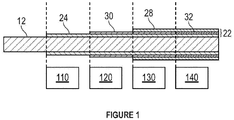
- the coated ceramic fiber includes ceramic fiber 12 and a multi-layer interface coating 22.
- the multi-layer interface coating 22 as shown includes three coating layers 24, 32 and 28.
- Exemplary ceramic fiber materials include silicon carbide, carbon, hafnium carbide, zirconium carbide, tantalum carbide, niobium carbide, boron carbide, titanium carbide, hafnium boride, zirconium boride, tantalum boride, niobium boride, titanium boride, aluminum oxide, mullite, and combinations thereof.
- the first interface layer 24 includes zirconium. A portion of the first interface layer is oxidized to form an initially formed zirconium dioxide layer 30.
- the third interface layer 28 (the additional interface layer) may include silicon carbide, zirconium, zirconium boride or a combination thereof.
- the first interface layer may have a thickness of 1000 nm to 20,000 nm, or, 2,000 nm to 10,000 nm.
- the second interface layer may have a thickness of 50 nm to 10,000 nm, or, 100 nm to 1,000 nm.
- the third interface layer may have a thickness of 1000 nm to 20,000 nm, or, 2000 nm to 10,000 nm.
- the first interface layer is deposited on the ceramic fiber by chemical vapor deposition (shown as step 110).
- the combination of the first interface layer and the ceramic fiber are then heat treated in the presence of oxygen to oxidize a portion of the first interface layer to form an initially formed zirconium dioxide layer 30 (shown as step 120).
- the zirconium dioxide layer 30 has a thickness less than 200 nm then the zirconium dioxide crystal structure may be tetragonal and after heating to a temperature greater than or equal to 1000°C and cooling will transform to a monoclinic crystal structure with micro cracks.
- the zirconium dioxide layer 30 has a thickness greater than 200 nm then the crystal structure may be monoclinic which will convert to tetragonal at a temperature greater than or equal to 1000°C and return to monoclinic with micro cracks upon cooling.
- an interdiffusion layer forms between the zirconium interface coating layer and the ceramic fiber.
- An additional interface coating layer 28 is deposited on the initially formed zirconium dioxide layer 30 (shown as step 130) after which the fiber with the multilayer coating is subjected to a heat treatment (shown as step 140) to change the crystal structure of the initially formed zirconium dioxide layer.
- Exemplary additional interface coating layer materials include zirconium, silicon carbide, zirconium boride or combinations thereof.
- the additional interface coating layer 28 may be deposited by chemical vapor deposition for example although other methods could be employed.
- Exemplary matrix materials include silicon carbide, aluminum oxide, mullite, cordierite, and combinations thereof.
- Exemplary heat treatment temperatures are 1250 to 1800 °C, or, 1250 to 1400°C.
- Exemplary times for the heat treatment include 1 minute to 100 hours, or, 10 minutes to 5 hours.
- the micro cracks in the zirconium dioxide interface coating layer provide protection to the fiber from matrix cracking by deflecting the cracks into the second interface layer.
- the first interlayer provides environmental protection to the fiber so the combination of layers results in a composite with more robust properties.
- the additional interface coating layer protects the micro cracked zirconium oxide interface layer.
Landscapes
- Chemical & Material Sciences (AREA)
- Engineering & Computer Science (AREA)
- Ceramic Engineering (AREA)
- Manufacturing & Machinery (AREA)
- Materials Engineering (AREA)
- Organic Chemistry (AREA)
- Structural Engineering (AREA)
- Inorganic Chemistry (AREA)
- Nanotechnology (AREA)
- Composite Materials (AREA)
- Chemical Kinetics & Catalysis (AREA)
- Inorganic Fibers (AREA)
- Chemical Or Physical Treatment Of Fibers (AREA)
Abstract
Description
- Exemplary embodiments pertain to the art of composites, including ceramic matrix composites.
- Composite components are finding increased use into aerospace applications due to their unique, tailorable properties which can result in significant weight savings, increased performance and durability, as well as reductions in specific fuel consumption. In particular, gas turbine engines, such as aircraft engines, operate in severe environments and show significant benefit from incorporation of composite materials. Additionally, other aerospace components, such as brakes, can benefit from incorporating composite materials.
- As an example, ceramic matrix composite (CMC) components have desirable high temperature mechanical, physical, and chemical properties which allow gas turbine engines to operate at much higher temperatures with significant weight savings as compared to current engines with superalloy components. As opposed to traditional, monolithic ceramics, CMCs exhibit a significant amount of damage tolerance when under an applied load. This damage tolerance is due in part to the formation of multiple matrix cracks that aid in the redistribution of stresses to the high strength fibers.
- The formation of matrix cracks can extend to the fiber and damage to the fiber may negatively impact the strength of the composite. Interface coatings have been used to address this issue. As CMCs, along with many other composites, are used under harsh environmental conditions improved interface coatings are desired.
- Disclosed is a coated ceramic fiber (e.g. as formed by the method disclosed herein) including or comprising a zirconium interface coating layer deposited on the ceramic fiber, a zirconium dioxide interface coating layer adjacent to the zirconium interface coating layer and an additional interface coating layer adjacent to the zirconium dioxide interface coating layer, wherein the zirconium dioxide interface coating layer forms cracks, e.g. micro cracks, after a crystal structure transformation.
- In addition to one or more of the features described above, or as an alternative to any of the foregoing embodiments, the zirconium dioxide interface coating layer has a thickness of 50 nanometers (nm) to 10,000 nm, or, 100 to 1,000 nm. Additionally or as an alternative, in some embodiments, the zirconium interface coating layer has a thickness of 1000 nm to 20,000 nm, or, 2,000 to 10,000 nm.
- In addition to one or more of the features described above, or as an alternative to any of the foregoing embodiments, the zirconium dioxide interface coating layer has a thickness greater than 200 nm and includes monoclinic zirconium dioxide which forms cracks, e.g. micro cracks, after transforming to tetragonal zirconium dioxide and back to monoclinic zirconium dioxide.
- In addition to one or more of the features described above, or as an alternative to any of the foregoing embodiments, the zirconium dioxide interface coating layer has a thickness less than 200 nm and includes tetragonal zirconium dioxide which forms cracks, e.g. micro cracks, after transforming to monoclinic zirconium dioxide.
- In addition to one or more of the features described above, or as an alternative to any of the foregoing embodiments, the additional interface coating layer has the same composition as the zirconium interface coating layer. Alternatively, the additional interface coating layer may have a different composition from the zirconium interface coating layer.
- Also disclosed is a composite material including a ceramic matrix material and a plurality of ceramic fibers, e.g. coated ceramic fibers, (e.g. as described herein and/or as formed by the method described herein) embedded within the (ceramic) matrix material. The plurality of fibers, e.g. ceramic fibers, includes a multi-layer interface coating. The multi-layer interface coating includes or comprises a zirconium interface coating layer deposited on the plurality of fibers, e.g. ceramic fibers, and a zirconium dioxide interface coating layer adjacent to the zirconium interface coating layer and an additional interface coating layer adjacent to the zirconium dioxide interface coating layer, wherein the zirconium dioxide interface coating layer forms cracks, e.g. micro cracks, after a crystal structure transformation.
- In addition to one or more of the features described above, or as an alternative to any of the foregoing embodiments, the zirconium dioxide interface coating layer has a thickness greater than 200 nm and includes monoclinic zirconium dioxide which forms cracks, e.g. micro cracks, after transforming to tetragonal zirconium dioxide and back to monoclinic zirconium dioxide.
- In addition to one or more of the features described above, or as an alternative to any of the foregoing embodiments, the zirconium dioxide interface coating layer has a thickness less than 200 nm and includes tetragonal zirconium dioxide which forms cracks, e.g. micro cracks, after transforming to monoclinic zirconium dioxide.
- In addition to one or more of the features described above, or as an alternative to any of the foregoing embodiments, the zirconium dioxide interface coating layer has a thickness of 50 nanometers (nm) to 10,000 nm, or, 100 to 1,000 nm. Additionally or as an alternative, in some embodiments, the zirconium interface coating layer has a thickness of 1000 nm to 20,000 nm, or, 2,000 to 10,000 nm.
- In addition to one or more of the features described above, or as an alternative to any of the foregoing embodiments, the additional interface coating layer can have the same composition as the zirconium interface coating layer. Alternatively, the additional interface coating layer can have a composition different from the zirconium interface coating layer.
- Also disclosed is a method for forming a multi-layer interface coating onto a ceramic fiber (e.g. to form a coated ceramic fiber as described herein) including or comprising depositing a zirconium interface coating layer onto or on the ceramic fiber, oxidizing a portion of the zirconium interface coating layer to form a zirconium dioxide interface coating layer, depositing an additional interface coating layer on the zirconium dioxide interface coating layer and heat treating the multilayer coating such that the zirconium dioxide interface coating layer forms cracks, e.g. micro cracks, after a crystal structure transformation.
- In addition to one or more of the features described above, or as an alternative to any of the foregoing embodiments, the zirconium dioxide interface coating layer has a thickness greater than 200 nm and includes or comprises monoclinic zirconium dioxide which forms cracks, e.g. micro cracks, after transforming to tetragonal zirconium dioxide and back to monoclinic zirconium dioxide.
- In addition to one or more of the features described above, or as an alternative to any of the foregoing embodiments, the zirconium dioxide interface coating layer has a thickness less than 200 nm and includes or comprises tetragonal zirconium dioxide which forms cracks, e.g. micro cracks, after transforming to monoclinic zirconium dioxide.
- The following descriptions should not be considered limiting in any way. With reference to the accompanying drawing, like elements are numbered alike:
-
Figure 1 shows a representative interface coating and method of making. - A detailed description of one or more embodiments of the disclosed coated fiber and method are presented herein by way of exemplification and not limitation with reference to
Figure 1 . - Composites exhibit a significant amount of damage tolerance when under an applied load. In ceramic matrix composites (CMC) in particular, this damage tolerance is due to the formation of multiple matrix cracks that aid in the redistribution of stresses. However, the formation of matrix cracks can result in environmental exposure to the fiber and fiber interface coating. The fiber interface coating protects the fiber from the environmental exposure and provides a weak interface to allow for composite behavior.
- The multi-layer interface coating described herein provides a weak interface with the fiber to allow for composite behavior and also provides environmental protection. The multiple layers can prevent crack propagation from reaching the fibers and protect the fiber from environmental degradation. In particular, the zirconium dioxide interface coating layer is a crystalline material which goes through a crystal structure transformation under conditions of normal use or heat treatment. The crystal structure transformation results in the presence of micro cracks which can deflect any matrix cracks from reaching the fiber.
- Referring now to
Figure 1 , a coated ceramic fiber for use in a composite is shown. The coated ceramic fiber includesceramic fiber 12 and amulti-layer interface coating 22. Themulti-layer interface coating 22 as shown includes threecoating layers - The
first interface layer 24 includes zirconium. A portion of the first interface layer is oxidized to form an initially formedzirconium dioxide layer 30. The third interface layer 28 (the additional interface layer) may include silicon carbide, zirconium, zirconium boride or a combination thereof. - The first interface layer may have a thickness of 1000 nm to 20,000 nm, or, 2,000 nm to 10,000 nm. The second interface layer may have a thickness of 50 nm to 10,000 nm, or, 100 nm to 1,000 nm. The third interface layer may have a thickness of 1000 nm to 20,000 nm, or, 2000 nm to 10,000 nm.
- The first interface layer is deposited on the ceramic fiber by chemical vapor deposition (shown as step 110). The combination of the first interface layer and the ceramic fiber are then heat treated in the presence of oxygen to oxidize a portion of the first interface layer to form an initially formed zirconium dioxide layer 30 (shown as step 120). If the
zirconium dioxide layer 30 has a thickness less than 200 nm then the zirconium dioxide crystal structure may be tetragonal and after heating to a temperature greater than or equal to 1000°C and cooling will transform to a monoclinic crystal structure with micro cracks. If thezirconium dioxide layer 30 has a thickness greater than 200 nm then the crystal structure may be monoclinic which will convert to tetragonal at a temperature greater than or equal to 1000°C and return to monoclinic with micro cracks upon cooling. - In some embodiments an interdiffusion layer forms between the zirconium interface coating layer and the ceramic fiber.
- An additional
interface coating layer 28 is deposited on the initially formed zirconium dioxide layer 30 (shown as step 130) after which the fiber with the multilayer coating is subjected to a heat treatment (shown as step 140) to change the crystal structure of the initially formed zirconium dioxide layer. Exemplary additional interface coating layer materials include zirconium, silicon carbide, zirconium boride or combinations thereof. The additionalinterface coating layer 28 may be deposited by chemical vapor deposition for example although other methods could be employed. Exemplary matrix materials include silicon carbide, aluminum oxide, mullite, cordierite, and combinations thereof. - Exemplary heat treatment temperatures (step 130) are 1250 to 1800 °C, or, 1250 to 1400°C. Exemplary times for the heat treatment include 1 minute to 100 hours, or, 10 minutes to 5 hours.
- The micro cracks in the zirconium dioxide interface coating layer provide protection to the fiber from matrix cracking by deflecting the cracks into the second interface layer. The first interlayer provides environmental protection to the fiber so the combination of layers results in a composite with more robust properties. The additional interface coating layer protects the micro cracked zirconium oxide interface layer.
- The terminology used herein is for the purpose of describing particular embodiments only and is not intended to be limiting of the present disclosure. As used herein, the singular forms "a", "an" and "the" are intended to include the plural forms as well, unless the context clearly indicates otherwise. The term "adjacent to" is defined as being in contact with the underlying material. It will be further understood that the terms "comprises" and/or "comprising," when used in this specification, specify the presence of stated features, integers, steps, operations, elements, and/or components, but do not preclude the presence or addition of one or more other features, integers, steps, operations, element components, and/or groups thereof.
- While the present disclosure has been described with reference to an exemplary embodiment or embodiments, it will be understood by those skilled in the art that various changes may be made and equivalents may be substituted for elements thereof without departing from the scope of the present disclosure. In addition, many modifications may be made to adapt a particular situation or material to the teachings of the present disclosure without departing from the essential scope thereof. Therefore, it is intended that the present disclosure not be limited to the particular embodiment disclosed as the best mode contemplated for carrying out this present disclosure, but that the present disclosure will include all embodiments falling within the scope of the claims.
Claims (15)
- A coated ceramic fiber comprising a zirconium interface coating layer deposited on the ceramic fiber, a zirconium dioxide interface coating layer adjacent to the zirconium interface coating layer, and an additional interface coating layer adjacent to the zirconium dioxide interface coating layer, wherein the zirconium dioxide interface coating layer forms micro cracks after a crystal structure transformation.
- The coated ceramic fiber of claim 1, wherein the zirconium dioxide interface coating layer has a thickness of 50 nm to 10,000 nm.
- The coated ceramic fiber of claim 1 or claim 2, wherein the zirconium interface coating layer has a thickness of 1000 nm to 20,000 nm.
- The coated ceramic fiber of any one of claims 1-3, wherein the zirconium dioxide interface coating layer has a thickness greater than 200 nm and includes monoclinic zirconium dioxide which forms micro cracks after transforming to tetragonal zirconium dioxide and back to monoclinic zirconium dioxide.
- The coated ceramic fiber of any one of claims 1-3, wherein the zirconium dioxide interface coating layer has a thickness less than 200 nm and includes tetragonal zirconium dioxide which forms micro cracks after transforming to monoclinic zirconium dioxide.
- The coated ceramic fiber of any one of claims 1-5, wherein the additional interface coating layer has the same composition as the zirconium interface coating layer, or wherein the additional interface coating layer has a different composition from the zirconium interface coating layer.
- A composite material comprising a ceramic matrix material and a plurality of ceramic fibers embedded within the ceramic matrix material wherein the plurality of ceramic fibers comprises a multi-layer interface coating and the multi-layer interface coating comprises a zirconium interface coating layer deposited on the plurality of ceramic fibers, a zirconium dioxide interface coating layer adjacent to the zirconium interface coating layer and an additional interface coating layer adjacent to the zirconium dioxide interface coating layer, wherein the zirconium dioxide interface coating layer forms micro cracks after a crystal structure transformation.
- The composite material of claim 7, wherein the zirconium dioxide interface coating layer has a thickness of 50 nm to 10,000 nm.
- The composite material of claim 7 or claim 8, wherein the zirconium interface coating layer has a thickness of 1000 nm to 20,000 nm.
- The composite material of any one of claims 7-9, wherein the zirconium dioxide interface coating layer has a thickness greater than 200 nm and includes monoclinic zirconium dioxide which forms micro cracks after transforming to tetragonal zirconium dioxide and back to monoclinic zirconium dioxide.
- The composite material of any one of claims 7-9, wherein the zirconium dioxide interface coating layer has a thickness less than 200 nm and includes tetragonal zirconium dioxide which forms micro cracks after transforming to monoclinic zirconium dioxide.
- The coated ceramic fiber of any one of claims 7-11, wherein the additional interface coating layer has the same composition as the zirconium interface coating layer, or wherein the additional interface coating layer has a different composition from the zirconium interface coating layer.
- A method for forming a multi-layer interface coating onto a ceramic fiber comprising depositing a zirconium interface coating layer on the ceramic fiber, oxidizing a portion of the zirconium interface coating layer to form a zirconium dioxide interface coating layer, depositing an additional interface coating layer on the zirconium dioxide interface coating layer and heat treating the multilayer coating such that the zirconium dioxide interface coating layer forms micro cracks after a crystal structure transformation.
- The method of claim 13, wherein the zirconium dioxide interface coating layer has a thickness greater than 200 nm and comprises monoclinic zirconium dioxide which forms micro cracks after transforming to tetragonal zirconium dioxide and back to monoclinic zirconium dioxide.
- The method of claim 13, wherein the zirconium dioxide interface coating layer has a thickness less than 200 nm and comprises tetragonal zirconium dioxide which forms micro cracks after transforming to monoclinic zirconium dioxide.
Applications Claiming Priority (1)
| Application Number | Priority Date | Filing Date | Title |
|---|---|---|---|
| US16/678,833 US12391622B2 (en) | 2019-11-08 | 2019-11-08 | Microstructured fiber interface coatings for composites |
Publications (2)
| Publication Number | Publication Date |
|---|---|
| EP3819276A1 true EP3819276A1 (en) | 2021-05-12 |
| EP3819276B1 EP3819276B1 (en) | 2024-04-24 |
Family
ID=73138755
Family Applications (1)
| Application Number | Title | Priority Date | Filing Date |
|---|---|---|---|
| EP20206017.4A Active EP3819276B1 (en) | 2019-11-08 | 2020-11-05 | Microstructured fiber interface coatings for composites |
Country Status (2)
| Country | Link |
|---|---|
| US (2) | US12391622B2 (en) |
| EP (1) | EP3819276B1 (en) |
Families Citing this family (1)
| Publication number | Priority date | Publication date | Assignee | Title |
|---|---|---|---|---|
| US11565977B2 (en) | 2019-11-08 | 2023-01-31 | Raytheon Technologies Corporation | Microstructured fiber interface coatings for composites |
Citations (2)
| Publication number | Priority date | Publication date | Assignee | Title |
|---|---|---|---|---|
| US5110771A (en) * | 1991-03-13 | 1992-05-05 | Northrop Corporation | Method of forming a precracked fiber coating for toughening ceramic fiber-matrix composites |
| US20150274979A1 (en) * | 2013-03-14 | 2015-10-01 | Rolls-Royce Corporation | Multi-layer fiber coatings |
Family Cites Families (19)
| Publication number | Priority date | Publication date | Assignee | Title |
|---|---|---|---|---|
| US2674445A (en) | 1951-02-13 | 1954-04-06 | John Deca Mines Furnace Inc | Furnace for exfoliating perlite or the like |
| US3326704A (en) | 1965-09-03 | 1967-06-20 | Harbison Walker Refractories | Production of vitreous silica in a rotary kiln |
| US4668579A (en) | 1984-02-01 | 1987-05-26 | The United States Of America As Represented By The Secretary Of The Air Force | Interstitially protected oxidation resistant carbon-carbon composite |
| US4623228A (en) | 1984-10-25 | 1986-11-18 | United Technologies Corporation | Composite mirror substrate |
| US4657877A (en) * | 1986-05-21 | 1987-04-14 | The United States Of America As Represented By The United States Department Of Energy | Silicon carbide whisker-zirconia reinforced mullite and alumina ceramics |
| US5585165A (en) | 1987-06-12 | 1996-12-17 | Lanxide Technology Company, Lp | Composite materials and methods for making the same |
| US5284685A (en) | 1988-08-31 | 1994-02-08 | Aerospatiale Societe Nationale Industrielle | Composite material with carbon reinforced fibers and its production |
| US5275984A (en) * | 1991-03-13 | 1994-01-04 | Northrop Corporation | Fiber coating of unbonded multi-layers for toughening ceramic fiber-matrix composites |
| US5455106A (en) * | 1993-10-06 | 1995-10-03 | Hyper-Therm High Temperature Composites, Inc. | Multilayer fiber coating comprising alternate fugitive carbon and ceramic coating material for toughened ceramic composite materials |
| US5723213A (en) | 1995-10-18 | 1998-03-03 | Northrop Grumman Corporation | Integrated multiple-ceramic-layer fiber interfacial coating |
| US6194083B1 (en) | 1997-07-28 | 2001-02-27 | Kabushiki Kaisha Toshiba | Ceramic composite material and its manufacturing method, and heat resistant member using thereof |
| US6322889B1 (en) | 1998-04-23 | 2001-11-27 | The United States Of America As Represented By The United States Department Of Energy | Oxidation-resistant interfacial coating for fiber-reinforced ceramic |
| US6361888B1 (en) | 1999-01-19 | 2002-03-26 | The Board Of Trustees Of The University Of Illinois | Toughening of ceramic composites by transformation weakening of interphases |
| US6441341B1 (en) | 2000-06-16 | 2002-08-27 | General Electric Company | Method of forming cooling holes in a ceramic matrix composite turbine components |
| US20060163773A1 (en) | 2005-01-24 | 2006-07-27 | General Electric Company | Method for performing silicon melt infiltration of ceramic matrix composites |
| WO2007098152A2 (en) | 2006-02-20 | 2007-08-30 | Lee Kang N | Article including enviromental barrier coating system |
| CN107001160B (en) | 2014-08-25 | 2022-12-13 | 通用电气公司 | Article for high temperature operation |
| US20160376691A1 (en) | 2015-05-27 | 2016-12-29 | University Of Virginia Patent Foundation | Multilayered thermal and environmental barrier coating (ebc) for high temperature applications and method thereof |
| US11565977B2 (en) | 2019-11-08 | 2023-01-31 | Raytheon Technologies Corporation | Microstructured fiber interface coatings for composites |
-
2019
- 2019-11-08 US US16/678,833 patent/US12391622B2/en active Active
-
2020
- 2020-11-05 EP EP20206017.4A patent/EP3819276B1/en active Active
-
2025
- 2025-07-30 US US19/284,921 patent/US20250353795A1/en active Pending
Patent Citations (2)
| Publication number | Priority date | Publication date | Assignee | Title |
|---|---|---|---|---|
| US5110771A (en) * | 1991-03-13 | 1992-05-05 | Northrop Corporation | Method of forming a precracked fiber coating for toughening ceramic fiber-matrix composites |
| US20150274979A1 (en) * | 2013-03-14 | 2015-10-01 | Rolls-Royce Corporation | Multi-layer fiber coatings |
Also Published As
| Publication number | Publication date |
|---|---|
| US20210139384A1 (en) | 2021-05-13 |
| US20250353795A1 (en) | 2025-11-20 |
| EP3819276B1 (en) | 2024-04-24 |
| US12391622B2 (en) | 2025-08-19 |
Similar Documents
| Publication | Publication Date | Title |
|---|---|---|
| US20090324930A1 (en) | Protective coatings for silicon based substrates with improved adhesion | |
| CN100415693C (en) | Coating systems for silicon-based substrates | |
| EP3252278B1 (en) | High temperature composites with enhanced matrix | |
| US12428351B2 (en) | Microstructured fiber interface coatings for composites | |
| US7449254B2 (en) | Environmental barrier coating with physical barrier layer for silicon-comprising materials | |
| US8475945B2 (en) | Composite article including silicon oxycarbide layer | |
| EP1683775B1 (en) | Thermal/environmental barrier coating with transition layer for silicon comprising materials | |
| US6517960B1 (en) | Ceramic with zircon coating | |
| US9764989B2 (en) | Reactive fiber interface coatings for improved environmental stability | |
| US9963396B2 (en) | Environmental barrier fiber coating | |
| US12410107B2 (en) | Nanolaminate fiber interface coatings for composites | |
| US20250353795A1 (en) | Microstructured fiber interface coatings for composites | |
| US20100179045A1 (en) | Methods and apparatus relating to a composite material | |
| EP2905271A1 (en) | Ceramic matrix composite for high temperature application containing ceramic fibers coated with a MAX phase | |
| EP1683774B1 (en) | Thermal/environmental barrier coating for silicon-comprising materials | |
| CN105671619A (en) | Methods of forming an article using electrophoretic deposition, and related article | |
| EP4306497A1 (en) | Multilayer interface coating with thermally-grown oxide for improved durability |
Legal Events
| Date | Code | Title | Description |
|---|---|---|---|
| PUAI | Public reference made under article 153(3) epc to a published international application that has entered the european phase |
Free format text: ORIGINAL CODE: 0009012 |
|
| STAA | Information on the status of an ep patent application or granted ep patent |
Free format text: STATUS: THE APPLICATION HAS BEEN PUBLISHED |
|
| AK | Designated contracting states |
Kind code of ref document: A1 Designated state(s): AL AT BE BG CH CY CZ DE DK EE ES FI FR GB GR HR HU IE IS IT LI LT LU LV MC MK MT NL NO PL PT RO RS SE SI SK SM TR |
|
| RIN1 | Information on inventor provided before grant (corrected) |
Inventor name: JACKSON, RICHARD WESLEY Inventor name: SHE, YING Inventor name: SRINIVASAN, GAJAWALLI V. |
|
| STAA | Information on the status of an ep patent application or granted ep patent |
Free format text: STATUS: REQUEST FOR EXAMINATION WAS MADE |
|
| 17P | Request for examination filed |
Effective date: 20211111 |
|
| RBV | Designated contracting states (corrected) |
Designated state(s): AL AT BE BG CH CY CZ DE DK EE ES FI FR GB GR HR HU IE IS IT LI LT LU LV MC MK MT NL NO PL PT RO RS SE SI SK SM TR |
|
| RAP3 | Party data changed (applicant data changed or rights of an application transferred) |
Owner name: RTX CORPORATION |
|
| GRAP | Despatch of communication of intention to grant a patent |
Free format text: ORIGINAL CODE: EPIDOSNIGR1 |
|
| STAA | Information on the status of an ep patent application or granted ep patent |
Free format text: STATUS: GRANT OF PATENT IS INTENDED |
|
| INTG | Intention to grant announced |
Effective date: 20231201 |
|
| GRAS | Grant fee paid |
Free format text: ORIGINAL CODE: EPIDOSNIGR3 |
|
| GRAA | (expected) grant |
Free format text: ORIGINAL CODE: 0009210 |
|
| STAA | Information on the status of an ep patent application or granted ep patent |
Free format text: STATUS: THE PATENT HAS BEEN GRANTED |
|
| AK | Designated contracting states |
Kind code of ref document: B1 Designated state(s): AL AT BE BG CH CY CZ DE DK EE ES FI FR GB GR HR HU IE IS IT LI LT LU LV MC MK MT NL NO PL PT RO RS SE SI SK SM TR |
|
| REG | Reference to a national code |
Ref country code: GB Ref legal event code: FG4D |
|
| REG | Reference to a national code |
Ref country code: CH Ref legal event code: EP |
|
| REG | Reference to a national code |
Ref country code: DE Ref legal event code: R096 Ref document number: 602020029457 Country of ref document: DE |
|
| REG | Reference to a national code |
Ref country code: IE Ref legal event code: FG4D |
|
| REG | Reference to a national code |
Ref country code: LT Ref legal event code: MG9D |
|
| REG | Reference to a national code |
Ref country code: NL Ref legal event code: MP Effective date: 20240424 |
|
| REG | Reference to a national code |
Ref country code: AT Ref legal event code: MK05 Ref document number: 1679457 Country of ref document: AT Kind code of ref document: T Effective date: 20240424 |
|
| PG25 | Lapsed in a contracting state [announced via postgrant information from national office to epo] |
Ref country code: NL Free format text: LAPSE BECAUSE OF FAILURE TO SUBMIT A TRANSLATION OF THE DESCRIPTION OR TO PAY THE FEE WITHIN THE PRESCRIBED TIME-LIMIT Effective date: 20240424 |
|
| PG25 | Lapsed in a contracting state [announced via postgrant information from national office to epo] |
Ref country code: NL Free format text: LAPSE BECAUSE OF FAILURE TO SUBMIT A TRANSLATION OF THE DESCRIPTION OR TO PAY THE FEE WITHIN THE PRESCRIBED TIME-LIMIT Effective date: 20240424 |
|
| PG25 | Lapsed in a contracting state [announced via postgrant information from national office to epo] |
Ref country code: IS Free format text: LAPSE BECAUSE OF FAILURE TO SUBMIT A TRANSLATION OF THE DESCRIPTION OR TO PAY THE FEE WITHIN THE PRESCRIBED TIME-LIMIT Effective date: 20240824 |
|
| PG25 | Lapsed in a contracting state [announced via postgrant information from national office to epo] |
Ref country code: BG Free format text: LAPSE BECAUSE OF FAILURE TO SUBMIT A TRANSLATION OF THE DESCRIPTION OR TO PAY THE FEE WITHIN THE PRESCRIBED TIME-LIMIT Effective date: 20240424 |
|
| PG25 | Lapsed in a contracting state [announced via postgrant information from national office to epo] |
Ref country code: HR Free format text: LAPSE BECAUSE OF FAILURE TO SUBMIT A TRANSLATION OF THE DESCRIPTION OR TO PAY THE FEE WITHIN THE PRESCRIBED TIME-LIMIT Effective date: 20240424 Ref country code: FI Free format text: LAPSE BECAUSE OF FAILURE TO SUBMIT A TRANSLATION OF THE DESCRIPTION OR TO PAY THE FEE WITHIN THE PRESCRIBED TIME-LIMIT Effective date: 20240424 |
|
| PG25 | Lapsed in a contracting state [announced via postgrant information from national office to epo] |
Ref country code: GR Free format text: LAPSE BECAUSE OF FAILURE TO SUBMIT A TRANSLATION OF THE DESCRIPTION OR TO PAY THE FEE WITHIN THE PRESCRIBED TIME-LIMIT Effective date: 20240725 |
|
| PG25 | Lapsed in a contracting state [announced via postgrant information from national office to epo] |
Ref country code: PT Free format text: LAPSE BECAUSE OF FAILURE TO SUBMIT A TRANSLATION OF THE DESCRIPTION OR TO PAY THE FEE WITHIN THE PRESCRIBED TIME-LIMIT Effective date: 20240826 |
|
| PG25 | Lapsed in a contracting state [announced via postgrant information from national office to epo] |
Ref country code: ES Free format text: LAPSE BECAUSE OF FAILURE TO SUBMIT A TRANSLATION OF THE DESCRIPTION OR TO PAY THE FEE WITHIN THE PRESCRIBED TIME-LIMIT Effective date: 20240424 |
|
| PG25 | Lapsed in a contracting state [announced via postgrant information from national office to epo] |
Ref country code: AT Free format text: LAPSE BECAUSE OF FAILURE TO SUBMIT A TRANSLATION OF THE DESCRIPTION OR TO PAY THE FEE WITHIN THE PRESCRIBED TIME-LIMIT Effective date: 20240424 |
|
| PG25 | Lapsed in a contracting state [announced via postgrant information from national office to epo] |
Ref country code: PL Free format text: LAPSE BECAUSE OF FAILURE TO SUBMIT A TRANSLATION OF THE DESCRIPTION OR TO PAY THE FEE WITHIN THE PRESCRIBED TIME-LIMIT Effective date: 20240424 |
|
| PG25 | Lapsed in a contracting state [announced via postgrant information from national office to epo] |
Ref country code: LV Free format text: LAPSE BECAUSE OF FAILURE TO SUBMIT A TRANSLATION OF THE DESCRIPTION OR TO PAY THE FEE WITHIN THE PRESCRIBED TIME-LIMIT Effective date: 20240424 |
|
| PG25 | Lapsed in a contracting state [announced via postgrant information from national office to epo] |
Ref country code: PT Free format text: LAPSE BECAUSE OF FAILURE TO SUBMIT A TRANSLATION OF THE DESCRIPTION OR TO PAY THE FEE WITHIN THE PRESCRIBED TIME-LIMIT Effective date: 20240826 Ref country code: PL Free format text: LAPSE BECAUSE OF FAILURE TO SUBMIT A TRANSLATION OF THE DESCRIPTION OR TO PAY THE FEE WITHIN THE PRESCRIBED TIME-LIMIT Effective date: 20240424 Ref country code: NO Free format text: LAPSE BECAUSE OF FAILURE TO SUBMIT A TRANSLATION OF THE DESCRIPTION OR TO PAY THE FEE WITHIN THE PRESCRIBED TIME-LIMIT Effective date: 20240724 Ref country code: LV Free format text: LAPSE BECAUSE OF FAILURE TO SUBMIT A TRANSLATION OF THE DESCRIPTION OR TO PAY THE FEE WITHIN THE PRESCRIBED TIME-LIMIT Effective date: 20240424 Ref country code: IS Free format text: LAPSE BECAUSE OF FAILURE TO SUBMIT A TRANSLATION OF THE DESCRIPTION OR TO PAY THE FEE WITHIN THE PRESCRIBED TIME-LIMIT Effective date: 20240824 Ref country code: HR Free format text: LAPSE BECAUSE OF FAILURE TO SUBMIT A TRANSLATION OF THE DESCRIPTION OR TO PAY THE FEE WITHIN THE PRESCRIBED TIME-LIMIT Effective date: 20240424 Ref country code: GR Free format text: LAPSE BECAUSE OF FAILURE TO SUBMIT A TRANSLATION OF THE DESCRIPTION OR TO PAY THE FEE WITHIN THE PRESCRIBED TIME-LIMIT Effective date: 20240725 Ref country code: FI Free format text: LAPSE BECAUSE OF FAILURE TO SUBMIT A TRANSLATION OF THE DESCRIPTION OR TO PAY THE FEE WITHIN THE PRESCRIBED TIME-LIMIT Effective date: 20240424 Ref country code: ES Free format text: LAPSE BECAUSE OF FAILURE TO SUBMIT A TRANSLATION OF THE DESCRIPTION OR TO PAY THE FEE WITHIN THE PRESCRIBED TIME-LIMIT Effective date: 20240424 Ref country code: BG Free format text: LAPSE BECAUSE OF FAILURE TO SUBMIT A TRANSLATION OF THE DESCRIPTION OR TO PAY THE FEE WITHIN THE PRESCRIBED TIME-LIMIT Effective date: 20240424 Ref country code: AT Free format text: LAPSE BECAUSE OF FAILURE TO SUBMIT A TRANSLATION OF THE DESCRIPTION OR TO PAY THE FEE WITHIN THE PRESCRIBED TIME-LIMIT Effective date: 20240424 Ref country code: RS Free format text: LAPSE BECAUSE OF FAILURE TO SUBMIT A TRANSLATION OF THE DESCRIPTION OR TO PAY THE FEE WITHIN THE PRESCRIBED TIME-LIMIT Effective date: 20240724 |
|
| PG25 | Lapsed in a contracting state [announced via postgrant information from national office to epo] |
Ref country code: DK Free format text: LAPSE BECAUSE OF FAILURE TO SUBMIT A TRANSLATION OF THE DESCRIPTION OR TO PAY THE FEE WITHIN THE PRESCRIBED TIME-LIMIT Effective date: 20240424 |
|
| PG25 | Lapsed in a contracting state [announced via postgrant information from national office to epo] |
Ref country code: EE Free format text: LAPSE BECAUSE OF FAILURE TO SUBMIT A TRANSLATION OF THE DESCRIPTION OR TO PAY THE FEE WITHIN THE PRESCRIBED TIME-LIMIT Effective date: 20240424 |
|
| PG25 | Lapsed in a contracting state [announced via postgrant information from national office to epo] |
Ref country code: CZ Free format text: LAPSE BECAUSE OF FAILURE TO SUBMIT A TRANSLATION OF THE DESCRIPTION OR TO PAY THE FEE WITHIN THE PRESCRIBED TIME-LIMIT Effective date: 20240424 |
|
| PG25 | Lapsed in a contracting state [announced via postgrant information from national office to epo] |
Ref country code: RO Free format text: LAPSE BECAUSE OF FAILURE TO SUBMIT A TRANSLATION OF THE DESCRIPTION OR TO PAY THE FEE WITHIN THE PRESCRIBED TIME-LIMIT Effective date: 20240424 Ref country code: SK Free format text: LAPSE BECAUSE OF FAILURE TO SUBMIT A TRANSLATION OF THE DESCRIPTION OR TO PAY THE FEE WITHIN THE PRESCRIBED TIME-LIMIT Effective date: 20240424 |
|
| REG | Reference to a national code |
Ref country code: DE Ref legal event code: R097 Ref document number: 602020029457 Country of ref document: DE |
|
| PG25 | Lapsed in a contracting state [announced via postgrant information from national office to epo] |
Ref country code: SM Free format text: LAPSE BECAUSE OF FAILURE TO SUBMIT A TRANSLATION OF THE DESCRIPTION OR TO PAY THE FEE WITHIN THE PRESCRIBED TIME-LIMIT Effective date: 20240424 |
|
| PG25 | Lapsed in a contracting state [announced via postgrant information from national office to epo] |
Ref country code: SM Free format text: LAPSE BECAUSE OF FAILURE TO SUBMIT A TRANSLATION OF THE DESCRIPTION OR TO PAY THE FEE WITHIN THE PRESCRIBED TIME-LIMIT Effective date: 20240424 Ref country code: SK Free format text: LAPSE BECAUSE OF FAILURE TO SUBMIT A TRANSLATION OF THE DESCRIPTION OR TO PAY THE FEE WITHIN THE PRESCRIBED TIME-LIMIT Effective date: 20240424 Ref country code: RO Free format text: LAPSE BECAUSE OF FAILURE TO SUBMIT A TRANSLATION OF THE DESCRIPTION OR TO PAY THE FEE WITHIN THE PRESCRIBED TIME-LIMIT Effective date: 20240424 Ref country code: EE Free format text: LAPSE BECAUSE OF FAILURE TO SUBMIT A TRANSLATION OF THE DESCRIPTION OR TO PAY THE FEE WITHIN THE PRESCRIBED TIME-LIMIT Effective date: 20240424 Ref country code: DK Free format text: LAPSE BECAUSE OF FAILURE TO SUBMIT A TRANSLATION OF THE DESCRIPTION OR TO PAY THE FEE WITHIN THE PRESCRIBED TIME-LIMIT Effective date: 20240424 Ref country code: CZ Free format text: LAPSE BECAUSE OF FAILURE TO SUBMIT A TRANSLATION OF THE DESCRIPTION OR TO PAY THE FEE WITHIN THE PRESCRIBED TIME-LIMIT Effective date: 20240424 |
|
| PLBE | No opposition filed within time limit |
Free format text: ORIGINAL CODE: 0009261 |
|
| STAA | Information on the status of an ep patent application or granted ep patent |
Free format text: STATUS: NO OPPOSITION FILED WITHIN TIME LIMIT |
|
| 26N | No opposition filed |
Effective date: 20250127 |
|
| PG25 | Lapsed in a contracting state [announced via postgrant information from national office to epo] |
Ref country code: SI Free format text: LAPSE BECAUSE OF FAILURE TO SUBMIT A TRANSLATION OF THE DESCRIPTION OR TO PAY THE FEE WITHIN THE PRESCRIBED TIME-LIMIT Effective date: 20240424 |
|
| REG | Reference to a national code |
Ref country code: CH Ref legal event code: PL |
|
| PG25 | Lapsed in a contracting state [announced via postgrant information from national office to epo] |
Ref country code: MC Free format text: LAPSE BECAUSE OF FAILURE TO SUBMIT A TRANSLATION OF THE DESCRIPTION OR TO PAY THE FEE WITHIN THE PRESCRIBED TIME-LIMIT Effective date: 20240424 |
|
| PG25 | Lapsed in a contracting state [announced via postgrant information from national office to epo] |
Ref country code: LU Free format text: LAPSE BECAUSE OF NON-PAYMENT OF DUE FEES Effective date: 20241105 |
|
| REG | Reference to a national code |
Ref country code: CH Ref legal event code: PL |
|
| PG25 | Lapsed in a contracting state [announced via postgrant information from national office to epo] |
Ref country code: CH Free format text: LAPSE BECAUSE OF NON-PAYMENT OF DUE FEES Effective date: 20241130 |
|
| REG | Reference to a national code |
Ref country code: BE Ref legal event code: MM Effective date: 20241130 |
|
| PG25 | Lapsed in a contracting state [announced via postgrant information from national office to epo] |
Ref country code: SE Free format text: LAPSE BECAUSE OF FAILURE TO SUBMIT A TRANSLATION OF THE DESCRIPTION OR TO PAY THE FEE WITHIN THE PRESCRIBED TIME-LIMIT Effective date: 20240424 |
|
| PG25 | Lapsed in a contracting state [announced via postgrant information from national office to epo] |
Ref country code: BE Free format text: LAPSE BECAUSE OF NON-PAYMENT OF DUE FEES Effective date: 20241130 |
|
| PG25 | Lapsed in a contracting state [announced via postgrant information from national office to epo] |
Ref country code: IE Free format text: LAPSE BECAUSE OF NON-PAYMENT OF DUE FEES Effective date: 20241105 |
|
| PGFP | Annual fee paid to national office [announced via postgrant information from national office to epo] |
Ref country code: DE Payment date: 20251022 Year of fee payment: 6 |
|
| PGFP | Annual fee paid to national office [announced via postgrant information from national office to epo] |
Ref country code: GB Payment date: 20251022 Year of fee payment: 6 |
|
| PGFP | Annual fee paid to national office [announced via postgrant information from national office to epo] |
Ref country code: FR Payment date: 20251022 Year of fee payment: 6 |
|
| PG25 | Lapsed in a contracting state [announced via postgrant information from national office to epo] |
Ref country code: IT Free format text: LAPSE BECAUSE OF FAILURE TO SUBMIT A TRANSLATION OF THE DESCRIPTION OR TO PAY THE FEE WITHIN THE PRESCRIBED TIME-LIMIT Effective date: 20240424 |
|
| PG25 | Lapsed in a contracting state [announced via postgrant information from national office to epo] |
Ref country code: HU Free format text: LAPSE BECAUSE OF FAILURE TO SUBMIT A TRANSLATION OF THE DESCRIPTION OR TO PAY THE FEE WITHIN THE PRESCRIBED TIME-LIMIT; INVALID AB INITIO Effective date: 20201105 |
|
| PG25 | Lapsed in a contracting state [announced via postgrant information from national office to epo] |
Ref country code: CY Free format text: LAPSE BECAUSE OF FAILURE TO SUBMIT A TRANSLATION OF THE DESCRIPTION OR TO PAY THE FEE WITHIN THE PRESCRIBED TIME-LIMIT; INVALID AB INITIO Effective date: 20201105 |