EP3819205B1 - Speed control device, automatic navigation system, and speed control method - Google Patents
Speed control device, automatic navigation system, and speed control method Download PDFInfo
- Publication number
- EP3819205B1 EP3819205B1 EP19831451.0A EP19831451A EP3819205B1 EP 3819205 B1 EP3819205 B1 EP 3819205B1 EP 19831451 A EP19831451 A EP 19831451A EP 3819205 B1 EP3819205 B1 EP 3819205B1
- Authority
- EP
- European Patent Office
- Prior art keywords
- speed
- change
- module
- target
- throttle opening
- Prior art date
- Legal status (The legal status is an assumption and is not a legal conclusion. Google has not performed a legal analysis and makes no representation as to the accuracy of the status listed.)
- Active
Links
Images




Classifications
-
- F—MECHANICAL ENGINEERING; LIGHTING; HEATING; WEAPONS; BLASTING
- F02—COMBUSTION ENGINES; HOT-GAS OR COMBUSTION-PRODUCT ENGINE PLANTS
- F02D—CONTROLLING COMBUSTION ENGINES
- F02D41/00—Electrical control of supply of combustible mixture or its constituents
- F02D41/02—Circuit arrangements for generating control signals
- F02D41/021—Introducing corrections for particular conditions exterior to the engine
-
- B—PERFORMING OPERATIONS; TRANSPORTING
- B60—VEHICLES IN GENERAL
- B60K—ARRANGEMENT OR MOUNTING OF PROPULSION UNITS OR OF TRANSMISSIONS IN VEHICLES; ARRANGEMENT OR MOUNTING OF PLURAL DIVERSE PRIME-MOVERS IN VEHICLES; AUXILIARY DRIVES FOR VEHICLES; INSTRUMENTATION OR DASHBOARDS FOR VEHICLES; ARRANGEMENTS IN CONNECTION WITH COOLING, AIR INTAKE, GAS EXHAUST OR FUEL SUPPLY OF PROPULSION UNITS IN VEHICLES
- B60K31/00—Vehicle fittings, acting on a single sub-unit only, for automatically controlling vehicle speed, i.e. preventing speed from exceeding an arbitrarily established velocity or maintaining speed at a particular velocity, as selected by the vehicle operator
- B60K31/0066—Vehicle fittings, acting on a single sub-unit only, for automatically controlling vehicle speed, i.e. preventing speed from exceeding an arbitrarily established velocity or maintaining speed at a particular velocity, as selected by the vehicle operator responsive to vehicle path curvature
-
- B—PERFORMING OPERATIONS; TRANSPORTING
- B60—VEHICLES IN GENERAL
- B60W—CONJOINT CONTROL OF VEHICLE SUB-UNITS OF DIFFERENT TYPE OR DIFFERENT FUNCTION; CONTROL SYSTEMS SPECIALLY ADAPTED FOR HYBRID VEHICLES; ROAD VEHICLE DRIVE CONTROL SYSTEMS FOR PURPOSES NOT RELATED TO THE CONTROL OF A PARTICULAR SUB-UNIT
- B60W30/00—Purposes of road vehicle drive control systems not related to the control of a particular sub-unit, e.g. of systems using conjoint control of vehicle sub-units
- B60W30/14—Adaptive cruise control
- B60W30/143—Speed control
-
- B—PERFORMING OPERATIONS; TRANSPORTING
- B60—VEHICLES IN GENERAL
- B60W—CONJOINT CONTROL OF VEHICLE SUB-UNITS OF DIFFERENT TYPE OR DIFFERENT FUNCTION; CONTROL SYSTEMS SPECIALLY ADAPTED FOR HYBRID VEHICLES; ROAD VEHICLE DRIVE CONTROL SYSTEMS FOR PURPOSES NOT RELATED TO THE CONTROL OF A PARTICULAR SUB-UNIT
- B60W50/00—Details of control systems for road vehicle drive control not related to the control of a particular sub-unit, e.g. process diagnostic or vehicle driver interfaces
-
- B—PERFORMING OPERATIONS; TRANSPORTING
- B63—SHIPS OR OTHER WATERBORNE VESSELS; RELATED EQUIPMENT
- B63B—SHIPS OR OTHER WATERBORNE VESSELS; EQUIPMENT FOR SHIPPING
- B63B49/00—Arrangements of nautical instruments or navigational aids
-
- B—PERFORMING OPERATIONS; TRANSPORTING
- B63—SHIPS OR OTHER WATERBORNE VESSELS; RELATED EQUIPMENT
- B63H—MARINE PROPULSION OR STEERING
- B63H21/00—Use of propulsion power plant or units on vessels
- B63H21/21—Control means for engine or transmission, specially adapted for use on marine vessels
-
- B—PERFORMING OPERATIONS; TRANSPORTING
- B63—SHIPS OR OTHER WATERBORNE VESSELS; RELATED EQUIPMENT
- B63H—MARINE PROPULSION OR STEERING
- B63H21/00—Use of propulsion power plant or units on vessels
- B63H21/22—Use of propulsion power plant or units on vessels the propulsion power units being controlled from exterior of engine room, e.g. from navigation bridge; Arrangements of order telegraphs
-
- B—PERFORMING OPERATIONS; TRANSPORTING
- B63—SHIPS OR OTHER WATERBORNE VESSELS; RELATED EQUIPMENT
- B63H—MARINE PROPULSION OR STEERING
- B63H25/00—Steering; Slowing-down otherwise than by use of propulsive elements; Dynamic anchoring, i.e. positioning vessels by means of main or auxiliary propulsive elements
- B63H25/02—Initiating means for steering, for slowing down, otherwise than by use of propulsive elements, or for dynamic anchoring
- B63H25/04—Initiating means for steering, for slowing down, otherwise than by use of propulsive elements, or for dynamic anchoring automatic, e.g. reacting to compass
-
- B—PERFORMING OPERATIONS; TRANSPORTING
- B60—VEHICLES IN GENERAL
- B60W—CONJOINT CONTROL OF VEHICLE SUB-UNITS OF DIFFERENT TYPE OR DIFFERENT FUNCTION; CONTROL SYSTEMS SPECIALLY ADAPTED FOR HYBRID VEHICLES; ROAD VEHICLE DRIVE CONTROL SYSTEMS FOR PURPOSES NOT RELATED TO THE CONTROL OF A PARTICULAR SUB-UNIT
- B60W50/00—Details of control systems for road vehicle drive control not related to the control of a particular sub-unit, e.g. process diagnostic or vehicle driver interfaces
- B60W2050/0001—Details of the control system
- B60W2050/0002—Automatic control, details of type of controller or control system architecture
- B60W2050/0008—Feedback, closed loop systems or details of feedback error signal
- B60W2050/0011—Proportional Integral Differential [PID] controller
-
- B—PERFORMING OPERATIONS; TRANSPORTING
- B60—VEHICLES IN GENERAL
- B60W—CONJOINT CONTROL OF VEHICLE SUB-UNITS OF DIFFERENT TYPE OR DIFFERENT FUNCTION; CONTROL SYSTEMS SPECIALLY ADAPTED FOR HYBRID VEHICLES; ROAD VEHICLE DRIVE CONTROL SYSTEMS FOR PURPOSES NOT RELATED TO THE CONTROL OF A PARTICULAR SUB-UNIT
- B60W50/00—Details of control systems for road vehicle drive control not related to the control of a particular sub-unit, e.g. process diagnostic or vehicle driver interfaces
- B60W2050/0062—Adapting control system settings
- B60W2050/0075—Automatic parameter input, automatic initialising or calibrating means
- B60W2050/0083—Setting, resetting, calibration
- B60W2050/0088—Adaptive recalibration
-
- B—PERFORMING OPERATIONS; TRANSPORTING
- B60—VEHICLES IN GENERAL
- B60W—CONJOINT CONTROL OF VEHICLE SUB-UNITS OF DIFFERENT TYPE OR DIFFERENT FUNCTION; CONTROL SYSTEMS SPECIALLY ADAPTED FOR HYBRID VEHICLES; ROAD VEHICLE DRIVE CONTROL SYSTEMS FOR PURPOSES NOT RELATED TO THE CONTROL OF A PARTICULAR SUB-UNIT
- B60W2520/00—Input parameters relating to overall vehicle dynamics
- B60W2520/10—Longitudinal speed
-
- B—PERFORMING OPERATIONS; TRANSPORTING
- B60—VEHICLES IN GENERAL
- B60W—CONJOINT CONTROL OF VEHICLE SUB-UNITS OF DIFFERENT TYPE OR DIFFERENT FUNCTION; CONTROL SYSTEMS SPECIALLY ADAPTED FOR HYBRID VEHICLES; ROAD VEHICLE DRIVE CONTROL SYSTEMS FOR PURPOSES NOT RELATED TO THE CONTROL OF A PARTICULAR SUB-UNIT
- B60W2540/00—Input parameters relating to occupants
- B60W2540/18—Steering angle
-
- B—PERFORMING OPERATIONS; TRANSPORTING
- B60—VEHICLES IN GENERAL
- B60W—CONJOINT CONTROL OF VEHICLE SUB-UNITS OF DIFFERENT TYPE OR DIFFERENT FUNCTION; CONTROL SYSTEMS SPECIALLY ADAPTED FOR HYBRID VEHICLES; ROAD VEHICLE DRIVE CONTROL SYSTEMS FOR PURPOSES NOT RELATED TO THE CONTROL OF A PARTICULAR SUB-UNIT
- B60W2552/00—Input parameters relating to infrastructure
- B60W2552/30—Road curve radius
-
- B—PERFORMING OPERATIONS; TRANSPORTING
- B63—SHIPS OR OTHER WATERBORNE VESSELS; RELATED EQUIPMENT
- B63H—MARINE PROPULSION OR STEERING
- B63H21/00—Use of propulsion power plant or units on vessels
- B63H21/21—Control means for engine or transmission, specially adapted for use on marine vessels
- B63H2021/216—Control means for engine or transmission, specially adapted for use on marine vessels using electric control means
-
- F—MECHANICAL ENGINEERING; LIGHTING; HEATING; WEAPONS; BLASTING
- F02—COMBUSTION ENGINES; HOT-GAS OR COMBUSTION-PRODUCT ENGINE PLANTS
- F02D—CONTROLLING COMBUSTION ENGINES
- F02D41/00—Electrical control of supply of combustible mixture or its constituents
- F02D41/0002—Controlling intake air
Definitions
- the present disclosure mainly relates to a speed control device which performs an automatic tracking control in which a speed of a movable body, e.g. a ship, follows a speed setting set by a user.
- Patent Document 1 discloses this kind of ship navigation control system.
- the navigation control system of Patent Document 1 corrects a basic engine speed acquired from a map which associates a target ship speed with a basic engine speed, according to a difference between the target ship speed and the actual ship speed, and sets the corrected engine speed as the target engine speed to control the engine so that an actual ship speed approaches the target ship speed.
- Patent Document 1 JP2017-088119A Further technological background can be found in US 2007/155258 A1 , US 2018/057133 A1 and CN 103 293 952 A .
- Patent Document 1 needs to use the map which associates the target ship speed set in advance with the basic engine speed in order to make the ship speed follow the target ship speed, the computer resources are taken up. Note that since Patent Document 1 uses the map defined in advance, an acceleration and a deceleration are not easily adjustable while making the ship speed follow the target ship speed. Therefore, there is room for an improvement.
- the present disclosure is made in view of the above situations, and one purpose thereof is to provide a speed control device which is satisfactory in response and tracking to a speed setting, and can adjust an acceleration-and-deceleration feel according to preferences.
- a speed control device controls a speed of a movable body so that the speed automatically follows a speed setting set by a user.
- the speed control device includes a target speed setting module and a change rate adjusting module.
- the target speed setting module sets a target speed that is a target of the speed of the movable body to follow, for every unit time, according to the speed setting, to change the target speed based on a given rate of change.
- the change rate adjusting module decreases the rate of change by adjusting the rate of change at multiple stages, when the target speed set by the target speed setting module approaches the speed setting.
- the multiple-stage change of the speed with a plurality of rates of change can be achieved without requiring a given data, such as a speed-control map. Moreover, the occurrence of an overshoot can be reduced by decreasing the rate of change of the target speed which is the target for the speed of the movable body to follow, when the target speed approaches the speed setting.
- the speed control device preferably has the following configuration. That is, the rate of change in the target speed is acquired based on a given speed change parameter, and the speed change parameter includes the unit time and a reference amount of change in the target speed for every unit time.
- the change rate in the speed of the movable body i.e., acceleration/deceleration
- the change rate in the speed of the movable body i.e., acceleration/deceleration
- the change rate adjusting module preferably adjusts the rate of change to two different values based on the setting of the reference amount of change.
- the change rate in the target speed can easily be changed at two steps.
- the algorithm for the following to the speed setting can be simpler.
- the speed control device preferably has the following configuration. That is, the change rate adjusting module sets a first rate of change, a second rate of change smaller than the first rate of change, and a change speed at which the first rate of change is switched to the second rate of change, based on a given speed change parameter.
- the change rate adjusting module is adapted to, while the speed setting is above the speed of the movable body, output the first rate of change to the target speed setting module when the target speed set by the target speed setting module is at or below the change speed, and output the second rate of change to the target speed setting module when the target speed is above the change speed.
- the change rate adjusting module is adapted to, while the speed setting is below the speed of the movable body, output the first rate of change to the target speed setting module when the target speed set by the target speed setting module is at or above the change speed, and output the second rate of change to the target speed setting module when the target speed is below the change speed.
- the range of change of the target speed to which each rate of change is applied can be set.
- various acceleration-and-deceleration feels can be achieved.
- the speed control device has the following configuration. That is, the speed control device includes a base throttle opening calculating module and a throttle opening outputting module.
- the base throttle opening calculating module calculates a base throttle opening related to a throttle opening control of an engine provided to the movable body, based on the target speed set by the target speed setting module.
- the throttle opening outputting module outputs the base throttle opening calculated by the base throttle opening calculating module to a control device of the engine as a throttle opening for control.
- the speed of the movable body can be controlled.
- the throttle opening outputting module outputs a given lower limit of the throttle opening to the control device of the engine as the throttle opening for control when the base throttle opening calculated by the base throttle opening calculating module is below the given lower limit of the throttle opening.
- the control taking a dead zone of a throttle into consideration can be performed, the user can quickly feel the speed change due to the speed setting, and a ride comfort can be improved.
- the speed control device preferably has the following configuration. That is, the speed control device includes an actual speed acquiring module, a memory, and a turning speed controlling module.
- the actual speed acquiring module acquires an actual speed that is a current speed of the movable body.
- the memory stores the speed setting as a turning start speed.
- the turning speed controlling module outputs a turning speed setting that is the speed setting during a turning of the movable body. While the movable body is turning, the turning speed controlling module sets the actual speed acquired by the actual speed acquiring module as the speed setting, when a turning angle of the movable body from a start of the tuning is within a given angle range.
- the acceleration/deceleration control during the turning can be stopped, and a natural and stable turning can be secured.
- the speed control device preferably has the following configuration. That is, the speed control device includes an actual speed acquiring module and a PID controlling module.
- the actual speed acquiring module acquires an actual speed that is a current speed of the movable body.
- the PID controlling module controls the speed of the movable body based on the target speed set by the target speed setting module and the actual speed acquired by the actual speed acquiring module so that the speed follows the target speed.
- the automatic navigation system includes the speed control device and a navigation device.
- the navigation device displays information related to navigation.
- the automatic navigation system which is satisfactory in response and tracking to the speed setting, and capable of improving the ride comfort, can be provided.
- a method of controlling a speed includes the steps of setting target speed that is a target of a speed of a movable body to follow for every unit time, according to a speed setting set by a user in order to make the speed of the movable body follow the target speed by the control to change the target speed based on a given rate of change, and adjusting the rate of change at a multiple stages when the set target speed approaches the speed setting to decrease the rate of change,
- the multiple-stage change of the speed with a plurality of rates of change can be achieved without requiring the given data, such as a speed-control map. Moreover, the occurrence of the overshoot can be reduced by decreasing the rate of change of the target speed which is the target for the speed of the movable body to follow, when the target speed approaches the speed setting.
- FIG. 1 is a block diagram schematically illustrating a configuration of an automatic navigation system 100 according to this embodiment of the present disclosure.
- the automatic navigation system 100 of this embodiment may be mounted on an unillustrated ship (movable body), and cause the ship to travel automatically according to a given navigation route/course.
- the automatic navigation system 100 may include a GNSS receiver 1, a bearing sensor 2, a radar device 3, a navigation device 4, an autopilot device 5, and an automatic speed controlling device (speed control device) 6. These devices may be connected with each other, for example, through a CAN bus 10 so that two-way communications are possible.
- CAN may be an abbreviation of "Controller Area Network.”
- the GNSS receiver 1 may receive positioning signals from a plurality of satellites by using GNSS antennas (not-illustrated), and detect information, such as the position of the ship and a traveling speed, based on the received positioning signals.
- the GNSS receiver 1 may output the detected information to the navigation device 4 and the autopilot device 5.
- the GNSS may include satellite positioning systems established in some countries and areas, such as GPS, GLONASS, Galileo, BeiDou, QZSS, and Gagan.
- the bearing sensor 2 may be constructed as a satellite compass provided with a plurality of GNSS antennas fixed to the ship, and measure a heading of the ship based on relative relations of the ship position detected by the GNSS antennas.
- the bearing sensor 2 may output the measured heading to the navigation device 4, the autopilot device 5, and the automatic speed controlling device 6.
- the bearing sensor 2 is not limited to the above configuration, and, for example, it may be comprised of a magnetic direction sensor, a gyrocompass, etc.
- the radar device 3 may generate a radar image indicative of a situation and position of a target object around the ship by transmitting and receiving an electric wave through a radar antenna (not-illustrated). The radar device 3 may output the generated radar image to the navigation device 4.
- the navigation device 4 may be installed in an operation room (e.g., a steering station) provided to the ship.
- a ship operator (user) can instruct information, such as a destination and a speed (a speed setting V S ), related to the navigation of the ship by operating the navigation device 4.
- the navigation device 4 may generate the navigation route/course based on the information set by the ship operator.
- the navigation device 4 can display the ship position, the navigation route/course setting, and a trace of the ship in such a form that they are superimposed on an electronic nautical chart.
- the autopilot device 5 may be comprised of a steering angle sensor 51 which detects a steering angle of a rudder 50 of the ship, a hydraulic pump 52 which drives the rudder 50, and a steering angle controller 53 which controls operation of the hydraulic pump 52.
- the autopilot device 5 can control the operation of the hydraulic pump 52 based on the information on the ship position and the heading inputted from the GNSS receiver 1 and the bearing sensor 2 to operate the rudder automatically so that the ship travels according to the navigation route/course set by the navigation device 4.
- the automatic speed controlling device 6 may control the traveling speed automatically so that the traveling speed of the ship follows the speed setting which is set by the ship operator.
- the automatic speed controlling device 6 may output an instruction for a throttle opening related to an intake air amount of an engine 9 which is a power source of the ship to an ECU (Engine Control Unit) 90 which is a control device for the engine 9 to control the output of the engine 9, thereby controlling the traveling speed of the ship.
- ECU Engine Control Unit
- the ECU 90 adjusts the opening of a throttle 92 by controlling an actuator 91 which drives the throttle 92 for adjusting the intake air amount of the engine 9.
- the automatic speed controlling device 6 may include an actual speed acquiring module 61, a memory 62, a target speed setting module 63, a change rate setting module (change rate adjusting module) 64, and a PID controlling module 65, a base opening calculating module (base throttle opening calculating module) 66, an opening limit processing module (throttle opening outputting module) 67, and a turning speed controlling module 68.
- the automatic speed controlling device 6 may make the traveling speed of the ship follow the speed setting V S which is set by the ship operator, by using an algorithm illustrated in Fig. 2 .
- the automatic speed controlling device 6 may set a target speed V T for the speed setting V S set by the ship operator so as to track or follow the speed setting V S by using a speed rate processing (described later), and output it to the PID controlling module 65.
- the automatic speed controlling device 6 may perform a PID control for the traveling speed so that the traveling speed of the ship follows the set target speed V T by using the PID controlling module 65.
- the target speed V T can be changed gradually, and the traveling speed of the ship can automatically follow the target speed V T suitably. That is, when the speed difference ⁇ V between the speed setting V S and the actual speed V is large, the automatic speed controlling device 6 of this embodiment can avoid a sudden acceleration/deceleration of the ship in case of the traveling speed simply following the speed setting V S , thereby achieving a satisfactory response and tracking performance.
- the automatic speed controlling device 6 may be provided with a known computer (not illustrated).
- the computer may include a CPU, a ROM, a RAM, and an I/O part, which are not illustrated.
- the ROM may store various programs, data, etc.
- the CPU can read and execute the various programs etc. from the ROM.
- the automatic speed controlling device 6 can operate the computer as the memory 62, the target speed setting module 63, the change rate setting module 64, the PID controlling module 65, the base opening calculating module 66, the opening limit processing module 67, and the turning speed controlling module 68, by collaboration of hardware and software.
- the actual speed acquiring module 61 may detect an actual speed V of the ship. Note that the actual speed may be a ground speed on the basis of the earth. The actual speed acquiring module 61 may acquire the actual speed (ground speed) of the ship, for example, by calculating a change in the position obtained by the GNSS receiver 1.
- the memory 62 may store various data related to a control of the traveling speed of the ship.
- the data may include parameters for the control, such as given parameters for calculation and speed change parameters set by the ship operator.
- the target speed setting module 63 may set a target speed V T for every unit time T 0 so that the traveling speed of the ship changes gradually until it reaches the speed setting V S set by the ship operator, for example, through the navigation device 4. That is, the target speed setting module 63 may change the target speed V T based on a given rate of change, by setting the target speed V T for every unit time T 0 . In other words, the target speed setting module 63 may change the target speed V T to be set, by a unit change amount ⁇ v U , during each given unit time T 0 , regardless of the speed difference ⁇ V between the speed setting V S and the actual speed V of the ship.
- the target speed setting module 63 may perform the speed rate processing illustrated in Fig. 3 for the purpose of avoiding that the traveling speed of the ship changes rapidly in a short period of time. Although in the speed rate processing of Fig. 3 processings at Steps S101-S109 may be repeated as a loop fashion, one loop is performed for every given unit time T 0 .
- the speed setting V S inputted in the current loop may be given a subscript "(n)” and referred to as the "speed setting V S(n) ,” and the speed setting V S inputted in the last loop may be given a subscript "(n-1)” and referred to as the “last speed setting V S(n-1) .”
- n may be an integer which is incremented by one for each loop.
- the target speed setting module 63 may determine whether a current target speed V T(n) of the ship is equal to the currently-inputted speed setting V S(n) (Step S101). If the current target speed V T(n) is equal to the speed setting V S(n) , since the target speed V T(n) does not need to be changed, the target speed setting module 63 may return to Step S101. As the result of the determination at Step S101, if the current target speed V T(n) is not equal to the speed setting V S(n) , the target speed setting module 63 may transit to Step S102.
- the target speed setting module 63 may determine whether the last speed setting V S(n-1) is equal to the speed setting V S(n) . If the last speed setting V S(n-1) is not equal to the speed setting V S(n) , the target speed setting module 63 may set the actual speed V of the ship as a reference speed for defining the current target speed V T(n) of the ship (Step S103). As the result of the determination at Step S102, if the last speed setting V S(n-1) is equal to the speed setting V S(n) , the target speed setting module 63 may skip the processing at Step S103.
- the target speed setting module 63 may calculate a speed difference ⁇ V between the speed setting V S(n) and the target speed V T(n) (Step S104). If the speed setting V S(n) is above the target speed V T(n) , the speed difference ⁇ V may become a positive value, and if the speed setting V S(n) is below the target speed V T(n) , the speed difference ⁇ V may become a negative value.
- the target speed setting module 63 may compare the calculated speed difference ⁇ V with the unit change amount ⁇ v U outputted from the change rate setting module 64 described later (Step S 105). This unit change amount ⁇ v U may always become a positive value.
- the target speed setting module 63 may set a value obtained by adding the unit change amount ⁇ v U to the current target speed V T(n) as a target speed V T(n+1) for the next loop (Step S 106).
- the target speed setting module 63 may set the current speed setting V S(n) as the last speed setting V S(n-1) (Step S 107), and then return to Step S 101.
- the target speed setting module 63 may compare the speed difference ⁇ V with a value obtained by multiplying the unit change amount ⁇ v U by -1 (Step S108). As the result of the comparison, when the speed difference ⁇ V is below [the unit change amount ⁇ v U ⁇ -1], this may mean that the speed setting is deviated largely to the negative side (decelerating side) from the target speed.
- the target speed setting module 63 may set a value obtained by subtracting the unit change amount ⁇ v U from the current target speed V T(n) of the ship as a target speed V T(n+1) for the next loop (Step S 109), and then transit to Step S 107.
- the target speed setting module 63 may set the speed setting V S(n) as a target speed V T(n+1) for the next loop (Step S110), and then transit to Step S107.
- the target speed setting module 63 performing such a speed rate processing, the target speed V T which is a target traveling speed to follow may be updated so that it increases/decreases gradually for every unit time. Therefore, the traveling speed of the ship may change gradually, and the sudden acceleration/deceleration in a short period of time can be avoided.
- a coefficient "a" related to the unit time T 0 which is used in the speed rate processing by the target speed setting module 63, and a reference unit change amount ⁇ v S related to the unit change amount ⁇ v U may be set, for example, by operation of the ship operator.
- the coefficient "a” may be an integer.
- the coefficient "a" for the speed rate processing period illustrated in Fig. 3 can be set by the ship operator through the navigation device 4 etc.
- the unit time T 0 which is an update period of the target speed becomes, for example, a value obtained by multiplying the coefficient "a" by a given time (in the embodiment, it is, but no limited to, 100ms).
- the processing period (unit time T 0 ) of the target speed setting module 63 may increase, and therefore, the change in the target speed V T may become mild.
- the ship operator can operate the navigation device 4 etc. to set the reference unit change amount ⁇ v S (reference amount of change).
- the reference unit change amount ⁇ v S may be adjusted by the change rate setting module 64 (described later) and may be outputted to the target speed setting module 63 as the unit change amount ⁇ v U . That is, by the ship operator setting the reference unit change amount ⁇ v S to increase the unit change amount ⁇ v U , the target speed V T can be changed relatively rapidly as illustrated in Fig. 4(b) .
- the rate of change in the target speed V T i.e., the traveling speed of the ship
- the rate of change in the target speed V T i.e., the traveling speed of the ship
- the set speed change parameters may be stored in the memory 62.
- the subsequent settings of the target speed V T will be performed using the speed change parameters stored in the memory 62.
- the speed change parameters stored in the memory 62 can be updated by a resetting operation.
- the change rate setting module 64 may adjust the rate of change (unit change amount ⁇ v U ) in the target speed V T by using the reference unit change amount ⁇ v S of the target speed V T set by the ship operator.
- the given condition may be that the target speed V T set by the target speed setting module 63 is above a switching speed V B calculated using a set coefficient b (here, 0 ⁇ b ⁇ 1).
- the switching speed V B may be a speed indicative of a reference for switching the unit change amount ⁇ v U so as to be adjusted smaller.
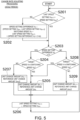
- the change rate setting module 64 may perform a change rate adjusting processing illustrated in Fig. 5 .
- the change rate adjusting processing may be performed independently from the speed rate processing of Fig. 3 and performed simultaneously parallel with the speed rate processing.
- the processings at Steps S201-S209 are repeated as a loop fashion, one loop may be performed at a period Hms same as the unit time T 0 described in the speed rate processing (i.e., H is a value obtained by multiplying the coefficient "a" by 100).
- H is a value obtained by multiplying the coefficient "a" by 100.
- the change rate adjusting processing is not limited to this configuration, but may be performed at a period sufficiently shorter than the unit time T 0 , for example.
- the change rate setting module 64 may determine whether the last speed setting V S(n-1) inputted in the last loop is equal to the currently-inputted speed setting V S(n) (Step S201).
- the change rate setting module 64 may calculate a speed setting difference V D which is the difference between the speed setting V S(n) and the last speed setting V S(n-1) , and calculate the switching speed V B , as a value obtained by multiplying the speed setting difference V D by a value obtained by subtracting the coefficient b from 1 and adding it to the last speed setting V S(n-1) (Step S202).
- the speed setting difference V D may become a positive value, and if the speed setting V S(n) is below the last speed setting V S(n-1) , the speed setting difference V D may become a negative value.
- the change rate setting module 64 may skip the processing at Step S202.
- the change rate setting module 64 may compare the calculated speed setting difference V D with 0 (Step S203).
- the change rate setting module 64 may compare the target speed V T set by the target speed setting module 63 with the switching speed V B (Step S204).
- the change rate setting module 64 may compare the target speed V T set by the target speed setting module 63 with the switching speed V B (Step S208).
- the target speed setting module 63 may set the target speed V T by using each of the two different unit change amounts ( ⁇ v S and ⁇ v S /2) outputted from the change rate setting module 64, in the different phases.
- the tracking performance i.e., the response
- the rate of change in the target speed V T is simply changed at two steps, the algorithm can be simpler.
- the coefficient b for calculating the switching speed V B in the change rate adjusting processing can be set arbitrarily according to the ship operator's preferences through the navigation device 4 etc.
- the coefficient b set by the ship operator may be stored in the memory 62.
- the change rate setting module 64 may calculate the switching speed V B using the coefficient b stored in the memory 62. Note that, by the ship operator resetting the coefficient b, the coefficient b stored in the memory 62 can be updated.
- each of ranges of change S0 and S1 of the target speed V T based on each unit change amount ⁇ v U may be adjusted according to the value of the coefficient b.
- the PID controlling module 65 of Fig. 1 may input a deviation of the actual speed V of the ship from the target speed V T and calculate an output speed V n which is a parameter, according to a known formula, so that the traveling speed of the ship follows the target speed V T set by the target speed setting module 63.
- the base opening calculating module 66 may convert the output speed V n calculated by the PID controlling module 65 into a base throttle opening U n0 which is a controlled variable related to a throttle opening control.
- the base opening calculating module 66 may calculate the base throttle opening U n0 corresponding to the output speed V n by multiplying the output speed V n by a given constant Cv.
- the opening limit processing module 67 may perform a limiting processing to the base throttle opening U n0 calculated by the base opening calculating module 66, by using a given maximum throttle opening U max and a given minimum throttle opening (throttle opening lower limit) U min .
- the opening limit processing module 67 may output the minimum throttle opening U min to the ECU 90 of the engine 9 as the throttle opening U n for control.
- the opening limit processing module 67 may output the base throttle opening U n0 calculated by the base opening calculating module 66 to the ECU 90 of the engine 9 as the throttle opening U n for control.
- the opening limit processing module 67 may output the maximum throttle opening U max to the ECU 90 of the engine 9 as the throttle opening U n for control.
- the ECU 90 of the engine 9 may operate the actuator 91 according to the throttle opening U n for control outputted by performing the limiting processing by the opening limit processing module 67 to change the opening of the throttle 92.
- the intake air amount of the engine 9 may change and the output of the engine 9 may be adjusted. That is, the actual speed of the ship may be adjusted.
- the maximum throttle opening U max can be, for example, the maximum throttle opening which can be given according to the specification of the ECU 90 of the engine 9.
- the minimum throttle opening U min may be set to a value, for example, obtained by taking a dead zone illustrated in Fig. 8 into consideration. That is, the minimum throttle opening U min may be a throttle opening at which the actual speed V of the ship begins to change according to the change in the throttle opening.
- the dead zone may be a zone of the actual speed V where the actual speed V does not change according to the change in an opening command value of the throttle 92, and, for example, it may be caused by mechanical plays.
- the base opening calculating module 66 performing the limiting processing to the base throttle opening U n0 , since the dead zone of the actual speed V when the throttle opening is below the given value can be covered, and the ship operator can quickly feel the change in the actual speed V, a brisk ride comfort can be realized.
- the automatic speed controlling device 6 of this embodiment may give the gradually-increasing target speed V T to the PID controlling module 65 according to the speed setting V S set by the ship operator.
- Fig. 9 illustrates a result of an experiment in which the automatic speed controlling device 6 is applied to an actual ship.
- the ship provided with the automatic speed controlling device 6 of this embodiment can achieve both a satisfactory response to the change in the speed setting V S and a prevention of an excessively sudden acceleration/deceleration in a well-balanced fashion.
- the turning speed controlling module 68 may be used for controlling a speed when the ship turns, and may be provided with a turning state determining part 69.
- the turning state determining part 69 may determine whether the ship is turning, for example, based on whether a change in the bow direction (heading) detected by the bearing sensor 2 is above a given threshold. Note that the change in the heading can be obtained, for example, by a differentiation of the heading angle, or a calculation of a difference between the current heading angle and a heading angle before a given time.
- the turning speed controlling module 68 may perform a turning speed control processing illustrated in Fig. 10 .
- the turning speed control processing may be performed independently from the speed rate processing of Fig. 3 , and performed simultaneously parallel with the speed rate processing.
- the determinations at Steps S301, S304, S306, and S308 may be performed at a period sufficiently shorter than the unit time T 0 described in the speed rate processing.
- the turning speed controlling module 68 may determine whether the ship is turning by using the turning state determining part 69 (Step S301). If not turning, the turning speed controlling module 68 may return to Step S301.
- the turning speed controlling module 68 may store the current speed setting V S as a turning start speed V ST , and calculate a directional difference between a heading setting set by the ship operator and the current heading (Step S302).
- the directional difference herein may be an absolute value, and therefore, it may be a positive value, regardless of the ship turning to the left or the right.
- the turning speed controlling module 68 may compare the calculated directional difference with a given angle ⁇ (Step S303).
- the threshold angle ⁇ may be set to a small angle to some extent. If the directional difference is at or below ⁇ , this may mean that it is a mild turn and the deceleration of the ship during the turning may be small. Therefore, the turning speed controlling module 68 may skip processings at Steps S305-S309 (described later), and stand by until the turning state determining part 69 determines a termination of the turning (Step S304). If the turning speed controlling module 68 determines that the turning of the ship is finished at Step S304, it may return to Step S301.
- the turning speed controlling module 68 may calculate a deceleration preservation bearing and a speed reset bearing (Step S305).
- the deceleration preservation bearing can be calculated by adding a value to the heading detected by the bearing sensor 2. The value may be obtained by multiplying a calculated directional difference ⁇ by a given coefficient d (here, 0 ⁇ d ⁇ 1).
- the speed reset bearing can be calculated, for example, by multiplying the directional difference by a value obtained by subtracting the coefficient d from 1 and adding the acquired value to the heading.
- the turning speed controlling module 68 may compare the heading of the ship with the calculated deceleration preservation bearing (Step S306). If the heading is at or above the deceleration preservation bearing (i.e., if the turning angle after the ship starts the turning reaches an angle of the value obtained by multiplying the directional difference by the coefficient d), the turning speed controlling module 68 may output the actual speed V of the ship detected at this time, as the speed setting V S (Step S307).
- the speed setting V S at this time may correspond to the turning speed setting. Since it is after a part of the turning has been performed at this time, the actual speed V detected at Step S307 may be a speed reduced to some extent by water drag.
- the target speed setting module 63 may perform the speed rate processing using the speed setting V S outputted from the turning speed controlling module 68.
- the turning speed controlling module 68 may wait for the heading to reach the deceleration preservation bearing.
- the turning speed controlling module 68 may wait for the heading to reach the speed reset bearing (Step S308).
- the speed setting V S may become equal to the actual speed V during the speed rate processing performed by the target speed setting module 63. Therefore, the target speed V T may also become equal to the actual speed V, and the speed does not substantially change.
- the turning speed controlling module 68 may output the turning start speed V ST stored at Step S302 as the speed setting V S (Step S309). Therefore, the speed rate processing performed by the target speed setting module 63 may again be performed based on the speed setting V S set by the ship operator. Then, the turning speed controlling module 68 may transit the processing to Step S304.
- the turning speed controlling module 68 may substantially inhibit the acceleration/deceleration control in the given angle range which is a part of an intermediate turning range from the start to the end of the turning, by setting the actual speed V as the speed setting V S . Therefore, an unnatural acceleration and an excessive deceleration during the turning may be both avoidable.
- the speed setting V S which is the target for following or tracking the target speed V T , may return to the original value at a suitable timing before near the termination of turning. Therefore, a quick rising after the turning can be realized.
- the automatic speed controlling device 6 of this embodiment may control the traveling speed of the ship so as to automatically track or follow the speed setting V S set by the ship operator.
- the automatic speed controlling device 6 may include the target speed setting module 63 and the change rate setting module 64.
- the target speed setting module 63 may change the target speed V T based on the given rate of change by setting the target speed V T , which is a target to be followed by the traveling speed, for every unit time T 0 according to the speed setting V S .
- the change rate setting module 64 may decrease the rate of change by adjusting the rate of change at the multiple stages, when the target speed V T set by the target speed setting module 63 approaches the speed setting V S .
- the multiple-stage change of the speed with a plurality of rates of change can be achieved without requiring the given data, such as the speed-control map.
- the occurrence of the overshoot can be reduced by decreasing the rate of change (the rate of change defined by the unit change amount ⁇ v U and the unit time T 0 ) of the target speed V T which is the target for the speed of the movable body to follow, when the target speed V T approaches the speed setting V S .
- the speed rate processing may be terminated if the speed setting V S(n) is equal to the target speed V T(n) as the result of the determination at Step S101.
- the speed rate processing may be automatically started, for example, after the ship operator inputs the speed setting V S through the navigation device 4.
- the unit time T 0 may be directly set, instead of the coefficient "a" related to the unit time T 0 of the target speed setting module 63.
- the actual speed V acquired by the actual speed acquiring module 61 may be a speed through water, instead of the ground speed.
- the change rate setting module 64 may also set three values of the unit change amount ⁇ v U so that the target speed V T set by the target speed setting module 63 has three or more rates of change.
- the change rate setting module 64 may calculate it by multiplying the reference unit change amount ⁇ v S by a given ratio (e.g., H%), instead of dividing the reference unit change amount ⁇ v S by two.
- This ratio (H%) may be set in advance or may be adjusted according to the preferences of the ship operator.
- the change rate setting module 64 may adjust the rate of change in the target speed V T set by the target speed setting module 63 by adjusting the unit time T 0 and outputting it to the target speed setting module 63, instead of the reference unit change amount ⁇ v S set by the ship operator.
- the target speed setting module 63 may set the target speed V T for every unit time T 0 outputted by the change rate setting module 64, for example, based on the reference unit change amount ⁇ v S set by the ship operator.
- the deceleration preservation bearing and the speed reset bearing may be determined based on different coefficients.
- the turning speed control processing by the turning speed controlling module 68 may be performed, for example, only when the ship turns while accelerating.
Landscapes
- Engineering & Computer Science (AREA)
- Mechanical Engineering (AREA)
- Chemical & Material Sciences (AREA)
- Combustion & Propulsion (AREA)
- Ocean & Marine Engineering (AREA)
- Transportation (AREA)
- General Engineering & Computer Science (AREA)
- Remote Sensing (AREA)
- Automation & Control Theory (AREA)
- Radar, Positioning & Navigation (AREA)
- Human Computer Interaction (AREA)
- Navigation (AREA)
- Control Of Vehicle Engines Or Engines For Specific Uses (AREA)
- Feedback Control In General (AREA)
- Control Of Driving Devices And Active Controlling Of Vehicle (AREA)
Description
- The present disclosure mainly relates to a speed control device which performs an automatic tracking control in which a speed of a movable body, e.g. a ship, follows a speed setting set by a user.
- Conventionally, it is known that a ship navigation control system controls an engine speed based on a target ship speed setting and an actual ship speed.
Patent Document 1 discloses this kind of ship navigation control system. - The navigation control system of
Patent Document 1 corrects a basic engine speed acquired from a map which associates a target ship speed with a basic engine speed, according to a difference between the target ship speed and the actual ship speed, and sets the corrected engine speed as the target engine speed to control the engine so that an actual ship speed approaches the target ship speed. - [Patent Document 1]
JP2017-088119A
Further technological background can be found inUS 2007/155258 A1 ,US 2018/057133 A1 andCN 103 293 952 A - However, since
Patent Document 1 needs to use the map which associates the target ship speed set in advance with the basic engine speed in order to make the ship speed follow the target ship speed, the computer resources are taken up. Note that sincePatent Document 1 uses the map defined in advance, an acceleration and a deceleration are not easily adjustable while making the ship speed follow the target ship speed. Therefore, there is room for an improvement. - The present disclosure is made in view of the above situations, and one purpose thereof is to provide a speed control device which is satisfactory in response and tracking to a speed setting, and can adjust an acceleration-and-deceleration feel according to preferences.
- The problem to be solved by the present disclosure is as described above, and measures to solve the problem and effects thereof are described as follows.
- According to the first aspect of the present disclosure, a speed control device with the following configuration is provided. The speed control device controls a speed of a movable body so that the speed automatically follows a speed setting set by a user. The speed control device includes a target speed setting module and a change rate adjusting module. The target speed setting module sets a target speed that is a target of the speed of the movable body to follow, for every unit time, according to the speed setting, to change the target speed based on a given rate of change. The change rate adjusting module decreases the rate of change by adjusting the rate of change at multiple stages, when the target speed set by the target speed setting module approaches the speed setting.
- According to this configuration, the multiple-stage change of the speed with a plurality of rates of change can be achieved without requiring a given data, such as a speed-control map. Moreover, the occurrence of an overshoot can be reduced by decreasing the rate of change of the target speed which is the target for the speed of the movable body to follow, when the target speed approaches the speed setting.
- The speed control device preferably has the following configuration. That is, the rate of change in the target speed is acquired based on a given speed change parameter, and the speed change parameter includes the unit time and a reference amount of change in the target speed for every unit time.
- According to this configuration, by the user setting the speed change parameter, the change rate in the speed of the movable body (i.e., acceleration/deceleration) can be changed easily according to preferences.
- In the speed control device, the change rate adjusting module preferably adjusts the rate of change to two different values based on the setting of the reference amount of change.
- According to this configuration, the change rate in the target speed can easily be changed at two steps. By changing at two steps, the algorithm for the following to the speed setting can be simpler.
- The speed control device preferably has the following configuration. That is, the change rate adjusting module sets a first rate of change, a second rate of change smaller than the first rate of change, and a change speed at which the first rate of change is switched to the second rate of change, based on a given speed change parameter. The change rate adjusting module is adapted to, while the speed setting is above the speed of the movable body, output the first rate of change to the target speed setting module when the target speed set by the target speed setting module is at or below the change speed, and output the second rate of change to the target speed setting module when the target speed is above the change speed. The change rate adjusting module is adapted to, while the speed setting is below the speed of the movable body, output the first rate of change to the target speed setting module when the target speed set by the target speed setting module is at or above the change speed, and output the second rate of change to the target speed setting module when the target speed is below the change speed.
- According to this configuration, the range of change of the target speed to which each rate of change is applied can be set. As a result, various acceleration-and-deceleration feels can be achieved.
- The speed control device has the following configuration. That is, the speed control device includes a base throttle opening calculating module and a throttle opening outputting module. The base throttle opening calculating module calculates a base throttle opening related to a throttle opening control of an engine provided to the movable body, based on the target speed set by the target speed setting module. The throttle opening outputting module outputs the base throttle opening calculated by the base throttle opening calculating module to a control device of the engine as a throttle opening for control.
- According to this configuration, by controlling the throttle opening of the engine, the speed of the movable body can be controlled.
- In the speed control device, the throttle opening outputting module outputs a given lower limit of the throttle opening to the control device of the engine as the throttle opening for control when the base throttle opening calculated by the base throttle opening calculating module is below the given lower limit of the throttle opening.
- According to this configuration, the control taking a dead zone of a throttle into consideration can be performed, the user can quickly feel the speed change due to the speed setting, and a ride comfort can be improved.
- The speed control device preferably has the following configuration. That is, the speed control device includes an actual speed acquiring module, a memory, and a turning speed controlling module. The actual speed acquiring module acquires an actual speed that is a current speed of the movable body. The memory stores the speed setting as a turning start speed. The turning speed controlling module outputs a turning speed setting that is the speed setting during a turning of the movable body. While the movable body is turning, the turning speed controlling module sets the actual speed acquired by the actual speed acquiring module as the speed setting, when a turning angle of the movable body from a start of the tuning is within a given angle range.
- According to this configuration, the acceleration/deceleration control during the turning can be stopped, and a natural and stable turning can be secured.
- The speed control device preferably has the following configuration. That is, the speed control device includes an actual speed acquiring module and a PID controlling module. The actual speed acquiring module acquires an actual speed that is a current speed of the movable body. The PID controlling module controls the speed of the movable body based on the target speed set by the target speed setting module and the actual speed acquired by the actual speed acquiring module so that the speed follows the target speed.
- According to this configuration, a satisfactory response and tracking performance to the target speed can be achieved easily.
- According to the second aspect of the present disclosure, an automatic navigation system with the following configuration is provided. That is, the automatic navigation system includes the speed control device and a navigation device. The navigation device displays information related to navigation.
- According to this configuration, the automatic navigation system which is satisfactory in response and tracking to the speed setting, and capable of improving the ride comfort, can be provided.
- According to the third aspect of the present disclosure, a method of controlling a speed is provided. The method includes the steps of setting target speed that is a target of a speed of a movable body to follow for every unit time, according to a speed setting set by a user in order to make the speed of the movable body follow the target speed by the control to change the target speed based on a given rate of change, and adjusting the rate of change at a multiple stages when the set target speed approaches the speed setting to decrease the rate of change,
- calculating a base throttle opening related to a throttle opening control of an engine provided to the movable body, based on the target speed; and
- outputting the base throttle opening to a control device of the engine as a throttle opening for control, such that a given lower limit of the throttle opening is output to the control device of the engine as the throttle opening for control when the base throttle opening is below the given lower limit of the throttle opening, with the given lower limit being based on a dead zone during which the speed of the movable body remains unchanged in response to a change in the throttle opening received by the control device of the engine.
- According to this configuration, the multiple-stage change of the speed with a plurality of rates of change can be achieved without requiring the given data, such as a speed-control map. Moreover, the occurrence of the overshoot can be reduced by decreasing the rate of change of the target speed which is the target for the speed of the movable body to follow, when the target speed approaches the speed setting.
-
-
Fig. 1 is a block diagram schematically illustrating a configuration of an automatic navigation system according to one embodiment of the present disclosure. -
Fig. 2 is a block diagram schematically illustrating a speed-control algorithm in an automatic speed controlling device. -
Fig. 3 is a flowchart related to a speed rate processing. -
Fig. 4(a) illustrates graphs of a change in a target speed VT in different unit times T0, andFig. 4(b) illustrates graphs of a change in the target speed VT in different unit change amounts ΔvU. -
Fig. 5 is a flowchart about a change rate adjusting processing. -
Fig. 6 illustrates graphs of a change in the target speed VT in different coefficients b. -
Fig. 7 illustrates a graph of an output speed for making the actual speed follow the target speed. -
Fig. 8 is a conceptual view illustrating a relation between a throttle opening and the actual speed. -
Fig. 9 is a graph illustrating one example of experimental data using the automatic speed controlling device. -
Fig. 10 is a flowchart related to a turning deceleration processing. -
Fig. 11 is a conceptual view illustrating one example of a given turning range which is an applicable range of a turning speed setting during a turning. - Next, one embodiment of the present disclosure is described with reference to the drawings.
Fig. 1 is a block diagram schematically illustrating a configuration of anautomatic navigation system 100 according to this embodiment of the present disclosure. - The
automatic navigation system 100 of this embodiment may be mounted on an unillustrated ship (movable body), and cause the ship to travel automatically according to a given navigation route/course. As illustrated inFig. 1 , theautomatic navigation system 100 may include aGNSS receiver 1, abearing sensor 2, aradar device 3, anavigation device 4, anautopilot device 5, and an automatic speed controlling device (speed control device) 6. These devices may be connected with each other, for example, through aCAN bus 10 so that two-way communications are possible. CAN may be an abbreviation of "Controller Area Network." - The
GNSS receiver 1 may receive positioning signals from a plurality of satellites by using GNSS antennas (not-illustrated), and detect information, such as the position of the ship and a traveling speed, based on the received positioning signals. TheGNSS receiver 1 may output the detected information to thenavigation device 4 and theautopilot device 5. The GNSS may include satellite positioning systems established in some countries and areas, such as GPS, GLONASS, Galileo, BeiDou, QZSS, and Gagan. - The bearing
sensor 2 may be constructed as a satellite compass provided with a plurality of GNSS antennas fixed to the ship, and measure a heading of the ship based on relative relations of the ship position detected by the GNSS antennas. The bearingsensor 2 may output the measured heading to thenavigation device 4, theautopilot device 5, and the automaticspeed controlling device 6. Note that the bearingsensor 2 is not limited to the above configuration, and, for example, it may be comprised of a magnetic direction sensor, a gyrocompass, etc. - The
radar device 3 may generate a radar image indicative of a situation and position of a target object around the ship by transmitting and receiving an electric wave through a radar antenna (not-illustrated). Theradar device 3 may output the generated radar image to thenavigation device 4. - The
navigation device 4 may be installed in an operation room (e.g., a steering station) provided to the ship. A ship operator (user) can instruct information, such as a destination and a speed (a speed setting VS), related to the navigation of the ship by operating thenavigation device 4. Thenavigation device 4 may generate the navigation route/course based on the information set by the ship operator. Thenavigation device 4 can display the ship position, the navigation route/course setting, and a trace of the ship in such a form that they are superimposed on an electronic nautical chart. - The
autopilot device 5 may be comprised of asteering angle sensor 51 which detects a steering angle of arudder 50 of the ship, ahydraulic pump 52 which drives therudder 50, and asteering angle controller 53 which controls operation of thehydraulic pump 52. Theautopilot device 5 can control the operation of thehydraulic pump 52 based on the information on the ship position and the heading inputted from theGNSS receiver 1 and thebearing sensor 2 to operate the rudder automatically so that the ship travels according to the navigation route/course set by thenavigation device 4. - The automatic
speed controlling device 6 may control the traveling speed automatically so that the traveling speed of the ship follows the speed setting which is set by the ship operator. The automaticspeed controlling device 6 may output an instruction for a throttle opening related to an intake air amount of anengine 9 which is a power source of the ship to an ECU (Engine Control Unit) 90 which is a control device for theengine 9 to control the output of theengine 9, thereby controlling the traveling speed of the ship. - Meanwhile, for example, the
ECU 90 adjusts the opening of athrottle 92 by controlling anactuator 91 which drives thethrottle 92 for adjusting the intake air amount of theengine 9. - The automatic
speed controlling device 6 may include an actualspeed acquiring module 61, amemory 62, a targetspeed setting module 63, a change rate setting module (change rate adjusting module) 64, and aPID controlling module 65, a base opening calculating module (base throttle opening calculating module) 66, an opening limit processing module (throttle opening outputting module) 67, and a turningspeed controlling module 68. The automaticspeed controlling device 6 may make the traveling speed of the ship follow the speed setting VS which is set by the ship operator, by using an algorithm illustrated inFig. 2 . - Describing with reference to
Fig. 2 , the automaticspeed controlling device 6 may set a target speed VT for the speed setting VS set by the ship operator so as to track or follow the speed setting VS by using a speed rate processing (described later), and output it to thePID controlling module 65. The automaticspeed controlling device 6 may perform a PID control for the traveling speed so that the traveling speed of the ship follows the set target speed VT by using thePID controlling module 65. - Thus, regardless of a speed difference ΔV between the speed setting VS and the actual speed V which is the current traveling speed of the ship, the target speed VT can be changed gradually, and the traveling speed of the ship can automatically follow the target speed VT suitably. That is, when the speed difference ΔV between the speed setting VS and the actual speed V is large, the automatic
speed controlling device 6 of this embodiment can avoid a sudden acceleration/deceleration of the ship in case of the traveling speed simply following the speed setting VS, thereby achieving a satisfactory response and tracking performance. - The automatic
speed controlling device 6 may be provided with a known computer (not illustrated). The computer may include a CPU, a ROM, a RAM, and an I/O part, which are not illustrated. The ROM may store various programs, data, etc. The CPU can read and execute the various programs etc. from the ROM. The automaticspeed controlling device 6 can operate the computer as thememory 62, the targetspeed setting module 63, the changerate setting module 64, thePID controlling module 65, the base opening calculatingmodule 66, the openinglimit processing module 67, and the turningspeed controlling module 68, by collaboration of hardware and software. - The actual
speed acquiring module 61 may detect an actual speed V of the ship. Note that the actual speed may be a ground speed on the basis of the earth. The actualspeed acquiring module 61 may acquire the actual speed (ground speed) of the ship, for example, by calculating a change in the position obtained by theGNSS receiver 1. - The
memory 62 may store various data related to a control of the traveling speed of the ship. The data may include parameters for the control, such as given parameters for calculation and speed change parameters set by the ship operator. - The target
speed setting module 63 may set a target speed VT for every unit time T0 so that the traveling speed of the ship changes gradually until it reaches the speed setting VS set by the ship operator, for example, through thenavigation device 4. That is, the targetspeed setting module 63 may change the target speed VT based on a given rate of change, by setting the target speed VT for every unit time T0. In other words, the targetspeed setting module 63 may change the target speed VT to be set, by a unit change amount ΔvU, during each given unit time T0, regardless of the speed difference ΔV between the speed setting VS and the actual speed V of the ship. - In detail, the target
speed setting module 63 may perform the speed rate processing illustrated inFig. 3 for the purpose of avoiding that the traveling speed of the ship changes rapidly in a short period of time. Although in the speed rate processing ofFig. 3 processings at Steps S101-S109 may be repeated as a loop fashion, one loop is performed for every given unit time T0. - In the following description, in order to distinguish the last speed setting VS and the current speed setting VS, the speed setting VS inputted in the current loop may be given a subscript "(n)" and referred to as the "speed setting VS(n)," and the speed setting VS inputted in the last loop may be given a subscript "(n-1)" and referred to as the "last speed setting VS(n-1)." Note that "n" may be an integer which is incremented by one for each loop.
- When the speed rate processing illustrated in
Fig. 3 is started, the targetspeed setting module 63 may determine whether a current target speed VT(n) of the ship is equal to the currently-inputted speed setting VS(n) (Step S101). If the current target speed VT(n) is equal to the speed setting VS(n), since the target speed VT(n) does not need to be changed, the targetspeed setting module 63 may return to Step S101. As the result of the determination at Step S101, if the current target speed VT(n) is not equal to the speed setting VS(n), the targetspeed setting module 63 may transit to Step S102. - At Step S102, the target
speed setting module 63 may determine whether the last speed setting VS(n-1) is equal to the speed setting VS(n). If the last speed setting VS(n-1) is not equal to the speed setting VS(n), the targetspeed setting module 63 may set the actual speed V of the ship as a reference speed for defining the current target speed VT(n) of the ship (Step S103). As the result of the determination at Step S102, if the last speed setting VS(n-1) is equal to the speed setting VS(n), the targetspeed setting module 63 may skip the processing at Step S103. - Then, the target
speed setting module 63 may calculate a speed difference ΔV between the speed setting VS(n) and the target speed VT(n) (Step S104). If the speed setting VS(n) is above the target speed VT(n), the speed difference ΔV may become a positive value, and if the speed setting VS(n) is below the target speed VT(n), the speed difference ΔV may become a negative value. - After the processing at Step S104 is performed, the target
speed setting module 63 may compare the calculated speed difference ΔV with the unit change amount ΔvU outputted from the changerate setting module 64 described later (Step S 105). This unit change amount ΔvU may always become a positive value. - As the result of the comparison at Step S105, if the speed difference ΔV is above the unit change amount ΔvU, this may mean that the speed setting is largely deviated to the positive side (accelerating side) from the target speed. Therefore, in this case, the target
speed setting module 63 may set a value obtained by adding the unit change amount ΔvU to the current target speed VT(n) as a target speed VT(n+1) for the next loop (Step S 106). - Then, in order to determine the change in the speed setting VS at Step S102, the target
speed setting module 63 may set the current speed setting VS(n) as the last speed setting VS(n-1) (Step S 107), and then return to Step S 101. - As the result of the comparison at Step S105, if the speed difference ΔV is at or below the unit change amount ΔvU, the target
speed setting module 63 may compare the speed difference ΔV with a value obtained by multiplying the unit change amount ΔvU by -1 (Step S108). As the result of the comparison, when the speed difference ΔV is below [the unit change amount ΔvU × -1], this may mean that the speed setting is deviated largely to the negative side (decelerating side) from the target speed. Therefore, in this case, the targetspeed setting module 63 may set a value obtained by subtracting the unit change amount ΔvU from the current target speed VT(n) of the ship as a target speed VT(n+1) for the next loop (Step S 109), and then transit to StepS 107. - On the other hand, as the result of the comparison, if the speed difference ΔV is at or above [the unit change amount ΔvU × -1], this may mean that the deviation of the speed setting from the target speed is small. Therefore, the target
speed setting module 63 may set the speed setting VS(n) as a target speed VT(n+1) for the next loop (Step S110), and then transit to Step S107. - By the target
speed setting module 63 performing such a speed rate processing, the target speed VT which is a target traveling speed to follow may be updated so that it increases/decreases gradually for every unit time. Therefore, the traveling speed of the ship may change gradually, and the sudden acceleration/deceleration in a short period of time can be avoided. - Meanwhile, a coefficient "a" related to the unit time T0 which is used in the speed rate processing by the target
speed setting module 63, and a reference unit change amount ΔvS related to the unit change amount ΔvU may be set, for example, by operation of the ship operator. The coefficient "a" may be an integer. - In detail, the coefficient "a" for the speed rate processing period illustrated in
Fig. 3 can be set by the ship operator through thenavigation device 4 etc. In this case, the unit time T0 which is an update period of the target speed becomes, for example, a value obtained by multiplying the coefficient "a" by a given time (in the embodiment, it is, but no limited to, 100ms). As illustrated inFig. 4(a) , although the target speed VT changes in a stepped manner, but, by setting a large coefficient, the processing period (unit time T0) of the targetspeed setting module 63 may increase, and therefore, the change in the target speed VT may become mild. - Moreover, the ship operator can operate the
navigation device 4 etc. to set the reference unit change amount ΔvS (reference amount of change). The reference unit change amount ΔvS may be adjusted by the change rate setting module 64 (described later) and may be outputted to the targetspeed setting module 63 as the unit change amount ΔvU. That is, by the ship operator setting the reference unit change amount ΔvS to increase the unit change amount ΔvU, the target speed VT can be changed relatively rapidly as illustrated inFig. 4(b) . - In this way, for example, by the ship operator setting the speed change parameters, such as the coefficient "a" related to the unit time T0 and the reference unit change amount ΔvS related to the unit change amount ΔvU, the rate of change in the target speed VT (i.e., the traveling speed of the ship) to the speed setting VS can be adjusted according to preferences, and therefore, the favorite acceleration-and-deceleration feel can be selected.
- Note that, it is not necessary to set the speed change parameters at every speed setting, and when they are once set, the set speed change parameters may be stored in the
memory 62. The subsequent settings of the target speed VT will be performed using the speed change parameters stored in thememory 62. The speed change parameters stored in thememory 62 can be updated by a resetting operation. - When a given condition is satisfied, the change
rate setting module 64 may adjust the rate of change (unit change amount ΔvU) in the target speed VT by using the reference unit change amount ΔvS of the target speed VT set by the ship operator. The given condition may be that the target speed VT set by the targetspeed setting module 63 is above a switching speed VB calculated using a set coefficient b (here, 0<b<1). Note that the switching speed VB may be a speed indicative of a reference for switching the unit change amount ΔvU so as to be adjusted smaller. - Describing concretely, the change
rate setting module 64 may perform a change rate adjusting processing illustrated inFig. 5 . The change rate adjusting processing may be performed independently from the speed rate processing ofFig. 3 and performed simultaneously parallel with the speed rate processing. Moreover, although in the change rate adjusting processing ofFig. 5 the processings at Steps S201-S209 are repeated as a loop fashion, one loop may be performed at a period Hms same as the unit time T0 described in the speed rate processing (i.e., H is a value obtained by multiplying the coefficient "a" by 100). However, the change rate adjusting processing is not limited to this configuration, but may be performed at a period sufficiently shorter than the unit time T0, for example. - When the change rate adjusting processing illustrated in
Fig. 5 is started, the changerate setting module 64 may determine whether the last speed setting VS(n-1) inputted in the last loop is equal to the currently-inputted speed setting VS(n) (Step S201). - As the result of the determination at Step S201, if the last speed setting VS(n-1) is not equal to the speed setting VS(n) (for example, when the ship operator sets a new speed), the change
rate setting module 64 may calculate a speed setting difference VD which is the difference between the speed setting VS(n) and the last speed setting VS(n-1), and calculate the switching speed VB, as a value obtained by multiplying the speed setting difference VD by a value obtained by subtracting the coefficient b from 1 and adding it to the last speed setting VS(n-1) (Step S202). If the speed setting VS(n) is above the last speed setting VS(n-1), the speed setting difference VD may become a positive value, and if the speed setting VS(n) is below the last speed setting VS(n-1), the speed setting difference VD may become a negative value. As the result of the determination at Step S201, if the last speed setting VS(n-1) is equal to the speed setting VS(n), the changerate setting module 64 may skip the processing at Step S202. - Then, the change
rate setting module 64 may compare the calculated speed setting difference VD with 0 (Step S203). - As the result of the comparison at Step S203, if the speed setting difference VD is zero or more (i.e., if accelerating), the change
rate setting module 64 may compare the target speed VT set by the targetspeed setting module 63 with the switching speed VB (Step S204). - As the result of the comparison at Step S204, if the target speed VT is at or below the switching speed VB, the change
rate setting module 64 may output the reference unit change amount ΔvS set by the ship operator as it is, as the unit change amount ΔvU to be used by the target speed setting module 63 (ΔvU=ΔvS, Step S205). Then, in order to determine the change in the speed setting VS at Step S201, the changerate setting module 64 may set the speed setting VS(n) as the last speed setting VS(n-1) (Step S206), and then return to Step S201. - On the other hand, as the result of the comparison at Step S204, if the target speed VT is above the switching speed VB, the change
rate setting module 64 may output a value obtained by dividing the reference unit change amount ΔvS set by the ship operator by two, as the unit change amount ΔvU to be used by the target speed setting module 63 (ΔvU=ΔvS/2, Step S207). Then, the changerate setting module 64 may transit the processing to Step S206. - As the result of the comparison at Step S203, if the speed setting difference VD is below zero (i.e., if slowing down), the change
rate setting module 64 may compare the target speed VT set by the targetspeed setting module 63 with the switching speed VB (Step S208). - As the result of the comparison at Step S208, if the target speed VT is at or above the switching speed VB, the change
rate setting module 64 may transit to Step S205. If the target speed VT is below the switching speed VB, the changerate setting module 64 may output a value obtained by dividing the reference unit change amount ΔvS set by the ship operator by two, as the unit change amount ΔvU to be used by the target speed setting module 63 (ΔvU=ΔvS/2, Step S209). Then, the changerate setting module 64 may transit the processing to Step S206. - As illustrated in
Fig. 6 , by the changerate setting module 64 performing such a change rate adjusting processing, the targetspeed setting module 63 may set the target speed VT by using each of the two different unit change amounts (ΔvS and ΔvS/2) outputted from the changerate setting module 64, in the different phases. - That is, as illustrated in
Fig. 6 , the target speed VT set by the targetspeed setting module 63 may change according to one of a first rate of change based on the unit change amount ΔvU=ΔvS outputted from the changerate setting module 64, and a second rate of change based on the unit change amount ΔvU=ΔvS/2. - In other words, in a first phase of a period during which the target speed VT changes, the target
speed setting module 63 may update the target speed VT by using the comparatively large unit change amount ΔvU=ΔvS. On the other hand, in a phase where the target speed VT approached the speed setting VS to some extent, the targetspeed setting module 63 may update the target speed VT by using the comparatively small unit change amount ΔvU=ΔvS/2. - Therefore, at the initial phase of the period where the target speed VT changes, the tracking performance (i.e., the response) to the speed setting VS can be improved by changing the target speed VT each time by a comparatively large unit change amount ΔvU=ΔvS. On the other hand, after the target speed VT approached the speed setting VS to some extent (ΔvU=ΔvS/2), an overshoot can be reduced by decreasing the unit amount of change of the target speed VT. Moreover, since the rate of change in the target speed VT is simply changed at two steps, the algorithm can be simpler.
- Meanwhile, the coefficient b for calculating the switching speed VB in the change rate adjusting processing can be set arbitrarily according to the ship operator's preferences through the
navigation device 4 etc. The coefficient b set by the ship operator may be stored in thememory 62. The changerate setting module 64 may calculate the switching speed VB using the coefficient b stored in thememory 62. Note that, by the ship operator resetting the coefficient b, the coefficient b stored in thememory 62 can be updated. - As illustrated in two graphs of
Fig. 6 , each of ranges of change S0 and S1 of the target speed VT based on each unit change amount ΔvU may be adjusted according to the value of the coefficient b. In detail, by increasing the coefficient b, the range S0 of the target speed VT to which the comparatively large unit change amount ΔvU=ΔvS is applied may become smaller, and, on the other hand, the range S1 of the target speed VT to which the comparatively small unit change amount ΔvU=ΔvS/2 is applied may become larger. - That is, by increasing the coefficient b, the change in the target speed VT can be milder as a whole. Thus, also by adjusting the coefficient b, different acceleration/deceleration feels can be adjusted.
- As illustrated in
Figs. 2 and7 , thePID controlling module 65 ofFig. 1 may input a deviation of the actual speed V of the ship from the target speed VT and calculate an output speed Vn which is a parameter, according to a known formula, so that the traveling speed of the ship follows the target speed VT set by the targetspeed setting module 63. - The base
opening calculating module 66 may convert the output speed Vn calculated by thePID controlling module 65 into a base throttle opening Un0 which is a controlled variable related to a throttle opening control. In detail, the base opening calculatingmodule 66 may calculate the base throttle opening Un0 corresponding to the output speed Vn by multiplying the output speed Vn by a given constant Cv. - The opening
limit processing module 67 may perform a limiting processing to the base throttle opening Un0 calculated by the base opening calculatingmodule 66, by using a given maximum throttle opening Umax and a given minimum throttle opening (throttle opening lower limit) Umin. - In detail, if the base throttle opening Un0 calculated by the base opening calculating
module 66 is below the minimum throttle opening, the openinglimit processing module 67 may output the minimum throttle opening Umin to theECU 90 of theengine 9 as the throttle opening Un for control. - If the base throttle opening Un0 calculated by the base opening calculating
module 66 is at or above the minimum throttle opening Umin and is at or below the maximum throttle opening Umax, the openinglimit processing module 67 may output the base throttle opening Un0 calculated by the base opening calculatingmodule 66 to theECU 90 of theengine 9 as the throttle opening Un for control. - If the base throttle opening Un0 calculated by the base opening calculating
module 66 is above the maximum throttle opening Umax, the openinglimit processing module 67 may output the maximum throttle opening Umax to theECU 90 of theengine 9 as the throttle opening Un for control. - The
ECU 90 of theengine 9 may operate theactuator 91 according to the throttle opening Un for control outputted by performing the limiting processing by the openinglimit processing module 67 to change the opening of thethrottle 92. - Thus, by adjusting the opening of the
throttle 92, the intake air amount of theengine 9 may change and the output of theengine 9 may be adjusted. That is, the actual speed of the ship may be adjusted. - Meanwhile, the maximum throttle opening Umax can be, for example, the maximum throttle opening which can be given according to the specification of the
ECU 90 of theengine 9. The minimum throttle opening Umin may be set to a value, for example, obtained by taking a dead zone illustrated inFig. 8 into consideration. That is, the minimum throttle opening Umin may be a throttle opening at which the actual speed V of the ship begins to change according to the change in the throttle opening. Note that the dead zone may be a zone of the actual speed V where the actual speed V does not change according to the change in an opening command value of thethrottle 92, and, for example, it may be caused by mechanical plays. - As described above, by the base opening calculating
module 66 performing the limiting processing to the base throttle opening Un0, since the dead zone of the actual speed V when the throttle opening is below the given value can be covered, and the ship operator can quickly feel the change in the actual speed V, a brisk ride comfort can be realized. - As described above, the automatic
speed controlling device 6 of this embodiment may give the gradually-increasing target speed VT to thePID controlling module 65 according to the speed setting VS set by the ship operator.Fig. 9 illustrates a result of an experiment in which the automaticspeed controlling device 6 is applied to an actual ship. As illustrated inFig. 9 , the ship provided with the automaticspeed controlling device 6 of this embodiment can achieve both a satisfactory response to the change in the speed setting VS and a prevention of an excessively sudden acceleration/deceleration in a well-balanced fashion. - The turning
speed controlling module 68 may be used for controlling a speed when the ship turns, and may be provided with a turningstate determining part 69. The turningstate determining part 69 may determine whether the ship is turning, for example, based on whether a change in the bow direction (heading) detected by the bearingsensor 2 is above a given threshold. Note that the change in the heading can be obtained, for example, by a differentiation of the heading angle, or a calculation of a difference between the current heading angle and a heading angle before a given time. - In detail, the turning
speed controlling module 68 may perform a turning speed control processing illustrated inFig. 10 . The turning speed control processing may be performed independently from the speed rate processing ofFig. 3 , and performed simultaneously parallel with the speed rate processing. Moreover, in the processing illustrated inFig. 10 , the determinations at Steps S301, S304, S306, and S308 may be performed at a period sufficiently shorter than the unit time T0 described in the speed rate processing. - When the turning speed control processing illustrated in
Fig. 10 is started, the turningspeed controlling module 68 may determine whether the ship is turning by using the turning state determining part 69 (Step S301). If not turning, the turningspeed controlling module 68 may return to Step S301. - As the result of the determination at Step S301, if the ship is turning, the turning
speed controlling module 68 may store the current speed setting VS as a turning start speed VST, and calculate a directional difference between a heading setting set by the ship operator and the current heading (Step S302). The directional difference herein may be an absolute value, and therefore, it may be a positive value, regardless of the ship turning to the left or the right. - Then, the turning
speed controlling module 68 may compare the calculated directional difference with a given angle θ (Step S303). The threshold angle θ may be set to a small angle to some extent. If the directional difference is at or below θ, this may mean that it is a mild turn and the deceleration of the ship during the turning may be small. Therefore, the turningspeed controlling module 68 may skip processings at Steps S305-S309 (described later), and stand by until the turningstate determining part 69 determines a termination of the turning (Step S304). If the turningspeed controlling module 68 determines that the turning of the ship is finished at Step S304, it may return to Step S301. - As the result of the comparison at Step S303, if the calculated directional difference is above θ, the turning
speed controlling module 68 may calculate a deceleration preservation bearing and a speed reset bearing (Step S305). As illustrated inFig. 11 , for example, the deceleration preservation bearing can be calculated by adding a value to the heading detected by the bearingsensor 2. The value may be obtained by multiplying a calculated directional difference γ by a given coefficient d (here, 0<d<1). The speed reset bearing can be calculated, for example, by multiplying the directional difference by a value obtained by subtracting the coefficient d from 1 and adding the acquired value to the heading. - Then, the turning
speed controlling module 68 may compare the heading of the ship with the calculated deceleration preservation bearing (Step S306). If the heading is at or above the deceleration preservation bearing (i.e., if the turning angle after the ship starts the turning reaches an angle of the value obtained by multiplying the directional difference by the coefficient d), the turningspeed controlling module 68 may output the actual speed V of the ship detected at this time, as the speed setting VS (Step S307). The speed setting VS at this time may correspond to the turning speed setting. Since it is after a part of the turning has been performed at this time, the actual speed V detected at Step S307 may be a speed reduced to some extent by water drag. The targetspeed setting module 63 may perform the speed rate processing using the speed setting VS outputted from the turningspeed controlling module 68. - As the result of the comparison at Step S306, if the heading is below the deceleration preservation bearing, the turning
speed controlling module 68 may wait for the heading to reach the deceleration preservation bearing. - After the processing at Step S307, the turning
speed controlling module 68 may wait for the heading to reach the speed reset bearing (Step S308). In the meantime, the speed setting VS may become equal to the actual speed V during the speed rate processing performed by the targetspeed setting module 63. Therefore, the target speed VT may also become equal to the actual speed V, and the speed does not substantially change. - If the heading reaches the speed reset bearing (i.e., if the ship turned a given angle range illustrated in
Fig. 11 from the deceleration preservation bearing), the turningspeed controlling module 68 may output the turning start speed VST stored at Step S302 as the speed setting VS (Step S309). Therefore, the speed rate processing performed by the targetspeed setting module 63 may again be performed based on the speed setting VS set by the ship operator. Then, the turningspeed controlling module 68 may transit the processing to Step S304. - As described above, the turning
speed controlling module 68 may substantially inhibit the acceleration/deceleration control in the given angle range which is a part of an intermediate turning range from the start to the end of the turning, by setting the actual speed V as the speed setting VS. Therefore, an unnatural acceleration and an excessive deceleration during the turning may be both avoidable. - Meanwhile, by setting the coefficient d appropriately, the speed setting VS, which is the target for following or tracking the target speed VT, may return to the original value at a suitable timing before near the termination of turning. Therefore, a quick rising after the turning can be realized.
- As described above, the automatic
speed controlling device 6 of this embodiment may control the traveling speed of the ship so as to automatically track or follow the speed setting VS set by the ship operator. The automaticspeed controlling device 6 may include the targetspeed setting module 63 and the changerate setting module 64. The targetspeed setting module 63 may change the target speed VT based on the given rate of change by setting the target speed VT, which is a target to be followed by the traveling speed, for every unit time T0 according to the speed setting VS. The changerate setting module 64 may decrease the rate of change by adjusting the rate of change at the multiple stages, when the target speed VT set by the targetspeed setting module 63 approaches the speed setting VS. - Therefore, the multiple-stage change of the speed with a plurality of rates of change can be achieved without requiring the given data, such as the speed-control map. Moreover, the occurrence of the overshoot can be reduced by decreasing the rate of change (the rate of change defined by the unit change amount ΔvU and the unit time T0) of the target speed VT which is the target for the speed of the movable body to follow, when the target speed VT approaches the speed setting VS.
- Although the suitable embodiment of the present disclosure is described above, the above configuration can be altered as follows, for example.
- The speed rate processing may be terminated if the speed setting VS(n) is equal to the target speed VT(n) as the result of the determination at Step S101. In this case, the speed rate processing may be automatically started, for example, after the ship operator inputs the speed setting VS through the
navigation device 4. - The unit time T0 may be directly set, instead of the coefficient "a" related to the unit time T0 of the target
speed setting module 63. - The actual speed V acquired by the actual
speed acquiring module 61 may be a speed through water, instead of the ground speed. - The change
rate setting module 64 may also set three values of the unit change amount ΔvU so that the target speed VT set by the targetspeed setting module 63 has three or more rates of change. - When calculating a smaller one of two unit change amounts ΔvU, the change
rate setting module 64 may calculate it by multiplying the reference unit change amount ΔvS by a given ratio (e.g., H%), instead of dividing the reference unit change amount ΔvS by two. This ratio (H%) may be set in advance or may be adjusted according to the preferences of the ship operator. - The change
rate setting module 64 may adjust the rate of change in the target speed VT set by the targetspeed setting module 63 by adjusting the unit time T0 and outputting it to the targetspeed setting module 63, instead of the reference unit change amount ΔvS set by the ship operator. In this case, the targetspeed setting module 63 may set the target speed VT for every unit time T0 outputted by the changerate setting module 64, for example, based on the reference unit change amount ΔvS set by the ship operator. - Instead of determining the deceleration preservation bearing and the speed reset bearing based on the single coefficient d, they may be determined based on different coefficients.
- The turning speed control processing by the turning
speed controlling module 68 may be performed, for example, only when the ship turns while accelerating. -
- 6
- Automatic Speed Controlling Device (Speed Control Device)
- VS
- Speed Setting
- VT
- Target Speed
- 63
- Target Speed Setting Module
- 64
- Change Rate Setting Module (Change Rate Adjusting Module)
- It should be emphasized that many variations and modifications may be made to the above-described embodiments, the elements of which are to be understood as being among other acceptable examples. All such modifications and variations are intended to be included herein within the scope of this disclosure and protected by the following claims.
Claims (8)
- A speed control device (6) configured to control a speed of a movable body so that the speed automatically follows a speed setting set by a user, comprising:a target speed setting module (63) configured to set a target speed that is a target of the speed of the movable body to follow, for every unit time, according to the speed setting, to change the target speed based on a given rate of change;a change rate adjusting modul (64)e configured to decrease the rate of change by adjusting the rate of change at a multiple stages, when the target speed set by the target speed setting module (63) approaches the speed setting;a base throttle opening calculating module (66) configured to calculate a base throttle opening related to a throttle opening control of an engine provided to the movable body, based on the target speed set by the target speed setting module (63);characterised in thata throttle opening outputting module (67) configured to output the base throttle opening calculated by the base throttle opening calculating module (66) to a control device of the engine as a throttle opening for control, wherein the throttle opening outputting module (67) outputs a given lower limit (Umin) of the throttle opening to the control device of the engine as the throttle opening for control when the base throttle opening calculated by the base throttle opening calculating module (66) is below the given lower limit (Umin) of the throttle opening, with the given lower limit (Umin) being based on a dead zone during which the speed of the movable body remains unchanged in response to a change in the throttle opening received by the control device of the engine.
- The speed control device (6) of claim 1, wherein the rate of change in the target speed is acquired based on a given speed change parameter, the speed change parameter including the unit time and a reference amount of change in the target speed for every unit time.
- The speed control device (6) of claim 2, wherein the change rate adjusting module (64) adjusts the rate of change to two different values based on the setting of the reference amount of change.
- The speed control device (6) of any one of claims 1 to 3, wherein the change rate adjusting module (64) sets a first rate of change, a second rate of change smaller than the first rate of change, and a change speed at which the first rate of change is switched to the second rate of change, based on a given speed change parameter, and
wherein the change rate adjusting module (64) is adapted to:while the speed setting is above the speed of the movable body, output the first rate of change to the target speed setting module (63) when the target speed set by the target speed setting module (63) is below the change speed, and output the second rate of change to the target speed setting module (63) when the target speed is above the change speed, andwhile the speed setting is below the speed of the movable body, output the first rate of change to the target speed setting module (63) when the target speed set by the target speed setting module (63) is above the change speed, and output the second rate of change to the target speed setting module (63) when the target speed is below the change speed. - The speed control device (6) of any one of claims 1 to 4, comprising:an actual speed acquiring module (61) configured to acquire an actual speed that is a current speed of the movable body;a memory (62) configured to store the speed setting as a turning start speed; anda turning speed controlling module (68) configured to output a turning speed setting that is the speed setting during a turning of the movable body,wherein, while the movable body is turning, the turning speed controlling module (68) sets the actual speed acquired by the actual speed acquiring module (61) as the speed setting, when a turning angle of the movable body from a start of the tuning is within a given angle range.
- The speed control device (6) of any one of claims 1 to 5, comprising:an actual speed acquiring module (61) configured to acquire an actual speed that is a current speed of the movable body; anda PID controlling module (65) configured to control the speed of the movable body based on the target speed set by the target speed setting module (63) and the actual speed acquired by the actual speed acquiring module (61) so that the speed follows the target speed.
- An automatic navigation system (100), comprising:the speed control device (6) of any one of claims 1 to 6; anda navigation device (4) configured to display information related to navigation.
- A method of controlling a speed, comprising the steps of:setting a target speed that is a target of a speed of a movable body to follow for every unit time, according to a speed setting set by a user in order to make the speed of the movable body follow the target speed by the control to change the target speed based on a given rate of change;adjusting the rate of change at a multiple stages when the set target speed approaches the speed setting to decrease the rate of change;calculating a base throttle opening related to a throttle opening control of an engine provided to the movable body, based on the target speed; andoutputting the base throttle opening to a control device of the engine as a throttle opening for control, such that a given lower limit of the throttle opening is output to the control device of the engine as the throttle opening for control when the base throttle opening is below the given lower limit of the throttle opening, with the given lower limit being based on a dead zone during which the speed of the movable body remains unchanged in response to a change in the throttle opening received by the control device of the engine.
Applications Claiming Priority (2)
| Application Number | Priority Date | Filing Date | Title |
|---|---|---|---|
| JP2018125827 | 2018-07-02 | ||
| PCT/JP2019/022076 WO2020008775A1 (en) | 2018-07-02 | 2019-06-04 | Speed control device, automatic navigation system, and speed control method |
Publications (3)
| Publication Number | Publication Date |
|---|---|
| EP3819205A1 EP3819205A1 (en) | 2021-05-12 |
| EP3819205A4 EP3819205A4 (en) | 2022-04-20 |
| EP3819205B1 true EP3819205B1 (en) | 2024-03-20 |
Family
ID=69059586
Family Applications (1)
| Application Number | Title | Priority Date | Filing Date |
|---|---|---|---|
| EP19831451.0A Active EP3819205B1 (en) | 2018-07-02 | 2019-06-04 | Speed control device, automatic navigation system, and speed control method |
Country Status (4)
| Country | Link |
|---|---|
| US (1) | US11472289B2 (en) |
| EP (1) | EP3819205B1 (en) |
| JP (1) | JP7361691B2 (en) |
| WO (1) | WO2020008775A1 (en) |
Families Citing this family (6)
| Publication number | Priority date | Publication date | Assignee | Title |
|---|---|---|---|---|
| JP2022131140A (en) * | 2021-02-26 | 2022-09-07 | ヤマハ発動機株式会社 | Vessel propulsion control system and vessel |
| US20230035533A1 (en) * | 2021-07-29 | 2023-02-02 | Transportation Ip Holdings, Llc | Vehicle control system and method |
| JP2023023442A (en) * | 2021-08-05 | 2023-02-16 | ナブテスコ株式会社 | Main machine control device, control method for main machine control device, and control program for main machine control device |
| JP7748842B2 (en) * | 2021-09-29 | 2025-10-03 | 古野電気株式会社 | Ship speed control device, ship speed control method, and ship speed control program |
| US12461495B2 (en) * | 2022-05-17 | 2025-11-04 | Furuno Electric Co., Ltd. | Disturbance estimating apparatus, method, and computer program |
| FR3139533B1 (en) * | 2022-09-09 | 2024-07-26 | Psa Automobiles Sa | Method and device for deactivating an autonomous vehicle speed limiter function. |
Family Cites Families (27)
| Publication number | Priority date | Publication date | Assignee | Title |
|---|---|---|---|---|
| JPS5043626A (en) * | 1973-08-29 | 1975-04-19 | ||
| JPS611549A (en) | 1984-06-13 | 1986-01-07 | Nippon Denso Co Ltd | Car-speed controller for automobile |
| JPS61210244A (en) * | 1985-03-15 | 1986-09-18 | Nissan Motor Co Ltd | Car speed control device |
| JPH07107374B2 (en) * | 1987-01-27 | 1995-11-15 | 日産自動車株式会社 | Vehicle drive force control device |
| JPH03125635A (en) * | 1989-10-12 | 1991-05-29 | Toyota Motor Corp | Constant speed driving device for vehicle |
| JPH0764231B2 (en) * | 1991-11-20 | 1995-07-12 | 株式会社ゼクセル | Automatic travel control device |
| JP2004034886A (en) * | 2002-07-05 | 2004-02-05 | Nissan Motor Co Ltd | Vehicle driving force control device |
| EP1577147B1 (en) * | 2004-03-15 | 2011-12-28 | Nissan Motor Company Limited | Deceleration control apparatus and method for automotive vehicle |
| JP4379199B2 (en) * | 2004-05-17 | 2009-12-09 | 日産自動車株式会社 | Lane change support apparatus and method |
| JP2006290328A (en) * | 2005-03-16 | 2006-10-26 | Nissan Motor Co Ltd | Preceding vehicle tracking control device |
| JP2007192214A (en) * | 2005-12-20 | 2007-08-02 | Yamaha Motor Co Ltd | Navigation control device and ship equipped with the same |
| US7280904B2 (en) * | 2005-12-20 | 2007-10-09 | Yamaha Hatsudoki Kabushiki Kaisha | Marine vessel running controlling apparatus, and marine vessel including the same |
| JP5056220B2 (en) * | 2006-09-29 | 2012-10-24 | 日産自動車株式会社 | Travel control device |
| JP5191199B2 (en) * | 2006-10-06 | 2013-04-24 | ヤマハ発動機株式会社 | Ship propulsion device control device, cruise support system using the same, and vessel |
| US8190316B2 (en) | 2006-10-06 | 2012-05-29 | Yamaha Hatsudoki Kabushiki Kaisha | Control apparatus for marine vessel propulsion system, and marine vessel running supporting system and marine vessel using the same |
| US8689920B2 (en) * | 2009-12-28 | 2014-04-08 | Kawasaki Jukogyo Kabushiki Kaisha | Traction control system and method of suppressing driving power |
| JP5491901B2 (en) * | 2010-02-23 | 2014-05-14 | 富士重工業株式会社 | Vehicle control device |
| JP2012131471A (en) * | 2010-11-29 | 2012-07-12 | Honda Motor Co Ltd | Electric steering system |
| EP2660451B1 (en) * | 2010-12-27 | 2020-09-23 | Nissan Motor Co., Ltd | Method for controlling starting of internal combustion engine and starting control device |
| CN103293952A (en) * | 2012-03-01 | 2013-09-11 | 山东交通学院 | Ship host active-disturbance-rejection controller |
| WO2013137387A1 (en) * | 2012-03-15 | 2013-09-19 | 日産自動車株式会社 | Vehicle output control device |
| CN104411553B (en) * | 2012-06-27 | 2017-03-01 | 丰田自动车株式会社 | vehicle controls |
| GB2512287B (en) * | 2013-03-22 | 2015-06-03 | Jaguar Land Rover Ltd | Improvements in vehicle steering |
| JP2016079850A (en) * | 2014-10-15 | 2016-05-16 | トヨタ自動車株式会社 | Engine control device |
| JP2017088119A (en) | 2015-11-17 | 2017-05-25 | ヤマハ発動機株式会社 | Ship maneuvering control method, and ship maneuvering control system |
| US10343758B2 (en) * | 2016-08-31 | 2019-07-09 | Brunswick Corporation | Systems and methods for controlling vessel speed when transitioning from launch to cruise |
| WO2020045064A1 (en) | 2018-08-30 | 2020-03-05 | 株式会社ニコン | Transistor production method |
-
2019
- 2019-06-04 JP JP2020528730A patent/JP7361691B2/en active Active
- 2019-06-04 WO PCT/JP2019/022076 patent/WO2020008775A1/en not_active Ceased
- 2019-06-04 EP EP19831451.0A patent/EP3819205B1/en active Active
-
2020
- 2020-12-30 US US17/138,400 patent/US11472289B2/en active Active
Also Published As
| Publication number | Publication date |
|---|---|
| JPWO2020008775A1 (en) | 2021-08-02 |
| US20210114458A1 (en) | 2021-04-22 |
| EP3819205A1 (en) | 2021-05-12 |
| EP3819205A4 (en) | 2022-04-20 |
| US11472289B2 (en) | 2022-10-18 |
| WO2020008775A1 (en) | 2020-01-09 |
| JP7361691B2 (en) | 2023-10-16 |
Similar Documents
| Publication | Publication Date | Title |
|---|---|---|
| EP3819205B1 (en) | Speed control device, automatic navigation system, and speed control method | |
| US11169524B2 (en) | Heading control device and heading control method for ship | |
| US11378984B2 (en) | Vessel-azimuth control apparatus and azimuth controlling method | |
| CN108834425B (en) | Method and system for controlling an autonomous vehicle to enter an autonomous driving mode | |
| GB2424967A (en) | Automatic steering gear and automatic operation device | |
| JPH1120499A (en) | Automatic following system | |
| JP2015051716A (en) | Vehicle travel control device | |
| JP2017094945A (en) | Ship controlling method, and ship control system | |
| US10082800B2 (en) | Method for stabilizing mission equipment using unmanned aerial vehicle command and posture information | |
| JP7150082B1 (en) | Vessel bearing control device and bearing control method | |
| EP4227214B1 (en) | Aircraft control system, aircraft, aircraft control method, and program | |
| US20210004007A1 (en) | Control device of propeller for ship, control method of propeller for ship, and control program of propeller for ship | |
| JP3472831B2 (en) | Ship route control method and apparatus, and ship | |
| US20230303233A1 (en) | Marine vessel, heading control method, heading control device, and program | |
| US20240134377A1 (en) | Ship control system for performing ship speed control, control method for ship control system, and storage medium storing control program for ship control system | |
| CN106444787B (en) | Intelligent robot constant-speed-cruise control method and system waterborne | |
| JP3212259B2 (en) | Guidance control device | |
| JP2020192906A (en) | Control method for moving body, control method, and program | |
| JPH11218398A (en) | Flying object guidance control device | |
| RU2270790C2 (en) | Spacecraft motion control system | |
| JP2023135995A (en) | Automatic steering device, automatic steering system, automatic steering method, and automatic steering program | |
| RU2383464C1 (en) | Device to rule out collision with metre ship | |
| JP2017001671A (en) | Vehicle travel control device | |
| JPH0569896A (en) | Automatic flight control system | |
| CN121716729A (en) | Commercial vehicle positioning control method, system, equipment and medium based on motion pattern recognition |
Legal Events
| Date | Code | Title | Description |
|---|---|---|---|
| STAA | Information on the status of an ep patent application or granted ep patent |
Free format text: STATUS: THE INTERNATIONAL PUBLICATION HAS BEEN MADE |
|
| PUAI | Public reference made under article 153(3) epc to a published international application that has entered the european phase |
Free format text: ORIGINAL CODE: 0009012 |
|
| STAA | Information on the status of an ep patent application or granted ep patent |
Free format text: STATUS: REQUEST FOR EXAMINATION WAS MADE |
|
| 17P | Request for examination filed |
Effective date: 20210201 |
|
| AK | Designated contracting states |
Kind code of ref document: A1 Designated state(s): AL AT BE BG CH CY CZ DE DK EE ES FI FR GB GR HR HU IE IS IT LI LT LU LV MC MK MT NL NO PL PT RO RS SE SI SK SM TR |
|
| DAV | Request for validation of the european patent (deleted) | ||
| DAX | Request for extension of the european patent (deleted) | ||
| A4 | Supplementary search report drawn up and despatched |
Effective date: 20220318 |
|
| RIC1 | Information provided on ipc code assigned before grant |
Ipc: B63H 21/22 20060101ALI20220314BHEP Ipc: G05D 13/62 20060101ALI20220314BHEP Ipc: F02D 29/02 20060101ALI20220314BHEP Ipc: F02D 9/02 20060101ALI20220314BHEP Ipc: B63H 21/21 20060101ALI20220314BHEP Ipc: B63H 25/04 20060101AFI20220314BHEP |
|
| GRAP | Despatch of communication of intention to grant a patent |
Free format text: ORIGINAL CODE: EPIDOSNIGR1 |
|
| STAA | Information on the status of an ep patent application or granted ep patent |
Free format text: STATUS: GRANT OF PATENT IS INTENDED |
|
| INTG | Intention to grant announced |
Effective date: 20231113 |
|
| GRAS | Grant fee paid |
Free format text: ORIGINAL CODE: EPIDOSNIGR3 |
|
| GRAA | (expected) grant |
Free format text: ORIGINAL CODE: 0009210 |
|
| STAA | Information on the status of an ep patent application or granted ep patent |
Free format text: STATUS: THE PATENT HAS BEEN GRANTED |
|
| AK | Designated contracting states |
Kind code of ref document: B1 Designated state(s): AL AT BE BG CH CY CZ DE DK EE ES FI FR GB GR HR HU IE IS IT LI LT LU LV MC MK MT NL NO PL PT RO RS SE SI SK SM TR |
|
| REG | Reference to a national code |
Ref country code: GB Ref legal event code: FG4D |
|
| REG | Reference to a national code |
Ref country code: CH Ref legal event code: EP |
|
| REG | Reference to a national code |
Ref country code: IE Ref legal event code: FG4D |
|
| REG | Reference to a national code |
Ref country code: DE Ref legal event code: R096 Ref document number: 602019048729 Country of ref document: DE |
|
| PG25 | Lapsed in a contracting state [announced via postgrant information from national office to epo] |
Ref country code: LT Free format text: LAPSE BECAUSE OF FAILURE TO SUBMIT A TRANSLATION OF THE DESCRIPTION OR TO PAY THE FEE WITHIN THE PRESCRIBED TIME-LIMIT Effective date: 20240320 |
|
| REG | Reference to a national code |
Ref country code: LT Ref legal event code: MG9D |
|
| PG25 | Lapsed in a contracting state [announced via postgrant information from national office to epo] |
Ref country code: GR Free format text: LAPSE BECAUSE OF FAILURE TO SUBMIT A TRANSLATION OF THE DESCRIPTION OR TO PAY THE FEE WITHIN THE PRESCRIBED TIME-LIMIT Effective date: 20240621 |
|
| PG25 | Lapsed in a contracting state [announced via postgrant information from national office to epo] |
Ref country code: RS Free format text: LAPSE BECAUSE OF FAILURE TO SUBMIT A TRANSLATION OF THE DESCRIPTION OR TO PAY THE FEE WITHIN THE PRESCRIBED TIME-LIMIT Effective date: 20240620 Ref country code: HR Free format text: LAPSE BECAUSE OF FAILURE TO SUBMIT A TRANSLATION OF THE DESCRIPTION OR TO PAY THE FEE WITHIN THE PRESCRIBED TIME-LIMIT Effective date: 20240320 |
|
| REG | Reference to a national code |
Ref country code: NL Ref legal event code: MP Effective date: 20240320 |
|
| PG25 | Lapsed in a contracting state [announced via postgrant information from national office to epo] |
Ref country code: RS Free format text: LAPSE BECAUSE OF FAILURE TO SUBMIT A TRANSLATION OF THE DESCRIPTION OR TO PAY THE FEE WITHIN THE PRESCRIBED TIME-LIMIT Effective date: 20240620 Ref country code: NO Free format text: LAPSE BECAUSE OF FAILURE TO SUBMIT A TRANSLATION OF THE DESCRIPTION OR TO PAY THE FEE WITHIN THE PRESCRIBED TIME-LIMIT Effective date: 20240620 Ref country code: LT Free format text: LAPSE BECAUSE OF FAILURE TO SUBMIT A TRANSLATION OF THE DESCRIPTION OR TO PAY THE FEE WITHIN THE PRESCRIBED TIME-LIMIT Effective date: 20240320 Ref country code: HR Free format text: LAPSE BECAUSE OF FAILURE TO SUBMIT A TRANSLATION OF THE DESCRIPTION OR TO PAY THE FEE WITHIN THE PRESCRIBED TIME-LIMIT Effective date: 20240320 Ref country code: GR Free format text: LAPSE BECAUSE OF FAILURE TO SUBMIT A TRANSLATION OF THE DESCRIPTION OR TO PAY THE FEE WITHIN THE PRESCRIBED TIME-LIMIT Effective date: 20240621 Ref country code: FI Free format text: LAPSE BECAUSE OF FAILURE TO SUBMIT A TRANSLATION OF THE DESCRIPTION OR TO PAY THE FEE WITHIN THE PRESCRIBED TIME-LIMIT Effective date: 20240320 Ref country code: BG Free format text: LAPSE BECAUSE OF FAILURE TO SUBMIT A TRANSLATION OF THE DESCRIPTION OR TO PAY THE FEE WITHIN THE PRESCRIBED TIME-LIMIT Effective date: 20240320 |
|
| REG | Reference to a national code |
Ref country code: AT Ref legal event code: MK05 Ref document number: 1667613 Country of ref document: AT Kind code of ref document: T Effective date: 20240320 |
|
| PG25 | Lapsed in a contracting state [announced via postgrant information from national office to epo] |
Ref country code: SE Free format text: LAPSE BECAUSE OF FAILURE TO SUBMIT A TRANSLATION OF THE DESCRIPTION OR TO PAY THE FEE WITHIN THE PRESCRIBED TIME-LIMIT Effective date: 20240320 Ref country code: LV Free format text: LAPSE BECAUSE OF FAILURE TO SUBMIT A TRANSLATION OF THE DESCRIPTION OR TO PAY THE FEE WITHIN THE PRESCRIBED TIME-LIMIT Effective date: 20240320 |
|
| PG25 | Lapsed in a contracting state [announced via postgrant information from national office to epo] |
Ref country code: NL Free format text: LAPSE BECAUSE OF FAILURE TO SUBMIT A TRANSLATION OF THE DESCRIPTION OR TO PAY THE FEE WITHIN THE PRESCRIBED TIME-LIMIT Effective date: 20240320 |
|
| PG25 | Lapsed in a contracting state [announced via postgrant information from national office to epo] |
Ref country code: NL Free format text: LAPSE BECAUSE OF FAILURE TO SUBMIT A TRANSLATION OF THE DESCRIPTION OR TO PAY THE FEE WITHIN THE PRESCRIBED TIME-LIMIT Effective date: 20240320 |
|
| PG25 | Lapsed in a contracting state [announced via postgrant information from national office to epo] |
Ref country code: IS Free format text: LAPSE BECAUSE OF FAILURE TO SUBMIT A TRANSLATION OF THE DESCRIPTION OR TO PAY THE FEE WITHIN THE PRESCRIBED TIME-LIMIT Effective date: 20240720 |
|
| PG25 | Lapsed in a contracting state [announced via postgrant information from national office to epo] |
Ref country code: SM Free format text: LAPSE BECAUSE OF FAILURE TO SUBMIT A TRANSLATION OF THE DESCRIPTION OR TO PAY THE FEE WITHIN THE PRESCRIBED TIME-LIMIT Effective date: 20240320 Ref country code: PT Free format text: LAPSE BECAUSE OF FAILURE TO SUBMIT A TRANSLATION OF THE DESCRIPTION OR TO PAY THE FEE WITHIN THE PRESCRIBED TIME-LIMIT Effective date: 20240722 |
|
| PG25 | Lapsed in a contracting state [announced via postgrant information from national office to epo] |
Ref country code: ES Free format text: LAPSE BECAUSE OF FAILURE TO SUBMIT A TRANSLATION OF THE DESCRIPTION OR TO PAY THE FEE WITHIN THE PRESCRIBED TIME-LIMIT Effective date: 20240320 |
|
| PG25 | Lapsed in a contracting state [announced via postgrant information from national office to epo] |
Ref country code: EE Free format text: LAPSE BECAUSE OF FAILURE TO SUBMIT A TRANSLATION OF THE DESCRIPTION OR TO PAY THE FEE WITHIN THE PRESCRIBED TIME-LIMIT Effective date: 20240320 Ref country code: CZ Free format text: LAPSE BECAUSE OF FAILURE TO SUBMIT A TRANSLATION OF THE DESCRIPTION OR TO PAY THE FEE WITHIN THE PRESCRIBED TIME-LIMIT Effective date: 20240320 |
|
| PG25 | Lapsed in a contracting state [announced via postgrant information from national office to epo] |
Ref country code: AT Free format text: LAPSE BECAUSE OF FAILURE TO SUBMIT A TRANSLATION OF THE DESCRIPTION OR TO PAY THE FEE WITHIN THE PRESCRIBED TIME-LIMIT Effective date: 20240320 |
|
| PG25 | Lapsed in a contracting state [announced via postgrant information from national office to epo] |
Ref country code: PL Free format text: LAPSE BECAUSE OF FAILURE TO SUBMIT A TRANSLATION OF THE DESCRIPTION OR TO PAY THE FEE WITHIN THE PRESCRIBED TIME-LIMIT Effective date: 20240320 |
|
| PG25 | Lapsed in a contracting state [announced via postgrant information from national office to epo] |
Ref country code: SK Free format text: LAPSE BECAUSE OF FAILURE TO SUBMIT A TRANSLATION OF THE DESCRIPTION OR TO PAY THE FEE WITHIN THE PRESCRIBED TIME-LIMIT Effective date: 20240320 |
|
| PG25 | Lapsed in a contracting state [announced via postgrant information from national office to epo] |
Ref country code: SM Free format text: LAPSE BECAUSE OF FAILURE TO SUBMIT A TRANSLATION OF THE DESCRIPTION OR TO PAY THE FEE WITHIN THE PRESCRIBED TIME-LIMIT Effective date: 20240320 Ref country code: SK Free format text: LAPSE BECAUSE OF FAILURE TO SUBMIT A TRANSLATION OF THE DESCRIPTION OR TO PAY THE FEE WITHIN THE PRESCRIBED TIME-LIMIT Effective date: 20240320 Ref country code: RO Free format text: LAPSE BECAUSE OF FAILURE TO SUBMIT A TRANSLATION OF THE DESCRIPTION OR TO PAY THE FEE WITHIN THE PRESCRIBED TIME-LIMIT Effective date: 20240320 Ref country code: PT Free format text: LAPSE BECAUSE OF FAILURE TO SUBMIT A TRANSLATION OF THE DESCRIPTION OR TO PAY THE FEE WITHIN THE PRESCRIBED TIME-LIMIT Effective date: 20240722 Ref country code: PL Free format text: LAPSE BECAUSE OF FAILURE TO SUBMIT A TRANSLATION OF THE DESCRIPTION OR TO PAY THE FEE WITHIN THE PRESCRIBED TIME-LIMIT Effective date: 20240320 Ref country code: IS Free format text: LAPSE BECAUSE OF FAILURE TO SUBMIT A TRANSLATION OF THE DESCRIPTION OR TO PAY THE FEE WITHIN THE PRESCRIBED TIME-LIMIT Effective date: 20240720 Ref country code: ES Free format text: LAPSE BECAUSE OF FAILURE TO SUBMIT A TRANSLATION OF THE DESCRIPTION OR TO PAY THE FEE WITHIN THE PRESCRIBED TIME-LIMIT Effective date: 20240320 Ref country code: EE Free format text: LAPSE BECAUSE OF FAILURE TO SUBMIT A TRANSLATION OF THE DESCRIPTION OR TO PAY THE FEE WITHIN THE PRESCRIBED TIME-LIMIT Effective date: 20240320 Ref country code: CZ Free format text: LAPSE BECAUSE OF FAILURE TO SUBMIT A TRANSLATION OF THE DESCRIPTION OR TO PAY THE FEE WITHIN THE PRESCRIBED TIME-LIMIT Effective date: 20240320 Ref country code: AT Free format text: LAPSE BECAUSE OF FAILURE TO SUBMIT A TRANSLATION OF THE DESCRIPTION OR TO PAY THE FEE WITHIN THE PRESCRIBED TIME-LIMIT Effective date: 20240320 |
|
| PG25 | Lapsed in a contracting state [announced via postgrant information from national office to epo] |
Ref country code: IT Free format text: LAPSE BECAUSE OF FAILURE TO SUBMIT A TRANSLATION OF THE DESCRIPTION OR TO PAY THE FEE WITHIN THE PRESCRIBED TIME-LIMIT Effective date: 20240320 |
|
| REG | Reference to a national code |
Ref country code: DE Ref legal event code: R097 Ref document number: 602019048729 Country of ref document: DE |
|
| PG25 | Lapsed in a contracting state [announced via postgrant information from national office to epo] |
Ref country code: IT Free format text: LAPSE BECAUSE OF FAILURE TO SUBMIT A TRANSLATION OF THE DESCRIPTION OR TO PAY THE FEE WITHIN THE PRESCRIBED TIME-LIMIT Effective date: 20240320 |
|
| PG25 | Lapsed in a contracting state [announced via postgrant information from national office to epo] |
Ref country code: DK Free format text: LAPSE BECAUSE OF FAILURE TO SUBMIT A TRANSLATION OF THE DESCRIPTION OR TO PAY THE FEE WITHIN THE PRESCRIBED TIME-LIMIT Effective date: 20240320 |
|
| PLBE | No opposition filed within time limit |
Free format text: ORIGINAL CODE: 0009261 |
|
| STAA | Information on the status of an ep patent application or granted ep patent |
Free format text: STATUS: NO OPPOSITION FILED WITHIN TIME LIMIT |
|
| PG25 | Lapsed in a contracting state [announced via postgrant information from national office to epo] |
Ref country code: DK Free format text: LAPSE BECAUSE OF FAILURE TO SUBMIT A TRANSLATION OF THE DESCRIPTION OR TO PAY THE FEE WITHIN THE PRESCRIBED TIME-LIMIT Effective date: 20240320 Ref country code: MC Free format text: LAPSE BECAUSE OF FAILURE TO SUBMIT A TRANSLATION OF THE DESCRIPTION OR TO PAY THE FEE WITHIN THE PRESCRIBED TIME-LIMIT Effective date: 20240320 |
|
| REG | Reference to a national code |
Ref country code: CH Ref legal event code: PL |
|
| PG25 | Lapsed in a contracting state [announced via postgrant information from national office to epo] |
Ref country code: LU Free format text: LAPSE BECAUSE OF NON-PAYMENT OF DUE FEES Effective date: 20240604 |
|
| 26N | No opposition filed |
Effective date: 20241223 |
|
| GBPC | Gb: european patent ceased through non-payment of renewal fee |
Effective date: 20240620 |
|
| PG25 | Lapsed in a contracting state [announced via postgrant information from national office to epo] |
Ref country code: IE Free format text: LAPSE BECAUSE OF NON-PAYMENT OF DUE FEES Effective date: 20240604 |
|
| PG25 | Lapsed in a contracting state [announced via postgrant information from national office to epo] |
Ref country code: BE Free format text: LAPSE BECAUSE OF NON-PAYMENT OF DUE FEES Effective date: 20240630 Ref country code: CH Free format text: LAPSE BECAUSE OF NON-PAYMENT OF DUE FEES Effective date: 20240630 Ref country code: SI Free format text: LAPSE BECAUSE OF FAILURE TO SUBMIT A TRANSLATION OF THE DESCRIPTION OR TO PAY THE FEE WITHIN THE PRESCRIBED TIME-LIMIT Effective date: 20240320 |
|
| PG25 | Lapsed in a contracting state [announced via postgrant information from national office to epo] |
Ref country code: FR Free format text: LAPSE BECAUSE OF NON-PAYMENT OF DUE FEES Effective date: 20240630 |
|
| PG25 | Lapsed in a contracting state [announced via postgrant information from national office to epo] |
Ref country code: GB Free format text: LAPSE BECAUSE OF NON-PAYMENT OF DUE FEES Effective date: 20240620 |
|
| REG | Reference to a national code |
Ref country code: BE Ref legal event code: MM Effective date: 20240630 |
|
| PGFP | Annual fee paid to national office [announced via postgrant information from national office to epo] |
Ref country code: DE Payment date: 20250429 Year of fee payment: 7 |
|
| PG25 | Lapsed in a contracting state [announced via postgrant information from national office to epo] |
Ref country code: CY Free format text: LAPSE BECAUSE OF FAILURE TO SUBMIT A TRANSLATION OF THE DESCRIPTION OR TO PAY THE FEE WITHIN THE PRESCRIBED TIME-LIMIT; INVALID AB INITIO Effective date: 20190604 |
|
| PG25 | Lapsed in a contracting state [announced via postgrant information from national office to epo] |
Ref country code: HU Free format text: LAPSE BECAUSE OF FAILURE TO SUBMIT A TRANSLATION OF THE DESCRIPTION OR TO PAY THE FEE WITHIN THE PRESCRIBED TIME-LIMIT; INVALID AB INITIO Effective date: 20190604 |