EP3818968A1 - Adhesive medical article having fluid management properties - Google Patents
Adhesive medical article having fluid management properties Download PDFInfo
- Publication number
- EP3818968A1 EP3818968A1 EP19207207.2A EP19207207A EP3818968A1 EP 3818968 A1 EP3818968 A1 EP 3818968A1 EP 19207207 A EP19207207 A EP 19207207A EP 3818968 A1 EP3818968 A1 EP 3818968A1
- Authority
- EP
- European Patent Office
- Prior art keywords
- adhesive
- backing layer
- article
- pressure sensitive
- major surface
- Prior art date
- Legal status (The legal status is an assumption and is not a legal conclusion. Google has not performed a legal analysis and makes no representation as to the accuracy of the status listed.)
- Granted
Links
Images




Classifications
-
- A—HUMAN NECESSITIES
- A61—MEDICAL OR VETERINARY SCIENCE; HYGIENE
- A61F—FILTERS IMPLANTABLE INTO BLOOD VESSELS; PROSTHESES; DEVICES PROVIDING PATENCY TO, OR PREVENTING COLLAPSING OF, TUBULAR STRUCTURES OF THE BODY, e.g. STENTS; ORTHOPAEDIC, NURSING OR CONTRACEPTIVE DEVICES; FOMENTATION; TREATMENT OR PROTECTION OF EYES OR EARS; BANDAGES, DRESSINGS OR ABSORBENT PADS; FIRST-AID KITS
- A61F13/00—Bandages or dressings; Absorbent pads
- A61F13/02—Adhesive bandages or dressings
- A61F13/0246—Adhesive bandages or dressings characterised by the skin-adhering layer
- A61F13/025—Adhesive bandages or dressings characterised by the skin-adhering layer having a special distribution arrangement of the adhesive
-
- A—HUMAN NECESSITIES
- A61—MEDICAL OR VETERINARY SCIENCE; HYGIENE
- A61K—PREPARATIONS FOR MEDICAL, DENTAL OR TOILETRY PURPOSES
- A61K9/00—Medicinal preparations characterised by special physical form
- A61K9/70—Web, sheet or filament bases ; Films; Fibres of the matrix type containing drug
- A61K9/7023—Transdermal patches and similar drug-containing composite devices, e.g. cataplasms
- A61K9/703—Transdermal patches and similar drug-containing composite devices, e.g. cataplasms characterised by shape or structure; Details concerning release liner or backing; Refillable patches; User-activated patches
-
- C—CHEMISTRY; METALLURGY
- C09—DYES; PAINTS; POLISHES; NATURAL RESINS; ADHESIVES; COMPOSITIONS NOT OTHERWISE PROVIDED FOR; APPLICATIONS OF MATERIALS NOT OTHERWISE PROVIDED FOR
- C09J—ADHESIVES; NON-MECHANICAL ASPECTS OF ADHESIVE PROCESSES IN GENERAL; ADHESIVE PROCESSES NOT PROVIDED FOR ELSEWHERE; USE OF MATERIALS AS ADHESIVES
- C09J7/00—Adhesives in the form of films or foils
- C09J7/30—Adhesives in the form of films or foils characterised by the adhesive composition
- C09J7/38—Pressure-sensitive adhesives [PSA]
-
- C—CHEMISTRY; METALLURGY
- C09—DYES; PAINTS; POLISHES; NATURAL RESINS; ADHESIVES; COMPOSITIONS NOT OTHERWISE PROVIDED FOR; APPLICATIONS OF MATERIALS NOT OTHERWISE PROVIDED FOR
- C09J—ADHESIVES; NON-MECHANICAL ASPECTS OF ADHESIVE PROCESSES IN GENERAL; ADHESIVE PROCESSES NOT PROVIDED FOR ELSEWHERE; USE OF MATERIALS AS ADHESIVES
- C09J9/00—Adhesives characterised by their physical nature or the effects produced, e.g. glue sticks
-
- A—HUMAN NECESSITIES
- A61—MEDICAL OR VETERINARY SCIENCE; HYGIENE
- A61F—FILTERS IMPLANTABLE INTO BLOOD VESSELS; PROSTHESES; DEVICES PROVIDING PATENCY TO, OR PREVENTING COLLAPSING OF, TUBULAR STRUCTURES OF THE BODY, e.g. STENTS; ORTHOPAEDIC, NURSING OR CONTRACEPTIVE DEVICES; FOMENTATION; TREATMENT OR PROTECTION OF EYES OR EARS; BANDAGES, DRESSINGS OR ABSORBENT PADS; FIRST-AID KITS
- A61F13/00—Bandages or dressings; Absorbent pads
- A61F2013/00361—Plasters
- A61F2013/00655—Plasters adhesive
-
- A—HUMAN NECESSITIES
- A61—MEDICAL OR VETERINARY SCIENCE; HYGIENE
- A61F—FILTERS IMPLANTABLE INTO BLOOD VESSELS; PROSTHESES; DEVICES PROVIDING PATENCY TO, OR PREVENTING COLLAPSING OF, TUBULAR STRUCTURES OF THE BODY, e.g. STENTS; ORTHOPAEDIC, NURSING OR CONTRACEPTIVE DEVICES; FOMENTATION; TREATMENT OR PROTECTION OF EYES OR EARS; BANDAGES, DRESSINGS OR ABSORBENT PADS; FIRST-AID KITS
- A61F13/00—Bandages or dressings; Absorbent pads
- A61F2013/00361—Plasters
- A61F2013/00655—Plasters adhesive
- A61F2013/00697—Plasters adhesive elastomer-, e.g. rubber- based
-
- A—HUMAN NECESSITIES
- A61—MEDICAL OR VETERINARY SCIENCE; HYGIENE
- A61F—FILTERS IMPLANTABLE INTO BLOOD VESSELS; PROSTHESES; DEVICES PROVIDING PATENCY TO, OR PREVENTING COLLAPSING OF, TUBULAR STRUCTURES OF THE BODY, e.g. STENTS; ORTHOPAEDIC, NURSING OR CONTRACEPTIVE DEVICES; FOMENTATION; TREATMENT OR PROTECTION OF EYES OR EARS; BANDAGES, DRESSINGS OR ABSORBENT PADS; FIRST-AID KITS
- A61F13/00—Bandages or dressings; Absorbent pads
- A61F2013/00361—Plasters
- A61F2013/00655—Plasters adhesive
- A61F2013/00697—Plasters adhesive elastomer-, e.g. rubber- based
- A61F2013/00702—Plasters adhesive elastomer-, e.g. rubber- based silicon-based
-
- C—CHEMISTRY; METALLURGY
- C09—DYES; PAINTS; POLISHES; NATURAL RESINS; ADHESIVES; COMPOSITIONS NOT OTHERWISE PROVIDED FOR; APPLICATIONS OF MATERIALS NOT OTHERWISE PROVIDED FOR
- C09J—ADHESIVES; NON-MECHANICAL ASPECTS OF ADHESIVE PROCESSES IN GENERAL; ADHESIVE PROCESSES NOT PROVIDED FOR ELSEWHERE; USE OF MATERIALS AS ADHESIVES
- C09J2301/00—Additional features of adhesives in the form of films or foils
- C09J2301/10—Additional features of adhesives in the form of films or foils characterized by the structural features of the adhesive tape or sheet
- C09J2301/12—Additional features of adhesives in the form of films or foils characterized by the structural features of the adhesive tape or sheet by the arrangement of layers
- C09J2301/122—Additional features of adhesives in the form of films or foils characterized by the structural features of the adhesive tape or sheet by the arrangement of layers the adhesive layer being present only on one side of the carrier, e.g. single-sided adhesive tape
-
- C—CHEMISTRY; METALLURGY
- C09—DYES; PAINTS; POLISHES; NATURAL RESINS; ADHESIVES; COMPOSITIONS NOT OTHERWISE PROVIDED FOR; APPLICATIONS OF MATERIALS NOT OTHERWISE PROVIDED FOR
- C09J—ADHESIVES; NON-MECHANICAL ASPECTS OF ADHESIVE PROCESSES IN GENERAL; ADHESIVE PROCESSES NOT PROVIDED FOR ELSEWHERE; USE OF MATERIALS AS ADHESIVES
- C09J2301/00—Additional features of adhesives in the form of films or foils
- C09J2301/10—Additional features of adhesives in the form of films or foils characterized by the structural features of the adhesive tape or sheet
- C09J2301/18—Additional features of adhesives in the form of films or foils characterized by the structural features of the adhesive tape or sheet characterized by perforations in the adhesive tape
-
- C—CHEMISTRY; METALLURGY
- C09—DYES; PAINTS; POLISHES; NATURAL RESINS; ADHESIVES; COMPOSITIONS NOT OTHERWISE PROVIDED FOR; APPLICATIONS OF MATERIALS NOT OTHERWISE PROVIDED FOR
- C09J—ADHESIVES; NON-MECHANICAL ASPECTS OF ADHESIVE PROCESSES IN GENERAL; ADHESIVE PROCESSES NOT PROVIDED FOR ELSEWHERE; USE OF MATERIALS AS ADHESIVES
- C09J2301/00—Additional features of adhesives in the form of films or foils
- C09J2301/20—Additional features of adhesives in the form of films or foils characterized by the structural features of the adhesive itself
- C09J2301/204—Additional features of adhesives in the form of films or foils characterized by the structural features of the adhesive itself the adhesive coating being discontinuous
-
- C—CHEMISTRY; METALLURGY
- C09—DYES; PAINTS; POLISHES; NATURAL RESINS; ADHESIVES; COMPOSITIONS NOT OTHERWISE PROVIDED FOR; APPLICATIONS OF MATERIALS NOT OTHERWISE PROVIDED FOR
- C09J—ADHESIVES; NON-MECHANICAL ASPECTS OF ADHESIVE PROCESSES IN GENERAL; ADHESIVE PROCESSES NOT PROVIDED FOR ELSEWHERE; USE OF MATERIALS AS ADHESIVES
- C09J2301/00—Additional features of adhesives in the form of films or foils
- C09J2301/30—Additional features of adhesives in the form of films or foils characterized by the chemical, physicochemical or physical properties of the adhesive or the carrier
- C09J2301/312—Additional features of adhesives in the form of films or foils characterized by the chemical, physicochemical or physical properties of the adhesive or the carrier parameters being the characterizing feature
-
- C—CHEMISTRY; METALLURGY
- C09—DYES; PAINTS; POLISHES; NATURAL RESINS; ADHESIVES; COMPOSITIONS NOT OTHERWISE PROVIDED FOR; APPLICATIONS OF MATERIALS NOT OTHERWISE PROVIDED FOR
- C09J—ADHESIVES; NON-MECHANICAL ASPECTS OF ADHESIVE PROCESSES IN GENERAL; ADHESIVE PROCESSES NOT PROVIDED FOR ELSEWHERE; USE OF MATERIALS AS ADHESIVES
- C09J2421/00—Presence of unspecified rubber
-
- C—CHEMISTRY; METALLURGY
- C09—DYES; PAINTS; POLISHES; NATURAL RESINS; ADHESIVES; COMPOSITIONS NOT OTHERWISE PROVIDED FOR; APPLICATIONS OF MATERIALS NOT OTHERWISE PROVIDED FOR
- C09J—ADHESIVES; NON-MECHANICAL ASPECTS OF ADHESIVE PROCESSES IN GENERAL; ADHESIVE PROCESSES NOT PROVIDED FOR ELSEWHERE; USE OF MATERIALS AS ADHESIVES
- C09J2433/00—Presence of (meth)acrylic polymer
-
- C—CHEMISTRY; METALLURGY
- C09—DYES; PAINTS; POLISHES; NATURAL RESINS; ADHESIVES; COMPOSITIONS NOT OTHERWISE PROVIDED FOR; APPLICATIONS OF MATERIALS NOT OTHERWISE PROVIDED FOR
- C09J—ADHESIVES; NON-MECHANICAL ASPECTS OF ADHESIVE PROCESSES IN GENERAL; ADHESIVE PROCESSES NOT PROVIDED FOR ELSEWHERE; USE OF MATERIALS AS ADHESIVES
- C09J2483/00—Presence of polysiloxane
Definitions
- the present disclosure relates generally to the field of medical articles, more specifically to the field of adhesive medical articles having fluid management properties.
- the present disclosure also relates to a method of manufacturing such adhesive medical articles.
- Adhesive articles used in medical applications are generally placed against the skin of a human body for a predetermined period of time specifically at a wound site.
- the medical adhesive articles are typically required to possess a certain set of properties such as e.g. good securement, gentleness to skin, moisture- and air-permeability and conformability.
- medical wound dressings When medical wound dressings are meant to be used during or after surgery operations, they are additionally required to possess excellent biological fluids (in particular wound exudates) control and/or transportation properties.
- biological fluids in particular wound exudates
- Such proper fluid management is typically desired to maintain an aseptic environment and minimize infection risk at the wound or medically treated site, or to prevent biological fluids spillage. Adequate fluid management will also typically result into preserving better adhesive securement and improved comfort for the patient.
- the biological fluids, in particular blood might need to be collected and recycled back to the patient.
- MVTR material and engineered films are typically insufficient to evacuate excess biological fluids from the so-called highly exuding wounds, such as intravenous (IV) sites or sites for gastric tubes.
- Films provided with micro-structured channels additional suffer from manufacturing complexity or production cost ineffectiveness.
- absorbent pads they typically allow absorbing large volumes of fluid but are not fully satisfactory in terms of providing absorption speed sufficient to prevent fluid buildup. Also, absorbent pads are typically placed directly over the wound or medically treated site, which prevents visual observation of wound healing progression.
- the present disclosure relates to an adhesive medical article comprising a backing layer having a first major surface and a second major surface opposite to the first major surface, wherein the backing layer comprises a central portion and an outer circumferential portion, wherein the article further comprises a pressure sensitive adhesive pattern coating applied onto at least part of the first major surface of the backing layer in such a way as to form a plurality of adhesive coated and adhesive uncoated areas of the backing layer, wherein the adhesive uncoated areas comprise a central collection portion and at least one longitudinal extension radiating from the central collection portion towards the outer circumferential portion of the backing layer.
- the present disclosure is directed to a method of manufacturing an adhesive medical article, comprising the steps of:
- the present disclosure relates to an adhesive medical article comprising a backing layer having a first major surface and a second major surface opposite to the first major surface, wherein the backing layer comprises a central portion and an outer circumferential portion, wherein the article further comprises a pressure sensitive adhesive pattern coating applied onto at least part of the first major surface of the backing layer in such a way as to form a plurality of adhesive coated and adhesive uncoated areas of the backing layer, wherein the adhesive uncoated areas comprise a central collection portion and at least one longitudinal extension radiating from the central collection portion towards the outer circumferential portion of the backing layer.
- an adhesive medical article as described above is provided with excellent fluid management characteristics, as well as an optimum balance of adhesive securement and gentleness to skin. This is a particularly unexpected finding as these characteristics are known to be self-contradicting as such.
- the adhesive medical article of the present disclosure allows the medically treated site to remain visible not only at the time of application but also during the entire healing process.
- the adhesive medical article as described above is further characterized by reduced manufacturing complexity and associated production costs.
- these excellent characteristics and performance attributes are due in particular to the presence of the specific pressure sensitive adhesive pattern coating applied onto at least part of the first major surface of the backing layer in such a way as to form a plurality of adhesive coated and adhesive uncoated areas of the backing layer, wherein the uncoated areas comprise a central collection portion and at least one longitudinal extension radiating from the central collection portion towards the outer circumferential portion of the backing layer.
- the improved visibility attribute is due, in particular, to the presence of the central collection portion which is part of the adhesive uncoated areas.
- central portion of the backing layer is meant to designate the region of the backing layer which is situated between the intersection point (I) of all the axis of symmetry of the backing layer and less than half of the distance between the intersection point (I) and the extremity of the backing layer.
- outer circumferential portion of the backing layer is meant to refer to the region of the backing layer which is situated between the extremity of the backing layer and half of the distance between the extremity of the backing layer and the intersection point (I).
- the adhesive medical article of the present disclosure comprises a backing layer which is provided with uncoated areas comprising a central collection portion.
- the central collection portion for use herein is typically meant to collect the biological fluids exuding from the wound or medically-treated site.
- Shape and size of the central collection portions for use herein are not particularly limited. Suitable shapes and sizes of the central collection portions will be easily identified by those skilled in the art in the light of the present disclosure.
- FIG. 1 is a top plan view of a round-shaped adhesive medical article 1 according to one aspect of the present disclosure, wherein the article comprises a backing layer having a central portion 5 and an outer circumferential portion 6 , wherein the backing layer is provided on its first major surface with a pressure sensitive adhesive pattern coating comprising a plurality of adhesive coated and adhesive uncoated areas of the backing layer, wherein the adhesive uncoated areas comprise a central collection portion 9 and one longitudinal extension 10 having a linear shape and radiating from the central collection portion 9 towards the outer circumferential portion 6 of the backing layer.
- FIG. 2 is a cross-sectional view of the adhesive medical article represented in FIG. 1 taken along the lines 2-2, and which depicts the backing layer 2 comprising a first major surface 3 and a second major surface 4 , and which is provided on its first major surface 3 with a pressure sensitive adhesive pattern coating comprising a plurality of adhesive coated areas 7 and adhesive uncoated areas 8 of the backing layer 4.
- the central collection portion for use herein has a shape selected from the group consisting of circle, oval, square, triangle, diamond, polygon, and any combinations thereof.
- the central collection portion has a size (of the greatest dimension) in a range from 1 to 400 mm, from 1 to 350 mm, from 1 to 300 mm, from 1 to 250 mm, from 1 to 200 mm, from 1 to 150 mm, from 1 to 100 mm, from 1 to 80 mm, from 1 to 50 mm, from 1 to 30 mm, from 2 to 30 mm, from 2 to 25 mm, from 2 to 20 mm, from 3 to 20 mm, or even from 5 to 15 mm.
- the central collection portion has a (substantial) circular shape having in particular a diameter in a range from 1 to 30 mm, from 2 to 30 mm, from 2 to 25 mm, from 2 to 20 mm, from 3 to 20 mm, or even from 5 to 15 mm.
- the adhesive medical article comprises a plurality of longitudinal extensions radiating from the central collection portion towards the outer circumferential portion of the backing layer.
- the presence of a plurality of longitudinal extensions radiating from the central collection portion towards the outer circumferential portion of the backing layer is believed to accelerate the biological fluid transport away from the wound or medically-treated site, in particular by increasing the volume of biological fluids being transported through the longitudinal extensions.
- the plurality of longitudinal extensions, when compared to a single longitudinal extension is also believed to advantageously affect the gentleness to skin attribute, while preserving adequate adhesive securement.
- the longitudinal extensions have a substantially radial configuration.
- the expression "the longitudinal extensions have a substantially radial configuration" is meant to express that the longitudinal extensions radially extend toward the outer circumferential portion of the backing layer.
- each longitudinal extension has a length-to-width ratio of at least 5, at least 10, at least 15, at least 20, at least 25, at least 30, at least 35, at least 40, at least 45, or even at least 50.
- each longitudinal extension has a width of at least 0.5 mm, at least 1 mm, at least 1.5 mm, or even at least 2 mm.
- each longitudinal extension has a width no greater than 10 mm, no greater than 8 mm, no greater than 5 mm, no greater than 4 mm, no greater than 3 mm, or even no greater than 2 mm.
- each longitudinal extension has a width in a range from 0.5 to 10 mm, from 0.5 to 8 mm, from 0.5 to 5 mm, from 0.5 to 4 mm, from 1 to 4 mm, from 1 to 4 mm, from 1.5 to 4 mm, from 1.5 to 3.5 mm, from 1.5 to 3 mm, or even from 1.5 to 2.5 mm.
- each longitudinal extension has a length of at least 10 mm, at least 20 mm, at least 30 mm, at least 35 mm, at least 40 mm, at least 40 mm, at least 50 mm, at least 55 mm, or even at least 60 mm.
- each longitudinal extension has a length no greater than 200 mm, no greater than 180 mm, no greater than 160 mm, no greater than 150 mm, no greater than 140 mm, no greater than 120 mm, no greater than 100 mm, no greater than 90 mm, no greater than 80 mm, no greater than 70 mm, or even no greater than 65 mm.
- each longitudinal extension has a length in a range from 10 to 200 mm, from 10 to 180 mm, from 10 to 150 mm, from 10 to 120 mm, from 10 to 100 mm, from 10 to 90 mm, from 20 to 90 mm, from 20 to 80 mm, from 30 to 80 mm, from 30 to 75 mm, from 35 to 75 mm, from 35 to 70 mm, from 40 to 70 mm, from 45 to 70 mm, from 45 to 65 mm, from 50 to 65 mm, or even from 50 to 60 mm.
- each longitudinal extension has a continuous and substantially non-linear shape.
- the longitudinal extension for use herein has a curved shape, in particular the shape of a curved strip.
- Longitudinal extensions having a curved shape are believed to beneficially impact the speed at which the biological fluid is being transported away from the wound or medically-treated site, in particular through improved guiding effect facilitated by the curved contours of the longitudinal extensions.
- the longitudinal extensions for use herein have a continuous and substantially linear shape, in particular the shape of a linear strip.
- FIG. 3 illustrates a top plan view of an oval-shaped adhesive medical article 1 according to another aspect of the present disclosure, wherein the article comprises a central collection portion 9 and two longitudinal extensions 10 having a linear shape.
- FIG. 4 illustrates a top plan view of a round-shaped adhesive medical article 1 according to another aspect of the present disclosure, wherein the article comprises a central collection portion 9 and a plurality of longitudinal extensions 10 having a non-linear shape.
- each longitudinal extension for use in the adhesive medical article takes the form of a channel or a pathway in the adhesive coated area of the backing layer.
- the term channel or pathway suitably characterize the technical function of the longitudinal extensions which are meant to facilitate and beneficially impact the fluid management characteristics of the adhesive medical article.
- the depth of each longitudinal extension for use herein is a range from 10 to 1000 micrometers, from 10 to 500 micrometers, from 10 to 400 micrometers, from 10 to 300 micrometers, from 10 to 200 micrometers, from 30 to 160 micrometers, from 40 to 160 micrometers, from 40 to 150 micrometers, from 50 to 150 micrometers, from 50 to 140 micrometers, from 60 to 140 micrometers, from 60 to 130 micrometers, from 70 to 130 micrometers, from 70 to 120 micrometers, from 80 to 120 micrometers, from 80 to 110 micrometers, from 90 to 110 micrometers, or even from 95 to 105 micrometers.
- the thickness of the pressure sensitive adhesive pattern coating applied onto at least part of the first major surface of the backing layer is in a range from 10 to 1000 micrometers, from 10 to 500 micrometers, from 10 to 400 micrometers, from 10 to 300 micrometers, from 10 to 200 micrometers, from 30 to 160 micrometers, from 40 to 160 micrometers, from 40 to 150 micrometers, from 50 to 150 micrometers, from 50 to 140 micrometers, from 60 to 140 micrometers, from 60 to 130 micrometers, from 70 to 130 micrometers, from 70 to 120 micrometers, from 80 to 120 micrometers, from 80 to 110 micrometers, from 90 to 110 micrometers, or even from 95 to 105 micrometers.
- the thickness of the pressure sensitive adhesive pattern coating applied onto the backing layer is directly correlated with the depth of the longitudinal extension(s).
- the average coat weight of the adhesive pattern coating applied onto at least part of the first major surface of the backing layer is in a range from 10 to 1000 g/m 2 , from 10 to 500 g/m 2 , from 10 to 400 g/m 2 , from 10 to 300 g/m 2 , from 10 to 200 g/m 2 , 30 to 160 g/m 2 , from 40 to 160 g/m 2 , from 40 to 150 g/m 2 , from 50 to 150 g/m 2 , from 50 to 140 g/m 2 , from 60 to 140 g/m 2 , from 60 to 130 g/m 2 , from 70 to 130 g/m 2 , from 70 to 120 g/m 2 , from 80 to 120 g/m 2 , from 80 to 110 g/m 2 , from 90 to 110 g/m 2 , or even from 95 to 105 g/m 2 .
- the adhesive pattern coating for use herein may be applied onto at least part of the first major surface of the backing layer by any means known to those skilled in the art. Suitable means for forming the adhesive pattern coating for use herein include, but are not limited to, coating techniques, melt blowing techniques, and printing techniques.
- Suitable coating techniques include, but are not limited to, roller coating, knife coating, dip-coating, and spray coating.
- the adhesive pattern coating for use herein may be applied from a hotmelt pressure sensitive adhesive material.
- Suitable printing techniques for applying the adhesive pattern coating include gravure printing, block printing, intaglio printing, lithographic printing, rotary screen printing, flat screen printing, flexographic printing, and any combinations thereof.
- the adhesive pattern coating for use herein is applied onto at least part of the first major surface of the backing layer by screen printing in particular from a hotmelt adhesive material.
- the adhesive pattern coating for use in the adhesive medical article forms a discontinuous pattern wherein the adhesive uncoated areas are interconnected. This interconnection between the adhesive uncoated areas of the backing layer is meant to facilitate and beneficially impact the fluid management characteristics of the adhesive medical article.
- the adhesive uncoated area(s) comprising the central collection portion and the plurality of longitudinal extensions are substantially fully surrounded by the adhesive coated area(s).
- the first major surface of the backing layer is substantially free of adhesive uncoated area(s) not comprising the central collection portion and the plurality of longitudinal extensions.
- the total adhesive uncoated area comprising the central collection portion and the plurality of longitudinal extensions is no greater than 50%, no greater than 45%, no greater than 40%, no greater than 35%, no greater than 30%, no greater than 25%, no greater than 20%, no greater than 15%, no greater than 10%, or even no greater than 5%, of the total surface of the backing layer.
- the total adhesive uncoated area comprising the central collection portion and the plurality of longitudinal extensions is in a range from 2 to 50%, from 2 to 45%, from 5 to 45%, from 5 to 40%, from 5 to 35%, from 10 to 35%, from 10 to 30%, from 10 to 25 %, or even from 10 to 20%, of the total surface of the backing layer.
- the total adhesive coated area is greater than 50%, greater than 55%, greater than 60%, greater than 65%, greater than 70%, greater than 75%, greater than 80%, greater than 85%, greater than 90%, or even greater than 95%, of the total surface of the backing layer.
- the total adhesive coated area is in a range from 50 to 98%, from 55 to 95%, from 55 to 90%, from 60 to 90%, from 65 to 90%, from 65 to 85%, from 70 to 85%, or even from 75 to 85%, of the total surface of the backing layer.
- Pressure sensitive adhesive material for use herein are not particularly limited. Suitable pressure sensitive adhesives for use herein will be easily identified by those skilled in the art in the light of the present disclosure.
- Exemplary pressure sensitive adhesives for use herein comprise a material selected from the group consisting of silicones, rubbers, block copolymers, acrylates, urethane, hydrogels, hydrocolloids, and any combinations or mixtures thereof.
- the pressure sensitive adhesive for use herein is selected from the group consisting of hydrophobic pressure sensitive adhesives.
- hydrophobic pressure sensitive adhesives is meant to designate those pressure sensitive adhesives having no or low affinity with water, i.e. the ability to repel water.
- the use of hydrophobic pressure sensitive adhesives is believed to facilitate and beneficially impact the fluid management characteristics of the adhesive medical article, by specifically repelling (through electrostatic interactions) and guiding the aqueous biological fluid transport away from the wound or medically-treated site and through the longitudinal extensions.
- the pressure sensitive adhesive for use herein is selected from the group consisting of silicone-based pressure sensitive adhesives, rubber-based pressure sensitive adhesives, acrylic-based pressure sensitive adhesives, and any combinations or mixtures thereof.
- the pressure sensitive adhesive for use herein is selected from the group consisting of silicone-based pressure sensitive adhesives, wherein the silicone base material is selected from the group of crosslinked polysiloxanes, in particular crosslinked poly diorganosiloxanes, more in particular poly dimethylsiloxanes.
- silicone-based pressure sensitive adhesives are particularly advantageous in that they provide good adhesion to human skin with gentle removal force, which makes them particularly suitable for gentle to skin adhesive applications. Moreover, they have the ability to be repositioned and are provided with very advantageous transparency and hydrophobicity characteristics. Examples of silicone-based pressure sensitive adhesives for use herein and methods of manufacturing thereof are described e.g. in WO 2010/056544 (Determan et al. ).
- the pressure sensitive adhesive for use herein is selected from the group consisting of rubber-based pressure sensitive adhesives, in particular those derived from styrene-isoprene-styrene (SIS) rubber, styrene-butadiene-styrene (SBS) rubber, styrene-butadiene (SB) rubber, nitrile butyl rubber (NBR), polyisobutylene (PIB) rubber, polyisoprene rubber, polybutadiene rubber, acrylic rubber, silicone rubber, urethane rubber, butyl rubber, ethylene-propylene rubber, fluoro rubber, polychloroprene rubber, halobutyl rubber, butadiene-acrylonitrile rubber, any combinations or mixtures thereof.
- SIS styrene-isoprene-styrene
- SBS styrene-butadiene-styrene
- SB styrene-butadiene
- the pressure sensitive adhesive for use in the present disclosure is selected from the group consisting of acrylic-based pressure sensitive adhesives, in particular those derived from acrylic copolymers, more in particular isooctyl acrylate:acrylamide copolymer, isooctyl acrylate:ethyleneoxide acrylate: acrylic acid terpolymer, and any mixtures thereof.
- the pressure sensitive adhesive for use in the adhesive medical article comprises a blend of silicone-based pressure sensitive adhesives and acrylic-based pressure sensitive adhesives.
- the pressure sensitive adhesive is selected from the group consisting of urethane-based pressure sensitive adhesives, in particular those derived from urethane (co)polymers.
- Backing layers for use herein are not particularly limited. Any backing layer commonly known in the art may be used in the context of the present disclosure. Suitable backing layers for use herein will be easily identified by those skilled in the art in the light of the present disclosure. Exemplary backing layers for use herein comprise a material selected from the group consisting of polymeric films, nonwoven fibrous webs, woven fibrous webs, knits, porous films, and any combinations thereof.
- the backing layer for use herein comprises a material selected from the group consisting of polymeric films, in particular those derived from elastomeric polyurethane, polyester, polyether block amide, and any combinations or mixtures thereof.
- Suitable backing materials are preferably chosen to have advantageous transparency or translucency characteristics, as well as high moisture vapor permeability and good conformability to anatomical surfaces. Examples of backing layers for use herein are described e.g. in US-A1-2001/0027285 (Heinecke et al. ).
- the central collection portion is positioned in the central portion of the backing layer, and the central collection portion fully overlaps with the central portion of the backing layer.
- each longitudinal extension for use herein comprises at its extremity a terminal portion which is positioned in the outer circumferential portion of the backing layer.
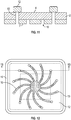
- FIG. 5 illustrates a top plan view of a square-shaped adhesive medical article 1 according to another aspect of the present disclosure, wherein the article comprises a central collection portion 9 and a plurality of longitudinal extensions 10 having a non-linear shape and wherein each longitudinal extension 10 comprises at its extremity a terminal portion 11.
- FIG. 6 illustrates a top plan view of a square-shaped adhesive medical article 1 according to another aspect of the present disclosure, wherein the article comprises a larger central collection portion 9 and a plurality of longitudinal extensions 10 having a non-linear shape and provided with terminal portions 11.
- the terminal portions for use herein have a shape selected from the group consisting of circle, oval, square, triangle, diamond, polygon, and any combinations thereof.
- each terminal portion has a size in a range from 0.5 to 5 mm, from 0.5 to 4 mm, from 1 to 4 mm, from 1 to 4 mm, from 1.5 to 4 mm, from 1.5 to 3.5 mm, from 1.5 to 3 mm, or even from 2 to 3 mm.
- each terminal portion for use herein has a circular shape having a diameter in a range from 0.5 to 5 mm, from 0.5 to 4 mm, from 1 to 4 mm, from 1 to 4 mm, from 1.5 to 4 mm, from 1.5 to 3.5 mm, from 1.5 to 3 mm, or even from 2 to 3 mm.
- the adhesive medical article of the present disclosure further comprises at least one absorbent pad connected to at least one terminal portion.
- the expression "the absorbent pad is connected to a terminal portion” is meant to express that the absorbent pad is in fluid connection with the corresponding terminal portion, i.e. the absorbent pad is enabled to directly or indirectly absorb the biological fluid present in the corresponding terminal portion.
- Absorbent pads for use herein are not particularly limited. Any absorbent pads commonly known in the art may be used in the context of the present disclosure. Suitable absorbent pads for use herein will be easily identified by those skilled in the art in the light of the present disclosure. Exemplary absorbent pads for use herein are described e.g. in US-A1-2001/0027285 (Heinecke et al. ).
- all the longitudinal extensions for use herein comprise at their extremity a terminal portion which is positioned in the outer circumferential portion of the backing layer, and the article comprises a plurality of absorbent pads each connected to a corresponding terminal portion.
- FIG. 7 illustrates a top plan view of an oval-shaped adhesive medical article 1 according to another aspect of the present disclosure, wherein the article comprises a central collection portion 9 , two longitudinal extensions 10 having a linear shape and comprising at their extremity a terminal portion 11 , and wherein the article further comprises two absorbent pads 12 each connected to a corresponding terminal portion 11.
- all the longitudinal extensions for use herein comprise at their extremity a terminal portion which is positioned in the outer circumferential portion of the backing layer, and wherein a single absorbent pad is connected to all the terminal portions.
- FIG. 8 illustrates a top plan view of a round-shaped adhesive medical article 1 according to another aspect of the present disclosure, wherein the article 1 comprises a central collection portion 9 , a plurality of longitudinal extensions 10 having a non-linear shape and comprising at their extremity a terminal portion 11 , and wherein the article further comprises a rounded-shape single absorbent pad 12 connected to all the terminal portions 11.
- absorbent pad(s) configured such as to be in connection with their corresponding terminal portion(s) is believed to facilitate and beneficially impact the fluid management characteristics of the adhesive medical article, by specifically attracting (through capillarity and absorption/adsorption effects) the biological fluids away from the wound or medically-treated site and through the longitudinal extensions, and by efficiently collecting and scavenging the biological fluid exuding from the medically-treated site.
- the additional absorbent pad(s) are further believed to allow increased volume of biological fluids to be transported away from the wound or medically-treated site, while permitting the central collection portion to remain substantially free to collect additional fluids and maintaining an aseptic environment and minimizing infection risk at the wound or medically treated site.
- the absorbent pad(s) are adhesively connected to the corresponding terminal portion(s), which means that the absorbent element (e.g. absorbing nonwoven material) of the absorbent pad(s) is placed directly over the surface of the corresponding terminal portion(s) while the carrier portion of the absorbent pad(s) which surrounds the absorbent element is adhesively secured to the surface surrounding the terminal portion(s), in particular via a suitable pressure sensitive adhesive.
- the absorbent element e.g. absorbing nonwoven material
- the absorbent pad(s) are releasably connected to the corresponding terminal portion(s), which means that the absorbent pad(s) may be conveniently and relatively easily detached or separated from the corresponding terminal portion(s).
- This specific configuration may be executed by using suitable pressure sensitive adhesives.
- the absorbent pad(s) may be suitably positioned on the first major surface of the backing layer. This specific execution is particularly advantageous in that it provides better comfort to the patient due to the cushioning effect provided by the absorbent pad(s) and provides for an adhesive medical article having a relatively neat external surface.
- Suitable absorbent pads for use in the context of the present disclosure may be formed by any absorbent material commonly known in the art.
- the absorbent pad for use herein comprises a material selected from the group consisting of woven, nonwoven cotton, rayon, synthetic or natural hydrophilic materials, hydrogels, hydrocolloid absorbent materials, foams, synthetic swelling polymers, synthetic or natural nonwoven materials, and any combinations or mixtures thereof.
- the absorbent pad for use herein may comprise a hydrocolloid composition.
- the hydrocolloid absorbent may comprise, in particular, a natural hydrocolloid, such as pectin, gelatin, or carboxymethylcellulose (CMC) (Aqualon Corp., Wilmington, Del.), a semi-synthetic hydrocolloid, such as cross-linked carboxymethylcellulose (X4ink CMC) (e.g. Ac-Di-Sol; FMC Corp., Philadelphia, Pa.), a synthetic hydrocolloid, such as cross-linked polyacrylic acid (PAA) (e.g., CARBOPOL(TM) No. 974P; B.F. Goodrich, Brecksville, Ohio), or a combination thereof.
- PAA cross-linked polyacrylic acid
- the absorbent may advantageously comprise any useful substance.
- suitable substances for use with the absorbent pad may include, but are not limited to, antimicrobial agents, drugs for transdermal drug delivery, chemical indicators to monitor hormones or other substances in a patient, and any combinations thereof.
- Other alternative substances may also be used depending on the targeted application or therapeutic benefits.
- the longitudinal extension(s) for use in the adhesive medical article have the ability to drive an aqueous liquid from the central collection portion towards the outer circumferential portion of the backing layer, in particular towards the terminal portion of the longitudinal portion, and ultimately towards the optional absorbent pad(s).
- the biological fluid or aqueous liquid referred to in the present disclosure is selected from human body fluids, in particular wound exudates.
- the backing layer of the adhesive medical article may be provided with at least one through hole perforation overlapping with the at least one terminal portion, wherein the at least one absorbent pad is positioned on the second major surface of the backing layer and is connected to the at least one terminal portion through the at least one perforation.
- the backing layer of the adhesive medical article is provided with a plurality of through hole perforations overlapping with a plurality of corresponding terminal portions, wherein the article comprises a plurality of absorbent pads each connected to a corresponding terminal portion through the corresponding perforation.
- FIG. 9 illustrates a top plan view of a square-shaped adhesive medical article 1 according to another aspect of the present disclosure, wherein the article 1 comprises a central collection portion 9 and a plurality of longitudinal extensions 10 having a non-linear shape, wherein each longitudinal extension 10 comprises at its extremity a terminal portion, wherein the article 1 is further provided with a plurality of through hole perforations 13 overlapping with a plurality of corresponding terminal portions and with four rectangular-shaped absorbing pads 12 , wherein the absorbent pads 12 are positioned on the second major surface of the backing layer and are each connected to some terminal portions through the corresponding perforations 13.
- the backing layer is provided with a plurality of through hole perforations overlapping with a plurality of corresponding terminal portions, wherein the article comprises a single absorbent pad which is connected to all the terminal portions through all the corresponding perforations.
- FIG. 10 illustrates a top plan view of a square-shaped adhesive medical article 1 according to another aspect of the present disclosure, wherein the article 1 comprises a central collection portion 9 and a plurality of longitudinal extensions 10 having a non-linear shape, wherein each longitudinal extension 10 comprises at its extremity a terminal portion, wherein the article 1 is further provided with a plurality of through hole perforations 13 overlapping with a plurality of corresponding terminal portions, and wherein the article 1 comprises a single absorbent pad 12 positioned on the second major surface of the backing layer and connected to all the terminal portions through all the corresponding perforations 13.
- FIG. 11 is a cross-sectional view of the adhesive medical article 1 represented in FIG. 10 taken along the lines 11-11.
- the absorbent pad(s) for use herein are releasably connected to the corresponding terminal portion(s), in particular adhesively connected to the corresponding terminal portion(s).
- the absorbent pad(s) may be advantageously positioned on the second major surface of the backing layer, i.e. on the surface of the backing layer opposite to the first major surface carrying the pressure sensitive adhesive pattern coating.
- This particular configuration may be advantageously selected with the use of absorbent pad(s) releasably and/or adhesively connected to the corresponding terminal portion(s).
- This specific execution is particularly advantageous in that it allows the patient or the medical operator to conveniently remove and replace the absorbent pad(s) as they become saturated with biological fluids while significantly minimizing the discomfort or pain caused by the replacement operation. This is in particular due to the easy accessibility of the absorbent pad(s) which are releasably and/or adhesively connected to the corresponding terminal portion(s) through the corresponding perforation(s).
- Suitable through hole perforations for use herein are not particularly limited as long as they overlap with the corresponding terminal portions and are able to have them connected to the corresponding absorbent pad(s). Suitable through hole perforations for use herein will be easily identified by those skilled in the art in the light of the present disclosure.
- the through hole perforations for use herein have a shape selected from the group consisting of circle, oval, square, triangle, diamond, polygon, and any combinations thereof.
- each through hole perforation has a in a range from 0.5 to 6 mm, from 0.5 to 5 mm, from 1 to 5 mm, from 2 to 5 mm, from 3 to 5 mm, or even from 3.5 to 4.5 mm.
- each through hole perforation for use herein has a circular shape having a diameter in a range from 0.5 to 6 mm, from 0.5 to 5 mm, from 1 to 5 mm, from 2 to 5 mm, from 3 to 5 mm, or even from 3.5 to 4.5 mm.
- the adhesive medical article of the present disclosure is further provided with a secondary pressure sensitive adhesive pattern coating applied onto at least part of the surface of the central collection portion in such a way as to form a plurality of secondary adhesive coated and adhesive uncoated areas of the central collection portion.
- a secondary pressure sensitive adhesive pattern coating as defined above is able to beneficially impact the overall fluid management characteristics of the adhesive medical article, in particular by modulating the volume and speed of the biological fluid transport away from the wound or medically-treated site.
- the secondary pressure sensitive adhesive pattern coating as defined above is also believed to advantageously affect the fine and delicate balance between the gentleness to skin attribute and the adhesive securement performance of the adhesive medical article.
- the secondary pressure sensitive adhesive pattern coating may share a lot of similarities with the primary pressure sensitive adhesive pattern coating as defined above, in particular in terms of the shape of the coated and adhesive uncoated areas, the overall adhesive pattern, the depth of the adhesive coated areas, the average coat weight and the chemical composition of the adhesive coating.
- the secondary pressure sensitive adhesive pattern coating for use herein is identical to the (primary) pressure sensitive adhesive pattern coating as defined above.
- the secondary pressure sensitive adhesive pattern coating for use herein is different from the (primary) pressure sensitive adhesive pattern coating as defined above.
- the secondary adhesive coating for use herein forms a continuous pattern wherein the secondary adhesive uncoated areas are not interconnected. Secondary adhesive coatings forming a continuous pattern have been found to predominantly and advantageously affect the adhesive securement performance of the adhesive medical article.
- the secondary adhesive coating forms a discontinuous pattern wherein the secondary adhesive uncoated areas are interconnected. Secondary adhesive coatings forming a discontinuous pattern have been found to advantageously affect not only the gentleness to skin attribute but also the overall fluid management characteristics and the overall breathability of the adhesive medical article.
- the plurality of secondary adhesive uncoated areas of the central collection portion have a shape selected from the group consisting of circle, oval, square, triangle, diamond, polygon, linear stripes, non-linear stripes, curved stripes, in particular C-shape and S-shape stripes, and any combinations thereof.
- the plurality of secondary adhesive uncoated areas of the central collection portion have a shape selected from the group consisting of diamond, linear stripes, curved stripes, in particular C-shape and S-shape stripes, and any combinations thereof.
- the plurality of secondary adhesive coated areas of the central collection portion have a shape selected from the group consisting of circle, oval, square, triangle, diamond, polygon, linear stripes, non-linear stripes, curved stripes, in particular C-shape and S-shape stripes, and any combinations thereof.
- the plurality of secondary adhesive coated areas of the central collection portion have a shape selected from the group consisting of circle, oval, diamond, and any combinations thereof.
- FIG. 14 illustrates a top plan view of a square-shaped adhesive medical article 1 according to another aspect of the present disclosure, wherein the article 1 comprises a central collection portion 9 and a plurality of longitudinal extensions 10 having a non-linear shape, wherein the article is further provided with a discontinuous secondary pressure sensitive adhesive pattern coating applied onto at least part of the surface of the central collection portion 9 in such a way as to form a plurality of secondary adhesive coated areas 14 and adhesive uncoated areas 15 of the central collection portion 9 , and wherein the plurality of secondary adhesive coated areas 14 have a circle shape.
- FIG. 15 illustrates a top plan view of a square-shaped adhesive medical article 1 according to another aspect of the present disclosure, wherein the article 1 comprises a central collection portion 9 and a plurality of longitudinal extensions 10 having a non-linear shape, wherein the article is further provided with a discontinuous secondary pressure sensitive adhesive pattern coating applied onto at least part of the surface of the central collection portion 9 in such a way as to form a plurality of secondary adhesive coated areas 14 and adhesive uncoated areas 15 of the central collection portion 9 , and wherein the plurality of secondary adhesive coated areas 14 have a diamond shape.
- FIG. 16 illustrates a top plan view of a square-shaped adhesive medical article 1 according to another aspect of the present disclosure, wherein the article 1 comprises a central collection portion 9 and a plurality of longitudinal extensions 10 having a non-linear shape, wherein the article is further provided with a continuous secondary pressure sensitive adhesive pattern coating applied onto at least part of the surface of the central collection portion 9 in such a way as to form a plurality of secondary adhesive coated areas 14 and adhesive uncoated areas 15 of the central collection portion 9 , and wherein the plurality of secondary adhesive uncoated areas 15 have the shape of C-shape stripes.
- FIG. 17 illustrates a top plan view of a square-shaped adhesive medical article 1 according to another aspect of the present disclosure, wherein the article 1 comprises a central collection portion 9 and a plurality of longitudinal extensions 10 having a non-linear shape, wherein the article is further provided with a continuous secondary pressure sensitive adhesive pattern coating applied onto at least part of the surface of the central collection portion 9 in such a way as to form a plurality of secondary adhesive coated areas 14 and adhesive uncoated areas 15 of the central collection portion 9 , and wherein the plurality of secondary adhesive uncoated areas 15 have the shape of S-shape stripes.
- FIG. 18 illustrates a top plan view of a square-shaped adhesive medical article 1 according to another aspect of the present disclosure, wherein the article 1 comprises a central collection portion 9 and a plurality of longitudinal extensions 10 having a non-linear shape and provided with terminal portions 11 , wherein the article is further provided with a continuous secondary pressure sensitive adhesive pattern coating applied onto at least part of the surface of the central collection portion 9 in such a way as to form a plurality of secondary adhesive coated areas 14 and adhesive uncoated areas 15 of the central collection portion 9 , wherein the plurality of secondary adhesive uncoated areas 15 have the shape of S-shape stripes, and wherein the article 1 further comprises a single absorbent pad 12 which is connected to all the terminal portions 11.
- the total secondary adhesive uncoated area is no greater than 50%, no greater than 45%, no greater than 40%, no greater than 35%, no greater than 30%, no greater than 25%, no greater than 20%, no greater than 15%, no greater than 10%, or even no greater than 5%, of the total surface of the central collection portion.
- the total secondary adhesive uncoated area is in a range from 2 to 50%, from 2 to 45%, from 5 to 45%, from 5 to 40%, from 5 to 35%, from 10 to 35%, from 10 to 30%, from 10 to 25 %, or even from 10 to 20%, of the total surface of the central collection portion.
- the total secondary adhesive coated area is greater than 50%, greater than 55%, greater than 60%, greater than 65%, greater than 70%, greater than 75%, greater than 80%, greater than 85%, greater than 90%, or even greater than 95%, of the total surface of the central collection portion.
- the total secondary adhesive coated area is in a range from 50 to 98%, from 55 to 95%, from 55 to 90%, from 60 to 90%, from 65 to 90%, from 65 to 85%, from 70 to 85%, or even from 75 to 85%, of the total surface of the central collection portion.
- the adhesive medical article of the present disclosure is further provided with a support layer which substantially fully overlaps the second major surface of the backing layer.
- Support layers for use herein are not particularly limited. Any support layer commonly known in the art may be used in the context of the present disclosure. Suitable support layers for use herein will be easily identified by those skilled in the art in the light of the present disclosure. Exemplary support layers for use herein comprise a material selected from the group consisting of polyethylene/vinyl acetate copolymer-coated papers, polyester films, and any combinations thereof.
- Suitable support materials are preferably chosen to have advantageous rigidity, flexibility and good conformability to anatomical surfaces. Examples of support layers for use herein are described e.g. in US-A1-2001/0027285 (Heinecke et al. ).
- FIG. 12 illustrates a top plan view of a square-shaped adhesive medical article 1 according to another aspect of the present disclosure, wherein the article 1 comprises a central collection portion 9 and a plurality of longitudinal extensions 10 having a non-linear shape, wherein each longitudinal extension 10 comprises at its extremity a terminal portion, wherein the article 1 is further provided with a plurality of through hole perforations 13 overlapping with a plurality of corresponding terminal portions, wherein the article 1 comprises a single absorbent pad 12 positioned on the second major surface of the backing layer and connected to all the terminal portions through all the corresponding perforations 13 , and wherein the article 1 is provided with a support layer 16 which substantially fully overlaps the second major surface of the backing layer.
- FIG. 13 is a cross-sectional view of the adhesive medical article represented in FIG. 12 taken along the lines 13-13.
- a support layer which substantially fully overlaps the second major surface of the backing layer is particularly advantageous in those configurations of the adhesive medical article where the second major surface of the backing layer is provided with optional absorbent pad(s) connected to the corresponding terminal portion(s) through optional corresponding perforation(s).
- the presence of a support layer overlapping and covering not only the second major surface of the backing layer but also the optional absorbent pad(s) is particularly advantageous in that it allows preserving a relatively neat external surface for the adhesive medical article.
- the backing layer, the primary pressure sensitive adhesive pattern coating, optionally the secondary pressure sensitive adhesive pattern coating, optionally the absorbent pad, and optionally the support layer are translucent or transparent.
- Adhesive medical articles provided with these transparency characteristics advantageously improves the ability for the wound or medically treated site to remain visible not only at the time of application but also during the entire healing process.
- the adhesive medical article of the present disclosure has an overall light-transmission (resulting from the light-transmission through the article), of at least 80%, at least 85%, or even at least 90%, when measured according to ASTM D-1003.
- the adhesive article of the present disclosure may be suitably used for various medical applications.
- the adhesive medical article is particularly suitable for biological fluids management, in particular wound exudates.
- the excellent fluid management properties e.g. control and/or transportation properties provided by the adhesive article described herein are typically desired to maintain an aseptic environment and minimize infection risk at the wound or medically treated site, or to prevent biological fluids spillage.
- the adhesive article according to the disclosure is particularly suitable for use with the so-called highly exuding wounds, such as intravenous (IV) sites or sites for gastric tubes, as well as with chronic wounds, such as e.g. diabetic foot ulcers, venous leg ulcers and pressure ulcers
- the adhesive medical article is further able to provide early detection of infection due in particular to its excellent transparency characteristics.
- the adhesive medical article is selected from the group consisting of wound dressings, wound drains, intravenous access site dressings, drug delivery dressings, and any combinations thereof.
- the adhesive medical article of the present disclosure is selected from the group of wound dressings, drug delivery dressings, and any combinations thereof.
- the adhesive medical article as described herein is a wound dressing or used as a wound dressing.
- the present disclosure is directed to a method of manufacturing an adhesive medical article, comprising the steps of:
- the method as described above further comprises the steps of:
- the method as described above further comprises the steps of:
- the method as described above further comprises the step of applying a secondary pressure sensitive adhesive pattern coating onto at least part of the surface of the central collection portion in such a way as to form a plurality of secondary adhesive coated and adhesive uncoated areas of the central collection portion.
- the present disclosure relates to a method of applying a wound dressing to a wound, comprising the steps of:
- the present disclosure relates to a method of facilitating wound healing, comprising the steps of:
- the present disclosure is directed to a method of managing wound exudates from a wound site, comprising the steps of:
- the exemplary silicone-based pressure sensitive adhesive is prepared by adding the silicone oil and the tackifier in a laboratory jar and allowed to mix for at least 48 hours to produce a homogeneous composition using a PDMS/TMS 803 blending ratio of 95/5.
- the blended silicone-based pressure sensitive adhesive composition is then screen-printed onto the TPU backing material using a rotary screen printer (available from Stork, Charlotte, N.C.) and using the screen-printing setting and method described in U.S. Pat. No. 6,461,467 (Blatchford et al. ), to obtain the targeted adhesive pattern coating.
- the resulting adhesive coat weight is 100 g/m 2 and the coating thickness is about 100 microns.
- the silicone-based pressure sensitive adhesive pattern is cured by e-beam radiation using suitable conditions, as described in WO 2010/056544 (Determan et al. ).
- the adhesive medical article of Example 1 is prepared according to the general procedure as described above and using a backing having a 110 mm x 110 mm dimension.
- the screen-printing results in the formation of a pressure sensitive adhesive pattern as depicted in FIG. 5 and comprising twelve longitudinal extensions having a curved shape and a central collection portion having a circular shape.
- Each longitudinal extension has a 55 mm length of and a 2 mm width, and comprises at its extremity a terminal portion having a circular shape and a diameter of 3 mm.
- the central collection portion has a diameter of 8 mm.
- the adhesive medical article of Example 2 is prepared according to the general procedure as described above and using a backing having a 110 mm x 110 mm dimension.
- the screen-printing results in the formation of a pressure sensitive adhesive pattern as depicted in FIG. 9 and comprising twelve longitudinal extensions having a curved shape and a central collection portion having a circular shape.
- Each longitudinal extension has a 55 mm length of and a 2 mm width, and comprises at its extremity a terminal portion having a circular shape and a diameter of 3 mm.
- the central collection portion has a diameter of 20 mm.
- the adhesive medical article of Example 2 is further provided with twelve through hole perforations overlapping with the corresponding twelve terminal portions and with four rectangular-shaped absorbing pads, wherein the absorbent pads are positioned on the second major surface of the backing layer and are each connected to three terminal portions through the corresponding three perforations.
- the through hole perforations have a 4 mm diameter.
- the absorbent pads have a 60 mm x 16 mm dimension.
Landscapes
- Health & Medical Sciences (AREA)
- Engineering & Computer Science (AREA)
- Chemical & Material Sciences (AREA)
- Public Health (AREA)
- Dermatology (AREA)
- Veterinary Medicine (AREA)
- Life Sciences & Earth Sciences (AREA)
- Animal Behavior & Ethology (AREA)
- General Health & Medical Sciences (AREA)
- Organic Chemistry (AREA)
- Bioinformatics & Cheminformatics (AREA)
- Biomedical Technology (AREA)
- Vascular Medicine (AREA)
- Heart & Thoracic Surgery (AREA)
- Medicinal Chemistry (AREA)
- Pharmacology & Pharmacy (AREA)
- Epidemiology (AREA)
- Materials For Medical Uses (AREA)
- Adhesive Tapes (AREA)
- Adhesives Or Adhesive Processes (AREA)
Abstract
Description
- The present disclosure relates generally to the field of medical articles, more specifically to the field of adhesive medical articles having fluid management properties. The present disclosure also relates to a method of manufacturing such adhesive medical articles.
- Adhesive articles used in medical applications, such as wound dressings, are generally placed against the skin of a human body for a predetermined period of time specifically at a wound site. The medical adhesive articles are typically required to possess a certain set of properties such as e.g. good securement, gentleness to skin, moisture- and air-permeability and conformability.
- When medical wound dressings are meant to be used during or after surgery operations, they are additionally required to possess excellent biological fluids (in particular wound exudates) control and/or transportation properties. Such proper fluid management is typically desired to maintain an aseptic environment and minimize infection risk at the wound or medically treated site, or to prevent biological fluids spillage. Adequate fluid management will also typically result into preserving better adhesive securement and improved comfort for the patient. In some other instances, the biological fluids, in particular blood, might need to be collected and recycled back to the patient.
- Medical articles and systems known in the art for providing biological fluids control typically rely on four different types of technical solution: a) the use of absorbent pads directly over the wound or medically treated site; b) the use of suction tubes; c) the use of films or materials having a high moisture vapor transmission rate (MVTR) or d) the use of engineered films provided with micro-replicated channels. All these known solutions suffer from various limitations or deficiencies that significantly hamper the desired fluid management properties. The use of suction tubes, which may be employed to collect fluids from a wound site, typical create significant patient discomfort and can be source of infection. The use of high MVTR material and engineered films are typically insufficient to evacuate excess biological fluids from the so-called highly exuding wounds, such as intravenous (IV) sites or sites for gastric tubes. Films provided with micro-structured channels additional suffer from manufacturing complexity or production cost ineffectiveness. As for absorbent pads, they typically allow absorbing large volumes of fluid but are not fully satisfactory in terms of providing absorption speed sufficient to prevent fluid buildup. Also, absorbent pads are typically placed directly over the wound or medically treated site, which prevents visual observation of wound healing progression.
- Without contesting the technical advantages associated with the solutions known in the art, there is still a need for a medical adhesive article which overcomes the above-mentioned deficiencies. In particular, it is desirable to provide a medical adhesive article having excellent fluid management characteristics, whilst providing an optimum balance of securement and gentleness to skin.
- According to one aspect, the present disclosure relates to an adhesive medical article comprising a backing layer having a first major surface and a second major surface opposite to the first major surface, wherein the backing layer comprises a central portion and an outer circumferential portion, wherein the article further comprises a pressure sensitive adhesive pattern coating applied onto at least part of the first major surface of the backing layer in such a way as to form a plurality of adhesive coated and adhesive uncoated areas of the backing layer, wherein the adhesive uncoated areas comprise a central collection portion and at least one longitudinal extension radiating from the central collection portion towards the outer circumferential portion of the backing layer.
- According to another aspect, the present disclosure is directed to a method of manufacturing an adhesive medical article, comprising the steps of:
- a) providing a backing layer having a first major surface and a second major surface opposite to the first major surface, and wherein the backing layer comprises a central portion and an outer circumferential portion; and
- b) applying a pressure sensitive adhesive pattern coating onto at least part of the first major surface of the backing layer in such a way as to form a plurality of adhesive coated and adhesive uncoated areas of the backing layer, wherein the adhesive uncoated areas comprise a central collection portion and a plurality of longitudinal extensions radiating from the central collection portion towards the outer circumferential portion of the backing layer.
-
-
FIG. 1 illustrates a top plan view of an adhesive medical article according to one aspect of the present disclosure, wherein the article comprises a central collection portion and one longitudinal extension having a linear shape. -
FIG. 2 is a cross-sectional view of the adhesive medical article represented inFIG. 1 taken along the lines 2-2. -
FIG. 3 illustrates a top plan view of an adhesive medical article according to another aspect of the present disclosure, wherein the article comprises a central collection portion and two longitudinal extensions having a linear shape. -
FIG. 4 illustrates a top plan view of an adhesive medical article according to another aspect of the present disclosure, wherein the article comprises a central collection portion and a plurality of longitudinal extensions having a non-linear shape. -
FIG. 5 illustrates a top plan view of an adhesive medical article according to another aspect of the present disclosure, wherein the article comprises a central collection portion and a plurality of longitudinal extensions having a non-linear shape, and wherein each longitudinal extension comprises at its extremity a terminal portion. -
FIG. 6 illustrates a top plan view of an adhesive medical article according to another aspect of the present disclosure, wherein the article comprises a central collection portion and a plurality of longitudinal extensions having a non-linear shape, and wherein each longitudinal extension comprises at its extremity a terminal portion. -
FIG. 7 illustrates a top plan view of an adhesive medical article according to another aspect of the present disclosure, wherein the article comprises a central collection portion, two longitudinal extensions having a linear shape and two absorbent pads. -
FIG. 8 illustrates a top plan view of an adhesive medical article according to another aspect of the present disclosure, wherein the article comprises a central collection portion, a plurality of longitudinal extensions having a non-linear shape, and a rounded-shape single absorbent pad. -
FIG. 9 illustrates a top plan view of an adhesive medical article according to another aspect of the present disclosure, wherein the article comprises a central collection portion and a plurality of longitudinal extensions having a non-linear shape, wherein each longitudinal extension comprises at its extremity a terminal portion, wherein the article is further provided with a plurality of through hole perforations overlapping with a plurality of corresponding terminal portions and with four absorbing pads each connected to some terminal portions through the corresponding perforations. -
FIG. 10 illustrates a top plan view of the adhesive medical article according to another aspect of the present disclosure, wherein the article comprises a central collection portion and a plurality of longitudinal extensions having a non-linear shape, wherein each longitudinal extension comprises at its extremity a terminal portion, wherein the article is further provided with a plurality of through hole perforations overlapping with a plurality of corresponding terminal portions, and wherein the article comprises a single absorbent pad which is connected to all the terminal portions through all the corresponding perforations. -
FIG. 11 is a cross-sectional view of the adhesive medical article represented inFIG. 10 taken along the lines 11-11. -
FIG. 12 is a top plan view of the adhesive medical article represented inFIG. 10 , which is further provided with an exemplary cover film. -
FIG. 13 is a cross-sectional view of the adhesive medical article represented inFIG. 12 taken along the lines 13-13. -
FIG. 14 illustrates a top plan view of an adhesive medical article according to another aspect of the present disclosure, wherein the article comprises a central collection portion and a plurality of longitudinal extensions having a non-linear shape, and wherein the article is further provided with a secondary pressure sensitive adhesive pattern coating applied onto at least part of the surface of the central collection portion. -
FIG. 15 illustrates a top plan view of an adhesive medical article according to another aspect of the present disclosure, wherein the article comprises a central collection portion and a plurality of longitudinal extensions having a non-linear shape, and wherein the article is further provided with an alternative secondary pressure sensitive adhesive pattern coating applied onto at least part of the surface of the central collection portion. -
FIG. 16 illustrates a top plan view of an adhesive medical article according to another aspect of the present disclosure, wherein the article comprises a central collection portion and a plurality of longitudinal extensions having a non-linear shape, and wherein the article is further provided with an alternative secondary pressure sensitive adhesive pattern coating applied onto at least part of the surface of the central collection portion. -
FIG. 17 illustrates a top plan view of an adhesive medical article according to another aspect of the present disclosure, wherein the article comprises a central collection portion and a plurality of longitudinal extensions having a non-linear shape, and wherein the article is further provided with an alternative secondary pressure sensitive adhesive pattern coating applied onto at least part of the surface of the central collection portion. -
FIG. 18 is a top plan view of an adhesive medical article according to another aspect of the present disclosure, wherein the article comprises a central collection portion and a plurality of longitudinal extensions having a non-linear shape, wherein the article is further provided with a secondary pressure sensitive adhesive pattern coating applied onto at least part of the surface of the central collection portion, wherein each longitudinal extension comprises at its extremity a terminal portion, and wherein the article comprises a single absorbent pad which is connected to all the terminal portions. - According to a first aspect, the present disclosure relates to an adhesive medical article comprising a backing layer having a first major surface and a second major surface opposite to the first major surface, wherein the backing layer comprises a central portion and an outer circumferential portion, wherein the article further comprises a pressure sensitive adhesive pattern coating applied onto at least part of the first major surface of the backing layer in such a way as to form a plurality of adhesive coated and adhesive uncoated areas of the backing layer, wherein the adhesive uncoated areas comprise a central collection portion and at least one longitudinal extension radiating from the central collection portion towards the outer circumferential portion of the backing layer.
- In the context of the present disclosure, it has been surprisingly found that an adhesive medical article as described above is provided with excellent fluid management characteristics, as well as an optimum balance of adhesive securement and gentleness to skin. This is a particularly unexpected finding as these characteristics are known to be self-contradicting as such. In one advantageous aspect, the adhesive medical article of the present disclosure allows the medically treated site to remain visible not only at the time of application but also during the entire healing process. The adhesive medical article as described above is further characterized by reduced manufacturing complexity and associated production costs.
- Without wishing to be bound by theory, it is believed that these excellent characteristics and performance attributes are due in particular to the presence of the specific pressure sensitive adhesive pattern coating applied onto at least part of the first major surface of the backing layer in such a way as to form a plurality of adhesive coated and adhesive uncoated areas of the backing layer, wherein the uncoated areas comprise a central collection portion and at least one longitudinal extension radiating from the central collection portion towards the outer circumferential portion of the backing layer. The improved visibility attribute is due, in particular, to the presence of the central collection portion which is part of the adhesive uncoated areas.
- In the context of the present disclosure, the expression "central portion of the backing layer" is meant to designate the region of the backing layer which is situated between the intersection point (I) of all the axis of symmetry of the backing layer and less than half of the distance between the intersection point (I) and the extremity of the backing layer. The expression "outer circumferential portion of the backing layer" is meant to refer to the region of the backing layer which is situated between the extremity of the backing layer and half of the distance between the extremity of the backing layer and the intersection point (I).
- The adhesive medical article of the present disclosure comprises a backing layer which is provided with uncoated areas comprising a central collection portion. The central collection portion for use herein is typically meant to collect the biological fluids exuding from the wound or medically-treated site. Shape and size of the central collection portions for use herein are not particularly limited. Suitable shapes and sizes of the central collection portions will be easily identified by those skilled in the art in the light of the present disclosure.
-
FIG. 1 is a top plan view of a round-shaped adhesivemedical article 1 according to one aspect of the present disclosure, wherein the article comprises a backing layer having acentral portion 5 and an outer circumferential portion 6, wherein the backing layer is provided on its first major surface with a pressure sensitive adhesive pattern coating comprising a plurality of adhesive coated and adhesive uncoated areas of the backing layer, wherein the adhesive uncoated areas comprise acentral collection portion 9 and onelongitudinal extension 10 having a linear shape and radiating from thecentral collection portion 9 towards the outer circumferential portion 6 of the backing layer. -
FIG. 2 is a cross-sectional view of the adhesive medical article represented inFIG. 1 taken along the lines 2-2, and which depicts thebacking layer 2 comprising a first major surface 3 and a secondmajor surface 4, and which is provided on its first major surface 3 with a pressure sensitive adhesive pattern coating comprising a plurality of adhesive coated areas 7 and adhesive uncoated areas 8 of thebacking layer 4. - In one exemplary aspect, the central collection portion for use herein has a shape selected from the group consisting of circle, oval, square, triangle, diamond, polygon, and any combinations thereof.
- In another exemplary aspect, the central collection portion has a size (of the greatest dimension) in a range from 1 to 400 mm, from 1 to 350 mm, from 1 to 300 mm, from 1 to 250 mm, from 1 to 200 mm, from 1 to 150 mm, from 1 to 100 mm, from 1 to 80 mm, from 1 to 50 mm, from 1 to 30 mm, from 2 to 30 mm, from 2 to 25 mm, from 2 to 20 mm, from 3 to 20 mm, or even from 5 to 15 mm.
- In one advantageous aspect, the central collection portion has a (substantial) circular shape having in particular a diameter in a range from 1 to 30 mm, from 2 to 30 mm, from 2 to 25 mm, from 2 to 20 mm, from 3 to 20 mm, or even from 5 to 15 mm.
- According to one advantageous aspect of the disclosure, the adhesive medical article comprises a plurality of longitudinal extensions radiating from the central collection portion towards the outer circumferential portion of the backing layer. The presence of a plurality of longitudinal extensions radiating from the central collection portion towards the outer circumferential portion of the backing layer is believed to accelerate the biological fluid transport away from the wound or medically-treated site, in particular by increasing the volume of biological fluids being transported through the longitudinal extensions. The plurality of longitudinal extensions, when compared to a single longitudinal extension is also believed to advantageously affect the gentleness to skin attribute, while preserving adequate adhesive securement.
- According to another advantageous aspect of the disclosure, the longitudinal extensions have a substantially radial configuration. In the context of the present disclosure, the expression "the longitudinal extensions have a substantially radial configuration" is meant to express that the longitudinal extensions radially extend toward the outer circumferential portion of the backing layer.
- In a beneficial aspect of the disclosure, each longitudinal extension has a length-to-width ratio of at least 5, at least 10, at least 15, at least 20, at least 25, at least 30, at least 35, at least 40, at least 45, or even at least 50.
- In another beneficial aspect of the disclosure, each longitudinal extension has a width of at least 0.5 mm, at least 1 mm, at least 1.5 mm, or even at least 2 mm.
- In still another beneficial aspect of the disclosure, each longitudinal extension has a width no greater than 10 mm, no greater than 8 mm, no greater than 5 mm, no greater than 4 mm, no greater than 3 mm, or even no greater than 2 mm.
- In still another beneficial aspect of the disclosure, each longitudinal extension has a width in a range from 0.5 to 10 mm, from 0.5 to 8 mm, from 0.5 to 5 mm, from 0.5 to 4 mm, from 1 to 4 mm, from 1 to 4 mm, from 1.5 to 4 mm, from 1.5 to 3.5 mm, from 1.5 to 3 mm, or even from 1.5 to 2.5 mm.
- In yet another beneficial aspect of the disclosure, each longitudinal extension has a length of at least 10 mm, at least 20 mm, at least 30 mm, at least 35 mm, at least 40 mm, at least 40 mm, at least 50 mm, at least 55 mm, or even at least 60 mm.
- In yet another advantageous aspect of the disclosure, each longitudinal extension has a length no greater than 200 mm, no greater than 180 mm, no greater than 160 mm, no greater than 150 mm, no greater than 140 mm, no greater than 120 mm, no greater than 100 mm, no greater than 90 mm, no greater than 80 mm, no greater than 70 mm, or even no greater than 65 mm.
- In yet another advantageous aspect of the disclosure, each longitudinal extension has a length in a range from 10 to 200 mm, from 10 to 180 mm, from 10 to 150 mm, from 10 to 120 mm, from 10 to 100 mm, from 10 to 90 mm, from 20 to 90 mm, from 20 to 80 mm, from 30 to 80 mm, from 30 to 75 mm, from 35 to 75 mm, from 35 to 70 mm, from 40 to 70 mm, from 45 to 70 mm, from 45 to 65 mm, from 50 to 65 mm, or even from 50 to 60 mm.
- According to a beneficial aspect of the disclosure, each longitudinal extension has a continuous and substantially non-linear shape.
- In a particularly advantageous aspect, the longitudinal extension for use herein has a curved shape, in particular the shape of a curved strip. Longitudinal extensions having a curved shape are believed to beneficially impact the speed at which the biological fluid is being transported away from the wound or medically-treated site, in particular through improved guiding effect facilitated by the curved contours of the longitudinal extensions.
- In an alternative aspect, the longitudinal extensions for use herein have a continuous and substantially linear shape, in particular the shape of a linear strip.
-
FIG. 3 illustrates a top plan view of an oval-shaped adhesivemedical article 1 according to another aspect of the present disclosure, wherein the article comprises acentral collection portion 9 and twolongitudinal extensions 10 having a linear shape. -
FIG. 4 illustrates a top plan view of a round-shaped adhesivemedical article 1 according to another aspect of the present disclosure, wherein the article comprises acentral collection portion 9 and a plurality oflongitudinal extensions 10 having a non-linear shape. - According to a typical execution, each longitudinal extension for use in the adhesive medical article takes the form of a channel or a pathway in the adhesive coated area of the backing layer. The term channel or pathway suitably characterize the technical function of the longitudinal extensions which are meant to facilitate and beneficially impact the fluid management characteristics of the adhesive medical article.
- In a beneficial aspect of the disclosure, the depth of each longitudinal extension for use herein is a range from 10 to 1000 micrometers, from 10 to 500 micrometers, from 10 to 400 micrometers, from 10 to 300 micrometers, from 10 to 200 micrometers, from 30 to 160 micrometers, from 40 to 160 micrometers, from 40 to 150 micrometers, from 50 to 150 micrometers, from 50 to 140 micrometers, from 60 to 140 micrometers, from 60 to 130 micrometers, from 70 to 130 micrometers, from 70 to 120 micrometers, from 80 to 120 micrometers, from 80 to 110 micrometers, from 90 to 110 micrometers, or even from 95 to 105 micrometers.
- According to another advantageous aspect, the thickness of the pressure sensitive adhesive pattern coating applied onto at least part of the first major surface of the backing layer is in a range from 10 to 1000 micrometers, from 10 to 500 micrometers, from 10 to 400 micrometers, from 10 to 300 micrometers, from 10 to 200 micrometers, from 30 to 160 micrometers, from 40 to 160 micrometers, from 40 to 150 micrometers, from 50 to 150 micrometers, from 50 to 140 micrometers, from 60 to 140 micrometers, from 60 to 130 micrometers, from 70 to 130 micrometers, from 70 to 120 micrometers, from 80 to 120 micrometers, from 80 to 110 micrometers, from 90 to 110 micrometers, or even from 95 to 105 micrometers.
- As will be easily apparent to those skilled in the art, the thickness of the pressure sensitive adhesive pattern coating applied onto the backing layer is directly correlated with the depth of the longitudinal extension(s).
- In an exemplary aspect of the present disclosure, the average coat weight of the adhesive pattern coating applied onto at least part of the first major surface of the backing layer is in a range from 10 to 1000 g/m2, from 10 to 500 g/m2, from 10 to 400 g/m2, from 10 to 300 g/m2, from 10 to 200 g/m2, 30 to 160 g/m2, from 40 to 160 g/m2, from 40 to 150 g/m2, from 50 to 150 g/m2, from 50 to 140 g/m2, from 60 to 140 g/m2, from 60 to 130 g/m2, from 70 to 130 g/m2, from 70 to 120 g/m2, from 80 to 120 g/m2, from 80 to 110 g/m2, from 90 to 110 g/m2, or even from 95 to 105 g/m2.
- The adhesive pattern coating for use herein may be applied onto at least part of the first major surface of the backing layer by any means known to those skilled in the art. Suitable means for forming the adhesive pattern coating for use herein include, but are not limited to, coating techniques, melt blowing techniques, and printing techniques.
- Suitable coating techniques include, but are not limited to, roller coating, knife coating, dip-coating, and spray coating. Beneficially, the adhesive pattern coating for use herein may be applied from a hotmelt pressure sensitive adhesive material.
- Suitable printing techniques for applying the adhesive pattern coating include gravure printing, block printing, intaglio printing, lithographic printing, rotary screen printing, flat screen printing, flexographic printing, and any combinations thereof.
- According to one advantageous aspect of the disclosure, the adhesive pattern coating for use herein is applied onto at least part of the first major surface of the backing layer by screen printing in particular from a hotmelt adhesive material.
- In one typical aspect of the disclosure, the adhesive pattern coating for use in the adhesive medical article forms a discontinuous pattern wherein the adhesive uncoated areas are interconnected. This interconnection between the adhesive uncoated areas of the backing layer is meant to facilitate and beneficially impact the fluid management characteristics of the adhesive medical article.
- In another typical aspect of the adhesive medical article, the adhesive uncoated area(s) comprising the central collection portion and the plurality of longitudinal extensions are substantially fully surrounded by the adhesive coated area(s).
- In still another typical aspect, the first major surface of the backing layer is substantially free of adhesive uncoated area(s) not comprising the central collection portion and the plurality of longitudinal extensions.
- According to one advantageous aspect of the adhesive medical article, the total adhesive uncoated area comprising the central collection portion and the plurality of longitudinal extensions is no greater than 50%, no greater than 45%, no greater than 40%, no greater than 35%, no greater than 30%, no greater than 25%, no greater than 20%, no greater than 15%, no greater than 10%, or even no greater than 5%, of the total surface of the backing layer.
- According to another advantageous aspect, the total adhesive uncoated area comprising the central collection portion and the plurality of longitudinal extensions is in a range from 2 to 50%, from 2 to 45%, from 5 to 45%, from 5 to 40%, from 5 to 35%, from 10 to 35%, from 10 to 30%, from 10 to 25 %, or even from 10 to 20%, of the total surface of the backing layer.
- According to still another advantageous aspect, the total adhesive coated area is greater than 50%, greater than 55%, greater than 60%, greater than 65%, greater than 70%, greater than 75%, greater than 80%, greater than 85%, greater than 90%, or even greater than 95%, of the total surface of the backing layer.
- According to yet another aspect of the disclosure, the total adhesive coated area is in a range from 50 to 98%, from 55 to 95%, from 55 to 90%, from 60 to 90%, from 65 to 90%, from 65 to 85%, from 70 to 85%, or even from 75 to 85%, of the total surface of the backing layer.
- The advantageous distribution of adhesive coated area and adhesive uncoated area as detailed above, is believed to beneficially impact not only the fluid management performance of the adhesive medical article but also the reaching of an optimum balance of adhesive securement and gentleness to skin.
- Pressure sensitive adhesive material for use herein are not particularly limited. Suitable pressure sensitive adhesives for use herein will be easily identified by those skilled in the art in the light of the present disclosure.
- Exemplary pressure sensitive adhesives for use herein comprise a material selected from the group consisting of silicones, rubbers, block copolymers, acrylates, urethane, hydrogels, hydrocolloids, and any combinations or mixtures thereof.
- According to one particularly advantageous aspect, the pressure sensitive adhesive for use herein is selected from the group consisting of hydrophobic pressure sensitive adhesives. As will be apparent to those skilled in the art, the expression "hydrophobic pressure sensitive adhesives" is meant to designate those pressure sensitive adhesives having no or low affinity with water, i.e. the ability to repel water. The use of hydrophobic pressure sensitive adhesives is believed to facilitate and beneficially impact the fluid management characteristics of the adhesive medical article, by specifically repelling (through electrostatic interactions) and guiding the aqueous biological fluid transport away from the wound or medically-treated site and through the longitudinal extensions.
- In one advantageous aspect, the pressure sensitive adhesive for use herein is selected from the group consisting of silicone-based pressure sensitive adhesives, rubber-based pressure sensitive adhesives, acrylic-based pressure sensitive adhesives, and any combinations or mixtures thereof.
- According to one particularly preferred aspect, the pressure sensitive adhesive for use herein is selected from the group consisting of silicone-based pressure sensitive adhesives, wherein the silicone base material is selected from the group of crosslinked polysiloxanes, in particular crosslinked poly diorganosiloxanes, more in particular poly dimethylsiloxanes. Silicone-based pressure sensitive adhesives are particularly advantageous in that they provide good adhesion to human skin with gentle removal force, which makes them particularly suitable for gentle to skin adhesive applications. Moreover, they have the ability to be repositioned and are provided with very advantageous transparency and hydrophobicity characteristics. Examples of silicone-based pressure sensitive adhesives for use herein and methods of manufacturing thereof are described e.g. in
WO 2010/056544 (Determan et al. ). - According to another advantageous aspect of the disclosure, the pressure sensitive adhesive for use herein is selected from the group consisting of rubber-based pressure sensitive adhesives, in particular those derived from styrene-isoprene-styrene (SIS) rubber, styrene-butadiene-styrene (SBS) rubber, styrene-butadiene (SB) rubber, nitrile butyl rubber (NBR), polyisobutylene (PIB) rubber, polyisoprene rubber, polybutadiene rubber, acrylic rubber, silicone rubber, urethane rubber, butyl rubber, ethylene-propylene rubber, fluoro rubber, polychloroprene rubber, halobutyl rubber, butadiene-acrylonitrile rubber, any combinations or mixtures thereof.
- According to still another advantageous aspect, the pressure sensitive adhesive for use in the present disclosure is selected from the group consisting of acrylic-based pressure sensitive adhesives, in particular those derived from acrylic copolymers, more in particular isooctyl acrylate:acrylamide copolymer, isooctyl acrylate:ethyleneoxide acrylate: acrylic acid terpolymer, and any mixtures thereof.
- According to yet another advantageous aspect, the pressure sensitive adhesive for use in the adhesive medical article comprises a blend of silicone-based pressure sensitive adhesives and acrylic-based pressure sensitive adhesives.
- In another advantageous execution, the pressure sensitive adhesive is selected from the group consisting of urethane-based pressure sensitive adhesives, in particular those derived from urethane (co)polymers.
- Backing layers for use herein are not particularly limited. Any backing layer commonly known in the art may be used in the context of the present disclosure. Suitable backing layers for use herein will be easily identified by those skilled in the art in the light of the present disclosure. Exemplary backing layers for use herein comprise a material selected from the group consisting of polymeric films, nonwoven fibrous webs, woven fibrous webs, knits, porous films, and any combinations thereof.
- In one advantageous aspect of the disclosure, the backing layer for use herein comprises a material selected from the group consisting of polymeric films, in particular those derived from elastomeric polyurethane, polyester, polyether block amide, and any combinations or mixtures thereof.
- Suitable backing materials are preferably chosen to have advantageous transparency or translucency characteristics, as well as high moisture vapor permeability and good conformability to anatomical surfaces. Examples of backing layers for use herein are described e.g. in
US-A1-2001/0027285 (Heinecke et al. ). - In a typical aspect of the adhesive medical article, the central collection portion is positioned in the central portion of the backing layer, and the central collection portion fully overlaps with the central portion of the backing layer.
- According to a typical aspect of the adhesive medical article, each longitudinal extension for use herein comprises at its extremity a terminal portion which is positioned in the outer circumferential portion of the backing layer.
-
FIG. 5 illustrates a top plan view of a square-shaped adhesivemedical article 1 according to another aspect of the present disclosure, wherein the article comprises acentral collection portion 9 and a plurality oflongitudinal extensions 10 having a non-linear shape and wherein eachlongitudinal extension 10 comprises at its extremity aterminal portion 11. -
FIG. 6 illustrates a top plan view of a square-shaped adhesivemedical article 1 according to another aspect of the present disclosure, wherein the article comprises a largercentral collection portion 9 and a plurality oflongitudinal extensions 10 having a non-linear shape and provided withterminal portions 11. - In one advantageous aspect of the disclosure, the terminal portions for use herein have a shape selected from the group consisting of circle, oval, square, triangle, diamond, polygon, and any combinations thereof.
- In another advantageous aspect of the disclosure, each terminal portion has a size in a range from 0.5 to 5 mm, from 0.5 to 4 mm, from 1 to 4 mm, from 1 to 4 mm, from 1.5 to 4 mm, from 1.5 to 3.5 mm, from 1.5 to 3 mm, or even from 2 to 3 mm.
- According to still another advantageous aspect, each terminal portion for use herein has a circular shape having a diameter in a range from 0.5 to 5 mm, from 0.5 to 4 mm, from 1 to 4 mm, from 1 to 4 mm, from 1.5 to 4 mm, from 1.5 to 3.5 mm, from 1.5 to 3 mm, or even from 2 to 3 mm.
- In one beneficial aspect, the adhesive medical article of the present disclosure further comprises at least one absorbent pad connected to at least one terminal portion. In the context of the present disclosure, the expression "the absorbent pad is connected to a terminal portion" is meant to express that the absorbent pad is in fluid connection with the corresponding terminal portion, i.e. the absorbent pad is enabled to directly or indirectly absorb the biological fluid present in the corresponding terminal portion.
- Absorbent pads for use herein are not particularly limited. Any absorbent pads commonly known in the art may be used in the context of the present disclosure. Suitable absorbent pads for use herein will be easily identified by those skilled in the art in the light of the present disclosure. Exemplary absorbent pads for use herein are described e.g. in
US-A1-2001/0027285 (Heinecke et al. ). - According to one more beneficial aspect of the adhesive medical article, all the longitudinal extensions for use herein comprise at their extremity a terminal portion which is positioned in the outer circumferential portion of the backing layer, and the article comprises a plurality of absorbent pads each connected to a corresponding terminal portion.
-
FIG. 7 illustrates a top plan view of an oval-shaped adhesivemedical article 1 according to another aspect of the present disclosure, wherein the article comprises acentral collection portion 9, twolongitudinal extensions 10 having a linear shape and comprising at their extremity aterminal portion 11, and wherein the article further comprises twoabsorbent pads 12 each connected to a correspondingterminal portion 11. - According to another more beneficial aspect of the adhesive medical article, all the longitudinal extensions for use herein comprise at their extremity a terminal portion which is positioned in the outer circumferential portion of the backing layer, and wherein a single absorbent pad is connected to all the terminal portions.
- Such a beneficial execution is described in
FIG. 8 , which illustrates a top plan view of a round-shaped adhesivemedical article 1 according to another aspect of the present disclosure, wherein thearticle 1 comprises acentral collection portion 9, a plurality oflongitudinal extensions 10 having a non-linear shape and comprising at their extremity aterminal portion 11, and wherein the article further comprises a rounded-shape singleabsorbent pad 12 connected to all theterminal portions 11. - The presence of absorbent pad(s) configured such as to be in connection with their corresponding terminal portion(s) is believed to facilitate and beneficially impact the fluid management characteristics of the adhesive medical article, by specifically attracting (through capillarity and absorption/adsorption effects) the biological fluids away from the wound or medically-treated site and through the longitudinal extensions, and by efficiently collecting and scavenging the biological fluid exuding from the medically-treated site. The additional absorbent pad(s) are further believed to allow increased volume of biological fluids to be transported away from the wound or medically-treated site, while permitting the central collection portion to remain substantially free to collect additional fluids and maintaining an aseptic environment and minimizing infection risk at the wound or medically treated site.
- Many different configurations may be envisaged for having the absorbent pad(s) suitably connected to their corresponding terminal portion(s).
- In one advantageous aspect, the absorbent pad(s) are adhesively connected to the corresponding terminal portion(s), which means that the absorbent element (e.g. absorbing nonwoven material) of the absorbent pad(s) is placed directly over the surface of the corresponding terminal portion(s) while the carrier portion of the absorbent pad(s) which surrounds the absorbent element is adhesively secured to the surface surrounding the terminal portion(s), in particular via a suitable pressure sensitive adhesive.
- In another advantageous aspect of the adhesive medical article, the absorbent pad(s) are releasably connected to the corresponding terminal portion(s), which means that the absorbent pad(s) may be conveniently and relatively easily detached or separated from the corresponding terminal portion(s). This specific configuration may be executed by using suitable pressure sensitive adhesives.
- According to still another advantageous aspect, the absorbent pad(s) may be suitably positioned on the first major surface of the backing layer. This specific execution is particularly advantageous in that it provides better comfort to the patient due to the cushioning effect provided by the absorbent pad(s) and provides for an adhesive medical article having a relatively neat external surface.
- Suitable absorbent pads for use in the context of the present disclosure may be formed by any absorbent material commonly known in the art. In one advantageous aspect, the absorbent pad for use herein comprises a material selected from the group consisting of woven, nonwoven cotton, rayon, synthetic or natural hydrophilic materials, hydrogels, hydrocolloid absorbent materials, foams, synthetic swelling polymers, synthetic or natural nonwoven materials, and any combinations or mixtures thereof.
- In one particular aspect of the disclosure, the absorbent pad for use herein may comprise a hydrocolloid composition. The hydrocolloid absorbent may comprise, in particular, a natural hydrocolloid, such as pectin, gelatin, or carboxymethylcellulose (CMC) (Aqualon Corp., Wilmington, Del.), a semi-synthetic hydrocolloid, such as cross-linked carboxymethylcellulose (X4ink CMC) (e.g. Ac-Di-Sol; FMC Corp., Philadelphia, Pa.), a synthetic hydrocolloid, such as cross-linked polyacrylic acid (PAA) (e.g., CARBOPOL(TM) No. 974P; B.F. Goodrich, Brecksville, Ohio), or a combination thereof.
- In another particular aspect, especially when the adhesive medical article is used as a drug delivery dressing, the absorbent may advantageously comprise any useful substance. Suitable substances for use with the absorbent pad may include, but are not limited to, antimicrobial agents, drugs for transdermal drug delivery, chemical indicators to monitor hormones or other substances in a patient, and any combinations thereof. Other alternative substances may also be used depending on the targeted application or therapeutic benefits.
- According to the present disclosure, the longitudinal extension(s) for use in the adhesive medical article have the ability to drive an aqueous liquid from the central collection portion towards the outer circumferential portion of the backing layer, in particular towards the terminal portion of the longitudinal portion, and ultimately towards the optional absorbent pad(s). According to a typical aspect, the biological fluid or aqueous liquid referred to in the present disclosure is selected from human body fluids, in particular wound exudates.
- According to an alternatively advantageous execution, the backing layer of the adhesive medical article may be provided with at least one through hole perforation overlapping with the at least one terminal portion, wherein the at least one absorbent pad is positioned on the second major surface of the backing layer and is connected to the at least one terminal portion through the at least one perforation.
- In a more advantageous aspect, the backing layer of the adhesive medical article is provided with a plurality of through hole perforations overlapping with a plurality of corresponding terminal portions, wherein the article comprises a plurality of absorbent pads each connected to a corresponding terminal portion through the corresponding perforation.
-
FIG. 9 illustrates a top plan view of a square-shaped adhesivemedical article 1 according to another aspect of the present disclosure, wherein thearticle 1 comprises acentral collection portion 9 and a plurality oflongitudinal extensions 10 having a non-linear shape, wherein eachlongitudinal extension 10 comprises at its extremity a terminal portion, wherein thearticle 1 is further provided with a plurality of throughhole perforations 13 overlapping with a plurality of corresponding terminal portions and with four rectangular-shapedabsorbing pads 12, wherein theabsorbent pads 12 are positioned on the second major surface of the backing layer and are each connected to some terminal portions through the correspondingperforations 13. - In another more advantageous aspect of the present disclosure, the backing layer is provided with a plurality of through hole perforations overlapping with a plurality of corresponding terminal portions, wherein the article comprises a single absorbent pad which is connected to all the terminal portions through all the corresponding perforations.
-
FIG. 10 illustrates a top plan view of a square-shaped adhesivemedical article 1 according to another aspect of the present disclosure, wherein thearticle 1 comprises acentral collection portion 9 and a plurality oflongitudinal extensions 10 having a non-linear shape, wherein eachlongitudinal extension 10 comprises at its extremity a terminal portion, wherein thearticle 1 is further provided with a plurality of throughhole perforations 13 overlapping with a plurality of corresponding terminal portions, and wherein thearticle 1 comprises a singleabsorbent pad 12 positioned on the second major surface of the backing layer and connected to all the terminal portions through all thecorresponding perforations 13. -
FIG. 11 is a cross-sectional view of the adhesivemedical article 1 represented inFIG. 10 taken along the lines 11-11. - In still another more advantageous aspect of the present disclosure, the absorbent pad(s) for use herein are releasably connected to the corresponding terminal portion(s), in particular adhesively connected to the corresponding terminal portion(s).
- According to the advantageous configuration according to which the absorbent pad(s) are connected to the corresponding terminal portion through the corresponding perforation(s), the absorbent pad(s) may be advantageously positioned on the second major surface of the backing layer, i.e. on the surface of the backing layer opposite to the first major surface carrying the pressure sensitive adhesive pattern coating. This particular configuration may be advantageously selected with the use of absorbent pad(s) releasably and/or adhesively connected to the corresponding terminal portion(s). This specific execution is particularly advantageous in that it allows the patient or the medical operator to conveniently remove and replace the absorbent pad(s) as they become saturated with biological fluids while significantly minimizing the discomfort or pain caused by the replacement operation. This is in particular due to the easy accessibility of the absorbent pad(s) which are releasably and/or adhesively connected to the corresponding terminal portion(s) through the corresponding perforation(s).
- Suitable through hole perforations for use herein are not particularly limited as long as they overlap with the corresponding terminal portions and are able to have them connected to the corresponding absorbent pad(s). Suitable through hole perforations for use herein will be easily identified by those skilled in the art in the light of the present disclosure.
- In one advantageous aspect of the disclosure, the through hole perforations for use herein have a shape selected from the group consisting of circle, oval, square, triangle, diamond, polygon, and any combinations thereof.
- In another advantageous aspect of the disclosure, each through hole perforation has a in a range from 0.5 to 6 mm, from 0.5 to 5 mm, from 1 to 5 mm, from 2 to 5 mm, from 3 to 5 mm, or even from 3.5 to 4.5 mm.
- According to still another advantageous aspect, each through hole perforation for use herein has a circular shape having a diameter in a range from 0.5 to 6 mm, from 0.5 to 5 mm, from 1 to 5 mm, from 2 to 5 mm, from 3 to 5 mm, or even from 3.5 to 4.5 mm.
- In a beneficial aspect, the adhesive medical article of the present disclosure is further provided with a secondary pressure sensitive adhesive pattern coating applied onto at least part of the surface of the central collection portion in such a way as to form a plurality of secondary adhesive coated and adhesive uncoated areas of the central collection portion.
- In the context of the present disclosure, it has been surprisingly found that the presence of a secondary pressure sensitive adhesive pattern coating as defined above is able to beneficially impact the overall fluid management characteristics of the adhesive medical article, in particular by modulating the volume and speed of the biological fluid transport away from the wound or medically-treated site. The secondary pressure sensitive adhesive pattern coating as defined above is also believed to advantageously affect the fine and delicate balance between the gentleness to skin attribute and the adhesive securement performance of the adhesive medical article.
- The secondary pressure sensitive adhesive pattern coating may share a lot of similarities with the primary pressure sensitive adhesive pattern coating as defined above, in particular in terms of the shape of the coated and adhesive uncoated areas, the overall adhesive pattern, the depth of the adhesive coated areas, the average coat weight and the chemical composition of the adhesive coating.
- According to one advantageous aspect of the disclosure, the secondary pressure sensitive adhesive pattern coating for use herein is identical to the (primary) pressure sensitive adhesive pattern coating as defined above.
- According to another advantageous aspect of the disclosure, the secondary pressure sensitive adhesive pattern coating for use herein is different from the (primary) pressure sensitive adhesive pattern coating as defined above.
- In one beneficial aspect of the adhesive medical article, the secondary adhesive coating for use herein forms a continuous pattern wherein the secondary adhesive uncoated areas are not interconnected. Secondary adhesive coatings forming a continuous pattern have been found to predominantly and advantageously affect the adhesive securement performance of the adhesive medical article.
- In another beneficial aspect of the adhesive medical article, the secondary adhesive coating forms a discontinuous pattern wherein the secondary adhesive uncoated areas are interconnected. Secondary adhesive coatings forming a discontinuous pattern have been found to advantageously affect not only the gentleness to skin attribute but also the overall fluid management characteristics and the overall breathability of the adhesive medical article.
- According to an exemplary aspect of the disclosure, the plurality of secondary adhesive uncoated areas of the central collection portion have a shape selected from the group consisting of circle, oval, square, triangle, diamond, polygon, linear stripes, non-linear stripes, curved stripes, in particular C-shape and S-shape stripes, and any combinations thereof.
- According to an advantageous aspect of the disclosure, the plurality of secondary adhesive uncoated areas of the central collection portion have a shape selected from the group consisting of diamond, linear stripes, curved stripes, in particular C-shape and S-shape stripes, and any combinations thereof.
- According to another exemplary aspect of the disclosure, the plurality of secondary adhesive coated areas of the central collection portion have a shape selected from the group consisting of circle, oval, square, triangle, diamond, polygon, linear stripes, non-linear stripes, curved stripes, in particular C-shape and S-shape stripes, and any combinations thereof.
- According to another advantageous aspect of the disclosure, the plurality of secondary adhesive coated areas of the central collection portion have a shape selected from the group consisting of circle, oval, diamond, and any combinations thereof.
-
FIG. 14 illustrates a top plan view of a square-shaped adhesivemedical article 1 according to another aspect of the present disclosure, wherein thearticle 1 comprises acentral collection portion 9 and a plurality oflongitudinal extensions 10 having a non-linear shape, wherein the article is further provided with a discontinuous secondary pressure sensitive adhesive pattern coating applied onto at least part of the surface of thecentral collection portion 9 in such a way as to form a plurality of secondary adhesive coatedareas 14 and adhesiveuncoated areas 15 of thecentral collection portion 9, and wherein the plurality of secondary adhesive coatedareas 14 have a circle shape. -
FIG. 15 illustrates a top plan view of a square-shaped adhesivemedical article 1 according to another aspect of the present disclosure, wherein thearticle 1 comprises acentral collection portion 9 and a plurality oflongitudinal extensions 10 having a non-linear shape, wherein the article is further provided with a discontinuous secondary pressure sensitive adhesive pattern coating applied onto at least part of the surface of thecentral collection portion 9 in such a way as to form a plurality of secondary adhesive coatedareas 14 and adhesiveuncoated areas 15 of thecentral collection portion 9, and wherein the plurality of secondary adhesive coatedareas 14 have a diamond shape. -
FIG. 16 illustrates a top plan view of a square-shaped adhesivemedical article 1 according to another aspect of the present disclosure, wherein thearticle 1 comprises acentral collection portion 9 and a plurality oflongitudinal extensions 10 having a non-linear shape, wherein the article is further provided with a continuous secondary pressure sensitive adhesive pattern coating applied onto at least part of the surface of thecentral collection portion 9 in such a way as to form a plurality of secondary adhesive coatedareas 14 and adhesiveuncoated areas 15 of thecentral collection portion 9, and wherein the plurality of secondary adhesiveuncoated areas 15 have the shape of C-shape stripes. -
FIG. 17 illustrates a top plan view of a square-shaped adhesivemedical article 1 according to another aspect of the present disclosure, wherein thearticle 1 comprises acentral collection portion 9 and a plurality oflongitudinal extensions 10 having a non-linear shape, wherein the article is further provided with a continuous secondary pressure sensitive adhesive pattern coating applied onto at least part of the surface of thecentral collection portion 9 in such a way as to form a plurality of secondary adhesive coatedareas 14 and adhesiveuncoated areas 15 of thecentral collection portion 9, and wherein the plurality of secondary adhesiveuncoated areas 15 have the shape of S-shape stripes. -
FIG. 18 illustrates a top plan view of a square-shaped adhesivemedical article 1 according to another aspect of the present disclosure, wherein thearticle 1 comprises acentral collection portion 9 and a plurality oflongitudinal extensions 10 having a non-linear shape and provided withterminal portions 11, wherein the article is further provided with a continuous secondary pressure sensitive adhesive pattern coating applied onto at least part of the surface of thecentral collection portion 9 in such a way as to form a plurality of secondary adhesive coatedareas 14 and adhesiveuncoated areas 15 of thecentral collection portion 9, wherein the plurality of secondary adhesiveuncoated areas 15 have the shape of S-shape stripes, and wherein thearticle 1 further comprises a singleabsorbent pad 12 which is connected to all theterminal portions 11. - In one exemplary aspect, the total secondary adhesive uncoated area is no greater than 50%, no greater than 45%, no greater than 40%, no greater than 35%, no greater than 30%, no greater than 25%, no greater than 20%, no greater than 15%, no greater than 10%, or even no greater than 5%, of the total surface of the central collection portion.
- In another exemplary aspect, the total secondary adhesive uncoated area is in a range from 2 to 50%, from 2 to 45%, from 5 to 45%, from 5 to 40%, from 5 to 35%, from 10 to 35%, from 10 to 30%, from 10 to 25 %, or even from 10 to 20%, of the total surface of the central collection portion.
- In still another exemplary aspect, the total secondary adhesive coated area is greater than 50%, greater than 55%, greater than 60%, greater than 65%, greater than 70%, greater than 75%, greater than 80%, greater than 85%, greater than 90%, or even greater than 95%, of the total surface of the central collection portion.
- In yet another exemplary aspect, the total secondary adhesive coated area is in a range from 50 to 98%, from 55 to 95%, from 55 to 90%, from 60 to 90%, from 65 to 90%, from 65 to 85%, from 70 to 85%, or even from 75 to 85%, of the total surface of the central collection portion.
- According to an advantageous aspect, the adhesive medical article of the present disclosure is further provided with a support layer which substantially fully overlaps the second major surface of the backing layer.
- Support layers for use herein are not particularly limited. Any support layer commonly known in the art may be used in the context of the present disclosure. Suitable support layers for use herein will be easily identified by those skilled in the art in the light of the present disclosure. Exemplary support layers for use herein comprise a material selected from the group consisting of polyethylene/vinyl acetate copolymer-coated papers, polyester films, and any combinations thereof.
- Suitable support materials are preferably chosen to have advantageous rigidity, flexibility and good conformability to anatomical surfaces. Examples of support layers for use herein are described e.g. in
US-A1-2001/0027285 (Heinecke et al. ). -
FIG. 12 illustrates a top plan view of a square-shaped adhesivemedical article 1 according to another aspect of the present disclosure, wherein thearticle 1 comprises acentral collection portion 9 and a plurality oflongitudinal extensions 10 having a non-linear shape, wherein eachlongitudinal extension 10 comprises at its extremity a terminal portion, wherein thearticle 1 is further provided with a plurality of throughhole perforations 13 overlapping with a plurality of corresponding terminal portions, wherein thearticle 1 comprises a singleabsorbent pad 12 positioned on the second major surface of the backing layer and connected to all the terminal portions through all thecorresponding perforations 13, and wherein thearticle 1 is provided with asupport layer 16 which substantially fully overlaps the second major surface of the backing layer. -
FIG. 13 is a cross-sectional view of the adhesive medical article represented inFIG. 12 taken along the lines 13-13. - The use of a support layer which substantially fully overlaps the second major surface of the backing layer is particularly advantageous in those configurations of the adhesive medical article where the second major surface of the backing layer is provided with optional absorbent pad(s) connected to the corresponding terminal portion(s) through optional corresponding perforation(s). In those executions, the presence of a support layer overlapping and covering not only the second major surface of the backing layer but also the optional absorbent pad(s) is particularly advantageous in that it allows preserving a relatively neat external surface for the adhesive medical article.
- According to a particularly advantageous aspect of the adhesive medical article, the backing layer, the primary pressure sensitive adhesive pattern coating, optionally the secondary pressure sensitive adhesive pattern coating, optionally the absorbent pad, and optionally the support layer, are translucent or transparent. Adhesive medical articles provided with these transparency characteristics advantageously improves the ability for the wound or medically treated site to remain visible not only at the time of application but also during the entire healing process.
- In one advantageous aspect, the adhesive medical article of the present disclosure has an overall light-transmission (resulting from the light-transmission through the article), of at least 80%, at least 85%, or even at least 90%, when measured according to ASTM D-1003.
- The adhesive article of the present disclosure may be suitably used for various medical applications. The adhesive medical article is particularly suitable for biological fluids management, in particular wound exudates. The excellent fluid management properties (e.g. control and/or transportation properties) provided by the adhesive article described herein are typically desired to maintain an aseptic environment and minimize infection risk at the wound or medically treated site, or to prevent biological fluids spillage.
- The adhesive article according to the disclosure is particularly suitable for use with the so-called highly exuding wounds, such as intravenous (IV) sites or sites for gastric tubes, as well as with chronic wounds, such as e.g. diabetic foot ulcers, venous leg ulcers and pressure ulcers
- In some aspects of the disclosure, the adhesive medical article is further able to provide early detection of infection due in particular to its excellent transparency characteristics.
- According to an exemplary aspect of the disclosure, the adhesive medical article is selected from the group consisting of wound dressings, wound drains, intravenous access site dressings, drug delivery dressings, and any combinations thereof.
- According to a preferred aspect, the adhesive medical article of the present disclosure is selected from the group of wound dressings, drug delivery dressings, and any combinations thereof.
- In a particularly preferred aspect, the adhesive medical article as described herein is a wound dressing or used as a wound dressing.
- According to another aspect, the present disclosure is directed to a method of manufacturing an adhesive medical article, comprising the steps of:
- a) providing a backing layer having a first major surface and a second major surface opposite to the first major surface, and wherein the backing layer comprises a central portion and an outer circumferential portion; and
- b) applying a pressure sensitive adhesive pattern coating onto at least part of the first major surface of the backing layer in such a way as to form a plurality of adhesive coated and adhesive uncoated areas of the backing layer, wherein the adhesive uncoated areas comprise a central collection portion and a plurality of longitudinal extensions radiating from the central collection portion towards the outer circumferential portion of the backing layer.
- In an advantageous aspect, the method as described above further comprises the steps of:
- a) providing a terminal portion at the extremity of each longitudinal extension and which is positioned in the outer circumferential portion of the backing layer; and
- b) providing at least one absorbent pad connected to at least one terminal portion.
- In a more advantageous aspect, the method as described above further comprises the steps of:
- a) providing the backing layer with at least one through hole perforation substantially overlapping with the at least one terminal portion; and
- b) positioning at least one absorbent pad on the second major surface of the backing layer so as to connect the at least one absorbent pad to the at least one terminal portion through the at least one perforation.
- In another more advantageous aspect, the method as described above further comprises the step of applying a secondary pressure sensitive adhesive pattern coating onto at least part of the surface of the central collection portion in such a way as to form a plurality of secondary adhesive coated and adhesive uncoated areas of the central collection portion.
- According to still another aspect, the present disclosure relates to a method of applying a wound dressing to a wound, comprising the steps of:
- a) providing a medical adhesive article as described above;
- b) positioning the first major surface of the backing layer medical article over the wound; and
- c) applying a surface pressure to the second major surface of the backing layer to conform the outer circumferential portion of the backing layer to the surface of the skin surrounding the wound.
- According to yet another aspect, the present disclosure relates to a method of facilitating wound healing, comprising the steps of:
- a) providing a medical adhesive article as described above;
- b) positioning the first major surface of the backing layer medical article over the wound; and
- c) applying a surface pressure to the second major surface of the backing layer to conform the outer circumferential portion of the backing layer to the surface of the skin surrounding the wound.
- According to yet another aspect, the present disclosure is directed to a method of managing wound exudates from a wound site, comprising the steps of:
- a) providing a medical adhesive article as described above;
- b) positioning the first major surface of the backing layer medical article over the wound; and
- c) applying a surface pressure to the second major surface of the backing layer to conform the outer circumferential portion of the backing layer to the surface of the skin surrounding the wound.
- All the particular and preferred aspects relating to, in particular, the backing layer, the first major surface, the second major surface, the central portion, the (primary) pressure sensitive adhesive pattern coating, the plurality of (primary) adhesive coated and adhesive uncoated areas of the backing layer, the longitudinal extension(s), the terminal portion(s), the absorbent pad(s), the through hole perforation(s), the secondary pressure sensitive adhesive pattern coating, and the support layer, which were described hereinabove in the context of the adhesive medical article, are fully applicable to the various methods as described.
-
Item 1 is an adhesive medical article comprising a backing layer having a first major surface and a second major surface opposite to the first major surface, wherein the backing layer comprises a central portion and an outer circumferential (peripheral) portion, wherein the article further comprises a (primary) pressure sensitive adhesive pattern coating applied onto at least part of the first major surface of the backing layer in such a way as to form a plurality of (primary) adhesive coated and adhesive uncoated areas of the backing layer, wherein the (primary) adhesive uncoated areas comprise a central collection portion and at least one longitudinal extension radiating from the central collection portion towards the outer circumferential (peripheral) portion of the backing layer. -
Item 2 is an article according toitem 1, which comprises a plurality of longitudinal extensions radiating from the central collection portion towards the outer circumferential (peripheral) portion of the backing layer. - Item 3 is an article according to any of
item -
Item 4 is an article according to any of the preceding items, wherein each longitudinal extension has a length-to-width ratio of at least 5, at least 10, at least 15, at least 20, at least 25, at least 30, at least 35, at least 40, at least 45, or even at least 50. -
Item 5 is an article according to any of the preceding items, wherein each longitudinal extension has a width of at least 0.5 mm, at least 1 mm, at least 1.5 mm, or even at least 2 mm. - Item 6 is an article according to any of the preceding items, wherein each longitudinal extension has a width no greater than 10 mm, no greater than 8 mm, no greater than 5 mm, no greater than 4 mm, no greater than 3 mm, or even no greater than 2 mm.
- Item 7 is an article according to any of the preceding items, wherein each longitudinal extension has a width in a range from 0.5 to 10 mm, from 0.5 to 8 mm, from 0.5 to 5 mm, from 0.5 to 4 mm, from 1 to 4 mm, from 1 to 4 mm, from 1.5 to 4 mm, from 1.5 to 3.5 mm, from 1.5 to 3 mm, or even from 1.5 to 2.5 mm.
- Item 8 is an article according to any of the preceding items, wherein each longitudinal extension has a length of at least 10 mm, at least 20 mm, at least 30 mm, at least 35 mm, at least 40 mm, at least 40 mm, at least 50 mm, at least 55 mm, or even at least 60 mm.
-
Item 9 is an article according to any of the preceding items, wherein each longitudinal extension has a length no greater than 200 mm, no greater than 180 mm, no greater than 160 mm, no greater than 150 mm, no greater than 140 mm, no greater than 120 mm, no greater than 100 mm, no greater than 90 mm, no greater than 80 mm, no greater than 70 mm, or even no greater than 65 mm. -
Item 10 is an article according to any of the preceding items, wherein each longitudinal extension has a length in a range from 10 to 200 mm, from 10 to 180 mm, from 10 to 150 mm, from 10 to 120 mm, from 10 to 100 mm, from 10 to 90 mm, from 20 to 90 mm, from 20 to 80 mm, from 30 to 80 mm, from 30 to 75 mm, from 35 to 75 mm, from 35 to 70 mm, from 40 to 70 mm, from 45 to 70 mm, from 45 to 65 mm, from 50 to 65 mm, or even from 50 to 60 mm. -
Item 11 is an article according to any of the preceding items, wherein each longitudinal extension has a continuous and substantially non-linear shape. -
Item 12 is an article according to any of the preceding items, wherein each longitudinal extension has a curved shape, in particular the shape of a curved strip. -
Item 13 is an article according to any ofitems 1 to 10, wherein each longitudinal extension has a continuous and substantially linear shape, in particular the shape of a linear strip. -
Item 14 is an article according to any of the preceding items, wherein each longitudinal extension takes the form of a channel or a pathway in the adhesive coated area of the backing layer. -
Item 15 is an article according to any of the preceding items, wherein the depth of each longitudinal extension is in a range from 10 to 1000 micrometers, from 10 to 500 micrometers, from 10 to 400 micrometers, from 10 to 300 micrometers, from 10 to 200 micrometers, from 30 to 160 micrometers, from 40 to 160 micrometers, from 40 to 150 micrometers, from 50 to 150 micrometers, from 50 to 140 micrometers, from 60 to 140 micrometers, from 60 to 130 micrometers, from 70 to 130 micrometers, from 70 to 120 micrometers, from 80 to 120 micrometers, from 80 to 110 micrometers, from 90 to 110 micrometers, or even from 95 to 105 micrometers. -
Item 16 is an article according to any of the preceding items, wherein the thickness of the (primary) adhesive pattern coating applied onto at least part of the first major surface of the backing layer is in a range from 10 to 1000 micrometers, from 10 to 500 micrometers, from 10 to 400 micrometers, from 10 to 300 micrometers, from 10 to 200 micrometers, from 30 to 160 micrometers, from 40 to 160 micrometers, from 40 to 150 micrometers, from 50 to 150 micrometers, from 50 to 140 micrometers, from 60 to 140 micrometers, from 60 to 130 micrometers, from 70 to 130 micrometers, from 70 to 120 micrometers, from 80 to 120 micrometers, from 80 to 110 micrometers, from 90 to 110 micrometers, or even from 95 to 105 micrometers. - Item 17 is an article according to any of the preceding items, wherein the average coat weight of the (primary) adhesive pattern coating applied onto at least part of the first major surface of the backing layer is in a range from 10 to 1000 g/m2, from 10 to 500 g/m2, from 10 to 400 g/m2, from 10 to 300 g/m2, from 10 to 200 g/m2, 30 to 160 g/m2, from 40 to 160 g/m2, from 40 to 150 g/m2, from 50 to 150 g/m2, from 50 to 140 g/m2, from 60 to 140 g/m2, from 60 to 130 g/m2, from 70 to 130 g/m2, from 70 to 120 g/m2, from 80 to 120 g/m2, from 80 to 110 g/m2, from 90 to 110 g/m2, or even from 95 to 105 g/m2.
- Item 18 is an article according to any of the preceding items, wherein the (primary) adhesive pattern coating is applied onto at least part of the first major surface of the backing layer by any of roller coating, knife coating, dip-coating, spray coating, gravure printing, block printing, intaglio printing, lithographic printing, rotary screen printing, flat screen printing, flexographic printing, and any combinations thereof.
- Item 19 is an article according to any of the preceding items, wherein the (primary) adhesive pattern coating is applied onto at least part of the first major surface of the backing layer by screen printing, in particular from a hotmelt adhesive material.
- Item 20 is an article according to any of the preceding items, wherein the (primary) adhesive pattern coating forms a discontinuous pattern wherein the (primary) adhesive uncoated areas are interconnected.
- Item 21 is an article according to any of the preceding items, wherein the adhesive uncoated area(s) comprising the central collection portion and the plurality of longitudinal extensions are substantially fully surrounded by the (primary) adhesive coated area(s).
- Item 22 is an article according to any of the preceding items, wherein the first major surface of the backing layer is substantially free of adhesive uncoated area(s) not comprising the central collection portion and the plurality of longitudinal extensions.
- Item 23 is an article according to any of the preceding items, wherein the total (primary) adhesive uncoated area comprising the central collection portion and the plurality of longitudinal extensions is no greater than 50%, no greater than 45%, no greater than 40%, no greater than 35%, no greater than 30%, no greater than 25%, no greater than 20%, no greater than 15%, no greater than 10%, or even no greater than 5%, of the total surface of the backing layer.
-
Item 24 is an article according to any of the preceding items, wherein the total (primary) adhesive uncoated area comprising the central collection portion and the plurality of longitudinal extensions is in a range from 2 to 50%, from 2 to 45%, from 5 to 45%, from 5 to 40%, from 5 to 35%, from 10 to 35%, from 10 to 30%, from 10 to 25 %, or even from 10 to 20%, of the total surface of the backing layer. - Item 25 is an article according to any of the preceding items, wherein the total (primary) adhesive coated area is greater than 50%, greater than 55%, greater than 60%, greater than 65%, greater than 70%, greater than 75%, greater than 80%, greater than 85%, greater than 90%, or even greater than 95%, of the total surface of the backing layer.
- Item 26 is an article according to any of the preceding items, wherein the total (primary) adhesive coated area is in a range from 50 to 98%, from 55 to 95%, from 55 to 90%, from 60 to 90%, from 65 to 90%, from 65 to 85%, from 70 to 85%, or even from 75 to 85%, of the total surface of the backing layer.
- Item 27 is an article according to any of the preceding items, wherein the pressure sensitive adhesive is selected from the group consisting of hydrophobic pressure sensitive adhesives.
- Item 28 is an article according to any of the preceding items, wherein the pressure sensitive adhesive comprises a material selected from the group consisting of silicones, rubbers, block copolymers, acrylates, urethane, hydrogels, hydrocolloids, and any combinations or mixtures thereof.
- Item 29 is an article according to any of the preceding items, wherein the pressure sensitive adhesive is selected from the group consisting of silicone-based pressure sensitive adhesives, rubber-based pressure sensitive adhesives, acrylic-based pressure sensitive adhesives, and any combinations or mixtures thereof.
- Item 30 is an article according to any of the preceding items, wherein the pressure sensitive adhesive is selected from the group consisting of silicone-based pressure sensitive adhesives, wherein the silicone base material is selected from the group of crosslinked polysiloxanes, in particular crosslinked poly diorganosiloxanes, more in particular poly dimethylsiloxanes.
- Item 31 is an article according to any of
items 1 to 29, wherein the pressure sensitive adhesive is selected from the group consisting of rubber-based pressure sensitive adhesives, in particular those derived from styrene-isoprene-styrene (SIS) rubber, styrene-butadiene-styrene (SBS) rubber, styrene-butadiene (SB) rubber, nitrile butyl rubber (NBR), polyisobutylene (PIB) rubber, polyisoprene rubber, polybutadiene rubber, acrylic rubber, silicone rubber, urethane rubber, butyl rubber, ethylene-propylene rubber, fluoro rubber, polychloroprene rubber, halobutyl rubber, butadiene-acrylonitrile rubber, any combinations or mixtures thereof. - Item 32 is an article according to any of
items 1 to 29, wherein the pressure sensitive adhesive is selected from the group consisting of acrylic-based pressure sensitive adhesives, in particular those derived from acrylic copolymers, more in particular isooctyl acrylate:acrylamide copolymer, isooctyl acrylate:ethyleneoxide acrylate:acrylic acid terpolymer, and any mixtures thereof. - Item 33 is an article according to any of
items 1 to 29, wherein the pressure sensitive adhesive comprises a blend of silicone-based pressure sensitive adhesives and acrylic-based pressure sensitive adhesives. - Item 34 is an article according to any of
items 1 to 28, wherein the pressure sensitive adhesive is selected from the group consisting of urethane-based pressure sensitive adhesives, in particular those derived from urethane (co)polymers. - Item 35 is an article according to any of the preceding items, wherein the backing layer comprises a material selected from the group consisting of polymeric films, nonwoven fibrous webs, woven fibrous webs, knits, porous films, and any combinations thereof.
- Item 36 is an article according to any of the preceding items, wherein the backing layer comprises a material selected from the group consisting of polymeric films, in particular those derived from elastomeric polyurethane, polyester, polyether block amide, and any combinations or mixtures thereof.
- Item 37 is an article according to any of the preceding items, wherein the central collection portion is positioned in the central portion of the backing layer, and wherein the central collection portion fully overlaps with the central collection portion of the backing layer.
- Item 38 is an article according to any of the preceding items, wherein each longitudinal extension comprises at its extremity a terminal portion which is positioned in the outer circumferential (peripheral) portion of the backing layer, and wherein the article further comprises at least one absorbent pad (releasably) connected to at least one terminal portion.
- Item 39 is an article according to item 38, wherein all the longitudinal extensions comprise at their extremity a terminal portion which is positioned in the outer circumferential (peripheral) portion of the backing layer, and wherein the article comprises a plurality of absorbent pads each (adhesively) connected to a corresponding terminal portion.
- Item 40 is an article according to item 38, wherein all the longitudinal extensions comprise at their extremity a terminal portion which is positioned in the outer circumferential (peripheral) portion of the backing layer, and wherein a single absorbent pad is (adhesively) connected to all the terminal portions.
- Item 41 is an article according to any of items 38 to 40, wherein each absorbent pad is positioned on the first major surface of the backing layer.
- Item 42 is an article according to any of items 38 to 40, wherein the backing layer is provided with at least one through hole perforation (substantially) overlapping with the at least one terminal portion, wherein the at least one absorbent pad is positioned on the second major surface of the backing layer and is connected to the at least one terminal portion through the at least one perforation.
- Item 43 is an article according to item 42, wherein the backing layer is provided with a plurality of through hole perforations overlapping with a plurality of corresponding terminal portions, and wherein the article comprises a plurality of absorbent pads each connected to a corresponding terminal portion through the corresponding perforation.
- Item 44 is an article according to item 42, wherein the backing layer is provided with a plurality of through hole perforations overlapping with a plurality of corresponding terminal portions, and wherein the article comprises a single absorbent pad which is connected to all the terminal portions through all the corresponding perforations.
- Item 45 is an article according to any of items 38 to 44, wherein each absorbent pad is releasably connected to a corresponding terminal portion, in particular adhesively connected to a corresponding terminal portion.
- Item 46 is an article according to any of items 38 to 44, wherein each absorbent pad is releasably connected to a corresponding terminal portion, in particular adhesively connected to a corresponding terminal portion.
- Item 47 is an article according to any of items 38 to 46, wherein the terminal portions have a shape selected from the group consisting of circle, oval, square, triangle, diamond, polygon, and any combinations thereof.
- Item 48 is an article according to any of items 38 to 47, wherein each terminal portion has a size (of the greatest dimension) in a range from 0.5 to 5 mm, from 0.5 to 4 mm, from 1 to 4 mm, from 1 to 4 mm, from 1.5 to 4 mm, from 1.5 to 3.5 mm, from 1.5 to 3 mm, or even from 2 to 3 mm.
- Item 49 is an article according to any of items 38 to 48, wherein each terminal portion has a circular shape having a diameter in a range from 0.5 to 5 mm, from 0.5 to 4 mm, from 1 to 4 mm, from 1 to 4 mm, from 1.5 to 4 mm, from 1.5 to 3.5 mm, from 1.5 to 3 mm, or even from 2 to 3 mm.
- Item 50 is an article according to any of items 38 to 49, wherein each perforation has a shape selected from the group consisting of circle, oval, square, triangle, diamond, polygon, and any combinations thereof.
- Item 51 is an article according to any of items 38 to 50, wherein each perforation has a size (of the greatest dimension) in a range from 0.5 to 6 mm, from 0.5 to 5 mm, from 1 to 5 mm, from 2 to 5 mm, from 3 to 5 mm, or even from 3.5 to 4.5 mm.
- Item 52 is an article according to any of items 38 to 51, wherein each perforation has a circular shape having a diameter in a range from 0.5 to 6 mm, from 0.5 to 5 mm, from 1 to 5 mm, from 2 to 5 mm, from 3 to 5 mm, or even from 3.5 to 4.5 mm.
- Item 53 is an article according to any of the preceding items, wherein the central collection portion has a shape selected from the group consisting of circle, oval, square, triangle, diamond, polygon, and any combinations thereof.
- Item 54 is an article according to item 53, wherein the central collection portion has a size (of the greatest dimension) in a range from 1 to 400 mm, from 1 to 350 mm, from 1 to 300 mm, from 1 to 250 mm, from 1 to 200 mm, from 1 to 150 mm, from 1 to 100 mm, from 1 to 80 mm, from 1 to 50 mm, from 1 to 30 mm, from 2 to 30 mm, from 2 to 25 mm, from 2 to 20 mm, from 3 to 20 mm, or even from 5 to 15 mm.
- Item 55 is an article according to any of item 53 or 54, wherein the central collection portion has a circular shape having a diameter in a range from 1 to 30 mm, from 2 to 30 mm, from 2 to 25 mm, from 2 to 20 mm, from 3 to 20 mm, or even from 5 to 15 mm.
- Item 56 is an article according to any of the preceding items, which is further provided with a secondary pressure sensitive adhesive pattern coating applied onto at least part of the surface of the central collection portion in such a way as to form a plurality of secondary adhesive coated and adhesive uncoated areas of the central collection portion.
- Item 57 is an article according to item 56, wherein the secondary pressure sensitive adhesive pattern coating is identical to the (primary) pressure sensitive adhesive pattern coating as defined in any of the preceding items.
- Item 58 is an article according to item 56, wherein the secondary pressure sensitive adhesive pattern coating is different from the (primary) pressure sensitive adhesive pattern coating as defined in any of
items 1 to 55. - Item 59 is an article according to item 58, wherein the secondary adhesive coating forms a continuous pattern wherein the secondary adhesive uncoated areas are not interconnected.
- Item 60 is an article according to item 58, wherein the secondary adhesive coating forms a discontinuous pattern wherein the secondary adhesive uncoated areas are interconnected.
- Item 61 is an article according to item 59, wherein the plurality of secondary adhesive uncoated areas of the central collection portion have a shape selected from the group consisting of circle, oval, square, triangle, diamond, polygon, linear stripes, non-linear stripes, curved stripes, in particular C-shape and S-shape stripes, and any combinations thereof.
- Item 62 is an article according to item 61, wherein the plurality of secondary adhesive uncoated areas of the central collection portion have a shape selected from the group consisting of diamond, linear stripes, curved stripes, in particular C-shape and S-shape stripes, and any combinations thereof.
- Item 63 is an article according to item 61, wherein the plurality of secondary adhesive coated areas of the central collection portion have a shape selected from the group consisting of circle, oval, square, triangle, diamond, polygon, linear stripes, non-linear stripes, curved stripes, in particular C-shape and S-shape stripes, and any combinations thereof.
- Item 64 is an article according to item 63, wherein the plurality of secondary adhesive coated areas of the central collection portion have a shape selected from the group consisting of circle, oval, diamond, and any combinations thereof.
- Item 65 is an article according to any of the preceding items, wherein each longitudinal extension can drive an aqueous liquid from the central collection portion towards the outer circumferential (peripheral) portion of the backing layer, in particular towards the terminal portion of the longitudinal portion, and ultimately towards the optional absorbent pad(s).
- Item 66 is an article according to item 65, wherein the aqueous liquid is selected from human body fluids, in particular wound exudates.
- Item 67 is an article according to any of the preceding items, which further comprises a support layer which (substantially fully) overlaps the second major surface of the backing layer.
- Item 68 is an article according to item 67, wherein the support layer comprises a material selected from the group consisting of polyethylene/vinyl acetate copolymer-coated papers, polyester films, and any combinations thereof.
- Item 69 is an article according to any of the preceding items, wherein the backing layer, the (primary) pressure sensitive adhesive pattern coating, optionally the secondary pressure sensitive adhesive pattern coating, optionally the absorbent pad, and optionally the support layer, are translucent or transparent.
- Item 70 is an article according to any of the preceding items, which has an overall light-transmission (resulting from the light-transmission through the article), of at least 80%, at least 85%, or even at least 90%, when measured according to ASTM D-1003.
- Item 71 is an article according to any of the preceding items, which is selected from the group consisting of wound dressings, wound drains, intravenous access site dressings, drug delivery dressings, and any combinations thereof.
- Item 72 is an article according to item 71, which is selected from the group of wound dressings, drug delivery dressings, and any combinations thereof.
- Item 73 is a method of manufacturing a medical adhesive article, comprising the steps of:
- a) providing a backing layer having a first major surface and a second major surface opposite to the first major surface, and wherein the backing layer comprises a central portion and an outer circumferential (peripheral) portion; and
- b) applying a (primary) pressure sensitive adhesive pattern coating onto at least part of the first major surface of the backing layer in such a way as to form a plurality of (primary) adhesive coated and adhesive uncoated areas of the backing layer, wherein the (primary) uncoated areas comprise a central collection portion and a plurality of longitudinal extensions radiating from the central collection portion towards the outer circumferential (peripheral) portion of the backing layer.
- Item 74 is a method according to item 73, which further comprises the steps of:
- a) providing a terminal portion at the extremity of each longitudinal extension and which is positioned in the outer circumferential (peripheral) portion of the backing layer; and
- b) providing at least one absorbent pad (releasably) connected to at least one terminal portion.
- Item 75 is a method according to item 74, which further comprises the steps of:
- a) providing the backing layer with at least one through hole perforation substantially overlapping with the at least one terminal portion; and
- b) positioning at least one absorbent pad on the second major surface of the backing layer so as to (adhesively) connect the at least one absorbent pad to the at least one terminal portion through the at least one perforation.
- Item 76 is a method according to any of items 73 to 75, which further comprises the step of applying a secondary pressure sensitive adhesive pattern coating onto at least part of the surface of the central collection portion in such a way as to form a plurality of secondary adhesive coated and adhesive uncoated areas of the central collection portion.
- Item 77 is a method of applying a wound dressing to a wound, comprising the steps of:
- a) providing a medical adhesive article according to any of
items 1 to 72; - b) positioning the first major surface of the backing layer medical article over the wound; and
- c) applying a surface pressure to the second major surface of the backing layer to conform the outer circumferential (peripheral) portion of the backing layer to the surface of the skin surrounding the wound.
- a) providing a medical adhesive article according to any of
- Item 78 is a method of facilitating wound healing, comprising the steps of:
- a) providing a medical adhesive article according to any of
items 1 to 72; - b) positioning the first major surface of the backing layer medical article over the wound; and
- c) applying a surface pressure to the second major surface of the backing layer to conform the outer circumferential (peripheral) portion of the backing layer to the surface of the skin surrounding the wound.
- a) providing a medical adhesive article according to any of
- Item 79 is a method of managing wound exudates from a wound site, comprising the steps of:
- a) providing a medical adhesive article according to any of
items 1 to 72; - b) positioning the first major surface of the backing layer medical article over the wound; and
- c) applying a surface pressure to the second major surface of the backing layer to conform the outer circumferential (peripheral) portion of the backing layer to the surface of the skin surrounding the wound.
- a) providing a medical adhesive article according to any of
- The present disclosure is further illustrated by the following examples. These examples are merely for illustrative purposes only and are not meant to be limiting on the scope of the appended claims.
- In the examples, the following raw materials and products are used:
- OHX-4070 (PDMS) is a terminal silanol functional PDMS silicone fluid (50.000 cST), commercially available from Xiameter, Midland, Michigan, USA.
- BELSIL® TMS 803 is a tackifier being the co-hydrolysis product of tetraalkoxysilane (Q unit) and trimethylethoxysilane (M unit), commercially available from Wacker Chemie AG, Germany.
- TPU backing material is a TPU-film made out of ESTANE® (commercially available from Lubrizol, USA) by conventional film-coating methods, as disclosed in
US-A1-2016/0015570 (Heinecke et al. ). - Stratex® absorbent pad is a rayon-based absorbent pad, commercially available from SWM, USA.
- The exemplary silicone-based pressure sensitive adhesive is prepared by adding the silicone oil and the tackifier in a laboratory jar and allowed to mix for at least 48 hours to produce a homogeneous composition using a PDMS/TMS 803 blending ratio of 95/5. The blended silicone-based pressure sensitive adhesive composition is then screen-printed onto the TPU backing material using a rotary screen printer (available from Stork, Charlotte, N.C.) and using the screen-printing setting and method described in
U.S. Pat. No. 6,461,467 (Blatchford et al. ), to obtain the targeted adhesive pattern coating. The resulting adhesive coat weight is 100 g/m2 and the coating thickness is about 100 microns. After coating, the silicone-based pressure sensitive adhesive pattern is cured by e-beam radiation using suitable conditions, as described inWO 2010/056544 (Determan et al. ). - The adhesive medical article of Example 1 is prepared according to the general procedure as described above and using a backing having a 110 mm x 110 mm dimension. The screen-printing results in the formation of a pressure sensitive adhesive pattern as depicted in
FIG. 5 and comprising twelve longitudinal extensions having a curved shape and a central collection portion having a circular shape. Each longitudinal extension has a 55 mm length of and a 2 mm width, and comprises at its extremity a terminal portion having a circular shape and a diameter of 3 mm. The central collection portion has a diameter of 8 mm. - The adhesive medical article of Example 2 is prepared according to the general procedure as described above and using a backing having a 110 mm x 110 mm dimension. The screen-printing results in the formation of a pressure sensitive adhesive pattern as depicted in
FIG. 9 and comprising twelve longitudinal extensions having a curved shape and a central collection portion having a circular shape. Each longitudinal extension has a 55 mm length of and a 2 mm width, and comprises at its extremity a terminal portion having a circular shape and a diameter of 3 mm. The central collection portion has a diameter of 20 mm. The adhesive medical article of Example 2 is further provided with twelve through hole perforations overlapping with the corresponding twelve terminal portions and with four rectangular-shaped absorbing pads, wherein the absorbent pads are positioned on the second major surface of the backing layer and are each connected to three terminal portions through the corresponding three perforations. The through hole perforations have a 4 mm diameter. The absorbent pads have a 60 mm x 16 mm dimension.
Claims (15)
- An adhesive medical article comprising a backing layer having a first major surface and a second major surface opposite to the first major surface, wherein the backing layer comprises a central portion and an outer circumferential portion, wherein the article further comprises a pressure sensitive adhesive pattern coating applied onto at least part of the first major surface of the backing layer in such a way as to form a plurality of adhesive coated and adhesive uncoated areas of the backing layer, wherein the adhesive uncoated areas comprise a central collection portion and at least one longitudinal extension radiating from the central collection portion towards the outer circumferential portion of the backing layer.
- An article according to claim 1, which comprises a plurality of longitudinal extensions radiating from the central collection portion towards the outer circumferential portion of the backing layer.
- An article according to any of claim 1 or 2, wherein each longitudinal extension has a curved shape, in particular the shape of a curved strip.
- An article according to any of the preceding claims, wherein the pressure sensitive adhesive is selected from the group consisting of hydrophobic pressure sensitive adhesives.
- An article according to any of the preceding claims, wherein the pressure sensitive adhesive is selected from the group consisting of silicone-based pressure sensitive adhesives, rubber-based pressure sensitive adhesives, acrylic-based pressure sensitive adhesives, and any combinations or mixtures thereof.
- An article according to any of the preceding claims, wherein the pressure sensitive adhesive is selected from the group consisting of silicone-based pressure sensitive adhesives, wherein the silicone base material is selected from the group of crosslinked polysiloxanes, in particular crosslinked poly diorganosiloxanes, more in particular poly dimethylsiloxanes.
- An article according to any of the preceding claims, wherein each longitudinal extension comprises at its extremity a terminal portion which is positioned in the outer circumferential portion of the backing layer, and wherein the article further comprises at least one absorbent pad connected to at least one terminal portion.
- An article according to claim 7, wherein the backing layer is provided with at least one through hole perforation overlapping with the at least one terminal portion, wherein the at least one absorbent pad is positioned on the second major surface of the backing layer and is connected to the at least one terminal portion through the at least one perforation.
- An article according to any of the preceding claims, which is further provided with a secondary pressure sensitive adhesive pattern coating applied onto at least part of the surface of the central collection portion in such a way as to form a plurality of secondary adhesive coated and adhesive uncoated areas of the central collection portion.
- An article according to claim 9, wherein the secondary adhesive coating forms a discontinuous pattern wherein the secondary adhesive uncoated areas are interconnected.
- An article according to any of claims 9 or 10, wherein the plurality of secondary adhesive coated areas of the central collection portion have a shape selected from the group consisting of circle, oval, square, triangle, diamond, polygon, linear stripes, non-linear stripes, curved stripes, in particular C-shape and S-shape stripes, and any combinations thereof.
- An article according to any of the preceding claims, which further comprises a support layer which overlaps the second major surface of the backing layer.
- An article according to any of the preceding claims, which is selected from the group consisting of wound dressings, wound drains, intravenous access site dressings, drug delivery dressings, and any combinations thereof.
- A method of manufacturing a medical adhesive article, comprising the steps of:a) providing a backing layer having a first major surface and a second major surface opposite to the first major surface, and wherein the backing layer comprises a central portion and an outer circumferential portion; andb) applying a pressure sensitive adhesive pattern coating onto at least part of the first major surface of the backing layer in such a way as to form a plurality of adhesive coated and adhesive uncoated areas of the backing layer, wherein the uncoated areas comprise a central collection portion and a plurality of longitudinal extensions radiating from the central collection portion towards the outer circumferential (peripheral) portion of the backing layer.
- A method according to claim 14, which further comprises the steps of:a) providing a terminal portion at the extremity of each longitudinal extension and which is positioned in the outer circumferential portion of the backing layer; andb) providing at least one absorbent pad connected to at least one terminal portion.
Priority Applications (4)
| Application Number | Priority Date | Filing Date | Title |
|---|---|---|---|
| EP19207207.2A EP3818968B1 (en) | 2019-11-05 | 2019-11-05 | Adhesive medical article having fluid management properties |
| US17/762,103 US20220395401A1 (en) | 2019-11-05 | 2020-10-28 | Adhesive medical article having fluid management properties |
| PCT/IB2020/060080 WO2021090113A1 (en) | 2019-11-05 | 2020-10-28 | Adhesive medical article having fluid management properties |
| CN202080073801.4A CN114599321B (en) | 2019-11-05 | 2020-10-28 | Adhesive medical article with fluid management properties |
Applications Claiming Priority (1)
| Application Number | Priority Date | Filing Date | Title |
|---|---|---|---|
| EP19207207.2A EP3818968B1 (en) | 2019-11-05 | 2019-11-05 | Adhesive medical article having fluid management properties |
Publications (2)
| Publication Number | Publication Date |
|---|---|
| EP3818968A1 true EP3818968A1 (en) | 2021-05-12 |
| EP3818968B1 EP3818968B1 (en) | 2024-01-17 |
Family
ID=68470249
Family Applications (1)
| Application Number | Title | Priority Date | Filing Date |
|---|---|---|---|
| EP19207207.2A Active EP3818968B1 (en) | 2019-11-05 | 2019-11-05 | Adhesive medical article having fluid management properties |
Country Status (4)
| Country | Link |
|---|---|
| US (1) | US20220395401A1 (en) |
| EP (1) | EP3818968B1 (en) |
| CN (1) | CN114599321B (en) |
| WO (1) | WO2021090113A1 (en) |
Cited By (1)
| Publication number | Priority date | Publication date | Assignee | Title |
|---|---|---|---|---|
| CN113616626A (en) * | 2021-09-01 | 2021-11-09 | 湖南慧泽生物医药科技有限公司 | Medical application with anesthesia effect and application thereof |
Families Citing this family (1)
| Publication number | Priority date | Publication date | Assignee | Title |
|---|---|---|---|---|
| EP3939555A1 (en) | 2020-07-14 | 2022-01-19 | 3M Innovative Properties Company | Adhesive eyelid closure article |
Citations (8)
| Publication number | Priority date | Publication date | Assignee | Title |
|---|---|---|---|---|
| FR2425240A1 (en) * | 1978-05-09 | 1979-12-07 | Noye Marie Claire | Self adhesive plaster for dressing skin area to be protected - is profiled and/or printed as decorative concealment of blemishes when sunbathing |
| WO1997007759A1 (en) * | 1995-08-25 | 1997-03-06 | Innovative Technologies Limited | Wound dressings |
| US20010027285A1 (en) | 1999-11-29 | 2001-10-04 | 3M Innovative Properties Company | Absorbent pad dressing frame delivery system |
| US6461467B2 (en) | 2000-03-10 | 2002-10-08 | 3M Innovative Properties Company | Medical dressings with multiple adhesives and methods of manufacturing |
| WO2010056544A1 (en) | 2008-10-29 | 2010-05-20 | 3M Innovative Properties Company | Gentle to skin adhesive |
| US20120123220A1 (en) * | 2009-04-27 | 2012-05-17 | Avery Dennison Corporation | Systems, Methods and Materials for Delivery and Debonding on Demand |
| US20160015570A1 (en) | 2013-03-11 | 2016-01-21 | 3M Innovative Properties Company | A conformable medical dressing |
| EP3398619A1 (en) * | 2009-11-09 | 2018-11-07 | 3M Innovative Properties Company | Medical articles and methods of making using immiscible material |
Family Cites Families (8)
| Publication number | Priority date | Publication date | Assignee | Title |
|---|---|---|---|---|
| US3367329A (en) * | 1965-08-27 | 1968-02-06 | Gen Electric | Surgical bandage and method of fabrication |
| US3811438A (en) * | 1972-03-30 | 1974-05-21 | G Economou | Adhesive tapes and bandages |
| DK1644076T3 (en) * | 2003-06-30 | 2014-02-03 | Johnson & Johnson Consumer | Topical composition for the treatment of acne and rosacea with galvanically generated electricity |
| US20050163978A1 (en) * | 2004-01-27 | 2005-07-28 | Esben Strobech | Article having a surface showing adhesive properties |
| EP1815876A3 (en) * | 2006-02-02 | 2007-10-17 | Bristol-Myers Squibb Company | Hot-melt silicone based ostomy and wound care skin attachment adhesives |
| EP2346459B1 (en) * | 2008-10-24 | 2015-11-25 | 3M Innovative Properties Company | Conformable wound dressing |
| DK2572737T3 (en) * | 2011-09-26 | 2016-06-27 | Bsn Medical Gmbh | improved wound dressing |
| EP3023083A1 (en) * | 2014-11-20 | 2016-05-25 | Mölnlycke Health Care AB | Wound dressings |
-
2019
- 2019-11-05 EP EP19207207.2A patent/EP3818968B1/en active Active
-
2020
- 2020-10-28 WO PCT/IB2020/060080 patent/WO2021090113A1/en not_active Ceased
- 2020-10-28 CN CN202080073801.4A patent/CN114599321B/en active Active
- 2020-10-28 US US17/762,103 patent/US20220395401A1/en not_active Abandoned
Patent Citations (8)
| Publication number | Priority date | Publication date | Assignee | Title |
|---|---|---|---|---|
| FR2425240A1 (en) * | 1978-05-09 | 1979-12-07 | Noye Marie Claire | Self adhesive plaster for dressing skin area to be protected - is profiled and/or printed as decorative concealment of blemishes when sunbathing |
| WO1997007759A1 (en) * | 1995-08-25 | 1997-03-06 | Innovative Technologies Limited | Wound dressings |
| US20010027285A1 (en) | 1999-11-29 | 2001-10-04 | 3M Innovative Properties Company | Absorbent pad dressing frame delivery system |
| US6461467B2 (en) | 2000-03-10 | 2002-10-08 | 3M Innovative Properties Company | Medical dressings with multiple adhesives and methods of manufacturing |
| WO2010056544A1 (en) | 2008-10-29 | 2010-05-20 | 3M Innovative Properties Company | Gentle to skin adhesive |
| US20120123220A1 (en) * | 2009-04-27 | 2012-05-17 | Avery Dennison Corporation | Systems, Methods and Materials for Delivery and Debonding on Demand |
| EP3398619A1 (en) * | 2009-11-09 | 2018-11-07 | 3M Innovative Properties Company | Medical articles and methods of making using immiscible material |
| US20160015570A1 (en) | 2013-03-11 | 2016-01-21 | 3M Innovative Properties Company | A conformable medical dressing |
Cited By (1)
| Publication number | Priority date | Publication date | Assignee | Title |
|---|---|---|---|---|
| CN113616626A (en) * | 2021-09-01 | 2021-11-09 | 湖南慧泽生物医药科技有限公司 | Medical application with anesthesia effect and application thereof |
Also Published As
| Publication number | Publication date |
|---|---|
| CN114599321B (en) | 2023-05-12 |
| CN114599321A (en) | 2022-06-07 |
| EP3818968B1 (en) | 2024-01-17 |
| US20220395401A1 (en) | 2022-12-15 |
| WO2021090113A1 (en) | 2021-05-14 |
Similar Documents
| Publication | Publication Date | Title |
|---|---|---|
| US12433796B2 (en) | Wound dressing with adhesive margin | |
| US11969318B2 (en) | Releasable medical drapes | |
| EP3050545B1 (en) | Conformable medical dressing with self supporting substrate | |
| KR101733021B1 (en) | Systems, methods and materials for delivery and debonding on demand | |
| WO2019073326A1 (en) | Securement dressing with conformal border | |
| US20130317405A1 (en) | Modular wound dressing | |
| EP3167855A1 (en) | Medical dressing | |
| CN106572922A (en) | Wound dressing assembly | |
| CN106572921A (en) | Two-stage wound dressing assembly | |
| EP3818968B1 (en) | Adhesive medical article having fluid management properties | |
| HK1215925B (en) | Wound dressing with adhesive margin |
Legal Events
| Date | Code | Title | Description |
|---|---|---|---|
| PUAI | Public reference made under article 153(3) epc to a published international application that has entered the european phase |
Free format text: ORIGINAL CODE: 0009012 |
|
| STAA | Information on the status of an ep patent application or granted ep patent |
Free format text: STATUS: THE APPLICATION HAS BEEN PUBLISHED |
|
| AK | Designated contracting states |
Kind code of ref document: A1 Designated state(s): AL AT BE BG CH CY CZ DE DK EE ES FI FR GB GR HR HU IE IS IT LI LT LU LV MC MK MT NL NO PL PT RO RS SE SI SK SM TR |
|
| STAA | Information on the status of an ep patent application or granted ep patent |
Free format text: STATUS: REQUEST FOR EXAMINATION WAS MADE |
|
| 17P | Request for examination filed |
Effective date: 20211103 |
|
| RBV | Designated contracting states (corrected) |
Designated state(s): AL AT BE BG CH CY CZ DE DK EE ES FI FR GB GR HR HU IE IS IT LI LT LU LV MC MK MT NL NO PL PT RO RS SE SI SK SM TR |
|
| REG | Reference to a national code |
Ref country code: DE Ref legal event code: R079 Free format text: PREVIOUS MAIN CLASS: A61F0013020000 Ipc: A61F0013000000 Ref document number: 602019045164 Country of ref document: DE |
|
| GRAP | Despatch of communication of intention to grant a patent |
Free format text: ORIGINAL CODE: EPIDOSNIGR1 |
|
| STAA | Information on the status of an ep patent application or granted ep patent |
Free format text: STATUS: GRANT OF PATENT IS INTENDED |
|
| RIC1 | Information provided on ipc code assigned before grant |
Ipc: A61F 13/00 20060101AFI20230720BHEP |
|
| INTG | Intention to grant announced |
Effective date: 20230809 |
|
| GRAS | Grant fee paid |
Free format text: ORIGINAL CODE: EPIDOSNIGR3 |
|
| GRAA | (expected) grant |
Free format text: ORIGINAL CODE: 0009210 |
|
| STAA | Information on the status of an ep patent application or granted ep patent |
Free format text: STATUS: THE PATENT HAS BEEN GRANTED |
|
| AK | Designated contracting states |
Kind code of ref document: B1 Designated state(s): AL AT BE BG CH CY CZ DE DK EE ES FI FR GB GR HR HU IE IS IT LI LT LU LV MC MK MT NL NO PL PT RO RS SE SI SK SM TR |
|
| REG | Reference to a national code |
Ref country code: GB Ref legal event code: FG4D |
|
| RIN1 | Information on inventor provided before grant (corrected) |
Inventor name: GRAU, UWE Inventor name: KARPANEN, TARJA Inventor name: WELKE, SIEGFRIED Inventor name: HANNEN, THOMAS Inventor name: SCHUELL, CHRISTOPH Inventor name: POPKO, DANIEL THOMAS Inventor name: PETERSON, DONALD GEORGE Inventor name: APELDORN, THOMAS Inventor name: ISHIWATARI, HIRONOBU |
|
| REG | Reference to a national code |
Ref country code: DE Ref legal event code: R096 Ref document number: 602019045164 Country of ref document: DE |
|
| REG | Reference to a national code |
Ref country code: CH Ref legal event code: EP |
|
| REG | Reference to a national code |
Ref country code: IE Ref legal event code: FG4D |
|
| RAP2 | Party data changed (patent owner data changed or rights of a patent transferred) |
Owner name: SOLVENTUM INTELLECTUAL PROPERTIES COMPANY |
|
| REG | Reference to a national code |
Ref country code: LT Ref legal event code: MG9D |
|
| REG | Reference to a national code |
Ref country code: NL Ref legal event code: MP Effective date: 20240117 |
|
| REG | Reference to a national code |
Ref country code: AT Ref legal event code: MK05 Ref document number: 1650066 Country of ref document: AT Kind code of ref document: T Effective date: 20240117 |
|
| PG25 | Lapsed in a contracting state [announced via postgrant information from national office to epo] |
Ref country code: NL Free format text: LAPSE BECAUSE OF FAILURE TO SUBMIT A TRANSLATION OF THE DESCRIPTION OR TO PAY THE FEE WITHIN THE PRESCRIBED TIME-LIMIT Effective date: 20240117 |
|
| PG25 | Lapsed in a contracting state [announced via postgrant information from national office to epo] |
Ref country code: NL Free format text: LAPSE BECAUSE OF FAILURE TO SUBMIT A TRANSLATION OF THE DESCRIPTION OR TO PAY THE FEE WITHIN THE PRESCRIBED TIME-LIMIT Effective date: 20240117 |
|
| PG25 | Lapsed in a contracting state [announced via postgrant information from national office to epo] |
Ref country code: IS Free format text: LAPSE BECAUSE OF FAILURE TO SUBMIT A TRANSLATION OF THE DESCRIPTION OR TO PAY THE FEE WITHIN THE PRESCRIBED TIME-LIMIT Effective date: 20240517 |
|
| PG25 | Lapsed in a contracting state [announced via postgrant information from national office to epo] |
Ref country code: LT Free format text: LAPSE BECAUSE OF FAILURE TO SUBMIT A TRANSLATION OF THE DESCRIPTION OR TO PAY THE FEE WITHIN THE PRESCRIBED TIME-LIMIT Effective date: 20240117 |
|
| PG25 | Lapsed in a contracting state [announced via postgrant information from national office to epo] |
Ref country code: GR Free format text: LAPSE BECAUSE OF FAILURE TO SUBMIT A TRANSLATION OF THE DESCRIPTION OR TO PAY THE FEE WITHIN THE PRESCRIBED TIME-LIMIT Effective date: 20240418 |
|
| PG25 | Lapsed in a contracting state [announced via postgrant information from national office to epo] |
Ref country code: HR Free format text: LAPSE BECAUSE OF FAILURE TO SUBMIT A TRANSLATION OF THE DESCRIPTION OR TO PAY THE FEE WITHIN THE PRESCRIBED TIME-LIMIT Effective date: 20240117 Ref country code: RS Free format text: LAPSE BECAUSE OF FAILURE TO SUBMIT A TRANSLATION OF THE DESCRIPTION OR TO PAY THE FEE WITHIN THE PRESCRIBED TIME-LIMIT Effective date: 20240417 |
|
| PG25 | Lapsed in a contracting state [announced via postgrant information from national office to epo] |
Ref country code: ES Free format text: LAPSE BECAUSE OF FAILURE TO SUBMIT A TRANSLATION OF THE DESCRIPTION OR TO PAY THE FEE WITHIN THE PRESCRIBED TIME-LIMIT Effective date: 20240117 |
|
| PG25 | Lapsed in a contracting state [announced via postgrant information from national office to epo] |
Ref country code: AT Free format text: LAPSE BECAUSE OF FAILURE TO SUBMIT A TRANSLATION OF THE DESCRIPTION OR TO PAY THE FEE WITHIN THE PRESCRIBED TIME-LIMIT Effective date: 20240117 |
|
| PG25 | Lapsed in a contracting state [announced via postgrant information from national office to epo] |
Ref country code: RS Free format text: LAPSE BECAUSE OF FAILURE TO SUBMIT A TRANSLATION OF THE DESCRIPTION OR TO PAY THE FEE WITHIN THE PRESCRIBED TIME-LIMIT Effective date: 20240417 Ref country code: NO Free format text: LAPSE BECAUSE OF FAILURE TO SUBMIT A TRANSLATION OF THE DESCRIPTION OR TO PAY THE FEE WITHIN THE PRESCRIBED TIME-LIMIT Effective date: 20240417 Ref country code: LT Free format text: LAPSE BECAUSE OF FAILURE TO SUBMIT A TRANSLATION OF THE DESCRIPTION OR TO PAY THE FEE WITHIN THE PRESCRIBED TIME-LIMIT Effective date: 20240117 Ref country code: IS Free format text: LAPSE BECAUSE OF FAILURE TO SUBMIT A TRANSLATION OF THE DESCRIPTION OR TO PAY THE FEE WITHIN THE PRESCRIBED TIME-LIMIT Effective date: 20240517 Ref country code: HR Free format text: LAPSE BECAUSE OF FAILURE TO SUBMIT A TRANSLATION OF THE DESCRIPTION OR TO PAY THE FEE WITHIN THE PRESCRIBED TIME-LIMIT Effective date: 20240117 Ref country code: GR Free format text: LAPSE BECAUSE OF FAILURE TO SUBMIT A TRANSLATION OF THE DESCRIPTION OR TO PAY THE FEE WITHIN THE PRESCRIBED TIME-LIMIT Effective date: 20240418 Ref country code: FI Free format text: LAPSE BECAUSE OF FAILURE TO SUBMIT A TRANSLATION OF THE DESCRIPTION OR TO PAY THE FEE WITHIN THE PRESCRIBED TIME-LIMIT Effective date: 20240117 Ref country code: ES Free format text: LAPSE BECAUSE OF FAILURE TO SUBMIT A TRANSLATION OF THE DESCRIPTION OR TO PAY THE FEE WITHIN THE PRESCRIBED TIME-LIMIT Effective date: 20240117 Ref country code: BG Free format text: LAPSE BECAUSE OF FAILURE TO SUBMIT A TRANSLATION OF THE DESCRIPTION OR TO PAY THE FEE WITHIN THE PRESCRIBED TIME-LIMIT Effective date: 20240117 Ref country code: AT Free format text: LAPSE BECAUSE OF FAILURE TO SUBMIT A TRANSLATION OF THE DESCRIPTION OR TO PAY THE FEE WITHIN THE PRESCRIBED TIME-LIMIT Effective date: 20240117 |
|
| PG25 | Lapsed in a contracting state [announced via postgrant information from national office to epo] |
Ref country code: PT Free format text: LAPSE BECAUSE OF FAILURE TO SUBMIT A TRANSLATION OF THE DESCRIPTION OR TO PAY THE FEE WITHIN THE PRESCRIBED TIME-LIMIT Effective date: 20240517 Ref country code: PL Free format text: LAPSE BECAUSE OF FAILURE TO SUBMIT A TRANSLATION OF THE DESCRIPTION OR TO PAY THE FEE WITHIN THE PRESCRIBED TIME-LIMIT Effective date: 20240117 |
|
| PG25 | Lapsed in a contracting state [announced via postgrant information from national office to epo] |
Ref country code: SE Free format text: LAPSE BECAUSE OF FAILURE TO SUBMIT A TRANSLATION OF THE DESCRIPTION OR TO PAY THE FEE WITHIN THE PRESCRIBED TIME-LIMIT Effective date: 20240117 Ref country code: PT Free format text: LAPSE BECAUSE OF FAILURE TO SUBMIT A TRANSLATION OF THE DESCRIPTION OR TO PAY THE FEE WITHIN THE PRESCRIBED TIME-LIMIT Effective date: 20240517 Ref country code: PL Free format text: LAPSE BECAUSE OF FAILURE TO SUBMIT A TRANSLATION OF THE DESCRIPTION OR TO PAY THE FEE WITHIN THE PRESCRIBED TIME-LIMIT Effective date: 20240117 Ref country code: LV Free format text: LAPSE BECAUSE OF FAILURE TO SUBMIT A TRANSLATION OF THE DESCRIPTION OR TO PAY THE FEE WITHIN THE PRESCRIBED TIME-LIMIT Effective date: 20240117 |
|
| PG25 | Lapsed in a contracting state [announced via postgrant information from national office to epo] |
Ref country code: DK Free format text: LAPSE BECAUSE OF FAILURE TO SUBMIT A TRANSLATION OF THE DESCRIPTION OR TO PAY THE FEE WITHIN THE PRESCRIBED TIME-LIMIT Effective date: 20240117 |
|
| PG25 | Lapsed in a contracting state [announced via postgrant information from national office to epo] |
Ref country code: SM Free format text: LAPSE BECAUSE OF FAILURE TO SUBMIT A TRANSLATION OF THE DESCRIPTION OR TO PAY THE FEE WITHIN THE PRESCRIBED TIME-LIMIT Effective date: 20240117 |
|
| REG | Reference to a national code |
Ref country code: DE Ref legal event code: R097 Ref document number: 602019045164 Country of ref document: DE |
|
| PG25 | Lapsed in a contracting state [announced via postgrant information from national office to epo] |
Ref country code: EE Free format text: LAPSE BECAUSE OF FAILURE TO SUBMIT A TRANSLATION OF THE DESCRIPTION OR TO PAY THE FEE WITHIN THE PRESCRIBED TIME-LIMIT Effective date: 20240117 Ref country code: CZ Free format text: LAPSE BECAUSE OF FAILURE TO SUBMIT A TRANSLATION OF THE DESCRIPTION OR TO PAY THE FEE WITHIN THE PRESCRIBED TIME-LIMIT Effective date: 20240117 |
|
| PG25 | Lapsed in a contracting state [announced via postgrant information from national office to epo] |
Ref country code: SK Free format text: LAPSE BECAUSE OF FAILURE TO SUBMIT A TRANSLATION OF THE DESCRIPTION OR TO PAY THE FEE WITHIN THE PRESCRIBED TIME-LIMIT Effective date: 20240117 |
|
| PG25 | Lapsed in a contracting state [announced via postgrant information from national office to epo] |
Ref country code: SM Free format text: LAPSE BECAUSE OF FAILURE TO SUBMIT A TRANSLATION OF THE DESCRIPTION OR TO PAY THE FEE WITHIN THE PRESCRIBED TIME-LIMIT Effective date: 20240117 Ref country code: SK Free format text: LAPSE BECAUSE OF FAILURE TO SUBMIT A TRANSLATION OF THE DESCRIPTION OR TO PAY THE FEE WITHIN THE PRESCRIBED TIME-LIMIT Effective date: 20240117 Ref country code: RO Free format text: LAPSE BECAUSE OF FAILURE TO SUBMIT A TRANSLATION OF THE DESCRIPTION OR TO PAY THE FEE WITHIN THE PRESCRIBED TIME-LIMIT Effective date: 20240117 Ref country code: EE Free format text: LAPSE BECAUSE OF FAILURE TO SUBMIT A TRANSLATION OF THE DESCRIPTION OR TO PAY THE FEE WITHIN THE PRESCRIBED TIME-LIMIT Effective date: 20240117 Ref country code: DK Free format text: LAPSE BECAUSE OF FAILURE TO SUBMIT A TRANSLATION OF THE DESCRIPTION OR TO PAY THE FEE WITHIN THE PRESCRIBED TIME-LIMIT Effective date: 20240117 Ref country code: CZ Free format text: LAPSE BECAUSE OF FAILURE TO SUBMIT A TRANSLATION OF THE DESCRIPTION OR TO PAY THE FEE WITHIN THE PRESCRIBED TIME-LIMIT Effective date: 20240117 |
|
| PLBE | No opposition filed within time limit |
Free format text: ORIGINAL CODE: 0009261 |
|
| STAA | Information on the status of an ep patent application or granted ep patent |
Free format text: STATUS: NO OPPOSITION FILED WITHIN TIME LIMIT |
|
| PG25 | Lapsed in a contracting state [announced via postgrant information from national office to epo] |
Ref country code: IT Free format text: LAPSE BECAUSE OF FAILURE TO SUBMIT A TRANSLATION OF THE DESCRIPTION OR TO PAY THE FEE WITHIN THE PRESCRIBED TIME-LIMIT Effective date: 20240117 |
|
| 26N | No opposition filed |
Effective date: 20241018 |
|
| PG25 | Lapsed in a contracting state [announced via postgrant information from national office to epo] |
Ref country code: IT Free format text: LAPSE BECAUSE OF FAILURE TO SUBMIT A TRANSLATION OF THE DESCRIPTION OR TO PAY THE FEE WITHIN THE PRESCRIBED TIME-LIMIT Effective date: 20240117 |
|
| PG25 | Lapsed in a contracting state [announced via postgrant information from national office to epo] |
Ref country code: SI Free format text: LAPSE BECAUSE OF FAILURE TO SUBMIT A TRANSLATION OF THE DESCRIPTION OR TO PAY THE FEE WITHIN THE PRESCRIBED TIME-LIMIT Effective date: 20240117 |
|
| REG | Reference to a national code |
Ref country code: CH Ref legal event code: PL |
|
| PG25 | Lapsed in a contracting state [announced via postgrant information from national office to epo] |
Ref country code: MC Free format text: LAPSE BECAUSE OF FAILURE TO SUBMIT A TRANSLATION OF THE DESCRIPTION OR TO PAY THE FEE WITHIN THE PRESCRIBED TIME-LIMIT Effective date: 20240117 |
|
| PG25 | Lapsed in a contracting state [announced via postgrant information from national office to epo] |
Ref country code: LU Free format text: LAPSE BECAUSE OF NON-PAYMENT OF DUE FEES Effective date: 20241105 |
|
| REG | Reference to a national code |
Ref country code: CH Ref legal event code: PL |
|
| PG25 | Lapsed in a contracting state [announced via postgrant information from national office to epo] |
Ref country code: CH Free format text: LAPSE BECAUSE OF NON-PAYMENT OF DUE FEES Effective date: 20241130 |
|
| REG | Reference to a national code |
Ref country code: BE Ref legal event code: MM Effective date: 20241130 |
|
| PG25 | Lapsed in a contracting state [announced via postgrant information from national office to epo] |
Ref country code: BE Free format text: LAPSE BECAUSE OF NON-PAYMENT OF DUE FEES Effective date: 20241130 |
|
| PG25 | Lapsed in a contracting state [announced via postgrant information from national office to epo] |
Ref country code: FR Free format text: LAPSE BECAUSE OF NON-PAYMENT OF DUE FEES Effective date: 20241130 |
|
| PG25 | Lapsed in a contracting state [announced via postgrant information from national office to epo] |
Ref country code: IE Free format text: LAPSE BECAUSE OF NON-PAYMENT OF DUE FEES Effective date: 20241105 |
|
| PGFP | Annual fee paid to national office [announced via postgrant information from national office to epo] |
Ref country code: DE Payment date: 20251022 Year of fee payment: 7 |
|
| PGFP | Annual fee paid to national office [announced via postgrant information from national office to epo] |
Ref country code: GB Payment date: 20251023 Year of fee payment: 7 |
|
| PG25 | Lapsed in a contracting state [announced via postgrant information from national office to epo] |
Ref country code: HU Free format text: LAPSE BECAUSE OF FAILURE TO SUBMIT A TRANSLATION OF THE DESCRIPTION OR TO PAY THE FEE WITHIN THE PRESCRIBED TIME-LIMIT; INVALID AB INITIO Effective date: 20191105 |
|
| PG25 | Lapsed in a contracting state [announced via postgrant information from national office to epo] |
Ref country code: CY Free format text: LAPSE BECAUSE OF FAILURE TO SUBMIT A TRANSLATION OF THE DESCRIPTION OR TO PAY THE FEE WITHIN THE PRESCRIBED TIME-LIMIT; INVALID AB INITIO Effective date: 20191105 |