EP3818887B1 - Aerosol generation device - Google Patents
Aerosol generation device Download PDFInfo
- Publication number
- EP3818887B1 EP3818887B1 EP19893146.1A EP19893146A EP3818887B1 EP 3818887 B1 EP3818887 B1 EP 3818887B1 EP 19893146 A EP19893146 A EP 19893146A EP 3818887 B1 EP3818887 B1 EP 3818887B1
- Authority
- EP
- European Patent Office
- Prior art keywords
- heating element
- generating device
- aerosol generating
- substance
- cigarette
- Prior art date
- Legal status (The legal status is an assumption and is not a legal conclusion. Google has not performed a legal analysis and makes no representation as to the accuracy of the status listed.)
- Active
Links
Images



Classifications
-
- A—HUMAN NECESSITIES
- A24—TOBACCO; CIGARS; CIGARETTES; SIMULATED SMOKING DEVICES; SMOKERS' REQUISITES
- A24F—SMOKERS' REQUISITES; MATCH BOXES; SIMULATED SMOKING DEVICES
- A24F40/00—Electrically operated smoking devices; Component parts thereof; Manufacture thereof; Maintenance or testing thereof; Charging means specially adapted therefor
- A24F40/40—Constructional details, e.g. connection of cartridges and battery parts
- A24F40/46—Shape or structure of electric heating means
- A24F40/465—Shape or structure of electric heating means specially adapted for induction heating
-
- A—HUMAN NECESSITIES
- A24—TOBACCO; CIGARS; CIGARETTES; SIMULATED SMOKING DEVICES; SMOKERS' REQUISITES
- A24F—SMOKERS' REQUISITES; MATCH BOXES; SIMULATED SMOKING DEVICES
- A24F40/00—Electrically operated smoking devices; Component parts thereof; Manufacture thereof; Maintenance or testing thereof; Charging means specially adapted therefor
- A24F40/50—Control or monitoring
-
- A—HUMAN NECESSITIES
- A24—TOBACCO; CIGARS; CIGARETTES; SIMULATED SMOKING DEVICES; SMOKERS' REQUISITES
- A24F—SMOKERS' REQUISITES; MATCH BOXES; SIMULATED SMOKING DEVICES
- A24F40/00—Electrically operated smoking devices; Component parts thereof; Manufacture thereof; Maintenance or testing thereof; Charging means specially adapted therefor
- A24F40/50—Control or monitoring
- A24F40/51—Arrangement of sensors
-
- A—HUMAN NECESSITIES
- A24—TOBACCO; CIGARS; CIGARETTES; SIMULATED SMOKING DEVICES; SMOKERS' REQUISITES
- A24F—SMOKERS' REQUISITES; MATCH BOXES; SIMULATED SMOKING DEVICES
- A24F40/00—Electrically operated smoking devices; Component parts thereof; Manufacture thereof; Maintenance or testing thereof; Charging means specially adapted therefor
- A24F40/50—Control or monitoring
- A24F40/57—Temperature control
-
- G—PHYSICS
- G05—CONTROLLING; REGULATING
- G05B—CONTROL OR REGULATING SYSTEMS IN GENERAL; FUNCTIONAL ELEMENTS OF SUCH SYSTEMS; MONITORING OR TESTING ARRANGEMENTS FOR SUCH SYSTEMS OR ELEMENTS
- G05B11/00—Automatic controllers
- G05B11/01—Automatic controllers electric
- G05B11/26—Automatic controllers electric in which the output signal is a pulse-train
- G05B11/28—Automatic controllers electric in which the output signal is a pulse-train using pulse-height modulation; using pulse-width modulation
-
- H—ELECTRICITY
- H05—ELECTRIC TECHNIQUES NOT OTHERWISE PROVIDED FOR
- H05B—ELECTRIC HEATING; ELECTRIC LIGHT SOURCES NOT OTHERWISE PROVIDED FOR; CIRCUIT ARRANGEMENTS FOR ELECTRIC LIGHT SOURCES, IN GENERAL
- H05B1/00—Details of electric heating devices
- H05B1/02—Automatic switching arrangements specially adapted to apparatus ; Control of heating devices
-
- H—ELECTRICITY
- H05—ELECTRIC TECHNIQUES NOT OTHERWISE PROVIDED FOR
- H05B—ELECTRIC HEATING; ELECTRIC LIGHT SOURCES NOT OTHERWISE PROVIDED FOR; CIRCUIT ARRANGEMENTS FOR ELECTRIC LIGHT SOURCES, IN GENERAL
- H05B6/00—Heating by electric, magnetic or electromagnetic fields
- H05B6/02—Induction heating
- H05B6/06—Control, e.g. of temperature, of power
-
- H—ELECTRICITY
- H05—ELECTRIC TECHNIQUES NOT OTHERWISE PROVIDED FOR
- H05B—ELECTRIC HEATING; ELECTRIC LIGHT SOURCES NOT OTHERWISE PROVIDED FOR; CIRCUIT ARRANGEMENTS FOR ELECTRIC LIGHT SOURCES, IN GENERAL
- H05B6/00—Heating by electric, magnetic or electromagnetic fields
- H05B6/02—Induction heating
- H05B6/10—Induction heating apparatus, other than furnaces, for specific applications
- H05B6/105—Induction heating apparatus, other than furnaces, for specific applications using a susceptor
-
- H—ELECTRICITY
- H05—ELECTRIC TECHNIQUES NOT OTHERWISE PROVIDED FOR
- H05B—ELECTRIC HEATING; ELECTRIC LIGHT SOURCES NOT OTHERWISE PROVIDED FOR; CIRCUIT ARRANGEMENTS FOR ELECTRIC LIGHT SOURCES, IN GENERAL
- H05B6/00—Heating by electric, magnetic or electromagnetic fields
- H05B6/02—Induction heating
- H05B6/10—Induction heating apparatus, other than furnaces, for specific applications
- H05B6/105—Induction heating apparatus, other than furnaces, for specific applications using a susceptor
- H05B6/108—Induction heating apparatus, other than furnaces, for specific applications using a susceptor for heating a fluid
-
- H—ELECTRICITY
- H05—ELECTRIC TECHNIQUES NOT OTHERWISE PROVIDED FOR
- H05B—ELECTRIC HEATING; ELECTRIC LIGHT SOURCES NOT OTHERWISE PROVIDED FOR; CIRCUIT ARRANGEMENTS FOR ELECTRIC LIGHT SOURCES, IN GENERAL
- H05B6/00—Heating by electric, magnetic or electromagnetic fields
- H05B6/02—Induction heating
- H05B6/36—Coil arrangements
- H05B6/365—Coil arrangements using supplementary conductive or ferromagnetic pieces
-
- A—HUMAN NECESSITIES
- A24—TOBACCO; CIGARS; CIGARETTES; SIMULATED SMOKING DEVICES; SMOKERS' REQUISITES
- A24F—SMOKERS' REQUISITES; MATCH BOXES; SIMULATED SMOKING DEVICES
- A24F40/00—Electrically operated smoking devices; Component parts thereof; Manufacture thereof; Maintenance or testing thereof; Charging means specially adapted therefor
- A24F40/20—Devices using solid inhalable precursors
-
- H—ELECTRICITY
- H02—GENERATION; CONVERSION OR DISTRIBUTION OF ELECTRIC POWER
- H02J—ELECTRIC POWER NETWORKS; CIRCUIT ARRANGEMENTS OR SYSTEMS FOR SUPPLYING OR DISTRIBUTING ELECTRIC POWER; SYSTEMS FOR STORING ELECTRIC ENERGY
- H02J2105/00—Networks for supplying or distributing electric power characterised by their spatial reach or by the load
- H02J2105/40—Networks for supplying or distributing electric power characterised by their spatial reach or by the load characterised by the loads connecting to the networks or being supplied by the networks
- H02J2105/44—Portable electronic devices
-
- H—ELECTRICITY
- H02—GENERATION; CONVERSION OR DISTRIBUTION OF ELECTRIC POWER
- H02J—ELECTRIC POWER NETWORKS; CIRCUIT ARRANGEMENTS OR SYSTEMS FOR SUPPLYING OR DISTRIBUTING ELECTRIC POWER; SYSTEMS FOR STORING ELECTRIC ENERGY
- H02J7/00—Circuit arrangements for charging or discharging batteries or for supplying loads from batteries
- H02J7/855—Circuit arrangements for charging or discharging batteries or for supplying loads from batteries with circuits adapted for supplying loads from the battery
Definitions
- the present disclosure relates to a heater assembly for heating a cigarette and an aerosol generating device including the same. More specifically, it relates to a heater assembly including a ferromagnetic substance for generating heat by an external magnetic field and an aerosol generating device that applies an alternating magnetic field to the heater assembly.
- An alternative heating method has been proposed to replace a method of heating a cigarette by disposing a heater formed of an electric resistor inside or outside a cigarette accommodated in an aerosol generating device and by supplying power to the heater.
- a heater formed of an electric resistor inside or outside a cigarette accommodated in an aerosol generating device and by supplying power to the heater.
- induction heating method of generating aerosol by including a magnetic substance that generates heat by an external magnetic field and supplying a current to a coil included in the aerosol generating device to apply a magnetic field to the cigarette.
- a magnetic substance for generating heat by receiving a magnetic field is included in the cigarette, it may be difficult to directly measure a temperature of the magnetic substance that heats a cigarette, and thus, it may be difficult to control the temperature of the magnetic substance.
- the aerosol may be generated non-uniformly from the cigarette.
- CN 108 617 042 A relates to an internal induction heating smoking apparatus comprising a shell, a power supply arranged in the shell, an electronic control system and a heating cavity; the heating cavity is formed in one end of the shell and used for allowing a to-be-heated cigarette to be inserted;
- the internal induction heating smoking apparatus also comprises an induction heating element;
- the induction heating element comprises an induction coil and a heating element arranged in the heating cavity;
- the electronic control system is used for converting electric energy provided by the power supply into a high-frequency induced current to be provided to the induction coil, and the high-frequency induced current in the induction coil generates an alternating magnetic field with constantly changed directions, so that the heating element in the alternating magnetic field forms a vortex current to be heated.
- US 2018/325179 A1 relates to an atomizer including a heating element, being configured for heating and atomizing tobacco liquid to generate an aerosol; a tobacco liquid reservoir, being configured for storing the tobacco liquid; and a liquid drive component, being connected with the tobacco liquid reservoir directly or indirectly, and being configured for controlling a volume of tobacco liquid conveyed to the heating element, with the tobacco liquid reservoir set on the atomizer, to control the volume of tobacco liquid in the tobacco liquid reservoir conveyed to the heating element so as to convey measurable tobacco liquid as well as generate measurable aerosol.
- CN 204 949 521 U relates to a smoking set for a cigarette.
- CN 104 664 608 A relates to a heating and atomizing device.
- the device comprises a shell; the shell comprises an air inlet and an air outlet, wherein a heating chamber is arranged in the shell, and an air flue is formed by the connection of the air inlet, the heating chamber and the air outlet; the heating chamber is filled with an atomizing material, a heat conductor of which one surface is closely propped against the atomizing material is arranged in the atomizing material, and the heat conductor is heated by an electric heating device.
- CN 207 040 896 U relates to a hybrid heating formula electronic smoking set and heating element.
- Various embodiments are directed to provide a heater assembly for heating a cigarette and an aerosol generating device including the same.
- Technical problem to be solved by the present disclosure are not limited to the technical problems described above, and other technical problems may be inferred from the following embodiments.
- an aerosol generating device including a heater assembly according to appended claim 1 is provided.
- a temperature sensor included in a heater assembly is included in the heater assembly and is disposed at a position in direct contact with an inner surface of a heating element for generating heat by receiving an external magnetic field, a temperature of the heater assembly heating a cigarette using an induction heating method may be directly measured and provided to an aerosol generating device, and thus, the temperature of the heater assembly for heating the cigarette may be more precisely controlled.
- the present embodiments relate to a heater assembly for heating a cigarette and an aerosol generating device including the same, and detailed descriptions on matters well known to those skilled in the art to which the following embodiments belong will be omitted.
- FIG. 1 is a view illustrating elements constituting an aerosol generating device including a heater assembly according to an embodiment.
- an aerosol generating device 100 may include a heater assembly 110, an accommodation space 120, a coil 130, a power supply unit 140, and a controller 150.
- the aerosol generating device 100 is not limited thereto and may further include other general-purpose elements in addition to the elements illustrated in FIG. 1 .
- the aerosol generating device 100 may generate aerosol by heating a cigarette accommodated in the aerosol generating device 100 by using an induction heating method.
- the induction heating method may include a method of generating heat from a magnetic substance by applying an alternating magnetic field of which direction is periodically changed to a magnetic substance that generates heat by receiving an external magnetic field.
- the aerosol generating device 100 may release heat energy from a magnetic substance by applying an alternating magnetic field to the magnetic substance and may transfer the heat energy emitted from the magnetic substance to a cigarette.
- a magnetic substance that generates heat by receiving an external magnetic field may be a susceptor.
- the susceptor may be disposed in the aerosol generating device 100 instead of being included in the cigarette in the form of a chip, a slice, or a strip.
- the susceptor may be included in the heater assembly 110 disposed inside the aerosol generating device 100.
- the susceptor may include metal or carbon.
- the susceptor may include at least one of ferrite, ferromagnetic alloy, stainless steel, and aluminum (Al).
- the susceptor may also include at least one of graphite, molybdenum, silicon carbide, niobium, nickel alloy, metal film, ceramic such as zirconia, transition metal such as nickel (Ni) or cobalt (Co), and metalloid such as boron (B) or phosphorus (P).
- the aerosol generating device 100 may include the accommodation space 120 for accommodating a cigarette.
- the accommodation space 120 may include an opening that opens to the outside of the accommodation space 120 to accommodate a cigarette in the aerosol generating device 100.
- a cigarette may be accommodated in the aerosol generating device 100 in a direction from the outside of the accommodation space 120 to the inside of the accommodation space 120 through the opening of the accommodation space 120.
- the heater assembly 110 may be disposed at an inner end portion of the accommodation space 120.
- the heater assembly 110 may be attached to a bottom surface formed at the inner end portion of the accommodation space 120.
- An upper end portion of the heater assembly 110 may be inserted into a cigarette, and the cigarette may reach a bottom surface of the accommodation space 120.
- the aerosol generating device 100 may include the coil 130 that applies an alternating magnetic field to the heater assembly 110.
- the coil 130 may be wound around a side surface of the accommodation space 120 and may be disposed at a position corresponding to the heater assembly 110.
- the coil 130 may receive power from the power supply unit 140.
- a magnetic field may be formed inside the coil 130.
- the magnetic field formed in the coil 130 may periodically change in direction.
- the heater assembly 110 formed inside the coil 130 is exposed to an alternating magnetic field that periodically changes a direction, the heater assembly 110 generates heat, thus heating a cigarette accommodated in the aerosol generating device 100.
- a temperature of the heater assembly 110 that heats the cigarette may also change.
- the controller 150 may adjust the amplitude or frequency of the alternating magnetic field formed by the coil 130 by controlling power supplied to the coil 130, and thus, the temperature of the heater assembly 110 may be controlled.
- the coil 130 may be configured with a solenoid.
- the coil 130 may be a solenoid wound along a side surface of the accommodation space 120, and a cigarette 200 may be accommodated in the inner space of the solenoid.
- a material of a conducting wire constituting the solenoid may be copper (Cu).
- the material of the conducting wire is not limited thereto and may be a material with a low specific resistance value allowing a large current to flow.
- any one of silver (Ag), gold (Au), aluminum (Al), tungsten (W), zinc (Zn), and nickel (Ni) or an alloy containing at least one thereof may be the material of the conducting wire constituting the solenoid.
- the susceptor may be included in the heater assembly 110 provided in the aerosol generating device 100 instead of being included in a cigarette.
- the susceptor may be included in the heater assembly 110 provided in the aerosol generating device 100 instead of being included in a cigarette.
- the heater assembly 110 including the susceptor is provided in the aerosol generating device 100, a temperature of the heater assembly 110 that generates heat by induction heating may be directly measured and provided to the aerosol generating device 100. Accordingly, the temperature of the heater assembly 110 may be controlled precisely.
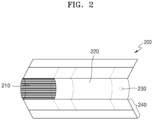
- FIG. 2 is a view illustrating a cigarette that is heated by a heater assembly and generates aerosol, according to an embodiment.
- the cigarette 200 may include a tobacco rod 210 and a filter rod 220.
- the filter rod 220 is illustrated as being composed of a single segment in FIG. 2 , but is not limited thereto and may be composed of a plurality of segments.
- the filter rod 220 may include a first segment for cooling aerosol and a second segment for filtering a specific component included in the aerosol.
- the filter rod 220 may further include at least one segment that performs other functions.
- the cigarette 200 may be wrapped by at least one wrapper 240.
- the wrapper 240 may include at least one hole through which external air flows in or internal air flows out.
- the cigarette 200 may be wrapped by one wrapper 240.
- the cigarette 200 may be wrapped by two or more wrappers 240 in an overlapping manner.
- the tobacco rod 210 may be wrapped by a first wrapper
- the filter rod 220 may be wrapped by a second wrapper.
- the tobacco rod 210 and the filter rod 220 respectively wrapped by the wrappers are coupled to each other, and then the entire cigarette 200 may be rewrapped by a third wrapper.
- the tobacco rod 210 may be made in various ways.
- the tobacco rod 210 may be made of sheets or strands.
- the tobacco rod 210 may also be made of cut tobacco obtained by finely cutting a tobacco sheet.
- the tobacco rod 210 may be surrounded by a heat-conducting material.
- the heat-conducting material may be metal foil such as aluminum foil, but is not limited thereto.
- the heat-conducting material surrounding the tobacco rod 210 may evenly dissipate the heat transferred to the tobacco rod 210 to increase thermal conductivity of the tobacco rod 210, thereby improving the savor of aerosol generated from the tobacco rod 210.
- the filter rod 220 may be a cellulose acetate filter.
- the filter rod 220 may have various forms.
- the filter rod 220 may be a cylindrical rod, or a tubular rod including a hollow therein.
- the filter rod 220 may also be a recessed rod including a cavity therein.
- the filter rod 220 is composed of a plurality of segments, the plurality of segments may have different shapes.
- the filter rod 220 may be made to generate flavor.
- a flavored liquid may be sprayed onto the filter rod 220, or fibers coated with a flavored liquid may be inserted into the filter rod 220.
- the filter rod 220 may include at least one capsule 230.
- the capsule 230 may generate flavor or aerosol.
- the capsule 230 may be formed in a structure that includes a flavor-containing liquid wrapped with a film.
- the capsule 230 may have a spherical or cylindrical shape, but is not limited thereto.
- the cooling segment may be made of a polymer material or a biodegradable polymer material.
- the cooling segment may be made of pure polylactic acid only.
- the cooling segment may be made of a cellulose acetate filter including a plurality of perforations.
- the cooling segment is not limited thereto, and may be composed of other structures and materials capable of cooling aerosol.
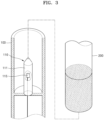
- FIG. 3 is a view illustrating a heater assembly that heats a cigarette accommodated in an aerosol generating device according to an embodiment.
- the cigarette 200 may be accommodated in the aerosol generating device 100 in a longitudinal direction of the cigarette 200.
- the heater assembly 110 may be inserted into the cigarette 200 accommodated in the aerosol generating device 100.
- the heater assembly 110 may have a structure extending in the longitudinal direction to be inserted into the cigarette 200.
- the heater assembly 110 may be located at a central portion of the accommodation space 120 to be inserted into a central portion of the cigarette 200.
- the heater assembly 110 is illustrated as being a single number but is not limited thereto, and the heater assembly 110 may be composed of a plurality of heater assemblies that extend in the longitudinal direction to be inserted into the cigarette 200 and are disposed in parallel to each other.
- FIG. 4 is a view illustrating elements constituting a heater assembly according to an embodiment.
- the heater assembly 110 may include a heating element 111 and a temperature sensor 115.
- the heater assembly 110 is not limited thereto, and may also further include other general-purpose elements in addition to the elements illustrated in FIG. 4 .
- the heater assembly 110 may further include a conducting wire connecting the temperature sensor 115 to the aerosol generating device 100.
- the heating element 111 may extend in the longitudinal direction of the cigarette 200.
- the heating element 111 may be formed in an elongated structure extending in the longitudinal direction.
- a length of the heating element 111 extending in the longitudinal direction may be less than the total length of the cigarette 200 and may be less than a distance from a bottom surface of the accommodation space 120 to an opening of the accommodation space 120.
- the length of the heating element 111 may be greater than a length of the tobacco rod 210 included in the cigarette 200 but is not limited thereto.
- the heating element 111 may include a hollow therein. Therefore, the heating element 111 may have an outer surface and an inner surface. In order to have a large hollow formed inside the heating element 111, a side surface of the heating element 111 formed between the outer surface and the inner surface of the heating element 111 may have a small thickness.
- a cross-section of the heating element 111 cut along a plane orthogonal to a longitudinal direction may have various shapes.
- a shape of the cross-section of the heating element 111 may be circular.
- a diameter of the cross-section of the heating element 111 may be less than a diameter of the cross-section of the cigarette 200.
- a cross-section of the heating element 111 may have other shape than the circular cross-section, which is suitable for being inserted into the cigarette 200 and transferring heat to the tobacco rod 210.
- the heating element 111 may include a ferromagnetic substance for generating heat by receiving an external magnetic field.
- the ferromagnetic substance may be a material that is magnetized in a direction of an external magnetic field and maintains a magnetic moment even after the external magnetic field disappears.
- the ferromagnetic substance may include one of iron (Fe), nickel (Ni), and cobalt (Co), or an alloy including at least one thereof, but is not limited thereto.
- the entire heating element 111 may be formed of a ferromagnetic substance. Alternatively, only a part of the heating element 111 may also be formed of a ferromagnetic substance. A proportion of a ferromagnetic substance contained in the heating element 111 may be appropriately selected within a range suitable for heating the cigarette 200.
- the ferromagnetic substance may be disposed at a position corresponding to the tobacco rod 210 of the cigarette 200 accommodated in the aerosol generating device 100. At least a part of the ferromagnetic substance may be disposed at a portion where the heating element 111 is in contact with the tobacco rod 210. Accordingly, the efficiency of heat transferred to the tobacco rod 210 and the efficiency of generating aerosol from the tobacco rod 210 may be increased.
- the heating element 111 may be divided into detailed elements.
- the heating element 111 may include an upper end portion 112, a middle portion 113, and a lower end portion 114.
- the upper end portion 112 may be located near an opening of the accommodation space 120 and may indicate a portion from an end of the heating element 111 facing the opening of the accommodation space 120 to a boundary between the upper end portion 112 and the middle portion 113.
- the lower end portion 114 may be located on an inner end portion of the accommodation space 120 and may indicate a portion from a bottom of the heating element 111 in contact with a bottom of the accommodation space 120 to a boundary between the lower end portion 114 and the middle portion 113.
- the middle portion 113 may be located between the upper end portion 112 and the lower end portion 114.
- the cigarette 200 when the cigarette 200 is accommodated in the aerosol generating device 100, the cigarette 200 may be accommodated up to the middle portion 113 of the heating element 111. Accordingly, a boundary between the lower end portion 114 and the middle portion 113 may be aligned with an end of the cigarette 200 which is accommodated in the aerosol generating device 100.
- the heater assembly 110 may further include a supporting body located at the lower end portion 114 so that the cigarette 200 may not be accommodated beyond the boundary between the lower end portion 114 and the middle portion 113.
- the upper end portion 112 may have a cross-section that becomes smaller toward an end facing an opening of the accommodation space 120. Specifically, the upper end portion 112 may have a conical shape or a poly pyramid shape that become narrower toward an end facing the opening. As such, the heater assembly 110 may be easily inserted into the cigarette 200.
- the cigarette 200 may not include a separate susceptor material. Therefore, a separate process for making a cigarette containing a susceptor material may not be required. Also, a cigarette used in an existing heating-type aerosol generating device may also be used in the aerosol generating device 100 according to the present disclosure, and thus, the aerosol generating device 100 may have high compatibility with existing cigarettes. In addition, since a separate susceptor material may not be included in the cigarette 200, a problem that aerosol is non-uniformly generated when the susceptor material is non-uniformly distributed in the cigarette may be solved.
- the heating element 111 is formed to include a hollow, a temperature of the heating element 111 increases may increase more rapidly compared with a case in which a hollow is not formed in the heating element 111.
- the inside of the heater body 111 is not empty, the inside tends to heat earlier than a surface thereof, which delays heating of the surface.
- a temperature of the surface may increase faster when the inside is empty.
- the cigarette 200 is heated in contact with the surface of the heating element 111, and thus, when a hollow is formed inside the heating element 111, a speed at which the cigarette 200 is heated may be increased.
- the temperature sensor 115 may measure a temperature of the heating element 111.
- the heater assembly 110 may include the heating element 111 and the temperature sensor 115, and the temperature of the heating element 111 may be measured by the temperature sensor 115, and thus, the temperature sensor 115 may directly measure the temperature of the heating element 111. Accordingly, the temperature at which the heating element 111 heats the cigarette 200 may be accurately reflected in the temperature measured by the temperature sensor 115.
- the temperature sensor 115 may abuts an inner surface of the heating element 111.
- the temperature sensor 115 in contact with the inner surface of the heating element 111 may be in direct contact with the heater assembly 110. Since the heating element 111 may have a hollow therein, a sufficient space for the temperature sensor 115 may be formed inside the heating element 111 and the temperature sensor 115 may be disposed on a hollow surface formed inside the heating element 111. As the temperature sensor 115 is disposed at a position in direct contact with the inner surface of the heating element 111, the temperature sensor 115 may not be contaminated by the tobacco rod 210 heated by being in contact with an outer surface of the heating element 111.
- the temperature of the heating element 111 is directly measured by the temperature sensor 115, and thus, the temperature of the heating element 111 may be precisely controlled. If the temperature sensor is not disposed at a position in direct contact with the susceptor material that heats by an external magnetic field, such as in a case where the susceptor material is included in a cigarette, it is difficult to accurately measure or control a temperature at which a cigarette is heated by a susceptor material.
- the heating element 111 according to the present disclosure is included in the heater assembly 110 of the aerosol generating device 100, not in the cigarette 200. Thus, a temperature of the heating element 111 may be accurately provided to the aerosol generating device 100 through the temperature sensor 115, and the temperature of the heating element 111 may be precisely controlled.
- FIG. 5 shows views illustrating a heating element further including at least one of a weak magnetic substance and a non-magnetic substance, according to an embodiment.
- FIG. 5 illustrates various heating elements 111, each including the upper end portion 112, the middle portion 113, and the lower end portion 114.
- the heating element 111 may include a ferromagnetic substance.
- the weak magnetic substance may further include at least one of a paramagnetic substance and a diamagnetic substance.
- the paramagnetic substance may indicate a material that is partially magnetized in a direction of an external magnetic field. However, a magnetic moment may disappear when the external magnetic field disappears.
- the diamagnetic substance may indicate a material that is magnetized in a direction opposite to the external magnetic field. When the external magnetic field is applied to the heating element 111, heating of the paramagnetic substance and the antimagnetic substance may be weaker than heating of the ferromagnetic substance.
- the paramagnetic substance may indicate at least one of aluminum (Al), tin (Sn), platinum (Pt), and iridium (Ir), and the diamagnetic substance may indicate metal other than a transition metal, such as bismuth (Bi), lead (Pb), mercury (Hg), copper (Cu), graphite (C), gold (Au), and silver (Ag).
- a transition metal such as bismuth (Bi), lead (Pb), mercury (Hg), copper (Cu), graphite (C), gold (Au), and silver (Ag).
- the middle portion 113 of the heating element 111 may be formed of a ferromagnetic substance.
- the lower end portion 114 of the heating element 111 may be formed of a weak magnetic substance or a non-magnetic substance.
- the upper end portion 112 of the heating element 111 may be formed of a ferromagnetic substance, a weak magnetic substance, or a non-magnetic substance.
- the ferromagnetic substance may serve as a main heating portion for heating the cigarette 200.
- the paramagnetic substance may serve as an auxiliary heating portion for performing auxiliary heating of the cigarette 200.
- a diamagnetic substance does not heat the cigarette 200, but may support the heating element 111 or secure a length of the heating element 111.
- an upper end portion 512, a middle portion 513, and a middle portion 523 may be formed of a ferromagnetic substance to become a main heating portion, and a lower end portion 514, an upper end portion 522, and a lower end portion 524 may be formed of a paramagnetic substance to become an auxiliary heating portion.
- the heating element 510 and the heating element 520 may have a size suitable for contacting the tobacco rod 210.
- the lower end portions 544, 554, and 564 may not come into contact with the tobacco rod 210.
- supporting bodies may be disposed on side surfaces of the lower end portions 544, 554, and 564, and thus, the middle portions 543, 553, and 563 and the upper end portions 542 and 552 may come into contact with the tobacco rod 210.
- the cigarette 200 further includes a front-end plug, the lower end portions 544, 554, and 564 may come into contact with the front-end plug, and the middle portions 543, 553, and 563 and the upper end portions 542 and 552 may come into contact with the tobacco rod 210.
- FIG. 6 shows views illustrating a temperature sensor disposed at a position in direct contact with an inner surface of a heating element according to embodiments.
- FIG. 6 illustrates a heater assembly 610 including the temperature sensor 115 disposed at a position in direct contact with an inner surface of the middle portion 113, and a heater assembly 620 including the temperature sensor 115 disposed at a position in direct contact with an inner surface of the lower end portion 114.
- the heating element 111 includes a hollow therein.
- the middle portion 113 may be formed of a ferromagnetic substance, and the temperature sensor 115 may be disposed at a position abutting the inner surface of the middle portion 113. Thus, a temperature at which the cigarette 200 is heated may be accurately reflected in a temperature measured by the temperature sensor 115.
- the middle portion 113 may be formed of a ferromagnetic substance
- the lower end portion 114 may be formed of a weak magnetic substance or a non-magnetic substance.
- the temperature sensor 115 may be disposed at a position abutting an inner surface of the lower end portion 114.
- a temperature of the lower end portion 114 may be lower than a temperature of the middle portion 113 formed of a ferromagnetic substance.
- the temperature of the lower end portion 114 may maintain a constant relationship with the temperature of the middle portion 113. Accordingly, the temperature at which the cigarette 200 is heated may be derived based on a relationship between the temperature of the lower end portion 114 and the temperature of the middle portion 113, which are measured by the temperature sensor 115.
- the supporting body 116 may be fixed to the outer surface of the heating element 111.
- the supporting body 116 may surround the outer surface of the heating element 111.
- the supporting body 116 may surround an outer surface of the lower end portion 114 of the heating element 111.
- the supporting body 116 is not limited thereto, and may also be disposed at the middle portion 113.
- the supporting body 116 may be formed of a material having heat insulation and heat resistance.
- the supporting body 116 holds heating element 111, and thus, it may be heated by heat transferred from the heating element 111. Therefore, it is necessary for the supporting body 116 to have heat resistance so as not to be deformed or damaged by heat transferred from the heating element 111, and to have heat insulation so as not to transfer heat to the accommodation space 120 and the aerosol generating device 100.
- the supporting body 116 may prevent tobacco residues generated from the cigarette 200 from flowing into the accommodation space 120 and the aerosol generating device 100. In addition, the supporting body 116 may prevent aerosol generated from the cigarette 200 from being liquefied again and flowing into the accommodation space 120 and the aerosol generating device 100.
- the coil 130 may be wound around a side surface of the accommodation space 120 to extend in a longitudinal direction.
- the coil 130 extending in the longitudinal direction may be disposed on the side surface of the accommodation space 120.
- the coil 130 may be disposed at a position corresponding to the heater assembly 110.
- the coil 130 may extend in a length direction to a length corresponding to the heater assembly 110 and may be disposed at a position corresponding to the heater assembly 110.
- the coil 130 may be disposed at a position corresponding to a ferromagnetic substance included in the heating element 111.
- a ferromagnetic substance included in the heating element 111.
- the coil 130 may be disposed at a position corresponding to the middle portion 113.
- the coil 130 may be disposed at a position corresponding to the upper end portion 112 and the middle portion 113.
- the middle portion 113, the tobacco rod 210, and the coil 130 may be disposed at positions corresponding to each other.
- the middle portion 113 may be formed to have a length corresponding to a length of the tobacco rod 210
- the coil 130 may be disposed to have a length corresponding to the length of the middle portion 113.
- FIG. 8 is a diagram illustrating a process of controlling a temperature of a heater assembly according to an embodiment.
- the aerosol generating device 100 may include the heater assembly 110, the accommodation space 120, the coil 130, the power supply unit 140, and the controller 150.
- the heater assembly 110 may include the heating element 111 and the temperature sensor 115, and the power supply unit 140 may include a battery 141 and a converter 142.
- other general-purpose elements other than the elements illustrated in FIG. 8 may be further included in the aerosol generating device 100, the heater assembly 110, or the power supply unit 140.
- the power supply unit 140 may supply power to the aerosol generating device 100.
- the power supply unit 140 may supply power to the coil 130.
- the power supply unit 140 may include the battery 141 for supplying a direct current to the aerosol generating device 100 and the converter 142 for converting the direct current supplied from the battery into an alternating current supplied to the coil 130.
- the converter 142 may include a low-pass filter for filtering a direct current supplied from the battery 141 to output an alternating current to be supplied to the coil 130.
- the converter 142 may further include an amplifier for amplifying a direct current supplied from the battery 141.
- the converter 142 may be a class-D amplifier that includes a load network constituting a low-pass filter and further includes an amplifier.
- the coil 130 may be an inductor included in the load network of the class-D amplifier.
- the controller 150 may be configured with an array of multiple logic gates or may be configured with a combination of a general-purpose microprocessor and a memory in which a program executable in the microprocessor is stored. In addition, the controller 150 may be configured with a plurality of processing elements.
- the controller 150 may control power supplied from the power supply unit 140 to the coil 130.
- the controller 150 may control a direct current supplied from the battery 141 to generate a DC pulse.
- the controller 150 may generate the DC pulse by controlling a switch connected to the battery 141 to be turned on-off.
- the converter 142 may convert a DC pulse generated from the battery 141 into an alternating current.
- a low-pass filter included in the converter 142 may receive a DC pulse and may output an alternating current by removing frequencies exceeding a cutoff frequency among a plurality of frequencies included in the DC pulse.
- An alternating current may be transferred from the power supply unit 140 to the coil 130.
- the coil 130 may generate an alternating magnetic field.
- the heating element 111 may generate heat, and the temperature sensor 115 may measure a temperature of the heating element 111.
- the controller 150 may control a temperature of the heater assembly 110 based on the temperature of the heating element 111 which is measured by the temperature sensor 115. For example, the controller 150 may modulate a DC pulse generated from the battery 141 based on the temperature of the heating element 111. Furthermore, the controller 150 may compare the temperature of the heating element 111, which is measured by the temperature sensor 115, with a reference temperature, and may control the temperature of the heater assembly 110 based on a difference between the measured temperature of the heating element 111 and the reference temperature.
- the controller 150 may modulate a DC pulse generated from the battery 141 based on the temperature of the heating element 111.
- the controller 150 may amplify the DC pulse through an amplifier included in the converter 142.
- an amplitude of an alternating current output from the converter 142 may increase.
- an amplitude of an alternating magnetic field generated from the coil 130 may increase, and accordingly, heat energy emitted from the heating element 111 may increase.
- the controller 150 may reduce the intensity of the DC pulse to reduce the heat energy emitted from the heating element 111.
- the controller 150 may perform a pulse width modulation on a DC pulse.
- a frequency of an alternating current output from the converter 142 may also be changed. Since the frequency of the alternating current applied to the coil 130 is changed, the frequency of the alternating magnetic field generated from the coil 130 may also be changed, and accordingly, the heat energy emitted from the heating element 111 may be changed. As such, a temperature of the heater assembly 110 may be controlled.
- the controller 150 may calculate the difference value between the measured temperature of the heating element 111 and the reference temperature, and may perform a feedback control by a PID method of adjusting the DC pulse supplied from the battery 141, based on at least one of a component proportional to the difference value, a component proportional to a value obtained by integrating the difference value, and a component proportional to a value obtained by differentiating the difference value.
- the aerosol generating device 100 may directly measure a temperature of the heater assembly 110, and thus, a temperature of the heater assembly 110 for heating the cigarette 200 may be controlled based on the measured temperature of the heater assembly 110. Therefore, the temperature of the heater assembly 110 for heating the cigarette 200 may be precisely controlled and stably maintained, and the aerosol may be consistently generated from the cigarette 200 and provided to a user.
Landscapes
- Physics & Mathematics (AREA)
- Electromagnetism (AREA)
- General Physics & Mathematics (AREA)
- Engineering & Computer Science (AREA)
- Automation & Control Theory (AREA)
- Resistance Heating (AREA)
Description
- The present disclosure relates to a heater assembly for heating a cigarette and an aerosol generating device including the same. More specifically, it relates to a heater assembly including a ferromagnetic substance for generating heat by an external magnetic field and an aerosol generating device that applies an alternating magnetic field to the heater assembly.
- In recent years, the demand for alternative methods of overcoming shortcomings of general cigarettes has increased. For example, there is growing demand for a method of generating aerosol by heating a tobacco material in a cigarette, rather than by combusting a cigarette. Accordingly, research into a heating-type cigarette and a heating-type aerosol generating device is actively being conducted.
- An alternative heating method has been proposed to replace a method of heating a cigarette by disposing a heater formed of an electric resistor inside or outside a cigarette accommodated in an aerosol generating device and by supplying power to the heater. In particular, research is being conducted into an induction heating method of generating aerosol by including a magnetic substance that generates heat by an external magnetic field and supplying a current to a coil included in the aerosol generating device to apply a magnetic field to the cigarette.
- If a magnetic substance for generating heat by receiving a magnetic field is included in the cigarette, it may be difficult to directly measure a temperature of the magnetic substance that heats a cigarette, and thus, it may be difficult to control the temperature of the magnetic substance. In addition, if a magnetic substance is not uniformly distributed in the cigarette in a process of making the cigarette, the aerosol may be generated non-uniformly from the cigarette.
- In order to resolve concerns that aerosol is generated non-uniformly and to improve quality of the aerosol generated from a cigarette by controlling a temperature of a magnetic substance more precisely, it may be required to improve a structure of a magnetic substance for heating a cigarette using an induction heating method.
CN 108 617 042 A relates to an internal induction heating smoking apparatus comprising a shell, a power supply arranged in the shell, an electronic control system and a heating cavity; the heating cavity is formed in one end of the shell and used for allowing a to-be-heated cigarette to be inserted; the internal induction heating smoking apparatus also comprises an induction heating element; the induction heating element comprises an induction coil and a heating element arranged in the heating cavity; and the electronic control system is used for converting electric energy provided by the power supply into a high-frequency induced current to be provided to the induction coil, and the high-frequency induced current in the induction coil generates an alternating magnetic field with constantly changed directions, so that the heating element in the alternating magnetic field forms a vortex current to be heated.
US 2018/325179 A1 relates to an atomizer including a heating element, being configured for heating and atomizing tobacco liquid to generate an aerosol; a tobacco liquid reservoir, being configured for storing the tobacco liquid; and a liquid drive component, being connected with the tobacco liquid reservoir directly or indirectly, and being configured for controlling a volume of tobacco liquid conveyed to the heating element, with the tobacco liquid reservoir set on the atomizer, to control the volume of tobacco liquid in the tobacco liquid reservoir conveyed to the heating element so as to convey measurable tobacco liquid as well as generate measurable aerosol.CN 204 949 521 U relates to a smoking set for a cigarette.
CN 104 664 608 A relates to a heating and atomizing device. The device comprises a shell; the shell comprises an air inlet and an air outlet, wherein a heating chamber is arranged in the shell, and an air flue is formed by the connection of the air inlet, the heating chamber and the air outlet; the heating chamber is filled with an atomizing material, a heat conductor of which one surface is closely propped against the atomizing material is arranged in the atomizing material, and the heat conductor is heated by an electric heating device.
CN 207 040 896 U relates to a hybrid heating formula electronic smoking set and heating element. - Various embodiments are directed to provide a heater assembly for heating a cigarette and an aerosol generating device including the same. Technical problem to be solved by the present disclosure are not limited to the technical problems described above, and other technical problems may be inferred from the following embodiments.
- To solve the technical problems described above, an aerosol generating device including a heater assembly according to appended
claim 1 is provided. - As a temperature sensor included in a heater assembly according to the present disclosure is included in the heater assembly and is disposed at a position in direct contact with an inner surface of a heating element for generating heat by receiving an external magnetic field, a temperature of the heater assembly heating a cigarette using an induction heating method may be directly measured and provided to an aerosol generating device, and thus, the temperature of the heater assembly for heating the cigarette may be more precisely controlled.
- As a heating element including a ferromagnetic substance for generating heat by receiving an external magnetic field is disposed inside an aerosol generating device, not inside the cigarette, a problem that a magnetic substance is non-uniformly distributed when the magnetic substance is included in the cigarette may be solved is included in the cigarette, and aerosol may be generated more uniformly.
-
-
FIG. 1 is a view illustrating elements constituting an aerosol generating device including a heater assembly according to an embodiment; -
FIG. 2 is a view illustrating a cigarette that generates aerosol when heated by a heater assembly, according to an embodiment; -
FIG. 3 is a view illustrating a heater assembly for heating a cigarette accommodated in an aerosol generating device according to an embodiment; -
FIG. 4 is a view illustrating elements constituting a heater assembly of an embodiment; -
FIG. 5 shows views illustrating examples of a heating element further including at least one of a weak magnetic substance and a non-magnetic substance, according to embodiments; -
FIG. 6 shows views illustrating examples of a temperature sensor disposed at a position in direct contact with an inner surface of a heating element; -
FIG. 7 is a view illustrating a heater assembly further including a supporting body and a coil disposed at a position corresponding to a ferromagnetic substance, according to an embodiment; -
FIG. 8 is a diagram illustrating a process of controlling a temperature of a heater assembly according to an embodiment. - According to the claimed invention an aerosol generating device according to
claim 1 is provided. - Hereinafter, example embodiments will be described in detail with reference to the accompanying drawings. It should be understood that the following description is only for the purpose of embodying the embodiments and does not limit the scope of the disclosure.
- Terms "configure", "include", and so on used in the present specification should not be construed as including all the various configuration elements or various steps described in the specification, and some of the configuration elements or steps may not be included, or additional configuration elements or steps may be further included.
- Terms including an ordinal number such as "first" or "second" used in the present specification may be used to describe various configuration elements, but the configuration elements should not be limited by the terms. The terms are used only to distinguish one configuration element from other configuration elements.
- With respect to the terms used in the present specification, general terms which are currently used as widely as possible are selected in consideration of functions of structural elements in the various embodiments of the present disclosure. However, meanings of the terms may be changed according to intention, a judicial precedence, the appearance of new technology, and the like. In addition, in a certain case, some terms are randomly selected by the applicant, and in this case, meanings thereof will be described in detail in the description of the corresponding disclosure. Accordingly, the terms used in the present disclosure should be defined based on the meanings of the terms and the content of the present disclosure, not simply by the names of the terms.
- The present embodiments relate to a heater assembly for heating a cigarette and an aerosol generating device including the same, and detailed descriptions on matters well known to those skilled in the art to which the following embodiments belong will be omitted.
-
FIG. 1 is a view illustrating elements constituting an aerosol generating device including a heater assembly according to an embodiment.
Referring toFIG. 1 , anaerosol generating device 100 may include aheater assembly 110, anaccommodation space 120, acoil 130, apower supply unit 140, and acontroller 150. However, theaerosol generating device 100 is not limited thereto and may further include other general-purpose elements in addition to the elements illustrated inFIG. 1 . - The
aerosol generating device 100 may generate aerosol by heating a cigarette accommodated in theaerosol generating device 100 by using an induction heating method. The induction heating method may include a method of generating heat from a magnetic substance by applying an alternating magnetic field of which direction is periodically changed to a magnetic substance that generates heat by receiving an external magnetic field. - When an alternating magnetic field is applied to a magnetic substance, energy loss may occur in the magnetic substance due to eddy current loss and hysteresis loss, and the lost energy may be released from the magnetic substance as thermal energy. As the amplitude or frequency of the alternating magnetic field applied to the magnetic substance increases, the heat energy released from the magnetic substance also increases. The
aerosol generating device 100 may release heat energy from a magnetic substance by applying an alternating magnetic field to the magnetic substance and may transfer the heat energy emitted from the magnetic substance to a cigarette. - A magnetic substance that generates heat by receiving an external magnetic field may be a susceptor. The susceptor may be disposed in the
aerosol generating device 100 instead of being included in the cigarette in the form of a chip, a slice, or a strip. For example, the susceptor may be included in theheater assembly 110 disposed inside theaerosol generating device 100. - The susceptor may include metal or carbon. The susceptor may include at least one of ferrite, ferromagnetic alloy, stainless steel, and aluminum (Al). In addition, the susceptor may also include at least one of graphite, molybdenum, silicon carbide, niobium, nickel alloy, metal film, ceramic such as zirconia, transition metal such as nickel (Ni) or cobalt (Co), and metalloid such as boron (B) or phosphorus (P).
- The
aerosol generating device 100 may include theaccommodation space 120 for accommodating a cigarette. Theaccommodation space 120 may include an opening that opens to the outside of theaccommodation space 120 to accommodate a cigarette in theaerosol generating device 100. A cigarette may be accommodated in the aerosol generatingdevice 100 in a direction from the outside of theaccommodation space 120 to the inside of theaccommodation space 120 through the opening of theaccommodation space 120. - The
heater assembly 110 may be disposed at an inner end portion of theaccommodation space 120. Theheater assembly 110 may be attached to a bottom surface formed at the inner end portion of theaccommodation space 120. An upper end portion of theheater assembly 110 may be inserted into a cigarette, and the cigarette may reach a bottom surface of theaccommodation space 120. - The
aerosol generating device 100 may include thecoil 130 that applies an alternating magnetic field to theheater assembly 110. Thecoil 130 may be wound around a side surface of theaccommodation space 120 and may be disposed at a position corresponding to theheater assembly 110. Thecoil 130 may receive power from thepower supply unit 140. - When power is supplied to the
coil 130, a magnetic field may be formed inside thecoil 130. When an AC current is applied from thepower supply unit 140 to thecoil 130, the magnetic field formed in thecoil 130 may periodically change in direction. When theheater assembly 110 formed inside thecoil 130 is exposed to an alternating magnetic field that periodically changes a direction, theheater assembly 110 generates heat, thus heating a cigarette accommodated in theaerosol generating device 100. - When an amplitude or frequency of the alternating magnetic field formed by the
coil 130 changes, a temperature of theheater assembly 110 that heats the cigarette may also change. Thecontroller 150 may adjust the amplitude or frequency of the alternating magnetic field formed by thecoil 130 by controlling power supplied to thecoil 130, and thus, the temperature of theheater assembly 110 may be controlled. - For example, the
coil 130 may be configured with a solenoid. Thecoil 130 may be a solenoid wound along a side surface of theaccommodation space 120, and acigarette 200 may be accommodated in the inner space of the solenoid. A material of a conducting wire constituting the solenoid may be copper (Cu). However, the material of the conducting wire is not limited thereto and may be a material with a low specific resistance value allowing a large current to flow. For example, any one of silver (Ag), gold (Au), aluminum (Al), tungsten (W), zinc (Zn), and nickel (Ni) or an alloy containing at least one thereof may be the material of the conducting wire constituting the solenoid. - According to an embodiment, the susceptor may be included in the
heater assembly 110 provided in theaerosol generating device 100 instead of being included in a cigarette. In this case, there may be various advantages as compared with a case in which the susceptor is included in the cigarette. For example, a problem that aerosol and flavor are generated non-uniformly when a material of the susceptor is not uniformly distributed inside the cigarette may be solved. In addition, since theheater assembly 110 including the susceptor is provided in theaerosol generating device 100, a temperature of theheater assembly 110 that generates heat by induction heating may be directly measured and provided to theaerosol generating device 100. Accordingly, the temperature of theheater assembly 110 may be controlled precisely. -
FIG. 2 is a view illustrating a cigarette that is heated by a heater assembly and generates aerosol, according to an embodiment. - Referring to
FIG. 2 , thecigarette 200 may include atobacco rod 210 and afilter rod 220. Thefilter rod 220 is illustrated as being composed of a single segment inFIG. 2 , but is not limited thereto and may be composed of a plurality of segments. For example, thefilter rod 220 may include a first segment for cooling aerosol and a second segment for filtering a specific component included in the aerosol. In addition, thefilter rod 220 may further include at least one segment that performs other functions. - The
cigarette 200 may be wrapped by at least onewrapper 240. Thewrapper 240 may include at least one hole through which external air flows in or internal air flows out. Thecigarette 200 may be wrapped by onewrapper 240. As another example, thecigarette 200 may be wrapped by two ormore wrappers 240 in an overlapping manner. Specifically, thetobacco rod 210 may be wrapped by a first wrapper, and thefilter rod 220 may be wrapped by a second wrapper. Thetobacco rod 210 and thefilter rod 220 respectively wrapped by the wrappers are coupled to each other, and then theentire cigarette 200 may be rewrapped by a third wrapper. - The
tobacco rod 210 may include an aerosol generating material. For example, the aerosol generating material may contain at least one of glycerin, propylene glycol, ethylene glycol, dipropylene glycol, diethylene glycol, triethylene glycol, tetraethylene glycol, and oleyl alcohol, but is not limited thereto. Thetobacco rod 210 may contain other additives such as a savoring agent, a wetting agent and/or organic acid. A flavored liquid such as menthol or moisturizer may be sprayed to thetobacco rod 210 to be added thereto. - The
tobacco rod 210 may be made in various ways. For example, thetobacco rod 210 may be made of sheets or strands. Alternatively, thetobacco rod 210 may also be made of cut tobacco obtained by finely cutting a tobacco sheet. - The
tobacco rod 210 may be surrounded by a heat-conducting material. For example, the heat-conducting material may be metal foil such as aluminum foil, but is not limited thereto. The heat-conducting material surrounding thetobacco rod 210 may evenly dissipate the heat transferred to thetobacco rod 210 to increase thermal conductivity of thetobacco rod 210, thereby improving the savor of aerosol generated from thetobacco rod 210. - The
filter rod 220 may be a cellulose acetate filter. Thefilter rod 220 may have various forms. For example, thefilter rod 220 may be a cylindrical rod, or a tubular rod including a hollow therein. Alternatively, thefilter rod 220 may also be a recessed rod including a cavity therein. When thefilter rod 220 is composed of a plurality of segments, the plurality of segments may have different shapes. - The
filter rod 220 may be made to generate flavor. For example, a flavored liquid may be sprayed onto thefilter rod 220, or fibers coated with a flavored liquid may be inserted into thefilter rod 220. - The
filter rod 220 may include at least onecapsule 230. Thecapsule 230 may generate flavor or aerosol. For example, thecapsule 230 may be formed in a structure that includes a flavor-containing liquid wrapped with a film. Thecapsule 230 may have a spherical or cylindrical shape, but is not limited thereto. - When a cooling segment for cooling aerosol is included in the
filter rod 220, the cooling segment may be made of a polymer material or a biodegradable polymer material. For example, the cooling segment may be made of pure polylactic acid only. Alternatively, the cooling segment may be made of a cellulose acetate filter including a plurality of perforations. However, the cooling segment is not limited thereto, and may be composed of other structures and materials capable of cooling aerosol. -
FIG. 3 is a view illustrating a heater assembly that heats a cigarette accommodated in an aerosol generating device according to an embodiment. -
FIG. 3 illustrates theheater assembly 110 that heats thecigarette 200 accommodated in theaerosol generating device 100. However, theaerosol generating device 100, thecigarette 200, and theheater assembly 110 illustrated inFIG. 3 are merely examples, and theaerosol generating device 100 and theheater assembly 110 may be arranged to form other structures capable of heating thecigarette 200. - The
cigarette 200 may be accommodated in theaerosol generating device 100 in a longitudinal direction of thecigarette 200. Theheater assembly 110 may be inserted into thecigarette 200 accommodated in theaerosol generating device 100. Theheater assembly 110 may have a structure extending in the longitudinal direction to be inserted into thecigarette 200. - The
heater assembly 110 may be located at a central portion of theaccommodation space 120 to be inserted into a central portion of thecigarette 200. InFIG. 3 , theheater assembly 110 is illustrated as being a single number but is not limited thereto, and theheater assembly 110 may be composed of a plurality of heater assemblies that extend in the longitudinal direction to be inserted into thecigarette 200 and are disposed in parallel to each other. -
FIG. 4 is a view illustrating elements constituting a heater assembly according to an embodiment. - Referring to
FIG. 4 , theheater assembly 110 may include aheating element 111 and atemperature sensor 115. However, theheater assembly 110 is not limited thereto, and may also further include other general-purpose elements in addition to the elements illustrated inFIG. 4 . For example, theheater assembly 110 may further include a conducting wire connecting thetemperature sensor 115 to theaerosol generating device 100. - The
heating element 111 may extend in the longitudinal direction of thecigarette 200. Theheating element 111 may be formed in an elongated structure extending in the longitudinal direction. A length of theheating element 111 extending in the longitudinal direction may be less than the total length of thecigarette 200 and may be less than a distance from a bottom surface of theaccommodation space 120 to an opening of theaccommodation space 120. Alternatively, the length of theheating element 111 may be greater than a length of thetobacco rod 210 included in thecigarette 200 but is not limited thereto. - The
heating element 111 may include a hollow therein. Therefore, theheating element 111 may have an outer surface and an inner surface. In order to have a large hollow formed inside theheating element 111, a side surface of theheating element 111 formed between the outer surface and the inner surface of theheating element 111 may have a small thickness. - A cross-section of the
heating element 111 cut along a plane orthogonal to a longitudinal direction may have various shapes. For example, a shape of the cross-section of theheating element 111 may be circular. When the cross-section of theheating element 111 and a cross-section of thecigarette 200 are circular, a diameter of the cross-section of theheating element 111 may be less than a diameter of the cross-section of thecigarette 200. However, a cross-section of theheating element 111 may have other shape than the circular cross-section, which is suitable for being inserted into thecigarette 200 and transferring heat to thetobacco rod 210. - The
heating element 111 may include a ferromagnetic substance for generating heat by receiving an external magnetic field. The ferromagnetic substance may be a material that is magnetized in a direction of an external magnetic field and maintains a magnetic moment even after the external magnetic field disappears. As the ferromagnetic substance is included in theheating element 111, when the external magnetic field is applied to theheater assembly 110, theheater assembly 110 may heat thecigarette 200. For example, the ferromagnetic substance may include one of iron (Fe), nickel (Ni), and cobalt (Co), or an alloy including at least one thereof, but is not limited thereto. - The
entire heating element 111 may be formed of a ferromagnetic substance. Alternatively, only a part of theheating element 111 may also be formed of a ferromagnetic substance. A proportion of a ferromagnetic substance contained in theheating element 111 may be appropriately selected within a range suitable for heating thecigarette 200. - When only a part of the
heating element 111 is formed of a ferromagnetic substance, the ferromagnetic substance may be disposed at a position corresponding to thetobacco rod 210 of thecigarette 200 accommodated in theaerosol generating device 100. At least a part of the ferromagnetic substance may be disposed at a portion where theheating element 111 is in contact with thetobacco rod 210. Accordingly, the efficiency of heat transferred to thetobacco rod 210 and the efficiency of generating aerosol from thetobacco rod 210 may be increased. - The
heating element 111 may be divided into detailed elements. For example, theheating element 111 may include anupper end portion 112, amiddle portion 113, and alower end portion 114. Theupper end portion 112 may be located near an opening of theaccommodation space 120 and may indicate a portion from an end of theheating element 111 facing the opening of theaccommodation space 120 to a boundary between theupper end portion 112 and themiddle portion 113. Thelower end portion 114 may be located on an inner end portion of theaccommodation space 120 and may indicate a portion from a bottom of theheating element 111 in contact with a bottom of theaccommodation space 120 to a boundary between thelower end portion 114 and themiddle portion 113. Themiddle portion 113 may be located between theupper end portion 112 and thelower end portion 114. - For example, when the
cigarette 200 is accommodated in theaerosol generating device 100, thecigarette 200 may be accommodated up to themiddle portion 113 of theheating element 111. Accordingly, a boundary between thelower end portion 114 and themiddle portion 113 may be aligned with an end of thecigarette 200 which is accommodated in theaerosol generating device 100. In addition, theheater assembly 110 may further include a supporting body located at thelower end portion 114 so that thecigarette 200 may not be accommodated beyond the boundary between thelower end portion 114 and themiddle portion 113. - The
middle portion 113 of theheating element 111 may include a ferromagnetic substance. Themiddle portion 113 may be formed of a material corresponding to a ferromagnetic substance. Accordingly, themiddle portion 113 may generate heat by receiving an external magnetic field. For example, themiddle portion 113 may be positioned to come into contact with thetobacco rod 210 of thecigarette 200 accommodated in theaerosol generating device 100. - The
upper end portion 112 may have a cross-section that becomes smaller toward an end facing an opening of theaccommodation space 120. Specifically, theupper end portion 112 may have a conical shape or a poly pyramid shape that become narrower toward an end facing the opening. As such, theheater assembly 110 may be easily inserted into thecigarette 200. - According to an embodiment, as the
heater assembly 110 of theaerosol generating device 100 includes a ferromagnetic substance for generating heat by receiving an external magnetic field, thecigarette 200 may not include a separate susceptor material. Therefore, a separate process for making a cigarette containing a susceptor material may not be required. Also, a cigarette used in an existing heating-type aerosol generating device may also be used in theaerosol generating device 100 according to the present disclosure, and thus, theaerosol generating device 100 may have high compatibility with existing cigarettes. In addition, since a separate susceptor material may not be included in thecigarette 200, a problem that aerosol is non-uniformly generated when the susceptor material is non-uniformly distributed in the cigarette may be solved. - As described above, since the
heating element 111 is formed to include a hollow, a temperature of theheating element 111 increases may increase more rapidly compared with a case in which a hollow is not formed in theheating element 111. When the inside of theheater body 111 is not empty, the inside tends to heat earlier than a surface thereof, which delays heating of the surface. Thus, a temperature of the surface may increase faster when the inside is empty. Thecigarette 200 is heated in contact with the surface of theheating element 111, and thus, when a hollow is formed inside theheating element 111, a speed at which thecigarette 200 is heated may be increased. - The
temperature sensor 115 may measure a temperature of theheating element 111. Theheater assembly 110 may include theheating element 111 and thetemperature sensor 115, and the temperature of theheating element 111 may be measured by thetemperature sensor 115, and thus, thetemperature sensor 115 may directly measure the temperature of theheating element 111. Accordingly, the temperature at which theheating element 111 heats thecigarette 200 may be accurately reflected in the temperature measured by thetemperature sensor 115. - When the
heating element 111 further includes a hollow therein, thetemperature sensor 115 may abuts an inner surface of theheating element 111. Thetemperature sensor 115 in contact with the inner surface of theheating element 111 may be in direct contact with theheater assembly 110. Since theheating element 111 may have a hollow therein, a sufficient space for thetemperature sensor 115 may be formed inside theheating element 111 and thetemperature sensor 115 may be disposed on a hollow surface formed inside theheating element 111. As thetemperature sensor 115 is disposed at a position in direct contact with the inner surface of theheating element 111, thetemperature sensor 115 may not be contaminated by thetobacco rod 210 heated by being in contact with an outer surface of theheating element 111. - The temperature of the
heating element 111 measured by thetemperature sensor 115 may be provided to thecontroller 150 in theaerosol generating device 100. For example, theheater assembly 110 may further include a wire for connecting thetemperature sensor 115 to thecontroller 150 and delivering the temperature measured by thetemperature sensor 115. - The
temperature sensor 115 may abut an inner surface of a ferromagnetic substance included in theheating element 111 although this mode is not covered by the claimed invention. The ferromagnetic substance may be disposed at a position corresponding to thetobacco rod 210, and may heat thetobacco rod 210 by receiving an external magnetic field. Thus, if thetemperature sensor 115 is disposed at a position corresponding to the ferromagnetic substance, the temperature at which thetobacco rod 210 is heated may be measured more accurately. However, as illustrated inFIG. 6 below, thetemperature sensor 115 according to the claimed invention abuts an inner surface of theheating element 111 other than the ferromagnetic substance portion. - The temperature of the
heating element 111 is directly measured by thetemperature sensor 115, and thus, the temperature of theheating element 111 may be precisely controlled. If the temperature sensor is not disposed at a position in direct contact with the susceptor material that heats by an external magnetic field, such as in a case where the susceptor material is included in a cigarette, it is difficult to accurately measure or control a temperature at which a cigarette is heated by a susceptor material. Theheating element 111 according to the present disclosure is included in theheater assembly 110 of theaerosol generating device 100, not in thecigarette 200. Thus, a temperature of theheating element 111 may be accurately provided to theaerosol generating device 100 through thetemperature sensor 115, and the temperature of theheating element 111 may be precisely controlled. - As described above, the
temperature sensor 115 may be disposed at a position corresponding to a ferromagnetic substance, but is not limited thereto. Thetemperature sensor 115 may be disposed at various positions on theheating element 111. For example, thetemperature sensor 115 may be disposed in theaccommodation space 120 near thelower end portion 114 of theheating element 111. When thetemperature sensor 115 is disposed in theaccommodation space 120, thetemperature sensor 115 may be configured with an infrared sensor that measures a temperature of theheating element 111 without coming into contact with theheating element 111, but is not limited thereto. -
FIG. 5 shows views illustrating a heating element further including at least one of a weak magnetic substance and a non-magnetic substance, according to an embodiment. -
FIG. 5 illustratesvarious heating elements 111, each including theupper end portion 112, themiddle portion 113, and thelower end portion 114. As described above, theheating element 111 may include a ferromagnetic substance. - The
heating element 111 may further include at least one of a weak magnetic substance and a non-magnetic substance. The weak magnetic substance may refer to a material that generates heat by receiving an external magnetic field, which is weaker than heat generated by the ferromagnetic substance. The non-magnetic substance may refer to a material that does not generate heat by receiving an external magnetic field. - The weak magnetic substance may further include at least one of a paramagnetic substance and a diamagnetic substance. The paramagnetic substance may indicate a material that is partially magnetized in a direction of an external magnetic field. However, a magnetic moment may disappear when the external magnetic field disappears. The diamagnetic substance may indicate a material that is magnetized in a direction opposite to the external magnetic field. When the external magnetic field is applied to the
heating element 111, heating of the paramagnetic substance and the antimagnetic substance may be weaker than heating of the ferromagnetic substance. - For example, the paramagnetic substance may indicate at least one of aluminum (Al), tin (Sn), platinum (Pt), and iridium (Ir), and the diamagnetic substance may indicate metal other than a transition metal, such as bismuth (Bi), lead (Pb), mercury (Hg), copper (Cu), graphite (C), gold (Au), and silver (Ag).
- The
middle portion 113 of theheating element 111 may be formed of a ferromagnetic substance. Thelower end portion 114 of theheating element 111 may be formed of a weak magnetic substance or a non-magnetic substance. Theupper end portion 112 of theheating element 111 may be formed of a ferromagnetic substance, a weak magnetic substance, or a non-magnetic substance. - The ferromagnetic substance may serve as a main heating portion for heating the
cigarette 200. The paramagnetic substance may serve as an auxiliary heating portion for performing auxiliary heating of thecigarette 200. A diamagnetic substance does not heat thecigarette 200, but may support theheating element 111 or secure a length of theheating element 111. - In the case of a
heating element 510 and aheating element 520, anupper end portion 512, amiddle portion 513, and amiddle portion 523 may be formed of a ferromagnetic substance to become a main heating portion, and alower end portion 514, anupper end portion 522, and alower end portion 524 may be formed of a paramagnetic substance to become an auxiliary heating portion. When thecigarette 200 is accommodated in theaerosol generating device 100, theheating element 510 and theheating element 520 may have a size suitable for contacting thetobacco rod 210. - In the case of a
heating element 530, themiddle portion 533 may be formed of a ferromagnetic substance to become a main heating portion, alower end portion 534 may be formed of a paramagnetic substance to become an auxiliary heating portion, and anupper end portion 532 may be formed of a diamagnetic substance. When thecigarette 200 is accommodated in theaerosol generating device 100, themiddle portion 533 and thelower end portion 534 come into contact with thetobacco rod 210, and a size of theheating element 530 may be set so that thelower end portion 534 is located at thefilter rod 220. - In the case of a
heating element 540, a heating element 550, and a heating element 560,lower end portions middle portions Upper end portions tobacco rod 210. - The
lower end portions tobacco rod 210. For example, supporting bodies may be disposed on side surfaces of thelower end portions middle portions upper end portions tobacco rod 210. Alternatively, if thecigarette 200 further includes a front-end plug, thelower end portions middle portions upper end portions tobacco rod 210. -
FIG. 6 shows views illustrating a temperature sensor disposed at a position in direct contact with an inner surface of a heating element according to embodiments. -
FIG. 6 illustrates aheater assembly 610 including thetemperature sensor 115 disposed at a position in direct contact with an inner surface of themiddle portion 113, and aheater assembly 620 including thetemperature sensor 115 disposed at a position in direct contact with an inner surface of thelower end portion 114. Theheating element 111 includes a hollow therein. - In the case of the
heater assembly 610, which is not covered by the claimed invention, themiddle portion 113 may be formed of a ferromagnetic substance, and thetemperature sensor 115 may be disposed at a position abutting the inner surface of themiddle portion 113. Thus, a temperature at which thecigarette 200 is heated may be accurately reflected in a temperature measured by thetemperature sensor 115. - In the case of the
heater assembly 620, themiddle portion 113 may be formed of a ferromagnetic substance, and thelower end portion 114 may be formed of a weak magnetic substance or a non-magnetic substance. Thetemperature sensor 115 may be disposed at a position abutting an inner surface of thelower end portion 114. When thelower end portion 114 is formed of a weak magnetic substance or a non-magnetic substance, a temperature of thelower end portion 114 may be lower than a temperature of themiddle portion 113 formed of a ferromagnetic substance. However, the temperature of thelower end portion 114 may maintain a constant relationship with the temperature of themiddle portion 113. Accordingly, the temperature at which thecigarette 200 is heated may be derived based on a relationship between the temperature of thelower end portion 114 and the temperature of themiddle portion 113, which are measured by thetemperature sensor 115. -
FIG. 7 is a view illustrating a heater assembly further including a supporting body and a coil disposed at a position corresponding to a ferromagnetic substance, according to an embodiment. -
FIG. 7 illustrates a structure in which aheater assembly 110 further including a supportingbody 116 and acoil 130 are disposed in theaerosol generating device 100 and thecigarette 200 is accommodated in theaerosol generating device 100. Theheater assembly 110 may further include the supportingbody 116 that is fixed to an outer surface of theheating element 111 and extends from the outer surface of theheating element 111 toward a side surface of theaccommodation space 120. - The supporting
body 116 may be fixed to the outer surface of theheating element 111. The supportingbody 116 may surround the outer surface of theheating element 111. For example, the supportingbody 116 may surround an outer surface of thelower end portion 114 of theheating element 111. However, the supportingbody 116 is not limited thereto, and may also be disposed at themiddle portion 113. - The supporting
body 116 may have a ring shape or a donut shape that includes theheating element 111 in contact with its inner surface and extends outwards from the outer surface of theheating element 111. The supportingbody 116 may extend from the outer surface of theheating element 111 to a side surface of theaccommodation space 120 to be fitted in theaccommodation space 120. Accordingly, the supportingbody 116 and theheating element 111 may be supported and fixed inside theaccommodation space 120. However, the supportingbody 116 is not limited thereto, and may have another shape as long as the supportingbody 116 may include theheating element 111 therein and may be accommodated in theaccommodation space 120. - The supporting
body 116 may be formed of a material having heat insulation and heat resistance. The supportingbody 116 holdsheating element 111, and thus, it may be heated by heat transferred from theheating element 111. Therefore, it is necessary for the supportingbody 116 to have heat resistance so as not to be deformed or damaged by heat transferred from theheating element 111, and to have heat insulation so as not to transfer heat to theaccommodation space 120 and theaerosol generating device 100. - For example, the supporting
body 116 may be formed of at least one of polypropylene (PP), polyether ether ketone (PEEK), polyethylene (PE), polyimide, sulfone-based resin, fluorine-based resin, and aramid. The sulfone-based resin may include resins such as polyethyl sulfone and polyphenylene sulfide, and the fluorine-based resin may include polytetrafluoroethylene (Teflon). - The supporting
body 116 may prevent tobacco residues generated from thecigarette 200 from flowing into theaccommodation space 120 and theaerosol generating device 100. In addition, the supportingbody 116 may prevent aerosol generated from thecigarette 200 from being liquefied again and flowing into theaccommodation space 120 and theaerosol generating device 100. - The supporting
body 116 may be made in a single body that includes theheating element 111 therein and is accommodated in theaccommodation space 120. Alternatively, the supportingbody 116 may be made of a structure that includes a flange in contact with theheating element 111 and a mold portion between the flange and a side surface of theaccommodation space 120. - The
coil 130 may be wound around a side surface of theaccommodation space 120 to extend in a longitudinal direction. Thecoil 130 extending in the longitudinal direction may be disposed on the side surface of theaccommodation space 120. Thecoil 130 may be disposed at a position corresponding to theheater assembly 110. Thecoil 130 may extend in a length direction to a length corresponding to theheater assembly 110 and may be disposed at a position corresponding to theheater assembly 110. - The
coil 130 may be disposed at a position corresponding to a ferromagnetic substance included in theheating element 111. For example, when themiddle portion 113 of theheating element 111 is formed of a ferromagnetic substance and theupper end portion 112 and thelower end portion 114 are formed of a diamagnetic substance, thecoil 130 may be disposed at a position corresponding to themiddle portion 113. Alternatively, when theupper end portion 112 and themiddle portion 113 are formed of a ferromagnetic substance, thecoil 130 may be disposed at a position corresponding to theupper end portion 112 and themiddle portion 113. - As illustrated in
FIG. 7 , when the supportingbody 116 is disposed at thelower end portion 114 and themiddle portion 113 is formed of a ferromagnetic substance, themiddle portion 113, thetobacco rod 210, and thecoil 130 may be disposed at positions corresponding to each other. Themiddle portion 113 may be formed to have a length corresponding to a length of thetobacco rod 210, and thecoil 130 may be disposed to have a length corresponding to the length of themiddle portion 113. When the lengths of themiddle portion 113, thetobacco rod 210, and thecoil 130 correspond to each other, energy loss may be minimized during a process in which heat is generated from themiddle portion 113 by thecoil 130 and the tobacco rod is heated by themiddle portion 113. Accordingly, power required for theaerosol generating device 100 to generate aerosol from thecigarette 200 may be reduced. -
FIG. 8 is a diagram illustrating a process of controlling a temperature of a heater assembly according to an embodiment. - Referring to
FIG. 8 , theaerosol generating device 100 may include theheater assembly 110, theaccommodation space 120, thecoil 130, thepower supply unit 140, and thecontroller 150. Theheater assembly 110 may include theheating element 111 and thetemperature sensor 115, and thepower supply unit 140 may include abattery 141 and aconverter 142. However, other general-purpose elements other than the elements illustrated inFIG. 8 may be further included in theaerosol generating device 100, theheater assembly 110, or thepower supply unit 140. - The
power supply unit 140 may supply power to theaerosol generating device 100. Thepower supply unit 140 may supply power to thecoil 130. Thepower supply unit 140 may include thebattery 141 for supplying a direct current to theaerosol generating device 100 and theconverter 142 for converting the direct current supplied from the battery into an alternating current supplied to thecoil 130. - The
converter 142 may include a low-pass filter for filtering a direct current supplied from thebattery 141 to output an alternating current to be supplied to thecoil 130. Theconverter 142 may further include an amplifier for amplifying a direct current supplied from thebattery 141. For example, theconverter 142 may be a class-D amplifier that includes a load network constituting a low-pass filter and further includes an amplifier. When theconverter 142 is a class-D amplifier, thecoil 130 may be an inductor included in the load network of the class-D amplifier. - The
controller 150 may be configured with an array of multiple logic gates or may be configured with a combination of a general-purpose microprocessor and a memory in which a program executable in the microprocessor is stored. In addition, thecontroller 150 may be configured with a plurality of processing elements. - The
controller 150 may control power supplied from thepower supply unit 140 to thecoil 130. Thecontroller 150 may control a direct current supplied from thebattery 141 to generate a DC pulse. For example, thecontroller 150 may generate the DC pulse by controlling a switch connected to thebattery 141 to be turned on-off. - The
converter 142 may convert a DC pulse generated from thebattery 141 into an alternating current. For example, a low-pass filter included in theconverter 142 may receive a DC pulse and may output an alternating current by removing frequencies exceeding a cutoff frequency among a plurality of frequencies included in the DC pulse. - An alternating current may be transferred from the
power supply unit 140 to thecoil 130. When an alternating current is applied to thecoil 130, thecoil 130 may generate an alternating magnetic field. When the alternating magnetic field generated from thecoil 130 is applied to theheater assembly 110, theheating element 111 may generate heat, and thetemperature sensor 115 may measure a temperature of theheating element 111. - The
controller 150 may control a temperature of theheater assembly 110 based on the temperature of theheating element 111 which is measured by thetemperature sensor 115. For example, thecontroller 150 may modulate a DC pulse generated from thebattery 141 based on the temperature of theheating element 111. Furthermore, thecontroller 150 may compare the temperature of theheating element 111, which is measured by thetemperature sensor 115, with a reference temperature, and may control the temperature of theheater assembly 110 based on a difference between the measured temperature of theheating element 111 and the reference temperature. - The
controller 150 may modulate a DC pulse generated from thebattery 141 based on the temperature of theheating element 111. For example, thecontroller 150 may amplify the DC pulse through an amplifier included in theconverter 142. When the DC pulse is amplified, an amplitude of an alternating current output from theconverter 142 may increase. When the amplitude of the alternating current applied to thecoil 130 increases, an amplitude of an alternating magnetic field generated from thecoil 130 may increase, and accordingly, heat energy emitted from theheating element 111 may increase. Reversely, thecontroller 150 may reduce the intensity of the DC pulse to reduce the heat energy emitted from theheating element 111. - As another example, the
controller 150 may perform a pulse width modulation on a DC pulse. When the DC pulse modulated by the pulse width modulation is input to theconverter 142, a frequency of an alternating current output from theconverter 142 may also be changed. Since the frequency of the alternating current applied to thecoil 130 is changed, the frequency of the alternating magnetic field generated from thecoil 130 may also be changed, and accordingly, the heat energy emitted from theheating element 111 may be changed. As such, a temperature of theheater assembly 110 may be controlled. - Specifically, the
controller 150 may perform the pulse width modulation on a direct current supplied from thebattery 141 by modulating at least one of a frequency of a DC pulse and a duty cycle of the DC pulse. Thecontroller 150 may modulate a frequency or a duty cycle by adjusting a cycle of turning on and off a switch connected to thebattery 141 or a ratio of turning on and off a switch. However, the frequency and duty cycle of the DC pulse is not limited thereto and may also be modulated by means other than the switch. Also, thecontroller 150 may perform the pulse width modulation by turning on and off the direct current of thebattery 141, according to a section in which the pulse width modulation and a section for blocking the direct current supplied from thebattery 141. - The
controller 150 may compare a temperature of theheating element 111, which is measured by thetemperature sensor 115, with a reference temperature. Also, thecontroller 150 may control a temperature of theheater assembly 110 based on a difference value between the measured temperature of theheating element 111 and a reference temperature. For example, when the temperature of theheating element 111 is higher than the reference temperature, thecontroller 150 may reduce at least one of a frequency and a duty cycle of a DC pulse supplied from thebattery 141 or may reduce the intensity of the DC pulse. - In addition, the
controller 150 may calculate the difference value between the measured temperature of theheating element 111 and the reference temperature, and may perform a feedback control by a PID method of adjusting the DC pulse supplied from thebattery 141, based on at least one of a component proportional to the difference value, a component proportional to a value obtained by integrating the difference value, and a component proportional to a value obtained by differentiating the difference value. - The
aerosol generating device 100 according to the present disclosure may directly measure a temperature of theheater assembly 110, and thus, a temperature of theheater assembly 110 for heating thecigarette 200 may be controlled based on the measured temperature of theheater assembly 110. Therefore, the temperature of theheater assembly 110 for heating thecigarette 200 may be precisely controlled and stably maintained, and the aerosol may be consistently generated from thecigarette 200 and provided to a user.
Claims (11)
- An aerosol generating device (100) comprising a heater assembly (110, 610, 620) for heating a cigarette (200) accommodated in the aerosol generating device (100), comprising:a heating element (111, 510, 520, 530, 540, 550, 560) that extends in a longitudinal direction of the cigarette (200) and includes a ferromagnetic substance that is configured to generate heat by an external magnetic field; anda temperature sensor (115) that is configured to measure a temperature of the heating element (111, 510, 520, 530, 540, 550, 560),wherein the heater assembly (110, 610, 620) is disposed at an inner end portion of an accommodation space (120) provided in the aerosol generating device (100) to accommodate the cigarette (200),wherein the heating element (111, 510, 520, 530, 540, 550, 560) further comprises a hollow, wherein the temperature sensor (115) abuts an inner surface of the heating element (111, 510, 520, 530, 540, 550, 560),the aerosol generating device (100) being characterised in thatthe temperature sensor (115) abuts an inner surface of a section other than the ferromagnetic substance in the heating element (111, 510, 520, 530, 540, 550, 560).
- The aerosol generating device of claim 1, wherein the heating element (111, 510, 520, 530, 540, 550, 560) comprises:a lower end portion (114) located at the inner end portion of the accommodation space (120);an upper end portion (112) located at an opening of the accommodation space (120); anda middle portion (113) located between the lower end portion (114) and the upper end portion (112), andwherein the ferromagnetic substance is included in the middle portion (113).
- The aerosol generating device of claim 2, wherein the lower end portion includes at least one of a weak magnetic substance and a non-magnetic substance, wherein the weak magnetic substance includes at least one of a paramagnetic substance and a diamagnetic substance.
- The aerosol generating device of claim 2, wherein the upper end portion (112) includes at least one of the ferromagnetic substance, a weak magnetic substance, and a non-magnetic substance, wherein the weak magnetic substance includes at least one of a paramagnetic substance and a diamagnetic substance.
- The aerosol generating device of claim 2, wherein a cross-section of the upper end portion (112) becomes smaller toward the opening.
- The aerosol generating device (100) according to any one of the previous claims, further comprising:a coil (130) that is configured to apply an alternating magnetic field to the heating element (111, 510, 520, 530, 540, 550, 560);a power supply unit (140) that is configured to supply power to the coil (130); anda controller (150) that is configured to control the power supplied to the coil (130).
- The aerosol generating device of claim 6, wherein the coil (130) is wound around a side surface of the accommodation space (120), extends in the longitudinal direction, and is disposed at a position corresponding to the ferromagnetic substance.
- The aerosol generating device of claim 6, wherein the power supply unit (140) comprises:a battery (141) that is configured to supply a direct current to the aerosol generating device (100); anda converter (142) that is configured to convert the direct current supplied from the battery (141) into an alternating current applied to the coil (130).
- The aerosol generating device of claim 8, wherein the controller (150) is configured to control an amplitude of the alternating current applied to the coil (130) by amplifying the direct current supplied from the battery (141).
- The aerosol generating device of claim 8, wherein the controller (150) is configured to control a frequency of the alternating current applied to the coil (130) by performing a pulse width modulation on the direct current supplied from the battery (141).
- The aerosol generating device of claim 10, wherein the controller (150) is configured to perform the pulse width modulation by controlling at least one of a frequency of a pulse obtained from the direct current supplied from the battery (141), a duty cycle of the pulse, and on-off of the direct current supplied from the battery (141).
Applications Claiming Priority (2)
| Application Number | Priority Date | Filing Date | Title |
|---|---|---|---|
| KR1020180157474A KR102342331B1 (en) | 2018-12-07 | 2018-12-07 | heater assembly for heating cigarette and aerosol generating device including thereof |
| PCT/KR2019/015072 WO2020116798A1 (en) | 2018-12-07 | 2019-11-07 | Heater assembly for heating cigarette, and aerosol generation device including same |
Publications (3)
| Publication Number | Publication Date |
|---|---|
| EP3818887A1 EP3818887A1 (en) | 2021-05-12 |
| EP3818887A4 EP3818887A4 (en) | 2022-01-12 |
| EP3818887B1 true EP3818887B1 (en) | 2025-07-02 |
Family
ID=70974311
Family Applications (1)
| Application Number | Title | Priority Date | Filing Date |
|---|---|---|---|
| EP19893146.1A Active EP3818887B1 (en) | 2018-12-07 | 2019-11-07 | Aerosol generation device |
Country Status (6)
| Country | Link |
|---|---|
| US (1) | US11937641B2 (en) |
| EP (1) | EP3818887B1 (en) |
| JP (1) | JP6993049B2 (en) |
| KR (1) | KR102342331B1 (en) |
| CN (1) | CN111818816B (en) |
| WO (1) | WO2020116798A1 (en) |
Families Citing this family (33)
| Publication number | Priority date | Publication date | Assignee | Title |
|---|---|---|---|---|
| CN209090060U (en) * | 2018-09-21 | 2019-07-12 | 深圳市博迪科技开发有限公司 | A ceramic heating element and electronic cigarette |
| CN211910548U (en) * | 2020-01-13 | 2020-11-13 | 深圳市合元科技有限公司 | Aerosol generator and heater |
| CN113508930B (en) * | 2020-04-11 | 2025-09-09 | 深圳市合元科技有限公司 | Aerosol generating device and susceptor |
| KR102878219B1 (en) * | 2020-05-25 | 2025-10-28 | 센젠 퍼스트 유니온 테크놀러지 캄파니 리미티드 | Aerosol generating device, susceptor and manufacturing method |
| KR102487083B1 (en) * | 2020-07-01 | 2023-01-10 | 주식회사 케이티앤지 | Apparatus for generating aerosol including susceptor assembly |
| KR102574394B1 (en) * | 2020-07-30 | 2023-09-04 | 주식회사 케이티앤지 | Aerosol generating device |
| EP3982769A4 (en) * | 2020-09-07 | 2022-08-24 | KT&G Corporation | HEATING DEVICE AND AEROSOL GENERATING DEVICE ASSEMBLY COMPRISING THE SAME |
| KR102544200B1 (en) * | 2020-09-07 | 2023-06-16 | 주식회사 케이티앤지 | Heater assembly and aerosol generating device including the same |
| KR102692618B1 (en) * | 2020-09-07 | 2024-08-07 | 주식회사 케이티앤지 | Aerosol generating device |
| US12127597B2 (en) | 2020-09-07 | 2024-10-29 | Kt&G Corporation | Induction heating type aerosol generating device capable of changing an operation mode of a power converter |
| KR102509093B1 (en) * | 2020-09-16 | 2023-03-10 | 주식회사 케이티앤지 | Aerosol generating device and aerosol generating system |
| KR102542599B1 (en) * | 2020-09-22 | 2023-06-12 | 주식회사 케이티앤지 | Aerosol generating device and manufacturing method thereof |
| KR102640828B1 (en) * | 2020-10-23 | 2024-02-23 | 주식회사 케이티앤지 | Induction heating type aerosol-generating article and apparatus |
| CN116367877A (en) * | 2020-11-24 | 2023-06-30 | 菲利普莫里斯生产公司 | Heater for aerosol generating device with hollow susceptor needle |
| CN113142642A (en) * | 2021-02-02 | 2021-07-23 | 广东中烟工业有限责任公司 | Heating body temperature measuring method of electromagnetic heater matched with heating cigarette and smoking set |
| TW202231200A (en) * | 2021-02-02 | 2022-08-16 | 瑞士商傑太日煙國際股份有限公司 | An induction heating assembly for an aerosol generating device |
| CN215347059U (en) * | 2021-04-15 | 2021-12-31 | 深圳市合元科技有限公司 | Aerosol generating device and infrared heater |
| KR102542026B1 (en) * | 2021-06-23 | 2023-06-12 | 주식회사 케이티앤지 | Device for generating aerosol |
| CN117615678A (en) * | 2021-07-09 | 2024-02-27 | 日本烟草产业株式会社 | Power supply unit for aerosol generating device |
| EP4136991A1 (en) * | 2021-08-17 | 2023-02-22 | Shenzhen Eigate Technology Co., Ltd. | Heating assembly comprising a high-frequency control assembly |
| JP2023043800A (en) * | 2021-09-16 | 2023-03-29 | Future Technology株式会社 | Cartridge for smoking tool |
| PL4426146T3 (en) * | 2021-11-04 | 2025-11-17 | Jt International S.A. | Temperature measurement system for an aerosol-generating device, aerosol-generating device comprising the temperature measurement system and method for measuring a temperature in an aerosol-generating device |
| EP4434366A4 (en) * | 2021-11-19 | 2025-12-24 | Japan Tobacco Inc | INHALATION DEVICE |
| US20240213936A1 (en) * | 2021-12-08 | 2024-06-27 | Kt & G Corporation | Aerosol generating device for controlling heating through power amplification and operating method thereof |
| CN216983590U (en) * | 2021-12-21 | 2022-07-19 | 深圳市合元科技有限公司 | Gas mist generating device and heater for gas mist generating device |
| KR102732817B1 (en) * | 2021-12-30 | 2024-11-20 | 주식회사 케이티앤지 | Device for generating aerosol |
| KR102747848B1 (en) | 2022-01-12 | 2025-01-14 | 주식회사 버스터 | A Heater Exchanging Type of an Apparatus for Heating a Tobacco |
| WO2023157276A1 (en) * | 2022-02-21 | 2023-08-24 | 日本たばこ産業株式会社 | Induction heating system, control method, and program |
| EP4467022A4 (en) * | 2022-02-21 | 2025-11-19 | Japan Tobacco Inc | INDUCTION HEATING SYSTEM, CONTROL METHOD AND PROGRAM |
| KR102754459B1 (en) * | 2022-03-04 | 2025-01-21 | 주식회사 이엠텍 | Shape-variable aerosol generating device |
| KR102936047B1 (en) * | 2022-05-13 | 2026-03-09 | 하이난 무어 브라더스 테크놀로지 컴퍼니 리미티드 | Electronic atomization device and heating assembly therefor |
| CN116570076B (en) * | 2023-06-12 | 2026-02-27 | 上海烟草集团有限责任公司 | An induction heating aerosol generating device and system |
| GB202312801D0 (en) * | 2023-08-22 | 2023-10-04 | Nicoventures Trading Ltd | Heater |
Citations (2)
| Publication number | Priority date | Publication date | Assignee | Title |
|---|---|---|---|---|
| CN104664608A (en) * | 2015-02-07 | 2015-06-03 | 深圳市杰仕博科技有限公司 | Heating and atomizing device |
| CN207040896U (en) * | 2017-06-29 | 2018-02-27 | 深圳市合元科技有限公司 | Dual heating type electronic smoking set and heater element |
Family Cites Families (23)
| Publication number | Priority date | Publication date | Assignee | Title |
|---|---|---|---|---|
| IL276708B2 (en) | 2014-02-28 | 2023-04-01 | Altria Client Services Llc | Electronic vaping device and components thereof |
| ES2703350T5 (en) * | 2014-05-12 | 2024-07-10 | Philip Morris Products Sa | Improved vaporizer device |
| TWI666993B (en) * | 2014-05-21 | 2019-08-01 | Philip Morris Products S. A. | Inductive heating device and system for aerosol generation |
| TWI692274B (en) | 2014-05-21 | 2020-04-21 | 瑞士商菲利浦莫里斯製品股份有限公司 | Induction heating device for heating aerosol to form substrate and method for operating induction heating system |
| PT2996504T (en) | 2014-05-21 | 2017-01-02 | Philip Morris Products Sa | Aerosol-generating article with multi-material susceptor |
| TWI635897B (en) | 2014-05-21 | 2018-09-21 | 瑞士商菲利浦莫里斯製品股份有限公司 | Aerosol-forming substrate and aerosol-delivery system |
| GB2527597B (en) | 2014-06-27 | 2016-11-23 | Relco Induction Dev Ltd | Electronic Vapour Inhalers |
| PL229757B1 (en) | 2015-02-06 | 2018-08-31 | Esmoking Inst Spolka Z Ograniczona Odpowiedzialnoscia | Electronic device for producing aerosol and the method for producing aerosol |
| WO2016210242A1 (en) * | 2015-06-25 | 2016-12-29 | Altria Client Services Llc | Electronic vaping device having pressure sensor |
| CN204949521U (en) * | 2015-08-18 | 2016-01-13 | 李文杰 | Cigarette dry combustion method smoking set |
| US20170055580A1 (en) | 2015-08-31 | 2017-03-02 | British American Tobacco (Investments) Limited | Apparatus for heating smokable material |
| TW201714534A (en) | 2015-10-22 | 2017-05-01 | 菲利浦莫里斯製品股份有限公司 | Aerosol delivery system and method of operating the aerosol delivery system |
| US20170119048A1 (en) | 2015-10-30 | 2017-05-04 | British American Tobacco (Investments) Limited | Article for Use with Apparatus for Heating Smokable Material |
| EP3571940B1 (en) | 2017-01-18 | 2025-09-17 | KT & G Corporation | Aerosol generating device, method for controlling same, and charging system including same |
| KR102316497B1 (en) * | 2017-01-18 | 2021-10-25 | 주식회사 케이티앤지 | Aerosol generating apparatus and control method thereof |
| BR112019021772A2 (en) | 2017-04-17 | 2020-05-05 | Loto Labs Inc. | devices, systems and methods for capturing the temperature in induction heating systems |
| CN206808677U (en) | 2017-05-10 | 2017-12-29 | 深圳市合元科技有限公司 | Can temperature correction Electromagnetic Heating electronic cigarette |
| TW201902372A (en) * | 2017-05-31 | 2019-01-16 | 瑞士商菲利浦莫里斯製品股份有限公司 | Heating member of aerosol generating device |
| EP3664632B1 (en) * | 2017-08-09 | 2024-09-04 | Philip Morris Products S.A. | Aerosol-generating device with susceptor layer |
| CN207754542U (en) | 2017-10-30 | 2018-08-24 | 深圳市合元科技有限公司 | The apparatus for aerosol creation of adjustable heating region |
| CN207927771U (en) * | 2018-01-29 | 2018-10-02 | 湖南中烟工业有限责任公司 | A kind of low temperature cigarette being conveniently replaceable heater |
| CN207968988U (en) * | 2018-04-13 | 2018-10-12 | 湖北中烟工业有限责任公司 | A kind of heater for electrical heating cigarette |
| CN108617042A (en) | 2018-07-05 | 2018-10-02 | 湖北中烟工业有限责任公司 | A kind of smoking apparatus of induced inside heating |
-
2018
- 2018-12-07 KR KR1020180157474A patent/KR102342331B1/en active Active
-
2019
- 2019-11-07 US US16/971,876 patent/US11937641B2/en active Active
- 2019-11-07 JP JP2020533571A patent/JP6993049B2/en active Active
- 2019-11-07 EP EP19893146.1A patent/EP3818887B1/en active Active
- 2019-11-07 WO PCT/KR2019/015072 patent/WO2020116798A1/en not_active Ceased
- 2019-11-07 CN CN201980017111.4A patent/CN111818816B/en active Active
Patent Citations (2)
| Publication number | Priority date | Publication date | Assignee | Title |
|---|---|---|---|---|
| CN104664608A (en) * | 2015-02-07 | 2015-06-03 | 深圳市杰仕博科技有限公司 | Heating and atomizing device |
| CN207040896U (en) * | 2017-06-29 | 2018-02-27 | 深圳市合元科技有限公司 | Dual heating type electronic smoking set and heater element |
Also Published As
| Publication number | Publication date |
|---|---|
| CN111818816A (en) | 2020-10-23 |
| EP3818887A1 (en) | 2021-05-12 |
| KR102342331B1 (en) | 2021-12-22 |
| US11937641B2 (en) | 2024-03-26 |
| JP6993049B2 (en) | 2022-01-13 |
| JP2021510293A (en) | 2021-04-22 |
| WO2020116798A1 (en) | 2020-06-11 |
| CN111818816B (en) | 2024-03-01 |
| US20210084980A1 (en) | 2021-03-25 |
| KR20200069904A (en) | 2020-06-17 |
Similar Documents
| Publication | Publication Date | Title |
|---|---|---|
| EP3818887B1 (en) | Aerosol generation device | |
| EP3818889B1 (en) | Device and system for generating aerosol by using inductive heating | |
| EP4030942B1 (en) | Hollow aerosol-generating article with tubular substrate layers | |
| CN112739229B (en) | Induction heating assembly for induction heating of an aerosol-forming substrate | |
| JP7544717B2 (en) | Heating assembly and method for inductively heating an aerosol-forming substrate - Patents.com | |
| US12256783B2 (en) | Inductively heatable aerosol-generating article comprising an aerosol-forming substrate and a susceptor assembly | |
| JP7472107B2 (en) | Susceptor assembly for inductively heating an aerosol-forming substrate - Patents.com | |
| JP7519154B2 (en) | Aerosol generating device having improved inductor coil | |
| KR102363814B1 (en) | Device for heating smokeable material | |
| KR20200090231A (en) | Heating elements suitable for aerosolizable materials | |
| US12137737B2 (en) | Resilient sealing element for aerosol-generating device | |
| RS58797B1 (en) | An aerosol-generating system comprising a cartridge with an internal air flow passage | |
| US20220338549A1 (en) | Aerosol-generating device comprising separate air inlets | |
| US20220287369A1 (en) | Thermal insulation for aerosol-generating device | |
| RU2776506C1 (en) | Heating unit for heating a cigarette and aerosol generating apparatus containing such unit | |
| RU2779929C1 (en) | Device and system for generating aerosol by induction heating |
Legal Events
| Date | Code | Title | Description |
|---|---|---|---|
| STAA | Information on the status of an ep patent application or granted ep patent |
Free format text: STATUS: THE INTERNATIONAL PUBLICATION HAS BEEN MADE |
|
| PUAI | Public reference made under article 153(3) epc to a published international application that has entered the european phase |
Free format text: ORIGINAL CODE: 0009012 |
|
| STAA | Information on the status of an ep patent application or granted ep patent |
Free format text: STATUS: REQUEST FOR EXAMINATION WAS MADE |
|
| 17P | Request for examination filed |
Effective date: 20201002 |
|
| AK | Designated contracting states |
Kind code of ref document: A1 Designated state(s): AL AT BE BG CH CY CZ DE DK EE ES FI FR GB GR HR HU IE IS IT LI LT LU LV MC MK MT NL NO PL PT RO RS SE SI SK SM TR |
|
| REG | Reference to a national code |
Free format text: PREVIOUS MAIN CLASS: A24F0047000000 Ipc: A24F0040465000 Ref country code: DE Ref legal event code: R079 Ref document number: 602019072116 Country of ref document: DE Free format text: PREVIOUS MAIN CLASS: A24F0047000000 Ipc: A24F0040465000 |
|
| A4 | Supplementary search report drawn up and despatched |
Effective date: 20211213 |
|
| RIC1 | Information provided on ipc code assigned before grant |
Ipc: H05B 6/10 20060101ALI20211207BHEP Ipc: A24F 40/51 20200101ALI20211207BHEP Ipc: A24F 40/465 20200101AFI20211207BHEP |
|
| DAV | Request for validation of the european patent (deleted) | ||
| DAX | Request for extension of the european patent (deleted) | ||
| P01 | Opt-out of the competence of the unified patent court (upc) registered |
Effective date: 20230526 |
|
| STAA | Information on the status of an ep patent application or granted ep patent |
Free format text: STATUS: EXAMINATION IS IN PROGRESS |
|
| 17Q | First examination report despatched |
Effective date: 20231108 |
|
| GRAP | Despatch of communication of intention to grant a patent |
Free format text: ORIGINAL CODE: EPIDOSNIGR1 |
|
| STAA | Information on the status of an ep patent application or granted ep patent |
Free format text: STATUS: GRANT OF PATENT IS INTENDED |
|
| INTG | Intention to grant announced |
Effective date: 20250203 |
|
| GRAS | Grant fee paid |
Free format text: ORIGINAL CODE: EPIDOSNIGR3 |
|
| GRAA | (expected) grant |
Free format text: ORIGINAL CODE: 0009210 |
|
| STAA | Information on the status of an ep patent application or granted ep patent |
Free format text: STATUS: THE PATENT HAS BEEN GRANTED |
|
| AK | Designated contracting states |
Kind code of ref document: B1 Designated state(s): AL AT BE BG CH CY CZ DE DK EE ES FI FR GB GR HR HU IE IS IT LI LT LU LV MC MK MT NL NO PL PT RO RS SE SI SK SM TR |
|
| REG | Reference to a national code |
Ref country code: GB Ref legal event code: FG4D |
|
| REG | Reference to a national code |
Ref country code: CH Ref legal event code: EP |
|
| REG | Reference to a national code |
Ref country code: DE Ref legal event code: R096 Ref document number: 602019072116 Country of ref document: DE |
|
| REG | Reference to a national code |
Ref country code: IE Ref legal event code: FG4D |
|
| REG | Reference to a national code |
Ref country code: NL Ref legal event code: MP Effective date: 20250702 |
|
| PG25 | Lapsed in a contracting state [announced via postgrant information from national office to epo] |
Ref country code: PT Free format text: LAPSE BECAUSE OF FAILURE TO SUBMIT A TRANSLATION OF THE DESCRIPTION OR TO PAY THE FEE WITHIN THE PRESCRIBED TIME-LIMIT Effective date: 20251103 |
|
| PG25 | Lapsed in a contracting state [announced via postgrant information from national office to epo] |
Ref country code: NL Free format text: LAPSE BECAUSE OF FAILURE TO SUBMIT A TRANSLATION OF THE DESCRIPTION OR TO PAY THE FEE WITHIN THE PRESCRIBED TIME-LIMIT Effective date: 20250702 |
|
| REG | Reference to a national code |
Ref country code: AT Ref legal event code: MK05 Ref document number: 1808178 Country of ref document: AT Kind code of ref document: T Effective date: 20250702 |
|
| PG25 | Lapsed in a contracting state [announced via postgrant information from national office to epo] |
Ref country code: IS Free format text: LAPSE BECAUSE OF FAILURE TO SUBMIT A TRANSLATION OF THE DESCRIPTION OR TO PAY THE FEE WITHIN THE PRESCRIBED TIME-LIMIT Effective date: 20251102 |
|
| PGFP | Annual fee paid to national office [announced via postgrant information from national office to epo] |
Ref country code: DE Payment date: 20251016 Year of fee payment: 7 |
|
| PGFP | Annual fee paid to national office [announced via postgrant information from national office to epo] |
Ref country code: GB Payment date: 20251014 Year of fee payment: 7 |
|
| PG25 | Lapsed in a contracting state [announced via postgrant information from national office to epo] |
Ref country code: NO Free format text: LAPSE BECAUSE OF FAILURE TO SUBMIT A TRANSLATION OF THE DESCRIPTION OR TO PAY THE FEE WITHIN THE PRESCRIBED TIME-LIMIT Effective date: 20251002 |
|
| REG | Reference to a national code |
Ref country code: LT Ref legal event code: MG9D |
|
| PG25 | Lapsed in a contracting state [announced via postgrant information from national office to epo] |
Ref country code: AT Free format text: LAPSE BECAUSE OF FAILURE TO SUBMIT A TRANSLATION OF THE DESCRIPTION OR TO PAY THE FEE WITHIN THE PRESCRIBED TIME-LIMIT Effective date: 20250702 |
|
| PG25 | Lapsed in a contracting state [announced via postgrant information from national office to epo] |
Ref country code: FI Free format text: LAPSE BECAUSE OF FAILURE TO SUBMIT A TRANSLATION OF THE DESCRIPTION OR TO PAY THE FEE WITHIN THE PRESCRIBED TIME-LIMIT Effective date: 20250702 |
|
| PGFP | Annual fee paid to national office [announced via postgrant information from national office to epo] |
Ref country code: IT Payment date: 20251015 Year of fee payment: 7 |
|
| PG25 | Lapsed in a contracting state [announced via postgrant information from national office to epo] |
Ref country code: HR Free format text: LAPSE BECAUSE OF FAILURE TO SUBMIT A TRANSLATION OF THE DESCRIPTION OR TO PAY THE FEE WITHIN THE PRESCRIBED TIME-LIMIT Effective date: 20250702 |
|
| PGFP | Annual fee paid to national office [announced via postgrant information from national office to epo] |
Ref country code: FR Payment date: 20251014 Year of fee payment: 7 |
|
| PG25 | Lapsed in a contracting state [announced via postgrant information from national office to epo] |
Ref country code: GR Free format text: LAPSE BECAUSE OF FAILURE TO SUBMIT A TRANSLATION OF THE DESCRIPTION OR TO PAY THE FEE WITHIN THE PRESCRIBED TIME-LIMIT Effective date: 20251003 |
|
| PG25 | Lapsed in a contracting state [announced via postgrant information from national office to epo] |
Ref country code: CZ Free format text: LAPSE BECAUSE OF FAILURE TO SUBMIT A TRANSLATION OF THE DESCRIPTION OR TO PAY THE FEE WITHIN THE PRESCRIBED TIME-LIMIT Effective date: 20250702 Ref country code: SE Free format text: LAPSE BECAUSE OF FAILURE TO SUBMIT A TRANSLATION OF THE DESCRIPTION OR TO PAY THE FEE WITHIN THE PRESCRIBED TIME-LIMIT Effective date: 20250702 |
|
| PG25 | Lapsed in a contracting state [announced via postgrant information from national office to epo] |
Ref country code: LV Free format text: LAPSE BECAUSE OF FAILURE TO SUBMIT A TRANSLATION OF THE DESCRIPTION OR TO PAY THE FEE WITHIN THE PRESCRIBED TIME-LIMIT Effective date: 20250702 |
|
| PG25 | Lapsed in a contracting state [announced via postgrant information from national office to epo] |
Ref country code: BG Free format text: LAPSE BECAUSE OF FAILURE TO SUBMIT A TRANSLATION OF THE DESCRIPTION OR TO PAY THE FEE WITHIN THE PRESCRIBED TIME-LIMIT Effective date: 20250702 Ref country code: PL Free format text: LAPSE BECAUSE OF FAILURE TO SUBMIT A TRANSLATION OF THE DESCRIPTION OR TO PAY THE FEE WITHIN THE PRESCRIBED TIME-LIMIT Effective date: 20250702 |
|
| PG25 | Lapsed in a contracting state [announced via postgrant information from national office to epo] |
Ref country code: RS Free format text: LAPSE BECAUSE OF FAILURE TO SUBMIT A TRANSLATION OF THE DESCRIPTION OR TO PAY THE FEE WITHIN THE PRESCRIBED TIME-LIMIT Effective date: 20251002 |
|
| PG25 | Lapsed in a contracting state [announced via postgrant information from national office to epo] |
Ref country code: ES Free format text: LAPSE BECAUSE OF FAILURE TO SUBMIT A TRANSLATION OF THE DESCRIPTION OR TO PAY THE FEE WITHIN THE PRESCRIBED TIME-LIMIT Effective date: 20250702 |
|
| PG25 | Lapsed in a contracting state [announced via postgrant information from national office to epo] |
Ref country code: RO Free format text: LAPSE BECAUSE OF FAILURE TO SUBMIT A TRANSLATION OF THE DESCRIPTION OR TO PAY THE FEE WITHIN THE PRESCRIBED TIME-LIMIT Effective date: 20250702 |
|
| PG25 | Lapsed in a contracting state [announced via postgrant information from national office to epo] |
Ref country code: SM Free format text: LAPSE BECAUSE OF FAILURE TO SUBMIT A TRANSLATION OF THE DESCRIPTION OR TO PAY THE FEE WITHIN THE PRESCRIBED TIME-LIMIT Effective date: 20250702 |
|
| PG25 | Lapsed in a contracting state [announced via postgrant information from national office to epo] |
Ref country code: DK Free format text: LAPSE BECAUSE OF FAILURE TO SUBMIT A TRANSLATION OF THE DESCRIPTION OR TO PAY THE FEE WITHIN THE PRESCRIBED TIME-LIMIT Effective date: 20250702 |
|
| PG25 | Lapsed in a contracting state [announced via postgrant information from national office to epo] |
Ref country code: SK Free format text: LAPSE BECAUSE OF FAILURE TO SUBMIT A TRANSLATION OF THE DESCRIPTION OR TO PAY THE FEE WITHIN THE PRESCRIBED TIME-LIMIT Effective date: 20250702 Ref country code: EE Free format text: LAPSE BECAUSE OF FAILURE TO SUBMIT A TRANSLATION OF THE DESCRIPTION OR TO PAY THE FEE WITHIN THE PRESCRIBED TIME-LIMIT Effective date: 20250702 |