EP3818040B1 - Process for preparation of amino alcohols - Google Patents
Process for preparation of amino alcohols Download PDFInfo
- Publication number
- EP3818040B1 EP3818040B1 EP19752577.7A EP19752577A EP3818040B1 EP 3818040 B1 EP3818040 B1 EP 3818040B1 EP 19752577 A EP19752577 A EP 19752577A EP 3818040 B1 EP3818040 B1 EP 3818040B1
- Authority
- EP
- European Patent Office
- Prior art keywords
- substituted
- unsubstituted
- alkyl
- hydrogen
- formula
- Prior art date
- Legal status (The legal status is an assumption and is not a legal conclusion. Google has not performed a legal analysis and makes no representation as to the accuracy of the status listed.)
- Active
Links
Classifications
-
- C—CHEMISTRY; METALLURGY
- C07—ORGANIC CHEMISTRY
- C07C—ACYCLIC OR CARBOCYCLIC COMPOUNDS
- C07C213/00—Preparation of compounds containing amino and hydroxy, amino and etherified hydroxy or amino and esterified hydroxy groups bound to the same carbon skeleton
- C07C213/02—Preparation of compounds containing amino and hydroxy, amino and etherified hydroxy or amino and esterified hydroxy groups bound to the same carbon skeleton by reactions involving the formation of amino groups from compounds containing hydroxy groups or etherified or esterified hydroxy groups
-
- C—CHEMISTRY; METALLURGY
- C07—ORGANIC CHEMISTRY
- C07C—ACYCLIC OR CARBOCYCLIC COMPOUNDS
- C07C213/00—Preparation of compounds containing amino and hydroxy, amino and etherified hydroxy or amino and esterified hydroxy groups bound to the same carbon skeleton
-
- C—CHEMISTRY; METALLURGY
- C07—ORGANIC CHEMISTRY
- C07C—ACYCLIC OR CARBOCYCLIC COMPOUNDS
- C07C249/00—Preparation of compounds containing nitrogen atoms doubly-bound to a carbon skeleton
- C07C249/02—Preparation of compounds containing nitrogen atoms doubly-bound to a carbon skeleton of compounds containing imino groups
Definitions
- the present technology is generally related to a process for preparing amino alcohols.
- the present technology relates to a process for preparing 1,2-amino alcohols from the hydroxylation or acyloxylation of primary alkyl amines.
- a process for preparing an amino alcohol comprising: condensing a compound of Formula (II), a stereoisomer, a tautomer, or a salt thereof with a compound of Formula (IIIa) or Formula (IIIb), a stereoisomer, a tautomer, or a salt thereof to form a condensation product; hydroxylating or acyloxylating the condensation product in the presence of an oxidant to obtain a hydroxylation or acyloxylation product; and subjecting the hydroxylation or acyloxylation product to one or more subsequent reactions comprising a hydrolysis reaction, alcohol deprotection, an aminolysis reaction, or a combination of two or more thereof to obtain an amino alcohol of Formula (I); wherein: and
- L is a carbonyl, imine, acetal, or hemiacetal;
- X is an amine or a protected amine;
- R 1 , R 2 , R 3 , and R 4 are each independently a hydrogen, a substituted or unsubstituted C 1 -C 10 alkyl, a substituted or unsubstituted C 3 -C 10 cycloalkyl, a substituted or unsubstituted aryl, a substituted or unsubstituted heterocyclyl, a substituted or unsubstituted heteroaryl, or two or more of R 1 , R 2 , R 3 , and R 4 together with the atoms to which they are attached form a substituted or unsubstituted cycloalkyl, substituted or unsubstituted heterocyclyl, substituted or unsubstituted aromatic, or substituted or unsubstituted heteroaromatic ring;
- R 5 is a hydrogen,
- substituted refers to an alkyl, alkenyl, alkynyl, aryl, or ether group, as defined below (e.g ., an alkyl group) in which one or more bonds to a hydrogen atom contained therein are replaced by a bond to non-hydrogen or non-carbon atoms.
- Substituted groups also include groups in which one or more bonds to a carbon(s) or hydrogen(s) atom are replaced by one or more bonds, including double or triple bonds, to a heteroatom.
- a substituted group will be substituted with one or more substituents, unless otherwise specified.
- a substituted group is substituted with 1, 2, 3, 4, 5, or 6 substituents.
- substituent groups include: halogens (i.e., F, Cl, Br, and I); hydroxyls; alkoxy, alkenoxy, alkynoxy, aryloxy, and heterocyclyloxy, groups; carbonyls (oxo); carboxyls; esters; urethanes; oximes; hydroxylamines; alkoxyamines; aralkoxyamines; thiols; sulfides; sulfoxides; sulfones; sulfonyls; sulfonamides; amines; N-oxides; hydrazines; hydrazides; hydrazones; azides; amides; ureas; amidines; guanidines; enamines; imides; isocyanates; isothiocyanates; cyanates; thiocyanates; imines; nitro groups; nitriles (i.e., CN); and the like.
- alkyl refers to a branched or unbranched hydrocarbon chain radical consisting solely of carbon and hydrogen atoms, containing no unsaturation, having from one to fifteen carbon atoms (e.g., C 1 -C 15 alkyl).
- an alkyl comprises one to thirteen carbon atoms (e.g., C 1 -C 13 alkyl).
- an alkyl comprises one to eight carbon atoms (e.g., C 1 -C 8 alkyl).
- an alkyl comprises one to six carbon atoms (e.g., C 1 -C 6 alkyl).
- an alkyl comprises one to three carbon atoms (e.g., C 1 -C 3 alkyl). In other embodiments, an alkyl comprises five to fifteen carbon atoms (e.g., C 5 -C 15 alkyl). In other embodiments, an alkyl comprises five to eight carbon atoms (e.g., C 5 -C 8 alkyl).
- the alkyl is attached to the rest of the molecule by a single bond, for example, methyl (Me), ethyl (Et), n-propyl, 1-methylethyl (iso-propyl), n-butyl, n-pentyl, 1,1-dimethylethyl (t-butyl), 3-methylhexyl, 2-methylhexyl, and the like.
- an alkyl group is optionally substituted by one or more of the following substituents: halo, cyano, nitro, oxo, thioxo, - OR a , -SR a , -OC(O)-R b , -N(R a ) 2 , -C(O)R a , -C(O)OR a , -C(O)N(R a ) 2 , -N(R a )C(O)OR a , - N(R a )C(O)R a , N(R a )S(O) 2 R b , -S(O)2OR a and -S(O) 2 N(R a )2, where each R a is independently hydrogen, alkyl, fluoroalkyl, cycloalkyl, aryl, heterocyclyl, or heteroaryl and each R b is independently alkyl, fluoroalky
- branched alkyl groups include, but are not limited to, isopropyl, isobutyl, sec-butyl, tert-butyl, neopentyl, isopentyl, and 2,2 dimethylpropyl groups.
- aryl refers to a radical derived from an aromatic monocyclic or multicyclic hydrocarbon ring system by removing a hydrogen atom from a ring carbon atom.
- the aromatic monocyclic or multicyclic hydrocarbon ring system contains only hydrogen and carbon from six to eighteen carbon atoms, where at least one of the rings in the ring system is fully unsaturated, i.e ., it contains a cyclic, delocalized (4n+2) ⁇ -electron system in accordance with the Hückel theory.
- aryl group has 6- to 10-carbon atoms.
- Aryl groups include, but are not limited to, groups such as phenyl, fluorenyl, and naphthyl.
- aryl or the prefix "ar-" (such as in “aralkyl”) is meant to include aryl radicals optionally substituted by one or more substituents independently selected from alkyl, alkenyl, alkynyl, halo, fluoroalkyl, cyano, nitro, optionally substituted aryl, optionally substituted cycloalkyl, optionally substituted heterocyclyl, optionally substituted heteroaryl, -R c -OR a , -R c -OC(O)-R b , -R c -N(R a ) 2 , -R c -C(O)R a , -R c -C(O)OR a , -R c -C(O)N(R a ) 2 , -R c -O-R d -C(O)N(R a ) 2 , -R c -OR a , -
- cycloalkyl refers to a stable non-aromatic monocyclic or polycyclic hydrocarbon radical consisting solely of carbon and hydrogen atoms, which may include fused or bridged ring systems, having from three to fifteen carbon atoms.
- monocyclic cycloalkyls include, e.g ., cyclopropyl, cyclobutyl, cyclopentyl, cyclohexyl, cycloheptyl, and cyclooctyl.
- monocyclic cycloalkenyls include, e.g ., cyclopentenyl, cyclohexenyl, cycloheptenyl, and cyclooctenyl.
- Polycyclic cycloalkyl radicals include, for example, adamantyl, norbornyl (i.e ., bicyclo[2.2.1]heptanyl), norbornenyl, decalinyl,7,7-dimethyl-bicyclo[2.2.1]heptanyl, and the like.
- cycloalkyl is meant to include cycloalkyl radicals that are optionally substituted by one or more substituents independently selected from alkyl, alkenyl, alkynyl, halo, fluoroalkyl, oxo, thioxo, cyano, nitro optionally substituted aryl, optionally substituted cycloalkyl, optionally substituted heterocyclyl, or optionally substituted heteroaryl, -R c -OR a , -R c -SR a , -R c -OC(O)-R b , -R c -N(R a ) 2 , -R c -C(O)R a , -R c -C(O)OR a , -R c -C(O)N(R a ) 2 , -R c -O-R d -C(O)N(R
- heterocyclyl refers to a stable 4- to 18-membered nonaromatic ring radical that comprises three to twelve carbon atoms and from one to six heteroatoms selected from nitrogen, oxygen and sulfur. Unless stated otherwise specifically in the specification, the heterocyclyl radical is a monocyclic, bicyclic, tricyclic or tetracyclic ring system, which may include fused or bridged ring systems.
- the heteroatoms in the heterocyclyl radical may be optionally oxidized. In some embodiments, one or more nitrogen atoms, if present, are optionally quaternized.
- the heterocyclyl radical is partially or fully saturated.
- the heterocyclyl may be attached to the rest of the molecule through any atom of the ring(s).
- heterocyclyl radicals include, but are not limited to, dioxolanyl, thienyl[1,3]dithianyl, decahydroisoquinolyl, imidazolinyl, imidazolidinyl, isothiazolidinyl, isoxazolidinyl, morpholinyl, octahydroindolyl, octahydroisoindolyl, 2-oxopiperazinyl, 2-oxopiperidinyl, 2-oxopyrrolidinyl, oxazolidinyl, piperidinyl, piperazinyl, 4-piperidonyl, pyrrolidinyl, pyrazolidinyl, quinuclidinyl, thiazolidinyl, tetrahydrofuryl, trithianyl, tetrahydropyranyl, thiomorpholinyl, thiamorpholinyl, 1-oxo-thio
- heterocyclyl is meant to include heterocyclyl radicals as defined above that are optionally substituted by one or more substituents selected from alkyl, alkenyl, alkynyl, halo, fluoroalkyl, oxo, thioxo, cyano, nitro, optionally substituted aryl, optionally substituted aralkyl, optionally substituted aralkenyl, optionally substituted aralkynyl, optionally substituted cycloalkyl, optionally substituted cycloalkylalkyl, optionally substituted heterocyclyl, optionally substituted heterocyclylalkyl, optionally substituted heteroaryl, optionally substituted heteroarylalkyl, -R c -OR a , -R c -SR a , - R c -OC(O)-R b , -R c -N(R a ) 2 , -R c -OR a , -
- heteroaryl refers to a radical derived from a 5- to 18-membered aromatic ring radical that comprises one to seventeen carbon atoms and from one to six heteroatoms selected from nitrogen, oxygen, and sulfur.
- the heteroaryl radical may be a monocyclic, bicyclic, tricyclic or tetracyclic ring system, wherein at least one of the rings in the ring system is fully unsaturated, i.e ., it contains a cyclic, delocalized (4n+2) ⁇ -electron system in accordance with the Hückel theory.
- Heteroaryl includes fused or bridged ring systems.
- the heteroatom(s) in the heteroaryl radical is optionally oxidized.
- one or more nitrogen atoms are optionally quaternized.
- the heteroaryl is attached to the rest of the molecule through any atom of the ring(s).
- heteroaryls include, but are not limited to, azepinyl, acridinyl, benzimidazolyl, benzindolyl, 1,3-benzodioxolyl, benzofuranyl, benzooxazolyl, benzo[d]thiazolyl, benzothiadiazolyl, benzo[ b ][1,4]dioxepinyl, benzo[ b ][1,4]oxazinyl, 1,4-benzodioxanyl, benzonaphthofuranyl, benzoxazolyl, benzodioxolyl, benzodioxinyl, benzopyranyl, benzopyranonyl, benzofuranyl, benzofuranonyl, benzo
- heteroaryl is meant to include heteroaryl radicals as defined above which are optionally substituted by one or more substituents selected from alkyl, alkenyl, alkynyl, halo, fluoroalkyl, haloalkenyl, haloalkynyl, oxo, thioxo, cyano, nitro, optionally substituted aryl, optionally substituted aralkyl, optionally substituted aralkenyl, optionally substituted aralkynyl, optionally substituted cycloalkyl, optionally substituted cycloalkylalkyl, optionally substituted heterocyclyl, optionally substituted heterocyclylalkyl, optionally substituted heteroaryl, optionally substituted heteroarylalkyl, -R c OR a , -R c -SR a , -R c -OC(O)-R b , -R c -N
- hydroxyl as used herein can refer to -OH or its ionized form, -O - .
- a "hydroxyalkyl” group is a hydroxyl-substituted alkyl group, such as HO-CH 2 -.
- the hydroxyl group may be in the form of an O-halogen group where the bond to hydrogen is replaced with a halogen.
- the hydroxyl group may be in the form of an O-acyl group, where the bond to hydrogen is replaced with -C(O)CH 3 .
- alkoxy refers to hydroxyl groups (-OH) in which the bond to the hydrogen atom is replaced by a bond to a carbon atom of a substituted or unsubstituted alkyl group as defined above.
- linear alkoxy groups include but are not limited to methoxy, ethoxy, propoxy, butoxy, pentoxy, hexoxy, and the like.
- branched alkoxy groups include but are not limited to isopropxy, sec-butoxy, tert-butoxy, isopentoxy, isohexoxy, and the like.
- cycloalkoxy groups include but are not limited to cyclopropyloxy, cyclobutyloxy, cyclopentyloxy, cyclohexyloxy, and the like.
- Two subsets of alkoxy groups are "aryloxy” and "arylalkoxy,” as used herein, refer to, respectively, a substituted or unsubstituted aryl group bonded to an oxygen atom and a substituted or unsubstituted aralkyl group bonded to an oxygen atom at the alkyl.
- Alkoxy groups may be substituted or unsubstituted.
- Representative substituted alkoxy groups can be substituted one or more times with substituents such as those listed above.
- halogen refers to bromine, chlorine, fluorine, or iodine. In some embodiments, the halogen is fluorine. In other embodiments, the halogen is chlorine or bromine.
- amine refers to -NR 75 R 76 and -N-G groups, wherein R 75 and R 76 are independently hydrogen, or a substituted or unsubstituted alkyl, alkenyl, alkynyl, cycloalkyl, aryl, aralkyl, heterocyclylalkyl or heterocyclyl group as defined herein.
- the amine is alkylamino, dialkylamino, arylamino, or alkylarylamino.
- the amine is NH 2 , methylamino, dimethylamino, ethylamino, diethylamino, propylamino, isopropylamino, phenylamino, or benzylamino.
- G is an amine protecting group. Amine protecting groups are well known to one of ordinary skill in the art. An extensive list of protecting groups for the amine group functionality may be found in Protective Groups in Organic Synthesis, Greene, T.W.; Wuts, P. G. M., John Wiley & Sons, New York, NY, (3rd Edition, 1999 ) which can be added or removed using the procedures set forth therein.
- “imine” also encompasses the enamine tautomer.
- stereoisomers is a general term for all isomers of individual molecules that differ only in the orientation of their atoms in space. It includes enantiomers and isomers of compounds with more than one chiral center that are not mirror images of one another (diastereomers).
- tautomers refers to particular isomers of a compound in which a hydrogen and double bond have changed position with respect to the other atoms of the molecule.
- examples of tautomers include keto-enol forms, imine-enamine forms, amide-imino alcohol forms, amidine-aminidine forms, nitroso-oxime forms, thio ketone-enethiol forms, N-nitroso-hydroxyazo forms, nitro-aci-nitro forms, and pyridone-hydroxypyridine forms.
- salt of compounds disclosed herein that are within the scope of the present technology include acid or base addition salts which retain the desired pharmacological activity and are not biologically undesirable (e.g., the salt is not unduly toxic, allergenic, or irritating, and is bioavailable).
- pharmaceutically acceptable salts can be formed with inorganic acids (such as hydrochloric acid, hydroboric acid, nitric acid, sulfuric acid, and phosphoric acid), organic acids (e.g ., alginate, formic acid, acetic acid, benzoic acid, gluconic acid, fumaric acid, oxalic acid, tartaric acid, lactic acid, maleic acid, citric acid, succinic acid, malic acid, methanesulfonic acid, benzenesulfonic acid, naphthalene sulfonic acid, and p-toluenesulfonic acid) or acidic amino acids (such as aspartic acid and glutamic acid).
- inorganic acids such as hydrochloric acid, hydroboric acid, nitric acid, sulfuric acid, and phosphoric acid
- organic acids e.g ., alginate, formic acid, acetic acid, benzoic acid, gluconic acid, fumaric acid,
- the compound of the present technology can form salts with metals, such as alkali and earth alkali metals (e.g ., Na + , Li + , K + , Ca 2+ , Mg 2+ , Zn 2+ ), ammonia or organic amines (e.g., dicyclohexylamine, trimethylamine, dimethylamine, pyridine, picoline, ethanolamine, diethanolamine, triethanolamine) or basic amino acids (e.g ., arginine, lysine, and ornithine).
- metals such as alkali and earth alkali metals (e.g ., Na + , Li + , K + , Ca 2+ , Mg 2+ , Zn 2+ ), ammonia or organic amines (e.g., dicyclohexylamine, trimethylamine, dimethylamine, pyridine, picoline, ethanolamine, diethanolamine, triethanolamine) or basic amino acids (e.g .
- acyloxylation or “acyloxylating” refers to a process that introduces an acyloxy group (-OC(O)-R 102 ) to a carbon atom of a primary alkyl amine as described herein, where R 102 is a substituted or unsubstituted alkyl, cycloalkyl, heterocyclyl, alkenyl, alkynyl, aryl, aralkyl, or heterocyclyl group as defined herein.
- the acyloxylation is an acetoxylation reaction, where a -OC(O)CH 3 group is introduced to a carbon atom of a primary alkyl amine as described herein.
- a process for the preparation of an amino alcohol includes: condensing a compound of Formula (II), a stereoisomer, a tautomer, or a salt thereof with a compound of Formula (IIIa) or Formula (IIIb), a stereoisomer, a tautomer, or a salt thereof to form a condensation product; hydroxylating or acyloxylating the condensation product in the presence of an oxidant to obtain a hydroxylation or acyloxylation product; and subjecting the hydroxylation or acyloxylation product to one or more subsequent reactions comprising a hydrolysis reaction, an aminolysis reaction, alcohol deprotection, or a combination thereof to obtain an amino alcohol of Formula (I); where: and
- L may be a carbonyl, an imine, an acetal, or a hemiacetal.
- L may be a carbonyl.
- L may be an imine, acetal, or hemiacetal.
- L may be converted to a carbonyl in situ from an imine, acetal, or hemiacetal.
- X may be an amine or a protected amine.
- X may be an amine.
- the protected amine may be an amine protected with groups including, but not limited to, 9-fluoroenylmethyl carbamate, t-butyl carbamate, benzyl carbamate, acetamide, trifluoroacetamide, phthalimide, triphenylmethylamine, benzylideneamine, p -toluenesulfonamide, and the like.
- X may be converted from a protected amine to an amine in situ.
- R 1 may be a substituted or unsubstituted C 1 -C 6 alkyl.
- R 1 may be selected from the group consisting of -CH 3 , -CH 2 CH 2 Ph, and -CH 2 C(CH 3 ) 3 .
- R 2 may be a substituted or unsubstituted C 1 -C 6 alkyl.
- R 2 may be methyl.
- R 3 and R 4 may independently be hydrogen or a substituted or unsubstituted C 1 -C 6 alkyl.
- R 3 and R 4 may be hydrogen.
- the compound of Formula II may include, but is not limited to, n-butyl amine, sec-butyl amine, or tert-butyl amine.
- R 5 and R 6 may each independently be hydrogen or a substituted or unsubstituted C 1 -C 6 alkyl.
- R 5 and R 6 may be a hydrogen.
- R 6 may be a hydroxyalkyl.
- R 6 may be hydroxyethyl.
- R 7 and R 8 together with the atoms to which they are attached may form a C 5 -C 10 aromatic ring.
- the aromatic ring may be a substituted or unsubstituted C6 aromatic ring.
- R 7 and R 8 in Formula (IIIa) together with the atoms to which they are attached may form a C 5 -C 10 aromatic ring.
- the aromatic ring may be a substituted or unsubstituted C6 aromatic ring.
- the compound of Formula (IIIa) or Formula (IIIb), a diastereomer, a tautomer, or salt thereof may be represented by a compound of Formula (IVa) or Formula (IVb), a diastereomer, a tautomer, or salt thereof.
- R 5 is a hydrogen, halogen, a hydroxyl, an alkoxy, an O-acyl, a substituted or unsubstituted C 1 -C 10 alkyl, a substituted or unsubstituted C 3 -C 10 cycloalkyl, a substituted or unsubstituted aryl, a substituted or unsubstituted heterocyclyl, or a substituted or unsubstituted heteroaryl;
- R 6 is a hydrogen, a substituted or unsubstituted C 1 -C 10 alkyl, a substituted or unsubstituted C 3 -C 10 cycloalkyl, a substituted or unsubstituted aryl, a substituted or unsubstituted heterocyclyl, or a substituted or unsubstituted heteroaryl;
- R 7 and R 8 in Formula (VIa) are each independently a hydrogen, a substituted or unsubstituted C 1
- R 5 and R 6 may each independently be hydrogen or a substituted or unsubstituted C 1 -C 6 alkyl.
- R 5 and R 6 may be a hydrogen.
- R 6 may be a hydroxyalkyl.
- R 6 may be hydroxyethyl.
- R 7 and R 8 in Formula (IVa) together with the atoms to which they are attached may form a C 5 -C 10 aromatic ring.
- the aromatic ring may be a substituted or unsubstituted C6 aromatic ring.
- the compound of Formula (IIIa) or Formula (IVa) may, in some embodiments, be represented by a compound of Formula (V): a tautomer, or a salt thereof.
- L may be a carbonyl, an imine, an acetal, or a hemiacetal;
- R 9 may be hydrogen, hydroxyl, alkoxy, O-acyl, or O-halogen;
- R 10 , R 11 , R 12 , and R 13 may each independently be a hydrogen, a halogen, an alkoxy, a substituted or unsubstituted C 1 -C 10 alkyl, a substituted or unsubstituted C 3 -C 10 cycloalkyl, a substituted or unsubstituted aryl, a substituted or unsubstituted heterocyclyl, a substituted or unsubstituted heteroaryl, or two or more of R 10 , R 11 , R 12 , and R 13 together with the atoms to which they are attached form a substituted or unsubstituted cycloalkyl, substituted or unsubstituted heterocyclyl, substituted or unsubstituted
- L may be a carbonyl.
- L may be an imine, acetal, or hemiacetal.
- L may be converted to a carbonyl in situ from an imine, acetal, or hemiacetal.
- R 9 may be hydrogen.
- R 10 , R 11 , R 12 , and R 13 may be hydrogen.
- R 10 , R 11 , R 12 , and R 13 may be hydrogen, and R a1 , R b1 , R c1 , and R d1 may be C-R'.
- at least one of R 10 , R 11 , R 12 , and R 13 may be an alkoxy, a halogen, or a C 1 -C 6 alkyl.
- R 9 may be hydrogen, at least one of R 10 , R 11 , R 12 , and R 13 may be an alkoxy, a halogen, or a C 1 -C 6 alkyl; and R a1 , R b1 , R c1 , and R d1 may be C-R'.
- the compound of Formula (IIIa), Formula (IVa), or Formula (V) may be (2-hydroxybenzaldehyde).
- the compound of Formula (IIIa), Formula (IVa), or Formula (V) may include, but is not limited to,
- the condensation product may include an imine, an amide, or the like or combinations thereof. In some embodiments, the condensation product may be an imine. In any embodiment herein, the condensation product may be represented by a structure of Formula (VI), a diastereomer, a tautomer, or a salt thereof.
- R 10 , R 11 , R 12 , and R 13 may each independently be a hydrogen, a halogen, an alkoxy, a substituted or unsubstituted C 1 -C 10 alkyl, a substituted or unsubstituted C 3 -C 10 cycloalkyl, a substituted or unsubstituted aryl, a substituted or unsubstituted heterocyclyl, or a substituted or unsubstituted heteroaryl; and R a1 , R b1 , R c1 , and R d1 are each independently a C-R', N, or N + -R', where: R' is any one of R 10 , R 11 , R 12 , or R 13 ; and when any one of R a1 , R b1 , R c1 , or R d1 is N, the compound of Formula (V) does not include the corresponding R 10 , R 11 , R 12 ,
- R 10 , R 11 , R 12 , and R 13 may be a hydrogen, an alkoxy, a halogen, or a C 1 -C 6 alkyl; and R a1 , R b1 , R c1 , and R d1 may be C-R'.
- R 14 may be a substituted or unsubstituted C 1 -C 6 alkyl.
- R 14 may be selected from the group consisting of -CH 3 , -CH 2 CH 2 Ph, and -CH 2 C(CH 3 ) 3 .
- R 15 may be a C 1 -C 3 alkyl.
- R 15 may be methyl.
- R 16 and R 17 may each independently be hydrogen or a substituted or unsubstituted C 1 -C 6 alkyl.
- R 16 and R 17 are hydrogen.
- the process of preparing amino alcohols may include hydroxylating or acyloxylating the condensation product in the presence of an oxidant to obtain a hydroxylation or acyloxylation product.
- Suitable oxidants include but are not limited to PhI(O(CO)R f1 ) 2 , PhI(OR f1 ) 2 , PhI(TFA) 2 , PhIO, 2-iodoxybenzoic acid (IBX), Dess-Martin periodinane, M 2 S 2 O 8 , R f1 COOI, R g1 OOR h1 , or O 2 ; where R f1 is hydrogen, a C 1 -C 6 alkyl, or a substituted or unsubstituted aryl; R g1 and R h1 are each independently a hydrogen, a C 1 -C 6 alkyl, or carboxyl group; and M is an alkali metal, such as Li, Na, or K.
- the oxidant may be PhI(
- the oxidant may be present in an amount from about 50 mol% to about 200 mol%.
- suitable amounts of the oxidant may include, but are not limited to, about 50 mol%, about 60 mol%, about 70 mol%, about 80 mol%, about 90 mol%, about 100 mol%, about 110 mol%, about 120 mol%, about 130 mol%, about 140 mol%, about 150 mol%, about 160 mol%, about 170 mol%, about 180 mol%, about 190 mol%, about 200 mol%, and any range including and/or in between any two of these values.
- the amount of oxidant may include from about 50 mol% to about 200 mol%, about 90 mol% to about 200 mol%, about 130 mol% to about 200 mol%, or about 160 mol% to about 200 mol%.
- the hydroxylating or acyloxylating may be conducted in the presence of one or more co-oxidants.
- Suitable co-oxidants include, but are not limited to, CuCl 2 , CuNO 3 , or combinations thereof.
- the hydroxylating or acyloxylating may further include electrochemical oxidation.
- the hydroxylation or acyloxylation reaction described herein may employ a heterogeneous or homogeneous catalyst.
- suitable catalysts include but are not limited to palladium or a palladium salt.
- Suitable palladium salts include, but are not limited to, Pd(OAc) 2 or other palladium(II) complexes, such as Pd(OC(O)R i1 ) 2 , PdCl 2 , Pd(OSO 2 R i1 ) 2 , Pd(acac) 2 , Pd(TFA) 2 , [Pd(allyl)Cl] 2 , or PdCl 2 (PPh 3 ) 2 , where R i1 is hydrogen, halogen, or a substituted or unsubstituted alkyl.
- the catalyst may be Pd(OAc) 2 .
- Pd(OAc) 2 may be generated in situ from Pd(0) or any of the other palladium complexes described herein.
- the catalyst may be present in an amount from 0.001 mol% to about 20 mol%.
- the amount of catalyst present in the hydroxylation or acyloxylation reaction may include about 0.001 mol%, about 0.01 mol%, about 0.1 mol%, about 0.25 mol%, about 0.5 mol%, about 1.0 mol%, about 2 mol%, about 3 mol%, about 4 mol%, about 5 mol%, about 6 mol%, about 7 mol%, about 8 mol%, about 9 mol%, about 10 mol%, about 11 mol%, about 12 mol%, about 13 mol%, about 14 mol%, about 15 mol%, about 16 mol%, about 17 mol%, about 18 mol%, about 19 mol%, about 20 mol%, and any range including and/or in between any two of these values.
- Additional reactants in the hydroxylation or acyloxylation reaction may include one or more ligands or bases.
- the hydroxylation or acyloxylation reaction may employ one or more ligands.
- Suitable ligands include, but are not limited to, one or more of or combinations of two or more thereof.
- the one or more ligands include an amino acid.
- the ligand may be present in an amount from about 0.1 mol% to about 10 mol%.
- Suitable amounts of ligand may include, but are not limited to, about 0.1 mol%, about 0.5 mol%, about 1 mol%, about 2 mol%, about 3 mol%, about 4 mol%, about 5 mol%, about 6 mol%, about 7 mol%, about 8 mol%, about 9 mol%, about 10 mol, and any range including and/or in between any two of these values.
- the hydroxylation or acyloxylation reaction may employ a base.
- Suitable bases include, but are not limited to, NaOAc, KOAc, LiOAc, Na 2 CO 3 , NaHCO 3 , NaHPO4, NaOS(O) 2 Ph, NaOCOCF 3 , NaOCOCF 2 Cl, NaOPiv, KH 2 PO 4 , K 3 PO 4 , or a combination of two or more thereof.
- the base may be present in an amount from about 0.01 to about 2.0 molar equivalents.
- the amount of base may be about 0.01, about 0.1, about 0.2, about 0.3, about 0.4, about 0.5, about 0.6, about 0.7, about 0.8, about 0.9, about 1.0, about 1.1, about 1.2, about 1.3, about 1.4, about 1.5, about 1.6, about 1.7, about, 1.9, about 2.0, and any range including and/or in between any two of these values.
- the hydroxylation or acyloxylation reaction may employ a solvent.
- Suitable solvents may include, but are not limited to, aprotic solvents.
- Aprotic solvents as used herein include, but are not limited to, a carbonate, a halogenated solvent, an ether, an ester, a ketone, a tertiary amide, a nitrile, a sulfoxide, a sulfone, or a mixture of any two or more thereof.
- the aprotic solvent may include toluene, tetrahydrofuran (THF), dioxane, dimethylformamide (DMF), dimethylsulfoxide (DMSO), m-xylene, cyclohexane, ethyl acetate, Cl(CH 2 ) 2 Cl, acetonitrile, N,N'-dimethylpropyleneurea (DMPU), chloroform (CHCl 3 ), N-methylpyrrolidone, benzene, dichlorobenzene, chlorobenzene, fluorobenzene, difluorobenzene, glymes (e.g., diethylene glycol dimethyl ether, dipropylene glycol dimethyl ether, polyglyme, or the like), or a mixture of any two or more such solvents.
- THF tetrahydrofuran
- DMF dimethylformamide
- DMSO dimethylsulfoxide
- m-xylene cyclohe
- the hydroxylation or acyloxylation reaction may occur at a temperature from about 50 °C to about 180 °C. Suitable temperatures include, but are not limited to, about 50°C to about 180°C, about 55°C to about 160°C, about 65°C to about 150°C, about 70°C to about 140°C, about 75°C to about 130°C, about 80°C to about 120°C, and any range including and/or in between any two of these values. In some embodiments, the temperature may be about 80°C to about 120 °C.
- the processes described herein may include at least one or more subsequent reactions that include a hydrolysis reaction, an aminolysis reaction alcohol deprotection, or combinations or two or more thereof with the hydroxylation or acyloxylation product.
- the hydroxylation or acyloxylation product may undergo an aminolysis reaction.
- the aminolysis may be a transimination with an amine compound, such as an amine compound of Formula II.
- the alcohol deprotection may occur under basic conditions, under acidic conditions, by way of transesterification with another alcohol, such as the compound of Formula I.
- the processes described herein may be carried out in several steps (sequentially) or in one step (simultaneously).
- the process may be carried out sequentially where the condensation reaction occurs separately from the hydroxylation or acyloxylation reaction and one or more subsequent reactions as described herein in any embodiment.
- the process may be carried out simultaneously where the condensation reaction, hydroxylation or acyloxylation reaction, and one or more subsequent reactions are carried out in a one-pot reaction.
- the process may be conducted in a batch mode operation, in a fed-batch mode of operation, in continuous mode of operation, or the like. In some embodiments, the process may be conducted in fed-batch mode where reaction materials are continuously fed to a solution of the catalyst in a reaction vessel. In some embodiments, the process may be conducted in continuous mode in which all reactants and catalyst are continuously fed to a reaction vessel with or without recycling of parts of the reaction mass.
- Example 2 Preparation of acetoxylation product with varying directing groups. Following the general synthesis procedure described in Example 1, mono- and di-acetoxylated 2-amino-2-methylpropyl alcohols having a substituted or unsubstituted 2-(iminomethyl)phenol directing group were prepared. Yields for the resulting products refer to 1 HNMR yields. The substituted products were determined by comparison with the unsubstituted product, and the yields of the substituted products were determined by crude 1 H-NMR spectrum using 1,3,5-trimethoxy benzene as internal standard. Table 1. Starting Material SM% mono % di% 20 30 5 28 18 4 20 19 2 14 22 6 8 10 19
- Example 3 Evaluation of sequential C-H functionalizations and ⁇ C-H functionalization.
- the following mono-, di-, and tri-acetoxylated amino alcohols having a 2-(iminomethyl)phenol directing group were prepared as illustrated in Scheme 3.
- Example 4 ⁇ C-H acetoxylation with varying ⁇ carbon substituents.
- the following mono-acetoxylated amino alcohols having a 2-(iminomethyl)phenol directing group and varying ⁇ carbon substituents were prepared as illustrated in Scheme 4. Table 2.
- Example 5 Evaluation of ligand effects. Following the general synthesis procedure described in Example 1, the mono- ( 2h ) and di-acetoxylated ( 2hh ) 2-amino-2-methylpropyl alcohols having a 2-(iminomethyl)phenol directing group were prepared using various ligands (Table 3) in the reaction mixture. Yields were determined using gas chromatography. Table 3. Ligand SM% mono% di% No Ligand 18 39 9 58 7 0 44 20 2 22 46 11 19 28 8 50 14 1 20 45 12 21 43 11 39 27 3 47 20 3 29 44 8 23 46 9 29 45 8 23 41 10 21 42 9 27 41 8 20 43 10
- Example 6 Evaluation of reaction using various catalyst loadings, temperatures, solvents, and bases. Following the general synthesis procedure described in Example 1, the mono- ( 2h ) and di-acetoxylated ( 2hh ) 2-amino-2-methylpropyl alcohols having a 2-(iminomethyl)phenol directing group were prepared using various catalyst loading amounts (Table 4), temperatures (Table 5), solvents (Table 6), and bases (Table 7). Yields were determined using gas chromatography. Table 4: Reaction with varying catalyst loadings.
- Example 8 Synthesis of an acetoxylation product.
- a synthetic process independent from the process of the present technology was carried out to confirm the structure of the acetoxylation product.
- To a 20 mL vial were added salicylaldehyde (2.4 g, 20 mmol), DCM (10 mL), 4A MS (2.0 g), and 2-amino-2-methyl propanol (1.8 g, 20 mmol).
- the reaction mixture was stirred at room temperature for 1 hour, after which time the reaction mixture was filtered through a short pad of Celite, and washed with DCM (2 mL). The filtrate was evaporated to remove volatiles and yield the product imine as a light yellow liquid.
- the crude imine product was used in the following step directly.
- To a 20 mL vial were added the imine (0.32 g, 1.7 mmol), DCM (5 mL), acetic anhydride (0.19 g, 1.8 mmol), and dimethylaminopyridine ("DMAP;" 0.23 g, 1.9 mmol).
- DMAP dimethylaminopyridine
- the reaction mixture was stirred at room temperature for 3 hours, after which time the reaction mixture was diluted with DCM (10 mL), and then washed with water (30 mL, twice), diluted aqueous HCl (5 mL) and brine (10 mL).
- a synthetic process independent from the process of the present technology was carried out to confirm the structure of the acetoxylation product.
- To a 20 mL vial were added salicylaldehyde (1.2 g, 10 mmol), DCM (50 mL), 4A MS (2.0 g), and 2-amino-2-methylpropane-1,3-diol (1.1 g, 10 mmol).
- the reaction mixture was stirred at room temperature for 3 hours, after which time the reaction mixture was filtered through a short pad of Celite, and washed with DCM (2 mL). The filtrate was evaporated to remove volatiles to yield the product imine as a light yellow liquid.
- the imine was used in the following step directly.
- Example 10 Other salicylaldehydes.
- the process of the present technology provides a process for efficiently preparing amino alcohols, and in particular 1,2 amino alcohols from primary amines.
Landscapes
- Chemical & Material Sciences (AREA)
- Organic Chemistry (AREA)
- Chemical Kinetics & Catalysis (AREA)
- Organic Low-Molecular-Weight Compounds And Preparation Thereof (AREA)
Description
- This application claims the benefit of priority to
U.S. Provisional Patent Application No. 62/693,240, filed on July 2, 2018 - The present technology is generally related to a process for preparing amino alcohols. In particular, the present technology relates to a process for preparing 1,2-amino alcohols from the hydroxylation or acyloxylation of primary alkyl amines.
- In an aspect of the present technology, a process for preparing an amino alcohol is provided, the process comprising: condensing a compound of Formula (II), a stereoisomer, a tautomer, or a salt thereof with a compound of Formula (IIIa) or Formula (IIIb), a stereoisomer, a tautomer, or a salt thereof to form a condensation product; hydroxylating or acyloxylating the condensation product in the presence of an oxidant to obtain a hydroxylation or acyloxylation product; and subjecting the hydroxylation or acyloxylation product to one or more subsequent reactions comprising a hydrolysis reaction, alcohol deprotection, an aminolysis reaction, or a combination of two or more thereof to obtain an amino alcohol of Formula (I); wherein:


- In the above structures, L is a carbonyl, imine, acetal, or hemiacetal; X is an amine or a protected amine; R1, R2, R3, and R4 are each independently a hydrogen, a substituted or unsubstituted C1-C10 alkyl, a substituted or unsubstituted C3-C10 cycloalkyl, a substituted or unsubstituted aryl, a substituted or unsubstituted heterocyclyl, a substituted or unsubstituted heteroaryl, or two or more of R1, R2, R3, and R4 together with the atoms to which they are attached form a substituted or unsubstituted cycloalkyl, substituted or unsubstituted heterocyclyl, substituted or unsubstituted aromatic, or substituted or unsubstituted heteroaromatic ring; R5 is a hydrogen, halogen, a hydroxyl, an alkoxy, an O-acyl, a substituted or unsubstituted C1-C10 alkyl, a substituted or unsubstituted C3-C10 cycloalkyl, a substituted or unsubstituted aryl, a substituted or unsubstituted heterocyclyl, or a substituted or unsubstituted heteroaryl; R6 is a hydrogen, a substituted or unsubstituted C1-C10 alkyl, a substituted or unsubstituted C3-C10 cycloalkyl, a substituted or unsubstituted aryl, a substituted or unsubstituted heterocyclyl, or a substituted or unsubstituted heteroaryl; R7 and R8 in Formula (IIIa) are each independently a hydrogen, a substituted or unsubstituted C1-C10 alkyl, a substituted or unsubstituted C3-C10 cycloalkyl, a substituted or unsubstituted aryl, a substituted or unsubstituted heterocyclyl, a substituted or unsubstituted heteroaryl, or R7 and R8 together with the atoms to which they are attached form a substituted or unsubstituted aromatic or heteroaromatic ring; and R7a, R7b, R8a, and R8b in Formula (IIIb) are each independently a hydrogen, a substituted or unsubstituted C1-C10 alkyl, a substituted or unsubstituted C3-C10 cycloalkyl, a substituted or unsubstituted aryl, a substituted or unsubstituted heterocyclyl, a substituted or unsubstituted heteroaryl, or two or more of R7a, R7b, R8a, and R8b together with the atoms to which they are attached form a substituted or unsubstituted cycloalkyl or heterocyclyl ring.
- ADVANCED SYNTHESIS & CATALYSIS, vol. 343, no. 8, 1 January 2001, pages 802-808 describes a process for the preparation of amino alcohols in which the carboxyl group of an amino acid is reduced to the corresponding hydroxy group.
- Various embodiments are described hereinafter. It should be noted that the specific embodiments are not intended as an exhaustive description or as a limitation to the broader aspects discussed herein. One aspect described in conjunction with a particular embodiment is not necessarily limited to that embodiment and can be practiced with any other embodiment(s).
- As used herein, "about" will be understood by persons of ordinary skill in the art and will vary to some extent depending upon the context in which it is used. If there are uses of the term which are not clear to persons of ordinary skill in the art, given the context in which it is used, "about" will mean up to plus or minus 10% of the particular term.
- The use of the terms "a" and "an" and "the" and similar referents in the context of describing the elements (especially in the context of the following claims) are to be construed to cover both the singular and the plural, unless otherwise indicated herein or clearly contradicted by context. Recitation of ranges of values herein are merely intended to serve as a shorthand method of referring individually to each separate value falling within the range, unless otherwise indicated herein, and each separate value is incorporated into the specification as if it were individually recited herein. All methods described herein can be performed in any suitable order unless otherwise indicated herein or otherwise clearly contradicted by context. The use of any and all examples, or exemplary language (e.g., "such as") provided herein, is intended merely to better illuminate the embodiments and does not pose a limitation on the scope of the claims unless otherwise stated. No language in the specification should be construed as indicating any non-claimed element as essential.
- In general, "substituted" refers to an alkyl, alkenyl, alkynyl, aryl, or ether group, as defined below (e.g., an alkyl group) in which one or more bonds to a hydrogen atom contained therein are replaced by a bond to non-hydrogen or non-carbon atoms. Substituted groups also include groups in which one or more bonds to a carbon(s) or hydrogen(s) atom are replaced by one or more bonds, including double or triple bonds, to a heteroatom. Thus, a substituted group will be substituted with one or more substituents, unless otherwise specified. In some embodiments, a substituted group is substituted with 1, 2, 3, 4, 5, or 6 substituents. Examples of substituent groups include: halogens (i.e., F, Cl, Br, and I); hydroxyls; alkoxy, alkenoxy, alkynoxy, aryloxy, and heterocyclyloxy, groups; carbonyls (oxo); carboxyls; esters; urethanes; oximes; hydroxylamines; alkoxyamines; aralkoxyamines; thiols; sulfides; sulfoxides; sulfones; sulfonyls; sulfonamides; amines; N-oxides; hydrazines; hydrazides; hydrazones; azides; amides; ureas; amidines; guanidines; enamines; imides; isocyanates; isothiocyanates; cyanates; thiocyanates; imines; nitro groups; nitriles (i.e., CN); and the like. In some embodiments, as noted herein, the substitution may be with an alkyl or other carbon containing group when attached to an alkyl, cycloalkyl, aryl, heteroaryl, or heterocyclyl group.
- As used herein, the term "alkyl" refers to a branched or unbranched hydrocarbon chain radical consisting solely of carbon and hydrogen atoms, containing no unsaturation, having from one to fifteen carbon atoms (e.g., C1-C15 alkyl). In certain embodiments, an alkyl comprises one to thirteen carbon atoms (e.g., C1-C13 alkyl). In certain embodiments, an alkyl comprises one to eight carbon atoms (e.g., C1-C8 alkyl). In certain embodiments, an alkyl comprises one to six carbon atoms (e.g., C1-C6 alkyl). In certain embodiments, an alkyl comprises one to three carbon atoms (e.g., C1-C3 alkyl). In other embodiments, an alkyl comprises five to fifteen carbon atoms (e.g., C5-C15 alkyl). In other embodiments, an alkyl comprises five to eight carbon atoms (e.g., C5-C8 alkyl). The alkyl is attached to the rest of the molecule by a single bond, for example, methyl (Me), ethyl (Et), n-propyl, 1-methylethyl (iso-propyl), n-butyl, n-pentyl, 1,1-dimethylethyl (t-butyl), 3-methylhexyl, 2-methylhexyl, and the like. In some embodiments, an alkyl group is optionally substituted by one or more of the following substituents: halo, cyano, nitro, oxo, thioxo, - ORa, -SRa, -OC(O)-Rb, -N(Ra)2, -C(O)Ra, -C(O)ORa, -C(O)N(Ra)2, -N(Ra)C(O)ORa, - N(Ra)C(O)Ra, N(Ra)S(O)2Rb, -S(O)2ORa and -S(O)2N(Ra)2, where each Ra is independently hydrogen, alkyl, fluoroalkyl, cycloalkyl, aryl, heterocyclyl, or heteroaryl and each Rb is independently alkyl, fluoroalkyl, cycloalkyl, cycloalkylalkyl, aryl, aralkyl, heterocyclyl, or heteroaryl. Examples of branched alkyl groups include, but are not limited to, isopropyl, isobutyl, sec-butyl, tert-butyl, neopentyl, isopentyl, and 2,2 dimethylpropyl groups.
- The term "aryl" refers to a radical derived from an aromatic monocyclic or multicyclic hydrocarbon ring system by removing a hydrogen atom from a ring carbon atom. The aromatic monocyclic or multicyclic hydrocarbon ring system contains only hydrogen and carbon from six to eighteen carbon atoms, where at least one of the rings in the ring system is fully unsaturated, i.e., it contains a cyclic, delocalized (4n+2) π-electron system in accordance with the Hückel theory. In some embodiments, aryl group has 6- to 10-carbon atoms. Aryl groups include, but are not limited to, groups such as phenyl, fluorenyl, and naphthyl. In some embodiments, the term "aryl" or the prefix "ar-" (such as in "aralkyl") is meant to include aryl radicals optionally substituted by one or more substituents independently selected from alkyl, alkenyl, alkynyl, halo, fluoroalkyl, cyano, nitro, optionally substituted aryl, optionally substituted cycloalkyl, optionally substituted heterocyclyl, optionally substituted heteroaryl, -Rc-ORa, -Rc-OC(O)-Rb, -Rc-N(Ra)2, -Rc-C(O)Ra, -Rc-C(O)ORa, -Rc-C(O)N(Ra)2, -Rc-O-Rd-C(O)N(Ra)2, -Rc-N(Ra)C(O)ORa, -Rc-N(Ra)C(O)Ra, -Rc-N(Ra)S(O)2Rb, -Rc-S(O)2ORa and -Rc-S(O)2N(Ra)2, where each Ra is independently hydrogen, alkyl, fluoroalkyl, cycloalkyl, aryl (optionally substituted with one or more halo groups), heterocyclyl, or heteroaryl, each Rb is independently alkyl, fluoroalkyl, cycloalkyl, aryl, heterocyclyl, or heteroaryl, each Rc is independently a direct bond or a straight or branched alkylene, alkenylene, or alkynylene chain, and Rd is a straight or branched alkylene, alkenylene, or alkynylene chain, and where each of the above substituents is unsubstituted unless otherwise indicated.
- The term "cycloalkyl" refers to a stable non-aromatic monocyclic or polycyclic hydrocarbon radical consisting solely of carbon and hydrogen atoms, which may include fused or bridged ring systems, having from three to fifteen carbon atoms. Examples of monocyclic cycloalkyls include, e.g., cyclopropyl, cyclobutyl, cyclopentyl, cyclohexyl, cycloheptyl, and cyclooctyl. Examples of monocyclic cycloalkenyls include, e.g., cyclopentenyl, cyclohexenyl, cycloheptenyl, and cyclooctenyl. Polycyclic cycloalkyl radicals include, for example, adamantyl, norbornyl (i.e., bicyclo[2.2.1]heptanyl), norbornenyl, decalinyl,7,7-dimethyl-bicyclo[2.2.1]heptanyl, and the like. In some embodiments, the term "cycloalkyl" is meant to include cycloalkyl radicals that are optionally substituted by one or more substituents independently selected from alkyl, alkenyl, alkynyl, halo, fluoroalkyl, oxo, thioxo, cyano, nitro optionally substituted aryl, optionally substituted cycloalkyl, optionally substituted heterocyclyl, or optionally substituted heteroaryl, -Rc-ORa, -Rc-SRa, -Rc-OC(O)-Rb, -Rc-N(Ra)2, -Rc-C(O)Ra, -Rc-C(O)ORa, -Rc-C(O)N(Ra)2, -Rc-O-Rd-C(O)N(Ra)2, -Rc-N(Ra)C(O)ORa, -Rc-N(Ra)C(O)Ra, -Rc-N(Ra)S(O)2Rb, -Rc-S(O)2ORa and -Rc-S(O)2N(Ra)2 where each Ra is independently hydrogen, alkyl, fluoroalkyl, cycloalkyl, aryl (optionally substituted with one or more halo groups), heterocyclyl, or heteroaryl, each Rb is independently alkyl, fluoroalkyl, cycloalkyl, aryl, heterocyclyl, or heteroaryl, and each Rc is independently a direct bond or a straight or branched alkylene, alkenylene, or alkynylene chain.
- The term "heterocyclyl" refers to a stable 4- to 18-membered nonaromatic ring radical that comprises three to twelve carbon atoms and from one to six heteroatoms selected from nitrogen, oxygen and sulfur. Unless stated otherwise specifically in the specification, the heterocyclyl radical is a monocyclic, bicyclic, tricyclic or tetracyclic ring system, which may include fused or bridged ring systems. The heteroatoms in the heterocyclyl radical may be optionally oxidized. In some embodiments, one or more nitrogen atoms, if present, are optionally quaternized. The heterocyclyl radical is partially or fully saturated. The heterocyclyl may be attached to the rest of the molecule through any atom of the ring(s). Examples of such heterocyclyl radicals include, but are not limited to, dioxolanyl, thienyl[1,3]dithianyl, decahydroisoquinolyl, imidazolinyl, imidazolidinyl, isothiazolidinyl, isoxazolidinyl, morpholinyl, octahydroindolyl, octahydroisoindolyl, 2-oxopiperazinyl, 2-oxopiperidinyl, 2-oxopyrrolidinyl, oxazolidinyl, piperidinyl, piperazinyl, 4-piperidonyl, pyrrolidinyl, pyrazolidinyl, quinuclidinyl, thiazolidinyl, tetrahydrofuryl, trithianyl, tetrahydropyranyl, thiomorpholinyl, thiamorpholinyl, 1-oxo-thiomorpholinyl, and 1,1-dioxothiomorpholinyl. In some embodiments, the term "heterocyclyl" is meant to include heterocyclyl radicals as defined above that are optionally substituted by one or more substituents selected from alkyl, alkenyl, alkynyl, halo, fluoroalkyl, oxo, thioxo, cyano, nitro, optionally substituted aryl, optionally substituted aralkyl, optionally substituted aralkenyl, optionally substituted aralkynyl, optionally substituted cycloalkyl, optionally substituted cycloalkylalkyl, optionally substituted heterocyclyl, optionally substituted heterocyclylalkyl, optionally substituted heteroaryl, optionally substituted heteroarylalkyl, -Rc-ORa, -Rc-SRa, - Rc-OC(O)-Rb, -Rc-N(Ra)2, -Rc-C(O)Ra, -Rc-C(O)ORa, -Rc-C(O)N(Ra)2, -Rc-O-Rd-C(O)N(Ra)2, -Rc-N(Ra)C(O)ORa, -Rc-N(Ra)C(O)Ra, -Rc-N(Ra)S(O)2Rb, -Rc-S(O)2ORa and - Rc-S(O)2N(Ra)2, where each Ra is independently hydrogen, alkyl, fluoroalkyl, cycloalkyl, cycloalkylalkyl, aryl (optionally substituted with one or more halo groups), heterocyclyl, or heteroaryl, each Rb is independently alkyl, fluoroalkyl, cycloalkyl, aryl, heterocyclyl, or heteroaryl, and each Rc is independently a direct bond or a straight or branched alkylene, alkenylene, or alkynylene chain.
- The term "heteroaryl" refers to a radical derived from a 5- to 18-membered aromatic ring radical that comprises one to seventeen carbon atoms and from one to six heteroatoms selected from nitrogen, oxygen, and sulfur. As used herein, the heteroaryl radical may be a monocyclic, bicyclic, tricyclic or tetracyclic ring system, wherein at least one of the rings in the ring system is fully unsaturated, i.e., it contains a cyclic, delocalized (4n+2) π-electron system in accordance with the Hückel theory. Heteroaryl includes fused or bridged ring systems. In some embodiments, the heteroatom(s) in the heteroaryl radical is optionally oxidized. In some embodiments, one or more nitrogen atoms, if present, are optionally quaternized. The heteroaryl is attached to the rest of the molecule through any atom of the ring(s). Examples of heteroaryls include, but are not limited to, azepinyl, acridinyl, benzimidazolyl, benzindolyl, 1,3-benzodioxolyl, benzofuranyl, benzooxazolyl, benzo[d]thiazolyl, benzothiadiazolyl, benzo[b][1,4]dioxepinyl, benzo[b][1,4]oxazinyl, 1,4-benzodioxanyl, benzonaphthofuranyl, benzoxazolyl, benzodioxolyl, benzodioxinyl, benzopyranyl, benzopyranonyl, benzofuranyl, benzofuranonyl, benzothienyl (benzothiophenyl), benzothieno[3,2-d]pyrimidinyl, benzotriazolyl, benzo[4,6]imidazo[1,2-a]pyridinyl, carbazolyl, cinnolinyl, cyclopenta[d]pyrimidinyl, 6,7 dihydro-5Hcyclopenta[4,5]thieno[2,3-d]pyrimidinyl, 5,6-dihydrobenzo[h]quinazolinyl, 5,6 dihydrobenzo[h]cinnolinyl, 6,7-dihydro-5H-benzo[6,7]cyclohepta[1,2-c]pyridazinyl, dibenzofuranyl, dibenzothiophenyl, furanyl, furanonyl, furo[3,2-c]pyridinyl, 5,6,7,8,9,10 hexahydrocycloocta[d]pyrimidinyl, 5,6,7,8,9,10-hexahydrocycloocta[d]pyridazinyl, 5,6,7,8,9,10 hexahydrocycloocta[d]pyridinyl, isothiazolyl, imidazolyl, indazolyl, indolyl, indazolyl, isoindolyl, indolinyl, isoindolinyl, isoquinolyl, indolizinyl, isoxazolyl, 5,8-methano-5,6,7,8 tetrahydroquinazolinyl, naphthyridinyl, 1,6-naphthyridinonyl, oxadiazolyl, 2-oxoazepinyl, oxazolyl, oxiranyl, 5,6,6a,7,8,9,10,10a-octahydrobenzo[h]quinazolinyl, 1-phenyl-1-H-pyrrolyl, phenazinyl, phenothiazinyl, phenoxazinyl, phthalazinyl, pteridinyl, purinyl, pyrrolyl, pyrazolyl, pyrazolo[3,4-d]pyrimidinyl, pyridinyl, pyrido[3,2-d]pyrimidinyl, pyrido[3,4-d]pyrimidinyl, pyrazinyl, pyrimidinyl, pyridazinyl, pyrrolyl, quinazolinyl, quinoxalinyl, quinolinyl, isoquinolinyl, tetrahydroquinolinyl, 5,6,7,8-tetrahydroquinazolinyl, 5,6,7,8 tetrahydrobenzo[4,5]thieno[2,3-d]pyrimidinyl, 6,7,8,9-tetrahydro-5H-cyclohepta[4,5]thieno[2,3 d]pyrimidinyl, 5,6,7,8-tetrahydropyrido[4,5-c]pyridazinyl, thiazolyl, thiadiazolyl, triazolyl, tetrazolyl, triazinyl, thieno[2,3-d]pyrimidinyl, thieno[3,2-d]pyrimidinyl, thieno[2,3-c]pyridinyl, and thiophenyl (i.e., thienyl). In some embodiments, the term "heteroaryl" is meant to include heteroaryl radicals as defined above which are optionally substituted by one or more substituents selected from alkyl, alkenyl, alkynyl, halo, fluoroalkyl, haloalkenyl, haloalkynyl, oxo, thioxo, cyano, nitro, optionally substituted aryl, optionally substituted aralkyl, optionally substituted aralkenyl, optionally substituted aralkynyl, optionally substituted cycloalkyl, optionally substituted cycloalkylalkyl, optionally substituted heterocyclyl, optionally substituted heterocyclylalkyl, optionally substituted heteroaryl, optionally substituted heteroarylalkyl, -RcORa, -Rc-SRa, -Rc-OC(O)-Rb, -Rc-N(Ra)2, -Rc-C(O)Ra, -Rc-C(O)ORa, -Rc-C(O)N(Ra)2, -Rc-O-Rd-C(O)N(Ra)2, -Rc-N(Ra)C(O)ORa, -Rc-N(Ra)C(O)Ra, -Rc-N(Ra)S(O)2Rb, -Rc-S(O)2ORa and -Rc-S(O)2N(Ra)2, where each Ra is independently hydrogen, alkyl, fluoroalkyl, cycloalkyl, aryl (optionally substituted with one or more halo groups), heterocyclyl, or heteroaryl, each Rb is independently alkyl, fluoroalkyl, cycloalkyl, aryl, heterocyclyl, or heteroaryl, and each Rc is independently a direct bond or a straight or branched alkylene, alkenylene, or alkynylene chain.
- The term "hydroxyl" as used herein can refer to -OH or its ionized form, -O-. A "hydroxyalkyl" group is a hydroxyl-substituted alkyl group, such as HO-CH2-. In some embodiments, the hydroxyl group may be in the form of an O-halogen group where the bond to hydrogen is replaced with a halogen. In some embodiments, the hydroxyl group may be in the form of an O-acyl group, where the bond to hydrogen is replaced with -C(O)CH3.
- The term "alkoxy" refers to hydroxyl groups (-OH) in which the bond to the hydrogen atom is replaced by a bond to a carbon atom of a substituted or unsubstituted alkyl group as defined above. Examples of linear alkoxy groups include but are not limited to methoxy, ethoxy, propoxy, butoxy, pentoxy, hexoxy, and the like. Examples of branched alkoxy groups include but are not limited to isopropxy, sec-butoxy, tert-butoxy, isopentoxy, isohexoxy, and the like. Examples of cycloalkoxy groups include but are not limited to cyclopropyloxy, cyclobutyloxy, cyclopentyloxy, cyclohexyloxy, and the like. Two subsets of alkoxy groups are "aryloxy" and "arylalkoxy," as used herein, refer to, respectively, a substituted or unsubstituted aryl group bonded to an oxygen atom and a substituted or unsubstituted aralkyl group bonded to an oxygen atom at the alkyl. Alkoxy groups may be substituted or unsubstituted. Representative substituted alkoxy groups can be substituted one or more times with substituents such as those listed above.
- The term "halogen" or "halo" as used herein refers to bromine, chlorine, fluorine, or iodine. In some embodiments, the halogen is fluorine. In other embodiments, the halogen is chlorine or bromine.
- The term "amine" (or "amino") as used herein refers to -NR75R76 and -N-G groups, wherein R75 and R76 are independently hydrogen, or a substituted or unsubstituted alkyl, alkenyl, alkynyl, cycloalkyl, aryl, aralkyl, heterocyclylalkyl or heterocyclyl group as defined herein. In some embodiments, the amine is alkylamino, dialkylamino, arylamino, or alkylarylamino. In other embodiments, the amine is NH2, methylamino, dimethylamino, ethylamino, diethylamino, propylamino, isopropylamino, phenylamino, or benzylamino. G is an amine protecting group. Amine protecting groups are well known to one of ordinary skill in the art. An extensive list of protecting groups for the amine group functionality may be found in Protective Groups in Organic Synthesis, Greene, T.W.; Wuts, P. G. M., John Wiley & Sons, New York, NY, (3rd Edition, 1999) which can be added or removed using the procedures set forth therein.
- The term "imine" refers to groups of formula -CR100=NR101 and/or -N=CR100R101 groups, wherein R100 and R101 are each independently hydrogen or a substituted or unsubstituted alkyl, cycloalkyl, heterocyclyl, alkenyl, alkynyl, aryl, aralkyl, or heterocyclyl group as defined herein, with the proviso that R100 and R101 are not both simultaneously hydrogen. In any embodiment herein, "imine" also encompasses the enamine tautomer. The term "enamine" refers to -C(R94)=C(R95)NR96R97 and - NR94C(R95)=C(R96)R97, wherein R94, R95, R96 and R97 are each independently hydrogen, a substituted or unsubstituted alkyl, cycloalkyl, alkenyl, alkynyl, aryl aralkyl, heterocyclyl or heterocyclylalkyl group as defined herein.
- The terms "optional" or "optionally" mean that a subsequently described event or circumstance may or may not occur and that the description includes instances when the event or circumstance occurs and instances in which it does not. For example, "optionally substituted aryl" means that the aryl radical may or may not be substituted and that the description includes both substituted aryl radicals and aryl radicals having no substitution.
- The term "stereoisomers" is a general term for all isomers of individual molecules that differ only in the orientation of their atoms in space. It includes enantiomers and isomers of compounds with more than one chiral center that are not mirror images of one another (diastereomers).
- As used herein, the term "tautomers" refers to particular isomers of a compound in which a hydrogen and double bond have changed position with respect to the other atoms of the molecule. Examples of tautomers include keto-enol forms, imine-enamine forms, amide-imino alcohol forms, amidine-aminidine forms, nitroso-oxime forms, thio ketone-enethiol forms, N-nitroso-hydroxyazo forms, nitro-aci-nitro forms, and pyridone-hydroxypyridine forms.
- As used herein, the term "salt" of compounds disclosed herein that are within the scope of the present technology include acid or base addition salts which retain the desired pharmacological activity and are not biologically undesirable (e.g., the salt is not unduly toxic, allergenic, or irritating, and is bioavailable). When the compound of the present technology has a basic group, such as, for example, an amino group, pharmaceutically acceptable salts can be formed with inorganic acids (such as hydrochloric acid, hydroboric acid, nitric acid, sulfuric acid, and phosphoric acid), organic acids (e.g., alginate, formic acid, acetic acid, benzoic acid, gluconic acid, fumaric acid, oxalic acid, tartaric acid, lactic acid, maleic acid, citric acid, succinic acid, malic acid, methanesulfonic acid, benzenesulfonic acid, naphthalene sulfonic acid, and p-toluenesulfonic acid) or acidic amino acids (such as aspartic acid and glutamic acid). When the compound of the present technology has an acidic group, such as for example, a carboxylic acid group, it can form salts with metals, such as alkali and earth alkali metals (e.g., Na+, Li+, K+, Ca2+, Mg2+, Zn2+), ammonia or organic amines (e.g., dicyclohexylamine, trimethylamine, dimethylamine, pyridine, picoline, ethanolamine, diethanolamine, triethanolamine) or basic amino acids (e.g., arginine, lysine, and ornithine). Such salts can be prepared in situ during isolation and purification of the compounds or by separately reacting the purified compound in its free base or free acid form with a suitable acid or base, respectively, and isolating the salt thus formed.
- As used herein, the term "acyloxylation" or "acyloxylating" refers to a process that introduces an acyloxy group (-OC(O)-R102) to a carbon atom of a primary alkyl amine as described herein, where R102 is a substituted or unsubstituted alkyl, cycloalkyl, heterocyclyl, alkenyl, alkynyl, aryl, aralkyl, or heterocyclyl group as defined herein. For example, in any embodiment herein, the acyloxylation is an acetoxylation reaction, where a -OC(O)CH3 group is introduced to a carbon atom of a primary alkyl amine as described herein.
- The synthesis of valuable 1,2-amino alcohols from less expensive starting materials in a safe and economical manner is described herein. Current processes of making 1,2-amino alcohols from alkanes typically require hazardous, multi-step synthetic routes involving nitration of an alkane, reaction with formaldehyde, and hydrogenation. The inventors of the present technology have discovered a process for synthesizing primary amino alcohols from primary alkyl amines, where primary amino alcohols include hydroxyl functionality at the β-position. Surprisingly, the inventors discovered that installation of a carbonyl directing group to the nitrogen of the primary alkyl amine allows for selective functionalization at the β-position. In contrast, current processes that employ similar directing groups do not exhibit selective functionalization at the β-position of primary alkyl amines or are not obtainable from primary alkyl amines. Described herein are synthetic routes to obtain 1,2 amino alcohols from primary alkyl amines, such as tert-butylamine, as primary amines tend to be inexpensive and available on a large scale.
- In one aspect, a process for the preparation of an amino alcohol is provided, the process that includes: condensing a compound of Formula (II), a stereoisomer, a tautomer, or a salt thereof with a compound of Formula (IIIa) or Formula (IIIb), a stereoisomer, a tautomer, or a salt thereof to form a condensation product; hydroxylating or acyloxylating the condensation product in the presence of an oxidant to obtain a hydroxylation or acyloxylation product; and subjecting the hydroxylation or acyloxylation product to one or more subsequent reactions comprising a hydrolysis reaction, an aminolysis reaction, alcohol deprotection, or a combination thereof to obtain an amino alcohol of Formula (I); where:


- L is a carbonyl, imine, acetal, or hemiacetal;
- X is an amine or a protected amine;
- R1, R2, R3, and R4 are each independently a hydrogen, a substituted or unsubstituted C1-C10 alkyl, a substituted or unsubstituted C3-C10 cycloalkyl, a substituted or unsubstituted aryl, a substituted or unsubstituted heterocyclyl, a substituted or unsubstituted heteroaryl, or two or more of R1, R2, R3, and R4 together with the atoms to which they are attached form a substituted or unsubstituted cycloalkyl, substituted or unsubstituted heterocyclyl, substituted or unsubstituted aromatic, or substituted or unsubstituted heteroaromatic ring;
- R5 is a hydrogen, halogen, a hydroxyl, an alkoxy, an O-acyl, a substituted or unsubstituted C1-C10 alkyl, a substituted or unsubstituted C3-C10 cycloalkyl, a substituted or unsubstituted aryl, a substituted or unsubstituted heterocyclyl, or a substituted or unsubstituted heteroaryl;
- R6 is a hydrogen, a substituted or unsubstituted C1-C10 alkyl, a substituted or unsubstituted C3-C10 cycloalkyl, a substituted or unsubstituted aryl, a substituted or unsubstituted heterocyclyl, or a substituted or unsubstituted heteroaryl;
- R7 and R8 in Formula (IIIa) are each independently a hydrogen, a substituted or unsubstituted C1-C10 alkyl, a substituted or unsubstituted C3-C10 cycloalkyl, a substituted or unsubstituted aryl, a substituted or unsubstituted heterocyclyl, a substituted or unsubstituted heteroaryl, or R7 and R8 together with the atoms to which they are attached form a substituted or unsubstituted aromatic or heteroaromatic ring; and
- R7a, R7b, R8a and R8b in Formula (IIIb) are each independently a hydrogen, a substituted or unsubstituted C1-C10 alkyl, a substituted or unsubstituted C3-C10 cycloalkyl, a substituted or unsubstituted aryl, a substituted or unsubstituted heterocyclyl, a substituted or unsubstituted heteroaryl, or two or more of R7a, R7b, R8a and R8b together with the atoms to which they are attached form a substituted or unsubstituted cycloalkyl or heterocyclyl ring.
- In any embodiment herein, L may be a carbonyl, an imine, an acetal, or a hemiacetal. For example, in any embodiment herein, L may be a carbonyl. L may be an imine, acetal, or hemiacetal. For example, in any embodiment, L may be C=NRe1, where Re1 may be hydrogen, a substituted or unsubstituted C1-C10 alkyl, a substituted or unsubstituted C3-C10 cycloalkyl, a substituted or unsubstituted aryl, a substituted or unsubstituted heterocyclyl, or a substituted or unsubstituted heteroaryl. In any embodiment herein, L may be converted to a carbonyl in situ from an imine, acetal, or hemiacetal.
- In any embodiment herein, X may be an amine or a protected amine. For example, in any embodiment herein, X may be an amine. The protected amine may be an amine protected with groups including, but not limited to, 9-fluoroenylmethyl carbamate, t-butyl carbamate, benzyl carbamate, acetamide, trifluoroacetamide, phthalimide, triphenylmethylamine, benzylideneamine, p-toluenesulfonamide, and the like. In any embodiment herein, X may be converted from a protected amine to an amine in situ.
- In any embodiment herein, R1 may be a substituted or unsubstituted C1-C6 alkyl. For example, in any embodiment herein, R1 may be selected from the group consisting of -CH3, -CH2CH2Ph, and -CH2C(CH3)3. In any embodiment herein, R2 may be a substituted or unsubstituted C1-C6 alkyl. For example, in any embodiment herein, R2 may be methyl. In any embodiment herein, R3 and R4 may independently be hydrogen or a substituted or unsubstituted C1-C6 alkyl. For example, in any embodiment herein, R3 and R4 may be hydrogen. In any embodiment herein, the compound of Formula II may include, but is not limited to, n-butyl amine, sec-butyl amine, or tert-butyl amine.
- In any embodiment herein, R5 and R6 may each independently be hydrogen or a substituted or unsubstituted C1-C6 alkyl. R5 and R6 may be a hydrogen. R6 may be a hydroxyalkyl. For example, in any embodiment herein, R6 may be hydroxyethyl. R7 and R8 together with the atoms to which they are attached may form a C5-C10 aromatic ring. In any embodiment herein, the aromatic ring may be a substituted or unsubstituted C6 aromatic ring.
- R7 and R8 in Formula (IIIa) together with the atoms to which they are attached may form a C5-C10 aromatic ring. For example, in any embodiment herein, the aromatic ring may be a substituted or unsubstituted C6 aromatic ring. In any embodiment herein, the compound of Formula (IIIa) or Formula (IIIb), a diastereomer, a tautomer, or salt thereof, may be represented by a compound of Formula (IVa) or Formula (IVb),

- The compound of Formula (IIIa) or Formula (IVa) may, in some embodiments, be represented by a compound of Formula (V):

- In Formula V, L may be a carbonyl, an imine, an acetal, or a hemiacetal; R9 may be hydrogen, hydroxyl, alkoxy, O-acyl, or O-halogen; R10, R11, R12, and R13 may each independently be a hydrogen, a halogen, an alkoxy, a substituted or unsubstituted C1-C10 alkyl, a substituted or unsubstituted C3-C10 cycloalkyl, a substituted or unsubstituted aryl, a substituted or unsubstituted heterocyclyl, a substituted or unsubstituted heteroaryl, or two or more of R10, R11, R12, and R13 together with the atoms to which they are attached form a substituted or unsubstituted cycloalkyl, substituted or unsubstituted heterocyclyl, substituted or unsubstituted aromatic, or substituted or unsubstituted heteroaromatic ring; and Ra1, Rb1, Rc1, and Rd1 are each independently a C-R', N, or N+-R', where: R' is any one of R10, R11, R12, or R13; and when any one of Ra1, Rb1, Rc1, or Rd1 is N, the compound of Formula (V) does not include the corresponding R10, R11, R12, and R13 substituent. In any embodiment herein, L may be a carbonyl. In any embodiment herein, L may be an imine, acetal, or hemiacetal. For example, in any embodiment, L may be C=NRe1, where Re1 may be hydrogen, a substituted or unsubstituted C1-C10 alkyl, a substituted or unsubstituted C3-C10 cycloalkyl, a substituted or unsubstituted aryl, a substituted or unsubstituted heterocyclyl, or a substituted or unsubstituted heteroaryl. In any embodiment herein, L may be converted to a carbonyl in situ from an imine, acetal, or hemiacetal.
- In any embodiment herein, R9 may be hydrogen. In any embodiment herein, R10, R11, R12, and R13 may be hydrogen. For example, in any embodiment herein, R10, R11, R12, and R13 may be hydrogen, and Ra1, Rb1, Rc1, and Rd1 may be C-R'. In any embodiment herein, at least one of R10, R11, R12, and R13 may be an alkoxy, a halogen, or a C1-C6 alkyl. For example, in any embodiment herein, R9 may be hydrogen, at least one of R10, R11, R12, and R13 may be an alkoxy, a halogen, or a C1-C6 alkyl; and Ra1, Rb1, Rc1, and Rd1 may be C-R'. In any embodiment herein, the compound of Formula (IIIa), Formula (IVa), or Formula (V) may be

- In any embodiment herein, the compound of Formula (IIIa), Formula (IVa), or Formula (V) may include, but is not limited to,


- In any embodiment herein, the condensation product may include an imine, an amide, or the like or combinations thereof. In some embodiments, the condensation product may be an imine. In any embodiment herein, the condensation product may be represented by a structure of Formula (VI),

- In Formula VI, R10, R11, R12, and R13 may each independently be a hydrogen, a halogen, an alkoxy, a substituted or unsubstituted C1-C10 alkyl, a substituted or unsubstituted C3-C10 cycloalkyl, a substituted or unsubstituted aryl, a substituted or unsubstituted heterocyclyl, or a substituted or unsubstituted heteroaryl; and Ra1, Rb1, Rc1, and Rd1 are each independently a C-R', N, or N+-R', where: R' is any one of R10, R11, R12, or R13; and when any one of Ra1, Rb1, Rc1, or Rd1 is N, the compound of Formula (V) does not include the corresponding R10, R11, R12, and R13 substituent. For example, in any embodiment herein, at least one of R10, R11, R12, and R13 may be a hydrogen, an alkoxy, a halogen, or a C1-C6 alkyl; and Ra1, Rb1, Rc1, and Rd1 may be C-R'. R14 may be a substituted or unsubstituted C1-C6 alkyl. For example, in any embodiment herein, R14 may be selected from the group consisting of -CH3, -CH2CH2Ph, and -CH2C(CH3)3. In some embodiments, R15 may be a C1-C3 alkyl. For example, in any embodiment herein, R15 may be methyl. R16 and R17 may each independently be hydrogen or a substituted or unsubstituted C1-C6 alkyl. For example, in any embodiment herein, R16 and R17 are hydrogen.
- The process of preparing amino alcohols may include hydroxylating or acyloxylating the condensation product in the presence of an oxidant to obtain a hydroxylation or acyloxylation product. Suitable oxidants include but are not limited to PhI(O(CO)Rf1)2, PhI(ORf1)2, PhI(TFA)2, PhIO, 2-iodoxybenzoic acid (IBX), Dess-Martin periodinane, M2S2O8, Rf1COOI, Rg1OORh1, or O2; where Rf1 is hydrogen, a C1-C6 alkyl, or a substituted or unsubstituted aryl; Rg1 and Rh1 are each independently a hydrogen, a C1-C6 alkyl, or carboxyl group; and M is an alkali metal, such as Li, Na, or K. In any embodiment herein, the oxidant may be PhI(O(CO)Rf1)2. For example, in any embodiment herein, the oxidant is PhI(OAc)2.
- The oxidant may be present in an amount from about 50 mol% to about 200 mol%. For example, in any embodiment herein, suitable amounts of the oxidant may include, but are not limited to, about 50 mol%, about 60 mol%, about 70 mol%, about 80 mol%, about 90 mol%, about 100 mol%, about 110 mol%, about 120 mol%, about 130 mol%, about 140 mol%, about 150 mol%, about 160 mol%, about 170 mol%, about 180 mol%, about 190 mol%, about 200 mol%, and any range including and/or in between any two of these values. In some embodiments, the amount of oxidant may include from about 50 mol% to about 200 mol%, about 90 mol% to about 200 mol%, about 130 mol% to about 200 mol%, or about 160 mol% to about 200 mol%.
- The hydroxylating or acyloxylating may be conducted in the presence of one or more co-oxidants. Suitable co-oxidants include, but are not limited to, CuCl2, CuNO3, or combinations thereof. In any embodiment herein, the hydroxylating or acyloxylating may further include electrochemical oxidation.
- The hydroxylation or acyloxylation reaction described herein may employ a heterogeneous or homogeneous catalyst. For example, in any embodiment herein, suitable catalysts include but are not limited to palladium or a palladium salt. In any embodiment herein, the catalyst may be Pd(0) or palladium (0) complexes, such as Pdn(dba)m (m = 2 or 3; n = 1 or 2), Pd(PPh3)4, or the like and combinations thereof. Suitable palladium salts include, but are not limited to, Pd(OAc)2 or other palladium(II) complexes, such as Pd(OC(O)Ri1)2, PdCl2, Pd(OSO2Ri1)2, Pd(acac)2, Pd(TFA)2, [Pd(allyl)Cl]2, or PdCl2(PPh3)2, where Ri1 is hydrogen, halogen, or a substituted or unsubstituted alkyl. In any embodiment herein, the catalyst may be Pd(OAc)2. In any embodiment herein, Pd(OAc)2 may be generated in situ from Pd(0) or any of the other palladium complexes described herein.
- The catalyst may be present in an amount from 0.001 mol% to about 20 mol%. For example, in any embodiment herein, the amount of catalyst present in the hydroxylation or acyloxylation reaction may include about 0.001 mol%, about 0.01 mol%, about 0.1 mol%, about 0.25 mol%, about 0.5 mol%, about 1.0 mol%, about 2 mol%, about 3 mol%, about 4 mol%, about 5 mol%, about 6 mol%, about 7 mol%, about 8 mol%, about 9 mol%, about 10 mol%, about 11 mol%, about 12 mol%, about 13 mol%, about 14 mol%, about 15 mol%, about 16 mol%, about 17 mol%, about 18 mol%, about 19 mol%, about 20 mol%, and any range including and/or in between any two of these values.
- Additional reactants in the hydroxylation or acyloxylation reaction may include one or more ligands or bases. In any embodiment herein, the hydroxylation or acyloxylation reaction may employ one or more ligands. Suitable ligands include, but are not limited to, one or more of


- In any embodiment herein, the hydroxylation or acyloxylation reaction may employ a base. Suitable bases include, but are not limited to, NaOAc, KOAc, LiOAc, Na2CO3, NaHCO3, NaHPO4, NaOS(O)2Ph, NaOCOCF3, NaOCOCF2Cl, NaOPiv, KH2PO4, K3PO4, or a combination of two or more thereof. The base may be present in an amount from about 0.01 to about 2.0 molar equivalents. For example, in any embodiment herein, the amount of base may be about 0.01, about 0.1, about 0.2, about 0.3, about 0.4, about 0.5, about 0.6, about 0.7, about 0.8, about 0.9, about 1.0, about 1.1, about 1.2, about 1.3, about 1.4, about 1.5, about 1.6, about 1.7, about, 1.9, about 2.0, and any range including and/or in between any two of these values.
- The hydroxylation or acyloxylation reaction may employ a solvent. Suitable solvents may include, but are not limited to, aprotic solvents. Aprotic solvents as used herein include, but are not limited to, a carbonate, a halogenated solvent, an ether, an ester, a ketone, a tertiary amide, a nitrile, a sulfoxide, a sulfone, or a mixture of any two or more thereof. For example, in any embodiment herein, the aprotic solvent may include toluene, tetrahydrofuran (THF), dioxane, dimethylformamide (DMF), dimethylsulfoxide (DMSO), m-xylene, cyclohexane, ethyl acetate, Cl(CH2)2Cl, acetonitrile, N,N'-dimethylpropyleneurea (DMPU), chloroform (CHCl3), N-methylpyrrolidone, benzene, dichlorobenzene, chlorobenzene, fluorobenzene, difluorobenzene, glymes (e.g., diethylene glycol dimethyl ether, dipropylene glycol dimethyl ether, polyglyme, or the like), or a mixture of any two or more such solvents.
- The hydroxylation or acyloxylation reaction may occur at a temperature from about 50 °C to about 180 °C. Suitable temperatures include, but are not limited to, about 50°C to about 180°C, about 55°C to about 160°C, about 65°C to about 150°C, about 70°C to about 140°C, about 75°C to about 130°C, about 80°C to about 120°C, and any range including and/or in between any two of these values. In some embodiments, the temperature may be about 80°C to about 120 °C.
- The processes described herein may include at least one or more subsequent reactions that include a hydrolysis reaction, an aminolysis reaction alcohol deprotection, or combinations or two or more thereof with the hydroxylation or acyloxylation product. In any embodiment herein, the hydroxylation or acyloxylation product may undergo an aminolysis reaction. For example, in any embodiment, the aminolysis may be a transimination with an amine compound, such as an amine compound of Formula II. In any embodiment herein, the alcohol deprotection may occur under basic conditions, under acidic conditions, by way of transesterification with another alcohol, such as the compound of Formula I.
- The processes described herein may be carried out in several steps (sequentially) or in one step (simultaneously). For example, in any embodiment herein, the process may be carried out sequentially where the condensation reaction occurs separately from the hydroxylation or acyloxylation reaction and one or more subsequent reactions as described herein in any embodiment. In any embodiment herein, the process may be carried out simultaneously where the condensation reaction, hydroxylation or acyloxylation reaction, and one or more subsequent reactions are carried out in a one-pot reaction.
- In any embodiment herein, the process may be conducted in a batch mode operation, in a fed-batch mode of operation, in continuous mode of operation, or the like. In some embodiments, the process may be conducted in fed-batch mode where reaction materials are continuously fed to a solution of the catalyst in a reaction vessel. In some embodiments, the process may be conducted in continuous mode in which all reactants and catalyst are continuously fed to a reaction vessel with or without recycling of parts of the reaction mass.
- The present technology, thus generally described, will be understood more readily by reference to the following examples, which are provided by way of illustration and are not intended to be limiting of the present invention.
-

- In a nitrogen-filled glove-box, Pd(OAc)2 (2.2 mg), PhI(OAc)2 (48 mg, 1.5 equivalents), and an additive (1.5 equiv. of base or 10 mol % of ligand) were added to a 4 mL vial with a magnetic stirrer bar, followed by solvent (1.0 mL) and compound 1h (17.7 mg). The vial was capped and stirred at 80 °C for 12 hours. The reaction mixture was diluted with ethyl acetate (2 mL), and a specific amount of dodecane was added as an internal standard. The yield of the reaction was determined by GC. [1H NMR data for 2h: 1H NMR (500 MHz, Chloroform-d) δ 8.38 (s, 1H), 7.36 - 7.27 (m, 2H), 6.96 (d, J = 8.2 Hz, 1H), 6.88 (td, J = 7.6, 1.2 Hz, 1H), 4.11 (s, 2H), 2.07 (s, 3H), 1.35 (s, 6H); 13C NMR data for 2h: 13C NMR (176 MHz, CDCl3) δ 170.91, 161.73, 161.32, 132.33, 131.57, 118.85, 118.49, 117.17, 71.29, 59.08, 24.23, 20.87. 1H NMR data for 2hh: 1H NMR (500 MHz, Chloroform-d) δ 8.44 (s, 1H), 7.35 (ddd, J = 8.4, 7.2, 1.6 Hz, 1H), 7.30 (dd, J = 7.6, 1.6 Hz, 1H), 6.99 (d, J = 8.4 Hz, 1H), 6.91 (td, J = 7.6, 1.2 Hz, 1H), 4.25 (d, J = 11.2 Hz, 2H), 4.19 (d, J = 11.2 Hz, 2H), 2.09 (s, 6H), 1.38 (s, 3H). 13C NMR data for 2hh: 13C NMR (176 MHz, CDCl3) δ 170.65, 163.73, 161.09, 132.80, 131.92, 118.73, 117.23, 67.25, 61.19, 20.82, 18.71. Compound 2h was reacted with 0.1 mL HCl (12 M) and 0.1 mL of H2O at 80°C overnight to cleave the imine linkage of the 2-(iminomethyl)phenol directing group followed by treatment with Na2CO3 to remove the acetyl protecting group. D2O (1.0 mL) was added to the reaction mixture, and the aqueous phase was extracted with deuterated chloroform (1.0 mL). After separation, 2-amino-2-methylpropanol was observed in the aqueous layer by 1H NMR. [1H NMR, 500 MHz, D2O]: δ 3.59 (s, 2H), 1.34 (s, 6H).
- Example 2: Preparation of acetoxylation product with varying directing groups. Following the general synthesis procedure described in Example 1, mono- and di-acetoxylated 2-amino-2-methylpropyl alcohols having a substituted or unsubstituted 2-(iminomethyl)phenol directing group were prepared. Yields for the resulting products refer to 1HNMR yields. The substituted products were determined by comparison with the unsubstituted product, and the yields of the substituted products were determined by crude 1H-NMR spectrum using 1,3,5-trimethoxy benzene as internal standard.

Table 1. Starting Material SM% mono % di% 
20 30 5 
28 18 4 
20 19 2 
14 22 6 
8 10 19 - Example 3: Evaluation of sequential C-H functionalizations and β C-H functionalization. The following mono-, di-, and tri-acetoxylated amino alcohols having a 2-(iminomethyl)phenol directing group were prepared as illustrated in Scheme 3.

- In a nitrogen-filled glove-box, Pd(OAc)2 (2.2 mg), PhI(OAc)2 (64 mg, 2.0 equivalents), and ligand (1.9 mg, 10 mol %) were added to a 4 mL vial with a magnetic stirrer bar, followed by solvent (1.0 mL) and imine substrate (19.1 mg). The vial was capped and stirred at 80 °C for 4 hours. Mono-OAc product and di-OAc product were observed by GC/MS. To the reaction mixture was added PhI(OAc)2 (48 mg, 1.5 equivalents), and the resulting mixture was stirred overnight. GC/MS showed that mono-OAc product was completely consumed, and di-OAc product and tri-OAc product were observed. 1H NMR for the mono-OAc (500 MHz, Chloroform-d): δ 8.38 (s, 1H), 7.39 - 7.26 (m, 2H), 6.98 (d, J = 8.2 Hz, 1H), 6.91 (t, J = 7.4 Hz, 1H), 4.19 (t, J = 7.0 Hz, 3H), 2.10 - 1.95 (m, 2H), 2.03 (s, 3H), 1.39 (s, 6H).
- Example 4: β C-H acetoxylation with varying α carbon substituents. The following mono-acetoxylated amino alcohols having a 2-(iminomethyl)phenol directing group and varying α carbon substituents were prepared as illustrated in Scheme 4.

Table 2. R- SM% mono% di% BnO-CH2- 34 6 25 t Bu-CH2- 30 32 9 Ph-CH2- 34 28 - 
39 38 - -

- Following the general procedure for the C-H acetoxylation described in Example 1, the acetoxylated product was obtained. 1H NMR (500 MHz, CDCl3) δ 13.92 (s, 1H), 8.40 (s, 1H), 7.37 (d, J = 7.4 Hz, 1H), 7.33 (d, J = 8.2 Hz, 1H), 7.00 (d, J = 8.2 Hz, 1H), 6.93 (t, J = 7.4 Hz, 1H), 4.14 (s, 2H), 2.10 (s, 3H), 1.88 (d, J = 14.6 Hz, 1H), 1.70 (d, J = 14.6 Hz, 1H), 1.48 (s, 3H), 1.01 (s, 9H); 13C NMR (176 MHz, CDCl3) δ 170.8, 161.8, 161.4, 132.3, 132.3, 131.6, 131.6, 118.9, 71.3, 62.7, 51.6, 31.8, 31.8, 21.6, 21.4.

- The acetoxylated product was reacted with 0.1 mL HCl (12 M) and 0.1 mL of H2O at 80°C overnight. To the reaction mixture D2O (1.0 mL) and CDCl3 (1.0 mL) were added. After organic layer was separated, the aqueous layer was basified with Na2CO3, and extracted with CDCl3 (1.0 mL). 1H NMR of the organic layer was conducted. 1H NMR (500 MHz, Chloroform-d) δ 3.32 (s, 2H), 1.45 (s, 2H), 1.23 (s, 3H), 1.08 (s, 9H).
-

- Following the general procedure for the C-H acetoxylation (Example 1), the acetoxylated product was obtained. 1H NMR (400 MHz, CDCl3) δ 13.65 (s, 1H), 8.46 (s, 1H), 7.43-7.23 (m, 7H), 6.96 (dd, J = 8.4, 1.2 Hz, 1H), 6.89 (td, J = 7.6, 1.2 Hz, 1H), 4.54 (s, 2H), 4.26 (d, J = 1.4 Hz, 2H), 3.61 (d, J = 9.2 Hz, 1H), 3.49 (d, J = 9.2 Hz, 1H), 2.05 (s, 3H), 1.37 (s, 3H); 13C NMR (176 MHz, CDCl3) δ 170.8, 163.5, 161.3, 137.9, 132.4, 131.8, 128.4, 127.7, 127.6, 118.9, 118.5, 117.2, 73.7, 73.5, 67.7, 62.1, 20.8, 19.1.
- Example 5: Evaluation of ligand effects. Following the general synthesis procedure described in Example 1, the mono- (2h) and di-acetoxylated (2hh) 2-amino-2-methylpropyl alcohols having a 2-(iminomethyl)phenol directing group were prepared using various ligands (Table 3) in the reaction mixture. Yields were determined using gas chromatography.

Table 3. Ligand SM% mono% di% No Ligand 18 39 9 
58 7 0 
44 20 2 
22 46 11 
19 28 8 
50 14 1 
20 45 12 
21 43 11 
39 27 3 
47 20 3 
29 44 8 
23 46 9 
29 45 8 
23 41 10 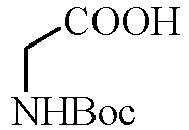
21 42 9 
27 41 8 
20 43 10 - Example 6: Evaluation of reaction using various catalyst loadings, temperatures, solvents, and bases. Following the general synthesis procedure described in Example 1, the mono- (2h) and di-acetoxylated (2hh) 2-amino-2-methylpropyl alcohols having a 2-(iminomethyl)phenol directing group were prepared using various catalyst loading amounts (Table 4), temperatures (Table 5), solvents (Table 6), and bases (Table 7). Yields were determined using gas chromatography.
Table 4: Reaction with varying catalyst loadings. Catalyst Amount (mol%) SM% mono% di% Mass balance conv.% mono-selectivity 10 24 44 11 79 76 4:1 5.0 26 39 9 74 74 4:1 2.5 35 27 2 64 65 14:1 1.0 40 15 0 55 60 1:0 0.5 49 8 0 56 51 1:0 Mass balance = SM% + mono% + di%
conv.% = 100-SM%
mono-selectivity = mono%/di%Table 5: Reaction at various temperatures Temperature SM% mono% di% Mass balance conv.% mono-selectivity 120 30 9 0.3 39 22 25 100 27 30 2.9 59 50 10 80 32 31 2.9 66 47 11 65 50 7 0 57 12 - Mass balance = SM% + mono% + di%
conv.% = 100-SM%
mono-selectivity = mono%/di%Table 6: Reaction using various solvents. Solvent SM% mono% di% Mass balance conv.% mono-selectivity toluene 32 31 2.9 66 47 11 THF 62 7 0 68 10 - dioxane 33 14 0 47 30 14 DMF 41 4 0 45 8 - DMSO 30 1.8 0 32 6 - m-xylene 15 30 4 49 61 8 cyclohexane 43 8 0 51 16 - ethyl acetate 26 25 3 53 46 8 Cl(CH2)2Cl 13 40 12 64 62 3 acetonitrile 28 22 3 52 50 8 DMPU 79 0 0 79 0 - CHCl3 10 33 15 58 57 - benzene 13 41 10 64 64 4 Mass balance = SM% + mono% + di%
conv.% = 100-SM%
mono-selectivity = mono%/di%Table 7: Reaction using various bases. Base SM% mono% di% Mass balance conv.% mono-selectivity NaOAc 32 31 2.9 66 47 11 KOAc 42 18 1 61 31 18 LiOAc 30 14 1 45 33 14 Na2CO3 60 1 0 61 2 - Na2HPO4 17 41 9 67 75 5 NaOS(O)2Ph 16 42 10 67 78 5 NaOCOCF3 30 5 1 36 17 5 NaOCOCF2Cl 23 3 1 27 15 3 NaOPiv 39 2 1 42 7 2 KH2PO4 16 41 8 65 75 5 K3PO4 35 18 1 54 35 18 OAc is acetate
Mass balance = SM% + mono% + di%
conv.% = 100-SM%
mono-selectivity = mono%/di% -

-

- The crude imine product was used in the following step directly. To a 20 mL vial were added the imine (0.32 g, 1.7 mmol), DCM (5 mL), acetic anhydride (0.19 g, 1.8 mmol), and dimethylaminopyridine ("DMAP;" 0.23 g, 1.9 mmol). The reaction mixture was stirred at room temperature for 3 hours, after which time the reaction mixture was diluted with DCM (10 mL), and then washed with water (30 mL, twice), diluted aqueous HCl (5 mL) and brine (10 mL). The organic layer was dried over Na2SO4, filtered, and condensed under reduced pressure to give the product 2h (see Example 1) as a light yellow oil. 1H NMR (500 MHz, Chloroform-d) δ 8.38 (s, 1H), 7.36 - 7.27 (m, 2H), 6.96 (d, J = 8.2 Hz, 1H), 6.88 (td, J = 7.6, 1.2 Hz, 1H), 4.11 (s, 2H), 2.07 (s, 3H), 1.35 (s, 6H); 13C NMR (176 MHz, CDCl3) δ 170.91, 161.73, 161.32, 132.33, 131.57, 118.85, 118.49, 117.17, 71.29, 59.08, 24.23, 20.87.
-

- To a 20 mL vial were added the imine (0.42 g, 2.0 mmol), DCM (5 mL), acetic anhydride (0.45 g, 4.4 mmol), and DMAP (0.56 g, 4.6mmol). The reaction mixture was stirred at room temperature for 3 hours, after which time the reaction mixture was diluted with DCM (10 mL), and then was washed with water (30 mL, twice), diluted aqueous HCl (5 mL) and brine (10 mL). The organic layer was dried over Na2SO4, filtered, and condensed under reduced pressure to give the product 2hh as a light yellow oil. 1H NMR (500 MHz, Chloroform-d) δ 8.44 (s, 1H), 7.35 (ddd, J = 8.4, 7.2, 1.6 Hz, 1H), 7.30 (dd, J = 7.6, 1.6 Hz, 1H), 6.99 (d, J = 8.4 Hz, 1H), 6.91 (td, J = 7.6, 1.2 Hz, 1H), 4.25 (d, J = 11.2 Hz, 2H), 4.19 (d, J = 11.2 Hz, 2H), 2.09 (s, 6H), 1.38 (s, 3H). 13C NMR (176 MHz, CDCl3) δ 170.65, 163.73, 161.09, 132.80, 131.92, 118.73, 117.23, 67.25, 61.19, 20.82, 18.71.
- Following the general synthesis procedure described in Example 1, mono- and di-acetoxylated 2-amino-2-methylpropyl alcohols having a substituted or unsubstituted 2-(iminomethyl)phenol directing group were prepared. Yields for the resulting products refer to 1H NMR yields. The substituted products were determined by comparison with the unsubstituted product, and the yields of the substituted products were determined by crude 1H NMR spectrum using 1,3,5-trimethoxy benzene as internal standard.

R SM% mono% di% - 26 32 7 tBu 45 21 4 Cl 33 17 2 - As illustrated in the above Examples, the process of the present technology provides a process for efficiently preparing amino alcohols, and in particular 1,2 amino alcohols from primary amines.
- While certain embodiments have been illustrated and described, it should be understood that changes and modifications can be made therein in accordance with ordinary skill in the art without departing from the technology in its broader aspects as defined in the following claims.
- The embodiments, illustratively described herein may suitably be practiced in the absence of any element or elements, limitation or limitations, not specifically disclosed herein. Thus, for example, the terms "comprising," "including," "containing," etc. shall be read expansively and without limitation. Additionally, the terms and expressions employed herein have been used as terms of description and not of limitation, and there is no intention in the use of such terms and expressions of excluding any equivalents of the features shown and described or portions thereof, but it is recognized that various modifications are possible within the scope of the claimed technology. Additionally, the phrase "consisting essentially of" will be understood to include those elements specifically recited and those additional elements that do not materially affect the basic and novel characteristics of the claimed technology. The phrase "consisting of' excludes any element not specified.
- The present disclosure is not to be limited in terms of the particular embodiments described in this application.
- In addition, where features or aspects of the disclosure are described in terms of Markush groups, those skilled in the art will recognize that the disclosure is also thereby described in terms of any individual member or subgroup of members of the Markush group.
- As will be understood by one skilled in the art, for any and all purposes, particularly in terms of providing a written description, all ranges disclosed herein also encompass any and all possible subranges and combinations of subranges thereof. Any listed range can be easily recognized as sufficiently describing and enabling the same range being broken down into at least equal halves, thirds, quarters, fifths, tenths, etc. As a non-limiting example, each range discussed herein can be readily broken down into a lower third, middle third and upper third, etc. As will also be understood by one skilled in the art all language such as "up to," "at least," "greater than," "less than," and the like, include the number recited and refer to ranges which can be subsequently broken down into subranges as discussed above. Finally, as will be understood by one skilled in the art, a range includes each individual member.
- Other embodiments are set forth in the following claims.
Claims (20)
- A process for the preparation of an amino alcohol, the process comprising:condensing a compound of Formula (II), a stereoisomer, a tautomer, or a salt thereof with a compound of Formula (IIIa) or Formula (IIIb), a stereoisomer, a tautomer, or a salt thereof to form a condensation product;hydroxylating or acyloxylating the condensation product in the presence of an oxidant to obtain a hydroxylation or acyloxylation product; andsubjecting the hydroxylation or acyloxylation product to one or more subsequent reactions comprising a hydrolysis reaction, an aminolysis reaction, alcohol deprotection, or a combination of two or more thereof to obtain an amino alcohol of Formula (I);wherein:


 L is a carbonyl, imine, acetal, or hemiacetal;X is an amine or a protected amine;R1, R2, R3, and R4 are each independently a hydrogen, a substituted or unsubstituted C1-C10 alkyl, a substituted or unsubstituted C3-C10 cycloalkyl, a substituted or unsubstituted aryl, a substituted or unsubstituted heterocyclyl, a substituted or unsubstituted heteroaryl, or two or more of R1, R2, R3, and R4 together with the atoms to which they are attached form a substituted or unsubstituted cycloalkyl, substituted or unsubstituted heterocyclyl, substituted or unsubstituted aromatic, or substituted or unsubstituted heteroaromatic ring;R5 is a hydrogen, a halogen, a hydroxyl, an alkoxy, an O-acyl, a substituted or unsubstituted C1-C10 alkyl, a substituted or unsubstituted C3-C10 cycloalkyl, a substituted or unsubstituted aryl, a substituted or unsubstituted heterocyclyl, or a substituted or unsubstituted heteroaryl;R6 is a hydrogen, a substituted or unsubstituted C1-C10 alkyl, a substituted or unsubstituted C3-C10 cycloalkyl, a substituted or unsubstituted aryl, a substituted or unsubstituted heterocyclyl, or a substituted or unsubstituted heteroaryl;R7 and R8 in Formula (IIIa) are each independently a hydrogen, a substituted or unsubstituted C1-C10 alkyl, a substituted or unsubstituted C3-C10 cycloalkyl, a substituted or unsubstituted aryl, a substituted or unsubstituted heterocyclyl, a substituted or unsubstituted heteroaryl, or R7 and R8 together with the atoms to which they are attached form a substituted or unsubstituted aromatic or heteroaromatic ring; andR7a, R7b, R8a and R8b in Formula (IIIb) are each independently a hydrogen, a substituted or unsubstituted C1-C10 alkyl, a substituted or unsubstituted C3-C10 cycloalkyl, a substituted or unsubstituted aryl, a substituted or unsubstituted heterocyclyl, a substituted or unsubstituted heteroaryl, or two or more of R7a, R7b, R8a and R8b together with the atoms to which they are attached form a substituted or unsubstituted cycloalkyl or heterocyclyl ring.
 - The process of claim 1, wherein R1 is a substituted or unsubstituted C1-C6 alkyl.
- The process of claim 2, wherein R1 is selected from the group consisting of -CH3, -CH2CH2Ph, and -CH2C(CH3)3.
- The process of any one of claims 1-3, wherein R2 is methyl.
- The process of any one of claims 1-4, wherein R3 and R4 are each independently hydrogen or a substituted or unsubstituted C1-C6 alkyl.
- The process of claim 1, wherein the compound of Formula (II) is tert-butyl amine.
- The process of any one of claims 1-6, wherein R5 and R6 are each independently hydrogen.
- The process of any one of claims 1-7, wherein R7 and R8 in Formula (IIIa) together with the atoms to which they are attached form a C5-C10 aromatic ring.
- The process of claim 1, wherein the compound of Formula (IIIa) is represented by a compound of Formula (V):
 L is a carbonyl, imine, acetal, or hemiacetal;R9 is hydrogen, halogen, hydroxyl, alkoxy, O-acyl;R10, R11, R12, and R13 are each independently a hydrogen, a halogen, an alkoxy, a substituted or unsubstituted C1-C10 alkyl, a substituted or unsubstituted C3-C10 cycloalkyl, a substituted or unsubstituted aryl, a substituted or unsubstituted heterocyclyl, a substituted or unsubstituted heteroaryl, or two or more of R10, R11, R12, and R13 together with the atoms to which they are attached form a substituted or unsubstituted cycloalkyl, substituted or unsubstituted heterocyclyl, substituted or unsubstituted aromatic, or substituted or unsubstituted heteroaromatic ring;Ra1, Rb1, Rc1, and Rd1 are each independently a C-R', N, or N+-R',wherein:R' is any one of R10, R11, R12, or R13; andwhen any one of Ra1, Rb1, Rc1, or Rd1 is N, the compound of Formula (V) does not include the corresponding R10, R11, R12, or R13 substituent.
 - The process of any one of claims 1 or 2-9, wherein L is a carbonyl and X is an amine.
- The process of claim 1 or 10, wherein X is a primary amine.
- The process of any one of claims 1 or 2-9, wherein L is C=NRe1, wherein Re1 is hydrogen, a substituted or unsubstituted C1-C10 alkyl, a substituted or unsubstituted C3-C10 cycloalkyl, a substituted or unsubstituted aryl, a substituted or unsubstituted heterocyclyl, or a substituted or unsubstituted heteroaryl.
- The process of claim 9, wherein R10, R11, R12, and R13 are each independently hydrogen.
- The process of claim 9, wherein at least one of R10, R11, R12, and R13 is an alkoxy, halogen, or C1-C6 alkyl.
- The process of claim 9, wherein at least one of R10, R11, R12, and R13 are each independently hydrogen, and Ra1, Rb1, Rc1, and Rd1 are each independently C-R'.
- The process of any one of claims 9-15, wherein R9 is hydrogen.
- The process of any one of claims 1-9, wherein the compound of Formula (IIIa), or

- The process of any one of claims 1-17, wherein the oxidant is selected from the group consisting of PhI(O(CO)Rf1)2, PhI(ORf1)2, PhI(TFA)2, PhIO, 2-iodoxybenzoic acid (IBX), Dess-Martin periodinane, M2S2O8, Rf1COOI, Rg1OORh1, and O2;
wherein:Rf1 is hydrogen, a C1-C6 alkyl, or a substituted or unsubstituted aryl;Rg1 and Rh1 are each independently a hydrogen, a C1-C6 alkyl, or carboxyl group; andM is an alkali metal. - The process of any one of claims 1-18, wherein the hydroxylating or acyloxylating is conducted in the presence of a heterogeneous or homogeneous catalyst, wherein the catalyst comprises palladium or a palladium salt.
- The process of any one of claims 1-19, wherein the amino alcohol of Formula (I) is 2-amino-2-methylpropanol and the amine of Formula (II) is tert-butylamine.
Applications Claiming Priority (2)
| Application Number | Priority Date | Filing Date | Title |
|---|---|---|---|
| US201862693240P | 2018-07-02 | 2018-07-02 | |
| PCT/US2019/040254 WO2020010055A1 (en) | 2018-07-02 | 2019-07-02 | Process for preparation of amino alcohols |
Publications (2)
| Publication Number | Publication Date |
|---|---|
| EP3818040A1 EP3818040A1 (en) | 2021-05-12 |
| EP3818040B1 true EP3818040B1 (en) | 2022-09-07 |
Family
ID=67587927
Family Applications (1)
| Application Number | Title | Priority Date | Filing Date |
|---|---|---|---|
| EP19752577.7A Active EP3818040B1 (en) | 2018-07-02 | 2019-07-02 | Process for preparation of amino alcohols |
Country Status (4)
| Country | Link |
|---|---|
| US (1) | US11512040B2 (en) |
| EP (1) | EP3818040B1 (en) |
| CN (1) | CN112469692A (en) |
| WO (1) | WO2020010055A1 (en) |
Families Citing this family (1)
| Publication number | Priority date | Publication date | Assignee | Title |
|---|---|---|---|---|
| CN112759531B (en) * | 2019-10-21 | 2023-07-21 | 中国石油化工股份有限公司 | Novel imine compound and preparation method thereof |
-
2019
- 2019-07-02 CN CN201980044876.7A patent/CN112469692A/en active Pending
- 2019-07-02 US US17/257,080 patent/US11512040B2/en active Active
- 2019-07-02 EP EP19752577.7A patent/EP3818040B1/en active Active
- 2019-07-02 WO PCT/US2019/040254 patent/WO2020010055A1/en not_active Ceased
Also Published As
| Publication number | Publication date |
|---|---|
| US20210155575A1 (en) | 2021-05-27 |
| WO2020010055A1 (en) | 2020-01-09 |
| EP3818040A1 (en) | 2021-05-12 |
| US11512040B2 (en) | 2022-11-29 |
| CN112469692A (en) | 2021-03-09 |
Similar Documents
| Publication | Publication Date | Title |
|---|---|---|
| ES2437755T3 (en) | Intermediates for thienopyrazole derivatives that have PDE 7 inhibitory activity | |
| WO2007082131A1 (en) | Process for the preparation of hydroxy substituted heterocycles | |
| JP6490055B2 (en) | Synthesis of 3- (5-amino-2-methyl-4-oxoquinazolin-3 (4H) -yl) piperidine-2,6-dione | |
| JP2016500106A (en) | Synthesis of spirocyclic isoxazoline derivatives | |
| KR100490220B1 (en) | Process for the preparation of 4-oxoimidazolinium salts | |
| CN101190899A (en) | Method for synthesizing 1, 2-dihydroquinazoline-4 (3H) -ketone compound | |
| US11512040B2 (en) | Process for preparation of amino alcohols | |
| KR20190103944A (en) | Method for preparing gamma lactam derivatives from nitrocompound using highly enantioselective bifunctional chiral organocatalytic compound | |
| Temple Jr et al. | New anticancer agents: alterations of the carbamate group of ethyl (5-amino-1, 2-dihydro-3-phenylpyrido [3, 4-b] pyrazin-7-yl) carbamates | |
| Zhuravel' et al. | Synthesis of substituted 3‐(5‐amino‐[1, 3, 4] thiadiazol‐2‐yl)‐2H‐pyrano [2, 3‐c] pyridin‐2‐ones | |
| Tatibouët et al. | Reaction of 3-amino-acridine with formaldehyde in acidic medium: Influence of the stoechiometry on the reaction products | |
| JP2020525443A (en) | Method for preparing substituted 4-aminoindan derivative | |
| CA2705512A1 (en) | Process | |
| Kadutskii et al. | Reaction of 6-aminoquinoline with formaldehyde and cyclic β-diketones. Synthesis of benzo [b]-and indeno [2, 1-b][4, 7]-phenanthroline derivatives | |
| KR20090116753A (en) | Novel method for preparing [3,4-d] pyridazin-7 (6H) -one with 3-methyl-4-phenylisoxazolo | |
| KR102720819B1 (en) | PROLINE ISOTHIOURONIUM SALT COMPOUND AND PREPARATION METHOD OF β-HYDROXY CARBONYL COMPOUND USING THE SAME | |
| US6426417B1 (en) | Processes and intermediates useful to make antifolates | |
| AU2024261178A1 (en) | Method for preparing 4-aminoindan and method for preparing dihydroindenyl-pyrazolo[3,4-b]pyridine-amine | |
| WO2018105492A1 (en) | Method for producing 3-(pyridyl-2-amino)propionitrile and analogues thereof | |
| US9908858B2 (en) | Method for the synthesis of a hydrazine that can be used in the treatment of the papilloma virus | |
| CN107973742A (en) | The method for preparing 3- indole ketone compounds | |
| GB2279346A (en) | Benzofuran intermediates | |
| RU2346947C1 (en) | Method of obtaining furylhetarylmethanes with thieno[2,3-b]pyridine fragment | |
| KR102542097B1 (en) | Method for preparing 4-cyanopiperidine hydrochloride | |
| KR20230040940A (en) | A synthetic method for bicyclic N-heterocycles via photoredox cycloaddition reaction |
Legal Events
| Date | Code | Title | Description |
|---|---|---|---|
| STAA | Information on the status of an ep patent application or granted ep patent |
Free format text: STATUS: UNKNOWN |
|
| STAA | Information on the status of an ep patent application or granted ep patent |
Free format text: STATUS: THE INTERNATIONAL PUBLICATION HAS BEEN MADE |
|
| PUAI | Public reference made under article 153(3) epc to a published international application that has entered the european phase |
Free format text: ORIGINAL CODE: 0009012 |
|
| STAA | Information on the status of an ep patent application or granted ep patent |
Free format text: STATUS: REQUEST FOR EXAMINATION WAS MADE |
|
| 17P | Request for examination filed |
Effective date: 20210202 |
|
| AK | Designated contracting states |
Kind code of ref document: A1 Designated state(s): AL AT BE BG CH CY CZ DE DK EE ES FI FR GB GR HR HU IE IS IT LI LT LU LV MC MK MT NL NO PL PT RO RS SE SI SK SM TR |
|
| DAV | Request for validation of the european patent (deleted) | ||
| DAX | Request for extension of the european patent (deleted) | ||
| GRAP | Despatch of communication of intention to grant a patent |
Free format text: ORIGINAL CODE: EPIDOSNIGR1 |
|
| STAA | Information on the status of an ep patent application or granted ep patent |
Free format text: STATUS: GRANT OF PATENT IS INTENDED |
|
| INTG | Intention to grant announced |
Effective date: 20220310 |
|
| GRAS | Grant fee paid |
Free format text: ORIGINAL CODE: EPIDOSNIGR3 |
|
| GRAA | (expected) grant |
Free format text: ORIGINAL CODE: 0009210 |
|
| STAA | Information on the status of an ep patent application or granted ep patent |
Free format text: STATUS: THE PATENT HAS BEEN GRANTED |
|
| AK | Designated contracting states |
Kind code of ref document: B1 Designated state(s): AL AT BE BG CH CY CZ DE DK EE ES FI FR GB GR HR HU IE IS IT LI LT LU LV MC MK MT NL NO PL PT RO RS SE SI SK SM TR |
|
| REG | Reference to a national code |
Ref country code: GB Ref legal event code: FG4D |
|
| REG | Reference to a national code |
Ref country code: CH Ref legal event code: EP Ref country code: AT Ref legal event code: REF Ref document number: 1516946 Country of ref document: AT Kind code of ref document: T Effective date: 20220915 |
|
| REG | Reference to a national code |
Ref country code: IE Ref legal event code: FG4D |
|
| REG | Reference to a national code |
Ref country code: DE Ref legal event code: R096 Ref document number: 602019019335 Country of ref document: DE |
|
| REG | Reference to a national code |
Ref country code: LT Ref legal event code: MG9D |
|
| REG | Reference to a national code |
Ref country code: NL Ref legal event code: MP Effective date: 20220907 |
|
| PG25 | Lapsed in a contracting state [announced via postgrant information from national office to epo] |
Ref country code: SE Free format text: LAPSE BECAUSE OF FAILURE TO SUBMIT A TRANSLATION OF THE DESCRIPTION OR TO PAY THE FEE WITHIN THE PRESCRIBED TIME-LIMIT Effective date: 20220907 Ref country code: RS Free format text: LAPSE BECAUSE OF FAILURE TO SUBMIT A TRANSLATION OF THE DESCRIPTION OR TO PAY THE FEE WITHIN THE PRESCRIBED TIME-LIMIT Effective date: 20220907 Ref country code: NO Free format text: LAPSE BECAUSE OF FAILURE TO SUBMIT A TRANSLATION OF THE DESCRIPTION OR TO PAY THE FEE WITHIN THE PRESCRIBED TIME-LIMIT Effective date: 20221207 Ref country code: LV Free format text: LAPSE BECAUSE OF FAILURE TO SUBMIT A TRANSLATION OF THE DESCRIPTION OR TO PAY THE FEE WITHIN THE PRESCRIBED TIME-LIMIT Effective date: 20220907 Ref country code: LT Free format text: LAPSE BECAUSE OF FAILURE TO SUBMIT A TRANSLATION OF THE DESCRIPTION OR TO PAY THE FEE WITHIN THE PRESCRIBED TIME-LIMIT Effective date: 20220907 Ref country code: FI Free format text: LAPSE BECAUSE OF FAILURE TO SUBMIT A TRANSLATION OF THE DESCRIPTION OR TO PAY THE FEE WITHIN THE PRESCRIBED TIME-LIMIT Effective date: 20220907 |
|
| REG | Reference to a national code |
Ref country code: AT Ref legal event code: MK05 Ref document number: 1516946 Country of ref document: AT Kind code of ref document: T Effective date: 20220907 |
|
| PG25 | Lapsed in a contracting state [announced via postgrant information from national office to epo] |
Ref country code: HR Free format text: LAPSE BECAUSE OF FAILURE TO SUBMIT A TRANSLATION OF THE DESCRIPTION OR TO PAY THE FEE WITHIN THE PRESCRIBED TIME-LIMIT Effective date: 20220907 Ref country code: GR Free format text: LAPSE BECAUSE OF FAILURE TO SUBMIT A TRANSLATION OF THE DESCRIPTION OR TO PAY THE FEE WITHIN THE PRESCRIBED TIME-LIMIT Effective date: 20221208 |
|
| PG25 | Lapsed in a contracting state [announced via postgrant information from national office to epo] |
Ref country code: SM Free format text: LAPSE BECAUSE OF FAILURE TO SUBMIT A TRANSLATION OF THE DESCRIPTION OR TO PAY THE FEE WITHIN THE PRESCRIBED TIME-LIMIT Effective date: 20220907 Ref country code: RO Free format text: LAPSE BECAUSE OF FAILURE TO SUBMIT A TRANSLATION OF THE DESCRIPTION OR TO PAY THE FEE WITHIN THE PRESCRIBED TIME-LIMIT Effective date: 20220907 Ref country code: PT Free format text: LAPSE BECAUSE OF FAILURE TO SUBMIT A TRANSLATION OF THE DESCRIPTION OR TO PAY THE FEE WITHIN THE PRESCRIBED TIME-LIMIT Effective date: 20230109 Ref country code: ES Free format text: LAPSE BECAUSE OF FAILURE TO SUBMIT A TRANSLATION OF THE DESCRIPTION OR TO PAY THE FEE WITHIN THE PRESCRIBED TIME-LIMIT Effective date: 20220907 Ref country code: CZ Free format text: LAPSE BECAUSE OF FAILURE TO SUBMIT A TRANSLATION OF THE DESCRIPTION OR TO PAY THE FEE WITHIN THE PRESCRIBED TIME-LIMIT Effective date: 20220907 Ref country code: AT Free format text: LAPSE BECAUSE OF FAILURE TO SUBMIT A TRANSLATION OF THE DESCRIPTION OR TO PAY THE FEE WITHIN THE PRESCRIBED TIME-LIMIT Effective date: 20220907 |
|
| PG25 | Lapsed in a contracting state [announced via postgrant information from national office to epo] |
Ref country code: SK Free format text: LAPSE BECAUSE OF FAILURE TO SUBMIT A TRANSLATION OF THE DESCRIPTION OR TO PAY THE FEE WITHIN THE PRESCRIBED TIME-LIMIT Effective date: 20220907 Ref country code: PL Free format text: LAPSE BECAUSE OF FAILURE TO SUBMIT A TRANSLATION OF THE DESCRIPTION OR TO PAY THE FEE WITHIN THE PRESCRIBED TIME-LIMIT Effective date: 20220907 Ref country code: IS Free format text: LAPSE BECAUSE OF FAILURE TO SUBMIT A TRANSLATION OF THE DESCRIPTION OR TO PAY THE FEE WITHIN THE PRESCRIBED TIME-LIMIT Effective date: 20230107 Ref country code: EE Free format text: LAPSE BECAUSE OF FAILURE TO SUBMIT A TRANSLATION OF THE DESCRIPTION OR TO PAY THE FEE WITHIN THE PRESCRIBED TIME-LIMIT Effective date: 20220907 |
|
| REG | Reference to a national code |
Ref country code: DE Ref legal event code: R097 Ref document number: 602019019335 Country of ref document: DE |
|
| PG25 | Lapsed in a contracting state [announced via postgrant information from national office to epo] |
Ref country code: NL Free format text: LAPSE BECAUSE OF FAILURE TO SUBMIT A TRANSLATION OF THE DESCRIPTION OR TO PAY THE FEE WITHIN THE PRESCRIBED TIME-LIMIT Effective date: 20220907 Ref country code: AL Free format text: LAPSE BECAUSE OF FAILURE TO SUBMIT A TRANSLATION OF THE DESCRIPTION OR TO PAY THE FEE WITHIN THE PRESCRIBED TIME-LIMIT Effective date: 20220907 |
|
| PLBE | No opposition filed within time limit |
Free format text: ORIGINAL CODE: 0009261 |
|
| STAA | Information on the status of an ep patent application or granted ep patent |
Free format text: STATUS: NO OPPOSITION FILED WITHIN TIME LIMIT |
|
| PG25 | Lapsed in a contracting state [announced via postgrant information from national office to epo] |
Ref country code: DK Free format text: LAPSE BECAUSE OF FAILURE TO SUBMIT A TRANSLATION OF THE DESCRIPTION OR TO PAY THE FEE WITHIN THE PRESCRIBED TIME-LIMIT Effective date: 20220907 |
|
| 26N | No opposition filed |
Effective date: 20230608 |
|
| PG25 | Lapsed in a contracting state [announced via postgrant information from national office to epo] |
Ref country code: SI Free format text: LAPSE BECAUSE OF FAILURE TO SUBMIT A TRANSLATION OF THE DESCRIPTION OR TO PAY THE FEE WITHIN THE PRESCRIBED TIME-LIMIT Effective date: 20220907 |
|
| REG | Reference to a national code |
Ref country code: DE Ref legal event code: R119 Ref document number: 602019019335 Country of ref document: DE |
|
| PG25 | Lapsed in a contracting state [announced via postgrant information from national office to epo] |
Ref country code: MC Free format text: LAPSE BECAUSE OF FAILURE TO SUBMIT A TRANSLATION OF THE DESCRIPTION OR TO PAY THE FEE WITHIN THE PRESCRIBED TIME-LIMIT Effective date: 20220907 |
|
| PG25 | Lapsed in a contracting state [announced via postgrant information from national office to epo] |
Ref country code: MC Free format text: LAPSE BECAUSE OF FAILURE TO SUBMIT A TRANSLATION OF THE DESCRIPTION OR TO PAY THE FEE WITHIN THE PRESCRIBED TIME-LIMIT Effective date: 20220907 |
|
| REG | Reference to a national code |
Ref country code: CH Ref legal event code: PL |
|
| REG | Reference to a national code |
Ref country code: BE Ref legal event code: MM Effective date: 20230731 |
|
| PG25 | Lapsed in a contracting state [announced via postgrant information from national office to epo] |
Ref country code: LU Free format text: LAPSE BECAUSE OF NON-PAYMENT OF DUE FEES Effective date: 20230702 |
|
| GBPC | Gb: european patent ceased through non-payment of renewal fee |
Effective date: 20230702 |
|
| PG25 | Lapsed in a contracting state [announced via postgrant information from national office to epo] |
Ref country code: LU Free format text: LAPSE BECAUSE OF NON-PAYMENT OF DUE FEES Effective date: 20230702 |
|
| REG | Reference to a national code |
Ref country code: IE Ref legal event code: MM4A |
|
| PG25 | Lapsed in a contracting state [announced via postgrant information from national office to epo] |
Ref country code: DE Free format text: LAPSE BECAUSE OF NON-PAYMENT OF DUE FEES Effective date: 20240201 Ref country code: CH Free format text: LAPSE BECAUSE OF NON-PAYMENT OF DUE FEES Effective date: 20230731 Ref country code: GB Free format text: LAPSE BECAUSE OF NON-PAYMENT OF DUE FEES Effective date: 20230702 |
|
| PG25 | Lapsed in a contracting state [announced via postgrant information from national office to epo] |
Ref country code: IT Free format text: LAPSE BECAUSE OF FAILURE TO SUBMIT A TRANSLATION OF THE DESCRIPTION OR TO PAY THE FEE WITHIN THE PRESCRIBED TIME-LIMIT Effective date: 20220907 Ref country code: FR Free format text: LAPSE BECAUSE OF NON-PAYMENT OF DUE FEES Effective date: 20230731 Ref country code: BE Free format text: LAPSE BECAUSE OF NON-PAYMENT OF DUE FEES Effective date: 20230731 |
|
| PG25 | Lapsed in a contracting state [announced via postgrant information from national office to epo] |
Ref country code: IE Free format text: LAPSE BECAUSE OF NON-PAYMENT OF DUE FEES Effective date: 20230702 |
|
| PG25 | Lapsed in a contracting state [announced via postgrant information from national office to epo] |
Ref country code: IE Free format text: LAPSE BECAUSE OF NON-PAYMENT OF DUE FEES Effective date: 20230702 |
|
| PG25 | Lapsed in a contracting state [announced via postgrant information from national office to epo] |
Ref country code: BG Free format text: LAPSE BECAUSE OF FAILURE TO SUBMIT A TRANSLATION OF THE DESCRIPTION OR TO PAY THE FEE WITHIN THE PRESCRIBED TIME-LIMIT Effective date: 20220907 |
|
| PG25 | Lapsed in a contracting state [announced via postgrant information from national office to epo] |
Ref country code: BG Free format text: LAPSE BECAUSE OF FAILURE TO SUBMIT A TRANSLATION OF THE DESCRIPTION OR TO PAY THE FEE WITHIN THE PRESCRIBED TIME-LIMIT Effective date: 20220907 |
|
| PG25 | Lapsed in a contracting state [announced via postgrant information from national office to epo] |
Ref country code: CY Free format text: LAPSE BECAUSE OF FAILURE TO SUBMIT A TRANSLATION OF THE DESCRIPTION OR TO PAY THE FEE WITHIN THE PRESCRIBED TIME-LIMIT; INVALID AB INITIO Effective date: 20190702 |
|
| PG25 | Lapsed in a contracting state [announced via postgrant information from national office to epo] |
Ref country code: HU Free format text: LAPSE BECAUSE OF FAILURE TO SUBMIT A TRANSLATION OF THE DESCRIPTION OR TO PAY THE FEE WITHIN THE PRESCRIBED TIME-LIMIT; INVALID AB INITIO Effective date: 20190702 |
|
| PG25 | Lapsed in a contracting state [announced via postgrant information from national office to epo] |
Ref country code: TR Free format text: LAPSE BECAUSE OF FAILURE TO SUBMIT A TRANSLATION OF THE DESCRIPTION OR TO PAY THE FEE WITHIN THE PRESCRIBED TIME-LIMIT Effective date: 20220907 |