EP3816399B1 - Airfoil with encapsulating sheath - Google Patents
Airfoil with encapsulating sheath Download PDFInfo
- Publication number
- EP3816399B1 EP3816399B1 EP20205011.8A EP20205011A EP3816399B1 EP 3816399 B1 EP3816399 B1 EP 3816399B1 EP 20205011 A EP20205011 A EP 20205011A EP 3816399 B1 EP3816399 B1 EP 3816399B1
- Authority
- EP
- European Patent Office
- Prior art keywords
- airfoil
- sheath
- interface members
- along
- section
- Prior art date
- Legal status (The legal status is an assumption and is not a legal conclusion. Google has not performed a legal analysis and makes no representation as to the accuracy of the status listed.)
- Active
Links
Images



Classifications
-
- F—MECHANICAL ENGINEERING; LIGHTING; HEATING; WEAPONS; BLASTING
- F01—MACHINES OR ENGINES IN GENERAL; ENGINE PLANTS IN GENERAL; STEAM ENGINES
- F01D—NON-POSITIVE DISPLACEMENT MACHINES OR ENGINES, e.g. STEAM TURBINES
- F01D5/00—Blades; Blade-carrying members; Heating, heat-insulating, cooling or antivibration means on the blades or the members
- F01D5/02—Blade-carrying members, e.g. rotors
- F01D5/021—Blade-carrying members, e.g. rotors for flow machines or engines with only one axial stage
-
- F—MECHANICAL ENGINEERING; LIGHTING; HEATING; WEAPONS; BLASTING
- F01—MACHINES OR ENGINES IN GENERAL; ENGINE PLANTS IN GENERAL; STEAM ENGINES
- F01D—NON-POSITIVE DISPLACEMENT MACHINES OR ENGINES, e.g. STEAM TURBINES
- F01D5/00—Blades; Blade-carrying members; Heating, heat-insulating, cooling or antivibration means on the blades or the members
- F01D5/12—Blades
- F01D5/14—Form or construction
- F01D5/147—Construction, i.e. structural features, e.g. of weight-saving hollow blades
-
- F—MECHANICAL ENGINEERING; LIGHTING; HEATING; WEAPONS; BLASTING
- F01—MACHINES OR ENGINES IN GENERAL; ENGINE PLANTS IN GENERAL; STEAM ENGINES
- F01D—NON-POSITIVE DISPLACEMENT MACHINES OR ENGINES, e.g. STEAM TURBINES
- F01D21/00—Shutting-down of machines or engines, e.g. in emergency; Regulating, controlling, or safety means not otherwise provided for
- F01D21/04—Shutting-down of machines or engines, e.g. in emergency; Regulating, controlling, or safety means not otherwise provided for responsive to undesired position of rotor relative to stator or to breaking-off of a part of the rotor, e.g. indicating such position
- F01D21/045—Shutting-down of machines or engines, e.g. in emergency; Regulating, controlling, or safety means not otherwise provided for responsive to undesired position of rotor relative to stator or to breaking-off of a part of the rotor, e.g. indicating such position special arrangements in stators or in rotors dealing with breaking-off of part of rotor
-
- F—MECHANICAL ENGINEERING; LIGHTING; HEATING; WEAPONS; BLASTING
- F01—MACHINES OR ENGINES IN GENERAL; ENGINE PLANTS IN GENERAL; STEAM ENGINES
- F01D—NON-POSITIVE DISPLACEMENT MACHINES OR ENGINES, e.g. STEAM TURBINES
- F01D5/00—Blades; Blade-carrying members; Heating, heat-insulating, cooling or antivibration means on the blades or the members
- F01D5/12—Blades
- F01D5/28—Selecting particular materials; Particular measures relating thereto; Measures against erosion or corrosion
- F01D5/282—Selecting composite materials, e.g. blades with reinforcing filaments
-
- F—MECHANICAL ENGINEERING; LIGHTING; HEATING; WEAPONS; BLASTING
- F01—MACHINES OR ENGINES IN GENERAL; ENGINE PLANTS IN GENERAL; STEAM ENGINES
- F01D—NON-POSITIVE DISPLACEMENT MACHINES OR ENGINES, e.g. STEAM TURBINES
- F01D5/00—Blades; Blade-carrying members; Heating, heat-insulating, cooling or antivibration means on the blades or the members
- F01D5/12—Blades
- F01D5/28—Selecting particular materials; Particular measures relating thereto; Measures against erosion or corrosion
- F01D5/286—Particular treatment of blades, e.g. to increase durability or resistance against corrosion or erosion
-
- F—MECHANICAL ENGINEERING; LIGHTING; HEATING; WEAPONS; BLASTING
- F02—COMBUSTION ENGINES; HOT-GAS OR COMBUSTION-PRODUCT ENGINE PLANTS
- F02C—GAS-TURBINE PLANTS; AIR INTAKES FOR JET-PROPULSION PLANTS; CONTROLLING FUEL SUPPLY IN AIR-BREATHING JET-PROPULSION PLANTS
- F02C3/00—Gas-turbine plants characterised by the use of combustion products as the working fluid
- F02C3/04—Gas-turbine plants characterised by the use of combustion products as the working fluid having a turbine driving a compressor
-
- F—MECHANICAL ENGINEERING; LIGHTING; HEATING; WEAPONS; BLASTING
- F04—POSITIVE - DISPLACEMENT MACHINES FOR LIQUIDS; PUMPS FOR LIQUIDS OR ELASTIC FLUIDS
- F04D—NON-POSITIVE-DISPLACEMENT PUMPS
- F04D29/00—Details, component parts, or accessories
- F04D29/02—Selection of particular materials
- F04D29/023—Selection of particular materials especially adapted for elastic fluid pumps
-
- F—MECHANICAL ENGINEERING; LIGHTING; HEATING; WEAPONS; BLASTING
- F04—POSITIVE - DISPLACEMENT MACHINES FOR LIQUIDS; PUMPS FOR LIQUIDS OR ELASTIC FLUIDS
- F04D—NON-POSITIVE-DISPLACEMENT PUMPS
- F04D29/00—Details, component parts, or accessories
- F04D29/26—Rotors specially for elastic fluids
- F04D29/32—Rotors specially for elastic fluids for axial flow pumps
- F04D29/321—Rotors specially for elastic fluids for axial flow pumps for axial flow compressors
- F04D29/324—Blades
-
- F—MECHANICAL ENGINEERING; LIGHTING; HEATING; WEAPONS; BLASTING
- F05—INDEXING SCHEMES RELATING TO ENGINES OR PUMPS IN VARIOUS SUBCLASSES OF CLASSES F01-F04
- F05D—INDEXING SCHEME FOR ASPECTS RELATING TO NON-POSITIVE-DISPLACEMENT MACHINES OR ENGINES, GAS-TURBINES OR JET-PROPULSION PLANTS
- F05D2220/00—Application
- F05D2220/30—Application in turbines
- F05D2220/32—Application in turbines in gas turbines
-
- F—MECHANICAL ENGINEERING; LIGHTING; HEATING; WEAPONS; BLASTING
- F05—INDEXING SCHEMES RELATING TO ENGINES OR PUMPS IN VARIOUS SUBCLASSES OF CLASSES F01-F04
- F05D—INDEXING SCHEME FOR ASPECTS RELATING TO NON-POSITIVE-DISPLACEMENT MACHINES OR ENGINES, GAS-TURBINES OR JET-PROPULSION PLANTS
- F05D2220/00—Application
- F05D2220/30—Application in turbines
- F05D2220/36—Application in turbines specially adapted for the fan of turbofan engines
-
- F—MECHANICAL ENGINEERING; LIGHTING; HEATING; WEAPONS; BLASTING
- F05—INDEXING SCHEMES RELATING TO ENGINES OR PUMPS IN VARIOUS SUBCLASSES OF CLASSES F01-F04
- F05D—INDEXING SCHEME FOR ASPECTS RELATING TO NON-POSITIVE-DISPLACEMENT MACHINES OR ENGINES, GAS-TURBINES OR JET-PROPULSION PLANTS
- F05D2230/00—Manufacture
- F05D2230/60—Assembly methods
-
- F—MECHANICAL ENGINEERING; LIGHTING; HEATING; WEAPONS; BLASTING
- F05—INDEXING SCHEMES RELATING TO ENGINES OR PUMPS IN VARIOUS SUBCLASSES OF CLASSES F01-F04
- F05D—INDEXING SCHEME FOR ASPECTS RELATING TO NON-POSITIVE-DISPLACEMENT MACHINES OR ENGINES, GAS-TURBINES OR JET-PROPULSION PLANTS
- F05D2240/00—Components
- F05D2240/20—Rotors
- F05D2240/24—Rotors for turbines
-
- F—MECHANICAL ENGINEERING; LIGHTING; HEATING; WEAPONS; BLASTING
- F05—INDEXING SCHEMES RELATING TO ENGINES OR PUMPS IN VARIOUS SUBCLASSES OF CLASSES F01-F04
- F05D—INDEXING SCHEME FOR ASPECTS RELATING TO NON-POSITIVE-DISPLACEMENT MACHINES OR ENGINES, GAS-TURBINES OR JET-PROPULSION PLANTS
- F05D2240/00—Components
- F05D2240/20—Rotors
- F05D2240/30—Characteristics of rotor blades, i.e. of any element transforming dynamic fluid energy to or from rotational energy and being attached to a rotor
-
- F—MECHANICAL ENGINEERING; LIGHTING; HEATING; WEAPONS; BLASTING
- F05—INDEXING SCHEMES RELATING TO ENGINES OR PUMPS IN VARIOUS SUBCLASSES OF CLASSES F01-F04
- F05D—INDEXING SCHEME FOR ASPECTS RELATING TO NON-POSITIVE-DISPLACEMENT MACHINES OR ENGINES, GAS-TURBINES OR JET-PROPULSION PLANTS
- F05D2240/00—Components
- F05D2240/20—Rotors
- F05D2240/30—Characteristics of rotor blades, i.e. of any element transforming dynamic fluid energy to or from rotational energy and being attached to a rotor
- F05D2240/304—Characteristics of rotor blades, i.e. of any element transforming dynamic fluid energy to or from rotational energy and being attached to a rotor related to the trailing edge of a rotor blade
-
- F—MECHANICAL ENGINEERING; LIGHTING; HEATING; WEAPONS; BLASTING
- F05—INDEXING SCHEMES RELATING TO ENGINES OR PUMPS IN VARIOUS SUBCLASSES OF CLASSES F01-F04
- F05D—INDEXING SCHEME FOR ASPECTS RELATING TO NON-POSITIVE-DISPLACEMENT MACHINES OR ENGINES, GAS-TURBINES OR JET-PROPULSION PLANTS
- F05D2260/00—Function
- F05D2260/30—Retaining components in desired mutual position
- F05D2260/36—Retaining components in desired mutual position by a form fit connection, e.g. by interlocking
-
- F—MECHANICAL ENGINEERING; LIGHTING; HEATING; WEAPONS; BLASTING
- F05—INDEXING SCHEMES RELATING TO ENGINES OR PUMPS IN VARIOUS SUBCLASSES OF CLASSES F01-F04
- F05D—INDEXING SCHEME FOR ASPECTS RELATING TO NON-POSITIVE-DISPLACEMENT MACHINES OR ENGINES, GAS-TURBINES OR JET-PROPULSION PLANTS
- F05D2300/00—Materials; Properties thereof
- F05D2300/60—Properties or characteristics given to material by treatment or manufacturing
- F05D2300/603—Composites; e.g. fibre-reinforced
-
- Y—GENERAL TAGGING OF NEW TECHNOLOGICAL DEVELOPMENTS; GENERAL TAGGING OF CROSS-SECTIONAL TECHNOLOGIES SPANNING OVER SEVERAL SECTIONS OF THE IPC; TECHNICAL SUBJECTS COVERED BY FORMER USPC CROSS-REFERENCE ART COLLECTIONS [XRACs] AND DIGESTS
- Y02—TECHNOLOGIES OR APPLICATIONS FOR MITIGATION OR ADAPTATION AGAINST CLIMATE CHANGE
- Y02T—CLIMATE CHANGE MITIGATION TECHNOLOGIES RELATED TO TRANSPORTATION
- Y02T50/00—Aeronautics or air transport
- Y02T50/60—Efficient propulsion technologies, e.g. for aircraft
Definitions
- This disclosure relates to a gas turbine engine, and more particularly to an airfoil having a sheath.
- Gas turbine engines can include a fan for propulsion air and to cool components.
- the fan also delivers air into a core engine where it is compressed.
- the compressed air is then delivered into a combustion section, where it is mixed with fuel and ignited.
- the combustion gas expands downstream over and drives turbine blades.
- Static vanes are positioned adjacent to the turbine blades to control the flow of the products of combustion.
- the fan can include an array of fan blades each having a main body that establishes an aerodynamic surface contour.
- the main body may be formed from a composite material made of a layup of one or more laminated layers.
- One or more sheaths may be secured to the main body to reduce a likelihood delamination of the layup due to a bird strike or other foreign object debris (FOD) event.
- FOD foreign object debris
- EP 2 607 628 A2 discloses an airfoil according to the preamble of claim 1.
- EP 2 253 806 A2 discloses a fiber-reinforced composite airfoil blade
- US 2010/322760 A1 discloses an interlocked CMC airfoil
- EP 3 282 090 A1 discloses airfoil systems and methods of assembly
- EP 0 735 161 A1 discloses an electroformed shield for a jet engine fan blade
- EP 2 693 061 A2 discloses a compressor blade for a gas turbine engine.
- an airfoil as set forth in claim 1.
- FIG. 1 schematically illustrates a gas turbine engine 20.
- the gas turbine engine 20 is disclosed herein as a two-spool turbofan that generally incorporates a fan section 22, a compressor section 24, a combustor section 26 and a turbine section 28.
- the fan section 22 drives air along a bypass flow path B in a bypass duct defined within a housing 15 such as a fan case or nacelle, and also drives air along a core flow path C for compression and communication into the combustor section 26 then expansion through the turbine section 28.
- the exemplary engine 20 generally includes a low speed spool 30 and a high speed spool 32 mounted for rotation about an engine central longitudinal axis A relative to an engine static structure 36 via several bearing systems 38. It should be understood that various bearing systems 38 at various locations may alternatively or additionally be provided, and the location of bearing systems 38 may be varied as appropriate to the application.
- the low speed spool 30 generally includes an inner shaft 40 that interconnects, a first (or low) pressure compressor 44 and a first (or low) pressure turbine 46.
- the inner shaft 40 is connected to the fan 42 through a speed change mechanism, which in exemplary gas turbine engine 20 is illustrated as a geared architecture 48 to drive a fan 42 at a lower speed than the low speed spool 30.
- the high speed spool 32 includes an outer shaft 50 that interconnects a second (or high) pressure compressor 52 and a second (or high) pressure turbine 54.
- a combustor 56 is arranged in exemplary gas turbine 20 between the high pressure compressor 52 and the high pressure turbine 54.
- a mid-turbine frame 57 of the engine static structure 36 may be arranged generally between the high pressure turbine 54 and the low pressure turbine 46.
- the mid-turbine frame 57 further supports bearing systems 38 in the turbine section 28.
- the inner shaft 40 and the outer shaft 50 are concentric and rotate via bearing systems 38 about the engine central longitudinal axis A which is colline
- the core airflow is compressed by the low pressure compressor 44 then the high pressure compressor 52, mixed and burned with fuel in the combustor 56, then expanded over the high pressure turbine 54 and low pressure turbine 46.
- the mid-turbine frame 57 includes airfoils 59 which are in the core airflow path C.
- the turbines 46, 54 rotationally drive the respective low speed spool 30 and high speed spool 32 in response to the expansion.
- gear system 48 may be located aft of the low pressure compressor, or aft of the combustor section 26 or even aft of turbine section 28, and fan 42 may be positioned forward or aft of the location of gear system 48.
- the engine 20 in one example is a high-bypass geared aircraft engine.
- the engine 20 bypass ratio is greater than about six, with an example embodiment being greater than about ten
- the geared architecture 48 is an epicyclic gear train, such as a planetary gear system or other gear system, with a gear reduction ratio of greater than about 2.3 and the low pressure turbine 46 has a pressure ratio that is greater than about five.
- the engine 20 bypass ratio is greater than about ten
- the fan diameter is significantly larger than that of the low pressure compressor 44
- the low pressure turbine 46 has a pressure ratio that is greater than about five.
- Low pressure turbine 46 pressure ratio is pressure measured prior to inlet of low pressure turbine 46 as related to the pressure at the outlet of the low pressure turbine 46 prior to an exhaust nozzle.
- the geared architecture 48 may be an epicycle gear train, such as a planetary gear system or other gear system, with a gear reduction ratio of greater than about 2.3:1 and less than about 5:1. It should be understood, however, that the above parameters are only exemplary of one embodiment of a geared architecture engine and that the present invention is applicable to other gas turbine engines including direct drive turbofans.
- the fan section 22 of the engine 20 is designed for a particular flight condition -- typically cruise at about 0.8 Mach and about 35,000 feet (10,668 meters).
- the flight condition of 0.8 Mach and 35,000 ft (10,668 meters), with the engine at its best fuel consumption - also known as "bucket cruise Thrust Specific Fuel Consumption ('TSFC')" - is the industry standard parameter of lbm of fuel being burned divided by lbf of thrust the engine produces at that minimum point.
- "Low fan pressure ratio” is the pressure ratio across the fan blade alone, without a Fan Exit Guide Vane (“FEGV”) system.
- the low fan pressure ratio as disclosed herein according to one non-limiting embodiment is less than about 1.45.
- the "Low corrected fan tip speed” as disclosed herein according to one non-limiting embodiment is less than about 1150 ft / second (350.5 meters/second).
- the fan 42 includes a rotor 60 including a fan hub 66 carrying or otherwise supporting a plurality of airfoils or fan blades 64.
- the fan blades 64 are arranged in an array or row 62 and are circumferentially distributed about the hub 66 (see also Figure 1 ).
- Various numbers of fan blades 64 may be incorporated into the fan 42, such as a total quantity of between 12 and 20 of fan blades 64.
- the array 62 of fan blades 64 are circumferentially distributed about the engine axis A.
- the low pressure turbine 46 can be rotatably coupled to the hub 66 of the fan 42.
- the fan blades 64 are rotatable in a direction D1 about the engine axis A in response to rotation of the hub 66.
- the airfoil 64 extends radially outward of a platform 69, which provides the inner flow path.
- the platform 69 may be integral with the airfoil 64 or separately secured to the hub 66, for example.
- a nosecone or spinner 72 is supported relative to the hub 66 to provide an aerodynamic inner flow path into the fan section 22, as illustrated in Figures 1-2 .
- FIG 3 illustrates an exemplary airfoil 164 for a gas turbine engine.
- like reference numerals designate like elements where appropriate and reference numerals with the addition of one-hundred or multiples thereof designate modified elements that are understood to incorporate the same features and benefits of the corresponding original elements.
- the airfoil 164 can be a fan blade incorporated into the fan 42 of Figures 1-2 , for example. It should be understood that other types of airfoils and other parts of the gas turbine engine 20 may benefit from the examples disclosed herein, such as inlet and exit guide vanes and other airfoils in the fan section 22, compressor section 24 and/or turbine section 28.
- the airfoil 164 includes an airfoil section 165 and a root section 168.
- the root section 168 is received in a correspondingly shaped slot in the hub 66.
- the root section 168 can have a shape configured to mount the airfoil 164 to the hub 66, such as a dovetail shape.
- the airfoil section 165 extends in a radial or spanwise direction R between the root section 168 and a tip portion 170, in a chordwise direction X between a leading edge LE and a trailing edge TE, and in a thickness direction T between a pressure side PS and a suction side SS ( Figures 2 and 4 ).
- the tip portion 170 establishes a terminal end of the airfoil 164.
- each airfoil 164 has an exterior surface ES providing an aerodynamic surface contour that extends in the chordwise direction X between the leading and trailing edges LE, TE.
- the exterior surface ES of the airfoil 164 generates lift based upon its geometry and directs flow along the core flow path C and bypass flow path B.
- the airfoil 164 may be constructed from a composite material, stainless steel, an aluminum or titanium alloy, or a combination of one or more of these. Abrasion-resistant coatings or other protective coatings may be applied to the airfoil 164.
- the airfoil 164 includes a first sheath 174 and a tip cap or second sheath 176 secured to the airfoil body 172.
- the sheath 174 and tip cap 176 are dimensioned to extend along the external surface ES of the airfoil body 172 at various positions and serve to protect the airfoil body 172 from impacts that may occur during engine operation such as bird strikes, ice fragments and other foreign object debris (FOD).
- FOD foreign object debris
- the sheath 174 is omitted.
- the airfoil body 172 is constructed from a composite layup that establishes the tip portion 170.
- the composite layup can include a plurality of plies or layers L ( Figures 6 and 7A-7B ) of composite material.
- Example composite materials include carbon fibers embedded in a polymer matrix material.
- Other example composite materials include fiberglass, aramid fibers such as Kevlar ® , and polyethylene.
- the layers L can be made of various constructions such as braided or woven fibers, fabrics, and/or uni-tape plies, for example.
- the sheath 174 and sheath (or tip cap) 176 can be arranged at various positions and orientations relative to the airfoil body 172.
- the sheath 174 has a major component dimensioned to extend in the radial direction R along a periphery of the leading edge LE of the airfoil section 165.
- the sheath 174 includes a sheath body 174A that extends in the spanwise direction R along both (or at least one) of the pressure and suction sides PS, SS (see also Figure 6 ).
- the sheath body 174A is dimensioned to extend from the tip portion 170 along the leading edge LE towards the root section 168.
- the sheath body 174A can be dimensioned to extend at least a majority of span positions of the airfoil section 165. In the illustrative example of Figure 3 , the sheath body 174A extends between approximately 0% span and approximately 100% span. For the purposes of this disclosure, 0% span is defined at a junction between the airfoil section 165 and the root section 168, and 100% span is defined at a radially outermost position or terminal end of the tip portion 170. For the purposes of this disclosure, the terms "about” and “approximately” mean ⁇ 3% of the stated value unless otherwise disclosed.
- the sheath (or tip cap) 176 includes first and second cap (or sheath) portions 178, 180 secured to and extending along the airfoil body 172.
- the cap portions 178, 180 are separate and distinct components.
- the cap portions 178, 180 can be arranged to be spaced apart from each other to accommodate design and manufacturing tolerances, as illustrated in Figures 3-4 , or can be arranged to directly abut each other. Separate and distinct cap portions 178, 180 can reduce complexity in cleaning and inspecting the tip cap 176, and can reduce dimensional variations that may otherwise be caused by distortions due to a welding operation.
- the cap portions 178, 180 cooperate to establish pressure and suction sides PS, SS of the airfoil section 165.
- the first and second cap portions 178, 180 include respective first and second cap (or sheath) bodies 178A, 180A dimensioned to extend along a periphery of the tip portion 170 and/or along a periphery of the trailing edge TE of the airfoil section 165.
- the cap bodies 178A, 180A are dimensioned to extend in the chordwise direction X along respective ones of the pressure and suction sides PS, SS.
- the first cap body 178A is dimensioned to extend along a first face 172A of the airfoil body 172
- the second cap body 180A is dimensioned to extend along a second face 172B of the airfoil body 172.
- the first face 172A is opposed to the second face 172B.
- the first face 172A extends along the pressure side PS
- the second face 172B extends along the suction side SS.
- an opposite arrangement is utilized.
- the first and second faces 172A, 172B are dimensioned to taper inwardly towards and are joined at an edge 172C of the airfoil body 172.
- the edge 172C has a generally planar geometry or face having a major component extending in the radial direction R along the trailing edge TE, as illustrated by Figure 8 . In other examples, the edge 172C tapers to a vertex.
- Each cap body 178A/180A includes a respective first body portion 178AA/180AA and a second body portion 178AB/180AB.
- the second body portion 178AB/180AB extends transversely from the respective first body portion 178AA/180AA.
- Each first body portion 178AA, 180AA has a major component dimensioned to extend in the chordwise direction X along the tip portion 170, as illustrated in Figures 3-4 .
- the airfoil body 172 is at least partially exposed along the terminal end of the airfoil section 165. In other examples, the sheath 174 and/or tip cap 176 enclose the airfoil body 172 along the terminal end of the airfoil section 165.
- Each second body portion 178AB, 180AB has a major component dimensioned to extend in the spanwise direction R along the trailing edge TE.
- Each cap body 178A, 180A including the second body portions 178AB, 180AB can be dimensioned to extend along various span positions of the airfoil section 165, such as at least a majority of span positions along the trailing edge TE.
- each cap body 178A, 180A including the second body portions 178AB, 180AB extends inwardly from 100% span towards the root section 168, such as at least 50% or 75% span.
- the tip cap 176 can be spaced apart from the root section 168, as illustrated in Figure 3 .
- Other arrangements can be utilized.
- the tip cap 176 can extend along the leading edge LE and tip portion 170, and the sheath 174 can extend from the tip portion 170 along the trailing edge TE.
- the first and second cap portions 178, 180 mate or otherwise cooperate to establish at least one joint 182 along the external surface ES of the airfoil section 165.
- the joint 182 provides substantially continuous stiffness along adjacent portions of the airfoil body 172.
- the joint 182 can be dimensioned to extend along the tip portion 170, such as inwardly from the terminal end of the airfoil section 165 and along the trailing edge TE, as illustrated in Figures 3-4 and 5A-5B . In other examples, the joint 182 is spaced apart from the terminal end of the tip portion 170.
- the first and second cap portions 178, 180 can directly abut each other along the joint 182 or can define a relatively small gap to accommodate design and manufacturing tolerances.
- Adhesive or another bonding material 188 can substantially fill a volume of the gap to establish a substantially continuous surface contour.
- the first and second sheath portions 178, 180 include respective first and second interface portions 178B, 180B extending outwardly from the respective cap body 178A, 180A.
- the first interface portion 178B cooperates with the second interface portion 180B to establish the respective joint 182.
- the interface portions 178B, 180B arranged according to the techniques disclosed herein provide a structural connection between the cap portions 178, 180.
- the interface portions 178B, 180B are arranged such that the joint 182 is established along the external surface ES of both of the pressure and suction sides PS, SS.
- the first and second interface portions 178B, 180B are dimensioned to establish at least one joint 182 having a circuitous profile along the external surface ES of the airfoil section 165, as illustrated by the joint 182 of Figures 3-4 and 5A-5B .
- circuitous means a profile having two or more points of inflection. The circuitous profile can reduce structural stiffness discontinuities that may otherwise degrade a structural integrity of the airfoil 164 due to FOD impacts.
- the first interface portion 178B includes a first set of interface members (or fingers) 178C extending outwardly from the first cap body 178A.
- the second interface portion 180B includes a second set of interface members (or fingers) 180C extending outwardly from the second cap body 180A.
- the interface members 178C, 180C can be dimensioned to extend at various positions and orientations relative to the airfoil body 172, and can have various shapes and/or sizes. In the illustrative example of Figures 3-4 and 5A-5B , the interface members 178C, 180C have a major component that extends in the chordwise direction X. Various quantities of interface members 178C, 180C can be utilized.
- the first interface portion 178B has a quantity of eight interface members 178C
- the second interface portion 180B has a quantity of seven interface members 180C.
- fewer or more than eight interface members 178C and seven interface members 180C can be utilized.
- each interface member 178C/180C is an elongated finger or protrusion dimensioned to extend outwardly from a base along the cap body 178A/180A to a respective terminal end 178E/180E.
- the interface members 178C, 180C are dimensioned to extend outwardly from the respective second body portions 180AA, 180AB and may also be dimensioned to extend outwardly from the respective first body portions 178AA, 178AB.
- the interface portions 178B, 180B are dimensioned to establish the joint 182 having a circuitous profile along the edge 172C of the airfoil body 172 joining the first and second faces 172A, 172B.
- the circuitous profile of the joint 182 has a plurality of segments extending between the pressure and suction sides PS, SS at respective span positions of the trailing edge TE that are established by an outer periphery of the interface members 178C, 180C, as illustrated by Figures 3-4 and 5A-5B .
- the interface members 178C, 180C can be arranged such that the joint 182 extends across the trailing edge TE a total of fourteen times at different span positions of the airfoil section 165 with respect to the radial direction R due to the interleaving of the interface members 178C, 180C, as illustrated by Figures 3-4 .
- the interface members 178C, 180C can substantially or completely define a height of the tip cap 176 along the trailing edge TE, as illustrated in Figures 3-4 , which can improve a total area of protection adjacent the edge 172C of the airfoil body 172.
- each interface members 178C/180C is an elongated tab having a generally J-shaped or hook-shaped cross sectional geometry or profile including a first portion having a major component extending from a respective one of the cap bodies 178A/180A toward the trailing edge TE and including a second portion having a major component extending from the first portion toward the leading edge LE and terminating at the respective terminal end 178E/180E.
- the first portion is opposed to the second portion to establish a respective recess 178R/180R dimensioned to receive a portion of the airfoil body 172 along the edge 172C.
- the interface members 178C are dimensioned to extend from the cap body 178A along the first face 172A, wrap in a first direction D1 about the edge 172C along the trailing edge TE, and extend along the second face 172B, as illustrated in Figure 7A .
- the interface members 180C are dimensioned to extend from the cap body 180A along the second face 172B, wrap in a second direction D2 about the edge 172C, and extend along the first face 172A, as illustrated in Figure 7B .
- the second direction D2 is generally opposed to the first direction D1.
- sidewalls 178F/180F of the respective interface members 178C/180C can have a flat or substantially linear geometry.
- the terminal ends 178E/180E of the respective interface members 178C/180C can have various geometries, such as a substantially flat or linear geometry, for example, which can serve to increase an effective length of the respective joint 182.
- a junction between the sidewalls 178F/180F and the respective terminal end 178E/180E can be rounded, which can serve to increase an effective length of the respective joint 182 and reduce stress concentrations in the airfoil body 172 that may be otherwise caused by abrupt changes along the joint 182.
- Interleaving the interface members 178C, 180C can provide a stiffness continuous transition between the cap portions 178, 180 and can establish a substantially continuous stiffness joint 182, which can serve to oppose out-of-plane bending loads, improve load transfers and reduce a likelihood of localized, inter-laminar stress concentrations and delamination of the composite plies or layers L ( Figures 6 and 7A-7B ) that may otherwise occur due to FOD impacts. Interleaving the interface members 178C, 180C can also occur without an increased weight as compared to a linear butt joint.
- each interface member 178C/180C extends a width W1 between the trailing edge TE and the respective terminal end 178E/180E and extends a height H1 between the respective sidewalls 178F/180F.
- a ratio of H1:W1 is at least about 1:1 or more narrowly at least about 2:1, such as between about 3:1 and about 4:1 for at least some, a majority, or all of the interface members 178C, 180C.
- the width W1 is approximately 0.25 inches (6.35 mm) or less, which can reduce a complexity of forming the interface members 178C, 180C.
- the width W1 of the first set of interface members 178C can be the same or can differ from the width W1 of the second set of interface members 180C.
- the width W1 of at least some (or each) of the first set of interface members 178C can be less than or greater than the width of at least some (or each) of the second set of interface members 180C.
- Dimensioning the interface members 178C, 180C utilizing the techniques disclosed herein can increase an effective length of the joint 182, which can improve strength along the joint 182 and stiffness of the airfoil 164 along adjacent portions of the airfoil body 172.
- the interface portions 178B/180B define respective slots or recesses 178D/180D between adjacent pairs of the interface members 178C/180C.
- the terminal ends 178E of the interface members 178C interfit with the respective recesses 180D established between the interface members 180C.
- the terminal ends 180E of the interface members 180C interfit with the respective recesses 178D established between adjacent pairs of the interface members 178C.
- the terminal ends 178E/180E are received in the respective recesses 178D/180D of adjacent pairs of the interface members 178C/180D such that the interface members 178C are at least partially aligned with the interface members 180C relative to the chordwise direction X and/or relative to the radial direction R, as illustrated in Figures 3-4 and 5A-5B .
- the interface members 178C can be substantially flush with the interface members 180C along the respective joint 182, which can reduce aerodynamic discontinuities along the external surface ES of the airfoil section 165.
- the interface members 178C, 180C are arranged in a row to establish an elongated groove 184 dimensioned to receive a portion of the airfoil body 172 along the edge 172C including a composite material, as illustrated by Figures 5A-5B and the composite layers L of Figure 6 .
- the recesses 178R, 180R are arranged to establish adjacent portions of the groove 184.
- the sheath 174 defines a first sheath cavity 185.
- the first cap member 178 and second cap member 180 of the tip cap 176 cooperate to establish a cap (or second sheath) cavity 186.
- the sheath cavity 185 is dimensioned to receive a portion of the airfoil body 172 along the leading edge LE such that the sheath 174 extends in the spanwise direction R along both the pressure and suction sides PS, SS.
- the cap cavity 186 is dimensioned to receive another portion of the airfoil body 172 along the tip portion 170 and trailing edge TE such that the tip cap 176 extends in the chordwise direction X along both the pressure and suction sides PS, SS.
- the sheath 174 and tip cap 176 serve to encapsulate the airfoil body 172 along the leading and trailing edges LE, TE and tip portion 170, with the airfoil body 172 sandwiched between the row of interface members 178C, 180C, as illustrated by Figures 7A-7B and 6 .
- the sheath 174 and tip cap 176 form structural closeouts that suppress impact force induced inter-laminar stresses that may otherwise cause matrix cracking or delamination in the underlying laminate composite structure of the airfoil body 172.
- the sheath 174 and cap portions 178, 180 of the tip cap 176 can be utilized to construct the sheath 174 and cap portions 178, 180 of the tip cap 176, including any of the materials disclosed herein.
- the sheath 174 and/or tip cap 176 are metallic.
- the first and second cap portions 178, 180 are formed from a sheet metal body and contoured to a predefined geometry.
- Various features including the interface members 178C, 180C can be machined from the sheet metal body.
- the airfoil 164 can be assembled as follows.
- the sheath 174 is secured to a portion of the airfoil section 165, such as along the leading edge LE, as illustrated in Figures 3-4 and 6 .
- the tip cap 176 is secured to another portion of the airfoil section 165, along the tip portion 170 and trailing edge TE as illustrated in Figures 3-4 and 6 .
- the sheath 174 and tip cap 176 are secured to the airfoil section 165 such that the first set of interface members 178C are interleaved with the second set of interface members 178C to establish at least one joint 182 along the external surface ES of the airfoil section 165, as illustrated by Figures 3-4 and 5A-5B .
- Securing the tip cap 176 can include moving the first and second cap portions 178, 180 of the tip cap 176 in a direction D3 ( Figure 8 ) such that at least a portion of the airfoil body 172 including the edge 172C are inserted into and received by the recesses 178R, 180R, as illustrated in Figures 7A-7B .
- the cap portions 178, 180 can be secured to the first and second faces 172A, 172B and edge 172C utilizing various techniques, such as fastening or bonding with an adhesive or epoxy material 188 ( Figures 5A-5B and 7A-7B ).
- the material 188 is a film adhesive deposited on the airfoil body 172 and/or cap portions 178, 180, and the airfoil 164 is positioned in an autoclave to cure the adhesive.
- the interface members 178C, 180C cooperate to substantially or completely encapsulate the airfoil body 172 along the trailing edge TE, as illustrated by Figures 5A-5B , 6 and 7A-7B .
- the interface members 178C, 180C are dimensioned to establish a substantially continuous external surface ES contour along the pressure and suction sides PS, SS of the airfoil section 165.
Landscapes
- Engineering & Computer Science (AREA)
- Mechanical Engineering (AREA)
- General Engineering & Computer Science (AREA)
- Chemical & Material Sciences (AREA)
- Materials Engineering (AREA)
- Combustion & Propulsion (AREA)
- Composite Materials (AREA)
- Architecture (AREA)
- Structures Of Non-Positive Displacement Pumps (AREA)
Description
- This disclosure relates to a gas turbine engine, and more particularly to an airfoil having a sheath.
- Gas turbine engines can include a fan for propulsion air and to cool components. The fan also delivers air into a core engine where it is compressed. The compressed air is then delivered into a combustion section, where it is mixed with fuel and ignited. The combustion gas expands downstream over and drives turbine blades. Static vanes are positioned adjacent to the turbine blades to control the flow of the products of combustion.
- The fan can include an array of fan blades each having a main body that establishes an aerodynamic surface contour. The main body may be formed from a composite material made of a layup of one or more laminated layers. One or more sheaths may be secured to the main body to reduce a likelihood delamination of the layup due to a bird strike or other foreign object debris (FOD) event.
-
EP 2 607 628 A2 discloses an airfoil according to the preamble of claim 1.EP 2 253 806 A2 discloses a fiber-reinforced composite airfoil blade,US 2010/322760 A1 discloses an interlocked CMC airfoil,EP 3 282 090 A1 discloses airfoil systems and methods of assembly,EP 0 735 161 A1 discloses an electroformed shield for a jet engine fan blade, andEP 2 693 061 A2 discloses a compressor blade for a gas turbine engine. - According to a first aspect of the present invention, there is provided an airfoil as set forth in claim 1.
- According to a further aspect of the present invention, there is provided a method as set forth in claim 9.
- Embodiments of the invention are set forth in the dependent claims.
- The various features and advantages of this disclosure will become apparent to those skilled in the art from the following detailed description. The drawings that accompany the detailed description can be briefly described as follows.
-
-
Figure 1 illustrates an example gas turbine engine. -
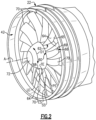
Figure 2 illustrates a perspective view of a fan section including an array of airfoils. -
Figure 3 illustrates a perspective view of an airfoil including a sheath and tip cap. -
Figure 4 illustrates a joint established between portions of the tip cap ofFigure 3 . -
Figure 5A illustrates a perspective view of the joint ofFigure 3 . -
Figure 5B illustrates a perspective view of the joint ofFigure 4 . -
Figure 6 illustrates a sectional view of the airfoil taken along line 6-6 ofFigure 4 . -
Figure 7A illustrates an interface member taken alongline 7A-7A ofFigure 5B . -
Figure 7B illustrates an interface member taken alongline 7B-7B ofFigure 5A . -
Figure 8 illustrates an exploded view of the tip cap ofFigure 3 . -
Figure 1 schematically illustrates agas turbine engine 20. Thegas turbine engine 20 is disclosed herein as a two-spool turbofan that generally incorporates afan section 22, acompressor section 24, a combustor section 26 and aturbine section 28. Thefan section 22 drives air along a bypass flow path B in a bypass duct defined within ahousing 15 such as a fan case or nacelle, and also drives air along a core flow path C for compression and communication into the combustor section 26 then expansion through theturbine section 28. Although depicted as a two-spool turbofan gas turbine engine in the disclosed non-limiting embodiment, it should be understood that the concepts described herein are not limited to use with two-spool turbofans as the teachings may be applied to other types of turbine engines including three-spool architectures. - The
exemplary engine 20 generally includes alow speed spool 30 and ahigh speed spool 32 mounted for rotation about an engine central longitudinal axis A relative to an engine static structure 36 viaseveral bearing systems 38. It should be understood thatvarious bearing systems 38 at various locations may alternatively or additionally be provided, and the location ofbearing systems 38 may be varied as appropriate to the application. - The
low speed spool 30 generally includes aninner shaft 40 that interconnects, a first (or low)pressure compressor 44 and a first (or low)pressure turbine 46. Theinner shaft 40 is connected to thefan 42 through a speed change mechanism, which in exemplarygas turbine engine 20 is illustrated as a gearedarchitecture 48 to drive afan 42 at a lower speed than thelow speed spool 30. Thehigh speed spool 32 includes anouter shaft 50 that interconnects a second (or high)pressure compressor 52 and a second (or high)pressure turbine 54. Acombustor 56 is arranged inexemplary gas turbine 20 between thehigh pressure compressor 52 and thehigh pressure turbine 54. Amid-turbine frame 57 of the engine static structure 36 may be arranged generally between thehigh pressure turbine 54 and thelow pressure turbine 46. Themid-turbine frame 57 further supports bearingsystems 38 in theturbine section 28. Theinner shaft 40 and theouter shaft 50 are concentric and rotate viabearing systems 38 about the engine central longitudinal axis A which is collinear with their longitudinal axes. - The core airflow is compressed by the
low pressure compressor 44 then thehigh pressure compressor 52, mixed and burned with fuel in thecombustor 56, then expanded over thehigh pressure turbine 54 andlow pressure turbine 46. Themid-turbine frame 57 includesairfoils 59 which are in the core airflow path C. Theturbines low speed spool 30 andhigh speed spool 32 in response to the expansion. It will be appreciated that each of the positions of thefan section 22,compressor section 24, combustor section 26,turbine section 28, and fandrive gear system 48 may be varied. For example,gear system 48 may be located aft of the low pressure compressor, or aft of the combustor section 26 or even aft ofturbine section 28, andfan 42 may be positioned forward or aft of the location ofgear system 48. - The
engine 20 in one example is a high-bypass geared aircraft engine. In a further example, theengine 20 bypass ratio is greater than about six, with an example embodiment being greater than about ten, the gearedarchitecture 48 is an epicyclic gear train, such as a planetary gear system or other gear system, with a gear reduction ratio of greater than about 2.3 and thelow pressure turbine 46 has a pressure ratio that is greater than about five. In one disclosed embodiment, theengine 20 bypass ratio is greater than about ten, the fan diameter is significantly larger than that of thelow pressure compressor 44, and thelow pressure turbine 46 has a pressure ratio that is greater than about five.Low pressure turbine 46 pressure ratio is pressure measured prior to inlet oflow pressure turbine 46 as related to the pressure at the outlet of thelow pressure turbine 46 prior to an exhaust nozzle. The gearedarchitecture 48 may be an epicycle gear train, such as a planetary gear system or other gear system, with a gear reduction ratio of greater than about 2.3:1 and less than about 5:1. It should be understood, however, that the above parameters are only exemplary of one embodiment of a geared architecture engine and that the present invention is applicable to other gas turbine engines including direct drive turbofans. - A significant amount of thrust is provided by the bypass flow B due to the high bypass ratio. The
fan section 22 of theengine 20 is designed for a particular flight condition -- typically cruise at about 0.8 Mach and about 35,000 feet (10,668 meters).
The flight condition of 0.8 Mach and 35,000 ft (10,668 meters), with the engine at its best fuel consumption - also known as "bucket cruise Thrust Specific Fuel Consumption ('TSFC')" - is the industry standard parameter of lbm of fuel being burned divided by lbf of thrust the engine produces at that minimum point. "Low fan pressure ratio" is the pressure ratio across the fan blade alone, without a Fan Exit Guide Vane ("FEGV") system. The low fan pressure ratio as disclosed herein according to one non-limiting embodiment is less than about 1.45. "Low corrected fan tip speed" is the actual fan tip speed in ft/sec divided by an industry standard temperature correction of [(Tram °R) / (518.7 °R)]0.5 (where °R = K x 9/5). The "Low corrected fan tip speed" as disclosed herein according to one non-limiting embodiment is less than about 1150 ft / second (350.5 meters/second). - Referring to
Figure 2 , thefan 42 includes arotor 60 including afan hub 66 carrying or otherwise supporting a plurality of airfoils orfan blades 64. Thefan blades 64 are arranged in an array orrow 62 and are circumferentially distributed about the hub 66 (see alsoFigure 1 ). Various numbers offan blades 64 may be incorporated into thefan 42, such as a total quantity of between 12 and 20 offan blades 64. Thearray 62 offan blades 64 are circumferentially distributed about the engine axis A. Thelow pressure turbine 46 can be rotatably coupled to thehub 66 of thefan 42. Thefan blades 64 are rotatable in a direction D1 about the engine axis A in response to rotation of thehub 66. - The
airfoil 64 extends radially outward of aplatform 69, which provides the inner flow path. Theplatform 69 may be integral with theairfoil 64 or separately secured to thehub 66, for example. A nosecone orspinner 72 is supported relative to thehub 66 to provide an aerodynamic inner flow path into thefan section 22, as illustrated inFigures 1-2 . -
Figure 3 illustrates anexemplary airfoil 164 for a gas turbine engine. In this disclosure, like reference numerals designate like elements where appropriate and reference numerals with the addition of one-hundred or multiples thereof designate modified elements that are understood to incorporate the same features and benefits of the corresponding original elements. Theairfoil 164 can be a fan blade incorporated into thefan 42 ofFigures 1-2 , for example. It should be understood that other types of airfoils and other parts of thegas turbine engine 20 may benefit from the examples disclosed herein, such as inlet and exit guide vanes and other airfoils in thefan section 22,compressor section 24 and/orturbine section 28. - Referring to
Figure 3 , with continuing reference toFigure 2 , theairfoil 164 includes anairfoil section 165 and aroot section 168. Theroot section 168 is received in a correspondingly shaped slot in thehub 66. Theroot section 168 can have a shape configured to mount theairfoil 164 to thehub 66, such as a dovetail shape. - The
airfoil section 165 extends in a radial or spanwise direction R between theroot section 168 and atip portion 170, in a chordwise direction X between a leading edge LE and a trailing edge TE, and in a thickness direction T between a pressure side PS and a suction side SS (Figures 2 and4 ). Thetip portion 170 establishes a terminal end of theairfoil 164. - The
airfoil section 165 of eachairfoil 164 has an exterior surface ES providing an aerodynamic surface contour that extends in the chordwise direction X between the leading and trailing edges LE, TE. The exterior surface ES of theairfoil 164 generates lift based upon its geometry and directs flow along the core flow path C and bypass flow path B. Theairfoil 164 may be constructed from a composite material, stainless steel, an aluminum or titanium alloy, or a combination of one or more of these. Abrasion-resistant coatings or other protective coatings may be applied to theairfoil 164. - The
airfoil 164 includes afirst sheath 174 and a tip cap orsecond sheath 176 secured to theairfoil body 172. Thesheath 174 andtip cap 176 are dimensioned to extend along the external surface ES of theairfoil body 172 at various positions and serve to protect theairfoil body 172 from impacts that may occur during engine operation such as bird strikes, ice fragments and other foreign object debris (FOD). In other examples, thesheath 174 is omitted. - Various materials can be utilized to construct the
airfoil body 172, such as metallic materials including titanium, aluminum, alloys, and composite materials. In some examples, theairfoil body 172 is constructed from a composite layup that establishes thetip portion 170. The composite layup can include a plurality of plies or layers L (Figures 6 and 7A-7B ) of composite material. Example composite materials include carbon fibers embedded in a polymer matrix material. Other example composite materials include fiberglass, aramid fibers such as Kevlar®, and polyethylene. The layers L can be made of various constructions such as braided or woven fibers, fabrics, and/or uni-tape plies, for example. - The
sheath 174 and sheath (or tip cap) 176 can be arranged at various positions and orientations relative to theairfoil body 172. In the illustrative example ofFigures 3-4 ,
thesheath 174 has a major component dimensioned to extend in the radial direction R along a periphery of the leading edge LE of theairfoil section 165. Thesheath 174 includes asheath body 174A that extends in the spanwise direction R along both (or at least one) of the pressure and suction sides PS, SS (see alsoFigure 6 ). Thesheath body 174A is dimensioned to extend from thetip portion 170 along the leading edge LE towards theroot section 168. Thesheath body 174A can be dimensioned to extend at least a majority of span positions of theairfoil section 165. In the illustrative example ofFigure 3 , thesheath body 174A extends between approximately 0% span and approximately 100% span. For the purposes of this disclosure, 0% span is defined at a junction between theairfoil section 165 and theroot section 168, and 100% span is defined at a radially outermost position or terminal end of thetip portion 170. For the purposes of this disclosure, the terms "about" and "approximately" mean ±3% of the stated value unless otherwise disclosed. - Referring to
Figures 3-4 and according to the present invention, the sheath (or tip cap) 176 includes first and second cap (or sheath)portions airfoil body 172. Thecap portions cap portions Figures 3-4 , or can be arranged to directly abut each other. Separate anddistinct cap portions tip cap 176, and can reduce dimensional variations that may otherwise be caused by distortions due to a welding operation. Thecap portions airfoil section 165. - The first and
second cap portions bodies tip portion 170 and/or along a periphery of the trailing edge TE of theairfoil section 165. Thecap bodies - Referring to
Figures 5A-5B , with continuing reference toFigures 3-4 , thefirst cap body 178A is dimensioned to extend along afirst face 172A of theairfoil body 172, and thesecond cap body 180A is dimensioned to extend along asecond face 172B of theairfoil body 172. Thefirst face 172A is opposed to thesecond face 172B. Thefirst face 172A extends along the pressure side PS, and thesecond face 172B extends along the suction side SS. In other non-claimed examples, an opposite arrangement is utilized. The first andsecond faces edge 172C of theairfoil body 172. Theedge 172C has a generally planar geometry or face having a major component extending in the radial direction R along the trailing edge TE, as illustrated byFigure 8 . In other examples, theedge 172C tapers to a vertex. - Each
cap body 178A/180A includes a respective first body portion 178AA/180AA and a second body portion 178AB/180AB. The second body portion 178AB/180AB extends transversely from the respective first body portion 178AA/180AA. Each first body portion 178AA, 180AA has a major component dimensioned to extend in the chordwise direction X along thetip portion 170, as illustrated inFigures 3-4 . Theairfoil body 172 is at least partially exposed along the terminal end of theairfoil section 165. In other examples, thesheath 174 and/ortip cap 176 enclose theairfoil body 172 along the terminal end of theairfoil section 165. Each second body portion 178AB, 180AB has a major component dimensioned to extend in the spanwise direction R along the trailing edge TE. - Each
cap body airfoil section 165, such as at least a majority of span positions along the trailing edge TE. In the illustrative example ofFigure 3 , eachcap body root section 168, such as at least 50% or 75% span. Thetip cap 176 can be spaced apart from theroot section 168, as illustrated inFigure 3 . Other arrangements can be utilized. For example, thetip cap 176 can extend along the leading edge LE andtip portion 170, and thesheath 174 can extend from thetip portion 170 along the trailing edge TE. - The first and
second cap portions airfoil section 165. Utilizing the techniques disclosed herein, the joint 182 provides substantially continuous stiffness along adjacent portions of theairfoil body 172. The joint 182 can be dimensioned to extend along thetip portion 170, such as inwardly from the terminal end of theairfoil section 165 and along the trailing edge TE, as illustrated inFigures 3-4 and5A-5B . In other examples, the joint 182 is spaced apart from the terminal end of thetip portion 170. The first andsecond cap portions bonding material 188 can substantially fill a volume of the gap to establish a substantially continuous surface contour. - The first and
second sheath portions second interface portions respective cap body first interface portion 178B cooperates with thesecond interface portion 180B to establish the respective joint 182. Theinterface portions cap portions interface portions - The first and
second interface portions airfoil section 165, as illustrated by the joint 182 ofFigures 3-4 and5A-5B . For the purposes of this disclosure, the term "circuitous" means a profile having two or more points of inflection. The circuitous profile can reduce structural stiffness discontinuities that may otherwise degrade a structural integrity of theairfoil 164 due to FOD impacts. - The
first interface portion 178B includes a first set of interface members (or fingers) 178C extending outwardly from thefirst cap body 178A. Thesecond interface portion 180B includes a second set of interface members (or fingers) 180C extending outwardly from thesecond cap body 180A. Theinterface members airfoil body 172, and can have various shapes and/or sizes. In the illustrative example ofFigures 3-4 and5A-5B , theinterface members interface members Figures 3-4 , thefirst interface portion 178B has a quantity of eightinterface members 178C, and thesecond interface portion 180B has a quantity of seveninterface members 180C. However, fewer or more than eightinterface members 178C and seveninterface members 180C can be utilized. - The
interface members edge 172C of theairfoil body 172 to establish the trailing edge TE of theairfoil section 165. The first set ofinterface members 178C and the second set ofinterface members 180C have complementary, interlocking profiles and are interleaved with each other to establish the respective joint 182. In the illustrative example ofFigures 5A-5B and8 , eachinterface member 178C/180C is an elongated finger or protrusion dimensioned to extend outwardly from a base along thecap body 178A/180A to a respectiveterminal end 178E/180E. Theinterface members - The
interface portions edge 172C of theairfoil body 172 joining the first andsecond faces interface members Figures 3-4 and5A-5B . For example, theinterface members airfoil section 165 with respect to the radial direction R due to the interleaving of theinterface members Figures 3-4 . Theinterface members tip cap 176 along the trailing edge TE, as illustrated inFigures 3-4 , which can improve a total area of protection adjacent theedge 172C of theairfoil body 172. - The
interface members Figures 5A-5B ,7A-7B and8 , eachinterface members 178C/180C is an elongated tab having a generally J-shaped or hook-shaped cross sectional geometry or profile including a first portion having a major component extending from a respective one of thecap bodies 178A/180A toward the trailing edge TE and including a second portion having a major component extending from the first portion toward the leading edge LE and terminating at the respectiveterminal end 178E/180E. The first portion is opposed to the second portion to establish arespective recess 178R/180R dimensioned to receive a portion of theairfoil body 172 along theedge 172C. Theinterface members 178C are dimensioned to extend from thecap body 178A along thefirst face 172A, wrap in a first direction D1 about theedge 172C along the trailing edge TE, and extend along thesecond face 172B, as illustrated inFigure 7A . Theinterface members 180C are dimensioned to extend from thecap body 180A along thesecond face 172B, wrap in a second direction D2 about theedge 172C, and extend along thefirst face 172A, as illustrated inFigure 7B . The second direction D2 is generally opposed to the first direction D1. - As illustrated by
Figures 5A-5B and8 , sidewalls 178F/180F of therespective interface members 178C/180C can have a flat or substantially linear geometry. The terminal ends 178E/180E of therespective interface members 178C/180C can have various geometries, such as a substantially flat or linear geometry, for example, which can serve to increase an effective length of the respective joint 182. A junction between thesidewalls 178F/180F and the respectiveterminal end 178E/180E can be rounded, which can serve to increase an effective length of the respective joint 182 and reduce stress concentrations in theairfoil body 172 that may be otherwise caused by abrupt changes along the joint 182. - Interleaving the
interface members cap portions Figures 6 and 7A-7B ) that may otherwise occur due to FOD impacts. Interleaving theinterface members - The
interface members Figures 5A-5B , eachinterface member 178C/180C extends a width W1 between the trailing edge TE and the respectiveterminal end 178E/180E and extends a height H1 between therespective sidewalls 178F/180F. In examples, a ratio of H1:W1 is at least about 1:1 or more narrowly at least about 2:1, such as between about 3:1 and about 4:1 for at least some, a majority, or all of theinterface members interface members interface members 178C can be the same or can differ from the width W1 of the second set ofinterface members 180C. For example, the width W1 of at least some (or each) of the first set ofinterface members 178C can be less than or greater than the width of at least some (or each) of the second set ofinterface members 180C. Dimensioning theinterface members airfoil 164 along adjacent portions of theairfoil body 172. - The
interface portions 178B/180B define respective slots orrecesses 178D/180D between adjacent pairs of theinterface members 178C/180C. The terminal ends 178E of theinterface members 178C interfit with therespective recesses 180D established between theinterface members 180C. Likewise, the terminal ends 180E of theinterface members 180C interfit with therespective recesses 178D established between adjacent pairs of theinterface members 178C. The terminal ends 178E/180E are received in therespective recesses 178D/180D of adjacent pairs of theinterface members 178C/180D such that theinterface members 178C are at least partially aligned with theinterface members 180C relative to the chordwise direction X and/or relative to the radial direction R, as illustrated inFigures 3-4 and5A-5B . Theinterface members 178C can be substantially flush with theinterface members 180C along the respective joint 182, which can reduce aerodynamic discontinuities along the external surface ES of theairfoil section 165. - The
interface members elongated groove 184 dimensioned to receive a portion of theairfoil body 172 along theedge 172C including a composite material, as illustrated byFigures 5A-5B and the composite layers L ofFigure 6 . Therecesses groove 184. - Referring to
Figure 6 , thesheath 174 defines afirst sheath cavity 185. Thefirst cap member 178 andsecond cap member 180 of thetip cap 176 cooperate to establish a cap (or second sheath)cavity 186. Thesheath cavity 185 is dimensioned to receive a portion of theairfoil body 172 along the leading edge LE such that thesheath 174 extends in the spanwise direction R along both the pressure and suction sides PS, SS. Thecap cavity 186 is dimensioned to receive another portion of theairfoil body 172 along thetip portion 170 and trailing edge TE such that thetip cap 176 extends in the chordwise direction X along both the pressure and suction sides PS, SS. Thesheath 174 andtip cap 176 serve to encapsulate theairfoil body 172 along the leading and trailing edges LE, TE andtip portion 170, with theairfoil body 172 sandwiched between the row ofinterface members Figures 7A-7B and 6 . Thesheath 174 andtip cap 176 form structural closeouts that suppress impact force induced inter-laminar stresses that may otherwise cause matrix cracking or delamination in the underlying laminate composite structure of theairfoil body 172. - Various materials can be utilized to construct the
sheath 174 andcap portions tip cap 176, including any of the materials disclosed herein. In the examples, thesheath 174 and/ortip cap 176 are metallic. In examples, the first andsecond cap portions interface members - The
airfoil 164 can be assembled as follows. Thesheath 174 is secured to a portion of theairfoil section 165, such as along the leading edge LE, as illustrated inFigures 3-4 and6 . According to the present invention, thetip cap 176 is secured to another portion of theairfoil section 165, along thetip portion 170 and trailing edge TE as illustrated inFigures 3-4 and6 . Thesheath 174 andtip cap 176 are secured to theairfoil section 165 such that the first set ofinterface members 178C are interleaved with the second set ofinterface members 178C to establish at least one joint 182 along the external surface ES of theairfoil section 165, as illustrated byFigures 3-4 and5A-5B . - Securing the
tip cap 176 can include moving the first andsecond cap portions tip cap 176 in a direction D3 (Figure 8 ) such that at least a portion of theairfoil body 172 including theedge 172C are inserted into and received by therecesses Figures 7A-7B . Thecap portions second faces edge 172C utilizing various techniques, such as fastening or bonding with an adhesive or epoxy material 188 (Figures 5A-5B and7A-7B ). In examples, thematerial 188 is a film adhesive deposited on theairfoil body 172 and/orcap portions airfoil 164 is positioned in an autoclave to cure the adhesive. Theinterface members airfoil body 172 along the trailing edge TE, as illustrated byFigures 5A-5B ,6 and 7A-7B . In an installed position, theinterface members airfoil section 165. - It should be understood that relative positional terms such as "forward," "aft," "upper," "lower," "above," "below," and the like are with reference to the normal operational attitude of the vehicle and should not be considered otherwise limiting.
- Although the different examples have the specific components shown in the illustrations, embodiments of this disclosure are not limited to those particular combinations. It is possible to use some of the components or features from one of the examples in combination with features or components from another one of the examples.
- Although particular step sequences are shown, described, and claimed, it should be understood that steps may be performed in any order, separated or combined unless otherwise indicated and will still benefit from the present disclosure.
- The foregoing description is exemplary rather than defined by the limitations within. Various non-limiting embodiments are disclosed herein, however, one of ordinary skill in the art would recognize that various modifications and variations in light of the above teachings will fall within the scope of the invention as defined in the appended claims. It is therefore to be understood that within the scope of the appended claims, the disclosure may be practiced other than as specifically described. For that reason the appended claims should be studied to determine true scope and content.
Claims (10)
- An airfoil (164), such as a fan blade (64), for a gas turbine engine (20) comprising:an airfoil section (165) extending between a leading edge (LE) and a trailing edge (TE) in a chordwise direction (X) and extending between a tip portion (170) and a root section (168) in a spanwise direction (R), and the airfoil section (165) defining pressure and suction sides (PS, SS) separated in a thickness direction (T);a sheath (176) including first and second sheath portions (178, 180) secured to an airfoil body (172) of the airfoil section (165), wherein:the first sheath portion (178) includes a first sheath body (178A) and a first set of interface members (178C);the first sheath body (178A) extends along a first face (172A) of the airfoil body (172);the first set of interface members (178C) extend from the first sheath body (178A) and along a second face (172B) of the airfoil body (172);the second sheath portion (180) includes a second sheath body (180A) and a second set of interface members (180C);the second sheath body (180A) extends along the second face (172B);the second set of interface members (180C) extend from the second sheath body (180A) and along the first face (172A), characterised in that:the second set of interface members (180C) are interleaved with the first set of interface members (178C) to establish a joint (182) having a circuitous profile along an edge (172C) of the airfoil body (172) joining the first and second faces (172A, 172B);the pressure side (PS) comprises the first face (172A), the suction side (SS) comprises the second face (172B), and the joint (182) is established along the trailing edge (TE);each of the first and second sheath bodies (178A, 180A) includes a first body portion (178AA, 180AA) and a second body portion (178AB, 180AB) extending transversely from the first body portion (178AA, 180AA);the first body portion (178AA, 180AA) has a major component extending in the chordwise direction (X) along the tip portion (170);the second body portion (178AB, 180AB) has a major component extending in the spanwise direction (R) along the trailing edge (TE);the first and second sets of interface members (178C, 180C) extend outwardly from the respective second body portion (178AB, 180AB) from a base to a respective terminal end (178E, 180E);the terminal ends (178E) of the first set of interface members (178C) are received in respective recesses (180D) between adjacent pairs of the second set of interface members (180C) and the terminal ends (180E) of the second set of interface members (180C) are received in respective recesses (178D) between adjacent pairs of the first set of interface members (178C) such that the first set of interface members (178C) are at least partially aligned with the second set of interface members (180C) relative to the chordwise direction (X) and relative to the radial direction along the trailing edge (TE);the first and second sets of interface members (178C, 180C) have a hook-shaped geometry including a first portion having a major component extending from a respective one of the first and second sheath bodies (178A, 180A) toward the trailing edge (TE) and including a second portion having a major component extending from the first portion toward the leading edge (LE) and terminating at the respective terminal ends (178E, 180E);each first portion is opposed to each second portion to establish a recess (178R, 180R) such that the first set of interface members (178C) include a first set of recesses (178R) and the second set of interface members (180C) include a second set of recesses (180R), the first and second sets of recesses (178R, 180R) receiving a portion of the airfoil body (172) along the edge (172C) of the airfoil body (172); andthe first and second sets of interface members (178C, 180C) are arranged in a row along the edge (172C) of the airfoil body (172) to establish the trailing edge (TE) of the airfoil section (165), the first and second sets of interface members (178C, 180C) have complementary, interlocking profiles and are interleaved with each other to establish the respective joint (182).
- The airfoil as recited in claim 1, wherein the airfoil body (172) comprises a composite material.
- The airfoil as recited in claim 1 or 2, wherein the first and second sheath portions (178, 180) are metallic.
- The airfoil as recited in claim 1, 2 or 3, wherein the joint (182) is established along an external surface (ES) of the airfoil section (165).
- The airfoil as recited in any preceding claim, wherein the first and second sheath portions (178, 180) cooperate to establish a sheath cavity (186) dimensioned to receive a portion of the airfoil body (172) along the tip portion (170).
- A gas turbine engine (20) comprising:a fan section (22) including a fan (42) having a fan hub (66) carrying a plurality of fan blades (64);a turbine section (28) including a fan drive turbine rotatably coupled to the fan (42); anda compressor section (24) driven by the turbine section (28), wherein each fan blade (64) of the plurality of fan blades (64) is an airfoil (164) as claimed in claim 1.
- The gas turbine engine as recited in claim 6, wherein the first and second sheath portions (178, 180) cooperate to establish a sheath cavity (186) dimensioned to receive a portion of the airfoil body (172), and the joint (182) is established along the trailing edge (TE) of the airfoil section (165).
- The gas turbine engine as recited in claim 6 or 7, wherein the airfoil body (172) comprises a composite material received in an elongated groove (184) established by the first and second sets of interface members (178C, 180C), and the first and second sheath portions (178, 180) are metallic.
- A method of assembly of an airfoil (164) as recited in any preceding claim, the method comprising:securing the first sheath portion (178) to the first face (172A) of the airfoil section (165), the first sheath portion (178) including the first set of interface members (178C); andsecuring the second sheath portion (180) to the second face (172B) of the airfoil section (165) such that the second set of interface members (180C) of the second sheath portion (180) is interleaved with the first set of interface members (178C) to establish the joint (182) along the edge (172C) of the airfoil section (165), wherein the step of securing the first and second sheath portion (178, 180) includes inserting the portion of the airfoil body (172) along the edge (172C) of the airfoil (164) into the first and second sets of recesses (178R, 180R) to establish the trailing edge (TE).
- The method as recited in claim 9, wherein the first and second sets of interface members (178C, 180C) cooperate to substantially encapsulate the airfoil body (172) along the trailing edge (TE) of the airfoil section (165), the airfoil body (172) comprises a composite layup at least partially received in an elongated groove (184) established by the first and second sets of interface members (178C, 180C), and the first and second sheath portions (178, 180) are metallic.
Applications Claiming Priority (1)
| Application Number | Priority Date | Filing Date | Title |
|---|---|---|---|
| US16/668,820 US11215054B2 (en) | 2019-10-30 | 2019-10-30 | Airfoil with encapsulating sheath |
Publications (2)
| Publication Number | Publication Date |
|---|---|
| EP3816399A1 EP3816399A1 (en) | 2021-05-05 |
| EP3816399B1 true EP3816399B1 (en) | 2024-09-18 |
Family
ID=73043106
Family Applications (1)
| Application Number | Title | Priority Date | Filing Date |
|---|---|---|---|
| EP20205011.8A Active EP3816399B1 (en) | 2019-10-30 | 2020-10-30 | Airfoil with encapsulating sheath |
Country Status (2)
| Country | Link |
|---|---|
| US (1) | US11215054B2 (en) |
| EP (1) | EP3816399B1 (en) |
Families Citing this family (7)
| Publication number | Priority date | Publication date | Assignee | Title |
|---|---|---|---|---|
| US11988103B2 (en) * | 2021-10-27 | 2024-05-21 | General Electric Company | Airfoils for a fan section of a turbine engine |
| US11560800B1 (en) * | 2021-11-12 | 2023-01-24 | Raytheon Technologies Corporation | Airfoil with fiber plies having interdigitated fingers in trailing end |
| US12163533B1 (en) * | 2023-06-30 | 2024-12-10 | General Electric Company | Composite airfoil assembly for a turbine engine |
| US20250059894A1 (en) * | 2023-08-16 | 2025-02-20 | General Electric Company | Turbine engine and a composite airfoil assembly thereof |
| US20250198421A1 (en) * | 2023-12-14 | 2025-06-19 | Asia Vital Components Co., Ltd. | Fan blade structure |
| US20250243766A1 (en) * | 2024-01-31 | 2025-07-31 | Honeywell International Inc. | Polymer-metal composite stator vanes and methods for manufacturing the same |
| FR3163105A1 (en) * | 2024-06-11 | 2025-12-12 | Safran Aircraft Engines | Attack-side shield, turbomachine blade equipped with such a shield, and method for manufacturing such a shield |
Citations (4)
| Publication number | Priority date | Publication date | Assignee | Title |
|---|---|---|---|---|
| CA395673A (en) * | 1941-04-01 | Jablonsky Bruno | Airscrew and blades | |
| EP1481747A2 (en) * | 2003-05-27 | 2004-12-01 | Alstom Technology Ltd | Method for producing a heat loaded component and component |
| EP2693061B1 (en) * | 2012-07-30 | 2016-12-28 | Rolls-Royce Deutschland Ltd & Co KG | Compressor blade of a gas turbine and method for its manufacturing |
| EP2253806B1 (en) * | 2009-05-21 | 2018-12-19 | Rolls-Royce plc | Fiber-reinforced composite aerofoil blade and method of reinforcing the blade |
Family Cites Families (44)
| Publication number | Priority date | Publication date | Assignee | Title |
|---|---|---|---|---|
| US2615236A (en) * | 1947-06-27 | 1952-10-28 | Curtiss Wright Corp | Blade edge welding technique |
| US4111600A (en) * | 1976-12-09 | 1978-09-05 | United Technologies Corporation | Breakaway fan blade |
| GB2168111B (en) | 1984-12-08 | 1988-05-18 | Rolls Royce | Rotor aerofoil blade containment |
| US5129787A (en) | 1991-02-13 | 1992-07-14 | United Technologies Corporation | Lightweight propulsor blade with internal spars and rigid base members |
| US5908285A (en) * | 1995-03-10 | 1999-06-01 | United Technologies Corporation | Electroformed sheath |
| US5674370A (en) | 1995-03-31 | 1997-10-07 | Optical Radiation Corporation | Method of electroforming an abrasion shield |
| JPH1054204A (en) | 1996-05-20 | 1998-02-24 | General Electric Co <Ge> | Multi-component wing for gas turbine |
| US6524063B1 (en) | 1996-10-17 | 2003-02-25 | Voith Siemens Hydro Power Generartion, Inc. | Hydraulic turbine for enhancing the level of dissolved gas in water |
| US5839882A (en) | 1997-04-25 | 1998-11-24 | General Electric Company | Gas turbine blade having areas of different densities |
| US5908522A (en) * | 1997-11-07 | 1999-06-01 | Composite Technology, Inc. | Supplemental leading edge wear strip for a rotor blade |
| US6039542A (en) | 1997-12-24 | 2000-03-21 | General Electric Company | Panel damped hybrid blade |
| US6231941B1 (en) | 1998-07-14 | 2001-05-15 | The Boeing Company | Radius fillers for a resin transfer molding process |
| DK175275B1 (en) | 2002-03-19 | 2004-08-02 | Lm Glasfiber As | Transition area in wind turbine blade |
| US7575417B2 (en) | 2003-09-05 | 2009-08-18 | General Electric Company | Reinforced fan blade |
| ATE534817T1 (en) | 2004-06-30 | 2011-12-15 | Vestas Wind Sys As | WIND TURBINE BLADES MADE FROM TWO SEPARATE PARTS |
| US7435058B2 (en) | 2005-01-18 | 2008-10-14 | Siemens Power Generation, Inc. | Ceramic matrix composite vane with chordwise stiffener |
| US20080145227A1 (en) | 2006-12-19 | 2008-06-19 | Mark Stefan Maier | Methods and apparatus for load transfer in rotor assemblies |
| US7828526B2 (en) | 2007-04-11 | 2010-11-09 | General Electric Company | Metallic blade having a composite inlay |
| US7980817B2 (en) * | 2007-04-16 | 2011-07-19 | United Technologies Corporation | Gas turbine engine vane |
| US8241003B2 (en) | 2008-01-23 | 2012-08-14 | United Technologies Corp. | Systems and methods involving localized stiffening of blades |
| US8585368B2 (en) | 2009-04-16 | 2013-11-19 | United Technologies Corporation | Hybrid structure airfoil |
| US8235670B2 (en) | 2009-06-17 | 2012-08-07 | Siemens Energy, Inc. | Interlocked CMC airfoil |
| US8814527B2 (en) * | 2009-08-07 | 2014-08-26 | Hamilton Sundstrand Corporation | Titanium sheath and airfoil assembly |
| US20110116906A1 (en) * | 2009-11-17 | 2011-05-19 | Smith Blair A | Airfoil component wear indicator |
| US8376712B2 (en) * | 2010-01-26 | 2013-02-19 | United Technologies Corporation | Fan airfoil sheath |
| US20110194941A1 (en) | 2010-02-05 | 2011-08-11 | United Technologies Corporation | Co-cured sheath for composite blade |
| US20110211965A1 (en) | 2010-02-26 | 2011-09-01 | United Technologies Corporation | Hollow fan blade |
| US9650897B2 (en) * | 2010-02-26 | 2017-05-16 | United Technologies Corporation | Hybrid metal fan blade |
| FR2957545B1 (en) * | 2010-03-19 | 2012-07-27 | Snecma | METHOD FOR MAKING A METALLIC INSERT FOR PROTECTING AN ATTACK EDGE IN COMPOSITE MATERIAL |
| US9556742B2 (en) | 2010-11-29 | 2017-01-31 | United Technologies Corporation | Composite airfoil and turbine engine |
| US20130064676A1 (en) | 2011-09-13 | 2013-03-14 | United Technologies Corporation | Composite filled metal airfoil |
| US9121294B2 (en) * | 2011-12-20 | 2015-09-01 | General Electric Company | Fan blade with composite core and wavy wall trailing edge cladding |
| US9085989B2 (en) | 2011-12-23 | 2015-07-21 | General Electric Company | Airfoils including compliant tip |
| US9221120B2 (en) | 2012-01-04 | 2015-12-29 | United Technologies Corporation | Aluminum fan blade construction with welded cover |
| US10260351B2 (en) * | 2012-03-16 | 2019-04-16 | United Technologies Corporation | Fan blade and method of manufacturing same |
| FR2989991B1 (en) * | 2012-04-30 | 2016-01-08 | Snecma | TURBOMACHINE METAL TURBINE STRUCTURAL REINFORCEMENT |
| FR2993942B1 (en) * | 2012-07-24 | 2017-03-24 | Snecma | AUBE TURBOMACHINE COMPOSITE WITH STRUCTURAL REINFORCEMENT |
| ITTV20130031A1 (en) | 2013-02-28 | 2014-08-29 | Pietro Rosa T B M S R L | PALLET FOR TURBOMACHES AND RELATED CONSTRUCTION METHOD |
| EP3034786B1 (en) * | 2014-12-19 | 2019-07-31 | Rolls-Royce plc | A gas turbine fan blade having a plurality of shear zones |
| EP3034785B1 (en) * | 2014-12-19 | 2019-01-30 | Rolls-Royce plc | A gas turbine fan blade with varying fracture resistance |
| DE102016101168A1 (en) | 2016-01-22 | 2017-07-27 | Rolls-Royce Deutschland Ltd & Co Kg | Turbomachine with an arranged in a recess of a wall insertion device |
| US10494933B2 (en) | 2016-03-18 | 2019-12-03 | General Electric Company | Airfoil with multi-material reinforcement |
| US10677259B2 (en) * | 2016-05-06 | 2020-06-09 | General Electric Company | Apparatus and system for composite fan blade with fused metal lead edge |
| US10815797B2 (en) | 2016-08-12 | 2020-10-27 | Hamilton Sundstrand Corporation | Airfoil systems and methods of assembly |
-
2019
- 2019-10-30 US US16/668,820 patent/US11215054B2/en active Active
-
2020
- 2020-10-30 EP EP20205011.8A patent/EP3816399B1/en active Active
Patent Citations (4)
| Publication number | Priority date | Publication date | Assignee | Title |
|---|---|---|---|---|
| CA395673A (en) * | 1941-04-01 | Jablonsky Bruno | Airscrew and blades | |
| EP1481747A2 (en) * | 2003-05-27 | 2004-12-01 | Alstom Technology Ltd | Method for producing a heat loaded component and component |
| EP2253806B1 (en) * | 2009-05-21 | 2018-12-19 | Rolls-Royce plc | Fiber-reinforced composite aerofoil blade and method of reinforcing the blade |
| EP2693061B1 (en) * | 2012-07-30 | 2016-12-28 | Rolls-Royce Deutschland Ltd & Co KG | Compressor blade of a gas turbine and method for its manufacturing |
Also Published As
| Publication number | Publication date |
|---|---|
| EP3816399A1 (en) | 2021-05-05 |
| US20210131286A1 (en) | 2021-05-06 |
| US11215054B2 (en) | 2022-01-04 |
Similar Documents
| Publication | Publication Date | Title |
|---|---|---|
| EP3816399B1 (en) | Airfoil with encapsulating sheath | |
| EP3613950B1 (en) | Blade outer air seal formed of laminate and having radial support hooks | |
| US11466576B2 (en) | Airfoil with continuous stiffness joint | |
| EP3480430B1 (en) | Integrally bladed rotor for a gas turbine engine and method of fabricating an integrally bladed rotor for a gas turbine engine | |
| EP3239459B1 (en) | Efficient low pressure ratio propulsor stage for gas turbine engines | |
| US12286905B2 (en) | Rotor assembly for gas turbine engines | |
| EP3643878B1 (en) | Pinned airfoil for gas turbine engines | |
| EP3108109B1 (en) | Gas turbine engine fan blade | |
| EP3126638B1 (en) | Gas turbine engine airfoil | |
| EP3896253B1 (en) | Airfoil with integral platform for gas turbine engines and assembly method | |
| EP4223980B1 (en) | Rotor assembly with structural platforms for gas turbine engines | |
| EP3913190B1 (en) | Airfoil attachment for gas turbine engines | |
| US11391167B2 (en) | Hybrid airfoil for gas turbine engines | |
| EP4053382B1 (en) | Composite inter-blade platform |
Legal Events
| Date | Code | Title | Description |
|---|---|---|---|
| PUAI | Public reference made under article 153(3) epc to a published international application that has entered the european phase |
Free format text: ORIGINAL CODE: 0009012 |
|
| STAA | Information on the status of an ep patent application or granted ep patent |
Free format text: STATUS: THE APPLICATION HAS BEEN PUBLISHED |
|
| AK | Designated contracting states |
Kind code of ref document: A1 Designated state(s): AL AT BE BG CH CY CZ DE DK EE ES FI FR GB GR HR HU IE IS IT LI LT LU LV MC MK MT NL NO PL PT RO RS SE SI SK SM TR |
|
| STAA | Information on the status of an ep patent application or granted ep patent |
Free format text: STATUS: REQUEST FOR EXAMINATION WAS MADE |
|
| 17P | Request for examination filed |
Effective date: 20211105 |
|
| RBV | Designated contracting states (corrected) |
Designated state(s): AL AT BE BG CH CY CZ DE DK EE ES FI FR GB GR HR HU IE IS IT LI LT LU LV MC MK MT NL NO PL PT RO RS SE SI SK SM TR |
|
| STAA | Information on the status of an ep patent application or granted ep patent |
Free format text: STATUS: EXAMINATION IS IN PROGRESS |
|
| 17Q | First examination report despatched |
Effective date: 20230503 |
|
| RAP3 | Party data changed (applicant data changed or rights of an application transferred) |
Owner name: RTX CORPORATION |
|
| GRAP | Despatch of communication of intention to grant a patent |
Free format text: ORIGINAL CODE: EPIDOSNIGR1 |
|
| STAA | Information on the status of an ep patent application or granted ep patent |
Free format text: STATUS: GRANT OF PATENT IS INTENDED |
|
| INTG | Intention to grant announced |
Effective date: 20231116 |
|
| GRAJ | Information related to disapproval of communication of intention to grant by the applicant or resumption of examination proceedings by the epo deleted |
Free format text: ORIGINAL CODE: EPIDOSDIGR1 |
|
| STAA | Information on the status of an ep patent application or granted ep patent |
Free format text: STATUS: EXAMINATION IS IN PROGRESS |
|
| GRAP | Despatch of communication of intention to grant a patent |
Free format text: ORIGINAL CODE: EPIDOSNIGR1 |
|
| STAA | Information on the status of an ep patent application or granted ep patent |
Free format text: STATUS: GRANT OF PATENT IS INTENDED |
|
| INTC | Intention to grant announced (deleted) | ||
| INTG | Intention to grant announced |
Effective date: 20240412 |
|
| GRAS | Grant fee paid |
Free format text: ORIGINAL CODE: EPIDOSNIGR3 |
|
| GRAA | (expected) grant |
Free format text: ORIGINAL CODE: 0009210 |
|
| STAA | Information on the status of an ep patent application or granted ep patent |
Free format text: STATUS: THE PATENT HAS BEEN GRANTED |
|
| AK | Designated contracting states |
Kind code of ref document: B1 Designated state(s): AL AT BE BG CH CY CZ DE DK EE ES FI FR GB GR HR HU IE IS IT LI LT LU LV MC MK MT NL NO PL PT RO RS SE SI SK SM TR |
|
| REG | Reference to a national code |
Ref country code: GB Ref legal event code: FG4D |
|
| REG | Reference to a national code |
Ref country code: CH Ref legal event code: EP |
|
| REG | Reference to a national code |
Ref country code: DE Ref legal event code: R096 Ref document number: 602020037842 Country of ref document: DE |
|
| REG | Reference to a national code |
Ref country code: IE Ref legal event code: FG4D |
|
| REG | Reference to a national code |
Ref country code: LT Ref legal event code: MG9D |
|
| PG25 | Lapsed in a contracting state [announced via postgrant information from national office to epo] |
Ref country code: NO Free format text: LAPSE BECAUSE OF FAILURE TO SUBMIT A TRANSLATION OF THE DESCRIPTION OR TO PAY THE FEE WITHIN THE PRESCRIBED TIME-LIMIT Effective date: 20241218 |
|
| PG25 | Lapsed in a contracting state [announced via postgrant information from national office to epo] |
Ref country code: GR Free format text: LAPSE BECAUSE OF FAILURE TO SUBMIT A TRANSLATION OF THE DESCRIPTION OR TO PAY THE FEE WITHIN THE PRESCRIBED TIME-LIMIT Effective date: 20241219 Ref country code: FI Free format text: LAPSE BECAUSE OF FAILURE TO SUBMIT A TRANSLATION OF THE DESCRIPTION OR TO PAY THE FEE WITHIN THE PRESCRIBED TIME-LIMIT Effective date: 20240918 |
|
| PG25 | Lapsed in a contracting state [announced via postgrant information from national office to epo] |
Ref country code: BG Free format text: LAPSE BECAUSE OF FAILURE TO SUBMIT A TRANSLATION OF THE DESCRIPTION OR TO PAY THE FEE WITHIN THE PRESCRIBED TIME-LIMIT Effective date: 20240918 |
|
| PG25 | Lapsed in a contracting state [announced via postgrant information from national office to epo] |
Ref country code: LV Free format text: LAPSE BECAUSE OF FAILURE TO SUBMIT A TRANSLATION OF THE DESCRIPTION OR TO PAY THE FEE WITHIN THE PRESCRIBED TIME-LIMIT Effective date: 20240918 |
|
| PG25 | Lapsed in a contracting state [announced via postgrant information from national office to epo] |
Ref country code: HR Free format text: LAPSE BECAUSE OF FAILURE TO SUBMIT A TRANSLATION OF THE DESCRIPTION OR TO PAY THE FEE WITHIN THE PRESCRIBED TIME-LIMIT Effective date: 20240918 |
|
| REG | Reference to a national code |
Ref country code: NL Ref legal event code: MP Effective date: 20240918 |
|
| PG25 | Lapsed in a contracting state [announced via postgrant information from national office to epo] |
Ref country code: RS Free format text: LAPSE BECAUSE OF FAILURE TO SUBMIT A TRANSLATION OF THE DESCRIPTION OR TO PAY THE FEE WITHIN THE PRESCRIBED TIME-LIMIT Effective date: 20241218 |
|
| PG25 | Lapsed in a contracting state [announced via postgrant information from national office to epo] |
Ref country code: RS Free format text: LAPSE BECAUSE OF FAILURE TO SUBMIT A TRANSLATION OF THE DESCRIPTION OR TO PAY THE FEE WITHIN THE PRESCRIBED TIME-LIMIT Effective date: 20241218 Ref country code: NO Free format text: LAPSE BECAUSE OF FAILURE TO SUBMIT A TRANSLATION OF THE DESCRIPTION OR TO PAY THE FEE WITHIN THE PRESCRIBED TIME-LIMIT Effective date: 20241218 Ref country code: LV Free format text: LAPSE BECAUSE OF FAILURE TO SUBMIT A TRANSLATION OF THE DESCRIPTION OR TO PAY THE FEE WITHIN THE PRESCRIBED TIME-LIMIT Effective date: 20240918 Ref country code: HR Free format text: LAPSE BECAUSE OF FAILURE TO SUBMIT A TRANSLATION OF THE DESCRIPTION OR TO PAY THE FEE WITHIN THE PRESCRIBED TIME-LIMIT Effective date: 20240918 Ref country code: GR Free format text: LAPSE BECAUSE OF FAILURE TO SUBMIT A TRANSLATION OF THE DESCRIPTION OR TO PAY THE FEE WITHIN THE PRESCRIBED TIME-LIMIT Effective date: 20241219 Ref country code: FI Free format text: LAPSE BECAUSE OF FAILURE TO SUBMIT A TRANSLATION OF THE DESCRIPTION OR TO PAY THE FEE WITHIN THE PRESCRIBED TIME-LIMIT Effective date: 20240918 Ref country code: BG Free format text: LAPSE BECAUSE OF FAILURE TO SUBMIT A TRANSLATION OF THE DESCRIPTION OR TO PAY THE FEE WITHIN THE PRESCRIBED TIME-LIMIT Effective date: 20240918 |
|
| REG | Reference to a national code |
Ref country code: AT Ref legal event code: MK05 Ref document number: 1724842 Country of ref document: AT Kind code of ref document: T Effective date: 20240918 |
|
| PG25 | Lapsed in a contracting state [announced via postgrant information from national office to epo] |
Ref country code: NL Free format text: LAPSE BECAUSE OF FAILURE TO SUBMIT A TRANSLATION OF THE DESCRIPTION OR TO PAY THE FEE WITHIN THE PRESCRIBED TIME-LIMIT Effective date: 20240918 |
|
| PG25 | Lapsed in a contracting state [announced via postgrant information from national office to epo] |
Ref country code: IS Free format text: LAPSE BECAUSE OF FAILURE TO SUBMIT A TRANSLATION OF THE DESCRIPTION OR TO PAY THE FEE WITHIN THE PRESCRIBED TIME-LIMIT Effective date: 20250118 Ref country code: PT Free format text: LAPSE BECAUSE OF FAILURE TO SUBMIT A TRANSLATION OF THE DESCRIPTION OR TO PAY THE FEE WITHIN THE PRESCRIBED TIME-LIMIT Effective date: 20250120 |
|
| PG25 | Lapsed in a contracting state [announced via postgrant information from national office to epo] |
Ref country code: RO Free format text: LAPSE BECAUSE OF FAILURE TO SUBMIT A TRANSLATION OF THE DESCRIPTION OR TO PAY THE FEE WITHIN THE PRESCRIBED TIME-LIMIT Effective date: 20240918 Ref country code: SM Free format text: LAPSE BECAUSE OF FAILURE TO SUBMIT A TRANSLATION OF THE DESCRIPTION OR TO PAY THE FEE WITHIN THE PRESCRIBED TIME-LIMIT Effective date: 20240918 |
|
| PG25 | Lapsed in a contracting state [announced via postgrant information from national office to epo] |
Ref country code: ES Free format text: LAPSE BECAUSE OF FAILURE TO SUBMIT A TRANSLATION OF THE DESCRIPTION OR TO PAY THE FEE WITHIN THE PRESCRIBED TIME-LIMIT Effective date: 20240918 |
|
| PG25 | Lapsed in a contracting state [announced via postgrant information from national office to epo] |
Ref country code: EE Free format text: LAPSE BECAUSE OF FAILURE TO SUBMIT A TRANSLATION OF THE DESCRIPTION OR TO PAY THE FEE WITHIN THE PRESCRIBED TIME-LIMIT Effective date: 20240918 Ref country code: AT Free format text: LAPSE BECAUSE OF FAILURE TO SUBMIT A TRANSLATION OF THE DESCRIPTION OR TO PAY THE FEE WITHIN THE PRESCRIBED TIME-LIMIT Effective date: 20240918 |
|
| PG25 | Lapsed in a contracting state [announced via postgrant information from national office to epo] |
Ref country code: CZ Free format text: LAPSE BECAUSE OF FAILURE TO SUBMIT A TRANSLATION OF THE DESCRIPTION OR TO PAY THE FEE WITHIN THE PRESCRIBED TIME-LIMIT Effective date: 20240918 Ref country code: PL Free format text: LAPSE BECAUSE OF FAILURE TO SUBMIT A TRANSLATION OF THE DESCRIPTION OR TO PAY THE FEE WITHIN THE PRESCRIBED TIME-LIMIT Effective date: 20240918 |
|
| PG25 | Lapsed in a contracting state [announced via postgrant information from national office to epo] |
Ref country code: IT Free format text: LAPSE BECAUSE OF FAILURE TO SUBMIT A TRANSLATION OF THE DESCRIPTION OR TO PAY THE FEE WITHIN THE PRESCRIBED TIME-LIMIT Effective date: 20240918 Ref country code: SK Free format text: LAPSE BECAUSE OF FAILURE TO SUBMIT A TRANSLATION OF THE DESCRIPTION OR TO PAY THE FEE WITHIN THE PRESCRIBED TIME-LIMIT Effective date: 20240918 |
|
| REG | Reference to a national code |
Ref country code: CH Ref legal event code: PL |
|
| REG | Reference to a national code |
Ref country code: DE Ref legal event code: R097 Ref document number: 602020037842 Country of ref document: DE |
|
| PG25 | Lapsed in a contracting state [announced via postgrant information from national office to epo] |
Ref country code: MC Free format text: LAPSE BECAUSE OF FAILURE TO SUBMIT A TRANSLATION OF THE DESCRIPTION OR TO PAY THE FEE WITHIN THE PRESCRIBED TIME-LIMIT Effective date: 20240918 |
|
| PG25 | Lapsed in a contracting state [announced via postgrant information from national office to epo] |
Ref country code: DK Free format text: LAPSE BECAUSE OF FAILURE TO SUBMIT A TRANSLATION OF THE DESCRIPTION OR TO PAY THE FEE WITHIN THE PRESCRIBED TIME-LIMIT Effective date: 20240918 |
|
| PG25 | Lapsed in a contracting state [announced via postgrant information from national office to epo] |
Ref country code: LU Free format text: LAPSE BECAUSE OF NON-PAYMENT OF DUE FEES Effective date: 20241030 Ref country code: BE Free format text: LAPSE BECAUSE OF NON-PAYMENT OF DUE FEES Effective date: 20241031 |
|
| PG25 | Lapsed in a contracting state [announced via postgrant information from national office to epo] |
Ref country code: CH Free format text: LAPSE BECAUSE OF NON-PAYMENT OF DUE FEES Effective date: 20241031 |
|
| PLBE | No opposition filed within time limit |
Free format text: ORIGINAL CODE: 0009261 |
|
| STAA | Information on the status of an ep patent application or granted ep patent |
Free format text: STATUS: NO OPPOSITION FILED WITHIN TIME LIMIT |
|
| REG | Reference to a national code |
Ref country code: BE Ref legal event code: MM Effective date: 20241031 |
|
| 26N | No opposition filed |
Effective date: 20250619 |
|
| PG25 | Lapsed in a contracting state [announced via postgrant information from national office to epo] |
Ref country code: SE Free format text: LAPSE BECAUSE OF FAILURE TO SUBMIT A TRANSLATION OF THE DESCRIPTION OR TO PAY THE FEE WITHIN THE PRESCRIBED TIME-LIMIT Effective date: 20240918 |
|
| PGFP | Annual fee paid to national office [announced via postgrant information from national office to epo] |
Ref country code: GB Payment date: 20250923 Year of fee payment: 6 |
|
| PGFP | Annual fee paid to national office [announced via postgrant information from national office to epo] |
Ref country code: FR Payment date: 20250924 Year of fee payment: 6 |
|
| PG25 | Lapsed in a contracting state [announced via postgrant information from national office to epo] |
Ref country code: IE Free format text: LAPSE BECAUSE OF NON-PAYMENT OF DUE FEES Effective date: 20241030 |
|
| PGFP | Annual fee paid to national office [announced via postgrant information from national office to epo] |
Ref country code: DE Payment date: 20250923 Year of fee payment: 6 |
|
| PG25 | Lapsed in a contracting state [announced via postgrant information from national office to epo] |
Ref country code: HU Free format text: LAPSE BECAUSE OF FAILURE TO SUBMIT A TRANSLATION OF THE DESCRIPTION OR TO PAY THE FEE WITHIN THE PRESCRIBED TIME-LIMIT; INVALID AB INITIO Effective date: 20201030 |
|
| PG25 | Lapsed in a contracting state [announced via postgrant information from national office to epo] |
Ref country code: CY Free format text: LAPSE BECAUSE OF FAILURE TO SUBMIT A TRANSLATION OF THE DESCRIPTION OR TO PAY THE FEE WITHIN THE PRESCRIBED TIME-LIMIT; INVALID AB INITIO Effective date: 20201030 |