EP3813657B1 - Catheter with mechanically expandable element having flex circuit - Google Patents
Catheter with mechanically expandable element having flex circuit Download PDFInfo
- Publication number
- EP3813657B1 EP3813657B1 EP19765789.3A EP19765789A EP3813657B1 EP 3813657 B1 EP3813657 B1 EP 3813657B1 EP 19765789 A EP19765789 A EP 19765789A EP 3813657 B1 EP3813657 B1 EP 3813657B1
- Authority
- EP
- European Patent Office
- Prior art keywords
- end effector
- assembly
- catheter
- expandable
- struts
- Prior art date
- Legal status (The legal status is an assumption and is not a legal conclusion. Google has not performed a legal analysis and makes no representation as to the accuracy of the status listed.)
- Active
Links
Images





Classifications
-
- A—HUMAN NECESSITIES
- A61—MEDICAL OR VETERINARY SCIENCE; HYGIENE
- A61B—DIAGNOSIS; SURGERY; IDENTIFICATION
- A61B18/00—Surgical instruments, devices or methods for transferring non-mechanical forms of energy to or from the body
- A61B18/04—Surgical instruments, devices or methods for transferring non-mechanical forms of energy to or from the body by heating
- A61B18/12—Surgical instruments, devices or methods for transferring non-mechanical forms of energy to or from the body by heating by passing a current through the tissue to be heated, e.g. high-frequency current
- A61B18/14—Probes or electrodes therefor
- A61B18/1492—Probes or electrodes therefor having a flexible, catheter-like structure, e.g. for heart ablation
-
- A—HUMAN NECESSITIES
- A61—MEDICAL OR VETERINARY SCIENCE; HYGIENE
- A61B—DIAGNOSIS; SURGERY; IDENTIFICATION
- A61B5/00—Measuring for diagnostic purposes; Identification of persons
- A61B5/68—Arrangements of detecting, measuring or recording means, e.g. sensors, in relation to patient
- A61B5/6846—Arrangements of detecting, measuring or recording means, e.g. sensors, in relation to patient specially adapted to be brought in contact with an internal body part, i.e. invasive
- A61B5/6847—Arrangements of detecting, measuring or recording means, e.g. sensors, in relation to patient specially adapted to be brought in contact with an internal body part, i.e. invasive mounted on an invasive device
- A61B5/6852—Catheters
- A61B5/6853—Catheters with a balloon
-
- A—HUMAN NECESSITIES
- A61—MEDICAL OR VETERINARY SCIENCE; HYGIENE
- A61B—DIAGNOSIS; SURGERY; IDENTIFICATION
- A61B5/00—Measuring for diagnostic purposes; Identification of persons
- A61B5/68—Arrangements of detecting, measuring or recording means, e.g. sensors, in relation to patient
- A61B5/6846—Arrangements of detecting, measuring or recording means, e.g. sensors, in relation to patient specially adapted to be brought in contact with an internal body part, i.e. invasive
- A61B5/6847—Arrangements of detecting, measuring or recording means, e.g. sensors, in relation to patient specially adapted to be brought in contact with an internal body part, i.e. invasive mounted on an invasive device
- A61B5/6852—Catheters
- A61B5/6858—Catheters with a distal basket, e.g. expandable basket
-
- A—HUMAN NECESSITIES
- A61—MEDICAL OR VETERINARY SCIENCE; HYGIENE
- A61B—DIAGNOSIS; SURGERY; IDENTIFICATION
- A61B5/00—Measuring for diagnostic purposes; Identification of persons
- A61B5/68—Arrangements of detecting, measuring or recording means, e.g. sensors, in relation to patient
- A61B5/6846—Arrangements of detecting, measuring or recording means, e.g. sensors, in relation to patient specially adapted to be brought in contact with an internal body part, i.e. invasive
- A61B5/6847—Arrangements of detecting, measuring or recording means, e.g. sensors, in relation to patient specially adapted to be brought in contact with an internal body part, i.e. invasive mounted on an invasive device
- A61B5/6852—Catheters
- A61B5/6859—Catheters with multiple distal splines
-
- A—HUMAN NECESSITIES
- A61—MEDICAL OR VETERINARY SCIENCE; HYGIENE
- A61B—DIAGNOSIS; SURGERY; IDENTIFICATION
- A61B17/00—Surgical instruments, devices or methods
- A61B17/00234—Surgical instruments, devices or methods for minimally invasive surgery
- A61B2017/00238—Type of minimally invasive operation
- A61B2017/00243—Type of minimally invasive operation cardiac
-
- A—HUMAN NECESSITIES
- A61—MEDICAL OR VETERINARY SCIENCE; HYGIENE
- A61B—DIAGNOSIS; SURGERY; IDENTIFICATION
- A61B18/00—Surgical instruments, devices or methods for transferring non-mechanical forms of energy to or from the body
- A61B2018/00005—Cooling or heating of the probe or tissue immediately surrounding the probe
- A61B2018/00011—Cooling or heating of the probe or tissue immediately surrounding the probe with fluids
-
- A—HUMAN NECESSITIES
- A61—MEDICAL OR VETERINARY SCIENCE; HYGIENE
- A61B—DIAGNOSIS; SURGERY; IDENTIFICATION
- A61B18/00—Surgical instruments, devices or methods for transferring non-mechanical forms of energy to or from the body
- A61B2018/00053—Mechanical features of the instrument of device
- A61B2018/0016—Energy applicators arranged in a two- or three dimensional array
-
- A—HUMAN NECESSITIES
- A61—MEDICAL OR VETERINARY SCIENCE; HYGIENE
- A61B—DIAGNOSIS; SURGERY; IDENTIFICATION
- A61B18/00—Surgical instruments, devices or methods for transferring non-mechanical forms of energy to or from the body
- A61B2018/00053—Mechanical features of the instrument of device
- A61B2018/00214—Expandable means emitting energy, e.g. by elements carried thereon
-
- A—HUMAN NECESSITIES
- A61—MEDICAL OR VETERINARY SCIENCE; HYGIENE
- A61B—DIAGNOSIS; SURGERY; IDENTIFICATION
- A61B18/00—Surgical instruments, devices or methods for transferring non-mechanical forms of energy to or from the body
- A61B2018/00053—Mechanical features of the instrument of device
- A61B2018/00214—Expandable means emitting energy, e.g. by elements carried thereon
- A61B2018/0022—Balloons
- A61B2018/00232—Balloons having an irregular shape
-
- A—HUMAN NECESSITIES
- A61—MEDICAL OR VETERINARY SCIENCE; HYGIENE
- A61B—DIAGNOSIS; SURGERY; IDENTIFICATION
- A61B18/00—Surgical instruments, devices or methods for transferring non-mechanical forms of energy to or from the body
- A61B2018/00053—Mechanical features of the instrument of device
- A61B2018/00214—Expandable means emitting energy, e.g. by elements carried thereon
- A61B2018/00267—Expandable means emitting energy, e.g. by elements carried thereon having a basket shaped structure
-
- A—HUMAN NECESSITIES
- A61—MEDICAL OR VETERINARY SCIENCE; HYGIENE
- A61B—DIAGNOSIS; SURGERY; IDENTIFICATION
- A61B18/00—Surgical instruments, devices or methods for transferring non-mechanical forms of energy to or from the body
- A61B2018/00315—Surgical instruments, devices or methods for transferring non-mechanical forms of energy to or from the body for treatment of particular body parts
- A61B2018/00345—Vascular system
- A61B2018/00351—Heart
-
- A—HUMAN NECESSITIES
- A61—MEDICAL OR VETERINARY SCIENCE; HYGIENE
- A61B—DIAGNOSIS; SURGERY; IDENTIFICATION
- A61B18/00—Surgical instruments, devices or methods for transferring non-mechanical forms of energy to or from the body
- A61B2018/00571—Surgical instruments, devices or methods for transferring non-mechanical forms of energy to or from the body for achieving a particular surgical effect
- A61B2018/00577—Ablation
-
- A—HUMAN NECESSITIES
- A61—MEDICAL OR VETERINARY SCIENCE; HYGIENE
- A61B—DIAGNOSIS; SURGERY; IDENTIFICATION
- A61B18/00—Surgical instruments, devices or methods for transferring non-mechanical forms of energy to or from the body
- A61B18/04—Surgical instruments, devices or methods for transferring non-mechanical forms of energy to or from the body by heating
- A61B18/12—Surgical instruments, devices or methods for transferring non-mechanical forms of energy to or from the body by heating by passing a current through the tissue to be heated, e.g. high-frequency current
- A61B18/14—Probes or electrodes therefor
- A61B2018/1405—Electrodes having a specific shape
-
- A—HUMAN NECESSITIES
- A61—MEDICAL OR VETERINARY SCIENCE; HYGIENE
- A61B—DIAGNOSIS; SURGERY; IDENTIFICATION
- A61B18/00—Surgical instruments, devices or methods for transferring non-mechanical forms of energy to or from the body
- A61B18/04—Surgical instruments, devices or methods for transferring non-mechanical forms of energy to or from the body by heating
- A61B18/12—Surgical instruments, devices or methods for transferring non-mechanical forms of energy to or from the body by heating by passing a current through the tissue to be heated, e.g. high-frequency current
- A61B18/14—Probes or electrodes therefor
- A61B2018/1465—Deformable electrodes
-
- A—HUMAN NECESSITIES
- A61—MEDICAL OR VETERINARY SCIENCE; HYGIENE
- A61B—DIAGNOSIS; SURGERY; IDENTIFICATION
- A61B18/00—Surgical instruments, devices or methods for transferring non-mechanical forms of energy to or from the body
- A61B18/04—Surgical instruments, devices or methods for transferring non-mechanical forms of energy to or from the body by heating
- A61B18/12—Surgical instruments, devices or methods for transferring non-mechanical forms of energy to or from the body by heating by passing a current through the tissue to be heated, e.g. high-frequency current
- A61B18/14—Probes or electrodes therefor
- A61B2018/1467—Probes or electrodes therefor using more than two electrodes on a single probe
-
- A—HUMAN NECESSITIES
- A61—MEDICAL OR VETERINARY SCIENCE; HYGIENE
- A61B—DIAGNOSIS; SURGERY; IDENTIFICATION
- A61B18/00—Surgical instruments, devices or methods for transferring non-mechanical forms of energy to or from the body
- A61B18/04—Surgical instruments, devices or methods for transferring non-mechanical forms of energy to or from the body by heating
- A61B18/12—Surgical instruments, devices or methods for transferring non-mechanical forms of energy to or from the body by heating by passing a current through the tissue to be heated, e.g. high-frequency current
- A61B18/14—Probes or electrodes therefor
- A61B2018/1497—Electrodes covering only part of the probe circumference
Definitions
- Cardiac arrhythmias such as atrial fibrillation, occur when regions of cardiac tissue abnormally conduct electric signals. Procedures for treating arrhythmia include surgically disrupting the conducting pathway for such signals.
- energy e.g., radiofrequency (RF) energy
- RF radiofrequency
- a catheter with one or more RF electrodes may be used to provide ablation within the cardiovascular system.
- the catheter may be inserted into a major vein or artery (e.g., the femoral artery) and then advanced to position the electrodes within the heart or in a cardiovascular structure adjacent to the heart (e.g., the pulmonary vein).
- the electrodes may be placed in contact with cardiac tissue or other vascular tissue and then activated with RF energy to thereby ablate the contacted tissue.
- the electrodes may be bipolar.
- a monopolar electrode may be used in conjunction with a ground pad that is in contact with the patient.
- EP mapping may include the use of sensing electrodes on a catheter (e.g., the same catheter that is used to perform the ablation). Such sensing electrodes may monitor electrical signals within the cardiovascular system to pinpoint the location of aberrant conductive tissue sites that are responsible for the arrhythmia. Examples of an EP mapping system are described in U.S. Pat. No. 5,738,096, entitled “Cardiac Electromechanics,” issued April 14, 1998 . Examples of an EP mapping catheter is described in U.S. Pat. No. 9,907,480, entitled “Catheter Spine Assembly with Closely-Spaced Bipole Microelectrodes,” issued March 6, 2018 .
- some catheter ablation procedures may be performed using an image guided surgery (IGS) system.
- IGS image guided surgery
- the IGS system may enable the physician to visually track the location of the catheter within the patient, in relation to images of anatomical structures within the patient, in real time.
- Some systems may provide a combination of EP mapping and IGS functionalities, including the CARTO 3 ® system by Biosense Webster, Inc. of Irvine, California.
- EP 3332727 A2 describes an irrigated balloon catheter, which includes a balloon carrying contact electrodes, wherein a user can vary the balloon's configuration by manipulating an elongated expander that extends along the catheter and through the balloon's interior, with its distal end coupled to a distal end of the balloon.
- the expander may pass through an irrigation lumen to save on space within the catheter, and the expander itself may be hollow in providing a lumen for cables or lead wires.
- the expander may include flexure slits for increased flexibility.
- the distal end of the balloon includes a housing for components, e.g., a position sensor.
- the distal end of the balloon and the manner by which the balloon membrane is attached to the housing present a generally flat atraumatic surface suitable for direct head-on contact with tissue. Longitudinal spines extend along the outer surface of the balloon to provide support.
- the terms “about” or “approximately” for any numerical values or ranges indicate a suitable dimensional tolerance that allows the part or collection of components to function for its intended purpose as described herein. More specifically, “about” or “approximately” may refer to the range of values ⁇ 10% of the recited value, e.g. “about 90%” may refer to the range of values from 81% to 99%.
- the terms “patient,” “host,” “user,” and “subject” refer to any human or animal subject and are not intended to limit the systems or methods to human use, although use of the subject invention in a human patient represents a preferred embodiment.
- FIG. 1 shows an exemplary medical procedure and associated components of a cardiac ablation system.
- FIG. 1 shows a physician (PH) grasping a handle (110) of an ablation catheter assembly (100), with an end effector (200) of an ablation catheter (120) (shown in FIGS. 2A-2B but not shown in FIG. 1 ) of ablation catheter assembly (100) disposed in a patient (PA) to ablate tissue in or near the heart (H) of the patient (PA).
- Ablation catheter assembly (100) is coupled with a guidance and drive system (10) via a cable (30).
- Ablation catheter assembly (100) is also coupled with a fluid source (42) via a fluid conduit (40), though this is merely optional.
- a set of field generators (20) are positioned underneath the patient (PA) and are also coupled with guidance and drive system (10) via a cable (22).
- Guidance and drive system (10) of the present example includes a console (12) and a display (18).
- Console (12) includes a first driver module (14) and a second driver module (16).
- First driver module (14) is coupled with ablation catheter assembly (100) via cable (30) and is operable to provide RF power to electrodes (250) of end effector (200) as will be described in greater detail below.
- first driver module (14) is also operable to receive EP mapping signals from electrodes (174 or 250).
- Console (12) includes a processor (not shown) that processes such EP mapping signals and thereby provides EP mapping as is known in the art.
- first driver module (14) is also operable to receive position indicative signals from a position sensor (not shown) in end effector (200), as will be described in greater detail below.
- the processor of console (12) is also operable to process the position indicative signals from the position sensor to thereby determine the position of the end effector (200) of ablation catheter (120) within the patient (PA).
- Second driver module (16) is coupled with field generators (20) via cable (22). Second driver module (16) is operable to activate field generators (20) to generate an alternating magnetic field around the heart (H) of the patient (PA).
- field generators (20) may include coils that generate alternating magnetic fields in a predetermined working volume that contains the heart (H).
- Display (18) is coupled with the processor of console (12) and is operable to render images of patient anatomy. Such images may be based on a set of preoperatively or intraoperatively obtained images (e.g., a CT or MRI scan, 3-D map, etc.).
- the views of patient anatomy provided through display (18) may also change dynamically based on signals from the position sensor of end effector (200). For instance, as end effector (200) of ablation catheter (120) moves within the patient (PA), the corresponding position data from the position sensor may cause the processor of console (12) to update the patient anatomy views in display (18) in real time to depict the regions of patient anatomy around end effector (200) as end effector (200) moves within the patient (PA).
- the processor of console (12) may drive display (18) to show locations of aberrant conductive tissue sites, as detected via EP mapping with end effector (200) or as detected via EP mapping with a dedicated mapping catheter (170) ( FIG. 3 ).
- the processor of console (12) may drive display (18) to superimpose the locations of aberrant conductive tissue sites on the images of the patient's anatomy, such as by superimposing an illuminated dot, a crosshair, or some other form of visual indication of aberrant conductive tissue sites.
- the processor of console (12) may also drive display (18) to superimpose the current location of end effector (200) on the images of the patient's anatomy, such as by superimposing an illuminated dot, a crosshair, a graphical representation of end effector (200), or some other form of visual indication.
- Such a superimposed visual indication may also move within the images of the patient anatomy on display (18) in real time as the physician moves end effector (200) within the patient (PA), thereby providing real-time visual feedback to the operator about the position of end effector (200) within the patient (PA) as end effector (200) moves within the patient (PA).
- the images provided through display (18) may thus effectively provide a video tracking the position of end effector (200) within a patient (PA), without necessarily having any optical instrumentation (i.e., cameras) viewing end effector (200).
- display (18) may simultaneously visually indicate the locations of aberrant conductive tissue sites detected through the EP mapping as described herein.
- the physician (PH) may thus view display (18) to observe the real time positioning of end effector (200) in relation to the mapped aberrant conductive tissue sites and in relation to images of the adjacent anatomical structures in the patient (PA).
- Fluid source (42) of the present example includes a bag containing saline or some other suitable irrigation fluid.
- Conduit (40) includes a flexible tube that is further coupled with a pump (44).
- Pump (44) is positioned along conduit (40) between fluid source (42) and ablation catheter assembly (100).
- pump (44) includes a peristaltic pump that is operable to selectively drive fluid from fluid source (42) to ablation catheter assembly (100).
- pump (44) may take any other suitable form.
- conduit (40), fluid source (42), and pump (44) are omitted entirely.
- end effector (200) may be configured to communicate irrigation fluid from fluid source (42) to the target site in the patient.
- Such irrigation may be provided in accordance with the teachings of any of the various patent references cited herein; or in any other suitable fashion as will be apparent to those skilled in the art in view of the teachings herein.
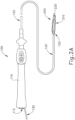
- FIGS. 2A-2B show ablation catheter assembly (100) in greater detail.
- ablation catheter (120) extends distally from handle (110); while a fluid connector assembly (130) extends proximally from handle (110).
- Fluid connector assembly (130) is configured to couple with conduit (40) to thereby provide a path for irrigation fluid to be communicated from fluid source (42) to end effector (200).
- fluid irrigation is a merely optional feature of ablation catheter assembly (100)
- fluid connector assembly (130) may be omitted if desired.
- Handle (110) of the present example also includes a socket (112), which is configured to receive a plug (not shown) on the distal end of cable (30) to thereby provide a path for electrical communication between console (12) and end effector (200).
- socket (112) which is configured to receive a plug (not shown) on the distal end of cable (30) to thereby provide a path for electrical communication between console (12) and end effector (200).
- end effector (200) is positioned at the distal end (122) of ablation catheter (120).
- End effector (200) is configured to transition between a non-expanded configuration ( FIG. 2A ) and an expanded configuration ( FIG. 2B ).
- End effector (200) may be kept in the non-expanded configuration as ablation catheter (120) is inserted into the patient (PA).
- end effector (200) may be transitioned to the expanded configuration.
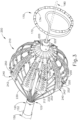
- FIG. 3 shows end effector (200) in greater detail, in the expanded configuration.
- End effector (200) is positioned distally of the distal end (152) of an outer sheath (150).
- ablation catheter (120) is slidably disposed in outer sheath (150); and ablation catheter (120) and outer sheath (150) are advanced together into lumen (e.g., artery, vein, etc.) of the patient (PA) until distal end (152) is near a target site in the patient (PA).
- End effector (200) may be initially retracted proximally relative to distal end (152) as the combination of ablation catheter (120) and outer sheath (150) are advanced into position.
- ablation catheter (120) may be advanced distally as outer sheath (150) is held stationary, to thereby advance end effector (200) from distal end (152).
- ablation catheter (120) may be held stationary as outer sheath (150) is retracted proximally to reveal end effector (200).
- outer sheath (150) is omitted.
- End effector (200) of this example includes an expandable assembly (210), a central shaft (212), and a distal hub (220).
- Expandable assembly (210) includes a set of struts (230), which are wires or beams that form a frame supporting a set of flex circuit assemblies (240).
- Struts (230) extend longitudinally from the distal end (122) of ablation catheter (120), generally converging at distal hub (220).
- the proximal ends of struts (230) may be joined with distal end (122) of ablation catheter (120) via an interlocking joint, which may be formed of a polymer or any other suitable material(s).
- one or more additional wires, beams, or other structural members extend transversely between adjacent struts (230).
- struts (230) may be formed of nitinol, self-expanding polymers, or any other suitable material(s).
- Struts (230) are angularly spaced apart from each other and are configured to bow outwardly to provide end effector (200) with a generally bulbous configuration when expandable assembly (210) is in the expanded configuration.
- struts (230) are resiliently biased to assume the outwardly bowed configuration.
- outer sheath (150) constrains struts (230) when outer sheath (150) is positioned over end effector (200), thereby maintaining expandable assembly (210) in the non-expanded configuration until end effector (200) is positioned distally in relation to distal end (152) of outer sheath (150).
- expandable assembly (210) may be selectively driven by an actuator to transition expandable assembly (210) between the expanded and non-expanded configurations.
- central shaft (212) is longitudinally fixed to distal hub (220) and relative to handle (110).
- a translating actuation assembly e.g., push rod, push wire, etc. (not shown) is coupled with the proximal ends of struts (230).
- struts (230) When the actuation assembly is advanced from a proximal position to a distal position, the proximal ends of struts (230) translate distally while the distal ends of struts (230) remain longitudinally stationary, thereby causing struts (230) to buckle and bow outwardly, thereby transitioning expandable assembly (210) to the expanded state.
- the actuation assembly When the actuation assembly is retracted from the distal position to the proximal position, the proximal ends of struts (230) translate proximally while the distal ends of struts (230) remain longitudinally stationary, thereby causing struts (230) to generally straighten, thereby transitioning expandable assembly (210) to the non-expanded state.
- proximal ends of struts (230) may be longitudinally fixed relative to handle (110), and the actuation assembly may be coupled with distal hub (220).
- the actuation assembly e.g., pull wire, etc.
- the distal ends of struts (230) translate proximally while the proximal ends of struts (230) remain longitudinally stationary, thereby causing struts (230) to buckle and bow outwardly, thereby transitioning expandable assembly (210) to the expanded state.
- struts (230) When the actuation assembly is advanced from the proximal position to the distal position, the distal ends of struts (230) translate distally while the proximal ends of struts (230) remain longitudinally stationary, thereby causing struts (230) to generally straighten, thereby transitioning expandable assembly (210) to the non-expanded state.
- Other suitable ways in which expandable assembly may transition between the non-expanded state and the expanded state will be apparent to those skilled in the art in view of the teachings herein.
- struts (230) may have various other suitable configurations and associated components.
- expandable assembly (210) may have various other components and configurations, some examples of which will be described in greater detail below.
- Each flex circuit assembly (240) is secured to a respective pair of struts (230) in the present example.
- FIG. 4 shows a flex circuit assembly (240) in greater detail.
- flex circuit assembly (240) includes a flexible substrate (242) and an electrode (250) adhered to flexible substrate (242).
- Electrode (250) includes a central elongated portion (252) or spine, with a plurality of fingers (254) extending transversely from elongated portion (252). Electrode (250) thus has a fishbone configuration.
- fingers (254) may advantageously increase the circumferential or equatorial contact surface of electrode (250) with the targeted tissue, while the gaps between adjacent fingers (254) may advantageously allow expandable assembly (210) to collapse inwardly and/or expand radially as needed at locations along its equator.
- fingers (254) have different lengths, with some being longer and others being shorter.
- fingers (254) may have progressively decreasing lengths along the length of elongated portion (252), providing electrode (250) with a generally tapered configuration.
- Electrodes (250) may be further constructed and operable in accordance with at least some of the teachings of U.S. Pub. No. 2017/0312022, entitled “Irrigated Balloon Catheter with Flexible Circuit Electrode Assembly," published November 2, 2017 .
- a longitudinally extending array of blind vias (256) are positioned along elongated portion (252).
- Blind vias (256) are electrically conductive formations that pass through electrode (250) and flexible substrate (242) to electrically couple electrode (250) with a wired assembly (260) on the underside of flexible substrate (242).
- Wired assembly (260) includes a wire (262) that extends to a weld (264) on a pad (266).
- Pad (266) is secured to a longitudinally extending electrode (268), with is further coupled with blind vias (256).
- electrode (268) may be secured to the underside of flexible substrate (242) via sewing or using any other suitable components or techniques.
- Electrode (250) thus cooperate to provide a path for electrical communication between electrode (250) and wire (262).
- Wire (262) is further coupled with cable (30), thereby coupling electrode (250) with console (12).
- Other suitable ways in which electrodes (250) may be coupled with console (12) will be apparent to those skilled in the art in view of the teachings herein.
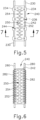
- each strut (230) is in the form of an elongate strip of material, with coupling tabs (234) formed at discrete positions along the length of the elongate strip of material.
- Each coupling tab (234) defines an opening (236).
- Flexible substrate (242) also defines a set of openings (244).
- Openings (244) are positioned such that each opening (244) along one lateral side of flexible substrate (242) will align with openings (236) along the strut (230) that is positioned along that lateral side of flexible substrate (242); while each opening (244) along the other lateral side of flexible substrate (242) will align with openings (236) along the strut (230) that is positioned along the other lateral side of flexible substrate (242). With corresponding openings (236, 244) aligned, a suture loop (232) may be passed through each pair of openings (236, 244) to thereby secure flex circuit assembly (240) to the pair of struts (230).
- suture loops (232) may be formed of a high tensile polymer fiber, polyester (e.g., Dacron), polypropylene, stainless steel, or any other suitable material(s). Each suture loop (232) may also be in the form of a monofilament or any other suitable form.
- FIG. 6 shows another merely illustrative way in which a flex circuit assembly (240) may be secured to a pair of struts (280).
- Struts (280) of this example are identical to struts (280) described above, except that struts (280) of this example lack coupling tabs (234).
- Flex circuit assembly (240) of this example is secured to struts (280) via sutures (282).
- a first suture (282) is stitched helically along one lateral side of flexible substrate (242), capturing the strut (280) underlying that lateral side of flexible substrate (242); and a second suture (282) is stitched helically along the other lateral side of flexible substrate (242), capturing the strut (280) underlying that other lateral side of flexible substrate (242).
- suture (282) may be formed of high tensile polymer fiber, polyester (e.g., Dacron), polypropylene, stainless steel, or any other suitable material(s).
- Each suture (282) may also be in the form of a monofilament or any other suitable form.
- One merely illustrative variation of the example shown in FIG. 6 may include one or more features like coupling tabs (234) on each strut (280), thereby promoting longitudinal fixation of at least one end of flexible substrate (242) along struts (280).
- FIG. 7 shows another merely illustrative way in which flex circuit assembly (240) may be secured to strut (280).
- a rivet (290) is used in place of suture loop (232).
- Rivet (290) of this example has a central shaft (292) with a head (294) at each end of shaft (292). Each head (294) has an outer diameter that is larger than the diameter of each opening (236, 244).
- Shaft (292) passes through openings (236, 244), with one head (294) bearing against flexible substrate (242) and the other head (294) bearing against coupling tab (234).
- rivet (290) may be formed of a polymer monofilament or any other suitable material(s).
- rivet (290) may be formed of a metallic material coated with an electrically insulative material.
- an insulating layer (296) is interposed between flexible substrate (242) and coupling tab (234), thereby providing electrical isolation between flex circuit assembly (240) and strut (280).
- FIG. 8 shows the same kind of insulating layer (296) being used in an example that incorporates suture loop (232) as described above.
- An insulating layer (296) may also be used in versions where suture (282) is used as described above with reference to FIG. 6 .
- ablation catheter (120) may be advanced to position end effector (200) near a targeted cardiovascular structure adjacent to the heart (e.g., the pulmonary vein) while end effector (200) is in the non-expanded configuration. End effector (200) may then be expanded to bring electrodes (250) into contact with the tissue of the targeted cardiovascular structure.
- the operator may selectively actuate expandable assembly (210) to provide a desired degree of expansion, with the degree of expansion being selected based on the dimensions or structural configuration of the particular anatomical structure that is being targeted.
- the operator may translate the actuator to a distance selected to achieve a degree of expansion that will result in expandable assembly (210) just bringing electrodes (250) into contact with the tissue of the anatomical structure. This may enable the operator to avoid over-expanding expandable assembly (210) and thereby potentially causing damage to the anatomical structure.
- electrodes (250) may then be activated to apply RF energy to the tissue, to thereby ablate the tissue.
- the RF energy may be supplied from console (12) via the various components electrically coupling electrodes (250) with console (12) as described above.
- End effector (200) may then be collapsed to the non-expanded configuration. End effector (200) may then be repositioned to another location, with above-described steps being repeated, to ablate tissue at the other location.
- ablation catheter (120) may be removed from the patient (PA).
- some versions of use may include the communication of irrigation fluid from fluid source (42) to the targeted tissue site while the ablation is being performed. Such irrigation may provide cooling to prevent undue thermal damage to the tissue.
- the patient's own blood may provide a cooling effect, such that irrigation fluid from fluid source (42) is not needed.
- the expanded end effector (200) provides substantial gaps between regions of struts (230) that are not covered by flex circuit assemblies (240). The patient's blood may flow freely through such gaps, thereby providing an irrigation effect.
- flexible substrate (242) may include a plurality of openings formed therethrough.
- distal hub (220) of the present example also defines an opening (222) that is sized to allow other instruments to pass through end effector (200).
- FIG. 3 shows a lasso catheter (170) protruding through opening (222) and positioned distally of end effector (200).
- Lasso catheter (170) includes a helical body portion (172) with a plurality of electrodes (174) spaced therealong.
- lasso catheter (170) may be configured and operable in accordance with at least some of the teachings of U.S. Pub. No. 2018/0036078, entitled "Catheter with Soft Distal Tip for Mapping and Ablating Tubular Region," published February 8, 2018 .
- catheter (180) may include a force sensor or any other suitable feature(s).
- catheter (180) may be configured and operable in accordance with at least some of the teachings of U.S. Pat. No. 8,357,152, entitled “Catheter with Pressure Sensing,” issued January 22, 2013 ; U.S. Pub. No. 2011/0130648, entitled “Catheter with Pressure Measuring Tip,” published November 30, 2009 ; or any other patent reference cited herein.
- Other suitable instruments that may be passed through opening (222) will be apparent to those skilled in the art in view of the teachings herein.
- end effector (200) includes a position sensor (not shown) that is operable to generate signals that are indicative of the position and orientation of end effector (200) within the patient (PA).
- a position sensor may be incorporated into another instrument that is associated with end effector (200), such as lasso catheter (170) or catheter (180).
- the position sensor includes a wire coil or a plurality of wire coils (e.g., three orthogonal coils) that are configured to generate electrical signals in response to the presence of an alternating electromagnetic field generated by field generators (20).
- end effector (200) may include wireless triangulation, acoustic tracking, optical tracking, inertial tracking, and the like.
- Some variations of ablation catheter assembly (100) may lack a position sensor.
- electrodes (250) are configured to provide both RF ablation functionality and EP mapping functionality. In some other versions, electrodes (250) are configured to provide only RF ablation functionality without also providing EP mapping functionality. In still other versions, electrodes (250) are only configured to provide EP mapping functionality without also providing RF ablation functionality. As yet another merely illustrative example, ablation catheter (120) may include some electrodes (250) that are dedicated to providing only RF ablation functionality and other electrodes that are dedicated to providing only EP mapping functionality. Other suitable configurations and functionalities that may be associated with electrodes (250) will be apparent to those skilled in the art in view of the teachings herein.
- a distal region of end effector (200) may include the electrodes that are dedicated to EP mapping.
- Such EP mapping electrodes may be positioned distal to electrodes (250).
- such EP mapping electrodes may be provided on distal hub (220), somewhere else on end effector (200) distal to flex circuit assemblies (240) (e.g., on one or more separate flex circuits), somewhere on distal regions of flex circuit assemblies (240), or elsewhere.
- Such EP mapping electrodes may be isolated relative to electrodes (250).
- Such EP mapping electrodes may be used to assist in identifying target regions for RF ablation, before the RF ablation is applied. Such EP mapping electrodes may also be used to verify whether RF ablation was sufficient, after the RF ablation is applied. Moreover, such EP mapping electrodes may monitor electrocardiogram signals in real time, during the RF ablation, to provide real-time feedback on the effectiveness of the RF ablation. In versions where EP mapping electrodes are integrated into end effector (200), lasso catheter (170) may be omitted.
- FIG. 9 shows an exemplary alternative end effector (300) that may be positioned at distal end (122) of ablation catheter (120).
- End effector (300) of this example includes an expandable assembly (310) that is configured to transition between a non-expanded configuration and an expanded configuration, with the expanded configuration being shown in FIG. 9 .
- expandable assembly (310) may generally resemble expandable assembly (210) shown in FIG. 2A .
- Expandable assembly (310) may be transitioned between the expanded and non-expanded configurations in a manner like any of those described above with respect to expandable assembly (210).
- expandable assembly (310) may be transitioned between the expanded and non-expanded configurations in accordance with any of the teachings of U.S. Pub. No. 2017/0156840, entitled “Medical Device for Modification of Left Atrial Appendage and Related Systems and Methods," published June 8, 2017 .
- Other suitable ways in which expandable assembly (310) may be transitioned between the expanded and non-expanded configurations will be apparent to those skilled in the art in view of the teachings herein.
- Expandable assembly (310) of this example includes an angularly spaced array of struts (330).
- Struts (330) may be formed of nitinol or any other suitable material(s).
- Each strut (330) of this example includes a distal bend (331), such that both ends of each strut (330) are located at distal end (122) of end ablation catheter (120).
- a hub (not shown) is centrally positioned between distal bends (331); and a plurality of spokes (not shown) radiate outwardly from the hub to pivotally couple the hub with distal bends (331). The spokes and hub may thus cooperate with struts (330) to transition expandable assembly (310) between the expanded and non-expanded configurations in response to relative longitudinal translation of the hub and struts (330).
- Flex circuit assemblies (240) are secured to struts (330).
- one lateral side of each flexible substrate (242) is secured to one segment of a corresponding strut (330) on one lateral side of the distal bend (331) of that strut (330), while the other lateral side of that flexible substrate (242) is secured to the other segment of the same strut (330) on the other lateral side of the distal bend (331) of that strut (330).
- flex circuit assemblies (240) are secured to struts (330) via suture loops (332), though any other suitable components and techniques as described herein may be used to secure flex circuit assemblies (240) to struts (330).
- end effector (300) of the example shown in FIG. 9 is generally shaped like a tulip or cone, rather than being bulbous like end effector (200).
- end effector (300) may have any other suitable shape when in the expanded configuration, including but not limited to hourglass-shaped, etc.
- End effector (300) may be used just like end effector (200) described above, with struts (330) urging electrodes (250) into contact with tissue; and with electrodes (250) being activated to provide RF ablation of the adjacent tissue.
- End effector (300) may also allow the flow of the patient's blood therethrough, thereby enabling the blood to serve as an irrigation fluid providing a cooling effect to avoid undue thermal damage to the tissue.
- FIG. 10 shows another exemplary alternative end effector (400) that may be positioned at distal end (122) of ablation catheter (120).
- End effector (400) of this example includes an expandable assembly (410) that is configured to transition between a non-expanded configuration and an expanded configuration, with the expanded configuration being shown in FIG. 10 .
- expandable assembly (410) may generally resemble expandable assembly (210) shown in FIG. 2A .
- Expandable assembly (410) of this example includes a wire mesh or cage (430).
- Cage (430) may be formed of nitinol or any other suitable material(s).
- a distal hub (420) is secured to a distal end of cage (430).
- a central shaft (not shown) may pass through the center of cage (430) and be secured to distal hub (420).
- Expandable assembly (410) may be transitioned between the expanded and non-expanded configurations in a manner like any of those described above with respect to expandable assembly (210). Expandable assembly (410) may thus be resiliently biased to assume the expanded configuration; and a sheath (e.g., like sheath (150)) may be used to hold expandable assembly (410) in the non-expanded configuration.
- a sheath e.g., like sheath (150)
- an actuator assembly may provide relative longitudinal movement between distal hub (420) and distal end (122) of ablation catheter (120) to cause cage (430) to buckle and thereby deform to the expanded configuration.
- expandable assembly (410) may transition between the expanded and non-expanded configurations will be apparent to those skilled in the art in view of the teachings herein.
- Flex circuit assemblies (240) are secured to cage (430).
- suture loops (432) are passed through openings in flex circuit assemblies and openings defined by cage (430).
- any other suitable components and techniques may be used to secure flex circuit assemblies (240) to cage (430).
- end effector (400) of the example shown in FIG. 10 is generally bulbous in shape.
- end effector (400) may have any other suitable shape when in the expanded configuration, including but not limited to conical, hourglass-shaped, etc.
- End effector (400) may be used just like end effector (200) described above, with cage (430) urging electrodes (250) into contact with tissue; and with electrodes (250) being activated to provide RF ablation of the adjacent tissue.
- End effector (400) may also allow the flow of the patient's blood therethrough, thereby enabling the blood to serve as an irrigation fluid providing a cooling effect to avoid undue thermal damage to the tissue.
- FIGS. 11-12 show yet another exemplary alternative end effector (500) that may be positioned at distal end (122) of ablation catheter (120).
- End effector (500) of this example includes an expandable assembly (510) that is configured to transition between a non-expanded configuration and an expanded configuration, with the expanded configuration being shown in FIGS. 11-12 .
- expandable assembly (510) may generally resemble expandable assembly (210) shown in FIG. 2A .
- Expandable assembly (510) of this example includes a plurality of struts (530, 532).
- a first set of struts (530) extend longitudinally and are positioned in an angularly spaced array.
- a second set of struts (532) extend between struts (530) along a generally circumferential path.
- struts (532) are arranged in a distal subset and in a proximal subset. Alternatively, any other suitable number and arrangement of subsets of struts (532) may be provided.
- Each strut (532) has a V shape and is resiliently biased toward a generally straight configuration, such that struts (532) cooperate with each other to ensure consistent angular spacing between struts (530), preventing struts (530) from bunching together and helping struts (530) to keep their shape.
- struts (532) are omitted.
- a distal hub (520) is secured to a distal end of struts (530).
- a central shaft (512) passes through the center of expandable assembly (510) and is secured to distal hub (520).
- Expandable assembly (510) may be transitioned between the expanded and non-expanded configurations in a manner like any of those described above with respect to expandable assembly (210). Expandable assembly (510) may thus be resiliently biased to assume the expanded configuration; and a sheath (e.g., like sheath (150)) may be used to hold expandable assembly (510) in the non-expanded configuration.
- an actuator assembly may provide relative longitudinal movement between distal hub (520) and distal end (122) of ablation catheter (120) to cause struts (530) to buckle and thereby deform to the expanded configuration.
- expandable assembly (510) may transition between the expanded and non-expanded configurations will be apparent to those skilled in the art in view of the teachings herein.
- Flex circuit assemblies (240) are secured to a sleeve (540).
- Sleeve (540) may be formed of any suitable material(s), including but not limited to polymers such as nylon, polyester (e.g., Dacron), polypropylene, ePTFE, polyurethane, etc.
- sleeve (540) may include one or more slits or openings formed therethrough, to facilitate communication of fluids therethrough.
- flex circuit assemblies (240) may be secured to sleeve (540) via heat fusion, stitching, suture loops, rivets, or using any other suitable components or techniques.
- the wire (262) of each flex circuit assembly (242) is woven into sleeve (540).
- Sleeve (540) of the present example is fitted over struts (530, 532) to thereby secure flex circuit assemblies (240) relative to struts (530, 532).
- sleeve (540) may be secured to struts (530) via stitching, suture loops, rivets, or using any other suitable components or techniques.
- sleeve (540) promotes consistent angular spacing between struts (530), prevents struts (530) from bunching together, and helps struts (530) to keep their shape.
- Sleeve (540) may also reduce the risk of tissue getting captured and pinched between struts (530).
- end effector (500) of the example shown in FIGS. 11-12 is generally pear-shaped, with the distal region of end effector (500) being narrower than the proximal region of end effector (500).
- end effector (500) is still pear-shaped in the expanded configuration, yet the distal region of end effector (500) is wider than the proximal region of end effector (500).
- end effector (500) may have any other suitable shape when in the expanded configuration, including but not limited to conical, hourglass-shaped, etc.
- End effector (500) may be used just like end effector (200) described above, with expandable assembly (510) urging electrodes (250) into contact with tissue; and with electrodes (250) being activated to provide RF ablation of the adjacent tissue. End effector (500) may also allow the flow of the patient's blood therethrough, thereby enabling the blood to serve as an irrigation fluid providing a cooling effect to avoid undue thermal damage to the tissue.
- sleeve (540) is only shown in the context of end effector (500), any of the other end effectors (200, 300, 400) described herein may be readily modified to incorporate a sleeve (540).
- flex circuit assemblies (240) may be secured to any of the expandable assemblies (210,310,410, 510) described herein via a sleeve (540) or variations thereof.
- end effector (200) may have variations that include EP mapping electrodes in addition to including RF ablation electrodes (250), end effectors (300, 400, 500) may also have EP mapping electrodes in addition to having electrodes (250). As with end effector (200), such EP mapping electrodes may be positioned distal to electrodes (250) and may be electrically isolated relative to electrodes (250).
- flex circuit assemblies (240) may be secured to expandable assemblies (210, 310, 410, 510) without the use of adhesives.
- flex circuit assemblies (240) may be secured to expandable assemblies (210, 310, 410, 510) via suture loops (232,332,432), rivets (290), stitched suture (282), sleeve (540), or some other mechanical/non-adhesive structure.
- robotic systems may be readily implemented to apply suture loops (232, 332, 432), to form rivet (290), to stitch suture (282), or to provide any other form of securing of flex circuit assemblies (240) to expandable assemblies (210, 310, 410, 510) as contemplated herein.
Landscapes
- Health & Medical Sciences (AREA)
- Life Sciences & Earth Sciences (AREA)
- Surgery (AREA)
- Engineering & Computer Science (AREA)
- Animal Behavior & Ethology (AREA)
- Public Health (AREA)
- Biomedical Technology (AREA)
- Heart & Thoracic Surgery (AREA)
- Medical Informatics (AREA)
- Molecular Biology (AREA)
- Veterinary Medicine (AREA)
- Physics & Mathematics (AREA)
- General Health & Medical Sciences (AREA)
- Biophysics (AREA)
- Pathology (AREA)
- Cardiology (AREA)
- Plasma & Fusion (AREA)
- Nuclear Medicine, Radiotherapy & Molecular Imaging (AREA)
- Otolaryngology (AREA)
- Surgical Instruments (AREA)
Description
- Cardiac arrhythmias, such as atrial fibrillation, occur when regions of cardiac tissue abnormally conduct electric signals. Procedures for treating arrhythmia include surgically disrupting the conducting pathway for such signals. By selectively ablating cardiac tissue by application of energy (e.g., radiofrequency (RF) energy), it may be possible to cease or modify the propagation of unwanted electrical signals from one portion of the heart to another. The ablation process may provide a barrier to unwanted electrical pathways by creating electrically insulative lesions or scar tissue.
- In some procedures, a catheter with one or more RF electrodes may be used to provide ablation within the cardiovascular system. The catheter may be inserted into a major vein or artery (e.g., the femoral artery) and then advanced to position the electrodes within the heart or in a cardiovascular structure adjacent to the heart (e.g., the pulmonary vein). The electrodes may be placed in contact with cardiac tissue or other vascular tissue and then activated with RF energy to thereby ablate the contacted tissue. In some cases, the electrodes may be bipolar. In some other cases, a monopolar electrode may be used in conjunction with a ground pad that is in contact with the patient.
- Examples of ablation catheters are described in
U.S. Pub. No. 2013/0030426, entitled "Integrated Ablation System using Catheter with Multiple Irrigation Lumens," published January 31, 2013 ;U.S. Pub. No. 2017/0312022, entitled "Irrigated Balloon Catheter with Flexible Circuit Electrode Assembly," published November 2, 2017 ;U.S. Pub. No. 2018/0071017, entitled "Ablation Catheter with a Flexible Printed Circuit Board," published March 15, 2018 ;U.S. Pub. No. 2018/0056038, entitled "Catheter with Bipole Electrode Spacer and Related Methods," published March 1, 2018 ;U.S. Pub. No. 2018/0036078, entitled "Catheter with Soft Distal Tip for Mapping and Ablating Tubular Region," published February 8, 2018 ;U.S. Pat. No. 8,956,353, entitled "Electrode Irrigation Using Micro-Jets," issued February 17, 2015 ; andU.S. Pat. No. 9,801,585, entitled "Electrocardiogram Noise Reduction," issued October 31, 2017 - Some catheter ablation procedures may be performed using electrophysiology (EP) mapping. Such EP mapping may include the use of sensing electrodes on a catheter (e.g., the same catheter that is used to perform the ablation). Such sensing electrodes may monitor electrical signals within the cardiovascular system to pinpoint the location of aberrant conductive tissue sites that are responsible for the arrhythmia. Examples of an EP mapping system are described in
U.S. Pat. No. 5,738,096, entitled "Cardiac Electromechanics," issued April 14, 1998 . Examples of an EP mapping catheter is described inU.S. Pat. No. 9,907,480, entitled "Catheter Spine Assembly with Closely-Spaced Bipole Microelectrodes," issued March 6, 2018 - In addition to using EP mapping, some catheter ablation procedures may be performed using an image guided surgery (IGS) system. The IGS system may enable the physician to visually track the location of the catheter within the patient, in relation to images of anatomical structures within the patient, in real time. Some systems may provide a combination of EP mapping and IGS functionalities, including the CARTO 3® system by Biosense Webster, Inc. of Irvine, California.
-
EP 3332727 A2 describes an irrigated balloon catheter, which includes a balloon carrying contact electrodes, wherein a user can vary the balloon's configuration by manipulating an elongated expander that extends along the catheter and through the balloon's interior, with its distal end coupled to a distal end of the balloon. The expander may pass through an irrigation lumen to save on space within the catheter, and the expander itself may be hollow in providing a lumen for cables or lead wires. The expander may include flexure slits for increased flexibility. The distal end of the balloon includes a housing for components, e.g., a position sensor. The distal end of the balloon and the manner by which the balloon membrane is attached to the housing present a generally flat atraumatic surface suitable for direct head-on contact with tissue. Longitudinal spines extend along the outer surface of the balloon to provide support. - While several ablation catheter systems and methods have been made and used, it is believed that no one prior to the inventors has made or used the invention described in the appended claims.
- The drawings and detailed description that follow are intended to be merely illustrative and are not intended to limit the scope of the invention as contemplated by the inventors. The invention is defined in independent claim 1. Embodiments of the invention are defined in the dependent claims.
-
FIG. 1 depicts a schematic view of a medical procedure in which an ablation catheter of an ablation catheter assembly is inserted in a patient; -
FIG. 2A depicts a top plan view of the ablation catheter assembly ofFIG. 1 , with an expandable assembly of an end effector in a non-expanded state; -
FIG. 2B depicts a top plan view of the ablation catheter assembly ofFIG. 1 , with the expandable assembly of the end effector in an expanded state; -
FIG. 3 depicts a perspective view of the end effector ofFIG. 2A , with the expandable assembly in the expanded state; -
FIG. 4 depicts a perspective view of a flex circuit of the end effector ofFIG. 2A , with a portion of the flex circuit bent over to reveal an underside; -
FIG. 5 depicts a top plan view of a portion of the end effector ofFIG. 2A , according to one example of features to secure the flex circuit ofFIG. 4 to struts of the expandable assembly; -
FIG. 6 depicts a top plan view of a portion of the end effector ofFIG. 2A , according to another example of features to secure the flex circuit ofFIG. 4 to struts of the expandable assembly; -
FIG. 7 depicts a cross-section of a lateral portion of the portion of the end effector ofFIG. 5 , taken along line 7-7 ofFIG. 5 , including a rivet securing the flex circuit ofFIG. 4 to a strut of the expandable assembly; -
FIG. 8 depicts a cross-section of a lateral portion of the portion of the end effector ofFIG. 5 , taken along line 7-7 ofFIG. 5 , including a suture loop securing the flex circuit ofFIG. 4 to a strut of the expandable assembly; -
FIG. 9 depicts a side elevational view of an exemplary alternative end effector that may be incorporated into the ablation catheter assembly ofFIG. 1 , with an expandable assembly of the end effector in an expanded state; -
FIG. 10 depicts a side elevational view of another exemplary alternative end effector that may be incorporated into the ablation catheter assembly ofFIG. 1 , with an expandable assembly of the end effector in an expanded state; -
FIG. 11 depicts a side elevational view of another exemplary alternative end effector that may be incorporated into the ablation catheter assembly ofFIG. 1 , with an expandable assembly of the end effector in an expanded state, and with a flex circuit sleeve omitted for clarity; and -
FIG. 12 depicts a side elevational view of the end effector ofFIG. 11 , with the expandable assembly in the expanded state, and with the flex circuit sleeve included. - The following description of certain examples of the invention should not be used to limit the scope of the present invention. The drawings, which are not necessarily to scale, depict selected embodiments and are not intended to limit the scope of the invention. The detailed description illustrates by way of example, not by way of limitation, the principles of the invention. Other examples, features, aspects, embodiments, and advantages of the invention will become apparent to those skilled in the art from the following description, which is by way of illustration, one of the best modes contemplated for carrying out the invention. As will be realized, the invention is capable of other different or equivalent aspects. Accordingly, the drawings and descriptions should be regarded as illustrative in nature and not restrictive.
- Any one or more of the teachings, expressions, versions, examples, etc. described herein may be combined with any one or more of the other teachings, expressions, versions, examples, etc. that are described herein. The following-described teachings, expressions, versions, examples, etc. should therefore not be viewed in isolation relative to each other. Various suitable ways in which the teachings herein may be combined will be readily apparent to those skilled in the art in view of the teachings herein.
- As used herein, the terms "about" or "approximately" for any numerical values or ranges indicate a suitable dimensional tolerance that allows the part or collection of components to function for its intended purpose as described herein. More specifically, "about" or "approximately" may refer to the range of values ±10% of the recited value, e.g. "about 90%" may refer to the range of values from 81% to 99%. In addition, as used herein, the terms "patient," "host," "user," and "subject" refer to any human or animal subject and are not intended to limit the systems or methods to human use, although use of the subject invention in a human patient represents a preferred embodiment.
-
FIG. 1 shows an exemplary medical procedure and associated components of a cardiac ablation system. In particular,FIG. 1 shows a physician (PH) grasping a handle (110) of an ablation catheter assembly (100), with an end effector (200) of an ablation catheter (120) (shown inFIGS. 2A-2B but not shown inFIG. 1 ) of ablation catheter assembly (100) disposed in a patient (PA) to ablate tissue in or near the heart (H) of the patient (PA). Ablation catheter assembly (100) is coupled with a guidance and drive system (10) via a cable (30). Ablation catheter assembly (100) is also coupled with a fluid source (42) via a fluid conduit (40), though this is merely optional. A set of field generators (20) are positioned underneath the patient (PA) and are also coupled with guidance and drive system (10) via a cable (22). - Guidance and drive system (10) of the present example includes a console (12) and a display (18). Console (12) includes a first driver module (14) and a second driver module (16). First driver module (14) is coupled with ablation catheter assembly (100) via cable (30) and is operable to provide RF power to electrodes (250) of end effector (200) as will be described in greater detail below. In some versions, first driver module (14) is also operable to receive EP mapping signals from electrodes (174 or 250). Console (12) includes a processor (not shown) that processes such EP mapping signals and thereby provides EP mapping as is known in the art. In some versions, first driver module (14) is also operable to receive position indicative signals from a position sensor (not shown) in end effector (200), as will be described in greater detail below. In such versions, the processor of console (12) is also operable to process the position indicative signals from the position sensor to thereby determine the position of the end effector (200) of ablation catheter (120) within the patient (PA).
- Second driver module (16) is coupled with field generators (20) via cable (22). Second driver module (16) is operable to activate field generators (20) to generate an alternating magnetic field around the heart (H) of the patient (PA). For instance, field generators (20) may include coils that generate alternating magnetic fields in a predetermined working volume that contains the heart (H).
- Display (18) is coupled with the processor of console (12) and is operable to render images of patient anatomy. Such images may be based on a set of preoperatively or intraoperatively obtained images (e.g., a CT or MRI scan, 3-D map, etc.). The views of patient anatomy provided through display (18) may also change dynamically based on signals from the position sensor of end effector (200). For instance, as end effector (200) of ablation catheter (120) moves within the patient (PA), the corresponding position data from the position sensor may cause the processor of console (12) to update the patient anatomy views in display (18) in real time to depict the regions of patient anatomy around end effector (200) as end effector (200) moves within the patient (PA). Moreover, the processor of console (12) may drive display (18) to show locations of aberrant conductive tissue sites, as detected via EP mapping with end effector (200) or as detected via EP mapping with a dedicated mapping catheter (170) (
FIG. 3 ). By way of example only, the processor of console (12) may drive display (18) to superimpose the locations of aberrant conductive tissue sites on the images of the patient's anatomy, such as by superimposing an illuminated dot, a crosshair, or some other form of visual indication of aberrant conductive tissue sites. - The processor of console (12) may also drive display (18) to superimpose the current location of end effector (200) on the images of the patient's anatomy, such as by superimposing an illuminated dot, a crosshair, a graphical representation of end effector (200), or some other form of visual indication. Such a superimposed visual indication may also move within the images of the patient anatomy on display (18) in real time as the physician moves end effector (200) within the patient (PA), thereby providing real-time visual feedback to the operator about the position of end effector (200) within the patient (PA) as end effector (200) moves within the patient (PA). The images provided through display (18) may thus effectively provide a video tracking the position of end effector (200) within a patient (PA), without necessarily having any optical instrumentation (i.e., cameras) viewing end effector (200). In the same view, display (18) may simultaneously visually indicate the locations of aberrant conductive tissue sites detected through the EP mapping as described herein. The physician (PH) may thus view display (18) to observe the real time positioning of end effector (200) in relation to the mapped aberrant conductive tissue sites and in relation to images of the adjacent anatomical structures in the patient (PA).
- Fluid source (42) of the present example includes a bag containing saline or some other suitable irrigation fluid. Conduit (40) includes a flexible tube that is further coupled with a pump (44). Pump (44) is positioned along conduit (40) between fluid source (42) and ablation catheter assembly (100). In the present example, pump (44) includes a peristaltic pump that is operable to selectively drive fluid from fluid source (42) to ablation catheter assembly (100). Alternatively, pump (44) may take any other suitable form. In some variations, conduit (40), fluid source (42), and pump (44) are omitted entirely. In versions where these components are included, end effector (200) may be configured to communicate irrigation fluid from fluid source (42) to the target site in the patient. Such irrigation may be provided in accordance with the teachings of any of the various patent references cited herein; or in any other suitable fashion as will be apparent to those skilled in the art in view of the teachings herein.
-
FIGS. 2A-2B show ablation catheter assembly (100) in greater detail. As shown, ablation catheter (120) extends distally from handle (110); while a fluid connector assembly (130) extends proximally from handle (110). Fluid connector assembly (130) is configured to couple with conduit (40) to thereby provide a path for irrigation fluid to be communicated from fluid source (42) to end effector (200). As fluid irrigation is a merely optional feature of ablation catheter assembly (100), fluid connector assembly (130) may be omitted if desired. Handle (110) of the present example also includes a socket (112), which is configured to receive a plug (not shown) on the distal end of cable (30) to thereby provide a path for electrical communication between console (12) and end effector (200). Various suitable components and configurations that may be used to form these components will be apparent to those skilled in the art in view of the teachings herein. - As also shown in
FIGS. 2A-2B , end effector (200) is positioned at the distal end (122) of ablation catheter (120). End effector (200) is configured to transition between a non-expanded configuration (FIG. 2A ) and an expanded configuration (FIG. 2B ). End effector (200) may be kept in the non-expanded configuration as ablation catheter (120) is inserted into the patient (PA). Once end effector (200) reaches a target site in the patient, end effector (200) may be transitioned to the expanded configuration. Some examples of how end effector (200) may be transitioned between the non-expanded configuration and the expanded configuration will be described in greater detail below, while other examples will be apparent to those skilled in the art in view of the teachings herein. -
FIG. 3 shows end effector (200) in greater detail, in the expanded configuration. End effector (200) is positioned distally of the distal end (152) of an outer sheath (150). In some scenarios, ablation catheter (120) is slidably disposed in outer sheath (150); and ablation catheter (120) and outer sheath (150) are advanced together into lumen (e.g., artery, vein, etc.) of the patient (PA) until distal end (152) is near a target site in the patient (PA). End effector (200) may be initially retracted proximally relative to distal end (152) as the combination of ablation catheter (120) and outer sheath (150) are advanced into position. Once reaching the target site, ablation catheter (120) may be advanced distally as outer sheath (150) is held stationary, to thereby advance end effector (200) from distal end (152). Alternatively, ablation catheter (120) may be held stationary as outer sheath (150) is retracted proximally to reveal end effector (200). In still other versions, outer sheath (150) is omitted. - End effector (200) of this example includes an expandable assembly (210), a central shaft (212), and a distal hub (220). Expandable assembly (210) includes a set of struts (230), which are wires or beams that form a frame supporting a set of flex circuit assemblies (240). Struts (230) extend longitudinally from the distal end (122) of ablation catheter (120), generally converging at distal hub (220). By way of example only, the proximal ends of struts (230) may be joined with distal end (122) of ablation catheter (120) via an interlocking joint, which may be formed of a polymer or any other suitable material(s). In some variations, one or more additional wires, beams, or other structural members extend transversely between adjacent struts (230). By way of example only, struts (230) may be formed of nitinol, self-expanding polymers, or any other suitable material(s). Struts (230) are angularly spaced apart from each other and are configured to bow outwardly to provide end effector (200) with a generally bulbous configuration when expandable assembly (210) is in the expanded configuration. In some versions, struts (230) are resiliently biased to assume the outwardly bowed configuration. In some such versions, outer sheath (150) constrains struts (230) when outer sheath (150) is positioned over end effector (200), thereby maintaining expandable assembly (210) in the non-expanded configuration until end effector (200) is positioned distally in relation to distal end (152) of outer sheath (150).
- As another merely illustrative example, expandable assembly (210) may be selectively driven by an actuator to transition expandable assembly (210) between the expanded and non-expanded configurations. For instance, in some such versions, central shaft (212) is longitudinally fixed to distal hub (220) and relative to handle (110). A translating actuation assembly (e.g., push rod, push wire, etc.) (not shown) is coupled with the proximal ends of struts (230). When the actuation assembly is advanced from a proximal position to a distal position, the proximal ends of struts (230) translate distally while the distal ends of struts (230) remain longitudinally stationary, thereby causing struts (230) to buckle and bow outwardly, thereby transitioning expandable assembly (210) to the expanded state. When the actuation assembly is retracted from the distal position to the proximal position, the proximal ends of struts (230) translate proximally while the distal ends of struts (230) remain longitudinally stationary, thereby causing struts (230) to generally straighten, thereby transitioning expandable assembly (210) to the non-expanded state.
- As another variation, the proximal ends of struts (230) may be longitudinally fixed relative to handle (110), and the actuation assembly may be coupled with distal hub (220). When the actuation assembly (e.g., pull wire, etc.) is retracted from a distal position to a proximal position, the distal ends of struts (230) translate proximally while the proximal ends of struts (230) remain longitudinally stationary, thereby causing struts (230) to buckle and bow outwardly, thereby transitioning expandable assembly (210) to the expanded state. When the actuation assembly is advanced from the proximal position to the distal position, the distal ends of struts (230) translate distally while the proximal ends of struts (230) remain longitudinally stationary, thereby causing struts (230) to generally straighten, thereby transitioning expandable assembly (210) to the non-expanded state. Other suitable ways in which expandable assembly may transition between the non-expanded state and the expanded state will be apparent to those skilled in the art in view of the teachings herein. It should also be understood that struts (230) may have various other suitable configurations and associated components. Moreover, expandable assembly (210) may have various other components and configurations, some examples of which will be described in greater detail below.
- Each flex circuit assembly (240) is secured to a respective pair of struts (230) in the present example.
FIG. 4 shows a flex circuit assembly (240) in greater detail. As shown, flex circuit assembly (240) includes a flexible substrate (242) and an electrode (250) adhered to flexible substrate (242). Electrode (250) includes a central elongated portion (252) or spine, with a plurality of fingers (254) extending transversely from elongated portion (252). Electrode (250) thus has a fishbone configuration. With such a fishbone configuration, fingers (254) may advantageously increase the circumferential or equatorial contact surface of electrode (250) with the targeted tissue, while the gaps between adjacent fingers (254) may advantageously allow expandable assembly (210) to collapse inwardly and/or expand radially as needed at locations along its equator. In some versions, fingers (254) have different lengths, with some being longer and others being shorter. For instance, fingers (254) may have progressively decreasing lengths along the length of elongated portion (252), providing electrode (250) with a generally tapered configuration. Electrodes (250) may be further constructed and operable in accordance with at least some of the teachings ofU.S. Pub. No. 2017/0312022, entitled "Irrigated Balloon Catheter with Flexible Circuit Electrode Assembly," published November 2, 2017 . - A longitudinally extending array of blind vias (256) are positioned along elongated portion (252). Blind vias (256) are electrically conductive formations that pass through electrode (250) and flexible substrate (242) to electrically couple electrode (250) with a wired assembly (260) on the underside of flexible substrate (242). Wired assembly (260) includes a wire (262) that extends to a weld (264) on a pad (266). Pad (266) is secured to a longitudinally extending electrode (268), with is further coupled with blind vias (256). By way of example only, electrode (268) may be secured to the underside of flexible substrate (242) via sewing or using any other suitable components or techniques. Weld (264), pad (266), electrode (268), and blind vias (256) thus cooperate to provide a path for electrical communication between electrode (250) and wire (262). Wire (262) is further coupled with cable (30), thereby coupling electrode (250) with console (12). Other suitable ways in which electrodes (250) may be coupled with console (12) will be apparent to those skilled in the art in view of the teachings herein.
- As shown in
FIG. 3 , flex circuit assemblies (240) are secured to respective pairs of struts (230) via suture loops (232).FIG. 5 shows exemplary features that may be provided to accommodate such suture loops (232). As shown, each strut (230) is in the form of an elongate strip of material, with coupling tabs (234) formed at discrete positions along the length of the elongate strip of material. Each coupling tab (234) defines an opening (236). Flexible substrate (242) also defines a set of openings (244). Openings (244) are positioned such that each opening (244) along one lateral side of flexible substrate (242) will align with openings (236) along the strut (230) that is positioned along that lateral side of flexible substrate (242); while each opening (244) along the other lateral side of flexible substrate (242) will align with openings (236) along the strut (230) that is positioned along the other lateral side of flexible substrate (242). With corresponding openings (236, 244) aligned, a suture loop (232) may be passed through each pair of openings (236, 244) to thereby secure flex circuit assembly (240) to the pair of struts (230). By way of example only, suture loops (232) may be formed of a high tensile polymer fiber, polyester (e.g., Dacron), polypropylene, stainless steel, or any other suitable material(s). Each suture loop (232) may also be in the form of a monofilament or any other suitable form. -
FIG. 6 shows another merely illustrative way in which a flex circuit assembly (240) may be secured to a pair of struts (280). Struts (280) of this example are identical to struts (280) described above, except that struts (280) of this example lack coupling tabs (234). Flex circuit assembly (240) of this example is secured to struts (280) via sutures (282). In this example, a first suture (282) is stitched helically along one lateral side of flexible substrate (242), capturing the strut (280) underlying that lateral side of flexible substrate (242); and a second suture (282) is stitched helically along the other lateral side of flexible substrate (242), capturing the strut (280) underlying that other lateral side of flexible substrate (242). Again, suture (282) may be formed of high tensile polymer fiber, polyester (e.g., Dacron), polypropylene, stainless steel, or any other suitable material(s). Each suture (282) may also be in the form of a monofilament or any other suitable form. One merely illustrative variation of the example shown inFIG. 6 may include one or more features like coupling tabs (234) on each strut (280), thereby promoting longitudinal fixation of at least one end of flexible substrate (242) along struts (280). -
FIG. 7 shows another merely illustrative way in which flex circuit assembly (240) may be secured to strut (280). In this example, a rivet (290) is used in place of suture loop (232). Rivet (290) of this example has a central shaft (292) with a head (294) at each end of shaft (292). Each head (294) has an outer diameter that is larger than the diameter of each opening (236, 244). Shaft (292) passes through openings (236, 244), with one head (294) bearing against flexible substrate (242) and the other head (294) bearing against coupling tab (234). By way of example only, rivet (290) may be formed of a polymer monofilament or any other suitable material(s). As another merely illustrative example, rivet (290) may be formed of a metallic material coated with an electrically insulative material. As also shown inFIG. 7 , an insulating layer (296) is interposed between flexible substrate (242) and coupling tab (234), thereby providing electrical isolation between flex circuit assembly (240) and strut (280).FIG. 8 shows the same kind of insulating layer (296) being used in an example that incorporates suture loop (232) as described above. An insulating layer (296) may also be used in versions where suture (282) is used as described above with reference toFIG. 6 . - During use of ablation catheter assembly (100), ablation catheter (120) may be advanced to position end effector (200) near a targeted cardiovascular structure adjacent to the heart (e.g., the pulmonary vein) while end effector (200) is in the non-expanded configuration. End effector (200) may then be expanded to bring electrodes (250) into contact with the tissue of the targeted cardiovascular structure. In some versions, the operator may selectively actuate expandable assembly (210) to provide a desired degree of expansion, with the degree of expansion being selected based on the dimensions or structural configuration of the particular anatomical structure that is being targeted. For instance, in versions where an actuator such as a pull wire is used to transition expandable assembly (210) from the non-expanded configuration to the expanded configuration, the operator may translate the actuator to a distance selected to achieve a degree of expansion that will result in expandable assembly (210) just bringing electrodes (250) into contact with the tissue of the anatomical structure. This may enable the operator to avoid over-expanding expandable assembly (210) and thereby potentially causing damage to the anatomical structure.
- After expandable assembly (210) appropriately urges electrodes (250) into contact with the target tissue, electrodes (250) may then be activated to apply RF energy to the tissue, to thereby ablate the tissue. The RF energy may be supplied from console (12) via the various components electrically coupling electrodes (250) with console (12) as described above. End effector (200) may then be collapsed to the non-expanded configuration. End effector (200) may then be repositioned to another location, with above-described steps being repeated, to ablate tissue at the other location. After the ablation is complete, ablation catheter (120) may be removed from the patient (PA).
- As noted above, some versions of use may include the communication of irrigation fluid from fluid source (42) to the targeted tissue site while the ablation is being performed. Such irrigation may provide cooling to prevent undue thermal damage to the tissue. As an alternative to providing irrigation, the patient's own blood may provide a cooling effect, such that irrigation fluid from fluid source (42) is not needed. In other words, the expanded end effector (200) provides substantial gaps between regions of struts (230) that are not covered by flex circuit assemblies (240). The patient's blood may flow freely through such gaps, thereby providing an irrigation effect. To further promote the flow of blood through the expanded end effector (200), flexible substrate (242) may include a plurality of openings formed therethrough.
- Referring back to
FIG. 3 , distal hub (220) of the present example also defines an opening (222) that is sized to allow other instruments to pass through end effector (200). For instance,FIG. 3 shows a lasso catheter (170) protruding through opening (222) and positioned distally of end effector (200). Lasso catheter (170) includes a helical body portion (172) with a plurality of electrodes (174) spaced therealong. By way of example only, lasso catheter (170) may be configured and operable in accordance with at least some of the teachings ofU.S. Pub. No. 2018/0036078, entitled "Catheter with Soft Distal Tip for Mapping and Ablating Tubular Region," published February 8, 2018 .FIG. 3 also shows another catheter (180) (in broken lines) protruding through opening (222) and positioned distally of end effector (200). Catheter (180) may include a force sensor or any other suitable feature(s). By way of example only, catheter (180) may be configured and operable in accordance with at least some of the teachings ofU.S. Pat. No. 8,357,152, entitled "Catheter with Pressure Sensing," issued January 22, 2013 ;U.S. Pub. No. 2011/0130648, entitled "Catheter with Pressure Measuring Tip," published November 30, 2009 ; or any other patent reference cited herein. Other suitable instruments that may be passed through opening (222) will be apparent to those skilled in the art in view of the teachings herein. - In some variations, end effector (200) includes a position sensor (not shown) that is operable to generate signals that are indicative of the position and orientation of end effector (200) within the patient (PA). By way of further example only, such a position sensor may be incorporated into another instrument that is associated with end effector (200), such as lasso catheter (170) or catheter (180). In some versions, the position sensor includes a wire coil or a plurality of wire coils (e.g., three orthogonal coils) that are configured to generate electrical signals in response to the presence of an alternating electromagnetic field generated by field generators (20). Other components and techniques that may be used to generate real-time position data associated with end effector (200) may include wireless triangulation, acoustic tracking, optical tracking, inertial tracking, and the like. Some variations of ablation catheter assembly (100) may lack a position sensor.
- In some versions, electrodes (250) are configured to provide both RF ablation functionality and EP mapping functionality. In some other versions, electrodes (250) are configured to provide only RF ablation functionality without also providing EP mapping functionality. In still other versions, electrodes (250) are only configured to provide EP mapping functionality without also providing RF ablation functionality. As yet another merely illustrative example, ablation catheter (120) may include some electrodes (250) that are dedicated to providing only RF ablation functionality and other electrodes that are dedicated to providing only EP mapping functionality. Other suitable configurations and functionalities that may be associated with electrodes (250) will be apparent to those skilled in the art in view of the teachings herein.
- As a merely illustrative example of ablation catheter (120) that includes some electrodes (250) that are dedicated to providing only RF ablation functionality and other electrodes that are dedicated to providing only EP mapping functionality, a distal region of end effector (200) may include the electrodes that are dedicated to EP mapping. Such EP mapping electrodes may be positioned distal to electrodes (250). For instance, such EP mapping electrodes may be provided on distal hub (220), somewhere else on end effector (200) distal to flex circuit assemblies (240) (e.g., on one or more separate flex circuits), somewhere on distal regions of flex circuit assemblies (240), or elsewhere. Such EP mapping electrodes may be isolated relative to electrodes (250). Such EP mapping electrodes may be used to assist in identifying target regions for RF ablation, before the RF ablation is applied. Such EP mapping electrodes may also be used to verify whether RF ablation was sufficient, after the RF ablation is applied. Moreover, such EP mapping electrodes may monitor electrocardiogram signals in real time, during the RF ablation, to provide real-time feedback on the effectiveness of the RF ablation. In versions where EP mapping electrodes are integrated into end effector (200), lasso catheter (170) may be omitted.
-
FIG. 9 shows an exemplary alternative end effector (300) that may be positioned at distal end (122) of ablation catheter (120). End effector (300) of this example includes an expandable assembly (310) that is configured to transition between a non-expanded configuration and an expanded configuration, with the expanded configuration being shown inFIG. 9 . In the non-expanded configuration, expandable assembly (310) may generally resemble expandable assembly (210) shown inFIG. 2A . Expandable assembly (310) may be transitioned between the expanded and non-expanded configurations in a manner like any of those described above with respect to expandable assembly (210). By way of further example only, expandable assembly (310) may be transitioned between the expanded and non-expanded configurations in accordance with any of the teachings ofU.S. Pub. No. 2017/0156840, entitled "Medical Device for Modification of Left Atrial Appendage and Related Systems and Methods," published June 8, 2017 . Other suitable ways in which expandable assembly (310) may be transitioned between the expanded and non-expanded configurations will be apparent to those skilled in the art in view of the teachings herein. - Expandable assembly (310) of this example includes an angularly spaced array of struts (330). Struts (330) may be formed of nitinol or any other suitable material(s). Each strut (330) of this example includes a distal bend (331), such that both ends of each strut (330) are located at distal end (122) of end ablation catheter (120). In some variations, a hub (not shown) is centrally positioned between distal bends (331); and a plurality of spokes (not shown) radiate outwardly from the hub to pivotally couple the hub with distal bends (331). The spokes and hub may thus cooperate with struts (330) to transition expandable assembly (310) between the expanded and non-expanded configurations in response to relative longitudinal translation of the hub and struts (330).
- Flex circuit assemblies (240) are secured to struts (330). In particular, one lateral side of each flexible substrate (242) is secured to one segment of a corresponding strut (330) on one lateral side of the distal bend (331) of that strut (330), while the other lateral side of that flexible substrate (242) is secured to the other segment of the same strut (330) on the other lateral side of the distal bend (331) of that strut (330). In the present example, flex circuit assemblies (240) are secured to struts (330) via suture loops (332), though any other suitable components and techniques as described herein may be used to secure flex circuit assemblies (240) to struts (330).
- In the expanded configuration, end effector (300) of the example shown in
FIG. 9 is generally shaped like a tulip or cone, rather than being bulbous like end effector (200). Alternatively, end effector (300) may have any other suitable shape when in the expanded configuration, including but not limited to hourglass-shaped, etc. End effector (300) may be used just like end effector (200) described above, with struts (330) urging electrodes (250) into contact with tissue; and with electrodes (250) being activated to provide RF ablation of the adjacent tissue. End effector (300) may also allow the flow of the patient's blood therethrough, thereby enabling the blood to serve as an irrigation fluid providing a cooling effect to avoid undue thermal damage to the tissue. -
FIG. 10 shows another exemplary alternative end effector (400) that may be positioned at distal end (122) of ablation catheter (120). End effector (400) of this example includes an expandable assembly (410) that is configured to transition between a non-expanded configuration and an expanded configuration, with the expanded configuration being shown inFIG. 10 . In the non-expanded configuration, expandable assembly (410) may generally resemble expandable assembly (210) shown inFIG. 2A . - Expandable assembly (410) of this example includes a wire mesh or cage (430). Cage (430) may be formed of nitinol or any other suitable material(s). A distal hub (420) is secured to a distal end of cage (430). A central shaft (not shown) may pass through the center of cage (430) and be secured to distal hub (420). Expandable assembly (410) may be transitioned between the expanded and non-expanded configurations in a manner like any of those described above with respect to expandable assembly (210). Expandable assembly (410) may thus be resiliently biased to assume the expanded configuration; and a sheath (e.g., like sheath (150)) may be used to hold expandable assembly (410) in the non-expanded configuration. Alternatively, an actuator assembly may provide relative longitudinal movement between distal hub (420) and distal end (122) of ablation catheter (120) to cause cage (430) to buckle and thereby deform to the expanded configuration. Other suitable ways in which expandable assembly (410) may transition between the expanded and non-expanded configurations will be apparent to those skilled in the art in view of the teachings herein.
- Flex circuit assemblies (240) are secured to cage (430). In particular, suture loops (432) are passed through openings in flex circuit assemblies and openings defined by cage (430). Alternatively, any other suitable components and techniques may be used to secure flex circuit assemblies (240) to cage (430).
- In the expanded configuration, end effector (400) of the example shown in
FIG. 10 is generally bulbous in shape. Alternatively, end effector (400) may have any other suitable shape when in the expanded configuration, including but not limited to conical, hourglass-shaped, etc. End effector (400) may be used just like end effector (200) described above, with cage (430) urging electrodes (250) into contact with tissue; and with electrodes (250) being activated to provide RF ablation of the adjacent tissue. End effector (400) may also allow the flow of the patient's blood therethrough, thereby enabling the blood to serve as an irrigation fluid providing a cooling effect to avoid undue thermal damage to the tissue. -
FIGS. 11-12 show yet another exemplary alternative end effector (500) that may be positioned at distal end (122) of ablation catheter (120). End effector (500) of this example includes an expandable assembly (510) that is configured to transition between a non-expanded configuration and an expanded configuration, with the expanded configuration being shown inFIGS. 11-12 . In the non-expanded configuration, expandable assembly (510) may generally resemble expandable assembly (210) shown inFIG. 2A . - Expandable assembly (510) of this example includes a plurality of struts (530, 532). A first set of struts (530) extend longitudinally and are positioned in an angularly spaced array. A second set of struts (532) extend between struts (530) along a generally circumferential path. In the present example, struts (532) are arranged in a distal subset and in a proximal subset. Alternatively, any other suitable number and arrangement of subsets of struts (532) may be provided. Each strut (532) has a V shape and is resiliently biased toward a generally straight configuration, such that struts (532) cooperate with each other to ensure consistent angular spacing between struts (530), preventing struts (530) from bunching together and helping struts (530) to keep their shape. In some variations, struts (532) are omitted.
- A distal hub (520) is secured to a distal end of struts (530). A central shaft (512) passes through the center of expandable assembly (510) and is secured to distal hub (520). Expandable assembly (510) may be transitioned between the expanded and non-expanded configurations in a manner like any of those described above with respect to expandable assembly (210). Expandable assembly (510) may thus be resiliently biased to assume the expanded configuration; and a sheath (e.g., like sheath (150)) may be used to hold expandable assembly (510) in the non-expanded configuration. Alternatively, an actuator assembly may provide relative longitudinal movement between distal hub (520) and distal end (122) of ablation catheter (120) to cause struts (530) to buckle and thereby deform to the expanded configuration. Other suitable ways in which expandable assembly (510) may transition between the expanded and non-expanded configurations will be apparent to those skilled in the art in view of the teachings herein.
- Flex circuit assemblies (240) are secured to a sleeve (540). Sleeve (540) may be formed of any suitable material(s), including but not limited to polymers such as nylon, polyester (e.g., Dacron), polypropylene, ePTFE, polyurethane, etc. Some variations of sleeve (540) may include one or more slits or openings formed therethrough, to facilitate communication of fluids therethrough. By way of example only, flex circuit assemblies (240) may be secured to sleeve (540) via heat fusion, stitching, suture loops, rivets, or using any other suitable components or techniques. In some variations, the wire (262) of each flex circuit assembly (242) is woven into sleeve (540). Sleeve (540) of the present example is fitted over struts (530, 532) to thereby secure flex circuit assemblies (240) relative to struts (530, 532). By way of example only, sleeve (540) may be secured to struts (530) via stitching, suture loops, rivets, or using any other suitable components or techniques. In some versions, sleeve (540) promotes consistent angular spacing between struts (530), prevents struts (530) from bunching together, and helps struts (530) to keep their shape. Sleeve (540) may also reduce the risk of tissue getting captured and pinched between struts (530).
- In the expanded configuration, end effector (500) of the example shown in
FIGS. 11-12 is generally pear-shaped, with the distal region of end effector (500) being narrower than the proximal region of end effector (500). In some other variations, end effector (500) is still pear-shaped in the expanded configuration, yet the distal region of end effector (500) is wider than the proximal region of end effector (500). Alternatively, end effector (500) may have any other suitable shape when in the expanded configuration, including but not limited to conical, hourglass-shaped, etc. End effector (500) may be used just like end effector (200) described above, with expandable assembly (510) urging electrodes (250) into contact with tissue; and with electrodes (250) being activated to provide RF ablation of the adjacent tissue. End effector (500) may also allow the flow of the patient's blood therethrough, thereby enabling the blood to serve as an irrigation fluid providing a cooling effect to avoid undue thermal damage to the tissue. - While sleeve (540) is only shown in the context of end effector (500), any of the other end effectors (200, 300, 400) described herein may be readily modified to incorporate a sleeve (540). In other words, flex circuit assemblies (240) may be secured to any of the expandable assemblies (210,310,410, 510) described herein via a sleeve (540) or variations thereof.
- Just as end effector (200) may have variations that include EP mapping electrodes in addition to including RF ablation electrodes (250), end effectors (300, 400, 500) may also have EP mapping electrodes in addition to having electrodes (250). As with end effector (200), such EP mapping electrodes may be positioned distal to electrodes (250) and may be electrically isolated relative to electrodes (250).
- In various examples described above, flex circuit assemblies (240) may be secured to expandable assemblies (210, 310, 410, 510) without the use of adhesives. In other words, flex circuit assemblies (240) may be secured to expandable assemblies (210, 310, 410, 510) via suture loops (232,332,432), rivets (290), stitched suture (282), sleeve (540), or some other mechanical/non-adhesive structure. In the process of assembling end effectors (200, 300, 400, 500), robotic systems may be readily implemented to apply suture loops (232, 332, 432), to form rivet (290), to stitch suture (282), or to provide any other form of securing of flex circuit assemblies (240) to expandable assemblies (210, 310, 410, 510) as contemplated herein.
- Having shown and described various versions of the present invention, further adaptations of the apparatus described herein may be accomplished by appropriate modifications by one of ordinary skill in the art. Several of such potential modifications have been mentioned, and others will be apparent to those skilled in the art. For instance, the examples, versions, geometrics, materials, dimensions, ratios, steps, and the like discussed above are illustrative and are not required. Accordingly, the scope of the present invention should be considered in terms of the following claims and is understood not to be limited to the details of structure and operation shown and described in the specification and drawings.
Claims (7)
- An apparatus comprising:(a) a catheter (120), wherein at least a portion of the catheter (120) is sized and configured to fit within a lumen of a human cardiovascular system; and(b) an end effector (400) positioned at a distal end (122) of the catheter (120), wherein the end effector (400) comprises:characterised in that the flexible substrate (242) is secured to the expandable wire frame assembly (410) via one or more structures selected from the group consisting of loops (432), rivets, or stitches.(i) an expandable wire frame assembly (410), wherein the expandable wire frame assembly (410) is configured to transition between a non-expanded state and an expanded state, and(ii) at least one flex circuit (240), wherein each flex circuit (240) of the at least one flex circuit (240) comprises:(A) a flexible substrate (242) secured to the expandable wire frame assembly (410) and(B) an electrode (250) secured to the flexible substrate (242), wherein the expandable wire frame assembly (410) in the expanded state is configured to urge the electrode (250) into contact with tissue,
- The apparatus of claim 1, wherein the expandable assembly (410) is configured to form a bulbous shape in the expanded state.
- The apparatus of claim 1, wherein the expandable assembly (410) is configured to form a conical shape in the expanded state.
- The apparatus of claim 1, wherein the expandable assembly (410) is configured to form an hourglass shape in the expanded state.
- The apparatus of claim 1, the end effector (400) further comprising a distal hub (420).
- The apparatus of claim 5, further comprising a central shaft secured to the distal hub (420), wherein the shaft extends through the expandable wire frame assembly (410), wherein the expandable wire frame assembly (410) is configured to transition between the non-expanded state and the expanded state in response to relative longitudinal movement between the distal hub (420) and the distal end (122) of the catheter (120), provided by an actuator assembly.
- The apparatus of claim 5, further comprising a central shaft secured to the distal hub (420), wherein the shaft extends through the expandable wire frame assembly (410), wherein the expandable wire frame assembly (410) is resiliently biased to assume the expanded configuration, and wherein a sheath (150) is used to hold expandable wire frame assembly (410) in the non-expanded configuration.
Applications Claiming Priority (2)
| Application Number | Priority Date | Filing Date | Title |
|---|---|---|---|
| US16/023,644 US11642165B2 (en) | 2018-06-29 | 2018-06-29 | Catheter with mechanically expandable element having flex circuit |
| PCT/IB2019/055362 WO2020003134A1 (en) | 2018-06-29 | 2019-06-25 | Catheter with mechanically expandable element having flex circuit |
Publications (3)
| Publication Number | Publication Date |
|---|---|
| EP3813657A1 EP3813657A1 (en) | 2021-05-05 |
| EP3813657B1 true EP3813657B1 (en) | 2025-04-02 |
| EP3813657C0 EP3813657C0 (en) | 2025-04-02 |
Family
ID=67902557
Family Applications (1)
| Application Number | Title | Priority Date | Filing Date |
|---|---|---|---|
| EP19765789.3A Active EP3813657B1 (en) | 2018-06-29 | 2019-06-25 | Catheter with mechanically expandable element having flex circuit |
Country Status (6)
| Country | Link |
|---|---|
| US (1) | US11642165B2 (en) |
| EP (1) | EP3813657B1 (en) |
| JP (1) | JP7419274B2 (en) |
| CN (1) | CN112399824B (en) |
| IL (1) | IL279668B2 (en) |
| WO (1) | WO2020003134A1 (en) |
Families Citing this family (42)
| Publication number | Priority date | Publication date | Assignee | Title |
|---|---|---|---|---|
| US10905329B2 (en) | 2016-06-09 | 2021-02-02 | Biosense Webster (Israel) Ltd. | Multi-function conducting elements for a catheter |
| US12029545B2 (en) | 2017-05-30 | 2024-07-09 | Biosense Webster (Israel) Ltd. | Catheter splines as location sensors |
| US20190314083A1 (en) | 2018-04-11 | 2019-10-17 | Biosense Webster (Israel) Ltd. | Flexible Multi-Arm Catheter with Diametrically Opposed Sensing Electrodes |
| US11045628B2 (en) | 2018-12-11 | 2021-06-29 | Biosense Webster (Israel) Ltd. | Balloon catheter with high articulation |
| US11207016B2 (en) | 2018-12-28 | 2021-12-28 | Biosense Webster (Israel) Ltd. | Mapping ECG signals using a multipole electrode assembly |
| US11850051B2 (en) | 2019-04-30 | 2023-12-26 | Biosense Webster (Israel) Ltd. | Mapping grid with high density electrode array |
| EP3975893A1 (en) * | 2019-05-30 | 2022-04-06 | Artfix Ltd | Cryo-ablation catheter |
| US11712172B2 (en) | 2019-07-18 | 2023-08-01 | Biosense Webster (Israel) Ltd. | Visual guidance for positioning a distal end of a medical probe |
| US11759150B2 (en) | 2019-08-27 | 2023-09-19 | Biosense Webster (Israel) Ltd. | Accurate basket catheter tracking |
| US11950930B2 (en) | 2019-12-12 | 2024-04-09 | Biosense Webster (Israel) Ltd. | Multi-dimensional acquisition of bipolar signals from a catheter |
| US11517218B2 (en) | 2019-12-20 | 2022-12-06 | Biosense Webster (Israel) Ltd. | Selective graphical presentation of electrophysiological parameters |
| US12232874B2 (en) | 2020-05-29 | 2025-02-25 | Biosense Webster (Israel) Ltd. | Electrode apparatus for diagnosis of arrhythmias |
| US11987017B2 (en) | 2020-06-08 | 2024-05-21 | Biosense Webster (Israel) Ltd. | Features to assist in assembly and testing of devices |
| US12048479B2 (en) | 2020-09-10 | 2024-07-30 | Biosense Webster (Israel) Ltd. | Surface mounted electrode catheter |
| US20220079667A1 (en) * | 2020-09-17 | 2022-03-17 | St. Jude Medical, Cardiology Division, Inc. | Left Atrial Appendage Occluder Delivery Device Incorporating Ablation Functionality |
| US11950840B2 (en) | 2020-09-22 | 2024-04-09 | Biosense Webster (Israel) Ltd. | Basket catheter having insulated ablation electrodes |
| US11950841B2 (en) | 2020-09-22 | 2024-04-09 | Biosense Webster (Israel) Ltd. | Basket catheter having insulated ablation electrodes and diagnostic electrodes |
| US12082875B2 (en) | 2020-09-24 | 2024-09-10 | Biosense Webster (Israel) Ltd | Balloon catheter having a coil for sensing tissue temperature and position of the balloon |
| US11974803B2 (en) | 2020-10-12 | 2024-05-07 | Biosense Webster (Israel) Ltd. | Basket catheter with balloon |
| US12201786B2 (en) | 2020-12-17 | 2025-01-21 | Biosense Webster (Israel) Ltd. | Measurement of distal end dimension of catheters using magnetic fields |
| US11918383B2 (en) | 2020-12-21 | 2024-03-05 | Biosense Webster (Israel) Ltd. | Visualizing performance of catheter electrodes |
| EP4066749B1 (en) * | 2021-02-05 | 2024-08-14 | Shenzhen Institutes of Advanced Technology Chinese Academy of Sciences | Soft apparatus for opening eyelids and method therefor |
| US12064170B2 (en) | 2021-05-13 | 2024-08-20 | Biosense Webster (Israel) Ltd. | Distal assembly for catheter with lumens running along spines |
| US12364426B2 (en) | 2021-08-12 | 2025-07-22 | Biosense Webster (Israel) Ltd. | Electro-anatomical mapping and annotation presented in electrophysiological procedures |
| US12004804B2 (en) | 2021-09-09 | 2024-06-11 | Biosense Webster (Israel) Ltd. | Basket catheter with mushroom shape distal tip |
| US12478424B2 (en) | 2021-09-10 | 2025-11-25 | Biosense Webster (Israel) Ltd. | Staggered pairs of biased ablation electrodes on basket catheter |
| US12011280B2 (en) | 2021-10-04 | 2024-06-18 | Biosense Webster (Israel) Ltd. | Electrophysiological mapping in the presence of injury current |
| US12533489B2 (en) | 2021-10-08 | 2026-01-27 | Biosense Webster (Israel) Ltd. | Measuring tissue proximity for multi-electrode catheter |
| US12419683B2 (en) | 2021-12-22 | 2025-09-23 | Biosense Webster (Israel) Ltd. | Irreversible electroporation with shorted electrodes |
| US12440263B2 (en) | 2022-01-20 | 2025-10-14 | Biosense Webster (Israel) Ltd. | Systems and methods for tripodic spines forming a spherical basket for improved tissue contact and current delivery |
| US12446946B2 (en) | 2022-01-20 | 2025-10-21 | Biosense Webster (Israel) Ltd. | Systems and methods for a single spiral electrode assembly forming a spherical basket for improved tissue contact and current delivery |
| US12484961B2 (en) | 2022-01-20 | 2025-12-02 | Biosense Webster (Israel) Ltd. | Mechanical retainer systems for electrodes of a basket catheter, and methods of the same |
| US12616517B2 (en) | 2022-03-25 | 2026-05-05 | Biosense Webster (Israel) Ltd. | Expandable basket assemblies with linear spine patterns for improved tissue contact and methods for making thereof |
| US12616518B2 (en) | 2022-04-28 | 2026-05-05 | Biosense Webster (Israel) Ltd. | Barrel electrodes for a basket catheter, and methods of the same |
| US12471989B2 (en) | 2022-04-28 | 2025-11-18 | Biosense Webster (Israel) Ltd. | Strengthened expandable baskets for medical probes and medical probes containing strengthen expandable baskets |
| US20250281231A1 (en) * | 2022-04-28 | 2025-09-11 | Mayo Foundation For Medical Education And Research | Devices and methods for ablation of tissue |
| US12616519B2 (en) | 2022-12-15 | 2026-05-05 | Biosense Webster (Israel) Ltd. | Basket assembly with atraumatic tip electrode and methods of making thereof |
| US12533185B2 (en) | 2022-12-28 | 2026-01-27 | Biosense Webster (Israel) Ltd. | Basket end effector with distal position sensor |
| US12521035B2 (en) | 2022-12-29 | 2026-01-13 | Biosense Webster (Israel) Ltd. | Cylindrical cage systems and methods for distributed tissue contact for mapping and ablation |
| US20240216056A1 (en) * | 2022-12-30 | 2024-07-04 | Biosense Webster (Israel) Ltd. | Systems and methods for coupling segmented spine struts |
| US20250000574A1 (en) * | 2023-06-29 | 2025-01-02 | Biosense Webster (Israel) Ltd. | System and method for shape tracking of intrabody object subject to deformation |
| US20250025230A1 (en) * | 2023-07-19 | 2025-01-23 | Biosense Webster (Israel) Ltd. | Electrode attachments for basket catheters |
Citations (9)
| Publication number | Priority date | Publication date | Assignee | Title |
|---|---|---|---|---|
| US6291780B1 (en) | 1997-12-23 | 2001-09-18 | Delphi Technologies, Inc. | Method and device for connecting FPCs |
| US20010044652A1 (en) | 1999-10-14 | 2001-11-22 | Moore Brian Edward | Stents with multi-layered struts |
| EP1795152A2 (en) | 2005-11-15 | 2007-06-13 | Cordis Corporation | Systems and methods for securing graft material to intraluminal devices |
| US20090240249A1 (en) | 2004-11-08 | 2009-09-24 | Cardima, Inc. | System and Method for Performing Ablation and Other Medical Procedures Using An Electrode Array with Flexible Circuit |
| US20100204560A1 (en) | 2008-11-11 | 2010-08-12 | Amr Salahieh | Low profile electrode assembly |
| US20120071870A1 (en) | 2008-11-11 | 2012-03-22 | Amr Salahieh | Low Profile Electrode Assembly |
| US20160262668A1 (en) | 2011-06-17 | 2016-09-15 | Abbott Diabetes Care Inc. | Connectors for Making Connections Between Analyte Sensors and Other Devices |
| WO2017192542A2 (en) | 2016-05-02 | 2017-11-09 | Affera, Inc. | Catheter sensing and irrigating |
| EP3300680A1 (en) | 2016-04-28 | 2018-04-04 | Biosense Webster (Israel), Ltd. | Methods for constructing irrigated balloon catheter with flexible circuit electrode assembly |
Family Cites Families (30)
| Publication number | Priority date | Publication date | Assignee | Title |
|---|---|---|---|---|
| US5345936A (en) | 1991-02-15 | 1994-09-13 | Cardiac Pathways Corporation | Apparatus with basket assembly for endocardial mapping |
| US5324284A (en) * | 1992-06-05 | 1994-06-28 | Cardiac Pathways, Inc. | Endocardial mapping and ablation system utilizing a separately controlled ablation catheter and method |
| US5738096A (en) | 1993-07-20 | 1998-04-14 | Biosense, Inc. | Cardiac electromechanics |
| US6917834B2 (en) * | 1997-12-03 | 2005-07-12 | Boston Scientific Scimed, Inc. | Devices and methods for creating lesions in endocardial and surrounding tissue to isolate focal arrhythmia substrates |
| US7615049B2 (en) * | 2001-09-19 | 2009-11-10 | Mederi Therapeutics, Inc. | Devices, systems and methods for treating tissue regions of the body |
| US8588885B2 (en) * | 2007-05-09 | 2013-11-19 | St. Jude Medical, Atrial Fibrillation Division, Inc. | Bendable catheter arms having varied flexibility |
| US8357152B2 (en) | 2007-10-08 | 2013-01-22 | Biosense Webster (Israel), Ltd. | Catheter with pressure sensing |
| US9795442B2 (en) * | 2008-11-11 | 2017-10-24 | Shifamed Holdings, Llc | Ablation catheters |
| US10631969B2 (en) | 2009-06-17 | 2020-04-28 | Coherex Medical, Inc. | Medical device for modification of left atrial appendage and related systems and methods |
| US10688278B2 (en) | 2009-11-30 | 2020-06-23 | Biosense Webster (Israel), Ltd. | Catheter with pressure measuring tip |
| US9655677B2 (en) * | 2010-05-12 | 2017-05-23 | Shifamed Holdings, Llc | Ablation catheters including a balloon and electrodes |
| US8560086B2 (en) * | 2010-12-02 | 2013-10-15 | St. Jude Medical, Atrial Fibrillation Division, Inc. | Catheter electrode assemblies and methods of construction therefor |
| CA2764494A1 (en) | 2011-01-21 | 2012-07-21 | Kardium Inc. | Enhanced medical device for use in bodily cavities, for example an atrium |
| US10743932B2 (en) | 2011-07-28 | 2020-08-18 | Biosense Webster (Israel) Ltd. | Integrated ablation system using catheter with multiple irrigation lumens |
| US8956353B2 (en) | 2011-12-29 | 2015-02-17 | Biosense Webster (Israel) Ltd. | Electrode irrigation using micro-jets |
| JP6204483B2 (en) | 2012-11-02 | 2017-09-27 | べシックス・バスキュラー・インコーポレイテッド | Balloon assembly |
| EP2953550B1 (en) * | 2013-02-08 | 2020-05-20 | Acutus Medical, Inc. | Expandable catheter assembly with flexible printed circuit board |
| US9583458B2 (en) | 2013-03-15 | 2017-02-28 | The Charles Stark Draper Laboratory, Inc. | Methods for bonding a hermetic module to an electrode array |
| CN106255470B (en) * | 2014-01-10 | 2020-04-28 | 波士顿科学国际有限公司 | Medical Devices with Flexible Circuit Assemblies |
| CN106687168A (en) * | 2014-09-12 | 2017-05-17 | X-节奏有限责任公司 | Multi-electrode mapping catheter |
| US9788893B2 (en) | 2014-11-20 | 2017-10-17 | Biosense Webster (Israel) Ltd. | Catheter with soft distal tip for mapping and ablating tubular region |
| US9801585B2 (en) | 2014-12-31 | 2017-10-31 | Biosense Webster (Israel) Ltd. | Electrocardiogram noise reduction |
| US20160338770A1 (en) | 2015-05-19 | 2016-11-24 | Biosense Webster (Israel) Ltd. | Woven foldable catheter |
| US10362953B2 (en) | 2015-12-11 | 2019-07-30 | Biosense Webster (Israel) Ltd. | Electrode array catheter with interconnected framework |
| US9907480B2 (en) | 2016-02-08 | 2018-03-06 | Biosense Webster (Israel) Ltd. | Catheter spine assembly with closely-spaced bipole microelectrodes |
| US10638976B2 (en) * | 2016-04-28 | 2020-05-05 | Biosense Webster (Israel) Ltd | Method of constructing irrigated balloon catheter |
| US10702177B2 (en) | 2016-08-24 | 2020-07-07 | Biosense Webster (Israel) Ltd. | Catheter with bipole electrode spacer and related methods |
| US11559349B2 (en) | 2016-09-12 | 2023-01-24 | Biosense Webster (Israel) Ltd. | Ablation catheter with a flexible printed circuit board |
| US20180161093A1 (en) | 2016-12-08 | 2018-06-14 | Biosense Webster (Israel) Ltd. | Irrigated balloon catheter with support spines and variable shape |
| CN110087572A (en) * | 2016-12-19 | 2019-08-02 | 波士顿科学医学有限公司 | The electrod-array towards distal end with longitudinally mounted spline |
-
2018
- 2018-06-29 US US16/023,644 patent/US11642165B2/en active Active
-
2019
- 2019-06-25 IL IL279668A patent/IL279668B2/en unknown
- 2019-06-25 CN CN201980044263.3A patent/CN112399824B/en active Active
- 2019-06-25 JP JP2020573316A patent/JP7419274B2/en active Active
- 2019-06-25 WO PCT/IB2019/055362 patent/WO2020003134A1/en not_active Ceased
- 2019-06-25 EP EP19765789.3A patent/EP3813657B1/en active Active
Patent Citations (9)
| Publication number | Priority date | Publication date | Assignee | Title |
|---|---|---|---|---|
| US6291780B1 (en) | 1997-12-23 | 2001-09-18 | Delphi Technologies, Inc. | Method and device for connecting FPCs |
| US20010044652A1 (en) | 1999-10-14 | 2001-11-22 | Moore Brian Edward | Stents with multi-layered struts |
| US20090240249A1 (en) | 2004-11-08 | 2009-09-24 | Cardima, Inc. | System and Method for Performing Ablation and Other Medical Procedures Using An Electrode Array with Flexible Circuit |
| EP1795152A2 (en) | 2005-11-15 | 2007-06-13 | Cordis Corporation | Systems and methods for securing graft material to intraluminal devices |
| US20100204560A1 (en) | 2008-11-11 | 2010-08-12 | Amr Salahieh | Low profile electrode assembly |
| US20120071870A1 (en) | 2008-11-11 | 2012-03-22 | Amr Salahieh | Low Profile Electrode Assembly |
| US20160262668A1 (en) | 2011-06-17 | 2016-09-15 | Abbott Diabetes Care Inc. | Connectors for Making Connections Between Analyte Sensors and Other Devices |
| EP3300680A1 (en) | 2016-04-28 | 2018-04-04 | Biosense Webster (Israel), Ltd. | Methods for constructing irrigated balloon catheter with flexible circuit electrode assembly |
| WO2017192542A2 (en) | 2016-05-02 | 2017-11-09 | Affera, Inc. | Catheter sensing and irrigating |
Non-Patent Citations (6)
| Title |
|---|
| ANONYMOUS: "A brief history of rivets", WONKEEDONKEETOOLS.CO.UK, 1 January 2021 (2021-01-01), XP093356862, Retrieved from the Internet <URL:https://www.wonkeedonkeetools.co.uk/rivets/a-brief-history-of-rivets> |
| ANONYMOUS: "Brigandine", WIKIPEDIA, 5 December 2025 (2025-12-05), XP093356868, Retrieved from the Internet <URL:https://en.wikipedia.org/w/index.php?title=Brigandine&oldid=1325887245> |
| D4 - HTTPS://WWW.FASTENERDATA.CO.UK/RIVETS (DATE?) |
| D8 - HTTPS://WWW.SCIENCEDIRECT.COM/TOPICS/MEDICINE-AND-DENTISTRY/STENT-GRAFT |
| IVANCEV KRASSI, VOGELZANG ROBERT: "A 35 Year History of Stent Grafting, and How EVAR Conquered the World", EUROPEAN JOURNAL OF VASCULAR & ENDOVASCULAR SURGERY, ELSEVIER, AMSTERDAM, NL, vol. 59, no. 5, 1 May 2020 (2020-05-01), AMSTERDAM, NL , pages 685 - 694, XP093356859, ISSN: 1078-5884, DOI: 10.1016/j.ejvs.2020.03.017 |
| PANEK TRACEY: "Celebrating the Evolution of Riveted Denim", LEVISTRAUSS.COM, 24 March 2025 (2025-03-24), XP093356872, Retrieved from the Internet <URL:https://www.levistrauss.com/2025/03/24/evolution-of-riveted-denim/> |
Also Published As
| Publication number | Publication date |
|---|---|
| EP3813657A1 (en) | 2021-05-05 |
| US20200000518A1 (en) | 2020-01-02 |
| US11642165B2 (en) | 2023-05-09 |
| JP2021529608A (en) | 2021-11-04 |
| IL279668B2 (en) | 2024-01-01 |
| JP7419274B2 (en) | 2024-01-22 |
| IL279668B1 (en) | 2023-09-01 |
| CN112399824B (en) | 2024-07-05 |
| CN112399824A (en) | 2021-02-23 |
| EP3813657C0 (en) | 2025-04-02 |
| WO2020003134A1 (en) | 2020-01-02 |
| IL279668A (en) | 2021-03-01 |
Similar Documents
| Publication | Publication Date | Title |
|---|---|---|
| US11642165B2 (en) | Catheter with mechanically expandable element having flex circuit | |
| JP7532506B2 (en) | Mapping catheter with flex panel electrode assembly | |
| EP4437989B1 (en) | Unipolar reference electrode for electrophysiology mapping catheter | |
| EP4218579B1 (en) | Intraluminal reference electrode for cardiovascular treatment apparatus | |
| US20210369132A1 (en) | Intraluminal reference electrode for cardiovascular treatment apparatus | |
| CN114423481B (en) | Catheter device with three puller wires | |
| US20230200895A1 (en) | Catheter end effector with resilient frame and flexible interior | |
| WO2007050941A1 (en) | System, apparatus, and method for imaging and treating tissue | |
| CN114288011A (en) | Folding fan catheter with electrode | |
| JP2023090688A (en) | A catheter end effector with a laterally projecting body | |
| EP4606306A2 (en) | Planar catheter with overlapping electrode pairs | |
| JP2022507851A (en) | Ablation catheter with laminated circuit assembly | |
| EP4342405B1 (en) | Catheter shaft with multi-plane articulation and rotation | |
| CN117731914A (en) | Catheter shaft with multi-planar articulation and rotation |
Legal Events
| Date | Code | Title | Description |
|---|---|---|---|
| STAA | Information on the status of an ep patent application or granted ep patent |
Free format text: STATUS: UNKNOWN |
|
| STAA | Information on the status of an ep patent application or granted ep patent |
Free format text: STATUS: THE INTERNATIONAL PUBLICATION HAS BEEN MADE |
|
| PUAI | Public reference made under article 153(3) epc to a published international application that has entered the european phase |
Free format text: ORIGINAL CODE: 0009012 |
|
| STAA | Information on the status of an ep patent application or granted ep patent |
Free format text: STATUS: REQUEST FOR EXAMINATION WAS MADE |
|
| 17P | Request for examination filed |
Effective date: 20210113 |
|
| AK | Designated contracting states |
Kind code of ref document: A1 Designated state(s): AL AT BE BG CH CY CZ DE DK EE ES FI FR GB GR HR HU IE IS IT LI LT LU LV MC MK MT NL NO PL PT RO RS SE SI SK SM TR |
|
| DAV | Request for validation of the european patent (deleted) | ||
| DAX | Request for extension of the european patent (deleted) | ||
| REG | Reference to a national code |
Ref country code: DE Ref legal event code: R079 Free format text: PREVIOUS MAIN CLASS: A61B0005042000 Ref country code: DE Ref legal event code: R079 Ref document number: 602019068126 Country of ref document: DE Free format text: PREVIOUS MAIN CLASS: A61B0005042000 Ipc: A61B0005000000 |
|
| GRAP | Despatch of communication of intention to grant a patent |
Free format text: ORIGINAL CODE: EPIDOSNIGR1 |
|
| STAA | Information on the status of an ep patent application or granted ep patent |
Free format text: STATUS: GRANT OF PATENT IS INTENDED |
|
| RIC1 | Information provided on ipc code assigned before grant |
Ipc: A61B 18/14 20060101ALI20240524BHEP Ipc: A61B 18/00 20060101ALI20240524BHEP Ipc: A61B 5/00 20060101AFI20240524BHEP |
|
| INTG | Intention to grant announced |
Effective date: 20240619 |
|
| GRAJ | Information related to disapproval of communication of intention to grant by the applicant or resumption of examination proceedings by the epo deleted |
Free format text: ORIGINAL CODE: EPIDOSDIGR1 |
|
| STAA | Information on the status of an ep patent application or granted ep patent |
Free format text: STATUS: REQUEST FOR EXAMINATION WAS MADE |
|
| GRAP | Despatch of communication of intention to grant a patent |
Free format text: ORIGINAL CODE: EPIDOSNIGR1 |
|
| STAA | Information on the status of an ep patent application or granted ep patent |
Free format text: STATUS: GRANT OF PATENT IS INTENDED |
|
| INTC | Intention to grant announced (deleted) | ||
| INTG | Intention to grant announced |
Effective date: 20241024 |
|
| GRAS | Grant fee paid |
Free format text: ORIGINAL CODE: EPIDOSNIGR3 |
|
| GRAA | (expected) grant |
Free format text: ORIGINAL CODE: 0009210 |
|
| STAA | Information on the status of an ep patent application or granted ep patent |
Free format text: STATUS: THE PATENT HAS BEEN GRANTED |
|
| AK | Designated contracting states |
Kind code of ref document: B1 Designated state(s): AL AT BE BG CH CY CZ DE DK EE ES FI FR GB GR HR HU IE IS IT LI LT LU LV MC MK MT NL NO PL PT RO RS SE SI SK SM TR |
|
| REG | Reference to a national code |
Ref country code: GB Ref legal event code: FG4D |
|
| REG | Reference to a national code |
Ref country code: CH Ref legal event code: EP |
|
| REG | Reference to a national code |
Ref country code: IE Ref legal event code: FG4D |
|
| REG | Reference to a national code |
Ref country code: DE Ref legal event code: R096 Ref document number: 602019068126 Country of ref document: DE |
|
| U01 | Request for unitary effect filed |
Effective date: 20250424 |
|
| U07 | Unitary effect registered |
Designated state(s): AT BE BG DE DK EE FI FR IT LT LU LV MT NL PT RO SE SI Effective date: 20250502 |
|
| U20 | Renewal fee for the european patent with unitary effect paid |
Year of fee payment: 7 Effective date: 20250509 |
|
| PGFP | Annual fee paid to national office [announced via postgrant information from national office to epo] |
Ref country code: GB Payment date: 20250501 Year of fee payment: 7 |
|
| PG25 | Lapsed in a contracting state [announced via postgrant information from national office to epo] |
Ref country code: ES Free format text: LAPSE BECAUSE OF FAILURE TO SUBMIT A TRANSLATION OF THE DESCRIPTION OR TO PAY THE FEE WITHIN THE PRESCRIBED TIME-LIMIT Effective date: 20250402 |
|
| PG25 | Lapsed in a contracting state [announced via postgrant information from national office to epo] |
Ref country code: NO Free format text: LAPSE BECAUSE OF FAILURE TO SUBMIT A TRANSLATION OF THE DESCRIPTION OR TO PAY THE FEE WITHIN THE PRESCRIBED TIME-LIMIT Effective date: 20250702 Ref country code: GR Free format text: LAPSE BECAUSE OF FAILURE TO SUBMIT A TRANSLATION OF THE DESCRIPTION OR TO PAY THE FEE WITHIN THE PRESCRIBED TIME-LIMIT Effective date: 20250703 |
|
| PG25 | Lapsed in a contracting state [announced via postgrant information from national office to epo] |
Ref country code: PL Free format text: LAPSE BECAUSE OF FAILURE TO SUBMIT A TRANSLATION OF THE DESCRIPTION OR TO PAY THE FEE WITHIN THE PRESCRIBED TIME-LIMIT Effective date: 20250402 |
|
| PG25 | Lapsed in a contracting state [announced via postgrant information from national office to epo] |
Ref country code: HR Free format text: LAPSE BECAUSE OF FAILURE TO SUBMIT A TRANSLATION OF THE DESCRIPTION OR TO PAY THE FEE WITHIN THE PRESCRIBED TIME-LIMIT Effective date: 20250402 |
|
| PG25 | Lapsed in a contracting state [announced via postgrant information from national office to epo] |
Ref country code: RS Free format text: LAPSE BECAUSE OF FAILURE TO SUBMIT A TRANSLATION OF THE DESCRIPTION OR TO PAY THE FEE WITHIN THE PRESCRIBED TIME-LIMIT Effective date: 20250702 |
|
| PG25 | Lapsed in a contracting state [announced via postgrant information from national office to epo] |
Ref country code: IS Free format text: LAPSE BECAUSE OF FAILURE TO SUBMIT A TRANSLATION OF THE DESCRIPTION OR TO PAY THE FEE WITHIN THE PRESCRIBED TIME-LIMIT Effective date: 20250802 |
|
| PLBI | Opposition filed |
Free format text: ORIGINAL CODE: 0009260 |
|
| PG25 | Lapsed in a contracting state [announced via postgrant information from national office to epo] |
Ref country code: SM Free format text: LAPSE BECAUSE OF FAILURE TO SUBMIT A TRANSLATION OF THE DESCRIPTION OR TO PAY THE FEE WITHIN THE PRESCRIBED TIME-LIMIT Effective date: 20250402 |
|
| PLAF | Information modified related to communication of a notice of opposition and request to file observations + time limit |
Free format text: ORIGINAL CODE: EPIDOSCOBS2 |
|
| REG | Reference to a national code |
Ref country code: CH Ref legal event code: L10 Free format text: ST27 STATUS EVENT CODE: U-0-0-L10-L00 (AS PROVIDED BY THE NATIONAL OFFICE) Effective date: 20260114 |
|
| PLAX | Notice of opposition and request to file observation + time limit sent |
Free format text: ORIGINAL CODE: EPIDOSNOBS2 |
|
| PG25 | Lapsed in a contracting state [announced via postgrant information from national office to epo] |
Ref country code: CZ Free format text: LAPSE BECAUSE OF FAILURE TO SUBMIT A TRANSLATION OF THE DESCRIPTION OR TO PAY THE FEE WITHIN THE PRESCRIBED TIME-LIMIT Effective date: 20250402 |
|
| PG25 | Lapsed in a contracting state [announced via postgrant information from national office to epo] |
Ref country code: SK Free format text: LAPSE BECAUSE OF FAILURE TO SUBMIT A TRANSLATION OF THE DESCRIPTION OR TO PAY THE FEE WITHIN THE PRESCRIBED TIME-LIMIT Effective date: 20250402 |
|
| REG | Reference to a national code |
Ref country code: CH Ref legal event code: H13 Free format text: ST27 STATUS EVENT CODE: U-0-0-H10-H13 (AS PROVIDED BY THE NATIONAL OFFICE) Effective date: 20260127 |
|
| PG25 | Lapsed in a contracting state [announced via postgrant information from national office to epo] |
Ref country code: MC Free format text: LAPSE BECAUSE OF FAILURE TO SUBMIT A TRANSLATION OF THE DESCRIPTION OR TO PAY THE FEE WITHIN THE PRESCRIBED TIME-LIMIT Effective date: 20250402 |
|
| 26 | Opposition filed |
Opponent name: MEDTRONIC INC. Effective date: 20251230 |
|
| PG25 | Lapsed in a contracting state [announced via postgrant information from national office to epo] |
Ref country code: IE Free format text: LAPSE BECAUSE OF NON-PAYMENT OF DUE FEES Effective date: 20250625 |
|
| PG25 | Lapsed in a contracting state [announced via postgrant information from national office to epo] |
Ref country code: CH Free format text: LAPSE BECAUSE OF NON-PAYMENT OF DUE FEES Effective date: 20250630 |