EP3813063A1 - Data rate compression of higher order ambisonics audio based on decorrelation by adaptive discrete spherical transform - Google Patents
Data rate compression of higher order ambisonics audio based on decorrelation by adaptive discrete spherical transform Download PDFInfo
- Publication number
- EP3813063A1 EP3813063A1 EP20208589.0A EP20208589A EP3813063A1 EP 3813063 A1 EP3813063 A1 EP 3813063A1 EP 20208589 A EP20208589 A EP 20208589A EP 3813063 A1 EP3813063 A1 EP 3813063A1
- Authority
- EP
- European Patent Office
- Prior art keywords
- channels
- channel
- rotation
- dsht
- hoa
- Prior art date
- Legal status (The legal status is an assumption and is not a legal conclusion. Google has not performed a legal analysis and makes no representation as to the accuracy of the status listed.)
- Granted
Links
Images

Classifications
-
- G—PHYSICS
- G10—MUSICAL INSTRUMENTS; ACOUSTICS
- G10L—SPEECH ANALYSIS TECHNIQUES OR SPEECH SYNTHESIS; SPEECH RECOGNITION; SPEECH OR VOICE PROCESSING TECHNIQUES; SPEECH OR AUDIO CODING OR DECODING
- G10L19/00—Speech or audio signals analysis-synthesis techniques for redundancy reduction, e.g. in vocoders; Coding or decoding of speech or audio signals, using source filter models or psychoacoustic analysis
- G10L19/012—Comfort noise or silence coding
-
- G—PHYSICS
- G10—MUSICAL INSTRUMENTS; ACOUSTICS
- G10L—SPEECH ANALYSIS TECHNIQUES OR SPEECH SYNTHESIS; SPEECH RECOGNITION; SPEECH OR VOICE PROCESSING TECHNIQUES; SPEECH OR AUDIO CODING OR DECODING
- G10L19/00—Speech or audio signals analysis-synthesis techniques for redundancy reduction, e.g. in vocoders; Coding or decoding of speech or audio signals, using source filter models or psychoacoustic analysis
- G10L19/008—Multichannel audio signal coding or decoding using interchannel correlation to reduce redundancy, e.g. joint-stereo, intensity-coding or matrixing
-
- G—PHYSICS
- G10—MUSICAL INSTRUMENTS; ACOUSTICS
- G10L—SPEECH ANALYSIS TECHNIQUES OR SPEECH SYNTHESIS; SPEECH RECOGNITION; SPEECH OR VOICE PROCESSING TECHNIQUES; SPEECH OR AUDIO CODING OR DECODING
- G10L19/00—Speech or audio signals analysis-synthesis techniques for redundancy reduction, e.g. in vocoders; Coding or decoding of speech or audio signals, using source filter models or psychoacoustic analysis
- G10L19/02—Speech or audio signals analysis-synthesis techniques for redundancy reduction, e.g. in vocoders; Coding or decoding of speech or audio signals, using source filter models or psychoacoustic analysis using spectral analysis, e.g. transform vocoders or subband vocoders
- G10L19/0212—Speech or audio signals analysis-synthesis techniques for redundancy reduction, e.g. in vocoders; Coding or decoding of speech or audio signals, using source filter models or psychoacoustic analysis using spectral analysis, e.g. transform vocoders or subband vocoders using orthogonal transformation
-
- G—PHYSICS
- G10—MUSICAL INSTRUMENTS; ACOUSTICS
- G10L—SPEECH ANALYSIS TECHNIQUES OR SPEECH SYNTHESIS; SPEECH RECOGNITION; SPEECH OR VOICE PROCESSING TECHNIQUES; SPEECH OR AUDIO CODING OR DECODING
- G10L19/00—Speech or audio signals analysis-synthesis techniques for redundancy reduction, e.g. in vocoders; Coding or decoding of speech or audio signals, using source filter models or psychoacoustic analysis
- G10L19/02—Speech or audio signals analysis-synthesis techniques for redundancy reduction, e.g. in vocoders; Coding or decoding of speech or audio signals, using source filter models or psychoacoustic analysis using spectral analysis, e.g. transform vocoders or subband vocoders
- G10L19/032—Quantisation or dequantisation of spectral components
- G10L19/038—Vector quantisation, e.g. TwinVQ audio
-
- H—ELECTRICITY
- H04—ELECTRIC COMMUNICATION TECHNIQUE
- H04S—STEREOPHONIC SYSTEMS
- H04S3/00—Systems employing more than two channels, e.g. quadraphonic
- H04S3/02—Systems employing more than two channels, e.g. quadraphonic of the matrix type, i.e. in which input signals are combined algebraically, e.g. after having been phase shifted with respect to each other
-
- H—ELECTRICITY
- H04—ELECTRIC COMMUNICATION TECHNIQUE
- H04S—STEREOPHONIC SYSTEMS
- H04S2420/00—Techniques used stereophonic systems covered by H04S but not provided for in its groups
- H04S2420/11—Application of ambisonics in stereophonic audio systems
Definitions
- This invention relates to a method and an apparatus for encoding multi-channel Higher Order Ambisonics audio signals for noise reduction, and to a method and an apparatus for decoding multi-channel Higher Order Ambisonics audio signals for noise reduction.
- HOA Higher Order Ambisonics
- HOA signals are multi-channel audio signals.
- the playback of certain multi-channel audio signal representations, particularly HOA representations, on a particular loudspeaker set-up requires a special rendering, which usually consists of a matrixing operation.
- the Ambisonics signals are "matrixed", i.e. mapped to new audio signals corresponding to actual spatial positions, e.g. of loudspeakers.
- a usual method for the compression of Higher Order Ambisonics audio signal representations is to apply independent perceptual coders to the individual Ambisonics coeffcient channels [7].
- the perceptual coders only consider coding noise masking effects which occur within each individual single-channel signals. However, such effects are typically non-linear. If matrixing such single-channels into new signals, noise unmasking is likely to occur. This effect also occurs when the Higher Order Ambisonics signals are transformed to the spatial domain by the Discrete Spherical Harmonics Transform prior to compression with perceptual coders [8].
- the transmission or storage of such multi-channel audio signal representations usually demands for appropriate multi-channel compression techniques.
- the term matrixing means adding or mixing the decoded signals x ⁇ ⁇ i l in a weighted manner.
- Mixing/matrixing are used synonymously herein.
- Mixing/matrixing is used for the purpose of rendering audio signals for any particular loudspeaker setups.
- the particular individual loudspeaker set-up on which the matrix depends, and thus the maxtrix that is used for matrixing during the rendering, is usually not known at the perceptual coding stage.
- the present invention provides an improvement to encoding and/or decoding multi-channel Higher Order Ambisonics audio signals so as to obtain noise reduction.
- the invention provides a way to suppress coding noise demasking for 3D audio rate compression.
- the invention describes technologies for an adaptive Discrete Spherical Harmonics Transform (aDSHT) that minimizes noise unmasking effects (which are unwanted). Further, it is described how the aDSHT can be integrated within a compressive coder architecture.
- the technology described is particularly advantageous at least for HOA signals.
- One advantage of the invention is that the amount of side information to be transmitted is reduced. In principle, only a rotation axis and a rotation angle need to be transmitted.
- the DSHT sampling grid can be indirectly signaled by the number of channels transmitted.
- a method for encoding multi-channel HOA audio signals for noise reduction comprises steps of decorrelating the channels using an inverse adaptive DSHT, the inverse adaptive DSHT comprising a rotation operation and an inverse DSHT (iDSHT), with the rotation operation rotating the spatial sampling grid of the iDSHT, perceptually encoding each of the decorrelated channels, encoding rotation information, the rotation information comprising parameters defining said rotation operation, and transmitting or storing the perceptually encoded audio channels and the encoded rotation information.
- the step of decorrelating the channels using an inverse adaptive DSHT is in principle a spatial encoding step.
- a method for decoding coded multi-channel HOA audio signals with reduced noise comprises steps of receiving encoded multi-channel HOA audio signals and channel rotation information, decompressing the received data, wherein perceptual decoding is used, spatially decoding each channel using an adaptive DSHT (aDSHT), correlating the perceptually and spatially decoded channels, wherein a rotation of a spatial sampling grid of the aDSHT according to said rotation information is performed, and matrixing the correlated perceptually and spatially decoded channels, wherein reproducible audio signals mapped to loudspeaker positions are obtained.
- aDSHT adaptive DSHT
- An apparatus for encoding multi-channel HOA audio signals is disclosed in claim 11.
- An apparatus for decoding multi-channel HOA audio signals is disclosed in claim 12.
- a computer readable medium has executable instructions to cause a computer to perform a method for encoding comprising steps as disclosed above, or to perform a method for decoding comprising steps as disclosed above.
- Fig.2 shows a known system where a HOA signal is transformed into the spatial domain using an inverse DSHT.
- the signal is subject to transformation using iDSHT 21, rate compression E1 / decompression D1, and re-transformed to the coefficient domain S24 using the DSHT 24.
- Fig.3 shows a system according to one embodiment of the present invention:
- the DSHT processing blocks of the known solution are replaced by processing blocks 31,34 that control an inverse adaptive DSHT and an adaptive DSHT, respectively.
- Side information SI is transmitted within the bitstream bs.
- the system comprises elements of an apparatus for encoding multi-channel HOA audio signals and elements of an apparatus for decoding multi-channel HOA audio signals.
- an apparatus ENC for encoding multi-channel HOA audio signals for noise reduction includes a decorrelator 31 for decorrelating the channels B using an inverse adaptive DSHT (iaDSHT), the inverse adaptive DSHT including a rotation operation unit 311 and an inverse DSHT (iDSHT) 310.
- the rotation operation unit rotates the spatial sampling grid of the iDSHT.
- the decorrelator 31 provides decorrelated channels W sd and side information SI that includes rotation information.
- the apparatus includes a perceptual encoder 32 for perceptually encoding each of the decorrelated channels W sd , and a side information encoder 321 for encoding rotation information.
- the rotation information comprises parameters defining said rotation operation.
- the perceptual encoder 32 provides perceptually encoded audio channels and the encoded rotation information, thus reducing the data rate.
- the apparatus for encoding comprises interface means 320 for creating a bitstream bs from the perceptually encoded audio channels and the encoded rotation information and for transmitting or storing the bitstream bs.
- An apparatus DEC for decoding multi-channel HOA audio signals with reduced noise includes interface means 330 for receiving encoded multi-channel HOA audio signals and channel rotation information, and a decompression module 33 for decompressing the received data, which includes a perceptual decoder for perceptually decoding each channel.
- the decompression module 33 provides recovered perceptually decoded channels W' sd and recovered side information SI'.
- the apparatus for decoding includes a correlator 34 for correlating the perceptually decoded channels W' sd using an adaptive DSHT (aDSHT), wherein a DSHT and a rotation of a spatial sampling grid of the DSHT according to said rotation information are performed, and a mixer MX for matrixing the correlated perceptually decoded channels, wherein reproducible audio signals mapped to loudspeaker positions are obtained.
- aDSHT can be performed in a DSHT unit 340 within the correlator 34.
- the rotation of the spatial sampling grid is done in a grid rotation unit 341, which in principle recalculates the original DSHT sampling points.
- the rotation is performed within the DSHT unit 340.
- a further essential assumption is that the coding is performed such that a predefined signal-to-noise ratio (SNR) is satisfied for each channel.
- SNR signal-to-noise ratio
- this SNR is obtained from the predefined SNR, SNR x , by the multiplication with a term, which is dependent on the diagonal and non-diagonal component of the signal correlation matrix ⁇ X .
- HOA Higher Order Ambisonics
- HOA Higher Order Ambisonics
- j n ( ⁇ ) indicate the spherical Bessel functions of the first kind and order n and Y n m ⁇ denote the Spherical Harmonics (SH) of order n and degree m.
- SH Spherical Harmonics
- SHs are complex valued functions in general. However, by an appropriate linear combination of them, it is possible to obtain real valued functions and perform the expansion with respect to these functions.
- a source field can consist of far-field/ near-field, discrete/ continuous sources [1].
- h n 2 is the spherical Hankel function of the second kind and r s is the source distance from the origin. 1
- Signals in the HOA domain can be represented in frequency domain or in time domain as the inverse Fourier transform of the source field or sound field coefficients.
- the coefficients b n m comprise the Audio information of one time sample m for later reproduction by loudspeakers.
- the corresponding inverse transform, transforms O 3D coefficient signals into the spatial domain to form L sd channel based signals and equation (36) becomes: W iDSHT B .
- test signal is defined to highlight some properties, which is used below.
- the test signal B g can be seen as the simplest case of an HOA signal. More complex signals consist of a superposition of many of such signals.
- Equation (53) should be seen analogous to equation (14).
- a basic idea of the present invention is to minimize noise unmasking effects by using an adaptive DSHT (aDSHT), which is composed of a rotation of the spatial sampling grid of the DSHT related to the spatial properties of the HOA input signal, and the DSHT itself.
- aDSHT adaptive DSHT
- a signal adaptive DSHT (aDSHT) with a number of spherical positions L Sd matching the number of HOA coefficients O 3D , (36), is described below.
- aDSHT signal adaptive DSHT
- a default spherical sample grid as in the conventional non-adaptive DSHT is selected.
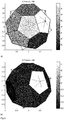
- Fig.4 shows a test signal B g transformed to the spatial domain.
- the default sampling grid was used
- the rotated grid of the aDSHT was used.
- Related ⁇ W Sd values (in dB) of the spatial channels are shown by the colors/grey variation of the Voronoi cells around the corresponding sample positions.
- Each cell of the spatial structure represents a sampling point, and the lightness/darkness of the cell represents a signal strength.
- a strongest source direction was found and the sampling grid was rotated such that one of the sides (i.e. a single spatial sample position) matches the strongest source direction.
- the following describes the main building blocks of the aDSHT used within the compression encoder and decoder.
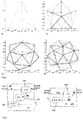
- Fig.5 shows examples of basic grids.
- Input to the rotation finding block (building block 'find best rotation' ) 320 is the coefficient matrix B .
- the building block is responsible to rotate the basis sampling grid such that the value of eq.(57) is minimized.
- the rotation is represented by the 'axis-angle' representation and compressed axis ⁇ rot and rotation angle ⁇ rot related to this rotation are output to this building block as side information SI.
- the rotation axis ⁇ rot can be described by a unit vector from the origin to a position on the unit sphere.
- ⁇ rot [ ⁇ axis , ⁇ axis ] T , with an implicit related radius of one which does not need to be transmitted
- ⁇ rot [ ⁇ axis , ⁇ axis ] T
- the three angles ⁇ axis , ⁇ axis , ⁇ rot are quantized and entropy coded with a special escape pattern that signals the reuse of previously used values to create side information SI.
- the first embodiment makes use of a single aDSHT.
- the second embodiment makes use of multiple aDSHTs in spectral bands.
- the first ("basic") embodiment is shown in Fig.7 .
- the HOA time samples with index m of O 3D coefficient channels b ( m ) are first stored in a buffer 71 to form blocks of M samples and time index ⁇ .
- B ( ⁇ ) is transformed to the spatial domain using the adaptive iDSHT in building block pE 72 as described above.
- the spatial signal block W Sd ( ⁇ ) is input to L Sd Audio Compression mono encoders 73, like AAC or mp3 encoders, or a single AAC multichannel encoder ( L Sd channels).
- the bitstream S73 consists of multiplexed frames of multiple encoder bitstream frames with integrated side information SI or a single multichannel bitstream where side information SI is integrated, preferable as auxiliary data.
- a respective compression decoder building block comprises, in one embodiment, demultiplexer D1 for demultiplexing the bitstream S73 to L Sd bitstreams and side information SI, and feeding the bitstreams to L Sd mono decoders, decoding them to L Sd spatial Audio channels with M samples to form block ⁇ Sd ( ⁇ ), and feeding ⁇ Sd ( ⁇ ) and SI to pD.
- a compression decoder building block comprises a receiver 74 for receiving the bitstream and decoding it to a L Sd multichannel signal ⁇ Sd ( ⁇ ), depacking SI and feeding ⁇ Sd ( ⁇ ) and SI to pD.
- ⁇ Sd ( ⁇ ) is transformed using the adaptive DSHT with SI in the decoder processing block pD 75 to the coefficient domain to form a block of HOA signals B ( ⁇ ), which are stored in a buffer 76 to be deframed to form a time signal of coefficients b(m).
- the above-described first embodiment may have, under certain conditions, two drawbacks: First, due to changes of spatial signal distribution there can be blocking artifacts from a previous block (i.e. from block ⁇ to ⁇ + 1). Second, there can be more than one strong signals at the same time and the de-correlation effects of the aDSHT are quite small. Both drawbacks are addressed in the second embodiment, which operates in the frequency domain.
- the aDSHT is applied to scale factor band data, which combine multiple frequency band data.
- the blocking artifacts are avoided by the overlapping blocks of the Time to Frequency Transform (TFT) with Overlay Add (OLA) processing.
- TFT Time to Frequency Transform
- OVA Overlay Add
- Each coefficient channel of the signal b(m) is subject to a Time to Frequency Transform (TFT) 912.
- TFT Time to Frequency Transform
- MDCT Modified Cosine Transform
- a TFT block transform unit 912 performs a block transform.
- a Spectral Banding unit 913 the TFT frequency bands are combined to form J new spectral bands and related signals B j ( ⁇ ) ⁇ , where K J denotes the number of frequency coefficients in band j.
- These spectral bands are processed in a plurality of processing blocks 914. For each of these spectral bands, there is one processing block pE j that creates signals W j Sd ⁇ ⁇ C L sd ⁇ K j and side information SI j .
- the spectral bands may match the spectral bands of the lossy audio compression method (like AAC/mp3 scale-factor bands), or have a more coarse granularity.
- the decoder receives or stores the bitstream (at least portions thereof), depacks 921 it and feeds the audio data to the multichannel audio decoder 922 for Channel-independent Audio decoding without TFT, and the side information SI j to a plurality of decoding processing blocks pD j 923.
- the audio decoder 922 for channel independent Audio decoding without TFT decodes the audio information and formats the J spectral band signals ⁇ j Sd ( ⁇ ) as an input to the decoding processing blocks pD j 923, where these signals are transformed to the HOA coefficient domain to form B ⁇ j ( ⁇ ).
- the J spectral bands are regrouped to match the banding of the TFT.
- iTFT & OLA block 925 which uses block overlapping Overlay Add (OLA) processing.
- OLA block overlapping Overlay Add
- the output of the iTFT & OLA block 925 is de-framed in a TFT Deframing block 926 to create the signal b ⁇ ( m ).
- the present invention is based on the finding that the SNR increase results from cross-correlation between channels.
- the perceptual coders only consider coding noise masking effects that occur within each individual single-channel signals. However, such effects are typically non-linear. Thus, when matrixing such single channels into new signals, noise unmasking is likely to occur. This is the reason why coding noise is normally increased after the matrixing operation.
- the invention proposes a decorrelation of the channels by an adaptive Discrete Spherical Harmonics Transform (aDSHT) that minimizes the unwanted noise unmasking effects.
- the aDSHT is integrated within the compressive coder and decoder architecture. It is adaptive since it includes a rotation operation that adjusts the spatial sampling grid of the DSHT to the spatial properties of the HOA input signal.
- the aDSHT comprises the adaptive rotation and an actual, conventional DSHT.
- the actual DSHT is a matrix that can be constructed as described in the prior art.
- the adaptive rotation is applied to the matrix, which leads to a minimization of inter-channel correlation, and therefore minimization of SNR increase after the matrixing.
- the rotation axis and angle are found by an automized search operation, not analytically.
- the rotation axis and angle are encoded and transmitted, in order to enable re-correlation after decoding and before matrixing, wherein inverse adaptive DSHT (iaDSHT) is used.
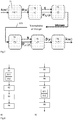
- Fig.8 a shows a flow-chart of a method for encoding multi-channel HOA audio signals for noise reduction in one embodiment of the invention.
- Fig.8 b shows a flow-chart of a method for decoding multi-channel HOA audio signals for noise reduction in one embodiment of the invention.
- the inverse adaptive DSHT comprises steps of selecting an initial default spherical sample grid, determining a strongest source direction, and rotating, for a block of M time samples, the spherical sample grid such that a single spatial sample position matches the strongest source direction.
- a method for decoding coded multi-channel HOA audio signals with reduced noise comprises steps of receiving 85 encoded multi-channel HOA audio signals and channel rotation information (within side information SI), decompressing 86 the received data, wherein perceptual decoding is used, spatially decoding 87 each channel using an adaptive DSHT, wherein a DSHT 872 and a rotation 871 of a spatial sampling grid of the DSHT according to said rotation information are performed and wherein the perceptually decoded channels are recorrelated, and matrixing 88 the recorrelated perceptually decoded channels, wherein reproducible audio signals mapped to loudspeaker positions are obtained.
- the adaptive DSHT comprises steps of selecting an initial default spherical sample grid for the adaptive DSHT and rotating, for a block of M time samples, the spherical sample grid according to said rotation information.
- the rotation information is a spatial vector ⁇ rot with three components. Note that the rotation axis ⁇ rot can be described by a unit vector.
- the rotation information is a vector composed out of 3 angles: ⁇ axis , ⁇ axis , ⁇ rot , where ⁇ axis , ⁇ axis define the information for the rotation axis with an implicit radius of one in spherical coordinates, and ⁇ rot defines the rotation angle around this axis.
- the angles are quantized and entropy coded with an escape pattern (i.e. dedicated bit pattern) that signals (i.e. indicates) the reuse of previous values for creating side information (SI).
- an apparatus for encoding multi-channel HOA audio signals for noise reduction comprises a decorrelator for decorrelating the channels using an inverse adaptive DSHT, the inverse adaptive DSHT comprising a rotation operation and an inverse DSHT (iDSHT), with the rotation operation rotating the spatial sampling grid of the iDSHT; a perceptual encoder for perceptually encoding each of the decorrelated channels, a side information encoder for encoding rotation information, with the rotation information comprising parameters defining said rotation operation, and an interface for transmitting or storing the perceptually encoded audio channels and the encoded rotation information.
- iDSHT inverse DSHT
- the adaptive DSHT in the apparatus for decoding comprises means for selecting an initial default spherical sample grid for the adaptive DSHT; rotation processing means for rotating, for a block of M time samples, the default spherical sample grid according to said rotation information; and transform processing means for performing the DSHT on the rotated spherical sample grid.
- the correlator 34 in the apparatus for decoding comprises a plurality of spatial decoding units 922 for simultaneously spatially decoding each channel using an adaptive DSHT, further comprising a spectral debanding unit 924 for performing spectral debanding, and an iTFT&OLA unit 925 for performing an inverse Time to Frequency Transform with Overlay Add processing, wherein the spectral debanding unit provides its output to the iTFT&OLA unit.
- Tab.1 provides a direct comparison between the aDSHT and the KLT. Although some similarities exist, the aDSHT provides significant advantages over the KLT.
- the transform matrix is the inverse mode matrix of a rotated spherical grid.
- the transform matrix is derived from the signal B for every processing block.
- Side Info to transmit axis ⁇ rot and rotation angle ⁇ rot for example coded as 3 values: ⁇ axis , ⁇ aXis , ⁇ rot More than half of the elements of C (that is, N + 1 4 + N + 1 2 2 values) or K (that is, (N + 1) 4 values) Lossy decompressed spatial signal
- the spatial signals are lossy coded, (coding noise E cod ) .
Landscapes
- Engineering & Computer Science (AREA)
- Physics & Mathematics (AREA)
- Signal Processing (AREA)
- Acoustics & Sound (AREA)
- Multimedia (AREA)
- Human Computer Interaction (AREA)
- Audiology, Speech & Language Pathology (AREA)
- Health & Medical Sciences (AREA)
- Computational Linguistics (AREA)
- Mathematical Physics (AREA)
- Mathematical Analysis (AREA)
- Theoretical Computer Science (AREA)
- Pure & Applied Mathematics (AREA)
- Mathematical Optimization (AREA)
- General Physics & Mathematics (AREA)
- Algebra (AREA)
- Spectroscopy & Molecular Physics (AREA)
- Stereophonic System (AREA)
- Compression, Expansion, Code Conversion, And Decoders (AREA)
Abstract
Description
- This application is a European divisional application of European patent application
EP 17205327.4 - This invention relates to a method and an apparatus for encoding multi-channel Higher Order Ambisonics audio signals for noise reduction, and to a method and an apparatus for decoding multi-channel Higher Order Ambisonics audio signals for noise reduction.
- Higher Order Ambisonics (HOA) is a multi-channel sound field representation [4], and HOA signals are multi-channel audio signals. The playback of certain multi-channel audio signal representations, particularly HOA representations, on a particular loudspeaker set-up requires a special rendering, which usually consists of a matrixing operation. After decoding, the Ambisonics signals are "matrixed", i.e. mapped to new audio signals corresponding to actual spatial positions, e.g. of loudspeakers. Usually there is a high cross-correlation between the single channels.
- A problem is that it is experienced that coding noise is increased after the matrixing operation. The reason appears to be unknown in the prior art. This effect also occurs when the HOA signals are transformed to the spatial domain, e.g. by a Discrete Spherical Harmonics Transform (DSHT), prior to compression with perceptual coders.
- A usual method for the compression of Higher Order Ambisonics audio signal representations is to apply independent perceptual coders to the individual Ambisonics coeffcient channels [7]. In particular, the perceptual coders only consider coding noise masking effects which occur within each individual single-channel signals. However, such effects are typically non-linear. If matrixing such single-channels into new signals, noise unmasking is likely to occur. This effect also occurs when the Higher Order Ambisonics signals are transformed to the spatial domain by the Discrete Spherical Harmonics Transform prior to compression with perceptual coders [8].
- The transmission or storage of such multi-channel audio signal representations usually demands for appropriate multi-channel compression techniques. Usually, a channel independent perceptual decoding is performed before finally matrixing the I decoded signals


The particular individual loudspeaker set-up on which the matrix depends, and thus the maxtrix that is used for matrixing during the rendering, is usually not known at the perceptual coding stage. - The present invention provides an improvement to encoding and/or decoding multi-channel Higher Order Ambisonics audio signals so as to obtain noise reduction. In particular, the invention provides a way to suppress coding noise demasking for 3D audio rate compression.
The invention describes technologies for an adaptive Discrete Spherical Harmonics Transform (aDSHT) that minimizes noise unmasking effects (which are unwanted). Further, it is described how the aDSHT can be integrated within a compressive coder architecture. The technology described is particularly advantageous at least for HOA signals. One advantage of the invention is that the amount of side information to be transmitted is reduced. In principle, only a rotation axis and a rotation angle need to be transmitted. The DSHT sampling grid can be indirectly signaled by the number of channels transmitted. This amount of side information is very small compared to other approaches like the Karhunen Loève transform (KLT) where more than half of the correlation matrix needs to be transmitted.
According to one embodiment of the invention, a method for encoding multi-channel HOA audio signals for noise reduction comprises steps of decorrelating the channels using an inverse adaptive DSHT, the inverse adaptive DSHT comprising a rotation operation and an inverse DSHT (iDSHT), with the rotation operation rotating the spatial sampling grid of the iDSHT, perceptually encoding each of the decorrelated channels, encoding rotation information, the rotation information comprising parameters defining said rotation operation, and transmitting or storing the perceptually encoded audio channels and the encoded rotation information. The step of decorrelating the channels using an inverse adaptive DSHT is in principle a spatial encoding step. - According to one embodiment of the invention, a method for decoding coded multi-channel HOA audio signals with reduced noise comprises steps of receiving encoded multi-channel HOA audio signals and channel rotation information, decompressing the received data, wherein perceptual decoding is used, spatially decoding each channel using an adaptive DSHT (aDSHT), correlating the perceptually and spatially decoded channels, wherein a rotation of a spatial sampling grid of the aDSHT according to said rotation information is performed, and matrixing the correlated perceptually and spatially decoded channels, wherein reproducible audio signals mapped to loudspeaker positions are obtained.
- An apparatus for encoding multi-channel HOA audio signals is disclosed in claim 11. An apparatus for decoding multi-channel HOA audio signals is disclosed in claim 12.
In one aspect, a computer readable medium has executable instructions to cause a computer to perform a method for encoding comprising steps as disclosed above, or to perform a method for decoding comprising steps as disclosed above. Advantageous embodiments of the invention are disclosed in the dependent claims, the following description and the figures. - Exemplary embodiments of the invention are described with reference to the accompanying drawings, which show in
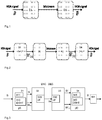
- Fig.1
- a known encoder and decoder for rate compressing a block of M coefficients;
- Fig.2
- a known encoder and decoder for transforming a HOA signal into the spatial domain using a conventional DSHT (Discrete Spherical Harmonics Transform) and conventional inverse DSHT;
- Fig.3
- an encoder and decoder for transforming a HOA signal into the spatial domain using an adaptive DSHT and adaptive inverse DSHT;
- Fig.4
- a test signal;
- Fig.5
- examples of spherical sampling positions for a codebook used in encoder and decoder building blocks;
- Fig.6
- signal adaptive DSHT building blocks (pE and pD),
- Fig.7
- a first embodiment of the present invention;
- Fig.8
- flow-charts of an encoding process and a decoding process; and
- Fig.9
- a second embodiment of the present invention.
-
Fig.2 shows a known system where a HOA signal is transformed into the spatial domain using an inverse DSHT. The signal is subject to transformation using iDSHT 21, rate compression E1 / decompression D1, and re-transformed to the coefficient domain S24 using theDSHT 24. Different from that,Fig.3 shows a system according to one embodiment of the present invention: The DSHT processing blocks of the known solution are replaced byprocessing blocks - In one embodiment, an apparatus ENC for encoding multi-channel HOA audio signals for noise reduction includes a
decorrelator 31 for decorrelating the channels B using an inverse adaptive DSHT (iaDSHT), the inverse adaptive DSHT including arotation operation unit 311 and an inverse DSHT (iDSHT) 310. The rotation operation unit rotates the spatial sampling grid of the iDSHT. Thedecorrelator 31 provides decorrelated channels Wsd and side information SI that includes rotation information. Further, the apparatus includes aperceptual encoder 32 for perceptually encoding each of the decorrelated channels Wsd , and a side information encoder 321 for encoding rotation information. The rotation information comprises parameters defining said rotation operation. Theperceptual encoder 32 provides perceptually encoded audio channels and the encoded rotation information, thus reducing the data rate. Finally, the apparatus for encoding comprises interface means 320 for creating a bitstream bs from the perceptually encoded audio channels and the encoded rotation information and for transmitting or storing the bitstream bs. - An apparatus DEC for decoding multi-channel HOA audio signals with reduced noise, includes interface means 330 for receiving encoded multi-channel HOA audio signals and channel rotation information, and a
decompression module 33 for decompressing the received data, which includes a perceptual decoder for perceptually decoding each channel. Thedecompression module 33 provides recovered perceptually decoded channels W'sd and recovered side information SI'. Further, the apparatus for decoding includes acorrelator 34 for correlating the perceptually decoded channels W'sd using an adaptive DSHT (aDSHT), wherein a DSHT and a rotation of a spatial sampling grid of the DSHT according to said rotation information are performed, and a mixer MX for matrixing the correlated perceptually decoded channels, wherein reproducible audio signals mapped to loudspeaker positions are obtained. At least the aDSHT can be performed in aDSHT unit 340 within thecorrelator 34. In one embodiment, the rotation of the spatial sampling grid is done in agrid rotation unit 341, which in principle recalculates the original DSHT sampling points. In another embodiment, the rotation is performed within theDSHT unit 340. - In the following, a mathematical model that defines and describes unmasking is given. Assume a given discrete-time multichannel signal consisting of I channels xi (m) , i = 1,... ,I, where m denotes the time sample index. The individual signals may be real or complex valued. We consider a frame of M samples beginning at the time sample index m START + 1, in which the individual signals are assumed to be stationary. The corresponding samples are arranged within the matrix




- Now assume that the multi-channel signal frame is coded, thereby introducing coding error noise at reconstruction. Thus the matrix of the reconstructed frame samples, which is denoted by X̂ , is composed of the true sample matrix X and an coding noise component E according to


- Since it is assumed that each channel has been coded independently, the coding noise signals ei (m) can be assumed to be independent of each other for i = 1, ...,I. Exploiting this property and the assumption, that the noise signals are zero-mean, the empirical correlation matrix of the noise signals is given by a diagonal matrix as

- Here,


- From now on we consider the matrixing of the reconstructed signals into J new signals yj (m) , j = 1,...,J. Without introducing any coding error the sample matrix of the matrixed signals may be expressed by


- However, due to coding noise the sample matrix of the matrixed signals is given by


- Exploiting equation (11), the empirical correlation matrix of the matrixed noise-free signals can be formulated as

- Thus, the empirical power of the j-th matrixed noise-free signal, which is the j-th element on the diagonal of ΣY, may be written as


- Similarly, with equation (15) the empirical correlation matrix of the matrixed noise signals can be written as

- The empirical power of the j-th matrixed noise signal, which is the j-th element on the diagonal of ΣN, is given by

- Consequently, the empirical SNR of the matrixed signals, which is defined by


- By decomposing ΣX into its diagonal and non-diagonal component as



- From this expression it can be seen that this SNR is obtained from the predefined SNR, SNRx , by the multiplication with a term, which is dependent on the diagonal and non-diagonal component of the signal correlation matrix ΣX. In particular, the empirical SNR of the matrixed signals is equal to the predefined SNR if the signals xi (m) are uncorrelated to each other such that Σ X,NG becomes a zero matrix, i.e.,

j can be much lower than SNR x . This phenomenon is called herein noise unmasking at matrixing. - The following section gives a brief introduction to Higher Order Ambisonics (HOA) and defines the signals to be processed (data rate compression).
- Higher Order Ambisonics (HOA) is based on the description of a sound field within a compact area of interest, which is assumed to be free of sound sources. In that case the spatiotemporal behavior of the sound pressure p(t,x) at time t and position x = [r, θ, φ] T within the area of interest (in spherical coordinates) is physically fully determined by the homogeneous wave equation. It can be shown that the Fourier transform of the sound pressure with respect to time, i.e.,
 corresponds to


- In equation (32), cs denotes the speed of sound and k = ω/cs the angular wave number. Further, j n(·) indicate the spherical Bessel functions of the first kind and order n and


- It should be noted that the SHs are complex valued functions in general. However, by an appropriate linear combination of them, it is possible to obtain real valued functions and perform the expansion with respect to these functions.
- Related to the pressure sound field description in equation (32), a source field can be defined as:


1 We use positive frequencies and the spherical Hankel function of second kind
- Signals in the HOA domain can be represented in frequency domain or in time domain as the inverse Fourier transform of the source field or sound field coefficients. The following description will assume the use of a time domain representation of source field coefficients:


- Two dimensional representations of sound fields can be derived by an expansion with circular harmonics. This is can be seen as a special case of the general description presented above using a fixed inclination of θ = π / 2, different weighting of coefficients and a reduced set to O2D coefficients (m = ±n). Thus all of the following considerations also apply to 2D representations, the term sphere then needs to be substituted by the term circle.
- The following describes a transform from HOA coefficient domain to a spatial, channel based, domain and vice versa. Equation (33) can be rewritten using time domain HOA coefficients for l discrete spatial sample positions Ω l = [θl , φl ] T on the unit sphere:

- Assuming Lsd = (N + 1)2 spherical sample positions Ω l , this can be rewritten in vector notation for a HOA data block B :


sd ] H with vectors yl =


- Equation (38) transforms Lsd spherical signals into the coefficient domain and can be rewritten as a forward transform:


- This definition of the Discrete Spherical Harmonics Transform is sufficient for the considerations regarding data rate compression of HOA data here because we start with coefficients B given and only the case B = DSHT {iDSHT{B}} is of interest. A more strict definition of the Discrete Spherical Harmonics Transform, is given within [2]. Suitable spherical sample positions for the DSHT and procedures to derive such positions can be reviewed in [3], [4], [6], [5]. Examples of sampling grids are shown in
Fig.5 . - In particular,
Fig.5 shows examples of spherical sampling positions for a codebook used in encoder and decoder building blocks pE, pD, namely inFig.5 a) for Lsd =4 , inFig.5 b) for Lsd =9, inFig.5 c) for Lsd =16 and inFig.5 d) for Lsd = 25. - In the following, rate compression of Higer Order Ambisonics coefficient data and noise unmasking is described. First, a test signal is defined to highlight some properties, which is used below.
- A single far field source located at direction Ω s
1 is represented by a vector g = [g(m), ... , g(M)] T of M discrete time samples and can be represented by a block of HOA coefficients by encoding:

1 = [θ s1 , φ s1 ] T (if real valued SH are used the conjugation has no effect). The test signal B g can be seen as the simplest case of an HOA signal. More complex signals consist of a superposition of many of such signals. - Concerning direct compression of HOA channels, the following shows why noise unmasking occurs when HOA coefficient channels are compressed. Direct compression and decompression of the O3D coefficient channels of an actual block of HOA data B will introduce coding noise E analogous to equation (4):

- We assume a constant SNRB
g as in equation (9). To replay this signal over loudspeakers the signal needs to be rendered. This process can be described by:



- As the decoding matrix A should not be influenced, because it should be possible to decode to arbitrary speaker layouts, the matrix Σ B needs to become diagonal to obtain SNRw
l = SNRBg . With equations (45) and (49), ( B = B g ) Σ B = y g H g y H = c yy H becomes non diagonal with constant scalar value c = g T g. Compared to SNRBg the signal to noise ratio at the speaker channels SNRwl decreases. But since neither the source signal g nor the speaker layout are usually known at the encoding stage, a direct lossy compression of coefficient channels can lead to uncontrollable unmasking effects especially for low data rates. - The following describes why noise unmasking occurs when HOA coefficients are compressed in the spatial domain after using the DSHT.
- The current block of HOA coefficient data B is transformed into the spatial domain prior to compression using the Spherical Harmonics Transform as given in equation (36):


- This signals are rendered to L speakers signals


- Here A becomes a mixing matrix with


Sd ,NG holding the non diagonal elements of
- Because there is no way to influence A D (since it should be possible to render to any loudspeaker layout) and thus no way to have any influence on A, Σ W
Sd needs to become near diagonal to keep the desired SNR: Using the simple test signal from equation (45) ( B = B g ), Σ WSd becomes
Sd can only become diagonal in very rare cases and worse, as described above, theterm 
- A basic idea of the present invention is to minimize noise unmasking effects by using an adaptive DSHT (aDSHT), which is composed of a rotation of the spatial sampling grid of the DSHT related to the spatial properties of the HOA input signal, and the DSHT itself.
- A signal adaptive DSHT (aDSHT) with a number of spherical positions LSd matching the number of HOA coefficients O3D, (36), is described below. First, a default spherical sample grid as in the conventional non-adaptive DSHT is selected. For a block of M time samples, the spherical sample grid is rotated such that the logarithm of the term


Sd (with matrix row index l and column index j) and
Sd . This is equal to minimizing the term
- Visualized, this process corresponds to a rotation of the spherical sampling grid of the DSHT in a way that a single spatial sample position matches the strongest source direction, as shown in
Fig.4 . Using the simple test signal from equation (45) (B = B g ), it can be shown that the term W Sd of equation (55) becomes a vector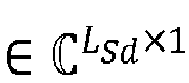
Sd becomes near diagonal and the desired SNR SNRSd can be kept. -
Fig.4 shows a test signal B g transformed to the spatial domain. InFig.4 a) , the default sampling grid was used, and inFig.4 b) , the rotated grid of the aDSHT was used. Related Σ WSd values (in dB) of the spatial channels are shown by the colors/grey variation of the Voronoi cells around the corresponding sample positions. Each cell of the spatial structure represents a sampling point, and the lightness/darkness of the cell represents a signal strength. As can be seen inFig.4 b) , a strongest source direction was found and the sampling grid was rotated such that one of the sides (i.e. a single spatial sample position) matches the strongest source direction. This side is depicted white (corresponding to strong source direction), while the other sides are dark (corresponding to low source direction). InFig.4 a) , i.e. before rotation, no side matches the strongest source direction, and several sides are more or less grey, which means that an audio signal of considerable (but not maximum) strength is received at the respective sampling point. - The following describes the main building blocks of the aDSHT used within the compression encoder and decoder.
- Details of the encoder and decoder processing building blocks pE and pD are shown in
Fig.6 . Both blocks own the same codebook of spherical sampling position grids that are the basis for the DSHT. Initially, the number of coefficients O3D is used to select a basis grid in module pE with LSd = O3D positions, according to the common codebook. LSd must be transmitted to block pD for initialization to select the same basis sampling position grid as indicated inFig.3 . The basis sampling grid is described by matrix
Fig.5 shows examples of basic grids. - Input to the rotation finding block (building block 'find best rotation') 320 is the coefficient matrix B . The building block is responsible to rotate the basis sampling grid such that the value of eq.(57) is minimized. The rotation is represented by the 'axis-angle' representation and compressed axis ψrot and rotation angle ϕ rot related to this rotation are output to this building block as side information SI. The rotation axis ψrot can be described by a unit vector from the origin to a position on the unit sphere. In spherical coordinates this can be articulated by two angles: ψrot = [θaxis,φaxis ] T, with an implicit related radius of one which does not need to be transmitted The three angles θaxis, φaxis, ϕ rot are quantized and entropy coded with a special escape pattern that signals the reuse of previously used values to create side information SI.
- The building block 'Build Ψ i' 330 decodes the rotation axis and angle to ψ̂rot and ϕ̂ rot and applies this rotation to the basis sampling gridto derive the rotated grid


- In the building Block 'iDSHT' 310, the actual block of HOA coefficient data B is transformed into the spatial domain by: W sd = Ψ i B
- The building block 'Build Ψ f' 350 of the decoding processing block pD receives and decodes the rotation axis and angle to ψ̂rot and ϕ̂ rot and applies this rotation to the basis sampling gridto derive the rotated grid


sd ] is derived with vectors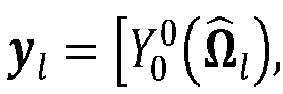

- In the building block 'DSHT' 340 within the
decoder processing block 34, the actual block of spatial domain data Ŵ Sd is transformed back into a block of coefficient domain data: B̂ = Ψ f Ŵ Sd. - In the following, various advantageous embodiments including overall architectures of compression codecs are described. The first embodiment makes use of a single aDSHT. The second embodiment makes use of multiple aDSHTs in spectral bands.
- The first ("basic") embodiment is shown in
Fig.7 . The HOA time samples with index m of O3D coefficient channels b (m) are first stored in abuffer 71 to form blocks of M samples and time index µ. B (µ) is transformed to the spatial domain using the adaptive iDSHT inbuilding block pE 72 as described above. The spatial signal block W Sd (µ) is input to LSd AudioCompression mono encoders 73, like AAC or mp3 encoders, or a single AAC multichannel encoder (LSd channels). The bitstream S73 consists of multiplexed frames of multiple encoder bitstream frames with integrated side information SI or a single multichannel bitstream where side information SI is integrated, preferable as auxiliary data. - A respective compression decoder building block comprises, in one embodiment, demultiplexer D1 for demultiplexing the bitstream S73 to LSd bitstreams and side information SI, and feeding the bitstreams to LSd mono decoders, decoding them to LSd spatial Audio channels with M samples to form block ŴSd (µ), and feeding Ŵ Sd (µ) and SI to pD. In another embodiment, where the bitstream is not multiplexed, a compression decoder building block comprises a
receiver 74 for receiving the bitstream and decoding it to a LSd multichannel signal Ŵ Sd (µ), depacking SI and feeding Ŵ Sd (µ) and SI to pD. - Ŵ Sd (µ) is transformed using the adaptive DSHT with SI in the decoder
processing block pD 75 to the coefficient domain to form a block of HOA signals B (µ), which are stored in abuffer 76 to be deframed to form a time signal of coefficients b(m). - The above-described first embodiment may have, under certain conditions, two drawbacks: First, due to changes of spatial signal distribution there can be blocking artifacts from a previous block (i.e. from block µ to µ + 1). Second, there can be more than one strong signals at the same time and the de-correlation effects of the aDSHT are quite small.
Both drawbacks are addressed in the second embodiment, which operates in the frequency domain. The aDSHT is applied to scale factor band data, which combine multiple frequency band data. The blocking artifacts are avoided by the overlapping blocks of the Time to Frequency Transform (TFT) with Overlay Add (OLA) processing. An improved signal de-correlation can be achieved by using the invention within J spectral bands at the cost of an increased overhead in data rate to transmit SIj.
Some more details of the second embodiment, as shown inFig.9 , are described in the following: Each coefficient channel of the signal b(m) is subject to a Time to Frequency Transform (TFT) 912. An example for a widely used TFT is the Modified Cosine Transform (MDCT). In aTFT Framing unit block transform unit 912 performs a block transform. In aSpectral Banding unit 913, the TFT frequency bands are combined to form J new spectral bands and related signals B j (µ) ∈, where KJ denotes the number of frequency coefficients in band j. These spectral bands are processed in a plurality of processing blocks 914. For each of these spectral bands, there is one processing block pEj that creates signals

TFT block 915 needs to rearrange the banding. Theprocessing block 914 acts like a Lsd multichannel audio encoder in frequency domain that allocates a constant bit-rate to each audio channel. A bitstream is formatted in abitstream packing block 916. - The decoder receives or stores the bitstream (at least portions thereof),
depacks 921 it and feeds the audio data to themultichannel audio decoder 922 for Channel-independent Audio decoding without TFT, and the side information SIj to a plurality of decoding processing blocks pDj 923.Theaudio decoder 922 for channel independent Audio decoding without TFT decodes the audio information and formats the J spectral band signals Ŵ jSd (µ) as an input to the decodingprocessing blocks pD j 923, where these signals are transformed to the HOA coefficient domain to form B̂ j(µ). In theSpectral debanding block 924, the J spectral bands are regrouped to match the banding of the TFT. They are transformed to the time domain in the iTFT &OLA block 925, which uses block overlapping Overlay Add (OLA) processing. Finally, the output of the iTFT &OLA block 925 is de-framed in a TFT Deframing block 926 to create the signal b̂ (m). - The present invention is based on the finding that the SNR increase results from cross-correlation between channels. The perceptual coders only consider coding noise masking effects that occur within each individual single-channel signals. However, such effects are typically non-linear. Thus, when matrixing such single channels into new signals, noise unmasking is likely to occur. This is the reason why coding noise is normally increased after the matrixing operation.
- The invention proposes a decorrelation of the channels by an adaptive Discrete Spherical Harmonics Transform (aDSHT) that minimizes the unwanted noise unmasking effects. The aDSHT is integrated within the compressive coder and decoder architecture. It is adaptive since it includes a rotation operation that adjusts the spatial sampling grid of the DSHT to the spatial properties of the HOA input signal. The aDSHT comprises the adaptive rotation and an actual, conventional DSHT. The actual DSHT is a matrix that can be constructed as described in the prior art. The adaptive rotation is applied to the matrix, which leads to a minimization of inter-channel correlation, and therefore minimization of SNR increase after the matrixing. The rotation axis and angle are found by an automized search operation, not analytically. The rotation axis and angle are encoded and transmitted, in order to enable re-correlation after decoding and before matrixing, wherein inverse adaptive DSHT (iaDSHT) is used.
- In one embodiment, Time-to-Frequency Transfrom (TFT) and spectral banding are performed, and the aDSHT/iaDSHT are applied to each spectral band independently.
-
Fig.8 a) shows a flow-chart of a method for encoding multi-channel HOA audio signals for noise reduction in one embodiment of the invention.Fig.8 b) shows a flow-chart of a method for decoding multi-channel HOA audio signals for noise reduction in one embodiment of the invention. - In an embodiment shown in
Fig.8 a) , a method for encoding multi-channel HOA audio signals for noise reduction comprises steps ofdecorrelating 81 the channels using an inverse adaptive DSHT, the inverse adaptive DSHT comprising a rotation operation and aninverse DSHT 812, with the rotation operation rotating 811 the spatial sampling grid of the iDSHT, perceptually encoding 82 each of the decorrelated channels, encoding 83 rotation information (as side information SI), the rotation information comprising parameters defining said rotation operation, and transmitting or storing 84 the perceptually encoded audio channels and the encoded rotation information. - In one embodiment, the inverse adaptive DSHT comprises steps of selecting an initial default spherical sample grid, determining a strongest source direction, and rotating, for a block of M time samples, the spherical sample grid such that a single spatial sample position matches the strongest source direction.
- In one embodiment, the spherical sample grid is rotated such that the logarithm of the term

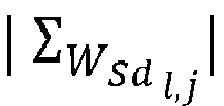
Sd (with matrix row index l and column index j) and
Sd , where
- In an embodiment shown in
Fig.8 b) , a method for decoding coded multi-channel HOA audio signals with reduced noise comprises steps of receiving 85 encoded multi-channel HOA audio signals and channel rotation information (within side information SI), decompressing 86 the received data, wherein perceptual decoding is used, spatially decoding 87 each channel using an adaptive DSHT, wherein a DSHT 872 and arotation 871 of a spatial sampling grid of the DSHT according to said rotation information are performed and wherein the perceptually decoded channels are recorrelated, andmatrixing 88 the recorrelated perceptually decoded channels, wherein reproducible audio signals mapped to loudspeaker positions are obtained. - In one embodiment, the adaptive DSHT comprises steps of selecting an initial default spherical sample grid for the adaptive DSHT and rotating, for a block of M time samples, the spherical sample grid according to said rotation information.
- In one embodiment, the rotation information is a spatial vector ψ̂ rot with three components. Note that the rotation axis ψ rot can be described by a unit vector.
- In one embodiment, the rotation information is a vector composed out of 3 angles: θaxis, φaxis, ϕ rot , where θaxis, φaxis define the information for the rotation axis with an implicit radius of one in spherical coordinates, and ϕ rot defines the rotation angle around this axis.
In one embodiment, the angles are quantized and entropy coded with an escape pattern (i.e. dedicated bit pattern) that signals (i.e. indicates) the reuse of previous values for creating side information (SI). - In one embodiment, an apparatus for encoding multi-channel HOA audio signals for noise reduction comprises a decorrelator for decorrelating the channels using an inverse adaptive DSHT, the inverse adaptive DSHT comprising a rotation operation and an inverse DSHT (iDSHT), with the rotation operation rotating the spatial sampling grid of the iDSHT; a perceptual encoder for perceptually encoding each of the decorrelated channels, a side information encoder for encoding rotation information, with the rotation information comprising parameters defining said rotation operation, and an interface for transmitting or storing the perceptually encoded audio channels and the encoded rotation information.
- In one embodiment, an apparatus for decoding multi-channel HOA audio signals with reduced noise comprises interface means 330 for receiving encoded multi-channel HOA audio signals and channel rotation information, a
decompression module 33 for decompressing the received data by using a perceptual decoder for perceptually decoding each channel, acorrelator 34 for re-correlating the perceptually decoded channels, wherein a DSHT and a rotation of a spatial sampling grid of the DSHT according to said rotation information are performed, and a mixer for matrixing the correlated perceptually decoded channels, wherein reproducible audio signals mapped to loudspeaker positions are obtained. In principle, the correlator 34 acts as a spatial decoder. - In one embodiment, an apparatus for decoding multi-channel HOA audio signals with reduced noise comprises interface means 330 for receiving encoded multi-channel HOA audio signals and channel rotation information;
decompression module 33 for decompressing the received data with a perceptual decoder for perceptually decoding each channel; acorrelator 34 for correlating the perceptually decoded channels using an aDSHT, wherein a DSHT and a rotation of a spatial sampling grid of the DSHT according to said rotation information is performed; and mixer MX for matrixing the correlated perceptually decoded channels, wherein reproducible audio signals mapped to loudspeaker positions are obtained. - In one embodiment, the adaptive DSHT in the apparatus for decoding comprises means for selecting an initial default spherical sample grid for the adaptive DSHT; rotation processing means for rotating, for a block of M time samples, the default spherical sample grid according to said rotation information; and transform processing means for performing the DSHT on the rotated spherical sample grid.
- In one embodiment, the
correlator 34 in the apparatus for decoding comprises a plurality ofspatial decoding units 922 for simultaneously spatially decoding each channel using an adaptive DSHT, further comprising aspectral debanding unit 924 for performing spectral debanding, and aniTFT&OLA unit 925 for performing an inverse Time to Frequency Transform with Overlay Add processing, wherein the spectral debanding unit provides its output to the iTFT&OLA unit. - In all embodiments, the term reduced noise relates at least to an avoidance of coding noise unmasking.
- Perceptual coding of audio signals means a coding that is adapted to the human perception of audio. It should be noted that when perceptually coding the audio signals, a quantization is usually performed not on the broadband audio signal samples, but rather in individual frequency bands related to the human perception. Hence, the ratio between the signal power and the quantization noise may vary between the individual frequency bands. Thus, perceptual coding usually comprises reduction of redundancy and/or irrelevancy information, while spatial coding usually relates to a spatial relation among the channels.
- The technology described above can be seen as an alternative to a decorrelation that uses the Karhunen-Loeve-Transformation (KLT). One advantage of the present invention is a strong reduction of the amount of side information, which comprises just three angles. The KLT requires the coefficients of a block correlation matrix as side information, and thus considerably more data. Further, the technology disclosed herein allows tweaking (or fine-tuning) the rotation in order to reduce transition artifacts when proceeding to the next processing block. This is beneficial for the compression quality of subsequent perceptual coding.
- Tab.1 provides a direct comparison between the aDSHT and the KLT. Although some similarities exist, the aDSHT provides significant advantages over the KLT.
Tab.1: Comparison of aDSHT vs. KLT sDSHT KLT Definition B is a N order HOA signal matrix, columns (time samples); W is a rows (channels), T columns (time (N + 1)2 rows (coefficients), T spatial matrix with (N + 1)2 samples) Encoder, spatial transform Inverse aDSHT Karhunen Loève transform W Sd = Ψ i B Wk = K B Transform Matrix A spherical regular sampling grid with (N + 1)2 spherical sample positions known to Build covariance matrix : C = BBH encoder and decoder is selected. This grid is rotated Eigenwert decomposition: C = KH Λ K, around axis ψ rot and rotation angle ϕ rot , which have been derived before (see remark below). A Mode-matrix Ψ f of that grid is created (i.e. spherical harmonics of these positions): Ψ i = Ψ f -1 (Or more general Ψi = Ψf + with ΨfΨi = I when the number of spatial channels becomes bigger than (N + 1)2) The transform matrix is the inverse mode matrix of a rotated spherical grid. The rotation is signal driven and updated every processing block with Eigen values diagonal in Λ and related Eigen vectors arranged in KH with KKH = 1 like in any orthogonal transform. The transform matrix is derived from the signal B for every processing block. Side Info to transmit axis ψ rot and rotation angle ϕ rot for example coded as 3 values: θaxis, φaXis, ϕ rot More than half of the elements of C (that is, 
values) or K (that is, (N + 1)4 values) Lossy decompressed spatial signal The spatial signals are lossy coded, (coding noise E cod ) . A block of T samples is arranges as Ŵ Sd The spatial signals are lossy coded (coding noise Êcod ). A block of T samples is arranges as Ŵ k Decoder, inverse spatial transform B̂ = Ψ f Ŵ Sd = B + Ψ f E cod B̂k = K Ŵ k = B + K Ê cod Remark In one embodiment, the grid is rotated such that a sampling position matches the strongest signal direction within B. An analysis of the covariance matrix can be used here, like it is usable for the KLT. In practice, since more simple and less computationally complex, signal tracking models can be used that also allow to adapt/modify the rotations smoothly from block to block, which avoids creation of blocking artifacts within the lossy (perceptual) coding blocks - While there has been shown, described, and pointed out fundamental novel features of the present invention as applied to preferred embodiments thereof, it will be understood that various omissions and substitutions and changes in the apparatus and method described, in the form and details of the devices disclosed, and in their operation, may be made by those skilled in the art without departing from the spirit of the present invention. It is expressly intended that all combinations of those elements that perform substantially the same function in substantially the same way to achieve the same results are within the scope of the invention. Substitutions of elements from one described embodiment to another are also fully intended and contemplated.
- It will be understood that the present invention has been described purely by way of example, and modifications of detail can be made without departing from the scope of the invention.
- Each feature disclosed in the description and (where appropriate) the claims and drawings may be provided independently or in any appropriate combination. Features may, where appropriate be implemented in hardware, software, or a combination of the two. Connections may, where applicable, be implemented as wireless connections or wired, not necessarily direct or dedicated, connections.
- Reference numerals appearing in the claims are by way of illustration only and shall have no limiting effect on the scope of the claims.
-
- [1] T.D. Abhayapala. Generalized framework for spherical microphone arrays: Spatial and frequency decomposition. In Proc. IEEE International Conference on Acoustics, Speech, and Signal Processing (ICASSP), (accepted) Vol. X, pp. , April 2008, Las Vegas, USA.
- [2] James R. Driscoll and Dennis M. Healy Jr. Computing fourier transforms and convolutions on the 2-sphere. Advances in Applied Mathematics, 15:202-250, 1994.
- [3] Jörg Fliege. Integration nodes for the sphere, http://www.personal.soton.ac.uk/jf1w07/nodes/nodes.html
- [4] Jörg Fliege and Ulrike Maier. A two-stage approach for computing cubature formulae for the sphere. Technical Report, Fachbereich Mathematik, Universität Dortmund, 1999.
- [5] R. H. Hardin and N. J. A. Sloane. Webpage: Spherical designs, spherical t-designs. http://www2.research.att.com/~njas/sphdesigns
- [6] R. H. Hardin and N. J. A. Sloane. Mclaren's improved snub cube and other new spherical designs in three dimensions. Discrete and Computational Geometry, 15:429-441, 1996.
- [7] Erik Hellerud, Ian Burnett, Audun Solvang, and U. Peter Svensson. Encoding higher order Ambisonics with AAC. In 124th AES Convention, Amsterdam, May 2008.
- [8] Peter Jax, Jan-Mark Batke, Johannes Boehm, and Sven Kordon. Perceptual coding of HOA signals in spatial domain. European patent application
EP2469741A1 (PD100051). - [9] Boaz Rafaely. Plane-wave decomposition of the sound field on a sphere by spherical convolution. J. Acoust. Soc. Am., 4(116):2149-2157, October 2004.
- [10] Earl G. Williams. Fourier Acoustics, volume 93 of Applied Mathematical Sciences. Academic Press, 1999.
- Various aspects of the present invention may be appreciated from the following enumerated example embodiments (EEEs):
- 1. A method for encoding multi-channel HOA audio signals for noise reduction, comprising steps of
- decorrelating (81) the channels using an inverse adaptive DSHT, the inverse adaptive DSHT comprising a rotation operation (811) and an inverse DSHT (812), with the rotation operation rotating the spatial sampling grid of the iDSHT;
- perceptually encoding (82) each of the decorrelated channels;
- encoding rotation information (83), the rotation information comprising parameters defining said rotation operation; and
- transmitting or storing (84) the perceptually encoded audio channels and the encoded rotation information.
- 2. Method according to
EEE 1, wherein the inverse adaptive DSHT performs steps of- selecting an initial default spherical sample grid;
- determining a strongest source direction; and
- rotating, for a block of M time samples, the spherical sample grid such that a single spatial sample position matches the strongest source direction.
- 3. Method according to
EEE 1 or 2, wherein the spherical sample grid is rotated such that the logarithm of the term

Sd (with matrix row index l and column index j) and
Sd , where
- 4. Method according to one of the EEEs 1-3, further comprising steps of
- constructing overlapping data blocks in a TFT framing unit (911),
- performing a Time-to-Frequency Transform (912) on the coefficients of each channel,
- combining in a Spectral Banding unit (913) the TFT frequency bands to form J new spectral bands,
- processing a plurality of the spectral bands simultaneously in a plurality of processing blocks (914), wherein each processing block performs an inverse adaptive DSHT, the inverse adaptive DSHT comprising a rotation operation and an inverse DSHT, wherein the rotation operation rotates the spatial sampling grid of the iDSHT, and
- performing a channel independent lossy audio compression without TFT (915).
- 5. A method for decoding coded multi-channel HOA audio signals with reduced noise, comprising steps of
- receiving (85) encoded multi-channel HOA audio signals and channel rotation information;
- decompressing (86) the received data, wherein perceptual decoding is used and perceptually decoded channels are obtained;
- spatially decoding (87) each perceptually decoded channel using an adaptive DSHT, wherein a DSHT (872) and a rotation (871) of a spatial sampling grid of the DSHT according to said rotation information are performed; and
- matrixing (88) the perceptually and spatially decoded channels, wherein reproducible audio signals mapped to loudspeaker positions are obtained.
- 6. Method according to EEE 5, wherein the adaptive DSHT comprises steps of
- selecting an initial default spherical sample grid for the adaptive DSHT;
- rotating, for a block of M time samples, the default spherical sample grid according to said rotation information; and
- performing the DSHT on the rotated spherical sample grid.
- 7. Method according to EEE 5 or 6, wherein the step of spatially decoding (87) each channel using an adaptive DSHT is done for all channels simultaneously in a plurality of spatial decoding units (922), further comprising steps of spectral debanding (924) and performing an inverse Time to Frequency Transform with Overlay Add processing (925).
- 8. Method according to any one of the EEEs 1-7, wherein the rotation information is a spatial vector ψ̂ rot with three components.
- 9. Method according to EEE 8, wherein the rotation information is composed of three angles: θaxis, φaxis, ϕ rot , where θaxis, φaxis define the information for the rotation axis with an implicit radius of one in spherical coordinates and ϕ rot defines the rotation angle around the rotation axis.
- 10. Method according to
EEE 9, wherein the angles are quantized and entropy coded with an escape pattern that signals the reuse of previously used values for creating side information (SI). - 11. An apparatus for encoding multi-channel HOA audio signals for noise reduction, comprising
- a decorrelator (31) for decorrelating the channels using an inverse adaptive DSHT, the inverse adaptive DSHT comprising a rotation operation unit (311) and an inverse DSHT (iDSHT), with the rotation operation rotating the spatial sampling grid of the iDSHT;
- perceptual encoder (32) for perceptually encoding each of the decorrelated channels;
- side information encoder (321) for encoding rotation information, the rotation information comprising parameters defining said rotation operation, and
- interface (320) for transmitting or storing the perceptually encoded audio channels and the encoded rotation information.
- 12. An apparatus for decoding multi-channel HOA audio signals with reduced noise, comprising
- interface means (330) for receiving encoded multi-channel HOA audio signals and channel rotation information;
- decompression module (33) for decompressing the received data with a perceptual decoder for perceptually decoding each channel;
- correlator (34) for correlating the perceptually decoded channels using an aDSHT, wherein a DSHT and a rotation of a spatial sampling grid of the DSHT according to said rotation information is performed; and
- mixer (MX) for matrixing the correlated perceptually decoded channels, wherein reproducible audio signals mapped to loudspeaker positions are obtained.
- 13. Apparatus according to EEE 12, wherein the adaptive DSHT comprises
- means for selecting an initial default spherical sample grid for the adaptive DSHT;
- rotation processing means for rotating, for a block of M time samples, the default spherical sample grid according to said rotation information; and
- transform processing means for performing the DSHT on the rotated spherical sample grid.
- 14. Apparatus according to EEE 12 or 13, wherein the correlator (34) comprises a plurality of spatial decoding units (922) for simultaneously spatially decoding each channel using an adaptive DSHT, further comprising a spectral debanding unit (924) for performing spectral debanding, and an iTFT&OLA unit (925) for performing an inverse Time to Frequency Transform with Overlay Add processing, wherein the spectral debanding unit provides its output to the iTFT&OLA unit.
Claims (8)
- A computer program having instructions which, when executed by a computing device or system, cause said computing device or system to perform a method for decoding coded multi-channel Higher Order Ambisonics (HOA) audio signals with reduced noise, comprising the steps of- receiving (85) encoded multi-channel HOA audio signals;- decompressing (86) the received data, wherein perceptual decoding is used and perceptually decoded channels W are obtained;- decoding (87) each perceptually decoded channel W from the spatial domain to the HOA coefficient domain according to:
 wherein ψ f is a matrix for which ψ f ψ i = I,wherein ψ i = [y 1,...,yL
sd ] H,wherein vectors
 wherein Ω l = [θl,φl ] T are discrete sample positions on a unit sphere that is rotated corresponding to channel rotation information; and- mapping the perceptually and spatially decoded channels B to reproducible audio signals mapped to loudspeaker positions.
 - The computer program according to claim 1, wherein the step of decoding (87) each channel is done for all channels simultaneously.
- The computer program according to claim 1 or claim 2, further comprising the steps of spectral debanding (924).
- The computer program according to any of the claims 1-3, further comprising performing an inverse Time to Frequency Transform with Overlay Add processing (925).
- The computer program according to any of the claims 1-3, wherein the channel rotation information comprises parameters defining a rotation operation.
- The computer program according to claim 5, wherein the parameters relate to an angle and an axis of rotation.
- The computer program according to claim 5, wherein the parameters relate a spatial vector with three components.
- A computer program having instructions which, when executed by a computing device or system, cause said computing device or system to perform a method for encoding multi-channel Higher Order Ambisonics (HOA) audio signals for noise reduction, comprising the steps of- decorrelating (81) the HOA channels B from the HOA coefficient domain into decorrelated channels W in a spatial domain according to:
 wherein ψ i = [y 1,...,yL
sd ] H,wherein vectors
 - perceptually encoding (82) each of the decorrelated channels;- encoding rotation information (83), the rotation information comprising parameters defining said rotation operation; and- transmitting or storing (84) the perceptually encoded audio channels and the encoded rotation information.
Priority Applications (1)
| Application Number | Priority Date | Filing Date | Title |
|---|---|---|---|
| EP25197841.7A EP4660999A1 (en) | 2012-07-16 | 2013-07-16 | Data rate compression of higher order ambisonics audio based on decorrelation by adaptive discrete spherical transform |
Applications Claiming Priority (4)
| Application Number | Priority Date | Filing Date | Title |
|---|---|---|---|
| EP12305861.2A EP2688066A1 (en) | 2012-07-16 | 2012-07-16 | Method and apparatus for encoding multi-channel HOA audio signals for noise reduction, and method and apparatus for decoding multi-channel HOA audio signals for noise reduction |
| PCT/EP2013/065032 WO2014012944A1 (en) | 2012-07-16 | 2013-07-16 | Method and apparatus for encoding multi-channel hoa audio signals for noise reduction, and method and apparatus for decoding multi-channel hoa audio signals for noise reduction |
| EP17205327.4A EP3327721B1 (en) | 2012-07-16 | 2013-07-16 | Data rate compression of higher order ambisonics audio based on decorrelation by adaptive discrete spherical transform |
| EP13740235.0A EP2873071B1 (en) | 2012-07-16 | 2013-07-16 | Method and apparatus for encoding multi-channel hoa audio signals for noise reduction, and method and apparatus for decoding multi-channel hoa audio signals for noise reduction |
Related Parent Applications (2)
| Application Number | Title | Priority Date | Filing Date |
|---|---|---|---|
| EP13740235.0A Division EP2873071B1 (en) | 2012-07-16 | 2013-07-16 | Method and apparatus for encoding multi-channel hoa audio signals for noise reduction, and method and apparatus for decoding multi-channel hoa audio signals for noise reduction |
| EP17205327.4A Division EP3327721B1 (en) | 2012-07-16 | 2013-07-16 | Data rate compression of higher order ambisonics audio based on decorrelation by adaptive discrete spherical transform |
Related Child Applications (1)
| Application Number | Title | Priority Date | Filing Date |
|---|---|---|---|
| EP25197841.7A Division EP4660999A1 (en) | 2012-07-16 | 2013-07-16 | Data rate compression of higher order ambisonics audio based on decorrelation by adaptive discrete spherical transform |
Publications (2)
| Publication Number | Publication Date |
|---|---|
| EP3813063A1 true EP3813063A1 (en) | 2021-04-28 |
| EP3813063B1 EP3813063B1 (en) | 2025-08-27 |
Family
ID=48874263
Family Applications (5)
| Application Number | Title | Priority Date | Filing Date |
|---|---|---|---|
| EP12305861.2A Withdrawn EP2688066A1 (en) | 2012-07-16 | 2012-07-16 | Method and apparatus for encoding multi-channel HOA audio signals for noise reduction, and method and apparatus for decoding multi-channel HOA audio signals for noise reduction |
| EP13740235.0A Active EP2873071B1 (en) | 2012-07-16 | 2013-07-16 | Method and apparatus for encoding multi-channel hoa audio signals for noise reduction, and method and apparatus for decoding multi-channel hoa audio signals for noise reduction |
| EP20208589.0A Active EP3813063B1 (en) | 2012-07-16 | 2013-07-16 | Data rate compression of higher order ambisonics audio based on decorrelation by adaptive discrete spherical transform |
| EP25197841.7A Pending EP4660999A1 (en) | 2012-07-16 | 2013-07-16 | Data rate compression of higher order ambisonics audio based on decorrelation by adaptive discrete spherical transform |
| EP17205327.4A Active EP3327721B1 (en) | 2012-07-16 | 2013-07-16 | Data rate compression of higher order ambisonics audio based on decorrelation by adaptive discrete spherical transform |
Family Applications Before (2)
| Application Number | Title | Priority Date | Filing Date |
|---|---|---|---|
| EP12305861.2A Withdrawn EP2688066A1 (en) | 2012-07-16 | 2012-07-16 | Method and apparatus for encoding multi-channel HOA audio signals for noise reduction, and method and apparatus for decoding multi-channel HOA audio signals for noise reduction |
| EP13740235.0A Active EP2873071B1 (en) | 2012-07-16 | 2013-07-16 | Method and apparatus for encoding multi-channel hoa audio signals for noise reduction, and method and apparatus for decoding multi-channel hoa audio signals for noise reduction |
Family Applications After (2)
| Application Number | Title | Priority Date | Filing Date |
|---|---|---|---|
| EP25197841.7A Pending EP4660999A1 (en) | 2012-07-16 | 2013-07-16 | Data rate compression of higher order ambisonics audio based on decorrelation by adaptive discrete spherical transform |
| EP17205327.4A Active EP3327721B1 (en) | 2012-07-16 | 2013-07-16 | Data rate compression of higher order ambisonics audio based on decorrelation by adaptive discrete spherical transform |
Country Status (7)
| Country | Link |
|---|---|
| US (4) | US9460728B2 (en) |
| EP (5) | EP2688066A1 (en) |
| JP (4) | JP6205416B2 (en) |
| KR (5) | KR20240091351A (en) |
| CN (6) | CN107403625B (en) |
| TW (4) | TWI602444B (en) |
| WO (1) | WO2014012944A1 (en) |
Families Citing this family (49)
| Publication number | Priority date | Publication date | Assignee | Title |
|---|---|---|---|---|
| EP2688066A1 (en) * | 2012-07-16 | 2014-01-22 | Thomson Licensing | Method and apparatus for encoding multi-channel HOA audio signals for noise reduction, and method and apparatus for decoding multi-channel HOA audio signals for noise reduction |
| CN104471641B (en) | 2012-07-19 | 2017-09-12 | 杜比国际公司 | Method and device for improving the rendering of multi-channel audio signals |
| EP2743922A1 (en) | 2012-12-12 | 2014-06-18 | Thomson Licensing | Method and apparatus for compressing and decompressing a higher order ambisonics representation for a sound field |
| US9769586B2 (en) | 2013-05-29 | 2017-09-19 | Qualcomm Incorporated | Performing order reduction with respect to higher order ambisonic coefficients |
| US9466305B2 (en) | 2013-05-29 | 2016-10-11 | Qualcomm Incorporated | Performing positional analysis to code spherical harmonic coefficients |
| US20150127354A1 (en) * | 2013-10-03 | 2015-05-07 | Qualcomm Incorporated | Near field compensation for decomposed representations of a sound field |
| EP2879408A1 (en) | 2013-11-28 | 2015-06-03 | Thomson Licensing | Method and apparatus for higher order ambisonics encoding and decoding using singular value decomposition |
| US9922656B2 (en) | 2014-01-30 | 2018-03-20 | Qualcomm Incorporated | Transitioning of ambient higher-order ambisonic coefficients |
| US9502045B2 (en) * | 2014-01-30 | 2016-11-22 | Qualcomm Incorporated | Coding independent frames of ambient higher-order ambisonic coefficients |
| KR102143037B1 (en) * | 2014-03-21 | 2020-08-11 | 돌비 인터네셔널 에이비 | Method for compressing a higher order ambisonics(hoa) signal, method for decompressing a compressed hoa signal, apparatus for compressing a hoa signal, and apparatus for decompressing a compressed hoa signal |
| EP2922057A1 (en) * | 2014-03-21 | 2015-09-23 | Thomson Licensing | Method for compressing a Higher Order Ambisonics (HOA) signal, method for decompressing a compressed HOA signal, apparatus for compressing a HOA signal, and apparatus for decompressing a compressed HOA signal |
| KR102144976B1 (en) | 2014-03-21 | 2020-08-14 | 돌비 인터네셔널 에이비 | Method for compressing a higher order ambisonics(hoa) signal, method for decompressing a compressed hoa signal, apparatus for compressing a hoa signal, and apparatus for decompressing a compressed hoa signal |
| EP2934025A1 (en) * | 2014-04-15 | 2015-10-21 | Thomson Licensing | Method and device for applying dynamic range compression to a higher order ambisonics signal |
| RU2658888C2 (en) | 2014-03-24 | 2018-06-25 | Долби Интернэшнл Аб | Method and device of the dynamic range compression application to the higher order ambiophony signal |
| CN103888889B (en) * | 2014-04-07 | 2016-01-13 | 北京工业大学 | A kind of multichannel conversion method based on spheric harmonic expansion |
| US9852737B2 (en) * | 2014-05-16 | 2017-12-26 | Qualcomm Incorporated | Coding vectors decomposed from higher-order ambisonics audio signals |
| US9620137B2 (en) | 2014-05-16 | 2017-04-11 | Qualcomm Incorporated | Determining between scalar and vector quantization in higher order ambisonic coefficients |
| US10770087B2 (en) * | 2014-05-16 | 2020-09-08 | Qualcomm Incorporated | Selecting codebooks for coding vectors decomposed from higher-order ambisonic audio signals |
| EP2960903A1 (en) | 2014-06-27 | 2015-12-30 | Thomson Licensing | Method and apparatus for determining for the compression of an HOA data frame representation a lowest integer number of bits required for representing non-differential gain values |
| CN119743722A (en) | 2014-06-27 | 2025-04-01 | 杜比国际公司 | Method and apparatus for decoding compressed HOA sound representations of sound or sound field |
| CN113793618B (en) * | 2014-06-27 | 2025-03-21 | 杜比国际公司 | Method for determining the minimum number of integer bits required to represent non-differential gain values for compression of HOA data frame representation |
| EP4730327A2 (en) | 2014-06-27 | 2026-04-22 | Dolby International AB | Apparatus for determining for the compression of an hoa data frame representation a lowest integer number of bits required for representing non-differential gain values |
| US9838819B2 (en) * | 2014-07-02 | 2017-12-05 | Qualcomm Incorporated | Reducing correlation between higher order ambisonic (HOA) background channels |
| EP2980789A1 (en) | 2014-07-30 | 2016-02-03 | Fraunhofer-Gesellschaft zur Förderung der angewandten Forschung e.V. | Apparatus and method for enhancing an audio signal, sound enhancing system |
| US9736606B2 (en) * | 2014-08-01 | 2017-08-15 | Qualcomm Incorporated | Editing of higher-order ambisonic audio data |
| US9747910B2 (en) | 2014-09-26 | 2017-08-29 | Qualcomm Incorporated | Switching between predictive and non-predictive quantization techniques in a higher order ambisonics (HOA) framework |
| US10140996B2 (en) * | 2014-10-10 | 2018-11-27 | Qualcomm Incorporated | Signaling layers for scalable coding of higher order ambisonic audio data |
| US9984693B2 (en) | 2014-10-10 | 2018-05-29 | Qualcomm Incorporated | Signaling channels for scalable coding of higher order ambisonic audio data |
| EP3007167A1 (en) * | 2014-10-10 | 2016-04-13 | Thomson Licensing | Method and apparatus for low bit rate compression of a Higher Order Ambisonics HOA signal representation of a sound field |
| EP3281196A1 (en) * | 2015-04-10 | 2018-02-14 | Thomson Licensing | Method and device for encoding multiple audio signals, and method and device for decoding a mixture of multiple audio signals with improved separation |
| US12087311B2 (en) * | 2015-07-30 | 2024-09-10 | Dolby Laboratories Licensing Corporation | Method and apparatus for encoding and decoding an HOA representation |
| WO2017085140A1 (en) * | 2015-11-17 | 2017-05-26 | Dolby International Ab | Method and apparatus for converting a channel-based 3d audio signal to an hoa audio signal |
| HK1221372A2 (en) * | 2016-03-29 | 2017-05-26 | 万维数码有限公司 | A method, apparatus and device for acquiring a spatial audio directional vector |
| EP3469590B1 (en) * | 2016-06-30 | 2020-06-24 | Huawei Technologies Duesseldorf GmbH | Apparatuses and methods for encoding and decoding a multichannel audio signal |
| GB2554446A (en) | 2016-09-28 | 2018-04-04 | Nokia Technologies Oy | Spatial audio signal format generation from a microphone array using adaptive capture |
| CN110892478A (en) * | 2017-04-28 | 2020-03-17 | Dts公司 | Audio codec window and transform implementation |
| JP7115477B2 (en) * | 2017-07-05 | 2022-08-09 | ソニーグループ株式会社 | SIGNAL PROCESSING APPARATUS AND METHOD, AND PROGRAM |
| US10944568B2 (en) * | 2017-10-06 | 2021-03-09 | The Boeing Company | Methods for constructing secure hash functions from bit-mixers |
| US10714098B2 (en) * | 2017-12-21 | 2020-07-14 | Dolby Laboratories Licensing Corporation | Selective forward error correction for spatial audio codecs |
| CN111210831B (en) * | 2018-11-22 | 2024-06-04 | 广州广晟数码技术有限公司 | Bandwidth extension audio encoding and decoding method and device based on spectrum stretching |
| BR112021014135A2 (en) | 2019-01-21 | 2021-09-21 | Fraunhofer-Gesellschaft zur Förderung der angewandten Forschung e.V. | ENCODED AUDIO SIGNAL, DEVICE AND METHOD FOR CODING A SPATIAL AUDIO REPRESENTATION OR DEVICE AND METHOD FOR DECODING AN ENCODED AUDIO SIGNAL |
| US11388416B2 (en) * | 2019-03-21 | 2022-07-12 | Qualcomm Incorporated | Video compression using deep generative models |
| US11729406B2 (en) | 2019-03-21 | 2023-08-15 | Qualcomm Incorporated | Video compression using deep generative models |
| US11902769B2 (en) | 2019-07-02 | 2024-02-13 | Dolby International Ab | Methods, apparatus and systems for representation, encoding, and decoding of discrete directivity data |
| CN110544484B (en) * | 2019-09-23 | 2021-12-21 | 中科超影(北京)传媒科技有限公司 | High-order Ambisonic audio coding and decoding method and device |
| US11317236B2 (en) * | 2019-11-22 | 2022-04-26 | Qualcomm Incorporated | Soundfield adaptation for virtual reality audio |
| CN110970048B (en) * | 2019-12-03 | 2023-01-17 | 腾讯科技(深圳)有限公司 | Audio data processing method and device |
| WO2022066313A1 (en) * | 2020-09-25 | 2022-03-31 | Apple Inc. | Higher order ambisonics encoding and decoding |
| CN115497485B (en) * | 2021-06-18 | 2024-10-18 | 华为技术有限公司 | Three-dimensional audio signal encoding method, device, encoder and system |
Citations (1)
| Publication number | Priority date | Publication date | Assignee | Title |
|---|---|---|---|---|
| EP2469741A1 (en) | 2010-12-21 | 2012-06-27 | Thomson Licensing | Method and apparatus for encoding and decoding successive frames of an ambisonics representation of a 2- or 3-dimensional sound field |
Family Cites Families (24)
| Publication number | Priority date | Publication date | Assignee | Title |
|---|---|---|---|---|
| JP2001275197A (en) * | 2000-03-23 | 2001-10-05 | Seiko Epson Corp | Sound source selection method, sound source selection device, and recording medium recording sound source selection control program |
| GB2379147B (en) * | 2001-04-18 | 2003-10-22 | Univ York | Sound processing |
| FR2847376B1 (en) * | 2002-11-19 | 2005-02-04 | France Telecom | METHOD FOR PROCESSING SOUND DATA AND SOUND ACQUISITION DEVICE USING THE SAME |
| DE10328777A1 (en) * | 2003-06-25 | 2005-01-27 | Coding Technologies Ab | Apparatus and method for encoding an audio signal and apparatus and method for decoding an encoded audio signal |
| JP2009514008A (en) * | 2005-10-26 | 2009-04-02 | エルジー エレクトロニクス インコーポレイティド | Multi-channel audio signal encoding and decoding method and apparatus |
| WO2007104882A1 (en) * | 2006-03-15 | 2007-09-20 | France Telecom | Device and method for encoding by principal component analysis a multichannel audio signal |
| DE602007011955D1 (en) * | 2006-09-25 | 2011-02-24 | Dolby Lab Licensing Corp | FOR MULTI-CHANNEL SOUND PLAY SYSTEMS BY LEADING SIGNALS WITH HIGH ORDER ANGLE SIZES |
| US20080232601A1 (en) * | 2007-03-21 | 2008-09-25 | Ville Pulkki | Method and apparatus for enhancement of audio reconstruction |
| FR2916079A1 (en) * | 2007-05-10 | 2008-11-14 | France Telecom | AUDIO ENCODING AND DECODING METHOD, AUDIO ENCODER, AUDIO DECODER AND ASSOCIATED COMPUTER PROGRAMS |
| FR2916078A1 (en) * | 2007-05-10 | 2008-11-14 | France Telecom | AUDIO ENCODING AND DECODING METHOD, AUDIO ENCODER, AUDIO DECODER AND ASSOCIATED COMPUTER PROGRAMS |
| WO2009081406A2 (en) * | 2007-12-26 | 2009-07-02 | Yissum, Research Development Company Of The Hebrew University Of Jerusalem | Method and apparatus for monitoring processes in living cells |
| EP2094032A1 (en) * | 2008-02-19 | 2009-08-26 | Deutsche Thomson OHG | Audio signal, method and apparatus for encoding or transmitting the same and method and apparatus for processing the same |
| PL2352147T3 (en) * | 2008-07-11 | 2014-02-28 | Fraunhofer Ges Forschung | An apparatus and a method for encoding an audio signal |
| EP2205007B1 (en) * | 2008-12-30 | 2019-01-09 | Dolby International AB | Method and apparatus for three-dimensional acoustic field encoding and optimal reconstruction |
| GB2467534B (en) * | 2009-02-04 | 2014-12-24 | Richard Furse | Sound system |
| FR2943867A1 (en) * | 2009-03-31 | 2010-10-01 | France Telecom | Three dimensional audio signal i.e. ambiophonic signal, processing method for computer, involves determining equalization processing parameters according to space components based on relative tolerance threshold and acquisition noise level |
| US9020152B2 (en) * | 2010-03-05 | 2015-04-28 | Stmicroelectronics Asia Pacific Pte. Ltd. | Enabling 3D sound reproduction using a 2D speaker arrangement |
| AU2011231565B2 (en) * | 2010-03-26 | 2014-08-28 | Dolby International Ab | Method and device for decoding an audio soundfield representation for audio playback |
| NZ587483A (en) * | 2010-08-20 | 2012-12-21 | Ind Res Ltd | Holophonic speaker system with filters that are pre-configured based on acoustic transfer functions |
| ES2922639T3 (en) * | 2010-08-27 | 2022-09-19 | Sennheiser Electronic Gmbh & Co Kg | Method and device for sound field enhanced reproduction of spatially encoded audio input signals |
| EP2450880A1 (en) * | 2010-11-05 | 2012-05-09 | Thomson Licensing | Data structure for Higher Order Ambisonics audio data |
| EP2560161A1 (en) * | 2011-08-17 | 2013-02-20 | Fraunhofer-Gesellschaft zur Förderung der angewandten Forschung e.V. | Optimal mixing matrices and usage of decorrelators in spatial audio processing |
| CN103165136A (en) * | 2011-12-15 | 2013-06-19 | 杜比实验室特许公司 | Audio processing method and audio processing device |
| EP2688066A1 (en) * | 2012-07-16 | 2014-01-22 | Thomson Licensing | Method and apparatus for encoding multi-channel HOA audio signals for noise reduction, and method and apparatus for decoding multi-channel HOA audio signals for noise reduction |
-
2012
- 2012-07-16 EP EP12305861.2A patent/EP2688066A1/en not_active Withdrawn
-
2013
- 2013-07-12 TW TW102125017A patent/TWI602444B/en active
- 2013-07-12 TW TW106123691A patent/TWI674009B/en active
- 2013-07-12 TW TW108124752A patent/TWI691214B/en active
- 2013-07-12 TW TW109108444A patent/TWI723805B/en active
- 2013-07-16 EP EP13740235.0A patent/EP2873071B1/en active Active
- 2013-07-16 KR KR1020247018653A patent/KR20240091351A/en active Pending
- 2013-07-16 JP JP2015522077A patent/JP6205416B2/en active Active
- 2013-07-16 CN CN201710829618.2A patent/CN107403625B/en active Active
- 2013-07-16 EP EP20208589.0A patent/EP3813063B1/en active Active
- 2013-07-16 CN CN201710829639.4A patent/CN107424618B/en active Active
- 2013-07-16 KR KR1020207017672A patent/KR102187936B1/en active Active
- 2013-07-16 EP EP25197841.7A patent/EP4660999A1/en active Pending
- 2013-07-16 WO PCT/EP2013/065032 patent/WO2014012944A1/en not_active Ceased
- 2013-07-16 CN CN201710829605.5A patent/CN107591159B/en active Active
- 2013-07-16 KR KR1020217041058A patent/KR20210156311A/en not_active Ceased
- 2013-07-16 CN CN201710829638.XA patent/CN107403626B/en active Active
- 2013-07-16 CN CN201710829636.0A patent/CN107591160B/en active Active
- 2013-07-16 CN CN201380036698.6A patent/CN104428833B/en active Active
- 2013-07-16 KR KR1020157000876A patent/KR102126449B1/en active Active
- 2013-07-16 KR KR1020207034592A patent/KR102340930B1/en active Active
- 2013-07-16 US US14/415,571 patent/US9460728B2/en active Active
- 2013-07-16 EP EP17205327.4A patent/EP3327721B1/en active Active
-
2016
- 2016-09-26 US US15/275,699 patent/US9837087B2/en active Active
-
2017
- 2017-08-24 US US15/685,252 patent/US10304469B2/en active Active
- 2017-09-04 JP JP2017169358A patent/JP6453961B2/en active Active
-
2018
- 2018-12-13 JP JP2018233042A patent/JP6676138B2/en active Active
-
2019
- 2019-05-20 US US16/417,480 patent/US10614821B2/en active Active
-
2020
- 2020-03-11 JP JP2020041510A patent/JP6866519B2/en active Active
Patent Citations (1)
| Publication number | Priority date | Publication date | Assignee | Title |
|---|---|---|---|---|
| EP2469741A1 (en) | 2010-12-21 | 2012-06-27 | Thomson Licensing | Method and apparatus for encoding and decoding successive frames of an ambisonics representation of a 2- or 3-dimensional sound field |
Non-Patent Citations (11)
| Title |
|---|
| BOAZ RAFAELY: "Plane-wave decomposition of the sound field on a sphere by spherical convolution", J. ACOUST. SOC. AM., vol. 4, no. 116, October 2004 (2004-10-01), pages 2149 - 2157 |
| EARL G. WILLIAMS.: "Mathematical Sciences", vol. 93, 1999, ACADEMIC PRESS, article "Fourier Acoustics" |
| ERIK HELLERUDIAN BURNETTAUDUN SOLVANGU. PETER SVENSSON: "Encoding higher order Ambisonics with AAC", 124TH AES CONVENTION, May 2008 (2008-05-01) |
| JAMES R: "Driscoll and Dennis M. Healy Jr. Computing fourier transforms and convolutions on the 2-sphere", ADVANCES IN APPLIED MATHEMATICS, vol. 15, 1994, pages 202 - 250 |
| JORG FLIEGE, INTEGRATION NODES FOR THE SPHERE, Retrieved from the Internet <URL:http://www.personal.soton.ac.uk/jf1w07/nodes/nodes.html> |
| JORG FLIEGEULRIKE MAIER: "Technical Report, Fachbereich Mathematik", 1999, UNIVERSITAT, article "A two-stage approach for computing cubature formulae for the sphere" |
| R. H. HARDINN. J. A. SLOANE, SPHERICAL DESIGNS, SPHERICAL T-DESIGNS, Retrieved from the Internet <URL:http://www2.research.att.com/-njas/sphdesigns> |
| R. H. HARDINN. J. A. SLOANE: "Mclaren's improved snub cube and other new spherical designs in three dimensions", DISCRETE AND COMPUTATIONAL GEOMETRY, vol. 15, 1996, pages 429 - 441 |
| T.D. ABHAYAPALA: "Generalized framework for spherical microphone arrays: Spatial and frequency decomposition", PROC. IEEE INTERNATIONAL CONFERENCE ON ACOUSTICS, SPEECH, AND SIGNAL PROCESSING (ICASSP), (ACCEPTED, vol. X, April 2008 (2008-04-01) |
| VÄÄNÄNEN ET AL: "Robustness Issues in Multi-View Audio Coding", AES CONVENTION 125; OCTOBER 2008, AES, 60 EAST 42ND STREET, ROOM 2520 NEW YORK 10165-2520, USA, 1 October 2008 (2008-10-01), XP040508860 * |
| YANG DAI ET AL: "An Inter-Channel Redundancy Removal Approach for High-Quality Multichannel Audio Compression", 22 September 2000 (2000-09-22), pages 1 - 14, XP002517098, Retrieved from the Internet <URL:http://www.aes.org/tmpFiles/elib/20090227/9100.pdf> [retrieved on 20000901] * |
Also Published As
Similar Documents
| Publication | Publication Date | Title |
|---|---|---|
| US10614821B2 (en) | Methods and apparatus for encoding and decoding multi-channel HOA audio signals | |
| HK40128533A (en) | Data rate compression of higher order ambisonics audio based on decorrelation by adaptive discrete spherical transform | |
| HK1242833B (en) | Method, apparatus and computer readable medium for decoding hoa audio signals | |
| HK1241130B (en) | Method, apparatus and computer readable medium for decoding hoa audio signals | |
| HK1241131B (en) | Method, apparatus and computer readable medium for decoding hoa audio signals | |
| HK1242834B (en) | Method, apparatus and computer readable medium for decoding hoa audio signals | |
| HK1242835B (en) | Method, apparatus and computer readable medium for decoding hoa audio signals | |
| HK1241130A1 (en) | Method, apparatus and computer readable medium for decoding hoa audio signals |
Legal Events
| Date | Code | Title | Description |
|---|---|---|---|
| PUAI | Public reference made under article 153(3) epc to a published international application that has entered the european phase |
Free format text: ORIGINAL CODE: 0009012 |
|
| STAA | Information on the status of an ep patent application or granted ep patent |
Free format text: STATUS: THE APPLICATION HAS BEEN PUBLISHED |
|
| AC | Divisional application: reference to earlier application |
Ref document number: 3327721 Country of ref document: EP Kind code of ref document: P Ref document number: 2873071 Country of ref document: EP Kind code of ref document: P |
|
| AK | Designated contracting states |
Kind code of ref document: A1 Designated state(s): AL AT BE BG CH CY CZ DE DK EE ES FI FR GB GR HR HU IE IS IT LI LT LU LV MC MK MT NL NO PL PT RO RS SE SI SK SM TR |
|
| STAA | Information on the status of an ep patent application or granted ep patent |
Free format text: STATUS: REQUEST FOR EXAMINATION WAS MADE |
|
| 17P | Request for examination filed |
Effective date: 20211028 |
|
| RBV | Designated contracting states (corrected) |
Designated state(s): AL AT BE BG CH CY CZ DE DK EE ES FI FR GB GR HR HU IE IS IT LI LT LU LV MC MK MT NL NO PL PT RO RS SE SI SK SM TR |
|
| RAP3 | Party data changed (applicant data changed or rights of an application transferred) |
Owner name: DOLBY INTERNATIONAL AB |
|
| RAP3 | Party data changed (applicant data changed or rights of an application transferred) |
Owner name: DOLBY INTERNATIONAL AB |
|
| STAA | Information on the status of an ep patent application or granted ep patent |
Free format text: STATUS: EXAMINATION IS IN PROGRESS |
|
| 17Q | First examination report despatched |
Effective date: 20230223 |
|
| P01 | Opt-out of the competence of the unified patent court (upc) registered |
Effective date: 20230418 |
|
| GRAP | Despatch of communication of intention to grant a patent |
Free format text: ORIGINAL CODE: EPIDOSNIGR1 |
|
| STAA | Information on the status of an ep patent application or granted ep patent |
Free format text: STATUS: GRANT OF PATENT IS INTENDED |
|
| INTG | Intention to grant announced |
Effective date: 20240531 |
|
| GRAJ | Information related to disapproval of communication of intention to grant by the applicant or resumption of examination proceedings by the epo deleted |
Free format text: ORIGINAL CODE: EPIDOSDIGR1 |
|
| STAA | Information on the status of an ep patent application or granted ep patent |
Free format text: STATUS: EXAMINATION IS IN PROGRESS |
|
| GRAP | Despatch of communication of intention to grant a patent |
Free format text: ORIGINAL CODE: EPIDOSNIGR1 |
|
| STAA | Information on the status of an ep patent application or granted ep patent |
Free format text: STATUS: GRANT OF PATENT IS INTENDED |
|
| INTC | Intention to grant announced (deleted) | ||
| INTG | Intention to grant announced |
Effective date: 20241009 |
|
| GRAJ | Information related to disapproval of communication of intention to grant by the applicant or resumption of examination proceedings by the epo deleted |
Free format text: ORIGINAL CODE: EPIDOSDIGR1 |
|
| STAA | Information on the status of an ep patent application or granted ep patent |
Free format text: STATUS: EXAMINATION IS IN PROGRESS |
|
| GRAP | Despatch of communication of intention to grant a patent |
Free format text: ORIGINAL CODE: EPIDOSNIGR1 |
|
| STAA | Information on the status of an ep patent application or granted ep patent |
Free format text: STATUS: GRANT OF PATENT IS INTENDED |
|
| INTC | Intention to grant announced (deleted) | ||
| INTG | Intention to grant announced |
Effective date: 20250307 |
|
| GRAS | Grant fee paid |
Free format text: ORIGINAL CODE: EPIDOSNIGR3 |
|
| GRAA | (expected) grant |
Free format text: ORIGINAL CODE: 0009210 |
|
| STAA | Information on the status of an ep patent application or granted ep patent |
Free format text: STATUS: THE PATENT HAS BEEN GRANTED |
|
| AC | Divisional application: reference to earlier application |
Ref document number: 3327721 Country of ref document: EP Kind code of ref document: P Ref document number: 2873071 Country of ref document: EP Kind code of ref document: P |
|
| AK | Designated contracting states |
Kind code of ref document: B1 Designated state(s): AL AT BE BG CH CY CZ DE DK EE ES FI FR GB GR HR HU IE IS IT LI LT LU LV MC MK MT NL NO PL PT RO RS SE SI SK SM TR |
|
| REG | Reference to a national code |
Ref country code: GB Ref legal event code: FG4D |
|
| REG | Reference to a national code |
Ref country code: CH Ref legal event code: EP |
|
| REG | Reference to a national code |
Ref country code: DE Ref legal event code: R096 Ref document number: 602013086999 Country of ref document: DE |
|
| REG | Reference to a national code |
Ref country code: IE Ref legal event code: FG4D |
|
| REG | Reference to a national code |
Ref country code: NL Ref legal event code: FP |
|
| PG25 | Lapsed in a contracting state [announced via postgrant information from national office to epo] |
Ref country code: IS Free format text: LAPSE BECAUSE OF FAILURE TO SUBMIT A TRANSLATION OF THE DESCRIPTION OR TO PAY THE FEE WITHIN THE PRESCRIBED TIME-LIMIT Effective date: 20251227 |
|
| PG25 | Lapsed in a contracting state [announced via postgrant information from national office to epo] |
Ref country code: NO Free format text: LAPSE BECAUSE OF FAILURE TO SUBMIT A TRANSLATION OF THE DESCRIPTION OR TO PAY THE FEE WITHIN THE PRESCRIBED TIME-LIMIT Effective date: 20251127 |
|
| REG | Reference to a national code |
Ref country code: LT Ref legal event code: MG9D |
|
| PG25 | Lapsed in a contracting state [announced via postgrant information from national office to epo] |
Ref country code: PT Free format text: LAPSE BECAUSE OF FAILURE TO SUBMIT A TRANSLATION OF THE DESCRIPTION OR TO PAY THE FEE WITHIN THE PRESCRIBED TIME-LIMIT Effective date: 20251229 |
|
| PG25 | Lapsed in a contracting state [announced via postgrant information from national office to epo] |
Ref country code: FI Free format text: LAPSE BECAUSE OF FAILURE TO SUBMIT A TRANSLATION OF THE DESCRIPTION OR TO PAY THE FEE WITHIN THE PRESCRIBED TIME-LIMIT Effective date: 20250827 |
|
| PG25 | Lapsed in a contracting state [announced via postgrant information from national office to epo] |
Ref country code: HR Free format text: LAPSE BECAUSE OF FAILURE TO SUBMIT A TRANSLATION OF THE DESCRIPTION OR TO PAY THE FEE WITHIN THE PRESCRIBED TIME-LIMIT Effective date: 20250827 |
|
| PG25 | Lapsed in a contracting state [announced via postgrant information from national office to epo] |
Ref country code: GR Free format text: LAPSE BECAUSE OF FAILURE TO SUBMIT A TRANSLATION OF THE DESCRIPTION OR TO PAY THE FEE WITHIN THE PRESCRIBED TIME-LIMIT Effective date: 20251128 |
|
| PG25 | Lapsed in a contracting state [announced via postgrant information from national office to epo] |
Ref country code: SE Free format text: LAPSE BECAUSE OF FAILURE TO SUBMIT A TRANSLATION OF THE DESCRIPTION OR TO PAY THE FEE WITHIN THE PRESCRIBED TIME-LIMIT Effective date: 20250827 |
|
| PG25 | Lapsed in a contracting state [announced via postgrant information from national office to epo] |
Ref country code: LV Free format text: LAPSE BECAUSE OF FAILURE TO SUBMIT A TRANSLATION OF THE DESCRIPTION OR TO PAY THE FEE WITHIN THE PRESCRIBED TIME-LIMIT Effective date: 20250827 |
|
| PG25 | Lapsed in a contracting state [announced via postgrant information from national office to epo] |
Ref country code: BG Free format text: LAPSE BECAUSE OF FAILURE TO SUBMIT A TRANSLATION OF THE DESCRIPTION OR TO PAY THE FEE WITHIN THE PRESCRIBED TIME-LIMIT Effective date: 20250827 Ref country code: PL Free format text: LAPSE BECAUSE OF FAILURE TO SUBMIT A TRANSLATION OF THE DESCRIPTION OR TO PAY THE FEE WITHIN THE PRESCRIBED TIME-LIMIT Effective date: 20250827 |
|
| PG25 | Lapsed in a contracting state [announced via postgrant information from national office to epo] |
Ref country code: RS Free format text: LAPSE BECAUSE OF FAILURE TO SUBMIT A TRANSLATION OF THE DESCRIPTION OR TO PAY THE FEE WITHIN THE PRESCRIBED TIME-LIMIT Effective date: 20251127 |
|
| PG25 | Lapsed in a contracting state [announced via postgrant information from national office to epo] |
Ref country code: ES Free format text: LAPSE BECAUSE OF FAILURE TO SUBMIT A TRANSLATION OF THE DESCRIPTION OR TO PAY THE FEE WITHIN THE PRESCRIBED TIME-LIMIT Effective date: 20250827 |
|
| REG | Reference to a national code |
Ref country code: AT Ref legal event code: MK05 Ref document number: 1830942 Country of ref document: AT Kind code of ref document: T Effective date: 20250827 |
|
| PG25 | Lapsed in a contracting state [announced via postgrant information from national office to epo] |
Ref country code: SM Free format text: LAPSE BECAUSE OF FAILURE TO SUBMIT A TRANSLATION OF THE DESCRIPTION OR TO PAY THE FEE WITHIN THE PRESCRIBED TIME-LIMIT Effective date: 20250827 |
|
| PG25 | Lapsed in a contracting state [announced via postgrant information from national office to epo] |
Ref country code: DK Free format text: LAPSE BECAUSE OF FAILURE TO SUBMIT A TRANSLATION OF THE DESCRIPTION OR TO PAY THE FEE WITHIN THE PRESCRIBED TIME-LIMIT Effective date: 20250827 |
|
| PG25 | Lapsed in a contracting state [announced via postgrant information from national office to epo] |
Ref country code: AT Free format text: LAPSE BECAUSE OF FAILURE TO SUBMIT A TRANSLATION OF THE DESCRIPTION OR TO PAY THE FEE WITHIN THE PRESCRIBED TIME-LIMIT Effective date: 20250827 |
|
| PG25 | Lapsed in a contracting state [announced via postgrant information from national office to epo] |
Ref country code: CZ Free format text: LAPSE BECAUSE OF FAILURE TO SUBMIT A TRANSLATION OF THE DESCRIPTION OR TO PAY THE FEE WITHIN THE PRESCRIBED TIME-LIMIT Effective date: 20250827 |
|
| PG25 | Lapsed in a contracting state [announced via postgrant information from national office to epo] |
Ref country code: EE Free format text: LAPSE BECAUSE OF FAILURE TO SUBMIT A TRANSLATION OF THE DESCRIPTION OR TO PAY THE FEE WITHIN THE PRESCRIBED TIME-LIMIT Effective date: 20250827 Ref country code: SK Free format text: LAPSE BECAUSE OF FAILURE TO SUBMIT A TRANSLATION OF THE DESCRIPTION OR TO PAY THE FEE WITHIN THE PRESCRIBED TIME-LIMIT Effective date: 20250827 |