EP3813000A1 - Method for implementing privacy protection in blockchain - Google Patents
Method for implementing privacy protection in blockchain Download PDFInfo
- Publication number
- EP3813000A1 EP3813000A1 EP19891559.7A EP19891559A EP3813000A1 EP 3813000 A1 EP3813000 A1 EP 3813000A1 EP 19891559 A EP19891559 A EP 19891559A EP 3813000 A1 EP3813000 A1 EP 3813000A1
- Authority
- EP
- European Patent Office
- Prior art keywords
- smart contract
- transaction
- blockchain node
- contract
- key
- Prior art date
- Legal status (The legal status is an assumption and is not a legal conclusion. Google has not performed a legal analysis and makes no representation as to the accuracy of the status listed.)
- Granted
Links
Images


Classifications
-
- G—PHYSICS
- G06—COMPUTING OR CALCULATING; COUNTING
- G06F—ELECTRIC DIGITAL DATA PROCESSING
- G06F21/00—Security arrangements for protecting computers, components thereof, programs or data against unauthorised activity
- G06F21/60—Protecting data
- G06F21/602—Providing cryptographic facilities or services
-
- G—PHYSICS
- G06—COMPUTING OR CALCULATING; COUNTING
- G06Q—INFORMATION AND COMMUNICATION TECHNOLOGY [ICT] SPECIALLY ADAPTED FOR ADMINISTRATIVE, COMMERCIAL, FINANCIAL, MANAGERIAL OR SUPERVISORY PURPOSES; SYSTEMS OR METHODS SPECIALLY ADAPTED FOR ADMINISTRATIVE, COMMERCIAL, FINANCIAL, MANAGERIAL OR SUPERVISORY PURPOSES, NOT OTHERWISE PROVIDED FOR
- G06Q20/00—Payment architectures, schemes or protocols
- G06Q20/38—Payment protocols; Details thereof
- G06Q20/382—Payment protocols; Details thereof insuring higher security of transaction
- G06Q20/3821—Electronic credentials
- G06Q20/38215—Use of certificates or encrypted proofs of transaction rights
-
- G—PHYSICS
- G06—COMPUTING OR CALCULATING; COUNTING
- G06F—ELECTRIC DIGITAL DATA PROCESSING
- G06F21/00—Security arrangements for protecting computers, components thereof, programs or data against unauthorised activity
- G06F21/60—Protecting data
- G06F21/62—Protecting access to data via a platform, e.g. using keys or access control rules
- G06F21/6218—Protecting access to data via a platform, e.g. using keys or access control rules to a system of files or objects, e.g. local or distributed file system or database
-
- G—PHYSICS
- G06—COMPUTING OR CALCULATING; COUNTING
- G06F—ELECTRIC DIGITAL DATA PROCESSING
- G06F21/00—Security arrangements for protecting computers, components thereof, programs or data against unauthorised activity
- G06F21/60—Protecting data
- G06F21/64—Protecting data integrity, e.g. using checksums, certificates or signatures
-
- G—PHYSICS
- G06—COMPUTING OR CALCULATING; COUNTING
- G06Q—INFORMATION AND COMMUNICATION TECHNOLOGY [ICT] SPECIALLY ADAPTED FOR ADMINISTRATIVE, COMMERCIAL, FINANCIAL, MANAGERIAL OR SUPERVISORY PURPOSES; SYSTEMS OR METHODS SPECIALLY ADAPTED FOR ADMINISTRATIVE, COMMERCIAL, FINANCIAL, MANAGERIAL OR SUPERVISORY PURPOSES, NOT OTHERWISE PROVIDED FOR
- G06Q20/00—Payment architectures, schemes or protocols
- G06Q20/04—Payment circuits
- G06Q20/06—Private payment circuits, e.g. involving electronic currency used among participants of a common payment scheme
- G06Q20/065—Private payment circuits, e.g. involving electronic currency used among participants of a common payment scheme using e-cash
- G06Q20/0658—Private payment circuits, e.g. involving electronic currency used among participants of a common payment scheme using e-cash e-cash managed locally
-
- G—PHYSICS
- G06—COMPUTING OR CALCULATING; COUNTING
- G06Q—INFORMATION AND COMMUNICATION TECHNOLOGY [ICT] SPECIALLY ADAPTED FOR ADMINISTRATIVE, COMMERCIAL, FINANCIAL, MANAGERIAL OR SUPERVISORY PURPOSES; SYSTEMS OR METHODS SPECIALLY ADAPTED FOR ADMINISTRATIVE, COMMERCIAL, FINANCIAL, MANAGERIAL OR SUPERVISORY PURPOSES, NOT OTHERWISE PROVIDED FOR
- G06Q20/00—Payment architectures, schemes or protocols
- G06Q20/38—Payment protocols; Details thereof
- G06Q20/382—Payment protocols; Details thereof insuring higher security of transaction
- G06Q20/3829—Payment protocols; Details thereof insuring higher security of transaction involving key management
-
- G—PHYSICS
- G06—COMPUTING OR CALCULATING; COUNTING
- G06Q—INFORMATION AND COMMUNICATION TECHNOLOGY [ICT] SPECIALLY ADAPTED FOR ADMINISTRATIVE, COMMERCIAL, FINANCIAL, MANAGERIAL OR SUPERVISORY PURPOSES; SYSTEMS OR METHODS SPECIALLY ADAPTED FOR ADMINISTRATIVE, COMMERCIAL, FINANCIAL, MANAGERIAL OR SUPERVISORY PURPOSES, NOT OTHERWISE PROVIDED FOR
- G06Q20/00—Payment architectures, schemes or protocols
- G06Q20/38—Payment protocols; Details thereof
- G06Q20/40—Authorisation, e.g. identification of payer or payee, verification of customer or shop credentials; Review and approval of payers, e.g. check credit lines or negative lists
- G06Q20/401—Transaction verification
- G06Q20/4014—Identity check for transactions
-
- G—PHYSICS
- G06—COMPUTING OR CALCULATING; COUNTING
- G06Q—INFORMATION AND COMMUNICATION TECHNOLOGY [ICT] SPECIALLY ADAPTED FOR ADMINISTRATIVE, COMMERCIAL, FINANCIAL, MANAGERIAL OR SUPERVISORY PURPOSES; SYSTEMS OR METHODS SPECIALLY ADAPTED FOR ADMINISTRATIVE, COMMERCIAL, FINANCIAL, MANAGERIAL OR SUPERVISORY PURPOSES, NOT OTHERWISE PROVIDED FOR
- G06Q30/00—Commerce
- G06Q30/06—Buying, selling or leasing transactions
-
- G—PHYSICS
- G06—COMPUTING OR CALCULATING; COUNTING
- G06Q—INFORMATION AND COMMUNICATION TECHNOLOGY [ICT] SPECIALLY ADAPTED FOR ADMINISTRATIVE, COMMERCIAL, FINANCIAL, MANAGERIAL OR SUPERVISORY PURPOSES; SYSTEMS OR METHODS SPECIALLY ADAPTED FOR ADMINISTRATIVE, COMMERCIAL, FINANCIAL, MANAGERIAL OR SUPERVISORY PURPOSES, NOT OTHERWISE PROVIDED FOR
- G06Q40/00—Finance; Insurance; Tax strategies; Processing of corporate or income taxes
- G06Q40/04—Trading; Exchange, e.g. stocks, commodities, derivatives or currency exchange
-
- H—ELECTRICITY
- H04—ELECTRIC COMMUNICATION TECHNIQUE
- H04L—TRANSMISSION OF DIGITAL INFORMATION, e.g. TELEGRAPHIC COMMUNICATION
- H04L9/00—Cryptographic mechanisms or cryptographic arrangements for secret or secure communications; Network security protocols
- H04L9/06—Cryptographic mechanisms or cryptographic arrangements for secret or secure communications; Network security protocols the encryption apparatus using shift registers or memories for block-wise or stream coding, e.g. DES systems or RC4; Hash functions; Pseudorandom sequence generators
- H04L9/0618—Block ciphers, i.e. encrypting groups of characters of a plain text message using fixed encryption transformation
- H04L9/0637—Modes of operation, e.g. cipher block chaining [CBC], electronic codebook [ECB] or Galois/counter mode [GCM]
-
- H—ELECTRICITY
- H04—ELECTRIC COMMUNICATION TECHNIQUE
- H04L—TRANSMISSION OF DIGITAL INFORMATION, e.g. TELEGRAPHIC COMMUNICATION
- H04L9/00—Cryptographic mechanisms or cryptographic arrangements for secret or secure communications; Network security protocols
- H04L9/08—Key distribution or management, e.g. generation, sharing or updating, of cryptographic keys or passwords
- H04L9/0816—Key establishment, i.e. cryptographic processes or cryptographic protocols whereby a shared secret becomes available to two or more parties, for subsequent use
- H04L9/0819—Key transport or distribution, i.e. key establishment techniques where one party creates or otherwise obtains a secret value, and securely transfers it to the other(s)
- H04L9/0825—Key transport or distribution, i.e. key establishment techniques where one party creates or otherwise obtains a secret value, and securely transfers it to the other(s) using asymmetric-key encryption or public key infrastructure [PKI], e.g. key signature or public key certificates
-
- H—ELECTRICITY
- H04—ELECTRIC COMMUNICATION TECHNIQUE
- H04L—TRANSMISSION OF DIGITAL INFORMATION, e.g. TELEGRAPHIC COMMUNICATION
- H04L9/00—Cryptographic mechanisms or cryptographic arrangements for secret or secure communications; Network security protocols
- H04L9/14—Cryptographic mechanisms or cryptographic arrangements for secret or secure communications; Network security protocols using a plurality of keys or algorithms
-
- H—ELECTRICITY
- H04—ELECTRIC COMMUNICATION TECHNIQUE
- H04L—TRANSMISSION OF DIGITAL INFORMATION, e.g. TELEGRAPHIC COMMUNICATION
- H04L9/00—Cryptographic mechanisms or cryptographic arrangements for secret or secure communications; Network security protocols
- H04L9/50—Cryptographic mechanisms or cryptographic arrangements for secret or secure communications; Network security protocols using hash chains, e.g. blockchains or hash trees
-
- G—PHYSICS
- G06—COMPUTING OR CALCULATING; COUNTING
- G06F—ELECTRIC DIGITAL DATA PROCESSING
- G06F2221/00—Indexing scheme relating to security arrangements for protecting computers, components thereof, programs or data against unauthorised activity
- G06F2221/21—Indexing scheme relating to G06F21/00 and subgroups addressing additional information or applications relating to security arrangements for protecting computers, components thereof, programs or data against unauthorised activity
- G06F2221/2105—Dual mode as a secondary aspect
-
- G—PHYSICS
- G06—COMPUTING OR CALCULATING; COUNTING
- G06F—ELECTRIC DIGITAL DATA PROCESSING
- G06F2221/00—Indexing scheme relating to security arrangements for protecting computers, components thereof, programs or data against unauthorised activity
- G06F2221/21—Indexing scheme relating to G06F21/00 and subgroups addressing additional information or applications relating to security arrangements for protecting computers, components thereof, programs or data against unauthorised activity
- G06F2221/2107—File encryption
-
- H—ELECTRICITY
- H04—ELECTRIC COMMUNICATION TECHNIQUE
- H04L—TRANSMISSION OF DIGITAL INFORMATION, e.g. TELEGRAPHIC COMMUNICATION
- H04L2209/00—Additional information or applications relating to cryptographic mechanisms or cryptographic arrangements for secret or secure communication H04L9/00
- H04L2209/56—Financial cryptography, e.g. electronic payment or e-cash
Definitions
- the present application relates to the field of blockchain technologies, and in particular, to methods for implementing privacy protection in a blockchain.
- Blockchain technologies are built on transport networks (such as peer-to-peer networks).
- Network nodes in the transport network use a chaining data structure to verify and store data, and use a distributed node consensus algorithm to generate and update data. Nodes in these blockchain networks sometimes need to be increased.
- a trusted execution environment is another solution to privacy problems.
- the TEE can act as a black box in hardware.
- the operating system layer cannot peep at code and data executed in the TEE, and only an interface predetermined in the code can operate on the code and the data.
- operation in the TEE uses plaintext data, and is not complex cryptographic operation in homomorphic encryption, so that there is no loss of efficiency in the computing process. Therefore, the combination with the TEE can greatly improve the security and privacy of the blockchain on the premise of less performance loss.
- TEE solutions including a trusted platform module (TPM) in terms of software and Intel software guard extensions (SGX), ARM TrustZone, and AMD platform security processor (PSP) in terms of hardware.
- TPM trusted platform module
- SGX software guard extensions
- PGP AMD platform security processor
- the whole smart contract is considered as the data that needs privacy protection and that needs to be computed in the TEE, and all contract states are encrypted and stored in the blockchain.
- some of the content in the smart contract may be sensitive and needs privacy protection, but the other content is not sensitive and can be made public.
- Embodiments of the present application aim to provide methods for implementing privacy protection in a blockchain.
- a method for implementing privacy protection in a blockchain includes the following: a client device encrypts a transaction including a smart contract, and sends the encrypted transaction to a first blockchain node, where code of the smart contract includes a contract state indicated by a privacy identifier; and the first blockchain node decrypts the code of the smart contract in the transaction, executes the code of the smart contract in a trusted execution environment, uses a key to encrypt the contract state indicated by the privacy identifier, and writes the encrypted contract state to a database.
- a method for implementing privacy protection in a blockchain includes the following: a first blockchain node receives an encrypted transaction including a smart contract, where code of the smart contract includes a contract state indicated by a privacy identifier; the first blockchain node decrypts the code of the smart contract in the transaction; and the first blockchain node executes the decrypted code of the smart contract in a trusted execution environment, uses a key to encrypt the contract state indicated by the privacy identifier, and writes the encrypted contract state to a database.
- a system for implementing privacy protection in a blockchain includes a client device and a first blockchain node, where the client device is configured to encrypt a transaction including a smart contract, and send the encrypted transaction to the first blockchain node, where code of the smart contract includes a contract state indicated by a privacy identifier; and the first blockchain node is configured to decrypt the code of the smart contract in the transaction, execute the code of the smart contract in a trusted execution environment, use a key to encrypt the contract state indicated by the privacy identifier, and write the encrypted contract state to a database.
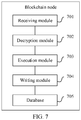
- a node for implementing privacy protection in a blockchain includes the following: a receiving module, configured to receive an encrypted transaction including a smart contract, where code of the smart contract includes a contract state indicated by a privacy identifier; a decryption module, configured to decrypt the code of the smart contract in the transaction; an execution module, configured to execute the decrypted code of the smart contract in a trusted execution environment; a writing module, configured to use a key to encrypt the contract state indicated by the privacy identifier, and write the encrypted contract state to a database after the execution module executes the decrypted code of the smart contract; and the database, configured to store the written contract state encrypted by using the key.
- the contract state indicated by the privacy identifier in the code of the smart contract can be encrypted and stored in the database in the embodiments of the present application.
- a contract state not indicated by the privacy identifier in the code of the smart contract can still be stored in plaintext in the database.
- the contract state indicated with privacy protection can be flexibly encrypted in the embodiments, compared with the existing technology that all contract states of the smart contract are considered as the data that needs privacy protection and that needs to be computed in the TEE, and all contract states are stored in the database.
- Embodiments of the present application provide methods for implementing privacy protection in a blockchain.
- Blockchains are generally classified into three types: public blockchains (Public Blockchain), private blockchains (Private Blockchain), and consortium blockchains (Consortium Blockchain). In addition, there are combinations of a plurality of types, such as a combination of a private blockchain and a consortium blockchain, and a combination of a consortium blockchain and a public blockchain.
- the public blockchain has the highest degree of decentralization. Bitcoin and Ethereum are examples of public blockchains. Participants that join the public blockchain can read data records in the blockchain, participate in transactions, contend for ledger permission of a new block, etc. In addition, each participant (namely node) can freely join and exit the network and perform related operations.
- the private blockchain is an opposite of the public blockchain. Write permission of the network is controlled by an organization or an institution, and data read permission is specified by the organization.
- the private blockchain can be a weakly centralized system, and has few participating nodes with strict restrictions. This type of blockchain is more suitable for internal use of specific institutions.
- the consortium blockchain varies from the public blockchain to the private blockchain, and can implement "partial decentralization". Each node in the consortium blockchain usually has a corresponding entity organization or institution. Participants are authorized to join the network and form a stakeholder alliance, and jointly maintain the operation of the blockchain.
- Each of the public blockchain, the private blockchain, and the consortium blockchain can provide the function of smart contract.
- Smart contracts in the blockchain are contracts that can be triggered by transactions to be executed in the blockchain system. Smart contracts can be described in the form of code.
- Ethereum is used as an example. Supporting users in creating and invoking some complex logic in the Ethereum network is the biggest challenge of Ethereum to be distinguished from the Bitcoin blockchain technology.
- Ethereum is a programmable blockchain, and the core of Ethereum is an Ethereum virtual machine (EVM). Each Ethereum node can run the EVM.
- the EVM is a Turing-complete virtual machine, which means that the EVM can implement various kinds of complex logic. Deploying and invoking smart contracts in Ethereum by users are implemented by the EVM. In fact, the virtual machine directly runs virtual machine code (virtual machine bytecode, referred to as "bytecode" below). Smart contracts deployed in the blockchain can be in the form of bytecode.
- an EVM of node 1 can execute the transaction and generate a corresponding contract instance.
- "0x68e12cf284... " in FIG. 1 represents an address of the contract
- a Data field of the transaction can store bytecode
- a To field of the transaction is an empty account.
- a contract account corresponding to the smart contract appears in the blockchain and has a specific address. Contract code and account storage are stored in the contract account. Behavior of the smart contract is controlled by the contract code, and the account storage of the smart contract keeps a contract state. In other words, the smart contract makes a virtual account including the contract code and the account storage (Storage) be generated in the blockchain.
- the Data field of the transaction that includes creating a smart contract can store the bytecode of the smart contract.
- the bytecode includes a series of bytes, and each byte can identify an operation.
- developers can choose a high-level language to write the smart contract code instead of writing bytecode directly.
- the smart contract code written in the high-level language is compiled by a compiler to generate bytecode, which can be deployed in the blockchain.
- Ethereum supports many high-level languages, such as Solidity, Serpent, and Lisp-Like Language (LLL).
- Solidity is used as an example. Contracts written in Solidity are similar to classes (Class) in object-oriented programming languages. A plurality of members can be stated in a contract, including a state variable, a function, a function modifier, an event, etc.
- the state variable is a value that is permanently stored in the account storage of the smart contract, and is used to keep the contract state.
- a storage state corresponding to the state variable "balance” is plaintext, and anyone can see the state.
- the whole operation of "balance” needs to be supported in an encryption domain.
- the operation of this type of encryption method is complex, and it is difficult to design a suitable algorithm to be supported in the encryption domain.
- all contract states of the smart contract are considered as the data that needs privacy protection and are stored in the blockchain.
- the blockchain is a data set that is stored in a database of the node and formed by specific logic.
- a physical carrier of the database can be a storage medium, such as a persistent storage medium.
- only the contract state "balance" in the smart contract may be sensitive and needs privacy protection, but the other content is not sensitive and can be made public.
- a From field of the transaction is an address of the account that initiates the invoking of the smart contract, "0x692a70d2... " in a To field represents an address of the invoked smart contract, a Value field represents a value of Ethercoin in Ethereum, and a Data field of the transaction stores methods and parameters for invoking the smart contract.
- the value of "balance” may change.
- a certain client device can view the current value of "balance” by using a certain blockchain node (such as node 6 in FIG. 2 ).
- the smart contract can be executed independently by each node in the blockchain network in a specified way, and all execution records and data are stored in the blockchain. Therefore, after the transaction is completed, a transaction certificate that cannot be tampered with or lost is stored in the blockchain.
- FIG. 3 is a diagram illustrating a process of creating a smart contract and invoking a smart contract.
- Creating a smart contract in Ethereum includes processes such as writing the smart contract, changing the smart contract to bytecode, and deploying the bytecode in the blockchain.
- Invoking a smart contract in Ethereum is initiating a transaction to an address of the smart contract, and code of the smart contract runs in a distributed way in the virtual machine of each node in the Ethereum network.
- a client device encrypts a transaction including a smart contract, and sends the encrypted transaction to a first blockchain node, where code of the smart contract includes a contract state indicated by a privacy identifier.
- a user can use the privacy identifier to identify the contract state that needs privacy protection.
- Solidity to write "creating a smart contract” is used as an example.
- the user can use a privacy identifier to identify a contract state that needs privacy protection.
- the contract state here is a state variable in a programming language.
- a privacy identifier can also be used to identify a state variable that needs privacy protection.
- Solidity mainly supports the following state variable types: Booleans, Integers, Fixed Point Numbers, Address, Fixed-size byte array, Address Literals, Rational and integer Literals, String Literals, Hexadecimal Literals, and Enums.
- the privacy identifier here can be an identifier that specially indicates the need for privacy protection, for example, is represented by the keyword "Confidential". Therefore, to implement privacy protection for the state variables supported by Solidity, the privacy identifier "Confidential" can be added in front of the state variables. In this way, the state variables that need privacy protection can be indicated by the prefix "Confidential”.
- Solidity can support the following state variable types that need privacy protection: Confidential Booleans, Confidential Integers, Confidential Fixed Point Numbers, Confidential Address, Confidential Fixed-size byte array, Confidential Address Literals, Confidential Rational and integer Literals, Confidential String Literals, Confidential Hexadecimal Literals, and Confidential Enums.
- the privacy identifier "Confidential” can be added in front of the type int that describes "balance” (certainly, the privacy identifier “Confidential” can alternatively be added after the type int that describes "balance”), as shown in code example 2 below (the underlined part represents the privacy identifier).
- the smart contract in the transaction received by the first blockchain node can be a smart contract written by the user in a high-level language directly on the first blockchain node, a received smart contract written by the user in a high-level language on the client device, or a smart contract in a transaction received from a second blockchain node.
- the smart contract can be a smart contract in a transaction sent by the client device by using the second blockchain node.
- smart contracts deployed in the blockchain are generally in the form of bytecode. If the user writes the smart contract in the high-level language directly on the first blockchain node, the first blockchain node can further use a compiler to compile the smart contract written in the high-level language to generate bytecode. For the received smart contract written by the user in the high-level language on the client device, after the user writes the smart contract on the client device, the client device can further use a compiler to compile the smart contract written in the high-level language to generate bytecode, and then send the smart contract in the form of bytecode to the first blockchain node. In this way, the first blockchain node receives the smart contract in the form of bytecode.
- the client device can directly send the smart contract written in the high-level language to the first blockchain node, and then the first blockchain node can use a compiler to compile the smart contract written in the high-level language to generate bytecode.
- the smart contract in the transaction received by the first blockchain node from the second blockchain node is generally a smart contract in the form of bytecode.
- the smart contract can alternatively be a smart contract written in a high-level language, and in this case, the first blockchain node can use a compiler to compile the smart contract written in the high-level language to generate bytecode.
- the compiler needs to be adjusted to process the contract state indicated by the privacy identifier.
- the keyword "Confidential" is also used to indicate an operation that needs privacy protection, and is the same as the privacy identifier in the smart contract written in Solidity, that is, the same as the privacy identifier in code example 2.
- a privacy identifier different from the privacy identifier in code example 2 can be used in the bytecode, that is, a privacy identifier different from the privacy identifier in the code written in the high-level language can be used in the bytecode.
- the privacy identifier in the code written in the high-level language is a first privacy identifier and the privacy identifier in the code in the form of bytecode is a second privacy identifier, the first privacy identifier has a mapping relationship with the second privacy identifier.
- the first blockchain node can further use a compiler to compile the smart contract written in the high-level language to generate bytecode.
- the contract state that needs privacy protection is indicated by a privacy identifier in the code of the smart contract.
- the smart contract written in the high-level language includes the contract state that needs privacy protection and that is indicated by the privacy identifier.
- the privacy identifier in the code written in the high-level language corresponds to the privacy identifier in the code in the form of bytecode.
- the client device can further use a compiler to compile the smart contract written in the high-level language to generate bytecode, and then send the smart contract in the form of bytecode to the first blockchain node.
- the first blockchain node receives the transaction including the smart contract, where the smart contract is the smart contract in the form of bytecode.
- the smart contract in the form of bytecode includes the contract state that needs privacy protection and that is indicated by a privacy identifier.
- the smart contract written in the high-level language includes the contract state that needs privacy protection and that is indicated by the privacy identifier.
- the privacy identifier in the code written in the high-level language corresponds to the privacy identifier in the code in the form of bytecode.
- the client device can directly send the smart contract written in the high-level language to the first blockchain node.
- the smart contract written in the high-level language includes the contract state that needs privacy protection and that is indicated by the privacy identifier.
- the first blockchain node can use a compiler to compile the smart contract written in the high-level language to generate bytecode.
- the contract state that needs privacy protection is indicated by a privacy identifier in the code of the smart contract.
- the privacy identifier in the code written in the high-level language corresponds to the privacy identifier in the code in the form of bytecode.
- the smart contract in the transaction received by the first blockchain node from the second blockchain node is generally a smart contract in the form of bytecode.
- the smart contract can alternatively be a smart contract written in a high-level language.
- the first blockchain node can further compile the smart contract written in the high-level language to generate bytecode.
- the privacy identifier in the code written in the high-level language corresponds to the privacy identifier in the code in the form of bytecode.
- the client device can use a key to encrypt the transaction that includes creating a smart contract.
- the encryption can use symmetric encryption or asymmetric encryption.
- Encryption algorithms for symmetric encryption are, for example, the Data Encryption Standard (DES) algorithm, the Triple DES (3DES) algorithm, the Triple Data Encryption Algorithm (TDEA), the Blowfish algorithm, the RC5 algorithm, and the International Data Encryption Algorithm (IDEA).
- Encryption algorithms for asymmetric encryption are, for example, the Rivest-Shamir-Adleman (RSA) algorithm, the ElGamal algorithm, the Knapsack algorithm, the Rabin algorithm, the Diffie-Hellman (D-H) algorithm, and the Elliptic Curve Cryptography (ECC) algorithm.
- RSA Rivest-Shamir-Adleman
- ElGamal the ElGamal algorithm
- Knapsack the Rabin algorithm
- D-H Diffie-Hellman
- ECC Elliptic Curve Cryptography
- the client device can use a combination of a symmetric encryption method and an asymmetric encryption method to encrypt the transaction that includes creating a smart contract.
- the client device uses a symmetric encryption algorithm to encrypt the transaction content, that is, uses a private key of the symmetric encryption algorithm to encrypt the transaction that includes creating a smart contract, and the client device uses an asymmetric encryption algorithm to encrypt the private key used in the symmetric encryption algorithm.
- a public key of the asymmetric encryption algorithm is used to encrypt the private key used in the symmetric encryption algorithm.
- the first blockchain node can first use a private key of the asymmetric encryption algorithm to perform decryption to obtain the private key of the symmetric encryption algorithm, and then use the private key of the symmetric encryption algorithm to perform decryption to obtain the transaction content, that is, code of creating a smart contract.
- the first blockchain node receives the transaction including the smart contract, where the code of the smart contract includes the contract state that needs privacy protection and that is indicated by the privacy identifier.
- the transaction sent by the client device to the first blockchain node can also be a transaction that includes invoking a smart contract.
- the client device can use a key to encrypt the transaction that includes invoking a smart contract, and send the encrypted transaction to the first blockchain node.
- the invoked smart contract can include a contract state indicated by a privacy identifier.
- the transaction for invoking a smart contract can be multi-nested invoking. For example, code in invoked smart contract 1 invokes smart contract 2, and code in invoked smart contract 2 directs to contract address 3 generated when smart contract code is created. Therefore, invoking the code in smart contract 1 indirectly invokes the smart contract code in contract address 3, and the code in contract address 3 can include a contract state indicated by a privacy identifier. In this way, invoked smart contract 1 includes the contract state indicated by the privacy identifier.
- a specific implementation process is similar to the previously described process, and details are omitted here for simplicity.
- the transaction sent by the client device to the first blockchain node can also be a transaction that includes creating and invoking a smart contract.
- the client device can use a key to encrypt the transaction that includes creating and invoking a smart contract, and send the encrypted transaction to the first blockchain node, where the smart contract includes a contract state indicated by a privacy identifier.
- a specific implementation process is similar to the previously described process, and details are omitted here for simplicity.
- the first blockchain node decrypts the code of the smart contract in the transaction, executes the code of the smart contract in a trusted execution environment, uses a key to encrypt the contract state indicated by the privacy identifier, and writes the encrypted contract state to a database.
- the transaction that includes the smart contract and that is received by the first blockchain node can be, for example, a transaction for creating and/or invoking a smart contract.
- a transaction for creating and/or invoking a smart contract For example, in Ethereum, after receiving the transaction for creating and/or invoking a smart contract from the client device, the first blockchain node can check whether the transaction is valid and whether the format is correct, verify whether a signature of the transaction is valid, etc.
- nodes in Ethereum are nodes contending for ledger permission. Therefore, as a node contending for the ledger permission, the first blockchain node can locally execute the transaction including the smart contract. If one of the nodes contending for the ledger permission wins in the process of contending for the ledger permission, the node becomes a ledger node. If the first blockchain node wins in the process of contending for the ledger permission, the first blockchain node becomes the ledger node. Certainly, if the first blockchain node does not win in the process of contending for the ledger permission, the first blockchain node is not the ledger node, and another node may become the ledger node.
- Smart contracts are similar to classes in object-oriented programming. Contract instances corresponding to the smart contracts are generated in execution results, and are similar to generated objects corresponding to the classes.
- a contract account is created, and a contract is deployed in the account space.
- an address of the smart contract account is generated based on an encryption algorithm by using a sender address (such as 0xf5e... in FIG. 1 or 0x14c5f88a... in FIG. 2 ) and a random number (nonce) of the transaction as input.
- the contract address in FIG. 2 is generated based on an encryption algorithm by using the sender address 0x14c5f88a... and nonce of the transaction.
- PoW Proof of Work
- PoS Proof of Stake
- DoS Delegated Proof of Stake
- nodes contending for the ledger permission can execute the transactions.
- One of the nodes contending for the ledger permission may win in the process of contending for the ledger permission, and then become a ledger node.
- the ledger node can packetize the transaction including the smart contract with other transactions to generate a new block, and send the generated new block to other nodes for consensus.
- nodes with the ledger permission are determined through negotiation in advance. Therefore, if the first blockchain node is not the ledger node, after receiving a transaction for creating a smart contract, the first blockchain node can send the transaction to the ledger node.
- the ledger node (which can be the first blockchain node) can execute the transaction including the smart contract. After packetizing the transaction including the smart contract (or packetizing the transaction including the smart contract with other transactions) to generate the new block, the ledger node sends the generated new block or block header to other nodes for consensus.
- PBFT Practical Byzantine Fault Tolerance
- the ledger node can packetize the transaction including the smart contract to generate a new block, and send the generated new block or block header to other nodes for consensus. If the block passes the verification performed by the other nodes that receive the block, the new block can be added to the end of the original blockchain, to complete the bookkeeping process and achieve consensus. In this case, the deployment of the smart contract in the blockchain network is completed.
- the other nodes are verifying the new block or block header sent by the ledger node, the transaction including the smart contract in the block can be executed.
- the execution process can be performed by a virtual machine, such as an EVM in Ethereum.
- the EVM executes smart contracts in the form of bytecode.
- the EVM writes the contract state to the database in a conventional key-value pair (key-value pair) method.
- the corresponding code is, for example, setstorage(key, value).
- the first blockchain node can execute the decrypted smart contract code in a TEE.
- the TEE is a trusted execution environment that is securely extended based on CPU hardware isolated from the outside.
- the TEE is first proposed by the Global Platform to securely isolate resources on mobile devices and provide trusted and secure execution environments parallel to the operating system for applications.
- a real commercial TEE technology is first implemented in the TrustZone technology of ARM
- TEE TEE
- server chip manufacturers such as Intel and AMD have successively launched hardware-assisted TEE, which enriches the concept and features of the TEE and has been widely recognized in the industry.
- the TEE usually refers to this kind of hardware-assisted TEE technology.
- cloud access needs remote access, and the hardware platform is invisible to end users. Therefore, the first step in using the TEE is to confirm the authenticity of the TEE. Therefore, a remote attestation mechanism is introduced in the TEE technology.
- TEEs including Intel software guard extensions (SGX) and AMD secure encrypted virtualization (SEV) provide memory encryption technologies. Trusted hardware is confined in CPUs, and the data of buses and memories are ciphertext to avoid snooping by malicious users. For example, in TEE technologies such as Intel SGX, code execution, remote attestation, security configuration, secure storage of data, and trusted paths for code execution are isolated. Security protection is implemented for applications running in the TEE, and the applications are almost impossible to be accessed by a third party.
- Intel software guard extensions SGX
- SEV secure encrypted virtualization
- the Intel SGX technology is used as an example.
- the SGX provides an enclave, that is, an encrypted trusted execution area in the memory, and the CPU prevents data from being stolen. That the first blockchain node uses a CPU supporting SGX is used as an example.
- a new processor instruction can be used to allocate an enclave page cache (EPC) in the memory, and the data in the EPC is encrypted by using a memory encryption engine (MEE) in the CPU.
- MEE memory encryption engine
- the encrypted content in the EPC is decrypted to plaintext only after entering the CPU. Therefore, in the SGX, users can distrust the operating system, the virtual machine monitor (VMM), or even the basic input/output system (BIOS), and only need to trust the CPU to ensure that the privacy data is not divulged.
- VMM virtual machine monitor
- BIOS basic input/output system
- the privacy data can be encrypted and transmitted to the enclave in the form of ciphertext, and a corresponding key is also transmitted to the enclave through remote attestation. Afterwards, the data is used for operation under the encryption protection of the CPU, and results are returned in the form of ciphertext. In this way, powerful computing power can be used, and there is no need to worry about data leakage.
- the client device can use a key to encrypt the transaction that includes creating a smart contract.
- the encryption can use symmetric encryption or asymmetric encryption.
- the first blockchain node can use a corresponding key to decrypt the code of the smart contract in the transaction. If the client device uses a symmetric encryption method, that is, a private key for symmetric encryption, to encrypt the transaction for creating a smart contract in S401, correspondingly, in S403, the first blockchain node can use the private key for symmetric encryption to decrypt the code of the smart contract in the transaction.
- Encryption algorithms for symmetric encryption are, for example, the DES algorithm, the 3DES algorithm, the TDEA, the Blowfish algorithm, the RC5 algorithm, and the IDEA.
- the key for symmetric encryption can be, for example, determined through negotiation between the client device and the first blockchain node.
- the client device uses an asymmetric encryption method, that is, a public key for asymmetric encryption, to encrypt the transaction for creating a smart contract in S401, correspondingly, in S403, the first blockchain node can use a private key for asymmetric encryption to decrypt the code of the smart contract in the transaction.
- Encryption algorithms for asymmetric encryption are, for example, the RSA algorithm, the ElGamal algorithm, the Knapsack algorithm, the Rabin algorithm, the D-H algorithm, and the Elliptic Curve Cryptography (ECC) algorithm.
- the keys for asymmetric encryption can be, for example, a pair of public key and private key generated by the first blockchain node.
- the public key is sent to the client device before S401, so that in S401, the client device can use the key to encrypt the transaction that includes creating a smart contract.
- the keys for asymmetric encryption can alternatively be generated by a key management server.
- the key management server sends the private key to the first blockchain node, and specifically to an enclave of the first blockchain node.
- the public key for asymmetric encryption can be sent by the key management server to the client device.
- the client device can use the public key to encrypt the transaction that includes creating a smart contract.
- the first blockchain node can use the private key to decrypt the code of the smart contract in the transaction.
- the client device can also use a combination of a symmetric encryption method and an asymmetric encryption method.
- the client device uses a symmetric encryption algorithm to encrypt the transaction content, that is, uses a private key of the symmetric encryption algorithm to encrypt the transaction that includes creating a smart contract, and the client device uses an asymmetric encryption algorithm to encrypt the private key used in the symmetric encryption algorithm.
- a public key of the asymmetric encryption algorithm is used to encrypt the private key used in the symmetric encryption algorithm.
- the first blockchain node can first use a private key of the asymmetric encryption algorithm to perform decryption to obtain the private key of the symmetric encryption algorithm, and then use the private key of the symmetric encryption algorithm to perform decryption to obtain the transaction content, that is, code of creating a smart contract.
- the key management server can send the private key of the asymmetric encryption algorithm to the enclave of the first blockchain node and send the public key of the asymmetric encryption algorithm to the client device.
- the client device can use the private key of the symmetric encryption algorithm to encrypt the transaction content, that is, use the private key of the symmetric encryption algorithm to encrypt the transaction that includes creating a smart contract, and the client device can use the public key of the asymmetric encryption algorithm to encrypt the private key used in the symmetric encryption algorithm. Therefore, the client device can send the encrypted transaction content and the private key that is used in the symmetric encryption algorithm and encrypted by using the public key of the asymmetric encryption algorithm to the first blockchain node.
- the first blockchain node After receiving the encrypted transaction content and the private key that is used in the symmetric encryption algorithm and encrypted by using the public key of the asymmetric encryption algorithm, the first blockchain node can first use the private key of the asymmetric encryption algorithm to perform decryption to obtain the private key of the symmetric encryption algorithm, and then use the private key of the symmetric encryption algorithm to decrypt the transaction to obtain the transaction plaintext, so as to obtain the code plaintext of creating a smart contract.
- the encryption method here is generally called digital envelope encryption.
- the case of invoking a smart contract is similar to the case of creating a smart contract, and details are omitted here for simplicity.
- the first blockchain node can execute the code of the smart contract in plaintext in the trusted execution environment.
- the first blockchain node can use a new processor instruction in the CPU to allocate an EPC in the memory, use the MEE in the CPU to encrypt the decrypted plaintext code, and store the encrypted code in the EPC.
- the encrypted content in the EPC is decrypted to plaintext after entering the CPU.
- the CPU operates on the plaintext code, to complete the execution process.
- the EVM can be loaded onto the enclave to execute the code of the smart contract.
- the key management server can calculate a hash value of local EVM code, compare the hash value of the local EVM code with a hash value of the EVM code loaded onto the first blockchain node, and use the validity of a comparison result as a necessary condition to pass remote attestation, so as to measure the code loaded onto the SGX enclave of the first blockchain node. After the measurement, the correct EVM can execute the smart contract code in the SGX.
- the contract state changes after the CPU executes the plaintext code.
- the contract state indicated by the privacy identifier in the smart contract also changes.
- storing the contract state in the blockchain is writing the contract state to a database, for example, a local database.
- the database is generally stored in a storage medium, and more commonly in a persistent storage medium.
- the persistent storage medium can be a disk, a floppy disk, or a memory etc. that can implement persistent storage by recovering data after being powered on.
- the code of the database write operation is, for example, setstorage (key, ENC (value, secret_key)).
- setstorage key, ENC (value, secret_key)
- the key (key) can be written in the same way as conventional keys.
- the value can be written by using the Intel SGX technology.
- ENC represents the enclave
- secret key represents the key used in the database write operation in the SGX technology.
- the key can be a key for symmetric encryption, for example, a Simple Encrypted Arithmetic Library (SEAL) key.
- SEAL key can be, for example, sent by the key management server to the first blockchain node after remote attestation is passed.
- the key can alternatively be a key for asymmetric encryption.
- the contract state indicated by the privacy identifier in the code of the smart contract can be encrypted and stored in the database.
- a contract state not indicated by the privacy identifier in the code of the smart contract can still be stored in plaintext in the database.
- the contract state indicated with privacy protection can be flexibly encrypted and stored in the embodiments, compared with the existing technology that all contract states of the smart contract are considered as the data that needs privacy protection and that needs to be computed in the TEE, and all contract states are stored in the database.
- FIG. 5 illustrates method embodiments for implementing privacy protection according to the present application.
- the embodiments focus on describing an implementation process from the perspective of a first blockchain node. As shown in FIG. 5 , the method embodiments include the following steps.
- the first blockchain node receives an encrypted transaction including a smart contract, where code of the smart contract includes a contract state indicated by a privacy identifier.
- the contract state can include a state variable in the code written in a programming language. That the user uses Solidity to write "creating a smart contract" is used as an example.
- the user can use a privacy identifier to identify a contract state that needs privacy protection.
- the contract state here is the state variable in the programming language.
- the privacy identifier here can be an identifier that specially indicates the need for privacy protection, for example, is represented by the keyword "Confidential". Therefore, to implement privacy protection for the state variables supported by Solidity, the privacy identifier "Confidential" can be added in front of the state variables. In this way, the state variables that need privacy protection can be indicated by the prefix "Confidential".
- the smart contract in the transaction received by the first blockchain node can include the following: a smart contract written by a user in a high-level language on the first blockchain node; a smart contract written by a user in a high-level language on a client device; or a smart contract in a transaction sent by a second blockchain node.
- smart contracts deployed in the blockchain are generally in the form of bytecode. If the user writes the smart contract in the high-level language directly on the first blockchain node, the first blockchain node can further use a compiler to compile the smart contract written in the high-level language to generate bytecode. For the received smart contract written by the user in the high-level language on the client device, after the user writes the smart contract on the client device, the client device can further use a compiler to compile the smart contract written in the high-level language to generate bytecode, and then send the smart contract in the form of bytecode to the first blockchain node. In this way, the first blockchain node receives the smart contract in the form of bytecode.
- the client device can directly send the smart contract written in the high-level language to the first blockchain node, and then the first blockchain node can use a compiler to compile the smart contract written in the high-level language to generate bytecode.
- the smart contract in the transaction received by the first blockchain node from the second blockchain node is generally a smart contract in the form of bytecode.
- the smart contract can alternatively be a smart contract written in a high-level language, and in this case, the first blockchain node can use a compiler to compile the smart contract written in the high-level language to generate bytecode.
- the compiler needs to be adjusted to process the contract state indicated by the privacy identifier.
- the keyword "Confidential" is also used to indicate an operation that needs privacy protection, and is the same as the privacy identifier in the smart contract written in Solidity, that is, the same as the privacy identifier in code example 2.
- a privacy identifier different from the privacy identifier in code example 2 can be used in the bytecode, that is, a privacy identifier different from the privacy identifier in the code written in the high-level language can be used in the bytecode. Even if a privacy identifier different from the privacy identifier in the code written in the high-level language is used in the bytecode, assuming that the privacy identifier in the code written in the high-level language is a first privacy identifier and the privacy identifier in the code in the form of bytecode is a second privacy identifier, the first privacy identifier has a mapping relationship with the second privacy identifier.
- the encryption uses a symmetric encryption method, an asymmetric encryption method, or a combination of a symmetric encryption method and an asymmetric encryption method.
- the client device can use a key to encrypt the transaction that includes creating a smart contract.
- the encryption can use symmetric encryption or asymmetric encryption.
- the client device can alternatively use a combination of a symmetric encryption method and an asymmetric encryption method.
- a private key for symmetric encryption is used to encrypt the transaction including the smart contract, and the first blockchain node uses the corresponding private key for symmetric encryption to decrypt the transaction to obtain the code of the smart contract; or a public key for asymmetric encryption is used to encrypt the transaction including the smart contract, and the first blockchain node uses a corresponding private key for asymmetric encryption to decrypt the transaction to obtain the code of the smart contract.
- the combination of a symmetric encryption method and an asymmetric encryption method includes a digital envelope encryption method.
- a private key of a symmetric encryption algorithm is used to encrypt the transaction including the smart contract, and a public key of an asymmetric encryption algorithm is used to encrypt the private key used in the symmetric encryption algorithm; and the first blockchain node can use a private key of the asymmetric encryption algorithm to perform decryption to obtain the private key of the symmetric encryption algorithm, and use the private key of the symmetric encryption algorithm to perform decryption to obtain the transaction content.
- a public key of the symmetric encryption algorithm is obtained through negotiation between an encryptor and the first blockchain node, or obtained from a key management server.
- the public key of the symmetric encryption algorithm can alternatively be generated by the encryptor, and through remote attestation, the key management server sends the private key of the asymmetric encryption algorithm to an enclave of the first blockchain node and sends the public key of the asymmetric encryption algorithm to the encryptor.
- the transaction that includes the smart contract and that is received by the first blockchain node can be, for example, a transaction for creating and/or invoking a smart contract.
- S503 The first blockchain node decrypts the code of the smart contract in the transaction.
- the decryption process is described above, and details are omitted here for simplicity.
- the first blockchain node executes the decrypted code of the smart contract in a trusted execution environment, uses a key to encrypt the contract state indicated by the privacy identifier, and writes the encrypted contract state to a database.
- the first blockchain node can use a new processor instruction in the CPU to allocate an EPC in the memory, use the MEE in the CPU to encrypt the decrypted plaintext code, and store the encrypted code in the EPC.
- the encrypted content in the EPC is decrypted to plaintext after entering the CPU.
- the CPU operates on the plaintext code, to complete the execution process.
- the EVM can be loaded onto the enclave to execute the code of the smart contract.
- the key management server can calculate a hash value of local EVM code, compare the hash value of the local EVM code with a hash value of the EVM code loaded onto the first blockchain node, and use the validity of a comparison result as a necessary condition to pass remote attestation, so as to measure the code loaded onto the SGX enclave of the first blockchain node. After the measurement, the correct EVM can execute the smart contract code in the SGX.
- the contract state changes after the CPU executes the plaintext code.
- the contract state indicated by the privacy identifier in the smart contract also changes.
- the contract state is written to a database, for example, a local database.
- the database is generally stored in a storage medium, and more commonly in a persistent storage medium.
- the persistent storage medium can be a disk, a floppy disk, or a memory etc. that can implement persistent storage by recovering data after being powered on.
- the key includes a key for symmetric encryption or a key for asymmetric encryption.
- the key for symmetric encryption includes a SEAL key.
- the SEAL key can be sent by the key management server after the SGX of the first blockchain node passes remote attestation.
- the compilers mentioned in the previously described embodiments are applicable to compiled languages. That is, before the code is executed, the compiler needs to convert the language (programming language) that human can understand in the code into the language that machines can understand. Then, the compiled code is executed by a virtual machine, such as the previously described EVM. Applications written in compiled languages can run directly after compilation. The compiled languages feature high running speeds and high efficiency.
- the interpreted languages are also languages (programming languages) that human can understand, and also need to be converted into languages that machines can understand for execution. However, the conversion is performed during the running. In other words, the interpreted languages are directly in the form of source code, which is parsed into machine code and executed in real time. Programs written in interpreted languages do not need to be compiled before running, but are translated during the running. Special interpreters are responsible for interpreting program code when each statement is executed. In this way, the interpreted languages need to be translated every time a statement is executed, which is inefficient.
- JavaScript is an interpreted language, which means that the system does not know whether there is an error in each piece of code until the code runs.
- the compiler checks all code so that there are no low-level errors such as nonexistent names or wrong names. However, these problems may occur in JavaScript.
- the compiled languages can be replaced by interpreted languages. That is, the smart contract code received by the first blockchain node can be written in an interpreted language and does not need to be compiled by the compiler.
- the interpreter can execute the smart contract code.
- the interpreter is, for example, a Just-In-Time (JIT) compilation of a Java virtual machine (JVM).
- the JVM can be loaded onto the enclave to execute the code of the smart contract.
- the key management server can calculate a hash value of local JVM code, compare the hash value of the local JVM code with a hash value of the JVM code loaded onto the first blockchain node, and use the validity of a comparison result as a necessary condition to pass remote attestation, so as to measure the code loaded onto the SGX enclave of the first blockchain node. After the measurement, the correct JVM can execute the smart contract code in the SGX.
- the system for implementing privacy protection includes a client device 601 and a first blockchain node 602.
- the client device 601 is configured to encrypt a transaction including a smart contract, and send the encrypted transaction to the first blockchain node, where code of the smart contract includes a contract state indicated by a privacy identifier.
- the first blockchain node 602 is configured to decrypt the code of the smart contract in the transaction, execute the code of the smart contract in a trusted execution environment, use a key to encrypt the contract state indicated by the privacy identifier, and write the encrypted contract state to a database.
- the contract state includes a state variable in the code written in a programming language.
- a smart contract in the form of a high-level language includes a contract state that needs privacy protection and that is indicated by a first privacy identifier, and a smart contract in the form of bytecode includes a contract state that needs privacy protection and that is indicated by a second privacy identifier; and the first privacy identifier is the same as or has a mapping relationship with the second privacy identifier.
- the node includes the following: a receiving module 701, configured to receive an encrypted transaction including a smart contract, where code of the smart contract includes a contract state indicated by a privacy identifier; a decryption module 702, configured to decrypt the code of the smart contract in the transaction; an execution module 703, configured to execute the decrypted code of the smart contract in a trusted execution environment; a writing module 704, configured to use a key to encrypt the contract state indicated by the privacy identifier, and write the encrypted contract state to a database after the execution module executes the decrypted code of the smart contract; and the database 705, configured to store the written contract state encrypted by using the key.
- the contract state includes a state variable in the code written in a programming language.
- a smart contract in the form of a high-level language includes a contract state that needs privacy protection and that is indicated by a first privacy identifier, and a smart contract in the form of bytecode includes a contract state that needs privacy protection and that is indicated by a second privacy identifier; and the first privacy identifier is the same as or has a mapping relationship with the second privacy identifier.
- the key for symmetric encryption includes a SEAL key.
- a technical improvement is a hardware improvement (for example, an improvement to a circuit structure, such as a diode, a transistor, or a switch) or a software improvement (an improvement to a method procedure) can be clearly distinguished.
- a hardware improvement for example, an improvement to a circuit structure, such as a diode, a transistor, or a switch
- a software improvement an improvement to a method procedure
- a designer usually programs an improved method procedure into a hardware circuit, to obtain a corresponding hardware circuit structure. Therefore, a method procedure can be improved by using a hardware entity module.
- a programmable logic device for example, a field programmable gate array (FPGA)
- FPGA field programmable gate array
- the designer performs programming to "integrate" a digital system to a PLD without requesting a chip manufacturer to design and produce an application-specific integrated circuit chip.
- this type of programming is mostly implemented by using "logic compiler” software.
- the programming is similar to a software compiler used to develop and write a program. Original code needs to be written in a particular programming language for compilation. The language is referred to as a hardware description language (HDL).
- HDL hardware description language
- HDLs such as the Advanced Boolean Expression Language (ABEL), the Altera Hardware Description Language (AHDL), Confluence, the Cornell University Programming Language (CUPL), HDCal, the Java Hardware Description Language (JHDL), Lava, Lola, MyHDL, PALASM, and the Ruby Hardware Description Language (RHDL).
- ABEL Advanced Boolean Expression Language
- AHDL Altera Hardware Description Language
- CUPL Cornell University Programming Language
- HDCal the Java Hardware Description Language
- JHDL Java Hardware Description Language
- Lava Lola
- MyHDL MyHDL
- PALASM Ruby Hardware Description Language
- RHDL Ruby Hardware Description Language
- VHDL very-high-speed integrated circuit hardware description language
- Verilog2 Verilog2
- a controller can be implemented by using any appropriate method.
- the controller can be a microprocessor or a processor, or a computer-readable medium that stores computer readable program code (such as software or firmware) that can be executed by the microprocessor or the processor, a logic gate, a switch, an application-specific integrated circuit (ASIC), a programmable logic controller, or a built-in microprocessor.
- Examples of the controller include but are not limited to the following microprocessors: ARC 625D, Atmel AT91SAM, Microchip PIC18F26K20, and Silicone Labs C8051F320.
- the memory controller can also be implemented as a part of the control logic of the memory.
- controller can be considered as a hardware component, and an apparatus configured to implement various functions in the controller can also be considered as a structure in the hardware component. Or the apparatus configured to implement various functions can even be considered as both a software module implementing the method and a structure in the hardware component.
- the system, apparatus, module, or unit described in the previously described embodiments can be implemented by a computer chip or an entity, or implemented by a product having a certain function.
- a typical implementation device is a computer.
- the computer can be, for example, a personal computer, a laptop computer, a cellular phone, a camera phone, a smartphone, a personal digital assistant, a media player, a navigation device, an email device, a game console, a tablet computer, a wearable device, or any combination of these devices.
- an embodiment of the present invention can be provided as a method, a system, or a computer program product. Therefore, the present invention can use a form of hardware only embodiments, software only embodiments, or embodiments with a combination of software and hardware. Moreover, the embodiments of the present invention can use a form of a computer program product that is implemented on one or more computer-usable storage media (including but not limited to a disk memory, a CD-ROM, an optical memory, etc.) that include computer-usable program code.
- computer-usable storage media including but not limited to a disk memory, a CD-ROM, an optical memory, etc.
- These computer program instructions can be provided for a general-purpose computer, a dedicated computer, an embedded processor, or a processor of another programmable data processing device to generate a machine, so that the instructions executed by the computer or the processor of the another programmable data processing device generate a device for implementing a specific function in one or more processes in the flowcharts and/or in one or more blocks in the block diagrams.
- the present application can be described in the general context of computer-executable instructions, for example, a program module.
- the program module includes a routine, a program, an object, a component, a data structure, etc. executing a specific task or implementing a specific abstract data type.
- the present application can alternatively be practiced in distributed computing environments in which tasks are performed by remote processing devices that are connected through a communications network.
- the program module can be located in both local and remote computer storage media including storage devices.
- These computer program instructions can be stored in a computer readable memory that can instruct the computer or the another programmable data processing device to work in a specific way, so that the instructions stored in the computer readable memory generate an artifact that includes an instruction apparatus.
- the instruction apparatus implements a specific function in one or more processes in the flowcharts and/or in one or more blocks in the block diagrams.
- the computing device includes one or more processors (CPU), an input/output interface, a network interface, and a memory.
- processors CPU
- input/output interface IO
- network interface IO
- memory e.g., RAM
- the memory can include a form of a volatile memory, a random access memory (RAM) and/or a nonvolatile memory, etc. in a computer readable medium, such as a read-only memory (ROM) or a flash memory (flash RAM).
- ROM read-only memory
- flash RAM flash memory
- the computer readable medium includes permanent and non-permanent, removable and non-removable media, and can store information by using any method or technology.
- the information can be a computer readable instruction, a data structure, a program module, or other data.
- Examples of the computer storage medium include but are not limited to a phase change random access memory (PRAM), a static RAM (SRAM), a dynamic RAM (DRAM), a RAM of another type, a read-only memory (ROM), an electrically erasable programmable ROM (EEPROM), a flash memory or another memory technology, a compact disc ROM (CD-ROM), a digital versatile disc (DVD), or another optical storage, a cassette, a cassette magnetic disk storage, or another magnetic storage device or any other non-transmission medium.
- PRAM phase change random access memory
- SRAM static RAM
- DRAM dynamic RAM
- ROM read-only memory
- EEPROM electrically erasable programmable ROM
- flash memory or another memory technology
- CD-ROM compact disc
- the computer storage medium can be configured to store information that can be accessed by the computing device. Based on the definition in the present specification, the computer readable medium does not include a transitory computer readable medium (transitory media), for example, a modulated data signal and carrier.
- a transitory computer readable medium for example, a modulated data signal and carrier.
- first touch can be named second touch
- second touch can be named the first touch
- the word “if” can be explained as “while” ("when” or “upon”), “in response to determining”, or “in response to detecting”.
- the phrase “if determining ! or “if detecting (the condition or event stated)” can be explained as “when determining !, “in response to determining !, “when detecting (the condition or event stated)”, or “in response to detecting (the condition or event stated)”.
Landscapes
- Engineering & Computer Science (AREA)
- Business, Economics & Management (AREA)
- Theoretical Computer Science (AREA)
- Accounting & Taxation (AREA)
- Computer Security & Cryptography (AREA)
- Physics & Mathematics (AREA)
- General Physics & Mathematics (AREA)
- Finance (AREA)
- General Business, Economics & Management (AREA)
- Strategic Management (AREA)
- Computer Networks & Wireless Communication (AREA)
- Signal Processing (AREA)
- Software Systems (AREA)
- Health & Medical Sciences (AREA)
- Bioethics (AREA)
- General Health & Medical Sciences (AREA)
- Computer Hardware Design (AREA)
- General Engineering & Computer Science (AREA)
- Development Economics (AREA)
- Marketing (AREA)
- Economics (AREA)
- Technology Law (AREA)
- Databases & Information Systems (AREA)
- Management, Administration, Business Operations System, And Electronic Commerce (AREA)
- Financial Or Insurance-Related Operations Such As Payment And Settlement (AREA)
Abstract
Description
- The present application relates to the field of blockchain technologies, and in particular, to methods for implementing privacy protection in a blockchain.
- Blockchain technologies are built on transport networks (such as peer-to-peer networks). Network nodes in the transport network use a chaining data structure to verify and store data, and use a distributed node consensus algorithm to generate and update data. Nodes in these blockchain networks sometimes need to be increased.
- At present, two biggest challenges of enterprise-level blockchain platform technologies are privacy and performance, which are often difficult to overcome at the same time. Most of the solutions are to gain privacy by losing performance, or pursue performance without considering privacy. Common encryption technologies for alleviating privacy problems, such as homomorphic encryption (Homomorphic encryption) and zero-knowledge proof (Zero-knowledge proof), have high complexity and poor universality, and may cause serious performance loss.
- A trusted execution environment (TEE) is another solution to privacy problems. The TEE can act as a black box in hardware. The operating system layer cannot peep at code and data executed in the TEE, and only an interface predetermined in the code can operate on the code and the data. In terms of efficiency, due to the black box feature of the TEE, operation in the TEE uses plaintext data, and is not complex cryptographic operation in homomorphic encryption, so that there is no loss of efficiency in the computing process. Therefore, the combination with the TEE can greatly improve the security and privacy of the blockchain on the premise of less performance loss. At present, the industry pays close attention to TEE solutions. Almost all mainstream chip and software alliances have their own TEE solutions, including a trusted platform module (TPM) in terms of software and Intel software guard extensions (SGX), ARM TrustZone, and AMD platform security processor (PSP) in terms of hardware.
- The emergence of smart contracts in the era of blockchain 2.0 improves the application scope of the blockchain to a new level. With the smart contract, the blockchain can not only perform a single transfer transaction, but also invoke a piece of code, which can be customized by users.
- In conventional solutions of combining the blockchain and the TEE, to implement privacy protection, the whole smart contract is considered as the data that needs privacy protection and that needs to be computed in the TEE, and all contract states are encrypted and stored in the blockchain. In fact, some of the content in the smart contract may be sensitive and needs privacy protection, but the other content is not sensitive and can be made public. In existing solutions, there is no more flexible method to implement privacy protection.
- Embodiments of the present application aim to provide methods for implementing privacy protection in a blockchain.
- To alleviate the previously described technical problem, the embodiments of the present application are performed in the following ways.
- A method for implementing privacy protection in a blockchain includes the following: a client device encrypts a transaction including a smart contract, and sends the encrypted transaction to a first blockchain node, where code of the smart contract includes a contract state indicated by a privacy identifier; and the first blockchain node decrypts the code of the smart contract in the transaction, executes the code of the smart contract in a trusted execution environment, uses a key to encrypt the contract state indicated by the privacy identifier, and writes the encrypted contract state to a database.
- A method for implementing privacy protection in a blockchain includes the following: a first blockchain node receives an encrypted transaction including a smart contract, where code of the smart contract includes a contract state indicated by a privacy identifier; the first blockchain node decrypts the code of the smart contract in the transaction; and the first blockchain node executes the decrypted code of the smart contract in a trusted execution environment, uses a key to encrypt the contract state indicated by the privacy identifier, and writes the encrypted contract state to a database.
- A system for implementing privacy protection in a blockchain includes a client device and a first blockchain node, where the client device is configured to encrypt a transaction including a smart contract, and send the encrypted transaction to the first blockchain node, where code of the smart contract includes a contract state indicated by a privacy identifier; and the first blockchain node is configured to decrypt the code of the smart contract in the transaction, execute the code of the smart contract in a trusted execution environment, use a key to encrypt the contract state indicated by the privacy identifier, and write the encrypted contract state to a database.
- A node for implementing privacy protection in a blockchain includes the following: a receiving module, configured to receive an encrypted transaction including a smart contract, where code of the smart contract includes a contract state indicated by a privacy identifier; a decryption module, configured to decrypt the code of the smart contract in the transaction; an execution module, configured to execute the decrypted code of the smart contract in a trusted execution environment; a writing module, configured to use a key to encrypt the contract state indicated by the privacy identifier, and write the encrypted contract state to a database after the execution module executes the decrypted code of the smart contract; and the database, configured to store the written contract state encrypted by using the key.
- It can be seen from the previously described technical solutions provided in the embodiments of the present application that, the contract state indicated by the privacy identifier in the code of the smart contract can be encrypted and stored in the database in the embodiments of the present application. A contract state not indicated by the privacy identifier in the code of the smart contract can still be stored in plaintext in the database. The contract state indicated with privacy protection can be flexibly encrypted in the embodiments, compared with the existing technology that all contract states of the smart contract are considered as the data that needs privacy protection and that needs to be computed in the TEE, and all contract states are stored in the database.
- To describe technical solutions in embodiments of the present application or in the existing technology more clearly, the following briefly describes the accompanying drawings needed for describing the embodiments or the existing technology. Clearly, the accompanying drawings in the following descriptions merely show some embodiments of the present application, and a person of ordinary skill in the art can still derive other drawings from these accompanying drawings without creative efforts.
-
FIG. 1 is a diagram illustrating a process of creating a smart contract, according to some embodiments of the present application; -
FIG. 2 is a diagram illustrating a process of invoking a smart contract, according to some embodiments of the present application; -
FIG. 3 is a diagram illustrating a process of creating a smart contract and invoking a smart contract, according to some embodiments of the present application; -
FIG. 4 is a flowchart illustrating method embodiments for implementing privacy protection, according to the present application; -
FIG. 5 is a flowchart illustrating method embodiments for implementing privacy protection, according to the present application; -
FIG. 6 is a diagram illustrating composition of system embodiments for implementing privacy protection, according to the present application; and -
FIG. 7 is a diagram illustrating composition of node embodiments for implementing privacy protection, according to the present application. - Embodiments of the present application provide methods for implementing privacy protection in a blockchain.
- To make a person skilled in the art better understand the technical solutions in the present application, the following describes in detail the technical solutions in the embodiments of the present application with reference to the accompanying drawings in the embodiments of the present application. Clearly, the described embodiments are merely some but not all of the embodiments of the present application. All other embodiments obtained by a person of ordinary skill in the art based on the embodiments of the present application without creative efforts shall fall within the protection scope of the present application.
- Blockchains are generally classified into three types: public blockchains (Public Blockchain), private blockchains (Private Blockchain), and consortium blockchains (Consortium Blockchain). In addition, there are combinations of a plurality of types, such as a combination of a private blockchain and a consortium blockchain, and a combination of a consortium blockchain and a public blockchain. The public blockchain has the highest degree of decentralization. Bitcoin and Ethereum are examples of public blockchains. Participants that join the public blockchain can read data records in the blockchain, participate in transactions, contend for ledger permission of a new block, etc. In addition, each participant (namely node) can freely join and exit the network and perform related operations. The private blockchain is an opposite of the public blockchain. Write permission of the network is controlled by an organization or an institution, and data read permission is specified by the organization. In short, the private blockchain can be a weakly centralized system, and has few participating nodes with strict restrictions. This type of blockchain is more suitable for internal use of specific institutions. The consortium blockchain varies from the public blockchain to the private blockchain, and can implement "partial decentralization". Each node in the consortium blockchain usually has a corresponding entity organization or institution. Participants are authorized to join the network and form a stakeholder alliance, and jointly maintain the operation of the blockchain.
- Each of the public blockchain, the private blockchain, and the consortium blockchain can provide the function of smart contract. Smart contracts in the blockchain are contracts that can be triggered by transactions to be executed in the blockchain system. Smart contracts can be described in the form of code.
- Ethereum is used as an example. Supporting users in creating and invoking some complex logic in the Ethereum network is the biggest challenge of Ethereum to be distinguished from the Bitcoin blockchain technology. Ethereum is a programmable blockchain, and the core of Ethereum is an Ethereum virtual machine (EVM). Each Ethereum node can run the EVM. The EVM is a Turing-complete virtual machine, which means that the EVM can implement various kinds of complex logic. Deploying and invoking smart contracts in Ethereum by users are implemented by the EVM. In fact, the virtual machine directly runs virtual machine code (virtual machine bytecode, referred to as "bytecode" below). Smart contracts deployed in the blockchain can be in the form of bytecode.
- For example, as shown in
FIG. 1 , after Bob sends a transaction that includes information for creating a smart contract to the Ethereum network, an EVM ofnode 1 can execute the transaction and generate a corresponding contract instance. "0x68e12cf284... " inFIG. 1 represents an address of the contract, a Data field of the transaction can store bytecode, and a To field of the transaction is an empty account. After nodes reach an agreement by using a consensus mechanism, the contract is successfully created, and users can invoke the contract subsequently. - After the contract is created, a contract account corresponding to the smart contract appears in the blockchain and has a specific address. Contract code and account storage are stored in the contract account. Behavior of the smart contract is controlled by the contract code, and the account storage of the smart contract keeps a contract state. In other words, the smart contract makes a virtual account including the contract code and the account storage (Storage) be generated in the blockchain.
- As mentioned above, the Data field of the transaction that includes creating a smart contract can store the bytecode of the smart contract. The bytecode includes a series of bytes, and each byte can identify an operation. Considering the development efficiency, readability, etc., developers can choose a high-level language to write the smart contract code instead of writing bytecode directly. The smart contract code written in the high-level language is compiled by a compiler to generate bytecode, which can be deployed in the blockchain. Ethereum supports many high-level languages, such as Solidity, Serpent, and Lisp-Like Language (LLL).
- Solidity is used as an example. Contracts written in Solidity are similar to classes (Class) in object-oriented programming languages. A plurality of members can be stated in a contract, including a state variable, a function, a function modifier, an event, etc. The state variable is a value that is permanently stored in the account storage of the smart contract, and is used to keep the contract state.
- The following is code example 1 of a simple smart contract written in Solidity.
          Contract Example {
         int balance;
         function C( ){
         balance + = 1;
          }
         function getblance( ) returns(int){
         return balance ;
          }
          }
          Contract Example {
          Confidential int balance;
         function C( ){
         balance+ = 1;
          }
         function getblance( ) returns(int){
         return balance ;
          }
          }
- /* compile function C( ) balance+ = 1*/
- tag_2
- /* pushes 1 onto stack, and this 1 is the
value 1 to be assigned*/ - 0x1
- /* pushes 0 onto stack, and this 0 refers to location 0 of the data storage of the contract account that the balance data is to be stored in. After the previous two lines are executed, the stack has two pieces of
data 0 and 1 from top to bottom*/ - 0x0
- /* a value obtained after balance is assigned to balance+1 in balance += 1*/
- dup2 /*duplicates the second item from top to bottom in the stack, and therefore the stack has three pieces of
data - swap1 /*interchanges two pieces of data at the top of the stack, and then the
stack stores - /* store(0x0, 0x1), the second piece of data from top to bottom in the stack is stored in a location identified by the first piece of data, and then the two pieces of data are removed from the stack. That is, the
data 1 is stored in location 0. Because balance has been bound to location 0, the assignment of balance = 1 is completed. At this time, the stack has only one piece ofdata 1*/ - sstore
- pop /*discards the data at the top of the stack. At this time, the stack becomes empty and waits for the next instruction to execute*/
- /* compile function C( ) balance+ = 1*/
- tag_2
- /* pushes 1 onto stack, and this 1 is the
value 1 to be assigned*/ - 0x1
- /* pushes 0 onto stack, and this 0 refers to location 0 of the data storage of the contract account that the balance data is to be stored in. After the previous two lines are executed, the stack has two pieces of
data 0 and 1 from top to bottom*/ - 0x0
- /* a value obtained after balance is assigned to balance+1 in balance += 1*/
- dup2 /*duplicates the second item from top to bottom in the stack, and therefore the stack has three pieces of
data - swap1 /*interchanges two pieces of data at the top of the stack, and then the
stack stores - /* Confidential_sstore(0x0, 0x1), the second piece of data from top to bottom in the stack is stored in a location identified by the first piece of data, and then the two pieces of data are removed from the stack. That is, the
data 1 is stored in location 0. Because balance has been bound to location 0, the assignment of balance = 1 is completed. At this time, the stack has only one piece ofdata 1*/
pop /*discards the data at the top of the stack. At this time, the stack becomes empty and waits for the next instruction to execute*/
Claims (46)
- A method for implementing privacy protection in a blockchain, comprising the following:encrypting, by a client device, a transaction comprising a smart contract, and sending the encrypted transaction to a first blockchain node, wherein code of the smart contract comprises a contract state indicated by a privacy identifier;decrypting, by the first blockchain node, the code of the smart contract in the transaction, executing the code of the smart contract in a trusted execution environment, using a key to encrypt the contract state indicated by the privacy identifier, and writing the encrypted contract state to a database.
- The method according to claim 1, wherein the smart contract in the transaction received by the first blockchain node comprises the following:a smart contract written by a user in a high-level language on the first blockchain node;a smart contract written by a user in a high-level language on the client device; ora smart contract in a transaction sent by the client device by using a second blockchain node.
- The method according to claim 2, wherein for the smart contract written by the user in the high-level language on the first blockchain node, after the first blockchain node receives the transaction comprising the smart contract, the method further comprises the following:
using a compiler to compile the smart contract written in the high-level language to generate bytecode. - The method according to claim 2, wherein for the smart contract written by the user in the high-level language on the client device, after the user writes the smart contract on the client device, the client device further uses a compiler to compile the smart contract written in the high-level language to generate bytecode, and then sends the smart contract in the form of bytecode to the first blockchain node; and
correspondingly, the first blockchain node receives the transaction comprising the smart contract, wherein the smart contract is the smart contract in the form of bytecode. - The method according to claim 2, wherein for the smart contract written by the user in the high-level language on the client device, after the user writes the smart contract on the client device, the client device sends the smart contract written in the high-level language to the first blockchain node;
correspondingly, the first blockchain node receives the transaction comprising the smart contract, wherein the smart contract is the smart contract in the form of a high-level language; and
the method further comprises the following:
using, by the first blockchain node, a compiler to compile the smart contract written in the high-level language to generate bytecode. - The method according to claim 2, wherein the smart contract in the transaction sent by the client device by using the second blockchain node comprises a smart contract in the form of bytecode or a smart contract written in a high-level language.
- The method according to claim 6, wherein for the smart contract written in the high-level language, after the first blockchain node receives the transaction comprising the smart contract, the method further comprises the following:
using a compiler to compile the smart contract written in the high-level language to generate bytecode. - The method according to any one of claims 3 to 7, wherein the smart contract in the form of a high-level language comprises a contract state that needs privacy protection and that is indicated by a first privacy identifier, and the smart contract in the form of bytecode comprises a contract state that needs privacy protection and that is indicated by a second privacy identifier; and
the first privacy identifier is the same as or has a mapping relationship with the second privacy identifier. - The method according to claim 1, wherein the client device encrypts the transaction comprising the smart contract, and the encryption uses a symmetric encryption method, an asymmetric encryption method, or a combination of a symmetric encryption method and an asymmetric encryption method.
- The method according to claim 9, wherein
the client device uses a private key for symmetric encryption to encrypt the transaction comprising the smart contract, and the first blockchain node uses the corresponding private key for symmetric encryption to decrypt the transaction to obtain the code of the smart contract; or
the client device uses a public key for asymmetric encryption to encrypt the transaction comprising the smart contract, and the first blockchain node uses a corresponding private key for asymmetric encryption to decrypt the transaction to obtain the code of the smart contract. - The method according to claim 9, wherein the combination of a symmetric encryption method and an asymmetric encryption method comprises a digital envelope encryption method.
- The method according to claim 11, wherein the client device uses a private key of a symmetric encryption algorithm to encrypt the transaction comprising the smart contract, and uses a public key of an asymmetric encryption algorithm to encrypt the private key used in the symmetric encryption algorithm; and
correspondingly, after receiving the encrypted transaction, the first blockchain node uses a private key of the asymmetric encryption algorithm to perform decryption to obtain the private key of the symmetric encryption algorithm, and uses the private key of the symmetric encryption algorithm to perform decryption to obtain the transaction content. - The method according to claim 10 or 12, wherein a public key of the symmetric encryption algorithm is obtained through negotiation between the client device and the first blockchain node, or obtained from a key management server.
- The method according to claim 12, wherein a public key of the symmetric encryption algorithm is generated by the client device, and through remote attestation, a key management server sends the private key of the asymmetric encryption algorithm to an enclave of the first blockchain node and sends the public key of the asymmetric encryption algorithm to the client device.
- The method according to claim 1, wherein the smart contract comprises creating and/or invoking a smart contract.
- The method according to claim 1, wherein the database is stored in a persistent storage medium.
- The method according to claim 16, wherein the persistent storage medium comprises a disk, a floppy disk, or a memory that can implement persistent storage by recovering data after being powered on.
- The method according to claim 1, wherein the key comprises a key for symmetric encryption or a key for asymmetric encryption.
- The method according to claim 18, wherein the key for symmetric encryption comprises a Simple Encrypted Arithmetic Library (SEAL) key.
- The method according to claim 18, wherein the SEAL key is sent by a key management server after software guard extensions (SGX) of the first blockchain node passes remote attestation.
- A method for implementing privacy protection in a blockchain, comprising the following:receiving, by a first blockchain node, an encrypted transaction comprising a smart contract, wherein code of the smart contract comprises a contract state indicated by a privacy identifier;decrypting, by the first blockchain node, the code of the smart contract in the transaction; andexecuting, by the first blockchain node, the decrypted code of the smart contract in a trusted execution environment, using a key to encrypt the contract state indicated by the privacy identifier, and writing the encrypted contract state to a database.
- The method according to claim 21, wherein the smart contract in the transaction received by the first blockchain node comprises the following:a smart contract written by a user in a high-level language on the first blockchain node;a smart contract written by a user in a high-level language on a client device; ora smart contract in a transaction sent by the client device by using a second blockchain node.
- The method according to claim 22, wherein for the smart contract written by the user in the high-level language on the first blockchain node, after the first blockchain node receives the transaction comprising the smart contract, the method further comprises the following:
using a compiler to compile the smart contract written in the high-level language to generate bytecode. - The method according to claim 22, wherein for the smart contract written by the user in the high-level language on the client device, after the user writes the smart contract on the client device, the client device further uses a compiler to compile the smart contract written in the high-level language to generate bytecode, and then sends the smart contract in the form of bytecode to the first blockchain node; and
correspondingly, the first blockchain node receives the transaction comprising the smart contract, wherein the smart contract is the smart contract in the form of bytecode. - The method according to claim 22, wherein for the smart contract written by the user in the high-level language on the client device, after the user writes the smart contract on the client device, the client device sends the smart contract written in the high-level language to the first blockchain node;
correspondingly, the first blockchain node receives the transaction comprising the smart contract, wherein the smart contract is the smart contract in the form of a high-level language; and
the method further comprises the following:
using, by the first blockchain node, a compiler to compile the smart contract written in the high-level language to generate bytecode. - The method according to claim 22, wherein the smart contract in the transaction sent by the client device by using the second blockchain node comprises a smart contract in the form of bytecode or a smart contract written in a high-level language.
- The method according to claim 26, wherein for the smart contract written in the high-level language, after the first blockchain node receives the transaction comprising the smart contract, the method further comprises the following:
using a compiler to compile the smart contract written in the high-level language to generate bytecode. - The method according to any one of claims 23 to 27, wherein the smart contract in the form of a high-level language comprises a contract state that needs privacy protection and that is indicated by a first privacy identifier, and the smart contract in the form of bytecode comprises a contract state that needs privacy protection and that is indicated by a second privacy identifier; and
the first privacy identifier is the same as or has a mapping relationship with the second privacy identifier. - The method according to claim 21, wherein for the encrypted transaction that comprises the smart contract and that is received by the first blockchain node, the encryption uses a symmetric encryption method, an asymmetric encryption method, or a combination of a symmetric encryption method and an asymmetric encryption method.
- The method according to claim 29, wherein
a private key for symmetric encryption is used to encrypt the transaction comprising the smart contract, and the first blockchain node uses the corresponding private key for symmetric encryption to decrypt the transaction to obtain the code of the smart contract; or
a public key for asymmetric encryption is used to encrypt the transaction comprising the smart contract, and the first blockchain node uses a corresponding private key for asymmetric encryption to decrypt the transaction to obtain the code of the smart contract. - The method according to claim 29, wherein the combination of a symmetric encryption method and an asymmetric encryption method comprises a digital envelope encryption method.
- The method according to claim 31, wherein a private key of a symmetric encryption algorithm is used to encrypt the transaction comprising the smart contract, and a public key of an asymmetric encryption algorithm is used to encrypt the private key used in the symmetric encryption algorithm; and
the first blockchain node uses a private key of the asymmetric encryption algorithm to perform decryption to obtain the private key of the symmetric encryption algorithm, and uses the private key of the symmetric encryption algorithm to perform decryption to obtain the transaction content. - The method according to claim 31 or 32, wherein a public key of the symmetric encryption algorithm is obtained through negotiation between an encryptor and the first blockchain node, or obtained from a key management server.
- The method according to claim 32, wherein a public key of the symmetric encryption algorithm is generated by an encryptor, and through remote attestation, a key management server sends the private key of the asymmetric encryption algorithm to an enclave of the first blockchain node and sends the public key of the asymmetric encryption algorithm to the encryptor.
- The method according to claim 21, wherein the smart contract comprises creating and/or invoking a smart contract.
- The method according to claim 21, wherein the database is stored in a persistent storage medium.
- The method according to claim 36, wherein the persistent storage medium comprises a disk, a floppy disk, or a memory that can implement persistent storage by recovering data after being powered on.
- The method according to claim 21, wherein the key comprises a key for symmetric encryption or a key for asymmetric encryption.
- The method according to claim 38, wherein the key for symmetric encryption comprises a SEAL key.
- The method according to claim 39, wherein the SEAL key is sent by a key management server after SGX of the first blockchain node passes remote attestation.
- The method according to claim 1 or 21, wherein the trusted execution environment comprises Intel SGX, AMD secure encrypted virtualization (SEV), or ARM TrustZone.
- A system for implementing privacy protection in a blockchain, comprising a client device and a first blockchain node, wherein
the client device is configured to encrypt a transaction comprising a smart contract, and send the encrypted transaction to the first blockchain node, wherein code of the smart contract comprises a contract state indicated by a privacy identifier; and
the first blockchain node is configured to decrypt the code of the smart contract in the transaction, execute the code of the smart contract in a trusted execution environment, use a key to encrypt the contract state indicated by the privacy identifier, and write the encrypted contract state to a database. - The system according to claim 42, wherein a smart contract in the form of a high-level language comprises a contract state that needs privacy protection and that is indicated by a first privacy identifier, and a smart contract in the form of bytecode comprises a contract state that needs privacy protection and that is indicated by a second privacy identifier; and the first privacy identifier is the same as or has a mapping relationship with the second privacy identifier.
- A node for implementing privacy protection in a blockchain, comprising the following:a receiving module, configured to receive an encrypted transaction comprising a smart contract, wherein code of the smart contract comprises a contract state indicated by a privacy identifier;a decryption module, configured to decrypt the code of the smart contract in the transaction;an execution module, configured to execute the decrypted code of the smart contract in a trusted execution environment;a writing module, configured to use a key to encrypt the contract state indicated by the privacy identifier, and write the encrypted contract state to a database after the execution module executes the decrypted code of the smart contract; andthe database, configured to store the written contract state encrypted by using the key.
- The node according to claim 44, wherein a smart contract in the form of a high-level language comprises a contract state that needs privacy protection and that is indicated by a first privacy identifier, and a smart contract in the form of bytecode comprises a contract state that needs privacy protection and that is indicated by a second privacy identifier; and
the first privacy identifier is the same as or has a mapping relationship with the second privacy identifier. - The node according to claim 44, wherein the key for symmetric encryption comprises a SEAL key.
Applications Claiming Priority (2)
| Application Number | Priority Date | Filing Date | Title |
|---|---|---|---|
| CN201811452984.1A CN110033368B (en) | 2018-11-30 | 2018-11-30 | Methods to achieve privacy protection in blockchain |
| PCT/CN2019/111304 WO2020108138A1 (en) | 2018-11-30 | 2019-10-15 | Method for implementing privacy protection in blockchain |
Publications (4)
| Publication Number | Publication Date |
|---|---|
| EP3813000A1 true EP3813000A1 (en) | 2021-04-28 |
| EP3813000A4 EP3813000A4 (en) | 2021-09-29 |
| EP3813000B1 EP3813000B1 (en) | 2025-02-12 |
| EP3813000C0 EP3813000C0 (en) | 2025-02-12 |
Family
ID=67235279
Family Applications (1)
| Application Number | Title | Priority Date | Filing Date |
|---|---|---|---|
| EP19891559.7A Active EP3813000B1 (en) | 2018-11-30 | 2019-10-15 | Method for implementing privacy protection in blockchain |
Country Status (6)
| Country | Link |
|---|---|
| US (1) | US11049099B2 (en) |
| EP (1) | EP3813000B1 (en) |
| CN (2) | CN110033368B (en) |
| SG (1) | SG11202100786YA (en) |
| TW (1) | TWI718662B (en) |
| WO (1) | WO2020108138A1 (en) |
Cited By (2)
| Publication number | Priority date | Publication date | Assignee | Title |
|---|---|---|---|---|
| EP3961437A1 (en) * | 2020-08-31 | 2022-03-02 | Alipay (Hangzhou) Information Technology Co., Ltd. | Method for executing smart contract, blockchain node, and storage medium |
| EP3961438A1 (en) * | 2020-08-31 | 2022-03-02 | Alipay (Hangzhou) Information Technology Co., Ltd. | Method for executing smart contract, blockchain node, and storage medium |
Families Citing this family (63)
| Publication number | Priority date | Publication date | Assignee | Title |
|---|---|---|---|---|
| CN110033368B (en) * | 2018-11-30 | 2020-07-07 | 阿里巴巴集团控股有限公司 | Methods to achieve privacy protection in blockchain |
| CN111582844A (en) * | 2019-08-22 | 2020-08-25 | 深圳市先河系统技术有限公司 | Block chain based commission fee distribution method, device and storage medium |
| CN110766550B (en) * | 2019-09-05 | 2021-06-22 | 创新先进技术有限公司 | Blockchain-based asset query method and device, and electronic equipment |
| CN111125741B (en) * | 2019-12-31 | 2022-07-01 | 广东卓启投资有限责任公司 | Zero knowledge verification method based on block chain |
| CN111277415B (en) * | 2020-01-20 | 2023-12-19 | 布比(北京)网络技术有限公司 | Privacy protection method and device based on blockchain intelligent contract |
| CN111047450A (en) * | 2020-03-18 | 2020-04-21 | 支付宝(杭州)信息技术有限公司 | Off-chain privacy computing method and device for on-chain data |
| CN111090888B (en) * | 2020-03-18 | 2020-07-07 | 支付宝(杭州)信息技术有限公司 | Contract verification method and device |
| CN111427663A (en) * | 2020-03-24 | 2020-07-17 | 杭州溪塔科技有限公司 | Virtual machine system based on intelligent contract and operation method thereof |
| CN111683071B (en) * | 2020-05-29 | 2023-02-28 | 百度在线网络技术(北京)有限公司 | Private data processing method, device, equipment and storage medium of block chain |
| CN117688623A (en) * | 2020-07-01 | 2024-03-12 | 陈子祺 | A trusted computing chip based on blockchain |
| CN111753335B (en) * | 2020-08-28 | 2023-09-01 | 支付宝(杭州)信息技术有限公司 | Method and device for editing block content |
| CN111768184A (en) | 2020-08-31 | 2020-10-13 | 支付宝(杭州)信息技术有限公司 | Method for executing intelligent contract and block link point |
| CN113872948B (en) | 2020-08-31 | 2025-12-19 | 蚂蚁区块链科技(上海)有限公司 | Method for executing intelligent contract, block chain node and node equipment |
| CN111770116B (en) * | 2020-08-31 | 2020-12-15 | 支付宝(杭州)信息技术有限公司 | Method for executing intelligent contract, block chain node and storage medium |
| CN111768187A (en) * | 2020-08-31 | 2020-10-13 | 支付宝(杭州)信息技术有限公司 | Method for deploying intelligent contract, block chain node and storage medium |
| CN111815330A (en) * | 2020-08-31 | 2020-10-23 | 支付宝(杭州)信息技术有限公司 | A method for deploying smart contracts, blockchain nodes and storage media |
| CN111815310B (en) * | 2020-08-31 | 2021-08-17 | 支付宝(杭州)信息技术有限公司 | A method, blockchain node and storage medium for executing smart contracts |
| CN111770204B (en) | 2020-08-31 | 2021-10-22 | 支付宝(杭州)信息技术有限公司 | A method, blockchain node and storage medium for executing smart contracts |
| CN111770205B (en) * | 2020-08-31 | 2020-12-04 | 支付宝(杭州)信息技术有限公司 | A method, blockchain node, system and storage medium for executing smart contracts |
| CN111770206B (en) | 2020-08-31 | 2020-12-29 | 支付宝(杭州)信息技术有限公司 | A method for deploying smart contracts, blockchain nodes and storage media |
| CN112422500B9 (en) * | 2020-09-25 | 2026-02-03 | 北京熠智科技有限公司 | Cross-platform data transmission method and device, storage medium and electronic device |
| CN112287392B (en) * | 2020-11-23 | 2023-06-02 | 广东科学技术职业学院 | Intelligent contract implementation method and system with privacy information protection function |
| CN114726560A (en) | 2020-12-22 | 2022-07-08 | 富泰华工业(深圳)有限公司 | Data protection method, computer device and readable storage medium |
| CN113269636B (en) * | 2020-12-28 | 2024-07-05 | 上海零数众合信息科技有限公司 | Nested transaction method oriented to block chain |
| CN112636928B (en) * | 2020-12-29 | 2023-01-17 | 广东国腾量子科技有限公司 | Decentralized trusted authentication method based on block chain, storage device and mobile terminal |
| CN113327109A (en) * | 2021-06-15 | 2021-08-31 | 重庆电子工程职业学院 | Intelligent contract construction method for block chain |
| CN114172667A (en) * | 2021-06-15 | 2022-03-11 | 支付宝(杭州)信息技术有限公司 | Privacy evidence storing method and device based on contract |
| CN113726733B (en) * | 2021-07-19 | 2022-07-22 | 东南大学 | Encryption intelligent contract privacy protection method based on trusted execution environment |
| CN113660226B (en) * | 2021-07-30 | 2024-05-28 | 国网天津市电力公司 | A blockchain-based energy data trusted sharing system and method |
| CN113642041B (en) * | 2021-08-14 | 2024-12-20 | 南方电网互联网服务有限公司 | A data processing and storage method for realizing contract privacy |
| CN113778564B (en) * | 2021-09-03 | 2023-05-30 | 杭州复杂美科技有限公司 | Method, equipment and storage medium for efficiently executing EVM intelligent contract |
| CN113852469B (en) * | 2021-09-24 | 2024-03-22 | 成都质数斯达克科技有限公司 | Method, device, equipment and readable storage medium for transmitting data between block chain nodes |
| CN114036524B (en) * | 2021-10-29 | 2025-11-21 | 中国银联股份有限公司 | Electronic equipment |
| CN113742782B (en) * | 2021-11-04 | 2022-02-08 | 中国信息通信研究院 | Block chain access authority control method based on privacy protection and block chain system |
| CN114358764B (en) * | 2021-11-15 | 2025-01-24 | 青岛国工新钻材料科技有限公司 | Privacy computing method and related equipment based on smart contracts in blockchain |
| CN114493587A (en) * | 2021-12-20 | 2022-05-13 | 福建师范大学 | Method for realizing high-performance privacy protection intelligent contract |
| CN114490750A (en) * | 2021-12-29 | 2022-05-13 | 杭州趣链科技有限公司 | Data aggregation method and device, prediction machine node and storage medium |
| CN115941230A (en) * | 2022-01-11 | 2023-04-07 | 浪潮云信息技术股份公司 | Supervision method and system for protecting privacy based on block chain |
| US12095926B2 (en) | 2022-03-25 | 2024-09-17 | Micro Focus Llc | Retroactively adding encryption and/or authentication levels to a blockchain |
| US12204670B2 (en) * | 2022-03-28 | 2025-01-21 | International Business Machines Corporation | Using smart contracts to manage hyper protect database as a service |
| CN114780944A (en) * | 2022-04-21 | 2022-07-22 | 中国工商银行股份有限公司 | Verification method and device based on block chain intelligent contract |
| CN114912145B (en) * | 2022-05-16 | 2024-08-16 | 清华大学深圳国际研究生院 | Intelligent contract confidential execution method and system |
| CN115270202B (en) * | 2022-07-22 | 2025-10-10 | 蚂蚁区块链科技(上海)有限公司 | A privacy computing method and device based on multi-party collaboration |
| CN115733659B (en) * | 2022-08-02 | 2023-06-02 | 药融云数字科技(成都)有限公司 | Encryption intelligent contract detection system based on block chain |
| CN115396115B (en) * | 2022-08-22 | 2024-02-09 | 国网浙江省电力有限公司物资分公司 | Block chain data privacy protection method, device, equipment and readable storage medium |
| CN115549906B (en) * | 2022-11-24 | 2023-04-11 | 富算科技(上海)有限公司 | Privacy calculation method, system, device and medium based on block chain |
| CN115758333A (en) * | 2022-11-30 | 2023-03-07 | 蚂蚁区块链科技(上海)有限公司 | Transaction grouping method and block link point |
| CN115758332A (en) * | 2022-11-30 | 2023-03-07 | 蚂蚁区块链科技(上海)有限公司 | A transaction grouping method and blockchain nodes |
| CN115906121A (en) * | 2022-11-30 | 2023-04-04 | 蚂蚁区块链科技(上海)有限公司 | Read-write set generation method and blockchain nodes for private transactions |
| US20240195635A1 (en) * | 2022-12-12 | 2024-06-13 | Intel Corporation | Roots of trust in intellectual property (ip) blocks in a system on a chip (soc) |
| CN116522374A (en) * | 2022-12-14 | 2023-08-01 | 南京迈特望科技股份有限公司 | Method, system, electronic device and storage medium for protecting data privacy of intelligent pension device |
| CN115827662B (en) * | 2022-12-15 | 2025-11-21 | 山石网科通信技术股份有限公司 | Private data query method and device based on blockchain and electronic equipment |
| US11991299B1 (en) * | 2023-01-10 | 2024-05-21 | Citibank, N.A. | Systems and methods for facilitating use of artificial intelligence platforms trained on blockchain action lineages to conduct blockchain actions |
| CN116192472B (en) * | 2023-01-29 | 2026-02-27 | 北京理工大学 | A method for covert data transmission based on Ethereum smart contracts and the IPFS platform |
| CN116112185B (en) * | 2023-02-10 | 2024-11-08 | 北京邮电大学 | Private data sharing method based on blockchain and zero knowledge proof |
| CN116582322A (en) * | 2023-05-13 | 2023-08-11 | 北京龙腾佳讯科技股份公司 | A method and system for multi-party safe calculation of data quantity on one side of the mean value |
| WO2024236572A1 (en) * | 2023-05-18 | 2024-11-21 | Applied Blockchain Ltd. Ii-5 | A system and method to provide a privacy-preserving hardware secure enclave environment for generating blockchain verifiable transactions at scale |
| CN117194359A (en) * | 2023-11-07 | 2023-12-08 | 国网信息通信产业集团有限公司 | A data sharing method, device, equipment and medium supporting privacy protection |
| US12462253B2 (en) | 2023-12-05 | 2025-11-04 | Ava Labs, Inc. | Atomic private transaction transfers in distributed ledger |
| CN118353605B (en) * | 2024-06-14 | 2024-08-20 | 长江三峡集团实业发展(北京)有限公司 | Distributed anonymous authentication method, device, system and storage medium |
| CN119203152B (en) * | 2024-09-09 | 2025-10-10 | 东南大学 | A privacy protection method for blockchain smart contracts based on trusted execution environment and assembly comparison calculation |
| CN119272335B (en) * | 2024-12-06 | 2025-04-11 | 杭州高新区(滨江)区块链与数据安全研究院 | Privacy protection method and device for intelligent contract, electronic equipment and program product |
| CN120541863B (en) * | 2025-05-29 | 2026-02-03 | 内蒙古自治区教育考试院 | Privacy protection method and system based on homomorphic encryption and blockchain |
Family Cites Families (30)
| Publication number | Priority date | Publication date | Assignee | Title |
|---|---|---|---|---|
| US20150379510A1 (en) * | 2012-07-10 | 2015-12-31 | Stanley Benjamin Smith | Method and system to use a block chain infrastructure and Smart Contracts to monetize data transactions involving changes to data included into a data supply chain. |
| US9818092B2 (en) * | 2014-06-04 | 2017-11-14 | Antti Pennanen | System and method for executing financial transactions |
| CN104506710B (en) * | 2014-11-24 | 2017-10-03 | 小米科技有限责任公司 | Short message management method, terminal and device |
| US10147087B2 (en) * | 2015-03-06 | 2018-12-04 | Mastercard International Incorporated | Primary account number (PAN) length issuer identifier in payment account number data field of a transaction authorization request message |
| US9992028B2 (en) * | 2015-11-26 | 2018-06-05 | International Business Machines Corporation | System, method, and computer program product for privacy-preserving transaction validation mechanisms for smart contracts that are included in a ledger |
| CN106874781A (en) * | 2015-12-11 | 2017-06-20 | 阿里巴巴集团控股有限公司 | A kind of tables of data encryption method and server |
| CN105592098B (en) * | 2016-01-16 | 2018-09-14 | 杭州复杂美科技有限公司 | The management method of ballot and CA certificate on block chain |
| US10046228B2 (en) * | 2016-05-02 | 2018-08-14 | Bao Tran | Smart device |
| US10447478B2 (en) * | 2016-06-06 | 2019-10-15 | Microsoft Technology Licensing, Llc | Cryptographic applications for a blockchain system |
| CN107809316A (en) * | 2016-09-08 | 2018-03-16 | 李立中 | financial supply chain block chain method, system and device |
| US20180268386A1 (en) * | 2016-09-13 | 2018-09-20 | C. Jay Wack | Identity Management Distributed Ledger and Blockchain |
| CN106559211B (en) * | 2016-11-22 | 2019-12-13 | 中国电子科技集团公司第三十研究所 | A privacy-preserving smart contract method in blockchain |
| CN106980794B (en) | 2017-04-01 | 2020-03-17 | 北京元心科技有限公司 | TrustZone-based file encryption and decryption method and device and terminal equipment |
| US10102265B1 (en) * | 2017-04-12 | 2018-10-16 | Vijay K. Madisetti | Method and system for tuning blockchain scalability for fast and low-cost payment and transaction processing |
| CN107172074B (en) * | 2017-06-26 | 2020-06-19 | 联动优势科技有限公司 | Information sending method, processing method and device |
| CN107342858B (en) * | 2017-07-05 | 2019-09-10 | 武汉凤链科技有限公司 | A kind of intelligent contract guard method and system based on trusted context |
| CN107528835B (en) * | 2017-08-10 | 2020-10-02 | 北方工业大学 | User privacy protection method based on security intelligent contract k-anonymous incentive mechanism |
| CN107911216B (en) * | 2017-10-26 | 2020-07-14 | 矩阵元技术(深圳)有限公司 | A method and system for privacy protection of blockchain transactions |
| US10819684B2 (en) * | 2017-11-24 | 2020-10-27 | International Business Machines Corporation | Cognitive blockchain for internet of things |
| CN108418689B (en) * | 2017-11-30 | 2020-07-10 | 矩阵元技术(深圳)有限公司 | Zero-knowledge proof method and medium suitable for block chain privacy protection |
| WO2019127531A1 (en) * | 2017-12-29 | 2019-07-04 | 深圳前海达闼云端智能科技有限公司 | Block chain-based data processing method and apparatus, storage medium and electronic device |
| CN108200079A (en) * | 2018-01-19 | 2018-06-22 | 深圳四方精创资讯股份有限公司 | Block chain method for secret protection and device based on symmetrical and asymmetric Hybrid Encryption |
| CN108389046B (en) * | 2018-02-07 | 2020-08-28 | 西安交通大学 | A privacy protection transaction method based on blockchain technology in e-commerce |
| CN108650647A (en) * | 2018-04-27 | 2018-10-12 | 深圳市元征科技股份有限公司 | A kind of wireless network resource sharing method and wireless network resource sharing means |
| CN108848058A (en) * | 2018-05-07 | 2018-11-20 | 众安信息技术服务有限公司 | Intelligent contract processing method and block catenary system |
| CN108830716B (en) * | 2018-05-31 | 2021-12-17 | 上海万向区块链股份公司 | Transaction system for protecting user privacy based on block chain and encryption processing |
| CN108776936A (en) * | 2018-06-05 | 2018-11-09 | 中国平安人寿保险股份有限公司 | Settlement of insurance claim method, apparatus, computer equipment and storage medium |
| US11296895B2 (en) * | 2018-09-12 | 2022-04-05 | Bitclave Pte. Ltd. | Systems and methods for preserving privacy and incentivizing third-party data sharing |
| CN110033368B (en) * | 2018-11-30 | 2020-07-07 | 阿里巴巴集团控股有限公司 | Methods to achieve privacy protection in blockchain |
| CN110032883B (en) * | 2019-01-31 | 2020-05-29 | 阿里巴巴集团控股有限公司 | Method, system and node for realizing privacy protection in block chain |
-
2018
- 2018-11-30 CN CN201811452984.1A patent/CN110033368B/en active Active
- 2018-11-30 CN CN202010752752.9A patent/CN111899102A/en active Pending
-
2019
- 2019-09-11 TW TW108132762A patent/TWI718662B/en active
- 2019-10-15 SG SG11202100786YA patent/SG11202100786YA/en unknown
- 2019-10-15 WO PCT/CN2019/111304 patent/WO2020108138A1/en not_active Ceased
- 2019-10-15 EP EP19891559.7A patent/EP3813000B1/en active Active
-
2021
- 2021-01-27 US US17/160,216 patent/US11049099B2/en active Active
Cited By (2)
| Publication number | Priority date | Publication date | Assignee | Title |
|---|---|---|---|---|
| EP3961437A1 (en) * | 2020-08-31 | 2022-03-02 | Alipay (Hangzhou) Information Technology Co., Ltd. | Method for executing smart contract, blockchain node, and storage medium |
| EP3961438A1 (en) * | 2020-08-31 | 2022-03-02 | Alipay (Hangzhou) Information Technology Co., Ltd. | Method for executing smart contract, blockchain node, and storage medium |
Also Published As
| Publication number | Publication date |
|---|---|
| TWI718662B (en) | 2021-02-11 |
| US20210150524A1 (en) | 2021-05-20 |
| EP3813000B1 (en) | 2025-02-12 |
| TW202023235A (en) | 2020-06-16 |
| CN111899102A (en) | 2020-11-06 |
| WO2020108138A1 (en) | 2020-06-04 |
| SG11202100786YA (en) | 2021-03-30 |
| CN110033368A (en) | 2019-07-19 |
| EP3813000A4 (en) | 2021-09-29 |
| EP3813000C0 (en) | 2025-02-12 |
| CN110033368B (en) | 2020-07-07 |
| US11049099B2 (en) | 2021-06-29 |
Similar Documents
| Publication | Publication Date | Title |
|---|---|---|
| US11049099B2 (en) | Methods for implementing privacy protection in blockchain | |
| CN110032883B (en) | Method, system and node for realizing privacy protection in block chain | |
| CN110020855B (en) | Method, node and storage medium for realizing privacy protection in blockchain | |
| CN110032884B (en) | Method for realizing privacy protection in block chain, node and storage medium | |
| CN113438068B (en) | Method and device for dynamic encryption based on block height | |
| CN110245944B (en) | Receipt storage method and node based on user type | |
| CN110033266B (en) | Method, node and storage medium for implementing privacy protection in block chain | |
| CN110008737B (en) | Method, node and storage medium for implementing privacy protection in block chain | |
| CN110008715B (en) | Method, node and storage medium for realizing privacy protection in blockchain | |
| CN113435883B (en) | Method and device for implementing dynamic encryption based on transaction offset | |
| WO2020233619A1 (en) | Receipt storage method and node in combination with user type and transaction type | |
| WO2020233629A1 (en) | Object-level receipt storage method and node based on code labeling | |
| CN110263547B (en) | Method and device for realizing dynamic encryption based on modification order of contract state | |
| CN115865489B (en) | Transaction execution method and block link point in block chain system | |
| HK40040563A (en) | Method for realizing privacy protection in block chain | |
| HK40010777B (en) | Method for realizing privacy protection in block chain | |
| HK40010777A (en) | Method for realizing privacy protection in block chain | |
| HK40010909B (en) | Method, system and node for realizing privacy protection in block chain | |
| HK40010909A (en) | Method, system and node for realizing privacy protection in block chain | |
| HK40039768A (en) | Method for realizing privacy protection in blockchain, node and storage medium | |
| HK40041834A (en) | Method for realizing privacy protection in blockchain, node and storage medium | |
| HK40036420A (en) | Method for realizing privacy protection in blockchain, node and storage medium | |
| HK40010711B (en) | Method and node for realizing privacy protection in block chain and storage medium | |
| HK40010711A (en) | Method and node for realizing privacy protection in block chain and storage medium | |
| HK40010906B (en) | Method and node for realizing privacy protection in block chain and storage medium |
Legal Events
| Date | Code | Title | Description |
|---|---|---|---|
| STAA | Information on the status of an ep patent application or granted ep patent |
Free format text: STATUS: THE INTERNATIONAL PUBLICATION HAS BEEN MADE |
|
| PUAI | Public reference made under article 153(3) epc to a published international application that has entered the european phase |
Free format text: ORIGINAL CODE: 0009012 |
|
| STAA | Information on the status of an ep patent application or granted ep patent |
Free format text: STATUS: REQUEST FOR EXAMINATION WAS MADE |
|
| 17P | Request for examination filed |
Effective date: 20210125 |
|
| AK | Designated contracting states |
Kind code of ref document: A1 Designated state(s): AL AT BE BG CH CY CZ DE DK EE ES FI FR GB GR HR HU IE IS IT LI LT LU LV MC MK MT NL NO PL PT RO RS SE SI SK SM TR |
|
| AX | Request for extension of the european patent |
Extension state: BA ME |
|
| REG | Reference to a national code |
Ref country code: DE Ref legal event code: R079 Free format text: PREVIOUS MAIN CLASS: G06Q0040040000 Ref country code: DE Ref legal event code: R079 Ref document number: 602019065945 Country of ref document: DE Free format text: PREVIOUS MAIN CLASS: G06Q0040040000 Ipc: G06F0021640000 |
|
| A4 | Supplementary search report drawn up and despatched |
Effective date: 20210827 |
|
| RIC1 | Information provided on ipc code assigned before grant |
Ipc: G06Q 30/06 20120101ALI20210823BHEP Ipc: G06Q 40/04 20120101ALI20210823BHEP Ipc: G06F 21/60 20130101ALI20210823BHEP Ipc: G06F 21/62 20130101ALI20210823BHEP Ipc: G06F 21/64 20130101AFI20210823BHEP |
|
| DAV | Request for validation of the european patent (deleted) | ||
| DAX | Request for extension of the european patent (deleted) | ||
| STAA | Information on the status of an ep patent application or granted ep patent |
Free format text: STATUS: EXAMINATION IS IN PROGRESS |
|
| 17Q | First examination report despatched |
Effective date: 20230426 |
|
| GRAP | Despatch of communication of intention to grant a patent |
Free format text: ORIGINAL CODE: EPIDOSNIGR1 |
|
| STAA | Information on the status of an ep patent application or granted ep patent |
Free format text: STATUS: GRANT OF PATENT IS INTENDED |
|
| RIC1 | Information provided on ipc code assigned before grant |
Ipc: H04L 9/00 20060101ALI20240819BHEP Ipc: H04L 9/14 20060101ALI20240819BHEP Ipc: H04L 9/08 20060101ALI20240819BHEP Ipc: G06Q 30/06 20120101ALI20240819BHEP Ipc: G06Q 40/04 20120101ALI20240819BHEP Ipc: G06F 21/60 20130101ALI20240819BHEP Ipc: G06F 21/62 20130101ALI20240819BHEP Ipc: G06F 21/64 20130101AFI20240819BHEP |
|
| INTG | Intention to grant announced |
Effective date: 20240905 |
|
| GRAS | Grant fee paid |
Free format text: ORIGINAL CODE: EPIDOSNIGR3 |
|
| GRAA | (expected) grant |
Free format text: ORIGINAL CODE: 0009210 |
|
| STAA | Information on the status of an ep patent application or granted ep patent |
Free format text: STATUS: THE PATENT HAS BEEN GRANTED |
|
| AK | Designated contracting states |
Kind code of ref document: B1 Designated state(s): AL AT BE BG CH CY CZ DE DK EE ES FI FR GB GR HR HU IE IS IT LI LT LU LV MC MK MT NL NO PL PT RO RS SE SI SK SM TR |
|
| RAP1 | Party data changed (applicant data changed or rights of an application transferred) |
Owner name: ANTCHAIN TECHNOLOGY PTE. LTD. |
|
| REG | Reference to a national code |
Ref country code: GB Ref legal event code: FG4D |
|
| REG | Reference to a national code |
Ref country code: CH Ref legal event code: EP |
|
| REG | Reference to a national code |
Ref country code: DE Ref legal event code: R096 Ref document number: 602019065945 Country of ref document: DE |
|
| REG | Reference to a national code |
Ref country code: IE Ref legal event code: FG4D |
|
| U01 | Request for unitary effect filed |
Effective date: 20250311 |
|
| U07 | Unitary effect registered |
Designated state(s): AT BE BG DE DK EE FI FR IT LT LU LV MT NL PT RO SE SI Effective date: 20250319 |
|
| PG25 | Lapsed in a contracting state [announced via postgrant information from national office to epo] |
Ref country code: RS Free format text: LAPSE BECAUSE OF FAILURE TO SUBMIT A TRANSLATION OF THE DESCRIPTION OR TO PAY THE FEE WITHIN THE PRESCRIBED TIME-LIMIT Effective date: 20250512 |
|
| PG25 | Lapsed in a contracting state [announced via postgrant information from national office to epo] |
Ref country code: PL Free format text: LAPSE BECAUSE OF FAILURE TO SUBMIT A TRANSLATION OF THE DESCRIPTION OR TO PAY THE FEE WITHIN THE PRESCRIBED TIME-LIMIT Effective date: 20250212 |
|
| PG25 | Lapsed in a contracting state [announced via postgrant information from national office to epo] |
Ref country code: ES Free format text: LAPSE BECAUSE OF FAILURE TO SUBMIT A TRANSLATION OF THE DESCRIPTION OR TO PAY THE FEE WITHIN THE PRESCRIBED TIME-LIMIT Effective date: 20250212 |
|
| PG25 | Lapsed in a contracting state [announced via postgrant information from national office to epo] |
Ref country code: NO Free format text: LAPSE BECAUSE OF FAILURE TO SUBMIT A TRANSLATION OF THE DESCRIPTION OR TO PAY THE FEE WITHIN THE PRESCRIBED TIME-LIMIT Effective date: 20250512 Ref country code: IS Free format text: LAPSE BECAUSE OF FAILURE TO SUBMIT A TRANSLATION OF THE DESCRIPTION OR TO PAY THE FEE WITHIN THE PRESCRIBED TIME-LIMIT Effective date: 20250612 |
|
| PG25 | Lapsed in a contracting state [announced via postgrant information from national office to epo] |
Ref country code: HR Free format text: LAPSE BECAUSE OF FAILURE TO SUBMIT A TRANSLATION OF THE DESCRIPTION OR TO PAY THE FEE WITHIN THE PRESCRIBED TIME-LIMIT Effective date: 20250212 |
|
| PG25 | Lapsed in a contracting state [announced via postgrant information from national office to epo] |
Ref country code: GR Free format text: LAPSE BECAUSE OF FAILURE TO SUBMIT A TRANSLATION OF THE DESCRIPTION OR TO PAY THE FEE WITHIN THE PRESCRIBED TIME-LIMIT Effective date: 20250513 |
|
| PG25 | Lapsed in a contracting state [announced via postgrant information from national office to epo] |
Ref country code: SM Free format text: LAPSE BECAUSE OF FAILURE TO SUBMIT A TRANSLATION OF THE DESCRIPTION OR TO PAY THE FEE WITHIN THE PRESCRIBED TIME-LIMIT Effective date: 20250212 |
|
| U20 | Renewal fee for the european patent with unitary effect paid |
Year of fee payment: 7 Effective date: 20250909 |
|
| PG25 | Lapsed in a contracting state [announced via postgrant information from national office to epo] |
Ref country code: CZ Free format text: LAPSE BECAUSE OF FAILURE TO SUBMIT A TRANSLATION OF THE DESCRIPTION OR TO PAY THE FEE WITHIN THE PRESCRIBED TIME-LIMIT Effective date: 20250212 |
|
| PG25 | Lapsed in a contracting state [announced via postgrant information from national office to epo] |
Ref country code: SK Free format text: LAPSE BECAUSE OF FAILURE TO SUBMIT A TRANSLATION OF THE DESCRIPTION OR TO PAY THE FEE WITHIN THE PRESCRIBED TIME-LIMIT Effective date: 20250212 |
|
| PLBE | No opposition filed within time limit |
Free format text: ORIGINAL CODE: 0009261 |
|
| STAA | Information on the status of an ep patent application or granted ep patent |
Free format text: STATUS: NO OPPOSITION FILED WITHIN TIME LIMIT |
|
| 26N | No opposition filed |
Effective date: 20251113 |