EP3812703B1 - Sensor element and angular velocity sensor - Google Patents
Sensor element and angular velocity sensor Download PDFInfo
- Publication number
- EP3812703B1 EP3812703B1 EP19818985.4A EP19818985A EP3812703B1 EP 3812703 B1 EP3812703 B1 EP 3812703B1 EP 19818985 A EP19818985 A EP 19818985A EP 3812703 B1 EP3812703 B1 EP 3812703B1
- Authority
- EP
- European Patent Office
- Prior art keywords
- arms
- electrodes
- detecting
- base part
- driving
- Prior art date
- Legal status (The legal status is an assumption and is not a legal conclusion. Google has not performed a legal analysis and makes no representation as to the accuracy of the status listed.)
- Active
Links
Images






Classifications
-
- G—PHYSICS
- G01—MEASURING; TESTING
- G01C—MEASURING DISTANCES, LEVELS OR BEARINGS; SURVEYING; NAVIGATION; GYROSCOPIC INSTRUMENTS; PHOTOGRAMMETRY OR VIDEOGRAMMETRY
- G01C19/00—Gyroscopes; Turn-sensitive devices using vibrating masses; Turn-sensitive devices without moving masses; Measuring angular rate using gyroscopic effects
- G01C19/56—Turn-sensitive devices using vibrating masses, e.g. vibratory angular rate sensors based on Coriolis forces
- G01C19/5705—Turn-sensitive devices using vibrating masses, e.g. vibratory angular rate sensors based on Coriolis forces using masses driven in reciprocating rotary motion about an axis
- G01C19/5712—Turn-sensitive devices using vibrating masses, e.g. vibratory angular rate sensors based on Coriolis forces using masses driven in reciprocating rotary motion about an axis the devices involving a micromechanical structure
-
- G—PHYSICS
- G01—MEASURING; TESTING
- G01C—MEASURING DISTANCES, LEVELS OR BEARINGS; SURVEYING; NAVIGATION; GYROSCOPIC INSTRUMENTS; PHOTOGRAMMETRY OR VIDEOGRAMMETRY
- G01C19/00—Gyroscopes; Turn-sensitive devices using vibrating masses; Turn-sensitive devices without moving masses; Measuring angular rate using gyroscopic effects
- G01C19/56—Turn-sensitive devices using vibrating masses, e.g. vibratory angular rate sensors based on Coriolis forces
- G01C19/5607—Turn-sensitive devices using vibrating masses, e.g. vibratory angular rate sensors based on Coriolis forces using vibrating tuning forks
- G01C19/5621—Turn-sensitive devices using vibrating masses, e.g. vibratory angular rate sensors based on Coriolis forces using vibrating tuning forks the devices involving a micromechanical structure
-
- G—PHYSICS
- G01—MEASURING; TESTING
- G01C—MEASURING DISTANCES, LEVELS OR BEARINGS; SURVEYING; NAVIGATION; GYROSCOPIC INSTRUMENTS; PHOTOGRAMMETRY OR VIDEOGRAMMETRY
- G01C19/00—Gyroscopes; Turn-sensitive devices using vibrating masses; Turn-sensitive devices without moving masses; Measuring angular rate using gyroscopic effects
- G01C19/56—Turn-sensitive devices using vibrating masses, e.g. vibratory angular rate sensors based on Coriolis forces
- G01C19/5607—Turn-sensitive devices using vibrating masses, e.g. vibratory angular rate sensors based on Coriolis forces using vibrating tuning forks
-
- H—ELECTRICITY
- H10—SEMICONDUCTOR DEVICES; ELECTRIC SOLID-STATE DEVICES NOT OTHERWISE PROVIDED FOR
- H10N—ELECTRIC SOLID-STATE DEVICES NOT OTHERWISE PROVIDED FOR
- H10N30/00—Piezoelectric or electrostrictive devices
- H10N30/101—Piezoelectric or electrostrictive devices with electrical and mechanical input and output, e.g. having combined actuator and sensor parts
-
- H—ELECTRICITY
- H10—SEMICONDUCTOR DEVICES; ELECTRIC SOLID-STATE DEVICES NOT OTHERWISE PROVIDED FOR
- H10N—ELECTRIC SOLID-STATE DEVICES NOT OTHERWISE PROVIDED FOR
- H10N30/00—Piezoelectric or electrostrictive devices
- H10N30/30—Piezoelectric or electrostrictive devices with mechanical input and electrical output, e.g. functioning as generators or sensors
- H10N30/304—Beam type
- H10N30/306—Cantilevers
-
- H—ELECTRICITY
- H10—SEMICONDUCTOR DEVICES; ELECTRIC SOLID-STATE DEVICES NOT OTHERWISE PROVIDED FOR
- H10N—ELECTRIC SOLID-STATE DEVICES NOT OTHERWISE PROVIDED FOR
- H10N30/00—Piezoelectric or electrostrictive devices
- H10N30/80—Constructional details
- H10N30/802—Circuitry or processes for operating piezoelectric or electrostrictive devices not otherwise provided for, e.g. drive circuits
-
- H—ELECTRICITY
- H10—SEMICONDUCTOR DEVICES; ELECTRIC SOLID-STATE DEVICES NOT OTHERWISE PROVIDED FOR
- H10N—ELECTRIC SOLID-STATE DEVICES NOT OTHERWISE PROVIDED FOR
- H10N30/00—Piezoelectric or electrostrictive devices
- H10N30/80—Constructional details
- H10N30/88—Mounts; Supports; Enclosures; Casings
Definitions
- the present disclosure relates to a sensor element and an angular velocity sensor.
- a piezoelectric body of the sensor element of Patent Literature 1 has a base part, a pair of driving arms extending alongside each other from the base part, and a pair of detecting arms extending from the base part to the side opposite to the pair of driving arms.
- a Coriolis force is generated and the detecting arms vibrate with amplitudes corresponding to the angular velocity. Due to this, an electrical signal corresponding to the angular velocity is generated in the detecting arms.
- the piezoelectric body of the sensor element of Patent Literature 1 has a support rod which extends between the pair of detecting arms from the base part alongside the pair of detecting arms and extends out beyond the front ends of the detecting arms toward the side opposite to the base part and a fixed plate which is connected to the end part of the support rod on the opposite side to the base part.
- the base part is supported by the support rod.
- the support rod shown in FIG. 7 (plan view) of Patent Literature 1 has a portion (constriction) which becomes narrower in width than the other portions of the support rod. Corner portions formed by the side surfaces of this constriction and the surface of the base part from which the support rod extends are chamfered. Such chamfering generally contributes to reduction of the influence due to residue generated by etching of the quartz crystal.
- US 2015/162522 A1 discloses a vibration element including a vibrating portion, a support portion that supports the vibrating portion, and a suspension arm that couples the vibrating portion to the support portion.
- the suspension arm includes a meandering portion extending out the support portion and an inclination portion that couples the meandering portion to the vibrating portion.
- US 6 124 962 A discloses an angular velocity detecting apparatus comprising a vibrator, excitation means for exciting the vibrator, detecting means for detecting an amplitude of vibration based on Coriolis' force occurring with rotation of the vibrator excited to vibrate by the excitation means, and angular velocity calculating means for calculating an angular velocity of the rotation from a magnitude of the amplitude detected by the detecting means, wherein in an X, Y, and Z, three-dimensional, orthogonal coordinate space, the vibrator has a vibrator base extending in the X-direction on the XY plane, two first vibrating bars projecting in the direction of +Y from the vibrator base and at substantially symmetric positions with respect to a Y-directional axis passing a central portion of the vibrator base, two second vibrating bars projecting in the direction of -Y from the vibrator base and at the same X-directional positions as the two first vibrating bars, and a single supporting rod having prescribed torsional rigidity, projecting from the
- Patent Literature 1 Japanese Patent Publication No. 10-54725
- the present invention provides a sensor element for an angular velocity sensor according to claim 1 and an angular velocity sensor according to claim 4.
- an orthogonal coordinate system xyz is attached.
- the orthogonal coordinate system xyz is defined based on the shape of the sensor element (piezoelectric body). That is, an x-axis, y-axis, and z-axis do not always indicate the electrical axis, mechanical axis, and optical axis of a crystal.
- any direction may be used as the "above” or "below”.
- the "upper surface” or “lower surface” and other terms will be used where the positive side of the z-direction is the upper part.
- when simply referred to as "viewed on a plane" it means "viewed in the z-direction" unless particularly explained otherwise.
- first, “second” and/or additional notations of alphabetic letters which are different from each other will be attached such as with the “first driving arm 23A” and “second driving arm 23B". Further, in this case, sometimes the configurations will be simply referred to as the “driving arms 23" and will not be differentiated.
- FIG. 1 is a disassembled perspective view showing a schematic configuration of an angular velocity sensor 1 (hereinafter, sometimes the "angular velocity" will be omitted) according to an embodiment of the present disclosure.
- FIG. 2A is a cross-sectional view of the sensor 1 taken along the IIa-IIa line in FIG. 1 .
- FIG. 2B is a cross-sectional view of the sensor 1 taken along the IIb-IIb line in FIG. 1 .
- the senor 1 is configured so as to detect the angular velocity about the y-axis.
- the sensor 1, for example, as a whole, is a schematically thin cuboid shaped electronic part.
- the dimensions thereof may be suitably set. If giving one example of dimensions according to a relatively small-sized aspect, the length of one side when viewed on a plane is 1 mm to 10 mm, and the thickness (z-direction) is 0.5 mm to 2 mm (however, smaller than the length of a short side when viewed on a plane).
- the sensor 1 for example has a mounting body 3 having a recessed part 3a formed therein, a sensor element 5 and electronic element 7 which are accommodated in the recessed part 3a, and a lid 9 closing the recessed part 3a.
- the sensor element 5 is the portion which is directly responsible for detection of the angular velocity.
- the electronic element 7 is for example an electronic part contributing to multiple functionalization of the sensor 1.
- the mounting body 3 and lid 9 configure a package 11 packaging the sensor element 5 (and electronic element 7).
- FIG. 3 is a perspective view showing the configuration of the principal part of the sensor element 5.
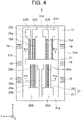
- FIG. 4 is a plan view (bottom surface view) showing the configuration of the principal part of the sensor element 5. As will be understood from the direction of the z-axis, among the upper surface and the lower surface of the sensor element 5, FIG. 4 shows the lower surface (side fixed to the mounting body 3).
- the sensor element 5 is a piezoelectric vibration type one. When used, the sensor element 5 is excited in the x-direction by utilizing an inverse piezoelectric effect. When the sensor element 5 rotates about the y-axis in this state, a Coriolis force in the z-direction is generated, so the sensor element 5 vibrates in the z-direction with an amplitude corresponding to the angular velocity. By conversion of this vibration to an electrical signal by the piezoelectric effect, the angular velocity is detected.
- the sensor element 5 according to the present embodiment may be the same as the sensor element described in Japanese Patent Publication No. 2015-141184 except for the configuration relating to a support part 27 which will be explained later. Further, in the explanation of the sensor element 5, sometimes explanation of details will be omitted for configurations other than the support part 27.
- the sensor element 5 has a piezoelectric body 13, first excitation electrodes 15A and second excitation electrodes 15B ( FIG. 3 ) for supplying voltages to the piezoelectric body 13, first detecting electrodes 17A ( FIG. 3 ) and second detecting electrodes 17B ( FIG. 3 ) for extracting electrical signals generated in the piezoelectric body 13, and element terminals 19 ( FIG. 4 ) for mounting the sensor element 5 on the mounting body 3.
- Additional notations "A" and "B" of the excitation electrodes 15 and detecting electrodes 17 are attached based on the orthogonal coordinate system xyz. Accordingly, as will be explained later, one first excitation electrode 15A and another first excitation electrode 15A do not always have the same potential. The same is true for the second excitation electrodes 15B, first detecting electrodes 17A, and second detecting electrodes 17B.
- the excitation electrodes 15, detecting electrodes 17, element terminals 19, and wirings 33 (schematically shown in FIG. 5A and FIG. 5B ) connecting them are configured by conductor layers provided on the surface of the piezoelectric body 13.
- the material for those is for example Cu, Al, or another suitable metal.
- These conductor layers may be configured by layers made of mutually different materials which are stacked on each other as well.
- the piezoelectric body 13 is integrally formed as a whole.
- the piezoelectric body 13 may be a single crystal or may be a polycrystal. Further, the material of the piezoelectric body 13 may be suitably selected. It is for example quartz crystal (SiO 2 ), LiTaO 3 , LiNbO 3 , or PZT.
- the electrical axis or polarization axis (below, sometimes only the polarization axis will be referred to as representative of the two) is set so as to coincide with the x-axis.
- the polarization axis may be inclined relative to the x-axis within a predetermined range (for example 15° or less) as well.
- the mechanical axis and optical axis may be made suitable directions.
- the mechanical axis is made substantially parallel to the y-axis and the optical axis is made substantially parallel to the z-axis.
- the piezoelectric body 13 is for example made substantially constant in thickness (z-direction) as a whole. Further, the piezoelectric body 13 is for example formed substantially in a line symmetrical shape relative to a not shown symmetrical axis parallel to the y-axis. Further, the piezoelectric body 13 for example includes a base part 21, driving arms 23 (first driving arm 23A to fourth driving arm 23D) and detecting arms 25 (first detecting arm 25A and second detecting arm 25B) which extend out of the base part 21, and a support part 27 which is connected with the base part 21.
- driving arms 23 first driving arm 23A to fourth driving arm 23D
- detecting arms 25 first detecting arm 25A and second detecting arm 25B
- the two (for example pair of) driving arms 23 are excited in the x-direction by application of voltage (electric field).
- the detecting arms 25 vibrate in the z-direction due to the Coriolis force and generate electrical signals corresponding to the angular velocity.
- the base part 21 for example contributes to support of the driving arms 23 and detecting arms 25 and transfer of vibration from the driving arms 23 to the detecting arms 25.
- the support part 27 for example contributes to support of the base part 21 and mounting of the sensor element 5 onto the mounting body 3.
- the specific configurations of these are for example as follows.
- the base part 21 is for example formed in a substantially cuboid shape so as to linearly extend in the x-direction with a constant width.
- the pluralities of driving arms 23 extend alongside (for example in parallel to) each other in the same directions (to the +y side) as each other.
- the front ends of them are made free ends.
- the number of the driving arms 23 is for example an even number (four in the present embodiment).
- each of the driving arms 23 when viewed on a plane is for example a so-called hammer shape. That is, the driving arm 23 has a body portion 23a which extends from the base part 21 to the +y side with a constant width and a broad width portion 23b which is positioned at the front end of the body portion 23a and is broader in width (x-direction) than the body portion 23a. Due to this, the mass of the driving arm 23 is secured at the front end. In turn, it becomes possible to improve the sensitivity while reducing the size.
- the broad width portions 23b for example spread to the inner side relative to the body portions 23a.
- the broad width portions 23b for example spread to the outer sides relative to the body portions 23a.
- the distance between the pair of driving arms 23 (second driving arm 23B and third driving arm 23C) which are positioned on the two sides of a not shown center line of the piezoelectric 13 and closest with respect to the center line, due to provision of the broad width portions 23b as described above, the distance at the side of the front ends (lateral sides of the broad width portions 23b) becomes shorter than the distance at the side of the roots (lateral sides of the body portions 23a).
- the broad width portion 23b may spread to both sides relative to the body portion 23a as well. Further, in each of the driving arms 23, the broad width portion 23b need not be provided either.
- the driving arms 23 When the driving arms 23 become larger in the x-direction (excitation direction) or z-direction (direction of the Coriolis force), the natural frequencies in the x-direction or z-direction of the driving arms 23 become higher. When the driving arms 23 become larger in the extension direction (y-direction), the natural frequencies in the x-direction and z-direction of the driving arms 23 become lower. Accordingly, for example, the ratios of the dimensions of the widths (x-direction) and lengths (y-direction) of the driving arms 23 may be set so that the natural frequencies in the excitation direction (x-direction) of the driving arms 23 become closer to the frequency of exciting the driving arms 23. Further, the shapes and dimensions of the xz cross-sections of the driving arms 23 may be for example set so that the natural frequencies in the x-direction of the driving arms 23 and the natural frequencies in the z-direction thereof become closer.
- the plurality of detecting arms 25 extend alongside (for example in parallel to) each other to an opposite direction (-y side) to the direction in which the pluralities of driving arms 23 extend.
- the front ends of the plurality of detecting arms 25 are formed as free ends.
- the number of the detecting arms 25 is for example an even number (two in the present embodiment).
- each detecting arm 25 when viewed on a plane is for example made a hammer shape in the same way as the driving arms 23. That is, the detecting arm 25 has a body portion 25a which extends from the base part 21 to the -y side with a constant width and a broad width portion 25b which is positioned at the front end of the body portion 25a and is broader in width (x-direction) than the body portion 25a. Due to this, the mass of the detecting arm 25 is secured at the front end. In turn, it becomes possible to improve the sensitivity while reducing the size.
- the broad width portion 25b for example spreads to the both side directions (+x direction and -x direction) in the x-direction relative to the body portion 25a. Due to this, regarding the distance between two (for example a pair of) detecting arms 25, the distance at the side of the front ends (lateral sides of the broad width portions 25b) becomes shorter than the distance at the side of the roots (lateral sides of the body portions 25a). However, unlike the example shown, the broad width portion 25b may spread to only one side in the x-direction (for example outer side of the pair of detecting arms 25) relative to the body portion 25a as well. Further, the broad width portion 25b need not be provided either.
- Each detecting arm 25 (for example the body portion 25a in each detecting arm 25) is for example shaped formed with one or a plurality of (four in the example shown) slits (notation omitted) which penetrate through the detecting arm 25 in the z-direction and extend in the y-direction. From another viewpoint, each detecting arm 25 has a plurality of (five in the example shown) divided arms 25c which extend alongside each other. By the detecting arm 25 having the plurality of divided arms 25c, for example, as will be understood from the explanation given later, the number of detecting electrodes 17 arranged is increased and detection sensitivity can be improved.
- the ratios of the dimensions of the thicknesses (z-direction) and lengths (y-direction) of the detecting arms 25 may be set to that the natural frequencies in the z-direction of the detecting arms 25 become closer to the frequency of exciting the driving arms 23.
- the ratios of the dimensions of the widths (x-direction) and lengths(y-direction) of the detecting arms 25 may be set so that the natural frequencies in the x-direction of the detecting arms 25 are separated from the frequency of exciting the driving arm 23.
- the width of the detecting arm 25 is made larger than the width of the driving arm 23 and the thickness of the detecting arm 25 (driving arm 23).
- the support part 27 for example has a holding part 29 which extends from the base part 21 and a mounting part 31 which is connected to the end part of the holding part 29 on the opposite side to the base part 21.
- the base part 21 is supported upon the mounting body 3 through the mounting part 31 and holding part 29.
- the base part 21 is not supported at its two ends upon the mounting part 31, but is supported through the holding part 29 upon the mounting part 31. Therefore, for example, even if stress is generated in the mounting part 31 due to a difference of thermal expansion between the mounting part 31 and the mounting body 3, the stress is not easily transferred to the base part 21.
- the holding part 29 for example extends between the pair of detecting arms 25 from the base part 21 to the -y side alongside (for example in parallel to) the detecting arms 25.
- the holding part 29 is longer than the detecting arms 25 and extends out beyond the front ends of the detecting arms 25 to the -y side.
- the holding part 29 for example, in the example shown, has a main portion 29a configuring most of the holding part 29 and a connection portion 29b connecting the main portion 29a and the base part 21.
- the width (x-direction) of the connection portion 29b is made broader than the main portion 29a. Due to this, the strength at the position of connection of the holding part 29 and the base part 21 is improved.
- the main portion 29a for example, when viewed on a plane, has schematically a long shape so as to linearly extend from the mounting part 31 to the base part 21 with a constant width (x-direction).
- the main portion 29a extends from a portion between the front ends of the pair of detecting arms 25 up to the connection portion 29b while maintaining a width not less than about the same width as that of the portion positioned between the front ends (broad width portions 25b) of the pair of detecting arm 25. That is, the main portion 29a (holding part 29) does not have a portion (constriction) which becomes narrower in width on the base part 21 side.
- the shape of the transverse plane (xz cross-section) of the main portion 29a is for example rectangular.
- connection portion 29b for example has a portion which extends in the y-direction with a constant width broader than the width of the main portion 29a. That is, the connection portion 29b has a rectangular portion when viewed on a plane.
- the rectangle may be a square or an oblong which is longer in any of the x-direction and y-direction.
- the shape of the transverse plane (xz cross-section) of the connection portion 29b is for example rectangular.
- the dimensions of the main portion 29a and connection portion 29b may be suitably set.
- the widths of these may be made the largest sizes as long as the holding part 29 and the pair of detecting arms 25 do not abut against each other due to vibration for detecting the angular velocity or other reasons.
- the width of the holding part 29 may be set to a length obtained by subtracting displacements in the x-direction of the pair of detecting arms 25 envisioned when they are normally used and a predetermined margin from the distance between the pair of detecting arms 25. At this time, it may be considered that the distance between the pair of detecting arms 25 and/or the displacements of the pair of detecting arms 25 differ according to the position of the main portion 29a and the position of the connection portion 29b in the y-direction.
- the width of the main portion 29a is less than 1 time the distance between the front ends (broad width portions 25b) of the pair of detecting arms 25. Further, for example, the width of the main portion 29a may be made 1/3 or more or 2/5 or more of the distance between the front ends of the pair of detecting arms 25. Further, the width of the connection portion 29b may be less than 1 time the distance between the root side portions (body portions 25a) of the pair of detecting arms 25. The width of the connection portion 29b is longer than a distance between the broad width portions 25b. For example, the width of the connection portion 29b may be set to 1.1 times or more the distance between the front ends of the pair of detecting arms 25.
- connection portion 29b and the width of the main portion 29a may be suitably set from the viewpoint of the relative sizes of the two.
- the width of the connection portion 29b may be made 1.1 times to 2 times the width of the main portion 29a.
- the thickness (z-direction) of the piezoelectric body 13 is basically constant over the piezoelectric body 13 as a whole.
- the thicknesses of the main portion 29a and the connection portion 29b are the same as each other.
- the mounting part 31 is for example formed in a frame shape extending at the peripheries of the base part 21, driving arms 23, and detecting arms 25.
- the frame is an annular shape surrounding the base part 21, driving arms 23, and detecting arms 25.
- the annular shape is for example substantially rectangular.
- the mounting part 31 has a detection side extending portion 31a which extends in the x-direction (for example in parallel to the x-direction) on the detecting arm 25 side (-y side), a pair of lateral side extending portions 31b which extend in the y-direction (for example in parallel to the y-direction) and face each other in the x-direction, and a driving side extending portion 31c which extends in the x-direction (for example in parallel to the x-direction) on the driving arm 23 side (+y side).
- the four corners of the rectangle may be grasped as the end parts of the detection side extending portion 31a or the driving side extending portion 31c or may be grasped as the end parts of the pair of lateral side extending portions 31b.
- the holding part 29 connects the base part 21 and the detection side extending portion 31a.
- the size of the mounting part 31 may be suitably set.
- the mounting part 31 may be separated from the driving arms 23 and detecting arms 25 by suitable distances so as not to abut against these arms due to vibration for detecting the angular velocity or other reasons while being made as small as possible.
- the lateral side extending portions 31b are for example longer than the detection side extending portion 31a and driving side extending portion 31c. However, the lengths of the two may be made equal and the relative lengths may be reversed from the example shown.
- the shape of the transverse plane of the mounting part 31 is for example substantially rectangular over the whole length of the mounting part 31.
- the thickness (z-direction) of the mounting part 31 is for example constant over the whole length of the mounting part 31.
- the width of the mounting part 31 is for example constant in each extending portion (each side) . Further, in the example shown, the widths of the lateral side extending portions 31b become larger than the width of the detection side extending portion 31a, and the width of the detection side extending portion 31a becomes larger than the driving side extending portion 31c. However, the width may change in each extending portion and/or the relative sizes of the widths of the sides may be made different from those described above.
- the number of the element terminals 19 may be suitably set in accordance with the configuration of the sensor element 5.
- the two element terminals 19 for the reference potential are connected at the base part 21 etc. to a shield-use wiring which is arranged between a driving signal-use wiring 33 and a detection signal-use wiring 33.
- Such element terminals 19 and wiring for reference potential use may be omitted as well.
- the wiring for the reference potential use in the base part 21 may be made the same as that disclosed in Japanese Patent Publication No. 2015-141183 .
- the element terminals 19 are for example provided on the lower surface (surface on the -z side) of the mounting part 31.
- the positions, shapes, and sizes of the plurality of element terminals 19 when viewed on a plane may be suitably set.
- the six element terminals 19 are arranged separated from the four corners of the mounting part 31 in the pair of lateral side extending portions 31b.
- all element terminals 19 are positioned closer to the +y side than the detection side extending portion 31a and closer to the -y side than the driving side extending portion 31c.
- all element terminals 19 are positioned between the front ends of the driving arms 23 and the front ends of the detecting arms 25 in the y-direction.
- the plurality of element terminals 19 are for example schematically arranged line symmetrical relative to a symmetrical axis parallel to the x-axis and a symmetrical axis parallel to the y-axis which pass through the center of gravity of the sensor element 5.
- Each element terminal 19 is for example formed in a rectangular shape so as to have a width about the same as the widths of the lateral side extending portions 31b or a width somewhat smaller than the latter.
- FIG. 5A is a cross-sectional view taken along the Va-Va line in FIG. 4 .
- the relationships of positive/negative of the x-axis and left/right directions on the drawing sheet are inverse.
- the excitation electrodes 15 (notation is attached to the fourth driving arm 23D on the right side on the drawing sheet) are layered conductors which are formed on the surfaces of the driving arms 23.
- a first excitation electrode 15A, in each of the driving arms 23, is provided on each of the upper surface and lower surface (surface on the +z side and surface on the -z side).
- a second excitation electrode 15B, in each of the driving arm 23, is provided on each of the side surfaces (surface on the +x side and surface on the -x side).
- Each excitation electrode 15 is for example provided so as to cover most of each surface of the body portion 23a in the driving arm 23 (see FIG. 3 and FIG. 4 as well). However, at least one of the first excitation electrode 15A and the second excitation electrode 15B (first excitation electrode 15A in the present embodiment) is formed smaller in the width direction than each surface so that these excitation electrodes do not short-circuit with each other. Further, portions on the root side and front end side of the body portions 23a may be made positions where the excitation electrodes 15 are not arranged.
- the two first excitation electrodes 15A are for example rendered the same potentials as each other.
- the two first excitation electrodes 15A are connected to each other by a wiring 33 on the piezoelectric body 13.
- the two second excitation electrodes 15B are for example rendered the same potentials as each other.
- the two second excitation electrodes 15B are connected to each other by a wirings 33 on the piezoelectric body 13.
- the orientation of the electric field and the orientation of the polarization axis match in one side portion of the x-direction, while the orientation of the electric field and the orientation of the polarization axis become inverse to each other in the other side portion.
- the driving arms 23 in the x-direction contract in the y-direction, and the other side portions extend in the y-direction. Further, the driving arms 23 flex to one side in the x-direction like a bimetal. If voltages supplied to the first excitation electrodes 15A and second excitation electrodes 15B are inverted, the driving arms 23 flex to inverse directions. If an AC voltage is supplied to the first excitation electrodes 15A and the second excitation electrodes 15B, the driving arms 23 vibrate in the x-direction.
- one or more recessed grooves extending along the long directions of the driving arms 23 may be provided in the upper surfaces and/or lower surfaces of the driving arms 23, and the first excitation electrodes 15A may be provided over the interiors of the recessed grooves.
- the first excitation electrodes 15A and the second excitation electrodes 15B face each other in the x-axis direction while sandwiching the wall portions of the recessed grooves therebetween, therefore the efficiency of excitation is improved.
- a recessed groove may be configured by a plurality of recessed portions arranged in the long direction of the driving arm 23 as well.
- the first excitation electrodes 15A are given the same potentials as each other, and the second excitation electrodes 15B are given the same potentials as each other.
- the excitation electrodes 15 which should be rendered the same potentials are for example connected to each other by the wirings 33 on the piezoelectric body 13.
- connection relationships if applying AC voltage between the first excitation electrodes 15A and the second excitation electrodes 15B, voltages having the same phases as each other are supplied to the two driving arms 23 which are adjacent to each other, therefore the driving arms vibrate so as to flexurally deform to the same orientations as each other in the x-direction.
- the two driving arms 23 which are adjacent to each other may be grasped as corresponding to ones divided from one driving arm.
- the two driving arms 23 which are adjacent to each other may be integrally formed to become one at their root portions as well.
- the first excitation electrodes 15A and the second excitation electrodes 15B are rendered the same potentials.
- the excitation electrodes 15 which must be rendered the same potentials as each other are for example connected with each other by the wirings 33 on the piezoelectric body 13.
- the pair of driving arms 23 which are line symmetrically arranged are supplied with voltages having inverse phases to each other, therefore they vibrate so as to flexurally deform in inverse orientations from each other (line symmetrically) in the x-direction.
- FIG. 5B is a cross-sectional view taken along the Vb-Vb line in FIG. 4 .
- the relationships of positive/negative of the x-axis and left/right directions on the drawing sheet are inverse.
- the detecting electrodes 17 (notation is attached to the divided arms 25c on the right side on the drawing sheet) are layered conductors which are formed on the surfaces of the detecting arms 25 (divided arms 25c). The detecting electrodes 17 are provided on each divided arm 25c.
- the first detecting electrodes 17A, on each divided arm 25c are respectively provided in a region on the +z side in a surface on the -x side (for example the side closer to +z than the center of the surface, the same is true for the following explanation) and a region on the -z side in a surface on the +x side.
- the second detecting electrodes 17B, on each divided arm 25c are respectively provided in a region on -z side in the surface on the -x side and in a region on the +z side in the surface on the +x side.
- the first detecting electrode 17A and the second detecting electrode 17B extend along the divided arm 25c at a suitable interval so as not to short-circuit with each other.
- the detecting electrodes 17 extend over substantially the whole length of the divided arm 25c.
- the two first detecting electrodes 17A are connected with each other, and the two second detecting electrodes 17B are connected with each other.
- the connections are for example made by the wirings 33 on the piezoelectric body 13.
- the voltages are detected as AC voltage.
- the electric fields parallel to the z-direction as described above may be dominant or a ratio of electric fields which are parallel to the x-direction and have inverse orientations to each other between the -z side and the +z side of the divided arms 25c may be larger unlike the above.
- voltages in accordance with the flexural deformation of the divided arms 25c in the z-axis direction are generated between the first detecting electrodes 17A and the second detecting electrodes 17B.
- the first detecting electrodes 17A are connected with each other and the second detecting electrodes 17B are connected with each other.
- the connections are for example made by the wirings 33 on the piezoelectric body 13. In such connection relationships, if the plurality of divided arms 25c flexurally deform so as to bend to the same sides as each other in the z-direction, signals detected in the plurality of divided arms 25c are added.
- the first detecting electrodes 17A and the second detecting electrodes 17B are connected.
- the connections are for example made by the wirings 33 on the piezoelectric body 13. In such connection relationships, if the two detecting arms 25 flexurally deform so as to bend to inverse sides to each other in the z-direction, the signals detected in the two detecting arms 25 are added.
- the plurality of wirings 33 connect the excitation electrodes 15 and the detecting electrodes 17 as explained above. Further, the plurality of wirings 33 connect four sets of electrodes in total, comprised of the excitation electrodes 15 which are divided into two sets from a viewpoint of potentials and the detecting electrodes 17 divided into two sets from a viewpoint of potentials, to the four element terminals 19 ( FIG. 4 ) respectively.
- the connections explained above can be realized without short-circuiting with each other in a mode where the entireties of wirings 33 are provided on the surfaces of the piezoelectric body 13.
- three-dimensional interconnect portions may be formed by providing an insulation layer on the wirings 33 positioned on the piezoelectric body 13 and providing the other wirings 33 above the same.
- a driving circuit 103 supplying voltages to the excitation electrodes 15 is connected to the excitation electrodes 15 through two element terminals 19 not shown here. Further, a detecting circuit 105 detecting the electrical signals from the detecting electrodes 17 is connected to the detecting electrodes 17 through two element terminals 19 not shown here.
- the combination of the sensor element 5 (or angular velocity sensor 1) and the driving circuit 103 and detecting circuit 105 may be considered to configure the angular velocity sensor 51.
- the driving circuit 103 and detecting circuit 105 configure a control circuit 107 as a whole.
- the control circuit 107 is for example configured by an IC (integrated circuit). Such an IC may be mounted on the mounting body 3 to be packaged together with the sensor element 5 or may be mounted on a not shown circuit board or the like on which the sensor 1 is mounted and be connected with the sensor element 5 through the circuit board and mounting body 3.
- the driving circuit 103 is for example configured including an oscillation circuit and amplifier and supplies an AC voltage having a predetermined frequency between the first excitation electrodes 15A and the second excitation electrodes 15B.
- the frequency may be determined in advance in the angular velocity sensor 51 or may be designated from an external apparatus or the like.
- the detecting circuit 105 is configured including an amplifier and wave detecting circuit, detects a potential difference between the first detecting electrode 17A and the second detecting electrode 17B, and outputs an electrical signal in accordance with the detection result to an external apparatus or the like. More specifically, for example, the potential difference described above is detected as the AC voltage, and the detecting circuit 105 outputs a signal in accordance with the amplitude of the detected AC voltage. The angular velocity is identified based on this amplitude. Further, the detecting circuit 105 outputs a signal in accordance with a phase difference between the applied voltage of the driving circuit 103 and the electrical signal which was detected. The orientation of rotation is identified based on this phase difference.
- the group of the first driving arm 23A and second driving arm 23B and the group of the third driving arm 23C and fourth driving arm 23D are excited with inverse phases from each other (phases offset by 180°) so as to deform to inverse sides to each other in the direction of excitation (x-direction).
- the driving arms 23 receive the Coriolis force in the direction (z-direction) perpendicular to the excitation direction (x-direction) and rotation direction (y-direction). Due to this, the driving arms 23 vibrate in the z-direction. Further, the group of the first driving arm 23A and second driving arm 23B and the group of the third driving arm 23C and fourth driving arm 23D are excited with inverse phases from each other, therefore vibrate so as to flex to inverse sides to each other in the z-direction.
- the driving arms 23 and the detecting arms 25 are connected by the base part 21. Accordingly, the vibrations of the driving arms 23 are transferred through the base part 21 to the detecting arms 25, so the detecting arms 25 also vibrate. Specifically, the first detecting arm 25A vibrates so as to flex to the inverse side to the first driving arm 23A and second driving arm 23B in the z-direction. Further, the second detecting arm 25B vibrates so as to flex to the inverse side to the third driving arm 23C and fourth driving arm 23D in the z-direction. From another viewpoint, the first detecting arm 25A and the second detecting arm 25B vibrate so as to flex to inverse sides to each other in the z-direction. Accordingly, as explained in the explanation of the connection relationships of the plurality of detecting electrodes 17, the electrical signals generated in the two detecting arms 25 are added.
- the explanation was given assuming that the vibrations in the z-direction of the driving arms 23 were transferred to the detecting arms 25. In other words, the explanation was given ignoring the vibrations in the x-direction of the detecting arms 25. In actuality, the action also arises of the vibrations in the x-direction of the driving arms 23 being transferred to the detecting arms 25 and the detecting arms 25 vibrating in the x-direction to generate the Coriolis force in the detecting arms 25, whereby the detecting arms 25 vibrate in the z-direction. In regard to the vibrations in the z-direction of the detecting arms 25, either of these two types of actions may be dominant.
- the electronic element 7 shown in FIG. 1 and FIG. 2A may be made suitable one.
- the electronic element 7 may be made a thermistor or another temperature sensor and/or may be an IC including the driving circuit 103 and detecting circuit 105 explained above.
- the electronic element 7 may be made one which is not connected with the sensor element 5 or may be one which is connected with the sensor element 5.
- one electronic element 7 is provided.
- a plurality of electronic elements 7 may be provided as well. In the sensor 1, the electronic element 7 also need not be provided.
- the electronic element 7 is one which is not electrically connected with the sensor element 5 (for example, a temperature sensor) and the sensor element 5 and the electronic element 7 are electrically connected through the package 11 with an external apparatus independently from each other will be taken as an example.
- the sensor element 5 for example, a temperature sensor
- the mounting body 3 shown in FIG. 1 , FIG. 2A, and FIG. 2B for example has an insulation body 35 which becomes the main part of the mounting body 3, a plurality of (six in the example shown) first pads 37 for mounting the sensor element 5 on the mounting body 3, a plurality of (two in the example shown) second pads 39 for mounting the electronic element 7 on the mounting body 3, and a plurality of (eight in the example shown) external terminals 41 for mounting the sensor 1 on a not shown circuit board or the like.
- the insulation body 35 has the recessed part 3a explained above.
- the outer shape of the insulation body 35 and the shape of the recessed part 3a may be suitably set.
- the outer shape of the insulation body 35 is formed as a cuboid shape having the x-direction as the long direction.
- the shape of the recessed part 3a is substantially a cuboid shape having the x-direction as the long direction in the same way as the insulation body 35.
- the bottom surface of the recessed part 3a in a region facing the sensor element 5, is further dug down leaving the regions where the first pads 37 are arranged. That is, the bottom surface (facing surface 35b) of the recessed part 3a has a fixed surface 35c to which the sensor element 5 is fixed and a retracting surface 35d which is located at a position lower than the fixed surface 35c and faces the most part of the sensor element 5. Due to this, the sensor element 5 seldom contacts the facing surface 35b.
- the recessed part 3a may be grasped as having a first recessed part (the portion of the fixed surface 35c) and a second recessed part (portion of the retracting surface 35d) which is formed in the bottom surface of the first recessed part.
- the insulation body 35 is, for example, as shown in FIG. 2A and FIG. 2B , configured by a plurality of insulation layers 43 (three insulation layers 43A to 43C in the example shown) stacked on each other. Further, by formation of one or more openings in part of the insulation layers 43 (43A and 43B) on the upper side (+z side), the recessed part 3a is formed.
- Each insulation layer 43 is for example configured by a ceramic, resin, or inorganic material in an amorphous state or a combination of the same. In FIG. 2A and FIG. 2B , for convenience, three insulation layers 43 are shown. However, each insulation layer 43 may be configured by a plurality of insulation layers as well. In the sensor 1 after completion, a boundary between the insulation layers need not always be identifiable.
- the first pads 37 and second pads 39 are for example configured by conductive layers which are made of metal or another conductor and are superposed on the facing surface 35b (fixed surface 35c) .
- the materials, planar shapes, and various dimensions of the first pads 37 and second pads 39 may be suitably set.
- the conductive layer may be configured by a plurality of layers as well.
- the sensor element 5 is for example arranged so that the plurality of element terminals 19 face the plurality of first pads 37. Further, the plurality of element terminals 19 and the plurality of first pads 37 are bonded by a plurality of conductive bumps 45 ( FIG. 2A and FIG. 2B ) interposed between them. Due to this, the sensor element 5 is supported upon the mounting body 3 and is electrically connected to the mounting body 3.
- the bumps 45 are for example configured by solder (including lead-free solder) or conductive adhesive.
- the conductive adhesive is for example configured by a conductive filler mixed into a thermosetting resin.
- the number and arrangement positions of the plurality of first pads 37 correspond to the number and arrangement positions of the plurality of element terminals 19.
- the shapes and sizes of the first pads 37 may be the same as or different from the shapes and sizes of the element terminals 19.
- the electronic element 7, for example, in the same way as the sensor element 5, is bonded through bumps (notation is omitted) with the second pads 39.
- the external terminals 41 are for example configured by conductor layers which are made of metal or another conductor and are superposed on the lower surface of the insulation body 35.
- the materials, planar shapes, and various dimensions of the external terminals 41 may be suitably set.
- the conductive layer may be configured by a plurality of layers as well. Further, the number and positions of the plurality of external terminals 41 may be suitably set in accordance with the configurations of the sensor element 5 and electronic element 7 and the like. In the example shown, eight external terminals 41 are arranged along the outer edge of the lower surface of the insulation body 35.
- external terminals 41 are connected independently from each other through wiring conductors (notation is omitted) provided on the surface or in the internal portion of the insulation body 35 with respect to the four first pads 37. These four first pads 37 are connected independently from each other through the four element terminals 19 to the two sets of excitation electrodes 15 and two sets of detecting electrodes 17. Further, the remaining four external terminals 41 are connected through wiring conductors (notation is omitted) provided on the surface or in the internal portion of the insulation body 35 to the two first pads 37 to be given the reference potential and to the second pads 37 for the electronic element 7.
- the lid 9 is for example configured by metal.
- the lid 9 is bonded to the upper surface of the mounting body 3 by seam welding or the like. Due to this, the interior of the recessed part 3a is air tightly sealed.
- the air tightly sealed interior of the recessed part 3a is for example evacuated or sealed with a suitable gas (for example nitrogen). Illustration of the conductive layers (notation is omitted) shown in FIG. 2A and FIG. 2B which contribute to bonding of the lid 9 is omitted in FIG. 1 .
- the above sensor 1 is for example arranged on the mounting surface of a not shown circuit board so that the lower surface of the mounting body 3 is made to face the mounting surface and is mounted on the circuit board by bonding of the external terminals 41 to the pads on the circuit board by solder or the like.
- the already explained driving circuit 103 and detecting circuit 105 are configured on the circuit board.
- the sensor element 5 in the present embodiment has the piezoelectric body 13, the plurality of first electrodes (excitation electrodes 15) and plurality of second electrodes (detecting electrodes 17), and the plurality of element terminals 19 which are connected to the plurality of excitation electrodes 15 and the plurality of detecting electrodes 17.
- the piezoelectric body 13 has the base part 21, two (for example a pair of) first arms (first driving arm 23A and fourth driving arm 23D or second driving arm 23B and third driving arm 23C), two (for example a pair of) second arms (detecting arms 25), the holding part 29, and the mounting part 31.
- the pair of driving arms 23 extend alongside each other from the base part 21 to one side (+y side) in the y-direction and have pluralities of excitation electrodes 15 positioned on them.
- the pair of detecting arms 25 extend alongside each other from the base part 21 to the other side (-y side) in the y-direction and have the pluralities of detecting electrodes 17 positioned on them.
- the holding part 29 extends between the pair of detecting arms 25 from the base part 21 to the -y side and extends out beyond the front ends of the pair of detecting arms 25 to the -y side.
- the mounting part 31 is connected to the end part of the holding part 29 on the -y side and has the plurality of element terminals 19 positioned on it.
- the holding part 29 has the main portion 29a and connection portion 29b.
- the main portion 29a When the length in the x-direction is the width, the main portion 29a extends from the position between the front ends (broad width portions 25b) of the pair of detecting arms 25 toward the base part 21 side while maintaining the width not less than the same degree as the width of the portion positioned between the front ends of the pair of detecting arms 25.
- the connection portion 29b is connected to the main portion 29a and the base part 21 and is broader in width than the main portion 29a.
- the strength of the holding part 29 can be raised. Due to this, for example, a possibility of breakage of the holding part 29 when impact is applied to the sensor 1 due to dropping or the like is reduced. In experiments by the present inventors, when the sensor element 5 is broken due to shock, the breakage may occur most at the position where the holding part 29 and the base part 21 are connected. Accordingly, by improvement of the strength of the connection portion 29b, the strength of sensor element 5 as a whole is substantially improved. In the arms (here, detecting arms 25) in the sensor element 5, displacement becomes larger toward the front ends (free ends) and/or the width becomes broader toward the front ends .
- the width is widened over the holding part 29 as a whole, the distance between the pair of detecting arms 25 must be made larger in order to suppress contact between the holding part 29 and the detecting arms 25, therefore it is disadvantageous for reduction of size.
- amplitudes of the pair of detecting arms 25 are restricted and/or masses of the front ends of the pair of detecting arms 25 are restricted, therefore the sensitivity falls.
- the root side (connection portion 29b) of the holding part 29 is made relatively broader relative to the front end side (main portion 29a) to raise the strength, therefore this inconvenience is solved. That is, both reduction of size and improvement of strength are achieved.
- the pluralities of excitation electrodes 15 include a plurality of third electrodes (first excitation electrodes 15A) which are positioned on the surfaces at the +z side and -z side of each of the pair of driving arms 23 and a plurality of fourth electrodes (second excitation electrodes 15B) which are positioned on the surfaces at the +x side and -x side of each of the pair of driving arms 23.
- the first excitation electrodes 15A positioned on the same driving arm 23 are connected with each other.
- the second excitation electrodes 15B positioned on the same driving arm 23 are connected with each other.
- the pluralities of detecting electrodes 17 include a plurality of fifth electrodes (first detecting electrodes 17A) which are positioned in the region on the +z side in the surface on the -x side and the region on the -z side in the surface on the +x side in each of the pair of detecting arms 25 and a plurality of sixth electrodes (second detecting electrodes 17B) which are positioned in the region on the -z side in the surface on the -x side and the region on the +z side in the surface on the +x side in each of the pair of detecting arms 25.
- the first detecting electrodes 17A positioned on the same detecting arm 25 are connected with each other.
- the second detecting electrodes 17B positioned on the same detecting arm 25 are connected with each other.
- the base part 21 is connected with the mounting part 31 by only the holding part 29.
- the holding part 29 is arranged between the latter pair and is not arranged between the former pair. Accordingly, the amounts of vibrations (x-direction) of the arms to be considered in order to avoid contact of the holding part 29 and the arms are small compared with the aspect in which the holding part 29 is arranged between the pair of driving arms 23 (this aspect is also included in the art according to the present disclosure).
- connection portion 29b without widening the interval of the pair of arms sandwiching the holding part 29 therebetween, therefore both reduction of size and reinforcement of the strength are easily realized.
- the necessity of restricting the amplitudes of the pair of arms sandwiching the holding part 29 is reduced, therefore it is easy to improve the sensitivity.
- connection portion 29b has a portion which extends in the y-direction with a constant width (x-direction).
- torsional deformation and flexural deformation in the portion on the base part 21 side in the holding part 29 are easily suppressed.
- a change of posture of the base part 21 with respect to the mounting part 31 is suppressed and in turn the detection accuracy of the angular velocity is improved.
- each of the pair of detecting arms 25 has the broad width portion 25b which becomes broader in width than the root side in its front end. Due to this, the distance between the pair of detecting arms 25 becomes shorter at the front ends than the root side. The width of the connection portion 29b of the holding part 29 is longer than the distance between the front ends of the pair of detecting arms 25.
- connection portion 29b a width which cannot be obtained if the width of the holding part 29 as a whole is increase is secured in the connection portion 29b. That is, the strength of the holding part 29 on the base part 21 side becomes a strength which cannot be obtained if the width of the holding part 29 as a whole were increased.
- the excitation electrodes 15 are one example of the first electrodes.
- the detecting electrodes 17 are one example of the second electrodes.
- the driving arms 23 are one example of the first arms.
- the detecting arms 25 are one example of the second arms.
- the first excitation electrodes 15A are one example of the third electrodes.
- the second excitation electrodes 15B are one example of the fourth electrodes.
- the first detecting electrodes 17A are one example of the fifth electrodes.
- the second detecting electrodes 17B are one example of the sixth electrodes.
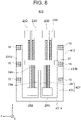
- FIG. 6 is a plan view showing a sensor element 205 according to a second embodiment and corresponds to FIG. 4 of the first embodiment.
- the holding part 29 extended alongside the detecting arms 25 from the base part 21 and was connected to the mounting part 31. Contrary to this, in the sensor element 205 (piezoelectric body 213) according to the present embodiment, the holding part 29 extends alongside the driving arms 23 from the base part 21 and is connected to the mounting part 31. In this way, the holding part 29 may be provided not on the detecting arm 25 side, but on the driving arm 23 side.
- the driving arms 23 are excited in the x-direction and the detecting arms 25 vibrate in the z-direction due to the Coriolis force. Therefore, a clearance between the holding part 29 and the detecting arm 25 in the first embodiment can be made smaller than the clearance between the holding part 29 and the driving arm 23 in the second embodiment. Consequently, in the first embodiment, the width (x-direction) and/or length (y-direction) of the connection portion 29b is more easily made larger than that in the second embodiment.
- the excitation electrodes 15 are one example of the second electrodes.
- the detecting electrodes 17 are one example of the first electrodes.
- the driving arms 23 are one example of the second arms.
- the detecting arms 25 are one example of the first arms.
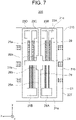
- FIG. 7 is a plan view showing a sensor element 305 according to a third embodiment and corresponds to FIG. 4 of the first embodiment.
- the sensor element 5 In the sensor element 5 according to the first embodiment, only one holding part 29 was provided.
- the sensor element 305 pieoelectric body 313, support part 327) according to the present embodiment, two holding parts 29 are provided. More specifically, provision is made of a holding part 29 which extends alongside the detecting arms 25 from the base part 21 and of a holding part 29 which extends alongside the driving arms 23 from the base part 21. That is, in the present embodiment, the first and second embodiments are combined.
- the base part 21 is supported by the two holding parts 29, so, for example, when shock is applied to the sensor element 5, the force which is added from the base part 21 to the holding part 29 is dispersed to the two holding parts 29. As a result, the possibility of breakage of the holding part 29 is reduced more than that in the first and second embodiments.
- the effect is exerted that, compared with the third embodiment, for example, the stress of the mounting part 31 causes just displacement of the base part 21 and is not easily transferred to the internal portion of the base part 21.
- the third embodiment compared with an aspect where the two ends of the base part 21 are connected to the mounting part 31, the base part 21 is connected to the holding parts 29 only at the center, therefore the stress in the mounting part 31 is not easily transferred to the internal portion of the base part 21.
- FIG. 8 is a plan view showing a sensor element 405 according to a fourth embodiment and corresponds to FIG. 4 of the first embodiment.
- the shape of the mounting part 31 was made an annular shape (specifically, rectangular).
- a mounting part 431 is not made annular.
- the mounting part 431 is shaped with a portion, which is on the side where the driving arms 23 extend (opposite side to the holding part 29, +y side), removed from the mounting part 31 according to the first embodiment.
- the mounting part 431 for example has a detection side extending portion 431a the same as that in the first embodiment and a pair of lateral side extending portions 431b which are obtained by removing single portions on the +y side from the pair of lateral side extending portions 31b in the first embodiment, and does not have the driving side extending portion 31c of the first embodiment.
- the mounting part 431 is broken at the end parts on the +y side of the pair of lateral side extending portions 431b.
- the end parts on the +y side of the pair of lateral side extending portions 431b configure the two ends of the mounting part 431.
- the positions in the y-direction of the end parts on the +y side of the lateral side extending portions 431b may be suitably set.
- the end parts are for example positioned closer to the -y side than the front ends of the driving arms 23 in the y-direction.
- the end parts are positioned between the front ends of the driving arms 23 and the base part 21.
- the end parts in the y-direction may be positioned at positions equal to that of the base part 21 or at positions closer to the detection side extending portion 431a than the base part 21.
- the element terminals 19 on the +y most side are for example positioned in the above end parts of the lateral side extending portions 431b.
- the sensor element 405 can be reduced in size on the +y side.
- deformations of the pair of lateral side extending portions 31b relative to each other are restricted by the driving side extending portion 31c.
- FIG. 9 is a plan view showing a sensor element 505 according to a fifth embodiment and corresponds to FIG. 4 of the first embodiment.
- the shape of the mounting part 31 was made a shape (frame shape) by combination of the extending portions (long shapes) .
- a mounting part 531 is not made a frame shape.
- the mounting part 531 is made a flat plate shape positioned as a whole on the side closer to the -y side than the detecting arms 25.
- the planar shape of the flat plate shape may be made a suitable shape. In the example shown, it is rectangular.
- the dimensions of the mounting part 531 may be suitably set.
- the mounting part 531 has a size large enough to arrange two or more (three in the example shown) element terminals 19 in the x-direction and has a size large enough to arrange two or more element terminals 19 in the y-direction.
- the length in the x-direction is for example longer than the length in the y-direction, and is not more than the length of the base part 21 in the x-direction.
- FIG. 10A and FIG. 10B are plan views showing modifications of the shape of the connection portion and correspond to a partially enlarged view of FIG. 4 .
- a corner portion formed by the side surface (surface facing the +x side or -x side) of the connection portion 151b in the holding part 153 and the surface on the holding part 153 side (surface on the -y side) of the base part 21 may be chamfered and/or a corner portion formed by the surface on the main portion 151a side (-y side) of the connection portion 151b and the side surface (surface facing the +x side or -x side) of the main portion 151a may be chamfered.
- All of chamfered surfaces may be suitably shaped.
- they may be made curved surfaces (arc shapes when viewed on a plane) as illustrated or may be made flat surfaces (linear shape when viewed on a plane) unlike the illustration.
- the radius of curvature of the curved chamfered surface and the inclination angle of the flat surface shaped chamfered surface relative to the x-axis and y-axis may be suitably set.
- the strength of the holding part 153 is improved, and in turn the strength of the sensor element is improved. Further, it is also made easier to make the influence of the residue formed due to the anisotropy with respect to etching of the piezoelectric body equal between the two sides in the x-direction.
- connection portion 151b in the holding part 153 need not have the portion extending in the y-direction with a constant width (x-direction) either.
- the connection portion 151b is substantially trapezoidal shaped with the main portion 153a side as the upper bottom side. That is, the side surface (surface facing the +x side or -x side) of the connection portion 151b is flat surface shaped (linear shape when viewed on a plane) so as to be inclined relative to the y-axis.
- the side surfaces of the connection portion 151b for example, other than this, may be made curved surfaces (curved shapes when viewed on a plane) so as to expand outward or be recessed inward.
- the sensor element and angular velocity sensor according to the present disclosure are not limited to the above embodiments and modifications and may be worked in various embodiments.
- the arrangement of the holding part in the second embodiment and the shape of the mounting part in the fourth embodiment may be combined.
- the mounting part conversely to the fourth embodiment, may be shaped broken on the detecting arm side (-y side).
- the arrangement of the holding part in the second to third embodiments and the shapes of the holding part in the modifications may be combined.
- the vibration modes of the driving arms and detecting arms are not limited to those illustrated in the embodiments.
- the axis of the angular velocity which is detected is not limited to the y-axis.
- the driving arms may be made to vibrate to inverse sides to each other in the z-direction, and the rotation about the y-axis may be detected by vibrations of the detecting arms to inverse sides to each other in the x-direction.
- the configurations and connections of the excitation electrodes and the configurations and connections of the detecting electrodes become inverse.
- provision may be made of a pair of driving arms which extend from the base part to the +y side, a pair of driving arms which extend from the base part to the -y side, a detecting arm which extends between the pair of driving arms on the +y side from the base part to the +y side, and a holding part which extends between the pair of driving arms on the -y side from the base part to the -y side, the driving arms may be made to vibrate in the x-direction, the base part may be made to vibrate in the rotation direction with respect to the position of connection with the holding part due to the Coriolis force in the y-direction which is generated by the rotation about the z-axis, thereby the detecting arm may be made to vibrate in the x-direction.
- the driving arms may be made not two pairs, but one pair or may be made three or more pairs.
- the detecting arms may be made not one pair, but two or more pairs.
- the main portion (29a etc.) of the holding part need not extend with a constant width over its entirety either.
- the main portion may be shaped so as to gradually become broader in width toward the base part (21) in a part or whole. In this case as well, it can be said that the main portion extends from the position between the front ends of the second arms to the base part while maintaining a width not less than the width of the portion positioned between the front ends of the second arms.
- the main portion as described above and the connection portion in the modification in FIG. 10B may be combined as well.
- the boundary of the two need not always be uniquely determined. So long as the holding part extends from the position between the front ends of the second arms (for example the detecting arms 25 in the first embodiment) to the base part while maintaining a width not less than the width of the portion positioned between the front ends of the second arms and so long as the width of the holding part at the position where the holding part and the base part are connected is larger than the width of the portion in the holding part which is positioned between the front ends of the second arms, the holding part can be said to have a main portion and connecting portion.
- the holding part may become broader in width than the width of the portion positioned between the front ends of the pair of second arms at the portion where it extends out beyond the front ends of the pair of second arms to the opposite side to the base part and is connected to the mounting part (for example 31).
- the ratio of occupation by the main portion was made greater than the ratio of occupation by the connection portion.
- the ratio of occupation by the connection portion may be made longer than the ratio of occupation by the main portion as well.
- the sensor element or angular velocity sensor may be configured as a portion of an MEMS (micro electromechanical system).
- MEMS micro electromechanical system
- the piezoelectric body configuring the sensor element may be mounted on the substrate of the MEMS.
- 1... angular velocity sensor 5... sensor element, 13... piezoelectric body, 15... excitation electrode (first electrode), 17... excitation electrode (second electrode) , 19... element terminal (terminal), 21... base part, 23... driving arm (first arm), 25... detecting arm (second arm), 29... holding part, and 31... mounting part.
Landscapes
- Physics & Mathematics (AREA)
- Engineering & Computer Science (AREA)
- General Physics & Mathematics (AREA)
- Radar, Positioning & Navigation (AREA)
- Remote Sensing (AREA)
- Gyroscopes (AREA)
Description
- The present disclosure relates to a sensor element and an angular velocity sensor.
- As a sensor element of an angular velocity sensor (gyroscope), a piezoelectric vibration type one is known (for example Patent Literature 1). A piezoelectric body of the sensor element of
Patent Literature 1 has a base part, a pair of driving arms extending alongside each other from the base part, and a pair of detecting arms extending from the base part to the side opposite to the pair of driving arms. When the sensor element rotates in a state where the driving arms are excited, a Coriolis force is generated and the detecting arms vibrate with amplitudes corresponding to the angular velocity. Due to this, an electrical signal corresponding to the angular velocity is generated in the detecting arms. - Further, the piezoelectric body of the sensor element of
Patent Literature 1 has a support rod which extends between the pair of detecting arms from the base part alongside the pair of detecting arms and extends out beyond the front ends of the detecting arms toward the side opposite to the base part and a fixed plate which is connected to the end part of the support rod on the opposite side to the base part. The base part is supported by the support rod. - At the end part on the base part side, the support rod shown in
FIG. 7 (plan view) ofPatent Literature 1 has a portion (constriction) which becomes narrower in width than the other portions of the support rod. Corner portions formed by the side surfaces of this constriction and the surface of the base part from which the support rod extends are chamfered. Such chamfering generally contributes to reduction of the influence due to residue generated by etching of the quartz crystal. -
US 2015/162522 A1 discloses a vibration element including a vibrating portion, a support portion that supports the vibrating portion, and a suspension arm that couples the vibrating portion to the support portion. In addition, the suspension arm includes a meandering portion extending out the support portion and an inclination portion that couples the meandering portion to the vibrating portion. -
US 6 124 962 A discloses an angular velocity detecting apparatus comprising a vibrator, excitation means for exciting the vibrator, detecting means for detecting an amplitude of vibration based on Coriolis' force occurring with rotation of the vibrator excited to vibrate by the excitation means, and angular velocity calculating means for calculating an angular velocity of the rotation from a magnitude of the amplitude detected by the detecting means, wherein in an X, Y, and Z, three-dimensional, orthogonal coordinate space, the vibrator has a vibrator base extending in the X-direction on the XY plane, two first vibrating bars projecting in the direction of +Y from the vibrator base and at substantially symmetric positions with respect to a Y-directional axis passing a central portion of the vibrator base, two second vibrating bars projecting in the direction of -Y from the vibrator base and at the same X-directional positions as the two first vibrating bars, and a single supporting rod having prescribed torsional rigidity, projecting from the central portion of the vibrator base, and fixed at the tip thereof to a body to be detected. - Patent Literature 1:
Japanese Patent Publication No. 10-54725 - The present invention provides a sensor element for an angular velocity sensor according to
claim 1 and an angular velocity sensor according to claim 4. - Further embodiments of the present invention are disclosed in the dependent claims.
-
-
FIG. 1 is a disassembled perspective view showing a schematic configuration of an angular velocity sensor according to a first embodiment. -
FIG. 2A is a cross-sectional view taken along the IIa-IIa line inFIG. 1 , andFIG. 2B is a cross-sectional view taken along the IIb-IIb line inFIG. 1 . -
FIG. 3 is a perspective view showing the configuration of a principal part of a sensor element in the angular velocity sensor inFIG. 1 . -
FIG. 4 is a plan view showing the configuration of the principal part of the sensor element inFIG. 3 . -
FIG. 5A is a cross-sectional view taken along the Va-Va line inFIG. 4 , andFIG. 5B is a cross-sectional view taken along the Vb-Vb line inFIG. 4 . -
FIG. 6 is a plan view showing a sensor element according to a second embodiment. -
FIG. 7 is a plan view showing a sensor element according to a third embodiment. -
FIG. 8 is a plan view showing a sensor element according to a fourth embodiment. -
FIG. 9 is a plan view showing a sensor element according to a fifth embodiment. -
FIG. 10A and FIG. 10B are plan views showing modifications of the shape of a connection portion. - Below, embodiments of the present disclosure will be explained with reference to the drawings. The drawings used in the following explanation are schematic ones. Ratios among various dimensions in the drawings do not always coincide with the actual ones. Further, among the plurality of drawings, ratios among
various dimensions do not always coincide with each other. For convenience, sometimes hatching will be attached to the surfaces of layered members (that is the surfaces which are not cross-sections). - Further, to each of the drawings, for convenience of explanation, an orthogonal coordinate system xyz is attached. The orthogonal coordinate system xyz is defined based on the shape of the sensor element (piezoelectric body). That is, an x-axis, y-axis, and z-axis do not always indicate the electrical axis, mechanical axis, and optical axis of a crystal. In the angular velocity sensor and sensor element, any direction may be used as the "above" or "below". In the following explanation, however, for convenience, sometimes the "upper surface" or "lower surface" and other terms will be used where the positive side of the z-direction is the upper part. Further, when simply referred to as "viewed on a plane", it means "viewed in the z-direction" unless particularly explained otherwise.
- For the same or similar configurations, sometimes numbers which are different from each other ("first", "second") and/or additional notations of alphabetic letters which are different from each other ("A" and "B") will be attached such as with the "
first driving arm 23A" and "second driving arm 23B". Further, in this case, sometimes the configurations will be simply referred to as the "driving arms 23" and will not be differentiated. - In the second and following embodiments, for configurations which are common or similar to the configurations in the already explained embodiments, the notations which were attached to the configurations in the already explained embodiments will be used. Further, sometimes illustration and explanations will be omitted. For the configurations corresponding to (similar to) the configurations in the already explained embodiments, even in a case where notations which are different from those for the configurations in the already explained embodiments are attached, they may be the same configurations as those in the already explained embodiments unless particularly explained otherwise. That is, in the second and following embodiments, basically only the portions which are different from those in the already explained embodiments will be explained.
-
FIG. 1 is a disassembled perspective view showing a schematic configuration of an angular velocity sensor 1 (hereinafter, sometimes the "angular velocity" will be omitted) according to an embodiment of the present disclosure.FIG. 2A is a cross-sectional view of thesensor 1 taken along the IIa-IIa line inFIG. 1 .FIG. 2B is a cross-sectional view of thesensor 1 taken along the IIb-IIb line inFIG. 1 . - In the present embodiment, the
sensor 1 is configured so as to detect the angular velocity about the y-axis. Thesensor 1, for example, as a whole, is a schematically thin cuboid shaped electronic part. The dimensions thereof may be suitably set. If giving one example of dimensions according to a relatively small-sized aspect, the length of one side when viewed on a plane is 1 mm to 10 mm, and the thickness (z-direction) is 0.5 mm to 2 mm (however, smaller than the length of a short side when viewed on a plane). - The
sensor 1 for example has a mountingbody 3 having a recessedpart 3a formed therein, asensor element 5 andelectronic element 7 which are accommodated in the recessedpart 3a, and alid 9 closing the recessedpart 3a. Thesensor element 5 is the portion which is directly responsible for detection of the angular velocity. Theelectronic element 7 is for example an electronic part contributing to multiple functionalization of thesensor 1. The mountingbody 3 andlid 9 configure apackage 11 packaging the sensor element 5 (and electronic element 7). -
FIG. 3 is a perspective view showing the configuration of the principal part of thesensor element 5.FIG. 4 is a plan view (bottom surface view) showing the configuration of the principal part of thesensor element 5. As will be understood from the direction of the z-axis, among the upper surface and the lower surface of thesensor element 5,FIG. 4 shows the lower surface (side fixed to the mounting body 3). - The
sensor element 5 is a piezoelectric vibration type one. When used, thesensor element 5 is excited in the x-direction by utilizing an inverse piezoelectric effect. When thesensor element 5 rotates about the y-axis in this state, a Coriolis force in the z-direction is generated, so thesensor element 5 vibrates in the z-direction with an amplitude corresponding to the angular velocity. By conversion of this vibration to an electrical signal by the piezoelectric effect, the angular velocity is detected. - The
sensor element 5 according to the present embodiment may be the same as the sensor element described inJapanese Patent Publication No. 2015-141184 support part 27 which will be explained later. Further, in the explanation of thesensor element 5, sometimes explanation of details will be omitted for configurations other than thesupport part 27. - The
sensor element 5 has apiezoelectric body 13,first excitation electrodes 15A andsecond excitation electrodes 15B (FIG. 3 ) for supplying voltages to thepiezoelectric body 13, first detectingelectrodes 17A (FIG. 3 ) and second detectingelectrodes 17B (FIG. 3 ) for extracting electrical signals generated in thepiezoelectric body 13, and element terminals 19 (FIG. 4 ) for mounting thesensor element 5 on the mountingbody 3. - Additional notations "A" and "B" of the excitation electrodes 15 and detecting electrodes 17 are attached based on the orthogonal coordinate system xyz. Accordingly, as will be explained later, one
first excitation electrode 15A and anotherfirst excitation electrode 15A do not always have the same potential. The same is true for thesecond excitation electrodes 15B, first detectingelectrodes 17A, and second detectingelectrodes 17B. - The excitation electrodes 15, detecting electrodes 17,
element terminals 19, and wirings 33 (schematically shown inFIG. 5A and FIG. 5B ) connecting them are configured by conductor layers provided on the surface of thepiezoelectric body 13. The material for those is for example Cu, Al, or another suitable metal. These conductor layers may be configured by layers made of mutually different materials which are stacked on each other as well. - The
piezoelectric body 13 is integrally formed as a whole. Thepiezoelectric body 13 may be a single crystal or may be a polycrystal. Further, the material of thepiezoelectric body 13 may be suitably selected. It is for example quartz crystal (SiO2), LiTaO3, LiNbO3, or PZT. - In the
piezoelectric body 13, the electrical axis or polarization axis (below, sometimes only the polarization axis will be referred to as representative of the two) is set so as to coincide with the x-axis. The polarization axis may be inclined relative to the x-axis within a predetermined range (for example 15° or less) as well. Further, in a case where thepiezoelectric body 13 is a single crystal, the mechanical axis and optical axis may be made suitable directions. For example, the mechanical axis is made substantially parallel to the y-axis and the optical axis is made substantially parallel to the z-axis. - The
piezoelectric body 13 is for example made substantially constant in thickness (z-direction) as a whole. Further, thepiezoelectric body 13 is for example formed substantially in a line symmetrical shape relative to a not shown symmetrical axis parallel to the y-axis. Further, thepiezoelectric body 13 for example includes abase part 21, driving arms 23 (first drivingarm 23A tofourth driving arm 23D) and detecting arms 25 (first detectingarm 25A and second detectingarm 25B) which extend out of thebase part 21, and asupport part 27 which is connected with thebase part 21. - The two (for example pair of) driving arms 23 are excited in the x-direction by application of voltage (electric field). The detecting arms 25 vibrate in the z-direction due to the Coriolis force and generate electrical signals corresponding to the angular velocity. The
base part 21 for example contributes to support of the driving arms 23 and detecting arms 25 and transfer of vibration from the driving arms 23 to the detecting arms 25. Thesupport part 27 for example contributes to support of thebase part 21 and mounting of thesensor element 5 onto the mountingbody 3. The specific configurations of these are for example as follows. - The
base part 21 is for example formed in a substantially cuboid shape so as to linearly extend in the x-direction with a constant width. - The pluralities of driving arms 23 extend alongside (for example in parallel to) each other in the same directions (to the +y side) as each other. The front ends of them are made free ends. The number of the driving arms 23 is for example an even number (four in the present embodiment).
- The shape of each of the driving arms 23 when viewed on a plane is for example a so-called hammer shape. That is, the driving arm 23 has a
body portion 23a which extends from thebase part 21 to the +y side with a constant width and abroad width portion 23b which is positioned at the front end of thebody portion 23a and is broader in width (x-direction) than thebody portion 23a. Due to this, the mass of the driving arm 23 is secured at the front end. In turn, it becomes possible to improve the sensitivity while reducing the size. - More specifically, in the inner side driving arms 23 (second driving
arm 23B andthird driving arm 23C) among the four driving arms 23, thebroad width portions 23b for example spread to the inner side relative to thebody portions 23a. In the outer side driving arms 23 (first drivingarm 23A andfourth driving arm 23D) among the four driving arms 23, thebroad width portions 23b for example spread to the outer sides relative to thebody portions 23a. - Regarding the distance between the pair of driving arms 23 (second driving
arm 23B andthird driving arm 23C) which are positioned on the two sides of a not shown center line of the piezoelectric 13 and closest with respect to the center line, due to provision of thebroad width portions 23b as described above, the distance at the side of the front ends (lateral sides of thebroad width portions 23b) becomes shorter than the distance at the side of the roots (lateral sides of thebody portions 23a). - Unlike the example shown, in each of the driving arms 23, the
broad width portion 23b may spread to both sides relative to thebody portion 23a as well. Further, in each of the driving arms 23, thebroad width portion 23b need not be provided either. - When the driving arms 23 become larger in the x-direction (excitation direction) or z-direction (direction of the Coriolis force), the natural frequencies in the x-direction or z-direction of the driving arms 23 become higher. When the driving arms 23 become larger in the extension direction (y-direction), the natural frequencies in the x-direction and z-direction of the driving arms 23 become lower. Accordingly, for example, the ratios of the dimensions of the widths (x-direction) and lengths (y-direction) of the driving arms 23 may be set so that the natural frequencies in the excitation direction (x-direction) of the driving arms 23 become closer to the frequency of exciting the driving arms 23. Further, the shapes and dimensions of the xz cross-sections of the driving arms 23 may be for example set so that the natural frequencies in the x-direction of the driving arms 23 and the natural frequencies in the z-direction thereof become closer.
- The plurality of detecting arms 25 extend alongside (for example in parallel to) each other to an opposite direction (-y side) to the direction in which the pluralities of driving arms 23 extend. The front ends of the plurality of detecting arms 25 are formed as free ends. The number of the detecting arms 25 is for example an even number (two in the present embodiment).
- The shape of each detecting arm 25 when viewed on a plane is for example made a hammer shape in the same way as the driving arms 23. That is, the detecting arm 25 has a
body portion 25a which extends from thebase part 21 to the -y side with a constant width and abroad width portion 25b which is positioned at the front end of thebody portion 25a and is broader in width (x-direction) than thebody portion 25a. Due to this, the mass of the detecting arm 25 is secured at the front end. In turn, it becomes possible to improve the sensitivity while reducing the size. - More specifically, the
broad width portion 25b for example spreads to the both side directions (+x direction and -x direction) in the x-direction relative to thebody portion 25a. Due to this, regarding the distance between two (for example a pair of) detecting arms 25, the distance at the side of the front ends (lateral sides of thebroad width portions 25b) becomes shorter than the distance at the side of the roots (lateral sides of thebody portions 25a). However, unlike the example shown, thebroad width portion 25b may spread to only one side in the x-direction (for example outer side of the pair of detecting arms 25) relative to thebody portion 25a as well. Further, thebroad width portion 25b need not be provided either. - Each detecting arm 25 (for example the
body portion 25a in each detecting arm 25) is for example shaped formed with one or a plurality of (four in the example shown) slits (notation omitted) which penetrate through the detecting arm 25 in the z-direction and extend in the y-direction. From another viewpoint, each detecting arm 25 has a plurality of (five in the example shown) dividedarms 25c which extend alongside each other. By the detecting arm 25 having the plurality of dividedarms 25c, for example, as will be understood from the explanation given later, the number of detecting electrodes 17 arranged is increased and detection sensitivity can be improved. - When the detecting arms 25 become large in the x-direction (excitation direction) or z-direction (direction of the Coriolis force), the natural frequencies in the x-direction or z-direction of the detecting arms 25 become higher. When the detecting arms 25 become large in the extension direction (y-direction), the natural frequencies in the x-direction and z-direction of the detecting arms 25 become lower. Accordingly, for example, the ratios of the dimensions of the thicknesses (z-direction) and lengths (y-direction) of the detecting arms 25 may be set to that the natural frequencies in the z-direction of the detecting arms 25 become closer to the frequency of exciting the driving arms 23. Further, for example, the ratios of the dimensions of the widths (x-direction) and lengths(y-direction) of the detecting arms 25 may be set so that the natural frequencies in the x-direction of the detecting arms 25 are separated from the frequency of exciting the driving arm 23. In the example shown, as a result of setting as described above, the width of the detecting arm 25 is made larger than the width of the driving arm 23 and the thickness of the detecting arm 25 (driving arm 23).
- The
support part 27 for example has a holdingpart 29 which extends from thebase part 21 and a mountingpart 31 which is connected to the end part of the holdingpart 29 on the opposite side to thebase part 21. By the mountingpart 31 being fixed to the mountingbody 3, thebase part 21 is supported upon the mountingbody 3 through the mountingpart 31 and holdingpart 29. Thebase part 21 is not supported at its two ends upon the mountingpart 31, but is supported through the holdingpart 29 upon the mountingpart 31. Therefore, for example, even if stress is generated in the mountingpart 31 due to a difference of thermal expansion between the mountingpart 31 and the mountingbody 3, the stress is not easily transferred to thebase part 21. - The holding
part 29 for example extends between the pair of detecting arms 25 from thebase part 21 to the -y side alongside (for example in parallel to) the detecting arms 25. The holdingpart 29 is longer than the detecting arms 25 and extends out beyond the front ends of the detecting arms 25 to the -y side. - The holding
part 29 for example, in the example shown, has amain portion 29a configuring most of the holdingpart 29 and aconnection portion 29b connecting themain portion 29a and thebase part 21. The width (x-direction) of theconnection portion 29b is made broader than themain portion 29a. Due to this, the strength at the position of connection of the holdingpart 29 and thebase part 21 is improved. - The
main portion 29a, for example, when viewed on a plane, has schematically a long shape so as to linearly extend from the mountingpart 31 to thebase part 21 with a constant width (x-direction). In other words, themain portion 29a extends from a portion between the front ends of the pair of detecting arms 25 up to theconnection portion 29b while maintaining a width not less than about the same width as that of the portion positioned between the front ends (broad width portions 25b) of the pair of detecting arm 25. That is, themain portion 29a (holding part 29) does not have a portion (constriction) which becomes narrower in width on thebase part 21 side. The shape of the transverse plane (xz cross-section) of themain portion 29a is for example rectangular. - The
connection portion 29b for example has a portion which extends in the y-direction with a constant width broader than the width of themain portion 29a. That is, theconnection portion 29b has a rectangular portion when viewed on a plane. The rectangle may be a square or an oblong which is longer in any of the x-direction and y-direction. The shape of the transverse plane (xz cross-section) of theconnection portion 29b is for example rectangular. - The dimensions of the
main portion 29a andconnection portion 29b may be suitably set. For example, the widths of these may be made the largest sizes as long as the holdingpart 29 and the pair of detecting arms 25 do not abut against each other due to vibration for detecting the angular velocity or other reasons. Specifically, for example, the width of the holdingpart 29 may be set to a length obtained by subtracting displacements in the x-direction of the pair of detecting arms 25 envisioned when they are normally used and a predetermined margin from the distance between the pair of detecting arms 25. At this time, it may be considered that the distance between the pair of detecting arms 25 and/or the displacements of the pair of detecting arms 25 differ according to the position of themain portion 29a and the position of theconnection portion 29b in the y-direction. - Specifically, the width of the
main portion 29a is less than 1 time the distance between the front ends (broad width portions 25b) of the pair of detecting arms 25. Further, for example, the width of themain portion 29a may be made 1/3 or more or 2/5 or more of the distance between the front ends of the pair of detecting arms 25. Further, the width of theconnection portion 29b may be less than 1 time the distance between the root side portions (body portions 25a) of the pair of detecting arms 25. The width of theconnection portion 29b is longer than a distance between thebroad width portions 25b. For example, the width of theconnection portion 29b may be set to 1.1 times or more the distance between the front ends of the pair of detecting arms 25. Further, the width of theconnection portion 29b and the width of themain portion 29a may be suitably set from the viewpoint of the relative sizes of the two. For example, the width of theconnection portion 29b may be made 1.1 times to 2 times the width of themain portion 29a. - As explained above, the thickness (z-direction) of the
piezoelectric body 13 is basically constant over thepiezoelectric body 13 as a whole. The thicknesses of themain portion 29a and theconnection portion 29b are the same as each other. - The mounting
part 31 is for example formed in a frame shape extending at the peripheries of thebase part 21, driving arms 23, and detecting arms 25. In the present embodiment, the frame is an annular shape surrounding thebase part 21, driving arms 23, and detecting arms 25. The annular shape is for example substantially rectangular. The mountingpart 31 has a detectionside extending portion 31a which extends in the x-direction (for example in parallel to the x-direction) on the detecting arm 25 side (-y side), a pair of lateralside extending portions 31b which extend in the y-direction (for example in parallel to the y-direction) and face each other in the x-direction, and a drivingside extending portion 31c which extends in the x-direction (for example in parallel to the x-direction) on the driving arm 23 side (+y side). The four corners of the rectangle may be grasped as the end parts of the detectionside extending portion 31a or the drivingside extending portion 31c or may be grasped as the end parts of the pair of lateralside extending portions 31b. The holdingpart 29 connects thebase part 21 and the detectionside extending portion 31a. - The size of the mounting part 31 (lengths etc. of the long sides and short sides) may be suitably set. For example, the mounting
part 31 may be separated from the driving arms 23 and detecting arms 25 by suitable distances so as not to abut against these arms due to vibration for detecting the angular velocity or other reasons while being made as small as possible. The lateralside extending portions 31b are for example longer than the detectionside extending portion 31a and drivingside extending portion 31c. However, the lengths of the two may be made equal and the relative lengths may be reversed from the example shown. - The shape of the transverse plane of the mounting part 31 (each extending portion) is for example substantially rectangular over the whole length of the mounting
part 31. The thickness (z-direction) of the mountingpart 31 is for example constant over the whole length of the mountingpart 31. The width of the mountingpart 31 is for example constant in each extending portion (each side) . Further, in the example shown, the widths of the lateralside extending portions 31b become larger than the width of the detectionside extending portion 31a, and the width of the detectionside extending portion 31a becomes larger than the drivingside extending portion 31c. However, the width may change in each extending portion and/or the relative sizes of the widths of the sides may be made different from those described above. - The number of the
element terminals 19 may be suitably set in accordance with the configuration of thesensor element 5. In the present embodiment, a case where provision is made of sixelement terminals 19 in total, i.e., twoelement terminals 19 receiving as input driving signals which are supplied to the excitation electrodes 15, twoelement terminals 19 which output the detection signals from the detecting electrodes 17, and twoelement terminals 19 given the reference potential, is illustrated. - The two
element terminals 19 for the reference potential, for example, although not particularly shown, are connected at thebase part 21 etc. to a shield-use wiring which is arranged between a driving signal-use wiring 33 and a detection signal-use wiring 33.Such element terminals 19 and wiring for reference potential use may be omitted as well. Further, the wiring for the reference potential use in thebase part 21 may be made the same as that disclosed inJapanese Patent Publication No. 2015-141183 - The
element terminals 19 are for example provided on the lower surface (surface on the -z side) of the mountingpart 31. The positions, shapes, and sizes of the plurality ofelement terminals 19 when viewed on a plane may be suitably set. In the example shown, the sixelement terminals 19 are arranged separated from the four corners of the mountingpart 31 in the pair of lateralside extending portions 31b. In other words, allelement terminals 19 are positioned closer to the +y side than the detectionside extending portion 31a and closer to the -y side than the drivingside extending portion 31c. In more detail, for example, allelement terminals 19 are positioned between the front ends of the driving arms 23 and the front ends of the detecting arms 25 in the y-direction. Further, the plurality ofelement terminals 19 are for example schematically arranged line symmetrical relative to a symmetrical axis parallel to the x-axis and a symmetrical axis parallel to the y-axis which pass through the center of gravity of thesensor element 5. Eachelement terminal 19 is for example formed in a rectangular shape so as to have a width about the same as the widths of the lateralside extending portions 31b or a width somewhat smaller than the latter. -
FIG. 5A is a cross-sectional view taken along the Va-Va line inFIG. 4 . However, as understood from the direction of the x-axis, betweenFIG. 4 andFIG. 5A , the relationships of positive/negative of the x-axis and left/right directions on the drawing sheet are inverse. - The excitation electrodes 15 (notation is attached to the
fourth driving arm 23D on the right side on the drawing sheet) are layered conductors which are formed on the surfaces of the driving arms 23. Afirst excitation electrode 15A, in each of the driving arms 23, is provided on each of the upper surface and lower surface (surface on the +z side and surface on the -z side). On the other hand, asecond excitation electrode 15B, in each of the driving arm 23, is provided on each of the side surfaces (surface on the +x side and surface on the -x side). - Each excitation electrode 15 is for example provided so as to cover most of each surface of the
body portion 23a in the driving arm 23 (seeFIG. 3 andFIG. 4 as well). However, at least one of thefirst excitation electrode 15A and thesecond excitation electrode 15B (first excitation electrode 15A in the present embodiment) is formed smaller in the width direction than each surface so that these excitation electrodes do not short-circuit with each other. Further, portions on the root side and front end side of thebody portions 23a may be made positions where the excitation electrodes 15 are not arranged. - In each of the driving arms 23, the two
first excitation electrodes 15A are for example rendered the same potentials as each other. For example, the twofirst excitation electrodes 15A are connected to each other by awiring 33 on thepiezoelectric body 13. Further, in each of the driving arms 23, the twosecond excitation electrodes 15B are for example rendered the same potentials as each other. For example, the twosecond excitation electrodes 15B are connected to each other by awirings 33 on thepiezoelectric body 13. - In such an arrangement and connection relationships of the excitation electrodes 15, if voltage is supplied between the
first excitation electrodes 15A and thesecond excitation electrodes 15B, for example, in the driving arms 23, an electric field going from the upper surface toward the pair of side surfaces (both sides in the x-direction) and an electric field going from the lower surface toward the pair of side surfaces are generated. On the other hand, the polarization axis matches with the x-direction. Accordingly, when focusing on the components in the x-direction of the electric fields, in the driving arm 23, the orientation of the electric field and the orientation of the polarization axis match in one side portion of the x-direction, while the orientation of the electric field and the orientation of the polarization axis become inverse to each other in the other side portion. - As a result, single side portions of the driving arms 23 in the x-direction contract in the y-direction, and the other side portions extend in the y-direction. Further, the driving arms 23 flex to one side in the x-direction like a bimetal. If voltages supplied to the
first excitation electrodes 15A andsecond excitation electrodes 15B are inverted, the driving arms 23 flex to inverse directions. If an AC voltage is supplied to thefirst excitation electrodes 15A and thesecond excitation electrodes 15B, the driving arms 23 vibrate in the x-direction. - Although not particularly shown, one or more recessed grooves extending along the long directions of the driving arms 23 may be provided in the upper surfaces and/or lower surfaces of the driving arms 23, and the
first excitation electrodes 15A may be provided over the interiors of the recessed grooves. In this case, thefirst excitation electrodes 15A and thesecond excitation electrodes 15B face each other in the x-axis direction while sandwiching the wall portions of the recessed grooves therebetween, therefore the efficiency of excitation is improved. A recessed groove may be configured by a plurality of recessed portions arranged in the long direction of the driving arm 23 as well. - Between two of the driving arms 23 which are adjacent to each other (two of the
first driving arm 23A andsecond driving arm 23B or two of thethird driving arm 23C andfourth driving arm 23D), thefirst excitation electrodes 15A are given the same potentials as each other, and thesecond excitation electrodes 15B are given the same potentials as each other. The excitation electrodes 15 which should be rendered the same potentials are for example connected to each other by thewirings 33 on thepiezoelectric body 13. - In such connection relationships, if applying AC voltage between the
first excitation electrodes 15A and thesecond excitation electrodes 15B, voltages having the same phases as each other are supplied to the two driving arms 23 which are adjacent to each other, therefore the driving arms vibrate so as to flexurally deform to the same orientations as each other in the x-direction. The two driving arms 23 which are adjacent to each other may be grasped as corresponding to ones divided from one driving arm. Although not particularly shown, the two driving arms 23 which are adjacent to each other may be integrally formed to become one at their root portions as well. - Between the pair of driving arms 23 which are line symmetrically arranged (a pair configured by the
first driving arm 23A andfourth driving arm 23D or a pair configured by thesecond driving arm 23B andthird driving arm 23C), thefirst excitation electrodes 15A and thesecond excitation electrodes 15B are rendered the same potentials. The excitation electrodes 15 which must be rendered the same potentials as each other are for example connected with each other by thewirings 33 on thepiezoelectric body 13. - In such connection relationships, if applying AC voltage between the
first excitation electrodes 15A and thesecond excitation electrodes 15B, the pair of driving arms 23 which are line symmetrically arranged are supplied with voltages having inverse phases to each other, therefore they vibrate so as to flexurally deform in inverse orientations from each other (line symmetrically) in the x-direction. -
FIG. 5B is a cross-sectional view taken along the Vb-Vb line inFIG. 4 . However, as understood from the direction of the x-axis, betweenFIG. 4 andFIG. 5B , the relationships of positive/negative of the x-axis and left/right directions on the drawing sheet are inverse. - The detecting electrodes 17 (notation is attached to the divided
arms 25c on the right side on the drawing sheet) are layered conductors which are formed on the surfaces of the detecting arms 25 (dividedarms 25c). The detecting electrodes 17 are provided on each dividedarm 25c. - More specifically, the first detecting
electrodes 17A, on each dividedarm 25c, are respectively provided in a region on the +z side in a surface on the -x side (for example the side closer to +z than the center of the surface, the same is true for the following explanation) and a region on the -z side in a surface on the +x side. The second detectingelectrodes 17B, on each dividedarm 25c, are respectively provided in a region on -z side in the surface on the -x side and in a region on the +z side in the surface on the +x side. - On each side surface of the divided
arm 25c, the first detectingelectrode 17A and the second detectingelectrode 17B extend along the dividedarm 25c at a suitable interval so as not to short-circuit with each other. The detecting electrodes 17 extend over substantially the whole length of the dividedarm 25c. In each dividedarm 25c, the two first detectingelectrodes 17A are connected with each other, and the two second detectingelectrodes 17B are connected with each other. The connections are for example made by thewirings 33 on thepiezoelectric body 13. - In such an arrangement and connection relationships of the detecting electrodes 17, if the divided
arms 25c flexurally deform in the z-axis direction, for example, an electric field parallel to the z-axis direction is generated. That is, on each side surface of the dividedarms 25c, voltage is generated between the detectingelectrode 17A and the detectingelectrode 17B. The orientation of the electric field is determined by the orientation of the polarization axes and the orientation of the flex (-z side or +z side). The orientations of the electric fields are inverse to each other between the -x side and the +x side of the dividedarms 25c. These voltages (electric fields) are output to the first detectingelectrodes 17A and second detectingelectrodes 17B. When the dividedarms 25c vibrate in the z-direction, the voltages are detected as AC voltage. Among electric fields, the electric fields parallel to the z-direction as described above may be dominant or a ratio of electric fields which are parallel to the x-direction and have inverse orientations to each other between the -z side and the +z side of the dividedarms 25c may be larger unlike the above. In any case, voltages in accordance with the flexural deformation of the dividedarms 25c in the z-axis direction are generated between the first detectingelectrodes 17A and the second detectingelectrodes 17B. - Among the plurality of divided
arms 25c in each detecting arm 25, the first detectingelectrodes 17A are connected with each other and the second detectingelectrodes 17B are connected with each other. The connections are for example made by thewirings 33 on thepiezoelectric body 13. In such connection relationships, if the plurality of dividedarms 25c flexurally deform so as to bend to the same sides as each other in the z-direction, signals detected in the plurality of dividedarms 25c are added. - Between the two detecting arms 25, the first detecting
electrodes 17A and the second detectingelectrodes 17B are connected. The connections are for example made by thewirings 33 on thepiezoelectric body 13. In such connection relationships, if the two detecting arms 25 flexurally deform so as to bend to inverse sides to each other in the z-direction, the signals detected in the two detecting arms 25 are added. - The plurality of
wirings 33 connect the excitation electrodes 15 and the detecting electrodes 17 as explained above. Further, the plurality ofwirings 33 connect four sets of electrodes in total, comprised of the excitation electrodes 15 which are divided into two sets from a viewpoint of potentials and the detecting electrodes 17 divided into two sets from a viewpoint of potentials, to the four element terminals 19 (FIG. 4 ) respectively. - Although not particularly shown, by suitable arrangement of the plurality of
wirings 33 on the upper surfaces, lower surfaces, and/or side surfaces of various parts in thepiezoelectric body 13, the connections explained above can be realized without short-circuiting with each other in a mode where the entireties ofwirings 33 are provided on the surfaces of thepiezoelectric body 13. However, three-dimensional interconnect portions may be formed by providing an insulation layer on thewirings 33 positioned on thepiezoelectric body 13 and providing theother wirings 33 above the same. - As shown in
FIG. 5A and FIG. 5B , a drivingcircuit 103 supplying voltages to the excitation electrodes 15 is connected to the excitation electrodes 15 through twoelement terminals 19 not shown here. Further, a detectingcircuit 105 detecting the electrical signals from the detecting electrodes 17 is connected to the detecting electrodes 17 through twoelement terminals 19 not shown here. - The combination of the sensor element 5 (or angular velocity sensor 1) and the driving
circuit 103 and detectingcircuit 105 may be considered to configure theangular velocity sensor 51. The drivingcircuit 103 and detectingcircuit 105 configure acontrol circuit 107 as a whole. Thecontrol circuit 107 is for example configured by an IC (integrated circuit). Such an IC may be mounted on the mountingbody 3 to be packaged together with thesensor element 5 or may be mounted on a not shown circuit board or the like on which thesensor 1 is mounted and be connected with thesensor element 5 through the circuit board and mountingbody 3. - The driving
circuit 103 is for example configured including an oscillation circuit and amplifier and supplies an AC voltage having a predetermined frequency between thefirst excitation electrodes 15A and thesecond excitation electrodes 15B. The frequency may be determined in advance in theangular velocity sensor 51 or may be designated from an external apparatus or the like. - The detecting
circuit 105, for example, is configured including an amplifier and wave detecting circuit, detects a potential difference between the first detectingelectrode 17A and the second detectingelectrode 17B, and outputs an electrical signal in accordance with the detection result to an external apparatus or the like. More specifically, for example, the potential difference described above is detected as the AC voltage, and the detectingcircuit 105 outputs a signal in accordance with the amplitude of the detected AC voltage. The angular velocity is identified based on this amplitude. Further, the detectingcircuit 105 outputs a signal in accordance with a phase difference between the applied voltage of the drivingcircuit 103 and the electrical signal which was detected. The orientation of rotation is identified based on this phase difference. - As explained above, the group of the
first driving arm 23A andsecond driving arm 23B and the group of thethird driving arm 23C andfourth driving arm 23D are excited with inverse phases from each other (phases offset by 180°) so as to deform to inverse sides to each other in the direction of excitation (x-direction). - In this state, if the
sensor element 5 rotates about the y-axis, the driving arms 23 receive the Coriolis force in the direction (z-direction) perpendicular to the excitation direction (x-direction) and rotation direction (y-direction). Due to this, the driving arms 23 vibrate in the z-direction. Further, the group of thefirst driving arm 23A andsecond driving arm 23B and the group of thethird driving arm 23C andfourth driving arm 23D are excited with inverse phases from each other, therefore vibrate so as to flex to inverse sides to each other in the z-direction. - The driving arms 23 and the detecting arms 25 are connected by the
base part 21. Accordingly, the vibrations of the driving arms 23 are transferred through thebase part 21 to the detecting arms 25, so the detecting arms 25 also vibrate. Specifically, the first detectingarm 25A vibrates so as to flex to the inverse side to thefirst driving arm 23A andsecond driving arm 23B in the z-direction. Further, the second detectingarm 25B vibrates so as to flex to the inverse side to thethird driving arm 23C andfourth driving arm 23D in the z-direction. From another viewpoint, the first detectingarm 25A and the second detectingarm 25B vibrate so as to flex to inverse sides to each other in the z-direction. Accordingly, as explained in the explanation of the connection relationships of the plurality of detecting electrodes 17, the electrical signals generated in the two detecting arms 25 are added. - In the above description, the explanation was given assuming that the vibrations in the z-direction of the driving arms 23 were transferred to the detecting arms 25. In other words, the explanation was given ignoring the vibrations in the x-direction of the detecting arms 25. In actuality, the action also arises of the vibrations in the x-direction of the driving arms 23 being transferred to the detecting arms 25 and the detecting arms 25 vibrating in the x-direction to generate the Coriolis force in the detecting arms 25, whereby the detecting arms 25 vibrate in the z-direction. In regard to the vibrations in the z-direction of the detecting arms 25, either of these two types of actions may be dominant. In the present embodiment, basically an aspect where the action of transferring the vibrations in the z-direction of the driving arms 23 to the detecting arms 25 is dominant (aspect where the vibrations in the x-direction of the detecting arms 25 are relatively small) will be taken as an example. In such a case, for example, as already referred to, compared with the difference among the natural frequency in the x-direction of the driving arm 23, the natural frequency in the z-direction of the driving arm 23, and the natural frequency in the z-direction of the detecting arm 25, the difference of the natural frequency in the x-direction of the detecting arm 25 relative to the former natural frequencies may be made larger.
- The
electronic element 7 shown inFIG. 1 andFIG. 2A may be made suitable one. For example, theelectronic element 7 may be made a thermistor or another temperature sensor and/or may be an IC including the drivingcircuit 103 and detectingcircuit 105 explained above. From another viewpoint, theelectronic element 7 may be made one which is not connected with thesensor element 5 or may be one which is connected with thesensor element 5. Further, in the example shown, oneelectronic element 7 is provided. However, a plurality ofelectronic elements 7 may be provided as well. In thesensor 1, theelectronic element 7 also need not be provided. - In the following explanation, basically, an aspect where the
electronic element 7 is one which is not electrically connected with the sensor element 5 (for example, a temperature sensor) and thesensor element 5 and theelectronic element 7 are electrically connected through thepackage 11 with an external apparatus independently from each other will be taken as an example. - The mounting
body 3 shown inFIG. 1 ,FIG. 2A, and FIG. 2B for example has aninsulation body 35 which becomes the main part of the mountingbody 3, a plurality of (six in the example shown)first pads 37 for mounting thesensor element 5 on the mountingbody 3, a plurality of (two in the example shown)second pads 39 for mounting theelectronic element 7 on the mountingbody 3, and a plurality of (eight in the example shown)external terminals 41 for mounting thesensor 1 on a not shown circuit board or the like. - The
insulation body 35 has the recessedpart 3a explained above. The outer shape of theinsulation body 35 and the shape of the recessedpart 3a may be suitably set. In the example shown, the outer shape of theinsulation body 35 is formed as a cuboid shape having the x-direction as the long direction. - The shape of the recessed
part 3a is substantially a cuboid shape having the x-direction as the long direction in the same way as theinsulation body 35. However, the bottom surface of the recessedpart 3a, in a region facing thesensor element 5, is further dug down leaving the regions where thefirst pads 37 are arranged. That is, the bottom surface (facingsurface 35b) of the recessedpart 3a has a fixedsurface 35c to which thesensor element 5 is fixed and a retractingsurface 35d which is located at a position lower than the fixedsurface 35c and faces the most part of thesensor element 5. Due to this, thesensor element 5 seldom contacts the facingsurface 35b. The recessedpart 3a may be grasped as having a first recessed part (the portion of the fixedsurface 35c) and a second recessed part (portion of the retractingsurface 35d) which is formed in the bottom surface of the first recessed part. - The
insulation body 35 is, for example, as shown inFIG. 2A and FIG. 2B , configured by a plurality of insulation layers 43 (threeinsulation layers 43A to 43C in the example shown) stacked on each other. Further, by formation of one or more openings in part of the insulation layers 43 (43A and 43B) on the upper side (+z side), the recessedpart 3a is formed. - Each insulation layer 43 is for example configured by a ceramic, resin, or inorganic material in an amorphous state or a combination of the same. In
FIG. 2A and FIG. 2B , for convenience, three insulation layers 43 are shown. However, each insulation layer 43 may be configured by a plurality of insulation layers as well. In thesensor 1 after completion, a boundary between the insulation layers need not always be identifiable. - The
first pads 37 andsecond pads 39 are for example configured by conductive layers which are made of metal or another conductor and are superposed on the facingsurface 35b (fixedsurface 35c) . The materials, planar shapes, and various dimensions of thefirst pads 37 andsecond pads 39 may be suitably set. The conductive layer may be configured by a plurality of layers as well. - The
sensor element 5 is for example arranged so that the plurality ofelement terminals 19 face the plurality offirst pads 37. Further, the plurality ofelement terminals 19 and the plurality offirst pads 37 are bonded by a plurality of conductive bumps 45 (FIG. 2A and FIG. 2B ) interposed between them. Due to this, thesensor element 5 is supported upon the mountingbody 3 and is electrically connected to the mountingbody 3. Thebumps 45 are for example configured by solder (including lead-free solder) or conductive adhesive. The conductive adhesive is for example configured by a conductive filler mixed into a thermosetting resin. - As apparent from the above explanation, the number and arrangement positions of the plurality of
first pads 37 correspond to the number and arrangement positions of the plurality ofelement terminals 19. The shapes and sizes of thefirst pads 37 may be the same as or different from the shapes and sizes of theelement terminals 19. Further, theelectronic element 7, for example, in the same way as thesensor element 5, is bonded through bumps (notation is omitted) with thesecond pads 39. - The
external terminals 41 are for example configured by conductor layers which are made of metal or another conductor and are superposed on the lower surface of theinsulation body 35. The materials, planar shapes, and various dimensions of theexternal terminals 41 may be suitably set. The conductive layer may be configured by a plurality of layers as well. Further, the number and positions of the plurality ofexternal terminals 41 may be suitably set in accordance with the configurations of thesensor element 5 andelectronic element 7 and the like. In the example shown, eightexternal terminals 41 are arranged along the outer edge of the lower surface of theinsulation body 35. - Among the plurality of
external terminals 41, fourexternal terminals 41 are connected independently from each other through wiring conductors (notation is omitted) provided on the surface or in the internal portion of theinsulation body 35 with respect to the fourfirst pads 37. These fourfirst pads 37 are connected independently from each other through the fourelement terminals 19 to the two sets of excitation electrodes 15 and two sets of detecting electrodes 17. Further, the remaining fourexternal terminals 41 are connected through wiring conductors (notation is omitted) provided on the surface or in the internal portion of theinsulation body 35 to the twofirst pads 37 to be given the reference potential and to thesecond pads 37 for theelectronic element 7. - The
lid 9 is for example configured by metal. Thelid 9 is bonded to the upper surface of the mountingbody 3 by seam welding or the like. Due to this, the interior of the recessedpart 3a is air tightly sealed. The air tightly sealed interior of the recessedpart 3a is for example evacuated or sealed with a suitable gas (for example nitrogen). Illustration of the conductive layers (notation is omitted) shown inFIG. 2A and FIG. 2B which contribute to bonding of thelid 9 is omitted inFIG. 1 . - The
above sensor 1 is for example arranged on the mounting surface of a not shown circuit board so that the lower surface of the mountingbody 3 is made to face the mounting surface and is mounted on the circuit board by bonding of theexternal terminals 41 to the pads on the circuit board by solder or the like. On the circuit board, for example, the already explained drivingcircuit 103 and detectingcircuit 105 are configured. - As explained above, the
sensor element 5 in the present embodiment has thepiezoelectric body 13, the plurality of first electrodes (excitation electrodes 15) and plurality of second electrodes (detecting electrodes 17), and the plurality ofelement terminals 19 which are connected to the plurality of excitation electrodes 15 and the plurality of detecting electrodes 17. Thepiezoelectric body 13 has thebase part 21, two (for example a pair of) first arms (first drivingarm 23A andfourth driving arm 23D orsecond driving arm 23B andthird driving arm 23C), two (for example a pair of) second arms (detecting arms 25), the holdingpart 29, and the mountingpart 31. The pair of driving arms 23 extend alongside each other from thebase part 21 to one side (+y side) in the y-direction and have pluralities of excitation electrodes 15 positioned on them. The pair of detecting arms 25 extend alongside each other from thebase part 21 to the other side (-y side) in the y-direction and have the pluralities of detecting electrodes 17 positioned on them. The holdingpart 29 extends between the pair of detecting arms 25 from thebase part 21 to the -y side and extends out beyond the front ends of the pair of detecting arms 25 to the -y side. The mountingpart 31 is connected to the end part of the holdingpart 29 on the -y side and has the plurality ofelement terminals 19 positioned on it. The holdingpart 29 has themain portion 29a andconnection portion 29b. When the length in the x-direction is the width, themain portion 29a extends from the position between the front ends (broad width portions 25b) of the pair of detecting arms 25 toward thebase part 21 side while maintaining the width not less than the same degree as the width of the portion positioned between the front ends of the pair of detecting arms 25. Theconnection portion 29b is connected to themain portion 29a and thebase part 21 and is broader in width than themain portion 29a. - Accordingly, the strength of the holding
part 29 can be raised. Due to this, for example, a possibility of breakage of the holdingpart 29 when impact is applied to thesensor 1 due to dropping or the like is reduced. In experiments by the present inventors, when thesensor element 5 is broken due to shock, the breakage may occur most at the position where the holdingpart 29 and thebase part 21 are connected. Accordingly, by improvement of the strength of theconnection portion 29b, the strength ofsensor element 5 as a whole is substantially improved. In the arms (here, detecting arms 25) in thesensor element 5, displacement becomes larger toward the front ends (free ends) and/or the width becomes broader toward the front ends . Accordingly, if the width is widened over the holdingpart 29 as a whole, the distance between the pair of detecting arms 25 must be made larger in order to suppress contact between the holdingpart 29 and the detecting arms 25, therefore it is disadvantageous for reduction of size. From another viewpoint, amplitudes of the pair of detecting arms 25 are restricted and/or masses of the front ends of the pair of detecting arms 25 are restricted, therefore the sensitivity falls. However, the root side (connection portion 29b) of the holdingpart 29 is made relatively broader relative to the front end side (main portion 29a) to raise the strength, therefore this inconvenience is solved. That is, both reduction of size and improvement of strength are achieved. - Further, in the present embodiment, the pluralities of excitation electrodes 15 include a plurality of third electrodes (
first excitation electrodes 15A) which are positioned on the surfaces at the +z side and -z side of each of the pair of driving arms 23 and a plurality of fourth electrodes (second excitation electrodes 15B) which are positioned on the surfaces at the +x side and -x side of each of the pair of driving arms 23. Thefirst excitation electrodes 15A positioned on the same driving arm 23 are connected with each other. Thesecond excitation electrodes 15B positioned on the same driving arm 23 are connected with each other. The pluralities of detecting electrodes 17 include a plurality of fifth electrodes (first detectingelectrodes 17A) which are positioned in the region on the +z side in the surface on the -x side and the region on the -z side in the surface on the +x side in each of the pair of detecting arms 25 and a plurality of sixth electrodes (second detectingelectrodes 17B) which are positioned in the region on the -z side in the surface on the -x side and the region on the +z side in the surface on the +x side in each of the pair of detecting arms 25. The first detectingelectrodes 17A positioned on the same detecting arm 25 are connected with each other. The second detectingelectrodes 17B positioned on the same detecting arm 25 are connected with each other. In thepiezoelectric body 13, thebase part 21 is connected with the mountingpart 31 by only the holdingpart 29. - That is, between the pair of arms (pair of driving arms 23) having the electrodes corresponding to the vibration in the x-direction and the pair of arms (pair of detecting arms 25) having the electrodes corresponding to the vibration in the z-direction, the holding
part 29 is arranged between the latter pair and is not arranged between the former pair. Accordingly, the amounts of vibrations (x-direction) of the arms to be considered in order to avoid contact of the holdingpart 29 and the arms are small compared with the aspect in which the holdingpart 29 is arranged between the pair of driving arms 23 (this aspect is also included in the art according to the present disclosure). As a result, for example, it is easy to secure the width (x-direction) and/or length (y-direction) of theconnection portion 29b without widening the interval of the pair of arms sandwiching the holdingpart 29 therebetween, therefore both reduction of size and reinforcement of the strength are easily realized. From another viewpoint, the necessity of restricting the amplitudes of the pair of arms sandwiching the holdingpart 29 is reduced, therefore it is easy to improve the sensitivity. - Further, in the present embodiment, the
connection portion 29b has a portion which extends in the y-direction with a constant width (x-direction). - Accordingly, for example, torsional deformation and flexural deformation in the portion on the
base part 21 side in the holdingpart 29 are easily suppressed. As a result, a change of posture of thebase part 21 with respect to the mountingpart 31 is suppressed and in turn the detection accuracy of the angular velocity is improved. - Further, in the invention, each of the pair of detecting arms 25 has the
broad width portion 25b which becomes broader in width than the root side in its front end. Due to this, the distance between the pair of detecting arms 25 becomes shorter at the front ends than the root side. The width of theconnection portion 29b of the holdingpart 29 is longer than the distance between the front ends of the pair of detecting arms 25. - Accordingly, a width which cannot be obtained if the width of the holding
part 29 as a whole is increase is secured in theconnection portion 29b. That is, the strength of the holdingpart 29 on thebase part 21 side becomes a strength which cannot be obtained if the width of the holdingpart 29 as a whole were increased. - In the first embodiment, the excitation electrodes 15 are one example of the first electrodes. The detecting electrodes 17 are one example of the second electrodes. The driving arms 23 are one example of the first arms. The detecting arms 25 are one example of the second arms. The
first excitation electrodes 15A are one example of the third electrodes. Thesecond excitation electrodes 15B are one example of the fourth electrodes. The first detectingelectrodes 17A are one example of the fifth electrodes. The second detectingelectrodes 17B are one example of the sixth electrodes. -
FIG. 6 is a plan view showing asensor element 205 according to a second embodiment and corresponds toFIG. 4 of the first embodiment. - In the
sensor element 5 according to the first embodiment, the holdingpart 29 extended alongside the detecting arms 25 from thebase part 21 and was connected to the mountingpart 31. Contrary to this, in the sensor element 205 (piezoelectric body 213) according to the present embodiment, the holdingpart 29 extends alongside the driving arms 23 from thebase part 21 and is connected to the mountingpart 31. In this way, the holdingpart 29 may be provided not on the detecting arm 25 side, but on the driving arm 23 side. - However, in the first and second embodiments, the driving arms 23 are excited in the x-direction and the detecting arms 25 vibrate in the z-direction due to the Coriolis force. Therefore, a clearance between the holding
part 29 and the detecting arm 25 in the first embodiment can be made smaller than the clearance between the holdingpart 29 and the driving arm 23 in the second embodiment. Consequently, in the first embodiment, the width (x-direction) and/or length (y-direction) of theconnection portion 29b is more easily made larger than that in the second embodiment. - In the second embodiment, the excitation electrodes 15 are one example of the second electrodes. The detecting electrodes 17 are one example of the first electrodes. The driving arms 23 are one example of the second arms. The detecting arms 25 are one example of the first arms.
-
FIG. 7 is a plan view showing asensor element 305 according to a third embodiment and corresponds toFIG. 4 of the first embodiment. - In the
sensor element 5 according to the first embodiment, only one holdingpart 29 was provided. On the other hand, in the sensor element 305 (piezoelectric body 313, support part 327) according to the present embodiment, two holdingparts 29 are provided. More specifically, provision is made of a holdingpart 29 which extends alongside the detecting arms 25 from thebase part 21 and of a holdingpart 29 which extends alongside the driving arms 23 from thebase part 21. That is, in the present embodiment, the first and second embodiments are combined. - In the present embodiment, the
base part 21 is supported by the two holdingparts 29, so, for example, when shock is applied to thesensor element 5, the force which is added from thebase part 21 to the holdingpart 29 is dispersed to the two holdingparts 29. As a result, the possibility of breakage of the holdingpart 29 is reduced more than that in the first and second embodiments. - In the first and second embodiments, the effect is exerted that, compared with the third embodiment, for example, the stress of the mounting
part 31 causes just displacement of thebase part 21 and is not easily transferred to the internal portion of thebase part 21. However, in the third embodiment as well, compared with an aspect where the two ends of thebase part 21 are connected to the mountingpart 31, thebase part 21 is connected to the holdingparts 29 only at the center, therefore the stress in the mountingpart 31 is not easily transferred to the internal portion of thebase part 21. -
FIG. 8 is a plan view showing asensor element 405 according to a fourth embodiment and corresponds toFIG. 4 of the first embodiment. - In the
sensor element 5 according to the first embodiment, the shape of the mountingpart 31 was made an annular shape (specifically, rectangular). On the other hand, in the sensor element 405 (piezoelectric body 413, support part 427) according to the present embodiment, a mountingpart 431 is not made annular. - Specifically, the mounting
part 431 is shaped with a portion, which is on the side where the driving arms 23 extend (opposite side to the holdingpart 29, +y side), removed from the mountingpart 31 according to the first embodiment. In other words, the mountingpart 431 for example has a detectionside extending portion 431a the same as that in the first embodiment and a pair of lateralside extending portions 431b which are obtained by removing single portions on the +y side from the pair of lateralside extending portions 31b in the first embodiment, and does not have the drivingside extending portion 31c of the first embodiment. As a result, the mountingpart 431 is broken at the end parts on the +y side of the pair of lateralside extending portions 431b. In other words, the end parts on the +y side of the pair of lateralside extending portions 431b configure the two ends of the mountingpart 431. - The positions in the y-direction of the end parts on the +y side of the lateral
side extending portions 431b (from another viewpoint, the lengths of the lateralside extending portions 431b) may be suitably set. In the example shown, the end parts are for example positioned closer to the -y side than the front ends of the driving arms 23 in the y-direction. In more detail, for example, the end parts are positioned between the front ends of the driving arms 23 and thebase part 21. However, unlike the example shown, the end parts in the y-direction may be positioned at positions equal to that of thebase part 21 or at positions closer to the detectionside extending portion 431a than thebase part 21. Theelement terminals 19 on the +y most side are for example positioned in the above end parts of the lateralside extending portions 431b. - In such a configuration, for example, compared with the first to third embodiments, the
sensor element 405 can be reduced in size on the +y side. In the first to third embodiments, compared with the fourth embodiment, for example, deformations of the pair of lateralside extending portions 31b relative to each other are restricted by the drivingside extending portion 31c. As a result, for example, it is expected that change of posture of thebase part 21 with respect to the mountingpart 31 is suppressed, so the accuracy of detection of the angular velocity is improved. -
FIG. 9 is a plan view showing asensor element 505 according to a fifth embodiment and corresponds toFIG. 4 of the first embodiment. - In the
sensor element 5 according to the first embodiment, the shape of the mountingpart 31 was made a shape (frame shape) by combination of the extending portions (long shapes) . On the other hand, in the sensor element 505 (piezoelectric body 513, support part 517) according to the present embodiment, a mountingpart 531 is not made a frame shape. - Specifically, the mounting
part 531, for example, is made a flat plate shape positioned as a whole on the side closer to the -y side than the detecting arms 25. The planar shape of the flat plate shape may be made a suitable shape. In the example shown, it is rectangular. The dimensions of the mountingpart 531 may be suitably set. For example, the mountingpart 531 has a size large enough to arrange two or more (three in the example shown)element terminals 19 in the x-direction and has a size large enough to arrange two ormore element terminals 19 in the y-direction. In the mountingpart 531, the length in the x-direction is for example longer than the length in the y-direction, and is not more than the length of thebase part 21 in the x-direction. - In such a configuration, for example, compared with the first to fourth embodiments, it is easier to reduce the size of the
sensor element 505 in the x-direction. In the first to fourth embodiments, compared with the fifth embodiment, for example, reduction of size is easier in the y-direction. Further, in the first to fourth embodiments, it is easier to arrange theelement terminals 19 separated from each other in the x-direction and y-direction, therefore parallelism of thesensor element 5 with respect to the facingsurface 35b can be improved. -
FIG. 10A and FIG. 10B are plan views showing modifications of the shape of the connection portion and correspond to a partially enlarged view ofFIG. 4 . - As shown in
FIG. 10A , a corner portion formed by the side surface (surface facing the +x side or -x side) of theconnection portion 151b in the holdingpart 153 and the surface on the holdingpart 153 side (surface on the -y side) of thebase part 21 may be chamfered and/or a corner portion formed by the surface on themain portion 151a side (-y side) of theconnection portion 151b and the side surface (surface facing the +x side or -x side) of themain portion 151a may be chamfered. - All of chamfered surfaces may be suitably shaped. For example, they may be made curved surfaces (arc shapes when viewed on a plane) as illustrated or may be made flat surfaces (linear shape when viewed on a plane) unlike the illustration. Also the radius of curvature of the curved chamfered surface and the inclination angle of the flat surface shaped chamfered surface relative to the x-axis and y-axis may be suitably set.
- By the chamfering carried out as described above, for example, occurrence of a stress concentration is avoided, the strength of the holding
part 153 is improved, and in turn the strength of the sensor element is improved. Further, it is also made easier to make the influence of the residue formed due to the anisotropy with respect to etching of the piezoelectric body equal between the two sides in the x-direction. - Further, as shown in
FIG. 10B , theconnection portion 151b in the holdingpart 153 need not have the portion extending in the y-direction with a constant width (x-direction) either. In the example shown, theconnection portion 151b is substantially trapezoidal shaped with themain portion 153a side as the upper bottom side. That is, the side surface (surface facing the +x side or -x side) of theconnection portion 151b is flat surface shaped (linear shape when viewed on a plane) so as to be inclined relative to the y-axis. Although not particularly shown, the side surfaces of theconnection portion 151b, for example, other than this, may be made curved surfaces (curved shapes when viewed on a plane) so as to expand outward or be recessed inward. - The sensor element and angular velocity sensor according to the present disclosure are not limited to the above embodiments and modifications and may be worked in various embodiments.
- The embodiments and modifications explained above may be suitably combined. For example, the arrangement of the holding part in the second embodiment and the shape of the mounting part in the fourth embodiment may be combined. In this case, the mounting part, conversely to the fourth embodiment, may be shaped broken on the detecting arm side (-y side). Further, for example, the arrangement of the holding part in the second to third embodiments and the shapes of the holding part in the modifications may be combined.
- The vibration modes of the driving arms and detecting arms are not limited to those illustrated in the embodiments. Further, the axis of the angular velocity which is detected is not limited to the y-axis. For example, conversely to the embodiments, the driving arms may be made to vibrate to inverse sides to each other in the z-direction, and the rotation about the y-axis may be detected by vibrations of the detecting arms to inverse sides to each other in the x-direction. Between this mode and the embodiments, the configurations and connections of the excitation electrodes and the configurations and connections of the detecting electrodes become inverse. Further, for example, provision may be made of a pair of driving arms which extend from the base part to the +y side, a pair of driving arms which extend from the base part to the -y side, a detecting arm which extends between the pair of driving arms on the +y side from the base part to the +y side, and a holding part which extends between the pair of driving arms on the -y side from the base part to the -y side, the driving arms may be made to vibrate in the x-direction, the base part may be made to vibrate in the rotation direction with respect to the position of connection with the holding part due to the Coriolis force in the y-direction which is generated by the rotation about the z-axis, thereby the detecting arm may be made to vibrate in the x-direction.
- Further, the driving arms may be made not two pairs, but one pair or may be made three or more pairs. Further, the detecting arms may be made not one pair, but two or more pairs.
- The main portion (29a etc.) of the holding part need not extend with a constant width over its entirety either. For example, the main portion may be shaped so as to gradually become broader in width toward the base part (21) in a part or whole. In this case as well, it can be said that the main portion extends from the position between the front ends of the second arms to the base part while maintaining a width not less than the width of the portion positioned between the front ends of the second arms.
- The main portion as described above and the connection portion in the modification in
FIG. 10B may be combined as well. In this case, the boundary of the two need not always be uniquely determined. So long as the holding part extends from the position between the front ends of the second arms (for example the detecting arms 25 in the first embodiment) to the base part while maintaining a width not less than the width of the portion positioned between the front ends of the second arms and so long as the width of the holding part at the position where the holding part and the base part are connected is larger than the width of the portion in the holding part which is positioned between the front ends of the second arms, the holding part can be said to have a main portion and connecting portion. - Further, the holding part may become broader in width than the width of the portion positioned between the front ends of the pair of second arms at the portion where it extends out beyond the front ends of the pair of second arms to the opposite side to the base part and is connected to the mounting part (for example 31).
- In the embodiments, in the length of the holding part from the base part up to the front ends of the second arms, the ratio of occupation by the main portion was made greater than the ratio of occupation by the connection portion. However, the ratio of occupation by the connection portion may be made longer than the ratio of occupation by the main portion as well.
- The sensor element or angular velocity sensor may be configured as a portion of an MEMS (micro electromechanical system). In this case, for example, the piezoelectric body configuring the sensor element may be mounted on the substrate of the MEMS.
- 1... angular velocity sensor, 5... sensor element, 13... piezoelectric body, 15... excitation electrode (first electrode), 17... excitation electrode (second electrode) , 19... element terminal (terminal), 21... base part, 23... driving arm (first arm), 25... detecting arm (second arm), 29... holding part, and 31... mounting part.
Claims (5)
- A sensor element (5) for an angular velocity sensor (1) comprising:a plurality of first electrodes (15) and a plurality of second electrodes (17); anda piezoelectric body (13), whereinthe piezoelectric body (13), when viewed in a z-direction in an orthogonal coordinate system xyz and wherein widths are defined as lengths in the x-direction, comprises a base part (21);two first arms (23A-D) which extend alongside each other from the base part (21) to one side in a y-direction and on which the plurality of first electrodes (15) are located;two second arms (25A, 25B) which extend alongside each other from the base part (21) to the other side in the y-direction and on which the plurality of second electrodes (17) are located,
wherein each of the two second arms (25A, 25B) comprises a body portion (25a) which extends from the base part (21) to the other side in the y-direction and a broad width portion (25b) which is positioned at an end of the body portion furthest from the base part, and is broader in width than the body portion, and whereby a distance between the two second arms becomes shorter at the broad width portions than at the ends of the second arms closest to the base part;a mounting part (31) which is connected to an end part of a holding part (29) on the other side in the y-direction; andthe holding part (29), which extends between the two second arms from the base part (21) to the other side in the y-direction and extends out beyond the two second arms to the other side in the y-direction,comprises a main portion (29a) extending from a position between the broad width portions (25b) of the two second arms to a side where the base part (21) is located while maintaining a width not less than a width of its portion located between the broad width portions (25b) of the two second armsand
a connection portion (29b) which is connected to the main portion (29a) and the base part (21), the connection portion (29b) being broader in width than the main portion (29a); characterized in thata width of the connection portion (29b) is longer than a distance between the broad width portions (25b). - The sensor element (5) for an angular velocity sensor (1) according to claim 1, whereinthe plurality of first electrodes (15) comprisesa plurality of third electrodes (15A) which are located on surfaces on a +z side and -z side in each of the two first arms anda plurality of fourth electrodes (15B) which are located on surfaces on a +x side and -x side in each of the two first armseach of the plurality of third electrodes (15A) located on the same first arm (23) are connected with each other,each of the plurality of fourth electrodes (15B) located on the same first arm are connected with each other; andthe plurality of second electrodes (17) comprisesa plurality of fifth electrodes (17A) which are located in a region on the +z side in a surface on the -x side and a region on the -z side in a surface on the +x side in each of the two second arms, anda plurality of sixth electrodes (17B) which are located in a region on the -z side in the surface on the -x side and a region on the +z side in the surface on the +x side in each of the two second arms (25),each of the plurality of fifth electrodes (17A) located on the same second arm (25) are connected with each other,each of the plurality of sixth electrodes (17B) located on the same second arm (25) are connected with each other, and,in the piezoelectric body (13), the base part (21) is connected through the holding part (29) to the mounting part (31).
- The sensor element (5) for an angular velocity sensor (1) according to claim 1 or 2, wherein the connection portion (29b) comprises a portion which extends in the y-direction with a constant width.
- An angular velocity sensor (1) comprising:a sensor element (5) according to claim 1; anda mounting body (3) on which the sensor element (5) is mounted, wherein the mounting part (31) is fixed to the mounting body (3).
- The angular velocity sensor (1) according to claim 4, further comprising:a driving circuit (103) which excites the two first arms in the x-direction, anda detecting circuit (105) which detects signals generated by vibrations in the z-direction of the two second arms whereinin the piezoelectric body (13), the base part (21) is connected through the holding part (29) to the mounting part (31).
Applications Claiming Priority (2)
| Application Number | Priority Date | Filing Date | Title |
|---|---|---|---|
| JP2018112928 | 2018-06-13 | ||
| PCT/JP2019/023298 WO2019240175A1 (en) | 2018-06-13 | 2019-06-12 | Sensor element and angular velocity sensor |
Publications (3)
| Publication Number | Publication Date |
|---|---|
| EP3812703A1 EP3812703A1 (en) | 2021-04-28 |
| EP3812703A4 EP3812703A4 (en) | 2021-06-16 |
| EP3812703B1 true EP3812703B1 (en) | 2022-10-05 |
Family
ID=68843392
Family Applications (1)
| Application Number | Title | Priority Date | Filing Date |
|---|---|---|---|
| EP19818985.4A Active EP3812703B1 (en) | 2018-06-13 | 2019-06-12 | Sensor element and angular velocity sensor |
Country Status (5)
| Country | Link |
|---|---|
| US (1) | US20210247187A1 (en) |
| EP (1) | EP3812703B1 (en) |
| JP (1) | JP7076546B2 (en) |
| CN (1) | CN112236644A (en) |
| WO (1) | WO2019240175A1 (en) |
Families Citing this family (3)
| Publication number | Priority date | Publication date | Assignee | Title |
|---|---|---|---|---|
| US11527700B2 (en) * | 2019-12-20 | 2022-12-13 | Vanguard International Semiconductor Singapore Pte. Ltd. | Microphone device with single crystal piezoelectric film and method of forming the same |
| DE102020214989A1 (en) * | 2020-11-27 | 2022-06-02 | Robert Bosch Gesellschaft mit beschränkter Haftung | Method for producing an electrotechnical arrangement, electronic control unit and electrotechnical arrangement |
| JP2023107353A (en) * | 2022-01-24 | 2023-08-03 | セイコーエプソン株式会社 | vibration device |
Family Cites Families (21)
| Publication number | Priority date | Publication date | Assignee | Title |
|---|---|---|---|---|
| JP3805837B2 (en) * | 1996-08-12 | 2006-08-09 | トヨタ自動車株式会社 | Angular velocity detector |
| JP3752737B2 (en) * | 1996-08-12 | 2006-03-08 | トヨタ自動車株式会社 | Angular velocity detector |
| JP3973742B2 (en) * | 1997-07-04 | 2007-09-12 | 日本碍子株式会社 | Vibrating gyroscope |
| JP2005070030A (en) * | 2003-08-04 | 2005-03-17 | Seiko Epson Corp | Gyro vibrator and electronic device |
| JP5165879B2 (en) * | 2006-10-27 | 2013-03-21 | 京セラクリスタルデバイス株式会社 | Angular velocity sensor |
| JP4415997B2 (en) * | 2007-03-19 | 2010-02-17 | セイコーエプソン株式会社 | Angular velocity sensor and electronic device |
| JP5155275B2 (en) * | 2008-10-16 | 2013-03-06 | 日本電波工業株式会社 | Tuning fork type piezoelectric vibrating piece, piezoelectric frame and piezoelectric device |
| US8692632B2 (en) * | 2010-03-17 | 2014-04-08 | Seiko Epson Corporation | Resonator element, resonator, oscillator, and electronic device |
| JP5652155B2 (en) * | 2010-11-24 | 2015-01-14 | セイコーエプソン株式会社 | Vibrating piece, sensor unit, electronic device, manufacturing method of vibrating piece, and manufacturing method of sensor unit |
| JP6078968B2 (en) * | 2012-03-29 | 2017-02-15 | セイコーエプソン株式会社 | Manufacturing method of vibrating piece |
| JP6127495B2 (en) * | 2012-12-19 | 2017-05-17 | セイコーエプソン株式会社 | Vibrating piece, vibrator, oscillator, electronic device, moving body, and method of manufacturing vibrating piece |
| JP6435596B2 (en) * | 2013-08-09 | 2018-12-12 | セイコーエプソン株式会社 | Vibration element, vibration device, electronic device, and moving object |
| JP2015102331A (en) * | 2013-11-21 | 2015-06-04 | セイコーエプソン株式会社 | Vibration element, vibrator, electronic device and moving body |
| JP6318590B2 (en) * | 2013-12-05 | 2018-05-09 | セイコーエプソン株式会社 | Vibration element, vibrator, vibration device, electronic device, and moving object |
| JP6401911B2 (en) * | 2014-01-30 | 2018-10-10 | 京セラ株式会社 | Angular velocity sensor and sensor element |
| JP6267979B2 (en) | 2014-01-30 | 2018-01-24 | 京セラ株式会社 | Angular velocity sensor and sensor element |
| JP6258051B2 (en) * | 2014-01-30 | 2018-01-10 | 京セラ株式会社 | Angular velocity sensor, sensor element, and method of manufacturing sensor element |
| JPWO2016035277A1 (en) * | 2014-09-01 | 2017-06-15 | パナソニックIpマネジメント株式会社 | Angular velocity sensor element |
| JP6591754B2 (en) * | 2015-01-20 | 2019-10-16 | 京セラ株式会社 | Sensor element and angular velocity sensor |
| US20170012602A1 (en) * | 2015-07-07 | 2017-01-12 | Denso Corporation | Oscillation device and physical quantity sensor |
| JP2017146181A (en) * | 2016-02-17 | 2017-08-24 | セイコーエプソン株式会社 | SENSOR ELEMENT, SENSOR ELEMENT MANUFACTURING METHOD, SENSOR, ELECTRONIC DEVICE, AND MOBILE BODY |
-
2019
- 2019-06-12 EP EP19818985.4A patent/EP3812703B1/en active Active
- 2019-06-12 JP JP2020525621A patent/JP7076546B2/en not_active Expired - Fee Related
- 2019-06-12 US US17/251,113 patent/US20210247187A1/en not_active Abandoned
- 2019-06-12 WO PCT/JP2019/023298 patent/WO2019240175A1/en not_active Ceased
- 2019-06-12 CN CN201980038499.6A patent/CN112236644A/en active Pending
Also Published As
| Publication number | Publication date |
|---|---|
| US20210247187A1 (en) | 2021-08-12 |
| JPWO2019240175A1 (en) | 2021-06-24 |
| CN112236644A (en) | 2021-01-15 |
| JP7076546B2 (en) | 2022-05-27 |
| EP3812703A4 (en) | 2021-06-16 |
| WO2019240175A1 (en) | 2019-12-19 |
| EP3812703A1 (en) | 2021-04-28 |
Similar Documents
| Publication | Publication Date | Title |
|---|---|---|
| US11835338B2 (en) | Sensor element, angular velocity sensor, and multi-axis angular velocity sensor | |
| US11054259B2 (en) | Angular velocity sensor, sensor element, and multi-axis angular velocity sensor | |
| EP3812703B1 (en) | Sensor element and angular velocity sensor | |
| US11112247B2 (en) | Angular velocity sensor, sensor element, and multi-axis angular velocity sensor | |
| JP7166371B2 (en) | Angular rate sensor and sensor element | |
| JP6591754B2 (en) | Sensor element and angular velocity sensor | |
| US11448505B2 (en) | Sensor element and angular velocity sensor | |
| JP2012149961A (en) | Vibration gyro | |
| JP6517553B2 (en) | Angular velocity sensor | |
| EP3812704A1 (en) | Sensor element and angular velocity sensor | |
| JP6450059B1 (en) | Sensor element and angular velocity sensor | |
| US11656078B2 (en) | Sensor element and angular velocity sensor | |
| EP3872878B1 (en) | Multi-axial angular velocity sensor | |
| JP2016170074A (en) | Angular velocity sensor and sensor element | |
| EP3842742B1 (en) | Sensor element and angular velocity sensor | |
| EP3978875A1 (en) | Angular velocity sensor and sensor element |
Legal Events
| Date | Code | Title | Description |
|---|---|---|---|
| STAA | Information on the status of an ep patent application or granted ep patent |
Free format text: STATUS: THE INTERNATIONAL PUBLICATION HAS BEEN MADE |
|
| PUAI | Public reference made under article 153(3) epc to a published international application that has entered the european phase |
Free format text: ORIGINAL CODE: 0009012 |
|
| STAA | Information on the status of an ep patent application or granted ep patent |
Free format text: STATUS: REQUEST FOR EXAMINATION WAS MADE |
|
| 17P | Request for examination filed |
Effective date: 20201210 |
|
| AK | Designated contracting states |
Kind code of ref document: A1 Designated state(s): AL AT BE BG CH CY CZ DE DK EE ES FI FR GB GR HR HU IE IS IT LI LT LU LV MC MK MT NL NO PL PT RO RS SE SI SK SM TR |
|
| AX | Request for extension of the european patent |
Extension state: BA ME |
|
| A4 | Supplementary search report drawn up and despatched |
Effective date: 20210514 |
|
| RIC1 | Information provided on ipc code assigned before grant |
Ipc: G01C 19/5621 20120101ALI20210508BHEP Ipc: H01L 41/113 20060101ALI20210508BHEP Ipc: G01C 19/5607 20120101AFI20210508BHEP |
|
| DAV | Request for validation of the european patent (deleted) | ||
| DAX | Request for extension of the european patent (deleted) | ||
| GRAP | Despatch of communication of intention to grant a patent |
Free format text: ORIGINAL CODE: EPIDOSNIGR1 |
|
| STAA | Information on the status of an ep patent application or granted ep patent |
Free format text: STATUS: GRANT OF PATENT IS INTENDED |
|
| INTG | Intention to grant announced |
Effective date: 20220425 |
|
| GRAS | Grant fee paid |
Free format text: ORIGINAL CODE: EPIDOSNIGR3 |
|
| GRAA | (expected) grant |
Free format text: ORIGINAL CODE: 0009210 |
|
| STAA | Information on the status of an ep patent application or granted ep patent |
Free format text: STATUS: THE PATENT HAS BEEN GRANTED |
|
| AK | Designated contracting states |
Kind code of ref document: B1 Designated state(s): AL AT BE BG CH CY CZ DE DK EE ES FI FR GB GR HR HU IE IS IT LI LT LU LV MC MK MT NL NO PL PT RO RS SE SI SK SM TR |
|
| REG | Reference to a national code |
Ref country code: GB Ref legal event code: FG4D |
|
| REG | Reference to a national code |
Ref country code: CH Ref legal event code: EP |
|
| REG | Reference to a national code |
Ref country code: AT Ref legal event code: REF Ref document number: 1522978 Country of ref document: AT Kind code of ref document: T Effective date: 20221015 |
|
| REG | Reference to a national code |
Ref country code: IE Ref legal event code: FG4D |
|
| REG | Reference to a national code |
Ref country code: DE Ref legal event code: R096 Ref document number: 602019020368 Country of ref document: DE |
|
| REG | Reference to a national code |
Ref country code: LT Ref legal event code: MG9D |
|
| REG | Reference to a national code |
Ref country code: NL Ref legal event code: MP Effective date: 20221005 |
|
| REG | Reference to a national code |
Ref country code: AT Ref legal event code: MK05 Ref document number: 1522978 Country of ref document: AT Kind code of ref document: T Effective date: 20221005 |
|
| PG25 | Lapsed in a contracting state [announced via postgrant information from national office to epo] |
Ref country code: NL Free format text: LAPSE BECAUSE OF FAILURE TO SUBMIT A TRANSLATION OF THE DESCRIPTION OR TO PAY THE FEE WITHIN THE PRESCRIBED TIME-LIMIT Effective date: 20221005 |
|
| PG25 | Lapsed in a contracting state [announced via postgrant information from national office to epo] |
Ref country code: SE Free format text: LAPSE BECAUSE OF FAILURE TO SUBMIT A TRANSLATION OF THE DESCRIPTION OR TO PAY THE FEE WITHIN THE PRESCRIBED TIME-LIMIT Effective date: 20221005 Ref country code: PT Free format text: LAPSE BECAUSE OF FAILURE TO SUBMIT A TRANSLATION OF THE DESCRIPTION OR TO PAY THE FEE WITHIN THE PRESCRIBED TIME-LIMIT Effective date: 20230206 Ref country code: NO Free format text: LAPSE BECAUSE OF FAILURE TO SUBMIT A TRANSLATION OF THE DESCRIPTION OR TO PAY THE FEE WITHIN THE PRESCRIBED TIME-LIMIT Effective date: 20230105 Ref country code: LT Free format text: LAPSE BECAUSE OF FAILURE TO SUBMIT A TRANSLATION OF THE DESCRIPTION OR TO PAY THE FEE WITHIN THE PRESCRIBED TIME-LIMIT Effective date: 20221005 Ref country code: FI Free format text: LAPSE BECAUSE OF FAILURE TO SUBMIT A TRANSLATION OF THE DESCRIPTION OR TO PAY THE FEE WITHIN THE PRESCRIBED TIME-LIMIT Effective date: 20221005 Ref country code: ES Free format text: LAPSE BECAUSE OF FAILURE TO SUBMIT A TRANSLATION OF THE DESCRIPTION OR TO PAY THE FEE WITHIN THE PRESCRIBED TIME-LIMIT Effective date: 20221005 Ref country code: AT Free format text: LAPSE BECAUSE OF FAILURE TO SUBMIT A TRANSLATION OF THE DESCRIPTION OR TO PAY THE FEE WITHIN THE PRESCRIBED TIME-LIMIT Effective date: 20221005 |
|
| PG25 | Lapsed in a contracting state [announced via postgrant information from national office to epo] |
Ref country code: RS Free format text: LAPSE BECAUSE OF FAILURE TO SUBMIT A TRANSLATION OF THE DESCRIPTION OR TO PAY THE FEE WITHIN THE PRESCRIBED TIME-LIMIT Effective date: 20221005 Ref country code: PL Free format text: LAPSE BECAUSE OF FAILURE TO SUBMIT A TRANSLATION OF THE DESCRIPTION OR TO PAY THE FEE WITHIN THE PRESCRIBED TIME-LIMIT Effective date: 20221005 Ref country code: LV Free format text: LAPSE BECAUSE OF FAILURE TO SUBMIT A TRANSLATION OF THE DESCRIPTION OR TO PAY THE FEE WITHIN THE PRESCRIBED TIME-LIMIT Effective date: 20221005 Ref country code: IS Free format text: LAPSE BECAUSE OF FAILURE TO SUBMIT A TRANSLATION OF THE DESCRIPTION OR TO PAY THE FEE WITHIN THE PRESCRIBED TIME-LIMIT Effective date: 20230205 Ref country code: HR Free format text: LAPSE BECAUSE OF FAILURE TO SUBMIT A TRANSLATION OF THE DESCRIPTION OR TO PAY THE FEE WITHIN THE PRESCRIBED TIME-LIMIT Effective date: 20221005 Ref country code: GR Free format text: LAPSE BECAUSE OF FAILURE TO SUBMIT A TRANSLATION OF THE DESCRIPTION OR TO PAY THE FEE WITHIN THE PRESCRIBED TIME-LIMIT Effective date: 20230106 |
|
| P01 | Opt-out of the competence of the unified patent court (upc) registered |
Effective date: 20230508 |
|
| REG | Reference to a national code |
Ref country code: DE Ref legal event code: R097 Ref document number: 602019020368 Country of ref document: DE |
|
| PG25 | Lapsed in a contracting state [announced via postgrant information from national office to epo] |
Ref country code: SM Free format text: LAPSE BECAUSE OF FAILURE TO SUBMIT A TRANSLATION OF THE DESCRIPTION OR TO PAY THE FEE WITHIN THE PRESCRIBED TIME-LIMIT Effective date: 20221005 Ref country code: RO Free format text: LAPSE BECAUSE OF FAILURE TO SUBMIT A TRANSLATION OF THE DESCRIPTION OR TO PAY THE FEE WITHIN THE PRESCRIBED TIME-LIMIT Effective date: 20221005 Ref country code: EE Free format text: LAPSE BECAUSE OF FAILURE TO SUBMIT A TRANSLATION OF THE DESCRIPTION OR TO PAY THE FEE WITHIN THE PRESCRIBED TIME-LIMIT Effective date: 20221005 Ref country code: DK Free format text: LAPSE BECAUSE OF FAILURE TO SUBMIT A TRANSLATION OF THE DESCRIPTION OR TO PAY THE FEE WITHIN THE PRESCRIBED TIME-LIMIT Effective date: 20221005 Ref country code: CZ Free format text: LAPSE BECAUSE OF FAILURE TO SUBMIT A TRANSLATION OF THE DESCRIPTION OR TO PAY THE FEE WITHIN THE PRESCRIBED TIME-LIMIT Effective date: 20221005 |
|
| PGFP | Annual fee paid to national office [announced via postgrant information from national office to epo] |
Ref country code: DE Payment date: 20230502 Year of fee payment: 5 |
|
| PLBE | No opposition filed within time limit |
Free format text: ORIGINAL CODE: 0009261 |
|
| STAA | Information on the status of an ep patent application or granted ep patent |
Free format text: STATUS: NO OPPOSITION FILED WITHIN TIME LIMIT |
|
| PG25 | Lapsed in a contracting state [announced via postgrant information from national office to epo] |
Ref country code: SK Free format text: LAPSE BECAUSE OF FAILURE TO SUBMIT A TRANSLATION OF THE DESCRIPTION OR TO PAY THE FEE WITHIN THE PRESCRIBED TIME-LIMIT Effective date: 20221005 Ref country code: AL Free format text: LAPSE BECAUSE OF FAILURE TO SUBMIT A TRANSLATION OF THE DESCRIPTION OR TO PAY THE FEE WITHIN THE PRESCRIBED TIME-LIMIT Effective date: 20221005 |
|
| 26N | No opposition filed |
Effective date: 20230706 |
|
| PG25 | Lapsed in a contracting state [announced via postgrant information from national office to epo] |
Ref country code: SI Free format text: LAPSE BECAUSE OF FAILURE TO SUBMIT A TRANSLATION OF THE DESCRIPTION OR TO PAY THE FEE WITHIN THE PRESCRIBED TIME-LIMIT Effective date: 20221005 |
|
| PG25 | Lapsed in a contracting state [announced via postgrant information from national office to epo] |
Ref country code: MC Free format text: LAPSE BECAUSE OF FAILURE TO SUBMIT A TRANSLATION OF THE DESCRIPTION OR TO PAY THE FEE WITHIN THE PRESCRIBED TIME-LIMIT Effective date: 20221005 |
|
| PG25 | Lapsed in a contracting state [announced via postgrant information from national office to epo] |
Ref country code: MC Free format text: LAPSE BECAUSE OF FAILURE TO SUBMIT A TRANSLATION OF THE DESCRIPTION OR TO PAY THE FEE WITHIN THE PRESCRIBED TIME-LIMIT Effective date: 20221005 |
|
| REG | Reference to a national code |
Ref country code: CH Ref legal event code: PL |
|
| REG | Reference to a national code |
Ref country code: BE Ref legal event code: MM Effective date: 20230630 |
|
| GBPC | Gb: european patent ceased through non-payment of renewal fee |
Effective date: 20230612 |
|
| PG25 | Lapsed in a contracting state [announced via postgrant information from national office to epo] |
Ref country code: LU Free format text: LAPSE BECAUSE OF NON-PAYMENT OF DUE FEES Effective date: 20230612 |
|
| REG | Reference to a national code |
Ref country code: IE Ref legal event code: MM4A |
|
| PG25 | Lapsed in a contracting state [announced via postgrant information from national office to epo] |
Ref country code: LU Free format text: LAPSE BECAUSE OF NON-PAYMENT OF DUE FEES Effective date: 20230612 |
|
| PG25 | Lapsed in a contracting state [announced via postgrant information from national office to epo] |
Ref country code: IE Free format text: LAPSE BECAUSE OF NON-PAYMENT OF DUE FEES Effective date: 20230612 |
|
| PG25 | Lapsed in a contracting state [announced via postgrant information from national office to epo] |
Ref country code: IE Free format text: LAPSE BECAUSE OF NON-PAYMENT OF DUE FEES Effective date: 20230612 Ref country code: CH Free format text: LAPSE BECAUSE OF NON-PAYMENT OF DUE FEES Effective date: 20230630 Ref country code: GB Free format text: LAPSE BECAUSE OF NON-PAYMENT OF DUE FEES Effective date: 20230612 |
|
| PG25 | Lapsed in a contracting state [announced via postgrant information from national office to epo] |
Ref country code: IT Free format text: LAPSE BECAUSE OF FAILURE TO SUBMIT A TRANSLATION OF THE DESCRIPTION OR TO PAY THE FEE WITHIN THE PRESCRIBED TIME-LIMIT Effective date: 20221005 Ref country code: FR Free format text: LAPSE BECAUSE OF NON-PAYMENT OF DUE FEES Effective date: 20230630 Ref country code: BE Free format text: LAPSE BECAUSE OF NON-PAYMENT OF DUE FEES Effective date: 20230630 |
|
| PG25 | Lapsed in a contracting state [announced via postgrant information from national office to epo] |
Ref country code: BG Free format text: LAPSE BECAUSE OF FAILURE TO SUBMIT A TRANSLATION OF THE DESCRIPTION OR TO PAY THE FEE WITHIN THE PRESCRIBED TIME-LIMIT Effective date: 20221005 |
|
| PG25 | Lapsed in a contracting state [announced via postgrant information from national office to epo] |
Ref country code: BG Free format text: LAPSE BECAUSE OF FAILURE TO SUBMIT A TRANSLATION OF THE DESCRIPTION OR TO PAY THE FEE WITHIN THE PRESCRIBED TIME-LIMIT Effective date: 20221005 |
|
| REG | Reference to a national code |
Ref country code: DE Ref legal event code: R119 Ref document number: 602019020368 Country of ref document: DE |
|
| PG25 | Lapsed in a contracting state [announced via postgrant information from national office to epo] |
Ref country code: DE Free format text: LAPSE BECAUSE OF NON-PAYMENT OF DUE FEES Effective date: 20250101 |
|
| PG25 | Lapsed in a contracting state [announced via postgrant information from national office to epo] |
Ref country code: CY Free format text: LAPSE BECAUSE OF FAILURE TO SUBMIT A TRANSLATION OF THE DESCRIPTION OR TO PAY THE FEE WITHIN THE PRESCRIBED TIME-LIMIT; INVALID AB INITIO Effective date: 20190612 |
|
| PG25 | Lapsed in a contracting state [announced via postgrant information from national office to epo] |
Ref country code: HU Free format text: LAPSE BECAUSE OF FAILURE TO SUBMIT A TRANSLATION OF THE DESCRIPTION OR TO PAY THE FEE WITHIN THE PRESCRIBED TIME-LIMIT; INVALID AB INITIO Effective date: 20190612 |
|
| PG25 | Lapsed in a contracting state [announced via postgrant information from national office to epo] |
Ref country code: TR Free format text: LAPSE BECAUSE OF FAILURE TO SUBMIT A TRANSLATION OF THE DESCRIPTION OR TO PAY THE FEE WITHIN THE PRESCRIBED TIME-LIMIT Effective date: 20221005 |