EP3812364A1 - Production method for ?-fluoroacrylic acid compound - Google Patents
Production method for ?-fluoroacrylic acid compound Download PDFInfo
- Publication number
- EP3812364A1 EP3812364A1 EP19821778.8A EP19821778A EP3812364A1 EP 3812364 A1 EP3812364 A1 EP 3812364A1 EP 19821778 A EP19821778 A EP 19821778A EP 3812364 A1 EP3812364 A1 EP 3812364A1
- Authority
- EP
- European Patent Office
- Prior art keywords
- compound
- group
- hydrogen atom
- palladium
- formula
- Prior art date
- Legal status (The legal status is an assumption and is not a legal conclusion. Google has not performed a legal analysis and makes no representation as to the accuracy of the status listed.)
- Granted
Links
Classifications
-
- C—CHEMISTRY; METALLURGY
- C07—ORGANIC CHEMISTRY
- C07C—ACYCLIC OR CARBOCYCLIC COMPOUNDS
- C07C51/00—Preparation of carboxylic acids or their salts, halides or anhydrides
- C07C51/10—Preparation of carboxylic acids or their salts, halides or anhydrides by reaction with carbon monoxide
- C07C51/145—Preparation of carboxylic acids or their salts, halides or anhydrides by reaction with carbon monoxide with simultaneous oxidation
-
- C—CHEMISTRY; METALLURGY
- C07—ORGANIC CHEMISTRY
- C07F—ACYCLIC, CARBOCYCLIC OR HETEROCYCLIC COMPOUNDS CONTAINING ELEMENTS OTHER THAN CARBON, HYDROGEN, HALOGEN, OXYGEN, NITROGEN, SULFUR, SELENIUM OR TELLURIUM
- C07F15/00—Compounds containing elements of Groups 8, 9, 10 or 18 of the Periodic Table
- C07F15/0006—Compounds containing elements of Groups 8, 9, 10 or 18 of the Periodic Table compounds of the platinum group
- C07F15/006—Palladium compounds
-
- B—PERFORMING OPERATIONS; TRANSPORTING
- B01—PHYSICAL OR CHEMICAL PROCESSES OR APPARATUS IN GENERAL
- B01J—CHEMICAL OR PHYSICAL PROCESSES, e.g. CATALYSIS OR COLLOID CHEMISTRY; THEIR RELEVANT APPARATUS
- B01J31/00—Catalysts comprising hydrides, coordination complexes or organic compounds
- B01J31/16—Catalysts comprising hydrides, coordination complexes or organic compounds containing coordination complexes
- B01J31/22—Organic complexes
- B01J31/2204—Organic complexes the ligands containing oxygen or sulfur as complexing atoms
- B01J31/2208—Oxygen, e.g. acetylacetonates
- B01J31/2226—Anionic ligands, i.e. the overall ligand carries at least one formal negative charge
- B01J31/223—At least two oxygen atoms present in one at least bidentate or bridging ligand
- B01J31/2234—Beta-dicarbonyl ligands, e.g. acetylacetonates
-
- B—PERFORMING OPERATIONS; TRANSPORTING
- B01—PHYSICAL OR CHEMICAL PROCESSES OR APPARATUS IN GENERAL
- B01J—CHEMICAL OR PHYSICAL PROCESSES, e.g. CATALYSIS OR COLLOID CHEMISTRY; THEIR RELEVANT APPARATUS
- B01J31/00—Catalysts comprising hydrides, coordination complexes or organic compounds
- B01J31/16—Catalysts comprising hydrides, coordination complexes or organic compounds containing coordination complexes
- B01J31/22—Organic complexes
- B01J31/2282—Unsaturated compounds used as ligands
- B01J31/2295—Cyclic compounds, e.g. cyclopentadienyls
-
- B—PERFORMING OPERATIONS; TRANSPORTING
- B01—PHYSICAL OR CHEMICAL PROCESSES OR APPARATUS IN GENERAL
- B01J—CHEMICAL OR PHYSICAL PROCESSES, e.g. CATALYSIS OR COLLOID CHEMISTRY; THEIR RELEVANT APPARATUS
- B01J31/00—Catalysts comprising hydrides, coordination complexes or organic compounds
- B01J31/16—Catalysts comprising hydrides, coordination complexes or organic compounds containing coordination complexes
- B01J31/24—Phosphines, i.e. phosphorus bonded to only carbon atoms, or to both carbon and hydrogen atoms, including e.g. sp2-hybridised phosphorus compounds such as phosphabenzene, phosphole or anionic phospholide ligands
-
- C—CHEMISTRY; METALLURGY
- C07—ORGANIC CHEMISTRY
- C07C—ACYCLIC OR CARBOCYCLIC COMPOUNDS
- C07C67/00—Preparation of carboxylic acid esters
- C07C67/36—Preparation of carboxylic acid esters by reaction with carbon monoxide or formates
-
- B—PERFORMING OPERATIONS; TRANSPORTING
- B01—PHYSICAL OR CHEMICAL PROCESSES OR APPARATUS IN GENERAL
- B01J—CHEMICAL OR PHYSICAL PROCESSES, e.g. CATALYSIS OR COLLOID CHEMISTRY; THEIR RELEVANT APPARATUS
- B01J2231/00—Catalytic reactions performed with catalysts classified in B01J31/00
- B01J2231/40—Substitution reactions at carbon centres, e.g. C-C or C-X, i.e. carbon-hetero atom, cross-coupling, C-H activation or ring-opening reactions
- B01J2231/49—Esterification or transesterification
-
- B—PERFORMING OPERATIONS; TRANSPORTING
- B01—PHYSICAL OR CHEMICAL PROCESSES OR APPARATUS IN GENERAL
- B01J—CHEMICAL OR PHYSICAL PROCESSES, e.g. CATALYSIS OR COLLOID CHEMISTRY; THEIR RELEVANT APPARATUS
- B01J2531/00—Additional information regarding catalytic systems classified in B01J31/00
- B01J2531/80—Complexes comprising metals of Group VIII as the central metal
- B01J2531/82—Metals of the platinum group
- B01J2531/824—Palladium
Definitions
- the present invention relates to a method for producing an ⁇ -fluoroacrylic acid compound.
- ⁇ -Fluoroacrylic acid compounds are useful as synthetic intermediates of pharmaceuticals (e.g., antibiotics), synthetic intermediates for sheath materials of optical fibers, synthetic intermediates of coating materials, synthetic intermediates of semiconductor resist materials, and monomers of functional polymers.
- pharmaceuticals e.g., antibiotics
- synthetic intermediates for sheath materials of optical fibers e.g., synthetic intermediates for sheath materials of optical fibers
- synthetic intermediates of coating materials e.g., synthetic intermediates of coating materials
- synthetic intermediates of semiconductor resist materials e.g., and monomers of functional polymers.
- a conventional method proposed for producing an ⁇ -fluoroacrylic acid ester at a high yield is, for example, a method for producing a compound represented by the following formula (1): (wherein
- the present invention encompasses the following embodiments.
- the present invention provides a novel method for producing an ⁇ -fluoroacrylic acid ester compound.
- an ⁇ -fluoroacrylic acid ester compound can be suitably obtained at a high starting material conversion and a high yield by using a small amount of catalyst.
- room temperature can mean a temperature in the range of 10 to 40°C.
- C n - m (wherein n and m each represent a number) indicates that the number of carbon atoms is n or more and m or less, as a person skilled in the art would usually understand.
- hydrocarbon group examples include aliphatic hydrocarbon groups optionally substituted with at least one aromatic hydrocarbon group (e.g., benzyl group) and aromatic hydrocarbon groups optionally substituted with at least one aliphatic hydrocarbon group, unless otherwise specified.
- aromatic hydrocarbon group may be referred to as an "aryl group.”
- examples of the "aromatic hydrocarbon group (aryl group)" include C 6-14 aromatic hydrocarbon groups (aryl groups). Specific examples include a phenyl group, a naphthyl group, a phenanthryl group, an anthryl group, and a pyrenyl group.
- aliphatic hydrocarbon group may be referred to as a linear, branched, or cyclic aliphatic hydrocarbon group, or a combination thereof.
- aliphatic hydrocarbon group may be referred to as a saturated or unsaturated aliphatic hydrocarbon group.
- examples of the "aliphatic hydrocarbon group” include alkyl groups, alkenyl groups, alkynyl groups, cycloalkyl groups, cycloalkenyl groups, and cycloalkadienyl groups, unless otherwise specified.
- alkyl groups include C 1-6 alkyl groups, such as methyl, ethyl, propyl (e.g., n-propyl and isopropyl), butyl (e.g., n-butyl, isobutyl, sec-butyl, tert-butyl), pentyl (e.g., pentyl and neopentyl), and hexyl.
- fluoroalkyl group refers to an alkyl group in which at least one hydrogen atom is replaced by a fluorine atom.
- fluoroalkyl group includes perfluoroalkyl groups.
- perfluoroalkyl group refers to an alkyl group in which all hydrogen atoms are replaced by fluorine atoms.
- alkenyl groups include linear or branched C 1-10 alkenyl groups, unless otherwise specified.
- Specific examples include vinyl, 1-propenyl, isopropenyl, 2-methyl-1-propenyl, 1-butenyl, 2-butenyl, 3-butenyl, 2-ethyl-1-butenyl, 1-pentenyl, 2-pentenyl, 3-pentenyl, 4-pentenyl, 4-methyl-3-pentenyl, 1-hexenyl, 2-hexenyl, 3-hexenyl, 4-hexenyl, and 5-hexenyl.
- alkynyl groups include linear or branched C 2-6 alkynyl groups, unless otherwise specified.
- Specific examples include ethynyl, 1-propynyl, 2-propynyl, 1-butynyl, 2-butynyl, 3-butynyl, 1-pentynyl, 2-pentynyl, 3-pentynyl, 4-pentynyl, 1-hexynyl, 2-hexynyl, 3-hexynyl, 4-hexynyl, and 5-hexynyl.
- examples of "C 1-3 hydrocarbon diyl” include C 1-3 alkanediyl, C 2-3 alkynediyl, and C 2-3 alkenediyl, unless otherwise specified.
- examples of "C 1-3 alkanediyl” include methanediyl, 1,1-ethanediyl, 1,2-ethanediyl, 1,1-propanediyl, 1,3-propanediyl, and 2,2-propanediyl, unless otherwise specified.
- alkoxy group refers to alkyl-O-.
- cycloalkyl groups include C 3-8 cycloalkyl groups, such as cyclopentyl, cyclohexyl, and cycloheptyl.
- cycloalkenyl groups include C 3-7 cycloalkenyl groups, such as cyclopropenyl, cyclobutenyl, cyclopentenyl, cyclohexenyl, and cycloheptenyl.
- cycloalkadienyl groups include C 4-10 cycloalkadienyl groups, such as cyclobutadienyl, cyclopentadienyl, cyclohexadienyl, cycloheptadienyl, cyclooctadienyl, cyclononadienyl, and cyclodecadienyl.
- dotted lines in the structural formulas can represent any bond or linkage, as is commonly understood by those skilled in the art. However, the absence of dotted lines in a structural formula does not necessarily mean that there is no bond or linkage. The presence or absence of a bond or linkage can be understood based on the description in the present specification. More specifically, as described above, -R yb1 in Y b1 can be linked to -R yb2 in Y b2 , and, in this sense, Y b1 can be linked to Y b2 .
- Examples of the salts of the compounds represented by formula (1) include metal salts (e.g., sodium salts and potassium salts), ammonium salts, and imidazole salts.
- alkyl group represented by R 1 is preferably a linear or branched C 1-6 alkyl group, more preferably a linear or branched C 1-5 alkyl group, and still more preferably a linear or branched C 1-4 alkyl group.
- fluoroalkyl group represented by R 1 is preferably a linear or branched C 1-6 fluoroalkyl group, more preferably a linear or branched C 1-5 fluoroalkyl group, and still more preferably a linear or branched C 1-4 fluoroalkyl group.
- substituents of the "aryl group optionally having one or more substituents" represented by R 1 include fluorine, alkyl, alkoxy, acyl, ester, cyano, nitro, and fluoroalkyl. More preferable examples include a fluorine atom.
- R 1 is preferably a hydrogen atom, a linear or branched alkyl group, or an aryl group optionally having one or more substituents, more preferably a hydrogen atom, a linear or branched C 1-6 alkyl group, or an aryl group optionally having one or more substituents, still more preferably a hydrogen atom, a linear or branched C 1-4 alkyl group, or an aryl group optionally having one or more substituents, even more preferably a hydrogen atom or an aryl group optionally having one or more substituents, and particularly preferably a hydrogen atom.
- alkyl group represented by R 2 is preferably a linear or branched C 1-6 alkyl group, more preferably a linear or branched C 1-5 alkyl group, and still more preferably a linear or branched C 1-4 alkyl group.
- fluoroalkyl group represented by R 2 is preferably a linear or branched C 1-6 fluoroalkyl group, more preferably a linear or branched C 1-5 fluoroalkyl group, and still more preferably a linear or branched C 1-4 fluoroalkyl group.
- substituents of the "aryl group optionally having one or more substituents" represented by R 2 include fluorine, alkyl, alkoxy, acyl, ester, cyano, nitro, and fluoroalkyl. More preferable examples include a fluorine atom.
- R 2 is preferably a hydrogen atom, a linear or branched alkyl group, or an aryl group optionally having one or more substituents, more preferably a hydrogen atom, a linear or branched C 1-6 alkyl group, or an aryl group optionally having one or more substituents, still more preferably a hydrogen atom, a linear or branched C 1-4 alkyl group, or an aryl group optionally having one or more substituents, even more preferably a hydrogen atom or an aryl group optionally having one or more substituents, and particularly preferably a hydrogen atom.
- R 1 and R 2 each are particularly preferably a hydrogen atom.
- R 3o is preferably R 3 .
- a compound in which R 3o is R 3 may be referred to as an "a-fluoroacrylic acid ester compound (1e)."
- alkyl group represented by R 3 is preferably a linear or branched C 1-6 alkyl group, more preferably a linear or branched C 1-5 alkyl group, and still more preferably a linear or branched C 1-4 alkyl group.
- fluoroalkyl group represented by R 3 is preferably a linear or branched C 1-6 fluoroalkyl group, more preferably a linear or branched C 1-5 fluoroalkyl group, and still more preferably a linear or branched C 1-4 fluoroalkyl group.
- substituents of the "aryl group optionally having one or more substituents" represented by R 3 include fluorine, alkyl, alkoxy, acyl, ester, cyano, nitro, and fluoroalkyl. More preferable examples include a fluorine atom.
- R 3 is preferably (a) a linear or branched C 1-6 alkyl group or (b) a linear or branched C 1-6 fluoroalkyl group, more preferably (a) a linear or branched C 1-4 alkyl group or (b) linear or branched C 1-4 fluoroalkyl group, still more preferably a methyl group, an ethyl group, or a linear or branched C 1-3 fluoroalkyl group, even more preferably a methyl group or an ethyl group, and particularly preferably a methyl group.
- the ⁇ -fluoroacrylic acid compound (1) is preferably 2-fluoroacrylic acid methyl ester, 2-fluoroacrylic acid ethyl ester, 2-fluoroacrylic acid 2,2,2-trifluoroethyl ester, or 2-fluoroacrylic acid 1,1,1,3,3,3-hexafluoro-2-propyl ester, more preferably 2-fluoroacrylic acid methyl ester or 2-fluoroacrylic acid ethyl ester, and particularly preferably 2-fluoroacrylic acid methyl ester.
- the chlorofluoroethylene compound (2) is a known compound and can be produced by a known method, or can be a commercially available product.
- the alcohol (3) is preferably an alcohol represented by formula: R 3 -OH, wherein R is preferably a linear or branched C 1-6 alkyl group, more preferably a linear or branched C 1-5 alkyl group, and more preferably a linear or branched C 1-4 alkyl group.
- the alcohol (3) is also used to function as a solvent for the reaction of step A as described later, the alcohol (3) is preferably as described above.
- fluoroalkyl group represented by R 3 is preferably a linear or branched C 1-6 fluoroalkyl group, more preferably a linear or branched C 1-5 fluoroalkyl group, and still more preferably a linear or branched C 1-4 fluoroalkyl group.
- the alcohol (3) is preferably methanol, ethanol, trifluoroethanol, pentafluoropropanol, or hexafluoroisopropanol, and particularly preferably methanol.
- R 1 be a hydrogen atom, a linear or branched alkyl group, or an aryl group optionally having one or more substituents
- R 2 be a hydrogen atom, a linear or branched alkyl group, or an aryl group optionally having one or more substituents
- R 3 be (a) a linear or branched C 1-6 alkyl group or (b) a linear or branched C 1-6 fluoroalkyl group.
- R 1 be a hydrogen atom, a linear or branched C 1-6 alkyl group, or an aryl group optionally having one or more substituents
- R 2 be a hydrogen atom, a linear or branched C 1-6 alkyl group, or an aryl group optionally having one or more substituents
- R 3 be (a) a linear or branched C 1-4 alkyl group or (b) a linear or branched C 1-4 fluoroalkyl group.
- R 1 be a hydrogen atom, a linear or branched C 1-4 alkyl group, or an aryl group optionally having one or more substituents
- R 2 be more preferably a hydrogen atom, a linear or branched C 1-4 alkyl group, or an aryl group optionally having one or more substituents
- R 3 be a methyl group, an ethyl group, or a linear or branched C 1-3 fluoroalkyl group.
- R 1 be a hydrogen atom or an aryl group optionally having one or more substituents
- R 2 be a hydrogen atom or an aryl group optionally having one or more substituents
- R 3 be a methyl group or an ethyl group.
- R 1 be a hydrogen atom
- R 2 be a hydrogen atom
- R 3 be a methyl group
- the alcohol (3) can also function as a solvent for the reaction in step A.
- the amount of the alcohol (3) used as a reaction starting material in step A is usually 1 to 500 mol, and preferably about 1.1 to 50 mol, per mole of the chlorofluoroethylene compound (2).
- the alcohol (3) is also used as a solvent for the reaction in step A, the alcohol is usually used in large excess with respect to the chlorofluoroethylene compound (2).
- the amount of the alcohol per mole of the chlorofluoroethylene compound (2) is, for example, 0.1 L or more, 0.2 L or more, 0.5 L or more, or 0.7 L or more, and 20 L or less, 10 L or less, or 5 L or less; and may be in the range of 0.1 to 20 L, in the range of 0.1 to 20 L, in the range of 0.2 to 15 L, in the range of 0.5 to 10 L, or in the range of 0.7 to 5 L.
- the reaction pressure in step A is not limited and may be, for example, equal to or higher than atmospheric pressure.
- Step A is preferably performed in a container such as an autoclave, and carbon monoxide as a reaction starting material in step A can be introduced into the container using a gas containing carbon monoxide, such as purified carbon monoxide gas.
- the pressure of carbon monoxide is usually 0 to 10 MPaG, and preferably 0.5 to 5 MPaG.
- palladium may form a palladium complex (A), taken together with the compound represented by formula (2), the double bond-containing compound ( ⁇ ), the diphosphine compound ( ⁇ ), or carbon monoxide; or with one or more of these.
- the palladium complex (A) used in step A may preferably contain palladium and the double bond-containing compound ( ⁇ ).
- the palladium complex (A) used in step A may preferably contain palladium and the diphosphine compound ( ⁇ ).
- the palladium complex (A) used in step A may preferably contain palladium, the double bond-containing compound ( ⁇ ), and the diphosphine compound ( ⁇ ).
- the palladium can be zero-, mono-, di-, tri-, or tetravalent.
- the palladium can preferably be zero- or di-valent.
- R b1 is a hydrogen atom or a hydrocarbon group.
- R b1 is preferably a hydrogen atom or an alkyl group, and more preferably a hydrogen atom or a methyl group.
- R b2 is a hydrogen atom or a hydrocarbon group.
- R b2 is preferably a hydrogen atom or an alkyl group, and more preferably a hydrogen atom or a methyl group.
- R yb1 and R yb2 may be linked to each other to form -L y -.
- -L y - is linear C 1-3 hydrocarbon diyl optionally having one or more side chains, preferably linear C 1-2 alkanediyl, and more preferably 1,2-ethanediyl.
- Examples of the side chains include methyl.
- the palladium complex (A) does not necessarily have to retain its form as a complex once it is introduced into the reaction system of step A.
- the palladium complex (A) may be produced in the reaction system of step A by introducing its precursor into the reaction system of step A.
- At least one member selected from the group consisting of the palladium complex (A), palladium, and the double bond-containing compound ( ⁇ ) may form a complex, together with the diphosphine compound ( ⁇ ) in the reaction system of step A.
- Y b1 O
- Y b2 O
- L b is methanediyl optionally having one side chain.
- Y b1 CH-R yb1
- Y b2 CH-R yb2
- R b1 and Y b1 taken together with the adjacent carbon atom, form an aromatic hydrocarbon ring
- Y b2 CH-R yb2
- L b is a bond
- R yb2 is an alkyl group
- R b1 is a hydrogen atom (-H)
- Y b1 CH-R yb1
- Y b2 is a hydrogen atom
- L b is a bond.
- double bond-containing compound ( ⁇ ) examples include
- the double bond-containing compound examples include 2,4-pentanedione and cycloocta-1,5-diene.
- the double bond-containing compound ( ⁇ ) may be in the form of its conjugate base.
- Double bond-containing compounds ( ⁇ ) may be used alone, or in a combination of two or more.
- the amount of the "other metals” may be usually one mole or less per mole of palladium.
- the "other metals” may be, for example, at least one member selected from the group consisting of nickel, copper, iron, platinum, ruthenium, rhodium, and cobalt.
- the diphosphine compound ( ⁇ ) is a diphosphine compound having, on each phosphorus atom, at least one substituent selected from the group consisting of alkyl and cycloalkyl groups; preferably a diphosphine compound having, on each phosphorus atom, at least one substituent selected from the group consisting of linear or branched alkyl groups (preferably C 1-6 alkyl and more preferably C 1-4 alkyl) and cycloalkyl groups (preferably C 3-8 cycloalkyl and more preferably C 3-6 cycloalkyl); and particularly preferably, for example, a diphosphine compound having, on each phosphorus atom, at least one substituent selected from the group consisting of isopropyl and cyclohexyl.
- diphosphine compound ( ⁇ ) examples include
- the diphosphine compound ( ⁇ ) may be a tetrafluoroborate (e.g., a bis(tetrafluoroborate) of diphosphine compound, such as 1,1'-bis(dicyclohexylphosphino)ferrocene bis(tetrafluoroborate) and 1,3-bis(dicyclohexylphosphino)propane bis(tetrafluoroborate)), hydrofluoric acid salt, hydrochloric acid salt, hydrobromic acid salt, hydroiodic acid salt, acetate, trifluoroacetate, methanesulfonate, trifluoromethanesulfonate, p-toluenesulfonate, or hexafluorophosphate.
- a tetrafluoroborate e.g., a bis(tetrafluoroborate) of diphosphine compound, such as 1,1'-bis(dicyclohexylphosphino)fer
- phosphine e.g., a diphosphine compound, such as 1,1'-bis(dicyclohexylphosphino)ferrocene and 1,3-bis(dicyclohexylphosphino)propane.
- phosphine e.g., a diphosphine compound, such as 1,1'-bis(dicyclohexylphosphino)ferrocene and 1,3-bis(dicyclohexylphosphino)propane.
- Examples of the base include amines, inorganic bases, organic metal bases.
- amines examples include triethylamine, tri(n-propyl)amine, tri(n-butyl)amine, diisopropylethylamine, cyclohexyldimethylamine, pyridine, lutidine, ⁇ -collidine, N,N-dimethylaniline, N-methylpiperidine, N-methylpyrrolidine, N-methylmorpholine, 1,8-diazabicyclo[5,4,0]-7-undecene, 1,5-diazabicyclo[4,3,0]-5-nonene, and 1,4-diazabicyclo[2,2,2]octane.
- Examples of the inorganic bases include lithium hydroxide, potassium hydroxide, sodium hydroxide, calcium hydroxide, lithium carbonate, sodium carbonate, potassium carbonate, sodium hydrogen carbonate, potassium hydrogen carbonate, lithium phosphate, sodium phosphate, and potassium phosphate.
- organic metal bases examples include organic alkali metal compounds, such as butyllithium, tert-butyllithium, phenyllithium, sodium triphenylmethyl, and sodium ethyl; organic alkali earth metal compounds, such as methylmagnesium bromide, dimethylmagnesium, phenylmagnesium chloride, phenylcalcium bromide, and bis(dicyclopentadiene)calcium; and alkoxides, such as sodium methoxide and tert-butyl methoxide.
- organic alkali metal compounds such as butyllithium, tert-butyllithium, phenyllithium, sodium triphenylmethyl, and sodium ethyl
- organic alkali earth metal compounds such as methylmagnesium bromide, dimethylmagnesium, phenylmagnesium chloride, phenylcalcium bromide, and bis(dicyclopentadiene)calcium
- alkoxides such
- bases include triethylamine, potassium carbonate, and potassium phosphate. More preferable examples of the bases include potassium carbonate and potassium phosphate. Particularly preferable examples of the bases include potassium phosphate.
- the bases can be used alone, or in a combination of two or more.
- the diphosphine compound ( ⁇ ) may form a coordinate bond with the palladium complex (A) or with palladium in the palladium complex (A).
- the coordinate bond may be formed with, for example, palladium contained in the palladium complex (A).
- the number of the coordinate bonds of the diphosphine compound with palladium depends on, for example, the oxidation number of the transition metal, and is preferably, for example, one or two.
- Preferable examples of the precursor of the palladium complex (A) produced in the reaction system include palladium chloride, palladium bromide, palladium iodide, palladium acetate, dichloro bis(acetonitrile) palladium (II), dichloro bis(benzonitrile) palladium (II), dichloro bis(triphenylphosphine)palladium (II), and Pd(PPh 3 ) 4 (Ph is phenyl).
- the palladium complex (A) may be added to the reaction system as a reagent, or may be formed in the reaction system by using the precursor as described above as a starting material.
- reaction in step A may be performed by using, for example,
- complex compound containing the precursor of the palladium complex (A) and the phosphine compound ( ⁇ ) include
- the palladium complex (A) used in step A may be in the form of a heterogeneous catalyst dispersed in or supported on a polymer such as polystyrene and polyethylene.
- the double bond-containing compound ( ⁇ ) may be originally bound to the heterogeneous catalyst, or the double bond-containing compound ( ⁇ ) may be separately added to form a heterogeneous palladium complex (A) in which the double bond-containing compound is bound in the reaction system.
- Such heterogeneous catalysts are advantageous in terms of processes such as catalyst recovery.
- Specific examples of the catalytic structure include the structure represented by the following chemical formula: wherein PS is polystyrene, and Ph is phenyl.
- PS polystyrene
- Ph phenyl
- the palladium atom is immobilized by a polymeric phosphine that is obtained by introducing phosphine into a crosslinked polystyrene (PS) chain.
- diphosphine compound ( ⁇ ) in this example is a compound in which one of the three phenyl groups of each bimolecular triphenylphosphine is bonded to a polymer chain, as shown in the following chemical formula: wherein PS is polystyrene and Ph is phenyl.
- the palladium complex (A) used in step A may be a supported catalyst supported on a carrier.
- a supported catalyst has a cost advantage because the catalyst can be reused.
- Examples of the carriers include carbon, alumina, silica-alumina, silica, barium carbonate, barium sulfate, calcium carbonate, titanium oxide, zirconium oxide, and zeolite.
- the palladium complex (A) used in step A may contain at least one ligand other than "the diphosphine compound having, on each phosphorus atom, at least one substituent selected from the group consisting of alkyl and cycloalkyl groups.”
- the ligands include chlorine ligands.
- the upper limit of the amount of the palladium complex (A) is, for example, 0.05 mol, 0.01 mol, 0.005 mol, 0.002 mol, 0.001 mol, 0.00075 mol, 0.0005 mol, 0.00025 mol, 0.0001 mol, or 0.00006 mol, per mole of the chlorofluoroethylene compound (2).
- the desired product can be obtained at a high yield as described later, even with such a small amount of catalyst.
- the lower limit of the amount of the palladium complex (A) is usually 0.00001 mol, and more preferably 0.00002 mol or 0.00004 mol, per mole of the chlorofluoroethylene compound (2).
- Step A is performed in the presence of a base.
- bases used in step A include amines, inorganic bases, and organic metal bases.
- amines include aliphatic amines (primary amine, secondary amine, tertiary amine), alicyclic amines (secondary amine, tertiary amine), aromatic amines (primary amine, secondary amine, tertiary amine), and heterocyclic amines; and polymers carrying amine compounds (e.g., polyallylamine, polyvinylpyridine).
- amines include triethylamine, tri(n-propyl)amine, tri(n-butyl)amine, diisopropylethylamine, cyclohexyldimethylamine, pyridine, lutidine, ⁇ -collidine, N,N-dimethylaniline, N-methylpiperidine, N-methylpyrrolidine, N-methylmorpholine, 1,8-diazabicyclo[5,4,0]-7-undecene, 1,5-diazabicyclo[4,3,0]-5-nonene, and 1,4-diazabicyclo[2,2,2]octane.
- inorganic bases include lithium hydroxide, potassium hydroxide, sodium hydroxide, calcium hydroxide, lithium carbonate, sodium carbonate, potassium carbonate, sodium hydrogen carbonate, and potassium hydrogen carbonate.
- organic metal bases include organic alkali metal compounds, such as butyllithium, t-butyllithium, phenyllithium, sodium triphenylmethyl, and sodium ethyl; organic alkali earth metal compounds, such as methylmagnesium bromide, dimethylmagnesium, phenylmagnesium chloride, phenylcalcium bromide, and bis(dicyclopentadiene)calcium; and alkoxides, such as sodium methoxide and t-butyl methoxide.
- organic alkali metal compounds such as butyllithium, t-butyllithium, phenyllithium, sodium triphenylmethyl, and sodium ethyl
- organic alkali earth metal compounds such as methylmagnesium bromide, dimethylmagnesium, phenylmagnesium chloride, phenylcalcium bromide, and bis(dicyclopentadiene)calcium
- alkoxides such as sodium meth
- the base used in step A may preferably be an amine.
- bases include tertiary amines (in particular, preferably aliphatic tertiary amines (e.g., triethylamine and diisopropylethylamine)), lithium hydroxide, potassium carbonate, and lithium carbonate.
- tertiary amines in particular, preferably aliphatic tertiary amines (e.g., triethylamine and diisopropylethylamine)
- lithium hydroxide lithium hydroxide
- potassium carbonate potassium carbonate
- lithium carbonate lithium carbonate
- bases include triethylamine, diisopropylethylamine, potassium carbonate, and lithium carbonate.
- bases include triethylamine and diisopropylethylamine.
- the bases may be used alone, or in a combination of two or more.
- the amount of base is usually 0.2 to 5 mol, and preferably about 0.5 to 3 mol, per mole of the chlorofluoroethylene compound (2).
- the additives include the double bond-containing compound and conjugate bases thereof.
- the double bond-containing compound or a conjugate base thereof may be partially used as a material of the palladium complex (A), and the rest may be used as an additive.
- the additive may be more preferably, for example, a polymerization inhibitor.
- polymerization inhibitors include dibutylhydroxytoluene (BHT), 4-methoxyphenol, hydroquinone, phenothiazine, benzoquinone, and phenothiazine.
- Step A is usually performed at a temperature of 20°C or higher, preferably 50°C or higher, and more preferably 80°C or higher.
- reaction temperature When the reaction temperature is adjusted to be within this temperature range, high starting material conversion can be achieved.
- reaction temperature When the reaction temperature is adjusted to be within this temperature range, high yield can be achieved.
- Step A is usually performed at a temperature of 150°C or lower, preferably 120°C or lower, and more preferably 110°C or lower.
- reaction temperature is adjusted to be within this temperature range, the formation of by-products can be suppressed.
- Step A is usually performed at a temperature of 20 to 150°C, preferably 50 to 120°C, and more preferably 80 to 110°C.
- the mixture obtained after the reaction in step A may contain by-products or decomposition products, which may be observed in analysis performed by the analysis method described below.
- hexafluorobenzene is added as an internal standard substance, and the resulting mixture is stirred. The mixture is then allowed to stand for a period of time to precipitate the salt. The supernatant is diluted with deuterated chloroform, and subjected to quantification based on 19 F-NMR integral values.
- step A in addition to the alcohol (3), which can also serve as a solvent, other solvent(s) may be used. In this case, the amount of the alcohol (3) can be reduced.
- solvents examples include non-aromatic hydrocarbon solvents, such as pentane, hexane, heptane, octane, cyclohexane, decahydronaphthalene, n-decane, isododecane, and tridecane; aromatic hydrocarbon solvents, such as benzene, toluene, xylene, tetralin, veratrole, diethylbenzene, methylnaphthalene, nitrobenzene, o-nitrotoluene, mesitylene, indene, and diphenyl sulfide; ketones, such as acetone, methyl ethyl ketone, methyl isobutyl ketone, acetophenone, propiophenone, diisobutyl ketone, and isophorone; halogenated hydrocarbon solvents, such as dichloromethane, chloroform, and chlorobenzene;
- solvents include non-aromatic hydrocarbons, such as heptane, octane, and cyclohexane; aromatic hydrocarbon solvents, such as toluene and xylene; ether solvents, such as diethyl ether, tetrahydrofuran, diisopropyl ether, methyl t-butyl ether, dioxane, dimethoxyethane, diglyme, phenetole, 1,1-dimethoxy cyclohexane, and diisoamyl ether; and amide solvents, such as N,N-dimethylformamide, N,N-dimethylacetamide, N-methylpyrrolidone, 1,3-dimethyl-2-imidazolidinone, N,N-dimethylacrylamide, N,N-dimethylacetoacetamide, N,N-diethylformamide, and N,N-diethylacetamide.
- the solvent is preferably inert to the starting material compound, the catalyst, and the product in step A.
- the solvent for use is preferably an organic solvent having a high boiling point (e.g., 100°C or higher, more preferably 120°C or higher) from the standpoint of ease of compound purification.
- a high boiling point e.g. 100°C or higher, more preferably 120°C or higher
- the use of such an organic solvent enables purification of the ⁇ -fluoroacrylic acid compound (1) simply by distillation.
- the use of a solvent having a low boiling point suitably enables purification of the ⁇ -fluoroacrylic acid compound (1).
- the amount of the solvent for use is not limited as long as part or all of the starting materials are dissolved at the reaction temperature.
- the solvent is used in an amount of 0.2 to 50 parts by weight or 0.5 to 30 parts by weight per part by weight of the chlorofluoroethylene compound (2).
- Step A is preferably performed in the absence of water.
- the "absence of water” can mean that the amount of water is 2000 ppm or less.
- the compound or reagent e.g., a base such as an amine
- the solvent which includes the alcohol (3), which can also serve as a solvent
- all possibly containing water and used in step A are preferably dried before use.
- the drying treatment can be performed, for example, by using a distillation technique, a dehydrating agent such as a molecular sieve, a commercially available dehydrated solvent, or a combination thereof.
- a dehydrating agent such as a molecular sieve, a commercially available dehydrated solvent, or a combination thereof.
- a compound or reagent and/or a solvent that is not dried may reduce the yield and selectivity of the desired product (i.e., ⁇ -fluoroacrylic acid compound) because of the generation of ⁇ -fluoroacrylic acids as by-products.
- the reaction time for the reaction can be determined, for example, on the basis of the desired starting material conversion and desired yield. Specifically, the reaction time is usually 1 to 48 hours, and preferably 5 to 30 hours.
- the reaction time can be shortened by applying a higher reaction temperature.
- the conversion of the starting material may be preferably 65% or more, more preferably 75% or more, and still more preferably 85% or more.
- the yield of the ⁇ -fluoroacrylic acid ester compound (1e) may be preferably 60% or more, more preferably 70% or more, and still more preferably 80% or more.
- an ⁇ -fluoroacrylic acid compound and/or a salt thereof, and an alcohol adduct of ⁇ -fluoroacrylic acid ester compound can be produced, together with the ⁇ -fluoroacrylic acid ester compound (1e).
- the NMR yield of the ⁇ -fluoroacrylic acid compound when a small amount of Pd is used (e.g., 0.025 mol%), the NMR yield of the ⁇ -fluoroacrylic acid compound may be within the range of 2 to 6%. According to the production method of the present invention, when a small amount of Pd is used (e.g., 0.025 mol%), the NMR yield of the alcohol adduct of the ⁇ -fluoroacrylic acid ester compound may be within the range of 0.05 to 0.2%.
- the present invention also provides a composition comprising
- a-fluoroacrylic acid compound in terms of the " ⁇ -fluoroacrylic acid compound and/or a salt thereof" may be an ⁇ -fluoroacrylic acid compound represented by the formula: wherein R 1 and R 2 are identical or different, and each represents an alkyl group, a fluoroalkyl group, an aryl group optionally having one or more substituents, a halogen atom, or a hydrogen atom; and R 3 is an alkyl group, a fluoroalkyl group, or an aryl group optionally having one or more substituents.
- the salts thereof include metal salts (e.g., sodium salts, potassium salts), ammonium salts, and imidazole salts, as understood from the above description.
- metal salts e.g., sodium salts, potassium salts
- ammonium salts e.g., ammonium salts, and imidazole salts, as understood from the above description.
- the alcohol adduct may be represented by R 3 O-R 1 R 2 C-CHF-CO 2 -R 3 , wherein
- the amount ratio of the ⁇ -fluoroacrylic acid ester compound (1) and the by-product compound in the composition may be, for example, in the range of 5:1 to 90:1, in the range of 9:1 to 70:1, or in the range of 15:1 to 50: 1.
- the ⁇ -fluoroacrylic acid ester compound (1) obtained by the production method of the present invention may optionally be purified by a known purification method, such as solvent extraction, desiccation, filtration, distillation, concentration, washing (e.g., washing with water), and a combination thereof.
- a known purification method such as solvent extraction, desiccation, filtration, distillation, concentration, washing (e.g., washing with water), and a combination thereof.
- the purification does not necessarily require complete removal of substances other than the ⁇ -fluoroacrylic acid ester compound (1) (hereinafter simply referred to as "other substances"). From the viewpoint of cost effectiveness, the other substances may be removed to an extent that the inconvenience caused by the other substances can be resolved to a desired degree.
- purification may intentionally be performed under conditions in which the substances will remain.
- These other substances may be a substance produced by the production method of the present invention or may be a substance intentionally or unintentionally added to the reaction system (e.g., a solvent) in the production method of the present invention.
- the other substances include water and aldehydes.
- the purification can be performed, for example, by using a zeolite.
- the purification may be performed, for example, by using (1) at least one aminated carrier selected from the group consisting of ⁇ -fluoroacrylic amino-modified silica gel, amino-modified siloxane, and amino-modified acrylic resin, or by bringing sulfites or a compound having one or more amino groups into contact.
- at least one aminated carrier selected from the group consisting of ⁇ -fluoroacrylic amino-modified silica gel, amino-modified siloxane, and amino-modified acrylic resin, or by bringing sulfites or a compound having one or more amino groups into contact.
- an extremely high-purity ⁇ -fluoroacrylic acid ester compound (1) can be obtained by a simple method such as distillation.
- the present invention also provides a composition (S) comprising
- the ⁇ -fluoroacrylic acid ester compound (1) may be present stably.
- the alcohol may be partly or entirely derived from the alcohol (3).
- the alcohol contained in the composition (S) is preferably an alcohol having 1 to 6 carbon atoms.
- composition (S) Specific examples of the alcohol contained in the composition (S) include methanol, ethanol, n-propanol, isopropanol, n-butanol, isobutanol, tert-butanol, pentanol, and hexanol.
- the alcohol contained in the composition (S) is particularly preferably methanol.
- the alcohols can be used alone, or in a combination of two or more.
- the lower limit of the alcohol content in the composition (S) is preferably 0.02% (w/w), more preferably 0.03% (w/w), still more preferably 0.1% (w/w), even more preferably 0.3% (w/w), particularly preferably 0.5% (w/w), more particularly preferably 1% (w/w), 1.5% (w/w), or 2.0%. (w/w), particularly preferably 3.0%, and more particularly preferably 5.0% (w/w).
- the upper limit of the alcohol content in the composition (S) is not limited; however, it is disadvantageous in terms of cost to use alcohol in an amount exceeding the amount at which the desired stabilization effect of the ⁇ -fluoroacrylic acid ester compound (1) is achieved. Therefore, the upper limit of the alcohol content in the composition (S) may be usually, for example, 70% (w/w), 50% (w/w), 40% (w/w), or 30% (w/w), 20% (w/w), 15% (w/w), 10% (w/w), 7% (w/w), 6% (w/w), 5% (w/w), 4% (w/w), or 3% (w/w).
- the alcohol content in the composition (S) is preferably 0.01 to 70% (w/w), 0.01 to 50% (w/w), or 0.02 to 6% (w/w), more preferably 0.03 to 5% (w/w), still more preferably 0.1 to 4% (w/w), even more preferably 0.3 to 3.5 (w/w), particularly preferably 0.5 to 3% (w/w), and more particularly preferably 1 to 3% (w/w).
- the lower limit of the amount ratio of alcohol to the ⁇ -fluoroacrylic acid ester compound (1) is preferably 0.02% (w/w), more preferably 0.03% (w/w), still more preferably 0.1% (w/w), even more preferably 0.3% (w/w), particularly preferably 0.5% (w/w), and more particularly preferably 1% (w/w).
- the upper limit of the amount ratio of alcohol to the ⁇ -fluoroacrylic acid ester compound (1) is not limited, however, it is disadvantageous in terms of cost to use alcohol in an amount exceeding the amount at which the desired stabilization effect of the ⁇ -fluoroacrylic acid ester compound (1) is achieved.
- the upper limit of the amount ratio of alcohol to the ⁇ -fluoroacrylic acid ester compound (1) may be usually, for example, 200% (w/w), 190% (w/w), 170% (w/w), 150% (w/w), 100% (w/w), 70% (w/w), 50% (w/w), 40% (w/w), or 30% (w/w), 20% (w/w), 15% (w/w), 10% (w/w), 7% (w/w), 6% (w/w), 5% (w/w), 4% (w/w), or 3% (w/w).
- the amount ratio of alcohol to ⁇ -fluoroacrylic acid ester compound (1) is preferably 0.01 to 200% (w/w), 0.01 to 190% (w/w), 0.01 to 170% (w/w), 0.01 to 100% (w/w), or 0.02 to 6% (w/w), more preferably 0.03 to 5% (w/w), still more preferably 0.1 to 4% (w/w), even more preferably 0.3 to 3.5 (w/w), particularly preferably 0.5 to 3% (w/w), and more particularly preferably 1 to 3% (w/w).
- amide contained in the composition (S) include N,N-dimethylformamide (DMF), N,N-dimethylacetamide (DMAC), N-methylpyrrolidone, 1,3-dimethyl-2-imidazolidinone, N,N-dimethylacrylamide, N,N-dimethylacetamide, N,N-diethylformamide, and N,N-diethylacetamide.
- DMF N,N-dimethylformamide
- DMAC N,N-dimethylacetamide
- N-methylpyrrolidone 1,3-dimethyl-2-imidazolidinone
- N,N-dimethylacrylamide N,N-dimethylacetamide
- N,N-diethylformamide N,N-diethylacetamide
- the amide contained in the composition (S) is preferably represented by formula: R 10 R 11 N-CO-R 12 (wherein R 10 and R 11 represent an alkyl group having 1 to 3 carbon atoms, and R 12 is a hydrogen atom or an alkyl group having 1 to 3 carbon atoms).
- the amide contained in the composition (S) is preferably an amide having 3 to 8 carbon atoms.
- the amide contained in the composition (S) is particularly preferably N,N-dimethylformamide or N,N-dimethylacetamide.
- the amides can be used alone, or in a combination of two or more.
- the lower limit of the content of the amide in the composition (S) is preferably 0.01% (w/w), 0.05% (w/w), 0.1% (w/w), 0.5% (w/w), or 1.0% (w/w), more preferably 3.0% (w/w), and still more preferably 5.0% (w/w).
- the upper limit of the content of the amide in the composition (S) is not limited; however, it is disadvantageous in terms of cost to use the amide in an amount exceeding the amount at which the desired stabilization effect of the ⁇ -fluoroacrylic acid ester compound (1) is achieved. Therefore, the upper limit of the content of the amide in the composition (S) may be usually, for example, 50% (w/w), 40% (w/w), 30% (w/w), 20% (w/w), or 10% (w/w).
- the content of the amide in the composition (S) is preferably 0.01 to 50% (w/w), more preferably 1.0 to 40% (w/w), still more preferably 5.0 to 30% (w/w), and even more preferably 1 to 3% (w/w).
- the lower limit of the amount ratio of the amide to the ⁇ -fluoroacrylic acid ester compound (1) is preferably 0.01% (w/w) or 0.05% (w/w), more preferably 0.1% (w/w), still more preferably 0.5% (w/w), even more preferably 1.0% (w/w), particularly preferably 3.0% (w/w), and more particularly preferably 5.0% (w/w).
- the upper limit of the amount ratio of the amide to the ⁇ -fluoroacrylic acid ester compound (1) i.e., the ratio of the amide/ ⁇ -fluoroacrylic acid ester compound (1)
- the ratio of the amide/ ⁇ -fluoroacrylic acid ester compound (1) is not limited; however, it is disadvantageous in terms of cost to use the amide in an amount exceeding the amount at which the desired stabilization effect of the ⁇ -fluoroacrylic acid ester compound (1) is achieved.
- the upper limit of the amount ratio of the amide to the ⁇ -fluoroacrylic acid ester compound (1) may be usually, for example, 200% (w/w), 190% (w/w), 170% (w/w), 150% (w/w), 100% (w/w) 70% (w/w), 50% (w/w), 40% (w/w), or 30% (w/w).
- the amount ratio of the amide to the ⁇ -fluoroacrylic acid ester compound (1) is preferably 0.01 to 200% (w/w), more preferably 0.1 to 190% (w/w), still more preferably 1 to 170% (w/w), even more preferably 3 to 50% (w/w), and particularly preferably 5 to 50% (w/w).
- the aldehyde may be at least one member selected from the group consisting of aliphatic aldehydes, and aromatic aldehydes optionally substituted with at least one substituent.
- the "aliphatic aldehyde” may be a linear or branched aliphatic aldehyde, and may be a saturated or unsaturated aliphatic aldehyde.
- the aldehyde is preferably linear saturated aldehyde having 1 to 20 (preferably 1 to 12, more preferably 1 to 6, still more preferably 1 to 4, even more preferably 1 to 3, and particularly preferably 1 or 2) carbon atoms.
- aliphatic aldehyde refers to, for example, a compound represented by formula: R-CHO, wherein R is an aliphatic hydrocarbon group.
- R is an aliphatic hydrocarbon group.
- the aliphatic hydrocarbon group represented by R is preferably an aliphatic hydrocarbon group.
- aromatic aldehyde refers to, for example, a compound represented by formula: R-CHO, wherein R is aryl optionally substituted with at least one substituent (e.g., alkyl group).
- the aldehyde is preferably one or more members (preferably one member) selected from the group consisting of formaldehyde, acetaldehyde, n-propylaldehyde, isopropylaldehyde, n-butylaldehyde, isobutylaldehyde, pivalaldehyde, n-pentylaldehyde, n-hexylaldehyde, n-heptylaldehyde, n-octylaldehyde, nonylaldehyde, decylaldehyde, undecylaldehyde, dodecylaldehyde, tridecylaldehyde, benzaldehyde, o-anisaldehyde, m-anisaldehyde, p-anisaldehyde, o-tolualdehyde, m-
- the aldehyde may be produced by a known method or a method in accordance with the known method, or may be obtained from commercial suppliers.
- the content of the aldehyde is preferably 0.1 mol or less, more preferably 0.05 mol or less, and further preferably 0.02 mol or less, per mole of the ⁇ -fluoroacrylic acid ester compound (1).
- the content of the aldehyde is, for example, 0.0005 mol or more per mole of the ⁇ -fluoroacrylic acid ester compound (1).
- the molar ratio of the ⁇ -fluoroacrylic acid ester compound (1) and the aldehyde is preferably 1:0.1 or less, more preferably 1:0.0005 to 1:0.05, and still more preferably 1:0.0005 to 1:0.02.
- the amount ratio of the alcohol, the amide, and the aldehyde is not limited.
- the present invention also provides an ⁇ -fluoroacrylic acid ester compound (1) in which the ⁇ -fluoroacrylic acid ester compound (1) and [2] two or more members selected from the group consisting of alcohols, amides, and aldehydes are present together.
- the method can be understood from the description of the composition (S).
- yield can represent “NMR yield,” unless otherwise specified.
- the unreacted gas was purged; and the reaction liquid in the autoclave was quantified based on 19 F-NMR integral values, which revealed that the amount of 2-fluoroacrylic acid methyl ester was 1.35 g (yield: 65%, selectivity: 96%), the yield of 2-fluoroacrylate was 2.5%, and the amount of unreacted 1-chloro-1-fluoroethene was 0.21 g (recovery rate: 13%).
- the unreacted gas was purged; and the reaction liquid in the autoclave was quantified based on 19 F-NMR integral values, which revealed that the amount of 2-fluoroacrylic acid methyl ester was 0.96 g (yield: 46%, selectivity: 94%), the yield of 2-fluoroacrylate was 2.7%, and the amount of unreacted 1-chloro-1-fluoroethene was 0.37 g (recovery rate: 23%).
- the unreacted gas was purged; and the reaction liquid in the autoclave was quantified based on 19 F-NMR integral values, which revealed that the amount of 2-fluoroacrylic acid methyl ester was 3.75 g (yield: 90%, selectivity: 95%), the yield of 2-fluoroacrylate was 5.9%, the yield of 2-fluoro-3-methoxypropionic acid methyl ester was 0.1%, and the amount of unreacted 1-chloro-1-fluoroethene was 0.16 g (recovery rate: 5%).
- the unreacted gas was purged; and the reaction liquid in the autoclave was quantified based on 19 F-NMR integral values, which revealed that the amount of 2-fluoroacrylic acid methyl ester was 2.81 g (yield: 67%, selectivity: 86%), the yield of 2-fluoroacrylate was 4.6%, and the amount of unreacted 1-chloro-1-fluoroethene was 0.60 g (recovery rate: 19%).
- the unreacted gas was purged; and the reaction liquid in the autoclave was quantified based on 19 F-NMR integral values, which revealed that the amount of 2-fluoroacrylic acid methyl ester was 5.93 g (yield: 76%, selectivity: 92%), the yield of 2-fluoroacrylate was 3.6%, and the amount of unreacted 1-chloro-1-fluoroethene was 1.04 g (recovery rate: 17%).
- the unreacted gas was purged; and the reaction liquid in the autoclave was quantified based on 19 F-NMR integral values, which revealed that the amount of 2-fluoroacrylic acid methyl ester was 1.73 g (yield: 86%, selectivity: 90%), the yield of 2-fluoroacrylate was 9.3%, the yield of 2-fluoro-3-methoxypropionic acid methyl ester was 0.6%, and the remaining percentage of unreacted 1-chloro-1-fluoroethene was 0.1%.
- the reaction liquid obtained in Example 8 was purified by simple distillation; and the obtained distillate was analyzed by gas chromatography, which revealed that 2-fluoroacrylic acid methyl ester was contained in an amount of 79.9 area%, methanol in an amount of 18.8 area%, triethylamine in an amount of 1.2 area%, and methyl acetate in an amount of 0.08 area%.
- the unreacted gas was purged; and the reaction liquid in the autoclave was quantified based on 19 F-NMR integral values, which revealed that the amount of the 2-fluoroacrylic acid methyl ester was 7.58 g (yield: 91%, selectivity: 94%), the yield of 2-fluoroacrylate was 5.5%, and the remaining percentage of unreacted 1-chloro-1-fluoroethene was 2.2%.
- n-Butyl aldehyde (0.1 g) was added to 48.5 g of the reaction liquid obtained in Example 15, and the mixture was subjected to simple distillation.
- the fraction was collected in a receiver into which 3.0 g of N,N-dimethylacetamide was placed beforehand, thus obtaining 34.4 g of a fraction.
- the fraction was analyzed by gas chromatography, which revealed that 2-fluoroacrylic acid methyl ester was contained in an amount of 19.2 area%, methanol in an amount of 68.7 area%, triethylamine in an amount of 2.45 area%, N,N-dimethylacetamide in an amount of 3.74 area%, and n-butyl aldehyde in an amount of 0.24%.
- the present invention is capable of producing an ⁇ -fluoroacrylic acid ester compound that is useful as a synthetic intermediate at a high starting material conversion and a high yield.
Landscapes
- Chemical & Material Sciences (AREA)
- Organic Chemistry (AREA)
- Chemical Kinetics & Catalysis (AREA)
- Engineering & Computer Science (AREA)
- Inorganic Chemistry (AREA)
- Materials Engineering (AREA)
- Oil, Petroleum & Natural Gas (AREA)
- Organic Low-Molecular-Weight Compounds And Preparation Thereof (AREA)
- Catalysts (AREA)
- Low-Molecular Organic Synthesis Reactions Using Catalysts (AREA)
Abstract
Description
- The present invention relates to a method for producing an α-fluoroacrylic acid compound.
- α-Fluoroacrylic acid compounds are useful as synthetic intermediates of pharmaceuticals (e.g., antibiotics), synthetic intermediates for sheath materials of optical fibers, synthetic intermediates of coating materials, synthetic intermediates of semiconductor resist materials, and monomers of functional polymers.
- Of α-fluoroacrylic acid compounds, a conventional method proposed for producing an α-fluoroacrylic acid ester at a high yield is, for example, a method for producing a compound represented by the following formula (1):

- R1 and R2 are identical or different, and each represents an alkyl group, a fluoroalkyl group, an aryl group optionally having one or more substituents, a halogen atom, or a hydrogen atom;
- R3o is a hydrogen atom or R3; and
- R3 is an alkyl group, a fluoroalkyl group, or an aryl group optionally having one or more substituents),
- the method comprising
step A of reacting a compound represented by the following formula (2):
with carbon monoxide and an alcohol represented by the following formula (3):
R3-OH (3)
(wherein the symbol in the formula is as defined above)
in the presence of a base and a transition metal complex catalyst containing a diphosphine compound having, on each phosphorus atom, at least one substituent selected from the group consisting of alkyl and cycloalkyl groups to obtain the compound represented by formula (1) above (Patent Literature (PTL) 1). - PTL 1:
JP2015-143199A - However, further novel production methods are always in demand.
- In particular, it would be beneficial to provide a method that is capable of producing an α-fluoroacrylic acid ester compound at a high starting material conversion and high yield by using a small amount of a catalyst.
- The present inventors found that a compound represented by formula (1), i.e., an α-fluoroacrylic acid ester compound, or a salt thereof:

- R1 and R2 are identical or different, and each represents an alkyl group, a fluoroalkyl group, an aryl group optionally having one or more substituents, a halogen atom, or a hydrogen atom;
- R3o is a hydrogen atom or R3; and
- R3 is an alkyl group, a fluoroalkyl group, or an aryl group optionally having one or more substituents,
- is obtained at a high starting material conversion and high yield by reacting a compound represented by formula (2):

R30-OH (3)
wherein the symbol in the formula is as defined above, in the presence of
palladium,
a double bond-containing compound (α) represented by formula (α):
- Rb1 is a hydrogen atom or a hydrocarbon group,
- Rb2 is a hydrogen atom or a hydrocarbon group,
- Yb1 is =O or =CH-Ryb1,
- Yb2 is -H, =O, -CH-Ryb2, or =CH-Ryb2,
- Ryb1 is a hydrogen atom or a hydrocarbon group,
- Ryb2 is a hydrogen atom or a hydrocarbon group,
or - Rb1 and Yb1, taken together with the adjacent carbon atom, may form an aromatic hydrocarbon ring,
- Lb is a bond, C1-3 alkanediyl optionally having one or more side chains, or -C(=O)-,
or - Ryb1 and Ryb2 may be linked to each other to form -Ly-, wherein Ly is linear C1-3 hydrocarbon diyl optionally having one or more side chains,
- wherein one of the side chains in Lb
- (1) may be linked to one of the side chains in Ly to form linear C1-2 hydrocarbon diyl, or
- (2) may be linked to Rb1 to form C3-4 alkanediyl,
- a diphosphine compound (β) having, on each phosphorus atom, at least one substituent selected from the group consisting of alkyl and cycloalkyl groups, and
- a base, with the proviso that the palladium, taken together with the double bond-containing compound (α) or the diphosphine compound (β), or with both, may form a palladium complex (A). The present invention has thus been completed.
- More specifically, the present invention encompasses the following embodiments.
- Item 1. A method for producing a compound represented by formula (1) or a salt thereof:

- R1 and R2 are identical or different, and each represents an alkyl group, a fluoroalkyl group, an aryl group optionally having one or more substituents, a halogen atom, or a hydrogen atom;
- R3o is a hydrogen atom or R3; and
- R3 is an alkyl group, a fluoroalkyl group, or an aryl group optionally having one or more substituents,
- the method comprising step A of reacting a compound represented by formula (2):

- with carbon monoxide and an alcohol represented by formula (3):
R3-OH (3)
wherein the symbol in the formula is as defined above, - in the presence of
palladium, - a double bond-containing compound (α) represented by formula (α):

- Rb1 is a hydrogen atom or a hydrocarbon group,
- Rb2 is a hydrogen atom or a hydrocarbon group,
- Yb1 is =O or =CH-Ryb1,
- Yb2 is -H, =O, -CH2-Ryb2, or =CH-Ryb2,
- Ryb1 is a hydrogen atom or a hydrocarbon group,
- Ryb2 is a hydrogen atom or a hydrocarbon group,
or - Rb1 and Yb1, taken together with the adjacent carbon atom, may form an aromatic hydrocarbon ring,
- Lb is a bond, C1-3 alkanediyl optionally having one or more side chains, or -C(=O)-,
or - Ryb1 and Ryb2 may be linked to each other to form -Ly-, wherein Ly is linear C1-3 hydrocarbon diyl optionally having one or more side chains,
- wherein one of the side chains in Lb
- (1) may be linked to one of the side chains in Ly to form linear C1-2 hydrocarbon diyl, or
- (2) may be linked to Rb1 to form C3-4 alkanediyl,
- a base, with the proviso that, in the reaction, the palladium, taken together with the compound represented by formula (2), the double bond-containing compound (α), the diphosphine compound (β), or carbon monoxide, or with one or more of these, may form a palladium complex (A),
- to obtain the compound represented by formula (1) or a salt thereof.
- Item 2. The method according to Item 1, wherein R1 and R2 each represent a hydrogen atom.
- Item 3. The method according to Item 1 or 2, wherein Rb1 is a hydrogen atom or an alkyl group.
- Item 4. The method according to any one of Items 1 to 3, wherein Rb2 is a hydrogen atom or an alkyl group.
- Item 5. The method according to any one of Items 1 to 4, wherein Ryb1 is an aryl group.
- Item 6. The method according to any one of Items 1 to 5, wherein Ryb2 is a hydrogen atom or an aryl group.
- Item 7. The according to any one of Items 1 to 6, wherein
Yb1 is =O,
Yb2 is =O, and
Lb is methanediyl optionally having a side chain. - Item 8. The method according to any one of Items 1 to 7, wherein
Yb1 is =CH-Ryb1,
Yb2 is =CH-Ryb2, and
Lb is a bond, -C(=O)-, methanediyl, or 1,2-ethanediyl. - Item 9. The method according to any one of Items 1 to 8, wherein Rb1 and Yb1, taken together with the adjacent carbon atom, form an aromatic hydrocarbon ring,
Yb2 is =CH-Ryb2,
Lb is a bond, and
Ryb2 is an alkyl group. - Item 10. The method according to any one of Items 1 to 9, wherein Rb1 is a hydrogen atom,
Yb1 is =CH-Ryb1,
Yb2 is a hydrogen atom, and
Lb is a bond. - Item 11. The method according to any one of Items 1 to 10, wherein the base is an amine.
- Item 12. The method according to any one of Items 1 to 11, wherein step A is performed at a temperature of 20°C or higher.
- The present invention provides a novel method for producing an α-fluoroacrylic acid ester compound.
- In particular, according to the production method of the present invention, an α-fluoroacrylic acid ester compound can be suitably obtained at a high starting material conversion and a high yield by using a small amount of catalyst.
- The steps, treatments, or operations described in the present specification may be performed at room temperature, unless otherwise specified.
- In the present specification, room temperature can mean a temperature in the range of 10 to 40°C.
- In the present specification, the term "Cn-m" (wherein n and m each represent a number) indicates that the number of carbon atoms is n or more and m or less, as a person skilled in the art would usually understand.
- In the present specification, examples of "hydrocarbon group" include aliphatic hydrocarbon groups optionally substituted with at least one aromatic hydrocarbon group (e.g., benzyl group) and aromatic hydrocarbon groups optionally substituted with at least one aliphatic hydrocarbon group, unless otherwise specified.
- In the present specification, the "aromatic hydrocarbon group" may be referred to as an "aryl group."
- In the present specification, unless otherwise specified, examples of the "aromatic hydrocarbon group (aryl group)" include C6-14 aromatic hydrocarbon groups (aryl groups). Specific examples include a phenyl group, a naphthyl group, a phenanthryl group, an anthryl group, and a pyrenyl group.
- In the present specification, unless otherwise specified, the "aliphatic hydrocarbon group" may be referred to as a linear, branched, or cyclic aliphatic hydrocarbon group, or a combination thereof.
- In the present specification, unless otherwise specified, the "aliphatic hydrocarbon group" may be referred to as a saturated or unsaturated aliphatic hydrocarbon group.
- In the present specification, examples of the "aliphatic hydrocarbon group" include alkyl groups, alkenyl groups, alkynyl groups, cycloalkyl groups, cycloalkenyl groups, and cycloalkadienyl groups, unless otherwise specified.
- In the present specification, examples of "alkyl groups" include C1-6 alkyl groups, such as methyl, ethyl, propyl (e.g., n-propyl and isopropyl), butyl (e.g., n-butyl, isobutyl, sec-butyl, tert-butyl), pentyl (e.g., pentyl and neopentyl), and hexyl.
- In the present specification, the "fluoroalkyl group" refers to an alkyl group in which at least one hydrogen atom is replaced by a fluorine atom. The "fluoroalkyl group" includes perfluoroalkyl groups. The "perfluoroalkyl group" refers to an alkyl group in which all hydrogen atoms are replaced by fluorine atoms.
- In the present specification, examples of "alkenyl groups" include linear or branched C1-10 alkenyl groups, unless otherwise specified.
- Specific examples include vinyl, 1-propenyl, isopropenyl, 2-methyl-1-propenyl, 1-butenyl, 2-butenyl, 3-butenyl, 2-ethyl-1-butenyl, 1-pentenyl, 2-pentenyl, 3-pentenyl, 4-pentenyl, 4-methyl-3-pentenyl, 1-hexenyl, 2-hexenyl, 3-hexenyl, 4-hexenyl, and 5-hexenyl.
- In the present specification, examples of "alkynyl groups" include linear or branched C2-6 alkynyl groups, unless otherwise specified.
- Specific examples include ethynyl, 1-propynyl, 2-propynyl, 1-butynyl, 2-butynyl, 3-butynyl, 1-pentynyl, 2-pentynyl, 3-pentynyl, 4-pentynyl, 1-hexynyl, 2-hexynyl, 3-hexynyl, 4-hexynyl, and 5-hexynyl.
- In the present specification, examples of "C1-3 hydrocarbon diyl" include C1-3 alkanediyl, C2-3 alkynediyl, and C2-3 alkenediyl, unless otherwise specified. In the present specification, examples of "C1-3 alkanediyl" include methanediyl, 1,1-ethanediyl, 1,2-ethanediyl, 1,1-propanediyl, 1,3-propanediyl, and 2,2-propanediyl, unless otherwise specified.
- In the present specification, the "alkoxy group" refers to alkyl-O-.
- In the present specification, examples of "acyl group" include alkanoyl (i.e., alkyl-C(=O)- group).
- In the present specification, examples of "ester group" include alkylcarbonyloxy (i.e., alkyl-C(=O)-O- group) and alkoxycarbonyl (i.e., alkyl-O-C(=O)- group).
- In the present specification, examples of "cycloalkyl groups" include C3-8 cycloalkyl groups, such as cyclopentyl, cyclohexyl, and cycloheptyl.
- In the present specification, examples of "cycloalkenyl groups" include C3-7 cycloalkenyl groups, such as cyclopropenyl, cyclobutenyl, cyclopentenyl, cyclohexenyl, and cycloheptenyl.
- In the present specification, examples of "cycloalkadienyl groups" include C4-10 cycloalkadienyl groups, such as cyclobutadienyl, cyclopentadienyl, cyclohexadienyl, cycloheptadienyl, cyclooctadienyl, cyclononadienyl, and cyclodecadienyl.
- The method of the present invention for producing a compound represented by formula (1) or a salt thereof (in the present specification, sometimes referred to as "the α-fluoroacrylic acid compound (1)"):

- R1 and R2 are identical or different, and each represents an alkyl group, a fluoroalkyl group, an aryl group optionally having one or more substituents, a halogen atom, or a hydrogen atom; R3o is a hydrogen atom or R3; and
- R3 is an alkyl group, a fluoroalkyl group, or an aryl group optionally having one or more substituents,
- comprises step A of reacting a compound represented by formula (2) :

R3-OH (3)
wherein the symbol in the formula is as defined above, in the presence of
palladium, - a double bond-containing compound (α) represented by formula (α):

- Rb1 is a hydrogen atom or a hydrocarbon group,
- Rb2 is a hydrogen atom or a hydrocarbon group,
- Yb1 is =O or =CH-Ryb1,
- Yb2 is -H, =O, -CH-Ryb2, or =CH-Ryb2,
- Ryb1 is a hydrogen atom or a hydrocarbon group,
- Ryb2 is a hydrogen atom or a hydrocarbon group,
or - Rb1 and Yb1, taken together with the adjacent carbon atom, may form an aromatic hydrocarbon ring,
- Lb is a bond, C1-3 alkanediyl optionally having one or more side chains, or -C(=O)-,
or - Ryb1 and Ryb2 may be linked to each other to form -Ly-, wherein Ly is linear C1-3 hydrocarbon diyl optionally having one or more side chains,
- wherein one of the side chains in Lb
- (1) may be linked to one of the side chains in Ly to form linear C1-2 hydrocarbon diyl, or
- (2) may be linked to Rb1 to form C3-4 alkanediyl,
- a diphosphine compound (β) having, on each phosphorus atom, at least one substituent selected from the group consisting of alkyl and cycloalkyl groups, and
- a base, with the proviso that the palladium, taken together with the double bond-containing compound (α) or the diphosphine compound (β), may form a palladium complex (A),
- to obtain the compound represented by formula (1) above.
- The dotted lines in the structural formulas can represent any bond or linkage, as is commonly understood by those skilled in the art. However, the absence of dotted lines in a structural formula does not necessarily mean that there is no bond or linkage. The presence or absence of a bond or linkage can be understood based on the description in the present specification. More specifically, as described above, -Ryb1 in Yb1 can be linked to -Ryb2 in Yb2, and, in this sense, Yb1 can be linked to Yb2.
- Only for the sake of confirmation, when Yb2 in formula (α) is -H, the partial structural formula on the right side of formula (α) with respect to Lb represents the structure: -Lb-CH2-Rb2, as is commonly understood by those skilled in the art.
- Examples of the salts of the compounds represented by formula (1) include metal salts (e.g., sodium salts and potassium salts), ammonium salts, and imidazole salts.
- The symbols in formulas (1), (2), and (3) above representing the α-fluoroacrylic acid compound (1), the chlorofluoroethylene compound (2), and the alcohol (3) are explained below.
- The "alkyl group" represented by R1 is preferably a linear or branched C1-6 alkyl group, more preferably a linear or branched C1-5 alkyl group, and still more preferably a linear or branched C1-4 alkyl group.
- The "fluoroalkyl group" represented by R1 is preferably a linear or branched C1-6 fluoroalkyl group, more preferably a linear or branched C1-5 fluoroalkyl group, and still more preferably a linear or branched C1-4 fluoroalkyl group.
- Preferable examples of the substituents of the "aryl group optionally having one or more substituents" represented by R1 include fluorine, alkyl, alkoxy, acyl, ester, cyano, nitro, and fluoroalkyl. More preferable examples include a fluorine atom.
- R1 is preferably a hydrogen atom, a linear or branched alkyl group, or an aryl group optionally having one or more substituents, more preferably a hydrogen atom, a linear or branched C1-6 alkyl group, or an aryl group optionally having one or more substituents, still more preferably a hydrogen atom, a linear or branched C1-4 alkyl group, or an aryl group optionally having one or more substituents, even more preferably a hydrogen atom or an aryl group optionally having one or more substituents, and particularly preferably a hydrogen atom.
- The "alkyl group" represented by R2 is preferably a linear or branched C1-6 alkyl group, more preferably a linear or branched C1-5 alkyl group, and still more preferably a linear or branched C1-4 alkyl group.
- The "fluoroalkyl group" represented by R2 is preferably a linear or branched C1-6 fluoroalkyl group, more preferably a linear or branched C1-5 fluoroalkyl group, and still more preferably a linear or branched C1-4 fluoroalkyl group.
- Preferable examples of the substituents of the "aryl group optionally having one or more substituents" represented by R2 include fluorine, alkyl, alkoxy, acyl, ester, cyano, nitro, and fluoroalkyl. More preferable examples include a fluorine atom.
- R2 is preferably a hydrogen atom, a linear or branched alkyl group, or an aryl group optionally having one or more substituents, more preferably a hydrogen atom, a linear or branched C1-6 alkyl group, or an aryl group optionally having one or more substituents, still more preferably a hydrogen atom, a linear or branched C1-4 alkyl group, or an aryl group optionally having one or more substituents, even more preferably a hydrogen atom or an aryl group optionally having one or more substituents, and particularly preferably a hydrogen atom.
- R1 and R2 each are particularly preferably a hydrogen atom.
- R3o is preferably R3. In the present specification, among α-fluoroacrylic acid compounds (1), a compound in which R3o is R3 may be referred to as an "a-fluoroacrylic acid ester compound (1e)."
- The "alkyl group" represented by R3 is preferably a linear or branched C1-6 alkyl group, more preferably a linear or branched C1-5 alkyl group, and still more preferably a linear or branched C1-4 alkyl group.
- The "fluoroalkyl group" represented by R3 is preferably a linear or branched C1-6 fluoroalkyl group, more preferably a linear or branched C1-5 fluoroalkyl group, and still more preferably a linear or branched C1-4 fluoroalkyl group.
- Preferable examples of the substituents of the "aryl group optionally having one or more substituents" represented by R3 include fluorine, alkyl, alkoxy, acyl, ester, cyano, nitro, and fluoroalkyl. More preferable examples include a fluorine atom.
- R3 is preferably (a) a linear or branched C1-6 alkyl group or (b) a linear or branched C1-6 fluoroalkyl group, more preferably (a) a linear or branched C1-4 alkyl group or (b) linear or branched C1-4 fluoroalkyl group, still more preferably a methyl group, an ethyl group, or a linear or branched C1-3 fluoroalkyl group, even more preferably a methyl group or an ethyl group, and particularly preferably a methyl group.
- The α-fluoroacrylic acid compound (1) is preferably 2-fluoroacrylic acid methyl ester, 2-fluoroacrylic acid ethyl ester, 2-fluoroacrylic acid 2,2,2-trifluoroethyl ester, or 2-fluoroacrylic acid 1,1,1,3,3,3-hexafluoro-2-propyl ester, more preferably 2-fluoroacrylic acid methyl ester or 2-fluoroacrylic acid ethyl ester, and particularly preferably 2-fluoroacrylic acid methyl ester.
- The chlorofluoroethylene compound (2) is a known compound and can be produced by a known method, or can be a commercially available product.
- The alcohol (3) is preferably an alcohol represented by formula: R3-OH,
wherein R is preferably a linear or branched C1-6 alkyl group, more preferably a linear or branched C1-5 alkyl group, and more preferably a linear or branched C1-4 alkyl group. - In particular, when the alcohol (3) is also used to function as a solvent for the reaction of step A as described later, the alcohol (3) is preferably as described above.
- The "fluoroalkyl group" represented by R3 is preferably a linear or branched C1-6 fluoroalkyl group, more preferably a linear or branched C1-5 fluoroalkyl group, and still more preferably a linear or branched C1-4 fluoroalkyl group.
- Specifically, the alcohol (3) is preferably methanol, ethanol, trifluoroethanol, pentafluoropropanol, or hexafluoroisopropanol, and particularly preferably methanol.
- It is preferable that R1 be a hydrogen atom, a linear or branched alkyl group, or an aryl group optionally having one or more substituents;
R2 be a hydrogen atom, a linear or branched alkyl group, or an aryl group optionally having one or more substituents; and
R3 be (a) a linear or branched C1-6 alkyl group or (b) a linear or branched C1-6 fluoroalkyl group. - It is more preferable that
R1 be a hydrogen atom, a linear or branched C1-6 alkyl group, or an aryl group optionally having one or more substituents;
R2 be a hydrogen atom, a linear or branched C1-6 alkyl group, or an aryl group optionally having one or more substituents; and
R3 be (a) a linear or branched C1-4 alkyl group or (b) a linear or branched C1-4 fluoroalkyl group. - It is still more preferable that
R1 be a hydrogen atom, a linear or branched C1-4 alkyl group, or an aryl group optionally having one or more substituents;
R2 be more preferably a hydrogen atom, a linear or branched C1-4 alkyl group, or an aryl group optionally having one or more substituents; and
R3 be a methyl group, an ethyl group, or a linear or branched C1-3 fluoroalkyl group. - It is even more preferable that
R1 be a hydrogen atom or an aryl group optionally having one or more substituents;
R2 be a hydrogen atom or an aryl group optionally having one or more substituents; and
R3 be a methyl group or an ethyl group. - It is particularly preferable that
R1 be a hydrogen atom;
R2 be a hydrogen atom; and
R3 be a methyl group. - The alcohol (3) can also function as a solvent for the reaction in step A.
- The amount of the alcohol (3) used as a reaction starting material in step A is usually 1 to 500 mol, and preferably about 1.1 to 50 mol, per mole of the chlorofluoroethylene compound (2).
- When the alcohol (3) is also used as a solvent for the reaction in step A, the alcohol is usually used in large excess with respect to the chlorofluoroethylene compound (2).
- Specifically, when a solvent other than the alcohol is not used, the amount of the alcohol per mole of the chlorofluoroethylene compound (2) is, for example, 0.1 L or more, 0.2 L or more, 0.5 L or more, or 0.7 L or more, and 20 L or less, 10 L or less, or 5 L or less; and may be in the range of 0.1 to 20 L, in the range of 0.1 to 20 L, in the range of 0.2 to 15 L, in the range of 0.5 to 10 L, or in the range of 0.7 to 5 L.
- The reaction pressure in step A is not limited and may be, for example, equal to or higher than atmospheric pressure. Step A is preferably performed in a container such as an autoclave, and carbon monoxide as a reaction starting material in step A can be introduced into the container using a gas containing carbon monoxide, such as purified carbon monoxide gas. The pressure of carbon monoxide is usually 0 to 10 MPaG, and preferably 0.5 to 5 MPaG.
- In the reaction in step A, palladium may form a palladium complex (A), taken together with the compound represented by formula (2), the double bond-containing compound (α), the diphosphine compound (β), or carbon monoxide; or with one or more of these.
- The palladium complex (A) used in step A may preferably contain palladium and the double bond-containing compound (α).
- Further, the palladium complex (A) used in step A may preferably contain palladium and the diphosphine compound (β).
- Furthermore, the palladium complex (A) used in step A may preferably contain palladium, the double bond-containing compound (α), and the diphosphine compound (β).
- The palladium can be zero-, mono-, di-, tri-, or tetravalent.
- The palladium can preferably be zero- or di-valent.
- The symbols in formula (α) above are explained below.
- Rb1 is a hydrogen atom or a hydrocarbon group. Rb1 is preferably a hydrogen atom or an alkyl group, and more preferably a hydrogen atom or a methyl group.
- Rb2 is a hydrogen atom or a hydrocarbon group. Rb2 is preferably a hydrogen atom or an alkyl group, and more preferably a hydrogen atom or a methyl group.
- Yb1 is =O or =CH-Ryb1, wherein Ryb1 is a hydrogen atom or a hydrocarbon group, preferably an aryl group, and more preferably a phenyl group.
- Yb2 is =O or =CH-Ryb2, wherein Ryb2 is a hydrogen atom or a hydrocarbon group, preferably an aryl group, and more preferably a phenyl group.
- Alternatively, Ryb1 and Ryb2 may be linked to each other to form -Ly-.
- Here, -Ly- is linear C1-3 hydrocarbon diyl optionally having one or more side chains, preferably linear C1-2 alkanediyl, and more preferably 1,2-ethanediyl.
- Examples of the side chains include methyl.
- One of the side chains in Lb
- (1) may be linked to one of the side chains in Ly to form linear C1-2 hydrocarbon diyl (preferably methanediyl), or
- (2) may be linked to Rb1 to form C3-4 alkanediyl (preferably linear C3-4 alkanediyl) .
- The palladium complex (A) does not necessarily have to retain its form as a complex once it is introduced into the reaction system of step A.
- On the other hand, the palladium complex (A) may be produced in the reaction system of step A by introducing its precursor into the reaction system of step A.
- At least one member selected from the group consisting of the palladium complex (A), palladium, and the double bond-containing compound (α) may form a complex, together with the diphosphine compound (β) in the reaction system of step A.
- In a preferred embodiment of the present invention,
Yb1 is =O,
Yb2 is =O, and
Lb is methanediyl optionally having one side chain. - In another preferred embodiment of the present invention,
Yb1 is =CH-Ryb1,
Yb2 is =CH-Ryb2, and
Lb is a bond, -C(=O)-, or 1,2-ethanediyl. - In another preferred embodiment of the present invention,
Rb1 and Yb1, taken together with the adjacent carbon atom, form an aromatic hydrocarbon ring,
Yb2 is =CH-Ryb2,
Lb is a bond, and
Ryb2 is an alkyl group - In another preferred embodiment of the present invention,
Rb1 is a hydrogen atom (-H),
Yb1 is =CH-Ryb1,
Yb2 is a hydrogen atom, and
Lb is a bond. - Specific examples of the double bond-containing compound (α) include
- (1) dione compounds, such as
- 1-phenylbutane-1,3-dione,
- 1,3-diphenylpropane-1,3-dione,
- 3-methyl-2,4-pentanedione,
- 2,2,6,6-tetramethylheptane-3,5-dione,
- 3,5-heptanedione,
- 2-acetylcyclohexanone,
- 2-acetylcyclopentanone,
- hexane-2,4-dione,
- 3,3-dimethyl-2,4-pentanedione, and
- 2,4-pentanedione;
- (2) diene compounds, such as
- cycloocta-1,5-diene,
- cyclohepta-1,3-diene,
- cyclohepta-1,4-diene,
- cyclohexa-1,3-diene,
- cyclohexa-1,4-diene,
- cyclopentadiene,
- 1,3-butadiene,
- 2-methyl-1,3-butadiene,
- 2,3-dimethyl-1,3-butadiene, and
- norbornadiene; and
- (3) other double bond-containing compounds, such as
- trans,trans-1,5-diphenyl-1,4-pentadien-3-one,
- 1-propene, and
- 1-phenyl-1-propene.
- Preferable examples of the double bond-containing compound include 2,4-pentanedione and cycloocta-1,5-diene.
- The double bond-containing compound (α) may be in the form of its conjugate base.
- These double bond-containing compounds (α) may be used alone, or in a combination of two or more.
- In the present invention, other metals or catalysts containing other metals may be used in combination with the palladium complex (A).
- The amount of the "other metals" may be usually one mole or less per mole of palladium.
- The "other metals" may be, for example, at least one member selected from the group consisting of nickel, copper, iron, platinum, ruthenium, rhodium, and cobalt.
- The diphosphine compound (β) is a diphosphine compound having, on each phosphorus atom, at least one substituent selected from the group consisting of alkyl and cycloalkyl groups; preferably a diphosphine compound having, on each phosphorus atom, at least one substituent selected from the group consisting of linear or branched alkyl groups (preferably C1-6 alkyl and more preferably C1-4 alkyl) and cycloalkyl groups (preferably C3-8 cycloalkyl and more preferably C3-6 cycloalkyl); and particularly preferably, for example, a diphosphine compound having, on each phosphorus atom, at least one substituent selected from the group consisting of isopropyl and cyclohexyl.
- Specific examples of the diphosphine compound (β) include
- bis(dicyclohexylphosphinophenyl)ether,
- 1,1'-bis(dicyclohexylphosphino)ferrocene,
- 1,1'-bis(diisopropylphosphino)ferrocene,
- 1,1'-bis(di-tert-butylphosphino)ferrocene,
- 1,3-bis(diisopropylphosphino)propane,
- 1,4-bis(diisopropylphosphino)butane,
- 1,3-bis(dicyclohexylphosphino)propane,
- 1,4-bis(dicyclohexylphosphino)butane,
- (1S,1S',2R,2R')-1,1'-di-tert-butyl-(2,2')-diphosphorane,
- (3S,3'S,4S,4'S,11bS,11'bS)-(+)-4,4'-di-tert-butyl-4,4',5,5'-tetrahydro-3,3'-bi-3H-dinaphtho[2,1-c:1',2'-e]phosphine,
- (1R,1R',2S,2S')-(+)-2,2'-di-tert-butyl-2,3,2',3'-tetrahydro-1,1'-bi-1H-isophosphenylindole,
- 1,2-bis(di-tert-butylphosphinomethyl)benzene,
- (-)-1,2-bis-[(2R,5R)-2,5,-dimethylphosphorano]benzene,
- (R)-1-[(Sp)-2-(dicyclohexylphosphino)ferrocenyl]ethyldi-tert-butylphosphine,
- (Rp)-1-dicyclohexylphosphino-2-[(R)-α-(dimethylamino)-2-(dicyclohexylphosphino benzyl)]ferrocene,
- (R,R)-(-)-2,3-bis(tert-butylmethylphosphino)quinoxaline, and
- (R)-1-[(S)-2-(dicyclohexylphosphino)ferrocenyl]ethyl dicyclohexylphosphine.
- 1,1'-bis(dicyclohexylphosphino)ferrocene,
- 1,1'-bis(diisopropylphosphino)ferrocene,
- 1,3-bis (diisopropylphosphino)propane,
- 1,4-bis(diisopropylphosphino)butane,
- 1,3-bis(dicyclohexylphosphino)propane,
- 1,4-bis(dicyclohexylphosphino)butane,
- (R)-1-[(Sp)-2-(dicyclohexylphosphino)ferrocenyl]ethyldi-tert-butylphosphine,
- (Rp)-1-dicyclohexylphosphino-2-[(R)-α-(dimethylamino)-2-(dicyclohexylphosphino benzyl)]ferrocene,
- (R,R)-(-)-2,3-bis(tert-butylmethylphosphino)quinoxaline, and
- (R)-1-[(S)-2-(dicyclohexylphosphino)ferrocenyl]ethyl dicyclohexylphosphine.
- The diphosphine compound (β) may be a tetrafluoroborate (e.g., a bis(tetrafluoroborate) of diphosphine compound, such as 1,1'-bis(dicyclohexylphosphino)ferrocene bis(tetrafluoroborate) and 1,3-bis(dicyclohexylphosphino)propane bis(tetrafluoroborate)), hydrofluoric acid salt, hydrochloric acid salt, hydrobromic acid salt, hydroiodic acid salt, acetate, trifluoroacetate, methanesulfonate, trifluoromethanesulfonate, p-toluenesulfonate, or hexafluorophosphate. These salts can react with a base to give a free form of phosphine (e.g., a diphosphine compound, such as 1,1'-bis(dicyclohexylphosphino)ferrocene and 1,3-bis(dicyclohexylphosphino)propane).
- Examples of the base include amines, inorganic bases, organic metal bases.
- Examples of the amines include triethylamine, tri(n-propyl)amine, tri(n-butyl)amine, diisopropylethylamine, cyclohexyldimethylamine, pyridine, lutidine, γ-collidine, N,N-dimethylaniline, N-methylpiperidine, N-methylpyrrolidine, N-methylmorpholine, 1,8-diazabicyclo[5,4,0]-7-undecene, 1,5-diazabicyclo[4,3,0]-5-nonene, and 1,4-diazabicyclo[2,2,2]octane.
- Examples of the inorganic bases include lithium hydroxide, potassium hydroxide, sodium hydroxide, calcium hydroxide, lithium carbonate, sodium carbonate, potassium carbonate, sodium hydrogen carbonate, potassium hydrogen carbonate, lithium phosphate, sodium phosphate, and potassium phosphate.
- Examples of the organic metal bases include organic alkali metal compounds, such as butyllithium, tert-butyllithium, phenyllithium, sodium triphenylmethyl, and sodium ethyl; organic alkali earth metal compounds, such as methylmagnesium bromide, dimethylmagnesium, phenylmagnesium chloride, phenylcalcium bromide, and bis(dicyclopentadiene)calcium; and alkoxides, such as sodium methoxide and tert-butyl methoxide.
- Preferable examples of the bases include triethylamine, potassium carbonate, and potassium phosphate. More preferable examples of the bases include potassium carbonate and potassium phosphate. Particularly preferable examples of the bases include potassium phosphate.
- The bases can be used alone, or in a combination of two or more.
- The diphosphine compound (β) may form a coordinate bond with the palladium complex (A) or with palladium in the palladium complex (A). The coordinate bond may be formed with, for example, palladium contained in the palladium complex (A).
- The number of the coordinate bonds of the diphosphine compound with palladium depends on, for example, the oxidation number of the transition metal, and is preferably, for example, one or two.
- Preferable examples of the precursor of the palladium complex (A) produced in the reaction system include palladium chloride, palladium bromide, palladium iodide, palladium acetate, dichloro bis(acetonitrile) palladium (II), dichloro bis(benzonitrile) palladium (II), dichloro bis(triphenylphosphine)palladium (II), and Pd(PPh3)4 (Ph is phenyl).
- As described above, the palladium complex (A) may be added to the reaction system as a reagent, or may be formed in the reaction system by using the precursor as described above as a starting material.
- Thus, the reaction in step A may be performed by using, for example,
- (1) a combination of
- (i) a palladium compound that contains the double bond-containing compound, and
- (ii) the diphosphine compound (β);
- (2) a combination of
- (i) the precursor of the palladium complex (A) (i.e., a palladium compound that does not contain the double bond-containing compound),
- (ii) the phosphine compound (β), and
- (iii) the double bond-containing compound;
- (3) a combination of
- (i) a complex compound containing the precursor of the palladium complex (A) (i.e., a palladium compound that does not contain the double bond-containing compound) and the phosphine compound (β), and
- (ii) the double bond-containing compound; or
- (4) a combination of
- (i) a complex compound containing the precursor of the palladium complex (A) (i.e., a palladium compound that does not contain the double bond-containing compound), the chlorofluoroethylene compound (2), and carbon monoxide, and
- (ii) the double bond-containing compound.
- Specific examples of the palladium compound that contains the double bond-containing compound include
- bis(acetylacetonato)palladium (II),
- tris(dibenzylidenacetone)dipalladium (0),
- bis(dibenzylidenacetone)palladium (0),
- bis(cycloocta-1,5-diene)palladium (0),
- palladium (II)(π-cinnamyl)chloride,
- allyl palladium (II) chloride, and
- dichloro(cycloocta-1,5-diene)palladium (II).
- Specific examples of the complex compound containing the precursor of the palladium complex (A) and the phosphine compound (β) include
- [bis(dicyclohexylphosphinophenyl)ether]dichloropalladium (II),
- [1,1'-bis(dicyclohexylphosphino)ferrocene]dichloropalladium (II),
- [1,1'-bis(diisopropylphosphino)ferrocene]dichloropalladium (II),
- [1,1'-bis(di-tert-butylphosphino)ferrocene]dichloropalladium (II),
- [1,3-bis(diisopropylphosphino)propane]dichloropalladium (II),
- [1,4-bis(diisopropylphosphino)butane]dichloropalladium (II),
- [1,3-bis(dicyclohexylphosphino)propane]dichloropalladium (II),
- [1,4-bis(dicyclohexylphosphino)butane]dichloropalladium (II),
- [(1S,1S',2R,2R')-1,1'-di-tert-butyl-(2,2')-diphosphorane]dichloropalladium (II),
- [(3S,3'S,4S,4'S,11bS,11'bS)-(+)-4,4'-di-tert-butyl-4,4',5,5'-tetrahydro-3,3'-bi-3H-dinaphtho[2,1-c:1',2'-e]phosphine]dichloropalladium (II),
- [(1R,1R',2S,2S')-(+)-2,2'-di-tert-butyl-2,3,2',3'-tetrahydro-1,1'-bi-1H-isophosphenylindole]dichloropalladium(II),
- [1,2-bis(di-tert-butylphosphinomethyl)benzene]dichloropalladium (II),
- [(-)-1,2-bis-[(2R,5R)-2,5,-dimethylphosphorano]benzene]dichloropalladium (II),
- [(R)-1-[(Sp)-2-(dicyclohexylphosphino)ferrocenyl]ethyl-di-tert-butylphosphine]dichloropalladium (II),
- [(Rp)-1-dicyclohexylphosphino-2-[(R)-α-(dimethylamino)-2-(dicyclohexylphosphino benzyl)]ferrocene]dichloropalladium (II),
- [(R,R)-(-)-2,3-bis(tert-butylmethylphosphino)quinoxaline]dichloropalladium (II), and
- [(R)-1-[(S)-2-(dicyclohexylphosphino)ferrocenyl]ethyl dicyclohexylphosphine]dichloropalladium (II).
- The palladium complex (A) used in step A may be in the form of a heterogeneous catalyst dispersed in or supported on a polymer such as polystyrene and polyethylene.
- For the double bond-containing compound (α) and the diphosphine compound (β), those described above may also be used.
- When such a heterogeneous catalyst is used, the double bond-containing compound (α) may be originally bound to the heterogeneous catalyst, or the double bond-containing compound (α) may be separately added to form a heterogeneous palladium complex (A) in which the double bond-containing compound is bound in the reaction system.
- Such heterogeneous catalysts are advantageous in terms of processes such as catalyst recovery. Specific examples of the catalytic structure include the structure represented by the following chemical formula:

- The diphosphine compound (β) in this example is a compound in which one of the three phenyl groups of each bimolecular triphenylphosphine is bonded to a polymer chain, as shown in the following chemical formula:

- The palladium complex (A) used in step A may be a supported catalyst supported on a carrier. Such a supported catalyst has a cost advantage because the catalyst can be reused.
- Examples of the carriers include carbon, alumina, silica-alumina, silica, barium carbonate, barium sulfate, calcium carbonate, titanium oxide, zirconium oxide, and zeolite.
- The palladium complex (A) used in step A may contain at least one ligand other than "the diphosphine compound having, on each phosphorus atom, at least one substituent selected from the group consisting of alkyl and cycloalkyl groups." Examples of the ligands include chlorine ligands.
- The upper limit of the amount of the palladium complex (A) is, for example, 0.05 mol, 0.01 mol, 0.005 mol, 0.002 mol, 0.001 mol, 0.00075 mol, 0.0005 mol, 0.00025 mol, 0.0001 mol, or 0.00006 mol, per mole of the chlorofluoroethylene compound (2).
- In the present invention, the desired product can be obtained at a high yield as described later, even with such a small amount of catalyst.
- The lower limit of the amount of the palladium complex (A) is usually 0.00001 mol, and more preferably 0.00002 mol or 0.00004 mol, per mole of the chlorofluoroethylene compound (2).
- Step A is performed in the presence of a base.
- Examples of bases used in step A include amines, inorganic bases, and organic metal bases.
- Examples of amines include
aliphatic amines (primary amine, secondary amine, tertiary amine), alicyclic amines (secondary amine, tertiary amine), aromatic amines (primary amine, secondary amine, tertiary amine), and
heterocyclic amines; and
polymers carrying amine compounds (e.g., polyallylamine, polyvinylpyridine). - Specific examples of amines include triethylamine, tri(n-propyl)amine, tri(n-butyl)amine, diisopropylethylamine, cyclohexyldimethylamine, pyridine, lutidine, γ-collidine, N,N-dimethylaniline, N-methylpiperidine, N-methylpyrrolidine, N-methylmorpholine, 1,8-diazabicyclo[5,4,0]-7-undecene, 1,5-diazabicyclo[4,3,0]-5-nonene, and 1,4-diazabicyclo[2,2,2]octane.
- Examples of inorganic bases include lithium hydroxide, potassium hydroxide, sodium hydroxide, calcium hydroxide, lithium carbonate, sodium carbonate, potassium carbonate, sodium hydrogen carbonate, and potassium hydrogen carbonate.
- Examples of organic metal bases include organic alkali metal compounds, such as butyllithium, t-butyllithium, phenyllithium, sodium triphenylmethyl, and sodium ethyl; organic alkali earth metal compounds, such as methylmagnesium bromide, dimethylmagnesium, phenylmagnesium chloride, phenylcalcium bromide, and bis(dicyclopentadiene)calcium; and alkoxides, such as sodium methoxide and t-butyl methoxide.
- The base used in step A may preferably be an amine.
- Preferable specific examples of bases include tertiary amines (in particular, preferably aliphatic tertiary amines (e.g., triethylamine and diisopropylethylamine)), lithium hydroxide, potassium carbonate, and lithium carbonate.
- More preferable specific examples of bases include triethylamine, diisopropylethylamine, potassium carbonate, and lithium carbonate.
- Particularly preferable specific examples of bases include triethylamine and diisopropylethylamine.
- The bases may be used alone, or in a combination of two or more.
- The amount of base is usually 0.2 to 5 mol, and preferably about 0.5 to 3 mol, per mole of the chlorofluoroethylene compound (2).
- In the production method of the present invention, other additives may be used as long as the effect of the present invention is not significantly impaired.
- Preferable examples of the additives include the double bond-containing compound and conjugate bases thereof. In this case, for example, the double bond-containing compound or a conjugate base thereof may be partially used as a material of the palladium complex (A), and the rest may be used as an additive.
- The additive may be more preferably, for example, a polymerization inhibitor.
- Specific examples of polymerization inhibitors include dibutylhydroxytoluene (BHT), 4-methoxyphenol, hydroquinone, phenothiazine, benzoquinone, and phenothiazine.
- Step A is usually performed at a temperature of 20°C or higher, preferably 50°C or higher, and more preferably 80°C or higher.
- When the reaction temperature is adjusted to be within this temperature range, high starting material conversion can be achieved.
- When the reaction temperature is adjusted to be within this temperature range, high yield can be achieved.
- Step A is usually performed at a temperature of 150°C or lower, preferably 120°C or lower, and more preferably 110°C or lower.
- When the reaction temperature is adjusted to be within this temperature range, the formation of by-products can be suppressed.
- Step A is usually performed at a temperature of 20 to 150°C, preferably 50 to 120°C, and more preferably 80 to 110°C.
- If the temperature is excessively low, there is a tendency towards lower starting material conversion and lower yield.
- In contrast, if the temperature is excessively high, the mixture obtained after the reaction in step A may contain by-products or decomposition products, which may be observed in analysis performed by the analysis method described below.
- After completion of the reaction, hexafluorobenzene is added as an internal standard substance, and the resulting mixture is stirred. The mixture is then allowed to stand for a period of time to precipitate the salt. The supernatant is diluted with deuterated chloroform, and subjected to quantification based on 19F-NMR integral values.
- In step A, in addition to the alcohol (3), which can also serve as a solvent, other solvent(s) may be used. In this case, the amount of the alcohol (3) can be reduced.
- Examples of such solvents include non-aromatic hydrocarbon solvents, such as pentane, hexane, heptane, octane, cyclohexane, decahydronaphthalene, n-decane, isododecane, and tridecane; aromatic hydrocarbon solvents, such as benzene, toluene, xylene, tetralin, veratrole, diethylbenzene, methylnaphthalene, nitrobenzene, o-nitrotoluene, mesitylene, indene, and diphenyl sulfide; ketones, such as acetone, methyl ethyl ketone, methyl isobutyl ketone, acetophenone, propiophenone, diisobutyl ketone, and isophorone; halogenated hydrocarbon solvents, such as dichloromethane, chloroform, and chlorobenzene; ether solvents, such as diethyl ether, tetrahydrofuran, diisopropyl ether, methyl t-butyl ether, dioxane, dimethoxyethane, diglyme, phenetole, 1,1-dimethoxy cyclohexane, and diisoamyl ether; ester solvents, such as ethyl acetate, isopropyl acetate, diethyl malonate, 3-methoxy-3-methylbutyl acetate, γ-butyrolactone, ethylene carbonate, propylene carbonate, dimethyl carbonate, and α-acetyl-γ-butyrolactone; nitrile solvents, such as acetonitrile and benzonitrile; sulfoxide-based solvents, such as dimethylsulfoxide and sulfolane; and amide solvents, such as N,N-dimethylformamide, N,N-dimethylacetamide, N-methylpyrrolidone, 1,3-dimethyl-2-imidazolidinone, N,N- dimethylacrylamide, N,N-dimethylacetoacetamide, N,N-diethylformamide, and N,N-diethylacetamide.
- Preferable examples of solvents include non-aromatic hydrocarbons, such as heptane, octane, and cyclohexane;
aromatic hydrocarbon solvents, such as toluene and xylene; ether solvents, such as diethyl ether, tetrahydrofuran, diisopropyl ether, methyl t-butyl ether, dioxane, dimethoxyethane, diglyme, phenetole, 1,1-dimethoxy cyclohexane, and diisoamyl ether; and amide solvents, such as N,N-dimethylformamide, N,N-dimethylacetamide, N-methylpyrrolidone, 1,3-dimethyl-2-imidazolidinone, N,N-dimethylacrylamide, N,N-dimethylacetoacetamide, N,N-diethylformamide, and N,N-diethylacetamide. - The solvent is preferably inert to the starting material compound, the catalyst, and the product in step A.
- When the α-fluoroacrylic acid compound (1) has a low boiling point, the solvent for use is preferably an organic solvent having a high boiling point (e.g., 100°C or higher, more preferably 120°C or higher) from the standpoint of ease of compound purification. The use of such an organic solvent enables purification of the α-fluoroacrylic acid compound (1) simply by distillation.
- When the α-fluoroacrylic acid compound (1) has a high boiling point, the use of a solvent having a low boiling point suitably enables purification of the α-fluoroacrylic acid compound (1).
- The amount of the solvent for use is not limited as long as part or all of the starting materials are dissolved at the reaction temperature. For example, the solvent is used in an amount of 0.2 to 50 parts by weight or 0.5 to 30 parts by weight per part by weight of the chlorofluoroethylene compound (2).
- Step A is preferably performed in the absence of water. Specifically, the "absence of water" can mean that the amount of water is 2000 ppm or less.
- The compound or reagent (e.g., a base such as an amine), and the solvent (which includes the alcohol (3), which can also serve as a solvent) all possibly containing water and used in step A are preferably dried before use.
- The drying treatment can be performed, for example, by using a distillation technique, a dehydrating agent such as a molecular sieve, a commercially available dehydrated solvent, or a combination thereof.
- The use of a compound or reagent and/or a solvent that is not dried may reduce the yield and selectivity of the desired product (i.e., α-fluoroacrylic acid compound) because of the generation of α-fluoroacrylic acids as by-products.
- The reaction time for the reaction can be determined, for example, on the basis of the desired starting material conversion and desired yield. Specifically, the reaction time is usually 1 to 48 hours, and preferably 5 to 30 hours.
- The reaction time can be shortened by applying a higher reaction temperature.
- According to the production method of the present invention, for example, when a small amount of Pd is used (e.g., 0.025 mol%), the conversion of the starting material may be preferably 65% or more, more preferably 75% or more, and still more preferably 85% or more.
- According to the production method of the present invention, for example, when a small amount of Pd is used (e.g., 0.025 mol%), the yield of the α-fluoroacrylic acid ester compound (1e) may be preferably 60% or more, more preferably 70% or more, and still more preferably 80% or more.
- According to the production method of the present invention, an α-fluoroacrylic acid compound and/or a salt thereof, and an alcohol adduct of α-fluoroacrylic acid ester compound can be produced, together with the α-fluoroacrylic acid ester compound (1e).
- According to the production method of the present invention, when a small amount of Pd is used (e.g., 0.025 mol%), the NMR yield of the α-fluoroacrylic acid compound may be within the range of 2 to 6%. According to the production method of the present invention, when a small amount of Pd is used (e.g., 0.025 mol%), the NMR yield of the alcohol adduct of the α-fluoroacrylic acid ester compound may be within the range of 0.05 to 0.2%.
- Therefore, the present invention also provides a composition comprising
- [1] the α-fluoroacrylic acid ester compound (1e); and
- [2] a by-product-compound selected from the group consisting of the α-fluoroacrylic acid compound (1) (i.e., the α-fluoroacrylic acid compound described above and/or a salt thereof) and the alcohol adduct of the α-fluoroacrylic acid ester compound (1e).
- The "a-fluoroacrylic acid compound" in terms of the "α-fluoroacrylic acid compound and/or a salt thereof" may be an α-fluoroacrylic acid compound represented by the formula:
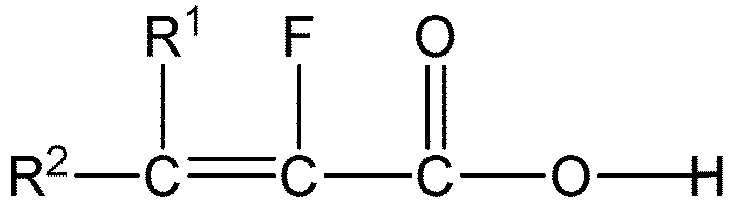
R1 and R2 are identical or different, and each represents an alkyl group, a fluoroalkyl group, an aryl group optionally having one or more substituents, a halogen atom, or a hydrogen atom; and R3 is an alkyl group, a fluoroalkyl group, or an aryl group optionally having one or more substituents. - The salts thereof include metal salts (e.g., sodium salts, potassium salts), ammonium salts, and imidazole salts, as understood from the above description.
- The alcohol adduct may be represented by
R3O-R1R2C-CHF-CO2-R3,
wherein - R1 and R2 are identical or different, and each represents an alkyl group, a fluoroalkyl group, an aryl group optionally having one or more substituents, a halogen atom, or a hydrogen atom; and
- R3 is an alkyl group, a fluoroalkyl group, or an aryl group optionally having one or more substituents.
- The amount ratio of the α-fluoroacrylic acid ester compound (1) and the by-product compound in the composition may be, for example, in the range of 5:1 to 90:1, in the range of 9:1 to 70:1, or in the range of 15:1 to 50: 1.
- The α-fluoroacrylic acid ester compound (1) obtained by the production method of the present invention may optionally be purified by a known purification method, such as solvent extraction, desiccation, filtration, distillation, concentration, washing (e.g., washing with water), and a combination thereof.
- The purification does not necessarily require complete removal of substances other than the α-fluoroacrylic acid ester compound (1) (hereinafter simply referred to as "other substances"). From the viewpoint of cost effectiveness, the other substances may be removed to an extent that the inconvenience caused by the other substances can be resolved to a desired degree.
- Further, if it is desirable to maintain the other substances due to their type and function, purification may intentionally be performed under conditions in which the substances will remain.
- These other substances may be a substance produced by the production method of the present invention or may be a substance intentionally or unintentionally added to the reaction system (e.g., a solvent) in the production method of the present invention. Examples of the other substances include water and aldehydes.
- For example, for removing water, the purification can be performed, for example, by using a zeolite.
- For example, for removing aldehydes, the purification may be performed, for example, by using (1) at least one aminated carrier selected from the group consisting of α-fluoroacrylic amino-modified silica gel, amino-modified siloxane, and amino-modified acrylic resin, or
by bringing sulfites or a compound having one or more amino groups into contact. - Each of these preferable examples of purification may be performed alone or in combination, as long as the effect of the present invention and the effect of the purification methods are not significantly impaired.
- In particular, since the production method of the present invention generates only an extremely small amount of by-products and decomposed products, an extremely high-purity α-fluoroacrylic acid ester compound (1) can be obtained by a simple method such as distillation.
- The present invention also provides a composition (S) comprising
- [1] an α-fluoroacrylic acid ester compound (1); and
- [2] two or more members selected from the group consisting of alcohols, amides, and aldehydes.
- In the composition (S), the α-fluoroacrylic acid ester compound (1) may be present stably.
- The alcohol may be partly or entirely derived from the alcohol (3).
- The alcohol contained in the composition (S) is preferably an alcohol having 1 to 6 carbon atoms.
- Specific examples of the alcohol contained in the composition (S) include methanol, ethanol, n-propanol, isopropanol, n-butanol, isobutanol, tert-butanol, pentanol, and hexanol.
- The alcohol contained in the composition (S) is particularly preferably methanol.
- In the present invention, the alcohols can be used alone, or in a combination of two or more.
- The lower limit of the alcohol content in the composition (S) is preferably 0.02% (w/w), more preferably 0.03% (w/w), still more preferably 0.1% (w/w), even more preferably 0.3% (w/w), particularly preferably 0.5% (w/w), more particularly preferably 1% (w/w), 1.5% (w/w), or 2.0%. (w/w), particularly preferably 3.0%, and more particularly preferably 5.0% (w/w).
- For the purpose of stabilizing the α-fluoroacrylic acid ester compound (1), the upper limit of the alcohol content in the composition (S) is not limited; however, it is disadvantageous in terms of cost to use alcohol in an amount exceeding the amount at which the desired stabilization effect of the α-fluoroacrylic acid ester compound (1) is achieved. Therefore, the upper limit of the alcohol content in the composition (S) may be usually, for example, 70% (w/w), 50% (w/w), 40% (w/w), or 30% (w/w), 20% (w/w), 15% (w/w), 10% (w/w), 7% (w/w), 6% (w/w), 5% (w/w), 4% (w/w), or 3% (w/w).
- The alcohol content in the composition (S) is preferably 0.01 to 70% (w/w), 0.01 to 50% (w/w), or 0.02 to 6% (w/w), more preferably 0.03 to 5% (w/w), still more preferably 0.1 to 4% (w/w), even more preferably 0.3 to 3.5 (w/w), particularly preferably 0.5 to 3% (w/w), and more particularly preferably 1 to 3% (w/w).
- In the composition (S), the lower limit of the amount ratio of alcohol to the α-fluoroacrylic acid ester compound (1) (i.e., the ratio of alcohol/α-fluoroacrylic acid ester compound (1)) is preferably 0.02% (w/w), more preferably 0.03% (w/w), still more preferably 0.1% (w/w), even more preferably 0.3% (w/w), particularly preferably 0.5% (w/w), and more particularly preferably 1% (w/w).
- For the purpose of stabilizing the α-fluoroacrylic acid ester compound (1), the upper limit of the amount ratio of alcohol to the α-fluoroacrylic acid ester compound (1) (i.e., the ratio of alcohol/α-fluoroacrylic acid ester compound (1)) is not limited, however, it is disadvantageous in terms of cost to use alcohol in an amount exceeding the amount at which the desired stabilization effect of the α-fluoroacrylic acid ester compound (1) is achieved. Therefore, the upper limit of the amount ratio of alcohol to the α-fluoroacrylic acid ester compound (1) (i.e., the ratio of alcohol/α-fluoroacrylic acid ester compound (1)) may be usually, for example, 200% (w/w), 190% (w/w), 170% (w/w), 150% (w/w), 100% (w/w), 70% (w/w), 50% (w/w), 40% (w/w), or 30% (w/w), 20% (w/w), 15% (w/w), 10% (w/w), 7% (w/w), 6% (w/w), 5% (w/w), 4% (w/w), or 3% (w/w).
- In the composition (S), the amount ratio of alcohol to α-fluoroacrylic acid ester compound (1) is preferably 0.01 to 200% (w/w), 0.01 to 190% (w/w), 0.01 to 170% (w/w), 0.01 to 100% (w/w), or 0.02 to 6% (w/w), more preferably 0.03 to 5% (w/w), still more preferably 0.1 to 4% (w/w), even more preferably 0.3 to 3.5 (w/w), particularly preferably 0.5 to 3% (w/w), and more particularly preferably 1 to 3% (w/w).
- Specific examples of the amide contained in the composition (S) include N,N-dimethylformamide (DMF), N,N-dimethylacetamide (DMAC), N-methylpyrrolidone, 1,3-dimethyl-2-imidazolidinone, N,N-dimethylacrylamide, N,N-dimethylacetamide, N,N-diethylformamide, and N,N-diethylacetamide.
- The amide contained in the composition (S) is preferably represented by formula: R10R11N-CO-R12 (wherein R10 and R11 represent an alkyl group having 1 to 3 carbon atoms, and R12 is a hydrogen atom or an alkyl group having 1 to 3 carbon atoms).
- The amide contained in the composition (S) is preferably an amide having 3 to 8 carbon atoms.
- The amide contained in the composition (S) is particularly preferably N,N-dimethylformamide or N,N-dimethylacetamide.
- In the present invention, the amides can be used alone, or in a combination of two or more.
- The lower limit of the content of the amide in the composition (S) is preferably 0.01% (w/w), 0.05% (w/w), 0.1% (w/w), 0.5% (w/w), or 1.0% (w/w), more preferably 3.0% (w/w), and still more preferably 5.0% (w/w).
- For the purpose of stabilizing the α-fluoroacrylic acid ester compound (1), the upper limit of the content of the amide in the composition (S) is not limited; however, it is disadvantageous in terms of cost to use the amide in an amount exceeding the amount at which the desired stabilization effect of the α-fluoroacrylic acid ester compound (1) is achieved. Therefore, the upper limit of the content of the amide in the composition (S) may be usually, for example, 50% (w/w), 40% (w/w), 30% (w/w), 20% (w/w), or 10% (w/w).
- The content of the amide in the composition (S) is preferably 0.01 to 50% (w/w), more preferably 1.0 to 40% (w/w), still more preferably 5.0 to 30% (w/w), and even more preferably 1 to 3% (w/w).
- In the composition (S), the lower limit of the amount ratio of the amide to the α-fluoroacrylic acid ester compound (1) (i.e., the ratio of amide/α-fluoroacrylic acid ester compound (1)) is preferably 0.01% (w/w) or 0.05% (w/w), more preferably 0.1% (w/w), still more preferably 0.5% (w/w), even more preferably 1.0% (w/w), particularly preferably 3.0% (w/w), and more particularly preferably 5.0% (w/w).
- For the purpose of stabilizing the α-fluoroacrylic acid ester compound (1), the upper limit of the amount ratio of the amide to the α-fluoroacrylic acid ester compound (1) (i.e., the ratio of the amide/α-fluoroacrylic acid ester compound (1)) is not limited; however, it is disadvantageous in terms of cost to use the amide in an amount exceeding the amount at which the desired stabilization effect of the α-fluoroacrylic acid ester compound (1) is achieved. Therefore, the upper limit of the amount ratio of the amide to the α-fluoroacrylic acid ester compound (1) (i.e., the ratio of amide/α-fluoroacrylic acid ester compound (1)) may be usually, for example, 200% (w/w), 190% (w/w), 170% (w/w), 150% (w/w), 100% (w/w) 70% (w/w), 50% (w/w), 40% (w/w), or 30% (w/w).
- In the composition (S), the amount ratio of the amide to the α-fluoroacrylic acid ester compound (1) is preferably 0.01 to 200% (w/w), more preferably 0.1 to 190% (w/w), still more preferably 1 to 170% (w/w), even more preferably 3 to 50% (w/w), and particularly preferably 5 to 50% (w/w).
- The aldehyde may be at least one member selected from the group consisting of aliphatic aldehydes, and aromatic aldehydes optionally substituted with at least one substituent.
- The "aliphatic aldehyde" may be a linear or branched aliphatic aldehyde, and may be a saturated or unsaturated aliphatic aldehyde.
- The aldehyde is preferably linear saturated aldehyde having 1 to 20 (preferably 1 to 12, more preferably 1 to 6, still more preferably 1 to 4, even more preferably 1 to 3, and particularly preferably 1 or 2) carbon atoms.
- The "aliphatic aldehyde" refers to, for example, a compound represented by formula: R-CHO, wherein R is an aliphatic hydrocarbon group. The aliphatic hydrocarbon group represented by R is preferably an aliphatic hydrocarbon group.
- In the present specification, "aromatic aldehyde" refers to, for example, a compound represented by formula: R-CHO, wherein R is aryl optionally substituted with at least one substituent (e.g., alkyl group).
- Specifically, the aldehyde is preferably one or more members (preferably one member) selected from the group consisting of formaldehyde, acetaldehyde, n-propylaldehyde, isopropylaldehyde, n-butylaldehyde, isobutylaldehyde, pivalaldehyde, n-pentylaldehyde, n-hexylaldehyde, n-heptylaldehyde, n-octylaldehyde, nonylaldehyde, decylaldehyde, undecylaldehyde, dodecylaldehyde, tridecylaldehyde, benzaldehyde, o-anisaldehyde, m-anisaldehyde, p-anisaldehyde, o-tolualdehyde, m-tolualdehyde, and p-tolualdehyde, and more preferably n-butylaldehyde.
- The aldehyde may be produced by a known method or a method in accordance with the known method, or may be obtained from commercial suppliers.
- In the composition (S), the content of the aldehyde is preferably 0.1 mol or less, more preferably 0.05 mol or less, and further preferably 0.02 mol or less, per mole of the α-fluoroacrylic acid ester compound (1).
- In the composition (S), even a very small amount of the aldehyde can stabilize the α-fluoroacrylic acid ester compound (1); however, in the composition (S), the content of the aldehyde is, for example, 0.0005 mol or more per mole of the α-fluoroacrylic acid ester compound (1).
- In the composition (S), the molar ratio of the α-fluoroacrylic acid ester compound (1) and the aldehyde is preferably 1:0.1 or less, more preferably 1:0.0005 to 1:0.05, and still more preferably 1:0.0005 to 1:0.02.
- In the composition (S), the amount ratio of the alcohol, the amide, and the aldehyde is not limited.
- The present invention also provides an α-fluoroacrylic acid ester compound (1) in which the α-fluoroacrylic acid ester compound (1) and [2] two or more members selected from the group consisting of alcohols, amides, and aldehydes are present together. The method can be understood from the description of the composition (S).
- The present invention is described in more detail below with reference to Examples; however, the present invention is not limited to these Examples.
- In the Examples, "yield" can represent "NMR yield," unless otherwise specified.
- 1-Chloro-1-fluoroethene (1.61 g), triethylamine (2.23 g), dichloro[1,1-bis(diisopropylphosphino)ferrocene]palladium (II) (9.0 mg), and methanol (16 g) were placed in an autoclave. Carbon monoxide (0.6 MPaG) was introduced thereinto, followed by stirring at 100°C for 7 hours.
- The unreacted gas was purged; and the reaction liquid in the autoclave was quantified based on 19F-NMR integral values, which revealed that the amount of 2-fluoroacrylic acid methyl ester was 1.28 g (yield: 61.5%, selectivity: 96.6%), the yield of 2-fluoroacrylate was 2.2%, and the amount of unreacted 1-chloro-1-fluoroethene was 0.52 g (recovery rate: 32.0%).
- 1-Chloro-1-fluoroethene (1.61 g), triethylamine (2.23 g), bis(acetylacetonato)palladium (II) (4.6 mg), 1,1'-bis(diisopropylphosphino)ferrocene (6.3 mg), and methanol (16 g) were placed in an autoclave. Carbon monoxide (0.6 MPaG) was introduced thereinto, followed by stirring at 100°C for 7 hours.
- The unreacted gas was purged; and the reaction liquid in the autoclave was quantified based on 19F-NMR integral values, which revealed that the amount of 2-fluoroacrylic acid methyl ester was 1.75 g (yield: 84%, selectivity: 91%), the yield of 2-fluoroacrylate was 2.3%, and the amount of unreacted 1-chloro-1-fluoroethene was 0.13 g (recovery rate: 8%).
- 1-Chloro-1-fluoroethene (1.61 g), triethylamine (2.23 g), dichloro(1,5-cyclooctadiene)palladium (II) (4.2 mg), 1,1'-bis(diisopropylphosphino)ferrocene (6.3 mg), and methanol (16 g) were placed in an autoclave. Carbon monoxide (0.6 MPaG) was introduced thereinto, followed by stirring at 100°C for 7 hours.
- The unreacted gas was purged; and the reaction liquid in the autoclave was quantified based on 19F-NMR integral values, which revealed that the amount of 2-fluoroacrylic acid methyl ester was 1.38 g (yield: 66.3%, selectivity: 96.6%), and the yield of 2-fluoroacrylate was 2.3%, and the amount of unreacted 1-chloro-1-fluoroethene was 0.40 g (recovery rate: 24.6%).
- 1-Chloro-1-fluoroethene (1.61 g), triethylamine (2.23 g), dichloro[1,1-bis(diisopropylphosphino)ferrocene]palladium (II) (3.0 mg), and methanol (16 g) were placed in an autoclave. Carbon monoxide (0.6 MPaG) was introduced thereinto, followed by stirring at 100°C for 18 hours.
- The unreacted gas was purged; and the reaction liquid in the autoclave was quantified based on 19F-NMR integral values, which revealed that the amount of 2-fluoroacrylic acid methyl ester was 0.59 g (yield: 28.2%, selectivity: 91.4%), and the yield of 2-fluoroacrylate was 2.7%, and the amount of unreacted 1-chloro-1-fluoroethene was 0.61 g (recovery rate: 37.8%).
- 1-Chloro-1-fluoroethene (1.61 g), triethylamine (2.23 g), bis(dibenzylideneacetone)palladium (0) (17.3 mg), 1,1'-bis(diisopropylphosphino)ferrocene (12.6 mg), and methanol (16 g) were placed in an autoclave. Carbon monoxide (0.65 MPaG) was introduced thereinto, followed by stirring at 100°C for 7 hours.
- The unreacted gas was purged; and the reaction liquid in the autoclave was quantified based on 19F-NMR integral values, which revealed that the amount of 2-fluoroacrylic acid methyl ester was 1.35 g (yield: 65%, selectivity: 96%), the yield of 2-fluoroacrylate was 2.5%, and the amount of unreacted 1-chloro-1-fluoroethene was 0.21 g (recovery rate: 13%).
- 1-Chloro-1-fluoroethene (1.61 g), triethylamine (2.23 g), dichloro[1,1-bis(diisopropylphosphino)ferrocene]palladium (II) (18.0 mg), and methanol (16 g) were placed in an autoclave. Carbon monoxide (0.65 MPaG) was introduced thereinto, followed by stirring at 100°C for 7 hours.
- The unreacted gas was purged; and the reaction liquid in the autoclave was quantified based on 19F-NMR integral values, which revealed that the amount of 2-fluoroacrylic acid methyl ester was 0.96 g (yield: 46%, selectivity: 94%), the yield of 2-fluoroacrylate was 2.7%, and the amount of unreacted 1-chloro-1-fluoroethene was 0.37 g (recovery rate: 23%).
- 1-Chloro-1-fluoroethene (3.22 g), triethylamine (4.45 g), bis(acetylacetonato)palladium (II) (3.0 mg), 1,1'-bis(diisopropylphosphino)ferrocene (4.2 mg), and methanol (32 g) were placed in an autoclave. Carbon monoxide (0.65 MPaG) was introduced thereinto, followed by stirring at 100°C for 22 hours.
- The unreacted gas was purged; and the reaction liquid in the autoclave was quantified based on 19F-NMR integral values, which revealed that the amount of 2-fluoroacrylic acid methyl ester was 3.04 g (yield: 73%, selectivity: 88%), and the yield of 2-fluoroacrylate was 3.9%, and the amount of unreacted 1-chloro-1-fluoroethene was 0.55 g (recovery rate: 17%).
- 1-Chloro-1-fluoroethene (1.61 g), triethylamine (2.23 g), bis(acetylacetonato)palladium (II) (4.6 mg), 1,3-bis(dicyclohexylphosphino)propane (6.5 mg), and methanol (16 g) were placed in an autoclave. Carbon monoxide (0.65 MPaG) was introduced thereinto, followed by stirring at 100°C for 7 hours.
- The unreacted gas was purged; and the reaction liquid in the autoclave was quantified based on 19F-NMR integral values, which revealed that the amount of 2-fluoroacrylic acid methyl ester was 1.71 g (yield: 82%, selectivity: 97%), the yield of 2-fluoroacrylate was 2.3%, and the amount of unreacted 1-chloro-1-fluoroethene was 0.10 g (recovery rate: 6.3%).
- 1-Chloro-1-fluoroethene (1.61 g), triethylamine (2.23 g), bis(acetylacetonato)palladium (II) (4.6 mg), bis(dicyclohexylphosphinophenyl)ether (9.0 mg), and methanol (16 g) were placed in an autoclave. Carbon monoxide (0.65 MPaG) was introduced thereinto, followed by stirring at 100°C for 7 hours.
- The unreacted gas was purged; and the reaction liquid in the autoclave was quantified based on 19F-NMR integral values, which revealed that the amount of 2-fluoroacrylic acid methyl ester was 1.48 g (yield: 71%, selectivity: 97%), the yield of 2-fluoroacrylate was 2.5%, and the amount of unreacted 1-chloro-1-fluoroethene was 0.24 g (recovery rate: 15%).
- 1-Chloro-1-fluoroethene (3.22 g), triethylamine (4.45 g), bis(acetylacetonato)palladium (II) (3.0 mg), 1,4-bis(dicyclohexylphosphino)butane (4.5 mg), and methanol (32 g) were placed in an autoclave. Carbon monoxide (0.65 MPaG) was introduced thereinto, followed by stirring at 100°C for 20 hours.
- The unreacted gas was purged; and the reaction liquid in the autoclave was quantified based on 19F-NMR integral values, which revealed that the amount of 2-fluoroacrylic acid methyl ester was 3.75 g (yield: 90%, selectivity: 95%), the yield of 2-fluoroacrylate was 5.9%, the yield of 2-fluoro-3-methoxypropionic acid methyl ester was 0.1%, and the amount of unreacted 1-chloro-1-fluoroethene was 0.16 g (recovery rate: 5%).
- 1-Chloro-1-fluoroethene (3.22 g), triethylamine (4.45 g), bis(acetylacetonato)palladium (II) (3.0 mg), 1,1'-bis(diisopropylphosphino)ferrocene (4.2 mg), 2,4-pentanedione (1.0 mg), and methanol (32 g) were placed in an autoclave. Carbon monoxide (0.65 MPaG) was introduced thereinto, followed by stirring at 100°C for 12 hours.
- The unreacted gas was purged; and the reaction liquid in the autoclave was quantified based on 19F-NMR integral values, which revealed that the amount of 2-fluoroacrylic acid methyl ester was 2.88 g (yield: 69%, selectivity: 96%), the yield of 2-fluoroacrylate was 2.7%, and the amount of unreacted 1-chloro-1-fluoroethene was 0.93 g (recovery rate: 29%).
- 1-Chloro-1-fluoroethene (3.22 g), triethylamine (4.45 g), dichloro(1,5-cyclooctadiene)palladium (II) (2.9 mg), 1,1'-bis(diisopropylphosphino)ferrocene (4.2 mg), 1,5-cyclooctadiene (1.1 mg), and methanol (32 g) were placed in an autoclave. Carbon monoxide (0.65 MPaG) was introduced thereinto, followed by stirring at 100°C for 21 hours.
- The unreacted gas was purged; and the reaction liquid in the autoclave was quantified based on 19F-NMR integral values, which revealed that the amount of 2-fluoroacrylic acid methyl ester was 2.81 g (yield: 67%, selectivity: 86%), the yield of 2-fluoroacrylate was 4.6%, and the amount of unreacted 1-chloro-1-fluoroethene was 0.60 g (recovery rate: 19%).
- 1-Chloro-1-fluoroethene (4.81 g), triethylamine (6.68 g), bis(acetylacetonato)palladium (II) (4.6 mg), 1,4-bis(dicyclohexylphosphino)butane (6.8 mg), 2,4-pentanedione (1.5 mg), and methanol (48 g) were placed in an autoclave. Carbon monoxide (0.65 MPaG) was introduced thereinto, followed by stirring at 100°C for 22 hours.
- The unreacted gas was purged; and the reaction liquid in the autoclave was quantified based on 19F-NMR integral values, which revealed that the amount of 2-fluoroacrylic acid methyl ester was 4.41 g (yield: 71%, selectivity: 91%), the yield of 2-fluoroacrylate was 5.1%, and the amount of unreacted 1-chloro-1-fluoroethene was 0.58 g (recovery rate: 12%).
- 1-Chloro-1-fluoroethene (6.04 g), triethylamine (8.35 g), bis(acetylacetonato)palladium (II) (11.4 mg), 1,1'-bis(dicyclohexylphosphino)ferrocene bis(tetrafluoroborate) (22.3 mg), and methanol (33 g) were placed in an autoclave. Carbon monoxide (0.75 MPaG) was introduced thereinto, followed by stirring at 90°C for 24 hours.
- The unreacted gas was purged; and the reaction liquid in the autoclave was quantified based on 19F-NMR integral values, which revealed that the amount of 2-fluoroacrylic acid methyl ester was 5.93 g (yield: 76%, selectivity: 92%), the yield of 2-fluoroacrylate was 3.6%, and the amount of unreacted 1-chloro-1-fluoroethene was 1.04 g (recovery rate: 17%).
- 1-Chloro-1-fluoroethene (6.04 g), triethylamine (8.35 g), bis(acetylacetonato)palladium (II) (11.4 mg), 1,4-bis(dicyclohexylphosphino)butane bis(tetrafluoroborate) (23.5 mg), and methanol (33 g) were placed in an autoclave. Carbon monoxide (0.75 MPaG) was introduced thereinto, followed by stirring at 90°C for 24 hours.
- The unreacted gas was purged; and the reaction liquid in the autoclave was quantified based on 19F-NMR integral values, which revealed that the amount of 2-fluoroacrylic acid methyl ester was 7.26 g (yield: 93%, selectivity: 94%), the yield of 2-fluoroacrylate was 4.6%, and the remaining percentage of unreacted 1-chloro-1-fluoroethene was 1.4%.
- 1-Chloro-1-fluoroethene (1.61 g), triethylamine (2.23 g), bis(acetylacetonato)palladium (II) (3.0 mg), 1,4-bis(dicyclohexylphosphino)butane (4.5 mg), dibutyl hydroxytoluene (42 mg), and methanol (11 g) were placed in an autoclave. Carbon monoxide (0.70 MPaG) was introduced thereinto, followed by stirring at 100°C for 21 hours.
- The unreacted gas was purged; and the reaction liquid in the autoclave was quantified based on 19F-NMR integral values, which revealed that the amount of 2-fluoroacrylic acid methyl ester was 1.73 g (yield: 86%, selectivity: 90%), the yield of 2-fluoroacrylate was 9.3%, the yield of 2-fluoro-3-methoxypropionic acid methyl ester was 0.6%, and the remaining percentage of unreacted 1-chloro-1-fluoroethene was 0.1%.
- The reaction liquid obtained in Example 8 was purified by simple distillation; and the obtained distillate was analyzed by gas chromatography, which revealed that 2-fluoroacrylic acid methyl ester was contained in an amount of 79.9 area%, methanol in an amount of 18.8 area%, triethylamine in an amount of 1.2 area%, and methyl acetate in an amount of 0.08 area%.
- 1-Chloro-1-fluoroethene (4.82 g), triethylamine (6.68 g), bis(acetylacetonato)palladium (II) (9.1 mg), 1,4-bis(dicyclohexylphosphino)butane (13.5 mg), and methanol (34 g) were placed in an autoclave. Carbon monoxide (0.75 MPaG) was introduced thereinto, followed by stirring at 90°C for 22 hours.
- The unreacted gas was purged; and the reaction liquid in the autoclave was quantified based on 19F-NMR integral values, which revealed that the amount of 2-fluoroacrylic acid methyl ester was 5.69 g (yield: 91%, selectivity: 97%), the yield of 2-fluoroacrylate was 2.6%, and the remaining percentage of unreacted 1-chloro-1-fluoroethene was 0.5%.
- 1-Chloro-1-fluoroethene (4.82 g), triethylamine (6.68 g), bis(acetylacetonato)palladium (II) (9.1 mg), 1,4-bis(dicyclohexylphosphino)butane (13.5 mg), and methanol (29 g) were placed in an autoclave. Carbon monoxide (0.75 MPaG) was introduced thereinto, followed by stirring at 85°C for 22 hours.
- The unreacted gas was purged; and the reaction liquid in the autoclave was quantified based on 19F-NMR integral values, which revealed that the amount of 2-fluoroacrylic acid methyl ester was 5.81 g (yield: 93%, selectivity: 97%), the yield of 2-fluoroacrylate was 2.9%, and the remaining percentage of unreacted 1-chloro-1-fluoroethene was 0.5%.
- 1-Chloro-1-fluoroethene (6.44 g), triethylamine (8.90 g), bis(acetylacetonato)palladium (II) (12.2 mg), 1,4-bis (dicyclohexylphosphino)butane (18.0 mg), and methanol (32 g) were placed in an autoclave. Carbon monoxide (0.75 MPaG) was introduced thereinto, followed by stirring at 85°C for 26 hours.
- The unreacted gas was purged; and the reaction liquid in the autoclave was quantified based on 19F-NMR integral values, which revealed that the amount of the 2-fluoroacrylic acid methyl ester was 7.58 g (yield: 91%, selectivity: 94%), the yield of 2-fluoroacrylate was 5.5%, and the remaining percentage of unreacted 1-chloro-1-fluoroethene was 2.2%.
- 1-Chloro-1-fluoroethene (6.04 g), triethylamine (8.35 g), bis(acetylacetonato)palladium (II) (11.4 mg), 1,4-bis(dicyclohexylphosphino)butane (16.9 mg), and methanol (33 g) were placed in an autoclave. Carbon monoxide (0.75 MPaG) was introduced thereinto, followed by stirring at 90°C for 24 hours.
- The unreacted gas was purged; and the reaction liquid in the autoclave was quantified based on 19F-NMR integral values, which revealed that the amount of 2-fluoroacrylic acid methyl ester was 7.26 g (yield: 93%, selectivity: 96%), the yield of 2-fluoroacrylate was 4.1%, and the remaining percentage of unreacted 1-chloro-1-fluoroethene was 0.7%.
- n-Butyl aldehyde (0.1 g) was added to 48.5 g of the reaction liquid obtained in Example 15, and the mixture was subjected to simple distillation. The fraction was collected in a receiver into which 3.0 g of N,N-dimethylacetamide was placed beforehand, thus obtaining 34.4 g of a fraction. The fraction was analyzed by gas chromatography, which revealed that 2-fluoroacrylic acid methyl ester was contained in an amount of 19.2 area%, methanol in an amount of 68.7 area%, triethylamine in an amount of 2.45 area%, N,N-dimethylacetamide in an amount of 3.74 area%, and n-butyl aldehyde in an amount of 0.24%.
- The present invention is capable of producing an α-fluoroacrylic acid ester compound that is useful as a synthetic intermediate at a high starting material conversion and a high yield.
Claims (12)
- A method for producing a compound represented by formula (1) or a salt thereof:
 R1 and R2 are identical or different, and each represents an alkyl group, a fluoroalkyl group, an aryl group optionally having one or more substituents, a halogen atom, or a hydrogen atom;R3o is a hydrogen atom or R3; andR3 is an alkyl group, a fluoroalkyl group, or an aryl group optionally having one or more substituents,the method comprising step A of reacting a compound represented by formula (2):
with carbon monoxide and an alcohol represented by formula (3):
R3-OH (3)
wherein the symbol in the formula is as defined above,
in the presence of
palladium,
a double bond-containing compound (α) represented by formula (α):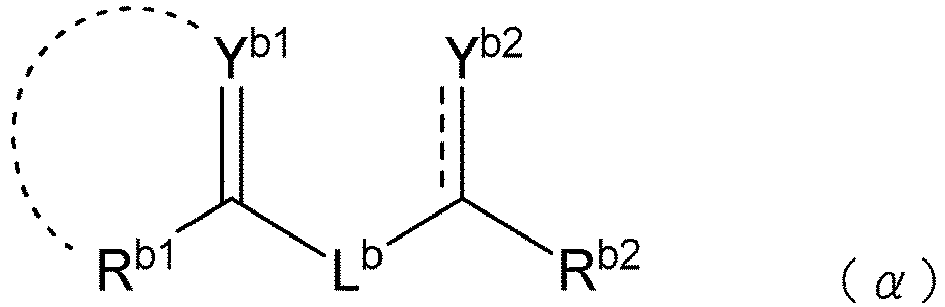 Rb1 is a hydrogen atom or a hydrocarbon group,Rb2 is a hydrogen atom or a hydrocarbon group,Yb1 is =O or =CH-Ryb1,Yb2 is -H, =O, -CH2-Ryb2, or =CH-Ryb2,Ryb1 is a hydrogen atom or a hydrocarbon group,Ryb2 is a hydrogen atom or a hydrocarbon group,
orRb1 and Yb1, taken together with the adjacent carbon atom, may form an aromatic hydrocarbon ring,Lb is a bond, C1-3 alkanediyl optionally having one or more side chains, or -C(=O)-,
orRyb1 and Ryb2 may be linked to each other to form -Ly-, wherein Ly is linear C1-3 hydrocarbon diyl optionally having one or more side chains,wherein one of the side chains in Lb(1) may be linked to one of the side chains in Ly to form linear C1-2 hydrocarbon diyl, or(2) may be linked to Rb1 to form C3-4 alkanediyl,a diphosphine compound (β) having, on each phosphorus atom, at least one substituent selected from the group consisting of alkyl and cycloalkyl groups, anda base, with the proviso that, in the reaction, the palladium, taken together with the compound represented by formula (2), the double bond-containing compound (α), the diphosphine compound (β), or carbon monoxide, or with one or more of these, may form a palladium complex (A),to obtain the compound represented by formula (1) or a salt thereof. - The method according to claim 1, wherein R1 and R2 each represent a hydrogen atom.
- The method according to claim 1 or 2, wherein Rb1 is a hydrogen atom or an alkyl group.
- The method according to any one of claims 1 to 3, wherein Rb2 is a hydrogen atom or an alkyl group.
- The method according to any one of claims 1 to 4, wherein Ryb1 is an aryl group.
- The method according to any one of claims 1 to 5, wherein Ryb2 is a hydrogen atom or an aryl group.
- The method according to any one of claims 1 to 6,
wherein
Yb1 is =O,
Yb2 is =O, and
Lb is methanediyl optionally having a side chain. - The method according to any one of claims 1 to 7,
wherein
Yb1 is =CH-Ryb1,
Yb2 is =CH-Ryb2, and
Lb is a bond, -C(=O)-, methanediyl, or 1,2-ethanediyl. - The method according to any one of claims 1 to 8,
wherein
Rb1 and Yb1, taken together with the adjacent carbon atom, form an aromatic hydrocarbon ring,
Yb2 is =CH-Ryb2,
Lb is a bond, and
Ryb2 is an alkyl group. - The method according to any one of claims 1 to 9,
wherein
Rb1 is a hydrogen atom,
Yb1 is =CH-Ryb1,
Yb2 is a hydrogen atom, and
Lb is a bond. - The method according to any one of claims 1 to 10,
wherein the base is an amine. - The method according to any one of claims 1 to 11, wherein step A is performed at a temperature of 20°C or higher.
Applications Claiming Priority (2)
| Application Number | Priority Date | Filing Date | Title |
|---|---|---|---|
| JP2018119353 | 2018-06-22 | ||
| PCT/JP2019/024848 WO2019245048A1 (en) | 2018-06-22 | 2019-06-21 | PRODUCTION METHOD FOR α-FLUOROACRYLIC ACID COMPOUND |
Publications (3)
| Publication Number | Publication Date |
|---|---|
| EP3812364A1 true EP3812364A1 (en) | 2021-04-28 |
| EP3812364A4 EP3812364A4 (en) | 2022-03-16 |
| EP3812364B1 EP3812364B1 (en) | 2026-05-06 |
Family
ID=68984097
Family Applications (1)
| Application Number | Title | Priority Date | Filing Date |
|---|---|---|---|
| EP19821778.8A Active EP3812364B1 (en) | 2018-06-22 | 2019-06-21 | Production method for alpha-fluoroacrylic acid compound |
Country Status (5)
| Country | Link |
|---|---|
| US (1) | US11420923B2 (en) |
| EP (1) | EP3812364B1 (en) |
| JP (1) | JP6852757B2 (en) |
| CN (1) | CN112384491B (en) |
| WO (1) | WO2019245048A1 (en) |
Family Cites Families (8)
| Publication number | Priority date | Publication date | Assignee | Title |
|---|---|---|---|---|
| JP4625652B2 (en) | 2004-05-13 | 2011-02-02 | 東ソー株式会社 | Method for producing 2-perfluoroalkyl acrylate |
| JP4862374B2 (en) * | 2005-12-05 | 2012-01-25 | セントラル硝子株式会社 | Method for producing 4,4,4-trifluorobutenoic acid |
| JP2008105956A (en) * | 2006-10-23 | 2008-05-08 | Daicel Chem Ind Ltd | Method for producing α-trifluoromethyl acrylate |
| CN104583174B (en) * | 2012-08-30 | 2017-06-13 | 大金工业株式会社 | Method for producing α-fluoroacrylate |
| JP6398224B2 (en) | 2013-12-27 | 2018-10-03 | ダイキン工業株式会社 | Process for producing α-fluoroacrylic acid esters |
| WO2015099154A1 (en) | 2013-12-27 | 2015-07-02 | ダイキン工業株式会社 | PRODUCTION METHOD FOR α-FLUORO ACRYLIC ACID ESTERS |
| JP2015160846A (en) * | 2014-02-28 | 2015-09-07 | ダイキン工業株式会社 | Method for producing α-fluoroacrylic acid ester or derivative thereof |
| CN106397484A (en) * | 2015-07-23 | 2017-02-15 | 赢创德固赛有限公司 | Butyl‑bridged diphosphine ligands for alkoxycarbonylation |
-
2019
- 2019-06-21 CN CN201980042073.8A patent/CN112384491B/en active Active
- 2019-06-21 US US17/253,856 patent/US11420923B2/en active Active
- 2019-06-21 EP EP19821778.8A patent/EP3812364B1/en active Active
- 2019-06-21 JP JP2019115929A patent/JP6852757B2/en active Active
- 2019-06-21 WO PCT/JP2019/024848 patent/WO2019245048A1/en not_active Ceased
Also Published As
| Publication number | Publication date |
|---|---|
| WO2019245048A1 (en) | 2019-12-26 |
| CN112384491B (en) | 2024-02-13 |
| JP2020002128A (en) | 2020-01-09 |
| US20210269383A1 (en) | 2021-09-02 |
| JP6852757B2 (en) | 2021-03-31 |
| CN112384491A (en) | 2021-02-19 |
| EP3812364A4 (en) | 2022-03-16 |
| EP3812364B1 (en) | 2026-05-06 |
| US11420923B2 (en) | 2022-08-23 |
Similar Documents
| Publication | Publication Date | Title |
|---|---|---|
| Rosebrugh et al. | Highly active ruthenium metathesis catalysts exhibiting unprecedented activity and Z-selectivity | |
| Sindhu et al. | Recent developments and applications of the Cadiot–Chodkiewicz reaction | |
| Li et al. | Copper-catalyzed regioselective 1, 2-alkylesterification of dienes to allylic esters | |
| JP6733722B2 (en) | Method for producing α-fluoroacrylic acid ester | |
| JP6680322B2 (en) | Method for producing α-fluoroacrylic acid esters | |
| US9950984B2 (en) | Production method for alpha-fluoro acrylic acid esters | |
| EP3812364B1 (en) | Production method for alpha-fluoroacrylic acid compound | |
| US3732281A (en) | Acrylonitrile dimers | |
| Czeluśniak et al. | Catalytic transformation of phenylacetylene mediated by phosphine-free ruthenium alkylidene complexes | |
| Chen et al. | Alkyl Carbon–Oxygen Bond Cleavage of Aryl Alkyl Ethers by Iridium–Porphyrin and Rhodium–Porphyrin Complexes in Alkaline Media | |
| EP3994113A1 (en) | Air-stable ni(0)-olefin complexes and their use as catalysts or precatalysts | |
| CN107216244B (en) | Method for preparing 3,5, 5-trimethyl-3-cyclohexene-1-ketone | |
| Goutierre et al. | Comparative structural analysis of biarylphosphine ligands in arylpalladium bromide and malonate complexes | |
| TWI725046B (en) | Method for producing halogenated acrylate ester derivate |
Legal Events
| Date | Code | Title | Description |
|---|---|---|---|
| STAA | Information on the status of an ep patent application or granted ep patent |
Free format text: STATUS: THE INTERNATIONAL PUBLICATION HAS BEEN MADE |
|
| PUAI | Public reference made under article 153(3) epc to a published international application that has entered the european phase |
Free format text: ORIGINAL CODE: 0009012 |
|
| STAA | Information on the status of an ep patent application or granted ep patent |
Free format text: STATUS: REQUEST FOR EXAMINATION WAS MADE |
|
| 17P | Request for examination filed |
Effective date: 20210111 |
|
| AK | Designated contracting states |
Kind code of ref document: A1 Designated state(s): AL AT BE BG CH CY CZ DE DK EE ES FI FR GB GR HR HU IE IS IT LI LT LU LV MC MK MT NL NO PL PT RO RS SE SI SK SM TR |
|
| AX | Request for extension of the european patent |
Extension state: BA ME |
|
| DAV | Request for validation of the european patent (deleted) | ||
| DAX | Request for extension of the european patent (deleted) | ||
| A4 | Supplementary search report drawn up and despatched |
Effective date: 20220215 |
|
| RIC1 | Information provided on ipc code assigned before grant |
Ipc: C07F 15/00 20060101ALI20220209BHEP Ipc: C07B 61/00 20060101ALI20220209BHEP Ipc: C07C 69/65 20060101ALI20220209BHEP Ipc: C07C 57/52 20060101ALI20220209BHEP Ipc: C07C 51/10 20060101ALI20220209BHEP Ipc: C07C 67/36 20060101AFI20220209BHEP |
|
| STAA | Information on the status of an ep patent application or granted ep patent |
Free format text: STATUS: EXAMINATION IS IN PROGRESS |
|
| 17Q | First examination report despatched |
Effective date: 20220923 |
|
| RAP3 | Party data changed (applicant data changed or rights of an application transferred) |
Owner name: DAIKIN INDUSTRIES, LTD. |
|
| P01 | Opt-out of the competence of the unified patent court (upc) registered |
Effective date: 20230525 |
|
| GRAP | Despatch of communication of intention to grant a patent |
Free format text: ORIGINAL CODE: EPIDOSNIGR1 |
|
| STAA | Information on the status of an ep patent application or granted ep patent |
Free format text: STATUS: GRANT OF PATENT IS INTENDED |
|
| INTG | Intention to grant announced |
Effective date: 20260130 |
|
| GRAS | Grant fee paid |
Free format text: ORIGINAL CODE: EPIDOSNIGR3 |
|
| GRAA | (expected) grant |
Free format text: ORIGINAL CODE: 0009210 |
|
| STAA | Information on the status of an ep patent application or granted ep patent |
Free format text: STATUS: THE PATENT HAS BEEN GRANTED |
|
| RIN1 | Information on inventor provided before grant (corrected) |
Inventor name: GOTOU, AKIHIRO Inventor name: KISHIKAWA, YOSUKE Inventor name: HOSHIYA, NAOYUKI Inventor name: MATSUURA, MAKOTO |
|
| AK | Designated contracting states |
Kind code of ref document: B1 Designated state(s): AL AT BE BG CH CY CZ DE DK EE ES FI FR GB GR HR HU IE IS IT LI LT LU LV MC MK MT NL NO PL PT RO RS SE SI SK SM TR |
|
| REG | Reference to a national code |
Ref country code: CH Ref legal event code: F10 Free format text: ST27 STATUS EVENT CODE: U-0-0-F10-F00 (AS PROVIDED BY THE NATIONAL OFFICE) Effective date: 20260506 Ref country code: GB Ref legal event code: FG4D Ref country code: CH Ref legal event code: R17 Free format text: ST27 STATUS EVENT CODE: U-0-0-R10-R17 (AS PROVIDED BY THE NATIONAL OFFICE) Effective date: 20260506 |