EP3812359A1 - Method for producing fluorinated compound - Google Patents
Method for producing fluorinated compound Download PDFInfo
- Publication number
- EP3812359A1 EP3812359A1 EP19823150.8A EP19823150A EP3812359A1 EP 3812359 A1 EP3812359 A1 EP 3812359A1 EP 19823150 A EP19823150 A EP 19823150A EP 3812359 A1 EP3812359 A1 EP 3812359A1
- Authority
- EP
- European Patent Office
- Prior art keywords
- group
- represents hydrogen
- substituents
- organic group
- hydrogen
- Prior art date
- Legal status (The legal status is an assumption and is not a legal conclusion. Google has not performed a legal analysis and makes no representation as to the accuracy of the status listed.)
- Withdrawn
Links
- 0 *C(CC(c1ccccc1)(F)F)=C Chemical compound *C(CC(c1ccccc1)(F)F)=C 0.000 description 4
- KUEZGAKXNCVJEZ-UHFFFAOYSA-N COC(C(CC(c1ccccc1)(F)F)CC(C1=CCCC=C1)(F)F)=O Chemical compound COC(C(CC(c1ccccc1)(F)F)CC(C1=CCCC=C1)(F)F)=O KUEZGAKXNCVJEZ-UHFFFAOYSA-N 0.000 description 1
- JDZLOJYSBBLXQD-UHFFFAOYSA-N FC(c1ccccc1)F Chemical compound FC(c1ccccc1)F JDZLOJYSBBLXQD-UHFFFAOYSA-N 0.000 description 1
Classifications
-
- B—PERFORMING OPERATIONS; TRANSPORTING
- B01—PHYSICAL OR CHEMICAL PROCESSES OR APPARATUS IN GENERAL
- B01J—CHEMICAL OR PHYSICAL PROCESSES, e.g. CATALYSIS OR COLLOID CHEMISTRY; THEIR RELEVANT APPARATUS
- B01J31/00—Catalysts comprising hydrides, coordination complexes or organic compounds
- B01J31/16—Catalysts comprising hydrides, coordination complexes or organic compounds containing coordination complexes
- B01J31/18—Catalysts comprising hydrides, coordination complexes or organic compounds containing coordination complexes containing nitrogen, phosphorus, arsenic or antimony as complexing atoms, e.g. in pyridine ligands, or in resonance therewith, e.g. in isocyanide ligands C=N-R or as complexed central atoms
- B01J31/1805—Catalysts comprising hydrides, coordination complexes or organic compounds containing coordination complexes containing nitrogen, phosphorus, arsenic or antimony as complexing atoms, e.g. in pyridine ligands, or in resonance therewith, e.g. in isocyanide ligands C=N-R or as complexed central atoms the ligands containing nitrogen
- B01J31/181—Cyclic ligands, including e.g. non-condensed polycyclic ligands, comprising at least one complexing nitrogen atom as ring member, e.g. pyridine
- B01J31/1815—Cyclic ligands, including e.g. non-condensed polycyclic ligands, comprising at least one complexing nitrogen atom as ring member, e.g. pyridine with more than one complexing nitrogen atom, e.g. bipyridyl, 2-aminopyridine
-
- C—CHEMISTRY; METALLURGY
- C07—ORGANIC CHEMISTRY
- C07C—ACYCLIC OR CARBOCYCLIC COMPOUNDS
- C07C67/00—Preparation of carboxylic acid esters
- C07C67/30—Preparation of carboxylic acid esters by modifying the acid moiety of the ester, such modification not being an introduction of an ester group
- C07C67/333—Preparation of carboxylic acid esters by modifying the acid moiety of the ester, such modification not being an introduction of an ester group by isomerisation; by change of size of the carbon skeleton
- C07C67/343—Preparation of carboxylic acid esters by modifying the acid moiety of the ester, such modification not being an introduction of an ester group by isomerisation; by change of size of the carbon skeleton by increase in the number of carbon atoms
- C07C67/347—Preparation of carboxylic acid esters by modifying the acid moiety of the ester, such modification not being an introduction of an ester group by isomerisation; by change of size of the carbon skeleton by increase in the number of carbon atoms by addition to unsaturated carbon-to-carbon bonds
-
- C—CHEMISTRY; METALLURGY
- C07—ORGANIC CHEMISTRY
- C07C—ACYCLIC OR CARBOCYCLIC COMPOUNDS
- C07C17/00—Preparation of halogenated hydrocarbons
- C07C17/26—Preparation of halogenated hydrocarbons by reactions involving an increase in the number of carbon atoms in the skeleton
- C07C17/263—Preparation of halogenated hydrocarbons by reactions involving an increase in the number of carbon atoms in the skeleton by condensation reactions
-
- C—CHEMISTRY; METALLURGY
- C07—ORGANIC CHEMISTRY
- C07C—ACYCLIC OR CARBOCYCLIC COMPOUNDS
- C07C21/00—Acyclic unsaturated compounds containing halogen atoms
- C07C21/02—Acyclic unsaturated compounds containing halogen atoms containing carbon-to-carbon double bonds
- C07C21/18—Acyclic unsaturated compounds containing halogen atoms containing carbon-to-carbon double bonds containing fluorine
-
- C—CHEMISTRY; METALLURGY
- C07—ORGANIC CHEMISTRY
- C07C—ACYCLIC OR CARBOCYCLIC COMPOUNDS
- C07C22/00—Cyclic compounds containing halogen atoms bound to an acyclic carbon atom
- C07C22/02—Cyclic compounds containing halogen atoms bound to an acyclic carbon atom having unsaturation in the rings
- C07C22/04—Cyclic compounds containing halogen atoms bound to an acyclic carbon atom having unsaturation in the rings containing six-membered aromatic rings
- C07C22/08—Cyclic compounds containing halogen atoms bound to an acyclic carbon atom having unsaturation in the rings containing six-membered aromatic rings containing fluorine
-
- C—CHEMISTRY; METALLURGY
- C07—ORGANIC CHEMISTRY
- C07C—ACYCLIC OR CARBOCYCLIC COMPOUNDS
- C07C231/00—Preparation of carboxylic acid amides
- C07C231/12—Preparation of carboxylic acid amides by reactions not involving the formation of carboxamide groups
-
- C—CHEMISTRY; METALLURGY
- C07—ORGANIC CHEMISTRY
- C07C—ACYCLIC OR CARBOCYCLIC COMPOUNDS
- C07C233/00—Carboxylic acid amides
- C07C233/01—Carboxylic acid amides having carbon atoms of carboxamide groups bound to hydrogen atoms or to acyclic carbon atoms
- C07C233/02—Carboxylic acid amides having carbon atoms of carboxamide groups bound to hydrogen atoms or to acyclic carbon atoms having nitrogen atoms of carboxamide groups bound to hydrogen atoms or to carbon atoms of unsubstituted hydrocarbon radicals
- C07C233/09—Carboxylic acid amides having carbon atoms of carboxamide groups bound to hydrogen atoms or to acyclic carbon atoms having nitrogen atoms of carboxamide groups bound to hydrogen atoms or to carbon atoms of unsubstituted hydrocarbon radicals with carbon atoms of carboxamide groups bound to carbon atoms of an acyclic unsaturated carbon skeleton
-
- C—CHEMISTRY; METALLURGY
- C07—ORGANIC CHEMISTRY
- C07C—ACYCLIC OR CARBOCYCLIC COMPOUNDS
- C07C37/00—Preparation of compounds having hydroxy or O-metal groups bound to a carbon atom of a six-membered aromatic ring
- C07C37/62—Preparation of compounds having hydroxy or O-metal groups bound to a carbon atom of a six-membered aromatic ring by introduction of halogen; by substitution of halogen atoms by other halogen atoms
-
- C—CHEMISTRY; METALLURGY
- C07—ORGANIC CHEMISTRY
- C07C—ACYCLIC OR CARBOCYCLIC COMPOUNDS
- C07C67/00—Preparation of carboxylic acid esters
- C07C67/30—Preparation of carboxylic acid esters by modifying the acid moiety of the ester, such modification not being an introduction of an ester group
- C07C67/333—Preparation of carboxylic acid esters by modifying the acid moiety of the ester, such modification not being an introduction of an ester group by isomerisation; by change of size of the carbon skeleton
- C07C67/343—Preparation of carboxylic acid esters by modifying the acid moiety of the ester, such modification not being an introduction of an ester group by isomerisation; by change of size of the carbon skeleton by increase in the number of carbon atoms
-
- C—CHEMISTRY; METALLURGY
- C07—ORGANIC CHEMISTRY
- C07C—ACYCLIC OR CARBOCYCLIC COMPOUNDS
- C07C69/00—Esters of carboxylic acids; Esters of carbonic or haloformic acids
- C07C69/62—Halogen-containing esters
- C07C69/65—Halogen-containing esters of unsaturated acids
-
- B—PERFORMING OPERATIONS; TRANSPORTING
- B01—PHYSICAL OR CHEMICAL PROCESSES OR APPARATUS IN GENERAL
- B01J—CHEMICAL OR PHYSICAL PROCESSES, e.g. CATALYSIS OR COLLOID CHEMISTRY; THEIR RELEVANT APPARATUS
- B01J2231/00—Catalytic reactions performed with catalysts classified in B01J31/00
- B01J2231/40—Substitution reactions at carbon centres, e.g. C-C or C-X, i.e. carbon-hetero atom, cross-coupling, C-H activation or ring-opening reactions
- B01J2231/42—Catalytic cross-coupling, i.e. connection of previously not connected C-atoms or C- and X-atoms without rearrangement
- B01J2231/4277—C-X Cross-coupling, e.g. nucleophilic aromatic amination, alkoxylation or analogues
- B01J2231/4294—C-X Cross-coupling, e.g. nucleophilic aromatic amination, alkoxylation or analogues using S nucleophiles, e.g. thiols
-
- B—PERFORMING OPERATIONS; TRANSPORTING
- B01—PHYSICAL OR CHEMICAL PROCESSES OR APPARATUS IN GENERAL
- B01J—CHEMICAL OR PHYSICAL PROCESSES, e.g. CATALYSIS OR COLLOID CHEMISTRY; THEIR RELEVANT APPARATUS
- B01J2231/00—Catalytic reactions performed with catalysts classified in B01J31/00
- B01J2231/40—Substitution reactions at carbon centres, e.g. C-C or C-X, i.e. carbon-hetero atom, cross-coupling, C-H activation or ring-opening reactions
- B01J2231/44—Allylic alkylation, amination, alkoxylation or analogues
-
- B—PERFORMING OPERATIONS; TRANSPORTING
- B01—PHYSICAL OR CHEMICAL PROCESSES OR APPARATUS IN GENERAL
- B01J—CHEMICAL OR PHYSICAL PROCESSES, e.g. CATALYSIS OR COLLOID CHEMISTRY; THEIR RELEVANT APPARATUS
- B01J2531/00—Additional information regarding catalytic systems classified in B01J31/00
- B01J2531/80—Complexes comprising metals of Group VIII as the central metal
- B01J2531/82—Metals of the platinum group
- B01J2531/821—Ruthenium
-
- B—PERFORMING OPERATIONS; TRANSPORTING
- B01—PHYSICAL OR CHEMICAL PROCESSES OR APPARATUS IN GENERAL
- B01J—CHEMICAL OR PHYSICAL PROCESSES, e.g. CATALYSIS OR COLLOID CHEMISTRY; THEIR RELEVANT APPARATUS
- B01J2531/00—Additional information regarding catalytic systems classified in B01J31/00
- B01J2531/80—Complexes comprising metals of Group VIII as the central metal
- B01J2531/82—Metals of the platinum group
- B01J2531/827—Iridium
-
- C—CHEMISTRY; METALLURGY
- C07—ORGANIC CHEMISTRY
- C07B—GENERAL METHODS OF ORGANIC CHEMISTRY; APPARATUS THEREFOR
- C07B2200/00—Indexing scheme relating to specific properties of organic compounds
- C07B2200/07—Optical isomers
-
- Y—GENERAL TAGGING OF NEW TECHNOLOGICAL DEVELOPMENTS; GENERAL TAGGING OF CROSS-SECTIONAL TECHNOLOGIES SPANNING OVER SEVERAL SECTIONS OF THE IPC; TECHNICAL SUBJECTS COVERED BY FORMER USPC CROSS-REFERENCE ART COLLECTIONS [XRACs] AND DIGESTS
- Y02—TECHNOLOGIES OR APPLICATIONS FOR MITIGATION OR ADAPTATION AGAINST CLIMATE CHANGE
- Y02E—REDUCTION OF GREENHOUSE GAS [GHG] EMISSIONS, RELATED TO ENERGY GENERATION, TRANSMISSION OR DISTRIBUTION
- Y02E10/00—Energy generation through renewable energy sources
- Y02E10/50—Photovoltaic [PV] energy
- Y02E10/542—Dye sensitized solar cells
Definitions
- the present invention relates to a method for producing a fluorine-containing compound.
- fluorinated methylene-containing compounds Since some physiologically active substances in vivo are fluorinated methylene-containing compounds, applications of fluoromethylene-containing compounds to, e.g., drugs have been actively studied.
- Non-patent Literature 1 and 2 methods for producing fluorine-containing methylene compounds, such as ⁇ -fluoromethylene compounds and ⁇ -difluoroaldol compounds, which are carbonyl compounds having, at the ⁇ -position, at least one substituent selected from the group consisting of fluorine atoms and perfluoro organic groups, are highly useful (Non-patent Literature 1 and 2).
- Patent Literature 1 discloses the following.
- the present disclosure aims to provide a novel method for producing a fluorine-containing methylene compound.
- the present disclosure includes the following embodiments.
- the present disclosure provides an efficient, novel method for producing a compound having a fluoromethylene group.
- room temperature refers to a temperature in a range of 10 to 40°C.
- C n-m (herein, n and m are each natural numbers) indicates that the carbon number is n or more and m or less, as conventionally used in the field of organic chemistry.
- fluoromethylene includes monofluoromethylene and difluoro methylene unless otherwise specified.
- halogen atom examples include fluorine, chlorine, bromine, and iodine.
- organic group refers to a group containing at least one carbon atom as its constituent atom.
- organic group examples include hydrocarbon, cyano, carboxy, alkoxy, ester, ether, and acyl.
- hydrocarbon refers to a group containing at least one carbon atom and at least one hydrogen atom as its constituent atoms.
- hydrocarbon examples include aliphatic hydrocarbon, aromatic hydrocarbon (aryl), and combinations thereof.
- aliphatic hydrocarbon may be linear, branched, or cyclic aliphatic hydrocarbon, or a combination thereof.
- aliphatic hydrocarbon may be saturated or unsaturated aliphatic hydrocarbon.
- aliphatic hydrocarbon examples include alkyl, alkenyl, alkynyl, and cycloalkyl.
- alkyl refers to, for example, linear or branched, primary, secondary, or tertiary C 1-15 alkyl (e.g., C 1-12 alkyl and C 1-10 alkyl), such as methyl, ethyl, propyl (e.g., n-propyl and isopropyl), butyl (n-butyl, isobutyl, sec-butyl, tert-butyl), pentyl (e.g., n-pentyl, tert-pentyl, neopentyl, isopentyl, sec-pentyl, and 3-pentyl), hexyl, heptyl, octyl, nonyl, and decyl.
- C 1-15 alkyl e.g., C 1-12 alkyl and C 1-10 alkyl
- methyl ethyl
- propyl e.g., n-propyl and is
- fluoroalkyl refers to alkyl having at least one hydrogen atom replaced by a fluorine atom.
- the number of fluorine atoms in the "fluoroalkyl” may be one or more (e.g., 1 to 3, 1 to 6, 1 to 12, or 1 to the maximum replaceable number).
- fluoroalkyl includes perfluoroalkyl.
- perfluoroalkyl refers to alkyl having all hydrogen atoms replaced by fluorine atoms.
- alkenyl refers to, for example, linear or branched C 1-10 alkenyl, such as vinyl, 1-propenyl, isopropenyl, 2-methyl-1-propenyl, 1-butenyl, 2-butenyl, 3-butenyl, 2-ethyl-1-butenyl, 1-pentenyl, 2-pentenyl, 3-pentenyl, 4-pentenyl, 4-methyl-3-pentenyl, 1-hexenyl, 2-hexenyl, 3-hexenyl, 4-hexenyl, and 5-hexenyl.
- alkynyl refers to, for example, linear or branched C 2-6 alkynyl, such as ethynyl, 1-propynyl, 2-propynyl, 1-butynyl, 2-butynyl, 3-butynyl, 1-pentynyl, 2-pentynyl, 3-pentynyl, 4-pentynyl, 1-hexynyl, 2-hexynyl, 3-hexynyl, 4-hexynyl, and 5-hexynyl.
- cycloalkyl refers to, for example, C 3-10 cycloalkyl (preferably C 4-10 cycloalkyl), such as cyclopentyl, cyclohexyl, and cycloheptyl.
- alkoxy refers to, for example, a group represented by RO-(wherein R represents alkyl).
- esters refers to, for example, a group represented by formula RCO 2 - (wherein R represents alkyl).
- ether refers to a group having an ether bond (-O-), and examples of ether include polyether.
- examples of polyether include groups represented by formula R a -(O-R b ) n - (wherein R a represents alkyl, R b , in each occurrence, is the same or different, and represents alkylene, and n is an integer of 1 or more).
- Alkylene is a divalent group formed by removing one hydrogen atom from the alkyl group.
- acyl includes alkanoyl.
- alkanoyl refers to, for example, a group represented by RCO- (wherein R represents alkyl).
- aromatic group includes aryl and heteroaryl.
- aryl examples include C 6-14 aryl (e.g., C 6-10 aryl), such as phenyl and naphthyl.
- heteroaryl examples include 5- to 14-membered (monocyclic, dicyclic, or tricyclic) heterocyclic groups containing, in addition to carbon, 1 to 4 heteroatoms selected from the group consisting of nitrogen, sulfur, and oxygen as an annular atom.
- heteroaryl examples include
- aromatic rings include (1) aromatic carbon rings such as a benzene ring and a naphthalene ring, and (2) 5- or 6-membered monocyclic aromatic heterocyclic rings having as the ring-constituting atoms, in addition to carbon atoms, 1 to 3 heteroatoms selected from oxygen, sulfur, and nitrogen.
- Such 5- or 6-membered monocyclic aromatic heterocyclic rings include a furan ring, a thiophene ring, a pyrrole ring, an oxazole ring, an isoxazol ring, a thiazole ring, an isothiazole ring, an imidazole ring, a pyrazole ring, a 1,2,3-oxadiazole ring, a 1,2,4-oxadiazole ring, a 1,3,4-oxadiazole ring, a furazan ring, a 1,2,3-thiadiazole ring, a 1,2,4-thiadiazole ring, a 1,3,4-thiadiazole ring, a 1,2,3-triazole ring, a 1,2,4-triazole ring, a tetrazole ring, a pyridine ring, a pyridazine ring, a pyrimidine ring, a pyridine
- non-aromatic hydrocarbon ring examples include C 3-8 non-aromatic hydrocarbon rings. Specific examples include:
- non-aromatic heterocyclic rings include 3- to 8-membered non-aromatic heterocyclic rings and the like. Specific examples include oxirane, azetidine, oxetane, thietane, pyrrolidine, dihydrofuran, tetrahydrofuran, tetrahydrothiophene, imidazolidine, oxazolidine, isoxazoline, piperidine, dihydropyran, tetrahydropyran, tetrahydrothiopyran, morpholine, thiomorpholine, piperazine, dihydrooxazine, tetrahydrooxazine, dihydropyrimidine, tetrahydropyrimidine, azepane, oxepane, thiepane, oxazepane, thiazepane, azocane, oxocane, thiocane,
- R 11 preferably represents an aryl group or a perfluoroalkyl group.
- R 11 preferably represents a C 1-6 alkyl group or a C 7-11 aralkyl group (e.g., benzyl).
- R 11 independently represents, in each occurrence, C 1-6 alkyl.
- R A preferably represents fluorine.
- Examples of the "ring” formed by connecting R 2 to R 4a include aromatic rings, non-aromatic hydrocarbon rings, and non-aromatic heterocyclic rings.
- substituents of the ring include halogen, nitro, cyano, amino, hydroxy, carboxy, alkyl, alkenyl, and alkynyl.
- R 2 preferably represents
- R 2 more preferably represents
- R 4a preferably represents hydrogen.
- R 4b preferably represents hydrogen.
- R 5a preferably represents hydrogen.
- R 5b preferably represents hydrogen.
- R 2 preferably represents
- Examples of the leaving group represented by X 1 include halogen (e.g., fluorine, chlorine, bromine, and iodine), alkylsulfonyloxy (e.g., C 1-6 alkylsulfonyloxy, such as methanesulfonyloxy and trifluoromethanesulfonyloxy); and arylsulfonyloxy (e.g., C 6-10 arylsulfonyloxy, such as benzene sulfonyloxy and p-toluenesulfonyloxy).
- halogen e.g., fluorine, chlorine, bromine, and iodine
- alkylsulfonyloxy e.g., C 1-6 alkylsulfonyloxy, such as methanesulfonyloxy and trifluoromethanesulfonyloxy
- arylsulfonyloxy e.
- X 1 preferably represents halogen, an alkylsulfonyloxy group, or an arylsulfonyloxy group.
- X 2 preferably represents
- X 2 more preferably represents -SO 2 R, wherein R is an organic group.
- the amount of compound (3) used in step A is preferably in the range of 1.0 to 20.0 moles, more preferably in the range of 1.3 to 10 moles, and even more preferably in the range of 1.5 to 5 moles, per mole of compound (2).
- step A The reaction of step A is preferably performed as desired in the presence of a reducing agent.
- the reducing agent may be an inorganic or organic reducing agent.
- the reducing agent include hydrogen, formic acid, ammonium formate, sodium formate, formic acid triethylamine, triethylsilan, tetramethyl disiloxane, polymethylhydrosiloxane, NaBH 3 CN, NHCBH 3 (N-heterocyclic carbene boranes), and a nitrogen-containing unsaturated heterocyclic compound having an N-H moiety (imino group).
- Preferable examples of the reducing agent include a nitrogen-containing unsaturated heterocyclic compound having an N-H moiety.
- the "nitrogen-containing unsaturated heterocyclic compound having an N-H moiety" that can be used as a reducing agent include a compound represented by formula (4) (sometimes referred to in this specification as "compound (4)"), wherein R 3a , R 3b , R 3c , and R 3d are the same or different, and each represents alkyl.
- R 3a preferably represents C 1-6 alkyl, and more preferably methyl or ethyl.
- R 3b preferably represents C 1-6 alkyl, and more preferably methyl or ethyl.
- R 3c preferably represents C 1-6 alkyl, and more preferably methyl or ethyl.
- R 3d preferably represents C 1-6 alkyl, and more preferably methyl or ethyl.
- Hantzsch esters sometimes abbreviated in this specification as “HEH”.
- Such reducing agents can be used alone or in a combination of two or more.
- an acid-removing agent such as amine
- amine an acid-removing agent
- the amount of the reducing agent is preferably within 0.5 to 10 moles, more preferably 1.0 to 5.0 moles, and even more preferably 1.2 to 3.0 moles, per mole of the compound represented by formula (2), which is a substrate.
- step A can be performed in the presence of a catalyst or in the substantial or complete absence of a catalyst.
- step A The reaction of step A is preferably performed in the presence of a catalyst.
- Examples of the catalyst used in the present disclosure include transition metal complexes and organic dye compounds.
- Examples of the kinds of central metal contained in the transition metal complexes that can be used in the present disclosure include cobalt, ruthenium, rhodium, rhenium, iridium, nickel, palladium, osmium, and platinum.
- Preferable examples of the kinds of central metal include ruthenium, iridium, and palladium.
- Examples of ligands of the transition metal complexes that can be used in the present disclosure include nitrogen-containing compounds, oxygen-containing compounds, and sulfur-containing compounds.
- nitrogen-containing compounds used as ligands include diamine compounds (e.g., ethylenediamine) and nitrogen-containing heterocyclic compounds (e.g., pyridine, bipyridine, phenanthroline, pyrrole, indole, carbazole, imidazole, pyrazole, quinoline, isoquinoline, acridine, pyridazine, pyrimidine, pyrazine, phthalazine, quinazoline, and quinoxaline.)
- diamine compounds e.g., ethylenediamine
- nitrogen-containing heterocyclic compounds e.g., pyridine, bipyridine, phenanthroline, pyrrole, indole, carbazole, imidazole, pyrazole, quinoline, isoquinoline, acridine, pyridazine, pyrimidine, pyrazine, phthalazine, quinazoline, and quinoxaline.
- oxygen-containing compounds used as ligands include diketones (e.g., dipivaloyl methane) and oxygen-containing heterocyclic compounds (e.g., furan, benzofuran, oxazol, pyran, pyrone, coumarin, and benzopyrone).
- diketones e.g., dipivaloyl methane
- oxygen-containing heterocyclic compounds e.g., furan, benzofuran, oxazol, pyran, pyrone, coumarin, and benzopyrone.
- the number of ligands of these compounds can be one or more. However, needless to say, the number of ligands may not necessarily be clear.
- the amount of the catalyst in step A is preferably within 0.0001 to 0.1 moles, more preferably 0.001 to 0.05 moles, and even more preferably 0.005 to 0.02 moles, per mole of compound (2).
- the organic dye compound that can be used in the present disclosure can be a compound containing no metal atom in the molecule.
- organic dye compounds examples include rose bengal, erythrosine, eosine (e.g., eosine B and eosine Y), acriflavine, riboflavine, and thionine.
- catalysts include [Ir ⁇ dF(CF 3 ) PPY ⁇ 2 (dtbpy)]PF 6 , [Ir(dtbbpy)(ppy) 2 ][PF 6 ], Ir(ppy) 3 , Ru(bpy) 3 Cl 2 ⁇ 6H 2 O, [Ru(bpz) 3 ][PF 6 ] 2 , [Ru(bpm) 3 ][Cl] 2 , [Ru(bpy) 2 (phen-5-NH 2 )][PF 6 ] 2 , [Ru(bpy) 3 ][PF 6 ] 2 , Ru(phen) 3 Cl 2 , Cu(dap) 2 chloride, 9-mesityl-10-methyl acridinium ⁇ perchlorate, Ir(ppy) 3 , and Pd(PPh 3 ) 4 .
- the catalysts can be used alone or in a combination of two or more.
- a photoredox catalyst can be preferably used as the catalyst used in step A.
- the catalyst used in step A may be carried by a carrier (e.g., zeolite).
- a carrier e.g., zeolite
- step A can be performed in the presence of a solvent or in the substantial or complete absence of a solvent.
- step A The reaction of step A is preferably performed in the presence of a solvent.
- solvents used in the present disclosure include dimethylformamide (DMF), toluene, CH 3 CN, ether, tetrahydrofuran (THF), benzene, dimethylsulfoxide (DMSO), hexane, and benzotrifluoride (BTF).
- DMF dimethylformamide
- toluene CH 3 CN
- ether tetrahydrofuran
- benzene benzene
- DMSO dimethylsulfoxide
- hexane hexane
- BTF benzotrifluoride
- solvents can be used alone or in a combination of two or more.
- the concentration of compound (2) in the mixture of the reaction system is preferably within 1 to 10000 mM, more preferably within 10 to 1000 mM, and even more preferably within 50 to 200 mM.
- the concentration of compound (3) in the mixture of the reaction system is preferably within 50 to 50000 mM, more preferably within 100 to 5000 mM, and even more preferably within 300 to 1000 mM.
- the concentration of the catalyst in the mixture of the reaction system is preferably within 0.01 to 100 mM, more preferably within 0.1 to 50 mM, and even more preferably within 0.5 to 20 mM.
- Step A can be performed by mixing compound (2) and compound (3) with, as desired, a reducing agent, a catalyst, and a solvent.
- all of the substances can be simultaneously mixed, or sequentially or gradually mixed.
- step A The reaction of step A is performed under light irradiation.
- any irradiation light can be used for light irradiation as long as light can start and/or promote the reaction of step A.
- the light source include a low-pressure, medium-pressure, or high-pressure mercury-vapor lamp, tungsten lamp, and light-emitting diode (LED).
- the irradiation light can be preferably visible light.
- the irradiation light is preferably light having a wavelength of 300 to 600 nm, and more preferably light having a wavelength of 400 to 500 nm.
- the irradiation time is preferably within 1 to 24 hours, and more preferably within 10 to 18 hours.
- the light irradiation can start before, during, at the same time as, or after mixing.
- the intensity of light irradiation may be such that energy for starting and/or promoting the reaction of step A is supplied.
- the intensity of light irradiation can be suitably adjusted by adjusting, based on common technical knowledge, the output of the light source, the distance between the light source and the reaction system of step A, etc. so that the reaction of step A suitably proceeds.
- the reaction of step A can be performed in the presence of an inert gas.
- the inert gas include nitrogen and argon.
- the reaction temperature in step A is preferably within 0 to 120°C, more preferably within 10 to 80°C, and even more preferably within 20 to 60°C.
- reaction temperature being within the above ranges is advantageous in view of costs, and undesirable side reaction is inhibited.
- the reaction time in step A is preferably within 1 to 24 hours, more preferably within 5 to 18 hours, and even more preferably within 10 to 15 hours.
- reaction time being within the above ranges is advantageous in view of costs, and undesirable side reaction is inhibited.
- step A can be preferably performed in batches or in a flow system.
- Compound (1) obtained by the production method of the present disclosure can be purified as desired by a known purification method, such as solvent extraction, drying, filtration, distillation, concentration, and a combination thereof.
- the inversion rate of compound (2), which is a starting material is preferably 40% or more, more preferably 60% or more, and even more preferably 80% or more.
- the selectivity of compound (1) is preferably 70% or more, and more preferably 80% or more.
- the yield of compound (1) is preferably 40% or more, and more preferably 60% or more.
- Compound (1) obtained by the production method of the present disclosure can be used, for example, as a pharmaceutical intermediate.
- Step Aa is the same as step A, except that the product to be produced is different.
- compound (1) and/or compound (1a) can be produced using the substrate and the conditions of the reaction of step A (or step Aa).
- step Aa can be understood based on the explanation of step A.
- the molar ratio of compound (3) to compound (2) can be preferably in the range of 0.9 to 0.1, and more preferably in the range of 0.5 to 0.2.
- the molar ratio of compound (3) to compound (2) can be preferably in the range of 1.1 to 10, and more preferably in the range of 2 to 5.
- R 11 preferably represents an aryl group or a perfluoroalkyl group.
- R 11 more preferably represents a C 6-10 aryl group or a C 1-10 perfluoroalkyl group.
- R A preferably represents fluorine.
- R 2 preferably represents
- R 2 more preferably represents
- R 2 more preferably represents
- R 2 is even more preferably hydrogen, a C 1-6 alkyl group, a C 6-14 aryl group, or a C 1-6 alkoxy-carbonyl group.
- R 4a preferably represents hydrogen.
- R 4b preferably represents hydrogen.
- R 5a preferably represents hydrogen.
- R 5b preferably represents hydrogen.
- R A represents fluorine
- R 2 represents hydrogen, an alkoxycarbonyl group that may have one or more substituents, an aryl group that may have one or more substituents, or an alkyl group that may have one or more substituents.
- R 2 represents hydrogen
- R 4a preferably represents hydrogen.
- R 4b preferably represents hydrogen.
- R 5a preferably represents hydrogen.
- R 5b preferably represents hydrogen.
- R 11 independently represents, in each occurrence, C 1-6 alkyl.
- R A preferably represents fluorine.
- the amount of compound (4) used in step A B is in the range of 3 to 20 moles, more preferably in the range of 4 to 15 moles, and even more preferably in the range of 5 to 12 moles, per mole of compound (2).
- step A B can be the same as the conditions and method of step A. The details are described below.
- step A B The reaction of step A B is performed under light irradiation.
- the irradiation light used in the light irradiation is not particularly limited as long as it is light that starts and/or promotes the reaction in step A.
- Examples of the light source include low-, medium-, or high-pressure mercury lamps, tungsten lamps, and light-emitting diodes (LEDs).
- the irradiation light can be preferably visible light.
- the irradiation light is preferably light having a wavelength of 300 to 600 nm, and more preferably light having a wavelength of 400 to 500 nm.
- the irradiation time is preferably in the range of 1 to 24 hours, and more preferably in the range of 10 to 18 hours.
- the light irradiation can start before, during, at the same time as, or after mixing.
- the intensity of light irradiation may be such that energy for starting and/or promoting the reaction of step A B is supplied.
- the intensity of light irradiation can be suitably adjusted by adjusting, based on common technical knowledge, the output of the light source, the distance between the light source and the reaction system of step A B , etc. so that the reaction of step A B suitably proceeds.
- step A B can be performed in the presence of an inert gas.
- the inert gas include nitrogen and argon.
- the reaction temperature in step A B is preferably within 0 to 120°C, more preferably within 10 to 80°C, and even more preferably within 20 to 60°C.
- reaction temperature being within the above ranges, is advantageous in view of costs, and undesired side effects can be reduced.
- the reaction time in step A B is preferably within 1 to 24 hours, more preferably within 5 to 18 hours, and even more preferably within 10 to 15 hours.
- step A B sufficiently proceeds.
- reaction time being within the above ranges, it is advantageous in view of costs, and undesired side effects can be reduced.
- step A B can be preferably performed in batches or in a flow system.
- Compound (1B) obtained by the production method of the present disclosure can be purified, as desired, by a known purification method, such as solvent extraction, drying, filtration, distillation, concentration, and a combination thereof.
- the inversion rate of compound (2), which is a starting material is preferably 40% or more, more preferably 60% or more, and even more preferably 80% or more.
- the selectivity of compound (1B) is preferably 70% or more, and more preferably 80% or more.
- the yield of compound (1B) is preferably 40% or more, and more preferably 60% or more.
- Compound (1B) obtained by the production method of the present disclosure can be used, for example, as a pharmaceutical intermediate.
- Example 1 Production of Compounds 3a and 4a under Various Conditions
Landscapes
- Chemical & Material Sciences (AREA)
- Organic Chemistry (AREA)
- Chemical Kinetics & Catalysis (AREA)
- Inorganic Chemistry (AREA)
- Engineering & Computer Science (AREA)
- Materials Engineering (AREA)
- Organic Low-Molecular-Weight Compounds And Preparation Thereof (AREA)
- Catalysts (AREA)
- Low-Molecular Organic Synthesis Reactions Using Catalysts (AREA)
Abstract
Description
- The present invention relates to a method for producing a fluorine-containing compound.
- Since some physiologically active substances in vivo are fluorinated methylene-containing compounds, applications of fluoromethylene-containing compounds to, e.g., drugs have been actively studied.
- For example, methods for producing fluorine-containing methylene compounds, such as α-fluoromethylene compounds and α-difluoroaldol compounds, which are carbonyl compounds having, at the α-position, at least one substituent selected from the group consisting of fluorine atoms and perfluoro organic groups, are highly useful (Non-patent Literature 1 and 2).
- As one example of the method for producing a fluorine-containing methylene compound, Patent Literature 1 discloses the following.
- A method for producing a compound represented by formula (1) or a ring-closed or ring-open derivative of the compound:

- wherein R1 represents an organic group,
- RX represents hydrogen or fluorine,
- R2a, R2b, R2c, and R2d are the same or different, and each represents -Y-R21 or -N(-R22)2, or R2b may be connected to R2c to form a bond,
- wherein Y represents a bond, oxygen, or sulfur,
- R21 represents hydrogen or an organic group, and
- R22, in each occurrence, is the same or different, and represents hydrogen or an organic group;
- PTL 1: Pamphlet of
WO2017/154948 -
- NPL 1: John T. Welch et al., Tetrahedron, 1987, 43, 14, p.3123
- NPL 2: Svante et al., J. Am. Chem. Soc., 1981, 103, p.4452
- However, another novel method for producing a fluorine-containing methylene compound is desired.
- The present disclosure aims to provide a novel method for producing a fluorine-containing methylene compound.
- The present disclosure includes the following embodiments.
- Item 1. A method for producing a compound represented by formula (1) :

- wherein R1 represents an organic group,
- RA represents hydrogen or fluorine,
- R4a represents hydrogen or an organic group,
- R4b represents hydrogen or an organic group,
- R2 represents hydrogen or an organic group,
- R5a represents hydrogen or an organic group, and
- R5b represents hydrogen or an organic group; or
- R2 is optionally connected to R4a to form a ring;

with a compound represented by formula (3):
in the presence of a reducing agent as desired, under light irradiation. - Item 2. The production method according to Item 1,
wherein- R1 represents R11-Y- or (R11-)2N-,
- Y represents a bond, oxygen, or sulfur, and
- R11 independently represents, in each occurrence, a hydrocarbon group that optionally has one or more substituents.
- Item 3. The production method according to Item 2,
wherein- R1 represents R11-Y-,
- Y represents a bond, and
- R11 represents
- an aryl group that optionally has one or more substituents, or
- an alkyl group that optionally has one or more substituents.
- Item 4. The production method according to Item 2,
wherein- R1 represents R11-Y-,
- Y represents -O-C(=O)- or -O-C(=S)-, and
- R11 represents an aliphatic hydrocarbon group that optionally has one or more substituents.
- Item 5. The production method according to Item 2,
wherein- R1 represents (R11-)2N-C(=O)- and
- R11 independently represents, in each occurrence, an aliphatic hydrocarbon group that optionally has one or more substituents.
- Item 6 The production method according to any one of Item 1 to 5, wherein RA represents fluorine.
- Item 7. The production method according to any one of Items 1 to 6, wherein
- R4a represents hydrogen,
- R4b represents hydrogen,
- R2 represents hydrogen,
- a hydrocarbon group that optionally has one or more substituents, or
- an alkoxycarbonyl group that optionally has one or more substituents,
- R5a represents hydrogen, and
- R5b represents hydrogen.
- Item 8. The production method according to any one of Items 1 to 7,
wherein- X1 represents
- halogen,
- an alkylsulfonyloxy group, or
- an arylsulfonyloxy group.
- Item 9. The production method according to any one of Items 1 to 8, wherein
- X2 represents
- -SO2R,
- -SR,
- -S(=O)R,
- -SeR,
- -TeR,
- -Cl
- -Br,
- -I,
- -PR2, or
- -P(=O)R2,
- wherein R independently represents, in each occurrence, an organic group.
- Item 10. The production method according to Item 9, wherein X2 represents -SO2R, wherein R is an organic group.
- Item 11. The production method according to any one of Items 1 to 10, wherein the reducing agent is a nitrogen-containing unsaturated heterocyclic compound having an N-H moiety.
- Item 12. The production method according to any one of Items 1 to 11, wherein the reducing agent is a compound represented by formula (4):

- Item 13. The production method according to any one of Items 1 to 12, wherein the reaction of step A is performed in the presence of a catalyst.
- Item 14. The production method according to Item 13, wherein the catalyst is at least one member selected from the group consisting of transition metal complexes and organic dye compounds.
- Item 15. A method for producing a compound represented by formula (1a):

- R1 independently represents, in each occurrence, an organic group,
- RA independently represents, in each occurrence, hydrogen or fluorine,
- R4a independently represents, in each occurrence, hydrogen or an organic group,
- R4b independently represents, in each occurrence, hydrogen or an organic group, and
- R2 represents hydrogen or an organic group;

with a compound represented by formula (3):
in the presence of a reducing agent as desired, under light irradiation. - Item 16. A compound represented by formula (1):

- wherein R1 represents an organic group,
- RA represents hydrogen or fluorine,
- R4a represents hydrogen or an organic group,
- R4b represents hydrogen or an organic group,
- R2 represents an organic group,
- R5a represents hydrogen or an organic group, and
- R5b represents hydrogen or an organic group, with the proviso that when R1 represents a perfluoroalkyl group, R2 represents an alkyl group having two or more carbon atoms, or an ester group having three or more carbon atoms.
- Item 17. The compound according to Item 16,
wherein- R1 represents R11-Y-,
- Y represents a bond,
- R11 represents an aryl group that optionally has one or more substituents, or an alkyl group that optionally has one or more substituents,
- RA represents hydrogen or fluorine, and
- R2 represents hydrogen or an organic group.
- Item 18. The compound according to Item 17, wherein RA represents fluorine.
- Item 19. The compound according to Item 17 or 18,
wherein- R4a represents hydrogen,
- R4b represents hydrogen,
- R2 represents hydrogen,
- an alkoxycarbonyl group that optionally has one or more substituents,
- an aryl group that optionally has one or more substituents, or an alkyl group that optionally has one or more substituents,
- R5a represents hydrogen, and
- R5b represents hydrogen.
- Item 20. The compound according to Item 16, wherein
- R1 represents R11-Y-,
- Y represents -O-C(=O)- or -O-C(=S)-,
- R11 represents an aliphatic hydrocarbon group that optionally has one or more substituents,
- RA represents hydrogen or fluorine, and
- R2 represents hydrogen or an organic group.
- Item 21. The compound according to Item 20, wherein RA represents fluorine.
- Item 22. The compound according to Item 20 or 21,
wherein- R4a represents hydrogen,
- R4b represents hydrogen,
- R2 represents hydrogen, an alkoxycarbonyl group that optionally has one or more substituents, an aryl group that optionally has one or more substituents, or an alkyl group that optionally has one or more substituents,
- R5a represents hydrogen, and
- R5b represents hydrogen.
- Item 23. The compound according to Item 16,
wherein- R1 represents R11-Y-,
- Y represents -O-C(=O)- or -O-C(=S)-,
- R11 represents an aliphatic hydrocarbon group that optionally has one or more substituents,
- RA represents hydrogen or fluorine, and
- R2 represents hydrogen or an organic group.
- Item 24. The compound according to Item 16,
wherein- R1 represents (R11-)2N-C(=O)-,
- R11 independently represents, in each occurrence, an aliphatic hydrocarbon group that optionally has one or more substituents,
- RA represents hydrogen or fluorine,
- R4a represents hydrogen,
- R4b represents hydrogen,
- R2 represents hydrogen or an organic group,
- R5a represents hydrogen, and
- R5b represents hydrogen or an organic group.
- Item 25. The compound according to Item 24, wherein RA represents fluorine.
- The present disclosure provides an efficient, novel method for producing a compound having a fluoromethylene group.
- The symbols and the abbreviations in this specification are to be interpreted as having the general meanings in the related technical field to which the present disclosure pertains, according to the context of this specification, unless otherwise specified.
- In this specification, the terms "comprise" and "contain" encompass the meanings of consisting essentially of and consisting of.
- The steps, treatments, or operations in this specification can be performed at room temperature unless otherwise specified.
- In this specification, room temperature refers to a temperature in a range of 10 to 40°C.
- In this specification, "Cn-m" (herein, n and m are each natural numbers) indicates that the carbon number is n or more and m or less, as conventionally used in the field of organic chemistry.
- In this specification, the term "fluoromethylene" includes monofluoromethylene and difluoro methylene unless otherwise specified.
- In this specification, unless otherwise specified, examples of "halogen atom" include fluorine, chlorine, bromine, and iodine.
- In this specification, unless otherwise specified, the term "organic group" refers to a group containing at least one carbon atom as its constituent atom.
- In this specification, unless otherwise specified, examples of "organic group" include hydrocarbon, cyano, carboxy, alkoxy, ester, ether, and acyl.
- In this specification, unless otherwise specified, the term "hydrocarbon" refers to a group containing at least one carbon atom and at least one hydrogen atom as its constituent atoms.
- In this specification, unless otherwise specified, examples of "hydrocarbon" include aliphatic hydrocarbon, aromatic hydrocarbon (aryl), and combinations thereof.
- In this specification, unless otherwise specified, the term "aliphatic hydrocarbon" may be linear, branched, or cyclic aliphatic hydrocarbon, or a combination thereof.
- In this specification, unless otherwise specified, the term "aliphatic hydrocarbon" may be saturated or unsaturated aliphatic hydrocarbon.
- In this specification, unless otherwise specified, examples of "aliphatic hydrocarbon" include alkyl, alkenyl, alkynyl, and cycloalkyl.
- In this specification, unless otherwise specified, the term "alkyl" refers to, for example, linear or branched, primary, secondary, or tertiary C1-15 alkyl (e.g., C1-12 alkyl and C1-10 alkyl), such as methyl, ethyl, propyl (e.g., n-propyl and isopropyl), butyl (n-butyl, isobutyl, sec-butyl, tert-butyl), pentyl (e.g., n-pentyl, tert-pentyl, neopentyl, isopentyl, sec-pentyl, and 3-pentyl), hexyl, heptyl, octyl, nonyl, and decyl.
- In this specification, the term "fluoroalkyl" refers to alkyl having at least one hydrogen atom replaced by a fluorine atom.
- In this specification, the number of fluorine atoms in the "fluoroalkyl" may be one or more (e.g., 1 to 3, 1 to 6, 1 to 12, or 1 to the maximum replaceable number).
- The term "fluoroalkyl" includes perfluoroalkyl. The term "perfluoroalkyl" refers to alkyl having all hydrogen atoms replaced by fluorine atoms.
- In this specification, unless otherwise specified, the term "alkenyl" refers to, for example, linear or branched C1-10 alkenyl, such as vinyl, 1-propenyl, isopropenyl, 2-methyl-1-propenyl, 1-butenyl, 2-butenyl, 3-butenyl, 2-ethyl-1-butenyl, 1-pentenyl, 2-pentenyl, 3-pentenyl, 4-pentenyl, 4-methyl-3-pentenyl, 1-hexenyl, 2-hexenyl, 3-hexenyl, 4-hexenyl, and 5-hexenyl.
- In this specification, unless otherwise specified, the term "alkynyl" refers to, for example, linear or branched C2-6 alkynyl, such as ethynyl, 1-propynyl, 2-propynyl, 1-butynyl, 2-butynyl, 3-butynyl, 1-pentynyl, 2-pentynyl, 3-pentynyl, 4-pentynyl, 1-hexynyl, 2-hexynyl, 3-hexynyl, 4-hexynyl, and 5-hexynyl.
- In this specification, unless otherwise specified, the term "cycloalkyl" refers to, for example, C3-10 cycloalkyl (preferably C4-10 cycloalkyl), such as cyclopentyl, cyclohexyl, and cycloheptyl.
- In this specification, unless otherwise specified, the term "alkoxy" refers to, for example, a group represented by RO-(wherein R represents alkyl).
- In this specification, unless otherwise specified, the term "ester" refers to, for example, a group represented by formula RCO2- (wherein R represents alkyl).
- In this specification, unless otherwise specified, the term "ether" refers to a group having an ether bond (-O-), and examples of ether include polyether. Examples of polyether include groups represented by formula Ra-(O-Rb)n- (wherein Ra represents alkyl, Rb, in each occurrence, is the same or different, and represents alkylene, and n is an integer of 1 or more). Alkylene is a divalent group formed by removing one hydrogen atom from the alkyl group.
- In this specification, unless otherwise specified, the term "acyl" includes alkanoyl. In this specification, unless otherwise specified, the term "alkanoyl" refers to, for example, a group represented by RCO- (wherein R represents alkyl).
- In this specification, unless otherwise specified, the term "aromatic group" includes aryl and heteroaryl.
- In this specification, examples of "aryl" include C6-14 aryl (e.g., C6-10 aryl), such as phenyl and naphthyl.
- In this specification, examples of "heteroaryl" include 5- to 14-membered (monocyclic, dicyclic, or tricyclic) heterocyclic groups containing, in addition to carbon, 1 to 4 heteroatoms selected from the group consisting of nitrogen, sulfur, and oxygen as an annular atom.
- In this specification, examples of "heteroaryl" include
- (1) monocyclic aromatic heterocyclic groups, such as furyl, thienyl, pyridyl, pyrimidinyl, pyridazinyl, pyrazinyl, pyrrolyl, imidazolyl, pyrazolyl, thiazolyl, isothiazolyl, oxazolyl, isoxazolyl, oxadiazolyl, thiadiazolyl, triazolyl, tetrazolyl, and triazinyl; and
- (2) polycyclic (e.g., dicyclic) aromatic heterocyclic groups, such as quinolyl, isoquinolyl, quinazolyl, quinoxalyl, benzofuryl, benzothienyl, benzoxazolyl, benzisoxazolyl, benzothiazolyl, benzimidazolyl, benzotriazolyl, indolyl, indazolyl, pyrrolo pyrazinyl, imidazo pyridinyl, imidazo pyrazinyl, imidazo thiazolyl pyrazolo pyridinyl, pyrazolo thienyl, and pyrazolo thoriadinyl.
- In the specification, examples of "aromatic rings" include (1) aromatic carbon rings such as a benzene ring and a naphthalene ring, and (2) 5- or 6-membered monocyclic aromatic heterocyclic rings having as the ring-constituting atoms, in addition to carbon atoms, 1 to 3 heteroatoms selected from oxygen, sulfur, and nitrogen. Specific examples of such 5- or 6-membered monocyclic aromatic heterocyclic rings include a furan ring, a thiophene ring, a pyrrole ring, an oxazole ring, an isoxazol ring, a thiazole ring, an isothiazole ring, an imidazole ring, a pyrazole ring, a 1,2,3-oxadiazole ring, a 1,2,4-oxadiazole ring, a 1,3,4-oxadiazole ring, a furazan ring, a 1,2,3-thiadiazole ring, a 1,2,4-thiadiazole ring, a 1,3,4-thiadiazole ring, a 1,2,3-triazole ring, a 1,2,4-triazole ring, a tetrazole ring, a pyridine ring, a pyridazine ring, a pyrimidine ring, a pyrazine ring, a triazine ring, and the like.
- In this specification, examples of a "non-aromatic hydrocarbon ring" include C3-8 non-aromatic hydrocarbon rings. Specific examples include:
- (1) C3-8 cycloalkanes, such as cyclopropane, cyclobutane, cyclopentane, cyclohexane, cycloheptane, and cyclooctane;
- (2) C5-8 cycloalkenes, such as cyclopentene, cyclohexene, cycloheptene, and cyclooctene;
- (3) C5-8 cycloalkadienes, such as cyclopentadiene, cyclohexadiene, cycloheptadiene, and cyclooctadiene; and
- (4) C5-8 bridged-ring hydrocarbons, such as bicyclo[2.1.0]pentane, bicyclo[2.2.1]heptane, bicyclo[3.2.1]octane, bicyclo[2.2.1]hept-2-ene, and tricyclo[2.2.1.0]heptane.
- In this specification, examples of "non-aromatic heterocyclic rings" include 3- to 8-membered non-aromatic heterocyclic rings and the like. Specific examples include oxirane, azetidine, oxetane, thietane, pyrrolidine, dihydrofuran, tetrahydrofuran, tetrahydrothiophene, imidazolidine, oxazolidine, isoxazoline, piperidine, dihydropyran, tetrahydropyran, tetrahydrothiopyran, morpholine, thiomorpholine, piperazine, dihydrooxazine, tetrahydrooxazine, dihydropyrimidine, tetrahydropyrimidine, azepane, oxepane, thiepane, oxazepane, thiazepane, azocane, oxocane, thiocane, oxazocane, and thiazocane.
- The method for producing a compound represented by formula (1) (in the specification, sometimes referred to as "compound (1)") :

- wherein R1 represents an organic group,
- RA represents hydrogen or fluorine,
- R4a represents hydrogen or an organic group,
- R4b represents hydrogen or an organic group,
- R5a represents hydrogen or an organic group,
- R5b represents hydrogen or an organic group, and
- R2 represents hydrogen or an organic group; or
- R2 may be connected to R4a to form a ring;
- In one preferable embodiment of the present invention,
- R1 represents R11-Y- or (R11-)2N-,
- Y represents a bond, oxygen, or sulfur, and
- R11 independently represents, in each occurrence, a hydrocarbon group that may have one or more substituents.
- In a more preferable embodiment of the present invention,
- R1 represents R11-Y-,
- Y represents a bond, and
- R11 represents an aryl group that may have one or more substituents, or an alkyl group that may have one or more substituents.
- R11 preferably represents an aryl group or a perfluoroalkyl group.
- In another preferable embodiment of the present invention,
- R1 represents R11-Y-,
- Y represents -O-C(=O)- or -O-C(=S)-, and
- R11 represents an aliphatic hydrocarbon group that may have one or more substituents.
- R11 preferably represents a C1-6 alkyl group or a C7-11 aralkyl group (e.g., benzyl).
- In yet another more preferable embodiment of the present invention,
- R1 represents (R11-)2N-C(=O)- and
- R11 independently represents, in each occurrence, a hydrocarbon group that may have one or more substituents.
- Preferably, R11 independently represents, in each occurrence, C1-6 alkyl.
- RA preferably represents fluorine.
- Examples of the "ring" formed by connecting R2 to R4a include aromatic rings, non-aromatic hydrocarbon rings, and non-aromatic heterocyclic rings.
- Examples of substituents of the ring include halogen, nitro, cyano, amino, hydroxy, carboxy, alkyl, alkenyl, and alkynyl.
- R2 preferably represents
- hydrogen,
- a hydrocarbon group that may have one or more substituents, or an alkoxycarbonyl group that may have one or more substituents.
- R2 more preferably represents
- hydrogen,
- C1-6 alkyl that may have one or more substituents,
- C6-14 aryl that may have one or more substituents, or
- C1-6 alkoxy-carbonyl that may have one or more substituents.
- R4a preferably represents hydrogen.
R4b preferably represents hydrogen.
R5a preferably represents hydrogen.
R5b preferably represents hydrogen. - R2 preferably represents
- hydrogen, a hydrocarbon group that may have one or more substituents, or an alkoxycarbonyl group that may have one or more substituents;
- R4a preferably represents hydrogen,
- R4b preferably represents hydrogen,
- R5a preferably represents hydrogen, and
- R5b preferably represents hydrogen.
- Examples of the leaving group represented by X1 include halogen (e.g., fluorine, chlorine, bromine, and iodine), alkylsulfonyloxy (e.g., C1-6 alkylsulfonyloxy, such as methanesulfonyloxy and trifluoromethanesulfonyloxy); and arylsulfonyloxy (e.g., C6-10 arylsulfonyloxy, such as benzene sulfonyloxy and p-toluenesulfonyloxy).
- X1 preferably represents halogen, an alkylsulfonyloxy group, or an arylsulfonyloxy group.
- X2 preferably represents
- -SO2R,
- -SR,
- -S(=O)R,
- -SeR,
- -TeR,
- -Cl,
- -Br,
- -I,
- -PR2, or
- -P(=O)R2,
- X2 more preferably represents -SO2R, wherein R is an organic group.
- The amount of compound (3) used in step A is preferably in the range of 1.0 to 20.0 moles, more preferably in the range of 1.3 to 10 moles, and even more preferably in the range of 1.5 to 5 moles, per mole of compound (2).
- The reaction of step A is preferably performed as desired in the presence of a reducing agent.
- The reducing agent may be an inorganic or organic reducing agent. Examples of the reducing agent include hydrogen, formic acid, ammonium formate, sodium formate, formic acid triethylamine, triethylsilan, tetramethyl disiloxane, polymethylhydrosiloxane, NaBH3CN, NHCBH3 (N-heterocyclic carbene boranes), and a nitrogen-containing unsaturated heterocyclic compound having an N-H moiety (imino group).
- Preferable examples of the reducing agent include a nitrogen-containing unsaturated heterocyclic compound having an N-H moiety.
- Preferable examples of the "nitrogen-containing unsaturated heterocyclic compound having an N-H moiety" that can be used as a reducing agent include a compound represented by formula (4) (sometimes referred to in this specification as "compound (4)"),

- R3a preferably represents C1-6 alkyl, and more preferably methyl or ethyl.
- R3b preferably represents C1-6 alkyl, and more preferably methyl or ethyl.
- R3c preferably represents C1-6 alkyl, and more preferably methyl or ethyl.
- R3d preferably represents C1-6 alkyl, and more preferably methyl or ethyl.
- More preferable examples of the reducing agent that can be used in the present disclosure include compounds represented by the formulae below. These compounds are "Hantzsch esters" (sometimes abbreviated in this specification as "HEH").

- Such reducing agents can be used alone or in a combination of two or more.
- In the reaction of step A, an acid-removing agent, such as amine, can be optionally used.
- When compound (4) is used, it is preferable not to use other amines.
- When the reducing agent is used in step A, the amount of the reducing agent is preferably within 0.5 to 10 moles, more preferably 1.0 to 5.0 moles, and even more preferably 1.2 to 3.0 moles, per mole of the compound represented by formula (2), which is a substrate.
- The reaction of step A can be performed in the presence of a catalyst or in the substantial or complete absence of a catalyst.
- The reaction of step A is preferably performed in the presence of a catalyst.
- Examples of the catalyst used in the present disclosure include transition metal complexes and organic dye compounds.
- Examples of the kinds of central metal contained in the transition metal complexes that can be used in the present disclosure include cobalt, ruthenium, rhodium, rhenium, iridium, nickel, palladium, osmium, and platinum.
- Preferable examples of the kinds of central metal include ruthenium, iridium, and palladium.
- Examples of ligands of the transition metal complexes that can be used in the present disclosure include nitrogen-containing compounds, oxygen-containing compounds, and sulfur-containing compounds.
- Examples of "nitrogen-containing compounds" used as ligands include diamine compounds (e.g., ethylenediamine) and nitrogen-containing heterocyclic compounds (e.g., pyridine, bipyridine, phenanthroline, pyrrole, indole, carbazole, imidazole, pyrazole, quinoline, isoquinoline, acridine, pyridazine, pyrimidine, pyrazine, phthalazine, quinazoline, and quinoxaline.)
- Examples of "oxygen-containing compounds" used as ligands include diketones (e.g., dipivaloyl methane) and oxygen-containing heterocyclic compounds (e.g., furan, benzofuran, oxazol, pyran, pyrone, coumarin, and benzopyrone).
- Examples of "sulfur-containing compounds" used as ligands include sulfur-containing heterocyclic compounds (e.g., thiophene, thionaphthene, and thiazole).
- In the transition metal complex, the number of ligands of these compounds can be one or more. However, needless to say, the number of ligands may not necessarily be clear.
- When a catalyst is used in the reaction of step A, the amount of the catalyst in step A is preferably within 0.0001 to 0.1 moles, more preferably 0.001 to 0.05 moles, and even more preferably 0.005 to 0.02 moles, per mole of compound (2).
- The organic dye compound that can be used in the present disclosure can be a compound containing no metal atom in the molecule.
- Examples of such organic dye compounds include rose bengal, erythrosine, eosine (e.g., eosine B and eosine Y), acriflavine, riboflavine, and thionine.
- Preferable examples of catalysts include [Ir{dF(CF3) PPY}2(dtbpy)]PF6, [Ir(dtbbpy)(ppy)2][PF6], Ir(ppy)3, Ru(bpy)3Cl2·6H2O, [Ru(bpz)3][PF6]2, [Ru(bpm)3][Cl]2, [Ru(bpy)2(phen-5-NH2)][PF6]2, [Ru(bpy)3][PF6]2, Ru(phen)3Cl2, Cu(dap)2 chloride, 9-mesityl-10-methyl acridinium·perchlorate, Ir(ppy)3, and Pd(PPh3)4.
- The catalysts can be used alone or in a combination of two or more.
- A photoredox catalyst can be preferably used as the catalyst used in step A.
- The catalyst used in step A may be carried by a carrier (e.g., zeolite).
- The reaction of step A can be performed in the presence of a solvent or in the substantial or complete absence of a solvent.
- The reaction of step A is preferably performed in the presence of a solvent.
- Examples of solvents used in the present disclosure include dimethylformamide (DMF), toluene, CH3CN, ether, tetrahydrofuran (THF), benzene, dimethylsulfoxide (DMSO), hexane, and benzotrifluoride (BTF).
- These solvents can be used alone or in a combination of two or more.
- When the reaction of step A starts, the concentration of compound (2) in the mixture of the reaction system is preferably within 1 to 10000 mM, more preferably within 10 to 1000 mM, and even more preferably within 50 to 200 mM.
- When the reaction of step A starts, the concentration of compound (3) in the mixture of the reaction system is preferably within 50 to 50000 mM, more preferably within 100 to 5000 mM, and even more preferably within 300 to 1000 mM.
- When the catalyst is used in the reaction of step A, the concentration of the catalyst in the mixture of the reaction system is preferably within 0.01 to 100 mM, more preferably within 0.1 to 50 mM, and even more preferably within 0.5 to 20 mM.
- Step A can be performed by mixing compound (2) and compound (3) with, as desired, a reducing agent, a catalyst, and a solvent.
- Conventional methods can be used for the mixing.
- In the mixing, all of the substances can be simultaneously mixed, or sequentially or gradually mixed.
- The reaction of step A is performed under light irradiation.
- Any irradiation light can be used for light irradiation as long as light can start and/or promote the reaction of step A. Examples of the light source include a low-pressure, medium-pressure, or high-pressure mercury-vapor lamp, tungsten lamp, and light-emitting diode (LED).
- The irradiation light can be preferably visible light.
- The irradiation light is preferably light having a wavelength of 300 to 600 nm, and more preferably light having a wavelength of 400 to 500 nm.
- The irradiation time is preferably within 1 to 24 hours, and more preferably within 10 to 18 hours.
- The light irradiation can start before, during, at the same time as, or after mixing.
- The intensity of light irradiation may be such that energy for starting and/or promoting the reaction of step A is supplied. For example, the intensity of light irradiation can be suitably adjusted by adjusting, based on common technical knowledge, the output of the light source, the distance between the light source and the reaction system of step A, etc. so that the reaction of step A suitably proceeds.
- The reaction of step A can be performed in the presence of an inert gas. Examples of the inert gas include nitrogen and argon.
- The reaction temperature in step A is preferably within 0 to 120°C, more preferably within 10 to 80°C, and even more preferably within 20 to 60°C.
- When the reaction temperature is within the above ranges, the reaction of step A sufficiently proceeds.
- The reaction temperature being within the above ranges is advantageous in view of costs, and undesirable side reaction is inhibited.
- The reaction time in step A is preferably within 1 to 24 hours, more preferably within 5 to 18 hours, and even more preferably within 10 to 15 hours.
- When the reaction time is within the above ranges, the reaction of step A sufficiently proceeds.
- The reaction time being within the above ranges is advantageous in view of costs, and undesirable side reaction is inhibited.
- The reaction of step A can be preferably performed in batches or in a flow system.
- Compound (1) obtained by the production method of the present disclosure can be purified as desired by a known purification method, such as solvent extraction, drying, filtration, distillation, concentration, and a combination thereof.
- According to the production method of the present disclosure, the inversion rate of compound (2), which is a starting material, is preferably 40% or more, more preferably 60% or more, and even more preferably 80% or more.
- According to the production method of the present disclosure, the selectivity of compound (1) is preferably 70% or more, and more preferably 80% or more.
- According to the production method of the present disclosure, the yield of compound (1) is preferably 40% or more, and more preferably 60% or more.
- Compound (1) obtained by the production method of the present disclosure can be used, for example, as a pharmaceutical intermediate.
- The present specification discloses a method for producing a compound represented by formula (1a):

- R1 independently represents, in each occurrence, an organic group,
- RA independently represents, in each occurrence, hydrogen or fluorine,
- R4a independently represents, in each occurrence, hydrogen or an organic group, and
- R4b independently represents, in each occurrence, hydrogen or an organic group, and
- R2 represents hydrogen or an organic group;
- Step Aa is the same as step A, except that the product to be produced is different.
- In other words, compound (1) and/or compound (1a) can be produced using the substrate and the conditions of the reaction of step A (or step Aa).
- Accordingly, step Aa can be understood based on the explanation of step A.
- Here, in order to produce compound (Aa) more preferentially, it is preferable to set the amount of compound (3) to be smaller than the amount of compound (2).
- Specifically, in this case, the molar ratio of compound (3) to compound (2) can be preferably in the range of 0.9 to 0.1, and more preferably in the range of 0.5 to 0.2.
- In contrast, in order to produce compound (A) more preferentially, it is preferable to set the amount of compound (3) to be larger than the amount of compound (2).
- Specifically, in this case, the molar ratio of compound (3) to compound (2) can be preferably in the range of 1.1 to 10, and more preferably in the range of 2 to 5.
- This specification also discloses the following compound (which is sometimes referred to as "compound (1)").
- A compound represented by formula (1):

- wherein R1 represents an organic group,
- RA represents hydrogen or fluorine,
- R4a represents hydrogen or an organic group,
- R4b represents hydrogen or an organic group,
- R2 represents hydrogen or an organic group,
- R5a represents hydrogen or an organic group, and
- R5b represents hydrogen or an organic group, with the proviso that when R1 represents a perfluoroalkyl group, R2 represents an alkyl group having two or more carbon atoms, or an ester group having three or more carbon atoms).
- In compound (1), it is preferable that
- R1 represents R11-Y- and
- Y represents a bond,
- R11 represents an aryl group that may have one or more substituents, or an alkyl group that may have one or more substituents,
- RA represents hydrogen or fluorine, and
- R2 represents hydrogen or an organic group.
- R11 preferably represents an aryl group or a perfluoroalkyl group.
- R11 more preferably represents a C6-10 aryl group or a C1-10 perfluoroalkyl group.
- RA preferably represents fluorine.
- R2 preferably represents
- hydrogen,
- a hydrocarbon group that may have one or more substituents, or an alkoxycarbonyl group that may have one or more substituents.
- R2 more preferably represents
- hydrogen,
- an alkoxycarbonyl group that may have one or more substituents, an aryl group that may have one or more substituents, or an alkyl group that may have one or more substituents
- R2 more preferably represents
- hydrogen,
- a C1-6 alkyl group that may have one or more substituents,
- a C6-14 aryl group that may have one or more substituents, or
- a C1-6 alkoxy-carbonyl group that may have one or more substituents.
- R2 is even more preferably hydrogen, a C1-6 alkyl group, a C6-14 aryl group, or a C1-6 alkoxy-carbonyl group.
- R4a preferably represents hydrogen.
R4b preferably represents hydrogen.
R5a preferably represents hydrogen.
R5b preferably represents hydrogen. - It is preferable that
- R4a represents hydrogen or an organic group;
- R4b represents hydrogen or an organic group;
- R2 represents hydrogen, an alkoxycarbonyl group that may have one or more substituents, an aryl group that may have one or more substituents, or an alkyl group that may have one or more substituents;
- R5a represents hydrogen; and
- R5b represents hydrogen.
- In compound (1), it is preferable that
- R1 represents R11-Y-;
- Y represents -O-C(=O)- or -O-C(=S)-;
- R11 represents an aliphatic hydrocarbon group that may have one or more substituents;
- RA represents hydrogen or fluorine; and
- R2 represents hydrogen or an organic group.
- It is preferable that RA represents fluorine.
- It is preferable that R2 represents hydrogen, an alkoxycarbonyl group that may have one or more substituents, an aryl group that may have one or more substituents, or an alkyl group that may have one or more substituents.
- It is preferable that R2 represents hydrogen,
- a C1-6 alkoxy-carbonyl group that may have one or more substituents,
- a C6-14 aryl group that may have one or more substituents, or
- a C1-6 alkyl group that may have one or more substituents.
- R4a preferably represents hydrogen.
R4b preferably represents hydrogen.
R5a preferably represents hydrogen.
R5b preferably represents hydrogen. - It is preferable that
- R4a represents hydrogen,
- R4b represents hydrogen,
- R2 represents hydrogen, an alkoxycarbonyl group that may have one or more substituents, an aryl group that may have one or more substituents, or an alkyl group that may have one or more substituents,
- R5a represents hydrogen, and
- R5b represents hydrogen.
- In compound (1), it is preferable that
- R1 represents R11-Y-,
- Y represents -O-C(=O)- or -O-C(=S)-,
- R11 represents an aliphatic hydrocarbon group that may have one or more substituents,
- RA represents hydrogen or fluorine, and
- R2 represents hydrogen or an organic group.
- In compound (1), it is preferable that
- R1 represents (R11-)2N-C(=O)-,
- R11 independently represents, in each occurrence, an aliphatic hydrocarbon group that may have one or more substituents,
- RA represents hydrogen or fluorine, and
- R2 represents hydrogen or an organic group.
- It is preferable that R11 independently represents, in each occurrence, C1-6 alkyl.
- RA preferably represents fluorine.
- The present specification further discloses a method for producing a compound (which is sometimes referred to in this specification as "compound (1B)") represented by formula (1B):

- R1 represents an organic group,
- RA represents hydrogen or fluorine,
- RB1 represents hydrogen or an organic group,
- RB2 represents hydrogen or an organic group, and
- R2 represents hydrogen or an organic group;
- The amount of compound (4) used in step AB is in the range of 3 to 20 moles, more preferably in the range of 4 to 15 moles, and even more preferably in the range of 5 to 12 moles, per mole of compound (2).
- The other conditions and method of step AB can be the same as the conditions and method of step A. The details are described below.
- The reaction of step AB is performed under light irradiation.
- The irradiation light used in the light irradiation is not particularly limited as long as it is light that starts and/or promotes the reaction in step A. Examples of the light source include low-, medium-, or high-pressure mercury lamps, tungsten lamps, and light-emitting diodes (LEDs).
- The irradiation light can be preferably visible light.
- The irradiation light is preferably light having a wavelength of 300 to 600 nm, and more preferably light having a wavelength of 400 to 500 nm.
- The irradiation time is preferably in the range of 1 to 24 hours, and more preferably in the range of 10 to 18 hours.
- The light irradiation can start before, during, at the same time as, or after mixing.
- The intensity of light irradiation may be such that energy for starting and/or promoting the reaction of step AB is supplied. For example, the intensity of light irradiation can be suitably adjusted by adjusting, based on common technical knowledge, the output of the light source, the distance between the light source and the reaction system of step AB, etc. so that the reaction of step AB suitably proceeds.
- The reaction of step AB can be performed in the presence of an inert gas. Examples of the inert gas include nitrogen and argon.
- The reaction temperature in step AB is preferably within 0 to 120°C, more preferably within 10 to 80°C, and even more preferably within 20 to 60°C.
- When the reaction temperature is within the above ranges, the reaction of the step AB sufficiently proceeds.
- The reaction temperature being within the above ranges, is advantageous in view of costs, and undesired side effects can be reduced.
- The reaction time in step AB is preferably within 1 to 24 hours, more preferably within 5 to 18 hours, and even more preferably within 10 to 15 hours.
- When the reaction time is within the above ranges, the reaction of step AB sufficiently proceeds.
- The reaction time being within the above ranges, it is advantageous in view of costs, and undesired side effects can be reduced.
- The reaction of step AB can be preferably performed in batches or in a flow system.
- Compound (1B) obtained by the production method of the present disclosure can be purified, as desired, by a known purification method, such as solvent extraction, drying, filtration, distillation, concentration, and a combination thereof.
- According to the production method of the present disclosure, the inversion rate of compound (2), which is a starting material, is preferably 40% or more, more preferably 60% or more, and even more preferably 80% or more.
- According to the production method of the present disclosure, the selectivity of compound (1B) is preferably 70% or more, and more preferably 80% or more.
- According to the production method of the present disclosure, the yield of compound (1B) is preferably 40% or more, and more preferably 60% or more.
- Compound (1B) obtained by the production method of the present disclosure can be used, for example, as a pharmaceutical intermediate.
- The present invention is detailed below with reference to Examples; however, the present invention is not limited to these.
- The following abbreviations may be used in this specification.
- HEH: Hantzsch ester
- TTMSS: Tris(trimethylsilyl)silane
- DIEA: N,N-diisopropyl ethylamine
- bpy: 2,2'-bipyridine
- In the Examples below, yields are isolated yields unless otherwise specified.
- Using the materials and conditions in Table 1, a solution (solvent: 3 ml) containing compound 1a (0.5 mmol), compound 2a (1.5 or 3.0 equivalents), Hantzsch ester a (HEH), and amine (2 equivalents) was subjected to light irradiation in a glass tube in the presence of a catalyst (1 mol%) using a white LED lamp (5 W) for 12 hours.
- As a result, compound 3a and/or compound 4a was obtained in the NMR yields shown in Table 1.

Table 1 entry Catalyst (cat) Reducing agent (equiv) Amino 2a (equiv) Solvent 3a (%) 4a (%) 1 RuCl2(bpy)3·6H2O HEH (1.2) Et3N 1.5 DMF 51 21 2 Ir(ppy)3 HEH (1.2) Et3N 1.5 DMF 20 20 3 RuCl2(bpy)3·6H2O TTMSS (1.2) Et3N 1.5 DMF 13 0 4 RuCl2(bpy)3·6H2O NaBH3CN (1.2) Et3N 1.5 DMF 25 28 5 RuCl2(bPY)1·6H2O HEH (0.6) Et3N 1.5 DMF 49 21 6 RuCl2(bpy)3·6H2O HEH (0.6) DBU 1.5 DMF 0 9 7 RuCl2(bpy)3·GH2O HEH (0.6) DIEA 1.5 DMF 68 20 8 RuCl2(bpy)3·6H2O HEH (0.6) DIEA 1.5 CH2Cl2 50 7 9 RuCl2(bpy)3·6H2O HEH (0.6) DIEA 1.5 MeCN 68 21 10 RuCl2(bpy)3·6H2O HEH (0.6) DIEA 2.0 MeCN 82 12 11 RuCl2(bpy)3·6H2O HEH (0.6) DIEA 3.0 MeCN 91 9 12c RuCl2(bpy)3·6H2O HEH (0.6) DIEA 3.0 MeCN 97 3 13c None HEH (0.6) DIEA 3.0 MeCN 0 0 14c RuCl2(bpy)3·6H2O None DIEA 3.0 MeCN 53 3 15c RuCl2(bpy)3·6H2O HEH (0.6) None 3.0 MeCN 14 0 - Using the materials and conditions in Table 2, a DMF solution containing compound 1, compound 2, Ru(bpy)3Cl2·6H2O (1 mol%), Hantzsch ester a (HEH), and Et3N were subjected to light irradiation in a grass tube using a white LED lamp (5 W) for 2 hours.
- As a result, compound 3 was obtained in the yield shown in Table 2. (Symbol c indicates the NMR yield in the table.)
Table 2 
entry 1 2 3 yield (%) 1 
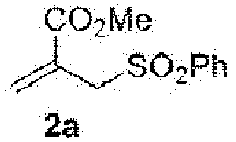

3a 94 2 

3b 80 3b 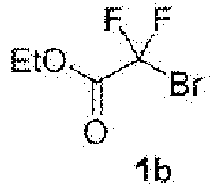


3c 68 4 2a 
3d 72 5 2b 
3e 72 


3f 6 34 (59)° 7 2a 
3g 57 8 2c 
3h 47 9 
2d 
3i 60 10 2a 
3j 78 11 
2d 
3k 74 12 2a 
3l 45 13 2d 
3m 1e 63 14 
2a 
3n 72 15 1f 2b 
3o 60 -

- In order to verify the effect of light irradiation using the reaction under the conditions of the above scheme, light irradiation in this system was turned on and off.
- After 10 minutes of light irradiation, product 3a was formed in the yield of 49%.
- When the light source was turned off to stop light irradiation, the reaction stopped quickly.
- 26 hours later, when the light source was turned on to restart light irradiation, the reaction was quickly restarted.
-

- In addition to compounds 1 and 2 in the above Example, the three-component radical reaction was tested in the Example by the addition of alkene(1-octene 5a) under the conditions of Scheme T above.
- By the reaction of the three components, i.e., 2-bromo-2,2-difluoroacetic acid ethyl 1b, 1-octene 5a, and 2-methoxycarbonyl-substituted allyl sulfone 2a, product 6a was obtained in a yield of 50%.
- By the reaction of the three components, i.e., perfluorodecyl bromide 1e, 1-octene 5a, and 2-phenyl allyl sulfone 2a, compound 6b was obtained in a yield of 56%.

with a compound represented by the following formula (3):

in the presence of a reducing agent under light irradiation.

with a compound represented by formula (3):

in the presence of a reducing agent as desired under light irradiation.

with a compound represented by formula (3):

in the presence of a reducing agent as desired, under light irradiation.

with a compound represented by formula (3):


in the presence of a reducing agent under light irradiation.
Claims (25)
- A method for producing a compound represented by formula (1):
 wherein R1 represents an organic group,RA represents hydrogen or fluorine,R4a represents hydrogen or an organic group,R4b represents hydrogen or an organic group,R2 represents hydrogen or an organic group,R5a represents hydrogen or an organic group, andR5b represents hydrogen or an organic group; orR2 is optionally connected to R4a to form a ring;the method comprising step A of reacting a compound represented by formula (2):
with a compound represented by formula (3):
in the presence of a reducing agent as desired, under light irradiation. - The production method according to claim 1,
whereinR1 represents R11-Y- or (R11-)2N-,Y represents a bond, oxygen, or sulfur, andR11 independently represents, in each occurrence, a hydrocarbon group that optionally has one or more substituents. - The production method according to claim 2,
whereinR1 represents R11-Y-,Y represents a bond, andR11 representsan aryl group that optionally has one or more substituents, or an alkyl group that optionally has one or more substituents. - The production method according to claim 2,
whereinR1 represents R11-Y-,Y represents -O-C(=O)- or -O-C(=S)-, andR11 represents an aliphatic hydrocarbon group that optionally has one or more substituents. - The production method according to claim 2,
whereinR1 represents (R11-)2N-C(=O)- andR11 independently represents, in each occurrence, an aliphatic hydrocarbon group that optionally has one or more substituents. - The production method according to any one of claims 1 to 5, wherein RA represents fluorine.
- The production method according to any one of claims 1 to 6, whereinR4a represents hydrogen,R4b represents hydrogen,R2 represents hydrogen, a hydrocarbon group that optionally has one or more substituents, or an alkoxycarbonyl group that optionally has one or more substituents,R5a represents hydrogen, andR5b represents hydrogen.
- The production method according to any one of claims 1 to 7, wherein X1 represents halogen, an alkylsulfonyloxy group, or an arylsulfonyloxy group.
- The production method according to any one of claims 1 to 8, wherein X2 represents-SO2R,-SR,-S(=O)R,-SeR,-TeR,-Cl-Br,-I,-PR2, or-P(=O)R2,wherein R independently represents, in each occurrence, an organic group.
- The production method according to claim 9, wherein X2 represents -SO2R, wherein R is an organic group.
- The production method according to any one of claims 1 to 10, wherein the reducing agent is a nitrogen-containing unsaturated heterocyclic compound having an N-H moiety.
- The production method according to any one of claims 1 to 11, wherein the reducing agent is a compound represented by formula (4):

- The production method according to any one of claims 1 to 12, wherein the reaction of step A is performed in the presence of a catalyst.
- The production method according to claim 13, wherein the catalyst is at least one member selected from the group consisting of transition metal complexes and organic dye compounds.
- A method for producing a compound represented by formula (1a):
 R1 independently represents, in each occurrence, an organic group,RA independently represents, in each occurrence, hydrogen or fluorine,R4a independently represents, in each occurrence, hydrogen or an organic group,R4b independently represents, in each occurrence, hydrogen or an organic group, andR2 represents hydrogen or an organic group;the method comprising step Aa of reacting a compound represented by formula (2):
with a compound represented by formula (3):
in the presence of a reducing agent as desired, under light irradiation. - A compound represented by formula (1):
 R1 represents an organic group,RA represents hydrogen or fluorine,R4a represents hydrogen or an organic group,R4b represents hydrogen or an organic group,R2 represents an organic group,R5a represents hydrogen or an organic group, andR5b represents hydrogen or an organic group, with the proviso that when R1 represents a perfluoroalkyl group, R2 represents an alkyl group having two or more carbon atoms, or an ester group having three or more carbon atoms.
 - The compound according to claim 16,
whereinR1 represents R11-Y-,Y represents a bond,R11 represents an aryl group that optionally has one or more substituents, or an alkyl group that optionally has one or more substituents,RA represents hydrogen or fluorine, andR2 represents hydrogen or an organic group. - The compound according to claim 17, wherein RA represents fluorine.
- The compound according to claim 17 or 18,
whereinR4a represents hydrogen,R4b represents hydrogen,R2 represents hydrogen,an alkoxycarbonyl group that optionally has one or more substituents,an aryl group that optionally has one or more substituents, or an alkyl group that optionally has one or more substituents,R5a represents hydrogen, andR5b represents hydrogen. - The compound according to claim 16, whereinR1 represents R11-Y-,Y represents -O-C(=O)- or -O-C(=S)-,R11 represents an aliphatic hydrocarbon group that optionally has one or more substituents,RA represents hydrogen or fluorine, andR2 represents hydrogen or an organic group.
- The compound according to claim 20, wherein RA represents fluorine.
- The compound according to claim 20 or 21,
whereinR4a represents hydrogen,R4b represents hydrogen,R2 represents hydrogen, an alkoxycarbonyl group that optionally has one or more substituents, an aryl group that optionally has one or more substituents, or an alkyl group that optionally has one or more substituents,R5a represents hydrogen, andR5b represents hydrogen. - The compound according to claim 16,
whereinR1 represents R11-Y-,Y represents -O-C(=O)- or -O-C(=S)-,R11 represents an aliphatic hydrocarbon group that optionally has one or more substituents,RA represents hydrogen or fluorine, andR2 represents hydrogen or an organic group. - The compound according to claim 16,
whereinR1 represents (R11-)2N-C(=O)-,R11 independently represents, in each occurrence, an aliphatic hydrocarbon group that optionally has one or more substituents,RA represents hydrogen or fluorine,R4a represents hydrogen,R4b represents hydrogen,R2 represents hydrogen or an organic group,R5a represents hydrogen, andR5b represents hydrogen or an organic group. - The compound according to claim 24, wherein RA represents fluorine.
Priority Applications (1)
| Application Number | Priority Date | Filing Date | Title |
|---|---|---|---|
| EP22201602.4A EP4140977A1 (en) | 2018-06-22 | 2019-06-20 | Fluorinated compound |
Applications Claiming Priority (2)
| Application Number | Priority Date | Filing Date | Title |
|---|---|---|---|
| JP2018119223A JP7298836B2 (en) | 2018-06-22 | 2018-06-22 | Method for producing fluorine-containing compound |
| PCT/JP2019/024610 WO2019245008A1 (en) | 2018-06-22 | 2019-06-20 | Method for producing fluorinated compound |
Related Child Applications (1)
| Application Number | Title | Priority Date | Filing Date |
|---|---|---|---|
| EP22201602.4A Division EP4140977A1 (en) | 2018-06-22 | 2019-06-20 | Fluorinated compound |
Publications (2)
| Publication Number | Publication Date |
|---|---|
| EP3812359A1 true EP3812359A1 (en) | 2021-04-28 |
| EP3812359A4 EP3812359A4 (en) | 2022-03-16 |
Family
ID=68983923
Family Applications (2)
| Application Number | Title | Priority Date | Filing Date |
|---|---|---|---|
| EP19823150.8A Withdrawn EP3812359A4 (en) | 2018-06-22 | 2019-06-20 | METHOD OF PREPARING A FLUORINATED COMPOUND |
| EP22201602.4A Withdrawn EP4140977A1 (en) | 2018-06-22 | 2019-06-20 | Fluorinated compound |
Family Applications After (1)
| Application Number | Title | Priority Date | Filing Date |
|---|---|---|---|
| EP22201602.4A Withdrawn EP4140977A1 (en) | 2018-06-22 | 2019-06-20 | Fluorinated compound |
Country Status (5)
| Country | Link |
|---|---|
| US (2) | US11492322B2 (en) |
| EP (2) | EP3812359A4 (en) |
| JP (2) | JP7298836B2 (en) |
| CN (2) | CN112334435A (en) |
| WO (1) | WO2019245008A1 (en) |
Families Citing this family (1)
| Publication number | Priority date | Publication date | Assignee | Title |
|---|---|---|---|---|
| WO2022191254A1 (en) * | 2021-03-09 | 2022-09-15 | ダイキン工業株式会社 | Haloether, method for producing same, vinyl ether, and method for producing same |
Family Cites Families (9)
| Publication number | Priority date | Publication date | Assignee | Title |
|---|---|---|---|---|
| DE3466871D1 (en) * | 1983-01-26 | 1987-11-26 | Sagami Chem Res | Process for preparing polyfluoroalkyl-substituted compounds |
| JPH0967323A (en) * | 1995-09-01 | 1997-03-11 | Mitsubishi Chem Corp | Fluorinated levulinic acid derivative |
| JPH10101614A (en) * | 1996-09-27 | 1998-04-21 | Daikin Ind Ltd | Method for producing α, α-difluoro-β-hydroxyester |
| US7364908B2 (en) * | 2004-06-17 | 2008-04-29 | University Of Pittsburgh - Of The Commonwealth System Of Higher Education | Separation of fluorous compounds |
| EP2338892A1 (en) | 2009-12-18 | 2011-06-29 | Bayer Schering Pharma Aktiengesellschaft | Prostate specific membrane antigen inhibitors |
| WO2013147266A1 (en) * | 2012-03-30 | 2013-10-03 | Jsr株式会社 | Immersion exposure photoresist composition, polymer and compound |
| JP6585024B2 (en) | 2016-03-08 | 2019-10-02 | ダイキン工業株式会社 | Method for producing fluorine-containing compound |
| CN115181005A (en) * | 2016-03-08 | 2022-10-14 | 大金工业株式会社 | Process for producing fluorine-containing compound |
| CN106749214B (en) * | 2016-11-01 | 2020-01-17 | 上海大学 | 1,3-benzoxazole-containing difluoromethylene indolinone compounds and preparation method thereof |
-
2018
- 2018-06-22 JP JP2018119223A patent/JP7298836B2/en active Active
-
2019
- 2019-06-20 CN CN201980042071.9A patent/CN112334435A/en active Pending
- 2019-06-20 EP EP19823150.8A patent/EP3812359A4/en not_active Withdrawn
- 2019-06-20 EP EP22201602.4A patent/EP4140977A1/en not_active Withdrawn
- 2019-06-20 CN CN202310377231.3A patent/CN116396170A/en active Pending
- 2019-06-20 US US17/254,437 patent/US11492322B2/en active Active
- 2019-06-20 WO PCT/JP2019/024610 patent/WO2019245008A1/en not_active Ceased
-
2022
- 2022-09-13 JP JP2022145177A patent/JP7421195B2/en active Active
- 2022-09-27 US US17/953,545 patent/US20230069592A1/en not_active Abandoned
Also Published As
| Publication number | Publication date |
|---|---|
| EP3812359A4 (en) | 2022-03-16 |
| JP7421195B2 (en) | 2024-01-24 |
| JP2019218330A (en) | 2019-12-26 |
| CN116396170A (en) | 2023-07-07 |
| US20230069592A1 (en) | 2023-03-02 |
| US11492322B2 (en) | 2022-11-08 |
| CN112334435A (en) | 2021-02-05 |
| JP7298836B2 (en) | 2023-06-27 |
| US20210221766A1 (en) | 2021-07-22 |
| WO2019245008A1 (en) | 2019-12-26 |
| JP2022177135A (en) | 2022-11-30 |
| EP4140977A1 (en) | 2023-03-01 |
Similar Documents
| Publication | Publication Date | Title |
|---|---|---|
| Kim et al. | Functionalization of pyridinium derivatives with 1, 4-dihydropyridines enabled by photoinduced charge transfer | |
| Wang et al. | CeCl3-promoted simultaneous photocatalytic cleavage and amination of Cα–Cβ bond in lignin model compounds and native lignin | |
| Nicholls et al. | Brønsted acid cocatalysis in copper (I)-photocatalyzed α-amino C–H bond functionalization | |
| Shing et al. | Arylruthenium (III) porphyrin-catalyzed C–H oxidation and epoxidation at room temperature and [RuV (Por)(O)(Ph)] intermediate by spectroscopic analysis and density functional theory calculations | |
| Miranda et al. | Synthesis and structural characterization of several ruthenium porphyrin nitrosyl complexes | |
| JP7043488B2 (en) | Cross-coupling method | |
| Casado-Sanchez et al. | 8-Mercaptoquinoline as a ligand for enhancing the photocatalytic activity of Pt (II) coordination complexes: reactions and mechanistic insights | |
| Cherepakhin et al. | Catalyst evolution in ruthenium-catalyzed coupling of amines and alcohols | |
| EP3428145B1 (en) | Method for producing fluorinated compound | |
| Gutierrez-Blanco et al. | Pyrene-connected tetraimidazolylidene complexes of iridium and rhodium. Structural features and catalytic applications | |
| Bakowski et al. | Enantioselective radical cyclisation reactions of 4-substituted quinolones mediated by a chiral template | |
| Mir et al. | A Au (I)-precatalyst with a cyclopropenium counterion: an unusual ion pair | |
| JP7421195B2 (en) | Method for producing fluorine-containing compounds | |
| Latham et al. | Metalation and methyl group migration in 21-, 22-, and 23-methylcarbaporphyrins: Synthesis and characterization of palladium (II), rhodium (I), and rhodium (III) derivatives | |
| Grell et al. | Chiral-at-rhodium catalyst containing two different cyclometalating ligands | |
| Lash et al. | Rhodium complexes of carbaporphyrins, carbachlorins, adj-dicarbaporphyrins, and an adj-dicarbachlorin | |
| CN110143962B (en) | A new method for synthesizing benzimidazo[1,2-a]quinoline derivatives | |
| CN115181005A (en) | Process for producing fluorine-containing compound | |
| CN116135868B (en) | Method for heteroaryl treatment of eighth main group metallocene compound | |
| Trofimov et al. | Cyanoacetylene and its derivatives: XXXIII. One-pot stereoselective synthesis of bis-iminodihydrofurans from 4-hydroxy-4-methyl-2-pentynonitrile and aromatic amines | |
| EP3628657A1 (en) | Production of amines via a hydroaminomethylation reaction using iminium reactants | |
| Gutiérrez Peña | Metal complexes with naphthalene-diimide and perylene-diimide-based ligands: supramolecular interactions and catalytic implications | |
| Singh et al. | Visible‐Light‐Driven Copper (II)‐Catalyzed Direct C–H Amination of Arenes via N‐Centered Radicals | |
| Palchikov et al. | HARNESSING FERROCENECARBOXALDEHYDE IN MULTICOMPONENT REACTIONS FOR THE SYNTHESIS OF BIOACTIVE HETEROCYCLIC FERROCENES | |
| Ma et al. | A promising strategy to construct strong sensitizing iridium (III) complexes via energy transfer sensitization for continuous gram-level photosynthesis |
Legal Events
| Date | Code | Title | Description |
|---|---|---|---|
| STAA | Information on the status of an ep patent application or granted ep patent |
Free format text: STATUS: THE INTERNATIONAL PUBLICATION HAS BEEN MADE |
|
| PUAI | Public reference made under article 153(3) epc to a published international application that has entered the european phase |
Free format text: ORIGINAL CODE: 0009012 |
|
| STAA | Information on the status of an ep patent application or granted ep patent |
Free format text: STATUS: REQUEST FOR EXAMINATION WAS MADE |
|
| 17P | Request for examination filed |
Effective date: 20201230 |
|
| AK | Designated contracting states |
Kind code of ref document: A1 Designated state(s): AL AT BE BG CH CY CZ DE DK EE ES FI FR GB GR HR HU IE IS IT LI LT LU LV MC MK MT NL NO PL PT RO RS SE SI SK SM TR |
|
| AX | Request for extension of the european patent |
Extension state: BA ME |
|
| DAV | Request for validation of the european patent (deleted) | ||
| DAX | Request for extension of the european patent (deleted) | ||
| A4 | Supplementary search report drawn up and despatched |
Effective date: 20220216 |
|
| RIC1 | Information provided on ipc code assigned before grant |
Ipc: C07B 61/00 20060101ALI20220210BHEP Ipc: C07C 233/09 20060101ALI20220210BHEP Ipc: C07C 231/12 20060101ALI20220210BHEP Ipc: C07C 69/65 20060101ALI20220210BHEP Ipc: C07C 67/343 20060101ALI20220210BHEP Ipc: C07C 22/08 20060101ALI20220210BHEP Ipc: C07C 21/18 20060101ALI20220210BHEP Ipc: B01J 35/02 20060101ALI20220210BHEP Ipc: B01J 31/22 20060101ALI20220210BHEP Ipc: C07C 17/26 20060101AFI20220210BHEP |
|
| RAP3 | Party data changed (applicant data changed or rights of an application transferred) |
Owner name: UNIVERSITY PUBLIC CORPORATION OSAKA Owner name: DAIKIN INDUSTRIES, LTD. |
|
| P01 | Opt-out of the competence of the unified patent court (upc) registered |
Effective date: 20230525 |
|
| STAA | Information on the status of an ep patent application or granted ep patent |
Free format text: STATUS: THE APPLICATION HAS BEEN WITHDRAWN |
|
| 18W | Application withdrawn |
Effective date: 20230921 |