EP3810143B1 - Nadph oxidase inhibitors, pharmaceutical composition comprising the same, and application thereof - Google Patents
Nadph oxidase inhibitors, pharmaceutical composition comprising the same, and application thereof Download PDFInfo
- Publication number
- EP3810143B1 EP3810143B1 EP19822444.6A EP19822444A EP3810143B1 EP 3810143 B1 EP3810143 B1 EP 3810143B1 EP 19822444 A EP19822444 A EP 19822444A EP 3810143 B1 EP3810143 B1 EP 3810143B1
- Authority
- EP
- European Patent Office
- Prior art keywords
- compound
- dmso
- nmr
- calcd
- esi
- Prior art date
- Legal status (The legal status is an assumption and is not a legal conclusion. Google has not performed a legal analysis and makes no representation as to the accuracy of the status listed.)
- Active
Links
Classifications
-
- C—CHEMISTRY; METALLURGY
- C07—ORGANIC CHEMISTRY
- C07D—HETEROCYCLIC COMPOUNDS
- C07D215/00—Heterocyclic compounds containing quinoline or hydrogenated quinoline ring systems
- C07D215/02—Heterocyclic compounds containing quinoline or hydrogenated quinoline ring systems having no bond between the ring nitrogen atom and a non-ring member or having only hydrogen atoms or carbon atoms directly attached to the ring nitrogen atom
- C07D215/16—Heterocyclic compounds containing quinoline or hydrogenated quinoline ring systems having no bond between the ring nitrogen atom and a non-ring member or having only hydrogen atoms or carbon atoms directly attached to the ring nitrogen atom with hetero atoms or with carbon atoms having three bonds to hetero atoms with at the most one bond to halogen, e.g. ester or nitrile radicals, directly attached to ring carbon atoms
- C07D215/20—Oxygen atoms
- C07D215/22—Oxygen atoms attached in position 2 or 4
-
- C—CHEMISTRY; METALLURGY
- C07—ORGANIC CHEMISTRY
- C07D—HETEROCYCLIC COMPOUNDS
- C07D215/00—Heterocyclic compounds containing quinoline or hydrogenated quinoline ring systems
- C07D215/02—Heterocyclic compounds containing quinoline or hydrogenated quinoline ring systems having no bond between the ring nitrogen atom and a non-ring member or having only hydrogen atoms or carbon atoms directly attached to the ring nitrogen atom
- C07D215/16—Heterocyclic compounds containing quinoline or hydrogenated quinoline ring systems having no bond between the ring nitrogen atom and a non-ring member or having only hydrogen atoms or carbon atoms directly attached to the ring nitrogen atom with hetero atoms or with carbon atoms having three bonds to hetero atoms with at the most one bond to halogen, e.g. ester or nitrile radicals, directly attached to ring carbon atoms
- C07D215/20—Oxygen atoms
- C07D215/24—Oxygen atoms attached in position 8
- C07D215/26—Alcohols; Ethers thereof
-
- C—CHEMISTRY; METALLURGY
- C07—ORGANIC CHEMISTRY
- C07D—HETEROCYCLIC COMPOUNDS
- C07D215/00—Heterocyclic compounds containing quinoline or hydrogenated quinoline ring systems
- C07D215/02—Heterocyclic compounds containing quinoline or hydrogenated quinoline ring systems having no bond between the ring nitrogen atom and a non-ring member or having only hydrogen atoms or carbon atoms directly attached to the ring nitrogen atom
- C07D215/16—Heterocyclic compounds containing quinoline or hydrogenated quinoline ring systems having no bond between the ring nitrogen atom and a non-ring member or having only hydrogen atoms or carbon atoms directly attached to the ring nitrogen atom with hetero atoms or with carbon atoms having three bonds to hetero atoms with at the most one bond to halogen, e.g. ester or nitrile radicals, directly attached to ring carbon atoms
- C07D215/38—Nitrogen atoms
-
- C—CHEMISTRY; METALLURGY
- C07—ORGANIC CHEMISTRY
- C07D—HETEROCYCLIC COMPOUNDS
- C07D223/00—Heterocyclic compounds containing seven-membered rings having one nitrogen atom as the only ring hetero atom
- C07D223/14—Heterocyclic compounds containing seven-membered rings having one nitrogen atom as the only ring hetero atom condensed with carbocyclic rings or ring systems
- C07D223/16—Benzazepines; Hydrogenated benzazepines
-
- C—CHEMISTRY; METALLURGY
- C07—ORGANIC CHEMISTRY
- C07D—HETEROCYCLIC COMPOUNDS
- C07D401/00—Heterocyclic compounds containing two or more hetero rings, having nitrogen atoms as the only ring hetero atoms, at least one ring being a six-membered ring with only one nitrogen atom
- C07D401/02—Heterocyclic compounds containing two or more hetero rings, having nitrogen atoms as the only ring hetero atoms, at least one ring being a six-membered ring with only one nitrogen atom containing two hetero rings
- C07D401/10—Heterocyclic compounds containing two or more hetero rings, having nitrogen atoms as the only ring hetero atoms, at least one ring being a six-membered ring with only one nitrogen atom containing two hetero rings linked by a carbon chain containing aromatic rings
-
- C—CHEMISTRY; METALLURGY
- C07—ORGANIC CHEMISTRY
- C07D—HETEROCYCLIC COMPOUNDS
- C07D409/00—Heterocyclic compounds containing two or more hetero rings, at least one ring having sulfur atoms as the only ring hetero atoms
- C07D409/02—Heterocyclic compounds containing two or more hetero rings, at least one ring having sulfur atoms as the only ring hetero atoms containing two hetero rings
- C07D409/04—Heterocyclic compounds containing two or more hetero rings, at least one ring having sulfur atoms as the only ring hetero atoms containing two hetero rings directly linked by a ring-member-to-ring-member bond
-
- C—CHEMISTRY; METALLURGY
- C07—ORGANIC CHEMISTRY
- C07D—HETEROCYCLIC COMPOUNDS
- C07D491/00—Heterocyclic compounds containing in the condensed ring system both one or more rings having oxygen atoms as the only ring hetero atoms and one or more rings having nitrogen atoms as the only ring hetero atoms, not provided for by groups C07D451/00 - C07D459/00, C07D463/00, C07D477/00 or C07D489/00
- C07D491/02—Heterocyclic compounds containing in the condensed ring system both one or more rings having oxygen atoms as the only ring hetero atoms and one or more rings having nitrogen atoms as the only ring hetero atoms, not provided for by groups C07D451/00 - C07D459/00, C07D463/00, C07D477/00 or C07D489/00 in which the condensed system contains two hetero rings
- C07D491/04—Ortho-condensed systems
- C07D491/056—Ortho-condensed systems with two or more oxygen atoms as ring hetero atoms in the oxygen-containing ring
-
- C—CHEMISTRY; METALLURGY
- C07—ORGANIC CHEMISTRY
- C07D—HETEROCYCLIC COMPOUNDS
- C07D495/00—Heterocyclic compounds containing in the condensed system at least one hetero ring having sulfur atoms as the only ring hetero atoms
- C07D495/02—Heterocyclic compounds containing in the condensed system at least one hetero ring having sulfur atoms as the only ring hetero atoms in which the condensed system contains two hetero rings
- C07D495/04—Ortho-condensed systems
Definitions
- ROS Reactive Oxygen Species
- ROS are a number of reactive molecules and free radicals derived from molecular oxygen, including superoxide anion ( • O 2 - ), peroxide ( • O 2 -2 ), hydrogen peroxide (H 2 O 2 ), hydroxyl radical ( • OH) and hydroxyl radical ion (OH - ). These molecules may be produced as byproducts during the aerobic respiration or by oxidoreductase enzymes and metal catalyzed oxidation. Normally, ROS play a role in immunity and cell signaling, including apoptosis, gene expression, and the activation of cell signaling cascades. However, excessive ROS production and/or impaired ROS reduction may lead to overload of ROS and oxidative stress.
- NOX NADPH oxidase
- COX cyclooxygenases
- substrate coupled nitric oxide synthetase substrate coupled nitric oxide synthetase
- EP 2 194 044 relates to a quinolone derivative having, at the 2-position, an alkyl group substituted with a heteroatom.
- EP 2 742 033 discloses flavonoid compounds, compositions containing the compounds, method for their synthesis, and uses of these compounds.
- the disclosure relates to a series of NADPH oxidase inhibitors, a pharmaceutical composition comprising the same, and a method of inhibiting NADPH oxidase (NOX) activity.
- a compound according to Formula (I) is provided.
- the pharmaceutically acceptable salt, hydrate or solvate of this compound are also provided.
- A is C 6 -C 20 aryl optionally fused with C 1 -C 20 heterocyclyl, or C 1 -C 20 heteroaryl optionally fused with C 1 -C 20 heterocyclyl, and A is optionally substituted with one or more C 1 -C 10 alkyl, C 6 -C 20 aryl, halogen, OR 11 , C(O)R 11 , C(O)OR 11 , NR 11 R 12 , SO 2 R 11 , or SO 2 (OR 11 );
- B is C 1 -C 10 alkyl, C 6 -C 20 aryl, C 1 -C 20 heteroaryl or C 1 -C 20 heterocyclyl and B is optionally substituted with one or more C 1 -C 10 alkyl, C 6 -C 20 aryl, C 1 -C 20 heterocyclyl and B is optionally
- a pharmaceutical composition comprising the compound according to Formula I and at least a pharmaceutically acceptable excipient or carrier.
- the compounds and the pharmaceutical compositions of the present invention are as defined in the appended claims. Any references in the subsequent paragraphs of this description to methods which include methods of treatment of the human (or animal) body by therapy (or for diagnosis) are not part of the invention.
- a method of inhibiting NADPH oxidase comprises the step of administering to a cell an effective amount of the compound according to Formula I or the pharmaceutical composition comprising the compound according to Formula I and at least a pharmaceutically acceptable excipient or carrier.
- compositions comprising, “comprising,” “includes,” “including,” “has,” “having,” “contains”, “containing,” “characterized by” or any other variation thereof, are intended to cover a non-exclusive inclusion, subject to any limitation explicitly indicated.
- a composition, mixture, process or method that comprises a list of elements is not necessarily limited to only those elements but may include other elements not expressly listed or inherent to such composition, mixture, process, or method.
- All of the carbon, hydrogen, oxygen, Sulfur, halogen, or nitrogen involved in the groups and compounds according to the present disclosure are optionally further replaced by one or more of their corresponding isotopes, wherein the carbon isotopes include 12 C, 13 C and 14 C, the hydrogen isotopes include protium (H), deuterium (D, also known as heavy hydrogen) and tritium (T, also known as superheavy hydrogen), the oxygen isotopes include 16 O, 17 O and 18 O, the sulfur isotopes include 32 S, 33 S, 34 S and 36 S, the nitrogen isotopes include 14 N and 15 N, the fluorine isotopes include 17 F and 19 F, the chlorine isotopes include 35 Cl and 17 Cl, and the bromine isotopes include 79 Br and 81 Br.
- the carbon isotopes include 12 C, 13 C and 14 C
- the hydrogen isotopes include protium (H), deuterium (D, also known as heavy hydrogen)
- Alkyl means a linear or branched saturated aliphatic hydrocarbyl having 1 to 20 carbon atoms, preferably 1 to 10 carbon atoms. Non-limiting examples thereof include methyl, ethyl, n-propyl, isopropyl. n-butyl, sec-butyl, t-butyl, isobutyl, n-pentyl, isopentyl, neo-pentyl, n-hexyl, octyl, and various branched isomers thereof.
- Alkenyl means a linear or branched unsaturated aliphatic hydrocarbyl having 1 to 3 carbon-carbon double bonds, and comprising 2 to 20 carbon atoms, preferably 2 to 8.
- Non limiting examples thereof include vinyl, propen-2-yl, buten2-yl, buten-2-yl, penten-2-yl, penten-4-yl, hexen-2-yl, hexen3-yl, hepten-2-yl, hepten-3-yl, hepten-4-yl, octen-3-yl, nonen-3-yl, decen-4-yl and hendecen-3-yl.
- Alkenyl can also include polyenes such as 1,2 propadienyl and 2,4 hexadienyl.
- Alkynyl means a linear or branched unsaturated aliphatic hydrocarbyl having 1 to 3 carbon-carbon triple bonds, and comprising 2 to 20 carbon atoms, preferably 2 to 8 carbon atoms.
- Non limiting examples thereof include ethynyl, propyn-1-yl, propyn-2-yl, butyn-1-yl, butyn-2-yl, butyn-3-yl, 3.3-dimethylbutyn-2-yl, pentyn-1-yl, pentyn-2-yl, hexyn-1-yl, heptyn-1-yl, heptyn-3-yl, heptyn-4-yl, octyn-3-yl, nonyn-3-yl, decyn4-yl, hendecyn-3-yl or dodecyn-4-yl.
- "Alkynyl” can also include moieties comprised of multiple triple bonds
- Alkoxy means -O-alkyl. Non-limiting examples thereof include methoxy, ethoxy, n-propoxy, isopropoxy, n-butoxy, sec-butoxy, t-butoxy, n-pentyloxy, n-hexyloxy, cyclopropoxy, and cyclobutoxy. This definition applies to the alkoxys used throughout this Description.
- halogen either alone or in compound words such as “haloalkyl”, or when used in descriptions such as “alkyl substituted with halogen” includes fluorine, chlorine, bromine or iodine. Further, when used in compound words such as “haloalkyl”, or when used in descriptions such as “alkyl substituted with halogen” said alkyl may be partially or fully substituted with halogen atoms which may be the same or different.
- Non-limiting examples of "haloalkyl” or “alkyl substituted with halogen” include F 3 C-, ClCH 2 -, CF 3 CH 2 - and CF 3 CCl 2 -.
- Aromatic indicates that each of the ring atoms is essentially in the same plane and has a p-orbital perpendicular to the ring plane, and that (4n + 2) ⁇ electrons, where n is a positive integer, are associated with the ring to comply with Hückel's rule.
- aromatic ring or ring system denotes a carbocyclic or heterocyclic ring or ring system in which the ring or at least one ring of the ring system is aromatic.
- aromatic ring or ring system is also referred to as "aryl”.
- “Aryl” might include 6 to 20 carbons as ring member including phenyl, benzyl, naphthyl, and the like.
- Aryl can also include substituted aryl groups such as tolyl.
- aromatic heterocyclic ring system denotes a heterocyclic ring system in which at least one ring of the ring system is aromatic.
- aromatic heterocyclic ring system is also referred to as “heteroaryl”.
- Heteroaryl might include 1 to 20 carbons as ring member and might further include at least one heteroatom selected from S, N, and O.
- Carbocyclyl means a saturated or unsaturated aromatic or non-aromatic ring, and the aromatic or non-aromatic ring may be a 3- to 8-membered monocyclic, a 4- to 12-membered bicyclic or a 10- to 20-membered tricyclic system.
- the carbocyclic group may have attached bridge rings or spiral rings. Non-limiting examples thereof include cyclopropyl, cyclobutyl, cyclopentyl, cyclohexyl, cycloheptyl, cyclooctyl, cyclodecyl and cyclododecyl, cyclohexenyl, This definition applies to the carbocyclyls used throughout this Description.
- Heterocyclyl means a substituted or unsubstituted, saturated or unsaturated, aromatic or non-aromatic ring, and the aromatic or non-aromatic ring may be a 1 to 8-membered monocyclic, a 4- to 12-membered bicyclic or a 10- to 20-membered tricyclic system, and contains at least one heteroatom selected from N, O or S.
- the optionally substituted N or S on the ring of a heterocyclic group may be oxidized into various oxidation States.
- the carbocyclic group may be attached via a heteroatom or a carbon atom, and may have attached bridge rings or spiral rings.
- Non-limiting examples thereof include epoxyethyl, azacyclopropyl, oxzcyclobutyl, azacyclobutyl, 1,3-dioxolane, 1,4-dioxolane, 1,3-dioxane, azacycloheptyl, pyridinyl, furyl, thiophenyl, pyranyl, N-alkylpyrrolyl, pyrimidinyl, pyrazinyl, pyridazinyl, imidazolyl, piperidinyl, hexahydropyridinyl, morpholinyl, thiomorpholinyl, 1,3-dithia-, dihydrofuryl, dihydropyranyl, dithiacyclopentyl, tetrahydrofuryl, tetrahydropyrrolyl, tetrahydroimidazolyl, tetrahydrothiazolyl, tetrahydropyranyl,
- the term “optional” or “optionally” means the event or situation modified by this term may but does not certainly happen, including both the case where the event or situation happens and the case not.
- the term “optionally substituted” refers to groups which are unsubstituted or have at least one non-hydrogen substituent that does not extinguish the biological activity possessed by the unsubstituted analog. As used herein, the following definitions shall apply unless otherwise indicated.
- an optionally substituted group may have a substituent at each substitutable position of the group, and each substitution is independent of the other.
- a heterocyclyl optionally substituted with alkyl means that the alkyl may be present but is not necessarily present, including both the case where the heterocyclyl is substituted with alkyl and the case where the heterocyclyl is not substituted with alkyl.
- a "pharmaceutically acceptable” component means that the compound or composition is suitable for administration to a subject to achieve the treatments described herein, without unduly deleterious side effects in light of the severity of the disease and necessity of the treatment.
- Carrier means a material that does not cause significant stimulation to an organism and does not eliminate the biological activity and characteristics of a given compound.
- Excipient means an inert substance added into a pharmaceutical composition to facilitate administration of a compound.
- Non-limiting examples thereof include calcium carbonate, calcium phosphate, sugar, starch, cellulose derivatives (including microcrystalline cellulose), gelatin, vegetable oils, polyethylene glycols, diluent, a granulating agent, lubricant, binder and disintegrant.
- the term "effective amount” refers to the amount of each active agent required to confer the desired effect (e.g. inhibiting NADPH oxidase) on the subject, either alone or in combination with one or more other active agents.
- An effective amount varies, as recognized by those skilled in the art, depending on the particular condition being treated, the severity of the condition, the individual patient parameters including age, physical condition, size, gender and weight, the duration of the treatment, the nature of concurrent therapy (if any), the specific route of administration and like factors within the knowledge and expertise of the health practitioner. These factors are well known to those of ordinary skill in the art and can be addressed with no more than routine experimentation.
- a maximum dose of the individual components or combinations thereof be used, that is, the highest safe dose according to sound medical judgment. It will be understood by those of ordinary skill in the art, however, that a patient may insist upon a lower dose or tolerable dose for medical reasons, psychological reasons or for virtually any other reasons.
- stereoisomer refers to an isomer of a molecule having its atoms in a different spatial arrangement, including cis-trans-isomer, enantiomer, and conformer.
- Compounds of this invention can exist as one or more stereoisomers.
- the various stereoisomers include enantiomers, diastereomers, racemates, atropisomers and geometric isomers.
- Stereoisomers are isomers of identical constitution but differing in the arrangement of their atoms in space and include enantiomers, diastereomers, cis-trans isomers (also known as geometric isomers) and atropisomers.
- Atropisomers result from restricted rotation about single bonds where the rotational barrier is high enough to permit isolation of the isomeric species.
- one stereoisomer may be more active and/or may exhibit beneficial effects when enriched relative to the other stereoisomer(s) or when separated from the other stereoisomer(s). Additionally, the skilled artisan knows how to separate, enrich, and/or to selectively prepare said stereoisomers.
- the compounds of the invention may be present as a mixture of stereoisomers, individual stereoisomers or as an optically active form.
- the invention is directed to compounds of Formula I selected from a group consisting of: and their pharmaceutical acceptable salts or solvates.
- compositions comprising a compound of any of the preceding Embodiments, as well as any other embodiments described herein, and any combinations thereof.
- the composition can be formulated to any form of formulation that is considered to be safe, effective, and convenient for use.
- the pharmaceutical composition may further comprise a pharmaceutically acceptable component as defined in the previous paragraphs.
- a usable pharmaceutically acceptable salt, carrier, or excipient are disclosed in various references including Handbook of Pharmaceuticals Excipients edited by Raymond C Rowe, Paul J Sheskey, and Marian E Quinn.
- said pharmaceutically acceptable carrier or excipient can be selected from the group consisting of inert diluents, dispersing and/or granulating agents, surface active agents and/or emulsifiers, disintegrating agents, binding agents, preservatives, buffering agents, lubricating agents and oils. Said compositions optionally further comprising at least one additional biologically active compound or agent.
- Step 1A Preparation of 2-bromo-1-(2-ethoxyphenyl) ethan-1-one
- Step 1 Preparation of 2-amino-1-(2-chlorophenyl) ethan-1-one hydrochloride
- Step 1 Preparation of (3-hydroxy-6,7-dimethoxy-2-(2-(trifluoromethyl) phenyl) quinolin-4(1H)-one
- Step 2A Preparation of 3-hydroxy-6,7-dimethoxy-2-(2-(trifluoromethyl)phenyl) quinolin-4(1H)-one hydrochloride
- Step 2B Preparation of 3-hydroxy-6,7-dimethoxy-2-(2-(trifluoromethyl)phenyl)quinolin-4(1H)-one acetate
- Step 2C Preparation of 3-hydroxy-6,7-dimethoxy-2-(2-(trifluoromethyl)phenyl)quinolin-4(1H)-one methanesulfonate
- active agent includes the pharmaceutically acceptable salts of the compound.
- Pharmaceutically acceptable salts are salts that retain the desired biological activity of the parent compound and do not impart undesired toxicological effects. Examples of such salts are (a) acid addition salts formed with inorganic acids, for example hydrochloric acid, hydrobromic acid, sulfuric acid, phosphoric acid, nitric acid and the like; and salts formed with organic acids such as, for example, acetic acid, oxalic acid, tartaric acid, succinic acid, maleic acid, fumaric acid, gluconic acid, citric acid, malic acid, ascorbic acid, benzoic acid, tannic acid, palmitic acid, alginic acid, polyglutamic acid, naphthalenesulfonic acid, methanesulfonic acid, p-toluenesulfonic acid, naphthalenedisulfonic acid, polygalacturonic acid, and the like; and (b)
- pharmaceutically acceptable salts are formed with malic acid.
- pharmaceutically acceptable salts are formed with hydrochloric acid.
- Active agents used to prepare compositions for the present disclosure may alternatively be in the form of a pharmaceutically acceptable free base of active agent. Because the free base of the compound is less soluble than the salt, free base compositions are employed to provide more sustained release of active agent to the target area. Active agent present in the target area which has not gone into solution is not available to induce a physiological response, but serves as a depot of bioavailable drug which gradually goes into solution. INDEX TABLE OF THE COMPOUNDS Cmpd. No.
- Another aspect of the invention relates to methods of inhibiting NADPH oxidase (NOX) in cell, comprising the step of administering to the cell an effective amount of the compound or the pharmaceutical composition according to embodiments of the present application.
- NOX NADPH oxidase
- samples with NOX activity include enzymes; tissue or cell cultures; biological samples such as biological material samples (blood, serum, urine, cerebrospinal fluid, tears, sputum, saliva, tissue samples, and the like); laboratory samples; biological samples such as extracts of cells, particularly recombinant cells expressing NOX; and the like. Samples can be contained in any medium including water and organic solvent ⁇ water mixtures.
- the NOX inhibiting activity of a compound of the present disclosure after use of the compound or the composition can be observed by any method including direct and indirect methods of detecting such activity. Quantitative, qualitative, and semiquantitative methods of determining such activity are all contemplated. Typically one of the methods described below are applied, however, any other method such as observation of the physiological properties of a living organism are also applicable.
- HT29 cells were cultured in T75 flask (Corning) and when 70-80% confluence was reached, cells were trypsinized, harvested in HBSS and counted. 1-2 x 10 5 cells were dispensed into individual wells in 70 ⁇ l final volume (96-well plates, white Corning). Cells were treated for 30-60mins at 37°C with 10 ⁇ l of GKT137831, DMSO and test compounds from their respective assay plates. This will correspond to a final concentration of 100 nM, 1000 nM GKT137831 or test compounds, and 0.1% DMSO. 20 ⁇ L of a mixture containing 100 ⁇ M luminol plus 0.4 units of HRP (final concentration) was added.
- Luminescence was quantified using a SpectraMax i3 Multiplate reader (Molecular Devices, Sunnyvale, CA, USA). As designed, compounds that inhibit NOX1 activity will reduce cellular ROS production, leading to reduced probe-ROS interactions and reduced well luminescence. Compounds were tested in duplicate at a concentration of 100nM and 1000nM. DMSO and GKT137831 wells were applied as negative and positive controls, and the activities measured were set to 0% and 100%, respectively.
- HL-60 cells rich in NOX2 expression, was stimulated to undergo oxidative burst by phorbol myristate acetate (PMA).
- PMA phorbol myristate acetate
- the ROS produced during this process was measured using the O 2 - -specific chemiluminescent probe L012.
- L012 was added to DMSO-differentiated HL-60 cell suspensions to a final concentration of 100 ⁇ M. Then, 80 ⁇ L aliquots of cell suspension (2.5 X 10 5 cells) were transferred to individual wells of a 96-well plate. Test compounds were directly added to the wells at the specified concentrations.
- the oxidative burst was initiated by the addition of 10 ng/mL PMA, and the chemiluminescence signal was recorded every 5 min over a period of 60 mins in a SpectraMax i3 Multiplate reader (Molecular Devices, Sunnyvale, CA, USA).
- Extracellular H 2 O 2 measurement using Amplex TM Red Hydrogen Peroxide/Peroxidase Assay Kit (Catalog number: A22188; Invitrogen, Carlsbad, CA, USA) was used to detect extracellular H 2 O 2 release by HEK293 cells stably overexpressing NOX4.
- NOX4 clonal cells in log-phase growth were trypsinized, washed, and dispersed thoroughly. Following trypsinization, the cells (3 ⁇ 10 4 ) were resuspended in 100 ⁇ L of 1X Krebs-Ringer phosphate glucose (KRPG) buffer containing various concentrations of GKT137831 or test compounds and incubated at 37 °C for 30 min.
- KRPG 1X Krebs-Ringer phosphate glucose
- A indicates that the percent of inhibition of NOX by the compounds is larger than or equals to 80%; B indicates that the percent of inhibition of NOX by the compounds ranges from 50% to 79%; C indicates that the percent of inhibition of NOX by the compounds ranges from 20% to 49%; and D indicates that the percent of inhibition of NOX by the compounds is smaller than or equals to 19%.
Landscapes
- Chemical & Material Sciences (AREA)
- Organic Chemistry (AREA)
- Pharmaceuticals Containing Other Organic And Inorganic Compounds (AREA)
- Medicines That Contain Protein Lipid Enzymes And Other Medicines (AREA)
- Acyclic And Carbocyclic Compounds In Medicinal Compositions (AREA)
Description
- Reactive Oxygen Species (ROS) are a number of reactive molecules and free radicals derived from molecular oxygen, including superoxide anion (•O2 -), peroxide (•O2 -2), hydrogen peroxide (H2O2), hydroxyl radical (•OH) and hydroxyl radical ion (OH-). These molecules may be produced as byproducts during the aerobic respiration or by oxidoreductase enzymes and metal catalyzed oxidation. Normally, ROS play a role in immunity and cell signaling, including apoptosis, gene expression, and the activation of cell signaling cascades. However, excessive ROS production and/or impaired ROS reduction may lead to overload of ROS and oxidative stress.
- Under conditions of oxidative stress, an imbalance between the systemic manifestation of ROS and biological system's ability to neutralize the reactive intermediates or to repair the resulting damage is presented, the result of which was demonstrated to contribute to various acute and chronic diseases related to cardiovascular, inflammatory, oncological, and neurological therapeutic areas.
- Several enzymes found throughout the cell are involved in ROS generation, including NADPH oxidase (NOX), xanthine oxidase, lipoxygenase, cyclooxygenases (COX) and substrate coupled nitric oxide synthetase. Among the enzymes, NOX may produce a large amount of ROS in nonphagocytic cells in both normal and pathological conditions, which is particularly worthy of attention; because by inhibiting NOX activity, one may ameliorate oxidative stress without compromising immunity of the phagocytic cells.
-
EP 2 194 044 relates to a quinolone derivative having, at the 2-position, an alkyl group substituted with a heteroatom.EP 2 742 033 discloses flavonoid compounds, compositions containing the compounds, method for their synthesis, and uses of these compounds. - The disclosure relates to a series of NADPH oxidase inhibitors, a pharmaceutical composition comprising the same, and a method of inhibiting NADPH oxidase (NOX) activity.
- According to one embodiment, which is not part of the present invention, a compound according to Formula (I) is provided. The pharmaceutically acceptable salt, hydrate or solvate of this compound are also provided.

- - - - - - is a single bond or double bond; n is 0 or 1; X is N or C; Y is H, OH or NH2; Z is nil or C(O); R3 and R4 independently are nil, H, C1-C10 alkyl or C6-C20 aryl; and R5 is nil, H or C1-C10 alkyl. - According to another embodiment, which is not part of the present invention, a pharmaceutical composition is provided. The pharmaceutical composition comprises the compound according to Formula I and at least a pharmaceutically acceptable excipient or carrier. The compounds and the pharmaceutical compositions of the present invention are as defined in the appended claims. Any references in the subsequent paragraphs of this description to methods which include methods of treatment of the human (or animal) body by therapy (or for diagnosis) are not part of the invention.
- According to still another embodiment, a method of inhibiting NADPH oxidase (NOX) is provided. The method comprises the step of administering to a cell an effective amount of the compound according to Formula I or the pharmaceutical composition comprising the compound according to Formula I and at least a pharmaceutically acceptable excipient or carrier.
- The foregoing and other aspects of the present disclosure will now be described in more detail with respect to other embodiments described herein. It should be appreciated that the invention can be embodied in different forms and should not be construed as limited to the embodiments set forth herein. Rather, these embodiments are provided so that this disclosure will be thorough and complete, and will fully convey the scope of the invention to those skilled in the art.
- The terminology used in the description of the invention herein is for the purpose of describing particular embodiments only and is not intended to be limiting of the invention. As used in the description of the invention and the appended claims, the singular forms "a", "an" and "the" are intended to include the plural forms as well, unless the context clearly indicates otherwise.
- As used herein, the terms "comprises," "comprising," "includes," "including," "has," "having," "contains", "containing," "characterized by" or any other variation thereof, are intended to cover a non-exclusive inclusion, subject to any limitation explicitly indicated. For example, a composition, mixture, process or method that comprises a list of elements is not necessarily limited to only those elements but may include other elements not expressly listed or inherent to such composition, mixture, process, or method.
- The transitional phrase "consisting of" excludes any element, step, or ingredient not specified. If in the claim, such would close the claim to the inclusion of materials other than those recited except for impurities ordinarily associated therewith. When the phrase "consisting of" appears in a clause of the body of a claim, rather than immediately following the preamble, it limits only the element set forth in that clause; other elements are not excluded from the claim as a whole.
- All of the carbon, hydrogen, oxygen, Sulfur, halogen, or nitrogen involved in the groups and compounds according to the present disclosure are optionally further replaced by one or more of their corresponding isotopes, wherein the carbon isotopes include 12C, 13C and 14C, the hydrogen isotopes include protium (H), deuterium (D, also known as heavy hydrogen) and tritium (T, also known as superheavy hydrogen), the oxygen isotopes include 16O, 17O and 18O, the sulfur isotopes include 32S, 33S, 34S and 36S, the nitrogen isotopes include 14N and 15N, the fluorine isotopes include 17F and 19F, the chlorine isotopes include 35Cl and 17Cl, and the bromine isotopes include 79Br and 81Br.
- "Alkyl" means a linear or branched saturated aliphatic hydrocarbyl having 1 to 20 carbon atoms, preferably 1 to 10 carbon atoms. Non-limiting examples thereof include methyl, ethyl, n-propyl, isopropyl. n-butyl, sec-butyl, t-butyl, isobutyl, n-pentyl, isopentyl, neo-pentyl, n-hexyl, octyl, and various branched isomers thereof.
- "Alkenyl" means a linear or branched unsaturated aliphatic hydrocarbyl having 1 to 3 carbon-carbon double bonds, and comprising 2 to 20 carbon atoms, preferably 2 to 8. Non limiting examples thereof include vinyl, propen-2-yl, buten2-yl, buten-2-yl, penten-2-yl, penten-4-yl, hexen-2-yl, hexen3-yl, hepten-2-yl, hepten-3-yl, hepten-4-yl, octen-3-yl, nonen-3-yl, decen-4-yl and hendecen-3-yl. "Alkenyl" can also include polyenes such as 1,2 propadienyl and 2,4 hexadienyl.
- "Alkynyl" means a linear or branched unsaturated aliphatic hydrocarbyl having 1 to 3 carbon-carbon triple bonds, and comprising 2 to 20 carbon atoms, preferably 2 to 8 carbon atoms. Non limiting examples thereof include ethynyl, propyn-1-yl, propyn-2-yl, butyn-1-yl, butyn-2-yl, butyn-3-yl, 3.3-dimethylbutyn-2-yl, pentyn-1-yl, pentyn-2-yl, hexyn-1-yl, heptyn-1-yl, heptyn-3-yl, heptyn-4-yl, octyn-3-yl, nonyn-3-yl, decyn4-yl, hendecyn-3-yl or dodecyn-4-yl. "Alkynyl" can also include moieties comprised of multiple triple bonds such as 2,5 hexadiynyl.
- "Alkoxy" means -O-alkyl. Non-limiting examples thereof include methoxy, ethoxy, n-propoxy, isopropoxy, n-butoxy, sec-butoxy, t-butoxy, n-pentyloxy, n-hexyloxy, cyclopropoxy, and cyclobutoxy. This definition applies to the alkoxys used throughout this Description.
- The term "halogen", either alone or in compound words such as "haloalkyl", or when used in descriptions such as "alkyl substituted with halogen" includes fluorine, chlorine, bromine or iodine. Further, when used in compound words such as "haloalkyl", or when used in descriptions such as "alkyl substituted with halogen" said alkyl may be partially or fully substituted with halogen atoms which may be the same or different. Non-limiting examples of "haloalkyl" or "alkyl substituted with halogen" include F3C-, ClCH2-, CF3CH2- and CF3CCl2-.
- The chemical abbreviations S(O) and S(=O) as used herein represent a sulfinyl moiety. The chemical abbreviations SO2, S(O)2 and S(=O)2 as used herein represent a sulfonyl moiety. The chemical abbreviations C(O) and C(=O) as used herein represent a carbonyl moiety. The chemical abbreviations CO2, C(O)O and C(=O)O as used herein represent an oxycarbonyl moiety. "CHO" means formyl.
- "Aromatic" indicates that each of the ring atoms is essentially in the same plane and has a p-orbital perpendicular to the ring plane, and that (4n + 2) π electrons, where n is a positive integer, are associated with the ring to comply with Hückel's rule. The term "aromatic ring or ring system" denotes a carbocyclic or heterocyclic ring or ring system in which the ring or at least one ring of the ring system is aromatic. The term "aromatic ring or ring system" is also referred to as "aryl". "Aryl" might include 6 to 20 carbons as ring member including phenyl, benzyl, naphthyl, and the like. Aryl can also include substituted aryl groups such as tolyl. The term "aromatic heterocyclic ring system" denotes a heterocyclic ring system in which at least one ring of the ring system is aromatic. The term "aromatic heterocyclic ring system" is also referred to as "heteroaryl". "Heteroaryl" might include 1 to 20 carbons as ring member and might further include at least one heteroatom selected from S, N, and O.
- "Carbocyclyl" means a saturated or unsaturated aromatic or non-aromatic ring, and the aromatic or non-aromatic ring may be a 3- to 8-membered monocyclic, a 4- to 12-membered bicyclic or a 10- to 20-membered tricyclic system. The carbocyclic group may have attached bridge rings or spiral rings. Non-limiting examples thereof include cyclopropyl, cyclobutyl, cyclopentyl, cyclohexyl, cycloheptyl, cyclooctyl, cyclodecyl and cyclododecyl, cyclohexenyl,
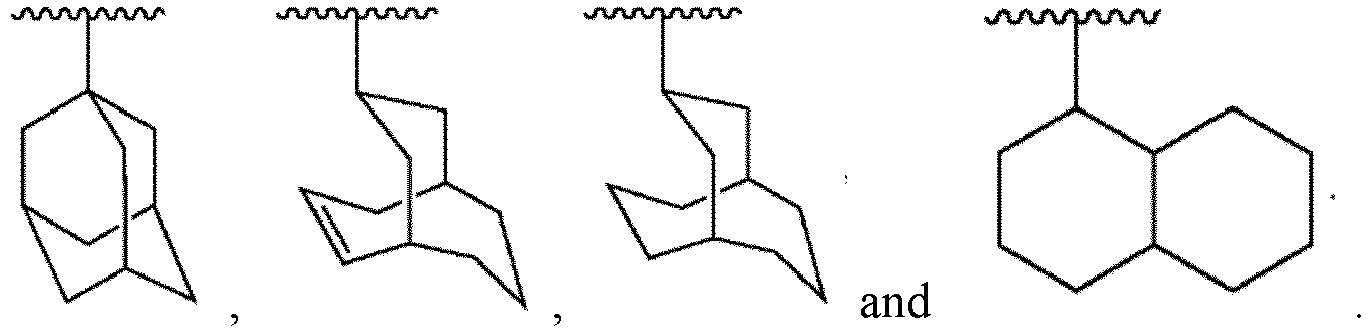
- "Heterocyclyl" means a substituted or unsubstituted, saturated or unsaturated, aromatic or non-aromatic ring, and the aromatic or non-aromatic ring may be a 1 to 8-membered monocyclic, a 4- to 12-membered bicyclic or a 10- to 20-membered tricyclic system, and contains at least one heteroatom selected from N, O or S. The optionally substituted N or S on the ring of a heterocyclic group may be oxidized into various oxidation States. The carbocyclic group may be attached via a heteroatom or a carbon atom, and may have attached bridge rings or spiral rings. Non-limiting examples thereof include epoxyethyl, azacyclopropyl, oxzcyclobutyl, azacyclobutyl, 1,3-dioxolane, 1,4-dioxolane, 1,3-dioxane, azacycloheptyl, pyridinyl, furyl, thiophenyl, pyranyl, N-alkylpyrrolyl, pyrimidinyl, pyrazinyl, pyridazinyl, imidazolyl, piperidinyl, hexahydropyridinyl, morpholinyl, thiomorpholinyl, 1,3-dithia-, dihydrofuryl, dihydropyranyl, dithiacyclopentyl, tetrahydrofuryl, tetrahydropyrrolyl, tetrahydroimidazolyl, tetrahydrothiazolyl, tetrahydropyranyl, benzimidazolyl, benzopyridinyl, pyrrolopyridinyl, benzodihydrofuryl, azabicyclo[3.2.1]octyl, azabicyclo[5.2.0]nonyl, azatricyclo[5.3.1.1]dodecyl, aza-adamantanyl, and oxaspiro[3.3]heptyl. This definition applies to the heterocyclyls used throughout this Description.
- As used herein, the term "optional" or "optionally" means the event or situation modified by this term may but does not certainly happen, including both the case where the event or situation happens and the case not. As used herein, the term "optionally substituted" refers to groups which are unsubstituted or have at least one non-hydrogen substituent that does not extinguish the biological activity possessed by the unsubstituted analog. As used herein, the following definitions shall apply unless otherwise indicated. The term "optionally substituted" is used interchangeably with the phrase "substituted or unsubstituted" or with the term "(un)substituted." Unless otherwise indicated, an optionally substituted group may have a substituent at each substitutable position of the group, and each substitution is independent of the other. For example, "a heterocyclyl optionally substituted with alkyl" means that the alkyl may be present but is not necessarily present, including both the case where the heterocyclyl is substituted with alkyl and the case where the heterocyclyl is not substituted with alkyl.
- As used herein, a "pharmaceutically acceptable" component (such as a carrier or excipient) means that the compound or composition is suitable for administration to a subject to achieve the treatments described herein, without unduly deleterious side effects in light of the severity of the disease and necessity of the treatment. "Carrier" means a material that does not cause significant stimulation to an organism and does not eliminate the biological activity and characteristics of a given compound. "Excipient" means an inert substance added into a pharmaceutical composition to facilitate administration of a compound. Non-limiting examples thereof include calcium carbonate, calcium phosphate, sugar, starch, cellulose derivatives (including microcrystalline cellulose), gelatin, vegetable oils, polyethylene glycols, diluent, a granulating agent, lubricant, binder and disintegrant.
- As used herein, the term "effective amount" refers to the amount of each active agent required to confer the desired effect (e.g. inhibiting NADPH oxidase) on the subject, either alone or in combination with one or more other active agents. An effective amount varies, as recognized by those skilled in the art, depending on the particular condition being treated, the severity of the condition, the individual patient parameters including age, physical condition, size, gender and weight, the duration of the treatment, the nature of concurrent therapy (if any), the specific route of administration and like factors within the knowledge and expertise of the health practitioner. These factors are well known to those of ordinary skill in the art and can be addressed with no more than routine experimentation. It is generally preferred that a maximum dose of the individual components or combinations thereof be used, that is, the highest safe dose according to sound medical judgment. It will be understood by those of ordinary skill in the art, however, that a patient may insist upon a lower dose or tolerable dose for medical reasons, psychological reasons or for virtually any other reasons.
- A "stereoisomer" refers to an isomer of a molecule having its atoms in a different spatial arrangement, including cis-trans-isomer, enantiomer, and conformer. Compounds of this invention can exist as one or more stereoisomers. The various stereoisomers include enantiomers, diastereomers, racemates, atropisomers and geometric isomers. Stereoisomers are isomers of identical constitution but differing in the arrangement of their atoms in space and include enantiomers, diastereomers, cis-trans isomers (also known as geometric isomers) and atropisomers. Atropisomers result from restricted rotation about single bonds where the rotational barrier is high enough to permit isolation of the isomeric species. One skilled in the art will appreciate that one stereoisomer may be more active and/or may exhibit beneficial effects when enriched relative to the other stereoisomer(s) or when separated from the other stereoisomer(s). Additionally, the skilled artisan knows how to separate, enrich, and/or to selectively prepare said stereoisomers. The compounds of the invention may be present as a mixture of stereoisomers, individual stereoisomers or as an optically active form.
- Embodiments of the present disclosure as described in the Summary of the Invention include those described below. The compounds protected by the present invention are defined by the appended claims. In the following Embodiments, reference to "a compound of Formula I" includes the definitions of substituents specified in the Summary of the Invention unless further defined in the Embodiments.
- Embodiments of this invention, and any combination thereof, pertain to the compositions and methods of the present disclosure.
- The invention is directed to compounds of Formula I selected from a group consisting of:


- Also noteworthy as embodiments of the present disclosure are compositions comprising a compound of any of the preceding Embodiments, as well as any other embodiments described herein, and any combinations thereof. The composition can be formulated to any form of formulation that is considered to be safe, effective, and convenient for use. Preferably, the pharmaceutical composition may further comprise a pharmaceutically acceptable component as defined in the previous paragraphs. A usable pharmaceutically acceptable salt, carrier, or excipient are disclosed in various references including Handbook of Pharmaceuticals Excipients edited by Raymond C Rowe, Paul J Sheskey, and Marian E Quinn. In a unlimited embodiment, said pharmaceutically acceptable carrier or excipient can be selected from the group consisting of inert diluents, dispersing and/or granulating agents, surface active agents and/or emulsifiers, disintegrating agents, binding agents, preservatives, buffering agents, lubricating agents and oils. Said compositions optionally further comprising at least one additional biologically active compound or agent.
- In a particular embodiment, said composition could be a pharmaceutical composition. The pharmaceutical composition might comprise but not limited to a single unit dose of the active ingredient (for instance, the compound of the present disclosure). For purposes of treatment, a dose unit can be in the form of a discrete article such as but not limited to a tablet or capsule, or can be a measurable volume of a solution, suspension or the like containing a unit dose of the active ingredient. The term "unit dose" herein refers to an amount of active ingredient intended for a single but not limited to oral, intravenous, intramuscular, cutaneous, subcutaneous, intrathecal, transdermal, implantation, sublingual, buccal, rectal, vaginal, ocular, otic, nasal, inhalation, or nebulization administration to a subject for inhibiting NADPH oxidase (NOX). The inhibitory to NOX may require periodic administration of unit doses of the compound of the present disclosure, for example one unit dose two or more times a day, one unit dose with each meal, one unit dose every four hours or other interval, or only one unit dose per day.
- Further noteworthy as embodiments of the present disclosure are compositions for inhibiting NADPH oxidase (NOX) activity comprising a compound of any of the preceding Embodiments, as well as any other embodiments described herein, and any combinations thereof, and at least one of a pharmaceutically acceptable excipient or carrier selected from the group consisting of inert diluents, dispersing and/or granulating agents, surface active agents and/or emulsifiers, disintegrating agents, binding agents, preservatives, buffering agents, lubricating agents, and/or oils, said compositions optionally further comprising at least one additional biologically active compound or agent. Embodiments of the invention further include methods for inhibiting NADPH oxidase (NOX) activity in cell comprising administering to the cell an effective amount of the compound or the pharmaceutical composition of any of the preceding Embodiments (e.g., as a composition described herein).
- One or more of the following methods and variations as described in Schemes I-XII can be used to prepare the compounds of Formula I. The definitions of substituents in the compounds below are as defined above unless otherwise noted. The following abbreviations are used: DCM is dichloromethane, DMF is N,N-dimethylformamide, DMSO is dimethyl sulfoxide, EA is ethyl acetate, MeOH is methanol, TFA is trifluoroacetic acid, and THF is tetrahydrofuran. 1H NMR spectra are reported in ppm downfield from tetramethylsilane; "s" means singlet, "d" means doublet, "t" means triplet, "q" means quartet, "m" means multiplet, "dd" means doublet of doublets, "dt" means doublet of triplets, and "br s" means broad singlet.
- Variations on the following general synthetic methods will be readily apparent to those of ordinary skill in the art and are deemed to be within the scope of the present disclosure.
- As explained in details below, Compounds 2-20 and 24-27 are synthesized by the method depicted in Scheme I below.


-

- 2-amino-4,5-dimethoxylbenzoic acid (1.97g, 10mmol) was dissolved in DMF (20mL), and to the solution was added potassium carbonate (1.38, 10mmol). The reaction mixture was heated at 90°C and stirred for 1hr. Then the solution was cooled to 20°C and p-methoxy-2-bromoacetophenone (2.4g, 10.5mmol) was added. The slightly exothermic reaction took place and the temperature increased to 25°C to 32°C in 5 minutes. After stirring for 30 minutes the reaction mixture was heated to 50°C and kept at this temperature for 30 minutes. The content of the flask was then poured into a 100 g mixture of water and ice. The precipitated solid material was collected by filtration, washed with water and dried. The dried solid was further recrystallized with ethanol to give Compound 1 (2-(4-methoxyphenyl)-2-oxoethyl 2-amino-4,5-dimethoxybenzoate) with a yield of 3.3g (95%).
-

- A solution of Compound 1 (0.6g, 1.74mmol) in TFA was heated to reflux for overnight, until reaction completed. Furthermore, the reaction mixture was cooled to room temperature, and TFA was removed in vacuo. The residue was added ice-water and stirred for 30 minutes. The solid was collected and washed by H2O and methanol to obtain Compound 2 (3-hydroxy-6,7-dimethoxy-2-(4-methoxyphenyl) quinolin-4(1H)-one 2,2,2-trifluoroacetate) with a yield of 0.5g (87%).
-

- A suspension of Compound 2 (0.2g, 0.6 mmol) in 20 mL HBr (47%) was heated to 100°C under an atmosphere of dry nitrogen for 23 hr. The solvents were evaporated under reduced pressure and the product was crystallized (by MeOH/EA=1:3). Compound 3 (3,6,7-trihydroxy-2-(4-hydroxyphenyl) quinolin-4(1H)-one hydrobromide) is obtained with a yield of 25%.
- Similarly, by replacing the p-methoxy-2-bromoacetophenone in Step 1, Compounds 4-20 and 24-27 can be prepared by the steps described above.
-

- To a suspension of 1-(2-hydroxyphenyl)ethan-1-one (2.0g, 14.69mmol), anhydrous K2CO3 (2.6g, 18.8mmol) and in DMF (80ml) was added bromoethane (5mL, 67mmol). The mixture was heated at 50°C until the starting ketone was completely consumed. After cooling to room temperature, the mixture was filtered, and the solvent was removed by rotary evaporation. The residue was purified by flash chromatography. The product is 1-(2-ethoxyphenyl) ethan-1-one with n-hexane/EA (9:1) as eluent, in the presence of colorless oil. The yield is 95%.
- In addition, 1-(2-ethoxyphenyl) ethan-1-one (2.55g, 15.53mmol) was dissolved in Et2O (40mL) and bromine (0.7mL, 14mmol) was added dropwise while stirring stir the mixture in the dark at ambient temperature. Wash the reaction mixture with a saturated aqueous Na2CO3 solution. The product is dried over MgSO4, filtered, collected the filtrate, and removed the volatiles under reduced pressure to provide the compound 2-bromo-1-(2-ethoxyphenyl) ethan-1-one, which was purified by flash chromatography (n-hexane/EA = 9: 1) with a yield of 1.8g (48%).
- The obtained compound were then used in Steps 1-3 of A-1 in replace of the p-methoxy-2-bromoacetophenone to prepare Compounds 21 and 22.
-

- A mixture of 1-(2-iodophenyl) ethan-1-one (1.0g, 4.06 mmol), sodium methanesulfunate (0.83g, 8.12 mmol) and copper iodide (77mg, 0.4 mmol) in 10 mL of DMSO was heated to 100 °C under argon. The cooled mixture was partitioned by EA and water. The organic layer was separated, and the aqueous layer was extracted with EA twice. The combined organic layers were washed with brine, dried over MgSO4, and concentrated in vacuo to afford the product, 1-(2-(methylsulfonyl)phenyl) ethan-1-one, which is yellow solid with a yield of 0.77g (95%).
- To the stirred mixture copper (II) bromide (0.22g, 0.98mmol) in EA (6 ml) was added solution of 1-(2-(methylsulfonyl)phenyl)ethan-1-one (0.1g, 0.5mmol) in EA (10 ml) dropwise under the room temperature. After addition was finished, the mixture was heated at 80°C for 18 hours. After that, the mixture was cooled to room temperature, filtered and precipitate was washed by EA (10 ml). The EA solution was treated with water, the organic phase was separated and dried over Na2SO4, and concentrated in vacuo. The crude product, 2-bromo-1-(2-(methylsulfonyl)phenyl) ethan-1-one, which was purified by column chromatography (DCM /Hexanes = 2/1) to give the purified product with a yield of 0.115g (82%).
- The obtained compound were then used in Steps 1-3 of A-1 in replace of the p-methoxy-2-bromoacetophenone to prepare Compound 23.
-

-

- By following the same methods as in Scheme I, Compound 29 (3-hydroxy-6,7-dimethoxy-2-(2-nitrophenyl) quinolin-4(1H)-one 2,2,2-trifluoroacetate) was obtained. To a solution of Compound 29 (0.3g, 0.66mmol) in ethanol (12 mL) was added hydrazine hydrate (50%) (0.4mL, 6.6mmol) and an excess of Raney nickel slurry in water (1 mmol) was added slowly. The reaction was stirred at 70°C for 1hr. After 1hr, the bubbling ceased, and the mixture was cooled to room temperature and filtered through Celite. The filtrate was condensed under reduced pressured and the residue was washed with H2O/ MeOH to afford the desired product 30 (2-(2-aminophenyl)-3-hydroxy-6,7-dimethoxyquinolin-4(1H)-one) (0.19g, 93%).
-

-

- To the solution of 2-Aminoterephthalic acid (0.91g, 5mmol) in DMF (20mL) was added potassium carbonate (1.38g, 10mmol) and p-methoxy-2-bromoacetophenone (2.4g, 10.5mmol). The reaction mixture was heated at 50°C and stirred for 18hr. Then the content of the flask was then poured into a 100g mixture of water and ice. The precipitated solid material was collected by filtration, washed with water and methanol to afford Compound 31 (bis(2-(4-methoxyphenyl)-2-oxoethyl) 2-aminoterephthalate) with a yield of 1.9g (80%).
-
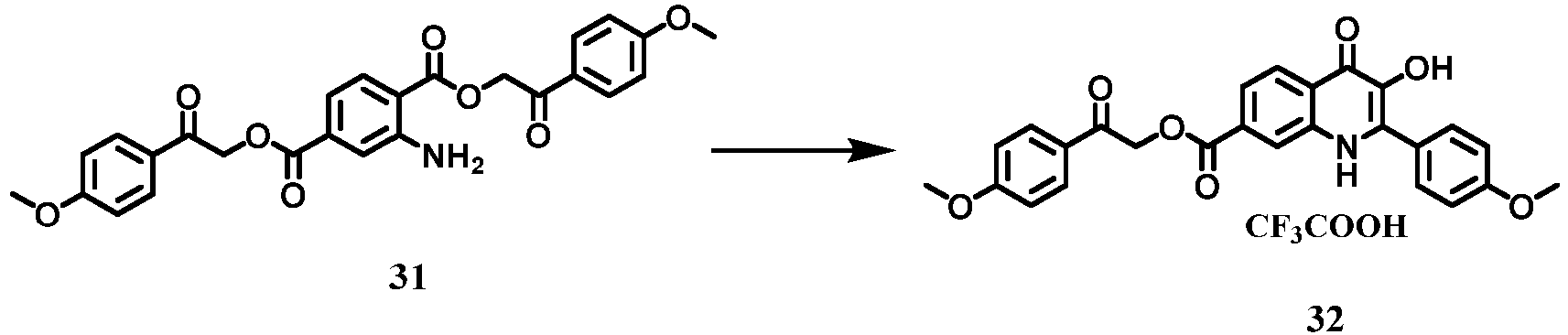
- A solution of Compound 31 (0.5g, 1.1mmol) in TFA (12mL) was heated to reflux for overnight, until reaction completed. Then the reaction mixture was cooled to room temperature, and TFA was removed in vacuo. The residue was added ice-water and stirred for 30 minutes. The solid was collected and washed by H2O and methanol to obtain Compound 32 (2-(4-methoxyphenyl)-2-oxoethyl 3-hydroxy-2-(4-methoxyphenyl)-4-oxo-1,4-dihydroquinoline-7-carboxylate 2,2,2-trifluoroacetate) with a yield of 0.5g (79%).
-

- A solution of Compound 32 (0.1g, 0.17mmol) in THF(5mL) was add 5mL of 1N LiOH(aq) and stirred at room temperature for overnight, until reaction completed. The reaction mixture was then cooled to 0°C, and 2N HCl was added slowly until pH=1-2. The solid was collected and washed by H2O and methanol to obtain Compound 33 (3-hydroxy-2-(4-methoxyphenyl)-4-oxo-1,4-dihydroquinoline-7-carboxylic acid) with a yield of 23mg.
-

- A solution of sodium ethoxide (Na, 2 mmol in dry EtOH, 5 mL) was add a suspension of 2,3-dihydro-2,3-dioxo-1H-indole (0.17g, 1.0 mmol) and 2-bromo-2 methoxy acetophenone (0.23g, 1.0 mmol) in dry EtOH (5 mL). The mixture was maintained at 0-5°C for 2 hr. The reaction mixture was allowed to warm up to room temperature and stirred for 18h. Then the mixture was acidified with 2N HCl(aq.) and extracted with EA. The organic phase was dried with MgSO4 and concentrated under reduced pressure to give the crude mixture. The crude mixture was purified by column chromatography (EA/ Hexanes = 1/2) to give Compound 34 (3-hydroxy-6-methoxy-2-(2-methoxybenzoyl) quinolin-4(1H)-one) with a yield of 0.1g (30%).
-

- To the full dissolution of 2-bromo-1-(2-chlorophenyl) ethan-1-one (3.0 g, 12.85 mmol) in the DMSO was added sodium azide (1.2 g) and stirred at room temperature for 15hr. The resulting mixture was diluted with H2O. The layers are separated and extracted with EA. The combined organic layers are dried over MgSO4, filtered and concentrated on a rotary evaporator to give the compound 2-azido-1-(2-chlorophenyl) ethan-1-one with a yield of 2.3 g (11.8 mmol).
- A mixture of the 2-azido-1-(2-chlorophenyl)ethan-1-one (2.3 g, 11.8 mmol) and 5% Pd/C (0.5 g) in MeOH (100 mL) was added the concentrated HCl (2 mL) stirred under an atmosphere of H2 (1 atm) at room temperature for 6 h. The mixture was filtered through celite and the filtrate was concentrated. The residue was not purified to provide the product. Compound 2-amino-1-(2-chlorophenyl) ethan-1-one hydrochloride with a yield of 2.2g (10.73 mmol).
-

- A mixture of the 2-amino-1-(2-chlorophenyl)ethan-1-one hydrochloride (1.0 g, 4.9 mmol), isatoic anhydride (0.9 g, 4.45 mmol), and Na2CO3 (0.6 g, 5.34 mmol) in H2O (20 mL) was stirred at 80°C for 4 hr. After the temperature cooled down to room temperature, the precipitate was collected by filtration and washed with H2O and ether to give the Compound 35 (2-(2-chlorophenyl)-7,8-dimethoxy-3,4-dihydro-5H-benzo[e][1,4] diazepin-5-one) with a yield of 870.0 mg (2.64 mmol).
- A mixture of the Compound 35 (2-(2-chlorophenyl)-7,8-dimethoxy-3,4-dihydro-5H-benzo[e][1,4] diazepin-5-one) (100.0 mg, 0.30 mmol) and PPA (5 mL) was stirred at 150°C for 2 h. After the temperature cooled down to 0°C, the resulting mixture was poured onto Na2CO3(aq), and after foaming had stopped, water was added. After 30 min of stirring, a solid product was filtered off and washed with water and methanol to give the Compound 36 (3-amino-2-(2-chlorophenyl)-6,7-dimethoxyquinolin-4(1H)-one) with a yield of 10.0 mg (0.03 mmol).
- Similarly, Compounds 37-38 are synthesized by using the same methods as in Scheme VII and VIII.
-

- Compound 39 was synthesized by Scheme IX, which are using the methods similar to Scheme I.
-

- Compound 25 (0.3 g, 1.3 mmol) and 3-(N,N-dimethylamino)phenyl boronic acid (0.258 g, 1.56 mmol) were added into 3 ml ethanol, followed by adding sodium carbonate (1.1 g, 10.4 mmol) and tetrakis(triphenylphosphine)palladium(0) (0.075 g, 0.065 mmol). The reaction mixture was heated under reflux overnight. After cooling to room temperature, the residue was filtered. The filtrate was extracted with EA and dried in vacuo. The dried residue was then applied with column chromatography with EA: hexane (1:1) as eluent to obtain Compound 40 with a yield of 0.42g (80%).
-

- To the full dissolution of Compound 17 (30.0mg, 0.06mmol) in H2O was added 1N NaOH (0.1 mL) stirred at room temperature for 3 hr. The precipitate was collected by filtration and washed with H2O to give the free base Compound 41 (3-hydroxy-6,7-dimethoxy-2-(2-(trifluoromethyl) phenyl) quinolin-4(1H)-one) with a yield of 13.0 mg (0.04 mmol).
-

- To the full dissolution of Compound 41 (0.29 g, 0.79 mmol) in the co-solvent of MeOH:DCM=2:1 was added 2N HCl in ether and stirred at room temperature for 3 hr. The precipitate was collected by filtration and washed with ether to give the Compound 42 (3-hydroxy-6,7-dimethoxy-2-(2-(trifluoromethyl)phenyl) quinolin-4(1H)-one hydrochloride) with a yield of 0.17 g (0.42mmol).
-

- To the full dissolution of Compound 41 (3-hydroxy-6,7-dimethoxy-2-(2-(trifluoromethyl) phenyl) quinolin-4(1H)-one) (28.0 mg, 0.08 mmol) in the co-solvent of MeOH:DCM=2:1 was added acetic acid (0.01 mL) and stirred at 100°C for 15hr. The precipitate was collected by filtration and washed with ether to give the Compound 43 (3-hydroxy-6,7-dimethoxy-2-(2-(trifluoromethyl)phenyl)quinolin-4(1H)-one acetate) with a yield of 6.0 mg (0.014 mmol).
-

- To the full dissolution of Compound 41 (3-hydroxy-6,7-dimethoxy-2-(2-(trifluoromethyl) phenyl)quinolin-4(1H)-one) (75.0 mg, 0.21 mmol) in the co-solvent of MeOH:DCM=2:1 was added methanesulfonic acid (16.3µl) and stirred at room temperature for 15hr. The precipitate was collected by filtration and washed with ether to give the Compound 44 (3-hydroxy-6,7-dimethoxy-2-(2-(trifluoromethyl)phenyl)quinolin-4(1H)-one methanesulfonate) with a yield of 21.0 mg (0.046 mmol).
- Compounds 45-50 were synthesized by using the methods as in Scheme XI.
- Compounds 51-52 were synthesized by using the methods as in Scheme XII.
- The term "active agent" as used herein, includes the pharmaceutically acceptable salts of the compound. Pharmaceutically acceptable salts are salts that retain the desired biological activity of the parent compound and do not impart undesired toxicological effects. Examples of such salts are (a) acid addition salts formed with inorganic acids, for example hydrochloric acid, hydrobromic acid, sulfuric acid, phosphoric acid, nitric acid and the like; and salts formed with organic acids such as, for example, acetic acid, oxalic acid, tartaric acid, succinic acid, maleic acid, fumaric acid, gluconic acid, citric acid, malic acid, ascorbic acid, benzoic acid, tannic acid, palmitic acid, alginic acid, polyglutamic acid, naphthalenesulfonic acid, methanesulfonic acid, p-toluenesulfonic acid, naphthalenedisulfonic acid, polygalacturonic acid, and the like; and (b) salts formed from elemental anions such as chlorine, bromine, and iodine. In other particular embodiments, pharmaceutically acceptable salts are formed with malic acid. In particular embodiments, pharmaceutically acceptable salts are formed with hydrochloric acid. Active agents used to prepare compositions for the present disclosure may alternatively be in the form of a pharmaceutically acceptable free base of active agent. Because the free base of the compound is less soluble than the salt, free base compositions are employed to provide more sustained release of active agent to the target area. Active agent present in the target area which has not gone into solution is not available to induce a physiological response, but serves as a depot of bioavailable drug which gradually goes into solution.
INDEX TABLE OF THE COMPOUNDS Cmpd. No. and Structure 1H NMR Data 
1H-NMR (300 MHz, DMSO): δ 11.25(s, 1H), 7.78-7.74 (d, 2H), 7.41(s, 1H), 7.18 (s, 1H), 7.13-7.09(d, 2H), 3.85(s, 6H), 3.84(s, 3H). Exact Mass: 441.10 ESI-MS m/z calcd for C20H18F3NO7 , 441.10 found 328.1[M+H]+ Molecular Weight: 441.36 Compound 2 
1H-NMR (400 MHz, DMSO): δ 7.72-7.70 (d, 2H), 7.51(s, 1H), 7.30 (s, 1H), 7.03-7.01(d, 2H). Chemical Formula: C13H12BrNO5 ESI-MS m/z calcd for C15H12BrNO5 364.99, found 286.1 [M+H]+ Exact Mass: 364.99 Molecular Weight: 366.17 Compound 3 * 
1H-NMR (300 MHz, DMSO): δ7.52-7.50(d, 1H), 7.47(s, 1H), 7.40(s, 1H), 7.38-7.36(m, 1H), 7.25(s, 1H), 7.13-7.10(dd, 1H), 3.89-3.84(m, 6H), 3.56(s, 3H). Chemical Formula: C20H18F3NO7 Exact Mass: 441.10 ESI-MS m/z calcd for C20H18F3NO7 441.10, found 328.3 [M+H]+ Molecular Weight: 441.36 Compound 4 
1H-NMR (400 MHz, DMSO): δ7.54-7.50(m, 1H), 7.46(s, 1H), 7.43-7.41(d, 1H), 7.22-7.20(d, 1H), 7.12-7.08(m, 1H), 7.07(s, 1H), 3.88(s, 3H), 3.85(s, 3H), 3.78(s, 3H). Chemical Formula: C20H18F3NO7 Exact Mass: 441.10 ESI-MS m/z calcd for C20H18F3NO7 441.10, found 328.3 [M+H]+ Molecular Weight: 441.36 Compound 5 
1H-NMR (400 MHz, DMSO): δ11.27(br, 1H), 7.71(d, 2H), 7.42(s, 1H), 7.36(d, 2H), 7.19(s, 1H), 3.86(s, 6H), 2.40(s, 3H). ESI-MS m/z calcd for C20H18F3NO6 425.11, found 312.3 [M+H]+ Chemical Formula: C20H18F3NO6 Exact Mass: 425.11 Molecular Weight: 425.36 Compound 6 
1H-NMR (400 MHz, DMSO): δ8.00(s, 1H), 7.87-7.85(m, 1H), 7.45(s, 1H), 7.33-7.29(m, 2H), 3.90(s, 3H), 3.84(s, 3H). Chemical Formula: C17H14F3NO6S ESI-MS m/z calcd for C17H14F3NO6S 417.05, found 304.2 [M+H]+ Exact Mass: 417.05 Molecular Weight: 417.36 Compound 7 * 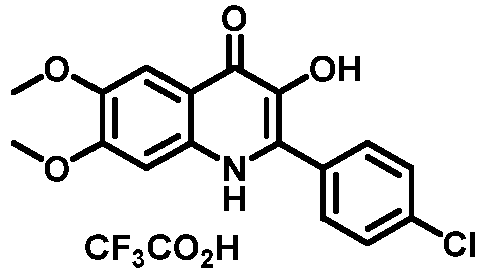
1H-NMR (400 MHz, DMSO): δ7.85-7.82(d, 2H), 7.65-7.63(d, 2H), 7.46(s, 1H), 7.20(s, 1H), 3.87(s, 6H). Chemical Formula: C19H15ClF3NO6 ESI-MS m/z calcd for C19H15ClF3NO6 445.05, found 332.2 [M+H]+ Exact Mass: 445.05 Molecular Weight: 445.78 Compound 8 
1H-NMR (400 MHz, DMSO): δ7.66-7.48(m, 4H), 7.45(s, 1H), 6.98(s, 1H), 3.86(s, 3H), 3.83(s, 3H). Chemical Formula: C19H15ClF3NO6 ESI-MS m/z calcd for C19H15ClF3NO6 445.05, found 332.3 [M+H]+. Exact Mass: 445.05 Molecular Weight: 445.78 Compound 9 
1H-NMR (300 MHz, DMSO): δ7.92-7.90(d, 1H), 7.73-7.70(d, 2H), 7.24-7.22(d, 1H), 7.12-7.09(d, 2H), 3.83(s, 3H). Chemical Formula: C16H12F3NO5S ESI-MS m/z calcd for C16H12F3NO5S 387.04, found 274.2 [M+H]+ Exact Mass: 387.04 Molecular Weight: 387.33 Compound 10 * 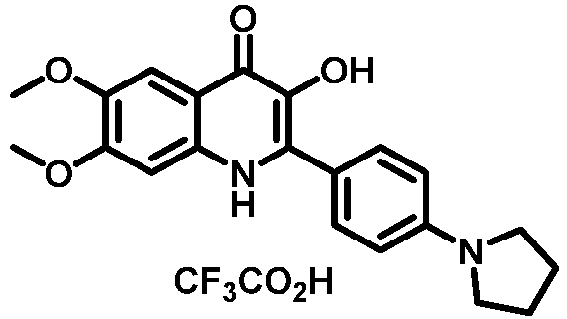
1H-NMR (400 MHz, DMSO): δ13.26(br, 1H), 7.78(d, 2H), 7.54(s, 1H), 7.49(s, 1H), 7.73(d, 2H), 3.93(s, 6H), 3.36-3.31(m, 4H), 2.02-1.91(m, 4H). Chemical Formula: C23H23F3N2O6 ESI-MS m/z calcd for C23H23F3N2O6 480.15, found 367.4 [M+H]+ Exact Mass: 480.15 Molecular Weight: 480.44 Compound 11 
1H-NMR (300 MHz, DMSO): δ8.03(d, 2H), 7.93(d, 2H), 7.43(s, 1H), 7.15(s, 1H), 3.87(s, 6H). ESI-MS m/z calcd for C20H15F6NO6 479.08, found 366.3 [M+H]+ Chemical Formula: C20H15F6NO6 Exact Mass: 479.08 Molecular Weight: 479.33 Compound 12 
1H-NMR (300 MHz, DMSO): δ7.88-7.84(m, 2H), 7.47-7.39(m, 3H), 7.21(s, 1H), 3.88(s, 6H). Chemical Formula: C19H15F4NO6 ESI-MS m/z calcd for C19H15F4NO6 429.08, found 316.3 [M+H]+ Exact Mass: 429.08 Molecular Weight: 429.32 Compound 13 
1H-NMR (400 MHz, DMSO): δ10.26(br, 1H), 7.55(s, 1H), 7.37(s, 1H), 3.86(s, 3H), 3.84(s, 3H), 1.48(s, 9H). ESI-MS m/z calcd for C17H20F3NO6 391.12, found 278.3 [M+H]+ Chemical Formula: C17H20F3NO6 Exact Mass: 391.12 Molecular Weight: 391.34 Compound 14 * 
1H-NMR (300 MHz, DMSO): δ7.41(s, 1H), 7.33-7.30(d, 1H), 7.01(s, 1H), 6.73(s, 1H), 6.67-6.64(d, 1H), 3.85-3.84(s, 6H), 3.82(s, 3H), 3.76(s, 3H). Chemical Formula: C21H20F3NO8 ESI-MS m/z calcd for C21H20F3NO8 471.11, found 358.3 [M+H]+ Exact Mass: 471.11 Molecular Weight: 471.39 Compound 15 
1H-NMR (300 MHz, DMSO): δ11.43(s, 1H), 7.97(br, 1H), 7.44(s, 1H), 7.41-7.30(m, 4H), 7.02(s, 1H), 3.86(s, 3H), 3.82(s, 3H), 2.22(s, 3H). Chemical Formula: C20H18F3NO6 ESI-MS m/z calcd for C20H18F3NO6 425.11, found 312.3[M+H]+. Exact Mass: 425.11 Molecular Weight: 425.36 Compound 16 
1H-NMR (400 MHz, DMSO): δ8.02-7.99(d, 1H), 7.94-7.74(m, 2H), 7.62-7.60(d, 1H), 7.45(s, 1H), 6.94(s, 1H), 3.94(s, 3H), 3.86(s, 3H). Chemical Formula: C20H15F6NO6 ESI-MS m/z calcd for C20H15F6NO6 479.08, found 366.3[M+H]+ Exact Mass: 479.08 Molecular Weight: 479.33 Compound 17 
1H-NMR (400 MHz, DMSO): δ7.61-7.53(m, 2H), 7.42(s, 1H), 7.40-7.33(m, 2H), 6.99(s, 1H), 3.84(s, 3H), 3.82(s, 3H). Chemical Formula: C19H15F4NO6 ESI-MS m/z calcd for C19H15F4NO6 429.08, found 316.3 [M+H]+ Exact Mass: 429.08 Molecular Weight: 429.32 Compound 18 
1H-NMR (400 MHz, DMSO): δ7.49-7.41(m, 2H), 7.31(s, 1H), 7.17-7.04(m, 2H), 3.90-3.87(m, 9H), 3.76(s, 3H). ESI-MS m/z calcd for C21H20F3NO8 471.11, found 358.3 [M+H]+ Chemical Formula: C21H20F3NO8 Exact Mass: 471.11 Molecular Weight: 471.39 Compound 19 
1H-NMR (300 MHz, DMSO): δ7.69-7.65(m, 2H), 7.59-7.54(m, 2H), 7.44(s, 1H), 7.00(s, 1H), 3.86(s, 3H), 3.84(s, 3H). Chemical Formula: C20H15F6NO7 ESI-MS m/z calcd for C20H15F6NO7 495.08, found 382.3 [M+H]+ Exact Mass: 495.08 Molecular Weight: 495.33 Compound 20 
1H-NMR (300 MHz, DMSO): δ7.65-7.57(m, 1H), 7.50-7.42(m, 2H), 7.20-7.14(m, 1H), 7.10-7.00(m, 2H), 4.40-4.33(q, 2H), 3.86(s, 3H), 3.83(s, 3H), 1.23-1.19(t, 3H). Chemical Formula: C21H20F3NO7 ESI-MS m/z calcd for C21H20F3NO7 455.12, found 342.3 [M+H]+ Exact Mass: 455.12 Molecular Weight: 455.39 Compound 21 
1H-NMR (400 MHz, DMSO): δ7.47-7.40(m, 3H), 7.18-7.16(d, 1H), 7.08-7.04(m, 1H), 7.00(s, 1H), 3.97-3.94(t, 2H), 3.85(s, 3H), 3.81(s, 3H), 1.62-1.56(m, 2H), 0.84-0.80(t,3H). Chemical Formula: C22H22F3NO7 Exact Mass: 469.13 ESI-MS m/z calcd for C22H22F3NO7 469.13, found 356.3 [M+H]+ Molecular Weight: 469.41 Compound 22 
1H-NMR (400 MHz, DMSO): δ12.11(br, 1H), 8.13(dd, 1H), 7.91-7.82(m, 2H), 7.62(dd, 1H), 7.48(s, 1H), 6.98(s, 1H), 3.88(s, 3H), 3.83(s, 3H), 3.17(s, 3H). Chemical Formula: C20H18F3NO8S ESI-MS m/z calcd for C20H18F3NO8S 489.07, found 376.3 [M+H]+ Exact Mass: 489.07 Molecular Weight: 489.42 Compound 23 
1H-NMR (300 MHz, DMSO): δ7.85(s, 1H), 7.60(s, 2H), 7.44(s, 1H), 6.95(s, 1H), 3.90(s, 3H), 3.84(s, 3H). ESI-MS m/z calcd for C19H14Cl2F3NO6 479.02, found 366.2 [M+H]+ Chemical Formula: C13H14Cl2F3NO6 Exact Mass: 479.02 Molecular Weight: 480.22 Compound 24 
1H-NMR (400 MHz, DMSO): δ7.59-7.57(d, 1H), 7.54-7.49(m, 1H), 7.46-7.41(m, 2H), 7.38-7.34(m, 1H), 7.22-7.19(d, 1H), 7.11-7.08(m, 1H), 3.77(s, 3H). Chemical Formula: C18H13BrF3NO5 ESI-MS m/z calcd for C18H13BrF3NO5 458.99, found 346.2 [M+H]+ Exact Mass: 458.99 Molecular Weight: 460.20 Compound 25 * 
1H-NMR (300 MHz, DMSO): δ7.52-7.47(m, 1H), 7.41-7.39(m, 2H), 7.21-7.18(d, 1H), 7.14-7.06(m, 1H), 6.98(s, 1H), 6.13(s, 2H), 3.77(s, 3H). Chemical Formula: C19H14F3NO7 ESI-MS m/z calcd for C19H14F3NO7 425.07, found 312.2[M+H]+ Exact Mass: 425.07 Molecular Weight: 425.32 Compound 26 
1H-NMR (300 MHz, CD3OD): δ7.72(s, 1H), 7.57(s, 1H), 7.16(s, 1H), 6.90(s, 1H), 4.03(s, 3H), 4.02-4.00(m, 6H), 3.92(s, 3H). Chemical Formula: C21H19BrF3NO8 ESI-MS m/z calcd for C21H19BrF3NO8 549.02, found 436.2[M+H] Exact Mass: 549.02 Molecular Weight: 550.28 Compound 27 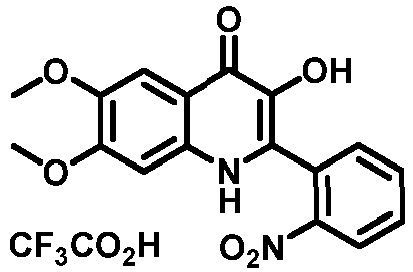
1H-NMR (400 MHz, DMSO): δ11.78(br, 1H), 8.16(d, 1H), 7.92(d, 1H), 7.89-7.74(m, 2H), 7.44(s, 1H), 7.00(s, 1H), 3.86(s, 6H). Chemical Formula: C19H15F3N2O8 ESI-MS m/z calcd for C19H15F3N2O8 456.08, found 343.3 [M+H]+ Exact Mass: 456.08 Molecular Weight: 456.33 Compound 29 
1H-NMR (400 MHz, DMSO): δ11.29(br, 1H), 7.43(s, 1H), 7.21(d, 2H), 7.09(s, 1H), 6.82(d, 1H), 6.71(m, 2H), 4.96(br, 2H), 3.92(s, 3H), 3.85(s, 3H). Chemical Formula: C17H16N2O4 ESI-MS m/z calcd for C17H16N2O4 312.11, found 313.3 [M+H]+ Exact Mass: 312.11 Molecular Weight: 312.33 Compound 30 
1H-NMR (300 MHz, DMSO): δ8.55(s, 1H), 8.30-8.27(d, 1H), 8.03-8.00(d, 2H), 7.85-7.79(m, 3H), 7.16-7.10(m, 4H), 5.76(s, 2H), 3.90(s, 3H), 3.87(s, 3H). Chemical Formula: C28H22F3NO9 Exact Mass: 573.12 Molecular Weight: 573.48 ESI-MS m/z calcd for C28H22F3NO9 573.12, found 460.4 [M+H]+ Compound 32 * 
1H-NMR (300 MHz, DMSO): δ8.41(s, 1H), 8.23-8.20(d, 1H), 7.81-7.78(d, 2H), 7.75-7.72(d, 1H), 7.15-7.12(d, 2H), 3.84(s, 3H). Chemical Formula: C17H13NO5 ESI-MS m/z calcd for C17H13NO5 311.08, found 312.3 [M+H]+ Exact Mass: 311.08 Molecular Weight: 311.29 Compound 33 * 
1H-NMR (400 MHz, CDCl3): δ7.94-7.93(d, 1H), 7.54-7.50(m, 1H), 7.07-7.03(m, 1H), 6.91-6.89(d, 1H), 6.87-6.81(m, 3H), 3.82(s, 3H), 3.78(s, 3H). Chemical Formula: C18H15NO5 ESI-MS m/z calcd for C18H15NO5 325.10, found 348.3 [M+Na] Exact Mass: 325.10 Molecular Weight: 325.32 Compound 34 * 
1H-NMR (400 MHz, CDCl3): δ7.63-7.60(dd, 1H), 7.52(s, 1H), 7.49-7.45(m, 1H), 7.44-7.36(m, 2H), 6.93(s, 1H), 4.08-4.06(d, 2H), 4.00(s, 3H), 3.96(s, 3H). Chemical Formula: C17H15ClN2O3 ESI-MS m/z calcd for C17H15ClN2O3 330.08, found 331.1[M+H]+ Exact Mass: 330.08 Molecular Weight: 330.77 Compound 35 * 
1H-NMR (400 MHz, CD3OD): δ7.67-7.65(d, 1H), 7.61-7.52(m, 4H), 7.02(s, 1H), 3.95(s, 3H), 3.92(s, 3H). Chemical Formula: C17H15ClN2O3 ESI-MS m/z calcd for C17H15ClN2O3 330.08, found 331.1[M+H]+ Exact Mass: 330.08 Molecular Weight: 330.77 Compound 36 
1H-NMR (300 MHz, DMSO): δ7.70-7.64(d, 2H), 7.58-7.46(m, 3H), 7.41(s, 1H), 7.10(s, 1H), 4.16(br, 2H), 3.96(s, 3H), 3.82(s, 3H). Chemical Formula: C17H16N2O3 ESI-MS m/z calcd for C17H16Cl2N2O3 296.12, found 297.3[M+H]+ Exact Mass: 296.12 Molecular Weight: 296.33 Compound 37 * 
1H-NMR (300 MHz, DMSO): δ8.40-8.36(m, 2H), 7.58-7.56(d, 1H), 7.53-7.48(dd, 1H), 7.33(s, 1H), 7.18-7.15(d, 1H), 7.07-7.02(dd, 1H), 6.90(s, 1H), 3.94(s, 3H), 3.84-3.81(m, 6H). Chemical Formula: C18H18N2O4 Exact Mass: 326.13 Molecular Weight: 326.35 ESI-MS m/z calcd for C18H18N2O4 326.13, found 327.3[M+H]+ Compound 38 
1H-NMR (300 MHz, DMSO): δ8.31-8.28(d, 1H), 8.09-7.78(m, 1H), 7.76-7.69(m, 2H), 7.40-7.35(d, 2H), 7.12-7.09(d, 2H), 3.84(s, 3H), 3.55(s, 3H). Chemical Formula: C17H15NO3 ESI-MS m/z calcd for C17H15NO3 281.11, found 282.3 [M+H]+ Exact Mass: 281.1052 Molecular Weight: 281.3110 Compound 39 * 
1H-NMR (300 MHz, CDCl3): δ7.97-7.94(d, 1H), 7.56-7.33(m, 4H), 7.15-7.04(m, 6H), 3.94(s, 3H), 3.07(s, 6H). ESI-MS m/z calcd for C24H22N2O3 386.16, found 387.4[M+H]+ Chemical Formula: C24H22N2O3 Exact Mass: 386.16 Molecular Weight: 386.45 Compound 40 * 
1H-NMR (300 MHz, DMSO): δ7.98-7.96(d, 1H), 7.90-7.79(m, 2H), 7.69-7.67(d, 1H), 7.56(s, 1H), 7.09(s, 1H), 3.91(s, 3H), 3.80(s, 3H). 19F-NMR (300MHz, DMSO): δ -58.54. Chemical Formula: C18H14F3NO4 ESI-MS m/z calcd for C18H14F3NO4 365.09, found 366.3[M+H]+ Exact Mass: 365.09 Molecular Weight: 365.31 Compound 41 
1H-NMR (300 MHz, DMSO): δ8.00-7.98(d, 1H), 7.92-7.81(m, 2H), 7.73-7.71(d, 1H), 7.68(s, 1H), 7.23(s, 1H), 3.94(s, 3H), 3.90(s, 3H).□19F-NMR (300MHz, DMSO): δ -58.49. Chemical Formula: C18H15ClF3NO4 ESI-MS m/z calcd for C18H15ClF3NO4 401.06, found 366.3[M+H]+ Exact Mass: 401.06 Molecular Weight: 401.77 Compound 42 
1H-NMR (400 MHz, DMSO): δ7.94-7.92(d, 1H), 7.85-7.78(m, 2H), 7.76-7.60(d, 1H), 7.44(s, 1H), 6.99(s, 1H), 3.86(s, 3H), 3.83(s, 3H). 19F-NMR (400MHz, DMSO): δ -58.63. Chemical Formula: C20H18F3NO6 ESI-MS m/z calcd for C20H18F3NO6 425.11, found 366.3[M+H]+ Exact Mass: 425.11 Molecular Weight: 425.36 Compound 43 
1H-NMR (400 MHz, DMSO): δ7.98-7.96(d, 1H), 7.89-7.79(m, 2H), 7.69-7.67(d, 1H), 7.56(s, 1H), 7.09(s, 1H), 3.93(s, 3H), 3.87(s, 3H). 19F-NMR (400MHz, DMSO): δ -58.54. Chemical Formula: C19H18F3NO7S ESI-MS m/z calcd for C19H18F3NO7S 461.08, found 366.3[M+H]+ Exact Mass: 461.08 Molecular Weight: 461.41 Compound 44 
1H-NMR (400 MHz, DMSO): δ7.88-7.86(d, 2H), 7.61-7.59(d, 2H), 7.41(s, 1H), 7.13(s, 1H), 3.85(s, 6H). ESI-MS m/z calcd for C17H14ClNO4 331.06, found 332.2 [M+H]+ Chemical Formula: C17H14ClNO4 Exact Mass: 331.06 Molecular Weight: 331.75 Compound 45 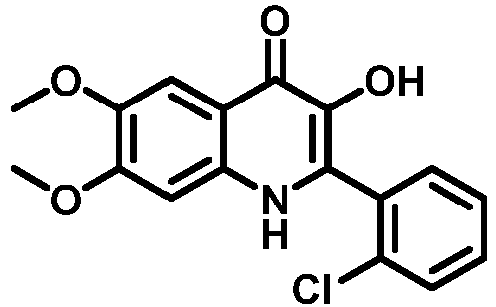
1H-NMR (400 MHz, DMSO): δ7.64-7.48(m,4H), 7.44(s, 1H), 6.97(s, 1H), 3.85(s, 3H), 3.82(s, 3H). ESI-MS m/z calcd for C17H14ClNO4 331.06, found 332.3 [M+H]+ Chemical Formula: C17H14ClNO4 Exact Mass: 331.06 Molecular Weight: 331.75 Compound 46 
1H-NMR (400 MHz, DMSO): δ7.86-7.82(m, 2H), 7.43-7.37(m, 3H), 7.15(s, 1H), 3.85(s, 6H). ESI-MS m/z calcd for C17H14FNO4 315.09, found 316.3 [M+H]+ Chemical Formula: C17H14FNO4 Exact Mass: 315.09 Molecular Weight: 315.30 Compound 47 
1H-NMR (300 MHz, DMSO): δ7.67-7.65(d, 2H), 7.59-7.54(dd, 2H), 7.44(s, 1H), 6.99(s, 1H), 3.86(s, 3H), 3.84(s, 3H). ESI-MS m/z calcd for C18H14F3NO5 381.08, found 382.3[M+H]+ Chemical Formula: C18H14F3NO5 Exact Mass: 381.08 Molecular Weight: 381.31 Compound 48 
1H-NMR (400 MHz, DMSO): δ7.84(s, 1H), 7.60(s, 2H), 7.44(s, 1H), 6.95(s, 1H), 3.85(s, 6H). ESI-MS m/z calcd for C17H13Cl2NO4 365.02, found 366.0[M+H]+ Chemical Formula: C17H13Cl2NO4 Exact Mass: 365.02 Molecular Weight: 366.19 Compound 49 
1H-NMR (300 MHz, DMSO): δ8.15(dd, 1H), 7.91-7.78(m, 2H), 7.59(dd, 1H), 7.42(s, 1H), 6.96(s, 1H), 3.84(s, 3H), 3.82(s, 3H), 3.18(s, 3H). Chemical Formula: C18H17NO6S ESI-MS m/z calcd for C18H17NO6S 375.08, found 376.1[M+H]+ Exact Mass: 375.08 Molecular Weight: 375.40 Compound 50 
1H-NMR (300 MHz, DMSO): δ7.58-7.55(d, 1H), 7.51(s, 1H), 7.47-7.44(d, 1H), 7.25-7.22(d, 1H), 7.16-7.09(m, 2H), 3.90(s, 3H), 3.86(s, 3H), 3.77(s, 3H). Chemical Formula: C18H18ClNO5 ESI-MS m/z calcd for C18H18ClNO5 363.09, found 328.3 [M+H]+ Exact Mass: 363.09 Molecular Weight: 363.79 Compound 51 
1H-NMR (300 MHz, DMSO): δ7.74-7.70(m, 2H), 7.63-7.54(m, 3H), 7.16-7.13(m, 1H), 3.91-3.88(m, 6H). ESI-MS m/z calcd for C18H15ClF3NO5 417.06, found 382.3[M+H]+ Chemical Formula: C18H15ClF3NO5 Exact Mass: 417.0591 Molecular Weight: 417.7652 Compound 52 *Not according to the present invention - Another aspect of the invention relates to methods of inhibiting NADPH oxidase (NOX) in cell, comprising the step of administering to the cell an effective amount of the compound or the pharmaceutical composition according to embodiments of the present application.
- Within the context according to the present application, samples with NOX activity include enzymes; tissue or cell cultures; biological samples such as biological material samples (blood, serum, urine, cerebrospinal fluid, tears, sputum, saliva, tissue samples, and the like); laboratory samples; biological samples such as extracts of cells, particularly recombinant cells expressing NOX; and the like. Samples can be contained in any medium including water and organic solvent\water mixtures.
- If desired, the NOX inhibiting activity of a compound of the present disclosure after use of the compound or the composition can be observed by any method including direct and indirect methods of detecting such activity. Quantitative, qualitative, and semiquantitative methods of determining such activity are all contemplated. Typically one of the methods described below are applied, however, any other method such as observation of the physiological properties of a living organism are also applicable.
- The NOX inhibiting activity of a compound or a composition according to the present application can be measured using standard screening protocols that are known. For example, the NOX inhibiting activity of a compound or a composition can be measured using the following general protocols.
- HT29 cells were cultured in T75 flask (Corning) and when 70-80% confluence was reached, cells were trypsinized, harvested in HBSS and counted. 1-2 x 10⁵ cells were dispensed into individual wells in 70µl final volume (96-well plates, white Corning). Cells were treated for 30-60mins at 37°C with 10µl of GKT137831, DMSO and test compounds from their respective assay plates. This will correspond to a final concentration of 100 nM, 1000 nM GKT137831 or test compounds, and 0.1% DMSO. 20 µL of a mixture containing 100 µM luminol plus 0.4 units of HRP (final concentration) was added. Luminescence was quantified using a SpectraMax i3 Multiplate reader (Molecular Devices, Sunnyvale, CA, USA). As designed, compounds that inhibit NOX1 activity will reduce cellular ROS production, leading to reduced probe-ROS interactions and reduced well luminescence. Compounds were tested in duplicate at a concentration of 100nM and 1000nM. DMSO and GKT137831 wells were applied as negative and positive controls, and the activities measured were set to 0% and 100%, respectively.
- HL-60 cells, rich in NOX2 expression, was stimulated to undergo oxidative burst by phorbol myristate acetate (PMA). The ROS produced during this process was measured using the O2 --specific chemiluminescent probe L012. L012 was added to DMSO-differentiated HL-60 cell suspensions to a final concentration of 100 µM. Then, 80 µL aliquots of cell suspension (2.5 X 10⁵ cells) were transferred to individual wells of a 96-well plate. Test compounds were directly added to the wells at the specified concentrations. Following a 30-60 mins incubation at 37°C in the dark, the oxidative burst was initiated by the addition of 10 ng/mL PMA, and the chemiluminescence signal was recorded every 5 min over a period of 60 mins in a SpectraMax i3 Multiplate reader (Molecular Devices, Sunnyvale, CA, USA).
- Extracellular H2O2 measurement using Amplex™ Red Hydrogen Peroxide/Peroxidase Assay Kit (Catalog number: A22188; Invitrogen, Carlsbad, CA, USA) was used to detect extracellular H2O2 release by HEK293 cells stably overexpressing NOX4. NOX4 clonal cells in log-phase growth were trypsinized, washed, and dispersed thoroughly. Following trypsinization, the cells (3 ×10⁴) were resuspended in 100 µL of 1X Krebs-Ringer phosphate glucose (KRPG) buffer containing various concentrations of GKT137831 or test compounds and incubated at 37 °C for 30 min. Cells were mixed with 100 µL of Amplex Red reagent solution containing 50 µM Amplex Red and 0.1 units/mL of HRP in KRPG buffer; each assay condition was evaluated in duplicate. The samples were incubated at 37°C for 90 mins in the dark, and then centrifuged at 2,500g for 5 mins. The supernatants were loaded to a 96 well plate, and then measured using a SpectraMax i3 Multiplate reader (Molecular Devices, Sunnyvale, CA, USA) at 530 nm excitation and 590 nm emission respectively. DMSO and GKT137831 wells were applied as negative and positive controls, and the activities measured were set to 0% and 100%, respectively.
- Representative examples of the NOX inhibiting activity of the compounds of Formula I are shown in the Table below. Wherein, A indicates that the percent of inhibition of NOX by the compounds is larger than or equals to 80%; B indicates that the percent of inhibition of NOX by the compounds ranges from 50% to 79%; C indicates that the percent of inhibition of NOX by the compounds ranges from 20% to 49%; and D indicates that the percent of inhibition of NOX by the compounds is smaller than or equals to 19%.
-
Compound # % Inhibition NOX1 % Inhibition NOX2 % Inhibition NOX4 (nM) 100 1000 100 1000 100 1000 2 A A D B C A 3* C A C A D B 4 B A D B D A 5 A A D A C A 6 A A D D C B 7* A A D B B A 8 C A D D D B 45 D A D D C B 9 A A D A B A 46 A A D A B B 10* A A D C C A 11 D B D D C A 12 D A D D D A 13 A A D A C A 47 A A D A C A 14* D A D D D D 15 A A C A C A 32* D B C C D C 16 A A C A B B 17 A A C B B B 33* A A D B D B 39* D A D D D B 18 A A C B C B 19 A A D B D B 20 A A B A C B 21 A A D B C A 22 A A C A C A 29 A A C A B B 23 A A B A B B 34* D D D D D D 51 A A C A D B 24 A A C A C B 25* B A D B D C 30 D A B A D D 37* D A B A D B 26 A A B A C A 52 A A C B C B 27 A A D A C A 42 A A B A B B 43 A A B A B B 44 A A C A B B 40* D A C B D B 48 A A C B C A 41 A A C A B B 38 D D D D D C 35* D D D D D D 49 A A D A C B 50 A A B A B B 36 C A C A D B *Not according to the present invention - It will be apparent to those skilled in the art that various modifications and variations can be made to the disclosed embodiments. It is intended that the specification and examples be considered as exemplary only, with a true scope of the disclosure being indicated by the following claims.
Claims (3)
- A compound selected from a group consisting of:


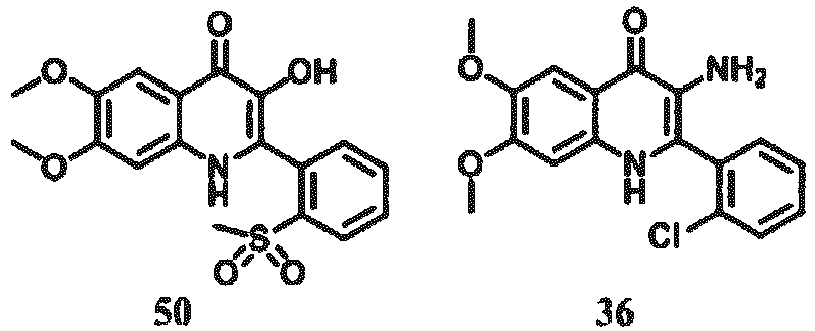
- The compound of claim 1, wherein the compound is selected from a group consisting of:


- A pharmaceutical composition comprising a compound of claim 1 or 2 and at least a pharmaceutically acceptable excipient or carrier.
Applications Claiming Priority (2)
| Application Number | Priority Date | Filing Date | Title |
|---|---|---|---|
| US201862688035P | 2018-06-21 | 2018-06-21 | |
| PCT/US2019/038140 WO2019246343A1 (en) | 2018-06-21 | 2019-06-20 | Nadph oxidase inhibitors, pharmaceutical composition comprising the same, and application thereof |
Publications (3)
| Publication Number | Publication Date |
|---|---|
| EP3810143A1 EP3810143A1 (en) | 2021-04-28 |
| EP3810143A4 EP3810143A4 (en) | 2022-06-15 |
| EP3810143B1 true EP3810143B1 (en) | 2025-04-16 |
Family
ID=68983457
Family Applications (1)
| Application Number | Title | Priority Date | Filing Date |
|---|---|---|---|
| EP19822444.6A Active EP3810143B1 (en) | 2018-06-21 | 2019-06-20 | Nadph oxidase inhibitors, pharmaceutical composition comprising the same, and application thereof |
Country Status (5)
| Country | Link |
|---|---|
| US (1) | US11661400B2 (en) |
| EP (1) | EP3810143B1 (en) |
| CN (1) | CN112292131A (en) |
| TW (1) | TWI812739B (en) |
| WO (1) | WO2019246343A1 (en) |
Families Citing this family (8)
| Publication number | Priority date | Publication date | Assignee | Title |
|---|---|---|---|---|
| PH12022551379A1 (en) | 2019-12-06 | 2023-05-03 | Vertex Pharma | Substituted tetrahydrofurans as modulators of sodium channels |
| JP7853310B2 (en) * | 2021-03-02 | 2026-04-28 | フレア・セラピューティクス・インコーポレーテッド | PPARG reverse agonist and its use |
| SI4347031T1 (en) | 2021-06-04 | 2026-01-30 | Vertex Pharmaceuticals Incorporated | N-(hydroxyalkyl (hetero)aryl) tetrahydrofuran carboxamides as modulators of sodium channels |
| US11938127B2 (en) | 2021-09-28 | 2024-03-26 | Wayne State University | Methods and compositions relating to steroid hormone receptor-dependent proliferative disorders |
| SMT202500447T1 (en) * | 2021-11-02 | 2026-01-12 | Flare Therapeutics Inc | Pparg inverse agonists and uses thereof |
| JP2025513455A (en) | 2022-04-22 | 2025-04-24 | バーテックス ファーマシューティカルズ インコーポレイテッド | Heteroaryl compounds for the treatment of pain - Patents.com |
| CN122122131A (en) * | 2023-11-10 | 2026-05-29 | 北京丹擎医药科技有限公司 | Heterocyclic derivatives, compositions and uses thereof |
| US20260085046A1 (en) * | 2024-09-26 | 2026-03-26 | Taiwanj Pharmaceuticals Co., Ltd. | Dual Function Compounds For NADPH Oxidase Inhibition And Histone Deacetylase Inhibition |
Citations (1)
| Publication number | Priority date | Publication date | Assignee | Title |
|---|---|---|---|---|
| EP2742033B1 (en) * | 2011-08-11 | 2018-09-19 | Armaron Bio Pty Ltd | Flavonoid compounds, and methods of use thereof |
Family Cites Families (10)
| Publication number | Priority date | Publication date | Assignee | Title |
|---|---|---|---|---|
| US3336300A (en) * | 1965-04-13 | 1967-08-15 | American Home Prod | 1, 2, 3, 4-tetrahydro-5h-benzodiazepin-5-ones |
| GB9015524D0 (en) * | 1990-07-13 | 1990-08-29 | Pfizer Ltd | Therapeutic agents |
| FR2803299B1 (en) * | 2000-01-05 | 2004-09-17 | Warner Lambert Co | NOVEL PYRAZOLO [4,3-e] SUBSTITUTED DIAZEPINES, PHARMACEUTICAL COMPOSITIONS CONTAINING THE SAME, USE AS A MEDICINAL PRODUCT AND METHODS FOR THEIR PREPARATION |
| AR058071A1 (en) * | 2005-10-03 | 2008-01-23 | Astrazeneca Ab | DERIVATIVES OF DIHYDROPIRAZOLO (3,4-E) (1,4) DIAZEPINA. PROCESSES OF OBTAINING AND PHARMACEUTICAL COMPOSITIONS. |
| CN101801933A (en) | 2007-09-26 | 2010-08-11 | 安斯泰来制药株式会社 | quinolone derivative |
| WO2012058211A2 (en) * | 2010-10-29 | 2012-05-03 | Emory University | Quinazoline derivatives, compositions, and uses related thereto |
| US8877742B2 (en) * | 2011-06-10 | 2014-11-04 | Glaxosmithkline Intellectual Property Limited | Compounds |
| US9428478B2 (en) * | 2011-06-13 | 2016-08-30 | Emory University | Piperazine derivatives, compositions, and uses related thereto |
| US20130025612A1 (en) * | 2011-07-25 | 2013-01-31 | Erica Hunter | SwigCap |
| US10975071B2 (en) * | 2015-09-28 | 2021-04-13 | Araxes Pharma Llc | Inhibitors of KRAS G12C mutant proteins |
-
2019
- 2019-06-19 TW TW108121355A patent/TWI812739B/en active
- 2019-06-20 WO PCT/US2019/038140 patent/WO2019246343A1/en not_active Ceased
- 2019-06-20 CN CN201980041579.7A patent/CN112292131A/en active Pending
- 2019-06-20 US US17/254,565 patent/US11661400B2/en active Active
- 2019-06-20 EP EP19822444.6A patent/EP3810143B1/en active Active
Patent Citations (1)
| Publication number | Priority date | Publication date | Assignee | Title |
|---|---|---|---|---|
| EP2742033B1 (en) * | 2011-08-11 | 2018-09-19 | Armaron Bio Pty Ltd | Flavonoid compounds, and methods of use thereof |
Also Published As
| Publication number | Publication date |
|---|---|
| EP3810143A4 (en) | 2022-06-15 |
| WO2019246343A1 (en) | 2019-12-26 |
| EP3810143A1 (en) | 2021-04-28 |
| CN112292131A (en) | 2021-01-29 |
| TW202019420A (en) | 2020-06-01 |
| US20210276957A1 (en) | 2021-09-09 |
| TWI812739B (en) | 2023-08-21 |
| US11661400B2 (en) | 2023-05-30 |
Similar Documents
| Publication | Publication Date | Title |
|---|---|---|
| US11661400B2 (en) | NADPH oxidase inhibitors, pharmaceutical composition comprising the same, and application thereof | |
| EP2132206B1 (en) | Substituted 4-aryl-1,4-dihydro-1,6-naphthyridinamides and use thereof | |
| JP6308504B2 (en) | Protein kinase inhibitors | |
| KR102240158B1 (en) | Cycloalkyl acid derivative, preparation method thereof, and pharmaceutical application thereof | |
| JPH0680654A (en) | Thiazolylvinylphenyl derivative | |
| WO2016081918A1 (en) | Fused bicyclic compounds for the treatment of disease | |
| WO2009157196A1 (en) | Amide compound | |
| JP2011526294A (en) | Disubstituted phenyl compounds as phosphodiesterase 10 inhibitors | |
| NO325445B1 (en) | Substituted benzoic acid amides and their use in the manufacture of a medicament for inhibiting angiogenesis, as well as the intermediate thereof | |
| CN105189452A (en) | Benzylideneguanidine derivatives and therapeutic use for the treatment of protein misfolding diseases | |
| KR20120093425A (en) | Azocyclic inhibitors of fatty acid amide hydrolase | |
| WO1992012144A1 (en) | Condensed benzoxa ring compound, production thereof, and pharmaceutical composition containing the same | |
| JP2020533328A (en) | Benzene condensed heterocyclic derivative and its pharmaceutical composition | |
| KR20020058091A (en) | Novel 1,8-naphthyridin-2(1h)-one derivatives | |
| JPH0550512B2 (en) | ||
| NZ576197A (en) | 3 -amino- pyridine derivatives for the treatment of metabolic disorders | |
| EP3715348A1 (en) | Fused bicyclic compounds for the treatment of disease | |
| CA2570046A1 (en) | Substituted triazole derivatives as oxytocin antagonists | |
| EP3041835B1 (en) | Liver x receptor (lxr) modulators | |
| JP2010517926A (en) | 4-Phenyl-3- (2-propylsulfonylamino) tetrahydrofuran derivatives useful for the treatment of schizophrenia that enhance glutamate receptors | |
| CN110437235B (en) | 3-amide azaindole compounds as mast cell regulators, and preparation method and application thereof | |
| PL182031B1 (en) | (S)-(-)-2-trifluoromethyl-4-(3-cyanophenyl)-4,6,7,8-tetrahydro-5(1H)-quinolone and its pharmaceutically acceptable salts, a pharmaceutical composition containing the compound, and a method of manufacture this relationship PL PL PL | |
| CN108299464A (en) | A kind of tricyclic pyrazole [1,5-c] [1,3] benzoxazinone derivatives and preparation method thereof and purposes | |
| JP2026500760A (en) | Naphthylamide compounds, their production method and applications | |
| Tsotinis et al. | Design and synthesis of new N1 and C3-substituted 4-fluoroindolic melatoninergics |
Legal Events
| Date | Code | Title | Description |
|---|---|---|---|
| STAA | Information on the status of an ep patent application or granted ep patent |
Free format text: STATUS: THE INTERNATIONAL PUBLICATION HAS BEEN MADE |
|
| PUAI | Public reference made under article 153(3) epc to a published international application that has entered the european phase |
Free format text: ORIGINAL CODE: 0009012 |
|
| STAA | Information on the status of an ep patent application or granted ep patent |
Free format text: STATUS: REQUEST FOR EXAMINATION WAS MADE |
|
| 17P | Request for examination filed |
Effective date: 20201229 |
|
| AK | Designated contracting states |
Kind code of ref document: A1 Designated state(s): AL AT BE BG CH CY CZ DE DK EE ES FI FR GB GR HR HU IE IS IT LI LT LU LV MC MK MT NL NO PL PT RO RS SE SI SK SM TR |
|
| AX | Request for extension of the european patent |
Extension state: BA ME |
|
| DAV | Request for validation of the european patent (deleted) | ||
| DAX | Request for extension of the european patent (deleted) | ||
| RIC1 | Information provided on ipc code assigned before grant |
Ipc: A61K 31/517 20060101ALI20220202BHEP Ipc: C07D 495/04 20060101ALI20220202BHEP Ipc: C07D 491/056 20060101ALI20220202BHEP Ipc: C07D 409/04 20060101ALI20220202BHEP Ipc: C07D 401/10 20060101ALI20220202BHEP Ipc: C07D 239/86 20060101ALI20220202BHEP Ipc: C07D 223/16 20060101ALI20220202BHEP Ipc: C07D 215/38 20060101ALI20220202BHEP Ipc: C07D 215/26 20060101ALI20220202BHEP Ipc: C07D 215/22 20060101AFI20220202BHEP |
|
| REG | Reference to a national code |
Ref country code: DE Ref legal event code: R079 Free format text: PREVIOUS MAIN CLASS: A61K0031517000 Ipc: C07D0215220000 Ref country code: DE Ref legal event code: R079 Ref document number: 602019068766 Country of ref document: DE Free format text: PREVIOUS MAIN CLASS: A61K0031517000 Ipc: C07D0215220000 |
|
| A4 | Supplementary search report drawn up and despatched |
Effective date: 20220518 |
|
| RIC1 | Information provided on ipc code assigned before grant |
Ipc: A61K 31/517 20060101ALI20220512BHEP Ipc: C07D 495/04 20060101ALI20220512BHEP Ipc: C07D 491/056 20060101ALI20220512BHEP Ipc: C07D 409/04 20060101ALI20220512BHEP Ipc: C07D 401/10 20060101ALI20220512BHEP Ipc: C07D 239/86 20060101ALI20220512BHEP Ipc: C07D 223/16 20060101ALI20220512BHEP Ipc: C07D 215/38 20060101ALI20220512BHEP Ipc: C07D 215/26 20060101ALI20220512BHEP Ipc: C07D 215/22 20060101AFI20220512BHEP |
|
| STAA | Information on the status of an ep patent application or granted ep patent |
Free format text: STATUS: EXAMINATION IS IN PROGRESS |
|
| 17Q | First examination report despatched |
Effective date: 20230913 |
|
| GRAP | Despatch of communication of intention to grant a patent |
Free format text: ORIGINAL CODE: EPIDOSNIGR1 |
|
| STAA | Information on the status of an ep patent application or granted ep patent |
Free format text: STATUS: GRANT OF PATENT IS INTENDED |
|
| INTG | Intention to grant announced |
Effective date: 20241129 |
|
| P01 | Opt-out of the competence of the unified patent court (upc) registered |
Free format text: CASE NUMBER: APP_68526/2024 Effective date: 20241230 |
|
| GRAS | Grant fee paid |
Free format text: ORIGINAL CODE: EPIDOSNIGR3 |
|
| GRAA | (expected) grant |
Free format text: ORIGINAL CODE: 0009210 |
|
| STAA | Information on the status of an ep patent application or granted ep patent |
Free format text: STATUS: THE PATENT HAS BEEN GRANTED |
|
| AK | Designated contracting states |
Kind code of ref document: B1 Designated state(s): AL AT BE BG CH CY CZ DE DK EE ES FI FR GB GR HR HU IE IS IT LI LT LU LV MC MK MT NL NO PL PT RO RS SE SI SK SM TR |
|
| REG | Reference to a national code |
Ref country code: GB Ref legal event code: FG4D |
|
| REG | Reference to a national code |
Ref country code: CH Ref legal event code: EP |
|
| REG | Reference to a national code |
Ref country code: IE Ref legal event code: FG4D |
|
| REG | Reference to a national code |
Ref country code: DE Ref legal event code: R096 Ref document number: 602019068766 Country of ref document: DE |
|
| REG | Reference to a national code |
Ref country code: NL Ref legal event code: MP Effective date: 20250416 |
|
| PG25 | Lapsed in a contracting state [announced via postgrant information from national office to epo] |
Ref country code: NL Free format text: LAPSE BECAUSE OF FAILURE TO SUBMIT A TRANSLATION OF THE DESCRIPTION OR TO PAY THE FEE WITHIN THE PRESCRIBED TIME-LIMIT Effective date: 20250416 |
|
| REG | Reference to a national code |
Ref country code: AT Ref legal event code: MK05 Ref document number: 1785597 Country of ref document: AT Kind code of ref document: T Effective date: 20250416 |
|
| PG25 | Lapsed in a contracting state [announced via postgrant information from national office to epo] |
Ref country code: PT Free format text: LAPSE BECAUSE OF FAILURE TO SUBMIT A TRANSLATION OF THE DESCRIPTION OR TO PAY THE FEE WITHIN THE PRESCRIBED TIME-LIMIT Effective date: 20250818 Ref country code: FI Free format text: LAPSE BECAUSE OF FAILURE TO SUBMIT A TRANSLATION OF THE DESCRIPTION OR TO PAY THE FEE WITHIN THE PRESCRIBED TIME-LIMIT Effective date: 20250416 Ref country code: ES Free format text: LAPSE BECAUSE OF FAILURE TO SUBMIT A TRANSLATION OF THE DESCRIPTION OR TO PAY THE FEE WITHIN THE PRESCRIBED TIME-LIMIT Effective date: 20250416 |
|
| REG | Reference to a national code |
Ref country code: LT Ref legal event code: MG9D |
|
| PG25 | Lapsed in a contracting state [announced via postgrant information from national office to epo] |
Ref country code: NO Free format text: LAPSE BECAUSE OF FAILURE TO SUBMIT A TRANSLATION OF THE DESCRIPTION OR TO PAY THE FEE WITHIN THE PRESCRIBED TIME-LIMIT Effective date: 20250716 Ref country code: GR Free format text: LAPSE BECAUSE OF FAILURE TO SUBMIT A TRANSLATION OF THE DESCRIPTION OR TO PAY THE FEE WITHIN THE PRESCRIBED TIME-LIMIT Effective date: 20250717 |
|
| PG25 | Lapsed in a contracting state [announced via postgrant information from national office to epo] |
Ref country code: PL Free format text: LAPSE BECAUSE OF FAILURE TO SUBMIT A TRANSLATION OF THE DESCRIPTION OR TO PAY THE FEE WITHIN THE PRESCRIBED TIME-LIMIT Effective date: 20250416 |
|
| PG25 | Lapsed in a contracting state [announced via postgrant information from national office to epo] |
Ref country code: BG Free format text: LAPSE BECAUSE OF FAILURE TO SUBMIT A TRANSLATION OF THE DESCRIPTION OR TO PAY THE FEE WITHIN THE PRESCRIBED TIME-LIMIT Effective date: 20250416 |
|
| PG25 | Lapsed in a contracting state [announced via postgrant information from national office to epo] |
Ref country code: HR Free format text: LAPSE BECAUSE OF FAILURE TO SUBMIT A TRANSLATION OF THE DESCRIPTION OR TO PAY THE FEE WITHIN THE PRESCRIBED TIME-LIMIT Effective date: 20250416 |
|
| PG25 | Lapsed in a contracting state [announced via postgrant information from national office to epo] |
Ref country code: AT Free format text: LAPSE BECAUSE OF FAILURE TO SUBMIT A TRANSLATION OF THE DESCRIPTION OR TO PAY THE FEE WITHIN THE PRESCRIBED TIME-LIMIT Effective date: 20250416 |
|
| PG25 | Lapsed in a contracting state [announced via postgrant information from national office to epo] |
Ref country code: RS Free format text: LAPSE BECAUSE OF FAILURE TO SUBMIT A TRANSLATION OF THE DESCRIPTION OR TO PAY THE FEE WITHIN THE PRESCRIBED TIME-LIMIT Effective date: 20250716 |
|
| PG25 | Lapsed in a contracting state [announced via postgrant information from national office to epo] |
Ref country code: IS Free format text: LAPSE BECAUSE OF FAILURE TO SUBMIT A TRANSLATION OF THE DESCRIPTION OR TO PAY THE FEE WITHIN THE PRESCRIBED TIME-LIMIT Effective date: 20250816 |
|
| PG25 | Lapsed in a contracting state [announced via postgrant information from national office to epo] |
Ref country code: LV Free format text: LAPSE BECAUSE OF FAILURE TO SUBMIT A TRANSLATION OF THE DESCRIPTION OR TO PAY THE FEE WITHIN THE PRESCRIBED TIME-LIMIT Effective date: 20250416 |
|
| PG25 | Lapsed in a contracting state [announced via postgrant information from national office to epo] |
Ref country code: DK Free format text: LAPSE BECAUSE OF FAILURE TO SUBMIT A TRANSLATION OF THE DESCRIPTION OR TO PAY THE FEE WITHIN THE PRESCRIBED TIME-LIMIT Effective date: 20250416 Ref country code: SM Free format text: LAPSE BECAUSE OF FAILURE TO SUBMIT A TRANSLATION OF THE DESCRIPTION OR TO PAY THE FEE WITHIN THE PRESCRIBED TIME-LIMIT Effective date: 20250416 |
|
| REG | Reference to a national code |
Ref country code: DE Ref legal event code: R097 Ref document number: 602019068766 Country of ref document: DE |
|
| PG25 | Lapsed in a contracting state [announced via postgrant information from national office to epo] |
Ref country code: CZ Free format text: LAPSE BECAUSE OF FAILURE TO SUBMIT A TRANSLATION OF THE DESCRIPTION OR TO PAY THE FEE WITHIN THE PRESCRIBED TIME-LIMIT Effective date: 20250416 |
|
| PG25 | Lapsed in a contracting state [announced via postgrant information from national office to epo] |
Ref country code: EE Free format text: LAPSE BECAUSE OF FAILURE TO SUBMIT A TRANSLATION OF THE DESCRIPTION OR TO PAY THE FEE WITHIN THE PRESCRIBED TIME-LIMIT Effective date: 20250416 |
|
| PG25 | Lapsed in a contracting state [announced via postgrant information from national office to epo] |
Ref country code: RO Free format text: LAPSE BECAUSE OF FAILURE TO SUBMIT A TRANSLATION OF THE DESCRIPTION OR TO PAY THE FEE WITHIN THE PRESCRIBED TIME-LIMIT Effective date: 20250416 Ref country code: SK Free format text: LAPSE BECAUSE OF FAILURE TO SUBMIT A TRANSLATION OF THE DESCRIPTION OR TO PAY THE FEE WITHIN THE PRESCRIBED TIME-LIMIT Effective date: 20250416 |
|
| REG | Reference to a national code |
Ref country code: CH Ref legal event code: H13 Free format text: ST27 STATUS EVENT CODE: U-0-0-H10-H13 (AS PROVIDED BY THE NATIONAL OFFICE) Effective date: 20260127 |
|
| PG25 | Lapsed in a contracting state [announced via postgrant information from national office to epo] |
Ref country code: IT Free format text: LAPSE BECAUSE OF FAILURE TO SUBMIT A TRANSLATION OF THE DESCRIPTION OR TO PAY THE FEE WITHIN THE PRESCRIBED TIME-LIMIT Effective date: 20250416 |
|
| PG25 | Lapsed in a contracting state [announced via postgrant information from national office to epo] |
Ref country code: MC Free format text: LAPSE BECAUSE OF FAILURE TO SUBMIT A TRANSLATION OF THE DESCRIPTION OR TO PAY THE FEE WITHIN THE PRESCRIBED TIME-LIMIT Effective date: 20250416 |
|
| PG25 | Lapsed in a contracting state [announced via postgrant information from national office to epo] |
Ref country code: LU Free format text: LAPSE BECAUSE OF NON-PAYMENT OF DUE FEES Effective date: 20250620 |
|
| PLBE | No opposition filed within time limit |
Free format text: ORIGINAL CODE: 0009261 |
|
| STAA | Information on the status of an ep patent application or granted ep patent |
Free format text: STATUS: NO OPPOSITION FILED WITHIN TIME LIMIT |
|
| REG | Reference to a national code |
Ref country code: CH Ref legal event code: L10 Free format text: ST27 STATUS EVENT CODE: U-0-0-L10-L00 (AS PROVIDED BY THE NATIONAL OFFICE) Effective date: 20260225 |
|
| REG | Reference to a national code |
Ref country code: BE Ref legal event code: MM Effective date: 20250630 |
|
| 26N | No opposition filed |
Effective date: 20260119 |
|
| PG25 | Lapsed in a contracting state [announced via postgrant information from national office to epo] |
Ref country code: IE Free format text: LAPSE BECAUSE OF NON-PAYMENT OF DUE FEES Effective date: 20250620 |
|
| PG25 | Lapsed in a contracting state [announced via postgrant information from national office to epo] |
Ref country code: BE Free format text: LAPSE BECAUSE OF NON-PAYMENT OF DUE FEES Effective date: 20250630 |
|
| PG25 | Lapsed in a contracting state [announced via postgrant information from national office to epo] |
Ref country code: CH Free format text: LAPSE BECAUSE OF NON-PAYMENT OF DUE FEES Effective date: 20250630 |
|
| PG25 | Lapsed in a contracting state [announced via postgrant information from national office to epo] |
Ref country code: LT Free format text: LAPSE BECAUSE OF FAILURE TO SUBMIT A TRANSLATION OF THE DESCRIPTION OR TO PAY THE FEE WITHIN THE PRESCRIBED TIME-LIMIT Effective date: 20250416 |
|
| PGFP | Annual fee paid to national office [announced via postgrant information from national office to epo] |
Ref country code: GB Payment date: 20260629 Year of fee payment: 8 |
|
| PGFP | Annual fee paid to national office [announced via postgrant information from national office to epo] |
Ref country code: DE Payment date: 20260624 Year of fee payment: 8 |
|
| PGFP | Annual fee paid to national office [announced via postgrant information from national office to epo] |
Ref country code: FR Payment date: 20260629 Year of fee payment: 8 |
|
| PG25 | Lapsed in a contracting state [announced via postgrant information from national office to epo] |
Ref country code: CY Free format text: LAPSE BECAUSE OF FAILURE TO SUBMIT A TRANSLATION OF THE DESCRIPTION OR TO PAY THE FEE WITHIN THE PRESCRIBED TIME-LIMIT Effective date: 20250416 Ref country code: SE Free format text: LAPSE BECAUSE OF FAILURE TO SUBMIT A TRANSLATION OF THE DESCRIPTION OR TO PAY THE FEE WITHIN THE PRESCRIBED TIME-LIMIT Effective date: 20250416 |