EP3808730A1 - Method for producing bifunctional compound having norbornane skeleton - Google Patents
Method for producing bifunctional compound having norbornane skeleton Download PDFInfo
- Publication number
- EP3808730A1 EP3808730A1 EP19822780.3A EP19822780A EP3808730A1 EP 3808730 A1 EP3808730 A1 EP 3808730A1 EP 19822780 A EP19822780 A EP 19822780A EP 3808730 A1 EP3808730 A1 EP 3808730A1
- Authority
- EP
- European Patent Office
- Prior art keywords
- reaction
- compound
- formula
- represented
- present
- Prior art date
- Legal status (The legal status is an assumption and is not a legal conclusion. Google has not performed a legal analysis and makes no representation as to the accuracy of the status listed.)
- Granted
Links
- ZDFOSSPNFAQIOM-UHFFFAOYSA-N COC(C(CC1C2)C2C2C1C1C=CC2C1)=O Chemical compound COC(C(CC1C2)C2C2C1C1C=CC2C1)=O ZDFOSSPNFAQIOM-UHFFFAOYSA-N 0.000 description 1
- IBKMAPZZUMRTNA-UHFFFAOYSA-N COC(C1C(C2)C(C3CC4CC3)C4C2C1)=O Chemical compound COC(C1C(C2)C(C3CC4CC3)C4C2C1)=O IBKMAPZZUMRTNA-UHFFFAOYSA-N 0.000 description 1
Images


Classifications
-
- C—CHEMISTRY; METALLURGY
- C07—ORGANIC CHEMISTRY
- C07C—ACYCLIC OR CARBOCYCLIC COMPOUNDS
- C07C67/00—Preparation of carboxylic acid esters
- C07C67/30—Preparation of carboxylic acid esters by modifying the acid moiety of the ester, such modification not being an introduction of an ester group
- C07C67/313—Preparation of carboxylic acid esters by modifying the acid moiety of the ester, such modification not being an introduction of an ester group by introduction of doubly bound oxygen containing functional groups, e.g. carboxyl groups
-
- C—CHEMISTRY; METALLURGY
- C07—ORGANIC CHEMISTRY
- C07C—ACYCLIC OR CARBOCYCLIC COMPOUNDS
- C07C67/00—Preparation of carboxylic acid esters
- C07C67/36—Preparation of carboxylic acid esters by reaction with carbon monoxide or formates
- C07C67/38—Preparation of carboxylic acid esters by reaction with carbon monoxide or formates by addition to an unsaturated carbon-to-carbon bond
-
- C—CHEMISTRY; METALLURGY
- C07—ORGANIC CHEMISTRY
- C07B—GENERAL METHODS OF ORGANIC CHEMISTRY; APPARATUS THEREFOR
- C07B61/00—Other general methods
-
- C—CHEMISTRY; METALLURGY
- C07—ORGANIC CHEMISTRY
- C07C—ACYCLIC OR CARBOCYCLIC COMPOUNDS
- C07C45/00—Preparation of compounds having >C = O groups bound only to carbon or hydrogen atoms; Preparation of chelates of such compounds
- C07C45/49—Preparation of compounds having >C = O groups bound only to carbon or hydrogen atoms; Preparation of chelates of such compounds by reaction with carbon monoxide
- C07C45/50—Preparation of compounds having >C = O groups bound only to carbon or hydrogen atoms; Preparation of chelates of such compounds by reaction with carbon monoxide by oxo-reactions
-
- C—CHEMISTRY; METALLURGY
- C07—ORGANIC CHEMISTRY
- C07C—ACYCLIC OR CARBOCYCLIC COMPOUNDS
- C07C69/00—Esters of carboxylic acids; Esters of carbonic or haloformic acids
- C07C69/74—Esters of carboxylic acids having an esterified carboxyl group bound to a carbon atom of a ring other than a six-membered aromatic ring
- C07C69/757—Esters of carboxylic acids having an esterified carboxyl group bound to a carbon atom of a ring other than a six-membered aromatic ring having any of the groups OH, O—metal, —CHO, keto, ether, acyloxy, groups, groups, or in the acid moiety
-
- C—CHEMISTRY; METALLURGY
- C07—ORGANIC CHEMISTRY
- C07C—ACYCLIC OR CARBOCYCLIC COMPOUNDS
- C07C2602/00—Systems containing two condensed rings
- C07C2602/36—Systems containing two condensed rings the rings having more than two atoms in common
- C07C2602/42—Systems containing two condensed rings the rings having more than two atoms in common the bicyclo ring system containing seven carbon atoms
-
- C—CHEMISTRY; METALLURGY
- C07—ORGANIC CHEMISTRY
- C07C—ACYCLIC OR CARBOCYCLIC COMPOUNDS
- C07C2603/00—Systems containing at least three condensed rings
- C07C2603/56—Ring systems containing bridged rings
- C07C2603/86—Ring systems containing bridged rings containing four rings
-
- C—CHEMISTRY; METALLURGY
- C07—ORGANIC CHEMISTRY
- C07C—ACYCLIC OR CARBOCYCLIC COMPOUNDS
- C07C2603/00—Systems containing at least three condensed rings
- C07C2603/56—Ring systems containing bridged rings
- C07C2603/90—Ring systems containing bridged rings containing more than four rings
Definitions
- the present invention relates to a method for producing a bifunctional compound having a norbornane skeleton useful as coating additives, adhesives, starting materials of resin, and the like. Also, the present invention relates to a production method for preventing a monofunctional compound having a norbornane skeleton from being by-produced.
- Patent Literature 1 describes that a bifunctional compound having a norbornane skeleton can be obtained through a hydroformylation reaction of a compound having a corresponding olefin.
- Patent Literature 1 International Publication No. WO 2015/147242
- a hydroformylation reaction is performed by reacting a compound having an olefin with an oxo gas, in presence of a catalyst containing rhodium or cobalt.
- the oxo gas for use as a starting material in the hydroformylation reaction is usually a gas having a controlled molar ratio between carbon monoxide and hydrogen of 50:50, because the hydroformylation reaction is represented by the following reaction formula.
- a certain amount of byproduct formed by hydrogenation of the compound having an olefin is generated along with production of a bifunctional compound having a norbornane skeleton.
- the present invention provides a method for producing a bifunctional compound having a norbornane skeleton which method is capable of preventing generation of a hydrogenated byproduct in the hydroformylation reaction.
- the present inventors have found that increase in molar quantity of carbon monoxide than hydrogen by a predetermined value or more in the composition of an oxo gas (mixed gas of carbon monoxide and hydrogen) during hydroformylation reaction results in decrease in formation of the hydrogenated byproduct, so that the present invention has been accomplished.
- the present invention is as follows.
- a bifunctional compound having a norbornane skeleton useful as coating additives, adhesives, starting materials of resin, and the like can be produced by an industrially advantageous method with generation of a hydrogenated byproduct inhibited.
- Embodiments of the present invention (hereinafter also referred to as "present embodiment") will be described in detail below.
- the following embodiments are intended to illustrate the present invention but are not intended to limit the present invention to the following.
- the present invention may be appropriately modified in the scope of the present invention.
- the production method in the present embodiment is a method for producing a compound represented by a formula (1) (hereinafter, also referred to as "bifunctional compound having a norbornane skeleton").
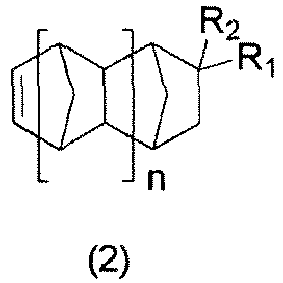
- the production method in the present embodiment comprises a step of hydroformylating a compound represented by a formula (2) (hereinafter, also referred to as “compound having a norbornene skeleton") with carbon monoxide and hydrogen (hereinafter, carbon monoxide and hydrogen together are called as "oxo gas”) (hereinafter, also referred to as “hydroformylating step").
- the molar ratio of the carbon monoxide to the hydrogen during the reaction is 55/45 or more and 95/5 or less: wherein R 1 represents COOCH 3 , COOC 2 H 5 , COOC 3 H 7 , COOC 4 H 9 , CHO, OCOCH 3 or OH, R 2 represents H, CH 3 or C 2 H 5 ; n is 0 or 1; and R 1 is preferably COOCH 3 or CHO: wherein R 1 , R 2 and n are the same as defined in the formula (1).
- bifunctional compound having a norbornane skeleton in the present embodiment exhibits excellent characteristics when used as adhesives and starting materials of resin.
- "bifunctional compound” refers to a compound having at least two reactive functional groups, and the bifunctional compound having a norbornane skeleton in the present embodiment has two reactive functional groups, i.e., -CHO and R 1 , which bind to the norbornane skeleton.
- R 2 is a non-reactive functional group.
- the bifunctional compound having a norbornane skeleton is not particularly limited as long as it is a bifunctional compound having a norbornane skeleton represented by the formula (1), and it is preferably a bifunctional compound having a norbornane skeleton having 8 to 20 carbon atoms.
- the compound having a norbornene skeleton is not particularly limited as long as it is a compound having a norbornene skeleton represented by the formula (2), and it is preferably a monoolefin having 7 to 19 carbon atoms.
- a compound having a norbornene skeleton may be produced, for example, by performing a Diels-Alder reaction of a monoolefin and dicyclopentadiene.
- Examples of the monoolefin for use in the Diels-Alder reaction include methyl (meth)acrylate, ethyl (meth)acrylate, propyl (meth)acrylate, butyl (meth)acrylate, (meth)acrolein and ethyl acrolein.
- methyl (meth)acrylate, ethyl (meth)acrylate, (meth)acrolein and ethyl acrolein are preferred.
- “(meth)acrylate” includes both of “methacrylate” and “acylate”
- “(meth)acrolein” includes both of "methacrolein” and "acrolein”.
- the dicyclopentadiene for use in the Diels-Alder reaction in the present embodiment is preferably one having high purity, and containment of butadiene, isoprene, or the like is preferably minimized.
- the purity of dicyclopentadiene is more preferably 90% or more, still more preferably 95% or more.
- cyclopentadiene may be used instead of dicyclopentadiene.
- a compound wherein n is 1 is formed substantially through a compound having a norbornene skeleton having 7 to 14 carbon atoms represented by the following formula (4) (product of first-stage Diels-Alder reaction).
- the formed monoolefin of the formula (4) as a new dienophile compound causes a Diels-Alder reaction with cyclopentadiene present in the reaction system (second-stage Diels-Alder reaction), so that a compound wherein n is 1, among compounds having a norbornene skeleton represented by the formula (2), is formed.
- R 1 and R 2 are the same as defined in the formula (1).
- the reaction temperature is preferably 100°C or more, more preferably 120°C or more, particularly preferably 130°C or more.
- the reaction be performed at a temperature of 250°C or less in order to prevent generation of byproducts having a high-boiling point.
- reaction solvent hydrocarbons, alcohols, esters, etc.
- aliphatic hydrocarbons having 6 or more carbon atoms, cyclohexane, toluene, xylene, ethylbenzene, mesitylene, propanol, butanol, etc., are suitably used.
- various reaction methods may be employed, including a batch method with a tank-type reaction vessel or the like, a semi-batch method with a tank-type reaction vessel under reaction conditions in which reactants or reactant solution are supplied, and a continuous flow method with a pipe-type reaction vessel in which reactants flow under reaction conditions.
- a reaction product obtained in the Diels-Alder reaction may be directly used as a starting material in the subsequent hydroformylation reaction, or may be subjected to purification by a method such as distillation, extraction, and crystal precipitation, and then supplied to the subsequent step.
- the hydroformylating step in the present embodiment is preferably performed in the presence of a rhodium compound and an organic phosphorus compound, though not particularly limited.
- the rhodium compound for use is not particularly limited as long as it is a compound which forms a complex with an organic phosphorus compound to exhibit hydroformylation activity in the presence of carbon monoxide and hydrogen.
- Examples of the rhodium compound include rhodium acetyl acetonate dicarbonyl (hereinafter, described as Rh(acac)(CO) 2 ), Rh 2 O 3 , Rh 4 (CO) 12 , Rh 6 (CO) 16 , and Rh(NO 3 ) 3 .
- the rhodium compound may be introduced as a precursor together with an organic phosphorus compound into a reaction mixture so as to form a rhodium metal hydride carbonyl phosphorus complex having a catalyst activity in a reaction vessel, or may be prepared into a rhodium metal hydride carbonyl phosphorus complex in advance, which is introduced into a reaction vessel.
- the amount of the rhodium compound used is preferably 0.1 to 60 micromoles, more preferably 0.1 to 30 micromoles, still more preferably 0.2 to 20 micromoles, further more preferably 0.5 to 10 micromoles, per mole of the compound having a norbornene skeleton as reactant of the hydroformylation reaction.
- the amount of the rhodium compound used is less than 60 micromoles per mole of the compound having a norbornene skeleton, the cost of rhodium catalyst can be reduced without providing facilities for collecting and recycling the rhodium complex. As a result, the economic burden on the facilities for collecting and recycling can be reduced.
- the organic phosphorus compound for use in the hydroformylating step in the present embodiment is not particularly limited as long as it can form a catalyst of the hydroformylation reaction with a rhodium compound.
- Examples of the organic phosphorus compound include a phosphine represented by a general formula P(-R 1 )(-R 2 )(-R 3 ), or a phosphite represented by P(-OR 1 )(-OR 2 )(-OR 3 ).
- R 1 , R 2 and R 3 include an aryl group which may be substituted with an alkyl group or alkoxy group having 1 to 4 carbon atoms, and an alicyclic alkyl group which may be substituted with an alkyl group or alkoxy group having 1 to 4 carbon atoms, and triphenyl phosphine and triphenyl phosphite are suitably used.
- the amount of the organic phosphorus compound used is preferably 300 to 10000 moles, more preferably 500 to 10000 moles, still more preferably 700 to 5000 moles, further more preferably 900 to 2000 moles, per mole of the rhodium atom in the rhodium compound.
- the amount of the organic phosphorus compound used is more than 300 moles per mole of the rhodium atom in the rhodium compound, the stability of a rhodium metal hydride carbonyl phosphorus complex as a catalyst activator is hardly impaired, so that delay in the progress of the reaction can be suppressed.
- the amount of the organic phosphorus compound used is less than 10000 moles per mole of the rhodium atom in the rhodium compound, increase in the cost of the organic phosphorus compound can be suppressed.
- the hydroformylating step in the present embodiment may be performed without use of a solvent, the step can be further suitably performed in the presence of a solvent inactive to the reaction.
- the solvent is not particularly limited as long as it can dissolve at least a part of the compound having a norbornene skeleton represented by the formula (2). In addition, it is preferable that the solvent can dissolve at least a part of the rhodium compound and the organic phosphorus compound.
- the solvent include hydrocarbons such as aliphatic hydrocarbons, alicyclic hydrocarbons and aromatic hydrocarbons; esters such as aliphatic esters, alicyclic esters and aromatic esters; alcohols such as aliphatic alcohols and alicyclic alcohols; and aromatic halides. Among these, hydrocarbons are suitably used, and, in particular, alicyclic hydrocarbons and aromatic hydrocarbons are suitably used.
- the temperature at which the hydroformylation reaction in the present embodiment is performed is, for example, preferably 40°C to 160°C, more preferably 80°C to 140°C, though not particularly limited.
- a reaction temperature of 40°C or more a sufficient reaction rate can be obtained, so that the compound having a norbornene skeleton as a starting material is prevented from remaining.
- a reaction temperature of 160°C or less generation of byproducts derived from the compound having a norbornene skeleton as a starting material or reaction products is suppressed, so that deterioration in the reaction performance can be prevented.
- the reaction is performed in the presence of carbon monoxide (hereinafter, also referred to as "CO") and hydrogen (hereinafter, also referred to as “H 2 "), preferably under pressure.
- CO and H 2 may be separately introduced into a reaction system, or may be mixed to prepare an oxo gas in advance for introduction into a reaction system.
- CO/H 2 molar ratio in such a range, the reaction activity of the hydroformylation reaction and the selectivity of the target aldehyde are improved.
- generation of the hydrogenated byproducts can be inhibited due to reduction in the partial pressure of hydrogen in the reaction system. Since CO and H 2 introduced into the reaction system decrease along with progress of the reaction, use of a mixed gas of CO and H 2 prepared in advance results in easiness of reaction control in some cases.
- the reaction pressure in the hydroformylation reaction in the present embodiment is preferably 1 to 12 MPa, more preferably 1.2 to 9 MPa, still more preferably 1.5 to 5 MPa. With a reaction pressure of 1 MPa or more, a sufficient reaction rate can be obtained, so that the compound having a norbornene skeleton as a starting material tends to be prevented from remaining. With a reaction pressure of 12 MPa or less, no expensive facilities excellent in pressure resistance performance are required, so that economic advantage can be achieved. In particular, when the reaction is performed by a batch method or a semi-batch method, CO and H 2 are required to be discharged/depressed after completion of the reaction. With decrease in the pressure, the loss of CO and H 2 decreases, so that economic advantage can be achieved.
- reaction method for the hydroformylation reaction in the present embodiment a batch reaction method or a semi-batch reaction method is suitable.
- the semi-batch reaction is performed as follows. A solvent and, on an as needed basis, a rhodium compound and an organic phosphorus compound are added into a reaction vessel, and pressurization by CO and H 2 and heating, etc. are performed to provide the reaction conditions described above. The compound having a norbornene skeleton as a starting material or a solution thereof may be then supplied to the reaction vessel.
- the content of the compound represented by the following formula (3) is preferably 1 mol% or less, more preferably 0.7 mol% or less, still more preferably 0.5 mol% or less.
- each of the conditions of the hydroformylation reaction may be adjusted to preferable one as described above. wherein R 1 , R 2 and n are the same as defined in the formula (1).
- the conversion rate of the reactant is preferably 90% or more, more preferably 95% or more, still more preferably 99% or more.
- each of the conditions for the hydroformylation reaction may be adjusted to preferable one as described above.
- the "conversion rate of the reactant” may be calculated from an equation: "((Monoolefin placed represented by formula (2)-Remaining monoolefin placed)/Monoolefin placed) ⁇ 100%)", based on mass. More specifically, the method described in Examples is applied.
- the yield of the aldehyde is preferably 90% or more, more preferably 95% or more, still more preferably 99% or more.
- each of the conditions for the hydroformylation reaction may be adjusted to a preferable one as described above.
- the "yield of the aldehyde” may be calculated from an equation: "(Main product/Monoolefin placed, represented by formula (2) ⁇ 100%)", based on mass. More specifically, the method described in Examples is applied.
- the reaction product obtained by the hydroformylation reaction in the present embodiment may be subjected to purification by, for example, distillation, extraction, crystal precipitation, or the like.
- the compound represented by the formula (3) may be removed by distillation purification with a low number of stages, so that the content of the compound represented by the formula (3) described above can be further adjusted within a range in which the effect of the present invention is not impaired.
- composition in the present embodiment may be any composition as long as it contains a bifunctional compound having a norbornane skeleton, and may further contain a compound having a norbornane skeleton or a compound represented by the formula (3).
- composition in the present embodiment may be a reaction product itself obtained in the hydroformylation reaction in the present embodiment, or may be a purified reaction product obtained in the hydroformylation reaction in the present embodiment.
- composition in the present embodiment can be used as coating additives, adhesives and starting materials of resin.
- the composition may further contain a known base compound and an additive used for coating additives, adhesives and starting materials of resin, in addition to the bifunctional compound having a norbornane skeleton, the compound having a norbornane skeleton, and the compound represented by the formula (3).
- the compound having a norbornene skeleton in the present embodiment is obtained by the production method in the present embodiment.
- the composition in the present embodiment also is obtained by the production method in the present embodiment.
- reaction liquid containing 96 g of monoolefin represented by the following formula (2a) acquired was subjected to distillation purification, and then a part of the purified product was supplied to a latter-stage reaction.
- gas supply to the reaction vessel was performed with a molar ratio of CO to H 2 of 60:40 for a reaction at 100°C, 2 MPa.
- gas supply was performed such that the molar ratio of CO to H 2 in the reaction vessel was kept at 60:40.
- the indicator value of the flow meter in the gas supply line reached 0
- the supply of gas was stopped, and when the decrease in pressure in the reaction vessel stopped, the reaction was regarded as completed.
- gas in the gas phase was collected to be subjected to gas composition analysis.
- the hydrogenated product represented by the formula (3a) had a molecular weight of 220 (value found by GC-MS instrument).
- the molecular weight of the monoolefin represented by the formula (2a) was regarded as 218.3
- the molecular weight of the main product represented by the formula (1a) was regarded as 248.32
- the molecular weight of the hydrogenated product represented by the formula (3a) was regarded as 220.31, based on the atomic weight and isotopic ratio in the composition formula; thus, the conversion rate of the reactant, the yield of the aldehyde, and the yield of the hydrogenated product were calculated.
- the conversion rate of the reactant, the yield of the aldehyde, and the yield of the hydrogenated product were calculated based on amounts in moles.
- Me represents a methyl group.
- a reaction liquid containing the compound represented by the formula (1a) and the compound represented by the formula (3a) was obtained from a reaction in the same manner as in Example 1, except that the molar ratio CO/H 2 in the reaction vessel was changed as shown in the following Table 1. The results of the conversion rate of the reactant and each of the yields are shown together in Table 1.
- a hydroformylation reaction of the monoolefin represented by the formula (2b) as reactant was performed.
- the reaction vessel 30 g of the distillation-purified monoolefin represented by the formula (2b), 60 g of toluene (manufactured by Wako Pure Chemical Industries), 182 mg (3000 molppm based on monoolefin) of triphenyl phosphite (manufactured by Wako Pure Chemical Industries), and 153 ⁇ g (3 molppm based on monoolefin) of Rh(acac)(CO) 2 (manufactured by N. E. Chemcat Corporation) were added.
- gas supply to the reaction vessel was performed with a molar ratio of CO to H 2 of 60:40 for a reaction at 100°C, 2 MPa.
- gas supply was performed with the molar ratio of CO to H 2 in the reaction vessel kept at 60:40, so that a reaction liquid as product was obtained.
- gas in the gas phase was collected to be subjected to gas composition analysis by inorganic gas analysis.
- reaction liquid contained 34.7 g of the main product represented by the formula (1b), 0.16 g of the hydrogenated product represented by the formula (3b), and 0.0 g of the remaining monoolefin placed (conversion rate of reactant: 100.0%, yield of aldehyde: 96.6%, and yield of hydrogenated product: 0.5%). Also, as a result of GC-MS analysis, it was confirmed that the hydrogenated product represented by the formula (3b) had a molecular weight of 154 (value found by GC-MS instrument).
- the molecular weight of the monoolefin represented by the formula (2b) was regarded as 152.19
- the molecular weight of the main product represented by the formula (1b) was regarded as 182.22
- the molecular weight of the hydrogenated product represented by the formula (3b) was regarded as 154.21, based on the atomic weight and isotopic ratio in the composition formula; thus, the conversion rate of the reactant, the yield of the aldehyde, and the yield of the hydrogenated product were calculated.
- the conversion rate of the reactant, the yield of the aldehyde, and the yield of the hydrogenated product were calculated based on amounts in moles.
- Me represents a methyl group.
- a reaction liquid containing the compound represented by the formula (1b) and the compound represented by the formula (3b) was obtained from a reaction in the same manner as in Example 4, except that the molar ratio CO/H 2 in the reaction vessel was changed as shown in the following Table 1. The results on the conversion rate of the reactant and each of the yields are shown together in Table 1.
- Example 1 The byproduct obtained in Example 1 was isolated and subjected to NMR analysis.
- Figure 1 shows a spectrum obtained by 1H-NMR measurement of the byproduct obtained in Example 1
- Figure 2 shows a spectrum obtained by 13C-NMR measurement of the byproduct obtained in Example 1. From the results of GC-MS analysis described above and NMR analysis in Figures 1 and 2 , it was confirmed that the compound by-produced in Example 1 was a monofunctional compound represented by the formula (3a) described above.
- Example 4 was subjected to NMR analysis.
- Figure 3 shows a spectrum obtained in 1H-NMR measurement of the byproduct obtained in Example 4
- Figure 4 shows a spectrum obtained in 13C-NMR measurement of the byproduct obtained in Example 4. From the results of GC-MS analysis described above and NMR analysis in Figures 3 and 4 , it was confirmed that the compound by-produced in Example 4 was a monofunctional compound represented by the formula (3b) described above.
- the present invention has industrial applicability in the field of coating additives, adhesives, starting materials of resin and the like made from a bifunctional compound having a norbornane skeleton.
Landscapes
- Chemical & Material Sciences (AREA)
- Organic Chemistry (AREA)
- Chemical Kinetics & Catalysis (AREA)
- Organic Low-Molecular-Weight Compounds And Preparation Thereof (AREA)
- Catalysts (AREA)
- Low-Molecular Organic Synthesis Reactions Using Catalysts (AREA)
Abstract
Description
- The present invention relates to a method for producing a bifunctional compound having a norbornane skeleton useful as coating additives, adhesives, starting materials of resin, and the like. Also, the present invention relates to a production method for preventing a monofunctional compound having a norbornane skeleton from being by-produced.
- It is known that a bifunctional compound having a norbornane skeleton exhibits excellent characteristics when used as adhesives or starting materials of resin. As a method for producing a bifunctional compound having a norbornane skeleton, for example,
Patent Literature 1 describes that a bifunctional compound having a norbornane skeleton can be obtained through a hydroformylation reaction of a compound having a corresponding olefin. - Patent Literature 1: International Publication No.
WO 2015/147242 - A hydroformylation reaction is performed by reacting a compound having an olefin with an oxo gas, in presence of a catalyst containing rhodium or cobalt. The oxo gas for use as a starting material in the hydroformylation reaction is usually a gas having a controlled molar ratio between carbon monoxide and hydrogen of 50:50, because the hydroformylation reaction is represented by the following reaction formula. In the reaction between the oxo gas and the compound having an olefin, however, a certain amount of byproduct formed by hydrogenation of the compound having an olefin, is generated along with production of a bifunctional compound having a norbornane skeleton.

- Also, use of the bifunctional compound having a norbornane skeleton thus produced as a starting material of a polymer causes the hydrogenated byproduct to inhibit a reaction into a polymer. However, both of the bifunctional compound having a norbornane skeleton and the hydrogenated byproduct have high viscosity and high boiling point, so that it is difficult to separate the hydrogenated byproduct from the bifunctional compound having a norbornane skeleton by simple distillation or thin film distillation. Also, although use of distillation purification with a high number of stages for separating the hydrogenated byproduct from the bifunctional compound having a norbornane skeleton can achieve a specified separation, the yield is worsened. It is therefore difficult to say that use of distillation purification with a high number of stages is an economical method. From these circumstances, a synthesis method capable of inhibiting generation of the hydrogenated byproduct in the hydroformylation reaction is desired.
- In order to solve the problem, the present invention provides a method for producing a bifunctional compound having a norbornane skeleton which method is capable of preventing generation of a hydrogenated byproduct in the hydroformylation reaction.
- The present inventors have found that increase in molar quantity of carbon monoxide than hydrogen by a predetermined value or more in the composition of an oxo gas (mixed gas of carbon monoxide and hydrogen) during hydroformylation reaction results in decrease in formation of the hydrogenated byproduct, so that the present invention has been accomplished.
- In other words, the present invention is as follows.
- [1] A method for producing a compound represented by formula (1), comprising a step of hydroformylating a compound represented by formula (2) with carbon monoxide and hydrogen,
wherein a molar ratio of the carbon monoxide to the hydrogen during reaction is 55/45 or more and 95/5 or less in the hydroformylating step:

- [2] The production method according to [1], wherein the compound represented by the formula (1) obtained in the hydroformylating step has a content of a compound represented by formula (3) of 1 mol% or less:

- [3] The production method according to [1] or [2], wherein the hydroformylating step uses 0.1 to 60 micromoles of a rhodium compound per mole of the compound represented by the formula (2), and 300 to 10000 moles of an organic phosphorus compound per mole of a rhodium atom in the rhodium compound.
- According to the production method of the present invention, a bifunctional compound having a norbornane skeleton useful as coating additives, adhesives, starting materials of resin, and the like can be produced by an industrially advantageous method with generation of a hydrogenated byproduct inhibited.
-
- [
Figure 1] Figure 1 shows a spectrum obtained through measurement of a byproduct obtained in Example 1 with 1H-NMR. - [
Figure 2] Figure 2 shows a spectrum obtained through measurement of a byproduct obtained in Example 1 with 13C-NMR. - [
Figure 3] Figure 3 shows a spectrum obtained through measurement of a byproduct obtained in Example 4 with 1H-NMR. - [
Figure 4] Figure 4 shows a spectrum obtained through measurement of a byproduct obtained in Example 4 with 13C-NMR. - Embodiments of the present invention (hereinafter also referred to as "present embodiment") will be described in detail below. The following embodiments are intended to illustrate the present invention but are not intended to limit the present invention to the following. The present invention may be appropriately modified in the scope of the present invention.
- The production method in the present embodiment is a method for producing a compound represented by a formula (1) (hereinafter, also referred to as "bifunctional compound having a norbornane skeleton"). The production method in the present embodiment comprises a step of hydroformylating a compound represented by a formula (2) (hereinafter, also referred to as "compound having a norbornene skeleton") with carbon monoxide and hydrogen (hereinafter, carbon monoxide and hydrogen together are called as "oxo gas") (hereinafter, also referred to as "hydroformylating step"). In the hydroformylating step, the molar ratio of the carbon monoxide to the hydrogen during the reaction is 55/45 or more and 95/5 or less:


- The bifunctional compound having a norbornane skeleton in the present embodiment exhibits excellent characteristics when used as adhesives and starting materials of resin. Herein, "bifunctional compound" refers to a compound having at least two reactive functional groups, and the bifunctional compound having a norbornane skeleton in the present embodiment has two reactive functional groups, i.e., -CHO and R1, which bind to the norbornane skeleton. R2 is a non-reactive functional group.
- The bifunctional compound having a norbornane skeleton is not particularly limited as long as it is a bifunctional compound having a norbornane skeleton represented by the formula (1), and it is preferably a bifunctional compound having a norbornane skeleton having 8 to 20 carbon atoms.
- The compound having a norbornene skeleton is not particularly limited as long as it is a compound having a norbornene skeleton represented by the formula (2), and it is preferably a monoolefin having 7 to 19 carbon atoms.
- A compound having a norbornene skeleton may be produced, for example, by performing a Diels-Alder reaction of a monoolefin and dicyclopentadiene.
- Examples of the monoolefin for use in the Diels-Alder reaction include methyl (meth)acrylate, ethyl (meth)acrylate, propyl (meth)acrylate, butyl (meth)acrylate, (meth)acrolein and ethyl acrolein. In particular, methyl (meth)acrylate, ethyl (meth)acrylate, (meth)acrolein and ethyl acrolein are preferred. Herein, "(meth)acrylate" includes both of "methacrylate" and "acylate", and "(meth)acrolein" includes both of "methacrolein" and "acrolein".
- The dicyclopentadiene for use in the Diels-Alder reaction in the present embodiment is preferably one having high purity, and containment of butadiene, isoprene, or the like is preferably minimized. The purity of dicyclopentadiene is more preferably 90% or more, still more preferably 95% or more. As it is known that dicyclopentadiene is depolymerized under heating conditions to produce cyclopentadiene (so-called monocyclopentadiene), cyclopentadiene may be used instead of dicyclopentadiene. It is considered that among compounds having a norbornene skeleton represented by the formula (2), a compound wherein n is 1 is formed substantially through a compound having a norbornene skeleton having 7 to 14 carbon atoms represented by the following formula (4) (product of first-stage Diels-Alder reaction). Thus, it is considered that the formed monoolefin of the formula (4) as a new dienophile compound causes a Diels-Alder reaction with cyclopentadiene present in the reaction system (second-stage Diels-Alder reaction), so that a compound wherein n is 1, among compounds having a norbornene skeleton represented by the formula (2), is formed.

- In order to efficiently proceed the two-stage Diels-Alder reaction, it is important that cyclopentadiene be present in a reaction system. The reaction temperature, therefore, is preferably 100°C or more, more preferably 120°C or more, particularly preferably 130°C or more. On the other hand, it is preferable that the reaction be performed at a temperature of 250°C or less in order to prevent generation of byproducts having a high-boiling point. Also, as reaction solvent, hydrocarbons, alcohols, esters, etc., may be used, and aliphatic hydrocarbons having 6 or more carbon atoms, cyclohexane, toluene, xylene, ethylbenzene, mesitylene, propanol, butanol, etc., are suitably used.
- As the Diels-Alder reaction method, various reaction methods may be employed, including a batch method with a tank-type reaction vessel or the like, a semi-batch method with a tank-type reaction vessel under reaction conditions in which reactants or reactant solution are supplied, and a continuous flow method with a pipe-type reaction vessel in which reactants flow under reaction conditions.
- A reaction product obtained in the Diels-Alder reaction may be directly used as a starting material in the subsequent hydroformylation reaction, or may be subjected to purification by a method such as distillation, extraction, and crystal precipitation, and then supplied to the subsequent step.
- The hydroformylating step in the present embodiment is preferably performed in the presence of a rhodium compound and an organic phosphorus compound, though not particularly limited. The rhodium compound for use is not particularly limited as long as it is a compound which forms a complex with an organic phosphorus compound to exhibit hydroformylation activity in the presence of carbon monoxide and hydrogen. Examples of the rhodium compound include rhodium acetyl acetonate dicarbonyl (hereinafter, described as Rh(acac)(CO)2), Rh2O3, Rh4(CO)12, Rh6(CO)16, and Rh(NO3)3. The rhodium compound may be introduced as a precursor together with an organic phosphorus compound into a reaction mixture so as to form a rhodium metal hydride carbonyl phosphorus complex having a catalyst activity in a reaction vessel, or may be prepared into a rhodium metal hydride carbonyl phosphorus complex in advance, which is introduced into a reaction vessel.
- The amount of the rhodium compound used is preferably 0.1 to 60 micromoles, more preferably 0.1 to 30 micromoles, still more preferably 0.2 to 20 micromoles, further more preferably 0.5 to 10 micromoles, per mole of the compound having a norbornene skeleton as reactant of the hydroformylation reaction. When the amount of the rhodium compound used is less than 60 micromoles per mole of the compound having a norbornene skeleton, the cost of rhodium catalyst can be reduced without providing facilities for collecting and recycling the rhodium complex. As a result, the economic burden on the facilities for collecting and recycling can be reduced.
- The organic phosphorus compound for use in the hydroformylating step in the present embodiment is not particularly limited as long as it can form a catalyst of the hydroformylation reaction with a rhodium compound. Examples of the organic phosphorus compound include a phosphine represented by a general formula P(-R1)(-R2)(-R3), or a phosphite represented by P(-OR1)(-OR2)(-OR3). Specific examples of R1, R2 and R3 include an aryl group which may be substituted with an alkyl group or alkoxy group having 1 to 4 carbon atoms, and an alicyclic alkyl group which may be substituted with an alkyl group or alkoxy group having 1 to 4 carbon atoms, and triphenyl phosphine and triphenyl phosphite are suitably used.
- The amount of the organic phosphorus compound used is preferably 300 to 10000 moles, more preferably 500 to 10000 moles, still more preferably 700 to 5000 moles, further more preferably 900 to 2000 moles, per mole of the rhodium atom in the rhodium compound. When the amount of the organic phosphorus compound used is more than 300 moles per mole of the rhodium atom in the rhodium compound, the stability of a rhodium metal hydride carbonyl phosphorus complex as a catalyst activator is hardly impaired, so that delay in the progress of the reaction can be suppressed. When the amount of the organic phosphorus compound used is less than 10000 moles per mole of the rhodium atom in the rhodium compound, increase in the cost of the organic phosphorus compound can be suppressed.
- Although the hydroformylating step in the present embodiment may be performed without use of a solvent, the step can be further suitably performed in the presence of a solvent inactive to the reaction. The solvent is not particularly limited as long as it can dissolve at least a part of the compound having a norbornene skeleton represented by the formula (2). In addition, it is preferable that the solvent can dissolve at least a part of the rhodium compound and the organic phosphorus compound. Examples of the solvent include hydrocarbons such as aliphatic hydrocarbons, alicyclic hydrocarbons and aromatic hydrocarbons; esters such as aliphatic esters, alicyclic esters and aromatic esters; alcohols such as aliphatic alcohols and alicyclic alcohols; and aromatic halides. Among these, hydrocarbons are suitably used, and, in particular, alicyclic hydrocarbons and aromatic hydrocarbons are suitably used.
- The temperature at which the hydroformylation reaction in the present embodiment is performed is, for example, preferably 40°C to 160°C, more preferably 80°C to 140°C, though not particularly limited. With a reaction temperature of 40°C or more, a sufficient reaction rate can be obtained, so that the compound having a norbornene skeleton as a starting material is prevented from remaining. With a reaction temperature of 160°C or less, generation of byproducts derived from the compound having a norbornene skeleton as a starting material or reaction products is suppressed, so that deterioration in the reaction performance can be prevented.
- In the hydroformylating step in the present embodiment, the reaction is performed in the presence of carbon monoxide (hereinafter, also referred to as "CO") and hydrogen (hereinafter, also referred to as "H2"), preferably under pressure. CO and H2 may be separately introduced into a reaction system, or may be mixed to prepare an oxo gas in advance for introduction into a reaction system.
- The molar ratio of CO to H2(=CO/H2 molar ratio) during reaction is 55/45 or more and 95/5 or less, preferably 60/40 or more and 90/10 or less, more preferably 70/30 or more and 80/20 or less. With a CO/H2 molar ratio in such a range, the reaction activity of the hydroformylation reaction and the selectivity of the target aldehyde are improved. In particular, with a CO/H2 molar ratio of 55/45 or more, generation of the hydrogenated byproducts can be inhibited due to reduction in the partial pressure of hydrogen in the reaction system. Since CO and H2 introduced into the reaction system decrease along with progress of the reaction, use of a mixed gas of CO and H2 prepared in advance results in easiness of reaction control in some cases.
- The reaction pressure in the hydroformylation reaction in the present embodiment is preferably 1 to 12 MPa, more preferably 1.2 to 9 MPa, still more preferably 1.5 to 5 MPa. With a reaction pressure of 1 MPa or more, a sufficient reaction rate can be obtained, so that the compound having a norbornene skeleton as a starting material tends to be prevented from remaining. With a reaction pressure of 12 MPa or less, no expensive facilities excellent in pressure resistance performance are required, so that economic advantage can be achieved. In particular, when the reaction is performed by a batch method or a semi-batch method, CO and H2 are required to be discharged/depressed after completion of the reaction. With decrease in the pressure, the loss of CO and H2 decreases, so that economic advantage can be achieved.
- As the reaction method for the hydroformylation reaction in the present embodiment, a batch reaction method or a semi-batch reaction method is suitable. The semi-batch reaction is performed as follows. A solvent and, on an as needed basis, a rhodium compound and an organic phosphorus compound are added into a reaction vessel, and pressurization by CO and H2 and heating, etc. are performed to provide the reaction conditions described above. The compound having a norbornene skeleton as a starting material or a solution thereof may be then supplied to the reaction vessel.
- In the reaction products obtained in the hydroformylating step, the content of the compound represented by the following formula (3) is preferably 1 mol% or less, more preferably 0.7 mol% or less, still more preferably 0.5 mol% or less. In order to obtain the reaction products with a content in the range, each of the conditions of the hydroformylation reaction may be adjusted to preferable one as described above.

- In the reaction products obtained in the hydroformylating step, the conversion rate of the reactant is preferably 90% or more, more preferably 95% or more, still more preferably 99% or more. In order to obtain the reaction products with a conversion rate of the reactant in the range, each of the conditions for the hydroformylation reaction may be adjusted to preferable one as described above. The "conversion rate of the reactant" may be calculated from an equation: "((Monoolefin placed represented by formula (2)-Remaining monoolefin placed)/Monoolefin placed)×100%)", based on mass. More specifically, the method described in Examples is applied.
- In the reaction product obtained in the hydroformylating step, the yield of the aldehyde is preferably 90% or more, more preferably 95% or more, still more preferably 99% or more. In order to obtain the reaction product with a yield of the aldehyde in the range, each of the conditions for the hydroformylation reaction may be adjusted to a preferable one as described above. The "yield of the aldehyde" may be calculated from an equation: "(Main product/Monoolefin placed, represented by formula (2) ×100%)", based on mass. More specifically, the method described in Examples is applied.
- The reaction product obtained by the hydroformylation reaction in the present embodiment may be subjected to purification by, for example, distillation, extraction, crystal precipitation, or the like. For example, the compound represented by the formula (3) may be removed by distillation purification with a low number of stages, so that the content of the compound represented by the formula (3) described above can be further adjusted within a range in which the effect of the present invention is not impaired.
- The composition in the present embodiment may be any composition as long as it contains a bifunctional compound having a norbornane skeleton, and may further contain a compound having a norbornane skeleton or a compound represented by the formula (3).
- The composition in the present embodiment may be a reaction product itself obtained in the hydroformylation reaction in the present embodiment, or may be a purified reaction product obtained in the hydroformylation reaction in the present embodiment.
- The composition in the present embodiment can be used as coating additives, adhesives and starting materials of resin. For use as coating additives, adhesives and starting materials of resin, the composition may further contain a known base compound and an additive used for coating additives, adhesives and starting materials of resin, in addition to the bifunctional compound having a norbornane skeleton, the compound having a norbornane skeleton, and the compound represented by the formula (3).
- The compound having a norbornene skeleton in the present embodiment is obtained by the production method in the present embodiment. The composition in the present embodiment also is obtained by the production method in the present embodiment.
- The present embodiment is more specifically described with reference to Examples as follows, though the present embodiment is not limited to these Examples.
-
- Analytical instrument: Capillary gas chromatograph GG-2010 Plus manufactured by Shimazu Corporation
- Analysis column: InertCap 1 (30 m, I.D.: 0.32 mm, film thickness: 0.25 µm) manufactured by GL Sciences Inc.
- Oven temperature: 60°C (0.5 min) - 15°C/min - 280°C (4 min)
- Detector: FID, temperature: 280°C
-
- Analytical instrument: Gas chromatograph GC-8A manufactured by Shimazu Corporation
- Analysis column: WG-100 manufactured by GL Sciences Inc.
- Oven temperature: 100°C
- Detector: TCD, temperature: 100°C
-
- Analytical instrument: GCMS-QP2010 Plus, manufactured by Shimazu Corporation
- Ionization voltage: 70 V
- Analysis column: DB-1 (30 m, I.D.: 0.32 mm, film thickness: 1.00 µm) manufactured by Agilent Technologies
- Oven temperature: 60°C (0.5 min) - 15°C/min - 280°C (4 min)
-
- Instrument: JNM-ECA500 (500 MHz) manufactured by JEOL Ltd.
- Measurement mode: 1H-NMR, 13C-NMR
- Solvent: CDCl3 (deuterated chloroform)
- Internal standard substance: tetramethylsilane
- In a 500-mL stainless steel reaction vessel, 173 g (2.01 mol) of methyl acrylate and 167 g (1.26 mol) of dicyclopentadiene were placed and reacted at 195°C for 2 hours. A reaction liquid containing 96 g of monoolefin represented by the following formula (2a) acquired was subjected to distillation purification, and then a part of the purified product was supplied to a latter-stage reaction.
- In a 300-mL stainless steel reaction vessel, a hydroformylation reaction of the monoolefin represented by the formula (2a) was performed. Into the reaction vessel, 30 g of the distillation-purified monoolefin represented by the formula (2a), 60 g of toluene (manufactured by Wako Pure Chemical Industries), 128 g (3000 molppm based on monoolefin) of triphenyl phosphite (manufactured by Wako Pure Chemical Industries), and 106 µg (3 molppm based on monoolefin) of Rh(acac)(CO)2 (manufactured by N. E. Chemcat Corporation) were added. After the reaction vessel was purged with nitrogen three times, gas supply to the reaction vessel was performed with a molar ratio of CO to H2 of 60:40 for a reaction at 100°C, 2 MPa. During the reaction, gas supply was performed such that the molar ratio of CO to H2 in the reaction vessel was kept at 60:40. When the indicator value of the flow meter in the gas supply line reached 0, the supply of gas was stopped, and when the decrease in pressure in the reaction vessel stopped, the reaction was regarded as completed. After completion of the reaction, gas in the gas phase was collected to be subjected to gas composition analysis. Also, as a result of gas chromatography analysis, it was confirmed that the reaction liquid contained 33.3 g of the main product represented by the formula (1a), 0.2 g of the byproduct (hydrogenated product) represented by the formula (3a), and 0.0 g of the remaining monoolefin placed (conversion rate of reactant: 100.0% (=(monoolefin placed: monoolefin represented by formula (2a)-remaining monoolefin placed)/monoolefin placed)×100%), yield of aldehyde: 97.6% (=main product/monoolefin placed×100%), yield of hydrogenated product: 0.7% (=hydrogenated product/monoolefin placed×100%)), (wherein, units other than % are based on mass). Also, as a result of GC-MS analysis, it was confirmed that the hydrogenated product represented by the formula (3a) had a molecular weight of 220 (value found by GC-MS instrument). For the molecular weight of each compound, the molecular weight of the monoolefin represented by the formula (2a) was regarded as 218.3, the molecular weight of the main product represented by the formula (1a) was regarded as 248.32, and the molecular weight of the hydrogenated product represented by the formula (3a) was regarded as 220.31, based on the atomic weight and isotopic ratio in the composition formula; thus, the conversion rate of the reactant, the yield of the aldehyde, and the yield of the hydrogenated product were calculated. The conversion rate of the reactant, the yield of the aldehyde, and the yield of the hydrogenated product were calculated based on amounts in moles.


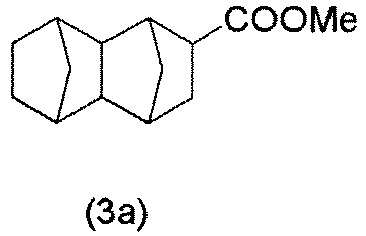
- A reaction liquid containing the compound represented by the formula (1a) and the compound represented by the formula (3a) was obtained from a reaction in the same manner as in Example 1, except that the molar ratio CO/H2 in the reaction vessel was changed as shown in the following Table 1. The results of the conversion rate of the reactant and each of the yields are shown together in Table 1.
- In a 500-mL stainless steel reaction vessel, 173 g (2.01 mol) of methyl acrylate and 167 g (1.26 mol) of dicyclopentadiene were placed and reacted at 195°C for 2 hours. A reaction liquid containing 198 g of monoolefin represented by the following formula (2b) acquired was subjected to distillation purification, and then a part of the purified product was supplied to a latter-stage reaction.
- In a 300-mL stainless steel reaction vessel, a hydroformylation reaction of the monoolefin represented by the formula (2b) as reactant was performed. Into the reaction vessel, 30 g of the distillation-purified monoolefin represented by the formula (2b), 60 g of toluene (manufactured by Wako Pure Chemical Industries), 182 mg (3000 molppm based on monoolefin) of triphenyl phosphite (manufactured by Wako Pure Chemical Industries), and 153 µg (3 molppm based on monoolefin) of Rh(acac)(CO)2 (manufactured by N. E. Chemcat Corporation) were added. After the reaction vessel was purged with nitrogen three times, gas supply to the reaction vessel was performed with a molar ratio of CO to H2 of 60:40 for a reaction at 100°C, 2 MPa. During the reaction, gas supply was performed with the molar ratio of CO to H2 in the reaction vessel kept at 60:40, so that a reaction liquid as product was obtained. After completion of the reaction, gas in the gas phase was collected to be subjected to gas composition analysis by inorganic gas analysis. Also, as a result of gas chromatography analysis of the reaction liquid, it was confirmed that the reaction liquid contained 34.7 g of the main product represented by the formula (1b), 0.16 g of the hydrogenated product represented by the formula (3b), and 0.0 g of the remaining monoolefin placed (conversion rate of reactant: 100.0%, yield of aldehyde: 96.6%, and yield of hydrogenated product: 0.5%). Also, as a result of GC-MS analysis, it was confirmed that the hydrogenated product represented by the formula (3b) had a molecular weight of 154 (value found by GC-MS instrument). For the molecular weight of each compound, the molecular weight of the monoolefin represented by the formula (2b) was regarded as 152.19, the molecular weight of the main product represented by the formula (1b) was regarded as 182.22, and the molecular weight of the hydrogenated product represented by the formula (3b) was regarded as 154.21, based on the atomic weight and isotopic ratio in the composition formula; thus, the conversion rate of the reactant, the yield of the aldehyde, and the yield of the hydrogenated product were calculated. The conversion rate of the reactant, the yield of the aldehyde, and the yield of the hydrogenated product were calculated based on amounts in moles.


- A reaction liquid containing the compound represented by the formula (1b) and the compound represented by the formula (3b) was obtained from a reaction in the same manner as in Example 4, except that the molar ratio CO/H2 in the reaction vessel was changed as shown in the following Table 1. The results on the conversion rate of the reactant and each of the yields are shown together in Table 1.
[Table 1] Example 1 Example 2 Example 3 Comparative Example 1 Comparative Example 2 Example 4 Comparative Example 3 Temperature [°C] 100 100 100 100 100 100 100 Pressure [MPa] 2 2 2 2 2 2 2 CO molar ratio [%] 60 70 80 50 40 60 50 H2 molar ratio [%] 40 30 20 50 60 40 50 Reaction time [h] 6 7.5 8 5 4 5 4 Reactant type 2a 2a 2a 2a 2a 2b 2b Conversion rate of reactant [%] 100.0 99.9 100.0 99.9 100.0 100.0 100.0 10 Yield of aldehyde [%] 97.6 97.8 97.9 97.4 96.8 96.6 96.5 Yield of hydrogenated product [%] 0.7 0.3 0.2 1.0 1.2 0.5 0.8 CO/H2 ratio in gas phase after reaction (analysis value) [vol%] 1.65 2.91 4.36 1.04 0.62 1.23 0.82 - The byproduct obtained in Example 1 was isolated and subjected to NMR analysis.
Figure 1 shows a spectrum obtained by 1H-NMR measurement of the byproduct obtained in Example 1, andFigure 2 shows a spectrum obtained by 13C-NMR measurement of the byproduct obtained in Example 1. From the results of GC-MS analysis described above and NMR analysis inFigures 1 and2 , it was confirmed that the compound by-produced in Example 1 was a monofunctional compound represented by the formula (3a) described above. - Also, the product obtained in Example 4 was subjected to NMR analysis.
Figure 3 shows a spectrum obtained in 1H-NMR measurement of the byproduct obtained in Example 4, andFigure 4 shows a spectrum obtained in 13C-NMR measurement of the byproduct obtained in Example 4. From the results of GC-MS analysis described above and NMR analysis inFigures 3 and4 , it was confirmed that the compound by-produced in Example 4 was a monofunctional compound represented by the formula (3b) described above. - The present application claims priority to Japanese Patent Application No.
2018-115434 - The present invention has industrial applicability in the field of coating additives, adhesives, starting materials of resin and the like made from a bifunctional compound having a norbornane skeleton.
Claims (3)
- A method for producing a compound represented by formula (1), comprising a step of hydroformylating a compound represented by formula (2) with carbon monoxide and hydrogen,
wherein a molar ratio of the carbon monoxide to the hydrogen during reaction is 55/45 or more and 95/5 or less in the hydroformylating step:
- The method according to claim 1, wherein a reaction product obtained in the hydroformylating step has a content of a compound represented by formula (3) of 1 mol% or less:

- The method according to claim 1 or 2, wherein the hydroformylating step uses 0.1 to 60 micromoles of a rhodium compound per mole of the compound represented by the formula (2), and 300 to 10000 moles of an organic phosphorus compound per mole of a rhodium atom in the rhodium compound.
Applications Claiming Priority (2)
| Application Number | Priority Date | Filing Date | Title |
|---|---|---|---|
| JP2018115434 | 2018-06-18 | ||
| PCT/JP2019/023839 WO2019244822A1 (en) | 2018-06-18 | 2019-06-17 | Method for producing bifunctional compound having norbornane skeleton |
Publications (3)
| Publication Number | Publication Date |
|---|---|
| EP3808730A1 true EP3808730A1 (en) | 2021-04-21 |
| EP3808730A4 EP3808730A4 (en) | 2021-08-11 |
| EP3808730B1 EP3808730B1 (en) | 2024-01-17 |
Family
ID=68983840
Family Applications (1)
| Application Number | Title | Priority Date | Filing Date |
|---|---|---|---|
| EP19822780.3A Active EP3808730B1 (en) | 2018-06-18 | 2019-06-17 | Method for producing bifunctional compound having norbornane skeleton |
Country Status (8)
| Country | Link |
|---|---|
| US (1) | US11325880B2 (en) |
| EP (1) | EP3808730B1 (en) |
| JP (1) | JP7320200B2 (en) |
| KR (1) | KR102825547B1 (en) |
| CN (1) | CN112334440B (en) |
| ES (1) | ES2972113T3 (en) |
| TW (1) | TWI843734B (en) |
| WO (1) | WO2019244822A1 (en) |
Family Cites Families (12)
| Publication number | Priority date | Publication date | Assignee | Title |
|---|---|---|---|---|
| JPS5821638A (en) * | 1981-07-31 | 1983-02-08 | Mitsubishi Petrochem Co Ltd | Preparation of dialdehydes |
| JPS59110643A (en) * | 1982-12-16 | 1984-06-26 | Kao Corp | Production of 2-ethylidene-5(or 6)-formylbicyclo(2.2.1) heptane |
| JPH0597769A (en) * | 1991-10-02 | 1993-04-20 | Kuraray Co Ltd | Condensed ring-containing compound and its production |
| US5332846A (en) * | 1993-06-01 | 1994-07-26 | Eastman Kodak Company | Hydroformylation process using novel phosphine-rhodium catalyst system |
| JP2000143573A (en) * | 1998-11-09 | 2000-05-23 | Mitsubishi Gas Chem Co Inc | Method for producing aldehydes |
| WO2011121849A1 (en) * | 2010-03-29 | 2011-10-06 | 日立化成工業株式会社 | Production method for polyamide having norbornane skeleton, and polyamide having norbornane skeleton obtained by means of same |
| WO2015147242A1 (en) | 2014-03-28 | 2015-10-01 | 三菱瓦斯化学株式会社 | Bifunctional compound having norbornane skeleton and method for producing same |
| EP3275856B1 (en) * | 2015-03-25 | 2019-12-04 | Mitsubishi Gas Chemical Company, Inc. | Bifunctional compound having norbornane backbone, and method for producing same |
| KR102073732B1 (en) * | 2016-07-08 | 2020-02-05 | 주식회사 엘지화학 | Hydroformylation catalyst, catalyst composition containing the same and method for preparing aldehyde |
| JP6860159B2 (en) | 2017-01-16 | 2021-04-14 | 株式会社進明技興 | Pile pulling equipment and pile pulling method using this |
| JP7185603B2 (en) * | 2019-07-29 | 2022-12-07 | 日立チャネルソリューションズ株式会社 | Gun thickness measuring instrument |
| JP2021110643A (en) * | 2020-01-10 | 2021-08-02 | トヨタ自動車株式会社 | jig |
-
2019
- 2019-06-17 EP EP19822780.3A patent/EP3808730B1/en active Active
- 2019-06-17 US US16/973,134 patent/US11325880B2/en active Active
- 2019-06-17 WO PCT/JP2019/023839 patent/WO2019244822A1/en not_active Ceased
- 2019-06-17 JP JP2020525717A patent/JP7320200B2/en active Active
- 2019-06-17 KR KR1020217001034A patent/KR102825547B1/en active Active
- 2019-06-17 ES ES19822780T patent/ES2972113T3/en active Active
- 2019-06-17 CN CN201980040524.4A patent/CN112334440B/en active Active
- 2019-06-18 TW TW108121052A patent/TWI843734B/en active
Also Published As
| Publication number | Publication date |
|---|---|
| TWI843734B (en) | 2024-06-01 |
| JP7320200B2 (en) | 2023-08-03 |
| US11325880B2 (en) | 2022-05-10 |
| EP3808730B1 (en) | 2024-01-17 |
| EP3808730A4 (en) | 2021-08-11 |
| JPWO2019244822A1 (en) | 2021-07-15 |
| US20210253510A1 (en) | 2021-08-19 |
| CN112334440B (en) | 2023-11-03 |
| CN112334440A (en) | 2021-02-05 |
| WO2019244822A1 (en) | 2019-12-26 |
| ES2972113T3 (en) | 2024-06-11 |
| KR102825547B1 (en) | 2025-06-25 |
| KR20210022047A (en) | 2021-03-02 |
| TW202005946A (en) | 2020-02-01 |
Similar Documents
| Publication | Publication Date | Title |
|---|---|---|
| JP6524998B2 (en) | Bifunctional compound having norbornane skeleton and method for producing the same | |
| EP3275856B1 (en) | Bifunctional compound having norbornane backbone, and method for producing same | |
| EP3808730B1 (en) | Method for producing bifunctional compound having norbornane skeleton | |
| EP4324814B1 (en) | Method for producing dimethanol compound having norbornane skeleton | |
| CN117098745B (en) | Method for manufacturing diethanol compounds with a norbornene skeleton | |
| JP7621095B2 (en) | Method for producing alicyclic compound and alicyclic compound | |
| JP7033686B1 (en) | Pentacyclopentadecane dimethanol products | |
| EP4516769A1 (en) | Method for producing alcohol | |
| WO2026105863A1 (en) | Bifunctional compound and method for producing bifunctional compound |
Legal Events
| Date | Code | Title | Description |
|---|---|---|---|
| STAA | Information on the status of an ep patent application or granted ep patent |
Free format text: STATUS: THE INTERNATIONAL PUBLICATION HAS BEEN MADE |
|
| PUAI | Public reference made under article 153(3) epc to a published international application that has entered the european phase |
Free format text: ORIGINAL CODE: 0009012 |
|
| STAA | Information on the status of an ep patent application or granted ep patent |
Free format text: STATUS: REQUEST FOR EXAMINATION WAS MADE |
|
| 17P | Request for examination filed |
Effective date: 20210113 |
|
| AK | Designated contracting states |
Kind code of ref document: A1 Designated state(s): AL AT BE BG CH CY CZ DE DK EE ES FI FR GB GR HR HU IE IS IT LI LT LU LV MC MK MT NL NO PL PT RO RS SE SI SK SM TR |
|
| AX | Request for extension of the european patent |
Extension state: BA ME |
|
| A4 | Supplementary search report drawn up and despatched |
Effective date: 20210708 |
|
| RIC1 | Information provided on ipc code assigned before grant |
Ipc: C07C 45/50 20060101ALI20210702BHEP Ipc: C07B 61/00 20060101ALI20210702BHEP Ipc: C07C 69/757 20060101ALI20210702BHEP Ipc: C07C 67/38 20060101AFI20210702BHEP |
|
| DAV | Request for validation of the european patent (deleted) | ||
| DAX | Request for extension of the european patent (deleted) | ||
| GRAP | Despatch of communication of intention to grant a patent |
Free format text: ORIGINAL CODE: EPIDOSNIGR1 |
|
| STAA | Information on the status of an ep patent application or granted ep patent |
Free format text: STATUS: GRANT OF PATENT IS INTENDED |
|
| INTG | Intention to grant announced |
Effective date: 20230731 |
|
| GRAS | Grant fee paid |
Free format text: ORIGINAL CODE: EPIDOSNIGR3 |
|
| GRAA | (expected) grant |
Free format text: ORIGINAL CODE: 0009210 |
|
| STAA | Information on the status of an ep patent application or granted ep patent |
Free format text: STATUS: THE PATENT HAS BEEN GRANTED |
|
| P01 | Opt-out of the competence of the unified patent court (upc) registered |
Effective date: 20231205 |
|
| AK | Designated contracting states |
Kind code of ref document: B1 Designated state(s): AL AT BE BG CH CY CZ DE DK EE ES FI FR GB GR HR HU IE IS IT LI LT LU LV MC MK MT NL NO PL PT RO RS SE SI SK SM TR |
|
| REG | Reference to a national code |
Ref country code: GB Ref legal event code: FG4D |
|
| REG | Reference to a national code |
Ref country code: DE Ref legal event code: R096 Ref document number: 602019045301 Country of ref document: DE |
|
| REG | Reference to a national code |
Ref country code: CH Ref legal event code: EP |
|
| REG | Reference to a national code |
Ref country code: IE Ref legal event code: FG4D |
|
| REG | Reference to a national code |
Ref country code: NL Ref legal event code: FP |
|
| REG | Reference to a national code |
Ref country code: LT Ref legal event code: MG9D |
|
| REG | Reference to a national code |
Ref country code: ES Ref legal event code: FG2A Ref document number: 2972113 Country of ref document: ES Kind code of ref document: T3 Effective date: 20240611 |
|
| REG | Reference to a national code |
Ref country code: AT Ref legal event code: MK05 Ref document number: 1650462 Country of ref document: AT Kind code of ref document: T Effective date: 20240117 |
|
| PG25 | Lapsed in a contracting state [announced via postgrant information from national office to epo] |
Ref country code: IS Free format text: LAPSE BECAUSE OF FAILURE TO SUBMIT A TRANSLATION OF THE DESCRIPTION OR TO PAY THE FEE WITHIN THE PRESCRIBED TIME-LIMIT Effective date: 20240517 |
|
| PG25 | Lapsed in a contracting state [announced via postgrant information from national office to epo] |
Ref country code: LT Free format text: LAPSE BECAUSE OF FAILURE TO SUBMIT A TRANSLATION OF THE DESCRIPTION OR TO PAY THE FEE WITHIN THE PRESCRIBED TIME-LIMIT Effective date: 20240117 |
|
| PG25 | Lapsed in a contracting state [announced via postgrant information from national office to epo] |
Ref country code: GR Free format text: LAPSE BECAUSE OF FAILURE TO SUBMIT A TRANSLATION OF THE DESCRIPTION OR TO PAY THE FEE WITHIN THE PRESCRIBED TIME-LIMIT Effective date: 20240418 |
|
| PG25 | Lapsed in a contracting state [announced via postgrant information from national office to epo] |
Ref country code: RS Free format text: LAPSE BECAUSE OF FAILURE TO SUBMIT A TRANSLATION OF THE DESCRIPTION OR TO PAY THE FEE WITHIN THE PRESCRIBED TIME-LIMIT Effective date: 20240417 Ref country code: HR Free format text: LAPSE BECAUSE OF FAILURE TO SUBMIT A TRANSLATION OF THE DESCRIPTION OR TO PAY THE FEE WITHIN THE PRESCRIBED TIME-LIMIT Effective date: 20240117 |
|
| PG25 | Lapsed in a contracting state [announced via postgrant information from national office to epo] |
Ref country code: AT Free format text: LAPSE BECAUSE OF FAILURE TO SUBMIT A TRANSLATION OF THE DESCRIPTION OR TO PAY THE FEE WITHIN THE PRESCRIBED TIME-LIMIT Effective date: 20240117 |
|
| PG25 | Lapsed in a contracting state [announced via postgrant information from national office to epo] |
Ref country code: RS Free format text: LAPSE BECAUSE OF FAILURE TO SUBMIT A TRANSLATION OF THE DESCRIPTION OR TO PAY THE FEE WITHIN THE PRESCRIBED TIME-LIMIT Effective date: 20240417 Ref country code: NO Free format text: LAPSE BECAUSE OF FAILURE TO SUBMIT A TRANSLATION OF THE DESCRIPTION OR TO PAY THE FEE WITHIN THE PRESCRIBED TIME-LIMIT Effective date: 20240417 Ref country code: LT Free format text: LAPSE BECAUSE OF FAILURE TO SUBMIT A TRANSLATION OF THE DESCRIPTION OR TO PAY THE FEE WITHIN THE PRESCRIBED TIME-LIMIT Effective date: 20240117 Ref country code: IS Free format text: LAPSE BECAUSE OF FAILURE TO SUBMIT A TRANSLATION OF THE DESCRIPTION OR TO PAY THE FEE WITHIN THE PRESCRIBED TIME-LIMIT Effective date: 20240517 Ref country code: HR Free format text: LAPSE BECAUSE OF FAILURE TO SUBMIT A TRANSLATION OF THE DESCRIPTION OR TO PAY THE FEE WITHIN THE PRESCRIBED TIME-LIMIT Effective date: 20240117 Ref country code: GR Free format text: LAPSE BECAUSE OF FAILURE TO SUBMIT A TRANSLATION OF THE DESCRIPTION OR TO PAY THE FEE WITHIN THE PRESCRIBED TIME-LIMIT Effective date: 20240418 Ref country code: FI Free format text: LAPSE BECAUSE OF FAILURE TO SUBMIT A TRANSLATION OF THE DESCRIPTION OR TO PAY THE FEE WITHIN THE PRESCRIBED TIME-LIMIT Effective date: 20240117 Ref country code: BG Free format text: LAPSE BECAUSE OF FAILURE TO SUBMIT A TRANSLATION OF THE DESCRIPTION OR TO PAY THE FEE WITHIN THE PRESCRIBED TIME-LIMIT Effective date: 20240117 Ref country code: AT Free format text: LAPSE BECAUSE OF FAILURE TO SUBMIT A TRANSLATION OF THE DESCRIPTION OR TO PAY THE FEE WITHIN THE PRESCRIBED TIME-LIMIT Effective date: 20240117 |
|
| PG25 | Lapsed in a contracting state [announced via postgrant information from national office to epo] |
Ref country code: PT Free format text: LAPSE BECAUSE OF FAILURE TO SUBMIT A TRANSLATION OF THE DESCRIPTION OR TO PAY THE FEE WITHIN THE PRESCRIBED TIME-LIMIT Effective date: 20240517 Ref country code: PL Free format text: LAPSE BECAUSE OF FAILURE TO SUBMIT A TRANSLATION OF THE DESCRIPTION OR TO PAY THE FEE WITHIN THE PRESCRIBED TIME-LIMIT Effective date: 20240117 |
|
| PG25 | Lapsed in a contracting state [announced via postgrant information from national office to epo] |
Ref country code: SE Free format text: LAPSE BECAUSE OF FAILURE TO SUBMIT A TRANSLATION OF THE DESCRIPTION OR TO PAY THE FEE WITHIN THE PRESCRIBED TIME-LIMIT Effective date: 20240117 Ref country code: PT Free format text: LAPSE BECAUSE OF FAILURE TO SUBMIT A TRANSLATION OF THE DESCRIPTION OR TO PAY THE FEE WITHIN THE PRESCRIBED TIME-LIMIT Effective date: 20240517 Ref country code: PL Free format text: LAPSE BECAUSE OF FAILURE TO SUBMIT A TRANSLATION OF THE DESCRIPTION OR TO PAY THE FEE WITHIN THE PRESCRIBED TIME-LIMIT Effective date: 20240117 Ref country code: LV Free format text: LAPSE BECAUSE OF FAILURE TO SUBMIT A TRANSLATION OF THE DESCRIPTION OR TO PAY THE FEE WITHIN THE PRESCRIBED TIME-LIMIT Effective date: 20240117 |
|
| PG25 | Lapsed in a contracting state [announced via postgrant information from national office to epo] |
Ref country code: DK Free format text: LAPSE BECAUSE OF FAILURE TO SUBMIT A TRANSLATION OF THE DESCRIPTION OR TO PAY THE FEE WITHIN THE PRESCRIBED TIME-LIMIT Effective date: 20240117 |
|
| PG25 | Lapsed in a contracting state [announced via postgrant information from national office to epo] |
Ref country code: SM Free format text: LAPSE BECAUSE OF FAILURE TO SUBMIT A TRANSLATION OF THE DESCRIPTION OR TO PAY THE FEE WITHIN THE PRESCRIBED TIME-LIMIT Effective date: 20240117 |
|
| REG | Reference to a national code |
Ref country code: DE Ref legal event code: R097 Ref document number: 602019045301 Country of ref document: DE |
|
| PG25 | Lapsed in a contracting state [announced via postgrant information from national office to epo] |
Ref country code: EE Free format text: LAPSE BECAUSE OF FAILURE TO SUBMIT A TRANSLATION OF THE DESCRIPTION OR TO PAY THE FEE WITHIN THE PRESCRIBED TIME-LIMIT Effective date: 20240117 Ref country code: CZ Free format text: LAPSE BECAUSE OF FAILURE TO SUBMIT A TRANSLATION OF THE DESCRIPTION OR TO PAY THE FEE WITHIN THE PRESCRIBED TIME-LIMIT Effective date: 20240117 |
|
| PG25 | Lapsed in a contracting state [announced via postgrant information from national office to epo] |
Ref country code: SK Free format text: LAPSE BECAUSE OF FAILURE TO SUBMIT A TRANSLATION OF THE DESCRIPTION OR TO PAY THE FEE WITHIN THE PRESCRIBED TIME-LIMIT Effective date: 20240117 |
|
| PG25 | Lapsed in a contracting state [announced via postgrant information from national office to epo] |
Ref country code: SM Free format text: LAPSE BECAUSE OF FAILURE TO SUBMIT A TRANSLATION OF THE DESCRIPTION OR TO PAY THE FEE WITHIN THE PRESCRIBED TIME-LIMIT Effective date: 20240117 Ref country code: SK Free format text: LAPSE BECAUSE OF FAILURE TO SUBMIT A TRANSLATION OF THE DESCRIPTION OR TO PAY THE FEE WITHIN THE PRESCRIBED TIME-LIMIT Effective date: 20240117 Ref country code: RO Free format text: LAPSE BECAUSE OF FAILURE TO SUBMIT A TRANSLATION OF THE DESCRIPTION OR TO PAY THE FEE WITHIN THE PRESCRIBED TIME-LIMIT Effective date: 20240117 Ref country code: EE Free format text: LAPSE BECAUSE OF FAILURE TO SUBMIT A TRANSLATION OF THE DESCRIPTION OR TO PAY THE FEE WITHIN THE PRESCRIBED TIME-LIMIT Effective date: 20240117 Ref country code: DK Free format text: LAPSE BECAUSE OF FAILURE TO SUBMIT A TRANSLATION OF THE DESCRIPTION OR TO PAY THE FEE WITHIN THE PRESCRIBED TIME-LIMIT Effective date: 20240117 Ref country code: CZ Free format text: LAPSE BECAUSE OF FAILURE TO SUBMIT A TRANSLATION OF THE DESCRIPTION OR TO PAY THE FEE WITHIN THE PRESCRIBED TIME-LIMIT Effective date: 20240117 |
|
| PLBE | No opposition filed within time limit |
Free format text: ORIGINAL CODE: 0009261 |
|
| STAA | Information on the status of an ep patent application or granted ep patent |
Free format text: STATUS: NO OPPOSITION FILED WITHIN TIME LIMIT |
|
| 26N | No opposition filed |
Effective date: 20241018 |
|
| PG25 | Lapsed in a contracting state [announced via postgrant information from national office to epo] |
Ref country code: MC Free format text: LAPSE BECAUSE OF FAILURE TO SUBMIT A TRANSLATION OF THE DESCRIPTION OR TO PAY THE FEE WITHIN THE PRESCRIBED TIME-LIMIT Effective date: 20240117 |
|
| PG25 | Lapsed in a contracting state [announced via postgrant information from national office to epo] |
Ref country code: LU Free format text: LAPSE BECAUSE OF NON-PAYMENT OF DUE FEES Effective date: 20240617 |
|
| PG25 | Lapsed in a contracting state [announced via postgrant information from national office to epo] |
Ref country code: IE Free format text: LAPSE BECAUSE OF NON-PAYMENT OF DUE FEES Effective date: 20240617 |
|
| PG25 | Lapsed in a contracting state [announced via postgrant information from national office to epo] |
Ref country code: SI Free format text: LAPSE BECAUSE OF FAILURE TO SUBMIT A TRANSLATION OF THE DESCRIPTION OR TO PAY THE FEE WITHIN THE PRESCRIBED TIME-LIMIT Effective date: 20240117 Ref country code: BE Free format text: LAPSE BECAUSE OF NON-PAYMENT OF DUE FEES Effective date: 20240630 |
|
| REG | Reference to a national code |
Ref country code: BE Ref legal event code: MM Effective date: 20240630 |
|
| PGFP | Annual fee paid to national office [announced via postgrant information from national office to epo] |
Ref country code: ES Payment date: 20250701 Year of fee payment: 7 |
|
| PGFP | Annual fee paid to national office [announced via postgrant information from national office to epo] |
Ref country code: CH Payment date: 20250701 Year of fee payment: 7 |
|
| PG25 | Lapsed in a contracting state [announced via postgrant information from national office to epo] |
Ref country code: CY Free format text: LAPSE BECAUSE OF FAILURE TO SUBMIT A TRANSLATION OF THE DESCRIPTION OR TO PAY THE FEE WITHIN THE PRESCRIBED TIME-LIMIT; INVALID AB INITIO Effective date: 20190617 |
|
| PG25 | Lapsed in a contracting state [announced via postgrant information from national office to epo] |
Ref country code: HU Free format text: LAPSE BECAUSE OF FAILURE TO SUBMIT A TRANSLATION OF THE DESCRIPTION OR TO PAY THE FEE WITHIN THE PRESCRIBED TIME-LIMIT; INVALID AB INITIO Effective date: 20190617 |
|
| PG25 | Lapsed in a contracting state [announced via postgrant information from national office to epo] |
Ref country code: TR Free format text: LAPSE BECAUSE OF FAILURE TO SUBMIT A TRANSLATION OF THE DESCRIPTION OR TO PAY THE FEE WITHIN THE PRESCRIBED TIME-LIMIT Effective date: 20240117 |
|
| PGFP | Annual fee paid to national office [announced via postgrant information from national office to epo] |
Ref country code: NL Payment date: 20260514 Year of fee payment: 8 |
|
| REG | Reference to a national code |
Ref country code: CH Ref legal event code: U11 Free format text: ST27 STATUS EVENT CODE: U-0-0-U10-U11 (AS PROVIDED BY THE NATIONAL OFFICE) Effective date: 20260701 |
|
| PGFP | Annual fee paid to national office [announced via postgrant information from national office to epo] |
Ref country code: GB Payment date: 20260505 Year of fee payment: 8 |
|
| PGFP | Annual fee paid to national office [announced via postgrant information from national office to epo] |
Ref country code: IT Payment date: 20260522 Year of fee payment: 8 |
|
| PGFP | Annual fee paid to national office [announced via postgrant information from national office to epo] |
Ref country code: DE Payment date: 20260430 Year of fee payment: 8 |
|
| PGFP | Annual fee paid to national office [announced via postgrant information from national office to epo] |
Ref country code: FR Payment date: 20260511 Year of fee payment: 8 |