EP3806255B1 - Laminated bus bars - Google Patents
Laminated bus bars Download PDFInfo
- Publication number
- EP3806255B1 EP3806255B1 EP19215924.2A EP19215924A EP3806255B1 EP 3806255 B1 EP3806255 B1 EP 3806255B1 EP 19215924 A EP19215924 A EP 19215924A EP 3806255 B1 EP3806255 B1 EP 3806255B1
- Authority
- EP
- European Patent Office
- Prior art keywords
- bus bar
- foil element
- recited
- grid elements
- foil
- Prior art date
- Legal status (The legal status is an assumption and is not a legal conclusion. Google has not performed a legal analysis and makes no representation as to the accuracy of the status listed.)
- Active
Links
Images

Classifications
-
- H—ELECTRICITY
- H02—GENERATION; CONVERSION OR DISTRIBUTION OF ELECTRIC POWER
- H02G—INSTALLATION OF ELECTRIC CABLES OR LINES, OR OF COMBINED OPTICAL AND ELECTRIC CABLES OR LINES
- H02G5/00—Installations of bus-bars
- H02G5/005—Laminated bus-bars
-
- H—ELECTRICITY
- H01—ELECTRIC ELEMENTS
- H01M—PROCESSES OR MEANS, e.g. BATTERIES, FOR THE DIRECT CONVERSION OF CHEMICAL ENERGY INTO ELECTRICAL ENERGY
- H01M50/00—Constructional details or processes of manufacture of the non-active parts of electrochemical cells other than fuel cells, e.g. hybrid cells
- H01M50/50—Current conducting connections for cells or batteries
- H01M50/502—Interconnectors for connecting terminals of adjacent batteries; Interconnectors for connecting cells outside a battery casing
- H01M50/505—Interconnectors for connecting terminals of adjacent batteries; Interconnectors for connecting cells outside a battery casing comprising a single busbar
-
- H—ELECTRICITY
- H02—GENERATION; CONVERSION OR DISTRIBUTION OF ELECTRIC POWER
- H02M—APPARATUS FOR CONVERSION BETWEEN AC AND AC, BETWEEN AC AND DC, OR BETWEEN DC AND DC, AND FOR USE WITH MAINS OR SIMILAR POWER SUPPLY SYSTEMS; CONVERSION OF DC OR AC INPUT POWER INTO SURGE OUTPUT POWER; CONTROL OR REGULATION THEREOF
- H02M7/00—Conversion of AC power input into DC power output; Conversion of DC power input into AC power output
- H02M7/003—Constructional details, e.g. physical layout, assembly, wiring or busbar connections
-
- H—ELECTRICITY
- H05—ELECTRIC TECHNIQUES NOT OTHERWISE PROVIDED FOR
- H05K—PRINTED CIRCUITS; CASINGS OR CONSTRUCTIONAL DETAILS OF ELECTRIC APPARATUS; MANUFACTURE OF ASSEMBLAGES OF ELECTRICAL COMPONENTS
- H05K1/00—Printed circuits
- H05K1/02—Details
- H05K1/0213—Electrical arrangements not otherwise provided for
- H05K1/0263—High current adaptations, e.g. printed high current conductors or using auxiliary non-printed means; Fine and coarse circuit patterns on one circuit board
- H05K1/0265—High current adaptations, e.g. printed high current conductors or using auxiliary non-printed means; Fine and coarse circuit patterns on one circuit board characterized by the lay-out of or details of the printed conductors, e.g. reinforced conductors, redundant conductors, conductors having different cross-sections
-
- H—ELECTRICITY
- H01—ELECTRIC ELEMENTS
- H01H—ELECTRIC SWITCHES; RELAYS; SELECTORS; EMERGENCY PROTECTIVE DEVICES
- H01H85/00—Protective devices in which the current flows through a part of fusible material and this current is interrupted by displacement of the fusible material when this current becomes excessive
- H01H85/02—Details
- H01H85/04—Fuses, i.e. expendable parts of the protective device, e.g. cartridges
- H01H85/041—Fuses, i.e. expendable parts of the protective device, e.g. cartridges characterised by the type
- H01H85/046—Fuses formed as printed circuits
-
- H—ELECTRICITY
- H01—ELECTRIC ELEMENTS
- H01M—PROCESSES OR MEANS, e.g. BATTERIES, FOR THE DIRECT CONVERSION OF CHEMICAL ENERGY INTO ELECTRICAL ENERGY
- H01M2200/00—Safety devices for primary or secondary batteries
- H01M2200/10—Temperature sensitive devices
- H01M2200/103—Fuse
-
- Y—GENERAL TAGGING OF NEW TECHNOLOGICAL DEVELOPMENTS; GENERAL TAGGING OF CROSS-SECTIONAL TECHNOLOGIES SPANNING OVER SEVERAL SECTIONS OF THE IPC; TECHNICAL SUBJECTS COVERED BY FORMER USPC CROSS-REFERENCE ART COLLECTIONS [XRACs] AND DIGESTS
- Y02—TECHNOLOGIES OR APPLICATIONS FOR MITIGATION OR ADAPTATION AGAINST CLIMATE CHANGE
- Y02E—REDUCTION OF GREENHOUSE GAS [GHG] EMISSIONS, RELATED TO ENERGY GENERATION, TRANSMISSION OR DISTRIBUTION
- Y02E60/00—Enabling technologies; Technologies with a potential or indirect contribution to GHG emissions mitigation
- Y02E60/10—Energy storage using batteries
Definitions
- the present disclosure relates to electrical systems, and more particularly to laminated bus bars.
- Bus bars carry high voltages. If a fault occurs between two live bus bars, e.g. due to a defect in the insulation separating the two bus bars, the high energy levels can potentially lead to cascading faults. The same can happen if there is a fault between a live bus bar and ground.
- Bus bars are disclosed, for example, in WO 2013/179433 .
- This disclosure provides a solution for this need.
- a system is provided as defined by claim 1.
- the first bus bar, the first foil element, and the first set of grid elements can be coated with a first plating.
- the second bus bar, the second foil element, and the second set of grid elements can be coated with a second plating.
- the first bus bar can have a thickness that is more than twice that of the first foil element.
- the second bus bar can have a thickness that is more than twice that of the second foil element.
- the first dielectric sub-layer can be thicker than the first foil element.
- the second dielectric sub-layer can be thicker than the second foil element.
- the dielectric layer can be thinner than the first bus bar, wherein the dielectric layer is thinner than the second bus bar.
- An external dielectric coating around the first and second bus bars can coat laterally along lateral edges of the first and second bus bars, the first and second foil elements, the first and second dielectric sub-layers, and the dielectric layer.
- a direct current source can be connected to the first bus bar with a positive potential, and connected to the second bus bar with a negative potential.
- a load can be electrically connected across the first and second bus bars, wherein the load is electrically connected through the first and second bus bars to the direct current source.
- a method is provided as defined by claim 10.
- Locally breaking a fusible link can include breaking a fusible link between a foil element and a bus bar at a grid element electrically connecting the foil element to the bar.
- the fusible link can include a section of the foil element between two grid elements electrically connecting the bus bar to the foil element.
- Continuing to power the load can include utilizing additional fusible links within the laminated bus bar assembly to protect against future faults.
- the bus bar can carry a load, wherein the foil element carries only a transient current, wherein the load has a lower frequency than the transient current.
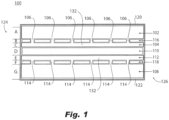
- FIG. 1 a partial view of an embodiment of a system in accordance with the disclosure is shown in Fig. 1 and is designated generally by reference character 100.
- FIGs. 2 Other embodiments of systems in accordance with the disclosure, or aspects thereof, are provided in Figs. 2 , as will be described.
- the systems and methods described herein can be used to provide self-clearing of faults in laminated bus bars.
- the system 100 includes a first bus bar 102.
- a foil element 104 is spaced apart from the first bus bar 102.
- the foil element 104 is electrically connected to the first bus bar 102 by grid elements 106.
- a second bus bar 108 is spaced apart from the foil element 104 across a dielectric layer 110.
- a second foil element 112 is spaced apart from the second bus bar 108.
- the second foil element 112 is electrically connected to the second bus bar 108 by a second set of grid elements 114.
- the second foil element 112 is spaced apart from the first foil element 104 by the dielectric layer 110.
- the first set of grid elements 106 pass through a first dielectric sub-layer 116 that otherwise separates the first bus bar 102 from the first foil element 104.
- the second set of grid elements 114 pass through a second dielectric sub-layer 118 that otherwise separates the second bus bar 108 from the second foil element 112.
- the dielectric layer 110 and the first and second dielectric sub-layers 116 and 118 can each include a dielectric adhesive material for adhering the laminate assembly of the system 100 together.
- the first bus bar 102, the first foil element 104, and the first set of grid elements 106 can be coated with a first plating 120.
- the second bus bar 108, the second foil element 112, and the second set of grid elements 114 may be coated with a second plating 122 that is separate from the first plating 120.
- An external dielectric coats the laminated assembly of the system 100, including coating around the first and second bus bars 102, 108, e.g., coating the upward facing surface of the bus bar 102 and the downward facing surface of the second bus bar 108 as oriented in Fig.
- the first bus bar 102 can have a thickness A that is more than twice the thickness C of the first foil element 104.
- the second bus bar 108 can have a thickness G that is more than twice the thickness E of the second foil element 112.
- the first dielectric sub-layer 116 can have a thickness B that is thicker than the thickness C of the first foil element 104.
- the second dielectric sub-layer 118 can have thickness F that is thicker than the thickness E of the second foil element 112.
- the dielectric layer 110 can have a thickness D that is thinner than the thickness A of the first bus bar and thinner than the thickness G of the second bus bar 108.
- a direct current source 128 can be connected to the first bus bar 102 with a positive potential, and connected to the second bus bar 108 with a negative potential.
- a load 130 can be electrically connected across the first and second bus bars 102, 108, wherein the load is electrically connected through the first and second bus bars 102, 108 to the direct current source 128.
- a method includes powering a load 130 through a laminated bus bar assembly, e.g., system 100.
- the method includes clearing a fault in the laminated bus bar assembly by locally breaking a fusible link within the laminated bus bar assembly, and continuing to power the load 130 through the laminated bus bar assembly after the fault is cleared.
- Locally breaking a fusible link can include breaking a fusible link between a foil element (e.g. foil elements 104, 112) and a bus bar (e.g. bus bars 102, 108) at a grid element (e.g. grid elements 106, 114) electrically connecting the foil element to the bar.
- the fusible link can include a section of the foil element between two of the grid elements (e.g. section 132 of the foil elements 104, 112, not all of which are labeled in Figs. 1 and 2 for sake of clarity) electrically connecting the bus bar to the foil element.
- the load can include utilizing additional fusible links (e.g. grid elements 106, 114 and/or sections 132 of the foil elements 104, 112) within the laminated bus bar assembly to protect against future faults.
- the bus bar can carry low frequency load, wherein the foil element carries only a high frequency transient currents, wherein high and low frequency are relative to one another.
- the systems and method disclosed herein allow for laminate bus bars to self-clear faults and continue operation without cascading failures to surrounding components.
- Such a laminated bus bar can repeatedly clear its own faults without having to replace a line-replaceable unit (LRU) comprising the laminated bus bar.
- LRU line-replaceable unit
Landscapes
- Engineering & Computer Science (AREA)
- Microelectronics & Electronic Packaging (AREA)
- Power Engineering (AREA)
- Chemical & Material Sciences (AREA)
- Chemical Kinetics & Catalysis (AREA)
- Electrochemistry (AREA)
- General Chemical & Material Sciences (AREA)
- Insulated Conductors (AREA)
Description
- The present disclosure relates to electrical systems, and more particularly to laminated bus bars.
- Bus bars carry high voltages. If a fault occurs between two live bus bars, e.g. due to a defect in the insulation separating the two bus bars, the high energy levels can potentially lead to cascading faults. The same can happen if there is a fault between a live bus bar and ground.
- The conventional techniques have been considered satisfactory for their intended purpose. Bus bars are disclosed, for example, in
WO 2013/179433 . However, there is an ever present need for improved systems and methods for bus bars and fault clearing in bus bars. This disclosure provides a solution for this need. - A system is provided as defined by claim 1.
- The first bus bar, the first foil element, and the first set of grid elements can be coated with a first plating. The second bus bar, the second foil element, and the second set of grid elements can be coated with a second plating.
- The first bus bar can have a thickness that is more than twice that of the first foil element. The second bus bar can have a thickness that is more than twice that of the second foil element. The first dielectric sub-layer can be thicker than the first foil element. The second dielectric sub-layer can be thicker than the second foil element. The dielectric layer can be thinner than the first bus bar, wherein the dielectric layer is thinner than the second bus bar. An external dielectric coating around the first and second bus bars can coat laterally along lateral edges of the first and second bus bars, the first and second foil elements, the first and second dielectric sub-layers, and the dielectric layer.
- A direct current source can be connected to the first bus bar with a positive potential, and connected to the second bus bar with a negative potential. A load can be electrically connected across the first and second bus bars, wherein the load is electrically connected through the first and second bus bars to the direct current source.
- A method is provided as defined by claim 10.
- Locally breaking a fusible link can include breaking a fusible link between a foil element and a bus bar at a grid element electrically connecting the foil element to the bar. The fusible link can include a section of the foil element between two grid elements electrically connecting the bus bar to the foil element. Continuing to power the load can include utilizing additional fusible links within the laminated bus bar assembly to protect against future faults. The bus bar can carry a load, wherein the foil element carries only a transient current, wherein the load has a lower frequency than the transient current.
- These and other features of the systems and methods of the subject disclosure will become more readily apparent to those skilled in the art from the following detailed description of the preferred embodiments taken in conjunction with the drawings.
- So that those skilled in the art to which the subject disclosure appertains will readily understand how to make and use the devices and methods of the subject disclosure without undue experimentation, preferred embodiments thereof will be described in detail herein below with reference to certain figures, wherein:
-
Fig. 1 is a schematic side elevation view of an embodiment of a system constructed in accordance with the present disclosure, showing the laminated bus bar assembly; and -
Fig. 2 is a schematic side elevation view of the system ofFig. 1 , showing the fusible links for self-clearing faults. - Reference will now be made to the drawings wherein like reference numerals identify similar structural features or aspects of the subject disclosure. For purposes of explanation and illustration, and not limitation, a partial view of an embodiment of a system in accordance with the disclosure is shown in
Fig. 1 and is designated generally byreference character 100. Other embodiments of systems in accordance with the disclosure, or aspects thereof, are provided inFigs. 2 , as will be described. The systems and methods described herein can be used to provide self-clearing of faults in laminated bus bars. - The
system 100 includes afirst bus bar 102. Afoil element 104 is spaced apart from thefirst bus bar 102. Thefoil element 104 is electrically connected to thefirst bus bar 102 bygrid elements 106. Asecond bus bar 108 is spaced apart from thefoil element 104 across adielectric layer 110. Asecond foil element 112 is spaced apart from thesecond bus bar 108. Thesecond foil element 112 is electrically connected to thesecond bus bar 108 by a second set ofgrid elements 114. Thesecond foil element 112 is spaced apart from thefirst foil element 104 by thedielectric layer 110. - With continued reference to
Fig. 1 , the first set ofgrid elements 106 pass through a firstdielectric sub-layer 116 that otherwise separates thefirst bus bar 102 from thefirst foil element 104. The second set ofgrid elements 114 pass through a seconddielectric sub-layer 118 that otherwise separates thesecond bus bar 108 from thesecond foil element 112. Thedielectric layer 110 and the first and seconddielectric sub-layers system 100 together. - With continued reference to
Fig. 1 , thefirst bus bar 102, thefirst foil element 104, and the first set ofgrid elements 106 can be coated with afirst plating 120. Thesecond bus bar 108, thesecond foil element 112, and the second set ofgrid elements 114 may be coated with asecond plating 122 that is separate from thefirst plating 120. An external dielectric coats the laminated assembly of thesystem 100, including coating around the first andsecond bus bars bus bar 102 and the downward facing surface of thesecond bus bar 108 as oriented inFig. 1 , as well as coating laterally alonglateral edges second foil elements dielectric sub-layers dielectric layer 110. - The
first bus bar 102 can have a thickness A that is more than twice the thickness C of thefirst foil element 104. Thesecond bus bar 108 can have a thickness G that is more than twice the thickness E of thesecond foil element 112. The firstdielectric sub-layer 116 can have a thickness B that is thicker than the thickness C of thefirst foil element 104. The seconddielectric sub-layer 118 can have thickness F that is thicker than the thickness E of thesecond foil element 112. Thedielectric layer 110 can have a thickness D that is thinner than the thickness A of the first bus bar and thinner than the thickness G of thesecond bus bar 108. - With reference now to
Fig. 2 , a directcurrent source 128 can be connected to thefirst bus bar 102 with a positive potential, and connected to thesecond bus bar 108 with a negative potential. Those skilled in the art will readily appreciate that an AC current source could be used in lieu of directcurrent source 128 without departing from the scope of this disclosure. Aload 130 can be electrically connected across the first andsecond bus bars second bus bars current source 128. - With continued reference to
Fig. 2 , a method includes powering aload 130 through a laminated bus bar assembly, e.g.,system 100. The method includes clearing a fault in the laminated bus bar assembly by locally breaking a fusible link within the laminated bus bar assembly, and continuing to power theload 130 through the laminated bus bar assembly after the fault is cleared. Locally breaking a fusible link can include breaking a fusible link between a foil element (e.g. foil elements 104, 112) and a bus bar (e.g. bus bars 102, 108) at a grid element (e.g. grid elements 106, 114) electrically connecting the foil element to the bar. It is also contemplated that the fusible link can include a section of the foil element between two of the grid elements (e.g. section 132 of thefoil elements Figs. 1 and2 for sake of clarity) electrically connecting the bus bar to the foil element. Continuing to power the load can include utilizing additional fusible links (e.g. grid elements sections 132 of thefoil elements 104, 112) within the laminated bus bar assembly to protect against future faults. The bus bar can carry low frequency load, wherein the foil element carries only a high frequency transient currents, wherein high and low frequency are relative to one another. The systems and method disclosed herein allow for laminate bus bars to self-clear faults and continue operation without cascading failures to surrounding components. Such a laminated bus bar can repeatedly clear its own faults without having to replace a line-replaceable unit (LRU) comprising the laminated bus bar. - The methods and systems of the present disclosure, as described above and shown in the drawings, provide for laminated bus bars with self-clearing of faults. While the apparatus and methods of the subject disclosure have been shown and described with reference to preferred embodiments, those skilled in the art will readily appreciate that changes and/or modifications may be made thereto without departing from the scope of the invention as defined by the claims.
Claims (14)
- A system comprising:a first bus bar (102);a foil element (104) spaced apart from the first bus bar, wherein the foil element is electrically connected to the first bus bar by grid elements (106); anda second bus bar (108) spaced apart from the foil element and from the first bus bar across a dielectric layer (110); whereinthe grid elements (106) pass through a first dielectric sub-layer (116) that otherwise separates the first bus bar (102) from the foil element (104); andwherein the foil element is a first foil element, wherein the grid elements are a first set of grid elements, and further comprising a second foil element (112) spaced apart from the second bus bar, wherein the second foil element is electrically connected to the second bus bar by a second set of grid elements (114).
- The system as recited in claim 1, wherein the second foil element is spaced apart from the first foil element by the dielectric layer.
- The system of claim 1, wherein the second set of grid elements pass through a second dielectric sub-layer (118) that otherwise separates the second bus bar from the second foil element.
- The system as recited in any preceding claim, wherein the first bus bar, the first foil element, and the grid elements are coated with a first plating (120) and wherein the second bus bar, the second foil element, and the second set of grid elements are coated with a second plating (122).
- The system as recited in any preceding claim, wherein the first bus bar has a thickness that is more than twice that of the first foil element and wherein the second bus bar has a thickness that is more than twice that of the second foil element.
- The system as recited in any preceding claim, wherein the first dielectric sub-layer is thicker than the first foil element and wherein the second dielectric sub-layer is thicker than the second foil element.
- The system as recited in any preceding claim, wherein the dielectric layer is thinner than the first bus bar, and wherein the dielectric layer is thinner than the second bus bar.
- The system as recited in any preceding claim, further comprising an external dielectric coating around the first and second bus bars that coats laterally along lateral edges of the first and second bus bars, the foil elements, the dielectric sub-layer(s), and the dielectric layer.
- The system as recited in any preceding claim, further comprising a direct current source (128) connected to the first bus bar with a positive potential, and connected to the second bus bar with a negative potential, and optionally further comprising a load (130) electrically connected across the first and second bus bars, wherein the load is electrically connected through the first and second bus bars to the direct current source.
- A method comprising:powering a load through a laminated bus bar assembly being a system as claimed in any preceding claim;clearing a fault in the laminated bus bar assembly by locally breaking a fusible link within the laminated bus bar assembly; andcontinuing to power the load through the laminated bus bar assembly after the fault is cleared.
- The method as recited in claim 10, wherein locally breaking a fusible link includes breaking a fusible link between a foil element and a bus bar at a grid element electrically connecting the foil element to the bus bar.
- The method as recited in claim 11, wherein the fusible link includes a section of the foil element between two grid elements electrically connecting the bus bar to the foil element.
- The method as recited in claim 10 or 11, wherein continuing to power the load includes utilizing additional fusible links within the laminated bus bar assembly to protect against future faults.
- The method as recited in claim 11, 12 or 13, wherein the bus bar carries a load, and wherein the foil element carries only a transient current, wherein the load has a lower frequency than the transient current.
Applications Claiming Priority (1)
| Application Number | Priority Date | Filing Date | Title |
|---|---|---|---|
| US16/596,036 US10998706B2 (en) | 2019-10-08 | 2019-10-08 | Laminated bus bars |
Publications (2)
| Publication Number | Publication Date |
|---|---|
| EP3806255A1 EP3806255A1 (en) | 2021-04-14 |
| EP3806255B1 true EP3806255B1 (en) | 2023-11-22 |
Family
ID=68916334
Family Applications (1)
| Application Number | Title | Priority Date | Filing Date |
|---|---|---|---|
| EP19215924.2A Active EP3806255B1 (en) | 2019-10-08 | 2019-12-13 | Laminated bus bars |
Country Status (2)
| Country | Link |
|---|---|
| US (1) | US10998706B2 (en) |
| EP (1) | EP3806255B1 (en) |
Family Cites Families (18)
| Publication number | Priority date | Publication date | Assignee | Title |
|---|---|---|---|---|
| FR2138403B1 (en) * | 1971-05-25 | 1976-12-03 | Europ Composants Electron | |
| US4236038A (en) * | 1979-07-19 | 1980-11-25 | Rogers Corporation | High capacitance multilayer bus bar and method of manufacture thereof |
| US4451694A (en) | 1981-03-31 | 1984-05-29 | Rogers Corporation | Miniaturized high capacitance bus bar assembly |
| US4436953A (en) * | 1981-03-31 | 1984-03-13 | Rogers Corporation | Bus bar assembly with discrete capacitor elements |
| US4440972A (en) | 1981-03-31 | 1984-04-03 | Rogers Corporation | Miniaturized bus bar with capacitors and method of making same |
| IT1194301B (en) * | 1983-07-06 | 1988-09-14 | Mecondor Spa | METHOD FOR HIGH CAPACITY MANUFACTURING WITH ELECTRICAL CONNECTIONS OBTAINED FOR WELDING, AND RELATED BARS PRODUCED ACCORDING TO THIS METHOD |
| US4908258A (en) * | 1988-08-01 | 1990-03-13 | Rogers Corporation | High dielectric constant flexible sheet material |
| US5051542A (en) * | 1988-08-01 | 1991-09-24 | Rogers Corporation | Low impedance bus bar |
| GB9621352D0 (en) * | 1996-10-11 | 1996-12-04 | Tunewell Technology Ltd | Improvements in or relating to a power distribution line |
| US6452776B1 (en) * | 2000-04-06 | 2002-09-17 | Intel Corporation | Capacitor with defect isolation and bypass |
| US6870134B2 (en) * | 2002-02-01 | 2005-03-22 | Centre Luxembourgeois De Recherches Pour Le Verre Et La Ceramique S.A. (C.R.V.C.) | Heatable vehicle windshield with bus bars including braided and printed portions |
| US7557298B2 (en) * | 2002-10-14 | 2009-07-07 | World Properties, Inc. | Laminated bus bar assembly |
| WO2011093239A1 (en) * | 2010-01-27 | 2011-08-04 | 株式会社日立製作所 | Power distribution mounting component and inverter apparatus using same |
| US9979173B2 (en) * | 2011-04-29 | 2018-05-22 | Ge Energy Power Conversion Technology Limited | Bus bar assembly and method of manufacturing same |
| WO2013179433A1 (en) | 2012-05-31 | 2013-12-05 | 株式会社日立製作所 | Bus bar and power conversion device |
| TWM537780U (en) * | 2016-08-15 | 2017-03-01 | 光寶電子(廣州)有限公司 | Current conducting device and cabinet having the same |
| WO2018047407A1 (en) * | 2016-09-06 | 2018-03-15 | 三洋電機株式会社 | Method for connecting bus bar, printed board, and switch device |
| US10021802B2 (en) * | 2016-09-19 | 2018-07-10 | General Electric Company | Electronic module assembly having low loop inductance |
-
2019
- 2019-10-08 US US16/596,036 patent/US10998706B2/en active Active
- 2019-12-13 EP EP19215924.2A patent/EP3806255B1/en active Active
Also Published As
| Publication number | Publication date |
|---|---|
| US10998706B2 (en) | 2021-05-04 |
| EP3806255A1 (en) | 2021-04-14 |
| US20210104882A1 (en) | 2021-04-08 |
Similar Documents
| Publication | Publication Date | Title |
|---|---|---|
| CA2852598C (en) | Wind turbine rotor blade having an electrical heating device and a plurality of lightning conductors | |
| DK2927044T3 (en) | Method of operating parallel auxiliary drive inverters in a rail vehicle | |
| US10330087B2 (en) | Lightning protection system for wind turbine blades with an effective injection area to carbon fiber laminates and a balanced lightning current and voltage distribution between different conductive paths | |
| US9907172B2 (en) | DC link capacitor bank | |
| US10014817B2 (en) | Flexible solar generator provided with electrical protection against the impact of celestial objects, spacecraft and satellite comprising at least one such solar generator | |
| EP2781452B1 (en) | Electromagnetic energy surface protection | |
| US8111496B2 (en) | Earthing arrangement for a DC electrical system and a method of operating an earthing arrangement for a DC electrical system | |
| US9087670B2 (en) | Electric potential control of high voltage insulation | |
| EP3140841B1 (en) | Capacitor bank, power cell and variable frequency drive | |
| US20090322147A1 (en) | Aircraft with isolated ground | |
| EP3806255B1 (en) | Laminated bus bars | |
| US20200214124A1 (en) | Printed circuit board structure including fusible ground plane | |
| CN105322697A (en) | Bearing insulation | |
| JP5659970B2 (en) | Solar panel | |
| JP2001510637A (en) | High energy density capacitor film and capacitor made therefrom | |
| EP3416256B1 (en) | High voltage direct current converter harmonic filtering and protection system | |
| EP3282536A1 (en) | Transient voltage protection circuits | |
| RU2689978C1 (en) | Power capacitor unit for high pressure applications | |
| RU2775893C1 (en) | Lightning-proof bus for attachment of composite panel to metal frame of unit | |
| EP3128630A1 (en) | Method for electrical separation of the metallic sheath a hvdc mi cable | |
| CN114914765B (en) | Use of laminated structure in busbar system of wind turbine and wind turbine | |
| EP2501022B1 (en) | Generator rotor and bleed resistor assembly | |
| EP2952737A1 (en) | Bearing insulation | |
| perumal | An Innovative Bulkhead Design to Replace the Bulkhead Holes |
Legal Events
| Date | Code | Title | Description |
|---|---|---|---|
| PUAI | Public reference made under article 153(3) epc to a published international application that has entered the european phase |
Free format text: ORIGINAL CODE: 0009012 |
|
| STAA | Information on the status of an ep patent application or granted ep patent |
Free format text: STATUS: THE APPLICATION HAS BEEN PUBLISHED |
|
| AK | Designated contracting states |
Kind code of ref document: A1 Designated state(s): AL AT BE BG CH CY CZ DE DK EE ES FI FR GB GR HR HU IE IS IT LI LT LU LV MC MK MT NL NO PL PT RO RS SE SI SK SM TR |
|
| AX | Request for extension of the european patent |
Extension state: BA ME |
|
| STAA | Information on the status of an ep patent application or granted ep patent |
Free format text: STATUS: REQUEST FOR EXAMINATION WAS MADE |
|
| 17P | Request for examination filed |
Effective date: 20211014 |
|
| RBV | Designated contracting states (corrected) |
Designated state(s): AL AT BE BG CH CY CZ DE DK EE ES FI FR GB GR HR HU IE IS IT LI LT LU LV MC MK MT NL NO PL PT RO RS SE SI SK SM TR |
|
| STAA | Information on the status of an ep patent application or granted ep patent |
Free format text: STATUS: EXAMINATION IS IN PROGRESS |
|
| 17Q | First examination report despatched |
Effective date: 20230228 |
|
| GRAP | Despatch of communication of intention to grant a patent |
Free format text: ORIGINAL CODE: EPIDOSNIGR1 |
|
| STAA | Information on the status of an ep patent application or granted ep patent |
Free format text: STATUS: GRANT OF PATENT IS INTENDED |
|
| RIC1 | Information provided on ipc code assigned before grant |
Ipc: H01M 50/505 20210101ALI20230522BHEP Ipc: H01H 85/046 20060101ALI20230522BHEP Ipc: H02G 5/00 20060101AFI20230522BHEP |
|
| INTG | Intention to grant announced |
Effective date: 20230606 |
|
| GRAS | Grant fee paid |
Free format text: ORIGINAL CODE: EPIDOSNIGR3 |
|
| GRAA | (expected) grant |
Free format text: ORIGINAL CODE: 0009210 |
|
| STAA | Information on the status of an ep patent application or granted ep patent |
Free format text: STATUS: THE PATENT HAS BEEN GRANTED |
|
| AK | Designated contracting states |
Kind code of ref document: B1 Designated state(s): AL AT BE BG CH CY CZ DE DK EE ES FI FR GB GR HR HU IE IS IT LI LT LU LV MC MK MT NL NO PL PT RO RS SE SI SK SM TR |
|
| REG | Reference to a national code |
Ref country code: GB Ref legal event code: FG4D |
|
| REG | Reference to a national code |
Ref country code: CH Ref legal event code: EP |
|
| REG | Reference to a national code |
Ref country code: DE Ref legal event code: R096 Ref document number: 602019041811 Country of ref document: DE |
|
| REG | Reference to a national code |
Ref country code: IE Ref legal event code: FG4D |
|
| REG | Reference to a national code |
Ref country code: LT Ref legal event code: MG9D |
|
| REG | Reference to a national code |
Ref country code: NL Ref legal event code: MP Effective date: 20231122 |
|
| PG25 | Lapsed in a contracting state [announced via postgrant information from national office to epo] |
Ref country code: GR Free format text: LAPSE BECAUSE OF FAILURE TO SUBMIT A TRANSLATION OF THE DESCRIPTION OR TO PAY THE FEE WITHIN THE PRESCRIBED TIME-LIMIT Effective date: 20240223 |
|
| PG25 | Lapsed in a contracting state [announced via postgrant information from national office to epo] |
Ref country code: IS Free format text: LAPSE BECAUSE OF FAILURE TO SUBMIT A TRANSLATION OF THE DESCRIPTION OR TO PAY THE FEE WITHIN THE PRESCRIBED TIME-LIMIT Effective date: 20240322 |
|
| PG25 | Lapsed in a contracting state [announced via postgrant information from national office to epo] |
Ref country code: LT Free format text: LAPSE BECAUSE OF FAILURE TO SUBMIT A TRANSLATION OF THE DESCRIPTION OR TO PAY THE FEE WITHIN THE PRESCRIBED TIME-LIMIT Effective date: 20231122 |
|
| REG | Reference to a national code |
Ref country code: AT Ref legal event code: MK05 Ref document number: 1634739 Country of ref document: AT Kind code of ref document: T Effective date: 20231122 |
|
| PG25 | Lapsed in a contracting state [announced via postgrant information from national office to epo] |
Ref country code: NL Free format text: LAPSE BECAUSE OF FAILURE TO SUBMIT A TRANSLATION OF THE DESCRIPTION OR TO PAY THE FEE WITHIN THE PRESCRIBED TIME-LIMIT Effective date: 20231122 |
|
| PG25 | Lapsed in a contracting state [announced via postgrant information from national office to epo] |
Ref country code: AT Free format text: LAPSE BECAUSE OF FAILURE TO SUBMIT A TRANSLATION OF THE DESCRIPTION OR TO PAY THE FEE WITHIN THE PRESCRIBED TIME-LIMIT Effective date: 20231122 |
|
| PG25 | Lapsed in a contracting state [announced via postgrant information from national office to epo] |
Ref country code: ES Free format text: LAPSE BECAUSE OF FAILURE TO SUBMIT A TRANSLATION OF THE DESCRIPTION OR TO PAY THE FEE WITHIN THE PRESCRIBED TIME-LIMIT Effective date: 20231122 |
|
| PG25 | Lapsed in a contracting state [announced via postgrant information from national office to epo] |
Ref country code: NL Free format text: LAPSE BECAUSE OF FAILURE TO SUBMIT A TRANSLATION OF THE DESCRIPTION OR TO PAY THE FEE WITHIN THE PRESCRIBED TIME-LIMIT Effective date: 20231122 Ref country code: LT Free format text: LAPSE BECAUSE OF FAILURE TO SUBMIT A TRANSLATION OF THE DESCRIPTION OR TO PAY THE FEE WITHIN THE PRESCRIBED TIME-LIMIT Effective date: 20231122 Ref country code: IS Free format text: LAPSE BECAUSE OF FAILURE TO SUBMIT A TRANSLATION OF THE DESCRIPTION OR TO PAY THE FEE WITHIN THE PRESCRIBED TIME-LIMIT Effective date: 20240322 Ref country code: GR Free format text: LAPSE BECAUSE OF FAILURE TO SUBMIT A TRANSLATION OF THE DESCRIPTION OR TO PAY THE FEE WITHIN THE PRESCRIBED TIME-LIMIT Effective date: 20240223 Ref country code: ES Free format text: LAPSE BECAUSE OF FAILURE TO SUBMIT A TRANSLATION OF THE DESCRIPTION OR TO PAY THE FEE WITHIN THE PRESCRIBED TIME-LIMIT Effective date: 20231122 Ref country code: BG Free format text: LAPSE BECAUSE OF FAILURE TO SUBMIT A TRANSLATION OF THE DESCRIPTION OR TO PAY THE FEE WITHIN THE PRESCRIBED TIME-LIMIT Effective date: 20240222 Ref country code: AT Free format text: LAPSE BECAUSE OF FAILURE TO SUBMIT A TRANSLATION OF THE DESCRIPTION OR TO PAY THE FEE WITHIN THE PRESCRIBED TIME-LIMIT Effective date: 20231122 Ref country code: PT Free format text: LAPSE BECAUSE OF FAILURE TO SUBMIT A TRANSLATION OF THE DESCRIPTION OR TO PAY THE FEE WITHIN THE PRESCRIBED TIME-LIMIT Effective date: 20240322 |
|
| PG25 | Lapsed in a contracting state [announced via postgrant information from national office to epo] |
Ref country code: SE Free format text: LAPSE BECAUSE OF FAILURE TO SUBMIT A TRANSLATION OF THE DESCRIPTION OR TO PAY THE FEE WITHIN THE PRESCRIBED TIME-LIMIT Effective date: 20231122 Ref country code: RS Free format text: LAPSE BECAUSE OF FAILURE TO SUBMIT A TRANSLATION OF THE DESCRIPTION OR TO PAY THE FEE WITHIN THE PRESCRIBED TIME-LIMIT Effective date: 20231122 Ref country code: PL Free format text: LAPSE BECAUSE OF FAILURE TO SUBMIT A TRANSLATION OF THE DESCRIPTION OR TO PAY THE FEE WITHIN THE PRESCRIBED TIME-LIMIT Effective date: 20231122 Ref country code: NO Free format text: LAPSE BECAUSE OF FAILURE TO SUBMIT A TRANSLATION OF THE DESCRIPTION OR TO PAY THE FEE WITHIN THE PRESCRIBED TIME-LIMIT Effective date: 20240222 Ref country code: LV Free format text: LAPSE BECAUSE OF FAILURE TO SUBMIT A TRANSLATION OF THE DESCRIPTION OR TO PAY THE FEE WITHIN THE PRESCRIBED TIME-LIMIT Effective date: 20231122 Ref country code: HR Free format text: LAPSE BECAUSE OF FAILURE TO SUBMIT A TRANSLATION OF THE DESCRIPTION OR TO PAY THE FEE WITHIN THE PRESCRIBED TIME-LIMIT Effective date: 20231122 |
|
| PG25 | Lapsed in a contracting state [announced via postgrant information from national office to epo] |
Ref country code: DK Free format text: LAPSE BECAUSE OF FAILURE TO SUBMIT A TRANSLATION OF THE DESCRIPTION OR TO PAY THE FEE WITHIN THE PRESCRIBED TIME-LIMIT Effective date: 20231122 |
|
| PG25 | Lapsed in a contracting state [announced via postgrant information from national office to epo] |
Ref country code: CZ Free format text: LAPSE BECAUSE OF FAILURE TO SUBMIT A TRANSLATION OF THE DESCRIPTION OR TO PAY THE FEE WITHIN THE PRESCRIBED TIME-LIMIT Effective date: 20231122 |
|
| PG25 | Lapsed in a contracting state [announced via postgrant information from national office to epo] |
Ref country code: SK Free format text: LAPSE BECAUSE OF FAILURE TO SUBMIT A TRANSLATION OF THE DESCRIPTION OR TO PAY THE FEE WITHIN THE PRESCRIBED TIME-LIMIT Effective date: 20231122 |
|
| PG25 | Lapsed in a contracting state [announced via postgrant information from national office to epo] |
Ref country code: SM Free format text: LAPSE BECAUSE OF FAILURE TO SUBMIT A TRANSLATION OF THE DESCRIPTION OR TO PAY THE FEE WITHIN THE PRESCRIBED TIME-LIMIT Effective date: 20231122 Ref country code: SK Free format text: LAPSE BECAUSE OF FAILURE TO SUBMIT A TRANSLATION OF THE DESCRIPTION OR TO PAY THE FEE WITHIN THE PRESCRIBED TIME-LIMIT Effective date: 20231122 Ref country code: RO Free format text: LAPSE BECAUSE OF FAILURE TO SUBMIT A TRANSLATION OF THE DESCRIPTION OR TO PAY THE FEE WITHIN THE PRESCRIBED TIME-LIMIT Effective date: 20231122 Ref country code: IT Free format text: LAPSE BECAUSE OF FAILURE TO SUBMIT A TRANSLATION OF THE DESCRIPTION OR TO PAY THE FEE WITHIN THE PRESCRIBED TIME-LIMIT Effective date: 20231122 Ref country code: EE Free format text: LAPSE BECAUSE OF FAILURE TO SUBMIT A TRANSLATION OF THE DESCRIPTION OR TO PAY THE FEE WITHIN THE PRESCRIBED TIME-LIMIT Effective date: 20231122 Ref country code: DK Free format text: LAPSE BECAUSE OF FAILURE TO SUBMIT A TRANSLATION OF THE DESCRIPTION OR TO PAY THE FEE WITHIN THE PRESCRIBED TIME-LIMIT Effective date: 20231122 Ref country code: CZ Free format text: LAPSE BECAUSE OF FAILURE TO SUBMIT A TRANSLATION OF THE DESCRIPTION OR TO PAY THE FEE WITHIN THE PRESCRIBED TIME-LIMIT Effective date: 20231122 |
|
| REG | Reference to a national code |
Ref country code: CH Ref legal event code: PL |
|
| PG25 | Lapsed in a contracting state [announced via postgrant information from national office to epo] |
Ref country code: LU Free format text: LAPSE BECAUSE OF NON-PAYMENT OF DUE FEES Effective date: 20231213 |
|
| REG | Reference to a national code |
Ref country code: DE Ref legal event code: R097 Ref document number: 602019041811 Country of ref document: DE |
|
| PG25 | Lapsed in a contracting state [announced via postgrant information from national office to epo] |
Ref country code: MC Free format text: LAPSE BECAUSE OF FAILURE TO SUBMIT A TRANSLATION OF THE DESCRIPTION OR TO PAY THE FEE WITHIN THE PRESCRIBED TIME-LIMIT Effective date: 20231122 |
|
| REG | Reference to a national code |
Ref country code: BE Ref legal event code: MM Effective date: 20231231 |
|
| PG25 | Lapsed in a contracting state [announced via postgrant information from national office to epo] |
Ref country code: MC Free format text: LAPSE BECAUSE OF FAILURE TO SUBMIT A TRANSLATION OF THE DESCRIPTION OR TO PAY THE FEE WITHIN THE PRESCRIBED TIME-LIMIT Effective date: 20231122 Ref country code: LU Free format text: LAPSE BECAUSE OF NON-PAYMENT OF DUE FEES Effective date: 20231213 |
|
| PLBE | No opposition filed within time limit |
Free format text: ORIGINAL CODE: 0009261 |
|
| STAA | Information on the status of an ep patent application or granted ep patent |
Free format text: STATUS: NO OPPOSITION FILED WITHIN TIME LIMIT |
|
| REG | Reference to a national code |
Ref country code: IE Ref legal event code: MM4A |
|
| PG25 | Lapsed in a contracting state [announced via postgrant information from national office to epo] |
Ref country code: IE Free format text: LAPSE BECAUSE OF NON-PAYMENT OF DUE FEES Effective date: 20231213 |
|
| PG25 | Lapsed in a contracting state [announced via postgrant information from national office to epo] |
Ref country code: BE Free format text: LAPSE BECAUSE OF NON-PAYMENT OF DUE FEES Effective date: 20231231 |
|
| PG25 | Lapsed in a contracting state [announced via postgrant information from national office to epo] |
Ref country code: CH Free format text: LAPSE BECAUSE OF NON-PAYMENT OF DUE FEES Effective date: 20231231 |
|
| PG25 | Lapsed in a contracting state [announced via postgrant information from national office to epo] |
Ref country code: SI Free format text: LAPSE BECAUSE OF FAILURE TO SUBMIT A TRANSLATION OF THE DESCRIPTION OR TO PAY THE FEE WITHIN THE PRESCRIBED TIME-LIMIT Effective date: 20231122 |
|
| 26N | No opposition filed |
Effective date: 20240823 |
|
| PG25 | Lapsed in a contracting state [announced via postgrant information from national office to epo] |
Ref country code: SI Free format text: LAPSE BECAUSE OF FAILURE TO SUBMIT A TRANSLATION OF THE DESCRIPTION OR TO PAY THE FEE WITHIN THE PRESCRIBED TIME-LIMIT Effective date: 20231122 Ref country code: IE Free format text: LAPSE BECAUSE OF NON-PAYMENT OF DUE FEES Effective date: 20231213 Ref country code: CH Free format text: LAPSE BECAUSE OF NON-PAYMENT OF DUE FEES Effective date: 20231231 Ref country code: BE Free format text: LAPSE BECAUSE OF NON-PAYMENT OF DUE FEES Effective date: 20231231 |
|
| PG25 | Lapsed in a contracting state [announced via postgrant information from national office to epo] |
Ref country code: FI Free format text: LAPSE BECAUSE OF FAILURE TO SUBMIT A TRANSLATION OF THE DESCRIPTION OR TO PAY THE FEE WITHIN THE PRESCRIBED TIME-LIMIT Effective date: 20231122 |
|
| PG25 | Lapsed in a contracting state [announced via postgrant information from national office to epo] |
Ref country code: CY Free format text: LAPSE BECAUSE OF FAILURE TO SUBMIT A TRANSLATION OF THE DESCRIPTION OR TO PAY THE FEE WITHIN THE PRESCRIBED TIME-LIMIT; INVALID AB INITIO Effective date: 20191213 |
|
| PG25 | Lapsed in a contracting state [announced via postgrant information from national office to epo] |
Ref country code: HU Free format text: LAPSE BECAUSE OF FAILURE TO SUBMIT A TRANSLATION OF THE DESCRIPTION OR TO PAY THE FEE WITHIN THE PRESCRIBED TIME-LIMIT; INVALID AB INITIO Effective date: 20191213 |
|
| PG25 | Lapsed in a contracting state [announced via postgrant information from national office to epo] |
Ref country code: TR Free format text: LAPSE BECAUSE OF FAILURE TO SUBMIT A TRANSLATION OF THE DESCRIPTION OR TO PAY THE FEE WITHIN THE PRESCRIBED TIME-LIMIT Effective date: 20231122 |
|
| PGFP | Annual fee paid to national office [announced via postgrant information from national office to epo] |
Ref country code: DE Payment date: 20251126 Year of fee payment: 7 |
|
| PGFP | Annual fee paid to national office [announced via postgrant information from national office to epo] |
Ref country code: GB Payment date: 20251120 Year of fee payment: 7 |
|
| PGFP | Annual fee paid to national office [announced via postgrant information from national office to epo] |
Ref country code: FR Payment date: 20251120 Year of fee payment: 7 |
|
| P01 | Opt-out of the competence of the unified patent court (upc) registered |
Free format text: CASE NUMBER: UPC_APP_0018914_3806255/2025 Effective date: 20251222 |