EP3806178B1 - Battery module - Google Patents
Battery module Download PDFInfo
- Publication number
- EP3806178B1 EP3806178B1 EP20827983.6A EP20827983A EP3806178B1 EP 3806178 B1 EP3806178 B1 EP 3806178B1 EP 20827983 A EP20827983 A EP 20827983A EP 3806178 B1 EP3806178 B1 EP 3806178B1
- Authority
- EP
- European Patent Office
- Prior art keywords
- output electrode
- battery module
- limiting element
- electrode base
- plate
- Prior art date
- Legal status (The legal status is an assumption and is not a legal conclusion. Google has not performed a legal analysis and makes no representation as to the accuracy of the status listed.)
- Active
Links
Images



Classifications
-
- H—ELECTRICITY
- H01—ELECTRIC ELEMENTS
- H01M—PROCESSES OR MEANS, e.g. BATTERIES, FOR THE DIRECT CONVERSION OF CHEMICAL ENERGY INTO ELECTRICAL ENERGY
- H01M10/00—Secondary cells; Manufacture thereof
- H01M10/04—Construction or manufacture in general
- H01M10/0481—Compression means other than compression means for stacks of electrodes and separators
-
- H—ELECTRICITY
- H01—ELECTRIC ELEMENTS
- H01M—PROCESSES OR MEANS, e.g. BATTERIES, FOR THE DIRECT CONVERSION OF CHEMICAL ENERGY INTO ELECTRICAL ENERGY
- H01M50/00—Constructional details or processes of manufacture of the non-active parts of electrochemical cells other than fuel cells, e.g. hybrid cells
- H01M50/20—Mountings; Secondary casings or frames; Racks, modules or packs; Suspension devices; Shock absorbers; Transport or carrying devices; Holders
- H01M50/204—Racks, modules or packs for multiple batteries or multiple cells
- H01M50/207—Racks, modules or packs for multiple batteries or multiple cells characterised by their shape
- H01M50/209—Racks, modules or packs for multiple batteries or multiple cells characterised by their shape adapted for prismatic or rectangular cells
-
- H—ELECTRICITY
- H01—ELECTRIC ELEMENTS
- H01M—PROCESSES OR MEANS, e.g. BATTERIES, FOR THE DIRECT CONVERSION OF CHEMICAL ENERGY INTO ELECTRICAL ENERGY
- H01M10/00—Secondary cells; Manufacture thereof
- H01M10/04—Construction or manufacture in general
- H01M10/0468—Compression means for stacks of electrodes and separators
-
- H—ELECTRICITY
- H01—ELECTRIC ELEMENTS
- H01M—PROCESSES OR MEANS, e.g. BATTERIES, FOR THE DIRECT CONVERSION OF CHEMICAL ENERGY INTO ELECTRICAL ENERGY
- H01M50/00—Constructional details or processes of manufacture of the non-active parts of electrochemical cells other than fuel cells, e.g. hybrid cells
- H01M50/20—Mountings; Secondary casings or frames; Racks, modules or packs; Suspension devices; Shock absorbers; Transport or carrying devices; Holders
- H01M50/204—Racks, modules or packs for multiple batteries or multiple cells
-
- H—ELECTRICITY
- H01—ELECTRIC ELEMENTS
- H01M—PROCESSES OR MEANS, e.g. BATTERIES, FOR THE DIRECT CONVERSION OF CHEMICAL ENERGY INTO ELECTRICAL ENERGY
- H01M50/00—Constructional details or processes of manufacture of the non-active parts of electrochemical cells other than fuel cells, e.g. hybrid cells
- H01M50/20—Mountings; Secondary casings or frames; Racks, modules or packs; Suspension devices; Shock absorbers; Transport or carrying devices; Holders
- H01M50/262—Mountings; Secondary casings or frames; Racks, modules or packs; Suspension devices; Shock absorbers; Transport or carrying devices; Holders with fastening means, e.g. locks
- H01M50/264—Mountings; Secondary casings or frames; Racks, modules or packs; Suspension devices; Shock absorbers; Transport or carrying devices; Holders with fastening means, e.g. locks for cells or batteries, e.g. straps, tie rods or peripheral frames
-
- H—ELECTRICITY
- H01—ELECTRIC ELEMENTS
- H01M—PROCESSES OR MEANS, e.g. BATTERIES, FOR THE DIRECT CONVERSION OF CHEMICAL ENERGY INTO ELECTRICAL ENERGY
- H01M50/00—Constructional details or processes of manufacture of the non-active parts of electrochemical cells other than fuel cells, e.g. hybrid cells
- H01M50/20—Mountings; Secondary casings or frames; Racks, modules or packs; Suspension devices; Shock absorbers; Transport or carrying devices; Holders
- H01M50/296—Mountings; Secondary casings or frames; Racks, modules or packs; Suspension devices; Shock absorbers; Transport or carrying devices; Holders characterised by terminals of battery packs
-
- H—ELECTRICITY
- H01—ELECTRIC ELEMENTS
- H01M—PROCESSES OR MEANS, e.g. BATTERIES, FOR THE DIRECT CONVERSION OF CHEMICAL ENERGY INTO ELECTRICAL ENERGY
- H01M50/00—Constructional details or processes of manufacture of the non-active parts of electrochemical cells other than fuel cells, e.g. hybrid cells
- H01M50/50—Current conducting connections for cells or batteries
- H01M50/543—Terminals
-
- Y—GENERAL TAGGING OF NEW TECHNOLOGICAL DEVELOPMENTS; GENERAL TAGGING OF CROSS-SECTIONAL TECHNOLOGIES SPANNING OVER SEVERAL SECTIONS OF THE IPC; TECHNICAL SUBJECTS COVERED BY FORMER USPC CROSS-REFERENCE ART COLLECTIONS [XRACs] AND DIGESTS
- Y02—TECHNOLOGIES OR APPLICATIONS FOR MITIGATION OR ADAPTATION AGAINST CLIMATE CHANGE
- Y02E—REDUCTION OF GREENHOUSE GAS [GHG] EMISSIONS, RELATED TO ENERGY GENERATION, TRANSMISSION OR DISTRIBUTION
- Y02E60/00—Enabling technologies; Technologies with a potential or indirect contribution to GHG emissions mitigation
- Y02E60/10—Energy storage using batteries
-
- Y—GENERAL TAGGING OF NEW TECHNOLOGICAL DEVELOPMENTS; GENERAL TAGGING OF CROSS-SECTIONAL TECHNOLOGIES SPANNING OVER SEVERAL SECTIONS OF THE IPC; TECHNICAL SUBJECTS COVERED BY FORMER USPC CROSS-REFERENCE ART COLLECTIONS [XRACs] AND DIGESTS
- Y02—TECHNOLOGIES OR APPLICATIONS FOR MITIGATION OR ADAPTATION AGAINST CLIMATE CHANGE
- Y02P—CLIMATE CHANGE MITIGATION TECHNOLOGIES IN THE PRODUCTION OR PROCESSING OF GOODS
- Y02P70/00—Climate change mitigation technologies in the production process for final industrial or consumer products
- Y02P70/50—Manufacturing or production processes characterised by the final manufactured product
Definitions
- Embodiments of this application relate to the field of energy storage devices, and in particular, to a battery module.
- a battery module usually includes an end plate and an output electrode base.
- the end plate is configured to compress a plurality of battery cells.
- the output electrode base is mounted on the end plate and is configured to secure an output electrode of the battery module.
- An exemplary battery module of the generic kind is disclosed in CN 207 896 173 U .
- the output electrode base is mounted to the end plate, the output electrode base is prone to falling off during transport. Therefore, it is necessary to design a new battery module to prevent the output electrode base from falling off the end plate during transport.
- This application provides a battery module to solve a prior-art problem and prevent an output electrode base from falling off during transport.
- this application provides a battery module, including an output electrode base and an end plate, where the output electrode base is inserted into and fitted to the end plate;
- the end plate includes a body
- a through groove is provided in the base plate
- the through groove includes an opening, and the opening is disposed away from the first end of the second limiting element.
- the second limiting element includes an elastic section
- the second limiting element includes a fixed section and the elastic section
- a thickness of the elastic section is less than a thickness of the fixed section.
- an angle ⁇ between the elastic section and the fixed section meets: 90° ⁇ 180°.
- the angle ⁇ between the elastic section and the fixed section meets: 135° ⁇ 170°.
- the first limiting element and the second limiting element are disposed on the output electrode base, and the limiting plate and the stop hole are disposed on the end plate.
- the first limiting element is fitted to the limiting plate to limit the relative movement of the output electrode base and the end plate along the first direction
- the second limiting element is fitted to the stop hole to limit the relative movement of the output electrode base and the end plate along the second direction, thereby improving connection reliability of the output electrode base during transport.
- the second limiting element is accommodated in the stop hole.
- the output electrode base is inserted into a slot without interference and further inserted until the first limiting element is fitted to the limiting plate, thereby facilitating an assembly process of the output electrode base.
- no interfering object is disposed on a side of the end plate facing away from the limiting plate, and installation space of a battery cell near the end plate is neither occupied, thereby improving energy density of the battery module.
- FIG. 1 is a schematic structural diagram of a battery module according to an embodiment of this application.
- FIG. 2 is a schematic exploded view of fitting of an output electrode base to an end plate in a battery module according to an embodiment of this application.
- FIG. 3 is a schematic structural diagram of an angle of an output electrode base in a battery module according to an embodiment of this application.
- FIG. 4 is a schematic structural diagram of another angle of an output electrode base in a battery module according to an embodiment of this application.
- an embodiment of this application provides a battery module 100, including an output electrode base 1 and an end plate 2.
- the end plate 2 may be made of a metal material.
- the output electrode base 1 is configured to provide insulation protection for an output electrode of the battery module 100, and may be made of a plastic material.
- the output electrode base 1 is inserted into and fitted to the end plate 2.
- the output electrode base 1 may be inserted into the end plate 2 in a length direction X of the battery module 100.
- the output electrode base 1 may alternatively be inserted into and fitted to the end plate 2 in another direction of the battery module 100.
- an insertion element 13 is disposed on the output electrode base 1 and a slot 23 is provided in the end plate 2.
- the slot 23 extends along the length direction X of the battery module 100
- the insertion element 13 also extends along the length direction X of the battery module 100
- the insertion element 13 is inserted into the slot 23.
- the slot 23 may be in an approximate swallow-tail shape
- the insertion element 13 may also have an outline of an approximate swallow-tail shape, so as to limit relative movement of the output electrode base 1 on the end plate 2 along a height direction Z and a width direction Y of the battery module 100.
- a first limiting element 14 is disposed on the output electrode base 1.
- the first limiting element 14 may be an end surface formed at one end of the insertion element 13, or may be a projection or another structure fixed on the insertion element 13 or fixed on another position of the output electrode base 1.
- the first limiting element 14 is an end surface formed at one end of the insertion element 13.
- a limiting plate 24 is disposed on the end plate 2, and the limiting plate 24 may extend upward along the height direction Z of the battery module to form a barrier to the first limiting element 14.
- the first limiting element 14 is fitted to the limiting plate 24 to limit relative movement of the output electrode base 1 and the end plate 2 along a first direction X1. In this way, after the output electrode base 1 is mounted to the end plate 2, the output electrode base 1 does not fall off along the first direction X1 when the end plate 2 and the output electrode base 1 are tilted or overturned during transport of the output electrode base 1 and the end plate 2.
- a stop hole 22 is provided in one of the output electrode base 1 and the end plate 2, and a second limiting element 12 is disposed on the other.
- the second limiting element 12 is accommodated in the stop hole 22.
- the second limiting element 12 is disposed on the output electrode base 1, and the stop hole 22 is provided in the end plate 2.
- the second limiting element 12 is fitted to the stop hole 22 to limit the relative movement of the output electrode base 1 and the end plate 2 along a second direction X2.
- An extension direction of the first direction X1 is opposite to an extension direction of the second direction X2.
- the first direction X1 and the second direction X2 are two opposite directions in the length direction X of the battery module 100.
- the second limiting element 12 is disposed on the output electrode base 1, the stop hole 22 is provided in the end plate 2, and the second limiting element 12 is accommodated in the stop hole 22.
- the output electrode base is inserted into a slot 23 without interference and further inserted until the first limiting element 14 is fitted to the limiting plate 24, thereby facilitating an assembly process of the output electrode base.
- no interfering object is disposed on a side of the end plate 2 facing away from the limiting plate 24, and installation space of a battery cell near the end plate 2 is neither occupied, thereby improving energy density of the battery module 100.
- the output electrode base 1 does not fall off because the first limiting element 14 is fitted to the limiting plate 24. If the output electrode base 1 and the end plate 2 are tilted or overturned along the second direction X2, the output electrode base 1 neither falls off because the second limiting element 12 is fitted to the stop hole 22, thereby improving connection reliability between the output electrode base 1 and the end plate 2 during transport.
- the end plate 2 includes a body 21, and the stop hole 22 is provided in the body 21 along the height direction Z of the battery module 100.
- the output electrode base 1 includes a base plate 11, and the second limiting element 12 protrudes from the base plate 11 along the height direction Z of the battery module 100.
- the insertion element 13 of the output electrode base 1 is inserted into the slot 23 of the end plate 2.
- the second limiting element 12 is accommodated in the stop hole 22.
- the second limiting element 12 may not be in contact with a hole wall 221 of the stop hole 22, or the second limiting element 12 comes in contact with the hole wall 221, but the two do not press against and interfere with each other.
- the second limiting element 12 may press against and interfere with the hole wall 221 of the stop hole 22 to prevent the output electrode base 1 from falling off.
- the second limiting element 12 is disposed on the base plate 11 of the output electrode base 1, and an existing hole in the body 21 of the end plate 2 is used as the stop hole 22. Therefore, occupied space can be reduced, and the energy density of the battery module 100 can be improved.
- a through groove 111 is provided in the base plate 11. As shown in FIG. 4 , a first end 12a of the second limiting element 12 is connected to an inner wall of the through groove 111, and there is a gap between parts, other than the first end 12a, of the second limiting element 12 and the inner wall of the through groove 111.
- the through groove 111 is formed during processing of the second limiting element 12.
- the gap provided in the through groove 111 also makes the second limiting element 12 elastic to some extent.
- the second limiting element 12 is elastically deformed to enter the stop hole 22.
- the through groove 111 includes an opening 111a, and the opening 111a is disposed away from the first end 12a of the second limiting element 12.
- the through groove 111 with the opening 111a can be obtained by means of a simple cutting process, and therefore the second limiting element 12 can be obtained by means of a relatively simple cutting process.
- disposition of the opening 111a also makes the output electrode base 1 lighter and further improves the energy density of the battery module 100.
- FIG. 5 is a schematic structural diagram of another output electrode base in a battery module according to an embodiment of this application, and FIG. 6 is an enlarged view of position A in FIG. 5 .
- a second limiting element 12 includes an elastic section 121.
- a through groove 111 is provided in a base plate 11, a first end 121a of the elastic section 121 is connected to an inner wall of the through groove 111, and a second end 121b of the elastic section 121 protrudes from the base plate 11.
- the elastic section 121 may be an elastomer directly formed on the base plate 11, or the elastic section 121 may be a block-like structure and a corresponding notch is provided in the elastic section 121 to make the elastic section 121 elastic to some extent.
- a raised tilt section is formed by the elastic section 121.
- a bevel structure of the raised tilt section can play a guiding role, so that the second limiting element 12 enters a stop hole 22 of the end plate 2.
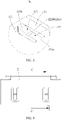
- FIG. 7 is a schematic structural diagram of still another output electrode base in a battery module according to an embodiment of this application, and FIG. 8 is an enlarged view of position B in FIG. 7 .
- a second limiting element 12 includes a fixed section 122 and an elastic section 121, a first end 122a of the fixed section 122 is connected to an inner wall of a through groove 111, a first end 121a of the elastic section 121 is connected to a second end 122b of the fixed section 122, and a second end 121b of the elastic section 121 protrudes from the base plate 11.
- a flat and straight section is formed by the fixed section 122, and a raised tilt section is formed by the elastic section 121.
- a bevel of the raised tilt section can play a guiding role, so that the second limiting element 12 enters a stop hole 22.
- Disposition of the fixed section 122 can increase a length size of the entire second limiting element 12, thereby improving elastic performance of the second limiting element 12.
- the fixed section 122 may be a sheet-like structure directly formed on the base plate 11, or the fixed section 122 may be a block-like structure.
- a notch may alternatively be provided in the block-like fixed section 122 to make the fixed section elastic to some extent.
- no notch may be provided in the block-like fixed section 122, and the second limiting element 12 enters the stop hole 22 with the help of elastic performance of the elastic section 121.
- FIG. 9 is a main view of an output electrode base fitted to an end plate in a battery module according to an embodiment of this application, and FIG. 10 is a cross-sectional view of FIG. 9 in a C-C direction.
- a thickness W1 of an elastic section 121 is less than a thickness W2 of a fixed section 122.
- the relatively thick fixed section 122a guarantees a connection strength of a second limiting element 12, and the relatively thin elastic section 121 improves elastic performance of the second limiting element 12.
- both the thickness W1 of the elastic section 121 and the thickness W2 of the fixed section 122 are average thickness.
- the second limiting element 12 may have a curve structure or a bevel structure.
- the elastic section 121 can form a bevel structure.
- an angle ⁇ between the elastic section 121 and the fixed section 122 meets: 90° ⁇ 180°, to form the bevel structure of the elastic section 121. This can facilitate insertion and assembly of the output electrode base 1.
- the angle ⁇ between the elastic section 121 and the fixed section 122 is an angle between a side, protruding from the base plate 11, of the elastic section 121 (refer to FIG. 8 ) and a side, protruding from the base plate 11, of the fixed section 122.
- the angle ⁇ between the elastic section 121 and the fixed section 122 meets: 135° ⁇ 170°. Such angle facilitates a guiding role of the bevel structure and does not damage the second limiting element 12.
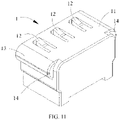
- FIG. 11 is a schematic structural diagram of yet another output electrode base in an battery module according to an embodiment of this application. As shown in FIG. 11 , there are three second limiting elements 12.
- One, two, or three stop holes 22 may be provided, depending on a quantity of second limiting elements 12. Certainly, there may be more second limiting elements 12 and stop holes 22, which is not further limited herein.
- two stop holes 22 there are two stop holes 22.
- Two hole walls 221 are both planar, and are coplanar in a width direction Y of the battery module 100.
- second ends 121b of the elastic sections 121 of the second limiting elements 12 that are fitted to the stop holes 22 may be in an aligned state, as shown in FIG. 7 .
- the hole walls 221 may alternatively be non-planar.
- the second limiting element 12 is implemented in a plurality of manners, so as to adapt to different forms of end plates 2.
Landscapes
- Chemical & Material Sciences (AREA)
- Chemical Kinetics & Catalysis (AREA)
- Electrochemistry (AREA)
- General Chemical & Material Sciences (AREA)
- Engineering & Computer Science (AREA)
- Manufacturing & Machinery (AREA)
- Battery Mounting, Suspending (AREA)
Description
- Embodiments of this application relate to the field of energy storage devices, and in particular, to a battery module.
- A battery module usually includes an end plate and an output electrode base. The end plate is configured to compress a plurality of battery cells. The output electrode base is mounted on the end plate and is configured to secure an output electrode of the battery module. An exemplary battery module of the generic kind is disclosed in
CN 207 896 173 U . - However, after the output electrode base is mounted to the end plate, the output electrode base is prone to falling off during transport. Therefore, it is necessary to design a new battery module to prevent the output electrode base from falling off the end plate during transport.
- This application provides a battery module to solve a prior-art problem and prevent an output electrode base from falling off during transport.
- Specifically, this application provides a battery module, including an output electrode base and an end plate, where the output electrode base is inserted into and fitted to the end plate;
- a first limiting element is disposed on the output electrode base, a limiting plate is disposed on the end plate, and the first limiting element is fitted to the limiting plate to limit relative movement of the output electrode base and the end plate along a first direction;
- a stop hole is provided in one of the output electrode base and the end plate, and a second limiting element is disposed on the other; the second limiting element is accommodated in the stop hole; and the second limiting element is fitted to the stop hole to limit relative movement of the output electrode base and the end plate along a second direction; and
- an extension direction of the first direction is opposite to an extension direction of the second direction.
- The end plate includes a body;
- the stop hole is provided in the body along a height direction of the battery module; and
- the output electrode base includes a base plate, and the second limiting element protrudes from the base plate along the height direction of the battery module.
- In a possible design, a through groove is provided in the base plate;
- a first end of the second limiting element is connected to an inner wall of the through groove; and
- there is a gap between parts, other than the first end, of the second limiting element and the inner wall of the through groove.
- In a possible design, the through groove includes an opening, and the opening is disposed away from the first end of the second limiting element.
- In a possible design, the second limiting element includes an elastic section;
- the through groove is provided in the base plate;
- a first end of the elastic section is connected to the inner wall of the through groove; and
- a second end of the elastic section protrudes from the base plate.
- In a possible design, the second limiting element includes a fixed section and the elastic section;
- a first end of the fixed section is connected to the inner wall of the through groove;
- the first end of the elastic section is connected to a second end of the fixed section; and
- the second end of the elastic section protrudes from the base plate.
- In a possible design, a thickness of the elastic section is less than a thickness of the fixed section.
- In a possible design, an angle θ between the elastic section and the fixed section meets: 90°<θ<180°.
- In a possible design, the angle θ between the elastic section and the fixed section meets: 135°<θ<170°.
- In a possible design, there are at least two second limiting elements;
along the second direction, second ends of elastic sections of the at least two second limiting elements are mutually staggered; and
hole walls, fitted to the second limiting elements, of at least two stop holes are not coplanar. - According to the battery module described above, the first limiting element and the second limiting element are disposed on the output electrode base, and the limiting plate and the stop hole are disposed on the end plate. The first limiting element is fitted to the limiting plate to limit the relative movement of the output electrode base and the end plate along the first direction, and the second limiting element is fitted to the stop hole to limit the relative movement of the output electrode base and the end plate along the second direction, thereby improving connection reliability of the output electrode base during transport.
- In addition, the second limiting element is accommodated in the stop hole. During installation of the output electrode base, the output electrode base is inserted into a slot without interference and further inserted until the first limiting element is fitted to the limiting plate, thereby facilitating an assembly process of the output electrode base. Furthermore, no interfering object is disposed on a side of the end plate facing away from the limiting plate, and installation space of a battery cell near the end plate is neither occupied, thereby improving energy density of the battery module.
-
-
FIG. 1 is a schematic structural diagram of a battery module according to an embodiment of this application; -
FIG. 2 is a schematic exploded view of fitting of an output electrode base to an end plate in a battery module according to an embodiment of this application; -
FIG. 3 is a schematic structural diagram of an angle of an output electrode base in a battery module according to an embodiment of this application; -
FIG. 4 is a schematic structural diagram of another angle of an output electrode base in a battery module according to an embodiment of this application; -
FIG. 5 is a schematic structural diagram of another output electrode base in a battery module according to an embodiment of this application; -
FIG. 6 is an enlarged view of position A inFIG. 5 ; -
FIG. 7 is a schematic structural diagram of still another output electrode base in a battery module according to an embodiment of this application; -
FIG. 8 is an enlarged view of position B inFIG. 7 ; -
FIG. 9 is a main view of an output electrode base fitted to an end plate in a battery module according to an embodiment of this application; -
FIG. 10 is a cross-sectional view ofFIG. 9 in a C-C direction; and -
FIG. 11 is a schematic structural diagram of yet another output electrode base in a battery module according to an embodiment of this application. - Reference numerals:
- 100. battery module;
- 1. output electrode base;
- 11. base plate;
111. through groove;
111a. opening; - 12. second limiting element;
- 12a. first end;
- 121. elastic section;
- 121a. first end;
- 121b. second end;
- 122. fixed section;
- 122a. first end;
- 122b. second end;
- 13. insertion element;
- 14. first limiting element;
- 2. end plate;
- 21. body;
- 22. stop hole;
221. hole wall; - 23. slot;
- 24. limiting plate.
-
FIG. 1 is a schematic structural diagram of a battery module according to an embodiment of this application.FIG. 2 is a schematic exploded view of fitting of an output electrode base to an end plate in a battery module according to an embodiment of this application.FIG. 3 is a schematic structural diagram of an angle of an output electrode base in a battery module according to an embodiment of this application.FIG. 4 is a schematic structural diagram of another angle of an output electrode base in a battery module according to an embodiment of this application. - As shown in
FIG. 1 and FIG. 2 , an embodiment of this application provides abattery module 100, including anoutput electrode base 1 and anend plate 2. Theend plate 2 may be made of a metal material. Theoutput electrode base 1 is configured to provide insulation protection for an output electrode of thebattery module 100, and may be made of a plastic material. - The
output electrode base 1 is inserted into and fitted to theend plate 2. In this embodiment, theoutput electrode base 1 may be inserted into theend plate 2 in a length direction X of thebattery module 100. In another embodiment, theoutput electrode base 1 may alternatively be inserted into and fitted to theend plate 2 in another direction of thebattery module 100. - In a possible implementation, an
insertion element 13 is disposed on theoutput electrode base 1 and aslot 23 is provided in theend plate 2. In this embodiment, theslot 23 extends along the length direction X of thebattery module 100, theinsertion element 13 also extends along the length direction X of thebattery module 100, and theinsertion element 13 is inserted into theslot 23. Theslot 23 may be in an approximate swallow-tail shape, and theinsertion element 13 may also have an outline of an approximate swallow-tail shape, so as to limit relative movement of theoutput electrode base 1 on theend plate 2 along a height direction Z and a width direction Y of thebattery module 100. - A first limiting
element 14 is disposed on theoutput electrode base 1. The first limitingelement 14 may be an end surface formed at one end of theinsertion element 13, or may be a projection or another structure fixed on theinsertion element 13 or fixed on another position of theoutput electrode base 1. In this embodiment, the first limitingelement 14 is an end surface formed at one end of theinsertion element 13. - A limiting
plate 24 is disposed on theend plate 2, and the limitingplate 24 may extend upward along the height direction Z of the battery module to form a barrier to the first limitingelement 14. The first limitingelement 14 is fitted to the limitingplate 24 to limit relative movement of theoutput electrode base 1 and theend plate 2 along a first direction X1. In this way, after theoutput electrode base 1 is mounted to theend plate 2, theoutput electrode base 1 does not fall off along the first direction X1 when theend plate 2 and theoutput electrode base 1 are tilted or overturned during transport of theoutput electrode base 1 and theend plate 2. - As shown in
FIG. 2 andFIG. 4 , astop hole 22 is provided in one of theoutput electrode base 1 and theend plate 2, and a second limitingelement 12 is disposed on the other. The second limitingelement 12 is accommodated in thestop hole 22. In this embodiment, the second limitingelement 12 is disposed on theoutput electrode base 1, and thestop hole 22 is provided in theend plate 2. The second limitingelement 12 is fitted to thestop hole 22 to limit the relative movement of theoutput electrode base 1 and theend plate 2 along a second direction X2. An extension direction of the first direction X1 is opposite to an extension direction of the second direction X2. In this embodiment, the first direction X1 and the second direction X2 are two opposite directions in the length direction X of thebattery module 100. - According to the
battery module 100 provided in this embodiment of this application, the second limitingelement 12 is disposed on theoutput electrode base 1, thestop hole 22 is provided in theend plate 2, and the second limitingelement 12 is accommodated in thestop hole 22. During installation of theoutput electrode base 1, the output electrode base is inserted into aslot 23 without interference and further inserted until the first limitingelement 14 is fitted to the limitingplate 24, thereby facilitating an assembly process of the output electrode base. Furthermore, no interfering object is disposed on a side of theend plate 2 facing away from the limitingplate 24, and installation space of a battery cell near theend plate 2 is neither occupied, thereby improving energy density of thebattery module 100. - During transport of the
output electrode base 1 and theend plate 2, if theoutput electrode base 1 and theend plate 2 are tilted or overturned along the first direction X1, theoutput electrode base 1 does not fall off because the first limitingelement 14 is fitted to the limitingplate 24. If theoutput electrode base 1 and theend plate 2 are tilted or overturned along the second direction X2, theoutput electrode base 1 neither falls off because the second limitingelement 12 is fitted to thestop hole 22, thereby improving connection reliability between theoutput electrode base 1 and theend plate 2 during transport. - In a possible implementation, as shown in
FIG. 2 andFIG. 4 , theend plate 2 includes abody 21, and thestop hole 22 is provided in thebody 21 along the height direction Z of thebattery module 100. Theoutput electrode base 1 includes abase plate 11, and the second limitingelement 12 protrudes from thebase plate 11 along the height direction Z of thebattery module 100. - The
insertion element 13 of theoutput electrode base 1 is inserted into theslot 23 of theend plate 2. Before transport, the second limitingelement 12 is accommodated in thestop hole 22. The second limitingelement 12 may not be in contact with ahole wall 221 of thestop hole 22, or the second limitingelement 12 comes in contact with thehole wall 221, but the two do not press against and interfere with each other. During transport, if theoutput electrode base 1 and theend plate 2 are tilted or overturned along the second direction X2, the second limitingelement 12 may press against and interfere with thehole wall 221 of thestop hole 22 to prevent theoutput electrode base 1 from falling off. - The second limiting
element 12 is disposed on thebase plate 11 of theoutput electrode base 1, and an existing hole in thebody 21 of theend plate 2 is used as thestop hole 22. Therefore, occupied space can be reduced, and the energy density of thebattery module 100 can be improved. - In a possible implementation, a through
groove 111 is provided in thebase plate 11. As shown inFIG. 4 , afirst end 12a of the second limitingelement 12 is connected to an inner wall of the throughgroove 111, and there is a gap between parts, other than thefirst end 12a, of the second limitingelement 12 and the inner wall of the throughgroove 111. - The through
groove 111 is formed during processing of the second limitingelement 12. The gap provided in the throughgroove 111 also makes the second limitingelement 12 elastic to some extent. During insertion of theinsertion element 13 of theoutput electrode base 1 into theslot 24 of theend plate 2, the second limitingelement 12 is elastically deformed to enter thestop hole 22. - In a possible implementation, the through
groove 111 includes anopening 111a, and theopening 111a is disposed away from thefirst end 12a of the second limitingelement 12. The throughgroove 111 with theopening 111a can be obtained by means of a simple cutting process, and therefore the second limitingelement 12 can be obtained by means of a relatively simple cutting process. In addition, disposition of theopening 111a also makes theoutput electrode base 1 lighter and further improves the energy density of thebattery module 100. - The following describes another example embodiment. However, detailed description of constituent components the same as those in the foregoing example embodiment is omitted, and only different constituent components are described in detail.
-
FIG. 5 is a schematic structural diagram of another output electrode base in a battery module according to an embodiment of this application, andFIG. 6 is an enlarged view of position A inFIG. 5 . - In a possible implementation, as shown in
FIG. 5 andFIG. 6 , a second limitingelement 12 includes anelastic section 121. A throughgroove 111 is provided in abase plate 11, afirst end 121a of theelastic section 121 is connected to an inner wall of the throughgroove 111, and asecond end 121b of theelastic section 121 protrudes from thebase plate 11. - Optionally, there is a gap between parts, other than the
first end 121a, of theelastic section 121 and the inner wall of the throughgroove 111, thereby improving elasticity of theelastic section 121. - It can be understood that the
elastic section 121 may be an elastomer directly formed on thebase plate 11, or theelastic section 121 may be a block-like structure and a corresponding notch is provided in theelastic section 121 to make theelastic section 121 elastic to some extent. - In a structure of the second limiting
element 12, a raised tilt section is formed by theelastic section 121. During insertion of aninsertion element 13 into aslot 23, a bevel structure of the raised tilt section can play a guiding role, so that the second limitingelement 12 enters astop hole 22 of theend plate 2. - The following describes another example embodiment. However, detailed description of constituent components the same as those in the foregoing example embodiment is omitted, and only different constituent components are described in detail.
-
FIG. 7 is a schematic structural diagram of still another output electrode base in a battery module according to an embodiment of this application, andFIG. 8 is an enlarged view of position B inFIG. 7 . - In a possible implementation, as shown in
FIG. 7 andFIG. 8 , a second limitingelement 12 includes a fixedsection 122 and anelastic section 121, afirst end 122a of the fixedsection 122 is connected to an inner wall of a throughgroove 111, afirst end 121a of theelastic section 121 is connected to asecond end 122b of the fixedsection 122, and asecond end 121b of theelastic section 121 protrudes from thebase plate 11. - In a structure of the second limiting
element 12, a flat and straight section is formed by the fixedsection 122, and a raised tilt section is formed by theelastic section 121. During insertion of aninsertion element 13 into aslot 23, a bevel of the raised tilt section can play a guiding role, so that the second limitingelement 12 enters astop hole 22. Disposition of the fixedsection 122 can increase a length size of the entire second limitingelement 12, thereby improving elastic performance of the second limitingelement 12. - It can be understood that the fixed
section 122 may be a sheet-like structure directly formed on thebase plate 11, or the fixedsection 122 may be a block-like structure. A notch may alternatively be provided in the block-likefixed section 122 to make the fixed section elastic to some extent. Alternatively, no notch may be provided in the block-likefixed section 122, and the second limitingelement 12 enters thestop hole 22 with the help of elastic performance of theelastic section 121. - The following describes another example embodiment. However, detailed description of constituent components the same as those in the foregoing example embodiment is omitted, and only different constituent components are described in detail.
-
FIG. 9 is a main view of an output electrode base fitted to an end plate in a battery module according to an embodiment of this application, andFIG. 10 is a cross-sectional view ofFIG. 9 in a C-C direction. - In a possible implementation, as shown in
FIG. 9 andFIG. 10 , a thickness W1 of anelastic section 121 is less than a thickness W2 of a fixedsection 122. In this way, the relatively thickfixed section 122a guarantees a connection strength of a second limitingelement 12, and the relatively thinelastic section 121 improves elastic performance of the second limitingelement 12. - It should be noted that both the thickness W1 of the
elastic section 121 and the thickness W2 of the fixedsection 122 are average thickness. - The second limiting
element 12 may have a curve structure or a bevel structure. In the foregoing, theelastic section 121 can form a bevel structure. In a possible implementation, an angle θ between theelastic section 121 and the fixedsection 122 meets: 90°<θ<180°, to form the bevel structure of theelastic section 121. This can facilitate insertion and assembly of theoutput electrode base 1. - It should be noted that the angle θ between the
elastic section 121 and the fixedsection 122 is an angle between a side, protruding from thebase plate 11, of the elastic section 121 (refer toFIG. 8 ) and a side, protruding from thebase plate 11, of the fixedsection 122. - Optionally, the angle θ between the
elastic section 121 and the fixedsection 122 meets: 135°<θ<170°. Such angle facilitates a guiding role of the bevel structure and does not damage the second limitingelement 12. - In the
battery module 100 provided in this embodiment of this application, there may be one (refer toFIG. 4 ) or two (refer toFIG. 5 ) second limitingelements 12.FIG. 11 is a schematic structural diagram of yet another output electrode base in an battery module according to an embodiment of this application. As shown inFIG. 11 , there are three second limitingelements 12. - One, two, or three
stop holes 22 may be provided, depending on a quantity of second limitingelements 12. Certainly, there may be more second limitingelements 12 and stopholes 22, which is not further limited herein. - In the embodiment shown in
FIG. 2 , there are two stop holes 22. Twohole walls 221 are both planar, and are coplanar in a width direction Y of thebattery module 100. In this case, second ends 121b of theelastic sections 121 of the second limitingelements 12 that are fitted to the stop holes 22 may be in an aligned state, as shown inFIG. 7 . In another embodiment, thehole walls 221 may alternatively be non-planar. In another embodiment, there are at least two stop holes 22, and twohole walls 221 are parallel but not coplanar. - In a possible implementation, as shown in
FIG. 5 , there are at least two second limitingelements 12. Along a second direction X2, second ends 121b ofelastic sections 121 of the at least two second limitingelements 12 are mutually staggered, andhole walls 221 of at least two stop holes 22 that are fitted to the second limitingelements 12 are not coplanar. Therefore, the second limitingelement 12 is implemented in a plurality of manners, so as to adapt to different forms ofend plates 2.
Claims (9)
- A battery module (100), comprising an output electrode base (1) and an end plate (2), wherein the output electrode base (1) is inserted into and fitted to the end plate (2);wherein a first limiting element (14) is disposed on the output electrode base (1), a limiting plate (24) is disposed on the end plate (2), and the first limiting element (14) is fitted to the limiting plate (24) to limit relative movement of the output electrode base (1) and the end plate (2) along a first direction (X1);wherein a stop hole (22) is provided in one of the output electrode base (1) and the end plate (2), and a second limiting element (12) is disposed on the other, wherein the second limiting element (12) is accommodated in the stop hole (22), and the second limiting element (12) is fitted to the stop hole (22) to limit relative movement of the output electrode base (1) and the end plate (2) along a second direction (X2); andwherein an extension direction of the first direction (X1) is opposite to an extension direction of the second direction (X2).characterized in thatthe end plate (2) comprises a body (21);the stop hole (22) is provided in the body (21) along a height direction (Z) of the battery module (100); andthe output electrode base (1) comprises a base plate (11), and the second limiting element (12) protrudes from the base plate (11) along the height direction (Z) of the battery module (100).
- The battery module (100) according to claim 1, characterized in that a through groove (111) is provided in the base plate (11);a first end (12a) of the second limiting element (12) is connected to an inner wall of the through groove (111); andthere is a gap between parts, other than the first end (12a), of the second limiting element (12) and the inner wall of the through groove (111).
- The battery module (100) according to claim 2, characterized in that the through groove (111) comprises an opening (111a), and the opening (111a) is disposed away from the first end (12a) of the second limiting element (12).
- The battery module (100) according to any one of the preceding claims, characterized in that the second limiting element (12) comprises an elastic section (121);the through groove (111) is provided in the base plate (11);a first end (121a) of the elastic section (121) is connected to the inner wall of the through groove (111); anda second end (121b) of the elastic section (121) protrudes from the base plate (11).
- The battery module (100) according to any one of the preceding claims, characterized in that the second limiting element (12) comprises a fixed section (122) and the elastic section (121);a first end (122a) of the fixed section (122) is connected to the inner wall of the through groove (111);the first end (121a) of the elastic section (121) is connected to a second end (122b) of the fixed section (122); andthe second end (121b) of the elastic section (121) protrudes from the base plate (11).
- The battery module (100) according to claim 5, characterized in that a thickness (W1) of the elastic section (121) is less than a thickness (W2) of the fixed section (122).
- The battery module (100) according to claim 5 or 6, characterized in that an angle θ between the elastic section (121) and the fixed section (122) meets: 90°<θ<180°.
- The battery module (100) according to claim 7, characterized in that the angle θ between the elastic section (121) and the fixed section (122) meets: 135°<θ<170°.
- The battery module (100) according to any one of claims 4 to 8, characterized in that there are at least two second limiting elements (12);
along the second direction (X2), second ends (121b) of elastic sections (121) of the at least two second limiting elements (12) are mutually staggered; and hole walls (221), fitted to the second limiting elements (12), of at least two stop holes (22) are not coplanar.
Applications Claiming Priority (2)
| Application Number | Priority Date | Filing Date | Title |
|---|---|---|---|
| CN201921323599.7U CN210403878U (en) | 2019-08-15 | 2019-08-15 | Battery module |
| PCT/CN2020/106465 WO2021027601A1 (en) | 2019-08-15 | 2020-07-31 | Battery module |
Publications (3)
| Publication Number | Publication Date |
|---|---|
| EP3806178A1 EP3806178A1 (en) | 2021-04-14 |
| EP3806178A4 EP3806178A4 (en) | 2021-11-03 |
| EP3806178B1 true EP3806178B1 (en) | 2022-12-28 |
Family
ID=70338662
Family Applications (1)
| Application Number | Title | Priority Date | Filing Date |
|---|---|---|---|
| EP20827983.6A Active EP3806178B1 (en) | 2019-08-15 | 2020-07-31 | Battery module |
Country Status (5)
| Country | Link |
|---|---|
| US (1) | US11588200B2 (en) |
| EP (1) | EP3806178B1 (en) |
| CN (1) | CN210403878U (en) |
| HU (1) | HUE061033T2 (en) |
| WO (1) | WO2021027601A1 (en) |
Families Citing this family (5)
| Publication number | Priority date | Publication date | Assignee | Title |
|---|---|---|---|---|
| CN210403878U (en) | 2019-08-15 | 2020-04-24 | 宁德时代新能源科技股份有限公司 | Battery module |
| CN112531299B (en) | 2020-11-27 | 2023-02-24 | 宁德时代新能源科技股份有限公司 | Mounting seat, battery and electrical equipment |
| CN112928374B (en) * | 2021-02-23 | 2022-09-30 | 远景动力技术(江苏)有限公司 | End plate for battery module and battery module |
| CN219457865U (en) * | 2023-02-21 | 2023-08-01 | 远景动力技术(江苏)有限公司 | Battery modules and battery packs |
| CN119560720A (en) * | 2023-09-01 | 2025-03-04 | 北京车和家汽车科技有限公司 | End plates for battery cells, battery modules, battery packs, and vehicles |
Family Cites Families (12)
| Publication number | Priority date | Publication date | Assignee | Title |
|---|---|---|---|---|
| WO2015064097A1 (en) * | 2013-10-31 | 2015-05-07 | パナソニックIpマネジメント株式会社 | Battery module |
| CN106450078B (en) * | 2016-08-31 | 2022-12-23 | 艾森(宁波)智能科技有限公司 | Multifunctional battery box |
| JP6752674B2 (en) * | 2016-09-30 | 2020-09-09 | ビークルエナジージャパン株式会社 | Battery pack |
| WO2018155093A1 (en) * | 2017-02-27 | 2018-08-30 | 日立オートモティブシステムズ株式会社 | Secondary battery module |
| CN206547229U (en) * | 2017-02-28 | 2017-10-10 | 上海海拉电子有限公司 | A kind of snap-in structure |
| CN206727133U (en) * | 2017-05-15 | 2017-12-08 | 宁德时代新能源科技股份有限公司 | Battery modules |
| CN109994663B (en) | 2017-12-29 | 2021-09-14 | 宁德时代新能源科技股份有限公司 | Composite end plate and battery module |
| CN207896173U (en) * | 2018-03-23 | 2018-09-21 | 宁德时代新能源科技股份有限公司 | Battery modules |
| CN208819951U (en) | 2018-10-17 | 2019-05-03 | 宁德时代新能源科技股份有限公司 | Battery module and its protection component |
| CN209571451U (en) * | 2019-02-12 | 2019-11-01 | 欣旺达电动汽车电池有限公司 | Battery modules |
| CN209822775U (en) * | 2019-06-03 | 2019-12-20 | 宁德时代新能源科技股份有限公司 | Terminal protection device and battery module |
| CN210403878U (en) * | 2019-08-15 | 2020-04-24 | 宁德时代新能源科技股份有限公司 | Battery module |
-
2019
- 2019-08-15 CN CN201921323599.7U patent/CN210403878U/en active Active
-
2020
- 2020-07-31 EP EP20827983.6A patent/EP3806178B1/en active Active
- 2020-07-31 HU HUE20827983A patent/HUE061033T2/en unknown
- 2020-07-31 WO PCT/CN2020/106465 patent/WO2021027601A1/en not_active Ceased
- 2020-12-17 US US17/125,858 patent/US11588200B2/en active Active
Also Published As
| Publication number | Publication date |
|---|---|
| CN210403878U (en) | 2020-04-24 |
| HUE061033T2 (en) | 2023-05-28 |
| WO2021027601A1 (en) | 2021-02-18 |
| US11588200B2 (en) | 2023-02-21 |
| EP3806178A1 (en) | 2021-04-14 |
| EP3806178A4 (en) | 2021-11-03 |
| US20210126315A1 (en) | 2021-04-29 |
Similar Documents
| Publication | Publication Date | Title |
|---|---|---|
| EP3806178B1 (en) | Battery module | |
| US11978927B2 (en) | Battery module and isolating member | |
| US20100143785A1 (en) | Battery pack | |
| EP3300136B1 (en) | Clamping member and battery module using same | |
| US20220140430A1 (en) | End plate securing structure and battery device | |
| CN209747626U (en) | A battery module | |
| US20210028610A1 (en) | Busway and corresponding electrical component | |
| EP3703154A1 (en) | Battery module | |
| US20240274932A1 (en) | End cover assembly, energy-storage device, and electricity-consumption device | |
| US20120064389A1 (en) | Secondary battery | |
| KR20200140197A (en) | Contact terminal | |
| JP6298377B2 (en) | Power storage device | |
| US20210159568A1 (en) | Hook coupling structure and battery pack case using same | |
| EP4123821A1 (en) | Electrode assembly and secondary battery including same | |
| CN218975681U (en) | An installation structure of an output pole base and an end plate and a battery module | |
| US20230232555A1 (en) | Device having fool-proofing structure | |
| CN203135088U (en) | Drawer-type card connector | |
| JP3749011B2 (en) | Battery case for portable electrical equipment | |
| US20080280485A1 (en) | Battery connector | |
| CN224177425U (en) | Battery cell cover plate assembly and battery cell | |
| EP4636918A1 (en) | Energy storage system | |
| CN216850234U (en) | Battery pack | |
| CN217281097U (en) | Battery pack | |
| US20240429578A1 (en) | Insulating sheet, battery cell, battery, and electronic apparatus | |
| CN222721777U (en) | Wire controller shell and electronic equipment |
Legal Events
| Date | Code | Title | Description |
|---|---|---|---|
| STAA | Information on the status of an ep patent application or granted ep patent |
Free format text: STATUS: UNKNOWN |
|
| STAA | Information on the status of an ep patent application or granted ep patent |
Free format text: STATUS: THE INTERNATIONAL PUBLICATION HAS BEEN MADE |
|
| PUAI | Public reference made under article 153(3) epc to a published international application that has entered the european phase |
Free format text: ORIGINAL CODE: 0009012 |
|
| STAA | Information on the status of an ep patent application or granted ep patent |
Free format text: STATUS: REQUEST FOR EXAMINATION WAS MADE |
|
| 17P | Request for examination filed |
Effective date: 20201229 |
|
| AK | Designated contracting states |
Kind code of ref document: A1 Designated state(s): AL AT BE BG CH CY CZ DE DK EE ES FI FR GB GR HR HU IE IS IT LI LT LU LV MC MK MT NL NO PL PT RO RS SE SI SK SM TR |
|
| AX | Request for extension of the european patent |
Extension state: BA ME |
|
| REG | Reference to a national code |
Ref country code: DE Ref legal event code: R079 Ref document number: 602020007257 Country of ref document: DE Free format text: PREVIOUS MAIN CLASS: H99Z9999999999 Ipc: H01M0050543000 |
|
| A4 | Supplementary search report drawn up and despatched |
Effective date: 20211001 |
|
| RIC1 | Information provided on ipc code assigned before grant |
Ipc: H01M 50/543 20210101AFI20210927BHEP |
|
| GRAP | Despatch of communication of intention to grant a patent |
Free format text: ORIGINAL CODE: EPIDOSNIGR1 |
|
| STAA | Information on the status of an ep patent application or granted ep patent |
Free format text: STATUS: GRANT OF PATENT IS INTENDED |
|
| DAV | Request for validation of the european patent (deleted) | ||
| DAX | Request for extension of the european patent (deleted) | ||
| GRAS | Grant fee paid |
Free format text: ORIGINAL CODE: EPIDOSNIGR3 |
|
| INTG | Intention to grant announced |
Effective date: 20221019 |
|
| GRAA | (expected) grant |
Free format text: ORIGINAL CODE: 0009210 |
|
| STAA | Information on the status of an ep patent application or granted ep patent |
Free format text: STATUS: THE PATENT HAS BEEN GRANTED |
|
| AK | Designated contracting states |
Kind code of ref document: B1 Designated state(s): AL AT BE BG CH CY CZ DE DK EE ES FI FR GB GR HR HU IE IS IT LI LT LU LV MC MK MT NL NO PL PT RO RS SE SI SK SM TR |
|
| REG | Reference to a national code |
Ref country code: GB Ref legal event code: FG4D |
|
| REG | Reference to a national code |
Ref country code: CH Ref legal event code: EP |
|
| REG | Reference to a national code |
Ref country code: DE Ref legal event code: R096 Ref document number: 602020007257 Country of ref document: DE |
|
| REG | Reference to a national code |
Ref country code: AT Ref legal event code: REF Ref document number: 1541048 Country of ref document: AT Kind code of ref document: T Effective date: 20230115 |
|
| REG | Reference to a national code |
Ref country code: IE Ref legal event code: FG4D |
|
| REG | Reference to a national code |
Ref country code: LT Ref legal event code: MG9D |
|
| PG25 | Lapsed in a contracting state [announced via postgrant information from national office to epo] |
Ref country code: SE Free format text: LAPSE BECAUSE OF FAILURE TO SUBMIT A TRANSLATION OF THE DESCRIPTION OR TO PAY THE FEE WITHIN THE PRESCRIBED TIME-LIMIT Effective date: 20221228 Ref country code: NO Free format text: LAPSE BECAUSE OF FAILURE TO SUBMIT A TRANSLATION OF THE DESCRIPTION OR TO PAY THE FEE WITHIN THE PRESCRIBED TIME-LIMIT Effective date: 20230328 Ref country code: LT Free format text: LAPSE BECAUSE OF FAILURE TO SUBMIT A TRANSLATION OF THE DESCRIPTION OR TO PAY THE FEE WITHIN THE PRESCRIBED TIME-LIMIT Effective date: 20221228 Ref country code: FI Free format text: LAPSE BECAUSE OF FAILURE TO SUBMIT A TRANSLATION OF THE DESCRIPTION OR TO PAY THE FEE WITHIN THE PRESCRIBED TIME-LIMIT Effective date: 20221228 |
|
| REG | Reference to a national code |
Ref country code: NL Ref legal event code: MP Effective date: 20221228 |
|
| REG | Reference to a national code |
Ref country code: AT Ref legal event code: MK05 Ref document number: 1541048 Country of ref document: AT Kind code of ref document: T Effective date: 20221228 |
|
| REG | Reference to a national code |
Ref country code: HU Ref legal event code: AG4A Ref document number: E061033 Country of ref document: HU |
|
| PG25 | Lapsed in a contracting state [announced via postgrant information from national office to epo] |
Ref country code: RS Free format text: LAPSE BECAUSE OF FAILURE TO SUBMIT A TRANSLATION OF THE DESCRIPTION OR TO PAY THE FEE WITHIN THE PRESCRIBED TIME-LIMIT Effective date: 20221228 Ref country code: LV Free format text: LAPSE BECAUSE OF FAILURE TO SUBMIT A TRANSLATION OF THE DESCRIPTION OR TO PAY THE FEE WITHIN THE PRESCRIBED TIME-LIMIT Effective date: 20221228 Ref country code: HR Free format text: LAPSE BECAUSE OF FAILURE TO SUBMIT A TRANSLATION OF THE DESCRIPTION OR TO PAY THE FEE WITHIN THE PRESCRIBED TIME-LIMIT Effective date: 20221228 Ref country code: GR Free format text: LAPSE BECAUSE OF FAILURE TO SUBMIT A TRANSLATION OF THE DESCRIPTION OR TO PAY THE FEE WITHIN THE PRESCRIBED TIME-LIMIT Effective date: 20230329 |
|
| P01 | Opt-out of the competence of the unified patent court (upc) registered |
Effective date: 20230516 |
|
| PG25 | Lapsed in a contracting state [announced via postgrant information from national office to epo] |
Ref country code: NL Free format text: LAPSE BECAUSE OF FAILURE TO SUBMIT A TRANSLATION OF THE DESCRIPTION OR TO PAY THE FEE WITHIN THE PRESCRIBED TIME-LIMIT Effective date: 20221228 |
|
| PG25 | Lapsed in a contracting state [announced via postgrant information from national office to epo] |
Ref country code: SM Free format text: LAPSE BECAUSE OF FAILURE TO SUBMIT A TRANSLATION OF THE DESCRIPTION OR TO PAY THE FEE WITHIN THE PRESCRIBED TIME-LIMIT Effective date: 20221228 Ref country code: RO Free format text: LAPSE BECAUSE OF FAILURE TO SUBMIT A TRANSLATION OF THE DESCRIPTION OR TO PAY THE FEE WITHIN THE PRESCRIBED TIME-LIMIT Effective date: 20221228 Ref country code: PT Free format text: LAPSE BECAUSE OF FAILURE TO SUBMIT A TRANSLATION OF THE DESCRIPTION OR TO PAY THE FEE WITHIN THE PRESCRIBED TIME-LIMIT Effective date: 20230428 Ref country code: ES Free format text: LAPSE BECAUSE OF FAILURE TO SUBMIT A TRANSLATION OF THE DESCRIPTION OR TO PAY THE FEE WITHIN THE PRESCRIBED TIME-LIMIT Effective date: 20221228 Ref country code: EE Free format text: LAPSE BECAUSE OF FAILURE TO SUBMIT A TRANSLATION OF THE DESCRIPTION OR TO PAY THE FEE WITHIN THE PRESCRIBED TIME-LIMIT Effective date: 20221228 Ref country code: CZ Free format text: LAPSE BECAUSE OF FAILURE TO SUBMIT A TRANSLATION OF THE DESCRIPTION OR TO PAY THE FEE WITHIN THE PRESCRIBED TIME-LIMIT Effective date: 20221228 Ref country code: AT Free format text: LAPSE BECAUSE OF FAILURE TO SUBMIT A TRANSLATION OF THE DESCRIPTION OR TO PAY THE FEE WITHIN THE PRESCRIBED TIME-LIMIT Effective date: 20221228 |
|
| PG25 | Lapsed in a contracting state [announced via postgrant information from national office to epo] |
Ref country code: SK Free format text: LAPSE BECAUSE OF FAILURE TO SUBMIT A TRANSLATION OF THE DESCRIPTION OR TO PAY THE FEE WITHIN THE PRESCRIBED TIME-LIMIT Effective date: 20221228 Ref country code: PL Free format text: LAPSE BECAUSE OF FAILURE TO SUBMIT A TRANSLATION OF THE DESCRIPTION OR TO PAY THE FEE WITHIN THE PRESCRIBED TIME-LIMIT Effective date: 20221228 Ref country code: IS Free format text: LAPSE BECAUSE OF FAILURE TO SUBMIT A TRANSLATION OF THE DESCRIPTION OR TO PAY THE FEE WITHIN THE PRESCRIBED TIME-LIMIT Effective date: 20230428 Ref country code: AL Free format text: LAPSE BECAUSE OF FAILURE TO SUBMIT A TRANSLATION OF THE DESCRIPTION OR TO PAY THE FEE WITHIN THE PRESCRIBED TIME-LIMIT Effective date: 20221228 |
|
| REG | Reference to a national code |
Ref country code: DE Ref legal event code: R097 Ref document number: 602020007257 Country of ref document: DE |
|
| PG25 | Lapsed in a contracting state [announced via postgrant information from national office to epo] |
Ref country code: DK Free format text: LAPSE BECAUSE OF FAILURE TO SUBMIT A TRANSLATION OF THE DESCRIPTION OR TO PAY THE FEE WITHIN THE PRESCRIBED TIME-LIMIT Effective date: 20221228 |
|
| PLBE | No opposition filed within time limit |
Free format text: ORIGINAL CODE: 0009261 |
|
| STAA | Information on the status of an ep patent application or granted ep patent |
Free format text: STATUS: NO OPPOSITION FILED WITHIN TIME LIMIT |
|
| 26N | No opposition filed |
Effective date: 20230929 |
|
| PG25 | Lapsed in a contracting state [announced via postgrant information from national office to epo] |
Ref country code: SI Free format text: LAPSE BECAUSE OF FAILURE TO SUBMIT A TRANSLATION OF THE DESCRIPTION OR TO PAY THE FEE WITHIN THE PRESCRIBED TIME-LIMIT Effective date: 20221228 |
|
| PG25 | Lapsed in a contracting state [announced via postgrant information from national office to epo] |
Ref country code: MC Free format text: LAPSE BECAUSE OF FAILURE TO SUBMIT A TRANSLATION OF THE DESCRIPTION OR TO PAY THE FEE WITHIN THE PRESCRIBED TIME-LIMIT Effective date: 20221228 |
|
| PG25 | Lapsed in a contracting state [announced via postgrant information from national office to epo] |
Ref country code: MC Free format text: LAPSE BECAUSE OF FAILURE TO SUBMIT A TRANSLATION OF THE DESCRIPTION OR TO PAY THE FEE WITHIN THE PRESCRIBED TIME-LIMIT Effective date: 20221228 |
|
| REG | Reference to a national code |
Ref country code: CH Ref legal event code: PL |
|
| REG | Reference to a national code |
Ref country code: BE Ref legal event code: MM Effective date: 20230731 |
|
| PG25 | Lapsed in a contracting state [announced via postgrant information from national office to epo] |
Ref country code: LU Free format text: LAPSE BECAUSE OF NON-PAYMENT OF DUE FEES Effective date: 20230731 |
|
| PG25 | Lapsed in a contracting state [announced via postgrant information from national office to epo] |
Ref country code: LU Free format text: LAPSE BECAUSE OF NON-PAYMENT OF DUE FEES Effective date: 20230731 |
|
| REG | Reference to a national code |
Ref country code: IE Ref legal event code: MM4A |
|
| PG25 | Lapsed in a contracting state [announced via postgrant information from national office to epo] |
Ref country code: CH Free format text: LAPSE BECAUSE OF NON-PAYMENT OF DUE FEES Effective date: 20230731 |
|
| PG25 | Lapsed in a contracting state [announced via postgrant information from national office to epo] |
Ref country code: BE Free format text: LAPSE BECAUSE OF NON-PAYMENT OF DUE FEES Effective date: 20230731 |
|
| PG25 | Lapsed in a contracting state [announced via postgrant information from national office to epo] |
Ref country code: IE Free format text: LAPSE BECAUSE OF NON-PAYMENT OF DUE FEES Effective date: 20230731 |
|
| PG25 | Lapsed in a contracting state [announced via postgrant information from national office to epo] |
Ref country code: IE Free format text: LAPSE BECAUSE OF NON-PAYMENT OF DUE FEES Effective date: 20230731 |
|
| REG | Reference to a national code |
Ref country code: DE Ref legal event code: R081 Ref document number: 602020007257 Country of ref document: DE Owner name: CONTEMPORARY AMPEREX TECHNOLOGY (HONG KONG) LI, HK Free format text: FORMER OWNER: CONTEMPORARY AMPEREX TECHNOLOGY CO., LIMITED, NINGDE CITY, FUJIAN, CN |
|
| REG | Reference to a national code |
Ref country code: GB Ref legal event code: 732E Free format text: REGISTERED BETWEEN 20240815 AND 20240821 |
|
| REG | Reference to a national code |
Ref country code: HU Ref legal event code: GB9C Owner name: CONTEMPORARY AMPEREX TECHNOLOGY (HONG KONG) LIMITED, HK Free format text: FORMER OWNER(S): CONTEMPORARY AMPEREX TECHNOLOGY CO., LIMITED, CN Ref country code: HU Ref legal event code: FH1C Free format text: FORMER REPRESENTATIVE(S): SBGK SZABADALMI UEGYVIVOEI IRODA, HU Representative=s name: DANUBIA SZABADALMI ES JOGI IRODA KFT., HU |
|
| PG25 | Lapsed in a contracting state [announced via postgrant information from national office to epo] |
Ref country code: BG Free format text: LAPSE BECAUSE OF FAILURE TO SUBMIT A TRANSLATION OF THE DESCRIPTION OR TO PAY THE FEE WITHIN THE PRESCRIBED TIME-LIMIT Effective date: 20221228 |
|
| PG25 | Lapsed in a contracting state [announced via postgrant information from national office to epo] |
Ref country code: BG Free format text: LAPSE BECAUSE OF FAILURE TO SUBMIT A TRANSLATION OF THE DESCRIPTION OR TO PAY THE FEE WITHIN THE PRESCRIBED TIME-LIMIT Effective date: 20221228 |
|
| PGFP | Annual fee paid to national office [announced via postgrant information from national office to epo] |
Ref country code: GB Payment date: 20250612 Year of fee payment: 6 |
|
| PGFP | Annual fee paid to national office [announced via postgrant information from national office to epo] |
Ref country code: FR Payment date: 20250610 Year of fee payment: 6 |
|
| PG25 | Lapsed in a contracting state [announced via postgrant information from national office to epo] |
Ref country code: CY Free format text: LAPSE BECAUSE OF FAILURE TO SUBMIT A TRANSLATION OF THE DESCRIPTION OR TO PAY THE FEE WITHIN THE PRESCRIBED TIME-LIMIT; INVALID AB INITIO Effective date: 20200731 |
|
| PGFP | Annual fee paid to national office [announced via postgrant information from national office to epo] |
Ref country code: HU Payment date: 20250630 Year of fee payment: 6 |
|
| PGFP | Annual fee paid to national office [announced via postgrant information from national office to epo] |
Ref country code: DE Payment date: 20250604 Year of fee payment: 6 |
|
| PGFP | Annual fee paid to national office [announced via postgrant information from national office to epo] |
Ref country code: IT Payment date: 20250623 Year of fee payment: 6 |
|
| PG25 | Lapsed in a contracting state [announced via postgrant information from national office to epo] |
Ref country code: TR Free format text: LAPSE BECAUSE OF FAILURE TO SUBMIT A TRANSLATION OF THE DESCRIPTION OR TO PAY THE FEE WITHIN THE PRESCRIBED TIME-LIMIT Effective date: 20221228 |