EP3806089A1 - Mixed speech recognition method and apparatus, and computer readable storage medium - Google Patents
Mixed speech recognition method and apparatus, and computer readable storage medium Download PDFInfo
- Publication number
- EP3806089A1 EP3806089A1 EP19806534.4A EP19806534A EP3806089A1 EP 3806089 A1 EP3806089 A1 EP 3806089A1 EP 19806534 A EP19806534 A EP 19806534A EP 3806089 A1 EP3806089 A1 EP 3806089A1
- Authority
- EP
- European Patent Office
- Prior art keywords
- speech
- vector
- enrollment
- mixed
- frame
- Prior art date
- Legal status (The legal status is an assumption and is not a legal conclusion. Google has not performed a legal analysis and makes no representation as to the accuracy of the status listed.)
- Granted
Links
Images




Classifications
-
- G—PHYSICS
- G10—MUSICAL INSTRUMENTS; ACOUSTICS
- G10L—SPEECH ANALYSIS TECHNIQUES OR SPEECH SYNTHESIS; SPEECH RECOGNITION; SPEECH OR VOICE PROCESSING TECHNIQUES; SPEECH OR AUDIO CODING OR DECODING
- G10L15/00—Speech recognition
- G10L15/22—Procedures used during a speech recognition process, e.g. man-machine dialogue
-
- G—PHYSICS
- G10—MUSICAL INSTRUMENTS; ACOUSTICS
- G10L—SPEECH ANALYSIS TECHNIQUES OR SPEECH SYNTHESIS; SPEECH RECOGNITION; SPEECH OR VOICE PROCESSING TECHNIQUES; SPEECH OR AUDIO CODING OR DECODING
- G10L17/00—Speaker identification or verification techniques
- G10L17/06—Decision making techniques; Pattern matching strategies
-
- G—PHYSICS
- G10—MUSICAL INSTRUMENTS; ACOUSTICS
- G10L—SPEECH ANALYSIS TECHNIQUES OR SPEECH SYNTHESIS; SPEECH RECOGNITION; SPEECH OR VOICE PROCESSING TECHNIQUES; SPEECH OR AUDIO CODING OR DECODING
- G10L15/00—Speech recognition
- G10L15/02—Feature extraction for speech recognition; Selection of recognition unit
-
- G—PHYSICS
- G10—MUSICAL INSTRUMENTS; ACOUSTICS
- G10L—SPEECH ANALYSIS TECHNIQUES OR SPEECH SYNTHESIS; SPEECH RECOGNITION; SPEECH OR VOICE PROCESSING TECHNIQUES; SPEECH OR AUDIO CODING OR DECODING
- G10L15/00—Speech recognition
- G10L15/06—Creation of reference templates; Training of speech recognition systems, e.g. adaptation to the characteristics of the speaker's voice
- G10L15/063—Training
-
- G—PHYSICS
- G10—MUSICAL INSTRUMENTS; ACOUSTICS
- G10L—SPEECH ANALYSIS TECHNIQUES OR SPEECH SYNTHESIS; SPEECH RECOGNITION; SPEECH OR VOICE PROCESSING TECHNIQUES; SPEECH OR AUDIO CODING OR DECODING
- G10L15/00—Speech recognition
- G10L15/06—Creation of reference templates; Training of speech recognition systems, e.g. adaptation to the characteristics of the speaker's voice
- G10L15/065—Adaptation
- G10L15/07—Adaptation to the speaker
-
- G—PHYSICS
- G10—MUSICAL INSTRUMENTS; ACOUSTICS
- G10L—SPEECH ANALYSIS TECHNIQUES OR SPEECH SYNTHESIS; SPEECH RECOGNITION; SPEECH OR VOICE PROCESSING TECHNIQUES; SPEECH OR AUDIO CODING OR DECODING
- G10L15/00—Speech recognition
- G10L15/08—Speech classification or search
- G10L15/16—Speech classification or search using artificial neural networks
-
- G—PHYSICS
- G10—MUSICAL INSTRUMENTS; ACOUSTICS
- G10L—SPEECH ANALYSIS TECHNIQUES OR SPEECH SYNTHESIS; SPEECH RECOGNITION; SPEECH OR VOICE PROCESSING TECHNIQUES; SPEECH OR AUDIO CODING OR DECODING
- G10L21/00—Speech or voice signal processing techniques to produce another audible or non-audible signal, e.g. visual or tactile, in order to modify its quality or its intelligibility
- G10L21/02—Speech enhancement, e.g. noise reduction or echo cancellation
-
- G—PHYSICS
- G10—MUSICAL INSTRUMENTS; ACOUSTICS
- G10L—SPEECH ANALYSIS TECHNIQUES OR SPEECH SYNTHESIS; SPEECH RECOGNITION; SPEECH OR VOICE PROCESSING TECHNIQUES; SPEECH OR AUDIO CODING OR DECODING
- G10L21/00—Speech or voice signal processing techniques to produce another audible or non-audible signal, e.g. visual or tactile, in order to modify its quality or its intelligibility
- G10L21/02—Speech enhancement, e.g. noise reduction or echo cancellation
- G10L21/0208—Noise filtering
-
- G—PHYSICS
- G10—MUSICAL INSTRUMENTS; ACOUSTICS
- G10L—SPEECH ANALYSIS TECHNIQUES OR SPEECH SYNTHESIS; SPEECH RECOGNITION; SPEECH OR VOICE PROCESSING TECHNIQUES; SPEECH OR AUDIO CODING OR DECODING
- G10L21/00—Speech or voice signal processing techniques to produce another audible or non-audible signal, e.g. visual or tactile, in order to modify its quality or its intelligibility
- G10L21/02—Speech enhancement, e.g. noise reduction or echo cancellation
- G10L21/0272—Voice signal separating
-
- G—PHYSICS
- G10—MUSICAL INSTRUMENTS; ACOUSTICS
- G10L—SPEECH ANALYSIS TECHNIQUES OR SPEECH SYNTHESIS; SPEECH RECOGNITION; SPEECH OR VOICE PROCESSING TECHNIQUES; SPEECH OR AUDIO CODING OR DECODING
- G10L25/00—Speech or voice analysis techniques not restricted to a single one of groups G10L15/00 - G10L21/00
- G10L25/03—Speech or voice analysis techniques not restricted to a single one of groups G10L15/00 - G10L21/00 characterised by the type of extracted parameters
- G10L25/24—Speech or voice analysis techniques not restricted to a single one of groups G10L15/00 - G10L21/00 characterised by the type of extracted parameters the extracted parameters being the cepstrum
-
- G—PHYSICS
- G10—MUSICAL INSTRUMENTS; ACOUSTICS
- G10L—SPEECH ANALYSIS TECHNIQUES OR SPEECH SYNTHESIS; SPEECH RECOGNITION; SPEECH OR VOICE PROCESSING TECHNIQUES; SPEECH OR AUDIO CODING OR DECODING
- G10L25/00—Speech or voice analysis techniques not restricted to a single one of groups G10L15/00 - G10L21/00
- G10L25/27—Speech or voice analysis techniques not restricted to a single one of groups G10L15/00 - G10L21/00 characterised by the analysis technique
- G10L25/30—Speech or voice analysis techniques not restricted to a single one of groups G10L15/00 - G10L21/00 characterised by the analysis technique using neural networks
-
- G—PHYSICS
- G10—MUSICAL INSTRUMENTS; ACOUSTICS
- G10L—SPEECH ANALYSIS TECHNIQUES OR SPEECH SYNTHESIS; SPEECH RECOGNITION; SPEECH OR VOICE PROCESSING TECHNIQUES; SPEECH OR AUDIO CODING OR DECODING
- G10L15/00—Speech recognition
- G10L15/20—Speech recognition techniques specially adapted for robustness in adverse environments, e.g. in noise, of stress induced speech
-
- G—PHYSICS
- G10—MUSICAL INSTRUMENTS; ACOUSTICS
- G10L—SPEECH ANALYSIS TECHNIQUES OR SPEECH SYNTHESIS; SPEECH RECOGNITION; SPEECH OR VOICE PROCESSING TECHNIQUES; SPEECH OR AUDIO CODING OR DECODING
- G10L15/00—Speech recognition
- G10L15/22—Procedures used during a speech recognition process, e.g. man-machine dialogue
- G10L2015/223—Execution procedure of a spoken command
-
- G—PHYSICS
- G10—MUSICAL INSTRUMENTS; ACOUSTICS
- G10L—SPEECH ANALYSIS TECHNIQUES OR SPEECH SYNTHESIS; SPEECH RECOGNITION; SPEECH OR VOICE PROCESSING TECHNIQUES; SPEECH OR AUDIO CODING OR DECODING
- G10L21/00—Speech or voice signal processing techniques to produce another audible or non-audible signal, e.g. visual or tactile, in order to modify its quality or its intelligibility
- G10L21/02—Speech enhancement, e.g. noise reduction or echo cancellation
- G10L21/0208—Noise filtering
- G10L2021/02087—Noise filtering the noise being separate speech, e.g. cocktail party
-
- Y—GENERAL TAGGING OF NEW TECHNOLOGICAL DEVELOPMENTS; GENERAL TAGGING OF CROSS-SECTIONAL TECHNOLOGIES SPANNING OVER SEVERAL SECTIONS OF THE IPC; TECHNICAL SUBJECTS COVERED BY FORMER USPC CROSS-REFERENCE ART COLLECTIONS [XRACs] AND DIGESTS
- Y02—TECHNOLOGIES OR APPLICATIONS FOR MITIGATION OR ADAPTATION AGAINST CLIMATE CHANGE
- Y02T—CLIMATE CHANGE MITIGATION TECHNOLOGIES RELATED TO TRANSPORTATION
- Y02T10/00—Road transport of goods or passengers
- Y02T10/10—Internal combustion engine [ICE] based vehicles
- Y02T10/40—Engine management systems
Definitions
- the present disclosure belongs to the field of speech recognition technologies, and in particular, to a mixed speech recognition method, a mixed speech recognition apparatus, and a computer readable storage medium.
- Embodiments of this application provide a mixed speech recognition method, a mixed speech recognition apparatus and a computer readable storage medium, so that speech of a target object may be determined in mixed speech and tracking the speech of the target object in the mixed speech is facilitated.
- a first aspect of the embodiments of this application provides a mixed speech recognition method, including:
- a second aspect of the embodiments of this application provides a mixed speech recognition apparatus, including:
- a third aspect of the embodiments of this application provides a mixed speech recognition apparatus, including: a memory, a processor, and a computer program that is stored on the memory and capable of being run on the processor.
- the processor implements the mixed speed recognition method mentioned in the first aspect during execution of the computer program.
- a fourth aspect of the embodiments of this application provides a computer readable storage medium, storing a computer program. When executed by a processor, the computer program implements the mixed speech recognition method mentioned in the first aspect.
- the speech features of the target object are acquired based on the enrollment speech in response to that the input of the enrollment speech and the mixed speech is detected; and the speech belonging to the target object in the mixed speech is determined based on the speech features of the target object.
- the speech of the target object may be determined in the mixed speech, to facilitate tracking the speech of the target object in the mixed speech.
- wake-up speech may be used as the enrollment speech to learn features of a speaker (that is, the target object) of the wake-up speech, and speech belonging to the speaker of the wake-up speech is recognized and tracked in the mixed speech that is inputted after the wake-up speech.
- the speech features of the target object in the embodiments of this application do not depend on the number of speakers in the mixed speech, in the embodiments of this application, the number of speakers in the mixed speech does not need to be learned in advance or estimated during the mixed speech recognition process.
- FIG. 1 is a schematic diagram of an application scenario according to an embodiment of the present disclosure.
- a user 20 may perform speech interaction with a computer device 10.
- the computer device 10 may include a microphone or a microphone array.
- the computer device may be various terminal devices, such as a smart speaker, a smart television, a smart speech assistant, a mobile phone, a tablet computer, an e-book reader, smart glasses, a smart watch, a laptop computer and a desktop computer.
- An embodiment of the present disclosure provides a mixed speech recognition method.
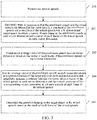
- the mixed speech recognition method in this embodiment of the present disclosure includes the following steps:
- Step 101 Monitor an input of speech.
- the input of the speech may be monitored by using the microphone array to reduce noise interferences of the speech input.
- the microphone or the microphone array may be connected to a computer device in a wired or wireless manner, or embedded in the computer device. After the microphone array detects the speech input, the speech is transmitted to the computer device.
- the computer device may be various terminal devices, or may be a server.
- Step 102 Acquire, in response to that enrollment speech and mixed speech are detected in the input speech, speech features of a target object based on the enrollment speech.
- the enrollment speech is speech including preset speech information.
- the computer device detects a speech input including the preset speech information in the input speech
- the input of the enrollment speech may be considered to be detected.
- wake-up speech usually needs to be inputted to wake up a speech control function of the smart speaker and the wake-up speech is speech that includes a wake-up word (for example, "Dingdong Dingdong"). Therefore, the wake-up speech may be used as the enrollment speech in the application scenario.
- the input of the enrollment speech may be considered to be detected.
- the wake-up word may be preset.
- the speech features of the target object may be extracted from the enrollment speech based on a speech feature recognition algorithm (for example, the Mel-frequency cepstral coefficients (MFCC) algorithm).
- MFCC Mel-frequency cepstral coefficients
- the speech features of the target object may alternatively be extracted from the enrollment speech through other manners. Reference may be made to descriptions in subsequent embodiments for details.
- Step 103 Determine speech belonging to the target object in the mixed speech based on the speech features of the target object.
- the mixed speech is non-enrollment speech that is detected and inputted to the computer device by the microphone array after the enrollment speech.
- the computer device may recognize speech features similar to the speech features of the target object from the mixed speech by a similarity likelihood algorithm based on the speech features of the target object, thereby determining the speech belonging to the target object in the mixed speech.
- the speech features of the target object are acquired based on the enrollment speech in response to that the input of the enrollment speech and the mixed speech is detected; and the speech belonging to the target object in the mixed speech is determined based on the speech features of the target object.
- the speech of the target object may be determined in the mixed speech, to facilitate tracking the speech of the target object in the mixed speech. Even in a case where an interference speaker and the target object are relatively close to each other in the application scenario, the speech of the target object may still be accurately recovered, and the accuracy of an interfered speech command recognition in subsequent processing may be improved.
- wake-up speech may be used as a feature of a speaker of the wake-up speech (that is, the target object) learned by the enrollment speech, and speech belonging to the speaker of the wake-up speech is recognized and tracked in the mixed speech that is inputted after the wake-up speech.
- the speech features of the target object in this embodiment of the present disclosure do not depend on the number of speakers in the mixed speech, in this embodiment of the present disclosure, the number of speakers in the mixed speech does not need to be learned in advance or estimated during the mixed speech recognition process.
- the mixed speech recognition method in the present disclosure is described by using another embodiment.
- the mixed speech recognition method in this embodiment of the present disclosure includes the following steps:
- Step 201 Monitor an input of speech.
- the input of the speech may be monitored by using the microphone array to reduce noise interferences of the speech input.
- the microphone array may be connected to a computer device in a wired or wireless manner, or embedded in the computer device. After the microphone array detects the speech input, the speech is transmitted to the computer device.
- the computer device may be various terminal devices, or may be a server.
- Step 202 Separately map, in response to that the enrollment speech and the mixed speech are detected in the input speech, a spectrum of the enrollment speech and a spectrum of the mixed speech into a K-dimensional vector space to determine a vector of each frame of the enrollment speech in each vector dimension and a vector of each frame of the mixed speech in each vector dimension.
- the enrollment speech is the speech including preset speech information, and K is not less than 1, for example, the K may be 40.
- the input of the enrollment speech in response to that the computer device detects a speech input including the preset speech information in the input speech, the input of the enrollment speech may be considered to be detected.
- wake-up speech usually needs to be inputted to wake up a speech control function of the smart speaker and the wake-up speech is speech that includes a wake-up word (for example, "Dingdong Dingdong"). Therefore, the wake-up speech may be used as the enrollment speech in the application scenario.
- the input of the enrollment speech in response to that the smart speaker detects the input of the wake-up speech, the input of the enrollment speech may be considered to be detected.
- the wake-up word may be preset.
- the mixed speech is non-enrollment speech inputted after the enrollment speech.
- speech of different speakers often overlaps. Consequently, the input speech is the mixed speech.
- the mixed speech recognition method in this embodiment of the present disclosure is for determining the speech belonging to the target object from the mixed speech.
- the computer device may map the spectrum of the enrollment speech and the spectrum of the mixed speech to the K-dimensional vector space by a deep neural network to determine the vector of each frame of the enrollment speech in each vector dimension and the vector of each frame of the mixed speech in each vector dimension.
- the deep neural network is composed of four layers of bidirectional long short-term memory (LSTM) networks, and each layer of the LSTM network has 600 nodes.
- the deep neural network may be replaced with various other effective new model structures, for example, a model combining a convolutional neural network (CNN) and other network structures, or other network structures, such as a time delay network or a gated convolutional neural network.
- CNN convolutional neural network
- a model type and a topology structure of the deep neural network are not limited in this embodiment of the present disclosure.
- the spectrum in this embodiment of the present disclosure may be determined after performing a short-time Fourier transform on the speech and logarithmizing the result of the short-time Fourier transform.
- Step 202 is described below by using an example.
- the superscript" ws " represents the enrollment speech
- the superscript" cs" represents the mixed speech
- X f,t is a short-time Fourier transform in the log domain, representing the spectrum of the t th frame in the input speech ( f represents a sequence number of a spectrum dimension, and t represents a frame sequence number in a time dimension)
- the spectrum of the enrollment speech may be represented as X f , t ws
- the spectrum of the mixed speech may be represented as X f , t cs .
- the input spectrum of the enrollment speech and the input spectrum of the mixed speech may be separately mapped into a K-dimensional vector by the deep neural network, to determine a vector V k , f , t ws of each frame of the enrollment speech in each vector dimension ( V k , f , t ws represents a vector of the t th frame of the enrollment speech in the k th vector dimension, k) and a vector V k , f , t cs of each frame of the mixed speech in each vector dimension ( V k , f , t cs represents a vector of the t th frame of the mixed speech in the k th vector dimension, k).
- Step 203 Calculate an average vector of the enrollment speech in each vector dimension based on the vector of each frame of the enrollment speech in each vector dimension.
- the average vector A k ws of the enrollment speech in each vector dimension may be calculated, T1 representing the number of frames of the enrollment speech.
- the spectrum of the enrollment speech may be compared with a spectrum threshold. If a spectrum amplitude of a frame of the enrollment speech (that is, a time-frequency window) is greater than an adaptation spectrum comparison value, the frame is considered to be the effective frame of the enrollment speech.
- the average vector of the enrollment speech in each vector dimension is calculated based on the vector of the effective frame of the enrollment speech in each vector dimension.
- the adaptation spectrum comparison value is equal to a difference between the largest spectrum amplitude of the enrollment speech and a preset spectrum threshold.
- a supervised labeling value Y f , t ws of the enrollment speech may be set, and the spectrum of each frame of the enrollment speech is separately compared with a difference between the largest spectrum amplitude and a spectrum threshold ⁇ . If a spectrum amplitude of a frame of the enrollment speech (that is, a time-frequency window) is greater than an adaptation spectrum comparison value (that is, a difference between the largest spectrum amplitude of the enrollment speech and ⁇ ), the supervised labeling value Y f , t ws of the enrollment speech corresponding to the time-frequency window is 1, and otherwise, the value of Y f , t ws is 0.
- the determining an average vector of the enrollment speech in each vector dimension based on the vector of the effective frame of the enrollment speech in each vector dimension includes: summing, after the vector of each frame of the enrollment speech in the corresponding vector dimension is multiplied by a supervised labeling value of the corresponding frame, vector dimensions to determine a total vector of the effective frame of the enrollment speech in the corresponding vector dimension; and separately dividing the total vector of the effective frame of the enrollment speech in each vector dimension by the sum of the supervised labeling values of each frame of the enrollment speech to determine the average vector of the enrollment speech in each vector dimension.
- the determining an average vector of the enrollment speech in each vector dimension based on the vector of the effective frame of the enrollment speech in each vector dimension may be implemented by the following second formula:
- a k ws ⁇ f , t V k , f , t ws ⁇ Y f , t ws ⁇ f , t Y f , t ws ,
- a k ws representing the average vector of the enrollment speech in the vector dimension k, and k ⁇ [1, K].
- Step 204 Use the average vector of the enrollment speech in each vector dimension as a speech extractor of the target object in each vector dimension and separately measure a distance between the vector of each frame of the mixed speech in each vector dimension and the speech extractor of the corresponding vector dimension to estimate a mask of each frame in the mixed speech.
- step 204 the computer device estimates the mask of each frame of the mixed speech by measuring the distance between the vector of each frame of the mixed speech in each vector dimension and the speech extractor, to recover the speech of the target object.
- Step 205 Determine the speech belonging to the target object in the mixed speech based on the mask of each frame of the mixed speech.
- the speech belonging to the target object in the mixed speech may be determined based on the mask of each frame of the mixed speech. Specifically, by using the mask to weight the mixed speech, the speech belonging to the target object in the mixed speech may be extracted frame by frame, and a larger mask indicates more speech that is of the corresponding time-frequency window and that is extracted.
- the average vector of the enrollment speech in each vector dimension is used as the speech extractor of the target object in each vector dimension.
- the speech extractor of the target object in each vector dimension may be selected in other manners.
- an alternative solution may be: after step 202, based on a clustering algorithm (for example, a K-means algorithm), the vector of each frame of the mixed speech in each vector dimension is processed to determine a centroid vector that is of the mixed speech and that corresponds to different speech of speakers in each vector dimension.
- Step 204 is replaced with: use a target centroid vector of the mixed speech in each vector dimension as a speech extractor of the target object in the corresponding vector dimension and separately measure a distance between the vector of each frame of the mixed speech in each vector dimension and the speech extractor of a corresponding vector dimension to estimate a mask of each frame of the mixed speech, the target centroid vector being a centroid vector that has the smallest distance with the average vector of the enrollment speech in the same vector dimension.
- a clustering algorithm for example, a K-means algorithm
- another alternative solution may be: after step 203, a distance between M preset speech extractors is separately compared with the average vector of the enrollment speech in each vector dimension, M being greater than 1; Step 204 is replaced with: use a speech extractor with the smallest distance from the average vector of the enrollment speech in a vector dimension in the M speech extractors as a speech extractor of the target object in the corresponding vector dimension and separately measure a distance between the vector of each frame of the mixed speech in each vector dimension and the speech extractor of the corresponding vector dimension to estimate a mask of each frame of the mixed speech.
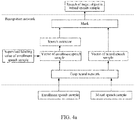
- a recognition network for implementing the mixed speech recognition process may be pre-built and the recognition network is trained.
- FIG. 4a the schematic structural diagram of the recognition network is shown as FIG. 4a .
- the training process of the recognition network is described with reference to FIG. 4a :
- An enrollment speech sample and a mixed speech sample that are used for training the recognition network are inputted into a deep neural network.
- the deep neural network is composed of four layers of bidirectional LSTM networks, and each layer of the LSTM network has 600 nodes.
- the deep neural network may be replaced with various other effective new model structures, for example, a model combining a CNN and other network structures, or other network structures, such as a time delay network or a gated convolutional neural network.
- a model type and a topology structure of the deep neural network are not limited in the present disclosure.
- the superscript" ws '" represents the enrollment speech sample
- the superscript" c s '" represents the mixed speech sample
- " X f,t " is a short-time Fourier transform in the log domain, representing the spectrum of the t th frame in the input speech ( f represents a sequence number of a spectrum dimension, and t represents a frame sequence number in a time dimension).
- the spectrum of the enrollment speech sample may be represented as X f , t ws ′
- the spectrum of the mixed speech sample may be represented as X f , t cs ′ .
- the input spectrum X f , t ws ′ of the enrollment speech sample and the input spectrum X f , t cs ′ of the mixed speech sample may be separately mapped into a K-dimensional vector by the deep neural network, to determine a vector V k , f , t ws ′ of each frame of the enrollment speech sample in each vector dimension ( V k , f , t ws ′ represents a vector of the t th frame of the enrollment speech sample in the k th vector dimension, k) and a vector V k , f , t c s ′ of each frame of the mixed speech sample in each vector dimension ( V k , f , t c s ′ represents a vector of the t th frame of the mixed speech sample in the k th vector dimension, k).
- a supervised labeling value Y f , t ws ′ of the enrollment speech sample is set, and the spectrum of each frame of the enrollment speech sample is separately compared with a difference between the largest spectrum amplitude and a spectrum threshold ⁇ .
- a spectrum amplitude of a frame of the enrollment speech sample (that is, a time-frequency window) is greater than an adaptation spectrum comparison value (that is, a difference between the largest spectrum amplitude of the enrollment speech sample and ⁇ )
- the supervised labeling value Y f , t ws ′ of the enrollment speech sample corresponding to the time-frequency window is 1, and otherwise, the value of Y f , t ws ′ is 0.
- the vector V k , f , t ws ′ and the supervised labeling value Y f , t ws ′ of the enrollment speech sample are used for estimating the speech extractor A k ws ′ of the target object in the vector space.
- vector dimensions are summed to determine a total vector of the effective frame of the enrollment speech in the corresponding vector dimension; and the total vector of the effective frame of the enrollment speech in each vector dimension is separately divided by the sum of the supervised labeling values of each frame of the enrollment speech to determine the average vector of the enrollment speech in each vector dimension.
- a k ws ′ ⁇ f , t V k , f , t ws ′ ⁇ Y f , t ws ′ ⁇ f , t Y f , t ws ′ .
- the value of ⁇ for example, is 40 dB.
- the mask of the target object is estimated and recovered.
- the estimation method is shown as the sixth formula. If an inner product distance between a time-frequency window and the speech extractor is smaller, the probability that the time-frequency window belongs to the target object is larger. Then the mask that corresponds to the time-frequency window and that is estimated by the sixth formula is larger, and more speech of the corresponding time-frequency window in the mixed speech sample is extracted.
- M f , t cs ′ S i gmoid ⁇ k A k ws ′ ⁇ V k , f , t cs ′ .
- M f , t cs ′ represents a mask of the t th frame of the mixed speech sample, and for A k ws ′ and V k , f , t cs ′ , reference may be made to the foregoing description.
- a spectral error between the speech of target object recovered by the estimated mask and reference speech of the target object is reconstructed by an objective function of the recognition network, and then the entire network is trained by minimizing the objective function.
- S f , t cs ′ represents a spectrum of the reference speech of the target object in the t th frame (that is, a spectrum of the reference speech).
- the seventh formula is a standard reconstruction error of L2. Because the reconstruction error reflects the spectral error between the recovered speech and the reference speech of the target object, a global error may be reduced by generating a gradient in response to that the recognition network is trained, to optimize the quality of the extracted speech of the target object.
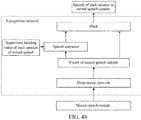
- the schematic structural diagram of the recognition network may alternatively be shown as FIG. 4b .
- the training process of the recognition network does not need the input of the enrollment speech sample, that is, a target object and an interference object are not distinguished from each other.
- the training process of the recognition network is described below with reference to FIG. 4b :
- S c ,f,t represents a spectrum of the reference speech of the speaker c in the t th frame (that is, a spectrum of the reference speech).
- the tenth formula is a standard reconstruction error of L2. Because the reconstruction error reflects the spectral error between the recovered speech of each speaker and the reference speech of the corresponding speaker, a global error may be reduced by generating a gradient in response to that the recognition network is trained, to optimize the quality of the extracted speech of all speakers.
- a spectrum of the enrollment speech and a spectrum of the mixed speech are separately mapped into a K-dimensional vector space, a speech extractor is determined for a target object based on the enrollment speech, then a mask of each frame of the mixed speech is estimated by measuring a distance between the vector of each frame of the mixed speech in each vector dimension and the speech extractor of a corresponding vector dimension, and finally speech belonging to the target object in the mixed speech is determined based on the mask.
- the speech of the target object may be determined in the mixed speech, to facilitate tracking the speech of the target object in the mixed speech
- wake-up speech may be used as the enrollment speech to learn features of a speaker (that is, the target object) of the wake-up speech, and speech belonging to the speaker of the wake-up speech is recognized and tracked in the mixed speech that is inputted after the wake-up speech.
- the determining of the speech extractor in the present disclosure does not depend on the number of speakers in the mixed speech, in this embodiment of the present disclosure, the number of speakers in the mixed speech does not need to be learned in advance or estimated during the mixed speech recognition process.
- the mixed speech recognition method in the present disclosure is described below by using another embodiment.
- the difference between this embodiment and the embodiment shown in FIG. 3 is that, in this embodiment, a feedforward neural network is introduced into a recognition network (that is, a network used for implementing the mixed speech recognition) to map an original vector space to a normalized vector space, so that the distribution of speech extractors trained by the recognition network is relatively more concentrated and stable.
- a recognition network that is, a network used for implementing the mixed speech recognition
- the mixed speech recognition method in this embodiment of the present disclosure includes the following steps:
- Step 301 Monitor an input of speech.
- the input of the speech may be monitored by using a microphone array to reduce noise interferences of the speech input.
- the microphone array may be connected to a computer device in a wired or wireless manner, or embedded in the computer device. After the microphone array detects the speech input, the speech is transmitted to the computer device.
- Step 302 Separately map, in response to that the enrollment speech and the mixed speech are detected in the input speech, a spectrum of the enrollment speech and a spectrum of the mixed speech into a K-dimensional vector space to determine a vector of each frame of the enrollment speech in each vector dimension and a vector of each frame of the mixed speech in each vector dimension.
- the enrollment speech is the speech including preset speech information, and K is not less than 1, for example, the K may be 40.
- the input of the enrollment speech in response to that the computer device detects a speech input including the preset speech information in the input speech, the input of the enrollment speech may be considered to be detected.
- wake-up speech usually needs to be inputted to wake up a speech control function of the smart speaker and the wake-up speech is speech that includes a wake-up word (for example, "Dingdong Dingdong"). Therefore, the wake-up speech may be used as the enrollment speech in the application scenario.
- the input of the enrollment speech in response to that the smart speaker detects the input of the wake-up speech, the input of the enrollment speech may be considered to be detected.
- the mixed speech is non-enrollment speech inputted after the enrollment speech.
- speech of different speakers often overlaps. Consequently, the input speech is the mixed speech.
- the mixed speech recognition method in this embodiment of the present disclosure is for determining the speech belonging to the target object from the mixed speech.
- a computer device may map the spectrum of the enrollment speech and the spectrum of the mixed speech to the K-dimensional vector space by a deep neural network to determine the vector of each frame of the enrollment speech in each vector dimension and the vector of each frame of the mixed speech in each vector dimension.
- the deep neural network is composed of four layers of bidirectional LSTM networks, and each layer of the LSTM network has 600 nodes.
- the deep neural network may be replaced with various other effective new model structures, for example, a model combining a convolutional neural network (CNN) and other network structures, or other network structures, such as a time delay network or a gated convolutional neural network.
- CNN convolutional neural network
- a model type and a topology structure of the deep neural network are not limited in this embodiment of the present disclosure.
- the spectrum in this embodiment of the present disclosure may be determined after performing a short-time Fourier transform on the speech and logarithmizing the result of the short-time Fourier transform.
- Step 302 is described below by using an example.
- the superscript" ws " represents the enrollment speech
- the superscript " cs " represents the mixed speech
- X f,t is a short-time Fourier transform in the log domain, representing the spectrum of the t th frame in the input speech ( / represents a sequence number of a spectrum dimension, and t represents a frame sequence number in a time dimension)
- the spectrum of the enrollment speech may be represented as X f , t ws
- the spectrum of the mixed speech may be represented as X f , t cs .
- the input spectrum X f , t ws of the enrollment speech and the input spectrum X f , t cs of the mixed speech may be separately mapped into a K-dimensional vector by the deep neural network, to determine a vector V k , f , t ws of each frame of the enrollment speech in each vector dimension ( V k , f , t ws represents a vector of the t th frame of the enrollment speech in the k th vector dimension, k) and a vector V k , f , t cs of each frame of the mixed speech in each vector dimension ( V k , f , t cs represents a vector of the t th frame of the mixed speech in the k th vector dimension, k).
- Step 303 Calculate an average vector of the enrollment speech in each vector dimension based on the vector of each frame of the enrollment speech in each vector dimension.
- the average vector of the enrollment speech in each vector dimension may be calculated, T1 representing the number of frames of the enrollment speech.
- the spectrum of the enrollment speech may be compared with a spectrum threshold. If a spectrum amplitude of a frame of the enrollment speech (that is, a time-frequency window) is greater than an adaptation spectrum comparison value, the frame is considered to be the effective frame of the enrollment speech.
- the average vector of the enrollment speech in each vector dimension is calculated based on the vector of the effective frame of the enrollment speech in each vector dimension.
- the adaptation spectrum comparison value is equal to a difference between the largest spectrum amplitude of the enrollment speech and a preset spectrum threshold.
- a supervised labeling value Y f , t ws of the enrollment speech may be set, and the spectrum of each frame of the enrollment speech is separately compared with a difference between the largest spectrum amplitude and a spectrum threshold ⁇ . If a spectrum amplitude of a frame of the enrollment speech (that is, a time-frequency window) is greater than an adaptation spectrum comparison value (that is, a difference between the largest spectrum amplitude of the enrollment speech and ⁇ ), the supervised labeling value Y f , t ws of the enrollment speech corresponding to the time-frequency window is 1, and otherwise, the value of Y f , t ws is 0.
- the step of calculating an average vector of the enrollment speech in each vector dimension based on the vector of the effective frame of the enrollment speech in each vector dimension may be implemented by the second formula.
- Step 304 Input the average vector of the enrollment speech in each vector dimension and the vector of each frame of the mixed speech in each vector dimension to a pre-trained feedforward neural network to determine a normalized vector of each frame in each vector dimension.
- the feedforward neural network may be a two-layer network, and the number of nodes in each layer may be 256. Description is further provided by using the foregoing example.
- a 2K-dimensional vector combined by the average vector A k ws of the enrollment speech in each vector dimension and the vector V k , f , t cs of each frame of the mixed speech in each vector dimension is inputted to the feedforward neural network, to output a K-dimensional normalized vector V k , f , t %
- a function of the feedforward neural network may be shown as the eleventh formula.
- V k , f , t % f A k ws V k , f , t cs .
- f (g) represents a nonlinear mapping function learned through the deep neural network, and the function of the nonlinear mapping function is to map an original vector space to a new vector space (that is, the normalized vector space).
- Step 305 Separately measure a distance between the normalized vector of each frame in each vector dimension and a preset speech extractor to estimate the mask of each frame of the mixed speech.
- centroids of all the speech extractors determined in response to that the recognition network is trained may be used as preset speech extractors. Because the speech extractor does not need to be re-estimated during the mixed speech recognition process in this embodiment of the present disclosure, the mixed speech recognition method in this embodiment of the present disclosure can better implement frame-by-frame real-time processing.
- Step 306 Determine the speech belonging to the target object in the mixed speech based on the mask of each frame of the mixed speech.
- the speech belonging to the target object in the mixed speech may be determined based on the mask of each frame of the mixed speech. Specifically, by using the mask to weight the mixed speech, the speech belonging to the target object in the mixed speech may be extracted frame by frame, and a larger mask indicates more speech that is of the corresponding time-frequency window and that is extracted.
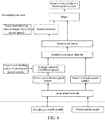
- the recognition network used for implementing the mixed speech recognition process shown in FIG. 5 is described below.
- a schematic structural diagram of the recognition network is shown in FIG. 6 .
- the training process of the recognition network is described below with reference to FIG. 6 :
- S f , t cs ′ represents the spectrum of the reference speech of the target object in the t th frame (that is, the spectrum of the reference speech).
- the fourteenth formula is a standard L2 reconstruction error. Because the reconstruction error reflects the spectral error between the recovered speech and the reference speech of the target object, a global error may be reduced by generating a gradient in response to that the recognition network is trained, to optimize the quality of the extracted speech of the target object.
- centroids of all the speech extractors determined in response to that the recognition network is trained may be used as preset speech extractors.
- measure a distance between the normalized vector of each frame in each vector dimension and a preset speech extractor is separately measured to estimate the mask of each frame of the mixed speech.
- An embodiment of the present disclosure provides a mixed speech recognition apparatus. As shown in FIG. 7 , the mixed speech recognition apparatus in this embodiment of the present disclosure includes:
- the acquiring unit 72 may include:
- the calculating unit 722 is specifically configured to: calculate the average vector of the enrollment speech in each vector dimension based on the vector of an effective frame of the enrollment speech in each vector dimension, the effective frame of the enrollment speech being a frame in the enrollment speech with a spectrum amplitude greater than an adaptation spectrum comparison value, and the adaptation spectrum comparison value being equal to a difference between a largest spectrum amplitude of the enrollment speech and a preset spectrum threshold.
- the mixed speech recognition apparatus in this embodiment of the present disclosure further includes: a normalization unit, configured to input the average vector of the enrollment speech in each vector dimension and the vector of each frame of the mixed speech in each vector dimension to a pre-trained feedforward neural network to determine a normalized vector of each frame in each vector dimension.
- the mask estimation unit 723 is specifically configured to: separately measure a distance between the normalized vector of each frame in each vector dimension and a preset speech extractor to estimate the mask of each frame of the mixed speech.
- the mixed speech recognition apparatus in this embodiment of the present disclosure further includes: a clustering unit, configured to process the vector of each frame of the mixed speech in each vector dimension based on a clustering algorithm to determine a centroid vector that is of the mixed speech and that corresponds to different speech of speakers in each vector dimension.
- the mask estimation unit 723 is specifically configured to: use a target centroid vector of the mixed speech in each vector dimension as a speech extractor of the target object in the corresponding vector dimension and separately measure a distance between the vector of each frame of the mixed speech in each vector dimension and the speech extractor in the corresponding vector dimension to estimate a mask of each frame of the mixed speech.
- the mixed speech recognition apparatus in this embodiment of the present disclosure may further include: a comparison unit, configured to separately compare a distance between M preset speech extractors and the average vector of the enrollment speech in each vector dimension, M being greater than 1.
- the mask estimation unit 723 is specifically configured to: use a speech extractor with the smallest distance from the average vector of the enrollment speech in a vector dimension in the M speech extractors as a speech extractor of the target object in the corresponding vector dimension, and separately measure a distance between the vector of each frame of the mixed speech in each vector dimension and the speech extractor of a corresponding vector dimension to estimate a mask of each frame of the mixed speech.
- the mixed speech recognition apparatus in this embodiment of the present disclosure may be configured to implement all the technical solutions in the method embodiments.
- the functions of the functional modules may be specifically implemented according to the methods in the method embodiments.
- the speech features of the target object are acquired based on the enrollment speech in response to that the input of the enrollment speech and the mixed speech is detected; and the speech belonging to the target object in the mixed speech is determined based on the speech features of the target object.
- the speech of the target object may be determined in the mixed speech, to facilitate tracking the speech of the target object in the mixed speech.
- wake-up speech may be used as the enrollment speech to learn features of a speaker (that is, the target object) of the wake-up speech, and speech belonging to the speaker of the wake-up speech is recognized and tracked in the mixed speech that is inputted after the wake-up speech.
- the speech features of the target object in this embodiment of the present disclosure do not depend on the number of speakers in the mixed speech, in this embodiment of the present disclosure, the number of speakers in the mixed speech does not need to be learned in advance or estimated during the mixed speech recognition process.
- the mixed speech recognition apparatus in this embodiment of the present disclosure further includes: a memory 81, one or more processors 82 (only one processor is shown in FIG. 9 ), and a computer program that is stored on the memory 81 and capable of being run on the processor.
- the memory 82 is configured to store a software program and a module.
- the processor 82 runs the software program and the unit stored in the memory 81, to perform various functional applications and data processing. Specifically, by running the computer program stored on the memory 81, the processor 82 implements of the following steps:
- the acquiring speech features of a target object based on the enrollment speech includes:
- the calculating an average vector of the enrollment speech in each vector dimension based on the vector of each frame of the enrollment speech in each vector dimension is specifically: calculating the average vector of the enrollment speech in each vector dimension based on the vector of an effective frame of the enrollment speech in each vector dimension, the effective frame of the enrollment speech being a frame in the enrollment speech with a spectrum amplitude greater than an adaptation spectrum comparison value, and the adaptation spectrum comparison value being equal to a difference between the largest spectrum amplitude of the enrollment speech and a preset spectrum threshold.
- the calculating unit is specifically configured to: sum, after the vector of each frame of the enrollment speech in the corresponding vector dimension is multiplied by a supervised labeling value of the corresponding frame, vector dimensions to determine a total vector of the effective frame of the enrollment speech in the corresponding vector dimension; and separately divide the total vector of the effective frame of the enrollment speech in each vector dimension by the sum of the supervised labeling values of the frames of the enrollment speech to determine the average vector of the enrollment speech in each vector dimension; the supervised labeling value of a frame in the enrollment speech being 1 in response to that a spectrum amplitude of the frame is greater than the adaptation spectrum comparison value; and being 0 in response to that the spectrum amplitude of the frame is not greater than the adaptation spectrum comparison value.
- the processor 82 after the calculating an average vector of the enrollment speech in each vector dimension based on the vector of each frame of the enrollment speech in each vector dimension, by running the computer program stored on the memory 81, the processor 82 further implements the following steps:
- the processor 82 after the separately mapping a spectrum of the enrollment speech and a spectrum of the mixed speech into a K-dimensional vector space, by running the computer program stored on the memory 81, the processor 82 further implements the following steps:
- the processor 82 after the calculating an average vector of the enrollment speech in each vector dimension based on the vector of each frame of the enrollment speech in each vector dimension, by running the computer program stored on the memory 81, the processor 82 further implements the following steps:
- the mixed speech recognition apparatus further includes: one or more input devices 83 (only one input device is shown in FIG. 9 ), and one or more output devices 84 (only one output device is shown in FIG. 9 ).
- the memory 81, the processor 82, the input device 83, and the output device 84 are connected through a bus 85.
- the processor 82 may be a central processing unit (CPU).
- the processor may further be another general-purpose processor, a digital signal processor (DSP), an application specific integrated circuit (ASIC), a field-programmable gate array (FPGA), or another programmable logic device, a discrete gate or a transistor logic device, a discrete hardware component, or the like.
- DSP digital signal processor
- ASIC application specific integrated circuit
- FPGA field-programmable gate array
- the general purpose processor may be a microprocessor or the processor may be any conventional processor or the like.
- the input device 83 may include a keyboard, a touch pad, a fingerprint acquisition sensor (configured to acquire fingerprint information and fingerprint direction information of users), a microphone, or the like.
- the output device 84 may include a display, a speaker, or the like.
- the memory 84 may include a read-only memory and a random access memory, and provides an instruction and data to the processor 81. A part or all of the memory 84 may further include a non-volatile random access memory.
- the speech features of the target object are acquired based on the enrollment speech in response to that the input of the enrollment speech and the mixed speech is detected; and the speech belonging to the target object in the mixed speech is determined based on the speech features of the target object.
- the speech of the target object may be determined in the mixed speech, to facilitate tracking the speech of the target object in the mixed speech.
- wake-up speech may be used as the enrollment speech to learn features of a speaker (that is, the target object) of the wake-up speech, and speech belonging to the speaker of the wake-up speech is recognized and tracked in the mixed speech that is inputted after the wake-up speech.
- the speech features of the target object in the present disclosure do not depend on the number of speakers in the mixed speech, in the embodiments of the present disclosure, the number of speakers in the mixed speech does not need to be learned in advance or estimated during the mixed speech recognition process.
- the disclosed apparatus and method may be implemented in other manners.
- the described system embodiment is merely exemplary.
- the modules and units division are merely logical function division and there may be other division manners during actual implementation.
- a plurality of units or components may be combined or integrated into another system, or some features may be ignored or not performed.
- the displayed or discussed mutual couplings or direct couplings or communications connections may be implemented through some interfaces.
- the indirect couplings or communications connections between the apparatuses or units may be implemented in electronic, mechanical, or other forms.
- the units described as separate parts may or may not be physically separate, and parts displayed as units may or may not be physical units, may be located in one position, or may be distributed on a plurality of network units. Some or all of the units may be selected according to actual needs to achieve the objectives of the solutions of the embodiments.
- the integrated unit When the integrated unit is implemented in the form of a software functional unit and sold or used as an independent product, the integrated unit may be stored in a computer readable storage medium. Based on such understanding, all or some of the processes of the methods in the embodiments may be implemented by a computer program instructing relevant hardware.
- the computer program may be stored in a computer readable storage medium. During execution of the computer program by the processor, steps of the foregoing method embodiments may be implemented.
- the computer program includes computer program code.
- the computer program code may be in source code form, object code form, executable file or some intermediate forms, or the like.
- the computer readable medium may include: any entity or apparatus that is capable of carrying the computer program code, a recording medium, a USB flash drive, a removable hard disk, a magnetic disk, an optical disc, a read-only memory (ROM), a random access memory (RAM), an electric carrier signal, a telecommunication signal and a software distribution medium, or the like.
- the content contained in the computer readable medium may be appropriately increased or decreased according to the requirements of legislation and patent practice in jurisdictions. For example, in some jurisdictions, according to legislation and patent practice, the computer readable medium does not include an electric carrier signal and a telecommunication signal.
Landscapes
- Engineering & Computer Science (AREA)
- Health & Medical Sciences (AREA)
- Audiology, Speech & Language Pathology (AREA)
- Human Computer Interaction (AREA)
- Physics & Mathematics (AREA)
- Acoustics & Sound (AREA)
- Multimedia (AREA)
- Computational Linguistics (AREA)
- Signal Processing (AREA)
- Artificial Intelligence (AREA)
- Computer Vision & Pattern Recognition (AREA)
- Quality & Reliability (AREA)
- Evolutionary Computation (AREA)
- Game Theory and Decision Science (AREA)
- Business, Economics & Management (AREA)
- Telephonic Communication Services (AREA)
- Image Analysis (AREA)
Abstract
Description
- This application claims the priority to Chinese patent application No.
201810436511.6 - The present disclosure belongs to the field of speech recognition technologies, and in particular, to a mixed speech recognition method, a mixed speech recognition apparatus, and a computer readable storage medium.
- As an acoustic representation of language, speech is one of the most natural, effective and convenient means for humans to exchange information. In recent years, computer speech recognition technologies have made tremendous progress. However, when speech is input into a computer for speech recognition, the input speech is inevitably interfered by environmental noise, room reverberation and even speech of other speakers. The interferences ultimately make the speech acquired by the computer not pure, but the speech contaminated by noise (that is, mixed speech). In recent years, many deep learning-based methods and systems have been developed to process separation and recognition of a mixed speech signal, such as a deep attractor network. The deep attractor network generates a distinguishing mapping vector for each time-frequency window of the mixed speech, and generates an attractor for each speaker in the mixed speech. Then, by calculating distances between the mapping vectors and the attractors, masks of the corresponding time-frequency windows belonging to the corresponding speakers are estimated and the masks are then used to calculate representation of each speaker in a time-frequency domain in the mixed speech.
- Embodiments of this application provide a mixed speech recognition method, a mixed speech recognition apparatus and a computer readable storage medium, so that speech of a target object may be determined in mixed speech and tracking the speech of the target object in the mixed speech is facilitated.
- A first aspect of the embodiments of this application provides a mixed speech recognition method, including:
- monitoring an input of speech;
- acquiring, in response to that an input of enrollment speech and mixed speech is detected, speech features of a target object based on the enrollment speech; and
- determining speech belonging to the target object in the mixed speech based on the speech features of the target object;
- the enrollment speech being speech including preset speech information and the mixed speech being non-enrollment speech inputted after the enrollment speech.
- A second aspect of the embodiments of this application provides a mixed speech recognition apparatus, including:
- a monitoring unit, configured to monitor an input of speech;
- an acquiring unit, configured to acquire, in response to that an input of enrollment speech and mixed speech is detected by the monitoring unit, speech features of a target object based on the enrollment speech; and
- a determining unit, configured to determine speech belonging to the target object in the mixed speech based on the speech features of the target object;
- the enrollment speech being speech including preset speech information and the mixed speech being non-enrollment speech inputted after the enrollment speech.
- A third aspect of the embodiments of this application provides a mixed speech recognition apparatus, including: a memory, a processor, and a computer program that is stored on the memory and capable of being run on the processor. The processor implements the mixed speed recognition method mentioned in the first aspect during execution of the computer program.
- A fourth aspect of the embodiments of this application provides a computer readable storage medium, storing a computer program. When executed by a processor, the computer program implements the mixed speech recognition method mentioned in the first aspect.
- It can be learned from the above that, in the embodiments of this application, the speech features of the target object are acquired based on the enrollment speech in response to that the input of the enrollment speech and the mixed speech is detected; and the speech belonging to the target object in the mixed speech is determined based on the speech features of the target object. By introducing speech features of a target object learned by enrollment speech, in the embodiments of this application, the speech of the target object may be determined in the mixed speech, to facilitate tracking the speech of the target object in the mixed speech. For example, in the application scenario of a smart speaker, wake-up speech may be used as the enrollment speech to learn features of a speaker (that is, the target object) of the wake-up speech, and speech belonging to the speaker of the wake-up speech is recognized and tracked in the mixed speech that is inputted after the wake-up speech. In addition, because the speech features of the target object in the embodiments of this application do not depend on the number of speakers in the mixed speech, in the embodiments of this application, the number of speakers in the mixed speech does not need to be learned in advance or estimated during the mixed speech recognition process.
- To describe the technical solutions of the embodiments of the present disclosure more clearly, the following briefly introduces the accompanying drawings required for describing the embodiments or the related art. Apparently, the accompanying drawings in the following description show only some embodiments of the present disclosure, and a person of ordinary skill in the art may still derive other drawings according to the accompanying drawings without creative efforts.
-
FIG. 1 is a schematic diagram of an application scenario according to an embodiment of the present disclosure. -
FIG. 2 is a schematic structural flowchart of a mixed speech recognition method according to an embodiment of the present disclosure. -
FIG. 3 is another schematic structural flowchart of a mixed speech recognition method according to an embodiment of the present disclosure. -
FIG. 4a is a schematic structural diagram of a recognition network according to an embodiment of the present disclosure. -
FIG. 4b is a schematic structural diagram of another recognition network according to an embodiment of the present disclosure. -
FIG. 5 is still another schematic structural flowchart of a mixed speech recognition method according to an embodiment of the present disclosure. -
FIG. 6 is a schematic structural diagram of still another recognition network according to an embodiment of the present disclosure. -
FIG. 7 is a schematic structural diagram of a mixed speech recognition apparatus according to an embodiment of the present disclosure. -
FIG. 8 is another schematic structural diagram of a mixed speech recognition apparatus according to an embodiment of the present disclosure. -
FIG. 9 is still another schematic structural diagram of a mixed speech recognition apparatus according to an embodiment of the present disclosure. - In the following description, for the purpose of illustration rather than limitation, specific details such as the specific system structure and technology are provided to thoroughly understand the embodiments of the present disclosure. However, a person skilled in the art knows that the present disclosure may be implemented in other embodiments without these specific details. In other cases, detailed descriptions of well-known systems, apparatuses, circuits, and methods are omitted to avoid unnecessary details hindering the description of the present disclosure.
- It is to be understood that the order of the sequence numbers of the steps in the following method embodiments does not mean the order of execution, and the execution order of each process is determined by its function and inherent logic, and does not constitute any limitation on the implementation process of each embodiment.
- To describe technical solutions in the present disclosure, the following will be described by using specific embodiments.
-
FIG. 1 is a schematic diagram of an application scenario according to an embodiment of the present disclosure. As shown inFIG. 1 , auser 20 may perform speech interaction with acomputer device 10. Thecomputer device 10 may include a microphone or a microphone array. The computer device may be various terminal devices, such as a smart speaker, a smart television, a smart speech assistant, a mobile phone, a tablet computer, an e-book reader, smart glasses, a smart watch, a laptop computer and a desktop computer. - An embodiment of the present disclosure provides a mixed speech recognition method. Referring to
FIG. 2 , the mixed speech recognition method in this embodiment of the present disclosure includes the following steps: - Step 101: Monitor an input of speech.
- In this embodiment of the present disclosure, the input of the speech may be monitored by using the microphone array to reduce noise interferences of the speech input. The microphone or the microphone array may be connected to a computer device in a wired or wireless manner, or embedded in the computer device. After the microphone array detects the speech input, the speech is transmitted to the computer device. The computer device may be various terminal devices, or may be a server.
- Step 102: Acquire, in response to that enrollment speech and mixed speech are detected in the input speech, speech features of a target object based on the enrollment speech.
- In this embodiment of the present disclosure, the enrollment speech is speech including preset speech information. In response to that the computer device detects a speech input including the preset speech information in the input speech, the input of the enrollment speech may be considered to be detected. For example, in the application scenario of a smart speaker, wake-up speech usually needs to be inputted to wake up a speech control function of the smart speaker and the wake-up speech is speech that includes a wake-up word (for example, "Dingdong Dingdong"). Therefore, the wake-up speech may be used as the enrollment speech in the application scenario. In response to that the smart speaker detects the input of the wake-up speech, the input of the enrollment speech may be considered to be detected. The wake-up word may be preset.
- According to this embodiment of the present disclosure, in
step 102, the speech features of the target object may be extracted from the enrollment speech based on a speech feature recognition algorithm (for example, the Mel-frequency cepstral coefficients (MFCC) algorithm). - Certainly, in
step 102, the speech features of the target object may alternatively be extracted from the enrollment speech through other manners. Reference may be made to descriptions in subsequent embodiments for details. - Step 103: Determine speech belonging to the target object in the mixed speech based on the speech features of the target object.
- The mixed speech is non-enrollment speech that is detected and inputted to the computer device by the microphone array after the enrollment speech.
- In
step 103, the computer device may recognize speech features similar to the speech features of the target object from the mixed speech by a similarity likelihood algorithm based on the speech features of the target object, thereby determining the speech belonging to the target object in the mixed speech. - It can be learned from the above that, in this embodiment of the present disclosure, the speech features of the target object are acquired based on the enrollment speech in response to that the input of the enrollment speech and the mixed speech is detected; and the speech belonging to the target object in the mixed speech is determined based on the speech features of the target object. By introducing speech features of a target object learned by enrollment speech, according to the method of this embodiment of the present disclosure, the speech of the target object may be determined in the mixed speech, to facilitate tracking the speech of the target object in the mixed speech. Even in a case where an interference speaker and the target object are relatively close to each other in the application scenario, the speech of the target object may still be accurately recovered, and the accuracy of an interfered speech command recognition in subsequent processing may be improved. For example, in the application scenario of a smart speaker, wake-up speech may be used as a feature of a speaker of the wake-up speech (that is, the target object) learned by the enrollment speech, and speech belonging to the speaker of the wake-up speech is recognized and tracked in the mixed speech that is inputted after the wake-up speech. In addition, because the speech features of the target object in this embodiment of the present disclosure do not depend on the number of speakers in the mixed speech, in this embodiment of the present disclosure, the number of speakers in the mixed speech does not need to be learned in advance or estimated during the mixed speech recognition process.
- The mixed speech recognition method in the present disclosure is described by using another embodiment. Referring to
FIG. 3 , the mixed speech recognition method in this embodiment of the present disclosure includes the following steps: - Step 201: Monitor an input of speech.
- In this embodiment of the present disclosure, the input of the speech may be monitored by using the microphone array to reduce noise interferences of the speech input. The microphone array may be connected to a computer device in a wired or wireless manner, or embedded in the computer device. After the microphone array detects the speech input, the speech is transmitted to the computer device. The computer device may be various terminal devices, or may be a server.
- Step 202: Separately map, in response to that the enrollment speech and the mixed speech are detected in the input speech, a spectrum of the enrollment speech and a spectrum of the mixed speech into a K-dimensional vector space to determine a vector of each frame of the enrollment speech in each vector dimension and a vector of each frame of the mixed speech in each vector dimension.
- The enrollment speech is the speech including preset speech information, and K is not less than 1, for example, the K may be 40.
- In this embodiment of the present disclosure, in response to that the computer device detects a speech input including the preset speech information in the input speech, the input of the enrollment speech may be considered to be detected. For example, in the application scenario of a smart speaker, wake-up speech usually needs to be inputted to wake up a speech control function of the smart speaker and the wake-up speech is speech that includes a wake-up word (for example, "Dingdong Dingdong"). Therefore, the wake-up speech may be used as the enrollment speech in the application scenario. In response to that the smart speaker detects the input of the wake-up speech, the input of the enrollment speech may be considered to be detected. The wake-up word may be preset.
- The mixed speech is non-enrollment speech inputted after the enrollment speech. In a real intelligent speech interaction scenario, especially under a condition of remote speaking, speech of different speakers often overlaps. Consequently, the input speech is the mixed speech. The mixed speech recognition method in this embodiment of the present disclosure is for determining the speech belonging to the target object from the mixed speech.
- In
step 202, the computer device may map the spectrum of the enrollment speech and the spectrum of the mixed speech to the K-dimensional vector space by a deep neural network to determine the vector of each frame of the enrollment speech in each vector dimension and the vector of each frame of the mixed speech in each vector dimension. For example, the deep neural network is composed of four layers of bidirectional long short-term memory (LSTM) networks, and each layer of the LSTM network has 600 nodes. Certainly, the deep neural network may be replaced with various other effective new model structures, for example, a model combining a convolutional neural network (CNN) and other network structures, or other network structures, such as a time delay network or a gated convolutional neural network. A model type and a topology structure of the deep neural network are not limited in this embodiment of the present disclosure. - Specifically, the spectrum in this embodiment of the present disclosure may be determined after performing a short-time Fourier transform on the speech and logarithmizing the result of the short-time Fourier transform.
- Step 202 is described below by using an example. The superscript" ws " represents the enrollment speech, the superscript" cs" represents the mixed speech, and " Xf,t is a short-time Fourier transform in the log domain, representing the spectrum of the tth frame in the input speech ( f represents a sequence number of a spectrum dimension, and t represents a frame sequence number in a time dimension), then the spectrum of the enrollment speech may be represented as


step 202, the input spectrum of the enrollment speech and the input spectrum of the mixed speech may be separately mapped into a K-dimensional vector by the deep neural network, to determine a vector


- Step 203: Calculate an average vector of the enrollment speech in each vector dimension based on the vector of each frame of the enrollment speech in each vector dimension.
- In this embodiment of the present disclosure, by the formula


- Alternatively, to remove low-energy spectrum window noise to determine an effective frame of the enrollment speech, in
step 203, the spectrum of the enrollment speech may be compared with a spectrum threshold. If a spectrum amplitude of a frame of the enrollment speech (that is, a time-frequency window) is greater than an adaptation spectrum comparison value, the frame is considered to be the effective frame of the enrollment speech. Instep 203, the average vector of the enrollment speech in each vector dimension is calculated based on the vector of the effective frame of the enrollment speech in each vector dimension. The adaptation spectrum comparison value is equal to a difference between the largest spectrum amplitude of the enrollment speech and a preset spectrum threshold. Specifically, a supervised labeling value


- The determining an average vector of the enrollment speech in each vector dimension based on the vector of the effective frame of the enrollment speech in each vector dimension includes: summing, after the vector of each frame of the enrollment speech in the corresponding vector dimension is multiplied by a supervised labeling value of the corresponding frame, vector dimensions to determine a total vector of the effective frame of the enrollment speech in the corresponding vector dimension; and separately dividing the total vector of the effective frame of the enrollment speech in each vector dimension by the sum of the supervised labeling values of each frame of the enrollment speech to determine the average vector of the enrollment speech in each vector dimension. Specifically, the determining an average vector of the enrollment speech in each vector dimension based on the vector of the effective frame of the enrollment speech in each vector dimension may be implemented by the following second formula:


- Step 204: Use the average vector of the enrollment speech in each vector dimension as a speech extractor of the target object in each vector dimension and separately measure a distance between the vector of each frame of the mixed speech in each vector dimension and the speech extractor of the corresponding vector dimension to estimate a mask of each frame in the mixed speech.
- In
step 204, the computer device estimates the mask of each frame of the mixed speech by measuring the distance between the vector of each frame of the mixed speech in each vector dimension and the speech extractor, to recover the speech of the target object. The estimation method is shown as the third formula:


- If an inner product distance between a vector of a frame of the mixed speech (that is, a time-frequency window) and the speech extractor is smaller, the probability that the frame belongs to the target object is larger. Correspondingly, a mask that corresponds to the time-frequency window and that is estimated by the third formula is larger.
- Step 205: Determine the speech belonging to the target object in the mixed speech based on the mask of each frame of the mixed speech.
- In this embodiment of the present disclosure, after the mask of each frame of the mixed speech is determined, the speech belonging to the target object in the mixed speech may be determined based on the mask of each frame of the mixed speech. Specifically, by using the mask to weight the mixed speech, the speech belonging to the target object in the mixed speech may be extracted frame by frame, and a larger mask indicates more speech that is of the corresponding time-frequency window and that is extracted.
- In the embodiment shown in
FIG. 3 , the average vector of the enrollment speech in each vector dimension is used as the speech extractor of the target object in each vector dimension. Certainly, in other embodiments, the speech extractor of the target object in each vector dimension may be selected in other manners. - For example, an alternative solution may be: after
step 202, based on a clustering algorithm (for example, a K-means algorithm), the vector of each frame of the mixed speech in each vector dimension is processed to determine a centroid vector that is of the mixed speech and that corresponds to different speech of speakers in each vector dimension. Step 204 is replaced with: use a target centroid vector of the mixed speech in each vector dimension as a speech extractor of the target object in the corresponding vector dimension and separately measure a distance between the vector of each frame of the mixed speech in each vector dimension and the speech extractor of a corresponding vector dimension to estimate a mask of each frame of the mixed speech, the target centroid vector being a centroid vector that has the smallest distance with the average vector of the enrollment speech in the same vector dimension. - In another example, another alternative solution may be: after
step 203, a distance between M preset speech extractors is separately compared with the average vector of the enrollment speech in each vector dimension, M being greater than 1; Step 204 is replaced with: use a speech extractor with the smallest distance from the average vector of the enrollment speech in a vector dimension in the M speech extractors as a speech extractor of the target object in the corresponding vector dimension and separately measure a distance between the vector of each frame of the mixed speech in each vector dimension and the speech extractor of the corresponding vector dimension to estimate a mask of each frame of the mixed speech. - To implement the mixed speech recognition process shown in
FIG. 3 , in this embodiment of the present disclosure, a recognition network for implementing the mixed speech recognition process may be pre-built and the recognition network is trained. - In an application scenario, the schematic structural diagram of the recognition network is shown as
FIG. 4a . The training process of the recognition network is described with reference toFIG. 4a : - 1. An enrollment speech sample and a mixed speech sample that are used for training the recognition network are inputted into a deep neural network. The deep neural network is composed of four layers of bidirectional LSTM networks, and each layer of the LSTM network has 600 nodes. Certainly, the deep neural network may be replaced with various other effective new model structures, for example, a model combining a CNN and other network structures, or other network structures, such as a time delay network or a gated convolutional neural network. A model type and a topology structure of the deep neural network are not limited in the present disclosure.
- In the application scenario, the superscript" ws'" represents the enrollment speech sample, the superscript" cs'" represents the mixed speech sample. " Xf,t " is a short-time Fourier transform in the log domain, representing the spectrum of the tth frame in the input speech (f represents a sequence number of a spectrum dimension, and t represents a frame sequence number in a time dimension). Then the spectrum of the enrollment speech sample may be represented as


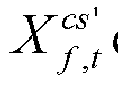


- 2. To remove low-energy spectrum window noise to determine an effective frame of the enrollment speech, a supervised labeling value


- In this application scenario, the vector


- The value of Γ, for example, is 40 dB. The input spectrum of the enrollment speech is mapped as the vector of the K-dimensional (for example, K = 40) space by the deep neural network.
- 3. By measuring a distance between the vector of each frame of the mixed speech sample in each vector dimension and the speech extractor
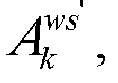

- In the sixth formula,
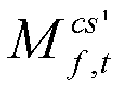


- 4. A spectral error between the speech of target object recovered by the estimated mask and reference speech of the target object is reconstructed by an objective function of the recognition network, and then the entire network is trained by minimizing the objective function. The objective function L may be shown as the seventh formula.

- In the seventh formula,

- In another application scenario, the schematic structural diagram of the recognition network may alternatively be shown as
FIG. 4b . In this application scenario, the training process of the recognition network does not need the input of the enrollment speech sample, that is, a target object and an interference object are not distinguished from each other. The training process of the recognition network is described below with reference toFIG. 4b : - 1. Assuming that there is speech of a total of C speakers in the mixed speech sample, to determine a supervised labeling value Y c,f,t of each speaker, a low energy spectrum window noise in the mixed speech sample may be removed first, and then for the speech spectrum amplitude of each speaker of the mixed speech sample, if a speech spectrum amplitude of a speaker in a frame is greater than spectrum amplitudes of other speakers in the frame, a value of corresponding Y c,f,t of the speaker in the frame is 1, and otherwise the value is 0.
In the application scenario, " X c,f,t " is a short-time Fourier transform in the log domain, indicating the spectrum of the tth frame of speech of the mixed speech. The input spectrum Xc,f,t of the mixed speech sample is mapped as a K-dimensional vector by the deep neural network to determine a vector Vk,f,t of each frame of the mixed speech sample in each vector dimension ( Vk,f,t represents a vector of the tth frame of the mixed speech sample in the kth vector dimension, k). The deep neural network is composed of four layers of bidirectional LSTM networks, and each layer of the LSTM network has 600 nodes. Certainly, the deep neural network may be replaced with various other effective new model structures, for example, a model combining a CNN and other network structures, or other network structures, such as a time delay network or a gated convolutional neural network. A model type and a topology structure of the deep neural network are not limited in the present disclosure. - 2. The vector Vk,f,t and the supervised labeling value Y c,f,t of the mixed speech sample are used for estimating the speech extractor Ac,k of each speaker in the vector space. The calculation method is shown as the eighth formula.

- 3. By measuring the distance between the vector of each frame of the mixed speech sample in each vector dimension and the speech extractor, the mask of each speaker is estimated. The estimation method is shown as the ninth formula.

In the ninth formula, Mc,f,t represents a mask that is related to a speaker c and that is in the tth frame in the mixed speech sample, and for Ac,k and Vk,f,t, reference may be made to the foregoing description. - 4. The mask of each speaker is used for extracting speech of each speaker in the mixed speech sample.
- 5. A spectral error between the speech of each speaker recovered by the estimated mask and reference speech of the corresponding speaker is reconstructed by the objective function of the recognition network, and then the entire network is trained by minimizing the objective function. The objective function L may be shown as the tenth formula.

- In the tenth formula, S c,f,t represents a spectrum of the reference speech of the speaker c in the tth frame (that is, a spectrum of the reference speech). The tenth formula is a standard reconstruction error of L2. Because the reconstruction error reflects the spectral error between the recovered speech of each speaker and the reference speech of the corresponding speaker, a global error may be reduced by generating a gradient in response to that the recognition network is trained, to optimize the quality of the extracted speech of all speakers.
- It can be learned from the foregoing that, in this embodiment of the present disclosure, in response to that an input of enrollment speech and mixed speech is detected, a spectrum of the enrollment speech and a spectrum of the mixed speech are separately mapped into a K-dimensional vector space, a speech extractor is determined for a target object based on the enrollment speech, then a mask of each frame of the mixed speech is estimated by measuring a distance between the vector of each frame of the mixed speech in each vector dimension and the speech extractor of a corresponding vector dimension, and finally speech belonging to the target object in the mixed speech is determined based on the mask. By introducing speech features of a target object learned by enrollment speech, in this embodiment of the present disclosure, the speech of the target object may be determined in the mixed speech, to facilitate tracking the speech of the target object in the mixed speech For example, in the application scenario of a smart speaker, wake-up speech may be used as the enrollment speech to learn features of a speaker (that is, the target object) of the wake-up speech, and speech belonging to the speaker of the wake-up speech is recognized and tracked in the mixed speech that is inputted after the wake-up speech. In addition, because the determining of the speech extractor in the present disclosure does not depend on the number of speakers in the mixed speech, in this embodiment of the present disclosure, the number of speakers in the mixed speech does not need to be learned in advance or estimated during the mixed speech recognition process.
- The mixed speech recognition method in the present disclosure is described below by using another embodiment. The difference between this embodiment and the embodiment shown in
FIG. 3 is that, in this embodiment, a feedforward neural network is introduced into a recognition network (that is, a network used for implementing the mixed speech recognition) to map an original vector space to a normalized vector space, so that the distribution of speech extractors trained by the recognition network is relatively more concentrated and stable. As shown inFIG. 5 , the mixed speech recognition method in this embodiment of the present disclosure includes the following steps: - Step 301: Monitor an input of speech.
- In this embodiment of the present disclosure, the input of the speech may be monitored by using a microphone array to reduce noise interferences of the speech input. The microphone array may be connected to a computer device in a wired or wireless manner, or embedded in the computer device. After the microphone array detects the speech input, the speech is transmitted to the computer device.
- Step 302: Separately map, in response to that the enrollment speech and the mixed speech are detected in the input speech, a spectrum of the enrollment speech and a spectrum of the mixed speech into a K-dimensional vector space to determine a vector of each frame of the enrollment speech in each vector dimension and a vector of each frame of the mixed speech in each vector dimension.
- The enrollment speech is the speech including preset speech information, and K is not less than 1, for example, the K may be 40.
- In this embodiment of the present disclosure, in response to that the computer device detects a speech input including the preset speech information in the input speech, the input of the enrollment speech may be considered to be detected. For example, in the application scenario of a smart speaker, wake-up speech usually needs to be inputted to wake up a speech control function of the smart speaker and the wake-up speech is speech that includes a wake-up word (for example, "Dingdong Dingdong"). Therefore, the wake-up speech may be used as the enrollment speech in the application scenario. In response to that the smart speaker detects the input of the wake-up speech, the input of the enrollment speech may be considered to be detected.
- The mixed speech is non-enrollment speech inputted after the enrollment speech. In a real intelligent speech interaction scenario, especially under a condition of remote speaking, speech of different speakers often overlaps. Consequently, the input speech is the mixed speech. The mixed speech recognition method in this embodiment of the present disclosure is for determining the speech belonging to the target object from the mixed speech.
- In
step 302, a computer device may map the spectrum of the enrollment speech and the spectrum of the mixed speech to the K-dimensional vector space by a deep neural network to determine the vector of each frame of the enrollment speech in each vector dimension and the vector of each frame of the mixed speech in each vector dimension. For example, the deep neural network is composed of four layers of bidirectional LSTM networks, and each layer of the LSTM network has 600 nodes. Certainly, the deep neural network may be replaced with various other effective new model structures, for example, a model combining a convolutional neural network (CNN) and other network structures, or other network structures, such as a time delay network or a gated convolutional neural network. A model type and a topology structure of the deep neural network are not limited in this embodiment of the present disclosure. - Specifically, the spectrum in this embodiment of the present disclosure may be determined after performing a short-time Fourier transform on the speech and logarithmizing the result of the short-time Fourier transform.
- Step 302 is described below by using an example. The superscript" ws" represents the enrollment speech, the superscript "cs" represents the mixed speech, and " Xf,t is a short-time Fourier transform in the log domain, representing the spectrum of the tth frame in the input speech ( / represents a sequence number of a spectrum dimension, and t represents a frame sequence number in a time dimension), then the spectrum of the enrollment speech may be represented as


step 302, the input spectrum


- Step 303: Calculate an average vector of the enrollment speech in each vector dimension based on the vector of each frame of the enrollment speech in each vector dimension.
- In this embodiment of the present disclosure, by the formula

- Alternatively, to remove low-energy spectrum window noise to determine an effective frame of the enrollment speech, in
step 303, the spectrum of the enrollment speech may be compared with a spectrum threshold. If a spectrum amplitude of a frame of the enrollment speech (that is, a time-frequency window) is greater than an adaptation spectrum comparison value, the frame is considered to be the effective frame of the enrollment speech. Instep 303, the average vector of the enrollment speech in each vector dimension is calculated based on the vector of the effective frame of the enrollment speech in each vector dimension. The adaptation spectrum comparison value is equal to a difference between the largest spectrum amplitude of the enrollment speech and a preset spectrum threshold. Specifically, a supervised labeling value


- Step 304: Input the average vector of the enrollment speech in each vector dimension and the vector of each frame of the mixed speech in each vector dimension to a pre-trained feedforward neural network to determine a normalized vector of each frame in each vector dimension.
- In this embodiment of the present disclosure, the feedforward neural network may be a two-layer network, and the number of nodes in each layer may be 256. Description is further provided by using the foregoing example. A 2K-dimensional vector combined by the average vector



- In the eleventh formula, f(g) represents a nonlinear mapping function learned through the deep neural network, and the function of the nonlinear mapping function is to map an original vector space to a new vector space (that is, the normalized vector space).
- Step 305: Separately measure a distance between the normalized vector of each frame in each vector dimension and a preset speech extractor to estimate the mask of each frame of the mixed speech.
- Because the speech extractors trained by the recognition network in this embodiment of the present disclosure have the feature of stable and concentrate distribution, in this embodiment of the present disclosure, centroids of all the speech extractors determined in response to that the recognition network is trained may be used as preset speech extractors. Because the speech extractor does not need to be re-estimated during the mixed speech recognition process in this embodiment of the present disclosure, the mixed speech recognition method in this embodiment of the present disclosure can better implement frame-by-frame real-time processing.
- Step 306: Determine the speech belonging to the target object in the mixed speech based on the mask of each frame of the mixed speech.
- In this embodiment of the present disclosure, after the mask of each frame of the mixed speech is determined, the speech belonging to the target object in the mixed speech may be determined based on the mask of each frame of the mixed speech. Specifically, by using the mask to weight the mixed speech, the speech belonging to the target object in the mixed speech may be extracted frame by frame, and a larger mask indicates more speech that is of the corresponding time-frequency window and that is extracted.
- The recognition network used for implementing the mixed speech recognition process shown in
FIG. 5 is described below. A schematic structural diagram of the recognition network is shown inFIG. 6 . The training process of the recognition network is described below with reference toFIG. 6 : - 1. An enrollment speech sample and a mixed speech sample that are used for training the recognition network are inputted into a deep neural network. The deep neural network is composed of four layers of bidirectional LSTM networks, and each layer of the LSTM network has 600 nodes. Certainly, the deep neural network may be replaced with various other effective new model structures, for example, a model combining a CNN and other network structures, or other network structures, such as a time delay network or a gated convolutional neural network. A model type and a topology structure of the deep neural network are not limited in the present disclosure.
In this application scenario takes, superscript" ws'" represents the enrollment speech sample, the superscript" cs'" represents the mixed speech sample. " Xf,t " is a short-time Fourier transform in the log domain, representing the spectrum of the tth frame in the input speech (f represents a sequence number of a spectrum dimension, and t represents a frame sequence number in a time dimension). Then the spectrum of the enrollment speech sample may be represented as


- 2. To remove low-energy spectrum window noise to determine an effective frame of the enrollment speech, a supervised labeling value of the enrollment speech sample is set, and the spectrum of each frame of the enrollment speech sample is separately compared with a difference between the largest spectrum amplitude and a spectrum threshold Γ. If a spectrum amplitude of a frame of the enrollment speech sample (that is, a time-frequency window) is greater than an adaptation spectrum comparison value (that is, a difference between the largest spectrum amplitude of the enrollment speech sample and Γ) the supervised labeling value


In this application scenario, the average vector


- 3. A 2K-dimensional vector combined by the average vector


step 304. Details are not described herein again. - 4. To determine a supervised labeling value


- 5. Based on a normalized vector


- 6. By measuring a distance between the normalized vector


In the thirteenth formula,
- 7. A spectral error between the speech of target object recovered by the estimated mask and reference speech of the target object is reconstructed by an objective function of the recognition network, and then the entire network is trained by minimizing the objective function. The objective function L may be shown as the fourteenth formula.

- In the fourteenth formula,

- Different from the mixed speech sample, in actual mixed speech recognition, because the speech that belongs to the target object in the input mixed speech is unknown, the supervised labeling value of the target object in the mixed speech is unknown. Therefore, as mentioned above, centroids of all the speech extractors determined in response to that the recognition network is trained may be used as preset speech extractors. In
step 305 of the embodiment shown inFIG. 3 , measure, a distance between the normalized vector of each frame in each vector dimension and a preset speech extractor is separately measured to estimate the mask of each frame of the mixed speech. - An embodiment of the present disclosure provides a mixed speech recognition apparatus. As shown in
FIG. 7 , the mixed speech recognition apparatus in this embodiment of the present disclosure includes: - a
monitoring unit 71, configured to monitor an input of speech; - an acquiring
unit 72, configured to acquire, in response to that an input of enrollment speech and mixed speech is detected by themonitoring unit 71, speech features of a target object based on the enrollment speech; and - a determining
unit 73, configured to determine speech belonging to the target object in the mixed speech based on the speech features of the target object; - the enrollment speech being speech including preset speech information and the mixed speech being non-enrollment speech inputted after the enrollment speech.
- Based on the embodiment shown in
FIG. 7 , as shown inFIG. 8 , the acquiringunit 72 may include: - a
spatial mapping unit 721, configured to separately map a spectrum of the enrollment speech and a spectrum of the mixed speech into a K-dimensional vector space to determine a vector of each frame of the enrollment speech in each vector dimension and a vector of each frame of the mixed speech in each vector dimension in response to that the input of the enrollment speech and the mixed speech is detected by themonitoring unit 71, the enrollment speech being the speech including the preset speech information, the mixed speech being the non-enrollment speech inputted after the enrollment speech and K being not less than 1; - a calculating
unit 722, configured to calculate an average vector of the enrollment speech in each vector dimension based on the vector of each frame of the enrollment speech in each vector dimension; - a
mask estimation unit 723, configured to use the average vector of the enrollment speech in each vector dimension as a speech extractor of the target object in each vector dimension and separately measure a distance between the vector of each frame of the mixed speech in each vector dimension and the speech extractor of a corresponding vector dimension to estimate a mask of each frame of the mixed speech; and - a determining
unit 73, configured to determine the speech belonging to the target object in the mixed speech based on a mask of each frame of the mixed speech. - Optionally, the calculating
unit 722 is specifically configured to: calculate the average vector of the enrollment speech in each vector dimension based on the vector of an effective frame of the enrollment speech in each vector dimension, the effective frame of the enrollment speech being a frame in the enrollment speech with a spectrum amplitude greater than an adaptation spectrum comparison value, and the adaptation spectrum comparison value being equal to a difference between a largest spectrum amplitude of the enrollment speech and a preset spectrum threshold. - Optionally, the mixed speech recognition apparatus in this embodiment of the present disclosure further includes: a normalization unit, configured to input the average vector of the enrollment speech in each vector dimension and the vector of each frame of the mixed speech in each vector dimension to a pre-trained feedforward neural network to determine a normalized vector of each frame in each vector dimension. The
mask estimation unit 723 is specifically configured to: separately measure a distance between the normalized vector of each frame in each vector dimension and a preset speech extractor to estimate the mask of each frame of the mixed speech. - Optionally, the mixed speech recognition apparatus in this embodiment of the present disclosure further includes: a clustering unit, configured to process the vector of each frame of the mixed speech in each vector dimension based on a clustering algorithm to determine a centroid vector that is of the mixed speech and that corresponds to different speech of speakers in each vector dimension. The
mask estimation unit 723 is specifically configured to: use a target centroid vector of the mixed speech in each vector dimension as a speech extractor of the target object in the corresponding vector dimension and separately measure a distance between the vector of each frame of the mixed speech in each vector dimension and the speech extractor in the corresponding vector dimension to estimate a mask of each frame of the mixed speech. - The mixed speech recognition apparatus in this embodiment of the present disclosure may further include: a comparison unit, configured to separately compare a distance between M preset speech extractors and the average vector of the enrollment speech in each vector dimension, M being greater than 1. The
mask estimation unit 723 is specifically configured to: use a speech extractor with the smallest distance from the average vector of the enrollment speech in a vector dimension in the M speech extractors as a speech extractor of the target object in the corresponding vector dimension, and separately measure a distance between the vector of each frame of the mixed speech in each vector dimension and the speech extractor of a corresponding vector dimension to estimate a mask of each frame of the mixed speech. - It is to be understood that the mixed speech recognition apparatus in this embodiment of the present disclosure may be configured to implement all the technical solutions in the method embodiments. The functions of the functional modules may be specifically implemented according to the methods in the method embodiments. For the specific implementation process, reference may be made to the relevant descriptions in the foregoing embodiments. Details are not described herein again.
- It can be learned from the above that, in this embodiment of the present disclosure, the speech features of the target object are acquired based on the enrollment speech in response to that the input of the enrollment speech and the mixed speech is detected; and the speech belonging to the target object in the mixed speech is determined based on the speech features of the target object. By introducing speech features of a target object learned by enrollment speech, in this embodiment of the present disclosure, the speech of the target object may be determined in the mixed speech, to facilitate tracking the speech of the target object in the mixed speech. For example, in the application scenario of a smart speaker, wake-up speech may be used as the enrollment speech to learn features of a speaker (that is, the target object) of the wake-up speech, and speech belonging to the speaker of the wake-up speech is recognized and tracked in the mixed speech that is inputted after the wake-up speech. In addition, because the speech features of the target object in this embodiment of the present disclosure do not depend on the number of speakers in the mixed speech, in this embodiment of the present disclosure, the number of speakers in the mixed speech does not need to be learned in advance or estimated during the mixed speech recognition process.
- An embodiment of the present disclosure provides another mixed speech recognition apparatus. Referring to
FIG. 9 , the mixed speech recognition apparatus in this embodiment of the present disclosure further includes: amemory 81, one or more processors 82 (only one processor is shown inFIG. 9 ), and a computer program that is stored on thememory 81 and capable of being run on the processor. Thememory 82 is configured to store a software program and a module. Theprocessor 82 runs the software program and the unit stored in thememory 81, to perform various functional applications and data processing. Specifically, by running the computer program stored on thememory 81, theprocessor 82 implements of the following steps: - monitoring an input of speech;
- acquiring, by an acquiring unit, in response to that an input of enrollment speech and mixed speech is detected, speech features of a target object based on the enrollment speech; and
- determining, by a determining unit, speech belonging to the target object in the mixed speech based on the speech features of the target object;
- the enrollment speech being speech including preset speech information and the mixed speech being non-enrollment speech inputted after the enrollment speech.
- Assuming that the foregoing is the first possible implementation, in the second possible implementation provided based on the first possible implementation, the acquiring speech features of a target object based on the enrollment speech includes:
- separately mapping a spectrum of the enrollment speech and a spectrum of the mixed speech into a K-dimensional vector space to determine a vector of each frame of the enrollment speech in each vector dimension and a vector of each frame of the mixed speech in each vector dimension, K being not less than 1;
- calculating an average vector of the enrollment speech in each vector dimension based on the vector of each frame of the enrollment speech in each vector dimension;
- using the average vector of the enrollment speech in each vector dimension as a speech extractor of the target object in each vector dimension and separately measuring a distance between the vector of each frame of the mixed speech in each vector dimension and the speech extractor of the corresponding vector dimension to estimate a mask of each frame in the mixed speech; and
- determining the speech belonging to the target object in the mixed speech based on a mask of each frame of the mixed speech.
- In the third possible implementation provided based on the second possible implementation, the calculating an average vector of the enrollment speech in each vector dimension based on the vector of each frame of the enrollment speech in each vector dimension is specifically:
calculating the average vector of the enrollment speech in each vector dimension based on the vector of an effective frame of the enrollment speech in each vector dimension, the effective frame of the enrollment speech being a frame in the enrollment speech with a spectrum amplitude greater than an adaptation spectrum comparison value, and the adaptation spectrum comparison value being equal to a difference between the largest spectrum amplitude of the enrollment speech and a preset spectrum threshold. - In the fourth possible implementation provided based on the third possible implementation, the calculating unit is specifically configured to: sum, after the vector of each frame of the enrollment speech in the corresponding vector dimension is multiplied by a supervised labeling value of the corresponding frame, vector dimensions to determine a total vector of the effective frame of the enrollment speech in the corresponding vector dimension; and separately divide the total vector of the effective frame of the enrollment speech in each vector dimension by the sum of the supervised labeling values of the frames of the enrollment speech to determine the average vector of the enrollment speech in each vector dimension;
the supervised labeling value of a frame in the enrollment speech being 1 in response to that a spectrum amplitude of the frame is greater than the adaptation spectrum comparison value; and being 0 in response to that the spectrum amplitude of the frame is not greater than the adaptation spectrum comparison value. - In the fifth possible implementation provided based on the second possible implementation or the third possible implementation or the fourth possible implementation, after the calculating an average vector of the enrollment speech in each vector dimension based on the vector of each frame of the enrollment speech in each vector dimension, by running the computer program stored on the
memory 81, theprocessor 82 further implements the following steps: - inputting the average vector of the enrollment speech in each vector dimension and the vector of each frame of the mixed speech in each vector dimension to a pre-trained feedforward neural network to determine a normalized vector of each frame in each vector dimension; and
- the using the average vector of the enrollment speech in each vector dimension as a speech extractor of the target object in each vector dimension and separately measuring a distance between the vector of each frame of the mixed speech in each vector dimension and the speech extractor of a corresponding vector dimension to estimate a mask of each frame of the mixed speech being replaced with:
separately measuring a distance between the normalized vector of each frame in each vector dimension and a preset speech extractor to estimate and determine the mask of each frame of the mixed speech. - In the sixth possible implementation provided based on the second possible implementation or the third possible implementation or the fourth possible implementation, after the separately mapping a spectrum of the enrollment speech and a spectrum of the mixed speech into a K-dimensional vector space, by running the computer program stored on the
memory 81, theprocessor 82 further implements the following steps: - processing the vector of each frame of the mixed speech in each vector dimension based on a clustering algorithm to determine a centroid vector that is of the mixed speech and that corresponds to different speech of speakers in each vector dimension; and
- the using the average vector of the enrollment speech in each vector dimension as a speech extractor of the target object in each vector dimension being replaced with: using a target centroid vector of the mixed speech in each vector dimension as a speech extractor of the target object in the corresponding vector dimension, the target centroid vector being a centroid vector with the smallest distance from the average vector of the enrollment speech in the same vector dimension.
- In the seventh possible implementation provided based on the second possible implementation or the third possible implementation or the fourth possible implementation, after the calculating an average vector of the enrollment speech in each vector dimension based on the vector of each frame of the enrollment speech in each vector dimension, by running the computer program stored on the
memory 81, theprocessor 82 further implements the following steps: - separately comparing a distance between M preset speech extractors and the average vector of the enrollment speech in each vector dimension, M being greater than 1; and
- the using the average vector of the enrollment speech in each vector dimension as a speech extractor of the target object in each vector dimension being replaced with: using a speech extractor with the smallest distance from the average vector of the enrollment speech in a vector dimension in the M speech extractors as a speech extractor of the target object in the corresponding vector dimension.
- Optionally, as shown in
FIG. 9 , the mixed speech recognition apparatus further includes: one or more input devices 83 (only one input device is shown inFIG. 9 ), and one or more output devices 84 (only one output device is shown inFIG. 9 ). Thememory 81, theprocessor 82, theinput device 83, and theoutput device 84 are connected through a bus 85. - It is to be understood that in the embodiments of the present disclosure, the
processor 82 may be a central processing unit (CPU). The processor may further be another general-purpose processor, a digital signal processor (DSP), an application specific integrated circuit (ASIC), a field-programmable gate array (FPGA), or another programmable logic device, a discrete gate or a transistor logic device, a discrete hardware component, or the like. The general purpose processor may be a microprocessor or the processor may be any conventional processor or the like. - The
input device 83 may include a keyboard, a touch pad, a fingerprint acquisition sensor (configured to acquire fingerprint information and fingerprint direction information of users), a microphone, or the like. Theoutput device 84 may include a display, a speaker, or the like. - The
memory 84 may include a read-only memory and a random access memory, and provides an instruction and data to theprocessor 81. A part or all of thememory 84 may further include a non-volatile random access memory. - It can be learned from the above that, in the embodiments of the present disclosure, the speech features of the target object are acquired based on the enrollment speech in response to that the input of the enrollment speech and the mixed speech is detected; and the speech belonging to the target object in the mixed speech is determined based on the speech features of the target object. By introducing speech features of a target object learned by enrollment speech, according to the embodiments of the present disclosure, the speech of the target object may be determined in the mixed speech, to facilitate tracking the speech of the target object in the mixed speech. For example, in the application scenario of a smart speaker, wake-up speech may be used as the enrollment speech to learn features of a speaker (that is, the target object) of the wake-up speech, and speech belonging to the speaker of the wake-up speech is recognized and tracked in the mixed speech that is inputted after the wake-up speech. In addition, because the speech features of the target object in the present disclosure do not depend on the number of speakers in the mixed speech, in the embodiments of the present disclosure, the number of speakers in the mixed speech does not need to be learned in advance or estimated during the mixed speech recognition process.
- A person skilled in the art may clearly understand that, for the purpose of convenient and brief description, only division of the foregoing function units is used as an example for description. In the practical application, the functions may be allocated to and completed by different function modules according to requirements. That is, an internal structure of the device is divided into different functional units or modules, to complete all or some of the functions described above. Functional units and modules in the embodiments may be integrated into one processing unit, or each of the units may exist alone physically, or two or more units are integrated into one unit. The integrated unit may be implemented in the form of hardware, or may be implemented in the form of a software function unit. In addition, the specific names of each functional unit and module are only for the purpose of distinguishing each other, and are not used to limit the protection scope of the present disclosure. For specific work processes of the units and modules in the system, reference may be made to corresponding processes in the foregoing method embodiments, and details are not described herein again.
- In the embodiments, descriptions of the embodiments have different emphases. As for parts that are not described in detail in one embodiment, reference can be made to the relevant descriptions of the other embodiments.
- A person of ordinary skill in the art may notice that the exemplary units and algorithm steps described with reference to the embodiments disclosed in this specification can be implemented in electronic hardware, or a combination of computer software and electronic hardware. Whether the functions are performed by hardware or software depends on particular applications and design constraint conditions of the technical solutions. A person skilled in the art may use different methods to implement the described functions for each particular application, but it is not considered that the implementation goes beyond the scope of the present disclosure.
- In the embodiments provided in the present disclosure, it is to be understood that the disclosed apparatus and method may be implemented in other manners. For example, the described system embodiment is merely exemplary. For example, the modules and units division are merely logical function division and there may be other division manners during actual implementation. For example, a plurality of units or components may be combined or integrated into another system, or some features may be ignored or not performed. In addition, the displayed or discussed mutual couplings or direct couplings or communications connections may be implemented through some interfaces. The indirect couplings or communications connections between the apparatuses or units may be implemented in electronic, mechanical, or other forms.
- The units described as separate parts may or may not be physically separate, and parts displayed as units may or may not be physical units, may be located in one position, or may be distributed on a plurality of network units. Some or all of the units may be selected according to actual needs to achieve the objectives of the solutions of the embodiments.
- When the integrated unit is implemented in the form of a software functional unit and sold or used as an independent product, the integrated unit may be stored in a computer readable storage medium. Based on such understanding, all or some of the processes of the methods in the embodiments may be implemented by a computer program instructing relevant hardware. The computer program may be stored in a computer readable storage medium. During execution of the computer program by the processor, steps of the foregoing method embodiments may be implemented. The computer program includes computer program code. The computer program code may be in source code form, object code form, executable file or some intermediate forms, or the like. The computer readable medium may include: any entity or apparatus that is capable of carrying the computer program code, a recording medium, a USB flash drive, a removable hard disk, a magnetic disk, an optical disc, a read-only memory (ROM), a random access memory (RAM), an electric carrier signal, a telecommunication signal and a software distribution medium, or the like. The content contained in the computer readable medium may be appropriately increased or decreased according to the requirements of legislation and patent practice in jurisdictions. For example, in some jurisdictions, according to legislation and patent practice, the computer readable medium does not include an electric carrier signal and a telecommunication signal.
- The foregoing embodiments are merely intended for describing the technical solutions of the present disclosure, but not for limiting the present disclosure. Although the present disclosure is described in detail with reference to the foregoing embodiments, it is to be understood by a person of ordinary skill in the art that they may still make modifications to the technical solutions described in the foregoing embodiments or make equivalent replacements to some technical features thereof, without departing from the spirit and scope of the technical solutions of the embodiments of the present disclosure, which being included in the protection scope of the present disclosure.
Claims (14)
- A mixed speech recognition method, applied to a computer device, the method comprising:monitoring an input of speech;acquiring, in response to that an input of enrollment speech and mixed speech is detected, speech features of a target object based on the enrollment speech; anddetermining speech belonging to the target object in the mixed speech based on the speech features of the target object;the enrollment speech being speech comprising preset speech information and the mixed speech being non-enrollment speech inputted after the enrollment speech.
- The mixed speech recognition method according to claim 1, wherein the acquiring speech features of a target object based on the enrollment speech comprises:separately mapping a spectrum of the enrollment speech and a spectrum of the mixed speech into a K-dimensional vector space to determine a vector of each frame of the enrollment speech in each vector dimension and a vector of each frame of the mixed speech in each vector dimension, the enrollment speech being the speech comprising the preset speech information, the mixed speech being the non-enrollment speech inputted after the enrollment speech and K being not less than 1;calculating an average vector of the enrollment speech in each vector dimension based on the vector of each frame of the enrollment speech in each vector dimension;determining the average vector of the enrollment speech in each vector dimension as a speech extractor of the target object in each vector dimension, and separately measuring a distance between the vector of each frame of the mixed speech in each vector dimension and the speech extractor of the corresponding vector dimension to estimate a mask of each frame in the mixed speech; andthe determining speech belonging to the target object in the mixed speech based on the speech features of the target object being:
determining the speech belonging to the target object in the mixed speech based on a mask of each frame of the mixed speech. - The mixed speech recognition method according to claim 2, wherein the calculating an average vector of the enrollment speech in each vector dimension based on the vector of each frame of the enrollment speech in each vector dimension is specifically:
calculating the average vector of the enrollment speech in each vector dimension based on the vector of an effective frame of the enrollment speech in each vector dimension, the effective frame of the enrollment speech being a frame in the enrollment speech with a spectrum amplitude greater than an adaptation spectrum comparison value, and the adaptation spectrum comparison value being equal to a difference between the largest spectrum amplitude of the enrollment speech and a preset spectrum threshold. - The mixed speech recognition method according to claim 3, wherein the calculating the average vector of the enrollment speech in each vector dimension based on the vector of an effective frame of the enrollment speech in each vector dimension comprises:summing, after the vector of each frame of the enrollment speech in the corresponding vector dimension is multiplied by a supervised labeling value of the corresponding frame, vector dimensions to determine a total vector of the effective frame of the enrollment speech in the corresponding vector dimension; andseparately dividing the total vector of the effective frame of the enrollment speech in each vector dimension by the sum of the supervised labeling values of the frames of the enrollment speech to determine the average vector of the enrollment speech in each vector dimension;the supervised labeling value of a frame in the enrollment speech being 1 in response to that a spectrum amplitude of the frame is greater than the adaptation spectrum comparison value; and being 1 in response to that the spectrum amplitude of the frame is not greater than the adaptation spectrum comparison value.
- The mixed speech recognition method according to any of claims 2 to 4, wherein after the calculating an average vector of the enrollment speech in each vector dimension based on the vector of each frame of the enrollment speech in each vector dimension, the method further comprises:inputting the average vector of the enrollment speech in each vector dimension and the vector of each frame of the mixed speech in each vector dimension to a pre-trained feedforward neural network to determine a normalized vector of each frame in each vector dimension; andthe using the average vector of the enrollment speech in each vector dimension as a speech extractor of the target object in each vector dimension, and separately measuring a distance between the vector of each frame of the mixed speech in each vector dimension and the speech extractor of the corresponding vector dimension to estimate a mask of each frame in the mixed speech being replaced with:
separately measuring a distance between the normalized vector of each frame in each vector dimension and a preset speech extractor to estimate and determine the mask of each frame of the mixed speech. - The mixed speech recognition method according to any of claims 2 to 4, wherein after the separately mapping a spectrum of the enrollment speech and a spectrum of the mixed speech into a K-dimensional vector space, the method further comprises:processing the vector of each frame of the mixed speech in each vector dimension based on a clustering algorithm to determine a centroid vector that is of the mixed speech and that corresponds to different speech of speakers in each vector dimension; andthe using the average vector of the enrollment speech in each vector dimension as a speech extractor of the target object in each vector dimension being replaced with:
using a target centroid vector of the mixed speech in each vector dimension as a speech extractor of the target object in the corresponding vector dimension, the target centroid vector being a centroid vector with the smallest distance from the average vector of the enrollment speech in the same vector dimension. - The mixed speech recognition method according to any of claims 2 to 4, wherein after the calculating an average vector of the enrollment speech in each vector dimension based on the vector of each frame of the enrollment speech in each vector dimension, the method further comprises:separately comparing a distance between M preset speech extractors and the average vector of the enrollment speech in each vector dimension, M being greater than 1; andthe using the average vector of the enrollment speech in each vector dimension as a speech extractor of the target object in each vector dimension being replaced with:
using a speech extractor with the smallest distance from the average vector of the enrollment speech in a vector dimension in the M speech extractors as a speech extractor of the target object in the corresponding vector dimension. - The mixed speech recognition method according to any of claims 2 to 4, wherein the separately mapping a spectrum of the enrollment speech and a spectrum of the mixed speech into a K-dimensional vector space to determine a vector of each frame of the enrollment speech in each vector dimension and a vector of each frame of the mixed speech in each vector dimension is specifically:
mapping the spectrum of the enrollment speech and the spectrum of the mixed speech to the K-dimensional vector space by a deep neural network, to determine the vector of each frame of the enrollment speech in each vector dimension and the vector of each frame of the mixed speech in each vector dimension. - The mixed speech recognition method according to claim 8, wherein the deep neural network is composed of four layers of bidirectional long short-term memory networks, and each layer of the bidirectional long short-term memory network has 600 nodes.
- The mixed speech recognition method according to claim 8, wherein a value of K is 40.
- A mixed speech recognition apparatus, comprising:a monitoring unit, configured to monitor an input of speech;an acquiring unit, configured to acquire, in response to that an input of enrollment speech and mixed speech is detected by the monitoring unit, speech features of a target object based on the enrollment speech; anda determining unit, configured to determine speech belonging to the target object in the mixed speech based on the speech features of the target object;the enrollment speech being speech comprising preset speech information and the mixed speech being non-enrollment speech inputted after the enrollment speech.
- The mixed speech recognition apparatus according to claim 11, wherein the acquiring unit comprises:a spatial mapping unit, configured to separately map a spectrum of the enrollment speech and a spectrum of the mixed speech into a K-dimensional vector space to determine a vector of each frame of the enrollment speech in each vector dimension and a vector of each frame of the mixed speech in each vector dimension in response to that the input of the enrollment speech and the mixed speech is detected by the monitoring unit, the enrollment speech being the speech comprising the preset speech information, the mixed speech being the non-enrollment speech inputted after the enrollment speech and K being not less than 1;a calculating unit, configured to calculate an average vector of the enrollment speech in each vector dimension based on the vector of each frame of the enrollment speech in each vector dimension;a mask estimation unit, configured to use the average vector of the enrollment speech in each vector dimension as a speech extractor of the target object in each vector dimension, and separately measure a distance between the vector of each frame of the mixed speech in each vector dimension and the speech extractor of a corresponding vector dimension to estimate a mask of each frame of the mixed speech; andthe determining unit being specifically configured to determine the speech belonging to the target object in the mixed speech based on a mask of each frame of the mixed speech.
- A mixed speech recognition apparatus, comprising a memory, a processor, and a computer program that is stored on the memory and capable of being run on the processor, the processor implementing the operations of the method according to any one of claims 1 to 10 during execution of the computer program.
- A computer readable storage medium, storing a computer program, the computer program, when executed by a processor, implementing the operations of the method according to any one of claims 1 to 10.
Applications Claiming Priority (2)
| Application Number | Priority Date | Filing Date | Title |
|---|---|---|---|
| CN201810507294.5A CN108962237B (en) | 2018-05-24 | 2018-05-24 | Hybrid speech recognition method, apparatus and computer readable storage medium |
| PCT/CN2019/082978 WO2019223457A1 (en) | 2018-05-24 | 2019-04-17 | Mixed speech recognition method and apparatus, and computer readable storage medium |
Publications (3)
| Publication Number | Publication Date |
|---|---|
| EP3806089A1 true EP3806089A1 (en) | 2021-04-14 |
| EP3806089A4 EP3806089A4 (en) | 2021-07-21 |
| EP3806089B1 EP3806089B1 (en) | 2024-06-19 |
Family
ID=64499498
Family Applications (1)
| Application Number | Title | Priority Date | Filing Date |
|---|---|---|---|
| EP19806534.4A Active EP3806089B1 (en) | 2018-05-24 | 2019-04-17 | Mixed speech recognition method and apparatus, and computer readable storage medium |
Country Status (5)
| Country | Link |
|---|---|
| US (1) | US11996091B2 (en) |
| EP (1) | EP3806089B1 (en) |
| JP (1) | JP7177167B2 (en) |
| CN (3) | CN108962237B (en) |
| WO (1) | WO2019223457A1 (en) |
Families Citing this family (61)
| Publication number | Priority date | Publication date | Assignee | Title |
|---|---|---|---|---|
| US9318108B2 (en) | 2010-01-18 | 2016-04-19 | Apple Inc. | Intelligent automated assistant |
| US8977255B2 (en) | 2007-04-03 | 2015-03-10 | Apple Inc. | Method and system for operating a multi-function portable electronic device using voice-activation |
| US8676904B2 (en) | 2008-10-02 | 2014-03-18 | Apple Inc. | Electronic devices with voice command and contextual data processing capabilities |
| US10057736B2 (en) | 2011-06-03 | 2018-08-21 | Apple Inc. | Active transport based notifications |
| US10417037B2 (en) | 2012-05-15 | 2019-09-17 | Apple Inc. | Systems and methods for integrating third party services with a digital assistant |
| DE112014000709B4 (en) | 2013-02-07 | 2021-12-30 | Apple Inc. | METHOD AND DEVICE FOR OPERATING A VOICE TRIGGER FOR A DIGITAL ASSISTANT |
| US10170123B2 (en) | 2014-05-30 | 2019-01-01 | Apple Inc. | Intelligent assistant for home automation |
| US9715875B2 (en) | 2014-05-30 | 2017-07-25 | Apple Inc. | Reducing the need for manual start/end-pointing and trigger phrases |
| US9338493B2 (en) | 2014-06-30 | 2016-05-10 | Apple Inc. | Intelligent automated assistant for TV user interactions |
| US9886953B2 (en) | 2015-03-08 | 2018-02-06 | Apple Inc. | Virtual assistant activation |
| US10460227B2 (en) | 2015-05-15 | 2019-10-29 | Apple Inc. | Virtual assistant in a communication session |
| US10747498B2 (en) | 2015-09-08 | 2020-08-18 | Apple Inc. | Zero latency digital assistant |
| US10331312B2 (en) | 2015-09-08 | 2019-06-25 | Apple Inc. | Intelligent automated assistant in a media environment |
| US10671428B2 (en) | 2015-09-08 | 2020-06-02 | Apple Inc. | Distributed personal assistant |
| US11587559B2 (en) | 2015-09-30 | 2023-02-21 | Apple Inc. | Intelligent device identification |
| US10691473B2 (en) | 2015-11-06 | 2020-06-23 | Apple Inc. | Intelligent automated assistant in a messaging environment |
| US12223282B2 (en) | 2016-06-09 | 2025-02-11 | Apple Inc. | Intelligent automated assistant in a home environment |
| US10586535B2 (en) | 2016-06-10 | 2020-03-10 | Apple Inc. | Intelligent digital assistant in a multi-tasking environment |
| DK201670540A1 (en) | 2016-06-11 | 2018-01-08 | Apple Inc | Application integration with a digital assistant |
| US12197817B2 (en) | 2016-06-11 | 2025-01-14 | Apple Inc. | Intelligent device arbitration and control |
| US11204787B2 (en) | 2017-01-09 | 2021-12-21 | Apple Inc. | Application integration with a digital assistant |
| DK180048B1 (en) | 2017-05-11 | 2020-02-04 | Apple Inc. | MAINTAINING THE DATA PROTECTION OF PERSONAL INFORMATION |
| DK201770428A1 (en) | 2017-05-12 | 2019-02-18 | Apple Inc. | Low-latency intelligent automated assistant |
| DK179496B1 (en) | 2017-05-12 | 2019-01-15 | Apple Inc. | USER-SPECIFIC Acoustic Models |
| DK201770411A1 (en) | 2017-05-15 | 2018-12-20 | Apple Inc. | MULTI-MODAL INTERFACES |
| DK179560B1 (en) | 2017-05-16 | 2019-02-18 | Apple Inc. | Far-field extension for digital assistant services |
| US10303715B2 (en) | 2017-05-16 | 2019-05-28 | Apple Inc. | Intelligent automated assistant for media exploration |
| US10818288B2 (en) | 2018-03-26 | 2020-10-27 | Apple Inc. | Natural assistant interaction |
| US10928918B2 (en) | 2018-05-07 | 2021-02-23 | Apple Inc. | Raise to speak |
| CN108962237B (en) | 2018-05-24 | 2020-12-04 | 腾讯科技(深圳)有限公司 | Hybrid speech recognition method, apparatus and computer readable storage medium |
| DK180639B1 (en) | 2018-06-01 | 2021-11-04 | Apple Inc | DISABILITY OF ATTENTION-ATTENTIVE VIRTUAL ASSISTANT |
| DK201870355A1 (en) | 2018-06-01 | 2019-12-16 | Apple Inc. | Virtual assistant operation in multi-device environments |
| US11462215B2 (en) | 2018-09-28 | 2022-10-04 | Apple Inc. | Multi-modal inputs for voice commands |
| US11475898B2 (en) * | 2018-10-26 | 2022-10-18 | Apple Inc. | Low-latency multi-speaker speech recognition |
| CN111696571A (en) * | 2019-03-15 | 2020-09-22 | 北京搜狗科技发展有限公司 | Voice processing method and device and electronic equipment |
| US11348573B2 (en) | 2019-03-18 | 2022-05-31 | Apple Inc. | Multimodality in digital assistant systems |
| CN110459238B (en) * | 2019-04-12 | 2020-11-20 | 腾讯科技(深圳)有限公司 | Voice separation method, voice recognition method and related equipment |
| US11307752B2 (en) | 2019-05-06 | 2022-04-19 | Apple Inc. | User configurable task triggers |
| DK201970509A1 (en) | 2019-05-06 | 2021-01-15 | Apple Inc | Spoken notifications |
| US11140099B2 (en) | 2019-05-21 | 2021-10-05 | Apple Inc. | Providing message response suggestions |
| US11227599B2 (en) | 2019-06-01 | 2022-01-18 | Apple Inc. | Methods and user interfaces for voice-based control of electronic devices |
| CN110265060B (en) * | 2019-06-04 | 2021-05-11 | 广东工业大学 | Speaker number automatic detection method based on density clustering |
| CN117037835A (en) * | 2020-02-28 | 2023-11-10 | 维沃移动通信有限公司 | Audio data processing methods, electronic devices and media |
| US12301635B2 (en) | 2020-05-11 | 2025-05-13 | Apple Inc. | Digital assistant hardware abstraction |
| US11061543B1 (en) | 2020-05-11 | 2021-07-13 | Apple Inc. | Providing relevant data items based on context |
| CN111583916B (en) * | 2020-05-19 | 2023-07-25 | 科大讯飞股份有限公司 | Speech recognition method, device, equipment and storage medium |
| CN111754982B (en) * | 2020-06-19 | 2024-11-05 | 平安科技(深圳)有限公司 | Noise elimination method, device, electronic device and storage medium for voice call |
| CN111667817A (en) * | 2020-06-22 | 2020-09-15 | 平安资产管理有限责任公司 | Voice recognition method, device, computer system and readable storage medium |
| US11490204B2 (en) | 2020-07-20 | 2022-11-01 | Apple Inc. | Multi-device audio adjustment coordination |
| US11438683B2 (en) | 2020-07-21 | 2022-09-06 | Apple Inc. | User identification using headphones |
| CN112614492A (en) * | 2020-12-09 | 2021-04-06 | 通号智慧城市研究设计院有限公司 | Voiceprint recognition method, system and storage medium based on time-space information fusion |
| US20220406324A1 (en) * | 2021-06-18 | 2022-12-22 | Samsung Electronics Co., Ltd. | Electronic device and personalized audio processing method of the electronic device |
| CN113436633B (en) * | 2021-06-30 | 2024-03-12 | 平安科技(深圳)有限公司 | Speaker recognition method, speaker recognition device, computer equipment and storage medium |
| CN113409776B (en) * | 2021-06-30 | 2024-06-07 | 南京领行科技股份有限公司 | Voice recognition method and device, electronic equipment and storage medium |
| US20250069614A1 (en) * | 2021-12-27 | 2025-02-27 | Nippon Telegraph And Telephone Corporation | Signal filtering apparatus, signal filtering method and program |
| CN114882914B (en) * | 2022-06-16 | 2024-06-18 | 中国电信股份有限公司 | Aliasing processing method, device and storage medium |
| CN116978358A (en) * | 2022-10-21 | 2023-10-31 | 腾讯科技(深圳)有限公司 | Speech processing methods, devices, equipment and media |
| CN116168687B (en) * | 2023-04-24 | 2023-07-21 | 北京探境科技有限公司 | A voice data processing method, device, computer equipment and storage medium |
| CN121281565A (en) * | 2024-07-03 | 2026-01-06 | 北京字跳网络技术有限公司 | Method, apparatus, device, medium and program product for detecting speech |
| CN119889348B (en) * | 2024-12-09 | 2025-10-28 | 中电信人工智能科技(北京)有限公司 | A synthetic speech identification method, device, system and product |
| CN119724157A (en) * | 2024-12-20 | 2025-03-28 | 华夏数智智慧校园规划设计院(深圳)有限公司 | Language recognition method and system based on artificial intelligence assisted conversation scene |
Family Cites Families (36)
| Publication number | Priority date | Publication date | Assignee | Title |
|---|---|---|---|---|
| JP3910898B2 (en) | 2002-09-17 | 2007-04-25 | 株式会社東芝 | Directivity setting device, directivity setting method, and directivity setting program |
| US7620546B2 (en) | 2004-03-23 | 2009-11-17 | Qnx Software Systems (Wavemakers), Inc. | Isolating speech signals utilizing neural networks |
| US8392185B2 (en) * | 2008-08-20 | 2013-03-05 | Honda Motor Co., Ltd. | Speech recognition system and method for generating a mask of the system |
| US20150112682A1 (en) * | 2008-12-10 | 2015-04-23 | Agnitio Sl | Method for verifying the identity of a speaker and related computer readable medium and computer |
| KR101670313B1 (en) | 2010-01-28 | 2016-10-28 | 삼성전자주식회사 | Signal separation system and method for selecting threshold to separate sound source |
| US8577678B2 (en) * | 2010-03-11 | 2013-11-05 | Honda Motor Co., Ltd. | Speech recognition system and speech recognizing method |
| CN102201236B (en) * | 2011-04-06 | 2012-12-19 | 中国人民解放军理工大学 | Speaker recognition method combining Gaussian mixture model and quantum neural network |
| KR101305373B1 (en) * | 2011-12-16 | 2013-09-06 | 서강대학교산학협력단 | Interested audio source cancellation method and voice recognition method thereof |
| US20130282373A1 (en) * | 2012-04-23 | 2013-10-24 | Qualcomm Incorporated | Systems and methods for audio signal processing |
| CN104049721B (en) * | 2013-03-11 | 2019-04-26 | 联想(北京)有限公司 | Information processing method and electronic equipment |
| US9858919B2 (en) * | 2013-11-27 | 2018-01-02 | International Business Machines Corporation | Speaker adaptation of neural network acoustic models using I-vectors |
| US9953632B2 (en) * | 2014-04-17 | 2018-04-24 | Qualcomm Incorporated | Keyword model generation for detecting user-defined keyword |
| US20160189730A1 (en) * | 2014-12-30 | 2016-06-30 | Iflytek Co., Ltd. | Speech separation method and system |
| CN105989836B (en) * | 2015-03-06 | 2020-12-01 | 腾讯科技(深圳)有限公司 | Voice acquisition method and device and terminal equipment |
| CN105280183B (en) * | 2015-09-10 | 2017-06-20 | 百度在线网络技术(北京)有限公司 | voice interactive method and system |
| US9892731B2 (en) * | 2015-09-28 | 2018-02-13 | Trausti Thor Kristjansson | Methods for speech enhancement and speech recognition using neural networks |
| CN105895078A (en) * | 2015-11-26 | 2016-08-24 | 乐视致新电子科技(天津)有限公司 | Speech recognition method used for dynamically selecting speech model and device |
| US10366687B2 (en) * | 2015-12-10 | 2019-07-30 | Nuance Communications, Inc. | System and methods for adapting neural network acoustic models |
| US9818431B2 (en) * | 2015-12-21 | 2017-11-14 | Microsoft Technoloogy Licensing, LLC | Multi-speaker speech separation |
| JP6616182B2 (en) * | 2015-12-25 | 2019-12-04 | 綜合警備保障株式会社 | Speaker recognition device, discriminant value generation method, and program |
| US10741195B2 (en) * | 2016-02-15 | 2020-08-11 | Mitsubishi Electric Corporation | Sound signal enhancement device |
| US10373612B2 (en) * | 2016-03-21 | 2019-08-06 | Amazon Technologies, Inc. | Anchored speech detection and speech recognition |
| WO2017218492A1 (en) * | 2016-06-14 | 2017-12-21 | The Trustees Of Columbia University In The City Of New York | Neural decoding of attentional selection in multi-speaker environments |
| CN107689224B (en) * | 2016-08-22 | 2020-09-01 | 北京深鉴智能科技有限公司 | Deep neural network compression method for reasonably using mask |
| US9741360B1 (en) * | 2016-10-09 | 2017-08-22 | Spectimbre Inc. | Speech enhancement for target speakers |
| KR102562287B1 (en) * | 2016-10-14 | 2023-08-02 | 삼성전자주식회사 | Electronic device and audio signal processing method thereof |
| US9881634B1 (en) * | 2016-12-01 | 2018-01-30 | Arm Limited | Multi-microphone speech processing system |
| US10192553B1 (en) * | 2016-12-20 | 2019-01-29 | Amazon Technologes, Inc. | Initiating device speech activity monitoring for communication sessions |
| CN106782504B (en) * | 2016-12-29 | 2019-01-22 | 百度在线网络技术(北京)有限公司 | Audio recognition method and device |
| US11133011B2 (en) * | 2017-03-13 | 2021-09-28 | Mitsubishi Electric Research Laboratories, Inc. | System and method for multichannel end-to-end speech recognition |
| IT201700044093A1 (en) * | 2017-04-21 | 2018-10-21 | Telecom Italia Spa | METHOD AND SYSTEM OF RECOGNITION OF THE PARLIAMENT |
| CN107785029B (en) | 2017-10-23 | 2021-01-29 | 科大讯飞股份有限公司 | Target voice detection method and device |
| JP6991041B2 (en) | 2017-11-21 | 2022-01-12 | ヤフー株式会社 | Generator, generation method, and generation program |
| CN107886943A (en) * | 2017-11-21 | 2018-04-06 | 广州势必可赢网络科技有限公司 | Voiceprint recognition method and device |
| US10529349B2 (en) * | 2018-04-16 | 2020-01-07 | Mitsubishi Electric Research Laboratories, Inc. | Methods and systems for end-to-end speech separation with unfolded iterative phase reconstruction |
| CN108962237B (en) * | 2018-05-24 | 2020-12-04 | 腾讯科技(深圳)有限公司 | Hybrid speech recognition method, apparatus and computer readable storage medium |
-
2018
- 2018-05-24 CN CN201810507294.5A patent/CN108962237B/en active Active
- 2018-05-24 CN CN201910745788.1A patent/CN110797021B/en active Active
- 2018-05-24 CN CN201910746274.8A patent/CN111445905B/en active Active
-
2019
- 2019-04-17 JP JP2020547178A patent/JP7177167B2/en active Active
- 2019-04-17 WO PCT/CN2019/082978 patent/WO2019223457A1/en not_active Ceased
- 2019-04-17 EP EP19806534.4A patent/EP3806089B1/en active Active
-
2020
- 2020-08-10 US US16/989,844 patent/US11996091B2/en active Active
Also Published As
| Publication number | Publication date |
|---|---|
| CN111445905B (en) | 2023-08-08 |
| US11996091B2 (en) | 2024-05-28 |
| EP3806089B1 (en) | 2024-06-19 |
| JP2021516369A (en) | 2021-07-01 |
| CN111445905A (en) | 2020-07-24 |
| EP3806089A4 (en) | 2021-07-21 |
| WO2019223457A1 (en) | 2019-11-28 |
| CN108962237A (en) | 2018-12-07 |
| CN110797021A (en) | 2020-02-14 |
| CN110797021B (en) | 2022-06-07 |
| JP7177167B2 (en) | 2022-11-22 |
| CN108962237B (en) | 2020-12-04 |
| US20200372905A1 (en) | 2020-11-26 |
Similar Documents
| Publication | Publication Date | Title |
|---|---|---|
| US11996091B2 (en) | Mixed speech recognition method and apparatus, and computer-readable storage medium | |
| CN112259106B (en) | Voiceprint recognition method, device, storage medium and computer equipment | |
| CN112435684B (en) | Voice separation method and device, computer equipment and storage medium | |
| US20220004870A1 (en) | Speech recognition method and apparatus, and neural network training method and apparatus | |
| CN110956966B (en) | Voiceprint authentication method, device, media and electronic equipment | |
| US9406298B2 (en) | Method and apparatus for efficient i-vector extraction | |
| CN112562691A (en) | Voiceprint recognition method and device, computer equipment and storage medium | |
| CN109360572B (en) | Call separation method and device, computer equipment and storage medium | |
| WO2021093449A1 (en) | Wakeup word detection method and apparatus employing artificial intelligence, device, and medium | |
| JP6967197B2 (en) | Anomaly detection device, anomaly detection method and program | |
| WO2019062721A1 (en) | Training method for voice identity feature extractor and classifier and related devices | |
| WO2022178942A1 (en) | Emotion recognition method and apparatus, computer device, and storage medium | |
| US20140222423A1 (en) | Method and Apparatus for Efficient I-Vector Extraction | |
| CN114254758A (en) | Domain adaptation | |
| CN111653274A (en) | Wake word recognition method, device and storage medium | |
| CN110797033A (en) | Artificial intelligence-based voice recognition method and related equipment | |
| US20200019875A1 (en) | Parameter calculation device, parameter calculation method, and non-transitory recording medium | |
| Gorrostieta et al. | Attention-based Sequence Classification for Affect Detection. | |
| CN115631762A (en) | Noise estimation method and related device | |
| Das et al. | Exploring kernel discriminant analysis for speaker verification with limited test data | |
| CN117976003A (en) | A cross-modal sentiment analysis method, training method, device and equipment | |
| CN114913860A (en) | Voiceprint recognition method, voiceprint recognition device, computer equipment, storage medium and program product | |
| CN105989838A (en) | Speech recognition method and device | |
| US20260128048A1 (en) | Voice enhancement method and apparatus, electronic device, and storage medium | |
| Samanta et al. | RETRACTED ARTICLE: An energy-efficient voice activity detector using reconfigurable Gaussian base normalization deep neural network |
Legal Events
| Date | Code | Title | Description |
|---|---|---|---|
| STAA | Information on the status of an ep patent application or granted ep patent |
Free format text: STATUS: THE INTERNATIONAL PUBLICATION HAS BEEN MADE |
|
| PUAI | Public reference made under article 153(3) epc to a published international application that has entered the european phase |
Free format text: ORIGINAL CODE: 0009012 |
|
| STAA | Information on the status of an ep patent application or granted ep patent |
Free format text: STATUS: REQUEST FOR EXAMINATION WAS MADE |
|
| 17P | Request for examination filed |
Effective date: 20201009 |
|
| AK | Designated contracting states |
Kind code of ref document: A1 Designated state(s): AL AT BE BG CH CY CZ DE DK EE ES FI FR GB GR HR HU IE IS IT LI LT LU LV MC MK MT NL NO PL PT RO RS SE SI SK SM TR |
|
| AX | Request for extension of the european patent |
Extension state: BA ME |
|
| A4 | Supplementary search report drawn up and despatched |
Effective date: 20210618 |
|
| RIC1 | Information provided on ipc code assigned before grant |
Ipc: G10L 15/07 20130101AFI20210614BHEP Ipc: G10L 21/0272 20130101ALI20210614BHEP Ipc: G10L 17/06 20130101ALI20210614BHEP Ipc: G10L 21/0208 20130101ALI20210614BHEP Ipc: G10L 15/20 20060101ALN20210614BHEP |
|
| DAV | Request for validation of the european patent (deleted) | ||
| DAX | Request for extension of the european patent (deleted) | ||
| RAP3 | Party data changed (applicant data changed or rights of an application transferred) |
Owner name: TENCENT TECHNOLOGY (SHENZHEN) COMPANY LIMITED |
|
| STAA | Information on the status of an ep patent application or granted ep patent |
Free format text: STATUS: EXAMINATION IS IN PROGRESS |
|
| 17Q | First examination report despatched |
Effective date: 20230331 |
|
| GRAP | Despatch of communication of intention to grant a patent |
Free format text: ORIGINAL CODE: EPIDOSNIGR1 |
|
| STAA | Information on the status of an ep patent application or granted ep patent |
Free format text: STATUS: GRANT OF PATENT IS INTENDED |
|
| RIC1 | Information provided on ipc code assigned before grant |
Ipc: G10L 15/20 20060101ALN20240327BHEP Ipc: G10L 21/0208 20130101ALI20240327BHEP Ipc: G10L 17/06 20130101ALI20240327BHEP Ipc: G10L 21/0272 20130101ALI20240327BHEP Ipc: G10L 15/07 20130101AFI20240327BHEP |
|
| GRAS | Grant fee paid |
Free format text: ORIGINAL CODE: EPIDOSNIGR3 |
|
| RIC1 | Information provided on ipc code assigned before grant |
Ipc: G10L 15/20 20060101ALN20240405BHEP Ipc: G10L 21/0208 20130101ALI20240405BHEP Ipc: G10L 17/06 20130101ALI20240405BHEP Ipc: G10L 21/0272 20130101ALI20240405BHEP Ipc: G10L 15/07 20130101AFI20240405BHEP |
|
| GRAA | (expected) grant |
Free format text: ORIGINAL CODE: 0009210 |
|
| STAA | Information on the status of an ep patent application or granted ep patent |
Free format text: STATUS: THE PATENT HAS BEEN GRANTED |
|
| INTG | Intention to grant announced |
Effective date: 20240423 |
|
| AK | Designated contracting states |
Kind code of ref document: B1 Designated state(s): AL AT BE BG CH CY CZ DE DK EE ES FI FR GB GR HR HU IE IS IT LI LT LU LV MC MK MT NL NO PL PT RO RS SE SI SK SM TR |
|
| REG | Reference to a national code |
Ref country code: GB Ref legal event code: FG4D |
|
| REG | Reference to a national code |
Ref country code: CH Ref legal event code: EP |
|
| REG | Reference to a national code |
Ref country code: DE Ref legal event code: R096 Ref document number: 602019053944 Country of ref document: DE |
|
| PG25 | Lapsed in a contracting state [announced via postgrant information from national office to epo] |
Ref country code: BG Free format text: LAPSE BECAUSE OF FAILURE TO SUBMIT A TRANSLATION OF THE DESCRIPTION OR TO PAY THE FEE WITHIN THE PRESCRIBED TIME-LIMIT Effective date: 20240619 |
|
| PG25 | Lapsed in a contracting state [announced via postgrant information from national office to epo] |
Ref country code: HR Free format text: LAPSE BECAUSE OF FAILURE TO SUBMIT A TRANSLATION OF THE DESCRIPTION OR TO PAY THE FEE WITHIN THE PRESCRIBED TIME-LIMIT Effective date: 20240619 Ref country code: FI Free format text: LAPSE BECAUSE OF FAILURE TO SUBMIT A TRANSLATION OF THE DESCRIPTION OR TO PAY THE FEE WITHIN THE PRESCRIBED TIME-LIMIT Effective date: 20240619 |
|
| REG | Reference to a national code |
Ref country code: LT Ref legal event code: MG9D |
|
| PG25 | Lapsed in a contracting state [announced via postgrant information from national office to epo] |
Ref country code: GR Free format text: LAPSE BECAUSE OF FAILURE TO SUBMIT A TRANSLATION OF THE DESCRIPTION OR TO PAY THE FEE WITHIN THE PRESCRIBED TIME-LIMIT Effective date: 20240920 |
|
| REG | Reference to a national code |
Ref country code: NL Ref legal event code: MP Effective date: 20240619 |
|
| PG25 | Lapsed in a contracting state [announced via postgrant information from national office to epo] |
Ref country code: LV Free format text: LAPSE BECAUSE OF FAILURE TO SUBMIT A TRANSLATION OF THE DESCRIPTION OR TO PAY THE FEE WITHIN THE PRESCRIBED TIME-LIMIT Effective date: 20240619 |
|
| PG25 | Lapsed in a contracting state [announced via postgrant information from national office to epo] |
Ref country code: NO Free format text: LAPSE BECAUSE OF FAILURE TO SUBMIT A TRANSLATION OF THE DESCRIPTION OR TO PAY THE FEE WITHIN THE PRESCRIBED TIME-LIMIT Effective date: 20240919 Ref country code: LV Free format text: LAPSE BECAUSE OF FAILURE TO SUBMIT A TRANSLATION OF THE DESCRIPTION OR TO PAY THE FEE WITHIN THE PRESCRIBED TIME-LIMIT Effective date: 20240619 Ref country code: HR Free format text: LAPSE BECAUSE OF FAILURE TO SUBMIT A TRANSLATION OF THE DESCRIPTION OR TO PAY THE FEE WITHIN THE PRESCRIBED TIME-LIMIT Effective date: 20240619 Ref country code: GR Free format text: LAPSE BECAUSE OF FAILURE TO SUBMIT A TRANSLATION OF THE DESCRIPTION OR TO PAY THE FEE WITHIN THE PRESCRIBED TIME-LIMIT Effective date: 20240920 Ref country code: FI Free format text: LAPSE BECAUSE OF FAILURE TO SUBMIT A TRANSLATION OF THE DESCRIPTION OR TO PAY THE FEE WITHIN THE PRESCRIBED TIME-LIMIT Effective date: 20240619 Ref country code: BG Free format text: LAPSE BECAUSE OF FAILURE TO SUBMIT A TRANSLATION OF THE DESCRIPTION OR TO PAY THE FEE WITHIN THE PRESCRIBED TIME-LIMIT Effective date: 20240619 Ref country code: RS Free format text: LAPSE BECAUSE OF FAILURE TO SUBMIT A TRANSLATION OF THE DESCRIPTION OR TO PAY THE FEE WITHIN THE PRESCRIBED TIME-LIMIT Effective date: 20240919 |
|
| PG25 | Lapsed in a contracting state [announced via postgrant information from national office to epo] |
Ref country code: NL Free format text: LAPSE BECAUSE OF FAILURE TO SUBMIT A TRANSLATION OF THE DESCRIPTION OR TO PAY THE FEE WITHIN THE PRESCRIBED TIME-LIMIT Effective date: 20240619 |
|
| REG | Reference to a national code |
Ref country code: AT Ref legal event code: MK05 Ref document number: 1696455 Country of ref document: AT Kind code of ref document: T Effective date: 20240619 |
|
| PG25 | Lapsed in a contracting state [announced via postgrant information from national office to epo] |
Ref country code: NL Free format text: LAPSE BECAUSE OF FAILURE TO SUBMIT A TRANSLATION OF THE DESCRIPTION OR TO PAY THE FEE WITHIN THE PRESCRIBED TIME-LIMIT Effective date: 20240619 |
|
| PG25 | Lapsed in a contracting state [announced via postgrant information from national office to epo] |
Ref country code: PT Free format text: LAPSE BECAUSE OF FAILURE TO SUBMIT A TRANSLATION OF THE DESCRIPTION OR TO PAY THE FEE WITHIN THE PRESCRIBED TIME-LIMIT Effective date: 20241021 |
|
| PG25 | Lapsed in a contracting state [announced via postgrant information from national office to epo] |
Ref country code: PT Free format text: LAPSE BECAUSE OF FAILURE TO SUBMIT A TRANSLATION OF THE DESCRIPTION OR TO PAY THE FEE WITHIN THE PRESCRIBED TIME-LIMIT Effective date: 20241021 |
|
| PG25 | Lapsed in a contracting state [announced via postgrant information from national office to epo] |
Ref country code: PL Free format text: LAPSE BECAUSE OF FAILURE TO SUBMIT A TRANSLATION OF THE DESCRIPTION OR TO PAY THE FEE WITHIN THE PRESCRIBED TIME-LIMIT Effective date: 20240619 |
|
| PG25 | Lapsed in a contracting state [announced via postgrant information from national office to epo] |
Ref country code: EE Free format text: LAPSE BECAUSE OF FAILURE TO SUBMIT A TRANSLATION OF THE DESCRIPTION OR TO PAY THE FEE WITHIN THE PRESCRIBED TIME-LIMIT Effective date: 20240619 |
|
| PG25 | Lapsed in a contracting state [announced via postgrant information from national office to epo] |
Ref country code: AT Free format text: LAPSE BECAUSE OF FAILURE TO SUBMIT A TRANSLATION OF THE DESCRIPTION OR TO PAY THE FEE WITHIN THE PRESCRIBED TIME-LIMIT Effective date: 20240619 Ref country code: IS Free format text: LAPSE BECAUSE OF FAILURE TO SUBMIT A TRANSLATION OF THE DESCRIPTION OR TO PAY THE FEE WITHIN THE PRESCRIBED TIME-LIMIT Effective date: 20241019 |
|
| PG25 | Lapsed in a contracting state [announced via postgrant information from national office to epo] |
Ref country code: CZ Free format text: LAPSE BECAUSE OF FAILURE TO SUBMIT A TRANSLATION OF THE DESCRIPTION OR TO PAY THE FEE WITHIN THE PRESCRIBED TIME-LIMIT Effective date: 20240619 |
|
| PG25 | Lapsed in a contracting state [announced via postgrant information from national office to epo] |
Ref country code: SK Free format text: LAPSE BECAUSE OF FAILURE TO SUBMIT A TRANSLATION OF THE DESCRIPTION OR TO PAY THE FEE WITHIN THE PRESCRIBED TIME-LIMIT Effective date: 20240619 Ref country code: RO Free format text: LAPSE BECAUSE OF FAILURE TO SUBMIT A TRANSLATION OF THE DESCRIPTION OR TO PAY THE FEE WITHIN THE PRESCRIBED TIME-LIMIT Effective date: 20240619 |
|
| PG25 | Lapsed in a contracting state [announced via postgrant information from national office to epo] |
Ref country code: SM Free format text: LAPSE BECAUSE OF FAILURE TO SUBMIT A TRANSLATION OF THE DESCRIPTION OR TO PAY THE FEE WITHIN THE PRESCRIBED TIME-LIMIT Effective date: 20240619 Ref country code: ES Free format text: LAPSE BECAUSE OF FAILURE TO SUBMIT A TRANSLATION OF THE DESCRIPTION OR TO PAY THE FEE WITHIN THE PRESCRIBED TIME-LIMIT Effective date: 20240619 |
|
| PG25 | Lapsed in a contracting state [announced via postgrant information from national office to epo] |
Ref country code: SM Free format text: LAPSE BECAUSE OF FAILURE TO SUBMIT A TRANSLATION OF THE DESCRIPTION OR TO PAY THE FEE WITHIN THE PRESCRIBED TIME-LIMIT Effective date: 20240619 Ref country code: SK Free format text: LAPSE BECAUSE OF FAILURE TO SUBMIT A TRANSLATION OF THE DESCRIPTION OR TO PAY THE FEE WITHIN THE PRESCRIBED TIME-LIMIT Effective date: 20240619 Ref country code: RO Free format text: LAPSE BECAUSE OF FAILURE TO SUBMIT A TRANSLATION OF THE DESCRIPTION OR TO PAY THE FEE WITHIN THE PRESCRIBED TIME-LIMIT Effective date: 20240619 Ref country code: PL Free format text: LAPSE BECAUSE OF FAILURE TO SUBMIT A TRANSLATION OF THE DESCRIPTION OR TO PAY THE FEE WITHIN THE PRESCRIBED TIME-LIMIT Effective date: 20240619 Ref country code: IS Free format text: LAPSE BECAUSE OF FAILURE TO SUBMIT A TRANSLATION OF THE DESCRIPTION OR TO PAY THE FEE WITHIN THE PRESCRIBED TIME-LIMIT Effective date: 20241019 Ref country code: ES Free format text: LAPSE BECAUSE OF FAILURE TO SUBMIT A TRANSLATION OF THE DESCRIPTION OR TO PAY THE FEE WITHIN THE PRESCRIBED TIME-LIMIT Effective date: 20240619 Ref country code: EE Free format text: LAPSE BECAUSE OF FAILURE TO SUBMIT A TRANSLATION OF THE DESCRIPTION OR TO PAY THE FEE WITHIN THE PRESCRIBED TIME-LIMIT Effective date: 20240619 Ref country code: CZ Free format text: LAPSE BECAUSE OF FAILURE TO SUBMIT A TRANSLATION OF THE DESCRIPTION OR TO PAY THE FEE WITHIN THE PRESCRIBED TIME-LIMIT Effective date: 20240619 Ref country code: AT Free format text: LAPSE BECAUSE OF FAILURE TO SUBMIT A TRANSLATION OF THE DESCRIPTION OR TO PAY THE FEE WITHIN THE PRESCRIBED TIME-LIMIT Effective date: 20240619 |
|
| PG25 | Lapsed in a contracting state [announced via postgrant information from national office to epo] |
Ref country code: IT Free format text: LAPSE BECAUSE OF FAILURE TO SUBMIT A TRANSLATION OF THE DESCRIPTION OR TO PAY THE FEE WITHIN THE PRESCRIBED TIME-LIMIT Effective date: 20240619 |
|
| REG | Reference to a national code |
Ref country code: DE Ref legal event code: R097 Ref document number: 602019053944 Country of ref document: DE |
|
| PG25 | Lapsed in a contracting state [announced via postgrant information from national office to epo] |
Ref country code: DK Free format text: LAPSE BECAUSE OF FAILURE TO SUBMIT A TRANSLATION OF THE DESCRIPTION OR TO PAY THE FEE WITHIN THE PRESCRIBED TIME-LIMIT Effective date: 20240619 |
|
| PLBE | No opposition filed within time limit |
Free format text: ORIGINAL CODE: 0009261 |
|
| STAA | Information on the status of an ep patent application or granted ep patent |
Free format text: STATUS: NO OPPOSITION FILED WITHIN TIME LIMIT |
|
| 26N | No opposition filed |
Effective date: 20250320 |
|
| PGFP | Annual fee paid to national office [announced via postgrant information from national office to epo] |
Ref country code: DE Payment date: 20250417 Year of fee payment: 7 |
|
| PGFP | Annual fee paid to national office [announced via postgrant information from national office to epo] |
Ref country code: FR Payment date: 20250415 Year of fee payment: 7 |
|
| PG25 | Lapsed in a contracting state [announced via postgrant information from national office to epo] |
Ref country code: SE Free format text: LAPSE BECAUSE OF FAILURE TO SUBMIT A TRANSLATION OF THE DESCRIPTION OR TO PAY THE FEE WITHIN THE PRESCRIBED TIME-LIMIT Effective date: 20240619 |
|
| REG | Reference to a national code |
Ref country code: CH Ref legal event code: H13 Free format text: ST27 STATUS EVENT CODE: U-0-0-H10-H13 (AS PROVIDED BY THE NATIONAL OFFICE) Effective date: 20251125 |
|
| PG25 | Lapsed in a contracting state [announced via postgrant information from national office to epo] |
Ref country code: LU Free format text: LAPSE BECAUSE OF NON-PAYMENT OF DUE FEES Effective date: 20250417 |
|
| PG25 | Lapsed in a contracting state [announced via postgrant information from national office to epo] |
Ref country code: MC Free format text: LAPSE BECAUSE OF FAILURE TO SUBMIT A TRANSLATION OF THE DESCRIPTION OR TO PAY THE FEE WITHIN THE PRESCRIBED TIME-LIMIT Effective date: 20240619 |
|
| REG | Reference to a national code |
Ref country code: BE Ref legal event code: MM Effective date: 20250430 |
|
| PG25 | Lapsed in a contracting state [announced via postgrant information from national office to epo] |
Ref country code: BE Free format text: LAPSE BECAUSE OF NON-PAYMENT OF DUE FEES Effective date: 20250430 |
|
| PG25 | Lapsed in a contracting state [announced via postgrant information from national office to epo] |
Ref country code: CH Free format text: LAPSE BECAUSE OF NON-PAYMENT OF DUE FEES Effective date: 20250430 |
|
| PGFP | Annual fee paid to national office [announced via postgrant information from national office to epo] |
Ref country code: GB Payment date: 20260324 Year of fee payment: 8 |
|
| PG25 | Lapsed in a contracting state [announced via postgrant information from national office to epo] |
Ref country code: IE Free format text: LAPSE BECAUSE OF NON-PAYMENT OF DUE FEES Effective date: 20250417 |