EP3806058B1 - Driver condition determination apparatus - Google Patents
Driver condition determination apparatus Download PDFInfo
- Publication number
- EP3806058B1 EP3806058B1 EP20200851.2A EP20200851A EP3806058B1 EP 3806058 B1 EP3806058 B1 EP 3806058B1 EP 20200851 A EP20200851 A EP 20200851A EP 3806058 B1 EP3806058 B1 EP 3806058B1
- Authority
- EP
- European Patent Office
- Prior art keywords
- driver
- function
- section
- recognition section
- voluntary
- Prior art date
- Legal status (The legal status is an assumption and is not a legal conclusion. Google has not performed a legal analysis and makes no representation as to the accuracy of the status listed.)
- Active
Links
Images


Classifications
-
- B—PERFORMING OPERATIONS; TRANSPORTING
- B60—VEHICLES IN GENERAL
- B60W—CONJOINT CONTROL OF VEHICLE SUB-UNITS OF DIFFERENT TYPE OR DIFFERENT FUNCTION; CONTROL SYSTEMS SPECIALLY ADAPTED FOR HYBRID VEHICLES; ROAD VEHICLE DRIVE CONTROL SYSTEMS FOR PURPOSES NOT RELATED TO THE CONTROL OF A PARTICULAR SUB-UNIT
- B60W40/00—Estimation or calculation of non-directly measurable driving parameters for road vehicle drive control systems not related to the control of a particular sub unit, e.g. by using mathematical models
- B60W40/08—Estimation or calculation of non-directly measurable driving parameters for road vehicle drive control systems not related to the control of a particular sub unit, e.g. by using mathematical models related to drivers or passengers
- B60W40/09—Driving style or behaviour
-
- B—PERFORMING OPERATIONS; TRANSPORTING
- B60—VEHICLES IN GENERAL
- B60K—ARRANGEMENT OR MOUNTING OF PROPULSION UNITS OR OF TRANSMISSIONS IN VEHICLES; ARRANGEMENT OR MOUNTING OF PLURAL DIVERSE PRIME-MOVERS IN VEHICLES; AUXILIARY DRIVES FOR VEHICLES; INSTRUMENTATION OR DASHBOARDS FOR VEHICLES; ARRANGEMENTS IN CONNECTION WITH COOLING, AIR INTAKE, GAS EXHAUST OR FUEL SUPPLY OF PROPULSION UNITS IN VEHICLES
- B60K28/00—Safety devices for propulsion-unit control, specially adapted for, or arranged in, vehicles, e.g. preventing fuel supply or ignition in the event of potentially dangerous conditions
- B60K28/02—Safety devices for propulsion-unit control, specially adapted for, or arranged in, vehicles, e.g. preventing fuel supply or ignition in the event of potentially dangerous conditions responsive to conditions relating to the driver
- B60K28/06—Safety devices for propulsion-unit control, specially adapted for, or arranged in, vehicles, e.g. preventing fuel supply or ignition in the event of potentially dangerous conditions responsive to conditions relating to the driver responsive to incapacity of driver
- B60K28/066—Safety devices for propulsion-unit control, specially adapted for, or arranged in, vehicles, e.g. preventing fuel supply or ignition in the event of potentially dangerous conditions responsive to conditions relating to the driver responsive to incapacity of driver actuating a signalling device
-
- B—PERFORMING OPERATIONS; TRANSPORTING
- B60—VEHICLES IN GENERAL
- B60W—CONJOINT CONTROL OF VEHICLE SUB-UNITS OF DIFFERENT TYPE OR DIFFERENT FUNCTION; CONTROL SYSTEMS SPECIALLY ADAPTED FOR HYBRID VEHICLES; ROAD VEHICLE DRIVE CONTROL SYSTEMS FOR PURPOSES NOT RELATED TO THE CONTROL OF A PARTICULAR SUB-UNIT
- B60W40/00—Estimation or calculation of non-directly measurable driving parameters for road vehicle drive control systems not related to the control of a particular sub unit, e.g. by using mathematical models
- B60W40/08—Estimation or calculation of non-directly measurable driving parameters for road vehicle drive control systems not related to the control of a particular sub unit, e.g. by using mathematical models related to drivers or passengers
-
- A—HUMAN NECESSITIES
- A61—MEDICAL OR VETERINARY SCIENCE; HYGIENE
- A61B—DIAGNOSIS; SURGERY; IDENTIFICATION
- A61B5/00—Measuring for diagnostic purposes; Identification of persons
- A61B5/02—Detecting, measuring or recording for evaluating the cardiovascular system, e.g. pulse, heart rate, blood pressure or blood flow
- A61B5/0205—Simultaneously evaluating both cardiovascular conditions and different types of body conditions, e.g. heart and respiratory condition
-
- A—HUMAN NECESSITIES
- A61—MEDICAL OR VETERINARY SCIENCE; HYGIENE
- A61B—DIAGNOSIS; SURGERY; IDENTIFICATION
- A61B5/00—Measuring for diagnostic purposes; Identification of persons
- A61B5/16—Devices for psychotechnics; Testing reaction times ; Devices for evaluating the psychological state
- A61B5/168—Evaluating attention deficit, hyperactivity
-
- A—HUMAN NECESSITIES
- A61—MEDICAL OR VETERINARY SCIENCE; HYGIENE
- A61B—DIAGNOSIS; SURGERY; IDENTIFICATION
- A61B5/00—Measuring for diagnostic purposes; Identification of persons
- A61B5/16—Devices for psychotechnics; Testing reaction times ; Devices for evaluating the psychological state
- A61B5/18—Devices for psychotechnics; Testing reaction times ; Devices for evaluating the psychological state for vehicle drivers or machine operators
-
- A—HUMAN NECESSITIES
- A61—MEDICAL OR VETERINARY SCIENCE; HYGIENE
- A61B—DIAGNOSIS; SURGERY; IDENTIFICATION
- A61B5/00—Measuring for diagnostic purposes; Identification of persons
- A61B5/72—Signal processing specially adapted for physiological signals or for diagnostic purposes
- A61B5/7271—Specific aspects of physiological measurement analysis
- A61B5/7275—Determining trends in physiological measurement data; Predicting development of a medical condition based on physiological measurements, e.g. determining a risk factor
-
- A—HUMAN NECESSITIES
- A61—MEDICAL OR VETERINARY SCIENCE; HYGIENE
- A61B—DIAGNOSIS; SURGERY; IDENTIFICATION
- A61B5/00—Measuring for diagnostic purposes; Identification of persons
- A61B5/74—Details of notification to user or communication with user or patient; User input means
- A61B5/746—Alarms related to a physiological condition, e.g. details of setting alarm thresholds or avoiding false alarms
-
- A—HUMAN NECESSITIES
- A61—MEDICAL OR VETERINARY SCIENCE; HYGIENE
- A61M—DEVICES FOR INTRODUCING MEDIA INTO, OR ONTO, THE BODY; DEVICES FOR TRANSDUCING BODY MEDIA OR FOR TAKING MEDIA FROM THE BODY; DEVICES FOR PRODUCING OR ENDING SLEEP OR STUPOR
- A61M21/00—Other devices or methods to cause a change in the state of consciousness; Devices for producing or ending sleep by mechanical, optical, or acoustical means, e.g. for hypnosis
-
- B—PERFORMING OPERATIONS; TRANSPORTING
- B60—VEHICLES IN GENERAL
- B60W—CONJOINT CONTROL OF VEHICLE SUB-UNITS OF DIFFERENT TYPE OR DIFFERENT FUNCTION; CONTROL SYSTEMS SPECIALLY ADAPTED FOR HYBRID VEHICLES; ROAD VEHICLE DRIVE CONTROL SYSTEMS FOR PURPOSES NOT RELATED TO THE CONTROL OF A PARTICULAR SUB-UNIT
- B60W30/00—Purposes of road vehicle drive control systems not related to the control of a particular sub-unit, e.g. of systems using conjoint control of vehicle sub-units
- B60W30/18—Propelling the vehicle
- B60W30/18009—Propelling the vehicle related to particular drive situations
- B60W30/18145—Cornering
-
- B—PERFORMING OPERATIONS; TRANSPORTING
- B60—VEHICLES IN GENERAL
- B60W—CONJOINT CONTROL OF VEHICLE SUB-UNITS OF DIFFERENT TYPE OR DIFFERENT FUNCTION; CONTROL SYSTEMS SPECIALLY ADAPTED FOR HYBRID VEHICLES; ROAD VEHICLE DRIVE CONTROL SYSTEMS FOR PURPOSES NOT RELATED TO THE CONTROL OF A PARTICULAR SUB-UNIT
- B60W30/00—Purposes of road vehicle drive control systems not related to the control of a particular sub-unit, e.g. of systems using conjoint control of vehicle sub-units
- B60W30/18—Propelling the vehicle
- B60W30/18009—Propelling the vehicle related to particular drive situations
- B60W30/18154—Approaching an intersection
-
- B—PERFORMING OPERATIONS; TRANSPORTING
- B60—VEHICLES IN GENERAL
- B60W—CONJOINT CONTROL OF VEHICLE SUB-UNITS OF DIFFERENT TYPE OR DIFFERENT FUNCTION; CONTROL SYSTEMS SPECIALLY ADAPTED FOR HYBRID VEHICLES; ROAD VEHICLE DRIVE CONTROL SYSTEMS FOR PURPOSES NOT RELATED TO THE CONTROL OF A PARTICULAR SUB-UNIT
- B60W40/00—Estimation or calculation of non-directly measurable driving parameters for road vehicle drive control systems not related to the control of a particular sub unit, e.g. by using mathematical models
- B60W40/10—Estimation or calculation of non-directly measurable driving parameters for road vehicle drive control systems not related to the control of a particular sub unit, e.g. by using mathematical models related to vehicle motion
- B60W40/105—Speed
-
- B—PERFORMING OPERATIONS; TRANSPORTING
- B60—VEHICLES IN GENERAL
- B60W—CONJOINT CONTROL OF VEHICLE SUB-UNITS OF DIFFERENT TYPE OR DIFFERENT FUNCTION; CONTROL SYSTEMS SPECIALLY ADAPTED FOR HYBRID VEHICLES; ROAD VEHICLE DRIVE CONTROL SYSTEMS FOR PURPOSES NOT RELATED TO THE CONTROL OF A PARTICULAR SUB-UNIT
- B60W50/00—Details of control systems for road vehicle drive control not related to the control of a particular sub-unit, e.g. process diagnostic or vehicle driver interfaces
- B60W50/0097—Predicting future conditions
-
- B—PERFORMING OPERATIONS; TRANSPORTING
- B60—VEHICLES IN GENERAL
- B60W—CONJOINT CONTROL OF VEHICLE SUB-UNITS OF DIFFERENT TYPE OR DIFFERENT FUNCTION; CONTROL SYSTEMS SPECIALLY ADAPTED FOR HYBRID VEHICLES; ROAD VEHICLE DRIVE CONTROL SYSTEMS FOR PURPOSES NOT RELATED TO THE CONTROL OF A PARTICULAR SUB-UNIT
- B60W50/00—Details of control systems for road vehicle drive control not related to the control of a particular sub-unit, e.g. process diagnostic or vehicle driver interfaces
- B60W50/0098—Details of control systems ensuring comfort, safety or stability not otherwise provided for
-
- B—PERFORMING OPERATIONS; TRANSPORTING
- B60—VEHICLES IN GENERAL
- B60W—CONJOINT CONTROL OF VEHICLE SUB-UNITS OF DIFFERENT TYPE OR DIFFERENT FUNCTION; CONTROL SYSTEMS SPECIALLY ADAPTED FOR HYBRID VEHICLES; ROAD VEHICLE DRIVE CONTROL SYSTEMS FOR PURPOSES NOT RELATED TO THE CONTROL OF A PARTICULAR SUB-UNIT
- B60W50/00—Details of control systems for road vehicle drive control not related to the control of a particular sub-unit, e.g. process diagnostic or vehicle driver interfaces
- B60W50/08—Interaction between the driver and the control system
- B60W50/14—Means for informing the driver, warning the driver or prompting a driver intervention
-
- B—PERFORMING OPERATIONS; TRANSPORTING
- B60—VEHICLES IN GENERAL
- B60W—CONJOINT CONTROL OF VEHICLE SUB-UNITS OF DIFFERENT TYPE OR DIFFERENT FUNCTION; CONTROL SYSTEMS SPECIALLY ADAPTED FOR HYBRID VEHICLES; ROAD VEHICLE DRIVE CONTROL SYSTEMS FOR PURPOSES NOT RELATED TO THE CONTROL OF A PARTICULAR SUB-UNIT
- B60W60/00—Drive control systems specially adapted for autonomous road vehicles
- B60W60/005—Handover processes
- B60W60/0051—Handover processes from occupants to vehicle
-
- B—PERFORMING OPERATIONS; TRANSPORTING
- B60—VEHICLES IN GENERAL
- B60W—CONJOINT CONTROL OF VEHICLE SUB-UNITS OF DIFFERENT TYPE OR DIFFERENT FUNCTION; CONTROL SYSTEMS SPECIALLY ADAPTED FOR HYBRID VEHICLES; ROAD VEHICLE DRIVE CONTROL SYSTEMS FOR PURPOSES NOT RELATED TO THE CONTROL OF A PARTICULAR SUB-UNIT
- B60W60/00—Drive control systems specially adapted for autonomous road vehicles
- B60W60/005—Handover processes
- B60W60/0057—Estimation of the time available or required for the handover
-
- G—PHYSICS
- G08—SIGNALLING
- G08B—SIGNALLING SYSTEMS, e.g. PERSONAL CALLING SYSTEMS; ORDER TELEGRAPHS; ALARM SYSTEMS
- G08B21/00—Alarms responsive to a single specified undesired or abnormal condition and not otherwise provided for
- G08B21/02—Alarms for ensuring the safety of persons
- G08B21/06—Alarms for ensuring the safety of persons indicating a condition of sleep, e.g. anti-dozing alarms
-
- G—PHYSICS
- G08—SIGNALLING
- G08G—TRAFFIC CONTROL SYSTEMS
- G08G1/00—Traffic control systems for road vehicles
- G08G1/16—Anti-collision systems
- G08G1/161—Decentralised systems, e.g. inter-vehicle communication
-
- G—PHYSICS
- G08—SIGNALLING
- G08G—TRAFFIC CONTROL SYSTEMS
- G08G1/00—Traffic control systems for road vehicles
- G08G1/16—Anti-collision systems
- G08G1/164—Centralised systems, e.g. external to vehicles
-
- A—HUMAN NECESSITIES
- A61—MEDICAL OR VETERINARY SCIENCE; HYGIENE
- A61B—DIAGNOSIS; SURGERY; IDENTIFICATION
- A61B2503/00—Evaluating a particular growth phase or type of persons or animals
- A61B2503/20—Workers
- A61B2503/22—Motor vehicles operators, e.g. drivers, pilots, captains
-
- A—HUMAN NECESSITIES
- A61—MEDICAL OR VETERINARY SCIENCE; HYGIENE
- A61M—DEVICES FOR INTRODUCING MEDIA INTO, OR ONTO, THE BODY; DEVICES FOR TRANSDUCING BODY MEDIA OR FOR TAKING MEDIA FROM THE BODY; DEVICES FOR PRODUCING OR ENDING SLEEP OR STUPOR
- A61M21/00—Other devices or methods to cause a change in the state of consciousness; Devices for producing or ending sleep by mechanical, optical, or acoustical means, e.g. for hypnosis
- A61M2021/0005—Other devices or methods to cause a change in the state of consciousness; Devices for producing or ending sleep by mechanical, optical, or acoustical means, e.g. for hypnosis by the use of a particular sense, or stimulus
- A61M2021/0083—Other devices or methods to cause a change in the state of consciousness; Devices for producing or ending sleep by mechanical, optical, or acoustical means, e.g. for hypnosis by the use of a particular sense, or stimulus especially for waking up
-
- B—PERFORMING OPERATIONS; TRANSPORTING
- B60—VEHICLES IN GENERAL
- B60W—CONJOINT CONTROL OF VEHICLE SUB-UNITS OF DIFFERENT TYPE OR DIFFERENT FUNCTION; CONTROL SYSTEMS SPECIALLY ADAPTED FOR HYBRID VEHICLES; ROAD VEHICLE DRIVE CONTROL SYSTEMS FOR PURPOSES NOT RELATED TO THE CONTROL OF A PARTICULAR SUB-UNIT
- B60W40/00—Estimation or calculation of non-directly measurable driving parameters for road vehicle drive control systems not related to the control of a particular sub unit, e.g. by using mathematical models
- B60W40/08—Estimation or calculation of non-directly measurable driving parameters for road vehicle drive control systems not related to the control of a particular sub unit, e.g. by using mathematical models related to drivers or passengers
- B60W2040/0818—Inactivity or incapacity of driver
-
- B—PERFORMING OPERATIONS; TRANSPORTING
- B60—VEHICLES IN GENERAL
- B60W—CONJOINT CONTROL OF VEHICLE SUB-UNITS OF DIFFERENT TYPE OR DIFFERENT FUNCTION; CONTROL SYSTEMS SPECIALLY ADAPTED FOR HYBRID VEHICLES; ROAD VEHICLE DRIVE CONTROL SYSTEMS FOR PURPOSES NOT RELATED TO THE CONTROL OF A PARTICULAR SUB-UNIT
- B60W50/00—Details of control systems for road vehicle drive control not related to the control of a particular sub-unit, e.g. process diagnostic or vehicle driver interfaces
- B60W50/08—Interaction between the driver and the control system
- B60W50/14—Means for informing the driver, warning the driver or prompting a driver intervention
- B60W2050/143—Alarm means
-
- B—PERFORMING OPERATIONS; TRANSPORTING
- B60—VEHICLES IN GENERAL
- B60W—CONJOINT CONTROL OF VEHICLE SUB-UNITS OF DIFFERENT TYPE OR DIFFERENT FUNCTION; CONTROL SYSTEMS SPECIALLY ADAPTED FOR HYBRID VEHICLES; ROAD VEHICLE DRIVE CONTROL SYSTEMS FOR PURPOSES NOT RELATED TO THE CONTROL OF A PARTICULAR SUB-UNIT
- B60W50/00—Details of control systems for road vehicle drive control not related to the control of a particular sub-unit, e.g. process diagnostic or vehicle driver interfaces
- B60W50/08—Interaction between the driver and the control system
- B60W50/14—Means for informing the driver, warning the driver or prompting a driver intervention
- B60W2050/146—Display means
-
- B—PERFORMING OPERATIONS; TRANSPORTING
- B60—VEHICLES IN GENERAL
- B60W—CONJOINT CONTROL OF VEHICLE SUB-UNITS OF DIFFERENT TYPE OR DIFFERENT FUNCTION; CONTROL SYSTEMS SPECIALLY ADAPTED FOR HYBRID VEHICLES; ROAD VEHICLE DRIVE CONTROL SYSTEMS FOR PURPOSES NOT RELATED TO THE CONTROL OF A PARTICULAR SUB-UNIT
- B60W2520/00—Input parameters relating to overall vehicle dynamics
- B60W2520/10—Longitudinal speed
-
- B—PERFORMING OPERATIONS; TRANSPORTING
- B60—VEHICLES IN GENERAL
- B60W—CONJOINT CONTROL OF VEHICLE SUB-UNITS OF DIFFERENT TYPE OR DIFFERENT FUNCTION; CONTROL SYSTEMS SPECIALLY ADAPTED FOR HYBRID VEHICLES; ROAD VEHICLE DRIVE CONTROL SYSTEMS FOR PURPOSES NOT RELATED TO THE CONTROL OF A PARTICULAR SUB-UNIT
- B60W2520/00—Input parameters relating to overall vehicle dynamics
- B60W2520/10—Longitudinal speed
- B60W2520/105—Longitudinal acceleration
-
- B—PERFORMING OPERATIONS; TRANSPORTING
- B60—VEHICLES IN GENERAL
- B60W—CONJOINT CONTROL OF VEHICLE SUB-UNITS OF DIFFERENT TYPE OR DIFFERENT FUNCTION; CONTROL SYSTEMS SPECIALLY ADAPTED FOR HYBRID VEHICLES; ROAD VEHICLE DRIVE CONTROL SYSTEMS FOR PURPOSES NOT RELATED TO THE CONTROL OF A PARTICULAR SUB-UNIT
- B60W2540/00—Input parameters relating to occupants
- B60W2540/10—Accelerator pedal position
-
- B—PERFORMING OPERATIONS; TRANSPORTING
- B60—VEHICLES IN GENERAL
- B60W—CONJOINT CONTROL OF VEHICLE SUB-UNITS OF DIFFERENT TYPE OR DIFFERENT FUNCTION; CONTROL SYSTEMS SPECIALLY ADAPTED FOR HYBRID VEHICLES; ROAD VEHICLE DRIVE CONTROL SYSTEMS FOR PURPOSES NOT RELATED TO THE CONTROL OF A PARTICULAR SUB-UNIT
- B60W2540/00—Input parameters relating to occupants
- B60W2540/18—Steering angle
-
- B—PERFORMING OPERATIONS; TRANSPORTING
- B60—VEHICLES IN GENERAL
- B60W—CONJOINT CONTROL OF VEHICLE SUB-UNITS OF DIFFERENT TYPE OR DIFFERENT FUNCTION; CONTROL SYSTEMS SPECIALLY ADAPTED FOR HYBRID VEHICLES; ROAD VEHICLE DRIVE CONTROL SYSTEMS FOR PURPOSES NOT RELATED TO THE CONTROL OF A PARTICULAR SUB-UNIT
- B60W2540/00—Input parameters relating to occupants
- B60W2540/223—Posture, e.g. hand, foot, or seat position, turned or inclined
-
- B—PERFORMING OPERATIONS; TRANSPORTING
- B60—VEHICLES IN GENERAL
- B60W—CONJOINT CONTROL OF VEHICLE SUB-UNITS OF DIFFERENT TYPE OR DIFFERENT FUNCTION; CONTROL SYSTEMS SPECIALLY ADAPTED FOR HYBRID VEHICLES; ROAD VEHICLE DRIVE CONTROL SYSTEMS FOR PURPOSES NOT RELATED TO THE CONTROL OF A PARTICULAR SUB-UNIT
- B60W2540/00—Input parameters relating to occupants
- B60W2540/225—Direction of gaze
-
- B—PERFORMING OPERATIONS; TRANSPORTING
- B60—VEHICLES IN GENERAL
- B60W—CONJOINT CONTROL OF VEHICLE SUB-UNITS OF DIFFERENT TYPE OR DIFFERENT FUNCTION; CONTROL SYSTEMS SPECIALLY ADAPTED FOR HYBRID VEHICLES; ROAD VEHICLE DRIVE CONTROL SYSTEMS FOR PURPOSES NOT RELATED TO THE CONTROL OF A PARTICULAR SUB-UNIT
- B60W2540/00—Input parameters relating to occupants
- B60W2540/229—Attention level, e.g. attentive to driving, reading or sleeping
-
- B—PERFORMING OPERATIONS; TRANSPORTING
- B60—VEHICLES IN GENERAL
- B60W—CONJOINT CONTROL OF VEHICLE SUB-UNITS OF DIFFERENT TYPE OR DIFFERENT FUNCTION; CONTROL SYSTEMS SPECIALLY ADAPTED FOR HYBRID VEHICLES; ROAD VEHICLE DRIVE CONTROL SYSTEMS FOR PURPOSES NOT RELATED TO THE CONTROL OF A PARTICULAR SUB-UNIT
- B60W2540/00—Input parameters relating to occupants
- B60W2540/30—Driving style
-
- B—PERFORMING OPERATIONS; TRANSPORTING
- B60—VEHICLES IN GENERAL
- B60W—CONJOINT CONTROL OF VEHICLE SUB-UNITS OF DIFFERENT TYPE OR DIFFERENT FUNCTION; CONTROL SYSTEMS SPECIALLY ADAPTED FOR HYBRID VEHICLES; ROAD VEHICLE DRIVE CONTROL SYSTEMS FOR PURPOSES NOT RELATED TO THE CONTROL OF A PARTICULAR SUB-UNIT
- B60W2552/00—Input parameters relating to infrastructure
- B60W2552/53—Road markings, e.g. lane marker or crosswalk
Definitions
- the invention relates to a driver state determination apparatus that determines a state of a driver who drives an automobile, for example.
- the present applicant considers that two directionalities are currently available for the automated driving system.
- a first directionality relates to a system that helps an automobile to transport an occupant to a destination without a need for an operation by a driver, and is so-called fully-automated travel of the automobile.
- Patent document 1 discloses an automated driving technique that shifts primary driving responsibility to the automobile when the occupant performs a specified operation.
- the second directionality relates to an automated driving system that is designed on the basis of an idea to "provide environment that makes automobile driving enjoyable" that is, with an assumption that the driver is responsible for driving.
- the automated driving system of the second directionality it is assumed that, when such a situation occurs that the driver suddenly suffers from an illness and becomes difficult to continue driving normally, for example, the automobile executes automated driving instead of the occupant.
- Patent document 2 discloses a technique of determining appropriateness of a vehicle driving state by the driver on the basis of a driving posture and an eye-opening amount of the driver that are acquired from an analysis result of a video captured by an imaging section.
- Patent document 3 discloses a technique of setting a determination criterion for a degree of consciousness of the driver and determining a conscious state of the driver on the basis of detected behavior of the driver's head and the set determination criterion.
- Non-Patent document 1 a case where the driver had a conscious disturbance attack while driving is discussed.
- Non-Patent document 1 Shinohara and 7 others (2014) Untenchu ni ishiki shogai hossa wo hassho shita shorei no kentou [Conscious disturbance attack while driving]. Transactions of Society of Automotive Engineers of Japan, 45(6), 1105-1110 .
- JP 2016 045714 A and US 2016/104050 A1 Further relevant documents of prior art are JP 2016 045714 A and US 2016/104050 A1 .
- Patent document 2 the following technique has been known.
- the driver becomes no longer able to drive and hunches over, it is determined that there is a high probability that the driver suffers from dysfunction or the illness and thus the driving state of the driver is inappropriate.
- Patent document 3 motion of the head or a body of the driver is recognized. Then, based on a recognition result, a so-called dead man determination is made.
- the technique allows the host vehicle to be evacuated to a safe place.
- the invention has been made in view of such points and therefore has a purpose of reducing a time required for an abnormality determination of a driver as much as possible.
- a driver state determination apparatus that is mounted on an automobile and that includes: a voluntary function recognition section that is configured to recognize whether a voluntary function of a driver works normally in order to detect a prediction of an outbreak of abnormality of the driver; and an involuntary function recognition section that is configured to recognize whether an involuntary function works normally on the basis of a fact that the involuntary function remains in an abnormal state for a specified time or longer.
- the driver state determination apparatus is configured to reduce the specified time that is required to recognize whether the involuntary function recognition section works normally in the case where it is recognized that the voluntary function does not work normally.
- High and low voluntary functions and the recognition of whether the involuntary function works normally in the apparatus according to the present invention are recognition in a content of saving life and securing safety by accelerating the abnormality determination of the driver, and include aspects such as estimation and determinations by apparatus hardware.
- the recognition in the apparatus according to the present invention is a different concept from a concept that a healthcare professional examines a human body to determine whether the body functions normally.
- the specified time that is required to recognize whether the involuntary function recognition section functions normally is reduced.
- a time required for the determination of the abnormality of the driver can be reduced while accuracy of the determination of the abnormality is secured as high as possible.
- the voluntary function recognition section includes: a high voluntary function recognition section that is configured to recognize whether a high voluntary function that is a relatively high voluntary function works normally; and a low voluntary function recognition section that is configured to recognize whether a low voluntary function that is a lower voluntary function than the high voluntary function works normally.
- a high voluntary function recognition section that is configured to recognize whether a high voluntary function that is a relatively high voluntary function works normally
- a low voluntary function recognition section that is configured to recognize whether a low voluntary function that is a lower voluntary function than the high voluntary function works normally.
- a condition for the determination of the abnormality (for example, a reduction in a determination time) is changed according to a combination of normality/abnormality of the high voluntary function and the low voluntary function.
- this apparatus may be configured so that in the case where it is recognized that at least one of the high voluntary function and the low voluntary function does not work normally, an actuation method by an actuation execution section that is configured to execute actuation for the driver may be changed.
- the high voluntary function recognition section is configured to check whether the driver decelerates the vehicle to secure safety as approaching the corner or the intersection based on an external environment estimated by the external environment estimation section, an operating status of the accelerator pedal or the steering wheel recognized by the driver operation recognition section and an output from a mechanical sensor which includes a vehicle speed sensor.
- the low voluntary function recognition section is configured to check whether the travel of the automobile on the lane wobbles on the basis of the results recognized by the object recognition sections and the driver operation recognition section.
- the low voluntary function recognition section is configured to check whether vestibulo-ocular reflex is normal, that is, whether the constancy of the head is maintained on the basis of the image capturing result of the internal camera.
- the determination criterion of the involuntary function recognition section is configured to reduce a threshold used to determine the abnormality of the low voluntary function so as to promote the determination of the abnormality.
- the actuation is to ask the driver the question or warning the driver by a screen of a car navigation system or a head-up display or a sound producing device such as a horn or a speaker may be used.
- fully-automated driving is one of options that promise freedom of mobility of elders and is an extremely important technique. Meanwhile, the present applicant considers that the fully-automated driving is not the only one automated driving system (technology) requested for next generation.
- the present applicant considers that, with an idea centered on how persons should be, realization of life fulfilled by free mobility is an ideal of a next-generation personal car for which automated driving technique is adopted.
- the present applicant considers that a technique for improving mobility and capability of a person while providing pleasure to help the person to be back on a natural human state is requested.
- the present applicant also considers that revitalization of mind and a body of the person by enjoyable automobile driving is a natural effect of the automobile.
- driving the person exerts his/her capability and feels active while the automobile is prepared for appropriate handling of a state by grasping motion of itself, surrounding environment, and the like, that is, stays present to a sense of the person.
- the person in the automobile naturally senses motion of the automobile and feels safe in the automobile without a sense of discomfort.
- the person owns such an automobile and has such "fulfilled satisfaction" that the person wants to drive the automobile as long as possible the person obtains extreme joyfulness of driving.
- the automobile provides the person with safety and a sense of ease. This is an idea of safety considered by the present applicant, and this is how the automated driving technique by the present applicant is used.
- Fig. 1 is a view that schematically illustrates the above overview.
- a driver recognizes travel environment information of the automobile through five senses including eyesight and hearing.
- the driver determines how to maneuver the automobile on the basis of the recognized travel environment information, and operates a steering wheel, an accelerator, a brake pedal, or the like on the basis of a determination result.
- a travel route for example, a target location, acceleration/deceleration, or the like
- various actuators AC see Fig. 5B in the automobile are started, and operation thereof is reflected to travel of the automobile.
- the travel environment information is information on travel environment of the automobile and includes external environment information of a host vehicle.
- the external environment information includes information on a sign and a building, information on stationary objects including road information such as a median strip and a center poll, and information on mobile objects such as another vehicle (an automated four-wheeled vehicle), an automated two-wheeled vehicle, a bicycle, and a pedestrian.
- the actuators AC are an engine system 81, a brake system 82, a steering system 83, and a transmission 84 (see Fig. 5B ).
- the driver In regard to the automobile on which the driver-led automated driving system is mounted, the driver usually maneuvers the automobile (in a normal state). In the normal state, the driver-led automated driving system grasps states of the host vehicle and the external environment and the state of the driver so as to execute virtual driving behind maneuvering by the driver. In other words, the driver-led automated driving system is operated as a backup system. More specifically, similar to the driver, the driver-led automated driving system recognizes the travel environment information, and also recognizes the state of the host vehicle and the state of the driver. Based on the above recognition results, the driver-led automated driving system determines how to move the automobile, and decides target motion of the automobile in parallel with maneuvering by the driver.
- the driver-led automated driving system operates the host vehicle instead of the driver so as to secure safety of the host vehicle and the surrounding environment, and also complements a declined function of the driver among functions such as perception, determination, and operation.
- the driver-led automated driving system is designed to be operated as described above as a precondition. Thus, it is extremely important to discover the outbreak of the abnormality, such as the declined function, the dysfunction, or the illness, to the driver (hereinafter referred to as driver abnormality) as soon as possible.
- the driver state is largely categorized into a normal healthy state and an abnormal state where the driver suffers from the dysfunction or the illness.
- the normal state includes a flow state where the driver is concentrated on driving at a maximum, a concentrated driving state, a relaxed driving state, an inattentive driving state, a desultory driving state, a declined awakening state, and a drowsy state in a descending order of a degree of awareness.
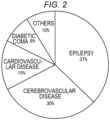
- various illnesses are present. Based on knowledge discussed in Non-Patent document 1 illustrated in Fig. 2 , representative examples of the illnesses that cause conscious disturbance attack while driving are epilepsy, apoplexy, myocardial infarction, and hypoglycemia.
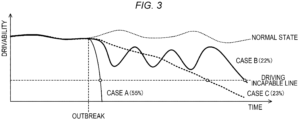
- Fig. 3 illustrates the three patterns (cases) of a decline in the driver state.
- a vertical axis represents a change in drivability with respect to time on a horizontal axis.
- Fig. 3 it is indicated that, when a line falls below a driving incapable line, the driver is brought into an unconscious state and is no longer able to drive.
- a case A is a pattern that, when the driver suffers from the illness, the driver becomes unconscious without prior warning.
- the case A occurs at a rate of approximately 55% of all cases.
- the case A is a pattern that is frequently observed in cases of epilepsy, and is also observed in some cases of myocardial infarction and a brain disorder.
- a case B is a pattern that the driver does not lose consciousness all at once when suffering from the illness. In the case B, the driver state is gradually declined as a whole while the driver feels something is wrong, that is, a relatively good state and a bad state repeatedly occur.
- the case B occurs at a rate of approximately 22% of all the cases and is frequently observed in the cases of the brain disorder.
- a case C is a pattern that, when the driver suffers from the illness, the driver state is slowly and gradually declined, and the driver eventually loses consciousness.
- the case C occurs at a rate of approximately 23% of all the cases and is frequently observed in cases of hypoglycemia.
- the related art has a problem of requiring a long time for determination when it is attempted to accurately discover the outbreak of the illness, and also has a problem of increased frequency of an erroneous determination when it is attempted to reduce the time required for the determination of the illness.
- the inventor focused on a mechanism of loss of the functions of the driver in a sequential order.
- the inventor paid attention to a prediction of the outbreak of the illness, and considered to determine the outbreak of the driver abnormality by using a detection result of such a prediction.
- it is possible to promptly and accurately determine the outbreak of the driver abnormality.
- a technique for determining the driver abnormality such a technique has been known to detect the outbreak of the abnormality of a function that is established regardless of the driver's intention, that is, an involuntary function.
- a method for detecting the abnormality of the involuntary function such a method has been known to analyze the imbalance driving posture of the driver and the eye-opening amount of the driver on the basis of a video captured by an imaging section, so as to determine the outbreak of the illness of the driver.
- a voluntary function of a person exists. Recently, techniques of detecting this voluntary function have been developed individually. The inventor of the present application further investigated classification based on this voluntary function while focusing on the brain functions.
- the inventor classified the voluntary function into: a voluntary function that was similar to a function of maintaining life and was processed in a barely conscious area (herein referred to as a "low voluntary function”); and a voluntary function that was processed in a conscious area (hereinafter referred to as a "high voluntary function") in comparison with the low voluntary function.
- the high voluntary function is a function that has an impact on whether so-called "driving while forecasting possible occurrence of something" can be performed.
- the inventor acquired knowledge that, after the outbreak of the driver abnormality, the high voluntary function was likely to be lost first, and the low voluntary function was likely to remain to the last.
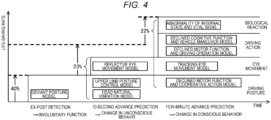
- Fig. 4 is a conceptual chart illustrating when and what types of the predictions and events occur in relation to the driver abnormality that shows behaviors as indicated in the cases B, C in Fig. 3 and also illustrating a relationship between each of the predictions and the events and a life-saving rate at a time point when the prediction or the event occurs.
- time goes back in a right direction of a time axis from timing at which the driver loses consciousness.
- Fig. 4 illustrates examples of the predictions (hereinafter referred to a few-minute advance predictions) that are detected a few minutes before the driver abnormality occurs and the driver becomes no longer able to drive.
- the few-minute advance predictions particularly, relatively high conscious behavior of the driver, that is, the high voluntary function is likely to be changed.
- the change in the high voluntary function is detected on the basis of indices that include a saccade reaction against saliency and frequency of rapid operations.
- a cognitive function and a motor function tend to be declined.
- trackability of eyes tend to be declined.
- the motor function tends to be declined.
- an internal state and vital signs of the driver tend to become abnormal, which causes an abnormal heart rate of the driver.
- a vehicle maneuver model, a driving operation model, a tracking eye movement model, a cooperative action model, and the like can be used. All of the few-minute advance predictions do not always occur, and only one or some of the few-minute advance predictions may occur. An example of a specific detection method of the few-minute advance prediction will be described below.
- the driver may be in a state capable of continuing driving.
- the life-saving rate is approximately 85%.
- Fig. 4 illustrates examples of the predictions (hereinafter referred to 10-second advance predictions) that are detected several seconds or a dozen seconds before the driver abnormality occurs and the driver becomes no longer able to drive.
- the 10-second advance prediction substantially unconscious behavior of the driver is likely to be changed. That is, at a stage of the 10-second advance prediction at which a certain time elapses from the outbreak of the driver abnormality and which is a relatively close stage to the driving incapable line, in addition to the high voluntary function, the low voluntary function is also likely to be changed.
- the low voluntary function works normally.
- the detection of whether the low voluntary function works normally can be made on the basis of indices that include vestibulo-ocular reflex, constancy of a head, wobbling of steering, and stability of a speed, for example.
- the 10-second advance prediction can be detected by using a reflective eye movement model, an upper limb posture control model, a head natural vibration model, a detection result of vehicle behavior, and the like.
- the 10-second advance prediction for example, in the case where vestibulo-ocular reflex action becomes abnormal, the driver is likely not to be able to keep his/her eyesight at a fixed position (for example, to the front) with his/her head rocking.
- the constancy of the head tends to become abnormal.
- the abnormality of the constancy of the head for example, when the automobile rocks, the constancy of the head cannot be maintained, and the head rocks more than necessary.
- motion of the head with respect to rocking of the automobile is significantly reduced in comparison with that of a healthy person.
- steering tends to wobble, or the speed tends to become unstable.
- the 10-second advance prediction can be detected on the basis of the change in the state of head or the eyes of the driver or on the basis of the change in the behavior of the automobile. All of the 10-second advance predictions do not always occur, and only one or some of the 10-second advance predictions may occur. An example of a specific detection method of the 10-second advance prediction will be described below. At the stage of the 10-second advance prediction, the life-saving rate is approximately 63%.
- Fig. 4 illustrates an example in which loss of consciousness of the driver is detected ex-post facto (hereinafter referred to as ex-post detection).
- the ex-post detection can be made on the basis of the imbalance driving posture of the driver, a long-term eye closing state/continuity of the eye opening state, absence of a pupil reaction, or the like. While normal driving, the imbalance driving posture of the driver or eye closing/eye opening temporarily also occurs.
- the abnormality is usually determined on the basis of whether such a state continues for a specified time. For this reason, there is a problem of an elongated time being required to determine the abnormality.
- a deviant posture model, an image capturing result of the driver by a camera, or the like can be used for the ex-post detection.
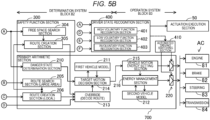
- Fig. 5A and Fig. 5B are block diagrams, each of which illustrates a functional configuration example of a driver-led automated driving system CU that has a driver state determination apparatus according to this embodiment.
- Fig. 5A and Fig. 5B will collectively be referred to as Fig. 5 .
- the driver-led automated driving system CU according to the present invention a (hereinafter simply referred to as an automated driving system CU) is functionally divided into a cognitive system block B1, a determination system block B2, and an operation system block B3.
- the cognitive system block B1 is configured to perceive external environment and internal environment of the automobile (including the driver state).
- the determination system block B2 is configured to determine various states, various situations, and the like on the basis of a recognition result by the cognitive system block B1, so as to determine the operation of the automobile.
- the operation system block B3 is configured to specifically generate signals/data to be transmitted to the actuators on the basis of the determination in the determination system block B2.
- the automated driving system CU includes: (1) a primary arithmetic section 200 that includes the cognitive system block B1, the determination system block B2, and the operation system block B3 to implement automated driving during normal driving; and (2) a safety function section 300 that has a function to complement the cognitive system block B1 and the determination system block B2 in the primary arithmetic section 200.
- the automated driving system CU receives data as an input signal from information acquisition means 10 that acquires information on the internal/external environment of the automobile.
- the automated driving system CU may also receive information as an input signal from a system or a service connected to an external network (for example, the Internet or the like) like cloud computing (described as "EXTERNAL INPUT" in Fig. 5 ).
- Examples of the information acquisition means 10 are: (1) plural vehicle exterior cameras 11, each of which is provided to a body or the like of an automobile 1 to capture an image of the exterior environment of the automobile; (2) plural radars 12, each of which is provided to the body or the like of the automobile 1 to detect an object, a sign, and the like on the outside of the vehicle; (3) a location sensor 13 that includes a positioning system such as the GPS; (4) external input 14 from the external network described above or the like; (5) a mechanical sensor 15 that is attached to the automobile 1; (6) a driver input section 16 that accepts an input operation by the driver; and (7) an internal camera 17 that is provided to a rear-view mirror, a dashboard, or the like of the automobile 1.
- the internal camera 17 is configured to be able to capture images of the posture, facial expression, the eye opening state, and a line of sight of the driver, the internal environment of the automobile, and the like, for example.
- the mechanical sensor 15 includes a vehicle speed sensor that detects an absolute speed of the automobile 1.
- the driver input section 16 includes a sensor that detects an operation of any of various operation targets, such as an accelerator pedal, a brake pedal, the steering wheel, or various switches, by the driver. More specifically, the driver input section 16 includes, for example: an accelerator operation amount sensor that detects a depression amount of the accelerator pedal; a steering angle sensor that detects a rotation angle (a steering angle) of the steering wheel; and a brake sensor (a hydraulic pressure sensor) that detects a depression amount of the brake pedal.
- the cognitive system block B1 and the determination system block B2 in the primary arithmetic section 200 execute processing by using any of the various models that are developed by deep leaning using a neural network.
- the processing is executed by using such a model, it is possible to control driving on the basis of a comprehensive determination on the vehicle state, the external environment of the automobile, the driver state, and the like. That is, it is possible to control driving by synchronizing a large volume of the input information in real time.
- the primary arithmetic section 200 includes an object recognition section 201 that recognizes an external object, a map creation section 202, an external environment estimation section 203, an external environment model 204, a route search section 205, a route creation section 206, and a vehicle state detection section 207.
- the object recognition section 201 receives the image (including the video) of the outside of the automobile that is captured by the external camera 11, and recognizes the external object on the basis of the received image. A recognition result of the object recognition section 201 is transmitted to the map creation section 202.
- the map creation section 202 divides a surrounding area of the host vehicle into plural areas (for example, front, right, left, and rear), and executes processing to create a map of each of the areas. More specifically, the map creation section 202 integrates target information recognized by the external camera 11 and object information recognized by the radar 12, and reflects the integrated information to the map of each of the areas.
- the map created by the map creation section 202 and a detection result of the vehicle state detection section 207 are used when the external environment estimation section 203 estimates the exterior environment of the automobile in image recognition processing using deep learning. More specifically, the external environment estimation section 203 executes the image recognition processing that is based on the external environment model 204 developed by using deep learning, and creates a 3D map that represents the exterior environment.
- a deep neural network DNN
- the DNN for example, a convolutional neural network (CNN) is available.
- the maps of the areas are joined to create an integrated map that shows surroundings of the host vehicle, (2) changes in a distance between the host vehicle and a mobile object in the integrated map as well as changes in a direction and a relative speed of the mobile object are predicted, and (3) results thereof are embedded in the external environment model 204.
- the external environment estimation section 203 (4) a location of the host vehicle on the integrated map is estimated from a combination of high-precision map information that is acquired from inside or outside of the automobile, location information acquired by the GPS or the like, vehicle speed information, and six-axis information, (5) cost for the above-described route is calculated, and (6) a result thereof and motion information of the host vehicle that is acquired from the various sensors are embedded in the external environment model 204.
- the external environment estimation section 203 updates the external environment model 204 as needed.
- the external environment model 204 is used when the route creation section 206, which will be described below, creates the route.
- the signal from the positioning system such as the GPS and car navigation data from the external network, for example, are transmitted to the route search section 205.
- the route search section 205 searches for an extensive route for the vehicle by using the signal from the positioning system such as the GPS and the navigation data from the external network, for example.
- the route creation section 206 creates the travel route of the vehicle on the basis of the above-described external environment model 204 and the output of the route search section 205. For example, the route creation section 206 scores safety, fuel economy, and the like and creates at least one travel route with a low score. Alternatively, the route creation section 206 may be configured to create the travel route that is based on plural perspectives such as the above travel route and a travel route that is adjusted according to the operation amount by the driver. Information on the travel route that is created by this route creation section 206 is included in external environment data.
- the safety function section 300 has a function of assuming a possibility that a determination or processing (hereinafter simply referred to as deviant processing) departing from a particular allowable range is derived from deep learning in the primary arithmetic section 200 and monitoring such deviant processing.
- the safety function section 300 is configured to
- the safety function section 300 includes an object recognition section 301 that recognizes the external object, a classification section 302, a preprocessing section 303, a free space search section 304, and a route creation section 305.
- the object recognition section 301 recognizes the external object on the basis of: the image (including the video) of the outside of the vehicle that is captured by the external camera 11; and a peak list of reflective waves detected by the radar 12.
- the classification section 302 and the preprocessing section 303 do not execute deep learning or the like, and estimate the external environment by a rule-based method based on a specified rule on the basis of a recognition result of the object recognition section 301. More specifically, the classification section 302 receives the object recognition result from the object recognition section 301, and classifies the recognized objects into the mobile object and a stationary object. Further specifically, in the classification section 302, (1) the surroundings of the host vehicle are divided into the plural areas (for example, the front, the right, the left, and the rear), (2) object information recognized by the external camera 11 and object information recognized by the radar 12 are integrated for each of the areas, and (3) classified information of the mobile object and the stationary object in each of the areas is generated.
- the preprocessing section 303 integrates a classification result for each of the areas that is generated in the classification section 302.
- the integrated information is managed, for example, as the classification information of the mobile object and the stationary object around the host vehicle, on a grid map (not illustrated).
- the preprocessing section 303 predicts a distance between the mobile object and the host vehicle as well as a direction and a relative speed of the mobile object, and integrates results thereof as attached information of the mobile object.
- the preprocessing section 303 combines the high-precision map information that is acquired from the inside or the outside of the automobile, the location information, the vehicle speed information, the six-axis information, and the like to estimate the location of the host vehicle with respect to the mobile object/ the stationary object.
- the free space search section 304 searches for the free space where a collision with the mobile object/ the stationary object (hereinafter also referred to as the target object), the location of which is estimated by the preprocessing section 303, can be avoided.
- the free space search section 304 sets the free space on the basis of such a specified rule that an area located a few meters from the target object is regarded as an unavoidable area.
- the target object is the mobile object
- the free space search section 304 sets the free space in consideration of a movement speed.
- the free space is an area that is on a road and where a mobile obstacle such as another vehicle or the pedestrian and a stationary obstacle such as the median strip or the center poll do not exist.
- the free space may include a space on a road shoulder where an emergency vehicle can be parked.
- the route creation section 305 calculates such a route that runs through the free space searched by the free space search section 304.
- a calculation method of the route by the route creation section 305 is not particularly limited, for example, the plural routes running through the free space are created, and the route with the lowest route cost is selected from the plural routes.
- the route that is calculated by the route creation section 305 is output to a target motion decision section 214, which will be described later.
- the functions of the safety function section 300 that have been described above are implemented by setting rules of the recognition method of the target and an avoidance method thereof, which are conventionally adopted for the automobile and the like.
- the primary arithmetic section 200 includes a danger state determination section 210, a first vehicle model 211, a second vehicle model 212, a route decision section 213, the target motion decision section 214, a vehicle motion energy setting section 215, an energy management section 216, a driver operation recognition section 217, an image processing section 218, and a selector 220.
- the image processing section 218 executes specified image processing on the image that is captured by the internal camera 17.
- the danger state determination section 210 determines that the collision with the target object or the departure from the lane possibly occurs on the basis of the external environment model 204, the danger state determination section 210 sets a travel route (for example, the target location and the vehicle speed) to avoid the collision with the target object or the departure from the lane.
- a travel route for example, the target location and the vehicle speed
- the driver operation recognition section 217 recognizes the operation amount and an operation direction by the driver as information used to decide the travel route. More specifically, the driver operation recognition section 217 recognizes the operation amount and the operation direction by the driver on the basis of the output of the driver input section 16, and outputs a recognition result to the route decision section 213.
- the route decision section 213 decides the vehicle travel route on the basis of the travel route set by the route creation section 206, the travel route set by the route creation section 305 in the safety function section 300, and the recognition result of the driver operation recognition section 217.
- a method for deciding this travel route is not particularly limited, for example, during the normal travel, the route decision section 213 may make the travel route set by the route creation section 206 a top priority.
- the route decision section 213 may select the travel route set by the route creation section 305 in the safety function section 300. Further alternatively, according to the operation amount or the operation direction by the driver, the route decision section 213 may adjust the selected travel route or prioritizes the operation by the driver.
- the target motion decision section 214 decides target six-axis motion (for example, acceleration, an angular speed, and the like) with respect to the travel route decided by the route decision section 213, for example.
- target six-axis motion for example, acceleration, an angular speed, and the like
- the target motion decision section 214 may use the specified first vehicle model 211.
- a six-axis vehicle model is created by modeling acceleration in three-axis directions of "front-rear”, “right-left”, and “up-down" of the traveling vehicle and angular speeds in three-axis directions of "pitch", "roll”, and "yaw".
- the six-axis vehicle model is created as a numerical model that replicates behavior of the vehicle by using a total of the six axes that include pitching (Y-axis), rolling (X-axis) motion, and movement in the Z-axis (vertical motion of a vehicle body) of a vehicle body placed on four wheels via suspensions.
- the first vehicle model 211 is created on the basis of a basic motor function of the vehicle, which is set in advance, the interior/exterior environment information of the vehicle, and the like, for example, and is appropriately updated.
- the vehicle motion energy setting section 215 calculates torque that is requested to each of a drive system, a steering system, and a brake system in regard to the target six-axis motion decided by the target motion decision section 214.
- the drive system includes an engine system, a motor, and the transmission.
- the steering system is the steering.
- the brake system is the brake.
- the energy management section 216 calculates a control amount of the actuators AC to obtain the highest energy efficiency at the time when the target motion decided by the target motion decision section 214 is achieved. More specifically exemplified, the energy management section 216 calculates opening/closing timing of intake/exhaust valves (not illustrated), fuel injection timing of an injector (not illustrated), and the like that improve the fuel economy the most in order to achieve energy torque decided by the target motion decision section 214. When performing energy management, the energy management section 216 may use the specified second vehicle model 212.
- the second vehicle model 212 is a model that represents energy consumption of the vehicle. More specifically, the second vehicle model 212 is a model that represents the fuel economy and electric consumption for the operation of the actuators AC in the vehicle.
- the second vehicle model 212 is created by modeling the opening/closing timing of the intake/exhaust valves (not illustrated), the fuel injection timing of the injector (not illustrated), valve opening/closing timing of an exhaust recirculation system, and the like that improve the fuel economy the most when a specified amount of the engine torque is output, for example.
- the second vehicle model is created during the travel of the vehicle, for example, and is appropriately updated.
- the automated driving system CU acknowledges the host vehicle, the external environment, and the driver state so as to execute the virtual driving in parallel with driving of the automobile by the driver.
- the automated driving system CU actuates the actuators AC for operating the automobile on the basis of the output from the vehicle motion energy setting section 215 and the energy management section 216 described above.
- Such switching operation can be realized by the above-described configuration for automated driving, a driver state recognition section 400, an automated driving switching section 410, and the selector 220.
- the driver state recognition section 400 recognizes the driver state on the basis of the information acquired by the information acquisition means 10, the processing result in each of the above-described blocks, and the like. Then, the driver state recognition section 400 acknowledges the states of the high voluntary function, the low voluntary function, and the involuntary function on the basis of the recognition result. For example, the driver state recognition section 400 recognizes the driver state on the basis of the results recognized by the object recognition sections 201, 301 and the driver operation recognition section 217, the image capturing information by the internal camera 17 (the image processing result of the image processing section 218), the output information from the external environment estimation section 203, and/or the like. In Fig.
- the driver state recognition section 400 receives the output from the preprocessing section 303, the driver operation recognition section 217, the image processing section 218, and the external environment estimation section 203.
- the driver state recognition section 400 may recognize the states of the high voluntary function, the low voluntary function, and the involuntary function on the basis of the information from the other block.
- the driver state recognition section 400 includes a high voluntary function recognition section 401, a low voluntary function recognition section 402, and an involuntary function recognition section 403.
- the high voluntary function recognition section 401 recognizes whether the high voluntary function of the driver works normally. More specifically, the high voluntary function recognition section 401 checks whether the operation based on the high voluntary function of the driver is performed on the basis of the external environment estimated by the external environment estimation section 203, an operating status of the accelerator pedal or the steering wheel recognized by the driver operation recognition section 217, and the output from the mechanical sensor 15, for example. Further specifically, the high voluntary function recognition section 401 recognizes how the driver acts when the driver passes a location such as a corner or an intersection where a person possibly and suddenly runs in front of the driver.
- the inventor has acquired such knowledge that the driver decelerates the vehicle to secure safety as approaching the corner or the intersection in the case where the high voluntary function works normally, that is, in the healthy state while the driver drives through the corner or the intersection without deceleration in the case where the driver suffers from a symptom of apoplexy and thus a danger anticipation function of the driver is lost, for example.
- the driver in such a state can travel on an usual empty road by tracing a lane. Traveling by tracing the lane relates to the voluntary function that can be processed in the area close to unconsciousness, and is a function that belongs to the low voluntary function in the classification by the inventor. It means that there is a case where the low voluntary function works normally even when the high voluntary function is declined.
- the high voluntary function recognition section 401 determines whether the driving operation that corresponds to the location where the driver passes through, in particular, the driving action with the assumption of a prediction of danger, so-called "driving while forecasting possible occurrence of something" is executed normally on the basis of the recognition result and/or the detection result of the external environment estimation section 203, the driver operation recognition section 217, and/or the mechanical sensor 15 described above. It is possible to recognize whether travel environment is environment that requires the automobile to perform "driving while forecasting possible occurrence of something", for example, by quantifying map information (for example, the target information such as building information) acquired from the GPS or the like and travel risk information of each of the targets. Then, the high voluntary function recognition section 401 recognizes that the high voluntary function does not work normally in the case where the driver continues performing rapid operations such as rapid depression of the accelerator pedal and rapid turning of the steering wheel regardless of a fact that the travel risk is increased.
- map information for example, the target information such as building information
- the high voluntary function recognition section 401 recognizes whether the high voluntary function works normally on the basis of motion of the line of sight of the driver, on the basis of the saccade reaction against saliency or movement of the line of sight to a figure if present. Further alternatively, with the assumption of combination with the other indices, the high voluntary function recognition section 401 may count the number of checking of an internal camera mirror, and may use the extremely small number of checking of the mirror or a significant reduction in the number for the recognition of the high voluntary function. In addition, as described above, in a situation where the high voluntary function does not work normally, a change occurs to an index such as an autonomic index. Thus, such an autonomic index (for example, a heart rate) may be referred in order to acknowledge a sign of the change in the high voluntary function.
- an autonomic index for example, a heart rate
- the high voluntary function recognition section 401 (1) may recognize that the high voluntary function does not work normally by combining plural indices, or (2) may cause an actuation execution section 50 to execute actuation for the driver so as to check reaction of the driver and recognize that the high voluntary function does not work normally on the basis of the result in the case where it is estimated that the high voluntary function does not work normally.
- a configuration of the actuation execution section 50 is not particularly limited, a dedicated device may be provided therefor. Alternatively, a screen of a car navigation system (not illustrated) or a head-up display or a sound producing device such as a horn or a speaker may be used.
- the high voluntary function recognition section 401 is an example of the voluntary function recognition section.
- the low voluntary function recognition section 402 recognizes whether the low voluntary function works normally. More specifically, the low voluntary function recognition section 402 acknowledges presence or absence of wobbling of steering or instability of the speed from the results recognized by the object recognition sections 201, 301 and the driver operation recognition section 217, for example, so as to check whether the operation based on the low voluntary function of the driver is performed. Further specifically, for example, the low voluntary function recognition section 402 checks whether the travel of the automobile on the lane wobbles on the basis of the results recognized by the object recognition sections 201, 301 and the driver operation recognition section 217. The low voluntary function recognition section 402 also recognizes whether the driver performs such travel that a distance between the host vehicle and a forward vehicle is repeatedly reduced and increased.
- the low voluntary function recognition section 402 checks whether vestibulo-ocular reflex is normal, that is, whether the constancy of the head is maintained on the basis of the image capturing result of the internal camera 17. For example, the low voluntary function recognition section 402 analyzes the motion of the head of the driver and motion of the line of sight of the driver on the basis of the video captured by the internal camera 17, so as to check whether vestibulo-ocular reflex is normal. Moreover, the low voluntary function recognition section 402 analyzes a degree of rocking of the head of the driver with respect to rocking of the automobile on the basis of the output from the mechanical sensor 15 and the video captured by the internal camera 17, so as to check whether the constancy of the head is maintained. The low voluntary function recognition section 402 is an example of the voluntary function recognition section.
- the involuntary function recognition section 403 recognizes whether the involuntary function works normally on the basis of a fact that the involuntary function remains in the abnormal state for a specified time or longer. For example, the involuntary function recognition section 403 analyzes the imbalance driving posture of the driver and the eye opening amount of the driver on the basis of the image capturing result of the internal camera 17, so as to determine the outbreak of the illness of the driver. More specifically, the involuntary function recognition section 403 recognizes the outbreak of the illness of the driver, for example, in the case where an imbalance state of the driving posture of the driver and/or the eye opening/closing state of the driver continues for two seconds.
- the driver state recognition section 400 When recognizing the outbreak of the illness of the driver, the driver state recognition section 400 outputs a recognition result to the automated driving switching section 410.
- the automated driving switching section 410 outputs a control signal to the selector 220 on the basis of the output from the driver state recognition section 400.
- the selector 220 has a function of switching whether or not to actually transmit the control signal for the virtual driving, which is calculated by the automated driving system CU, to the actuators AC.
- the selector 220 receives the control signals for actuating the actuators AC from the vehicle motion energy setting section 215 and the energy management section 216.
- the selector 220 is configured not to output the control signal for the virtual driving during the normal operation, that is, in the case where the driver is in the state capable of driving normally.
- the selector 220 receives the control signal from the automated driving switching section 410 and outputs the control signal (hereinafter referred to as an automated driving control signal) for actuating the actuators AC from the vehicle motion energy setting section 215 and the energy management section 216.
- the control signal hereinafter referred to as an automated driving control signal
- the automated driving control signal when the automated driving control signal is output from the selector 220, automated driving that is based on the automated driving control signal is adopted instead of driving based on the operation signal from the driver.
- the automated driving switching section 410 in the case where the driver state recognition section 400 recognizes the outbreak of the illness of the driver, the automated driving switching section 410 is notified of the recognition result, and the automated driving switching section 410 controls the selector 220. In this way, it is possible to operate the host vehicle instead of the driver in the manner to secure the safety of the host vehicle and the surroundings and to complement the declined function among the functions of the perception, the determination, and the operation of the driver.
- the invention is characterized in a point of reducing a determination time for the final driver abnormality determination by using the driver state recognition section 400 to detect the high voluntary function, the low voluntary function, and the involuntary function of the driver during driving and by combining the normal/abnormal determinations of the functions.
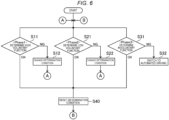
- Fig. 6 is a flowchart illustrating an example of the operation of the driver state determination apparatus
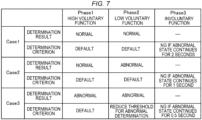
- Fig. 7 is a table for illustrating the operation of the driver state determination apparatus.
- Fig. 3 there is a case where the illness of the driver is shifted stepwise such that the abnormality is found in the high voluntary function as Phase 1, the abnormality is found in the low voluntary function as Phase 2, and the abnormality is found in the involuntary function as Phase 3. There is also a case where the abnormality is found in the involuntary function immediately after the outbreak of the illness of the driver. Furthermore, there is a case where the abnormality is found in the low voluntary function at first and then the abnormality is found in the involuntary function.
- step S11 it is determined whether the high voluntary function works normally.
- step S12 it is determined whether the low voluntary function works normally.
- step S13 it is determined whether the involuntary function works normally.
- Case 1 in Fig. 7 illustrates an example of the case where it is recognized that the high voluntary function works normally and that the low voluntary function works normally. That is, Case 1 in Fig. 7 illustrates the example of the case where the determinations in step S11 and step S12 are OK.
- the involuntary function recognition section 403 determines that the involuntary function is abnormal.
- the specified determination time is not particularly limited, an example in which the specified determination time is two seconds is illustrated in Fig. 7B. In the case of the configuration illustrated in Fig.
- the automated driving switching section 410 controls the selector 220 and sends the output of the automated driving system that has executed virtual driving to the actuators AC, so as to switch to automated driving.
- Case 2 in Fig. 7 illustrates an example of the case where it is recognized that the high voluntary function works normally and that the low voluntary function does not work normally. That is, Case 2 in Fig. 7 illustrates the example of the case where the determination in step S11 is OK and the determination in step S12 is NG.
- the involuntary function recognition section 403 reduces the determination time that is required to recognize whether the involuntary function works normally. An example in which the determination time is reduced from two seconds to one second is illustrated in Fig. 7B. In this way, in the case where the abnormality of the involuntary function of the driver continues for one second, the involuntary function recognition section 403 determines that the involuntary function is abnormal.
- Case 3 in Fig. 7 illustrates an example of the case where it is recognized that the high voluntary function does not work normally. That is, Case 3 in Fig. 7 illustrates the example of the case where the determination in step S11 is NG.
- the low voluntary function recognition section 402 changes a determination condition used to determine whether the low voluntary function works normally.
- the low voluntary function recognition section 402 reduces a threshold used to determine the abnormality of the low voluntary function so as to promote the determination of the abnormality.
- the involuntary function recognition section 403 reduces the determination time that is required to recognize whether the involuntary function works normally.
- Fig. 7B An example in which the determination time is reduced to 0.5 second is illustrated in Fig. 7B.
- the determination conditions may be changed for both of the low voluntary function recognition section 402 and the involuntary function recognition section 403.
- the threshold for the low voluntary function recognition section 402 may be reduced, and the determination time by the involuntary function recognition section 403 may be reduced to one second.
- the change of the determination condition for the abnormality of the low voluntary function is not limited to the reduction of the threshold.
- accuracy of the determination criterion or the determination threshold used to detect the abnormality of the driver may be increased. In this way, it is possible to substantially reduce the time required for the abnormality determination and to increase the accuracy of the abnormality determination.
- the voluntary function recognition sections (the high voluntary function recognition section 401 and the low voluntary function recognition section 402) are provided to each recognize whether the voluntary function works normally. Then, in the case where it is recognized that the voluntary function does not work normally, the determination time that is required to determine whether the involuntary function recognition section functions normally is reduced. That is, in this embodiment, the voluntary function recognition section detects the prediction before the outbreak of the driver abnormality. Then, in the case where the prediction is detected, the determination time that is required to determine whether the involuntary function recognition section functions normally is reduced. In this way, even in the case where the driving function of the driver is impaired due to the illness or the like, the driver abnormality determination can be accelerated. Therefore, it is possible to promptly and reliably execute safety control such as automated driving and automated stop.
- the reduction of the time includes a concept that the time required for the abnormality determination is indirectly reduced by relaxing the threshold for the abnormality determination or increasing the accuracy of the determination threshold.
- the determination condition for example, the determination time
- a step of resetting this changed determination condition may be provided.
- the processing may proceed to step S40, and the determination condition for each of the functions may be reset to a default value.
- the automated driving system CU may ask the driver a question such as "Are you OK?" or "Why don't you have a short break?" before and after changing the determination condition, and may change the processing according to the result. For example, in the case where the automated driving system CU asks the above question and receives a quick and appropriate response from the driver, the automated driving system CU may not change the determination condition in step S12 and/or step S22.
- the technique disclosed herein is useful as the driver state determination apparatus that is mounted on the automobile.
Landscapes
- Engineering & Computer Science (AREA)
- Health & Medical Sciences (AREA)
- Life Sciences & Earth Sciences (AREA)
- Physics & Mathematics (AREA)
- Automation & Control Theory (AREA)
- Transportation (AREA)
- Mechanical Engineering (AREA)
- Public Health (AREA)
- General Health & Medical Sciences (AREA)
- Animal Behavior & Ethology (AREA)
- Veterinary Medicine (AREA)
- Biomedical Technology (AREA)
- Heart & Thoracic Surgery (AREA)
- Biophysics (AREA)
- Medical Informatics (AREA)
- Molecular Biology (AREA)
- Surgery (AREA)
- Pathology (AREA)
- Human Computer Interaction (AREA)
- Developmental Disabilities (AREA)
- Physiology (AREA)
- Psychology (AREA)
- Psychiatry (AREA)
- Mathematical Physics (AREA)
- Educational Technology (AREA)
- Child & Adolescent Psychology (AREA)
- General Physics & Mathematics (AREA)
- Hospice & Palliative Care (AREA)
- Social Psychology (AREA)
- Cardiology (AREA)
- Anesthesiology (AREA)
- Chemical & Material Sciences (AREA)
- Combustion & Propulsion (AREA)
- Hematology (AREA)
- Business, Economics & Management (AREA)
- Emergency Management (AREA)
- Acoustics & Sound (AREA)
- Pulmonology (AREA)
- Artificial Intelligence (AREA)
- Computer Vision & Pattern Recognition (AREA)
Description
- The invention relates to a driver state determination apparatus that determines a state of a driver who drives an automobile, for example.
- Recently, development of automated driving systems has been promoted nationally.
- The present applicant considers that two directionalities are currently available for the automated driving system.
- A first directionality relates to a system that helps an automobile to transport an occupant to a destination without a need for an operation by a driver, and is so-called fully-automated travel of the automobile. For example,
Patent document 1 discloses an automated driving technique that shifts primary driving responsibility to the automobile when the occupant performs a specified operation. - The second directionality relates to an automated driving system that is designed on the basis of an idea to "provide environment that makes automobile driving enjoyable" that is, with an assumption that the driver is responsible for driving. In regard to the automated driving system of the second directionality, it is assumed that, when such a situation occurs that the driver suddenly suffers from an illness and becomes difficult to continue driving normally, for example, the automobile executes automated driving instead of the occupant.
-
Patent document 2 discloses a technique of determining appropriateness of a vehicle driving state by the driver on the basis of a driving posture and an eye-opening amount of the driver that are acquired from an analysis result of a video captured by an imaging section. Patent document 3 discloses a technique of setting a determination criterion for a degree of consciousness of the driver and determining a conscious state of the driver on the basis of detected behavior of the driver's head and the set determination criterion. InNon-Patent document 1, a case where the driver had a conscious disturbance attack while driving is discussed. -
- [Patent document 1]
JP-A-2019-119373 - [Patent document 2]
JP-A-2019-79328 - [Patent document 3]
JP-A-2010-128649 - [Non-Patent document 1] Shinohara and 7 others (2014) Untenchu ni ishiki shogai hossa wo hassho shita shorei no kentou [Conscious disturbance attack while driving]. Transactions of Society of Automotive Engineers of Japan, 45(6), 1105-1110.
- Further relevant documents of prior art are
JP 2016 045714 A US 2016/104050 A1 . - For example, as disclosed in
Patent document 2, the following technique has been known. In the case where the driver becomes no longer able to drive and hunches over, it is determined that there is a high probability that the driver suffers from dysfunction or the illness and thus the driving state of the driver is inappropriate. For example, in Patent document 3, motion of the head or a body of the driver is recognized. Then, based on a recognition result, a so-called dead man determination is made. In the case where a state of the driver who can no longer continue driving is recognized, instead of the driver, the technique allows the host vehicle to be evacuated to a safe place. - In such a case, it is extremely important to discover occurrence of abnormality to the driver, in particular, an outbreak of the dysfunction or the illness to the driver as soon as possible from perspectives of improvement in a life-saving rate of the driver and safety of surrounding environment. In particular, in the automated driving system according to the above second directionality, the driver is primarily responsible for driving. Thus, it is extremely important to discover the abnormality of the driver as soon as possible in order to provide an ease of mind and safety to the driver himself/herself and others.
- The invention has been made in view of such points and therefore has a purpose of reducing a time required for an abnormality determination of a driver as much as possible.
- In order to solve the problem, the invention is defined by the independent claims. It is targeted for a driver state determination apparatus that is mounted on an automobile and that includes: a voluntary function recognition section that is configured to recognize whether a voluntary function of a driver works normally in order to detect a prediction of an outbreak of abnormality of the driver; and an involuntary function recognition section that is configured to recognize whether an involuntary function works normally on the basis of a fact that the involuntary function remains in an abnormal state for a specified time or longer. The driver state determination apparatus is configured to reduce the specified time that is required to recognize whether the involuntary function recognition section works normally in the case where it is recognized that the voluntary function does not work normally.
- High and low voluntary functions and the recognition of whether the involuntary function works normally in the apparatus according to the present invention are recognition in a content of saving life and securing safety by accelerating the abnormality determination of the driver, and include aspects such as estimation and determinations by apparatus hardware. In addition, the recognition in the apparatus according to the present invention is a different concept from a concept that a healthcare professional examines a human body to determine whether the body functions normally.
- According to the invention, in the case where the prediction of the abnormality of the driver is detected on the basis of whether the voluntary function of the driver works normally and it is recognized that the voluntary function of the driver does not work normally, the specified time that is required to recognize whether the involuntary function recognition section functions normally is reduced. As a result, compared to a case where the abnormality of the driver is determined only on the basis of the involuntary function, a time required for the determination of the abnormality of the driver can be reduced while accuracy of the determination of the abnormality is secured as high as possible.
- According to the invention, the voluntary function recognition section includes:
a high voluntary function recognition section that is configured to recognize whether a high voluntary function that is a relatively high voluntary function works normally; and a low voluntary function recognition section that is configured to recognize whether a low voluntary function that is a lower voluntary function than the high voluntary function works normally. In the case where it is recognized that the high voluntary function recognition section does not function normally, determination criteria of the low voluntary function recognition section and/or the involuntary function recognition section are changed. Meanwhile, in the case where it is recognized that the low voluntary function recognition section does not function normally, the determination criterion of the involuntary function recognition section is changed. - According to this configuration, before the involuntary function is impaired, a condition for the determination of the abnormality (for example, a reduction in a determination time) is changed according to a combination of normality/abnormality of the high voluntary function and the low voluntary function. As a result, it is possible to further accelerate the determination of the abnormality of the driver and to increase accuracy of the prediction used for the determination of the abnormality.
- As an aspect of the driver state determination apparatus, this apparatus may be configured so that in the case where it is recognized that at least one of the high voluntary function and the low voluntary function does not work normally, an actuation method by an actuation execution section that is configured to execute actuation for the driver may be changed.
- Just as described, when the driver is notified or warned, it is possible to increase the accuracy of the determination of the abnormality of the driver and to urge the driver to act safely.
- According to a preferred embodiment the high voluntary function recognition section is configured to check whether the driver decelerates the vehicle to secure safety as approaching the corner or the intersection based on an external environment estimated by the external environment estimation section, an operating status of the accelerator pedal or the steering wheel recognized by the driver operation recognition section and an output from a mechanical sensor which includes a vehicle speed sensor.
- According to a further embodiment the low voluntary function recognition section is configured to check whether the travel of the automobile on the lane wobbles on the basis of the results recognized by the object recognition sections and the driver operation recognition section.
- Further, preferably, the low voluntary function recognition section is configured to check whether vestibulo-ocular reflex is normal, that is, whether the constancy of the head is maintained on the basis of the image capturing result of the internal camera.
- In accordance with a further embodiment in the case where it is recognized that the low voluntary function recognition section does not work normally, the determination criterion of the involuntary function recognition section is configured to reduce a threshold used to determine the abnormality of the low voluntary function so as to promote the determination of the abnormality.
- In accordance with a further embodiment the actuation is to ask the driver the question or warning the driver by a screen of a car navigation system or a head-up display or a sound producing device such as a horn or a speaker may be used.
- As it has been described so far, according to the technique disclosed herein, it is possible to accelerate the determination of the abnormality of the driver.
-
- [
Fig. 1] Fig. 1 is a conceptual view for illustrating a driver-led automated driving system. - [
Fig. 2] Fig. 2 is a graph illustrating a breakdown of illnesses and an influences on driving. - [
Fig. 3] Fig. 3 is a chart illustrating temporal changes in a decline in a driver state after an outbreak of the illness. - [
Fig. 4] Fig. 4 is a chart for illustrating ex-post detection and detection of predictions. - [
Fig. 5A] Fig. 5A is a block diagram illustrating a functional configuration of an automotive arithmetic system. - [
Fig. 5B] Fig. 5B is a block diagram illustrating the functional configuration of the automotive arithmetic system. - [
Fig. 6] Fig. 6 is a flowchart illustrating exemplary operation of a driver state determination apparatus. - [
Fig. 7] Fig. 7 is a table for illustrating the operation of the driver state determination apparatus. - Merits of a technique of the present invention are fully appreciated particularly when such a technique is adopted for the automated driving system in the above-described second directionality, that is, an automated driving system with an assumption that a person drivers an automobile (hereinafter referred to as a driver-led automated driving system).
- By the way, fully-automated driving is one of options that promise freedom of mobility of elders and is an extremely important technique. Meanwhile, the present applicant considers that the fully-automated driving is not the only one automated driving system (technology) requested for next generation.
- The present applicant considers that, with an idea centered on how persons should be, realization of life fulfilled by free mobility is an ideal of a next-generation personal car for which automated driving technique is adopted. In other words, the present applicant considers that a technique for improving mobility and capability of a person while providing pleasure to help the person to be back on a natural human state is requested. The present applicant also considers that revitalization of mind and a body of the person by enjoyable automobile driving is a natural effect of the automobile. When driving, the person exerts his/her capability and feels active while the automobile is prepared for appropriate handling of a state by grasping motion of itself, surrounding environment, and the like, that is, stays present to a sense of the person. As a result, the person in the automobile naturally senses motion of the automobile and feels safe in the automobile without a sense of discomfort. When the person owns such an automobile and has such "fulfilled satisfaction" that the person wants to drive the automobile as long as possible, the person obtains extreme joyfulness of driving. Meanwhile, the automobile provides the person with safety and a sense of ease. This is an idea of safety considered by the present applicant, and this is how the automated driving technique by the present applicant is used.
-
Fig. 1 is a view that schematically illustrates the above overview. - As illustrated in
Fig. 1 , a driver recognizes travel environment information of the automobile through five senses including eyesight and hearing. The driver determines how to maneuver the automobile on the basis of the recognized travel environment information, and operates a steering wheel, an accelerator, a brake pedal, or the like on the basis of a determination result. For example, in the case where the driver determines a possibility of a collision with an external object or departure from a lane, the driver decides a travel route (for example, a target location, acceleration/deceleration, or the like) to avoid such a situation, and performs an operation therefor. Consequently, various actuators AC (seeFig. 5B ) in the automobile are started, and operation thereof is reflected to travel of the automobile. The driver accepts a vehicle travel state as a result of such an operation as feedback, makes a determination on the basis of the feedback and the recognition result of the travel environment information, and performs an operation on the basis of the determination. The driver repeats such maneuver. Here, the travel environment information is information on travel environment of the automobile and includes external environment information of a host vehicle. For example, the external environment information includes information on a sign and a building, information on stationary objects including road information such as a median strip and a center poll, and information on mobile objects such as another vehicle (an automated four-wheeled vehicle), an automated two-wheeled vehicle, a bicycle, and a pedestrian. Examples of the actuators AC are anengine system 81, abrake system 82, asteering system 83, and a transmission 84 (seeFig. 5B ). - In regard to the automobile on which the driver-led automated driving system is mounted, the driver usually maneuvers the automobile (in a normal state). In the normal state, the driver-led automated driving system grasps states of the host vehicle and the external environment and the state of the driver so as to execute virtual driving behind maneuvering by the driver. In other words, the driver-led automated driving system is operated as a backup system. More specifically, similar to the driver, the driver-led automated driving system recognizes the travel environment information, and also recognizes the state of the host vehicle and the state of the driver. Based on the above recognition results, the driver-led automated driving system determines how to move the automobile, and decides target motion of the automobile in parallel with maneuvering by the driver. Then, when determining that the driver suffers from dysfunction or the illness, the driver-led automated driving system operates the host vehicle instead of the driver so as to secure safety of the host vehicle and the surrounding environment, and also complements a declined function of the driver among functions such as perception, determination, and operation.
- The driver-led automated driving system is designed to be operated as described above as a precondition. Thus, it is extremely important to discover the outbreak of the abnormality, such as the declined function, the dysfunction, or the illness, to the driver (hereinafter referred to as driver abnormality) as soon as possible.
- By the way, the driver state is largely categorized into a normal healthy state and an abnormal state where the driver suffers from the dysfunction or the illness. The normal state includes a flow state where the driver is concentrated on driving at a maximum, a concentrated driving state, a relaxed driving state, an inattentive driving state, a desultory driving state, a declined awakening state, and a drowsy state in a descending order of a degree of awareness. As the illness, various illnesses are present. Based on knowledge discussed in
Non-Patent document 1 illustrated inFig. 2 , representative examples of the illnesses that cause conscious disturbance attack while driving are epilepsy, apoplexy, myocardial infarction, and hypoglycemia. - The inventor acquired such knowledge that a change of a driver state from the normal state (the healthy state) to a state where the driver can no longer drive due to the outbreak of the illness causing the conscious disturbance attack is categorized into three patterns.
Fig. 3 illustrates the three patterns (cases) of a decline in the driver state. InFig. 3 , a vertical axis represents a change in drivability with respect to time on a horizontal axis. InFig. 3 , it is indicated that, when a line falls below a driving incapable line, the driver is brought into an unconscious state and is no longer able to drive. - In
Fig. 3 , a case A is a pattern that, when the driver suffers from the illness, the driver becomes unconscious without prior warning. The case A occurs at a rate of approximately 55% of all cases. The case A is a pattern that is frequently observed in cases of epilepsy, and is also observed in some cases of myocardial infarction and a brain disorder. A case B is a pattern that the driver does not lose consciousness all at once when suffering from the illness. In the case B, the driver state is gradually declined as a whole while the driver feels something is wrong, that is, a relatively good state and a bad state repeatedly occur. The case B occurs at a rate of approximately 22% of all the cases and is frequently observed in the cases of the brain disorder. A case C is a pattern that, when the driver suffers from the illness, the driver state is slowly and gradually declined, and the driver eventually loses consciousness. The case C occurs at a rate of approximately 23% of all the cases and is frequently observed in cases of hypoglycemia. - It can be said for all of these three cases that, with a current technical standard for detecting the driver state in a level adopted for the normal automobile, the outbreak of the illness can only be recognized after the driver state reaches the driving incapable line. This is because it is difficult to determine whether the driver is in a state of being healthy but looming, a state with accumulated fatigue, or a state with the outbreak of the illness. In addition, even when the driver is in the healthy state, the driver may close his/her eyes, and a posture of the driver may become imbalance. Thus, it is necessary to determine the abnormality of the driver under a condition that a state of imbalance posture and a state of the driver who keeps his/her eyes closed or open continue for a specified time. That is, the related art has a problem of requiring a long time for determination when it is attempted to accurately discover the outbreak of the illness, and also has a problem of increased frequency of an erroneous determination when it is attempted to reduce the time required for the determination of the illness.
- In view of the above, the inventor focused on a mechanism of loss of the functions of the driver in a sequential order. In other words, the inventor paid attention to a prediction of the outbreak of the illness, and considered to determine the outbreak of the driver abnormality by using a detection result of such a prediction. As a result, it is possible to promptly and accurately determine the outbreak of the driver abnormality.
- In general, as a method for determining the driver abnormality, such a technique has been known to detect the outbreak of the abnormality of a function that is established regardless of the driver's intention, that is, an involuntary function. As a method for detecting the abnormality of the involuntary function, such a method has been known to analyze the imbalance driving posture of the driver and the eye-opening amount of the driver on the basis of a video captured by an imaging section, so as to determine the outbreak of the illness of the driver. When focusing on brain functions, on contrary to the involuntary function, a voluntary function of a person exists. Recently, techniques of detecting this voluntary function have been developed individually. The inventor of the present application further investigated classification based on this voluntary function while focusing on the brain functions. More specifically, the inventor classified the voluntary function into: a voluntary function that was similar to a function of maintaining life and was processed in a barely conscious area (herein referred to as a "low voluntary function"); and a voluntary function that was processed in a conscious area (hereinafter referred to as a "high voluntary function") in comparison with the low voluntary function. For example, the high voluntary function is a function that has an impact on whether so-called "driving while forecasting possible occurrence of something" can be performed. With such classification, the inventor acquired knowledge that, after the outbreak of the driver abnormality, the high voluntary function was likely to be lost first, and the low voluntary function was likely to remain to the last.
-
Fig. 4 is a conceptual chart illustrating when and what types of the predictions and events occur in relation to the driver abnormality that shows behaviors as indicated in the cases B, C inFig. 3 and also illustrating a relationship between each of the predictions and the events and a life-saving rate at a time point when the prediction or the event occurs. InFig. 4 , time goes back in a right direction of a time axis from timing at which the driver loses consciousness. - In a right portion,
Fig. 4 illustrates examples of the predictions (hereinafter referred to a few-minute advance predictions) that are detected a few minutes before the driver abnormality occurs and the driver becomes no longer able to drive. In the few-minute advance predictions, particularly, relatively high conscious behavior of the driver, that is, the high voluntary function is likely to be changed. Thus, in order to detect onset of the few-minute prediction, it is focused on whether the high voluntary function works normally. The change in the high voluntary function is detected on the basis of indices that include a saccade reaction against saliency and frequency of rapid operations. - More specifically, for example, as the few-minute advance predictions of driving action, a cognitive function and a motor function tend to be declined. For example, as the few-minute advance prediction of eye movement, trackability of eyes tend to be declined. For example, as the few-minute advance prediction of the driving posture, the motor function tends to be declined. For example, as the few-minute advance predictions of a biological reaction, an internal state and vital signs of the driver tend to become abnormal, which causes an abnormal heart rate of the driver. Thus, by determining the abnormality of the vital sign or the decline in any of the various functions described above, it is possible to detect the few-minute advance prediction. In order to detect the few-minute advance prediction, for example, a vehicle maneuver model, a driving operation model, a tracking eye movement model, a cooperative action model, and the like can be used. All of the few-minute advance predictions do not always occur, and only one or some of the few-minute advance predictions may occur. An example of a specific detection method of the few-minute advance prediction will be described below. At a stage of the few-minute advance prediction, the driver may be in a state capable of continuing driving. At the stage of the few-minute advance prediction, the life-saving rate is approximately 85%.
- In a center portion,
Fig. 4 illustrates examples of the predictions (hereinafter referred to 10-second advance predictions) that are detected several seconds or a dozen seconds before the driver abnormality occurs and the driver becomes no longer able to drive. In the 10-second advance prediction, substantially unconscious behavior of the driver is likely to be changed. That is, at a stage of the 10-second advance prediction at which a certain time elapses from the outbreak of the driver abnormality and which is a relatively close stage to the driving incapable line, in addition to the high voluntary function, the low voluntary function is also likely to be changed. Thus, in order to detect the onset of the 10-second advance prediction, it is focused whether the low voluntary function works normally. The detection of whether the low voluntary function works normally can be made on the basis of indices that include vestibulo-ocular reflex, constancy of a head, wobbling of steering, and stability of a speed, for example. For example, the 10-second advance prediction can be detected by using a reflective eye movement model, an upper limb posture control model, a head natural vibration model, a detection result of vehicle behavior, and the like. - More specifically, in the 10-second advance prediction, for example, in the case where vestibulo-ocular reflex action becomes abnormal, the driver is likely not to be able to keep his/her eyesight at a fixed position (for example, to the front) with his/her head rocking. In addition, in the 10-second advance prediction, for example, the constancy of the head tends to become abnormal. As the abnormality of the constancy of the head, for example, when the automobile rocks, the constancy of the head cannot be maintained, and the head rocks more than necessary. In addition, in a case of muscle stiffing, motion of the head with respect to rocking of the automobile is significantly reduced in comparison with that of a healthy person. In the 10-second advance prediction, for example, steering tends to wobble, or the speed tends to become unstable. Thus, the 10-second advance prediction can be detected on the basis of the change in the state of head or the eyes of the driver or on the basis of the change in the behavior of the automobile. All of the 10-second advance predictions do not always occur, and only one or some of the 10-second advance predictions may occur. An example of a specific detection method of the 10-second advance prediction will be described below. At the stage of the 10-second advance prediction, the life-saving rate is approximately 63%.
- In a left portion,
Fig. 4 illustrates an example in which loss of consciousness of the driver is detected ex-post facto (hereinafter referred to as ex-post detection). As described above, the ex-post detection can be made on the basis of the imbalance driving posture of the driver, a long-term eye closing state/continuity of the eye opening state, absence of a pupil reaction, or the like. While normal driving, the imbalance driving posture of the driver or eye closing/eye opening temporarily also occurs. Thus, in the ex-post detection, the abnormality is usually determined on the basis of whether such a state continues for a specified time. For this reason, there is a problem of an elongated time being required to determine the abnormality. For example, a deviant posture model, an image capturing result of the driver by a camera, or the like can be used for the ex-post detection. -
Fig. 5A andFig. 5B are block diagrams, each of which illustrates a functional configuration example of a driver-led automated driving system CU that has a driver state determination apparatus according to this embodiment. In the following description,Fig. 5A andFig. 5B will collectively be referred to asFig. 5 . - The driver-led automated driving system CU according to the present invention a (hereinafter simply referred to as an automated driving system CU) is functionally divided into a cognitive system block B1, a determination system block B2, and an operation system block B3. The cognitive system block B1 is configured to perceive external environment and internal environment of the automobile (including the driver state). The determination system block B2 is configured to determine various states, various situations, and the like on the basis of a recognition result by the cognitive system block B1, so as to determine the operation of the automobile. The operation system block B3 is configured to specifically generate signals/data to be transmitted to the actuators on the basis of the determination in the determination system block B2.
- The automated driving system CU includes: (1) a primary
arithmetic section 200 that includes the cognitive system block B1, the determination system block B2, and the operation system block B3 to implement automated driving during normal driving; and (2) asafety function section 300 that has a function to complement the cognitive system block B1 and the determination system block B2 in the primaryarithmetic section 200. - The automated driving system CU receives data as an input signal from information acquisition means 10 that acquires information on the internal/external environment of the automobile. The automated driving system CU may also receive information as an input signal from a system or a service connected to an external network (for example, the Internet or the like) like cloud computing (described as "EXTERNAL INPUT" in
Fig. 5 ). - Examples of the information acquisition means 10 are: (1) plural
vehicle exterior cameras 11, each of which is provided to a body or the like of anautomobile 1 to capture an image of the exterior environment of the automobile; (2)plural radars 12, each of which is provided to the body or the like of theautomobile 1 to detect an object, a sign, and the like on the outside of the vehicle; (3) alocation sensor 13 that includes a positioning system such as the GPS; (4)external input 14 from the external network described above or the like; (5) amechanical sensor 15 that is attached to theautomobile 1; (6) adriver input section 16 that accepts an input operation by the driver; and (7) aninternal camera 17 that is provided to a rear-view mirror, a dashboard, or the like of theautomobile 1. Theinternal camera 17 is configured to be able to capture images of the posture, facial expression, the eye opening state, and a line of sight of the driver, the internal environment of the automobile, and the like, for example. Themechanical sensor 15 includes a vehicle speed sensor that detects an absolute speed of theautomobile 1. Thedriver input section 16 includes a sensor that detects an operation of any of various operation targets, such as an accelerator pedal, a brake pedal, the steering wheel, or various switches, by the driver. More specifically, thedriver input section 16 includes, for example: an accelerator operation amount sensor that detects a depression amount of the accelerator pedal; a steering angle sensor that detects a rotation angle (a steering angle) of the steering wheel; and a brake sensor (a hydraulic pressure sensor) that detects a depression amount of the brake pedal. - A description will herein be made on a configuration of the primary
arithmetic section 200 with exemplary creation of a route using deep learning by the primaryarithmetic section 200. - The cognitive system block B1 and the determination system block B2 in the primary
arithmetic section 200 execute processing by using any of the various models that are developed by deep leaning using a neural network. When the processing is executed by using such a model, it is possible to control driving on the basis of a comprehensive determination on the vehicle state, the external environment of the automobile, the driver state, and the like. That is, it is possible to control driving by synchronizing a large volume of the input information in real time. - More specifically, the primary
arithmetic section 200 includes anobject recognition section 201 that recognizes an external object, amap creation section 202, an externalenvironment estimation section 203, anexternal environment model 204, aroute search section 205, aroute creation section 206, and a vehiclestate detection section 207. - The
object recognition section 201 receives the image (including the video) of the outside of the automobile that is captured by theexternal camera 11, and recognizes the external object on the basis of the received image. A recognition result of theobject recognition section 201 is transmitted to themap creation section 202. - The
map creation section 202 divides a surrounding area of the host vehicle into plural areas (for example, front, right, left, and rear), and executes processing to create a map of each of the areas. More specifically, themap creation section 202 integrates target information recognized by theexternal camera 11 and object information recognized by theradar 12, and reflects the integrated information to the map of each of the areas. - The map created by the
map creation section 202 and a detection result of the vehiclestate detection section 207 are used when the externalenvironment estimation section 203 estimates the exterior environment of the automobile in image recognition processing using deep learning. More specifically, the externalenvironment estimation section 203 executes the image recognition processing that is based on theexternal environment model 204 developed by using deep learning, and creates a 3D map that represents the exterior environment. In deep learning, a deep neural network (DNN) is used. As the DNN, for example, a convolutional neural network (CNN) is available. - More specifically, in the external
environment estimation section 203, (1) the maps of the areas are joined to create an integrated map that shows surroundings of the host vehicle, (2) changes in a distance between the host vehicle and a mobile object in the integrated map as well as changes in a direction and a relative speed of the mobile object are predicted, and (3) results thereof are embedded in theexternal environment model 204. Further specifically, in the externalenvironment estimation section 203, (4) a location of the host vehicle on the integrated map is estimated from a combination of high-precision map information that is acquired from inside or outside of the automobile, location information acquired by the GPS or the like, vehicle speed information, and six-axis information, (5) cost for the above-described route is calculated, and (6) a result thereof and motion information of the host vehicle that is acquired from the various sensors are embedded in theexternal environment model 204. With the above processing (1) to (6), the externalenvironment estimation section 203 updates theexternal environment model 204 as needed. Theexternal environment model 204 is used when theroute creation section 206, which will be described below, creates the route. - The signal from the positioning system such as the GPS and car navigation data from the external network, for example, are transmitted to the
route search section 205. Theroute search section 205 searches for an extensive route for the vehicle by using the signal from the positioning system such as the GPS and the navigation data from the external network, for example. - The
route creation section 206 creates the travel route of the vehicle on the basis of the above-describedexternal environment model 204 and the output of theroute search section 205. For example, theroute creation section 206 scores safety, fuel economy, and the like and creates at least one travel route with a low score. Alternatively, theroute creation section 206 may be configured to create the travel route that is based on plural perspectives such as the above travel route and a travel route that is adjusted according to the operation amount by the driver. Information on the travel route that is created by thisroute creation section 206 is included in external environment data. - A description will herein be made on a configuration of the
safety function section 300 with exemplary creation of a route based on a rule by thesafety function section 300. - The
safety function section 300 has a function of assuming a possibility that a determination or processing (hereinafter simply referred to as deviant processing) departing from a particular allowable range is derived from deep learning in the primaryarithmetic section 200 and monitoring such deviant processing. - For example, the
safety function section 300 is configured to - (1) recognize the external object (hereinafter may be referred to as a target object) on the basis of a method for recognizing the target that is conventionally adopted for the automobile and the like, and
- (2) set a safe area through which the vehicle can travel safely by using a method that is conventionally adopted for the automobile and the like, and set a route that runs through such a safe area as the travel route on which the automobile should travel.
- More specifically, the
safety function section 300 includes anobject recognition section 301 that recognizes the external object, aclassification section 302, apreprocessing section 303, a freespace search section 304, and aroute creation section 305. - The
object recognition section 301 recognizes the external object on the basis of: the image (including the video) of the outside of the vehicle that is captured by theexternal camera 11; and a peak list of reflective waves detected by theradar 12. - The
classification section 302 and thepreprocessing section 303 do not execute deep learning or the like, and estimate the external environment by a rule-based method based on a specified rule on the basis of a recognition result of theobject recognition section 301. More specifically, theclassification section 302 receives the object recognition result from theobject recognition section 301, and classifies the recognized objects into the mobile object and a stationary object. Further specifically, in theclassification section 302, (1) the surroundings of the host vehicle are divided into the plural areas (for example, the front, the right, the left, and the rear), (2) object information recognized by theexternal camera 11 and object information recognized by theradar 12 are integrated for each of the areas, and (3) classified information of the mobile object and the stationary object in each of the areas is generated. - The
preprocessing section 303 integrates a classification result for each of the areas that is generated in theclassification section 302. The integrated information is managed, for example, as the classification information of the mobile object and the stationary object around the host vehicle, on a grid map (not illustrated). In addition, thepreprocessing section 303 predicts a distance between the mobile object and the host vehicle as well as a direction and a relative speed of the mobile object, and integrates results thereof as attached information of the mobile object. Furthermore, thepreprocessing section 303 combines the high-precision map information that is acquired from the inside or the outside of the automobile, the location information, the vehicle speed information, the six-axis information, and the like to estimate the location of the host vehicle with respect to the mobile object/ the stationary object. - The free
space search section 304 searches for the free space where a collision with the mobile object/ the stationary object (hereinafter also referred to as the target object), the location of which is estimated by thepreprocessing section 303, can be avoided. For example, the freespace search section 304 sets the free space on the basis of such a specified rule that an area located a few meters from the target object is regarded as an unavoidable area. In the case where the target object is the mobile object, the freespace search section 304 sets the free space in consideration of a movement speed. For example, the free space is an area that is on a road and where a mobile obstacle such as another vehicle or the pedestrian and a stationary obstacle such as the median strip or the center poll do not exist. The free space may include a space on a road shoulder where an emergency vehicle can be parked. - The
route creation section 305 calculates such a route that runs through the free space searched by the freespace search section 304. Although a calculation method of the route by theroute creation section 305 is not particularly limited, for example, the plural routes running through the free space are created, and the route with the lowest route cost is selected from the plural routes. The route that is calculated by theroute creation section 305 is output to a targetmotion decision section 214, which will be described later. - The functions of the
safety function section 300 that have been described above are implemented by setting rules of the recognition method of the target and an avoidance method thereof, which are conventionally adopted for the automobile and the like. - In addition to the block described in above "1-1. Primary arithmetic section (1)", the primary
arithmetic section 200 includes a dangerstate determination section 210, afirst vehicle model 211, asecond vehicle model 212, aroute decision section 213, the targetmotion decision section 214, a vehicle motionenergy setting section 215, anenergy management section 216, a driveroperation recognition section 217, animage processing section 218, and aselector 220. Theimage processing section 218 executes specified image processing on the image that is captured by theinternal camera 17. - In the case where the danger
state determination section 210 determines that the collision with the target object or the departure from the lane possibly occurs on the basis of theexternal environment model 204, the dangerstate determination section 210 sets a travel route (for example, the target location and the vehicle speed) to avoid the collision with the target object or the departure from the lane. - The driver
operation recognition section 217 recognizes the operation amount and an operation direction by the driver as information used to decide the travel route. More specifically, the driveroperation recognition section 217 recognizes the operation amount and the operation direction by the driver on the basis of the output of thedriver input section 16, and outputs a recognition result to theroute decision section 213. - The
route decision section 213 decides the vehicle travel route on the basis of the travel route set by theroute creation section 206, the travel route set by theroute creation section 305 in thesafety function section 300, and the recognition result of the driveroperation recognition section 217. Although a method for deciding this travel route is not particularly limited, for example, during the normal travel, theroute decision section 213 may make the travel route set by the route creation section 206 a top priority. Alternatively, in the case where the travel route set by theroute creation section 206 does not run through the free space searched by the freespace search section 304, theroute decision section 213 may select the travel route set by theroute creation section 305 in thesafety function section 300. Further alternatively, according to the operation amount or the operation direction by the driver, theroute decision section 213 may adjust the selected travel route or prioritizes the operation by the driver. - The target
motion decision section 214 decides target six-axis motion (for example, acceleration, an angular speed, and the like) with respect to the travel route decided by theroute decision section 213, for example. When deciding the target six-axis motion, the targetmotion decision section 214 may use the specifiedfirst vehicle model 211. A six-axis vehicle model is created by modeling acceleration in three-axis directions of "front-rear", "right-left", and "up-down" of the traveling vehicle and angular speeds in three-axis directions of "pitch", "roll", and "yaw". That is, instead of acknowledging motion of the vehicle on a plane (only in the front-rear/right-left direction (movement in X-Y) and yaw motion (Z-axis) of the vehicle), which has been practiced in the traditional vehicle motion engineering, the six-axis vehicle model is created as a numerical model that replicates behavior of the vehicle by using a total of the six axes that include pitching (Y-axis), rolling (X-axis) motion, and movement in the Z-axis (vertical motion of a vehicle body) of a vehicle body placed on four wheels via suspensions. Thefirst vehicle model 211 is created on the basis of a basic motor function of the vehicle, which is set in advance, the interior/exterior environment information of the vehicle, and the like, for example, and is appropriately updated. - The vehicle motion
energy setting section 215 calculates torque that is requested to each of a drive system, a steering system, and a brake system in regard to the target six-axis motion decided by the targetmotion decision section 214. For example, the drive system includes an engine system, a motor, and the transmission. For example, the steering system is the steering. For example, the brake system is the brake. - The
energy management section 216 calculates a control amount of the actuators AC to obtain the highest energy efficiency at the time when the target motion decided by the targetmotion decision section 214 is achieved. More specifically exemplified, theenergy management section 216 calculates opening/closing timing of intake/exhaust valves (not illustrated), fuel injection timing of an injector (not illustrated), and the like that improve the fuel economy the most in order to achieve energy torque decided by the targetmotion decision section 214. When performing energy management, theenergy management section 216 may use the specifiedsecond vehicle model 212. Thesecond vehicle model 212 is a model that represents energy consumption of the vehicle. More specifically, thesecond vehicle model 212 is a model that represents the fuel economy and electric consumption for the operation of the actuators AC in the vehicle. In detail, thesecond vehicle model 212 is created by modeling the opening/closing timing of the intake/exhaust valves (not illustrated), the fuel injection timing of the injector (not illustrated), valve opening/closing timing of an exhaust recirculation system, and the like that improve the fuel economy the most when a specified amount of the engine torque is output, for example. The second vehicle model is created during the travel of the vehicle, for example, and is appropriately updated. - As described above, in this embodiment, the automated driving system CU acknowledges the host vehicle, the external environment, and the driver state so as to execute the virtual driving in parallel with driving of the automobile by the driver. In the case where the automated driving system CU acknowledges the driver state and determines that the dysfunction or the illness has occurred to the driver, the automated driving system CU actuates the actuators AC for operating the automobile on the basis of the output from the vehicle motion
energy setting section 215 and theenergy management section 216 described above. - Such switching operation can be realized by the above-described configuration for automated driving, a driver
state recognition section 400, an automateddriving switching section 410, and theselector 220. - The driver
state recognition section 400 recognizes the driver state on the basis of the information acquired by the information acquisition means 10, the processing result in each of the above-described blocks, and the like. Then, the driverstate recognition section 400 acknowledges the states of the high voluntary function, the low voluntary function, and the involuntary function on the basis of the recognition result. For example, the driverstate recognition section 400 recognizes the driver state on the basis of the results recognized by theobject recognition sections operation recognition section 217, the image capturing information by the internal camera 17 (the image processing result of the image processing section 218), the output information from the externalenvironment estimation section 203, and/or the like. InFig. 5B , the driverstate recognition section 400 receives the output from thepreprocessing section 303, the driveroperation recognition section 217, theimage processing section 218, and the externalenvironment estimation section 203. However, the present invention is not limited thereto. The driverstate recognition section 400 may recognize the states of the high voluntary function, the low voluntary function, and the involuntary function on the basis of the information from the other block. - As illustrated in
Fig. 5B , the driverstate recognition section 400 includes a high voluntaryfunction recognition section 401, a low voluntaryfunction recognition section 402, and an involuntaryfunction recognition section 403. - The high voluntary
function recognition section 401 recognizes whether the high voluntary function of the driver works normally. More specifically, the high voluntaryfunction recognition section 401 checks whether the operation based on the high voluntary function of the driver is performed on the basis of the external environment estimated by the externalenvironment estimation section 203, an operating status of the accelerator pedal or the steering wheel recognized by the driveroperation recognition section 217, and the output from themechanical sensor 15, for example. Further specifically, the high voluntaryfunction recognition section 401 recognizes how the driver acts when the driver passes a location such as a corner or an intersection where a person possibly and suddenly runs in front of the driver. As a result of a demonstration experiment, the inventor has acquired such knowledge that the driver decelerates the vehicle to secure safety as approaching the corner or the intersection in the case where the high voluntary function works normally, that is, in the healthy state while the driver drives through the corner or the intersection without deceleration in the case where the driver suffers from a symptom of apoplexy and thus a danger anticipation function of the driver is lost, for example. According to the knowledge acquired by the inventor, it is understood that the driver in such a state can travel on an usual empty road by tracing a lane. Traveling by tracing the lane relates to the voluntary function that can be processed in the area close to unconsciousness, and is a function that belongs to the low voluntary function in the classification by the inventor. It means that there is a case where the low voluntary function works normally even when the high voluntary function is declined. - Accordingly, the high voluntary
function recognition section 401 determines whether the driving operation that corresponds to the location where the driver passes through, in particular, the driving action with the assumption of a prediction of danger, so-called "driving while forecasting possible occurrence of something" is executed normally on the basis of the recognition result and/or the detection result of the externalenvironment estimation section 203, the driveroperation recognition section 217, and/or themechanical sensor 15 described above. It is possible to recognize whether travel environment is environment that requires the automobile to perform "driving while forecasting possible occurrence of something", for example, by quantifying map information (for example, the target information such as building information) acquired from the GPS or the like and travel risk information of each of the targets. Then, the high voluntaryfunction recognition section 401 recognizes that the high voluntary function does not work normally in the case where the driver continues performing rapid operations such as rapid depression of the accelerator pedal and rapid turning of the steering wheel regardless of a fact that the travel risk is increased. - The high voluntary
function recognition section 401 recognizes whether the high voluntary function works normally on the basis of motion of the line of sight of the driver, on the basis of the saccade reaction against saliency or movement of the line of sight to a figure if present. Further alternatively, with the assumption of combination with the other indices, the high voluntaryfunction recognition section 401 may count the number of checking of an internal camera mirror, and may use the extremely small number of checking of the mirror or a significant reduction in the number for the recognition of the high voluntary function. In addition, as described above, in a situation where the high voluntary function does not work normally, a change occurs to an index such as an autonomic index. Thus, such an autonomic index (for example, a heart rate) may be referred in order to acknowledge a sign of the change in the high voluntary function. - In general, there is a tendency that it is more difficult to recognize the high voluntary function than the low voluntary function and the involuntary function. Accordingly, the high voluntary function recognition section 401 (1) may recognize that the high voluntary function does not work normally by combining plural indices, or (2) may cause an
actuation execution section 50 to execute actuation for the driver so as to check reaction of the driver and recognize that the high voluntary function does not work normally on the basis of the result in the case where it is estimated that the high voluntary function does not work normally. Although a configuration of theactuation execution section 50 is not particularly limited, a dedicated device may be provided therefor. Alternatively, a screen of a car navigation system (not illustrated) or a head-up display or a sound producing device such as a horn or a speaker may be used. The high voluntaryfunction recognition section 401 is an example of the voluntary function recognition section. - The low voluntary
function recognition section 402 recognizes whether the low voluntary function works normally. More specifically, the low voluntaryfunction recognition section 402 acknowledges presence or absence of wobbling of steering or instability of the speed from the results recognized by theobject recognition sections operation recognition section 217, for example, so as to check whether the operation based on the low voluntary function of the driver is performed. Further specifically, for example, the low voluntaryfunction recognition section 402 checks whether the travel of the automobile on the lane wobbles on the basis of the results recognized by theobject recognition sections operation recognition section 217. The low voluntaryfunction recognition section 402 also recognizes whether the driver performs such travel that a distance between the host vehicle and a forward vehicle is repeatedly reduced and increased. Furthermore, as described above, the low voluntaryfunction recognition section 402 checks whether vestibulo-ocular reflex is normal, that is, whether the constancy of the head is maintained on the basis of the image capturing result of theinternal camera 17. For example, the low voluntaryfunction recognition section 402 analyzes the motion of the head of the driver and motion of the line of sight of the driver on the basis of the video captured by theinternal camera 17, so as to check whether vestibulo-ocular reflex is normal. Moreover, the low voluntaryfunction recognition section 402 analyzes a degree of rocking of the head of the driver with respect to rocking of the automobile on the basis of the output from themechanical sensor 15 and the video captured by theinternal camera 17, so as to check whether the constancy of the head is maintained. The low voluntaryfunction recognition section 402 is an example of the voluntary function recognition section. - The involuntary
function recognition section 403 recognizes whether the involuntary function works normally on the basis of a fact that the involuntary function remains in the abnormal state for a specified time or longer. For example, the involuntaryfunction recognition section 403 analyzes the imbalance driving posture of the driver and the eye opening amount of the driver on the basis of the image capturing result of theinternal camera 17, so as to determine the outbreak of the illness of the driver. More specifically, the involuntaryfunction recognition section 403 recognizes the outbreak of the illness of the driver, for example, in the case where an imbalance state of the driving posture of the driver and/or the eye opening/closing state of the driver continues for two seconds. - When recognizing the outbreak of the illness of the driver, the driver
state recognition section 400 outputs a recognition result to the automateddriving switching section 410. - The automated
driving switching section 410 outputs a control signal to theselector 220 on the basis of the output from the driverstate recognition section 400. - The
selector 220 has a function of switching whether or not to actually transmit the control signal for the virtual driving, which is calculated by the automated driving system CU, to the actuators AC. Theselector 220 receives the control signals for actuating the actuators AC from the vehicle motionenergy setting section 215 and theenergy management section 216. Theselector 220 is configured not to output the control signal for the virtual driving during the normal operation, that is, in the case where the driver is in the state capable of driving normally. Meanwhile, in the case where the driverstate recognition section 400 recognizes the abnormality such as the illness of the driver, theselector 220 receives the control signal from the automateddriving switching section 410 and outputs the control signal (hereinafter referred to as an automated driving control signal) for actuating the actuators AC from the vehicle motionenergy setting section 215 and theenergy management section 216. In each of the actuators AC (including an ECU that operates the actuators), when the automated driving control signal is output from theselector 220, automated driving that is based on the automated driving control signal is adopted instead of driving based on the operation signal from the driver. - As described above, according to the configuration in this embodiment, in the case where the driver
state recognition section 400 recognizes the outbreak of the illness of the driver, the automateddriving switching section 410 is notified of the recognition result, and the automateddriving switching section 410 controls theselector 220. In this way, it is possible to operate the host vehicle instead of the driver in the manner to secure the safety of the host vehicle and the surroundings and to complement the declined function among the functions of the perception, the determination, and the operation of the driver. - Here, the invention is characterized in a point of reducing a determination time for the final driver abnormality determination by using the driver
state recognition section 400 to detect the high voluntary function, the low voluntary function, and the involuntary function of the driver during driving and by combining the normal/abnormal determinations of the functions. - A specific description will hereinafter be made with reference to
Figs. 6 and7 .Fig. 6 is a flowchart illustrating an example of the operation of the driver state determination apparatus, andFig. 7 is a table for illustrating the operation of the driver state determination apparatus. - As illustrated in
Fig. 3 , there is a case where the illness of the driver is shifted stepwise such that the abnormality is found in the high voluntary function asPhase 1, the abnormality is found in the low voluntary function asPhase 2, and the abnormality is found in the involuntary function as Phase 3. There is also a case where the abnormality is found in the involuntary function immediately after the outbreak of the illness of the driver. Furthermore, there is a case where the abnormality is found in the low voluntary function at first and then the abnormality is found in the involuntary function. - For the above reason, in
Fig. 6 , the abnormality determination of the high voluntary function (Phase 1), the abnormality determination of the low voluntary function(Phase 2), and the abnormality determination of the involuntary function (Phase 3) are processed in parallel. - In step S11, it is determined whether the high voluntary function works normally. In step S12, it is determined whether the low voluntary function works normally. In step S13, it is determined whether the involuntary function works normally.
-
Case 1 inFig. 7 illustrates an example of the case where it is recognized that the high voluntary function works normally and that the low voluntary function works normally. That is,Case 1 inFig. 7 illustrates the example of the case where the determinations in step S11 and step S12 are OK. At this time, for a determination in step S31, settings in a default state are used. For example, in the case where the abnormal state of the involuntary function continues for a specified determination time, the involuntaryfunction recognition section 403 determines that the involuntary function is abnormal. Although the specified determination time is not particularly limited, an example in which the specified determination time is two seconds is illustrated in Fig. 7B. In the case of the configuration illustrated inFig. 5B , when the driverstate recognition section 400 recognizes the outbreak of the illness of the driver, the recognition result is output to the automateddriving switching section 410. Then, the automateddriving switching section 410 controls theselector 220 and sends the output of the automated driving system that has executed virtual driving to the actuators AC, so as to switch to automated driving. -
Case 2 inFig. 7 illustrates an example of the case where it is recognized that the high voluntary function works normally and that the low voluntary function does not work normally. That is,Case 2 inFig. 7 illustrates the example of the case where the determination in step S11 is OK and the determination in step S12 is NG. At this time, the involuntaryfunction recognition section 403 reduces the determination time that is required to recognize whether the involuntary function works normally. An example in which the determination time is reduced from two seconds to one second is illustrated in Fig. 7B. In this way, in the case where the abnormality of the involuntary function of the driver continues for one second, the involuntaryfunction recognition section 403 determines that the involuntary function is abnormal. - Case 3 in
Fig. 7 illustrates an example of the case where it is recognized that the high voluntary function does not work normally. That is, Case 3 inFig. 7 illustrates the example of the case where the determination in step S11 is NG. In this case, in step S12, for example, the low voluntaryfunction recognition section 402 changes a determination condition used to determine whether the low voluntary function works normally. In an example illustrated inFig. 7 , the low voluntaryfunction recognition section 402 reduces a threshold used to determine the abnormality of the low voluntary function so as to promote the determination of the abnormality. Furthermore, if the determination in step S21 is NG, in step S22, the involuntaryfunction recognition section 403 reduces the determination time that is required to recognize whether the involuntary function works normally. An example in which the determination time is reduced to 0.5 second is illustrated in Fig. 7B. If the determination in step S11 is NG, the determination conditions may be changed for both of the low voluntaryfunction recognition section 402 and the involuntaryfunction recognition section 403. For example, the threshold for the low voluntaryfunction recognition section 402 may be reduced, and the determination time by the involuntaryfunction recognition section 403 may be reduced to one second. Here, the change of the determination condition for the abnormality of the low voluntary function is not limited to the reduction of the threshold. For example, accuracy of the determination criterion or the determination threshold used to detect the abnormality of the driver may be increased. In this way, it is possible to substantially reduce the time required for the abnormality determination and to increase the accuracy of the abnormality determination. - As it has been described so far, according to this embodiment, the voluntary function recognition sections (the high voluntary
function recognition section 401 and the low voluntary function recognition section 402) are provided to each recognize whether the voluntary function works normally. Then, in the case where it is recognized that the voluntary function does not work normally, the determination time that is required to determine whether the involuntary function recognition section functions normally is reduced. That is, in this embodiment, the voluntary function recognition section detects the prediction before the outbreak of the driver abnormality. Then, in the case where the prediction is detected, the determination time that is required to determine whether the involuntary function recognition section functions normally is reduced. In this way, even in the case where the driving function of the driver is impaired due to the illness or the like, the driver abnormality determination can be accelerated. Therefore, it is possible to promptly and reliably execute safety control such as automated driving and automated stop. - In this embodiment, such knowledge is acquired that, in the case where the voluntary function is classified into the high voluntary function and the low voluntary function, after the outbreak of the driver abnormality, the high voluntary function is lost first, and the low voluntary function remains to the end. Thus, before the involuntary function is declined, the condition of the abnormality determination is changed, and the determination time is reduced according to the combination of normality/abnormality of the high voluntary function and the low voluntary function. As a result, it is possible to further accelerate the driver abnormality determination and to increase the accuracy of the prediction related to the abnormality determination.
- According to the invention, in addition to a concept that the time required for the determination is directly reduced as illustrated in
Fig. 7 , the reduction of the time includes a concept that the time required for the abnormality determination is indirectly reduced by relaxing the threshold for the abnormality determination or increasing the accuracy of the determination threshold. - In the above embodiment, in the case where the determinations in steps S11 and S21 are NG, in steps S12 and S22, the determination condition (for example, the determination time) for each of the functions is thereafter changed. However, a step of resetting this changed determination condition may be provided. For example, in the case where the normal state is maintained for the specified time after the determination in step S11 and/or step S21 is NG, for example, in the case where a state with the determination of OK is maintained in steps S11, S21, and S31, the processing may proceed to step S40, and the determination condition for each of the functions may be reset to a default value.
- In the above embodiment, in the flow illustrated in
Fig. 6 , the automated driving system CU may ask the driver a question such as "Are you OK?" or "Why don't you have a short break?" before and after changing the determination condition, and may change the processing according to the result. For example, in the case where the automated driving system CU asks the above question and receives a quick and appropriate response from the driver, the automated driving system CU may not change the determination condition in step S12 and/or step S22. - In this way, when the actuation such as asking the driver the question or warning the driver, it is possible to increase the accuracy of the driver abnormality determination and urge the driver to act safely.
- The technique disclosed herein is useful as the driver state determination apparatus that is mounted on the automobile.
-
- 401 High voluntary function recognition section
- 402 Low voluntary function recognition section
- 403 Involuntary function recognition section
Claims (7)
- A driver state determination apparatus that is mounted on an automobile, the driver state determination apparatus comprising:a voluntary function recognition section that recognizes whether a driver's voluntary function works normally in order to detect a prediction of outbreak of abnormality of the driver; andan involuntary function recognition section (403) that recognizes whether an involuntary function works normally on the basis of a fact that the involuntary function remains in an abnormal state for a specified time or longer, whereinin the case where it is recognized that the voluntary function does not work normally, the specified time required to recognize whether the involuntary function works normally is reduced compared to a case where the abnormality of the driver is determined only on the basis of the involuntary function,characterized in that
the voluntary function recognition section includes:a high voluntary function recognition section (401) that recognizes whether a high voluntary function works normally on the basis of a saccade reaction against saliency or movement of the line of sight of the driver; anda low voluntary function recognition section (402) that recognizes whether a low voluntary function as a lower voluntary function than the high voluntary function works normally,in the case where it is recognized that the high voluntary function does not work normally, determination criteria of the low voluntary function recognition section (402) and/or the involuntary function recognition section (403) are changed, andin the case where it is recognized that the low voluntary function does not work normally, the determination criterion of the involuntary function recognition section (403) is changed. - The driver state determination apparatus according to claim 1, wherein
in the case where it is recognized that at least one of the high voluntary function and the low voluntary function does not work normally, an actuation method by an actuation execution section that executes actuation for the driver is executed. - The driver state determination apparatus according to claim 1, wherein the high voluntary function recognition section (401) checks whether the driver decelerates the vehicle to secure safety as approaching the corner or the intersection based on an external environment estimated by the external environment estimation section (203), an operating status of the accelerator pedal or the steering wheel recognized by a driver operation recognition section (217) and an output from a mechanical sensor 15 which includes a vehicle speed sensor.
- The driver state determination apparatus according to claim 1, wherein
the low voluntary function recognition section (402) checks whether the travel of the automobile on a lane wobbles on the basis of results recognized by an object recognition sections (201, 301) and a driver operation recognition section (217) . - The driver state determination apparatus according to claim 1, wherein
the low voluntary function recognition section (402) checks whether vestibulo-ocular reflex is normal, that is, whether the constancy of the head is maintained on the basis of the image capturing result of the internal camera (17). - The driver state determination apparatus according to claim 1, wherein
in the case where it is recognized that the low voluntary function recognition section does not work normally, the determination criterion of the involuntary function recognition section reduces a threshold used to determine the abnormality of the low voluntary function so as to promote the determination of the abnormality. - The driver state determination apparatus according to claim 2, wherein
the actuation is to ask the driver a question or warning the driver by a screen of a car navigation system or a head-up display or a sound producing device such as a horn or a speaker.
Applications Claiming Priority (1)
| Application Number | Priority Date | Filing Date | Title |
|---|---|---|---|
| JP2019186923A JP7318475B2 (en) | 2019-10-10 | 2019-10-10 | Driver condition determination device |
Publications (2)
| Publication Number | Publication Date |
|---|---|
| EP3806058A1 EP3806058A1 (en) | 2021-04-14 |
| EP3806058B1 true EP3806058B1 (en) | 2025-01-15 |
Family
ID=72811731
Family Applications (1)
| Application Number | Title | Priority Date | Filing Date |
|---|---|---|---|
| EP20200851.2A Active EP3806058B1 (en) | 2019-10-10 | 2020-10-08 | Driver condition determination apparatus |
Country Status (4)
| Country | Link |
|---|---|
| US (1) | US11427208B2 (en) |
| EP (1) | EP3806058B1 (en) |
| JP (1) | JP7318475B2 (en) |
| CN (1) | CN112644507B (en) |
Families Citing this family (11)
| Publication number | Priority date | Publication date | Assignee | Title |
|---|---|---|---|---|
| JP2021131708A (en) * | 2020-02-19 | 2021-09-09 | いすゞ自動車株式会社 | Driving assistance device |
| US12491847B2 (en) * | 2021-05-21 | 2025-12-09 | Hitachi Astemo, Ltd. | Vehicle control system, vehicle control device, and vehicle control method |
| US12441371B2 (en) * | 2021-06-21 | 2025-10-14 | Intel Corporation | Driver and environment monitoring to predict human driving maneuvers and reduce human driving errors |
| JP7745830B2 (en) * | 2021-11-12 | 2025-09-30 | マツダ株式会社 | Driver state determination method and device |
| CN114347997A (en) * | 2021-12-13 | 2022-04-15 | 华人运通(上海)自动驾驶科技有限公司 | Driving auxiliary control method and system in fatigue state |
| CN114998872A (en) * | 2022-06-08 | 2022-09-02 | 安徽悠然云端科技有限公司 | Method for estimating visual field deviation of building hoisting machinery driver |
| JP2024048772A (en) * | 2022-09-28 | 2024-04-09 | マツダ株式会社 | Driver Abnormality Prediction Detection Device |
| CN116416757B (en) * | 2023-01-13 | 2023-10-27 | 润芯微科技(江苏)有限公司 | Vital sign monitoring linkage vehicle-mounted machine alarm method and system |
| JP7810684B2 (en) * | 2023-10-19 | 2026-02-03 | 矢崎総業株式会社 | Vehicle control device, vehicle control method, and vehicle control program |
| JP7787133B2 (en) * | 2023-10-19 | 2025-12-16 | 矢崎総業株式会社 | Anomaly detection device |
| JP2025070028A (en) * | 2023-10-19 | 2025-05-02 | 矢崎総業株式会社 | Anomaly detection device, anomaly detection method, and anomaly detection program |
Citations (1)
| Publication number | Priority date | Publication date | Assignee | Title |
|---|---|---|---|---|
| US20190231279A1 (en) * | 2016-10-11 | 2019-08-01 | Tokai Optical Co., Ltd. | Eye movement measuring device and eye movement analysis system |
Family Cites Families (12)
| Publication number | Priority date | Publication date | Assignee | Title |
|---|---|---|---|---|
| CA2644053C (en) * | 2006-03-01 | 2015-06-30 | Optalert Pty Ltd | Incapacity monitor |
| JP2008013004A (en) * | 2006-07-04 | 2008-01-24 | Fuji Heavy Ind Ltd | Driving support system with aroma generation |
| JP2008204056A (en) | 2007-02-19 | 2008-09-04 | Tokai Rika Co Ltd | Driving assistance device |
| JP5326521B2 (en) | 2008-11-26 | 2013-10-30 | 日産自動車株式会社 | Arousal state determination device and arousal state determination method |
| US10430676B2 (en) * | 2014-06-23 | 2019-10-01 | Denso Corporation | Apparatus detecting driving incapability state of driver |
| JP2016045714A (en) | 2014-08-22 | 2016-04-04 | 株式会社デンソー | On-vehicle control device |
| DE102014220759B4 (en) | 2014-10-14 | 2019-06-19 | Audi Ag | Monitoring a degree of attention of a driver of a vehicle |
| JP2016196285A (en) * | 2015-04-03 | 2016-11-24 | 株式会社デンソー | Travel control device and travel control method |
| JP6683178B2 (en) * | 2017-06-02 | 2020-04-15 | トヨタ自動車株式会社 | Automatic driving system |
| JP7059566B2 (en) | 2017-10-25 | 2022-04-26 | いすゞ自動車株式会社 | Vehicle alarm device |
| JP7206592B2 (en) | 2018-01-09 | 2023-01-18 | トヨタ自動車株式会社 | vehicle controller |
| JP7328828B2 (en) * | 2019-08-27 | 2023-08-17 | フォルシアクラリオン・エレクトロニクス株式会社 | State estimation device, state estimation program, and state estimation method |
-
2019
- 2019-10-10 JP JP2019186923A patent/JP7318475B2/en active Active
-
2020
- 2020-09-29 US US17/035,767 patent/US11427208B2/en active Active
- 2020-09-29 CN CN202011047281.8A patent/CN112644507B/en active Active
- 2020-10-08 EP EP20200851.2A patent/EP3806058B1/en active Active
Patent Citations (1)
| Publication number | Priority date | Publication date | Assignee | Title |
|---|---|---|---|---|
| US20190231279A1 (en) * | 2016-10-11 | 2019-08-01 | Tokai Optical Co., Ltd. | Eye movement measuring device and eye movement analysis system |
Also Published As
| Publication number | Publication date |
|---|---|
| US11427208B2 (en) | 2022-08-30 |
| US20210107493A1 (en) | 2021-04-15 |
| CN112644507A (en) | 2021-04-13 |
| JP7318475B2 (en) | 2023-08-01 |
| JP2021061903A (en) | 2021-04-22 |
| EP3806058A1 (en) | 2021-04-14 |
| CN112644507B (en) | 2023-10-13 |
Similar Documents
| Publication | Publication Date | Title |
|---|---|---|
| EP3806058B1 (en) | Driver condition determination apparatus | |
| JP7226479B2 (en) | Image processing device, image processing method, and moving object | |
| JP7121681B2 (en) | vehicle control system | |
| US11760359B2 (en) | State determination device, state determination program, and computer-readable non-transitory tangible storage medium | |
| US10231660B2 (en) | System and method for assessing arousal level of driver of vehicle that can select manual driving mode or automated driving mode | |
| JP7329755B2 (en) | Support method and support system and support device using the same | |
| JP7459634B2 (en) | Driver Abnormality Judgment System | |
| JP6372388B2 (en) | Driver inoperability detection device | |
| JP7410681B2 (en) | vehicle control system | |
| WO2015198542A1 (en) | Device for detecting driving incapacity state of driver | |
| JP7459633B2 (en) | Driver abnormality determination device | |
| US20250108834A1 (en) | Vehicle integration control device and vehicle integration control method | |
| US20210316736A1 (en) | Driver abnormality determination apparatus, method and computer program | |
| US11952000B2 (en) | Vehicle failure diagnostic device | |
| EP3985642A1 (en) | Outside environment recognition device | |
| JP2021091409A (en) | State determination device | |
| JP7145805B2 (en) | vehicle control system | |
| EP4375963A1 (en) | Notification method for vehicle driver, notification system and vehicle | |
| JP6614286B2 (en) | Driver inoperability detection device | |
| EP4094969B1 (en) | Vehicle control apparatus, vehicle and vehicle control method | |
| US20260034991A1 (en) | Vehicle controller, method, and computer program for vehicle control | |
| JP2019008800A (en) | Driver inoperability detection device | |
| Merakanapalli et al. | Autonomous Steering Control using AI-Based Driver Drowsiness Detection and Safe-Zone Navigation | |
| JP2023072269A (en) | DRIVER STATE DETERMINATION METHOD AND DEVICE | |
| JP2023132123A (en) | Vehicle driving support device |
Legal Events
| Date | Code | Title | Description |
|---|---|---|---|
| PUAI | Public reference made under article 153(3) epc to a published international application that has entered the european phase |
Free format text: ORIGINAL CODE: 0009012 |
|
| STAA | Information on the status of an ep patent application or granted ep patent |
Free format text: STATUS: THE APPLICATION HAS BEEN PUBLISHED |
|
| AK | Designated contracting states |
Kind code of ref document: A1 Designated state(s): AL AT BE BG CH CY CZ DE DK EE ES FI FR GB GR HR HU IE IS IT LI LT LU LV MC MK MT NL NO PL PT RO RS SE SI SK SM TR |
|
| AX | Request for extension of the european patent |
Extension state: BA ME |
|
| STAA | Information on the status of an ep patent application or granted ep patent |
Free format text: STATUS: REQUEST FOR EXAMINATION WAS MADE |
|
| 17P | Request for examination filed |
Effective date: 20211014 |
|
| RBV | Designated contracting states (corrected) |
Designated state(s): AL AT BE BG CH CY CZ DE DK EE ES FI FR GB GR HR HU IE IS IT LI LT LU LV MC MK MT NL NO PL PT RO RS SE SI SK SM TR |
|
| STAA | Information on the status of an ep patent application or granted ep patent |
Free format text: STATUS: EXAMINATION IS IN PROGRESS |
|
| 17Q | First examination report despatched |
Effective date: 20221222 |
|
| GRAP | Despatch of communication of intention to grant a patent |
Free format text: ORIGINAL CODE: EPIDOSNIGR1 |
|
| STAA | Information on the status of an ep patent application or granted ep patent |
Free format text: STATUS: GRANT OF PATENT IS INTENDED |
|
| INTG | Intention to grant announced |
Effective date: 20241009 |
|
| GRAS | Grant fee paid |
Free format text: ORIGINAL CODE: EPIDOSNIGR3 |
|
| GRAA | (expected) grant |
Free format text: ORIGINAL CODE: 0009210 |
|
| STAA | Information on the status of an ep patent application or granted ep patent |
Free format text: STATUS: THE PATENT HAS BEEN GRANTED |
|
| AK | Designated contracting states |
Kind code of ref document: B1 Designated state(s): AL AT BE BG CH CY CZ DE DK EE ES FI FR GB GR HR HU IE IS IT LI LT LU LV MC MK MT NL NO PL PT RO RS SE SI SK SM TR |
|
| REG | Reference to a national code |
Ref country code: CH Ref legal event code: EP Ref country code: GB Ref legal event code: FG4D |
|
| REG | Reference to a national code |
Ref country code: DE Ref legal event code: R096 Ref document number: 602020044736 Country of ref document: DE |
|
| REG | Reference to a national code |
Ref country code: IE Ref legal event code: FG4D |
|
| REG | Reference to a national code |
Ref country code: NL Ref legal event code: MP Effective date: 20250115 |
|
| PG25 | Lapsed in a contracting state [announced via postgrant information from national office to epo] |
Ref country code: NL Free format text: LAPSE BECAUSE OF FAILURE TO SUBMIT A TRANSLATION OF THE DESCRIPTION OR TO PAY THE FEE WITHIN THE PRESCRIBED TIME-LIMIT Effective date: 20250115 |
|
| PG25 | Lapsed in a contracting state [announced via postgrant information from national office to epo] |
Ref country code: RS Free format text: LAPSE BECAUSE OF FAILURE TO SUBMIT A TRANSLATION OF THE DESCRIPTION OR TO PAY THE FEE WITHIN THE PRESCRIBED TIME-LIMIT Effective date: 20250415 |
|
| PG25 | Lapsed in a contracting state [announced via postgrant information from national office to epo] |
Ref country code: FI Free format text: LAPSE BECAUSE OF FAILURE TO SUBMIT A TRANSLATION OF THE DESCRIPTION OR TO PAY THE FEE WITHIN THE PRESCRIBED TIME-LIMIT Effective date: 20250115 |
|
| PG25 | Lapsed in a contracting state [announced via postgrant information from national office to epo] |
Ref country code: PL Free format text: LAPSE BECAUSE OF FAILURE TO SUBMIT A TRANSLATION OF THE DESCRIPTION OR TO PAY THE FEE WITHIN THE PRESCRIBED TIME-LIMIT Effective date: 20250115 |
|
| PG25 | Lapsed in a contracting state [announced via postgrant information from national office to epo] |
Ref country code: ES Free format text: LAPSE BECAUSE OF FAILURE TO SUBMIT A TRANSLATION OF THE DESCRIPTION OR TO PAY THE FEE WITHIN THE PRESCRIBED TIME-LIMIT Effective date: 20250115 |
|
| REG | Reference to a national code |
Ref country code: LT Ref legal event code: MG9D |
|
| PG25 | Lapsed in a contracting state [announced via postgrant information from national office to epo] |
Ref country code: IS Free format text: LAPSE BECAUSE OF FAILURE TO SUBMIT A TRANSLATION OF THE DESCRIPTION OR TO PAY THE FEE WITHIN THE PRESCRIBED TIME-LIMIT Effective date: 20250515 Ref country code: NO Free format text: LAPSE BECAUSE OF FAILURE TO SUBMIT A TRANSLATION OF THE DESCRIPTION OR TO PAY THE FEE WITHIN THE PRESCRIBED TIME-LIMIT Effective date: 20250415 |
|
| REG | Reference to a national code |
Ref country code: AT Ref legal event code: MK05 Ref document number: 1760365 Country of ref document: AT Kind code of ref document: T Effective date: 20250115 |
|
| PG25 | Lapsed in a contracting state [announced via postgrant information from national office to epo] |
Ref country code: HR Free format text: LAPSE BECAUSE OF FAILURE TO SUBMIT A TRANSLATION OF THE DESCRIPTION OR TO PAY THE FEE WITHIN THE PRESCRIBED TIME-LIMIT Effective date: 20250115 |
|
| PG25 | Lapsed in a contracting state [announced via postgrant information from national office to epo] |
Ref country code: LV Free format text: LAPSE BECAUSE OF FAILURE TO SUBMIT A TRANSLATION OF THE DESCRIPTION OR TO PAY THE FEE WITHIN THE PRESCRIBED TIME-LIMIT Effective date: 20250115 Ref country code: PT Free format text: LAPSE BECAUSE OF FAILURE TO SUBMIT A TRANSLATION OF THE DESCRIPTION OR TO PAY THE FEE WITHIN THE PRESCRIBED TIME-LIMIT Effective date: 20250515 |
|
| PG25 | Lapsed in a contracting state [announced via postgrant information from national office to epo] |
Ref country code: GR Free format text: LAPSE BECAUSE OF FAILURE TO SUBMIT A TRANSLATION OF THE DESCRIPTION OR TO PAY THE FEE WITHIN THE PRESCRIBED TIME-LIMIT Effective date: 20250416 Ref country code: BG Free format text: LAPSE BECAUSE OF FAILURE TO SUBMIT A TRANSLATION OF THE DESCRIPTION OR TO PAY THE FEE WITHIN THE PRESCRIBED TIME-LIMIT Effective date: 20250115 |
|
| PG25 | Lapsed in a contracting state [announced via postgrant information from national office to epo] |
Ref country code: AT Free format text: LAPSE BECAUSE OF FAILURE TO SUBMIT A TRANSLATION OF THE DESCRIPTION OR TO PAY THE FEE WITHIN THE PRESCRIBED TIME-LIMIT Effective date: 20250115 |
|
| PG25 | Lapsed in a contracting state [announced via postgrant information from national office to epo] |
Ref country code: SE Free format text: LAPSE BECAUSE OF FAILURE TO SUBMIT A TRANSLATION OF THE DESCRIPTION OR TO PAY THE FEE WITHIN THE PRESCRIBED TIME-LIMIT Effective date: 20250115 |
|
| PG25 | Lapsed in a contracting state [announced via postgrant information from national office to epo] |
Ref country code: SM Free format text: LAPSE BECAUSE OF FAILURE TO SUBMIT A TRANSLATION OF THE DESCRIPTION OR TO PAY THE FEE WITHIN THE PRESCRIBED TIME-LIMIT Effective date: 20250115 |
|
| PG25 | Lapsed in a contracting state [announced via postgrant information from national office to epo] |
Ref country code: DK Free format text: LAPSE BECAUSE OF FAILURE TO SUBMIT A TRANSLATION OF THE DESCRIPTION OR TO PAY THE FEE WITHIN THE PRESCRIBED TIME-LIMIT Effective date: 20250115 |
|
| PG25 | Lapsed in a contracting state [announced via postgrant information from national office to epo] |
Ref country code: IT Free format text: LAPSE BECAUSE OF FAILURE TO SUBMIT A TRANSLATION OF THE DESCRIPTION OR TO PAY THE FEE WITHIN THE PRESCRIBED TIME-LIMIT Effective date: 20250115 |
|
| REG | Reference to a national code |
Ref country code: DE Ref legal event code: R097 Ref document number: 602020044736 Country of ref document: DE |
|
| PG25 | Lapsed in a contracting state [announced via postgrant information from national office to epo] |
Ref country code: CZ Free format text: LAPSE BECAUSE OF FAILURE TO SUBMIT A TRANSLATION OF THE DESCRIPTION OR TO PAY THE FEE WITHIN THE PRESCRIBED TIME-LIMIT Effective date: 20250115 Ref country code: EE Free format text: LAPSE BECAUSE OF FAILURE TO SUBMIT A TRANSLATION OF THE DESCRIPTION OR TO PAY THE FEE WITHIN THE PRESCRIBED TIME-LIMIT Effective date: 20250115 |
|
| PG25 | Lapsed in a contracting state [announced via postgrant information from national office to epo] |
Ref country code: RO Free format text: LAPSE BECAUSE OF FAILURE TO SUBMIT A TRANSLATION OF THE DESCRIPTION OR TO PAY THE FEE WITHIN THE PRESCRIBED TIME-LIMIT Effective date: 20250115 |
|
| PG25 | Lapsed in a contracting state [announced via postgrant information from national office to epo] |
Ref country code: SK Free format text: LAPSE BECAUSE OF FAILURE TO SUBMIT A TRANSLATION OF THE DESCRIPTION OR TO PAY THE FEE WITHIN THE PRESCRIBED TIME-LIMIT Effective date: 20250115 |
|
| PLBE | No opposition filed within time limit |
Free format text: ORIGINAL CODE: 0009261 |
|
| STAA | Information on the status of an ep patent application or granted ep patent |
Free format text: STATUS: NO OPPOSITION FILED WITHIN TIME LIMIT |
|
| 26N | No opposition filed |
Effective date: 20251016 |
|
| PGFP | Annual fee paid to national office [announced via postgrant information from national office to epo] |
Ref country code: DE Payment date: 20250902 Year of fee payment: 6 |