EP3805925A1 - Method and apparatus for executing task by scheduling device - Google Patents
Method and apparatus for executing task by scheduling device Download PDFInfo
- Publication number
- EP3805925A1 EP3805925A1 EP19812398.6A EP19812398A EP3805925A1 EP 3805925 A1 EP3805925 A1 EP 3805925A1 EP 19812398 A EP19812398 A EP 19812398A EP 3805925 A1 EP3805925 A1 EP 3805925A1
- Authority
- EP
- European Patent Office
- Prior art keywords
- execution
- target
- execution device
- current
- value
- Prior art date
- Legal status (The legal status is an assumption and is not a legal conclusion. Google has not performed a legal analysis and makes no representation as to the accuracy of the status listed.)
- Pending
Links
Images


Classifications
-
- G—PHYSICS
- G06—COMPUTING OR CALCULATING; COUNTING
- G06F—ELECTRIC DIGITAL DATA PROCESSING
- G06F9/00—Arrangements for program control, e.g. control units
- G06F9/06—Arrangements for program control, e.g. control units using stored programs, i.e. using an internal store of processing equipment to receive or retain programs
- G06F9/46—Multiprogramming arrangements
- G06F9/50—Allocation of resources, e.g. of the central processing unit [CPU]
- G06F9/5005—Allocation of resources, e.g. of the central processing unit [CPU] to service a request
-
- G—PHYSICS
- G06—COMPUTING OR CALCULATING; COUNTING
- G06F—ELECTRIC DIGITAL DATA PROCESSING
- G06F9/00—Arrangements for program control, e.g. control units
- G06F9/06—Arrangements for program control, e.g. control units using stored programs, i.e. using an internal store of processing equipment to receive or retain programs
- G06F9/46—Multiprogramming arrangements
- G06F9/48—Program initiating; Program switching, e.g. by interrupt
- G06F9/4806—Task transfer initiation or dispatching
- G06F9/4843—Task transfer initiation or dispatching by program, e.g. task dispatcher, supervisor, operating system
- G06F9/4881—Scheduling strategies for dispatcher, e.g. round robin, multi-level priority queues
-
- G—PHYSICS
- G06—COMPUTING OR CALCULATING; COUNTING
- G06F—ELECTRIC DIGITAL DATA PROCESSING
- G06F9/00—Arrangements for program control, e.g. control units
- G06F9/06—Arrangements for program control, e.g. control units using stored programs, i.e. using an internal store of processing equipment to receive or retain programs
- G06F9/44—Arrangements for executing specific programs
- G06F9/455—Emulation; Interpretation; Software simulation, e.g. virtualisation or emulation of application or operating system execution engines
-
- G—PHYSICS
- G06—COMPUTING OR CALCULATING; COUNTING
- G06F—ELECTRIC DIGITAL DATA PROCESSING
- G06F9/00—Arrangements for program control, e.g. control units
- G06F9/06—Arrangements for program control, e.g. control units using stored programs, i.e. using an internal store of processing equipment to receive or retain programs
- G06F9/44—Arrangements for executing specific programs
- G06F9/455—Emulation; Interpretation; Software simulation, e.g. virtualisation or emulation of application or operating system execution engines
- G06F9/45533—Hypervisors; Virtual machine monitors
-
- G—PHYSICS
- G06—COMPUTING OR CALCULATING; COUNTING
- G06F—ELECTRIC DIGITAL DATA PROCESSING
- G06F9/00—Arrangements for program control, e.g. control units
- G06F9/06—Arrangements for program control, e.g. control units using stored programs, i.e. using an internal store of processing equipment to receive or retain programs
- G06F9/44—Arrangements for executing specific programs
- G06F9/455—Emulation; Interpretation; Software simulation, e.g. virtualisation or emulation of application or operating system execution engines
- G06F9/45533—Hypervisors; Virtual machine monitors
- G06F9/45558—Hypervisor-specific management and integration aspects
-
- G—PHYSICS
- G06—COMPUTING OR CALCULATING; COUNTING
- G06F—ELECTRIC DIGITAL DATA PROCESSING
- G06F9/00—Arrangements for program control, e.g. control units
- G06F9/06—Arrangements for program control, e.g. control units using stored programs, i.e. using an internal store of processing equipment to receive or retain programs
- G06F9/46—Multiprogramming arrangements
- G06F9/48—Program initiating; Program switching, e.g. by interrupt
-
- G—PHYSICS
- G06—COMPUTING OR CALCULATING; COUNTING
- G06F—ELECTRIC DIGITAL DATA PROCESSING
- G06F9/00—Arrangements for program control, e.g. control units
- G06F9/06—Arrangements for program control, e.g. control units using stored programs, i.e. using an internal store of processing equipment to receive or retain programs
- G06F9/46—Multiprogramming arrangements
- G06F9/48—Program initiating; Program switching, e.g. by interrupt
- G06F9/4806—Task transfer initiation or dispatching
-
- G—PHYSICS
- G06—COMPUTING OR CALCULATING; COUNTING
- G06F—ELECTRIC DIGITAL DATA PROCESSING
- G06F9/00—Arrangements for program control, e.g. control units
- G06F9/06—Arrangements for program control, e.g. control units using stored programs, i.e. using an internal store of processing equipment to receive or retain programs
- G06F9/46—Multiprogramming arrangements
- G06F9/48—Program initiating; Program switching, e.g. by interrupt
- G06F9/4806—Task transfer initiation or dispatching
- G06F9/4843—Task transfer initiation or dispatching by program, e.g. task dispatcher, supervisor, operating system
-
- G—PHYSICS
- G06—COMPUTING OR CALCULATING; COUNTING
- G06F—ELECTRIC DIGITAL DATA PROCESSING
- G06F9/00—Arrangements for program control, e.g. control units
- G06F9/06—Arrangements for program control, e.g. control units using stored programs, i.e. using an internal store of processing equipment to receive or retain programs
- G06F9/46—Multiprogramming arrangements
- G06F9/48—Program initiating; Program switching, e.g. by interrupt
- G06F9/4806—Task transfer initiation or dispatching
- G06F9/4843—Task transfer initiation or dispatching by program, e.g. task dispatcher, supervisor, operating system
- G06F9/485—Task life-cycle, e.g. stopping, restarting, resuming execution
-
- G—PHYSICS
- G06—COMPUTING OR CALCULATING; COUNTING
- G06F—ELECTRIC DIGITAL DATA PROCESSING
- G06F9/00—Arrangements for program control, e.g. control units
- G06F9/06—Arrangements for program control, e.g. control units using stored programs, i.e. using an internal store of processing equipment to receive or retain programs
- G06F9/46—Multiprogramming arrangements
- G06F9/50—Allocation of resources, e.g. of the central processing unit [CPU]
-
- G—PHYSICS
- G06—COMPUTING OR CALCULATING; COUNTING
- G06F—ELECTRIC DIGITAL DATA PROCESSING
- G06F9/00—Arrangements for program control, e.g. control units
- G06F9/06—Arrangements for program control, e.g. control units using stored programs, i.e. using an internal store of processing equipment to receive or retain programs
- G06F9/46—Multiprogramming arrangements
- G06F9/50—Allocation of resources, e.g. of the central processing unit [CPU]
- G06F9/5005—Allocation of resources, e.g. of the central processing unit [CPU] to service a request
- G06F9/5011—Allocation of resources, e.g. of the central processing unit [CPU] to service a request the resources being hardware resources other than CPUs, Servers and Terminals
- G06F9/5016—Allocation of resources, e.g. of the central processing unit [CPU] to service a request the resources being hardware resources other than CPUs, Servers and Terminals the resource being the memory
-
- G—PHYSICS
- G06—COMPUTING OR CALCULATING; COUNTING
- G06F—ELECTRIC DIGITAL DATA PROCESSING
- G06F9/00—Arrangements for program control, e.g. control units
- G06F9/06—Arrangements for program control, e.g. control units using stored programs, i.e. using an internal store of processing equipment to receive or retain programs
- G06F9/46—Multiprogramming arrangements
- G06F9/50—Allocation of resources, e.g. of the central processing unit [CPU]
- G06F9/5005—Allocation of resources, e.g. of the central processing unit [CPU] to service a request
- G06F9/5011—Allocation of resources, e.g. of the central processing unit [CPU] to service a request the resources being hardware resources other than CPUs, Servers and Terminals
- G06F9/5022—Mechanisms to release resources
-
- G—PHYSICS
- G06—COMPUTING OR CALCULATING; COUNTING
- G06F—ELECTRIC DIGITAL DATA PROCESSING
- G06F9/00—Arrangements for program control, e.g. control units
- G06F9/06—Arrangements for program control, e.g. control units using stored programs, i.e. using an internal store of processing equipment to receive or retain programs
- G06F9/46—Multiprogramming arrangements
- G06F9/50—Allocation of resources, e.g. of the central processing unit [CPU]
- G06F9/5005—Allocation of resources, e.g. of the central processing unit [CPU] to service a request
- G06F9/5027—Allocation of resources, e.g. of the central processing unit [CPU] to service a request the resource being a machine, e.g. CPUs, Servers, Terminals
-
- G—PHYSICS
- G06—COMPUTING OR CALCULATING; COUNTING
- G06F—ELECTRIC DIGITAL DATA PROCESSING
- G06F9/00—Arrangements for program control, e.g. control units
- G06F9/06—Arrangements for program control, e.g. control units using stored programs, i.e. using an internal store of processing equipment to receive or retain programs
- G06F9/46—Multiprogramming arrangements
- G06F9/50—Allocation of resources, e.g. of the central processing unit [CPU]
- G06F9/5005—Allocation of resources, e.g. of the central processing unit [CPU] to service a request
- G06F9/5027—Allocation of resources, e.g. of the central processing unit [CPU] to service a request the resource being a machine, e.g. CPUs, Servers, Terminals
- G06F9/5033—Allocation of resources, e.g. of the central processing unit [CPU] to service a request the resource being a machine, e.g. CPUs, Servers, Terminals considering data affinity
-
- G—PHYSICS
- G06—COMPUTING OR CALCULATING; COUNTING
- G06F—ELECTRIC DIGITAL DATA PROCESSING
- G06F9/00—Arrangements for program control, e.g. control units
- G06F9/06—Arrangements for program control, e.g. control units using stored programs, i.e. using an internal store of processing equipment to receive or retain programs
- G06F9/46—Multiprogramming arrangements
- G06F9/50—Allocation of resources, e.g. of the central processing unit [CPU]
- G06F9/5005—Allocation of resources, e.g. of the central processing unit [CPU] to service a request
- G06F9/5027—Allocation of resources, e.g. of the central processing unit [CPU] to service a request the resource being a machine, e.g. CPUs, Servers, Terminals
- G06F9/5038—Allocation of resources, e.g. of the central processing unit [CPU] to service a request the resource being a machine, e.g. CPUs, Servers, Terminals considering the execution order of a plurality of tasks, e.g. taking priority or time dependency constraints into consideration
-
- G—PHYSICS
- G06—COMPUTING OR CALCULATING; COUNTING
- G06F—ELECTRIC DIGITAL DATA PROCESSING
- G06F9/00—Arrangements for program control, e.g. control units
- G06F9/06—Arrangements for program control, e.g. control units using stored programs, i.e. using an internal store of processing equipment to receive or retain programs
- G06F9/46—Multiprogramming arrangements
- G06F9/50—Allocation of resources, e.g. of the central processing unit [CPU]
- G06F9/5005—Allocation of resources, e.g. of the central processing unit [CPU] to service a request
- G06F9/5027—Allocation of resources, e.g. of the central processing unit [CPU] to service a request the resource being a machine, e.g. CPUs, Servers, Terminals
- G06F9/5044—Allocation of resources, e.g. of the central processing unit [CPU] to service a request the resource being a machine, e.g. CPUs, Servers, Terminals considering hardware capabilities
-
- G—PHYSICS
- G06—COMPUTING OR CALCULATING; COUNTING
- G06F—ELECTRIC DIGITAL DATA PROCESSING
- G06F9/00—Arrangements for program control, e.g. control units
- G06F9/06—Arrangements for program control, e.g. control units using stored programs, i.e. using an internal store of processing equipment to receive or retain programs
- G06F9/46—Multiprogramming arrangements
- G06F9/50—Allocation of resources, e.g. of the central processing unit [CPU]
- G06F9/5005—Allocation of resources, e.g. of the central processing unit [CPU] to service a request
- G06F9/5027—Allocation of resources, e.g. of the central processing unit [CPU] to service a request the resource being a machine, e.g. CPUs, Servers, Terminals
- G06F9/505—Allocation of resources, e.g. of the central processing unit [CPU] to service a request the resource being a machine, e.g. CPUs, Servers, Terminals considering the load
-
- G—PHYSICS
- G06—COMPUTING OR CALCULATING; COUNTING
- G06F—ELECTRIC DIGITAL DATA PROCESSING
- G06F9/00—Arrangements for program control, e.g. control units
- G06F9/06—Arrangements for program control, e.g. control units using stored programs, i.e. using an internal store of processing equipment to receive or retain programs
- G06F9/46—Multiprogramming arrangements
- G06F9/50—Allocation of resources, e.g. of the central processing unit [CPU]
- G06F9/5005—Allocation of resources, e.g. of the central processing unit [CPU] to service a request
- G06F9/5027—Allocation of resources, e.g. of the central processing unit [CPU] to service a request the resource being a machine, e.g. CPUs, Servers, Terminals
- G06F9/5055—Allocation of resources, e.g. of the central processing unit [CPU] to service a request the resource being a machine, e.g. CPUs, Servers, Terminals considering software capabilities, i.e. software resources associated or available to the machine
-
- G—PHYSICS
- G06—COMPUTING OR CALCULATING; COUNTING
- G06F—ELECTRIC DIGITAL DATA PROCESSING
- G06F9/00—Arrangements for program control, e.g. control units
- G06F9/06—Arrangements for program control, e.g. control units using stored programs, i.e. using an internal store of processing equipment to receive or retain programs
- G06F9/46—Multiprogramming arrangements
- G06F9/50—Allocation of resources, e.g. of the central processing unit [CPU]
- G06F9/5061—Partitioning or combining of resources
- G06F9/5072—Grid computing
-
- G—PHYSICS
- G06—COMPUTING OR CALCULATING; COUNTING
- G06F—ELECTRIC DIGITAL DATA PROCESSING
- G06F9/00—Arrangements for program control, e.g. control units
- G06F9/06—Arrangements for program control, e.g. control units using stored programs, i.e. using an internal store of processing equipment to receive or retain programs
- G06F9/46—Multiprogramming arrangements
- G06F9/50—Allocation of resources, e.g. of the central processing unit [CPU]
- G06F9/5083—Techniques for rebalancing the load in a distributed system
-
- G—PHYSICS
- G06—COMPUTING OR CALCULATING; COUNTING
- G06F—ELECTRIC DIGITAL DATA PROCESSING
- G06F9/00—Arrangements for program control, e.g. control units
- G06F9/06—Arrangements for program control, e.g. control units using stored programs, i.e. using an internal store of processing equipment to receive or retain programs
- G06F9/46—Multiprogramming arrangements
- G06F9/50—Allocation of resources, e.g. of the central processing unit [CPU]
- G06F9/5083—Techniques for rebalancing the load in a distributed system
- G06F9/5088—Techniques for rebalancing the load in a distributed system involving task migration
-
- G—PHYSICS
- G06—COMPUTING OR CALCULATING; COUNTING
- G06F—ELECTRIC DIGITAL DATA PROCESSING
- G06F9/00—Arrangements for program control, e.g. control units
- G06F9/06—Arrangements for program control, e.g. control units using stored programs, i.e. using an internal store of processing equipment to receive or retain programs
- G06F9/44—Arrangements for executing specific programs
- G06F9/455—Emulation; Interpretation; Software simulation, e.g. virtualisation or emulation of application or operating system execution engines
- G06F9/45533—Hypervisors; Virtual machine monitors
- G06F9/45558—Hypervisor-specific management and integration aspects
- G06F2009/4557—Distribution of virtual machine instances; Migration and load balancing
-
- G—PHYSICS
- G06—COMPUTING OR CALCULATING; COUNTING
- G06F—ELECTRIC DIGITAL DATA PROCESSING
- G06F9/00—Arrangements for program control, e.g. control units
- G06F9/06—Arrangements for program control, e.g. control units using stored programs, i.e. using an internal store of processing equipment to receive or retain programs
- G06F9/44—Arrangements for executing specific programs
- G06F9/455—Emulation; Interpretation; Software simulation, e.g. virtualisation or emulation of application or operating system execution engines
- G06F9/45533—Hypervisors; Virtual machine monitors
- G06F9/45558—Hypervisor-specific management and integration aspects
- G06F2009/45575—Starting, stopping, suspending or resuming virtual machine instances
-
- G—PHYSICS
- G06—COMPUTING OR CALCULATING; COUNTING
- G06F—ELECTRIC DIGITAL DATA PROCESSING
- G06F2209/00—Indexing scheme relating to G06F9/00
- G06F2209/50—Indexing scheme relating to G06F9/50
- G06F2209/501—Performance criteria
-
- G—PHYSICS
- G06—COMPUTING OR CALCULATING; COUNTING
- G06F—ELECTRIC DIGITAL DATA PROCESSING
- G06F2209/00—Indexing scheme relating to G06F9/00
- G06F2209/54—Indexing scheme relating to G06F9/54
- G06F2209/549—Remote execution
Definitions
- the present disclosure relates to the technical field of electronics, and in particular, relates to a method and apparatus for executing a task by a scheduling device.
- each task is manually allocated to each of the execution devices.
- a user receives two tasks. One is to detect a face image in each frame of image in a video A, and the other is to feather an image B. The user may manually allocate the task of detecting the face image in each frame of image in the video A to an execution device C, and allocate the task of feathering the image B to an execution device D.
- an algorithm corresponding to the task needs to be invoked to actually execute the task. For example, to execute the task of detecting the face image in each frame of image in the video A, a face recognition algorithm needs to be invoked.
- the tasks often need to be sequentially allocated to a plurality of execution devices for execution attempts until the tasks are successfully executed. In this process, when a task is allocated to an execution device, if the execution device cannot successfully execute the task, the execution device returns execution failure prompt information to the user.
- a method for executing a task by a scheduling device includes: acquiring a target algorithm corresponding to a to-be-executed target task; acquiring a preset execution environment condition for the target algorithm and current execution environment information of each of execution devices; determining, from the execution devices, a target execution device where execution environment information satisfies the execution environment condition; and sending a control message for executing the target task to the target execution device.
- the method further includes: acquiring an algorithm corresponding to a task currently executed by the each of the execution devices; and determining, from the execution devices, the target execution device where execution environment information satisfies the execution environment condition includes: determining, from the execution devices, a target execution device where execution environment information satisfies the execution environment condition and where an algorithm corresponding to a currently executed task is the target algorithm.
- acquiring the current execution environment information of the each of the execution devices includes: acquiring a current computing capability value, a chip model, and system environment information of each of execution devices, wherein the system environment information includes a system bit width and a kernel version; and determining, from the execution devices, the target execution device where execution environment information satisfies the execution environment condition includes: determining, from the execution devices, a target execution device where the computing capability value is greater than or equal to a computing capability value threshold corresponding to the target algorithm, the chip model matches a reference chip model corresponding to the target algorithm, and the system environment information matches reference system environment information corresponding to the target algorithm.
- acquiring the current computing capability value of the each of the execution devices includes: determining a current computing capability value of the each of the execution devices based on a current central processing unit (CPU) idle ratio, a current graphics processing unit (GPU) idle ratio, and a current memory idle ratio of the each of the execution devices.
- CPU central processing unit
- GPU graphics processing unit
- determining the current computing capability value of the each of the execution devices based on the current CPU idle ratio, the current GPU idle ratio, and the current memory idle ratio of the each of the execution devices includes: for one of the execution devices except a preset reference execution device, multiplying a current CPU idle ratio of the execution device by a first ratio value to acquire a first calculation value; multiplying a current GPU idle ratio of the execution device by a second ratio value to acquire a second calculation value; multiplying a current memory idle ratio of the execution device by a third ratio value to acquire a third calculation value; and determining a smallest value among the first calculation value, the second calculation value, and the third calculation value as a current computing capability value of the execution device, wherein the first ratio value is a ratio of a CPU basic performance value of the execution device to a CPU basic performance value of the reference execution device, the second ratio value is a ratio of a GPU basic performance value of the execution device to a GPU basic performance value of the reference execution device, and the third ratio value is a ratio of a total
- the method further includes: sending an instruction message to an algorithm warehouse server, wherein the instruction message is intended to instruct the algorithm warehouse server to send an algorithm code corresponding to the target algorithm to the target execution device.
- the method further includes: upon receipt of a task execution failure message returned by the target execution device, acquiring the execution environment condition for the target algorithm and current execution environment information of one of the execution devices except the target execution device, determining, from the execution devices except the target execution device, an execution device where execution environment information satisfies the execution environment condition, and sending the control message for executing the target task to the determined execution device.
- an apparatus for executing a task by a scheduling device includes: an acquiring module, configured to acquire a target algorithm corresponding to a to-be-executed target task, wherein the acquiring module is configured to acquire a preset execution environment condition for the target algorithm and current execution environment information of each of execution devices; a determining module, configured to determine, from the execution devices, a target execution device where execution environment information satisfies the execution environment condition; and a sending module, configured to send a control message for executing the target task to the target execution device.
- the acquiring module is further configured to acquire an algorithm corresponding to a task currently executed by the each of the execution devices; and the determining module is configured to determine, from the execution devices, a target execution device where execution environment information satisfies the execution environment condition and where an algorithm corresponding to a currently executed task is the target algorithm.
- the acquiring module is configured to acquire a current computing capability value, a current chip model, and current system environment information of the each of the execution devices, wherein the system environment information includes a system bit width and a kernel version; and the determining module is configured to determine, from the execution devices, a target execution device where the computing capability value is greater than or equal to a computing capability value threshold corresponding to the target algorithm, the chip model matches a reference chip model corresponding to the target algorithm, and the system environment information matches reference system environment information corresponding to the target algorithm.
- the acquiring module is configured to: determine the current computing capability value of the each of the execution devices based on a current CPU idle ratio, a current GPU idle ratio, and a current memory idle ratio of the each of the execution devices.
- the acquiring module is configured to: for one of the execution devices except a preset reference execution device, multiply a current CPU idle ratio of the execution device by a first ratio value to acquire a first calculation value; multiply a current GPU idle ratio of the execution device by a second ratio value to acquire a second calculation value; multiply a current memory idle ratio of the execution device by a third ratio value to acquire a third calculation value; and determine a smallest value among the first calculation value, the second calculation value, and the third calculation value as a current computing capability value of the execution device, wherein the first ratio value is a ratio of a CPU basic performance value of the execution device to a CPU basic performance value of the reference execution device, the second ratio value is a ratio of a GPU basic performance value of the execution device to a GPU basic performance value of the reference execution device, and the third ratio value is a ratio of a total memory capacity of the execution device to a total memory capacity of the reference execution device; and for the preset reference execution device, determine a smallest value among a current CPU idle ratio of the
- the sending module is further configured to: send an instruction message to an algorithm warehouse server, wherein the instruction message is intended to instruct the algorithm warehouse server to send an algorithm code corresponding to the target algorithm to the target execution device.
- the apparatus further includes: an execution module, configured to: upon receipt of a task execution failure message returned by the target execution device, acquire the execution environment condition for the target algorithm and current execution environment information of one of the execution devices except the target execution device, determine, from the execution devices except the target execution device, an execution device where execution environment information satisfies the execution environment condition, and send the control message for executing the target task to the determined execution device.
- an execution module configured to: upon receipt of a task execution failure message returned by the target execution device, acquire the execution environment condition for the target algorithm and current execution environment information of one of the execution devices except the target execution device, determine, from the execution devices except the target execution device, an execution device where execution environment information satisfies the execution environment condition, and send the control message for executing the target task to the determined execution device.
- a computer device includes a processor, a communications interface, a memory, and a communications bus; wherein the processor, the communications interface, and the memory communicate with each other by using the communications bus; the memory is configured to store a computer program; and the processor is configured to run the program stored in the memory, to perform the method for executing the task by the scheduling device.
- a computer-readable storage medium stores a computer program.
- the computer program when run by a processor, enables the processor to perform the method for executing a task by a scheduling device.
- the target execution device that can successfully execute the target algorithm may be automatically found for the target algorithm based on the execution environment condition for the target algorithm and the current execution environment information of the devices. In this way, an attempt to sequentially execute the target task on the plurality of execution devices is avoided, such that even in the case of a relatively large quantity of tasks and a relatively large quantity of execution devices, a different algorithm can be automatically matched to an execution device that can successfully execute the algorithm, thereby achieving a relatively high task allocation efficiency and a relatively high task execution efficiency.
- An embodiment of the present disclosure provides a method for executing a task by a scheduling device.
- the method may be performed by a computer device such as a scheduling server, and may be performed by cooperation between an algorithm warehouse server and an execution device.
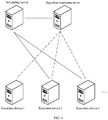
- FIG. 1 is a schematic structural diagram of a system for executing a task by a scheduling device according to an embodiment of the present disclosure.
- the scheduling server may include a processor, a memory and the like.
- the processor may be a processor such as a central processing unit (CPU) that may be configured to determine, from the execution devices, a target execution device where execution environment information satisfies an execution environment condition.
- the memory may be a random access memory (RAM), a flash memory, or the like that may be configured to store received data, data required in a processing process, data generated in the processing process, or the like, such as an execution environment condition.
- the scheduling server may further include a transceiver.
- the transceiver may be configured to transmit data to another server.
- the transceiver may include a Bluetooth component, a wireless-fidelity (Wi-Fi) component, an antenna, a matching circuit, a modem, and the like.
- An exemplary embodiment of the present disclosure provides a method for executing a task by a scheduling device. As shown in FIG. 2 , the method may include the following steps:
- step S210 a target algorithm corresponding to a to-be-executed target task is acquired.
- a scheduling server may directly acquire the to-be-executed target task, the to-be-executed target task may be acquired from a terminal, and a user may perform an operation on the terminal, to allocate the to-be-executed target task to the terminal.
- a user may trigger, by a preset operation, generation of an instruction on querying specific preset algorithms in an algorithm warehouse server.
- the user may learn what tasks can be executed by execution devices by using these algorithms, then allocate the task that can be executed by the execution device, as the to-be-executed target task, to the scheduling server.
- the user may select the to-be-executed target task in the algorithm warehouse server, and when detecting that the to-be-executed target task is selected, the algorithm warehouse server may send the to-be-executed target task to the scheduling server.
- the scheduling server may acquire the to-be-executed target task.
- the user may further trigger, by a preset operation, generation of an instruction on querying an algorithm that can be currently executed by the execution device.
- the scheduling server needs to synthesize situations of the algorithm warehouse server and the execution device, makes an analysis to acquire the algorithm that can be currently executed by the execution device, and feeds back, to the terminal, information about the algorithm that can be currently executed by the execution device.
- a correspondence between a task identifier and an algorithm may be preset in the scheduling server.
- the scheduling server may determine an identifier of the to-be-executed target task, such that the target algorithm corresponding to the identifier of the to-be-executed target task may be determined. For example, if the to-be-executed target task is a face recognition task, the target algorithm is an algorithm related to the face recognition. If the to-be-executed target task is an image feathering task, the target algorithm is an algorithm related to the image feathering. The to-be-executed target task may be actually implemented by using the target algorithm.
- step S220 a preset execution environment condition for the target algorithm and current execution environment information of each of execution devices are acquired.
- Execution environment conditions for a plurality of algorithms may be locally prestored in the scheduling server.
- the scheduling server may determine the execution environment condition corresponding to the target algorithm.
- the target algorithm may be provided by the algorithm warehouse server, algorithm codes and an algorithm library (a library file acquired after the algorithm codes are encoded) that correspond to the plurality of algorithms may be prestored in the algorithm warehouse server, and the algorithm codes and the algorithm library may be packaged to acquire an algorithm package.
- Execution environment conditions of the algorithm codes may be further prestored in the algorithm warehouse server
- the scheduling server may send an instruction message intended to query the execution environment condition for the target algorithm to the algorithm warehouse server.
- the algorithm warehouse server may query the execution environment condition for the target algorithm from the plurality of prestored algorithm codes and the execution environment conditions of the algorithm codes, and send the found execution environment condition for the target algorithm to the scheduling server.
- the user may perform a preset query operation in the terminal.
- the terminal may detect a query instruction, generate a query message, and send the query message to the scheduling server.
- the scheduling server may query, in the algorithm warehouse server, the specific algorithms that can be executed by the algorithm warehouse server and execution environment conditions for the algorithms. After the found algorithms, the execution environment conditions for the algorithms, and the execution devices are associated, the scheduling server may return the found algorithms and the execution environment conditions to the terminal.
- the terminal may display the algorithms and the execution environment conditions of the algorithms for user reference.
- the scheduling server may further send an instruction message intended to query current execution environment information of the each of the execution devices to the each of the execution devices.
- the each of the execution devices determines each piece of current execution environment information, and sends each piece of current execution environment information to the scheduling server.
- the scheduling server may acquire the current execution environment information of the each of the execution devices.
- the user may perform a preset query operation in the terminal.
- the terminal may detect a query instruction, generate a query message, and send the query message to the scheduling server.
- the scheduling server may query, in the each of the execution devices, the current execution environment information of the each of the execution devices.
- the scheduling server returns the found current execution environment information of the each of the execution devices to the terminal, and the terminal may display the current execution environment information of the each of the execution devices. Furthermore, the terminal may display the algorithms, the execution environment conditions of the algorithms, and the current execution environment information of the each of the execution devices.
- step S230 a target execution device where execution environment information satisfies the execution environment condition is determined from the execution devices.
- the target algorithm cannot be successfully executed on all the execution devices or in current situations of all the devices.
- the target algorithm has a condition requirement on an execution environment, and a specific condition is recorded in the execution environment condition for the target algorithm.
- execution environment information of one of the execution devices satisfies the execution environment condition for the target algorithm, the device may execute the to-be-executed target task corresponding to the algorithm.
- the step of acquiring current execution environment information of each of execution devices may include: acquiring a current computing capability value, a current chip model, and current system environment information of the each of the execution devices, wherein the system environment information includes a system bit width and a kernel version.
- the step of determining, from the execution devices, the target execution device where execution environment information satisfies the execution environment condition may include: determining, from the execution devices, a target execution device where the computing capability value is greater than or equal to a computing capability value threshold corresponding to the target algorithm, the chip model matches a reference chip model corresponding to the target algorithm, and the system environment information matches reference system environment information corresponding to the target algorithm.
- the execution devices may not be in a completely idle state, and may execute some tasks before the scheduling server performs scheduling. However, the execution devices are not in a completely busy state, in other words, may execute another task.
- a capability of the each of the execution devices executing another task may be indicated by using the computing capability value, and the value may be indicated in percentage.
- the computing capability value may be 100%. If some computing resources are occupied when the execution device executes a task, the computing capability value may turn into 43%, and 43% is a current computing capability value of the execution device.
- the chip model of the chip configured in the each of the execution devices may be the same or different.
- the chip model may include a CPU model, a GPU model, and a model (such as a TX1 or a model P4 of a video card) of a chip integrating with both a CPU and a GPU.
- the algorithm may further pose a corresponding requirement on another parameter of the execution device.
- a system bit width of the execution device is generally 32 bits, 64 bits, or the like.
- a kernel version may be 24. Models of same chips are similar.
- JSON JavaScript Object Notation
- the scheduling server may determine, from the execution devices, the target execution device where the computing capability value is greater than or equal to the computing capability value threshold corresponding to the target algorithm, the chip model matches the reference chip model corresponding to the target algorithm, and the system environment information matches the reference system environment information corresponding to the target algorithm.
- the step of acquiring the current computing capability value of the each of the execution devices may include: determining the current computing capability value of the each of the execution devices based on a current CPU idle ratio, a current GPU idle ratio, and a current memory idle ratio of the each of the execution devices.
- a largest value among a CPU idle ratio, a GPU idle ratio, and a memory idle ratio that correspond to an algorithm may be determined as a computing capability value corresponding to the algorithm.
- a smallest value among the current CPU idle ratio, the current GPU idle ratio, and the current memory idle ratio of the execution device is determined as the current computing capability value of the execution device.
- the step of determining the current computing capability value of the each of the execution devices based on a current CPU idle ratio, a current GPU idle ratio, and a current memory idle ratio of the each of the execution devices may include: for one of the execution devices except a preset reference execution device, multiplying a current CPU idle ratio of the execution device by a first ratio value to acquire a first calculation value; multiplying a current GPU idle ratio of the execution device by a second ratio value to acquire a second calculation value; multiplying a current memory idle ratio of the execution device by a third ratio value to acquire a third calculation value; determining a smallest value among the first calculation value, the second calculation value, and the third calculation value as a current computing capability value of the execution device, wherein the first ratio value is a ratio of a CPU basic performance value of the execution device to a CPU basic performance value of the reference execution device, the second ratio value is a ratio of a GPU basic performance value of the execution device to a GPU basic performance value of the reference execution device, and the third ratio value is a current
- the computing capability values of the execution devices may be normalized.
- a reference execution device may be selected from the execution devices, and the reference execution device may be a pre-selected execution device that is relatively common on the market.
- a computing capability value of the reference execution device that is idle and stores no data is set to 100%. For one of the execution devices except the preset reference execution device, the current CPU idle ratio of the execution device is multiplied by the first ratio value to acquire the first calculation value; the current GPU idle ratio of the execution device is multiplied by the second ratio value to acquire the second calculation value; the current memory idle ratio of the execution device is multiplied by the third ratio value to acquire the third calculation value.
- the reference execution device has a dual-core CPU. If one of the execution devices other than the preset reference execution device has a quad-core CPU, the first ratio value is the ratio of the CPU basic performance value of the execution device to the CPU basic performance value of the reference execution device, and the ratio is 2. This is because a processing capability of the quad-core CPU is twice that of the dual-core CPU.
- the reference execution device has a dual-core CPU. If one of the execution devices other than the preset reference execution device has a single-core CPU, the first ratio value is the ratio of the CPU basic performance value of the execution device to the CPU basic performance value of the reference execution device, and the ratio is 0.5. This is because a processing capability of the single-core CPU is half that of the dual-core CPU.
- a smallest value thereamong is selected as the current computing capability value of the execution device.
- the computing capability value of the reference execution device may also be determined in such a fashion.
- the method provided in this embodiment of the present disclosure further includes: acquiring an algorithm corresponding to a task currently executed by the each of the execution devices.
- Step S230 may include: determining, from the execution devices, a target execution device where execution environment information satisfies the execution environment condition and where an algorithm corresponding to a currently executed task is the target algorithm.
- the target execution device where execution environment information satisfies the execution environment condition may be selected from the execution devices for which the algorithm corresponding to the currently executed task is the target algorithm.
- the target execution device where execution environment information satisfies the execution environment condition and where the algorithm corresponding to the currently executed task is the target algorithm already downloads a target algorithm code and may be executing the target algorithm code. Therefore, for the target execution device, an operation of downloading the target algorithm code may be omitted.
- a data volume of the algorithm code may achieve hundreds of megabytes, and is relatively large.
- the downloading operation is time-consuming, especially when network bandwidth between the algorithm warehouse server and the each of the execution devices is relatively narrow, the downloading operation is more time-consuming. Based on the method provided in this embodiment of the present disclosure, the time for downloading the target algorithm code may be reduced.
- a current running environment of the target execution device is relatively suitable for executing the target algorithm code.
- the efficiency of executing the target algorithm code is relatively high, such that an efficiency of executing the target task is also relatively high. This is because a corresponding virtual machine or container needs to be established whenever a type of algorithm code is run, if the algorithm code is executed in the virtual machine or container. When the execution is completed, the virtual machine or container may be destroyed, to release resources. Because the target execution device already establishes the virtual machine or container corresponding to the target algorithm code, the target algorithm code corresponding to the target task may continue to be executed in the virtual machine or container, thereby omitting an operation of establishing the virtual machine or container, and increasing the efficiency of executing the target algorithm code.
- step S240 a control message for executing the target task is sent to the target execution device.
- the scheduling server may send the control message for executing the target task to the target execution device.
- the control message may be intended to instruct the target execution device to execute a specific target task.
- the scheduling server may further send a file corresponding to the target task to the target execution device.
- the file corresponding to the target task may include various types of files, such as an image, a video, and an audio. Then the execution device may perform related processing on the file corresponding to the target task by using the target algorithm.
- the method according to this embodiment of the present disclosure may further include: upon receipt of a task execution failure message returned by the target execution device, acquiring the execution environment condition for the target algorithm and current execution environment information of the each of the execution devices except the target execution device, determining, from the execution devices except the target execution device, an execution device where execution environment information satisfies the execution environment condition, and sending the control message for executing the target task to the determined execution device.
- the target task corresponding to the target algorithm may be executed in the target execution device. If the target execution device can successfully execute the target task corresponding to the target algorithm, the target execution device may send a task execution success message to the scheduling server. In contrast, if the target execution device cannot successfully execute the target task corresponding to the target algorithm, the target execution device may send a task execution failure message to the scheduling server.
- the scheduling server may receive the task execution failure message sent by the target execution device, then acquire the execution environment condition for the target algorithm and the current execution environment information of one of the execution devices except the target execution device, reselect, from the execution devices except the target execution device, the execution device where execution environment information satisfies the execution environment condition, and send the control message for executing the target task to the newly determined execution device, such that the newly determined execution device executes the target task.
- the method according to this embodiment of the present disclosure further includes: sending an instruction message to the algorithm warehouse server, wherein the instruction message is intended to instruct the algorithm warehouse server to send the algorithm code corresponding to the target algorithm to the target execution device.
- the scheduling server may send the instruction message to the algorithm warehouse server. If all algorithm codes are stored in the algorithm warehouse server, the scheduling server stores no algorithm code, and the each of the execution devices also stores no algorithm code, before specifically executing the target task, the target execution device needs to download the target algorithm from the algorithm warehouse server, to execute the target task.
- the scheduling server may send the instruction message to the algorithm warehouse server.
- the algorithm warehouse server may determine that a specific device is the target execution device, and that the target execution device needs a specific algorithm code. As shown in FIG. 3 , the algorithm warehouse server may acquire the algorithm code corresponding to the target algorithm, and send the algorithm code to the target execution device.
- the target execution device determines the algorithm code corresponding to the target algorithm required for executing the target task.
- the algorithm code is downloaded from the algorithm warehouse server.
- each of the execution devices may more flexibly execute the task.
- an operation of the execution device executing the task is made more flexible.
- the algorithm code is dynamically downloaded from the algorithm warehouse server, such that one of the execution devices where execution environment information satisfies the execution environment condition may execute the task corresponding to the algorithm code that can be provided by the algorithm warehouse server.
- the target execution device that can successfully execute the target algorithm may be automatically found for the target algorithm based on the execution environment condition for the target algorithm and the current execution environment information of the devices. In this way, an attempt to sequentially execute the target task on the plurality of execution devices is avoided, such that even in the case of relatively large quantity of tasks and a relatively large quantity of execution devices, a different algorithm can be automatically matched to an execution device that can successfully execute the algorithm, thereby achieving a relatively high task allocation efficiency and a relatively high task execution efficiency.
- Another exemplary embodiment of the present disclosure provides an apparatus for executing a task by a scheduling device. As shown in FIG. 4 , the apparatus includes:
- the acquiring module 410 is further configured to acquire an algorithm corresponding to a task currently executed by the each of the execution devices; and the determining module 420 is configured to determine, from the execution devices, a target execution device where execution environment information satisfies the execution environment condition and where an algorithm corresponding to a currently executed task is the target algorithm.
- the acquiring module 410 is configured to acquire a current computing capability value, a current chip model, and current system environment information of the each of the execution devices, wherein the system environment information includes a system bit width and a kernel version; and the determining module 420 is configured to determine, from the execution devices, a target execution device where the computing capability value is greater than or equal to a computing capability value threshold corresponding to the target algorithm, the chip model matches a reference chip model corresponding to the target algorithm, and the system environment information matches reference system environment information corresponding to the target algorithm.
- the acquiring module 410 is configured to: determine the current computing capability value of the each of the execution devices based on a current CPU idle ratio, a current GPU idle ratio, and a current memory idle ratio of the each of the execution devices.
- the acquiring module 410 is configured to:
- the sending module 430 is further configured to: send an instruction message to an algorithm warehouse server, wherein the instruction message is intended to instruct the algorithm warehouse server to send an algorithm code corresponding to the target algorithm to the target execution device.
- the apparatus further includes: an execution module, configured to: upon receipt of a task execution failure message returned by the target execution device, acquire the execution environment condition for the target algorithm and current execution environment information of one of the execution devices except the target execution device, determine, from the execution devices except the target execution device, an execution device where execution environment information satisfies the execution environment condition, and send the control message for executing the target task to the determined execution device.
- an execution module configured to: upon receipt of a task execution failure message returned by the target execution device, acquire the execution environment condition for the target algorithm and current execution environment information of one of the execution devices except the target execution device, determine, from the execution devices except the target execution device, an execution device where execution environment information satisfies the execution environment condition, and send the control message for executing the target task to the determined execution device.
- the target execution device that can successfully execute the target algorithm may be automatically found for the target algorithm based on the execution environment condition for the target algorithm and the current execution environment information of the devices. In this way, an attempt to sequentially execute the target task on the plurality of execution devices is avoided, such that even in the case of a relatively large quantity of tasks and a relatively large quantity of execution devices, a different algorithm can be automatically matched to an execution device that can successfully execute the algorithm, thereby achieving a relatively high task allocation efficiency and a relatively high task execution efficiency.
- the apparatus for executing a task by a scheduling device schedules the device to execute the task
- division of the foregoing function modules is merely used as an example for description. In practical applications, based on a requirement, the functions may be allocated to and completed by different function modules. That is, an internal structure of a server is divided into different function modules, to complete all or some of the functions described above.
- the apparatus for executing a task by a scheduling device and the method for executing a task by a scheduling device that are provided in the foregoing embodiments belong to a same concept. For the detailed implementation process, reference may be made to the method embodiment, which is not described herein any further.
- FIG. 5 is a schematic structural diagram of a computer device 1900 according to an exemplary embodiment of the present disclosure.
- the computer device 1900 may have relatively great differences due to different configurations or performance, and may include one or more CPUs 1910 and one or more memories 1920.
- the memory 1920 stores at least one instruction, and the at least one instruction is loaded and executed by the central processing unit 1910, to perform the method for executing the task by the scheduling device according to the above embodiment.
Landscapes
- Engineering & Computer Science (AREA)
- Software Systems (AREA)
- Theoretical Computer Science (AREA)
- Physics & Mathematics (AREA)
- General Engineering & Computer Science (AREA)
- General Physics & Mathematics (AREA)
- Mathematical Physics (AREA)
- Stored Programmes (AREA)
- Debugging And Monitoring (AREA)
Abstract
Description
- The present disclosure claims priority to Chinese Patent Application No.
201810551595.8, filed on May 31, 2018 - The present disclosure relates to the technical field of electronics, and in particular, relates to a method and apparatus for executing a task by a scheduling device.
- When an image analysis task needs to be executed, usually, each task is manually allocated to each of the execution devices. For example, a user receives two tasks. One is to detect a face image in each frame of image in a video A, and the other is to feather an image B. The user may manually allocate the task of detecting the face image in each frame of image in the video A to an execution device C, and allocate the task of feathering the image B to an execution device D.
- When a task is specifically to be executed, an algorithm corresponding to the task needs to be invoked to actually execute the task. For example, to execute the task of detecting the face image in each frame of image in the video A, a face recognition algorithm needs to be invoked. The tasks often need to be sequentially allocated to a plurality of execution devices for execution attempts until the tasks are successfully executed. In this process, when a task is allocated to an execution device, if the execution device cannot successfully execute the task, the execution device returns execution failure prompt information to the user.
- In practice the present disclosure, the inventors have found at least the following problems:
- In the case of a relatively large quantity of tasks and a relatively large quantity of execution devices, hardware resources of each of the execution devices are severely occupied. In this case, when an attempt to execute a task on different execution devices is made, the attempt failure probability is high, the attempt quantity may be large, and the task execution efficiency may be low
- To solve a problem existing in the related art, the present disclosure provides the following technical solutions:
- According to a first aspect of embodiments of the present disclosure, a method for executing a task by a scheduling device is provided. The method includes: acquiring a target algorithm corresponding to a to-be-executed target task; acquiring a preset execution environment condition for the target algorithm and current execution environment information of each of execution devices; determining, from the execution devices, a target execution device where execution environment information satisfies the execution environment condition; and sending a control message for executing the target task to the target execution device.
- Optionally, the method further includes: acquiring an algorithm corresponding to a task currently executed by the each of the execution devices; and determining, from the execution devices, the target execution device where execution environment information satisfies the execution environment condition includes: determining, from the execution devices, a target execution device where execution environment information satisfies the execution environment condition and where an algorithm corresponding to a currently executed task is the target algorithm.
- Optionally, acquiring the current execution environment information of the each of the execution devices includes: acquiring a current computing capability value, a chip model, and system environment information of each of execution devices, wherein the system environment information includes a system bit width and a kernel version; and determining, from the execution devices, the target execution device where execution environment information satisfies the execution environment condition includes: determining, from the execution devices, a target execution device where the computing capability value is greater than or equal to a computing capability value threshold corresponding to the target algorithm, the chip model matches a reference chip model corresponding to the target algorithm, and the system environment information matches reference system environment information corresponding to the target algorithm.
- Optionally, acquiring the current computing capability value of the each of the execution devices includes: determining a current computing capability value of the each of the execution devices based on a current central processing unit (CPU) idle ratio, a current graphics processing unit (GPU) idle ratio, and a current memory idle ratio of the each of the execution devices.
- Optionally, determining the current computing capability value of the each of the execution devices based on the current CPU idle ratio, the current GPU idle ratio, and the current memory idle ratio of the each of the execution devices includes: for one of the execution devices except a preset reference execution device, multiplying a current CPU idle ratio of the execution device by a first ratio value to acquire a first calculation value; multiplying a current GPU idle ratio of the execution device by a second ratio value to acquire a second calculation value; multiplying a current memory idle ratio of the execution device by a third ratio value to acquire a third calculation value; and determining a smallest value among the first calculation value, the second calculation value, and the third calculation value as a current computing capability value of the execution device, wherein the first ratio value is a ratio of a CPU basic performance value of the execution device to a CPU basic performance value of the reference execution device, the second ratio value is a ratio of a GPU basic performance value of the execution device to a GPU basic performance value of the reference execution device, and the third ratio value is a ratio of a total memory capacity of the execution device to a total memory capacity of the reference execution device; and for the reference execution device, determining a smallest value among a current CPU idle ratio, a current GPU idle ratio, and a current memory idle ratio of the reference execution device as a current computing capability value of the reference execution device.
- Optionally, the method further includes: sending an instruction message to an algorithm warehouse server, wherein the instruction message is intended to instruct the algorithm warehouse server to send an algorithm code corresponding to the target algorithm to the target execution device.
- Optionally, after the control message for executing the target task is sent the target execution device, the method further includes: upon receipt of a task execution failure message returned by the target execution device, acquiring the execution environment condition for the target algorithm and current execution environment information of one of the execution devices except the target execution device, determining, from the execution devices except the target execution device, an execution device where execution environment information satisfies the execution environment condition, and sending the control message for executing the target task to the determined execution device.
- According to a second aspect of embodiments of the present disclosure, an apparatus for executing a task by a scheduling device is provided. The apparatus includes: an acquiring module, configured to acquire a target algorithm corresponding to a to-be-executed target task, wherein the acquiring module is configured to acquire a preset execution environment condition for the target algorithm and current execution environment information of each of execution devices; a determining module, configured to determine, from the execution devices, a target execution device where execution environment information satisfies the execution environment condition; and a sending module, configured to send a control message for executing the target task to the target execution device.
- Optionally, the acquiring module is further configured to acquire an algorithm corresponding to a task currently executed by the each of the execution devices; and the determining module is configured to determine, from the execution devices, a target execution device where execution environment information satisfies the execution environment condition and where an algorithm corresponding to a currently executed task is the target algorithm.
- Optionally, the acquiring module is configured to acquire a current computing capability value, a current chip model, and current system environment information of the each of the execution devices, wherein the system environment information includes a system bit width and a kernel version; and the determining module is configured to determine, from the execution devices, a target execution device where the computing capability value is greater than or equal to a computing capability value threshold corresponding to the target algorithm, the chip model matches a reference chip model corresponding to the target algorithm, and the system environment information matches reference system environment information corresponding to the target algorithm.
- Optionally, the acquiring module is configured to: determine the current computing capability value of the each of the execution devices based on a current CPU idle ratio, a current GPU idle ratio, and a current memory idle ratio of the each of the execution devices.
- Optionally, the acquiring module is configured to: for one of the execution devices except a preset reference execution device, multiply a current CPU idle ratio of the execution device by a first ratio value to acquire a first calculation value; multiply a current GPU idle ratio of the execution device by a second ratio value to acquire a second calculation value; multiply a current memory idle ratio of the execution device by a third ratio value to acquire a third calculation value; and determine a smallest value among the first calculation value, the second calculation value, and the third calculation value as a current computing capability value of the execution device, wherein the first ratio value is a ratio of a CPU basic performance value of the execution device to a CPU basic performance value of the reference execution device, the second ratio value is a ratio of a GPU basic performance value of the execution device to a GPU basic performance value of the reference execution device, and the third ratio value is a ratio of a total memory capacity of the execution device to a total memory capacity of the reference execution device; and for the preset reference execution device, determine a smallest value among a current CPU idle ratio, a current GPU idle ratio, and a current memory idle ratio of the reference execution device as a current computing capability value of the reference execution device.
- Optionally, the sending module is further configured to: send an instruction message to an algorithm warehouse server, wherein the instruction message is intended to instruct the algorithm warehouse server to send an algorithm code corresponding to the target algorithm to the target execution device.
- Optionally, after the control message for executing the target task is sent to the target execution device, the apparatus further includes: an execution module, configured to: upon receipt of a task execution failure message returned by the target execution device, acquire the execution environment condition for the target algorithm and current execution environment information of one of the execution devices except the target execution device, determine, from the execution devices except the target execution device, an execution device where execution environment information satisfies the execution environment condition, and send the control message for executing the target task to the determined execution device.
- According to a third aspect of embodiments of the present disclosure, a computer device is provided. The computer device includes a processor, a communications interface, a memory, and a communications bus; wherein the processor, the communications interface, and the memory communicate with each other by using the communications bus; the memory is configured to store a computer program; and the processor is configured to run the program stored in the memory, to perform the method for executing the task by the scheduling device.
- According to a fourth aspect of embodiments of the present disclosure, a computer-readable storage medium is provided. The computer-readable storage medium stores a computer program. The computer program, when run by a processor, enables the processor to perform the method for executing a task by a scheduling device.
- The technical solutions according to the embodiments of the present disclosure may include the following benefits.
- In the method according to the embodiments of the present disclosure, the target execution device that can successfully execute the target algorithm may be automatically found for the target algorithm based on the execution environment condition for the target algorithm and the current execution environment information of the devices. In this way, an attempt to sequentially execute the target task on the plurality of execution devices is avoided, such that even in the case of a relatively large quantity of tasks and a relatively large quantity of execution devices, a different algorithm can be automatically matched to an execution device that can successfully execute the algorithm, thereby achieving a relatively high task allocation efficiency and a relatively high task execution efficiency.
- It is to be understood that both the foregoing general description and the following detailed description are exemplary and explanatory only and are not intended to limit the present disclosure.
- The accompanying drawings, which are incorporated in and constitute a part of this specification, illustrate embodiments consistent with the present disclosure, and together with the description, serve to explain the principles of the present disclosure. In the accompanying drawings:
-
FIG. 1 is a schematic structural diagram of a system for executing a task by a scheduling device according to an exemplary embodiment; -
FIG. 2 is a schematic flowchart of a method for executing a task by a scheduling device according to an exemplary embodiment; -
FIG. 3 is a schematic flowchart of a method for executing a task by a scheduling device according to an exemplary embodiment; -
FIG. 4 is a schematic structural diagram of an apparatus for executing a task by a scheduling device according to an exemplary embodiment; and -
FIG. 5 is a schematic structural diagram of a computer device according to an exemplary embodiment. - With reference to the above drawings, explicit embodiments of the present disclosure have been shown, and will be described in more detail later. These drawings and text descriptions are not intended to limit the scope of the concept of the present disclosure in any form, but to explain the concepts of the present disclosure to those skilled in the art by referring to specific embodiments.
- Reference will now be made in detail to exemplary embodiments, examples of which are illustrated in the accompanying drawings. Where the description hereinafter refers to the accompanying drawings, the same reference numerals in different drawings represent the same or similar elements, unless otherwise represented. The embodiments set forth in the following description are merely exemplary ones, but not represent all embodiments consistent with the present disclosure. Instead, these embodiments are merely examples of devices and methods consistent with aspects related to the present disclosure as recited in the appended claims.
- An embodiment of the present disclosure provides a method for executing a task by a scheduling device. The method may be performed by a computer device such as a scheduling server, and may be performed by cooperation between an algorithm warehouse server and an execution device.
FIG. 1 is a schematic structural diagram of a system for executing a task by a scheduling device according to an embodiment of the present disclosure. - The scheduling server may include a processor, a memory and the like. The processor may be a processor such as a central processing unit (CPU) that may be configured to determine, from the execution devices, a target execution device where execution environment information satisfies an execution environment condition. The memory may be a random access memory (RAM), a flash memory, or the like that may be configured to store received data, data required in a processing process, data generated in the processing process, or the like, such as an execution environment condition.
- The scheduling server may further include a transceiver. The transceiver may be configured to transmit data to another server. The transceiver may include a Bluetooth component, a wireless-fidelity (Wi-Fi) component, an antenna, a matching circuit, a modem, and the like.
- An exemplary embodiment of the present disclosure provides a method for executing a task by a scheduling device. As shown in
FIG. 2 , the method may include the following steps: - In step S210, a target algorithm corresponding to a to-be-executed target task is acquired.
- A scheduling server may directly acquire the to-be-executed target task, the to-be-executed target task may be acquired from a terminal, and a user may perform an operation on the terminal, to allocate the to-be-executed target task to the terminal.
- Alternatively, a user may trigger, by a preset operation, generation of an instruction on querying specific preset algorithms in an algorithm warehouse server. In this way, the user may learn what tasks can be executed by execution devices by using these algorithms, then allocate the task that can be executed by the execution device, as the to-be-executed target task, to the scheduling server. In other words, the user may select the to-be-executed target task in the algorithm warehouse server, and when detecting that the to-be-executed target task is selected, the algorithm warehouse server may send the to-be-executed target task to the scheduling server. The scheduling server may acquire the to-be-executed target task. In addition, the user may further trigger, by a preset operation, generation of an instruction on querying an algorithm that can be currently executed by the execution device. The scheduling server needs to synthesize situations of the algorithm warehouse server and the execution device, makes an analysis to acquire the algorithm that can be currently executed by the execution device, and feeds back, to the terminal, information about the algorithm that can be currently executed by the execution device.
- A correspondence between a task identifier and an algorithm may be preset in the scheduling server. When acquiring the to-be-executed target task, the scheduling server may determine an identifier of the to-be-executed target task, such that the target algorithm corresponding to the identifier of the to-be-executed target task may be determined. For example, if the to-be-executed target task is a face recognition task, the target algorithm is an algorithm related to the face recognition. If the to-be-executed target task is an image feathering task, the target algorithm is an algorithm related to the image feathering. The to-be-executed target task may be actually implemented by using the target algorithm.
- In step S220, a preset execution environment condition for the target algorithm and current execution environment information of each of execution devices are acquired.
- Execution environment conditions for a plurality of algorithms may be locally prestored in the scheduling server. When determining the target algorithm corresponding to the to-be-executed target task, the scheduling server may determine the execution environment condition corresponding to the target algorithm.
- Alternatively, as shown in
FIG. 3 , the target algorithm may be provided by the algorithm warehouse server, algorithm codes and an algorithm library (a library file acquired after the algorithm codes are encoded) that correspond to the plurality of algorithms may be prestored in the algorithm warehouse server, and the algorithm codes and the algorithm library may be packaged to acquire an algorithm package. Execution environment conditions of the algorithm codes may be further prestored in the algorithm warehouse server The scheduling server may send an instruction message intended to query the execution environment condition for the target algorithm to the algorithm warehouse server. Upon receipt of the instruction message, the algorithm warehouse server may query the execution environment condition for the target algorithm from the plurality of prestored algorithm codes and the execution environment conditions of the algorithm codes, and send the found execution environment condition for the target algorithm to the scheduling server. - Alternatively, if a user allocates no task to the scheduling server at the beginning of the solution, and only intends to query specific algorithms that can be executed by the algorithm warehouse server, the user may perform a preset query operation in the terminal. The terminal may detect a query instruction, generate a query message, and send the query message to the scheduling server. The scheduling server may query, in the algorithm warehouse server, the specific algorithms that can be executed by the algorithm warehouse server and execution environment conditions for the algorithms. After the found algorithms, the execution environment conditions for the algorithms, and the execution devices are associated, the scheduling server may return the found algorithms and the execution environment conditions to the terminal. The terminal may display the algorithms and the execution environment conditions of the algorithms for user reference.
- In addition, as shown in
FIG. 3 , the scheduling server may further send an instruction message intended to query current execution environment information of the each of the execution devices to the each of the execution devices. Upon receipt of the instruction message, the each of the execution devices determines each piece of current execution environment information, and sends each piece of current execution environment information to the scheduling server. The scheduling server may acquire the current execution environment information of the each of the execution devices. - Alternatively, if the user allocates no task to the scheduling server at the beginning of the solution, only intends to query a current situation of the each of the execution devices, the specific algorithms that can be executed by the algorithm warehouse server, and the execution environment conditions for the algorithms for overall consideration, and determines specific tasks that are to be allocated to the scheduling server and that can be executed by the each of the execution devices connected to the scheduling server. Firstly, the user may perform a preset query operation in the terminal. The terminal may detect a query instruction, generate a query message, and send the query message to the scheduling server. The scheduling server may query, in the each of the execution devices, the current execution environment information of the each of the execution devices. The scheduling server returns the found current execution environment information of the each of the execution devices to the terminal, and the terminal may display the current execution environment information of the each of the execution devices. Furthermore, the terminal may display the algorithms, the execution environment conditions of the algorithms, and the current execution environment information of the each of the execution devices.
- In step S230, a target execution device where execution environment information satisfies the execution environment condition is determined from the execution devices.
- The target algorithm cannot be successfully executed on all the execution devices or in current situations of all the devices. The target algorithm has a condition requirement on an execution environment, and a specific condition is recorded in the execution environment condition for the target algorithm. When execution environment information of one of the execution devices satisfies the execution environment condition for the target algorithm, the device may execute the to-be-executed target task corresponding to the algorithm.
- Optionally, the step of acquiring current execution environment information of each of execution devices may include: acquiring a current computing capability value, a current chip model, and current system environment information of the each of the execution devices, wherein the system environment information includes a system bit width and a kernel version. The step of determining, from the execution devices, the target execution device where execution environment information satisfies the execution environment condition may include: determining, from the execution devices, a target execution device where the computing capability value is greater than or equal to a computing capability value threshold corresponding to the target algorithm, the chip model matches a reference chip model corresponding to the target algorithm, and the system environment information matches reference system environment information corresponding to the target algorithm.
- The execution devices may not be in a completely idle state, and may execute some tasks before the scheduling server performs scheduling. However, the execution devices are not in a completely busy state, in other words, may execute another task. A capability of the each of the execution devices executing another task may be indicated by using the computing capability value, and the value may be indicated in percentage. When the execution device is in a completely idle state, the computing capability value may be 100%. If some computing resources are occupied when the execution device executes a task, the computing capability value may turn into 43%, and 43% is a current computing capability value of the execution device.
- The chip model of the chip configured in the each of the execution devices may be the same or different. The chip model may include a CPU model, a GPU model, and a model (such as a TX1 or a model P4 of a video card) of a chip integrating with both a CPU and a GPU. Some algorithms pose a requirement on the chip model of the chip configured in the execution device. This is determined when an algorithm code corresponding to an algorithm is written. When the algorithm code is determined, a required chip model of a chip configured in the execution device is determined. If the algorithm code is executed on a mismatched execution device, a program crash or a running error may occur. Therefore, an execution device suitable for running of the algorithm code may be selected for the algorithm code.
- In addition to the requirement on the model of the running chip, the algorithm may further pose a corresponding requirement on another parameter of the execution device. A system bit width of the execution device is generally 32 bits, 64 bits, or the like. A kernel version may be 24. Models of same chips are similar. Some algorithms pose a requirement on the system bit width and the kernel version of the execution device. This is determined when the algorithm code is written. After the algorithm code is determined, the required system bit width and kernel version of the execution device are determined. If the algorithm code is executed on a mismatched execution device, the algorithm code may not be executed. When both the system bit width and the kernel version of the execution device satisfy the requirements of the algorithm, the algorithm code may be successfully executed.
- The current execution environment information of the each of the execution devices may be represented in JavaScript Object Notation (JSON), for example:
 {
 chip:tx1;
 ability:0.5;
 bitset:64;
 kernel:24;
 }
- an acquiring
module 410, configured to acquire a target algorithm corresponding to a to-be-executed target task, wherein the acquiringmodule 410 is configured to acquire a preset execution environment condition for the target algorithm and current execution environment information of each of execution devices; - a determining
module 420, configured to determine, from the execution devices, a target execution device where execution environment information satisfies the execution environment condition; and - a sending
module 430, configured to send a control message for executing the target task to the target execution device.
the determining
the determining
determine the current computing capability value of the each of the execution devices based on a current CPU idle ratio, a current GPU idle ratio, and a current memory idle ratio of the each of the execution devices.
- for one of the execution devices except a preset reference execution device, multiply a current CPU idle ratio of the execution device by a first ratio value to acquire a first calculation value; multiply a current GPU idle ratio of the execution device by a second ratio value to acquire a second calculation value; multiply a current memory idle ratio of the execution device by a third ratio value to acquire a third calculation value; and determine a smallest value among the first calculation value, the second calculation value, and the third calculation value as a current computing capability value of the execution device, wherein the first ratio value is a ratio of a CPU basic performance value of the execution device to a CPU basic performance value of the reference execution device, the second ratio value is a ratio of a GPU basic performance value of the execution device to a GPU basic performance value of the reference execution device, and the third ratio value is a ratio of a total memory capacity of the execution device to a total memory capacity of the reference execution device; and
- for the preset reference execution device, determine a smallest value among a current CPU idle ratio, a current GPU idle ratio, and a current memory idle ratio of the reference execution device as a current computing capability value of the reference execution device.
Claims (16)
- A method for executing a task by a scheduling device, wherein the method comprises:acquiring a target algorithm corresponding to a to-be-executed target task;acquiring a preset execution environment condition for the target algorithm and current execution environment information of each of execution devices;determining, from the execution devices, a target execution device where execution environment information satisfies the execution environment condition; andsending a control message for executing the target task to the target execution device.
- The method according to claim 1, wherein the method further comprises:acquiring an algorithm corresponding to a task currently executed by each of the execution devices; anddetermining, from the execution devices, the target execution device where execution environment information satisfies the execution environment condition comprises:
determining, from the execution devices, a target execution device where execution environment information satisfies the execution environment condition and where an algorithm corresponding to a currently executed task is the target algorithm. - The method according to claim 1, wherein acquiring the current execution environment information of the each of the execution devices comprises:acquiring a current computing capability value, a chip model, and system environment information of each of execution devices, wherein the system environment information comprises a system bit width and a kernel version; anddetermining, from the execution devices, the target execution device where execution environment information satisfies the execution environment condition comprises:
determining, from the execution devices, a target execution device where the computing capability value is greater than or equal to a computing capability value threshold corresponding to the target algorithm, the chip model matches a reference chip model corresponding to the target algorithm, and the system environment information matches reference system environment information corresponding to the target algorithm. - The method according to claim 3, wherein acquiring the current computing capability value of the each of the execution devices comprises:
determining a current computing capability value of the each of the execution devices based on a current central processing unit (CPU) idle ratio, a current graphics processing unit (GPU) idle ratio, and a current memory idle ratio of the each of the execution devices. - The method according to claim 4, wherein determining the current computing capability value of the each of the execution devices based on the current CPU idle ratio, the current GPU idle ratio, and the current memory idle ratio of the each of the execution devices includes:for one of the execution devices except a preset reference execution device, multiplying a current CPU idle ratio of the execution device by a first ratio value to acquire a first calculation value; multiplying a current GPU idle ratio of the execution device by a second ratio value to acquire a second calculation value; multiplying a current memory idle ratio of the execution device by a third ratio value to acquire a third calculation value; and determining a smallest value among the first calculation value, the second calculation value, and the third calculation value as a current computing capability value of the execution device, wherein the first ratio value is a ratio of a CPU basic performance value of the execution device to a CPU basic performance value of the reference execution device, the second ratio value is a ratio of a GPU basic performance value of the execution device to a GPU basic performance value of the reference execution device, and the third ratio value is a ratio of a total memory capacity of the execution device to a total memory capacity of the reference execution device; andfor the preset reference execution device, determining a smallest value among a current CPU idle ratio, a current GPU idle ratio, and a current memory idle ratio of the reference execution device as a current computing capability value of the reference execution device.
- The method according to claim 1, wherein the method further comprises:
sending an instruction message to an algorithm warehouse server, wherein the instruction message is intended to instruct the algorithm warehouse server to send an algorithm code corresponding to the target algorithm to the target execution device. - The method according to claim 1, wherein after sending the control message for executing the target task to the target execution device, the method further comprises:
upon receipt of a task execution failure message returned by the target execution device, acquiring the execution environment condition for the target algorithm and current execution environment information of one of the execution devices except the target execution device, determining, from the execution devices except the target execution device, an execution device where execution environment information satisfies the execution environment condition, and sending the control message for executing the target task to the determined execution device. - An apparatus for executing a task by a scheduling device, wherein the apparatus comprises:an acquiring module, configured to acquire a target algorithm corresponding to a to-be-executed target task, wherein the acquiring module is configured to acquire a preset execution environment condition for the target algorithm and current execution environment information of each of execution devices;a determining module, configured to determine, from the execution devices, a target execution device where execution environment information satisfies the execution environment condition; anda sending module, configured to send a control message for executing the target task to the target execution device.
- The apparatus according to claim 8, wherein the acquiring module is further configured to acquire an algorithm corresponding to a task currently executed by the each of the execution devices; and
the determining module is configured to determine, from the execution devices, a target execution device where execution environment information satisfies the execution environment condition and where an algorithm corresponding to a currently executed task is the target algorithm. - The apparatus according to claim 8, wherein the acquiring module is configured to acquire a current computing capability value, a current chip model, and current system environment information of the each of the execution devices, wherein the system environment information comprises a system bit width and a kernel version; and
the determining module is configured to determine, from the execution devices, a target execution device where the computing capability value is greater than or equal to a computing capability value threshold corresponding to the target algorithm, the chip model matches a reference chip model corresponding to the target algorithm, and the system environment information matches reference system environment information corresponding to the target algorithm. - The apparatus according to claim 10, wherein the acquiring module is configured to:
determine the current computing capability value of the each of the execution devices based on a current CPU idle ratio, a current GPU idle ratio, and a current memory idle ratio of the each of the execution devices. - The apparatus according to claim 11, wherein the acquiring module is configured to:for one of the execution devices except a preset reference execution device, multiply a current CPU idle ratio of the execution device by a first ratio value to acquire a first calculation value; multiply a current GPU idle ratio of the execution device by a second ratio value to acquire a second calculation value; multiply a current memory idle ratio of the execution device by a third ratio value to acquire a third calculation value; and determine a smallest value among the first calculation value, the second calculation value, and the third calculation value as a current computing capability value of the execution device, wherein the first ratio value is a ratio of a CPU basic performance value of the execution device to a CPU basic performance value of the reference execution device, the second ratio value is a ratio of a GPU basic performance value of the execution device to a GPU basic performance value of the reference execution device, and the third ratio value is a ratio of a total memory capacity of the execution device to a total memory capacity of the reference execution device; andfor the preset reference execution device, determine a smallest value among a current CPU idle ratio, a current GPU idle ratio, and a current memory idle ratio of the reference execution device as a current computing capability value of the reference execution device.
- The apparatus according to claim 8, wherein the sending module is further configured to:
send an instruction message to an algorithm warehouse server, wherein the instruction message is intended to instruct the algorithm warehouse server to send an algorithm code corresponding to the target algorithm to the target execution device. - The apparatus according to claim 8, wherein after the control message for executing the target task is sent to the target execution device, the apparatus further comprises:
an executing module, configured to: upon receipt of a task execution failure message returned by the target execution device, acquire the execution environment condition for the target algorithm and current execution environment information of one of the execution devices except the target execution device, determine, from the execution devices except the target execution device, an execution device where execution environment information satisfies the execution environment condition, and send the control message for executing the target task to the determined execution device. - A computer device, comprising a processor, a communications interface, a memory, and a communications bus; wherein
the processor, the communications interface, and the memory communicate with each other by the communications bus;
the memory is configured to store a computer program; and
the processor is configured to run the computer program stored in the memory, to perform steps in the method as defined in any one of claims 1 to 7. - A computer-readable storage medium storing a computer program therein; wherein the computer program, when run by a processor, enables the processor to perform steps in the method as defined in any one of claims 1 to 7.
Applications Claiming Priority (2)
| Application Number | Priority Date | Filing Date | Title |
|---|---|---|---|
| CN201810551595.8A CN110554912B (en) | 2018-05-31 | 2018-05-31 | Method and device for scheduling equipment to execute tasks |
| PCT/CN2019/088812 WO2019228346A1 (en) | 2018-05-31 | 2019-05-28 | Method and apparatus for executing task by scheduling device |
Publications (2)
| Publication Number | Publication Date |
|---|---|
| EP3805925A1 true EP3805925A1 (en) | 2021-04-14 |
| EP3805925A4 EP3805925A4 (en) | 2021-11-17 |
Family
ID=68697393
Family Applications (1)
| Application Number | Title | Priority Date | Filing Date |
|---|---|---|---|
| EP19812398.6A Pending EP3805925A4 (en) | 2018-05-31 | 2019-05-28 | METHOD AND APPARATUS FOR EXECUTING A TASK BY MEANS OF A PROGRAMMING DEVICE |
Country Status (4)
| Country | Link |
|---|---|
| US (1) | US11526377B2 (en) |
| EP (1) | EP3805925A4 (en) |
| CN (1) | CN110554912B (en) |
| WO (1) | WO2019228346A1 (en) |
Families Citing this family (5)
| Publication number | Priority date | Publication date | Assignee | Title |
|---|---|---|---|---|
| US11354060B2 (en) * | 2018-09-11 | 2022-06-07 | Portworx, Inc. | Application snapshot for highly available and distributed volumes |
| CN113687932B (en) * | 2021-08-30 | 2024-07-12 | 上海商汤科技开发有限公司 | Task scheduling method, device, system, electronic equipment and storage medium |
| CN114138473B (en) * | 2021-11-23 | 2024-06-25 | 西安深信智行科技有限公司 | Elastic scheduling device and method based on mixed mode |
| CN114254156A (en) * | 2021-12-24 | 2022-03-29 | 中电信数智科技有限公司 | Video processing method, algorithm bin creating method, device and server |
| CN114493672A (en) * | 2021-12-30 | 2022-05-13 | 广州趣丸网络科技有限公司 | Virtual article issuing method and system |
Family Cites Families (20)
| Publication number | Priority date | Publication date | Assignee | Title |
|---|---|---|---|---|
| US7346186B2 (en) | 2001-01-30 | 2008-03-18 | Nice Systems Ltd | Video and audio content analysis system |
| US20040205730A1 (en) * | 2001-06-11 | 2004-10-14 | Week Jon J. | System and method for building libraries and groups of computer programs |
| US8336040B2 (en) * | 2004-04-15 | 2012-12-18 | Raytheon Company | System and method for topology-aware job scheduling and backfilling in an HPC environment |
| US7596788B1 (en) * | 2004-05-11 | 2009-09-29 | Platform Computing Corporation | Support of non-trivial scheduling policies along with topological properties |
| US7987075B2 (en) * | 2008-06-30 | 2011-07-26 | Hitachi, Ltd | Apparatus and method to develop multi-core microcomputer-based systems |
| US8370472B2 (en) * | 2008-09-02 | 2013-02-05 | Ca, Inc. | System and method for efficient machine selection for job provisioning |
| CN102624865B (en) | 2012-01-09 | 2014-06-18 | 浙江大学 | Cluster load prediction method and distributed cluster management system |
| CN103366238B (en) * | 2012-03-30 | 2018-09-07 | 北京千橡网景科技发展有限公司 | The method and apparatus of automatic distribution calculating task |
| US10902464B2 (en) | 2013-08-27 | 2021-01-26 | Verizon Media Inc. | Spark satellite clusters to HADOOP data stores |
| CN103500123B (en) * | 2013-10-12 | 2016-09-21 | 浙江大学 | Parallel computation dispatching method in isomerous environment |
| CN105701099B (en) * | 2014-11-25 | 2019-01-22 | 阿里巴巴集团控股有限公司 | Method, apparatus and system for performing tasks in a distributed environment |
| US10069681B2 (en) * | 2015-12-31 | 2018-09-04 | Amazon Technologies, Inc. | FPGA-enabled compute instances |
| CN107977257A (en) | 2016-10-25 | 2018-05-01 | 杭州海康威视数字技术股份有限公司 | A kind of method for scheduling task and device |
| CN106874120A (en) * | 2017-02-28 | 2017-06-20 | 联想(北京)有限公司 | The processor resource optimization method of calculate node, calculate node and server cluster |
| US10244034B2 (en) * | 2017-03-29 | 2019-03-26 | Ca, Inc. | Introspection driven monitoring of multi-container applications |
| CN107092522B (en) | 2017-03-30 | 2020-07-21 | 阿里巴巴集团控股有限公司 | Calculation method and device for real-time data |
| US20180314971A1 (en) * | 2017-04-26 | 2018-11-01 | Midea Group Co., Ltd. | Training Machine Learning Models On A Large-Scale Distributed System Using A Job Server |
| CN107992359B (en) * | 2017-11-27 | 2021-05-18 | 江苏海平面数据科技有限公司 | Task scheduling method for cost perception in cloud environment |
| US10990440B2 (en) * | 2018-02-06 | 2021-04-27 | Rubrik, Inc. | Real-time distributed job scheduler with job self-scheduling |
| US20190250946A1 (en) * | 2018-02-13 | 2019-08-15 | International Business Machines Corporation | Migrating a software container taking into account resource constraints |
-
2018
- 2018-05-31 CN CN201810551595.8A patent/CN110554912B/en active Active
-
2019
- 2019-05-28 EP EP19812398.6A patent/EP3805925A4/en active Pending
- 2019-05-28 US US15/733,872 patent/US11526377B2/en active Active
- 2019-05-28 WO PCT/CN2019/088812 patent/WO2019228346A1/en not_active Ceased
Also Published As
| Publication number | Publication date |
|---|---|
| US11526377B2 (en) | 2022-12-13 |
| CN110554912A (en) | 2019-12-10 |
| EP3805925A4 (en) | 2021-11-17 |
| US20210224108A1 (en) | 2021-07-22 |
| CN110554912B (en) | 2022-05-20 |
| WO2019228346A1 (en) | 2019-12-05 |
Similar Documents
| Publication | Publication Date | Title |
|---|---|---|
| US11526377B2 (en) | Method for executing task by scheduling device, and computer device and storage medium | |
| CN115328663B (en) | Method, device, equipment and storage medium for scheduling resources based on PaaS platform | |
| US11281388B2 (en) | Method for managing a multi-system shared memory, electronic device and non-volatile computer-readable storage medium | |
| CN114816662B (en) | Container orchestration methods and systems applied to Kubernetes | |
| CN111459659A (en) | Data processing method, device, scheduling server and medium | |
| CN111124704B (en) | Data processing method, processor and terminal equipment | |
| CN115237582B (en) | Method for processing multiple tasks, processing equipment and heterogeneous computing system | |
| CN110659131B (en) | Task processing method, electronic device, computer equipment and storage medium | |
| CN113721990B (en) | Data processing method, data processing device, accelerator card and storage medium | |
| CN110659104B (en) | Service monitoring method and related equipment | |
| CN112035238A (en) | Task scheduling processing method and device, cluster system and readable storage medium | |
| CN113608800A (en) | Project starting method and device, electronic equipment and storage medium | |
| CN113032153A (en) | Dynamic capacity expansion method, system, device and storage medium for container service resources | |
| CN113849287A (en) | Processing method, device, electronic device and storage medium for algorithm service | |
| US12360813B2 (en) | Resource allocation method and apparatus and artificial intelligence training system | |
| CN112667371B (en) | Asynchronous task processing method, device, equipment and storage medium | |
| WO2019117767A1 (en) | Method, function manager and arrangement for handling function calls | |
| US20120291038A1 (en) | Method for reducing inter-process communication latency | |
| CN116467066A (en) | Method and device for allocating number bin resources, electronic equipment and storage medium | |
| CN113626506A (en) | Data processing method and device based on heterogeneous platform and electronic equipment | |
| CN110245027B (en) | Inter-process communication method and device | |
| CN112738181A (en) | Method, device and server for cluster external IP access | |
| CN118445046A (en) | Task processing method and device of supply chain service system, medium and electronic equipment | |
| CN107797843A (en) | A kind of method and apparatus of container function enhancing | |
| WO2024174737A1 (en) | Method and apparatus for setting process priority level in container |
Legal Events
| Date | Code | Title | Description |
|---|---|---|---|
| STAA | Information on the status of an ep patent application or granted ep patent |
Free format text: STATUS: THE INTERNATIONAL PUBLICATION HAS BEEN MADE |
|
| PUAI | Public reference made under article 153(3) epc to a published international application that has entered the european phase |
Free format text: ORIGINAL CODE: 0009012 |
|
| STAA | Information on the status of an ep patent application or granted ep patent |
Free format text: STATUS: REQUEST FOR EXAMINATION WAS MADE |
|
| 17P | Request for examination filed |
Effective date: 20201217 |
|
| AK | Designated contracting states |
Kind code of ref document: A1 Designated state(s): AL AT BE BG CH CY CZ DE DK EE ES FI FR GB GR HR HU IE IS IT LI LT LU LV MC MK MT NL NO PL PT RO RS SE SI SK SM TR |
|
| AX | Request for extension of the european patent |
Extension state: BA ME |
|
| RIC1 | Information provided on ipc code assigned before grant |
Ipc: G06F 9/50 20060101AFI20210622BHEP |
|
| DAV | Request for validation of the european patent (deleted) | ||
| DAX | Request for extension of the european patent (deleted) | ||
| REG | Reference to a national code |
Ref country code: DE Ref legal event code: R079 Free format text: PREVIOUS MAIN CLASS: G06F0009480000 Ipc: G06F0009500000 |
|
| A4 | Supplementary search report drawn up and despatched |
Effective date: 20211015 |
|
| RIC1 | Information provided on ipc code assigned before grant |
Ipc: G06F 9/50 20060101AFI20211011BHEP |
|
| STAA | Information on the status of an ep patent application or granted ep patent |
Free format text: STATUS: EXAMINATION IS IN PROGRESS |
|
| 17Q | First examination report despatched |
Effective date: 20230217 |