EP3805231B1 - Inhibitor containing tricyclic derivative, preparation method therefor, and application thereof - Google Patents
Inhibitor containing tricyclic derivative, preparation method therefor, and application thereof Download PDFInfo
- Publication number
- EP3805231B1 EP3805231B1 EP19810781.5A EP19810781A EP3805231B1 EP 3805231 B1 EP3805231 B1 EP 3805231B1 EP 19810781 A EP19810781 A EP 19810781A EP 3805231 B1 EP3805231 B1 EP 3805231B1
- Authority
- EP
- European Patent Office
- Prior art keywords
- group
- alkyl
- oxazepin
- hydrogen
- difluoromethyl
- Prior art date
- Legal status (The legal status is an assumption and is not a legal conclusion. Google has not performed a legal analysis and makes no representation as to the accuracy of the status listed.)
- Active
Links
Classifications
-
- A—HUMAN NECESSITIES
- A61—MEDICAL OR VETERINARY SCIENCE; HYGIENE
- A61K—PREPARATIONS FOR MEDICAL, DENTAL OR TOILETRY PURPOSES
- A61K31/00—Medicinal preparations containing organic active ingredients
- A61K31/33—Heterocyclic compounds
- A61K31/395—Heterocyclic compounds having nitrogen as a ring hetero atom, e.g. guanethidine or rifamycins
- A61K31/41—Heterocyclic compounds having nitrogen as a ring hetero atom, e.g. guanethidine or rifamycins having five-membered rings with two or more ring hetero atoms, at least one of which being nitrogen, e.g. tetrazole
- A61K31/4164—1,3-Diazoles
- A61K31/4188—1,3-Diazoles condensed with other heterocyclic ring systems, e.g. biotin, sorbinil
-
- A—HUMAN NECESSITIES
- A61—MEDICAL OR VETERINARY SCIENCE; HYGIENE
- A61K—PREPARATIONS FOR MEDICAL, DENTAL OR TOILETRY PURPOSES
- A61K31/00—Medicinal preparations containing organic active ingredients
- A61K31/33—Heterocyclic compounds
- A61K31/395—Heterocyclic compounds having nitrogen as a ring hetero atom, e.g. guanethidine or rifamycins
- A61K31/41—Heterocyclic compounds having nitrogen as a ring hetero atom, e.g. guanethidine or rifamycins having five-membered rings with two or more ring hetero atoms, at least one of which being nitrogen, e.g. tetrazole
- A61K31/42—Oxazoles
- A61K31/422—Oxazoles not condensed and containing further heterocyclic rings
-
- A—HUMAN NECESSITIES
- A61—MEDICAL OR VETERINARY SCIENCE; HYGIENE
- A61K—PREPARATIONS FOR MEDICAL, DENTAL OR TOILETRY PURPOSES
- A61K31/00—Medicinal preparations containing organic active ingredients
- A61K31/33—Heterocyclic compounds
- A61K31/395—Heterocyclic compounds having nitrogen as a ring hetero atom, e.g. guanethidine or rifamycins
- A61K31/55—Heterocyclic compounds having nitrogen as a ring hetero atom, e.g. guanethidine or rifamycins having seven-membered rings, e.g. azelastine, pentylenetetrazole
- A61K31/553—Heterocyclic compounds having nitrogen as a ring hetero atom, e.g. guanethidine or rifamycins having seven-membered rings, e.g. azelastine, pentylenetetrazole having at least one nitrogen and one oxygen as ring hetero atoms, e.g. loxapine, staurosporine
-
- A—HUMAN NECESSITIES
- A61—MEDICAL OR VETERINARY SCIENCE; HYGIENE
- A61P—SPECIFIC THERAPEUTIC ACTIVITY OF CHEMICAL COMPOUNDS OR MEDICINAL PREPARATIONS
- A61P11/00—Drugs for disorders of the respiratory system
-
- A—HUMAN NECESSITIES
- A61—MEDICAL OR VETERINARY SCIENCE; HYGIENE
- A61P—SPECIFIC THERAPEUTIC ACTIVITY OF CHEMICAL COMPOUNDS OR MEDICINAL PREPARATIONS
- A61P19/00—Drugs for skeletal disorders
-
- A—HUMAN NECESSITIES
- A61—MEDICAL OR VETERINARY SCIENCE; HYGIENE
- A61P—SPECIFIC THERAPEUTIC ACTIVITY OF CHEMICAL COMPOUNDS OR MEDICINAL PREPARATIONS
- A61P25/00—Drugs for disorders of the nervous system
-
- A—HUMAN NECESSITIES
- A61—MEDICAL OR VETERINARY SCIENCE; HYGIENE
- A61P—SPECIFIC THERAPEUTIC ACTIVITY OF CHEMICAL COMPOUNDS OR MEDICINAL PREPARATIONS
- A61P29/00—Non-central analgesic, antipyretic or antiinflammatory agents, e.g. antirheumatic agents; Non-steroidal antiinflammatory drugs [NSAID]
-
- A—HUMAN NECESSITIES
- A61—MEDICAL OR VETERINARY SCIENCE; HYGIENE
- A61P—SPECIFIC THERAPEUTIC ACTIVITY OF CHEMICAL COMPOUNDS OR MEDICINAL PREPARATIONS
- A61P3/00—Drugs for disorders of the metabolism
-
- A—HUMAN NECESSITIES
- A61—MEDICAL OR VETERINARY SCIENCE; HYGIENE
- A61P—SPECIFIC THERAPEUTIC ACTIVITY OF CHEMICAL COMPOUNDS OR MEDICINAL PREPARATIONS
- A61P35/00—Antineoplastic agents
-
- A—HUMAN NECESSITIES
- A61—MEDICAL OR VETERINARY SCIENCE; HYGIENE
- A61P—SPECIFIC THERAPEUTIC ACTIVITY OF CHEMICAL COMPOUNDS OR MEDICINAL PREPARATIONS
- A61P35/00—Antineoplastic agents
- A61P35/02—Antineoplastic agents specific for leukemia
-
- A—HUMAN NECESSITIES
- A61—MEDICAL OR VETERINARY SCIENCE; HYGIENE
- A61P—SPECIFIC THERAPEUTIC ACTIVITY OF CHEMICAL COMPOUNDS OR MEDICINAL PREPARATIONS
- A61P37/00—Drugs for immunological or allergic disorders
- A61P37/02—Immunomodulators
-
- A—HUMAN NECESSITIES
- A61—MEDICAL OR VETERINARY SCIENCE; HYGIENE
- A61P—SPECIFIC THERAPEUTIC ACTIVITY OF CHEMICAL COMPOUNDS OR MEDICINAL PREPARATIONS
- A61P9/00—Drugs for disorders of the cardiovascular system
-
- C—CHEMISTRY; METALLURGY
- C07—ORGANIC CHEMISTRY
- C07D—HETEROCYCLIC COMPOUNDS
- C07D498/00—Heterocyclic compounds containing in the condensed system at least one hetero ring having nitrogen and oxygen atoms as the only ring hetero atoms
- C07D498/02—Heterocyclic compounds containing in the condensed system at least one hetero ring having nitrogen and oxygen atoms as the only ring hetero atoms in which the condensed system contains two hetero rings
- C07D498/04—Ortho-condensed systems
-
- C—CHEMISTRY; METALLURGY
- C07—ORGANIC CHEMISTRY
- C07D—HETEROCYCLIC COMPOUNDS
- C07D498/00—Heterocyclic compounds containing in the condensed system at least one hetero ring having nitrogen and oxygen atoms as the only ring hetero atoms
- C07D498/02—Heterocyclic compounds containing in the condensed system at least one hetero ring having nitrogen and oxygen atoms as the only ring hetero atoms in which the condensed system contains two hetero rings
- C07D498/10—Spiro-condensed systems
-
- C—CHEMISTRY; METALLURGY
- C07—ORGANIC CHEMISTRY
- C07D—HETEROCYCLIC COMPOUNDS
- C07D498/00—Heterocyclic compounds containing in the condensed system at least one hetero ring having nitrogen and oxygen atoms as the only ring hetero atoms
- C07D498/12—Heterocyclic compounds containing in the condensed system at least one hetero ring having nitrogen and oxygen atoms as the only ring hetero atoms in which the condensed system contains three hetero rings
- C07D498/14—Ortho-condensed systems
-
- C—CHEMISTRY; METALLURGY
- C07—ORGANIC CHEMISTRY
- C07D—HETEROCYCLIC COMPOUNDS
- C07D519/00—Heterocyclic compounds containing more than one system of two or more relevant hetero rings condensed among themselves or condensed with a common carbocyclic ring system not provided for in groups C07D453/00 or C07D455/00
Definitions
- the present invention belongs to the field of drug synthesis, and in particular relates to a tricyclic derivative inhibitor, a method for preparing the same, and a use thereof.
- the phosphatidylinositol 3-kinase (PI3K) protein family is divided into four types: I, II, III and IV, and involved in the regulation of multiple cell functions such as cell growth, proliferation, differentiation, survival and glucose metabolism.
- the four types of PI3K proteins have different structures and functions, and the most widely studied is type I of PI3K.
- This type I of PI3K is further divided into four subtypes: PI3K ⁇ , PI3K ⁇ , PI3K ⁇ and PI3K ⁇ .
- PI3K ⁇ shows activating mutation and amplification in a variety of tumors, and is closely related to the occurrence and development of tumor.
- PI3K ⁇ can activate platelets, and play an important role in the development of diseases such as thrombosis.
- PI3K ⁇ and PI3K ⁇ are mainly expressed in the blood system, and are closely related to the immune system and inflammation.
- PI3K ⁇ is also closely related to the blood pressure stability and smooth muscle contraction.
- PI3K ⁇ shows activating mutation and amplification in a variety of tumors, and is the driving factor leading to tumorigenesis.
- PI3K ⁇ is a heterodimer composed of p110 catalytic subunit and p85 regulatory subunit.
- PI3K ⁇ is activated by receptor tyrosine kinases (RTKs) and G protein-coupled receptors (GPCRs). After activation, it catalyzes the production of phosphatidylinositol 3 phosphate (PIP3) from phosphatidylinositol 2 phosphate (PIP2).
- PIP3 can further activate protein kinase B (PKB, also known as AKT) and its downstream signaling pathways.
- PKT protein kinase B
- EGF epidermal growth factor
- FGF fibroblast growth factor
- VEGF vascular endothelial growth factor
- HGF hepatocyte growth factor
- insulin can activate PI3K ⁇ , thereby activating downstream cell proliferation signaling pathways.
- the abnormal activation of PI3K ⁇ can lead to rapid cell proliferation, thereby causing tumorigenesis.
- PI3K ⁇ has always been an important target for tumor drug development.
- most of the compounds are broad-spectrum inhibitors of PI3Ks and can cause obvious side effects in clinical studies, which severely limit the development of PI3Ks inhibitor.
- Current studies have determined that most of the side effects of broad-spectrum inhibitors of PI3Ks are caused by the inhibition of PI3K ⁇ , PI3K ⁇ and PI3K ⁇ subtypes.
- PI3K ⁇ plays an important role in the side effects of thrombocytopenia and thrombosis.
- the inhibition of PI3K ⁇ can cause abnormalities in the immune system, and autoimmunity and virus infections such as pneumonia, hepatitis and diarrhea/enteritis are closely related to the inhibition of PI3K ⁇ target.
- PI3K ⁇ is closely related to blood pressure stability and smooth muscle contraction, and is the main target that causes the side effect of hypertension. Therefore, it is necessary to develop a PI3K ⁇ inhibitor with a high activity and high selectivity, which can further improve the anti-tumor effect of PI3K ⁇ inhibitor, and reduce or eliminate severe side effects such as various inflammation, thrombocytopenia and hypertension caused by the inhibition of other subtypes.
- the PI3K ⁇ -selective inhibitor BYL-719 developed by Novartis is currently in phase III clinical trial.
- the PI3K ⁇ -selective inhibitor MI,N1117 developed by Takeda has entered phase II clinical trial.
- the selective inhibitor GDC-0077 developed by Genentech is in phase I clinical trial.
- PI3K ⁇ -selective inhibitor related compounds disclose PI3K ⁇ -selective inhibitor related compounds.
- subsequent studies show that the activity of these compounds in cells is not high, which affects its clinical anti-tumor effect. Therefore, there is an urgent need to develop a PI3K ⁇ -selective inhibitor with a high activity and high selectivity.
- PI3K ⁇ -selective inhibitors can be used to treat a variety of multiple tumors with PI3K ⁇ activating mutation or amplification, and have an important clinical application value.
- WO 2017/001658 and WO 2017/001645 disclose benzoxazepin oxazolidinone compounds and methods of their use.
- WO 2011/036280 discloses benzoxazepin PI3 kinase inhibitor compounds and methods of their use.
- WO 2012/126901 discloses benzoxazepin compounds selective for PI3 kinase P110 delta and methods of their use.
- Timothy P. Heffron et.al. J. Med. Chem. 2016, 59, 3, 985-1002 , discloses a rational design of selective benzoxazepin inhibitors of the ⁇ -isoform of phosphoinositide 3-kinase.
- a compound of formula (I), a stereoisomer thereof, or a pharmaceutically acceptable salt thereof can have the structure of the compound of formula (I) as follows: wherein:
- R x is -(CH 2 ) n1 NR bb C(R ff R gg )C(O)R cc ;
- R y can be hydrogen, Q and Y are N, Z is -CR aa , R aa is hydrogen, n is 1 and R 1 is R x is not -NHCHR ff C(O)NH 2 , wherein R ff is CH 3 -, cyclopropyl- or -CH 2 CH 3 ;
- ring B is selected from the group consisting of:
- R 3 and R 4 can be as defined in formula (VII).
- any two groups of R 2 , R 3 and R 4 can be bonded to form a cycloalkyl, heterocyclyl, aryl or heteroaryl, wherein the cycloalkyl, heterocyclyl, aryl or heteroaryl is optionally further substituted by one or more substituent(s) selected from the group consisting of deuterium, alkyl, haloalkyl, halogen, amino, oxo, nitro, cyano, hydroxy, alkenyl, alkynyl, alkoxy, haloalkoxy, hydroxyalkyl, substituted or unsubstituted cycloalkyl, substituted or unsubstituted heterocyclyl, substituted or unsubstituted aryl, substituted or unsubstituted heteroaryl, -(CH 2 ) n1 -,
- R 2 can be selected from the group consisting of hydrogen, C 1-3 alkyl and C 1-3 haloalkyl, and further preferably hydrogen, methyl, ethyl or propyl;
- ring B is selected from the group consisting of
- R 2 is selected from the group consisting of hydrogen and C 1-6 alkyl, preferably hydrogen or C 1-3 alkyl, and further preferably hydrogen, methyl, ethyl or propyl;
- R 2 is selected from the group consisting of hydrogen, C 1-6 alkyl and C 1-6 haloalkyl;
- R 2 is selected from the group consisting of hydrogen and C 1-3 alkyl
- R 2 is selected from the group consisting of methyl, ethyl and propyl;
- the structure of the compound is as follows:
- the problem according to the present invention is solved by a method for preparing a compound of formula (X), a stereoisomer thereof, or a pharmaceutically acceptable salt thereof according to claim 1, characterized by comprising the following step of reacting the compound of formula (IX) and a Lawesson's reagent to obtain the compound of formula (IX-A), the stereoisomer thereof, or the pharmaceutically acceptable salt thereof;
- the transition metal complex and the ligand are dichloro(p-cymene)ruthenium(II) dimer and 2-bicyclohexylphosphino-2',6'-dimethoxybiphenyl.
- the problem according to the present invention is solved by a pharmaceutical composition, comprising a therapeutically effective amount of the compound of formula (X), the stereoisomer thereof, or the pharmaceutically acceptable salt thereof according to any one of claims 1 to 7, and one or more pharmaceutically acceptable carrier(s), diluent(s) or excipient(s).
- the problem according to the present invention is solved by the compound of formula (X), the stereoisomer thereof, or the pharmaceutically acceptable salt thereof according to the present invention, or the pharmaceutical composition according to the present invention for use as a PI3K inhibitor medicament.
- the PI3K inhibitor medicament is a PI3K ⁇ inhibitor medicament.
- the problem according to the present invention is solved by the compound of formula (X), the stereoisomer thereof, or the pharmaceutically acceptable salt thereof according to the present invention, or the pharmaceutical composition according to the present invention for use in treating cancer, bone disease, inflammatory disease, immune disease, nervous system disease, metabolic disease, respiratory disease and heart disease.
- the problem according to the present invention is solved by the compound of formula (X), the stereoisomer thereof, or the pharmaceutically acceptable salt thereof according to the present invention, or the pharmaceutical composition according to the present invention for use in treating breast cancer, pancreatic cancer, non-small cell lung cancer, thyroid cancer, seminoma, melanoma, bladder cancer, liver cancer, kidney cancer, myelodysplastic syndrome, acute myeloid leukemia and colorectal cancer.
- references to methods of treatment in the subsequent paragraphs of this description are to be interpreted as references to the compounds, pharmaceutical compositions and medicaments of the present invention for use in a method for treatment of the human (or animal) body by therapy (or for diagnosis).
- the claimed subject matter can be useful in a method for preventing and/or treating a cancer, comprising administering to a patient a therapeutically effective amount of the compound of formula (I), the stereoisomer thereof, or the pharmaceutically acceptable salt thereof, or the pharmaceutical composition comprsing the same.
- the claimed subject matter can be useful in a method for treating a disease condition with the compound or pharmaceutical composition of the present invention, wherein the disease condition includes, but is not limited to, conditions related to PI3K ⁇ , PI3K ⁇ , PI3K ⁇ and PI3K ⁇ kinase dysfunction.
- the claimed subject matter can be useful in a method for treating a hyperproliferative disease in a mammal, comprising administering to the mammal a therapeutically effective amount of the compound of the present invention or the pharmaceutically acceptable salt, ester, prodrug, solvate, hydrate or derivative thereof.
- the claimed subject matter can be useful in the treatment of disease such as cancer, bone disease, inflammatory disease, immune disease, nervous system disease, metabolic disease, respiratory disease and heart disease.
- the claimed subject matter can be useful in the treatment of cancer such as acute myeloid leukemia, myelodysplastic syndrome (MDS), thymic cancer, brain cancer, lung cancer (NSCLC and SCLC), squamous cell carcinoma, seminoma, melanoma, skin cancer, eye cancer, retinoblastoma, intraocular melanoma, oral and oropharyngeal cancer, bladder cancer, gastric cancer, stomach cancer, pancreatic cancer, bladder cancer, breast cancer, cervical cancer, head cancer, neck cancer, renal cancer, kidney cancer, liver cancer, ovarian cancer, prostate cancer, endometrial cancer, colorectal cancer, esophageal cancer, testicular cancer, gynecological cancer, thyroid cancer, CNS cancer, PNS cancer, AIDS-related cancer (such as lymphoma and Kaposi's sarcoma) and virus-induced cancer.
- MDS myelodysplastic syndrome
- SCLC lung cancer
- squamous cell carcinoma seminoma
- the claimed subject matter can be useful in the treatment of non-cancerous hyperproliferative disease such as skin disease (for example, psoriasis), restenosis and benign prostatic hyperplasia (for example, benign prostatic hypertrophy (BPH)).
- non-cancerous hyperproliferative disease such as skin disease (for example, psoriasis), restenosis and benign prostatic hyperplasia (for example, benign prostatic hypertrophy (BPH)).
- the cancer is melanoma or colorectal cancer.
- a treatment method could comprise administering to a subject a therapeutically effective amount of the compound of the present invention.
- the claimed subject matter can be useful in a method for treating an inflammatory disease including autoimmune disease in a mammal.
- the method comprises administering to the mammal a therapeutically effective amount of the compound of the present invention or the pharmaceutically acceptable salt, ester, prodrug, solvate, hydrate or derivative thereof.
- the disease related to one or more types of ERK dysfunction includes, but is not limited to, acute disseminated encephalomyelitis (ADEM), Addison's disease, antiphospholipid antibody syndrome (APS), aplastic anemia, autoimmune hepatitis, celiac disease, Crohn's disease, diabetes (type 1), Good Pasteur's syndrome, Graves' disease, Guillain-Barre's syndrome (GBS), Hashimoto's disease, lupus erythematosus, multiple sclerosis, myasthenia gravis, opsoclonus myoclonus syndrome (OMS), optic neuritis, Ord's thyroiditis, pemphigus, polyarthritis, primary biliary cirrhosis, psoriasis, rheumatoid arthritis, Lytle's syndrome, Takavasu's arteritis, temporal arteritis (also known as "giant cell arteritis”), warm autoimmune hemo
- alkyl refers to a saturated aliphatic hydrocarbon group, which is a straight or branched chain group comprising 1 to 20 carbon atoms, preferably an alkyl having 1 to 8 carbon atoms, more preferably an alkyl having 1 to 6 carbon atoms, and most preferably an alkyl having 1 to 3 carbon atoms.
- Non-limiting examples include methyl, ethyl, n-propyl, isopropyl, n-butyl, isobutyl, tert-butyl, sec-butyl, n-pentyl, 1,1-dimethylpropyl, 1,2-dimethylpropyl, 2,2-dimethylpropyl, 1-ethylpropyl, 2-methylbutyl, 3-methylbutyl, n-hexyl, 1-ethyl-2-methylpropyl, 1,1,2-trimethylpropyl, 1,1-dimethylbutyl, 1,2-dimethylbutyl, 2,2-dimethylbutyl, 1,3-dimethylbutyl, 2-ethylbutyl, 2-methylpentyl, 3-methylpentyl, 4-methylpentyl, 2,3-dimethylbutyl, n-heptyl, 2-methylhexyl, 3-methylhexyl, 4-methylhexyl, 5-methylhexyl,
- the alkyl group is a lower alkyl having 1 to 6 carbon atoms, and non-limiting examples include methyl, ethyl, n-propyl, isopropyl, n-butyl, isobutyl, tert-butyl, sec-butyl, n-pentyl, 1,1-dimethylpropyl, 1,2-dimethylpropyl, 2,2-dimethylpropyl, 1-ethylpropyl, 2-methylbutyl, 3-methylbutyl, n-hexyl, 1-ethyl-2-methylpropyl, 1,1,2-trimethylpropyl, 1,1-dimethylbutyl, 1,2-dimethylbutyl, 2,2-dimethylbutyl, 1,3-dimethylbutyl, 2-ethylbutyl, 2-methylpentyl, 3-methylpentyl, 4-methylpentyl, 2,3-dimethylbutyl and the like.
- the alkyl group can be substituted or unsubstituted. When substituted, the substituent group(s) can be substituted at any available connection point.
- the substituent group(s) is preferably one or more group(s) independently selected from the group consisting of alkyl, alkenyl, alkynyl, alkoxy, alkylthio, alkylamino, halogen, thiol, hydroxy, nitro, cyano, cycloalkyl, heterocyclyl, aryl, heteroaryl, cycloalkoxy, heterocycloalkoxy, cycloalkylthio, heterocyclylthio, oxo, carboxy and alkoxycarbonyl.
- the alkyl of the present invention is preferably selected from the group consisting of methyl, ethyl, isopropyl, tert-butyl, haloalkyl, deuterated alkyl, alkoxy-substituted alkyl and hydroxy-substituted alkyl.
- alkylene refers to an alkyl of which a hydrogen atom is further substituted, for example, "methylene” refers to -CH 2 -, "ethylene” refers to -(CH 2 ) 2 -, “propylene” refers to -(CH 2 ) 3 -, “butylene” refers to -(CH 2 ) 4 - and the like.
- alkenyl refers to an alkyl as defined above that consists of at least two carbon atoms and at least one carbon-carbon double bond, for example, ethenyl, 1-propenyl, 2-propenyl, 1-, 2- or 3-butenyl and the like.
- the alkenyl group can be substituted or unsubstituted.
- the substituent group(s) is preferably one or more groups independently selected from the group consisting of alkyl, alkenyl, alkynyl, alkoxy, alkylthio, alkylamino, halogen, thiol, hydroxy, nitro, cyano, cycloalkyl, heterocyclyl, aryl, heteroaryl, cycloalkoxy, heterocycloalkoxy, cycloalkylthio and heterocyclylthio.
- Polycyclic cycloalkyl includes a cycloalkyl having a spiro ring, fused ring or bridged ring.
- the cycloalkyl is preferably cyclopropyl, cyclobutyl, cyclohexyl, cyclopentyl or cycloheptyl.
- spiro cycloalkyl refers to a 5 to 20 membered polycyclic group with individual rings connected through one shared carbon atom (called a spiro atom), wherein the rings can contain one or more double bonds, but none of the rings has a completely conjugated ⁇ -electron system.
- the spiro cycloalkyl is preferably a 6 to 14 membered spiro cycloalkyl, and more preferably a 7 to 10 membered spiro cycloalkyl.
- the spiro cycloalkyl can be divided into a mono-spiro cycloalkyl, a di-spiro cycloalkyl, or a poly-spiro cycloalkyl, and the spiro cycloalkyl is preferably a mono-spiro cycloalkyl or di-spiro cycloalkyl, and more preferably a 4-membered/4-membered, 4-membered/5-membered, 4-membered/6-membered, 5-membered/5-membered, or 5-membered/6-membered mono-spiro cycloalkyl.
- Non-limiting examples of spiro cycloalkyl include: and also include spiro cycloalkyl in which a cycloalkyl and a heterocyclyl are connected through one spiro atom, non-limiting examples thereof include:
- fused cycloalkyl refers to a 5 to 20 membered all-carbon polycyclic group, wherein each ring in the system shares an adjacent pair of carbon atoms with another ring, one or more rings can contain one or more double bonds, but none of the rings has a completely conjugated 7 r-electron system.
- the fused cycloalkyl is preferably a 6 to 14 membered fused cycloalkyl, and more preferably a 7 to 10 membered fused cycloalkyl.
- the fused cycloalkyl can be divided into a bicyclic, tricyclic, tetracyclic or polycyclic fused cycloalkyl, and the fused cycloalkyl is preferably a bicyclic or tricyclic fused cycloalkyl, and more preferably a 5-membered/5-membered, or 5-membered/6-membered bicyclic fused cycloalkyl.
- fused cycloalkyl include:
- bridged cycloalkyl refers to a 5 to 20 membered all-carbon polycyclic group, wherein every two rings in the system share two disconnected carbon atoms, the rings can have one or more double bonds, but none of the rings has a completely conjugated 7 r-electron system.
- the bridged cycloalkyl is preferably a 6 to 14 membered bridged cycloalkyl, and more preferably a 7 to 10 membered bridged cycloalkyl.
- the bridged cycloalkyl can be divided into a bicyclic, tricyclic, tetracyclic or polycyclic bridged cycloalkyl, and the bridged cycloalkyl is preferably a bicyclic, tricyclic or tetracyclic bridged cycloalkyl, and more preferably a bicyclic or tricyclic bridged cycloalkyl.
- bridged cycloalkyl include:
- the cycloalkyl ring can be fused to the ring of aryl, heteroaryl or heterocyclyl, wherein the ring bound to the parent structure is cycloalkyl.
- Non-limiting examples include indanyl, tetrahydronaphthyl, benzocycloheptyl and the like.
- the cycloalkyl can be optionally substituted or unsubstituted.
- the substituent group(s) is preferably one or more group(s) independently selected from the group consisting of alkyl, alkenyl, alkynyl, alkoxy, alkylthio, alkylamino, halogen, thiol, hydroxy, nitro, cyano, cycloalkyl, heterocyclyl, aryl, heteroaryl, cycloalkoxy, heterocycloalkoxy, cycloalkylthio, heterocyclylthio, oxo, carboxy and alkoxycarbonyl.
- heterocyclyl refers to a 3 to 20 membered saturated or partially unsaturated monocyclic or polycyclic hydrocarbon group, wherein one or more ring atoms are heteroatoms selected from the group consisting of N, O and S(O) m (wherein m is an integer of 0 to 2), but excluding -O-O-, -O-S- or -S-S- in the ring, with the remaining ring atoms being carbon atoms.
- the heterocyclyl has 3 to 12 ring atoms wherein 1 to 4 atoms are heteroatoms; more preferably, 3 to 8 ring atoms; further preferably, 3 to 8 ring atoms; and most preferably 4 to 6 ring atoms.
- Non-limiting examples of monocyclic heterocyclyl include oxetanyl, pyrrolidinyl, pyrrolidonyl, imidazolidinyl, tetrahydrofuranyl, tetrahydrothienyl, dihydroimidazolyl, dihydrofuranyl, dihydropyrazolyl, dihydropyrrolyl, piperidinyl, piperazinyl, morpholinyl, thiomorpholinyl, homopiperazinyl, pyranyl and the like, and preferably oxetanyl, pyrrolidinyl, pyrrolidonyl, tetrahydrofuranyl, pyrazolidinyl, morpholinyl, piperazinyl and pyranyl.
- Polycyclic heterocyclyl includes a heterocyclyl having a spiro ring, fused ring or bridged ring.
- the heterocyclyl having a spiro ring, fused ring or bridged ring is optionally bonded to other group via a single bond, or further bonded to other cycloalkyl, heterocyclyl, aryl and heteroaryl via any two or more atoms on the ring.
- spiro heterocyclyl refers to a 3 to 20 membered polycyclic heterocyclyl group with individual rings connected through one shared atom (called a spiro atom), wherein one or more ring atoms are heteroatoms selected from the group consisting of N, O and S(O) m (wherein m is an integer of 0 to 2), with the remaining ring atoms being carbon atoms, and the rings can contain one or more double bonds, but none of the rings has a completely conjugated 7 r-electron system.
- the spiro heterocyclyl is preferably a 6 to 14 membered spiro heterocyclyl, and more preferably a 7 to 10 membered spiro heterocyclyl.
- the spiro heterocyclyl can be divided into a mono-spiro heterocyclyl, di-spiro heterocyclyl, or poly-spiro heterocyclyl, and the spiro heterocyclyl is preferably a mono-spiro heterocyclyl or di-spiro heterocyclyl, and more preferably a 3-membered/5-membered, 4-membered/5-membered, 4-membered/6-membered, 5-membered/5-membered, or 5-membered/6-membered mono-spiro heterocyclyl.
- spiro heterocyclyl include:
- fused heterocyclyl refers to a 5 to 20 membered polycyclic heterocyclyl group, wherein each ring in the system shares an adjacent pair of atoms with another ring, one or more rings can contain one or more double bonds, but none of the rings has a completely conjugated 7 r-electron system, and one or more ring atoms are heteroatoms selected from the group consisting of N, O and S(O) m (wherein m is an integer of 0 to 2), with the remaining ring atoms being carbon atoms.
- the fused heterocyclyl is preferably a 6 to 14 membered fused heterocyclyl, and more preferably a 7 to 10 membered fused heterocyclyl.
- the fused heterocyclyl can be divided into a bicyclic, tricyclic, tetracyclic or polycyclic fused heterocyclyl, and preferably a bicyclic or tricyclic fused heterocyclyl, and more preferably a 3-membered/5-membered, 4-membered/5-membered or 5-membered/6-membered bicyclic fused heterocyclyl.
- fused heterocyclyl include:
- bridged heterocyclyl refers to a 5 to 14 membered polycyclic heterocyclyl group, wherein every two rings in the system share two disconnected atoms, wherein the rings can have one or more double bond(s), but none of the rings has a completely conjugated 7 r-electron system, and one or more ring atoms are heteroatoms selected from the group consisting of N, O and S(O) m (wherein m is an integer of 0 to 2), with the remaining ring atoms being carbon atoms.
- the bridged heterocyclyl is preferably a 6 to 14 membered bridged heterocyclyl, and more preferably a 7 to 10 membered bridged heterocyclyl.
- the bridged heterocyclyl can be divided into a bicyclic, tricyclic, tetracyclic or polycyclic bridged heterocyclyl, and the bridged heterocyclyl is preferably a bicyclic, tricyclic or tetracyclic bridged heterocyclyl, and more preferably a bicyclic or tricyclic bridged heterocyclyl.
- bridged heterocyclyl include:
- the heterocyclyl ring can be fused to the ring of aryl, heteroaryl or cycloalkyl, wherein the ring bound to the parent structure is heterocyclyl.
- Non-limiting examples thereof include: and the like.
- the heterocyclyl can be optionally substituted or unsubstituted.
- the substituent group(s) is preferably one or more group(s) independently selected from the group consisting of alkyl, alkenyl, alkynyl, alkoxy, alkylthio, alkylamino, halogen, thiol, hydroxy, nitro, cyano, cycloalkyl, heterocyclyl, aryl, heteroaryl, cycloalkoxy, heterocycloalkoxy, cycloalkylthio, heterocyclylthio, oxo, carboxy and alkoxycarbonyl.
- aryl refers to a 6 to 14 membered all-carbon monocyclic ring or polycyclic fused ring (i.e. each ring in the system shares an adjacent pair of carbon atoms with another ring in the system) having a conjugated ⁇ -electron system, preferably a 6 to 10 membered aryl, for example, phenyl and naphthyl.
- the aryl is more preferably phenyl.
- the aryl ring can be fused to the ring of heteroaryl, heterocyclyl or cycloalkyl, wherein the ring bound to the parent structure is aryl ring.
- Non-limiting examples thereof include:
- the aryl can be substituted or unsubstituted.
- the substituent group(s) is preferably one or more group(s) independently selected from the group consisting of alkyl, alkenyl, alkynyl, alkoxy, alkylthio, alkylamino, halogen, thiol, hydroxy, nitro, cyano, cycloalkyl, heterocyclyl, aryl, heteroaryl, cycloalkoxy, heterocycloalkoxy, cycloalkylthio, heterocyclylthio, carboxy and alkoxycarbonyl.
- heteroaryl refers to a 5 to 14 membered heteroaromatic system having 1 to 4 heteroatoms selected from the group consisting of O, S and N.
- the heteroaryl is preferably a 5 to 10 membered heteroaryl, and more preferably a 5 or 6 membered heteroaryl, for example imidazolyl, furyl, thienyl, thiazolyl, pyrazolyl, oxazolyl, pyrrolyl, triazolyl, tetrazolyl, pyridyl, pyrimidinyl, thiadiazolyl, pyrazinyl and the like, preferably triazolyl, thienyl, imidazolyl, pyrazolyl, pyridyl, pyrimidinyl and thiazolyl, and more preferably triazolyl, pyrrolyl, thienyl, thiazolyl, pyridyl and pyrimidinyl.
- the heteroaryl
- the heteroaryl can be optionally substituted or unsubstituted.
- the substituent group(s) is preferably one or more group(s) independently selected from the group consisting of alkyl, alkenyl, alkynyl, alkoxy, alkylthio, alkylamino, halogen, thiol, hydroxy, nitro, cyano, cycloalkyl, heterocyclyl, aryl, heteroaryl, cycloalkoxy, heterocycloalkoxy, cycloalkylthio, heterocyclylthio, carboxy and alkoxycarbonyl.
- alkoxy refers to an -O-(alkyl) or an -O-(unsubstituted cycloalkyl) group, wherein the alkyl is as defined above.
- alkoxy include methoxy, ethoxy, propoxy, butoxy, cyclopropyloxy, cyclobutyloxy, cyclopentyloxy, cyclohexyloxy.
- the alkoxy can be optionally substituted or unsubstituted.
- the substituent group(s) is preferably one or more group(s) independently selected from the group consisting of alkyl, alkenyl, alkynyl, alkoxy, alkylthio, alkylamino, halogen, thiol, hydroxy, nitro, cyano, cycloalkyl, heterocyclyl, aryl, heteroaryl, cycloalkoxy, heterocycloalkoxy, cycloalkylthio, heterocyclylthio, carboxy and alkoxycarbonyl.
- Haloalkyl refers to an alkyl group substituted by one or more halogen(s), wherein the alkyl is as defined above.
- Haloalkoxy refers to an alkoxy group substituted by one or more halogen(s), wherein the alkoxy is as defined above.
- Hydroalkyl refers to an alkyl group substituted by hydroxy(s), wherein the alkyl is as defined above.
- Alkenyl refers to a chain alkenyl, also known as alkene group.
- the alkenyl can be further substituted by other related group, for example alkyl, alkenyl, alkynyl, alkoxy, alkylthio, alkylamino, halogen, thiol, hydroxy, nitro, cyano, cycloalkyl, heterocyclyl, aryl, heteroaryl, cycloalkoxy, heterocycloalkoxy, cycloalkylthio, heterocyclylthio, carboxy or alkoxycarbonyl.
- the alkynyl can be further substituted by other related group, for example alkyl, alkenyl, alkynyl, alkoxy, alkylthio, alkylamino, halogen, thiol, hydroxy, nitro, cyano, cycloalkyl, heterocyclyl, aryl, heteroaryl, cycloalkoxy, heterocycloalkoxy, cycloalkylthio, heterocyclylthio, carboxy or alkoxycarbonyl.
- Hydrophilicity refers to an -OH group.
- Halogen refers to fluorine, chlorine, bromine or iodine.
- Amino refers to a -NH 2 group.
- Cyano refers to a -CN group.
- Niro refers to a -NO 2 group.
- Carboxy refers to a -C(O)OH group.
- THF tetrahydrofuran
- EtOAc refers to ethyl acetate
- EA refers to ethyl acetate
- MeOH refers to methanol
- DMF N,N-dimethylformamide
- DIPEA diisopropylethylamine
- TFA trifluoroacetic acid
- MeCN refers to acetonitrile
- DMA refers to N,N-dimethylacetamide.
- Et 2 O refers to diethyl ether
- DCE refers to 1,2-dichloroethane.
- DIPEA N,N-diisopropylethylamine
- NBS N-bromosuccinimide
- NIS N-iodosuccinimide
- Cbz-Cl refers to benzyl chloroformate
- Pd 2 (dba) 3 refers to tris(dibenzylideneacetone)dipalladium.
- Dppf' refers to 1,1'-bisdiphenylphosphinoferrocene.
- HATU refers to 2-(7-azabenzotriazol-1-yl)-N,N,N',N'-tetramethyluronium hexafluorophosphate.
- KHMDS refers to potassium hexamethyldisilazide
- LiHMDS refers to lithium bis(trimethylsilyl)amide.
- MeLi refers to methyl lithium
- n-BuLi refers to n -butyl lithium
- NaBH(OAc) 3 refers to sodium triacetoxyborohydride.
- DCM dichloromethane
- the hydrogen atom of the present invention can be substituted by its isotope deuterium. Any of the hydrogen atoms in the compounds of the examples of the present invention can also be substituted by deuterium atom.
- Optional or “optionally” means that the event or circumstance described subsequently can, but need not, occur, and such a description includes the situation in which the event or circumstance does or does not occur.
- the heterocyclyl optionally substituted by an alkyl means that an alkyl group can be, but need not be, present, and such a description includes the situation of the heterocyclyl being substituted by an alkyl and the heterocyclyl being not substituted by an alkyl.
- Substituted refers to one or more hydrogen atoms in a group, preferably up to 5, and more preferably 1 to 3 hydrogen atoms, independently substituted by a corresponding number of substituents. It goes without saying that the substituents only exist in their possible chemical position. The person skilled in the art is able to determine whether the substitution is possible or impossible by experiments or theory without excessive efforts. For example, the combination of amino or hydroxy having free hydrogen and carbon atoms having unsaturated bonds (such as olefinic) may be unstable.
- a “pharmaceutical composition” refers to a mixture of one or more of the compounds according to the present invention or physiologically/pharmaceutically acceptable salts or prodrugs thereof with other chemical components, and other components such as physiologically/pharmaceutically acceptable carriers and excipients.
- the purpose of the pharmaceutical composition is to facilitate administration of a compound to an organism, which is conducive to the absorption of the active ingredient so as to exert biological activity.
- a “pharmaceutically acceptable salt” refers to a salt of the compound of the present invention, which is safe and effective in mammals and has the desired biological activity.
- NMR nuclear magnetic resonance
- LC-MS liquid chromatography-mass spectrometry
- LC-MS Liquid chromatography-mass spectrometry
- HPLC High performance liquid chromatography
- Yantai Huanghai HSGF254 or Qingdao GF254 silica gel plate was used as the thin-layer silica gel chromatography (TLC) plate.
- the dimension of the silica gel plate used in TLC was 0.15 mm to 0.2 mm, and the dimension of the silica gel plate used in product purification was 0.4 mm to 0.5 mm.
- Yantai Huanghai 200 to 300 mesh silica gel was generally used as a carrier for column chromatography.
- the raw materials used in the examples of the present invention are known and commercially available, or can be synthesized by adopting or according to known methods in the art.
- Aqueous glyoxal solution (40 wt.%, 87 g, 597 mmol) was added to a solution of 4-bromo-2-hydroxybenzaldehyde (24.0 g, 119 mmol) in methanol (250 mL).
- ammonia 28 wt.%, 121 g, 860 mmol was slowly added dropwise to the reaction solution under stirring, the addition process lasted for 30 minutes, and the temperature of the reaction solution was controlled not to exceed 40°C.
- the mixture was stirred at 35°C for two days, cooled and concentrated under reduced pressure to remove the organic solvent and obtain the crude product 5-bromo-2-(1H-imidazol-2-yl)phenol, which was used directly in the next step.
- Step 3 Preparation of 9-bromo-2,3-diiodo-5,6-dihydrobenzo[f]imidazo[1,2-d][1,4]oxazepine
- EtMgBr (1.0 M, THF solution, 60.9 mL, 60.9 mmol) was slowly added dropwise to a solution of 9-bromo-2,3-diiodo-5,6-dihydrobenzo[f]imidazo[1,2-d][1,4]oxazepine (21.0 g, 40.6 mmol) in THF (140 mL) at -20°C. After completion of the addition, the reaction solution was stirred at -15°C for 3 hours. The reaction solution was slowly warmed up to room temperature, and saturated aqueous ammonium chloride solution was added dropwise. After stirring for 15 minutes, the reaction solution was extracted with ethyl acetate several times.
- Step 5 Preparation of (S)-3-(9-bromo-5,6-dihydrobenzo[f]imidazo[1,2-d][1,4]oxazepin-2-yl)-4-(difluorometh yl)oxazolidin-2-one
- the reaction system was purged with nitrogen three times, and reacted at 78°C for 22 hours.
- the reaction solution was cooled to room temperature, and 15% ammonia was added.
- the reaction solution was stirred for 5 minutes and extracted with EtOAc three times.
- the organic phases were combined, washed with saturated aqueous sodium chloride solution, dried over anhydrous sodium sulfate, and concentrated under reduced pressure to remove the organic solvent.
- Step 4 Preparation of (S)-3-(10-bromo-6,7-dihydro-5H-benzo[b]imidazo[2,1-d][1,5]oxazocin-2-yl)-4-(difluor omethyl)oxazolidin-2-one
- the reaction system was purged with nitrogen three times, and reacted at 100°C for 5 hours.
- the reaction solution was cooled to room temperature, and 15% ammonia was added.
- the reaction solution was stirred for 5 minutes and extracted with EtOAc three times.
- the organic phases were combined, washed with saturated aqueous sodium chloride solution, dried over anhydrous sodium sulfate, and concentrated under reduced pressure.
- the residue was subjected to column chromatography to obtain the title compound (S)-3-(10-bromo-6,7-dihydro-5H-benzo[b]imidazo[2,1-d][1,5]oxazocin-2-yl)-4-(difluor omethyl)oxazolidin-2-one (187 mg, 60%).
- Step 5 Preparation of (S)-2-((2-((S)-4-(difluoromethyl)-2-oxooxazolidin-3-yl)-6,7-dihydro-5H-benzo[b]imida zo[2,1-d][1,5]oxazocin-10-yl)amino)propanamide
- reaction solution was cooled to room temperature, then ammonium chloride (78 mg, 1.45 mmol) and triethylamine (367 mg, 3.63 mmol) were added, and the reaction solution was stirred for 5 minutes.
- O-(7-azabenzotriazol-1-yl)-N,N,N',N'-tetramethylurea hexafluorophosphate (830 mg, 2.18 mmol) was added, and the reaction solution was stirred at room temperature for 2 hours, and filtered. Saturated aqueous sodium bicarbonate solution was added to the filtrate, which was then extracted with ethyl acetate three times. The organic phases were combined, dried over anhydrous sodium sulfate, and concentrated under reduced pressure.
- Step 3 Preparation of 9-bromo-2,3-diiodo-6-methyl-5,6-dihydrobenzo[f]imidazo[1,2-d][1,4]oxazepine
- Step 4 Preparation of 9-bromo-2-iodo-6-methyl-5,6-dihydrobenzo[f]imidazo[1,2-d][1,4]oxazepine
- Step 5 Preparation of (4S)-3-(9-bromo-6-methyl-5,6-dihydrobenzo[f]imidazo[1,2-d][1,4]oxazepin-2-yl)-4-(dif luoromethyl)oxazolidin-2-one
- Step 6 Preparation of (S)-2-(((S)-2-((S)-4-(difluoromethyl)-2-oxooxazolidin-3-yl)-6-methyl-5,6-dihydrobenzo [f]imidazo[1,2-d][1,4]oxazepin-9-yl)amino)propanamide and (S)-2-(((R)-2-((S)-4-(difluoromethyl)-2-oxooxazolidin-3-yl)-6-methyl-5,6-dihydrobenz o[f]imidazo[1,2-d][1,4]oxazepin-9-yl)amino)propanamide
- Step 1 Preparation of 9-bromo-3-fluoro-2-iodo-5,6-dihydrobenzo[f]imidazo[1,2-d][1,4]oxazepine
- Step 2 Preparation of (S)-3-(9-bromo-3-fluoro-5,6-dihydrobenzo[f]imidazo[1,2-d][1,4]oxazepin-2-yl)-4-(diflu oromethyl)oxazolidin-2-one
- Step 3 Preparation of (2-((S)-4-(difluoromethyl)-2-oxooxazolidin-3-yl)-3-fluoro-5,6-dihydrobenzo[f]imidazo[ 1,2-d][1,4]oxazepin-9-yl)-L-alanine
- Step 4 Preparation of (S)-2-((2-((S)-4-(difluoromethyl)-2-oxooxazolidin-3-yl)-3-fluoro-5,6-dihydrobenzo[f]i midazo[1,2-d][1,4]oxazepin-9-yl)amino)propanamide
- Aqueous pyruvaldehyde solution (40 wt.%, 80 mL) was added to a solution of 4-bromo-2-hydroxybenzaldehyde (5 g, 119 mmol) in methanol (100 mL).
- ammonia 28 wt.%, 40 g was slowly added dropwise to the reaction solution under stirring, the addition process lasted for 30 minutes, and the temperature of the reaction solution was controlled not to exceed 40°C.
- the reaction solution was stirred at 75°C for 2 hours, then cooled to room temperature to precipitate a solid, which was filtered to obtain the title compound 5-bromo-2-(5-methyl-1H-imidazol-2-yl)phenol (3.6 g, 57%).
- Step 3 Preparation of 9-bromo-2-iodo-3-methyl-5,6-dihydrobenzo[f]imidazo[1,2-d][1,4]oxazepine
- Step 4 Preparation of (S)-3-(9-bromo-3-methyl-5,6-dihydrobenzo[f]imidazo[1,2-d][1,4]oxazepin-2-yl)-4-(difl uoromethyl)oxazolidin-2-one
- Step 5 Preparation of (2-((S)-4-(difluoromethyl)-2-oxooxazolidin-3-yl)-3-methyl-5,6-dihydrobenzo[f]imidazo [1,2-d][1,4]oxazepin-9-yl)-L-alanine
- Step 6 Preparation of (S)-2-((2-((S)-4-(difluoromethyl)-2-oxooxazolidin-3-yl)-3-methyl-5,6-dihydrobenzo[f]i midazo[1,2-d][1,4]oxazepin-9-yl)amino)propanamide
- Step 1 Preparation of methyl 3-(cyanomethoxy)thiophene-2-carboxylate
- Step 3 Preparation of methyl 2-(5-oxo-2,3-dihydrothieno[2,3-f][1,4]oxazepin-4(5H)-yl)acetate
- Step 5 Preparation of 9-bromo-5,6-dihydroimidazo[1,2-d]thieno[2,3-f][1,4]oxazepine
- Step 6 Preparation of (S)-4-(difluoromethyl)-3-(5,6-dihydroimidazo[1,2-d]thieno[2,3-f][1,4]oxazepin-9-yl)ox azolidin-2-one
- Step 7 Preparation of (S)-4-(difluoromethyl)-3-(2-iodo-5,6-dihydroimidazo[1,2-d]thieno[2,3-f][1,4]oxazepin-9-yl)oxazolidin-2-one
- Step 8 Preparation of (S)-2-((9-((S)-4-(difluoromethyl)-2-oxooxazolidin-3-yl)-5,6-dihydroimidazo[1,2-d]thie no[2,3-f][1,4]oxazepin-2-yl)amino)propanamide
- Step 1 Preparation of 1-(bicyclo[4.2.0]octa-1(6),2,4-trien-3-yl)ethan-1-one
- reaction solution was extracted with DCM (50 mL ⁇ 2), and the organic phases were combined and concentrated under reduced pressure. The residue was subjected to column chromatography to obtain the title compound 5-bromo-3-hydroxybicyclo[4.2.0]octa-1(6),2,4-triene-2-carbaldehyde (517.6 mg, 80%).
- Step 6 Preparation of (S)-2-((2-((S)-4-(difluoromethyl)-2-oxooxazolidin-3 -yl)-5,6,10,11-tetrahydrocyclobuta[ 5,6]benzo[1,2-f]imidazo[1,2-d][1,4]oxazepin-9-yl)amino)propanamide
- Step 2 Preparation of methyl 3-(4-bromo-2-methoxyphenyl)-3-oxopropanoate
- Step 5 Preparation of 9-bromo-5,6-dihydrobenzo[f]pyrazolo[1,5-d][1,4]oxazepin-2(3H)-one
- the crude product of the above step was dissolved in DMF (4 mL), followed by the successive addition of 1,2-dibromoethane (70 mg, 0.372 mmol) and potassium carbonate (515 mg, 3.72 mmol).
- the reaction solution was stirred at 60°C for 1 hour, stirred at 75°C for 1 hour, and stirred at 90°C for 1 hour.
- the reaction solution was cooled, diluted with ethyl acetate, washed with saturated brine several times, dried over anhydrous sodium sulfate and concentrated.
- Step 6 Preparation of 9-bromo-5,6-dihydrobenzo[f]pyrazolo[1,5-d][1,4]oxazepin-2-yl trifluoromethanesulfonate
- Trifluoromethanesulfonic anhydride 48 mg, 0.171 mmol was added dropwise to a solution of 9-bromo-5,6-dihydrobenzo[f]pyrazolo[1,5-d][1,4]oxazepin-2(3H)-one (40 mg, 0.142 mmol) in pyridine (1 mL) in an ice water bath. The reaction solution was stirred at room temperature for 2 hours. The reaction solution was concentrated under reduced pressure to remove the organic solvent.
- Step 7 Preparation of (S)-2-((2-((S)-4-(difluoromethyl)-2-oxooxazolidin-3-yl)-5,6-dihydrobenzo[f]pyrazolo[1, 5-d][1,4]oxazepin-9-yl)amino)propanamide
- Step 1 Preparation of (S)-3-(9-bromo-5,6-dihydrobenzo[f]imidazo[1,2-d][1,4]oxazepin-2-yl)-4-(difluorometh yl)oxazolidine-2-thione
- Lawesson's reagent (1.01 g, 2.5 mmol) was added to a solution of (S)-3-(10-bromo-6,7-dihydro-5H-benzo[b]imidazo[2,1-d][1,5]oxazocin-2-yl)-4-(difluor omethyl)oxazolidin-2-one (100 mg, 0.25 mmol) in toluene (10 mL).
- the reaction solution was reacted under microwave at 140°C for 3 hours.
- the reaction solution was cooled to room temperature and filtered, and the filter cake was washed with EtOAc (20 mL). The filtrate was dried over anhydrous sodium sulfate, and concentrated under reduced pressure.
- Step 2 Preparation of (R)-3-(9-bromo-5,6-dihydrobenzo[f]imidazo[1,2-d][1,4]oxazepin-2-yl)-4-(difluorometh yl)thiazolidin-2-one
- Step 3 Preparation of (S)-2-((2-((R)-4-(difluoromethyl)-2-oxothiazolidin-3-yl)-5,6-dihydrobenzo[f]imidazo[1, 2-d][1,4]oxazepin-9-yl)amino)propanamide
- reaction solution was cooled to room temperature, ammonium chloride (20 mg, 0.37 mmol) and triethylamine (95 mg, 0.94 mmol) were added and the reaction solution was stirred for 5 minutes.
- O-(7-azabenzotriazol-1-yl)-N,N,N',N'-tetramethylurea hexafluorophosphate (212 mg, 0.56 mmol) was added, and the reaction solution was stirred at room temperature for 2 hours.
- the reaction solution was filtered, saturated aqueous sodium bicarbonate solution was added to the filtrate, which was then extracted with ethyl acetate three times. The organic phases were combined, dried over anhydrous sodium sulfate, and concentrated under reduced pressure.
- Step 1 Preparation of methyl (4S,5R)-5-methyl-2-oxooxazolidine-4-carboxylate
- Methyl L-threoninate hydrochloride (500 mg, 2.95 mmol) was dissolved in dichloromethane (15 mL), and the resulting solution was cooled to 0°C in an ice water bath. Triphosgene (289 mg, 0.97 mmol) was added, then a solution of triethylamine (895 mg, 8.84 mmol) in dichloromethane (2 mL) was added dropwise. After completion of the addition, the reaction solution was reacted at 0°C for 1 hour. Water was added, and the reaction solution was extracted with dichloromethane. The organic phase was dried over anhydrous sodium sulfate, and concentrated under reduced pressure to remove the organic solvent. The resulting crude product was purified by column chromatography to obtain the title compound methyl (4S,5R)-5-methyl-2-oxooxazolidine-4-carboxylate (251 mg, 53%).
- Step 7 Preparation of (4S,5R)-3-(9-bromo-5,6-dihydrobenzo[f]imidazo[1,2-d][1,4]oxazepin-2-yl)-4-(difluoro methyl)-5-methyloxazolidin-2-one
- Step 8 Preparation of (S)-2-((2-((4S,5R)-4-(difluoromethyl)-5-methyl-2-oxooxazolidin-3-yl)-5,6-dihydrobenz o[f]imidazo[1,2-d][1,4]oxazepin-9-yl)amino)propanamide
- reaction solution was cooled to room temperature, ammonium chloride (47 mg, 0.88 mmol) and triethylamine (223 mg, 2.21 mmol) were added, and the reaction solution was stirred for 5 minutes.
- O-(7-azabenzotriazol-1-yl)-N,N,N',N'-tetramethylurea hexafluorophosphate (505 mg, 1.33 mmol) was added, and the reaction solution was stirred at room temperature for 2 hours.
- the reaction solution was filtered, saturated aqueous sodium bicarbonate solution was added to the filtrate, which was then extracted with ethyl acetate three times.
- Step 1 Preparation of methyl ((benzyloxy)carbonyl)-L-homoserinate
- Step 4 Preparation of methyl (S)-3-benzyl-2-oxo-1,3-oxazinane-4-carboxylate
- Step 5 Preparation of (S)-4-(9-bromo-5,6-dihydrobenzo[f]imidazo[1,2-d][1,4]oxazepin-2-yl)-5-(difluorometh yl)morpholin-3-one
- the reaction system was purged with nitrogen three times, and reacted at 125°C for 5 hours.
- the reaction solution was cooled to room temperature, 15% ammonia (5 mL) was added, and the reaction solution was stirred for 5 minutes and extracted with EtOAc three times.
- the organic phases were combined, washed with saturated aqueous sodium chloride solution, dried over anhydrous sodium sulfate, and concentrated under reduced pressure to remove the organic solvent.
- Step 6 Preparation of (S)-2-((2-((S)-3-(difluoromethyl)-5-oxomorpholino)-5,6-dihydrobenzo[f]imidazo[1,2-d] [1,4]oxazepin-9-yl)amino)propanamide
- reaction solution was cooled to room temperature, ammonium chloride (39 mg, 0.73 mmol) and triethylamine (183 mg, 1.82 mmol) were added, and the reaction solution was stirred for 5 minutes.
- O-(7-azabenzotriazol-1-yl)-N,N,N',N'-tetramethylurea hexafluorophosphate (414 mg, 1.09 mmol) was added, and the reaction solution was stirred at room temperature for 2 hours.
- the reaction solution was filtered, saturated aqueous sodium bicarbonate solution was added to the filtrate, which was then extracted with ethyl acetate three times.
- Step 6 Preparation of (S)-1-(9-bromo-5,6-dihydrobenzo[f]imidazo[1,2-d][1,4]oxazepin-2-yl)-6-(difluorometh yl)-4-methylpiperazin-2-one
- the reaction system was purged with nitrogen three times, and reacted at 125°C for 5 hours.
- the reaction solution was cooled to room temperature, and 15% ammonia was added.
- the reaction solution was stirred for 5 minutes and extracted with EtOAc three times.
- the organic phases were combined, washed with saturated aqueous sodium chloride solution, dried over anhydrous sodium sulfate, and concentrated under reduced pressure to remove the organic solvent.
- Step 7 Preparation of (S)-2-((2-((S)-2-(difluoromethyl)-4-methyl-6-oxopiperazin-1-yl)-5,6-dihydrobenzo[f]im idazo[1,2-d][1,4]oxazepin-9-yl)amino)propanamide
- reaction solution was cooled to room temperature, ammonium chloride (49 mg, 0.9 mmol) and N,N-diisopropylethylamine (290 mg, 2.25 mmol) were added, and the reaction solution was stirred for 5 minutes.
- O-(7-azabenzotriazol-1-yl)-N,N,N',N'-tetramethylurea hexafluorophosphate (513 mg, 1.35 mmol) was added, and the reaction solution was stirred at room temperature for 1 hour.
- the reaction solution was filtered, saturated aqueous sodium bicarbonate solution was added to the filtrate, which was then extracted with ethyl acetate three times.
- Aqueous glyoxal solution (40 wt.%, 3.73 g, 25.7 mmol) was added to a solution of 4-bromo-3-fluoro-2-hydroxybenzaldehyde (1.12 g, 5.14 mmol) in methanol (12 mL).
- ammonia 28 wt.%, 5.14 g, 51.4 mmol was slowly added dropwise to the reaction solution under stirring, the addition process lasted for 30 minutes, and the temperature of the reaction solution was controlled not to exceed 40°C.
- the mixture was stirred at 35°C for two days, cooled and concentrated under reduced pressure to remove the organic solvent.
- the resulting residue was purified by column chromatography to obtain 3-bromo-2-fluoro-6-(1H-imidazol-2-yl)phenol (1.31 g, 100%).
- Step 5 Preparation of 9-bromo-8-fluoro-2,3-diiodo-5,6-dihydrobenzo[f]imidazo[1,2-d][1,4]oxazepine
- Step 6 Preparation of 9-bromo-8-fluoro-2-iodo-5,6-dihydrobenzo[f]imidazo[1,2-d][1,4]oxazepine
- EtMgBr (1.0 M, THF solution, 1.23 mL, 3.69 mmol) was slowly added dropwise to a solution of 9-bromo-8-fluoro-2,3-diiodo-5,6-dihydrobenzo[f]imidazo[1,2-d][1,4]oxazepine (1.79 g, 3.35 mmol) in THF (10 mL) at -20°C. After completion of the addition, the reaction solution was stirred at -15°C for 3 hours. The reaction solution was slowly warmed up to room temperature, saturated aqueous ammonium chloride solution was added dropwise, and the reaction solution was stirred for 15 minutes. The reaction solution was extracted with ethyl acetate several times.
- Step 7 Preparation of (S)-4-(difluoromethyl)-3-(8-fluoro-9-iodo-5,6-dihydrobenzo[f]imidazo[1,2-d][1,4]oxaze pin-2-yl)oxazolidin-2-one
- the reaction system was purged with nitrogen three times, and reacted at 105°C for 5 hours.
- the reaction solution was cooled to room temperature, and 15% ammonia was added.
- the solution was stirred for 5 minutes and extracted with EtOAc three times.
- the organic phases were combined, washed with saturated aqueous sodium chloride solution, dried over anhydrous sodium sulfate, and concentrated under reduced pressure.
- the residue was subjected to column chromatography to obtain the title compound (S)-4-(difluoromethyl)-3-(8-fluoro-9-iodo-5,6-dihydrobenzo[f]imidazo[1,2-d][1,4]oxaze pin-2-yl)oxazolidin-2-one (225 mg, 65%).
Landscapes
- Chemical & Material Sciences (AREA)
- Organic Chemistry (AREA)
- Health & Medical Sciences (AREA)
- Animal Behavior & Ethology (AREA)
- Medicinal Chemistry (AREA)
- Pharmacology & Pharmacy (AREA)
- Life Sciences & Earth Sciences (AREA)
- General Health & Medical Sciences (AREA)
- Public Health (AREA)
- Veterinary Medicine (AREA)
- Chemical Kinetics & Catalysis (AREA)
- General Chemical & Material Sciences (AREA)
- Nuclear Medicine, Radiotherapy & Molecular Imaging (AREA)
- Engineering & Computer Science (AREA)
- Bioinformatics & Cheminformatics (AREA)
- Epidemiology (AREA)
- Hematology (AREA)
- Immunology (AREA)
- Neurology (AREA)
- Obesity (AREA)
- Biomedical Technology (AREA)
- Oncology (AREA)
- Neurosurgery (AREA)
- Physical Education & Sports Medicine (AREA)
- Rheumatology (AREA)
- Heart & Thoracic Surgery (AREA)
- Pulmonology (AREA)
- Diabetes (AREA)
- Cardiology (AREA)
- Pain & Pain Management (AREA)
- Pharmaceuticals Containing Other Organic And Inorganic Compounds (AREA)
- Nitrogen And Oxygen Or Sulfur-Condensed Heterocyclic Ring Systems (AREA)
- Mobile Radio Communication Systems (AREA)
Description
- The present invention belongs to the field of drug synthesis, and in particular relates to a tricyclic derivative inhibitor, a method for preparing the same, and a use thereof.
- The phosphatidylinositol 3-kinase (PI3K) protein family is divided into four types: I, II, III and IV, and involved in the regulation of multiple cell functions such as cell growth, proliferation, differentiation, survival and glucose metabolism. The four types of PI3K proteins have different structures and functions, and the most widely studied is type I of PI3K. This type I of PI3K is further divided into four subtypes: PI3Kα, PI3Kβ, PI3Kδ and PI3Kγ. Among them, PI3Kα shows activating mutation and amplification in a variety of tumors, and is closely related to the occurrence and development of tumor. It is reported that PI3Kβ can activate platelets, and play an important role in the development of diseases such as thrombosis. PI3Kδ and PI3Kγ are mainly expressed in the blood system, and are closely related to the immune system and inflammation. PI3Kγ is also closely related to the blood pressure stability and smooth muscle contraction.
- PI3Kα shows activating mutation and amplification in a variety of tumors, and is the driving factor leading to tumorigenesis. PI3Kα is a heterodimer composed of p110 catalytic subunit and p85 regulatory subunit. PI3Kα is activated by receptor tyrosine kinases (RTKs) and G protein-coupled receptors (GPCRs). After activation, it catalyzes the production of phosphatidylinositol 3 phosphate (PIP3) from phosphatidylinositol 2 phosphate (PIP2). PIP3 can further activate protein kinase B (PKB, also known as AKT) and its downstream signaling pathways. A variety of cell growth factors, such as epidermal growth factor (EGF), fibroblast growth factor (FGF), vascular endothelial growth factor (VEGF), hepatocyte growth factor (HGF) and insulin, can activate PI3Kα, thereby activating downstream cell proliferation signaling pathways. The abnormal activation of PI3Kα can lead to rapid cell proliferation, thereby causing tumorigenesis.
- PI3Kα has always been an important target for tumor drug development. However, most of the compounds are broad-spectrum inhibitors of PI3Ks and can cause obvious side effects in clinical studies, which severely limit the development of PI3Ks inhibitor. Current studies have determined that most of the side effects of broad-spectrum inhibitors of PI3Ks are caused by the inhibition of PI3Kβ, PI3Kδ and PI3Kγ subtypes. PI3Kβ plays an important role in the side effects of thrombocytopenia and thrombosis. The inhibition of PI3Kδ can cause abnormalities in the immune system, and autoimmunity and virus infections such as pneumonia, hepatitis and diarrhea/enteritis are closely related to the inhibition of PI3Kδ target. PI3Kγ is closely related to blood pressure stability and smooth muscle contraction, and is the main target that causes the side effect of hypertension. Therefore, it is necessary to develop a PI3Kα inhibitor with a high activity and high selectivity, which can further improve the anti-tumor effect of PI3Kα inhibitor, and reduce or eliminate severe side effects such as various inflammation, thrombocytopenia and hypertension caused by the inhibition of other subtypes.
- The PI3Kα-selective inhibitor BYL-719 developed by Novartis is currently in phase III clinical trial. The PI3Kα-selective inhibitor MI,N1117 developed by Takeda has entered phase II clinical trial. The selective inhibitor GDC-0077 developed by Genentech is in phase I clinical trial.
- International patent applications
WO2010029082(A1 ) andWO2011022439(A1 ) disclose PI3Kα-selective inhibitor related compounds. However, subsequent studies show that the activity of these compounds in cells is not high, which affects its clinical anti-tumor effect. Therefore, there is an urgent need to develop a PI3Kα-selective inhibitor with a high activity and high selectivity. PI3Kα-selective inhibitors can be used to treat a variety of multiple tumors with PI3Kα activating mutation or amplification, and have an important clinical application value. -
WO 2017/001658 andWO 2017/001645 disclose benzoxazepin oxazolidinone compounds and methods of their use. -
WO 2011/036280 discloses benzoxazepin PI3 kinase inhibitor compounds and methods of their use. -
WO 2012/126901 discloses benzoxazepin compounds selective for PI3 kinase P110 delta and methods of their use. - Timothy P. Heffron et.al., J. Med. Chem. 2016, 59, 3, 985-1002, discloses a rational design of selective benzoxazepin inhibitors of the α-isoform of phosphoinositide 3-kinase.
- Studies show that the compounds of the examples of the present invention have higher activity and selectivity on PI3Kα enzyme, better activity in cells, better tumor inhibition rate in mice pharmacodynamic model, and higher safety.
- The objective of the invention is solved by the invention as claimed in claim 1 which claims compounds (X). Compounds (I)-(IX) are reference compounds only except in so far as they fall within the scope of (X).
- A compound of formula (I), a stereoisomer thereof, or a pharmaceutically acceptable salt thereof, can have the structure of the compound of formula (I) as follows:

- Q, Y and Z are each independently selected from the group consisting of N and -CRaa;
- ring A is selected from the group consisting of cycloalkyl, heterocyclyl, aryl and heteroaryl;
- R1 is selected from the group consisting of hydrogen, deuterium, alkyl, deuterated alkyl, haloalkyl, alkoxy, haloalkoxy, halogen, amino, nitro, hydroxy, cyano, alkenyl, alkynyl, cycloalkyl, heterocyclyl, oxoheterocyclyl, thioxoheterocyclyl, aryl, heteroaryl, -(CH2)n1Rbb, -(CH2)n1ORbb, -NRaaC(O)(CH2)n1ORbb, -NRaaC(S)(CH2)n1ORbb, -(CH2)n1SRbb, -(CH2)n1C(O)Rbb, -(CH2)n1C(O)ORbb, -(CH2)n1S(O)m1Rbb, -(CH2)n1NRbbRcc, -(CH2)n1C(O)NRbbRcc, -(CH2)n1NRbbC(O)Rcc and -(CH2)n1NRbbS(O)m1Rcc, wherein the alkyl, deuterated alkyl, haloalkyl, alkoxy, haloalkoxy, alkenyl, alkynyl, cycloalkyl, heterocyclyl, oxoheterocyclyl, thioxoheterocyclyl, aryl and heteroaryl are each optionally further substituted by one or more substituent(s) selected from the group consisting of deuterium, substituted or unsubstituted cycloalkylalkyl, substituted or unsubstituted cycloalkylhaloalkyl, halogen, substituted or unsubstituted cycloalkylamino, oxo, thioxo, nitro, cyano, hydroxy, substituted or unsubstituted cycloalkylalkenyl, substituted or unsubstituted cycloalkylalkynyl, substituted or unsubstituted cycloalkylalkoxy, substituted or unsubstituted cycloalkylhaloalkoxy, substituted or unsubstituted cycloalkylhydroxyalkyl, substituted or unsubstituted cycloalkyl, substituted or unsubstituted heterocyclyl, substituted or unsubstituted aryl, substituted or unsubstituted heteroaryl, -(CH2)n1Rdd, -(CH2)n1ORdd, -(CH2)n1SRdd, -(CH2)n1C(O)Rdd, -(CH2)n1C(O)ORdd, -(CH2)n1S(O)m1Rdd, -(CH2)n1NRddRee, -(CH2)n1C(O)NRddRee, -(CH2)n1C(O)NHRdd, -(CH2)n1NRddC(O)Ree and -(CH2)n1NRddS(O)m1Ree;
- Rx and Ry are each independently selected from the group consisting of hydrogen, deuterium, alkyl, deuterated alkyl, haloalkyl, alkoxy, haloalkoxy, halogen, amino, thiol, nitro, hydroxy, cyano, alkenyl, alkynyl, cycloalkyl, heterocyclyl, aryl, heteroaryl, -(CH2)n1-, -(CH2)n1Rbb, -(CH2)n1ORbb, -(CH2)n1SRbb, -(CH2)n1C(O)Rbb, -(CH2)n1C(O)ORbb, -(CH2)n1S(O)m1Rbb, -(CH2)n1NRbbRcc, -(CH2)n1C(O)NRbbRcc, -(CH2)n1NRbbC(O)Rcc and -(CH2)n1NRbbS(O)m1Rcc, wherein the alkyl, deuterated alkyl, haloalkyl, alkoxy, haloalkoxy, alkenyl, alkynyl, cycloalkyl, heterocyclyl, aryl and heteroaryl are each optionally further substituted by one or more substituent(s) selected from the group consisting of deuterium, substituted or unsubstituted cycloalkylalkyl, substituted or unsubstituted cycloalkylhaloalkyl, halogen, substituted or unsubstituted cycloalkylamino, thiol, oxo, nitro, cyano, hydroxy, substituted or unsubstituted alkenyl, substituted or unsubstituted alkynyl, substituted or unsubstituted cycloalkylalkoxy, substituted or unsubstituted cycloalkylhaloalkoxy, substituted or unsubstituted cycloalkylhydroxyalkyl, substituted or unsubstituted cycloalkyl, substituted or unsubstituted heterocyclyl, substituted or unsubstituted aryl, substituted or unsubstituted heteroaryl, -(CH2)n1Rdd, -(CH2)n1ORdd, -(CH2)n1SRdd, -(CH2)n1C(O)Rdd, -(CH2)n1C(O)ORdd, -(CH2)n1S(O)m1Rdd, -(CH2)n1NRddRee, -(CH2)n1C(O)NRddRee, -(CH2)n1C(O)NHRdd, -(CH2)n1NRddC(O)Ree and -(CH2)n1NRddS(O)m1Ree;
- or, any two adjacent or non-adjacent Rx are bonded to form a cycloalkyl, heterocyclyl, aryl or heteroaryl, wherein the cycloalkyl, heterocyclyl, aryl or heteroaryl is optionally further substituted by one or more substituent(s) selected from the group consisting of deuterium, substituted or unsubstituted alkyl, substituted or unsubstituted haloalkyl, halogen, substituted or unsubstituted amino, oxo, nitro, cyano, hydroxy, substituted or unsubstituted alkenyl, substituted or unsubstituted alkynyl, substituted or unsubstituted alkoxy, substituted or unsubstituted haloalkoxy, substituted or unsubstituted hydroxyalkyl, substituted or unsubstituted cycloalkyl, substituted or unsubstituted heterocyclyl, substituted or unsubstituted aryl, substituted or unsubstituted heteroaryl, -(CH2)n1-, -(CH2)n1Rbb, -(CH2)n1ORbb, -(CH2)n1SRbb, -(CH2)n1C(O)Rbb, -(CH2)n1C(O)ORbb, -(CH2)n1S(O)m1Rbb, -(CH2)n1NRbbRcc, -(CH2)n1C(O)NRbbRcc, -(CH2)n1NRbbC(O)Rcc and -(CH2)n1NRbbS(O)m1Rcc;
- or, any two adjacent or non-adjacent Ry are bonded to form a cycloalkyl, heterocyclyl, aryl or heteroaryl, wherein the cycloalkyl, heterocyclyl, aryl or heteroaryl is optionally further substituted by one or more substituent(s) selected from the group consisting of deuterium, substituted or unsubstituted alkyl, substituted or unsubstituted haloalkyl, halogen, substituted or unsubstituted amino, oxo, nitro, cyano, hydroxy, substituted or unsubstituted alkenyl, substituted or unsubstituted alkynyl, substituted or unsubstituted alkoxy, substituted or unsubstituted haloalkoxy, substituted or unsubstituted hydroxyalkyl, substituted or unsubstituted cycloalkyl, substituted or unsubstituted heterocyclyl, substituted or unsubstituted aryl, substituted or unsubstituted heteroaryl, -(CH2)n1-, -(CH2)n1Rbb, -(CH2)n1ORbb, -(CH2)n1SRbb, -(CH2)n1C(O)Rbb, -(CH2)n1C(O)ORbb, -(CH2)n1S(O)m1Rbb, -(CH2)n1NRbbRcc, -(CH2)n1C(O)NRbbRcc, -(CH2)n1NRbbC(O)Rcc and -(CH2)n1NRbbS(O)m1Rcc;
- Raa is selected from the group consisting of hydrogen, deuterium, alkyl, deuterated alkyl, haloalkyl, alkoxy, hydroxyalkyl, haloalkoxy, halogen, cyano, nitro, hydroxy, amino, alkenyl, alkynyl, cycloalkyl, heterocyclyl, aryl and heteroaryl, wherein the alkyl, deuterated alkyl, haloalkyl, alkoxy, hydroxyalkyl, haloalkoxy, alkenyl, alkynyl, cycloalkyl, heterocyclyl, aryl and heteroaryl are each optionally further substituted by one or more substituent(s) selected from the group consisting of deuterium, substituted or unsubstituted alkyl, halogen, hydroxy, substituted or unsubstituted amino, oxo, nitro, cyano, substituted or unsubstituted alkenyl, substituted or unsubstituted alkynyl, substituted or unsubstituted alkoxy, substituted or unsubstituted hydroxyalkyl, substituted or unsubstituted cycloalkyl, substituted or unsubstituted heterocyclyl, substituted or unsubstituted aryl and substituted or unsubstituted heteroaryl;
- Rbb, Rcc, Rdd and Ree are each independently selected from the group consisting of hydrogen, deuterium, alkyl, deuterated alkyl, haloalkyl, alkoxy, hydroxyalkyl, haloalkoxy, halogen, cyano, nitro, hydroxy, amino, alkenyl, alkynyl, cycloalkyl, heterocyclyl, aryl and heteroaryl, wherein the alkyl, deuterated alkyl, haloalkyl, alkoxy, hydroxyalkyl, haloalkoxy, alkenyl, alkynyl, cycloalkyl, heterocyclyl, aryl and heteroaryl are each optionally further substituted by one or more substituent(s) selected from the group consisting of deuterium, substituted or unsubstituted alkyl, halogen, hydroxy, substituted or unsubstituted amino, oxo, nitro, cyano, substituted or unsubstituted alkenyl, substituted or unsubstituted alkynyl, substituted or unsubstituted alkoxy, substituted or unsubstituted hydroxyalkyl, substituted or unsubstituted cycloalkyl, substituted or unsubstituted heterocyclyl, substituted or unsubstituted aryl and substituted or unsubstituted heteroaryl;
- n is 0, 1, 2 or 3;
- p is 0, 1, 2, 3, 4, 5 or 6;
- q is 0, 1, 2, 3, 4, 5 or 6;
- m1 is 0, 1 or 2; and
- n1 is 0, 1, 2, 3, 4 or 5.
- Possibly, Rx is -(CH2)n1NRbbC(RffRgg)C(O)Rcc;
- Rff and Rgg can each independently be selected from the group consisting of hydrogen, deuterium, alkyl, deuterated alkyl, haloalkyl, alkoxy, hydroxyalkyl, haloalkoxy, halogen, cyano, nitro, hydroxy, amino, alkenyl, alkynyl, cycloalkyl, heterocyclyl, aryl and heteroaryl, wherein the alkyl, deuterated alkyl, haloalkyl, alkoxy, hydroxyalkyl, haloalkoxy, alkenyl, alkynyl, cycloalkyl, heterocyclyl, aryl and heteroaryl are each optionally further substituted by one or more substituent(s) selected from the group consisting of deuterium, substituted or unsubstituted alkyl, halogen, hydroxy, substituted or unsubstituted amino, oxo, nitro, cyano, substituted or unsubstituted alkenyl, substituted or unsubstituted alkynyl, substituted or unsubstituted alkoxy, substituted or unsubstituted hydroxyalkyl, substituted or unsubstituted cycloalkyl, substituted or unsubstituted heterocyclyl, substituted or unsubstituted aryl and substituted or unsubstituted heteroaryl; and
- m, Rbb and Rcc are as defined in formula (I).
- Possibly, when ring A is a benzene ring, Ry can be hydrogen, Q and Y are N, Z is -CRaa, Raa is hydrogen, n is 1 and R1 is

- when ring A is a benzene ring, Ry is hydrogen, Q and Y are N, Z is -CRaa, Raa is hydrogen, n is 1 and R1 is

- when ring A is a benzene ring, Ry is hydrogen, Q and Y are N, Z is -CRaa, Raa is hydrogen, n is 1 and R1 is

- There is a compound of formula (I), the stereoisomer thereof, or the pharmaceutically acceptable salt thereof, wherein the structure of the compound is as shown in formula (II):

- W is selected from the group consisting of oxygen and sulfur, and preferably oxygen;
- R9 and R10 are each independently selected from the group consisting of hydrogen, deuterium, alkyl, deuterated alkyl, haloalkyl, alkoxy, haloalkoxy, halogen, amino, thiol, nitro, hydroxy, cyano, alkenyl, alkynyl, cycloalkyl, halocycloalkyl, heterocyclyl, aryl, heteroaryl, -(CH2)n1-, -(CH2)n1Rbb, -(CH2)n1ORbb, -(CH2)n1SRbb, -(CH2)n1C(O)Rbb, -(CH2)n1C(O)ORbb, -(CH2)n1S(O)m1Rbb, -(CH2)n1NRbbRcc, -(CH2)n1C(O)NRbbRcc, -(CH2)n1NRbbC(O)Rcc and -(CH2)n1NRbbS(O)m1Rcc, wherein the alkyl, haloalkyl, cycloalkyl, heterocyclyl, aryl and heteroaryl are each optionally further substituted by one or more substituent(s) selected from the group consisting of deuterium, alkyl, haloalkyl, halogen, amino, thiol, oxo, nitro, cyano, hydroxy, alkenyl, alkynyl, alkoxy, haloalkoxy, hydroxyalkyl, substituted or unsubstituted cycloalkyl, substituted or unsubstituted heterocyclyl, substituted or unsubstituted aryl, substituted or unsubstituted heteroaryl, -(CH2)n1Rdd, -(CH2)n1ORdd, -(CH2)n1SRdd, -(CH2)n1C(O)Rdd, -(CH2)n1C(O)ORdd, -(CH2)n1S(O)m1Rdd, -(CH2)n1NRddRee, -(CH2)n1C(O)NRddRee, -(CH2)n1C(O)NHRdd, -(CH2)n1NRddC(O)Ree and -(CH2)n1NRddS(O)m1Ree;
- or, R9 and R10 can be bonded to form a heterocyclyl or heteroaryl, wherein the heterocyclyl or heteroaryl is optionally further substituted by one or more substituent(s) selected from the group consisting of deuterium, alkyl, haloalkyl, halogen, amino, oxo, nitro, cyano, hydroxy, alkenyl, alkynyl, alkoxy, haloalkoxy, hydroxyalkyl, substituted or unsubstituted cycloalkyl, substituted or unsubstituted heterocyclyl, substituted or unsubstituted aryl, substituted or unsubstituted heteroaryl, -(CH2)n1-, -(CH2)n1Rbb, -(CH2)n1ORbb, -(CH2)n1SRbb, -(CH2)n1C(O)Rbb, -(CH2)n1C(O)ORbb, -(CH2)n1S(O)m1Rbb, -(CH2)n1NRbbRcc, -(CH2)n1C(O)NRbbRcc, -(CH2)n1NRbbC(O)Rcc and -(CH2)n1NRbbS(O)m1Rcc; and
- ring A, H, Y, Z, R23 to R26, Rx, Ry, n, p, q, m1 and n1 are as defined in formula (II).
- There is a compound of formula (II), the stereoisomer thereof, or the pharmaceutically acceptable salt thereof, wherein the structure of the compound is shown in formula (II-A) or (II-B):

- G is selected from the group consisting of oxygen and sulfur;
- L is selected from the group consisting of nitrogen, oxygen, sulfur and -CRaa;
- ring B is selected from the group consisting of heterocyclyl and heteroaryl, and preferably thioxoheterocyclyl or oxoheterocyclyl;
- Rz is selected from the group consisting of hydrogen, deuterium, alkyl, deuterated alkyl, haloalkyl, alkoxy, haloalkoxy, halogen, amino, thiol, nitro, hydroxy, cyano, oxo, alkenyl, alkynyl, cycloalkyl, heterocyclyl, aryl, heteroaryl, -(CH2)n1-, -(CH2)n1Rbb, -(CH2)n1ORbb, -(CH2)n1SRbb, -(CH2)n1C(O)Rbb, -(CH2)n1C(O)ORbb, -(CH2)n1S(O)m1Rbb, -(CH2)n1NRbbRcc, -(CH2)n1C(O)NRbbRcc, -(CH2)n1NRbbC(O)Rcc and -(CH2)n1NRbbS(O)m1Rcc, wherein the alkyl, haloalkyl, alkoxy, haloalkoxy, alkenyl, alkynyl, cycloalkyl, heterocyclyl, aryl and heteroaryl are each optionally further substituted by one or more substituent(s) selected from the group consisting of deuterium, alkyl, haloalkyl, halogen, amino, thiol, oxo, nitro, cyano, hydroxy, alkenyl, alkynyl, alkoxy, haloalkoxy, hydroxyalkyl, substituted or unsubstituted cycloalkyl, substituted or unsubstituted heterocyclyl, substituted or unsubstituted aryl, substituted or unsubstituted heteroaryl, -(CH2)n1Rdd, -(CH2)n1ORdd, -(CH2)n1SRdd, -(CH2)n1C(O)Rdd, -(CH2)n1C(O)ORdd, -(CH2)n1S(O)m1Rdd, -(CH2)n1NRddRee, -(CH2)n1C(O)NRddRee, -(CH2)n1C(O)NHRdd, -(CH2)n1NRddC(O)Ree and -(CH2)n1NRddS(O)m1Ree;
- or, any two adjacent or non-adjacent Rz can be bonded to form a cycloalkyl, heterocyclyl, aryl or heteroaryl, wherein the cycloalkyl, heterocyclyl, aryl or heteroaryl is optionally further substituted by one or more substituent(s) selected from the group consisting of deuterium, alkyl, haloalkyl, halogen, amino, oxo, nitro, cyano, hydroxy, alkenyl, alkynyl, alkoxy, haloalkoxy, hydroxyalkyl, substituted or unsubstituted cycloalkyl, substituted or unsubstituted heterocyclyl, substituted or unsubstituted aryl, substituted or unsubstituted heteroaryl, -(CH2)n1-, -(CH2)n1Rbb, -(CH2)n1ORbb, -(CH2)n1SRbb, -(CH2)n1C(O)Rbb, -(CH2)n1C(O)ORbb, -(CH2)n1S(O)m1Rbb, -(CH2)n1NRbbRcc, -(CH2)n1C(O)NRbbRcc, -(CH2)n1NRbbC(O)Rcc and -(CH2)n1NRbbS(O)m1Rcc;
- R2 is present or absent, when L is nitrogen or -CRaa, R2 is selected from the group consisting of hydrogen, deuterium, alkyl, deuterated alkyl, haloalkyl, alkoxy, haloalkoxy, halogen, amino, thiol, nitro, hydroxy, cyano, alkenyl, alkynyl, cycloalkyl, heterocyclyl, aryl, heteroaryl, -(CH2)n1-, -(CH2)n1Rbb, -(CH2)n1ORbb, -(CH2)n1SRbb, -(CH2)n1C(O)Rbb, -(CH2)n1C(O)ORbb, -(CH2)n1S(O)m1Rbb, -(CH2)n1NRbbRcc, -(CH2)n1C(O)NRbbRcc, -(CH2)n1NRbbC(O)Rcc and -(CH2)n1NRbbS(O)m1Rcc;
- R3 and R4 are each independently selected from the group consisting of hydrogen, deuterium, alkyl, deuterated alkyl, haloalkyl, alkoxy, hydroxyalkyl, haloalkoxy, halogen, amino, thiol, nitro, hydroxy, cyano, alkenyl, alkynyl, cycloalkyl, heterocyclyl, aryl, heteroaryl, -(CH2)n1-, -(CH2)n1Rbb, -(CH2)n1ORbb, -(CH2)n1SRbb, -(CH2)n1C(O)Rbb, -(CH2)n1C(O)ORbb, -(CH2)n1S(O)m1Rbb, -(CH2)n1NRbbRcc, -(CH2)n1C(O)NRbbRcc, -(CH2)n1NRbbC(O)Rcc and -(CH2)n1NRbbS(O)m1Rcc, wherein the alkyl, deuterated alkyl, haloalkyl, alkoxy, haloalkoxy, alkenyl, alkynyl, cycloalkyl, heterocyclyl, aryl and heteroaryl are each optionally further substituted by one or more substituent(s) selected from the group consisting of deuterium, alkyl, haloalkyl, halogen, amino, thiol, oxo, nitro, cyano, hydroxy, alkenyl, alkynyl, alkoxy, haloalkoxy, hydroxyalkyl, substituted or unsubstituted cycloalkyl, substituted or unsubstituted heterocyclyl, substituted or unsubstituted aryl, substituted or unsubstituted heteroaryl, -(CH2)n1Rdd, -(CH2)n1ORdd, -(CH2)n1SRdd, -(CH2)n1C(O)Rdd, -(CH2)n1C(O)ORdd, -(CH2)n1S(O)m1Rdd, -(CH2)n1NRddRee, -(CH2)n1C(O)NRddRee, -(CH2)n1C(O)NHRdd, -(CH2)n1NRddC(O)Ree and -(CH2)n1NRddS(O)m1Ree;
- or, any two groups of R2, R3, R4 and Raa are bonded to form a cycloalkyl, heterocyclyl, aryl or heteroaryl, wherein the cycloalkyl, heterocyclyl, aryl or heteroaryl is optionally further substituted by one or more substituent(s) selected from the group consisting of deuterium, alkyl, haloalkyl, halogen, amino, oxo, nitro, cyano, hydroxy, alkenyl, alkynyl, alkoxy, haloalkoxy, hydroxyalkyl, substituted or unsubstituted cycloalkyl, substituted or unsubstituted heterocyclyl, substituted or unsubstituted aryl, substituted or unsubstituted heteroaryl, -(CH2)n1-, -(CH2)n1Rbb, -(CH2)n1ORbb, -(CH2)n1SRbb, -(CH2)n1C(O)Rbb, -(CH2)n1C(O)ORbb, -(CH2)n1S(O)m1Rbb, -(CH2)n1NRbbRcc, -(CH2)n1C(O)NRbbRcc, -(CH2)n1NRbbC(O)Rcc and -(CH2)n1NRbbS(O)m1Rcc;
- m is 0, 1, 2, 3, 4, 5 or 6;
- t is 0, 1, 2, 3, 4, 5 or 6;
- q is 0, 1, 2, 3, 4, 5 or 6; and
- ring A, Q, Y, Z, Rbb, Rcc, Rdd, Ree, Rx, Ry, n, p, q, m1 and n1 are as defined in formula (I).
- There is a compound of formula (I), the stereoisomer thereof, or the pharmaceutically acceptable salt thereof, wherein the structure of the compound is shown in formula (III):

- R5, R6 and R14 are each independently selected from the group consisting of hydrogen, deuterium, alkyl, deuterated alkyl, haloalkyl, alkoxy, haloalkoxy, halogen, amino, thiol, nitro, hydroxy, cyano, alkenyl, alkynyl, cycloalkyl, heterocyclyl, aryl, heteroaryl, -(CH2)n1-, -(CH2)n1Rbb, -(CH2)n1ORbb, -(CH2)n1SRbb, -(CH2)n1C(O)Rbb, -(CH2)n1C(O)ORbb, -(CH2)n1S(O)m1Rbb, -(CH2)n1NRbbRcc, -(CH2)n1C(O)NRbbRcc, -(CH2)n1NRbbC(O)Rcc and -(CH2)n1NRbbS(O)m1Rcc, wherein the alkyl, haloalkyl, cycloalkyl, heterocyclyl, aryl and heteroaryl are each optionally further substituted by one or more substituent(s) selected from the group consisting of deuterium, alkyl, haloalkyl, halogen, amino, thiol, oxo, nitro, cyano, hydroxy, alkenyl, alkynyl, alkoxy, haloalkoxy, hydroxyalkyl, substituted or unsubstituted cycloalkyl, substituted or unsubstituted heterocyclyl, substituted or unsubstituted aryl and substituted or unsubstituted heteroaryl;
- or, R5 and R6 are bonded to form a cycloalkyl, heterocyclyl, aryl or heteroaryl, wherein the cycloalkyl, heterocyclyl, aryl or heteroaryl is optionally further substituted by one or more substituent(s) selected from the group consisting of deuterium, alkyl, haloalkyl, halogen, amino, oxo, nitro, cyano, hydroxy, alkenyl, alkynyl, alkoxy, haloalkoxy, hydroxyalkyl, substituted or unsubstituted cycloalkyl, substituted or unsubstituted heterocyclyl, substituted or unsubstituted aryl, substituted or unsubstituted heteroaryl, -(CH2)n1-, -(CH2)n1Rbb, -(CH2)n1ORbb, -(CH2)n1SRbb, -(CH2)n1C(O)Rbb, -(CH2)n1C(O)ORbb, -(CH2)n1S(O)m1Rbb, -(CH2)n1NRbbRcc, -(CH2)n1C(O)NRbbRcc, -(CH2)n1NRbbC(O)Rcc and -(CH2)n1NRbbS(O)m1Rcc;
- Q, Y, Z, Rbb, Rcc, R1, R2, Ry, n, p, q, m1 and n1 are as defined in formula (I); and
- G, m, R3 and R4 are as defined in formula (II-A).
- There is a compound of formula (I), the stereoisomer thereof, or the pharmaceutically acceptable salt thereof, wherein the structure of the compound is shown in formula (IV):
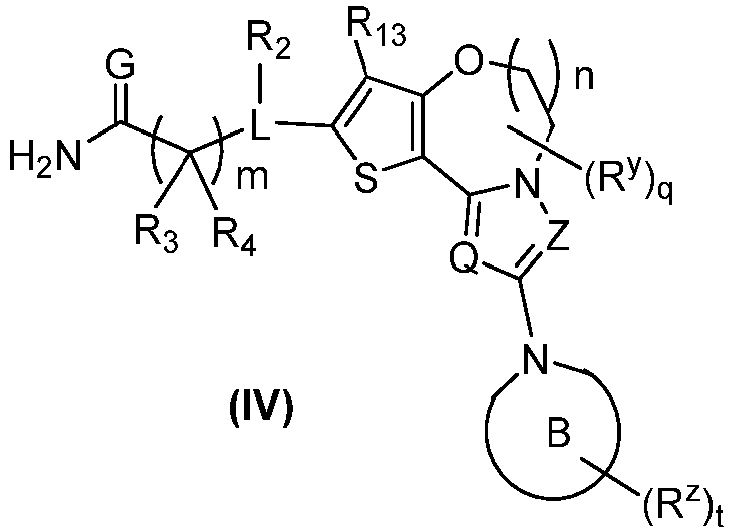
- R13 is selected from the group consisting of hydrogen, deuterium, alkyl, deuterated alkyl, halogen, cyano, nitro, haloalkyl, hydroxy, amino, alkenyl, alkynyl, cycloalkyl, heterocyclyl, aryl and heteroaryl, wherein the alkyl, cycloalkyl, heterocyclyl, aryl and heteroaryl are each optionally further substituted by one or more substituent(s) selected from the group consisting of deuterium, alkyl, halogen, hydroxy, amino, oxo, nitro, cyano, alkenyl, alkynyl, alkoxy, hydroxyalkyl, cycloalkyl, heterocyclyl, aryl and heteroaryl, and preferably halogen, amino, nitro, cyano, alkyl, haloalkyl or cycloalkyl; and
- ring B, Q, Z, G, R2 to R4, Ry, Rz, m, n, q and t are as defined in formula (III).
- There is a compound of formula (III), the stereoisomer thereof, or the pharmaceutically acceptable salt thereof, wherein the structure of the compound is shown in formula (III-A) or (III-B):

- R7, R8, R11 and R12 are each independently selected from the group consisting of hydrogen, deuterium, alkyl, deuterated alkyl, haloalkyl, alkoxy, haloalkoxy, halogen, amino, thiol, nitro, hydroxy, cyano, alkenyl, alkynyl, cycloalkyl, heterocyclyl, aryl, heteroaryl, -(CH2)n1-, -(CH2)n1Rbb, -(CH2)n1ORbb, -(CH2)n1SRbb, -(CH2)n1C(O)Rbb, -(CH2)n1C(O)ORbb, -(CH2)n1S(O)m1Rbb, -(CH2)n1NRbbRcc, -(CH2)n1C(O)NRbbRcc, -(CH2)n1NRbbC(O)Rcc and -(CH2)n1NRbbS(O)m1Rcc, wherein the alkyl, haloalkyl, cycloalkyl, heterocyclyl, aryl and heteroaryl are each optionally further substituted by one or more substituent(s) selected from the group consisting of deuterium, alkyl, haloalkyl, halogen, amino, thiol, oxo, nitro, cyano, hydroxy, alkenyl, alkynyl, alkoxy, haloalkoxy, hydroxyalkyl, cycloalkyl, heterocyclyl, aryl and heteroaryl;
- or, any two groups of R7, R8, R11 and R12 can be bonded to form a cycloalkyl, heterocyclyl, aryl or heteroaryl, wherein the cycloalkyl, heterocyclyl, aryl or heteroaryl is optionally further substituted by one or more substituent(s) selected from the group consisting of deuterium, alkyl, haloalkyl, halogen, amino, oxo, nitro, cyano, hydroxy, alkenyl, alkynyl, alkoxy, haloalkoxy, hydroxyalkyl, cycloalkyl, heterocyclyl, aryl and heteroaryl;
- R9 and R10 are as defined in formula (II);
- Q, Z, G, R2 to R6, Rbb, Rcc, Ry, m, n, q, m1 and n1 are as defined in formula (III); and
- R14 is as defined in formula (III-A).
- There is a compound of formula (III-A), the stereoisomer thereof, or the pharmaceutically acceptable salt thereof, wherein the structure of the compound is shown in formula (V):

- ring B is as defined in formula (II-A); and
- Q, Z, G, L, R2 to R8, R11, R12, R14, Rz, m and t are as defined in formula (III-A).
- There is a compound of formula (III-A), the stereoisomer thereof, or the pharmaceutically acceptable salt thereof, wherein the structure of the compound is shown in formula (VI):
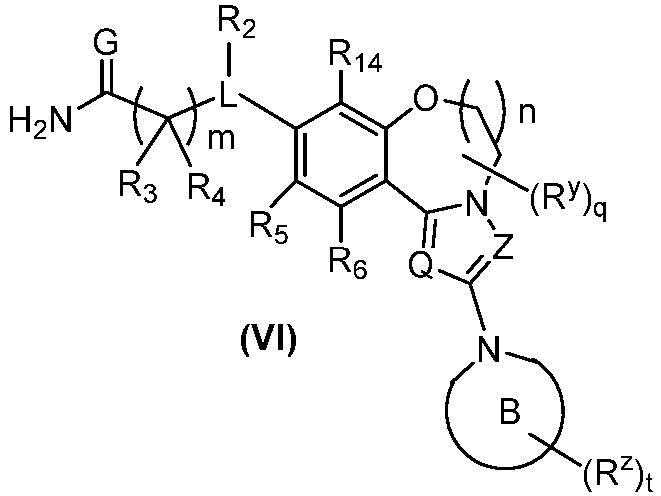
- ring B is as defined in formula (II-A); and
- Q, Z, G, L, R2 to R6, R14, Ry, Rz, q, m and t are as defined in formula (III-A).
- There are any one of the compound of formula (II-A), (II-B), (IV), (V) or (VI), the stereoisomer thereof, or the pharmaceutically acceptable salt thereof is characterized in that
ring B is selected from the group consisting of:


- There is a compound of formula (I), the stereoisomer thereof, or the pharmaceutically acceptable salt thereof, wherein the structure of the compound is shown in formula (VII):

- Raa is selected from the group consisting of hydrogen, deuterium, alkyl, deuterated alkyl, haloalkyl, alkoxy, hydroxyalkyl, haloalkoxy, halogen, cyano, nitro, hydroxy, amino, alkenyl, alkynyl, cycloalkyl, heterocyclyl, aryl and heteroaryl, wherein the alkyl, deuterated alkyl, haloalkyl, alkoxy, hydroxyalkyl, haloalkoxy, alkenyl, alkynyl, cycloalkyl, heterocyclyl, aryl and heteroaryl are each optionally further substituted by one or more substituent(s) selected from the group consisting of deuterium, alkyl, halogen, hydroxy, amino, oxo, nitro, cyano, alkenyl, alkynyl, alkoxy, hydroxyalkyl, cycloalkyl, heterocyclyl, aryl and heteroaryl; and
- L, R2 to R8, R11, R12, R14 and m are as defined in formula (V).
- Possibly, when Rdd, R2, R5 to R8, R11, R12 and R14 are not hydrogen at the same time, R3 and R4 can be as defined in formula (VII).
- Possibly, when Rdd, R2, R5 to R8, R11, R12 and R14 are hydrogen at the same time, any two groups of R2, R3 and R4 can be bonded to form a cycloalkyl, heterocyclyl, aryl or heteroaryl, wherein the cycloalkyl, heterocyclyl, aryl or heteroaryl is optionally further substituted by one or more substituent(s) selected from the group consisting of deuterium, alkyl, haloalkyl, halogen, amino, oxo, nitro, cyano, hydroxy, alkenyl, alkynyl, alkoxy, haloalkoxy, hydroxyalkyl, substituted or unsubstituted cycloalkyl, substituted or unsubstituted heterocyclyl, substituted or unsubstituted aryl, substituted or unsubstituted heteroaryl, -(CH2)n1-, -(CH2)n1Rbb, -(CH2)n1ORbb, -(CH2)n1SRbb, -(CH2)n1C(O)Rbb, -(CH2)n1C(O)ORbb, -(CH2)n1S(O)m1Rbb, -(CH2)n1NRbbRcc, -(CH2)n1C(O)NRbbRcc, -(CH2)n1NRbbC(O)Rcc and -(CH2)n1NRbbS(O)m1Rcc.
- There is a compound of formula (I), the stereoisomer thereof, or the pharmaceutically acceptable salt thereof, wherein the structure of the compound is shown in formula (VIII-A):

- ring B is selected from the group consisting of:

- R2 is selected from the group consisting of hydrogen, C1-6 alkyl and C1-6 haloalkyl;
- R3 and R4 are each independently selected from the group consisting of hydrogen, C1-6 alkyl, C1-6 haloalkyl, C1-6 alkoxy and -(CH2)n1ORbb;
- or, R3 and R4 are bonded to form a C3-8 cycloalkyl or 3 to 8 membered heterocyclyl, and preferably oxetanyl;
- or, R2 and R3 or R2 and R4 are bonded to form a 3 to 8 membered heterocyclyl, and preferably pyrrolidinyl or azetidinyl;
- R5, R6 and R14 are each independently selected from the group consisting of hydrogen, halogen, cyano, C1-6 alkyl, C1-6 alkoxy and C1-6 haloalkyl;
- Raa is selected from the group consisting of hydrogen, C1-6 alkyl, halogen and cyano;
- Rz is selected from the group consisting of hydrogen, oxo, C1-6 alkyl, C1-6 haloalkyl and -(CH2)n1Rbb;
- Rbb is selected from the group consisting of hydrogen, C1-6 alkyl, halogen and cyano; and
- t is 0, 1, 2 or 3.
- Possibly, R2 can be selected from the group consisting of hydrogen, C1-3 alkyl and C1-3 haloalkyl, and further preferably hydrogen, methyl, ethyl or propyl;
- R3 and R4 are each independently selected from the group consisting of hydrogen, C1-3 alkyl, C1-3 alkoxy and C1-3 alkyl substituted by C1-3 alkoxy, and further preferably hydrogen, methyl, ethyl, propyl, methoxy, ethoxy, CH3OCH2- or CH3CH2OCH2-;
- or, R3 and R4 are bonded to form a C4-6 cycloalkyl or 4 to 6 membered heterocyclyl, preferably 4 to 6 membered heterocyclyl containing one oxygen or nitrogen, and more preferably oxetanyl;
- R2 and R3 or R2 and R4 are bonded to form a 3 to 8 membered heterocyclyl, preferably 4 to 6 membered heterocyclyl containing nitrogen or oxygen wherein the number of heteroatoms is one or two, and more preferably tetrahydropyrrolyl, tetrahydrofuranyl, piperidinyl or azetidinyl;
- R5 and R6 are each independently selected from the group consisting of hydrogen, halogen, cyano, C1-3 alkyl, C1-3 alkoxy and C1-3 haloalkyl, and preferably hydrogen;
- R14 is selected from the group consisting of hydrogen and halogen, and preferably hydrogen, fluorine or chlorine;
- Rz is selected from the group consisting of hydrogen, halogen, oxo, C1-3 alkyl, C1-3 alkyl substituted by halogen and -(CH2)n1Rbb, preferably hydrogen, fluorine, chlorine, bromine, iodine, cyano, acetonitrilyl, propionitrilyl or C1-3 alkyl substituted by fluorine, and further preferably fluorine, methyl, acetonitrilyl, -CHF2, -CF2CH3 or CHF2CH2-;
- Raa is selected from the group consisting of hydrogen and halogen, and preferably hydrogen;
- Rbb is cyano;
- n1 is 0, 1, 2 or 3; and
- t is 0, 1, 2 or 3.
- Provided that,
- when Raa is hydrogen, ring B is

- when Raa is hydrogen, ring B is

- when Raa is hydrogen, ring B is

- when Raa is hydrogen, ring B is

- when Raa is hydrogen, ring B is
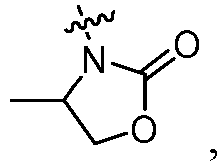
- when Raa is hydrogen, ring B is

- There is a compound of formula (I), the stereoisomer thereof, or the pharmaceutically acceptable salt thereof, wherein the structure of the compound is shown in formula (VIII):

- Possibly, ring B is selected from the group consisting of

- R2 is selected from the group consisting of hydrogen and C1-6 alkyl, preferably hydrogen or C1-3 alkyl, and further preferably hydrogen, methyl, ethyl or propyl;
- R3 is selected from the group consisting of C1-6 alkyl, C1-6 alkoxy and C1-6 alkoxy substituted by alkyl, preferably C1-3 alkyl, C1-3 alkoxy or C1-3 alkyl substituted by C1-3 alkoxy, and further preferably methyl, ethyl, propyl, methoxy, ethoxy, CH3OCH2- or CH3CH2OCH2-;
- R5 and R6 are each independently selected from the group consisting of hydrogen and halogen, and preferably hydrogen;
- R14 is selected from the group consisting of hydrogen and halogen, and preferably hydrogen, fluorine or chlorine; and
- Rz is selected from the group consisting of hydrogen, halogen, cyano, C1-6 alkyl and C1-6 alkyl substituted by halogen, preferably hydrogen, fluorine, chlorine, bromine, iodine, cyano, acetonitrilyl, propionitrilyl or C1-3 alkyl substituted by halogen, and further preferably fluorine, methyl, acetonitrilyl, -CHF2, -CF2CH3 or CHF2CH2-.
- There is a compound of formula (I), the stereoisomer thereof, or the pharmaceutically acceptable salt thereof, wherein the structure of the compound is shown in formula (IX):

- R15 and R16 are each independently selected from the group consisting of hydrogen, C1-6 alkyl, C1-6 haloalkyl and -(CH2)n1Rbb; and
- R2 to R4, R6, R14, Raa and Rbb are as defined in formula (VIII-A).
- Possibly, R2 is selected from the group consisting of hydrogen and C1-6 alkyl, preferably hydrogen or C1-3 alkyl, and further preferably hydrogen, methyl, ethyl or propyl;
- R3 and R4 are each independently selected from the group consisting of hydrogen, C1-6 alkyl, C1-6 alkoxy and C1-6 alkoxy substituted by alkyl, preferably hydrogen, C1-3 alkyl, C1-3 alkoxy or C1-3 alkyl substituted by C1-3 alkoxy, and further preferably hydrogen, methyl, ethyl, propyl, methoxy, ethoxy, CH3OCH2- or CH3CH2OCH2-;
- R3 and R4 are bonded to form a C4-6 cycloalkyl or 4 to 6 membered heterocyclyl, preferably 4 to 6 membered heterocyclyl containing one oxygen or nitrogen, and more preferably oxetanyl;
- R2 and R3 or R2 and R4 are bonded to form a 4 to 6 membered heterocyclyl, preferably 4 to 6 membered heterocyclyl containing nitrogen or oxygen wherein the number of heteroatoms is one or two, and more preferably tetrahydropyrrolyl, tetrahydrofuranyl, piperidinyl or azetidinyl;
- R6 is selected from the group consisting of hydrogen and halogen, and preferably hydrogen;
- R14 is selected from the group consisting of hydrogen and halogen, and preferably hydrogen, fluorine or chlorine;
- Raa is selected from the group consisting of hydrogen and halogen, and preferably hydrogen; and
- R15 and R16 are each independently selected from the group consisting of hydrogen, halogen, cyano, C1-6 alkyl and C1-6 alkyl substituted by halogen, preferably hydrogen, fluorine, chlorine, bromine, iodine, cyano, acetonitrilyl, propionitrilyl or C1-3 alkyl substituted by halogen, and further preferably hydrogen, fluorine, methyl, acetonitrilyl, -CHF2, -CF2CH3 or CHF2CH2-.
- In a first embodiment of the present invention, a
- compound of formula (X), a stereoisomer thereof, or a pharmaceutically acceptable salt thereof:

- wherein:
- R15 and R16 are each independently selected from the group consisting of hydrogen, C1-6 alkyl, C1-6 haloalkyl and -(CH2)n1Rbb;
- R2 is selected from the group consisting of hydrogen, C1-6 alkyl and C1-6 haloalkyl;
- R3 and R4 are each independently selected from the group consisting of hydrogen, C1-6 alkyl, C1-6 haloalkyl, C1-6 alkoxy and -(CH2)n1ORbb;
- or, R3 and R4 are bonded to form a C3-8 cycloalkyl or 3 to 8 membered heterocyclyl;
- or, R2 and R3 or R2 and R4 are bonded to form a 3 to 8 membered heterocyclyl;
- R6 and R14 are each independently selected from the group consisting of hydrogen, halogen, cyano, C1-6 alkyl, C1-6 alkoxy and C1-6 haloalkyl;
- Raa is selected from the group consisting of hydrogen, C1-6 alkyl, halogen and cyano;
- Rbb is selected from the group consisting of hydrogen, C1-6 alkyl, halogen and cyano;
- n1 is 0, 1, 2, 3, 4 or 5.
- Preferably, R15 and R16 are each independently selected from the group consisting of hydrogen, C1-6 alkyl, C1-6 haloalkyl and -(CH2)n1Rbb;
- R2 is selected from the group consisting of hydrogen, C1-6 alkyl and C1-6 haloalkyl;
- R3 and R4 are each independently selected from the group consisting of hydrogen, C1-6 alkyl, C1-6 haloalkyl, C1-6 alkoxy and -(CH2)n1ORbb;
- or, R2 and R3 or R2 and R4 are bonded to form pyrrolidinyl or azetidinyl;
- R6 and R14 are each independently selected from the group consisting of hydrogen, halogen, cyano, C1-6 alkyl, C1-6 alkoxy and C1-6 haloalkyl;
- Raa is selected from the group consisting of hydrogen, C1-6 alkyl, halogen and cyano;
- Rbb is selected from the group consisting of hydrogen, C1-6 alkyl, halogen and cyano;
- n1 is 0, 1, 2, 3, 4 or 5.
- Preferably, R2 is selected from the group consisting of hydrogen, C1-6 alkyl and C1-6 haloalkyl;
- or, R2 and R3 or R2 and R4 are bonded to form a 3 to 8 membered heterocyclyl;
- R3 and R4 are each independently selected from the group consisting of hydrogen, C1-6 alkyl, C1-6 haloalkyl and C1-6 alkoxy; or, R3 and R4 are bonded to form a C3-8 cycloalkyl or 3 to 8 membered heterocyclyl;
- R6 is selected from the group consisting of hydrogen, halogen, cyano, C1-6 alkyl, C1-6 alkoxy and C1-6 haloalkyl;
- R14 is selected from the group consisting of hydrogen, halogen, cyano, C1-6 alkyl, C1-6 haloalkyl and C1-6 alkoxy;
- Raa is selected from the group consisting of hydrogen, halogen, cyano and C1-6 alkyl.
- Preferably, R2 is selected from the group consisting of hydrogen, C1-6 alkyl and C1-6 haloalkyl;
- or, R2 and R3 or R2 and R4 are bonded to form pyrrolidinyl or azetidinyl;
- R3 and R4 are each independently selected from the group consisting of hydrogen, C1-6 alkyl, C1-6 haloalkyl and C1-6 alkoxy;
- R6 is selected from the group consisting of hydrogen, halogen, cyano, C1-6 alkyl, C1-6 alkoxy and C1-6 haloalkyl;
- R14 is selected from the group consisting of hydrogen, halogen, cyano, C1-6 alkyl, C1-6 haloalkyl and C1-6 alkoxy;
- Raa is selected from the group consisting of hydrogen, halogen, cyano and C1-6 alkyl.
- Preferably, R2 is selected from the group consisting of hydrogen and C1-3 alkyl;
- R3 and R4 are each independently selected from the group consisting of C1-3 alkyl, C1-3 haloalkyl and C1-3 alkoxy;
- R6 is selected from the group consisting of hydrogen, C1-3 alkyl, C1-3 alkoxy and C1-3 haloalkyl;
- R14 is selected from the group consisting of hydrogen, C1-3 alkyl, C1-3 alkoxy and C1-3 haloalkyl;
- Raa is selected from the group consisting of halogen, cyano and C1-3 alkyl.
- Preferably, R2 is selected from the group consisting of methyl, ethyl and propyl;
- R3 and R4 are each independently selected from the group consisting of methyl, ethyl, propyl, halomethyl, haloethyl, halopropyl, methoxy, ethoxy and propoxy;
- R6 is selected from the group consisting of methyl, ethyl, propyl, halomethyl, haloethyl, halopropyl, methoxy, ethoxy and propoxy;
- R14 is selected from the group consisting of methyl, ethyl, propyl, halomethyl, haloethyl, halopropyl, methoxy, ethoxy and propoxy;
- Raa is selected from the group consisting of methyl, ethyl and propyl.
- Preferably, the structure of the compound is as follows:


- In a further embodiment, the problem according to the present invention is solved by a method for preparing a compound of formula (X), a stereoisomer thereof, or a pharmaceutically acceptable salt thereof according to claim 1, characterized by comprising the following step of


- reacting the compound of formula (IX-A) with a transition metal complex and a ligand thereof to obtain the compound of formula (X), the stereoisomer thereof, or the pharmaceutically acceptable salt thereof;
- wherein:
R2 to R4, R6, R14 to R16 and Raa are as defined in claim 1. - Preferably, the transition metal complex and the ligand are dichloro(p-cymene)ruthenium(II) dimer and 2-bicyclohexylphosphino-2',6'-dimethoxybiphenyl.
- In a further embodiment of the invention, the problem according to the present invention is solved by a pharmaceutical composition, comprising a therapeutically effective amount of the compound of formula (X), the stereoisomer thereof, or the pharmaceutically acceptable salt thereof according to any one of claims 1 to 7, and one or more pharmaceutically acceptable carrier(s), diluent(s) or excipient(s).
- In a further embodiment of the invention, the problem according to the present invention is solved by the compound of formula (X), the stereoisomer thereof, or the pharmaceutically acceptable salt thereof according to the present invention, or the pharmaceutical composition according to the present invention for use as a PI3K inhibitor medicament.
- Preferably, the PI3K inhibitor medicament is a PI3Kα inhibitor medicament.
- In a further embodiment of the invention, the problem according to the present invention is solved by the compound of formula (X), the stereoisomer thereof, or the pharmaceutically acceptable salt thereof according to the present invention, or the pharmaceutical composition according to the present invention for use in treating cancer, bone disease, inflammatory disease, immune disease, nervous system disease, metabolic disease, respiratory disease and heart disease.
- In a further embodiment of the invention, the problem according to the present invention is solved by the compound of formula (X), the stereoisomer thereof, or the pharmaceutically acceptable salt thereof according to the present invention, or the pharmaceutical composition according to the present invention for use in treating breast cancer, pancreatic cancer, non-small cell lung cancer, thyroid cancer, seminoma, melanoma, bladder cancer, liver cancer, kidney cancer, myelodysplastic syndrome, acute myeloid leukemia and colorectal cancer.
- Any references to methods of treatment in the subsequent paragraphs of this description are to be interpreted as references to the compounds, pharmaceutical compositions and medicaments of the present invention for use in a method for treatment of the human (or animal) body by therapy (or for diagnosis). The claimed subject matter can be useful in a method for preventing and/or treating a cancer, comprising administering to a patient a therapeutically effective amount of the compound of formula (I), the stereoisomer thereof, or the pharmaceutically acceptable salt thereof, or the pharmaceutical composition comprsing the same.
- The claimed subject matter can be useful in a method for treating a disease condition with the compound or pharmaceutical composition of the present invention, wherein the disease condition includes, but is not limited to, conditions related to PI3Kα, PI3Kβ, PI3Kδ and PI3Kγ kinase dysfunction.
- The claimed subject matter can be useful in a method for treating a hyperproliferative disease in a mammal, comprising administering to the mammal a therapeutically effective amount of the compound of the present invention or the pharmaceutically acceptable salt, ester, prodrug, solvate, hydrate or derivative thereof.
- The claimed subject matter can be useful in the treatment of disease such as cancer, bone disease, inflammatory disease, immune disease, nervous system disease, metabolic disease, respiratory disease and heart disease.
- The claimed subject matter can be useful in the treatment of cancer such as acute myeloid leukemia, myelodysplastic syndrome (MDS), thymic cancer, brain cancer, lung cancer (NSCLC and SCLC), squamous cell carcinoma, seminoma, melanoma, skin cancer, eye cancer, retinoblastoma, intraocular melanoma, oral and oropharyngeal cancer, bladder cancer, gastric cancer, stomach cancer, pancreatic cancer, bladder cancer, breast cancer, cervical cancer, head cancer, neck cancer, renal cancer, kidney cancer, liver cancer, ovarian cancer, prostate cancer, endometrial cancer, colorectal cancer, esophageal cancer, testicular cancer, gynecological cancer, thyroid cancer, CNS cancer, PNS cancer, AIDS-related cancer (such as lymphoma and Kaposi's sarcoma) and virus-induced cancer. The claimed subject matter can be useful in the treatment of non-cancerous hyperproliferative disease such as skin disease (for example, psoriasis), restenosis and benign prostatic hyperplasia (for example, benign prostatic hypertrophy (BPH)). In some embodiments, the cancer is melanoma or colorectal cancer.
- A treatment method could comprise administering to a subject a therapeutically effective amount of the compound of the present invention. The claimed subject matter can be useful in a method for treating an inflammatory disease including autoimmune disease in a mammal. The method comprises administering to the mammal a therapeutically effective amount of the compound of the present invention or the pharmaceutically acceptable salt, ester, prodrug, solvate, hydrate or derivative thereof. The disease related to one or more types of ERK dysfunction includes, but is not limited to, acute disseminated encephalomyelitis (ADEM), Addison's disease, antiphospholipid antibody syndrome (APS), aplastic anemia, autoimmune hepatitis, celiac disease, Crohn's disease, diabetes (type 1), Good Pasteur's syndrome, Graves' disease, Guillain-Barre's syndrome (GBS), Hashimoto's disease, lupus erythematosus, multiple sclerosis, myasthenia gravis, opsoclonus myoclonus syndrome (OMS), optic neuritis, Ord's thyroiditis, pemphigus, polyarthritis, primary biliary cirrhosis, psoriasis, rheumatoid arthritis, Lytle's syndrome, Takavasu's arteritis, temporal arteritis (also known as "giant cell arteritis"), warm autoimmune hemolytic anemia, Wegener's granulomatosis, alopecia universalis, Chagas' disease, chronic fatigue syndrome, autonomic dysfunction, endometriosis, hidradenitis suppurativa, interstitial cystitis, neuromuscular rigidity, sarcoidosis, scleroderma, ulcerative colitis, vitiligo and vulvar pain. Other diseases include bone resorption disorder and thromobsis.
- Unless otherwise stated, the terms used in the specification and claims have the meanings described below.
- The term "alkyl" refers to a saturated aliphatic hydrocarbon group, which is a straight or branched chain group comprising 1 to 20 carbon atoms, preferably an alkyl having 1 to 8 carbon atoms, more preferably an alkyl having 1 to 6 carbon atoms, and most preferably an alkyl having 1 to 3 carbon atoms. Non-limiting examples include methyl, ethyl, n-propyl, isopropyl, n-butyl, isobutyl, tert-butyl, sec-butyl, n-pentyl, 1,1-dimethylpropyl, 1,2-dimethylpropyl, 2,2-dimethylpropyl, 1-ethylpropyl, 2-methylbutyl, 3-methylbutyl, n-hexyl, 1-ethyl-2-methylpropyl, 1,1,2-trimethylpropyl, 1,1-dimethylbutyl, 1,2-dimethylbutyl, 2,2-dimethylbutyl, 1,3-dimethylbutyl, 2-ethylbutyl, 2-methylpentyl, 3-methylpentyl, 4-methylpentyl, 2,3-dimethylbutyl, n-heptyl, 2-methylhexyl, 3-methylhexyl, 4-methylhexyl, 5-methylhexyl, 2,3-dimethylpentyl, 2,4-dimethylpentyl, 2,2-dimethylpentyl, 3,3-dimethylpentyl, 2-ethylpentyl, 3-ethylpentyl, n-octyl, 2,3-dimethylhexyl, 2,4-dimethylhexyl, 2,5-dimethylhexyl, 2,2-dimethylhexyl, 3,3-dimethylhexyl, 4,4-dimethylhexyl, 2-ethylhexyl, 3-ethylhexyl, 4-ethylhexyl, 2-methyl-2-ethylpentyl, 2-methyl-3-ethylpentyl, n-nonyl, 2-methyl-2-ethylhexyl, 2-methyl-3-ethylhexyl, 2,2-diethylpentyl, n-decyl, 3,3-diethylhexyl, 2,2-diethylhexyl, and various branched isomers thereof. More preferably, the alkyl group is a lower alkyl having 1 to 6 carbon atoms, and non-limiting examples include methyl, ethyl, n-propyl, isopropyl, n-butyl, isobutyl, tert-butyl, sec-butyl, n-pentyl, 1,1-dimethylpropyl, 1,2-dimethylpropyl, 2,2-dimethylpropyl, 1-ethylpropyl, 2-methylbutyl, 3-methylbutyl, n-hexyl, 1-ethyl-2-methylpropyl, 1,1,2-trimethylpropyl, 1,1-dimethylbutyl, 1,2-dimethylbutyl, 2,2-dimethylbutyl, 1,3-dimethylbutyl, 2-ethylbutyl, 2-methylpentyl, 3-methylpentyl, 4-methylpentyl, 2,3-dimethylbutyl and the like. The alkyl group can be substituted or unsubstituted. When substituted, the substituent group(s) can be substituted at any available connection point. The substituent group(s) is preferably one or more group(s) independently selected from the group consisting of alkyl, alkenyl, alkynyl, alkoxy, alkylthio, alkylamino, halogen, thiol, hydroxy, nitro, cyano, cycloalkyl, heterocyclyl, aryl, heteroaryl, cycloalkoxy, heterocycloalkoxy, cycloalkylthio, heterocyclylthio, oxo, carboxy and alkoxycarbonyl. The alkyl of the present invention is preferably selected from the group consisting of methyl, ethyl, isopropyl, tert-butyl, haloalkyl, deuterated alkyl, alkoxy-substituted alkyl and hydroxy-substituted alkyl.
- The term "alkylene" refers to an alkyl of which a hydrogen atom is further substituted, for example, "methylene" refers to -CH2-, "ethylene" refers to -(CH2)2-, "propylene" refers to -(CH2)3-, "butylene" refers to -(CH2)4- and the like. The term "alkenyl" refers to an alkyl as defined above that consists of at least two carbon atoms and at least one carbon-carbon double bond, for example, ethenyl, 1-propenyl, 2-propenyl, 1-, 2- or 3-butenyl and the like. The alkenyl group can be substituted or unsubstituted. When substituted, the substituent group(s) is preferably one or more groups independently selected from the group consisting of alkyl, alkenyl, alkynyl, alkoxy, alkylthio, alkylamino, halogen, thiol, hydroxy, nitro, cyano, cycloalkyl, heterocyclyl, aryl, heteroaryl, cycloalkoxy, heterocycloalkoxy, cycloalkylthio and heterocyclylthio.
- The term "cycloalkyl" refers to a saturated or partially unsaturated monocyclic or polycyclic hydrocarbon substituent group having 3 to 20 carbon atoms, preferably 3 to 12 carbon atoms, more preferably 3 to 8 carbon atoms, and most preferably 3 to 6 carbon atoms. Non-limiting examples of monocyclic cycloalkyl include cyclopropyl, cyclobutyl, cyclopentyl, cyclopentenyl, cyclohexyl, cyclohexenyl, cyclohexadienyl, cycloheptyl, cycloheptatrienyl, cyclooctyl and the like. Polycyclic cycloalkyl includes a cycloalkyl having a spiro ring, fused ring or bridged ring. The cycloalkyl is preferably cyclopropyl, cyclobutyl, cyclohexyl, cyclopentyl or cycloheptyl.
- The term "spiro cycloalkyl" refers to a 5 to 20 membered polycyclic group with individual rings connected through one shared carbon atom (called a spiro atom), wherein the rings can contain one or more double bonds, but none of the rings has a completely conjugated π-electron system. The spiro cycloalkyl is preferably a 6 to 14 membered spiro cycloalkyl, and more preferably a 7 to 10 membered spiro cycloalkyl. According to the number of the spiro atoms shared between the rings, the spiro cycloalkyl can be divided into a mono-spiro cycloalkyl, a di-spiro cycloalkyl, or a poly-spiro cycloalkyl, and the spiro cycloalkyl is preferably a mono-spiro cycloalkyl or di-spiro cycloalkyl, and more preferably a 4-membered/4-membered, 4-membered/5-membered, 4-membered/6-membered, 5-membered/5-membered, or 5-membered/6-membered mono-spiro cycloalkyl. Non-limiting examples of spiro cycloalkyl include:


- The term "fused cycloalkyl" refers to a 5 to 20 membered all-carbon polycyclic group, wherein each ring in the system shares an adjacent pair of carbon atoms with another ring, one or more rings can contain one or more double bonds, but none of the rings has a completely conjugated 7r-electron system. The fused cycloalkyl is preferably a 6 to 14 membered fused cycloalkyl, and more preferably a 7 to 10 membered fused cycloalkyl. According to the number of membered rings, the fused cycloalkyl can be divided into a bicyclic, tricyclic, tetracyclic or polycyclic fused cycloalkyl, and the fused cycloalkyl is preferably a bicyclic or tricyclic fused cycloalkyl, and more preferably a 5-membered/5-membered, or 5-membered/6-membered bicyclic fused cycloalkyl. Non-limiting examples of fused cycloalkyl include:

- The term "bridged cycloalkyl" refers to a 5 to 20 membered all-carbon polycyclic group, wherein every two rings in the system share two disconnected carbon atoms, the rings can have one or more double bonds, but none of the rings has a completely conjugated 7r-electron system. The bridged cycloalkyl is preferably a 6 to 14 membered bridged cycloalkyl, and more preferably a 7 to 10 membered bridged cycloalkyl. According to the number of membered rings, the bridged cycloalkyl can be divided into a bicyclic, tricyclic, tetracyclic or polycyclic bridged cycloalkyl, and the bridged cycloalkyl is preferably a bicyclic, tricyclic or tetracyclic bridged cycloalkyl, and more preferably a bicyclic or tricyclic bridged cycloalkyl. Non-limiting examples of bridged cycloalkyl include:
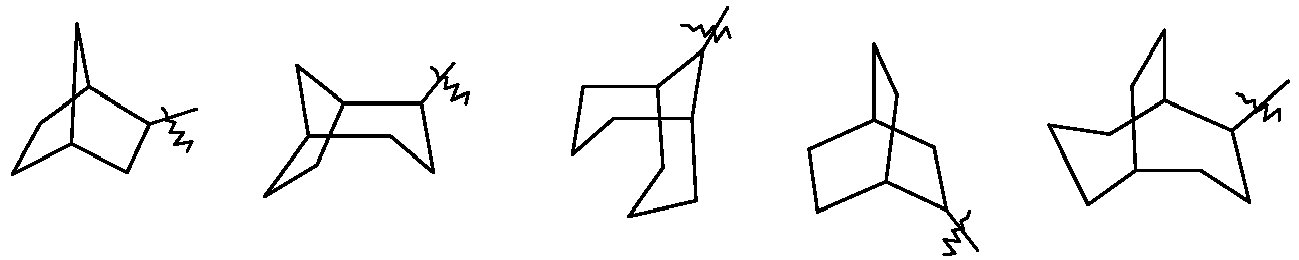

- The cycloalkyl ring can be fused to the ring of aryl, heteroaryl or heterocyclyl, wherein the ring bound to the parent structure is cycloalkyl. Non-limiting examples include indanyl, tetrahydronaphthyl, benzocycloheptyl and the like. The cycloalkyl can be optionally substituted or unsubstituted. When substituted, the substituent group(s) is preferably one or more group(s) independently selected from the group consisting of alkyl, alkenyl, alkynyl, alkoxy, alkylthio, alkylamino, halogen, thiol, hydroxy, nitro, cyano, cycloalkyl, heterocyclyl, aryl, heteroaryl, cycloalkoxy, heterocycloalkoxy, cycloalkylthio, heterocyclylthio, oxo, carboxy and alkoxycarbonyl.
- The term "heterocyclyl" refers to a 3 to 20 membered saturated or partially unsaturated monocyclic or polycyclic hydrocarbon group, wherein one or more ring atoms are heteroatoms selected from the group consisting of N, O and S(O)m (wherein m is an integer of 0 to 2), but excluding -O-O-, -O-S- or -S-S- in the ring, with the remaining ring atoms being carbon atoms. Preferably, the heterocyclyl has 3 to 12 ring atoms wherein 1 to 4 atoms are heteroatoms; more preferably, 3 to 8 ring atoms; further preferably, 3 to 8 ring atoms; and most preferably 4 to 6 ring atoms. Non-limiting examples of monocyclic heterocyclyl include oxetanyl, pyrrolidinyl, pyrrolidonyl, imidazolidinyl, tetrahydrofuranyl, tetrahydrothienyl, dihydroimidazolyl, dihydrofuranyl, dihydropyrazolyl, dihydropyrrolyl, piperidinyl, piperazinyl, morpholinyl, thiomorpholinyl, homopiperazinyl, pyranyl and the like, and preferably oxetanyl, pyrrolidinyl, pyrrolidonyl, tetrahydrofuranyl, pyrazolidinyl, morpholinyl, piperazinyl and pyranyl. Polycyclic heterocyclyl includes a heterocyclyl having a spiro ring, fused ring or bridged ring. The heterocyclyl having a spiro ring, fused ring or bridged ring is optionally bonded to other group via a single bond, or further bonded to other cycloalkyl, heterocyclyl, aryl and heteroaryl via any two or more atoms on the ring.
- The term "spiro heterocyclyl" refers to a 3 to 20 membered polycyclic heterocyclyl group with individual rings connected through one shared atom (called a spiro atom), wherein one or more ring atoms are heteroatoms selected from the group consisting of N, O and S(O)m (wherein m is an integer of 0 to 2), with the remaining ring atoms being carbon atoms, and the rings can contain one or more double bonds, but none of the rings has a completely conjugated 7r-electron system. The spiro heterocyclyl is preferably a 6 to 14 membered spiro heterocyclyl, and more preferably a 7 to 10 membered spiro heterocyclyl. According to the number of the spiro atoms shared between the rings, the spiro heterocyclyl can be divided into a mono-spiro heterocyclyl, di-spiro heterocyclyl, or poly-spiro heterocyclyl, and the spiro heterocyclyl is preferably a mono-spiro heterocyclyl or di-spiro heterocyclyl, and more preferably a 3-membered/5-membered, 4-membered/5-membered, 4-membered/6-membered, 5-membered/5-membered, or 5-membered/6-membered mono-spiro heterocyclyl. Non-limiting examples of spiro heterocyclyl include:


- The term "fused heterocyclyl" refers to a 5 to 20 membered polycyclic heterocyclyl group, wherein each ring in the system shares an adjacent pair of atoms with another ring, one or more rings can contain one or more double bonds, but none of the rings has a completely conjugated 7r-electron system, and one or more ring atoms are heteroatoms selected from the group consisting of N, O and S(O)m (wherein m is an integer of 0 to 2), with the remaining ring atoms being carbon atoms. The fused heterocyclyl is preferably a 6 to 14 membered fused heterocyclyl, and more preferably a 7 to 10 membered fused heterocyclyl. According to the number of membered rings, the fused heterocyclyl can be divided into a bicyclic, tricyclic, tetracyclic or polycyclic fused heterocyclyl, and preferably a bicyclic or tricyclic fused heterocyclyl, and more preferably a 3-membered/5-membered, 4-membered/5-membered or 5-membered/6-membered bicyclic fused heterocyclyl. Non-limiting examples of fused heterocyclyl include:


- The term "bridged heterocyclyl" refers to a 5 to 14 membered polycyclic heterocyclyl group, wherein every two rings in the system share two disconnected atoms, wherein the rings can have one or more double bond(s), but none of the rings has a completely conjugated 7r-electron system, and one or more ring atoms are heteroatoms selected from the group consisting of N, O and S(O)m (wherein m is an integer of 0 to 2), with the remaining ring atoms being carbon atoms. The bridged heterocyclyl is preferably a 6 to 14 membered bridged heterocyclyl, and more preferably a 7 to 10 membered bridged heterocyclyl. According to the number of membered rings, the bridged heterocyclyl can be divided into a bicyclic, tricyclic, tetracyclic or polycyclic bridged heterocyclyl, and the bridged heterocyclyl is preferably a bicyclic, tricyclic or tetracyclic bridged heterocyclyl, and more preferably a bicyclic or tricyclic bridged heterocyclyl. Non-limiting examples of bridged heterocyclyl include:


- The heterocyclyl ring can be fused to the ring of aryl, heteroaryl or cycloalkyl, wherein the ring bound to the parent structure is heterocyclyl. Non-limiting examples thereof include:
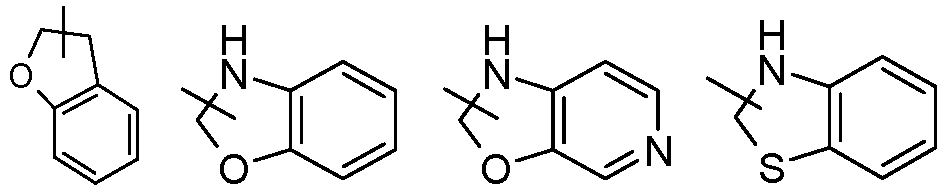
- The heterocyclyl can be optionally substituted or unsubstituted. When substituted, the substituent group(s) is preferably one or more group(s) independently selected from the group consisting of alkyl, alkenyl, alkynyl, alkoxy, alkylthio, alkylamino, halogen, thiol, hydroxy, nitro, cyano, cycloalkyl, heterocyclyl, aryl, heteroaryl, cycloalkoxy, heterocycloalkoxy, cycloalkylthio, heterocyclylthio, oxo, carboxy and alkoxycarbonyl.
- The term "aryl" refers to a 6 to 14 membered all-carbon monocyclic ring or polycyclic fused ring (i.e. each ring in the system shares an adjacent pair of carbon atoms with another ring in the system) having a conjugated π-electron system, preferably a 6 to 10 membered aryl, for example, phenyl and naphthyl. The aryl is more preferably phenyl. The aryl ring can be fused to the ring of heteroaryl, heterocyclyl or cycloalkyl, wherein the ring bound to the parent structure is aryl ring. Non-limiting examples thereof include:



- The aryl can be substituted or unsubstituted. When substituted, the substituent group(s) is preferably one or more group(s) independently selected from the group consisting of alkyl, alkenyl, alkynyl, alkoxy, alkylthio, alkylamino, halogen, thiol, hydroxy, nitro, cyano, cycloalkyl, heterocyclyl, aryl, heteroaryl, cycloalkoxy, heterocycloalkoxy, cycloalkylthio, heterocyclylthio, carboxy and alkoxycarbonyl.
- The term "heteroaryl" refers to a 5 to 14 membered heteroaromatic system having 1 to 4 heteroatoms selected from the group consisting of O, S and N. The heteroaryl is preferably a 5 to 10 membered heteroaryl, and more preferably a 5 or 6 membered heteroaryl, for example imidazolyl, furyl, thienyl, thiazolyl, pyrazolyl, oxazolyl, pyrrolyl, triazolyl, tetrazolyl, pyridyl, pyrimidinyl, thiadiazolyl, pyrazinyl and the like, preferably triazolyl, thienyl, imidazolyl, pyrazolyl, pyridyl, pyrimidinyl and thiazolyl, and more preferably triazolyl, pyrrolyl, thienyl, thiazolyl, pyridyl and pyrimidinyl. The heteroaryl ring can be fused to the ring of aryl, heterocyclyl or cycloalkyl, wherein the ring bound to the parent structure is heteroaryl ring. Non-limiting examples thereof include:


- The heteroaryl can be optionally substituted or unsubstituted. When substituted, the substituent group(s) is preferably one or more group(s) independently selected from the group consisting of alkyl, alkenyl, alkynyl, alkoxy, alkylthio, alkylamino, halogen, thiol, hydroxy, nitro, cyano, cycloalkyl, heterocyclyl, aryl, heteroaryl, cycloalkoxy, heterocycloalkoxy, cycloalkylthio, heterocyclylthio, carboxy and alkoxycarbonyl.
- The term "alkoxy" refers to an -O-(alkyl) or an -O-(unsubstituted cycloalkyl) group, wherein the alkyl is as defined above. Non-limiting examples of alkoxy include methoxy, ethoxy, propoxy, butoxy, cyclopropyloxy, cyclobutyloxy, cyclopentyloxy, cyclohexyloxy. The alkoxy can be optionally substituted or unsubstituted. When substituted, the substituent group(s) is preferably one or more group(s) independently selected from the group consisting of alkyl, alkenyl, alkynyl, alkoxy, alkylthio, alkylamino, halogen, thiol, hydroxy, nitro, cyano, cycloalkyl, heterocyclyl, aryl, heteroaryl, cycloalkoxy, heterocycloalkoxy, cycloalkylthio, heterocyclylthio, carboxy and alkoxycarbonyl.
- "Haloalkyl" refers to an alkyl group substituted by one or more halogen(s), wherein the alkyl is as defined above.
- "Haloalkoxy" refers to an alkoxy group substituted by one or more halogen(s), wherein the alkoxy is as defined above.
- "Hydroxyalkyl" refers to an alkyl group substituted by hydroxy(s), wherein the alkyl is as defined above.
- "Alkenyl" refers to a chain alkenyl, also known as alkene group. The alkenyl can be further substituted by other related group, for example alkyl, alkenyl, alkynyl, alkoxy, alkylthio, alkylamino, halogen, thiol, hydroxy, nitro, cyano, cycloalkyl, heterocyclyl, aryl, heteroaryl, cycloalkoxy, heterocycloalkoxy, cycloalkylthio, heterocyclylthio, carboxy or alkoxycarbonyl.
- "Alkynyl" refers to (CH=C-). The alkynyl can be further substituted by other related group, for example alkyl, alkenyl, alkynyl, alkoxy, alkylthio, alkylamino, halogen, thiol, hydroxy, nitro, cyano, cycloalkyl, heterocyclyl, aryl, heteroaryl, cycloalkoxy, heterocycloalkoxy, cycloalkylthio, heterocyclylthio, carboxy or alkoxycarbonyl.
- "Hydroxy" refers to an -OH group.
- "Halogen" refers to fluorine, chlorine, bromine or iodine.
- "Amino" refers to a -NH2 group.
- "Cyano" refers to a -CN group.
- "Nitro" refers to a -NO2 group.
- "Carboxy" refers to a -C(O)OH group.
- "THF" refers to tetrahydrofuran.
- "EtOAc" refers to ethyl acetate.
- "EA" refers to ethyl acetate.
- "MeOH" refers to methanol.
- "DMF" refers to N,N-dimethylformamide.
- "DIPEA" refers to diisopropylethylamine.
- "TFA" refers to trifluoroacetic acid.
- "MeCN" refers to acetonitrile.
- "DMA" refers to N,N-dimethylacetamide.
- "Et2O" refers to diethyl ether.
- "DCE" refers to 1,2-dichloroethane.
- "DIPEA" refers to N,N-diisopropylethylamine.
- "NBS" refers to N-bromosuccinimide.
- "NIS" refers to N-iodosuccinimide.
- "Cbz-Cl" refers to benzyl chloroformate.
- "Pd2(dba)3" refers to tris(dibenzylideneacetone)dipalladium.
- "Dppf' refers to 1,1'-bisdiphenylphosphinoferrocene.
- "HATU" refers to 2-(7-azabenzotriazol-1-yl)-N,N,N',N'-tetramethyluronium hexafluorophosphate.
- "KHMDS" refers to potassium hexamethyldisilazide.
- "LiHMDS" refers to lithium bis(trimethylsilyl)amide.
- "MeLi" refers to methyl lithium.
- "n-BuLi" refers to n-butyl lithium.
- "NaBH(OAc)3" refers to sodium triacetoxyborohydride.
- "DCM" refers to dichloromethane.
- Different expressions such as "X is selected from the group consisting of A, B or C", "X is selected from the group consisting of A, B and C", "X is A, B or C", "X is A, B and C" and the like, express the same meaning, that is, X can be any one or more of A, B and C.
- The hydrogen atom of the present invention can be substituted by its isotope deuterium. Any of the hydrogen atoms in the compounds of the examples of the present invention can also be substituted by deuterium atom.
- "Optional" or "optionally" means that the event or circumstance described subsequently can, but need not, occur, and such a description includes the situation in which the event or circumstance does or does not occur. For example, "the heterocyclyl optionally substituted by an alkyl" means that an alkyl group can be, but need not be, present, and such a description includes the situation of the heterocyclyl being substituted by an alkyl and the heterocyclyl being not substituted by an alkyl.
- "Substituted" refers to one or more hydrogen atoms in a group, preferably up to 5, and more preferably 1 to 3 hydrogen atoms, independently substituted by a corresponding number of substituents. It goes without saying that the substituents only exist in their possible chemical position. The person skilled in the art is able to determine whether the substitution is possible or impossible by experiments or theory without excessive efforts. For example, the combination of amino or hydroxy having free hydrogen and carbon atoms having unsaturated bonds (such as olefinic) may be unstable.
- A "pharmaceutical composition" refers to a mixture of one or more of the compounds according to the present invention or physiologically/pharmaceutically acceptable salts or prodrugs thereof with other chemical components, and other components such as physiologically/pharmaceutically acceptable carriers and excipients. The purpose of the pharmaceutical composition is to facilitate administration of a compound to an organism, which is conducive to the absorption of the active ingredient so as to exert biological activity.
- A "pharmaceutically acceptable salt" refers to a salt of the compound of the present invention, which is safe and effective in mammals and has the desired biological activity.
- The present invention will be further described with reference to the following examples, but the examples should not be considered as limiting the scope of the present invention.
- The structures of the compounds of the present invention were identified by nuclear magnetic resonance (NMR) and/or liquid chromatography-mass spectrometry (LC-MS). NMR shifts (δ) are given in parts per million (ppm). NMR was determined by a Bruker AVANCE-400 machine. The solvents for determination were deuterated-dimethyl sulfoxide (DMSO-d 6), deuterated-methanol (CD3OD) and deuterated-chloroform (CDCl3), and the internal standard was tetramethylsilane (TMS).
- Liquid chromatography-mass spectrometry (LC-MS) was determined on an Agilent 1200 Infinity Series mass spectrometer. High performance liquid chromatography (HPLC) was determined on an Agilent 1200DAD high pressure liquid chromatograph (Sunfire C18 150×4.6 mm chromatographic column), and a Waters 2695-2996 high pressure liquid chromatograph (Gimini C18 150×4.6 mm chromatographic column).
- Yantai Huanghai HSGF254 or Qingdao GF254 silica gel plate was used as the thin-layer silica gel chromatography (TLC) plate. The dimension of the silica gel plate used in TLC was 0.15 mm to 0.2 mm, and the dimension of the silica gel plate used in product purification was 0.4 mm to 0.5 mm. Yantai Huanghai 200 to 300 mesh silica gel was generally used as a carrier for column chromatography.
- The raw materials used in the examples of the present invention are known and commercially available, or can be synthesized by adopting or according to known methods in the art.
- Unless otherwise stated, all reactions of the present invention were carried out under continuous magnetic stirring under a dry nitrogen or argon atmosphere, the solvent was dry, and the reaction temperature was in degrees celsius.
-

-
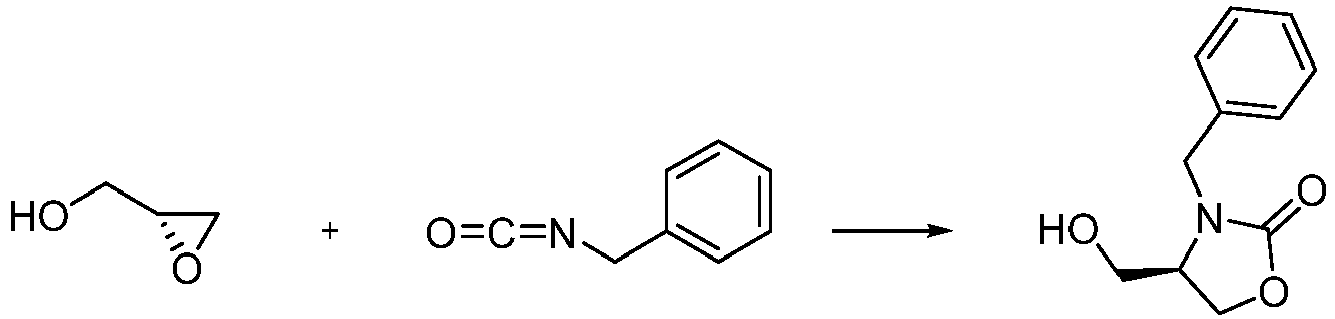
- (R)-Oxiran-2-ylmethanol (3.7 g, 50.0 mmol) and (isocyanatomethyl)benzene (6.66 g, 50.0 mmol) were mixed in dichloromethane (50 mL). Under a nitrogen atmosphere, the reaction solution was warmed up to 45°C and stirred overnight. After cooling, 100 mL of saturated aqueous sodium bicarbonate solution was added, the reaction solution was then extract with dichloromethane (100 mL×2). The organic phases were combined, washed with saturated brine, dried over anhydrous sodium sulfate and concentrated under reduced pressure. The residue was subjected to column chromatography to obtain the title compound (R)-3-benzyl-4-(hydroxymethyl)oxazolidin-2-one (4.14 g, 40%).
- MS m/z (ESI): 208.2 [M+H]+.
-

- (R)-3-Benzyl-4-(hydroxymethyl)oxazolidin-2-one (4.14 g, 20.0 mmol) and IBX (16.8 g, 60.0 mmol) were mixed in ethyl acetate (100 mL). Under a nitrogen atmosphere, the reaction solution was stirred at 85°C for 3 hours. The reaction solution was cooled and filtered. The filtrate was concentrated under reduced pressure to obtain the crude product (S)-3-benzyl-4-(dihydroxymethyl)oxazolidin-2-one (4.46 g), which was used directly in the next step.
- MS m/z (ESI): 224.2 [M+H]+.
-

- (S)-3-Benzyl-4-(dihydroxymethyl)oxazolidin-2-one (4.46 g, 20.0 mmol) was dissolved in dichloromethane (100 mL). Under a nitrogen atmosphere, DAST (6.45 g, 40.0 mmol) was added dropwise in an ice bath, and then the reaction solution was naturally warmed up to room temperature and reacted for 3 hours. The reaction solution was slowly added dropwise to the pre-cooled saturated aqueous sodium bicarbonate solution, and then extract with dichloromethane (200 mL×2). The organic phases were combined and concentrated under reduced pressure. The residue was subjected to column chromatography to obtain the title compound (S)-3-benzyl-4-(difluoromethyl)oxazolidin-2-one (1.82 g, two-step yield 40%).
- MS m/z (ESI): 228.2 [M+H]+.
-

- (S)-3-Benzyl-4-(difluoromethyl)oxazolidin-2-one (1.82 g, 8 mmol) was dissolved in ethanol (100 mL), followed by the addition of Pd(OH)2/C (300 mg). Under a hydrogen atmosphere, the reaction solution was stirred at 70°C overnight. The reaction solution was cooled and filtered. The filtrate was concentrated under reduced pressure to obtain the title compound (S)-4-(difluoromethyl)oxazolidin-2-one (0.88 g, 80 %).
- 1H NMR (400 MHz, CDCl3) δ 4.05-4.18 (m, 1H), 4.39-4.45 (m, 1H), 4.54 (t, J = 9.3 Hz, 1H), 5.78 (td, J= 55.3, 4.7 Hz, 1H), 6.07 (s, 1H);
- MS m/z (ESI): 138.1 [M+H]+.
-

- Aqueous glyoxal solution (40 wt.%, 87 g, 597 mmol) was added to a solution of 4-bromo-2-hydroxybenzaldehyde (24.0 g, 119 mmol) in methanol (250 mL). In a water bath, ammonia (28 wt.%, 121 g, 860 mmol) was slowly added dropwise to the reaction solution under stirring, the addition process lasted for 30 minutes, and the temperature of the reaction solution was controlled not to exceed 40°C. The mixture was stirred at 35°C for two days, cooled and concentrated under reduced pressure to remove the organic solvent and obtain the crude product 5-bromo-2-(1H-imidazol-2-yl)phenol, which was used directly in the next step.
- MS m/z (ESI): 239.0 [M+H]+.
-

- The crude product 5-bromo-2-(1H-imidazol-2-yl)phenol (about 29 g, 119 mmol), cesium carbonate (158 g, 485 mmol) and 1,2-dibromoethane (42 mL, 485 mmol) were mixed in DMF (250 mL), and the reaction solution was stirred at 85°C overnight. The reaction solution was cooled, and diluted with a large amount of ethyl acetate. The organic phase was washed with saturated brine several times, dried over anhydrous sodium sulfate and concentrated. The residue was subjected to column chromatography to obtain the title compound 9-bromo-5,6-dihydrobenzo[f]imidazo[1,2-d][1,4]oxazepine (12.5 g, two-step yield: 38%).
- MS m/z (ESI): 265.0 [M+H]+.
-

- NIS (29.8 g, 132 mmol) was added in batches to a solution of 9-bromo-5,6-dihydrobenzo[f]imidazo[1,2-d][1,4]oxazepine (11.7 g, 44.1 mmol) in DMF (150 mL) at room temperature, and the reaction solution was stirred at 60°C overnight. The reaction solution was cooled, and water was added to precipitate a solid. After filtering, the solid was dissolved in ethyl acetate. The solution was washed with 1 M aqueous NaOH solution and saturated brine successively, dried over anhydrous sodium sulfate, and concentrated to obtain the title compound 9-bromo-2,3-diiodo-5,6-dihydrobenzo[f]imidazo[1,2-d][1,4]oxazepine (22.5 g, yield: 98.7%).
- MS m/z (ESI): 516.7 [M+H]+.
-

- EtMgBr (1.0 M, THF solution, 60.9 mL, 60.9 mmol) was slowly added dropwise to a solution of 9-bromo-2,3-diiodo-5,6-dihydrobenzo[f]imidazo[1,2-d][1,4]oxazepine (21.0 g, 40.6 mmol) in THF (140 mL) at -20°C. After completion of the addition, the reaction solution was stirred at -15°C for 3 hours. The reaction solution was slowly warmed up to room temperature, and saturated aqueous ammonium chloride solution was added dropwise. After stirring for 15 minutes, the reaction solution was extracted with ethyl acetate several times. The organic phases were combined, washed with saturated brine, dried over anhydrous sodium sulfate and concentrated. The residue was subjected to column chromatography to obtain the title compound 9-bromo-2-iodo-5,6-dihydrobenzo[f]imidazo[1,2-d][1,4]oxazepine (12.5 g, yield: 79%).
- MS m/z (ESI): 390.9 [M+H]+.
-

- 9-Bromo-2-iodo-5,6-dihydrobenzo[f]imidazo[1,2-d][1,4]oxazepine (300 mg, 0.77 mmol), (S)-4-(difluoromethyl)oxazolidin-2-one (105 mg, 0.77 mmol), (1R,2R)-N1,N2-dimethylcyclohexane-1,2-diamine (43 mg, 0.30 mmol), copper acetate (27 mg, 0.15 mmol) and cesium carbonate (489 mg, 1.5 mmol) were mixed in 2-methyltetrahydrofuran (6 mL). The reaction system was purged with nitrogen three times, and reacted at 78°C for 22 hours. The reaction solution was cooled to room temperature, and 15% ammonia was added. The reaction solution was stirred for 5 minutes and extracted with EtOAc three times. The organic phases were combined, washed with saturated aqueous sodium chloride solution, dried over anhydrous sodium sulfate, and concentrated under reduced pressure to remove the organic solvent. The residue was subjected to column chromatography to obtain the title compound (S)-3-(9-bromo-5,6-dihydrobenzo[f]imidazo[1,2-d][1,4]oxazepin-2-yl)-4-(difluorometh yl)oxazolidin-2-one (186 mg, 61%).
- 1H NMR (400 MHz, CDCl3) δ 4.35-4.41 (m, 2H), 4.44-4.52 (m, 2H), 4.53-4.55 (m, 1H), 4.73-4.76 (m, 1H), 4.89-4.91 (m, 1H), 6.62-6.71 (m, 1H), 7.19-7.28 (m, 2H), 7.30 (s, 1H), 8.21 (d, J = 8.6 Hz, 1H);
- MS m/z (ESI): 400.1 [M+H]+.
-

-

- 5-Bromo-2-(1H-imidazol-2-yl)phenol (1.0 g, 4.2 mmol), 1,3-dibromopropane (3.2 g, 15.9 mmol) and cesium carbonate (5.2 g, 15.9 mmol) were mixed in N,N-dimethylformamide (20 mL), and the reaction solution was stirred at room temperature for 1.5 hours. Water was added, and the reaction solution was stirred for 5 minutes and extracted with EtOAc three times. The organic phases were combined, dried over anhydrous sodium sulfate, and concentrated under reduced pressure. The residue was subjected to column chromatography to obtain the title compound 10-bromo-6,7-dihydro-5H-benzo[b]imidazo[2,1-d][1,5]oxazocine (1.1 g, 94%).
- 1H NMR (400 MHz, DMSO-d 6) δ 1.89-1.94 (m, 2H), 4.03-4.09 (m, 4H), 7.03 (d, J = 0.8 Hz, 1H), 7.28-7.33 (m, 3H), 7.95 (s, 1H);
- MS m/z (ESI): 279.0 [M+H]+.
-

- 10-Bromo-6,7-dihydro-5H-benzo[b]imidazo[2,1-d][1,5]oxazocine (1.1 g, 3.96 mmol) and N-iodosuccinimide (2.5 g, 11.08 mmol) were mixed in N,N-dimethylformamide (15 mL). The reaction system was purged with nitrogen three times, and stirred at 80°C overnight. The reaction solution was cooled to room temperature, and then ice water was added to the reaction flask. The reaction solution was stirred for 5 minutes and extracted with EtOAc three times. The organic phases were combined, dried over anhydrous sodium sulfate, and concentrated under reduced pressure. The residue was subjected to column chromatography to obtain the title compound 10-bromo-2,3-diiodo-6,7-dihydro-5H-benzo[b]imidazo[2,1-d][1,5]oxazocine (720 mg, 34%).
- MS m/z (ESI): 530.8 [M+H]+.
-

- 10-Bromo-2,3-diiodo-6,7-dihydro-5H-benzo[b]imidazo[2,1-d][1,5]oxazocine (500 mg, 0.94 mmol) was dissolved in tetrahydrofuran (10 mL). The reaction system was cooled to -20°C, and purged with nitrogen three times. Ethylmagnesium bromide (0.35 mL, 1.05 mmol) was added dropwise, and the reaction solution was reacted at -20°C for 3 hours. Saturated ammonium chloride solution was added to quench the reaction, and the reaction solution was extracted with EtOAc three times. The organic phase was washed with saturated brine, dried over anhydrous sodium sulfate, and concentrated under reduced pressure. The residue was subjected to column chromatography to obtain the title compound 10-bromo-2-iodo-6,7-dihydro-5H-benzo[b]imidazo[2,1-d][1,5]oxazocine (365 mg, 96%).
- 1H NMR (400 MHz, DMSO-d 6) δ 1.87-1.96 (m, 2H), 4.00-4.11 (m, 4H), 7.30-7.37 (m, 2H), 7.47-7.52 (m, 2H);
- MS m/z (ESI): 404.9 [M+H]+.
-

- 10-Bromo-2-iodo-6,7-dihydro-5H-benzo[b]imidazo[2,1-d][1,5]oxazocine (300 mg, 0.75 mmol), (S)-4-(difluoromethyl)oxazolidin-2-one (103 mg, 0.75 mmol), (1R,2R)-N1,N2-dimethylcyclohexane-1,2-diamine (43 mg, 0.30 mmol), cuprous iodide (29 mg, 0.15 mmol) and potassium carbonate (205 mg, 1.5 mmol) were mixed in 1,4-dioxane (6 mL). The reaction system was purged with nitrogen three times, and reacted at 100°C for 5 hours. The reaction solution was cooled to room temperature, and 15% ammonia was added. The reaction solution was stirred for 5 minutes and extracted with EtOAc three times. The organic phases were combined, washed with saturated aqueous sodium chloride solution, dried over anhydrous sodium sulfate, and concentrated under reduced pressure. The residue was subjected to column chromatography to obtain the title compound (S)-3-(10-bromo-6,7-dihydro-5H-benzo[b]imidazo[2,1-d][1,5]oxazocin-2-yl)-4-(difluor omethyl)oxazolidin-2-one (187 mg, 60%).
- MS m/z (ESI): 414.0 [M+H]+.
-

- (S)-3-(10-Bromo-6,7-dihydro-5H-benzo[b]imidazo[2,1-d][1,5]oxazocin-2-yl)-4-(di fluoromethyl)oxazolidin-2-one (100 mg, 0.24 mmol), L-alanine (43 mg, 0.48 mmol), cuprous iodide (9 mg, 0.048 mmol) and potassium phosphate (103 mg, 0.48 mmol) were mixed in dimethyl sulfoxide (5 mL). The reaction system was purged with nitrogen three times, and reacted at 100°C for 5 hours. The reaction solution was cooled to room temperature, then ammonium chloride (78 mg, 1.45 mmol) and triethylamine (367 mg, 3.63 mmol) were added, and the reaction solution was stirred for 5 minutes. O-(7-azabenzotriazol-1-yl)-N,N,N',N'-tetramethylurea hexafluorophosphate (830 mg, 2.18 mmol) was added, and the reaction solution was stirred at room temperature for 2 hours, and filtered. Saturated aqueous sodium bicarbonate solution was added to the filtrate, which was then extracted with ethyl acetate three times. The organic phases were combined, dried over anhydrous sodium sulfate, and concentrated under reduced pressure. The residue was subjected to column chromatography to obtain the title compound (S)-2-((2-((S)-4-(difluoromethyl)-2-oxooxazolidin-3-yl)-6,7-dihydro-5H-benzo[b]imida zo[2,1-d][1,5]oxazocin-10-yl)amino)propanamide (34 mg, 34%).
- 1H NMR (400 MHz, DMSO-d 6) δ 1.31 (d, J = 6.9 Hz, 3H), 1.82-1.96 (m, 2H), 3.71-3.82 (m, 1H), 3.87-4.06 (m, 4H), 4.51-4.62 (m, 2H), 4.89-4.95 (m, 1H), 6.11-6.17 (m, 2H), 6.35-6.40 (m, 1H), 6.54-6.82 (m, 1H), 7.01 (s, 1H), 7.20 (s, 1H), 7.32 (d, J = 8.6 Hz, 1H), 7.39 (s, 1H);
- MS m/z (ESI): 422.1 [M+H]+.
-

-

- 5-Bromo-2-fluorobenzaldehyde (5.0 g, 24.6 mmol) was dissolved in isopropanol/water (25 mL/25 mL) at room temperature, followed by the addition of mmonium acetate (17.6 g, 221.7 mmol) and the dropwise addition of glyoxal (4.5 mL, 221.7 mmol), and the reaction solution was stirred overnight. The reaction solution was diluted with isopropanol, filtered and concentrated under reduced pressure. Dichloromethane and water were added to the concentrate, and two phases were separated. The organic phases were combined, dried over anhydrous sodium sulfate, and concentrated under reduced pressure. The residue was subjected to column chromatography to obtain the title compound 2-(5-bromo-2-fluorophenyl)-1H-imidazole (3.3 g, 56%).
- 1H NMR (400 MHz, DMSO-d 6) δ 7.18-7.27 (m, 2H), 7.33-7.38 (m, 1H), 7.56-7.60 (m, 1H), 8.10-8.16 (m, 1H);
- MS m/z (ESI): 241.0[M+H]+.
-

- 2-(5-Bromo-2-fluorophenyl)-1H-imidazole (1.0 g, 4.2 mmol) was dissolved in N,N-dimethylformamide (5 mL), followed by the addition of sodium hydride (221 mg, 4.6 mmol) in an ice water bath, and the reaction solution was stirred for 10 minutes. 1,2-Propylene oxide (292 mg, 5.1 mmol) was added, and the reaction solution was warmed up to 95°C and stirred for 6 hours. The reaction solution was cooled to room temperature, and then saturated aqueous ammonium chloride solution was added to the reaction flask. The reaction solution was extracted with dichloromethane three times. The organic phases were combined, dried over anhydrous sodium sulfate, and concentrated under reduced pressure. The residue was subjected to column chromatography to obtain the title compound 9-bromo-6-methyl-5,6-dihydrobenzo[f]imidazo[1,2-d][1,4]oxazepine (1.1 g, 94%).
- 1H NMR (400 MHz, DMSO-d6) δ 1.40 (d, J = 6.4 Hz, 3H), 4.19-4.25 (m, 1H), 4.42-4.53 (m, 2H), 6.96 (d, J = 8.7 Hz, 1H), 7.07 (s, 1H), 7.31 (s, 1H), 7.38-7.42 (m, 1H), 8.41 (d, J = 2.5 Hz, 1H);
- MS m/z (ESI): 279.0 [M+H]+.
-

- 9-Bromo-2,3-diiodo-6-methyl-5,6-dihydrobenzo[f]imidazo[1,2-d][1,4]oxazepine was prepared by referring to the method of Example 1.
- 1H NMR (400 MHz, DMSO-d 6) δ 1.42 (d, J = 6.4 Hz, 3H), 4.14-4.20 (m, 1H), 4.31-4.36 (m, 1H), 4.44-4.56 (m, 1H), 6.99 (d, J= 8.7 Hz, 1H), 7.43-7.48 (m, 1H), 8.26 (d, J = 2.5 Hz, 1H);
- MS m/z (ESI): 530.8 [M+H]+.
-

- 9-Bromo-2-iodo-6-methyl-5,6-dihydrobenzo[f]imidazo[1,2-d][1,4]oxazepine was prepared by referring to the method of Example 1.
- MS m/z (ESI): 404.9 [M+H]+.
-

- (4S)-3-(9-Bromo-6-methyl-5,6-dihydrobenzo[f]imidazo[1,2-d][1,4]oxazepin-2-yl)-4-(difluoromethyl)oxazolidin-2-one was prepared by referring to the method of Example 1.
- MS m/z (ESI): 414.0 [M+H]+.
-

- (S)-2-(((S)-2-((S)-4-(Difluoromethyl)-2-oxooxazolidin-3-yl)-6-methyl-5,6-dihydro benzo[f]imidazo[1,2-d][1,4]oxazepin-9-yl)amino)propanamide and (S)-2-(((R)-2-((S)-4-(difluoromethyl)-2-oxooxazolidin-3-yl)-6-methyl-5,6-dihydrobenz o[fJimidazo[1,2-d][1,4]oxazepin-9-yl)amino)propanamide were prepared by referring to the method of Example 1 and by chiral resolution.
- The NMR and mass spectrum data of the mixed pair of epimers are as follows:
- 1H NMR (400 MHz, DMSO-d 6) δ 1.24-1.41 (m, 6H), 3.65-3.77 (m, 1H), 4.01- 4.13 (m, 1H), 4.35-4.41 (m, 2H), 4.55-4.65 (m, 2H), 4.91-4.97 (m, 1H), 5.69 (d, J= 7.0 Hz, 1H), 6.50-6.53 (m, 1H), 6.61-6.94 (m, 1H), 6.76-6.81 (m, 1H), 6.97 (s, 1H), 7.29 (s, 1H), 7.33 (s, 2H);
- MS m/z (ESI): 422.1 [M+H]+.
-

- (S)-2-(((R)-2-((S)-4-(Difluoromethyl)-2-oxooxazolidin-3-yl)-5-methyl-5,6-dihydro benzo[f]imidazo[1,2-d][1,4]oxazepin-9-yl)amino)propanamide was prepared by referring to the method of Example 2 and Example 3.
- 1H NMR (400 MHz, CD3OD) δ 1.47 (t, J = 7.4 Hz, 6H), 3.78-3.87 (m, 1H), 4.16-4.23 (m, 1H), 4.40-4.45 (m, 1H), 4.55-4.65 (m, 3H), 4.91-4.97 (m, 1H), 6.17-6.21 (m, 1H), 6.41-6.45 (m, 1H), 6.43-6.73 (m, 1H), 7.20 (s, 1H), 8.06-8.09 (m, 1H);
- MS m/z (ESI): 422.1 [M+H]+.
-

- (S)-2-(((S)-2-((S)-4-(Difluoromethyl)-2-oxooxazolidin-3-yl)-5-methyl-5,6-dihydro benzo[f]imidazo[1,2-d][1,4]oxazepin-9-yl)amino)propanamide was prepared by referring to the method of Example 2 and Example 3.
- 1H NMR (400 MHz, CD3OD) δ 1.47 (t, J = 7.4 Hz, 6H), 3.78-3.87 (m, 1H), 4.16-4.23 (m, 1H), 4.40-4.45 (m, 1H), 4.55-4.65 (m, 3H), 4.91-4.97 (m, 1H), 6.17-6.21 (m, 1H), 6.41-6.45 (m, 1H), 6.43-6.73 (m, 1H), 7.20 (s, 1H), 8.06-8.09 (m, 1H);
- MS m/z (ESI): 422.1 [M+H]+.
-
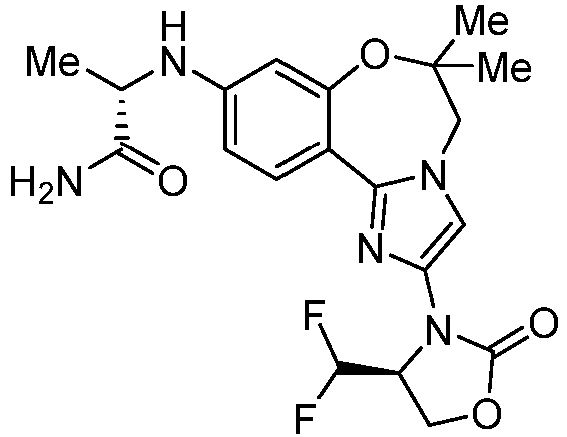
- (S)-2-((2-((S)-4-(Difluoromethyl)-2-oxooxazolidin-3-yl)-6,6-dimethyl-5,6-dihydro benzo[f]imidazo[1,2-d][1,4]oxazepin-9-yl)amino)propanamide was prepared by referring to the method of Example 2 and Example 3.
- 1H NMR (400 MHz, DMSO-d 6) δ 1.26-1.33 (m, 9H), 3.69-3.75 (m, 1H), 3.90-3.98 (m, 2H), 4.55-4.63 (m, 2H), 4.90-5.00 (m, 1H), 5.78 (d, J= 7.1 Hz, 1H), 6.54-6.58 (m, 1H), 6.78-6.83 (m, 1H), 6.55-6.86 (m, 1H), 6.94 (d, J = 2.8 Hz, 1H), 6.98 (s, 1H), 7.35 (s, 1H), 7.39 (s, 1H);
- MS m/z (ESI): 436.1 [M+H]+.
-

- (S)-2-((2-((S)-4-(Difluoromethyl)-2-oxooxazolidin-3-yl)-5,5-dimethyl-5,6-dihydro benzo[f]imidazo[1,2-d][1,4]oxazepin-9-yl)amino)propanamide was prepared by referring to the method of Example 2 and Example 3.
- MS m/z (ESI): 436.1 [M+H]+.
-

- (S)-2-((2-((S)-4-(Difluoromethyl)-2-oxooxazolidin-3-yl)-5H-spiro[benzo[f]imidaz o[1,2-d][1,4]oxazepine-6,1'-cyclopropan]-9-yl)amino)propanamide was prepared by referring to the method of Example 2 and Example 3.
- MS m/z (ESI): 434.1 [M+H]+.
-

- (S)-2-((2-((S)-4-(Difluoromethyl)-2-oxooxazolidin-3-yl)-6H-spiro[benzo[f]imidaz o[1,2-d][1,4]oxazepine-5,1'-cyclopropan]-9-yl)amino)propanamide was prepared by referring to the method of Example 2 and Example 3.
- MS m/z (ESI): 434.1 [M+H]+.
-

-

- A solution of 9-bromo-2-iodo-5,6-dihydrobenzo[f]imidazo[1,2-d][1,4]oxazepine (500 mg, 1.28 mmol) in tetrahydrofuran (10 mL) was added dropwise to a solution of LDA (1.28 mL, 2.56 mmol) in tetrahydrofuran (10 mL) at -78°C. After completion of the addition, the reaction solution was stirred at -78°C for 30 minutes. A solution of N-fluorobenzenesulfonamide (806 mg, 2.56 mmol) in tetrahydrofuran (9 mL) was added dropwise, and the reaction solution was stirred at -78°C for 30 minutes. The reaction was quenched by saturated aqueous ammonium chloride solution, and the reaction solution was extracted with dichloromethane (100 mL×2). The organic phase was washed with saturated brine, dried over anhydrous sodium sulfate and concentrated. The residue was subjected to column chromatography to obtain the title compound 9-bromo-3-fluoro-2-iodo-5,6-dihydrobenzo[f]imidazo[1,2-d][1,4]oxazepine (150 mg, 29%).
- 1H NMR (400 MHz, DMSO-d 6) δ 4.31-4.34 (m, 2H), 4.43-4.48 (m, 2H), 7.19-7.34 (m, 2H), 8.17 (d, J = 8.6 Hz, 1H);
- MS m/z (ESI): 408.9 [M+H]+.
-

- 9-Bromo-3-fluoro-2-iodo-5,6-dihydrobenzo[f]imidazo[1,2-d][1,4]oxazepine (100 mg, 0.24 mmol), (S)-4-(difluoromethyl)oxazolidin-2-one (33.5 mg, 0.24 mmol), (1R,2R)-N1,N2-dimethylcyclohexane-1,2-diamine (35 mg, 0.24 mmol), cuprous iodide (46 mg, 0.24 mmol) and potassium phosphate (155 mg, 0.73 mmol) were mixed in dimethyl sulfoxide (10 mL), and reaction solution was reacted at 130°C for 3 hours. The reaction solution was cooled to room temperature, and 15% ammonia was added. The reaction solution was stirred for 5 minutes and extracted with EtOAc three times. The organic phases were combined, washed with saturated sodium chloride solution, dried over anhydrous sodium sulfate, and concentrated under reduced pressure. The residue was subjected to column chromatography to obtain the title compound (S)-3-(9-bromo-3-fluoro-5,6-dihydrobenzo[f]imidazo[1,2-d][1,4]oxazepin-2-yl)-4-(diflu oromethyl)oxazolidin-2-one (21 mg, 20%).
- 1H NMR (400 MHz, CDCl3) δ 4.25-4.29 (m, 1H), 4.42-4.50 (m, 2H), 4.56-4.69 (m, 4H), 6.16-6.35 (m, 1H), 7.20-7.25 (m, 2H), 8.15 (d, J = 8.4 Hz, 1H);
- MS m/z (ESI): 417.9 [M+H]+.
-

- (2-((S)-4-(Difluoromethyl)-2-oxooxazolidin-3-yl)-3-fluoro-5,6-dihydrobenzo[f]imi dazo[1,2-d][1,4]oxazepin-9-yl)-L-alanine was prepared by referring to the method of Example 1.
- MS m/z (ESI): 427.1 [M+H]+.
-

- (S)-2-((2-((S)-4-(Difluoromethyl)-2-oxooxazolidin-3-yl)-3-fluoro-5,6-dihydrobenz o[fJimidazo[1,2-d][1,4]oxazepin-9-yl)amino)propanamide was prepared by referring to the method of Example 1.
- 1H NMR (400 MHz, CDCl3) δ 1.55 (d, J= 7.0 Hz, 3H), 3.70-3.87 (m, 1H), 4.21 (d, J= 3.6 Hz, 2H), 4.43 (d, J= 5.2 Hz, 2H), 4.57-4.66 (m, 2H), 5.35 (s, 1H), 6.10-6.27 (m, 2H), 6.37-6.50 (m, 2H), 8.07 (d, J= 8.6 Hz, 1H).
- MS m/z (ESI): 426.1 [M+H]+.
-

- (S)-1-(2-((S)-4-(Difluoromethyl)-2-oxooxazolidin-3-yl)-3-fluoro-5,6-dihydrobenzo [f]imidazo[1,2-d][1,4]oxazepin-9-yl)pyrrolidine-2-carboxamide was prepared by referring to the method of Example 10.
- MS m/z (ESI): 452.1 [M+H]+.
-

- (S)-2-((2-((S)-4-(Difluoromethyl)-2-oxooxazolidin-3-yl)-3-fluoro-5,6-dihydrobenz o[f]imidazo[1,2-d][1,4]oxazepin-9-yl)oxy)propanamide was prepared by referring to the method of Example 10.
- MS m/z (ESI): 427.1 [M+H]+.
-

- (S)-2-((3-Fluoro-2-((S)-2-oxo-4-(trifluoromethyl)oxazolidin-3-yl)-5,6-dihydrobenz o[f]imidazo[1,2-d][1,4]oxazepin-9-yl)amino)propanamide was prepared by referring to the method of Example 10.
- MS m/z (ESI): 444.1 [M+H]+.
-

- (S)-2-((3-Chloro-2-((S)-4-(difluoromethyl)-2-oxooxazolidin-3-yl)-5,6-dihydrobenz o[f]imidazo[1,2-d][1,4]oxazepin-9-yl)amino)propanamide was prepared by referring to the method of Example 10.
- 1H NMR (400 MHz, CD3OD) δ 1.46 (d, J = 7.0 Hz, 3H), 3.80-3.86 (m, 1H), 4.29-4.32 (m, 2H), 4.43-4.46 (m, 2H), 4.57-4.67 (m, 3H), 6.07-6.31 (m, 2H), 6.43-6.46 (m, 1H), 7.98 (d, J = 8.8 Hz, 1H);
- MS m/z (ESI): 442.1 [M+H]+.
-
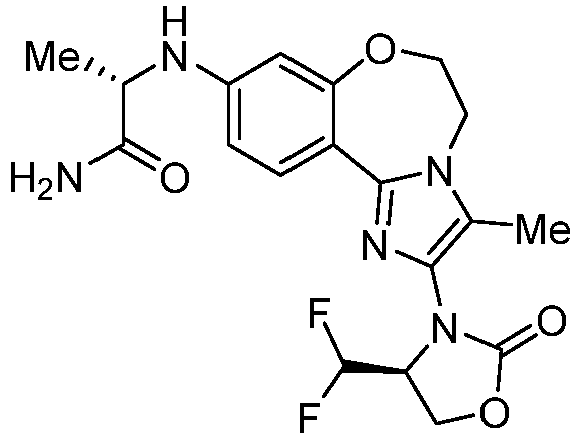
-

- Aqueous pyruvaldehyde solution (40 wt.%, 80 mL) was added to a solution of 4-bromo-2-hydroxybenzaldehyde (5 g, 119 mmol) in methanol (100 mL). In a water bath, ammonia (28 wt.%, 40 g) was slowly added dropwise to the reaction solution under stirring, the addition process lasted for 30 minutes, and the temperature of the reaction solution was controlled not to exceed 40°C. The reaction solution was stirred at 75°C for 2 hours, then cooled to room temperature to precipitate a solid, which was filtered to obtain the title compound 5-bromo-2-(5-methyl-1H-imidazol-2-yl)phenol (3.6 g, 57%).
- MS m/z (ESI): 253.0 [M+H]+.
-

- 5-Bromo-2-(5-methyl-1H-imidazol-2-yl)phenol (2.5 g, 9.8 mmol), cesium carbonate (12.2 g, 37.5 mmol) and 1,2-dibromoethane (42.0 mL, 37.5 mmol) were mixed in DMF (30 mL), and the reaction solution was stirred at 85°C overnight. The reaction solution was cooled to room temperature, and diluted with a large amount of ethyl acetate. The organic phase was washed with saturated brine several times, dried over sodium sulfate and concentrated. The residue was subjected to column chromatography to obtain the title compound 9-bromo-3-methyl-5,6-dihydrobenzo[f]imidazo[1,2-d][1,4]oxazepine (0.92 g, 33%).
- 1H NMR (400 MHz, CDCl3) δ 2.25 (s, 3H), 4.12-4.29 (m, 2H), 4.40-4.53 (m, 2H), 6.94 (s, 1H), 7.14-7.18 (m, 1H), 7.20-7.22 (m, 1H), 8.37 (d, J= 8.6 Hz, 1H);
- MS m/z (ESI): 279.1 [M+H]+.
-

- 9-Bromo-2-iodo-3-methyl-5,6-dihydrobenzo[f]imidazo[1,2-d][1,4]oxazepine was prepared by referring to the method of Example 1.
- MS m/z (ESI): 404.9 [M+H]+.
-

- (S)-3-(9-Bromo-3-methyl-5,6-dihydrobenzo[f]imidazo[1,2-d][1,4]oxazepin-2-yl)-4 -(difluoromethyl)oxazolidin-2-one was prepared by referring to the method of Example 1.
- MS m/z (ESI): 414.0 [M+H]+.
-

- (2-((S)-4-(Difluoromethyl)-2-oxooxazolidin-3-yl)-3-methyl-5,6-dihydrobenzo[f]im idazo[1,2-d][1,4]oxazepin-9-yl)-L-alanine was prepared by referring to the method of Example 1.
- MS m/z (ESI): 423.1 [M+H]+.
-

- (S)-2-((2-((S)-4-(Difluoromethyl)-2-oxooxazolidin-3-yl)-3-methyl-5,6-dihydroben zo[f]imidazo[1,2-d][1,4]oxazepin-9-yl)amino)propanamide was prepared by referring to the method of Example 1.
- 1H NMR (400 MHz, CD3OD) δ 1.37 (d, J = 7.0 Hz, 3H), 2.08 (s, 3H), 3.68-3.75 (m, 1H), 4.18-4.24 (m, 2H), 4.32-4.35 (m, 2H), 4.45-4.61 (m, 3H), 6.10 (m, 2H), 6.34 (d, J= 8.8 Hz, 1H), 7.83 (d, J= 8.8 Hz, 1H).
- MS m/z (ESI): 422.2 [M+H]+.
-

- (S)-1-(2-((S)-4-(Difluoromethyl)-2-oxooxazolidin-3-yl)-3-methyl-5,6-dihydrobenz o[f]imidazo[1,2-d][1,4]oxazepin-9-yl)pyrrolidine-2-carboxamide was prepared by referring to the method of Example 15.
- MS m/z (ESI): 448.2 [M+H]+.
-
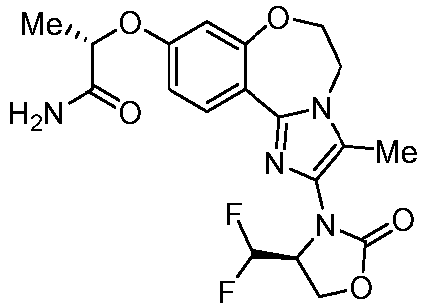
- (S)-2-((2-((S)-4-(Difluoromethyl)-2-oxooxazolidin-3-yl)-3-methyl-5,6-dihydroben zo[f]imidazo[1,2-d][1,4]oxazepin-9-yl)oxy)propanamide was prepared by referring to the method of Example 15.
- MS m/z (ESI): 423.1 [M+H]+.
-

- (S)-2-((3-Methyl-2-((S)-2-oxo-4-(trifluoromethyl)oxazolidin-3-yl)-5,6-dihydroben zo[f]imidazo[1,2-d][1,4]oxazepin-9-yl)amino)propanamide was prepared by referring to the method of Example 15.
- MS m/z (ESI): 440.1 [M+H]+.
-

- (S)-2-((2-((S)-4-(Difluoromethyl)-2-oxooxazolidin-3-yl)-3-(trifluoromethyl)-5,6-di hydrobenzo[f]imidazo[1,2-d][1,4]oxazepin-9-yl)amino)propanamide was prepared by referring to the method of Example 15.
- MS m/z (ESI): 476.1 [M+H]+.
-

- (S)-2-((3-Cyano-2-((S)-4-(difluoromethyl)-2-oxooxazolidin-3-yl)-5,6-dihydrobenz o[f]imidazo[1,2-d][1,4]oxazepin-9-yl)amino)propanamide was prepared by referring to the method of Example 15.
- MS m/z (ESI): 433.1 [M+H]+.
-

- (S)-1-(3-Cyano-2-((S)-4-(difluoromethyl)-2-oxooxazolidin-3-yl)-5,6-dihydrobenzo [f]imidazo[1,2-d][1,4]oxazepin-9-yl)pyrrolidine-2-carboxamide was prepared by referring to the method of Example 15.
- MS m/z (ESI): 459.2 [M+H]+.
-

- (S)-2-((3-Cyano-2-((S)-2-oxo-4-(trifluoromethyl)oxazolidin-3-yl)-5,6-dihydrobenz o[f]imidazo[1,2-d][1,4]oxazepin-9-yl)amino)propanamide was prepared by referring to the method of Example 15.
- MS m/z (ESI): 451.1 [M+H]+.
-

- (S)-2-((3-Cyano-2-((S)-4-(difluoromethyl)-2-oxooxazolidin-3-yl)-5,6-dihydrobenz o[f]imidazo[1,2-d][1,4]oxazepin-9-yl)oxy)propanamide was prepared by referring to the method of Example 15.
- MS m/z (ESI): 434.1 [M+H]+.
-

- (S)-2-((3-Cyclopropyl-2-((S)-4-(difluoromethyl)-2-oxooxazolidin-3-yl)-5,6-dihydr obenzo[f]imidazo[1,2-d][1,4]oxazepin-9-yl)amino)propanamide was prepared by referring to the method of Example 15.
- MS m/z (ESI): 448.2 [M+H]+.
-

-
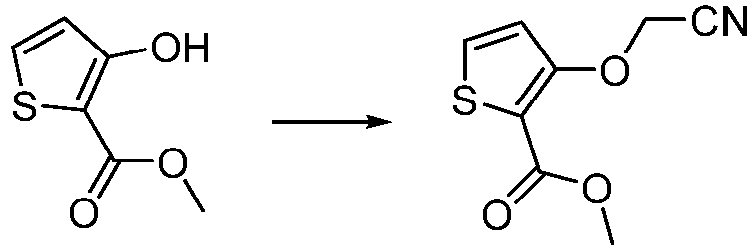
- Methyl 3-hydroxythiophene-2-carboxylate (1.58 g, 10 mmol), bromoacetonitrile (2.4 g, 20 mmol) and cesium carbonate (9.77 g, 30 mmol) were added to DMF (40 mL). The reaction solution was warmed up to 60°C and reacted for 2 hours. The reaction solution was cooled to room temperature, water (200 mL) was added, and the reaction solution was extracted with EA (200 mL×3). The organic phases were combined and washed with saturated aqueous sodium chloride solution (200 mL×3). The organic phases were collected and concentrated under reduced pressure. The residue was subjected to column chromatography to obtain the title compound methyl 3-(cyanomethoxy)thiophene-2-carboxylate (1.58 g, 80 %).
-

- Methyl 3-(cyanomethoxy)thiophene-2-carboxylate (1.58 g, 8 mmol), Raney-Ni (400 mg) and ammonia (2 mL) were added to ethanol (100 mL). Under a hydrogen atmosphere (50 psi), the reaction solution was warmed up to reflux and reacted for 5 hours. The reaction solution was cooled to room temperature and filtered, and the filtrate was concentrated. The residue was subjected to column chromatography to obtain the title compound 3,4-dihydrothieno[2,3-f][1,4]oxazepin-5(2H)-one (1 g, 74 %).
- MS m/z (ESI): 170.2 [M+H]+.
-

- 3,4-Dihydrothieno[2,3-f][1,4]oxazepin-5(2H)-one (1 g, 5.91 mmol), methyl bromoacetate (1.09 g, 7.09 mmol) and potassium carbonate (1.63 g, 11.8 mmol) were added to acetone (20 mL). The reaction solution was warmed up to reflux and reacted for 3 hours. The reaction solution was cooled to room temperature and concentrated. DCM and water were added to the concentrate, and two phases were separated. The organic phase was concentrated, and the residue was subjected to column chromatography to obtain the title compound methyl 2-(5-oxo-2,3-dihydrothieno[2,3-f][1,4]oxazepin-4(5H)-yl)acetate (1.21 g, 85 %).
- MS m/z (ESI): 242.2 [M+H]+.
-

- Methyl 2-(5-oxo-2,3-dihydrothieno[2,3-f][1,4]oxazepin-4(5H)-yl)acetate (1.21 g, 5.02 mmol) and ammonia (5 mL) were added to tert-amyl alcohol (25 mL). The reaction solution was warmed up to 120°C and reacted for 5 hours in a sealed tube. The reaction solution was cooled to room temperature and concentrated. DCM and water were added to the concentrate, and two phases were separated. The organic phase was concentrated, and the residue was subjected to column chromatography to obtain the title compound 5,6-dihydroimidazo[1,2-d]thieno[2,3-f][1,4]oxazepin-9(8H)-one (521 mg, 50%).
- MS m/z (ESI): 209.2 [M+H]+.
-
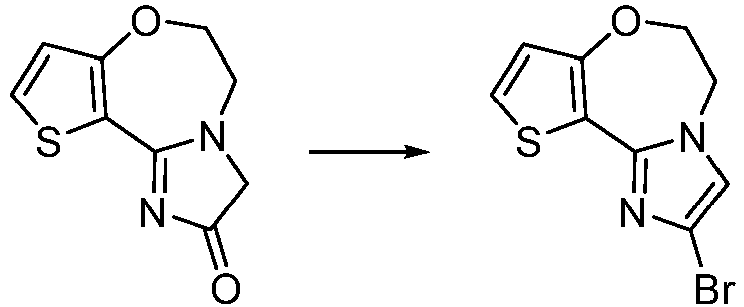
- 5,6-Dihydroimidazo[1,2-d]thieno[2,3-f][1,4]oxazepin-9(8H)-one (521 mg, 2.50 mmol) was dissolved in 1,2-dichloroethane (15 mL), followed by the addition of phosphorus oxybromide (2.15 g, 7.50 mmol). The reaction solution was heated to reflux and reacted overnight. The reaction solution was cooled to room temperature, and its pH was adjusted to neutral with saturated aqueous sodium bicarbonate solution. The reaction solution was extracted with DCM, and the organic phase was concentrated. The residue was subjected to column chromatography to obtain the title compound 9-bromo-5,6-dihydroimidazo[1,2-d]thieno[2,3-f][1,4]oxazepine (407 mg, 60%).
- MS m/z (ESI): 271.1 [M+H]+.
-

- (S)-4-(Difluoromethyl)-3-(5,6-dihydroimidazo[1,2-d]thieno[2,3-f][1,4]oxazepin-9-yl)oxazolidin-2-one was prepared by referring to Example 21.
- MS m/z (ESI): 328.1 [M+H]+.
-

- (S)-4-(Difluoromethyl)-3-(5,6-dihydroimidazo[1,2-d]thieno[2,3-f][1,4]oxazepin-9-yl)oxazolidin-2-one (327 mg, 1.0 mmol) was dissolved in dichloromethane (5 mL) and acetic acid (5 mL), followed by the addition of NIS (248 mg, 1.1 mmol). The reaction solution was reacted at room temperature overnight. The pH of the reaction solution was adjusted to neutral with saturated aqueous sodium bicarbonate solution. The reaction solution was extracted with DCM, and the organic phase was concentrated. The residue was subjected to column chromatography to obtain the title compound (S)-4-(difluoromethyl)-3-(2-iodo-5,6-dihydroimidazo[1,2-d]thieno[2,3-f][1,4]oxazepin-9-yl)oxazolidin-2-one (363 mg, 80 %).
- MS m/z (ESI): 454.1 [M+H]+.
-

- (S)-2-((9-((S)-4-(Difluoromethyl)-2-oxooxazolidin-3-yl)-5,6-dihydroimidazo[1,2-d ]thieno[2,3-f][1,4]oxazepin-2-yl)amino)propanamide was prepared by referring to Example 1.
- MS m/z (ESI): 414.1 [M+H]+.
-

- (S)-2-((9-((S)-4-(Difluoromethyl)-2-oxooxazolidin-3-yl)-3-fluoro-5,6-dihydroimid azo[1,2-d]thieno[2,3-f][1,4]oxazepin-2-yl)amino)propanamide was prepared by referring to Example 25.
- MS m/z (ESI): 432.1 [M+H]+.
-

- (S)-2-((9-((S)-4-(Difluoromethyl)-2-oxooxazolidin-3-yl)-5,6-dihydroimidazo[1,2-d ]thieno[2,3-f][1,4]oxazepin-2-yl)oxy)propanamide was prepared by referring to Example 25.
- MS m/z (ESI): 415.1 [M+H]+.
-

- (S)-1-(9-((S)-4-(Difluoromethyl)-2-oxooxazolidin-3-yl)-5,6-dihydroimidazo[1,2-d] thieno[2,3-f][1,4]oxazepin-2-yl)pyrrolidine-2-carboxamide was prepared by referring to Example 25.
- MS m/z (ESI): 440.1 [M+H]+.
-

- (S)-2-((9-((S)-2-Oxo-4-(trifluoromethyl)oxazolidin-3-yl)-5,6-dihydroimidazo[1,2-d]thieno[2,3-f][1,4]oxazepin-2-yl)amino)propanamide was prepared by referring to Example 25.
- MS m/z (ESI): 432.1 [M+H]+.
-

-

- AlCl3 (3.33 g, 25 mmol) was suspended in nitromethane (25 mL), followed by the dropwise addition of a solution of bicyclo[4.2.0]octa-1(6),2,4-triene (2.08 g, 20 mmol) and acetyl chloride (1.73 g, 22 mmol) in nitromethane (25 mL) in an ice bath under a N2 atmosphere. The reaction solution was naturally warmed up to room temperature and reacted overnight. The reaction solution was added to 200 mL of ice water, and extracted with DCM (200 mL×2). The organic phases were combined and concentrated under reduced pressure. The residue was subjected to column chromatography to obtain the title compound 1-(bicyclo[4.2.0]octa-1(6),2,4-trien-3-yl)ethan-1-one (800 mg, 27%).
-

- 1-(Bicyclo[4.2.0]octa-1(6),2,4-trien-3-yl)ethan-1-one (731 mg, 5 mmol) was dissolved in acetic acid (20 mL). Under a N2 atmosphere, bromine (878.9 mg, 5.5 mmol) was added dropwise, and the reaction solution was reacted at room temperature for 3 hours. The reaction solution was concentrated, DCM and saturated aqueous sodium bicarbonate solution were added to the concentrate, and two phases were separated. The organic phase was concentrated under reduced pressure, and the residue was subjected to column chromatography to obtain the title compound 1-(5-bromobicyclo[4.2.0]octa-1(6),2,4-trien-3-yl)ethan-1-one (900 mg, 80%).
-

- 1-(5-Bromobicyclo[4.2.0]octa-1(6),2,4-trien-3-yl)ethan-1-one (900 mg, 4 mmol) and m-CPBA (75%, 2.30 g, 10 mmol) were mixed in DCM (20 mL). Under a N2 atmosphere, the reaction solution was heated to reflux and reacted overnight. The reaction solution was cooled to room temperature, and filtered to remove insolubles. The reaction solution was washed with saturated aqueous sodium bicarbonate solution, and the organic phase was concentrated under reduced pressure. The residue was subjected to column chromatography to obtain the title compound 5-bromobicyclo[4.2.0]octa-1(6),2,4-trien-3-yl acetate (723 mg, 75%).
-

- 5-Bromobicyclo[4.2.0]octa-1(6),2,4-trien-3-yl acetate (723 mg, 3 mmol) was dissolved in methanol (20 mL), followed by the addition of 5 N aqueous sodium hydroxide solution (3 mL). The reaction solution was reacted at room temperature overnight. 50 mL of water was added to the reaction solution, and its pH was adjusted to 5 with 1 N hydrochloric acid. The reaction solution was extracted with DCM (50 mL×2), and the organic phases were combined and concentrated under reduced pressure. The residue was subjected to column chromatography to obtain the title compound 5-bromobicyclo[4.2.0]octa-1(6),2,4-trien-3-ol (567 mg, 95%).
-

- 5-Bromobicyclo[4.2.0]octa-1(6),2,4-trien-3-ol (567.2 mg, 2.85 mmol), magnesium chloride (407 mg, 4.28 mmol) and TEA (1.15 g, 11.4 mmol) were added to acetonitrile (5 mL). The reaction solution was warmed up to 40°C and reacted for 30 minutes. Paraformaldehyde (770 mg, 8.55 mmol) was added, and the reaction solution was reacted at 80°C overnight. The reaction solution was cooled to room temperature, 50 mL of water was added, and the pH of the reaction solution was adjusted to 5 with 4 N hydrochloric acid. The reaction solution was extracted with DCM (50 mL×2), and the organic phases were combined and concentrated under reduced pressure. The residue was subjected to column chromatography to obtain the title compound 5-bromo-3-hydroxybicyclo[4.2.0]octa-1(6),2,4-triene-2-carbaldehyde (517.6 mg, 80%).
-

- (S)-2-((2-((S)-4-(Difluoromethyl)-2-oxooxazolidin-3-yl)-5,6,10,11-tetrahydrocyclo buta[5,6]benzo[1,2-f]imidazo[1,2-d][1,4]oxazepin-9-yl)amino)propanamide was prepared by referring to Example 1.
- MS m/z (ESI): 434.2 [M+H]+.
-

- (S)-2-((2-((S)-4-(Difluoromethyl)-2-oxooxazolidin-3-yl)-5,6,10,11-tetrahydrocyclo buta[5,6]benzo[1,2-f]imidazo[1,2-d][1,4]oxazepin-9-yl)amino)-2-methoxyacetamide was prepared by referring to Example 30.
- MS m/z (ESI): 450.1 [M+H]+.
-

- (S)-2-((2-((S)-4-(Difluoromethyl)-2-oxooxazolidin-3-yl)-5,6,11,12-tetrahydro-10H -imidazo[1,2-d]indeno[4,5-f][1,4]oxazepin-9-yl)amino)propanamide was prepared by referring to Example 30.
- MS m/z (ESI): 448.1 [M+H]+.
-

- (S)-2-((11-((S)-4-(Difluoromethyl)-2-oxooxazolidin-3-yl)-7,8-dihydro-[1,3]dioxol o[4',5':5,6]benzo[1,2-f]imidazo[1,2-d][1,4]oxazepin-4-yl)amino)propanamide was prepared by referring to Example 30.
- MS m/z (ESI): 452.1 [M+H]+.
-

-

- 1-(4-Bromo-2-hydroxyphenyl)ethan-1-one (5.00 g, 23.3 mmol), potassium carbonate (4.82 g, 35.0 mmol) and methyl iodide (2.94 mL, 46.5 mmol) were mixed in DMF (60 mL), and the reaction solution was stirred at room temperature for 3 hours. Solid was precipitated by adding water to the reaction solution, and dried to obtain the title compound 1-(4-bromo-2-methoxyphenyl)ethan-1-one (5.3 g, 99%).
-

- Under a nitrogen atmosphere, dimethyl carbonate (2.76 mL, 32.7 mmol) was added to a suspension of NaH (1.75 g, 43.7 mmol) in THF (40 mL). The reaction solution was warmed up to 70°C, followed by the slowly dropwise addition of a solution of 1-(4-bromo-2-methoxyphenyl)ethan-1-one (2.50 g, 10.9 mmol) in THF (10 mL). After completion of the addition, the reaction solution was stirred at 70°C for 3 hours. The reaction solution was cooled, and 1 M HCl solution was added to make the system acidic. The reaction solution was extracted with ethyl acetate several times. The organic phases were combined, dried over anhydrous sodium sulfate and concentrated. The residue was subjected to column chromatography to obtain the title compound methyl 3-(4-bromo-2-methoxyphenyl)-3-oxopropanoate (2.2 g, 70%).
- MS m/z (ESI): 227.0 [M+H]+.
-

- Hydrazine hydrate solution (80 wt.%, 3 mL) was added to a solution of methyl 3-(4-bromo-2-methoxyphenyl)-3-oxopropanoate (1.20 g, 4.18 mmol) in ethanol (50 mL). The reaction solution was stirred under reflux for 1 hour. The reaction solution was cooled, and water was added to precipitate a solid 5-(4-bromo-2-methoxyphenyl)-1,2-dihydro-3H-pyrazol-3-one (600 mg). The filtrate was concentrated, and the residue was subjected to column chromatography to obtain the title compound 5-(4-bromo-2-methoxyphenyl)-1,2-dihydro-3H-pyrazol-3-one (400 mg). After the two are combined, a total of 1.0 g of the title compound 5-(4-bromo-2-methoxyphenyl)-1,2-dihydro-3H-pyrazol-3-one was obtained (89%).
- MS m/z (ESI): 269.0 [M+H]+.
-

- 5-(4-Bromo-2-methoxyphenyl)-1,2-dihydro-3H-pyrazol-3-one (100 mg, 0.372 mmol) was mixed with a solution of BBr3 in DCM (1 M, 4 mL), and the reaction solution was stirred at room temperature overnight. The reaction solution was concentrated under reduced pressure to remove the organic solvent and obtain the crude product 5-(4-bromo-2-hydroxyphenyl)-1,2-dihydro-3H-pyrazol-3-one, which was used directly in the next step.
- MS m/z (ESI): 255.0 [M+H]+.
-

- The crude product of the above step was dissolved in DMF (4 mL), followed by the successive addition of 1,2-dibromoethane (70 mg, 0.372 mmol) and potassium carbonate (515 mg, 3.72 mmol). The reaction solution was stirred at 60°C for 1 hour, stirred at 75°C for 1 hour, and stirred at 90°C for 1 hour. The reaction solution was cooled, diluted with ethyl acetate, washed with saturated brine several times, dried over anhydrous sodium sulfate and concentrated. The residue was subjected to column chromatography to obtain the title compound 9-bromo-5,6-dihydrobenzo[f]pyrazolo[1,5-d][1,4]oxazepin-2(3H)-one (44 mg, two-step yield: 42%).
- MS m/z (ESI): 281.0 [M+H]+.
-

- Trifluoromethanesulfonic anhydride (48 mg, 0.171 mmol) was added dropwise to a solution of 9-bromo-5,6-dihydrobenzo[f]pyrazolo[1,5-d][1,4]oxazepin-2(3H)-one (40 mg, 0.142 mmol) in pyridine (1 mL) in an ice water bath. The reaction solution was stirred at room temperature for 2 hours. The reaction solution was concentrated under reduced pressure to remove the organic solvent. The residue was subjected to column chromatography to obtain the title compound 9-bromo-5,6-dihydrobenzo[f]pyrazolo[1,5-d][1,4]oxazepin-2-yl trifluoromethanesulfonate (42 mg, 71%).
- MS m/z (ESI): 412.9 [M+H]+.
-

- (S)-2-((2-((S)-4-(Difluoromethyl)-2-oxooxazolidin-3-yl)-5,6-dihydrobenzo[f]pyraz olo[1,5-d][1,4]oxazepin-9-yl)amino)propanamide was prepared by referring to Example 1.
- MS m/z (ESI): 408.1 [M+H]+.
-

- (S)-1-(2-((S)-4-(Difluoromethyl)-2-oxooxazolidin-3-yl)-5,6-dihydrobenzo[f]pyraz olo[1,5-d][1,4]oxazepin-9-yl)pyrrolidine-2-carboxamide was prepared by referring to the method of Example 34.
- MS m/z (ESI): 434.2 [M+H]+.
-

- (S)-2-((2-((S)-4-(Difluoromethyl)-2-oxooxazolidin-3-yl)-5,6-dihydrobenzo[f]pyraz olo[1,5-d][1,4]oxazepin-9-yl)oxy)propanamide was prepared by referring to the method of Example 34.
- MS m/z (ESI): 409.1 [M+H]+.
-

- (S)-2-((2-((S)-2-Oxo-4-(trifluoromethyl)oxazolidin-3-yl)-5,6-dihydrobenzo[f]pyraz olo[1,5-d][1,4]oxazepin-9-yl)amino)propanamide was prepared by referring to the method of Example 34.
- MS m/z (ESI): 426.1 [M+H]+.
-

- (S)-2-((2-((S)-4-(Difluoromethyl)-2-oxooxazolidin-3-yl)-5,6-dihydrobenzo[f]imida zo[1,2-d][1,4]oxazepin-9-yl)amino)-3-methylbutanamide was prepared by referring to the method of Example 1.
- 1H NMR (400 MHz, CD3OD) δ 1.09 (t, J = 6.1 Hz, 6H), 2.13 (d, J = 7.0 Hz, 1H), 3.60 (d, J = 6.4 Hz, 1H), 4.38 (d, J = 19.3 Hz, 4H), 4.68-4.60 (m, 3H), 6.27 (s, 1H), 6.43-6.78 (m, 2H), 7.17 (s, 1H), 8.06 (d, J = 8.7 Hz, 1H);
- MS m/z (ESI): 436.1 [M+H]+.
-
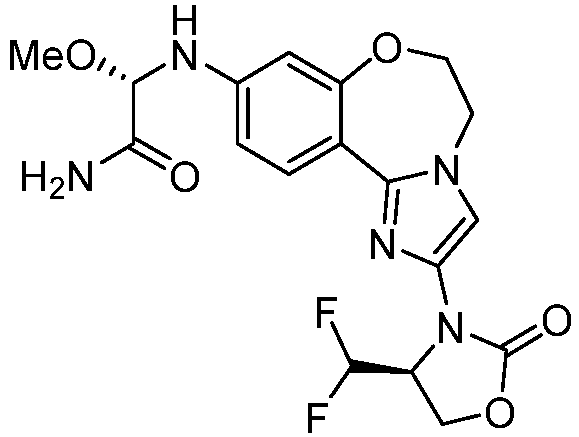
- (S)-2-((2-((S)-4-(difluoromethyl)-2-oxooxazolidin-3-yl)-5,6-dihydrobenzo[f]imida zo[1,2-d][1,4]oxazepin-9-yl)amino)-2-methoxyacetamide was prepared by referring to the method of Example 1.
- MS m/z (ESI): 424.1 [M+H]+.
-
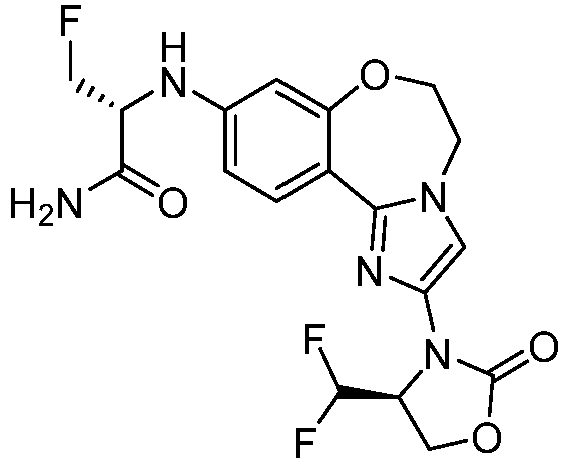
- (R)-2-((2-((S)-4-(Difluoromethyl)-2-oxooxazolidin-3-yl)-5,6-dihydrobenzo[f]imid azo[1,2-d][1,4]oxazepin-9-yl)amino)-3-fluoropropanamide was prepared by referring to the method of Example 1.
- MS m/z (ESI): 426.1 [M+H]+.
-

- (S)-2-((2-((S)-4-(Difluoromethyl)-2-oxooxazolidin-3-yl)-5,6-dihydrobenzo[f]imida zo[1,2-d][1,4]oxazepin-9-yl)amino)-2-(oxetan-3-yl)acetamide was prepared by referring to the method of Example 1.
- 1H NMR (400 MHz, CD3OD) δ 3.26-3.33 (m, 2H), 4.08 (d, J = 9.6 Hz, 1H), 4.22-4.25 (m, 2H), 4.29-4.31 (m, 2H), 4.40-4.50 (m, 5H), 4.61-4.69 (m, 1H), 6.18 (d, J = 2.2 Hz, 1H), 6.44-6.50 (m, 2H), 7.06 (s, 1H), 7.97 (d, J = 8.8 Hz, 1H);
- MS m/z (ESI): 450.1 [M+H]+.
-

- (S)-2-((2-(4-(Difluoromethyl)-2-oxooxazolidin-3-yl)-5,6-dihydrobenzo[f]imidazo[ 1,2-d][1,4]oxazepin-9-yl)amino)-2-methylpropanamide was prepared by referring to the method of Example 1.
- 1H NMR (400 MHz, CD3OD) δ 1.50 (s, 6H), 4.31-4.36 (m, 2H), 4.38-4.43 (m, 2H), 4.61-4.65 (m, 2H), 4.95 (d, J = 10.6 Hz, 1H), 6.19 (d, J = 2.2 Hz, 1H), 6.64-6.81 (m, 2H), 7.17 (s, 1H), 8.05 (d, J = 8.8 Hz, 1H);
- MS m/z (ESI): 422.1 [M+H]+.
-

- (S)-2-((2-((S)-4-(Difluoromethyl)-2-oxooxazolidin-3-yl)-5,6-dihydrobenzo[f]imida zo[1,2-d][1,4]oxazepin-9-yl)(methyl)amino)propanamide was prepared by referring to the method of Example 1.
- 1H NMR (400 MHz, CD3OD): δ 1.40 (d, J = 6.8 Hz, 3H), 2.90 (s, 3H), 4.37-4.64 (m, 7H), 4.96 (m, 1H), 6.41 (s, 1H), 6.46-6.74 (m, 2H), 7.16 (s, 1H), 8.13 (d, J = 9.2 Hz, 1H);
- MS m/z (ESI): 422.1 [M+H]+.
-

- (S)-2-((2-((S)-4-(Difluoromethyl)-2-oxooxazolidin-3-yl)-5,6-dihydrobenzo[f]imida zo[1,2-d][1,4]oxazepin-9-yl)amino)propanethioamide was prepared by referring to the method of Example 1.
- MS m/z (ESI): 424.1 [M+H]+.
-

- (S)-2-((2-((S)-4-(Difluoromethyl)-2-oxooxazolidin-3-yl)-5,6-dihydrobenzo[f]imida zo[1,2-d][1,4]oxazepin-9-yl)thio)propanamide was prepared by referring to the method of Example 1.
- MS m/z (ESI): 425.1 [M+H]+.
-

- (S)-3-((2-(4-(Difluoromethyl)-2-oxooxazolidin-3-yl)-5,6-dihydrobenzo[f]imidazo[ 1,2-d][1,4]oxazepin-9-yl)amino)oxetane-3-carboxamide was prepared by referring to the method of Example 1.
- 1H NMR (400 MHz, CD3OD) δ 4.35 (m, 4H), 4.63 (m, 4H), 4.90 (m, 1H), 5.10 (d, J = 8.0 Hz, 2H), 5.90 (s, 1H), 6.29 (d, J = 8.0 Hz, 1H), 6.59 (t, J = 56 Hz, 1H), 7.16 (s, 1H), 8.10 (d, J = 8.0 Hz, 1H);
- MS m/z (ESI): 436.1 [M+H]+.
-

- (S)-3-(9-(((3-Aminooxetan-3-yl)methyl)amino)-5,6-dihydrobenzo[f]imidazo[1,2-d] [1,4]oxazepin-2-yl)-4-(difluoromethyl)oxazolidin-2-one was prepared by referring to the method of Example 1.
- 1H NMR (400 MHz, CD3OD): δ 3.35 (s, 2H), 4.24 (d, J = 4.7 Hz, 2H), 4.30 (d, J = 4.7 Hz, 2H), 4.41 (d, J = 6.4 Hz, 2H), 4.45-4.60 (m, 5H), 6.22 (d, J = 2.3 Hz, 1H), 6.27-6.71 (m, 2H), 7.05 (s, 1H), 7.94 (d, J = 8.8 Hz, 1H);
- MS m/z (ESI): 422.1 [M+H]+.
-

- (S)-1-(2-((S)-4-(Difluoromethyl)-2-oxooxazolidin-3-yl)-5,6-dihydrobenzo[f]imida zo[1,2-d][1,4]oxazepin-9-yl)azetidine-2-carboxamide was prepared by referring to the method of Example 1.
- 1H NMR (400 MHz, CD3OD) δ 2.30-2.40 (m, 1H), 2.52-2.58 (m, 1H), 3.66-3.72 (m, 1H), 3.91-3.96 (m, 1H), 4.22-4.27 (m, 2H), 4.28-4.34 (m, 2H), 4.48-4.59 (m, 2H), 4.79-4.85 (m, 2H), 6.00 (d, J = 2.2 Hz, 1H), 6.20-6.22 (m, 1H), 6.37-6.65 (m, 1H), 7.08 (s, 1H), 8.06 (d, J = 8.7 Hz, 1H).
- MS m/z (ESI): 420.1 [M+H]+.
-

- (S)-1-(2-(4-(Difluoromethyl)-2-oxooxazolidin-3-yl)-5,6-dihydrobenzo[f]imidazo[1 ,2-d][1,4]oxazepin-9-yl)azetidine-3-carboxamide was prepared by referring to the method of Example 1.
- 1H NMR (400 MHz, CD3OD) δ 3.42-3.49 (m, 1H), 3.87 (t, J = 6.7 Hz, 2H), 3.98 (t, J = 7.9 Hz, 2H), 4.23-4.27 (m, 2H), 4.29-4.33 (m, 2H), 4.50-4.58 (m, 3H), 5.97 (d, J = 2.2 Hz, 1H), 6.17-6.20 (m, 1H), 6.36-6.64 (m, 1H), 7.07 (s, 1H), 8.02 (d, J = 8.7 Hz, 1H);
- MS m/z (ESI): 420.1 [M+H]+.
-
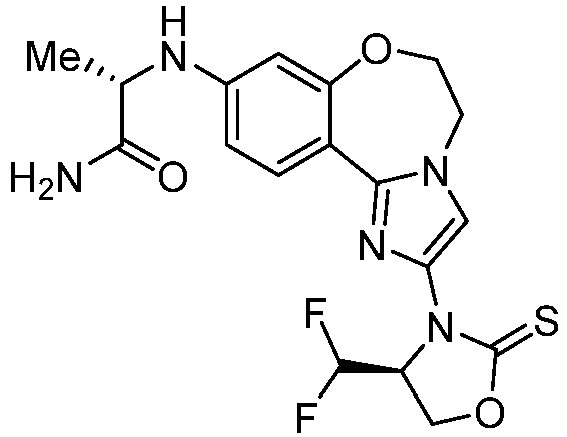
- (S)-2-((2-((S)-4-(Difluoromethyl)-2-thioxooxazolidin-3-yl)-5,6-dihydrobenzo[f]im idazo[1,2-d][1,4]oxazepin-9-yl)amino)propanamide was prepared by referring to the method of Example 1.
- MS m/z (ESI): 424.1 [M+H]+.
-

-

- Lawesson's reagent (1.01 g, 2.5 mmol) was added to a solution of (S)-3-(10-bromo-6,7-dihydro-5H-benzo[b]imidazo[2,1-d][1,5]oxazocin-2-yl)-4-(difluor omethyl)oxazolidin-2-one (100 mg, 0.25 mmol) in toluene (10 mL). The reaction solution was reacted under microwave at 140°C for 3 hours. The reaction solution was cooled to room temperature and filtered, and the filter cake was washed with EtOAc (20 mL). The filtrate was dried over anhydrous sodium sulfate, and concentrated under reduced pressure. The residue was subjected to column chromatography to obtain the title compound (S)-3-(9-bromo-5,6-dihydrobenzo[f]imidazo[1,2-d][1,4]oxazepin-2-yl)-4-(difluorometh yl)oxazolidine-2-thione (42 mg, 40%).
- 1H NMR (400 MHz, DMSO-d6 ) δ 4.43-4.52 (m, 4H), 4.79-4.86 (m, 2H), 5.24-5.35 (m, 1H), 6.57-6.85 (m, 1H), 7.23-7.38 (m, 2H), 8.10 (s, 1H), 8.26 (d, J = 8.6 Hz, 1H);
- MS m/z (ESI): 416.1 [M+H]+.
-

- Dichloro(p-cymene)ruthenium(II) dimer (14.7 mg, 0.024 mmol) and 2-bicyclohexylphosphino-2',6'-dimethoxybiphenyl (9.7 mg, 0.024 mmol) were added to a solution of (S)-3-(10-bromo-6,7-dihydro-5H-benzo[b]imidazo[2,1-d][1,5]oxazepin-2-yl)-4-(difluor omethyl)oxazolidine-2-thione (33 mg, 0.079 mmol) in toluene (1 mL). The reaction solution was reacted under an air atmosphere at 110°C for 12 hours. The reaction solution was cooled to room temperature, and diluted with EtOAc. The organic phase was washed with saturated aqueous sodium chloride solution, dried over anhydrous sodium sulfate, and concentrated under reduced pressure. The residue was subjected to column chromatography to obtain the title compound (R)-3-(9-bromo-5,6-dihydrobenzo[f]imidazo[1,2-d][1,4]oxazepin-2-yl)-4-(difluorometh yl)thiazolidin-2-one (26 mg, 79%).
- 1H NMR (400 MHz, CDCl3) δ 3.57-3.72 (m, 2H), 4.28-4.41 (m, 2H),4.44-4.47 (m, 2H) 5.14-5.24 (m, 1H), 6.29-6.67 (m, 1H), 7.14-7.25 (m, 2H), 7.42 (s, 1H), 8.21 (d, J = 8.8 Hz, 1H);
- MS m/z (ESI): 416.1 [M+H]+.
-

- (R)-3 -(9-Bromo-5,6-dihydrobenzo[f]imidazo[1,2-d][1,4]oxazepin-2-yl)-4-(difluoro methyl)thiazolidin-2-one (26 mg, 0.062 mmol), L-alanine (19.5 mg, 0.22 mmol), cuprous iodide (6 mg, 0.03 mmol) and potassium phosphate (40 mg, 0.19 mmol) were mixed in dimethyl sulfoxide (3 mL). The reaction system was purged with nitrogen three times, and reacted at 100°C for 12 hours. The reaction solution was cooled to room temperature, ammonium chloride (20 mg, 0.37 mmol) and triethylamine (95 mg, 0.94 mmol) were added and the reaction solution was stirred for 5 minutes. O-(7-azabenzotriazol-1-yl)-N,N,N',N'-tetramethylurea hexafluorophosphate (212 mg, 0.56 mmol) was added, and the reaction solution was stirred at room temperature for 2 hours. The reaction solution was filtered, saturated aqueous sodium bicarbonate solution was added to the filtrate, which was then extracted with ethyl acetate three times. The organic phases were combined, dried over anhydrous sodium sulfate, and concentrated under reduced pressure. The residue was subjected to column chromatography to obtain the title compound (S)-2-((2-((R)-4-(difluoromethyl)-2-oxothiazolidin-3-yl)-5,6-dihydrobenzo[f]imidazo[1, 2-d][1,4]oxazepin-9-yl)amino)propanamide (15 mg, 56%).
- 1H NMR (400 MHz, CD3OD) δ 1.37 (d, J = 7.2 Hz, 3H), 3.57-3.61 (m, 1H), 3.83-3.87 (m, 2H), 4.33-4.41 (m, 4H), 5.12-5.19 (m, 1H), 6.15-6.17 (m, 1H), 6.47-6.52 (m, 2H), 7.28 (s, 1H), 8.10 (d, J = 8.8 Hz, 1H);
- MS m/z (ESI): 424.1 [M+H]+.
-
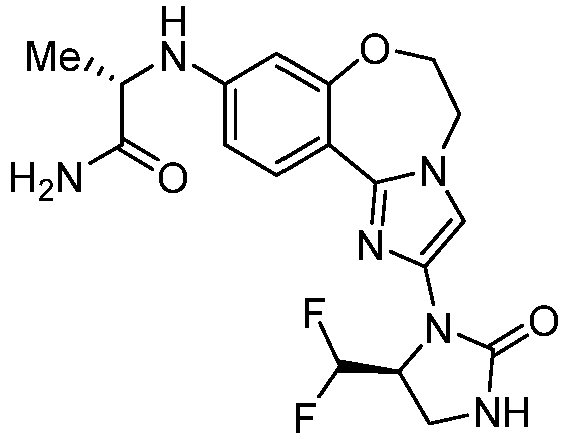
- (S)-2-((2-((S)-5-(Difluoromethyl)-2-oxoimidazolidin-1-yl)-5,6-dihydrobenzo[f]imi dazo[1,2-d][1,4]oxazepin-9-yl)amino)propanamide was prepared by referring to the method of Example 51.
- MS m/z (ESI): 407.2 [M+H]+.
-

- (S)-2-((2-((S)-5-(Difluoromethyl)-3-methyl-2-oxoimidazolidin-1-yl)-5,6-dihydrobe nzo[f]imidazo[1,2-d][1,4]oxazepin-9-yl)amino)propanamide was prepared by referring to the method of Example 51.
- 1H NMR (400 MHz, CD3OD) δ 1.46 (d, J = 7.0 Hz, 3H), 2.85 (s, 3H), 3.62-3.68 (m, 2H), 3.79-3.85 (m, 1H), 4.27-4.30 (m, 2H), 4.35-4.37 (m, 2H), 4.63-4.69 (m, 1H), 6.17 (d, J = 2.0 Hz, 1H), 6.34-6.62 (m, 2H), 7.05 (s, 1H), 8.01 (d, J = 8.8 Hz, 1H);
- MS m/z (ESI): 421.2 [M+H]+.
-

-

- Methyl L-threoninate hydrochloride (500 mg, 2.95 mmol) was dissolved in dichloromethane (15 mL), and the resulting solution was cooled to 0°C in an ice water bath. Triphosgene (289 mg, 0.97 mmol) was added, then a solution of triethylamine (895 mg, 8.84 mmol) in dichloromethane (2 mL) was added dropwise. After completion of the addition, the reaction solution was reacted at 0°C for 1 hour. Water was added, and the reaction solution was extracted with dichloromethane. The organic phase was dried over anhydrous sodium sulfate, and concentrated under reduced pressure to remove the organic solvent. The resulting crude product was purified by column chromatography to obtain the title compound methyl (4S,5R)-5-methyl-2-oxooxazolidine-4-carboxylate (251 mg, 53%).
- MS m/z (ESI): 160.1 [M+H]+.
-

- Methyl (4S,5R)-5-methyl-2-oxooxazolidine-4-carboxylate (200 mg, 1.26 mmol) was dissolved in DMF (5 mL), and the resulting solution was cooled to -15°C. NaH (60% in kerosene, 50 mg, 1.26 mmol) was added, and the reaction solution was stirred at -15°C for 1 hour. Benzyl bromide (322 mg, 1.89 mmol) was added, and the reaction solution was stirred for 2 hours. Water was added to quench the reaction, and the reaction solution was extracted with dichloromethane. The organic phase was dried over anhydrous sodium sulfate, and concentrated under reduced pressure to remove the organic solvent. The resulting crude product was purified by column chromatography to obtain the title compound methyl (4S,5R)-3-benzyl-5-methyl-2-oxooxazolidine-4-carboxylate (260 mg, 83%).
- MS m/z (ESI): 250.1 [M+H]+.
-

- Methyl (4S,5R)-3-benzyl-5-methyl-2-oxooxazolidine-4-carboxylate (260 mg, 1.0 mmol) was dissolved in methanol (5 mL), and the resulting solution was cooled to 0°C in an ice water bath. Sodium borohydride (11 mg, 3.1 mmol) was added in batches, the reaction solution was gradually warmed up to room temperature and reacted for 2 hours. The reaction solution was concentrated, and the resulting crude product was purified by column chromatography to obtain the title compound (4R,5R)-3-benzyl-4-(hydroxymethyl)-5-methyloxazolidin-2-one (180 mg, 78%).
- MS m/z (ESI):222.1 [M+H]+.
-

- (4R,5R)-3-Benzyl-4-(hydroxymethyl)-5-methyloxazolidin-2-one (180 mg, 0.81 mmol) and IBX (683 mg, 2.44 mmol) were mixed in ethyl acetate (10 mL). Under a nitrogen atmosphere, the reaction solution was reacted at 85°C for 3 hours. The reaction solution was cooled and filtered. The filtrate was concentrated under reduced pressure to obtain the crude product (4S,5R)-3-benzyl-5-methyl-2-oxooxazolidine-4-carbaldehyde (178 mg), which was used directly in the next step.
- MS m/z (ESI): 220.2 [M+H]+.
-

- (4S,5R)-3-Benzyl-5-methyl-2-oxooxazolidine-4-carbaldehyde (178 mg, 0.81 mmol) was dissolved in dichloromethane (10 mL). Under a nitrogen atmosphere, the solution was cooled to 0°C in an ice water bath, and DAST (262 mg, 1.62 mmol) was added dropwise. The reaction solution was naturally warmed up to room temperature and reacted for 3 hours. The reaction solution was slowly added dropwise to the pre-cooled saturated aqueous sodium bicarbonate solution, and extract with dichloromethane (20 mL×2). The organic phases were combined, dried over anhydrous sodium sulfate, and concentrated under reduced pressure to remove the organic solvent. The residue was subjected to column chromatography to obtain the title compound (4S,5R)-3-benzyl-4-(difluoromethyl)-5-methyloxazolidin-2-one (110 mg, two-step yield: 56%).
- 1H NMR (400 MHz, CDCl3) δ 1.33 (d, J = 6.4 Hz, 3H), 3.27-3.33 (m, 1H), 4.16-4.20 (m, 1H), 4.41-4.64 (m, 1H), 4.91 (d, J = 15.0 Hz, 1H), 5.56-5.88 (m, 1H), 7.27-7.44 (m, 5H);
- MS m/z (ESI): 242.1 [M+H]+.
-

- (4S,5R)-3-Benzyl-4-(difluoromethyl)-5-methyloxazolidin-2-one (110 mg, 0.46 mmol) was dissolved in mesitylene (2 mL), followed by the addition of methanesulfonic acid (438 mg, 4.56 mmol). The reaction solution was heated to 135°C and reacted for 5 hours. After cooling to room temperature, the reaction solution was slowly added dropwise to the pre-cooled saturated aqueous sodium bicarbonate solution, and extract with dichloromethane (20 mL×2). The organic phases were combined, dried over anhydrous sodium sulfate, and concentrated under reduced pressure to remove the organic solvent. The residue was subjected to column chromatography to obtain the crude title compound (4S,5R)-4-(difluoromethyl)-5-methyloxazolidin-2-one (68 mg), which was used directly in the next step.
- MS m/z (ESI): 152.1 [M+H]+.
-

- 9-Bromo-2-iodo-5,6-dihydrobenzo[f]Jimidazo[1,2-d][1,4]oxazepine (100 mg, 0.25 mmol), (4S,5R)-4-(difluoromethyl)-5-methyloxazolidin-2-one (38.5 mg, 0.25 mmol), (1R,2R)-N1,N2-dimethylcyclohexane-1,2-diamine (22 mg, 0.15 mmol), cuprous iodide (14 mg, 0.08 mmol) and potassium phosphate (108 mg, 0.51 mmol) were mixed in dimethyl sulfoxide (3 mL), and the reaction solution was reacted at 130°C for 3 hours. The reaction solution was cooled to room temperature, and 15% ammonia (5 mL) was added. The reaction solution was stirred for 5 minutes and extracted with ethyl acetate three times. The organic phases were combined, washed with saturated sodium chloride solution, dried over anhydrous sodium sulfate, and concentrated under reduced pressure to remove the organic solvent. The residue was subjected to column chromatography to obtain the title compound (S)-3-(9-bromo-3-fluoro-5,6-dihydrobenzo[f]imidazo[1,2-d][1,4]oxazepin-2-yl)-4-(diflu oromethyl)oxazolidin-2-one (61 mg, 57%).
- MS m/z (ESI): 414.2 [M+H]+.
-

- (4S,5R)-3-(9-Bromo-5,6-dihydrobenzo[f]imidazo[1,2-d][1,4]oxazepin-2-yl)-4-(difl uoromethyl)-5-methyloxazolidin-2-one (61 mg, 0.15 mmol), L-alanine (39 mg, 0.44 mmol), cuprous iodide (14 mg, 0.07 mmol) and potassium phosphate (94 mg, 0.44 mmol) were mixed in dimethyl sulfoxide (5 mL). The reaction system was purged with nitrogen three times, and reacted at 100°C for 5 hours. The reaction solution was cooled to room temperature, ammonium chloride (47 mg, 0.88 mmol) and triethylamine (223 mg, 2.21 mmol) were added, and the reaction solution was stirred for 5 minutes. O-(7-azabenzotriazol-1-yl)-N,N,N',N'-tetramethylurea hexafluorophosphate (505 mg, 1.33 mmol) was added, and the reaction solution was stirred at room temperature for 2 hours. The reaction solution was filtered, saturated aqueous sodium bicarbonate solution was added to the filtrate, which was then extracted with ethyl acetate three times. The organic phases were combined, dried over anhydrous sodium sulfate, and concentrated under reduced pressure to remove the organic solvent. The residue was subjected to column chromatography to obtain the title compound (S)-2-((2-((S)-4-(difluoromethyl)-2-oxooxazolidin-3-yl)-6,7-dihydro-5H-benzo[b]imida zo[2,1-d][1,5]oxazocin-10-yl)amino)propanamide (33 mg, 53%).
- 1H NMR (400 MHz, CD3OD) δ 1.46 (d, J = 6.8 Hz, 3H), 1.53 (d, J = 6.2 Hz, 3H), 3.79-3.85 (m, 1H), 4.32-4.39 (m, 4H), 4.46-4.55 (m, 1H), 4.93-4.95 (m, 1H), 6.17 (s, 1H), 6.39-6.72 (m, 2H), 7.14 (s, 1H), 8.03 (d, J = 8.6 Hz, 1H);
- MS m/z (ESI): 422.1 [M+H]+.
-

- (R)-2-((2-((4S,5R)-4-(Difluoromethyl)-5-methyl-2-oxooxazolidin-3-yl)-5,6-dihydr obenzo[f]imidazo[1,2-d][1,4]oxazepin-9-yl)amino)propanamide was prepared by referring to the method of Example 54.
- MS m/z (ESI): 422.2 [M+H]+.
-

- (S)-2-((2-((S)-4-(Difluoromethyl)-5,5-dimethyl-2-oxooxazolidin-3-yl)-5,6-dihydro benzo[f]imidazo[1,2-d][1,4]oxazepin-9-yl)amino)propanamide was prepared by referring to the method of Example 54.
- MS m/z (ESI): 436.2 [M+H]+.
-

- (S)-2-((2-((S)-7-(Difluoromethyl)-5-oxo-4-oxa-6-azaspiro[2.4]heptan-6-yl)-5,6-dih ydrobenzo[f]imidazo[1,2-d][1,4]oxazepin-9-yl)amino)propanamide was prepared by referring to the method of Example 54.
- MS m/z (ESI): 434.2 [M+H]+.
-

- (S)-2-((2-((S)-8-(Difluoromethyl)-6-oxo-2,5-dioxa-7-azaspiro[3.4]octan-7-yl)-5,6-dihydrobenzo[f]imidazo[1,2-d][1,4]oxazepin-9-yl)amino)propanamide was prepared by referring to the method of Example 54.
- MS m/z (ESI): 450.2 [M+H]+.
-

- (S)-2-((2-(6-Oxo-2,7-dioxa-5-azaspiro[3.4]octan-5-yl)-5,6-dihydrobenzo[f]imidazo [1,2-d][1,4]oxazepin-9-yl)amino)propanamide was prepared by referring to the method of Example 1.
- 1H NMR (400 MHz, CD3OD) δ 1.37 (d, J = 7.0 Hz, 3H), 3.69-3.77 (m, 1H), 4.27-4.38 (m, 4H), 4.62 (d, J = 7.4 Hz, 2H), 4.70 (s, 2H), 5.12 (d, J = 7.4 Hz, 2H), 6.10 (d, J = 2.3 Hz, 1H), 6.33-6.38 (m, 1H), 7.18 (s, 1H), 7.96 (d, J = 8.8 Hz, 1H);
- MS m/z (ESI): 400.2 [M+H]+.
-

- (S)-2-((2-((R)-4-(Methoxymethyl)-2-oxooxazolidin-3-yl)-5,6-dihydrobenzo[f]imid azo[1,2-d][1,4]oxazepin-9-yl)amino)propanamide was prepared by referring to the method of Example 1.
- 1H NMR (400 MHz, CD3OD) δ 1.46 (d, J = 7.0 Hz, 3H), 3.34 (s, 3H), 3.57-3.62 (m, 1H), 3.77-3.85 (m, 2H), 4.31-4.35 (m, 2H), 4.37-4.41 (m, 2H), 4.42-4.45 (m, 1H), 4.53-4.55 (m, 1H), 4.63-4.69 (m, 1H), 6.16-6.19 (m, 1H), 6.40-6.45 (m, 1H), 7.12 (s, 1H), 8.01 (d, J = 8.8 Hz, 1H);
- MS m/z (ESI): 402.2 [M+H]+.
-

- (2S)-2-((2-((5S)-5-(Difluoromethyl)-3-oxo-2-oxa-4-azabicyclo[3.1.0]hexan-4-yl)-5 ,6-dihydrobenzo[f]imidazo[1,2-d][1,4]oxazepin-9-yl)amino)propanamide was prepared by referring to the method of Example 1.
- MS m/z (ESI): 420.1 [M+H]+.
-

- (S)-2-((2-((1R,5S)-6,6-Difluoro-3-oxo-2-oxa-4-azabicyclo[3.1.0]hexan-4-yl)-5,6-d ihydrobenzo[f]imidazo[1,2-d][1,4]oxazepin-9-yl)amino)propanamide was prepared by referring to the method of Example 1.
- MS m/z (ESI): 406.1 [M+H]+.
-

- (S)-2-((2-((S)-1,1-Difluoro-5-oxo-6-oxa-4-azaspiro[2.4]heptan-4-yl)-5,6-dihydrobe nzo[f]imidazo[1,2-d][1,4]oxazepin-9-yl)amino)propanamide was prepared by referring to the method of Example 1.
- MS m/z (ESI): 420.1 [M+H]+.
-

- (S)-2-((2-((S)-5-(Difluoromethyl)-3-methyl-2,4-dioxoimidazolidin-1-yl)-5,6-dihyd robenzo[f]imidazo[1,2-d][1,4]oxazepin-9-yl)amino)propanamide was prepared by referring to the method of Example 1.
- MS m/z (ESI): 435.2 [M+H]+.
-

- Methyl (9-(((S)-1-amino-1-oxopropan-2-yl)amino)-5,6-dihydrobenzo[f]imidazo[1,2-d] [1,4]oxa zepin-2-yl)((S)-2,2-difluorocyclopropyl)carbamate was prepared by referring to the method of Example 1.
- MS m/z (ESI): 422.2 [M+H]+.
-

- (S)-2-((2-(5,5-Difluoro-2-oxo-1,3-oxazinan-3-yl)-5,6-dihydrobenzo[f]imidazo[1,2-d][1,4]oxazepin-9-yl)amino)propanamide was prepared by referring to the method of Example 1.
- 1H NMR (400 MHz, CD3OD) δ 1.37 (d, J = 7.0 Hz, 3H), 3.70-3.75 (m, 1H), 4.21-4.25 (m, 2H), 4.26-4.32 (m, 3H), 4.44-4.52 (m, 3H), 6.08 (d, J = 2.2 Hz, 1H), 6.36-6.33 (m, 1H), 7.13 (s, 1H), 7.96 (d, J = 8.8 Hz, 1H);
- MS m/z (ESI): 408.1 [M+H]+.
-
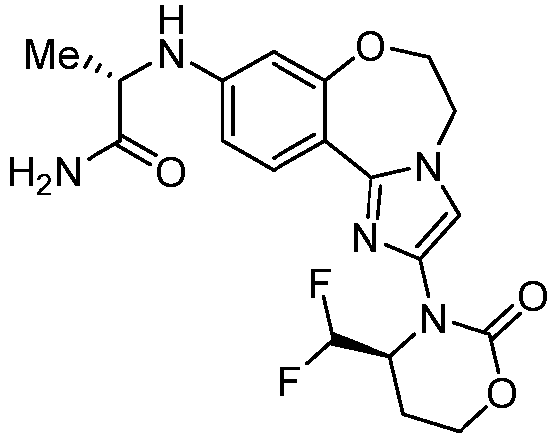
-

- Potassium carbonate (545 mg, 3.95 mmol) and methyl iodide (617 mg, 4.35 mmol) were successively added to a solution of ((benzyloxy)carbonyl)-L-homoserine (1.0 g, 3.95 mmol) in N,N-dimethylformamide (6 mL), and the reaction solution was stirred at room temperature overnight. Saturated sodium bicarbonate solution was added to quench the reaction, and the reaction solution was extract with EtOAc. The organic phases were collected, dried over anhydrous sodium sulfate and concentrated under reduced pressure. The residue was subjected to column chromatography to obtain the title compound methyl ((benzyloxy)carbonyl)-L-homoserinate (920 mg, 87%).
- MS m/z (ESI): 268.1 [M+H]+.
-

- Methyl ((benzyloxy)carbonyl)-L-homoserinate (920 mg, 3.4 mmol) was dissolved in methanol (10 mL), followed by the addition of Pd/C (50 mg). Under a hydrogen atmosphere, the reaction solution was stirred at room temperature overnight. The reaction solution was filtered, and concentrated under reduced pressure obtain the crude title compound methyl L-homoserinate (288 mg, 64%).
- MS m/z (ESI): 134.1 [M+H]+.
-

- Methyl L-homoserinate (288 mg, 2.2 mmol) was dissolved in dichloromethane (15 mL), and the resulting solution was cooled in an ice bath. Triphosgene (258 mg, 0.87 mmol) was added, then a solution of triethylamine (658 mg, 6.51 mmol) in dichloromethane (2 mL) was added dropwise. After completion of the addition, the reaction solution was reacted in an ice bath for 1 hour. Water was added, and the reaction solution was extracted with dichloromethane. The organic phase was dried over anhydrous sodium sulfate, and concentrated under reduced pressure. The resulting crude product was purified by column chromatography to obtain the pure product methyl (S)-2-oxo-1,3-oxazinane-4-carboxylate (110 mg, 32%).
- MS m/z (ESI): 160.1 [M+H]+.
-

- Methyl (S)-2-oxo-1,3-oxazinane-4-carboxylate (110 mg, 0.7 mmol) was dissolved in tetrahydrofuran (12 mL), and the resulting solution was cooled in an ice bath. Sodium hydride (42 mg, 1.06 mmol) was added, and the reaction solution was stirred for 10 minutes, then a solution of benzyl bromide (142 mg, 0.84 mmol) in tetrahydrofuran (2 mL) was added dropwise. After completion of the addition, the reaction solution was gradually warmed up to room temperature and reacted for 2 hours. Saturated ammonium chloride solution was added, and the reaction solution was extracted with ethyl acetate. The organic phase was dried over anhydrous sodium sulfate, and concentrated under reduced pressure. The resulting crude product was purified by column chromatography to obtain the pure product methyl (S)-3-benzyl-2-oxo-1,3-oxazinane-4-carboxylate (100 mg, 57%).
- MS m/z (ESI):250.1 [M+H]+.
-

- Methyl (S)-3-benzyl-2-oxo-1,3-oxazinane-4-carboxylate (100 mg, 0.4 mmol) was dissolved in methanol (5 mL), and the resulting solution was cooled in an ice bath. Sodium borohydride (30 mg, 0.8 mmol) was added in batches, and the reaction solution was gradually warmed up to room temperature and reacted for 2 hours. The reaction solution was concentrated, and the resulting crude product was purified by column chromatography to obtain the pure product (S)-3-benzyl-4-(hydroxymethyl)-1,3-oxazinan-2-one (70 mg, 79%).
- MS m/z (ESI): 222.1 [M+H]+.
-

- (S)-3-Benzyl-4-(hydroxymethyl)-1,3-oxazinan-2-one (70 mg, 0.32 mmol) and IBX (269 mg, 0.96 mmol) were mixed in ethyl acetate (5 mL). Under a nitrogen atmosphere, the reaction solution was stirred at 85°C for 3 hours. The reaction solution was cooled and filtered. The filtrate was concentrated under reduced pressure to obtain the crude product (S)-3-benzyl-2-oxo-1,3-oxazinane-4-carbaldehyde (68 mg), which was used directly in the next step.
- MS m/z (ESI): 220.1 [M+H]+.
-

- (S)-3-Benzyl-2-oxo-1,3-oxazinane-4-carbaldehyde (68 mg, 0.31 mmol) was dissolved in dichloromethane (5 mL). Under a nitrogen atmosphere, DAST (100 mg, 0.62 mmol) was added dropwise to the reaction solution in an ice bath. The reaction solution was naturally warmed up to room temperature and reacted for 3 hours. The reaction solution was slowly added dropwise to the pre-cooled saturated aqueous sodium bicarbonate solution, and extract with dichloromethane (10 mL×2). The organic phases were combined and concentrate under reduced pressure. The residue was subjected to column chromatography to obtain the title compound (S)-3-benzyl-4-(difluoromethyl)-1,3-oxazinan-2-one (55 mg, 73%).
- MS m/z (ESI): 242.1 [M+H]+.
-

- (S)-3-Benzyl-4-(difluoromethyl)-1,3-oxazinan-2-one (55 mg, 0.23 mmol) was dissolved in ethanol (5 mL), followed by the addition of Pd(OH)2/C (10 mg). Under a hydrogen atmosphere, the reaction solution was stirred at 70°C overnight. The reaction solution was cooled and filtered. The filtrate was concentrated under reduced pressure to obtain the title compound (S)-4-(difluoromethyl)-1,3-oxazinan-2-one (28 mg, 81 %).
- MS m/z (ESI): 152.1 [M+H]+.

- (S)-2-((2-((S)-4-(Difluoromethyl)-2-oxo-1,3-oxazinan-3-yl)-5,6-dihydrobenzo[f]im idazo[1,2-d][1,4]oxazepin-9-yl)amino)propanamide was prepared by referring to the method of Example 1.
- MS m/z (ESI): 422.2 [M+H]+.
-
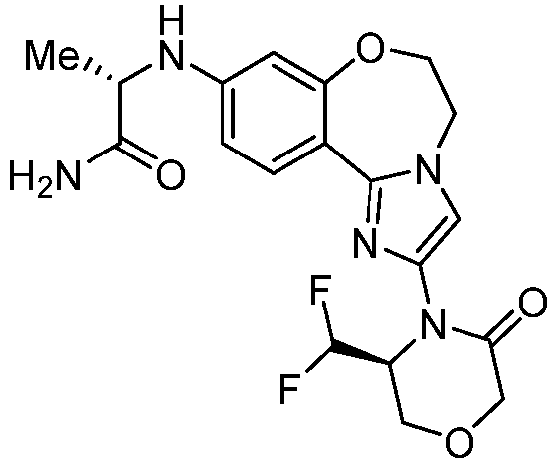
-

- 5 mol/L aqueous sodium hydroxide solution (1.5 mL, 7.5 mmol) was added to a solution of (S)-3-benzyl-4-(difluoromethyl)oxazolidin-2-one (340 mg, 1.5 mmol) in methanol (5 mL) at room temperature. After completion of the addition, the reaction solution was warmed up to 55°C, and stirred at this temperature for 3 hours. The reaction solution was cooled and concentrated under reduced pressure to remove the organic solvent. Water was added to the reaction flask, and the reaction solution was extracted with ethyl acetate three times. The organic phases were combined, dried over anhydrous sodium sulfate and concentrated under reduced pressure to remove the organic solvent and obtain the crude title compound (S)-2-(benzylamino)-3,3-difluoropropan-1-ol, which was used directly in the next step.
- MS m/z (ESI): 202.1 [M+H]+.
-

- A solution of chloroacetyl chloride (186 mg, 1.65 mmol) in tetrahydrofuran (2 mL) was added dropwise to a solution of (S)-2-(benzylamino)-3,3-difluoropropan-1-ol (301 mg, 1.5 mmol) and triethylamine (379 mg, 3.75 mmol) in tetrahydrofuran (10 mL) in an ice bath. After completion of the addition, the reaction solution was stirred at this temperature for 2 hours. Water was added to the reaction flask to quench the reaction, and the reaction solution was extracted with ethyl acetate three times. The organic phases were combined, dried over anhydrous sodium sulfate and concentrated under reduced pressure to remove the organic solvent and obtain the crude title compound (S)-N-benzyl-2-chloro-N-(1,1-difluoro-3-hydroxypropan-2-yl)acetamide, which was used directly in the next step.
- MS m/z (ESI): 278.1 [M+H]+.
-

- Sodium hydride (72 mg, 1.8 mmol) was added to a solution of (S)-N-benzyl-2-chloro-N-(1,1-difluoro-3-hydroxypropan-2-yl)acetamide (415 mg, 1.5 mmol) in tetrahydrofuran (8 mL) in an ice bath. After completion of the addition, the reaction solution was gradually warmed up to room temperature and stirred for 3 hours. Saturated ammonium chloride solution was added to the reaction flask to quench the reaction, and the reaction solution was extracted with ethyl acetate three times. The organic phases were combined, washed with saturated brine, dried over anhydrous sodium sulfate and concentrated under reduced pressure to remove the organic solvent. The residue was subjected to column chromatography to obtain the title compound (S)-4-benzyl-5-(difluoromethyl)morpholin-3-one (240 mg, 66%).
- MS m/z (ESI): 242.1 [M+H]+.
-

- (S)-4-Benzyl-5-(difluoromethyl)morpholin-3-one (240 mg, 1.0 mmol) was dissolved in a solution of methanesulfonic acid (0.5 mL) and mesitylene (2.5 mL) at room temperature. The reaction solution was reacted under microwave at 135°C for 1.5 hours. The reaction solution was concentrated, saturated aqueous sodium carbonate solution was added, and the reaction solution was extracted with ethyl acetate three times. The organic phases were combined, dried over anhydrous sodium sulfate and concentrated under reduced pressure to remove the organic solvent and obtain the crude title compound (S)-5-(difluoromethyl)morpholin-3-one.
- MS m/z (ESI): 152.1 [M+H]+.
-

- 10-Bromo-2-iodo-6,7-dihydro-5H-benzo[b]imidazo[2,1-d][1,5]oxazocine (258 mg, 0.66 mmol), (S)-5-(difluoromethyl)morpholin-3-one (100 mg, 0.66 mmol), (1R,2R)-N1,N2-dimethylcyclohexane-1,2-diamine (38 mg, 0.27 mmol), cuprous iodide (25 mg, 0.13 mmol) and potassium carbonate (183 mg, 1.32 mmol) were mixed in 1,4-dioxane (4 mL). The reaction system was purged with nitrogen three times, and reacted at 125°C for 5 hours. The reaction solution was cooled to room temperature, 15% ammonia (5 mL) was added, and the reaction solution was stirred for 5 minutes and extracted with EtOAc three times. The organic phases were combined, washed with saturated aqueous sodium chloride solution, dried over anhydrous sodium sulfate, and concentrated under reduced pressure to remove the organic solvent. The residue was subjected to column chromatography to obtain the title compound (S)-4-(9-bromo-5,6-dihydrobenzo[f]imidazo[1,2-d][1,4]oxazepin-2-yl)-5-(difluorometh yl)morpholin-3-one (110 mg, 40%).
- MS m/z (ESI): 414.0 [M+H]+.
-

- (S)-4-(9-Bromo-5,6-dihydrobenzo[f]imidazo[1,2-d][1,4]oxazepin-2-yl)-5-(difluoro methyl)morpholin-3-one (50 mg, 0.12 mmol), L-alanine (22 mg, 0.24 mmol), cuprous iodide (5 mg, 0.025 mmol) and potassium phosphate (51 mg, 0.24 mmol) were mixed in dimethyl sulfoxide (3 mL). The reaction system was purged with nitrogen three times, and reacted at 105°C for 2.5 hours. The reaction solution was cooled to room temperature, ammonium chloride (39 mg, 0.73 mmol) and triethylamine (183 mg, 1.82 mmol) were added, and the reaction solution was stirred for 5 minutes. O-(7-azabenzotriazol-1-yl)-N,N,N',N'-tetramethylurea hexafluorophosphate (414 mg, 1.09 mmol) was added, and the reaction solution was stirred at room temperature for 2 hours. The reaction solution was filtered, saturated aqueous sodium bicarbonate solution was added to the filtrate, which was then extracted with ethyl acetate three times. The organic phases were combined, dried over anhydrous sodium sulfate, and concentrated under reduced pressure to remove the organic solvent. The residue was subjected to column chromatography to obtain the title compound (S)-2-((2-((S)-3-(difluoromethyl)-5-oxomorpholino)-5,6-dihydrobenzo[f]imidazo[1,2-d] [1,4]oxazepin-9-yl)amino)propanamide (8.6 mg, 17%).
- 1H NMR (400 MHz, CD3OD) δ 1.37 (d, J = 7.0 Hz, 3H), 3.75-3.77 (m, 1H), 3.92-3.97 (m, 1H), 4.19-4.21 (m, 1H), 4.22-4.25 (m, 2H), 4.28-4.33 (m, 3H), 4.45-4.53 (m, 2H), 6.06-6.10 (m, 1H), 6.22-6.37 (m, 2H), 7.26 (s, 1H), 7.95 (d, J = 8.8 Hz, 1H);
- MS m/z (ESI): 422.1 [M+H]+.
-

-

- 5 mol/L aqueous sodium hydroxide solution (8.8 mL, 44.0 mmol) was added to a solution of (S)-3-benzyl-4-(difluoromethyl)oxazolidin-2-one (2.0 g, 8.8 mmol) in methanol (30 mL) at room temperature. After completion of the addition, the reaction solution was warmed up to 55°C, and stirred at this temperature for 3 hours. The reaction solution was cooled and concentrated under reduced pressure to remove the organic solvent. Water was added to the reaction flask, and the reaction solution was extracted with ethyl acetate three times. The organic phases were combined, dried over anhydrous sodium sulfate and concentrated under reduced pressure to remove the organic solvent and obtain the crude title compound (S)-2-(benzylamino)-3,3-difluoropropan-1-ol, which was used directly in the next step.
- MS m/z (ESI): 202.1 [M+H]+.
-

- A solution of chloroacetyl chloride (1.2 g, 10.6 mmol) in tetrahydrofuran (5 mL) was added dropwise to a solution of (S)-2-(benzylamino)-3,3-difluoropropan-1-ol (1.8 g, 8.8 mmol) and triethylamine (1.8 g, 17.6 mmol) in tetrahydrofuran (30 mL) in an ice bath. After completion of the addition, the reaction solution was stirred at this temperature for 2 hours. Water was added to the reaction flask to quench the reaction, and the reaction solution was extracted with ethyl acetate three times. The organic phases were combined, dried over anhydrous sodium sulfate and concentrated under reduced pressure to remove the organic solvent and obtain the crude title compound (S)-N-benzyl-2-chloro-N-(1,1-difluoro-3-hydroxypropan-2-yl)acetamide, which was used directly in the next step.
- MS m/z (ESI): 278.1 [M+H]+.
-

- (S)-N-Benzyl-2-chloro-N-(1,1-difluoro-3-hydroxypropan-2-yl)acetamide (1.9 g, 6.9 mmol), methylamine hydrochloride (2.3 g, 34.5 mmol) and triethylamine (4.2 g, 41.4 mmol) were dissolved in tetrahydrofuran (25 mL). The reaction solution was reacted at room temperature for 1 hour, and warmed up to 60°C and reacted for 2 hours. The reaction solution was concentrated, and the resulting residue was purified by column chromatography to obtain the pure product (S)-N-benzyl-N-(1,1-difluoro-3-hydroxypropan-2-yl)-2-(methylamino)acetamide (1.0 g, 53%).
- MS m/z (ESI): 273.1 [M+H]+.
-

- (S)-N-Benzyl-N-(1,1-difluoro-3-hydroxypropan-2-yl)-2-(methylamino)acetamide (272 mg, 1.0 mmol), triphenylphosphorus (341 mg, 1.3 mmol), diisopropyl azodicarboxylate (263 mg, 1.3 mmol) and N,N-diisopropylethylamine (194 mg, 1.5 mmol) were dissolved in tetrahydrofuran (12 mL), and reacted at room temperature overnight. The reaction solution was concentrated, and the resulting residue was purified by column chromatography to obtain the pure product (S)-1-benzyl-6-(difluoromethyl)-4-methylpiperazin-2-one (78 mg, 30%).
- MS m/z (ESI): 255.1 [M+H]+.
-

- (S)-1-Benzyl-6-(difluoromethyl)-4-methylpiperazin-2-one (70 mg, 0.28 mmol) was dissolved in 0.5 mL of methanesulfonic acid at room temperature. The reaction solution was reacted under microwave at 150°C for 1.5 hours. The reaction solution was concentrated, saturated aqueous sodium carbonate solution was added, and the reaction solution was extracted with ethyl acetate three times. The organic phases were combined, dried over anhydrous sodium sulfate and concentrated under reduced pressure to remove the organic solvent and obtain the crude title compound (S)-6-(difluoromethyl)-4-methylpiperazin-2-one.
- MS m/z (ESI): 152.1 [M+H]+.
-
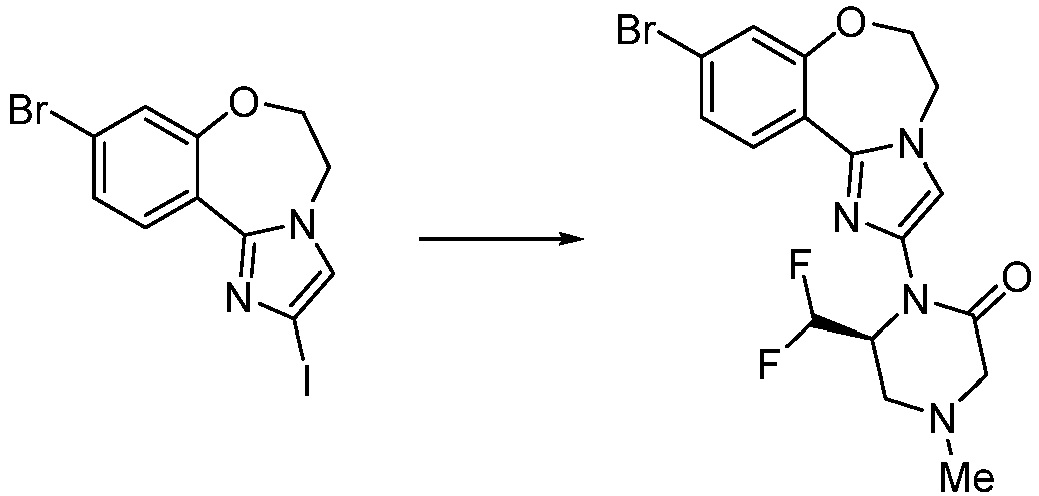
- 10-Bromo-2-iodo-6,7-dihydro-5H-benzo[b]imidazo[2,1-d][1,5]oxazocine (71 mg, 0.18mmol), (S)-6-(difluoromethyl)-4-methylpiperazin-2-one (30 mg, 0.18 mmol), (1R,2R)-N1,N2-dimethylcyclohexane-1,2-diamine (7 mg, 0.04 mmol), cuprous iodide (10 mg, 0.07 mmol) and potassium carbonate (51 mg, 0.37 mmol) were mixed in 1,4-dioxane (4 mL). The reaction system was purged with nitrogen three times, and reacted at 125°C for 5 hours. The reaction solution was cooled to room temperature, and 15% ammonia was added. The reaction solution was stirred for 5 minutes and extracted with EtOAc three times. The organic phases were combined, washed with saturated aqueous sodium chloride solution, dried over anhydrous sodium sulfate, and concentrated under reduced pressure to remove the organic solvent. The residue was subjected to column chromatography to obtain the title compound (S)-1-(9-bromo-5,6-dihydrobenzo[f]imidazo[1,2-d][1,4]oxazepin-2-yl)-6-(difluorometh yl)-4-methylpiperazin-2-one (63 mg, 82%).
- MS m/z (ESI): 427.1 [M+H]+.
-

- (S)-1-(9-Bromo-5,6-dihydrobenzo[f]imidazo[1,2-d][1,4]oxazepin-2-yl)-6-(difluoro methyl)-4-methylpiperazin-2-one (63 mg, 0.15 mmol), L-alanine (53 mg, 0.6 mmol), cuprous iodide (11 mg, 0.06 mmol) and potassium phosphate (191 mg, 0.9 mmol) were mixed in dimethyl sulfoxide (3 mL). The reaction system was purged with nitrogen three times, and reacted at 105°C for 2 hours. The reaction solution was cooled to room temperature, ammonium chloride (49 mg, 0.9 mmol) and N,N-diisopropylethylamine (290 mg, 2.25 mmol) were added, and the reaction solution was stirred for 5 minutes. O-(7-azabenzotriazol-1-yl)-N,N,N',N'-tetramethylurea hexafluorophosphate (513 mg, 1.35 mmol) was added, and the reaction solution was stirred at room temperature for 1 hour. The reaction solution was filtered, saturated aqueous sodium bicarbonate solution was added to the filtrate, which was then extracted with ethyl acetate three times. The organic phases were combined, dried over anhydrous sodium sulfate, and concentrated under reduced pressure to remove the organic solvent. The residue was subjected to column chromatography to obtain the title compound (S)-2-((2-((S)-2-(difluoromethyl)-4-methyl-6-oxopiperazin-1-yl)-5,6-dihydrobenzo[f]im idazo[1,2-d][1,4]oxazepin-9-yl)amino)propanamide (4.6 mg, 7%).
- 1H NMR (400 MHz, CD3OD) δ = 1.46 (d, J = 7.0, 3H), 2.36 (s, 3H), 2.76-2.81 (m, 1H), 3.02 (s, 1H), 3.15-3.21 (m, 1H), 3.50-3.55 (m, 1H), 3.79-3.85 (m, 1H), 4.30-4.35 (m, 2H), 4.38-4.42 (m, 2H), 4.72-4.79 (m, 1H), 6.07-6.36 (m, 1H), 6.15-6.19 (m, 1H), 6.40-6.46 (m, 1H), 7.26 (s, 1H), 8.02 (d, J = 8.8, 1H);
- MS m/z (ESI): 435.1 [M+H]+.
-

- (S)-2-((2-((S)-2-(Difluoromethyl)-6-oxopiperazin-1-yl)-5,6-dihydrobenzo[f]imidaz o[1,2-d][1,4]oxazepin-9-yl)amino)propanamide was prepared by referring to the method of Example 69.
- MS m/z (ESI): 421.2 [M+H]+.
-

- (S)-2-((2-((S)-2-(Difluoromethyl)-4-oxooxazolidin-3-yl)-5,6-dihydrobenzo[f]imida zo[1,2-d][1,4]oxazepin-9-yl)amino)propanamide was prepared by referring to the method of Example 1.
- MS m/z (ESI): 408.1 [M+H]+.
-

- (S)-2-((2-((S)-4-(Chlorodifluoromethyl)-2-oxooxazolidin-3-yl)-5,6-dihydrobenzo[f ]imidazo[1,2-d][1,4]oxazepin-9-yl)amino)propanamide was prepared by referring to the method of Example 1.
- MS m/z (ESI): 442.1 [M+H]+.
-

- (2S)-2-((2-((4S)-4-(Difluoromethyl)-2-oxido-1,2,3-oxathiazolidin-3-yl)-5,6-dihydr obenzo[f]imidazo[1,2-d][1,4]oxazepin-9-yl)amino)propanamide was prepared by referring to the method of Example 1.
- MS m/z (ESI): 428.1 [M+H]+.
-

- (S)-2-((2-((S)-4-(Difluoromethyl)-2,2-dioxido-1,2,3-oxathiazolidin-3-yl)-5,6-dihyd robenzo[f]imidazo[1,2-d][1,4]oxazepin-9-yl)amino)propanamide was prepared by referring to the method of Example 1.
- MS m/z (ESI): 444.1 [M+H]+.
-

- (S)-2-((2-((S)-3-(Difluoromethyl)-1,1-dioxidoisothiazolidin-2-yl)-5,6-dihydrobenz o[f]imidazo[1,2-d][1,4]oxazepin-9-yl)amino)propanamide was prepared by referring to the method of Example 1.
- MS m/z (ESI): 442.1 [M+H]+.
-
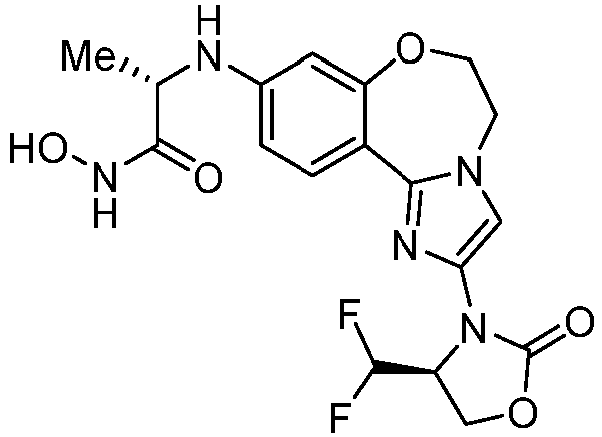
- (S)-2-((2-((S)-4-(Difluoromethyl)-2-oxooxazolidin-3-yl)-5,6-dihydrobenzo[f]imida zo[1,2-d][1,4]oxazepin-9-yl)amino)-N-hydroxypropanamide was prepared by referring to the method of Example 1.
- 1H NMR (400 MHz, CD3OD): δ 1.45 (d, J = 6.9 Hz, 3H), 3.79-3.94 (m, 1H), 4.31-4.41 (m, 4H), 4.50-4.70 (m, 3H), 6.18-6.22 (m, 1H), 6.42-6.73 (m, 2H), 7.15 (s, 1H), 8.04 (d, J = 8.8 Hz, 1H);
- MS m/z (ESI): 424.1 [M+H]+.
-

-

- Sodium methoxide (733 mg, 13.56 mmol) was added to a solution of 4-bromo-2,3-difluorobenzaldehyde (2.0 g, 9.05 mmol) in methanol (25 mL) at room temperature. The reaction solution was warmed up to 65°C and reacted for 2 hours. The reaction solution was concentrated, and the resulting residue was purified by column chromatography to obtain 4-bromo-3-fluoro-2-methoxybenzaldehyde (1.78 g, 85%).
- MS m/z (ESI): 233.0 [M+H]+.
-

- Hydrobromic acid (8.7 mL, 48%) was added to a solution of 4-bromo-3-fluoro-2-methoxybenzaldehyde (1.78 g, 7.67 mmol) in acetic acid (15 mL) at room temperature. The reaction solution was warmed up to 120°C and reacted for 16 hours. The reaction solution was cooled and concentrated under reduced pressure. Water and ethyl acetate were added to the reaction flask, and then two phases were separated. The organic phase was dried over anhydrous sodium sulfate, and concentrated under reduced pressure to remove the organic solvent. The resulting residue was purified by column chromatography to obtain 4-bromo-3-fluoro-2-hydroxybenzaldehyde (1.12 g, 67%).
- MS m/z (ESI): 219.0 [M+H]+.
-

- Aqueous glyoxal solution (40 wt.%, 3.73 g, 25.7 mmol) was added to a solution of 4-bromo-3-fluoro-2-hydroxybenzaldehyde (1.12 g, 5.14 mmol) in methanol (12 mL). In a water bath, ammonia (28 wt.%, 5.14 g, 51.4 mmol) was slowly added dropwise to the reaction solution under stirring, the addition process lasted for 30 minutes, and the temperature of the reaction solution was controlled not to exceed 40°C. The mixture was stirred at 35°C for two days, cooled and concentrated under reduced pressure to remove the organic solvent. The resulting residue was purified by column chromatography to obtain 3-bromo-2-fluoro-6-(1H-imidazol-2-yl)phenol (1.31 g, 100%).
- MS m/z (ESI): 257.0 [M+H]+.
-

- 3-Bromo-2-fluoro-6-(1H-imidazol-2-yl)phenol (1.31 g, 5.14 mmol), cesium carbonate (6.3 g, 19.53 mmol) and 1,2-dibromoethane (3.6 g, 19.12 mmol) were mixed in DMF (12 mL), and the reaction solution was stirred at 85°C overnight. The reaction solution was cooled, and diluted with ethyl acetate. The organic phase was washed with saturated brine several times, dried over sodium sulfate, and concentrated under reduced pressure to remove the organic solvent. The resulting residue was purified by column chromatography to obtain the title compound 9-bromo-8-fluoro-5,6-dihydrobenzo[f]imidazo[1,2-d][1,4]oxazepine (995 mg, 69%).
- MS m/z (ESI): 283.0 [M+H]+.
-

- NIS (2.23 g, 9.88 mmol) was added to a solution of 9-bromo-8-fluoro-5,6-dihydrobenzo[f]imidazo[1,2-d][1,4]oxazepine (995 mg, 3.53 mmol) in DMF (8 mL) at room temperature, and the reaction solution was stirred at 60°C overnight. The reaction solution was cooled, and water was added to precipitate a solid. After filtering, the solid was dissolved in ethyl acetate. The solution was washed with 1 M aqueous NaOH solution and saturated brine successively, dried over anhydrous sodium sulfate, and concentrated to obtain the title compound 9-bromo-8-fluoro-2,3-diiodo-5,6-dihydrobenzo[f]imidazo[1,2-d][1,4]oxazepine (1.79 g, 94%).
- MS m/z (ESI): 534.7 [M+H]+.
-

- EtMgBr (1.0 M, THF solution, 1.23 mL, 3.69 mmol) was slowly added dropwise to a solution of 9-bromo-8-fluoro-2,3-diiodo-5,6-dihydrobenzo[f]imidazo[1,2-d][1,4]oxazepine (1.79 g, 3.35 mmol) in THF (10 mL) at -20°C. After completion of the addition, the reaction solution was stirred at -15°C for 3 hours. The reaction solution was slowly warmed up to room temperature, saturated aqueous ammonium chloride solution was added dropwise, and the reaction solution was stirred for 15 minutes. The reaction solution was extracted with ethyl acetate several times. The organic phases were combined, washed with saturated brine, dried over sodium sulfate, and concentrated under reduced pressure to remove the organic solvent. The residue was subjected to column chromatography to obtain the title compound 9-bromo-8-fluoro-2-iodo-5,6-dihydrobenzo[f]imidazo[1,2-d][1,4]oxazepine (610 mg, 45%).
- MS m/z (ESI): 408.9 [M+H]+.
-

- 9-Bromo-8-fluoro-2-iodo-5,6-dihydrobenzo[f]imidazo[1,2-d][1,4]oxazepine (300 mg, 0.74 mmol), (S)-4-(difluoromethyl)oxazolidin-2-one (102 mg, 0.74 mmol), (1R,2R)-N1,N2-dimethylcyclohexane-1,2-diamine (42 mg, 0.30 mmol), cuprous iodide (28 mg, 0.15 mmol) and potassium carbonate (205 mg, 1.5 mmol) were mixed in 1,4-dioxane (6 mL). The reaction system was purged with nitrogen three times, and reacted at 105°C for 5 hours. The reaction solution was cooled to room temperature, and 15% ammonia was added. The solution was stirred for 5 minutes and extracted with EtOAc three times. The organic phases were combined, washed with saturated aqueous sodium chloride solution, dried over anhydrous sodium sulfate, and concentrated under reduced pressure. The residue was subjected to column chromatography to obtain the title compound (S)-4-(difluoromethyl)-3-(8-fluoro-9-iodo-5,6-dihydrobenzo[f]imidazo[1,2-d][1,4]oxaze pin-2-yl)oxazolidin-2-one (225 mg, 65%).
- MS m/z (ESI): 466.0 [M+H]+.
- (S)-2-((2-((S)-4-(Difluoromethyl)-2-oxooxazolidin-3-yl)-8-fluoro-5,6-dihydrobenz o[f]imidazo[1,2-d][1,4]oxazepin-9-yl)amino)propanamide was prepared by referring to the method of Example 1.

- 1H NMR (400 MHz, CD3OD) δ 1.50 (d, J = 7.0 Hz, 3H), 3.95-4.01 (m, 1H), 4.36 -4.41 (m, 2H), 4.47-4.53 (m, 2H), 4.57-4.67 (m, 2H), 4.93-4.98 (m, 1H), 6.37-6.42 (m, 1H), 6.44-6.73 (m, 1H), 7.20 (s, 1H),7.87-7.91 (m, 1H);
- MS m/z (ESI): 426.1 [M+H]+.
-

- (S)-2-((2-((S)-4-(Difluoromethyl)-2-oxooxazolidin-3-yl)-11-fluoro-5,6-dihydroben zo[f]imidazo[1,2-d][1,4]oxazepin-9-yl)amino)propanamide was prepared by referring to the method of Example 1.
- 1H NMR (400 MHz, CD3OD) δ 1.46 (d, J = 4.0 Hz, 3H), 3.84 (m, 1H), 4.24 (m, 2H), 4.49 (m, 2H), 4.60 (m, 3H), 6.19 (s, 1H), 6.28 (d, J = 8.0 Hz, 1H), 6.49 (t, J = 56 Hz, 1H), 7.30 (s, 1H);
- MS m/z (ESI): 426.1 [M+H]+.
-

- (S)-2-((2-((S)-4-(Difluoromethyl)-2-oxooxazolidin-3-yl)-10-fluoro-5,6-dihydroben zo[f]imidazo[1,2-d][1,4]oxazepin-9-yl)amino)propanamide was prepared by referring to the method of Example 1.
- 1H NMR (400 MHz, CD3OD): δ 1.52 (d, J = 6.8 Hz, 3H), 3.86-3.96 (m, 1H), 4.30-4.42 (m, 4H), 4.60-4.69 (m, 3H), 4.91-5.00 (m, 1H), 6.19-6.25 (m, 1H), 6.46-6.76 (m, 1H), 7.18 (s, 1H), 8.04 (d, J = 13.4 Hz, 1H);
- MS m/z (ESI): 426.1 [M+H]+.
-

- (S)-3-(9-(4-Amino-5-methyl-1H-imidazol-1-yl)-5,6-dihydrobenzo[f]imidazo[1,2-d ][1,4]oxazepin-2-yl)-4-(difluoromethyl)oxazolidin-2-one was prepared by referring to the method of Example 1.
- MS m/z (ESI): 417.1 [M+H]+.
-

- (S)-2-((2-((S)-4-(Difluoromethyl)-2-oxooxazolidin-3-yl)-8-methyl-5,6-dihydroben zo[f]imidazo[1,2-d][1,4]oxazepin-9-yl)amino)propanamide was prepared by referring to the method of Example 1.
- 1H NMR (400 MHz, CD3OD) δ 1.51 (d, J = 6.9 Hz, 3H), 2.15 (s, 3H), 3.99-4.02 (m, 1H), 4.33-4.37 (m, 2H), 4.43-4.47 (m, 2H), 4.55-4.68 (m, 2H), 4.93-4.97 (m, 1H), 6.36 (d, J = 8.9 Hz, 1H), 6.43-6.71 (m, 1H), 7.19 (s, 1H),7.94 (d, J = 8.8 Hz, 1H);
- MS m/z (ESI): 422.1 [M+H]+.
-

- (S)-2-((2-((S)-4-(Difluoromethyl)-2-oxooxazolidin-3-yl)-11-methyl-5,6-dihydrobe nzo[f]imidazo[1,2-d][1,4]oxazepin-9-yl)amino)propanamide was prepared by referring to the method of Example 1.
- MS m/z (ESI): 422.1 [M+H]+.
-

- (S)-2-((2-((S)-4-(Difluoromethyl)-2-oxooxazolidin-3-yl)-10-methyl-5,6-dihydrobe nzo[f]imidazo[1,2-d][1,4]oxazepin-9-yl)amino)propanamide was prepared by referring to the method of Example 1.
- 1H NMR (400 MHz, CD3OD): δ 1.52 (d, J = 6.9 Hz, 3H), 2.19 (s, 3H), 3.85-3.93 (m, 1H), 4.25-4.36 (m, 4H), 4.55-4.67 (m, 2H), 4.92-4.96 (m, 1H), 6.09 (s, 1H), 6.43-6.71 (m, 1H), 7.12 (s, 1H), 7.90 (s, 1H);
- MS m/z (ESI): 422.1 [M+H]+.
-

- (S)-2-((2-((S)-4-(Difluoromethyl)-2-oxooxazolidin-3-yl)-8-methoxy-5,6-dihydrobe nzo[f]imidazo[1,2-d][1,4]oxazepin-9-yl)amino)propanamide was prepared by referring to the method of Example 1.
- MS m/z (ESI): 438.1 [M+H]+.
-

- (S)-2-((2-((S)-4-(Difluoromethyl)-2-oxooxazolidin-3-yl)-11-methoxy-5,6-dihydrob enzo[f]imidazo[1,2-d][1,4]oxazepin-9-yl)amino)propanamide was prepared by referring to the method of Example 1.
- MS m/z (ESI): 438.1 [M+H]+.
-

- (S)-2-((2-((S)-4-(Difluoromethyl)-2-oxooxazolidin-3-yl)-10-methoxy-5,6-dihydrob enzo[f]imidazo[1,2-d][1,4]oxazepin-9-yl)amino)propanamide was prepared by referring to the method of Example 1.
- MS m/z (ESI): 438.1 [M+H]+.
-

- (S)-2-((8-Cyano-2-((S)-4-(difluoromethyl)-2-oxooxazolidin-3-yl)-5,6-dihydrobenz o[f]imidazo[1,2-d][1,4]oxazepin-9-yl)amino)propanamide was prepared by referring to the method of Example 1.
- MS m/z (ESI): 433.1 [M+H]+.
-

- (S)-2-((11-Cyano-2-((S)-4-(difluoromethyl)-2-oxooxazolidin-3-yl)-5,6-dihydroben zo[f]imidazo[1,2-d][1,4]oxazepin-9-yl)amino)propanamide was prepared by referring to the method of Example 1.
- MS m/z (ESI): 433.1 [M+H]+.
-

- (S)-2-((10-Cyano-2-((S)-4-(difluoromethyl)-2-oxooxazolidin-3-yl)-5,6-dihydroben zo[f]imidazo[1,2-d][1,4]oxazepin-9-yl)amino)propanamide was prepared by referring to the method of Example 1.
- MS m/z (ESI): 433.1 [M+H]+.
-

- (S)-2-((2-((S)-4-(Difluoromethyl)-2-oxooxazolidin-3-yl)-5,6-dihydrobenzo[f]imida zo[1,2-d][1,4]oxazepin-9-yl)amino)-3-methoxypropanamide was prepared by referring to the method of Example 1.
- 1H NMR (400 MHz, CD3OD) δ 3.39 (s, 3H), 3.67-3.76 (m, 2H), 3.94-3.98 (m, 1H), 4.30-4.34 (m, 2H), 4.37-4.41 (m, 2H), 4.57-4.66 (m, 2H), 4.91-4.96 (m, 1H), 6.21-6.25 (m, 1H), 6.43-6.46 (m, 1H), 6.48-6.73 (m, 1H), 7.15 (s, 1H), 8.06 (d, J = 8.8 Hz, 1H);
- MS m/z (ESI): 438.2 [M+H]+.
-

- (2S,3R)-2-((2-((S)-4-(Difluoromethyl)-2-oxooxazolidin-3-yl)-5,6-dihydrobenzo[f]i midazo[1,2-d][1,4]oxazepin-9-yl)amino)-3-methoxybutanamide was prepared by referring to the method of Example 1.
- 1H NMR (400 MHz, CD3OD): δ 1.23-1.27 (d, J = 6.9 Hz, 3H), 3.39 (s, 3H), 3.75-3.80 (m, 1H), 3.88-3.93 (m, 1H), 4.29-4.43 (m, 4H), 4.56-4.68 (m, 2H), 4.89-4.98 (m, 1H), 6.22-6.25 (m, 1H), 6.43-6.74 (m, 2H), 7.15 (s, 1H), 8.03-8.08 (d, J = 8.8 Hz, 1H);
- MS m/z (ESI): 452.2 [M+H]+.
-

- (2S,3S)-2-((2-((S)-4-(Difluoromethyl)-2-oxooxazolidin-3-yl)-5,6-dihydrobenzo[f]i midazo[1,2-d][1,4]oxazepin-9-yl)amino)-3-methoxybutanamide was prepared by referring to the method of Example 1.
- MS m/z (ESI): 452.2 [M+H]+.
-
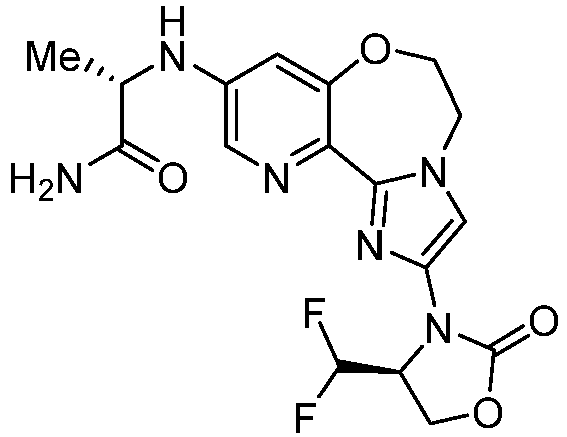
- (S)-2-((2-((S)-4-(Difluoromethyl)-2-oxooxazolidin-3-yl)-5,6-dihydroimidazo[1,2-d ]pyrido[2,3-f][1,4]oxazepin-9-yl)amino)propanamide was prepared by referring to the method of Example 1.
- MS m/z (ESI): 409.2 [M+H]+.
-

- (S)-2-((2-((S)-4-(Difluoromethyl)-2-oxooxazolidin-3-yl)-5,6-dihydroimidazo[1,2-d ]pyrido[3,4-f][1,4]oxazepin-9-yl)amino)propanamide was prepared by referring to the method of Example 1.
- MS m/z (ESI): 409.2 [M+H]+.
-

- (S)-2-((2-((S)-4-(Difluoromethyl)-2-oxooxazolidin-3-yl)-5,6-dihydroimidazo[1,2-d ]pyrido[3,2-f][1,4]oxazepin-9-yl)amino)propanamide was prepared by referring to the method of Example 1.
- MS m/z (ESI): 409.2 [M+H]+.
-

- (S)-2-((2-((S)-4-(Difluoromethyl)-2-oxooxazolidin-3-yl)-5,6-dihydrobenzo[f][1,2,4 ]triazolo[1,5-d][1,4]oxazepin-9-yl)amino)propanamide was prepared by referring to the method of Example 1.
- MS m/z (ESI): 409.2 [M+H]+.
-

- (S)-2-((2-((S)-2-(Difluoromethyl)-5-oxopyrrolidin-1-yl)-5,6-dihydrobenzo[f]imida zo[1,2-d][1,4]oxazepin-9-yl)amino)propanamide was prepared by referring to the method of Example 1.
- 1H NMR (400 MHz, DMSO-d6) δ 1.30 (d, J = 8.0 Hz, 3H), 2.20-2.45 (m, 3H), 3.31 (d, J = 8.0 Hz, 1H), 3.76 (t, J = 7.6 Hz, 1H), 4.32-4.36 (m, 4H), 4.69-4.78 (m, 1H), 6.08 (s, 1H), 6.15 (d, J = 8.0 Hz, 1H), 6.41 (d, J = 8.0 Hz, 1H), 6.66 (t, J = 56 Hz, 1H), 7.00 (s, 1H), 7.38 (d, J = 8.0 Hz, 1H), 7.40 (s, 1H), 8.00 (d, J = 8.0 Hz, 1H);
- MS m/z (ESI): 406.2 [M+H]+.
-

- (S)-2-((2-((S)-7-(Difluoromethyl)-2,5-dioxa-8-azaspiro[3.4]octan-8-yl)-5,6-dihydr obenzo[f]imidazo[1,2-d][1,4]oxazepin-9-yl)amino)propanamide was prepared by referring to the method of Example 1.
- MS m/z (ESI): 436.2 [M+H]+.
-

- (S)-2-((2-(N-((S)-2,2-Difluoro-1-(oxetan-3-yl)ethyl)acetamido)-5,6-dihydrobenzo[ f]imidazo[1,2-d][1,4]oxazepin-9-yl)amino)propanamide was prepared by referring to the method of Example 1.
- MS m/z (ESI): 450.2 [M+H]+.
-

- (S)-N-(9-((1-Amino-1-oxopropan-2-yl)amino)-5,6-dihydrobenzo[f]imidazo[1,2-d][ 1,4]oxazepin-2-yl)-N-(2,2-difluoroethyl)oxetane-3-carboxamide was prepared by referring to the method of Example 1.
- MS m/z (ESI): 436.2 [M+H]+.
-
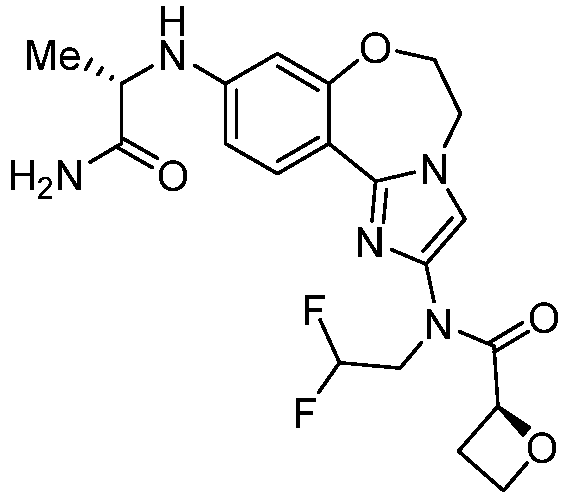
- (S)-N-(9-(((S)-1-Amino-1-oxopropan-2-yl)amino)-5,6-dihydrobenzo[f]imidazo[1,2 -d][1,4]oxazepin-2-yl)-N-(2,2-difluoroethyl)oxetane-2-carboxamide was prepared by referring to the method of Example 1.
- MS m/z (ESI): 436.2 [M+H]+.
-
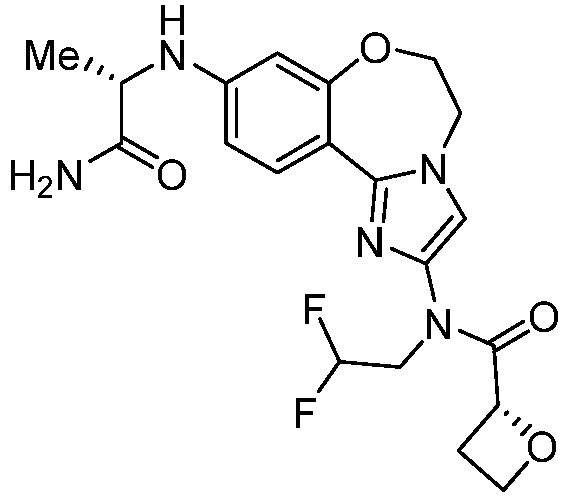
- (R)-N-(9-(((S)-1-Amino-1-oxopropan-2-yl)amino)-5,6-dihydrobenzo[f]imidazo[1, 2-d][1,4]oxazepin-2-yl)-N-(2,2-difluoroethyl)oxetane-2-carboxamide was prepared by referring to the method of Example 1.
- MS m/z (ESI): 436.2 [M+H]+.
-

- (S)-2-((2-(N-(2,2-Difluoroethyl)-2-methoxyacetamido)-5,6-dihydrobenzo[f]imidaz o[1,2-d][1,4]oxazepin-9-yl)amino)propanamide was prepared by referring to the method of Example 1.
- MS m/z (ESI): 424.2 [M+H]+.
-

- (S)-2-((2-((3S,5S)-5-(Difluoromethyl)-3-methoxy-2-oxopyrrolidin-1-yl)-5,6-dihyd robenzo[f]imidazo[1,2-d][1,4]oxazepin-9-yl)amino)propanamide was prepared by referring to the method of Example 1.
- 1H NMR (400 MHz, CD3OD) δ 1.46 (d, J = 7.0 Hz, 3H), 2.10-2.20 (m, 1H), 2.74-2.84 (m, 1H), 3.57 (s, 3H), 3.81 (q, J = 7.0 Hz, 1H), 4.25-4.40 (m, 5H), 4.71-4.84 (m, 1H), 6.13-6.18 (m, 1H), 6.37-6.70 (m, 2H), 7.38 (s, 1H), 8.04 (d, J = 8.8 Hz, 1H);
- MS m/z (ESI): 436.2 [M+H]+.
-

- (S)-2-((2-((3R,5S)-5-(Difluoromethyl)-3-methoxy-2-oxopyrrolidin-1-yl)-5,6-dihyd robenzo[f]imidazo[1,2-d][1,4]oxazepin-9-yl)amino)propanamide was prepared by referring to the method of Example 1.
- MS m/z (ESI): 436.2 [M+H]+.
-

- (1S,5R)-2-(2-((S)-4-(Difluoromethyl)-2-oxooxazolidin-3-yl)-5,6-dihydrobenzo[f]i midazo[1,2-d][1,4]oxazepin-9-yl)-2-azabicyclo[3 .1.0]hexane-1 -carboxamide was prepared by referring to the method of Example 1.
- MS m/z (ESI): 446.2 [M+H]+.
-

- (S)-2-((2-((S)-4-(Difluoromethyl)-2-oxooxazolidin-3-yl)-5,6-dihydrobenzo[f]imida zo[1,2-d][1,4]oxazepin-9-yl)amino)-3-hydroxypropanamide was prepared by referring to the method of Example 1.
- 1H NMR (400 MHz, CD3OD) δ 3.87 (s, 2H), 4.34 (d, J = 4.3 Hz, 2H), 4.37-4.43 (m, 2H), 4.62 (m, 4H), 6.23 (d, J = 2.6 Hz, 1H), 6.41-6.62 (m, 2H), 7.16 (s, 1H), 8.06 (d, J = 8.8 Hz, 1H);
- MS m/z (ESI): 424.1[M+H]+.
-

-

- Sodium methoxide (733 mg, 13.56 mmol) was added to a solution of 4-bromo-2,3-difluorobenzaldehyde (2.0 g, 9.05 mmol) in methanol (25 mL) at room temperature. The reaction solution was warmed up to 65°C and reacted for 2 hours. The reaction solution was concentrated, and the resulting residue was purified by column chromatography to obtain 4-bromo-3-fluoro-2-methoxybenzaldehyde (1.78 g, 85%).
- MS m/z (ESI): 233.0 [M+H]+.
-

- Hydrobromic acid (8.7 mL, 48%) was added to a solution of 4-bromo-3-fluoro-2-methoxybenzaldehyde (1.78 g, 7.67 mmol) in acetic acid (15 mL) at room temperature. The reaction solution was warmed up to 120°C and reacted for 16 hours. The reaction solution was cooled and concentrated under reduced pressure. Water and ethyl acetate were added to the reaction flask, and then two phases were separated. The organic phase was dried over anhydrous sodium sulfate, and concentrated under reduced pressure to remove the organic solvent. The residue was subjected to column chromatography to obtain 4-bromo-3-fluoro-2-hydroxybenzaldehyde (1.12 g, 67%).
- MS m/z (ESI): 219.0 [M+H]+.
-

- Aqueous glyoxal solution (40 wt.%, 3.73 g, 25.7 mmol) was added to a solution of 4-bromo-3-fluoro-2-hydroxybenzaldehyde (1.12 g, 5.14 mmol) in methanol (12 mL). In a water bath, ammonia (28 wt.%, 5.14 g, 51.4 mmol) was slowly added dropwise to the reaction solution under stirring, the addition process lasted for 30 minutes, and the temperature of the reaction solution was controlled not to exceed 40°C. The mixture was stirred at 35°C for two days, cooled and concentrated under reduced pressure to remove the organic solvent. The resulting residue was purified by column chromatography to obtain 3-bromo-2-fluoro-6-(1H-imidazol-2-yl)phenol (1.31 g, 100%).
- MS m/z (ESI): 257.0 [M+H]+.
-

- 3-Bromo-2-fluoro-6-(1H-imidazol-2-yl)phenol (1.31 g, 5.14 mmol), cesium carbonate (6.3 g, 19.53 mmol) and 1,2-dibromoethane (3.6 g, 19.12 mmol) were mixed in DMF (12 mL), and the reaction solution was stirred at 85°C overnight. The reaction solution was cooled, and diluted with ethyl acetate. The organic phase was washed with saturated brine several times, dried over anhydrous sodium sulfate, and concentrated under reduced pressure to remove the organic solvent. The resulting residue was purified by column chromatography to obtain the title compound 9-bromo-8-fluoro-5,6-dihydrobenzo[f]imidazo[1,2-d][1,4]oxazepine (995 mg, 69%).
- MS m/z (ESI): 283.0 [M+H]+.
-

- NIS (2.23 g, 9.88 mmol) was added to a solution of 9-bromo-8-fluoro-5,6-dihydrobenzo[f]imidazo[1,2-d][1,4]oxazepine (995 mg, 3.53 mmol) in DMF (8 mL) at room temperature, and the reaction solution was stirred at 60°C overnight. The reaction solution was cooled, and water was added to precipitate a solid. After filtering, the solid was dissolved in ethyl acetate. The solution was washed with 1 M NaOH aqueous solution and saturated brine successively, dried over anhydrous sodium sulfate, and concentrated to obtain the title compound 9-bromo-8-fluoro-2,3-diiodo-5,6-dihydrobenzo[f]imidazo[1,2-d][1,4]oxazepine (1.79 g, 94%).
- MS m/z (ESI): 534.7 [M+H]+.
-

- EtMgBr (1.0 M, THF solution, 1.23 mL, 3.69 mmol) was slowly added dropwise to a solution of 9-bromo-8-fluoro-2,3-diiodo-5,6-dihydrobenzo[f]imidazo[1,2-d][1,4]oxazepine (1.79 g, 3.35 mmol) in THF (10 mL) at -20°C. After completion of the addition, the reaction solution was stirred at -15°C for 3 hours. The reaction solution was slowly warmed up to room temperature, and saturated aqueous ammonium chloride solution was added dropwise. The reaction solution was stirred for 15 minutes, and extracted with ethyl acetate several times. The organic phases were combined, washed with saturated brine, dried over anhydrous sodium sulfate, and concentrated under reduced pressure to remove the organic solvent. The residue was subjected to column chromatography to obtain the title compound 9-bromo-8-fluoro-2-iodo-5,6-dihydrobenzo[f]imidazo[1,2-d][1,4]oxazepine (610 mg, 45%).
- MS m/z (ESI): 408.9 [M+H]+.
-

- 9-Bromo-8-fluoro-2-iodo-5,6-dihydrobenzo[f]imidazo[1,2-d][1,4]oxazepine (300 mg, 0.74 mmol), (S)-4-(difluoromethyl)oxazolidin-2-one (102 mg, 0.74 mmol), (1R,2R)-N1,N2-dimethylcyclohexane-1,2-diamine (42 mg, 0.30 mmol), cuprous iodide (28 mg, 0.15 mmol) and potassium carbonate (205 mg, 1.5 mmol) were mixed in 1,4-dioxane (6 mL). The reaction system was purged with nitrogen three times, and reacted at 105°C for 5 hours. The reaction solution was cooled to room temperature, and 15% ammonia was added. The reaction solution was stirred for 5 minutes and extracted with EtOAc three times. The organic phases were combined, washed with saturated aqueous sodium chloride solution, dried over anhydrous sodium sulfate, and concentrated under reduced pressure. The residue was subjected to column chromatography to obtain the title compound (S)-4-(difluoromethyl)-3-(8-fluoro-9-iodo-5,6-dihydrobenzo[f]imidazo[1,2-d][1,4]oxaze pin-2-yl)oxazolidin-2-one (225 mg, 65%).
- MS m/z (ESI): 466.0 [M+H]+.
-

- Lawesson's reagent (1.92 g, 4.73 mmol) was added to a solution of (S)-4-(difluoromethyl)-3-(8-fluoro-9-iodo-5,6-dihydrobenzo[f]imidazo[1,2-d][1,4]oxaze pin-2-yl)oxazolidin-2-one (220 mg, 0.47 mmol) in toluene (20 mL). The reaction solution was warmed up to 145°C and reacted for 6 hours. The reaction solution was cooled to room temperature and filtered, and the filter cake was washed with EtOAc (20 mL). The filtrate was dried over anhydrous sodium sulfate, and concentrated under reduced pressure. The residue was subjected to column chromatography to obtain the title compound (S)-3-(9-bromo-8-fluoro-5,6-dihydrobenzo[f]imidazo[1,2-d][1,4]oxazepin-2-yl)-4-(diflu oromethyl)oxazolidine-2-thione (105 mg, 46%).
- MS m/z (ESI): 482.1[M+H]+.
-

- Dichloro(p-cymene)ruthenium(II) dimer (27 mg, 0.045 mmol) and 2-bicyclohexylphosphino-2',6'-dimethoxybiphenyl (27 mg, 0.065 mmol) were added to a solution of (S)-3-(9-bromo-8-fluoro-5,6-dihydrobenzo[f]imidazo[1,2-d][1,4]oxazepin-2-yl)-4-(diflu oromethyl)oxazolidine-2-thione (105 mg, 0.22 mmol) in toluene (3 mL). The reaction solution was reacted under air at 115°C for 16 hours. The reaction solution was cooled to room temperature, and diluted with EtOAc. The organic phase was washed with saturated aqueous sodium chloride solution, dried over anhydrous sodium sulfate, and concentrated under reduced pressure. The residue was subjected to column chromatography to obtain the title compound (R)-4-(difluoromethyl)-3-(8-fluoro-9-iodo-5,6-dihydrobenzo[f]imidazo[1,2-d][1,4]oxaz epin-2-yl)thiazolidin-2-one (55 mg, 52%).
- MS m/z (ESI): 482.1 [M+H]+.
-

- (R)-4-(Difluoromethyl)-3-(8-fluoro-9-iodo-5,6-dihydrobenzo[f]imidazo[1,2-d] [1,4] oxazepin-2-yl)thiazolidin-2-one (40 mg, 0.083 mmol), L-alanine (15 mg, 0.17 mmol), cuprous iodide (6.3 mg, 0.033 mmol) and potassium phosphate (53 mg, 0.25 mmol) were mixed in dimethyl sulfoxide (3 mL). The reaction system was purged with nitrogen three times, and reacted at 125°C for 1.5 hours. The reaction solution was cooled to room temperature, ammonium chloride (27 mg, 0.5 mmol) and DMAP (161 mg, 1.25 mmol) were added, and the reaction solution was stirred for 5 minutes. O-(7-azabenzotriazol-1-yl)-N,N,N',N'-tetramethylurea hexafluorophosphate (284 mg, 0.75 mmol) was added, and the reaction solution was stirred at room temperature for 2 hours. The reaction solution was filtered, saturated aqueous sodium bicarbonate solution was added to the filtrate, which was then extracted with ethyl acetate three times. The organic phases were combined, dried over anhydrous sodium sulfate, and concentrated under reduced pressure. The residue was subjected to column chromatography to obtain the title compound (S)-2-((2-((R)-4-(difluoromethyl)-2-oxothiazolidin-3-yl)-8-fluoro-5,6-dihydrobenzo[f]i midazo[1,2-d][1,4]oxazepin-9-yl)amino)propanamide (7.9 mg, 22%).
- 1H NMR (400 MHz, CD3OD) δ 1.49 (d, J = 7.0 Hz, 3H), 3.54-3.60 (m, 1H), 3.76-3.93 (m, 1H), 3.95-4.00 (m, 1H), 4.36-4.40 (m, 2H), 4.47-4.52 (m, 2H), 5.10-5.20 (m, 1H), 6.32-6.62 (m, 2H), 7.32 (s, 1H), 7.85-7.91 (m, 1H);
- MS m/z (ESI): 442.1 [M+H]+.
-

- (S)-2-((2-((R)-4-(Difluoromethyl)-2-oxothiazolidin-3-yl)-8-fluoro-5,6-dihydrobenz o[f]imidazo[1,2-d][1,4]oxazepin-9-yl)amino)-3-methoxypropanamide was prepared by referring to Example 108.
- 1H NMR (400 MHz, CD3OD) δ 3.40 (s, 3H), 3.53-3.60 (m, 1H), 3.69-3.83 (m, 3H), 4.06-4.13 (m, 1H), 4.35-4.41 (m, 2H), 4.47-4.52 (m, 2H), 5.10-5.21 (m, 1H), 6.30-6.60 (m, 2H), 7.32 (s, 1H), 7.89 (d, J = 8.5 Hz, 1H);
- MS m/z (ESI): 472.1 [M+H]+.
-

-

- (R)-3-(9-Bromo-5,6-dihydrobenzo[f]imidazo[1,2-d][1,4]oxazepin-2-yl)-4-(difluoro methyl)thiazolidin-2-one (26 mg, 0.062 mmol), O-methyl-L-serine (22 mg, 0.18 mmol), cuprous iodide (6.0 mg, 0.03 mmol) and potassium phosphate (40 mg, 0.19 mmol) were mixed in dimethyl sulfoxide (3 mL). The reaction system was purged with nitrogen three times, and reacted at 100°C for 12 hours. The reaction solution was cooled to room temperature, ammonium chloride (20 mg, 0.37 mmol) and triethylamine (95 mg, 0.94 mmol) were added, and the reaction solution was stirred for 5 minutes. O-(7-azabenzotriazol-1-yl)-N,N,N',N'-tetramethylurea hexafluorophosphate (212 mg, 0.56 mmol) was added, and the reaction solution was stirred at room temperature for 2 hours. The reaction solution was filtered, saturated aqueous sodium bicarbonate solution was added to the filtrate, which was then extracted with ethyl acetate three times. The organic phases were combined, dried over anhydrous sodium sulfate, and concentrated under reduced pressure to remove the organic solvent. The residue was subjected to column chromatography to obtain the title compound (S)-2-((2-((R)-4-(difluoromethyl)-2-oxothiazolidin-3-yl)-5,6-dihydrobenzo[f]imidazo[1, 2-d][1,4]oxazepin-9-yl)amino)-3-methoxypropanamide (13 mg, 46%).
- 1H NMR (400 MHz, CD3OD) δ 3.39 (s, 3H), 3.53-3.57 (m, 1H), 3.62-3.76 (m, 3H), 3.93-3.98 (m, 1H), 4.16-4.30 (m, 4H), 5.06-5.16 (m, 1H), 6.21-6.23 (m, 1H), 6.28-6.52 (m, 2H), 7.23 (s, 1H), 8.02 (d, J = 8.8 Hz, 1H);
- MS m/z (ESI): 454.1 [M+H]+.
-

- (S)-1-(2-((R)-4-(Difluoromethyl)-2-oxothiazolidin-3-yl)-5,6-dihydrobenzo[f]imida zo[1,2-d][1,4]oxazepin-9-yl)pyrrolidine-2-carboxamide was prepared by referring to the method of Example 51.
- 1H NMR (400 MHz, DMSO-d6 ) δ 1.83-1.92 (m, 2H), 2.09-2.15 (m, 1H), 3.72-3.81 (m, 4H), 4.25-4.32 (m, 4H), 5.07-5.15 (m, 1H), 5.93-5.97 (m, 1H), 6.22-6.28 (m, 1H), 6.35-6.65 (s, 1H), 7.00 (s, 1H), 7.26 (s, 1H), 7.35 (s, 1H), 7.99 (d, J = 8.6 Hz, 1H);
- MS m/z (ESI): 450.1 [M+H]+.
-
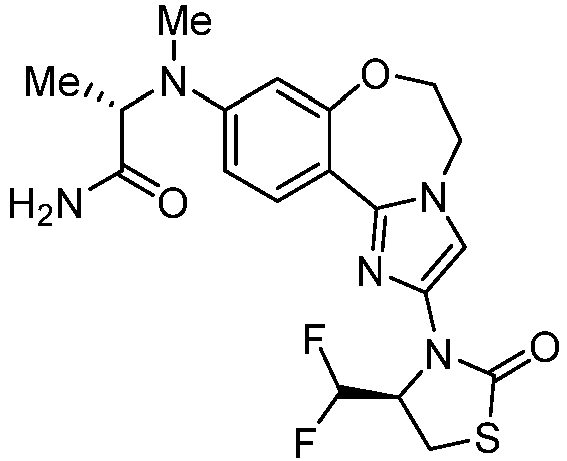
- (S)-2-((2-((R)-4-(Difluoromethyl)-2-oxothiazolidin-3-yl)-5,6-dihydrobenzo[f]imid azo[1,2-d][1,4]oxazepin-9-yl)(methyl)amino)propanamide was prepared by referring to the method of Example 51.
- 1H NMR (400 MHz, CD3OD) δ 1.40 (d, J = 7.0 Hz, 3H), 2.90 (s, 3H), 3.53-3.58 (m, 1H), 3.75-3.80 (m, 1H), 4.30-4.44 (m, 4H), 4.46-4.51 (m, 1H), 5.08-5.18 (m, 1H), 6.22-6.41 (m, 2H), 6.51-6.73 (m, 1H),7.28 (s, 1H), 8.11 (d, J = 9.0 Hz, 1H);
- MS m/z (ESI): 438.1[M+H]+.
-

- (S)-2-((2-((R)-5-(Methoxymethyl)-2-oxooxazolidin-3-yl)-5,6-dihydrobenzo[f]imid azo[1,2-d][1,4]oxazepin-9-yl)amino)propanamide was prepared by referring to the method of Example 1.
- 1H NMR (400 MHz, CD3OD) δ 1.48 (d, J = 7.0 Hz, 3H), 3.44 (s, 3H), 3.59-3.72 (m, 2H), 3.83 (q, J = 7.0 Hz, 1H), 3.95-4.02 (m, 6.5 Hz, 1H), 4.20 (t, J = 9.3 Hz, 1H), 4.28-4.33 (m, 2H), 4.35-4.42 (m, 2H), 4.81-4.86 (m, 1H), 6.17-6.21 (m, 1H), 6.43 (dd, J = 8.8, 2.3 Hz, 1H), 7.12 (s, 1H),8.01 (d, J = 8.8 Hz, 1H);
- MS m/z (ESI): 402.2 [M+H]+.
-

- (S)-2-((2-((R)-4-Methoxy-2-oxopyrrolidin-1-yl)-5,6-dihydrobenzo[f]imidazo[1,2-d ][1,4]oxazepin-9-yl)amino)propanamide was prepared by referring to the method of Example 1.
- 1H NMR (400 MHz, CDCl3) δ 1.52 (d, J = 6.9 Hz, 3H), 2.57-2.67 (m, 1H), 2.78-2.88 (m, 1H), 3.40 (s, 3H), 3.79-3.88 (m, 1H), 4.10-4.43 (m, 7H), 6.19 (s, 1H), 6.42 (d, J = 8.8 Hz, 1H), 7.32 (s, 1H),8.16 (d, J = 8.7 Hz, 1H);
- MS m/z (ESI): 386.2 [M+H]+.
-

- (2S)-2-((2-(4-(Cyanomethyl)-2-oxopyrrolidin-1-yl)-5,6-dihydrobenzo[f]imidazo[1, 2-d][1,4]oxazepin-9-yl)amino)propanamide was prepared by referring to the method of Example 1.
- 1H NMR (400 MHz, DMSO-d6) δ 1.30 (d, J = 6.9 Hz, 3H), 2.29 (dd, J = 16.9, 6.2 Hz, 1H), 2.70 (dd, J = 16.5, 8.0 Hz, 1H), 2.77-2.88 (m, 3H), 3.64 (dd, J = 10.8, 4.4 Hz, 1H), 3.76 (dt, J = 13.7, 6.9 Hz, 1H), 4.13 (dd, J = 10.6, 7.1 Hz, 1H), 4.33 (dd, J = 8.5, 5.8 Hz, 4H), 6.08 (d, J = 2.0 Hz, 1H), 6.12 (d, J = 7.0 Hz, 1H), 6.40 (dd, J = 8.8, 2.2 Hz, 1H), 6.99 (d, J = 0.7 Hz, 1H), 7.37 (s, 2H), 7.99 (d, J = 8.8 Hz, 1H);
- MS m/z (ESI): 395.1 [M+H]+.
-

- (2S)-2-((2-(4-Cyano-2-oxopyrrolidin-1-yl)-5,6-dihydrobenzo[f]imidazo[1,2-d][1,4] oxazepin-9-yl)amino)propanamide was prepared by referring to the method of Example 1.
- 1H NMR (400 MHz, CD3OD) δ 1.49 (d, J = 7.0 Hz, 3H), 2.88 (dd, J = 17.0, 6.7 Hz, 1H), 3.01 (dd, J = 17.0, 9.3 Hz, 1H), 3.64-3.76 (m, 1H), 3.83 (q, J = 7.1 Hz, 1H), 4.25 (dd, J = 10.8, 5.9 Hz, 1H), 4.30-4.46 (m, 5H), 6.19 (d, J = 1.8 Hz, 1H), 6.44 (dd, J = 8.8, 2.3 Hz, 1H), 7.38 (s, 1H), 7.75 (s, 1H), 8.06 (d, J = 8.8 Hz, 1H);
- MS m/z (ESI): 381.1 [M+H]+.
-

- (S)-2-((2-((S)-2-(Cyanomethyl)-5-oxopyrrolidin-1-yl)-5,6-dihydrobenzo[f]imidazo [1,2-d][1,4]oxazepin-9-yl)amino)propanamide was prepared by referring to the method of Example 1.
- 1H NMR (400 MHz, DMSO-d6) δ 1.30 (d, J = 6.8 Hz, 3H), 1.99 (t, J = 10.8 Hz, 1H), 2.42 (dd, J = 22.2, 12.2 Hz, 3H), 2.62-2.71 (m, 1H), 3.13 (dd, J = 16.8, 2.8 Hz, 1H), 3.69-3.80 (m, 1H), 4.17-4.48 (m, 4H), 4.53-4.66 (m, 1H), 6.08 (d, J = 1.7 Hz, 1H), 6.15 (d, J = 7.0 Hz, 1H), 6.40 (dd, J = 8.8, 1.8 Hz, 1H), 7.01 (s, 1H), 7.38 (s, 1H), 7.41 (s, 1H), 7.98 (d, J = 8.9 Hz, 1H);
- MS m/z (ESI): 395.2 [M+H]+.
-

- (S)-2-((2-((R)-4-(Cyanomethyl)-2-oxooxazolidin-3-yl)-5,6-dihydrobenzo[f]imidaz o[1,2-d][1,4]oxazepin-9-yl)amino)propanamide was prepared by referring to the method of Example 1.
- 1H NMR (400 MHz, DMSO-d6) δ 1.30 (d, J = 6.9 Hz, 3H), 3.14 (dd, J = 17.1, 2.4 Hz, 1H), 3.45 (dd, J = 17.1, 5.0 Hz, 1H), 3.72-3.80 (m, 1H), 4.33 (ddd, J = 13.3, 8.4, 4.7 Hz, 5H), 4.66 (t, J = 8.9 Hz, 1H), 4.77 (dt, J = 8.4, 4.9 Hz, 1H), 6.08 (d, J = 2.1 Hz, 1H), 6.17 (d, J = 7.0 Hz, 1H), 6.40 (dd, J = 8.8, 2.2 Hz, 1H), 7.02 (s, 1H), 7.20 (s, 1H), 7.39 (d, J = 1.0 Hz, 1H), 7.98 (d, J = 8.8 Hz, 1H);
- MS m/z (ESI): 397.1 [M+H]+.
-

- (S)-2-((2-((R)-4-(Cyanomethyl)-2-oxothiazolidin-3-yl)-5,6-dihydrobenzo[f]imidaz o[1,2-d][1,4]oxazepin-9-yl)amino)propanamide was prepared by referring to the method of Example 1.
- MS m/z (ESI): 436.2 [M+H]+.
-

- (S)-2-((2-((R)-4-(Cyanomethyl)-2-oxooxazolidin-3-yl)-5,6-dihydrobenzo[f]imidaz o[1,2-d][1,4]oxazepin-9-yl)amino)-3-methoxypropanamide was prepared by referring to the method of Example 1.
- 1H NMR (400 MHz, DMSO-d6) δ 3.14 (dd, J = 17.6, 2.8 Hz, 1H), 3.28 (s, 3H), 3.46 (dd, J = 17.3, 4.4 Hz, 1H), 3.56 (d, J = 5.3 Hz, 2H), 3.92-4.01 (m, 1H), 4.24-4.48 (m, 5H), 4.66 (t, J = 9.0 Hz, 1H), 4.74-4.81 (m, 1H), 6.09-6.21 (m, 2H), 6.46 (dd, J = 8.7, 1.7 Hz, 1H), 7.16 (s, 1H), 7.20 (s, 1H), 7.46 (s, 1H), 7.99 (d, J = 8.8 Hz, 1H);
- MS m/z (ESI): 427.1 [M+H]+.
-

- (S)-2-((2-((R)-4-(2-Methoxyethyl)-2-oxooxazolidin-3-yl)-5,6-dihydrobenzo[f]imid azo[1,2-d][1,4]oxazepin-9-yl)amino)propanamide was prepared by referring to Example 1.
- MS m/z (ESI): 416.1 [M+H]+.
-

- (S)-2-((2-((S)-4-(Difluoromethyl)-2-oxo-1,3-thiazinan-3-yl)-5,6-dihydrobenzo[f]i midazo[1,2-d][1,4]oxazepin-9-yl)amino)propanamide was prepared by referring to Example 51.
- MS m/z (ESI): 438.1 [M+H]+.
-

- (S)-2-((2-((S)-4-(Difluoromethyl)-2-oxo-1,3-thiazinan-3-yl)-8-fluoro-5,6-dihydrob enzo[f]imidazo[1,2-d][1,4]oxazepin-9-yl)amino)propanamide was prepared by referring to Example 51.
- MS m/z (ESI): 456.1 [M+H]+.
-

- (S)-2-((2-((S)-4-(Difluoromethyl)-2-oxo-1,3-thiazinan-3-yl)-5,6-dihydrobenzo[f]i midazo[1,2-d][1,4]oxazepin-9-yl)amino)-3-methoxypropanamide was prepared by referring to Example 51.
- MS m/z (ESI): 468.1 [M+H]+.
-

- (S)-2-((2-((S)-3-(Difluoromethyl)-5-oxomorpholino)-8-fluoro-5,6-dihydrobenzo[f] imidazo[1,2-d][1,4]oxazepin-9-yl)amino)propanamide was prepared by referring to Example 68.
- MS m/z (ESI): 440.1 [M+H]+.
-

- (S)-2-((2-((S)-3-(Difluoromethyl)-5-oxomorpholino)-5,6-dihydrobenzo[f]imidazo[ 1,2-d][1,4]oxazepin-9-yl)amino)-3-methoxypropanamide was prepared by referring to Example 68.
- MS m/z (ESI): 452.1 [M+H]+.
-

- (S)-2-((2-((S)-2-(Difluoromethyl)-4-methyl-6-oxopiperazin-1-yl)-8-fluoro-5,6-dihy drobenzo[f]imidazo[1,2-d][1,4]oxazepin-9-yl)amino)propanamide was prepared by referring to Example 69.
- MS m/z (ESI): 453.1 [M+H]+.
-

- (S)-2-((2-((S)-2-(Difluoromethyl)-4-methyl-6-oxopiperazin-1-yl)-5,6-dihydrobenz o[fJimidazo[1,2-d][1,4]oxazepin-9-yl)amino)-3-methoxypropanamide was prepared by referring to Example 69.
- MS m/z (ESI): 465.1 [M+H]+.
-

- (2S,3R)-1-(2-((S)-4-(Difluoromethyl)-2-oxooxazolidin-3-yl)-5,6-dihydrobenzo[f]i midazo[1,2-d][1,4]oxazepin-9-yl)-3-methylpyrrolidine-2-carboxamide was prepared by referring to Example 1.
- MS m/z (ESI): 448.1 [M+H]+.
- The present invention is further described below in combination with the following test examples, which are not intended to limit the scope of the present invention.
- Experimental objective: The objective of this test example is to determine the inhibitory effect of the compounds of the examples on PI3Kα/β/γ/δ kinase activity.
- Experimental instruments: Centrifuge (5810R, purchased from Eppendorf), pipette (purchased from Eppendorf or Rainin), and microplate reader (Model: SynergyH1 full-function microplate reader, purchased from BioTek, USA).
- Experimental method: Promega's ADP-Glo lipid kinase assay method (Promega#V9102) was applied in this experiment. Lipid kinase PI3Kα/β/γ/δ catalyzed the generation of ADP from ATP in the presence of the substrate PIP2: 3PS and ATP. The lipid kinase activity was characterized by measuring the ADP content in the reaction, and the half inhibitory concentration IC50 of the compound on inhibiting PI3Kα/β/γ/δ kinase activity was thus obtained.
- The specific experimental process is as follows:
The kinase reaction was carried out in a white 384-well plate (Perkin Elmer#6007299). 2 µL of the compound solution of different concentrations diluted with ddH2O containing 1% DMSO was added to each well. 2 µL of ddH2O containing 1% DMSO was added to the positive control well. 2 µL of 0.1∼2 nM PI3K kinase solution diluted with 5× kinase buffer (HEPES 250 mM, MgCl2 15 mM, NaCl 250 mM, BSA 0.05%) was added to each well. 2 µL of 5× kinase buffer was added to the negative control well. 4 µL of 50 µM substrate PIP2: 3PS (Promega#V1701) formulated with 10×Dilution buffer and ddH2O was added to all wells. Finally, 2 µL of 50~100 µM ATP solution diluted with water was added to start the reaction. After the reaction was carried out at room temperature for 90 to 120 minutes, 10 µL of ADP-Glo Reagent (containing 10 mM MgCl2) was added to each well, and reacted at room temperature for 60 minutes to remove excess ATP in the reaction. 20 µL of Kinase Detection Reagent was added to each well, and reacted at room temperature in the dark for 20 minutes. The chemiluminescence value was mearsured by the BioTek Synergy H1 microplate reader.Enzyme Name Article number Enzyme reaction concentration Enzyme reaction time ATP concentration PI3Kα Promega#V1721 0.1 nM 120 min 50 µM PI3Kβ Carna#11-102 0.4 nM 90 min 100 µM PI3Kγ Thermofisher#PV4786 0.4 nM 120 min 50 µM PI3Kδ Carna# 11-103 0.1 nM 90 min 100 µM - The percentage inhibition data of the compound-treated well was calculated through the positive control well (DMSO control well) and negative control well (no kinase added) on the plate {% inhibition rate = 100-[(test compound value - negative control value)] / (positive control value - negative control value) × 100}. The IC50 value was calculated by fitting the data of different concentrations and corresponding percentage inhibition rates to a four-parameter nonlinear logic formula with GraphPad prism.
- According to the above scheme, the compounds of the examples of the present invention showed the following biological activities in Table 1 in the PI3Kα/β/γ/δ kinase activity test.
Table 1 Example PI3Kα, IC50 (nM) PI3Kβ, IC50 (nM) PI3Kγ, IC50 (nM) PI3Kδ, IC50 (nM) Selectivity of PI3Kα vs PI3Kβ Selectivity of PI3Kα vs PI3Kγ Selectivity of PI3Kα vs PI3Kδ Example 10 7.9 >10000 1788 1398 >1266 226 177 Example 38 4 1432 447 410 358 112 103 Example 43 0.86 283 557 25 329 648 29 Example 51 0.2 168 90 49 840 450 245 Example 53 5 6190 402 373 1238 80 75 Example 54 1.2 1799 481 336 1499 401 280 Example 55 1.7 1872 363 213 1101 214 125 Example 66 9.3 4574 2076 653 492 223 70 Example 68 0.38 198 79 24 521 208 63 Example 69 2.1 3179 332 142 1514 158 68 Example 77 5.2 924 450 306 178 87 59 Example 78 5.2 2786 510 459 536 98 88 Example 97 2.1 1649 510 190 785 243 90 Example 108 2.4 472 247 194 197 103 81 Example 109 6.8 1069 1154 348 157 170 51 Example 110 1 754 376 139 754 376 139 Example 111 2.9 1227 736 125 423 254 43 Example 112 2.2 523 478 69 238 217 31 Example 117 2.5 1948 505 280 779 202 112 Example 118 1.3 190 74 50 146 57 38 Example 119 2.4 407 116 71 170 48 30 Example 120 4.7 988 530 200 210 113 43 - The above data show that the compounds of the examples of the present invention have a good activity and selectivity in inhibiting PI3Kα/β/γ/δ kinase activity.
- Experimental objective: The objective of this test example is to determine the proliferation inhibitory activity of the compounds of the examples on PI3Kα mutant cancer cells HCC1954 (H1047R), HGC-27 (E542K) and MKN1 (E545K).
- Experimental instruments: Centrifuge (5702R, purchased from Eppendorf), carbon dioxide incubator (purchased from Thermo), biological safety cabinet (purchased from Shanghai Boxun Company), pipette (purchased from Eppendorf or Rainin), and microplate reader (Model: SynergyH1 full-function microplate reader, purchased from BioTek, USA).
- Experimental method: The proliferation inhibitory effect of the compounds of the examples on PI3Kα mutant cancer cell lines HCC1954, HGC-27 and MKN1 was determined by Cell Titer-Glo method. The cell lines were cultured in RPMI 1640 medium (Gibco#22400089) containing 10% FBS (Gibco#10091148) and 1% P/S (Hyclone#SV30010) at 37°C and 5% CO2. Before the experiment, the cells were collected and counted, and then the cell density was adjusted. The cells were inoculated in a white 96-well plate (Corning#3610) at a density of 1000 to 10000 cells/well, and incubated in an incubator at 37°C, 5% CO2 overnight. The compound solution of different concentrations was added, and corresponding vehicle control was set at the same time. The cell plate was further incubated in an incubator at 37°C, 5% CO2 for 48 to 96 hours. The cell plate and its content were equilibrated to room temperature. 20 to 100 µL of Cell Titer-Glo solution (Promega#G7573) was added to each well, and the plate was shaked well and incubated at room temperature in the dark for 5 to 30 minutes. The chemiluminescence value was mearsured by the BioTek SynergyH1 microplate reader.
- The percentage inhibition data of the well treated by the compounds of the examples was calculated through the vehicle control well on the plate {% inhibition rate = 100 -(test compound value / vehicle control value) × 100}. The IC50 value was calculated by fitting the data of different concentrations and corresponding percentage inhibition rates to a four-parameter nonlinear logic formula with GraphPad prism.
- According to the above scheme, the compounds of the examples of the present invention showed the following biological activities in Table 2 in the PI3Kα mutant cancer cells HCC1954 (H1047R), HGC-27 (E542K) and MKN1 (E545K) proliferation inhibition test.
Table 2 Example HCC1954 (H1047R) IC50 (nM) MKN1 (E545K) IC50 (nM) HGC-27(E542K) IC50 (nM) Example 38 204 615 417 Example 43 112 214 169 Example 48 205 399 396 Example 51 21 60 40 Example 54 79 84 93 Example 55 160 508 325 Example 68 70 113 111 Example 69 601 584 433 Example 77 226 653 499 Example 90 222 368 531 Example 97 184 268 186 Example 108 98 118 233 Example 109 243 426 455 Example 110 57 109 137 Example 111 40 66 77 Example 112 29 42 32 Example 118 140 398 371 Example 119 134 304 358 - The above data show that the compounds of the examples of the present invention have a good activity in inhibiting PI3Kα mutant cancer cells HCC1954 (H1047R), HGC-27 (E542K) and MKN1 (E545K) proliferation.
- The objective of this study is to investigate the possible toxicity of GDC-0077 and the compound of Example 51 in SD rats after a 7-day repeatedly intragastric administration, and to compare the toxicity differences between GDC-0077 and the compound of Example 51.
-
- Test compound 1: GDC-0077
- Test compound 2: the compound of Example 51
- Name: 20% aqueous SBE-β-CD (Captisol) solution
-
- Species & strains: Sprague-Dawley (SD) rats
- Animal grade: SPF grade
- Number and sex of animals: 112 rats, half male and half female
-
- ADVIA®2120 automatic blood analyzer, which was used for blood cell counting;
- SYSMEX CA-500 blood coagulometer, which was used for the determination of coagulation function indicators;
- TBA-120FR automatic biochemical analyzer, which was used for the determination of blood biochemical indicators;
- Easylyte electrolyte analyzer, which was used for the determination of electrolyte; and
- Liquid chromatography - mass spectrometry (detector: API4000, electrospray source (ESI) positive ion mode, column: Agilent ZORBAX XDB-C18 (3.5 µm, 2.1×50 mm)), which was used for the biological analysis of plasma sample.
-
- 1) In the experiment, 112 rats (56 rats/sex) were divided into 14 groups by sex and body weight, wherein 70 rats were used for toxicology study (groups 1 to 7, 5 rats/sex/group) and 42 rats were used for toxicokinetics study (groups 8 to 14, 3 rats/sex/group).
- 2) As the vehicle control group, the animals in groups 1 and 8 were intragastrically administered 20% aqueous SBE-β-CD (Captisol) solution.
- 3) The animals in groups 2 and 9, groups 3 and 10, and groups 4 and 11 were intragastrically administered GDC-0077 at 10, 30 and 60 mg/kg, respectively.
- 4) The animals in groups 5 and 12, groups 6 and 13, and groups 7 and 14 were intragastrically administered the compound of Example 51 at 10, 30 and 60 mg/kg, respectively.
- 5) The animals were administered once a day for 7 consecutive days (the animals in groups 7 and 14 were administered for 6 consecutive days).
- 6) The administration volume was 10 mL/kg.
- 7) During the experiment, items such as clinical observation, body weight, food intake, clinicopathological indicators (blood cell count, coagulation function, blood biochemistry), toxicokinetics and the like were studied.
- 8) All animals were euthanized on Day 8 (the animals in groups 7 and 14 were euthanized after administration on Day 6).
- 9) During the experiment, gross anatomy observation was carried out on animals in groups 1 to 7, animals in group 14 and dead animals (including animals in toxicokinetics study), and histopathological examination was carried out on abnormal tissues, gastrointestinal tissues (such as colon and cecum) and immune tissues (such as thymus).
- Regarding to GDC-0077 or the compound of Example 51 at the dose of 60 mg/kg, near-dead/dead animals were found. Regarding to other doses, no dead/near-dead animals were found.
- At the dose of 30 mg/kg, the average system exposure AUC of the compound of Example 51 after the last administration (male: 11400 h*ng/mL, female: 15900 h*ng/mL) was about 2.4 to 3.8 times that of GDC-0077 at the same dose (male: 3000 h*ng/mL, female: 6510 h*ng/mL), and similar to that of GDC-0077 at the dose of 60 mg/kg after the first administration (male: 15400 h*ng/mL, female: 22800 h*ng/mL).
- At the dose of 10 mg/kg, the average system exposure AUC of the compound of Example 51 after the last administration (male: 2110 h*ng/mL, female: 3170 h*ng/mL) was about 1.4 to 2.5 times that of GDC-0077 (male: 845 h*ng/mL, female: 2250 h*ng/mL).
- Therefore, the system exposure of the compound of Example 51 was significantly higher than that of GDC-0077 at the same dose.
- GDC-0077: In the high-dose group, abnormal symptoms such as arched back, loose stools, perianal contamination and fluffy coat were observed.
- The compound of Example 51: In the middle-dose and high-dose groups, abnormal symptoms such as arched back, loose stools, perianal contamination and fluffy coat were observed.
- GDC-0077: In the middle-dose and high-dose groups, the final body weight of all animals declined, and their food intake also declined during the same period.
- The compound of Example 51: In the low-dose, middle-dose and high-dose groups, the final body weight declined, and the corresponding food intake also declined.
- GDC-0077: In each dose group, Retic decreased in both male and female animals.
- The compound of Example 51: In each dose group, Retic decreased in both male and female animals; and in 30 mg/kg group and 60 mg/kg group, Neut increased and PLT decreased in both male and female animals.
- GDC-0077: In each dose group, Glu and CHO increased in male animals; in 60 mg/kg group, AST and UREA increased in both male and female animals, A/G decreased in both male and female animals, and ALT increased in male animals; and in 30 mg/kg group, AST and UREA increased in both male and female animals, and ALT increased in female animals.
- The compound of Example 51: In 60 mg/kg group, AST, Glu and UREA increased in both male and female animals; in 30 mg/kg group, AST and UREA increased in both male and female animals, and Glu increased in male animals; and in 10 mg/kg group, AST increased in both male and female animals.
- GDC-0077: The pathological changes under the microscope mainly included atrophy of goblet cells in the cecal mucosa, increase in thymic tingible body macrophages, and erosion, bleeding and edema of gastric mucosal.
- The compound of Example 51: The pathological changes under the microscope mainly included bleeding and atrophy of glandular gastric mucosa; bleeding of cecal mucosa, atrophy of goblet cell, atrophy of colonic mucosa goblet cell; atrophy of splenic white pulp; and atrophy of thymic cortex or cortex and medulla, increase in tingible body macrophages and the like.
- The main target organs of the toxicity of GDC-0077 and the compound of Example 51 are gastrointestinal tissues (such as stomach and cecum) and immune tissues (such as thymus).
- During this experiment, the test comound GDC-0077 and the compound of Example 51 were administered intragastrically to SD rats for 7 days at a dose of 10, 30 and 60 mg/kg (once/day). The lethal dose of GDC-0077 and the compound of Example 51 is 60 mg/kg, and the maximum tolerated dose (MTD) is 30 mg/kg. At the dose of 30 mg/kg, the Cmax and AUC(0-24h) of the compound of Example 51 are significantly higher than those of GDC-0077. The tolerance of the compound of Example 51 is thus better than that of GDC-0077.
- The objective is to screen out compounds with significant efficacy and less toxic and side effects through in vivo efficacy test.
-
- 1. Biological safety cabinet (BSC-1300II A2, Shanghai Boxun Medical Biological Instrument Corp.)
- 2. Ultra-clean workbench (CJ-2F, Suzhou Fengshi Laboratory Animal Equipment Co., Ltd.)
- 3. CO2 incubator (Thermo-311)
- 4. Centrifuge (Centrifuge 5702R, Eppendorf)
- 5. Automatic cell counter (Countess II, Life)
- 6. Pipette (10-20 µL, Eppendorf)
- 7. Microscope (TS2, Nikon)
- 8. Vernier caliper (CD-6"AX, Mitutoyo, Japan)
- 9. Cell culture flask (T75/T225, Corning)
- 10. Electronic balance (CPA2202S, Sartorius)
-
- 1. RPMI-1640 medium (22400-089, Gibco)
- 2. Fetal Bovine Serum (FBS) (10091-148, Gibco)
- 3. 0.25% Trypsin (25200-056, Gibco)
- 4. Penicillin-streptomycin double antibiotics (15140-122, Gibco)
- 5. Phosphate buffered saline (PBS) (10010-023, Gibco)
- 6. Matrigel Matrix (356234, Corning)
- BALB/c nude mice, 6 to 8 weeks old, ♀, purchased from Shanghai Sippr-BK laboratory animal Co. Ltd.
-
- a. HCC1954 cells were taken from the cell bank, and resuscitated in RPMI-1640 medium (RPMI-1640 + 10% FBS + 1% SP). The resuscitated cells were placed in a cell culture flask (the cell type, date, operator's name and the like were marked on the wall of the flask), and cultured in a CO2 incubator (the temperature of the incubator was 37°C, and the CO2 concentration was 5%).
- b. Passage was carried out after the cells covered 80 to 90% of the bottom of the culture flask. After passage, the cells continued to be cultured in the CO2 incubator. This process was repeated until the number of cells met the requirement for in vivo efficacy test.
- c. The cultured cells were collected and counted with the automatic cell counter. The cells were resuspended with PBS and matrigel according to the counting results to prepare a cell suspension (density: 5×10⁷/mL), which was placed in an ice box for later use.
-
- a. Before the inoculation, the nude mice were marked with disposable universal ear tags for rats and mice.
- b. During the inoculation, the cell suspension was mixed well. 0.1 to 1 mL of cell suspension was sucked with a 1 mL syringe, the air bubbles were removed, and the syringe was placed on an ice bag for later use.
- c. The nude mouse was bound with the left hand. The position of the right back near the right shoulder of the nude mouse (inoculation site) was disinfected with 75% alcohol, and inoculation was carried out after 30 seconds.
- d. The test nude mice were subjected to inoculation successively (0.1 mL of cell suspension was inoculated to each mouse).
-
- a. According to the tumor growth, the tumor was measured on 14 to 18 days after the inoculation, and the tumor size was calculated.
Tumor volume calculation: tumor volume (mm3) = length (mm) × width (mm) × width (mm) /2 - b. According to the body weight and tumor size of the tumor-bearing mouse, grouping was carried out by a random grouping method.
- c. According to the grouping results, the test compounds were administered (administration mode: oral administration; administration dose: 10 mg/kg; administration volume: 10 mL/kg; administration frequency: once/day; administration cycle: 21 days; vehicle: 0.5% CMC/1% Tween 80).
- d. Tumor volume and body weight were measured twice a week after the administration of test compounds began.
- e. After the end of the experiment, the animals were euthanized.
- f. The data was processed with softwares such as Excel. Calculation of the tumor growth inhibition rate TGI (%) of a compound: when the tumor did not regress, TGI (%) = [(1-(average tumor volume of the treatment group at the end of the administration - average tumor volume of the treatment group at the beginning of the administration))/(average tumor volume of the vehicle control group at the end of the treatment - average tumor volume of the vehicle control group at the beginning of the treatment)]×100%. When the tumor regressed, TGI(%) = [1-( average tumor volume of the treatment group at the end of the administration - average tumor volume of the treatment group at the beginning of the administration)/ average tumor volume of the treatment group at the beginning of the administration]×100%.
-
Table 3 Groups Number of animals Administration days (days) Tumor growth inhibition rate Control 5 21 - Example 51 5 19 132% Example 54 5 21 120% Example 68 5 21 78% Example 108 5 21 96% Example 110 5 21 98% - It can be seen from the above results that the above compounds of the present application showed a good tumor growth inhibition rate.
- The pharmacokinetic assay of the preferred compounds of the examples of the present invention in mice was carried out in Balb/c male mice (Shanghai Jiesijie Laboratory Animal Co., LTD).
■ Administration mode: single intragastric administration.
■ Administration dose: 5 mg/10 ml/kg (body weight).
■ Formulation: the compound was dissolved in 0.5% CMC-Na by ultrasound to obtain a clear solution or homogeneous suspension.
■ Sampling points: 0.5, 1, 2, 4, 6, 8 and 24 hours after administration.
■ Sample process: - 1) 0.1 mL of blood was taken from the orbit, placed in a K2-EDTA tube, and centrifuged for 5 to 20 minutes at room temperature at 1000 to 3000×g to separate the plasma, which was then stored at -80°C.
- 2) 160 µL of acetonitrile was added to 40 µL of plasma sample for precipitation, and then the mixture was centrifuged for 5 to 20 minutes at 500 to 2000×g.
- 3) 100 µL of processed supernatant was taken and analyzed by LC/MS/MS assay to determine the concentration of the test compound.
- ■ LC-MS/MS assay:
- Liquid chromatography condition: Shimadzu LC-20AD pump
- Mass spectrometry condition: AB Sciex API 4000 mass spectrometer
- Chromatographic column: phenomenex Gemiu 5 µm C18 50 × 4.6 mm
- Mobile phase: solution A was 0.1% aqueous formic acid solution, and solution B was acetonitrile
- Flow rate: 0.8 mL/min
- Elution time: 0-4 minutes gradient elution
- ■ LC-MS/MS assay:
- It can be seen from the results of the pharmacokinetics assay in mice in the table that the compounds of the examples of the present invention showed good metabolic properties, and both the plasma exposure AUC and the maximum plasma concentration Cmax were good.
■ Pharmacokinetics:
The main parameters were calculated using WinNonlin 6.1. The experimental results of the pharmacokinetic assay in mice are shown in Table 4 below:
| Example No. | Pharmacokinetic assay (5mg/kg) | |||||
| Peak time | Plasma concentration | Area under curve | Area under curve | Half-life | Mean residence time | |
| tmax(h) | Cmax(ng/mL) | AUC0-t(ng/mL×h) | AUC0-∞(ng/mL×h) | t1/2(h) | MRT(h) | |
| 43 | 0.5 | 2060 | 3442 | 3499 | 1.0 | 1.8 |
| 51 | 0.5 | 1057 | 2185 | 2274 | 1.6 | 2.2 |
| 53 | 0.5 | 1088 | 1283 | 1289 | 0.8 | 1.2 |
| 54 | 1.0 | 832 | 1560 | 1615 | 1.8 | 2.0 |
| 68 | 0.5 | 641 | 1321 | 1339 | 1.6 | 1.8 |
| 77 | 0.5 | 2300 | 4089 | 4116 | 1.2 | 1.7 |
| 90 | 0.5 | 1287 | 2072 | 2086 | 1.0 | 1.6 |
| 108 | 0.5 | 1227 | 4238 | 4241 | 2.0 | 3.4 |
| 110 | 0.5 | 4020 | 13703 | 13712 | 2.8 | 3.7 |
| 111 | 0.5 | 466 | 1742 | 1744 | 2.8 | 3.9 |
Claims (14)
- A compound of formula (X), a stereoisomer thereof, or a pharmaceutically acceptable salt thereof:
 R15 and R16 are each independently selected from the group consisting of hydrogen, C1-6 alkyl, C1-6 haloalkyl and -(CH2)n1Rbb;R2 is selected from the group consisting of hydrogen, C1-6 alkyl and C1-6 haloalkyl;R3 and R4 are each independently selected from the group consisting of hydrogen, C1-6 alkyl, C1-6 haloalkyl, C1-6 alkoxy and -(CH2)n1ORbb;or, R3 and R4 are bonded to form a C3-8 cycloalkyl or 3 to 8 membered heterocyclyl;or, R2 and R3 or R2 and R4 are bonded to form a 3 to 8 membered heterocyclyl;R6 and R14 are each independently selected from the group consisting of hydrogen, halogen, cyano, C1-6 alkyl, C1-6 alkoxy and C1-6 haloalkyl;Raa is selected from the group consisting of hydrogen, C1-6 alkyl, halogen and cyano;Rbb is selected from the group consisting of hydrogen, C1-6 alkyl, halogen and cyano;n1 is 0, 1, 2, 3, 4 or 5.
 - The compound of formula (X), the stereoisomer thereof, or the pharmaceutically acceptable salt thereof according to claim 1, characterized in that:R15 and R16 are each independently selected from the group consisting of hydrogen, C1-6 alkyl, C1-6 haloalkyl and -(CH2)n1Rbb;R2 is selected from the group consisting of hydrogen, C1-6 alkyl and C1-6 haloalkyl;R3 and R4 are each independently selected from the group consisting of hydrogen, C1-6 alkyl, C1-6 haloalkyl, C1-6 alkoxy and -(CH2)n1ORbb;or, R2 and R3 or R2 and R4 are bonded to form pyrrolidinyl or azetidinyl;R6 and R14 are each independently selected from the group consisting of hydrogen, halogen, cyano, C1-6 alkyl, C1-6 alkoxy and C1-6 haloalkyl;Raa is selected from the group consisting of hydrogen, C1-6 alkyl, halogen and cyano;Rbb is selected from the group consisting of hydrogen, C1-6 alkyl, halogen and cyano;n1 is 0, 1, 2, 3, 4 or 5.
- The compound of formula (X), the stereoisomer thereof, or the pharmaceutically acceptable salt thereof according to claim 1, characterized in that:R2 is selected from the group consisting of hydrogen, C1-6 alkyl and C1-6 haloalkyl;or, R2 and R3 or R2 and R4 are bonded to form a 3 to 8 membered heterocyclyl;R3 and R4 are each independently selected from the group consisting of hydrogen, C1-6 alkyl, C1-6 haloalkyl and C1-6 alkoxy; or, R3 and R4 are bonded to form a C3-8 cycloalkyl or 3 to 8 membered heterocyclyl;R6 is selected from the group consisting of hydrogen, halogen, cyano, C1-6 alkyl, C1-6 alkoxy and C1-6 haloalkyl;R14 is selected from the group consisting of hydrogen, halogen, cyano, C1-6 alkyl, C1-6 haloalkyl and C1-6 alkoxy;Raa is selected from the group consisting of hydrogen, halogen, cyano and C1-6 alkyl.
- The compound of formula (X), the stereoisomer thereof, or the pharmaceutically acceptable salt thereof according to claim 3, characterized in that:R2 is selected from the group consisting of hydrogen, C1-6 alkyl and C1-6 haloalkyl;or, R2 and R3 or R2 and R4 are bonded to form pyrrolidinyl or azetidinyl;R3 and R4 are each independently selected from the group consisting of hydrogen, C1-6 alkyl, C1-6 haloalkyl and C1-6 alkoxy;R6 is selected from the group consisting of hydrogen, halogen, cyano, C1-6 alkyl, C1-6 alkoxy and C1-6 haloalkyl;R14 is selected from the group consisting of hydrogen, halogen, cyano, C1-6 alkyl, C1-6 haloalkyl and C1-6 alkoxy;Raa is selected from the group consisting of hydrogen, halogen, cyano and C1-6 alkyl.
- The compound of formula (X), the stereoisomer thereof, or the pharmaceutically acceptable salt thereof according to claim 1, characterized in that:R2 is selected from the group consisting of hydrogen and C1-3 alkyl;R3 and R4 are each independently selected from the group consisting of C1-3 alkyl, C1-3 haloalkyl and C1-3 alkoxy;R6 is selected from the group consisting of hydrogen, C1-3 alkyl, C1-3 alkoxy and C1-3 haloalkyl;R14 is selected from the group consisting of hydrogen, C1-3 alkyl, C1-3 alkoxy and C1-3 haloalkyl;Raa is selected from the group consisting of halogen, cyano and C1-3 alkyl.
- The compound of formula (X), the stereoisomer thereof, or the pharmaceutically acceptable salt thereof according to claim 5, characterized in that:R2 is selected from the group consisting of methyl, ethyl and propyl;R3 and R4 are each independently selected from the group consisting of methyl, ethyl, propyl, halomethyl, haloethyl, halopropyl, methoxy, ethoxy and propoxy;R6 is selected from the group consisting of methyl, ethyl, propyl, halomethyl, haloethyl, halopropyl, methoxy, ethoxy and propoxy;R14 is selected from the group consisting of methyl, ethyl, propyl, halomethyl, haloethyl, halopropyl, methoxy, ethoxy and propoxy;Raa is selected from the group consisting of methyl, ethyl and propyl.
- The compound of formula (X), the stereoisomer thereof, or the pharmaceutically acceptable salt thereof according to claim 1, characterized in that the structure of the compound is as follows:


- A method for preparing a compound of formula (X), a stereoisomer thereof, or a pharmaceutically acceptable salt thereof according to claim 1, characterized by comprising the following step of

 reacting the compound of formula (IX-A) with a transition metal complex and a ligand thereof to obtain the compound of formula (X), the stereoisomer thereof, or the pharmaceutically acceptable salt thereof;wherein:
R2 to R4, R6, R14 to R16 and Raa are as defined in claim 1. - The method according to claim 8, wherein, the transition metal complex and the ligand are dichloro(p-cymene)ruthenium(II) dimer and 2-bicyclohexylphosphino-2',6'-dimethoxybiphenyl.
- A pharmaceutical composition, comprising a therapeutically effective amount of the compound of formula (X), the stereoisomer thereof, or the pharmaceutically acceptable salt thereof according to any one of claims 1 to 7, and one or more pharmaceutically acceptable carrier(s), diluent(s) or excipient(s).
- The compound of formula (X), the stereoisomer thereof, or the pharmaceutically acceptable salt thereof according to any one of claims 1 to 7, or the pharmaceutical composition according to claim 10 for use as a PI3K inhibitor medicament.
- The compound according to claim 11, wherein, the PI3K inhibitor medicament is a PI3Kα inhibitor medicament.
- The compound of formula (X), the stereoisomer thereof, or the pharmaceutically acceptable salt thereof according to any one of claims 1 to 7, or the pharmaceutical composition according to claim 10 for use in treating cancer, bone disease, inflammatory disease, immune disease, nervous system disease, metabolic disease, respiratory disease and heart disease.
- The compound of formula (X), the stereoisomer thereof, or the pharmaceutically acceptable salt thereof according to any one of claims 1 to 7, or the pharmaceutical composition according to claim 10 for use in treating breast cancer, pancreatic cancer, non-small cell lung cancer, thyroid cancer, seminoma, melanoma, bladder cancer, liver cancer, kidney cancer, myelodysplastic syndrome, acute myeloid leukemia and colorectal cancer.
Applications Claiming Priority (5)
| Application Number | Priority Date | Filing Date | Title |
|---|---|---|---|
| CN201810541998 | 2018-05-30 | ||
| CN201810772171 | 2018-07-13 | ||
| CN201811142142 | 2018-09-28 | ||
| CN201910176302 | 2019-03-08 | ||
| PCT/CN2019/088788 WO2019228341A1 (en) | 2018-05-30 | 2019-05-28 | Inhibitor containing tricyclic derivative, preparation method therefor, and application thereof |
Publications (4)
| Publication Number | Publication Date |
|---|---|
| EP3805231A1 EP3805231A1 (en) | 2021-04-14 |
| EP3805231A4 EP3805231A4 (en) | 2022-01-12 |
| EP3805231B1 true EP3805231B1 (en) | 2024-10-16 |
| EP3805231C0 EP3805231C0 (en) | 2024-10-16 |
Family
ID=68697821
Family Applications (1)
| Application Number | Title | Priority Date | Filing Date |
|---|---|---|---|
| EP19810781.5A Active EP3805231B1 (en) | 2018-05-30 | 2019-05-28 | Inhibitor containing tricyclic derivative, preparation method therefor, and application thereof |
Country Status (12)
| Country | Link |
|---|---|
| US (1) | US12630561B2 (en) |
| EP (1) | EP3805231B1 (en) |
| JP (2) | JP7456945B2 (en) |
| KR (1) | KR102765889B1 (en) |
| CN (2) | CN114835729B (en) |
| AU (1) | AU2019276514B2 (en) |
| BR (1) | BR112020022328A2 (en) |
| CA (1) | CA3101227A1 (en) |
| MX (1) | MX2020012347A (en) |
| TW (1) | TWI891602B (en) |
| WO (1) | WO2019228341A1 (en) |
| ZA (1) | ZA202007072B (en) |
Families Citing this family (16)
| Publication number | Priority date | Publication date | Assignee | Title |
|---|---|---|---|---|
| AU2019276514B2 (en) | 2018-05-30 | 2023-12-14 | Jiangsu Hansoh Pharmaceutical Group Co., Ltd. | Inhibitor containing tricyclic derivative, preparation method therefor, and application thereof |
| AU2019404022A1 (en) | 2018-12-19 | 2021-07-08 | Celgene Corporation | Substituted 3-((3-aminophenyl)amino)piperidine-2,6-dione compounds, compositions thereof, and methods of treatment therewith |
| BR112021011968A2 (en) | 2018-12-19 | 2021-09-08 | Celgene Corporation | SUBSTITUTED 3-((3-AMINOPHENYL)AMINO)PIPERIDINE-2,6-DIONE COMPOUNDS, COMPOSITIONS THEREOF AND TREATMENT METHODS THEREOF |
| WO2021088845A1 (en) * | 2019-11-04 | 2021-05-14 | 贝达药业股份有限公司 | Imidazolidinone compound and preparation method and application thereof |
| CN113227101B (en) | 2019-11-25 | 2024-10-11 | 上海翰森生物医药科技有限公司 | Salt or crystal form containing tricyclic derivatives and pharmaceutical composition thereof |
| CN114569619A (en) * | 2020-12-01 | 2022-06-03 | 上海翰森生物医药科技有限公司 | Application of PI3K inhibitor alone or in combination with EGFR inhibitor in preparation of medicines for treating head and neck cancer or gastric cancer |
| WO2022161347A1 (en) * | 2021-01-29 | 2022-08-04 | 南京明德新药研发有限公司 | Tricyclic compounds and use thereof |
| CN115040523A (en) * | 2021-03-09 | 2022-09-13 | 上海翰森生物医药科技有限公司 | Use of PI3K inhibitors in combination with estrogen receptor antagonists for the treatment of neoplastic diseases |
| CN115181075A (en) * | 2021-04-07 | 2022-10-14 | 江苏豪森药业集团有限公司 | Thiazolidinone derivatives and preparation method thereof |
| CN115181114A (en) * | 2021-04-07 | 2022-10-14 | 江苏豪森药业集团有限公司 | Preparation method of thiazolidone-containing tricyclic compound |
| KR20240013791A (en) * | 2021-05-28 | 2024-01-30 | 제넨테크, 인크. | Process for producing benzoxazepine oxazolidinone compounds |
| WO2023039068A1 (en) * | 2021-09-08 | 2023-03-16 | Neubase Therapeutics, Inc. | Compositions and methods for synthesis of peptide nucleic acid intermediates |
| WO2024022435A1 (en) * | 2022-07-27 | 2024-02-01 | 南京明德新药研发有限公司 | Crystal form of 5,6-dihydrobenzo[f]imidazo[1,2-d][1,4]oxazepine compound and preparation method therefor |
| WO2024104435A1 (en) * | 2022-11-17 | 2024-05-23 | 微境生物医药科技(上海)有限公司 | TRICYCLIC PI3Kα INHIBITOR, PREPARATION METHOD THEREFOR, AND PHARMACEUTICAL USE THEREOF |
| WO2025237374A1 (en) * | 2024-05-16 | 2025-11-20 | 微境生物医药科技(上海)有限公司 | PI3Kα INHIBITOR, AND PREPARATION METHOD THEREFOR AND PHARMACEUTICAL USE THEREOF |
| CN121108069B (en) * | 2025-11-14 | 2026-02-17 | 苏州美诺医药科技有限公司 | Preparation method of ethyl-1-oxo-4-aza spiro [5.5] undecane-9-carboxylic acid ethyl ester and homolog thereof |
Family Cites Families (10)
| Publication number | Priority date | Publication date | Assignee | Title |
|---|---|---|---|---|
| UA104147C2 (en) | 2008-09-10 | 2014-01-10 | Новартис Аг | PYROLIDINDICARBONIC ACID DERIVATIVE AND ITS APPLICATION IN THE TREATMENT OF PROLIFERATIVE DISEASES |
| UA111579C2 (en) | 2009-08-17 | 2016-05-25 | Інтеллікіне Ллк | Heterocyclic 2-Aminobenzo [d] Oxazole Derivatives, Pharmaceutical Composition Based on Them and Their Applications for Disease Treatment |
| TWI423980B (en) | 2009-09-28 | 2014-01-21 | Hoffmann La Roche | Benzoxazepin pi3k inhibitor compounds and methods of use |
| KR20140032383A (en) * | 2011-03-21 | 2014-03-14 | 에프. 호프만-라 로슈 아게 | Benzoxazepin compounds selective for pi3k p110 delta and methods of use |
| CN104350144B (en) * | 2012-05-23 | 2017-08-04 | 弗·哈夫曼-拉罗切有限公司 | Compositions and methods for obtaining and using endoderm and hepatocytes |
| GB201505658D0 (en) * | 2015-04-01 | 2015-05-13 | Cancer Rec Tech Ltd | Inhibitor compounds |
| CN111909173B (en) * | 2015-07-02 | 2025-03-04 | 豪夫迈·罗氏有限公司 | Benzoxazepine oxazolidinone compounds and methods of use thereof |
| JP6522807B2 (en) * | 2015-07-02 | 2019-05-29 | エフ・ホフマン−ラ・ロシュ・アクチェンゲゼルシャフト | Benzoxazepine oxazolidinone compounds and methods of use |
| WO2018072707A1 (en) * | 2016-10-18 | 2018-04-26 | 保诺科技(北京)有限公司 | Aromatic ether derivative, preparation method therefor, and medical applications thereof |
| AU2019276514B2 (en) | 2018-05-30 | 2023-12-14 | Jiangsu Hansoh Pharmaceutical Group Co., Ltd. | Inhibitor containing tricyclic derivative, preparation method therefor, and application thereof |
-
2019
- 2019-05-28 AU AU2019276514A patent/AU2019276514B2/en active Active
- 2019-05-28 MX MX2020012347A patent/MX2020012347A/en unknown
- 2019-05-28 CN CN202210657073.2A patent/CN114835729B/en active Active
- 2019-05-28 JP JP2020565398A patent/JP7456945B2/en active Active
- 2019-05-28 CN CN201980002845.5A patent/CN110785423B/en active Active
- 2019-05-28 EP EP19810781.5A patent/EP3805231B1/en active Active
- 2019-05-28 CA CA3101227A patent/CA3101227A1/en active Pending
- 2019-05-28 US US17/059,936 patent/US12630561B2/en active Active
- 2019-05-28 KR KR1020207036502A patent/KR102765889B1/en active Active
- 2019-05-28 WO PCT/CN2019/088788 patent/WO2019228341A1/en not_active Ceased
- 2019-05-28 BR BR112020022328-0A patent/BR112020022328A2/en active IP Right Grant
- 2019-05-30 TW TW108118756A patent/TWI891602B/en active
-
2020
- 2020-11-12 ZA ZA2020/07072A patent/ZA202007072B/en unknown
-
2024
- 2024-03-14 JP JP2024040496A patent/JP7819233B2/en active Active
Also Published As
| Publication number | Publication date |
|---|---|
| AU2019276514A1 (en) | 2020-11-26 |
| EP3805231A4 (en) | 2022-01-12 |
| CN114835729A (en) | 2022-08-02 |
| MX2020012347A (en) | 2021-01-29 |
| KR102765889B1 (en) | 2025-02-11 |
| CA3101227A1 (en) | 2019-12-05 |
| JP2024083359A (en) | 2024-06-21 |
| JP7819233B2 (en) | 2026-02-24 |
| EP3805231A1 (en) | 2021-04-14 |
| CN114835729B (en) | 2024-05-31 |
| AU2019276514B2 (en) | 2023-12-14 |
| EP3805231C0 (en) | 2024-10-16 |
| KR20210018304A (en) | 2021-02-17 |
| JP7456945B2 (en) | 2024-03-27 |
| BR112020022328A2 (en) | 2021-02-02 |
| JP2021525252A (en) | 2021-09-24 |
| WO2019228341A1 (en) | 2019-12-05 |
| ZA202007072B (en) | 2025-04-30 |
| US12630561B2 (en) | 2026-05-19 |
| TWI891602B (en) | 2025-08-01 |
| CN110785423A (en) | 2020-02-11 |
| US20210221822A1 (en) | 2021-07-22 |
| TW202016120A (en) | 2020-05-01 |
| CN110785423B (en) | 2022-07-26 |
Similar Documents
| Publication | Publication Date | Title |
|---|---|---|
| US12630561B2 (en) | Tricyclic derivatives inhibitor, preparation method, and applications thereof | |
| US12180215B2 (en) | Substituted pyrrolo[3,4-d]imidazoles as JAK inhibitors | |
| EP4606803A1 (en) | Kras g12d degradation agent, and preparation method and use therefor | |
| EP3889152A1 (en) | Heteroaromatic derivatives for use as regulator, preparation method therefor and use thereof | |
| KR101428346B1 (en) | Benzoxazepin pi3k inhibitor compounds and methods of use | |
| CN112789279B (en) | Inhibitors containing tricyclic derivatives, preparation methods and applications thereof | |
| EP4190784A1 (en) | Nitrogen-containing fused ring derivative inhibitor, preparation method therefor and use thereof | |
| EP4495110A1 (en) | Nitrogen-containing heterocyclic derivative inhibitor, preparation method therefor and use thereof | |
| EP4067363A1 (en) | Three fused ring derivative-containing salt or crystal form and pharmaceutical composition thereof | |
| CN112830935B (en) | Crystal forms containing free bases of tricyclic derivatives and pharmaceutical compositions thereof | |
| RU2800543C2 (en) | Inhibitor containing a tricyclic derivative, a method of its production and its use | |
| HK40013388A (en) | Inhibitor containing tricyclic derivative, preparation method therefor, and application thereof | |
| HK40013388B (en) | Inhibitor containing tricyclic derivative, preparation method therefor, and application thereof | |
| RU2835105C1 (en) | Containing derivative with three condensed rings, salt or crystalline form and pharmaceutical composition based thereon | |
| HK40051503A (en) | Three fused ring derivative-containing salt or crystal form and pharmaceutical composition thereof |
Legal Events
| Date | Code | Title | Description |
|---|---|---|---|
| STAA | Information on the status of an ep patent application or granted ep patent |
Free format text: STATUS: THE INTERNATIONAL PUBLICATION HAS BEEN MADE |
|
| PUAI | Public reference made under article 153(3) epc to a published international application that has entered the european phase |
Free format text: ORIGINAL CODE: 0009012 |
|
| STAA | Information on the status of an ep patent application or granted ep patent |
Free format text: STATUS: REQUEST FOR EXAMINATION WAS MADE |
|
| 17P | Request for examination filed |
Effective date: 20201209 |
|
| AK | Designated contracting states |
Kind code of ref document: A1 Designated state(s): AL AT BE BG CH CY CZ DE DK EE ES FI FR GB GR HR HU IE IS IT LI LT LU LV MC MK MT NL NO PL PT RO RS SE SI SK SM TR |
|
| AX | Request for extension of the european patent |
Extension state: BA ME |
|
| DAV | Request for validation of the european patent (deleted) | ||
| DAX | Request for extension of the european patent (deleted) | ||
| A4 | Supplementary search report drawn up and despatched |
Effective date: 20211214 |
|
| RIC1 | Information provided on ipc code assigned before grant |
Ipc: A61P 35/00 20060101ALI20211208BHEP Ipc: A61K 31/4196 20060101ALI20211208BHEP Ipc: A61K 31/4188 20060101ALI20211208BHEP Ipc: A61K 31/4162 20060101ALI20211208BHEP Ipc: A61K 31/553 20060101ALI20211208BHEP Ipc: C07D 498/14 20060101ALI20211208BHEP Ipc: C07D 498/04 20060101AFI20211208BHEP |
|
| STAA | Information on the status of an ep patent application or granted ep patent |
Free format text: STATUS: EXAMINATION IS IN PROGRESS |
|
| 17Q | First examination report despatched |
Effective date: 20220920 |
|
| GRAP | Despatch of communication of intention to grant a patent |
Free format text: ORIGINAL CODE: EPIDOSNIGR1 |
|
| STAA | Information on the status of an ep patent application or granted ep patent |
Free format text: STATUS: GRANT OF PATENT IS INTENDED |
|
| INTG | Intention to grant announced |
Effective date: 20240514 |
|
| GRAS | Grant fee paid |
Free format text: ORIGINAL CODE: EPIDOSNIGR3 |
|
| GRAA | (expected) grant |
Free format text: ORIGINAL CODE: 0009210 |
|
| STAA | Information on the status of an ep patent application or granted ep patent |
Free format text: STATUS: THE PATENT HAS BEEN GRANTED |
|
| AK | Designated contracting states |
Kind code of ref document: B1 Designated state(s): AL AT BE BG CH CY CZ DE DK EE ES FI FR GB GR HR HU IE IS IT LI LT LU LV MC MK MT NL NO PL PT RO RS SE SI SK SM TR |
|
| REG | Reference to a national code |
Ref country code: GB Ref legal event code: FG4D |
|
| REG | Reference to a national code |
Ref country code: CH Ref legal event code: EP |
|
| REG | Reference to a national code |
Ref country code: IE Ref legal event code: FG4D |
|
| REG | Reference to a national code |
Ref country code: DE Ref legal event code: R096 Ref document number: 602019060558 Country of ref document: DE |
|
| U01 | Request for unitary effect filed |
Effective date: 20241105 |
|
| U07 | Unitary effect registered |
Designated state(s): AT BE BG DE DK EE FI FR IT LT LU LV MT NL PT RO SE SI Effective date: 20241113 |
|
| PG25 | Lapsed in a contracting state [announced via postgrant information from national office to epo] |
Ref country code: HR Free format text: LAPSE BECAUSE OF FAILURE TO SUBMIT A TRANSLATION OF THE DESCRIPTION OR TO PAY THE FEE WITHIN THE PRESCRIBED TIME-LIMIT Effective date: 20241016 Ref country code: IS Free format text: LAPSE BECAUSE OF FAILURE TO SUBMIT A TRANSLATION OF THE DESCRIPTION OR TO PAY THE FEE WITHIN THE PRESCRIBED TIME-LIMIT Effective date: 20250216 |
|
| PG25 | Lapsed in a contracting state [announced via postgrant information from national office to epo] |
Ref country code: ES Free format text: LAPSE BECAUSE OF FAILURE TO SUBMIT A TRANSLATION OF THE DESCRIPTION OR TO PAY THE FEE WITHIN THE PRESCRIBED TIME-LIMIT Effective date: 20241016 |
|
| PG25 | Lapsed in a contracting state [announced via postgrant information from national office to epo] |
Ref country code: NO Free format text: LAPSE BECAUSE OF FAILURE TO SUBMIT A TRANSLATION OF THE DESCRIPTION OR TO PAY THE FEE WITHIN THE PRESCRIBED TIME-LIMIT Effective date: 20250116 |
|
| PG25 | Lapsed in a contracting state [announced via postgrant information from national office to epo] |
Ref country code: GR Free format text: LAPSE BECAUSE OF FAILURE TO SUBMIT A TRANSLATION OF THE DESCRIPTION OR TO PAY THE FEE WITHIN THE PRESCRIBED TIME-LIMIT Effective date: 20250117 |
|
| PG25 | Lapsed in a contracting state [announced via postgrant information from national office to epo] |
Ref country code: PL Free format text: LAPSE BECAUSE OF FAILURE TO SUBMIT A TRANSLATION OF THE DESCRIPTION OR TO PAY THE FEE WITHIN THE PRESCRIBED TIME-LIMIT Effective date: 20241016 |
|
| PG25 | Lapsed in a contracting state [announced via postgrant information from national office to epo] |
Ref country code: RS Free format text: LAPSE BECAUSE OF FAILURE TO SUBMIT A TRANSLATION OF THE DESCRIPTION OR TO PAY THE FEE WITHIN THE PRESCRIBED TIME-LIMIT Effective date: 20250116 |
|
| U20 | Renewal fee for the european patent with unitary effect paid |
Year of fee payment: 7 Effective date: 20250407 |
|
| PG25 | Lapsed in a contracting state [announced via postgrant information from national office to epo] |
Ref country code: SM Free format text: LAPSE BECAUSE OF FAILURE TO SUBMIT A TRANSLATION OF THE DESCRIPTION OR TO PAY THE FEE WITHIN THE PRESCRIBED TIME-LIMIT Effective date: 20241016 |
|
| PG25 | Lapsed in a contracting state [announced via postgrant information from national office to epo] |
Ref country code: SK Free format text: LAPSE BECAUSE OF FAILURE TO SUBMIT A TRANSLATION OF THE DESCRIPTION OR TO PAY THE FEE WITHIN THE PRESCRIBED TIME-LIMIT Effective date: 20241016 |
|
| PG25 | Lapsed in a contracting state [announced via postgrant information from national office to epo] |
Ref country code: CZ Free format text: LAPSE BECAUSE OF FAILURE TO SUBMIT A TRANSLATION OF THE DESCRIPTION OR TO PAY THE FEE WITHIN THE PRESCRIBED TIME-LIMIT Effective date: 20241016 |
|
| PLBE | No opposition filed within time limit |
Free format text: ORIGINAL CODE: 0009261 |
|
| STAA | Information on the status of an ep patent application or granted ep patent |
Free format text: STATUS: NO OPPOSITION FILED WITHIN TIME LIMIT |
|
| 26N | No opposition filed |
Effective date: 20250717 |
|
| PG25 | Lapsed in a contracting state [announced via postgrant information from national office to epo] |
Ref country code: MC Free format text: LAPSE BECAUSE OF FAILURE TO SUBMIT A TRANSLATION OF THE DESCRIPTION OR TO PAY THE FEE WITHIN THE PRESCRIBED TIME-LIMIT Effective date: 20241016 |
|
| PGFP | Annual fee paid to national office [announced via postgrant information from national office to epo] |
Ref country code: GB Payment date: 20260312 Year of fee payment: 8 |
|
| PG25 | Lapsed in a contracting state [announced via postgrant information from national office to epo] |
Ref country code: IE Free format text: LAPSE BECAUSE OF NON-PAYMENT OF DUE FEES Effective date: 20250528 |
|
| U1N | Appointed representative for the unitary patent procedure changed after the registration of the unitary effect |
Representative=s name: MARKS & CLERK LLP; GB |
|
| REG | Reference to a national code |
Ref country code: CH Ref legal event code: U11 Free format text: ST27 STATUS EVENT CODE: U-0-0-U10-U11 (AS PROVIDED BY THE NATIONAL OFFICE) Effective date: 20260601 |
|
| U20 | Renewal fee for the european patent with unitary effect paid |
Year of fee payment: 8 Effective date: 20260507 |
|
| PGFP | Annual fee paid to national office [announced via postgrant information from national office to epo] |
Ref country code: CH Payment date: 20260601 Year of fee payment: 8 |
|
| PG25 | Lapsed in a contracting state [announced via postgrant information from national office to epo] |
Ref country code: CY Free format text: LAPSE BECAUSE OF FAILURE TO SUBMIT A TRANSLATION OF THE DESCRIPTION OR TO PAY THE FEE WITHIN THE PRESCRIBED TIME-LIMIT Effective date: 20241016 |