EP3805210B1 - Novel compound and pharmaceutical composition comprising same - Google Patents
Novel compound and pharmaceutical composition comprising same Download PDFInfo
- Publication number
- EP3805210B1 EP3805210B1 EP19811441.5A EP19811441A EP3805210B1 EP 3805210 B1 EP3805210 B1 EP 3805210B1 EP 19811441 A EP19811441 A EP 19811441A EP 3805210 B1 EP3805210 B1 EP 3805210B1
- Authority
- EP
- European Patent Office
- Prior art keywords
- carboxamide
- isopropylthiophene
- isopropyl
- pyridin
- furan
- Prior art date
- Legal status (The legal status is an assumption and is not a legal conclusion. Google has not performed a legal analysis and makes no representation as to the accuracy of the status listed.)
- Active
Links
Images

Classifications
-
- C—CHEMISTRY; METALLURGY
- C07—ORGANIC CHEMISTRY
- C07D—HETEROCYCLIC COMPOUNDS
- C07D333/00—Heterocyclic compounds containing five-membered rings having one sulfur atom as the only ring hetero atom
- C07D333/02—Heterocyclic compounds containing five-membered rings having one sulfur atom as the only ring hetero atom not condensed with other rings
- C07D333/04—Heterocyclic compounds containing five-membered rings having one sulfur atom as the only ring hetero atom not condensed with other rings not substituted on the ring sulphur atom
- C07D333/26—Heterocyclic compounds containing five-membered rings having one sulfur atom as the only ring hetero atom not condensed with other rings not substituted on the ring sulphur atom with hetero atoms or with carbon atoms having three bonds to hetero atoms with at the most one bond to halogen, e.g. ester or nitrile radicals, directly attached to ring carbon atoms
- C07D333/38—Carbon atoms having three bonds to hetero atoms with at the most one bond to halogen, e.g. ester or nitrile radicals
-
- C—CHEMISTRY; METALLURGY
- C07—ORGANIC CHEMISTRY
- C07D—HETEROCYCLIC COMPOUNDS
- C07D409/00—Heterocyclic compounds containing two or more hetero rings, at least one ring having sulfur atoms as the only ring hetero atoms
- C07D409/14—Heterocyclic compounds containing two or more hetero rings, at least one ring having sulfur atoms as the only ring hetero atoms containing three or more hetero rings
-
- C—CHEMISTRY; METALLURGY
- C07—ORGANIC CHEMISTRY
- C07D—HETEROCYCLIC COMPOUNDS
- C07D333/00—Heterocyclic compounds containing five-membered rings having one sulfur atom as the only ring hetero atom
- C07D333/02—Heterocyclic compounds containing five-membered rings having one sulfur atom as the only ring hetero atom not condensed with other rings
- C07D333/04—Heterocyclic compounds containing five-membered rings having one sulfur atom as the only ring hetero atom not condensed with other rings not substituted on the ring sulphur atom
- C07D333/06—Heterocyclic compounds containing five-membered rings having one sulfur atom as the only ring hetero atom not condensed with other rings not substituted on the ring sulphur atom with only hydrogen atoms, hydrocarbon or substituted hydrocarbon radicals, directly attached to the ring carbon atoms
- C07D333/08—Hydrogen atoms or radicals containing only hydrogen and carbon atoms
- C07D333/10—Thiophene
-
- A—HUMAN NECESSITIES
- A61—MEDICAL OR VETERINARY SCIENCE; HYGIENE
- A61K—PREPARATIONS FOR MEDICAL, DENTAL OR TOILETRY PURPOSES
- A61K31/00—Medicinal preparations containing organic active ingredients
- A61K31/33—Heterocyclic compounds
- A61K31/335—Heterocyclic compounds having oxygen as the only ring hetero atom, e.g. fungichromin
- A61K31/34—Heterocyclic compounds having oxygen as the only ring hetero atom, e.g. fungichromin having five-membered rings with one oxygen as the only ring hetero atom, e.g. isosorbide
-
- A—HUMAN NECESSITIES
- A61—MEDICAL OR VETERINARY SCIENCE; HYGIENE
- A61K—PREPARATIONS FOR MEDICAL, DENTAL OR TOILETRY PURPOSES
- A61K31/00—Medicinal preparations containing organic active ingredients
- A61K31/33—Heterocyclic compounds
- A61K31/38—Heterocyclic compounds having sulfur as a ring hetero atom
- A61K31/381—Heterocyclic compounds having sulfur as a ring hetero atom having five-membered rings
-
- A—HUMAN NECESSITIES
- A61—MEDICAL OR VETERINARY SCIENCE; HYGIENE
- A61K—PREPARATIONS FOR MEDICAL, DENTAL OR TOILETRY PURPOSES
- A61K31/00—Medicinal preparations containing organic active ingredients
- A61K31/33—Heterocyclic compounds
- A61K31/395—Heterocyclic compounds having nitrogen as a ring hetero atom, e.g. guanethidine or rifamycins
- A61K31/435—Heterocyclic compounds having nitrogen as a ring hetero atom, e.g. guanethidine or rifamycins having six-membered rings with one nitrogen as the only ring hetero atom
- A61K31/44—Non condensed pyridines; Hydrogenated derivatives thereof
- A61K31/4427—Non condensed pyridines; Hydrogenated derivatives thereof containing further heterocyclic ring systems
- A61K31/4436—Non condensed pyridines; Hydrogenated derivatives thereof containing further heterocyclic ring systems containing a heterocyclic ring having sulfur as a ring hetero atom
-
- A—HUMAN NECESSITIES
- A61—MEDICAL OR VETERINARY SCIENCE; HYGIENE
- A61P—SPECIFIC THERAPEUTIC ACTIVITY OF CHEMICAL COMPOUNDS OR MEDICINAL PREPARATIONS
- A61P1/00—Drugs for disorders of the alimentary tract or the digestive system
- A61P1/16—Drugs for disorders of the alimentary tract or the digestive system for liver or gallbladder disorders, e.g. hepatoprotective agents, cholagogues, litholytics
-
- C—CHEMISTRY; METALLURGY
- C07—ORGANIC CHEMISTRY
- C07D—HETEROCYCLIC COMPOUNDS
- C07D307/00—Heterocyclic compounds containing five-membered rings having one oxygen atom as the only ring hetero atom
- C07D307/02—Heterocyclic compounds containing five-membered rings having one oxygen atom as the only ring hetero atom not condensed with other rings
- C07D307/34—Heterocyclic compounds containing five-membered rings having one oxygen atom as the only ring hetero atom not condensed with other rings having two or three double bonds between ring members or between ring members and non-ring members
- C07D307/56—Heterocyclic compounds containing five-membered rings having one oxygen atom as the only ring hetero atom not condensed with other rings having two or three double bonds between ring members or between ring members and non-ring members with hetero atoms or with carbon atoms having three bonds to hetero atoms with at the most one bond to halogen, e.g. ester or nitrile radicals, directly attached to ring carbon atoms
- C07D307/68—Carbon atoms having three bonds to hetero atoms with at the most one bond to halogen
-
- C—CHEMISTRY; METALLURGY
- C07—ORGANIC CHEMISTRY
- C07D—HETEROCYCLIC COMPOUNDS
- C07D405/00—Heterocyclic compounds containing both one or more hetero rings having oxygen atoms as the only ring hetero atoms, and one or more rings having nitrogen as the only ring hetero atom
- C07D405/02—Heterocyclic compounds containing both one or more hetero rings having oxygen atoms as the only ring hetero atoms, and one or more rings having nitrogen as the only ring hetero atom containing two hetero rings
- C07D405/04—Heterocyclic compounds containing both one or more hetero rings having oxygen atoms as the only ring hetero atoms, and one or more rings having nitrogen as the only ring hetero atom containing two hetero rings directly linked by a ring-member-to-ring-member bond
-
- C—CHEMISTRY; METALLURGY
- C07—ORGANIC CHEMISTRY
- C07D—HETEROCYCLIC COMPOUNDS
- C07D405/00—Heterocyclic compounds containing both one or more hetero rings having oxygen atoms as the only ring hetero atoms, and one or more rings having nitrogen as the only ring hetero atom
- C07D405/02—Heterocyclic compounds containing both one or more hetero rings having oxygen atoms as the only ring hetero atoms, and one or more rings having nitrogen as the only ring hetero atom containing two hetero rings
- C07D405/12—Heterocyclic compounds containing both one or more hetero rings having oxygen atoms as the only ring hetero atoms, and one or more rings having nitrogen as the only ring hetero atom containing two hetero rings linked by a chain containing hetero atoms as chain links
-
- C—CHEMISTRY; METALLURGY
- C07—ORGANIC CHEMISTRY
- C07D—HETEROCYCLIC COMPOUNDS
- C07D405/00—Heterocyclic compounds containing both one or more hetero rings having oxygen atoms as the only ring hetero atoms, and one or more rings having nitrogen as the only ring hetero atom
- C07D405/14—Heterocyclic compounds containing both one or more hetero rings having oxygen atoms as the only ring hetero atoms, and one or more rings having nitrogen as the only ring hetero atom containing three or more hetero rings
-
- C—CHEMISTRY; METALLURGY
- C07—ORGANIC CHEMISTRY
- C07D—HETEROCYCLIC COMPOUNDS
- C07D409/00—Heterocyclic compounds containing two or more hetero rings, at least one ring having sulfur atoms as the only ring hetero atoms
- C07D409/02—Heterocyclic compounds containing two or more hetero rings, at least one ring having sulfur atoms as the only ring hetero atoms containing two hetero rings
- C07D409/04—Heterocyclic compounds containing two or more hetero rings, at least one ring having sulfur atoms as the only ring hetero atoms containing two hetero rings directly linked by a ring-member-to-ring-member bond
-
- C—CHEMISTRY; METALLURGY
- C07—ORGANIC CHEMISTRY
- C07D—HETEROCYCLIC COMPOUNDS
- C07D409/00—Heterocyclic compounds containing two or more hetero rings, at least one ring having sulfur atoms as the only ring hetero atoms
- C07D409/02—Heterocyclic compounds containing two or more hetero rings, at least one ring having sulfur atoms as the only ring hetero atoms containing two hetero rings
- C07D409/12—Heterocyclic compounds containing two or more hetero rings, at least one ring having sulfur atoms as the only ring hetero atoms containing two hetero rings linked by a chain containing hetero atoms as chain links
Definitions
- the present disclosure relates to a novel compound and a pharmaceutical composition comprising the same.
- the compound according to the present disclosure has effects for activating autophagy and thus, can be valuably used for preventing or treating various diseases, particularly liver diseases.
- Autophagy is a process by which eukaryotic cells digest their own cellular organs and old lived proteins as a kind of metabolic process.
- the process is closely associated with cellular growth, differentiation and homeostasis, and is a proteolytic process that is essential for maintaining cellular homeostasis and genetic stability by degrading aged or dysfunctional organelles and damaged proteins not possessing their native three dimensional structures. Further, the process is the only way to digest "long lived” or "broken” cell organs as above, and it appears in all eukaryotic cells, from yeast to mammals. ((1) Science, 290, 1717-1721, 2000 , (2) Developmental cell, 6, 463-477,2004 ).
- autophagy occurs at an appropriate level for the continuous metabolic turnover of intracellular components, and under certain conditions, autophagy is activated, making the energy necessary for cell survival and recycling nutrients. Therefore, the regulation of autophagy is a very important process in vivo.
- autophagy can be activated by certain drugs suggests that the process of autophagy can be a potential therapeutic target for diverse diseases ( Nat Rev Drug Discov, 11 (9), 709-730, 2012 ).
- liver disease ((1) J Hepatol, 59, 389-391, 2013 ), (2) J Hepatol, 53, 1123-1134, 2010 , (3) Autophagy, 9, 1131-1158, 2013 ), metabolic diseases such as obesity, diabetes, arteriosclerosis ((1) J Pathol, 226, 255-273, 2012 , (2) N Engl J Med, 368, 651-662, 2013 , (3) Cell Res, 24, 69-79, 2014 ), age-related macular degeneration ( PLOS One, 4, e4160, 2009 ), degenerative brain disease ( Cell, 7, 1146-1158, 2010 .), pulmonary fibrosis, heart disease, inflammatory bowel disease, etc.
- liver which is also a representative model of autophagy research, is characterized by: 1) very excellent reproductivity, 2) an important metabolic organ, and 3) an organ that is exposed to infection by liver trophic virus. Therefore, the core functions of the organ such as regeneration, metabolism, and immunity are closely related to autophagy ( Autophagy, 9(8), 1131-1158, 2013 ). Liver ischemia-reperfusion occurs clinically during liver transplantation, trauma, shock, and elective liver resection.
- ROS reactive oxygen species
- Ca 2+ levels increase inside mitochondria, which causes mitochondria permeability transition, and oxidative phosphorylation is uncoupled, ultimately inducing apoptosis along with depletion of energy and ATP.
- autophagy proteins are inhibited during anoxia/reoxygenation, the damaged mitochondria are not removed. Therefore, a strategy to activate tolerance to ischemia-reperfusion by activating autophagy has been attempted in preclinical models. Meanwhile, in the acute liver injury model, autophagy is activated to increase cell survival in stress situations.
- Liver fibrosis is a common healing response to chronic liver injury of all causes. In order to heal injured tissues, liver tissue deposits new collagen in the wound, but over time, such a process leads to liver cirrhosis. Liver fibrosis is usually associated with chronic liver diseases caused by infections, drugs, metabolic disorders, or autoimmune imbalances. Liver fibrosis caused by the parenchymal cell death and necrosis over a long period of time is associated with inflammatory response, which invites immune cells, activates and accumulates fibrogenic cells, and induces extracellular matrix accumulation. Progression of fibrosis due to continuous liver injury is associated with the expansion of the fibrotic septa and ultimately causes liver cirrhosis.
- Liver fibrosis can develop into liver cirrhosis over the next one to ten years and increases a liver-related mortality from 12% to 25% in seven to ten years (Farrell, G. C. & Larter, C. Z. Nonalcoholic fatty liver disease: from steatosis to cirrhosis. Hepatology, 43, S99-S112, 2006 ).
- effective clinical therapies are still lacking. Therefore, effective anti-fibrosis therapies are good targets for the treatment of liver diseases.
- anti-fibrosis strategies targeting various stages leading to liver fibrosis have been recognized.
- liver fibrosis there are methods of inhibiting the apoptosis of liver cells, or inhibiting liver inflammation, or promoting the apoptosis of fibrogenic cells, or returning phenotype fibrogenic cells to a quiescent state.
- specific drugs used to treat liver fibrosis so far are still limited.
- Nonalcoholic fatty liver disease and nonalcoholic steatohepatitis (NASH) are known as a major cause of the most common chronic liver disease worldwide along with the increase in obesity population, and also known as a disease associated with autophagy regulation.
- NAFLD can be divided into simple steatosis and NASH.
- the simple steatosis is considered a benign disease with a clinically favorable prognosis with excessive deposition of fat, but NASH is accompanied by hepatocellular injury and inflammation along with fat deposition, and may cause liver fibrosis, liver cirrhosis, and hepatocellular carcinoma.
- the 5-year survival rate is reduced to 67% and the 10-year survival rate to 59% ( Hepatology, 37, 1202-1219, 2003 ).
- NASH nonalcoholic steatohepatitis
- the stage corresponding to the 1st Hit is the accumulation of fat in the liver, and the 2nd Hit includes oxidative stress, inflammatory response, ER stress, and the like ( Gastroenterology, 114, 842-845 ).
- the present inventors have learned from the above-mentioned prior studies that autophagy plays a crucial role in various diseases, and based on the findings, the inventors have conducted intensive studies to develop a compound that can induce activity of autophagy.
- novel compounds as described below have excellent effects for activating autophagy, and thus can be used as a therapeutic agent for various diseases, in particular, the compounds have activities for inhibiting the progression of liver diseases, thereby completing the present disclosure.
- the compound represented by Chemical Formula 1 can be prepared in the form of a pharmaceutically acceptable salt using conventional methods in the technical field to which the present disclosure pertains.
- a pharmaceutically acceptable metal salt can be obtained using a base by a conventional method, and examples of the metal salt include a sodium salt, a potassium salt, or a calcium salt.
- an acid addition salt formed by a pharmaceutically acceptable free acid is useful.
- the free acid an inorganic acid and an organic acid can be used.
- the inorganic acid hydrochloric acid, bromic acid, sulfuric acid, phosphoric acid and the like can be used.
- organic acid citric acid, acetic acid, lactic acid, maleic acid, gluconic acid, methanesulfonic acid, succinic acid, 4-toluenesulfonic acid, glutamic acid, aspartic acid, or the like can be used.
- the compound represented by Chemical Formula 1 according to the present disclosure includes not only pharmaceutically acceptable salts thereof, but also enantiomers, solvates and hydrates that can be prepared therefrom.
- the enantiomers, solvates and hydrates of the compound represented by Chemical Formula 1 can be prepared from the compound represented by Chemical Formula 1 using a conventional method in the technical field to which the present disclosure pertains.
- the compound represented by Chemical Formula 1 according to the present disclosure may be prepared either in a crystalline form or in a non-crystalline form, and when the compound of Chemical Formula 1 is prepared in a crystalline form, it may be optionally hydrated or solvated.
- the compound of Chemical Formula 1 may not only include a stoichiometric hydrate, but also include a compound containing various amounts of water.
- the solvate of the compound of Chemical Formula 1 according to the present disclosure includes both stoichiometric solvates and non-stoichiometric solvates.
- the compound represented by Chemical Formula 1 can be prepared by the method as shown in Reaction Scheme 1 below: in Reaction Scheme 1, X, Y, Ar, R 1 , R 2 , and R 3 are as defined above, and X' is halogen, more preferably bromo or chloro.
- the above reaction is a Suzuki coupling reaction, and a reactive group for the Suzuki coupling reaction can be changed. Also, the reaction is preferably carried out in the presence of palladium catalyst. Further, the reaction molar ratio of the compound represented by Chemical Formula 2 and the compound represented by Chemical Formula 3 is preferably 10:1 to 1:10. Further, the reaction is preferably performed at 20 to 200 °C, and the reaction is preferably performed for 10 minutes to 10 hours. After the reaction, a purification process may be included if necessary.
- the above preparation method can be more embodied in the Examples to be described below.
- the present disclosure provides a pharmaceutical composition for preventing or treating autophagy-related diseases, comprising the compound represented by Chemical Formula 1 or a pharmaceutically acceptable salt thereof.
- the compound represented by Chemical Formula 1 according to the present disclosure, or a pharmaceutically acceptable salt thereof can increase the autophagy activity, and thus can be valuably used for preventing or treating diseases associated with autophagy regulation.
- diseases associated with autophagy regulation include metabolic diseases such as liver disease, obesity, diabetes, and atherosclerosis, degenerative brain diseases such as age-related macular degeneration, dementia, and Parkinson's disease, pulmonary fibrosis and inflammatory bowel disease, etc.
- examples of the liver diseases include liver fibrosis, liver cirrhosis, hepatitis, alcoholic liver disease, non-alcoholic fatty liver disease, or non-alcoholic steatohepatitis (NASH).
- prevention refers to any act to delay or inhibit occurrence, spread or recurrence of the autophagy-related diseases by administration of the composition of the present disclosure
- treatment refers to any act to improve or change the symptoms of the above diseases for the better by administration of the composition of the present disclosure.
- the pharmaceutical composition according to the present disclosure can be formulated in types for oral or parenteral administrations according to a standard pharmaceutical practice. These formulations may contain additives such as pharmaceutically acceptable carrier, adjuvant or diluent in addition to the active ingredient.
- suitable carriers include, for example, physiological saline, polyethylene glycol, ethanol, vegetable oil, isopropyl myristate and the like.
- Diluents include, for example, lactose, dextrose, sucrose, mannitol, sorbitol, cellulose and/or glycine and the like, but are not limited thereto.
- the compounds of the present disclosure can be dissolved in oils, propylene glycol or other solvents commonly used in the preparation of injection solutions.
- the compounds of the present disclosure can be formulated in ointments or creams for topical application.
- a preferred dose of the compound represented by Chemical Formula 1 according to the present disclosure may be varied according to the condition and weight of a patient, the severity of a disease, the type of a drug, and the route and duration of administration, but it may be suitably selected by those skilled in the art.
- the compound represented by Chemical Formula 1 according to the present disclosure may be administrated daily at a dose of 0.0001 to 100 mg/kg (body weight), and preferably 0.001 to 100 mg/kg (body weight).
- the administration may be performed once a day or in divided doses each day through an oral or parenteral route.
- the pharmaceutical composition according to the present disclosure may contain the compound represented by Chemical Formula 1 according to the present disclosure or a pharmaceutically acceptable salt thereof in an amount of 0.001 to 99% by weight, preferably 0.01 to 60% by weight.
- the pharmaceutical composition of the present disclosure may be administered to mammals such as a rat, a mouse, a domestic animal and a human, through various routes.
- the administration may be carried out through all possible methods, for example, oral, rectal, intravenous, intramuscular, subcutaneous, intra-endometrial, intracerebroventricular injection.
- the compound according to the present disclosure or a pharmaceutically acceptable salt thereof exhibits effects for activating autophagy, and thus can be valuably used for preventing or treating diseases associated with autophagy regulation, including metabolic diseases such as liver disease, obesity, diabetes, and atherosclerosis, degenerative brain diseases such as age-related macular degeneration, dementia, and Parkinson's disease, pulmonary fibrosis and inflammatory bowel disease, etc.
- Examples 1-28, 30-43, 45, 46, 50, 51, 54-56, 58-67, 69, 70, 72, 74, 75, 78, 85 and 91-94 are examples of the invention, the remaining are comparative examples.
- the degree of autophagy activation of each compound was evaluated by measuring the degree of LC3-II production in Hep3B cells.
- Hep3B human hepatocytes were cultured in DMEM medium at 37°C under 5% CO 2 atmosphere.
- the respective cells were dispensed into 6-well plates at a density of 5 ⁇ 10 5 cells/well.
- These cells were treated with DMSO, the compound prepared in Examples described above, and the compound of Comparative Example, respectively, and then treated in DMEM medium at 37°C under 5% CO 2 atmosphere for 12 hours to induce autophagy.
- Hep3B cells were lysed with an extraction buffer containing protease inhibitor cocktail (PBS solution containing 0.5% Triton X-100, 1 mM Na 3 VO 4 , etc.), and then fragmentation of DNA was performed by sonication.
- PBS solution containing 0.5% Triton X-100, 1 mM Na 3 VO 4 , etc.
- the amount of protein was measured with bovine serum albumin as a protein standard using SMART TM BCA Protein Assay kit from iNtRON Biotechnology. After electrophoresis of 10- 50 ⁇ g of total cell protein in 8-12% (w/v) polyacrylamide gel containing 0.1% SDS, the proteins present in a gel were transferred to PVDF membrane by an electroblotting technique. Then, in order to block non-specific binding, the PVDF membrane was placed in a TBS-tween (tris-buffered saline-tween, Sigma Co.) solution containing 5% non-fat dry milk and reacted at room temperature for 1 hour.
- TBS-tween tris-buffered saline-tween, Sigma Co.
- the filter was placed in a TBS-tween solution containing a specific antibody against LC3 protein (Cell Signaling), allowed to stand at 4°C for 12 hours, and then labeled with a secondary antibody labeled with HRP (Horseradish Peroxidase, Sigma Co., Cat No. P0889). Then, bands were measured using ECL (Enhanced Chemiluminescence, Thermo Scientific, Cat No. 34080).
- LC3 precursors are usually scattered in the cytoplasm, proteolytically cleaved, and present in the form of LC3-I.
- the C-terminal glycine is modified to form LC3-II, which migrates to autophagosome and is distributed in puncta form.
- the measurement results are shown in Table 1 below.
- the amount of LC3-II increased by the compound treatment was quantified by measuring the band density, and then compared with the amount of LC3-II increased by the treatment of the compound of Comparative Example, and the comparison values are shown in Table 1. That is, the case having the same autophagy-inducing capacity as that of the compound of Comparative Example is represented by a value of 1; the case having superior autophagy-inducing capacity to that of the compound of Comparative Example is represented by a value greater than 1; and the case having weaker autophagy-inducing capacity than that of the compound of Comparative Example is represented by a value less than 1 Examples 48, 49, 88 and 89 are comparative examples. [Table 1] Example No.
- Example 1 Specifically, to 48 mice having induced nonalcoholic steatohepatitis (8 mice for each experimental example below), between 6 and 9 weeks of age, the compound of Example 1 was divided into low-, medium-, and high-dose groups along with a vehicle (10% HPbCD in 0.5% CMC solution), and orally administered twice daily.
- mice having induced nonalcoholic steatohepatitis As a comparative group, 4 normal mice were not treated until 9 weeks of age.
- telmisartan which is a therapeutic agent of hypertension between 6 and 9 weeks of age
- OCA obeticholic acid
- As a negative control to 8 mice having induced nonalcoholic steatohepatitis, only 10 mL/kg of a 10% HPbCD in 0.5% CMC solution which is a vehicle between 6 and 9 weeks of age was orally administered twice daily.
- FIG. 1 is a graph showing the nonalcoholic fatty liver disease (NAFLD) activity score calculated from a composite score of steatosis, inflammation and ballooning in the liver of experimental animals. As shown in FIG. 1 , it can be confirmed that the compound of the present disclosure had significant activity for alleviation of nonalcoholic steatohepatitis in a dose-dependent manner.
- FIG. 2 is a graph that shows the area of fibrosis by staining the level of fibrosis for the liver of experimental animals. It was confirmed that the mice to which the compound of the present disclosure was administered exhibited a fibrosis-suppressing activity depending on the dose of the above-mentioned derivative.
Landscapes
- Chemical & Material Sciences (AREA)
- Organic Chemistry (AREA)
- Health & Medical Sciences (AREA)
- Veterinary Medicine (AREA)
- Animal Behavior & Ethology (AREA)
- Public Health (AREA)
- General Health & Medical Sciences (AREA)
- Life Sciences & Earth Sciences (AREA)
- Medicinal Chemistry (AREA)
- Pharmacology & Pharmacy (AREA)
- Epidemiology (AREA)
- Nuclear Medicine, Radiotherapy & Molecular Imaging (AREA)
- General Chemical & Material Sciences (AREA)
- Engineering & Computer Science (AREA)
- Chemical Kinetics & Catalysis (AREA)
- Bioinformatics & Cheminformatics (AREA)
- Gastroenterology & Hepatology (AREA)
- Pharmaceuticals Containing Other Organic And Inorganic Compounds (AREA)
- Plural Heterocyclic Compounds (AREA)
- Furan Compounds (AREA)
- Acyclic And Carbocyclic Compounds In Medicinal Compositions (AREA)
- Heterocyclic Carbon Compounds Containing A Hetero Ring Having Oxygen Or Sulfur (AREA)
Description
- The present disclosure relates to a novel compound and a pharmaceutical composition comprising the same. The compound according to the present disclosure has effects for activating autophagy and thus, can be valuably used for preventing or treating various diseases, particularly liver diseases.
- Autophagy is a process by which eukaryotic cells digest their own cellular organs and old lived proteins as a kind of metabolic process. The process is closely associated with cellular growth, differentiation and homeostasis, and is a proteolytic process that is essential for maintaining cellular homeostasis and genetic stability by degrading aged or dysfunctional organelles and damaged proteins not possessing their native three dimensional structures. Further, the process is the only way to digest "long lived" or "broken" cell organs as above, and it appears in all eukaryotic cells, from yeast to mammals. ((1) Science, 290, 1717-1721, 2000, (2) Developmental cell, 6, 463-477,2004).
- In most in-vivo tissues, autophagy occurs at an appropriate level for the continuous metabolic turnover of intracellular components, and under certain conditions, autophagy is activated, making the energy necessary for cell survival and recycling nutrients. Therefore, the regulation of autophagy is a very important process in vivo. In addition, the fact that autophagy can be activated by certain drugs suggests that the process of autophagy can be a potential therapeutic target for diverse diseases (Nat Rev Drug Discov, 11 (9), 709-730, 2012).
- When dysregulation of autophagy occurs, it leads to the accumulation of proteins to be removed, which causes various diseases. As these diseases, typically, liver disease ((1) J Hepatol, 59, 389-391, 2013), (2) J Hepatol, 53, 1123-1134, 2010, (3) Autophagy, 9, 1131-1158, 2013), metabolic diseases such as obesity, diabetes, arteriosclerosis ((1) J Pathol, 226, 255-273, 2012, (2) N Engl J Med, 368, 651-662, 2013, (3) Cell Res, 24, 69-79, 2014), age-related macular degeneration (PLOS One, 4, e4160, 2009), degenerative brain disease (Cell, 7, 1146-1158, 2010.), pulmonary fibrosis, heart disease, inflammatory bowel disease, etc. are known. Further, it has been reported that the deficiency of autophagy-related genes (Atg) of systemic or specific tissues of various organisms including mice causes serious disorders (Exp Anim, 60, 329-345, 2011). This also demonstrates the importance of autophagy regulatory function.
- As such, since autophagy is associated with various diseases, the development of substances capable of regulating the activity of autophagy is a clinically important issue.
- Among various diseases related to autophagy, the liver, which is also a representative model of autophagy research, is characterized by: 1) very excellent reproductivity, 2) an important metabolic organ, and 3) an organ that is exposed to infection by liver trophic virus. Therefore, the core functions of the organ such as regeneration, metabolism, and immunity are closely related to autophagy (Autophagy, 9(8), 1131-1158, 2013). Liver ischemia-reperfusion occurs clinically during liver transplantation, trauma, shock, and elective liver resection. During ischemia-reoxygenation, ROS (reactive oxygen species) and Ca2+ levels increase inside mitochondria, which causes mitochondria permeability transition, and oxidative phosphorylation is uncoupled, ultimately inducing apoptosis along with depletion of energy and ATP. Because autophagy proteins are inhibited during anoxia/reoxygenation, the damaged mitochondria are not removed. Therefore, a strategy to activate tolerance to ischemia-reperfusion by activating autophagy has been attempted in preclinical models. Meanwhile, in the acute liver injury model, autophagy is activated to increase cell survival in stress situations.
- Liver fibrosis is a common healing response to chronic liver injury of all causes. In order to heal injured tissues, liver tissue deposits new collagen in the wound, but over time, such a process leads to liver cirrhosis. Liver fibrosis is usually associated with chronic liver diseases caused by infections, drugs, metabolic disorders, or autoimmune imbalances. Liver fibrosis caused by the parenchymal cell death and necrosis over a long period of time is associated with inflammatory response, which invites immune cells, activates and accumulates fibrogenic cells, and induces extracellular matrix accumulation. Progression of fibrosis due to continuous liver injury is associated with the expansion of the fibrotic septa and ultimately causes liver cirrhosis.
- Liver fibrosis can develop into liver cirrhosis over the next one to ten years and increases a liver-related mortality from 12% to 25% in seven to ten years (Farrell, G. C. & Larter, C. Z. Nonalcoholic fatty liver disease: from steatosis to cirrhosis. Hepatology, 43, S99-S112, 2006). Unfortunately, however, effective clinical therapies are still lacking. Therefore, effective anti-fibrosis therapies are good targets for the treatment of liver diseases. Currently, anti-fibrosis strategies targeting various stages leading to liver fibrosis have been recognized. That is, there are methods of inhibiting the apoptosis of liver cells, or inhibiting liver inflammation, or promoting the apoptosis of fibrogenic cells, or returning phenotype fibrogenic cells to a quiescent state. However, specific drugs used to treat liver fibrosis so far are still limited.
- Nonalcoholic fatty liver disease (NAFLD) and nonalcoholic steatohepatitis (NASH) are known as a major cause of the most common chronic liver disease worldwide along with the increase in obesity population, and also known as a disease associated with autophagy regulation. NAFLD can be divided into simple steatosis and NASH. The simple steatosis is considered a benign disease with a clinically favorable prognosis with excessive deposition of fat, but NASH is accompanied by hepatocellular injury and inflammation along with fat deposition, and may cause liver fibrosis, liver cirrhosis, and hepatocellular carcinoma. Thus, when NASH occurs, the 5-year survival rate is reduced to 67% and the 10-year survival rate to 59% (Hepatology, 37, 1202-1219, 2003).
- The progression to nonalcoholic steatohepatitis (NASH) in a normal liver is usually described to evolve by way of '2-Hit model'. The stage corresponding to the 1st Hit is the accumulation of fat in the liver, and the 2nd Hit includes oxidative stress, inflammatory response, ER stress, and the like (Gastroenterology, 114, 842-845).
- Recent studies have reported that lipids can also be removed through autophagy, and many studies have revealed that autophagy plays an important role in lipid metabolism (Nature, 458, 1131-1135, 2009). However, despite the recent increase in the prevalence rate of NAFLD, there are still no drugs approved as a therapeutic agent of NASH and thus, the available drugs are limited.
- Therefore, the present inventors have learned from the above-mentioned prior studies that autophagy plays a crucial role in various diseases, and based on the findings, the inventors have conducted intensive studies to develop a compound that can induce activity of autophagy. As a result, the inventors have found that novel compounds as described below have excellent effects for activating autophagy, and thus can be used as a therapeutic agent for various diseases, in particular, the compounds have activities for inhibiting the progression of liver diseases, thereby completing the present disclosure.
- It is an object of the present disclosure to provide a novel compound and a pharmaceutical composition comprising the same. It is another object of the present disclosure to provide a method for preparing the above-mentioned compound.
- In order to achieve the above objects, there is provided a compound represented by Chemical Formula 1 below, or a pharmaceutically acceptable salt thereof:

- X is O, or S,
- Y is O, or NH,
- Ar is phenyl, pyridin-3-yl, indolyl, 2-oxoindolyl, quinolinyl, isoquinolinyl, or pyrrolo[2,3-b]pyridinyl,
- the Ar is substituted with R1 and R2,
- R1 is hydrogen, C1-4 alkyl, C1-4 alkoxy, hydroxy, halogen, amino, cyano, carboxy, -COO-(C1-4 alkyl), -CONH-(C1-4 alkyl), or -CONH-(phenyl),
- R2 is hydrogen, C1-4 alkyl, C1-4 alkoxy, hydroxy, or halogen,
- R3 is C1-4 alkyl, C6-10 aryl, or C6-10 heteroaryl containing any one or more heteroatoms selected from the group consisting of N, O and S,
- with the proviso that when X is S and Ar is phenyl, both R1 and R2 are not C1-4 alkoxy, wherein the compound is any one selected from the group consisting of:
- 5-(4-hydroxy-3-methoxyphenyl)-N-isopropylthiophene-2-carboxamide,
- 5-(3-hydroxy-4-methoxyphenyl)-N-isopropylthiophene-2-carboxamide,
- 5-(3,4-dihydroxyphenyl)-N-isopropylthiophene-2-carboxamide,
- 5-(3-hydroxyphenyl)-N-isopropylthiophene-2-carboxamide,
- 5-(4-hydroxyphenyl)-N-isopropylthiophene-2-carboxamide,
- N-isopropyl-5-(2-methoxypyridin-3-yl)thiophene-2-carboxamide,
- N-isopropyl-5-(pyridin-3-yl)thiophene-2-carboxamide,
- N-isopropyl-5-(6-methoxypyridin-3-yl)thiophene-2-carboxamide,
- 5-(6-ethoxypyridin-3-yl)-N-isopropylthiophene-2-carboxamide,
- N-isopropyl-5-(5-methoxypyridin-3-yl)thiophene-2-carboxamide,
- 5-(1H-indol-5-yl)-N-isopropylthiophene-2-carboxamide,
- 5-(2,6-dimethoxypyridin-3-yl)-N-isopropylthiophene-2-carboxamide,
- 5-(6-aminopyridin-3-yl)-N-isopropylthiophene-2-carboxamide,
- 5-(6-amino-5-methoxypyridin-3-yl)-N-isopropylthiophene-2-carboxamide,
- N-isopropyl-5-(isoquinolin-4-yl)thiophene-2-carboxamide,
- 5-(6-cyanopyridin-3-yl)-N-isopropylthiophene-2-carboxamide,
- N-isopropyl-5-(quinolin-3-yl)thiophene-2-carboxamide,
- 5-(3-aminophenyl)-N-isopropylthiophene-2-carboxamide,
- methyl 4-(5-(isopropylcarbamoyl)thiophen-2-yl)benzoate,
- 4-(5-(isopropylcarbamoyl)thiophen-2-yl)benzoic acid,
- 5-(2-aminophenyl)-N-isopropylthiophene-2-carboxamide,
- methyl 3-(5-(isopropylcarbamoyl)thiophen-2-yl)benzoate,
- 3-(5-(isopropylcarbamoyl)thiophen-2-yl)benzoic acid,
- N-isopropyl-5-p-tolylthiophene-2-carboxamide,
- 5-(4-ethylphenyl)-N-isopropylthiophene-2-carboxamide,
- N-isopropyl-5-(4-isopropylphenyl)thiophene-2-carboxamide,
- 5-(3,4-difluorophenyl)-N-isopropylthiophene-2-carboxamide,
- 5-(3,5-dimethylphenyl)-N-isopropylthiophene-2-carboxamide,
- N-isopropyl-5-m-tolylthiophene-2-carboxamide,
- 5-(2,4-dimethylphenyl)-N-isopropylthiophene-2-carboxamide,
- 5-(4-cyanophenyl)-N-isopropylthiophene-2-carboxamide,
- N-isopropyl-5-(4-(isopropylcarbamoyl)phenyl)thiophene-2-carboxamide,
- 5-(3,5-difluorophenyl)-N-isopropylthiophene-2-carboxamide,
- 5-(4-ethoxyphenyl)-N-isopropylthiophene-2-carboxamide,
- 5-(4-(ethylcarbamoyl)phenyl)-N-isopropylthiophene-2-carboxamide,
- N-isopropyl-5-(4-(phenylcarbamoyl)phenyl)thiophene-2-carboxamide,
- 5-(2,4-dimethylphenyl)-N-isopropylfuran-2-carboxamide,
- 5-(3,4-difluorophenyl)-N-isopropylfuran-2-carboxamide,
- 5-(4-ethylphenyl)-N-isopropylfuran-2-carboxamide,
- N-isopropyl-5-m-tolylfuran-2-carboxamide,
- 5-(4-ethoxyphenyl)-N-isopropylfuran-2-carboxamide,
- N-isopropyl-5-p-tolylfuran-2-carboxamide,
- N-isopropyl-5-(4-isopropylphenyl)furan-2-carboxamide,
- 5-(4-cyanophenyl)-N-isopropylfuran-2-carboxamide,
- N-ethyl-5-(pyridin-3-yl)thiophene-2-carboxamide,
- 5-(3,4-difluorophenyl)-N-phenylfuran-2-carboxamide,
- 5-(4-hydroxy-3-methoxyphenyl)-N-isopropylfuran-2-carboxamide,
- N,5-di(pyridin-3-yl)thiophene-2-carboxamide,
- 5-(4-hydroxy-3-methoxyphenyl)-N-phenylfuran-2-carboxamide,
- N,5-di(pyridin-3-yl)furan-2-carboxamide,
- 5-(4-hydroxy-3-methoxyphenyl)-N-(pyridin-3-yl)furan-2-carboxamide,
- 5-(4-hydroxy-3-methoxyphenyl)-N-(pyridin-3-yl)thiophene-2-carboxamide,
- 5-(2-aminophenyl)-N-isopropylfuran-2-carboxamide,
- N-isopropyl-5-(quinolin-3-yl)furan-2-carboxamide,
- N-isopropyl-5-(2-oxoindolin-5-yl)furan-2-carboxamide,
- 5-(1H-indol-5-yl)-N-isopropylfuran-2-carboxamide,
- N-isopropyl-5-(isoquinolin-4-yl)furan-2-carboxamide,
- N-isopropyl-5-(pyridin-3-yl)furan-2-carboxamide,
- isopropyl 5-(pyridin-3-yl)furan-2-carboxylate,
- phenyl 5-(pyridin-3-yl)furan-2-carboxylate,
- pyridin-3-yl 5-(pyridin-3-yl)furan-2-carboxylate,
- isopropyl 5-(pyridin-3-yl)thiophene-2-carboxylate,
- pyridin-3-yl 5-(pyridin-3-yl)thiophene-2-carboxylate,
- 5-(3-hydroxyphenyl)-N-isopropylfuran-2-carboxamide,
- 5-(3,5-difluorophenyl)-N-isopropylfuran-2-carboxamide,
- 5-(3,5-dimethylphenyl)-N-isopropylfuran-2-carboxamide,
- 5-(3-hydroxyphenyl)-N-(pyridin-3-yl)furan-2-carboxamide,
- 5-(3-(ethylcarbamoyl)phenyl)-N-isopropylfuran-2-carboxamide,
- 5-(4-(ethylcarbamoyl)phenyl)-N-isopropylfuran-2-carboxamide, and
- N-isopropyl-5-(4-(isopropylcarbamoyl)phenyl)furan-2-carboxamide.
- Representative examples of the compound represented by Chemical Formula 1 are as follows (compounds 1-28, 30-43, 45, 46, 50, 51, 54-56, 58-67, 69, 70, 72, 74, 75, 78, 85 and 91-94 are compounds of the invention, the remaining are comparative compounds):
- 1) 5-(4-hydroxy-3-methoxyphenyl)-N-isopropylthiophene-2-carboxamide,
- 2) 5-(3-hydroxy-4-methoxyphenyl)-N-isopropylthiophene-2-carboxamide,
- 3) 5-(3,4-dihydroxyphenyl)-N-isopropylthiophene-2-carboxamide,
- 4) 5-(3-hydroxyphenyl)-N-isopropylthiophene-2-carboxamide,
- 5) 5-(4-hydroxyphenyl)-N-isopropylthiophene-2-carboxamide,
- 6) N-isopropyl-5-(2-methoxypyridin-3-yl)thiophene-2-carboxamide,
- 7) N-isopropyl-5-(pyridin-3-yl)thiophene-2-carboxamide,
- 8) N-isopropyl-5-(6-methoxypyridin-3-yl)thiophene-2-carboxamide,
- 9) 5-(6-ethoxypyridin-3-yl)-N-isopropylthiophene-2-carboxamide,
- 10) N-isopropyl-5-(5-methoxypyridin-3-yl)thiophene-2-carboxamide,
- 11) 5-(1H-indol-5-yl)-N-isopropylthiophene-2-carboxamide,
- 12) 5-(2,6-dimethoxypyridin-3-yl)-N-isopropylthiophene-2-carboxamide,
- 13) 5-(6-aminopyridin-3-yl)-N-isopropylthiophene-2-carboxamide,
- 14) 5-(6-amino-5-methoxypyridin-3-yl)-N-isopropylthiophene-2-carboxamide,
- 15) N-isopropyl-5-(isoquinolin-4-yl)thiophene-2-carboxamide,
- 16) 5-(6-cyanopyridin-3-yl)-N-isopropylthiophene-2-carboxamide,
- 17) N-isopropyl-5-(quinolin-3-yl)thiophene-2-carboxamide,
- 18) 5-(3-aminophenyl)-N-isopropylthiophene-2-carboxamide,
- 19) methyl 4-(5-(isopropylcarbamoyl)thiophen-2-yl)benzoate,
- 20) 4-(5-(isopropylcarbamoyl)thiophen-2-yl)benzoic acid,
- 21) 5-(2-aminophenyl)-N-isopropylthiophene-2-carboxamide,
- 22) methyl 3-(5-(isopropylcarbamoyl)thiophen-2-yl)benzoate,
- 23) 3-(5-(isopropylcarbamoyl)thiophen-2-yl)benzoic acid,
- 24) N-isopropyl-5-p-tolylthiophene-2-carboxamide,
- 25) 5-(4-ethylphenyl)-N-isopropylthiophene-2-carboxamide,
- 26) N-isopropyl-5-(4-isopropylphenyl)thiophene-2-carboxamide,
- 27) 5-(3,4-difluorophenyl)-N-isopropylthiophene-2-carboxamide,
- 28) 5-(3,5-dimethylphenyl)-N-isopropylthiophene-2-carboxamide,
- 29) 5-(4-fluorophenyl)-N-isopropylthiophene-2-carboxamide,
- 30) N-isopropyl-5-m-tolylthiophene-2-carboxamide,
- 31) 5-(2,4-dimethylphenyl)-N-isopropylthiophene-2-carboxamide,
- 32) 5-(4-cyanophenyl)-N-isopropylthiophene-2-carboxamide,
- 33) N-isopropyl-5-(4-(isopropylcarbamoyl)phenyl)thiophene-2-carboxamide,
- 34) 5-(3,5-difluorophenyl)-N-isopropylthiophene-2-carboxamide,
- 35) 5-(4-ethoxyphenyl)-N-isopropylthiophene-2-carboxamide,
- 36) 5-(4-(ethylcarbamoyl)phenyl)-N-isopropylthiophene-2-carboxamide,
- 37) N-isopropyl-5-(4-(phenylcarbamoyl)phenyl)thiophene-2-carboxamide,
- 38) 5-(2,4-dimethylphenyl)-N-isopropylfuran-2-carboxamide,
- 39) 5-(3,4-difluorophenyl)-N-isopropylfuran-2-carboxamide,
- 40) 5-(4-ethylphenyl)-N-isopropylfuran-2-carboxamide,
- 41) N-isopropyl-5-m-tolylfuran-2-carboxamide,
- 42) 5-(4-ethoxyphenyl)-N-isopropylfuran-2-carboxamide,
- 43) N-isopropyl-5-p-tolylfuran-2-carboxamide,
- 44) N-isopropyl-5-phenylfuran-2-carboxamide,
- 45) N-isopropyl-5-(4-isopropylphenyl)furan-2-carboxamide,
- 46) 5-(4-cyanophenyl)-N-isopropylfuran-2-carboxamide,
- 47) 5-(3,5-dimethylphenyl)-N-phenylfuran-2-carboxamide,
- 48) 5-(3,5-dimethylphenyl)-N-phenylthiophene-2-carboxamide,
- 49) N-phenyl-5-(pyridin-3-yl)thiophene-2-carboxamide,
- 50) N-ethyl-5-(pyridin-3-yl)thiophene-2-carboxamide,
- 51) 5-(3,4-difluorophenyl)-N-phenylfuran-2-carboxamide,
- 52) N-phenyl-5-p-tolylfuran-2-carboxamide,
- 53) N-phenyl-5-(pyridin-3-yl)furan-2-carboxamide,
- 54) 5-(4-hydroxy-3-methoxyphenyl)-N-isopropylfuran-2-carboxamide,
- 55) N,5-di(pyridin-3-yl)thiophene-2-carboxamide,
- 56) 5-(4-hydroxy-3-methoxyphenyl)-N-phenylfuran-2-carboxamide,
- 57) 5-(3,4-dimethoxyphenyl)-N-(pyridin-3-yl)furan-2-carboxamide,
- 58) N,5-di(pyridin-3-yl)furan-2-carboxamide,
- 59) 5-(4-hydroxy-3-methoxyphenyl)-N-(pyridin-3-yl)furan-2-carboxamide,
- 60) 5-(4-hydroxy-3-methoxyphenyl)-N-(pyridin-3-yl)thiophene-2-carboxamide,
- 61) 5-(2-aminophenyl)-N-isopropylfuran-2-carboxamide,
- 62) N-isopropyl-5-(quinolin-3-yl)furan-2-carboxamide,
- 63) N-isopropyl-5-(2-oxoindolin-5-yl)furan-2-carboxamide,
- 64) 5-(1H-indol-5-yl)-N-isopropylfuran-2-carboxamide,
- 65) N-isopropyl-5-(isoquinolin-4-yl)furan-2-carboxamide,
- 66) N-isopropyl-5-(pyridin-3-yl)furan-2-carboxamide,
- 67) isopropyl 5-(pyridin-3-yl)furan-2-carboxylate,
- 68) ethyl 5-(pyridin-3-yl)furan-2-carboxylate,
- 69) phenyl 5-(pyridin-3-yl)furan-2-carboxylate,
- 70) pyridin-3-yl 5-(pyridin-3-yl)furan-2-carboxylate,
- 71) ethyl 5-(pyridin-3-yl)thiophene-2-carboxylate,
- 72) isopropyl 5-(pyridin-3-yl)thiophene-2-carboxylate,
- 73) phenyl 5-(pyridin-3-yl)thiophene-2-carboxylate,
- 74) pyridin-3-yl 5-(pyridin-3-yl)thiophene-2-carboxylate,
- 75) 5-(3-hydroxyphenyl)-N-isopropylfuran-2-carboxamide,
- 76) 5-(3,4-dimethoxyphenyl)-N-isopropylfuran-2-carboxamide,
- 77) ethyl 5-(3,4-dimethoxyphenyl)furan-2-carboxylate,
- 78) 5-(3,5-difluorophenyl)-N-isopropylfuran-2-carboxamide,
- 79) ethyl 5-(2-aminophenyl)furan-2-carboxylate,
- 80) ethyl 5-(isoquinolin-4-yl)furan-2-carboxylate,
- 81) ethyl 5-(4-(methoxycarbonyl)phenyl)furan-2-carboxylate,
- 82) ethyl 5-(3,5-difluorophenyl)furan-2-carboxylate,
- 83) 5-(3,5-dimethylphenyl)-N-(pyridin-3-yl)furan-2-carboxamide,
- 84) 5-(2,4-dimethylphenyl)-N-(pyridin-3-yl)furan-2-carboxamide,
- 85) 5-(3,5-dimethylphenyl)-N-isopropylfuran-2-carboxamide,
- 86) ethyl 5-(3,5-dimethylphenyl)furan-2-carboxylate,
- 87) ethyl 5-(3-hydroxyphenyl)furan-2-carboxylate,
- 88) ethyl 5-(quinolin-3-yl)furan-2-carboxylate,
- 89) ethyl 5-(4-cyanophenyl)furan-2-carboxylate,
- 90) ethyl 5-(1H-indol-5-yl)furan-2-carboxylate,
- 91) 5-(3-hydroxyphenyl)-N-(pyridin-3-yl)furan-2-carboxamide,
- 92) 5-(3-(ethylcarbamoyl)phenyl)-N-isopropylfuran-2-carboxamide,
- 93) 5-(4-(ethylcarbamoyl)phenyl)-N-isopropylfuran-2-carboxamide, and
- 94) N-isopropyl-5-(4-(isopropylcarbamoyl)phenyl)furan-2-carboxamide.
- In addition, if necessary, the compound represented by Chemical Formula 1 can be prepared in the form of a pharmaceutically acceptable salt using conventional methods in the technical field to which the present disclosure pertains. In one example, a pharmaceutically acceptable metal salt can be obtained using a base by a conventional method, and examples of the metal salt include a sodium salt, a potassium salt, or a calcium salt. In another example, an acid addition salt formed by a pharmaceutically acceptable free acid is useful. As the free acid, an inorganic acid and an organic acid can be used. As the inorganic acid, hydrochloric acid, bromic acid, sulfuric acid, phosphoric acid and the like can be used. As the organic acid, citric acid, acetic acid, lactic acid, maleic acid, gluconic acid, methanesulfonic acid, succinic acid, 4-toluenesulfonic acid, glutamic acid, aspartic acid, or the like can be used.
- The compound represented by Chemical Formula 1 according to the present disclosure includes not only pharmaceutically acceptable salts thereof, but also enantiomers, solvates and hydrates that can be prepared therefrom. The enantiomers, solvates and hydrates of the compound represented by Chemical Formula 1 can be prepared from the compound represented by Chemical Formula 1 using a conventional method in the technical field to which the present disclosure pertains.
- Further, the compound represented by Chemical Formula 1 according to the present disclosure may be prepared either in a crystalline form or in a non-crystalline form, and when the compound of Chemical Formula 1 is prepared in a crystalline form, it may be optionally hydrated or solvated. In the present disclosure, the compound of Chemical Formula 1 may not only include a stoichiometric hydrate, but also include a compound containing various amounts of water. The solvate of the compound of Chemical Formula 1 according to the present disclosure includes both stoichiometric solvates and non-stoichiometric solvates.
- Further, according to the present disclosure, the compound represented by Chemical Formula 1 can be prepared by the method as shown in Reaction Scheme 1 below:

- The above reaction is a Suzuki coupling reaction, and a reactive group for the Suzuki coupling reaction can be changed. Also, the reaction is preferably carried out in the presence of palladium catalyst. Further, the reaction molar ratio of the compound represented by Chemical Formula 2 and the compound represented by Chemical Formula 3 is preferably 10:1 to 1:10. Further, the reaction is preferably performed at 20 to 200 °C, and the reaction is preferably performed for 10 minutes to 10 hours. After the reaction, a purification process may be included if necessary. The above preparation method can be more embodied in the Examples to be described below.
- Further, the present disclosure provides a pharmaceutical composition for preventing or treating autophagy-related diseases, comprising the compound represented by Chemical Formula 1 or a pharmaceutically acceptable salt thereof.
- The compound represented by Chemical Formula 1 according to the present disclosure, or a pharmaceutically acceptable salt thereof can increase the autophagy activity, and thus can be valuably used for preventing or treating diseases associated with autophagy regulation. Examples of the diseases associated with autophagy regulation include metabolic diseases such as liver disease, obesity, diabetes, and atherosclerosis, degenerative brain diseases such as age-related macular degeneration, dementia, and Parkinson's disease, pulmonary fibrosis and inflammatory bowel disease, etc. Further, examples of the liver diseases include liver fibrosis, liver cirrhosis, hepatitis, alcoholic liver disease, non-alcoholic fatty liver disease, or non-alcoholic steatohepatitis (NASH).
- As used herein, the term "prevention" refers to any act to delay or inhibit occurrence, spread or recurrence of the autophagy-related diseases by administration of the composition of the present disclosure, and the term "treatment" refers to any act to improve or change the symptoms of the above diseases for the better by administration of the composition of the present disclosure.
- The pharmaceutical composition according to the present disclosure can be formulated in types for oral or parenteral administrations according to a standard pharmaceutical practice. These formulations may contain additives such as pharmaceutically acceptable carrier, adjuvant or diluent in addition to the active ingredient. Suitable carriers include, for example, physiological saline, polyethylene glycol, ethanol, vegetable oil, isopropyl myristate and the like. Diluents include, for example, lactose, dextrose, sucrose, mannitol, sorbitol, cellulose and/or glycine and the like, but are not limited thereto. Further, the compounds of the present disclosure can be dissolved in oils, propylene glycol or other solvents commonly used in the preparation of injection solutions. Furthermore, the compounds of the present disclosure can be formulated in ointments or creams for topical application.
- A preferred dose of the compound represented by Chemical Formula 1 according to the present disclosure may be varied according to the condition and weight of a patient, the severity of a disease, the type of a drug, and the route and duration of administration, but it may be suitably selected by those skilled in the art. In order to achieve the desirable effects, however, the compound represented by Chemical Formula 1 according to the present disclosure may be administrated daily at a dose of 0.0001 to 100 mg/kg (body weight), and preferably 0.001 to 100 mg/kg (body weight). The administration may be performed once a day or in divided doses each day through an oral or parenteral route.
- Depending on the method of administration, the pharmaceutical composition according to the present disclosure may contain the compound represented by Chemical Formula 1 according to the present disclosure or a pharmaceutically acceptable salt thereof in an amount of 0.001 to 99% by weight, preferably 0.01 to 60% by weight.
- The pharmaceutical composition of the present disclosure may be administered to mammals such as a rat, a mouse, a domestic animal and a human, through various routes. The administration may be carried out through all possible methods, for example, oral, rectal, intravenous, intramuscular, subcutaneous, intra-endometrial, intracerebroventricular injection.
- The compound according to the present disclosure or a pharmaceutically acceptable salt thereof exhibits effects for activating autophagy, and thus can be valuably used for preventing or treating diseases associated with autophagy regulation, including metabolic diseases such as liver disease, obesity, diabetes, and atherosclerosis, degenerative brain diseases such as age-related macular degeneration, dementia, and Parkinson's disease, pulmonary fibrosis and inflammatory bowel disease, etc.
-
-
FIG. 1 is a graph showing the nonalcoholic fatty liver disease (NAFLD) activity score calculated from a composite score of steatosis, inflammation and ballooning in the liver of experimental animals. -
FIG. 2 is a graph that shows the area of fibrosis by staining the level of fibrosis for the liver of experimental animals. - Below, the present disclosure will be described in more detail by way of examples. Examples 1-28, 30-43, 45, 46, 50, 51, 54-56, 58-67, 69, 70, 72, 74, 75, 78, 85 and 91-94 are examples of the invention, the remaining are comparative examples.
-

- Isopropylamine (29.0 mmol), 5-brothiophene-2-carboxylic acid (9.66 mmol), EDC (14.5 mmol), HOBT (14.5 mmol), and diisopropylamine (29.0 mmol) were added to dichloromethane (20 mL), and the mixture was stirred at room temperature for 10 hours. The organic solvent was concentrated under reduced pressure, purified by flash column chromatography (n-Hx:EtOAc = 5:1), and then recrystallized using dichloromethane and hexane. The product was dried by a vacuum pump to give Intermediate 1 as a white solid (yield: 59.70%).
-

- 4-Bromo-2-methoxyphenol (1.0 g, 4.93 mmol), 4,4,4',4',5,5,5',5'-octamethyl-2,2'-bi(1,3,2-dioxaborolane) (1.376 g, 5.42 mmol), [1,1'-bis(diphenylphosphino)ferrocene]dichloropalladium(II) dichloromethane (241.0 mg, 0.296 mmol), and calcium carbonate (2.042 g, 14.8 mmol) were added to 1,4-dioxane (40.0 mL), and the mixture was stirred at 90°C for 16 hours. The organic solvent was concentrated under reduced pressure, and purified by flash column chromatography (n-Hx:EtOAc = 7:1), and then dried by a vacuum pump to give Intermediate 2 as an oil (yield: 66.70%).
-

- 5-Bromo-N-isopropylthiophene-2-carboxamide (Intermediate 1, 2.015 mmol), 2M sodium carbonate aqueous solution (0.64 mL, 1.29 mmol) and dichlorobis(triphenylphosphine)palladium(II) (22.6 mg, 0.032 mmol) were added to 1,2-dimethoxyethane (3 mL), and the mixture was stirred at room temperature for 30 minutes. (3,4-Dimethoxyphenyl)boronic acid (3.022 mmol) was dissolved in ethanol (3 mL) and then added to the above solution. The mixture was stirred at 80°C for 6 hours, and extracted twice with dichloromethane. The extracted solution was dehydrated with anhydrous magnesium sulfate, and the organic solvent was concentrated under reduced pressure, purified by flash column chromatography (n-Hx:EtOAc = 3:1) and then dried by a vacuum pump to give Intermediate 3 as a white solid (yield: 66.70%).
-

- Thionyl chloride (1.14 mL, 15.7 mmol) and 5-bromofuran-2-carboxylic acid (5.24 mmol) were added to chloroform (30 mL), and the mixture was stirred at 100°C for 4 hours. The organic solvent was concentrated under reduced pressure, and ethyl alcohol (15 mL) was added to dichloromethane (15 mL), and the mixture was stirred at room temperature for 2 hours. The organic solvent was concentrated under reduced pressure, purified by flash column chromatography (n-Hx:EtOAc = 5:1), and then dried by a vacuum pump to give Intermediate 4 as an oil (yield: 95.1%).
-

- The title compound (yield: 72.83%) was obtained as a white solid in the same manner as in Preparation Example 3, except that Intermediate 2 was used instead of (3,4-dimethoxyphenyl) boronic acid.
- 1H NMR (400 MHz, DMSO-d6) δ 9.34 (s, 1H), 8.17 (d, 1H, J = 8.0 Hz), 7.72 (d, 1H, J = 3.6 Hz), 7.37 (d, 1H, J = 4.0 Hz), 7.20 (s, 1H), 7.11 - 7.10 (m, 1H), 6.82 - 6.80 (m, 1H), 4.09 - 4.02 (m, 1H), 3.84 (s, 3H), 1.16 (d, 6H, J = 6.8 Hz).
-

- The title compound (yield: 36.96%) was obtained as a white solid in the same manner as in Preparation Examples 2 and 3, except that 5-bromo-2-methoxyphenol was used instead of 4-bromo-2-methoxyphenol.
- 1H NMR (400 MHz, DMSO-d6) δ 9.26 (s, 1H), 8.19 (d, 1H, J = 7.6 Hz), 7.71 (d, 1H, J = 4.0 Hz), 7.31 (d, 1H, J = 4.0 Hz), 7.12 - 7.09 (m, 2H), 6.98 - 6.96 (m, 1H), 4.09 - 4.00 (m, 1H), 3.80 (s, 3H), 1.16 (d, 6H, J = 6.8 Hz).
-

- 5-(3,4-Dimethoxyphenyl)-N-isopropylthiophen-2-carboxamide (100 mg, 0.327 mmol) was put in a 50.0 ml round-bottom flask, and after argon replacement, dichloromethane (3.46 ml) and 1M boron tribromide heptane solution (3.93 ml) were added thereto at 0°C. After stirring for 30 hours, methanol was added to terminate the reaction, and the reaction mixture was concentrated under reduced pressure. It was then purified by flash column chromatography (10% MeOH in MC), and then dried by a vacuum pump to give the title compound as a white solid (yield: 20.05%).
- 1H NMR (300 MHz, DMSO-d6) δ 9.23 (s, 2H), 8.16 (d, 1H, J = 7.8 Hz), 7.69 (d, 1H, J = 3.9 Hz), 7.24 (d, 1H, J = 3.9 Hz), 7.04 (d, 1H, J = 2.4 Hz), 7.00 - 6.97 (m, 1H), 6.79 - 6.76 (m, 1H), 4.10 - 3.99 (m, 1H) 1.16 (d, 6H, J = 6.6 Hz).
-

- The title compound (yield: 57.90%) was obtained as a white solid in the same manner as in Preparation Example 3, except that (3-hydroxyphenyl)boronic acid was used instead of (3,4-dimethoxyphenyl)boronic acid.
- 1H NMR (300 MHz, DMSO-d6) δ 9.66 (s, 1H), 8.25 (d, 1H, J = 7.8 Hz), 7.75 (d, 1H, J = 3.9 Hz), 7.43 (d, 1H, J = 3.9 Hz), 7.26 - 7.21 (m, 1H), 7.14 - 7.11 (m, 1H), 7.06 - 7.04 (m, 1H), 6.78 - 6.75 (m, 1H), 4.11 - 4.00 (m, 1H), 1.17 (d, 6H, J = 6.6 Hz).
-

- The title compound (yield: 11.80%) was obtained as a white solid in the same manner as in Preparation Example 3, except that (4-hydroxyphenyl)boronic acid was used instead of (3,4-dimethoxyphenyl)boronic acid.
- 1H NMR (300 MHz, DMSO-d6) δ 9.80 (s, 1H), 8.19 (d, 1H, J = 7.8 Hz), 7.71 (d, 1H, J = 3.9 Hz), 7.52 (d, 2H, J = 8.7 Hz), 7.32 (d, 1H, J = 3.9 Hz), 6.82 (d, 2H, J = 8.7 Hz), 4.08 - 4.01 (m, 1H), 1.16 (d, 6H, J = 6.6 Hz).
-

- The title compound (yield: 46.30%) was obtained as a white solid in the same manner as in Preparation Example 3, except that (2-methoxypyridin-3-yl)boronic acid was used instead of (3,4-dimethoxyphenyl)boronic acid.
- 1H NMR (300 MHz, DMSO-d6) δ 8.27 (d, 1H, J = 10.4 Hz), 8.23 - 8.17 (m, 2H), 7.78 (d, 1H, J = 5.2 Hz), 7.71 (d, 1H, J = 5.6 Hz), 7.14 - 7.10 (m, 1H), 4.10 - 4.03 (m, 4H) 1.17 (d, 6H, J = 9.2 Hz).
-

- The title compound (yield: 64.52%) was obtained as a white solid in the same manner as in Preparation Example 3, except that pyridine-3-ylboronic acid was used instead of (3,4-dimethoxyphenyl)boronic acid.
1H NMR (400 MHz, DMSO-d6) δ 8.95 (d, 1H, J = 2.0 Hz), 8.56 (d, 1H, J = 4.4 Hz), 8.10 (d, 1H, J = 8.0 Hz), 7.66 (d, 1H, J = 4.0 Hz), 7.48 (q, 1H, J = 4.8 Hz), 4.12-4.03 (m, 1H), 1.19 (d, 6H, J = 6.4 Hz) -

- The title compound (yield: 72.83%) was obtained as a white solid in the same manner as in Preparation Example 3, except that (6-methoxypyridin-3-yl)boronic acid was used instead of (3,4-dimethoxyphenyl)boronic acid.
1H NMR (400 MHz, DMSO-d6) δ 8.54 (d, 1H, J = 2.4 Hz), 8.27 (d, 1H, J = 7.6 Hz), 8.03 (dd, 1H, Ja = 8.8 Hz Jb = 2.4 Hz), 7.79 (d, 1H, J = 4.0 Hz), 7.49 (d, 1H, J = 4.0 Hz), 6.91 (d, 1H, J = 8.8 Hz), 4.11-4.03 (m, 1H), 3.90 (s, 3H), 1.19 (d, 6H, J = 6.4 Hz) -

- The title compound (yield: 51.23%) was obtained as a white solid in the same manner as in Preparation Example 3, except that (6-ethoxypyridin-3-yl)boronic acid was used instead of (3,4-dimethoxyphenyl)boronic acid.
1H NMR (400 MHz, DMSO-d6) δ 8.51 (d, 1H, J = 2.4 Hz), 8.27 (d, 1H, J = 8.0 Hz), 8.01 (dd, 1H, Ja = 8.4 Hz, Jb = 2.4 Hz), 7.78 (d, 1H, J = 4.0 Hz), 7.48 (d, 1H, J = 4.0 Hz), 6.87 (d, 1H, J = 8.8 Hz), 4.34 (q, 2H, J = 7.2 Hz), 4.11-4.03 (m, 1H), 1.34 (t, 3H, J = 7.0 Hz), 1.18 (d, 6H, J = 6.8 Hz) -

- The title compound (yield: 75.10%) was obtained as a white solid in the same manner as in Preparation Example 3, except that (5-methoxypyridin-3-yl)boronic acid was used instead of (3,4-dimethoxyphenyl)boronic acid.
- 1H NMR (300 MHz, DMSO-d6) δ 8.52 (s, 1H), 8.33 - 8.27 (m, 2H), 7.82 (d, 1H, J = 3.6 Hz), 7.69 (d, 1H, J = 4.0 Hz), 7.65 (s, 1H), 4.09 - 4.04 (m, 1H), 3.91 (s, 3H), 1.18 (d, 6H, J = 6.8 Hz).
-

- The title compound (yield: 44.40%) was obtained as a white solid in the same manner as in Preparation Example 3, except that (1H-indol-5-yl)boronic acid was used instead of (3,4-dimethoxyphenyl)boronic acid.
- 1H NMR (300 MHz, DMSO-d6) δ 11.24 (s, 1H), 8.20 (d, 1H, J = 7.8 Hz), 7.76 (d, 1H, J = 3.9 Hz), 7.69 - 7.68 (m, 1H), 7.59 (d, 1H, J = 8.1 Hz), 7.45 - 7.41 (m, 2H), 7.37 - 7.34 (m, 1H), 6.46 - 6.45 (m, 1H), 4.10 - 4.03 (m, 1H), 1.18 (d, 6H, J = 6.6 Hz).
-

- The title compound (yield: 50.30%) was obtained as a white solid in the same manner as in Preparation Example 3, except that (2,6-dimethoxypyridin-3-yl)boronic acid was used instead of (3,4-dimethoxyphenyl)boronic acid.
1H NMR (400 MHz, DMSO-d6) δ 8.12 (d, 1H, J = 11.2 Hz), 7.73 (d, 1H, J = 5.2 Hz), 7.53 (d, 1H, J = 5.2 Hz), 6.51 (d, 1H, J = 11.2 Hz), 4.09-4.00 (m, 4H), 3.92 (s, 3H), 1.17 (d, 6H, J = 8.8 Hz) -

- The title compound (yield: 52.80%) was obtained as a white solid in the same manner as in Preparation Example 3, except that (6-aminopyridin-3-yl) boronic acid was used instead of (3,4-dimethoxyphenyl)boronic acid.
1H NMR (400 MHz, DMSO-d6) δ 8.27 (dd, 1H, Ja = 3.6 Hz, Jb = 0.8 Hz), 8.16 (d, 1H, J = 10.8 Hz), 7.71-7.66 (m, 2H), 7.29 (d, 1H, J = 5.2 Hz), 6.51-6.48 (m, 1H), 6.28 (s, 2H), 4.08-4.01 (m, 1H), 1.16 (d, 6H, J = 8.0 Hz) -

- The title compound (yield: 64.30%) was obtained as a white solid in the same manner as in Preparation Example 3, except that (6-amino-5-methoxypyridin-3-yl)boronic acid was used instead of (3,4-dimethoxyphenyl)boronic acid.
1H NMR (400 MHz, DMSO-d6) δ 8.161 (d, 1H, J = 10.4 Hz), 7.88 (d, 1H, J = 2.4 Hz), 7.72 (d, 1H, J = 5.6 Hz), 7.37 (d, 1H, J = 5.2 Hz), 7.27 (d, 1H, J = 2.4 Hz), 6.08 (s, 2H), 4.11-3.99 (m, 1H), 3.87 (s, 3H), 1.164 (d, 6H, J = 8.8 Hz) -

- The title compound (yield: 54.80%) was obtained as a white solid in the same manner as in Preparation Example 3, except that isoquinoline-4-ylboronic acid was used instead of (3,4-dimethoxyphenyl)boronic acid.
- 1H NMR (300 MHz, DMSO-d6) δ 9.38 (d, 1H, J = 0.9 Hz), 8.60 (s, 1H), 8.40 (d, 1H, J = 7.5 Hz), 8.27 - 8.20 (m, 2H), 7.94 - 7.87 (m, 2H), 7.82 - 7.77 (m, 1H), 7.46 (d, 1H, J = 3.9 Hz), 4.16 - 4.05 (m, 1H), 1.21 (d, 6H, J = 6.6 Hz).
-

- The title compound was obtained as a white solid in the same manner as in Preparation Example 3, except that 6-cyanopyridin-3-ylboronic acid was used instead of (3,4-dimethoxyphenyl)boronic acid.
- 1H NMR (300 MHz, DMSO-d6) δ 9.14 - 9.13 (m, 1H), 8.40 (d, 1H, J = 7.8 Hz), 8.36 - 8.31 (m, 1H), 8.11 - 8.08 (m, 1H), 7.86 (s, 2H), 4.12 - 4.01 (m, 1H), 1.18 (d, 6H, J = 6.6 Hz).
-

- The title compound (yield: 62.40%) was obtained as a white solid in the same manner as in Preparation Example 3, except that quinoline-3-ylboronic acid was used instead of (3,4-dimethoxyphenyl)boronic acid.
- 1H NMR (300 MHz, DMSO-d6) δ 9.30 (d, 1H, J = 2.4 Hz), 8.67 (d, 1H, J = 2.1 Hz), 8.38 - 8.32 (m, 1H), 8.07 - 8.03 (m, 2H), 7.87 (d, 1H, J = 3.9 Hz), 7.82 - 7.74 (m, 2H), 7.69 - 7.63 (m, 1H), 4.12 - 4.03 (m, 1H), 1.19 (d, 6H, J = 6.6 Hz).
-

- The title compound (yield: 24.20%) was obtained as a white solid in the same manner as in Preparation Example 3, except that (3-aminophenyl)boronic acid was used instead of (3,4-dimethoxyphenyl)boronic acid.
- 1H NMR (300 MHz, DMSO-d6) δ 8.22 (d, 1H, J = 7.8 Hz), 7.73 (d, 1H, J = 3.9 Hz), 7.34 (d, 1H, J = 4.2 Hz), 7.07 (t, 1H, J = 7.7 Hz), 6.87 - 6.82 (m, 2H), 6.57 - 6.54 (m, 1H), 5.25 (s, 2H), 4.11 - 3.99 (m, 1H), 1.17 (d, 6H, J = 6.6 Hz).
-

- The title compound (yield: 11.90%) was obtained as a white solid in the same manner as in Preparation Example 3, except that (4-(methoxycarbonyl)phenyl)boronic acid was used instead of (3,4-dimethoxyphenyl)boronic acid.
- 1H NMR (300 MHz, DMSO-d6) δ 8.33 (d, 1H, J = 7.8 Hz), 8.03 - 7.99 (m, 2H), 7.88 - 7.84 (m, 2H), 7.82 (d, 1H, J = 3.9 Hz), 7.69 (d, 1H, J = 3.9 Hz), 4.10 - 4.03 (m, 1H), 3.87 (s, 3H), 1.18 (d, 6H, J = 6.6 Hz).
-

- Methyl 4-(5-(isopropylcarbamoyl)thiophen-2-yl)benzoate (100.0 mg, 0.342 mmol) was added to 1M sodium hydroxide aqueous solution (3.0 ml) and ethanol (3.0 ml), and the mixture was stirred at 80°C for 2 hours. The reaction temperature was lowered to room temperature, and a 5% hydrochloric acid solution was added until pH 2 was reached. The formed suspension was filtered using a filter, purified by flash column chromatography (n-Hx:EtOAc = 3:1), and then dried by a vacuum pump to give the title compound as a white solid (yield 29.40%).
- 1H NMR (300 MHz, DMSO-d6) δ 8.33 (d, 1H, J = 7.8 Hz), 7.99 (d, 2H, J = 8.4 Hz), 7.84 - 7.81 (m, 3H), 7.67 (d, 1H, J = 3.9 Hz), 4.12 - 4.01 (m, 1H), 1.18 (d, 6H, J = 6.6 Hz).
-

- The title compound (yield: 3.73%) was obtained as a white solid in the same manner as in Preparation Example 3, except that (2-aminophenyl)boronic acid was used instead of (3,4-dimethoxyphenyl)boronic acid.
- 1H NMR (300 MHz, DMSO-d6) δ 8.22 (d, 1H, J = 7.8 Hz), 7.77 (d, 1H, J = 3.9 Hz), 7.24 (d, 1H, J = 3.9 Hz), 7.20 - 7.17 (m, 1H), 7.10 - 7.05 (m, 1H), 6.82 - 6.79 (m, 1H), 6.65 - 6.60 (m, 1H), 5.16 (s, 2H), 4.12 - 4.01 (m, 1H), 1.17 (d, 6H, J = 6.6 Hz).
-

- The title compound (yield: 22.30%) was obtained as a white solid in the same manner as in Preparation Example 3, except that (3-(methoxycarbonyl)phenyl)boronic acid was used instead of (3,4-dimethoxyphenyl)boronic acid.
- 1H NMR (400 MHz, DMSO-d6) δ 8.32 (d, 1H, J = 7.6 Hz), 8.20 (s, 1H), 8.00 (d, 1H, J = 7.6 Hz), 7.94 (d, 1H, J = 7.6 Hz), 7.81 (d, 1H, J = 4.0 Hz), 7.65 - 7.60 (m, 2H), 4.09 - 4.04 (m, 1H), 3.90 (s, 3H), 1.18 (d, 6H, J = 6.4 Hz).
-
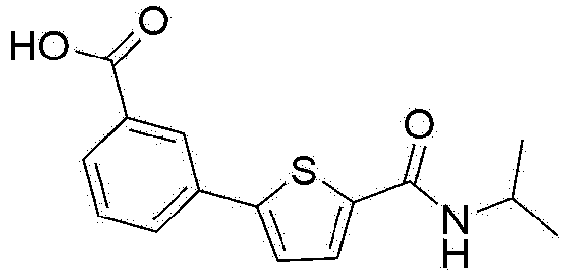
- The title compound (yield: 14.30%) was obtained as a white solid in the same manner as in Example 20, except that methyl 3-(5-(isopropylcarbamoyl)thiophen-2-yl)benzoate was used instead of methyl 4-(5-(isopropylcarbamoyl)thiophen-2-yl)benzoate.
- 1H NMR (400 MHz, DMSO-d6) δ 8.33 (d, 1H, J = 7.6 Hz), 8.20 (s, 1H), 7.93 (t, 2H, J = 8.8 Hz), 7.82 (d, 1H, J = 4.0 Hz), 7.63 - 7.55 (m, 2H), 4.09 - 4.04 (m, 1H), 1.18 (d, 6H, J = 6.8 Hz).
-

- The title compound (yield: 64.90%) was obtained as a white solid in the same manner as in Preparation Example 3, except that p-tolylboronic acid was used instead of (3,4-dimethoxyphenyl)boronic acid.
- 1H NMR (400 MHz, DMSO-d6) δ 8.24 (d, 1H, J = 7.6 Hz), 7.75 (d, 1H, J = 4.0 Hz), 7.59 (d, 2H, J = 8.4 Hz), 7.46 (d, 1H, J = 3.6 Hz), 7.24 (d, 2H, J = 8.0 Hz), 4.10 - 4.01 (m, 1H), 2.33 (s, 3H), 1.17 (d, 6H, J = 6.4 Hz).
-

- The title compound (yield: 24.20%) was obtained as a white solid in the same manner as in Preparation Example 3, except that (4-ethylphenyl)boronic acid was used instead of (3,4-dimethoxyphenyl)boronic acid.
- 1H NMR (400 MHz, DMSO-d6) δ 8.22 (d, 1H, J = 7.6 Hz), 7.74 (d, 1H, J = 2.0 Hz), 7.59 (d, 2H, J = 8.0 Hz), 7.45 (d, 1H, J = 3.9 Hz), 7.26 (d, 2H, J = 8.4 Hz), 4.08 - 3.99 (m, 1H), 2.63 - 2.58 (m, 2H), 1.19 - 1.14 (m, 9H).
-
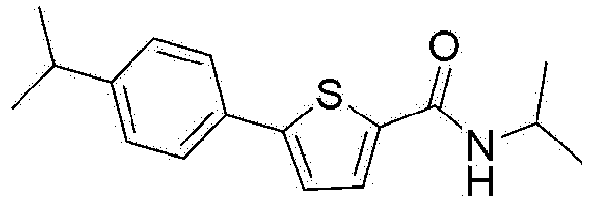
- The title compound (yield: 25.30%) was obtained as a white solid in the same manner as in Preparation Example 3, except that (4-isopropylphenyl)boronic acid was used instead of (3,4-dimethoxyphenyl)boronic acid.
- 1H NMR (400 MHz, DMSO-d6) δ 8.25 (d, 1H, J = 7.6 Hz), 7.77 (d, 1H, J = 4.0 Hz), 7.63 (d, 2H, J = 8.0 Hz), 7.48 (d, 1H, J = 4.0 Hz), 7.32 (d, 2H, J = 8.0 Hz), 4.11 - 4.03 (m, 1H), 2.98 - 2.87 (m, 1H), 1.21 (m, 12H).
-

- The title compound (yield: 36,40%) was obtained as a white solid in the same manner as in Preparation Example 3, except that (3,4-difluorophenyl)boronic acid was used instead of (3,4-dimethoxyphenyl)boronic acid.
- 1H NMR (400 MHz, DMSO-d6) δ 8.31 (d, 1H, J = 7.6 Hz), 7.78 - 7.83 (m, 1H), 7.79 (d, 1H, J = 4.0 Hz), 7.59 (d, 1H, J = 3.6 Hz), 7.55 - 7.48 (m, 2H), 4.11 - 4.03 (m, 1H), 1.19 (d, 6H, J = 6.4 Hz).
-

- The title compound (yield: 21.90%) was obtained as a white solid in the same manner as in Preparation Example 3, except that (3,5-dimethylphenyl)boronic acid was used instead of (3,4-dimethoxyphenyl)boronic acid.
- 1H NMR (400 MHz, DMSO-d6) δ 8.23 (d, 1H, J = 8.0 Hz), 7.75 (d, 1H, J = 4.0 Hz), 7.47 (d, 1H, J = 4.0 Hz), 7.31 (s, 2H), 6.99 (s, 1H), 4.10 - 4.01 (m, 1H), 2.31 (s, 6H), 1.17 (d, 6H, J = 6.8 Hz).
-

- The title compound (yield: 48.20%) was obtained as a white solid in the same manner as in Preparation Example 3, except that (4-fluorophenyl)boronic acid was used instead of (3,4-dimethoxyphenyl)boronic acid.
- 1H NMR (400 MHz, DMSO-d6) δ 8.28 (d, 1H, J = 8.0 Hz), 7.79 - 7.75 (m, 3H), 7.51 (d, 1H, J = 4.0 Hz), 7.30 (t, 2H, J = 8.8 Hz), 4.11 - 4.03 (m, 1H), 1.19 (d, 6H, J = 6.8 Hz).
-

- The title compound (yield: 77.10%) was obtained as a white solid in the same manner as in Preparation Example 3, except that m-tolylboronic acid was used instead of (3,4-dimethoxyphenyl)boronic acid.
1H NMR (400 MHz, DMSO-d6) δ 8.26 (d, 1H, J = 7.6 Hz), 7.77 (d, 1H, J = 3.6 Hz), 7.489 - 7.532 (m, 3H), 7.33 (t, 1H, J = 7.6 Hz), 7.18 (d, 1H, J = 7.6 Hz), 4.024 - 4.109 (m, 1H), 2.36 (s, 3H), 1.17 (d, 6H, J = 6.4 Hz) -

- The title compound (yield: 45.90%) was obtained as a white solid in the same manner as in Preparation Example 3, except that (2,4-dimethylphenyl)boronic acid was used instead of (3,4-dimethoxyphenyl)boronic acid.
- 1H NMR (400 MHz, DMSO-d6) δ 8.24 (d, 1H, J = 7.6 Hz), 7.76 (d, 1H, J = 3.6 Hz), 7.29 (d, 1H, J = 7.6 Hz), 7.15 (d, 2H, J = 4.0 Hz), 7.08 (d, 1H, J = 8.0 Hz), 4.10 - 4.02 (m, 1H), 2.36 (s, 3H), 2.30 (s, 3H), 1.17 (d, 6H, J = 6.4 Hz).
-

- The title compound (yield: 39.70%) was obtained as a white solid in the same manner as in Preparation Example 3, except that (2,4-dimethylphenyl) boronic acid was used instead of (3,4-dimethoxyphenyl)boronic acid.
- 1H NMR (400 MHz, DMSO-d6) δ 8.36 (d, 1H, J = 8.0 Hz), 7.90 (s, 4H), 7.83 (d, 1H, J = 4.0 Hz), 7.74 (d, 1H, J = 4.0 Hz), 4.10 - 4.02 (m, 1H), 1.18 (d, 6H, J = 6.8 Hz).
-

- Isopropylamine (5.5 mmol), 4-(5-(isopropylcarbamoyl)thiophen-2-yl)benzoic acid (Example 20, 1.1 mmol), EDC (1.43 mmol), DMAP (1.43 mmol), and N,N-diisopropylethylamine (DIPEA; 5.5 mmol) were added to dichloromethane (20 mL), and the mixture was stirred at room temperature for 10 hours. The organic solvent was concentrated under reduced pressure and purified by flash column chromatography (n-Hx:EtOAc = 5:1), and then recrystallized using dichloromethane and hexane. The product was dried by a vacuum pump to give the title compound as a white solid (yield: 4.12%).
- 1H NMR (400 MHz, DMSO-d6) δ 8.31 - 8.27 (m, 2H), 7.91 (d, 2H, J = 8.4 Hz), 7.81 - 7.78 (m, 3H), 7.64 (d, 1H, J = 4.0 Hz), 4.13 - 4.04 (m, 2H), 1.17 (d, 12H, J = 6.4 Hz).
-

- The title compound (yield: 30.00%) was obtained as a white solid in the same manner as in Preparation Example 3, except that (3,5-difluorophenyl)boronic acid was used instead of (3,4-dimethoxyphenyl)boronic acid.
- 1H NMR (400 MHz, DMSO-d6) δ 8.34 (d, 1H, J = 7.6 Hz), 7.80 (d, 1H, J = 3.6 Hz), 7.70 (d, 1H, J = 4.0 Hz), 7.48 (d, 2H, J = 6.8 Hz), 7.27 - 7.23 (m, 1H), 4.10 - 4.02 (m, 1H), 1.18 (d, 6H, J = 6.4 Hz).
-

- The title compound was obtained as a white solid in the same manner as in Preparation Example 3, except that (4-ethoxyphenyl)boronic acid was used instead of (3,4-dimethoxyphenyl)boronic acid.
1H NMR (400 MHz, DMSO-d6) δ 8.20 (d, 1H, J = 10.4 Hz), 7.74 (d, 1H, J = 5.2 Hz), 7.62 (d, 2H, J = 12.0 Hz), 7.39 (d, 1H, J = 5.2 Hz), 7.00 (d, 2H, J = 22.0 Hz), 4.10 - 4.02 (m, 3H), 1.35 (t, 3H, J = 9.2 Hz), 1.17 (d, 6H, J = 8.8 Hz) -

- The title compound (yield: 11.5%) was obtained as a white solid in the same manner as in Example 33, except that ethylamine hydrochloride was used instead of isopropylamine.
1H NMR (300 MHz, DMSO-d6) δ 8.49 (t, 1H, J = 5.45 Hz), 8.27 (d, 1H, J = 7.71 Hz), 7.89 - 7.86 (m, 2H), 7.78 - 7.74 (m, 3H), 7.61 (d, 1H, J = 3.94 Hz), 4.03 (dq, 1H J = 6.50, 13.09 Hz), 3.32 - 3.23 (m, 2H), 1.15 (d, 6H, J = 6.60 Hz), 1.11 (t, 3H, J = 7.21 Hz) -

- The title compound (yield: 38.7%) was obtained as an ocher solid in the same manner as in Example 33, except that aniline was used instead of isopropylamine.
1H NMR (300 MHz, DMSO-d6) δ 10.30 (s, 1H), 8.33 (d, 1H, J = 7.71 Hz), 8.04 (d, 2H, J = 8.52 Hz), 7.89 - 7.79 (m, 5H), 7.69 (d, 1H, J = 3.95 Hz), 7.40 - 7.35 (m, 2H), 7.15 - 7.10 (m, 1H), 4.14 - 4.04 (m, 1H), 1.19 (d, 6H, J = 6.61 Hz) - In the following Examples 38 to 91, respective compounds were prepared in the same manner as in Preparation Example 3, except that the starting materials were changed in compliance with the structures of the respective compounds to be prepared.
-

- 1H NMR (400 MHz, DMSO-d6) δ 8.12 (d, 1H, J= 10.4 Hz), 7.79 (t, 1H, J= 5.6 Hz), 7.18 - 7.12 (m, 3H), 6.76 (d, 1H, J= 4.8 Hz), 4.16 - 4.04 (m, 1H), 2.44 (s, 3H), 2.31 (s, 3H), 1.18 (d, 6H, J= 8.8 Hz)
-

- 1H NMR (400 MHz, DMSO-d6) δ 8.25 (d, 1H, J= 10.4 Hz), 8.12 - 8.04 (m, 1H), 7.81 - 7.76 (m, 1H), 7.60 - 7.51 (m, 1H), 7.16 - 7.13 (m, 2H), 4.17 - 4.06 (m, 1H), 1.12 (d, 6H, J= 8.8 Hz)
-

- 1H NMR (300 MHz, DMSO-d6) δ 8.16 (d, J = 7.9 Hz, 1H), 7.84 - 7.83 (m, 1H), 7.82 - 7.80 (m, 1H), 7.31 (d, J = 8.6 Hz, 2H), 7.13 (d, J = 3.6 Hz, 1H), 7.00 (d, J = 3.5 Hz, 1H), 4.14 - 4.07 (m, 1H), 2.64 (q, J = 7.5 Hz, 2H), 1.23 - 1.18 (m, 9H)
-

- 1H NMR (300 MHz, DMSO-d6) δ 8.17 (d, 1H, J = 8.1 Hz), 7.73 - 7.70 (m, 2H), 7.35 (t, 1H, J = 7.9 Hz), 7.18 (d, 1H, J = 7.5 Hz), 7.15 (d, 1H, J = 3.6 Hz), 7.04 (d, 1H, J = 3.3 Hz), 4.17 - 4.05 (m, 1H), 2.38 (s, 3H), 1.19 (d, 6H, J = 6.6 Hz)
-

- 1H NMR (300 MHz, DMSO-d6) δ 8.13 (d, 1H, J= 13.5 Hz), 7.86 - 7.81 (m, 2H), 7.11 (d, 1H, J= 3.6 Hz), 7.04 - 6.99 (m, 2H), 6.90 (d, 2H, J= 3.6 Hz), 4.14 - 4.05 (m, 3H), 1.35 (t, 3H, J= 3.6 Hz), 1.19 (d, 6H, J = 6.6 Hz)
-

- 1H NMR (300 MHz, DMSO-d6) δ 8.16 (d, 1H, J= 7.8 Hz), 7.80 (d, 2H, J= 5.4 Hz), 7.28 (d, 2H, J = 8.1 Hz), 7.13 (d, 1H, J = 3.6 Hz), 7.00 (d, 1H, J= 3.6 Hz), 4.16 - 4.05 (m, 1H), 2.34 (s, 1H), 1.19 (d, 6H, J = 6.6 Hz)
-

- 1H NMR (300 MHz, DMSO-d6) δ 8.20 (d, 1H, J = 8.1 Hz), 7.94 - 7.91 (m, 2H), 7.50 - 7.45 (m, 2H), 7.40 - 7.35 (m, 1H), 7.16 - 7.15 (m, 1H), 7.09 - 7.07 (m, 1H), 4.17 - 4.06 (m, 1H), 1.20 (d, 6H, J = 6.6 Hz)
-

- 1H NMR (300 MHz, DMSO-d6) δ 8.16 (d, 1H, J = 8.1 Hz), 7.82 (d, 2H, J = 8.4 Hz), 7.34 (d, 2H, J = 8.1 Hz), 7.14 (d, 1H, J = 3.6 Hz), 6.99 (d, 1H, J = 3.6 Hz), 4.16 - 4.05 (m, 1H), 3.00 - 2.86 (m, 1H), 1.23 (d, 6H, J = 6.9 Hz), 1.19 (d, 6H, J = 6.6 Hz)
-

- 1H NMR (300 MHz, DMSO-d6) δ 8.34 (d, 1H, J = 7.8 Hz), 8.13 (d, 2H, J = 8.7 Hz), 7.95 (d, 2H, J = 8.7 Hz), 7.34 (d, 1H, J = 3.6 Hz), 7.20 (d, 1H, J = 3.6 Hz), 4.18 - 4.06 (m, 1H), 1.20 (d, 6H, J = 6.6 Hz)
-

- 1H NMR (300 MHz, DMSO-d6) δ 10.14 (s, 1H), 7.79 - 7.75 (m, 2H), 7.59 - 7.58 (m, 2H), 7.41 - 7.35 (m, 3H), 7.15 - 7.10 (m, 2H), 7.04 - 7.03 (m, 1H), 2.35 (d, J = 0.5 Hz, 6H)
-

- 1H NMR (300 MHz, DMSO-d6) δ 10.24 (s, 1H), 8.03 (d, 2H, J = 4.2 Hz), 7.75 (d, 2H, J = 7.5 Hz), 7.60 (d, 1H, J = 3.9 Hz), 7.37 (t, 4H, J = 7.8 Hz), 7.12 (t, 1H, J = 7.3 Hz), 7.036 (s, 1H), 2.33 (s, 6H)
-

- 1H NMR (300 MHz, DMSO-d6) δ 10.32 (s, 1H), 7.73 (dd, 1H, J = 0.6 Hz), 7.73 (dd, 1H, J = 1.5 Hz), 8.18 - 8.08 (m, 2H), 7.76 (t, 3H, J = 6.0 Hz), 7.53 - 7.49 (m, 1H), 7.38 (t, 2H, J = 7.9 Hz), 7.13 (t, 1H, J = 7.4 Hz)
-

- 1H NMR (300 MHz, DMSO-d6) δ 8.95 (dd, 1H, J = 0.6 Hz), 8.57 - 8.54 (m, 2H), 8.12 - 8.08 (m, 1H), 7.77 (d, 1H, J = 3.9 Hz), 7.66 (d, 1H, J = 3.9 Hz), 7.50 - 7.45 (m, 1H), 3.31 - 3.24 (m, 2H), 1.14 (t, 3H, J = 7.2 Hz)
-

- 1H NMR (300 MHz, DMSO-d6) δ 10.20 (s, 1H), 8.15 (ddd, J = 11.8, 8.0, 2.1 Hz, 1H), 7.88 - 7.84 (m, 1H), 7.75 (dd, J = 8.6, 1.1 Hz, 2H), 7.60 (dt, J = 10.5, 8.6 Hz, 1H), 7.41 - 7.36 (m, 3H), 7.26 (d, J = 3.6 Hz, 1H), 7.17 - 7.12 (m, 1H)
-

- 1H NMR (300 MHz, DMSO-d6) δ 10.14 (s, 1H), 7.87 (d, J = 8.2 Hz, 2H), 7.78 - 7.75 (m, 2H), 7.40 - 7.30 (m, 5H), 7.15 - 7.10 (m, 2H), 2.36 (s, 3H)
-

- 1H NMR (300 MHz, DMSO-d6) δ 10.22 (s, 1H), 9.25 (dd, J = 2.3, 0.8 Hz, 1H), 8.59 (dd, J = 4.8, 1.6 Hz, 1H), 8.35 (ddd, J = 8.0, 2.3, 1.6 Hz, 1H), 7.78 - 7.75 (m, 2H), 7.54 (ddd, J = 8.0, 4.8, 0.9 Hz, 1H), 7.44 (d, J = 3.7 Hz, 1H), 7.42 - 7.36 (m, 2H), 7.34 (d, J = 3.6 Hz, 1H), 7.17 - 7.11 (m, 1H)
-

- 1H NMR (300 MHz, DMSO-d6) δ 9.37 (s, 1H), 8.09 (d, J = 8.1 Hz, 1H), 7.39 - 7.36 (m, 2H), 7.12 (d, J = 3.6 Hz, 1H), 6.90 - 6.84 (m, 2H), 4.16 - 4.04 (m, 1H), 3.86 (s, 3H), 1.19 (d, J = 6.6 Hz, 6H)
-

- 1H NMR (300 MHz, DMSO-d6) δ 10.56 (s, 1H), 9.00 (d, 1H, J = 1.8 Hz), 8.92 (d, 1H, J = 2.1 Hz), 8.58 (dd, 1H, J = 1.5 Hz), 8.33 (dd, 1H, J = 1.3 Hz), 8.19 - 8.12 (m, 3H), 7.77 (d, 1H, J = 3.9 Hz), 7.52 - 7.48 (m, 1H), 7.41 (q, 1H, J = 4.8 Hz)
-

- 1H NMR (300 MHz, DMSO-d6) δ 10.08 (s, 1H), 9.43 (s, 1H), 7.76 (dd, J = 8.7, 1.1 Hz, 2H), 7.47 - 7.34 (m, 5H), 7.14 - 7.09 (m, 1H), 7.00 (d, J = 3.6 Hz, 1H), 6.88 (d, J = 8.2 Hz, 1H), 3.88 (s, 3H)
-

- 1H NMR (300 MHz, DMSO-d6) δ 10.33 (s, 1H), 8.94 (d, 1H, J = 2.1 Hz), 8.34 - 8.32 (m, 1H), 8.18 - 8.15 (m, 1H), 7.56 - 7.43 (m, 4H), 7.11 - 7.07 (m, 2H), 3.85 (d, 6H, J = 15.0 Hz)
-

- 1H NMR (300 MHz, DMSO-d6) δ 10.43 (s, 1H), 9.25 (t, 1H, J= 1.2 Hz), 8.94 (d, 1H, J = 2.1 Hz), 8.62 - 8.59 (m, 1H), 8.37 - 8.34 (m, 2H), 8.20 - 8.16 (m, 1H), 7.58 - 7.36 (m, 4H)
-

- 1H NMR (300 MHz, DMSO-d6) δ 10.29 (s, 1H), 9.46 (s, 1H), 8.94 (d, 1H, J = 2.4 Hz), 8.34 - 8.32 (m, 1H), 8.16 - 8.15 (m, 1H), 7.46 - 7.41 (m, 4H), 7.02 (d, 1H, J = 3.6 Hz), 6.89 (d, 1H, J = 8.1 Hz), 3.89 (s, 3H)
-

- 1H NMR (300 MHz, DMSO-d6) δ 10.38 (s, 1H), 9.44 (s, 1H), 8.90 (d, J = 2.3 Hz, 1H), 8.31 (dd, J = 4.7, 1.4 Hz, 1H), 8.17 - 8.14 (m, 1H), 8.00 (d, J = 4.0 Hz, 1H), 7.51 (d, J = 4.0 Hz, 1H), 7.40 (dd, J = 8.3, 4.7 Hz, 1H), 7.27 (d, J = 2.1 Hz, 1H), 7.17 (dd, J = 8.2, 2.1 Hz, 1H), 6.85 (d, J = 8.2 Hz, 1H), 3.87 (s, 3H)
-

- 1H NMR (300 MHz, DMSO-d6) δ 8.15 (d, J = 8.0 Hz, 1H), 7.62 (dd, J = 7.9, 1.5 Hz, 1H), 7.18 (d, J = 3.6 Hz, 1H), 7.09 (ddd, J = 8.5, 7.2, 1.6 Hz, 1H), 6.85 - 6.81 (m, 2H), 6.66 (ddd, J = 8.2, 7.2, 1.2 Hz, 1H), 5.46 (s, 2H), 4.21 - 3.99 (m, 1H), 1.18 (d, J = 6.6 Hz, 6H)
-

- 1H NMR (300 MHz, DMSO-d6) δ 9.49 (d, J = 2.2 Hz, 1H), 8.81 (d, J = 2.0 Hz, 1H), 8.33 (d, J = 8.0 Hz, 1H), 8.08 - 8.05 (m, 2H), 7.79 (ddd, J = 8.4, 6.9, 1.5 Hz, 1H), 7.68 (ddd, J = 1.13, 6.99, 8.11 Hz, 1H), 7.39 (d, J = 3.6 Hz, 1H), 7.26 (d, J = 3.6 Hz, 1H), 4.21 - 4.10 (m, 1H), 1.23 (d, J = 6.6 Hz, 6H)
-

- 1H NMR (300 MHz, DMSO-d6) δ 10.55 (s, 1H), 8.13 (d, J = 8.1 Hz, 1H), 7.78 - 7.74 (m, 2H), 7.11 (d, J = 3.6 Hz, 1H), 6.91 - 6.87 (m, 2H), 4.19 - 4.03 (m, 1H), 3.56 (s, 2H), 1.19 (d, J = 6.6 Hz, 6H)
-

- 1H NMR (300 MHz, DMSO-d6) δ 11.26 (s, 1H), 8.15 - 8.12 (m, 2H), 7.64 (dd, J = 8.5, 1.6 Hz, 1H), 7.47 - 7.40 (m, 2H), 7.13 (d, J = 3.5 Hz, 1H), 6.90 (d, J = 3.5 Hz, 1H), 6.52 - 6.51 (m, 1H), 4.17 - 4.10 (m, 1H), 1.21 (d, J = 6.6 Hz, 6H)
-

- 1H NMR (300 MHz, DMSO-d6) δ 9.37 (s, 1H), 9.01 (s, 1H), 8.43 (d, J = 8.5 Hz, 1H), 8.33 - 8.24 (m, 2H), 7.96 - 7.90 (m, 1H), 7.80 (t, J = 7.2 Hz, 1H), 7.34 (d, J = 3.6 Hz, 1H), 7.24 (d, J = 3.6 Hz, 1H), 4.22 - 4.06 (m, 1H), 1.21 (d, J = 6.6 Hz, 6H)
-

- 1H NMR (300 MHz, DMSO-d6) δ 9.20 - 9.19 (m, 1H), 8.57 - 8.55 (m, 1H), 8.31 - 8.27 (m, 2H), 7.53 - 7.48 (m, 1H), 7.24 - 7.18 (m, 2H), 4.20 - 4.04 (m, 1H), 1.20 (d, 6H, J = 6.6 Hz)
-

- 1H NMR (300 MHz, DMSO-d6) δ 9.05 (s, 1H), 8.62 - 8.61 (m, 1H), 8.18 - 8.17 (m, 1H), 7.55 - 7.33 (m, 3H), 5.20 - 5.10 (m, 1H), 1.34 (d, 6H, J = 6.3Hz)
-

- 1H NMR (300 MHz, DMSO) δ 9.05 (dd, J = 2.3, 0.8 Hz, 1H), 8.60 (dd, J = 4.8, 1.6 Hz, 1H), 8.20 - 8.16 (m, 1H), 7.55 - 7.51 (m, 1H), 7.45 (d, J = 3.7 Hz, 1H), 7.34 (d, J = 3.7 Hz, 1H), 4.33 (q, J = 7.1 Hz, 2H), 1.32 (t, J = 7.1 Hz, 3H)
-

- 1H NMR (300 MHz, CDCl3) δ 9.06 (s, 1H), 8.62 - 8.61 (m, 1H), 8.16 - 8.12 (m, 1H), 7.49 - 7.37 (m, 4H), 7.31 - 7.28 (m, 1H), 7.25 - 7.23 (m, 2H), 6.93 (d, 1H, J = 3.9Hz)
-

- 1H NMR (300 MHz, CDCl3) δ 9.07 - 9.06 (m, 1H), 8.60 - 8.54 (m, 3H), 8.16 - 8.13 (m, 1H), 7.67 - 7.63 (m, 1H), 7.53 (d, J = 3.7 Hz, 1H), 7.43 - 7.38 (m, 2H), 6.95 (d, J = 3.7 Hz, 1H)
-

- 1H NMR (300 MHz, DMSO-d6) δ 9.01 - 9.00 (m, 1H), 8.61 - 8.59 (m, 1H), 8.19 - 8.15 (m, 1H), 7.85 - 7.84 (m, 1H), 7.77 - 7.74 (m, 1H), 7.52 - 7.48 (m, 1H), 4.32 (q, 2H, J = 7.2 Hz), 1.32 (t, 3H, J = 7.2 Hz)
-

- 1H NMR (300 MHz, DMSO-d6) δ 9.00 - 8.99 (m, 1H), 8.60 - 8.58 (m, 1H), 8.19 - 8.15 (m, 1H), 7.83 - 7.81 (m, 1H), 7.74 - 7.73 (m, 1H), 7.52 - 7.47 (m, 1H), 1.32 (d, 6H, J = 6.3 Hz)
-

- 1H NMR (300 MHz, CDCl3) δ 8.96 - 8.95 (m, 1H), 8.63 - 8.61 (m, 1H), 7.99 - 7.92 (m, 2H), 7.47 - 7.39 (m, 4H), 7.31 - 7.26 (m, 1H), 7.25 - 7.22 (m, 2H)
-
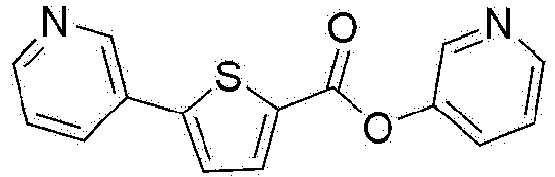
- 1H NMR (300 MHz, DMSO-d6) δ 9.08 - 9.07 (m, 1H), 8.65 - 8.61 (m, 2H), 8.56 - 8.54 (m, 1H), 8.26 - 8.22 (m, 1H), 8.13 - 8.12 (m, 1H), 7.88 - 7.83 (m, 2H), 7.58 - 7.51 (m, 2H)
-

- 1H NMR (300 MHz, DMSO-d6) δ 9.67 (s, 1H), 8.22 (d, 1H, J = 8.1 Hz), 7.34 - 7.22 (m, 3H), 7.14 - 7.13 (m, 1H), 6.99 - 6.98 (m, 1H), 6.79 - 6.76 (m, 1H), 4.16 - 4.04 (m, 1H), 1.18 (d, 6H, J = 6.6 Hz)
-

- 1H NMR (300 MHz, DMSO-d6) δ 8.11 (d, 1H, J = 7.8 Hz), 7.48 (q, 1H, J = 2.1 Hz), 7.39 (d, 1H, J = 2.1 Hz), 7.13 (d, 1H, J = 3.6 Hz), 7.04 (d, 1H, J = 8.4 Hz), 6.97 (d, 1H, J = 3.6 Hz), 4.13 - 4.06 (m, 1H), 3.83 (d, 6H, J = 12.6 Hz), 1.19 (d, 6H, J = 6.6 Hz)
-

- The title compound (yield: 48.3%) was obtained as an ocher oil in the same manner as in Preparation Example 3, except that Intermediate 4 was used instead of 5-bromo-N-isopropylthiophene-2-carboxamide.
1H NMR (300 MHz, DMSO-d6) δ 7.40 - 7.36 (m, 2H), 7.34 (d, 1H, J = 2.1 Hz), 7.09 - 7.05 (m, 2H), 4.31 (q, 2H, J = 7.2 Hz), 3.83 (d, 6H, J = 10.5 Hz), 1.31 (t, 3H, J = 10.5 Hz) -

- 1H NMR (300 MHz, DMSO-d6) δ 8.30 (d, 1H, J = 7.8 Hz), 7.79 - 7.70 (m, 2H), 7.29 - 7.16 (m, 3H), 4.18 - 4.07 (m, 1H), 1.20 (d, 6H, J = 6.9 Hz)
-

- 1H NMR (300 MHz, DMSO-d6) δ 7.51 (q, 1H, J = 0 Hz), 7.40 (d, 1H, J = 6 Hz), 7.14-7.09 (m, 1H), 6.5 (d, 1H, J = 6 Hz), 6.83 (q, 1H, J = 0 Hz), 6.69-6.64 (m, 1H), 5.54 (s, 2H), 4.31 (q, 2H, J = 6 Hz), 1.31 (t, 3H, J = 7.5 Hz)
-
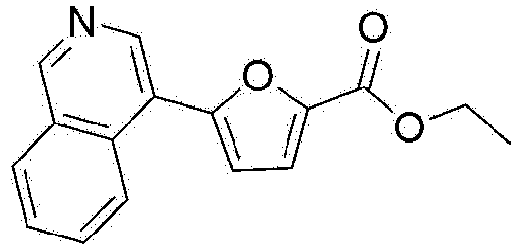
- 1H NMR (300 MHz, DMSO-d6) δ 9.40 (d, 1H, J = 0 Hz), 8.87 (s, 1H), 8.44 (q, 1H, J = 0 Hz), 8.27 (d, 1H, J = 9 Hz), 7.97-7.92 (m, 1H), 7.83-7.78 (m, 1H), 7.54 (d, 1H, J = 3 Hz), 7.32 (d, 1H, J = 3 Hz), 4.36 (q, 2H, J = 6 Hz), 1.34 (t, 3H, J = 7.5 Hz)
-

- 1H NMR (300 MHz, DMSO-d6) δ 8.08-7.95 (m, 4H), 7.45 (d, 1H, J = 6 Hz), 7.37 (d, 1H, J = 3 Hz), 4.34 (q, 2H, J = 6 Hz), 3.89 (d, 3H, J = 3Hz), 1.33 (t, 3H, J = 7.5 Hz)
-

- 1H NMR (300 MHz, DMSO-d6) δ 7.55-7.52 (m, 2H), 7.45 (d, 1H, J = 3Hz), 7.38 (d, 1H, J = 3 Hz), 7.35-7.28 (m, 1H), 4.33 (q, 2H, J = 6 Hz), 1.33 (t, 3H, J = 7.5 Hz)
-

- 1H NMR (300 MHz, DMSO-d6) δ 10.35 (s, 1H), 8.95 (d, 1H, J = 3 Hz), 8.34 (q, 1H, J = 0 Hz), 8.19-8.15 (m, 1H), 7.59 (t, 2H, J = 0 Hz), 7.45-7.40 (m, 2H), 7.15 (d, 1H, J = 3 Hz), 7.05 (s, 1H), 2.36 (d, 6H, J = 0 Hz)
-

- 1H NMR (300 MHz, DMSO-d6) δ 10.34 (s, 1H), 8.93 (d, 1H, J = 0 Hz), 8.33 (q, 1H, J = 3 Hz), 8.19-8.15 (m, 1H), 7.84 (d, 1H, J = 9 Hz), 7.48 (d, 1H, J = 6 Hz), 7.43-7.39 (m, 1H), 7.18-7.17 (m, 2H), 6.90 (d, 1H, J = 3 Hz), 2.48 (s, 3H), 2.33 (s, 3H)
-

- 1H NMR (300 MHz, DMSO-d6) δ 8.15 (d, J = 8.1 Hz, 1H), 7.53 - 7.49 (m, 2H), 7.14 (d, J = 3.6 Hz, 1H), 7.02 - 7.00 (m, 2H), 4.20 - 3.99 (m, 1H), 2.33 (d, J = 0.5 Hz, 6H), 1.20 (d, J = 6.6 Hz, 6H)
-

- 1H NMR (300 MHz, DMSO-d6) δ 7.46 - 7.42 (m, 2H), 7.38 (d, J = 3.7 Hz, 1H), 7.12 (d, J = 3.6 Hz, 1H), 7.06 - 7.03 (m, 1H), 4.32 (q, J = 7.1 Hz, 2H), 2.35 - 2.32 (m, 6H), 1.31 (t, J = 7.1 Hz, 3H)
-

- 1H NMR (300 MHz, DMSO-d6) δ 9.71 (s, 1H), 7.38 (d, J = 3.7 Hz, 1H), 7.29 - 7.21 (m, 3H), 7.10 (d, J = 3.6 Hz, 1H), 6.83 - 6.79 (m, 1H), 4.31 (q, J = 7.1 Hz, 2H), 1.31 (t, J = 7.1 Hz, 3H)
-

- 1H NMR (300 MHz, DMSO-d6) δ 9.38 (d, J = 2.3 Hz, 1H), 8.74 (d, J = 2.2 Hz, 1H), 8.16 - 8.13 (m, 1H), 8.08 - 8.05 (m, 1H), 7.81 (ddd, J = 8.4, 6.9, 1.5 Hz, 1H), 7.68 (ddd, J = 8.1, 6.9, 1.2 Hz, 1H), 7.51 - 7.48 (m, 2H), 4.36 (q, J = 7.1 Hz, 2H), 1.34 (t, J = 7.1 Hz, 3H)
-

- 1H NMR (300 MHz, DMSO-d6) δ 8.02 - 7.94 (m, 4H), 7.45 (dd, J = 9.2, 3.7 Hz, 2H), 4.33 (q, J = 7.1 Hz, 2H), 1.32 (t, J = 7.1 Hz, 3H)
-

- 1H NMR (300 MHz, DMSO-d6) δ 11.31 (s, 1H), 8.06 - 8.01 (m, 1H), 7.58 - 7.55 (m, 1H), 7.51 - 7.46 (m, 1H), 7.44 - 7.40 (m, 1H), 7.38 (d, J = 3.6 Hz, 1H), 7.02 (d, J = 3.6 Hz, 1H), 6.56 - 6.52 (m, 1H), 4.31 (q, J = 7.1 Hz, 2H), 1.32 (t, J = 7.1 Hz, 3H)
-

- 1H NMR (400 MHz, DMSO) δ 10.41 (s, 1H), 9.72 (s, 1H), 8.94 (d, J = 2.3 Hz, 1H), 8.34 (dd, J = 4.7, 1.4 Hz, 1H), 8.19 - 8.16 (m, 1H), 7.48 - 7.35 (m, 4H), 7.29 (t, J = 7.8 Hz, 1H), 7.13 (d, J = 3.6 Hz, 1H), 6.84 - 6.81 (m, 1H)
- In the following Examples 92 to 94, respective compounds were prepared in the same manner as in Example 33, except that the starting materials were changed in compliance with the structures of the respective compounds to be prepared.
-

- 1H NMR (300 MHz, DMSO) δ 8.57 (t, J = 5.4 Hz, 1H), 8.27 - 8.23 (m, 2H), 8.07 - 8.05 (m, 1H), 7.81 - 7.78 (m, 1H), 7.56 (t, J = 7.7 Hz, 1H), 7.19 (d, J = 3.6 Hz, 1H), 7.13 (d, J = 3.6 Hz, 1H), 4.17 - 4.05 (m, 1H), 3.37 - 3.28 (m, 2H), 1.21 - 1.13 (m, 9H)
-

- 1H NMR (300 MHz, DMSO) δ 8.55 (t, J = 5.4 Hz, 1H), 8.28 (d, J = 8.1 Hz, 1H), 8.06 - 7.89 (m, 4H), 7.20 (q, J = 3.6 Hz, 2H), 4.18 - 4.06 (m, 1H), 3.36 - 3.27 (m, 2H), 1.22 - 1.12 (m, 9H)
-

- 1H NMR (300 MHz, DMSO) δ 8.29 - 8.26 (m, 2H), 8.02 - 7.88 (m, 4H), 7.21 - 7.17 (m, 2H), 4.17 - 4.06 (m, 2H), 1.21 - 1.17 (m, 12H)
- Compound (5-(3,4-dimethoxyphenyl)-N-isopropylthiophene-2-carboxamide) disclosed in Example 1 of
Korean Patent Publication No. 10-2017-0022790 - The degree of autophagy activation of each compound was evaluated by measuring the degree of LC3-II production in Hep3B cells.
- Specifically, Hep3B human hepatocytes were cultured in DMEM medium at 37°C under 5% CO2 atmosphere. The respective cells were dispensed into 6-well plates at a density of 5×10⁵ cells/well. These cells were treated with DMSO, the compound prepared in Examples described above, and the compound of Comparative Example, respectively, and then treated in DMEM medium at 37°C under 5% CO2 atmosphere for 12 hours to induce autophagy. Subsequently, Hep3B cells were lysed with an extraction buffer containing protease inhibitor cocktail (PBS solution containing 0.5% Triton X-100, 1 mM Na3VO4, etc.), and then fragmentation of DNA was performed by sonication. The amount of protein was measured with bovine serum albumin as a protein standard using SMART™ BCA Protein Assay kit from iNtRON Biotechnology. After electrophoresis of 10- 50 µg of total cell protein in 8-12% (w/v) polyacrylamide gel containing 0.1% SDS, the proteins present in a gel were transferred to PVDF membrane by an electroblotting technique. Then, in order to block non-specific binding, the PVDF membrane was placed in a TBS-tween (tris-buffered saline-tween, Sigma Co.) solution containing 5% non-fat dry milk and reacted at room temperature for 1 hour. The filter was placed in a TBS-tween solution containing a specific antibody against LC3 protein (Cell Signaling), allowed to stand at 4°C for 12 hours, and then labeled with a secondary antibody labeled with HRP (Horseradish Peroxidase, Sigma Co., Cat No. P0889). Then, bands were measured using ECL (Enhanced Chemiluminescence, Thermo Scientific, Cat No. 34080).
- The induction of autophagy can be confirmed by an increase in specific LC3-II molecules. LC3 precursors are usually scattered in the cytoplasm, proteolytically cleaved, and present in the form of LC3-I. When autophagy is activated, the C-terminal glycine is modified to form LC3-II, which migrates to autophagosome and is distributed in puncta form.
- The measurement results are shown in Table 1 below. The amount of LC3-II increased by the compound treatment was quantified by measuring the band density, and then compared with the amount of LC3-II increased by the treatment of the compound of Comparative Example, and the comparison values are shown in Table 1. That is, the case having the same autophagy-inducing capacity as that of the compound of Comparative Example is represented by a value of 1; the case having superior autophagy-inducing capacity to that of the compound of Comparative Example is represented by a value greater than 1; and the case having weaker autophagy-inducing capacity than that of the compound of Comparative Example is represented by a value less than 1 Examples 48, 49, 88 and 89 are comparative examples.
[Table 1] Example No. Autophagy-inducing capacity Example No. Autophagy-inducing capacity Example 1 1.48 Example 31 1.49 Example 2 1.38 Example 48 1.46 Example 4 1.16 Example 49 1.51 Example 5 1.80 Example 58 1.10 Example 7 1.24 Example 65 1.66 Example 11 2.13 Example 72 1.08 Example 12 1.19 Example 85 1.09 Example 14 1.13 Example 88 1.02 Example 15 1.50 Example 89 1.64 Example 17 1.99 Example 91 1.33 Example 18 1.13 Example 92 1.41 Example 27 1.01 Example 93 1.19 Example 28 1.60 Example 94 1.17 Example 30 1.02 Comparative Example 1.00 - As shown in Table 1 above, it can be confirmed by an increase in LC3-II that Hep3B cells induce autophagy by the treatment of the compound of Comparative Example used as a control substance. Also, the compound according to the present disclosure showed an increase in LC3-II as compared with the compound of Comparative Example. Therefore, it can be seen that the compounds according to the present disclosure had excellent autophagy-inducing capacity.
- In order to confirm the efficacy of the compounds of the present disclosure on nonalcoholic steatohepatitis and hepatic fibrosis, animal experiments were performed.
- Specifically, to 48 mice having induced nonalcoholic steatohepatitis (8 mice for each experimental example below), between 6 and 9 weeks of age, the compound of Example 1 was divided into low-, medium-, and high-dose groups along with a vehicle (10% HPbCD in 0.5% CMC solution), and orally administered twice daily.
- As a comparative group, 4 normal mice were not treated until 9 weeks of age. As a positive control, to 8 mice having induced nonalcoholic steatohepatitis, telmisartan which is a therapeutic agent of hypertension between 6 and 9 weeks of age, and obeticholic acid (OCA) currently being developed as a therapeutic agent of NASH were respectively administered orally once daily at a dose of 10 mg/ kg, 30 mg/kg. As a negative control, to 8 mice having induced nonalcoholic steatohepatitis, only 10 mL/kg of a 10% HPbCD in 0.5% CMC solution which is a vehicle between 6 and 9 weeks of age was orally administered twice daily.
- Subsequently, the degree of steatosis, inflammation and ballooning was measured for the liver of the 9-week-old experimental animals using HE staining, and the area of fibrosis was observed and measured using Sirius red staining. The results are scored using Bonferroni Multiple Comparison Test, and shown in
FIGS. 1 and 2 . -
FIG. 1 is a graph showing the nonalcoholic fatty liver disease (NAFLD) activity score calculated from a composite score of steatosis, inflammation and ballooning in the liver of experimental animals. As shown inFIG. 1 , it can be confirmed that the compound of the present disclosure had significant activity for alleviation of nonalcoholic steatohepatitis in a dose-dependent manner.FIG. 2 is a graph that shows the area of fibrosis by staining the level of fibrosis for the liver of experimental animals. It was confirmed that the mice to which the compound of the present disclosure was administered exhibited a fibrosis-suppressing activity depending on the dose of the above-mentioned derivative.
Claims (3)
- A compound represented by Chemical Formula 1 below, or a pharmaceutically acceptable salt thereof:
 X is O, or S,Y is O, or NH,Ar is phenyl, pyridin-3-yl, indolyl, 2-oxoindolyl, quinolinyl, isoquinolinyl, or pyrrolo[2,3-b]pyridinyl,the Ar is substituted with R1 and R2,R1 is hydrogen, C1-4 alkyl, C1-4 alkoxy, hydroxy, halogen, amino, cyano, carboxy, -COO-(C1-4 alkyl), -CONH-(C1-4 alkyl), or -CONH-(phenyl),R2 is hydrogen, C1-4 alkyl, C1-4 alkoxy, hydroxy, or halogen,R3 is C1-4 alkyl, C6-10 aryl, or C6-10 heteroaryl containing any one or more heteroatoms selected from the group consisting of N, O and S,with the proviso that when X is S and Ar is phenyl, both R1 and R2 are not C1-4 alkoxy,wherein the compound is any one selected from the group consisting of:5-(4-hydroxy-3-methoxyphenyl)-N-isopropylthiophene-2-carboxam ide,5-(3-hydroxy-4-methoxyphenyl)-N-isopropylthiophene-2-carboxam ide,5-(3,4-dihydroxyphenyl)-N-isopropylthiophene-2-carboxamide,5-(3-hydroxyphenyl)-N-isopropylthiophene-2-carboxamide,5-(4-hydroxyphenyl)-N-isopropylthiophene-2-carboxamide,N-isopropyl-5-(2-methoxypyridin-3-yl)thiophene-2-carboxamide,N-isopropyl-5-(pyridin-3-yl)thiophene-2-carboxam ide,N-isopropyl-5-(6-methoxypyridin-3-yl)thiophene-2-carboxamide,5-(6-ethoxypyridin-3-yl)-N-isopropylthiophene-2-carboxamide,N-isopropyl-5-(5-methoxypyridin-3-yl)thiophene-2-carboxamide,5-(1H-indol-5-yl)-N-isopropylthiophene-2-carboxamide,5-(2,6-dimethoxypyridin-3-yl)-N-isopropylthiophene-2-carboxamide,5-(6-aminopyridin-3-yl)-N-isopropylthiophene-2-carboxamide,5-(6-amino-5-methoxypyridin-3-yl)-N-isopropylthiophene-2-carboxamide,N-isopropyl-5-(isoquinolin-4-yl)thiophene-2-carboxamide,5-(6-cyanopyridin-3-yl)-N-isopropylthiophene-2-carboxamide,N-isopropyl-5-(quinolin-3-yl)thiophene-2-carboxamide,5-(3-aminophenyl)-N-isopropylthiophene-2-carboxamide,methyl 4-(5-(isopropylcarbamoyl)thiophen-2-yl)benzoate,4-(5-(isopropylcarbamoyl)thiophen-2-yl)benzoic acid,5-(2-aminophenyl)-N-isopropylthiophene-2-carboxamide,methyl 3-(5-(isopropylcarbamoyl)thiophen-2-yl)benzoate,3-(5-(isopropylcarbamoyl)thiophen-2-yl)benzoic acid,N-isopropyl-5-p-tolylthiophene-2-carboxamide,5-(4-ethylphenyl)-N-isopropylthiophene-2-carboxamide,N-isopropyl-5-(4-isopropylphenyl)thiophene-2-carboxamide,5-(3,4-difluorophenyl)-N-isopropylthiophene-2-carboxamide,5-(3,5-dimethylphenyl)-N-isopropylthiophene-2-carboxamide,N-isopropyl-5-m-tolylthiophene-2-carboxamide,5-(2,4-dimethylphenyl)-N-isopropylthiophene-2-carboxamide,5-(4-cyanophenyl)-N-isopropylthiophene-2-carboxamide,N-isopropyl-5-(4-(isopropylcarbamoyl)phenyl)thiophene-2-carboxamide,5-(3,5-difluorophenyl)-N-isopropylthiophene-2-carboxamide,5-(4-ethoxyphenyl)-N-isopropylthiophene-2-carboxamide,5-(4-(ethylcarbamoyl)phenyl)-N-isopropylthiophene-2-carboxamide,N-isopropyl-5-(4-(phenylcarbamoyl)phenyl)thiophene-2-carboxamide,5-(2,4-dimethylphenyl)-N-isopropylfuran-2-carboxamide,5-(3,4-difluorophenyl)-N-isopropylfuran-2-carboxamide,5-(4-ethylphenyl)-N-isopropylfuran-2-carboxam ide,N-isopropyl-5-m-tolylfuran-2-carboxamide,5-(4-ethoxyphenyl)-N-isopropylfuran-2-carboxam ide,N-isopropyl-5-p-tolylfuran-2-carboxamide,N-isopropyl-5-(4-isopropylphenyl)furan-2-carboxamide,5-(4-cyanophenyl)-N-isopropylfuran-2-carboxamide,N-ethyl-5-(pyridin-3-yl)thiophene-2-carboxamide,5-(3,4-difluorophenyl)-N-phenylfuran-2-carboxamide,5-(4-hydroxy-3-methoxyphenyl)-N-isopropylfuran-2-carboxamide,N,5-di(pyridin-3-yl)thiophene-2-carboxamide,5-(4-hydroxy-3-methoxyphenyl)-N-phenylfuran-2-carboxamide,N,5-di(pyridin-3-yl)furan-2-carboxamide,5-(4-hydroxy-3-methoxyphenyl)-N-(pyridin-3-yl)furan-2-carboxamide,5-(4-hydroxy-3-methoxyphenyl)-N-(pyridin-3-yl)thiophene-2-carboxamide,5-(2-am inophenyl)-N-isopropylfuran-2-carboxam ide,N-isopropyl-5-(quinolin-3-yl)furan-2-carboxamide,N-isopropyl-5-(2-oxoindolin-5-yl)furan-2-carboxamide,5-(1H-indol-5-yl)-N-isopropylfuran-2-carboxamide,N-isopropyl-5-(isoquinolin-4-yl)furan-2-carboxamide,N-isopropyl-5-(pyridin-3-yl)furan-2-carboxamide,isopropyl 5-(pyridin-3-yl)furan-2-carboxylate,phenyl 5-(pyridin-3-yl)furan-2-carboxylate,pyridin-3-yl 5-(pyridin-3-yl)furan-2-carboxylate,isopropyl 5-(pyridin-3-yl)thiophene-2-carboxylate,pyridin-3-yl 5-(pyridin-3-yl)thiophene-2-carboxylate,5-(3-hydroxyphenyl)-N-isopropylfuran-2-carboxamide,5-(3,5-difluorophenyl)-N-isopropylfuran-2-carboxamide,5-(3,5-dimethylphenyl)-N-isopropylfuran-2-carboxamide,5-(3-hydroxyphenyl)-N-(pyridin-3-yl)furan-2-carboxamide,5-(3-(ethylcarbamoyl)phenyl)-N-isopropylfuran-2-carboxamide,5-(4-(ethylcarbamoyl)phenyl)-N-isopropylfuran-2-carboxamide, andN-isopropyl-5-(4-(isopropylcarbamoyl)phenyl)furan-2-carboxamide.
 - A pharmaceutical composition for use in preventing or treating diseases associated with autophagy regulation, comprising a compound of claim 1 or a pharmaceutically acceptable salt thereof, wherein the diseases associated with autophagy regulation are liver diseases, metabolic diseases, age-related macular degeneration, degenerative brain diseases, pulmonary fibrosis disease, or inflammatory bowel disease.
- The pharmaceutical composition for use in preventing or treating diseases associated with autophagy regulation according to claim 2, wherein liver diseases are liver fibrosis, liver cirrhosis, hepatitis, alcoholic liver disease, non-alcoholic fatty liver disease, or non-alcoholic steatohepatitis.
Applications Claiming Priority (2)
| Application Number | Priority Date | Filing Date | Title |
|---|---|---|---|
| KR20180063496 | 2018-06-01 | ||
| PCT/KR2019/006606 WO2019231290A1 (en) | 2018-06-01 | 2019-05-31 | Novel compound and pharmaceutical composition comprising same |
Publications (3)
| Publication Number | Publication Date |
|---|---|
| EP3805210A1 EP3805210A1 (en) | 2021-04-14 |
| EP3805210A4 EP3805210A4 (en) | 2022-01-19 |
| EP3805210B1 true EP3805210B1 (en) | 2023-11-29 |
Family
ID=68698300
Family Applications (1)
| Application Number | Title | Priority Date | Filing Date |
|---|---|---|---|
| EP19811441.5A Active EP3805210B1 (en) | 2018-06-01 | 2019-05-31 | Novel compound and pharmaceutical composition comprising same |
Country Status (13)
| Country | Link |
|---|---|
| US (1) | US11407744B2 (en) |
| EP (1) | EP3805210B1 (en) |
| JP (1) | JP7177577B2 (en) |
| KR (1) | KR102308713B1 (en) |
| CN (1) | CN112004807B (en) |
| AU (1) | AU2019279441B2 (en) |
| BR (1) | BR112020022220A2 (en) |
| CA (1) | CA3100308C (en) |
| CL (1) | CL2020002347A1 (en) |
| ES (1) | ES2971118T3 (en) |
| IL (1) | IL276783B2 (en) |
| MX (1) | MX2020009287A (en) |
| WO (1) | WO2019231290A1 (en) |
Families Citing this family (2)
| Publication number | Priority date | Publication date | Assignee | Title |
|---|---|---|---|---|
| US12110281B2 (en) * | 2018-07-20 | 2024-10-08 | Hexapharmatec Co., Ltd. | Catechol derivatives or salt thereof, processes for preparing the same, and pharmaceutical compositions comprising the same |
| CN113929591A (en) * | 2021-10-09 | 2022-01-14 | 中国科学技术大学 | Inhibitors with antiproliferative activity |
Family Cites Families (6)
| Publication number | Priority date | Publication date | Assignee | Title |
|---|---|---|---|---|
| WO2004110998A1 (en) | 2003-05-16 | 2004-12-23 | Ambit Biosciences Corporation | Pyrrole compounds and uses thereof |
| WO2005074642A2 (en) * | 2004-01-30 | 2005-08-18 | Smithkline Beecham Corporation | Chemical compounds |
| TWI423962B (en) * | 2009-10-07 | 2014-01-21 | Lg Life Sciences Ltd | Novel compounds effective as xanthine oxidase inhibitors, method for preparing the same, and pharmaceutical composition containing the same |
| WO2012085170A2 (en) * | 2010-12-22 | 2012-06-28 | Haag Benjamin | Process for making organoboron compounds, products obtainable thereby, and their use |
| KR101721490B1 (en) | 2014-07-30 | 2017-03-30 | 한국생명공학연구원 | Phenyl derivatives, preparation method thereof and pharmaceutical composition for prevention or treatment of the cellproliferative diseases containing the same as an active ingredient |
| KR102100470B1 (en) * | 2015-08-21 | 2020-04-13 | (주)오토파지사이언스 | Novel catechol derivatives and pharmaceutical composition comprising the same |
-
2019
- 2019-05-31 WO PCT/KR2019/006606 patent/WO2019231290A1/en not_active Ceased
- 2019-05-31 BR BR112020022220-8A patent/BR112020022220A2/en not_active IP Right Cessation
- 2019-05-31 CN CN201980022667.2A patent/CN112004807B/en active Active
- 2019-05-31 KR KR1020190064328A patent/KR102308713B1/en active Active
- 2019-05-31 CA CA3100308A patent/CA3100308C/en active Active
- 2019-05-31 ES ES19811441T patent/ES2971118T3/en active Active
- 2019-05-31 AU AU2019279441A patent/AU2019279441B2/en active Active
- 2019-05-31 MX MX2020009287A patent/MX2020009287A/en unknown
- 2019-05-31 JP JP2020550741A patent/JP7177577B2/en active Active
- 2019-05-31 US US16/970,418 patent/US11407744B2/en active Active
- 2019-05-31 EP EP19811441.5A patent/EP3805210B1/en active Active
- 2019-05-31 IL IL276783A patent/IL276783B2/en unknown
-
2020
- 2020-09-10 CL CL2020002347A patent/CL2020002347A1/en unknown
Also Published As
| Publication number | Publication date |
|---|---|
| AU2019279441A1 (en) | 2020-08-27 |
| CA3100308A1 (en) | 2019-12-05 |
| MX2020009287A (en) | 2020-09-28 |
| AU2019279441B2 (en) | 2024-02-29 |
| CN112004807B (en) | 2023-07-18 |
| JP2021534072A (en) | 2021-12-09 |
| US11407744B2 (en) | 2022-08-09 |
| JP7177577B2 (en) | 2022-11-24 |
| EP3805210A1 (en) | 2021-04-14 |
| BR112020022220A2 (en) | 2021-02-02 |
| IL276783B1 (en) | 2023-08-01 |
| EP3805210A4 (en) | 2022-01-19 |
| IL276783A (en) | 2020-10-29 |
| CN112004807A (en) | 2020-11-27 |
| CL2020002347A1 (en) | 2021-01-15 |
| CA3100308C (en) | 2024-02-20 |
| IL276783B2 (en) | 2023-12-01 |
| KR20190137711A (en) | 2019-12-11 |
| KR102308713B1 (en) | 2021-10-05 |
| ES2971118T3 (en) | 2024-06-03 |
| WO2019231290A1 (en) | 2019-12-05 |
| US20210078987A1 (en) | 2021-03-18 |
Similar Documents
| Publication | Publication Date | Title |
|---|---|---|
| TWI853806B (en) | Small molecule pd-1/pd-l1 inhibitor, pharmaceutical composition thereof with pd-l1 antibody and application thereof | |
| KR100948278B1 (en) | Aromatic Amino Acid Derivatives and Pharmaceutical Compositions | |
| KR101751325B1 (en) | Novel compounds effective as xanthine oxidase inhibitors, method for preparing the same, and pharmaceutical composition containing the same | |
| KR102474640B1 (en) | Carboxylic acid compound, method for preparation thereof, and use thereof | |
| AU2013366898B2 (en) | Halogen-substituted heterocyclic compound | |
| JP5775519B2 (en) | Novel dihydropyrimidin-2 (1H) -one compounds as S-nitrosoglutathione reductase inhibitors | |
| CN107108478B (en) | URAT1 inhibitors | |
| WO1999005109A1 (en) | PYRIDYLACRYLAMIDE DERIVATIVES AND NEPHRITIS REMEDIES AND TGF-β INHIBITORS CONTAINING THE SAME | |
| CN112300078A (en) | 1, 2-naphthoquinone derivative and preparation method thereof | |
| CN105130888A (en) | Pyridylacetylene prolyl hydroxylase inhibitor and preparation method and medical application thereof | |
| KR20070045272A (en) | 2-phenylpyridine derivative | |
| EP3805210A1 (en) | Novel compound and pharmaceutical composition comprising same | |
| KR102047816B1 (en) | Bisarylsulfonamides useful in the treatment of inflammation and cancer | |
| AU2003249067A1 (en) | Furanthiazole derivatives as heparanase inhibitors | |
| CA2994377C (en) | Novel catechol derivative and pharmaceutical composition comprising the same | |
| RU2793138C2 (en) | New compounds and pharmaceutical composition containing them | |
| US11207296B2 (en) | XPA inhibitor compounds and their use | |
| KR102640385B1 (en) | Composition for treating hypertension and/or pulmonary fibrosis | |
| WO2000042013A1 (en) | Cinnamamide derivatives and drug compositions containing the same | |
| CN111825619A (en) | A kind of benzimidazole derivatives and use thereof | |
| CN115667227B (en) | Matrix Metalloproteinase (MMP) inhibitors and methods of use thereof | |
| CN101010300A (en) | 2-phenylpyridine derivative | |
| CN121494842A (en) | Acetamide compounds containing benzothiophene, their preparation methods and applications, and pharmaceutical compositions. | |
| HK1241355A1 (en) | Urat1 inhibitor |
Legal Events
| Date | Code | Title | Description |
|---|---|---|---|
| STAA | Information on the status of an ep patent application or granted ep patent |
Free format text: STATUS: THE INTERNATIONAL PUBLICATION HAS BEEN MADE |
|
| PUAI | Public reference made under article 153(3) epc to a published international application that has entered the european phase |
Free format text: ORIGINAL CODE: 0009012 |
|
| STAA | Information on the status of an ep patent application or granted ep patent |
Free format text: STATUS: REQUEST FOR EXAMINATION WAS MADE |
|
| 17P | Request for examination filed |
Effective date: 20200907 |
|
| AK | Designated contracting states |
Kind code of ref document: A1 Designated state(s): AL AT BE BG CH CY CZ DE DK EE ES FI FR GB GR HR HU IE IS IT LI LT LU LV MC MK MT NL NO PL PT RO RS SE SI SK SM TR |
|
| AX | Request for extension of the european patent |
Extension state: BA ME |
|
| DAV | Request for validation of the european patent (deleted) | ||
| DAX | Request for extension of the european patent (deleted) | ||
| A4 | Supplementary search report drawn up and despatched |
Effective date: 20211220 |
|
| RIC1 | Information provided on ipc code assigned before grant |
Ipc: C07D 409/04 20060101ALI20211214BHEP Ipc: A61P 1/16 20060101ALI20211214BHEP Ipc: A61K 31/4436 20060101ALI20211214BHEP Ipc: A61K 31/34 20060101ALI20211214BHEP Ipc: A61K 31/381 20060101ALI20211214BHEP Ipc: C07D 333/10 20060101AFI20211214BHEP |
|
| GRAP | Despatch of communication of intention to grant a patent |
Free format text: ORIGINAL CODE: EPIDOSNIGR1 |
|
| STAA | Information on the status of an ep patent application or granted ep patent |
Free format text: STATUS: GRANT OF PATENT IS INTENDED |
|
| INTG | Intention to grant announced |
Effective date: 20230630 |
|
| GRAS | Grant fee paid |
Free format text: ORIGINAL CODE: EPIDOSNIGR3 |
|
| GRAA | (expected) grant |
Free format text: ORIGINAL CODE: 0009210 |
|
| STAA | Information on the status of an ep patent application or granted ep patent |
Free format text: STATUS: THE PATENT HAS BEEN GRANTED |
|
| AK | Designated contracting states |
Kind code of ref document: B1 Designated state(s): AL AT BE BG CH CY CZ DE DK EE ES FI FR GB GR HR HU IE IS IT LI LT LU LV MC MK MT NL NO PL PT RO RS SE SI SK SM TR |
|
| REG | Reference to a national code |
Ref country code: GB Ref legal event code: FG4D |
|
| REG | Reference to a national code |
Ref country code: CH Ref legal event code: EP |
|
| REG | Reference to a national code |
Ref country code: DE Ref legal event code: R096 Ref document number: 602019042498 Country of ref document: DE |
|
| REG | Reference to a national code |
Ref country code: IE Ref legal event code: FG4D |
|
| REG | Reference to a national code |
Ref country code: LT Ref legal event code: MG9D |
|
| REG | Reference to a national code |
Ref country code: NL Ref legal event code: MP Effective date: 20231129 |
|
| PG25 | Lapsed in a contracting state [announced via postgrant information from national office to epo] |
Ref country code: GR Free format text: LAPSE BECAUSE OF FAILURE TO SUBMIT A TRANSLATION OF THE DESCRIPTION OR TO PAY THE FEE WITHIN THE PRESCRIBED TIME-LIMIT Effective date: 20240301 |
|
| PG25 | Lapsed in a contracting state [announced via postgrant information from national office to epo] |
Ref country code: IS Free format text: LAPSE BECAUSE OF FAILURE TO SUBMIT A TRANSLATION OF THE DESCRIPTION OR TO PAY THE FEE WITHIN THE PRESCRIBED TIME-LIMIT Effective date: 20240329 |
|
| PG25 | Lapsed in a contracting state [announced via postgrant information from national office to epo] |
Ref country code: LT Free format text: LAPSE BECAUSE OF FAILURE TO SUBMIT A TRANSLATION OF THE DESCRIPTION OR TO PAY THE FEE WITHIN THE PRESCRIBED TIME-LIMIT Effective date: 20231129 |
|
| PG25 | Lapsed in a contracting state [announced via postgrant information from national office to epo] |
Ref country code: LT Free format text: LAPSE BECAUSE OF FAILURE TO SUBMIT A TRANSLATION OF THE DESCRIPTION OR TO PAY THE FEE WITHIN THE PRESCRIBED TIME-LIMIT Effective date: 20231129 Ref country code: IS Free format text: LAPSE BECAUSE OF FAILURE TO SUBMIT A TRANSLATION OF THE DESCRIPTION OR TO PAY THE FEE WITHIN THE PRESCRIBED TIME-LIMIT Effective date: 20240329 Ref country code: GR Free format text: LAPSE BECAUSE OF FAILURE TO SUBMIT A TRANSLATION OF THE DESCRIPTION OR TO PAY THE FEE WITHIN THE PRESCRIBED TIME-LIMIT Effective date: 20240301 Ref country code: BG Free format text: LAPSE BECAUSE OF FAILURE TO SUBMIT A TRANSLATION OF THE DESCRIPTION OR TO PAY THE FEE WITHIN THE PRESCRIBED TIME-LIMIT Effective date: 20240229 |
|
| REG | Reference to a national code |
Ref country code: AT Ref legal event code: MK05 Ref document number: 1635997 Country of ref document: AT Kind code of ref document: T Effective date: 20231129 |
|
| PG25 | Lapsed in a contracting state [announced via postgrant information from national office to epo] |
Ref country code: NL Free format text: LAPSE BECAUSE OF FAILURE TO SUBMIT A TRANSLATION OF THE DESCRIPTION OR TO PAY THE FEE WITHIN THE PRESCRIBED TIME-LIMIT Effective date: 20231129 |
|
| PG25 | Lapsed in a contracting state [announced via postgrant information from national office to epo] |
Ref country code: SE Free format text: LAPSE BECAUSE OF FAILURE TO SUBMIT A TRANSLATION OF THE DESCRIPTION OR TO PAY THE FEE WITHIN THE PRESCRIBED TIME-LIMIT Effective date: 20231129 Ref country code: RS Free format text: LAPSE BECAUSE OF FAILURE TO SUBMIT A TRANSLATION OF THE DESCRIPTION OR TO PAY THE FEE WITHIN THE PRESCRIBED TIME-LIMIT Effective date: 20231129 Ref country code: PL Free format text: LAPSE BECAUSE OF FAILURE TO SUBMIT A TRANSLATION OF THE DESCRIPTION OR TO PAY THE FEE WITHIN THE PRESCRIBED TIME-LIMIT Effective date: 20231129 Ref country code: NO Free format text: LAPSE BECAUSE OF FAILURE TO SUBMIT A TRANSLATION OF THE DESCRIPTION OR TO PAY THE FEE WITHIN THE PRESCRIBED TIME-LIMIT Effective date: 20240229 Ref country code: NL Free format text: LAPSE BECAUSE OF FAILURE TO SUBMIT A TRANSLATION OF THE DESCRIPTION OR TO PAY THE FEE WITHIN THE PRESCRIBED TIME-LIMIT Effective date: 20231129 Ref country code: LV Free format text: LAPSE BECAUSE OF FAILURE TO SUBMIT A TRANSLATION OF THE DESCRIPTION OR TO PAY THE FEE WITHIN THE PRESCRIBED TIME-LIMIT Effective date: 20231129 Ref country code: HR Free format text: LAPSE BECAUSE OF FAILURE TO SUBMIT A TRANSLATION OF THE DESCRIPTION OR TO PAY THE FEE WITHIN THE PRESCRIBED TIME-LIMIT Effective date: 20231129 |
|
| REG | Reference to a national code |
Ref country code: ES Ref legal event code: FG2A Ref document number: 2971118 Country of ref document: ES Kind code of ref document: T3 Effective date: 20240603 |
|
| PG25 | Lapsed in a contracting state [announced via postgrant information from national office to epo] |
Ref country code: DK Free format text: LAPSE BECAUSE OF FAILURE TO SUBMIT A TRANSLATION OF THE DESCRIPTION OR TO PAY THE FEE WITHIN THE PRESCRIBED TIME-LIMIT Effective date: 20231129 |
|
| PG25 | Lapsed in a contracting state [announced via postgrant information from national office to epo] |
Ref country code: CZ Free format text: LAPSE BECAUSE OF FAILURE TO SUBMIT A TRANSLATION OF THE DESCRIPTION OR TO PAY THE FEE WITHIN THE PRESCRIBED TIME-LIMIT Effective date: 20231129 Ref country code: AT Free format text: LAPSE BECAUSE OF FAILURE TO SUBMIT A TRANSLATION OF THE DESCRIPTION OR TO PAY THE FEE WITHIN THE PRESCRIBED TIME-LIMIT Effective date: 20231129 |
|
| PG25 | Lapsed in a contracting state [announced via postgrant information from national office to epo] |
Ref country code: SK Free format text: LAPSE BECAUSE OF FAILURE TO SUBMIT A TRANSLATION OF THE DESCRIPTION OR TO PAY THE FEE WITHIN THE PRESCRIBED TIME-LIMIT Effective date: 20231129 |
|
| PG25 | Lapsed in a contracting state [announced via postgrant information from national office to epo] |
Ref country code: SM Free format text: LAPSE BECAUSE OF FAILURE TO SUBMIT A TRANSLATION OF THE DESCRIPTION OR TO PAY THE FEE WITHIN THE PRESCRIBED TIME-LIMIT Effective date: 20231129 Ref country code: SK Free format text: LAPSE BECAUSE OF FAILURE TO SUBMIT A TRANSLATION OF THE DESCRIPTION OR TO PAY THE FEE WITHIN THE PRESCRIBED TIME-LIMIT Effective date: 20231129 Ref country code: RO Free format text: LAPSE BECAUSE OF FAILURE TO SUBMIT A TRANSLATION OF THE DESCRIPTION OR TO PAY THE FEE WITHIN THE PRESCRIBED TIME-LIMIT Effective date: 20231129 Ref country code: EE Free format text: LAPSE BECAUSE OF FAILURE TO SUBMIT A TRANSLATION OF THE DESCRIPTION OR TO PAY THE FEE WITHIN THE PRESCRIBED TIME-LIMIT Effective date: 20231129 Ref country code: DK Free format text: LAPSE BECAUSE OF FAILURE TO SUBMIT A TRANSLATION OF THE DESCRIPTION OR TO PAY THE FEE WITHIN THE PRESCRIBED TIME-LIMIT Effective date: 20231129 Ref country code: CZ Free format text: LAPSE BECAUSE OF FAILURE TO SUBMIT A TRANSLATION OF THE DESCRIPTION OR TO PAY THE FEE WITHIN THE PRESCRIBED TIME-LIMIT Effective date: 20231129 Ref country code: AT Free format text: LAPSE BECAUSE OF FAILURE TO SUBMIT A TRANSLATION OF THE DESCRIPTION OR TO PAY THE FEE WITHIN THE PRESCRIBED TIME-LIMIT Effective date: 20231129 |
|
| PG25 | Lapsed in a contracting state [announced via postgrant information from national office to epo] |
Ref country code: PT Free format text: LAPSE BECAUSE OF FAILURE TO SUBMIT A TRANSLATION OF THE DESCRIPTION OR TO PAY THE FEE WITHIN THE PRESCRIBED TIME-LIMIT Effective date: 20240401 |
|
| PG25 | Lapsed in a contracting state [announced via postgrant information from national office to epo] |
Ref country code: PT Free format text: LAPSE BECAUSE OF FAILURE TO SUBMIT A TRANSLATION OF THE DESCRIPTION OR TO PAY THE FEE WITHIN THE PRESCRIBED TIME-LIMIT Effective date: 20240401 |
|
| REG | Reference to a national code |
Ref country code: DE Ref legal event code: R097 Ref document number: 602019042498 Country of ref document: DE |
|
| PLBE | No opposition filed within time limit |
Free format text: ORIGINAL CODE: 0009261 |
|
| STAA | Information on the status of an ep patent application or granted ep patent |
Free format text: STATUS: NO OPPOSITION FILED WITHIN TIME LIMIT |
|
| PG25 | Lapsed in a contracting state [announced via postgrant information from national office to epo] |
Ref country code: SI Free format text: LAPSE BECAUSE OF FAILURE TO SUBMIT A TRANSLATION OF THE DESCRIPTION OR TO PAY THE FEE WITHIN THE PRESCRIBED TIME-LIMIT Effective date: 20231129 |
|
| PG25 | Lapsed in a contracting state [announced via postgrant information from national office to epo] |
Ref country code: SI Free format text: LAPSE BECAUSE OF FAILURE TO SUBMIT A TRANSLATION OF THE DESCRIPTION OR TO PAY THE FEE WITHIN THE PRESCRIBED TIME-LIMIT Effective date: 20231129 |
|
| 26N | No opposition filed |
Effective date: 20240830 |
|
| REG | Reference to a national code |
Ref country code: CH Ref legal event code: PL |
|
| PG25 | Lapsed in a contracting state [announced via postgrant information from national office to epo] |
Ref country code: MC Free format text: LAPSE BECAUSE OF FAILURE TO SUBMIT A TRANSLATION OF THE DESCRIPTION OR TO PAY THE FEE WITHIN THE PRESCRIBED TIME-LIMIT Effective date: 20231129 |
|
| PG25 | Lapsed in a contracting state [announced via postgrant information from national office to epo] |
Ref country code: LU Free format text: LAPSE BECAUSE OF NON-PAYMENT OF DUE FEES Effective date: 20240531 |
|
| PG25 | Lapsed in a contracting state [announced via postgrant information from national office to epo] |
Ref country code: MC Free format text: LAPSE BECAUSE OF FAILURE TO SUBMIT A TRANSLATION OF THE DESCRIPTION OR TO PAY THE FEE WITHIN THE PRESCRIBED TIME-LIMIT Effective date: 20231129 Ref country code: LU Free format text: LAPSE BECAUSE OF NON-PAYMENT OF DUE FEES Effective date: 20240531 Ref country code: CH Free format text: LAPSE BECAUSE OF NON-PAYMENT OF DUE FEES Effective date: 20240531 |
|
| REG | Reference to a national code |
Ref country code: BE Ref legal event code: MM Effective date: 20240531 |
|
| PG25 | Lapsed in a contracting state [announced via postgrant information from national office to epo] |
Ref country code: IE Free format text: LAPSE BECAUSE OF NON-PAYMENT OF DUE FEES Effective date: 20240531 |
|
| PG25 | Lapsed in a contracting state [announced via postgrant information from national office to epo] |
Ref country code: BE Free format text: LAPSE BECAUSE OF NON-PAYMENT OF DUE FEES Effective date: 20240531 |
|
| PGFP | Annual fee paid to national office [announced via postgrant information from national office to epo] |
Ref country code: DE Payment date: 20250507 Year of fee payment: 7 |
|
| PGFP | Annual fee paid to national office [announced via postgrant information from national office to epo] |
Ref country code: ES Payment date: 20250603 Year of fee payment: 7 |
|
| PGFP | Annual fee paid to national office [announced via postgrant information from national office to epo] |
Ref country code: IT Payment date: 20250522 Year of fee payment: 7 |
|
| PGFP | Annual fee paid to national office [announced via postgrant information from national office to epo] |
Ref country code: FR Payment date: 20250508 Year of fee payment: 7 |
|
| PG25 | Lapsed in a contracting state [announced via postgrant information from national office to epo] |
Ref country code: CY Free format text: LAPSE BECAUSE OF FAILURE TO SUBMIT A TRANSLATION OF THE DESCRIPTION OR TO PAY THE FEE WITHIN THE PRESCRIBED TIME-LIMIT; INVALID AB INITIO Effective date: 20190531 |
|
| PG25 | Lapsed in a contracting state [announced via postgrant information from national office to epo] |
Ref country code: FI Free format text: LAPSE BECAUSE OF FAILURE TO SUBMIT A TRANSLATION OF THE DESCRIPTION OR TO PAY THE FEE WITHIN THE PRESCRIBED TIME-LIMIT Effective date: 20231129 |
|
| PG25 | Lapsed in a contracting state [announced via postgrant information from national office to epo] |
Ref country code: HU Free format text: LAPSE BECAUSE OF FAILURE TO SUBMIT A TRANSLATION OF THE DESCRIPTION OR TO PAY THE FEE WITHIN THE PRESCRIBED TIME-LIMIT; INVALID AB INITIO Effective date: 20190531 |
|
| PGFP | Annual fee paid to national office [announced via postgrant information from national office to epo] |
Ref country code: GB Payment date: 20260313 Year of fee payment: 8 |