EP3805050B1 - Can circuit structure and vehicle diagnostic device thereof - Google Patents
Can circuit structure and vehicle diagnostic device thereof Download PDFInfo
- Publication number
- EP3805050B1 EP3805050B1 EP19865451.9A EP19865451A EP3805050B1 EP 3805050 B1 EP3805050 B1 EP 3805050B1 EP 19865451 A EP19865451 A EP 19865451A EP 3805050 B1 EP3805050 B1 EP 3805050B1
- Authority
- EP
- European Patent Office
- Prior art keywords
- transceiver
- voltage
- circuit
- power supply
- controller
- Prior art date
- Legal status (The legal status is an assumption and is not a legal conclusion. Google has not performed a legal analysis and makes no representation as to the accuracy of the status listed.)
- Active
Links
Images


Classifications
-
- H—ELECTRICITY
- H04—ELECTRIC COMMUNICATION TECHNIQUE
- H04L—TRANSMISSION OF DIGITAL INFORMATION, e.g. TELEGRAPHIC COMMUNICATION
- H04L12/00—Data switching networks
- H04L12/28—Data switching networks characterised by path configuration, e.g. LAN [Local Area Networks] or WAN [Wide Area Networks]
- H04L12/40—Bus networks
- H04L12/40006—Architecture of a communication node
-
- B—PERFORMING OPERATIONS; TRANSPORTING
- B60—VEHICLES IN GENERAL
- B60R—VEHICLES, VEHICLE FITTINGS, OR VEHICLE PARTS, NOT OTHERWISE PROVIDED FOR
- B60R16/00—Electric or fluid circuits specially adapted for vehicles and not otherwise provided for; Arrangement of elements of electric or fluid circuits specially adapted for vehicles and not otherwise provided for
- B60R16/02—Electric or fluid circuits specially adapted for vehicles and not otherwise provided for; Arrangement of elements of electric or fluid circuits specially adapted for vehicles and not otherwise provided for electric constitutive elements
- B60R16/023—Electric or fluid circuits specially adapted for vehicles and not otherwise provided for; Arrangement of elements of electric or fluid circuits specially adapted for vehicles and not otherwise provided for electric constitutive elements for transmission of signals between vehicle parts or subsystems
-
- G—PHYSICS
- G06—COMPUTING OR CALCULATING; COUNTING
- G06F—ELECTRIC DIGITAL DATA PROCESSING
- G06F13/00—Interconnection of, or transfer of information or other signals between, memories, input/output devices or central processing units
- G06F13/38—Information transfer, e.g. on bus
- G06F13/382—Information transfer, e.g. on bus using universal interface adapter
- G06F13/385—Information transfer, e.g. on bus using universal interface adapter for adaptation of a particular data processing system to different peripheral devices
-
- G—PHYSICS
- G06—COMPUTING OR CALCULATING; COUNTING
- G06F—ELECTRIC DIGITAL DATA PROCESSING
- G06F13/00—Interconnection of, or transfer of information or other signals between, memories, input/output devices or central processing units
- G06F13/38—Information transfer, e.g. on bus
- G06F13/40—Bus structure
- G06F13/4063—Device-to-bus coupling
- G06F13/4068—Electrical coupling
- G06F13/4072—Drivers or receivers
-
- G—PHYSICS
- G06—COMPUTING OR CALCULATING; COUNTING
- G06F—ELECTRIC DIGITAL DATA PROCESSING
- G06F13/00—Interconnection of, or transfer of information or other signals between, memories, input/output devices or central processing units
- G06F13/38—Information transfer, e.g. on bus
- G06F13/42—Bus transfer protocol, e.g. handshake; Synchronisation
-
- H—ELECTRICITY
- H04—ELECTRIC COMMUNICATION TECHNIQUE
- H04L—TRANSMISSION OF DIGITAL INFORMATION, e.g. TELEGRAPHIC COMMUNICATION
- H04L67/00—Network arrangements or protocols for supporting network services or applications
- H04L67/01—Protocols
- H04L67/12—Protocols specially adapted for proprietary or special-purpose networking environments, e.g. medical networks, sensor networks, networks in vehicles or remote metering networks
-
- H—ELECTRICITY
- H04—ELECTRIC COMMUNICATION TECHNIQUE
- H04L—TRANSMISSION OF DIGITAL INFORMATION, e.g. TELEGRAPHIC COMMUNICATION
- H04L12/00—Data switching networks
- H04L12/28—Data switching networks characterised by path configuration, e.g. LAN [Local Area Networks] or WAN [Wide Area Networks]
- H04L12/40—Bus networks
- H04L2012/40208—Bus networks characterized by the use of a particular bus standard
- H04L2012/40215—Controller Area Network CAN
-
- H—ELECTRICITY
- H04—ELECTRIC COMMUNICATION TECHNIQUE
- H04L—TRANSMISSION OF DIGITAL INFORMATION, e.g. TELEGRAPHIC COMMUNICATION
- H04L12/00—Data switching networks
- H04L12/28—Data switching networks characterised by path configuration, e.g. LAN [Local Area Networks] or WAN [Wide Area Networks]
- H04L12/40—Bus networks
- H04L2012/40267—Bus for use in transportation systems
- H04L2012/40273—Bus for use in transportation systems the transportation system being a vehicle
Definitions
- the present application relates to the technical field of vehicle diagnosis, and in particular, to a CAN (Controller Area Network) circuit structure and a vehicle diagnostic device including the same.
- CAN Controller Area Network
- Bosch In order to meet the requirements of "reducing the number of wire harnesses” and “performing high-speed communication for a large amount of data through a plurality of LANs", Bosch, a German electrical company, developed the CAN communication protocol for automobiles in 1986.
- the document D1 discloses an automobile CAN bus adapter circuit and a method thereof.
- the circuit includes a differential signal processing circuit, a CAN signal adapter circuit and a signal isolation circuit.
- the differential signal processing circuit is used for carrying out experimental matching and filtering on a CAN network signal.
- the CAN signal adapter circuit is used for transmitting and receiving a differential signal to provide differential transmission capability to the bus and provide differential receiving capability to MCU.
- the signal isolation circuit is used for converting a signal of the CAN signal adapter circuit into a serial signal having the same electric potential with the MCU and outputting the serial signal to a CAN communication interface of the MCU.
- the related art document D2 discloses a differential bus network, in general, or a controller area network (CAN) driver, in particular, controls and minimizes the variation on the common-mode signal of the CAN bus.
- This CAN driver also provides improved symmetry between its differential output signals, CANH and CANL, and provides protection for its low voltage devices from voltage transients occurring on its output lines.
- the common-mode signal is sensed and buffered, then during the dominant to recessive transition, the bus signals are shorted to the buffered common mode voltage.
- additional switches or transistors are used to pull the differential output signals, CANH and CANL, to the common mode signal VCM when the state of the CAN bus transitions from dominant to recessive.
- a controller area network (CAN for short) is one of the most widely used fieldbuses in the world after being standardized by ISO11898 and ISO11519, which provides powerful technical support for a distributed control system to achieve real-time and reliable data communication between nodes.
- CAN transceiver chips in conformity with corresponding standards can achieve communication with the CAN for reading information about the automobile.
- a use range of the standard CAN transceiver chip is restricted and some non-standard or general CANs need tailored CAN transceiver chips, resulting in increased manufacturing costs.
- the CAN specification 2.0 was formulated and released in 1991, which includes two parts: A and B.
- the part 2.0A provides a standard format for CAN messages and the part 2.0B is an extension.
- the J1939 protocol based on the CAN2.0B specification was further proposed in 2000.
- FIG. 1 is a block diagram of a typical CAN circuit.
- the CAN circuit block diagram includes a pair of data buses (respectively represented by CAN_H and CAN_L in FIG. 1 ), a CAN transceiver 410, a CAN controller 420 and a power supply circuit 430.
- the CAN transceiver 410 serves as a transmission medium to implement conversion into different data forms.
- a binary code stream is converted into a differential signal to be sent to the data bus and the differential signal is converted into a binary code stream to be received.
- the CAN controller 420 is a control core for implementing a protocol bottom layer and a data link layer of the CAN bus.
- the CAN controller 420 may generate a CAN frame and transmit the CAN frame to the CAN transceiver 410 in the binary code stream form, which is converted into a corresponding differential signal by the CAN transceiver 410.
- a binary code stream received from the CAN transceiver 410 may be parsed and received.
- bit filling, CRC and response detection may be further performed, or tasks such as conflict determining and error handling are performed during receiving.
- the power supply circuit 430 may be any type of power management system for outputting a stable and reliable DC voltage to supply power to the CAN transceiver 410 and the CAN controller 420.
- the power supply circuit 430 may be a power management system consisting of a low-dropout linear voltage regulator for outputting an operating voltage VCC required by the CAN transceiver 410 and the CAN controller 420.
- the differential signal transmitted on the data bus usually represents different information by using a high-low level difference between the two buses. For example, when the data line CAN_H has a low level and the data line CAN_L has a high level, it indicates binary information "0". However, when the data line CAN_H has a low level and the data line CAN_L has a high level, it indicates binary information "1".
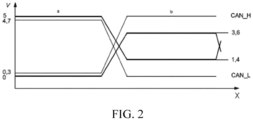
- FIG. 2 is a logic diagram of CAN_H and CAN_L at a CAN physical layer of a general standard.
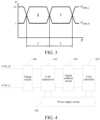
- FIG. 3 is a logic diagram of CAN_H and CAN_L at a CAN physical layer of a 24V trailer.
- CAN standards with different highest levels have different requirements for use of the CAN transceiver 410.
- adaptive CAN transceivers 410 usually need to be designed for use.
- the CAN transceiver 410 of the general standard cannot be used in the CAN for the 24V trailer. Instead, only a special CAN transceiver 410 adapted to the standard for the 24V trailer can be used.
- the CAN transceiver 410 for the 24V trailer is specially adapted to a special CAN version.
- the CAN circuit structure provided in the embodiments of the present invention can still be applied to a CAN bus of other special standards even selecting a CAN transceiver chip meeting the general standard. In this way, fewer CAN transceiver chips of the special standard are required and the manufacturing costs of related devices are reduced.
- FIG. 4 shows an exemplary CAN circuit structure.
- the CAN circuit structure may consist of: a pair of data buses, a CAN transceiver 410, a clamp circuit 440, a CAN controller 420, a signal isolation circuit 450 and a power supply circuit 430.
- the pair of data buses are respectively represented by CAN_H and CAN_L. Differential signals corresponding to a CAN protocol are transmitted on the data buses. Information is transmitted through a correspondence between CAN_H and CAN_L and a high level and a low level.
- the CAN transceiver 410 is connected to the data buses CAN_H and CAN_L for receiving and transmitting the differential signals and implementing conversion between a differential signal and a binary digital signal.
- a "first voltage domain" consists of a ground terminal and a corresponding operating voltage. The ground terminal may not be a zero potential reference point for an entire system.
- a difference between voltages of high and low levels of the differential signals that can be received and sent by the CAN transceiver is constant.
- the expression "operating in a first voltage domain" is used herein to indicate a difference between voltages of differential signals that can be received and transmitted by the CAN transceiver 410.
- the CAN transceiver 410 may be a CAN transceiver meeting the general standard, for example, a CAN transceiver meeting an ISO11898 standard, thus implementing relatively low hardware costs.
- the clamp circuit 440 is a functional circuit for maintaining a top or a bottom of a periodically changing waveform signal at a specified level.
- the clamp circuit 440 is disposed between the CAN transceiver 410 and the data buses CAN_H and CAN_L, which can restrict the high level or the low level of the differential signal to a specific level. In this way, the difference between the voltages of the differential signals transmitted on the data buses can be changed, to conform to a standard met by the CAN transceiver 410.
- the CAN controller 420 may specifically be any suitable existing CAN controller, which can perform one or more functions (for example, perform operations such as bit filling, CRC, response detection and the like) disclosed in the above embodiments during information transmission and receiving.
- the CAN controller 420 Since the CAN transceiver 410 needs to adapt to the differential signal on the data bus, the CAN controller 420 operates in a normal voltage environment. Therefore, reference voltage points in the voltage environments in which the CAN controller 420 and the CAN transceiver 410 are located are different.
- the expression "operating in a second voltage domain” is used herein to indicate an operating voltage and a ground terminal used by the CAN controller 420 during operation, which are different from those of the voltage environment in which the CAN transceiver 410 operates.
- the signal isolation circuit 450 is disposed between the CAN transceiver 410 and the CAN controller 420.
- the signal isolation circuit 450 may adopt any type of circuit or chip that has a signal isolation effect, to ensure that both the CAN transceiver 410 and the CAN controller 420 can operate normally and that signals between the two can be converted accordingly without being affected by a voltage domain change.
- the power supply circuit 430 is a functional module for power management, which may specifically adopt any power management chip capable of dual voltage outputting.
- the power supply circuit may be connected to the CAN transceiver 410 and the CAN controller 420 for providing corresponding first voltage domain and second voltage domain for the CAN transceiver 410 and the CAN controller 420.
- the power supply circuit 430 may serve as a discrete power management system with a plurality of different output terminals to meet power supplying demands of the CAN transceiver 410 and the CAN controller 420.
- the power supply circuit 430 may be integrated into the CAN circuit structure as a part of the CAN circuit structure and provides the first voltage domain and the second voltage domain through two output terminals respectively.
- a high level of the differential signal is about 35V.
- the operating voltage of the first voltage domain may be equivalent to the high level of the differential signals, which is also set to about 25V.
- the difference between the voltage of the ground terminal and the operating voltage of the first voltage domain is maintained at about 5V, to ensure that the CAN transceiver can be used.
- the operating voltage of the second voltage domain is a normal operating voltage and the ground terminal thereof is also a zero potential reference, to maintain the normal operation of the CAN controller 420.
- the difference between voltages of the high level and the low level on the data buses is restricted within a voltage difference range of the general standard through the clamp circuit 440 that is additionally disposed, so that the CAN transceiver meeting the general standard can also be used in some CAN protocols of specific versions.
- the CAN transceiver and a CAN receiver operating in two different voltage domains are connected through the signal isolation circuit 450, which implements voltage domain isolation and signal conversion for the two, thus ensuring that signals can be effectively transmitted between the two.
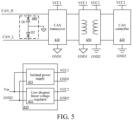
- FIG. 5 is a specific example of a CAN circuit structure. As shown in FIG. 5 , a first ground terminal GND1 and a second ground terminal CND2 that are isolated from each other exist in the CAN circuit structure.
- a CAN transceiver 410 is connected to the first ground terminal GND1 and operates at a first voltage VCC1.
- a CAN controller 420 is connected to the second ground terminal GND2 and operates at a second voltage VCC2.
- the CAN transceiver 410 and the CAN controller 420 are connected to each other through a signal isolation chip 450.
- the signal isolation chip 450 isolates two different voltage domains in which the CAN transceiver 410 and the CAN controller 420 are located and implements conversion of signals for the two voltage domains.
- the first ground terminal GND1, the second ground terminal CND2, the first voltage VCC1 and the second voltage VCC2 are all provided by a power supply circuit 430.
- the power supply circuit 430 consists of two parts: an isolated power supply 431 and a low-dropout linear voltage regulator 432, each having a corresponding output port for providing the first ground terminal GND1, the second ground terminal CND2, the first voltage VCC1 and the second voltage VCC2.
- An input terminal of the power supply circuit 430 is connected to an input power supply Vin for receiving a voltage provided by the input power supply Vin.
- a ground terminal of the input power supply Vin is also the second ground terminal GND2 as a zero voltage point.
- an input terminal of the isolated power supply 431 is connected to the input power supply. After the input power supply is converted, the first voltage VCC1 and the first ground terminal GND1 are output at an output terminal of the isolated power supply 431. Since the isolated power supply 431 is used, the first ground terminal GND1 and the second ground terminal GND2 output at the output terminal are isolated from each other.
- the input terminal of the low-dropout linear voltage regulator 432 is also connected to the input power supply.
- a pretty stable output voltage VCC2 (a second voltage) is provided for the CAN controller 420 for use.
- the ground terminal of the low-dropout linear voltage regulator 432 is the same as the ground terminal of the input power supply, which is also the second ground terminal GND2.
- the first voltage domain (that is, the first ground terminal GND1 and the first operating voltage VCC1) is provided for the CAN transceiver 410 through the isolated power supply 431 and the second voltage domain (that is, the second ground terminal GND2 and the second operating voltage VCC2) is further provided for the CAN controller 420 through the low-dropout linear voltage regulator 432.
- the CAN circuit structure further includes a clamp circuit 440.
- the CAN transceiver 410 is connected to the data bus through the clamp circuit 440, which controls the difference between the voltages of the differential signals.
- the clamp circuit 440 may consist of a first diode D1 and a second diode D2.
- a pair of data buses are respectively represented by a first data line CAN_H and a second data line CAN_L.
- An anode of the first diode D1 is connected to the first data line CAN_H and an anode of the second diode D2 is connected to the second data line CAN_L.
- Cathodes of the first diode D1 and the second diode D2 are both connected to the first ground terminal GND1.
- Low levels on the first data line CAN_H and the second data line CAN_L may be clamped to the first ground terminal GND1 through the above clamp circuit 440.
- a high level of the differential signal is equivalent to the first operating voltage VCC1 of the CAN transceiver 31. Therefore, the difference between the voltages of the differential signals transmitted on the data lines can adapt to the CAN transceiver 410.
- the difference between the voltages of the high level and the low level of the differential signals transmitted on the data buses may be greater than a voltage specification standard met by the CAN transceiver 410.
- a level value of the high level on the 24V trailer system is up to about 32V.
- the CAN transceiver that can meet only the general standard can also be applied to the 24V trailer system to receive or output a differential signal conforming to the CAN standard for the 24V trailer merely by maintaining the high level of the differential signal to be equivalent to the first operating voltage VCC1, thus reducing corresponding costs.
- FIG. 6 is an application example of a CAN circuit structure according to one of the disclosed exemplary CAN circuit structures. As shown in FIG. 6 , the CAN circuit structure may be applied to a diagnostic device 62 for diagnosing a trailer system 61.
- the trailer system 61 is a typical vehicle control system that uses a CAN bus to implement real-time data communication between a plurality of functional nodes in a trailer. Generally, all data structures required for vehicle control, for example, throttle control are transmitted on the CAN bus.
- the diagnostic device 62 is a data information reading device used for fault maintenance or overhaul.
- the diagnosis device 62 may communicate with the CAN bus in the trailer system 10 through a communication interface provided by the trailer system 61, to obtain related data information transmitted on the bus, to assist in completion of vehicle fault diagnosis.
- the CAN circuit structure disclosed in the above embodiments is applied in the diagnostic device 62, including a clamp circuit 440, a CAN transceiver 410, a signal isolation circuit 450, a CAN controller 420 and a power supply circuit 430.
- the diagnostic device establishes a connection to the CAN bus of the trailer system 61 through a connection interface extending from the clamp circuit 440 and reads one or more pieces of related vehicle information transmitted in the CAN bus through the CAN transceiver 410, the CAN controller 420 and the like.
- the diagnostic device may be provided with a control button for receiving a control instruction from a user, or may be provided with a portable power supply such as a lithium battery for supplying power to the entire diagnostic device 62.
- the CAN bus in the trailer system 61 uses a specific-version CAN protocol for a trailer of 24V or 12V
- a CAN receiver meeting the general standard with lower costs, which is available in the market in a large quantity may still be used in the diagnostic device 62, which serves as a differential signal converter to receive and transmit differential signals meeting the CAN protocol of the specific version.
- the diagnostic device 20 may be a diagnostic device used for vehicle and device diagnosis of a 24V trailer system.
- the diagnostic device may be connected to the CAN bus of the 24V trailer through the above CAN circuit structure, to perform related device diagnosis operations.
- the CAN transceiver 410 disposed in the diagnostic device 20 is a CAN transceiver chip that meets the general standard ISO11898.
- the computer software may be stored in a computer-readable storage medium.
- the program When the program is executed, the program may include the procedures of the embodiments of the foregoing methods.
- the storage medium may be a magnetic disk, an optical disc, a read-only memory, a random access memory or the like.
Landscapes
- Engineering & Computer Science (AREA)
- Theoretical Computer Science (AREA)
- General Engineering & Computer Science (AREA)
- Physics & Mathematics (AREA)
- General Physics & Mathematics (AREA)
- Computer Networks & Wireless Communication (AREA)
- Signal Processing (AREA)
- Mechanical Engineering (AREA)
- Computer Hardware Design (AREA)
- Health & Medical Sciences (AREA)
- Computing Systems (AREA)
- General Health & Medical Sciences (AREA)
- Medical Informatics (AREA)
- Dc Digital Transmission (AREA)
Description
- The present application relates to the technical field of vehicle diagnosis, and in particular, to a CAN (Controller Area Network) circuit structure and a vehicle diagnostic device including the same.
- In the automobile industry, in consideration of requirements for safety, comfort, convenience, low pollution and low costs, automobile manufacturers developed a plurality of different electronic control systems. Since requirements for data types and reliability for communication between the electronic control systems are different, a number of wire harnesses increases, which brings difficulties to automobile manufacturing and design.
- In order to meet the requirements of "reducing the number of wire harnesses" and "performing high-speed communication for a large amount of data through a plurality of LANs", Bosch, a German electrical company, developed the CAN communication protocol for automobiles in 1986.
- In the related art, the document D1 (Patent Application Pub. No.:
CN102490669A ) discloses an automobile CAN bus adapter circuit and a method thereof. The circuit includes a differential signal processing circuit, a CAN signal adapter circuit and a signal isolation circuit. The differential signal processing circuit is used for carrying out experimental matching and filtering on a CAN network signal. The CAN signal adapter circuit is used for transmitting and receiving a differential signal to provide differential transmission capability to the bus and provide differential receiving capability to MCU. The signal isolation circuit is used for converting a signal of the CAN signal adapter circuit into a serial signal having the same electric potential with the MCU and outputting the serial signal to a CAN communication interface of the MCU. - The related art document D2 (Patent Application Pub. No.:
US 2006091915Al ) discloses a differential bus network, in general, or a controller area network (CAN) driver, in particular, controls and minimizes the variation on the common-mode signal of the CAN bus. This CAN driver also provides improved symmetry between its differential output signals, CANH and CANL, and provides protection for its low voltage devices from voltage transients occurring on its output lines. The common-mode signal is sensed and buffered, then during the dominant to recessive transition, the bus signals are shorted to the buffered common mode voltage. Specifically, additional switches or transistors are used to pull the differential output signals, CANH and CANL, to the common mode signal VCM when the state of the CAN bus transitions from dominant to recessive. - A controller area network (CAN for short) is one of the most widely used fieldbuses in the world after being standardized by ISO11898 and ISO11519, which provides powerful technical support for a distributed control system to achieve real-time and reliable data communication between nodes.
- During implementation of the present invention, the inventor finds at least the following problems in the prior art. There are still a plurality of different versions of stipulations for signals at logic levels in the existing automobile CAN protocol specification, for example, a general CAN protocol specification and a CAN protocol specification for a 24V trailer.
- In different versions, only CAN transceiver chips in conformity with corresponding standards can achieve communication with the CAN for reading information about the automobile. As a result, a use range of the standard CAN transceiver chip is restricted and some non-standard or general CANs need tailored CAN transceiver chips, resulting in increased manufacturing costs.
- The present invention is defined in the appended
independent claim 1 to which reference should be made. Advantageous features are set out in the appended dependent claims. -
-
FIG. 1 is a schematic diagram of a typical CAN circuit structure; -
FIG. 2 is a logic diagram of CAN_H and CAN_L at a CAN physical layer of a general standard; -
FIG. 3 is a logic diagram of CAN_H and CAN_L at a CAN physical layer of a 24V trailer; -
FIG. 4 is a structural block diagram of an exemplary CAN circuit structure; -
FIG. 5 is a schematic diagram of an exemplary CAN circuit structure; and -
FIG. 6 is a schematic diagram of an application example of a CAN circuit structure according to one of the disclosed exemplary CAN circuit structures - The CAN specification 2.0 was formulated and released in 1991, which includes two parts: A and B. The part 2.0A provides a standard format for CAN messages and the part 2.0B is an extension. The J1939 protocol based on the CAN2.0B specification was further proposed in 2000.
-
FIG. 1 is a block diagram of a typical CAN circuit. As shown inFIG. 1 , the CAN circuit block diagram includes a pair of data buses (respectively represented by CAN_H and CAN_L inFIG. 1 ), aCAN transceiver 410, aCAN controller 420 and apower supply circuit 430. - The
CAN transceiver 410 serves as a transmission medium to implement conversion into different data forms. In other words, a binary code stream is converted into a differential signal to be sent to the data bus and the differential signal is converted into a binary code stream to be received. - The CAN
controller 420 is a control core for implementing a protocol bottom layer and a data link layer of the CAN bus. TheCAN controller 420 may generate a CAN frame and transmit the CAN frame to theCAN transceiver 410 in the binary code stream form, which is converted into a corresponding differential signal by theCAN transceiver 410. Alternatively, a binary code stream received from theCAN transceiver 410 may be parsed and received. - Certainly, during transmission by the
CAN controller 420, bit filling, CRC and response detection (during receiving by theCAN controller 420, transmission and receiving comparison is correspondingly performed, bit filling is removed and CRC is performed) may be further performed, or tasks such as conflict determining and error handling are performed during receiving. - The
power supply circuit 430 may be any type of power management system for outputting a stable and reliable DC voltage to supply power to theCAN transceiver 410 and theCAN controller 420. Specifically, thepower supply circuit 430 may be a power management system consisting of a low-dropout linear voltage regulator for outputting an operating voltage VCC required by theCAN transceiver 410 and theCAN controller 420. - In the CAN circuit block diagram shown in
FIG. 1 , the differential signal transmitted on the data bus usually represents different information by using a high-low level difference between the two buses. For example, when the data line CAN_H has a low level and the data line CAN_L has a high level, it indicates binary information "0". However, when the data line CAN_H has a low level and the data line CAN_L has a high level, it indicates binary information "1". - For CANs following different standards, although logic settings may be similar, differences between voltages of differential signals transmitted on the data buses are usually different due to differences between voltage specifications.
- For example,
FIG. 2 is a logic diagram of CAN_H and CAN_L at a CAN physical layer of a general standard.FIG. 3 is a logic diagram of CAN_H and CAN_L at a CAN physical layer of a 24V trailer. - It can be seen from comparison between
FIG. 2 andFIG. 3 that, in a dominant state (indicating information "0"), the highest level of CAN_L of the general standard is maintained at about 5V, but the highest level of CAN_L of the 24V trailer can be up to about 32V. - Therefore, CAN standards with different highest levels (differences between voltages of differential signals) have different requirements for use of the
CAN transceiver 410. In order to adapt to different CAN protocols,adaptive CAN transceivers 410 usually need to be designed for use. - For example, as shown in
FIG. 2 andFIG. 3 , since differences between voltages of the differential signals are very large in a voltage specification and standard for a 24V trailer, theCAN transceiver 410 of the general standard cannot be used in the CAN for the 24V trailer. Instead, only aspecial CAN transceiver 410 adapted to the standard for the 24V trailer can be used. - Compared with the
CAN transceiver 410 of the general standard, theCAN transceiver 410 for the 24V trailer is specially adapted to a special CAN version. There arefew CAN transceivers 410 for the 24V trailer in the market and the price is relatively high, which results in relatively high costs of related devices connected to the CAN for the 24V trailer. - The CAN circuit structure provided in the embodiments of the present invention can still be applied to a CAN bus of other special standards even selecting a CAN transceiver chip meeting the general standard. In this way, fewer CAN transceiver chips of the special standard are required and the manufacturing costs of related devices are reduced.
-
FIG. 4 shows an exemplary CAN circuit structure. As shown inFIG. 4 , the CAN circuit structure may consist of: a pair of data buses, aCAN transceiver 410, aclamp circuit 440, aCAN controller 420, asignal isolation circuit 450 and apower supply circuit 430. - The pair of data buses are respectively represented by CAN_H and CAN_L. Differential signals corresponding to a CAN protocol are transmitted on the data buses. Information is transmitted through a correspondence between CAN_H and CAN_L and a high level and a low level.
- The
CAN transceiver 410 is connected to the data buses CAN_H and CAN_L for receiving and transmitting the differential signals and implementing conversion between a differential signal and a binary digital signal. A "first voltage domain" consists of a ground terminal and a corresponding operating voltage. The ground terminal may not be a zero potential reference point for an entire system. - According to different standards to be met during design, a difference between voltages of high and low levels of the differential signals that can be received and sent by the CAN transceiver is constant. The expression "operating in a first voltage domain" is used herein to indicate a difference between voltages of differential signals that can be received and transmitted by the
CAN transceiver 410. - In some embodiments, the
CAN transceiver 410 may be a CAN transceiver meeting the general standard, for example, a CAN transceiver meeting an ISO11898 standard, thus implementing relatively low hardware costs. - The
clamp circuit 440 is a functional circuit for maintaining a top or a bottom of a periodically changing waveform signal at a specified level. Theclamp circuit 440 is disposed between theCAN transceiver 410 and the data buses CAN_H and CAN_L, which can restrict the high level or the low level of the differential signal to a specific level. In this way, the difference between the voltages of the differential signals transmitted on the data buses can be changed, to conform to a standard met by theCAN transceiver 410. - The
CAN controller 420 may specifically be any suitable existing CAN controller, which can perform one or more functions (for example, perform operations such as bit filling, CRC, response detection and the like) disclosed in the above embodiments during information transmission and receiving. - Since the
CAN transceiver 410 needs to adapt to the differential signal on the data bus, theCAN controller 420 operates in a normal voltage environment. Therefore, reference voltage points in the voltage environments in which theCAN controller 420 and theCAN transceiver 410 are located are different. - The expression "operating in a second voltage domain" is used herein to indicate an operating voltage and a ground terminal used by the
CAN controller 420 during operation, which are different from those of the voltage environment in which theCAN transceiver 410 operates. - The
signal isolation circuit 450 is disposed between theCAN transceiver 410 and theCAN controller 420. Specifically, thesignal isolation circuit 450 may adopt any type of circuit or chip that has a signal isolation effect, to ensure that both theCAN transceiver 410 and theCAN controller 420 can operate normally and that signals between the two can be converted accordingly without being affected by a voltage domain change. - The
power supply circuit 430 is a functional module for power management, which may specifically adopt any power management chip capable of dual voltage outputting. The power supply circuit may be connected to theCAN transceiver 410 and theCAN controller 420 for providing corresponding first voltage domain and second voltage domain for theCAN transceiver 410 and theCAN controller 420. - In this embodiment, the
power supply circuit 430 may serve as a discrete power management system with a plurality of different output terminals to meet power supplying demands of theCAN transceiver 410 and theCAN controller 420. - In some other embodiments, the
power supply circuit 430 may be integrated into the CAN circuit structure as a part of the CAN circuit structure and provides the first voltage domain and the second voltage domain through two output terminals respectively. - For example, for a differential signal used in the 24V trailer system, if a low level of the differential signal is the zero potential reference, a high level of the differential signal is about 35V.
- Therefore, in an actual CAN circuit structure, the operating voltage of the first voltage domain may be equivalent to the high level of the differential signals, which is also set to about 25V. In addition, the difference between the voltage of the ground terminal and the operating voltage of the first voltage domain is maintained at about 5V, to ensure that the CAN transceiver can be used.
- The operating voltage of the second voltage domain is a normal operating voltage and the ground terminal thereof is also a zero potential reference, to maintain the normal operation of the
CAN controller 420. - According to the CAN circuit structure provided in the embodiments of the present invention, on one hand, the difference between voltages of the high level and the low level on the data buses is restricted within a voltage difference range of the general standard through the
clamp circuit 440 that is additionally disposed, so that the CAN transceiver meeting the general standard can also be used in some CAN protocols of specific versions. - On the other hand, the CAN transceiver and a CAN receiver operating in two different voltage domains are connected through the
signal isolation circuit 450, which implements voltage domain isolation and signal conversion for the two, thus ensuring that signals can be effectively transmitted between the two. -
FIG. 5 is a specific example of a CAN circuit structure. As shown inFIG. 5 , a first ground terminal GND1 and a second ground terminal CND2 that are isolated from each other exist in the CAN circuit structure. - A
CAN transceiver 410 is connected to the first ground terminal GND1 and operates at a first voltage VCC1. ACAN controller 420 is connected to the second ground terminal GND2 and operates at a second voltage VCC2. - The
CAN transceiver 410 and theCAN controller 420 are connected to each other through asignal isolation chip 450. Thesignal isolation chip 450 isolates two different voltage domains in which theCAN transceiver 410 and theCAN controller 420 are located and implements conversion of signals for the two voltage domains. - The first ground terminal GND1, the second ground terminal CND2, the first voltage VCC1 and the second voltage VCC2 are all provided by a
power supply circuit 430. - In some embodiments, the
power supply circuit 430 consists of two parts: anisolated power supply 431 and a low-dropoutlinear voltage regulator 432, each having a corresponding output port for providing the first ground terminal GND1, the second ground terminal CND2, the first voltage VCC1 and the second voltage VCC2. - An input terminal of the
power supply circuit 430 is connected to an input power supply Vin for receiving a voltage provided by the input power supply Vin. A ground terminal of the input power supply Vin is also the second ground terminal GND2 as a zero voltage point. - On one hand, an input terminal of the
isolated power supply 431 is connected to the input power supply. After the input power supply is converted, the first voltage VCC1 and the first ground terminal GND1 are output at an output terminal of theisolated power supply 431. Since theisolated power supply 431 is used, the first ground terminal GND1 and the second ground terminal GND2 output at the output terminal are isolated from each other. - On the other hand, the input terminal of the low-dropout
linear voltage regulator 432 is also connected to the input power supply. Through the dropoutlinear voltage regulator 432, a pretty stable output voltage VCC2 (a second voltage) is provided for theCAN controller 420 for use. Certainly, the ground terminal of the low-dropoutlinear voltage regulator 432 is the same as the ground terminal of the input power supply, which is also the second ground terminal GND2. - In the above power supply circuit, the first voltage domain (that is, the first ground terminal GND1 and the first operating voltage VCC1) is provided for the
CAN transceiver 410 through theisolated power supply 431 and the second voltage domain (that is, the second ground terminal GND2 and the second operating voltage VCC2) is further provided for theCAN controller 420 through the low-dropoutlinear voltage regulator 432. - Still referring to
FIG 5 , in order to ensure that the difference between voltages of differential signals transmitted on the data buses is adapted to theCAN transceiver 410, the CAN circuit structure further includes aclamp circuit 440. TheCAN transceiver 410 is connected to the data bus through theclamp circuit 440, which controls the difference between the voltages of the differential signals. - As shown in
FIG. 5 , in some embodiments, theclamp circuit 440 may consist of a first diode D1 and a second diode D2. A pair of data buses are respectively represented by a first data line CAN_H and a second data line CAN_L. - An anode of the first diode D1 is connected to the first data line CAN_H and an anode of the second diode D2 is connected to the second data line CAN_L. Cathodes of the first diode D1 and the second diode D2 are both connected to the first ground terminal GND1.
- Low levels on the first data line CAN_H and the second data line CAN_L may be clamped to the first ground terminal GND1 through the
above clamp circuit 440. A high level of the differential signal is equivalent to the first operating voltage VCC1 of the CAN transceiver 31. Therefore, the difference between the voltages of the differential signals transmitted on the data lines can adapt to theCAN transceiver 410. - During actual operation, the difference between the voltages of the high level and the low level of the differential signals transmitted on the data buses may be greater than a voltage specification standard met by the
CAN transceiver 410. For example, a level value of the high level on the 24V trailer system is up to about 32V. - Therefore, after the low level (an initial level value is a zero potential reference point, that is, the second ground terminal GND2) on the first data line CAN_H or the second data line CAN_L is clamped to the first ground terminal GND1 (which is consistent with the ground terminal of the CAN transceiver 410) under the clamping action of the
clamp circuit 440, the CAN transceiver that can meet only the general standard can also be applied to the 24V trailer system to receive or output a differential signal conforming to the CAN standard for the 24V trailer merely by maintaining the high level of the differential signal to be equivalent to the first operating voltage VCC1, thus reducing corresponding costs. - The CAN circuit structure provided in the embodiments of the present invention may be further applied to many different related devices.
FIG. 6 is an application example of a CAN circuit structure according to one of the disclosed exemplary CAN circuit structures. As shown inFIG. 6 , the CAN circuit structure may be applied to adiagnostic device 62 for diagnosing atrailer system 61. - The
trailer system 61 is a typical vehicle control system that uses a CAN bus to implement real-time data communication between a plurality of functional nodes in a trailer. Generally, all data structures required for vehicle control, for example, throttle control are transmitted on the CAN bus. - The
diagnostic device 62 is a data information reading device used for fault maintenance or overhaul. Thediagnosis device 62 may communicate with the CAN bus in the trailer system 10 through a communication interface provided by thetrailer system 61, to obtain related data information transmitted on the bus, to assist in completion of vehicle fault diagnosis. - As shown in
FIG. 6 , the CAN circuit structure disclosed in the above embodiments is applied in thediagnostic device 62, including aclamp circuit 440, aCAN transceiver 410, asignal isolation circuit 450, aCAN controller 420 and apower supply circuit 430. - The diagnostic device establishes a connection to the CAN bus of the
trailer system 61 through a connection interface extending from theclamp circuit 440 and reads one or more pieces of related vehicle information transmitted in the CAN bus through theCAN transceiver 410, theCAN controller 420 and the like. - Certainly, one or more functional modules may be added to or deducted from the
diagnostic device 62 according to actual situations. For example, the diagnostic device may be provided with a control button for receiving a control instruction from a user, or may be provided with a portable power supply such as a lithium battery for supplying power to the entirediagnostic device 62. - In this embodiment, although the CAN bus in the
trailer system 61 uses a specific-version CAN protocol for a trailer of 24V or 12V, a CAN receiver meeting the general standard with lower costs, which is available in the market in a large quantity may still be used in thediagnostic device 62, which serves as a differential signal converter to receive and transmit differential signals meeting the CAN protocol of the specific version. - In this embodiment, due to the specific CAN circuit structure design, manufacturing costs of the diagnostic device can be effectively reduced and fewer special CAN receivers are required.
- Specifically, the diagnostic device 20 may be a diagnostic device used for vehicle and device diagnosis of a 24V trailer system. The diagnostic device may be connected to the CAN bus of the 24V trailer through the above CAN circuit structure, to perform related device diagnosis operations. The
CAN transceiver 410 disposed in the diagnostic device 20 is a CAN transceiver chip that meets the general standard ISO11898. - A person skilled in the art should further understand that the steps of the exemplary CAN circuit network described with reference to the embodiments disclosed herein can be implemented in electronic hardware, computer software or a combination thereof. To clearly illustrate the interchangeability of hardware and software, the compositions and the steps of the various examples have been generally described in the above description in terms of functionality. Whether the functions are performed by hardware or software depends on specific applications and design constraints and conditions of the technical solutions.
- Persons skilled in the art can use different methods to implement the described functions for each particular application, but it should not be considered that the implementation goes beyond the scope of the embodiments of the present invention. The computer software may be stored in a computer-readable storage medium. When the program is executed, the program may include the procedures of the embodiments of the foregoing methods. The storage medium may be a magnetic disk, an optical disc, a read-only memory, a random access memory or the like.
Claims (5)
- A Controller Area Network, CAN, circuit structure, comprising:a pair of data buses on which differential signals are transmitted;a CAN transceiver (410) operating in a first voltage domain, wherein the CAN transceiver (410) is connected to the data buses for receiving and transmitting the differential signals;a clamp circuit (440) disposed between the CAN transceiver (410) and the data buses for clamping a high level or a low level of the differential signals, so that a difference between voltages of the differential signals is adapted to the CAN transceiver (410), wherein the clamp circuit (440) is configured to restrict the low level of the differential signals to a ground terminal of the first voltage domain and the high level of the differential signals to an operating voltage of the first voltage domain;a CAN controller (420) operating in a second voltage domain, wherein the CAN controller (420) is connected to the CAN transceiver (410) for communicating with the CAN transceiver (410); anda signal isolation circuit (450) disposed between the CAN transceiver (410) and the CAN controller (420) for isolating the first voltage domain from the second voltage domain, wherein a first connection terminal of the signal isolation circuit (450) is connected to the CAN transceiver (410) and a second connection terminal of the signal isolation circuit (450) is connected to the CAN controller (420) for isolating and converting a signal transmitted between the first voltage domain and the second voltage domain;further comprising: a power supply circuit (430) configured to provide the first voltage domain and the second voltage domain for the CAN transceiver (410) and the CAN controller (420);wherein the power supply circuit (430) forms a first ground terminal and a second ground terminal that are isolated from each other and outputs a first supply voltage and a second supply voltage, whereinthe CAN transceiver (410) is connected to the first supply voltage and the first ground terminal and the CAN controller (420) is connected to the second supply voltage and the second ground terminal;characterised in that the power supply circuit (430) comprises an input power supply and an isolated power supply (431), wherein an input terminal of the isolated power supply (431) is connected to the input power supply, andan output terminal of the isolated power supply (431) forms the first supply voltage and the first ground terminal and the isolated power supply (431) is connected to the CAN transceiver (410) for providing the first supply voltage and the first ground terminal for the CAN transceiver (410).
- The CAN circuit structure according to claim 1, wherein the power supply circuit (430) further comprises a low-dropout linear voltage regulator (432), wherein an input terminal of the low-dropout linear voltage regulator (432) is connected to the input power supply, and
an output terminal of the low-dropout linear voltage regulator (432) forms the second supply voltage and the second ground terminal and the low-dropout linear voltage regulator (432) is connected to the CAN controller (420) for providing the second supply voltage and the second ground terminal for the CAN controller (420). - The CAN circuit structure according to claim 1, wherein the clamp circuit (440) consists of a first diode and a second diode and the pair of data buses consist of a first data line and a second data line, wherein
an anode of the first diode is connected to the first data line, an anode of the second diode is connected to the second data line and cathodes of both the first diode and the second diode are connected to the first ground terminal. - The CAN circuit structure according to claim 1, wherein the CAN transceiver (410) is a CAN transceiver (410) meeting a general standard ISO11898 and the differential signals transmitted on the data buses are CAN signals meeting an ISO11992 standard.
- A vehicle diagnostic device, comprising:
the CAN circuit structure of any one of the preceding claims.
Applications Claiming Priority (2)
| Application Number | Priority Date | Filing Date | Title |
|---|---|---|---|
| CN201821597707.5U CN209351354U (en) | 2018-09-28 | 2018-09-28 | CAN circuit structure and its vehicle diagnostic equipment |
| PCT/CN2019/108537 WO2020063865A1 (en) | 2018-09-28 | 2019-09-27 | Can circuit structure and vehicle diagnostic device thereof |
Publications (3)
| Publication Number | Publication Date |
|---|---|
| EP3805050A1 EP3805050A1 (en) | 2021-04-14 |
| EP3805050A4 EP3805050A4 (en) | 2021-07-28 |
| EP3805050B1 true EP3805050B1 (en) | 2025-03-12 |
Family
ID=67780502
Family Applications (1)
| Application Number | Title | Priority Date | Filing Date |
|---|---|---|---|
| EP19865451.9A Active EP3805050B1 (en) | 2018-09-28 | 2019-09-27 | Can circuit structure and vehicle diagnostic device thereof |
Country Status (4)
| Country | Link |
|---|---|
| US (1) | US11548456B2 (en) |
| EP (1) | EP3805050B1 (en) |
| CN (1) | CN209351354U (en) |
| WO (1) | WO2020063865A1 (en) |
Families Citing this family (7)
| Publication number | Priority date | Publication date | Assignee | Title |
|---|---|---|---|---|
| CN209351354U (en) | 2018-09-28 | 2019-09-06 | 深圳市道通科技股份有限公司 | CAN circuit structure and its vehicle diagnostic equipment |
| CN109050444B (en) * | 2018-09-28 | 2024-08-16 | 深圳市道通科技股份有限公司 | CAN circuit structure and vehicle diagnosis equipment thereof |
| EP4037258B1 (en) * | 2021-01-29 | 2025-04-23 | Nxp B.V. | Can transmitter |
| CN117076366A (en) * | 2022-05-09 | 2023-11-17 | 瑞昱半导体股份有限公司 | Electronic device with defined and undefined bus communication mechanism and communication method thereof |
| US20240338331A1 (en) * | 2023-04-04 | 2024-10-10 | Ghost Autonomy Inc. | Autarchical power domains for executing minimal risk conditions |
| CN116184306B (en) * | 2023-05-05 | 2023-06-23 | 深圳市锐深科技有限公司 | CAN communication isolation device for resisting pulse group and interference elimination method |
| CN118467439B (en) * | 2024-04-29 | 2025-09-19 | 广州市迪士普音响科技有限公司 | Bus isolation transmission circuit |
Family Cites Families (17)
| Publication number | Priority date | Publication date | Assignee | Title |
|---|---|---|---|---|
| US7148723B2 (en) * | 2002-01-30 | 2006-12-12 | Caterpillar Inc | Common controller area network interface |
| US7259609B2 (en) * | 2003-12-01 | 2007-08-21 | Texas Instruments Incorporated | Clamping circuit |
| DE102004042380A1 (en) * | 2004-09-02 | 2006-03-09 | Robert Bosch Gmbh | Data bus interface for a control unit and control unit with a data bus interface |
| US7242227B2 (en) * | 2004-11-01 | 2007-07-10 | Texas Instruments Incorporated | Common mode stabilization circuit for differential bus networks |
| JP2012038040A (en) * | 2010-08-05 | 2012-02-23 | Auto Network Gijutsu Kenkyusho:Kk | Processing system, processing unit, and power supply control method |
| CN102490669A (en) * | 2011-12-09 | 2012-06-13 | 綦江齿轮传动有限公司 | Automobile CAN (Controller Area Network) bus adapter circuit and method thereof |
| JP6117747B2 (en) * | 2014-07-31 | 2017-04-19 | 株式会社日本自動車部品総合研究所 | Signal transmission circuit |
| CN204304418U (en) * | 2014-11-27 | 2015-04-29 | 北京广大泰祥自动化技术有限公司 | Colliery low voltage power line carrier communication-charged uncapping far controls power-off protector |
| KR101596763B1 (en) * | 2015-01-13 | 2016-02-24 | 현대자동차주식회사 | A method for controling controller area network circuit and a device therefore |
| CN105068528B (en) * | 2015-07-10 | 2018-01-30 | 深圳市元征科技股份有限公司 | The communication device of automotive diagnostic system |
| JP6525825B2 (en) * | 2015-08-31 | 2019-06-05 | 国立大学法人名古屋大学 | Communication device |
| US11055615B2 (en) * | 2016-12-07 | 2021-07-06 | Arilou Information Security Technologies Ltd. | System and method for using signal waveform analysis for detecting a change in a wired network |
| US10263706B2 (en) * | 2017-04-18 | 2019-04-16 | The Boeing Company | Single-fiber bidirectional controller area network bus |
| CN106992508A (en) * | 2017-04-20 | 2017-07-28 | 天索(苏州)控制技术有限公司 | Non-isolated CAN overvoltage crowbar |
| US10615996B2 (en) * | 2018-03-14 | 2020-04-07 | Nxp B.V. | Apparatuses and methods for switching communication modes of a transceiver circuit |
| CN209351354U (en) * | 2018-09-28 | 2019-09-06 | 深圳市道通科技股份有限公司 | CAN circuit structure and its vehicle diagnostic equipment |
| CN109050444B (en) * | 2018-09-28 | 2024-08-16 | 深圳市道通科技股份有限公司 | CAN circuit structure and vehicle diagnosis equipment thereof |
-
2018
- 2018-09-28 CN CN201821597707.5U patent/CN209351354U/en active Active
-
2019
- 2019-09-27 EP EP19865451.9A patent/EP3805050B1/en active Active
- 2019-09-27 WO PCT/CN2019/108537 patent/WO2020063865A1/en not_active Ceased
-
2021
- 2021-01-08 US US17/144,356 patent/US11548456B2/en active Active
Also Published As
| Publication number | Publication date |
|---|---|
| US20210129772A1 (en) | 2021-05-06 |
| WO2020063865A1 (en) | 2020-04-02 |
| EP3805050A1 (en) | 2021-04-14 |
| EP3805050A4 (en) | 2021-07-28 |
| CN209351354U (en) | 2019-09-06 |
| US11548456B2 (en) | 2023-01-10 |
Similar Documents
| Publication | Publication Date | Title |
|---|---|---|
| EP3805050B1 (en) | Can circuit structure and vehicle diagnostic device thereof | |
| CN109050444B (en) | CAN circuit structure and vehicle diagnosis equipment thereof | |
| EP3745656A2 (en) | Controller area network transceiver | |
| US11516043B2 (en) | Monolithic high-voltage transceiver connected to two different supply voltage domains | |
| EP4207691B1 (en) | Controller area network termination scheme | |
| US10838906B1 (en) | Communication between transceiver and microcontroller | |
| US20200403823A1 (en) | Functional safety transceiver | |
| CN107852354B (en) | Transmitter-receiver device capable of being connected to a communication network using a bus of the CAN type or FlexRay type | |
| US20220393715A1 (en) | Transceiver for a user station of a serial bus system and method for communicating in a serial bus system | |
| CN115441889A (en) | Transceiver device | |
| CN115811447A (en) | Controller area network transceiver | |
| US11115236B2 (en) | Subscriber station for a bus system and method for transmitting data in a bus system | |
| CN117914645A (en) | CAN bus control method and structure with priority | |
| US7283488B2 (en) | J1850 application specific integrated circuit (ASIC) and messaging technique | |
| US20190305983A1 (en) | Method and apparatus for configuring backup path in vehicle network | |
| CN118819647B (en) | Universal serial bus interface driving method, device, electronic device, storage medium and computer program product | |
| KR20100057840A (en) | Device for fitting a multimedia system in a vehicle | |
| US12113647B2 (en) | Controller area network apparatus with reconfiguration signalling | |
| CN117424774A (en) | Communication anti-interference method and device, electronic equipment and storage medium | |
| CN212811729U (en) | On-board communication circuit and device based on CAN communication | |
| CN211557288U (en) | Conversion circuit based on BroadR-Reach vehicle-mounted Ethernet converter | |
| CN221961721U (en) | A dual power supply circuit based on Schmitt trigger buffer | |
| CN210327617U (en) | CAN Bus communication module | |
| EP4376364B1 (en) | Can transceiver and method for the can transceiver | |
| CN113812121A (en) | Dispenser device and method |
Legal Events
| Date | Code | Title | Description |
|---|---|---|---|
| STAA | Information on the status of an ep patent application or granted ep patent |
Free format text: STATUS: THE INTERNATIONAL PUBLICATION HAS BEEN MADE |
|
| PUAI | Public reference made under article 153(3) epc to a published international application that has entered the european phase |
Free format text: ORIGINAL CODE: 0009012 |
|
| STAA | Information on the status of an ep patent application or granted ep patent |
Free format text: STATUS: REQUEST FOR EXAMINATION WAS MADE |
|
| 17P | Request for examination filed |
Effective date: 20210108 |
|
| AK | Designated contracting states |
Kind code of ref document: A1 Designated state(s): AL AT BE BG CH CY CZ DE DK EE ES FI FR GB GR HR HU IE IS IT LI LT LU LV MC MK MT NL NO PL PT RO RS SE SI SK SM TR |
|
| AX | Request for extension of the european patent |
Extension state: BA ME |
|
| REG | Reference to a national code |
Ref legal event code: R079 Free format text: PREVIOUS MAIN CLASS: B60R0016023000 Ref country code: DE Ref legal event code: R079 Ref document number: 602019067297 Country of ref document: DE Free format text: PREVIOUS MAIN CLASS: B60R0016023000 Ipc: H04L0012400000 |
|
| A4 | Supplementary search report drawn up and despatched |
Effective date: 20210630 |
|
| RIC1 | Information provided on ipc code assigned before grant |
Ipc: H04L 12/40 20060101AFI20210624BHEP |
|
| DAV | Request for validation of the european patent (deleted) | ||
| DAX | Request for extension of the european patent (deleted) | ||
| STAA | Information on the status of an ep patent application or granted ep patent |
Free format text: STATUS: EXAMINATION IS IN PROGRESS |
|
| 17Q | First examination report despatched |
Effective date: 20230206 |
|
| GRAP | Despatch of communication of intention to grant a patent |
Free format text: ORIGINAL CODE: EPIDOSNIGR1 |
|
| STAA | Information on the status of an ep patent application or granted ep patent |
Free format text: STATUS: GRANT OF PATENT IS INTENDED |
|
| GRAS | Grant fee paid |
Free format text: ORIGINAL CODE: EPIDOSNIGR3 |
|
| RIC1 | Information provided on ipc code assigned before grant |
Ipc: H04L 67/12 20220101ALI20240903BHEP Ipc: H04L 12/40 20060101AFI20240903BHEP |
|
| INTG | Intention to grant announced |
Effective date: 20240916 |
|
| GRAA | (expected) grant |
Free format text: ORIGINAL CODE: 0009210 |
|
| STAA | Information on the status of an ep patent application or granted ep patent |
Free format text: STATUS: THE PATENT HAS BEEN GRANTED |
|
| AK | Designated contracting states |
Kind code of ref document: B1 Designated state(s): AL AT BE BG CH CY CZ DE DK EE ES FI FR GB GR HR HU IE IS IT LI LT LU LV MC MK MT NL NO PL PT RO RS SE SI SK SM TR |
|
| REG | Reference to a national code |
Ref country code: GB Ref legal event code: FG4D |
|
| REG | Reference to a national code |
Ref country code: CH Ref legal event code: EP |
|
| REG | Reference to a national code |
Ref country code: DE Ref legal event code: R096 Ref document number: 602019067297 Country of ref document: DE |
|
| REG | Reference to a national code |
Ref country code: IE Ref legal event code: FG4D |
|
| PG25 | Lapsed in a contracting state [announced via postgrant information from national office to epo] |
Ref country code: RS Free format text: LAPSE BECAUSE OF FAILURE TO SUBMIT A TRANSLATION OF THE DESCRIPTION OR TO PAY THE FEE WITHIN THE PRESCRIBED TIME-LIMIT Effective date: 20250612 |
|
| PG25 | Lapsed in a contracting state [announced via postgrant information from national office to epo] |
Ref country code: FI Free format text: LAPSE BECAUSE OF FAILURE TO SUBMIT A TRANSLATION OF THE DESCRIPTION OR TO PAY THE FEE WITHIN THE PRESCRIBED TIME-LIMIT Effective date: 20250312 |
|
| PG25 | Lapsed in a contracting state [announced via postgrant information from national office to epo] |
Ref country code: ES Free format text: LAPSE BECAUSE OF FAILURE TO SUBMIT A TRANSLATION OF THE DESCRIPTION OR TO PAY THE FEE WITHIN THE PRESCRIBED TIME-LIMIT Effective date: 20250312 |
|
| REG | Reference to a national code |
Ref country code: LT Ref legal event code: MG9D |
|
| PG25 | Lapsed in a contracting state [announced via postgrant information from national office to epo] |
Ref country code: NO Free format text: LAPSE BECAUSE OF FAILURE TO SUBMIT A TRANSLATION OF THE DESCRIPTION OR TO PAY THE FEE WITHIN THE PRESCRIBED TIME-LIMIT Effective date: 20250612 |
|
| PG25 | Lapsed in a contracting state [announced via postgrant information from national office to epo] |
Ref country code: HR Free format text: LAPSE BECAUSE OF FAILURE TO SUBMIT A TRANSLATION OF THE DESCRIPTION OR TO PAY THE FEE WITHIN THE PRESCRIBED TIME-LIMIT Effective date: 20250312 |
|
| REG | Reference to a national code |
Ref country code: NL Ref legal event code: MP Effective date: 20250312 |
|
| PG25 | Lapsed in a contracting state [announced via postgrant information from national office to epo] |
Ref country code: LV Free format text: LAPSE BECAUSE OF FAILURE TO SUBMIT A TRANSLATION OF THE DESCRIPTION OR TO PAY THE FEE WITHIN THE PRESCRIBED TIME-LIMIT Effective date: 20250312 |
|
| PG25 | Lapsed in a contracting state [announced via postgrant information from national office to epo] |
Ref country code: GR Free format text: LAPSE BECAUSE OF FAILURE TO SUBMIT A TRANSLATION OF THE DESCRIPTION OR TO PAY THE FEE WITHIN THE PRESCRIBED TIME-LIMIT Effective date: 20250613 Ref country code: BG Free format text: LAPSE BECAUSE OF FAILURE TO SUBMIT A TRANSLATION OF THE DESCRIPTION OR TO PAY THE FEE WITHIN THE PRESCRIBED TIME-LIMIT Effective date: 20250312 |
|
| REG | Reference to a national code |
Ref country code: AT Ref legal event code: MK05 Ref document number: 1775967 Country of ref document: AT Kind code of ref document: T Effective date: 20250312 |
|
| PG25 | Lapsed in a contracting state [announced via postgrant information from national office to epo] |
Ref country code: NL Free format text: LAPSE BECAUSE OF FAILURE TO SUBMIT A TRANSLATION OF THE DESCRIPTION OR TO PAY THE FEE WITHIN THE PRESCRIBED TIME-LIMIT Effective date: 20250312 |
|
| PG25 | Lapsed in a contracting state [announced via postgrant information from national office to epo] |
Ref country code: SE Free format text: LAPSE BECAUSE OF FAILURE TO SUBMIT A TRANSLATION OF THE DESCRIPTION OR TO PAY THE FEE WITHIN THE PRESCRIBED TIME-LIMIT Effective date: 20250312 |
|
| PG25 | Lapsed in a contracting state [announced via postgrant information from national office to epo] |
Ref country code: SM Free format text: LAPSE BECAUSE OF FAILURE TO SUBMIT A TRANSLATION OF THE DESCRIPTION OR TO PAY THE FEE WITHIN THE PRESCRIBED TIME-LIMIT Effective date: 20250312 |
|
| PG25 | Lapsed in a contracting state [announced via postgrant information from national office to epo] |
Ref country code: PT Free format text: LAPSE BECAUSE OF FAILURE TO SUBMIT A TRANSLATION OF THE DESCRIPTION OR TO PAY THE FEE WITHIN THE PRESCRIBED TIME-LIMIT Effective date: 20250714 |
|
| PGFP | Annual fee paid to national office [announced via postgrant information from national office to epo] |
Ref country code: DE Payment date: 20250919 Year of fee payment: 7 |
|
| PG25 | Lapsed in a contracting state [announced via postgrant information from national office to epo] |
Ref country code: PL Free format text: LAPSE BECAUSE OF FAILURE TO SUBMIT A TRANSLATION OF THE DESCRIPTION OR TO PAY THE FEE WITHIN THE PRESCRIBED TIME-LIMIT Effective date: 20250312 Ref country code: IT Free format text: LAPSE BECAUSE OF FAILURE TO SUBMIT A TRANSLATION OF THE DESCRIPTION OR TO PAY THE FEE WITHIN THE PRESCRIBED TIME-LIMIT Effective date: 20250312 |
|
| PGFP | Annual fee paid to national office [announced via postgrant information from national office to epo] |
Ref country code: GB Payment date: 20250923 Year of fee payment: 7 |
|
| PG25 | Lapsed in a contracting state [announced via postgrant information from national office to epo] |
Ref country code: AT Free format text: LAPSE BECAUSE OF FAILURE TO SUBMIT A TRANSLATION OF THE DESCRIPTION OR TO PAY THE FEE WITHIN THE PRESCRIBED TIME-LIMIT Effective date: 20250312 |
|
| PGFP | Annual fee paid to national office [announced via postgrant information from national office to epo] |
Ref country code: FR Payment date: 20250924 Year of fee payment: 7 |
|
| PG25 | Lapsed in a contracting state [announced via postgrant information from national office to epo] |
Ref country code: CZ Free format text: LAPSE BECAUSE OF FAILURE TO SUBMIT A TRANSLATION OF THE DESCRIPTION OR TO PAY THE FEE WITHIN THE PRESCRIBED TIME-LIMIT Effective date: 20250312 Ref country code: EE Free format text: LAPSE BECAUSE OF FAILURE TO SUBMIT A TRANSLATION OF THE DESCRIPTION OR TO PAY THE FEE WITHIN THE PRESCRIBED TIME-LIMIT Effective date: 20250312 |
|
| PG25 | Lapsed in a contracting state [announced via postgrant information from national office to epo] |
Ref country code: RO Free format text: LAPSE BECAUSE OF FAILURE TO SUBMIT A TRANSLATION OF THE DESCRIPTION OR TO PAY THE FEE WITHIN THE PRESCRIBED TIME-LIMIT Effective date: 20250312 |
|
| PG25 | Lapsed in a contracting state [announced via postgrant information from national office to epo] |
Ref country code: SK Free format text: LAPSE BECAUSE OF FAILURE TO SUBMIT A TRANSLATION OF THE DESCRIPTION OR TO PAY THE FEE WITHIN THE PRESCRIBED TIME-LIMIT Effective date: 20250312 |
|
| PG25 | Lapsed in a contracting state [announced via postgrant information from national office to epo] |
Ref country code: IS Free format text: LAPSE BECAUSE OF FAILURE TO SUBMIT A TRANSLATION OF THE DESCRIPTION OR TO PAY THE FEE WITHIN THE PRESCRIBED TIME-LIMIT Effective date: 20250712 |
|
| REG | Reference to a national code |
Ref country code: DE Ref legal event code: R097 Ref document number: 602019067297 Country of ref document: DE |
|
| PG25 | Lapsed in a contracting state [announced via postgrant information from national office to epo] |
Ref country code: DK Free format text: LAPSE BECAUSE OF FAILURE TO SUBMIT A TRANSLATION OF THE DESCRIPTION OR TO PAY THE FEE WITHIN THE PRESCRIBED TIME-LIMIT Effective date: 20250312 |
|
| PLBE | No opposition filed within time limit |
Free format text: ORIGINAL CODE: 0009261 |
|
| STAA | Information on the status of an ep patent application or granted ep patent |
Free format text: STATUS: NO OPPOSITION FILED WITHIN TIME LIMIT |
|
| REG | Reference to a national code |
Ref country code: CH Ref legal event code: L10 Free format text: ST27 STATUS EVENT CODE: U-0-0-L10-L00 (AS PROVIDED BY THE NATIONAL OFFICE) Effective date: 20260121 |
|
| 26N | No opposition filed |
Effective date: 20251215 |
|
| REG | Reference to a national code |
Ref country code: CH Ref legal event code: H13 Free format text: ST27 STATUS EVENT CODE: U-0-0-H10-H13 (AS PROVIDED BY THE NATIONAL OFFICE) Effective date: 20260425 |