EP3800707B1 - Secondary battery, and related battery module, battery pack and apparatus - Google Patents
Secondary battery, and related battery module, battery pack and apparatus Download PDFInfo
- Publication number
- EP3800707B1 EP3800707B1 EP20827980.2A EP20827980A EP3800707B1 EP 3800707 B1 EP3800707 B1 EP 3800707B1 EP 20827980 A EP20827980 A EP 20827980A EP 3800707 B1 EP3800707 B1 EP 3800707B1
- Authority
- EP
- European Patent Office
- Prior art keywords
- secondary battery
- negative electrode
- oxide
- battery
- active material
- Prior art date
- Legal status (The legal status is an assumption and is not a legal conclusion. Google has not performed a legal analysis and makes no representation as to the accuracy of the status listed.)
- Active
Links
Images
Classifications
-
- H—ELECTRICITY
- H01—ELECTRIC ELEMENTS
- H01M—PROCESSES OR MEANS, e.g. BATTERIES, FOR THE DIRECT CONVERSION OF CHEMICAL ENERGY INTO ELECTRICAL ENERGY
- H01M10/00—Secondary cells; Manufacture thereof
- H01M10/05—Accumulators with non-aqueous electrolyte
- H01M10/052—Li-accumulators
- H01M10/0525—Rocking-chair batteries, i.e. batteries with lithium insertion or intercalation in both electrodes; Lithium-ion batteries
-
- H—ELECTRICITY
- H01—ELECTRIC ELEMENTS
- H01M—PROCESSES OR MEANS, e.g. BATTERIES, FOR THE DIRECT CONVERSION OF CHEMICAL ENERGY INTO ELECTRICAL ENERGY
- H01M10/00—Secondary cells; Manufacture thereof
- H01M10/05—Accumulators with non-aqueous electrolyte
- H01M10/058—Construction or manufacture
-
- H—ELECTRICITY
- H01—ELECTRIC ELEMENTS
- H01M—PROCESSES OR MEANS, e.g. BATTERIES, FOR THE DIRECT CONVERSION OF CHEMICAL ENERGY INTO ELECTRICAL ENERGY
- H01M4/00—Electrodes
- H01M4/02—Electrodes composed of, or comprising, active material
- H01M4/04—Processes of manufacture in general
- H01M4/0402—Methods of deposition of the material
- H01M4/0404—Methods of deposition of the material by coating on electrode collectors
-
- H—ELECTRICITY
- H01—ELECTRIC ELEMENTS
- H01M—PROCESSES OR MEANS, e.g. BATTERIES, FOR THE DIRECT CONVERSION OF CHEMICAL ENERGY INTO ELECTRICAL ENERGY
- H01M4/00—Electrodes
- H01M4/02—Electrodes composed of, or comprising, active material
- H01M4/13—Electrodes for accumulators with non-aqueous electrolyte, e.g. for lithium-accumulators; Processes of manufacture thereof
- H01M4/131—Electrodes based on mixed oxides or hydroxides, or on mixtures of oxides or hydroxides, e.g. LiCoOx
-
- H—ELECTRICITY
- H01—ELECTRIC ELEMENTS
- H01M—PROCESSES OR MEANS, e.g. BATTERIES, FOR THE DIRECT CONVERSION OF CHEMICAL ENERGY INTO ELECTRICAL ENERGY
- H01M4/00—Electrodes
- H01M4/02—Electrodes composed of, or comprising, active material
- H01M4/13—Electrodes for accumulators with non-aqueous electrolyte, e.g. for lithium-accumulators; Processes of manufacture thereof
- H01M4/139—Processes of manufacture
- H01M4/1391—Processes of manufacture of electrodes based on mixed oxides or hydroxides, or on mixtures of oxides or hydroxides, e.g. LiCoOx
-
- H—ELECTRICITY
- H01—ELECTRIC ELEMENTS
- H01M—PROCESSES OR MEANS, e.g. BATTERIES, FOR THE DIRECT CONVERSION OF CHEMICAL ENERGY INTO ELECTRICAL ENERGY
- H01M4/00—Electrodes
- H01M4/02—Electrodes composed of, or comprising, active material
- H01M4/36—Selection of substances as active materials, active masses, active liquids
- H01M4/362—Composites
-
- H—ELECTRICITY
- H01—ELECTRIC ELEMENTS
- H01M—PROCESSES OR MEANS, e.g. BATTERIES, FOR THE DIRECT CONVERSION OF CHEMICAL ENERGY INTO ELECTRICAL ENERGY
- H01M4/00—Electrodes
- H01M4/02—Electrodes composed of, or comprising, active material
- H01M4/36—Selection of substances as active materials, active masses, active liquids
- H01M4/362—Composites
- H01M4/364—Composites as mixtures
-
- H—ELECTRICITY
- H01—ELECTRIC ELEMENTS
- H01M—PROCESSES OR MEANS, e.g. BATTERIES, FOR THE DIRECT CONVERSION OF CHEMICAL ENERGY INTO ELECTRICAL ENERGY
- H01M4/00—Electrodes
- H01M4/02—Electrodes composed of, or comprising, active material
- H01M4/36—Selection of substances as active materials, active masses, active liquids
- H01M4/48—Selection of substances as active materials, active masses, active liquids of inorganic oxides or hydroxides
- H01M4/483—Selection of substances as active materials, active masses, active liquids of inorganic oxides or hydroxides for non-aqueous cells
-
- H—ELECTRICITY
- H01—ELECTRIC ELEMENTS
- H01M—PROCESSES OR MEANS, e.g. BATTERIES, FOR THE DIRECT CONVERSION OF CHEMICAL ENERGY INTO ELECTRICAL ENERGY
- H01M4/00—Electrodes
- H01M4/02—Electrodes composed of, or comprising, active material
- H01M4/36—Selection of substances as active materials, active masses, active liquids
- H01M4/48—Selection of substances as active materials, active masses, active liquids of inorganic oxides or hydroxides
- H01M4/52—Selection of substances as active materials, active masses, active liquids of inorganic oxides or hydroxides of nickel, cobalt or iron
- H01M4/525—Selection of substances as active materials, active masses, active liquids of inorganic oxides or hydroxides of nickel, cobalt or iron of mixed oxides or hydroxides containing iron, cobalt or nickel for inserting or intercalating light metals, e.g. LiNiO2, LiCoO2 or LiCoOxFy
-
- H—ELECTRICITY
- H01—ELECTRIC ELEMENTS
- H01M—PROCESSES OR MEANS, e.g. BATTERIES, FOR THE DIRECT CONVERSION OF CHEMICAL ENERGY INTO ELECTRICAL ENERGY
- H01M4/00—Electrodes
- H01M4/02—Electrodes composed of, or comprising, active material
- H01M4/36—Selection of substances as active materials, active masses, active liquids
- H01M4/58—Selection of substances as active materials, active masses, active liquids of inorganic compounds other than oxides or hydroxides, e.g. sulfides, selenides, tellurides, halogenides or LiCoFy; of polyanionic structures, e.g. phosphates, silicates or borates
- H01M4/583—Carbonaceous material, e.g. graphite-intercalation compounds or CFx
- H01M4/587—Carbonaceous material, e.g. graphite-intercalation compounds or CFx for inserting or intercalating light metals
-
- H—ELECTRICITY
- H01—ELECTRIC ELEMENTS
- H01M—PROCESSES OR MEANS, e.g. BATTERIES, FOR THE DIRECT CONVERSION OF CHEMICAL ENERGY INTO ELECTRICAL ENERGY
- H01M4/00—Electrodes
- H01M4/02—Electrodes composed of, or comprising, active material
- H01M2004/021—Physical characteristics, e.g. porosity, surface area
-
- H—ELECTRICITY
- H01—ELECTRIC ELEMENTS
- H01M—PROCESSES OR MEANS, e.g. BATTERIES, FOR THE DIRECT CONVERSION OF CHEMICAL ENERGY INTO ELECTRICAL ENERGY
- H01M4/00—Electrodes
- H01M4/02—Electrodes composed of, or comprising, active material
- H01M2004/026—Electrodes composed of, or comprising, active material characterised by the polarity
- H01M2004/027—Negative electrodes
-
- H—ELECTRICITY
- H01—ELECTRIC ELEMENTS
- H01M—PROCESSES OR MEANS, e.g. BATTERIES, FOR THE DIRECT CONVERSION OF CHEMICAL ENERGY INTO ELECTRICAL ENERGY
- H01M4/00—Electrodes
- H01M4/02—Electrodes composed of, or comprising, active material
- H01M4/13—Electrodes for accumulators with non-aqueous electrolyte, e.g. for lithium-accumulators; Processes of manufacture thereof
- H01M4/133—Electrodes based on carbonaceous material, e.g. graphite-intercalation compounds or CFx
-
- H—ELECTRICITY
- H01—ELECTRIC ELEMENTS
- H01M—PROCESSES OR MEANS, e.g. BATTERIES, FOR THE DIRECT CONVERSION OF CHEMICAL ENERGY INTO ELECTRICAL ENERGY
- H01M4/00—Electrodes
- H01M4/02—Electrodes composed of, or comprising, active material
- H01M4/13—Electrodes for accumulators with non-aqueous electrolyte, e.g. for lithium-accumulators; Processes of manufacture thereof
- H01M4/139—Processes of manufacture
- H01M4/1393—Processes of manufacture of electrodes based on carbonaceous material, e.g. graphite-intercalation compounds or CFx
-
- H—ELECTRICITY
- H01—ELECTRIC ELEMENTS
- H01M—PROCESSES OR MEANS, e.g. BATTERIES, FOR THE DIRECT CONVERSION OF CHEMICAL ENERGY INTO ELECTRICAL ENERGY
- H01M4/00—Electrodes
- H01M4/02—Electrodes composed of, or comprising, active material
- H01M4/36—Selection of substances as active materials, active masses, active liquids
- H01M4/48—Selection of substances as active materials, active masses, active liquids of inorganic oxides or hydroxides
- H01M4/485—Selection of substances as active materials, active masses, active liquids of inorganic oxides or hydroxides of mixed oxides or hydroxides for inserting or intercalating light metals, e.g. LiTi2O4 or LiTi2OxFy
-
- H—ELECTRICITY
- H01—ELECTRIC ELEMENTS
- H01M—PROCESSES OR MEANS, e.g. BATTERIES, FOR THE DIRECT CONVERSION OF CHEMICAL ENERGY INTO ELECTRICAL ENERGY
- H01M4/00—Electrodes
- H01M4/02—Electrodes composed of, or comprising, active material
- H01M4/36—Selection of substances as active materials, active masses, active liquids
- H01M4/48—Selection of substances as active materials, active masses, active liquids of inorganic oxides or hydroxides
- H01M4/50—Selection of substances as active materials, active masses, active liquids of inorganic oxides or hydroxides of manganese
- H01M4/505—Selection of substances as active materials, active masses, active liquids of inorganic oxides or hydroxides of manganese of mixed oxides or hydroxides containing manganese for inserting or intercalating light metals, e.g. LiMn2O4 or LiMn2OxFy
-
- Y—GENERAL TAGGING OF NEW TECHNOLOGICAL DEVELOPMENTS; GENERAL TAGGING OF CROSS-SECTIONAL TECHNOLOGIES SPANNING OVER SEVERAL SECTIONS OF THE IPC; TECHNICAL SUBJECTS COVERED BY FORMER USPC CROSS-REFERENCE ART COLLECTIONS [XRACs] AND DIGESTS
- Y02—TECHNOLOGIES OR APPLICATIONS FOR MITIGATION OR ADAPTATION AGAINST CLIMATE CHANGE
- Y02E—REDUCTION OF GREENHOUSE GAS [GHG] EMISSIONS, RELATED TO ENERGY GENERATION, TRANSMISSION OR DISTRIBUTION
- Y02E60/00—Enabling technologies; Technologies with a potential or indirect contribution to GHG emissions mitigation
- Y02E60/10—Energy storage using batteries
-
- Y—GENERAL TAGGING OF NEW TECHNOLOGICAL DEVELOPMENTS; GENERAL TAGGING OF CROSS-SECTIONAL TECHNOLOGIES SPANNING OVER SEVERAL SECTIONS OF THE IPC; TECHNICAL SUBJECTS COVERED BY FORMER USPC CROSS-REFERENCE ART COLLECTIONS [XRACs] AND DIGESTS
- Y02—TECHNOLOGIES OR APPLICATIONS FOR MITIGATION OR ADAPTATION AGAINST CLIMATE CHANGE
- Y02P—CLIMATE CHANGE MITIGATION TECHNOLOGIES IN THE PRODUCTION OR PROCESSING OF GOODS
- Y02P70/00—Climate change mitigation technologies in the production process for final industrial or consumer products
- Y02P70/50—Manufacturing or production processes characterised by the final manufactured product
Definitions
- a first aspect of the present application provides a secondary battery as defined in claim 1.
- One or more of D v 50 a , D v 50 b , and D v 50 c within the given range can further improve the cycle performance of the secondary battery, and is also beneficial to increasing the energy density of the secondary battery.
- the lithium nickel cobalt manganese oxide can be selected from one or more of the compounds represented by Formula 1 and a surface coating modified compounds thereof Li a Ni b Co c Mn d M 1 e O f A g Formula 1,
- At least a part of the positive active material has a single-particle morphology.
- the use of such positive active material can improve the energy density and cycle performance of the secondary battery.
- a second aspect of the present application provides a battery module including the secondary battery according to the first aspect of the present application.
- the present application provides a secondary battery comprising a positive electrode plate, a negative electrode plate, a separator and an electrolyte.
- the negative electrode plate comprises a negative electrode current collector and a negative electrode film disposed on at least one surface of the negative electrode current collector.
- the negative electrode current collector has two opposite surfaces in its thickness direction, and the negative electrode film is disposed on either or both of the two surfaces.
- the negative electrode plate comprises a negative active material, and the negative active material comprises graphite and silicon-oxygen compound SiO x , in which 0 ⁇ x ⁇ 2; when a button battery made from the negative electrode plate and a lithium metal sheet is subjected to constant-current lithium intercalation at a rate of 0.1C to a voltage of 0.005V, and then subjected to constant-current lithium intercalation at a rate of 0.05C to a voltage of 0.005V, and then subjected to constant-current lithium deintercalation at a rate of 0.1C to a voltage of 1.2V, a ratio of total delithiation energy of the negative electrode film to total delithiation capacity in the voltage range of 0.005V to 1.2V is defined as the delithiation platform voltage, and the delithiation capacity of the negative electrode film in the voltage range of 0.005V to the delithiation platform voltage is defined as A, and the delithiation capacity of the negative electrode film in the voltage range of the delithi
- the preparation process of the button battery can refer to national standards or industry specifications.
- the negative active material and the customary binder and conductive agent in the industry can be prepared into the above-mentioned electrode containing the negative electrode film, and then a lithium metal disc is used as the counter electrode, and the customary electrolyte in the industry can be added to prepare the button battery.
- a button battery can be prepared as follows: dispersing the selected negative active material, conductive agent, and binder in a solvent (such as water) according to a certain mass ratio to make a negative electrode slurry, then coating it on a copper foil, drying to remove the solvent, cutting, and pressing, to prepare a circular electrode plate containing the above-mentioned negative electrode film; and then using a small lithium metal disc as a counter electrode, and adding an electrolyte, and assembling them in a glove box to prepare the button battery.
- a solvent such as water
- the electrolyte can be obtained by the following process: homogeneously mixing ethylene carbonate (EC), ethyl methyl carbonate (EMC), and diethyl carbonate (DEC) in a volume ratio of 1:1:1 to obtain an organic solvent, and dissolving the fully dried lithium salt LiPF 6 in the organic solvent, and then adding fluoroethylene carbonate (FEC) and mixing uniformly to obtain an electrolyte, wherein the concentration of LiPF 6 is 1 mol/L and the mass percentage of FEC in the electrolyte is 6%.
- EC ethylene carbonate
- EMC ethyl methyl carbonate
- DEC diethyl carbonate
- the embedded lithium metal reference electrode during the preparation of the secondary battery, a copper wire having a diameter of 300 ⁇ m and uniformly plated with metallic lithium on the surface thereof (or a copper wire not plated with metallic lithium is used, and after assembling into a secondary battery, the positive electrode and the copper wire electrode are connected to charge to depositing the active lithium ion in the positive electrode on the surface of the copper wire; similarly, the negative electrode and the copper wire are connecting to discharge, and the active lithium ions in the negative electrode can also be deposited on the surface of the copper wire, so that the surface of the copper wire is evenly plated with a layer of lithium metal) is placed between the positive electrode plate and the negative electrode plate (a person skilled in the art can adjust the diameter according to actual needs), and a separator is placed between the positive electrode plate and the copper wire, and between the negative electrode plate and the copper wire, respectively, to prevent short circuit between the positive electrode plate or the negative electrode plate and the copper wire plated with lithium metal on the surface.
- the positive active material comprises one or more of layered lithium nickel cobalt manganese oxide and layered lithium nickel cobalt aluminum oxide
- the negative active material comprises silicon-oxygen compound and graphite, which is conducive to making the secondary battery have a higher energy density.
- the secondary battery having both the A/B value of the negative electrode film and the voltage U value of the negative electrode plate within an appropriate range, it can effectively increase the amount of active lithium ions that can be stored in the negative electrode film. It also helps to maintain the stability of the SEI (solid electrolyte interface) film on the surface of the silicon-oxygen compound and the stability of the conductive network in the negative electrode film. At the same time, it can ensure that the capacity of the positive active material is fully utilized, thereby greatly improving the energy density, initial coulombic efficiency and cycle performance of the secondary battery.
- SEI solid electrolyte interface
- the ratio A/ B of the delithiation capacity A of the negative electrode film in the voltage range from 0.005V to the delithiation platform voltage to the delithiation capacity B in the voltage range from the delithiation platform voltage to 1.2V can be at most 2, at most 1.95, at most 1.9, at most 1.85, at most 1.8, at most 1.75, at most 1.7, at most 1.65, at most 1.6, at most 1.55, at most 1.5, at most 1.45, at most 1.4, or at most 1.35.
- A/B can be at least 1, at least 1.1, at least 1.15, at least 1.2, at least 1.25, at least 1.28, or at least 1.3. Further optionally, A/B can be from1.1 to 1.6; or from 1.2 to 1.5.
- the A/B value within the given range can better enable the battery to have both higher energy density, initial coulombic efficiency and better cycle performance.
- the silicon-oxygen compound SiO x satisfies 0 ⁇ x ⁇ 2.
- x is from 0.6 to1.5, or from 0.9 to 1.2.
- the silicon-oxygen compound satisfies x within an appropriate range, which enables the silicon-oxygen compound to have higher capacity performance and higher initial coulombic efficiency, and can increase the cycle life of the silicon-oxygen compound, thereby improving the corresponding performance of the secondary battery using the same.
- the powder volume resistivity of the silicon-oxygen compound under a pressure of 16 MPa may be 1000 ⁇ cm or less.
- Dv50 b is 3 ⁇ m or more, which can reduce the film-forming consumption of active lithium ions on the negative electrode, and reduce the side reaction of the electrolyte on the negative electrode, thereby improving the cycle performance of the battery.
- a proper Dv50 b can also reduce the amount of binder added in the negative electrode film, which is beneficial to increasing the energy density of the battery.
- Dv50 b is 4 ⁇ m or more.
- the average particle diameter Dv50 c of the graphite may be from 5 ⁇ m to 18 ⁇ m, or from 6 ⁇ m to 15 ⁇ m.
- the average particle size Dv50 a of the negative active material, the average particle size Dv50 b of the silicon-oxygen compound, and the average particle size Dv50 c of the graphite are all well-known in the art, and can be measured with well-known instruments and methods in the art. For example, it can be easily measured with a laser particle size analyzer, such as the Mastersizer 3000 laser particle size analyzer from Malvern Instruments Co., Ltd., UK.
- the mass percentage of the negative active material in the negative electrode film is from 90% to 98%, or from 92% to 96%.
- the binder in the negative electrode film can be selected from binders known in the art that can be used in secondary batteries.
- the binder includes one or more of styrenebutadiene rubber (SBR), polyacrylic compounds and modified compounds thereof, polyacrylate compounds and modified compounds thereof.
- SBR styrenebutadiene rubber
- a process known in the art can be used for the lithium pre-replenishing process for the negative electrode film.
- one or more of lithium powder, lithium flakes, and lithium ingots can be used to pre-replenish lithium on the negative electrode film; or a silicon-oxygen compound pre-replenished lithium can be directly used.
- the coefficient of excess capacity of the secondary battery can be selected from 1.05 to 1.3, or can be selected from 1.1 to 1.2.
- the coefficient of excess capacity of the secondary battery within the above range can optimize the voltage U, and is also conducive to the development of the battery capacity, increasing the energy density of the battery, and preventing the negative electrode film from precipitating lithium during the cycle.
- the layered lithium nickel cobalt aluminum oxide can be selected from one or more of the compounds represented by Formula 2 and the surface coating modified compounds thereof, Li ⁇ Ni ⁇ Co ⁇ Al ⁇ M 2 ⁇ O ⁇ X ⁇ Formula 2,
- the carbon layer may include one or more of graphite, graphene, mesocarbon microspheres (MCMB), carbon from hydrocarbon pyrolysis, hard carbon, and soft carbon.
- MCMB mesocarbon microspheres
- the oxide layer may include one or more of Al oxide, Ti oxide, Mn oxide, Zr oxide, Mg oxide, Zn oxide, Ba oxide, Mo oxide, and B oxide.
- the inorganic salt layer may include one or more of Li 2 ZrO 3 , LiNbO 3 , Li 4 Ti 5 O 12 , Li 2 TiO 3 , Li 3 VO 4 , LiSnOs, Li 2 SiO 3 , and LiAlO 2 .
- the conductive polymer layer may include one or more of polypyrrole (PPy), poly 3,4-ethylenedioxythiophene (PEDOT), and polyamide (PI).
- PPy polypyrrole
- PEDOT poly 3,4-ethylenedioxythiophene
- PI polyamide
- the positive active material may also optionally comprise other positive active materials that can be used in the positive electrode of the secondary battery.
- other positive active materials are, for example, one or more of lithium manganese oxide, lithium iron phosphate, lithium manganese phosphate, and lithium iron manganese phosphate.
- the positive active material has a single-particle morphology (i.e., a non-agglomerated particle morphology).
- the single-particle morphology of the positive active material can improve the overall compacted density and ductility of the positive electrode plate, while reducing the contact area between the positive active material and the electrolyte, reducing the occurrence of interface side reactions, reducing gas production, as such to further improve the cycle performance of lithium-ion batteries.
- the positive electrode current collector can be made of a material with good conductivity and mechanical strength, such as aluminum foil, but it is not limited thereto.
- the solvent may be one or more of ethylene carbonate (EC), propylene carbonate (PC), ethyl methyl carbonate (EMC), diethyl carbonate (DEC), dimethyl carbonate (DMC), dipropyl carbonate (DPC), methyl propyl carbonate (MPC), ethyl propyl carbonate (EPC), butylene carbonate (BC), fluoroethylene carbonate (FEC), methyl formate (MF), methyl acetate (MA), ethyl acetate (EA), propyl acetate (PA), methyl propionate (MP), ethyl propionate (EP), propyl propionate (PP), methyl butyrate (MB), ethyl butyrate (EB), 1,4-butyrolactone (GBL), sulfolane (SF), dimethylsulfone (MSM), methylethylsulfone (EMS), and diethylsulfone (ESE).
- EC ethylene carbon
- the electrolyte salt may be selected from one or more of LiPF 6 (lithium hexafluorophosphate), LiBF 4 (lithium tetrafluoroborate), LiTFSI (lithium bistrifluoromethanesulfonimide) and LiTFS (lithium trifluoromethanesulfonate).
- LiPF 6 lithium hexafluorophosphate
- LiBF 4 lithium tetrafluoroborate
- LiTFSI lithium bistrifluoromethanesulfonimide
- LiTFS lithium trifluoromethanesulfonate
- the separator is disposed between the positive electrode plate and the negative electrode plate to serve as isolation.
- the type of the separator is not particularly limited, and any well-known porous structure separator having chemical stability and mechanical stability can be selected, such as one or more of glass fiber, non-woven fabric, polyethylene, polypropylene and polyvinylidene fluoride.
- the separator can be a single-layer film or a multilayer composite film. When the separator is a multilayer composite film, the materials of each layer may be the same or different.
- the secondary battery of the present application can be prepared according to conventional methods in the art, for example, a negative active material and optional conductive agent and binder are dispersed in a solvent (such as water) to form a uniform negative electrode slurry, and the negative electrode slurry is coated on a negative electrode current collector, after drying, cold pressing, etc., the negative electrode plate is obtained; a positive active material and optional conductive agent and binder are dispersed in a solvent (such as N-methylpyrrolidone, referred to as NMP) to form a uniform positive electrode slurry, and the positive electrode slurry is coated on a positive electrode current collector, and the positive electrode plate is obtained after drying and cold pressing, etc.; the positive electrode plate, the separator, and the negative electrode plate are wound in order, so that the separator is located between the positive electrode plate and the negative electrode plate to play a role of isolation, as such to obtain an electrode assembly.
- the electrode assembly is placed in an outer packaging, and then an electrolyte is injected and sealed to obtain
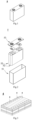
- Fig. 1 shows a secondary battery 5 with a square structure as an example.
- the outer packaging may comprise a housing 51 and a cover 53.
- the housing 51 may comprise a bottom plate and a side plate connected to the bottom plate, and the bottom plate and the side plate enclose a receiving cavity.
- the housing 51 has an opening communicating with the receiving cavity, and the cover plate 53 can cover the opening to close the receiving cavity.
- a positive electrode plate, a negative electrode plate and a separator may be formed into an electrode assembly 52 through a winding process or a lamination process.
- the electrode assembly 52 is packaged in the receiving cavity.
- the electrolyte that can be an electrolytic solution is infiltrated in the electrode assembly 52.
- the number of electrode assemblies 52 contained in the battery 5 can be one or more, which can be adjusted according to requirements.
- the outer packaging of the secondary battery may be a hard case, such as a hard plastic case, an aluminum case, or a steel case.
- the outer packaging of the battery may also be a soft bag, such as a bag-type soft bag.
- the material of the soft bag can be plastic, such as one or more of polypropylene (PP), polybutylene terephthalate (PBT), polybutylene succinate (PBS).
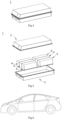
- Fig. 3 is a battery module 4 as an example.
- a plurality of secondary batteries 5 may be arranged in sequence along the length direction of the battery module 4. Of course, it can also be arranged in any other manner. Further, the plurality of secondary batteries 5 can be fixed by fasteners.
- the above-mentioned battery module may also be assembled into a battery pack.
- the number of battery modules contained in the battery pack can be adjusted according to the application and capacity of the battery pack.
- Figs. 4 and 5 are the battery pack 1 as an example.
- the battery pack 1 may comprise a battery case and a plurality of battery modules 4 provided in the battery case.
- the battery case comprises an upper case 2 and a lower case 3.
- the upper box case 2 can be covered on the lower case 3 and forms a closed space for accommodating the battery module 4.
- Multiple battery modules 4 can be arranged in the battery box in any manner.
- the present application further provides an apparatus comprising the secondary battery of the present application.
- the secondary battery can be used as a power source of the apparatus, and can also be used as an energy storage unit of the apparatus.
- the apparatus can be, but is not limited to, mobile apparatus (such as mobile phones, notebook computers), electric vehicles (such as pure electric vehicles, hybrid electric vehicles, plug-in hybrid electric vehicles, electric bicycles, electric scooters, electric golf carts, electric trucks.), electric trains, ships and satellites, energy storage systems, etc.
- a secondary battery, a battery module, or a battery pack can be selected to be used according to the usage requirements of the apparatus.
- Fig. 6 is an apparatus as an example.
- the apparatus is a pure electric vehicle, a hybrid electric vehicle, or a plug-in hybrid electric vehicle.
- a battery pack or a battery module can be used.
- the apparatus may be a mobile phone, a tablet computer, a notebook computer, etc.
- the apparatus is generally required to be thin and light, and a secondary battery can be used as a power source.
- a positive active material LiNi 0.8 Mn 0.1 Co 0.1 O 2 (NMC811), a conductive agent SP, and a binder PVDF were mixed at a weight ratio of 95:1.5:3.5 in an appropriate amount of NMP to form a uniform positive electrode slurry;
- the positive electrode slurry was coated on a positive electrode current collector aluminum foil, dried and cold pressed to obtain a positive electrode plate.
- a negative active material, conductive agent SP and CNT, and a binder sodium polyacrylate (PAAS) in a certain weight ratio were mixed in an appropriate amount of deionized water to form a uniform negative electrode slurry; the negative electrode slurry was coated on a negative electrode current collector copper foil, after drying and cold pressing, a negative electrode plate was obtained. At the same time, the value of the voltage U was adjusted by the way of pre-replenishing lithium on the electrode plate.
- PAAS binder sodium polyacrylate
- a lithium salt LiPF 6 was dissolved in the organic solvent, and then fluoroethylene carbonate (FEC) was added, and the electrolyte was obtained after uniform mixing.
- the concentration of LiPF 6 was 1mol/L, and the mass percentage of FEC in the electrolyte was 6%.
- the above-mentioned negative electrode plate satisfied: when the above-mentioned negative electrode plate, the electrolyte (the electrolyte prepared in the above step 4)), and a lithium metal counter electrode were made into a button cell, and the button cell was subjected to constant-current lithium intercalation at a rate of 0.1C to a voltage of 0.005V, and then subjected to constant-current lithium intercalation at a rate of 0.05C to a voltage of 0.005V, and then subjected to constant-current lithium deintercalation at a rate of 0.1C to a voltage of 1.2V, the delithiation capacity of the negative electrode film in the voltage range of 0.005V to the delithiation platform voltage was defined as A, and the delithiation capacity of the negative electrode film in the voltage range of the delithiation platform voltage to 1.2V was defined as B.
- the secondary batteries of Examples 1 to 23 and Comparative Examples 1 to 4 were charged at a constant current rate of 0.1C to 4.25V, and then charged at a constant voltage to a current of 0.05C, and then was left for 5 minutes.
- the charge capacity at this time was recorded as the first charge capacity; then the secondary batteries were discharged to 2.5V at a constant current rate of 0.1C, and then left for 5 minutes. This procedure formed a charge and discharge cycle.
- the discharge capacity at this time was recorded as the first discharge capacity.
- the secondary battery was subjected to 300 cycles of charge and discharge tests following the procedure described above, and the discharge capacity for each cycle was recorded.
- Weight energy density of battery Wh / kg first discharge energy / battery weight
- the initial coulombic efficiency of battery (%) first discharge capacity/first charge capacity ⁇ 100%
- the positive active material of the secondary battery comprising one or more of layered lithium nickel cobalt manganese oxide and layered lithium nickel cobalt aluminum oxide, and the negative active material comprising silicon-oxygen compound and graphite, can make the battery have a higher energy density; by making the secondary battery meet both the A/B value of the negative electrode film and the voltage U value of the negative electrode within a specific range, the battery's cycle capacity retention rate was obviously increased, effectively improving the cycle performance of the battery, in particular, further increasing the energy density of the battery.
Landscapes
- Chemical & Material Sciences (AREA)
- Chemical Kinetics & Catalysis (AREA)
- Electrochemistry (AREA)
- General Chemical & Material Sciences (AREA)
- Engineering & Computer Science (AREA)
- Inorganic Chemistry (AREA)
- Manufacturing & Machinery (AREA)
- Composite Materials (AREA)
- Materials Engineering (AREA)
- Battery Electrode And Active Subsutance (AREA)
- Secondary Cells (AREA)
Description
- This application belongs to the technical field of energy storage apparatus, and specifically relates to a secondary battery, and related battery module, battery pack and apparatus.
- With the increasing attention to environmental protection, environmentally friendly secondary batteries are gradually being applied to consumer electronics and electric vehicles. Among them, the energy density and cycle life of batteries are increasingly being valued by end consumers. Compared with traditional carbon-based materials, silicon-based materials have a very high theoretical gram capacity, which is about ten times that of carbon-based materials. Therefore, silicon-based materials have been widely studied.
- However, the swelling problem of silicon-based materials is serious during use, resulting in deterioration of battery cycle performance, which greatly limits the application of silicon-based materials in commercial products.
-
US2015263379A1 relates to an electrochemical cell. The cell includes a non-lithium negative electrode in contact with a lithium ion permeable negative electrode current collector, and a positive electrode disposed in contact with a lithium ion permeable positive electrode current collector. The non-lithium negative electrode and the positive electrode are lithium ion permeable. The cell also has a lithium source electrode including lithium ions. A respective microporous polymer separator is disposed between the lithium source electrode and each of the negative and positive electrodes; or a first separator is disposed between the lithium source electrode and one of the negative and positive electrodes, and a second separator is disposed between the negative and positive electrodes. An electrolyte is introduced into the electrochemical cell. A voltage potential is applied across the electrochemical cell to pre-lithiate any of the non-lithium negative electrode and positive electrode with lithium ions from the lithium source electrode. - A first aspect of the present application provides a secondary battery as defined in
claim 1. - It is surprisingly found that in the secondary battery provided in the present application, the positive active material includes one or more of layered lithium nickel cobalt manganese oxide and layered lithium nickel cobalt aluminum oxide, and the negative active material includes silicon-oxygen compound and graphite, and at the same time the A/B value of the negative electrode plate and the voltage U value of the negative electrode plate when the battery is discharged to 2.5V are within a specific range, making the battery have high energy density, initial coulombic efficiency and a better cycle life.
- In any of the foregoing embodiments, optionally, A/B is from 1.1 to 1.6, or from 1.2 to 1.5. A/B value within the given range can better enable the battery to have both higher energy density, initial coulombic efficiency and a better cycle life.
- In any of the foregoing embodiments, when the secondary battery is discharged to a voltage of 2.5V, the voltage U of the negative electrode plate relative to the lithium metal reference electrode may be from 0.55V to 0.65V. The value of the voltage U within an appropriate range can better enable the battery to have both higher energy density, initial coulombic efficiency and better cycle performance.
- In any of the above embodiments, the graphite can be selected from one or more of artificial graphite and natural graphite. The graphite can improve the cycle performance and energy density of the secondary battery.
- In any of the foregoing embodiments, the mass percentage ω of the silicon-oxygen compound in the negative active material satisfies 5%≤ω≤40%; optionally, 15%≤ω ≤ 35%. Within the given range, the energy density and cycle performance of the battery can be further improved.
- In any of the foregoing embodiments, the negative active material further satisfies one or more of the following aspects:
- the average particle size Dv50a of the negative active material is from 5µm to 20µm; optionally, from 6µm to 15µm;
- the average particle size Dv50b of the silicon-oxygen compound is from 3µm to 12µm; optionally, from 4µm to 10µm;
- the average particle size Dv50c of the graphite is from 5 µm to 18 µm; optionally, from 6 µm to 15 µm.
- One or more of Dv50a, Dv50b, and Dv50c within the given range can further improve the cycle performance of the secondary battery, and is also beneficial to increasing the energy density of the secondary battery.
- In any of the foregoing embodiments, the lithium nickel cobalt manganese oxide can be selected from one or more of the compounds represented by Formula 1 and a surface coating modified compounds thereof
LiaNibCocMndM1 eOfAgFormula 1,
- In Formula 1, 0.8≤a≤1.2, 0.5≤b<1, 0<c< 1, 0<d< 1, 0≤e≤0.1, 1≤f≤2, 0≤g≤1, M1 is selected from one or more of Zr, Al, Zn, Cu, Cr, Mg, Fe, V, Ti, and B, and A is selected from one or more of N, F, S, and Cl; and/or,
the lithium nickel cobalt aluminum oxide can be selected from one or more of the compounds represented by Formula 2 and the surface coating modified compounds thereof,
LiαNiβCoγAlδM2 εOνXσ Formula 2,
- In Formula 2, 0.8≤a≤1.2, 0.5≤β<1, 0<γ<1, 0<δ< 1, 0≤ε≤0.1, 1≤ν≤2, 0≤σ≤1, M2 is selected from one or more of Zr, Mn, Zn, Cu, Cr, Mg, Fe, V, Ti, and B, and X is selected from one or more of N, F, S, and Cl.
- The lithium nickel cobalt manganese oxide and/or lithium nickel cobalt aluminum oxide may have a higher gram capacity, thereby improving the energy density of the secondary battery.
- In any of the foregoing embodiments, at least a part of the positive active material has a single-particle morphology. The use of such positive active material can improve the energy density and cycle performance of the secondary battery.
- In any of the foregoing embodiments, the coefficient of excess capacity of the secondary battery may be from 1.05 to 1.3, and optionally from 1.1 to 1.2. The coefficient of excess capacity of the secondary battery within the given range can increase the energy density of the secondary battery and is beneficial to preventing the negative electrode film from lithium precipitation during the cycle.
- In any of the foregoing embodiments, the negative electrode film has an areal density ρ satisfying 7 mg/cm2≤ρ≤10 mg/cm2; optionally, 7 mg/cm2≤ρ≤9 mg/cm2. When the areal density of the negative electrode film is within the range, the secondary battery can have higher energy density and better dynamic performance at the same time.
- A second aspect of the present application provides a battery module including the secondary battery according to the first aspect of the present application.
- A third aspect of the present application provides a battery pack including the battery module according to the second aspect of the present application.
- A fourth aspect of the present application provides an apparatus including the secondary battery according to the first aspect of the present application.
- The battery module, battery pack, and apparatus of the present application include the secondary battery described in the present application, and therefore have at least the same or similar technical effects.
- In order to explain the technical solutions of the embodiments of the present application more clearly, the following will briefly introduce the drawings that need to be used in the embodiments of the present application. Obviously, the drawings described below are only some embodiments of the present application. A person of ordinary skill in the art can obtain other drawings based on the drawings without creative work.
-
Fig. 1 is a schematic diagram of an embodiment of a secondary battery. -
Fig. 2 is an exploded view ofFig. 1 . -
Fig. 3 is a schematic diagram of an embodiment of a battery module. -
Fig. 4 is a schematic diagram of an embodiment of a battery pack. -
Fig. 5 is an exploded view ofFig. 4 . -
Fig. 6 is a schematic diagram of an embodiment of an apparatus using the secondary battery as a power supply. - The present application provides a secondary battery comprising a positive electrode plate, a negative electrode plate, a separator and an electrolyte.
- The positive electrode plate comprises a positive electrode current collector and a positive electrode film disposed on at least one surface of the positive electrode current collector. For example, the positive electrode current collector has two opposite surfaces in its thickness direction, and the positive electrode film is disposed on either or both of the two surfaces.
- The positive electrode plate comprises a positive active material, and the positive active material comprises one or more of layered lithium nickel cobalt manganese oxide and layered lithium nickel cobalt aluminum oxide.
- The negative electrode plate comprises a negative electrode current collector and a negative electrode film disposed on at least one surface of the negative electrode current collector. For example, the negative electrode current collector has two opposite surfaces in its thickness direction, and the negative electrode film is disposed on either or both of the two surfaces.
- The negative electrode plate comprises a negative active material, and the negative active material comprises graphite and silicon-oxygen compound SiOx, in which 0 < x < 2; when a button battery made from the negative electrode plate and a lithium metal sheet is subjected to constant-current lithium intercalation at a rate of 0.1C to a voltage of 0.005V, and then subjected to constant-current lithium intercalation at a rate of 0.05C to a voltage of 0.005V, and then subjected to constant-current lithium deintercalation at a rate of 0.1C to a voltage of 1.2V, a ratio of total delithiation energy of the negative electrode film to total delithiation capacity in the voltage range of 0.005V to 1.2V is defined as the delithiation platform voltage, and the delithiation capacity of the negative electrode film in the voltage range of 0.005V to the delithiation platform voltage is defined as A, and the delithiation capacity of the negative electrode film in the voltage range of the delithiation platform voltage to 1.2V is defined as B, and A and B satisfy: 1 ≤A/B ≤ 2; and when the secondary battery is discharged to a voltage of 2.5V, the voltage U of the negative electrode plate relative to a lithium metal reference electrode satisfies: 0.5V ≤U≤0.7V.
- It should be noted that the preparation process of the button battery can refer to national standards or industry specifications. For example, the negative active material and the customary binder and conductive agent in the industry can be prepared into the above-mentioned electrode containing the negative electrode film, and then a lithium metal disc is used as the counter electrode, and the customary electrolyte in the industry can be added to prepare the button battery.
- As a specific example, a button battery can be prepared as follows:
dispersing the selected negative active material, conductive agent, and binder in a solvent (such as water) according to a certain mass ratio to make a negative electrode slurry, then coating it on a copper foil, drying to remove the solvent, cutting, and pressing, to prepare a circular electrode plate containing the above-mentioned negative electrode film; and then using a small lithium metal disc as a counter electrode, and adding an electrolyte, and assembling them in a glove box to prepare the button battery. The electrolyte can be obtained by the following process: homogeneously mixing ethylene carbonate (EC), ethyl methyl carbonate (EMC), and diethyl carbonate (DEC) in a volume ratio of 1:1:1 to obtain an organic solvent, and dissolving the fully dried lithium salt LiPF6 in the organic solvent, and then adding fluoroethylene carbonate (FEC) and mixing uniformly to obtain an electrolyte, wherein the concentration of LiPF6 is 1 mol/L and the mass percentage of FEC in the electrolyte is 6%. - When the secondary battery is discharged to a voltage of 2.5V, the voltage U of the negative electrode plate can be tested using methods known in the art. For example, it can be measured by the following test method: when making a secondary battery, a lithium metal reference electrode is embedded to form a three-electrode structure secondary battery. The voltage difference between the negative electrode plate and the reference electrode is the voltage U of the negative electrode plate.
- As a specific example of the embedded lithium metal reference electrode: during the preparation of the secondary battery, a copper wire having a diameter of 300µm and uniformly plated with metallic lithium on the surface thereof (or a copper wire not plated with metallic lithium is used, and after assembling into a secondary battery, the positive electrode and the copper wire electrode are connected to charge to depositing the active lithium ion in the positive electrode on the surface of the copper wire; similarly, the negative electrode and the copper wire are connecting to discharge, and the active lithium ions in the negative electrode can also be deposited on the surface of the copper wire, so that the surface of the copper wire is evenly plated with a layer of lithium metal) is placed between the positive electrode plate and the negative electrode plate (a person skilled in the art can adjust the diameter according to actual needs), and a separator is placed between the positive electrode plate and the copper wire, and between the negative electrode plate and the copper wire, respectively, to prevent short circuit between the positive electrode plate or the negative electrode plate and the copper wire plated with lithium metal on the surface.
- In the secondary battery of the present application, the positive active material comprises one or more of layered lithium nickel cobalt manganese oxide and layered lithium nickel cobalt aluminum oxide, and the negative active material comprises silicon-oxygen compound and graphite, which is conducive to making the secondary battery have a higher energy density.
- The applicant's intensive research has found that when the secondary battery having both the A/B value of the negative electrode film and the voltage U value of the negative electrode plate within an appropriate range, it can effectively increase the amount of active lithium ions that can be stored in the negative electrode film. It also helps to maintain the stability of the SEI (solid electrolyte interface) film on the surface of the silicon-oxygen compound and the stability of the conductive network in the negative electrode film. At the same time, it can ensure that the capacity of the positive active material is fully utilized, thereby greatly improving the energy density, initial coulombic efficiency and cycle performance of the secondary battery.
- In the secondary battery of the present application, the ratio A/ B of the delithiation capacity A of the negative electrode film in the voltage range from 0.005V to the delithiation platform voltage to the delithiation capacity B in the voltage range from the delithiation platform voltage to 1.2V can be at most 2, at most 1.95, at most 1.9, at most 1.85, at most 1.8, at most 1.75, at most 1.7, at most 1.65, at most 1.6, at most 1.55, at most 1.5, at most 1.45, at most 1.4, or at most 1.35. Optionally, A/B can be at least 1, at least 1.1, at least 1.15, at least 1.2, at least 1.25, at least 1.28, or at least 1.3. Further optionally, A/B can be from1.1 to 1.6; or from 1.2 to 1.5.
- The A/B value within the given range can better enable the battery to have both higher energy density, initial coulombic efficiency and better cycle performance.
- In the secondary battery of the present application, it is possible to adjust the mass ratio of the silicon-oxygen compound in the negative active material, the type and content of the binder, the type and content of the conductive agent, etc., so that A/B is in the range described above.
- In the secondary battery of the present application, the silicon-oxygen compound SiOx satisfies 0<x<2. Optionally, x is from 0.6 to1.5, or from 0.9 to 1.2.
- The silicon-oxygen compound satisfies x within an appropriate range, which enables the silicon-oxygen compound to have higher capacity performance and higher initial coulombic efficiency, and can increase the cycle life of the silicon-oxygen compound, thereby improving the corresponding performance of the secondary battery using the same.
- In the secondary battery of the present application, optionally, the powder volume resistivity of the silicon-oxygen compound under a pressure of 16 MPa may be 1000 Ω·cm or less.
- In the secondary battery of the present application, optionally, the average particle diameter of the negative active material (that is, the average particle diameter Dv50a of the mixture of the silicon-oxygen compound and the graphite) may be from 5µm to 20µm, or from 6µm to 15µm.
- In the secondary battery of the present application, optionally, the average particle size Dv50b of the silicon-oxygen compound may be from 3 µm to 12 µm, or from 4 µm to 10 µm.
- Dv50b is 3 µm or more, which can reduce the film-forming consumption of active lithium ions on the negative electrode, and reduce the side reaction of the electrolyte on the negative electrode, thereby improving the cycle performance of the battery. In addition, a proper Dv50b can also reduce the amount of binder added in the negative electrode film, which is beneficial to increasing the energy density of the battery. Optionally, Dv50b is 4µm or more.
- Dv50b is 12µm or less, which can increase the migration rate of lithium ions and electrons in the silicon-oxygen compound, and is also beneficial to preventing the silicon-oxygen compound from cracking during charge and discharge, increasing the cycle life of the silicon-oxygen compound, and thereby improving the cycle performance of the battery. Optionally, Dv50b is 10µm or less.
- In the secondary battery of the present application, optionally, the average particle diameter Dv50c of the graphite may be from 5 µm to 18 µm, or from 6 µm to 15 µm.
- Dv50c is 5µm or more, which can reduce the film-forming consumption of active lithium ions on the negative electrode, and reduce the side reaction of the electrolyte on the negative electrode, thereby improving the cycle performance of the battery. In addition, a proper Dv50c can also reduce the amount of binder added in the negative electrode plate, which is beneficial to increasing the energy density of the battery. Optionally, Dv50c is 6µm or more.
- Dv50c is 18µm or less, which can increase the migration rate of lithium ions and electrons in the graphite, thereby improving the cycle performance of the battery. Optionally, Dv50c is 15µm or less.
- The average particle size Dv50a of the negative active material, the average particle size Dv50b of the silicon-oxygen compound, and the average particle size Dv50c of the graphite are all well-known in the art, and can be measured with well-known instruments and methods in the art. For example, it can be easily measured with a laser particle size analyzer, such as the Mastersizer 3000 laser particle size analyzer from Malvern Instruments Co., Ltd., UK.
- In the secondary battery of the present application, the graphite may be one or more of natural graphite and artificial graphite.
- In the secondary battery of the present application, optionally, the mass percentage of the negative active material in the negative electrode film is from 90% to 98%, or from 92% to 96%.
- In the secondary battery of the present application, optionally, the mass percentage ω of the silicon-oxygen compound in the negative active material satisfies 5% ≤ω≤ 40%, or 15% ≤ω≤ 35%. Within the above range, the A/B value can be optimized, and the energy density and cycle performance of the battery can be further improved.
- In the secondary battery of the present application, the negative electrode film may optionally contain other negative active materials that can be used for the negative electrode of the secondary battery. As an example, other negative electrode active materials may be one or more of elemental silicon, silicon-carbon composites, silicon alloys, mesocarbon microspheres (MCMB), hard carbon, and soft carbon.
- In the secondary battery of the present application, the negative electrode film may also optionally contain a binder and a conductive agent.
- The binder in the negative electrode film can be selected from binders known in the art that can be used in secondary batteries. Optionally, the binder includes one or more of styrenebutadiene rubber (SBR), polyacrylic compounds and modified compounds thereof, polyacrylate compounds and modified compounds thereof.
- Optionally, the mass percentage of the binder in the negative electrode film is from 1% to 9%, or from 3% to 7%.
- The conductive agent in the negative electrode film may be selected from conductive agents known in the art that can be used in secondary batteries. Optionally, the conductive agent includes one or more of conductive carbon black (Super P, abbreviated as SP) and carbon nanotube (Carbon Nanotube, abbreviated as CNT). Further optionally, the conductive agent includes both SP and CNT.
- Optionally, the mass percentage of the conductive agent in the negative electrode film is from 1% to 5%, or from 1% to 3%.
- In the secondary battery of the present application, optionally, when the secondary battery is discharged to a voltage of 2.5V, the voltage U of the negative electrode plate relative to the lithium metal reference electrode may be at most 0.7, at most 0.68, at most 0.65, at most 0.64, at most 0.63, at most 0.62, at most 0.61, or at most 0.6. Optionally, U can be at least 0.59, at least 0.58, at least 0.57, at least 0.56, at least 0.55, at least 0.54, at least 0.53, at least 0.52, at least 0.51, or at least 0.5. Optionally, U is from 0.55V to 0.65V.
- The value of the voltage U within the proper range can better enable the battery to have higher energy density, initial coulombic efficiency and better cycle performance at the same time.
- In the secondary battery of the present application, one or more of the following methods can be used to control the above voltage U within the range given in the present application, i.e., pre-replenishing lithium on the negative electrode film, using silicon-oxygen compound with pre-embedded lithium, and adjusting the coefficient of excess capacity (i.e. CB value) of the battery. The coefficient of excess capacity of the battery is the ratio of the capacity of the negative electrode film to the capacity of the positive electrode film with the same area.
- In the secondary battery of the present application, a process known in the art can be used for the lithium pre-replenishing process for the negative electrode film. For example, one or more of lithium powder, lithium flakes, and lithium ingots can be used to pre-replenish lithium on the negative electrode film; or a silicon-oxygen compound pre-replenished lithium can be directly used.
- In the secondary battery of the present application, the coefficient of excess capacity of the secondary battery can be selected from 1.05 to 1.3, or can be selected from 1.1 to 1.2. The coefficient of excess capacity of the secondary battery within the above range can optimize the voltage U, and is also conducive to the development of the battery capacity, increasing the energy density of the battery, and preventing the negative electrode film from precipitating lithium during the cycle.
- In the secondary battery of the present application, optionally, the areal density ρ of the negative electrode film may satisfy 7 mg/cm2 ≤ρ≤10 mg/cm2. Optionally, ρ is from 7 mg/cm2 to 9 mg/cm2. When the areal density of the negative electrode film is within the range, the secondary battery can have both higher energy density and better dynamic performance. It should be noted that the areal density ρ mentioned here refers to the areal density of the negative electrode film on any side of the current collector.
- In the secondary battery of the present application, the negative electrode current collector can be made of a material with good conductivity and mechanical strength, such as copper foil, but it is not limited thereto.
- In the secondary battery of the present application, optionally, the layered lithium nickel cobalt manganese oxide can be selected from one or more of the compounds represented by
Formula 1 and a surface coating modified compounds thereof
LiaNibCocMndM1 eOfAg Formula 1,
- In
Formula 1, 0.8≤a≤1.2, 0.5≤b<1, 0<c< 1, 0<d< 1, 0≤e≤0.1, 1≤f≤2, 0≤g≤1; - M1 is a cationic doping element, and M1 can be selected from one or more of Zr, Al, Zn, Cu, Cr, Mg, Fe, V, Ti, and B;
- A is an anionic doping element, and A can be selected from one or more of N, F, S, and Cl.
- In the secondary battery of the present application, optionally, the layered lithium nickel cobalt aluminum oxide can be selected from one or more of the compounds represented by
Formula 2 and the surface coating modified compounds thereof,
LiαNiβCoγAlδM2 εOνXσ Formula 2,
- In
Formula 2, 0.8≤a≤1.2, 0.5≤β<1, 0<γ<1, 0<δ<1, 0≤ε≤0.1, 1≤ν≤2, 0≤σ≤1; - M2 is a cationic doping element, and M2 can be selected from one or more of Zr, Mn, Zn, Cu, Cr, Mg, Fe, V, Ti, and B;
- X is an anionic doping element, and X can be selected from one or more of N, F, S, and Cl.
- The surface coating modified compound may be provided with a coating layer on at least a part of the surface of the material particles, and the coating layer may be a carbon layer, an oxide layer, an inorganic salt layer or a conductive polymer layer. Surface coating modification can further improve the cycle performance of the battery.
- Optionally, the carbon layer may include one or more of graphite, graphene, mesocarbon microspheres (MCMB), carbon from hydrocarbon pyrolysis, hard carbon, and soft carbon.
- Optionally, the oxide layer may include one or more of Al oxide, Ti oxide, Mn oxide, Zr oxide, Mg oxide, Zn oxide, Ba oxide, Mo oxide, and B oxide.
- Optionally, the inorganic salt layer may include one or more of Li2ZrO3, LiNbO3, Li4Ti5O12, Li2TiO3, Li3VO4, LiSnOs, Li2SiO3, and LiAlO2.
- Optionally, the conductive polymer layer may include one or more of polypyrrole (PPy),
poly 3,4-ethylenedioxythiophene (PEDOT), and polyamide (PI). - In the secondary battery of the present application, the positive active material may also optionally comprise other positive active materials that can be used in the positive electrode of the secondary battery. As an example, other positive active materials are, for example, one or more of lithium manganese oxide, lithium iron phosphate, lithium manganese phosphate, and lithium iron manganese phosphate.
- In the secondary battery of the present application, optionally, at least a part of the positive active material has a single-particle morphology (i.e., a non-agglomerated particle morphology). The single-particle morphology of the positive active material can improve the overall compacted density and ductility of the positive electrode plate, while reducing the contact area between the positive active material and the electrolyte, reducing the occurrence of interface side reactions, reducing gas production, as such to further improve the cycle performance of lithium-ion batteries.
- In the secondary battery of the present application, the positive electrode film may also optionally comprise a binder and a conductive agent. The types of the binder and the conductive agent are not specifically limited, and those skilled in the art can select according to actual needs.
- Optionally, the binder in the positive electrode film can be one or more of polyvinylidene fluoride (PVDF), polytetrafluoroethylene (PTFE), polyacrylic acid (PAA), polyvinyl alcohol (PVA), carboxymethyl cellulose sodium (CMC), sodium alginate (SA), polymethacrylic acid (PMAA) and carboxymethyl chitosan (CMCS). The conductive agent in the positive electrode film can be one or more of graphite, superconducting carbon, acetylene black, carbon black, Ketjen black, carbon dots, carbon nanotubes, graphene, and carbon nanofibers.
- In the secondary battery of the present application, the positive electrode current collector can be made of a material with good conductivity and mechanical strength, such as aluminum foil, but it is not limited thereto.
- In the secondary battery of the present application, the electrolyte comprise an organic solvent and a lithium salt dispersed in the organic solvent. The specific types and compositions of the organic solvent and the lithium salt are not specifically limited, and can be selected according to actual needs.
- Optionally, the solvent may be one or more of ethylene carbonate (EC), propylene carbonate (PC), ethyl methyl carbonate (EMC), diethyl carbonate (DEC), dimethyl carbonate (DMC), dipropyl carbonate (DPC), methyl propyl carbonate (MPC), ethyl propyl carbonate (EPC), butylene carbonate (BC), fluoroethylene carbonate (FEC), methyl formate (MF), methyl acetate (MA), ethyl acetate (EA), propyl acetate (PA), methyl propionate (MP), ethyl propionate (EP), propyl propionate (PP), methyl butyrate (MB), ethyl butyrate (EB), 1,4-butyrolactone (GBL), sulfolane (SF), dimethylsulfone (MSM), methylethylsulfone (EMS), and diethylsulfone (ESE).
- Optionally, the electrolyte salt may be selected from one or more of LiPF6 (lithium hexafluorophosphate), LiBF4 (lithium tetrafluoroborate), LiTFSI (lithium bistrifluoromethanesulfonimide) and LiTFS (lithium trifluoromethanesulfonate).
- The electrolyte may optionally comprise an additive. The additive is not particularly limited and can be selected according to requirements.
- In the secondary battery, the separator is disposed between the positive electrode plate and the negative electrode plate to serve as isolation. The type of the separator is not particularly limited, and any well-known porous structure separator having chemical stability and mechanical stability can be selected, such as one or more of glass fiber, non-woven fabric, polyethylene, polypropylene and polyvinylidene fluoride. The separator can be a single-layer film or a multilayer composite film. When the separator is a multilayer composite film, the materials of each layer may be the same or different.
- The secondary battery of the present application can be prepared according to conventional methods in the art, for example, a negative active material and optional conductive agent and binder are dispersed in a solvent (such as water) to form a uniform negative electrode slurry, and the negative electrode slurry is coated on a negative electrode current collector, after drying, cold pressing, etc., the negative electrode plate is obtained; a positive active material and optional conductive agent and binder are dispersed in a solvent (such as N-methylpyrrolidone, referred to as NMP) to form a uniform positive electrode slurry, and the positive electrode slurry is coated on a positive electrode current collector, and the positive electrode plate is obtained after drying and cold pressing, etc.; the positive electrode plate, the separator, and the negative electrode plate are wound in order, so that the separator is located between the positive electrode plate and the negative electrode plate to play a role of isolation, as such to obtain an electrode assembly. The electrode assembly is placed in an outer packaging, and then an electrolyte is injected and sealed to obtain a secondary battery.
- The present application has no particular limitation on the shape of the secondary battery, which may be cylindrical, square or other arbitrary shapes.
Fig. 1 shows asecondary battery 5 with a square structure as an example. - In some embodiments, the secondary battery may comprise an outer packaging. The outer packaging is used to encapsulate the positive electrode plate, the negative electrode plate and the electrolyte.
- In some embodiments, referring to
Fig. 2 , the outer packaging may comprise ahousing 51 and acover 53. Wherein, thehousing 51 may comprise a bottom plate and a side plate connected to the bottom plate, and the bottom plate and the side plate enclose a receiving cavity. Thehousing 51 has an opening communicating with the receiving cavity, and thecover plate 53 can cover the opening to close the receiving cavity. - A positive electrode plate, a negative electrode plate and a separator may be formed into an
electrode assembly 52 through a winding process or a lamination process. Theelectrode assembly 52 is packaged in the receiving cavity. The electrolyte that can be an electrolytic solution is infiltrated in theelectrode assembly 52. The number ofelectrode assemblies 52 contained in thebattery 5 can be one or more, which can be adjusted according to requirements. - In some embodiments, the outer packaging of the secondary battery may be a hard case, such as a hard plastic case, an aluminum case, or a steel case. The outer packaging of the battery may also be a soft bag, such as a bag-type soft bag. The material of the soft bag can be plastic, such as one or more of polypropylene (PP), polybutylene terephthalate (PBT), polybutylene succinate (PBS).
- In some embodiments, the secondary battery may be assembled into a battery module. The number of secondary batteries contained in the battery module can be multiple, and the specific number can be adjusted according to the application and capacity of the battery module.
-
Fig. 3 is abattery module 4 as an example. Referring toFig. 3 , in thebattery module 4, a plurality ofsecondary batteries 5 may be arranged in sequence along the length direction of thebattery module 4. Of course, it can also be arranged in any other manner. Further, the plurality ofsecondary batteries 5 can be fixed by fasteners. - Optionally, the
battery module 4 may further comprise a housing with a receiving space, and a plurality ofsecondary batteries 5 are accommodated in the receiving space. - In some embodiments, the above-mentioned battery module may also be assembled into a battery pack. The number of battery modules contained in the battery pack can be adjusted according to the application and capacity of the battery pack.
-
Figs. 4 and 5 are thebattery pack 1 as an example. Referring toFigs. 4 and 5 , thebattery pack 1 may comprise a battery case and a plurality ofbattery modules 4 provided in the battery case. The battery case comprises anupper case 2 and alower case 3. Theupper box case 2 can be covered on thelower case 3 and forms a closed space for accommodating thebattery module 4.Multiple battery modules 4 can be arranged in the battery box in any manner. - The present application further provides an apparatus comprising the secondary battery of the present application. The secondary battery can be used as a power source of the apparatus, and can also be used as an energy storage unit of the apparatus. The apparatus can be, but is not limited to, mobile apparatus (such as mobile phones, notebook computers), electric vehicles (such as pure electric vehicles, hybrid electric vehicles, plug-in hybrid electric vehicles, electric bicycles, electric scooters, electric golf carts, electric trucks.), electric trains, ships and satellites, energy storage systems, etc.
- A secondary battery, a battery module, or a battery pack can be selected to be used according to the usage requirements of the apparatus.
-
Fig. 6 is an apparatus as an example. The apparatus is a pure electric vehicle, a hybrid electric vehicle, or a plug-in hybrid electric vehicle. In order to meet the requirements of the apparatus for high power and high energy density of the secondary battery, a battery pack or a battery module can be used. - As another example, the apparatus may be a mobile phone, a tablet computer, a notebook computer, etc. The apparatus is generally required to be thin and light, and a secondary battery can be used as a power source.
- The following examples are intended to describe the disclosure of the present application, and are intended to be illustrative only. All parts, percentages, and ratios reported in the following examples are by weight unless otherwise stated, and all reagents used in the examples are commercially available or synthetically obtained by conventional methods and are directly used without further processing, and the instruments used in the examples are commercially available.
- A positive active material LiNi0.8Mn0.1Co0.1O2 (NMC811), a conductive agent SP, and a binder PVDF were mixed at a weight ratio of 95:1.5:3.5 in an appropriate amount of NMP to form a uniform positive electrode slurry; The positive electrode slurry was coated on a positive electrode current collector aluminum foil, dried and cold pressed to obtain a positive electrode plate.
- As shown in Table 1, a negative active material, conductive agent SP and CNT, and a binder sodium polyacrylate (PAAS) in a certain weight ratio (see Table 1 for details) were mixed in an appropriate amount of deionized water to form a uniform negative electrode slurry; the negative electrode slurry was coated on a negative electrode current collector copper foil, after drying and cold pressing, a negative electrode plate was obtained. At the same time, the value of the voltage U was adjusted by the way of pre-replenishing lithium on the electrode plate.
- Ethylene carbonate (EC), ethyl methyl carbonate (EMC), and diethyl carbonate (DEC) were mixed in a volume ratio of EC: EMC: DEC=1:1:1 to obtain an organic solvent. A lithium salt LiPF6 was dissolved in the organic solvent, and then fluoroethylene carbonate (FEC) was added, and the electrolyte was obtained after uniform mixing. The concentration of LiPF6 was 1mol/L, and the mass percentage of FEC in the electrolyte was 6%.
- 5) The above positive electrode plate, the separator, a lithium metal reference electrode, the separator, and the negative electrode plate were stacked in order to obtain an electrode assembly after winding. The electrode assembly was put into the outer packaging, the above electrolyte was added and sealed to obtain a secondary battery.
- Wherein, the above-mentioned negative electrode plate satisfied: when the above-mentioned negative electrode plate, the electrolyte (the electrolyte prepared in the above step 4)), and a lithium metal counter electrode were made into a button cell, and the button cell was subjected to constant-current lithium intercalation at a rate of 0.1C to a voltage of 0.005V, and then subjected to constant-current lithium intercalation at a rate of 0.05C to a voltage of 0.005V, and then subjected to constant-current lithium deintercalation at a rate of 0.1C to a voltage of 1.2V, the delithiation capacity of the negative electrode film in the voltage range of 0.005V to the delithiation platform voltage was defined as A, and the delithiation capacity of the negative electrode film in the voltage range of the delithiation platform voltage to 1.2V was defined as B.
- The battery of Example 1 satisfied both ① and ②:
- ① A/B = 1.0;
- ② When the battery was discharged to a voltage of 2.5V, the voltage U of the negative electrode plate relative to the lithium metal reference electrode was 0.6V.
- The preparation methods of Examples 2 to 23 and Comparative Examples 1 to 4 were similar to those of Example 1, and the different product parameters were shown in Table 1.
- Under a normal pressure environment at 25°C, the secondary batteries of Examples 1 to 23 and Comparative Examples 1 to 4 were charged at a constant current rate of 0.1C to 4.25V, and then charged at a constant voltage to a current of 0.05C, and then was left for 5 minutes. The charge capacity at this time was recorded as the first charge capacity; then the secondary batteries were discharged to 2.5V at a constant current rate of 0.1C, and then left for 5 minutes. This procedure formed a charge and discharge cycle. The discharge capacity at this time was recorded as the first discharge capacity. The secondary battery was subjected to 300 cycles of charge and discharge tests following the procedure described above, and the discharge capacity for each cycle was recorded.

The initial coulombic efficiency of battery (%) =first discharge capacity/first charge capacity×100% -
Capacity retention rate of battery (%) =discharge capacity for the 300th cycle/discharge capacity for the first cycle×100% 

- In Table 1, ω was the mass percentage of silicon-oxygen compound (i.e., SiO) in the negative active material.
Table 2 No. Weight energy density of battery (Wh/kg) Initial coulombic efficiency (%) Capacity retention rate after 30 cycles (%) Example 1 309 89.1 88.9 Example 2 306 89.4 94.5 Example 3 303 90.4 95.1 Example 4 302 90.5 95.6 Example 5 297 90.1 95.7 Example 6 293 89.7 95.9 Example 7 288 89.3 94.8 Example 8 282 89.5 90.4 Example 9 279 89.0 89.1 Example 10 300 87.2 93 Example 11 301 88.0 94.8 Example 12 297 90.7 95.8 Example 13 293 90.9 95.9 Example 14 304 89.8 92.2 Example 15 302 89.4 95.4 Example 16 301 89.5 95.7 Example 17 300 90.2 95.9 Example 18 298 90.0 96 Example 19 297 89.5 96.3 Example 20 291 89.5 96.5 Example 21 285 89.3 96.9 Example 22 280 89.0 97.1 Example 23 305 89.5 92.7 Comparative Example 1 288 89.4 85 Comparative Example 2 279 89.5 86.3 Comparative Example 3 282 86.7 84.4 Comparative Example 4 283 90.9 82.7 - It can be seen from the test results in Table 2 that the positive active material of the secondary battery comprising one or more of layered lithium nickel cobalt manganese oxide and layered lithium nickel cobalt aluminum oxide, and the negative active material comprising silicon-oxygen compound and graphite, can make the battery have a higher energy density; by making the secondary battery meet both the A/B value of the negative electrode film and the voltage U value of the negative electrode within a specific range, the battery's cycle capacity retention rate was obviously increased, effectively improving the cycle performance of the battery, in particular, further increasing the energy density of the battery.
- The above mentioned descriptions only show particular implementations of the present application and but are not intended to limit the protection scope of the present application. Therefore, the protection scope of the present application shall be determined by the protection scope of the claims.
Claims (13)
- A secondary battery (5), comprising a positive electrode plate, a negative electrode plate, a separator and an electrolyte, wherein:the positive electrode plate comprises a positive electrode current collector and a positive electrode film disposed on at least one surface of the positive electrode current collector, comprising a positive active material, andthe negative electrode plate comprises a negative electrode current collector and a negative electrode film disposed on at least one surface of the negative electrode current collector, comprising a negative active material;wherein:the positive active material comprises one or more of layered lithium nickel cobalt manganese oxide and layered lithium nickel cobalt aluminum oxide;the negative active material comprises graphite and silicon-oxygen compound SiOx, in which 0 < x < 2;the delithiation capacity A of the negative electrode film in the voltage range of 0.005V to the delithiation platform voltage and the delithiation capacity B of the negative electrode film in the voltage range of the delithiation platform voltage to 1.2V satisfy: 1≤A/B≤2;when the secondary battery (5) is discharged to a voltage of 2.5V, a voltage U of the negative electrode plate relative to a lithium metal reference electrode satisfies: 0.5V ≤ U ≤ 0.7V, measured according to the methods as described in the description; andwherein a mass percentage ω of the silicon-oxygen compound in the negative active material satisfies 5%≤ω≤40%.
- The secondary battery (5) according to claim 1, wherein A and B satisfy: 1.1 ≤ A/B ≤ 1.6; optionally, 1.2 ≤ A/B ≤ 1.5.
- The secondary battery (5) according to claim 1 or 2, wherein when the secondary battery (5) is discharged to a voltage of 2.5V, a voltage U of the negative electrode plate relative to a lithium metal reference electrode satisfies: 0.55V ≤ U ≤ 0.65V, measured according to the methods as described in the description.
- The secondary battery (5) according to any one of claims 1 to 3, wherein the graphite is selected from one or more of artificial graphite and natural graphite.
- The secondary battery (5) according to any one of claims 1 to 4, wherein a mass percentage ω of the silicon-oxygen compound in the negative active material satisfies 15%≤ω ≤ 35%.
- The secondary battery (5) according to any one of claims 1 to 5, wherein the negative active material further satisfies one or more of the following aspects:the negative active material has an average particle size Dv50a from 5µm to 20µm; optionally, from 6µm to 15µm;the silicon-oxygen compound has an average particle size Dv50b from 3µm to 12µm; optionally, from 4µm to 10µm;the graphite has an average particle size Dv50c from 5 µm to 18 µm; optionally, from 6 µm to 15 µm.
- The secondary battery (5) according to any one of claims 1 to 6, wherein the lithium nickel cobalt manganese oxide is selected from one or more of the compounds represented by Formula 1 and a surface coating modified compounds thereof,
LiaNibCocMndM1 eOfAg Formula 1,
in Formula 1, 0.8≤a≤1.2, 0.5≤b<1, 0<c<1, 0<d<1, 0≤e≤0.1, 1≤f≤2, 0≤g≤1, M1 is selected from one or more of Zr, Al, Zn, Cu, Cr, Mg, Fe, V, Ti, and B, and A is selected from one or more of N, F, S, and Cl; and/or,the lithium nickel cobalt aluminum oxide is selected from one or more of the compounds represented by Formula 2 and the surface coating modified compounds thereof,
LiαNiβCoγAlδM2 εOνXσ Formula 2,
in Formula 2, 0.8≤α≤1.2, 0.5≤β<1, 0<γ<1, 0<δ<1, 0≤ε≤0.1, 1≤ν≤2, 0 ≤σ≤1, M2 is selected from one or more of Zr, Mn, Zn, Cu, Cr, Mg, Fe, V, Ti, and B, and X is selected from one or more of N, F, S, and Cl;wherein surface coating modified compound is provided with a coating layer on at least a part of the surface of the material particles, and the coating layer comprises a carbon layer, an oxide layer, an inorganic salt layer or a conductive polymer layer; wherein the carbon layer comprises one or more of graphite, graphene, mesocarbon microspheres (MCMB), carbon from hydrocarbon pyrolysis, hard carbon, and soft carbon; wherein the oxide layer comprises one or more of Al oxide, Ti oxide, Mn oxide, Zr oxide, Mg oxide, Zn oxide, Ba oxide, Mo oxide, and B oxide; wherein the inorganic salt layer comprises one or more of Li2ZrO3, LiNbO3, Li4Ti5O12, Li2TiO3, Li3VO4, LiSnO3, Li2SiO3, and LiAlO2; and wherein the conductive polymer layer comprises one or more of polypyrrole (PPy), poly 3,4-ethylenedioxythiophene (PEDOT), and polyamide (PI). - The secondary battery (5) according to any one of claims 1 to 7, wherein at least a part of the positive active material has a single-particle morphology.
- The secondary battery (5) according to any one of claims 1 to 8, wherein the secondary battery (5) has a coefficient of excess capacity from 1.05 to 1.3; optionally from 1.1 to 1.2, measured according to the methods as described in the description.
- The secondary battery (5) according to any one of claims 1 to 9, wherein the negative electrode film has an areal density ρ satisfying 7 mg/cm2≤ρ≤10 mg/cm2; optionally, 7 mg/cm2≤ρ≤9 mg/cm2, measured according to the methods as described in the description.
- A battery module (4) comprising the secondary battery (5) according to any one of claims 1 to 10.
- A battery pack (1) comprising the battery module (4) of claim 11.
- An apparatus comprising the secondary battery (5) according to any one of claims 1 to 10.
Applications Claiming Priority (2)
| Application Number | Priority Date | Filing Date | Title |
|---|---|---|---|
| CN201910638890.1A CN112242551B (en) | 2019-07-16 | 2019-07-16 | Secondary battery |
| PCT/CN2020/100990 WO2021008429A1 (en) | 2019-07-16 | 2020-07-09 | Secondary battery, and battery module, battery pack and device related thereto |
Publications (4)
| Publication Number | Publication Date |
|---|---|
| EP3800707A1 EP3800707A1 (en) | 2021-04-07 |
| EP3800707A4 EP3800707A4 (en) | 2021-10-13 |
| EP3800707C0 EP3800707C0 (en) | 2024-07-24 |
| EP3800707B1 true EP3800707B1 (en) | 2024-07-24 |
Family
ID=74166932
Family Applications (1)
| Application Number | Title | Priority Date | Filing Date |
|---|---|---|---|
| EP20827980.2A Active EP3800707B1 (en) | 2019-07-16 | 2020-07-09 | Secondary battery, and related battery module, battery pack and apparatus |
Country Status (4)
| Country | Link |
|---|---|
| US (1) | US11316158B2 (en) |
| EP (1) | EP3800707B1 (en) |
| CN (1) | CN112242551B (en) |
| WO (1) | WO2021008429A1 (en) |
Families Citing this family (18)
| Publication number | Priority date | Publication date | Assignee | Title |
|---|---|---|---|---|
| CN112886050B (en) * | 2019-11-29 | 2022-07-05 | 宁德时代新能源科技股份有限公司 | Secondary battery and device containing the same |
| CN113488636B (en) * | 2021-06-18 | 2023-04-07 | 江苏正力新能电池技术有限公司 | Composite negative electrode material, negative plate and lithium ion battery |
| CN113659221A (en) * | 2021-08-18 | 2021-11-16 | 东莞塔菲尔新能源科技有限公司 | Secondary battery and application thereof |
| US20240243278A1 (en) * | 2021-11-19 | 2024-07-18 | Lg Energy Solution, Ltd. | Composition for cathode active material layer, and lithium secondary battery |
| CN114361378B (en) * | 2021-12-14 | 2024-03-29 | 宁德厦钨新能源材料有限公司 | Electrochemical performance detection method for ternary material |
| CN114636887B (en) * | 2022-05-20 | 2022-07-22 | 石家庄嘉硕电子技术有限公司 | State detection method, consistency detection method and device for de-embedded electrode plate pair |
| CN115275197B (en) * | 2022-07-18 | 2024-10-01 | 江苏正力新能电池技术股份有限公司 | Lithium ion secondary battery and power-using device |
| EP4439726A4 (en) * | 2022-08-04 | 2025-07-23 | Lg Energy Solution Ltd | LITHIUM SECONDARY BATTERY, BATTERY MODULE AND BATTERY PACK |
| EP4525125A4 (en) * | 2022-11-11 | 2025-11-26 | Contemporary Amperex Technology Co Ltd | BATTERY AND ELECTRICAL DEVICE |
| EP4528847A4 (en) * | 2022-11-22 | 2026-04-15 | Contemporary Amperex Technology Hong Kong Ltd | Electrode assembly, secondary battery and electrical device |
| CN116314586A (en) * | 2023-03-07 | 2023-06-23 | 上海兰钧新能源科技有限公司 | Secondary battery |
| CN116093254B (en) * | 2023-04-07 | 2023-09-08 | 宁德时代新能源科技股份有限公司 | Battery monomer, battery and electric equipment |
| CN116741929A (en) * | 2023-04-24 | 2023-09-12 | 珠海冠宇动力电池有限公司 | a battery |
| CN116487526B (en) * | 2023-05-31 | 2026-01-30 | 宁德新能源科技有限公司 | Secondary batteries and electronic devices |
| CN119230768B (en) * | 2023-06-30 | 2026-01-13 | 宁德时代新能源科技股份有限公司 | Negative electrode active material, negative electrode plate, lithium ion battery and electricity utilization device |
| WO2025000481A1 (en) * | 2023-06-30 | 2025-01-02 | 宁德新能源科技有限公司 | Negative electrode material and negative electrode using same, electrochemical device, and electronic device |
| CN119920816A (en) * | 2023-10-30 | 2025-05-02 | 宁德时代新能源科技股份有限公司 | Secondary batteries and electrical devices |
| CN118117144B (en) * | 2023-12-20 | 2025-08-29 | 蔚来电池科技(安徽)有限公司 | Secondary battery and electronic device including the same |
Family Cites Families (21)
| Publication number | Priority date | Publication date | Assignee | Title |
|---|---|---|---|---|
| US8895189B2 (en) * | 2012-02-03 | 2014-11-25 | Nanotek Instruments, Inc. | Surface-mediated cells with high power density and high energy density |
| JP6466635B2 (en) | 2013-06-14 | 2019-02-06 | 信越化学工業株式会社 | Method for producing negative electrode for nonaqueous electrolyte secondary battery and method for producing nonaqueous electrolyte secondary battery |
| US10593988B2 (en) * | 2013-06-20 | 2020-03-17 | GM Global Technology Operations LLC | Electrochemical cell for lithium-based batteries |
| KR101690497B1 (en) * | 2014-07-24 | 2016-12-28 | 에스케이이노베이션 주식회사 | Secondary Battery and the Design Method Thereof |
| CN107251304B (en) * | 2015-03-12 | 2020-04-24 | 精工电子有限公司 | Nonaqueous electrolyte secondary battery |
| JP6386414B2 (en) | 2015-04-22 | 2018-09-05 | 信越化学工業株式会社 | Anode active material for nonaqueous electrolyte secondary battery, method for producing the same, nonaqueous electrolyte secondary battery using the anode active material, and method for producing anode material for nonaqueous electrolyte secondary battery |
| CN106207264B (en) * | 2015-05-28 | 2020-06-12 | 通用汽车环球科技运作有限责任公司 | Electrochemical cell for lithium-based batteries |
| US10276868B2 (en) * | 2015-12-11 | 2019-04-30 | Denso Corporation | Non-aqueous electrolyte rechargeable battery |
| CN113782817B (en) * | 2015-12-22 | 2024-04-12 | 中央硝子株式会社 | Electrolyte for nonaqueous electrolyte battery and nonaqueous electrolyte battery using same |
| CN109314269B (en) * | 2016-06-15 | 2021-10-29 | 罗伯特·博世有限公司 | Lithium-ion battery and preparation method thereof |
| US11098201B2 (en) * | 2016-08-24 | 2021-08-24 | Denka Company Limited | Carbon black for batteries, conductive composition for electrodes, electrode for batteries, and battery |
| CN106450481B (en) * | 2016-12-07 | 2019-06-04 | 清华大学深圳研究生院 | A kind of lithium ion battery and preparation method thereof |
| CN107248451B (en) * | 2017-07-28 | 2019-01-11 | 中国科学院电工研究所 | A kind of lithium-ion capacitor of high-energy density |
| US10566652B2 (en) * | 2017-08-15 | 2020-02-18 | GM Global Technology Operations LLC | Lithium metal battery with hybrid electrolyte system |
| CN109524621A (en) * | 2017-09-18 | 2019-03-26 | 浙江工业大学 | A kind of prelithiation method and device for the lithium ion battery negative electrode that prelithiation degree is controllable |
| CN109509909B (en) * | 2018-10-17 | 2020-07-03 | 宁德时代新能源科技股份有限公司 | Secondary battery |
| CN109817473B (en) * | 2018-12-13 | 2021-08-27 | 中国科学院电工研究所 | Lithium pre-embedding method of lithium ion electrochemical energy storage device |
| CN109786841B (en) * | 2018-12-13 | 2020-12-15 | 中国科学院电工研究所 | A kind of preparation method of lithium ion electrochemical energy storage device |
| CN109671999B (en) * | 2018-12-20 | 2021-01-12 | 国联汽车动力电池研究院有限责任公司 | A method for in-situ pre-lithiation of lithium ion battery and lithium ion battery |
| CN109920987A (en) * | 2019-02-20 | 2019-06-21 | 宁德新能源科技有限公司 | Negative electrode material and electrochemical appliance and electronic device comprising the negative electrode material |
| US20200388874A1 (en) * | 2019-06-07 | 2020-12-10 | GM Global Technology Operations LLC | Planar, thin-film electrochemical device and method of making the same |
-
2019
- 2019-07-16 CN CN201910638890.1A patent/CN112242551B/en active Active
-
2020
- 2020-07-09 EP EP20827980.2A patent/EP3800707B1/en active Active
- 2020-07-09 WO PCT/CN2020/100990 patent/WO2021008429A1/en not_active Ceased
-
2021
- 2021-01-26 US US17/159,138 patent/US11316158B2/en active Active
Also Published As
| Publication number | Publication date |
|---|---|
| US11316158B2 (en) | 2022-04-26 |
| EP3800707C0 (en) | 2024-07-24 |
| US20210151751A1 (en) | 2021-05-20 |
| CN112242551B (en) | 2021-12-07 |
| EP3800707A1 (en) | 2021-04-07 |
| WO2021008429A1 (en) | 2021-01-21 |
| CN112242551A (en) | 2021-01-19 |
| EP3800707A4 (en) | 2021-10-13 |
Similar Documents
| Publication | Publication Date | Title |
|---|---|---|
| EP3800707B1 (en) | Secondary battery, and related battery module, battery pack and apparatus | |
| KR102502618B1 (en) | Secondary battery, battery module including secondary battery, battery pack and device | |
| EP3968430A1 (en) | Secondary battery and apparatus comprising same | |
| EP3965201B1 (en) | Secondary battery and device containing same | |
| CN115885396B (en) | Positive electrode active material, lithium ion secondary battery, battery module, battery pack and electric device | |
| EP4145564A1 (en) | Secondary battery and preparation method therefor, battery module comprising secondary battery, battery pack, and device | |
| US12230810B2 (en) | Secondary battery and apparatus containing the same | |
| EP4386899A1 (en) | Negative electrode active material and preparation method therefor, secondary battery comprising same, and electric device | |
| EP4394923A1 (en) | Negative electrode active material and preparation method therefor, secondary battery comprising negative electrode active material, and electric device | |
| EP4503173A1 (en) | Negative electrode plate and preparation method therefor, secondary battery, battery module, battery pack, and electric device | |
| CN115133020B (en) | Lithium manganate cathode active material and cathode plates containing the same, secondary batteries, battery modules, battery packs and electrical devices | |
| KR102514891B1 (en) | Secondary battery and device including the same | |
| US20260031350A1 (en) | Positive electrode active material and preparation method therefor, positive electrode plate, battery, and electrical apparatus | |
| EP4246647A1 (en) | Electrolyte, secondary battery, and electric device | |
| EP4187669A1 (en) | Secondary battery, battery module, battery pack, and power-consuming apparatus | |
| EP4358192A1 (en) | Negative electrode sheet and preparation method therefor, secondary battery, battery module, battery pack, and electric device | |
| EP4276934A1 (en) | Positive electrode plate and lithium ion battery containing electrode plate | |
| EP4632834A1 (en) | Secondary battery and electric device | |
| EP4550475A1 (en) | Carbonaceous material and preparation method therefor, and secondary battery and electrical device comprising same | |
| US12160003B2 (en) | Electrode assembly and secondary battery comprising the same, battery module, battery pack and electrical device | |
| EP4496033A1 (en) | Positive electrode active material, preparation method, secondary battery and electrical device | |
| EP4510265A1 (en) | Electrolyte solution, secondary battery, battery module, battery pack, and electric device | |
| EP4700890A1 (en) | Secondary battery and electrical apparatus |
Legal Events
| Date | Code | Title | Description |
|---|---|---|---|
| STAA | Information on the status of an ep patent application or granted ep patent |
Free format text: STATUS: UNKNOWN |
|
| STAA | Information on the status of an ep patent application or granted ep patent |
Free format text: STATUS: THE INTERNATIONAL PUBLICATION HAS BEEN MADE |
|
| PUAI | Public reference made under article 153(3) epc to a published international application that has entered the european phase |
Free format text: ORIGINAL CODE: 0009012 |
|
| STAA | Information on the status of an ep patent application or granted ep patent |
Free format text: STATUS: REQUEST FOR EXAMINATION WAS MADE |
|
| 17P | Request for examination filed |
Effective date: 20201229 |
|
| AK | Designated contracting states |
Kind code of ref document: A1 Designated state(s): AL AT BE BG CH CY CZ DE DK EE ES FI FR GB GR HR HU IE IS IT LI LT LU LV MC MK MT NL NO PL PT RO RS SE SI SK SM TR |
|
| AX | Request for extension of the european patent |
Extension state: BA ME |
|
| REG | Reference to a national code |
Ref country code: DE Ref legal event code: R079 Free format text: PREVIOUS MAIN CLASS: H01M0004134000 Ipc: H01M0004040000 Ref country code: DE Ref legal event code: R079 Ref document number: 602020034595 Country of ref document: DE Free format text: PREVIOUS MAIN CLASS: H01M0004134000 Ipc: H01M0004040000 |
|
| A4 | Supplementary search report drawn up and despatched |
Effective date: 20210914 |
|
| RIC1 | Information provided on ipc code assigned before grant |
Ipc: H01M 4/525 20100101ALN20210908BHEP Ipc: H01M 4/505 20100101ALN20210908BHEP Ipc: H01M 4/485 20100101ALN20210908BHEP Ipc: H01M 4/587 20100101ALN20210908BHEP Ipc: H01M 4/1393 20100101ALN20210908BHEP Ipc: H01M 4/133 20100101ALN20210908BHEP Ipc: H01M 10/058 20100101ALI20210908BHEP Ipc: H01M 10/0525 20100101ALI20210908BHEP Ipc: H01M 4/36 20060101ALI20210908BHEP Ipc: H01M 4/1391 20100101ALI20210908BHEP Ipc: H01M 4/131 20100101ALI20210908BHEP Ipc: H01M 4/04 20060101AFI20210908BHEP |
|
| STAA | Information on the status of an ep patent application or granted ep patent |
Free format text: STATUS: EXAMINATION IS IN PROGRESS |
|
| 17Q | First examination report despatched |
Effective date: 20220222 |
|
| DAV | Request for validation of the european patent (deleted) | ||
| DAX | Request for extension of the european patent (deleted) | ||
| GRAP | Despatch of communication of intention to grant a patent |
Free format text: ORIGINAL CODE: EPIDOSNIGR1 |
|
| STAA | Information on the status of an ep patent application or granted ep patent |
Free format text: STATUS: GRANT OF PATENT IS INTENDED |
|
| INTG | Intention to grant announced |
Effective date: 20240517 |
|
| GRAS | Grant fee paid |
Free format text: ORIGINAL CODE: EPIDOSNIGR3 |
|
| GRAA | (expected) grant |
Free format text: ORIGINAL CODE: 0009210 |
|
| STAA | Information on the status of an ep patent application or granted ep patent |
Free format text: STATUS: THE PATENT HAS BEEN GRANTED |
|
| AK | Designated contracting states |
Kind code of ref document: B1 Designated state(s): AL AT BE BG CH CY CZ DE DK EE ES FI FR GB GR HR HU IE IS IT LI LT LU LV MC MK MT NL NO PL PT RO RS SE SI SK SM TR |
|
| REG | Reference to a national code |
Ref country code: GB Ref legal event code: FG4D |
|
| REG | Reference to a national code |
Ref country code: CH Ref legal event code: EP |
|
| REG | Reference to a national code |
Ref country code: IE Ref legal event code: FG4D Ref country code: DE Ref legal event code: R096 Ref document number: 602020034595 Country of ref document: DE |
|
| REG | Reference to a national code |
Ref country code: GB Ref legal event code: 732E Free format text: REGISTERED BETWEEN 20240808 AND 20240814 |
|
| U01 | Request for unitary effect filed |
Effective date: 20240819 |
|
| RAP2 | Party data changed (patent owner data changed or rights of a patent transferred) |
Owner name: CONTEMPORARY AMPEREX TECHNOLOGY(HONG KONG) LIMITED |
|
| U07 | Unitary effect registered |
Designated state(s): AT BE BG DE DK EE FI FR IT LT LU LV MT NL PT SE SI Effective date: 20240828 |
|
| PG25 | Lapsed in a contracting state [announced via postgrant information from national office to epo] |
Ref country code: NO Free format text: LAPSE BECAUSE OF FAILURE TO SUBMIT A TRANSLATION OF THE DESCRIPTION OR TO PAY THE FEE WITHIN THE PRESCRIBED TIME-LIMIT Effective date: 20241024 |
|
| PG25 | Lapsed in a contracting state [announced via postgrant information from national office to epo] |
Ref country code: GR Free format text: LAPSE BECAUSE OF FAILURE TO SUBMIT A TRANSLATION OF THE DESCRIPTION OR TO PAY THE FEE WITHIN THE PRESCRIBED TIME-LIMIT Effective date: 20241025 Ref country code: PL Free format text: LAPSE BECAUSE OF FAILURE TO SUBMIT A TRANSLATION OF THE DESCRIPTION OR TO PAY THE FEE WITHIN THE PRESCRIBED TIME-LIMIT Effective date: 20240724 |
|
| PG25 | Lapsed in a contracting state [announced via postgrant information from national office to epo] |
Ref country code: IS Free format text: LAPSE BECAUSE OF FAILURE TO SUBMIT A TRANSLATION OF THE DESCRIPTION OR TO PAY THE FEE WITHIN THE PRESCRIBED TIME-LIMIT Effective date: 20241124 |
|
| PG25 | Lapsed in a contracting state [announced via postgrant information from national office to epo] |
Ref country code: HR Free format text: LAPSE BECAUSE OF FAILURE TO SUBMIT A TRANSLATION OF THE DESCRIPTION OR TO PAY THE FEE WITHIN THE PRESCRIBED TIME-LIMIT Effective date: 20240724 |
|
| PG25 | Lapsed in a contracting state [announced via postgrant information from national office to epo] |
Ref country code: RS Free format text: LAPSE BECAUSE OF FAILURE TO SUBMIT A TRANSLATION OF THE DESCRIPTION OR TO PAY THE FEE WITHIN THE PRESCRIBED TIME-LIMIT Effective date: 20241024 Ref country code: ES Free format text: LAPSE BECAUSE OF FAILURE TO SUBMIT A TRANSLATION OF THE DESCRIPTION OR TO PAY THE FEE WITHIN THE PRESCRIBED TIME-LIMIT Effective date: 20240724 |
|
| PG25 | Lapsed in a contracting state [announced via postgrant information from national office to epo] |
Ref country code: RS Free format text: LAPSE BECAUSE OF FAILURE TO SUBMIT A TRANSLATION OF THE DESCRIPTION OR TO PAY THE FEE WITHIN THE PRESCRIBED TIME-LIMIT Effective date: 20241024 Ref country code: PL Free format text: LAPSE BECAUSE OF FAILURE TO SUBMIT A TRANSLATION OF THE DESCRIPTION OR TO PAY THE FEE WITHIN THE PRESCRIBED TIME-LIMIT Effective date: 20240724 Ref country code: NO Free format text: LAPSE BECAUSE OF FAILURE TO SUBMIT A TRANSLATION OF THE DESCRIPTION OR TO PAY THE FEE WITHIN THE PRESCRIBED TIME-LIMIT Effective date: 20241024 Ref country code: IS Free format text: LAPSE BECAUSE OF FAILURE TO SUBMIT A TRANSLATION OF THE DESCRIPTION OR TO PAY THE FEE WITHIN THE PRESCRIBED TIME-LIMIT Effective date: 20241124 Ref country code: HR Free format text: LAPSE BECAUSE OF FAILURE TO SUBMIT A TRANSLATION OF THE DESCRIPTION OR TO PAY THE FEE WITHIN THE PRESCRIBED TIME-LIMIT Effective date: 20240724 Ref country code: GR Free format text: LAPSE BECAUSE OF FAILURE TO SUBMIT A TRANSLATION OF THE DESCRIPTION OR TO PAY THE FEE WITHIN THE PRESCRIBED TIME-LIMIT Effective date: 20241025 Ref country code: ES Free format text: LAPSE BECAUSE OF FAILURE TO SUBMIT A TRANSLATION OF THE DESCRIPTION OR TO PAY THE FEE WITHIN THE PRESCRIBED TIME-LIMIT Effective date: 20240724 |
|
| PG25 | Lapsed in a contracting state [announced via postgrant information from national office to epo] |
Ref country code: RO Free format text: LAPSE BECAUSE OF FAILURE TO SUBMIT A TRANSLATION OF THE DESCRIPTION OR TO PAY THE FEE WITHIN THE PRESCRIBED TIME-LIMIT Effective date: 20240724 Ref country code: SM Free format text: LAPSE BECAUSE OF FAILURE TO SUBMIT A TRANSLATION OF THE DESCRIPTION OR TO PAY THE FEE WITHIN THE PRESCRIBED TIME-LIMIT Effective date: 20240724 |
|
| PG25 | Lapsed in a contracting state [announced via postgrant information from national office to epo] |
Ref country code: CZ Free format text: LAPSE BECAUSE OF FAILURE TO SUBMIT A TRANSLATION OF THE DESCRIPTION OR TO PAY THE FEE WITHIN THE PRESCRIBED TIME-LIMIT Effective date: 20240724 |
|
| PG25 | Lapsed in a contracting state [announced via postgrant information from national office to epo] |
Ref country code: SK Free format text: LAPSE BECAUSE OF FAILURE TO SUBMIT A TRANSLATION OF THE DESCRIPTION OR TO PAY THE FEE WITHIN THE PRESCRIBED TIME-LIMIT Effective date: 20240724 |
|
| PLBE | No opposition filed within time limit |
Free format text: ORIGINAL CODE: 0009261 |
|
| STAA | Information on the status of an ep patent application or granted ep patent |
Free format text: STATUS: NO OPPOSITION FILED WITHIN TIME LIMIT |
|
| 26N | No opposition filed |
Effective date: 20250425 |
|
| U20 | Renewal fee for the european patent with unitary effect paid |
Year of fee payment: 6 Effective date: 20250722 |
|
| PGFP | Annual fee paid to national office [announced via postgrant information from national office to epo] |
Ref country code: GB Payment date: 20250722 Year of fee payment: 6 |
|
| REG | Reference to a national code |
Ref country code: CH Ref legal event code: H13 Free format text: ST27 STATUS EVENT CODE: U-0-0-H10-H13 (AS PROVIDED BY THE NATIONAL OFFICE) Effective date: 20260224 |
|
| PG25 | Lapsed in a contracting state [announced via postgrant information from national office to epo] |
Ref country code: CH Free format text: LAPSE BECAUSE OF NON-PAYMENT OF DUE FEES Effective date: 20250731 |