EP3800100B1 - Road surface condition estimation apparatus and road surface condition estimation method using the same - Google Patents
Road surface condition estimation apparatus and road surface condition estimation method using the same Download PDFInfo
- Publication number
- EP3800100B1 EP3800100B1 EP20199590.9A EP20199590A EP3800100B1 EP 3800100 B1 EP3800100 B1 EP 3800100B1 EP 20199590 A EP20199590 A EP 20199590A EP 3800100 B1 EP3800100 B1 EP 3800100B1
- Authority
- EP
- European Patent Office
- Prior art keywords
- road surface
- surface condition
- tire
- acceleration
- module
- Prior art date
- Legal status (The legal status is an assumption and is not a legal conclusion. Google has not performed a legal analysis and makes no representation as to the accuracy of the status listed.)
- Active
Links
Images



Classifications
-
- B—PERFORMING OPERATIONS; TRANSPORTING
- B60—VEHICLES IN GENERAL
- B60W—CONJOINT CONTROL OF VEHICLE SUB-UNITS OF DIFFERENT TYPE OR DIFFERENT FUNCTION; CONTROL SYSTEMS SPECIALLY ADAPTED FOR HYBRID VEHICLES; ROAD VEHICLE DRIVE CONTROL SYSTEMS FOR PURPOSES NOT RELATED TO THE CONTROL OF A PARTICULAR SUB-UNIT
- B60W40/00—Estimation or calculation of non-directly measurable driving parameters for road vehicle drive control systems not related to the control of a particular sub unit, e.g. by using mathematical models
- B60W40/02—Estimation or calculation of non-directly measurable driving parameters for road vehicle drive control systems not related to the control of a particular sub unit, e.g. by using mathematical models related to ambient conditions
- B60W40/06—Road conditions
-
- B—PERFORMING OPERATIONS; TRANSPORTING
- B60—VEHICLES IN GENERAL
- B60W—CONJOINT CONTROL OF VEHICLE SUB-UNITS OF DIFFERENT TYPE OR DIFFERENT FUNCTION; CONTROL SYSTEMS SPECIALLY ADAPTED FOR HYBRID VEHICLES; ROAD VEHICLE DRIVE CONTROL SYSTEMS FOR PURPOSES NOT RELATED TO THE CONTROL OF A PARTICULAR SUB-UNIT
- B60W40/00—Estimation or calculation of non-directly measurable driving parameters for road vehicle drive control systems not related to the control of a particular sub unit, e.g. by using mathematical models
- B60W40/02—Estimation or calculation of non-directly measurable driving parameters for road vehicle drive control systems not related to the control of a particular sub unit, e.g. by using mathematical models related to ambient conditions
- B60W40/06—Road conditions
- B60W40/068—Road friction coefficient
-
- B—PERFORMING OPERATIONS; TRANSPORTING
- B60—VEHICLES IN GENERAL
- B60C—VEHICLE TYRES; TYRE INFLATION; TYRE CHANGING; CONNECTING VALVES TO INFLATABLE ELASTIC BODIES IN GENERAL; DEVICES OR ARRANGEMENTS RELATED TO TYRES
- B60C23/00—Devices for measuring, signalling, controlling, or distributing tyre pressure or temperature, specially adapted for mounting on vehicles; Arrangement of tyre inflating devices on vehicles, e.g. of pumps or of tanks; Tyre cooling arrangements
- B60C23/02—Signalling devices actuated by tyre pressure
- B60C23/04—Signalling devices actuated by tyre pressure mounted on the wheel or tyre
- B60C23/0408—Signalling devices actuated by tyre pressure mounted on the wheel or tyre transmitting the signals by non-mechanical means from the wheel or tyre to a vehicle body mounted receiver
- B60C23/0474—Measurement control, e.g. setting measurement rate or calibrating of sensors; Further processing of measured values, e.g. filtering, compensating or slope monitoring
-
- B—PERFORMING OPERATIONS; TRANSPORTING
- B60—VEHICLES IN GENERAL
- B60C—VEHICLE TYRES; TYRE INFLATION; TYRE CHANGING; CONNECTING VALVES TO INFLATABLE ELASTIC BODIES IN GENERAL; DEVICES OR ARRANGEMENTS RELATED TO TYRES
- B60C23/00—Devices for measuring, signalling, controlling, or distributing tyre pressure or temperature, specially adapted for mounting on vehicles; Arrangement of tyre inflating devices on vehicles, e.g. of pumps or of tanks; Tyre cooling arrangements
- B60C23/02—Signalling devices actuated by tyre pressure
- B60C23/04—Signalling devices actuated by tyre pressure mounted on the wheel or tyre
- B60C23/0408—Signalling devices actuated by tyre pressure mounted on the wheel or tyre transmitting the signals by non-mechanical means from the wheel or tyre to a vehicle body mounted receiver
- B60C23/0422—Signalling devices actuated by tyre pressure mounted on the wheel or tyre transmitting the signals by non-mechanical means from the wheel or tyre to a vehicle body mounted receiver characterised by the type of signal transmission means
- B60C23/0433—Radio signals
-
- B—PERFORMING OPERATIONS; TRANSPORTING
- B60—VEHICLES IN GENERAL
- B60C—VEHICLE TYRES; TYRE INFLATION; TYRE CHANGING; CONNECTING VALVES TO INFLATABLE ELASTIC BODIES IN GENERAL; DEVICES OR ARRANGEMENTS RELATED TO TYRES
- B60C23/00—Devices for measuring, signalling, controlling, or distributing tyre pressure or temperature, specially adapted for mounting on vehicles; Arrangement of tyre inflating devices on vehicles, e.g. of pumps or of tanks; Tyre cooling arrangements
- B60C23/02—Signalling devices actuated by tyre pressure
- B60C23/04—Signalling devices actuated by tyre pressure mounted on the wheel or tyre
- B60C23/0486—Signalling devices actuated by tyre pressure mounted on the wheel or tyre comprising additional sensors in the wheel or tyre mounted monitoring device, e.g. movement sensors, microphones or earth magnetic field sensors
- B60C23/0488—Movement sensor, e.g. for sensing angular speed, acceleration or centripetal force
-
- B—PERFORMING OPERATIONS; TRANSPORTING
- B60—VEHICLES IN GENERAL
- B60C—VEHICLE TYRES; TYRE INFLATION; TYRE CHANGING; CONNECTING VALVES TO INFLATABLE ELASTIC BODIES IN GENERAL; DEVICES OR ARRANGEMENTS RELATED TO TYRES
- B60C23/00—Devices for measuring, signalling, controlling, or distributing tyre pressure or temperature, specially adapted for mounting on vehicles; Arrangement of tyre inflating devices on vehicles, e.g. of pumps or of tanks; Tyre cooling arrangements
- B60C23/06—Signalling devices actuated by deformation of the tyre, e.g. tyre mounted deformation sensors or indirect determination of tyre deformation based on wheel speed, wheel-centre to ground distance or inclination of wheel axle
- B60C23/064—Signalling devices actuated by deformation of the tyre, e.g. tyre mounted deformation sensors or indirect determination of tyre deformation based on wheel speed, wheel-centre to ground distance or inclination of wheel axle comprising tyre mounted deformation sensors, e.g. to determine road contact area
-
- B—PERFORMING OPERATIONS; TRANSPORTING
- B60—VEHICLES IN GENERAL
- B60T—VEHICLE BRAKE CONTROL SYSTEMS OR PARTS THEREOF; BRAKE CONTROL SYSTEMS OR PARTS THEREOF, IN GENERAL; ARRANGEMENT OF BRAKING ELEMENTS ON VEHICLES IN GENERAL; PORTABLE DEVICES FOR PREVENTING UNWANTED MOVEMENT OF VEHICLES; VEHICLE MODIFICATIONS TO FACILITATE COOLING OF BRAKES
- B60T8/00—Arrangements for adjusting wheel-braking force to meet varying vehicular or ground-surface conditions, e.g. limiting or varying distribution of braking force
- B60T8/17—Using electrical or electronic regulation means to control braking
- B60T8/172—Determining control parameters used in the regulation, e.g. by calculations involving measured or detected parameters
-
- B—PERFORMING OPERATIONS; TRANSPORTING
- B60—VEHICLES IN GENERAL
- B60W—CONJOINT CONTROL OF VEHICLE SUB-UNITS OF DIFFERENT TYPE OR DIFFERENT FUNCTION; CONTROL SYSTEMS SPECIALLY ADAPTED FOR HYBRID VEHICLES; ROAD VEHICLE DRIVE CONTROL SYSTEMS FOR PURPOSES NOT RELATED TO THE CONTROL OF A PARTICULAR SUB-UNIT
- B60W30/00—Purposes of road vehicle drive control systems not related to the control of a particular sub-unit, e.g. of systems using conjoint control of vehicle sub-units
- B60W30/02—Control of vehicle driving stability
-
- B—PERFORMING OPERATIONS; TRANSPORTING
- B60—VEHICLES IN GENERAL
- B60W—CONJOINT CONTROL OF VEHICLE SUB-UNITS OF DIFFERENT TYPE OR DIFFERENT FUNCTION; CONTROL SYSTEMS SPECIALLY ADAPTED FOR HYBRID VEHICLES; ROAD VEHICLE DRIVE CONTROL SYSTEMS FOR PURPOSES NOT RELATED TO THE CONTROL OF A PARTICULAR SUB-UNIT
- B60W30/00—Purposes of road vehicle drive control systems not related to the control of a particular sub-unit, e.g. of systems using conjoint control of vehicle sub-units
- B60W30/18—Propelling the vehicle
- B60W30/18172—Preventing, or responsive to skidding of wheels
-
- B—PERFORMING OPERATIONS; TRANSPORTING
- B60—VEHICLES IN GENERAL
- B60W—CONJOINT CONTROL OF VEHICLE SUB-UNITS OF DIFFERENT TYPE OR DIFFERENT FUNCTION; CONTROL SYSTEMS SPECIALLY ADAPTED FOR HYBRID VEHICLES; ROAD VEHICLE DRIVE CONTROL SYSTEMS FOR PURPOSES NOT RELATED TO THE CONTROL OF A PARTICULAR SUB-UNIT
- B60W40/00—Estimation or calculation of non-directly measurable driving parameters for road vehicle drive control systems not related to the control of a particular sub unit, e.g. by using mathematical models
- B60W40/10—Estimation or calculation of non-directly measurable driving parameters for road vehicle drive control systems not related to the control of a particular sub unit, e.g. by using mathematical models related to vehicle motion
-
- B—PERFORMING OPERATIONS; TRANSPORTING
- B60—VEHICLES IN GENERAL
- B60W—CONJOINT CONTROL OF VEHICLE SUB-UNITS OF DIFFERENT TYPE OR DIFFERENT FUNCTION; CONTROL SYSTEMS SPECIALLY ADAPTED FOR HYBRID VEHICLES; ROAD VEHICLE DRIVE CONTROL SYSTEMS FOR PURPOSES NOT RELATED TO THE CONTROL OF A PARTICULAR SUB-UNIT
- B60W50/00—Details of control systems for road vehicle drive control not related to the control of a particular sub-unit, e.g. process diagnostic or vehicle driver interfaces
- B60W50/08—Interaction between the driver and the control system
- B60W50/14—Means for informing the driver, warning the driver or prompting a driver intervention
-
- G—PHYSICS
- G06—COMPUTING OR CALCULATING; COUNTING
- G06N—COMPUTING ARRANGEMENTS BASED ON SPECIFIC COMPUTATIONAL MODELS
- G06N20/00—Machine learning
-
- G—PHYSICS
- G06—COMPUTING OR CALCULATING; COUNTING
- G06N—COMPUTING ARRANGEMENTS BASED ON SPECIFIC COMPUTATIONAL MODELS
- G06N3/00—Computing arrangements based on biological models
- G06N3/02—Neural networks
- G06N3/04—Architecture, e.g. interconnection topology
- G06N3/0499—Feedforward networks
-
- G—PHYSICS
- G06—COMPUTING OR CALCULATING; COUNTING
- G06N—COMPUTING ARRANGEMENTS BASED ON SPECIFIC COMPUTATIONAL MODELS
- G06N3/00—Computing arrangements based on biological models
- G06N3/02—Neural networks
- G06N3/08—Learning methods
- G06N3/09—Supervised learning
-
- B—PERFORMING OPERATIONS; TRANSPORTING
- B60—VEHICLES IN GENERAL
- B60C—VEHICLE TYRES; TYRE INFLATION; TYRE CHANGING; CONNECTING VALVES TO INFLATABLE ELASTIC BODIES IN GENERAL; DEVICES OR ARRANGEMENTS RELATED TO TYRES
- B60C19/00—Tyre parts or constructions not otherwise provided for
- B60C2019/004—Tyre sensors other than for detecting tyre pressure
-
- B—PERFORMING OPERATIONS; TRANSPORTING
- B60—VEHICLES IN GENERAL
- B60T—VEHICLE BRAKE CONTROL SYSTEMS OR PARTS THEREOF; BRAKE CONTROL SYSTEMS OR PARTS THEREOF, IN GENERAL; ARRANGEMENT OF BRAKING ELEMENTS ON VEHICLES IN GENERAL; PORTABLE DEVICES FOR PREVENTING UNWANTED MOVEMENT OF VEHICLES; VEHICLE MODIFICATIONS TO FACILITATE COOLING OF BRAKES
- B60T2210/00—Detection or estimation of road or environment conditions; Detection or estimation of road shapes
- B60T2210/10—Detection or estimation of road conditions
- B60T2210/12—Friction
-
- B—PERFORMING OPERATIONS; TRANSPORTING
- B60—VEHICLES IN GENERAL
- B60T—VEHICLE BRAKE CONTROL SYSTEMS OR PARTS THEREOF; BRAKE CONTROL SYSTEMS OR PARTS THEREOF, IN GENERAL; ARRANGEMENT OF BRAKING ELEMENTS ON VEHICLES IN GENERAL; PORTABLE DEVICES FOR PREVENTING UNWANTED MOVEMENT OF VEHICLES; VEHICLE MODIFICATIONS TO FACILITATE COOLING OF BRAKES
- B60T2240/00—Monitoring, detecting wheel/tyre behaviour; counteracting thereof
- B60T2240/03—Tyre sensors
-
- B—PERFORMING OPERATIONS; TRANSPORTING
- B60—VEHICLES IN GENERAL
- B60W—CONJOINT CONTROL OF VEHICLE SUB-UNITS OF DIFFERENT TYPE OR DIFFERENT FUNCTION; CONTROL SYSTEMS SPECIALLY ADAPTED FOR HYBRID VEHICLES; ROAD VEHICLE DRIVE CONTROL SYSTEMS FOR PURPOSES NOT RELATED TO THE CONTROL OF A PARTICULAR SUB-UNIT
- B60W50/00—Details of control systems for road vehicle drive control not related to the control of a particular sub-unit, e.g. process diagnostic or vehicle driver interfaces
- B60W2050/0001—Details of the control system
- B60W2050/0019—Control system elements or transfer functions
- B60W2050/002—Integrating means
-
- B—PERFORMING OPERATIONS; TRANSPORTING
- B60—VEHICLES IN GENERAL
- B60W—CONJOINT CONTROL OF VEHICLE SUB-UNITS OF DIFFERENT TYPE OR DIFFERENT FUNCTION; CONTROL SYSTEMS SPECIALLY ADAPTED FOR HYBRID VEHICLES; ROAD VEHICLE DRIVE CONTROL SYSTEMS FOR PURPOSES NOT RELATED TO THE CONTROL OF A PARTICULAR SUB-UNIT
- B60W50/00—Details of control systems for road vehicle drive control not related to the control of a particular sub-unit, e.g. process diagnostic or vehicle driver interfaces
- B60W2050/0001—Details of the control system
- B60W2050/0043—Signal treatments, identification of variables or parameters, parameter estimation or state estimation
- B60W2050/0057—Frequency analysis, spectral techniques or transforms
-
- B—PERFORMING OPERATIONS; TRANSPORTING
- B60—VEHICLES IN GENERAL
- B60W—CONJOINT CONTROL OF VEHICLE SUB-UNITS OF DIFFERENT TYPE OR DIFFERENT FUNCTION; CONTROL SYSTEMS SPECIALLY ADAPTED FOR HYBRID VEHICLES; ROAD VEHICLE DRIVE CONTROL SYSTEMS FOR PURPOSES NOT RELATED TO THE CONTROL OF A PARTICULAR SUB-UNIT
- B60W50/00—Details of control systems for road vehicle drive control not related to the control of a particular sub-unit, e.g. process diagnostic or vehicle driver interfaces
- B60W2050/0001—Details of the control system
- B60W2050/0043—Signal treatments, identification of variables or parameters, parameter estimation or state estimation
- B60W2050/0059—Signal noise suppression
-
- B—PERFORMING OPERATIONS; TRANSPORTING
- B60—VEHICLES IN GENERAL
- B60W—CONJOINT CONTROL OF VEHICLE SUB-UNITS OF DIFFERENT TYPE OR DIFFERENT FUNCTION; CONTROL SYSTEMS SPECIALLY ADAPTED FOR HYBRID VEHICLES; ROAD VEHICLE DRIVE CONTROL SYSTEMS FOR PURPOSES NOT RELATED TO THE CONTROL OF A PARTICULAR SUB-UNIT
- B60W50/00—Details of control systems for road vehicle drive control not related to the control of a particular sub-unit, e.g. process diagnostic or vehicle driver interfaces
- B60W50/08—Interaction between the driver and the control system
- B60W50/14—Means for informing the driver, warning the driver or prompting a driver intervention
- B60W2050/146—Display means
-
- B—PERFORMING OPERATIONS; TRANSPORTING
- B60—VEHICLES IN GENERAL
- B60W—CONJOINT CONTROL OF VEHICLE SUB-UNITS OF DIFFERENT TYPE OR DIFFERENT FUNCTION; CONTROL SYSTEMS SPECIALLY ADAPTED FOR HYBRID VEHICLES; ROAD VEHICLE DRIVE CONTROL SYSTEMS FOR PURPOSES NOT RELATED TO THE CONTROL OF A PARTICULAR SUB-UNIT
- B60W2420/00—Indexing codes relating to the type of sensors based on the principle of their operation
- B60W2420/90—Single sensor for two or more measurements
-
- B—PERFORMING OPERATIONS; TRANSPORTING
- B60—VEHICLES IN GENERAL
- B60W—CONJOINT CONTROL OF VEHICLE SUB-UNITS OF DIFFERENT TYPE OR DIFFERENT FUNCTION; CONTROL SYSTEMS SPECIALLY ADAPTED FOR HYBRID VEHICLES; ROAD VEHICLE DRIVE CONTROL SYSTEMS FOR PURPOSES NOT RELATED TO THE CONTROL OF A PARTICULAR SUB-UNIT
- B60W2422/00—Indexing codes relating to the special location or mounting of sensors
- B60W2422/70—Indexing codes relating to the special location or mounting of sensors on the wheel or the tyre
-
- B—PERFORMING OPERATIONS; TRANSPORTING
- B60—VEHICLES IN GENERAL
- B60W—CONJOINT CONTROL OF VEHICLE SUB-UNITS OF DIFFERENT TYPE OR DIFFERENT FUNCTION; CONTROL SYSTEMS SPECIALLY ADAPTED FOR HYBRID VEHICLES; ROAD VEHICLE DRIVE CONTROL SYSTEMS FOR PURPOSES NOT RELATED TO THE CONTROL OF A PARTICULAR SUB-UNIT
- B60W2520/00—Input parameters relating to overall vehicle dynamics
-
- B—PERFORMING OPERATIONS; TRANSPORTING
- B60—VEHICLES IN GENERAL
- B60W—CONJOINT CONTROL OF VEHICLE SUB-UNITS OF DIFFERENT TYPE OR DIFFERENT FUNCTION; CONTROL SYSTEMS SPECIALLY ADAPTED FOR HYBRID VEHICLES; ROAD VEHICLE DRIVE CONTROL SYSTEMS FOR PURPOSES NOT RELATED TO THE CONTROL OF A PARTICULAR SUB-UNIT
- B60W2530/00—Input parameters relating to vehicle conditions or values, not covered by groups B60W2510/00 or B60W2520/00
- B60W2530/20—Tyre data
-
- B—PERFORMING OPERATIONS; TRANSPORTING
- B60—VEHICLES IN GENERAL
- B60W—CONJOINT CONTROL OF VEHICLE SUB-UNITS OF DIFFERENT TYPE OR DIFFERENT FUNCTION; CONTROL SYSTEMS SPECIALLY ADAPTED FOR HYBRID VEHICLES; ROAD VEHICLE DRIVE CONTROL SYSTEMS FOR PURPOSES NOT RELATED TO THE CONTROL OF A PARTICULAR SUB-UNIT
- B60W2552/00—Input parameters relating to infrastructure
-
- G—PHYSICS
- G06—COMPUTING OR CALCULATING; COUNTING
- G06N—COMPUTING ARRANGEMENTS BASED ON SPECIFIC COMPUTATIONAL MODELS
- G06N3/00—Computing arrangements based on biological models
- G06N3/02—Neural networks
- G06N3/08—Learning methods
Definitions
- the present invention relates to a road surface condition estimation apparatus and a road surface condition estimation method using the same, and more particularly to a road surface condition estimation apparatus which accurately estimates a road surface condition even under changes of external environment such as weather, etc., and a road surface condition estimation method using the same.
- a tire among parts of a vehicle is a unique component that contacts a road surface. Also, the tire generates a cornering force, a driving force, and a braking force of the vehicle, thereby enabling the vehicle to run. Therefore, the tire plays a very important role in the driving performance and safety of the vehicle.
- the driving force, braking force, and cornering force generated between the tire and the road surface is significantly affected by the characteristics of the tire, the type and condition of the road surface.
- Such information can give attention to a driver of the vehicle through a vehicle dashboard or the like and induce driving appropriate for each road surface. For example, when a wet road surface is detected, the driver will slow down the vehicle in order to avoid hydroplaning, etc.
- this road surface estimation method there is a method of photographing a road surface by using a camera mounted on the vehicle, and the like and estimating the road surface by using image processing.
- a lens of the camera may be contaminated on wet roads or snowy roads, resulting in poor image resolution.
- optical road surface recognition may be difficult in dark nights.
- the installation of additional cameras may increase vehicle cost and cause the complexity of an on-board sensor network of the vehicle.
- the road surface condition may be indirectly estimated on the basis of a vehicle dynamic model and vehicle driving condition information measured by the on-board sensor.
- This estimation method is being widely used for vehicle control.
- this method has a disadvantage that errors may be accumulated in the indirect estimation process and the estimation can be made only when a certain amount or more of slip occurs between the road surface and the tire.
- US 9,170,102 B2 classifies various road surface conditions by using the characteristics of an acceleration waveform measured by an acceleration sensor attached inside the tire.
- This invention proposes a method for distinguishing between snowy roads, rainy roads, dry roads, icy roads, etc., and an apparatus of the same.
- the conditions of snowy road can be analyzed in detail such as compacted snow, deeply sherbet like snow, shallowly sherbet like snow or the like.
- US 9,170,102 B2 requires additionally measuring the temperature of the road surface and noise generated from tires.
- US 2018/0222458 A1 proposes a method for extracting a contact area of an acceleration sensor of a tire at various travel speeds. Since the acceleration sensor measuring inside the tire is affected by the travel speed, it is difficult for an algorithm for separating the contact area at a particular speed to extract effectively the contact area at different travel speeds. Therefore, a contact area separation algorithm including the speed effect was proposed, and a road surface with a high coefficient of friction and a road surface with a low coefficient of friction are separated by using vibration energy of the acceleration signal of the separated contact area.
- this method cannot accurately estimate because a road surface estimation algorithm does not include not only the tire contact area but also the vibration characteristics before and after contacting. Also, it is impossible to provide detailed road surface information to the ECU simply by separating an asphalt road surface from the road surface having a low coefficient of friction.
- JP 2019 081531 A discloses a road surface state determination device including a tire-side device and a vehicle-body-side system.
- the tire-side device is attached to a tire of a vehicle and outputs a detection signal corresponding to a magnitude of vibration of the tire.
- the tire-side device generates road surface data indicative of a road surface state shown in a waveform of the detection signal.
- the vehicle-body-side system receives the road surface data from the tire-side device and determines the road surface state of a road surface on which the vehicle is traveling based on the road surface data and learning data.
- the object of the present invention for solving the above-mentioned problems is to provide a road surface condition estimation apparatus which accurately estimates a road surface condition even under changes of external environment such as weather, etc., and a road surface condition estimation method using the same.
- a road surface condition estimation apparatus of a tire is provided.
- the road surface condition estimation apparatus includes: a sensor module which is mounted on a tire; a receiver module which receives sensing information measured by the sensor module; a processing module which extracts a parameter for estimating a road surface condition by analyzing the sensing information received by the receiver module; and an estimation module which estimates the road surface condition by using the parameter extracted by the processing module.
- the sensing information includes an acceleration of the tire.
- the processing module extracts the parameter by analyzing acceleration vibration characteristics through an acceleration waveform graph.
- the processing module is provided to extract a contact area of the tire from the acceleration waveform graph and to extract the parameter through frequency analysis of the contact area.
- the processing module analyzes a power spectrum density in a high frequency range in accordance with road surfaces to select a frequency range of interest, and determines signal energy calculated within the frequency range of interest as the parameter input to machine learning.
- the sensor module is formed in a center of a tread of an inner surface of the tire.
- the sensor module includes: an acceleration sensor provided to measure circumferential and radial accelerations of the tire; and a pressure sensor provided to measure an internal pressure of the tire.
- the processing module extracts, from the acceleration waveform graph, between a minimum value and a maximum value of a differential value of a radial acceleration graph as the contact area.
- the processing module extracts, from the acceleration waveform graph, between a minimum value and a maximum value of a circumferential acceleration graph as the contact area.
- the signal energy is calculated for within the contact area, an area before contacting, an area after contacting, and an entire area which have been extracted respectively from the circumferential acceleration graph and the radial acceleration graph of the tire.
- the calculated value is included in the parameter which is input to the machine learning.
- a frequency band of the high frequency range is 1.5 kHz to 4.5 kHz.
- the frequency range of interest is a range determined to be capable of analyzing the power spectrum density in the high frequency range in accordance with road surfaces and of distinguishing differences between the road surfaces.
- the estimation module is provided to estimate the road surface condition by further including a tire pressure, a tire bearing load, and a travel speed in addition to a plurality of the parameters extracted by the processing module.
- the road surface condition estimation apparatus further includes a display module provided to show the road surface condition estimated from the estimation module to a user.
- the road surface condition estimation apparatus further includes an ECU module provided to receive the estimated road surface condition from the estimation module.
- the ECU module is provided to control a vehicle in accordance with the road surface condition.
- the road surface condition estimation method includes: a) measuring an acceleration of a tire; b) providing the measured acceleration to the processing module; c) analyzing the provided acceleration and extracting a parameter for estimating a road surface condition; and d) estimating the road surface condition by using the extracted parameter.
- the step c) includes: c1) obtaining an acceleration waveform graph during one rotation of the tire; c2) extracting a contact area of the tire from the acceleration waveform graph; c3) selecting a frequency range of interest by analyzing, in accordance with road surfaces, a power spectrum density in a high frequency range for within the contact area, an area before contacting, an area after contacting, and an entire area; c4) calculating signal energy within the selected frequency range of interest; and c5) extracting the calculated signal energy as a parameter.
- the road surface condition estimation method further includes, after the step d), displaying the estimated road surface condition to a user and controlling a vehicle in response to the road surface condition.
- the embodiment of the present invention warns a driver of rainy roads, snowy roads, etc., thereby enabling the driver to drive in preparation for this.
- a current method related to ABS braking determines, during initial braking, an appropriate slip ratio by estimating the friction coefficient of a road surface on the basis of the speed and degree of occurrence of wheel slip.
- a slight delay occurs in estimating the appropriate slip ratio through this process, which leads to an increase in the braking distance.
- the initial estimation of ABS algorithm can be reduced and the braking distance can be reduced by about 5 %.
- the feedback process of the feedback control minimized by determining an input appropriate for steering and braking inputs, so that it is possible to increase stability.
- the dynamic characteristics of a running tire is measured by a sensor attached inside the tire, and then the road surface condition is estimated through characteristic analysis of the measured waveform. Accordingly, according to the present invention, the road surface condition can be estimated even in a normal driving condition where no slip occurs between the tire and the road surface, and since the sensing value inside the tire is directly used, the accumulation of errors in an existing indirect estimation method can be minimized and the estimation accuracy can be improved.
- the resolution of the classifier can be improved compared when the signal is dealt with as a whole.
- the characteristics of the measured acceleration signal are extracted when the tire contacts and before and after the tire contacts, and the characteristics are used as an input parameter of the machine learning technique. Also, various road surface types can be accurately estimated by using only the measured values of the acceleration sensor attached inside tire.
- a portion is “connected (accessed, contacted, combined)" to another portion, it includes not only “is directly connected” but also “indirectly connected” with another member placed therebetween. Additionally, when it is mentioned that a portion "includes” a component, it means that the portion does not exclude but further includes other components unless there is a special opposite mention.
- Fig. 1 is a view showing an example of a configuration of a road surface condition estimation apparatus according to an embodiment of the present invention.
- the road surface condition estimation apparatus 100 of a tire includes a sensor module 110, a receiver module 120, a processing module 130, an estimation module 140, a display module 150, and an ECU module 160.
- Fig. 2 is a view showing an example of a mounting position of the sensor module according to the embodiment of the present invention.
- the sensor module 110 may be a tire mounted sensor (TMS) mounted within the tire. Since the sensor module 110 is mounted directly on the inner surface of the tire, the sensor module can obtain information on the deformation and vibration of a running tire by measuring acceleration.
- TMS tire mounted sensor
- the sensor module 110 may be formed in the center of a tread 10 on the inner surface and may include an acceleration sensor 111 and a pressure sensor 112.
- the acceleration sensor 111 may be provided to measure circumferential and radial accelerations of the tire, that is, an acceleration about a total of two axes.
- the pressure sensor 112 may be provided to measure an internal pressure of the tire.
- the sensor module 110 provided as described above may measure sensing information on deformation and vibration of the tire.
- the sensor module 110 may be formed in the center of the tread 10 to minimize the influence of a wheel slip angle or a camber angle on the acceleration measurement.
- the receiver module 120 may be provided to receive the sensing information measured by the sensor module 110.
- the sensor module 110 wirelessly transmits the measured acceleration and the internal pressure of the tire through a transmitter. Then, they are received by the receiver module 120 located within a vehicle system.
- a method for the above wireless transmission above may employ a method such as RF, BLE or the like.
- An acceleration signal received by the receiver module 120 has information related to the vibration and deformation of the tire. Based on the information, tire characteristics vary according to the type of a road surface.
- the processing module 130 may be provided to analyze the sensing information received by the receiver module 120 and to extract a parameter for estimating a road surface condition.
- the parameter may be referred to as a variable which is used in a road surface estimation model on the basis of an analysis of acceleration vibration characteristics measured on a dry road surface, a wet road surface, an icy road, a snowy road, etc.
- the processing module 130 may be provided to extract the parameter by analyzing the acceleration vibration characteristics through an acceleration waveform graph for the two-axis acceleration measured by the sensor module 110.
- the acceleration waveform graph shows changes in the acceleration depending on time for each of the two axes.
- Fig. 3 is a view showing an example of a contact position according to one rotation of the tire in accordance with the embodiment of the present invention and the acceleration waveform graph thereof.
- the processing module 130 may extract a contact area of the tire from the acceleration waveform graph and extract the parameter through frequency analysis of the contact area.
- a sudden change in the acceleration occurs at a point b at which the tire starts to contact, at a point c during contacting, and at a point d at which the contact ends.
- the acceleration waveform has a maximum value or a minimum value due to the discontinuity of the tire shape in the contact arrears b to d.
- the acceleration in the z direction radial direction
- the acceleration converges to almost zero within the contact, and, outside the contact, has a value corresponding to the centrifugal force acceleration of the tire.
- the processing module 130 may extract, from the acceleration waveform graph, between a minimum value and a maximum value of a differential value of a radial acceleration graph as the contact area.
- the processing module 130 may extract, from the acceleration waveform graph, between a minimum value and a maximum value of a circumferential acceleration graph as the contact area.
- the processing module 130 may be provided to derive the contact area of the tire from the acceleration waveform graph.
- Fig. 4 is the circumferential acceleration graph according to the road surface condition according to the embodiment of the present invention.
- the acceleration waveforms in the circumferential direction of the tire measured on various road surfaces can be seen, and vibration characteristics vary according to the type of the road surface. As shown in (a) of Fig. 4 , it can be found that the vibration energy of a dry road surface is overall lower than that of a wet road surface shown in (b) of Fig. 4 . In particular, high energy is observed in front of and behind the contact area.
- the vibration energy is higher in the front portion of the contact area than in the rear portion of the contact area on the icy road. Also, as shown in (d) of Fig. 4 , the vibration energy is higher in the rear portion of the contact area than in the front portion of the contact area on the snowy road.
- Fig. 5 is a view showing an example of the contact area of the radial acceleration graph according to the embodiment of the present invention.
- the contact area is extracted by using a differential value of the radial acceleration. Since the differential value of the acceleration signal has minimum and maximum values at a contact start point and a contact end point, the contact area can be distinguished by extracting these point.
- the present invention includes the use of the circumferential acceleration of the tire in order to distinguish the contact area.
- the processing module 130 uses a signal from which a high frequency noise has been removed by using a low-pass filter for the purpose of distinguishing the acceleration contact area.
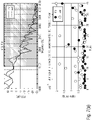
- Fig. 6 is a graph showing a frequency analysis method according to the embodiment of the present invention.
- the processing module 130 is provided to extract a specific parameter which represents a difference according to the road surface by using a frequency analysis after distinguishing the contact area by using the acceleration waveform graph showing accelerations depending on time.
- a method which is mainly used for the frequency analysis of the signal is to use FFT analysis.
- the acceleration measured inside the tire includes various noises as shown in (a) of Fig. 6 .
- the processing module 130 may be provided to perform frequency analysis by using Welchi's method which is shown in (b) of Fig. 6 and has relatively low noise.
- the graph of Fig. 6 shows a change in power spectrum density according to frequency and compares a dry road surface with a wet road surface.
- the processing module 130 analyzes the power spectrum density in a high frequency range in accordance with road surfaces to select a frequency range of interest, and determines signal energy calculated within the frequency range of interest as the parameter input to machine learning.
- the high frequency range may have a frequency band of 1.5 kHz to 4.5 kHz.
- the frequency range of interest may be referred to as a range determined to be capable of analyzing the power spectrum density in the high frequency range in accordance with road surfaces and of distinguishing differences between the road surfaces.
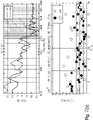
- Fig. 7 is a graph showing the frequency range of interest and the signal energy according to the embodiment of the present invention.
- the processing module 130 analyzes the power spectrum density in the high frequency range in accordance with the road surfaces, and selects the frequency range of interest that clearly shows the difference between the road surfaces. This is represented as a highlighted region in Fig. 7 .
- the signal energy is calculated in the frequency range of interest and is defined as an input parameter of machine learning.
- y is the signal energy
- f1 is a start point of the frequency range of interest
- f2 is an end point of the frequency range of interest
- X(f) is the power spectrum density within the frequency range of interest.
- the signal energy is calculated for within the contact area, an area before contacting, an area after contacting, and an entire area which have been extracted respectively from the circumferential acceleration graph and the radial acceleration graph of the tire.
- the calculated value may be a parameter which is input to the machine learning.
- the parameter may include eight or more values including the signal energy calculated for within the contact area, the area before contacting, the area after contacting, and the entire area which are extracted from the radial acceleration graph of the tire and the signal energy calculated for within the contact area, the area before contacting, the area after contacting, and the entire area which are extracted from the circumferential acceleration graph of the tire.
- the estimation module 140 may be provided to estimate the road surface condition by using the parameter extracted by the processing module 130.
- the estimation module 140 may be provided to estimate the road surface condition by further including a tire pressure, a tire bearing load, and a travel speed in addition to a plurality of the parameters extracted by the processing module.
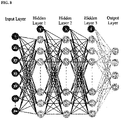
- Fig. 8 is a view showing an example of a neural network model structure of the estimation module according to the embodiment of the present invention.
- the estimation module 140 may be provided to estimate the road surface condition by using machine learning which has the extracted eight parameters and three test conditions as parameters.
- the estimation module 140 may be formed to have a model structure using the neural network shown in Fig. 8 .
- test such as a tire pressure, a tire bearing load, and a travel speed and eight acceleration specific parameters.
- outputs of four estimated road conditions There are outputs of four estimated road conditions.
- the neural network may be composed of three hidden layers, and each hidden layer may be composed of 30 neurons.
- the load applied to the tire can be estimated from the load and contact length estimated from the acceleration signal, and the value measured by the pressure sensor 112 is used as the pressure.
- the travel speed of the vehicle can be obtained through the CAN/Bus connection of the vehicle, and the speed may be collected by installing an additional GPS sensor.
- the estimation module 140 which estimates the road surface condition by using such a neural network model has performed a test by using the number of about 5,000 data. In other words, during wheel rotations 5,000 times, 80% of the data was used for the machine learning and 20% of the data was used for the road surface condition estimation test.
- the method for estimating the road surface condition by the estimation module 140 is not limited to the model structure using the neural network.
- Various machine learning algorithms such as decision trees and random forests can be used.
- the estimation module 140 can include all the methods using a machine learning algorithm capable of estimating the road surface condition.
- the estimation module 140 may be provide to machine-learn the parameter change according to each road surface condition by using the parameters extracted by the processing module 130, and when a new parameter is input based on the data trained according to the machine learning, the estimation module 140 may be provided to estimate the road surface condition accordingly.
- the display module 150 may be provided on a dashboard or the like of the vehicle, and may be provided to show the road surface condition estimated by the estimation module 140 to a user.
- the display module 150 provided as described above may warns a driver of rainy roads, snowy roads, etc., thereby enabling the driver to drive in preparation for this.
- the ECU module 160 may be provided to receive the estimated road surface condition from the estimation module 140 and may be provided to control the vehicle according to the road surface condition.
- a current method related to ABS braking determines, during initial braking, an appropriate slip ratio by estimating the friction coefficient of a road surface on the basis of the speed and degree of occurrence of wheel slip.
- a slight delay occurs in estimating the appropriate slip ratio through this process, which leads to an increase in the braking distance.
- the initial estimation of ABS algorithm can be reduced and the braking distance can be reduced by about 5 %.
- the feedback process of the feedback control minimized by determining an input appropriate for steering and braking inputs, so that it is possible to increase stability.
- the dynamic characteristics of a running tire is measured by the sensor module 110 attached inside the tire, and then the road surface condition is estimated through characteristic analysis of the measured waveform. Accordingly, according to the present invention, the road surface condition can be estimated even in a normal driving condition where no slip occurs between the tire and the road surface, and since the sensing value inside the tire is directly used, the accumulation of errors in an existing indirect estimation method can be minimized and the estimation accuracy can be improved.
- the characteristics of the measured acceleration signal are extracted when the tire contacts and before and after the tire contacts, and the characteristics are used as an input parameter of the machine learning technique. Also, various road surface types can be accurately estimated by using only the measured values of the acceleration sensor 111 attached inside tire.
- Fig. 9 is a flowchart of the road surface condition estimation apparatus according to the embodiment of the present invention and a road surface condition estimation method using the same.
- a step S10 of measuring the acceleration of the tire may be performed.
- the sensor module 110 may be provided to measure the acceleration of the tire.
- the sensor module 110 may measure the circumferential and radial accelerations of the tire, that is, an acceleration about a total of two axes.
- a step S20 of providing the measured acceleration to the processing module may be performed.
- the receiver module 120 may be provided to provide the acceleration measured by the sensor module 110 to the processing module 130.
- a step S30 of analyzing the provided acceleration and extracting the parameter for estimating the road surface condition may be performed.
- Fig. 10 is a flowchart of a step of extracting the parameter according to the embodiment of the present invention.
- a step S31 of obtaining an acceleration waveform graph during one rotation of the tire may be performed.
- a step S32 of extracting a contact area of the tire from the acceleration waveform graph may be performed.
- the processing module 130 may extract, from the acceleration waveform graph, between a minimum value and a maximum value of a differential value of a radial acceleration graph as the contact area. Also, the processing module 130 may extract, from the acceleration waveform graph, between a minimum value and a maximum value of a circumferential acceleration graph as the contact area.
- a step S33 of selecting a frequency range of interest by analyzing, in accordance with road surfaces, a power spectrum density in a high frequency range for within the contact area, an area before contacting, an area after contacting, and an entire area may be performed.
- the processing module 130 may analyze the power spectrum density in a high frequency range in accordance with road surfaces to select a frequency range of interest.
- the high frequency range may have a frequency band of 1.5 kHz to 4.5 kHz.
- the frequency range of interest may be referred to as a range determined to be capable of analyzing the power spectrum density in the high frequency range in accordance with road surfaces and of distinguishing differences between the road surfaces.
- a step S34 of calculating signal energy within the selected frequency range of interest may be performed.
- the signal energy is calculated for within the contact area, an area before contacting, an area after contacting, and an entire area which have been extracted respectively from the circumferential acceleration graph and the radial acceleration graph of the tire.
- the calculated value may be a parameter which is input to the machine learning.
- a step S35 of extracting the calculated signal energy as a parameter may be performed.
- the parameter may include eight or more values including the signal energy calculated for within the contact area, the area before contacting, the area after contacting, and the entire area which are extracted from the radial acceleration graph of the tire and the signal energy calculated for within the contact area, the area before contacting, the area after contacting, and the entire area which are extracted from the circumferential acceleration graph of the tire.
- a step S40 of estimating the road surface condition by using the extracted parameter may be performed.
- the estimation module 140 may be provided to machine-learn the parameter change according to each road surface condition by using the parameters extracted by the processing module 130, and when a new parameter is input based on the data trained according to the machine learning, the estimation module 140 may be provided to estimate the road surface condition accordingly.
- a step S50 of displaying the estimated road surface condition to a user and controlling a vehicle in response to the road surface condition may be performed.
- the display module 150 may be provided on a dashboard or the like of the vehicle, and may be provided to show the road surface condition estimated by the estimation module 140 to a user.
- the display module 150 provided as described above may warns a driver of rainy roads, snowy roads, etc., thereby enabling the driver to drive in preparation for this.
- the ECU module 160 may be provided to receive the estimated road surface condition from the estimation module 140 and may be provided to control the vehicle according to the road surface condition.
- REFERENCE NUMERALS 100 road surface condition estimation apparatus of tire 110: sensor module 111: acceleration sensor 112: pressure sensor 120: receiver module 130: processing module 140: estimation module 150: display module 160: ECU module
Landscapes
- Engineering & Computer Science (AREA)
- Mechanical Engineering (AREA)
- Automation & Control Theory (AREA)
- Transportation (AREA)
- Physics & Mathematics (AREA)
- Mathematical Physics (AREA)
- Theoretical Computer Science (AREA)
- Software Systems (AREA)
- Computing Systems (AREA)
- General Physics & Mathematics (AREA)
- Evolutionary Computation (AREA)
- Artificial Intelligence (AREA)
- Data Mining & Analysis (AREA)
- General Engineering & Computer Science (AREA)
- Human Computer Interaction (AREA)
- Computational Linguistics (AREA)
- Biophysics (AREA)
- Biomedical Technology (AREA)
- Molecular Biology (AREA)
- Life Sciences & Earth Sciences (AREA)
- Health & Medical Sciences (AREA)
- General Health & Medical Sciences (AREA)
- Computer Vision & Pattern Recognition (AREA)
- Medical Informatics (AREA)
- Control Of Driving Devices And Active Controlling Of Vehicle (AREA)
- Tires In General (AREA)
Description
- The present invention relates to a road surface condition estimation apparatus and a road surface condition estimation method using the same, and more particularly to a road surface condition estimation apparatus which accurately estimates a road surface condition even under changes of external environment such as weather, etc., and a road surface condition estimation method using the same.
- A tire among parts of a vehicle is a unique component that contacts a road surface. Also, the tire generates a cornering force, a driving force, and a braking force of the vehicle, thereby enabling the vehicle to run. Therefore, the tire plays a very important role in the driving performance and safety of the vehicle.
- The driving force, braking force, and cornering force generated between the tire and the road surface is significantly affected by the characteristics of the tire, the type and condition of the road surface.
- Therefore, when the vehicle is able to estimate the road surface condition in real time and to provide information thereon to the ECU of the vehicle, it is possible to expect the performance improvement of the vehicle control such as ABS, ADAS, etc.
- Also, such information can give attention to a driver of the vehicle through a vehicle dashboard or the like and induce driving appropriate for each road surface. For example, when a wet road surface is detected, the driver will slow down the vehicle in order to avoid hydroplaning, etc.
- As this road surface estimation method, there is a method of photographing a road surface by using a camera mounted on the vehicle, and the like and estimating the road surface by using image processing. However, a lens of the camera may be contaminated on wet roads or snowy roads, resulting in poor image resolution. Further, optical road surface recognition may be difficult in dark nights.
- Also, the installation of additional cameras may increase vehicle cost and cause the complexity of an on-board sensor network of the vehicle.
- The road surface condition may be indirectly estimated on the basis of a vehicle dynamic model and vehicle driving condition information measured by the on-board sensor. This estimation method is being widely used for vehicle control. However, this method has a disadvantage that errors may be accumulated in the indirect estimation process and the estimation can be made only when a certain amount or more of slip occurs between the road surface and the tire.
-
US 9,170,102 B2 - However, in order to determine whether or not a material is covered on the road surface, for example, in order to distinguish between a wet road surface and a dry road surface,
US 9,170,102 B2 - These road surface temperature sensors and sound recording sensors are additionally installed in the vehicle, which causes the complexity of the sensor network and increases the cost of sensors. Also, the accuracy of the estimation result presented as an embodiment in the patent is 57 % to 86 % and not high under road surface conditions such as wet, icy, sherbet, etc. In order for the road surface estimation result to be effectively used for vehicle control and the like, the accuracy is required to be 90% or more.
-
US 2018/0222458 A1 proposes a method for extracting a contact area of an acceleration sensor of a tire at various travel speeds. Since the acceleration sensor measuring inside the tire is affected by the travel speed, it is difficult for an algorithm for separating the contact area at a particular speed to extract effectively the contact area at different travel speeds. Therefore, a contact area separation algorithm including the speed effect was proposed, and a road surface with a high coefficient of friction and a road surface with a low coefficient of friction are separated by using vibration energy of the acceleration signal of the separated contact area. - However, this method cannot accurately estimate because a road surface estimation algorithm does not include not only the tire contact area but also the vibration characteristics before and after contacting. Also, it is impossible to provide detailed road surface information to the ECU simply by separating an asphalt road surface from the road surface having a low coefficient of friction.
- Therefore, there is a need for a technology capable of more accurately estimating the road surface condition.
-
JP 2019 081531 A - The object of the present invention for solving the above-mentioned problems is to provide a road surface condition estimation apparatus which accurately estimates a road surface condition even under changes of external environment such as weather, etc., and a road surface condition estimation method using the same.
- The technical problem to be overcome in this document is not limited to the above-mentioned technical problems. Other technical problems not mentioned can be clearly understood from those described below by a person having ordinary skill in the art.
- The above object is achieved by an apparatus comprising the features of
claim 1 and by a method comprising the features of claim 13. - According to the invention, a road surface condition estimation apparatus of a tire is provided.
- The road surface condition estimation apparatus includes: a sensor module which is mounted on a tire; a receiver module which receives sensing information measured by the sensor module; a processing module which extracts a parameter for estimating a road surface condition by analyzing the sensing information received by the receiver module; and an estimation module which estimates the road surface condition by using the parameter extracted by the processing module. The sensing information includes an acceleration of the tire. The processing module extracts the parameter by analyzing acceleration vibration characteristics through an acceleration waveform graph. The processing module is provided to extract a contact area of the tire from the acceleration waveform graph and to extract the parameter through frequency analysis of the contact area. The processing module analyzes a power spectrum density in a high frequency range in accordance with road surfaces to select a frequency range of interest, and determines signal energy calculated within the frequency range of interest as the parameter input to machine learning.
- The sensor module is formed in a center of a tread of an inner surface of the tire.
- The sensor module includes: an acceleration sensor provided to measure circumferential and radial accelerations of the tire; and a pressure sensor provided to measure an internal pressure of the tire.
- The processing module extracts, from the acceleration waveform graph, between a minimum value and a maximum value of a differential value of a radial acceleration graph as the contact area.
- The processing module extracts, from the acceleration waveform graph, between a minimum value and a maximum value of a circumferential acceleration graph as the contact area.
- The signal energy is calculated by the following equation.

- The signal energy is calculated for within the contact area, an area before contacting, an area after contacting, and an entire area which have been extracted respectively from the circumferential acceleration graph and the radial acceleration graph of the tire. The calculated value is included in the parameter which is input to the machine learning.
- A frequency band of the high frequency range is 1.5 kHz to 4.5 kHz.
- The frequency range of interest is a range determined to be capable of analyzing the power spectrum density in the high frequency range in accordance with road surfaces and of distinguishing differences between the road surfaces.
- The estimation module is provided to estimate the road surface condition by further including a tire pressure, a tire bearing load, and a travel speed in addition to a plurality of the parameters extracted by the processing module.
- The road surface condition estimation apparatus further includes a display module provided to show the road surface condition estimated from the estimation module to a user.
- The road surface condition estimation apparatus further includes an ECU module provided to receive the estimated road surface condition from the estimation module. The ECU module is provided to control a vehicle in accordance with the road surface condition.
- Another object of the invention is a road surface condition estimation method using the road surface condition estimation apparatus of a tire. The road surface condition estimation method includes: a) measuring an acceleration of a tire; b) providing the measured acceleration to the processing module; c) analyzing the provided acceleration and extracting a parameter for estimating a road surface condition; and d) estimating the road surface condition by using the extracted parameter.
- The step c) includes: c1) obtaining an acceleration waveform graph during one rotation of the tire; c2) extracting a contact area of the tire from the acceleration waveform graph; c3) selecting a frequency range of interest by analyzing, in accordance with road surfaces, a power spectrum density in a high frequency range for within the contact area, an area before contacting, an area after contacting, and an entire area; c4) calculating signal energy within the selected frequency range of interest; and c5) extracting the calculated signal energy as a parameter.
- The road surface condition estimation method further includes, after the step d), displaying the estimated road surface condition to a user and controlling a vehicle in response to the road surface condition.
- The embodiment of the present invention warns a driver of rainy roads, snowy roads, etc., thereby enabling the driver to drive in preparation for this.
- A current method related to ABS braking determines, during initial braking, an appropriate slip ratio by estimating the friction coefficient of a road surface on the basis of the speed and degree of occurrence of wheel slip. However, a slight delay occurs in estimating the appropriate slip ratio through this process, which leads to an increase in the braking distance. However, according to the present invention, if road surface types are provided to the ECU, the initial estimation of ABS algorithm can be reduced and the braking distance can be reduced by about 5 %.
- Also, if vehicles are connected by telematics, information on the preceding vehicle can be shared to recognize the road surface condition in advance and defensive driving is possible. Also, if vehicles are connected with related organizations such as road traffic authority, etc., the organizations can provide a road condition map and the like in real time.
- Also, regarding autonomous vehicles, if the road surface condition is known in advance, the feedback process of the feedback control minimized by determining an input appropriate for steering and braking inputs, so that it is possible to increase stability.
- Also, according to the present invention, the dynamic characteristics of a running tire is measured by a sensor attached inside the tire, and then the road surface condition is estimated through characteristic analysis of the measured waveform. Accordingly, according to the present invention, the road surface condition can be estimated even in a normal driving condition where no slip occurs between the tire and the road surface, and since the sensing value inside the tire is directly used, the accumulation of errors in an existing indirect estimation method can be minimized and the estimation accuracy can be improved.
- By separating signals into different contact regions and by extracting characteristics from each region respectively, the resolution of the classifier can be improved compared when the signal is dealt with as a whole.
- Also, according to the present invention, the characteristics of the measured acceleration signal are extracted when the tire contacts and before and after the tire contacts, and the characteristics are used as an input parameter of the machine learning technique. Also, various road surface types can be accurately estimated by using only the measured values of the acceleration sensor attached inside tire.
- The effect of the present invention is not limited to the above effects and should be construed as including all the effects that can be inferred from the configuration of the present invention disclosed in the detailed description or claims of the present invention.
-
-
Fig. 1 is a view showing an example of a configuration of a road surface condition estimation apparatus according to an embodiment of the present invention; -
Fig. 2 is a view showing an example of a mounting position of a sensor module according to the embodiment of the present invention; -
Fig. 3 is a view showing an example of a contact position according to one rotation of a tire in accordance with the embodiment of the present invention and an acceleration waveform graph thereof; -
Fig. 4 is a circumferential acceleration graph according to the road surface condition according to the embodiment of the present invention; -
Fig. 5 is a view showing an example of a contact area of a radial acceleration and its time derivative graph according to the embodiment of the present invention; -
Fig. 6 is a graph showing a frequency analysis method according to the embodiment of the present invention; -
Fig. 7 is a graph showing a frequency range of interest and signal energy according to the embodiment of the present invention; -
Fig. 8 is a view showing an example of a neural network model structure of an estimation module according to the embodiment of the present invention; -
Fig. 9 is a flowchart of the road surface condition estimation apparatus according to the embodiment of the present invention and a road surface condition estimation method using the same; and -
Fig. 10 is a flowchart of a step of extracting a parameter according to the embodiment of the present invention. - Hereinafter, the present invention will be described with reference to the accompanying drawings. However, the present invention may be embodied in various forms and is not limited to the embodiment described in the present specification. In the drawings, parts irrelevant to the description will be omitted for a clear description of the present invention.
- Similar reference numerals will be assigned to similar parts throughout this patent document.
- Throughout the specification, when it is mentioned that a portion is "connected (accessed, contacted, combined)" to another portion, it includes not only "is directly connected" but also "indirectly connected" with another member placed therebetween. Additionally, when it is mentioned that a portion "includes" a component, it means that the portion does not exclude but further includes other components unless there is a special opposite mention.
- Terms used in the present specification are provided for description of only specific embodiments of the present invention, and not intended to be limiting. An expression of a singular form includes the expression of plural form thereof unless otherwise explicitly mentioned in the context. In the present specification, it should be understood that the term "include" or "comprise" and the like is intended to specify characteristics, numbers, steps, operations, components, parts or any combination thereof which are mentioned in the specification, and intended not to previously exclude the possibility of existence or addition of at least one another characteristics, numbers, steps, operations, components, parts or any combination thereof.
- Embodiments of the present invention will be described in detail with reference to the accompanying drawings.
-
Fig. 1 is a view showing an example of a configuration of a road surface condition estimation apparatus according to an embodiment of the present invention. - As shown in
Fig. 1 , the road surfacecondition estimation apparatus 100 of a tire includes asensor module 110, areceiver module 120, aprocessing module 130, anestimation module 140, adisplay module 150, and anECU module 160. -
Fig. 2 is a view showing an example of a mounting position of the sensor module according to the embodiment of the present invention. - Referring further to
Fig. 2 , thesensor module 110 may be a tire mounted sensor (TMS) mounted within the tire. Since thesensor module 110 is mounted directly on the inner surface of the tire, the sensor module can obtain information on the deformation and vibration of a running tire by measuring acceleration. - Particularly, the
sensor module 110 may be formed in the center of atread 10 on the inner surface and may include anacceleration sensor 111 and apressure sensor 112. - The
acceleration sensor 111 may be provided to measure circumferential and radial accelerations of the tire, that is, an acceleration about a total of two axes. - Also, the
pressure sensor 112 may be provided to measure an internal pressure of the tire. - The
sensor module 110 provided as described above may measure sensing information on deformation and vibration of the tire. - Also, the
sensor module 110 may be formed in the center of thetread 10 to minimize the influence of a wheel slip angle or a camber angle on the acceleration measurement. - The
receiver module 120 may be provided to receive the sensing information measured by thesensor module 110. - Specifically, the
sensor module 110 wirelessly transmits the measured acceleration and the internal pressure of the tire through a transmitter. Then, they are received by thereceiver module 120 located within a vehicle system. - Here, a method for the above wireless transmission above may employ a method such as RF, BLE or the like.
- An acceleration signal received by the
receiver module 120 has information related to the vibration and deformation of the tire. Based on the information, tire characteristics vary according to the type of a road surface. - The
processing module 130 may be provided to analyze the sensing information received by thereceiver module 120 and to extract a parameter for estimating a road surface condition. - Here, the parameter may be referred to as a variable which is used in a road surface estimation model on the basis of an analysis of acceleration vibration characteristics measured on a dry road surface, a wet road surface, an icy road, a snowy road, etc.
- The
processing module 130 may be provided to extract the parameter by analyzing the acceleration vibration characteristics through an acceleration waveform graph for the two-axis acceleration measured by thesensor module 110. Here, the acceleration waveform graph shows changes in the acceleration depending on time for each of the two axes. -
Fig. 3 is a view showing an example of a contact position according to one rotation of the tire in accordance with the embodiment of the present invention and the acceleration waveform graph thereof. - Referring to
Fig. 3 , theprocessing module 130 may extract a contact area of the tire from the acceleration waveform graph and extract the parameter through frequency analysis of the contact area. - As shown in
Fig. 3 , it can be seen that a sudden change in the acceleration occurs at a point b at which the tire starts to contact, at a point c during contacting, and at a point d at which the contact ends. - Specifically, the acceleration waveform has a maximum value or a minimum value due to the discontinuity of the tire shape in the contact arrears b to d. In the case of the acceleration in the z direction (radial direction), the acceleration converges to almost zero within the contact, and, outside the contact, has a value corresponding to the centrifugal force acceleration of the tire.
- Accordingly, the
processing module 130 may extract, from the acceleration waveform graph, between a minimum value and a maximum value of a differential value of a radial acceleration graph as the contact area. - Also, the
processing module 130 may extract, from the acceleration waveform graph, between a minimum value and a maximum value of a circumferential acceleration graph as the contact area. - As such, the
processing module 130 may be provided to derive the contact area of the tire from the acceleration waveform graph. -
Fig. 4 is the circumferential acceleration graph according to the road surface condition according to the embodiment of the present invention. - Referring further to
Fig. 4 , the acceleration waveforms in the circumferential direction of the tire measured on various road surfaces can be seen, and vibration characteristics vary according to the type of the road surface. As shown in (a) ofFig. 4 , it can be found that the vibration energy of a dry road surface is overall lower than that of a wet road surface shown in (b) ofFig. 4 . In particular, high energy is observed in front of and behind the contact area. - Also, as shown in (c) of
Fig. 4 , the vibration energy is higher in the front portion of the contact area than in the rear portion of the contact area on the icy road. Also, as shown in (d) ofFig. 4 , the vibration energy is higher in the rear portion of the contact area than in the front portion of the contact area on the snowy road. - As described above, since the acceleration vibration characteristics vary according to each road surface, it can be seen that an appropriate characteristic parameter for road surface estimation can be extracted from the acceleration waveform.
- These parameters are used to develop data models by using machine learning. Further, when the characteristic parameter is extracted by dividing the acceleration signal on the basis of each section, that is, signal before contacting, signal during the contacting, and after contacting, a higher degree of estimation is possible.
-
Fig. 5 is a view showing an example of the contact area of the radial acceleration graph according to the embodiment of the present invention. - Referring further to
Fig. 5 , it can be seen that the contact area is extracted by using a differential value of the radial acceleration. Since the differential value of the acceleration signal has minimum and maximum values at a contact start point and a contact end point, the contact area can be distinguished by extracting these point. - Also, although not shown, the present invention includes the use of the circumferential acceleration of the tire in order to distinguish the contact area.
- Also, it is preferable that the
processing module 130 uses a signal from which a high frequency noise has been removed by using a low-pass filter for the purpose of distinguishing the acceleration contact area. -
Fig. 6 is a graph showing a frequency analysis method according to the embodiment of the present invention. - Referring to
Fig. 6 , theprocessing module 130 is provided to extract a specific parameter which represents a difference according to the road surface by using a frequency analysis after distinguishing the contact area by using the acceleration waveform graph showing accelerations depending on time. - Specifically, a method which is mainly used for the frequency analysis of the signal is to use FFT analysis. However, the acceleration measured inside the tire includes various noises as shown in (a) of
Fig. 6 . Accordingly, theprocessing module 130 may be provided to perform frequency analysis by using Welchi's method which is shown in (b) ofFig. 6 and has relatively low noise. - The graph of
Fig. 6 shows a change in power spectrum density according to frequency and compares a dry road surface with a wet road surface. - As described above, the
processing module 130 analyzes the power spectrum density in a high frequency range in accordance with road surfaces to select a frequency range of interest, and determines signal energy calculated within the frequency range of interest as the parameter input to machine learning. - Here, the high frequency range may have a frequency band of 1.5 kHz to 4.5 kHz.
- Also, the frequency range of interest may be referred to as a range determined to be capable of analyzing the power spectrum density in the high frequency range in accordance with road surfaces and of distinguishing differences between the road surfaces.
-
Fig. 7 is a graph showing the frequency range of interest and the signal energy according to the embodiment of the present invention. - Describing with reference to
Fig. 7 , theprocessing module 130 analyzes the power spectrum density in the high frequency range in accordance with the road surfaces, and selects the frequency range of interest that clearly shows the difference between the road surfaces. This is represented as a highlighted region inFig. 7 . - The signal energy is calculated in the frequency range of interest and is defined as an input parameter of machine learning. The signal energy is calculated by the following equation.

- Here, y is the signal energy, f1 is a start point of the frequency range of interest, f2 is an end point of the frequency range of interest, and X(f) is the power spectrum density within the frequency range of interest.
- The signal energy is calculated for within the contact area, an area before contacting, an area after contacting, and an entire area which have been extracted respectively from the circumferential acceleration graph and the radial acceleration graph of the tire. The calculated value may be a parameter which is input to the machine learning.
- That is, the parameter may include eight or more values including the signal energy calculated for within the contact area, the area before contacting, the area after contacting, and the entire area which are extracted from the radial acceleration graph of the tire and the signal energy calculated for within the contact area, the area before contacting, the area after contacting, and the entire area which are extracted from the circumferential acceleration graph of the tire.
- Since these extracted parameters maximize and show the characteristic difference that distinguishes according to the road surface condition, it is possible to more accurately measure the road surface condition.
- The
estimation module 140 may be provided to estimate the road surface condition by using the parameter extracted by theprocessing module 130. - Here, the
estimation module 140 may be provided to estimate the road surface condition by further including a tire pressure, a tire bearing load, and a travel speed in addition to a plurality of the parameters extracted by the processing module. -
Fig. 8 is a view showing an example of a neural network model structure of the estimation module according to the embodiment of the present invention. - Referring further to
Fig. 8 , theestimation module 140 may be provided to estimate the road surface condition by using machine learning which has the extracted eight parameters and three test conditions as parameters. - As one embodiment, the
estimation module 140 may be formed to have a model structure using the neural network shown inFig. 8 . - Specifically, there are a total of 11 input parameters consisting of test such as a tire pressure, a tire bearing load, and a travel speed and eight acceleration specific parameters. There are outputs of four estimated road conditions.
- The neural network may be composed of three hidden layers, and each hidden layer may be composed of 30 neurons. The load applied to the tire can be estimated from the load and contact length estimated from the acceleration signal, and the value measured by the
pressure sensor 112 is used as the pressure. The travel speed of the vehicle can be obtained through the CAN/Bus connection of the vehicle, and the speed may be collected by installing an additional GPS sensor. - The
estimation module 140 which estimates the road surface condition by using such a neural network model has performed a test by using the number of about 5,000 data. In other words, during wheel rotations 5,000 times, 80% of the data was used for the machine learning and 20% of the data was used for the road surface condition estimation test. - The accuracy of the results estimated by this method has reached 92 % in the current embodiment. Cross validation has been performed by using 10 folds in order to check for overfitting. For 10 cases, it was confirmed that there was no overfitting problem in the developed data model with similar level of accuracy.
- Here, the method for estimating the road surface condition by the
estimation module 140 is not limited to the model structure using the neural network. Various machine learning algorithms such as decision trees and random forests can be used. - That is, the
estimation module 140 can include all the methods using a machine learning algorithm capable of estimating the road surface condition. - As such, the
estimation module 140 may be provide to machine-learn the parameter change according to each road surface condition by using the parameters extracted by theprocessing module 130, and when a new parameter is input based on the data trained according to the machine learning, theestimation module 140 may be provided to estimate the road surface condition accordingly. - The
display module 150 may be provided on a dashboard or the like of the vehicle, and may be provided to show the road surface condition estimated by theestimation module 140 to a user. Thedisplay module 150 provided as described above may warns a driver of rainy roads, snowy roads, etc., thereby enabling the driver to drive in preparation for this. - The
ECU module 160 may be provided to receive the estimated road surface condition from theestimation module 140 and may be provided to control the vehicle according to the road surface condition. - A current method related to ABS braking determines, during initial braking, an appropriate slip ratio by estimating the friction coefficient of a road surface on the basis of the speed and degree of occurrence of wheel slip. However, a slight delay occurs in estimating the appropriate slip ratio through this process, which leads to an increase in the braking distance. However, according to the present invention, if road surface types are provided to the
ECU module 160, the initial estimation of ABS algorithm can be reduced and the braking distance can be reduced by about 5 %. - Also, if vehicles are connected by telematics, information on the preceding vehicle can be shared to recognize the road surface condition in advance and defensive driving is possible. Also, if vehicles are connected with related organizations such as road traffic authority, etc., the organizations can provide a road condition map and the like in real time.
- Also, regarding autonomous vehicles, if the road surface condition is known in advance, the feedback process of the feedback control minimized by determining an input appropriate for steering and braking inputs, so that it is possible to increase stability.
- Also, according to the present invention, the dynamic characteristics of a running tire is measured by the
sensor module 110 attached inside the tire, and then the road surface condition is estimated through characteristic analysis of the measured waveform. Accordingly, according to the present invention, the road surface condition can be estimated even in a normal driving condition where no slip occurs between the tire and the road surface, and since the sensing value inside the tire is directly used, the accumulation of errors in an existing indirect estimation method can be minimized and the estimation accuracy can be improved. - Also, according to the present invention, the characteristics of the measured acceleration signal are extracted when the tire contacts and before and after the tire contacts, and the characteristics are used as an input parameter of the machine learning technique. Also, various road surface types can be accurately estimated by using only the measured values of the
acceleration sensor 111 attached inside tire. -
Fig. 9 is a flowchart of the road surface condition estimation apparatus according to the embodiment of the present invention and a road surface condition estimation method using the same. - Referring to
Fig. 9 , in the road surface condition estimation method using the road surface condition estimation apparatus, first, a step S10 of measuring the acceleration of the tire may be performed. - In the step S10 of measuring the acceleration of the tire, the
sensor module 110 may be provided to measure the acceleration of the tire. - In the step S10 of measuring the acceleration of the tire, the
sensor module 110 may measure the circumferential and radial accelerations of the tire, that is, an acceleration about a total of two axes. - After the step S10 of measuring the acceleration of the tire, a step S20 of providing the measured acceleration to the processing module may be performed.
- In the step S20 of providing the measured acceleration to the processing module, the
receiver module 120 may be provided to provide the acceleration measured by thesensor module 110 to theprocessing module 130. - After the step S20 of providing the measured acceleration to the processing module, a step S30 of analyzing the provided acceleration and extracting the parameter for estimating the road surface condition may be performed.
-
Fig. 10 is a flowchart of a step of extracting the parameter according to the embodiment of the present invention. - Referring to
Fig. 10 , in the step S30 of analyzing the provided acceleration and extracting the parameter for estimating the road surface condition, first, a step S31 of obtaining an acceleration waveform graph during one rotation of the tire may be performed. - After the step S31 of obtaining an acceleration waveform graph during one rotation of the tire, a step S32 of extracting a contact area of the tire from the acceleration waveform graph may be performed.
- In the step S32 of extracting a contact area of the tire from the acceleration waveform graph, the
processing module 130 may extract, from the acceleration waveform graph, between a minimum value and a maximum value of a differential value of a radial acceleration graph as the contact area. Also, theprocessing module 130 may extract, from the acceleration waveform graph, between a minimum value and a maximum value of a circumferential acceleration graph as the contact area. - After the step S32 of extracting a contact area of the tire from the acceleration waveform graph, a step S33 of selecting a frequency range of interest by analyzing, in accordance with road surfaces, a power spectrum density in a high frequency range for within the contact area, an area before contacting, an area after contacting, and an entire area may be performed.
- In the step S33 of selecting a frequency range of interest by analyzing, in accordance with road surfaces, a power spectrum density in a high frequency range for within the contact area, an area before contacting, an area after contacting, and an entire area, the
processing module 130 may analyze the power spectrum density in a high frequency range in accordance with road surfaces to select a frequency range of interest. Here, the high frequency range may have a frequency band of 1.5 kHz to 4.5 kHz. Also, the frequency range of interest may be referred to as a range determined to be capable of analyzing the power spectrum density in the high frequency range in accordance with road surfaces and of distinguishing differences between the road surfaces. - After the step S33 of selecting a frequency range of interest by analyzing, in accordance with road surfaces, a power spectrum density in a high frequency range for within the contact area, an area before contacting, an area after contacting, and an entire area, a step S34 of calculating signal energy within the selected frequency range of interest may be performed.
- In the step S34 of calculating signal energy within the selected frequency range of interest, the signal energy is calculated for within the contact area, an area before contacting, an area after contacting, and an entire area which have been extracted respectively from the circumferential acceleration graph and the radial acceleration graph of the tire. The calculated value may be a parameter which is input to the machine learning.
- After the step S34 of calculating signal energy within the selected frequency range of interest, a step S35 of extracting the calculated signal energy as a parameter may be performed.
- In the step S35 of extracting the calculated signal energy as a parameter, the parameter may include eight or more values including the signal energy calculated for within the contact area, the area before contacting, the area after contacting, and the entire area which are extracted from the radial acceleration graph of the tire and the signal energy calculated for within the contact area, the area before contacting, the area after contacting, and the entire area which are extracted from the circumferential acceleration graph of the tire.
- After the step S30 of analyzing the provided acceleration and extracting the parameter for estimating the road surface condition, a step S40 of estimating the road surface condition by using the extracted parameter may be performed.
- In the step S40 of estimating the road surface condition by using the extracted parameter, the
estimation module 140 may be provided to machine-learn the parameter change according to each road surface condition by using the parameters extracted by theprocessing module 130, and when a new parameter is input based on the data trained according to the machine learning, theestimation module 140 may be provided to estimate the road surface condition accordingly. - After the step S40 of estimating the road surface condition by using the extracted parameter, a step S50 of displaying the estimated road surface condition to a user and controlling a vehicle in response to the road surface condition may be performed.
- In the step S50 of displaying the estimated road surface condition to a user and controlling a vehicle in response to the road surface condition, the
display module 150 may be provided on a dashboard or the like of the vehicle, and may be provided to show the road surface condition estimated by theestimation module 140 to a user. Thedisplay module 150 provided as described above may warns a driver of rainy roads, snowy roads, etc., thereby enabling the driver to drive in preparation for this. - Also, in the step S50 of displaying the estimated road surface condition to a user and controlling a vehicle in response to the road surface condition, the
ECU module 160 may be provided to receive the estimated road surface condition from theestimation module 140 and may be provided to control the vehicle according to the road surface condition. - The above-mentioned descriptions of the present invention are provided for illustration. It can be understood by those skilled in the art that the present invention can be embodied in other specific forms without departing from the scope of the claims. Therefore, the foregoing embodiments and advantages are merely exemplary and are not to be construed as limiting the present invention. For example, each component described as a single type may be implemented in a distributed manner, and similarly, components described as being distributed can also be implemented in a combined form.
- All modification, alternatives, and variations falling under the scope of the claims should be construed as being included in the scopes of the embodiments.
REFERENCE NUMERALS 100: road surface condition estimation apparatus of tire 110: sensor module 111: acceleration sensor 112: pressure sensor 120: receiver module 130: processing module 140: estimation module 150: display module 160: ECU module
Claims (14)
- A road surface condition estimation apparatus (100) of a tire, the road surface condition estimation apparatus (100) comprising:a sensor module (110) which is mounted on a tire;a receiver module (120) which is configured to receive sensing information measured by the sensor module (110);a processing module (130) which is configured to extract a parameter for estimating a road surface condition by analyzing the sensing information received by the receiver module (120); andan estimation module (140) which is configured to estimate the road surface condition by using the parameter extracted by the processing module (130),
wherein the sensing information comprises an acceleration of the tire,wherein the processing module (130) is configured to extract the parameter by analyzing acceleration vibration characteristics through an acceleration waveform graph,wherein the processing module (130) is configured to extract a contact area of the tire from the acceleration waveform graph and extracts the parameter through frequency analysis of the contact area, andcharacterized in that the processing module (130) is configured to analyze a power spectrum density in a high frequency range in accordance with road surfaces to select a frequency range of interest, and to determine signal energy calculated within the frequency range of interest as the parameter input to machine learning. - The road surface condition estimation apparatus (100) of claim 1, wherein the sensor module (110) is formed in a center of a tread of an inner surface of the tire.
- The road surface condition estimation apparatus (100) of claim 2, wherein the sensor module (110) comprises:an acceleration sensor (111) which is configured to measure circumferential and radial accelerations of the tire; anda pressure sensor (112) which is configured to measure an internal pressure of the tire.
- The road surface condition estimation apparatus (100) of claim 1, wherein the processing module (130) is configured to extract, from the acceleration waveform graph, between a minimum value and a maximum value of a differential value of a radial acceleration graph as the contact area.
- The road surface condition estimation apparatus (100) of claim 1, wherein the processing module (130) is configured to extract, from the acceleration waveform graph, between a minimum value and a maximum value of a circumferential acceleration graph as the contact area.
- The road surface condition estimation apparatus (100) of claim 1, wherein the signal energy is calculated by the following equation.

- The road surface condition estimation apparatus (100) of claim 6, wherein the signal energy is calculated for within the contact area, an area before contacting, an area after contacting, and an entire area which have been extracted respectively from the circumferential acceleration graph and the radial acceleration graph of the tire, and wherein the calculated value is comprised in the parameter which is input to the machine learning.
- The road surface condition estimation apparatus (100) of claim 6, wherein a frequency band of the high frequency range is 1.5 kHz to 4.5 kHz.
- The road surface condition estimation apparatus (100) of claim 1, wherein the frequency range of interest is a range determined to be capable of analyzing the power spectrum density in the high frequency range in accordance with road surfaces and of distinguishing differences between the road surfaces.
- The road surface condition estimation apparatus (100) of claim 1, wherein the estimation module (140) is configured to estimate the road surface condition by further comprising a tire pressure, a tire bearing load, and a travel speed in addition to the parameter extracted by the processing module (130).
- The road surface condition estimation apparatus (100) of claim 1, further comprising a display module (150) provided to show the road surface condition estimated from the estimation module (140) to a user.
- The road surface condition estimation apparatus (100) of claim 1, further comprising an ECU module (160) provided to receive the estimated road surface condition from the estimation module (140), wherein the ECU module (160) is provided to control a vehicle in accordance with the road surface condition.
- A road surface condition estimation method using the road surface condition estimation apparatus (100) of a tire according to claim 1, the road surface condition estimation method comprising:a) measuring (S10) an acceleration of a tire;b) providing (S20) the measured acceleration to the processing module (130);c) analyzing (S30) the provided acceleration and extracting a parameter for estimating a road surface condition; andd) estimating (S40) the road surface condition by using the extracted parameter, characterized in that step c) comprises:c1) obtaining (S31) an acceleration waveform graph during one rotation of the tire;c2) extracting (S32) a contact area of the tire from the acceleration waveform graph;c3) selecting (S33) a frequency range of interest by analyzing, in accordance with road surfaces, a power spectrum density in a high frequency range for within the contact area, an area before contacting, an area after contacting, and an entire area;c4) calculating (S34) signal energy within the selected frequency range of interest; andc5) extracting (S35) the calculated signal energy as a parameter.
- The road surface condition estimation method of claim 13, further comprising, after the step d), displaying (S50) the estimated road surface condition to a user and controlling a vehicle in response to the road surface condition.
Applications Claiming Priority (1)
| Application Number | Priority Date | Filing Date | Title |
|---|---|---|---|
| KR1020190122275A KR102267901B1 (en) | 2019-10-02 | 2019-10-02 | Road surface condition estimation apparatus and road surface condition estimation method using the same |
Publications (2)
| Publication Number | Publication Date |
|---|---|
| EP3800100A1 EP3800100A1 (en) | 2021-04-07 |
| EP3800100B1 true EP3800100B1 (en) | 2022-11-30 |
Family
ID=72752272
Family Applications (1)
| Application Number | Title | Priority Date | Filing Date |
|---|---|---|---|
| EP20199590.9A Active EP3800100B1 (en) | 2019-10-02 | 2020-10-01 | Road surface condition estimation apparatus and road surface condition estimation method using the same |
Country Status (5)
| Country | Link |
|---|---|
| US (1) | US12179768B2 (en) |
| EP (1) | EP3800100B1 (en) |
| JP (1) | JP7096871B2 (en) |
| KR (1) | KR102267901B1 (en) |
| CN (1) | CN112590795B (en) |
Cited By (1)
| Publication number | Priority date | Publication date | Assignee | Title |
|---|---|---|---|---|
| WO2025202972A1 (en) * | 2024-03-28 | 2025-10-02 | Hutchinson S.A. | Wheel performance monitoring and feedback system for vehicle control |
Families Citing this family (12)
| Publication number | Priority date | Publication date | Assignee | Title |
|---|---|---|---|---|
| US11084471B2 (en) * | 2019-11-22 | 2021-08-10 | Automotive Research & Testing Center | Braking control method according to friction of road surface |
| WO2022261668A1 (en) * | 2021-06-10 | 2022-12-15 | Virginia Tech Intellectual Properties, Inc. | Data driven smart non-pneumatic tires |
| JP7276397B2 (en) * | 2021-09-27 | 2023-05-18 | いすゞ自動車株式会社 | Wheel condition determination device |
| JP7805139B2 (en) * | 2021-11-18 | 2026-01-23 | Tdk株式会社 | Estimation system, estimation method, and estimation program |
| CN115071726B (en) * | 2022-06-13 | 2026-01-23 | 经纬恒润(天津)研究开发有限公司 | Wheel speed measuring method, device and equipment |
| CN115320608B (en) * | 2022-10-17 | 2023-01-03 | 广东粤港澳大湾区黄埔材料研究院 | Method, device and system for monitoring tire road surface information |
| GB202215777D0 (en) * | 2022-10-25 | 2022-12-07 | Mclaren Automotive Ltd | Driver vehicle control assistance |
| CN115587293A (en) * | 2022-11-04 | 2023-01-10 | 南京理工大学 | Road surface identification method and system by using tire signals |
| KR20250121056A (en) * | 2023-01-06 | 2025-08-11 | 엘지전자 주식회사 | Road surface condition analysis method and device |
| KR20250086326A (en) | 2023-12-06 | 2025-06-13 | 한국타이어앤테크놀로지 주식회사 | Road surface friction coefficient estimation system and road surface friction coefficient estimation method |
| CN118220155B (en) * | 2024-05-27 | 2024-09-20 | 长城汽车股份有限公司 | A driving mode control method, system and vehicle |
| CN120146710B (en) * | 2025-05-15 | 2025-07-15 | 安康市交通运输综合执法支队 | Roadbed compaction quality assessment system and method based on federal learning |
Family Cites Families (25)
| Publication number | Priority date | Publication date | Assignee | Title |
|---|---|---|---|---|
| CN1321838C (en) | 2001-12-21 | 2007-06-20 | 株式会社普利司通 | Method and apparatus for estimating road surface state and tire running state, abs and vehicle control using the same |
| JP4415704B2 (en) * | 2004-03-03 | 2010-02-17 | 株式会社アドヴィックス | Road surface roughness estimation device and road surface roughness estimation method |
| JP4439985B2 (en) | 2004-04-20 | 2010-03-24 | 株式会社ブリヂストン | Road surface friction coefficient estimation method, road surface friction coefficient estimation device, and vehicle control device |
| EP1878596B1 (en) * | 2006-07-11 | 2013-06-05 | The Yokohama Rubber Co., Ltd. | Apparatus and method for evaluating a degree of a safety in traveling of a vehicle |
| US8085987B2 (en) * | 2007-10-26 | 2011-12-27 | Ahmed Shalaby | Method and tool for surface texture evaluation |
| JP4474475B2 (en) | 2008-05-16 | 2010-06-02 | 住友ゴム工業株式会社 | Tire pressure drop detection device and method, and tire pressure drop detection program |
| JP4629756B2 (en) * | 2008-07-14 | 2011-02-09 | 株式会社ブリヂストン | Road surface state estimation method and road surface state estimation device |
| JP5557569B2 (en) | 2010-03-24 | 2014-07-23 | 株式会社ブリヂストン | Road surface condition estimation method |
| JP5657917B2 (en) | 2010-05-19 | 2015-01-21 | 株式会社ブリヂストン | Road surface condition estimation method |
| JP5837341B2 (en) * | 2011-06-24 | 2015-12-24 | 株式会社ブリヂストン | Road surface condition determination method and apparatus |
| CN103717469B (en) * | 2011-07-20 | 2016-08-03 | 株式会社普利司通 | Pavement state method of estimation and pavement state estimate equipment |
| JP5993804B2 (en) * | 2013-06-12 | 2016-09-14 | 株式会社ブリヂストン | Tire contact state estimation method |
| US9527352B2 (en) * | 2013-06-17 | 2016-12-27 | Infineon Technologies Ag | Indirect tire pressure monitoring systems and methods using multidimensional resonance frequency analysis |
| US8983749B1 (en) * | 2013-10-24 | 2015-03-17 | The Goodyear Tire & Rubber Company | Road friction estimation system and method |
| EP3066446A4 (en) | 2013-11-05 | 2017-06-28 | Compagnie Générale des Etablissements Michelin | Method and apparatus for non-destructive detection of tire anomalies |
| JP6273937B2 (en) | 2014-03-18 | 2018-02-07 | 株式会社Soken | Road surface condition estimation device |
| JP5878612B2 (en) | 2014-11-27 | 2016-03-08 | 株式会社ブリヂストン | Road surface condition estimation method |
| JP6450170B2 (en) * | 2014-12-05 | 2019-01-09 | 株式会社ブリヂストン | Road surface condition determination method |
| JP6365503B2 (en) * | 2015-10-27 | 2018-08-01 | 株式会社Soken | Road surface condition estimation device |
| JP6734713B2 (en) | 2016-06-30 | 2020-08-05 | 株式会社ブリヂストン | Road condition determination method |
| JP6617666B2 (en) * | 2016-09-07 | 2019-12-11 | 株式会社デンソー | Tire mount sensor |
| JP7009098B2 (en) | 2017-07-19 | 2022-01-25 | 株式会社ブリヂストン | Road surface condition estimation method |
| JP6733707B2 (en) | 2017-10-30 | 2020-08-05 | 株式会社デンソー | Road surface condition determination device and tire system including the same |
| JP6946970B2 (en) | 2017-11-23 | 2021-10-13 | 株式会社デンソー | Road surface condition determination device |
| US11615711B2 (en) * | 2019-04-29 | 2023-03-28 | Drover, Inc. | Precision localization and geofencing governance system and method for light electric vehicles |
-
2019
- 2019-10-02 KR KR1020190122275A patent/KR102267901B1/en active Active
-
2020
- 2020-09-30 CN CN202011059341.8A patent/CN112590795B/en active Active
- 2020-09-30 US US17/038,507 patent/US12179768B2/en active Active
- 2020-10-01 EP EP20199590.9A patent/EP3800100B1/en active Active
- 2020-10-02 JP JP2020167783A patent/JP7096871B2/en active Active
Cited By (1)
| Publication number | Priority date | Publication date | Assignee | Title |
|---|---|---|---|---|
| WO2025202972A1 (en) * | 2024-03-28 | 2025-10-02 | Hutchinson S.A. | Wheel performance monitoring and feedback system for vehicle control |
Also Published As
| Publication number | Publication date |
|---|---|
| CN112590795A (en) | 2021-04-02 |
| KR20210040212A (en) | 2021-04-13 |
| US20210101603A1 (en) | 2021-04-08 |
| US12179768B2 (en) | 2024-12-31 |
| CN112590795B (en) | 2024-10-22 |
| JP2021060401A (en) | 2021-04-15 |
| EP3800100A1 (en) | 2021-04-07 |
| KR102267901B1 (en) | 2021-06-24 |
| JP7096871B2 (en) | 2022-07-06 |
Similar Documents
| Publication | Publication Date | Title |
|---|---|---|
| EP3800100B1 (en) | Road surface condition estimation apparatus and road surface condition estimation method using the same | |
| CN103717469B (en) | Pavement state method of estimation and pavement state estimate equipment | |
| CN107933559B (en) | Method and system for determining road characteristics in a vehicle | |
| CN107003429B (en) | Road surface state judging system | |
| CN103003110B (en) | Pavement Condition Estimation Method | |
| EP2346725B1 (en) | Method and system for signaling an aquaplaning condition of a tyre fitted on a vehicle | |
| US5723768A (en) | Process for the early recognition of hydroplaning of a vehicle tire on a wet road | |
| EP0863028A2 (en) | Method for detecting a deflated tire on a vehicle | |
| CN105313606A (en) | System and method for determining tire wear properties | |
| CN103153726B (en) | Determine the method and system of potential friction between vehicle tyre and rolling surface | |
| US11505015B2 (en) | Determining a tire pressure status in a vehicle | |
| US20160033367A1 (en) | System and method for determining tire wear | |
| EP1767422B1 (en) | Method and apparatus for evaluating a cornering stability of a wheel | |
| EP1925516B1 (en) | Brake control method and brake control device | |
| Niskanen et al. | Accelerometer tyre to estimate the aquaplaning state of the tyre-road contact | |
| EP4217213B1 (en) | Adjustment of indirectly determined values of a tire monitoring system | |
| JP5241556B2 (en) | Road surface condition estimation device | |
| JP3948678B2 (en) | Wheel turning stability evaluation method and wheel turning stability evaluation apparatus | |
| KR20250086326A (en) | Road surface friction coefficient estimation system and road surface friction coefficient estimation method | |
| Cheli | Cyber tyre: A novel sensor to improve vehicle's safety | |
| JP2008247243A (en) | Threshold setting method in tire internal pressure drop judgment method | |
| US20030109968A1 (en) | System and method for monitoring the driving state of a vehicle | |
| JP5097438B2 (en) | Tire dynamic load radius reference value initialization method and apparatus, and tire dynamic load radius reference value initialization program | |
| Andrieux et al. | A novel approach to real time tire-road grip and slip monitoring |
Legal Events
| Date | Code | Title | Description |
|---|---|---|---|
| PUAI | Public reference made under article 153(3) epc to a published international application that has entered the european phase |
Free format text: ORIGINAL CODE: 0009012 |
|
| STAA | Information on the status of an ep patent application or granted ep patent |
Free format text: STATUS: REQUEST FOR EXAMINATION WAS MADE |
|
| 17P | Request for examination filed |
Effective date: 20201001 |
|
| AK | Designated contracting states |
Kind code of ref document: A1 Designated state(s): AL AT BE BG CH CY CZ DE DK EE ES FI FR GB GR HR HU IE IS IT LI LT LU LV MC MK MT NL NO PL PT RO RS SE SI SK SM TR |
|
| AX | Request for extension of the european patent |
Extension state: BA ME |
|
| GRAP | Despatch of communication of intention to grant a patent |
Free format text: ORIGINAL CODE: EPIDOSNIGR1 |
|
| STAA | Information on the status of an ep patent application or granted ep patent |
Free format text: STATUS: GRANT OF PATENT IS INTENDED |
|
| RIC1 | Information provided on ipc code assigned before grant |
Ipc: B60C 19/00 20060101ALI20220127BHEP Ipc: B60W 50/14 20200101ALI20220127BHEP Ipc: B60W 30/18 20120101ALI20220127BHEP Ipc: G06N 20/00 20190101ALI20220127BHEP Ipc: B60W 40/068 20120101AFI20220127BHEP |
|
| GRAJ | Information related to disapproval of communication of intention to grant by the applicant or resumption of examination proceedings by the epo deleted |
Free format text: ORIGINAL CODE: EPIDOSDIGR1 |
|
| STAA | Information on the status of an ep patent application or granted ep patent |
Free format text: STATUS: REQUEST FOR EXAMINATION WAS MADE |
|
| INTG | Intention to grant announced |
Effective date: 20220218 |
|
| GRAP | Despatch of communication of intention to grant a patent |
Free format text: ORIGINAL CODE: EPIDOSNIGR1 |
|
| STAA | Information on the status of an ep patent application or granted ep patent |
Free format text: STATUS: GRANT OF PATENT IS INTENDED |
|
| INTC | Intention to grant announced (deleted) | ||
| GRAJ | Information related to disapproval of communication of intention to grant by the applicant or resumption of examination proceedings by the epo deleted |
Free format text: ORIGINAL CODE: EPIDOSDIGR1 |
|
| STAA | Information on the status of an ep patent application or granted ep patent |
Free format text: STATUS: REQUEST FOR EXAMINATION WAS MADE |
|
| INTG | Intention to grant announced |
Effective date: 20220413 |
|
| INTG | Intention to grant announced |
Effective date: 20220426 |
|
| INTG | Intention to grant announced |
Effective date: 20220429 |
|
| GRAP | Despatch of communication of intention to grant a patent |
Free format text: ORIGINAL CODE: EPIDOSNIGR1 |
|
| STAA | Information on the status of an ep patent application or granted ep patent |
Free format text: STATUS: GRANT OF PATENT IS INTENDED |
|
| INTC | Intention to grant announced (deleted) | ||
| INTG | Intention to grant announced |
Effective date: 20220530 |
|
| GRAS | Grant fee paid |
Free format text: ORIGINAL CODE: EPIDOSNIGR3 |
|
| GRAA | (expected) grant |
Free format text: ORIGINAL CODE: 0009210 |
|
| STAA | Information on the status of an ep patent application or granted ep patent |
Free format text: STATUS: THE PATENT HAS BEEN GRANTED |
|
| AK | Designated contracting states |
Kind code of ref document: B1 Designated state(s): AL AT BE BG CH CY CZ DE DK EE ES FI FR GB GR HR HU IE IS IT LI LT LU LV MC MK MT NL NO PL PT RO RS SE SI SK SM TR |
|
| REG | Reference to a national code |
Ref country code: CH Ref legal event code: EP Ref country code: GB Ref legal event code: FG4D |
|
| REG | Reference to a national code |
Ref country code: AT Ref legal event code: REF Ref document number: 1534467 Country of ref document: AT Kind code of ref document: T Effective date: 20221215 |
|
| REG | Reference to a national code |
Ref country code: IE Ref legal event code: FG4D |
|
| REG | Reference to a national code |
Ref country code: DE Ref legal event code: R096 Ref document number: 602020006587 Country of ref document: DE |
|
| REG | Reference to a national code |
Ref country code: LT Ref legal event code: MG9D |
|
| REG | Reference to a national code |
Ref country code: NL Ref legal event code: MP Effective date: 20221130 |
|
| PG25 | Lapsed in a contracting state [announced via postgrant information from national office to epo] |
Ref country code: SE Free format text: LAPSE BECAUSE OF FAILURE TO SUBMIT A TRANSLATION OF THE DESCRIPTION OR TO PAY THE FEE WITHIN THE PRESCRIBED TIME-LIMIT Effective date: 20221130 Ref country code: PT Free format text: LAPSE BECAUSE OF FAILURE TO SUBMIT A TRANSLATION OF THE DESCRIPTION OR TO PAY THE FEE WITHIN THE PRESCRIBED TIME-LIMIT Effective date: 20230331 Ref country code: NO Free format text: LAPSE BECAUSE OF FAILURE TO SUBMIT A TRANSLATION OF THE DESCRIPTION OR TO PAY THE FEE WITHIN THE PRESCRIBED TIME-LIMIT Effective date: 20230228 Ref country code: LT Free format text: LAPSE BECAUSE OF FAILURE TO SUBMIT A TRANSLATION OF THE DESCRIPTION OR TO PAY THE FEE WITHIN THE PRESCRIBED TIME-LIMIT Effective date: 20221130 Ref country code: FI Free format text: LAPSE BECAUSE OF FAILURE TO SUBMIT A TRANSLATION OF THE DESCRIPTION OR TO PAY THE FEE WITHIN THE PRESCRIBED TIME-LIMIT Effective date: 20221130 Ref country code: ES Free format text: LAPSE BECAUSE OF FAILURE TO SUBMIT A TRANSLATION OF THE DESCRIPTION OR TO PAY THE FEE WITHIN THE PRESCRIBED TIME-LIMIT Effective date: 20221130 |
|
| REG | Reference to a national code |
Ref country code: AT Ref legal event code: MK05 Ref document number: 1534467 Country of ref document: AT Kind code of ref document: T Effective date: 20221130 |
|
| PG25 | Lapsed in a contracting state [announced via postgrant information from national office to epo] |
Ref country code: RS Free format text: LAPSE BECAUSE OF FAILURE TO SUBMIT A TRANSLATION OF THE DESCRIPTION OR TO PAY THE FEE WITHIN THE PRESCRIBED TIME-LIMIT Effective date: 20221130 Ref country code: PL Free format text: LAPSE BECAUSE OF FAILURE TO SUBMIT A TRANSLATION OF THE DESCRIPTION OR TO PAY THE FEE WITHIN THE PRESCRIBED TIME-LIMIT Effective date: 20221130 Ref country code: LV Free format text: LAPSE BECAUSE OF FAILURE TO SUBMIT A TRANSLATION OF THE DESCRIPTION OR TO PAY THE FEE WITHIN THE PRESCRIBED TIME-LIMIT Effective date: 20221130 Ref country code: IS Free format text: LAPSE BECAUSE OF FAILURE TO SUBMIT A TRANSLATION OF THE DESCRIPTION OR TO PAY THE FEE WITHIN THE PRESCRIBED TIME-LIMIT Effective date: 20230330 Ref country code: HR Free format text: LAPSE BECAUSE OF FAILURE TO SUBMIT A TRANSLATION OF THE DESCRIPTION OR TO PAY THE FEE WITHIN THE PRESCRIBED TIME-LIMIT Effective date: 20221130 Ref country code: GR Free format text: LAPSE BECAUSE OF FAILURE TO SUBMIT A TRANSLATION OF THE DESCRIPTION OR TO PAY THE FEE WITHIN THE PRESCRIBED TIME-LIMIT Effective date: 20230301 |
|
| PG25 | Lapsed in a contracting state [announced via postgrant information from national office to epo] |
Ref country code: NL Free format text: LAPSE BECAUSE OF FAILURE TO SUBMIT A TRANSLATION OF THE DESCRIPTION OR TO PAY THE FEE WITHIN THE PRESCRIBED TIME-LIMIT Effective date: 20221130 |
|
| PG25 | Lapsed in a contracting state [announced via postgrant information from national office to epo] |
Ref country code: SM Free format text: LAPSE BECAUSE OF FAILURE TO SUBMIT A TRANSLATION OF THE DESCRIPTION OR TO PAY THE FEE WITHIN THE PRESCRIBED TIME-LIMIT Effective date: 20221130 Ref country code: RO Free format text: LAPSE BECAUSE OF FAILURE TO SUBMIT A TRANSLATION OF THE DESCRIPTION OR TO PAY THE FEE WITHIN THE PRESCRIBED TIME-LIMIT Effective date: 20221130 Ref country code: EE Free format text: LAPSE BECAUSE OF FAILURE TO SUBMIT A TRANSLATION OF THE DESCRIPTION OR TO PAY THE FEE WITHIN THE PRESCRIBED TIME-LIMIT Effective date: 20221130 Ref country code: DK Free format text: LAPSE BECAUSE OF FAILURE TO SUBMIT A TRANSLATION OF THE DESCRIPTION OR TO PAY THE FEE WITHIN THE PRESCRIBED TIME-LIMIT Effective date: 20221130 Ref country code: CZ Free format text: LAPSE BECAUSE OF FAILURE TO SUBMIT A TRANSLATION OF THE DESCRIPTION OR TO PAY THE FEE WITHIN THE PRESCRIBED TIME-LIMIT Effective date: 20221130 Ref country code: AT Free format text: LAPSE BECAUSE OF FAILURE TO SUBMIT A TRANSLATION OF THE DESCRIPTION OR TO PAY THE FEE WITHIN THE PRESCRIBED TIME-LIMIT Effective date: 20221130 |
|
| PG25 | Lapsed in a contracting state [announced via postgrant information from national office to epo] |
Ref country code: SK Free format text: LAPSE BECAUSE OF FAILURE TO SUBMIT A TRANSLATION OF THE DESCRIPTION OR TO PAY THE FEE WITHIN THE PRESCRIBED TIME-LIMIT Effective date: 20221130 Ref country code: AL Free format text: LAPSE BECAUSE OF FAILURE TO SUBMIT A TRANSLATION OF THE DESCRIPTION OR TO PAY THE FEE WITHIN THE PRESCRIBED TIME-LIMIT Effective date: 20221130 |
|
| REG | Reference to a national code |
Ref country code: DE Ref legal event code: R097 Ref document number: 602020006587 Country of ref document: DE |
|
| PLBE | No opposition filed within time limit |
Free format text: ORIGINAL CODE: 0009261 |
|
| STAA | Information on the status of an ep patent application or granted ep patent |
Free format text: STATUS: NO OPPOSITION FILED WITHIN TIME LIMIT |
|
| P01 | Opt-out of the competence of the unified patent court (upc) registered |
Effective date: 20230926 |
|
| 26N | No opposition filed |
Effective date: 20230831 |
|
| PG25 | Lapsed in a contracting state [announced via postgrant information from national office to epo] |
Ref country code: SI Free format text: LAPSE BECAUSE OF FAILURE TO SUBMIT A TRANSLATION OF THE DESCRIPTION OR TO PAY THE FEE WITHIN THE PRESCRIBED TIME-LIMIT Effective date: 20221130 |
|
| PG25 | Lapsed in a contracting state [announced via postgrant information from national office to epo] |
Ref country code: IT Free format text: LAPSE BECAUSE OF FAILURE TO SUBMIT A TRANSLATION OF THE DESCRIPTION OR TO PAY THE FEE WITHIN THE PRESCRIBED TIME-LIMIT Effective date: 20221130 Ref country code: MC Free format text: LAPSE BECAUSE OF FAILURE TO SUBMIT A TRANSLATION OF THE DESCRIPTION OR TO PAY THE FEE WITHIN THE PRESCRIBED TIME-LIMIT Effective date: 20221130 |
|
| REG | Reference to a national code |
Ref country code: CH Ref legal event code: PL |
|
| REG | Reference to a national code |
Ref country code: BE Ref legal event code: MM Effective date: 20231031 |
|
| PG25 | Lapsed in a contracting state [announced via postgrant information from national office to epo] |
Ref country code: LU Free format text: LAPSE BECAUSE OF NON-PAYMENT OF DUE FEES Effective date: 20231001 |
|
| PG25 | Lapsed in a contracting state [announced via postgrant information from national office to epo] |
Ref country code: LU Free format text: LAPSE BECAUSE OF NON-PAYMENT OF DUE FEES Effective date: 20231001 |
|
| PG25 | Lapsed in a contracting state [announced via postgrant information from national office to epo] |
Ref country code: CH Free format text: LAPSE BECAUSE OF NON-PAYMENT OF DUE FEES Effective date: 20231031 |
|
| PG25 | Lapsed in a contracting state [announced via postgrant information from national office to epo] |
Ref country code: CH Free format text: LAPSE BECAUSE OF NON-PAYMENT OF DUE FEES Effective date: 20231031 |
|
| PG25 | Lapsed in a contracting state [announced via postgrant information from national office to epo] |
Ref country code: BE Free format text: LAPSE BECAUSE OF NON-PAYMENT OF DUE FEES Effective date: 20231031 |
|
| PG25 | Lapsed in a contracting state [announced via postgrant information from national office to epo] |
Ref country code: IE Free format text: LAPSE BECAUSE OF NON-PAYMENT OF DUE FEES Effective date: 20231001 |
|
| PG25 | Lapsed in a contracting state [announced via postgrant information from national office to epo] |
Ref country code: IE Free format text: LAPSE BECAUSE OF NON-PAYMENT OF DUE FEES Effective date: 20231001 |
|
| PG25 | Lapsed in a contracting state [announced via postgrant information from national office to epo] |
Ref country code: BG Free format text: LAPSE BECAUSE OF FAILURE TO SUBMIT A TRANSLATION OF THE DESCRIPTION OR TO PAY THE FEE WITHIN THE PRESCRIBED TIME-LIMIT Effective date: 20221130 |
|
| PG25 | Lapsed in a contracting state [announced via postgrant information from national office to epo] |
Ref country code: BG Free format text: LAPSE BECAUSE OF FAILURE TO SUBMIT A TRANSLATION OF THE DESCRIPTION OR TO PAY THE FEE WITHIN THE PRESCRIBED TIME-LIMIT Effective date: 20221130 |
|
| GBPC | Gb: european patent ceased through non-payment of renewal fee |
Effective date: 20241001 |
|
| PG25 | Lapsed in a contracting state [announced via postgrant information from national office to epo] |
Ref country code: GB Free format text: LAPSE BECAUSE OF NON-PAYMENT OF DUE FEES Effective date: 20241001 |
|
| PG25 | Lapsed in a contracting state [announced via postgrant information from national office to epo] |
Ref country code: CY Free format text: LAPSE BECAUSE OF FAILURE TO SUBMIT A TRANSLATION OF THE DESCRIPTION OR TO PAY THE FEE WITHIN THE PRESCRIBED TIME-LIMIT; INVALID AB INITIO Effective date: 20201001 |
|
| PG25 | Lapsed in a contracting state [announced via postgrant information from national office to epo] |
Ref country code: HU Free format text: LAPSE BECAUSE OF FAILURE TO SUBMIT A TRANSLATION OF THE DESCRIPTION OR TO PAY THE FEE WITHIN THE PRESCRIBED TIME-LIMIT; INVALID AB INITIO Effective date: 20201001 |
|
| PGFP | Annual fee paid to national office [announced via postgrant information from national office to epo] |
Ref country code: FR Payment date: 20250925 Year of fee payment: 6 |
|
| PG25 | Lapsed in a contracting state [announced via postgrant information from national office to epo] |
Ref country code: TR Free format text: LAPSE BECAUSE OF FAILURE TO SUBMIT A TRANSLATION OF THE DESCRIPTION OR TO PAY THE FEE WITHIN THE PRESCRIBED TIME-LIMIT Effective date: 20221130 |
|
| PGFP | Annual fee paid to national office [announced via postgrant information from national office to epo] |
Ref country code: DE Payment date: 20250922 Year of fee payment: 6 |