EP3799516A1 - Information reporting method, apparatus, terminal, and storage medium - Google Patents
Information reporting method, apparatus, terminal, and storage medium Download PDFInfo
- Publication number
- EP3799516A1 EP3799516A1 EP18921427.3A EP18921427A EP3799516A1 EP 3799516 A1 EP3799516 A1 EP 3799516A1 EP 18921427 A EP18921427 A EP 18921427A EP 3799516 A1 EP3799516 A1 EP 3799516A1
- Authority
- EP
- European Patent Office
- Prior art keywords
- event
- terminal
- denial
- network
- response
- Prior art date
- Legal status (The legal status is an assumption and is not a legal conclusion. Google has not performed a legal analysis and makes no representation as to the accuracy of the status listed.)
- Granted
Links
Images


Classifications
-
- H—ELECTRICITY
- H04—ELECTRIC COMMUNICATION TECHNIQUE
- H04W—WIRELESS COMMUNICATION NETWORKS
- H04W12/00—Security arrangements; Authentication; Protecting privacy or anonymity
- H04W12/12—Detection or prevention of fraud
- H04W12/121—Wireless intrusion detection systems [WIDS]; Wireless intrusion prevention systems [WIPS]
- H04W12/122—Counter-measures against attacks; Protection against rogue devices
-
- H—ELECTRICITY
- H04—ELECTRIC COMMUNICATION TECHNIQUE
- H04L—TRANSMISSION OF DIGITAL INFORMATION, e.g. TELEGRAPHIC COMMUNICATION
- H04L63/00—Network architectures or network communication protocols for network security
- H04L63/14—Network architectures or network communication protocols for network security for detecting or protecting against malicious traffic
- H04L63/1441—Countermeasures against malicious traffic
- H04L63/1458—Denial of Service
-
- H—ELECTRICITY
- H04—ELECTRIC COMMUNICATION TECHNIQUE
- H04W—WIRELESS COMMUNICATION NETWORKS
- H04W24/00—Supervisory, monitoring or testing arrangements
- H04W24/10—Scheduling measurement reports ; Arrangements for measurement reports
-
- H—ELECTRICITY
- H04—ELECTRIC COMMUNICATION TECHNIQUE
- H04W—WIRELESS COMMUNICATION NETWORKS
- H04W48/00—Access restriction; Network selection; Access point selection
- H04W48/08—Access restriction or access information delivery, e.g. discovery data delivery
-
- H—ELECTRICITY
- H04—ELECTRIC COMMUNICATION TECHNIQUE
- H04W—WIRELESS COMMUNICATION NETWORKS
- H04W76/00—Connection management
- H04W76/10—Connection setup
- H04W76/18—Management of setup rejection or failure
-
- H—ELECTRICITY
- H04—ELECTRIC COMMUNICATION TECHNIQUE
- H04W—WIRELESS COMMUNICATION NETWORKS
- H04W76/00—Connection management
- H04W76/10—Connection setup
- H04W76/19—Connection re-establishment
-
- H—ELECTRICITY
- H04—ELECTRIC COMMUNICATION TECHNIQUE
- H04W—WIRELESS COMMUNICATION NETWORKS
- H04W84/00—Network topologies
- H04W84/02—Hierarchically pre-organised networks, e.g. paging networks, cellular networks, WLAN [Wireless Local Area Network] or WLL [Wireless Local Loop]
- H04W84/04—Large scale networks; Deep hierarchical networks
- H04W84/042—Public Land Mobile systems, e.g. cellular systems
-
- H—ELECTRICITY
- H04—ELECTRIC COMMUNICATION TECHNIQUE
- H04W—WIRELESS COMMUNICATION NETWORKS
- H04W88/00—Devices specially adapted for wireless communication networks, e.g. terminals, base stations or access point devices
- H04W88/02—Terminal devices
Definitions
- the subject disclosure relates to the field of communication, and more particularly, to a method and apparatus for reporting information, a terminal, and a storage medium.
- a terminal When initiates a connection request to a Base Station (BS), a terminal may be subject to a security threat referred to as a Denial of Service (DoS) attack.
- DoS attack in general is when a pseudo BS receives a connection request sent by a terminal and sends a denial message to the terminal to prevent the terminal from accessing a network, such that the terminal cannot access the network for a long time.
- Embodiments herein provide a method and apparatus for reporting information, a terminal, and a storage medium.
- the technical solution is as follows.
- a method for reporting information includes:
- the event information may include event type indication information for identifying the denial event.
- the event information may further include at least one of following parameters: location information, time information, a cell identifier, a Public Land Mobile Network (PLMN) identifier, a cause of response denial, waiting time indicated by the network, a cause of connection establishment, or a request type.
- PLMN Public Land Mobile Network
- a maximum of n entries of the event information may be recorded by the terminal.
- Each entry of the n entries of the event information may correspond to one denial event.
- the n may be a positive integer.
- the n may be configured by the network.
- the n may be specified by a protocol.
- the n may be configured by the terminal.
- the method may further include: in response to occurrence of the denial event corresponding to the connection request, detecting, by the terminal, whether the network has configured a Minimized Driving Test (MDT) function for the terminal.
- MDT Minimized Driving Test
- the terminal may record the event information corresponding to the denial event in response to detecting that the network has configured the MDT function for the terminal.
- the method may further include: in response to occurrence of the denial event corresponding to the connection request, detecting, by the terminal, whether the network has configured, for the terminal, a function to record and report the denial event.
- the terminal may record the event information corresponding to the denial event in response to detecting that the network has configured, for the terminal, the function to record and report the denial event.
- the method may further include: after the terminal has successfully attained access to the network, sending, by the terminal, an event reporting request to the network, the event reporting request being adapted to requesting to send the event report to the network.
- the terminal may send, to the network, the event report generated according to the event information in response to receiving a confirmation of the event reporting request.
- the method may further include:
- the terminal may record the event information corresponding to the denial event in response to detecting that no integrity protection is applied to the denial message.
- the method may further include: in response to detecting that the integrity protection is applied to the denial message, performing, by the terminal, integrity protection check on the denial message.
- the terminal may record the event information corresponding to the denial event in response to determining that the integrity protection check on the denial message fails.
- the method may further include: acquiring, by the terminal, a number of denials and / or total time.
- the number of denials may refer to a number of occurrences of the denial event.
- the total time may refer to a time span since a first occurrence of the denial event till a last occurrence of the denial event.
- the event report may include the number of denials and / or the total time.
- the number of denials and / or the total time corresponding to a cell, a UMTS Terrestrial Radio Access Network (UTRAN) registered area, or a tracking area may be counted.
- UTRAN UMTS Terrestrial Radio Access Network
- the method may further include: acquiring, by the terminal, a total number of denials.
- the total number of denials may refer to a total number of occurrences of the denial event during a target time period.
- the terminal may send, to the network, the event report generated according to the event information in response to determining that the total number of denials is greater than a preset threshold.
- the method may further include:
- an apparatus for reporting information is applicable to a terminal.
- the apparatus includes a request sending module, an event recording module, and an information reporting module.
- the request sending module is adapted to sending a connection request.
- the connection request is adapted to requesting establishment of a radio connection with an access network device in a network.
- the event recording module is adapted to, in response to occurrence of a denial event corresponding to the connection request, recording event information corresponding to the denial event.
- the denial event refers to an event of denial of response to the connection request.
- the information reporting module is adapted to, after the terminal has successfully attained access to the network, sending, to the network, an event report generated according to the event information.
- the event information may include event type indication information for identifying the denial event.
- the event information may further include at least one of following parameters: location information, time information, a cell identifier, a Public Land Mobile Network (PLMN) identifier, a cause of response denial, waiting time indicated by the network, a cause of connection establishment, or a request type.
- PLMN Public Land Mobile Network
- a maximum of n entries of the event information may be recorded by the terminal.
- Each entry of the n entries of the event information may correspond to one denial event.
- the n may be a positive integer.
- the n may be configured by the network.
- the n may be specified by a protocol.
- the n may be configured by the terminal.
- the apparatus may further include a first detecting module.
- the first detecting module may be adapted to, in response to occurrence of the denial event corresponding to the connection request, detecting whether the network has configured a Minimized Driving Test (MDT) function for the terminal.
- MDT Minimized Driving Test
- the event recording module may be further adapted to recording the event information corresponding to the denial event in response to detecting that the network has configured the MDT function for the terminal.
- the apparatus may further include a second detecting module.
- the second detecting module may be adapted to, in response to occurrence of the denial event corresponding to the connection request, detecting whether the network has configured, for the terminal, a function to record and report the denial event.
- the event recording module may be further adapted to recording the event information corresponding to the denial event in response to detecting that the network has configured, for the terminal, the function to record and report the denial event.
- the apparatus may further include a report requesting module.
- the report requesting module may be adapted to, after the terminal has successfully attained access to the network, sending an event reporting request to the network.
- the event reporting request may be adapted to requesting to send the event report to the network.
- the information reporting module may be further adapted to sending, to the network, the event report generated according to the event information in response to receiving a confirmation of the event reporting request.
- the apparatus may further include a message receiving module and a third detecting module.
- the message receiving module may be adapted to receiving a denial message corresponding to the connection request.
- the denial message may be adapted to indicating denial of response to the connection request.
- the third detecting module may be adapted to detecting whether integrity protection is applied to the denial message.
- the event recording module may be further adapted to recording the event information corresponding to the denial event in response to detecting that no integrity protection is applied to the denial message.
- the apparatus may further include a fourth detecting module.
- the fourth detecting module may be adapted to, in response to detecting that the integrity protection is applied to the denial message, performing integrity protection check on the denial message.
- the event recording module may be further adapted to recording the event information corresponding to the denial event in response to determining that the integrity protection check on the denial message fails.
- the apparatus may further include a first counting module.
- the first counting module may be adapted to acquiring a number of denials and / or total time.
- the number of denials may refer to a number of occurrences of the denial event.
- the total time may refer to a time span since a first occurrence of the denial event till a last occurrence of the denial event.
- the event report may include the number of denials and / or the total time.
- the number of denials and / or the total time corresponding to a cell, a UMTS Terrestrial Radio Access Network (UTRAN) registered area, or a tracking area may be counted.
- UTRAN UMTS Terrestrial Radio Access Network
- the apparatus may further include a second counting module.
- the second counting module may be adapted to acquiring a total number of denials.
- the total number of denials may refer to a total number of occurrences of the denial event during a target time period.
- the event recording module may be further adapted to sending, to the network, the event report generated according to the event information in response to determining that the total number of denials is greater than a preset threshold.
- the apparatus may further include a resetting module.
- the resetting module may be adapted to, in response to a change in a radio connection state of the terminal, resetting the total number of denials.
- the radio connection state may include at least two of an idle state, a connected state, or an inactive state.
- the resetting module may be adapted to, in response to determining that the terminal switches between a first state and a second state, resetting the total number of denials.
- the first state may include the connected state.
- the second state may include the idle state and / or the inactive state.
- a terminal includes a processor and memory.
- the memory is adapted to storing an instruction executable by the processor.
- the processor is adapted to:
- a non-transitory computer-readable storage medium has stored thereon a computer program which, when executed by a processor, implements the method of the first aspect.
- a technical solution herein may include beneficial effects as follows.
- a terminal in response to occurrence of a denial event corresponding to the connection request, a terminal records event information corresponding to a denial event. Having successfully attained access to the network, the terminal sends, to the network, an event report generated according to the event information. Accordingly, the network learns, according to the event report, a possible security threat to the network, such as a DoS attack. Compared to manual collection and troubleshooting, a network collects information on a DoS attack reported by a terminal, reducing labor and time cost, improving efficiency.
- a network architecture and a service scene are illustrated herein to illustrate a technical solution herein more clearly, and do not form a limitation to a technical solution herein.
- a person having ordinary skill in the art may know that with evolution of the network architecture and emergence of a new service scene, a technical solution herein may also apply to a similar technical problem.
- FIG. 1 is a diagram of a scene of application according to an exemplary embodiment.
- the scene of application may include multiple access network devices 110 and a terminal 120.
- An access network device 110 may be deployed in a Radio Access Network (RAN) 10.
- RAN Radio Access Network
- terminals 120 there may be multiple terminals 120.
- One or more terminals 120 may be distributed in a cell managed by an access network device 110.
- An access network device 110 and a terminal 120 may communicate with each other through an air interface such as a cellular technology.
- a technical solution herein may apply to a Long Term Evolution (LTE) system, as well as an evolved LTE system such as an LTE-Advanced (LTE-A) system, a 5th Generation (5G) system (also referred to as New Radio, NR, system), etc.
- LTE Long Term Evolution
- LTE-A LTE-Advanced
- 5G 5th Generation
- NR New Radio
- a terminal herein may include various handheld devices, onboard devices, wearable devices, computing devices, etc., capable of radio communication, other processing devices connected to a radio modem, various forms of User Equipment (UE), Mobile Stations (MS), terminal devices, etc.
- UE User Equipment
- MS Mobile Stations
- terminal devices etc.
- an aforementioned device may be collectively referred to as a terminal.
- an access network device in a RAN may be a Base Station (BS).
- the BS may be an apparatus deployed in a RAN to provide a radio communication function to a terminal.
- the BS may include various forms of macro BSs, micro BSs, relays, access points, etc.
- devices having BS functions may be given different names.
- such a device may be referred to as an evolved NodeB (eNB or eNodeB) in an LTE system, a Node B in a 3rd Generation (3G) system, etc.
- eNB evolved NodeB
- 3G 3rd Generation
- the name "BS" may change as communication technologies evolve.
- a device providing a radio communication function to a terminal may be collectively referred to as an access network device.
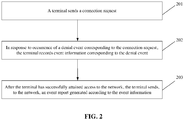
- FIG. 2 is a flowchart of a method for reporting information according to an exemplary embodiment.
- the method may apply to the scene of application in FIG. 1 .
- the method may include steps as follows.
- step 201 a terminal sends a connection request.
- the connection request is adapted to requesting establishment of a radio connection with an access network device in a network.
- the terminal may send the connection request to a first access network device in the network to request establishment of a radio connection with the first access network device in the network.
- the terminal may transmit signaling and / or data through the radio connection.
- the radio connection may be a Radio Resource Control (RRC) connection.
- RRC Radio Resource Control
- the connection request may be any one of a connection establishment request, a connection reestablishment request, a connection restoration request, etc.
- a terminal in an idle state may send a connection establishment request requesting establishment of a radio connection.
- a terminal in a connected state may send a connection reestablishment request requesting reestablishment of a radio connection.
- a terminal in an inactive state may send a connection restoration request requesting restoration of an established radio connection.
- the terminal may send a connection establishment request to the network to request establishment of a radio connection.
- the terminal may send a connection reestablishment request to the network to request reestablishment of a radio connection.
- the terminal may send a connection restoration request to the network to request restoration of an established radio connection.
- the terminal may record event information corresponding to the denial event.
- the denial event may refer to an event of denial of response to the connection request, i.e., an event that the network denies establishment of a radio connection with the terminal.
- the terminal when receiving the denial message corresponding to the connection request, the terminal may determine that a denial event corresponding to the connection request has occurred.
- the denial message may be adapted to indicating denial of response to the connection request.
- the terminal when the terminal initiates a connection establishment request to the network, if the terminal receives a connection establishment denial message corresponding to the connection establishment request, the terminal may determine that a denial event corresponding to the connection establishment request has occurred.
- the terminal initiates a connection reestablishment request to the network, if the terminal receives a connection reestablishment denial message corresponding to the connection reestablishment request, the terminal may determine that a denial event corresponding to the connection reestablishment request has occurred.
- the terminal initiates a connection restoration request to the network, if the terminal receives a connection restoration denial message corresponding to the connection restoration request, the terminal may determine that a denial event corresponding to the connection restoration request has occurred.
- the terminal may initiate a connection request to the first access network device.
- the terminal may receive a denial message corresponding to the connection request.
- the denial message may be sent by the first access network device.
- the denial message may be sent by another network device in the network that implements a DoS attack.
- the event information corresponding to the denial event may be adapted to illustrating the denial event.
- the event information may include event type indication information for identifying the denial event.
- the event type indication information may be an identifier. The identifier may be expressed as any one of a digit, a letter, a symbol, etc, or a combination thereof.
- the terminal may have to record multiple different events including the denial event. With the event type indication information, the denial event can be distinguished from another event. For example, different events may correspond to different event type indication information.
- same event type indication information may correspond to a connection establishment request, a connection reestablishment request, a connection restoration request, etc.
- event type indication information corresponding to denial of response to a connection establishment request may be first indication information.
- Event type indication information corresponding to denial of response to a connection reestablishment request may be second indication information.
- Event type indication information corresponding to denial of response to a connection restoration request may be third indication information.
- the first indication information, the second indication information, and the third indication information may differ from each other. Thus, different indication information may be used to indicate different denial events.
- the event information may further include at least one of following parameters: location information, time information, a cell identifier, a Public Land Mobile Network (PLMN) identifier, a cause of response denial, waiting time indicated by the network, a cause of connection establishment, or a request type.
- the location information may be adapted to indicating a location of the terminal at occurrence of the denial event.
- the location information may include latitude and longitude coordinates.
- the location information may further include a horizontal speed and / or a vertical speed.
- the time information may be adapted to indicating time of occurrence of the denial event.
- the time information may be expressed as a timestamp for a time point of occurrence of the denial event.
- the cell identifier may be adapted to indicating identifier information of a cell where the terminal is located at occurrence of the denial event.
- the PIMN identifier may be adapted to indicating identifier information of a PIMN selected by the terminal at occurrence of the denial event.
- the cause of response denial may be adapted to indicating a cause of the network's denial of response to the connection request. Exemplarily, the cause of response denial may include network congestion, an integrity check failure, etc.
- the terminal may acquire the cause of response denial from the denial message.
- the waiting time indicated by the network may refer to time the terminal has to wait before re-initiating the connection request, as instructed by the network.
- the terminal may acquire the waiting time indicated by the network from the denial message.
- the cause of connection establishment may be adapted to indicating a cause of the terminal's request for establishment of the radio connection, such as an emergency service, data or signaling initiated by the terminal, etc.
- the request type may be adapted to indicating a type of the connection request initiated by the terminal.
- the request type may include the connection establishment request, the connection reestablishment request, the connection restoration request, etc.
- the terminal may record the event information in a storage device such as a cache.
- the terminal may record event information corresponding to a denial event corresponding to a connection request whenever the denial event occurs.
- the terminal may record multiple entries of event information, each corresponding to one denial event.
- a maximum of n entries of the event information may be recorded by the terminal.
- the n may be a positive integer. That is, the terminal may record a limited number of entries of event information.
- the n may be configured by the network.
- the n may be specified by a protocol.
- the n may be configured by the terminal.
- the terminal may send information on capability of the terminal to the network.
- the network may configure the maximum number n for the terminal according to the information on capability of the terminal.
- the information on capability of the terminal may include a size of an available storage space of the terminal, such as a cache size.
- the terminal may no longer record event information corresponding to the new occurrence.
- the terminal may delete event information corresponding to a recorded denial event, and record event information corresponding to the new occurrence. For example, the terminal may delete event information corresponding to an earliest denial event.
- the terminal may keep event information corresponding to a recorded denial event, and add the event information corresponding to the new occurrence.
- the terminal may delete event information corresponding to a recorded denial event, and add the event information corresponding to the new occurrence, i.e., replace event information corresponding to a recorded denial event with the event information corresponding to the new occurrence.
- step 203 after the terminal has successfully attained access to the network, the terminal sends, to the network, an event report generated according to the event information.
- the terminal may mean that the terminal has successfully established a radio connection such as an RRC connection with any access network device in the network.
- the terminal may send the event report to the second access network device.
- the second access network device may be the first access network device, or an access network device in the network other than the first access network device.
- the event report may be adapted to reporting the denial event to the network. Accordingly, the network learns, according to the event report, a possible security threat to the network, such as a DoS attack.
- the event information may include event type indication information.
- the event information may further include at least one of following parameters: location information, time information, a cell identifier, a Public Land Mobile Network (PLMN) identifier, a cause of response denial, waiting time indicated by the network, a cause of connection establishment, or a request type.
- PLMN Public Land Mobile Network
- the time information included in the event report may be adapted to indicating the time of occurrence of the denial event.
- the time information may be expressed as a timestamp for a time point of occurrence of the denial event.
- the time information may be expressed as a difference between a timestamp for a time point when the terminal sends the event report to the network and the timestamp for the time point of occurrence of the denial event.
- the terminal may directly send the event report to the network. In another example. Having successfully attained access to the network, the terminal may send the event report to the network upon the network approval.
- the terminal may send an event reporting request to the network.
- the event reporting request may be adapted to requesting to send the event report to the network.
- the terminal may send, to the network, the event report generated according to the event information in response to receiving a confirmation of the event reporting request. For example, when the terminal has successfully established a radio connection with the second access network device in the network, the terminal may send the event reporting request to the second access network device.
- the network may determine that available event report has been recorded in the terminal and is to be reported. The network may determine whether to allow the terminal to report. If approving the terminal to report, the network may send a confirmation to the terminal to trigger sending the event report by the terminal to the network.
- the network may send a denial to the terminal, or send no response to the event reporting request.
- the terminal may decide not to send the event report to the network when receiving the denial or failing to receive a response to the event reporting request in time.
- the second access network device may determine whether to allow the terminal to report.
- the second access network device may interact with a core network device. The core network device may then decide whether to allow the terminal to report. The core network device may send a decision to the terminal through the second access network device.
- a terminal in response to occurrence of a denial event corresponding to the connection request, a terminal records event information corresponding to a denial event. Having successfully attained access to the network, the terminal sends, to the network, an event report generated according to the event information. Accordingly, the network learns, according to the event report, a possible security threat to the network, such as a DoS attack. Compared to manual collection and troubleshooting, a network collects information on a DoS attack reported by a terminal, reducing labor and time cost, improving efficiency.
- the terminal may determine, according to configuration by the network, whether to record the event information corresponding to the denial event.
- the terminal in response to occurrence of the denial event corresponding to the connection request, the terminal may detect whether the network has configured a Minimized Driving Test (MDT) function for the terminal.
- MDT Minimized Driving Test
- the terminal may record the event information corresponding to the denial event in response to detecting that the network has configured the MDT function for the terminal. If the network configures no MDT function for the terminal, the terminal does not have to record the event information corresponding to the denial event.
- MDT Minimized Driving Test
- the MDT function may be set according to different radio connection states. For example, in response to occurrence of the denial event corresponding to the connection request, the terminal may detect whether the network has configured the MDT function for the terminal in the idle state. If the network has configured the MDT function for the terminal in the idle state, the terminal may record the event information corresponding to the denial event. If the network configures no MDT function for the terminal in the idle state, the terminal does not have to record the event information corresponding to the denial event. As another example, in response to occurrence of the denial event corresponding to the connection request, the terminal may detect whether the network has configured the MDT function for the terminal in the connected state.
- the terminal may record the event information corresponding to the denial event. If the network has configured the MDT function for the terminal in the connected state, the terminal may record the event information corresponding to the denial event. If the network configures no MDT function for the terminal in the connected state, the terminal does not have to record the event information corresponding to the denial event. As another example, in response to occurrence of the denial event corresponding to the connection request, the terminal may detect whether the network has configured the MDT function for the terminal in the inactive state. If the network has configured the MDT function for the terminal in the inactive state, the terminal may record the event information corresponding to the denial event. If the network configures no MDT function for the terminal in the inactive state, the terminal does not have to record the event information corresponding to the denial event.
- the terminal in response to occurrence of the denial event corresponding to the connection request, may detect whether the network has configured, for the terminal, a function to record and report the denial event.
- the terminal may record the event information corresponding to the denial event in response to detecting that the network has configured, for the terminal, the function to record and report the denial event. If the network configures no function to record and report the denial event for the terminal, the terminal does not have to record the event information corresponding to the denial event.
- the function to record and report the denial event may be set according to different radio connection states. For example, in response to occurrence of the denial event corresponding to the connection request, the terminal may detect whether the network has configured the function to record and report the denial event for the terminal in the idle state. If the network has configured the function to record and report the denial event for the terminal in the idle state, the terminal may record the event information corresponding to the denial event. If the network configures no function to record and report the denial event for the terminal in the idle state, the terminal does not have to record the event information corresponding to the denial event.
- the terminal may detect whether the network has configured the function to record and report the denial event for the terminal in the connected state. If the network has configured the function to record and report the denial event for the terminal in the connected state, the terminal may record the event information corresponding to the denial event. If the network configures no function to record and report the denial event for the terminal in the connected state, the terminal does not have to record the event information corresponding to the denial event. As another example, in response to occurrence of the denial event corresponding to the connection request, the terminal may detect whether the network has configured the function to record and report the denial event for the terminal in the inactive state.
- the terminal may record the event information corresponding to the denial event. If the network configures no function to record and report the denial event for the terminal in the inactive state, the terminal does not have to record the event information corresponding to the denial event.
- the network may have configured the MDT function or the function to record and report the denial event for the terminal.
- the network may configure the MDT function or the function to record and report the denial event for the terminal.
- the network may configure the MDT function or the function to record and report the denial event for the terminal at any time.
- the MDT function or the function to record and report the denial event may be configured for the terminal by an access network device, a core network device, etc., which is not limited thereto herein.
- the terminal may send the information on capability of the terminal to the terminal.
- the network may determine whether to configure the MDT function or the function to record and report the denial event for the terminal according to the information on capability of the terminal.
- the information on capability of the terminal may include whether the terminal supports the MDT function or the function to record and report the denial event.
- the network side may effectively control information recording and reporting.
- the terminal may detect whether integrity protection is applied to the denial message.
- the terminal may record the event information corresponding to the denial event in response to detecting that no integrity protection is applied to the denial message.
- the terminal does not have to record the event information corresponding to the denial event.
- the terminal in the inactive state may receive the denial message corresponding to the connection request, and may determine whether to record the event information corresponding to the denial event by detecting whether integrity protection is applied to the denial message.
- the terminal may detect whether integrity protection is applied to the denial message by detecting whether the denial message is sent through a Signaling Radio Bearer (SRB) 0. If the denial message is sent through the SRBO, the terminal may determine that no integrity protection is applied to the denial message. If the denial message is not sent through the SRB0, the terminal may determine that integrity protection is applied to the denial message.
- SRB Signaling Radio Bearer
- the terminal may perform integrity protection check on the denial message.
- the terminal may record the event information corresponding to the denial event in response to determining that the integrity protection check on the denial message fails. If the integrity protection check on the denial message is successful, the terminal does not have to record the event information corresponding to the denial event.
- the integrity protection check it means that the denial message received by the terminal is sent by a legitimate access network device and no DoS attack exists, and thus the terminal does not have to record the event information corresponding to the denial event.
- the terminal may determine whether to record the event information corresponding to the denial event by determining whether integrity protection is applied to the denial message as well as whether the integrity protection check succeeds. Accordingly, recording of the denial event initiated by a legitimate access network device is prevented effectively, improving the pertinence and effectiveness of event recording.
- the terminal may further acquire a number of denials and / or total time.
- the number of denials may refer to a number of occurrences of the denial event.
- the total time may refer to a time span since a first occurrence of the denial event till a last occurrence of the denial event.
- the event report may further include the number of denials and / or the total time.
- the number of denials corresponding to a cell, a UMTS Terrestrial Radio Access Network (UTRAN) registered area, or a tracking area may be counted.
- the total time corresponding to a cell, a UTRAN registered area, or a tracking area may be counted.
- the number of denials corresponding to a cell may be counted as follows. The terminal may count the number of denials of response to the connection request initiated in a respective cell, and indicate, in the event report, numbers of denials having occurred in respective cells.
- the number of denials may be counted according to a criterion other than according to respective cells, respective UTRAN registered areas, or respective tracking areas.
- the terminal may count an overall number of denials and total time.
- the number of denials and the total time may be counted till the terminal determines that an event report is to be sent to the network. Having acquired the number of denials and / or the total time, the terminal may send the event report to the network.
- the terminal counts the number of denials and / or the total time, and include the number of denials and / or the total time in the event report. Accordingly, the network learns the number of denials and / or the total time, providing more effective information and help for troubleshooting a DoS attack.
- the terminal may further acquire a total number of denials.
- the total number of denials may refer to a total number of occurrences of the denial event during a target time period.
- the terminal may send, to the network, the event report generated according to the event information in response to determining that the total number of denials is greater than a preset threshold.
- the target time period as well as the preset threshold may be configured by the network, specified by a protocol, or configured by the terminal.
- the terminal may acquire the total number of denials during each of multiple target time periods. Then, durations of two such adjacent target time periods may or may not be the same. For example, each target time period may have the same duration of 30 minutes. As another example, durations of two adjacent target time periods may differ, such as be 10 minutes and 20 minutes, respectively.
- the terminal may reset the total number of denials duly.
- the terminal may reset the total number of denials in response to a change in a radio connection state of the terminal.
- the radio connection state may include at least two of an idle state, a connected state, or an inactive state.
- the terminal may reset the total number of denials.
- the terminal may reset the total number of denials in response to determining that the terminal switches between a first state and a second state.
- the first state may include the connected state.
- the second state may include the idle state and / or the inactive state.
- the terminal when the terminal switches the radio connection state between the connected state and the idle state, or between the connected state and the inactive state, the terminal may reset the total number of denials. However, when the terminal switches the radio connection state between the idle state and the inactive state, the total number of denials does not have to be reset.
- the terminal counts a total number of denials during a target time period.
- the terminal determines, based on the total number of denials, whether to send an event report to the network. Accordingly, information is reported to the network in case of a serious DoS attack, such that the network handles and troubleshoots the attack preferentially.
- a device embodiment herein set forth below may be adapted to implementing a method embodiment herein.
- One may refer to a method embodiment herein for a detail not disclosed in a device embodiment herein.
- FIG. 3 is a block diagram of an apparatus for reporting information according to an exemplary embodiment.
- the apparatus may serve to implement an aforementioned method example, such as by hardware, or by executing corresponding software by hardware, etc.
- the apparatus may apply to a terminal.
- the apparatus may include a request sending module 310, an event recording module 320, and an information reporting module 330.
- the request sending module 310 is adapted to sending a connection request.
- the connection request is adapted to requesting establishment of a radio connection with an access network device in a network.
- the event recording module 320 is adapted to, in response to occurrence of a denial event corresponding to the connection request, recording event information corresponding to the denial event.
- the denial event refers to an event of denial of response to the connection request.
- the information reporting module 330 is adapted to, after the terminal has successfully attained access to the network, sending, to the network, an event report generated according to the event information.
- a terminal in response to occurrence of a denial event corresponding to the connection request, a terminal records event information corresponding to a denial event. Having successfully attained access to the network, the terminal sends, to the network, an event report generated according to the event information. Accordingly, the network learns, according to the event report, a possible security threat to the network, such as a DoS attack. Compared to manual collection and troubleshooting, a network collects information on a DoS attack reported by a terminal, reducing labor and time cost, improving efficiency.
- the event information may include event type indication information for identifying the denial event.
- the event information may further include at least one of following parameters: location information, time information, a cell identifier, a Public Land Mobile Network (PLMN) identifier, a cause of response denial, waiting time indicated by the network, a cause of connection establishment, or a request type.
- PLMN Public Land Mobile Network
- a maximum of n entries of the event information may be recorded by the terminal.
- Each entry of the n entries of the event information may correspond to one denial event.
- the n may be a positive integer.
- the n may be configured by the network.
- the n may be specified by a protocol.
- the n may be configured by the terminal.
- the apparatus may further include a first detecting module (not shown in the figure).
- the first detecting module may be adapted to, in response to occurrence of the denial event corresponding to the connection request, detecting whether the network has configured a Minimized Driving Test (MDT) function for the terminal.
- MDT Minimized Driving Test
- the event recording module 320 may be further adapted to recording the event information corresponding to the denial event in response to detecting that the network has configured the MDT function for the terminal.
- the apparatus may further include a second detecting module (not shown in the figure).
- the second detecting module may be adapted to, in response to occurrence of the denial event corresponding to the connection request, detecting whether the network has configured, for the terminal, a function to record and report the denial event.
- the event recording module 320 may be further adapted to recording the event information corresponding to the denial event in response to detecting that the network has configured, for the terminal, the function to record and report the denial event.
- the apparatus may further include a report requesting module (not shown in the figure).
- the report requesting module may be adapted to, after the terminal has successfully attained access to the network, sending an event reporting request to the network.
- the event reporting request may be adapted to requesting to send the event report to the network.
- the information reporting module 330 may be further adapted to sending, to the network, the event report generated according to the event information in response to receiving a confirmation of the event reporting request.
- the apparatus may further include a message receiving module and a third detecting module (not shown in the figure).
- the message receiving module may be adapted to receiving a denial message corresponding to the connection request, the denial message being adapted to indicating denial of response to the connection request.
- the third detecting module may be adapted to detecting whether integrity protection is applied to the denial message.
- the event recording module 320 may be further adapted to recording the event information corresponding to the denial event in response to detecting that no integrity protection is applied to the denial message.
- the apparatus may further include a fourth detecting module (not shown in the figure).
- the fourth detecting module may be adapted to, in response to detecting that the integrity protection is applied to the denial message, performing integrity protection check on the denial message.
- the event recording module 320 may be further adapted to recording the event information corresponding to the denial event in response to determining that the integrity protection check on the denial message fails.
- the apparatus may further include a first counting module (not shown in the figure).
- the counting module may be adapted to acquiring a number of denials and / or total time, the number of denials referring to a number of occurrences of the denial event, the total time referring to a time span since a first occurrence of the denial event till a last occurrence of the denial event.
- the event report may include the number of denials and / or the total time.
- the number of denials and / or the total time corresponding to a cell, a UMTS Terrestrial Radio Access Network (UTRAN) registered area, or a tracking area may be counted.
- UTRAN UMTS Terrestrial Radio Access Network
- the apparatus may further include a second counting module (not shown in the figure).
- the second counting module may be adapted to acquiring a total number of denials.
- the total number of denials may refer to a total number of occurrences of the denial event during a target time period.
- the event recording module 330 may be further adapted to sending, to the network, the event report generated according to the event information in response to determining that the total number of denials is greater than a preset threshold.
- the apparatus may further include a resetting module (not shown in the figure).
- the resetting module may be adapted to, in response to a change in a radio connection state of the terminal, resetting the total number of denials.
- the radio connection state may include at least two of an idle state, a connected state, or an inactive state.
- the resetting module may be adapted to, in response to determining that the terminal switches between a first state and a second state, resetting the total number of denials.
- the first state may include the connected state.
- the second state may include the idle state and / or the inactive state.
- An exemplary embodiment herein further provides a terminal capable of implementing a method herein for reporting information.
- the terminal may include a processor and memory adapted to storing an instruction executable by the processor.
- the processor is adapted to:
- the event information may include event type indication information for identifying the denial event.
- the event information may further include at least one of following parameters: location information, time information, a cell identifier, a Public Land Mobile Network (PLMN) identifier, a cause of response denial, waiting time indicated by the network, a cause of connection establishment, or a request type.
- PLMN Public Land Mobile Network
- a maximum of n entries of the event information may be recorded by the terminal.
- Each entry of the n entries of the event information may correspond to one denial event.
- the n may be a positive integer.
- the n may be configured by the network.
- the n may be specified by a protocol.
- the n may be configured by the terminal.
- the processor may be further adapted to:
- the processor may be further adapted to:
- the processor may be further adapted to:
- the processor may be further adapted to:
- the processor may be further adapted to:
- the processor may be further adapted to: acquiring a number of denials and / or total time.
- the number of denials may refer to a number of occurrences of the denial event.
- the total time may refer to a time span since a first occurrence of the denial event till a last occurrence of the denial event.
- the event report may include the number of denials and / or the total time.
- the number of denials and / or the total time corresponding to a cell, a UMTS Terrestrial Radio Access Network (UTRAN) registered area, or a tracking area may be counted.
- UTRAN UMTS Terrestrial Radio Access Network
- the processor may be further adapted to:
- the processor may be further adapted to:
- a terminal may include a hardware structure and / or a software module for implementing a function herein.
- a terminal may include a hardware structure and / or a software module for implementing a function herein.
- embodiments herein may be implemented by hardware or a combination of hardware and computer software. Whether a function is implemented by hardware or by computer software driven hardware may depend on a specific application of a technical solution as well as a design constraint. Depending on a specific application, a person having ordinary skill in the art may implement a described function using different methods. Such implementation however should not be deemed going beyond a scope of a technical solution herein.
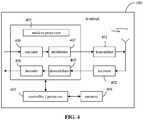
- FIG. 4 is a diagram of a structure of a terminal according to an exemplary embodiment.
- the terminal 400 may include a transmitter 401, a receiver 402, and a processor 403.
- the processor 403 may also be a controller, represented as "controller / processor 403" in FIG. 4 .
- the terminal 400 may further include a modem processor 405.
- the modem processor 405 may include an encoder 406, a modulator 407, a decoder 408, and a demodulator 409.
- the transmitter 401 may adjust an output sample (such as by analog conversion, filtration, amplification, up-conversion, etc.) and generate an uplink signal.
- the uplink signal may be transmitted to an access network device via an antenna.
- the antenna On a downlink, the antenna may receive a downlink signal transmitted by the access network device.
- the receiver 402 may adjust a signal sent by the antenna (such as by filtration, amplification, down-conversion, digitalization, etc.) and provide an input sample.
- the encoder 406 may receive service data and a signaling message to be sent uplink, and may process (e.g., format, encode, interleave, etc.) the service data and the signaling message.
- the modulator 407 may further process the encoded service data and signaling message (such as by symbol mapping, modulation, etc.) and provide an output sample.
- the demodulator 409 may process (e.g., demodulate) the input sample and provide symbol estimation.
- the decoder 408 may process (e.g., de-interleave, decode, etc.) the symbol estimation and provide decoded data and signaling message sent to the terminal 400.
- the encoder 406, the modulator 407, the demodulator 409, and the decoder 408 may be implemented by a synthetic modem processor 405. These units may perform processing according to radio access technology (such as LTE, access technology of another evolved system, etc.) adopted by a radio access network. Note that when the terminal 400 does not include the modem processor 405, said function of the modem processor 405 may instead be performed by the processor 403.
- the processor 403 may control and manage a move of the terminal 400, and may be adapted to implement a process performed by the terminal 400 herein.
- the processor 403 may be further adapted to implement a step at a terminal side in a method embodiment herein, and / or another step of a technical solution illustrated herein.
- the terminal 400 may further include memory 404.
- the memory 404 may be adapted to storing a program code and data used in the terminal 400.
- a processor adapted to implementing a function of the terminal herein may be a Central Processing Unit (CPU), a universal processor, a Digital Signal Processor (DSP), an Application-Specific Integrated Circuit (ASIC), a Field Programmable Gate Array (FPGA), or another programmable logic device, transistor logic device, hardware component, etc., or any combination thereof.
- the processor may implement or execute various exemplary logic block diagrams, modules, circuits, etc., illustrated in combination with content disclosed herein.
- the processor may also be a combination for implementing a computing function, such as a combination including one or more microprocessors, a combination of a DSP and a microprocessor, etc.
- a step of a method or an algorithm illustrated in combination with content disclosed herein may be implemented as hardware, processor executed software instructions, etc.
- a software instruction may consist of a corresponding software module.
- a software module may be stored in Random Access Memory (RAM), flash memory, Read Only Memory (ROM), Erasable Programmable ROM (EPROM), Electrically EPROM (EEPROM), a register, a hard disk, a mobile hard disk, Compact Disc Read-Only Memory (CD-ROM), or a storage medium of any other form known in the art, etc.
- An exemplary storage medium may be coupled to the processor, allowing the processor to read information from the storage medium and write information to the storage medium. Understandably, the storage medium may also be a component of the processor.
- the processor and the storage medium may be located in an ASIC.
- the ASIC may be located in the terminal. Understandably, the processor and the storage medium may also exist in the terminal as separate components.
- a function illustrated herein may be implemented by hardware, software, firmware, or any combination thereof in the one or more examples herein.
- a function When implemented by software, such a function may be stored in a computer-readable medium, or transmitted as one or more instructions or codes on the computer-readable medium.
- the computer-readable medium may include a computer storage medium, a communication medium, etc.
- the communication medium may include any medium that facilitates transmitting a computer program from one place to another.
- the storage medium may be any available medium accessable by a universal or dedicated computer.
- a non-transitory computer-readable storage medium has stored thereon a computer program which, when executed by a processor, implements a method herein for reporting information.
- multiple it may mean two or more.
- a term “and /or” may describe an association between associated objects, including three possible relationships.
- a and /or B it may mean that there may be three cases, namely, existence of but A, existence of both A and B, or existence of but B.
- a slash mark "/” may generally denote an "or" relationship between two associated objects that come respectively before and after the mark per se.
Landscapes
- Engineering & Computer Science (AREA)
- Computer Networks & Wireless Communication (AREA)
- Signal Processing (AREA)
- Computer Security & Cryptography (AREA)
- Computer Hardware Design (AREA)
- Computing Systems (AREA)
- General Engineering & Computer Science (AREA)
- Mobile Radio Communication Systems (AREA)
- Telephonic Communication Services (AREA)
Abstract
Description
- The subject disclosure relates to the field of communication, and more particularly, to a method and apparatus for reporting information, a terminal, and a storage medium.
- When initiates a connection request to a Base Station (BS), a terminal may be subject to a security threat referred to as a Denial of Service (DoS) attack. A DoS attack in general is when a pseudo BS receives a connection request sent by a terminal and sends a denial message to the terminal to prevent the terminal from accessing a network, such that the terminal cannot access the network for a long time.
- Embodiments herein provide a method and apparatus for reporting information, a terminal, and a storage medium. The technical solution is as follows.
- According to a first aspect herein, a method for reporting information includes:
- sending, by a terminal, a connection request, the connection request being adapted to requesting establishment of a radio connection with an access network device in a network;
- in response to occurrence of a denial event corresponding to the connection request, recording, by the terminal, event information corresponding to the denial event, the denial event referring to an event of denial of response to the connection request; and
- after the terminal has successfully attained access to the network, sending, by the terminal, to the network, an event report generated according to the event information.
- Optionally, the event information may include event type indication information for identifying the denial event.
- Optionally, the event information may further include at least one of following parameters: location information, time information, a cell identifier, a Public Land Mobile Network (PLMN) identifier, a cause of response denial, waiting time indicated by the network, a cause of connection establishment, or a request type.
- Optionally, a maximum of n entries of the event information may be recorded by the terminal. Each entry of the n entries of the event information may correspond to one denial event. The n may be a positive integer.
- Optionally, the n may be configured by the network. Alternatively, the n may be specified by a protocol. Alternatively, the n may be configured by the terminal.
- Optionally, the method may further include:
in response to occurrence of the denial event corresponding to the connection request, detecting, by the terminal, whether the network has configured a Minimized Driving Test (MDT) function for the terminal. - The terminal may record the event information corresponding to the denial event in response to detecting that the network has configured the MDT function for the terminal.
- Optionally, the method may further include:
in response to occurrence of the denial event corresponding to the connection request, detecting, by the terminal, whether the network has configured, for the terminal, a function to record and report the denial event. - The terminal may record the event information corresponding to the denial event in response to detecting that the network has configured, for the terminal, the function to record and report the denial event.
- Optionally, the method may further include:
after the terminal has successfully attained access to the network, sending, by the terminal, an event reporting request to the network, the event reporting request being adapted to requesting to send the event report to the network. - The terminal may send, to the network, the event report generated according to the event information in response to receiving a confirmation of the event reporting request.
- Optionally, the method may further include:
- receiving, by the terminal, a denial message corresponding to the connection request, the denial message being adapted to indicating denial of response to the connection request; and
- detecting, by the terminal, whether integrity protection is applied to the denial message.
- The terminal may record the event information corresponding to the denial event in response to detecting that no integrity protection is applied to the denial message.
- Optionally, the method may further include:
in response to detecting that the integrity protection is applied to the denial message, performing, by the terminal, integrity protection check on the denial message. - The terminal may record the event information corresponding to the denial event in response to determining that the integrity protection check on the denial message fails.
- Optionally, the method may further include: acquiring, by the terminal, a number of denials and / or total time. The number of denials may refer to a number of occurrences of the denial event. The total time may refer to a time span since a first occurrence of the denial event till a last occurrence of the denial event.
- The event report may include the number of denials and / or the total time.
- Optionally, the number of denials and / or the total time corresponding to a cell, a UMTS Terrestrial Radio Access Network (UTRAN) registered area, or a tracking area may be counted.
- Optionally, the method may further include: acquiring, by the terminal, a total number of denials. The total number of denials may refer to a total number of occurrences of the denial event during a target time period.
- The terminal may send, to the network, the event report generated according to the event information in response to determining that the total number of denials is greater than a preset threshold.
- Optionally, the method may further include:
- in response to a change in a radio connection state of the terminal, resetting the total number of denials, the radio connection state including at least two of an idle state, a connected state, or an inactive state; or
- in response to determining that the terminal switches between a first state and a second state, resetting the total number of denials, the first state including the connected state, the second state including the idle state and / or the inactive state.
- According to a second aspect herein, an apparatus for reporting information is applicable to a terminal. The apparatus includes a request sending module, an event recording module, and an information reporting module.
- The request sending module is adapted to sending a connection request. The connection request is adapted to requesting establishment of a radio connection with an access network device in a network.
- The event recording module is adapted to, in response to occurrence of a denial event corresponding to the connection request, recording event information corresponding to the denial event. The denial event refers to an event of denial of response to the connection request.
- The information reporting module is adapted to, after the terminal has successfully attained access to the network, sending, to the network, an event report generated according to the event information.
- Optionally, the event information may include event type indication information for identifying the denial event.
- Optionally, the event information may further include at least one of following parameters: location information, time information, a cell identifier, a Public Land Mobile Network (PLMN) identifier, a cause of response denial, waiting time indicated by the network, a cause of connection establishment, or a request type.
- Optionally, a maximum of n entries of the event information may be recorded by the terminal. Each entry of the n entries of the event information may correspond to one denial event. The n may be a positive integer.
- Optionally, the n may be configured by the network. Alternatively, the n may be specified by a protocol. Alternatively, the n may be configured by the terminal.
- Optionally, the apparatus may further include a first detecting module.
- The first detecting module may be adapted to, in response to occurrence of the denial event corresponding to the connection request, detecting whether the network has configured a Minimized Driving Test (MDT) function for the terminal.
- The event recording module may be further adapted to recording the event information corresponding to the denial event in response to detecting that the network has configured the MDT function for the terminal.
- Optionally, the apparatus may further include a second detecting module.
- The second detecting module may be adapted to, in response to occurrence of the denial event corresponding to the connection request, detecting whether the network has configured, for the terminal, a function to record and report the denial event.
- The event recording module may be further adapted to recording the event information corresponding to the denial event in response to detecting that the network has configured, for the terminal, the function to record and report the denial event.
- Optionally, the apparatus may further include a report requesting module.
- The report requesting module may be adapted to, after the terminal has successfully attained access to the network, sending an event reporting request to the network. The event reporting request may be adapted to requesting to send the event report to the network.
- The information reporting module may be further adapted to sending, to the network, the event report generated according to the event information in response to receiving a confirmation of the event reporting request.
- Optionally, the apparatus may further include a message receiving module and a third detecting module.
- The message receiving module may be adapted to receiving a denial message corresponding to the connection request. The denial message may be adapted to indicating denial of response to the connection request.
- The third detecting module may be adapted to detecting whether integrity protection is applied to the denial message.
- The event recording module may be further adapted to recording the event information corresponding to the denial event in response to detecting that no integrity protection is applied to the denial message.
- Optionally, the apparatus may further include a fourth detecting module.
- The fourth detecting module may be adapted to, in response to detecting that the integrity protection is applied to the denial message, performing integrity protection check on the denial message.
- The event recording module may be further adapted to recording the event information corresponding to the denial event in response to determining that the integrity protection check on the denial message fails.
- Optionally, the apparatus may further include a first counting module.
- The first counting module may be adapted to acquiring a number of denials and / or total time. The number of denials may refer to a number of occurrences of the denial event. The total time may refer to a time span since a first occurrence of the denial event till a last occurrence of the denial event.
- The event report may include the number of denials and / or the total time.
- Optionally, the number of denials and / or the total time corresponding to a cell, a UMTS Terrestrial Radio Access Network (UTRAN) registered area, or a tracking area may be counted.
- Optionally, the apparatus may further include a second counting module.
- The second counting module may be adapted to acquiring a total number of denials. The total number of denials may refer to a total number of occurrences of the denial event during a target time period.
- The event recording module may be further adapted to sending, to the network, the event report generated according to the event information in response to determining that the total number of denials is greater than a preset threshold.
- Optionally, the apparatus may further include a resetting module.
- The resetting module may be adapted to, in response to a change in a radio connection state of the terminal, resetting the total number of denials. The radio connection state may include at least two of an idle state, a connected state, or an inactive state.
- The resetting module may be adapted to, in response to determining that the terminal switches between a first state and a second state, resetting the total number of denials. The first state may include the connected state. The second state may include the idle state and / or the inactive state.
- According to a third aspect herein, a terminal includes a processor and memory.
- The memory is adapted to storing an instruction executable by the processor.
- The processor is adapted to:
- sending a connection request, the connection request being adapted to requesting establishment of a radio connection with an access network device in a network;
- in response to occurrence of a denial event corresponding to the connection request, recording event information corresponding to the denial event, the denial event referring to an event of denial of response to the connection request; and
- after the terminal has successfully attained access to the network, sending, to the network, an event report generated according to the event information.
- According to a fourth aspect herein, a non-transitory computer-readable storage medium has stored thereon a computer program which, when executed by a processor, implements the method of the first aspect.
- A technical solution herein may include beneficial effects as follows.
- With a technical solution herein, in response to occurrence of a denial event corresponding to the connection request, a terminal records event information corresponding to a denial event. Having successfully attained access to the network, the terminal sends, to the network, an event report generated according to the event information. Accordingly, the network learns, according to the event report, a possible security threat to the network, such as a DoS attack. Compared to manual collection and troubleshooting, a network collects information on a DoS attack reported by a terminal, reducing labor and time cost, improving efficiency.
- The above general description and detailed description below are but exemplary and explanatory, and do not limit the subject disclosure.
- Drawings here are incorporated in and constitute part of the subject disclosure, illustrate embodiments according to the subject disclosure, and together with the subject disclosure, serve to explain the principle of the subject disclosure.
-
FIG. 1 is a diagram of a scene of application according to an exemplary embodiment. -
FIG. 2 is a flowchart of a method for reporting information according to an exemplary embodiment. -
FIG. 3 is a block diagram of an apparatus for reporting information according to an exemplary embodiment. -
FIG. 4 is a diagram of a structure of a terminal according to an exemplary embodiment. - Exemplary embodiments (examples of which are illustrated in the accompanying drawings) are elaborated below. The following description may refer to the accompanying drawings, in which identical or similar elements in two drawings are denoted by identical reference numerals unless indicated otherwise. Implementations set forth in the following exemplary embodiments do not represent all implementations in accordance with the subject disclosure. Rather, they are mere examples of the apparatus (i.e., device / equipment / terminal) and method in accordance with certain aspects of the subject disclosure as recited in the accompanying claims.
- A network architecture and a service scene are illustrated herein to illustrate a technical solution herein more clearly, and do not form a limitation to a technical solution herein. A person having ordinary skill in the art may know that with evolution of the network architecture and emergence of a new service scene, a technical solution herein may also apply to a similar technical problem.
-
FIG. 1 is a diagram of a scene of application according to an exemplary embodiment. The scene of application may include multipleaccess network devices 110 and a terminal 120. Anaccess network device 110 may be deployed in a Radio Access Network (RAN) 10. - In general, there may be
multiple terminals 120. One ormore terminals 120 may be distributed in a cell managed by anaccess network device 110. - An
access network device 110 and a terminal 120 may communicate with each other through an air interface such as a cellular technology. A technical solution herein may apply to a Long Term Evolution (LTE) system, as well as an evolved LTE system such as an LTE-Advanced (LTE-A) system, a 5th Generation (5G) system (also referred to as New Radio, NR, system), etc. - Herein terms "network" and "system" are often used alternately. A person having ordinary skill in the art may understand meanings thereof, though.
- A terminal herein may include various handheld devices, onboard devices, wearable devices, computing devices, etc., capable of radio communication, other processing devices connected to a radio modem, various forms of User Equipment (UE), Mobile Stations (MS), terminal devices, etc. For ease of description, an aforementioned device may be collectively referred to as a terminal.
- Herein an access network device in a RAN may be a Base Station (BS). The BS may be an apparatus deployed in a RAN to provide a radio communication function to a terminal. The BS may include various forms of macro BSs, micro BSs, relays, access points, etc. In systems using different radio access technologies, devices having BS functions may be given different names. For example, such a device may be referred to as an evolved NodeB (eNB or eNodeB) in an LTE system, a Node B in a 3rd Generation (3G) system, etc. The name "BS" may change as communication technologies evolve. For ease of description, herein a device providing a radio communication function to a terminal may be collectively referred to as an access network device.
-
FIG. 2 is a flowchart of a method for reporting information according to an exemplary embodiment. The method may apply to the scene of application inFIG. 1 . The method may include steps as follows. - In
step 201, a terminal sends a connection request. - The connection request is adapted to requesting establishment of a radio connection with an access network device in a network. For example, the terminal may send the connection request to a first access network device in the network to request establishment of a radio connection with the first access network device in the network. After a radio connection with an access network device has been established, the terminal may transmit signaling and / or data through the radio connection. In one or more embodiments, the radio connection may be a Radio Resource Control (RRC) connection.
- In one or more embodiments, the connection request may be any one of a connection establishment request, a connection reestablishment request, a connection restoration request, etc. A terminal in an idle state may send a connection establishment request requesting establishment of a radio connection. A terminal in a connected state may send a connection reestablishment request requesting reestablishment of a radio connection. A terminal in an inactive state may send a connection restoration request requesting restoration of an established radio connection.
- That is, when the terminal is in the idle state, the terminal may send a connection establishment request to the network to request establishment of a radio connection. When the terminal is in the connected state, the terminal may send a connection reestablishment request to the network to request reestablishment of a radio connection. When the terminal is in the inactive state, the terminal may send a connection restoration request to the network to request restoration of an established radio connection.
- In
step 202, in response to occurrence of a denial event corresponding to the connection request, the terminal may record event information corresponding to the denial event. - The denial event may refer to an event of denial of response to the connection request, i.e., an event that the network denies establishment of a radio connection with the terminal. Optionally, when receiving the denial message corresponding to the connection request, the terminal may determine that a denial event corresponding to the connection request has occurred. The denial message may be adapted to indicating denial of response to the connection request.
- For example, when the terminal initiates a connection establishment request to the network, if the terminal receives a connection establishment denial message corresponding to the connection establishment request, the terminal may determine that a denial event corresponding to the connection establishment request has occurred. When the terminal initiates a connection reestablishment request to the network, if the terminal receives a connection reestablishment denial message corresponding to the connection reestablishment request, the terminal may determine that a denial event corresponding to the connection reestablishment request has occurred. When the terminal initiates a connection restoration request to the network, if the terminal receives a connection restoration denial message corresponding to the connection restoration request, the terminal may determine that a denial event corresponding to the connection restoration request has occurred.
- For example, the terminal may initiate a connection request to the first access network device. The terminal may receive a denial message corresponding to the connection request. The denial message may be sent by the first access network device. Alternatively, the denial message may be sent by another network device in the network that implements a DoS attack.
- The event information corresponding to the denial event may be adapted to illustrating the denial event. Optionally, the event information may include event type indication information for identifying the denial event. The event type indication information may be an identifier. The identifier may be expressed as any one of a digit, a letter, a symbol, etc, or a combination thereof. The terminal may have to record multiple different events including the denial event. With the event type indication information, the denial event can be distinguished from another event. For example, different events may correspond to different event type indication information.
- In addition, in an example, same event type indication information may correspond to a connection establishment request, a connection reestablishment request, a connection restoration request, etc. In another example, event type indication information corresponding to denial of response to a connection establishment request may be first indication information. Event type indication information corresponding to denial of response to a connection reestablishment request may be second indication information. Event type indication information corresponding to denial of response to a connection restoration request may be third indication information. The first indication information, the second indication information, and the third indication information may differ from each other. Thus, different indication information may be used to indicate different denial events.
- Optionally, the event information may further include at least one of following parameters: location information, time information, a cell identifier, a Public Land Mobile Network (PLMN) identifier, a cause of response denial, waiting time indicated by the network, a cause of connection establishment, or a request type. The location information may be adapted to indicating a location of the terminal at occurrence of the denial event. For instance, the location information may include latitude and longitude coordinates. The location information may further include a horizontal speed and / or a vertical speed. The time information may be adapted to indicating time of occurrence of the denial event. For instance, the time information may be expressed as a timestamp for a time point of occurrence of the denial event. The cell identifier may be adapted to indicating identifier information of a cell where the terminal is located at occurrence of the denial event. The PIMN identifier may be adapted to indicating identifier information of a PIMN selected by the terminal at occurrence of the denial event. The cause of response denial may be adapted to indicating a cause of the network's denial of response to the connection request. Exemplarily, the cause of response denial may include network congestion, an integrity check failure, etc. The terminal may acquire the cause of response denial from the denial message. The waiting time indicated by the network may refer to time the terminal has to wait before re-initiating the connection request, as instructed by the network. The terminal may acquire the waiting time indicated by the network from the denial message. The cause of connection establishment may be adapted to indicating a cause of the terminal's request for establishment of the radio connection, such as an emergency service, data or signaling initiated by the terminal, etc. The request type may be adapted to indicating a type of the connection request initiated by the terminal. The request type may include the connection establishment request, the connection reestablishment request, the connection restoration request, etc.
- Optionally, the terminal may record the event information in a storage device such as a cache.
- Optionally, the terminal may record event information corresponding to a denial event corresponding to a connection request whenever the denial event occurs. The terminal may record multiple entries of event information, each corresponding to one denial event.
- Optionally, a maximum of n entries of the event information may be recorded by the terminal. The n may be a positive integer. That is, the terminal may record a limited number of entries of event information. The n may be configured by the network. The n may be specified by a protocol. The n may be configured by the terminal. When the maximum number n is configured by the network, the terminal may send information on capability of the terminal to the network. The network may configure the maximum number n for the terminal according to the information on capability of the terminal. For example, the information on capability of the terminal may include a size of an available storage space of the terminal, such as a cache size.
- In addition, when a maximum number of n entries of event information have been recorded by the terminal, in a possible implementation, in case of a new occurrence of the denial event, the terminal may no longer record event information corresponding to the new occurrence. In another possible implementation, in case of a new occurrence of the denial event, the terminal may delete event information corresponding to a recorded denial event, and record event information corresponding to the new occurrence. For example, the terminal may delete event information corresponding to an earliest denial event.
- In addition, when recording the event information corresponding to the new occurrence, the terminal may keep event information corresponding to a recorded denial event, and add the event information corresponding to the new occurrence. Alternatively, the terminal may delete event information corresponding to a recorded denial event, and add the event information corresponding to the new occurrence, i.e., replace event information corresponding to a recorded denial event with the event information corresponding to the new occurrence.
- In
step 203, after the terminal has successfully attained access to the network, the terminal sends, to the network, an event report generated according to the event information. - In an embodiment herein, if the terminal has successfully attained access to the network, it may mean that the terminal has successfully established a radio connection such as an RRC connection with any access network device in the network. Optionally, when the terminal has successfully established a radio connection with a second access network device in the network, the terminal may send the event report to the second access network device. The second access network device may be the first access network device, or an access network device in the network other than the first access network device. The event report may be adapted to reporting the denial event to the network. Accordingly, the network learns, according to the event report, a possible security threat to the network, such as a DoS attack.
- Optionally, the event information may include event type indication information. Optionally, the event information may further include at least one of following parameters: location information, time information, a cell identifier, a Public Land Mobile Network (PLMN) identifier, a cause of response denial, waiting time indicated by the network, a cause of connection establishment, or a request type. Refer to the above for explanation of the various types of information, which is not repeated here. Note that the time information included in the event report may be adapted to indicating the time of occurrence of the denial event. The time information may be expressed as a timestamp for a time point of occurrence of the denial event. Alternatively, the time information may be expressed as a difference between a timestamp for a time point when the terminal sends the event report to the network and the timestamp for the time point of occurrence of the denial event.
- In an example. Having successfully attained access to the network, the terminal may directly send the event report to the network. In another example. Having successfully attained access to the network, the terminal may send the event report to the network upon the network approval.
- Optionally, after the terminal has successfully attained access to the network, the terminal may send an event reporting request to the network. The event reporting request may be adapted to requesting to send the event report to the network. The terminal may send, to the network, the event report generated according to the event information in response to receiving a confirmation of the event reporting request. For example, when the terminal has successfully established a radio connection with the second access network device in the network, the terminal may send the event reporting request to the second access network device. Upon receiving the event reporting request sent by the terminal, the network may determine that available event report has been recorded in the terminal and is to be reported. The network may determine whether to allow the terminal to report. If approving the terminal to report, the network may send a confirmation to the terminal to trigger sending the event report by the terminal to the network. In addition, if disapproving the terminal to report, the network may send a denial to the terminal, or send no response to the event reporting request. The terminal may decide not to send the event report to the network when receiving the denial or failing to receive a response to the event reporting request in time. Optionally, after the second access network device receives the event reporting request sent by the terminal, the second access network device may determine whether to allow the terminal to report. Alternatively, the second access network device may interact with a core network device. The core network device may then decide whether to allow the terminal to report. The core network device may send a decision to the terminal through the second access network device.
- To sum up, with a technical solution herein, in response to occurrence of a denial event corresponding to the connection request, a terminal records event information corresponding to a denial event. Having successfully attained access to the network, the terminal sends, to the network, an event report generated according to the event information. Accordingly, the network learns, according to the event report, a possible security threat to the network, such as a DoS attack. Compared to manual collection and troubleshooting, a network collects information on a DoS attack reported by a terminal, reducing labor and time cost, improving efficiency.
- Based on an embodiment in
FIG. 2 , the terminal may determine, according to configuration by the network, whether to record the event information corresponding to the denial event. - In an example, in response to occurrence of the denial event corresponding to the connection request, the terminal may detect whether the network has configured a Minimized Driving Test (MDT) function for the terminal. The terminal may record the event information corresponding to the denial event in response to detecting that the network has configured the MDT function for the terminal. If the network configures no MDT function for the terminal, the terminal does not have to record the event information corresponding to the denial event.
- Optionally, the MDT function may be set according to different radio connection states. For example, in response to occurrence of the denial event corresponding to the connection request, the terminal may detect whether the network has configured the MDT function for the terminal in the idle state. If the network has configured the MDT function for the terminal in the idle state, the terminal may record the event information corresponding to the denial event. If the network configures no MDT function for the terminal in the idle state, the terminal does not have to record the event information corresponding to the denial event. As another example, in response to occurrence of the denial event corresponding to the connection request, the terminal may detect whether the network has configured the MDT function for the terminal in the connected state. If the network has configured the MDT function for the terminal in the connected state, the terminal may record the event information corresponding to the denial event. If the network configures no MDT function for the terminal in the connected state, the terminal does not have to record the event information corresponding to the denial event. As another example, in response to occurrence of the denial event corresponding to the connection request, the terminal may detect whether the network has configured the MDT function for the terminal in the inactive state. If the network has configured the MDT function for the terminal in the inactive state, the terminal may record the event information corresponding to the denial event. If the network configures no MDT function for the terminal in the inactive state, the terminal does not have to record the event information corresponding to the denial event.
- In another example, in response to occurrence of the denial event corresponding to the connection request, the terminal may detect whether the network has configured, for the terminal, a function to record and report the denial event. The terminal may record the event information corresponding to the denial event in response to detecting that the network has configured, for the terminal, the function to record and report the denial event. If the network configures no function to record and report the denial event for the terminal, the terminal does not have to record the event information corresponding to the denial event.
- Optionally, the function to record and report the denial event may be set according to different radio connection states. For example, in response to occurrence of the denial event corresponding to the connection request, the terminal may detect whether the network has configured the function to record and report the denial event for the terminal in the idle state. If the network has configured the function to record and report the denial event for the terminal in the idle state, the terminal may record the event information corresponding to the denial event. If the network configures no function to record and report the denial event for the terminal in the idle state, the terminal does not have to record the event information corresponding to the denial event. As another example, in response to occurrence of the denial event corresponding to the connection request, the terminal may detect whether the network has configured the function to record and report the denial event for the terminal in the connected state. If the network has configured the function to record and report the denial event for the terminal in the connected state, the terminal may record the event information corresponding to the denial event. If the network configures no function to record and report the denial event for the terminal in the connected state, the terminal does not have to record the event information corresponding to the denial event. As another example, in response to occurrence of the denial event corresponding to the connection request, the terminal may detect whether the network has configured the function to record and report the denial event for the terminal in the inactive state. If the network has configured the function to record and report the denial event for the terminal in the inactive state, the terminal may record the event information corresponding to the denial event. If the network configures no function to record and report the denial event for the terminal in the inactive state, the terminal does not have to record the event information corresponding to the denial event.
- Note that before the terminal initiates a connection request to the network, the network may have configured the MDT function or the function to record and report the denial event for the terminal. For example, when the network monitors the presence of the terminal, or when the terminal initiates registration to the network, or when the terminal has completed the registration in the network, the network may configure the MDT function or the function to record and report the denial event for the terminal. In an embodiment herein, the network may configure the MDT function or the function to record and report the denial event for the terminal at any time. In addition, the MDT function or the function to record and report the denial event may be configured for the terminal by an access network device, a core network device, etc., which is not limited thereto herein.
- In addition, the terminal may send the information on capability of the terminal to the terminal. The network may determine whether to configure the MDT function or the function to record and report the denial event for the terminal according to the information on capability of the terminal. For example, the information on capability of the terminal may include whether the terminal supports the MDT function or the function to record and report the denial event.
- According to a technical solution herein, it may be determined, according to configuration by the network, whether the terminal records the event information corresponding to the denial event. Accordingly, the network side may effectively control information recording and reporting.
- Based on an embodiment in
FIG. 2 or an aforementioned option, when the terminal receives a denial message corresponding to the connection request, the terminal may detect whether integrity protection is applied to the denial message. The terminal may record the event information corresponding to the denial event in response to detecting that no integrity protection is applied to the denial message. In addition, in response to detecting that the integrity protection is applied to the denial message, the terminal does not have to record the event information corresponding to the denial event. - Optionally, the terminal in the inactive state may receive the denial message corresponding to the connection request, and may determine whether to record the event information corresponding to the denial event by detecting whether integrity protection is applied to the denial message.
- Optionally, the terminal may detect whether integrity protection is applied to the denial message by detecting whether the denial message is sent through a Signaling Radio Bearer (SRB) 0. If the denial message is sent through the SRBO, the terminal may determine that no integrity protection is applied to the denial message. If the denial message is not sent through the SRB0, the terminal may determine that integrity protection is applied to the denial message.
- Optionally, in response to detecting that the integrity protection is applied to the denial message, the terminal may perform integrity protection check on the denial message. The terminal may record the event information corresponding to the denial event in response to determining that the integrity protection check on the denial message fails. If the integrity protection check on the denial message is successful, the terminal does not have to record the event information corresponding to the denial event. When the integrity protection check is successful, it means that the denial message received by the terminal is sent by a legitimate access network device and no DoS attack exists, and thus the terminal does not have to record the event information corresponding to the denial event.
- According to a technical solution herein, the terminal may determine whether to record the event information corresponding to the denial event by determining whether integrity protection is applied to the denial message as well as whether the integrity protection check succeeds. Accordingly, recording of the denial event initiated by a legitimate access network device is prevented effectively, improving the pertinence and effectiveness of event recording.
- Based on an embodiment in
FIG. 2 or an aforementioned option, the terminal may further acquire a number of denials and / or total time. The number of denials may refer to a number of occurrences of the denial event. The total time may refer to a time span since a first occurrence of the denial event till a last occurrence of the denial event. Optionally, the event report may further include the number of denials and / or the total time. - In a possible implementation, the number of denials corresponding to a cell, a UMTS Terrestrial Radio Access Network (UTRAN) registered area, or a tracking area may be counted. Similarly, the total time corresponding to a cell, a UTRAN registered area, or a tracking area may be counted. For example, the number of denials corresponding to a cell may be counted as follows. The terminal may count the number of denials of response to the connection request initiated in a respective cell, and indicate, in the event report, numbers of denials having occurred in respective cells.
- Understandably, in other possible implementations, the number of denials may be counted according to a criterion other than according to respective cells, respective UTRAN registered areas, or respective tracking areas. The terminal may count an overall number of denials and total time.
- Note that the number of denials and the total time may be counted till the terminal determines that an event report is to be sent to the network. Having acquired the number of denials and / or the total time, the terminal may send the event report to the network.
- According to a technical solution herein, the terminal counts the number of denials and / or the total time, and include the number of denials and / or the total time in the event report. Accordingly, the network learns the number of denials and / or the total time, providing more effective information and help for troubleshooting a DoS attack.
- Based on an embodiment in
FIG. 2 or an aforementioned option, the terminal may further acquire a total number of denials. The total number of denials may refer to a total number of occurrences of the denial event during a target time period. The terminal may send, to the network, the event report generated according to the event information in response to determining that the total number of denials is greater than a preset threshold. The target time period as well as the preset threshold may be configured by the network, specified by a protocol, or configured by the terminal. - Optionally, the terminal may acquire the total number of denials during each of multiple target time periods. Then, durations of two such adjacent target time periods may or may not be the same. For example, each target time period may have the same duration of 30 minutes. As another example, durations of two adjacent target time periods may differ, such as be 10 minutes and 20 minutes, respectively. The duration of a target time period configured by the network, specified by a protocol, or configured by the terminal, which is not limited thereto herein.
- In addition, the terminal may reset the total number of denials duly. In an example, the terminal may reset the total number of denials in response to a change in a radio connection state of the terminal. The radio connection state may include at least two of an idle state, a connected state, or an inactive state. For example, when the terminal switches the radio connection state between any two of the idle state, the connected state, or the inactive state, the terminal may reset the total number of denials. In another example, the terminal may reset the total number of denials in response to determining that the terminal switches between a first state and a second state. The first state may include the connected state. The second state may include the idle state and / or the inactive state. That is, when the terminal switches the radio connection state between the connected state and the idle state, or between the connected state and the inactive state, the terminal may reset the total number of denials. However, when the terminal switches the radio connection state between the idle state and the inactive state, the total number of denials does not have to be reset.
- According to a technical solution herein, the terminal counts a total number of denials during a target time period. The terminal determines, based on the total number of denials, whether to send an event report to the network. Accordingly, information is reported to the network in case of a serious DoS attack, such that the network handles and troubleshoots the attack preferentially.
- A device embodiment herein set forth below may be adapted to implementing a method embodiment herein. One may refer to a method embodiment herein for a detail not disclosed in a device embodiment herein.
-
FIG. 3 is a block diagram of an apparatus for reporting information according to an exemplary embodiment. The apparatus may serve to implement an aforementioned method example, such as by hardware, or by executing corresponding software by hardware, etc. The apparatus may apply to a terminal. The apparatus may include arequest sending module 310, anevent recording module 320, and aninformation reporting module 330. - The
request sending module 310 is adapted to sending a connection request. The connection request is adapted to requesting establishment of a radio connection with an access network device in a network. - The
event recording module 320 is adapted to, in response to occurrence of a denial event corresponding to the connection request, recording event information corresponding to the denial event. The denial event refers to an event of denial of response to the connection request. - The
information reporting module 330 is adapted to, after the terminal has successfully attained access to the network, sending, to the network, an event report generated according to the event information. - To sum up, with a technical solution herein, in response to occurrence of a denial event corresponding to the connection request, a terminal records event information corresponding to a denial event. Having successfully attained access to the network, the terminal sends, to the network, an event report generated according to the event information. Accordingly, the network learns, according to the event report, a possible security threat to the network, such as a DoS attack. Compared to manual collection and troubleshooting, a network collects information on a DoS attack reported by a terminal, reducing labor and time cost, improving efficiency.
- Based on an embodiment in
FIG. 3 , the event information may include event type indication information for identifying the denial event. - Optionally, the event information may further include at least one of following parameters: location information, time information, a cell identifier, a Public Land Mobile Network (PLMN) identifier, a cause of response denial, waiting time indicated by the network, a cause of connection establishment, or a request type.
- Based on an embodiment in
FIG. 3 or an aforementioned option, a maximum of n entries of the event information may be recorded by the terminal. Each entry of the n entries of the event information may correspond to one denial event. The n may be a positive integer. - Optionally, the n may be configured by the network. Alternatively, the n may be specified by a protocol. Alternatively, the n may be configured by the terminal.
- Based on an embodiment in
FIG. 3 or an aforementioned option, the apparatus may further include a first detecting module (not shown in the figure). - The first detecting module may be adapted to, in response to occurrence of the denial event corresponding to the connection request, detecting whether the network has configured a Minimized Driving Test (MDT) function for the terminal.
- The
event recording module 320 may be further adapted to recording the event information corresponding to the denial event in response to detecting that the network has configured the MDT function for the terminal. - Based on an embodiment in
FIG. 3 or an aforementioned option, the apparatus may further include a second detecting module (not shown in the figure). - The second detecting module may be adapted to, in response to occurrence of the denial event corresponding to the connection request, detecting whether the network has configured, for the terminal, a function to record and report the denial event.
- The
event recording module 320 may be further adapted to recording the event information corresponding to the denial event in response to detecting that the network has configured, for the terminal, the function to record and report the denial event. - Based on an embodiment in
FIG. 3 or an aforementioned option, the apparatus may further include a report requesting module (not shown in the figure). - The report requesting module may be adapted to, after the terminal has successfully attained access to the network, sending an event reporting request to the network. The event reporting request may be adapted to requesting to send the event report to the network.
- The
information reporting module 330 may be further adapted to sending, to the network, the event report generated according to the event information in response to receiving a confirmation of the event reporting request. - Based on an embodiment in
FIG. 3 or an aforementioned option, the apparatus may further include a message receiving module and a third detecting module (not shown in the figure). - The message receiving module may be adapted to receiving a denial message corresponding to the connection request, the denial message being adapted to indicating denial of response to the connection request.
- The third detecting module may be adapted to detecting whether integrity protection is applied to the denial message.
- The
event recording module 320 may be further adapted to recording the event information corresponding to the denial event in response to detecting that no integrity protection is applied to the denial message. - Optionally, the apparatus may further include a fourth detecting module (not shown in the figure).
- The fourth detecting module may be adapted to, in response to detecting that the integrity protection is applied to the denial message, performing integrity protection check on the denial message.
- The
event recording module 320 may be further adapted to recording the event information corresponding to the denial event in response to determining that the integrity protection check on the denial message fails. - Based on an embodiment in
FIG. 3 or an aforementioned option, the apparatus may further include a first counting module (not shown in the figure). - The counting module may be adapted to acquiring a number of denials and / or total time, the number of denials referring to a number of occurrences of the denial event, the total time referring to a time span since a first occurrence of the denial event till a last occurrence of the denial event.
- The event report may include the number of denials and / or the total time.
- Optionally, the number of denials and / or the total time corresponding to a cell, a UMTS Terrestrial Radio Access Network (UTRAN) registered area, or a tracking area may be counted.
- Based on an embodiment in
FIG. 3 or an aforementioned option, the apparatus may further include a second counting module (not shown in the figure). - The second counting module may be adapted to acquiring a total number of denials. The total number of denials may refer to a total number of occurrences of the denial event during a target time period.
- The
event recording module 330 may be further adapted to sending, to the network, the event report generated according to the event information in response to determining that the total number of denials is greater than a preset threshold. - Optionally, the apparatus may further include a resetting module (not shown in the figure).
- The resetting module may be adapted to, in response to a change in a radio connection state of the terminal, resetting the total number of denials. The radio connection state may include at least two of an idle state, a connected state, or an inactive state.
- Alternatively, the resetting module may be adapted to, in response to determining that the terminal switches between a first state and a second state, resetting the total number of denials. The first state may include the connected state. The second state may include the idle state and / or the inactive state.
- Note that division of the functional modules in implementing the function of the apparatus according to the embodiment is merely illustrative. In application, the function may be allocated to be carried out by different functional modules as needed. That is, a content structure of the device may be divided into different functional modules for carrying out all or part of the function.
- Refer to an exemplary method herein for elaboration of a way a module of the apparatus herein executes an operation, which is not repeated here.
- An exemplary embodiment herein further provides a terminal capable of implementing a method herein for reporting information. The terminal may include a processor and memory adapted to storing an instruction executable by the processor. The processor is adapted to:
- sending a connection request, the connection request being adapted to requesting establishment of a radio connection with an access network device in a network;
- in response to occurrence of a denial event corresponding to the connection request, recording event information corresponding to the denial event, the denial event referring to an event of denial of response to the connection request; and
- after the terminal has successfully attained access to the network, sending, to the network, an event report generated according to the event information.
- Optionally, the event information may include event type indication information for identifying the denial event.
- Optionally, the event information may further include at least one of following parameters: location information, time information, a cell identifier, a Public Land Mobile Network (PLMN) identifier, a cause of response denial, waiting time indicated by the network, a cause of connection establishment, or a request type.
- Optionally, a maximum of n entries of the event information may be recorded by the terminal. Each entry of the n entries of the event information may correspond to one denial event. The n may be a positive integer.
- Optionally, the n may be configured by the network. Alternatively, the n may be specified by a protocol. Alternatively, the n may be configured by the terminal.
- Optionally, the processor may be further adapted to:
- in response to occurrence of the denial event corresponding to the connection request, detecting whether the network has configured a Minimized Driving Test (MDT) function for the terminal; and
- recording the event information corresponding to the denial event in response to detecting that the network has configured the MDT function for the terminal.
- Optionally, the processor may be further adapted to:
- in response to occurrence of the denial event corresponding to the connection request, detecting whether the network has configured, for the terminal, a function to record and report the denial event; and
- recording the event information corresponding to the denial event in response to detecting that the network has configured, for the terminal, the function to record and report the denial event.
- Optionally, the processor may be further adapted to:
- after the terminal has successfully attained access to the network, sending an event reporting request to the network, the event reporting request being adapted to requesting to send the event report to the network; and
- sending, to the network, the event report generated according to the event information in response to receiving a confirmation of the event reporting request.
- Optionally, the processor may be further adapted to:
- receiving a denial message corresponding to the connection request, the denial message being adapted to indicating denial of response to the connection request;
- detecting whether integrity protection is applied to the denial message; and
- recording the event information corresponding to the denial event in response to detecting that no integrity protection is applied to the denial message.
- Optionally, the processor may be further adapted to:
- in response to detecting that the integrity protection is applied to the denial message, performing integrity protection check on the denial message; and
- recording the event information corresponding to the denial event in response to determining that the integrity protection check on the denial message fails.
- Optionally, the processor may be further adapted to:
acquiring a number of denials and / or total time. The number of denials may refer to a number of occurrences of the denial event. The total time may refer to a time span since a first occurrence of the denial event till a last occurrence of the denial event. - The event report may include the number of denials and / or the total time.
- Optionally, the number of denials and / or the total time corresponding to a cell, a UMTS Terrestrial Radio Access Network (UTRAN) registered area, or a tracking area may be counted.
- Optionally, the processor may be further adapted to:
- acquiring a total number of denials, the total number of denials referring to a total number of occurrences of the denial event during a target time period; and
- sending, to the network, the event report generated according to the event information in response to determining that the total number of denials is greater than a preset threshold.
- Optionally, the processor may be further adapted to:
- in response to a change in a radio connection state of the terminal, resetting the total number of denials, the radio connection state including at least two of an idle state, a connected state, or an inactive state; or
- in response to determining that the terminal switches between a first state and a second state, resetting the total number of denials, the first state including the connected state, the second state including the idle state and / or the inactive state.
- A solution herein has been described herein mainly from a terminal side. Understandably, a terminal may include a hardware structure and / or a software module for implementing a function herein. Combining an exemplary unit as well as an exemplary algorithm step disclosed herein, embodiments herein may be implemented by hardware or a combination of hardware and computer software. Whether a function is implemented by hardware or by computer software driven hardware may depend on a specific application of a technical solution as well as a design constraint. Depending on a specific application, a person having ordinary skill in the art may implement a described function using different methods. Such implementation however should not be deemed going beyond a scope of a technical solution herein.
-
FIG. 4 is a diagram of a structure of a terminal according to an exemplary embodiment. - The terminal 400 may include a
transmitter 401, areceiver 402, and aprocessor 403. Theprocessor 403 may also be a controller, represented as "controller /processor 403" inFIG. 4 . Optionally, the terminal 400 may further include amodem processor 405. Themodem processor 405 may include anencoder 406, amodulator 407, adecoder 408, and ademodulator 409. - In an example, the
transmitter 401 may adjust an output sample (such as by analog conversion, filtration, amplification, up-conversion, etc.) and generate an uplink signal. The uplink signal may be transmitted to an access network device via an antenna. On a downlink, the antenna may receive a downlink signal transmitted by the access network device. Thereceiver 402 may adjust a signal sent by the antenna (such as by filtration, amplification, down-conversion, digitalization, etc.) and provide an input sample. In themodem processor 405, theencoder 406 may receive service data and a signaling message to be sent uplink, and may process (e.g., format, encode, interleave, etc.) the service data and the signaling message. Themodulator 407 may further process the encoded service data and signaling message (such as by symbol mapping, modulation, etc.) and provide an output sample. Thedemodulator 409 may process (e.g., demodulate) the input sample and provide symbol estimation. Thedecoder 408 may process (e.g., de-interleave, decode, etc.) the symbol estimation and provide decoded data and signaling message sent to the terminal 400. Theencoder 406, themodulator 407, thedemodulator 409, and thedecoder 408 may be implemented by asynthetic modem processor 405. These units may perform processing according to radio access technology (such as LTE, access technology of another evolved system, etc.) adopted by a radio access network. Note that when the terminal 400 does not include themodem processor 405, said function of themodem processor 405 may instead be performed by theprocessor 403. - The
processor 403 may control and manage a move of the terminal 400, and may be adapted to implement a process performed by the terminal 400 herein. For example, theprocessor 403 may be further adapted to implement a step at a terminal side in a method embodiment herein, and / or another step of a technical solution illustrated herein. - The terminal 400 may further include
memory 404. Thememory 404 may be adapted to storing a program code and data used in theterminal 400. - A processor adapted to implementing a function of the terminal herein may be a Central Processing Unit (CPU), a universal processor, a Digital Signal Processor (DSP), an Application-Specific Integrated Circuit (ASIC), a Field Programmable Gate Array (FPGA), or another programmable logic device, transistor logic device, hardware component, etc., or any combination thereof. The processor may implement or execute various exemplary logic block diagrams, modules, circuits, etc., illustrated in combination with content disclosed herein. The processor may also be a combination for implementing a computing function, such as a combination including one or more microprocessors, a combination of a DSP and a microprocessor, etc.
- A step of a method or an algorithm illustrated in combination with content disclosed herein may be implemented as hardware, processor executed software instructions, etc. A software instruction may consist of a corresponding software module. A software module may be stored in Random Access Memory (RAM), flash memory, Read Only Memory (ROM), Erasable Programmable ROM (EPROM), Electrically EPROM (EEPROM), a register, a hard disk, a mobile hard disk, Compact Disc Read-Only Memory (CD-ROM), or a storage medium of any other form known in the art, etc. An exemplary storage medium may be coupled to the processor, allowing the processor to read information from the storage medium and write information to the storage medium. Understandably, the storage medium may also be a component of the processor. The processor and the storage medium may be located in an ASIC. In addition, the ASIC may be located in the terminal. Understandably, the processor and the storage medium may also exist in the terminal as separate components.
- A person having ordinary skill in the art may realize that a function illustrated herein may be implemented by hardware, software, firmware, or any combination thereof in the one or more examples herein. When implemented by software, such a function may be stored in a computer-readable medium, or transmitted as one or more instructions or codes on the computer-readable medium. The computer-readable medium may include a computer storage medium, a communication medium, etc. The communication medium may include any medium that facilitates transmitting a computer program from one place to another. The storage medium may be any available medium accessable by a universal or dedicated computer.
- According to an embodiment herein, a non-transitory computer-readable storage medium has stored thereon a computer program which, when executed by a processor, implements a method herein for reporting information.
- Herein by "multiple", it may mean two or more. A term "and /or" may describe an association between associated objects, including three possible relationships. For example, by A and /or B, it may mean that there may be three cases, namely, existence of but A, existence of both A and B, or existence of but B. A slash mark "/" may generally denote an "or" relationship between two associated objects that come respectively before and after the mark per se.
- Other implementations of the subject disclosure will be apparent to a person having ordinary skill in the art that has considered the specification and or practiced the subject disclosure. The subject disclosure is intended to cover any variation, use, or adaptation of the subject disclosure following the general principles of the subject disclosure and including such departures from the subject disclosure as come within common knowledge or customary practice in the art. The specification and the embodiments are intended to be exemplary only, with a true scope and spirit of the subject disclosure being indicated by the appended claims.
- Note that the subject disclosure is not limited to the exact construction that has been described above and illustrated in the accompanying drawings, and that various modifications and changes can be made to the subject disclosure without departing from the scope of the subject disclosure. It is intended that the scope of the subject disclosure is limited only by the appended claims.
Claims (30)
- A method for reporting information, comprising:sending, by a terminal, a connection request, the connection request being adapted to requesting establishment of a radio connection with an access network device in a network;in response to occurrence of a denial event corresponding to the connection request, recording, by the terminal, event information corresponding to the denial event, the denial event referring to an event of denial of response to the connection request; andafter the terminal has successfully attained access to the network, sending, by the terminal, to the network, an event report generated according to the event information.
- The method of claim 1, wherein the event information comprises event type indication information for identifying the denial event.
- The method of claim 2, wherein the event information further comprises at least one of following parameters: location information, time information, a cell identifier, a Public Land Mobile Network (PLMN) identifier, a cause of response denial, waiting time indicated by the network, a cause of connection establishment, or a request type.
- The method of claim 1, wherein a maximum of n entries of the event information are recorded by the terminal, wherein each entry of the n entries of the event information corresponds to one denial event, wherein the n is a positive integer.
- The method of claim 4, wherein n is determined by one of followings:n is configured by the network,n is specified by a protocol, orn is configured by the terminal.
- The method of claim 1, further comprising:in response to occurrence of the denial event corresponding to the connection request, detecting, by the terminal, whether the network has configured a Minimized Driving Test (MDT) function for the terminal, andin response to detecting that the network has configured the MDT function for the terminal, recording, by the terminal, the event information corresponding to the denial event.
- The method of claim 1, further comprising:in response to occurrence of the denial event corresponding to the connection request, detecting, by the terminal, whether the network has configured, for the terminal, a function to record and report the denial event,in response to detecting that the network has configured, for the terminal, the function to record and report the denial event, recording, by the terminal, the event information corresponding to the denial event.
- The method of claim 1, further comprising:after the terminal has successfully attained access to the network, sending, by the terminal, an event reporting request to the network, the event reporting request being adapted to requesting to send the event report to the network,in response to receiving a confirmation of the event reporting request, sending, by the terminal, to the network, the event report generated according to the event information.
- The method of claim 1, further comprising:receiving, by the terminal, a denial message corresponding to the connection request, the denial message being adapted to indicating denial of response to the connection request; anddetecting, by the terminal, whether integrity protection is applied to the denial message, andin response to detecting that no integrity protection is applied to the denial message, recording, by the terminal, the event information corresponding to the denial event.
- The method of claim 9, further comprising:in response to detecting that the integrity protection is applied to the denial message, performing, by the terminal, integrity protection check on the denial message,in response to determining that the integrity protection check on the denial message fails, recording, by the terminal, the event information corresponding to the denial event.
- The method of claim 1, further comprising:acquiring, by the terminal, a number of denials and / or total time, the number of denials referring to a number of occurrences of the denial event, the total time referring to a time span since a first occurrence of the denial event till a last occurrence of the denial event,wherein the event report comprises the number of denials and / or the total time.
- The method of claim 11, wherein the number of denials and / or the total time is counted corresponding to any one of following parameters: a cell, a UMTS Terrestrial Radio Access Network (UTRAN) registered area, or a tracking area.
- The method of claim 1, further comprising:acquiring, by the terminal, a total number of denials, the total number of denials referring to a total number of occurrences of the denial event during a target time period,in response to determining that the total number of denials is greater than a preset threshold, sending, by the terminal to the network, the event report generated according to the event information.
- The method of claim 13, further comprising:in response to a change in a radio connection state of the terminal, resetting the total number of denials, wherein the radio connection state comprises at least two of an idle state, a connected state, or an inactive state; orin response to determining that the terminal switches between a first state and a second state, resetting the total number of denials, wherein the first state comprises the connected state, wherein the second state comprises the idle state and / or the inactive state.
- An apparatus for reporting information, applied to a terminal, the apparatus comprising a request sending module, an event recording module, and an information reporting module,
wherein the request sending module is adapted to sending a connection request, the connection request being adapted to requesting establishment of a radio connection with an access network device in a network,
wherein the event recording module is adapted to, in response to occurrence of a denial event corresponding to the connection request, recording event information corresponding to the denial event, the denial event referring to an event of denial of response to the connection request,
wherein the information reporting module is adapted to, after the terminal has successfully attained access to the network, sending, to the network, an event report generated according to the event information. - The apparatus of claim 15, wherein the event information comprises event type indication information for identifying the denial event.
- The apparatus of claim 16, wherein the event information further comprises at least one of following parameters: location information, time information, a cell identifier, a Public Land Mobile Network (PLMN) identifier, a cause of response denial, waiting time indicated by the network, a cause of connection establishment, or a request type.
- The apparatus of claim 15, wherein a maximum of n entries of the event information are recorded by the terminal, wherein each entry of the n entries of the event information corresponds to one denial event, wherein the n is a positive integer.
- The apparatus of claim 18, wherein n is determined by one of followings:n is configured by the network,n is specified by a protocol, orn is configured by the terminal.
- The apparatus of claim 15, further comprising a first detecting module,
wherein the first detecting module is adapted to, in response to occurrence of the denial event corresponding to the connection request, detecting whether the network has configured a Minimized Driving Test (MDT) function for the terminal,
wherein the event recording module is further adapted to recording the event information corresponding to the denial event in response to detecting that the network has configured the MDT function for the terminal. - The apparatus of claim 15, further comprising a second detecting module,
wherein the second detecting module is adapted to, in response to occurrence of the denial event corresponding to the connection request, detecting whether the network has configured, for the terminal, a function to record and report the denial event,
wherein the event recording module is further adapted to recording the event information corresponding to the denial event in response to detecting that the network has configured, for the terminal, the function to record and report the denial event. - The apparatus of claim 15, further comprising a report requesting module,
wherein the report requesting module is adapted to, after the terminal has successfully attained access to the network, sending an event reporting request to the network, the event reporting request being adapted to requesting to send the event report to the network,
wherein the information reporting module is further adapted to sending, to the network, the event report generated according to the event information in response to receiving a confirmation of the event reporting request. - The apparatus of claim 15, further comprising a message receiving module and a third detecting module,
wherein the message receiving module is adapted to receiving a denial message corresponding to the connection request, the denial message being adapted to indicating denial of response to the connection request,
wherein the third detecting module is adapted to detecting whether integrity protection is applied to the denial message,
wherein the event recording module is further adapted to recording the event information corresponding to the denial event in response to detecting that no integrity protection is applied to the denial message. - The apparatus of claim 23, further comprising a fourth detecting module,
wherein the fourth detecting module is adapted to, in response to detecting that the integrity protection is applied to the denial message, performing integrity protection check on the denial message,
wherein the event recording module is further adapted to recording the event information corresponding to the denial event in response to determining that the integrity protection check on the denial message fails. - The apparatus of claim 15, further comprising a first counting module,
wherein the first counting module is adapted to acquiring a number of denials and / or total time, the number of denials referring to a number of occurrences of the denial event, the total time referring to a time span since a first occurrence of the denial event till a last occurrence of the denial event,
wherein the event report comprises the number of denials and / or the total time. - The apparatus of claim 25, wherein the number of denials and / or the total time is counted corresponding to any one of following parameters: a cell, a UMTS Terrestrial Radio Access Network (UTRAN) registered area, or a tracking area.
- The apparatus of claim 15, further comprising a second counting module,
wherein the second counting module is adapted to acquiring a total number of denials, the total number of denials referring to a total number of occurrences of the denial event during a target time period,
wherein the event recording module is further adapted to sending, to the network, the event report generated according to the event information in response to determining that the total number of denials is greater than a preset threshold. - The apparatus of claim 27, further comprising a resetting module adapted to:in response to a change in a radio connection state of the terminal, resetting the total number of denials, wherein the radio connection state comprises at least two of an idle state, a connected state, or an inactive state; orin response to determining that the terminal switches between a first state and a second state, resetting the total number of denials, wherein the first state comprises the connected state, wherein the second state comprises the idle state and / or the inactive state.
- A terminal, comprising a processor and memory,
wherein the memory is adapted to storing an instruction executable by the processor,
wherein the processor is adapted to:sending a connection request, the connection request being adapted to requesting establishment of a radio connection with an access network device in a network;in response to occurrence of a denial event corresponding to the connection request, recording event information corresponding to the denial event, the denial event referring to an event of denial of response to the connection request; andafter the terminal has successfully attained access to the network, sending, to the network, an event report generated according to the event information. - A non-transitory computer-readable storage medium, having stored thereon a computer program which, when executed by a processor, implements the method of any one of claims 1 to 14.
Applications Claiming Priority (1)
| Application Number | Priority Date | Filing Date | Title |
|---|---|---|---|
| PCT/CN2018/089993 WO2019232698A1 (en) | 2018-06-05 | 2018-06-05 | Information reporting method, apparatus, terminal, and storage medium |
Publications (3)
| Publication Number | Publication Date |
|---|---|
| EP3799516A1 true EP3799516A1 (en) | 2021-03-31 |
| EP3799516A4 EP3799516A4 (en) | 2022-01-19 |
| EP3799516B1 EP3799516B1 (en) | 2025-04-16 |
Family
ID=63873575
Family Applications (1)
| Application Number | Title | Priority Date | Filing Date |
|---|---|---|---|
| EP18921427.3A Active EP3799516B1 (en) | 2018-06-05 | 2018-06-05 | Information reporting method, apparatus, terminal, and storage medium |
Country Status (5)
| Country | Link |
|---|---|
| US (1) | US11438950B2 (en) |
| EP (1) | EP3799516B1 (en) |
| CN (1) | CN108713348B (en) |
| ES (1) | ES3032283T3 (en) |
| WO (1) | WO2019232698A1 (en) |
Cited By (1)
| Publication number | Priority date | Publication date | Assignee | Title |
|---|---|---|---|---|
| EP4044659A4 (en) * | 2020-05-27 | 2023-04-05 | Honor Device Co., Ltd. | METHOD, DEVICE AND SYSTEM FOR ACQUIRING NETWORK RESOURCES |
Families Citing this family (3)
| Publication number | Priority date | Publication date | Assignee | Title |
|---|---|---|---|---|
| CN110611558B (en) * | 2019-10-16 | 2022-04-22 | 深圳前海中电慧安科技有限公司 | Method and device for collecting mobile terminal information, collecting equipment and storage medium |
| CN110740190B (en) * | 2019-10-28 | 2022-07-26 | 宁波三星智能电气有限公司 | Event reporting method, power terminal and computer readable storage medium |
| CN117708382B (en) * | 2023-10-12 | 2024-09-03 | 广州信邦智能装备股份有限公司 | Inspection data processing method, intelligent factory inspection system and related medium program |
Family Cites Families (14)
| Publication number | Priority date | Publication date | Assignee | Title |
|---|---|---|---|---|
| CN102215499B (en) * | 2010-04-01 | 2013-08-14 | 鼎桥通信技术有限公司 | Method for determining occurrence time of measurement event |
| US9767807B2 (en) | 2011-03-30 | 2017-09-19 | Ack3 Bionetics Pte Limited | Digital voice signature of transactions |
| CN103458466B (en) | 2012-05-30 | 2017-04-12 | 株式会社日立制作所 | Flow control device, flow control method, network flow management system, and network flow management method |
| JP5923393B2 (en) | 2012-06-15 | 2016-05-24 | 株式会社Nttドコモ | Mobile communication network distribution system and mobile communication network distribution method |
| CN104429153B (en) * | 2012-07-31 | 2019-02-19 | 华为技术有限公司 | A method, device and system for realizing radio resource control connection release |
| CN104756589A (en) * | 2012-08-03 | 2015-07-01 | 美国博通公司 | Method and apparatus for measurement reporting |
| EP2906014B1 (en) | 2012-10-04 | 2018-09-19 | LG Electronics Inc. | Method for reporting denied connection in wireless communication system and apparatus supporting same |
| CN104604279B (en) | 2012-10-31 | 2018-07-20 | 富士通株式会社 | Report the methods, devices and systems of connection reconstruction information |
| US20150195167A1 (en) | 2014-01-03 | 2015-07-09 | Horatio Lo | Availability device, storage area network system with availability device and methods for operation thereof |
| WO2016144806A2 (en) * | 2015-03-10 | 2016-09-15 | Ack3 Bionetics Private Ltd. | Digital voice signature of transactions |
| CN105743960B (en) | 2015-07-20 | 2019-09-06 | 浪潮(北京)电子信息产业有限公司 | Session connection management method and device |
| US12015921B2 (en) * | 2016-11-10 | 2024-06-18 | Mediatek Singapore Pte. Ltd. | Method and apparatus for avoiding denial of services in mobile communications |
| CN107734530B (en) * | 2017-11-30 | 2021-10-12 | Oppo广东移动通信有限公司 | Method and device for detecting access result and computer storage medium |
| US10728773B2 (en) * | 2018-01-26 | 2020-07-28 | Verizon Patent And Licensing Inc. | Automated intelligent self-organizing network for optimizing network performance |
-
2018
- 2018-06-05 CN CN201880000588.7A patent/CN108713348B/en active Active
- 2018-06-05 EP EP18921427.3A patent/EP3799516B1/en active Active
- 2018-06-05 ES ES18921427T patent/ES3032283T3/en active Active
- 2018-06-05 US US15/733,821 patent/US11438950B2/en active Active
- 2018-06-05 WO PCT/CN2018/089993 patent/WO2019232698A1/en not_active Ceased
Cited By (1)
| Publication number | Priority date | Publication date | Assignee | Title |
|---|---|---|---|---|
| EP4044659A4 (en) * | 2020-05-27 | 2023-04-05 | Honor Device Co., Ltd. | METHOD, DEVICE AND SYSTEM FOR ACQUIRING NETWORK RESOURCES |
Also Published As
| Publication number | Publication date |
|---|---|
| EP3799516A4 (en) | 2022-01-19 |
| EP3799516B1 (en) | 2025-04-16 |
| ES3032283T3 (en) | 2025-07-16 |
| WO2019232698A1 (en) | 2019-12-12 |
| US11438950B2 (en) | 2022-09-06 |
| CN108713348A (en) | 2018-10-26 |
| CN108713348B (en) | 2022-07-08 |
| US20210219365A1 (en) | 2021-07-15 |
Similar Documents
| Publication | Publication Date | Title |
|---|---|---|
| JP6518345B2 (en) | Network node, wireless device and method thereof for handling radio access network (RAN) context information in a wireless communication network | |
| US11438950B2 (en) | Reporting of information regarding denial of connection request | |
| EP3866506B1 (en) | Method and device for controlling terminal and network connection | |
| EP2439977B1 (en) | Method, apparatus and system for flexible user tracing in mobile networks | |
| EP3550870B1 (en) | Method for constructing logged measurement entry and device supporting the same | |
| CN112514446B (en) | Method for handling network slice overload | |
| US20210076353A1 (en) | Paging processing method and apparatus | |
| EP3780688B1 (en) | Method and apparatus for restricting access of terminal device | |
| KR20120098899A (en) | Group-based machine to machine communication | |
| WO2015030845A1 (en) | Measurement triggers for customer care in a wireless network | |
| EP3687135B1 (en) | Device monitoring, and deregistration method and apparatus | |
| US10349299B2 (en) | Technique for controlling minimizing of drive tests log tracing of user equipment in idle mode | |
| KR20140066356A (en) | System, method and apparatus for solving mismatch of radio resource control status in wireless communication system | |
| US8761783B2 (en) | Method of transmitting user message, terminal and base station using the method | |
| US20240251278A1 (en) | Method and apparatus for collecting sensing data, and core network element | |
| KR20170032395A (en) | Distributed implementation of self-organizing tracking areas | |
| EP3952380A1 (en) | Pseudo base station identification method, and related device and system | |
| EP2617226A1 (en) | Cell degradation detection | |
| EP3829253A1 (en) | Information reporting method and apparatus, terminal, and storage medium | |
| EP3952373B1 (en) | Cell selection method and device | |
| JP2024545079A (en) | Communication method and apparatus | |
| CN108352939A (en) | Extend the timer for spreading over | |
| JP6680926B2 (en) | Paging optimization method, device and system | |
| WO2026034649A1 (en) | User equipments, base stations, and communication methods | |
| CN111512687A (en) | Wireless communication method, network equipment and terminal equipment |
Legal Events
| Date | Code | Title | Description |
|---|---|---|---|
| STAA | Information on the status of an ep patent application or granted ep patent |
Free format text: STATUS: THE INTERNATIONAL PUBLICATION HAS BEEN MADE |
|
| PUAI | Public reference made under article 153(3) epc to a published international application that has entered the european phase |
Free format text: ORIGINAL CODE: 0009012 |
|
| STAA | Information on the status of an ep patent application or granted ep patent |
Free format text: STATUS: REQUEST FOR EXAMINATION WAS MADE |
|
| 17P | Request for examination filed |
Effective date: 20201223 |
|
| AK | Designated contracting states |
Kind code of ref document: A1 Designated state(s): AL AT BE BG CH CY CZ DE DK EE ES FI FR GB GR HR HU IE IS IT LI LT LU LV MC MK MT NL NO PL PT RO RS SE SI SK SM TR |
|
| AX | Request for extension of the european patent |
Extension state: BA ME |
|
| DAV | Request for validation of the european patent (deleted) | ||
| DAX | Request for extension of the european patent (deleted) | ||
| A4 | Supplementary search report drawn up and despatched |
Effective date: 20211216 |
|
| RIC1 | Information provided on ipc code assigned before grant |
Ipc: H04W 88/02 20090101ALN20211210BHEP Ipc: H04W 76/18 20180101ALI20211210BHEP Ipc: H04W 24/10 20090101ALI20211210BHEP Ipc: H04W 12/122 20210101ALI20211210BHEP Ipc: H04L 29/06 20060101AFI20211210BHEP |
|
| REG | Reference to a national code |
Ref country code: DE Free format text: PREVIOUS MAIN CLASS: H04W0076180000 Ref country code: DE Ref legal event code: R079 Ref document number: 602018081223 Country of ref document: DE Free format text: PREVIOUS MAIN CLASS: H04W0076180000 Ipc: H04W0012122000 |
|
| GRAP | Despatch of communication of intention to grant a patent |
Free format text: ORIGINAL CODE: EPIDOSNIGR1 |
|
| STAA | Information on the status of an ep patent application or granted ep patent |
Free format text: STATUS: GRANT OF PATENT IS INTENDED |
|
| RIC1 | Information provided on ipc code assigned before grant |
Ipc: H04W 88/02 20090101ALI20250107BHEP Ipc: H04W 76/18 20180101ALI20250107BHEP Ipc: H04W 24/10 20090101ALI20250107BHEP Ipc: H04L 9/40 20220101ALI20250107BHEP Ipc: H04W 12/122 20210101AFI20250107BHEP |
|
| INTG | Intention to grant announced |
Effective date: 20250123 |
|
| GRAS | Grant fee paid |
Free format text: ORIGINAL CODE: EPIDOSNIGR3 |
|
| GRAA | (expected) grant |
Free format text: ORIGINAL CODE: 0009210 |
|
| STAA | Information on the status of an ep patent application or granted ep patent |
Free format text: STATUS: THE PATENT HAS BEEN GRANTED |
|
| P01 | Opt-out of the competence of the unified patent court (upc) registered |
Free format text: CASE NUMBER: APP_8618/2025 Effective date: 20250220 |
|
| AK | Designated contracting states |
Kind code of ref document: B1 Designated state(s): AL AT BE BG CH CY CZ DE DK EE ES FI FR GB GR HR HU IE IS IT LI LT LU LV MC MK MT NL NO PL PT RO RS SE SI SK SM TR |
|
| REG | Reference to a national code |
Ref country code: GB Ref legal event code: FG4D |
|
| REG | Reference to a national code |
Ref country code: CH Ref legal event code: EP Ref country code: DE Ref legal event code: R096 Ref document number: 602018081223 Country of ref document: DE |
|
| REG | Reference to a national code |
Ref country code: IE Ref legal event code: FG4D |
|
| PGFP | Annual fee paid to national office [announced via postgrant information from national office to epo] |
Ref country code: GB Payment date: 20250618 Year of fee payment: 8 |
|
| REG | Reference to a national code |
Ref country code: ES Ref legal event code: FG2A Ref document number: 3032283 Country of ref document: ES Kind code of ref document: T3 Effective date: 20250716 |
|
| PGFP | Annual fee paid to national office [announced via postgrant information from national office to epo] |
Ref country code: FR Payment date: 20250626 Year of fee payment: 8 |
|
| REG | Reference to a national code |
Ref country code: NL Ref legal event code: MP Effective date: 20250416 |
|
| PG25 | Lapsed in a contracting state [announced via postgrant information from national office to epo] |
Ref country code: NL Free format text: LAPSE BECAUSE OF FAILURE TO SUBMIT A TRANSLATION OF THE DESCRIPTION OR TO PAY THE FEE WITHIN THE PRESCRIBED TIME-LIMIT Effective date: 20250416 |
|
| REG | Reference to a national code |
Ref country code: AT Ref legal event code: MK05 Ref document number: 1786694 Country of ref document: AT Kind code of ref document: T Effective date: 20250416 |
|
| PG25 | Lapsed in a contracting state [announced via postgrant information from national office to epo] |
Ref country code: FI Free format text: LAPSE BECAUSE OF FAILURE TO SUBMIT A TRANSLATION OF THE DESCRIPTION OR TO PAY THE FEE WITHIN THE PRESCRIBED TIME-LIMIT Effective date: 20250416 Ref country code: PT Free format text: LAPSE BECAUSE OF FAILURE TO SUBMIT A TRANSLATION OF THE DESCRIPTION OR TO PAY THE FEE WITHIN THE PRESCRIBED TIME-LIMIT Effective date: 20250818 |
|
| PGFP | Annual fee paid to national office [announced via postgrant information from national office to epo] |
Ref country code: ES Payment date: 20250731 Year of fee payment: 8 |
|
| REG | Reference to a national code |
Ref country code: LT Ref legal event code: MG9D |
|
| PG25 | Lapsed in a contracting state [announced via postgrant information from national office to epo] |
Ref country code: GR Free format text: LAPSE BECAUSE OF FAILURE TO SUBMIT A TRANSLATION OF THE DESCRIPTION OR TO PAY THE FEE WITHIN THE PRESCRIBED TIME-LIMIT Effective date: 20250717 Ref country code: NO Free format text: LAPSE BECAUSE OF FAILURE TO SUBMIT A TRANSLATION OF THE DESCRIPTION OR TO PAY THE FEE WITHIN THE PRESCRIBED TIME-LIMIT Effective date: 20250716 |
|
| PG25 | Lapsed in a contracting state [announced via postgrant information from national office to epo] |
Ref country code: PL Free format text: LAPSE BECAUSE OF FAILURE TO SUBMIT A TRANSLATION OF THE DESCRIPTION OR TO PAY THE FEE WITHIN THE PRESCRIBED TIME-LIMIT Effective date: 20250416 |
|
| PG25 | Lapsed in a contracting state [announced via postgrant information from national office to epo] |
Ref country code: BG Free format text: LAPSE BECAUSE OF FAILURE TO SUBMIT A TRANSLATION OF THE DESCRIPTION OR TO PAY THE FEE WITHIN THE PRESCRIBED TIME-LIMIT Effective date: 20250416 |
|
| PG25 | Lapsed in a contracting state [announced via postgrant information from national office to epo] |
Ref country code: HR Free format text: LAPSE BECAUSE OF FAILURE TO SUBMIT A TRANSLATION OF THE DESCRIPTION OR TO PAY THE FEE WITHIN THE PRESCRIBED TIME-LIMIT Effective date: 20250416 |
|
| PG25 | Lapsed in a contracting state [announced via postgrant information from national office to epo] |
Ref country code: AT Free format text: LAPSE BECAUSE OF FAILURE TO SUBMIT A TRANSLATION OF THE DESCRIPTION OR TO PAY THE FEE WITHIN THE PRESCRIBED TIME-LIMIT Effective date: 20250416 |
|
| PG25 | Lapsed in a contracting state [announced via postgrant information from national office to epo] |
Ref country code: RS Free format text: LAPSE BECAUSE OF FAILURE TO SUBMIT A TRANSLATION OF THE DESCRIPTION OR TO PAY THE FEE WITHIN THE PRESCRIBED TIME-LIMIT Effective date: 20250716 |
|
| PG25 | Lapsed in a contracting state [announced via postgrant information from national office to epo] |
Ref country code: IS Free format text: LAPSE BECAUSE OF FAILURE TO SUBMIT A TRANSLATION OF THE DESCRIPTION OR TO PAY THE FEE WITHIN THE PRESCRIBED TIME-LIMIT Effective date: 20250816 |
|
| PG25 | Lapsed in a contracting state [announced via postgrant information from national office to epo] |
Ref country code: LV Free format text: LAPSE BECAUSE OF FAILURE TO SUBMIT A TRANSLATION OF THE DESCRIPTION OR TO PAY THE FEE WITHIN THE PRESCRIBED TIME-LIMIT Effective date: 20250416 |
|
| REG | Reference to a national code |
Ref country code: DE Ref legal event code: R119 Ref document number: 602018081223 Country of ref document: DE |
|
| PG25 | Lapsed in a contracting state [announced via postgrant information from national office to epo] |
Ref country code: SM Free format text: LAPSE BECAUSE OF FAILURE TO SUBMIT A TRANSLATION OF THE DESCRIPTION OR TO PAY THE FEE WITHIN THE PRESCRIBED TIME-LIMIT Effective date: 20250416 Ref country code: DK Free format text: LAPSE BECAUSE OF FAILURE TO SUBMIT A TRANSLATION OF THE DESCRIPTION OR TO PAY THE FEE WITHIN THE PRESCRIBED TIME-LIMIT Effective date: 20250416 |
|
| PG25 | Lapsed in a contracting state [announced via postgrant information from national office to epo] |
Ref country code: CZ Free format text: LAPSE BECAUSE OF FAILURE TO SUBMIT A TRANSLATION OF THE DESCRIPTION OR TO PAY THE FEE WITHIN THE PRESCRIBED TIME-LIMIT Effective date: 20250416 |
|
| PG25 | Lapsed in a contracting state [announced via postgrant information from national office to epo] |
Ref country code: EE Free format text: LAPSE BECAUSE OF FAILURE TO SUBMIT A TRANSLATION OF THE DESCRIPTION OR TO PAY THE FEE WITHIN THE PRESCRIBED TIME-LIMIT Effective date: 20250416 |
|
| PG25 | Lapsed in a contracting state [announced via postgrant information from national office to epo] |
Ref country code: RO Free format text: LAPSE BECAUSE OF FAILURE TO SUBMIT A TRANSLATION OF THE DESCRIPTION OR TO PAY THE FEE WITHIN THE PRESCRIBED TIME-LIMIT Effective date: 20250416 Ref country code: SK Free format text: LAPSE BECAUSE OF FAILURE TO SUBMIT A TRANSLATION OF THE DESCRIPTION OR TO PAY THE FEE WITHIN THE PRESCRIBED TIME-LIMIT Effective date: 20250416 |
|
| REG | Reference to a national code |
Ref country code: CH Ref legal event code: H13 Free format text: ST27 STATUS EVENT CODE: U-0-0-H10-H13 (AS PROVIDED BY THE NATIONAL OFFICE) Effective date: 20260127 |
|
| PG25 | Lapsed in a contracting state [announced via postgrant information from national office to epo] |
Ref country code: IT Free format text: LAPSE BECAUSE OF FAILURE TO SUBMIT A TRANSLATION OF THE DESCRIPTION OR TO PAY THE FEE WITHIN THE PRESCRIBED TIME-LIMIT Effective date: 20250416 |
|
| PG25 | Lapsed in a contracting state [announced via postgrant information from national office to epo] |
Ref country code: MC Free format text: LAPSE BECAUSE OF FAILURE TO SUBMIT A TRANSLATION OF THE DESCRIPTION OR TO PAY THE FEE WITHIN THE PRESCRIBED TIME-LIMIT Effective date: 20250416 |
|
| PG25 | Lapsed in a contracting state [announced via postgrant information from national office to epo] |
Ref country code: LU Free format text: LAPSE BECAUSE OF NON-PAYMENT OF DUE FEES Effective date: 20250605 |
|
| PLBE | No opposition filed within time limit |
Free format text: ORIGINAL CODE: 0009261 |
|
| STAA | Information on the status of an ep patent application or granted ep patent |
Free format text: STATUS: NO OPPOSITION FILED WITHIN TIME LIMIT |
|
| REG | Reference to a national code |
Ref country code: CH Ref legal event code: L10 Free format text: ST27 STATUS EVENT CODE: U-0-0-L10-L00 (AS PROVIDED BY THE NATIONAL OFFICE) Effective date: 20260225 |
|
| REG | Reference to a national code |
Ref country code: BE Ref legal event code: MM Effective date: 20250630 |
|
| 26N | No opposition filed |
Effective date: 20260119 |
|
| PG25 | Lapsed in a contracting state [announced via postgrant information from national office to epo] |
Ref country code: DE Free format text: LAPSE BECAUSE OF NON-PAYMENT OF DUE FEES Effective date: 20260101 Ref country code: IE Free format text: LAPSE BECAUSE OF NON-PAYMENT OF DUE FEES Effective date: 20250605 |
|
| PG25 | Lapsed in a contracting state [announced via postgrant information from national office to epo] |
Ref country code: BE Free format text: LAPSE BECAUSE OF NON-PAYMENT OF DUE FEES Effective date: 20250630 |
|
| PG25 | Lapsed in a contracting state [announced via postgrant information from national office to epo] |
Ref country code: CH Free format text: LAPSE BECAUSE OF NON-PAYMENT OF DUE FEES Effective date: 20250630 |