EP3799414A1 - Method and apparatus for multi-exposure photography - Google Patents
Method and apparatus for multi-exposure photography Download PDFInfo
- Publication number
- EP3799414A1 EP3799414A1 EP20153132.4A EP20153132A EP3799414A1 EP 3799414 A1 EP3799414 A1 EP 3799414A1 EP 20153132 A EP20153132 A EP 20153132A EP 3799414 A1 EP3799414 A1 EP 3799414A1
- Authority
- EP
- European Patent Office
- Prior art keywords
- screen touch
- touch operation
- image
- subject area
- area image
- Prior art date
- Legal status (The legal status is an assumption and is not a legal conclusion. Google has not performed a legal analysis and makes no representation as to the accuracy of the status listed.)
- Granted
Links
Images




Classifications
-
- H—ELECTRICITY
- H04—ELECTRIC COMMUNICATION TECHNIQUE
- H04N—PICTORIAL COMMUNICATION, e.g. TELEVISION
- H04N5/00—Details of television systems
- H04N5/222—Studio circuitry; Studio devices; Studio equipment
- H04N5/262—Studio circuits, e.g. for mixing, switching-over, change of character of image, other special effects ; Cameras specially adapted for the electronic generation of special effects
- H04N5/2621—Cameras specially adapted for the electronic generation of special effects during image pickup, e.g. digital cameras, camcorders, video cameras having integrated special effects capability
-
- G—PHYSICS
- G06—COMPUTING OR CALCULATING; COUNTING
- G06F—ELECTRIC DIGITAL DATA PROCESSING
- G06F3/00—Input arrangements for transferring data to be processed into a form capable of being handled by the computer; Output arrangements for transferring data from processing unit to output unit, e.g. interface arrangements
- G06F3/01—Input arrangements or combined input and output arrangements for interaction between user and computer
- G06F3/048—Interaction techniques based on graphical user interfaces [GUI]
- G06F3/0487—Interaction techniques based on graphical user interfaces [GUI] using specific features provided by the input device, e.g. functions controlled by the rotation of a mouse with dual sensing arrangements, or of the nature of the input device, e.g. tap gestures based on pressure sensed by a digitiser
- G06F3/0488—Interaction techniques based on graphical user interfaces [GUI] using specific features provided by the input device, e.g. functions controlled by the rotation of a mouse with dual sensing arrangements, or of the nature of the input device, e.g. tap gestures based on pressure sensed by a digitiser using a touch-screen or digitiser, e.g. input of commands through traced gestures
-
- G—PHYSICS
- G06—COMPUTING OR CALCULATING; COUNTING
- G06T—IMAGE DATA PROCESSING OR GENERATION, IN GENERAL
- G06T5/00—Image enhancement or restoration
- G06T5/50—Image enhancement or restoration using two or more images, e.g. averaging or subtraction
-
- G—PHYSICS
- G06—COMPUTING OR CALCULATING; COUNTING
- G06T—IMAGE DATA PROCESSING OR GENERATION, IN GENERAL
- G06T7/00—Image analysis
- G06T7/30—Determination of transform parameters for the alignment of images, i.e. image registration
-
- H—ELECTRICITY
- H04—ELECTRIC COMMUNICATION TECHNIQUE
- H04N—PICTORIAL COMMUNICATION, e.g. TELEVISION
- H04N23/00—Cameras or camera modules comprising electronic image sensors; Control thereof
- H04N23/60—Control of cameras or camera modules
- H04N23/62—Control of parameters via user interfaces
-
- H—ELECTRICITY
- H04—ELECTRIC COMMUNICATION TECHNIQUE
- H04N—PICTORIAL COMMUNICATION, e.g. TELEVISION
- H04N23/00—Cameras or camera modules comprising electronic image sensors; Control thereof
- H04N23/60—Control of cameras or camera modules
- H04N23/63—Control of cameras or camera modules by using electronic viewfinders
- H04N23/633—Control of cameras or camera modules by using electronic viewfinders for displaying additional information relating to control or operation of the camera
- H04N23/635—Region indicators; Field of view indicators
-
- H—ELECTRICITY
- H04—ELECTRIC COMMUNICATION TECHNIQUE
- H04N—PICTORIAL COMMUNICATION, e.g. TELEVISION
- H04N23/00—Cameras or camera modules comprising electronic image sensors; Control thereof
- H04N23/60—Control of cameras or camera modules
- H04N23/64—Computer-aided capture of images, e.g. transfer from script file into camera, check of taken image quality, advice or proposal for image composition or decision on when to take image
-
- H—ELECTRICITY
- H04—ELECTRIC COMMUNICATION TECHNIQUE
- H04N—PICTORIAL COMMUNICATION, e.g. TELEVISION
- H04N5/00—Details of television systems
- H04N5/222—Studio circuitry; Studio devices; Studio equipment
- H04N5/262—Studio circuits, e.g. for mixing, switching-over, change of character of image, other special effects ; Cameras specially adapted for the electronic generation of special effects
- H04N5/2625—Studio circuits, e.g. for mixing, switching-over, change of character of image, other special effects ; Cameras specially adapted for the electronic generation of special effects for obtaining an image which is composed of images from a temporal image sequence, e.g. for a stroboscopic effect
-
- H—ELECTRICITY
- H04—ELECTRIC COMMUNICATION TECHNIQUE
- H04N—PICTORIAL COMMUNICATION, e.g. TELEVISION
- H04N5/00—Details of television systems
- H04N5/222—Studio circuitry; Studio devices; Studio equipment
- H04N5/262—Studio circuits, e.g. for mixing, switching-over, change of character of image, other special effects ; Cameras specially adapted for the electronic generation of special effects
- H04N5/265—Mixing
-
- G—PHYSICS
- G06—COMPUTING OR CALCULATING; COUNTING
- G06T—IMAGE DATA PROCESSING OR GENERATION, IN GENERAL
- G06T2207/00—Indexing scheme for image analysis or image enhancement
- G06T2207/20—Special algorithmic details
- G06T2207/20084—Artificial neural networks [ANN]
-
- G—PHYSICS
- G06—COMPUTING OR CALCULATING; COUNTING
- G06T—IMAGE DATA PROCESSING OR GENERATION, IN GENERAL
- G06T2207/00—Indexing scheme for image analysis or image enhancement
- G06T2207/20—Special algorithmic details
- G06T2207/20092—Interactive image processing based on input by user
- G06T2207/20104—Interactive definition of region of interest [ROI]
-
- G—PHYSICS
- G06—COMPUTING OR CALCULATING; COUNTING
- G06T—IMAGE DATA PROCESSING OR GENERATION, IN GENERAL
- G06T2207/00—Indexing scheme for image analysis or image enhancement
- G06T2207/20—Special algorithmic details
- G06T2207/20212—Image combination
- G06T2207/20221—Image fusion; Image merging
-
- H—ELECTRICITY
- H04—ELECTRIC COMMUNICATION TECHNIQUE
- H04N—PICTORIAL COMMUNICATION, e.g. TELEVISION
- H04N23/00—Cameras or camera modules comprising electronic image sensors; Control thereof
- H04N23/70—Circuitry for compensating brightness variation in the scene
- H04N23/743—Bracketing, i.e. taking a series of images with varying exposure conditions
Definitions
- the disclosure relates to the technology of multi-exposure photography, and especially to a method and apparatus for multi-exposure photography.
- the multi-exposure function of a digital camera is in fact implemented through a process of synthesizing multiple pictures into one picture in a certain way in real time.
- a human body profile can be synthesized with other background to reach a special artistic effect.
- Fig. 1 illustrates a synthesized picture subjected to multi-exposure processing in a first application scenario.
- pictures to be synthesized contain a same background but multiple subjects associated with a same person, and the positions of the subjects in the background are different among the pictures, to reach an interesting effect of a synthesized picture containing multiple doppelgangers of the same person.
- Synthesis processing may be implemented by simply adding the pictures in a fixed proportion. Specifically, multiple pictures are photographed consecutively, with the photographed multiple pictures containing the same background; during preview, the multiple pictures which have not been aligned are simply synthesized averagely for display; when the photography of all the pictures is completed, all of the pictures are aligned in an off-line manner; the area where a picture subject is located is determined according to a difference between pictures, and the subjects are extracted separately to obtain a final result, i.e., obtaining a multi-exposed photography picture.
- a method for multi-exposure photography including:
- the first rule includes: determining the subject area image corresponding to the screen touch operation according to at least one of the screen touch operation or an object image segmentation approach.
- determining the subject area image corresponding to the screen touch operation according to the screen touch operation and the object image segmentation approach includes:
- the second rule includes one of the following:
- the method further includes:
- the editing operation at least includes at least one of: an operation of modifying the subject area image; or an operation of deleting the subject area image.
- an apparatus for multi-exposure photography including:
- the first rule includes: determining the subject area image corresponding to the screen touch operation according to at least one of the screen touch operation or an object image segmentation approach.
- the first module includes:
- the second rule includes one of the following:
- the apparatus further includes:
- the editing operation at least includes at least one of: an operation of modifying the subject area image; or an operation of deleting the subject area image.
- an apparatus for multi-exposure photography including:
- a non-transitory computer-readable storage medium wherein instructions in the storage medium, when executed by a processor of a mobile terminal, enable the mobile terminal to execute a method for multi-exposure photography, comprising:
- the technical solutions provided in the embodiments of the disclosure may have the following beneficial effects: in the technical solutions according to the embodiments of the disclosure, during multi-exposure photography, an image synthesis operation can be conducted in real time and a multi-exposure synthesis effect can be displayed, according to a screen touch operation initiated by a user; such a real-time preview function, which is more convenient, quicker and more intuitive, improves user experience.
- Fig. 2 illustrates a flow chart of a method for multi-exposure photography according to an exemplary embodiment. The method may be applied to a terminal. As illustrated in Fig. 2 , the method includes the following steps.
- step S21 a screen touch operation is received, a collected frame corresponding to the screen touch operation is determined, a subject area image corresponding to the screen touch operation is determined from the collected frame corresponding to the screen touch operation according to a first rule, and an alignment parameter of the subject area image corresponding to the screen touch operation is determined according to a second rule.
- step S22 a currently collected frame is acquired in real time.
- step S23 When determining that the screen touch operation is the first received screen touch operation, the subject area image corresponding to the screen touch operation is synthesized into the currently collected frame according to the alignment parameter of the subject area image corresponding to the screen touch operation, the synthesized image is taken to be an image with a multi-exposure processed effect, and the image with the multi-exposure processed effect is displayed.
- the subject area image corresponding to the screen touch operation and subject area images corresponding to all historical screen touch operations are synthesized into the currently collected frame according to corresponding alignment parameters, the synthesized image is taken to be the image with the multi-exposure processed effect, and the image with the multi-exposure processed effect is displayed.
- step S24 an image with a multi-exposure processed effect is determined to be a multi-exposed result image from the images with the multi-exposure processed effect, which are generated after a final screen touch operation.
- the screen touch operation may include various operations.
- the screen touch operation may be a screen clicking operation, a screen long-press operation, an operation of sliding on a screen or the like.
- the sliding track may be regular or irregular.
- the sliding track may include any open and/or closed curve. The curve herein includes a straight line, and a broken line with more than one breakpoint.
- the recognized subject area image may be a human, an animal, a plant, a still article or the like. Since a recognition operation will be conducted each time a screen touch operation is received, multiple subject area images may be recognized. When multiple subject area images are recognized, the subject area image recognized each time may be associated with a same subject. For example, the subject area image recognized each time may be associated with the same human. The subject area image recognized each time may be associated with different subjects as well. For example, the subject area image recognized at a first time is associated with a human, and the subject area image recognized at a second time is associated with a still article, etc.
- step S23 when determining that the screen touch operation is not the first received screen touch operation, the subject area image corresponding to the screen touch operation and subject area images corresponding to all historical screen touch operations are synthesized into the currently collected frame according to corresponding alignment parameters.
- the subject area image corresponding to the screen touch operation may be synthesized into the currently collected frame according to the alignment parameter of the subject area image corresponding to the screen touch operation determined in step S11.
- the subject area images corresponding to all historical screen touch operations prior to receiving the screen touch operation may be synthesized into the currently collected frame successively according to the alignment parameters of the subject area images corresponding to the respective historical screen touch operations.
- the subject area image corresponding to the screen touch operation and the subject area images corresponding to all the historical screen touch operations are synthesized into a same collected frame.
- the multi-exposed result image may be determined in many ways.
- the subject area image corresponding to the final screen touch operation and the subject area images corresponding to all the historical screen touch operations may be synthesized into the collected frame acquired at the moment of receiving the final screen touch operation, and the synthesized image obtained at this time is taken to be the multi-exposed result image.
- the subject area image corresponding to the final screen touch operation and the subject area images corresponding to all the historical screen touch operations may also be synthesized into the collected frame acquired at the moment of determining that the multi-exposure photography ends, and the synthesized image obtained at this time is taken to be the multi-exposed result image.
- each time a screen touch operation is received an operation of recognizing a subject area image and an operation of synthesizing the recognized subject area image will be triggered.
- original pictures photographed pictures
- each extracted subject corresponds an original picture.
- a collected frame corresponding to a screen touch operation herein is equivalent to an original picture in multi-exposure photography
- the screen touch operation is equivalent to an operation of triggering the photography of the original picture in the multi-exposure photography.
- the subject area image recognized according to the screen touch operation is equivalent to a subject extracted from the current original picture.
- the image with the multi-exposure processed effect is equivalent to a real-time preview picture generated each time an original picture for multi-exposure is photographed. That is to say, during multi-exposure photography, the multi-exposure processed effect of a currently photographed original picture and previously photographed original pictures can be previewed in real time each time an original picture is photographed, without the need of conducting an average synthesis operation to obtain a multi-exposed effect picture after the photography of all the pictures is completed. It can be seen that the technical solution of this embodiment provides a user with the function of previewing a multi-exposure processed effect in real time more conveniently and more intuitively.
- the multi-exposed result image obtained at the end of multi-exposure photography operations is one of the images with the multi-exposure processed effect previewed in real time; that is, the photography effect of "what you see is what you get” is achieved, improving user experience.
- the means of triggering photography by a screen touch operation is totally different from the means of adding a picture by pressing a shutter in the related art, and triggering photography by a screen touch operation is more convenient for a user's photography operation and improves user experience.
- the first rule involved in the method may include: determining the subject area image corresponding to the screen touch operation according to at least one of the screen touch operation or an object image segmentation approach.
- the approach to recognize a subject area image in an original picture in the technical solution of this embodiment may at least include the following three approaches.
- a subject area image corresponding to a screen touch operation is determined according to the screen touch operation. That is to say, an image area corresponding to the screen touch operation initiated by a user can be recognized as the subject area image. For example, when the screen touch operation initiated by the user includes a sliding operation, the image area corresponding to the screen touch operation may be determined according to a sliding track, and this image area may be extracted as the subject area image. According to this approach, the screen touch operation initiated by the user is considered as main basis for the recognition operation, so that the user's requirement of autonomously selecting a subject to be selected can be better satisfied, improving user experience.
- the subject area image corresponding to the screen touch operation is determined according to an object image segmentation approach. That is to say, an object image segmentation approach is used to automatically recognize the subject area image from the collected frame corresponding to the screen touch operation, equivalent to recognizing the subject area image from the original picture of which the photography is triggered by the screen touch operation.
- the object image segmentation approach is a commonly used object segmentation technique, which will not be described in detail. In this approach, the function of automatically recognizing a subject is realized based on the object image segmentation approach, simplifying the flow of recognition, and improving the efficiency of recognition.
- the subject area image corresponding to the screen touch operation is determined according to the screen touch operation and the object image segmentation approach. That is to say, the screen touch operation initiated by the user and the object image segmentation approach are combined to serve as a basis for the recognition operation.
- the advantages of the object image segmentation approach and the user autonomously selecting a subject to be synthesized are combined, so that the recognition of the subject area image is more accurate and better fits user requirements while ensuring the efficiency of recognition.
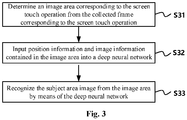
- the process of determining a subject area image corresponding to a screen touch operation according to the screen touch operation and an object image segmentation approach at least includes the following operations.
- step S31 an image area corresponding to the screen touch operation is determined from the collected frame corresponding to the screen touch operation.
- image area corresponding to the screen touch operation may be determined in a random way.
- the screen touch operation includes a clicking operation
- the coordinates, in the coordinate system of the collected frame corresponding to the screen touch operation, of the clicking position of the clicking operation may be acquired, which are referred to as the coordinates of the clicking position for short.
- An area of a set size which contains the coordinates of the clicking position is determined as an image area corresponding to the screen touch operation.
- the set size may be pre-configured by the system, or may be configured by the user autonomously.
- the screen touch operation includes a long-press operation
- the way to determine an image area corresponding to the long-press operation is substantially the same as that of determining the image area corresponding to the clicking operation, which will not be described here.
- the coordinates, in the coordinate system of the collected frame corresponding to the screen touch operation, of the sliding start point of the sliding operation are referred to as the coordinates of the sliding start point for short.
- the coordinates, in the coordinate system of the collected frame corresponding to the screen touch operation, of all the sliding points during sliding are referred to as the coordinates of the sliding points for short.
- the coordinates, in the coordinate system of the collected frame corresponding to the screen touch operation, of the sliding end point are referred to as the coordinates of the sliding end point for short.
- an area of a set size which contains the coordinates of the clicking start point, the coordinates of all the sliding points and the coordinates of the sliding end point may be determined to be an image area corresponding to the screen touch operation.
- the coordinates of the clicking start point, the coordinates of all the sliding points and the coordinates of the sliding end point may be taken to be a boundary to divide the collected frame corresponding to the screen touch operation into an area inside the closed curve and an area outside the closed curve.
- An area of a set size which contains the area inside the closed curve may be determined to be an image area corresponding to the screen touch operation.
- the set size may be pre-configured by the system, or may be configured by the user autonomously.
- step S32 position information and image information contained in the image area are input into a deep neural network.
- the position information contained in the image area may include the coordinate range of the image area in the coordinate system of the collected frame corresponding to the screen touch operation.
- the image information contained in the image area may include pixel information, light/shadow information, etc. of the image area.
- the pixel information may include any one or more of hue, saturation and brightness.
- the light/shadow information may include all information having a direct effect on light rays, for example, brightness and contrast.
- step S33 the subject area image is recognized from the image area by means of the deep neural network.
- any object segmentation approach may be employed in the deep neural network to recognize the subject area image, which will not be particularly specified.
- an area to be recognized can be accurately positioned according to a user's screen touch operation, and then the subject area image can be automatically recognized using a deep neural network, that is, the artificial intelligence technique.
- the subject area image can be recognized at a higher precision, thus improving the processing effect of multi-exposure photography, solving the problem in the related art that serious fault tolerance of a subject area of a picture may easily lead to misjudgment.
- the second rule involved in the method may include one of the following:
- the operation of determining, according to a pre-configured alignment parameter, the alignment parameter of the subject area image corresponding to the screen touch operation is equivalent to using the pre-configured alignment parameter to obtain a synthesized image with a multi-exposure photography processed effect based on the alignment operation experience. In this way, the flow of a synthesis operation can be simplified, and the efficiency of the synthesis operation can be improved.
- Alignment computation is conducted, according to a pre-configured alignment algorithm, on the currently collected frame acquired in real time and the collected frame corresponding to the screen touch operation, to obtain the alignment parameter of the subject area image corresponding to the screen touch operation.
- the applied alignment manner is to take the collected frame corresponding to each received screen touch operation, that is, the original picture photographed each time a photography operation is triggered, as a reference to perform alignment of a currently collected frame acquired in real time, so as to obtain an image with a multi-exposure processed effect.
- Alignment computation is conducted, according to the pre-configured alignment algorithm, on the currently collected frame acquired in real time and collected frames corresponding to the historical screen touch operations, to obtain the alignment parameter of the subject area image corresponding to the screen touch operation.
- the applied alignment manner is to take one of the frames that have been collected when receiving a screen touch operation, that is one of the photographed original pictures as a reference to perform alignment of the currently collected frame acquired in real time, so as to obtain an image with a multi-exposure processed effect.
- any manner of alignment may be used to conduct a synthesis operation.
- a subject area image is recognized in real time at each screen touch operation, that is, each time a photography operation is triggered, and the accuracy of recognition is high. Therefore, with the reliability of recognizing a subject area image being guaranteed, the quality of an image with a multi-exposure processed effect synthesized in any manner of alignment can be guaranteed to a certain extent.
- the problems of blur and distortion, and disorder of photographed subjects caused by conducting average synthesization after the photography of multiple pictures is completed in the related art can be avoided.
- the method also includes the following operations: receiving an editing operation initiated for the subject area image corresponding to any one or more of the historical screen touch operations; and processing, according to the editing operation, the corresponding subject area image, and taking the processed image to be an updated image with the multi-exposure processed effect.
- a user can view the effect of multi-exposure photography timely.
- the function of adjusting the image with the multi-exposure processed effect in real time to improve the effect of a final synthesized picture is provided for the user. For example, if the effect such as the posture, expression and position of some subject area image cannot satisfy user requirements, the subject area image can be particularly processed according to an editing operation initiated by the user. This operation will not affect the other subject area images. Consequently, the user experience is improved.
- an editing operation may include an operation of modifying the subject area image and/or an operation of deleting the subject area image.
- various parameters of a specified subject area image can be modified in the image with the multi-exposure processed effect displayed in real time during multi-exposure photography.
- the various parameters of the subject area image may include the image position, the image size, the image pixel, the image brightness, the image transparency, etc.
- one or more specified subject area images may be deleted from all the recognized subject area images during multi-exposure photography.
- Fig. 4 illustrates a schematic diagram of a detailed flow of a method for multi-exposure photography according to an exemplary embodiment.
- Fig. 5 illustrates schematic diagrams of collected frames and images with a multi-exposure processed effect corresponding to screen touch operations during multi-exposure photography illustrated in Fig. 4 .
- Fig. 6 illustrates final multi-exposed result images obtained according to the method illustrated in Fig. 4 .
- the process of carrying out a method for multi-exposure photography is explained in conjunction with Fig. 4 and Figs. 5 .
- the process, as illustrated in Fig. 4 includes the following step.
- step S401 a multi-exposure photography flow is started, and a currently collected frame is acquired and displayed in real time.
- the currently collected frame acquired in real time is an actually collected original image frame.
- step S402 a first screen touch operation is received for the first time, a collected frame corresponding to the screen touch operation is determined, and a first subject area image is determined from the collected frame according to the screen touch operation.
- step 402 may be carried out in the following operations:
- step S402a a screen touch operation initiated by a user is received, and an image frame Ia at the current moment is collected.
- the user initiates the screen touch operation by clicking a photographed human in the screen.
- the image frame Ia of the current moment is collected to serve as an original frame, equivalent to a photographed original picture.
- the image frame Ia is the collected frame corresponding to the screen touch operation.
- step S402b the image frame Ia is taken as a reference frame for alignment computation, to generate an alignment tool A.
- the alignment algorithm used in the alignment computation may be preset.
- step S402c an image area, corresponding to the screen touch operation, in the image frame Ia is determined.
- a first area can be acquired around the position at which the user performs a clicking operation.
- the size of the first area may be configured by the system or the user.
- the first area corresponding to the user's clicking operation is the area identified with a rectangular block in the display screen.
- the area mapped to the image frame Ia by the first area is the image area corresponding to the screen touch operation.
- the method of determining the area mapped to the image frame Ia by the first area is explained, with the example of the display screen and the image frame Ia using a same coordinate system.
- the coordinate range of the first area in the coordinate system of the display screen can be first determined, and the area having the same coordinate range in the coordinate system of the image frame Ia is then confirmed to be the area mapped to the image frame Ia by the first area.
- step S402d the pixel information and the position information of the image area corresponding to the screen touch operation are input into a deep neural network; and in the deep neural network, a subject area image in the image area is automatically predicted and is extracted as a recognized first subject area image, which can be referred to as object Sa for short.
- step S403 the alignment parameter of the first subject area image is determined, and the determined alignment parameter of the first subject area image is used to synthesize the first subject area image into the currently collected frame acquired in real time, for display.
- step 403 may be carried out in the following operations:
- step S403a the currently collected frame I acquired in real time is aligned with the reference frame Ia by using the alignment tool A generated in step S402b, to obtain an alignment parameter Wa.
- step S403b the object Sa, to which affine transformation has been made, is drawn, by using the alignment parameter Wa, into the currently collected frame I acquired in real time, for display.
- the operation of making affine transformation to the object Sa and then drawing the transformed object into the currently collected frame I acquired in real time is equivalent to synthesizing the object Sa into the currently collected frame I acquired in real time.
- the image displayed at this time is an image with a multi-exposure processed effect, such as the image displayed at the right part of Fig. 5b .
- step S404 a second screen touch operation is received, a collected frame corresponding to the screen touch operation is determined, and a second subject area image is determined from the collected frame according to the screen touch operation.
- step 404 may include the following operations:
- step S404a a screen touch operation initiated by a user is received, and an image frame Ib of the current moment is collected.
- the image frame Ib of the current moment is collected to serve as an original frame, equivalent to a photographed original picture.
- the image frame Ib is the collected frame corresponding to the screen touch operation.
- the user may initiate the screen touch operation by clicking a photographed portrait in the screen. Since the image with the multi-exposure processed effect is displayed in the screen at this time, the image contains two photographed subjects. One of the photographed subjects is a subject to be synthesized, that is, the subject area image determined in step S402, namely the object Sa. The other is a real photographed subject, that is, the object Sb illustrated in the right part of Fig. 5b .
- the photographed portrait clicked by the user is the object Sb.
- step S404b the image area in the image frame Ib corresponding to the screen touch operation is determined.
- a second area can be acquired around the position at which the user performs a clicking operation.
- the size of the second area may be configured by the system or the user.
- the second area corresponding to the user's clicking operation is the area identified by a hand-shaped cursor with a rectangular block in the display screen.
- the area mapped to the image frame Ib by the second area is the image area corresponding to the screen touch operation.
- the principle of determining the area mapped to the image frame Ib by the second area is the same as that of determining the area mapped to the image frame Ia by the first area, which will not be described.
- step S404c the pixel information and the position information of the image area corresponding to the screen touch operation are input into a deep neural network; and in the deep neural network, a subject area image in the image area is automatically predicted and is extracted as a recognized second subject area image, which can be referred to as object Sb for short.
- step S405 the alignment parameter of the second subject area image is determined, the determined alignment parameter of the second subject area image is used to synthesize the second subject area image into the currently collected frame acquired in real time, and the subject area image corresponding to the historical screen touch operation, namely the first subject area image, is also synthesized into the collected frame, for display.
- step S405 may include the following operations
- step S405a the currently collected frame I acquired in real time is aligned with the reference frame Ia by using the alignment tool A generated in step S402b, to obtain an alignment parameter Wa_b.
- step S405b he object Sa, to which affine transformation has been made, is drawn, by using the alignment parameter Wa obtained in step S403a, into the currently collected frame I acquired in real time.
- step S405c the object Sb, to which affine transformation has been made, is drawn, by using the alignment parameter Wa ⁇ Wa_b-1 (that is, the inverse matrix of the alignment parameter Wa_b), into the currently collected frame I acquired in real time, for display.
- the alignment parameter Wa ⁇ Wa_b-1 that is, the inverse matrix of the alignment parameter Wa_b
- steps S405b and S405c are to draw the object Sa and the object Sb into the same collected frame.
- the image displayed at this time is an image with a multi-exposure processed effect, such as the image displayed at the right part of Fig. 5c .
- step S406 a third screen touch operation is received, a collected frame corresponding to the screen touch operation is determined, and a third subject area image is determined from the collected frame according to the screen touch operation.
- step S406 For the operations in the above step S406, reference can be made to the operations in the above step S404, which will not be described.
- an image frame Ic of the current moment is collected, as illustrated in the left part of Fig. 5c .
- the screen touch operation initiated by the user is targeted at the subject area image, that is, the actually photographed portrait Sc.
- the object Sc is the third subject area image determined in this embodiment.
- step S407 the alignment parameter of the third subject area image is determined, the third subject area image is synthesized into the currently collected frame acquired in real time, and the subject area images corresponding to the historical screen touch operations, namely the first subject area image and the second subject area image, are also synthesized into the collected frame, for display.
- step S407 may include the following operations:
- step S407a the currently collected frame I acquired in real time is aligned with the reference frame Ia by using the alignment tool A generated in step S402b, to obtain an alignment parameter Wa_c.
- step S407b the object Sa, to which affine transformation has been made, is drawn, by using the alignment parameter Wa obtained in step S403a, into the currently collected frame I acquired in real time.
- step S407c the object Sb, to which affine transformation has been made, is drawn, by using the alignment parameter Wa_b obtained in step S405a, into the currently collected frame I acquired in real time.
- step S407d the object Sc, to which affine transformation has been made, is drawn, by using the alignment parameter Wa ⁇ Wa_c-1 (that is, the inverse matrix of the alignment parameter Wa_c), into the currently collected frame I acquired in real time, for display.
- the alignment parameter Wa ⁇ Wa_c-1 that is, the inverse matrix of the alignment parameter Wa_c
- steps S407b, S407c and S407d are to draw the object Sa, the object Sb and the object Sc into the same collected frame.
- the image displayed at this time is an image with a multi-exposure processed effect.
- step S408 an instruction to end multi-exposure photography is received, and an image with a multi-exposure processed effect generated after a final screen touch operation is output, displayed and stored as a multi-exposed result image.
- the image with the multi-exposure processed effect corresponding to the final screen touch operation may be obtained by synthesizing the subject area image corresponding to the final screen touch operation and the subject area images corresponding to all the historical screen touch operations into the collected frame acquired at the moment of receiving the final screen touch operation.
- the image with the multi-exposure processed effect corresponding to the final screen touch operation may also be obtained by synthesizing the subject area image corresponding to the final screen touch operation and the subject area images corresponding to all the historical screen touch operations into the collected frame acquired at the moment of receiving the instruction to end multi-exposure photography.
- the instruction to end multi-exposure photography is received.
- the generated multi-exposed result image is as illustrated in Fig. 5d .
- the multi-exposed result images generated according to the above method are as illustrated in Figs. 6.
- Fig. 6a and Fig. 6b are multi-exposed pictures finally generated after photography in two scenes. It can be seen therefrom that in the same scene, the photographed subjects (that is, the child) extracted from different pictures are synthesized into the same picture at different positions, reaching the interesting effect of the same picture containing multiple doppelgangers of the same person.
- the image with the multi-exposure processed effect displayed in real time provides the user with the function of previewing a multi-exposure processed effect in real time. Therefore, the user can modify the image with the multi-exposure processed effect in real time as required. That is to say, on the basis of the above method, an editing operation initiated by the user for one or more subject area images in the image with the multi-exposure processed effect can also be received.
- the subject area image selected by the user is correspondingly processed according to the editing operation, and the processed image is updated to be an image with a multi-exposure processed effect.
- the received editing operation is an operation of deleting the subject area image
- the remaining subject area images among all the subject area images other than the deleted subject area image can be synthesized into the currently collected frame acquired in real time, for display.
- the synthesized image obtained is an updated image with the multi-exposure processed effect.
- Fig. 7 illustrates a block diagram of an apparatus for multi-exposure photography according to an exemplary embodiment. As illustrated in Fig. 7 , the apparatus includes a first module 71, a second module 72, a third module 73, a fourth module 74 and a fifth module 75.
- the first module 71 is configured to receive a screen touch operation, determine a collected frame corresponding to the screen touch operation, determine, according to a first rule, a subject area image corresponding to the screen touch operation from the collected frame corresponding to the screen touch operation, and determine, according to a second rule, an alignment parameter of the subject area image corresponding to the screen touch operation.
- the second module 72 is configured to acquire a currently collected frame in real time.
- the third module 73 is configured to: when determining that the screen touch operation is the first received screen touch operation, synthesize, according to the alignment parameter of the subject area image corresponding to the screen touch operation, the subject area image corresponding to the screen touch operation into the currently collected frame, take the synthesized image to be an image with a multi-exposure processed effect and display the image with the multi-exposure processed effect.
- the fourth module 74 is configured to: when determining that the screen touch operation is not the first received screen touch operation, synthesize, according to corresponding alignment parameters, the subject area image corresponding to the screen touch operation and subject area images corresponding to all historical screen touch operations into the currently collected frame, take the synthesized image to be the image with the multi-exposure processed effect and display the image with the multi-exposure processed effect.
- the fifth module 75 is configured to determine an image with a multi-exposure processed effect from the images with the multi-exposure processed effect, which are generated after a final screen touch operation, to be a multi-exposed result image.
- the first rule includes: determining the subject area image corresponding to the screen touch operation according to at least one of the screen touch operation or an object image segmentation approach.
- the first module 71 may include a first sub-module, a second sub-module and a third sub-module.
- the first sub-module is configured to determine an image area corresponding to the screen touch operation from the collected frame corresponding to the screen touch operation.
- the second sub-module is configured to input position information and image information contained in the image area into a deep neural network.
- the third sub-module is configured to recognize the subject area image from the image area by means of the deep neural network.
- the second rule may include one of the following: determining, according to a pre-configured alignment parameter, he alignment parameter of the subject area image corresponding to the screen touch operation; conducting, according to a pre-configured alignment algorithm, alignment computation on the currently collected frame acquired in real time and the collected frame corresponding to the screen touch operation, to obtain the alignment parameter of the subject area image corresponding to the screen touch operation; or conducting, according to the pre-configured alignment algorithm, alignment computation on the currently collected frame acquired in real time and collected frames corresponding to the historical screen touch operations, to obtain the alignment parameter of the subject area image corresponding to the screen touch operation.
- the apparatus may further include a sixth module and a seventh module.
- the sixth module is configured to receive an editing operation initiated for the subject area image corresponding to any one or more of the historical screen touch operations.
- the seventh module is configured to process, according to the editing operation, the corresponding subject area image, take the processed image to be an updated image with the multi-exposure processed effect and display the updated image with the multi-exposure processed effect.
- An editing operation involved in the apparatus may include an operation of modifying the subject area image and/or an operation of deleting the subject area image.
- an apparatus for multi-exposure photography including a processor and a memory configured to store instructions executable by the processor.
- the processor is configured to:
- a non-transitory computer-readable storage medium wherein instructions in the storage medium, when executed by a processor of a mobile terminal, may enable the mobile terminal to execute a method for multi-exposure photography, including:
Landscapes
- Engineering & Computer Science (AREA)
- Multimedia (AREA)
- Signal Processing (AREA)
- Theoretical Computer Science (AREA)
- Physics & Mathematics (AREA)
- General Physics & Mathematics (AREA)
- General Engineering & Computer Science (AREA)
- Human Computer Interaction (AREA)
- Computer Vision & Pattern Recognition (AREA)
- Studio Devices (AREA)
Abstract
Description
- The disclosure relates to the technology of multi-exposure photography, and especially to a method and apparatus for multi-exposure photography.
- In the related art, the multi-exposure function of a digital camera is in fact implemented through a process of synthesizing multiple pictures into one picture in a certain way in real time. For example, a human body profile can be synthesized with other background to reach a special artistic effect.
Fig. 1 illustrates a synthesized picture subjected to multi-exposure processing in a first application scenario. Alternatively, pictures to be synthesized contain a same background but multiple subjects associated with a same person, and the positions of the subjects in the background are different among the pictures, to reach an interesting effect of a synthesized picture containing multiple doppelgangers of the same person. - Synthesis processing may be implemented by simply adding the pictures in a fixed proportion. Specifically, multiple pictures are photographed consecutively, with the photographed multiple pictures containing the same background; during preview, the multiple pictures which have not been aligned are simply synthesized averagely for display; when the photography of all the pictures is completed, all of the pictures are aligned in an off-line manner; the area where a picture subject is located is determined according to a difference between pictures, and the subjects are extracted separately to obtain a final result, i.e., obtaining a multi-exposed photography picture.
- It can be seen from the description of the process above that, in the related art, during the preview of multi-exposure photography, average synthesization of multiple pictures cannot be performed until the photography of all the pictures is completed.
- In order to overcome the problem in the related art, a method and apparatus for multi-exposure photography are provided in the disclosure.
- According to a first aspect of embodiments of the disclosure, a method for multi-exposure photography is provided, including:
- receiving a screen touch operation;
- determining a collected frame corresponding to the screen touch operation;
- determining, according to a first rule, a subject area image corresponding to the screen touch operation from the collected frame corresponding to the screen touch operation; determining, according to a second rule, an alignment parameter of the subject area image corresponding to the screen touch operation;
- acquiring a currently collected frame in real time;
- Optionally, in the method, the first rule includes: determining the subject area image corresponding to the screen touch operation according to at least one of the screen touch operation or an object image segmentation approach.
- Optionally, in the above method, determining the subject area image corresponding to the screen touch operation according to the screen touch operation and the object image segmentation approach includes:
- determining an image area corresponding to the screen touch operation from the collected frame corresponding to the screen touch operation;
- inputting position information and image information contained in the image area into a deep neural network; and
- recognizing the subject area image from the image area by means of the deep neural network.
- Optionally, in the method, the second rule includes one of the following:
- determining, according to a pre-configured alignment parameter, the alignment parameter of the subject area image corresponding to the screen touch operation;
- conducting, according to a pre-configured alignment algorithm, alignment computation on the currently collected frame acquired in real time and the collected frame corresponding to the screen touch operation, to obtain the alignment parameter of the subject area image corresponding to the screen touch operation; or
- conducting, according to the pre-configured alignment algorithm, alignment computation on the currently collected frame acquired in real time and collected frames corresponding to the historical screen touch operations, to obtain the alignment parameter of the subject area image corresponding to the screen touch operation.
- Optionally, the method further includes:
- receiving an editing operation initiated for the subject area image corresponding to any one or more of the historical screen touch operations;
- processing, according to the editing operation, the corresponding subject area image;
- taking the processed image to be an updated image with the multi-exposure processed effect; and
- displaying the updated image with the multi-exposure processed effect.
- Optionally, in the method, the editing operation at least includes at least one of: an operation of modifying the subject area image; or an operation of deleting the subject area image.
- According to a second aspect of embodiments of the disclosure, an apparatus for multi-exposure photography is provided, including:
- a first module, configured to receive a screen touch operation, determine a collected frame corresponding to the screen touch operation, determine, according to a first rule, a subject area image corresponding to the screen touch operation from the collected frame corresponding to the screen touch operation, and determine, according to a second rule, an alignment parameter of the subject area image corresponding to the screen touch operation;
- a second module, configured to acquire a currently collected frame in real time;
- a third module, configured to: when determining that the screen touch operation is the first received screen touch operation, synthesize, according to the alignment parameter of the subject area image corresponding to the screen touch operation, the subject area image corresponding to the screen touch operation into the currently collected frame, take the synthesized image to be an image with a multi-exposure processed effect and display the image with the multi-exposure processed effect;
- a fourth module, configured to: when determining that the screen touch operation is not the first received screen touch operation, synthesize, according to corresponding alignment parameters, the subject area image corresponding to the screen touch operation and subject area images corresponding to all historical screen touch operations into the currently collected frame, take the synthesized image to be the image with the multi-exposure processed effect and display the image with the multi-exposure processed effect; and
- a fifth module, configured to determine an image with a multi-exposure processed effect from the images with the multi-exposure processed effect, which are generated after a final screen touch operation, to be a multi-exposed result image.
- Optionally, in the apparatus, the first rule includes: determining the subject area image corresponding to the screen touch operation according to at least one of the screen touch operation or an object image segmentation approach.
- Optionally, in the apparatus, the first module includes:
- a first sub-module, configured to determine an image area corresponding to the screen touch operation from the collected frame corresponding to the screen touch operation;
- a second sub-module, configured to input position information and image information contained in the image area into a deep neural network; and
- a third sub-module, configured to recognize the subject area image from the image area by means of the deep neural network.
- Optionally, in the apparatus, the second rule includes one of the following:
- determining, according to a pre-configured alignment parameter, the alignment parameter of the subject area image corresponding to the screen touch operation;
- conducting, according to a pre-configured alignment algorithm, alignment computation on the currently collected frame acquired in real time and the collected frame corresponding to the screen touch operation, to obtain the alignment parameter of the subject area image corresponding to the screen touch operation; or
- conducting, according to the pre-configured alignment algorithm, alignment computation on the currently collected frame acquired in real time and collected frames corresponding to the historical screen touch operations, to obtain the alignment parameter of the subject area image corresponding to the screen touch operation.
- Optionally, the apparatus further includes:
- a sixth module, configured to receive an editing operation initiated for the subject area image corresponding to any one or more of the historical screen touch operations; and
- a seventh module, configured to process, according to the editing operation, the corresponding subject area image, take the processed image to be an updated image with the multi-exposure processed effect and display the updated image with the multi-exposure processed effect.
- Optionally, in the apparatus, the editing operation at least includes at least one of: an operation of modifying the subject area image; or an operation of deleting the subject area image.
- According to a third aspect of embodiments of the disclosure, an apparatus for multi-exposure photography is provided, including:
- a processor; and
- a memory, configured to store instructions executable by the processor,
- receive a screen touch operation;
- determine a collected frame corresponding to the screen touch operation;
- determine, according to a first rule, a subject area image corresponding to the screen touch operation from the collected frame corresponding to the screen touch operation;
- determine, according to a second rule, an alignment parameter of the subject area image corresponding to the screen touch operation;
- acquire a currently collected frame in real time;
- when determining that the screen touch operation is the first received screen touch operation, synthesize, according to the alignment parameter of the subject area image corresponding to the screen touch operation, the subject area image corresponding to the screen touch operation into the currently collected frame, take the synthesized image to be an image with a multi-exposure processed effect and display the image with the multi-exposure processed effect; or when determining that the screen touch operation is not the first received screen touch operation, synthesize, according to corresponding alignment parameters, the subject area image corresponding to the screen touch operation and subject area images corresponding to all historical screen touch operations into the currently collected frame, take the synthesized image to be the image with the multi-exposure processed effect and display the image with the multi-exposure processed effect; and
- determine an image with a multi-exposure processed effect from the images with the multi-exposure processed effect, which are generated after a final screen touch operation, to be a multi-exposed result image.
- According to a fourth aspect of embodiments of the disclosure, a non-transitory computer-readable storage medium is provided, wherein instructions in the storage medium, when executed by a processor of a mobile terminal, enable the mobile terminal to execute a method for multi-exposure photography, comprising:
- receiving a screen touch operation;
- determining a collected frame corresponding to the screen touch operation;
- determining, according to a first rule, a subject area image corresponding to the screen touch operation from the collected frame corresponding to the screen touch operation;
- determining, according to a second rule, an alignment parameter of the subject area image corresponding to the screen touch operation;
- acquiring a currently collected frame in real time;
- when determining that the screen touch operation is the first received screen touch operation, synthesizing, according to the alignment parameter of the subject area image corresponding to the screen touch operation, the subject area image corresponding to the screen touch operation into the currently collected frame, taking the synthesized image to be an image with a multi-exposure processed effect and displaying the image with the multi-exposure processed effect; or when determining that the screen touch operation is not the first received screen touch operation, synthesizing, according to corresponding alignment parameters, the subject area image corresponding to the screen touch operation and subject area images corresponding to all historical screen touch operations into the currently collected frame, taking the synthesized image to be the image with the multi-exposure processed effect and displaying the image with the multi-exposure processed effect; and
- determining an image with a multi-exposure processed effect from the images with the multi-exposure processed effect, which are generated after a final screen touch operation, to be a multi-exposed result image.
- The technical solutions provided in the embodiments of the disclosure may have the following beneficial effects:
in the technical solutions according to the embodiments of the disclosure, during multi-exposure photography, an image synthesis operation can be conducted in real time and a multi-exposure synthesis effect can be displayed, according to a screen touch operation initiated by a user; such a real-time preview function, which is more convenient, quicker and more intuitive, improves user experience. - It should be understood that the general description above and detailed description later are merely exemplary and explanatory, and are not intended to restrict the disclosure.
- The accompanying drawings herein are incorporated into the specification and constitute part of the present specification, illustrate embodiments consistent with the disclosure and explain the principles of the disclosure together with the specification.
-
Fig. 1 illustrates a synthesized picture subjected to multi-exposure processing. -
Fig. 2 illustrates a flow chart of a method for multi-exposure photography according to an exemplary embodiment. -
Fig. 3 illustrates a flow chart of the process of determining a subject area image in response to a screen touch operation and according to an object image segmentation approach in a method for multi-exposure photography according to an exemplary embodiment. -
Fig. 4 illustrates a detailed flow chart of a method for multi-exposure photography according to an exemplary embodiment. -
Fig. 5a illustrates a schematic diagram of a collected frame corresponding to a first received screen touch operation, and a picture displayed on a screen at the moment of the screen touch operation, according to the method for multi-exposure photography illustrated inFig. 4 . -
Fig. 5b illustrates a schematic diagram of a collected frame corresponding to a second received screen touch operation, and a picture displayed on the screen at the moment of the screen touch operation, according to the method for multi-exposure photography illustrated inFig. 4 . -
Fig. 5c illustrates a schematic diagram of a collected frame corresponding to a third received screen touch operation, and a picture displayed on the screen at the moment of the screen touch operation, according to the method for multi-exposure photography illustrated inFig. 4 . -
Fig. 5d illustrates a multi-exposed result picture generated according to the method for multi-exposure photography illustrated inFig. 4 . -
Fig. 6a illustrates a multi-exposed result picture generated according to the method for multi-exposure photography illustrated inFig. 4 . -
Fig. 6b illustrates another multi-exposed result picture generated according to the method for multi-exposure photography illustrated inFig. 4 . -
Fig. 7 illustrates a block diagram of an apparatus for multi-exposure photography according to an exemplary embodiment. - Detailed description will be made here to exemplary embodiments, examples of which are illustrated in the accompanying drawings. When drawings are involved in the following description, identical numerals in different drawings refer to identical or similar elements, unless otherwise indicated. Implementations described in the following exemplary embodiments do not mean all the implementations consistent with the disclosure. On the contrary, they are merely examples of apparatuses and methods consistent with some aspects of the disclosure detailed in the appended claims.
-
Fig. 2 illustrates a flow chart of a method for multi-exposure photography according to an exemplary embodiment. The method may be applied to a terminal. As illustrated inFig. 2 , the method includes the following steps. - In step S21, a screen touch operation is received, a collected frame corresponding to the screen touch operation is determined, a subject area image corresponding to the screen touch operation is determined from the collected frame corresponding to the screen touch operation according to a first rule, and an alignment parameter of the subject area image corresponding to the screen touch operation is determined according to a second rule.
- In step S22, a currently collected frame is acquired in real time.
- In step S23, When determining that the screen touch operation is the first received screen touch operation, the subject area image corresponding to the screen touch operation is synthesized into the currently collected frame according to the alignment parameter of the subject area image corresponding to the screen touch operation, the synthesized image is taken to be an image with a multi-exposure processed effect, and the image with the multi-exposure processed effect is displayed. When determining that the screen touch operation is not the first received screen touch operation, the subject area image corresponding to the screen touch operation and subject area images corresponding to all historical screen touch operations are synthesized into the currently collected frame according to corresponding alignment parameters, the synthesized image is taken to be the image with the multi-exposure processed effect, and the image with the multi-exposure processed effect is displayed. In step S24, an image with a multi-exposure processed effect is determined to be a multi-exposed result image from the images with the multi-exposure processed effect, which are generated after a final screen touch operation.
- In the above step S21, the screen touch operation may include various operations. For example, the screen touch operation may be a screen clicking operation, a screen long-press operation, an operation of sliding on a screen or the like. When the screen touch operation is a sliding operation, the sliding track may be regular or irregular. The sliding track may include any open and/or closed curve. The curve herein includes a straight line, and a broken line with more than one breakpoint.
- In this embodiment, the recognized subject area image may be a human, an animal, a plant, a still article or the like. Since a recognition operation will be conducted each time a screen touch operation is received, multiple subject area images may be recognized. When multiple subject area images are recognized, the subject area image recognized each time may be associated with a same subject. For example, the subject area image recognized each time may be associated with the same human. The subject area image recognized each time may be associated with different subjects as well. For example, the subject area image recognized at a first time is associated with a human, and the subject area image recognized at a second time is associated with a still article, etc.
- In the above step S23, when determining that the screen touch operation is not the first received screen touch operation, the subject area image corresponding to the screen touch operation and subject area images corresponding to all historical screen touch operations are synthesized into the currently collected frame according to corresponding alignment parameters. The subject area image corresponding to the screen touch operation may be synthesized into the currently collected frame according to the alignment parameter of the subject area image corresponding to the screen touch operation determined in step S11. The subject area images corresponding to all historical screen touch operations prior to receiving the screen touch operation may be synthesized into the currently collected frame successively according to the alignment parameters of the subject area images corresponding to the respective historical screen touch operations. During the synthesis operation, the subject area image corresponding to the screen touch operation and the subject area images corresponding to all the historical screen touch operations are synthesized into a same collected frame.
- In the above step S24, the multi-exposed result image may be determined in many ways. By way of example, when determining that the multi-exposure photography has ended, the subject area image corresponding to the final screen touch operation and the subject area images corresponding to all the historical screen touch operations may be synthesized into the collected frame acquired at the moment of receiving the final screen touch operation, and the synthesized image obtained at this time is taken to be the multi-exposed result image. When determining that the multi-exposure photography ends, the subject area image corresponding to the final screen touch operation and the subject area images corresponding to all the historical screen touch operations may also be synthesized into the collected frame acquired at the moment of determining that the multi-exposure photography ends, and the synthesized image obtained at this time is taken to be the multi-exposed result image.
- It can be seen from the above embodiment that, in the technical solution according to embodiments of the disclosure, each time a screen touch operation is received, an operation of recognizing a subject area image and an operation of synthesizing the recognized subject area image will be triggered. However, in conventional multi-exposure photography, all the subjects involved in synthesis processing are extracted from photographed pictures (referred to hereinafter as original pictures) respectively, that is to say, each extracted subject corresponds an original picture. Hence, a collected frame corresponding to a screen touch operation herein is equivalent to an original picture in multi-exposure photography, and the screen touch operation is equivalent to an operation of triggering the photography of the original picture in the multi-exposure photography. The subject area image recognized according to the screen touch operation is equivalent to a subject extracted from the current original picture. All the subject area images recognized according to previously received screen touch operations are equivalent to subjects extracted from previously photographed original pictures. It can be seen therefrom that, in this embodiment, the image with the multi-exposure processed effect is equivalent to a real-time preview picture generated each time an original picture for multi-exposure is photographed. That is to say, during multi-exposure photography, the multi-exposure processed effect of a currently photographed original picture and previously photographed original pictures can be previewed in real time each time an original picture is photographed, without the need of conducting an average synthesis operation to obtain a multi-exposed effect picture after the photography of all the pictures is completed. It can be seen that the technical solution of this embodiment provides a user with the function of previewing a multi-exposure processed effect in real time more conveniently and more intuitively. The multi-exposed result image obtained at the end of multi-exposure photography operations is one of the images with the multi-exposure processed effect previewed in real time; that is, the photography effect of "what you see is what you get" is achieved, improving user experience. Moreover, in the technical solution of this embodiment, the means of triggering photography by a screen touch operation is totally different from the means of adding a picture by pressing a shutter in the related art, and triggering photography by a screen touch operation is more convenient for a user's photography operation and improves user experience.
- Another method for multi-exposure photography is further provided in this embodiment. The first rule involved in the method may include: determining the subject area image corresponding to the screen touch operation according to at least one of the screen touch operation or an object image segmentation approach.
- It can be seen from the above description that the approach to recognize a subject area image in an original picture in the technical solution of this embodiment may at least include the following three approaches.
- A subject area image corresponding to a screen touch operation is determined according to the screen touch operation. That is to say, an image area corresponding to the screen touch operation initiated by a user can be recognized as the subject area image. For example, when the screen touch operation initiated by the user includes a sliding operation, the image area corresponding to the screen touch operation may be determined according to a sliding track, and this image area may be extracted as the subject area image. According to this approach, the screen touch operation initiated by the user is considered as main basis for the recognition operation, so that the user's requirement of autonomously selecting a subject to be selected can be better satisfied, improving user experience.
- The subject area image corresponding to the screen touch operation is determined according to an object image segmentation approach. That is to say, an object image segmentation approach is used to automatically recognize the subject area image from the collected frame corresponding to the screen touch operation, equivalent to recognizing the subject area image from the original picture of which the photography is triggered by the screen touch operation. The object image segmentation approach is a commonly used object segmentation technique, which will not be described in detail. In this approach, the function of automatically recognizing a subject is realized based on the object image segmentation approach, simplifying the flow of recognition, and improving the efficiency of recognition.
- The subject area image corresponding to the screen touch operation is determined according to the screen touch operation and the object image segmentation approach. That is to say, the screen touch operation initiated by the user and the object image segmentation approach are combined to serve as a basis for the recognition operation. In this approach, during the recognition of the subject, the advantages of the object image segmentation approach and the user autonomously selecting a subject to be synthesized are combined, so that the recognition of the subject area image is more accurate and better fits user requirements while ensuring the efficiency of recognition.
- Another method for multi-exposure photography is further provided in this embodiment. In the method, the process of determining a subject area image corresponding to a screen touch operation according to the screen touch operation and an object image segmentation approach, as illustrated in
Fig. 3 , at least includes the following operations. - In step S31, an image area corresponding to the screen touch operation is determined from the collected frame corresponding to the screen touch operation.
- In the above step S31, image area corresponding to the screen touch operation may be determined in a random way. For example, when the screen touch operation includes a clicking operation, the coordinates, in the coordinate system of the collected frame corresponding to the screen touch operation, of the clicking position of the clicking operation may be acquired, which are referred to as the coordinates of the clicking position for short. An area of a set size which contains the coordinates of the clicking position is determined as an image area corresponding to the screen touch operation. The set size may be pre-configured by the system, or may be configured by the user autonomously. Furthermore, when the screen touch operation includes a long-press operation, the way to determine an image area corresponding to the long-press operation is substantially the same as that of determining the image area corresponding to the clicking operation, which will not be described here.
- For another example, when the screen touch operation includes a sliding operation, the coordinates, in the coordinate system of the collected frame corresponding to the screen touch operation, of the sliding start point of the sliding operation are referred to as the coordinates of the sliding start point for short. The coordinates, in the coordinate system of the collected frame corresponding to the screen touch operation, of all the sliding points during sliding are referred to as the coordinates of the sliding points for short. The coordinates, in the coordinate system of the collected frame corresponding to the screen touch operation, of the sliding end point are referred to as the coordinates of the sliding end point for short. When the sliding track is an open curve, an area of a set size which contains the coordinates of the clicking start point, the coordinates of all the sliding points and the coordinates of the sliding end point may be determined to be an image area corresponding to the screen touch operation. When the sliding track is a closed curve, the coordinates of the clicking start point, the coordinates of all the sliding points and the coordinates of the sliding end point may be taken to be a boundary to divide the collected frame corresponding to the screen touch operation into an area inside the closed curve and an area outside the closed curve. An area of a set size which contains the area inside the closed curve may be determined to be an image area corresponding to the screen touch operation. The set size may be pre-configured by the system, or may be configured by the user autonomously.
- In step S32, position information and image information contained in the image area are input into a deep neural network.
- In the above step S32, the position information contained in the image area may include the coordinate range of the image area in the coordinate system of the collected frame corresponding to the screen touch operation. The image information contained in the image area may include pixel information, light/shadow information, etc. of the image area. The pixel information may include any one or more of hue, saturation and brightness. The light/shadow information may include all information having a direct effect on light rays, for example, brightness and contrast.
- In step S33, the subject area image is recognized from the image area by means of the deep neural network.
- In the above step S33, any object segmentation approach may be employed in the deep neural network to recognize the subject area image, which will not be particularly specified.
- It can be seen that, according to the technical solution of this embodiment, an area to be recognized can be accurately positioned according to a user's screen touch operation, and then the subject area image can be automatically recognized using a deep neural network, that is, the artificial intelligence technique. In this way, the subject area image can be recognized at a higher precision, thus improving the processing effect of multi-exposure photography, solving the problem in the related art that terrible fault tolerance of a subject area of a picture may easily lead to misjudgment.
- Another method for multi-exposure photography is also provided in this embodiment. The second rule involved in the method may include one of the following:
- determining, according to a pre-configured alignment parameter, the alignment parameter of the subject area image corresponding to the screen touch operation;
- conducting, according to a pre-configured alignment algorithm, alignment computation on the currently collected frame acquired in real time and the collected frame corresponding to the screen touch operation, to obtain the alignment parameter of the subject area image corresponding to the screen touch operation; or
- conducting, according to the pre-configured alignment algorithm, alignment computation the currently collected frame acquired in real time and collected frames corresponding to the historical screen touch operations, to obtain the alignment parameter of the subject area image corresponding to the screen touch operation.
- The operation of determining, according to a pre-configured alignment parameter, the alignment parameter of the subject area image corresponding to the screen touch operation is equivalent to using the pre-configured alignment parameter to obtain a synthesized image with a multi-exposure photography processed effect based on the alignment operation experience. In this way, the flow of a synthesis operation can be simplified, and the efficiency of the synthesis operation can be improved.
- Alignment computation is conducted, according to a pre-configured alignment algorithm, on the currently collected frame acquired in real time and the collected frame corresponding to the screen touch operation, to obtain the alignment parameter of the subject area image corresponding to the screen touch operation. The applied alignment manner is to take the collected frame corresponding to each received screen touch operation, that is, the original picture photographed each time a photography operation is triggered, as a reference to perform alignment of a currently collected frame acquired in real time, so as to obtain an image with a multi-exposure processed effect.
- Alignment computation is conducted, according to the pre-configured alignment algorithm, on the currently collected frame acquired in real time and collected frames corresponding to the historical screen touch operations, to obtain the alignment parameter of the subject area image corresponding to the screen touch operation. The applied alignment manner is to take one of the frames that have been collected when receiving a screen touch operation, that is one of the photographed original pictures as a reference to perform alignment of the currently collected frame acquired in real time, so as to obtain an image with a multi-exposure processed effect.
- It can be seen that, in the technical solution of this embodiment, in the process of synthesizing an image with a multi-exposure processed effect in real time, any manner of alignment may be used to conduct a synthesis operation. As described above, in this embodiment, a subject area image is recognized in real time at each screen touch operation, that is, each time a photography operation is triggered, and the accuracy of recognition is high. Therefore, with the reliability of recognizing a subject area image being guaranteed, the quality of an image with a multi-exposure processed effect synthesized in any manner of alignment can be guaranteed to a certain extent. The problems of blur and distortion, and disorder of photographed subjects caused by conducting average synthesization after the photography of multiple pictures is completed in the related art can be avoided.
- Another method for multi-exposure photography is provided in this embodiment. The method also includes the following operations: receiving an editing operation initiated for the subject area image corresponding to any one or more of the historical screen touch operations; and processing, according to the editing operation, the corresponding subject area image, and taking the processed image to be an updated image with the multi-exposure processed effect.
- In the technical solution of this embodiment, by means of displaying an image with a multi-exposure processed effect in real time, a user can view the effect of multi-exposure photography timely. Further, the function of adjusting the image with the multi-exposure processed effect in real time to improve the effect of a final synthesized picture is provided for the user. For example, if the effect such as the posture, expression and position of some subject area image cannot satisfy user requirements, the subject area image can be particularly processed according to an editing operation initiated by the user. This operation will not affect the other subject area images. Consequently, the user experience is improved.
- Another method for multi-exposure photography is provided in this embodiment. In the method, an editing operation may include an operation of modifying the subject area image and/or an operation of deleting the subject area image.
- By means of the operation of modifying the subject area image, various parameters of a specified subject area image can be modified in the image with the multi-exposure processed effect displayed in real time during multi-exposure photography. The various parameters of the subject area image may include the image position, the image size, the image pixel, the image brightness, the image transparency, etc.
- Through the operation of deleting the subject area image, one or more specified subject area images may be deleted from all the recognized subject area images during multi-exposure photography.
-
Fig. 4 illustrates a schematic diagram of a detailed flow of a method for multi-exposure photography according to an exemplary embodiment.Fig. 5 illustrates schematic diagrams of collected frames and images with a multi-exposure processed effect corresponding to screen touch operations during multi-exposure photography illustrated inFig. 4 .Fig. 6 illustrates final multi-exposed result images obtained according to the method illustrated inFig. 4 . - The process of carrying out a method for multi-exposure photography is explained in conjunction with
Fig. 4 andFigs. 5 . The process, as illustrated inFig. 4 , includes the following step. - In step S401, a multi-exposure photography flow is started, and a currently collected frame is acquired and displayed in real time.
- In this step, the currently collected frame acquired in real time, as illustrated in the left part of
Fig. 5a , is an actually collected original image frame. - In step S402, a first screen touch operation is received for the first time, a collected frame corresponding to the screen touch operation is determined, and a first subject area image is determined from the collected frame according to the screen touch operation.
- In this embodiment, the above step 402 may be carried out in the following operations:
- In step S402a, a screen touch operation initiated by a user is received, and an image frame Ia at the current moment is collected.
- As illustrated in the right part of
Fig. 5a , the user initiates the screen touch operation by clicking a photographed human in the screen. - As illustrated in the left part of
Fig. 5a , the image frame Ia of the current moment is collected to serve as an original frame, equivalent to a photographed original picture. The image frame Ia is the collected frame corresponding to the screen touch operation. - In step S402b, the image frame Ia is taken as a reference frame for alignment computation, to generate an alignment tool A. In this step, the alignment algorithm used in the alignment computation may be preset. In step S402c, an image area, corresponding to the screen touch operation, in the image frame Ia is determined.
- In this step, a first area can be acquired around the position at which the user performs a clicking operation. The size of the first area may be configured by the system or the user. As illustrated in the right part of
Fig. 5a , the first area corresponding to the user's clicking operation is the area identified with a rectangular block in the display screen. The area mapped to the image frame Ia by the first area is the image area corresponding to the screen touch operation. For simplified description, the method of determining the area mapped to the image frame Ia by the first area is explained, with the example of the display screen and the image frame Ia using a same coordinate system. The coordinate range of the first area in the coordinate system of the display screen can be first determined, and the area having the same coordinate range in the coordinate system of the image frame Ia is then confirmed to be the area mapped to the image frame Ia by the first area. - In step S402d, the pixel information and the position information of the image area corresponding to the screen touch operation are input into a deep neural network; and in the deep neural network, a subject area image in the image area is automatically predicted and is extracted as a recognized first subject area image, which can be referred to as object Sa for short.
- In step S403, the alignment parameter of the first subject area image is determined, and the determined alignment parameter of the first subject area image is used to synthesize the first subject area image into the currently collected frame acquired in real time, for display.
- In this embodiment, the above step 403 may be carried out in the following operations:
- In step S403a, the currently collected frame I acquired in real time is aligned with the reference frame Ia by using the alignment tool A generated in step S402b, to obtain an alignment parameter Wa.
- In step S403b, the object Sa, to which affine transformation has been made, is drawn, by using the alignment parameter Wa, into the currently collected frame I acquired in real time, for display.
- The operation of making affine transformation to the object Sa and then drawing the transformed object into the currently collected frame I acquired in real time is equivalent to synthesizing the object Sa into the currently collected frame I acquired in real time. The image displayed at this time is an image with a multi-exposure processed effect, such as the image displayed at the right part of
Fig. 5b . - In step S404, a second screen touch operation is received, a collected frame corresponding to the screen touch operation is determined, and a second subject area image is determined from the collected frame according to the screen touch operation.
- In this embodiment, the above step 404 may include the following operations:
- In step S404a, a screen touch operation initiated by a user is received, and an image frame Ib of the current moment is collected.
- As illustrated in the left part of
Fig. 5b , the image frame Ib of the current moment is collected to serve as an original frame, equivalent to a photographed original picture. The image frame Ib is the collected frame corresponding to the screen touch operation. - As illustrated in the right part of
Fig. 5b , the user may initiate the screen touch operation by clicking a photographed portrait in the screen. Since the image with the multi-exposure processed effect is displayed in the screen at this time, the image contains two photographed subjects. One of the photographed subjects is a subject to be synthesized, that is, the subject area image determined in step S402, namely the object Sa. The other is a real photographed subject, that is, the object Sb illustrated in the right part ofFig. 5b . The photographed portrait clicked by the user is the object Sb. - In step S404b, the image area in the image frame Ib corresponding to the screen touch operation is determined.
- In this step, a second area can be acquired around the position at which the user performs a clicking operation. The size of the second area may be configured by the system or the user. As illustrated in the right part of
Fig. 5b , the second area corresponding to the user's clicking operation is the area identified by a hand-shaped cursor with a rectangular block in the display screen. The area mapped to the image frame Ib by the second area is the image area corresponding to the screen touch operation. The principle of determining the area mapped to the image frame Ib by the second area is the same as that of determining the area mapped to the image frame Ia by the first area, which will not be described. - In step S404c, the pixel information and the position information of the image area corresponding to the screen touch operation are input into a deep neural network; and in the deep neural network, a subject area image in the image area is automatically predicted and is extracted as a recognized second subject area image, which can be referred to as object Sb for short.
- In step S405, the alignment parameter of the second subject area image is determined, the determined alignment parameter of the second subject area image is used to synthesize the second subject area image into the currently collected frame acquired in real time, and the subject area image corresponding to the historical screen touch operation, namely the first subject area image, is also synthesized into the collected frame, for display.
- In this embodiment, the above step S405 may include the following operations
- In step S405a, the currently collected frame I acquired in real time is aligned with the reference frame Ia by using the alignment tool A generated in step S402b, to obtain an alignment parameter Wa_b.
- In step S405b, he object Sa, to which affine transformation has been made, is drawn, by using the alignment parameter Wa obtained in step S403a, into the currently collected frame I acquired in real time.
- In step S405c, the object Sb, to which affine transformation has been made, is drawn, by using the alignment parameter Wa×Wa_b-1 (that is, the inverse matrix of the alignment parameter Wa_b), into the currently collected frame I acquired in real time, for display.
- The drawing operations in steps S405b and S405c are to draw the object Sa and the object Sb into the same collected frame. The image displayed at this time is an image with a multi-exposure processed effect, such as the image displayed at the right part of
Fig. 5c . - In step S406, a third screen touch operation is received, a collected frame corresponding to the screen touch operation is determined, and a third subject area image is determined from the collected frame according to the screen touch operation.
- In this embodiment, for the operations in the above step S406, reference can be made to the operations in the above step S404, which will not be described. When a screen touch operation initiated by a user is received, an image frame Ic of the current moment is collected, as illustrated in the left part of
Fig. 5c . As illustrated in the right part ofFig. 5c , the screen touch operation initiated by the user is targeted at the subject area image, that is, the actually photographed portrait Sc. The object Sc is the third subject area image determined in this embodiment. - In step S407, the alignment parameter of the third subject area image is determined, the third subject area image is synthesized into the currently collected frame acquired in real time, and the subject area images corresponding to the historical screen touch operations, namely the first subject area image and the second subject area image, are also synthesized into the collected frame, for display.
- In this embodiment, the above step S407 may include the following operations:
- In step S407a, the currently collected frame I acquired in real time is aligned with the reference frame Ia by using the alignment tool A generated in step S402b, to obtain an alignment parameter Wa_c.
- In step S407b, the object Sa, to which affine transformation has been made, is drawn, by using the alignment parameter Wa obtained in step S403a, into the currently collected frame I acquired in real time.
- In step S407c, the object Sb, to which affine transformation has been made, is drawn, by using the alignment parameter Wa_b obtained in step S405a, into the currently collected frame I acquired in real time.
- In step S407d, the object Sc, to which affine transformation has been made, is drawn, by using the alignment parameter Wa×Wa_c-1 (that is, the inverse matrix of the alignment parameter Wa_c), into the currently collected frame I acquired in real time, for display.
- The drawing operations in steps S407b, S407c and S407d are to draw the object Sa, the object Sb and the object Sc into the same collected frame. The image displayed at this time is an image with a multi-exposure processed effect.
- In step S408, an instruction to end multi-exposure photography is received, and an image with a multi-exposure processed effect generated after a final screen touch operation is output, displayed and stored as a multi-exposed result image.
- The image with the multi-exposure processed effect corresponding to the final screen touch operation may be obtained by synthesizing the subject area image corresponding to the final screen touch operation and the subject area images corresponding to all the historical screen touch operations into the collected frame acquired at the moment of receiving the final screen touch operation. The image with the multi-exposure processed effect corresponding to the final screen touch operation may also be obtained by synthesizing the subject area image corresponding to the final screen touch operation and the subject area images corresponding to all the historical screen touch operations into the collected frame acquired at the moment of receiving the instruction to end multi-exposure photography.
- In this step, when the user confirms that all the pictures have been added completely and clicks the complete button as illustrated in the left part of
Fig. 5c , the instruction to end multi-exposure photography is received. The generated multi-exposed result image is as illustrated inFig. 5d . With actually photographed pictures as an example, the multi-exposed result images generated according to the above method are as illustrated inFigs. 6. Fig. 6a and Fig. 6b are multi-exposed pictures finally generated after photography in two scenes. It can be seen therefrom that in the same scene, the photographed subjects (that is, the child) extracted from different pictures are synthesized into the same picture at different positions, reaching the interesting effect of the same picture containing multiple doppelgangers of the same person. - In addition, during photography according to the above method for multi-exposure photography, the image with the multi-exposure processed effect displayed in real time provides the user with the function of previewing a multi-exposure processed effect in real time. Therefore, the user can modify the image with the multi-exposure processed effect in real time as required. That is to say, on the basis of the above method, an editing operation initiated by the user for one or more subject area images in the image with the multi-exposure processed effect can also be received. The subject area image selected by the user is correspondingly processed according to the editing operation, and the processed image is updated to be an image with a multi-exposure processed effect. For example, when the received editing operation is an operation of deleting the subject area image, the remaining subject area images among all the subject area images other than the deleted subject area image can be synthesized into the currently collected frame acquired in real time, for display. The synthesized image obtained is an updated image with the multi-exposure processed effect.
-
Fig. 7 illustrates a block diagram of an apparatus for multi-exposure photography according to an exemplary embodiment. As illustrated inFig. 7 , the apparatus includes afirst module 71, asecond module 72, athird module 73, afourth module 74 and afifth module 75. - The
first module 71 is configured to receive a screen touch operation, determine a collected frame corresponding to the screen touch operation, determine, according to a first rule, a subject area image corresponding to the screen touch operation from the collected frame corresponding to the screen touch operation, and determine, according to a second rule, an alignment parameter of the subject area image corresponding to the screen touch operation. - The
second module 72 is configured to acquire a currently collected frame in real time. - The
third module 73 is configured to: when determining that the screen touch operation is the first received screen touch operation, synthesize, according to the alignment parameter of the subject area image corresponding to the screen touch operation, the subject area image corresponding to the screen touch operation into the currently collected frame, take the synthesized image to be an image with a multi-exposure processed effect and display the image with the multi-exposure processed effect. - The
fourth module 74 is configured to: when determining that the screen touch operation is not the first received screen touch operation, synthesize, according to corresponding alignment parameters, the subject area image corresponding to the screen touch operation and subject area images corresponding to all historical screen touch operations into the currently collected frame, take the synthesized image to be the image with the multi-exposure processed effect and display the image with the multi-exposure processed effect. - The
fifth module 75 is configured to determine an image with a multi-exposure processed effect from the images with the multi-exposure processed effect, which are generated after a final screen touch operation, to be a multi-exposed result image. - Another apparatus for multi-exposure photography is provided in this embodiment. The first rule includes: determining the subject area image corresponding to the screen touch operation according to at least one of the screen touch operation or an object image segmentation approach.
- Another apparatus for multi-exposure photography is provided in this embodiment. The
first module 71 may include a first sub-module, a second sub-module and a third sub-module. The first sub-module is configured to determine an image area corresponding to the screen touch operation from the collected frame corresponding to the screen touch operation. - The second sub-module is configured to input position information and image information contained in the image area into a deep neural network.
- The third sub-module is configured to recognize the subject area image from the image area by means of the deep neural network.
- Another apparatus for multi-exposure photography is provided in this embodiment. The second rule may include one of the following: determining, according to a pre-configured alignment parameter, he alignment parameter of the subject area image corresponding to the screen touch operation; conducting, according to a pre-configured alignment algorithm, alignment computation on the currently collected frame acquired in real time and the collected frame corresponding to the screen touch operation, to obtain the alignment parameter of the subject area image corresponding to the screen touch operation; or conducting, according to the pre-configured alignment algorithm, alignment computation on the currently collected frame acquired in real time and collected frames corresponding to the historical screen touch operations, to obtain the alignment parameter of the subject area image corresponding to the screen touch operation.
- Another apparatus for multi-exposure photography is provided in this embodiment. The apparatus may further include a sixth module and a seventh module.
- The sixth module is configured to receive an editing operation initiated for the subject area image corresponding to any one or more of the historical screen touch operations.
- The seventh module is configured to process, according to the editing operation, the corresponding subject area image, take the processed image to be an updated image with the multi-exposure processed effect and display the updated image with the multi-exposure processed effect.
- Another apparatus for multi-exposure photography is provided in this embodiment. An editing operation involved in the apparatus may include an operation of modifying the subject area image and/or an operation of deleting the subject area image.
- With regard to the apparatus in the above embodiments, the specific way for the various modules to execute operations has been described in detail in the embodiments regarding the method, which will not be described in detail here.
- In an exemplary embodiment, an apparatus for multi-exposure photography is provided, including a processor and a memory configured to store instructions executable by the processor. The processor is configured to:
- receive a screen touch operation, determine a collected frame corresponding to the screen touch operation, determine, according to a first rule, a subject area image corresponding to the screen touch operation from the collected frame corresponding to the screen touch operation, and determine, according to a second rule, an alignment parameter of the subject area image corresponding to the screen touch operation;
- acquire a currently collected frame in real time;
- when determining that the screen touch operation is the first received screen touch operation, synthesize, according to the alignment parameter of the subject area image corresponding to the screen touch operation, the subject area image corresponding to the screen touch operation into the currently collected frame, take the synthesized image to be an image with a multi-exposure processed effect and display the image with the multi-exposure processed effect; or when determining that the screen touch operation is not the first received screen touch operation, synthesize, according to corresponding alignment parameters, the subject area image corresponding to the screen touch operation and subject area images corresponding to all historical screen touch operations into the currently collected frame, take the synthesized image to be the image with the multi-exposure processed effect, and display the image with the multi-exposure processed effect; and
- determine an image with a multi-exposure processed effect from the images with the multi-exposure processed effect, which are generated after a final screen touch operation, to be a multi-exposed result image.
- With regard to the apparatus in the above embodiments, the specific way for the various parts to execute operations has been described in detail in the embodiments regarding the method, which will not be described in detail here.
- In an exemplary embodiment, a non-transitory computer-readable storage medium is provided, wherein instructions in the storage medium, when executed by a processor of a mobile terminal, may enable the mobile terminal to execute a method for multi-exposure photography, including:
- receiving a screen touch operation, determine a collected frame corresponding to the screen touch operation, determine, according to a first rule, a subject area image corresponding to the screen touch operation from the collected frame corresponding to the screen touch operation, and determine, according to a second rule, an alignment parameter of the subject area image corresponding to the screen touch operation;
- acquiring a currently collected frame in real time;
- when determining that the screen touch operation is the first received screen touch operation, synthesizing, according to the alignment parameter of the subject area image corresponding to the screen touch operation, the subject area image corresponding to the screen touch operation into the currently collected frame, taking the synthesized image to be an image with a multi-exposure processed effect and displaying the image with the multi-exposure processed effect; or when determining that the screen touch operation is not the first received screen touch operation, synthesizing, according to corresponding alignment parameters, the subject area image corresponding to the screen touch operation and subject area images corresponding to all historical screen touch operations into the currently collected frame, taking the synthesized image to be the image with the multi-exposure processed effect, and displaying the image with the multi-exposure processed effect; and
- determining an image with a multi-exposure processed effect from the images with the multi-exposure processed effect, which are generated after a final screen touch operation, to be a multi-exposed result image.
- The specific way for each of the instructions in the storage medium in the above embodiments to execute an operation has been described in detail in the embodiments regarding the method, which will not be described in detail here.
- Other embodiments of the disclosure would readily occur to those skilled in the art upon consideration of the specification and practicing the disclosure here. The application is aimed at covering any variants, usages or adaptive changes that comply with generic principles of the disclosure and include common knowledge or customary technical means in the art that is not disclosed in the disclosure. The specification and embodiments are merely exemplary, and the scope of the invention is defined by the appended claims.
- It should be understood that the disclosure is not limited to the precise structures described above and illustrated in the accompanying drawings, and modifications and changes may be made thereto without departing from the scope thereof. The scope of the invention is defined by the appended claims.
Claims (14)
- A method for multi-exposure photography, comprising:receiving (S21) a screen touch operation;determining (S21) a collected frame corresponding to the screen touch operation; and characterized by:determining (S21), according to a first rule, a subject area image corresponding to the screen touch operation from the collected frame corresponding to the screen touch operation;determining (S21), according to a second rule, an alignment parameter of the subject area image corresponding to the screen touch operation;acquiring (S22) a currently collected frame in real time;when determining that the screen touch operation is the first received screen touch operation, synthesizing (S23), according to the alignment parameter of the subject area image corresponding to the screen touch operation, the subject area image corresponding to the screen touch operation into the currently collected frame, taking the synthesized image to be an image with a multi-exposure processed effect and displaying the image with the multi-exposure processed effect; or when determining that the screen touch operation is not the first received screen touch operation, synthesizing, according to corresponding alignment parameters, the subject area image corresponding to the screen touch operation and subject area images corresponding to all historical screen touch operations into the currently collected frame, taking the synthesized image to be the image with the multi-exposure processed effect and displaying the image with the multi-exposure processed effect; anddetermining (S24) an image with a multi-exposure processed effect from the images with the multi-exposure processed effect, which are generated after a final screen touch operation, to be a multi-exposed result image.
- The method according to claim 1, wherein the first rule comprises:
determining the subject area image corresponding to the screen touch operation according to at least one of the screen touch operation or an object image segmentation approach. - The method according to claim 2, wherein determining the subject area image corresponding to the screen touch operation according to the screen touch operation and the object image segmentation approach comprises:determining an image area corresponding to the screen touch operation from the collected frame corresponding to the screen touch operation;inputting position information and image information contained in the image area into a deep neural network; andrecognizing the subject area image from the image area by means of the deep neural network.
- The method according to claim 1, 2 or 3, wherein the second rule comprises one of the following:determining, according to a pre-configured alignment parameter, the alignment parameter of the subject area image corresponding to the screen touch operation;conducting, according to a pre-configured alignment algorithm, alignment computation on the currently collected frame acquired in real time and the collected frame corresponding to the screen touch operation, to obtain the alignment parameter of the subject area image corresponding to the screen touch operation; orconducting, according to the pre-configured alignment algorithm, alignment computation on the currently collected frame acquired in real time and collected frames corresponding to the historical screen touch operations, to obtain the alignment parameter of the subject area image corresponding to the screen touch operation.
- The method according to any preceding claim, further comprising:receiving an editing operation initiated for the subject area image corresponding to any one or more of the historical screen touch operations;processing, according to the editing operation, the corresponding subject area image;taking the processed image to be an updated image with the multi-exposure processed effect; anddisplaying the updated image with the multi-exposure processed effect.
- The method according to claim 5, wherein the editing operation at least comprises at least one of:an operation of modifying the subject area image; oran operation of deleting the subject area image.
- An apparatus for multi-exposure photography comprising:a first module (71), configured to receive a screen touch operation, determine a collected frame corresponding to the screen touch operation, determine, according to a first rule, a subject area image corresponding to the screen touch operation from the collected frame corresponding to the screen touch operation, and determine, according to a second rule, an alignment parameter of the subject area image corresponding to the screen touch operation;a second module (72), configured to acquire a currently collected frame in real time;a third module (73), configured to: when determining that the screen touch operation is a first received screen touch operation, synthesize, according to the alignment parameter of the subject area image corresponding to the screen touch operation, the subject area image corresponding to the screen touch operation into the currently collected frame, take the synthesized image to be an image with a multi-exposure processed effect and display the image with the multi-exposure processed effect;a fourth module (74), configured to: when determining that the screen touch operation is not the first received screen touch operation, synthesize, according to corresponding alignment parameters, the subject area image corresponding to the screen touch operation and subject area images corresponding to all historical screen touch operations into the currently collected frame, take the synthesized image to be the image with the multi-exposure processed effect and display the image with the multi-exposure processed effect; anda fifth module (75), configured to determine an image with a multi-exposure processed effect from the images with the multi-exposure processed effect, which are generated after a final screen touch operation, to be a multi-exposed result image.
- The apparatus according to claim 7, wherein the first rule comprises:
determining the subject area image corresponding to the screen touch operation according to at least one of the screen touch operation or an object image segmentation approach. - The apparatus according to claim 8, wherein the first module (71) comprises:a first sub-module, configured to determine an image area corresponding to the screen touch operation from the collected frame corresponding to the screen touch operation;a second sub-module, configured to input position information and image information contained in the image area into a deep neural network; anda third sub-module, configured to recognize the subject area image from the image area by means of the deep neural network.
- The apparatus according to claim 7, 8 or 9, wherein the second rule comprises one of the following:determining, according to a pre-configured alignment parameter, the alignment parameter of the subject area image corresponding to the screen touch operation;conducting, according to a pre-configured alignment algorithm, alignment computation on the currently collected frame acquired in real time and the collected frame corresponding to the screen touch operation, to obtain the alignment parameter of the subject area image corresponding to the screen touch operation; orconducting, according to the pre-configured alignment algorithm, alignment computation on the currently collected frame acquired in real time and collected frames corresponding to the historical screen touch operations, to obtain the alignment parameter of the subject area image corresponding to the screen touch operation.
- The apparatus according to claims 7 to 10, further comprising:a sixth module, configured to receive an editing operation initiated for the subject area image corresponding to any one or more of the historical screen touch operations; anda seventh module, configured to process, according to the editing operation, the corresponding subject area image, take the processed image to be an updated image with the multi-exposure processed effect and display the updated image with the multi-exposure processed effect.
- The apparatus according to claim 11, wherein the editing operation at least comprises at least one of:an operation of modifying the subject area image; oran operation of deleting the subject area image.
- An apparatus for multi-exposure photography, comprising:a processor; anda memory, configured to store instructions executable by the processor,wherein the processor is configured to perform the method according to any of claims 1 to 6.
- A computer-readable storage medium having stored therein instructions that, when executed by a processor of a mobile terminal, causes the mobile terminal to perform the method for multi-exposure photography according to any of claims 1 to 6.
Applications Claiming Priority (1)
| Application Number | Priority Date | Filing Date | Title |
|---|---|---|---|
| CN201910923409.3A CN110611768B (en) | 2019-09-27 | 2019-09-27 | Multiple exposure photography method and device |
Publications (2)
| Publication Number | Publication Date |
|---|---|
| EP3799414A1 true EP3799414A1 (en) | 2021-03-31 |
| EP3799414B1 EP3799414B1 (en) | 2025-10-15 |
Family
ID=68893661
Family Applications (1)
| Application Number | Title | Priority Date | Filing Date |
|---|---|---|---|
| EP20153132.4A Active EP3799414B1 (en) | 2019-09-27 | 2020-01-22 | Method and apparatus for multi-exposure photography |
Country Status (3)
| Country | Link |
|---|---|
| US (1) | US11146742B2 (en) |
| EP (1) | EP3799414B1 (en) |
| CN (1) | CN110611768B (en) |
Families Citing this family (4)
| Publication number | Priority date | Publication date | Assignee | Title |
|---|---|---|---|---|
| CN111107267A (en) * | 2019-12-30 | 2020-05-05 | 广州华多网络科技有限公司 | Image processing method, device, equipment and storage medium |
| KR102788915B1 (en) * | 2020-09-10 | 2025-03-31 | 삼성전자주식회사 | Augmented reality device and method for controlling the same |
| CN113497973B (en) * | 2021-09-06 | 2021-12-10 | 北京市商汤科技开发有限公司 | Video processing method and device, computer readable storage medium and computer equipment |
| CN114143461B (en) * | 2021-11-30 | 2024-04-26 | 维沃移动通信有限公司 | Shooting method, device and electronic equipment |
Citations (5)
| Publication number | Priority date | Publication date | Assignee | Title |
|---|---|---|---|---|
| US20120057051A1 (en) * | 2010-09-03 | 2012-03-08 | Olympus Imaging Corp. | Imaging apparatus, imaging method and computer-readable recording medium |
| US20150070523A1 (en) * | 2013-09-06 | 2015-03-12 | Qualcomm Incorporated | Interactive image composition |
| EP2869239A2 (en) * | 2013-11-04 | 2015-05-06 | Facebook, Inc. | Systems and methods for facial representation |
| US20160227108A1 (en) * | 2015-02-02 | 2016-08-04 | Olympus Corporation | Imaging apparatus |
| CN108419007A (en) * | 2018-01-30 | 2018-08-17 | 努比亚技术有限公司 | Clone method, photo taking, terminal and computer readable storage medium |
Family Cites Families (28)
| Publication number | Priority date | Publication date | Assignee | Title |
|---|---|---|---|---|
| JP2002171398A (en) * | 2000-12-04 | 2002-06-14 | Konica Corp | Image processing method and electronic camera |
| US20050129324A1 (en) * | 2003-12-02 | 2005-06-16 | Lemke Alan P. | Digital camera and method providing selective removal and addition of an imaged object |
| US7702131B2 (en) * | 2005-10-13 | 2010-04-20 | Fujifilm Corporation | Segmenting images and simulating motion blur using an image sequence |
| US8275215B2 (en) * | 2007-05-08 | 2012-09-25 | Arcsoft (Shanghai) Technology Company, Ltd | Merging images |
| JP5108747B2 (en) * | 2008-12-26 | 2012-12-26 | 富士フイルム株式会社 | Information display apparatus, method and program |
| KR20110050834A (en) * | 2009-11-09 | 2011-05-17 | 삼성전자주식회사 | Method and device for image registration in portable terminal |
| JP4947668B2 (en) * | 2009-11-20 | 2012-06-06 | シャープ株式会社 | Electronic device, display control method, and program |
| JP5814566B2 (en) * | 2011-02-28 | 2015-11-17 | オリンパス株式会社 | IMAGING DEVICE, IMAGING METHOD, AND IMAGING DEVICE CONTROL PROGRAM |
| JP5762114B2 (en) * | 2011-04-28 | 2015-08-12 | キヤノン株式会社 | Imaging apparatus and control method thereof |
| JP5921080B2 (en) * | 2011-04-28 | 2016-05-24 | キヤノン株式会社 | Imaging apparatus and control method thereof |
| US8866943B2 (en) * | 2012-03-09 | 2014-10-21 | Apple Inc. | Video camera providing a composite video sequence |
| JP2013225245A (en) * | 2012-04-23 | 2013-10-31 | Sony Corp | Image processing device, image processing method, and program |
| CN103327253B (en) | 2013-06-26 | 2015-05-13 | 努比亚技术有限公司 | Multiple exposure method and camera shooting device |
| CN105659286B (en) * | 2013-09-18 | 2021-09-28 | 英特尔公司 | Automated image cropping and sharing |
| KR102138521B1 (en) * | 2013-12-12 | 2020-07-28 | 엘지전자 주식회사 | Mobile terminal and method for controlling the same |
| US9659350B2 (en) * | 2014-01-31 | 2017-05-23 | Morpho, Inc. | Image processing device and image processing method for image correction, and non-transitory computer readable recording medium thereof |
| US9158985B2 (en) * | 2014-03-03 | 2015-10-13 | Xerox Corporation | Method and apparatus for processing image of scene of interest |
| CN103856718B (en) * | 2014-03-26 | 2017-02-15 | 努比亚技术有限公司 | Photo synthesis method and photo synthesis device |
| KR102356448B1 (en) * | 2014-05-05 | 2022-01-27 | 삼성전자주식회사 | Method for composing image and electronic device thereof |
| CN104113692B (en) * | 2014-07-22 | 2015-11-25 | 努比亚技术有限公司 | Image capturing method and device |
| CN104243819B (en) | 2014-08-29 | 2018-02-23 | 小米科技有限责任公司 | Photo acquisition methods and device |
| JP6065939B2 (en) * | 2015-06-11 | 2017-01-25 | カシオ計算機株式会社 | Display device and display method |
| JP6372472B2 (en) * | 2015-10-26 | 2018-08-15 | 京セラドキュメントソリューションズ株式会社 | Display device |
| CN107077720A (en) * | 2016-12-27 | 2017-08-18 | 深圳市大疆创新科技有限公司 | Method, device and the equipment of image procossing |
| JP2018148272A (en) * | 2017-03-01 | 2018-09-20 | オリンパス株式会社 | Imaging apparatus, image processing apparatus, imaging method, and program |
| CN106851125B (en) | 2017-03-31 | 2020-10-16 | 努比亚技术有限公司 | Mobile terminal and multiple exposure shooting method |
| US10782822B2 (en) * | 2017-06-08 | 2020-09-22 | Walmart Apollo, Llc | Augmented touch-sensitive display system |
| CN108777766B (en) * | 2018-08-10 | 2021-01-15 | 维沃移动通信有限公司 | A multi-person photographing method, terminal and storage medium |
-
2019
- 2019-09-27 CN CN201910923409.3A patent/CN110611768B/en active Active
-
2020
- 2020-01-16 US US16/744,698 patent/US11146742B2/en active Active
- 2020-01-22 EP EP20153132.4A patent/EP3799414B1/en active Active
Patent Citations (5)
| Publication number | Priority date | Publication date | Assignee | Title |
|---|---|---|---|---|
| US20120057051A1 (en) * | 2010-09-03 | 2012-03-08 | Olympus Imaging Corp. | Imaging apparatus, imaging method and computer-readable recording medium |
| US20150070523A1 (en) * | 2013-09-06 | 2015-03-12 | Qualcomm Incorporated | Interactive image composition |
| EP2869239A2 (en) * | 2013-11-04 | 2015-05-06 | Facebook, Inc. | Systems and methods for facial representation |
| US20160227108A1 (en) * | 2015-02-02 | 2016-08-04 | Olympus Corporation | Imaging apparatus |
| CN108419007A (en) * | 2018-01-30 | 2018-08-17 | 努比亚技术有限公司 | Clone method, photo taking, terminal and computer readable storage medium |
Also Published As
| Publication number | Publication date |
|---|---|
| US11146742B2 (en) | 2021-10-12 |
| CN110611768A (en) | 2019-12-24 |
| US20210099654A1 (en) | 2021-04-01 |
| CN110611768B (en) | 2021-06-29 |
| EP3799414B1 (en) | 2025-10-15 |
Similar Documents
| Publication | Publication Date | Title |
|---|---|---|
| EP3799414B1 (en) | Method and apparatus for multi-exposure photography | |
| CN104503749B (en) | Photo processing method and electronic equipment | |
| DE112020003794T5 (en) | Depth-aware photo editing | |
| US20160269526A1 (en) | Portable electronic devices with integrated image/video compositing | |
| DE102018132245A1 (en) | Method and system for recurrent semantic segmentation for image processing | |
| CN102158648B (en) | Image capturing device and image processing method | |
| CN105991915A (en) | Shooting method and apparatus, and terminal | |
| JP2020535688A5 (en) | ||
| CN104995905A (en) | Image processing device, photographing control method, and program | |
| US10726524B2 (en) | Low-resolution tile processing for real-time bokeh | |
| CN106296789B (en) | It is a kind of to be virtually implanted the method and terminal that object shuttles in outdoor scene | |
| CN106454118A (en) | Picture blurring method and mobile terminal | |
| CN109788359B (en) | Video data processing method and related device | |
| CN104869372B (en) | Projection method and electronic equipment | |
| CN104836957A (en) | Photo shooting processing method and device | |
| CN110177210A (en) | photographing method and related device | |
| JP7739476B2 (en) | Photographing method, device, electronic device, and storage medium | |
| CN110213476A (en) | Image processing method and device | |
| CN106803920B (en) | An image processing method, device and intelligent conference terminal | |
| CN108282622B (en) | Photo shooting method and device | |
| CN106412421A (en) | System and method for rapidly generating large-size multi-focused image | |
| CN112954197A (en) | Shooting method, shooting device, electronic equipment and readable storage medium | |
| CN114626992A (en) | Image blurring method and terminal equipment | |
| WO2021103574A1 (en) | Image scaling method and apparatus, terminal, and storage medium | |
| CN105933613A (en) | Image processing method, device and mobile terminal |
Legal Events
| Date | Code | Title | Description |
|---|---|---|---|
| PUAI | Public reference made under article 153(3) epc to a published international application that has entered the european phase |
Free format text: ORIGINAL CODE: 0009012 |
|
| STAA | Information on the status of an ep patent application or granted ep patent |
Free format text: STATUS: THE APPLICATION HAS BEEN PUBLISHED |
|
| AK | Designated contracting states |
Kind code of ref document: A1 Designated state(s): AL AT BE BG CH CY CZ DE DK EE ES FI FR GB GR HR HU IE IS IT LI LT LU LV MC MK MT NL NO PL PT RO RS SE SI SK SM TR |
|
| AX | Request for extension of the european patent |
Extension state: BA ME |
|
| STAA | Information on the status of an ep patent application or granted ep patent |
Free format text: STATUS: REQUEST FOR EXAMINATION WAS MADE |
|
| 17P | Request for examination filed |
Effective date: 20210413 |
|
| RBV | Designated contracting states (corrected) |
Designated state(s): AL AT BE BG CH CY CZ DE DK EE ES FI FR GB GR HR HU IE IS IT LI LT LU LV MC MK MT NL NO PL PT RO RS SE SI SK SM TR |
|
| STAA | Information on the status of an ep patent application or granted ep patent |
Free format text: STATUS: EXAMINATION IS IN PROGRESS |
|
| 17Q | First examination report despatched |
Effective date: 20220105 |
|
| REG | Reference to a national code |
Ref country code: DE Ref legal event code: R079 Free format text: PREVIOUS MAIN CLASS: H04N0005232000 Ipc: H04N0023630000 Ref country code: DE Ref legal event code: R079 Ref document number: 602020060373 Country of ref document: DE Free format text: PREVIOUS MAIN CLASS: H04N0005232000 Ipc: H04N0023630000 |
|
| GRAP | Despatch of communication of intention to grant a patent |
Free format text: ORIGINAL CODE: EPIDOSNIGR1 |
|
| STAA | Information on the status of an ep patent application or granted ep patent |
Free format text: STATUS: GRANT OF PATENT IS INTENDED |
|
| RIC1 | Information provided on ipc code assigned before grant |
Ipc: H04N 5/262 20060101ALI20250130BHEP Ipc: H04N 23/60 20230101ALI20250130BHEP Ipc: H04N 23/63 20230101AFI20250130BHEP |
|
| INTG | Intention to grant announced |
Effective date: 20250206 |
|
| GRAJ | Information related to disapproval of communication of intention to grant by the applicant or resumption of examination proceedings by the epo deleted |
Free format text: ORIGINAL CODE: EPIDOSDIGR1 |
|
| STAA | Information on the status of an ep patent application or granted ep patent |
Free format text: STATUS: EXAMINATION IS IN PROGRESS |
|
| GRAP | Despatch of communication of intention to grant a patent |
Free format text: ORIGINAL CODE: EPIDOSNIGR1 |
|
| STAA | Information on the status of an ep patent application or granted ep patent |
Free format text: STATUS: GRANT OF PATENT IS INTENDED |
|
| INTG | Intention to grant announced |
Effective date: 20250424 |
|
| GRAS | Grant fee paid |
Free format text: ORIGINAL CODE: EPIDOSNIGR3 |
|
| GRAA | (expected) grant |
Free format text: ORIGINAL CODE: 0009210 |
|
| STAA | Information on the status of an ep patent application or granted ep patent |
Free format text: STATUS: THE PATENT HAS BEEN GRANTED |
|
| AK | Designated contracting states |
Kind code of ref document: B1 Designated state(s): AL AT BE BG CH CY CZ DE DK EE ES FI FR GB GR HR HU IE IS IT LI LT LU LV MC MK MT NL NO PL PT RO RS SE SI SK SM TR |
|
| REG | Reference to a national code |
Ref country code: GB Ref legal event code: FG4D Ref country code: CH Ref legal event code: F10 Free format text: ST27 STATUS EVENT CODE: U-0-0-F10-F00 (AS PROVIDED BY THE NATIONAL OFFICE) Effective date: 20251015 |
|
| REG | Reference to a national code |
Ref country code: DE Ref legal event code: R096 Ref document number: 602020060373 Country of ref document: DE |
|
| REG | Reference to a national code |
Ref country code: IE Ref legal event code: FG4D |
|
| PGFP | Annual fee paid to national office [announced via postgrant information from national office to epo] |
Ref country code: GB Payment date: 20251204 Year of fee payment: 7 |
|
| REG | Reference to a national code |
Ref country code: NL Ref legal event code: MP Effective date: 20251015 |
|
| REG | Reference to a national code |
Ref country code: AT Ref legal event code: MK05 Ref document number: 1848127 Country of ref document: AT Kind code of ref document: T Effective date: 20251015 |
|
| PG25 | Lapsed in a contracting state [announced via postgrant information from national office to epo] |
Ref country code: NL Free format text: LAPSE BECAUSE OF FAILURE TO SUBMIT A TRANSLATION OF THE DESCRIPTION OR TO PAY THE FEE WITHIN THE PRESCRIBED TIME-LIMIT Effective date: 20251015 |
|
| PG25 | Lapsed in a contracting state [announced via postgrant information from national office to epo] |
Ref country code: ES Free format text: LAPSE BECAUSE OF FAILURE TO SUBMIT A TRANSLATION OF THE DESCRIPTION OR TO PAY THE FEE WITHIN THE PRESCRIBED TIME-LIMIT Effective date: 20251015 |
|
| REG | Reference to a national code |
Ref country code: LT Ref legal event code: MG9D |
|
| PG25 | Lapsed in a contracting state [announced via postgrant information from national office to epo] |
Ref country code: NO Free format text: LAPSE BECAUSE OF FAILURE TO SUBMIT A TRANSLATION OF THE DESCRIPTION OR TO PAY THE FEE WITHIN THE PRESCRIBED TIME-LIMIT Effective date: 20260115 |
|
| PG25 | Lapsed in a contracting state [announced via postgrant information from national office to epo] |
Ref country code: AT Free format text: LAPSE BECAUSE OF FAILURE TO SUBMIT A TRANSLATION OF THE DESCRIPTION OR TO PAY THE FEE WITHIN THE PRESCRIBED TIME-LIMIT Effective date: 20251015 Ref country code: HR Free format text: LAPSE BECAUSE OF FAILURE TO SUBMIT A TRANSLATION OF THE DESCRIPTION OR TO PAY THE FEE WITHIN THE PRESCRIBED TIME-LIMIT Effective date: 20251015 Ref country code: FI Free format text: LAPSE BECAUSE OF FAILURE TO SUBMIT A TRANSLATION OF THE DESCRIPTION OR TO PAY THE FEE WITHIN THE PRESCRIBED TIME-LIMIT Effective date: 20251015 |
|
| PG25 | Lapsed in a contracting state [announced via postgrant information from national office to epo] |
Ref country code: RS Free format text: LAPSE BECAUSE OF FAILURE TO SUBMIT A TRANSLATION OF THE DESCRIPTION OR TO PAY THE FEE WITHIN THE PRESCRIBED TIME-LIMIT Effective date: 20260115 |
|
| PG25 | Lapsed in a contracting state [announced via postgrant information from national office to epo] |
Ref country code: IS Free format text: LAPSE BECAUSE OF FAILURE TO SUBMIT A TRANSLATION OF THE DESCRIPTION OR TO PAY THE FEE WITHIN THE PRESCRIBED TIME-LIMIT Effective date: 20260215 |
|
| PG25 | Lapsed in a contracting state [announced via postgrant information from national office to epo] |
Ref country code: PT Free format text: LAPSE BECAUSE OF FAILURE TO SUBMIT A TRANSLATION OF THE DESCRIPTION OR TO PAY THE FEE WITHIN THE PRESCRIBED TIME-LIMIT Effective date: 20260216 |
|
| PG25 | Lapsed in a contracting state [announced via postgrant information from national office to epo] |
Ref country code: PL Free format text: LAPSE BECAUSE OF FAILURE TO SUBMIT A TRANSLATION OF THE DESCRIPTION OR TO PAY THE FEE WITHIN THE PRESCRIBED TIME-LIMIT Effective date: 20251015 |
|
| PG25 | Lapsed in a contracting state [announced via postgrant information from national office to epo] |
Ref country code: LV Free format text: LAPSE BECAUSE OF FAILURE TO SUBMIT A TRANSLATION OF THE DESCRIPTION OR TO PAY THE FEE WITHIN THE PRESCRIBED TIME-LIMIT Effective date: 20251015 |
|
| PG25 | Lapsed in a contracting state [announced via postgrant information from national office to epo] |
Ref country code: BG Free format text: LAPSE BECAUSE OF FAILURE TO SUBMIT A TRANSLATION OF THE DESCRIPTION OR TO PAY THE FEE WITHIN THE PRESCRIBED TIME-LIMIT Effective date: 20251015 |