EP3799358A1 - Bulk configuration of building technology devices - Google Patents
Bulk configuration of building technology devices Download PDFInfo
- Publication number
- EP3799358A1 EP3799358A1 EP19200090.9A EP19200090A EP3799358A1 EP 3799358 A1 EP3799358 A1 EP 3799358A1 EP 19200090 A EP19200090 A EP 19200090A EP 3799358 A1 EP3799358 A1 EP 3799358A1
- Authority
- EP
- European Patent Office
- Prior art keywords
- configuration data
- building technology
- received
- devices
- antenna
- Prior art date
- Legal status (The legal status is an assumption and is not a legal conclusion. Google has not performed a legal analysis and makes no representation as to the accuracy of the status listed.)
- Pending
Links
- 230000005540 biological transmission Effects 0.000 claims abstract description 31
- 230000004044 response Effects 0.000 claims description 32
- 238000000034 method Methods 0.000 claims description 7
- 230000001419 dependent effect Effects 0.000 description 3
- 125000004122 cyclic group Chemical group 0.000 description 2
- 230000006399 behavior Effects 0.000 description 1
- 230000000694 effects Effects 0.000 description 1
- 238000010801 machine learning Methods 0.000 description 1
- 230000005855 radiation Effects 0.000 description 1
- 238000012795 verification Methods 0.000 description 1
Images

Classifications
-
- H—ELECTRICITY
- H04—ELECTRIC COMMUNICATION TECHNIQUE
- H04L—TRANSMISSION OF DIGITAL INFORMATION, e.g. TELEGRAPHIC COMMUNICATION
- H04L12/00—Data switching networks
- H04L12/28—Data switching networks characterised by path configuration, e.g. LAN [Local Area Networks] or WAN [Wide Area Networks]
- H04L12/2803—Home automation networks
- H04L12/2807—Exchanging configuration information on appliance services in a home automation network
- H04L12/2814—Exchanging control software or macros for controlling appliance services in a home automation network
-
- H—ELECTRICITY
- H04—ELECTRIC COMMUNICATION TECHNIQUE
- H04B—TRANSMISSION
- H04B7/00—Radio transmission systems, i.e. using radiation field
- H04B7/02—Diversity systems; Multi-antenna system, i.e. transmission or reception using multiple antennas
- H04B7/04—Diversity systems; Multi-antenna system, i.e. transmission or reception using multiple antennas using two or more spaced independent antennas
- H04B7/06—Diversity systems; Multi-antenna system, i.e. transmission or reception using multiple antennas using two or more spaced independent antennas at the transmitting station
- H04B7/0602—Diversity systems; Multi-antenna system, i.e. transmission or reception using multiple antennas using two or more spaced independent antennas at the transmitting station using antenna switching
- H04B7/0608—Antenna selection according to transmission parameters
Definitions
- the invention relates to an apparatus and method for configuring building technology devices.
- the invention further relates to a building technology device that can be configured by the apparatus in large quantity.
- mapping is generally used to refer to both, the programming of devices for dedicated behavior and to assign operating parameters and/or addresses to the devices.
- DE 10 2016 210 414 A1 discloses a system for wirelessly configuring components of a lighting system, in which the components comprise RFID or NFC transponder to receive configuration data transmitted from a read/write device, so that the components can be configured in a de-energised state and, thus, before they are installed.
- this system does not allow to configure a plurality of devices in a single operation, for example, at the factory before delivery.
- One problem is that the transmitted signal is not strong enough to ensure proper reception at all devices.
- Another problem is the verification whether all devices are successfully configured.
- an apparatus for configuring building technology devices comprises a control means for acquiring configuration data and for controlling a transmission of the configuration data to the building technology devices using at least one antenna for transmitting the configuration data to the building technology devices. Further, the apparatus comprises a changing means for changing a position and/or direction of the antenna from which the configuration data are received by the building technology devices. The transmission of the configuration data is executed in a plurality of transmission cycles, at least one before and one after the position and/or direction change.
- the strength of the signal transmitted by an antenna is limited and the strengths of the signals received by the building technology devices are different and are dependent on the device position and/or orientation with respect to the antenna, and on the coverage area of the antenna.
- the position and/or direction (including the distance between the antenna and the building technology devices) is changed during the configuration operation relative to the devices, and for each position and/or direction one transmission cycle is executed so that all devices are covered by a region of sufficient signal strength and receive the configuration data.
- the position and/or direction is automatically changed during the configuration operation (between the transmission cycles) or only if it is determined that the configuration data are not successfully received by all devices in a transmission cycle, which means that not all devices are configured.
- the apparatus may comprise a plurality of antennas arranged at different positions and/or with different orientations relative to the devices, wherein the changing means is configured to switch between different antennas for changing the position and/or direction.
- the changing means can be configured to move the at least one antenna and/or the building technology devices relative to each other for changing the position and/or direction. In that case, even one antenna would be sufficient to cover the entire plurality of devices with sufficient signal strength.
- the apparatus comprises two or more opposing antennas to enable a homogenous field distribution between the opposing antennas, wherein all or a part of the building technology devices can be positioned between the opposing antennas.
- the control means can be configured to receive after each transmission cycle, via the at least one antenna, a response from each building technology devices that has received the configuration data, and can be configured to determine, based on the response, a unique device identifier of the building technology devices that are configured successfully. Thus, the building technology devices or at least the number of the building technology devices that are not configured can be determined. Information on the determination result can be output or displayed.
- control means can be configured to control the changing means to change the relative position and/or direction, when not all building technology devices of the plurality of devices, which are for example included in a list stored in the apparatus, are configured successfully.
- the response that is received from the successfully configured devices may indicate the number of configurations of the building technology device executed, wherein the control means is configured to detect the number of configurations in each received response and to determine, based on the numbers of configurations determined in the entirety of receives responses, the number of the building technology devices that are configured in the completed transmission cycles.
- control means is configured to detect the unique device identifier in each received response and to count the number of different device identifiers received and/or to match the received device identifiers and device identifiers included in a list indicating the entirety of the building technology devices to be configured.
- a building technology device comprises a transponder for receiving the configuration data transmitted by the above-described apparatus, storing the configuration data and transmitting a response to the apparatus. Further, the device comprises control means for controlling the building technology device based on the received configuration data.
- the transponder may be configured to receive and store the configuration data when the building technology device is not supplied with power (de-energised state) and the control means is configured to read out the configuration data when the building technology device is supplied with power.
- the transponder can be configured to determine whether or not the configuration data are received in its entirety by performing, for example, cyclic redundancy check (CRC) and to transmit the response to said apparatus, if the configuration data are received in its entirety.
- CRC cyclic redundancy check
- the transponder can be configured to count the number of transmissions, in which the configuration data are received in its entirety, and to transmit the response indicating the number of transmissions to said apparatus. Counting the number of transmissions may be conducted by incrementing a counter each time received configuration data is stored successfully in an internal memory of the transponder.
- the transponder send back an "acknowledge" including an ID (the unique device identifier).
- the transponder can be configured to store the configuration data each time the configuration data are received or until a predetermined number of transmissions is reached.
- the configuration data can contain version information and the transponder can be configured to compare the version information of the received configuration data and the version information of the configuration data already stored in the building technology device and to determine, based on the comparison, whether or not the stored configuration data are to be overwritten/replaced by the received configuration data.
- the transponder can be a RFID transponder or a NFC transponder, wherein the at least one antenna is configured to transmit and receive the configuration data to/from the RFID transponder or a NFC transponder.
- a method for configuring building technology devices comprises the steps of:
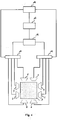
- FIG. 1 shows an apparatus according to a first embodiment of the present invention and a carton box 1 that contains a plurality of building technology devices (not individually shown) that are to be configured.
- the carton box 1 is only one example for any kind of arrangement of a plurality of preferably identical devices, that are arranged so that they may not be accessed individually but only as a group consisting of a plurality of devices.
- the apparatus comprises eight antennas 2..9, two multiplexers 10, 11, a power splitter 12, a NFC reader/writer 13 and a control means 14.
- the antennas 2..9 are arranged around the carton box 1 (top-down view) and are directed towards the carton box 1, wherein each antenna 2..9 is directed to a different area of the carton box 1.
- the building technology devices can be stacked on a pallet.
- the control means 14 which can be a tablet, laptop, smart phone or personal computer, includes a graphical user interface and a software application configured to assist a user to select/acquire the configuration data to be transmitted to the building technology devices, which can be LED control gears, ballasts, luminaires and/or sensor devices.
- the selected configuration data are output to the NFC reader/writer 13 that modulates the configuration data on a signal to be supplied to at least one of the antennas 2..9.
- the power splitter 12 forwards the signal received from the NFC reader/writer 13 to the two multiplexers 10, 11.
- the power splitter 12 enables to divide received power for feeding two antennas so that that radiation of a single antenna does not exceed a predetermined threshold, based on governmental regulations.
- the control means 14 controls the multiplexers 10, 11, so that the signal is supplied to the at least one antenna 2..9, from which the signal is transmitted to the building technology devices.
- the antennas 2..9 transmitting the signal are switched/changed by the multiplexers 10, 11, so that the position and/or direction, from which the configuration data are received by the building technology devices, is changed during the configuration operation.
- the chronological order of the active antennas 2..9 can be: antenna 2 -> antenna 3 -> antenna 4 -> antenna 5 -> antenna 6 -> antenna 7 -> antenna 8 -> antenna 9.
- two or more opposing antennas set of opposing antennas
- Other combinations of active antennas are possible/switchable and can be manually or automatically selected dependent on the form of the carton box 1, type of the building technology device and/or the positions of the building technology devices in the carton box 1.
- the same effect of changing the coverage area inside the entirety of devices to which the configuration data shall be transmitted may be achieved by moving at least one antenna relative to the devices.
- the "coverage area” is considered to represent a volume in which signal quality and signal strength are sufficient to successfully transmit data to devices whose antenna is arranged - a correct orientation of the antenna assumed - inside this volume, so that the devices are successfully configured.
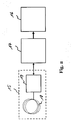
- FIG. 2 shows one building technology device according to an embodiment of the present invention, which one of the plurality of devices is included in the carton box 1 shown in FIG. 1 .
- the building technology device shown in FIG. 2 is an LED control gear and comprises a transponder 15 that receives and stores the configuration data, an LED driver 16 and a controller 17 that controls the LED driver 16 based on the configuration data.
- the controller 17 can be a microcontroller or an Application-Specific Integrated Circuit (ASIC).
- the transponder 15 includes an antenna 18, a control unit 19 and an EEPROM (not shown) that stores the configuration data received via the antenna 18.
- the controller 17 reads out the stored configuration data, when the building technology device/LED control gear is connected to the mains supply and the controller 17 is supplied with power, and controls the LED driver 16 based the configuration operation.
- the control unit 19 determines whether the configuration data are received in its entirety by performing cyclic redundancy check (CRC) and transmits, if the check has been successfully completed, a response or an acknowledgment to the apparatus in order to indicate the successful configuration.
- CRC cyclic redundancy check
- the received configuration data are always stored in the EEPROM or only when they are new.
- the configuration data can contain version information and the transponder can compare the version information of the received configuration data and the version information of the configuration data already stored in the EEPROM to determine whether or not the received configuration data are new, i.e. whether or not the stored configuration data are to be overwritten by the received configuration data.
- the response from the device includes information, based on which the apparatus determines whether all building technology devices in the carton box 1 are configured and includes at least a unique device identifier.
- the response may include besides the unique identifier of the building technology device (or its transponder 15) the number of configurations cycles that is counted by the control unit 19.
- Each building technology device that is successfully configured by the apparatus sends the response, which is received by the NFC reader/writer 13 via one of the active antennas 2..9.
- the control means 14 compares the received unique identifiers included in the responses and a list of unique identifiers of the entirety of devices to be configured and included in the carton box 1, and determines whether all building technology devices in the carton box 1 are configured.
- the unique identifiers and/or the number of the building technology devices that are not yet successfully configured are displayed and/or the user is requested to change the position of the carton box 1 and to continue with a new cycle in the configuration operation if not all building technology devices in the carton box 1 are configured.
- the list stored in the control means may include a correspondence between a unique device identifier and a counter value that is incremented in the device each time the device is successfully configured.
- the list is updated for every response received. When a new response is received after a further transmission cycle, the received counter value associated with a unique device identifier of a device allows to determine those devices which have not yet been successfully configured.
- control means 14 controls the multiplexers 10, 11 to change the antenna(s) 2..9 and/or the combination of the antennas 2..9, from which the configuration data are transmitted.
- the control means 14 can initiate a third phase (third transmission cycle) of the configuration operation (third combination of active antennas 2..9) or can simply try again the first and/or second combination (temporary disturbance) in order to receive the response having the counter value of three and/or can display a message as described above.
- the configuration operation can be terminated automatically when all building technology devices are configured.
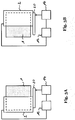
- FIG. 3A shows another arrangement, in which the carton box 1 is arranged with a first relative position and orientation for transmission of configuration data in a first cycle.
- the apparatus shown in FIG. 3A comprises two opposing antennas 2 with the carton box 1 in between, the NFC reader/writer 13, the control means 14 and a drive system 20 that is controlled by the control means 14 and that moves the antennas 2 parallel to the upper surface of the carton box 1.
- the antennas 2 are positioned on the left side and the selected configuration data are outputted by the control means 14 to the NFC reader/writer 13 that modulates the configuration data on a signal that is supplied to the antenna 2.
- the configuration data are transmitted and may successfully program the devices whose antennas are located in the coverage area of the antennas 2 being in the position shown in fig.
- the antenna 2 is positioned on the right side for changing the position and/or direction, from which the configuration data are received by the building technology devices. Together with the movement of the antennas 2, the coverage area of the antennas 2 has changed and consequently at least some other devices than during the first cycle are now in the coverage may be programmed.
- the responses of the building technology devices received after each transmission cycle are analyzed as described above.
- the antenna 2 can be arranged lateral to the carton box 1 and/or the carton box 1 can be moved parallel to the antenna 2 or rotated.
- the control means 14 shown in FIG. 1 and/or 3A and 3B can be configured to determine, by machine learning based on the received responses, most efficient antenna combinations and/or positions for a fast configuration operation.
- the distance between the antenna 2 and the carton box 1 can be changed, the position of the carton box 1 and/or the position of the antenna 2 can be changed, and/or the orientation/pose of the carton box 1, the orientation/pose of the antenna 2 can be changed by, for example, rotating/tilling the carton box 1 and/or the antenna 2, and/or the number of active antennas 2 that transmit the configuration data in a transmission cycle can be changed.
- the number of active antennas 2 adjacent to one another can be increased in a cascade-like manner.
- the control means 14 of the apparatuses described above includes a graphical user interface.
- the control means 14 can be a microcontroller and the configuration operation can be started manually by the user or can be started automatically when a sensor detects the carton box 1 inserted in the apparatus, wherein the configuration data to be transmitted are stored in the apparatus or are acquired from a server.
- FIG. 4 shows a very simplistic flowchart showing the single steps performed by the method described in detail above.
Landscapes
- Engineering & Computer Science (AREA)
- Automation & Control Theory (AREA)
- Computer Networks & Wireless Communication (AREA)
- Signal Processing (AREA)
- Mobile Radio Communication Systems (AREA)
Abstract
Description
- The invention relates to an apparatus and method for configuring building technology devices. The invention further relates to a building technology device that can be configured by the apparatus in large quantity.
- The term "configuring" is generally used to refer to both, the programming of devices for dedicated behavior and to assign operating parameters and/or addresses to the devices.
-
DE 10 2016 210 414 A1 discloses a system for wirelessly configuring components of a lighting system, in which the components comprise RFID or NFC transponder to receive configuration data transmitted from a read/write device, so that the components can be configured in a de-energised state and, thus, before they are installed. - However, this system does not allow to configure a plurality of devices in a single operation, for example, at the factory before delivery. One problem is that the transmitted signal is not strong enough to ensure proper reception at all devices. Another problem is the verification whether all devices are successfully configured.
- It is an object of the present invention to overcome the above-mentioned drawbacks and to provide an improved apparatus for configuring a plurality of building technology devices. More specifically, it is an object of the invention to provide an apparatus and a method, with which a plurality of devices can be configured in a time efficient manner and to provide a building technology device that can be easily configured in large volumes.
- This object is achieved by an apparatus, a method and a building technology device according to the enclosed independent claims. Advantageous features of the present invention are defined in the corresponding dependent claims. According to the present invention, an apparatus for configuring building technology devices comprises a control means for acquiring configuration data and for controlling a transmission of the configuration data to the building technology devices using at least one antenna for transmitting the configuration data to the building technology devices. Further, the apparatus comprises a changing means for changing a position and/or direction of the antenna from which the configuration data are received by the building technology devices. The transmission of the configuration data is executed in a plurality of transmission cycles, at least one before and one after the position and/or direction change.
- The strength of the signal transmitted by an antenna is limited and the strengths of the signals received by the building technology devices are different and are dependent on the device position and/or orientation with respect to the antenna, and on the coverage area of the antenna. With the present invention, the position and/or direction (including the distance between the antenna and the building technology devices) is changed during the configuration operation relative to the devices, and for each position and/or direction one transmission cycle is executed so that all devices are covered by a region of sufficient signal strength and receive the configuration data. The position and/or direction is automatically changed during the configuration operation (between the transmission cycles) or only if it is determined that the configuration data are not successfully received by all devices in a transmission cycle, which means that not all devices are configured.
- The apparatus may comprise a plurality of antennas arranged at different positions and/or with different orientations relative to the devices, wherein the changing means is configured to switch between different antennas for changing the position and/or direction.
- Alternatively or in addition, the changing means can be configured to move the at least one antenna and/or the building technology devices relative to each other for changing the position and/or direction. In that case, even one antenna would be sufficient to cover the entire plurality of devices with sufficient signal strength.
- Alternatively or in addition, the apparatus comprises two or more opposing antennas to enable a homogenous field distribution between the opposing antennas, wherein all or a part of the building technology devices can be positioned between the opposing antennas.
- The control means can be configured to receive after each transmission cycle, via the at least one antenna, a response from each building technology devices that has received the configuration data, and can be configured to determine, based on the response, a unique device identifier of the building technology devices that are configured successfully. Thus, the building technology devices or at least the number of the building technology devices that are not configured can be determined. Information on the determination result can be output or displayed.
- In addition, the control means can be configured to control the changing means to change the relative position and/or direction, when not all building technology devices of the plurality of devices, which are for example included in a list stored in the apparatus, are configured successfully.
- The response that is received from the successfully configured devices may indicate the number of configurations of the building technology device executed, wherein the control means is configured to detect the number of configurations in each received response and to determine, based on the numbers of configurations determined in the entirety of receives responses, the number of the building technology devices that are configured in the completed transmission cycles.
- Alternatively or in addition, the control means is configured to detect the unique device identifier in each received response and to count the number of different device identifiers received and/or to match the received device identifiers and device identifiers included in a list indicating the entirety of the building technology devices to be configured.
- According to the present invention, a building technology device comprises a transponder for receiving the configuration data transmitted by the above-described apparatus, storing the configuration data and transmitting a response to the apparatus. Further, the device comprises control means for controlling the building technology device based on the received configuration data.
- The transponder may be configured to receive and store the configuration data when the building technology device is not supplied with power (de-energised state) and the control means is configured to read out the configuration data when the building technology device is supplied with power.
- Alternatively or in addition, the transponder can be configured to determine whether or not the configuration data are received in its entirety by performing, for example, cyclic redundancy check (CRC) and to transmit the response to said apparatus, if the configuration data are received in its entirety.
- Alternatively or in addition, the transponder can be configured to count the number of transmissions, in which the configuration data are received in its entirety, and to transmit the response indicating the number of transmissions to said apparatus. Counting the number of transmissions may be conducted by incrementing a counter each time received configuration data is stored successfully in an internal memory of the transponder.
- Alternatively or in addition, after the transmission, the transponder send back an "acknowledge" including an ID (the unique device identifier).
- The transponder can be configured to store the configuration data each time the configuration data are received or until a predetermined number of transmissions is reached. Alternatively, the configuration data can contain version information and the transponder can be configured to compare the version information of the received configuration data and the version information of the configuration data already stored in the building technology device and to determine, based on the comparison, whether or not the stored configuration data are to be overwritten/replaced by the received configuration data.
- The transponder can be a RFID transponder or a NFC transponder, wherein the at least one antenna is configured to transmit and receive the configuration data to/from the RFID transponder or a NFC transponder.
- According to the present invention, a method for configuring building technology devices comprises the steps of:
- acquiring configuration data,
- transmitting, by at least one antenna, the configuration data to the building technology device,
- changing the relative position and/or direction between the antenna and the building technology devices, from which the configuration data are received by the building technology devices, and
- executing a further transmission cycle for transmitting configuration data to the building technology devices.
- The invention will now be explained in more detail with reference to the accompanying drawings, wherein:
-
FIG. 1 shows, in schematic form, an apparatus according to a first embodiment of the present invention, -
FIG. 2 shows a building technology device according to an embodiment of the present invention, -
FIG. 3A shows, in schematic form, an apparatus according to a second embodiment of the present invention in a first phase, -
FIG. 3B shows, in schematic form, an apparatus according to the second embodiment of the present invention in a second phase, and -
FIG. 4 shows a flowchart of the method according to an embodiment of the present invention. - The same features are denoted by the same reference signs throughout all figures.
-
FIG. 1 shows an apparatus according to a first embodiment of the present invention and acarton box 1 that contains a plurality of building technology devices (not individually shown) that are to be configured. It is to be noted that thecarton box 1 is only one example for any kind of arrangement of a plurality of preferably identical devices, that are arranged so that they may not be accessed individually but only as a group consisting of a plurality of devices. The apparatus comprises eightantennas 2..9, twomultiplexers 10, 11, apower splitter 12, a NFC reader/writer 13 and a control means 14. Theantennas 2..9 are arranged around the carton box 1 (top-down view) and are directed towards thecarton box 1, wherein eachantenna 2..9 is directed to a different area of thecarton box 1. Instead of thecarton box 1, the building technology devices can be stacked on a pallet. - The control means 14, which can be a tablet, laptop, smart phone or personal computer, includes a graphical user interface and a software application configured to assist a user to select/acquire the configuration data to be transmitted to the building technology devices, which can be LED control gears, ballasts, luminaires and/or sensor devices. The selected configuration data are output to the NFC reader/
writer 13 that modulates the configuration data on a signal to be supplied to at least one of theantennas 2..9. Thepower splitter 12 forwards the signal received from the NFC reader/writer 13 to the twomultiplexers 10, 11. Thepower splitter 12 enables to divide received power for feeding two antennas so that that radiation of a single antenna does not exceed a predetermined threshold, based on governmental regulations. - The control means 14 controls the
multiplexers 10, 11, so that the signal is supplied to the at least oneantenna 2..9, from which the signal is transmitted to the building technology devices. In order to transmit the configuration data to almost all building technology devices included in thecarton box 1, theantennas 2..9 transmitting the signal are switched/changed by themultiplexers 10, 11, so that the position and/or direction, from which the configuration data are received by the building technology devices, is changed during the configuration operation. The chronological order of theactive antennas 2..9 can be: antenna 2 -> antenna 3 -> antenna 4 -> antenna 5 -> antenna 6 -> antenna 7 -> antenna 8 -> antenna 9. For an improved time efficiency, it is also possible to use more than one antenna at a time, for example:antennas 2 and 3 -> antennas 9 and 4 -> antennas 8 and 5 -> antennas 7 and 6. Further, for forming a so-called "Helmholtz antenna", which enables relatively homogenous field distribution, it is also possible to use two or more opposing antennas (set of opposing antennas) at the same time, for example:antennas 2 and 7 -> antennas 3 and 6 -> antennas 9 and 4 -> antennas 8 and 5. Other combinations of active antennas are possible/switchable and can be manually or automatically selected dependent on the form of thecarton box 1, type of the building technology device and/or the positions of the building technology devices in thecarton box 1. - It is to be noted that the same effect of changing the coverage area inside the entirety of devices to which the configuration data shall be transmitted, may be achieved by moving at least one antenna relative to the devices. For conciseness of the further explanation it will, however, be referred to the multiple antenna configuration as shown in
FIG. 1 . The "coverage area" is considered to represent a volume in which signal quality and signal strength are sufficient to successfully transmit data to devices whose antenna is arranged - a correct orientation of the antenna assumed - inside this volume, so that the devices are successfully configured. -
FIG. 2 shows one building technology device according to an embodiment of the present invention, which one of the plurality of devices is included in thecarton box 1 shown inFIG. 1 . The building technology device shown inFIG. 2 is an LED control gear and comprises atransponder 15 that receives and stores the configuration data, anLED driver 16 and acontroller 17 that controls theLED driver 16 based on the configuration data. Thecontroller 17 can be a microcontroller or an Application-Specific Integrated Circuit (ASIC). Thetransponder 15 includes anantenna 18, acontrol unit 19 and an EEPROM (not shown) that stores the configuration data received via theantenna 18. Thecontroller 17 reads out the stored configuration data, when the building technology device/LED control gear is connected to the mains supply and thecontroller 17 is supplied with power, and controls theLED driver 16 based the configuration operation. - The
control unit 19 determines whether the configuration data are received in its entirety by performing cyclic redundancy check (CRC) and transmits, if the check has been successfully completed, a response or an acknowledgment to the apparatus in order to indicate the successful configuration. The received configuration data are always stored in the EEPROM or only when they are new. - The configuration data can contain version information and the transponder can compare the version information of the received configuration data and the version information of the configuration data already stored in the EEPROM to determine whether or not the received configuration data are new, i.e. whether or not the stored configuration data are to be overwritten by the received configuration data.
- The response from the device includes information, based on which the apparatus determines whether all building technology devices in the
carton box 1 are configured and includes at least a unique device identifier. The response may include besides the unique identifier of the building technology device (or its transponder 15) the number of configurations cycles that is counted by thecontrol unit 19. Each building technology device that is successfully configured by the apparatus sends the response, which is received by the NFC reader/writer 13 via one of theactive antennas 2..9. - After the configuration data are transmitted by the at least one of the
antennas 2..9 or a plurality ofantennas 2..9, the control means 14 compares the received unique identifiers included in the responses and a list of unique identifiers of the entirety of devices to be configured and included in thecarton box 1, and determines whether all building technology devices in thecarton box 1 are configured. The unique identifiers and/or the number of the building technology devices that are not yet successfully configured are displayed and/or the user is requested to change the position of thecarton box 1 and to continue with a new cycle in the configuration operation if not all building technology devices in thecarton box 1 are configured. - The list stored in the control means may include a correspondence between a unique device identifier and a counter value that is incremented in the device each time the device is successfully configured. The list is updated for every response received. When a new response is received after a further transmission cycle, the received counter value associated with a unique device identifier of a device allows to determine those devices which have not yet been successfully configured.
- Alternatively or in addition, when it is determined that not all building technology devices are successfully configured and/or the configuration data are not transmitted by all
antennas 2..9, the control means 14 controls themultiplexers 10, 11 to change the antenna(s) 2..9 and/or the combination of theantennas 2..9, from which the configuration data are transmitted. - In case of using only one antenna or only one set of opposing antennas, at this point in time, the position and/or direction of this antenna relative to the
carton box 1 is changed. - It is also possible to perform the completeness check based on the number of configurations (counter value) indicated in each response, when merely the number of the building technology devices in the
carton box 1 is known and the initial counter values of all building technology devices are equal. For example, when the number of the building technology devices is twenty und the initial counter value is two, in a first phase (first transmission cycle) of the configuration operation (first combination ofactive antennas 2..9), fifteen responses have a counter value of three, and, in a second phase (second transmission cycle) of the configuration operation (second combination ofactive antennas 2..9), four responses have a counter value of three and ten responses have a counter value of four, the control means 14 determines that nineteen (15+4) building technology devices are configured at least once, ten building technology devices are configured twice and, consequently, one building technology device has not been configured, yet. The control means 14 can initiate a third phase (third transmission cycle) of the configuration operation (third combination ofactive antennas 2..9) or can simply try again the first and/or second combination (temporary disturbance) in order to receive the response having the counter value of three and/or can display a message as described above. The configuration operation can be terminated automatically when all building technology devices are configured. -
FIG. 3A shows another arrangement, in which thecarton box 1 is arranged with a first relative position and orientation for transmission of configuration data in a first cycle. The apparatus shown inFIG. 3A comprises two opposingantennas 2 with thecarton box 1 in between, the NFC reader/writer 13, the control means 14 and adrive system 20 that is controlled by the control means 14 and that moves theantennas 2 parallel to the upper surface of thecarton box 1. In the first phase, theantennas 2 are positioned on the left side and the selected configuration data are outputted by the control means 14 to the NFC reader/writer 13 that modulates the configuration data on a signal that is supplied to theantenna 2. The configuration data are transmitted and may successfully program the devices whose antennas are located in the coverage area of theantennas 2 being in the position shown infig. 3A . In the second cycle shown inFIG. 3B , theantenna 2 is positioned on the right side for changing the position and/or direction, from which the configuration data are received by the building technology devices. Together with the movement of theantennas 2, the coverage area of theantennas 2 has changed and consequently at least some other devices than during the first cycle are now in the coverage may be programmed. The responses of the building technology devices received after each transmission cycle are analyzed as described above. - Alternatively or in addition, the
antenna 2 can be arranged lateral to thecarton box 1 and/or thecarton box 1 can be moved parallel to theantenna 2 or rotated. - The control means 14 shown in
FIG. 1 and/or 3A and 3B can be configured to determine, by machine learning based on the received responses, most efficient antenna combinations and/or positions for a fast configuration operation. - In order to change the position and/or direction, the distance between the
antenna 2 and thecarton box 1 can be changed, the position of thecarton box 1 and/or the position of theantenna 2 can be changed, and/or the orientation/pose of thecarton box 1, the orientation/pose of theantenna 2 can be changed by, for example, rotating/tilling thecarton box 1 and/or theantenna 2, and/or the number ofactive antennas 2 that transmit the configuration data in a transmission cycle can be changed. In particular, during the configuration operation, the number ofactive antennas 2 adjacent to one another can be increased in a cascade-like manner. - The control means 14 of the apparatuses described above includes a graphical user interface. However, the control means 14 can be a microcontroller and the configuration operation can be started manually by the user or can be started automatically when a sensor detects the
carton box 1 inserted in the apparatus, wherein the configuration data to be transmitted are stored in the apparatus or are acquired from a server. -
FIG. 4 shows a very simplistic flowchart showing the single steps performed by the method described in detail above.
Claims (15)
- Apparatus for configuring a plurality of building technology devices, comprising
control means (14) for acquiring configuration data and for controlling a transmission of the configuration data to the building technology devices via at least one antenna (2..9) in a plurality of transmission cycles, and
changing means (10, 11, 20) for changing a relative position and/or direction from which the configuration data are received by the at least one antenna (2,9) to the plurality of technology devices between the transmission cycles. - The apparatus according to claim 1, wherein
the apparatus comprises a plurality of antennas (2..9) arranged at different positions and the changing means (10, 11, 20) is configured to switch between the antennas (2..9) for changing the position and/or direction for successive transmission cycles. - The apparatus according to claim 1 or 2, wherein
the changing means (10, 11, 20) is configured to move the at least one antenna (2..9) and/or the building technology devices relative to each other for changing the position and/or direction. - The apparatus according any one of the preceding claims, wherein
the control means (14) is configured to receive after each transmission cycle, via the at least one antenna (2..9), a response from at least one of the building technology devices to which the configuration data was transmitted, and is configured to determine, based on the response, at least a unique device identifier of each of the building technology devices that is configured successfully. - The apparatus according to claim 4, wherein
the control means (14) is configured to control the changing means (10, 11, 20) to change the position and/or direction, when not all building technology devices the plurality of building technology devices are configured successfully. - The apparatus according to claim 4 or 5, wherein
the response indicates the number of configurations of the building technology device and the control means (14) is configured to detect the number of configurations in each received response and to determine the number of the building technology devices that are configured in each transmission cycle based on the numbers of configurations. - The apparatus according to any one of claims 4 to 6, wherein
the control means (14) is configured to detect the device identifier in each received response and to count the number of different device identifiers received and/or to match the received device identifiers and device identifiers of a list. - The apparatus according to any one of claims 4 to 7, wherein
the control means (14) is configured to detect the device identifier in each received response and to generate a list of unique device identifiers based on the detect the device identifiers. - A building technology device, comprising
a transponder (15) for receiving configuration data transmitted by an apparatus according to any one of claims 1 to 7 and transmitting at least its unique device identifier in a response to said apparatus; and
a controller (17) for controlling the building technology device based on the received configuration data. - The building technology device according to claim 9, wherein
the transponder (15) is configured to receive and store the configuration data when the building technology device is not supplied with power; and
the controller (17) is configured to read out the configuration data when the building technology device is supplied with power. - The building technology device according to claim 9 or 10, wherein
the transponder (15) is configured to determine whether or not the configuration data are received in its entirety and to transmit the response to said apparatus, if the configuration data are received in its entirety. - The building technology device according to claim 11, wherein
the transponder (15) is configured to count the number of transmissions, in which the configuration data are received in its entirety, and to transmit the response indicating the number of transmissions to said apparatus. - The building technology device according to any one of claims 9 to 12, wherein
the configuration data contains version information and the transponder (15) is configured to compare the version information of the received configuration data and the version information of the configuration data already stored in the building technology device and to determine, based on the comparison, whether or not the stored configuration data are to be overwritten by the received configuration data. - The building technology device according to any one of claims 9 to 13, wherein
the transponder (15) is a RFID transponder or a NFC transponder. - A method for configuring building technology devices, comprising the steps of:acquiring configuration data;transmitting, by at least one antenna (2..9), the configuration data to the building technology device; andchanging the relative position and/or direction from which the configuration data are received by the at least one antenna (2,9 to the plurality of technology devices andtransmitting, in a further transmission cycle, configuration data to the plurality of building technology devices.
Priority Applications (1)
| Application Number | Priority Date | Filing Date | Title |
|---|---|---|---|
| EP19200090.9A EP3799358A1 (en) | 2019-09-27 | 2019-09-27 | Bulk configuration of building technology devices |
Applications Claiming Priority (1)
| Application Number | Priority Date | Filing Date | Title |
|---|---|---|---|
| EP19200090.9A EP3799358A1 (en) | 2019-09-27 | 2019-09-27 | Bulk configuration of building technology devices |
Publications (1)
| Publication Number | Publication Date |
|---|---|
| EP3799358A1 true EP3799358A1 (en) | 2021-03-31 |
Family
ID=68084614
Family Applications (1)
| Application Number | Title | Priority Date | Filing Date |
|---|---|---|---|
| EP19200090.9A Pending EP3799358A1 (en) | 2019-09-27 | 2019-09-27 | Bulk configuration of building technology devices |
Country Status (1)
| Country | Link |
|---|---|
| EP (1) | EP3799358A1 (en) |
Cited By (1)
| Publication number | Priority date | Publication date | Assignee | Title |
|---|---|---|---|---|
| WO2023046687A1 (en) | 2021-09-24 | 2023-03-30 | Tridonic Gmbh & Co Kg | Configuration of components of a lighting system by means of a blockable transponder |
Citations (5)
| Publication number | Priority date | Publication date | Assignee | Title |
|---|---|---|---|---|
| US20020055345A1 (en) * | 1996-12-18 | 2002-05-09 | Wood Clifton W. | Wireless communication system, radio frequency communications system, wireless communications method, radio frequency communications method, and backscatter radio frequency communications system |
| US20030120742A1 (en) * | 2000-10-23 | 2003-06-26 | Yoichi Ohgami | Home network system |
| US20110102148A1 (en) * | 2009-10-29 | 2011-05-05 | Laffey Thomas M | Configuration information provided to configurable electronic device residing in a shipping box |
| US20170132168A1 (en) * | 2015-11-09 | 2017-05-11 | Dell Products, Lp | System and Method for Providing Wireless Communications to a Boxed Server |
| US20190007121A1 (en) * | 2015-12-22 | 2019-01-03 | Sony Mobile Communications, Inc. | Operating a wireless communication system |
-
2019
- 2019-09-27 EP EP19200090.9A patent/EP3799358A1/en active Pending
Patent Citations (5)
| Publication number | Priority date | Publication date | Assignee | Title |
|---|---|---|---|---|
| US20020055345A1 (en) * | 1996-12-18 | 2002-05-09 | Wood Clifton W. | Wireless communication system, radio frequency communications system, wireless communications method, radio frequency communications method, and backscatter radio frequency communications system |
| US20030120742A1 (en) * | 2000-10-23 | 2003-06-26 | Yoichi Ohgami | Home network system |
| US20110102148A1 (en) * | 2009-10-29 | 2011-05-05 | Laffey Thomas M | Configuration information provided to configurable electronic device residing in a shipping box |
| US20170132168A1 (en) * | 2015-11-09 | 2017-05-11 | Dell Products, Lp | System and Method for Providing Wireless Communications to a Boxed Server |
| US20190007121A1 (en) * | 2015-12-22 | 2019-01-03 | Sony Mobile Communications, Inc. | Operating a wireless communication system |
Cited By (2)
| Publication number | Priority date | Publication date | Assignee | Title |
|---|---|---|---|---|
| WO2023046687A1 (en) | 2021-09-24 | 2023-03-30 | Tridonic Gmbh & Co Kg | Configuration of components of a lighting system by means of a blockable transponder |
| DE102021124751A1 (en) | 2021-09-24 | 2023-03-30 | Tridonic Gmbh & Co Kg | Configuration of components of a lighting system using a lockable transponder |
Similar Documents
| Publication | Publication Date | Title |
|---|---|---|
| US10887955B2 (en) | Light bulb, intelligent lighting device and method and system for use in configuring same | |
| US8086176B2 (en) | Information processing apparatus, method, and program for performing near field communication with an external device | |
| JP7254976B2 (en) | Operation terminal device, manufacturing system, article manufacturing method, control method for operation terminal device, control program for operation terminal device, and storage medium | |
| EP2026245B1 (en) | RFID system using response control information | |
| US20150341969A1 (en) | Controller and method, device and system for use in configuring same | |
| KR20090023542A (en) | Apparatus and method for providing at least one operating function of a remote control for operating a device | |
| CA2892464C (en) | Light bulb, intelligent lighting device and method and system for use in configuring same | |
| US20050127180A1 (en) | Contactless identification tag, data communication system and contactless identification tag control program | |
| EP2782045B1 (en) | RFID system, communication device and communication program | |
| JP2012063932A (en) | Rfid tag and rfid system | |
| CN105094877B (en) | The method and host-side device and system of a kind of firmware upgrade | |
| US7336154B2 (en) | Method for selecting one or more transponders | |
| RU2190249C2 (en) | Method controlling and programming transponders and device for its realization | |
| US20100156613A1 (en) | Apparatus for communicating with rfid tag | |
| US20220300781A1 (en) | Configuration of a transaction in a contactless electronic device | |
| JP2007518298A (en) | Synchronization during collision prevention | |
| CA2852445A1 (en) | A programmable controller and method, device and system for configuring and updating same | |
| US20050231327A1 (en) | Method for selecting one or more transponders | |
| KR100858053B1 (en) | A Passive RFID Reader and Operation Control Method | |
| JP6535049B2 (en) | RFID apparatus and method for communication using at least one RFID transponder | |
| US20150045931A1 (en) | Machine control system, motion controller, and connection device | |
| JP6549952B2 (en) | Diversity transmitter | |
| JP2009251630A (en) | Rfid management system, rfid reader device, rfid synchronization control device, rfid management device, and rfid management method | |
| US20190026114A1 (en) | Electronic apparatus and wireless communication system | |
| JP2018046351A (en) | Radio tag communication device |
Legal Events
| Date | Code | Title | Description |
|---|---|---|---|
| PUAI | Public reference made under article 153(3) epc to a published international application that has entered the european phase |
Free format text: ORIGINAL CODE: 0009012 |
|
| STAA | Information on the status of an ep patent application or granted ep patent |
Free format text: STATUS: THE APPLICATION HAS BEEN PUBLISHED |
|
| AK | Designated contracting states |
Kind code of ref document: A1 Designated state(s): AL AT BE BG CH CY CZ DE DK EE ES FI FR GB GR HR HU IE IS IT LI LT LU LV MC MK MT NL NO PL PT RO RS SE SI SK SM TR |
|
| AX | Request for extension of the european patent |
Extension state: BA ME |
|
| STAA | Information on the status of an ep patent application or granted ep patent |
Free format text: STATUS: REQUEST FOR EXAMINATION WAS MADE |
|
| 17P | Request for examination filed |
Effective date: 20210910 |
|
| RBV | Designated contracting states (corrected) |
Designated state(s): AL AT BE BG CH CY CZ DE DK EE ES FI FR GB GR HR HU IE IS IT LI LT LU LV MC MK MT NL NO PL PT RO RS SE SI SK SM TR |
|
| STAA | Information on the status of an ep patent application or granted ep patent |
Free format text: STATUS: EXAMINATION IS IN PROGRESS |
|
| 17Q | First examination report despatched |
Effective date: 20230320 |