EP3799073A1 - Method, system and computer readable medium for adaptive advisory control of diabetes - Google Patents
Method, system and computer readable medium for adaptive advisory control of diabetes Download PDFInfo
- Publication number
- EP3799073A1 EP3799073A1 EP20191889.3A EP20191889A EP3799073A1 EP 3799073 A1 EP3799073 A1 EP 3799073A1 EP 20191889 A EP20191889 A EP 20191889A EP 3799073 A1 EP3799073 A1 EP 3799073A1
- Authority
- EP
- European Patent Office
- Prior art keywords
- patient
- insulin
- model
- net effect
- glucose
- Prior art date
- Legal status (The legal status is an assumption and is not a legal conclusion. Google has not performed a legal analysis and makes no representation as to the accuracy of the status listed.)
- Granted
Links
Images







Classifications
-
- A—HUMAN NECESSITIES
- A61—MEDICAL OR VETERINARY SCIENCE; HYGIENE
- A61B—DIAGNOSIS; SURGERY; IDENTIFICATION
- A61B5/00—Measuring for diagnostic purposes; Identification of persons
-
- G—PHYSICS
- G16—INFORMATION AND COMMUNICATION TECHNOLOGY [ICT] SPECIALLY ADAPTED FOR SPECIFIC APPLICATION FIELDS
- G16H—HEALTHCARE INFORMATICS, i.e. INFORMATION AND COMMUNICATION TECHNOLOGY [ICT] SPECIALLY ADAPTED FOR THE HANDLING OR PROCESSING OF MEDICAL OR HEALTHCARE DATA
- G16H50/00—ICT specially adapted for medical diagnosis, medical simulation or medical data mining; ICT specially adapted for detecting, monitoring or modelling epidemics or pandemics
- G16H50/50—ICT specially adapted for medical diagnosis, medical simulation or medical data mining; ICT specially adapted for detecting, monitoring or modelling epidemics or pandemics for simulation or modelling of medical disorders
-
- A—HUMAN NECESSITIES
- A61—MEDICAL OR VETERINARY SCIENCE; HYGIENE
- A61B—DIAGNOSIS; SURGERY; IDENTIFICATION
- A61B5/00—Measuring for diagnostic purposes; Identification of persons
- A61B5/72—Signal processing specially adapted for physiological signals or for diagnostic purposes
- A61B5/7225—Details of analogue processing, e.g. isolation amplifier, gain or sensitivity adjustment, filtering, baseline or drift compensation
-
- A—HUMAN NECESSITIES
- A61—MEDICAL OR VETERINARY SCIENCE; HYGIENE
- A61B—DIAGNOSIS; SURGERY; IDENTIFICATION
- A61B5/00—Measuring for diagnostic purposes; Identification of persons
- A61B5/0002—Remote monitoring of patients using telemetry, e.g. transmission of vital signals via a communication network
- A61B5/0015—Remote monitoring of patients using telemetry, e.g. transmission of vital signals via a communication network characterised by features of the telemetry system
- A61B5/002—Monitoring the patient using a local or closed circuit, e.g. in a room or building
-
- A—HUMAN NECESSITIES
- A61—MEDICAL OR VETERINARY SCIENCE; HYGIENE
- A61B—DIAGNOSIS; SURGERY; IDENTIFICATION
- A61B5/00—Measuring for diagnostic purposes; Identification of persons
- A61B5/0002—Remote monitoring of patients using telemetry, e.g. transmission of vital signals via a communication network
- A61B5/0015—Remote monitoring of patients using telemetry, e.g. transmission of vital signals via a communication network characterised by features of the telemetry system
- A61B5/0022—Monitoring a patient using a global network, e.g. telephone networks, internet
-
- A—HUMAN NECESSITIES
- A61—MEDICAL OR VETERINARY SCIENCE; HYGIENE
- A61B—DIAGNOSIS; SURGERY; IDENTIFICATION
- A61B5/00—Measuring for diagnostic purposes; Identification of persons
- A61B5/103—Measuring devices for testing the shape, pattern, colour, size or movement of the body or parts thereof, for diagnostic purposes
- A61B5/11—Measuring movement of the entire body or parts thereof, e.g. head or hand tremor or mobility of a limb
- A61B5/1118—Determining activity level
-
- A—HUMAN NECESSITIES
- A61—MEDICAL OR VETERINARY SCIENCE; HYGIENE
- A61B—DIAGNOSIS; SURGERY; IDENTIFICATION
- A61B5/00—Measuring for diagnostic purposes; Identification of persons
- A61B5/145—Measuring characteristics of blood in vivo, e.g. gas concentration or pH-value ; Measuring characteristics of body fluids or tissues, e.g. interstitial fluid or cerebral tissue
- A61B5/14532—Measuring characteristics of blood in vivo, e.g. gas concentration or pH-value ; Measuring characteristics of body fluids or tissues, e.g. interstitial fluid or cerebral tissue for measuring glucose, e.g. by tissue impedance measurement
-
- A—HUMAN NECESSITIES
- A61—MEDICAL OR VETERINARY SCIENCE; HYGIENE
- A61B—DIAGNOSIS; SURGERY; IDENTIFICATION
- A61B5/00—Measuring for diagnostic purposes; Identification of persons
- A61B5/48—Other medical applications
- A61B5/4806—Sleep evaluation
- A61B5/4812—Detecting sleep stages or cycles
-
- A—HUMAN NECESSITIES
- A61—MEDICAL OR VETERINARY SCIENCE; HYGIENE
- A61B—DIAGNOSIS; SURGERY; IDENTIFICATION
- A61B5/00—Measuring for diagnostic purposes; Identification of persons
- A61B5/48—Other medical applications
- A61B5/4836—Diagnosis combined with treatment in closed-loop systems or methods
- A61B5/4839—Diagnosis combined with treatment in closed-loop systems or methods combined with drug delivery
-
- A—HUMAN NECESSITIES
- A61—MEDICAL OR VETERINARY SCIENCE; HYGIENE
- A61B—DIAGNOSIS; SURGERY; IDENTIFICATION
- A61B5/00—Measuring for diagnostic purposes; Identification of persons
- A61B5/48—Other medical applications
- A61B5/4848—Monitoring or testing the effects of treatment, e.g. of medication
-
- A—HUMAN NECESSITIES
- A61—MEDICAL OR VETERINARY SCIENCE; HYGIENE
- A61B—DIAGNOSIS; SURGERY; IDENTIFICATION
- A61B5/00—Measuring for diagnostic purposes; Identification of persons
- A61B5/48—Other medical applications
- A61B5/4857—Indicating the phase of biorhythm
-
- A—HUMAN NECESSITIES
- A61—MEDICAL OR VETERINARY SCIENCE; HYGIENE
- A61B—DIAGNOSIS; SURGERY; IDENTIFICATION
- A61B5/00—Measuring for diagnostic purposes; Identification of persons
- A61B5/48—Other medical applications
- A61B5/486—Biofeedback
-
- A—HUMAN NECESSITIES
- A61—MEDICAL OR VETERINARY SCIENCE; HYGIENE
- A61B—DIAGNOSIS; SURGERY; IDENTIFICATION
- A61B5/00—Measuring for diagnostic purposes; Identification of persons
- A61B5/48—Other medical applications
- A61B5/4866—Evaluating metabolism
-
- A—HUMAN NECESSITIES
- A61—MEDICAL OR VETERINARY SCIENCE; HYGIENE
- A61B—DIAGNOSIS; SURGERY; IDENTIFICATION
- A61B5/00—Measuring for diagnostic purposes; Identification of persons
- A61B5/72—Signal processing specially adapted for physiological signals or for diagnostic purposes
- A61B5/7271—Specific aspects of physiological measurement analysis
- A61B5/7275—Determining trends in physiological measurement data; Predicting development of a medical condition based on physiological measurements, e.g. determining a risk factor
-
- A—HUMAN NECESSITIES
- A61—MEDICAL OR VETERINARY SCIENCE; HYGIENE
- A61B—DIAGNOSIS; SURGERY; IDENTIFICATION
- A61B5/00—Measuring for diagnostic purposes; Identification of persons
- A61B5/72—Signal processing specially adapted for physiological signals or for diagnostic purposes
- A61B5/7271—Specific aspects of physiological measurement analysis
- A61B5/7278—Artificial waveform generation or derivation, e.g. synthesizing signals from measured signals
-
- A—HUMAN NECESSITIES
- A61—MEDICAL OR VETERINARY SCIENCE; HYGIENE
- A61B—DIAGNOSIS; SURGERY; IDENTIFICATION
- A61B5/00—Measuring for diagnostic purposes; Identification of persons
- A61B5/72—Signal processing specially adapted for physiological signals or for diagnostic purposes
- A61B5/7271—Specific aspects of physiological measurement analysis
- A61B5/7282—Event detection, e.g. detecting unique waveforms indicative of a medical condition
-
- A—HUMAN NECESSITIES
- A61—MEDICAL OR VETERINARY SCIENCE; HYGIENE
- A61B—DIAGNOSIS; SURGERY; IDENTIFICATION
- A61B5/00—Measuring for diagnostic purposes; Identification of persons
- A61B5/74—Details of notification to user or communication with user or patient; User input means
- A61B5/742—Details of notification to user or communication with user or patient; User input means using visual displays
- A61B5/743—Displaying an image simultaneously with additional graphical information, e.g. symbols, charts, function plots
-
- A—HUMAN NECESSITIES
- A61—MEDICAL OR VETERINARY SCIENCE; HYGIENE
- A61B—DIAGNOSIS; SURGERY; IDENTIFICATION
- A61B5/00—Measuring for diagnostic purposes; Identification of persons
- A61B5/74—Details of notification to user or communication with user or patient; User input means
- A61B5/7475—User input or interface means, e.g. keyboard, pointing device, joystick
-
- A—HUMAN NECESSITIES
- A61—MEDICAL OR VETERINARY SCIENCE; HYGIENE
- A61M—DEVICES FOR INTRODUCING MEDIA INTO, OR ONTO, THE BODY; DEVICES FOR TRANSDUCING BODY MEDIA OR FOR TAKING MEDIA FROM THE BODY; DEVICES FOR PRODUCING OR ENDING SLEEP OR STUPOR
- A61M5/00—Devices for bringing media into the body in a subcutaneous, intra-vascular or intramuscular way; Accessories therefor, e.g. filling or cleaning devices, arm rests
- A61M5/14—Infusion devices, e.g. infusing by gravity; Blood infusion; Accessories therefor
- A61M5/168—Means for controlling media flow to the body or for metering media to the body, e.g. drip meters, counters
- A61M5/16886—Means for controlling media flow to the body or for metering media to the body, e.g. drip meters, counters for measuring fluid flow rate, i.e. flowmeters
-
- A—HUMAN NECESSITIES
- A61—MEDICAL OR VETERINARY SCIENCE; HYGIENE
- A61M—DEVICES FOR INTRODUCING MEDIA INTO, OR ONTO, THE BODY; DEVICES FOR TRANSDUCING BODY MEDIA OR FOR TAKING MEDIA FROM THE BODY; DEVICES FOR PRODUCING OR ENDING SLEEP OR STUPOR
- A61M5/00—Devices for bringing media into the body in a subcutaneous, intra-vascular or intramuscular way; Accessories therefor, e.g. filling or cleaning devices, arm rests
- A61M5/14—Infusion devices, e.g. infusing by gravity; Blood infusion; Accessories therefor
- A61M5/168—Means for controlling media flow to the body or for metering media to the body, e.g. drip meters, counters
- A61M5/172—Means for controlling media flow to the body or for metering media to the body, e.g. drip meters, counters electrical or electronic
- A61M5/1723—Means for controlling media flow to the body or for metering media to the body, e.g. drip meters, counters electrical or electronic using feedback of body parameters, e.g. blood sugar or pressure
-
- G—PHYSICS
- G16—INFORMATION AND COMMUNICATION TECHNOLOGY [ICT] SPECIALLY ADAPTED FOR SPECIFIC APPLICATION FIELDS
- G16H—HEALTHCARE INFORMATICS, i.e. INFORMATION AND COMMUNICATION TECHNOLOGY [ICT] SPECIALLY ADAPTED FOR THE HANDLING OR PROCESSING OF MEDICAL OR HEALTHCARE DATA
- G16H20/00—ICT specially adapted for therapies or health-improving plans, e.g. for handling prescriptions, for steering therapy or for monitoring patient compliance
- G16H20/10—ICT specially adapted for therapies or health-improving plans, e.g. for handling prescriptions, for steering therapy or for monitoring patient compliance relating to drugs or medications, e.g. for ensuring correct administration to patients
- G16H20/17—ICT specially adapted for therapies or health-improving plans, e.g. for handling prescriptions, for steering therapy or for monitoring patient compliance relating to drugs or medications, e.g. for ensuring correct administration to patients delivered via infusion or injection
-
- G—PHYSICS
- G16—INFORMATION AND COMMUNICATION TECHNOLOGY [ICT] SPECIALLY ADAPTED FOR SPECIFIC APPLICATION FIELDS
- G16Z—INFORMATION AND COMMUNICATION TECHNOLOGY [ICT] SPECIALLY ADAPTED FOR SPECIFIC APPLICATION FIELDS, NOT OTHERWISE PROVIDED FOR
- G16Z99/00—Subject matter not provided for in other main groups of this subclass
-
- A—HUMAN NECESSITIES
- A61—MEDICAL OR VETERINARY SCIENCE; HYGIENE
- A61B—DIAGNOSIS; SURGERY; IDENTIFICATION
- A61B2505/00—Evaluating, monitoring or diagnosing in the context of a particular type of medical care
- A61B2505/07—Home care
-
- A—HUMAN NECESSITIES
- A61—MEDICAL OR VETERINARY SCIENCE; HYGIENE
- A61B—DIAGNOSIS; SURGERY; IDENTIFICATION
- A61B2560/00—Constructional details of operational features of apparatus; Accessories for medical measuring apparatus
- A61B2560/02—Operational features
- A61B2560/0295—Operational features adapted for recording user messages or annotations
-
- A—HUMAN NECESSITIES
- A61—MEDICAL OR VETERINARY SCIENCE; HYGIENE
- A61B—DIAGNOSIS; SURGERY; IDENTIFICATION
- A61B2560/00—Constructional details of operational features of apparatus; Accessories for medical measuring apparatus
- A61B2560/04—Constructional details of apparatus
- A61B2560/0475—Special features of memory means, e.g. removable memory cards
-
- G—PHYSICS
- G16—INFORMATION AND COMMUNICATION TECHNOLOGY [ICT] SPECIALLY ADAPTED FOR SPECIFIC APPLICATION FIELDS
- G16H—HEALTHCARE INFORMATICS, i.e. INFORMATION AND COMMUNICATION TECHNOLOGY [ICT] SPECIALLY ADAPTED FOR THE HANDLING OR PROCESSING OF MEDICAL OR HEALTHCARE DATA
- G16H20/00—ICT specially adapted for therapies or health-improving plans, e.g. for handling prescriptions, for steering therapy or for monitoring patient compliance
- G16H20/30—ICT specially adapted for therapies or health-improving plans, e.g. for handling prescriptions, for steering therapy or for monitoring patient compliance relating to physical therapies or activities, e.g. physiotherapy, acupressure or exercising
-
- G—PHYSICS
- G16—INFORMATION AND COMMUNICATION TECHNOLOGY [ICT] SPECIALLY ADAPTED FOR SPECIFIC APPLICATION FIELDS
- G16H—HEALTHCARE INFORMATICS, i.e. INFORMATION AND COMMUNICATION TECHNOLOGY [ICT] SPECIALLY ADAPTED FOR THE HANDLING OR PROCESSING OF MEDICAL OR HEALTHCARE DATA
- G16H50/00—ICT specially adapted for medical diagnosis, medical simulation or medical data mining; ICT specially adapted for detecting, monitoring or modelling epidemics or pandemics
- G16H50/30—ICT specially adapted for medical diagnosis, medical simulation or medical data mining; ICT specially adapted for detecting, monitoring or modelling epidemics or pandemics for calculating health indices; for individual health risk assessment
Definitions
- T1DM Type 1 Diabetes Mellitus
- SH severe hypoglycemia
- Glucose variability or the magnitude and the speed of BG fluctuations, is both the measurable result from this behavioral optimization and the principal feedback to the patient for his/her optimization of diabetes control.
- BG fluctuations in diabetes result from the action of a complex dynamical system perturbed by a behavioral event generator and dependent on two metabolic processes: (i) interaction between exogenous insulin and carbohydrate utilization and (ii) hormonal defenses against hypoglycemia known as counterregulation.
- the bio-behavioral control of T1DM is therefore comprised of: (i) behaviorally-triggered processes of commonly stable glucose fluctuations (e.g. regular postprandial glucose excursions) interrupted by generally random hypoglycemia-triggering behavioral events (e.g. insulin overdose, missed food, or excessive exercise [9,26]); and (ii) physiologic processes depending on a person's metabolic parameters such as insulin sensitivity [4] or counterregulation, which counteracts insulin-induced hypoglycemia, but also suffers from occasional depletion of counterregulatory reserves occurring with repeated hypoglycemia and known as hypoglycemia-associated autonomic failure (HAAF, [16]).
- HAAF hypoglycemia-associated autonomic failure
- BG control techniques such as adaptive control [7,23], physiologic modeling [52,56], control specific to intensive care units [3], or linear quadratic Gaussian optimization (LQG) [24,41].
- LQG linear quadratic Gaussian optimization
- i.v. closed-loop control remains cumbersome and unsuited for outpatient use.
- An alternative to extracorporeal i.v. control has been presented by implantable i.v.-i.p. systems employing intravenous sampling and intra-peritoneal (i.p.) insulin delivery [37,51,55]. The implementation of these systems, however, requires considerable surgery.
- An aspect of an embodiment of the present invention introduces, among other things, the new paradigm of Adaptive Advisory Control (AA Control) - an interactive process involving algorithm-based assessment and communication of physiologic and behavioral parameters and patterns to patients with diabetes, with the goal of assisting the optimization of their glycemic control.
- Applicant has introduced, but not limited thereto, the following: The notion of stochastic process of human behavior: Behavioral events (meals, exercise, going to bed, waking up) cause the system (person) to change its state, e.g. fasting-to-fed, pre-to-post exercise, awake ⁇ asleep. These states form the "state space" of possible situations a person could encounter. Each transition from one state to another corresponds to a behavioral event.
- the behavioral event generator causes system transitions from one state to another. These transitions occur with different probabilities for different people; thus each person is identified by the specific transition probabilities of his/her behavior.
- This concept was formally described by a stochastic process ⁇ (n) built upon the concept of stochastic transitions, i.e. transitions which allow identical precursors at one state to have different consequences at the next.
- the process ⁇ (n) is described by a random variable x n , having its values in some set X n .
- each person is identified by an individual behavioral trajectory defined by his/her own transition probabilities ⁇ p ij ⁇ between any two states (i) and (j).
- This representation enables a formal description of behavioral patterns that may be considered one of the keys (but not limited thereto) to the methods (and systems and computer readable mediums) in this invention - for each person the transition probabilities can be estimated from data, which serves as the base for tracking behavioral patterns.
- an estimator can be devised that slides along a window of continuous glucose monitoring (CGM) data and identifies system (person) state changes.
- CGM continuous glucose monitoring
- Figure 1 graphically presents pilot results in the case of meal observation in a subject from a previously reported study [32]: The meal observer slides down along the days of observation (top-to-bottom). The probability of meal occurring at a certain time is color coded from black (very low) to white (very high). It is seen that, after a week of observation (top line), the times of meals are already well defined and remain stable across 30 days of observation. Breakfast (7:30AM) and dinner at 8:30PM appear defined best for this person [46].
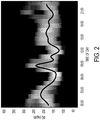
- estimation of a person's risk for hypoglycemia can be based on our risk analysis theory [35] and on the observation that hypoglycemic episodes typically follow detectable patterns of system disturbances [33] as graphically illustrated in Figure 2 : after 10 days of observation a pattern emerges (black line) which shows a tendency for lower BG at 6AM and 12PM. Brighter spots indicate higher likelihood (certainty); thus for this person hypoglycemia pre-breakfast is likely.
- assessment of system stability can be done as graphically presented in Figure 3 , which depicts the glucose rate of change clearly identifying fasting overnight state (bright area continuing until 7AM), and usual times of waking up, and going to bed (11PM) for a participant in a previously reported study.
- An aspect of an embodiment of the present invention introduces an Adaptive Advisory (AA) system assisting the control of diabetes via recognition of key treatment-related bio-behavioral patterns.
- the methods (and systems and computer readable medium) of aspect of embodiments of the invention may use all available sources of information about the patient; (i) BG Data (e.g. self-monitoring of blood glucose (SMBG) and CMG 22 ), (ii) Insulin Data (e.g. insulin pump log files or patient treatment records 32 ), and (iii) Patient Self Reporting Data (e.g. self treatment behaviors, meals, and exercise 52 ) to:
- BG Data e.g. self-monitoring of blood glucose (SMBG) and CMG 22
- Insulin Data e.g. insulin pump log files or patient treatment records 32
- Patient Self Reporting Data e.g. self treatment behaviors, meals, and exercise 52
- the AA system can provide on demand correction-insulin advice to the patient.
- the AA system can be implemented in any contemporary computing device, including portable computers, tablets, a media player (e.g., MP3 based or video player), cellular phone, and smart phones (e.g., personal digital assistant (PDA), as well as Internet-based applications or network applications that have access to the patient data stream.
- a media player e.g., MP3 based or video player
- cellular phone e.g., cellular phone
- smart phones e.g., personal digital assistant (PDA)
- Internet-based applications or network applications that have access to the patient data stream.
- An aspect of an embodiment of the present invention provides a processor-based method for providing posterior assessment of the risk of hypoglycemic of a patient.
- the method may comprise: providing an algorithm to compute a statistic, R hypo (record), for the risk of hypoglycemia based on the absolute BG levels, BG variability, and insulin delivery that is highly correlated to the posterior (conditional) probability of hypoglycemia, P ( E hypo
- An aspect of an embodiment of the present invention provides a processor-based method for retroactively providing a safe level of insulin for the patient.
- the method may comprise: providing an algorithm to retroactively compute a risk-based insulation attenuation factor to the subject's record of insulin delivery; and providing the computed risk-based insulation attenuation factor and applying the risk-based attenuation factor so that any internal threshold is provided to the patient or user for deciding on reduced temporary basal rates before meals and/or following exercise in the future that may be implemented.
- An aspect of an embodiment of the present invention provides a processor-based method for providing a "net effect” based patient adoptive model.
- the method may comprise: providing an algorithm to compute: a dynamic model of the patient's metabolic system, wherein the dynamic model includes descriptive parameters of an individual physiology of the model patient; a corresponding inferred history of behavioral "net effect” model that explains the glucose variability in the historical record through the dynamic model; wherein the "net effect" model includes a mathematical representation perturbations of the model patient; and an update of the patient's physiological parameters based on both (i) the ability of the dynamic model to predict future BG based on known inputs and (ii) the ability of the model to produce net effect curves that are consistent with the patient's record of the perturbations.
- the method may further comprise providing the update to the patient or user whereby patient or user can use the update for future course of action.
- An aspect of an embodiment of the present invention provides a method that may comprise providing a retroactive assessment of the patient's optimal rate of insulin delivery, wherein the algorithm: retroactively computes what the patient's optimal rate of insulin delivery would have been over a predetermined period of historical time given that the disturbances to the system are exactly the historical of net effect curves computed for the patient over that interval of time, wherein for each "history" of net effect curves there is a corresponding "history" of insulin delivery rates that account for meals, exercise, and corrections for each day in the considered interval of time; maps between the net effect curve for a given day and the model-based response of an optimal controller, wherein these vectors of optimal responses are collected and analyzed, and presented to the patient or user for a day-by-day review of insulin treatment; extracts features from the optimal responses that correspond to important but random events by subtracting discrete amounts of insulin associated with meals or accounting for discrete insulin deficits associated with temporary basal rates around exercise, whereby the remaining schedule of insulin delivery corresponds to a representation of the
- the method may further comprise: providing to the patient or user the median level of basal insulin that would have been applied in each segment, wherein the patient or user could use this information to (i) decide upon on reduced temporary basal rates before meals and/or following exercise in the future or (ii) adjust the patient's long-term basal rate profile.
- An aspect of an embodiment of the present invention provides a method that may comprise providing an on-demand adaptive correction of insulin advice model.
- the method may comprise providing an algorithm to include the following computations: retrospective detecting for meal and exercise activities; stochastic modeling to provide a description about the timing and content of meals and exercise; and providing insulin correction advice to a patient or user that would be in response to a patient and user request.
- An aspect of an embodiment of the present invention provides a system for providing posterior assessment of the risk of hypoglycemic of a patient.
- the system may comprise: a retroactive risk-based safety module having a processor to compute a statistic, R hypo (record), for the risk of hypoglycemia based on the absolute BG levels, BG variability, and insulin delivery that is highly correlated to the posterior (conditional) probability of hypoglycemia, P ( E hypo
- An aspect of an embodiment of the present invention provides a system for retroactively providing a safe level of insulin for the patient.
- the system may comprise: a retroactive risk-based safety module having a processor to retroactively compute a risk-based insulation attenuation factor to the subject's record of insulin delivery; and the processor outputs the computed risk-based insulation attenuation factor and applying the risk-based attenuation factor so that any internal threshold is provided to the patient or user for deciding on reduced temporary basal rates before meals and/or following exercise in the future that may be implemented.
- An aspect of an embodiment of the present invention provides a system for providing a "net effect" based patient adoptive model.
- the system may comprise: a net effect estimator module having a processor to compute: a dynamic model of the patient's metabolic system, wherein the dynamic model includes descriptive parameters of an individual physiology of the model patient; and a corresponding inferred history of behavioral "net effect” model that explains the glucose variability in the historical record through the dynamic model; wherein the "net effect" model includes a mathematical representation perturbations of the model patient; and a model updater module having a processor to compute: an update of the patient's physiological parameters based on both (i) the ability of the dynamic model to predict future BG based on known inputs and (ii) the ability of the model to produce net effect curves that are consistent with the patient's record of the perturbations.
- the system outputs the update to the patient or user whereby patient or user can use the update for future course of action.
- An aspect of an embodiment of the present invention provides a system configured to provide a retroactive assessment of the patient's optimal rate of insulin delivery.
- the system comprises a retrospective optimal control analyzer module having a processor configured to: retroactively compute what the patient's optimal rate of insulin delivery would have been over a predetermined period of historical time given that the disturbances to the system are exactly the historical of net effect curves computed for the patient over that interval of time, wherein for each "history" of net effect curves there is a corresponding "history" of insulin delivery rates that account for meals, exercise, and corrections for each day in the considered interval of time; and map between the net effect curve for a given day and the model-based response of an optimal controller, wherein these vectors of optimal responses are collected and analyzed, and presented to the patient or user for a day-by-day review of insulin treatment.
- the system further comprise a retro-optimal basal rate extractor module having a processor configured to: extract features from the optimal responses that correspond to important but random events by subtracting discrete amounts of insulin associated with meals or accounting for discrete insulin deficits associated with temporary basal rates around exercise, whereby the remaining schedule of insulin delivery corresponds to a representation of the patient's "optimal" basal pattern each day in the historical record; and identify consistency in the retroactively computed optimal basal rates, such optimal basal rates in a plurality of duration segments representing the patient's treatment duration.
- a retro-optimal basal rate extractor module having a processor configured to: extract features from the optimal responses that correspond to important but random events by subtracting discrete amounts of insulin associated with meals or accounting for discrete insulin deficits associated with temporary basal rates around exercise, whereby the remaining schedule of insulin delivery corresponds to a representation of the patient's "optimal" basal pattern each day in the historical record; and identify consistency in the retroactively computed optimal basal rates, such optimal basal rates in a plurality of
- the system may be configured to: provide an output to the patient or user the median level of basal insulin that would have been applied in each segment, wherein the patient or user could use this information to (i) decide upon on reduced temporary basal rates before meals and/or following exercise in the future or (ii) adjust the patient's long-term basal rate profile.
- An aspect of an embodiment of the present invention provides a system configured to provide an on-demand adaptive correction of insulin advice model.
- the system may comprise: a retrospective meal and exercise detector module having a processor to provide retrospective detecting for meal and exercise activities; a meal and exercise stochastic modeler module having a processor to provide stochastic modeling to provide a description about the timing and content of meals and exercise; and a correction bolus advisor module having a processor to provide and output insulin correction advice to a patient or user that would be in response to a patient and user request.
- An aspect of an embodiment of the present invention provides a non-transitory computer readable medium containing program instructions for providing posterior assessment of the risk of hypoglycemic of a patient, wherein execution of the program instructions by one or more processors of a computer system causes the processor to carry out the following steps of: providing an algorithm to compute a statistic, R hypo ( record ), for the risk of hypoglycemia based on the absolute BG levels, BG variability, and insulin delivery that is highly correlated to the posterior (conditional) probability of hypoglycemia, P ( E hypo
- An aspect of an embodiment of the present invention provides a non-transitory computer readable medium containing program instructions for retroactively providing a safe level of insulin for the patient, wherein execution of the program instructions by one or more processors of a computer system causes the processor to carry out the following steps of: providing an algorithm to retroactively compute a risk-based insulation attenuation factor to the subject's record of insulin delivery; and providing the computed risk-based insulation attenuation factor and applying the risk-based attenuation factor so that any internal threshold is provided to the patient or user for deciding on reduced temporary basal rates before meals and/or following exercise in the future that may be implemented.
- An aspect of an embodiment of the present invention provides a non-transitory computer readable medium containing program instructions for providing a "net effect" based patient adoptive model, wherein execution of the program instructions by one or more processors of a computer system causes the processor to carry out the following steps of: computing a dynamic model of the patient's metabolic system, wherein the dynamic model includes descriptive parameters of an individual physiology of the model patient; computing a corresponding inferred history of behavioral "net effect" model that explains the glucose variability in the historical record through the dynamic model; wherein the "net effect” model includes a mathematical representation perturbations of the model patient; computing an update of the patient's physiological parameters based on both (i) the ability of the dynamic model to predict future BG based on known inputs and (ii) the ability of the model to produce net effect curves that are consistent with the patient's record of the perturbations; and providing the update to the patient or user whereby patient or user can use the update for future course of action.
- An aspect of an embodiment of the present invention provides a non-transitory computer readable medium providing a retroactive assessment of the patient's optimal rate of insulin delivery, wherein execution of the program instructions by one or more processors of a computer system causes the processor to carry out the following steps of: retroactively computing what the patient's optimal rate of insulin delivery would have been over a predetermined period of historical time given that the disturbances to the system are exactly the historical of net effect curves computed for the patient over that interval of time, wherein for each "history" of net effect curves there is a corresponding "history" of insulin delivery rates that account for meals, exercise, and corrections for each day in the considered interval of time; mapping between the net effect curve for a given day and the model-based response of an optimal controller, wherein these vectors of optimal responses are collected and analyzed, and presented to the patient or user for a day-by-day review of insulin treatment; extracting features from the optimal responses that correspond to important but random events by subtracting discrete amounts of insulin associated with meals or accounting for discrete
- An aspect of an embodiment of the present invention provides a non-transitory computer readable medium providing an on-demand adaptive correction of insulin advice model, wherein execution of the program instructions by one or more processors of a computer system causes the processor to carry out the following steps of: retrospectively detecting for meal and exercise activities; stochastic modeling to provide a description about the timing and content of meals and exercise; and providing insulin correction advice to a patient or user that would be in response to a patient and user request.
- time period may refer to a day
- time period or date
- AA System 10 Some exemplary elements of the AA System 10 are illustrated in Figure 4 . All four primary functions of the system provide, among other things, long-term historical trends in the patient's physiological responses to carbohydrate intake and insulin, as well as to the patient's self treatment, eating, and exercise behaviors.
- the "retroactive" advisory components are designed to illustrate to the patient how a safety-supervised and/or optimal insulin regiment would have differed from what the patient actually did, providing the evidence needed by the patient to change his/her self treatment behaviors.
- the "on demand” component which relies on real-time BG and insulin data in addition to the historical record, can advise the patient on correction insulin amounts, acting in a sense as an adaptive bolus calculator, i.e., adapted to the patient's physiology, anticipated future behaviors, and real-time metabolic state.
- AA System could easily be used in conjunction with a real time safety supervision system, in which CGM and insulin data inform model-based reductions to insulin delivery (e.g. attenuation of basal rate) in real time.
- CGM and insulin data inform model-based reductions to insulin delivery (e.g. attenuation of basal rate) in real time.
- the use of such a safety supervision system is entirely optional.
- modules, systems, sub-systems and devices associated with the invention may be integrally or separately formed in a variety of forms, and be in communication wirelessly or by-wire (or a combination of both) utilizing technology and approaches as would be available to one skilled in the art.
- Some non-limiting examples of device, module, network and system interfaces and communications may be referred to by all of the references, applications and publications disclosed herein (and are hereby incorporated by reference).
- an example of possible interface and communication between the various systems, devices and networks is disclosed in (but not limited thereto) International Patent Application Serial No.
- Output 1 Posterior Assessment of the Risk of Hypoglycemia: This part of the Retroactive Risk-Based Safety subsystem analyzes the historical record and uses kernel density estimates of the patient's BG time series to compute a statistic, R hypo ( record ), for the risk of hypoglycemia based on the absolute BG levels, BG variability, and insulin delivery that is highly correlated to the posterior (conditional) probability of hypoglycemia, P ( E hypo
- the absolute BG levels and BG variability may be data derived from a patient's CGM device (or records or data storage of glucose readings) and the absolute insulin delivery may be data obtained from the patient's insulin pump device (or records or data storage of insulin delivery) from multiple daily injections.
- the manifestation of the AA system is based on CGM and insulin pump data or manual injection of insulin data.
- the components of the AA system can be realized without CGM or an insulin pump, though the time scale for making the computations would have to change considerable.
- SMBG short blood pressure
- insulin pump data could be computed, though such a methodology would need extensively more such "net effect" curves to obtain an accurate representation of patient behavior.
- an SMBG device may be utilized with a manual insulin injection device, such as an insulin pen, needle or similar type of devices.
- Retro-Safe Insulin Delivery 28 This part of the Retroactive Risk-Based Safety subsystem analyzes the historical record and retroactively computes a risk based insulin attenuation factor to the patient's record of insulin delivery.
- Other methods of computing attenuation factors exist, including methods based on assessing the patient's active insulin up to time t and adjusting the measured value of BG at time t, based on the patient's correction factor.
- An exemplary key step of an embodiment of the invention looks for consistency in the retroactively computed attenuation factors. Specifically, the system computes kernel density estimates of ⁇ ( R ( t, ⁇ )) in 24 one-hour bins representing the patient's treatment day, and then presents to the patient the median level attenuation that would have been applied in each hour-long segment. Again, the patient could use this information to lower his/her own internal thresholds for deciding on reduced temporary basal rates before meals and/or following exercise in the future.
- the parts of the system devoted to the "Net Effect"-Based Patient Adaptive Model are illustrated in Figure 6 .
- the model that the AA System produces may include (but not limited thereto) two main components: (i) a dynamic model of the patient's metabolic system and (ii) a corresponding, inferred history of behavioral "net effect" curves that explain the glucose variability in the historical record through the dynamic model.
- the "Net Effect"-Based Patient Adaptive Model is, but not limited thereto, a formal mathematical representation of meal profiles such as those presented in Figure 1 , but also taking into account the influence of other system perturbations, such as physical activity, and sleep/awake periods ( Figure 3 ).
- the metabolic model descriptive of the patient's individual physiology, provides a mathematical representation of the dynamic relationship between oral carbs d (g/min), physical activity e (cal/min), subcutaneous insulin u (U/hr), and the patient's metabolic state vector ⁇ whose elements include glucose and insulin concentrations (mg/dl) in various compartments of the body and carbohydrate mass (mg) in the gut.
- F and G are nonlinear system equations
- ⁇ ( k ) is a vector of parameter values that are characteristic of the patient, such as body weight, volumes of distribution in various compartments, various time constant that describe the rates of absorption and clearance between various compartments, some of which are prone to varying as a function of time k.
- Net Effect Estimator 34 This element of the "Net Effect"-Based Patient Adaptive Model produces a "history" of virtual system inputs (a.k.a. "net effect") that reconciles the patient's historical record of BG 22 and insulin delivery 32.
- a.k.a. net effect the net effect that reconciles the historical information is the vector of virtual carbohydrate inputs ⁇ d n.e.
- dist measures the distance between two vectors of BG concentration (in this case actual BG versus model-predicted BG) given the fixed record of insulin delivery ⁇ u ( k ) ⁇ k ⁇ day and the candidate net effect vector ⁇ d n.e. ( k ) ⁇ k ⁇ day .
- the resulting optimal net effect vector (aka. net effect curve 38 ) ⁇ d n.e. ( k ) ⁇ k ⁇ day optimal reconciles the BG and insulin data collected by the patient through a virtual carbohydrate signal, which captures all external influences on the patient as a single external disturbance signal measured in (mg/min).
- net effect curve 38 When the net effect curve 38 is positive this may correspond to the patient actually eating, or it may correspond a period of the day in which the patient is experiencing enhanced insulin sensitivity. When the net effect curve 38 is negative then this may correspond to the patient engaging in intense physical activity or exercise.
- the computed net effect curve 38 is implicitly a function of the patient's physiological model, parameterized by ⁇ ( k ).
- a poorly adapted physiological model is likely to produce unusual-looking net effect curves 38
- the side-effect of a well-adapted physiological model is a set of net effect curves that correspond well to the patients record or recollection of daily activities, meal and exercise behaviors, and self treatment.
- Model Updater 35 It is common practice to use techniques of "system identification" to recursively update the parameters of dynamic model. In the context of model-based treatment of diabetes, such techniques allow for the estimation of the patients physiological model parameters ⁇ ⁇ ( k ) ⁇ k ⁇ day including daily variability due to the patients circadian rhythm. Many techniques have been employed including linear least-squares fitting of the data, parametric and non-parametric system identification, adaptive recursive estimation.
- an aspect of an embodiment of the present invention addresses, among other things, the latter concerns by integrating the notion of net effect into the long-term adaptation of the patient's physiological model parameters.
- the side-effect of a well-adapted physiological model is a set of "net effect" curves 38 that correspond well to the patients record or recollection of daily activities, meal and exercise behaviors, and self treatment.
- Component 3 Retroactive Assessment of Optimal Insulin Delivery
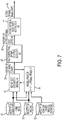
- Retroactive Assessment of Optimal Insulin Delivery The parts of the system devoted to Retroactive Assessment of Optimal Insulin Delivery are illustrated in Figure 7 .
- Optimal Control Analyzer 42 This element of the Retroactive Assessment of Optimal Insulin Delivery subsystem serves to retroactively compute what the patient's optimal rate of insulin delivery would have been over a predetermined period of historical time given that the disturbances to the system are exactly the historical of net effect curves 38 computed for the patient over that interval of time.
- Optimal Insulin Delivery subsystem serves to retroactively compute what the patient's optimal rate of insulin delivery would have been over a predetermined period of historical time given that the disturbances to the system are exactly the historical of net effect curves 38 computed for the patient over that interval of time.
- the disturbances to the system are exactly the historical of net effect curves 38 computed for the patient over that interval of time.
- a corresponding "history" of insulin delivery rates that account for meals, exercise, and corrections for each day in the considered interval of time. For example, associated with any day in the historical record, we have d n . e .
- the Retrospective Optimal Control Analyzer 42 uses both components of the "Net Effect"-Based Patient Adaptive Model, i.e. both the "history” of net effect curves computed for the patient and the adapted patient physiological model.
- a beneficial feature of this architecture is that, but not limited thereto, errors in the patient model (i.e. ⁇ misadapted to the patient) do not have a large effect on the retrospective optimal control analysis. The reason for this is that, while ⁇ may be off, the net effect curves computed for the patient reconcile the actual insulin and BG data for the patient through the model. As long as ⁇ is close (“in the ballpark"), the optimal control responses will still be patient-adapted.
- a novel aspect of an aspect of an embodiment of the present invention is the concept, method, and system based on (i) feeding the patient's history of net effect curves 38 into various types of optimal control algorithms and (ii) retroactively analyzing the optimal responses, and informing the patient of through comparative analysis.
- Retro-Optimal Basal Rate Extractor 44 This element of the Retroactive Assessment of Optimal Insulin Delivery subsystem serves to (i) take the "history 43" of optimal control responses computed by the Retrospective Optimal Control Analyzer 42 and (ii) extract features from the optimal responses that correspond to important but random events (i.e. subtract discrete amounts of insulin associated with meals or account for discrete insulin deficits associated with temporary basal rates around exercise). The remaining schedule of insulin delivery corresponds to a representation of the patient's "optimal" basal pattern each day in the historical record.
- the Retro-Optimal Basal Rate Extractor 44 looks for consistency in the retroactively computed optimal basal rates. Specifically, the system computes kernel density estimates of the optimal basal rates in 24 one-hour bins representing the patient's treatment day, and then presents to the patient the median level of basal insulin 46 that would have been applied in each hour-long segment. The patient could use this information to (i) decide upon on reduced temporary basal rates before meals and/or following exercise in the future or (ii) adjust his/her long-term basal rate profile.
- Component 4 On Demand Adaptive Correction Insulin Advice
- FIG. 8 An over-arching goal, among other things, of this component of the Adaptive Advisory system (and related method) is to provide in-the-moment correction insulin advice to the patient based on both (i) the historical record 22, 32, 52 and (ii) real-time CGM/SMBG measurements and insulin pump data 62.
- One of the first steps of this system may be to develop a stochastic model of upcoming behavioral disturbances. With this model it is possible to reason about appropriate correction insulin amounts that anticipate meals and exercise that are forthcoming.
- Some of the key elements, but not limited thereto, of the On Demand Adaptive Correction Insulin Advice subsystem may be (i) the Retrospective Meal & Exercise Detector, 54 (ii) the Meal & Exercise Stochastic Modeler 56, and (iii) the on demand Correction Bolus Advisor 58, described in the following paragraphs. These elements of the subsystem can work in tandem, and there is also independent value in each element individually.
- Retrospective Meal & Exercise Detector 54 This element of the On Demand Adaptive Correction Insulin Advice subsystem serves to reconcile 55 the current "history" of patient "net effect" curves 38 with the historical record of patient-acknowledged meals and exercise events to produce a validated (high-confidence) record of relevant patient behaviors.
- the Retrospective Meal & Exercise Detector 54 looks for discrepancies between (i) the net effect curves 38 computed from the available BG and insulin data for the patient and (ii) the meal and exercise events 55 that are acknowledged 62 by the patient through the systems user interface.
- the Retrospective Meal & Exercise Detector 54 suggests possible resolutions, such as "Perhaps you had a meal between 1PM and 2PM that you failed to acknowledge?" or "There is an indication to you engaged in intense physical activity between 3PM and 3:30PM. Is this true?" The responses from the patient are then taken to form the final, validated record of relevant patient activities.
- the Retrospective Meal & Exercise Detector 54 employs a method of analyzing the net effect curves 36 to produce discrete estimates of meal and exercise events.
- the method may be based on, among other things, (i) identifying significant local extreme of the net effect curves, (ii) computing areas under the over time-windows that correspond to meals and exercise, (iii) computing most-likely times of meal and exercise events, and then (iv) confirming that the resulting estimation of meal and exercise behaviors yield model-predicted BG traces that are close to the actual record.
- Meal & Exercise Stochastic Modeler 56 This element of the On Demand Adaptive Correction Insulin Advice subsystem serves to take the reconciled (validated) history of behavioral events 55 above, and then produce a stochastic model 57 that describes the timing and content of meals and exercise.
- the model 57 essentially describes the patient's daily behavior as a sequence of non-overlapping meal and exercise regimes. Each regime is described in terms of (i) an earliest possible time at which the disturbance could "arrive” (e.g. the earliest possible breakfast time), (ii) a latest possible disturbance arrival time (e.g. the latest possible breakfast time), and (iii) a relative frequency distribution for the times at which the disturbance arrives within the regime that also accounts for the possibility that the disturbance will be "skipped” [67].
- meal regimes are determined from the reconciled history of meal and exercise events 55 (based on clustering analysis), for estimating the relative frequency distribution of meal timing within the regime, and for characterizing the random variable that describes the size of the meal or exercise disturbance associated with the regime.
- This element of the On Demand Adaptive Correction Insulin Advice subsystem serves to continuously monitor the patient's status and to provide correction insulin advice 59 in the moment the patient asks for it, based on (i) the stochastic model 57 above for upcoming behavioral disturbances and (ii) the current physiological model for the patient (i.e., dynamic model of the patient's metabolic system) that allows for the prediction of the impact of various alternative correction insulin amounts.
- the concept of this user-prompted advisory mode correction system is illustrated in Figure 9.
- Figure 9 graphically illustrates an example of the On Demand Adaptive Correction Insulin System.
- the system and method assumes that (i) the patient is in charge of computing insulin boluses at mealtimes using conventional methods and (ii) the patient uses our advisory system to address unplanned hyperglycemia, such as at time t shown in the figure.
- the patient activates the advisory system, he/she has the option to provide information regarding the timing and content of the next meal, and the system proceeds to update the stochastic model 56 of meal and exercise timing (referred to as the Meal Behavioral Profile and illustrated as a shaded probability distribution in the figure).
- the system computes an insulin recommendation that is optimal with respect the patient's future (random) metabolic trajectory.
- the advised bolus is computed as the optimal solution to an indefinite-horizon linear quadratic problem defined by the uncertain time at which the patient will next eat.
- One of the key benefits of the proposed method is that it is minimally invasive and only provides advice in response to the user's interaction with the system. With the patient being ultimately "in charge,” he/she can easily override the system in case of un-modeled metabolic disturbances, e.g. intense physical activity. Another benefit of the system, among other things, is that it allows the patient to implement a "conventional" bolusing strategy at mealtimes, including the option to implement an extended meal bolus to account for meals with high fat content.
- the framework that we present here computes correction bolus insulin recommendations based on a model of the patient's metabolism, and the framework can adapt to either a "population average" model or patient-specific metabolic models.
- recommended insulin boluses are computed with respect to a model of the patient's individual eating behavior.
- the system is constantly aware of the next meal opportunity and is prepared to optimize correction recommendations with respect to an empirical stochastic model for meal timing and size (including the possibility that the meal will be skipped). Knowing that the patient is responsible for mealtime boluses, the system will avoid making large corrections immediately prior to anticipated meals.
- the insulin recommendations produced by the system anticipate the patient's treatment behavior at the time of the next meal, knowing that the patient will compute a mealtime bolus based on his/her insulin to carbohydrate ratio (CR) and correction factor (CF).
- CR insulin to carbohydrate ratio
- CF correction factor
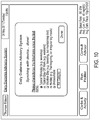
- Figures 10-15 present screenshots of one possible implementation of the AA system on a personal computer. Similar implementations are possible on a tablet, portable computers (e.g., laptops or notebooks), via Internet applications or network applications, cellular phones, or on a smart phone such as PDAs (with appropriately reduced text and graphs if desired or required). Specifically: Figure 10 presents the initialization screen where the system is customized to a particular person;
- Figure 11 provides a screen that presents an opportunity for input of carbohydrate intake (meals) and physical activity by time and amount;
- Figure 12 provides a screen that is a representation of the day in review, including glucose trace and superimposed behaviorally-driven events
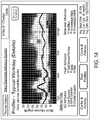
- Figures 13 and 14 provide screens that present daily profiles at a different level of detail (simple in Figure 13 and with added probability plots in Figure 14 );
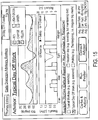
- Figure 15 provides a screen that presents an advisory screen including identified periods of risk for hyper- and hypoglycemia during a typical day off work (shaded red in upper screen panel), and system advice to reduce insulin dose to avoid hypoglycemia (dotted line in lower screen panel).
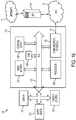
- FIG. 16 is a block diagram that illustrates a system 130 including a computer system 140 and the associated Internet 11 connection upon which an embodiment may be implemented.
- Such configuration is typically used for computers (hosts) connected to the Internet 11 and executing a server or a client (or a combination) software.
- a source computer such as laptop, an ultimate destination computer and relay servers, for example, as well as any computer or processor described herein, may use the computer system configuration and the Internet connection shown in FIG. 16 .
- the system 140 may be used as a portable electronic device such as a notebook/laptop computer, a media player (e.g., MP3 based or video player), a cellular phone, a Personal Digital Assistant (PDA), an image processing device (e.g., a digital camera or video recorder), and/or any other handheld computing devices, or a combination of any of these devices.
- a portable electronic device such as a notebook/laptop computer, a media player (e.g., MP3 based or video player), a cellular phone, a Personal Digital Assistant (PDA), an image processing device (e.g., a digital camera or video recorder), and/or any other handheld computing devices, or a combination of any of these devices.
- PDA Personal Digital Assistant
- FIG. 16 illustrates various components of a computer system, it is not intended to represent any particular architecture or manner of interconnecting the components; as such details are not germane to the present invention. It will also be appreciated that network computers, handheld computers, cell phones and other data processing systems which have
- Computer system 140 includes a bus 137, an interconnect, or other communication mechanism for communicating information, and a processor 138, commonly in the form of an integrated circuit, coupled with bus 137 for processing information and for executing the computer executable instructions.
- Computer system 140 also includes a main memory 134, such as a Random Access Memory (RAM) or other dynamic storage device, coupled to bus 137 for storing information and instructions to be executed by processor 138.
- RAM Random Access Memory
- Main memory 134 also may be used for storing temporary variables or other intermediate information during execution of instructions to be executed by processor 138.
- Computer system 140 further includes a Read Only Memory (ROM) 136 (or other non-volatile memory) or other static storage device coupled to bus 137 for storing static information and instructions for processor 138.
- ROM Read Only Memory
- the hard disk drive, magnetic disk drive, and optical disk drive may be connected to the system bus by a hard disk drive interface, a magnetic disk drive interface, and an optical disk drive interface, respectively.
- the drives and their associated computer-readable media provide non-volatile storage of computer readable instructions, data structures, program modules and other data for the general purpose computing devices.
- computer system 140 includes an Operating System (OS) stored in a non-volatile storage for managing the computer resources and provides the applications and programs with an access to the computer resources and interfaces.
- An operating system commonly processes system data and user input, and responds by allocating and managing tasks and internal system resources, such as controlling and allocating memory, prioritizing system requests, controlling input and output devices, facilitating networking and managing files.
- Non-limiting examples of operating systems are Microsoft Windows, Mac OS X, and Linux.
- processor is meant to include any integrated circuit or other electronic device (or collection of devices) capable of performing an operation on at least one instruction including, without limitation, Reduced Instruction Set Core (RISC) processors, CISC microprocessors, Microcontroller Units (MCUs), CISC-based Central Processing Units (CPUs), and Digital Signal Processors (DSPs).
- RISC Reduced Instruction Set Core
- MCU Microcontroller Unit
- CPU Central Processing Unit
- DSPs Digital Signal Processors
- the hardware of such devices may be integrated onto a single substrate (e.g., silicon "die"), or distributed among two or more substrates.
- various functional aspects of the processor may be implemented solely as software or firmware associated with the processor.
- Computer system 140 may be coupled via bus 137 to a display 131, such as a Cathode Ray Tube (CRT), a Liquid Crystal Display (LCD), a flat screen monitor, a touch screen monitor or similar means for displaying text and graphical data to a user.
- the display may be connected via a video adapter for supporting the display.
- the display allows a user to view, enter, and/or edit information that is relevant to the operation of the system.
- An input device 132 is coupled to bus 137 for communicating information and command selections to processor 138.
- cursor control 133 such as a mouse, a trackball, or cursor direction keys for communicating direction information and command selections to processor 138 and for controlling cursor movement on display 131.
- This input device typically has two degrees of freedom in two axes, a first axis (e.g., x) and a second axis (e.g., y), that allows the device to specify positions in a plane.
- the computer system 140 may be used for implementing the methods and techniques described herein. According to one embodiment, those methods and techniques are performed by computer system 140 in response to processor 138 executing one or more sequences of one or more instructions contained in main memory 134. Such instructions may be read into main memory 134 from another computer-readable medium, such as storage device 135. Execution of the sequences of instructions contained in main memory 134 causes processor 138 to perform the process steps described herein. In alternative embodiments, hard-wired circuitry may be used in place of or in combination with software instructions to implement the arrangement. Thus, embodiments of the invention are not limited to any specific combination of hardware circuitry and software.
- computer-readable medium (or “machine-readable medium”) as used herein is an extensible term that refers to any medium or any memory, that participates in providing instructions to a processor, (such as processor 138 ) for execution, or any mechanism for storing or transmitting information in a form readable by a machine (e.g., a computer).
- a machine e.g., a computer
- Such a medium may store computer-executable instructions to be executed by a processing element and/or control logic, and data which is manipulated by a processing element and/or control logic, and may take many forms, including but not limited to, non-volatile medium, volatile medium, and transmission medium.
- Transmission media includes coaxial cables, copper wire and fiber optics, including the wires that comprise bus 137.
- Transmission media can also take the form of acoustic or light waves, such as those generated during radio-wave and infrared data communications, or other form of propagated signals (e.g., carrier waves, infrared signals, digital signals, etc.).
- Common forms of computer-readable media include, for example, a floppy disk, a flexible disk, hard disk, magnetic tape, or any other magnetic medium, a CD-ROM, any other optical medium, punch-cards, paper-tape, any other physical medium with patterns of holes, a RAM, a PROM, and EPROM, a FLASH-EPROM, any other memory chip or cartridge, a carrier wave as described hereinafter, or any other medium from which a computer can read.
- Various forms of computer-readable media may be involved in carrying one or more sequences of one or more instructions to processor 138 for execution.
- the instructions may initially be carried on a magnetic disk of a remote computer.
- the remote computer can load the instructions into its dynamic memory and send the instructions over a telephone line using a modem.
- a modem local to computer system 140 can receive the data on the telephone line and use an infra-red transmitter to convert the data to an infra-red signal.
- An infra-red detector can receive the data carried in the infra-red signal and appropriate circuitry can place the data on bus 137.
- Bus 137 carries the data to main memory 134, from which processor 138 retrieves and executes the instructions.
- the instructions received by main memory 134 may optionally be stored on storage device 135 either before or after execution by processor 138.
- Computer system 140 also includes a communication interface 141 coupled to bus 137.
- Communication interface 141 provides a two-way data communication coupling to a network link 139 that is connected to a local network 111.
- communication interface 141 may be an Integrated Services Digital Network (ISDN) card or a modem to provide a data communication connection to a corresponding type of telephone line.
- ISDN Integrated Services Digital Network
- communication interface 141 may be a local area network (LAN) card to provide a data communication connection to a compatible LAN.
- LAN local area network
- Ethernet based connection based on IEEE802.3 standard may be used such as 10/100BaseT, 1000BaseT (gigabit Ethernet), 10 gigabit Ethernet (10 GE or 10 GbE or 10 GigE per IEEE Std 802.3ae-2002 as standard), 40 Gigabit Ethernet (40 GbE), or 100 Gigabit Ethernet (100 GbE as per Ethernet standard IEEE P802.3ba), as described in Cisco Systems, Inc. Publication number 1-587005-001-3 (6/99), " Internetworking Technologies Handbook", Chapter 7: “Ethernet Technologies", pages 7-1 to 7-38 , which is incorporated in its entirety for all purposes as if fully set forth herein.
- the communication interface 141 typically include a LAN transceiver or a modem, such as Standard Microsystems Corporation (SMSC) LAN91C111 10/100 Ethernet transceiver described in the Standard Microsystems Corporation (SMSC) data-sheet "LAN91C111 10/100 Non-PCI Ethernet Single Chip MAC+PHY" Data-Sheet, Rev. 15 (02-20-04), which is incorporated in its entirety for all purposes as if fully set forth herein.
- SMSC Standard Microsystems Corporation
- SMSC Standard Microsystems Corporation
- SMSC Standard Microsystems Corporation
- Wireless links may also be implemented.
- communication interface 141 sends and receives electrical, electromagnetic or optical signals that carry digital data streams representing various types of information.
- Network link 139 typically provides data communication through one or more networks to other data devices.
- network link 139 may provide a connection through local network 111 to a host computer or to data equipment operated by an Internet Service Provider (ISP) 142.
- ISP 142 in turn provides data communication services through the world wide packet data communication network Internet 11.
- Local network 111 and Internet 11 both use electrical, electromagnetic or optical signals that carry digital data streams.
- the signals through the various networks and the signals on the network link 139 and through the communication interface 141, which carry the digital data to and from computer system 140, are exemplary forms of carrier waves transporting the information.
- a received code may be executed by processor 138 as it is received, and/or stored in storage device 135, or other non-volatile storage for later execution. In this manner, computer system 140 may obtain application code in the form of a carrier wave.
- the concept of retroactively assessing risk of hypoglycemia, retroactively assessing risk-based reduction of insulin delivery, and reporting the same on how to prevent hypoglycemia as well as enjoying other related benefits, may be implemented and utilized with the related processors, networks, computer systems, internet, and components and functions according to the schemes disclosed herein.
- example nos. 1-98 may be combined with any one or more of example nos. 1-98 as desired or required.
- a subject or patient may be a human or any animal.
- an animal may be a variety of any applicable type, including, but not limited thereto, mammal, veterinarian animal, livestock animal or pet type animal, etc.
- the animal may be a laboratory animal specifically selected to have certain characteristics similar to human (e.g. rat, dog, pig, monkey), etc.
- the subject may be any applicable human patient, for example.
- any particular described or illustrated activity or element any particular sequence or such activities, any particular size, speed, material, duration, contour, dimension or frequency, or any particularly interrelationship of such elements.
- any activity can be repeated, any activity can be performed by multiple entities, and/or any element can be duplicated.
- any activity or element can be excluded, the sequence of activities can vary, and/or the interrelationship of elements can vary. It should be appreciated that aspects of the present invention may have a variety of sizes, contours, shapes, compositions and materials as desired or required.
- any activity can be repeated, any activity can be performed by multiple entities, and/or any element can be duplicated. Further, any activity or element can be excluded, the sequence of activities can vary, and/or the interrelationship of elements can vary. Unless clearly specified to the contrary, there is no requirement for any particular described or illustrated activity or element, any particular sequence or such activities, any particular size, speed, material, dimension or frequency, or any particularly interrelationship of such elements. Accordingly, the descriptions and drawings are to be regarded as illustrative in nature, and not as restrictive. Moreover, when any number or range is described herein, unless clearly stated otherwise, that number or range is approximate. When any range is described herein, unless clearly stated otherwise, that range includes all values therein and all sub ranges therein.
Landscapes
- Health & Medical Sciences (AREA)
- Life Sciences & Earth Sciences (AREA)
- Engineering & Computer Science (AREA)
- Public Health (AREA)
- General Health & Medical Sciences (AREA)
- Biomedical Technology (AREA)
- Medical Informatics (AREA)
- Heart & Thoracic Surgery (AREA)
- Veterinary Medicine (AREA)
- Animal Behavior & Ethology (AREA)
- Physics & Mathematics (AREA)
- Molecular Biology (AREA)
- Pathology (AREA)
- Surgery (AREA)
- Biophysics (AREA)
- Signal Processing (AREA)
- Physiology (AREA)
- Psychiatry (AREA)
- Artificial Intelligence (AREA)
- Computer Vision & Pattern Recognition (AREA)
- Computer Networks & Wireless Communication (AREA)
- Vascular Medicine (AREA)
- Anesthesiology (AREA)
- Hematology (AREA)
- Bioinformatics & Cheminformatics (AREA)
- Medicinal Chemistry (AREA)
- Chemical & Material Sciences (AREA)
- Primary Health Care (AREA)
- Epidemiology (AREA)
- Diabetes (AREA)
- Power Engineering (AREA)
- Pharmacology & Pharmacy (AREA)
- Dentistry (AREA)
- Oral & Maxillofacial Surgery (AREA)
- Fluid Mechanics (AREA)
- Emergency Medicine (AREA)
- Optics & Photonics (AREA)
- Biodiversity & Conservation Biology (AREA)
- Obesity (AREA)
- Nuclear Medicine, Radiotherapy & Molecular Imaging (AREA)
Abstract
Description
- The present application claims priority from
U.S. Provisional Application Serial No. 61/528,129 filed August 26, 2011 - In health, glucose metabolism is tightly controlled by a hormonal network including the gut, the liver, the pancreas, and the brain to ensure stable fasting blood glucose (BG) levels and transient postprandial glucose fluctuations. In
Type 1 Diabetes Mellitus (T1DM), intensive insulin treatment attempting to approximate near-normal levels of glycemia markedly reduces chronic complications [49,61], but may risk potentially life-threatening severe hypoglycemia (SH) - a result from imperfect insulin replacement [25,60]. Consequently hypoglycemia has been identified as the primary barrier to optimal diabetes management [15,17]. Thus, people with T1DM face a life-long behaviorally-controlled optimization problem: to maintain strict glycemic control without increasing their risk for hypoglycemia [14]. Glucose variability, or the magnitude and the speed of BG fluctuations, is both the measurable result from this behavioral optimization and the principal feedback to the patient for his/her optimization of diabetes control. In other words, BG fluctuations in diabetes result from the action of a complex dynamical system perturbed by a behavioral event generator and dependent on two metabolic processes: (i) interaction between exogenous insulin and carbohydrate utilization and (ii) hormonal defenses against hypoglycemia known as counterregulation. - Approached from a systems biology point of view, the bio-behavioral control of T1DM is therefore comprised of: (i) behaviorally-triggered processes of commonly stable glucose fluctuations (e.g. regular postprandial glucose excursions) interrupted by generally random hypoglycemia-triggering behavioral events (e.g. insulin overdose, missed food, or excessive exercise [9,26]); and (ii) physiologic processes depending on a person's metabolic parameters such as insulin sensitivity [4] or counterregulation, which counteracts insulin-induced hypoglycemia, but also suffers from occasional depletion of counterregulatory reserves occurring with repeated hypoglycemia and known as hypoglycemia-associated autonomic failure (HAAF, [16]).
- Attempts to use technology aiding the control of diabetes led to the formulation of the artificial pancreas idea, which can be traced back to developments that took place over thirty years ago when the possibility for external BG regulation in people with diabetes had been established by studies using intravenous (i.v.) glucose measurement and i.v. infusion of glucose and insulin. Systems such as the Biostator™ have been introduced and used in hospital setting to maintain normoglycemia by exerting both positive (via glucose or glucagon) and negative (via insulin) control [1,10, 39,48,53]. Detailed description of the major early designs can be found in [6,11,13,21,22,52]. More work followed, spanning a broader range of BG control techniques, such as adaptive control [7,23], physiologic modeling [52,56], control specific to intensive care units [3], or linear quadratic Gaussian optimization (LQG) [24,41]. However, i.v. closed-loop control remains cumbersome and unsuited for outpatient use. An alternative to extracorporeal i.v. control has been presented by implantable i.v.-i.p. systems employing intravenous sampling and intra-peritoneal (i.p.) insulin delivery [37,51,55]. The implementation of these systems, however, requires considerable surgery. Thus, with the advent of minimally-invasive subcutaneous (s.c.) continuous glucose monitoring (CGM), increasing academic, industrial, and political effort has been focused on the development of s.c.-s.c. systems, using CGM coupled with insulin infusion pump and a control algorithm [2,8,29,31]. So far, encouraging pilot results have been reported [12,28,54,58,62]. The pioneering studies of Hovorka et al. [27,28,29] and Steil et al. [58] have outlined the two major types of controllers deemed suitable for s.c. use - MPC (model-predictive control) and PID (proportional-integral-derivative) control, respectively. To date, the first trials of fully s.c.-s.c. systems have been exclusively using PID [58,62]; nevertheless, MPC [20,27,38,45] became the approach of choice targeted by recent research [12,28,54]. There are two important reasons making MPC preferable: (i) PID is purely reactive, responding to changes in glucose level, while a properly tuned MPC allows for prediction of glucose dynamics [50,54,57,65] and, as a result, for mitigation of the time delays inherent with s.c. glucose monitoring [5,36,59,63] and s.c. insulin infusion [40,64]; (ii) MPC allows for relatively straightforward personalizing of the control using patient-specific model parameters. Methods for meal or hypoglycemia detection have been recently developed [18,19] and self-learning technology has been tested as well. It has been shown that a class of algorithms (known as run-to-run control) can "learn" specifics of patients' daily routine (e.g. timing of meals) and then optimize the response to a subsequent meal using this information [42,43,66], or account for circadian fluctuation in insulin resistance (e.g. dawn phenomenon observed in some people [44]).
- An aspect of an embodiment of the present invention introduces, among other things, the new paradigm of Adaptive Advisory Control (AA Control) - an interactive process involving algorithm-based assessment and communication of physiologic and behavioral parameters and patterns to patients with diabetes, with the goal of assisting the optimization of their glycemic control. Specifically, Applicant has introduced, but not limited thereto, the following:
The notion of stochastic process of human behavior: Behavioral events (meals, exercise, going to bed, waking up) cause the system (person) to change its state, e.g. fasting-to-fed, pre-to-post exercise, awake↔asleep. These states form the "state space" of possible situations a person could encounter. Each transition from one state to another corresponds to a behavioral event. In other words, the behavioral event generator causes system transitions from one state to another. These transitions occur with different probabilities for different people; thus each person is identified by the specific transition probabilities of his/her behavior. This concept was formally described by a stochastic process ξ(n) built upon the concept of stochastic transitions, i.e. transitions which allow identical precursors at one state to have different consequences at the next. Suppose that at its step n (n=1,2,...) the process ξ(n) is described by a random variable xn, having its values in some set Xn. A stochastic transition of the process ξ from Xn to its next stage Xn+1 is defined by the probabilities P(ξ(n+1)=xn+1 / ξ(n) ∈ S) for any, xn+1 ∈ Xn+1 and S ∈ Sn. Thus, each person is identified by an individual behavioral trajectory defined by his/her own transition probabilities {pij} between any two states (i) and (j). This representation enables a formal description of behavioral patterns that may be considered one of the keys (but not limited thereto) to the methods (and systems and computer readable mediums) in this invention - for each person the transition probabilities can be estimated from data, which serves as the base for tracking behavioral patterns. For example, an estimator can be devised that slides along a window of continuous glucose monitoring (CGM) data and identifies system (person) state changes. To illustrate this action,Figure 1 graphically presents pilot results in the case of meal observation in a subject from a previously reported study [32]: The meal observer slides down along the days of observation (top-to-bottom). The probability of meal occurring at a certain time is color coded from black (very low) to white (very high). It is seen that, after a week of observation (top line), the times of meals are already well defined and remain stable across 30 days of observation. Breakfast (7:30AM) and dinner at 8:30PM appear defined best for this person [46]. - Further, estimation of a person's risk for hypoglycemia can be based on our risk analysis theory [35] and on the observation that hypoglycemic episodes typically follow detectable patterns of system disturbances [33] as graphically illustrated in
Figure 2 : after 10 days of observation a pattern emerges (black line) which shows a tendency for lower BG at 6AM and 12PM. Brighter spots indicate higher likelihood (certainty); thus for this person hypoglycemia pre-breakfast is likely. Finally, assessment of system stability can be done as graphically presented inFigure 3 , which depicts the glucose rate of change clearly identifying fasting overnight state (bright area continuing until 7AM), and usual times of waking up, and going to bed (11PM) for a participant in a previously reported study. - An aspect of an embodiment of the present invention introduces an Adaptive Advisory (AA) system assisting the control of diabetes via recognition of key treatment-related bio-behavioral patterns. The methods (and systems and computer readable medium) of aspect of embodiments of the invention may use all available sources of information about the patient; (i) BG Data (e.g. self-monitoring of blood glucose (SMBG) and CMG 22), (ii) Insulin Data (e.g. insulin pump log files or patient treatment records 32), and (iii) Patient Self Reporting Data (e.g. self treatment behaviors, meals, and exercise 52) to:
- 1. Retroactively assess the risk of hypoglycemia, retroactively assess risk-based reduction of insulin delivery, and then report to the patient how a risk-based insulin reduction system would have acted consistently to prevent hypoglycemia,
- 2. Develop and periodically refine a mathematical model of the patient consisting in both
- a. a dynamic systems model of the patient's glucose/insulin system, relating oral carbohydrates, physical activity, and subcutaneous insulin infusion to the patient's blood glucose concentration, and
- b. a probabilistic model of the patient's metabolically significant behaviors, which particularly describes the variability of patient behavior, and
- 3. Retroactively compute optimal insulin delivery schedules based on the physiological and behavioral models above, and then report to the patient how an optimal insulin dosing algorithm would have acted consistently to achieve tight glycemic control.
- Based on the physiological and behavioral net effect models above and real-time CGM/SMBG and insulin pump data, the AA system (and method and computer readable medium) can provide on demand correction-insulin advice to the patient. The AA system can be implemented in any contemporary computing device, including portable computers, tablets, a media player (e.g., MP3 based or video player), cellular phone, and smart phones (e.g., personal digital assistant (PDA), as well as Internet-based applications or network applications that have access to the patient data stream.
- An aspect of an embodiment of the present invention provides a processor-based method for providing posterior assessment of the risk of hypoglycemic of a patient. The method may comprise: providing an algorithm to compute a statistic, Rhypo (record), for the risk of hypoglycemia based on the absolute BG levels, BG variability, and insulin delivery that is highly correlated to the posterior (conditional) probability of hypoglycemia, P(Ehypo |record), where Ehypo denotes the event of hypoglycemia in the next day and record refers to the subject's historical BG, insulin delivery, and activities record; and providing the computed statistic, Rhypo (record), whereby actionable prior warning of the possibility of hypoglycemia about the patient is so provided to patient or user.
- An aspect of an embodiment of the present invention provides a processor-based method for retroactively providing a safe level of insulin for the patient. The method may comprise: providing an algorithm to retroactively compute a risk-based insulation attenuation factor to the subject's record of insulin delivery; and providing the computed risk-based insulation attenuation factor and applying the risk-based attenuation factor so that any internal threshold is provided to the patient or user for deciding on reduced temporary basal rates before meals and/or following exercise in the future that may be implemented.
- An aspect of an embodiment of the present invention provides a processor-based method for providing a "net effect" based patient adoptive model. The method may comprise: providing an algorithm to compute: a dynamic model of the patient's metabolic system,
wherein the dynamic model includes descriptive parameters of an individual physiology of the model patient; a corresponding inferred history of behavioral "net effect" model that explains the glucose variability in the historical record through the dynamic model; wherein the "net effect" model includes a mathematical representation perturbations of the model patient; and an update of the patient's physiological parameters based on both (i) the ability of the dynamic model to predict future BG based on known inputs and (ii) the ability of the model to produce net effect curves that are consistent with the patient's record of the perturbations. The method may further comprise providing the update to the patient or user whereby patient or user can use the update for future course of action. - An aspect of an embodiment of the present invention provides a method that may comprise providing a retroactive assessment of the patient's optimal rate of insulin delivery, wherein the algorithm: retroactively computes what the patient's optimal rate of insulin delivery would have been over a predetermined period of historical time given that the disturbances to the system are exactly the historical of net effect curves computed for the patient over that interval of time, wherein for each "history" of net effect curves there is a corresponding "history" of insulin delivery rates that account for meals, exercise, and corrections for each day in the considered interval of time; maps between the net effect curve for a given day and the model-based response of an optimal controller, wherein these vectors of optimal responses are collected and analyzed, and presented to the patient or user for a day-by-day review of insulin treatment; extracts features from the optimal responses that correspond to important but random events by subtracting discrete amounts of insulin associated with meals or accounting for discrete insulin deficits associated with temporary basal rates around exercise, whereby the remaining schedule of insulin delivery corresponds to a representation of the patient's "optimal" basal pattern each day in the historical record; and identifies consistency in the retroactively computed optimal basal rates, such optimal basal rates in a plurality of duration segments representing the patient's treatment duration. The method may further comprise: providing to the patient or user the median level of basal insulin that would have been applied in each segment, wherein the patient or user could use this information to (i) decide upon on reduced temporary basal rates before meals and/or following exercise in the future or (ii) adjust the patient's long-term basal rate profile.
- An aspect of an embodiment of the present invention provides a method that may comprise providing an on-demand adaptive correction of insulin advice model. The method may comprise providing an algorithm to include the following computations:
retrospective detecting for meal and exercise activities; stochastic modeling to provide a description about the timing and content of meals and exercise; and providing insulin correction advice to a patient or user that would be in response to a patient and user request. - An aspect of an embodiment of the present invention provides a system for providing posterior assessment of the risk of hypoglycemic of a patient. The system may comprise: a retroactive risk-based safety module having a processor to compute a statistic, Rhypo (record), for the risk of hypoglycemia based on the absolute BG levels, BG variability, and insulin delivery that is highly correlated to the posterior (conditional) probability of hypoglycemia, P(Ehypo |record), where Ehypo denotes the event of hypoglycemia in the next day and record refers to the subject's historical BG, insulin delivery, and activities record; and
the processor outputs the computed statistic, Rhypo (record), whereby actionable prior warning of the possibility of hypoglycemia about the patient is so provided to patient or user. - An aspect of an embodiment of the present invention provides a system for retroactively providing a safe level of insulin for the patient. The system may comprise: a retroactive risk-based safety module having a processor to retroactively compute a risk-based insulation attenuation factor to the subject's record of insulin delivery; and the processor outputs the computed risk-based insulation attenuation factor and applying the risk-based attenuation factor so that any internal threshold is provided to the patient or user for deciding on reduced temporary basal rates before meals and/or following exercise in the future that may be implemented.
- An aspect of an embodiment of the present invention provides a system for providing a "net effect" based patient adoptive model. The system may comprise: a net effect estimator module having a processor to compute: a dynamic model of the patient's metabolic system, wherein the dynamic model includes descriptive parameters of an individual physiology of the model patient; and a corresponding inferred history of behavioral "net effect" model that explains the glucose variability in the historical record through the dynamic model; wherein the "net effect" model includes a mathematical representation perturbations of the model patient; and a model updater module having a processor to compute: an update of the patient's physiological parameters based on both (i) the ability of the dynamic model to predict future BG based on known inputs and (ii) the ability of the model to produce net effect curves that are consistent with the patient's record of the perturbations. The system outputs the update to the patient or user whereby patient or user can use the update for future course of action.
- An aspect of an embodiment of the present invention provides a system configured to provide a retroactive assessment of the patient's optimal rate of insulin delivery. The system comprises a retrospective optimal control analyzer module having a processor configured to: retroactively compute what the patient's optimal rate of insulin delivery would have been over a predetermined period of historical time given that the disturbances to the system are exactly the historical of net effect curves computed for the patient over that interval of time, wherein for each "history" of net effect curves there is a corresponding "history" of insulin delivery rates that account for meals, exercise, and corrections for each day in the considered interval of time; and map between the net effect curve for a given day and the model-based response of an optimal controller, wherein these vectors of optimal responses are collected and analyzed, and presented to the patient or user for a day-by-day review of insulin treatment. The system further comprise a retro-optimal basal rate extractor module having a processor configured to: extract features from the optimal responses that correspond to important but random events by subtracting discrete amounts of insulin associated with meals or accounting for discrete insulin deficits associated with temporary basal rates around exercise, whereby the remaining schedule of insulin delivery corresponds to a representation of the patient's "optimal" basal pattern each day in the historical record; and identify consistency in the retroactively computed optimal basal rates, such optimal basal rates in a plurality of duration segments representing the patient's treatment duration. Also, the system may be configured to: provide an output to the patient or user the median level of basal insulin that would have been applied in each segment, wherein the patient or user could use this information to (i) decide upon on reduced temporary basal rates before meals and/or following exercise in the future or (ii) adjust the patient's long-term basal rate profile.
- An aspect of an embodiment of the present invention provides a system configured to provide an on-demand adaptive correction of insulin advice model. The system may comprise: a retrospective meal and exercise detector module having a processor to provide retrospective detecting for meal and exercise activities; a meal and exercise stochastic modeler module having a processor to provide stochastic modeling to provide a description about the timing and content of meals and exercise; and a correction bolus advisor module having a processor to provide and output insulin correction advice to a patient or user that would be in response to a patient and user request.
- An aspect of an embodiment of the present invention provides a non-transitory computer readable medium containing program instructions for providing posterior assessment of the risk of hypoglycemic of a patient, wherein execution of the program instructions by one or more processors of a computer system causes the processor to carry out the following steps of: providing an algorithm to compute a statistic, Rhypo (record), for the risk of hypoglycemia based on the absolute BG levels, BG variability, and insulin delivery that is highly correlated to the posterior (conditional) probability of hypoglycemia, P(Ehypo |record), where Ehypo denotes the event of hypoglycemia in the next day and record refers to the subject's historical BG, insulin delivery, and activities record; and providing the computed statistic, Rhypo (record), whereby actionable prior warning of the possibility of hypoglycemia about the patient is so provided to patient or user.
- An aspect of an embodiment of the present invention provides a non-transitory computer readable medium containing program instructions for retroactively providing a safe level of insulin for the patient, wherein execution of the program instructions by one or more processors of a computer system causes the processor to carry out the following steps of: providing an algorithm to retroactively compute a risk-based insulation attenuation factor to the subject's record of insulin delivery; and providing the computed risk-based insulation attenuation factor and applying the risk-based attenuation factor so that any internal threshold is provided to the patient or user for deciding on reduced temporary basal rates before meals and/or following exercise in the future that may be implemented.
- An aspect of an embodiment of the present invention provides a non-transitory computer readable medium containing program instructions for providing a "net effect" based patient adoptive model, wherein execution of the program instructions by one or more processors of a computer system causes the processor to carry out the following steps of: computing a dynamic model of the patient's metabolic system, wherein the dynamic model includes descriptive parameters of an individual physiology of the model patient; computing a corresponding inferred history of behavioral "net effect" model that explains the glucose variability in the historical record through the dynamic model; wherein the "net effect" model includes a mathematical representation perturbations of the model patient; computing an update of the patient's physiological parameters based on both (i) the ability of the dynamic model to predict future BG based on known inputs and (ii) the ability of the model to produce net effect curves that are consistent with the patient's record of the perturbations; and providing the update to the patient or user whereby patient or user can use the update for future course of action.
- An aspect of an embodiment of the present invention provides a non-transitory computer readable medium providing a retroactive assessment of the patient's optimal rate of insulin delivery, wherein execution of the program instructions by one or more processors of a computer system causes the processor to carry out the following steps of: retroactively computing what the patient's optimal rate of insulin delivery would have been over a predetermined period of historical time given that the disturbances to the system are exactly the historical of net effect curves computed for the patient over that interval of time, wherein for each "history" of net effect curves there is a corresponding "history" of insulin delivery rates that account for meals, exercise, and corrections for each day in the considered interval of time; mapping between the net effect curve for a given day and the model-based response of an optimal controller, wherein these vectors of optimal responses are collected and analyzed, and presented to the patient or user for a day-by-day review of insulin treatment; extracting features from the optimal responses that correspond to important but random events by subtracting discrete amounts of insulin associated with meals or accounting for discrete insulin deficits associated with temporary basal rates around exercise, whereby the remaining schedule of insulin delivery corresponds to a representation of the patient's "optimal" basal pattern each day in the historical record; identifying consistency in the retroactively computed optimal basal rates, such optimal basal rates in a plurality of duration segments representing the patient's treatment duration; and providing to the patient or user the median level of basal insulin that would have been applied in each segment, wherein the patient or user could use this information to (i) decide upon on reduced temporary basal rates before meals and/or following exercise in the future or (ii) adjust the patient's long-term basal rate profile.
- An aspect of an embodiment of the present invention provides a non-transitory computer readable medium providing an on-demand adaptive correction of insulin advice model, wherein execution of the program instructions by one or more processors of a computer system causes the processor to carry out the following steps of: retrospectively detecting for meal and exercise activities; stochastic modeling to provide a description about the timing and content of meals and exercise; and providing insulin correction advice to a patient or user that would be in response to a patient and user request.
- It should be appreciated that while a particular time period may refer to a day, a different time period (or date) may be identified or a longer or shorter period may be substituted as desired or required.
- These and other objects, along with advantages and features of various aspects of embodiments of the invention disclosed herein, will be made more apparent from the description, drawings and claims that follow.
- The foregoing and other objects, features and advantages of the present invention, as well as the invention itself, will be more fully understood from the following description of preferred embodiments, when read together with the accompanying drawings.
-
Figure 1 graphically presents pilot results in the case of meal observation in a subject from a previously reported study, which represents an example of Probabilistic Assessment of Meal Behavioral Patterns. -
Figure 2 graphically illustrates the observation that hypoglycemic episodes typically follow detectable patterns of system disturbances as provided by the subject, which represents an example of Probabilistic Assessment of Risks for Hypo- and Hyperglycemia. -
Figure 3 graphically depicts the glucose rate of change clearly identifying fasting overnight state (bright area continuing until 7AM), and usual times of waking up, and going to bed (11PM) for a participant in a previously reported study, which represents an example of Probabilistic Assessment of System Stability Patterns (sleep/awake patterns). -
Figure 4 provides a schematic of Overview of Adaptive Advisory (AA) System. -
Figure 5 provides a schematic of Retroactive Risk-Based Safety Assessment. -
Figure 6 provides a schematic of "Net Effect"-Based Patient Adaptive Model. -
Figure 7 provides a schematic of Retroactive Assessment of Optimal Insulin Delivery. -
Figure 8 provides a schematic of On Demand Adaptive Correction Insulin Advice. -
Figure 9 graphically illustrates an example of the On Demand Adaptive Correction Insulin System. -
Figures 10-15 provide screenshots of one implementation of an embodiment of the AA System. -
Figure 16 is a schematic block diagram for a system or related method of an embodiment of the present invention in whole or in part. - Some exemplary elements of the
AA System 10 are illustrated inFigure 4 . All four primary functions of the system provide, among other things, long-term historical trends in the patient's physiological responses to carbohydrate intake and insulin, as well as to the patient's self treatment, eating, and exercise behaviors. The "retroactive" advisory components are designed to illustrate to the patient how a safety-supervised and/or optimal insulin regiment would have differed from what the patient actually did, providing the evidence needed by the patient to change his/her self treatment behaviors. The "on demand" component, which relies on real-time BG and insulin data in addition to the historical record, can advise the patient on correction insulin amounts, acting in a sense as an adaptive bolus calculator, i.e., adapted to the patient's physiology, anticipated future behaviors, and real-time metabolic state. - It is worth noting that the AA System above could easily be used in conjunction with a real time safety supervision system, in which CGM and insulin data inform model-based reductions to insulin delivery (e.g. attenuation of basal rate) in real time. The use of such a safety supervision system is entirely optional.
- The subsections that follow provide a detailed description of the four main system components: (i) Retroactive Risk-Based Safety, (ii) "Net Effect"-Based Patient Adaptive Model, (iii) Retroactive Assessment of Optimal Insulin Delivery, and (iv) On Demand Adaptive Correction Insulin Advice.
- It should be appreciated that the modules, systems, sub-systems and devices associated with the invention may be integrally or separately formed in a variety of forms, and be in communication wirelessly or by-wire (or a combination of both) utilizing technology and approaches as would be available to one skilled in the art. Some non-limiting examples of device, module, network and system interfaces and communications may be referred to by all of the references, applications and publications disclosed herein (and are hereby incorporated by reference). Moreover, an example of possible interface and communication between the various systems, devices and networks is disclosed in (but not limited thereto)
International Patent Application Serial No. PCT/US2008/082063 , Magni, et al., entitled "Model Predictive Control Based Method for Closed-Loop Control of Insulin Delivery in Diabetes Using Continuous Glucose Sensing," filed October 31, 2008; andU.S. Patent Application Serial No. 12/740,275 , Magni, et al., entitled "Predictive Control Based System and Method for Control of Insulin Delivery in Diabetes Using Glucose Sensing," filed April 28, 2010-in particular seeFigures 1-4 and6-10 of Magni et al. (of which both of the disclosures are hereby incorporated by reference herein in their entirety). - The parts of the system devoted to Retroactive Risk-Based Safety assessment are illustrated in
Figure 5 , resulting in two main outputs, both of which can be displayed to the patient for enhanced understanding of his/her risk of hypoglycemia as follows:
Output 1: Posterior Assessment of the Risk of Hypoglycemia: This part of the Retroactive Risk-Based Safety subsystem analyzes the historical record and uses kernel density estimates of the patient's BG time series to compute a statistic, Rhypo (record), for the risk of hypoglycemia based on the absolute BG levels, BG variability, and insulin delivery that is highly correlated to the posterior (conditional) probability of hypoglycemia, P(Ehypo |record), where Ehypo denotes the event of hypoglycemia in the next day and record refers to the patientshistorical BG 22,insulin 32, andactivities record 52. By explicitly informing the patient of the posterior probability ofhypoglycemia 26 over the next treatment day, the patient gets actionable prior warning of the possibility of hypoglycemia. The patient could use this information to lower his/her own internal thresholds for deciding on reduced temporary basal rates before meals and/or following exercise. This "posterior assessment" of the risk of hypoglycemia is intended to complement existing methods for computing "BG profiles" that highlight hypoglycemia "risk zones" throughout the treatment day (as inFigure 2 ). This invention does not claim the notion of a "BG profile", but rather it claims the method of computing the posterior probability of hypoglycemia given the patient's historical record (22, 32, 52). - It should be appreciated that the absolute BG levels and BG variability may be data derived from a patient's CGM device (or records or data storage of glucose readings) and the absolute insulin delivery may be data obtained from the patient's insulin pump device (or records or data storage of insulin delivery) from multiple daily injections. For instance, in various embodiments as disclosed throughout, the manifestation of the AA system is based on CGM and insulin pump data or manual injection of insulin data. However, in alternative embodiments, the components of the AA system can be realized without CGM or an insulin pump, though the time scale for making the computations would have to change considerable. For example, "net effect" curves based on SMBG and insulin pump data could be computed, though such a methodology would need extensively more such "net effect" curves to obtain an accurate representation of patient behavior. As a further example, an SMBG device may be utilized with a manual insulin injection device, such as an insulin pen, needle or similar type of devices.
- Output 2: Retro-Safe Insulin Delivery 28: This part of the Retroactive Risk-Based Safety subsystem analyzes the historical record and retroactively computes a risk based insulin attenuation factor to the patient's record of insulin delivery. In one embodiment of the method, the risk-based attenuation factor (alternatively insulin constraint) would be computed as in [30]:

- An exemplary key step of an embodiment of the invention (but not limited thereto) is that the system (and related method) looks for consistency in the retroactively computed attenuation factors. Specifically, the system computes kernel density estimates of φ(R(t,τ)) in 24 one-hour bins representing the patient's treatment day, and then presents to the patient the median level attenuation that would have been applied in each hour-long segment. Again, the patient could use this information to lower his/her own internal thresholds for deciding on reduced temporary basal rates before meals and/or following exercise in the future.
- The parts of the system devoted to the "Net Effect"-Based Patient Adaptive Model are illustrated in
Figure 6 . The model that the AA System produces may include (but not limited thereto) two main components: (i) a dynamic model of the patient's metabolic system and (ii) a corresponding, inferred history of behavioral "net effect" curves that explain the glucose variability in the historical record through the dynamic model. In one aspect, the "Net Effect"-Based Patient Adaptive Model is, but not limited thereto, a formal mathematical representation of meal profiles such as those presented inFigure 1 , but also taking into account the influence of other system perturbations, such as physical activity, and sleep/awake periods (Figure 3 ). - The metabolic model, descriptive of the patient's individual physiology, provides a mathematical representation of the dynamic relationship between oral carbs d (g/min), physical activity e (cal/min), subcutaneous insulin u (U/hr), and the patient's metabolic state vector χ whose elements include glucose and insulin concentrations (mg/dl) in various compartments of the body and carbohydrate mass (mg) in the gut. Abstractly, this relationship can be described as a set of discrete-time nonlinear difference equations:


- It should be appreciated that alternatively, the dynamic relationships can be described as a set of continuous-time nonlinear differential equations:


- Some of the novel elements of the "Net Effect"-Based Patient Adaptive Model are, but not limited thereto, described below.
- Net Effect Estimator 34: This element of the "Net Effect"-Based Patient Adaptive Model produces a "history" of virtual system inputs (a.k.a. "net effect") that reconciles the patient's historical record of
BG 22 andinsulin delivery 32. To be more specific, given the record of the patient's BG concentration and insulin delivery, {BG(k)} k∈day and {u(k)} k∈day the net effect that reconciles the historical information is the vector of virtual carbohydrate inputs {dn.e. (k)} k∈day that minimizes the error function:
- Note that the resulting optimal net effect vector (aka. net effect curve 38) {dn.e. (k)} k∈day optimal reconciles the BG and insulin data collected by the patient through a virtual carbohydrate signal, which captures all external influences on the patient as a single external disturbance signal measured in (mg/min). When the
net effect curve 38 is positive this may correspond to the patient actually eating, or it may correspond a period of the day in which the patient is experiencing enhanced insulin sensitivity. When thenet effect curve 38 is negative then this may correspond to the patient engaging in intense physical activity or exercise. - Note also that the computed
net effect curve 38 is implicitly a function of the patient's physiological model, parameterized by θ(k). Thus a poorly adapted physiological model is likely to produce unusual-looking net effect curves 38, and the side-effect of a well-adapted physiological model is a set of net effect curves that correspond well to the patients record or recollection of daily activities, meal and exercise behaviors, and self treatment. - Different types of distance measures are possible for assessing the patients "net effect," including weighted l 1, l 2, and l ∞ norms. The combination of the l 2 norm with the linearized version of the patient physiological model makes it particularly easy to compute daily net effect.
Model Updater 35 : It is common practice to use techniques of "system identification" to recursively update the parameters of dynamic model. In the context of model-based treatment of diabetes, such techniques allow for the estimation of the patients physiological model parameters {θ(k)} k∈day including daily variability due to the patients circadian rhythm. Many techniques have been employed including linear least-squares fitting of the data, parametric and non-parametric system identification, adaptive recursive estimation. All of these techniques work to ensure endogenous consistency of the model with the data, generally taking "exact knowledge" of patient-inputs (meals and exercise) for granted. Of course, prior knowledge of the precise content and timing of meals and exercise is only possible within a clinical environment. And, frequently requiring the patient to undergo such testing in order to track long time-scale variability, is not economically feasible. - An aspect of an embodiment of the present invention addresses, among other things, the latter concerns by integrating the notion of net effect into the long-term adaptation of the patient's physiological model parameters. As mentioned above, the side-effect of a well-adapted physiological model is a set of "net effect" curves 38 that correspond well to the patients record or recollection of daily activities, meal and exercise behaviors, and self treatment. Specifically, our system (and method and computer readable medium) may use a recursive procedure for updating the patients physiological parameters based on both (i) the ability of the model to predict future BG based on known inputs and (ii) the ability of the model to produce net effect curves 38 that are consistent with the patient's record of eating, exercise, and self-treatment behaviors. Mathematically, the net-effect based Model Updater, takes the form


- The parts of the system devoted to Retroactive Assessment of Optimal Insulin Delivery are illustrated in
Figure 7 . One of the key elements of the Retroactive Assessment of Optimal Insulin Delivery subsystem, but not limited thereto, are (i) the RetrospectiveOptimal Control Analyzer 42 and (ii) the Retro-OptimalBasal Rate Extractor 44, both of which make use of the "Net Effect"-Based Patient Adaptive Model, as described in the following paragraphs. - Retrospective Optimal Control Analyzer 42: This element of the Retroactive Assessment of Optimal Insulin Delivery subsystem serves to retroactively compute what the patient's optimal rate of insulin delivery would have been over a predetermined period of historical time given that the disturbances to the system are exactly the historical of net effect curves 38 computed for the patient over that interval of time. Thus, for each "history" of net effect curves there is a corresponding "history" of insulin delivery rates that account for meals, exercise, and corrections for each day in the considered interval of time. For example, associated with any day in the historical record, we have

net effect curve 38 for a given day and the model-based response of anoptimal controller 42. These vectors of optimal responses can be collected and analyzed, and can be directly presented to the patient for a day-by-day review of insulin treatment. A specific form of this analysis takes shape in the Retro-OptimalBasal Rate Extract 46 described below. - It may be noted that the Retrospective
Optimal Control Analyzer 42 uses both components of the "Net Effect"-Based Patient Adaptive Model, i.e. both the "history" of net effect curves computed for the patient and the adapted patient physiological model. - A beneficial feature of this architecture is that, but not limited thereto, errors in the patient model (i.e. θ misadapted to the patient) do not have a large effect on the retrospective optimal control analysis. The reason for this is that, while θ may be off, the net effect curves computed for the patient reconcile the actual insulin and BG data for the patient through the model. As long as θ is close ("in the ballpark"), the optimal control responses will still be patient-adapted.
- Different types of optimal control methodologies (from the prior art, for example) could be employed to compute the optimal control responses {uopt (k)} k∈day , including deterministic and stochastic model predictive control algorithms [20,27,38,45]. The Open-Loop Feedback Control (OLFC) scheme of [47] is particularly well-suited for the various embodiments of the invention.
- A novel aspect of an aspect of an embodiment of the present invention, but not limited thereto, is the concept, method, and system based on (i) feeding the patient's history of net effect curves 38 into various types of optimal control algorithms and (ii) retroactively analyzing the optimal responses, and informing the patient of through comparative analysis.
- Retro-Optimal Basal Rate Extractor 44: This element of the Retroactive Assessment of Optimal Insulin Delivery subsystem serves to (i) take the "
history 43" of optimal control responses computed by the RetrospectiveOptimal Control Analyzer 42 and (ii) extract features from the optimal responses that correspond to important but random events (i.e. subtract discrete amounts of insulin associated with meals or account for discrete insulin deficits associated with temporary basal rates around exercise). The remaining schedule of insulin delivery corresponds to a representation of the patient's "optimal" basal pattern each day in the historical record. - Next, the Retro-Optimal
Basal Rate Extractor 44 then looks for consistency in the retroactively computed optimal basal rates. Specifically, the system computes kernel density estimates of the optimal basal rates in 24 one-hour bins representing the patient's treatment day, and then presents to the patient the median level ofbasal insulin 46 that would have been applied in each hour-long segment. The patient could use this information to (i) decide upon on reduced temporary basal rates before meals and/or following exercise in the future or (ii) adjust his/her long-term basal rate profile. - Some of the exemplary parts of the system devoted to On Demand Adaptive Correction Insulin Advice are illustrated in
Figure 8 . An over-arching goal, among other things, of this component of the Adaptive Advisory system (and related method) is to provide in-the-moment correction insulin advice to the patient based on both (i) thehistorical record insulin pump data 62. One of the first steps of this system may be to develop a stochastic model of upcoming behavioral disturbances. With this model it is possible to reason about appropriate correction insulin amounts that anticipate meals and exercise that are forthcoming. - Some of the key elements, but not limited thereto, of the On Demand Adaptive Correction Insulin Advice subsystem may be (i) the Retrospective Meal & Exercise Detector, 54 (ii) the Meal &
Exercise Stochastic Modeler 56, and (iii) the on demandCorrection Bolus Advisor 58, described in the following paragraphs. These elements of the subsystem can work in tandem, and there is also independent value in each element individually. - Retrospective Meal & Exercise Detector 54 : This element of the On Demand Adaptive Correction Insulin Advice subsystem serves to reconcile 55 the current "history" of patient "net effect" curves 38 with the historical record of patient-acknowledged meals and exercise events to produce a validated (high-confidence) record of relevant patient behaviors. The Retrospective Meal &
Exercise Detector 54 looks for discrepancies between (i) the net effect curves 38 computed from the available BG and insulin data for the patient and (ii) the meal andexercise events 55 that are acknowledged 62 by the patient through the systems user interface. When discrepancies arise the Retrospective Meal &Exercise Detector 54 suggests possible resolutions, such as "Perhaps you had a meal between 1PM and 2PM that you failed to acknowledge?" or "There is an indication to you engaged in intense physical activity between 3PM and 3:30PM. Is this true?" The responses from the patient are then taken to form the final, validated record of relevant patient activities. - Internally, the Retrospective Meal &
Exercise Detector 54 employs a method of analyzing the net effect curves 36 to produce discrete estimates of meal and exercise events. The method may be based on, among other things, (i) identifying significant local extreme of the net effect curves, (ii) computing areas under the over time-windows that correspond to meals and exercise, (iii) computing most-likely times of meal and exercise events, and then (iv) confirming that the resulting estimation of meal and exercise behaviors yield model-predicted BG traces that are close to the actual record. - Meal & Exercise Stochastic Modeler 56 : This element of the On Demand Adaptive Correction Insulin Advice subsystem serves to take the reconciled (validated) history of
behavioral events 55 above, and then produce astochastic model 57 that describes the timing and content of meals and exercise. Themodel 57 essentially describes the patient's daily behavior as a sequence of non-overlapping meal and exercise regimes. Each regime is described in terms of (i) an earliest possible time at which the disturbance could "arrive" (e.g. the earliest possible breakfast time), (ii) a latest possible disturbance arrival time (e.g. the latest possible breakfast time), and (iii) a relative frequency distribution for the times at which the disturbance arrives within the regime that also accounts for the possibility that the disturbance will be "skipped" [67]. - One of the key novel aspects here is the method by which meal regimes are determined from the reconciled history of meal and exercise events 55 (based on clustering analysis), for estimating the relative frequency distribution of meal timing within the regime, and for characterizing the random variable that describes the size of the meal or exercise disturbance associated with the regime.
- Correction Bolus Advisor 58: This element of the On Demand Adaptive Correction Insulin Advice subsystem serves to continuously monitor the patient's status and to provide
correction insulin advice 59 in the moment the patient asks for it, based on (i) thestochastic model 57 above for upcoming behavioral disturbances and (ii) the current physiological model for the patient (i.e., dynamic model of the patient's metabolic system) that allows for the prediction of the impact of various alternative correction insulin amounts. The concept of this user-prompted advisory mode correction system is illustrated inFigure 9. Figure 9 graphically illustrates an example of the On Demand Adaptive Correction Insulin System. The system and method assumes that (i) the patient is in charge of computing insulin boluses at mealtimes using conventional methods and (ii) the patient uses our advisory system to address unplanned hyperglycemia, such as at time t shown in the figure. When the patient activates the advisory system, he/she has the option to provide information regarding the timing and content of the next meal, and the system proceeds to update thestochastic model 56 of meal and exercise timing (referred to as the Meal Behavioral Profile and illustrated as a shaded probability distribution in the figure). Next, the system computes an insulin recommendation that is optimal with respect the patient's future (random) metabolic trajectory. Specifically, the advised bolus is computed as the optimal solution to an indefinite-horizon linear quadratic problem defined by the uncertain time at which the patient will next eat. - One of the key benefits of the proposed method, but not limited thereto, is that it is minimally invasive and only provides advice in response to the user's interaction with the system. With the patient being ultimately "in charge," he/she can easily override the system in case of un-modeled metabolic disturbances, e.g. intense physical activity. Another benefit of the system, among other things, is that it allows the patient to implement a "conventional" bolusing strategy at mealtimes, including the option to implement an extended meal bolus to account for meals with high fat content. The framework that we present here computes correction bolus insulin recommendations based on a model of the patient's metabolism, and the framework can adapt to either a "population average" model or patient-specific metabolic models. In addition, recommended insulin boluses are computed with respect to a model of the patient's individual eating behavior. In particular, the system is constantly aware of the next meal opportunity and is prepared to optimize correction recommendations with respect to an empirical stochastic model for meal timing and size (including the possibility that the meal will be skipped). Knowing that the patient is responsible for mealtime boluses, the system will avoid making large corrections immediately prior to anticipated meals. Finally, the insulin recommendations produced by the system anticipate the patient's treatment behavior at the time of the next meal, knowing that the patient will compute a mealtime bolus based on his/her insulin to carbohydrate ratio (CR) and correction factor (CF).
-
Figures 10-15 present screenshots of one possible implementation of the AA system on a personal computer. Similar implementations are possible on a tablet, portable computers (e.g., laptops or notebooks), via Internet applications or network applications, cellular phones, or on a smart phone such as PDAs (with appropriately reduced text and graphs if desired or required). Specifically:
Figure 10 presents the initialization screen where the system is customized to a particular person; -
Figure 11 provides a screen that presents an opportunity for input of carbohydrate intake (meals) and physical activity by time and amount; -
Figure 12 provides a screen that is a representation of the day in review, including glucose trace and superimposed behaviorally-driven events; -
Figures 13 and14 provide screens that present daily profiles at a different level of detail (simple inFigure 13 and with added probability plots inFigure 14 ); -
Figure 15 provides a screen that presents an advisory screen including identified periods of risk for hyper- and hypoglycemia during a typical day off work (shaded red in upper screen panel), and system advice to reduce insulin dose to avoid hypoglycemia (dotted line in lower screen panel). -
FIG. 16 is a block diagram that illustrates asystem 130 including acomputer system 140 and the associatedInternet 11 connection upon which an embodiment may be implemented. Such configuration is typically used for computers (hosts) connected to theInternet 11 and executing a server or a client (or a combination) software. A source computer such as laptop, an ultimate destination computer and relay servers, for example, as well as any computer or processor described herein, may use the computer system configuration and the Internet connection shown inFIG. 16 . Thesystem 140 may be used as a portable electronic device such as a notebook/laptop computer, a media player (e.g., MP3 based or video player), a cellular phone, a Personal Digital Assistant (PDA), an image processing device (e.g., a digital camera or video recorder), and/or any other handheld computing devices, or a combination of any of these devices. Note that whileFIG. 16 illustrates various components of a computer system, it is not intended to represent any particular architecture or manner of interconnecting the components; as such details are not germane to the present invention. It will also be appreciated that network computers, handheld computers, cell phones and other data processing systems which have fewer components or perhaps more components may also be used. The computer system ofFIG. 16 may, for example, be an Apple Macintosh computer or Power Book, or an IBM compatible PC.Computer system 140 includes abus 137, an interconnect, or other communication mechanism for communicating information, and aprocessor 138, commonly in the form of an integrated circuit, coupled withbus 137 for processing information and for executing the computer executable instructions.Computer system 140 also includes amain memory 134, such as a Random Access Memory (RAM) or other dynamic storage device, coupled tobus 137 for storing information and instructions to be executed byprocessor 138. -
Main memory 134 also may be used for storing temporary variables or other intermediate information during execution of instructions to be executed byprocessor 138.Computer system 140 further includes a Read Only Memory (ROM) 136 (or other non-volatile memory) or other static storage device coupled tobus 137 for storing static information and instructions forprocessor 138. Astorage device 135, such as a magnetic disk or optical disk, a hard disk drive for reading from and writing to a hard disk, a magnetic disk drive for reading from and writing to a magnetic disk, and/or an optical disk drive (such as DVD) for reading from and writing to a removable optical disk, is coupled tobus 137 for storing information and instructions. The hard disk drive, magnetic disk drive, and optical disk drive may be connected to the system bus by a hard disk drive interface, a magnetic disk drive interface, and an optical disk drive interface, respectively. The drives and their associated computer-readable media provide non-volatile storage of computer readable instructions, data structures, program modules and other data for the general purpose computing devices. Typicallycomputer system 140 includes an Operating System (OS) stored in a non-volatile storage for managing the computer resources and provides the applications and programs with an access to the computer resources and interfaces. An operating system commonly processes system data and user input, and responds by allocating and managing tasks and internal system resources, such as controlling and allocating memory, prioritizing system requests, controlling input and output devices, facilitating networking and managing files. Non-limiting examples of operating systems are Microsoft Windows, Mac OS X, and Linux. - The term "processor" is meant to include any integrated circuit or other electronic device (or collection of devices) capable of performing an operation on at least one instruction including, without limitation, Reduced Instruction Set Core (RISC) processors, CISC microprocessors, Microcontroller Units (MCUs), CISC-based Central Processing Units (CPUs), and Digital Signal Processors (DSPs). The hardware of such devices may be integrated onto a single substrate (e.g., silicon "die"), or distributed among two or more substrates. Furthermore, various functional aspects of the processor may be implemented solely as software or firmware associated with the processor.
-
Computer system 140 may be coupled viabus 137 to adisplay 131, such as a Cathode Ray Tube (CRT), a Liquid Crystal Display (LCD), a flat screen monitor, a touch screen monitor or similar means for displaying text and graphical data to a user. The display may be connected via a video adapter for supporting the display. The display allows a user to view, enter, and/or edit information that is relevant to the operation of the system. Aninput device 132, including alphanumeric and other keys, is coupled tobus 137 for communicating information and command selections toprocessor 138. Another type of user input device iscursor control 133, such as a mouse, a trackball, or cursor direction keys for communicating direction information and command selections toprocessor 138 and for controlling cursor movement ondisplay 131. This input device typically has two degrees of freedom in two axes, a first axis (e.g., x) and a second axis (e.g., y), that allows the device to specify positions in a plane. - The
computer system 140 may be used for implementing the methods and techniques described herein. According to one embodiment, those methods and techniques are performed bycomputer system 140 in response toprocessor 138 executing one or more sequences of one or more instructions contained inmain memory 134. Such instructions may be read intomain memory 134 from another computer-readable medium, such asstorage device 135. Execution of the sequences of instructions contained inmain memory 134 causesprocessor 138 to perform the process steps described herein. In alternative embodiments, hard-wired circuitry may be used in place of or in combination with software instructions to implement the arrangement. Thus, embodiments of the invention are not limited to any specific combination of hardware circuitry and software. - The term "computer-readable medium" (or "machine-readable medium") as used herein is an extensible term that refers to any medium or any memory, that participates in providing instructions to a processor, (such as processor 138) for execution, or any mechanism for storing or transmitting information in a form readable by a machine (e.g., a computer). Such a medium may store computer-executable instructions to be executed by a processing element and/or control logic, and data which is manipulated by a processing element and/or control logic, and may take many forms, including but not limited to, non-volatile medium, volatile medium, and transmission medium. Transmission media includes coaxial cables, copper wire and fiber optics, including the wires that comprise
bus 137. Transmission media can also take the form of acoustic or light waves, such as those generated during radio-wave and infrared data communications, or other form of propagated signals (e.g., carrier waves, infrared signals, digital signals, etc.). Common forms of computer-readable media include, for example, a floppy disk, a flexible disk, hard disk, magnetic tape, or any other magnetic medium, a CD-ROM, any other optical medium, punch-cards, paper-tape, any other physical medium with patterns of holes, a RAM, a PROM, and EPROM, a FLASH-EPROM, any other memory chip or cartridge, a carrier wave as described hereinafter, or any other medium from which a computer can read. - Various forms of computer-readable media may be involved in carrying one or more sequences of one or more instructions to
processor 138 for execution. For example, the instructions may initially be carried on a magnetic disk of a remote computer. The remote computer can load the instructions into its dynamic memory and send the instructions over a telephone line using a modem. A modem local tocomputer system 140 can receive the data on the telephone line and use an infra-red transmitter to convert the data to an infra-red signal. An infra-red detector can receive the data carried in the infra-red signal and appropriate circuitry can place the data onbus 137.Bus 137 carries the data tomain memory 134, from whichprocessor 138 retrieves and executes the instructions. The instructions received bymain memory 134 may optionally be stored onstorage device 135 either before or after execution byprocessor 138. -
Computer system 140 also includes acommunication interface 141 coupled tobus 137.Communication interface 141 provides a two-way data communication coupling to anetwork link 139 that is connected to alocal network 111. For example,communication interface 141 may be an Integrated Services Digital Network (ISDN) card or a modem to provide a data communication connection to a corresponding type of telephone line. As another non-limiting example,communication interface 141 may be a local area network (LAN) card to provide a data communication connection to a compatible LAN. For example, Ethernet based connection based on IEEE802.3 standard may be used such as 10/100BaseT, 1000BaseT (gigabit Ethernet), 10 gigabit Ethernet (10 GE or 10 GbE or 10 GigE per IEEE Std 802.3ae-2002 as standard), 40 Gigabit Ethernet (40 GbE), or 100 Gigabit Ethernet (100 GbE as per Ethernet standard IEEE P802.3ba), as described in Cisco Systems, Inc. Publication number 1-587005-001-3 (6/99), "Internetworking Technologies Handbook", Chapter 7: "Ethernet Technologies", pages 7-1 to 7-38, which is incorporated in its entirety for all purposes as if fully set forth herein. In such a case, thecommunication interface 141 typically include a LAN transceiver or a modem, such as Standard Microsystems Corporation (SMSC)LAN91C111 10/100 Ethernet transceiver described in the Standard Microsystems Corporation (SMSC) data-sheet "LAN91C111 10/100 Non-PCI Ethernet Single Chip MAC+PHY" Data-Sheet, Rev. 15 (02-20-04), which is incorporated in its entirety for all purposes as if fully set forth herein. - Wireless links may also be implemented. In any such implementation,
communication interface 141 sends and receives electrical, electromagnetic or optical signals that carry digital data streams representing various types of information. - Network link 139 typically provides data communication through one or more networks to other data devices. For example,
network link 139 may provide a connection throughlocal network 111 to a host computer or to data equipment operated by an Internet Service Provider (ISP) 142.ISP 142 in turn provides data communication services through the world wide packet datacommunication network Internet 11.Local network 111 andInternet 11 both use electrical, electromagnetic or optical signals that carry digital data streams. The signals through the various networks and the signals on thenetwork link 139 and through thecommunication interface 141, which carry the digital data to and fromcomputer system 140, are exemplary forms of carrier waves transporting the information. - A received code may be executed by
processor 138 as it is received, and/or stored instorage device 135, or other non-volatile storage for later execution. In this manner,computer system 140 may obtain application code in the form of a carrier wave. - The concept of retroactively assessing risk of hypoglycemia, retroactively assessing risk-based reduction of insulin delivery, and reporting the same on how to prevent hypoglycemia as well as enjoying other related benefits, may be implemented and utilized with the related processors, networks, computer systems, internet, and components and functions according to the schemes disclosed herein.
- The following patents, applications and publications as listed below and throughout this document are hereby incorporated by reference in their entirety herein, and which are not admitted to be prior art with respect to the present invention by inclusion in this section.
- 1. Albisser AM, Leibel BS, Ewart TG, Davidovac Z, Botz CK, Zinggg W. An artificial endocrine pancreas. Diabetes, 23:389-396, 1974.
- 2. Bellazzi R, Nucci G, Cobelli C: The subcutaneous route to insulin-dependent diabetes therapy: closed-loop and partially closed-loop control strategies for insulin delivery and measuring glucose concentration. IEEE Eng Med Biol 20: 54-64, 2001.
- 3. Bequette BW. Analysis of Algorithms for Intensive Care Unit Blood Glucose Control. J Diabetes Sci Technol, 1: 813-824, 2007.
- 4. Bergman RN, Ider YZ, Bowden CR, Cobelli C. Quantitative estimation of insulin sensitivity. Am J Physiol. 236:E667-E677, 1979.
- 5. Boyne M, Silver D, Kaplan J, and Saudek C: Timing of Changes in Interstitial and Venous Blood Glucose Measured With a Continuous Subcutaneous Glucose Sensor. Diabetes, 52:2790-2794, 2003.
- 6. Broekhuyse HM, Nelson JD, Zinman B, and Albisser AM: Comparison of algorithms for the closed-loop control of blood glucose using the artificial beta cell. IEEE Trans Biomed Eng BME-28: 678-687, 1981.
- 7. Brunetti P., Cobelli C., Cruciani P., Fabietti P.G., Filippucci F., Santeusanio F.: A simulation study on a self-tuning portable controller of blood glucose. Int J Artificial Organs 16: 51-57, 1993.
- 8. Clarke WL and Kovatchev BP. The Artificial Pancreas: How Close We Are to Closing the Loop? Ped Endocrinol Rev, 4: 314-316, 2007.
- 9. Clarke WL, Cox DJ, Gonder-Frederick LA, Julian DM, Kovatchev BP, Young-Hyman D. The bio-psycho-behavioral model of severe hypoglycemia II: Self-management behaviors. Diabetes Care 22: 580-584, 1999.
- 10. Clemens AH, Chang PH, Myers RW. The development of Biostator, a glucose-controlled insulin infusion system. Horm Metab Res Supplement, 7: 23-33, 1977.
- 11. Clemens AH: Feedback control dynamics for glucose controlled insulin infusion system. MedProg Technol 6: 91-98, 1979.
- 12. Cobelli C and Kovatchev BP. Clinical Trial of Model-Predictive Control Powered by In Silico Studies. Proc. 8th Diabetes Technology Meeting, Bethesda, MD, 2008.
- 13. Cobelli C, Ruggeri A: Evaluation of portal/peripheral route and of algorithms for insulin delivery in the closed-loop control of glucose in diabetes. A modelling study. IEEE Trans Biomed Eng 30: 93-103, 1983.
- 14. Cryer PE, Davis SN, Shamoon H. Hypoglycemia in Diabetes. Diabetes Care, 26: 1902-1912,2003.
- 15. Cryer PE. Hypoglycaemia: The limiting factor in the glycaemic management of type I and type II diabetes. Diabetologia 45: 937-948, 2002.
- 16. Cryer PE. Iatrogenic hypoglycemia as a cause of hypoglycemia-associated autonomic failure in IDDM: A vicious cycle. Diabetes 41:255-260, 1992.
- 17. Cryer PE: Hypoglycemia: The Limiting factor in the management of IDDM. Diabetes 43: 1378-1389, 1994.
- 18. Dassau E, Bequette BW, Buckingham BA, Doyle FJ 3rd. Detection of a meal using continuous glucose monitoring: implications for an artificial beta-cell. Diabetes Care, 31:295-300, 2008.
- 19. Dassau E, Cameron F, Neimeyer G, Chase P, Buckingham B. Real-time Hypoglycemic Prediciton Using Continuous Glucose Monitoring (CGM). Diabetes, 57 .
- 20. Dua P, Doyle FJ 3rd, Pistikopoulos EN. "Model-Based Blood Glucose Control for .
- 21. EW, Campbell LV, Chia YO, Meler H, and Lazarus L: Control of blood glucose in diabetics using an artificial pancreas. Aust N Z J Med 7: 280-286, 1977.
- 22. Fischer U, Jutzi E, Freyse E-J, and Salzsieder E: Derivation and experimental proof of a new algorithm for the artificial beta-cell based on the individual analysis of the physiological insulin- glucose relationship. Endokrinologie 71:65-75, 1978.
- 23. Fischer U, Schenk W, Salzsieder E, Albrecht G, Abel P, and Freyse E-J: Does physiological blood glucose control require an adaptive strategy? IEEE Trans Biomed Eng 34:575-582, 1987.
- 24. Fisher ME: A semi closed-loop algorithm for the control of blood glucose levels in diabetics. IEEE Trans Biomed Eng 38: 57-61, 1991.
- 25. Gold AE, Deary IJ, Frier BM. Recurrent severe hypoglycaemia and cognitive function in type I diabetes. Diabet Med 10:503-508, 1993.
- 26. Gonder-Frederick L, Cox D, Kovatchev B, Schlundt D, Clarke W. A biopsychobehavioral model of risk of severe hypoglycemia. Diabetes Care, 20:661-669, 1997.
- 27. Hovorka R, Canonico V, Chassin LJ, et al. Nonlinear model predictive control of glucose concentration in subjects with .
- 28. Hovorka R, Chassin LJ, Wilinska ME, et al. Closing the loop: the ADICOL experience. Diabetes Technol Ther. 6: 307-318, 2004.
- 29. Hovorka R: Continuous glucose monitoring and closed-loop systems. Diabet Med 23:1-12, 2006.
- 30. Hughes CS, S. D. Patek SD, M. Breton MD, and BP Kovatchev. Hypoglycemia Prevention via Pump Attenuation and Red-Yellow-Green "Traffic" Lights using CGM and Insulin Pump Data, J Diab Sci and Tech, 4: 1146-1155, 2010.
- 31. Klonoff DC: The Artificial Pancreas: How Sweet Engineering Will Solve Bitter Problems. J Diabetes Sci Technol, 1: 72-81, 2007.
- 32. Kovatchev BP, Clarke WL. Continuous glucose monitoring reduces risks for hypo- and hyperglycemia and glucose variability in diabetes. Diabetes, 56, Supplement 1: 0086OR, 2007.
- 33. Kovatchev BP, Cox DJ, Farhy LS, Straume M, Gonder-Frederick LA, Clarke, WL. Episodes of Severe Hypoglycemia in .
- 34. Kovatchev BP, Cox DJ, Gonder-Frederick LA, and WL Clarke. Symmetrization of the blood glucose measurement scale and its applications, Diabetes Care, 20: 1655-1658, 1997.
- 35. Kovatchev BP, Straume M, Cox DJ, Farhy LS. Risk analysis of blood glucose data: A quantitative approach to optimizing the control of insulin dependent diabetes. J of Theoretical Medicine, 3:1-10, 2001.
- 36. Kulcu E, Tamada JA, Reach G, Potts RO, Lesho MJ: Physiological differences between interstitial glucose and blood glucose measured in human subjects. Diabetes Care, 26:2405-2409, 2003.
- 37. Leblanc H, Chauvet D, Lombrail P, Robert JJ : Glycemic control with closed-loop intraperitoneal insulin in type I diabetes. Diabetes Care, 9: 124- 128, 1986.
- 38. Magni L, Raimondo F, Bossi L, Dalla Man C, De Nicolao G, Kovatchev BP, Cobelli C. Model Predictive Control of .
- 39. Marliss EB, Murray FT, Stokes EF, Zinman B, Nakhooda AF, Denoga A, Leibel BS, and Albisser AM: Normalization of glycemia in diabetics during meals with insulin and glucagon delivery by the artificial pancreas. Diabetes 26: 663-672, 1977.
- 40. Nucci G., Cobelli C.. Models of subcutaneous insulin kinetics. A critical review. Comput Methods Programs Biomed., 62:249-57 Review, 2000.
- 41. Ollerton RL: Application of optimal control theory to diabetes mellitus. Int J Control 50: 2503-2522, 1989.
- 42. Owens C, Zisser H, Jovanovic L, Srinivasan B, Bonvin D, Doyle FJ 3rd. Run-to-run control of glucose concentrations for people with .
- 43. Palerm CC, Zisser H, Bevier WC, Jovanovic L, Doyle FJ 3rd. Prandial insulin dosing using run-to-run control: application of clinical data and medical expertise to define a suitable performance metric. Diabetes Care. 30:1131-1136, 2007.
- 44. Palerm CC, Zisser H, Jovanovič̌̌ L, Doyle FJ 3rd. A Run-to-Run Control Strategy to Adjust Basal Insulin Infusion Rates in .
- 45. Parker RS, Doyle FJ 3rd, Peppas NA. A model-based algorithm for blood glucose control in Type I diabetic patients. IEEE Trans Biomed Eng, 48:148-157, 1999.
- 46. Patek SD, Breton MD, Cobelli C, Dalla Man C, and Kovatchev BP. Adaptive meal detection algorithm enabling closed-loop control in .
- 47. Patek SD. Open-Loop Feedback Control under Multiple Disturbance Function Hypotheses, Proc. of the IEEE Conference on Decision and Control, 2010, Atlanta.
- 48. Pfeiffer EF, Thum Ch, and Clemens AH: The artificial beta cell - A continuous control of blood sugar by external regulation of insulin infusion (glucose controlled insulin infusion system).Horm Metab Res 487: 339-342, 1974.
- 49. Reichard P, Phil M. Mortality and treatment side effects during long-term intensified conventional insulin treatment in the Stockholm Diabetes Intervention study. Diabetes 43: 313-317, 1994.
- 50. Reifman J, Rajaraman S, Gribok A, Ward WK. Predictive monitoring for improved management of glucose levels. J Diabetes Sci Technol 1: 478-486, 2007.
- 51. Renard E: Implantable closed-loop glucose-sensing and insulin delivery: the future for insulin pump therapy, Current Opinion in Pharmacology, 2: 708-716, 2002.
- 52. Salzsieder E, Albrecht G, Fischer U, and Freyse E-J: Kinetic modeling of the gluco-regulatory system to improve insulin therapy. IEEE Trans Biomed Eng 32: 846-855, 1985.
- 53. Santiago JV, Clemens AH, Clarke WL, Kipnis DM. Closed-loop and open-loop devices for blood glucose control in normal and diabetic subjects. Diabetes, 28: 71-84, 1979.
- 54. Schaller HC, Schaupp L, Bodenlenz M, Wilinska ME, Chassin LJ, Wach P, Vering T, Hovorka R, Pieber TR: On-line adaptive algorithm with glucose prediction capacity for subcutaneous closed loop control of glucose: evaluation under fasting conditions in patients with .
- 55. Selam JL, Micossi P, Dunn FL, and Nathan DM: Clinical trial of programmable implantable insulin pump for type I diabetes, Diabetes Care 15: 877-885, 1992.
- 56. Sorensen JT: A Physiologic Model of Glucose Metabolism in Man and its Use to Design and Assess Improved Insulin Therapies for Diabetes, Ph.D. dissertation, Dept Chemical Engineering, MIT, 1985.
- 57. Sparacino G, Zanderigo F, Corazza G, Maran A, Facchinetti A, Cobelli C. Glucose concentration can be predicted ahead in time from continuous glucose monitoring sensor time-series. IEEE Trans Biomed Eng, 54:931-937, 2007.
- 58. Steil GM, Rebrin K, Darwin C, Hariri F, Saad MF. Feasibility of automating insulin delivery for the treatment of .
- 59. Stout PJ, Racchini JR, Hilgers ME: A Novel Approach to Mitigating the Physiological Lag between Blood and Interstitial Fluid Glucose Measurements. Diabetes Technol Ther, 6:635-644, 2004.
- 60. The Diabetes Control and Complications Trial Research Group. Hypoglycemia in the Diabetes Control and Complications Trial. Diabetes 46: 271-286, 1997.
- 61. The Diabetes Control and Complications Trial Research Group. The effect of intensive treatment of diabetes on the development and progression of long-term complications of insulin-dependent diabetes mellitus. N Engl J Med 329: 978-986, 1993.
- 62. Weinzimer SA, Steil GM, Swan KL, Dziura J, Kurtz N, Tamborlane WV: Fully automated closed-loop insulin delivery versus semi-automated hybrid control in pediatric patients with .
- 63. Wentholt IME, Hart AAM, Hoekstra JBL, DeVries JH. Relationship Between Interstitial and Blood Glucose in .
- 64. Wilinska ME, Chassin LJ, Schaller HC, Schaupp L, Pieber TR, Hovorka R. Insulin kinetics in type-1 diabetes: continuous and bolus delivery of rapid acting insulin. IEEE Trans. Biomed. Eng. 52:3-12, 2005.
- 65. Zanderigo F, Sparacino G, Kovatchev B, Cobelli C. Glucose Prediction Algorithms from continuous monitoring: Assessment of accuracy via Continuous Glucose-Error Grid Analysis. J Diabetes Sci Technol, 1: 645-651, 2007
- 66. Zisser H, Jovanovic L, Doyle FJ 3rd, Ospina P, Owens C. Run-to-Run Control of Meal-Related Insulin Dosing. Diab Technol Ther 7:48-57, 2005.
- 67. C. S. Hughes, S. D. Patek, A. Taylor, R. Park, K. Laub- scher, S. Pillutla, M. Breton, and B. P. Kovatchev. In- silico experiments of human eating patterns: Making a case for behavior-informed control of T1DM. In Proc. UKACC International Conference of Control, 2010.
- The devices, systems, computer readable medium, and methods of various embodiments of the invention disclosed herein may utilize aspects disclosed in the following references, applications, publications and patents and which are hereby incorporated by reference herein in their entirety, and which are not admitted to be prior art with respect to the present invention by inclusion in this section:
- A. International Patent Application Serial No.
PCT/US2012/043910, Kovatchev, et al. , "Unified Platform For Monitoring and Control of Blood Glucose Levels in Diabetic Patients", filed June 23, 2012. - B. International Patent Application Serial No.
PCT/US2012/043883, Kovatchev, et al. , "Methods and Apparatus for Modular Power Management and Protection of Critical Services in Ambulatory Medical Devices", filed June 22, 2012. - C. International Patent Application Serial No.
PCT/US2011/029793, Kovatchev et al. , entitled Method, System, and Computer Program Product for Improving the Accuracy of Glucose Sensors Using Insulin Delivery Observation in Diabetes," filed March 24, 2011 - D.
PCT/US2011/028163, Breton, et al. , entitled "Method and System for the Safety, Analysis and Supervision of Insulin Pump Action and Other Modes of Insulin Delivery in Diabetes", filed March 11, 2011. - E. International Patent Application Serial No.
PCT/US2010/047711, Kovatchev, et al. , "Tracking the Probability for Imminent Hypoglycemia in Diabetes from Self-Monitoring Blood Glucose (SMBG) Data", filed September 2, 2010. - F. International Patent Application Serial No.
PCT/US2010/047386, Kovatchev, et al. , "System, Method and Computer Program Product for Adjustment of Insulin Delivery (AID) in Diabetes Using Nominal Open-Loop Profiles", filed August 31, 2010. - G. International Patent Application Serial No.
PCT/US2010/040097, Kovatchev, et al. , "System, Method, and Computer Simulation Environment for In Silico Trials in Prediabetes andType 2 Diabetes", filed June 25, 2010. - H. International Patent Application Serial No.
PCT/US2010/036629, Kovatchev, et al. , "System Coordinator and Modular Architecture for Open-Loop and Closed-Loop Control of Diabetes", filed May 28, 2010 (Publication No.WO 2010/138848, December 2, 2010 ). - I. International Patent Application Serial No.
PCT/US2010/025405, Kovatchev, et al. , entitled "Method, System and Computer Program Product for CGM-Based Prevention of Hypoglycemia via Hypoglycemia Risk Assessment and Smooth Reduction Insulin Delivery," filed February 25, 2010. - J. International Patent Application Serial No.
PCT/US2009/065725, Kovatchev, et al., filed November 24, 2009 , entitled "Method, System, and Computer Program Product for Tracking of Blood Glucose Variability in Diabetes from Data." - K. International Patent Application Serial No.
PCT/US2008/082063, Magni, et al. , entitled "Model Predictive Control Based Method for Closed-Loop Control of Insulin Delivery in Diabetes Using Continuous Glucose Sensing", filed October 31, 2008;U.S. Patent Application Serial No. 12/740,275, Magni, et al. - L. International Patent Application Serial No.
PCT/US2008/069416, Breton, et al. , entitled "Method, System and Computer Program Product for Evaluation of Insulin Sensitivity, Insulin/Carbohydrate Ratio, and Insulin Correction Factors in Diabetes from Self-Monitoring Data", filed July 8, 2008, (Publication No.WO 2009/009528, January 15, 2009 );U.S. Patent Application Serial No. 12/665,149, Breton, et al. - M. International Patent Application Serial No.
PCT/US2008/067725, Kovatchev, et al. , entitled "Method, System and Computer Simulation Environment for Testing of Monitoring and Control Strategies in Diabetes," filed June 20, 2008, (Publication No.WO 2008/157781, December 24, 2008 );U.S. Patent Application Publication Serial No. 12/664,444, Kovatchev, et al., filed December 14, 2009 2010/0-179768, July 15, 2010 ). - N. International Patent Application Serial No.
PCT/US2008/067723, Patek, et al. , entitled "LQG Artificial Pancreas Control System and Related Method", filed on 6/20/2008. - O.
U.S. Patent Application Serial No. 12/516,044, Kovatchev, et al., filed May 22, 2009 - P. International Patent Application Serial No.
PCT/US2007/085588, Kovatchev, et al., filed November 27, 2007 , entitled "Method, System, and Computer Program Product for the Detection of Physical Activity by Changes in Heart Rate, Assessment of Fast Changing Metabolic States, and Applications of Closed and Open Control Loop in Diabetes", (Publication No.WO2008/067284, June 5, 2008 ) - Q.
U.S. Patent Application Serial No. 11/943,226, Kovatchev, et al., filed November 20, 2007 - R.
U.S. Patent Application Serial No. 11/578,831, Kovatchev, et al., filed October 18, 2006 US2007/0232878, October 4, 2007 ),U.S. Patent No. 7,815,569, Kovatchev, et al., issued October 29, 2010 - S. International Application Serial No.
PCT/US2005/013792, Kovatchev, et al., filed April 21, 2005 , entitled "Method, System, and Computer Program Product for Evaluation of the Accuracy of Blood Glucose Monitoring Sensors/Devices", (Publication No.WO 05106017, November 10, 2005 - T. International Patent Application Serial No.
PCT/US01/09884, Kovatchev, et al., filed March 29 2001 , entitled "Method, System, and Computer Program Product for Evaluation of Glycemic Control in Diabetes Self-Monitoring Data", (Publication No.WO 01/72208, October 4, 2001 - U.
U.S. Patent Application Serial No. 10/240,228, Kovatchev, et al., filed September 26, 2002 U.S. Patent No. 7,025,425 B2, Kovatchev, et al., issued April 11, 2006 , entitled "Method, System, and Computer Program Product for the Evaluation of Glycemic Control in Diabetes from Self-Monitoring Data". - V.
U.S. Patent Application Serial No. 11/305,946, Kovatchev, et al., filed December 19, 2005 2006/0094947, May 4, 2006 ),U.S. Patent No. 7,874,985, Kovatchev, et al., issued January 25, 2011 . - W.
U.S. Patent Application Serial No. 12/975,580, Kovatchev, et al. - X. International Patent Application Serial No.
PCT/US2003/025053, Kovatchev, et al., filed August 8, 2003 , entitled "Method, System, and Computer Program Product for the Processing of Self-Monitoring Blood Glucose (SMBG) Data to Enhance Diabetic Self-Management", (Publication No.WO 2004/015539, February 19, 2004 ). - Y.
U.S. Patent Application Serial No. 10/524,094, Kovatchev, et al., filed February 9, 2005 2005/214892, September 29, 2005 ). - Z.
U.S. Patent Application Serial No. 12/065,257, Kovatchev, et al., filed August 29, 2008 , entitled "Accuracy of Continuous Glucose Sensors", (Publication No.2008/0314395, December 25, 2008 ). - AA. International Patent Application Serial No
PCT/US2006/033724, Kovatchev, et al., filed August 29, 2006 , entitled "Method for Improvising Accuracy of Continuous Glucose Sensors and a Continuous Glucose Sensor Using the Same", (Publication No.WO 07027691, March 8, 2007 - BB.
U.S. Patent Application Serial No. 12/159,891, Kovatchev, B., filed July 2, 2008 2009/0171589, July 2, 2009 ). - CC. International Application No.
PCT/US2007/000370, Kovatchev, B., filed January 5, 2007 , entitled "Method, System and Computer Program Product for Evaluation of Blood Glucose Variability in Diabetes from Self-Monitoring Data", (Publication No.WO 07081853, July 19, 2007 - DD.
U.S. Patent Application Serial No. 11/925,689 PCT International Patent Application No. PCT/US2007/082744, Breton, et al., both filed October 26, 2007 , entitled "For Method, System and Computer Program Product for Real-Time Detection of Sensitivity Decline in Analyte Sensors", (Publication Nos.2008/0172205, July 17, 2008 andWO 2008/052199, May 2, 2008 ). - EE.
U.S. Patent Application Serial No. 10/069,674, Kovatchev, et al., filed February 22, 2002 , entitled "Method and Apparatus for Predicting the Risk of Hypoglycemia". - FF. International Application No.
PCT/US00/22886, Kovatchev, et al., filed August 21, 2000 , entitled "Method and Apparatus for Predicting the Risk of Hypoglycemia", (Publication No.WO 01/13786, March 1, 2001 - GG.
U.S. Patent Application Serial No. 6,923,763 B1, Kovatchev, et al., issued August 2, 2005 , entitled "Method and Apparatus for Predicting the Risk of Hypoglycemia". - HH. U.S. Patent Application Publication No.
US 2004/0254434 A1 , "Glucose Measuring Module and "Insulin Pump Combination", published December 16, 2004., Goodnow, et al. Serial No.10/458,914, filed June 10, 2003 - II. U.S. Patent Application Publication No.
US 2009/00697456 A1, Estes, et al. 11/851,194, September 6, 2007 - JJ. Fernandez-Luque, et al., eDiab: A System for Monitoring, Assisting and Educating People with Diabetes", ICCHP 2006, LNCS 4061, pp. 1342-1349, 2006.
- KK.
U.S. Patent No. 6,602,191 B2, Quy, R. , Method and Apparatus for Health and Disease Management Combining Patient Data Monitoring with Wireless Internet Connectivity, August 5, 2003. - LL. International Patent Application Publication No.
WO 2008/064053 A2, Patel, et al. , Systems and Methods for Diabetes Management Using Consumer Electronic Devices, May 29, 2008; International Patent Application Serial No.PCT/US2007/084769, filed November 15, 2007 . - MM. International Patent Application Publication No.
WO 2010/138817 A1, Ow-Wing, K. , Glucose Monitoring System with Wireless Communications, December 2, 2010; International Patent Application Serial No.WO 2010/138817 A1, filed May 28, 2010 . - NN. International Patent Application Publication No.
WO 2004/052204 A1, Kim, Kwan-Ho , Blood Glucose Monitoring System, June 24, 2004; International Patent Application Serial No.PCT/KR2003/000398, filed February 28, 2003 - Practice of an aspect of an embodiment (or embodiments) of the invention will be still more fully understood from the following examples, which are presented herein for illustration only and should not be construed as limiting the invention in any way.
- Example 1. A processor-based method for providing posterior assessment of the risk of hypoglycemic of a patient, said method comprises:
- providing an algorithm to compute a statistic, Rhypo (record), for the risk of hypoglycemia based on the absolute BG levels, BG variability, and insulin delivery that is highly correlated to the posterior (conditional) probability of hypoglycemia, P(Ehypo |record), where Ehypo denotes the event of hypoglycemia in the next day and record refers to the subject's historical BG, insulin delivery, and activities record; and
- providing the computed statistic, Rhypo (record), whereby actionable prior warning of the possibility of hypoglycemia about the patient is so provided to patient or user.
- Example 2. The method of example 1, wherein the absolute BG levels and BG variability may be data derived from a CGM device and the absolute insulin delivery may be data obtained from an insulin pump device.
- Example 3. The method of example 1, wherein the absolute BG levels and BG variability may be data derived from a CGM device and the absolute insulin delivery may be data obtained from a manual insulin injection device.
- Example 4. The method of example 1, wherein the absolute BG levels and BG variability may be data derived from an SMBG device and/or the absolute insulin delivery may be data obtained from an insulin pump device.
- Example 5. The method of example 1, wherein the absolute BG levels and BG variability may be data derived from an SMBG device and/or the absolute insulin delivery may be data obtained from a manual insulin injection device.
- Example 6. A processor-based method for retroactively providing a safe level of insulin for the patient, said method comprises:
- providing an algorithm to retroactively compute a risk-based insulation attenuation factor to the subject's record of insulin delivery; and
- providing the computed risk-based insulation attenuation factor and applying the risk-based attenuation factor so that any internal threshold is provided to the patient or user for deciding on reduced temporary basal rates before meals and/or following exercise in the future that may be implemented.
- Example 7. The method of example 6, wherein the record of the insulin delivery may be data obtained from an insulin pump device.
- Example 8. The method of example 6, wherein the record of the insulin delivery may be data obtained from a manual insulin injection device.
- Example 9. The method of example 6, wherein the risk-based attenuation factor would be computed as follows:
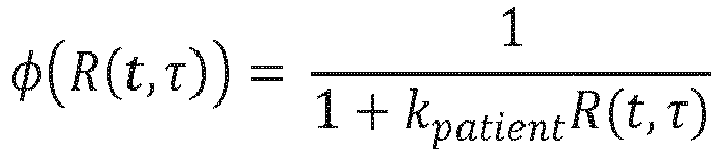
- Example 10. A processor-based method for providing a "net effect" based patient adoptive model, said method comprises:
providing an algorithm to compute:- a dynamic model of the patient's metabolic system,
wherein said dynamic model includes descriptive parameters of an individual physiology of the model patient; - a corresponding inferred history of behavioral "net effect" model that explains the glucose variability in the historical record through the dynamic model;
wherein said "net effect" model includes a mathematical representation perturbations of the model patient; and - an update of the patient's physiological parameters based on both (i) the ability of the dynamic model to predict future BG based on known inputs and (ii) the ability of the model to produce net effect curves that are consistent with the patient's record of the perturbations; and
- providing said update to the patient or user whereby patient or user can use the update for future course of action.
- a dynamic model of the patient's metabolic system,
- Example 11. The method of example 10, wherein said descriptive parameters include a representation of the dynamic relationship between oral carbs d (g/min), physical activity e (cal/min), subcutaneous insulin u (U/hr), and the model patient's metabolic state vector χ whose elements include glucose and insulin concentrations (mg/dl) in various compartments of the body and carbohydrate mass (mg) in the gut.
- Example 12. The method of example 11, wherein the glucose concentration (mg/dl) may be data derived from a CGM device and the subcutaneous insulin u and the insulin concentration (mg/dl) may be data obtained from an insulin pump device.
- Example 13. The method of example 11, wherein the glucose concentration (mg/dl) may be data derived from a CGM device and the subcutaneous insulin u and the insulin concentration (mg/dl) may be data obtained from a manual insulin injection device.
- Example 14. The method of example 11, wherein the glucose concentration (mg/dl) may be data derived from a SMBG device and/or the subcutaneous insulin u and the insulin concentration (mg/dl) may be data obtained from an insulin pump device.
- Example 15. The method of example 11, wherein the glucose concentration (mg/dl) may be data derived from a SMBG device and/or the subcutaneous insulin u and the insulin concentration (mg/dl) may be data obtained from a manual insulin injection device.
- Example 16. The method of example 11, wherein relationship of said descriptive parameters can be described as a set of discrete-time nonlinear difference equations:


- Example 17. The method of example 11, wherein relationship of said of descriptive parameters can be described as a set of continuous-time nonlinear differential equations:


- Example 18. The method of example 17, wherein nonlinear representation can be linearized around any desired operating point (e.g. steady state glucose concentration) to yield a linear dynamic model:


- Example 19. The method of example 10, wherein said perturbations include meal profiles, physical activity, and sleep/awake periods.
- Example 20. The method of example 10, wherein said "net effect" model provides a "history" of virtual system inputs that reconciles the patient's historical record of BG and historical record of insulin delivery.
- Example 21. The method of example 20, wherein the patient's historical record of BG concentration, {BG(k)} k∈day , and historical record of insulin delivery, {u(k)} k∈day , the net effect that reconciles the historical information is the vector of virtual carbohydrate inputs {dn.e. (k)} k∈day that minimizes the error function:

- Example 22. The method of example 21, wherein the resulting optimal net effect vector (aka. net effect curve), {dn.e. (k)} k∈day , optimally reconciles the BG and insulin data collected by the patient through a virtual carbohydrate signal, which captures all external influences on the patient as a single external disturbance signal measured in (mg/min).
- Example 23. The method of example 22, wherein:
when the net effect curve is positive this shall correspond to the patient actually eating, or it may correspond a period of the day in which the patient is experiencing enhanced insulin sensitivity; and
when the net effect curve is negative then this shall correspond to the patient engaging in intense physical activity or exercise. - Example 24. The method of example 10, wherein:
- the patients physiological model parameters, {θ(k)} k∈day , includes daily variability due to the patients circadian rhythm; and
- the model updater, includes a formula that takes the form having the following:

- Example 25. The method of example 24, wherein the dynamic model is adjusted on multiple time scales, whereby parameter updates can be computed daily based on BG residuals:


- Example 26. The method of example 10, further comprising providing a retroactive assessment of the patient's optimal rate of insulin delivery, wherein said algorithm:
- retroactively computes what the patient's optimal rate of insulin delivery would have been over a predetermined period of historical time given that the disturbances to the system are exactly the historical of net effect curves computed for the patient over that interval of time, wherein for each "history" of net effect curves there is a corresponding "history" of insulin delivery rates that account for meals, exercise, and corrections for each day in the considered interval of time;
- maps between the net effect curve for a given day and the model-based response of an optimal controller, wherein these vectors of optimal responses are collected and analyzed, and presented to the patient or user for a day-by-day review of insulin treatment;
- extracts features from the optimal responses that correspond to important but random events by subtracting discrete amounts of insulin associated with meals or accounting for discrete insulin deficits associated with temporary basal rates around exercise, whereby the remaining schedule of insulin delivery corresponds to a representation of the patient's "optimal" basal pattern each day in the historical record; and
- identifies consistency in the retroactively computed optimal basal rates, such optimal basal rates in a plurality of duration segments representing the patient's treatment duration; and
providing to the patient or user the median level of basal insulin that would have been applied in each segment, wherein the patient or user could use this information to (i) decide upon on reduced temporary basal rates before meals and/or following exercise in the future or (ii) adjust the patient's long-term basal rate profile. - Example 27. The method of example 10, further comprising providing an on-demand adaptive correction of insulin advice model, said method comprises:
providing an algorithm to include the following computations:- retrospective detecting for meal and exercise activities;
- stochastic modeling to provide a description about the timing and content of meals and exercise; and
- providing insulin correction advice to a patient or user that would be in response to a patient and user request.
- Example 28. The method of example 27, wherein:
- said retrospective detection for meal and exercise activities includes the algorithm for reconciling current history of said patient "net effect curves" with the historical record of patient-acknowledged meals and exercise events to produce a validated (high-confidence) record of relevant patient behaviors, wherein the reconciling includes identifying discrepancies between (i) the net effect curves computed from the available BG and insulin data for the patient and (ii) the meal and exercise events that are acknowledged by the patient or user through the systems user interface; and
- said method comprises:
- providing suggestions from said discrepancies, wherein suggestions are communicated to patient or user; and
- receiving any responses resultant from user or patient to form the final, validated record of relevant patient activities.
- Example 29. The method of example 28, wherein:
said stochastic modeling includes the algorithm for receiving said final, validated record of relevant patient activities and stochastically modeling to represent the timing and content of meals and exercise of the patient's behavior. - Example 30. The method of example 29, wherein:
said insulin correction includes the algorithm for monitoring the patient's status and to provide insulin correction advice in the moment the patient or user asks for it, based on (i) the stochastic modeling for upcoming behavioral disturbances and (ii) the current dynamic model of the patient's metabolic system that allows for the prediction of the impact of various alternative correction insulin amounts. - Example 31. A system for providing posterior assessment of the risk of hypoglycemic of a patient, said system comprises:
- a retroactive risk-based safety module having a processor to compute a statistic, Rhypo (record), for the risk of hypoglycemia based on the absolute BG levels, BG variability, and insulin delivery that is highly correlated to the posterior (conditional) probability of hypoglycemia, P(Ehypo |record), where Ehypo denotes the event of hypoglycemia in the next day and record refers to the subject's historical BG, insulin delivery, and activities record; and
- said processor outputs the computed statistic, Rhypo (record), whereby actionable prior warning of the possibility of hypoglycemia about the patient is so provided to patient or user.
- Example 32. The system of example 31, wherein the absolute BG levels and BG variability may be data derived from a CGM device and the absolute insulin delivery may be data obtained from an insulin pump device.
- Example 33. The system of example 31, wherein the absolute BG levels and BG variability may be data derived from a CGM device and the absolute insulin delivery may be data obtained from a manual insulin injection device.
- Example 34. The system of example 31, wherein the absolute BG levels and BG variability may be data derived from an SMBG device and the absolute insulin delivery may be data obtained from an insulin pump device.
- Example 35. The system of example 31, wherein the absolute BG levels and BG variability may be data derived from an SMBG device and the absolute insulin delivery may be data obtained from a manual insulin injection device.
- Example 36. The system of example 31, further comprising:
- a CGM device, wherein the absolute BG levels and BG variability may be data derived from said CGM device; and
- an insulin pump device, wherein the absolute insulin delivery may be data obtained from said insulin pump device.
- Example 37. The system of example 31, further comprising:
- a CGM device, wherein the absolute BG levels and BG variability may be data derived from said CGM device; and
- a manual insulin injection device, wherein the absolute insulin delivery may be data obtained from said manual insulin injection device.
- Example 38. The system of example 31, further comprising:
- an SMBG device, wherein the absolute BG levels and BG variability may be data derived from said SMBG device; and/or
- an insulin pump device, wherein the absolute insulin delivery may be data obtained from said insulin pump device .
- Example 39. The system of example 31, further comprising:
- an SMBG device, wherein the absolute BG levels and BG variability may be data derived from said SMBG device; and/or
- a manual insulin injection device, wherein the absolute insulin delivery may be data obtained from said manual insulin injection device.
- Example 40. system for retroactively providing a safe level of insulin for the patient, said system comprises:
- a retroactive risk-based safety module having a processor to retroactively compute a risk-based insulation attenuation factor to the subject's record of insulin delivery; and
- said processor outputs the computed risk-based insulation attenuation factor and applying the risk-based attenuation factor so that any internal threshold is provided to the patient or user for deciding on reduced temporary basal rates before meals and/or following exercise in the future that may be implemented.
- Example 41. The system of example 40, wherein the insulin delivery may be data obtained from an insulin pump device.
- Example 42. The system of example 40, wherein the insulin delivery may be data obtained from a manual insulin injection device.
- Example 43. The system of example 40, further comprising:
an insulin pump device, wherein the insulin delivery may be data obtained from said insulin pump device. - Example 44. The system of example 40, further comprising:
a manual insulin injection device, wherein the insulin delivery may be data obtained from said manual insulin injection device. - Example 45. The system of example 40, wherein the risk-based attenuation factor would be computed as follows:

- Example 46. A system for providing a "net effect" based patient adoptive model, said system comprises:
- a net effect estimator module having a processor to compute:
a dynamic model of the patient's metabolic system, - wherein said dynamic model includes descriptive parameters of an individual physiology of the model patient; and
a corresponding inferred history of behavioral "net effect" model that explains the glucose variability in the historical record through the dynamic model; - wherein said "net effect" model includes a mathematical representation perturbations of the model patient; and
- a model updater module having a processor to compute:
an update of the patient's physiological parameters based on both (i) the ability of the dynamic model to predict future BG based on known inputs and (ii) the ability of the model to produce net effect curves that are consistent with the patient's record of the perturbations; and - said system outputs said update to the patient or user whereby patient or user can use the update for future course of action.
- a net effect estimator module having a processor to compute:
- Example 47. The system of example 46, wherein said descriptive parameters include a representation of the dynamic relationship between oral carbs d (g/min), physical activity e (cal/min), subcutaneous insulin u (U/hr), and the model patient's metabolic state vector χ whose elements include glucose and insulin concentrations (mg/dl) in various compartments of the body and carbohydrate mass (mg) in the gut.
- Example 48. The system of example 47, wherein the glucose concentration (mg/dl) may be data derived from a CGM device and the subcutaneous insulin u and the insulin concentration (mg/dl) may be data obtained from an insulin pump device.
- Example 49. The system of example 47, wherein the glucose concentration (mg/dl) may be data derived from a CGM device and the subcutaneous insulin u and the insulin concentration (mg/dl) may be data obtained from a manual insulin injection device.
- Example 50. The system of example 47, wherein the glucose concentration (mg/dl) may be data derived from a SMBG device and the subcutaneous insulin u and the insulin concentration (mg/dl) may be data obtained from an insulin pump device.
- Example 51. The system of example 47, wherein the glucose concentration (mg/dl) may be data derived from a SMBG device and the subcutaneous insulin u and the insulin concentration (mg/dl) may be data obtained from a manual insulin injection.
- Example 52. The system of example 47, further comprising:
- an CGM device, wherein the glucose concentration (mg/dl) may be data derived from said CGM device; and
- an insulin pump, wherein the subcutaneous insulin u and the insulin concentration (mg/dl) may be data obtained from an insulin pump device.
- Example 53. The system of example 47, further comprising:
- an SMBG device, wherein the glucose concentration (mg/dl) may be data derived from said SMBG device; and
- an insulin pump device or an insulin injection device, wherein the subcutaneous insulin u and the insulin concentration (mg/dl) may be data obtained from said insulin pump device or said insulin injection device.
- Example 54. The system of example 47, wherein relationship said descriptive parameters can be described as a set of discrete-time nonlinear difference equations:


- Example 55. The system of example 47, wherein relationship of said of descriptive parameters can be described as a set of continuous-time nonlinear differential equations:


- Example 56. The system of example 55, wherein nonlinear representation can be linearized around any desired operating point (e.g. steady state glucose concentration) to yield a linear dynamic model:


- Example 57. The system of example 46, wherein said perturbations include meal profiles, physical activity, and sleep/awake periods.
- Example 58. The system of example 46, wherein said "net effect" model provides a "history" of virtual system inputs that reconciles the patient's historical record of BG and historical record of insulin delivery.
- Example 59. The system of example 58, wherein the patient's historical record of BG concentration, {BG(k)} k∈day , and historical record of insulin delivery, {u(k)} k∈day, the net effect that reconciles the historical information is the vector of virtual carbohydrate inputs {dn.e. (k)} k∈day that minimizes the error function:

- Example 60. The system of example 59, wherein the resulting optimal net effect vector (aka. net effect curve), {dn.e. (k)} k∈day , optimally reconciles the BG and insulin data collected by the patient through a virtual carbohydrate signal, which captures all external influences on the patient as a single external disturbance signal measured in (mg/min).
- Example 61. The system of example 60, wherein:
- when the net effect curve is positive this shall correspond to the patient actually eating, or it may correspond a period of the day in which the patient is experiencing enhanced insulin sensitivity; and
- when the net effect curve is negative then this shall correspond to the patient engaging in intense physical activity or exercise.
- Example 62. The system of example 46, wherein:
- the patients physiological model parameters, {θ(k)} k∈day , includes daily variability due to the patients circadian rhythm; and
- the processor of the model updater module is configured to compute the following:

- Example 63. The system of example 62, wherein the dynamic model is adjusted on multiple time scales, whereby parameter updates can be computed daily based on BG residuals:


- Example 64. The system of example 46, further configured to provide a retroactive assessment of the patient's optimal rate of insulin delivery, wherein said system comprises:
- a retrospective optimal control analyzer module having a processor configured to:
- retroactively compute what the patient's optimal rate of insulin delivery would have been over a predetermined period of historical time given that the disturbances to the system are exactly the historical of net effect curves computed for the patient over that interval of time, wherein for each "history" of net effect curves there is a corresponding "history" of insulin delivery rates that account for meals, exercise, and corrections for each day in the considered interval of time; and
- map between the net effect curve for a given day and the model-based response of an optimal controller, wherein these vectors of optimal responses are collected and analyzed, and presented to the patient or user for a day-by-day review of insulin treatment;
- a retro-optimal basal rate extractor module having a processor configured to:
- extract features from the optimal responses that correspond to important but random events by subtracting discrete amounts of insulin associated with meals or accounting for discrete insulin deficits associated with temporary basal rates around exercise, whereby the remaining schedule of insulin delivery corresponds to a representation of the patient's "optimal" basal pattern each day in the historical record; and
- identify consistency in the retroactively computed optimal basal rates, such optimal basal rates in a plurality of duration segments representing the patient's treatment duration; and
- said system being configured to:
provide an output to the patient or user the median level of basal insulin that would have been applied in each segment, wherein the patient or user could use this information to (i) decide upon on reduced temporary basal rates before meals and/or following exercise in the future or (ii) adjust the patient's long-term basal rate profile.
- a retrospective optimal control analyzer module having a processor configured to:
- Example 65. The system of example 46, further configured to provide an on-demand adaptive correction of insulin advice model, said system comprises:
- a retrospective meal and exercise detector module having a processor to provide retrospective detecting for meal and exercise activities;
- a meal and exercise stochastic modeler module having a processor to provide stochastic modeling to provide a description about the timing and content of meals and exercise; and
- a correction bolus advisor module having a processor to provide and output insulin correction advice to a patient or user that would be in response to a patient and user request.
- Example 66. The system of example 65, wherein:
- said retrospective detection for meal and exercise activities includes the algorithm for reconciling current history of said patient "net effect curves" with the historical record of patient-acknowledged meals and exercise events to produce a validated (high-confidence) record of relevant patient behaviors, wherein the reconciling includes identifying discrepancies between (i) the net effect curves computed from the available BG and insulin data for the patient and (ii) the meal and exercise events that are acknowledged by the patient or user through the systems user interface; and
- said system configured to comprise:
- an output module to provide suggestions from said discrepancies, wherein suggestions are communicated to patient or user; and
- an input module to receive any responses resultant from user or patient to form the final, validated record of relevant patient activities.
- Example 67. The system of example 66, wherein:
said processor of said stochastic modeling module being configured for receiving said final, validated record of relevant patient activities and stochastically modeling to represent the timing and content of meals and exercise of the patient's behavior. - Example 68. The system of example 67, wherein:
said processor of said correction bolus advisor module being configured for monitoring the patient's status and to provide insulin correction advice output in the moment the patient or user asks for it, based on (i) the stochastic modeling for upcoming behavioral disturbances and (ii) the current dynamic model of the patient's metabolic system that allows for the prediction of the impact of various alternative correction insulin amounts. - Example 69. A non-transitory computer readable medium containing program instructions for providing posterior assessment of the risk of hypoglycemic of a patient, wherein execution of the program instructions by one or more processors of a computer system causes the processor to carry out the following steps of :
- providing an algorithm to compute a statistic, Rhypo (record), for the risk of hypoglycemia based on the absolute BG levels, BG variability, and insulin delivery that is highly correlated to the posterior (conditional) probability of hypoglycemia, P(Ehypo |record), where Ehypo denotes the event of hypoglycemia in the next day and record refers to the subject's historical BG, insulin delivery, and activities record; and
- providing the computed statistic, Rhypo (record), whereby actionable prior warning of the possibility of hypoglycemia about the patient is so provided to patient or user.
- Example 70. The non-transitory computer readable medium of example 69, wherein the absolute BG levels and BG variability may be data derived from a CGM device and the absolute insulin delivery may be data obtained from an insulin pump device.
- Example 71. The non-transitory computer readable medium of example 69, wherein the absolute BG levels and BG variability may be data derived from a CGM device and the absolute insulin delivery may be data obtained from a manual insulin injection device.
- Example 72. The non-transitory computer readable medium of example 69, wherein the absolute BG levels and BG variability may be data derived from an SMBG device and/or the absolute insulin delivery may be data obtained from an insulin pump device.
- Example 73. The non-transitory computer readable medium of example 69, wherein the absolute BG levels and BG variability may be data derived from an SMBG device and/or the absolute insulin delivery may be data obtained from a manual insulin injection device.
- Example 74. A non-transitory computer readable medium containing program instructions for retroactively providing a safe level of insulin for the patient, wherein execution of the program instructions by one or more processors of a computer system causes the processor to carry out the following steps of:
- providing an algorithm to retroactively compute a risk-based insulation attenuation factor to the subject's record of insulin delivery; and
- providing the computed risk-based insulation attenuation factor and applying the risk-based attenuation factor so that any internal threshold is provided to the patient or user for deciding on reduced temporary basal rates before meals and/or following exercise in the future that may be implemented.
- Example 75. The non-transitory computer readable medium of example 74, wherein the record of the insulin delivery may be data obtained from an insulin pump device.
- Example 76. The non-transitory computer readable medium of example 74, wherein the record of the insulin delivery may be data obtained from a manual insulin injection device.
- Example 77. The non-transitory computer readable medium of example 202, wherein the risk-based attenuation factor would be computed as follows:
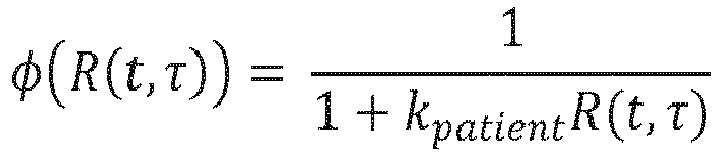
- Example 78. A non-transitory computer readable medium containing program instructions for providing a "net effect" based patient adoptive model, wherein execution of the program instructions by one or more processors of a computer system causes the processor to carry out the following steps of:
- computing a dynamic model of the patient's metabolic system, wherein said dynamic model includes descriptive parameters of an individual physiology of the model patient;
- computing a corresponding inferred history of behavioral "net effect" model that explains the glucose variability in the historical record through the dynamic model; wherein said "net effect" model includes a mathematical representation perturbations of the model patient;
- computing an update of the patient's physiological parameters based on both (i) the ability of the dynamic model to predict future BG based on known inputs and (ii) the ability of the model to produce net effect curves that are consistent with the patient's record of the perturbations; and
- providing said update to the patient or user whereby patient or user can use the update for future course of action.
- Example 79. The non-transitory computer readable medium of example 78, wherein said descriptive parameters include a representation of the dynamic relationship between oral carbs d (g/min), physical activity e (cal/min), subcutaneous insulin u (U/hr), and the model patient's metabolic state vector χ whose elements include glucose and insulin concentrations (mg/dl) in various compartments of the body and carbohydrate mass (mg) in the gut.
- Example 80. The non-transitory computer readable medium of example 79, wherein the glucose concentration (mg/dl) may be data derived from a CGM device and the subcutaneous insulin u and the insulin concentration (mg/dl) may be data obtained from an insulin pump device.
- Example 81. The non-transitory computer readable medium of example 79, wherein the glucose concentration (mg/dl) may be data derived from a CGM device and the subcutaneous insulin u and the insulin concentration (mg/dl) may be data obtained from a manual insulin injection device.
- Example 82. The non-transitory computer readable medium of example 79, wherein the glucose concentration (mg/dl) may be data derived from a SMBG device and/or the subcutaneous insulin u and the insulin concentration (mg/dl) may be data obtained from an insulin pump device.
- Example 83. The non-transitory computer readable medium of example 79, wherein the glucose concentration (mg/dl) may be data derived from a SMBG device and/or the subcutaneous insulin u and the insulin concentration (mg/dl) may be data obtained from a manual insulin injection device.
- Example 84. The non-transitory computer readable medium of example 79, wherein relationship said descriptive parameters can be described as a set of discrete-time nonlinear difference equations:


- Example 85. The non-transitory computer readable medium of example 79, wherein relationship of said of descriptive parameters can be described as a set of continuous-time nonlinear differential equations:


- Example 86. The non-transitory computer readable medium of example 185, wherein nonlinear representation can be linearized around any desired operating point (e.g. steady state glucose concentration) to yield a linear dynamic model:


- Example 87. The non-transitory computer readable medium of example 78, wherein said perturbations include meal profiles, physical activity, and sleep/awake periods.
- Example 88. The non-transitory computer readable medium of example 78, wherein said "net effect" model provides a "history" of virtual system inputs that reconciles the patient's historical record of BG and historical record of insulin delivery.
- Example 89. The non-transitory computer readable medium of example 88, wherein the patient's historical record of BG concentration, {BG(k)} k∈day , and historical record of insulin delivery, {u(k) k∈day , the net effect that reconciles the historical information is the vector of virtual carbohydrate inputs {dn.e. (k)} k∈day that minimizes the error function:

- Example 90. The non-transitory computer readable medium of example 89, wherein the resulting optimal net effect vector (aka. net effect curve), {dn.e. (k)} k∈day, optimally reconciles the BG and insulin data collected by the patient through a virtual carbohydrate signal, which captures all external influences on the patient as a single external disturbance signal measured in (mg/min).
- Example 91. The non-transitory computer readable medium of example 90, wherein:
- when the net effect curve is positive this shall correspond to the patient actually eating, or it may correspond a period of the day in which the patient is experiencing enhanced insulin sensitivity; and
- when the net effect curve is negative then this shall correspond to the patient engaging in intense physical activity or exercise.
- Example 92. The non-transitory computer readable medium of example 78, wherein:
- the patients physiological model parameters, {θ(k)} k∈day , includes daily variability due to the patients circadian rhythm; and
- the model updater, includes a formula that takes the form having the following:

- Example 93. The non-transitory computer readable medium of example 92, wherein the dynamic model is adjusted on multiple time scales, whereby parameter updates can be computed daily based on BG residuals:


- Example 94. The non-transitory computer readable medium of example 78, further comprising providing a retroactive assessment of the patient's optimal rate of insulin delivery, wherein execution of the program instructions by one or more processors of a computer system causes the processor to carry out the following steps of:
- retroactively computing what the patient's optimal rate of insulin delivery would have been over a predetermined period of historical time given that the disturbances to the system are exactly the historical of net effect curves computed for the patient over that interval of time, wherein for each "history" of net effect curves there is a corresponding "history" of insulin delivery rates that account for meals, exercise, and corrections for each day in the considered interval of time;
- mapping between the net effect curve for a given day and the model-based response of an optimal controller, wherein these vectors of optimal responses are collected and analyzed, and presented to the patient or user for a day-by-day review of insulin treatment;
- extracting features from the optimal responses that correspond to important but random events by subtracting discrete amounts of insulin associated with meals or accounting for discrete insulin deficits associated with temporary basal rates around exercise, whereby the remaining schedule of insulin delivery corresponds to a representation of the patient's "optimal" basal pattern each day in the historical record;
- identifying consistency in the retroactively computed optimal basal rates, such optimal basal rates in a plurality of duration segments representing the patient's treatment duration; and
- providing to the patient or user the median level of basal insulin that would have been applied in each segment, wherein the patient or user could use this information to (i) decide upon on reduced temporary basal rates before meals and/or following exercise in the future or (ii) adjust the patient's long-term basal rate profile.
- Example 95. The non-transitory computer readable medium of example 78, further comprising providing an on-demand adaptive correction of insulin advice model, wherein execution of the program instructions by one or more processors of a computer system causes the processor to carry out the following steps of:
- retrospectively detecting for meal and exercise activities;
- stochastic modeling to provide a description about the timing and content of meals and exercise; and
- providing insulin correction advice to a patient or user that would be in response to a patient and user request.
- Example 96. The non-transitory computer readable medium of example 95, wherein:
- said retrospective detection for meal and exercise activities includes the algorithm for reconciling current history of said patient "net effect curves" with the historical record of patient-acknowledged meals and exercise events to produce a validated (high-confidence) record of relevant patient behaviors, wherein the reconciling includes identifying discrepancies between (i) the net effect curves computed from the available BG and insulin data for the patient and (ii) the meal and exercise events that are acknowledged by the patient or user through the systems user interface; and
- wherein execution of the program instructions by one or more processors of a computer system causes the processor to carry out the following steps of :
- providing suggestions from said discrepancies, wherein suggestions are communicated to patient or user; and
- receiving any responses resultant from user or patient to form the final, validated record of relevant patient activities.
- Example 97. The non-transitory computer readable medium of example 96, wherein:
said stochastic modeling includes the algorithm for receiving said final, validated record of relevant patient activities and stochastically modeling to represent the timing and content of meals and exercise of the patient's behavior. - Example 98. The non-transitory computer readable medium of example 97, wherein:
said insulin correction includes the algorithm for monitoring the patient's status and to provide insulin correction advice in the moment the patient or user asks for it, based on (i) the stochastic modeling for upcoming behavioral disturbances and (ii) the current dynamic model of the patient's metabolic system that allows for the prediction of the impact of various alternative correction insulin amounts. - It should be appreciated that any one or more of the example nos. 1-98 may be combined with any one or more of example nos. 1-98 as desired or required.
- It should be appreciated that as discussed herein, a subject or patient may be a human or any animal. It should be appreciated that an animal may be a variety of any applicable type, including, but not limited thereto, mammal, veterinarian animal, livestock animal or pet type animal, etc. As an example, the animal may be a laboratory animal specifically selected to have certain characteristics similar to human (e.g. rat, dog, pig, monkey), etc. It should be appreciated that the subject may be any applicable human patient, for example.
- Unless clearly specified to the contrary, there is no requirement for any particular described or illustrated activity or element, any particular sequence or such activities, any particular size, speed, material, duration, contour, dimension or frequency, or any particularly interrelationship of such elements. Moreover, any activity can be repeated, any activity can be performed by multiple entities, and/or any element can be duplicated. Further, any activity or element can be excluded, the sequence of activities can vary, and/or the interrelationship of elements can vary. It should be appreciated that aspects of the present invention may have a variety of sizes, contours, shapes, compositions and materials as desired or required.
- In summary, while the present invention has been described with respect to specific embodiments, many modifications, variations, alterations, substitutions, and equivalents will be apparent to those skilled in the art. The present invention is not to be limited in scope by the specific embodiment described herein. Indeed, various modifications of the present invention, in addition to those described herein, will be apparent to those of skill in the art from the foregoing description and accompanying drawings. Accordingly, the invention is to be considered as limited only by the spirit and scope of the following claims, including all modifications and equivalents.
- Still other embodiments will become readily apparent to those skilled in this art from reading the above-recited detailed description and drawings of certain exemplary embodiments. It should be understood that numerous variations, modifications, and additional embodiments are possible, and accordingly, all such variations, modifications, and embodiments are to be regarded as being within the spirit and scope of this application. For example, regardless of the content of any portion (e.g., title, field, background, summary, abstract, drawing figure, etc.) of this application, unless clearly specified to the contrary, there is no requirement for the inclusion in any claim herein or of any application claiming priority hereto of any particular described or illustrated activity or element, any particular sequence of such activities, or any particular interrelationship of such elements. Moreover, any activity can be repeated, any activity can be performed by multiple entities, and/or any element can be duplicated. Further, any activity or element can be excluded, the sequence of activities can vary, and/or the interrelationship of elements can vary. Unless clearly specified to the contrary, there is no requirement for any particular described or illustrated activity or element, any particular sequence or such activities, any particular size, speed, material, dimension or frequency, or any particularly interrelationship of such elements. Accordingly, the descriptions and drawings are to be regarded as illustrative in nature, and not as restrictive. Moreover, when any number or range is described herein, unless clearly stated otherwise, that number or range is approximate. When any range is described herein, unless clearly stated otherwise, that range includes all values therein and all sub ranges therein. Any information in any material (e.g., a United States/foreign patent, United States/foreign patent application, book, article, etc.) that has been incorporated by reference herein, is only incorporated by reference to the extent that no conflict exists between such information and the other statements and drawings set forth herein. In the event of such conflict, including a conflict that would render invalid any claim herein or seeking priority hereto, then any such conflicting information in such incorporated by reference material is specifically not incorporated by reference herein.
Claims (14)
- A processor-based method for providing a "net effect" based patient adaptive model, comprising: computing, by a processor:a dynamic model of a patient's metabolic system, wherein said dynamic model includes parameters of an individual physiology of a model patient;a behavioral "net effect" model that explains glucose variability in a historical record of blood glucose through the dynamic model, wherein said "net effect" model includes a mathematical representation perturbations of the model patient; andan update of an estimation of the physiological parameters of the model patient based on both (i) the ability of the dynamic model to predict future blood glucose (BG) based on known inputs and (ii) the ability of the "net effect" model to generate one or more net effect curves that are consistent with the model patient's record of the perturbations, the update of the estimation of parameters of the model patient being performed using a recursive procedure; andapplying said update of the estimation of the parameters of the model patient to a display of an output device;wherein said parameters include a representation of the dynamic relationship between at least two of oral carbs d (g/min), physical activity e (cal/min), subcutaneous insulin u (U/hr), or the model patient's metabolic state vector χ whose elements include glucose and insulin concentrations (mg/dl) in various compartments of the body and carbohydrate mass (mg) in the gut; andwherein, the "net effect" model provides a "history" of virtual system inputs that reconciles the patient's historical record of BG concentration, {BG(k)} k∈day, and historical record of insulin delivery, {u(k)} k∈day.
- The method of claim 1, wherein said "net effect" model is also based on a corresponding inferred history of generated behavioral "net effect" curves, the "net effect" model being consistent with the glucose variability in the historical record of blood glucose of the model patient and further being consistent with a historical record of insulin delivery of the model patient, the corresponding inferred history of generated behavioral "net effect" curves at least including a mathematical representation of a meal profile, and optionally including other system perturbations including physical activity and sleep/awake periods.
- The method of claim 1, wherein the display at least informs the model patient how to manage at least their glucose.
- The method of claim 1, wherein the net effect that reconciles the historical information is the vector of virtual carbohydrate inputs {dn.e. (k)} k∈day that minimizes the error function:

- The method of claim 1, wherein the glucose concentration (mg/dl) are data derived from a CGM device and the subcutaneous insulin u and the insulin concentration (mg/dl) are data obtained from an insulin pump device.
- The method of claim 1, wherein the glucose concentration (mg/dl) are data derived from a CGM device and the subcutaneous insulin u and the insulin concentration (mg/dl) may be data obtained from a manual insulin injection device.
- The method of claim 1, wherein the glucose concentration (mg/dl) are data derived from a SMBG device and/or the subcutaneous insulin u and the insulin concentration (mg/dl) may be data obtained from an insulin pump device.
- The method of claim 1, wherein the glucose concentration (mg/dl) may be data derived from a SMBG device and/or the subcutaneous insulin u and the insulin concentration (mg/dl) may be data obtained from a manual insulin injection device.
- The method of claim 4, wherein relationship of said parameters can be described as a set of discrete-time nonlinear difference equations:


- The method of claim 4, wherein relationship of said of parameters can be described as a set of continuous-time nonlinear differential equations:


- The method of claim 10, wherein nonlinear representation can be linearized around any desired operating point (e.g. steady state glucose concentration) to yield a linear dynamic model:


- The method of claim 4 , wherein the resulting optimal net effect vector (aka. net effect curve), {d n.e.(k)} k∈day, optimally reconciles the BG and insulin data collected by the patient through a virtual carbohydrate signal, which captures all external influences on the patient as a single external disturbance signal measured in (mg/min).
- The method of claim 11, wherein:the parameters, {θ(k)} k∈day , include daily variability due to the patients circadian rhythm; andthe model updater includes a formula :

- The method of claim 13, wherein the dynamic model is adjusted on multiple time scales, whereby parameter updates can be computed daily based on BG residuals:


Priority Applications (1)
| Application Number | Priority Date | Filing Date | Title |
|---|---|---|---|
| EP26150415.3A EP4712100A3 (en) | 2011-08-26 | 2012-08-26 | Method, system and computer readable medium for adaptive advisory control of diabetes |
Applications Claiming Priority (3)
| Application Number | Priority Date | Filing Date | Title |
|---|---|---|---|
| US201161528129P | 2011-08-26 | 2011-08-26 | |
| EP12826823.2A EP2748747B1 (en) | 2011-08-26 | 2012-08-26 | Method, system and computer readable medium for adaptive advisory control of diabetes |
| PCT/US2012/052422 WO2013032965A1 (en) | 2011-08-26 | 2012-08-26 | Method, system and computer readable medium for adaptive advisory control of diabetes |
Related Parent Applications (1)
| Application Number | Title | Priority Date | Filing Date |
|---|---|---|---|
| EP12826823.2A Division EP2748747B1 (en) | 2011-08-26 | 2012-08-26 | Method, system and computer readable medium for adaptive advisory control of diabetes |
Related Child Applications (1)
| Application Number | Title | Priority Date | Filing Date |
|---|---|---|---|
| EP26150415.3A Division EP4712100A3 (en) | 2011-08-26 | 2012-08-26 | Method, system and computer readable medium for adaptive advisory control of diabetes |
Publications (2)
| Publication Number | Publication Date |
|---|---|
| EP3799073A1 true EP3799073A1 (en) | 2021-03-31 |
| EP3799073B1 EP3799073B1 (en) | 2026-01-07 |
Family
ID=47756776
Family Applications (3)
| Application Number | Title | Priority Date | Filing Date |
|---|---|---|---|
| EP26150415.3A Pending EP4712100A3 (en) | 2011-08-26 | 2012-08-26 | Method, system and computer readable medium for adaptive advisory control of diabetes |
| EP12826823.2A Active EP2748747B1 (en) | 2011-08-26 | 2012-08-26 | Method, system and computer readable medium for adaptive advisory control of diabetes |
| EP20191889.3A Active EP3799073B1 (en) | 2011-08-26 | 2012-08-26 | Method, system and computer readable medium for adaptive advisory control of diabetes |
Family Applications Before (2)
| Application Number | Title | Priority Date | Filing Date |
|---|---|---|---|
| EP26150415.3A Pending EP4712100A3 (en) | 2011-08-26 | 2012-08-26 | Method, system and computer readable medium for adaptive advisory control of diabetes |
| EP12826823.2A Active EP2748747B1 (en) | 2011-08-26 | 2012-08-26 | Method, system and computer readable medium for adaptive advisory control of diabetes |
Country Status (9)
| Country | Link |
|---|---|
| US (1) | US11024429B2 (en) |
| EP (3) | EP4712100A3 (en) |
| JP (1) | JP2014534483A (en) |
| CN (2) | CN106326651A (en) |
| AU (1) | AU2012300331B2 (en) |
| BR (1) | BR112014004529A2 (en) |
| CA (2) | CA3175850A1 (en) |
| RU (1) | RU2602040C2 (en) |
| WO (1) | WO2013032965A1 (en) |
Families Citing this family (83)
| Publication number | Priority date | Publication date | Assignee | Title |
|---|---|---|---|---|
| US8956291B2 (en) | 2005-02-22 | 2015-02-17 | Admetsys Corporation | Balanced physiological monitoring and treatment system |
| US20090177142A1 (en) | 2008-01-09 | 2009-07-09 | Smiths Medical Md, Inc | Insulin pump with add-on modules |
| US20120245556A1 (en) * | 2009-09-01 | 2012-09-27 | University Of Virginia Patent Foundation | System, Method and Computer Program Product For Adjustment of Insulin Delivery in Diabetes Using Nominal Open-Loop Profiles |
| WO2011041429A1 (en) | 2009-09-29 | 2011-04-07 | Admetsys Corporation | System and method for differentiating containers in medication delivery |
| EP2545185B1 (en) * | 2010-03-11 | 2022-07-06 | University Of Virginia Patent Foundation | Method and system for the safety, analysis and supervision of insulin pump action and other modes of insulin delivery in diabetes |
| CA3175850A1 (en) | 2011-08-26 | 2013-03-07 | Stephen D. Patek | Method, system and computer readable medium for adaptive advisory control of diabetes |
| EP4420603A3 (en) * | 2013-03-15 | 2024-11-20 | Abbott Diabetes Care, Inc. | System and method to manage diabetes based on glucose median, glucose variability, and hypoglycemic risk |
| EP4527291A3 (en) | 2014-08-14 | 2025-07-09 | University Of Virginia Patent Foundation | Improved accuracy continuous glucose monitoring method, system, and device |
| CA2968480A1 (en) * | 2014-11-28 | 2016-06-02 | Zensun (Shanghai) Science & Technology Limited | Injection pump control method, control unit and injection pump |
| US10617363B2 (en) | 2015-04-02 | 2020-04-14 | Roche Diabetes Care, Inc. | Methods and systems for analyzing glucose data measured from a person having diabetes |
| WO2016201120A1 (en) | 2015-06-09 | 2016-12-15 | University Of Virginia Patent Foundation | Insulin monitoring and delivery system and method for cgm based fault detection and mitigation via metabolic state tracking |
| CN114343580A (en) | 2015-07-06 | 2022-04-15 | 雅培糖尿病护理公司 | Systems, devices and methods for symptom onset detection and assessment |
| DK3328276T3 (en) * | 2015-07-27 | 2023-09-18 | Massachusetts Inst Technology | APPARATUS IN CONNECTION WITH MONITORING METABOLISM |
| US10463297B2 (en) * | 2015-08-21 | 2019-11-05 | Medtronic Minimed, Inc. | Personalized event detection methods and related devices and systems |
| US10867012B2 (en) * | 2015-08-21 | 2020-12-15 | Medtronic Minimed, Inc. | Data analytics and insight delivery for the management and control of diabetes |
| WO2017040927A1 (en) | 2015-09-02 | 2017-03-09 | University Of Virginia Patent Foundation | System, method, and computer readable medium for dynamic insulin sensitivity in diabetic pump users |
| EP4545005A3 (en) | 2016-01-14 | 2025-07-02 | Insulet Corporation | Adjusting insulin delivery rates |
| US11037658B2 (en) | 2016-02-17 | 2021-06-15 | International Business Machines Corporation | Clinical condition based cohort identification and evaluation |
| US10937526B2 (en) | 2016-02-17 | 2021-03-02 | International Business Machines Corporation | Cognitive evaluation of assessment questions and answers to determine patient characteristics |
| US10575790B2 (en) | 2016-03-02 | 2020-03-03 | Roche Diabetes Care, Inc. | Patient diabetes monitoring system with clustering of unsupervised daily CGM profiles (or insulin profiles) and method thereof |
| US10478556B2 (en) | 2016-03-04 | 2019-11-19 | Roche Diabetes Care, Inc. | Probability based controller gain |
| US10518031B2 (en) | 2016-03-04 | 2019-12-31 | Roche Diabetes Care, Inc. | Bolus calculator with probabilistic glucose measurements |
| US10311388B2 (en) | 2016-03-22 | 2019-06-04 | International Business Machines Corporation | Optimization of patient care team based on correlation of patient characteristics and care provider characteristics |
| US10923231B2 (en) | 2016-03-23 | 2021-02-16 | International Business Machines Corporation | Dynamic selection and sequencing of healthcare assessments for patients |
| US20170286621A1 (en) * | 2016-03-29 | 2017-10-05 | International Business Machines Corporation | Evaluating Risk of a Patient Based on a Patient Registry and Performing Mitigating Actions Based on Risk |
| CN108882893A (en) | 2016-03-29 | 2018-11-23 | 豪夫迈·罗氏有限公司 | Operate the method for receiving the receiver of analyte data, receiver and computer program product |
| US10311976B2 (en) | 2016-04-28 | 2019-06-04 | Roche Diabetes Care, Inc. | Bolus calculator with probabilistic carbohydrate measurements |
| EP3451926B1 (en) | 2016-05-02 | 2024-12-11 | DexCom, Inc. | System for providing alerts optimized for a user |
| US12383166B2 (en) | 2016-05-23 | 2025-08-12 | Insulet Corporation | Insulin delivery system and methods with risk-based set points |
| US10297350B2 (en) | 2016-06-01 | 2019-05-21 | Roche Diabetes Care, Inc. | Risk-based control-to-range |
| US10332633B2 (en) | 2016-06-01 | 2019-06-25 | Roche Diabetes Care, Inc. | Control-to-range aggressiveness |
| US10332632B2 (en) * | 2016-06-01 | 2019-06-25 | Roche Diabetes Care, Inc. | Control-to-range failsafes |
| EP3479267B1 (en) | 2016-06-30 | 2020-05-27 | Novo Nordisk A/S | Regimen adherence measure for insulin treatment based on glucose measurements and insulin pen data |
| CN109661196B (en) * | 2016-07-08 | 2022-03-29 | 诺和诺德股份有限公司 | Basal titration with adaptive target glucose level |
| EP3510533B1 (en) | 2016-09-09 | 2022-07-27 | Dexcom, Inc. | Method for enabling health care provider set up of a bolus calculator |
| EP3300656B1 (en) * | 2016-09-30 | 2024-10-30 | Roche Diabetes Care GmbH | Method and system for determining a carbohydrate intake event from glucose monitoring data indicative of a glucose level, and a non-transitory computer readable medium |
| EP3532958B1 (en) * | 2016-10-31 | 2024-03-27 | Novo Nordisk A/S | Systems and methods for estimating the risk of a future hypoglycemic event |
| CN108261591B (en) * | 2016-12-30 | 2021-10-08 | 上海移宇科技股份有限公司 | A closed-loop control algorithm for artificial pancreas |
| US10758675B2 (en) | 2017-01-13 | 2020-09-01 | Bigfoot Biomedical, Inc. | System and method for adjusting insulin delivery |
| US10500334B2 (en) | 2017-01-13 | 2019-12-10 | Bigfoot Biomedical, Inc. | System and method for adjusting insulin delivery |
| US10881793B2 (en) | 2017-01-13 | 2021-01-05 | Bigfoot Biomedical, Inc. | System and method for adjusting insulin delivery |
| EP4708311A3 (en) | 2017-01-13 | 2026-05-20 | Insulet Corporation | INSULIN ADMINISTRATION PROCEDURES, SYSTEMS AND DEVICES |
| EP4708310A3 (en) | 2017-01-13 | 2026-05-06 | Insulet Corporation | Insulin delivery methods, systems and devices |
| US10583250B2 (en) | 2017-01-13 | 2020-03-10 | Bigfoot Biomedical, Inc. | System and method for adjusting insulin delivery |
| EP3576815A4 (en) | 2017-02-03 | 2020-11-18 | University Of Virginia Patent Foundation | METHOD, SYSTEM AND COMPUTER-READABLE MEDIUM FOR CONTROLLING INSULIN RELEASE USING RETROSPECTIVE VIRTUAL BASAL RATES |
| WO2018167543A1 (en) | 2017-03-17 | 2018-09-20 | Universität Bern | System and method for drug therapy management |
| CA3059985C (en) * | 2017-05-05 | 2023-08-08 | Eli Lilly And Company | Closed loop control of physiological glucose |
| WO2018229209A1 (en) | 2017-06-15 | 2018-12-20 | Novo Nordisk A/S | Insulin titration algorithm based on patient profile |
| CN110741438B (en) | 2017-06-15 | 2023-12-29 | 诺和诺德股份有限公司 | Basal titration with adaptive target glucose levels |
| JP7181900B2 (en) * | 2017-06-15 | 2022-12-01 | ノボ・ノルデイスク・エー/エス | Insulin titration algorithm based on patient profile |
| CN107423560A (en) * | 2017-06-27 | 2017-12-01 | 天方创新(北京)信息技术有限公司 | Based on Rating Model type-II diabetes are carried out with the method and device of risk score |
| US11199556B2 (en) * | 2017-07-04 | 2021-12-14 | Arkray, Inc. | Measuring apparatus, computer readable medium storing measuring program and measuring method |
| EP4765154A2 (en) | 2017-08-02 | 2026-06-24 | Diabeloop | Closed-loop blood glucose control systems and methods |
| JP7133625B2 (en) | 2017-12-21 | 2022-09-08 | イーライ リリー アンド カンパニー | Closed-loop control of physiological glucose |
| JP7443235B2 (en) | 2018-02-09 | 2024-03-05 | デックスコム・インコーポレーテッド | Decision support systems and methods |
| US12462912B2 (en) | 2018-02-13 | 2025-11-04 | The University of Virginia Licensing and Ventures Group | System and method for physical activity informed drug dosing |
| CN108671328B (en) * | 2018-03-27 | 2021-03-30 | 哈工大机器人集团股份有限公司 | Intelligent transfusion monitoring device, system and method |
| US11565043B2 (en) * | 2018-05-04 | 2023-01-31 | Insulet Corporation | Safety constraints for a control algorithm based drug delivery system |
| CN112313754A (en) | 2018-06-22 | 2021-02-02 | 伊莱利利公司 | Insulin and pramlintide delivery systems, methods and devices |
| CN109065176B (en) * | 2018-08-20 | 2020-11-10 | 清华-伯克利深圳学院筹备办公室 | A blood sugar prediction method, device, terminal and storage medium |
| EP3651164A1 (en) * | 2018-11-07 | 2020-05-13 | Roche Diabetes Care GmbH | Method and system of determining a probability of a blood glucose value for a patient being in an adverse blood glucose range at a prediction time, and computer program product |
| KR102696363B1 (en) | 2018-12-04 | 2024-08-20 | 삼성전자주식회사 | Method for guiding measurement of bio signal in wearable device |
| US12233240B2 (en) | 2018-12-26 | 2025-02-25 | Tandem Diabetes Care, Inc. | Methods of wireless communication in an infusion pump system |
| US20200205743A1 (en) | 2018-12-28 | 2020-07-02 | Dexcom, Inc. | Evaluation and visualization of glycemic dysfunction |
| WO2020153423A1 (en) * | 2019-01-23 | 2020-07-30 | 国立研究開発法人科学技術振興機構 | Dosage management assistance system |
| MY210053A (en) * | 2019-03-05 | 2025-08-22 | Health Arx Tech Pvt Ltd | System and method for determining lifestyle regime |
| EP3968847A4 (en) * | 2019-05-14 | 2023-06-07 | University Of Virginia Patent Foundation | SYSTEM AND METHOD FOR ARTIFICIAL PANCREAS WITH PREDICTIVE MULTI-STAGE MODEL CONTROL |
| US20210151190A1 (en) * | 2019-11-15 | 2021-05-20 | Dexcom, Inc. | Joint state estimation prediction that evaluates differences in predicted vs. corresponding received data |
| US11654236B2 (en) | 2019-11-22 | 2023-05-23 | Tandem Diabetes Care, Inc. | Systems and methods for automated insulin delivery for diabetes therapy |
| US11887712B2 (en) * | 2019-12-13 | 2024-01-30 | Medtronic Minimed, Inc. | Method and system for classifying detected events as labeled event combinations for processing at a client application |
| EP4076156A4 (en) * | 2019-12-18 | 2024-01-10 | Dexcom, Inc. | Therapeutic zone assessor |
| CN111341451B (en) * | 2020-03-06 | 2022-09-20 | 南京理工大学 | Model-free adaptive predictive control method with interference compensation for glycemic control |
| EP4204044A4 (en) * | 2020-08-26 | 2024-05-22 | Medtrum Technologies Inc. | Closed-loop artificial pancreas insulin infusion control system |
| CN112402732B (en) * | 2020-10-10 | 2023-05-05 | 广东食品药品职业学院 | Insulin infusion quantity control method based on self-adaptive control weighting factor strategy |
| EP3985678A1 (en) * | 2020-10-13 | 2022-04-20 | Diabeloop | Computerized device for repeatedly determining a command to control the infusion of fluid in a diabetic patient |
| CN112259181A (en) * | 2020-11-03 | 2021-01-22 | 陈军 | Medication recording method and system |
| JP7755965B2 (en) | 2021-09-30 | 2025-10-17 | キヤノンメディカルシステムズ株式会社 | Medical information processing device, method, and program |
| WO2023070252A1 (en) * | 2021-10-25 | 2023-05-04 | Medtrum Technologies Inc. | Closed-loop artificial pancreas insulin multi-drug control system |
| US12673159B2 (en) | 2021-12-01 | 2026-07-07 | Medtronic Minimed, Inc. | Mealtime delivery of correction boluses |
| US20250057448A1 (en) * | 2021-12-22 | 2025-02-20 | Hochschule Fulda | Method, device and system for determining a state of health of a patient |
| CN121263852A (en) * | 2023-04-11 | 2026-01-02 | 威尔德康股份有限公司 | System and method for continuous glucose monitoring result prediction |
| WO2025166261A1 (en) * | 2024-02-01 | 2025-08-07 | University Of Virginia Patent Foundation | Method and system for calculating insulin dosing parameters in computer aided dosing |
| CN120496879B (en) * | 2025-07-18 | 2026-02-03 | 西安交通大学医学院第二附属医院 | Cardiovascular internal medicine disease early warning analysis system based on big data |
Citations (24)
| Publication number | Priority date | Publication date | Assignee | Title |
|---|---|---|---|---|
| WO2001013786A1 (en) | 1999-08-23 | 2001-03-01 | University Of Virginia Patent Foundation | Method and apparatus for predicting the risk of hypoglycemia |
| WO2001072208A2 (en) | 2000-03-29 | 2001-10-04 | University Of Virginia Patent Foundation | Method, system, and computer program product for the evaluation of glycemic control in diabetes from self-monitoring data |
| WO2002024065A1 (en) * | 2000-09-22 | 2002-03-28 | Knobbe, Lim & Buckingham | Method and apparatus for real-time estimation and control of pysiological parameters |
| US6525708B2 (en) | 2001-02-20 | 2003-02-25 | Au Optronics Corporation | Display panel with dot inversion or column inversion |
| US6602191B2 (en) | 1999-12-17 | 2003-08-05 | Q-Tec Systems Llp | Method and apparatus for health and disease management combining patient data monitoring with wireless internet connectivity |
| WO2004015539A2 (en) | 2002-08-13 | 2004-02-19 | University Of Virginia Patent Foundation | Managing and processing self-monitoring blood glucose |
| WO2004052204A1 (en) | 2002-12-06 | 2004-06-24 | Kwan-Ho Kim | Blood glucose monitoring system |
| US20040254434A1 (en) | 2003-06-10 | 2004-12-16 | Goodnow Timothy T. | Glucose measuring module and insulin pump combination |
| US6923763B1 (en) | 1999-08-23 | 2005-08-02 | University Of Virginia Patent Foundation | Method and apparatus for predicting the risk of hypoglycemia |
| WO2005106017A2 (en) | 2004-04-21 | 2005-11-10 | University Of Virginia Patent Foundation | Method, system and computer program product for evaluating the accuracy of blood glucose monitoring sensors/devices |
| US6967402B2 (en) | 1998-05-15 | 2005-11-22 | Kabushiki Kaisha Toshiba | Hermetically sealed semiconductor power module and large scale module comprising the same |
| WO2007027691A1 (en) | 2005-08-31 | 2007-03-08 | University Of Virginia Patent Foundation | Improving the accuracy of continuous glucose sensors |
| WO2007081853A2 (en) | 2006-01-05 | 2007-07-19 | University Of Virginia Patent Foundation | Method, system and computer program product for evaluation of blood glucose variability in diabetes from self-monitoring data |
| WO2008052199A2 (en) | 2006-10-26 | 2008-05-02 | Abbott Diabetes Care, Inc. | Method, system and computer program product for real-time detection of sensitivity decline in analyte sensors |
| WO2008064053A2 (en) | 2006-11-17 | 2008-05-29 | Medtronic Minimed, Inc. | System and method for diabetes management using consumer electronic devices |
| WO2008067284A2 (en) | 2006-11-27 | 2008-06-05 | University Of Virginia Patent Foundation | Method, system, and computer program for detection of conditions of a patient having diabetes |
| WO2008157780A1 (en) * | 2007-06-21 | 2008-12-24 | University Of Virginia Patent Foundation | Lqg artificial pancreas control system and related method |
| WO2008157781A1 (en) | 2007-06-21 | 2008-12-24 | University Of Virginia Patent Foundation | Method, system and computer simulation environment for testing of monitoring and control strategies in diabetes |
| US20090006061A1 (en) * | 2007-06-27 | 2009-01-01 | Roche Diagnostics Operations, Inc. | System for developing patient specific therapies based on dynamic modeling of patient physiology and method thereof |
| WO2009009528A2 (en) | 2007-07-09 | 2009-01-15 | University Of Virginia Patent Foundation | Diabetes insulin sensitivity, carbohydrate ratio, correction factors data self-monitoring product |
| US20090069745A1 (en) | 2007-09-06 | 2009-03-12 | M2 Medical Group Holdings, Inc. | Operating an Infusion Pump System |
| WO2009059187A1 (en) * | 2007-11-02 | 2009-05-07 | University Of Virginia Patent Foundation | Predictive control based system and method for control of insulin delivery in diabetes using glucose sensing |
| WO2010138848A1 (en) | 2009-05-29 | 2010-12-02 | University Of Virginia Patent Foundation | System coordinator and modular architecture for open-loop and closed-loop control of diabetes |
| WO2010138817A1 (en) | 2009-05-29 | 2010-12-02 | Abbott Diabetes Care Inc. | Glucose monitoring system with wireless communications |
Family Cites Families (9)
| Publication number | Priority date | Publication date | Assignee | Title |
|---|---|---|---|---|
| EP0212317B1 (en) | 1985-07-26 | 1990-01-17 | Société Anonyme dite SAFT | Electrode based on iron oxide for an alkaline battery, and process for manufacturing such an electrode |
| CA2480550C (en) | 2002-03-22 | 2011-07-12 | Cygnus, Inc. | Improving performance of an analyte monitoring device |
| EP1949105A4 (en) * | 2005-10-11 | 2009-06-17 | Tethys Bioscience Inc | MARKERS ASSOCIATED WITH DIABETES AND METHODS OF USE THEREOF |
| JP5657559B2 (en) * | 2008-11-26 | 2015-01-21 | ユニバーシティ オブ ヴァージニア パテント ファウンデーション | Method, system and computer program for tracking and recording blood glucose fluctuations in diabetes |
| US20120245556A1 (en) * | 2009-09-01 | 2012-09-27 | University Of Virginia Patent Foundation | System, Method and Computer Program Product For Adjustment of Insulin Delivery in Diabetes Using Nominal Open-Loop Profiles |
| JP2013036989A (en) | 2011-07-11 | 2013-02-21 | Sumitomo Chemical Co Ltd | Method and device for inspecting defect in honeycomb filter, and method for manufacturing honeycomb filter |
| CA3175850A1 (en) | 2011-08-26 | 2013-03-07 | Stephen D. Patek | Method, system and computer readable medium for adaptive advisory control of diabetes |
| AU2014381308B2 (en) | 2014-02-05 | 2019-08-22 | Monash University | Method and system for rapid malaria detection |
| DE102017202499A1 (en) | 2017-02-16 | 2018-08-16 | Airbus Operations Gmbh | Communication system, aerospace vehicle and communication method |
-
2012
- 2012-08-26 CA CA3175850A patent/CA3175850A1/en active Pending
- 2012-08-26 EP EP26150415.3A patent/EP4712100A3/en active Pending
- 2012-08-26 US US14/241,383 patent/US11024429B2/en active Active
- 2012-08-26 CN CN201610702392.5A patent/CN106326651A/en active Pending
- 2012-08-26 RU RU2014111290/14A patent/RU2602040C2/en not_active IP Right Cessation
- 2012-08-26 AU AU2012300331A patent/AU2012300331B2/en active Active
- 2012-08-26 JP JP2014527348A patent/JP2014534483A/en active Pending
- 2012-08-26 WO PCT/US2012/052422 patent/WO2013032965A1/en not_active Ceased
- 2012-08-26 BR BR112014004529-1A patent/BR112014004529A2/en not_active IP Right Cessation
- 2012-08-26 CN CN201280052869.XA patent/CN103907116A/en active Pending
- 2012-08-26 EP EP12826823.2A patent/EP2748747B1/en active Active
- 2012-08-26 EP EP20191889.3A patent/EP3799073B1/en active Active
- 2012-08-26 CA CA2846854A patent/CA2846854C/en active Active
Patent Citations (35)
| Publication number | Priority date | Publication date | Assignee | Title |
|---|---|---|---|---|
| US6967402B2 (en) | 1998-05-15 | 2005-11-22 | Kabushiki Kaisha Toshiba | Hermetically sealed semiconductor power module and large scale module comprising the same |
| WO2001013786A1 (en) | 1999-08-23 | 2001-03-01 | University Of Virginia Patent Foundation | Method and apparatus for predicting the risk of hypoglycemia |
| US6923763B1 (en) | 1999-08-23 | 2005-08-02 | University Of Virginia Patent Foundation | Method and apparatus for predicting the risk of hypoglycemia |
| US6602191B2 (en) | 1999-12-17 | 2003-08-05 | Q-Tec Systems Llp | Method and apparatus for health and disease management combining patient data monitoring with wireless internet connectivity |
| WO2001072208A2 (en) | 2000-03-29 | 2001-10-04 | University Of Virginia Patent Foundation | Method, system, and computer program product for the evaluation of glycemic control in diabetes from self-monitoring data |
| US20030212317A1 (en) | 2000-03-29 | 2003-11-13 | Kovatchev Boris P. | Method, system, and computer program product for the evaluation of glycemic control in diabetes from self-monitoring data |
| US7874985B2 (en) | 2000-03-29 | 2011-01-25 | University Of Virginia Patent Foundation | Method, system, and computer program product for the evaluation of glycemic control in diabetes from self-monitoring data |
| US20060094947A1 (en) | 2000-03-29 | 2006-05-04 | Kovatchev Boris P | Method, system, and computer program product for the evaluation of glycemic control in diabetes from self-monitoring data |
| US7025425B2 (en) | 2000-03-29 | 2006-04-11 | University Of Virginia Patent Foundation | Method, system, and computer program product for the evaluation of glycemic control in diabetes from self-monitoring data |
| WO2002024065A1 (en) * | 2000-09-22 | 2002-03-28 | Knobbe, Lim & Buckingham | Method and apparatus for real-time estimation and control of pysiological parameters |
| US6525708B2 (en) | 2001-02-20 | 2003-02-25 | Au Optronics Corporation | Display panel with dot inversion or column inversion |
| US20050214892A1 (en) | 2002-08-13 | 2005-09-29 | Kovatchev Boris P | Method, system, and computer program product for the processing of self-monitoring blood glucose(smbg)data to enhance diabetic self-management |
| WO2004015539A2 (en) | 2002-08-13 | 2004-02-19 | University Of Virginia Patent Foundation | Managing and processing self-monitoring blood glucose |
| WO2004052204A1 (en) | 2002-12-06 | 2004-06-24 | Kwan-Ho Kim | Blood glucose monitoring system |
| US20040254434A1 (en) | 2003-06-10 | 2004-12-16 | Goodnow Timothy T. | Glucose measuring module and insulin pump combination |
| WO2005106017A2 (en) | 2004-04-21 | 2005-11-10 | University Of Virginia Patent Foundation | Method, system and computer program product for evaluating the accuracy of blood glucose monitoring sensors/devices |
| US7815569B2 (en) | 2004-04-21 | 2010-10-19 | University Of Virginia Patent Foundation | Method, system and computer program product for evaluating the accuracy of blood glucose monitoring sensors/devices |
| US20070232878A1 (en) | 2004-04-21 | 2007-10-04 | University Of Virginia Patent Foundation | Method, System and Computer Program Product for Evaluating the Accuracy of Blood Glucose Monitoring Sensors/Devices |
| US20080314395A1 (en) | 2005-08-31 | 2008-12-25 | Theuniversity Of Virginia Patent Foundation | Accuracy of Continuous Glucose Sensors |
| WO2007027691A1 (en) | 2005-08-31 | 2007-03-08 | University Of Virginia Patent Foundation | Improving the accuracy of continuous glucose sensors |
| US20090171589A1 (en) | 2006-01-05 | 2009-07-02 | University Of Virginia Patent Foundation | Method, System and Computer Program Product for Evaluation of Blood Glucose Variability In Diabetes From Self-Monitoring Data |
| WO2007081853A2 (en) | 2006-01-05 | 2007-07-19 | University Of Virginia Patent Foundation | Method, system and computer program product for evaluation of blood glucose variability in diabetes from self-monitoring data |
| US20080172205A1 (en) | 2006-10-26 | 2008-07-17 | Abbott Diabetes Care, Inc. | Method, system and computer program product for real-time detection of sensitivity decline in analyte sensors |
| WO2008052199A2 (en) | 2006-10-26 | 2008-05-02 | Abbott Diabetes Care, Inc. | Method, system and computer program product for real-time detection of sensitivity decline in analyte sensors |
| WO2008064053A2 (en) | 2006-11-17 | 2008-05-29 | Medtronic Minimed, Inc. | System and method for diabetes management using consumer electronic devices |
| WO2008067284A2 (en) | 2006-11-27 | 2008-06-05 | University Of Virginia Patent Foundation | Method, system, and computer program for detection of conditions of a patient having diabetes |
| WO2008157781A1 (en) | 2007-06-21 | 2008-12-24 | University Of Virginia Patent Foundation | Method, system and computer simulation environment for testing of monitoring and control strategies in diabetes |
| US20100179768A1 (en) | 2007-06-21 | 2010-07-15 | University Of Virginia Patent Foundation | Method, System and Computer Simulation Environment for Testing of Monitoring and Control Strategies in Diabetes |
| WO2008157780A1 (en) * | 2007-06-21 | 2008-12-24 | University Of Virginia Patent Foundation | Lqg artificial pancreas control system and related method |
| US20090006061A1 (en) * | 2007-06-27 | 2009-01-01 | Roche Diagnostics Operations, Inc. | System for developing patient specific therapies based on dynamic modeling of patient physiology and method thereof |
| WO2009009528A2 (en) | 2007-07-09 | 2009-01-15 | University Of Virginia Patent Foundation | Diabetes insulin sensitivity, carbohydrate ratio, correction factors data self-monitoring product |
| US20090069745A1 (en) | 2007-09-06 | 2009-03-12 | M2 Medical Group Holdings, Inc. | Operating an Infusion Pump System |
| WO2009059187A1 (en) * | 2007-11-02 | 2009-05-07 | University Of Virginia Patent Foundation | Predictive control based system and method for control of insulin delivery in diabetes using glucose sensing |
| WO2010138848A1 (en) | 2009-05-29 | 2010-12-02 | University Of Virginia Patent Foundation | System coordinator and modular architecture for open-loop and closed-loop control of diabetes |
| WO2010138817A1 (en) | 2009-05-29 | 2010-12-02 | Abbott Diabetes Care Inc. | Glucose monitoring system with wireless communications |
Non-Patent Citations (71)
| Title |
|---|
| "Ethernet Technologies", CISCO SYSTEMS, INC, article "Internetworking Technologies Handbook", pages: 7 - 1,7-38 |
| "The Diabetes Control and Complications Trial Research Group. Hypoglycemia in the Diabetes Control and Complications Trial", DIABETES, vol. 46, 1997, pages 271 - 286 |
| "The Diabetes Control and Complications Trial Research Group. The effect of intensive treatment of diabetes on the development and progression of long-term complications of insulin-dependent diabetes mellitus", NENGL J MED, vol. 329, 1993, pages 978 - 986 |
| ALBISSER AMLEIBEL BSEWART TGDAVIDOVAC ZBOTZ CKZINGGG W: "An artificial endocrine pancreas", DIABETES, vol. 23, 1974, pages 389 - 396 |
| BELLAZZI RNUCCI GCOBELLI C: "The subcutaneous route to insulin-dependent diabetes therapy: closed-loop and partially closed-loop control strategies for insulin delivery and measuring glucose concentration", IEEE ENG MED BIOL, vol. 20, 2001, pages 54 - 64, XP011085089, DOI: 10.1109/51.897828 |
| BEQUETTE BW: "Analysis of Algorithms for Intensive Care Unit Blood Glucose Control", J DIABETES SCI TECHNOL, vol. 1, 2007, pages 813 - 824 |
| BERGMAN RNIDER YZBOWDEN CRCOBELLI C: "Quantitative estimation of insulin sensitivity", AM J PHYSIOL., vol. 236, 1979, pages E667 - E677, XP055126324 |
| BOYNE MSILVER DKAPLAN JSAUDEK C: "Timing of Changes in Interstitial and Venous Blood Glucose Measured With a Continuous Subcutaneous Glucose Sensor", DIABETES, vol. 52, 2003, pages 2790 - 2794 |
| BROEKHUYSE HMNELSON JDZINMAN BALBISSER AM: "Comparison of algorithms for the closed-loop control of blood glucose using the artificial beta cell", IEEE TRANS BIOMED ENG, vol. BME-28, 1981, pages 678 - 687, XP011173177 |
| BRUNETTI P.COBELLI C.CRUCIANI P.FABIETTI P.G.FILIPPUCCI F.SANTEUSANIO F.: "A simulation study on a self-tuning portable controller of blood glucose", INT J ARTIFICIAL ORGANS, vol. 16, 1993, pages 51 - 57 |
| C. S. HUGHESS. D. PATEKA. TAYLORR. PARKK. LAUB- SCHERS. PILLUTLAM. BRETONB. P. KOVATCHEV: "In- silico experiments of human eating patterns: Making a case for behavior-informed control of T1DM", PROC. UKACC INTERNATIONAL CONFERENCE OF CONTROL, 2010 |
| CLARKE WLCOX DJGONDER-FREDERICK LAJULIAN DMKOVATCHEV BP: "Young-Hyman D. The bio-psycho-behavioral model of severe hypoglycemia II: Self-management behaviors", DIABETES CARE, vol. 22, 1999, pages 580 - 584 |
| CLARKE WLKOVATCHEV BP: "The Artificial Pancreas: How Close We Are to Closing the Loop?", PED ENDOCRINOL REV, vol. 4, 2007, pages 314 - 316 |
| CLEMENS AH: "Feedback control dynamics for glucose controlled insulin infusion system", MEDPROG TECHNOL, vol. 6, 1979, pages 91 - 98 |
| CLEMENS AHCHANG PHMYERS RW: "The development of Biostator, a glucose-controlled insulin infusion system", HORM METAB RES SUPPLEMENT, vol. 7, 1977, pages 23 - 33 |
| COBELLI C ET AL: "Diabetes: Models, Signals, and Control", IEEE REVIEWS IN BIOMEDICAL ENGINEERING, IEEE, USA, vol. 2, 1 January 2009 (2009-01-01), pages 54 - 96, XP011285638, ISSN: 1937-3333 * |
| COBELLI CKOVATCHEV BP: "Clinical Trial of Model-Predictive Control Powered by In Silico Studies", PROC. 8TH DIABETES TECHNOLOGY MEETING, 2008 |
| COBELLI CRUGGERI A: "Evaluation of portal/peripheral route and of algorithms for insulin delivery in the closed-loop control of glucose in diabetes. A modelling study", IEEE TRANS BIOMED ENG, vol. 30, 1983, pages 93 - 103 |
| CRYER PE: "Hypoglycaemia: The limiting factor in the glycaemic management of type I and type II diabetes", DIABETOLOGIA, vol. 45, 2002, pages 937 - 948 |
| CRYER PE: "Hypoglycemia: The Limiting factor in the management of IDDM", DIABETES, vol. 43, 1994, pages 1378 - 1389 |
| CRYER PE: "Iatrogenic hypoglycemia as a cause of hypoglycemia-associated autonomic failure in IDDM: A vicious cycle", DIABETES, vol. 41, 1992, pages 255 - 260 |
| CRYER PEDAVIS SNSHAMOON H: "Hypoglycemia in Diabetes", DIABETES CARE, vol. 26, 2003, pages 1902 - 1912, XP002538099, DOI: 10.2337/diacare.26.6.1902 |
| DASSAU EBEQUETTE BWBUCKINGHAM BADOYLE FJ 3RD: "Detection of a meal using continuous glucose monitoring: implications for an artificial beta-cell", DIABETES CARE, vol. 31, 2008, pages 295 - 300, XP002601932, DOI: 10.2337/dc07-1293 |
| DASSAU ECAMERON FNEIMEYER GCHASE PBUCKINGHAM B: "Real-time Hypoglycemic Prediciton Using Continuous Glucose Monitoring (CGM", DIABETES, vol. 57, no. 1, 2008 |
| DUA PDOYLE FJ 3RDPISTIKOPOULOS EN: "Model-Based Blood Glucose Control for Type 1 Diabetes via Parametric Programming", IEEE TRANS BIOMED ENG., vol. 53, 2006, pages 1478 - 1491, XP055220345, DOI: 10.1109/TBME.2006.878075 |
| EW, CAMPBELL LVCHIA YOMELER HLAZARUS L: "Control of blood glucose in diabetics using an artificial pancreas", AUST NZJMED, vol. 7, 1977, pages 280 - 286 |
| FISCHER UJUTZI EFREYSE E-JSALZSIEDER E: "Derivation and experimental proof of a new algorithm for the artificial beta-cell based on the individual analysis of the physiological insulin- glucose relationship", ENDOKRINOLOGIE, vol. 71, 1978, pages 65 - 75 |
| FISCHER USCHENK WSALZSIEDER EALBRECHT GABEL PFREYSE E-J: "Does physiological blood glucose control require an adaptive strategy?", IEEE TRANS BIOMED ENG, vol. 34, 1987, pages 575 - 582 |
| FISHER ME: "A semi closed-loop algorithm for the control of blood glucose levels in diabetics", IEEE TRANS BIOMED ENG, vol. 38, 1991, pages 57 - 61 |
| GOLD AEDEARY IJFRIER BM: "Recurrent severe hypoglycaemia and cognitive function in type I diabetes", DIABETMED, vol. 10, 1993, pages 503 - 508 |
| GONDER-FREDERICK LCOX DKOVATCHEV BSCHLUNDT DCLARKE W.: "A biopsychobehavioral model of risk of severe hypoglycemia", DIABETES CARE, vol. 20, 1997, pages 661 - 669 |
| HOVORKA R: "Continuous glucose monitoring and closed-loop systems", DIABET MED, vol. 23, 2006, pages 1 - 12, XP007900887, DOI: 10.1111/j.1464-5491.2005.01672.x |
| HOVORKA RCANONICO VCHASSIN LJ ET AL.: "Nonlinear model predictive control of glucose concentration in subjects with type 1 diabetes", PHYSIOL MEAS, vol. 25, 2004, pages 905 - 920, XP055420209, DOI: 10.1088/0967-3334/25/4/010 |
| HOVORKA RCHASSIN LJWILINSKA ME ET AL.: "Closing the loop: the ADICOL experience", DIABETES TECHNOL THER., vol. 6, 2004, pages 307 - 318, XP055046184, DOI: 10.1089/152091504774197990 |
| HUGHES CSS. D. PATEK SDM. BRETON MDBP KOVATCHEV: "Hypoglycemia Prevention via Pump Attenuation and Red-Yellow-Green ''Traffic'' Lights using CGM and Insulin Pump Data", J DIAB SCI AND TECH, vol. 4, 2010, pages 1146 - 1155 |
| JJ. FERNANDEZ-LUQUE ET AL.: "eDiab: A System for Monitoring, Assisting and Educating People with Diabetes", ICCHP 2006, LNCS, vol. 4061, 2006, pages 1342 - 1349, XP019036953 |
| KLONOFF DC: "The Artificial Pancreas: How Sweet Engineering Will Solve Bitter Problems", J DIABETES SCI TECHNOL, vol. 1, 2007, pages 72 - 81 |
| KOVATCHEV BPCLARKE WL: "Continuous glucose monitoring reduces risks for hypo- and hyperglycemia and glucose variability in diabetes", DIABETES, vol. 56, no. 1, 2007, pages 00860R |
| KOVATCHEV BPCOX DJFARHY LSSTRAUME MGONDER-FREDERICK LACLARKE, WL.: "Episodes of Severe Hypoglycemia in Type 1 Diabetes are Preceded, and Followed, within 48 Hours by Measurable Disturbances in Blood Glucose", J OF CLINICAL ENDOCRINOLOGY AND METABOLISM, vol. 85, 2000, pages 4287 - 4292, XP002256624, DOI: 10.1210/jc.85.11.4287 |
| KOVATCHEV BPCOX DJGONDER-FREDERICK LAWL CLARKE: "Symmetrization of the blood glucose measurement scale and its applications", DIABETES CARE, vol. 20, 1997, pages 1655 - 1658, XP008128145, DOI: 10.2337/diacare.20.11.1655 |
| KOVATCHEV BPSTRAUME MCOX DJFARHY LS: "Risk analysis of blood glucose data: A quantitative approach to optimizing the control of insulin dependent diabetes", J OF THEORETICAL MEDICINE, vol. 3, 2001, pages 1 - 10, XP009136223 |
| KULCU ETAMADA JAREACH GPOTTS ROLESHO MJ: "Physiological differences between interstitial glucose and blood glucose measured in human subjects", DIABETES CARE, vol. 26, 2003, pages 2405 - 2409 |
| LALO MAGNI ET AL: "Model Predictive Control of Type 1 Diabetes: An in Silico Trial", JOURNAL OF DIABETES SCIENCE AND TECHNOLOGY, vol. 1, no. 6, 1 November 2007 (2007-11-01), pages 804 - 812, XP055166918 * |
| LEBLANC HCHAUVET DLOMBRAIL PROBERT JJ: "Glycemic control with closed-loop intraperitoneal insulin in type I diabetes", DIABETES CARE, vol. 9, 1986, pages 124 - 128 |
| MAGNI LRAIMONDO FBOSSI LDALLA MAN CDE NICOLAO GKOVATCHEV BPCOBELLI C: "Model Predictive Control of Type 1 Diabetes: An In Silico Trial", J DIABETES SCI TECHNOL, 2007, pages 804 - 812, XP055166918, DOI: 10.1177/193229680700100603 |
| MARLISS EBMURRAY FTSTOKES EFZINMAN BNAKHOODA AFDENOGA ALEIBEL BSALBISSER AM: "Normalization of glycemia in diabetics during meals with insulin and glucagon delivery by the artificial pancreas", DIABETES, vol. 26, 1977, pages 663 - 672 |
| NUCCI G.COBELLI C.: "Models of subcutaneous insulin kinetics. A critical review", COMPUT METHODS PROGRAMS BIOMED., vol. 62, 2000, pages 249 - 57, XP055570595, DOI: 10.1016/S0169-2607(00)00071-7 |
| OLLERTON RL: "Application of optimal control theory to diabetes mellitus", INT J CONTROL, vol. 50, 1989, pages 2503 - 2522, XP009172072, DOI: 10.1080/00207178908953512 |
| OWENS CZISSER HJOVANOVIC LSRINIVASAN BBONVIN DDOYLE FJ 3RD: "Run-to-run control of glucose concentrations for people with Type 1 diabetes mellitus", IEEE TRANS BIOMED ENG., vol. 53, 2006, pages 996 - 1005 |
| PALERM CCZISSER HBEVIER WCJOVANOVIC LDOYLE FJ 3RD: "Prandial insulin dosing using run-to-run control: application of clinical data and medical expertise to define a suitable performance metric", DIABETES CARE, vol. 30, 2007, pages 1131 - 1136 |
| PALERM CCZISSER HJOVANOVIC LDOYLE FJ 3RD: "A Run-to-Run Control Strategy to Adjust Basal Insulin Infusion Rates in Type 1 Diabetes", J PROCESS CONTROL., vol. 18, 2008, pages 258 - 265, XP022519573, DOI: 10.1016/j.jprocont.2007.07.010 |
| PARKER RSDOYLE FJ 3RDPEPPAS NA: "A model-based algorithm for blood glucose control in Type I diabetic patients", IEEE TRANS BIOMEDENG, vol. 48, 1999, pages 148 - 157 |
| PATEK SD: "Open-Loop Feedback Control under Multiple Disturbance Function Hypotheses", PROC. OF THE IEEE CONFERENCE ON DECISION AND CONTROL, 2010 |
| PATEK SDBRETON MDCOBELLI CDALLA MAN CKOVATCHEV BP: "Adaptive meal detection algorithm enabling closed-loop control in type 1 diabetes", PROC. 7TH DIABETES TECHNOLOGY MEETING, 2007 |
| PFEIFFER EFTHUM CHCLEMENS AH: "The artificial beta cell - A continuous control of blood sugar by external regulation of insulin infusion (glucose controlled insulin infusion system", HORM METAB RES, vol. 487, 1974, pages 339 - 342 |
| REICHARD PPHIL M: "Mortality and treatment side effects during long-term intensified conventional insulin treatment in the Stockholm Diabetes Intervention study", DIABETES, vol. 43, 1994, pages 313 - 317 |
| REIFMAN JRAJARAMAN SGRIBOK AWARD WK: "Predictive monitoring for improved management of glucose levels", J DIABETES SCI TECHNOL, vol. 1, 2007, pages 478 - 486 |
| RENARD E: "Implantable closed-loop glucose-sensing and insulin delivery: the future for insulin pump therapy", CURRENT OPINION IN PHARMACOLOGY, vol. 2, 2002, pages 708 - 716, XP055163536, DOI: 10.1016/S1471-4892(02)00216-3 |
| SALZSIEDER EALBRECHT GFISCHER UFREYSE E-J: "Kinetic modeling of the gluco-regulatory system to improve insulin therapy", IEEE TRANS BIOMED ENG, vol. 32, 1985, pages 846 - 855 |
| SANTIAGO JVCLEMENS AHCLARKE WLKIPNIS DM: "Closed-loop and open-loop devices for blood glucose control in normal and diabetic subjects", DIABETES, vol. 28, 1979, pages 71 - 84 |
| SCHALLER HCSCHAUPP LBODENLENZ MWILINSKA MECHASSIN LJWACH PVERING THOVORKA RPIEBER TR: "On-line adaptive algorithm with glucose prediction capacity for subcutaneous closed loop control of glucose: evaluation under fasting conditions in patients with Type 1 diabetes", DIABET MED, vol. 23, 2006, pages 90 - 93 |
| SELAM JLMICOSSI PDUNN FLNATHAN DM: "Clinical trial of programmable implantable insulin pump for type I diabetes", DIABETES CARE, vol. 15, 1992, pages 877 - 885 |
| SORENSEN JT: "Ph.D. dissertation", 1985, DEPT CHEMICAL ENGINEERING, MIT, article "A Physiologic Model of Glucose Metabolism in Man and its Use to Design and Assess Improved Insulin Therapies for Diabetes" |
| SPARACINO GZANDERIGO FCORAZZA GMARAN AFACCHINETTI ACOBELLI C: "Glucose concentration can be predicted ahead in time from continuous glucose monitoring sensor time-series", IEEE TRANS BIOMEDENG, vol. 54, 2007, pages 931 - 937, XP011176961, DOI: 10.1109/TBME.2006.889774 |
| STEIL GMREBRIN KDARWIN CHARIRI FSAAD MF: "Feasibility of automating insulin delivery for the treatment of type 1 diabetes", DIABETES, vol. 55, 2006, pages 3344 - 3350, XP002476472, DOI: 10.2337/db06-0419 |
| STOUT PJRACCHINI JRHILGERS ME: "A Novel Approach to Mitigating the Physiological Lag between Blood and Interstitial Fluid Glucose Measurements", DIABETES TECHNOL THER, vol. 6, 2004, pages 635 - 644 |
| WEINZIMER SASTEIL GMSWAN KLDZIURA JKURTZ NTAMBORLANE WV: "Fully automated closed-loop insulin delivery versus semi-automated hybrid control in pediatric patients with type 1 diabetes using an artificial pancreas", DIABETES CARE, vol. 31, 2008, pages 934 - 939, XP007915338, DOI: 10.2337/dc07-1967 |
| WENTHOLT IMEHART AAMHOEKSTRA JBLDEVRIES JH: "Relationship Between Interstitial and Blood Glucose in Type 1 Diabetes Patients: Delay and the Push-Pull Phenomenon Revisited", DIABETES TECHNOL THER, vol. 9, 2004, pages 169 - 175 |
| WILINSKA MECHASSIN LJSCHALLER HCSCHAUPP LPIEBER TRHOVORKA R: "Insulin kinetics in type-1 diabetes: continuous and bolus delivery of rapid acting insulin", IEEE TRANS. BIOMED. ENG., vol. 52, 2005, pages 3 - 12, XP055436932, DOI: 10.1109/TBME.2004.839639 |
| ZANDERIGO FSPARACINO GKOVATCHEV BCOBELLI C: "Glucose Prediction Algorithms from continuous monitoring: Assessment of accuracy via Continuous Glucose-Error Grid Analysis", J DIABETES SCI TECHNOL, vol. 1, 2007, pages 645 - 651 |
| ZISSER HJOVANOVIC LDOYLE FJ 3RDOSPINA POWENS C: "Run-to-Run Control of Meal-Related Insulin Dosing", DIAB TECHNOL THER, vol. 7, 2005, pages 48 - 57 |
Also Published As
| Publication number | Publication date |
|---|---|
| EP3799073B1 (en) | 2026-01-07 |
| RU2602040C2 (en) | 2016-11-10 |
| US11024429B2 (en) | 2021-06-01 |
| EP4712100A3 (en) | 2026-04-29 |
| EP2748747A4 (en) | 2015-07-08 |
| AU2012300331A1 (en) | 2014-04-17 |
| WO2013032965A1 (en) | 2013-03-07 |
| JP2014534483A (en) | 2014-12-18 |
| CA2846854C (en) | 2022-12-13 |
| CN106326651A (en) | 2017-01-11 |
| EP2748747B1 (en) | 2020-08-26 |
| EP2748747A1 (en) | 2014-07-02 |
| CA3175850A1 (en) | 2013-03-07 |
| US20150190098A1 (en) | 2015-07-09 |
| BR112014004529A2 (en) | 2017-06-13 |
| EP4712100A2 (en) | 2026-03-18 |
| AU2012300331B2 (en) | 2016-04-14 |
| RU2014111290A (en) | 2015-10-27 |
| CN103907116A (en) | 2014-07-02 |
| CA2846854A1 (en) | 2013-03-07 |
Similar Documents
| Publication | Publication Date | Title |
|---|---|---|
| EP3799073B1 (en) | Method, system and computer readable medium for adaptive advisory control of diabetes | |
| US20250054597A1 (en) | System coordinator and modular architecture for open-loop and closed-loop control of diabetes | |
| US20250235155A1 (en) | Unified platform for monitoring and control of blood glucose levels in diabetic patients | |
| US20210169409A1 (en) | Systems of centralized data exchange for monitoring and control of blood glucose | |
| AU2018215533B2 (en) | Method, system, and computer readable medium for controlling insulin delivery using retrospective virtual basal rates |
Legal Events
| Date | Code | Title | Description |
|---|---|---|---|
| PUAI | Public reference made under article 153(3) epc to a published international application that has entered the european phase |
Free format text: ORIGINAL CODE: 0009012 |
|
| STAA | Information on the status of an ep patent application or granted ep patent |
Free format text: STATUS: THE APPLICATION HAS BEEN PUBLISHED |
|
| AC | Divisional application: reference to earlier application |
Ref document number: 2748747 Country of ref document: EP Kind code of ref document: P |
|
| AK | Designated contracting states |
Kind code of ref document: A1 Designated state(s): AL AT BE BG CH CY CZ DE DK EE ES FI FR GB GR HR HU IE IS IT LI LT LU LV MC MK MT NL NO PL PT RO RS SE SI SK SM TR |
|
| STAA | Information on the status of an ep patent application or granted ep patent |
Free format text: STATUS: REQUEST FOR EXAMINATION WAS MADE |
|
| 17P | Request for examination filed |
Effective date: 20210929 |
|
| RBV | Designated contracting states (corrected) |
Designated state(s): AL AT BE BG CH CY CZ DE DK EE ES FI FR GB GR HR HU IE IS IT LI LT LU LV MC MK MT NL NO PL PT RO RS SE SI SK SM TR |
|
| STAA | Information on the status of an ep patent application or granted ep patent |
Free format text: STATUS: EXAMINATION IS IN PROGRESS |
|
| 17Q | First examination report despatched |
Effective date: 20230417 |
|
| P01 | Opt-out of the competence of the unified patent court (upc) registered |
Effective date: 20230705 |
|
| GRAP | Despatch of communication of intention to grant a patent |
Free format text: ORIGINAL CODE: EPIDOSNIGR1 |
|
| STAA | Information on the status of an ep patent application or granted ep patent |
Free format text: STATUS: GRANT OF PATENT IS INTENDED |
|
| RIC1 | Information provided on ipc code assigned before grant |
Ipc: G16H 50/50 20180101AFI20250625BHEP Ipc: G16H 20/17 20180101ALI20250625BHEP Ipc: G16H 50/30 20180101ALI20250625BHEP Ipc: G16H 20/30 20180101ALN20250625BHEP |
|
| RIC1 | Information provided on ipc code assigned before grant |
Ipc: G16H 50/50 20180101AFI20250716BHEP Ipc: G16H 20/17 20180101ALI20250716BHEP Ipc: G16H 50/30 20180101ALI20250716BHEP Ipc: G16H 20/30 20180101ALN20250716BHEP |
|
| INTG | Intention to grant announced |
Effective date: 20250729 |
|
| RAP3 | Party data changed (applicant data changed or rights of an application transferred) |
Owner name: UNIVERSITY OF VIRGINIA PATENT FOUNDATION |
|
| RIN1 | Information on inventor provided before grant (corrected) |
Inventor name: PATEK, STEPHEN D. Inventor name: KOVATCHEV, BORIS P. |
|
| GRAS | Grant fee paid |
Free format text: ORIGINAL CODE: EPIDOSNIGR3 |
|
| GRAA | (expected) grant |
Free format text: ORIGINAL CODE: 0009210 |
|
| STAA | Information on the status of an ep patent application or granted ep patent |
Free format text: STATUS: THE PATENT HAS BEEN GRANTED |
|
| AC | Divisional application: reference to earlier application |
Ref document number: 2748747 Country of ref document: EP Kind code of ref document: P |
|
| AK | Designated contracting states |
Kind code of ref document: B1 Designated state(s): AL AT BE BG CH CY CZ DE DK EE ES FI FR GB GR HR HU IE IS IT LI LT LU LV MC MK MT NL NO PL PT RO RS SE SI SK SM TR |
|
| REG | Reference to a national code |
Ref country code: CH Ref legal event code: F10 Free format text: ST27 STATUS EVENT CODE: U-0-0-F10-F00 (AS PROVIDED BY THE NATIONAL OFFICE) Effective date: 20260107 Ref country code: GB Ref legal event code: FG4D |
|
| REG | Reference to a national code |
Ref country code: DE Ref legal event code: R096 Ref document number: 602012081892 Country of ref document: DE |
|
| REG | Reference to a national code |
Ref country code: IE Ref legal event code: FG4D |
|
| REG | Reference to a national code |
Ref country code: NL Ref legal event code: MP Effective date: 20260107 |
|
| PG25 | Lapsed in a contracting state [announced via postgrant information from national office to epo] |
Ref country code: NL Free format text: LAPSE BECAUSE OF FAILURE TO SUBMIT A TRANSLATION OF THE DESCRIPTION OR TO PAY THE FEE WITHIN THE PRESCRIBED TIME-LIMIT Effective date: 20260107 |
|
| REG | Reference to a national code |
Ref country code: AT Ref legal event code: MK05 Ref document number: 1876151 Country of ref document: AT Kind code of ref document: T Effective date: 20260107 |
|
| PG25 | Lapsed in a contracting state [announced via postgrant information from national office to epo] |
Ref country code: RS Free format text: LAPSE BECAUSE OF FAILURE TO SUBMIT A TRANSLATION OF THE DESCRIPTION OR TO PAY THE FEE WITHIN THE PRESCRIBED TIME-LIMIT Effective date: 20260407 |
|
| PG25 | Lapsed in a contracting state [announced via postgrant information from national office to epo] |
Ref country code: ES Free format text: LAPSE BECAUSE OF FAILURE TO SUBMIT A TRANSLATION OF THE DESCRIPTION OR TO PAY THE FEE WITHIN THE PRESCRIBED TIME-LIMIT Effective date: 20260107 |
|
| PG25 | Lapsed in a contracting state [announced via postgrant information from national office to epo] |
Ref country code: PL Free format text: LAPSE BECAUSE OF FAILURE TO SUBMIT A TRANSLATION OF THE DESCRIPTION OR TO PAY THE FEE WITHIN THE PRESCRIBED TIME-LIMIT Effective date: 20260107 |
|
| PG25 | Lapsed in a contracting state [announced via postgrant information from national office to epo] |
Ref country code: GR Free format text: LAPSE BECAUSE OF FAILURE TO SUBMIT A TRANSLATION OF THE DESCRIPTION OR TO PAY THE FEE WITHIN THE PRESCRIBED TIME-LIMIT Effective date: 20260408 |
|
| REG | Reference to a national code |
Ref country code: LT Ref legal event code: MG9D |
|
| PG25 | Lapsed in a contracting state [announced via postgrant information from national office to epo] |
Ref country code: LT Free format text: LAPSE BECAUSE OF FAILURE TO SUBMIT A TRANSLATION OF THE DESCRIPTION OR TO PAY THE FEE WITHIN THE PRESCRIBED TIME-LIMIT Effective date: 20260107 |
|
| PG25 | Lapsed in a contracting state [announced via postgrant information from national office to epo] |
Ref country code: NO Free format text: LAPSE BECAUSE OF FAILURE TO SUBMIT A TRANSLATION OF THE DESCRIPTION OR TO PAY THE FEE WITHIN THE PRESCRIBED TIME-LIMIT Effective date: 20260407 |
|
| PG25 | Lapsed in a contracting state [announced via postgrant information from national office to epo] |
Ref country code: SE Free format text: LAPSE BECAUSE OF FAILURE TO SUBMIT A TRANSLATION OF THE DESCRIPTION OR TO PAY THE FEE WITHIN THE PRESCRIBED TIME-LIMIT Effective date: 20260107 Ref country code: FI Free format text: LAPSE BECAUSE OF FAILURE TO SUBMIT A TRANSLATION OF THE DESCRIPTION OR TO PAY THE FEE WITHIN THE PRESCRIBED TIME-LIMIT Effective date: 20260107 Ref country code: AT Free format text: LAPSE BECAUSE OF FAILURE TO SUBMIT A TRANSLATION OF THE DESCRIPTION OR TO PAY THE FEE WITHIN THE PRESCRIBED TIME-LIMIT Effective date: 20260107 |
|
| PG25 | Lapsed in a contracting state [announced via postgrant information from national office to epo] |
Ref country code: HR Free format text: LAPSE BECAUSE OF FAILURE TO SUBMIT A TRANSLATION OF THE DESCRIPTION OR TO PAY THE FEE WITHIN THE PRESCRIBED TIME-LIMIT Effective date: 20260107 |
|
| PG25 | Lapsed in a contracting state [announced via postgrant information from national office to epo] |
Ref country code: PT Free format text: LAPSE BECAUSE OF FAILURE TO SUBMIT A TRANSLATION OF THE DESCRIPTION OR TO PAY THE FEE WITHIN THE PRESCRIBED TIME-LIMIT Effective date: 20260507 Ref country code: IS Free format text: LAPSE BECAUSE OF FAILURE TO SUBMIT A TRANSLATION OF THE DESCRIPTION OR TO PAY THE FEE WITHIN THE PRESCRIBED TIME-LIMIT Effective date: 20260507 |
|
| PG25 | Lapsed in a contracting state [announced via postgrant information from national office to epo] |
Ref country code: LV Free format text: LAPSE BECAUSE OF FAILURE TO SUBMIT A TRANSLATION OF THE DESCRIPTION OR TO PAY THE FEE WITHIN THE PRESCRIBED TIME-LIMIT Effective date: 20260107 |
|
| PG25 | Lapsed in a contracting state [announced via postgrant information from national office to epo] |
Ref country code: BG Free format text: LAPSE BECAUSE OF FAILURE TO SUBMIT A TRANSLATION OF THE DESCRIPTION OR TO PAY THE FEE WITHIN THE PRESCRIBED TIME-LIMIT Effective date: 20260107 |