EP3798951A1 - Method and system for reducing the environmental pollution due to a transport route - Google Patents
Method and system for reducing the environmental pollution due to a transport route Download PDFInfo
- Publication number
- EP3798951A1 EP3798951A1 EP20197582.8A EP20197582A EP3798951A1 EP 3798951 A1 EP3798951 A1 EP 3798951A1 EP 20197582 A EP20197582 A EP 20197582A EP 3798951 A1 EP3798951 A1 EP 3798951A1
- Authority
- EP
- European Patent Office
- Prior art keywords
- environmental
- transport
- route
- transport route
- account
- Prior art date
- Legal status (The legal status is an assumption and is not a legal conclusion. Google has not performed a legal analysis and makes no representation as to the accuracy of the status listed.)
- Withdrawn
Links
Images

Classifications
-
- G—PHYSICS
- G06—COMPUTING OR CALCULATING; COUNTING
- G06Q—INFORMATION AND COMMUNICATION TECHNOLOGY [ICT] SPECIALLY ADAPTED FOR ADMINISTRATIVE, COMMERCIAL, FINANCIAL, MANAGERIAL OR SUPERVISORY PURPOSES; SYSTEMS OR METHODS SPECIALLY ADAPTED FOR ADMINISTRATIVE, COMMERCIAL, FINANCIAL, MANAGERIAL OR SUPERVISORY PURPOSES, NOT OTHERWISE PROVIDED FOR
- G06Q10/00—Administration; Management
- G06Q10/06—Resources, workflows, human or project management; Enterprise or organisation planning; Enterprise or organisation modelling
-
- G—PHYSICS
- G06—COMPUTING OR CALCULATING; COUNTING
- G06Q—INFORMATION AND COMMUNICATION TECHNOLOGY [ICT] SPECIALLY ADAPTED FOR ADMINISTRATIVE, COMMERCIAL, FINANCIAL, MANAGERIAL OR SUPERVISORY PURPOSES; SYSTEMS OR METHODS SPECIALLY ADAPTED FOR ADMINISTRATIVE, COMMERCIAL, FINANCIAL, MANAGERIAL OR SUPERVISORY PURPOSES, NOT OTHERWISE PROVIDED FOR
- G06Q50/00—Information and communication technology [ICT] specially adapted for implementation of business processes of specific business sectors, e.g. utilities or tourism
- G06Q50/10—Services
- G06Q50/26—Government or public services
-
- G—PHYSICS
- G16—INFORMATION AND COMMUNICATION TECHNOLOGY [ICT] SPECIALLY ADAPTED FOR SPECIFIC APPLICATION FIELDS
- G16H—HEALTHCARE INFORMATICS, i.e. INFORMATION AND COMMUNICATION TECHNOLOGY [ICT] SPECIALLY ADAPTED FOR THE HANDLING OR PROCESSING OF MEDICAL OR HEALTHCARE DATA
- G16H20/00—ICT specially adapted for therapies or health-improving plans, e.g. for handling prescriptions, for steering therapy or for monitoring patient compliance
- G16H20/30—ICT specially adapted for therapies or health-improving plans, e.g. for handling prescriptions, for steering therapy or for monitoring patient compliance relating to physical therapies or activities, e.g. physiotherapy, acupressure or exercising
-
- G—PHYSICS
- G01—MEASURING; TESTING
- G01C—MEASURING DISTANCES, LEVELS OR BEARINGS; SURVEYING; NAVIGATION; GYROSCOPIC INSTRUMENTS; PHOTOGRAMMETRY OR VIDEOGRAMMETRY
- G01C21/00—Navigation; Navigational instruments not provided for in groups G01C1/00 - G01C19/00
- G01C21/26—Navigation; Navigational instruments not provided for in groups G01C1/00 - G01C19/00 specially adapted for navigation in a road network
- G01C21/34—Route searching; Route guidance
- G01C21/3407—Route searching; Route guidance specially adapted for specific applications
- G01C21/3423—Multimodal routing
-
- G—PHYSICS
- G01—MEASURING; TESTING
- G01C—MEASURING DISTANCES, LEVELS OR BEARINGS; SURVEYING; NAVIGATION; GYROSCOPIC INSTRUMENTS; PHOTOGRAMMETRY OR VIDEOGRAMMETRY
- G01C21/00—Navigation; Navigational instruments not provided for in groups G01C1/00 - G01C19/00
- G01C21/26—Navigation; Navigational instruments not provided for in groups G01C1/00 - G01C19/00 specially adapted for navigation in a road network
- G01C21/34—Route searching; Route guidance
- G01C21/3453—Special cost functions, i.e. other than distance or default speed limit of road segments
- G01C21/3469—Fuel consumption; Energy use; Emission aspects
-
- G—PHYSICS
- G06—COMPUTING OR CALCULATING; COUNTING
- G06Q—INFORMATION AND COMMUNICATION TECHNOLOGY [ICT] SPECIALLY ADAPTED FOR ADMINISTRATIVE, COMMERCIAL, FINANCIAL, MANAGERIAL OR SUPERVISORY PURPOSES; SYSTEMS OR METHODS SPECIALLY ADAPTED FOR ADMINISTRATIVE, COMMERCIAL, FINANCIAL, MANAGERIAL OR SUPERVISORY PURPOSES, NOT OTHERWISE PROVIDED FOR
- G06Q10/00—Administration; Management
- G06Q10/04—Forecasting or optimisation specially adapted for administrative or management purposes, e.g. linear programming or "cutting stock problem"
- G06Q10/047—Optimisation of routes or paths, e.g. travelling salesman problem
-
- G—PHYSICS
- G06—COMPUTING OR CALCULATING; COUNTING
- G06Q—INFORMATION AND COMMUNICATION TECHNOLOGY [ICT] SPECIALLY ADAPTED FOR ADMINISTRATIVE, COMMERCIAL, FINANCIAL, MANAGERIAL OR SUPERVISORY PURPOSES; SYSTEMS OR METHODS SPECIALLY ADAPTED FOR ADMINISTRATIVE, COMMERCIAL, FINANCIAL, MANAGERIAL OR SUPERVISORY PURPOSES, NOT OTHERWISE PROVIDED FOR
- G06Q10/00—Administration; Management
- G06Q10/06—Resources, workflows, human or project management; Enterprise or organisation planning; Enterprise or organisation modelling
- G06Q10/063—Operations research, analysis or management
- G06Q10/0637—Strategic management or analysis, e.g. setting a goal or target of an organisation; Planning actions based on goals; Analysis or evaluation of effectiveness of goals
-
- G—PHYSICS
- G06—COMPUTING OR CALCULATING; COUNTING
- G06Q—INFORMATION AND COMMUNICATION TECHNOLOGY [ICT] SPECIALLY ADAPTED FOR ADMINISTRATIVE, COMMERCIAL, FINANCIAL, MANAGERIAL OR SUPERVISORY PURPOSES; SYSTEMS OR METHODS SPECIALLY ADAPTED FOR ADMINISTRATIVE, COMMERCIAL, FINANCIAL, MANAGERIAL OR SUPERVISORY PURPOSES, NOT OTHERWISE PROVIDED FOR
- G06Q10/00—Administration; Management
- G06Q10/08—Logistics, e.g. warehousing, loading or distribution; Inventory or stock management
- G06Q10/083—Shipping
- G06Q10/08355—Routing methods
-
- G—PHYSICS
- G06—COMPUTING OR CALCULATING; COUNTING
- G06Q—INFORMATION AND COMMUNICATION TECHNOLOGY [ICT] SPECIALLY ADAPTED FOR ADMINISTRATIVE, COMMERCIAL, FINANCIAL, MANAGERIAL OR SUPERVISORY PURPOSES; SYSTEMS OR METHODS SPECIALLY ADAPTED FOR ADMINISTRATIVE, COMMERCIAL, FINANCIAL, MANAGERIAL OR SUPERVISORY PURPOSES, NOT OTHERWISE PROVIDED FOR
- G06Q30/00—Commerce
- G06Q30/018—Certifying business or products
-
- G—PHYSICS
- G06—COMPUTING OR CALCULATING; COUNTING
- G06Q—INFORMATION AND COMMUNICATION TECHNOLOGY [ICT] SPECIALLY ADAPTED FOR ADMINISTRATIVE, COMMERCIAL, FINANCIAL, MANAGERIAL OR SUPERVISORY PURPOSES; SYSTEMS OR METHODS SPECIALLY ADAPTED FOR ADMINISTRATIVE, COMMERCIAL, FINANCIAL, MANAGERIAL OR SUPERVISORY PURPOSES, NOT OTHERWISE PROVIDED FOR
- G06Q30/00—Commerce
- G06Q30/02—Marketing; Price estimation or determination; Fundraising
- G06Q30/0201—Market modelling; Market analysis; Collecting market data
- G06Q30/0206—Price or cost determination based on market factors
-
- G—PHYSICS
- G06—COMPUTING OR CALCULATING; COUNTING
- G06Q—INFORMATION AND COMMUNICATION TECHNOLOGY [ICT] SPECIALLY ADAPTED FOR ADMINISTRATIVE, COMMERCIAL, FINANCIAL, MANAGERIAL OR SUPERVISORY PURPOSES; SYSTEMS OR METHODS SPECIALLY ADAPTED FOR ADMINISTRATIVE, COMMERCIAL, FINANCIAL, MANAGERIAL OR SUPERVISORY PURPOSES, NOT OTHERWISE PROVIDED FOR
- G06Q30/00—Commerce
- G06Q30/02—Marketing; Price estimation or determination; Fundraising
- G06Q30/0207—Discounts or incentives, e.g. coupons or rebates
- G06Q30/0208—Trade or exchange of goods or services in exchange for incentives or rewards
-
- G—PHYSICS
- G06—COMPUTING OR CALCULATING; COUNTING
- G06Q—INFORMATION AND COMMUNICATION TECHNOLOGY [ICT] SPECIALLY ADAPTED FOR ADMINISTRATIVE, COMMERCIAL, FINANCIAL, MANAGERIAL OR SUPERVISORY PURPOSES; SYSTEMS OR METHODS SPECIALLY ADAPTED FOR ADMINISTRATIVE, COMMERCIAL, FINANCIAL, MANAGERIAL OR SUPERVISORY PURPOSES, NOT OTHERWISE PROVIDED FOR
- G06Q50/00—Information and communication technology [ICT] specially adapted for implementation of business processes of specific business sectors, e.g. utilities or tourism
- G06Q50/40—Business processes related to the transportation industry
Definitions
- the invention relates to a method and a system for reducing the environmental pollution due to a transport route.
- a transport route can be characterized here by at least one transport means, a transport material, and a route.
- the transport material of a transport route can comprise in particular persons and/or products and/or goods.
- a route is generally defined by a start and a destination.
- the object of the application is to provide a method and a system by which uniform and simple reduction of the environmental pollution is made possible.
- the method according to the invention is characterized in that an environmental account is provided, on which environmental units are managed, that a transport route causes costs in the form of a number of environmental units and these costs are deducted from the environmental account, and that a transport route is selected in dependence on the costs.
- the environmental pollution of a transport route is dependent on multiple factors. If a route is covered, for example, via bicycle as the transport means, the environmental pollution with identical route and identical transport material is substantially less than if a passenger vehicle is used. This means that, for example, a reduction of the environmental pollution can be achieved by suitable selection of the transport means. In the method according to the invention, fewer costs thus result, so that after the transport route is completed, fewer environmental units are deducted from the environmental account.
- the advantage is that by way of the environmental account, a transparent means is available by which transport routes can be planned and/or selected on the basis of the occurring costs.
- the method can thus easily contribute to reducing the overall environmental pollution, wherein driving bans can be substantially dispensed with.
- the environmental account is assigned to a transport means and/or a user and/or a transport material.
- the costs can be easily assigned in this way.
- the transport route can be selected in dependence on the available environmental units on the environmental account, so that the environmental account does not sink below zero environmental units.
- a guiding function can thus result. For example, if only a limited number of environmental units is available, there is a greater incentive to select an environmentally-friendly transport route.
- the selection of the transport route can in principle take place automatically, in an automated manner, or manually.
- the transport means and/or the route can be adapted or selected so that the lowest possible costs result for the environmental account.
- a transport route can be selected in dependence on health data and/or fitness data of a user.
- the advantage is that the health of the user can also be promoted. In particular, it can be specified for short routes, for example, that the user is to ride a bicycle or to run.
- a transport route can be selected in dependence on a current environmental pollution of a route. In this manner, driving bans can be prevented, since particularly strongly polluted routes are avoided and thus a distribution of the environmental pollution can be effectuated. Traffic jams can thus also be avoided and the traffic can be made more free-flowing overall.
- a transport route can be selected in dependence on administrative requirements.
- existing or temporary bans or restrictions can be taken into consideration in the selection.
- the costs of a transport route can be higher due to administrative requirements, for example, to equalize typical commuter flows.
- Individual routes which are blocked, for example, by driving bans can be bypassed in that alternative routes or alternative transport means are selected. Overall, the environmental pollution can thus be reduced so that such driving bans are no longer necessary or are necessary very rarely.
- the option also exists that a group of users unite, for example, via a marketplace for environmental units or via Internet portals in a guideline which is voluntary or under private law to reduce the environmental pollution, so that this can be taken into consideration in the selection of the transport route.
- a transport route is divided into multiple partial transport routes, wherein each partial transport route has at least one transport means and a route and costs linked thereto in environmental units for the environmental account.
- each partial transport route has at least one transport means and a route and costs linked thereto in environmental units for the environmental account.
- a first partial route is covered using a passenger vehicle and a second partial route adjoining thereon is covered using the train or a suburban railway.
- the division into partial routes can in turn be dependent on various factors.
- a different division or no division can be proposed, since the resulting total environmental pollution is thus less.
- a user is free to use a transport route deviating from the proposed transport route. This means that he can use a passenger vehicle, for example, even if a train was proposed. It is accordingly expedient if an ascertainment of the costs of a transport route is carried out in dependence on the actually covered transport route. In this manner, such deviations from the proposed transport route can be taken into consideration easily.
- route monitoring it can be reasonable for route monitoring to take place, for example, by a portable device on the user and/or by a device connected to a transport means.
- the costs of a transport route can be dependent on many factors. In particular, it is expedient if the costs are dependent on the transport means, on the route, on the current environmental pollution, for example, of a route, on the utilization of a transport means, and/or on the transport material.
- the costs can additionally be dependent on the time of day, the season, or other chronological specifications, for example, vacation times.
- environmental units can be traded, in given, loaned, or transferred in another manner.
- users having low environmental costs can sell their free environmental units to other users.
- costs are grouped or divided within a group. For example, if multiple persons form a carpool, lower environmental costs result per person, since then each person can have deductions from their environmental account.
- a marketplace can expediently be provided for this purpose, for example, on which environmental units can be traded.
- Such a marketplace can be formed centrally, or handled in each state or in a decentralized manner.
- each environmental account can have a starting value of environmental units.
- a starting value can be credited to the environmental account once, for example, such as upon initial application/registration or upon birth, for example, as a life credit.
- a government credits a yearly amount of environmental units to each user so that in principle here a continuous availability of mobility is provided.
- Excess environmental units i.e., environmental units which are not required or claimed in a year, can also remain available in following years on the environmental account, or they can be traded.
- the allocation of environmental units can be coupled, for example, to legal requirements, for example, treaties under international law. In this manner, for example, consideration can be taken of global climate goals.
- the transport means can comprise any form of movement, in particular driving, running, swimming, and/or flying. Accordingly, for example, motor vehicles, boats, and/or aircraft, but also bicycles, cargo bicycles, and/or drones can be used as transport means.
- such a method can advantageously be used upon the use of autonomous vehicles, since they can automatically follow a specified transport route due to various environmental factors and deviations are only possible with difficulty.
- the environmental units can be defined as desired.
- An environmental unit could, for example, correspond to a specific quantity of a specific pollutant, for example, carbon dioxide or nitrogen oxides.
- An environmental unit could, however, also comprise various components or could be a virtual dimension which represents environmental pollution per se in abstract form. For example, methane is significantly more harmful to the climate than carbon dioxide. It would therefore be possible to count a quantity unit of methane at higher costs of an environmental unit than, for example, the same quantity unit of carbon dioxide.
- the invention also comprises a system for reducing the environmental pollution due to a transport route.
- the system is characterized according to the invention in that the system has an environmental account for managing environmental units, and that the system has a device for selecting a transport route, having a connection to the environmental account.
- the selection of the transport route can take place on the basis of different criteria in this way. In contrast to the prior art, not only the shortest or fastest transport route can be considered in this case, but rather also one having the lowest environmental pollution. The selection of the transport means and/or a suitable route can also influence the environmental pollution here.
- the transport route can be selected at least according to the number of the environmental units available on the environmental account. In this way, it is possible to prevent a negative environmental balance from occurring.
- the system has a marketplace for trade, exchange, or other types of transfer of environmental units.
- Environmental units can thus be transferred between users.
- the system can be uniquely assigned to a transport means and/or transport material and/or user.
- the system is configured to ascertain the costs of a transport route in dependence on the actually covered transport route.
- the system can have means for detecting and/or monitoring the actual transport route.
- Such means can comprise, for example, a satellite navigation.
- the system can be designed in particular to execute a method according to the invention as described above.
- Figure 1 shows a flow chart of a method according to the invention.
- the boundary conditions of the transport route are defined. These include a transport material, such as one or more persons and/or products and/or goods. Furthermore, it is necessary to specify a starting location and a destination location.
- a transport route is selected from these data.
- the selection therefore includes at least one transport means and one route.
- the transport route is selected so that a minimal environmental pollution results. In this case, legal requirements can be taken into consideration as well as voluntary specifications.
- the selection can also be carried out according to the environmental units present on the environmental account, so that the environmental account does not fall below zero.
- the transport route is divided into partial transport routes to minimize the environmental pollution as a whole.
- a third step 4 the actual costs of the selected transport route are determined. Since it is possible to deviate from the transport route selected in step 2, it is important to determine the actually occurring cost to consider the actually carried out transport route. The actually occurring costs are then deducted from the environmental account in a last step 5.
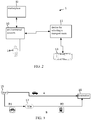
- FIG. 2 shows by way of example a system 1 according to the invention for reducing the environmental pollution.
- the system 1 has an environmental account 10, which is uniquely assigned to a person 14 in the example.
- Environmental units are managed on the environmental account 10.
- An environmental unit can be, for example, an abstract or virtual dimension which can represent various types of environmental pollution.
- the various pollutants of a motor vehicle, such as CO2 and NOx can be converted in weighted form into environmental units.
- the system 1 has a device 11 for selecting a transport route.
- the transport route is selected in this case according to a method according to the invention to reduce or minimize the environmental pollution.
- the device 11 has a connection to the environmental account 10, whereby a consideration of the environmental units available on the environmental account 10 is possible.
- the selected transport route can be transmitted, for example, to a transport means, in the example a motor vehicle 13, which was selected to carry out the transport route.
- the device 11 can be arranged, for example, in a portable device, it can be implemented solely as a software solution, for example, on a smart phone, or can be permanently installed in the vehicle 13. A unique assignment is possible at any time due to the connection to the environmental account 10. After ending the transport route, the environmental units actually required or consumed are deducted from the environmental account.
- the system 1 can additionally have a marketplace 12, which is connected to the environmental account.
- Environmental units can be traded on the marketplace 12, to possibly purchase a missing number of environmental units which are required to carry out a certain transport route.
- Two alternative transport routes A and B are shown by way of example in Figure 3 , which are possible between a start 15 and a destination 16.
- a passenger vehicle was selected and a route which leads on the most direct possible path from the start 15 to the destination 16.
- the costs of this transport route are a certain number of environmental units.
- the transport route B can be more favorable for minimizing the environmental pollution due to various factors to be considered, for example, to select the transport route B.
- the costs of the transport route A can be made more expensive. Parts of the route A could also be blocked due to high environmental pollution or the environmental account could not have sufficient environmental units.
- the transport route B is divided here into two partial transport routes Bland B2.
- the first partial transport route B1 leads with the bicycle to a railway station 17. From there, the second partial route B2 leads with the train to the destination 16.
- the environmental pollution of the transport route B is thus less as a whole than the environmental pollution of the transport route A.
- route selection shown is merely an example of how an environmentally-friendly route selection can take place.
- the example shown here are not meant to be restrictive in any way. All known and available transport means can be taken into consideration in the selection of the transport route.
Landscapes
- Business, Economics & Management (AREA)
- Engineering & Computer Science (AREA)
- Strategic Management (AREA)
- Human Resources & Organizations (AREA)
- Economics (AREA)
- Physics & Mathematics (AREA)
- General Physics & Mathematics (AREA)
- Development Economics (AREA)
- Entrepreneurship & Innovation (AREA)
- Marketing (AREA)
- General Business, Economics & Management (AREA)
- Theoretical Computer Science (AREA)
- Remote Sensing (AREA)
- Radar, Positioning & Navigation (AREA)
- Finance (AREA)
- Accounting & Taxation (AREA)
- Tourism & Hospitality (AREA)
- Game Theory and Decision Science (AREA)
- Operations Research (AREA)
- Quality & Reliability (AREA)
- Health & Medical Sciences (AREA)
- Educational Administration (AREA)
- Automation & Control Theory (AREA)
- General Health & Medical Sciences (AREA)
- Primary Health Care (AREA)
- Data Mining & Analysis (AREA)
- Epidemiology (AREA)
- Life Sciences & Earth Sciences (AREA)
- Medical Informatics (AREA)
- Physical Education & Sports Medicine (AREA)
- Public Health (AREA)
- Biophysics (AREA)
- Navigation (AREA)
- Management, Administration, Business Operations System, And Electronic Commerce (AREA)
- Traffic Control Systems (AREA)
- Educational Technology (AREA)
Abstract
A method and a system for reducing the environmental pollution due to a transport route, wherein the transport route contains at least one transport means, a transport material, and a route, is characterized in that an environmental account (10) is provided, on which environmental units are managed, in that a transport route causes costs in the form of a number of environmental units and these costs are deducted from the environmental account, and in that a transport route is selected in dependence on the costs. (Figure 3)
Description
- The invention relates to a method and a system for reducing the environmental pollution due to a transport route.
- A transport route can be characterized here by at least one transport means, a transport material, and a route. The transport material of a transport route can comprise in particular persons and/or products and/or goods. A route is generally defined by a start and a destination.
- The goal of reducing environmental pollution as a whole exists in society and also on the part of the government. A not insignificant fraction of the environmental pollution is contributed, for example, by the traffic by motor vehicles. The individual traffic by passenger vehicles and also the product transport by trucks are included therein.
- A presently disputed way of reducing the environmental pollution is to enact driving bans for specific motor vehicles in defined environmental zones.
- The object of the application is to provide a method and a system by which uniform and simple reduction of the environmental pollution is made possible.
- This object is achieved by a method having the features of
claim 1 and a system having the features ofclaim 12. - The method according to the invention is characterized in that an environmental account is provided, on which environmental units are managed, that a transport route causes costs in the form of a number of environmental units and these costs are deducted from the environmental account, and that a transport route is selected in dependence on the costs.
- It is clear here that the environmental pollution of a transport route is dependent on multiple factors. If a route is covered, for example, via bicycle as the transport means, the environmental pollution with identical route and identical transport material is substantially less than if a passenger vehicle is used. This means that, for example, a reduction of the environmental pollution can be achieved by suitable selection of the transport means. In the method according to the invention, fewer costs thus result, so that after the transport route is completed, fewer environmental units are deducted from the environmental account.
- The advantage is that by way of the environmental account, a transparent means is available by which transport routes can be planned and/or selected on the basis of the occurring costs. The method can thus easily contribute to reducing the overall environmental pollution, wherein driving bans can be substantially dispensed with.
- In one advantageous embodiment, the environmental account is assigned to a transport means and/or a user and/or a transport material. The costs can be easily assigned in this way.
- In one advantageous embodiment, the transport route can be selected in dependence on the available environmental units on the environmental account, so that the environmental account does not sink below zero environmental units. A guiding function can thus result. For example, if only a limited number of environmental units is available, there is a greater incentive to select an environmentally-friendly transport route.
- The selection of the transport route can in principle take place automatically, in an automated manner, or manually. In particular, the transport means and/or the route can be adapted or selected so that the lowest possible costs result for the environmental account.
- In addition to the costs or the environmental pollution, other factors can also be taken into consideration in the selection of the transport route.
- In one embodiment, a transport route can be selected in dependence on health data and/or fitness data of a user. The advantage is that the health of the user can also be promoted. In particular, it can be specified for short routes, for example, that the user is to ride a bicycle or to run.
- In a further embodiment, a transport route can be selected in dependence on a current environmental pollution of a route. In this manner, driving bans can be prevented, since particularly strongly polluted routes are avoided and thus a distribution of the environmental pollution can be effectuated. Traffic jams can thus also be avoided and the traffic can be made more free-flowing overall.
- In one embodiment, a transport route can be selected in dependence on administrative requirements. In this manner, existing or temporary bans or restrictions can be taken into consideration in the selection. Thus, for example, at specific times of day, the costs of a transport route can be higher due to administrative requirements, for example, to equalize typical commuter flows. Individual routes which are blocked, for example, by driving bans can be bypassed in that alternative routes or alternative transport means are selected. Overall, the environmental pollution can thus be reduced so that such driving bans are no longer necessary or are necessary very rarely.
- The option also exists that a group of users unite, for example, via a marketplace for environmental units or via Internet portals in a guideline which is voluntary or under private law to reduce the environmental pollution, so that this can be taken into consideration in the selection of the transport route.
- In dependence on various factors, it can be advantageous if a transport route is divided into multiple partial transport routes, wherein each partial transport route has at least one transport means and a route and costs linked thereto in environmental units for the environmental account. In this manner, for example, for the commute from the surrounding area into a city, it can be selected that a first partial route is covered using a passenger vehicle and a second partial route adjoining thereon is covered using the train or a suburban railway.
- The division into partial routes can in turn be dependent on various factors. Thus, for example, for a transport route having the same route but having an additional transport material, such as a further person or a product, a different division or no division can be proposed, since the resulting total environmental pollution is thus less.
- However, a user is free to use a transport route deviating from the proposed transport route. This means that he can use a passenger vehicle, for example, even if a train was proposed. It is accordingly expedient if an ascertainment of the costs of a transport route is carried out in dependence on the actually covered transport route. In this manner, such deviations from the proposed transport route can be taken into consideration easily.
- For this purpose, it can be reasonable for route monitoring to take place, for example, by a portable device on the user and/or by a device connected to a transport means.
- The costs of a transport route can be dependent on many factors. In particular, it is expedient if the costs are dependent on the transport means, on the route, on the current environmental pollution, for example, of a route, on the utilization of a transport means, and/or on the transport material. The costs can additionally be dependent on the time of day, the season, or other chronological specifications, for example, vacation times.
- There is also the option of orienting the cost to measured values, for example, to a real measured fuel consumption or pollutant emission. Thus, for example, a more environmentally-friendly way of driving with otherwise identical transport route can be rewarded by lower environmental costs. Overall, an environmentally-friendly mode of transport can also be rewarded in that environmental units are credited if, for example, a transport route is covered on foot or using the bicycle. An additional incentive can thus be provided.
- In one embodiment of the invention, it can be provided that environmental units can be traded, in given, loaned, or transferred in another manner. In this manner, for example, users having low environmental costs can sell their free environmental units to other users.
- It can also be provided that costs are grouped or divided within a group. For example, if multiple persons form a carpool, lower environmental costs result per person, since then each person can have deductions from their environmental account.
- A marketplace can expediently be provided for this purpose, for example, on which environmental units can be traded. Such a marketplace can be formed centrally, or handled in each state or in a decentralized manner. For example, it could also be possible to transfer environmental units via email or messenger.
- In one embodiment, each environmental account can have a starting value of environmental units. Such a starting value can be credited to the environmental account once, for example, such as upon initial application/registration or upon birth, for example, as a life credit. However, it is also possible that, for example, a government credits a yearly amount of environmental units to each user, so that in principle here a continuous availability of mobility is provided. Excess environmental units, i.e., environmental units which are not required or claimed in a year, can also remain available in following years on the environmental account, or they can be traded.
- The allocation of environmental units can be coupled, for example, to legal requirements, for example, treaties under international law. In this manner, for example, consideration can be taken of global climate goals.
- It can be provided that the use of such an environmental account is made compulsory on various levels, so that, for example, a government or a city management receives significant design freedom for environmental protection.
- In principle, the transport means can comprise any form of movement, in particular driving, running, swimming, and/or flying. Accordingly, for example, motor vehicles, boats, and/or aircraft, but also bicycles, cargo bicycles, and/or drones can be used as transport means.
- In particular, such a method can advantageously be used upon the use of autonomous vehicles, since they can automatically follow a specified transport route due to various environmental factors and deviations are only possible with difficulty.
- The environmental units can be defined as desired. An environmental unit could, for example, correspond to a specific quantity of a specific pollutant, for example, carbon dioxide or nitrogen oxides. An environmental unit could, however, also comprise various components or could be a virtual dimension which represents environmental pollution per se in abstract form. For example, methane is significantly more harmful to the climate than carbon dioxide. It would therefore be possible to count a quantity unit of methane at higher costs of an environmental unit than, for example, the same quantity unit of carbon dioxide.
- The invention also comprises a system for reducing the environmental pollution due to a transport route. The system is characterized according to the invention in that the system has an environmental account for managing environmental units, and that the system has a device for selecting a transport route, having a connection to the environmental account.
- The selection of the transport route can take place on the basis of different criteria in this way. In contrast to the prior art, not only the shortest or fastest transport route can be considered in this case, but rather also one having the lowest environmental pollution. The selection of the transport means and/or a suitable route can also influence the environmental pollution here.
- In one advantageous embodiment, the transport route can be selected at least according to the number of the environmental units available on the environmental account. In this way, it is possible to prevent a negative environmental balance from occurring.
- In one embodiment, the system has a marketplace for trade, exchange, or other types of transfer of environmental units. Environmental units can thus be transferred between users.
- In one embodiment, the system can be uniquely assigned to a transport means and/or transport material and/or user.
- In one advantageous embodiment, the system is configured to ascertain the costs of a transport route in dependence on the actually covered transport route. For this purpose, the system can have means for detecting and/or monitoring the actual transport route. Such means can comprise, for example, a satellite navigation.
- The system can be designed in particular to execute a method according to the invention as described above.
- The invention is explained in greater detail hereinafter on the basis of the appended drawings.
- In the figures:
- Figure 1:
- shows a flow chart of a method according to the invention,
- Figure 2:
- shows a block diagram of a system according to the invention, and
- Figure 3:
- shows a schematic illustration of two alternative transport routes.
-
Figure 1 shows a flow chart of a method according to the invention. In afirst step 2, the boundary conditions of the transport route are defined. These include a transport material, such as one or more persons and/or products and/or goods. Furthermore, it is necessary to specify a starting location and a destination location. - In a following
step 3, a transport route is selected from these data. The selection therefore includes at least one transport means and one route. In particular, the transport route is selected so that a minimal environmental pollution results. In this case, legal requirements can be taken into consideration as well as voluntary specifications. In addition, the selection can also be carried out according to the environmental units present on the environmental account, so that the environmental account does not fall below zero. - It can also be advantageous here if the transport route is divided into partial transport routes to minimize the environmental pollution as a whole.
- After the transport route has been executed or carried out, in a
third step 4, the actual costs of the selected transport route are determined. Since it is possible to deviate from the transport route selected instep 2, it is important to determine the actually occurring cost to consider the actually carried out transport route. The actually occurring costs are then deducted from the environmental account in alast step 5. -
Figure 2 shows by way of example asystem 1 according to the invention for reducing the environmental pollution. Thesystem 1 has anenvironmental account 10, which is uniquely assigned to aperson 14 in the example. Environmental units are managed on theenvironmental account 10. An environmental unit can be, for example, an abstract or virtual dimension which can represent various types of environmental pollution. For example, the various pollutants of a motor vehicle, such as CO2 and NOx, can be converted in weighted form into environmental units. - The
system 1 has adevice 11 for selecting a transport route. The transport route is selected in this case according to a method according to the invention to reduce or minimize the environmental pollution. In this case, thedevice 11 has a connection to theenvironmental account 10, whereby a consideration of the environmental units available on theenvironmental account 10 is possible. - The selected transport route can be transmitted, for example, to a transport means, in the example a
motor vehicle 13, which was selected to carry out the transport route. Thedevice 11 can be arranged, for example, in a portable device, it can be implemented solely as a software solution, for example, on a smart phone, or can be permanently installed in thevehicle 13. A unique assignment is possible at any time due to the connection to theenvironmental account 10. After ending the transport route, the environmental units actually required or consumed are deducted from the environmental account. - The
system 1 can additionally have amarketplace 12, which is connected to the environmental account. Environmental units can be traded on themarketplace 12, to possibly purchase a missing number of environmental units which are required to carry out a certain transport route. - Two alternative transport routes A and B are shown by way of example in
Figure 3 , which are possible between astart 15 and adestination 16. For the first transport route A, a passenger vehicle was selected and a route which leads on the most direct possible path from thestart 15 to thedestination 16. The costs of this transport route are a certain number of environmental units. - However, it can be more favorable for minimizing the environmental pollution due to various factors to be considered, for example, to select the transport route B. In this case, for example, at typical commuting times, the costs of the transport route A can be made more expensive. Parts of the route A could also be blocked due to high environmental pollution or the environmental account could not have sufficient environmental units.
- The transport route B is divided here into two partial transport routes Bland B2. The first partial transport route B1 leads with the bicycle to a
railway station 17. From there, the second partial route B2 leads with the train to thedestination 16. The environmental pollution of the transport route B is thus less as a whole than the environmental pollution of the transport route A. - However, the route selection shown is merely an example of how an environmentally-friendly route selection can take place. The example shown here are not meant to be restrictive in any way. All known and available transport means can be taken into consideration in the selection of the transport route.
-
- 1
- system for reducing the environmental pollution
- 2-5
- method steps
- 10
- environmental account
- 11
- device for selecting a transport route
- 12
- marketplace
- 13
- transport means
- 14
- user
- 15
- starting location
- 16
- destination
- 17
- railway station
- A
- transport route
- B
- transport route
- B1
- partial transport route of the transport route B
- B2
- partial transport route of the transport route B
Claims (15)
- A method for reducing the environmental pollution due to a transport route, wherein the transport route contains at least one transport means, a transport material, and a route, characterized in that
an environmental account (10) is provided, on which environmental units are managed,
in that a transport route causes costs in the form of a number of environmental units and these costs are deducted from the environmental account, and
in that a transport route is selected in dependence on the costs. - The method as claimed in claim 1, characterized in that the environmental account is assigned to a transport means and/or a user and/or a transport material.
- The method as claimed in one of claims 1 or 2, characterized in that the transport route is selected in dependence on the available environmental units on the environmental account (10), so that the environmental account does not sink below zero environmental units.
- The method as claimed in any one of claims 1 to 3, characterized in that a transport route is selected in dependence on health data and/or fitness data of a user (13) and/or in dependence on an environmental pollution of a route.
- The method as claimed in any one of claims 1 to 4, characterized in that a transport route is selected in dependence on administrative requirements and/or in that a transport route is selected in dependence on requirements which are voluntary or under private stipulations.
- The method as claimed in any one of claims 1 to 5, characterized in that a transport route (B) is divided into multiple partial transport routes (B1, B2), wherein each partial transport route (B1, B2) has at least a transport means and a route and costs linked thereto in environmental units for the environmental account.
- The method as claimed in any one of claims 1 to 6, characterized in that an ascertainment of the costs of a transport route is performed in dependence on the actually covered transport route.
- The method as claimed in any one of claims 1 to 7, characterized in that the costs of a transport route are dependent on the transport means, on the route, on the current environmental pollution, on the utilization of a transport means, and/or on the transport material.
- The method as claimed in any one of claims 1 to 8, characterized in that environmental units can be traded, given, loaned, or transferred in other ways, preferably on a marketplace.
- The method as claimed in any one of claims 1 to 9, characterized in that each environmental account has a starting value of environmental units and/or in that environmental units are regularly credited to an environmental account.
- The method as claimed in any one of claims 1 to 10, characterized in that the transport means can comprise any form of movement, in particular driving, running, swimming and/or in that the transport material can comprise persons and/or products and/or goods.
- A system (1) for reducing the environmental pollution due to a transport route, wherein the transport route contains at least one transport means, a transport material, and a route, characterized in that
the system has an environmental account (10) for managing environmental units, and
in that the system has a device (11) for selecting a transport route, having a connection to the environmental account,
in particular wherein the transport route is selected at least according to the number of the environmental units available on the environmental account. - The system as claimed in claim 12, characterized in that the system has a marketplace (12) for trading, exchanging, or other types of transfer of environmental units.
- The system as claimed in claim 12 or 13, characterized in that the device is uniquely assigned to a transport means and/or transport material and/or user (13).
- The system as claimed in any one of claims 12 to 14, characterized in that the device for selecting a transport route is configured to ascertain the costs of a transport route in dependence on the actually covered transport route.
Applications Claiming Priority (1)
| Application Number | Priority Date | Filing Date | Title |
|---|---|---|---|
| DE102019126207.0A DE102019126207A1 (en) | 2019-09-27 | 2019-09-27 | Method and system for reducing the environmental impact of a transport route |
Publications (1)
| Publication Number | Publication Date |
|---|---|
| EP3798951A1 true EP3798951A1 (en) | 2021-03-31 |
Family
ID=72615653
Family Applications (1)
| Application Number | Title | Priority Date | Filing Date |
|---|---|---|---|
| EP20197582.8A Withdrawn EP3798951A1 (en) | 2019-09-27 | 2020-09-22 | Method and system for reducing the environmental pollution due to a transport route |
Country Status (5)
| Country | Link |
|---|---|
| US (1) | US20210095983A1 (en) |
| EP (1) | EP3798951A1 (en) |
| KR (1) | KR20210037543A (en) |
| CN (1) | CN112582047A (en) |
| DE (1) | DE102019126207A1 (en) |
Family Cites Families (6)
| Publication number | Priority date | Publication date | Assignee | Title |
|---|---|---|---|---|
| US20040107110A1 (en) * | 2002-12-02 | 2004-06-03 | Jens Gottlieb | Optimization of transport with multiple vehicles |
| CA2728946A1 (en) * | 2008-06-27 | 2009-12-30 | Navitime Japan Co., Ltd. | Route searching apparatus and route searching method |
| US20100030608A1 (en) * | 2008-07-29 | 2010-02-04 | Jason Kaminsky | System and method for a carbon calculator including carbon offsets |
| WO2010021060A1 (en) * | 2008-08-22 | 2010-02-25 | 株式会社ナビタイムジャパン | Route search device and route search method |
| US8744766B2 (en) * | 2011-09-27 | 2014-06-03 | International Business Machines Corporation | Dynamic route recommendation based on pollution data |
| US9389086B2 (en) * | 2014-03-27 | 2016-07-12 | Heba Abdulmohsen HASHEM | Transportation planner and route calculator for alternative travel methods |
-
2019
- 2019-09-27 DE DE102019126207.0A patent/DE102019126207A1/en not_active Withdrawn
-
2020
- 2020-09-15 KR KR1020200118093A patent/KR20210037543A/en not_active Withdrawn
- 2020-09-18 CN CN202010984337.6A patent/CN112582047A/en active Pending
- 2020-09-22 EP EP20197582.8A patent/EP3798951A1/en not_active Withdrawn
- 2020-09-23 US US17/029,668 patent/US20210095983A1/en not_active Abandoned
Non-Patent Citations (1)
| Title |
|---|
| KWON YONG-JU ET AL: "Heterogeneous fixed fleet vehicle routing considering carbon emission", TRANSPORTATION RESEARCH PART D: TRANSPORT AND ENVIRONMENT, PERGAMON, AMSTERDAM, NL, vol. 23, 17 May 2013 (2013-05-17), pages 81 - 89, XP028575510, ISSN: 1361-9209, DOI: 10.1016/J.TRD.2013.04.001 * |
Also Published As
| Publication number | Publication date |
|---|---|
| KR20210037543A (en) | 2021-04-06 |
| DE102019126207A1 (en) | 2021-04-01 |
| CN112582047A (en) | 2021-03-30 |
| US20210095983A1 (en) | 2021-04-01 |
Similar Documents
| Publication | Publication Date | Title |
|---|---|---|
| Owczarzak et al. | Design of passenger public transportation solutions based on autonomous vehicles and their multiple criteria comparison with traditional forms of passenger transportation | |
| Malasek | A set of tools for making urban transport more sustainable | |
| McKinnon | Sustainable distribution: opportunities to improve vehicle loading | |
| Kalifa et al. | Application of Multi‐Criteria Decision analysis including sustainable indicators for prioritization of public transport system | |
| Lopez-Ruiz et al. | Quantifying the effects of sustainable urban mobility plans | |
| Zhang et al. | Traveler information tool with integrated real-time transit information and multimodal trip planning: Design and implementation | |
| Bénichou | Sustainable development of transport infrastructure in the system of national economy | |
| Strong | When apps pollute: Regulating transportation network companies to maximize environmental benefits | |
| SE1150530A1 (en) | Method of route planning | |
| Hipogrosso et al. | Sustainable mobility in the public transportation of Montevideo, Uruguay | |
| US20210095983A1 (en) | Method and system for reducing the environmental pollution due to a transport route | |
| Boyce | Transportation systems | |
| van Duin et al. | Explaining the growth in light electric vehicles in city logistics | |
| Horažďovský et al. | Dynamic service of public transport in smart city and region | |
| Zushi | Driverless vehicles: Opportunity for further greenhouse gas emission reductions | |
| Williams et al. | Transportation planning implications of automated/connected vehicles on Texas highways. | |
| Cristescu | Autonomous Vehicles as an alternative to traditional Transportation Options | |
| Columbus | SmartColumbus | |
| Zoepf et al. | Accessibility and equity: Can a shared and electric future be socially just? | |
| LÓPEZ et al. | Quantifying the Effects of Sustainable Urban Mobility Plans | |
| Muelaner | Unsettled Issues Regarding First-and Last-mile Transport | |
| Diermeyer et al. | ODD Taxi | |
| Palencia | Improving Freight System Performance With Automation, Collaborative Practices, and Cleaner Vehicle Technologies | |
| Meka et al. | The Role of Transportation in the Development of Medan Urban Areas a Study of Infrastructure and Mobility Patterns | |
| Sh | Ensuring sustainability of public transport system through rational management |
Legal Events
| Date | Code | Title | Description |
|---|---|---|---|
| PUAI | Public reference made under article 153(3) epc to a published international application that has entered the european phase |
Free format text: ORIGINAL CODE: 0009012 |
|
| STAA | Information on the status of an ep patent application or granted ep patent |
Free format text: STATUS: THE APPLICATION HAS BEEN PUBLISHED |
|
| AK | Designated contracting states |
Kind code of ref document: A1 Designated state(s): AL AT BE BG CH CY CZ DE DK EE ES FI FR GB GR HR HU IE IS IT LI LT LU LV MC MK MT NL NO PL PT RO RS SE SI SK SM TR |
|
| AX | Request for extension of the european patent |
Extension state: BA ME |
|
| STAA | Information on the status of an ep patent application or granted ep patent |
Free format text: STATUS: THE APPLICATION IS DEEMED TO BE WITHDRAWN |
|
| 18D | Application deemed to be withdrawn |
Effective date: 20211001 |