EP3798862A1 - Method and system for learning rules from a data base - Google Patents
Method and system for learning rules from a data base Download PDFInfo
- Publication number
- EP3798862A1 EP3798862A1 EP19199308.8A EP19199308A EP3798862A1 EP 3798862 A1 EP3798862 A1 EP 3798862A1 EP 19199308 A EP19199308 A EP 19199308A EP 3798862 A1 EP3798862 A1 EP 3798862A1
- Authority
- EP
- European Patent Office
- Prior art keywords
- numerical
- relation
- relations
- rules
- data base
- Prior art date
- Legal status (The legal status is an assumption and is not a legal conclusion. Google has not performed a legal analysis and makes no representation as to the accuracy of the status listed.)
- Withdrawn
Links
Images


Classifications
-
- G—PHYSICS
- G06—COMPUTING OR CALCULATING; COUNTING
- G06N—COMPUTING ARRANGEMENTS BASED ON SPECIFIC COMPUTATIONAL MODELS
- G06N5/00—Computing arrangements using knowledge-based models
- G06N5/02—Knowledge representation; Symbolic representation
- G06N5/022—Knowledge engineering; Knowledge acquisition
- G06N5/025—Extracting rules from data
-
- G—PHYSICS
- G06—COMPUTING OR CALCULATING; COUNTING
- G06N—COMPUTING ARRANGEMENTS BASED ON SPECIFIC COMPUTATIONAL MODELS
- G06N3/00—Computing arrangements based on biological models
- G06N3/02—Neural networks
- G06N3/04—Architecture, e.g. interconnection topology
-
- G—PHYSICS
- G06—COMPUTING OR CALCULATING; COUNTING
- G06N—COMPUTING ARRANGEMENTS BASED ON SPECIFIC COMPUTATIONAL MODELS
- G06N3/00—Computing arrangements based on biological models
- G06N3/02—Neural networks
- G06N3/04—Architecture, e.g. interconnection topology
- G06N3/042—Knowledge-based neural networks; Logical representations of neural networks
-
- G—PHYSICS
- G06—COMPUTING OR CALCULATING; COUNTING
- G06N—COMPUTING ARRANGEMENTS BASED ON SPECIFIC COMPUTATIONAL MODELS
- G06N3/00—Computing arrangements based on biological models
- G06N3/02—Neural networks
- G06N3/08—Learning methods
-
- G—PHYSICS
- G06—COMPUTING OR CALCULATING; COUNTING
- G06N—COMPUTING ARRANGEMENTS BASED ON SPECIFIC COMPUTATIONAL MODELS
- G06N5/00—Computing arrangements using knowledge-based models
- G06N5/02—Knowledge representation; Symbolic representation
- G06N5/022—Knowledge engineering; Knowledge acquisition
Definitions
- the invention concerns a system and a computer implemented method for learning rules from a data base comprising entities and relations between said entities, wherein an entity is either a constant or a numerical value, and a relation between a constant and a numerical value is a numerical relation and a relation between two constants is a non-numerical relation.
- Such data bases are also known as knowledge graphs which are mainly used for graph-based knowledge representation by describing (real world) entities and their relations organized in a graph.
- Rules over a knowledge graph capture interpretable patterns in data, such that the rules can be used for prediction, completion and cleaning of knowledge graphs.
- Several approaches for deriving such rules from a knowledge graph are known. However, they are limited with respect to the treatment of numeric data.
- Predictions for an entity of a data base is often based not only on its relation to other entities but also on a summary over a set of such relations commonly expressed by aggregates.
- a computer implemented method for learning rules from a data base comprising entities and relations between said entities, wherein an entity is either a constant or a numerical value, and a relation between a constant and a numerical value is a numerical relation and a relation between two constants is a non-numerical relation, comprises the steps of:
- An aggregate value is a single result value from a set of input values.
- an aggregate value is a numerical value a relation between an entity being a constant and an entity being an aggregate value is a numerical relation.
- non-numerical relations are derived from the aggregate values and added to the data base.
- the method according to the present invention enables advantageously to integrate aggregate values in the rule learning process.
- the step of deriving aggregate values from said numerical and/or non-numerical relations comprises applying aggregate functions to said numerical and/or non-numerical relations.
- Aggregation functions group multiple values together, and can perform a variety of operations on the grouped values to return a single result, herein referred to as an aggregate value.
- examples of the aggregate function include average, sum, minimum, maximum, count, and various other aggregate functions.
- the count function is preferably applied to numerical and non-numerical relations.
- Further aggregate functions, for example average, sum, minimum, and maximum are preferably applied to numerical relations.
- the step of deriving non-numerical relations from said aggregate values comprises encoding a numerical relation into a non-numerical relation.
- a relation between a constant and a numerical value is encoded into a relation between two constants.
- the step of encoding a numerical relation into a non-numerical relation comprises comparing of entities with respect to numerical relations in which the entities participate. It has been proved beneficial, to compare two or more entities with respect to numerical relations of the same type. Typically, the comparison with respect to numerical relations of different types is irrelevant.
- TensorLog operators also known as TensorLog operators, wherein in TensorLog all entities are mapped to integers, and each entity i is associated with a one-hot encoded vector v i such that only it's i-th entry is 1 and the other entries are zeros.
- the step of constructing differentiable operators comprises constructing matrices, wherein a matrix refers to a non-numerical relation.
- a matrix is constructed for every non-numerical relation.
- the matrix is an i-by-i matrix, wherein an entry (j, k) is non-zero, for example 1, if the relation is a relation between the entity j and entity k, otherwise an entry is zero.
- the step of constructing differentiable operators comprises constructing negated differentiable operators.
- constructing negated differentiable operators comprises constructing negated matrices, wherein a negated matrix refers to a negated non-numerical relation.
- the negation of a matrix can be obtained by flipping all zeros to ones and vice versa such that the corresponding (sparse) matrix results in a dense matrix. Since dense matrices cannot be materialized in TensorLog, negated relations are not supported directly by the approach known from the cited reference. Therefore, according to a preferred embodiment of the present invention, the construction of negated differentiable operators comprises constructing negated matrices by flipping only the elements in such rows that contain at least one non-zero element.
- the step of extracting rules from the differentiable operators comprises using an artificial neural network, particularly an artificial neural network constructed based on neural logic programming, LP, framework.
- Exemplary details of the neural logic programming, LP, framework and the training of such a framework for learning rules are disclosed for example in the following reference: ZHANG Fan, YANG Zhilin and COHEN, William W., Differentiable Learning of Logical Rules for Knowledge Base Reasoning. NeurIPS, 2017, pages 2316 to 2325 .
- the step extracting rules from said differentiable operators using a neural network is restricted by a maximum number of relations allowed in a rule.
- the rules extracted from the differentiable operators are horn rules, wherein said method further comprises the step of decoding said rules into decoded rules.
- the horn rules extracted from the differentiable operators using the neural logic programming, LP, framework do not comprise the aggregate values and/or negations. By decoding the horn rules, they can be advantageously decoded into rules with aggregate values and/or rules with negations.
- the method further comprises the step of applying said rules and/or said decoded rules to predict one or more relations between two or more entities of the data base.
- the invention also concerns a system configured for learning rules from a data base comprising entities and binary relations between said entities, wherein the system comprises a processing unit configured to perform the method according to any of the embodiments.
- the processing unit may be a distributed computing system, a microprocessor or a microcontroller.
- the system comprises a memory, in particular computer readable non-volatile memory, wherein the processing unit and the memory interact via a data line.
- the memory comprises computer readable instructions that when executed by the processing unit cause the processing unit to execute the method for learning rules from a data base according to the above described embodiments.
- the system may comprise the database or connect to a further memory in which the data base is stored such that the processing unit has access to the data of the data base when performing the method according to the embodiments.
- the system further comprises a processing unit and a memory unit for an artificial neural network, particularly an artificial neural network constructed based on neural logic programming (neural LP) framework, configured to perform the step according to an embodiment.
- an artificial neural network particularly an artificial neural network constructed based on neural logic programming (neural LP) framework, configured to perform the step according to an embodiment.
- neural logic programming neural LP
- the invention also concerns a computer program, wherein the computer program comprises computer readable instructions that when executed by a computer cause the computer to execute the method according to the embodiments.
- the invention also concerns a computer program product, wherein the computer program product comprises a computer readable storage medium comprising the computer program according to the embodiments.
- the invention also concerns use of a method according to the embodiments and/or a system according to the embodiments and/or a computer program according to the embodiments and/or a computer program product according to the embodiments for predicting relations between entities of a data base and/or cleaning of a data base and/or completion of a data base.
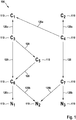
- Figure 1 depicts a schematic view of a data base 100 according to a first embodiment.
- Such data bases 100 are also known as knowledge graphs which are mainly used for graph-based knowledge representation by describing (real world) entities and their relations organized in a graph.
- figure 1 is an exemplary schematic extract of a data base 100 to allow for describing by example the method and system of the present invention, wherein the method and system described herein can be applied to large-scale real world knowledge graphs, which may contain millions and billions of facts.
- the data base 100 comprises entities 110 and relations 120 between the entities 110.
- Entities C1, C2, C3, C4, C5, C6 and C7 of the data base 100 are constants.
- Entities N1, N2, N3 are numerical values.
- a relation 120 between a constant and a numerical value is referred to as a numerical relation and a relation 120 between two constants is referred to as a non-numerical relation.
- entity C3 is a first person and entity C4 is a second person.
- Entity C1 is a first article and entity C2 is a second article.
- the relation 120a between the entity C3 and the entity C2 is for example "cited in”, which in this case means that the first person is cited in the first article.
- the relation 120a between the entity C4 and the entity C1 as well as the relation 120a between the entity C4 and the entity C2 is for example also “cited in”, which in this means that the second person is cited in the first article as well as in the second article.
- the relation 120a is a non-numerical relation.
- entity C6 is a first patent and entity C7 is a second patent.
- Numerical value N1 has the value "1”
- numerical value N2 has the value "2”
- numerical value N3 has the value "3”.
- the relation 120b between the entity C6 and the entity N1 as well as the relation 120b between the entity C6 and the entity N2 is for example “has Rating”, which means in this case that the first patent has rating "1" as well as rating "2".
- the relation 120b between the entity C7 and the entity N2 as well as the relation 120b between the entity C7 and the entity N3 is for example "has Rating", which means in this case that the second patent has rating "2" as well as rating "3”.
- the relation 120b is a numerical relation.
- Rules over a data base 100 capture interpretable patterns in data, such that the rules can be used for prediction, completion and cleaning of the data base 100.
- Predictions for an entity 110 of a data base 100 is often based not only on its relation 120 to other entities 110 but also rather on a summary over a set of such relations commonly expressed by aggregates.
- Fig. 3 depicts first aspects of computer-implemented method 200 for learning rules from a data base 100.
- a step 210 of deriving aggregate values from said numerical and/or non-numerical relations of the data base 100 is executed.
- An aggregate value is a single result value from a set of input values.
- the step of deriving 210 aggregate values from said numerical and/or non-numerical relations comprises applying aggregate functions on said numerical and/or non-numerical relations.
- Aggregate functions compute a single result value, aggregate value, from a set of input values.
- examples of the aggregate function include average, sum, minimum, maximum, count, and various other aggregate functions the count function is preferably applied to numerical and non-numerical relations.
- Further aggregate functions for example average, sum, minimum and maximum, are preferably applied to numerical relations.
- Applying the step 210 to the above described example means for example applying the count function to the non-numerical relation 120a "cited in". Entity C3 is cited once and entity C4 is cited twice. According to this example, the aggregate value "1" and "2" are derived from the relation 120a.
- step 220 is executed.
- step 220 non-numerical relations are derived from said aggregate values.
- an aggregate value is a numerical value a relation between an entity being a constant and an entity being an aggregate value is a numerical relation.
- non-numerical relations are derived from the aggregate values.
- the step of deriving 220 non-numerical relations from said aggregate values comprises encoding a numerical relation into a non-numerical relation.
- a relation between a constant and a numerical value is encoded into a relation between two constants.
- the step of encoding a numerical relation into a non-numerical relation comprises comparing of entities with respect to numerical relations in which the entities participate. It has been proved beneficial to compare two or more entities with respect to numerical relations of the same type. Typically, the comparison with respect to numerical relations of different types is irrelevant.
- Applying the step 210 to the above described example means for example to compare entity C6 and C7 with regard to their average ratings.
- entity C6 comprises an average rating of "1.5”
- entity C7 comprises an average rating of "2.5”
- a non-numerical relation of "less rated” or “more rated” respectively can be derived from these aggregate values.
- step 210 means for example to compare entity C3 and C4 with regard to the amount of citations.
- entity C3 is cited once and C4 is cited twice a non-numerical relation of "more cited” or "less cited” respectively can be derived from the aggregate values.
- step 230 is executed.
- the non-numerical relations derived from the aggregate values are added to the data base. Instead of adding the aggregate values as new entities in the form of numerical value to the data base non-numerical relations are derived from the aggregate values as described above and then added to the data base.
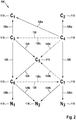
- Fig. 2 depicts a data base 100 according to a second embodiment, wherein derived non-numerical relations 130 has been added.
- step 240 differentiable operators are constructed, wherein a differentiable operator refers to a non-numerical relation or a derived non-numerical relation of the data base.
- TensorLog operators which enable investigating reasoning over data base facts in a differentiable manner to derive new facts are disclosed for example in the following reference: COHEN William W., YANG Fan, MAZAITIS Kathryn, Tensorlog: Deep Learning Meets Probabilistic Databases. CoRR, 2017, abs/1707.05390 , which connects rule application with sparse matrix multiplications.
- TensorLog all entities are mapped to integers, and each entity i is associated with a one-hot encoded vector v i such that only it's i-th entry is 1 and the other entries are zeros.
- the step of constructing 240 differentiable operators comprises constructing matrices M R , wherein a matrix M R refers to a non-numerical relation.
- a Matrix M R is constructed for every non-numerical relation.
- the matrix M R is an i-by-i matrix, wherein an entry (j, k) is non-zero, for example 1, if the relation is a relation between the entity j and the entity k, otherwise the entry is zero.
- the step of constructing 240 differentiable operators comprises constructing negated differentiable operators.
- constructing negated differentiable operators comprises constructing negated matrices M Rneg , wherein a matrix M Rneg refers to a negated non-numerical relation.
- the negation of a matrix M R can be obtained by flipping all zeros to ones and vice versa such that the corresponding (sparse) matrix M R results in a dense matrix. Since dense matrices cannot be materialized in TensorLog, negated relations are not supported directly by the approach known from the cited reference.
- the negated matrices M Rneg are constructed by flipping only the elements in such rows that contain at least one non-zero element.
- the construction of the negated differentiable operators is performed under the assumption that it can be only concluded that a negated relation between a pair of entities is true if their already exist an associated non negated relation between this pair of entities. Otherwise, the negated relation remains unknown.
- step 250 rules are extracted from said differentiable operators.
- the step of extracting 250 rules from the differentiable operators comprises using an artificial neural network, particularly an artificial neural network constructed based on neural logic programming, LP, framework.
- Exemplary details of the neural logic programming, LP, framework and the training of such a framework for learning rules are disclosed for example in the following reference: ZHANG Fan, YANG Zhilin and COHEN, William W., Differentiable Learning of Logical Rules for Knowledge Base Reasoning. NeurIPS, 2017, pages 2316 to 2325 .
- the computer-implemented method 200 described in the present invention has the following advantages: By performing the steps of deriving 210 aggregate values from said numerical and/or non-numerical relations, deriving 220 non-numerical relations from said aggregate values, adding 230 said derived non-numerical relations to the data base and constructing 240 differentiable operators based on a derived non-numerical relation, the present invention allows to compile numerical relations into differentiable operators. Therefore, the method according to the present invention enables to utilize a respective comparison information effectively and incorporate it into the rule learning process.
- the present invention allows to construct negated differentiable operators which can be materialized in the approaches known from prior art.
- the rules extracted from the differentiable operators are horn rules
- the method 200 further comprises the step of decoding 260 said rules into decoded rules.
- the horn rules extracted from the differentiable operators using the neural logic programming, LP, framework do not comprise the aggregate values and/or negations.
- decoding 260 the horn rules they can by advantageously decoded into rules with aggregate values and/or negations.
- a rule which can be extracted by method 200 can be for example "a person is influenced by a person which is cited more often in an article than another person”. After decoding, this rule reads to "a person is influenced by a person which is cited at least two times in an article”.
- a further rule which can be extracted by method 200 can be for example "a patent is relevant for a person, if this patent has a higher rating than another patent”. After decoding, this rule reads to "a patent which is has a higher rating than 2 is relevant for a person.”
- the method 200 further comprises the step of applying 270 said rules and/or said decoded rules to predict one or more relations 140 between two or more entities 110 of the data base 100.
- relations 140 between entity C4 and entity C5 and between entity C5 and entity C7 have been predicted by applying 210 the rules.
- a rule that can be extracted and/or decoded by method 200 can be for example "a person is influenced by a person which is cited at least two times in an article”. Entity C3 is cited once and entity C4 is cited twice. Applying now the rule to the data base 100 we can predict the relation 140a "influences" between entity C4 and C5. Another rule can be for example "a patent which is has a higher rating than 2 is relevant for a person”. Entity C6 has rating "1.5" and entity C7 has rating "2.5". Applying now the rule to the data base 100 we can be predict the relation 140b "is relevant" between entity C7 and C5.
- the method 200 may be performed by a system 300 configured for learning rules from a data base 100 comprising entities 110 and binary relations 120 between said entities as depicted in figure 4 .
- the system 300 comprises a processing unit 310 configured to perform the method 200 according to embodiments.
- the system comprises a memory 320, in particular computer readable non-volatile memory 320, wherein the processing unit 310 and the memory 320 interact via a data line 330.
- the processing unit 310 may be a distributed computing system, a microprocessor or a microcontroller.
- the memory 320 comprises computer readable instructions that when executed by the processing unit 310 cause the processing unit 310 to execute the method 200 for learning rules from a data base according to the above described embodiments.
- system 300 may comprise the database 100 or connect to a further memory, not depicted in figure 4 , in which the data base 100 is stored such that the processing unit 310 has access to the data of the data base 100 when performing the method 200.
- the system 300 further comprises a processing unit 340 and a memory 350 for an artificial neural network, configured to perform the step 250 of extracting rules from said differentiable operators as described above.
- the processing 340 for the artificial network is connect via a data line 330 with the memory 320.
- the artificial neural network is constructed based on neural logic programming, LP, framework.
- LP neural logic programming
- framework Exemplary details of the neural logic programming, LP, framework and the training of such a framework for learning rules are disclosed for example in the above cited reference.
- a method 200 according to the above described embodiments and/or a system 300 according to the above described embodiments and/or a computer program according to the above described embodiments and/or a computer program product according to the above described embodiments may be used for predicting relations 120 between entities 110 of a data base 100 and/or cleaning of a data base 100 and/or completion of a data base 100.
Landscapes
- Engineering & Computer Science (AREA)
- Theoretical Computer Science (AREA)
- Physics & Mathematics (AREA)
- General Engineering & Computer Science (AREA)
- Computing Systems (AREA)
- Software Systems (AREA)
- Artificial Intelligence (AREA)
- Mathematical Physics (AREA)
- Computational Linguistics (AREA)
- Data Mining & Analysis (AREA)
- Evolutionary Computation (AREA)
- General Physics & Mathematics (AREA)
- Biomedical Technology (AREA)
- Molecular Biology (AREA)
- General Health & Medical Sciences (AREA)
- Biophysics (AREA)
- Life Sciences & Earth Sciences (AREA)
- Health & Medical Sciences (AREA)
- Information Retrieval, Db Structures And Fs Structures Therefor (AREA)
- Machine Translation (AREA)
Abstract
deriving (210) aggregate values from said numerical and/or non-numerical relations;
deriving (220) non-numerical relations from said aggregate values;
adding (230) said derived non-numerical relations to the data base;
constructing (240) differentiable operators, wherein a differentiable operator refers to a non-numerical or a derived non-numerical relation of the data base, and extracting (250) rules from said differentiable operators.
Description
- The invention concerns a system and a computer implemented method for learning rules from a data base comprising entities and relations between said entities, wherein an entity is either a constant or a numerical value, and a relation between a constant and a numerical value is a numerical relation and a relation between two constants is a non-numerical relation.
- Such data bases are also known as knowledge graphs which are mainly used for graph-based knowledge representation by describing (real world) entities and their relations organized in a graph.
- Rules over a knowledge graph capture interpretable patterns in data, such that the rules can be used for prediction, completion and cleaning of knowledge graphs. Several approaches for deriving such rules from a knowledge graph are known. However, they are limited with respect to the treatment of numeric data.
- Predictions for an entity of a data base is often based not only on its relation to other entities but also on a summary over a set of such relations commonly expressed by aggregates.
- Therefore, it is desirable to learn rules from the data base, which express such aggregates.
- This is achieved by the device and methods according to the independent claims.
- A computer implemented method for learning rules from a data base comprising entities and relations between said entities, wherein an entity is either a constant or a numerical value, and a relation between a constant and a numerical value is a numerical relation and a relation between two constants is a non-numerical relation, comprises the steps of:
- deriving aggregate values from said numerical and/or non-numerical relations;
- deriving non-numerical relations from said aggregate values;
- adding said derived non-numerical relations to the data base;
- constructing differentiable operators, wherein each differentiable operator refers to a non-numerical or a derived non-numerical relation of the data base,
- and extracting rules from said differentiable operators using a neural network.
- An aggregate value is a single result value from a set of input values. As an aggregate value is a numerical value a relation between an entity being a constant and an entity being an aggregate value is a numerical relation. Instead of adding the aggregate values as new entities in the form of numerical value to the data base non-numerical relations are derived from the aggregate values and added to the data base.
- Exemplary details of constructing differentiable operators, also known as TensorLog operators, which enable investigating reasoning over data base facts in a differentiable manner to derive new facts are disclosed for example in the following reference:
COHEN William W., YANG Fan, MAZAITIS Kathryn, Tensorlog: Deep Learning Meets Probabilistic Databases. CoRR, 2017, abs/1707.05390. However, this approach is limited to the treatment of numeric data. - The method according to the present invention enables advantageously to integrate aggregate values in the rule learning process.
- According to an embodiment, the step of deriving aggregate values from said numerical and/or non-numerical relations comprises applying aggregate functions to said numerical and/or non-numerical relations. Aggregation functions group multiple values together, and can perform a variety of operations on the grouped values to return a single result, herein referred to as an aggregate value.
- Preferably, examples of the aggregate function include average, sum, minimum, maximum, count, and various other aggregate functions. The count function is preferably applied to numerical and non-numerical relations. Further aggregate functions, for example average, sum, minimum, and maximum are preferably applied to numerical relations.
- According to an embodiment, the step of deriving non-numerical relations from said aggregate values comprises encoding a numerical relation into a non-numerical relation. Thus, a relation between a constant and a numerical value is encoded into a relation between two constants.
- According to an embodiment, the step of encoding a numerical relation into a non-numerical relation comprises comparing of entities with respect to numerical relations in which the entities participate. It has been proved beneficial, to compare two or more entities with respect to numerical relations of the same type. Typically, the comparison with respect to numerical relations of different types is irrelevant.
- The above cited reference describes exemplary details of constructing differentiable operators, also known as TensorLog operators, wherein in TensorLog all entities are mapped to integers, and each entity i is associated with a one-hot encoded vector vi such that only it's i-th entry is 1 and the other entries are zeros.
- According to an embodiment, the step of constructing differentiable operators comprises constructing matrices, wherein a matrix refers to a non-numerical relation. Preferably, a matrix is constructed for every non-numerical relation. Preferably, the matrix is an i-by-i matrix, wherein an entry (j, k) is non-zero, for example 1, if the relation is a relation between the entity j and entity k, otherwise an entry is zero.
- According to an embodiment, the step of constructing differentiable operators comprises constructing negated differentiable operators. Preferably, constructing negated differentiable operators comprises constructing negated matrices, wherein a negated matrix refers to a negated non-numerical relation. The negation of a matrix can be obtained by flipping all zeros to ones and vice versa such that the corresponding (sparse) matrix results in a dense matrix. Since dense matrices cannot be materialized in TensorLog, negated relations are not supported directly by the approach known from the cited reference. Therefore, according to a preferred embodiment of the present invention, the construction of negated differentiable operators comprises constructing negated matrices by flipping only the elements in such rows that contain at least one non-zero element.
- According to an embodiment, the step of extracting rules from the differentiable operators comprises using an artificial neural network, particularly an artificial neural network constructed based on neural logic programming, LP, framework.
- Exemplary details of the neural logic programming, LP, framework and the training of such a framework for learning rules are disclosed for example in the following reference:
ZHANG Fan, YANG Zhilin and COHEN, William W., Differentiable Learning of Logical Rules for Knowledge Base Reasoning. NeurIPS, 2017, pages 2316 to 2325. - According to an embodiment the step extracting rules from said differentiable operators using a neural network is restricted by a maximum number of relations allowed in a rule.
- According to an embodiment, the rules extracted from the differentiable operators are horn rules, wherein said method further comprises the step of decoding said rules into decoded rules. The horn rules extracted from the differentiable operators using the neural logic programming, LP, framework do not comprise the aggregate values and/or negations. By decoding the horn rules, they can be advantageously decoded into rules with aggregate values and/or rules with negations.
- According to an embodiment, the method further comprises the step of applying said rules and/or said decoded rules to predict one or more relations between two or more entities of the data base.
- The invention also concerns a system configured for learning rules from a data base comprising entities and binary relations between said entities, wherein the system comprises a processing unit configured to perform the method according to any of the embodiments. The processing unit may be a distributed computing system, a microprocessor or a microcontroller.
- According to an embodiment, the system comprises a memory, in particular computer readable non-volatile memory, wherein the processing unit and the memory interact via a data line.
- According to an embodiment, the memory comprises computer readable instructions that when executed by the processing unit cause the processing unit to execute the method for learning rules from a data base according to the above described embodiments.
- According to an embodiment, the system may comprise the database or connect to a further memory in which the data base is stored such that the processing unit has access to the data of the data base when performing the method according to the embodiments.
- According to an embodiment, the system further comprises a processing unit and a memory unit for an artificial neural network, particularly an artificial neural network constructed based on neural logic programming (neural LP) framework, configured to perform the step according to an embodiment.
- Exemplary details of the neural logic programming, LP, framework and the training of such a framework for learning rules are disclosed in the above cited reference.
- The invention also concerns a computer program, wherein the computer program comprises computer readable instructions that when executed by a computer cause the computer to execute the method according to the embodiments.
- The invention also concerns a computer program product, wherein the computer program product comprises a computer readable storage medium comprising the computer program according to the embodiments.
- The invention also concerns use of a method according to the embodiments and/or a system according to the embodiments and/or a computer program according to the embodiments and/or a computer program product according to the embodiments for predicting relations between entities of a data base and/or cleaning of a data base and/or completion of a data base.
- Further advantageous embodiments are derived from the following description and the drawings. In the drawings
- Fig. 1
- depicts a schematic view of a data base according to a first embodiment;
- Fig. 2
- depicts a schematic view of a data base according to a second embodiment;
- Fig. 3
- depicts first aspects of computer-implemented method for learning rules from a data base, and
- Fig. 4
- depicts aspects of a system configured for learning rules from a data base.
-
Figure 1 depicts a schematic view of adata base 100 according to a first embodiment. -
Such data bases 100 are also known as knowledge graphs which are mainly used for graph-based knowledge representation by describing (real world) entities and their relations organized in a graph. - It should be noted that
figure 1 is an exemplary schematic extract of adata base 100 to allow for describing by example the method and system of the present invention, wherein the method and system described herein can be applied to large-scale real world knowledge graphs, which may contain millions and billions of facts. - According to the embodiment, the
data base 100 comprisesentities 110 andrelations 120 between theentities 110. Entities C1, C2, C3, C4, C5, C6 and C7 of thedata base 100 are constants. Entities N1, N2, N3 are numerical values. Arelation 120 between a constant and a numerical value is referred to as a numerical relation and arelation 120 between two constants is referred to as a non-numerical relation. - For example, entity C3 is a first person and entity C4 is a second person. Entity C1 is a first article and entity C2 is a second article. The
relation 120a between the entity C3 and the entity C2 is for example "cited in", which in this case means that the first person is cited in the first article. Further, therelation 120a between the entity C4 and the entity C1 as well as therelation 120a between the entity C4 and the entity C2 is for example also "cited in", which in this means that the second person is cited in the first article as well as in the second article. According to this example, therelation 120a is a non-numerical relation. - For example, entity C6 is a first patent and entity C7 is a second patent. Numerical value N1 has the value "1", numerical value N2 has the value "2" and numerical value N3 has the value "3". The
relation 120b between the entity C6 and the entity N1 as well as therelation 120b between the entity C6 and the entity N2 is for example "has Rating", which means in this case that the first patent has rating "1" as well as rating "2". Further, therelation 120b between the entity C7 and the entity N2 as well as therelation 120b between the entity C7 and the entity N3 is for example "has Rating", which means in this case that the second patent has rating "2" as well as rating "3". According to this example, therelation 120b is a numerical relation. - Rules over a
data base 100 capture interpretable patterns in data, such that the rules can be used for prediction, completion and cleaning of thedata base 100. Predictions for anentity 110 of adata base 100 is often based not only on itsrelation 120 toother entities 110 but also rather on a summary over a set of such relations commonly expressed by aggregates. - Therefore, it is desirable to learn rules from the data base, which express such aggregates.
-
Fig. 3 depicts first aspects of computer-implementedmethod 200 for learning rules from adata base 100. - According to one aspect, when the computer implemented
method 200 starts, astep 210 of deriving aggregate values from said numerical and/or non-numerical relations of thedata base 100 is executed. An aggregate value is a single result value from a set of input values. - According to one aspect, the step of deriving 210 aggregate values from said numerical and/or non-numerical relations comprises applying aggregate functions on said numerical and/or non-numerical relations. Aggregate functions compute a single result value, aggregate value, from a set of input values. Preferably, examples of the aggregate function include average, sum, minimum, maximum, count, and various other aggregate functions the count function is preferably applied to numerical and non-numerical relations. Further aggregate functions, for example average, sum, minimum and maximum, are preferably applied to numerical relations.
- Applying the
step 210 to the above described example means for example applying the count function to thenon-numerical relation 120a "cited in". Entity C3 is cited once and entity C4 is cited twice. According to this example, the aggregate value "1" and "2" are derived from therelation 120a. - Further, applying the average function to the
numerical relation 120b "has rating" results in aggregate value "1.5" for entity C6 and aggregate value "2.5" for entity C7. - Afterwards,
step 220 is executed. - In the
step 220, non-numerical relations are derived from said aggregate values. - As an aggregate value is a numerical value a relation between an entity being a constant and an entity being an aggregate value is a numerical relation. Instead of adding the aggregate values as new entities in the form of numerical value to the
data base 100 instep 220 non-numerical relations are derived from the aggregate values. - According to one aspect, the step of deriving 220 non-numerical relations from said aggregate values comprises encoding a numerical relation into a non-numerical relation. Thus, a relation between a constant and a numerical value is encoded into a relation between two constants.
- According to one aspect, the step of encoding a numerical relation into a non-numerical relation comprises comparing of entities with respect to numerical relations in which the entities participate. It has been proved beneficial to compare two or more entities with respect to numerical relations of the same type. Typically, the comparison with respect to numerical relations of different types is irrelevant.
- Applying the
step 210 to the above described example means for example to compare entity C6 and C7 with regard to their average ratings. As entity C6 comprises an average rating of "1.5" and entity C7 comprises an average rating of "2.5", a non-numerical relation of "less rated" or "more rated" respectively can be derived from these aggregate values. - Further, applying the
step 210 to the above described example means for example to compare entity C3 and C4 with regard to the amount of citations. As entity C3 is cited once and C4 is cited twice a non-numerical relation of "more cited" or "less cited" respectively can be derived from the aggregate values. - Afterwards,
step 230 is executed. - In the
step 230, the non-numerical relations derived from the aggregate values are added to the data base. Instead of adding the aggregate values as new entities in the form of numerical value to the data base non-numerical relations are derived from the aggregate values as described above and then added to the data base. -
Fig. 2 depicts adata base 100 according to a second embodiment, wherein derivednon-numerical relations 130 has been added. - With reference to the example above, the derived
non-numerical relation 130a "more cited" between entity C4 and C3 and the derived non-numerical relation 130b "less rated" between the entity C6 and C7 have been added. - Afterwards, 240 is executed.
- In the
step 240, differentiable operators are constructed, wherein a differentiable operator refers to a non-numerical relation or a derived non-numerical relation of the data base. - Exemplary details of constructing differentiable operators, also known as TensorLog operators, which enable investigating reasoning over data base facts in a differentiable manner to derive new facts are disclosed for example in the following reference:
COHEN William W., YANG Fan, MAZAITIS Kathryn, Tensorlog: Deep Learning Meets Probabilistic Databases. CoRR, 2017, abs/1707.05390, which connects rule application with sparse matrix multiplications. In TensorLog all entities are mapped to integers, and each entity i is associated with a one-hot encoded vector vi such that only it's i-th entry is 1 and the other entries are zeros. - According to one aspect, the step of constructing 240 differentiable operators comprises constructing matrices MR, wherein a matrix MR refers to a non-numerical relation. Preferably, for every non-numerical relation a Matrix MR is constructed. Preferably, the matrix MR is an i-by-i matrix, wherein an entry (j, k) is non-zero, for example 1, if the relation is a relation between the entity j and the entity k, otherwise the entry is zero.
- According to one aspect, the step of constructing 240 differentiable operators comprises constructing negated differentiable operators. Preferably, constructing negated differentiable operators comprises constructing negated matrices MRneg, wherein a matrix MRneg refers to a negated non-numerical relation. The negation of a matrix MR can be obtained by flipping all zeros to ones and vice versa such that the corresponding (sparse) matrix MR results in a dense matrix. Since dense matrices cannot be materialized in TensorLog, negated relations are not supported directly by the approach known from the cited reference. Therefore, to construct negated differentiable operators, the negated matrices MRneg are constructed by flipping only the elements in such rows that contain at least one non-zero element. The construction of the negated differentiable operators is performed under the assumption that it can be only concluded that a negated relation between a pair of entities is true if their already exist an associated non negated relation between this pair of entities. Otherwise, the negated relation remains unknown.
- Afterwards, 250 is executed.
- In the
step 250, rules are extracted from said differentiable operators. - According to one aspect, the step of extracting 250 rules from the differentiable operators comprises using an artificial neural network, particularly an artificial neural network constructed based on neural logic programming, LP, framework.
- Exemplary details of the neural logic programming, LP, framework and the training of such a framework for learning rules are disclosed for example in the following reference:
ZHANG Fan, YANG Zhilin and COHEN, William W., Differentiable Learning of Logical Rules for Knowledge Base Reasoning. NeurIPS, 2017, pages 2316 to 2325. - In contrast to the approaches disclosed in the above cited references, the computer-implemented
method 200 described in the present invention has the following advantages:
By performing the steps of deriving 210 aggregate values from said numerical and/or non-numerical relations, deriving 220 non-numerical relations from said aggregate values, adding 230 said derived non-numerical relations to the data base and constructing 240 differentiable operators based on a derived non-numerical relation, the present invention allows to compile numerical relations into differentiable operators. Therefore, the method according to the present invention enables to utilize a respective comparison information effectively and incorporate it into the rule learning process. - In contrast, the direct incorporation of numerical relations into the differentiable operators would result in dense matrices, wherein their materialization and storage in the memory of a processor is unfeasible.
- Further, the present invention allows to construct negated differentiable operators which can be materialized in the approaches known from prior art.
- According to one aspect, the rules extracted from the differentiable operators are horn rules, and the
method 200 further comprises the step of decoding 260 said rules into decoded rules. The horn rules extracted from the differentiable operators using the neural logic programming, LP, framework do not comprise the aggregate values and/or negations. By decoding 260 the horn rules, they can by advantageously decoded into rules with aggregate values and/or negations. - For example, a rule which can be extracted by
method 200 can be for example "a person is influenced by a person which is cited more often in an article than another person". After decoding, this rule reads to "a person is influenced by a person which is cited at least two times in an article". - A further rule which can be extracted by
method 200 can be for example "a patent is relevant for a person, if this patent has a higher rating than another patent". After decoding, this rule reads to "a patent which is has a higher rating than 2 is relevant for a person." - According to one aspect, the
method 200 further comprises the step of applying 270 said rules and/or said decoded rules to predict one or more relations 140 between two ormore entities 110 of thedata base 100. Referring now tofigure 2 , for example relations 140 between entity C4 and entity C5 and between entity C5 and entity C7 have been predicted by applying 210 the rules. - Referring again to the above described example, a rule that can be extracted and/or decoded by
method 200 can be for example "a person is influenced by a person which is cited at least two times in an article". Entity C3 is cited once and entity C4 is cited twice. Applying now the rule to thedata base 100 we can predict therelation 140a "influences" between entity C4 and C5. Another rule can be for example "a patent which is has a higher rating than 2 is relevant for a person". Entity C6 has rating "1.5" and entity C7 has rating "2.5". Applying now the rule to thedata base 100 we can be predict therelation 140b "is relevant" between entity C7 and C5. - According to one aspect of the invention, the
method 200 may be performed by asystem 300 configured for learning rules from adata base 100 comprisingentities 110 andbinary relations 120 between said entities as depicted infigure 4 . - In one aspect depicted in
figure 4 , thesystem 300 comprises aprocessing unit 310 configured to perform themethod 200 according to embodiments. - In one aspect, the system comprises a
memory 320, in particular computer readablenon-volatile memory 320, wherein theprocessing unit 310 and thememory 320 interact via adata line 330. Theprocessing unit 310 may be a distributed computing system, a microprocessor or a microcontroller. - In one aspect, the
memory 320 comprises computer readable instructions that when executed by theprocessing unit 310 cause theprocessing unit 310 to execute themethod 200 for learning rules from a data base according to the above described embodiments. - In one aspect, the
system 300 may comprise thedatabase 100 or connect to a further memory, not depicted infigure 4 , in which thedata base 100 is stored such that theprocessing unit 310 has access to the data of thedata base 100 when performing themethod 200. - According to one aspect, the
system 300 further comprises aprocessing unit 340 and amemory 350 for an artificial neural network, configured to perform thestep 250 of extracting rules from said differentiable operators as described above. - In one aspect, the
processing 340 for the artificial network is connect via adata line 330 with thememory 320. - In one aspect, the artificial neural network is constructed based on neural logic programming, LP, framework. Exemplary details of the neural logic programming, LP, framework and the training of such a framework for learning rules are disclosed for example in the above cited reference.
- In one aspect, a
method 200 according to the above described embodiments and/or asystem 300 according to the above described embodiments and/or a computer program according to the above described embodiments and/or a computer program product according to the above described embodiments may be used for predictingrelations 120 betweenentities 110 of adata base 100 and/or cleaning of adata base 100 and/or completion of adata base 100.
Claims (14)
- Computer implemented method (200) for learning rules from a data base (100) comprising entities (110) and relations (120) between said entities, wherein an entity (110) is either a constant (C1, C2, C3, C4, C5, C6, C7) or a numerical value (N1, N2, N3), and a relation (120) between a constant (C6, C7) and a numerical value (N1, N2, N3) is a numerical relation (120b) and a relation (120) between two constants (C1, C2, C3, C4) is a non-numerical relation (120a), the method (200) comprising steps of:deriving (210) aggregate values from said numerical and/or non-numerical relations;deriving (220) non-numerical relations from said aggregate values;adding (230) said derived non-numerical relations to the data base;constructing (240) differentiable operators, wherein a differentiable operator refers to a non-numerical or a derived non-numerical relation of the data base,and extracting (250) rules from said differentiable operators.
- The method (200) according to claim 1, wherein the step of deriving (210) aggregate values from said numerical and/or non-numerical relations comprises applying aggregate functions on said numerical and/or non-numerical relations.
- The method (200) according to any of the preceding claims, wherein the step of deriving (220) non-numerical relations from said aggregate values comprises encoding a numerical relation into a non-numerical relation.
- The method (200) according to claim 4, wherein the step of encoding a numerical relation into a non-numerical relation comprises comparing of entities (110) with respect to numerical relations in which the entities (110) participate.
- The method (200) according to any of the preceding claims, wherein the step of constructing (240) differentiable operators comprises constructing matrices (MR), wherein a matrix refers to a non-numerical relation.
- The method (200) according to any of the preceding claims, wherein the step of constructing (240) differentiable operators comprises constructing negated differentiable operators, particularly constructing negated matrices (MRneg) wherein a negated matrix refers (MRneg) to a negated non-numerical relation.
- The method (200) according to any of the preceding claims, wherein the step of extracting (250) rules from the differentiable operators comprises using an artificial neural network, particularly an artificial neural network constructed based on neural logic programming, LP, framework.
- The method (200) according to any of the preceding claims, wherein said rules extracted from the differentiable operators are horn rules, wherein said method further comprises the step of decoding (260) said rules into decoded rules.
- The method (200) according to any of the preceding claims, wherein said method further comprises the step of applying (270) said rules and/or said decoded rules to predict one or more relations (140) between two or more entities (110) of the data base (100).
- System (300) configured for learning rules from a data base (100) comprising entities (110) and binary relations (120) between said entities, wherein the system comprises a processing unit (310) configured to perform a method (200) according to any of the preceding claims.
- System (300) according to claim 10, wherein said system (300) further comprises a processing unit (340) and a memory unit (350) for an artificial neural network, particularly an artificial neural network constructed based on neural logic programming, LP, framework, configured to perform the step of extracting (250) rules from said differentiable operators.
- Computer program, wherein the computer program comprises computer readable instructions that when executed by a computer cause the computer to execute a method (200) according to claims 1 to 9.
- Computer program product, wherein the computer program product comprises a computer readable storage medium comprising the computer program according to claim 12.
- Use of a method (200) according to any of the claims 1 to 9 and/or a system (300) according to any of the claims 10 or 11 and/or a computer program according to claim 12 and/or a computer program product according to claim 13 for predicting relations (120) between entities (110) of a data base (100) and/or cleaning of a data base (100) and/or completion of a data base (100).
Priority Applications (3)
| Application Number | Priority Date | Filing Date | Title |
|---|---|---|---|
| EP19199308.8A EP3798862A1 (en) | 2019-09-24 | 2019-09-24 | Method and system for learning rules from a data base |
| US16/993,995 US11699076B2 (en) | 2019-09-24 | 2020-08-14 | Method and system for learning rules from a data base |
| JP2020159104A JP7660830B2 (en) | 2019-09-24 | 2020-09-23 | Method and system for learning rules from a database - Patents.com |
Applications Claiming Priority (1)
| Application Number | Priority Date | Filing Date | Title |
|---|---|---|---|
| EP19199308.8A EP3798862A1 (en) | 2019-09-24 | 2019-09-24 | Method and system for learning rules from a data base |
Publications (1)
| Publication Number | Publication Date |
|---|---|
| EP3798862A1 true EP3798862A1 (en) | 2021-03-31 |
Family
ID=68072105
Family Applications (1)
| Application Number | Title | Priority Date | Filing Date |
|---|---|---|---|
| EP19199308.8A Withdrawn EP3798862A1 (en) | 2019-09-24 | 2019-09-24 | Method and system for learning rules from a data base |
Country Status (3)
| Country | Link |
|---|---|
| US (1) | US11699076B2 (en) |
| EP (1) | EP3798862A1 (en) |
| JP (1) | JP7660830B2 (en) |
Family Cites Families (2)
| Publication number | Priority date | Publication date | Assignee | Title |
|---|---|---|---|---|
| JP2005182334A (en) | 2003-12-18 | 2005-07-07 | Nec Corp | Point card, point card system and point card using method |
| US10332028B2 (en) | 2015-08-25 | 2019-06-25 | Qualcomm Incorporated | Method for improving performance of a trained machine learning model |
-
2019
- 2019-09-24 EP EP19199308.8A patent/EP3798862A1/en not_active Withdrawn
-
2020
- 2020-08-14 US US16/993,995 patent/US11699076B2/en active Active
- 2020-09-23 JP JP2020159104A patent/JP7660830B2/en active Active
Non-Patent Citations (5)
| Title |
|---|
| COHEN WILLIAM W.YANG FANMAZAITIS KATHRYN: "Tensorlog: Deep Learning Meets Probabilistic Databases", CORR, 2017 |
| FAN YANG ET AL: "Differentiable Learning of Logical Rules for Knowledge Base Completion", ARXIV.ORG, CORNELL UNIVERSITY LIBRARY, 201 OLIN LIBRARY CORNELL UNIVERSITY ITHACA, NY 14853, 27 February 2017 (2017-02-27), XP080748785 * |
| SIDHARTH MUDGAL ET AL: "Deep Learning for Entity Matching : A Design Space Exploration", PROCEEDINGS OF THE 2018 INTERNATIONAL CONFERENCE ON MANAGEMENT OF DATA , SIGMOD '18, 1 January 2018 (2018-01-01), New York, New York, USA, pages 19 - 34, XP055669649, ISBN: 978-1-4503-4703-7, DOI: 10.1145/3183713.3196926 * |
| WILLIAM W COHEN ET AL: "TensorLog: Deep Learning Meets Probabilistic DBs", ARXIV.ORG, CORNELL UNIVERSITY LIBRARY, 201 OLIN LIBRARY CORNELL UNIVERSITY ITHACA, NY 14853, 17 July 2017 (2017-07-17), XP080777443 * |
| ZHANG FANYANG ZHILINCOHEN, WILLIAM W.: "Differentiable Learning of Logical Rules for Knowledge Base Reasoning", NEURLPS, 2017, pages 2316 - 2325 |
Also Published As
| Publication number | Publication date |
|---|---|
| US20210089894A1 (en) | 2021-03-25 |
| US11699076B2 (en) | 2023-07-11 |
| JP2021051748A (en) | 2021-04-01 |
| JP7660830B2 (en) | 2025-04-14 |
Similar Documents
| Publication | Publication Date | Title |
|---|---|---|
| JP7169369B2 (en) | Method, system for generating data for machine learning algorithms | |
| Garreta et al. | Learning scikit-learn: machine learning in python | |
| US20180276542A1 (en) | Recommendation Result Generation Method and Apparatus | |
| CN111582538B (en) | Community value prediction method and system based on graph neural network | |
| CN112598111B (en) | Abnormal data identification method and device | |
| KR102104316B1 (en) | Apparatus for predicting stock price of company by analyzing news and operating method thereof | |
| CN109657947A (en) | A kind of method for detecting abnormality towards enterprises ' industry classification | |
| CN112703512A (en) | Quantum circuit design specific to application or algorithm | |
| Twala et al. | Ensemble missing data techniques for software effort prediction | |
| CN117407533A (en) | Method, device and computer-readable storage medium for constructing knowledge graph | |
| US11144938B2 (en) | Method and system for predictive modeling of consumer profiles | |
| CN117370651A (en) | A SaaS service recommendation method based on global multi-behavior dependencies | |
| Zhang et al. | An improved MCDM model with cloud TOPSIS method | |
| Ge et al. | Nonlinear quality prediction for multiphase batch processes | |
| Tian | A criterion for parameter identification in structural equation models | |
| US11699076B2 (en) | Method and system for learning rules from a data base | |
| Islam et al. | On lifted inference using neural embeddings | |
| Fu et al. | Genetically engineered decision trees: population diversity produces smarter trees | |
| Solaymani Fard et al. | On fuzzy portfolio selection problems: a parametric representation approach | |
| Hosobe et al. | A Soft Constraint-Based Framework for Ethical Reasoning. | |
| Dwarakanath et al. | Optimal stopping with Gaussian processes | |
| Qiu et al. | Wrapper feature selection algorithm for the optimization of an indicator system of patent value assessment | |
| Özçift | Forward stage‐wise ensemble regression algorithm to improve base regressors prediction ability: an empirical study | |
| Sitnikov et al. | An algebraic approach to defining rough set approximations and generating logic rules | |
| Wu et al. | Using synthetic data to mitigate unfairness and preserve privacy through single-shot federated learning |
Legal Events
| Date | Code | Title | Description |
|---|---|---|---|
| PUAI | Public reference made under article 153(3) epc to a published international application that has entered the european phase |
Free format text: ORIGINAL CODE: 0009012 |
|
| STAA | Information on the status of an ep patent application or granted ep patent |
Free format text: STATUS: THE APPLICATION HAS BEEN PUBLISHED |
|
| AK | Designated contracting states |
Kind code of ref document: A1 Designated state(s): AL AT BE BG CH CY CZ DE DK EE ES FI FR GB GR HR HU IE IS IT LI LT LU LV MC MK MT NL NO PL PT RO RS SE SI SK SM TR |
|
| AX | Request for extension of the european patent |
Extension state: BA ME |
|
| STAA | Information on the status of an ep patent application or granted ep patent |
Free format text: STATUS: REQUEST FOR EXAMINATION WAS MADE |
|
| 17P | Request for examination filed |
Effective date: 20210930 |
|
| RBV | Designated contracting states (corrected) |
Designated state(s): AL AT BE BG CH CY CZ DE DK EE ES FI FR GB GR HR HU IE IS IT LI LT LU LV MC MK MT NL NO PL PT RO RS SE SI SK SM TR |
|
| STAA | Information on the status of an ep patent application or granted ep patent |
Free format text: STATUS: THE APPLICATION HAS BEEN WITHDRAWN |
|
| 18W | Application withdrawn |
Effective date: 20230210 |