EP3796621A1 - Packet priority determining method and apparatus, packet priority sending method and apparatus, and routing system - Google Patents
Packet priority determining method and apparatus, packet priority sending method and apparatus, and routing system Download PDFInfo
- Publication number
- EP3796621A1 EP3796621A1 EP19803990.1A EP19803990A EP3796621A1 EP 3796621 A1 EP3796621 A1 EP 3796621A1 EP 19803990 A EP19803990 A EP 19803990A EP 3796621 A1 EP3796621 A1 EP 3796621A1
- Authority
- EP
- European Patent Office
- Prior art keywords
- arp
- packet
- white list
- information
- arp packet
- Prior art date
- Legal status (The legal status is an assumption and is not a legal conclusion. Google has not performed a legal analysis and makes no representation as to the accuracy of the status listed.)
- Granted
Links
Images




Classifications
-
- H—ELECTRICITY
- H04—ELECTRIC COMMUNICATION TECHNIQUE
- H04L—TRANSMISSION OF DIGITAL INFORMATION, e.g. TELEGRAPHIC COMMUNICATION
- H04L63/00—Network architectures or network communication protocols for network security
- H04L63/14—Network architectures or network communication protocols for network security for detecting or protecting against malicious traffic
- H04L63/1441—Countermeasures against malicious traffic
- H04L63/1458—Denial of Service
-
- H—ELECTRICITY
- H04—ELECTRIC COMMUNICATION TECHNIQUE
- H04L—TRANSMISSION OF DIGITAL INFORMATION, e.g. TELEGRAPHIC COMMUNICATION
- H04L45/00—Routing or path finding of packets in data switching networks
- H04L45/74—Address processing for routing
-
- H—ELECTRICITY
- H04—ELECTRIC COMMUNICATION TECHNIQUE
- H04L—TRANSMISSION OF DIGITAL INFORMATION, e.g. TELEGRAPHIC COMMUNICATION
- H04L45/00—Routing or path finding of packets in data switching networks
- H04L45/24—Multipath
-
- H—ELECTRICITY
- H04—ELECTRIC COMMUNICATION TECHNIQUE
- H04L—TRANSMISSION OF DIGITAL INFORMATION, e.g. TELEGRAPHIC COMMUNICATION
- H04L45/00—Routing or path finding of packets in data switching networks
- H04L45/44—Distributed routing
-
- H—ELECTRICITY
- H04—ELECTRIC COMMUNICATION TECHNIQUE
- H04L—TRANSMISSION OF DIGITAL INFORMATION, e.g. TELEGRAPHIC COMMUNICATION
- H04L61/00—Network arrangements, protocols or services for addressing or naming
- H04L61/09—Mapping addresses
- H04L61/10—Mapping addresses of different types
- H04L61/103—Mapping addresses of different types across network layers, e.g. resolution of network layer into physical layer addresses or address resolution protocol [ARP]
-
- H—ELECTRICITY
- H04—ELECTRIC COMMUNICATION TECHNIQUE
- H04L—TRANSMISSION OF DIGITAL INFORMATION, e.g. TELEGRAPHIC COMMUNICATION
- H04L63/00—Network architectures or network communication protocols for network security
- H04L63/02—Network architectures or network communication protocols for network security for separating internal from external traffic, e.g. firewalls
- H04L63/0227—Filtering policies
- H04L63/0236—Filtering by address, protocol, port number or service, e.g. IP-address or URL
-
- H—ELECTRICITY
- H04—ELECTRIC COMMUNICATION TECHNIQUE
- H04L—TRANSMISSION OF DIGITAL INFORMATION, e.g. TELEGRAPHIC COMMUNICATION
- H04L63/00—Network architectures or network communication protocols for network security
- H04L63/10—Network architectures or network communication protocols for network security for controlling access to devices or network resources
- H04L63/101—Access control lists [ACL]
-
- H—ELECTRICITY
- H04—ELECTRIC COMMUNICATION TECHNIQUE
- H04L—TRANSMISSION OF DIGITAL INFORMATION, e.g. TELEGRAPHIC COMMUNICATION
- H04L2101/00—Indexing scheme associated with group H04L61/00
- H04L2101/60—Types of network addresses
- H04L2101/618—Details of network addresses
- H04L2101/622—Layer-2 addresses, e.g. medium access control [MAC] addresses
Definitions
- the present invention relates to the field of communications, and in particular, to a method and device for determining and sending a priority of a packet, and a routing system.
- IP forwarding devices when the router devices (IP forwarding devices) are connected via Ethernet, if a sender(a source device) wants to transmit data to a directly connected receiver (a target device) in a point-to-point manner, it is required to learn a layer 2 Media Access Control (MAC) address of the direct IP address corresponding to the receiver device.
- MAC address learning needs to be implemented through an Address Resolution Protocol (ARP).
- ARP is the basis of Ethernet unicast communication.
- the router device needs to work normally to implement layer-3 forwarding such as IP, which requires a route.
- layer-3 forwarding such as IP
- IP Layer-3 forwarding
- the routing protocol is the basis of a router.
- Each routing protocol has a certain keep-alive interactive mechanism. That is, a router periodically sends a keep-alive packet to a peer end to inform a working state the router, so that the peer end synchronizes routing information to the router in real time. It is obvious that the keep-alive of the routing protocol is quite important for the core node router, which is similar to the "heartbeat" of the router. In addition, the routing path information delivery of routing protocol is also very important, similar to the "blood" of routers.
- a routing protocol is based on unicast point-to-point communication.
- ETH Ethernet
- a unicast communication basis thereof is having an MAC of the IP address of an opposite end, and the MAC learning is implemented by means of an ARP protocol.
- the learned ARP entries also needs to be refreshed periodically by packet; otherwise, the ARP entries will be aged; and after the aging time, even if a transient ARP failure occurs, the impact on a core node router is also great, it is similar to a "myocardial infarction", the impact may be fatal.
- the router will be greatly affected; if the ARP for routing protocol interaction mentioned above is invalid, the influence on the router of the core node is fatal, which may result in the protocol links broken, and tens of thousands of users communication is interrupted within a short or long time.
- Embodiments of the present invention provide a method and a device for determining and sending a priority of a packet, and a routing system.
- a method for determining a priority of a packet comprising: receiving an address resolution protocol (ARP) packet; and determining the white list protection entry of the ARP packet according to the dynamic routing protocol subscription information.
- ARP address resolution protocol
- a method for sending a priority of a packet comprising: acquiring an ARP packet to be sent; determining a white list protection entry of the ARP packet according to dynamic routing protocol subscription information; sending the ARP packet.
- a device for determining a priority of a packet comprising: a receiving module, configured to receive an ARP packet; and a determining module, configured to determine the white list protection entry of the ARP packet according to the dynamic routing protocol subscription information.
- a packet priority sending device comprising: an acquisition module configured to acquire an ARP packet to be sent; a generation module, configured to determine a white list protection entry of the ARP packet according to dynamic routing protocol subscription information; and a sending module, configured to send the ARP packet.
- a routing system comprising: a first routing device and a second routing device.
- the first routing device comprising: an acquisition module, configured to acquire an ARP packet to be sent; a first white list generation module, configured to determine the white list protection entry of the ARP packet according to the dynamic routing protocol subscription information, and the sending module, configured to send the ARP packet.
- the second routing device comprises: a receiving module, configured to receive the ARP packet; and a second white list generation module, configured to determine the white list protection entry of the ARP packet according to dynamic routing protocol subscription information.
- the embodiments of the present invention also provide a storage medium, in which a computer program may be stored, the computer program being configured to run to execute the network topology division method provided in the embodiments of the present invention.
- the embodiments of the present invention also provide an electronic device, which may include a memory and a processor.
- a computer program may be stored in the memory.
- the processor may be configured to run the computer program to execute the network topology division method provided in the embodiments of the present invention.
- the white list protection entry of the ARP packet is generated based on the subscription information. Therefore, the priority information of the ARP packet can be determined, the attack ARP packet and the legal ARP packet can be effectively distinguished, and the legal ARP interaction packet subscribed by the routing protocol is ensured to be processed normally. Thus, it is ensured that the routing protocol can interact normally, and the technical problem in the related art that the ARP packet cannot be interacted normally due to the ARP attack can be solved.
- Fig. 1 is a network architecture diagram of an embodiment of the present invention. As shown in Fig. 1 , the network architecture includes: a first routing device 10 and a second routing device 20, wherein packets receiving and sending are performed between the first routing device and the second routing device.
- Fig. 2 is a flowchart of packet interaction according to the embodiment of the present invention. As shown in Fig. 2 , the flow comprises the following steps:
- the dynamic routing protocol subscription information is used to generate a white list protection entry for determining an ARP packet. Therefore, the priority information of the ARP packet can be determined, the attack ARP packet and the legal ARP packet can be effectively distinguished, and the legal ARP interaction packet subscribed by the routing protocol is ensured to be processed normally. Thus, it is ensured that the routing protocol can interact normally, and the technical problem in the related art that the ARP packet cannot be interacted normally due to the ARP attack can be solved.
- the entity for performing the above steps can be a packet receiving end, such as a router or a switch, but is not limited thereto.
- the method before determining the white list protection entry of the ARP packet according to the dynamic routing protocol subscription information, the method further comprises: setting dynamic routing protocol subscription information.
- the dynamic routing protocol subscription information includes source address information, destination address information and interface information.
- the address information may be an IP address, a MAC address, or the like, and the interface may be an ingress interface.
- determining the white list protection entry of the ARP packet according to the dynamic routing protocol subscription information comprises:
- Fig. 2 is a flowchart of message interaction according to an embodiment of the present invention. As shown in Fig. 2 , the flow further comprises the following steps:
- the entity for executing the foregoing steps may be a packet sending end, such as a router or a switch, but is not limited thereto.
- the method further comprises at least one of the following: rechecking the MAC address of the white list protection entry; and disabling the ARP keep-alive function of the white list protection entry within a predetermined time.
- the step of determining a white list protection entry of the ARP packet according to the dynamic routing protocol subscription information comprises: when key value information of the first ARP packet in the ARP packet matches the dynamic routing protocol subscription information, and adding the first ARP packet to the white list protection entry, wherein the priority of the white list protection entry is higher than a default priority.
- sending the ARP packet comprises: using a pre-set priority to send the ARP packets in the white list protection entry, and the remaining ARP packets being normally sent. Therefore, ARP packets may be sent at a high priority.
- the computer software product is stored in a storage medium (for example, a Read-Only Memory (ROM)/Random Access Memory (RAM), a magnetic disk and an optical disk), including a plurality of instructions configured to enable a terminal device (which may be a mobile phone, a computer, a server, a network device or the like) to execute the method of each embodiment of the present invention.
- a storage medium for example, a Read-Only Memory (ROM)/Random Access Memory (RAM), a magnetic disk and an optical disk
- a terminal device which may be a mobile phone, a computer, a server, a network device or the like
- the embodiments of the present invention further provide devices for determining and sending the priority of a packet.
- the devices are used for implementing the described embodiment and example implementation mode, and what has been described will not be elaborated.
- the term "module”, as used hereinafter, is a combination of software and/or hardware capable of realizing a predetermined function.
- the device described in the following embodiment is preferably implemented by software, implementation of hardware or a combination of software and hardware is also possible and conceived.
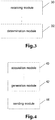
- Fig. 3 is a structural block diagram of a device for determining a priority of a packet according to an embodiment of the present invention. As shown in Fig. 3 , the device includes:
- the determination module comprises: a parsing unit, configured to parse key value information about a first ARP packet in the ARP packet, wherein the key value information comprises source address information, destination address information and interface information; a query unit, configured to query whether the key value information matches the dynamic routing protocol subscription information; and a determination unit, configured to determine that the white list protection entry comprises the first ARP packet when the key value information match the dynamic routing protocol subscription information, wherein the priority of the white list protection entry is higher than a default priority.
- Fig. 4 is a structural block diagram of a device for sending a priority of a packet according to an embodiment of the present invention. As shown in Fig. 4 , the device includes:
- the generation module 42 further comprises: a generation unit, configured to add the first ARP packet to the white list protection entry when the key value information of the first ARP packet in the ARP packet matches the dynamic routing protocol subscription information, wherein the priority of the white list protection entry is higher than a default priority.
- a routing system comprises: a first routing device and a second routing device.
- the first routing device comprises: an acquisition module, configured to acquire an ARP packet to be sent; a first white list generation module, configured to determine the white list protection entry of the ARP packet according to the dynamic routing protocol subscription information; and a sending module, configured to send the ARP packet;
- the second routing device comprises: a receiving module, configured to receive the ARP packet; and a second white list generation module, configured to determine a white list protection entry of the ARP packet according to the dynamic routing protocol subscription information.
- each module may be implemented through software or hardware and, under the latter condition, may be implemented in, but not limited to, the following manner: the modules are all positioned in the same processor, or the modules are positioned in different processors in any combination form respectively.
- an ARP recognition and protection method and device based on routing protocol subscription are provided, which are applicable to an ARP attack scenario.
- the device can effectively distinguish an attack ARP packet from a legal ARP packet, and ensure normal processing of a legal ARP interaction packet subscribed by a routing protocol, thereby ensuring normal interaction of the routing protocol.
- the present embodiment relates to ARP recognition and protection method and device (system) based on routing protocol subscription, such as a routing device, comprising the following components:
- FIG. 5 is a general interaction diagram of a routing and an ARP according to an embodiment of the present invention. Referring to Fig. 5 , interaction between components includes the following steps:
- the ARP related component of the component B After receiving the subscription information of the component C, the ARP related component of the component B generates the following actions for the subscribed ARP entry:
- a routing device extracts ARP protection subscription information according to a routing protocol deployed on the router, and the key value of the ARP protection subscription information includes, but is not limited to, an egress interface, a next hop IP (source IP), and an interface IP (destination IP).
- the ARP entry of the route subscription is set as a "sensitive ARP" according to the subscription information, and the MAC modification is rechecked or the ARP keep-alive function is disabled temporarily.
- a high-priority delivery entry can be generated according to the subscription ARP entry, so as to send an ARP keep-alive packet of the subscription entry with a high priority.
- Fig. 6 is a schematic diagram illustrating the deployment and interaction of route and ARP, with reference to Fig. 6 .
- On the right side it is a routing device under test, on the left side, it is a opposite end device connected to the routing device, and the two devices are connected through an ETH interface.
- the interface address of the routing device under test is 10.1.1.1/24, and the address of the opposite end device is 10.1.1.2/24.
- the two devices learn the ARP addresses of each other, and the keep-alive time is configured to be T1.
- a routing protocol such as BGP/various IGP/LDP is enabled between the routing device under test and the opposite end device.
- ARP attack packets are sent from the opposite end device, and the destination IP address, the source IP address, and the MAC address of the ARP attack packet can be generated randomly.
- the routing device under test or the opposite end device initiates ARP keep-alive or learning packets.
- ARP of 10.1.1.2 on the routing device under test may not be normally processed, resulting in ARP failure. In this way, the routing protocol on the routing device under test is disconnected.
- the ARP attack packet includes an address 10.1.1.2, the normal ARP of the device is tampered illegally, which also leads to link disconnection.
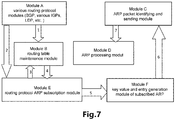
- FIG. 7 is a schematic diagram of deployment and interaction of embodiment 2 of the present invention, and as shown in Fig. 7 .
- Module A can be various types routing protocol modules, and when they work normally, various routing entries are generated, and these routing entries are the basis for the router to work.
- the various routing entries generated by the routing protocol will finally be sent to the routing table maintenance module of module B for unified maintenance and management (process 1).
- the BGP is taken as an example for implementation (the same applies hereinafter). Assume that in the BGP instance A, the IP address of the opposite end of the BGP instance A is a directly-connected V4 IP address: 10.1.1.2. Subscribing ARP protection for instance A.
- the BGP instance A transmits the IP address 10.1.1.2 to the module E (process 2); after receiving the IP address, the routing protocol ARP subscription module of the module E first acquires the IP address 10.1.1.2 to the module B to perform a routing table (process 3); since the routing is a direct connection, the module B only returns an egress interface which is the interface I_1/1, but at the same time inform that the routing is a direct connection (process 4).
- module E After receiving the information returned by module B, module E processes the information, for example, queries the IP address of interface I_1/1, assuming the IP address is 10.1.1.1, and then the related key value information about the subscribed ARP: the interface I_1/1, the destination IP 10.1.1.1, the source IP 10.1.1.2 and the protected priority information are sent to the module F (process 5).
- the module F generates white list protection entry information according to the information received from the module E, writes and maintains the generated white list protection entry information, and sends the generated white list protection entry information to the ARP packet identifying and sending module of module C (process 6).
- module C The common task of module C is to perform ARP recognition and reporting. Before a module writes a special protection ARP entry, for all ARPs the identification and processing performed by the module are equal.
- ARP attack with a large bandwidth occurs, because the bandwidth sent to the ARP processing module (process 7) of the module D is limited, the processing capability of the module D is also limited, and it cannot be ensured that the ARP of the routing protocol must be learnt and kept alive.
- module C can classify the ARPs, ARPs satisfying the following three conditions are processed differently: (1) the ARP is received from the interface I_1/1; (2) the source IP address of the ARP request is 10.1.1.2 (3) the destination IP of the ARP request is 10.1.1.1. ensuring that such ARP packets are sent to the module D (process 7) with high priorities, and ensuring that the ARP module preferentially processes this type of ARP, in this way, it is ensured that the BGP instance A does not cause loss of the routing protocol keep-alive packet or the routing information interaction packet because the ARP keep-alive time aged or the ARP of 10.1.1.2 cannot be learned.
- Non-direct connection neighbors subscription ARP packet receiving protection as shown in Fig. 7 .
- the IP address of an opposite end of the BGP instance A is an indirect V4 IP address: 2.2.2.2.
- An ARP protection for instance A is subscribed.
- the BGP instance A transmits an IP address 2.2.2.2 to a module E (process 2); after receiving the IP address, a routing protocol ARP subscription module of the module E first acquires the IP address 2.2.2.2 to a module B to perform routing table lookup (process 3); and in a normal condition, a route can be found, and the found information is returned to the module E (process 4), for example, an egress interface I_1/1 and a direct connection next hop IP 10.1.1.2.
- FIG. 8 is a schematic diagram of deployment and interaction according to Embodiment 4 of the present invention. As shown in Fig. 8 .
- the BGP instance A transmits the IP address 2.2.2.2 to the module E (process 2); after the module E receives the routing protocol ARP subscription module, the module E first acquires the IP address 2.2.2.2 to the module B to perform routing table lookup (process 3); under normal circumstances, the route can be found, and the found information is returned to the module E (process 4), for example, an egress interface I_1/1, directly connected to a next hop IP 10.1.1.2.
- module E After receiving the returned information from module B, module E processes the information, for example, queries the IP address of interface I_1/1 , for example, 10.1.1.1, and then the key value information of the related subscription ARP: interface I_1/1, destination IP10.1.1, source IP10.1.1. 2 is forwarded to module D for tamper protection (process 5).
- the module D does not modify the MAC of 10.1.1.2 directly according to the received ARP packet, but performs a second check, and construct and send an ARP request packet of request 10.1.1.2.
- FIG. 9 is a schematic diagram of deployment and interaction according to Embodiment 6 of the present invention, referring to Fig. 9 .
- the BGP instance A transmits the IP address 2.2.2.2 to the module E (process 2), and after receiving the IP address by the routing protocol ARP subscription module of the module E, the module E first acquires the IP address 2.2.2.2 to the module B to perform a routing table lookup (process 3), and normally the routing can be found, and the found information is returned to the module E (process 4), for example, an egress interface I_1/1 and a direct next-hop IP 10.1.1.2.
- module E After receiving the returned information from module B, module E processes the information, for example, queries the IP address of interface I_1/1, for example, 10.1.1.1, and then the key value information of the related subscription ARP: interface I_1/1, destination IP 10.1.1.1, source IP 10.1.1.2 and the protected priority information are transmitted to module F (process 5).
- Module F generates white list protection entry information according to the information received from module E, and performs writing and maintenance (process 6).
- Module E simultaneously transmit the key value information of the related subscription ARP (including the interface I_1/1, the destination IP 10.1.1.1 and the source IP 10.1.1.2) to the module D for subscribing a high priority (the same procedure as the tamper-proof, process 7).
- the module D can endeavor to ensure a high priority when sending the ARP packet, and ensure that the opposite end can receive the ARP packet from the present end, the ARP response packet can be returned normally.
- ARP information subscription processing used by a routing protocol is processed by a component C, and a high-priority ARP protection entry subscribed by the routing protocol is generated.
- This can effectively protect the ARP keep-alive packet used in the routing protocol from being received and processed normally when the ARP attack occurs, thereby protecting the routing protocol from being link broken.
- an ARP request packet can also be sent preferentially to a certain degree, and an opposite end can be ensured to receive an ARP packet from the present end, thereby an ARP response packet can be normally replied.
- Embodiments of the present invention further provide a storage medium.
- the storage medium stores a computer program, wherein the computer program is configured to execute the steps in any one of the method embodiments during running.
- the storage medium may be configured to store a computer program for executing the following steps:
- the storage medium may include, but is not limited to, any medium that can store a computer program, such as a USB flash drive, a read-only memory (Read-Only Memory, ROM for short), a random access memory (Random Access Memory, RAM for short), a removable hard disk, a magnetic disk, or an optical disc.
- a computer program such as a USB flash drive, a read-only memory (Read-Only Memory, ROM for short), a random access memory (Random Access Memory, RAM for short), a removable hard disk, a magnetic disk, or an optical disc.
- An embodiment of the present invention also provides an electronic device, comprising a memory and a processor, wherein the memory stores a computer program, and the processor is configured to run the computer program so as to execute the steps in any of the above embodiments.
- the electronic device can further comprise a transmission device and an input/output device, wherein the transmission device is connected to the processor, and the input/output device is connected to the processor.
- the processor is configured to execute the following steps:
- each module or each step of the present invention may be implemented by a universal computing device, which may be concentrated on a single computing device or distributed on a network composed of a plurality of computing devices.
- they may be implemented by program code executable by a computing device, and thus, they may be stored in a storage device and executed by the computing device.
- the steps shown or described may be performed in an order different from that here, or they may be manufactured into individual integrated circuit modules, or a plurality of modules or steps thereof may be manufactured into individual integrated circuit modules.
- the present invention is not limited to any specific combination of hardware and software.
Landscapes
- Engineering & Computer Science (AREA)
- Computer Networks & Wireless Communication (AREA)
- Signal Processing (AREA)
- Computer Security & Cryptography (AREA)
- Computer Hardware Design (AREA)
- Computing Systems (AREA)
- General Engineering & Computer Science (AREA)
- Data Exchanges In Wide-Area Networks (AREA)
Abstract
Description
- The present invention relates to the field of communications, and in particular, to a method and device for determining and sending a priority of a packet, and a routing system.
- In the related art, when the router devices (IP forwarding devices) are connected via Ethernet, if a sender(a source device) wants to transmit data to a directly connected receiver (a target device) in a point-to-point manner, it is required to learn a
layer 2 Media Access Control (MAC) address of the direct IP address corresponding to the receiver device. MAC address learning needs to be implemented through an Address Resolution Protocol (ARP). Hence, ARP is the basis of Ethernet unicast communication. - In the related art, the router device needs to work normally to implement layer-3 forwarding such as IP, which requires a route. However, most of these routes are generated by routing protocol learning, and it can be said that the routing protocol is the basis of a router. Each routing protocol has a certain keep-alive interactive mechanism. That is, a router periodically sends a keep-alive packet to a peer end to inform a working state the router, so that the peer end synchronizes routing information to the router in real time. It is obvious that the keep-alive of the routing protocol is quite important for the core node router, which is similar to the "heartbeat" of the router. In addition, the routing path information delivery of routing protocol is also very important, similar to the "blood" of routers.
- A routing protocol is based on unicast point-to-point communication. When a keep-alive packet and an information packet of the routing protocol are borne on an Ethernet (ETH) link, a unicast communication basis thereof is having an MAC of the IP address of an opposite end, and the MAC learning is implemented by means of an ARP protocol. In addition, the learned ARP entries also needs to be refreshed periodically by packet; otherwise, the ARP entries will be aged; and after the aging time, even if a transient ARP failure occurs, the impact on a core node router is also great, it is similar to a "myocardial infarction", the impact may be fatal.
- Network attacks happen all the time, and among various attacks, the ARP attack is a typical attack. For an ARP attack, if measures are not taken, the router will be greatly affected; if the ARP for routing protocol interaction mentioned above is invalid, the influence on the router of the core node is fatal, which may result in the protocol links broken, and tens of thousands of users communication is interrupted within a short or long time.
- Concerning the above described problems existing in the related art, no effective solution has been provided till now.
- Embodiments of the present invention provide a method and a device for determining and sending a priority of a packet, and a routing system.
- According to an embodiment of the present invention, provided is a method for determining a priority of a packet, comprising: receiving an address resolution protocol (ARP) packet; and determining the white list protection entry of the ARP packet according to the dynamic routing protocol subscription information.
- According to an embodiment of the present invention, provided is a method for sending a priority of a packet, comprising: acquiring an ARP packet to be sent; determining a white list protection entry of the ARP packet according to dynamic routing protocol subscription information; sending the ARP packet.
- According to another embodiment of the present invention, a device for determining a priority of a packet is provided, comprising: a receiving module, configured to receive an ARP packet; and a determining module, configured to determine the white list protection entry of the ARP packet according to the dynamic routing protocol subscription information.
- According to another embodiment of the present invention, a packet priority sending device is provided, comprising: an acquisition module configured to acquire an ARP packet to be sent; a generation module, configured to determine a white list protection entry of the ARP packet according to dynamic routing protocol subscription information; and a sending module, configured to send the ARP packet.
- According to another embodiment of the present invention, provided is a routing system, comprising: a first routing device and a second routing device. The first routing device comprising: an acquisition module, configured to acquire an ARP packet to be sent; a first white list generation module, configured to determine the white list protection entry of the ARP packet according to the dynamic routing protocol subscription information, and the sending module, configured to send the ARP packet. The second routing device comprises: a receiving module, configured to receive the ARP packet; and a second white list generation module, configured to determine the white list protection entry of the ARP packet according to dynamic routing protocol subscription information.
- The embodiments of the present invention also provide a storage medium, in which a computer program may be stored, the computer program being configured to run to execute the network topology division method provided in the embodiments of the present invention.
- The embodiments of the present invention also provide an electronic device, which may include a memory and a processor. A computer program may be stored in the memory. The processor may be configured to run the computer program to execute the network topology division method provided in the embodiments of the present invention.
- In the above embodiments of the present invention, the white list protection entry of the ARP packet is generated based on the subscription information. Therefore, the priority information of the ARP packet can be determined, the attack ARP packet and the legal ARP packet can be effectively distinguished, and the legal ARP interaction packet subscribed by the routing protocol is ensured to be processed normally. Thus, it is ensured that the routing protocol can interact normally, and the technical problem in the related art that the ARP packet cannot be interacted normally due to the ARP attack can be solved.
- Drawings, provided for further understanding of the present invention and forming a part of the description, are used to explain the present invention together with embodiments of the present invention rather than to limit the present invention. In the drawings:
-
Fig. 1 is a diagram of network architecture according to an embodiment of the present invention; -
Fig. 2 is a flowchart of packet interaction according to an embodiment of the present invention; -
Fig. 3 is a structural block diagram of a device for determining a priority of a packet according to an embodiment of the present invention; -
Fig. 4 is a structural block diagram of a device for sending a priority of a packet according to an embodiment of the present invention; -
Fig. 5 is a schematic diagram illustrating the route and ARP general interaction according to an embodiment of the present invention; -
Fig. 6 is a schematic diagram of deployment and interaction according toEmbodiment 1 of the present invention; -
Fig. 7 is a schematic diagram of deployment and interaction according to a second embodiment of the present invention; -
Fig. 8 is a schematic diagram of deployment and interaction according to a fourth embodiment of the present invention; -
Fig. 9 is a schematic diagram of deployment and interaction according toEmbodiment 6 of the present invention. - The present invention will be described below with reference to the drawings and in combination with the embodiments in detail. It is to be noted that the embodiments in the present application and characteristics in the embodiments may be combined without conflicts.
- It is to be noted that the terms like "first" and "second" in the specification, claims and accompanying drawings of the present invention are used for differentiating the similar objects, but do not have to describe a specific order or a sequence.
- An embodiment of the present invention may run on the network architecture shown in
Fig. 1. Fig. 1 is a network architecture diagram of an embodiment of the present invention. As shown inFig. 1 , the network architecture includes: afirst routing device 10 and asecond routing device 20, wherein packets receiving and sending are performed between the first routing device and the second routing device. - The embodiment provides a method for determining the priority of a packet, and the method is implemented on the described network architecture.
Fig. 2 is a flowchart of packet interaction according to the embodiment of the present invention. As shown inFig. 2 , the flow comprises the following steps: - Step S202, receiving an ARP packet; and
- Step S204: determining the white list protection entry of the ARP packet according to the dynamic routing protocol subscription information.
- Through the above steps, the dynamic routing protocol subscription information is used to generate a white list protection entry for determining an ARP packet. Therefore, the priority information of the ARP packet can be determined, the attack ARP packet and the legal ARP packet can be effectively distinguished, and the legal ARP interaction packet subscribed by the routing protocol is ensured to be processed normally. Thus, it is ensured that the routing protocol can interact normally, and the technical problem in the related art that the ARP packet cannot be interacted normally due to the ARP attack can be solved.
- In an embodiment, the entity for performing the above steps can be a packet receiving end, such as a router or a switch, but is not limited thereto.
- In an embodiment, before determining the white list protection entry of the ARP packet according to the dynamic routing protocol subscription information, the method further comprises: setting dynamic routing protocol subscription information.
- In an embodiment, the dynamic routing protocol subscription information includes source address information, destination address information and interface information. The address information may be an IP address, a MAC address, or the like, and the interface may be an ingress interface.
- In this embodiment, determining the white list protection entry of the ARP packet according to the dynamic routing protocol subscription information comprises:
- S11, parsing key value information about a first ARP packet in the ARP packet, wherein the key value information comprises source address information, destination address information and interface information; the first ARP packet may be any of the received ARP packets;
- S12, querying whether the key value information matches the dynamic routing protocol subscription information; determining whether the key value information of the received first ARP packet matches the key value of dynamic routing protocol subscription information; and
- S13, when the key value information matches the dynamic routing protocol subscription information, determining that the white list protection entry includes the first ARP packet, wherein the priority of the white list protection entry is higher than a default priority. If yes, it may be a match or a plurality of matches, and if yes, it is confirmed that the ARP packet is an ARP packet with a high priority, the ARP packet may be selected and filtered preferentially, and the next processing is performed.
- The present embodiment provides a method for sending a packet priority, and the method is implemented on the above described network architecture.
Fig. 2 is a flowchart of message interaction according to an embodiment of the present invention. As shown inFig. 2 , the flow further comprises the following steps: - Step S302, acquiring an ARP packet to be sent;
- Step S304, determining a white list protection entry of the ARP packet according to the dynamic routing protocol subscription information; and
- Step S306: sending the ARP packet.
- In an embodiment, the entity for executing the foregoing steps may be a packet sending end, such as a router or a switch, but is not limited thereto.
- In an embodiment, after generating the white list protection entry of the ARP packet according to the dynamic routing protocol subscription information, the method further comprises at least one of the following: rechecking the MAC address of the white list protection entry; and disabling the ARP keep-alive function of the white list protection entry within a predetermined time.
- In an embodiment, the step of determining a white list protection entry of the ARP packet according to the dynamic routing protocol subscription information comprises: when key value information of the first ARP packet in the ARP packet matches the dynamic routing protocol subscription information, and adding the first ARP packet to the white list protection entry, wherein the priority of the white list protection entry is higher than a default priority.
- In an embodiment, sending the ARP packet comprises: using a pre-set priority to send the ARP packets in the white list protection entry, and the remaining ARP packets being normally sent. Therefore, ARP packets may be sent at a high priority.
- Through the above descriptions about the implementation modes, those skilled in the art may clearly know that the methods according to the embodiment may be implemented in a manner of combining software and a required universal hardware platform and, of course, may also be implemented through hardware, but the former is a preferred implementation mode under many circumstances. Based on such an understanding, the technical solutions of the present invention substantially or parts making contributions to a conventional art may be embodied in form of a software product. The computer software product is stored in a storage medium (for example, a Read-Only Memory (ROM)/Random Access Memory (RAM), a magnetic disk and an optical disk), including a plurality of instructions configured to enable a terminal device (which may be a mobile phone, a computer, a server, a network device or the like) to execute the method of each embodiment of the present invention.
- The embodiments of the present invention further provide devices for determining and sending the priority of a packet. The devices are used for implementing the described embodiment and example implementation mode, and what has been described will not be elaborated. The term "module", as used hereinafter, is a combination of software and/or hardware capable of realizing a predetermined function. Although the device described in the following embodiment is preferably implemented by software, implementation of hardware or a combination of software and hardware is also possible and conceived.
-
Fig. 3 is a structural block diagram of a device for determining a priority of a packet according to an embodiment of the present invention. As shown inFig. 3 , the device includes: - a receiving
module 30, configured to receive an ARP packet; and - a determining
module 32, configured to determine the white list protection entry of the ARP packet according to the dynamic routing protocol subscription information. - In an embodiment, the determination module comprises: a parsing unit, configured to parse key value information about a first ARP packet in the ARP packet, wherein the key value information comprises source address information, destination address information and interface information; a query unit, configured to query whether the key value information matches the dynamic routing protocol subscription information; and a determination unit, configured to determine that the white list protection entry comprises the first ARP packet when the key value information match the dynamic routing protocol subscription information, wherein the priority of the white list protection entry is higher than a default priority.
-
Fig. 4 is a structural block diagram of a device for sending a priority of a packet according to an embodiment of the present invention. As shown inFig. 4 , the device includes: - an
acquisition module 40, configured to acquire an ARP packet to be sent; - a
generation module 42, configured to determine a white list protection entry of the ARP packet according to the dynamic routing protocol subscription information; and - a sending
module 44, configured to send the ARP packet. - In an embodiment, the
generation module 42 further comprises: a generation unit, configured to add the first ARP packet to the white list protection entry when the key value information of the first ARP packet in the ARP packet matches the dynamic routing protocol subscription information, wherein the priority of the white list protection entry is higher than a default priority. - In an embodiment of the present invention, a routing system is further provided. The routing system comprises: a first routing device and a second routing device. The first routing device comprises: an acquisition module, configured to acquire an ARP packet to be sent; a first white list generation module, configured to determine the white list protection entry of the ARP packet according to the dynamic routing protocol subscription information; and a sending module, configured to send the ARP packet; the second routing device comprises: a receiving module, configured to receive the ARP packet; and a second white list generation module, configured to determine a white list protection entry of the ARP packet according to the dynamic routing protocol subscription information.
- It is to be noted that each module may be implemented through software or hardware and, under the latter condition, may be implemented in, but not limited to, the following manner: the modules are all positioned in the same processor, or the modules are positioned in different processors in any combination form respectively.
- In this embodiment, an ARP recognition and protection method and device (system) based on routing protocol subscription are provided, which are applicable to an ARP attack scenario. The device can effectively distinguish an attack ARP packet from a legal ARP packet, and ensure normal processing of a legal ARP interaction packet subscribed by a routing protocol, thereby ensuring normal interaction of the routing protocol.
- The present embodiment relates to ARP recognition and protection method and device (system) based on routing protocol subscription, such as a routing device, comprising the following components:
- Component A -- a route-related component: responsible for tasks such as route establishment, keep-alive, and route advertisement.
- Component B -- ARP related component: responsible for tasks such as maintaining and refreshing an ARP entry and sending a keep-alive packet; a keep-alive packet is a form of packet interaction in the field of communications. The two communication parties agree to continuously send information about themselves to each other in a period, so as to prove that the communication states of themselves are normal. Otherwise, if the keep-alive packet of the other communication party cannot be received in several periods, it indicates that the communication is abnormal, and the communication party which does not receive the keep-alive information may take certain measures such as an active disconnection.
- Component C -- routing and ARP interactive subscription component.
- In an embodiment of the present invention, further provided is an ARP recognition protection device based on routing protocol subscription.
Fig. 5 is a general interaction diagram of a routing and an ARP according to an embodiment of the present invention. Referring toFig. 5 , interaction between components includes the following steps: -
Step 1, the component A transmits the route keep-alive packet or the next hop and outbound interface information for link establishment to component C; and -
Step 2, the component C receives the subscription information of the component A, performs some processing on the subscription information, then transmits the subscription information to the component B, and performs some guidance on the behaviors of the component B. - After receiving the subscription information of the component C, the ARP related component of the component B generates the following actions for the subscribed ARP entry:
- 1) In the packet receiving direction, generates a white list filter entry with a high priority for the subscribed ARP, so as to ensure that the subscribed ARP information can be filtered out precisely.
- 2) The subscribed ARP white list filtering entry can be used as a protection entry to prevent ARP information from being "illegally tampered".
- 3) The subscribed ARP white list filtering entry can act on the packet sending direction to ensure the packet sending priority.
- In this embodiment, a routing device extracts ARP protection subscription information according to a routing protocol deployed on the router, and the key value of the ARP protection subscription information includes, but is not limited to, an egress interface, a next hop IP (source IP), and an interface IP (destination IP). Generating a high-priority ARP protection entry subscribed based on the routing protocol according to the subscription information. In this way, during ARP attack, the normal ARP may be filtered and protected with a high priority. The ARP entry of the route subscription is set as a "sensitive ARP" according to the subscription information, and the MAC modification is rechecked or the ARP keep-alive function is disabled temporarily. A high-priority delivery entry can be generated according to the subscription ARP entry, so as to send an ARP keep-alive packet of the subscription entry with a high priority.
- The routing device applied in this embodiment may include the following modules:
- A. Various routing protocol modules (including but not limited to: BGP, OSPF, ISIS, and LDP), all of which are standard protocols defined by RFC, configure to perform the routing packet interaction according to related conventions, generate routing information, and write the routing information to a routing table maintenance module. In addition, all these protocols have the keep-alive mechanism, and it is necessary to periodically transmit and receive keep-alive packets.
- B. A routing table maintenance module, configured to perform organization and induction on a routing table generated by a routing protocol for an upper-layer application or a bottom-layer packet to perform routing lookup.
- C. An ARP packet identifying and sending module, configured to identify a received ARP packet and package the ARP packet according to a priority and send the ARP packet to an ARP processing module.
- D. An ARP processing module, the main function of which is as follows: 1) an ARP entry (a next hop IP address + a device interface and a corresponding MAC address) is generated according to a transmitted ARP packet; and 2) the ARP keep-alive packets for the generated ARP entry is regularly triggered. 3) If the upper layer application or the bottom layer packet finds that the corresponding ARP cannot be found, the sending of the ARP request message is triggered.
- The routing device in this embodiment further includes the following modules:
- E. a routing protocol ARP subscription module, configured to subscribe to an ARP entry used by a routing protocol (module A).
- F. A subscribed ARP key value and table entry generation module, configured to generate a relevant key value and priority information of a routing protocol subscription ARP, and organize the relevant key value and priority information into a white list table entry for ARP identification, uploading, and issuing.
- The following examples are described in detail for the BGP routing protocol subscribing to the ARP protection:
- Routing and ARP linkage protection,
Fig. 6 is a schematic diagram illustrating the deployment and interaction of route and ARP, with reference toFig. 6 . On the right side, it is a routing device under test, on the left side, it is a opposite end device connected to the routing device, and the two devices are connected through an ETH interface. The interface address of the routing device under test is 10.1.1.1/24, and the address of the opposite end device is 10.1.1.2/24. The two devices learn the ARP addresses of each other, and the keep-alive time is configured to be T1. A routing protocol such as BGP/various IGP/LDP is enabled between the routing device under test and the opposite end device. At the same time, large-capacity ARP attack packets are sent from the opposite end device, and the destination IP address, the source IP address, and the MAC address of the ARP attack packet can be generated randomly. In the related art (solutions of the present invention are not deployed), before the ARP aging time T1 arrives, the routing device under test or the opposite end device initiates ARP keep-alive or learning packets. However, due to a large number of ARP attacks packets, ARP of 10.1.1.2 on the routing device under test may not be normally processed, resulting in ARP failure. In this way, the routing protocol on the routing device under test is disconnected. Furthermore, when the ARP attack packet includes an address 10.1.1.2, the normal ARP of the device is tampered illegally, which also leads to link disconnection. - When the solution of this embodiment is deployed, a certain linkage and dependency relationship is generated between the route and the ARP, and under a same condition, the routing protocol is no longer broken due to the ARP attacks. That is, the ARP keep-alive or learning packets can be normally processed, and even if the attack ARP packet contains the address 10.1.1.2, ARP is no longer tampered illegally.
- Direct connection neighbor subscription ARP packet receiving protection.
Fig. 7 is a schematic diagram of deployment and interaction ofembodiment 2 of the present invention, and as shown inFig. 7 . - Module A can be various types routing protocol modules, and when they work normally, various routing entries are generated, and these routing entries are the basis for the router to work. The various routing entries generated by the routing protocol will finally be sent to the routing table maintenance module of module B for unified maintenance and management (process 1). The BGP is taken as an example for implementation (the same applies hereinafter). Assume that in the BGP instance A, the IP address of the opposite end of the BGP instance A is a directly-connected V4 IP address: 10.1.1.2. Subscribing ARP protection for instance A.
- The BGP instance A transmits the IP address 10.1.1.2 to the module E (process 2); after receiving the IP address, the routing protocol ARP subscription module of the module E first acquires the IP address 10.1.1.2 to the module B to perform a routing table (process 3); since the routing is a direct connection, the module B only returns an egress interface which is the interface I_1/1, but at the same time inform that the routing is a direct connection (process 4).
- After receiving the information returned by module B, module E processes the information, for example, queries the IP address of interface I_1/1, assuming the IP address is 10.1.1.1, and then the related key value information about the subscribed ARP: the interface I_1/1, the destination IP 10.1.1.1, the source IP 10.1.1.2 and the protected priority information are sent to the module F (process 5).
- The module F generates white list protection entry information according to the information received from the module E, writes and maintains the generated white list protection entry information, and sends the generated white list protection entry information to the ARP packet identifying and sending module of module C (process 6).
- The common task of module C is to perform ARP recognition and reporting. Before a module writes a special protection ARP entry, for all ARPs the identification and processing performed by the module are equal. When an ARP attack with a large bandwidth occurs, because the bandwidth sent to the ARP processing module (process 7) of the module D is limited, the processing capability of the module D is also limited, and it cannot be ensured that the ARP of the routing protocol must be learnt and kept alive.
- However, After module C receives the ARP protection information transmitted by module F (process 6), module C can classify the ARPs, ARPs satisfying the following three conditions are processed differently: (1) the ARP is received from the interface I_1/1; (2) the source IP address of the ARP request is 10.1.1.2 (3) the destination IP of the ARP request is 10.1.1.1. ensuring that such ARP packets are sent to the module D (process 7) with high priorities, and ensuring that the ARP module preferentially processes this type of ARP, in this way, it is ensured that the BGP instance A does not cause loss of the routing protocol keep-alive packet or the routing information interaction packet because the ARP keep-alive time aged or the ARP of 10.1.1.2 cannot be learned.
- Non-direct connection neighbors subscription ARP packet receiving protection, as shown in
Fig. 7 . - Assume that in the BGP instance A, the IP address of an opposite end of the BGP instance A is an indirect V4 IP address: 2.2.2.2. An ARP protection for instance A is subscribed.
- The BGP instance A transmits an IP address 2.2.2.2 to a module E (process 2); after receiving the IP address, a routing protocol ARP subscription module of the module E first acquires the IP address 2.2.2.2 to a module B to perform routing table lookup (process 3); and in a normal condition, a route can be found, and the found information is returned to the module E (process 4), for example, an egress interface I_1/1 and a direct connection next hop IP 10.1.1.2.
- In the present example, other following steps are the same as those in Example 1.
- MAC tampering to protocol subscription ARP is rechecked.
Fig. 8 is a schematic diagram of deployment and interaction according toEmbodiment 4 of the present invention. As shown inFig. 8 . - As a variant of
embodiment 3, the BGP instance A transmits the IP address 2.2.2.2 to the module E (process 2); after the module E receives the routing protocol ARP subscription module, the module E first acquires the IP address 2.2.2.2 to the module B to perform routing table lookup (process 3); under normal circumstances, the route can be found, and the found information is returned to the module E (process 4), for example, an egress interface I_1/1, directly connected to a next hop IP 10.1.1.2. - After receiving the returned information from module B, module E processes the information, for example, queries the IP address of interface I_1/1 , for example, 10.1.1.1, and then the key value information of the related subscription ARP: interface I_1/1, destination IP10.1.1, source IP10.1.1. 2 is forwarded to module D for tamper protection (process 5).
- For those ARP request packets which are not received by the interface I_1/1 from the destination IP10.1.1.1 and the source IP10.1.1.2 are directly ignored and not responded.
for those ARP request packets satisfying the interface I_1/1, the destination IP 10.1.1.1 and the source IP 10.1.1.2, when it is found that the MAC corresponding to 10.1.1.2 is modified, the module D does not modify the MAC of 10.1.1.2 directly according to the received ARP packet, but performs a second check, and construct and send an ARP request packet of request 10.1.1.2. - Only when the ARP response packet which satisfies the interface 11.1/1, the destination IP10.1.1.1 and the source IP10.1.1.2 is received again, the ARP information of 10.1.1.2 is modified. In this way, it is ensured that the ARP entry is not tampered by the illegal ARP request.
- The protocol subscription ARP age to close, as shown in
Fig. 8 . - 1. In the
embodiment 4, after ARP processing module of the module D receives from the routing protocol ARP subscription module of the module B the key value subscription information: interface I_1/1, destination IP 10.1.1.1 and source IP 10.1.1.2, in addition to the tamper-proof protection, another group of optional actions may also be generated. For example, the ARP keep-alive of 10.1.1.2 on theinterface 1/1 is temporarily closed, so that the ARP entry is permanently effective during the subscription period. In this way, the problem that the routing protocol on the interface is not broken due to ARP loss, etc. , can be prevented. - The ARP packets of protocol subscription ARP are sent preferentially.
Fig. 9 is a schematic diagram of deployment and interaction according toEmbodiment 6 of the present invention, referring toFig. 9 . - This embodiment is modified on the
embodiment 2, the BGP instance A transmits the IP address 2.2.2.2 to the module E (process 2), and after receiving the IP address by the routing protocol ARP subscription module of the module E, the module E first acquires the IP address 2.2.2.2 to the module B to perform a routing table lookup (process 3), and normally the routing can be found, and the found information is returned to the module E (process 4), for example, an egress interface I_1/1 and a direct next-hop IP 10.1.1.2. - After receiving the returned information from module B, module E processes the information, for example, queries the IP address of interface I_1/1, for example, 10.1.1.1, and then the key value information of the related subscription ARP: interface I_1/1, destination IP 10.1.1.1, source IP 10.1.1.2 and the protected priority information are transmitted to module F (process 5).
- Module F generates white list protection entry information according to the information received from module E, and performs writing and maintenance (process 6).
- Module E simultaneously transmit the key value information of the related subscription ARP (including the interface I_1/1, the destination IP 10.1.1.1 and the source IP 10.1.1.2) to the module D for subscribing a high priority (the same procedure as the tamper-proof, process 7).
- After the
processes - In the solution provided by this embodiment, ARP information subscription processing used by a routing protocol is processed by a component C, and a high-priority ARP protection entry subscribed by the routing protocol is generated. This can effectively protect the ARP keep-alive packet used in the routing protocol from being received and processed normally when the ARP attack occurs, thereby protecting the routing protocol from being link broken. By setting an ARP entry of a route subscription to be a "sensitive ARP" and performing a second check of MAC modification, a normal ARP address can be prevented from being tampered illegally when an ARP request attacks, thereby further providing a guarantee for the security of a routing protocol. By subscribing to an ARP entry, a high priority can be generated and kept alive, such an ARP request packet can also be sent preferentially to a certain degree, and an opposite end can be ensured to receive an ARP packet from the present end, thereby an ARP response packet can be normally replied.
- Embodiments of the present invention further provide a storage medium. The storage medium stores a computer program, wherein the computer program is configured to execute the steps in any one of the method embodiments during running.
- In an embodiment, in this embodiment, the storage medium may be configured to store a computer program for executing the following steps:
- S1, receiving an ARP packet; and
- S2, determining a white list protection entry of the ARP packet according to the dynamic routing protocol subscription information.
- In this embodiment, the storage medium may include, but is not limited to, any medium that can store a computer program, such as a USB flash drive, a read-only memory (Read-Only Memory, ROM for short), a random access memory (Random Access Memory, RAM for short), a removable hard disk, a magnetic disk, or an optical disc.
- An embodiment of the present invention also provides an electronic device, comprising a memory and a processor, wherein the memory stores a computer program, and the processor is configured to run the computer program so as to execute the steps in any of the above embodiments.
- In an embodiment, the electronic device can further comprise a transmission device and an input/output device, wherein the transmission device is connected to the processor, and the input/output device is connected to the processor.
- In this embodiment, the processor is configured to execute the following steps:
- S1, receiving an ARP packet; and
- S2, determining a white list protection entry of the ARP packet according to the dynamic routing protocol subscription information.
- Alternatively, for specific examples in this embodiment, reference may be made to the examples described in the foregoing embodiments and optional implementations, and details are not repeatedly described herein in this embodiment.
- Obviously, those skilled in the art should understand that each module or each step of the present invention may be implemented by a universal computing device, which may be concentrated on a single computing device or distributed on a network composed of a plurality of computing devices. In an embodiment, they may be implemented by program code executable by a computing device, and thus, they may be stored in a storage device and executed by the computing device. Furthermore, in some cases, the steps shown or described may be performed in an order different from that here, or they may be manufactured into individual integrated circuit modules, or a plurality of modules or steps thereof may be manufactured into individual integrated circuit modules. Thus, the present invention is not limited to any specific combination of hardware and software.
- The above description is only the preferred embodiments of the present invention, and is not intended to limit the present invention. For those skilled in the art, the present invention may have various modifications and variations. Any modifications, equivalent replacements, improvements and the like made within the principle of the present invention shall belong to the protection scope of the present invention.
Claims (15)
- A method for determining a priority of a packet, comprising:receiving an address resolution protocol (ARP) packet; anddetermining a white list protection entry of the ARP packet according to dynamic routing protocol subscription information.
- The method as claimed in claim 1, wherein before determining the white list protection entry of the ARP packet according to the dynamic routing protocol subscription information, the method further comprises:
setting the dynamic routing protocol subscription information. - The method as claimed in claim 1, wherein the dynamic routing protocol subscription information comprises:
source address information, destination address information and interface information. - The method as claimed in claim 1, wherein determining the white list protection entry of the ARP packet according to the dynamic routing protocol subscription information comprises:parsing key value information about a first ARP packet in the ARP packet, wherein the key value information comprises source address information, destination address information and interface information;querying whether the key value information match the dynamic routing protocol subscription information; andwhen the key value information match the dynamic routing protocol subscription information, determining that the white list protection entry comprises the first ARP packet, wherein a priority of the white list protection entry is higher than a default priority.
- A method for sending a priority of a packet, comprising:acquiring an address resolution protocol (ARP) packet to be sent;determining a white list protection entry of the ARP packet according to dynamic routing protocol subscription information; andsending the ARP packet.
- The method as claimed in claim 5, wherein after determining the white list protection entry of the ARP packet according to the dynamic routing protocol subscription information, the method further comprises at least one of:rechecking an MAC address of the white list protection entry; anddisabling an ARP keep-alive function of the white list protection entry within a predetermined time.
- The method as claimed in claim 5, wherein determining the white list protection entry of the ARP packet according to the dynamic routing protocol subscription information comprises:
adding a first ARP packet into the white list protection entry when key value information of the first ARP packet in the ARP packet matches the dynamic routing protocol subscription information, wherein a priority of the white list protection entry is higher than a default priority. - The method as claimed in claim 7, wherein sending the ARP packet comprises:
sending the ARP packet in the white list protection entry by using a preset priority. - A device for determining a priority of a packet, comprising:a receiving module, configured to receive an address resolution protocol (ARP) packet; anda determining module, configured to determine a white list protection entry of the ARP packet according to dynamic routing protocol subscription information.
- The device as claimed in claim 9, wherein the determination module comprises:a parsing unit, configured to parse key value information of a first ARP packet in the ARP packet, wherein the key value information comprises source address information, destination address information and interface information;a query unit, configured to query whether the key value information match the dynamic routing protocol subscription information; anda determination unit, configured to determine that the white list protection entry comprises the first ARP packet when the key value information match the dynamic routing protocol subscription information, wherein a priority of the white list protection entry is higher than a default priority.
- A device for sending a priority of a packet, comprising:an acquisition module, configured to acquire an address resolution protocol (ARP) packet to be sent;a generation module, configured to determine a white list protection entry of the ARP packet according to dynamic routing protocol subscription information; anda sending module, configured to send the ARP packet.
- The device according to claim 11, wherein the generation module comprises:
a generating unit, configured to add a first ARP packet to the white list protection entry when key value information of the first ARP packet in the ARP packet matches the dynamic routing protocol subscription information, wherein a priority of the white list protection entry is higher than a default priority. - A routing system comprising a first routing device and a second routing device, wherein,
The first routing device comprises:acquisition module, configured to acquire an address resolution protocol (ARP) packet to be sent;a first white list generation module, configured to determine white list protection entry of the ARP packet according to dynamic routing protocol subscription information; anda sending module, configured to send the ARP packet;the second routing device comprises:a receiving module, configured to receive the ARP packet; anda second white list generation module, configured to determine the white list protection entry of the ARP packet according to dynamic routing protocol subscription information. - A storage medium, wherein the storage medium stores a computer program, and the computer program running to execute the method as claimed in any one of claims 1 to 8.
- An electronic device, comprising a memory and a processor, wherein the memory stores a computer program, and the processor is configured to run the computer program to execute the method as claimed in any one of claims 1 to 8.
Applications Claiming Priority (2)
| Application Number | Priority Date | Filing Date | Title |
|---|---|---|---|
| CN201810468603.2A CN110505176B9 (en) | 2018-05-16 | 2018-05-16 | Method and device for determining and sending message priority, and routing system |
| PCT/CN2019/075748 WO2019218740A1 (en) | 2018-05-16 | 2019-02-21 | Packet priority determining method and apparatus, packet priority sending method and apparatus, and routing system |
Publications (3)
| Publication Number | Publication Date |
|---|---|
| EP3796621A1 true EP3796621A1 (en) | 2021-03-24 |
| EP3796621A4 EP3796621A4 (en) | 2021-03-24 |
| EP3796621B1 EP3796621B1 (en) | 2024-09-04 |
Family
ID=68539396
Family Applications (1)
| Application Number | Title | Priority Date | Filing Date |
|---|---|---|---|
| EP19803990.1A Active EP3796621B1 (en) | 2018-05-16 | 2019-02-21 | Packet priority determining method and apparatus, and routing system |
Country Status (4)
| Country | Link |
|---|---|
| US (1) | US11303567B2 (en) |
| EP (1) | EP3796621B1 (en) |
| CN (1) | CN110505176B9 (en) |
| WO (1) | WO2019218740A1 (en) |
Families Citing this family (4)
| Publication number | Priority date | Publication date | Assignee | Title |
|---|---|---|---|---|
| CN114024731B (en) * | 2021-10-29 | 2023-04-25 | 杭州迪普科技股份有限公司 | Message processing method and device |
| TWI789116B (en) * | 2021-11-15 | 2023-01-01 | 瑞昱半導體股份有限公司 | Mesh network system and communication method of the same having data flow transmission sorting mechanism |
| CN117118912A (en) * | 2022-05-17 | 2023-11-24 | 华为技术有限公司 | Message transmission method, network equipment and communication system |
| CN117939697A (en) * | 2024-01-19 | 2024-04-26 | 深圳市雷鸟网络传媒有限公司 | Communication connection establishment method, device, electronic device and storage medium |
Family Cites Families (35)
| Publication number | Priority date | Publication date | Assignee | Title |
|---|---|---|---|---|
| US6917614B1 (en) * | 1999-09-17 | 2005-07-12 | Arris International, Inc. | Multi-channel support for virtual private networks in a packet to ATM cell cable system |
| US8218555B2 (en) * | 2001-04-24 | 2012-07-10 | Nvidia Corporation | Gigabit ethernet adapter |
| US20050060535A1 (en) * | 2003-09-17 | 2005-03-17 | Bartas John Alexander | Methods and apparatus for monitoring local network traffic on local network segments and resolving detected security and network management problems occurring on those segments |
| US7471684B2 (en) * | 2004-10-21 | 2008-12-30 | International Machines Corporation | Preventing asynchronous ARP cache poisoning of multiple hosts |
| US7796614B1 (en) * | 2004-11-30 | 2010-09-14 | Symantec Corporation | Systems and methods for message proxying |
| US20060209818A1 (en) * | 2005-03-18 | 2006-09-21 | Purser Jimmy R | Methods and devices for preventing ARP cache poisoning |
| US7760722B1 (en) * | 2005-10-21 | 2010-07-20 | Oracle America, Inc. | Router based defense against denial of service attacks using dynamic feedback from attacked host |
| US8635284B1 (en) * | 2005-10-21 | 2014-01-21 | Oracle Amerca, Inc. | Method and apparatus for defending against denial of service attacks |
| US20070192858A1 (en) | 2006-02-16 | 2007-08-16 | Infoexpress, Inc. | Peer based network access control |
| US7890612B2 (en) * | 2006-05-08 | 2011-02-15 | Electro Guard Corp. | Method and apparatus for regulating data flow between a communications device and a network |
| US7697429B2 (en) * | 2006-07-10 | 2010-04-13 | Scientific-Atlanta, Llc | Enhancing a configuration file |
| US7885180B2 (en) * | 2006-12-15 | 2011-02-08 | Check Point Software Technologies Inc. | Address resolution request mirroring |
| US7930428B2 (en) * | 2008-11-11 | 2011-04-19 | Barracuda Networks Inc | Verification of DNS accuracy in cache poisoning |
| WO2010054471A1 (en) * | 2008-11-17 | 2010-05-20 | Sierra Wireless, Inc. | Method and apparatus for network port and network address translation |
| CN102130776B (en) * | 2010-01-19 | 2013-05-01 | 新浪网技术(中国)有限公司 | Communication method and system |
| TW201132055A (en) * | 2010-03-04 | 2011-09-16 | Gemtek Technology Co Ltd | Routing device and related packet processing circuit |
| KR101098029B1 (en) * | 2010-09-29 | 2011-12-22 | 전자부품연구원 | Data Transmission Method Using Virtual Single Link in Wireless Networks |
| TWI583151B (en) * | 2011-08-04 | 2017-05-11 | 中界雲端公司 | System and method for implementing and managing virtual networks |
| US8677489B2 (en) * | 2012-01-24 | 2014-03-18 | L3 Communications Corporation | Methods and apparatus for managing network traffic |
| US8830869B2 (en) * | 2012-07-18 | 2014-09-09 | Accedian Networks Inc. | Systems and methods of detecting and assigning IP addresses to devices with ARP requests |
| US10097578B2 (en) * | 2013-07-23 | 2018-10-09 | Oasis Technology, Inc. | Anti-cyber hacking defense system |
| CN104754070A (en) * | 2013-12-31 | 2015-07-01 | 华为技术有限公司 | Method and device for learning address resolution protocol table entries and network device |
| JP2016048854A (en) * | 2014-08-27 | 2016-04-07 | 横河電機株式会社 | Data transfer system and method |
| US10798048B2 (en) * | 2015-04-07 | 2020-10-06 | Nicira, Inc. | Address resolution protocol suppression using a flow-based forwarding element |
| CN105262738B (en) * | 2015-09-24 | 2019-08-16 | 上海斐讯数据通信技术有限公司 | A kind of method of router and its preventing ARP aggression |
| WO2017053806A1 (en) * | 2015-09-25 | 2017-03-30 | Acalvio Technologies, Inc. | Dynamic security mechanisms |
| CN107332773B (en) * | 2016-04-29 | 2020-01-10 | 华为技术有限公司 | Method for learning ARP table entry and PTN equipment |
| US10659283B2 (en) * | 2016-07-08 | 2020-05-19 | Cisco Technology, Inc. | Reducing ARP/ND flooding in cloud environment |
| US10320838B2 (en) * | 2016-07-20 | 2019-06-11 | Cisco Technology, Inc. | Technologies for preventing man-in-the-middle attacks in software defined networks |
| CN107690004B (en) * | 2016-08-04 | 2021-10-08 | 中兴通讯股份有限公司 | Method and device for processing address resolution protocol message |
| US10542006B2 (en) * | 2016-11-22 | 2020-01-21 | Daniel Chien | Network security based on redirection of questionable network access |
| KR102098029B1 (en) | 2016-12-26 | 2020-04-08 | 가톨릭대학교 산학협력단 | A composition comprising chitosan for ehancing the the photodynamic therapy against Helicobacter pylori |
| JP6979740B2 (en) * | 2017-03-02 | 2021-12-15 | 任天堂株式会社 | Wireless communication system, communication method, information processing device, and information processing program |
| CN107241313B (en) * | 2017-05-18 | 2020-07-07 | 杭州迪普科技股份有限公司 | Method and device for preventing MAC flooding attack |
| US11038887B2 (en) * | 2017-09-29 | 2021-06-15 | Fisher-Rosemount Systems, Inc. | Enhanced smart process control switch port lockdown |
-
2018
- 2018-05-16 CN CN201810468603.2A patent/CN110505176B9/en active Active
-
2019
- 2019-02-21 EP EP19803990.1A patent/EP3796621B1/en active Active
- 2019-02-21 WO PCT/CN2019/075748 patent/WO2019218740A1/en not_active Ceased
- 2019-02-21 US US17/055,645 patent/US11303567B2/en active Active
Also Published As
| Publication number | Publication date |
|---|---|
| EP3796621B1 (en) | 2024-09-04 |
| US11303567B2 (en) | 2022-04-12 |
| CN110505176A (en) | 2019-11-26 |
| US20210226894A1 (en) | 2021-07-22 |
| WO2019218740A1 (en) | 2019-11-21 |
| EP3796621A4 (en) | 2021-03-24 |
| CN110505176B9 (en) | 2023-04-11 |
| CN110505176B (en) | 2023-02-21 |
Similar Documents
| Publication | Publication Date | Title |
|---|---|---|
| US12166772B2 (en) | Synergistic DNS security update | |
| US10084685B2 (en) | Route reflector as a service | |
| US10158561B2 (en) | Data plane learning of bi-directional service chains | |
| EP3796621B1 (en) | Packet priority determining method and apparatus, and routing system | |
| US6931016B1 (en) | Virtual private network management system | |
| US12316526B2 (en) | BGP route identification method, apparatus, and device | |
| US11799774B2 (en) | Method, device, and system for determining route leak | |
| US12143293B2 (en) | Fast reroute for BUM traffic in ethernet virtual private networks | |
| WO2019196562A1 (en) | Message processing method and device, storage medium and processor | |
| CN107682261B (en) | Flow forwarding method and device | |
| US7782797B2 (en) | Methods and apparatus for self partitioning a data network to prevent address conflicts | |
| EP3767900B1 (en) | Method for discovering forwarding path, and related device thereof | |
| US11134099B2 (en) | Threat response in a multi-router environment | |
| CN115442288B (en) | SRv6 network data packet inspection method and device | |
| CN117439947A (en) | Exception routing processing method, device and readable storage medium | |
| CN111147376B (en) | Route updating method, device, equipment and medium | |
| US9571459B2 (en) | Synchronizing a routing-plane and crypto-plane for routers in virtual private networks |
Legal Events
| Date | Code | Title | Description |
|---|---|---|---|
| STAA | Information on the status of an ep patent application or granted ep patent |
Free format text: STATUS: THE INTERNATIONAL PUBLICATION HAS BEEN MADE |
|
| PUAI | Public reference made under article 153(3) epc to a published international application that has entered the european phase |
Free format text: ORIGINAL CODE: 0009012 |
|
| STAA | Information on the status of an ep patent application or granted ep patent |
Free format text: STATUS: REQUEST FOR EXAMINATION WAS MADE |
|
| 17P | Request for examination filed |
Effective date: 20201215 |
|
| A4 | Supplementary search report drawn up and despatched |
Effective date: 20210218 |
|
| AK | Designated contracting states |
Kind code of ref document: A1 Designated state(s): AL AT BE BG CH CY CZ DE DK EE ES FI FR GB GR HR HU IE IS IT LI LT LU LV MC MK MT NL NO PL PT RO RS SE SI SK SM TR |
|
| AX | Request for extension of the european patent |
Extension state: BA ME |
|
| DAV | Request for validation of the european patent (deleted) | ||
| DAX | Request for extension of the european patent (deleted) | ||
| STAA | Information on the status of an ep patent application or granted ep patent |
Free format text: STATUS: EXAMINATION IS IN PROGRESS |
|
| 17Q | First examination report despatched |
Effective date: 20220316 |
|
| REG | Reference to a national code |
Ref country code: DE Ref legal event code: R079 Free format text: PREVIOUS MAIN CLASS: H04L0029120000 Ipc: H04L0009400000 Ref country code: DE Ref legal event code: R079 Ref document number: 602019058376 Country of ref document: DE Free format text: PREVIOUS MAIN CLASS: H04L0029120000 Ipc: H04L0009400000 |
|
| GRAP | Despatch of communication of intention to grant a patent |
Free format text: ORIGINAL CODE: EPIDOSNIGR1 |
|
| STAA | Information on the status of an ep patent application or granted ep patent |
Free format text: STATUS: GRANT OF PATENT IS INTENDED |
|
| RIC1 | Information provided on ipc code assigned before grant |
Ipc: H04L 61/103 20220101ALI20240524BHEP Ipc: H04L 9/40 20220101AFI20240524BHEP |
|
| INTG | Intention to grant announced |
Effective date: 20240618 |
|
| GRAS | Grant fee paid |
Free format text: ORIGINAL CODE: EPIDOSNIGR3 |
|
| GRAA | (expected) grant |
Free format text: ORIGINAL CODE: 0009210 |
|
| STAA | Information on the status of an ep patent application or granted ep patent |
Free format text: STATUS: THE PATENT HAS BEEN GRANTED |
|
| AK | Designated contracting states |
Kind code of ref document: B1 Designated state(s): AL AT BE BG CH CY CZ DE DK EE ES FI FR GB GR HR HU IE IS IT LI LT LU LV MC MK MT NL NO PL PT RO RS SE SI SK SM TR |
|
| REG | Reference to a national code |
Ref country code: GB Ref legal event code: FG4D |
|
| REG | Reference to a national code |
Ref country code: CH Ref legal event code: EP |
|
| REG | Reference to a national code |
Ref country code: IE Ref legal event code: FG4D |
|
| REG | Reference to a national code |
Ref country code: DE Ref legal event code: R096 Ref document number: 602019058376 Country of ref document: DE |
|
| REG | Reference to a national code |
Ref country code: LT Ref legal event code: MG9D |
|
| REG | Reference to a national code |
Ref country code: NL Ref legal event code: MP Effective date: 20240904 |
|
| PG25 | Lapsed in a contracting state [announced via postgrant information from national office to epo] |
Ref country code: NO Free format text: LAPSE BECAUSE OF FAILURE TO SUBMIT A TRANSLATION OF THE DESCRIPTION OR TO PAY THE FEE WITHIN THE PRESCRIBED TIME-LIMIT Effective date: 20241204 |
|
| PG25 | Lapsed in a contracting state [announced via postgrant information from national office to epo] |
Ref country code: FI Free format text: LAPSE BECAUSE OF FAILURE TO SUBMIT A TRANSLATION OF THE DESCRIPTION OR TO PAY THE FEE WITHIN THE PRESCRIBED TIME-LIMIT Effective date: 20240904 Ref country code: PL Free format text: LAPSE BECAUSE OF FAILURE TO SUBMIT A TRANSLATION OF THE DESCRIPTION OR TO PAY THE FEE WITHIN THE PRESCRIBED TIME-LIMIT Effective date: 20240904 Ref country code: GR Free format text: LAPSE BECAUSE OF FAILURE TO SUBMIT A TRANSLATION OF THE DESCRIPTION OR TO PAY THE FEE WITHIN THE PRESCRIBED TIME-LIMIT Effective date: 20241205 |
|
| PG25 | Lapsed in a contracting state [announced via postgrant information from national office to epo] |
Ref country code: BG Free format text: LAPSE BECAUSE OF FAILURE TO SUBMIT A TRANSLATION OF THE DESCRIPTION OR TO PAY THE FEE WITHIN THE PRESCRIBED TIME-LIMIT Effective date: 20240904 |
|
| PG25 | Lapsed in a contracting state [announced via postgrant information from national office to epo] |
Ref country code: LV Free format text: LAPSE BECAUSE OF FAILURE TO SUBMIT A TRANSLATION OF THE DESCRIPTION OR TO PAY THE FEE WITHIN THE PRESCRIBED TIME-LIMIT Effective date: 20240904 |
|
| PG25 | Lapsed in a contracting state [announced via postgrant information from national office to epo] |
Ref country code: HR Free format text: LAPSE BECAUSE OF FAILURE TO SUBMIT A TRANSLATION OF THE DESCRIPTION OR TO PAY THE FEE WITHIN THE PRESCRIBED TIME-LIMIT Effective date: 20240904 |
|
| PG25 | Lapsed in a contracting state [announced via postgrant information from national office to epo] |
Ref country code: ES Free format text: LAPSE BECAUSE OF FAILURE TO SUBMIT A TRANSLATION OF THE DESCRIPTION OR TO PAY THE FEE WITHIN THE PRESCRIBED TIME-LIMIT Effective date: 20240904 Ref country code: RS Free format text: LAPSE BECAUSE OF FAILURE TO SUBMIT A TRANSLATION OF THE DESCRIPTION OR TO PAY THE FEE WITHIN THE PRESCRIBED TIME-LIMIT Effective date: 20241204 |
|
| PG25 | Lapsed in a contracting state [announced via postgrant information from national office to epo] |
Ref country code: RS Free format text: LAPSE BECAUSE OF FAILURE TO SUBMIT A TRANSLATION OF THE DESCRIPTION OR TO PAY THE FEE WITHIN THE PRESCRIBED TIME-LIMIT Effective date: 20241204 Ref country code: PL Free format text: LAPSE BECAUSE OF FAILURE TO SUBMIT A TRANSLATION OF THE DESCRIPTION OR TO PAY THE FEE WITHIN THE PRESCRIBED TIME-LIMIT Effective date: 20240904 Ref country code: NO Free format text: LAPSE BECAUSE OF FAILURE TO SUBMIT A TRANSLATION OF THE DESCRIPTION OR TO PAY THE FEE WITHIN THE PRESCRIBED TIME-LIMIT Effective date: 20241204 Ref country code: LV Free format text: LAPSE BECAUSE OF FAILURE TO SUBMIT A TRANSLATION OF THE DESCRIPTION OR TO PAY THE FEE WITHIN THE PRESCRIBED TIME-LIMIT Effective date: 20240904 Ref country code: HR Free format text: LAPSE BECAUSE OF FAILURE TO SUBMIT A TRANSLATION OF THE DESCRIPTION OR TO PAY THE FEE WITHIN THE PRESCRIBED TIME-LIMIT Effective date: 20240904 Ref country code: GR Free format text: LAPSE BECAUSE OF FAILURE TO SUBMIT A TRANSLATION OF THE DESCRIPTION OR TO PAY THE FEE WITHIN THE PRESCRIBED TIME-LIMIT Effective date: 20241205 Ref country code: FI Free format text: LAPSE BECAUSE OF FAILURE TO SUBMIT A TRANSLATION OF THE DESCRIPTION OR TO PAY THE FEE WITHIN THE PRESCRIBED TIME-LIMIT Effective date: 20240904 Ref country code: ES Free format text: LAPSE BECAUSE OF FAILURE TO SUBMIT A TRANSLATION OF THE DESCRIPTION OR TO PAY THE FEE WITHIN THE PRESCRIBED TIME-LIMIT Effective date: 20240904 Ref country code: BG Free format text: LAPSE BECAUSE OF FAILURE TO SUBMIT A TRANSLATION OF THE DESCRIPTION OR TO PAY THE FEE WITHIN THE PRESCRIBED TIME-LIMIT Effective date: 20240904 |
|
| REG | Reference to a national code |
Ref country code: AT Ref legal event code: MK05 Ref document number: 1721539 Country of ref document: AT Kind code of ref document: T Effective date: 20240904 |
|
| PG25 | Lapsed in a contracting state [announced via postgrant information from national office to epo] |
Ref country code: NL Free format text: LAPSE BECAUSE OF FAILURE TO SUBMIT A TRANSLATION OF THE DESCRIPTION OR TO PAY THE FEE WITHIN THE PRESCRIBED TIME-LIMIT Effective date: 20240904 |
|
| PG25 | Lapsed in a contracting state [announced via postgrant information from national office to epo] |
Ref country code: PT Free format text: LAPSE BECAUSE OF FAILURE TO SUBMIT A TRANSLATION OF THE DESCRIPTION OR TO PAY THE FEE WITHIN THE PRESCRIBED TIME-LIMIT Effective date: 20250106 Ref country code: IS Free format text: LAPSE BECAUSE OF FAILURE TO SUBMIT A TRANSLATION OF THE DESCRIPTION OR TO PAY THE FEE WITHIN THE PRESCRIBED TIME-LIMIT Effective date: 20250104 |
|
| PG25 | Lapsed in a contracting state [announced via postgrant information from national office to epo] |
Ref country code: RO Free format text: LAPSE BECAUSE OF FAILURE TO SUBMIT A TRANSLATION OF THE DESCRIPTION OR TO PAY THE FEE WITHIN THE PRESCRIBED TIME-LIMIT Effective date: 20240904 Ref country code: SM Free format text: LAPSE BECAUSE OF FAILURE TO SUBMIT A TRANSLATION OF THE DESCRIPTION OR TO PAY THE FEE WITHIN THE PRESCRIBED TIME-LIMIT Effective date: 20240904 |
|
| PG25 | Lapsed in a contracting state [announced via postgrant information from national office to epo] |
Ref country code: EE Free format text: LAPSE BECAUSE OF FAILURE TO SUBMIT A TRANSLATION OF THE DESCRIPTION OR TO PAY THE FEE WITHIN THE PRESCRIBED TIME-LIMIT Effective date: 20240904 Ref country code: AT Free format text: LAPSE BECAUSE OF FAILURE TO SUBMIT A TRANSLATION OF THE DESCRIPTION OR TO PAY THE FEE WITHIN THE PRESCRIBED TIME-LIMIT Effective date: 20240904 |
|
| PG25 | Lapsed in a contracting state [announced via postgrant information from national office to epo] |
Ref country code: CZ Free format text: LAPSE BECAUSE OF FAILURE TO SUBMIT A TRANSLATION OF THE DESCRIPTION OR TO PAY THE FEE WITHIN THE PRESCRIBED TIME-LIMIT Effective date: 20240904 |
|
| PG25 | Lapsed in a contracting state [announced via postgrant information from national office to epo] |
Ref country code: SK Free format text: LAPSE BECAUSE OF FAILURE TO SUBMIT A TRANSLATION OF THE DESCRIPTION OR TO PAY THE FEE WITHIN THE PRESCRIBED TIME-LIMIT Effective date: 20240904 Ref country code: IT Free format text: LAPSE BECAUSE OF FAILURE TO SUBMIT A TRANSLATION OF THE DESCRIPTION OR TO PAY THE FEE WITHIN THE PRESCRIBED TIME-LIMIT Effective date: 20240904 |
|
| REG | Reference to a national code |
Ref country code: DE Ref legal event code: R097 Ref document number: 602019058376 Country of ref document: DE |
|
| PG25 | Lapsed in a contracting state [announced via postgrant information from national office to epo] |
Ref country code: DK Free format text: LAPSE BECAUSE OF FAILURE TO SUBMIT A TRANSLATION OF THE DESCRIPTION OR TO PAY THE FEE WITHIN THE PRESCRIBED TIME-LIMIT Effective date: 20240904 |
|
| PLBE | No opposition filed within time limit |
Free format text: ORIGINAL CODE: 0009261 |
|
| STAA | Information on the status of an ep patent application or granted ep patent |
Free format text: STATUS: NO OPPOSITION FILED WITHIN TIME LIMIT |
|
| 26N | No opposition filed |
Effective date: 20250605 |
|
| PG25 | Lapsed in a contracting state [announced via postgrant information from national office to epo] |
Ref country code: SE Free format text: LAPSE BECAUSE OF FAILURE TO SUBMIT A TRANSLATION OF THE DESCRIPTION OR TO PAY THE FEE WITHIN THE PRESCRIBED TIME-LIMIT Effective date: 20240904 |
|
| PG25 | Lapsed in a contracting state [announced via postgrant information from national office to epo] |
Ref country code: MC Free format text: LAPSE BECAUSE OF FAILURE TO SUBMIT A TRANSLATION OF THE DESCRIPTION OR TO PAY THE FEE WITHIN THE PRESCRIBED TIME-LIMIT Effective date: 20240904 |
|
| REG | Reference to a national code |
Ref country code: CH Ref legal event code: PL |
|
| PG25 | Lapsed in a contracting state [announced via postgrant information from national office to epo] |
Ref country code: LU Free format text: LAPSE BECAUSE OF NON-PAYMENT OF DUE FEES Effective date: 20250221 |
|
| PG25 | Lapsed in a contracting state [announced via postgrant information from national office to epo] |
Ref country code: CH Free format text: LAPSE BECAUSE OF NON-PAYMENT OF DUE FEES Effective date: 20250228 |
|
| REG | Reference to a national code |
Ref country code: BE Ref legal event code: MM Effective date: 20250228 |
|
| PGFP | Annual fee paid to national office [announced via postgrant information from national office to epo] |
Ref country code: FR Payment date: 20251208 Year of fee payment: 8 |
|
| PG25 | Lapsed in a contracting state [announced via postgrant information from national office to epo] |
Ref country code: BE Free format text: LAPSE BECAUSE OF NON-PAYMENT OF DUE FEES Effective date: 20250228 |
|
| PG25 | Lapsed in a contracting state [announced via postgrant information from national office to epo] |
Ref country code: IE Free format text: LAPSE BECAUSE OF NON-PAYMENT OF DUE FEES Effective date: 20250221 |
|
| PGFP | Annual fee paid to national office [announced via postgrant information from national office to epo] |
Ref country code: GB Payment date: 20260106 Year of fee payment: 8 |
|
| PGFP | Annual fee paid to national office [announced via postgrant information from national office to epo] |
Ref country code: DE Payment date: 20251230 Year of fee payment: 8 |