EP3795559A1 - Method for producing amino acid aminoalkyl ester or inorganic acid salt thereof - Google Patents
Method for producing amino acid aminoalkyl ester or inorganic acid salt thereof Download PDFInfo
- Publication number
- EP3795559A1 EP3795559A1 EP19803769.9A EP19803769A EP3795559A1 EP 3795559 A1 EP3795559 A1 EP 3795559A1 EP 19803769 A EP19803769 A EP 19803769A EP 3795559 A1 EP3795559 A1 EP 3795559A1
- Authority
- EP
- European Patent Office
- Prior art keywords
- group
- general formula
- carbon atoms
- groups
- represented
- Prior art date
- Legal status (The legal status is an assumption and is not a legal conclusion. Google has not performed a legal analysis and makes no representation as to the accuracy of the status listed.)
- Granted
Links
- 0 CC=C(CC1)*C1C1C(C*)C1 Chemical compound CC=C(CC1)*C1C1C(C*)C1 0.000 description 8
Classifications
-
- C—CHEMISTRY; METALLURGY
- C07—ORGANIC CHEMISTRY
- C07C—ACYCLIC OR CARBOCYCLIC COMPOUNDS
- C07C269/00—Preparation of derivatives of carbamic acid, i.e. compounds containing any of the groups, the nitrogen atom not being part of nitro or nitroso groups
- C07C269/06—Preparation of derivatives of carbamic acid, i.e. compounds containing any of the groups, the nitrogen atom not being part of nitro or nitroso groups by reactions not involving the formation of carbamate groups
-
- C—CHEMISTRY; METALLURGY
- C07—ORGANIC CHEMISTRY
- C07C—ACYCLIC OR CARBOCYCLIC COMPOUNDS
- C07C319/00—Preparation of thiols, sulfides, hydropolysulfides or polysulfides
- C07C319/14—Preparation of thiols, sulfides, hydropolysulfides or polysulfides of sulfides
- C07C319/20—Preparation of thiols, sulfides, hydropolysulfides or polysulfides of sulfides by reactions not involving the formation of sulfide groups
-
- C—CHEMISTRY; METALLURGY
- C07—ORGANIC CHEMISTRY
- C07C—ACYCLIC OR CARBOCYCLIC COMPOUNDS
- C07C227/00—Preparation of compounds containing amino and carboxyl groups bound to the same carbon skeleton
- C07C227/14—Preparation of compounds containing amino and carboxyl groups bound to the same carbon skeleton from compounds containing already amino and carboxyl groups or derivatives thereof
- C07C227/18—Preparation of compounds containing amino and carboxyl groups bound to the same carbon skeleton from compounds containing already amino and carboxyl groups or derivatives thereof by reactions involving amino or carboxyl groups, e.g. hydrolysis of esters or amides, by formation of halides, salts or esters
-
- C—CHEMISTRY; METALLURGY
- C07—ORGANIC CHEMISTRY
- C07C—ACYCLIC OR CARBOCYCLIC COMPOUNDS
- C07C249/00—Preparation of compounds containing nitrogen atoms doubly-bound to a carbon skeleton
- C07C249/02—Preparation of compounds containing nitrogen atoms doubly-bound to a carbon skeleton of compounds containing imino groups
-
- C—CHEMISTRY; METALLURGY
- C07—ORGANIC CHEMISTRY
- C07C—ACYCLIC OR CARBOCYCLIC COMPOUNDS
- C07C273/00—Preparation of urea or its derivatives, i.e. compounds containing any of the groups, the nitrogen atoms not being part of nitro or nitroso groups
- C07C273/18—Preparation of urea or its derivatives, i.e. compounds containing any of the groups, the nitrogen atoms not being part of nitro or nitroso groups of substituted ureas
-
- C—CHEMISTRY; METALLURGY
- C07—ORGANIC CHEMISTRY
- C07C—ACYCLIC OR CARBOCYCLIC COMPOUNDS
- C07C229/00—Compounds containing amino and carboxyl groups bound to the same carbon skeleton
- C07C229/02—Compounds containing amino and carboxyl groups bound to the same carbon skeleton having amino and carboxyl groups bound to acyclic carbon atoms of the same carbon skeleton
- C07C229/04—Compounds containing amino and carboxyl groups bound to the same carbon skeleton having amino and carboxyl groups bound to acyclic carbon atoms of the same carbon skeleton the carbon skeleton being acyclic and saturated
- C07C229/06—Compounds containing amino and carboxyl groups bound to the same carbon skeleton having amino and carboxyl groups bound to acyclic carbon atoms of the same carbon skeleton the carbon skeleton being acyclic and saturated having only one amino and one carboxyl group bound to the carbon skeleton
- C07C229/08—Compounds containing amino and carboxyl groups bound to the same carbon skeleton having amino and carboxyl groups bound to acyclic carbon atoms of the same carbon skeleton the carbon skeleton being acyclic and saturated having only one amino and one carboxyl group bound to the carbon skeleton the nitrogen atom of the amino group being further bound to hydrogen atoms
-
- C—CHEMISTRY; METALLURGY
- C07—ORGANIC CHEMISTRY
- C07C—ACYCLIC OR CARBOCYCLIC COMPOUNDS
- C07C229/00—Compounds containing amino and carboxyl groups bound to the same carbon skeleton
- C07C229/02—Compounds containing amino and carboxyl groups bound to the same carbon skeleton having amino and carboxyl groups bound to acyclic carbon atoms of the same carbon skeleton
- C07C229/04—Compounds containing amino and carboxyl groups bound to the same carbon skeleton having amino and carboxyl groups bound to acyclic carbon atoms of the same carbon skeleton the carbon skeleton being acyclic and saturated
- C07C229/24—Compounds containing amino and carboxyl groups bound to the same carbon skeleton having amino and carboxyl groups bound to acyclic carbon atoms of the same carbon skeleton the carbon skeleton being acyclic and saturated having more than one carboxyl group bound to the carbon skeleton, e.g. aspartic acid
-
- C—CHEMISTRY; METALLURGY
- C07—ORGANIC CHEMISTRY
- C07C—ACYCLIC OR CARBOCYCLIC COMPOUNDS
- C07C229/00—Compounds containing amino and carboxyl groups bound to the same carbon skeleton
- C07C229/02—Compounds containing amino and carboxyl groups bound to the same carbon skeleton having amino and carboxyl groups bound to acyclic carbon atoms of the same carbon skeleton
- C07C229/04—Compounds containing amino and carboxyl groups bound to the same carbon skeleton having amino and carboxyl groups bound to acyclic carbon atoms of the same carbon skeleton the carbon skeleton being acyclic and saturated
- C07C229/26—Compounds containing amino and carboxyl groups bound to the same carbon skeleton having amino and carboxyl groups bound to acyclic carbon atoms of the same carbon skeleton the carbon skeleton being acyclic and saturated having more than one amino group bound to the carbon skeleton, e.g. lysine
-
- C—CHEMISTRY; METALLURGY
- C07—ORGANIC CHEMISTRY
- C07C—ACYCLIC OR CARBOCYCLIC COMPOUNDS
- C07C229/00—Compounds containing amino and carboxyl groups bound to the same carbon skeleton
- C07C229/02—Compounds containing amino and carboxyl groups bound to the same carbon skeleton having amino and carboxyl groups bound to acyclic carbon atoms of the same carbon skeleton
- C07C229/34—Compounds containing amino and carboxyl groups bound to the same carbon skeleton having amino and carboxyl groups bound to acyclic carbon atoms of the same carbon skeleton the carbon skeleton containing six-membered aromatic rings
- C07C229/36—Compounds containing amino and carboxyl groups bound to the same carbon skeleton having amino and carboxyl groups bound to acyclic carbon atoms of the same carbon skeleton the carbon skeleton containing six-membered aromatic rings with at least one amino group and one carboxyl group bound to the same carbon atom of the carbon skeleton
-
- C—CHEMISTRY; METALLURGY
- C07—ORGANIC CHEMISTRY
- C07C—ACYCLIC OR CARBOCYCLIC COMPOUNDS
- C07C251/00—Compounds containing nitrogen atoms doubly-bound to a carbon skeleton
- C07C251/02—Compounds containing nitrogen atoms doubly-bound to a carbon skeleton containing imino groups
- C07C251/04—Compounds containing nitrogen atoms doubly-bound to a carbon skeleton containing imino groups having carbon atoms of imino groups bound to hydrogen atoms or to acyclic carbon atoms
- C07C251/10—Compounds containing nitrogen atoms doubly-bound to a carbon skeleton containing imino groups having carbon atoms of imino groups bound to hydrogen atoms or to acyclic carbon atoms to carbon atoms of an unsaturated carbon skeleton
- C07C251/16—Compounds containing nitrogen atoms doubly-bound to a carbon skeleton containing imino groups having carbon atoms of imino groups bound to hydrogen atoms or to acyclic carbon atoms to carbon atoms of an unsaturated carbon skeleton containing six-membered aromatic rings
-
- C—CHEMISTRY; METALLURGY
- C07—ORGANIC CHEMISTRY
- C07C—ACYCLIC OR CARBOCYCLIC COMPOUNDS
- C07C271/00—Derivatives of carbamic acids, i.e. compounds containing any of the groups, the nitrogen atom not being part of nitro or nitroso groups
- C07C271/06—Esters of carbamic acids
- C07C271/40—Esters of carbamic acids having oxygen atoms of carbamate groups bound to carbon atoms of six-membered aromatic rings
- C07C271/42—Esters of carbamic acids having oxygen atoms of carbamate groups bound to carbon atoms of six-membered aromatic rings with the nitrogen atoms of the carbamate groups bound to hydrogen atoms or to acyclic carbon atoms
- C07C271/48—Esters of carbamic acids having oxygen atoms of carbamate groups bound to carbon atoms of six-membered aromatic rings with the nitrogen atoms of the carbamate groups bound to hydrogen atoms or to acyclic carbon atoms to carbon atoms of hydrocarbon radicals substituted by singly-bound oxygen atoms
-
- C—CHEMISTRY; METALLURGY
- C07—ORGANIC CHEMISTRY
- C07C—ACYCLIC OR CARBOCYCLIC COMPOUNDS
- C07C275/00—Derivatives of urea, i.e. compounds containing any of the groups, the nitrogen atoms not being part of nitro or nitroso groups
- C07C275/04—Derivatives of urea, i.e. compounds containing any of the groups, the nitrogen atoms not being part of nitro or nitroso groups having nitrogen atoms of urea groups bound to acyclic carbon atoms
- C07C275/06—Derivatives of urea, i.e. compounds containing any of the groups, the nitrogen atoms not being part of nitro or nitroso groups having nitrogen atoms of urea groups bound to acyclic carbon atoms of an acyclic and saturated carbon skeleton
- C07C275/10—Derivatives of urea, i.e. compounds containing any of the groups, the nitrogen atoms not being part of nitro or nitroso groups having nitrogen atoms of urea groups bound to acyclic carbon atoms of an acyclic and saturated carbon skeleton being further substituted by singly-bound oxygen atoms
Definitions
- the present invention relates to a method for producing an amino acid aminoalkyl ester or an inorganic acid salt thereof.
- Patent Document 1 Japanese Unexamined Patent Application, First Publication No. 2003-252840
- an amino acid aminoalkyl ester or an inorganic acid salt thereof can be produced in high yield without acid distillation.
- the production method of this embodiment of the present invention is a method for producing an amino acid aminoalkyl ester or an inorganic acid salt thereof by reacting a compound represented by general formula (I) shown below (hereafter sometimes referred to as "the compound (I)”) or a compound represented by general formula (III) shown below (hereafter sometimes referred to as “the compound (III)”), or a salt thereof, and at least one compound selected from the group consisting of compounds represented by general formula (IV-I) shown below (hereafter sometimes referred to as "the compound (IV-I)”), compounds represented by general formula (IV-II) shown below (hereafter sometimes referred to as "the compound (IV-II)”), compounds represented by general formula (IV-III) shown below (hereafter sometimes referred to as "the compound (IV-III)”), and compounds represented by general formula (IV-IV) shown below (hereafter sometimes referred to as "the compound (IV-IV)”), or an inorganic acid salt thereof. Further, in the production method
- R 21 represents a monovalent aliphatic hydrocarbon group of at least 1 but not more than 10 carbon atoms which may have a substituent, or a monovalent aromatic cyclic group of at least 6 but not more than 10 carbon atoms which may have a substituent.
- R 25 represents a hydrogen atom or a monovalent organic group.
- the substituent is at least one group selected from the group consisting of monovalent aliphatic hydrocarbon groups of at least 1 but not more than 10 carbon atoms, monovalent aromatic cyclic groups of at least 6 but not more than 10 carbon atoms, halogeno groups, alkoxy groups, thioalkyl groups, a primary amino group (-NH 2 ), a carboxyl group, a carbamide group (-NHCONH 2 ), groups represented by general formula (II-1) shown above, groups represented by general formula (II-2) shown above, groups represented by general formula (II-3) shown above, and groups represented by general formula (II-4) shown above.
- Y 401 represents a divalent aliphatic hydrocarbon group of at least 1 but not more than 10 carbon atoms or a divalent aromatic cyclic group of at least 6 but not more than 10 carbon atoms.
- R 401 represents an amino group, a carbamide group (-NHCONH 2 ), a group represented by general formula (II-1) shown above, a group represented by general formula (II-2) shown above, or a group represented by general formula (II-3) shown above.
- an amino acid aminoalkyl ester or an inorganic acid salt thereof can be produced in high yield without acid distillation.
- the blend ratio (molar ratio) between the compound (I) or the compound (III) or the salt thereof, and the at least one compound selected from the group consisting of the compound (IV-I), the compound (IV-II), the compound (IV-III) and the compound (IV-IV), or the salt thereof is preferably from 1:0.5 to 1:5, and is more preferably from 1:1 to 1:3.
- the pressure is preferably at least 1 kPa but not more than 150 kPa, more preferably at least 5 kPa but not more than 100 kPa, and even more preferably at least 10 kPa but not more than 80 kPa.
- R 11 represents a hydrogen atom, a monovalent aliphatic hydrocarbon group of at least 1 but not more than 10 carbon atoms which may have a substituent, or a monovalent aromatic cyclic group of at least 6 but not more than 10 carbon atoms which may have a substituent.
- aromatic hydrocarbon groups include a phenyl group and a naphthyl group.
- R 115 represents a monovalent aromatic cyclic group of at least 6 but not more than 10 carbon atoms which may have a substituent.
- Examples of the monovalent aromatic cyclic group of at least 6 but not more than 10 carbon atoms which may have a substituent for R 115 include the same groups as those exemplified above for R 11 .
- R 116 is the same as R 13 described above.
- n113 is the same as n11 described above.
- Preferred examples of the compound (1-2) include compounds represented by general formula (1-2-1) shown below (hereafter sometimes referred to as “the compound (1-2-1)”), and compounds represented by general formula (1-2-2) shown below (hereafter sometimes referred to as “the compound (1-2-2)").
- Preferred examples of the compound (1-3) include compounds represented by general formula (1-3-1) shown below (hereafter sometimes referred to as “the compound (1-3-1)”), and compounds represented by general formula (1-3-2) shown below (hereafter sometimes referred to as “the compound (1-3-2)").
- R 417 is the same as R 115 described above.
- R 418 is the same as R 412 described above.
- R 419 is the same as R 13 described above.
- n413 is the same as n11 described above.
- Preferred examples of the compound (1-5) include compounds represented by general formula (1-5-1) shown below (hereafter sometimes referred to as “the compound (1-5-1)”), and compounds represented by general formula (1-5-2) shown below (hereafter sometimes referred to as “the compound (1-5-2)").
- each of n114, n115, n116, n117, n118, n119, n120, n121, n123, n124 and n125 independently represents an integer of at least 1 but not more than 4.
- n114 is 1 in the compound (I-1-1a), one example is the compound represented by formula ((I-1-1a)-1) shown below. Further, when n114 is 3, one example is the compound represented by formula ((I-1-1a)-2) shown below. Further, when n114 is 4, one example is the compound represented by formula ((I-1-1a)-3) shown below.
- R 220 is the same as R 13 described above.
- R 221 and R 222 is the same as R 212 described above.
- n214 is the same as n11 described above.
- R 417 is the same as R 13 described above.
- R 418 and R 419 is the same as R 412 described above.
- n414 is the same as n11 described above.
- Preferred examples of the compound (1-5) include compounds represented by general formula (I-5-1a) shown below (hereafter sometimes referred to as “the compound (I-5-1a)").
- R 523 is the same as R 13 described above.
- R 524 , R 525 R 526 and R 527 are the same as R 512 and R 513 described above respectively.
- n514 is the same as n11 described above.
- the compound (III) is a compound represented by general formula (III) shown below.
- the compound (III) may exist in the form of a salt with an acid.
- the acid that forms the salt with the compound (III) may be an organic acid or an inorganic acid. Examples of these types of acids include the same acids as those exemplified below in relation to the "acid catalyst".
- the acid that forms a salt with the compound (III) is preferably an inorganic acid.
- hydrochloric acid may be used as the acid that forms a salt with the compound (III).
- n31 is an integer of least 2 but not more than 4, and is preferably either 2 or 4.
- R 31 represents an n31-valent aliphatic hydrocarbon group of at least 1 but not more than 10 carbon atoms which may have a substituent, or an n31-valent aromatic cyclic group of at least 6 but not more than 10 carbon atoms which may have a substituent.
- Examples of the divalent to tetravalent aromatic cyclic group of at least 6 but not more than 10 carbon atoms include the same groups as those exemplified above for R 13 .
- the compound (III) include compounds represented by general formula (III-1) shown below (hereafter sometimes referred to as “the compound (III-1)”) and compounds represented by general formula (III-2) shown below (hereafter sometimes referred to as “the compound (III-2)").
- R 611 is the same as R 31 described above.
- R 612 is the same as R 33 described above.
- n611 is the same as n31 described above.
- R 811 is the same as R 31 described above.
- R 812 is the same as R 33 described above.
- n811 is the same as n31 described above.
- R 911 is the same as R 31 described above.
- R 912 is the same as R 22 described above.
- R 913 is the same as R 33 described above.
- n911 is the same as n31 described above.
- R 951 is the same as R 31 described above.
- R 952 and R 953 are the same as R 23 described above and R 24 described above respectively.
- R 954 is the same as R 33 described above.
- n911 is the same as n31 described above.
- the compound (III-1) include compounds represented by general formula (III-1-1) shown below (hereafter sometimes referred to as “the compound (III-1-1)”), and compounds represented by general formula (III-1-2) shown below (hereafter sometimes referred to as “the compound (III-1-2)").
- R 714 is the same as R 613 described above.
- R 715 is the same as R 712 described above.
- R 716 is the same as R 33 described above.
- n712 is the same as n612 described above.
- n713 is the same as n31 described above, and 2 ⁇ n712+n713 ⁇ 6.
- Preferred examples of the compound (III-3) include compounds represented by general formula (III-3-1) shown below (hereafter sometimes referred to as “the compound (III-3-1)”), and compounds represented by general formula (III-3-2) shown below (hereafter sometimes referred to as “the compound (III-3-2)").
- Preferred examples of the compound (III-4) include compounds represented by general formula (III-4-1) shown below (hereafter sometimes referred to as “the compound (III-4-1)”), and compounds represented by general formula (1-4-2) shown below (hereafter sometimes referred to as “the compound (III-4-2)").
- R 959 is the same as R 615 described above.
- R 970 and R 971 are the same as R 912 described above and R 913 described above respectively.
- R 952 is the same as R 33 described above.
- n954 is the same as n31 described above.
- the compound (IV-I) may exist in the form of a salt with an acid.
- the acid that forms the salt with the compound (IV-I) may be an organic acid or an inorganic acid. Examples of these types of acids include the same acids as those exemplified below in relation to the "acid catalyst".
- the acid that forms a salt with the compound (IV-I) is preferably an inorganic acid.
- hydrochloric acid may be used as the acid that forms a salt with the compound (IV-I).
- Y 401 represents a divalent aliphatic hydrocarbon group of at least 1 but not more than 10 carbon atoms or a divalent aromatic cyclic group of at least 6 but not more than 10 carbon atoms.
- R 401 represents an amino group, a carbamide group (-NHCONH 2 ), a group represented by general formula (II-1) shown above, a group represented by general formula (II-2) shown above, a group represented by general formula (II-3) shown above, or a group represented by general formula (II-4) shown above.
- Y 401 is preferably a divalent aliphatic hydrocarbon group of at least 1 but not more than 10 carbon atoms, more preferably a divalent aliphatic hydrocarbon group of at least 1 but not more than 5 carbon atoms, and even more preferably an ethylene group, 2'-methylethylene group, or 1',1',5-trimethylpentamethylene group.
- Specific preferred examples of the compound (IV-2) include compounds represented by formulas (B-4) to (B-9) shown below.
- Rx in the above formulas is preferably a methyl group, ethyl group, propyl group (including structural isomers), butyl group (including structural isomers), pentyl group (including structural isomers), hexyl group (including structural isomers), pentyl group (including structural isomers), octyl group (including structural isomers), phenyl group, methylphenyl group (including structural isomers), dimethylphenyl group (including structural isomers), ethylphenyl group (including structural isomers), and diethylphenyl group (including structural isomers)).
- Specific preferred examples of the compound (IV-3) include hydroxymethyl urea and 2-hydroxyethyl urea.
- Preferred examples of the compound (IV-4) include compounds represented by general formula (IV-4-1) shown below (hereafter sometimes referred to as "the compound (IV-4-1)").
- Specific preferred examples of the compound (IV-4-1) include the compound represented by formula (B-3) shown below and compounds represented by formula (B-10) shown below.
- Rx in the above formula is preferably a methyl group, ethyl group, propyl group (including structural isomers), butyl group (including structural isomers), pentyl group (including structural isomers), hexyl group (including structural isomers), pentyl group (including structural isomers), octyl group (including structural isomers), phenyl group, methylphenyl group (including structural isomers), dimethylphenyl group (including structural isomers), ethylphenyl group (including structural isomers), and diethylphenyl group (including structural isomers)).
- Specific preferred examples of the compound (IV-5) include the compound represented by formula (B-11) shown below.
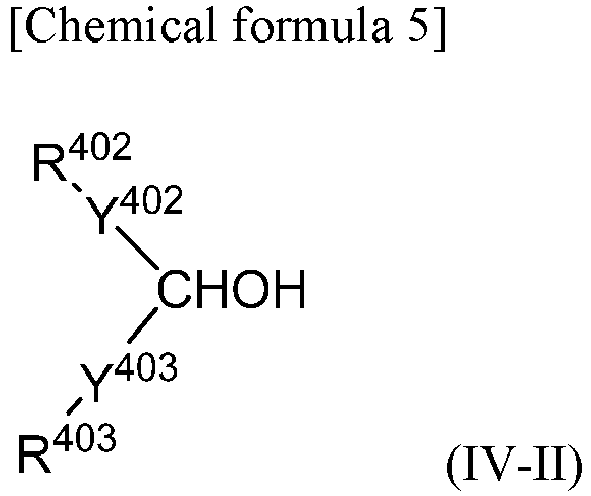
- the compound (IV-II) is a compound represented by general formula (IV-II) shown below.
- the compound (IV-II) may exist in the form of a salt with an acid.
- the acid that forms the salt with the compound (IV-II) is as described above for the acid that forms a salt with the compound (IV-I),
- each of Y 402 and Y 403 independently represents a divalent aliphatic hydrocarbon group of at least 1 but not more than 10 carbon atoms or a divalent aromatic cyclic group of at least 6 but not more than 10 carbon atoms.
- Each of R 402 and R 403 independently represents at least one group selected from the group consisting of a hydrogen, an amino group, a carbamide group (-NHCONH 2 ), groups represented by general formula (II-1) shown above, groups represented by general formula (II-2) shown above, groups represented by general formula (II-3) shown above, and groups represented by general formula (II-4) shown above.
- the divalent aliphatic hydrocarbon group of at least 1 but not more than 10 carbon atoms or the divalent aromatic cyclic group of at least 6 but not more than 10 carbon atoms for Y 402 and Y 403 is as described above for the divalent aliphatic hydrocarbon group of at least 1 but not more than 10 carbon atoms or the divalent aromatic cyclic group of at least 6 but not more than 10 carbon atoms for Y 401 in general formula (IV-I).
- the compound (IV-III) is a compound represented by general formula (IV-III) shown below.
- the compound (IV-III) may exist in the form of a salt with an acid.
- the acid that forms the salt with the compound (IV-III) is as described above for the acid that forms a salt with the compound (IV-I),
- each of Y 404 , Y 405 and Y 406 independently represents a divalent aliphatic hydrocarbon group of at least 1 but not more than 10 carbon atoms or a divalent aromatic cyclic group of at least 6 but not more than 10 carbon atoms.
- Each of R 404 , R 405 and R 406 independently represents at least one group selected from the group consisting of a hydrogen, an amino group, a carbamide group (-NHCONH 2 ), groups represented by general formula (II-1) shown above, groups represented by general formula (II-2) shown above, groups represented by general formula (II-3) shown above, and groups represented by general formula (II-4) shown above.
- Specific preferred examples of the compound (IV-III) include the compounds represented by formulas (B-31) to (B-317) shown below.
- Rx in the above formulas is preferably a methyl group, ethyl group, propyl group (including structural isomers), butyl group (including structural isomers), pentyl group (including structural isomers), hexyl group (including structural isomers), pentyl group (including structural isomers), octyl group (including structural isomers), phenyl group, methylphenyl group (including structural isomers), dimethylphenyl group (including structural isomers), ethylphenyl group (including structural isomers), and diethylphenyl group (including structural isomers)).
- each of Y 407 , Y 408 , Y 409 and Y 4010 represents a divalent aliphatic hydrocarbon group of at least 1 but not more than 10 carbon atoms or a divalent aromatic cyclic group of at least 6 but not more than 10 carbon atoms.
- the acid catalyst may be an organic acid or an inorganic acid.
- organic acids examples include aliphatic sulfonic acids, aromatic sulfonic acids, alkyl phosphoric acids, alkyl sulfuric acids, and aromatic sulfuric acids.
- aliphatic sulfonic acids include methanesulfonic acid. and the like.
- alkyl phosphoric acids include dimethyl phosphate (normal boiling point: 174°C) and diethyl phosphate (normal boiling point: 204°C).
- alkyl sulfuric acids include dimethyl sulfate (normal boiling point: 188°C), diethyl sulfate (normal boiling point: 209°C) and lauryl sulfuric acid (normal boiling point: 206°C).
- aromatic sulfate esters include phenyl sulfate and phenyl fluorosulfate.
- inorganic acids examples include sulfuric acid (normal boiling point: 337°C), phosphoric acid (normal boiling point: 158°C), nitric acid (normal boiling point:83°C) and boric acid (normal boiling point:300°C).
- One of these acids may be used alone, or a combination of two or more acids may be used.
- the inventors of the present invention discovered that in the production method of the present invention, when producing the amino acid aminoalkyl ester and the inorganic acid salt thereof, among the various possibilities listed above for the acid catalyst, an aliphatic sulfonic acid or an inorganic acid is preferred, and methanesulfonic acid, p-toluenesulfonic acid, trifluoromethanesulfonic acid, sulfuric acid, phosphoric acid, or a combination of these acids is more preferred.
- a carrying agent may be used to assist the distillation of the water or hydroxy compound produced by the reaction.
- a "carrying agent” refers to a substance which is substantially inert and exists in the gaseous state under the reaction conditions.
- substantially inert means that under the conditions in which synthesis of the amino acid aminoalkyl ester or the inorganic acid salt thereof is conducted, the substance does not react with the raw materials, including the compound (I) or the compound (III) or the salt thereof, and the at least one compound selected from the group consisting of the compound (IV-I), the compound (IV-II), the compound (IV-III) and the compound (IV-IV), or the salt thereof, nor with the amino acid aminoalkyl ester or the inorganic acid salt thereof and the water that represent the reaction products, or if reaction does occur, then there is no significant effect on the synthesis of the amino acid aminoalkyl ester or the inorganic acid salt thereof.
- this type of carrying agent include inert gases and organic solvents and the like.
- the inert gas examples include nitrogen, argon, helium, carbon dioxide gas, methane, ethane and propane.
- an inert gas such as nitrogen is preferred as the carrying agent.
- the organic solvent is preferably a solvent that undergoes azeotropic distillation with water.
- the organic solvent may be supplied in a solution state, or supplied to the reaction system in a gaseous state.
- organic solvent includes alkanes, aromatic hydrocarbons and alkyl-substituted aromatic hydrocarbons, aromatic compounds substituted with a nitro group or a halogen, polycyclic hydrocarbon compounds, alicyclic hydrocarbons, ketones, esters, ethers and thioethers, sulfoxides, sulfones, and silicone oils.
- alkanes examples include hexane, heptane, octane, nonane, decane, n-hexadecane, n-octadecane, eicosane and squalane.
- aromatic hydrocarbons and alkyl-substituted aromatic hydrocarbons examples include benzene, toluene, xylene, ethylbenzene, triethylbenzene, cumene, diisopropylbenzene, dibutylbenzene, naphthalene, lower alkyl-substituted naphthalene, and dodecylbenzene.
- aromatic compounds substituted with a nitro group or a halogen examples include chlorobenzene, 4-methylbenzyl chloride, p-dichlorobenzene, bromobenzene, dibromobenzene, chloronaphthalene, bromonaphthalene, nitrobenzene and nitronaphthalene.
- polycyclic hydrocarbon compounds examples include diphenyl, substituted diphenyl, diphenylmethane, terphenyl, anthracene, phenanthrene, benzyltoluene, benzyltoluene isomers, and triphenylmethane.
- Examples of the alicyclic hydrocarbons include cyclohexane and ethylcyclohexane.
- esters examples include dibutyl phthalate, dihexyl phthalate and dioctyl phthalate.
- ethers and thioethers examples include diphenyl ether and diphenyl sulfide.
- sulfoxides examples include dimethyl sulfoxide and diphenyl sulfoxide.
- sulfones examples include dimethyl sulfone, diethyl sulfone, diphenyl sulfone and sulfolane.
- the inert solvent is preferably an aromatic hydrocarbon, an alkyl-substituted aromatic hydrocarbon, or an aromatic compound substituted with a nitro group or a halogen, is more preferably an alkyl-substituted aromatic hydrocarbon or an aromatic compound substituted with a halogen, and is even more preferably toluene, xylene or p-dichlorobenzene.
- the amount supplied of the carrying agent for example in the case where the carrying agent is supplied in a solution state, may be set to an amount of at least 0.01 times but not more than 1.0 times, and preferably at least 0.02 times but not more than 0.5 times, the volume of the reaction liquid per hour. Further, when the carrying agent is supplied in the gaseous state, the amount supplied may be set to an amount of at least 3.0 times but not more than 20.0 times, and preferably at least 5.0 times but not more than 10.0 times, the volume of the reaction liquid per hour.
- the amino acid aminoalkyl ester or the inorganic acid salt thereof obtained using the production method of the present embodiment is a compound represented by general formula (I) shown above or a compound represented by general formula (III) shown above, in which R 13 or R 33 has been substituted with a group obtained by removing the hydroxyl group from general formula (IV-I), (IV-II), (IV-III) or (IV-IV) shown above, or is an inorganic acid salt of that compound.
- R 11 and R 12 are the same as R 11 and R 12 respectively in general formula (I) described above.
- R 41 and n41 are the same as R 41 and n41 respectively in general formula (I) described above.
- R 32 and R 33 are the same as R 32 and R 33 respectively in general formula (III) described above.
- R 41 and n41 are the same as R 41 and n41 respectively in general formula (I) described above.
- a glass flask with an internal capacity of 1,000 mL fitted with a distillation device was charged with 200 g of a compound (A-1) (glycine) shown as the raw material 1 in Table 1 below, 171 g of a compound (B-1) (ethanolamine) shown as the raw material 2 in Table 1 below, 200 g of toluene and 214 g of phosphoric acid, and a reaction was conducted under reduced pressure at 100°C, with the toluene being distilled off while additional toluene was added to keep the liquid level substantially constant.
- A-1 glycine
- B-1 ethanolamine
- Example 10 With the exception of replacing the acid used in Example 10 from methanesulfonic acid to hydrogen chloride, a reaction was conducted using the same method as Example 10. The hydrogen chloride was supplied to the reaction system using the same method as Comparative Example 1. In this reaction, the yield of the produced compound (E-10) was 50%.
- the yield of every products was at least 67%, with the target product able to be obtained in high yield. Further, the acid was in a liquid state during the production process, and was not contained in the distilled gaseous component.
Landscapes
- Chemical & Material Sciences (AREA)
- Organic Chemistry (AREA)
- Chemical Kinetics & Catalysis (AREA)
- Organic Low-Molecular-Weight Compounds And Preparation Thereof (AREA)
- Low-Molecular Organic Synthesis Reactions Using Catalysts (AREA)
Abstract


Description
- The present invention relates to a method for producing an amino acid aminoalkyl ester or an inorganic acid salt thereof.
- Priority is claimed on Japanese Patent Application No.
2018-094173, filed May 15, 2018 - One known method for producing an amino acid aminoalkyl ester or an inorganic acid salt thereof is a method in which an amino acid or a salt thereof and an amino alcohol or a salt thereof are subjected to an esterification reaction in the presence of hydrogen chloride and an organic solvent. In this reaction system, because the reaction tends to proceed poorly in the latter stages of the reaction, with a low conversion and reaction rate, a method has been proposed in which following supply of hydrogen chloride gas to the reaction system, an organic solvent is supplied to the reaction system, and the water produced by the reaction is removed (for example, see Patent Document 1).
- Patent Document 1: Japanese Unexamined Patent Application, First Publication No.
2003-252840 - However, in the method disclosed in Patent Document 1, because hydrogen chloride is used as a catalyst, hydrogen chloride gas is distilled off together with the water (steam) produced in the reaction, leading to the possibility of corrosion of the reaction container and lines.
- The present invention has been developed in light of the above circumstances, and provides a method that can produce an amino acid aminoalkyl ester or an inorganic acid salt thereof in high yield without acid distillation.
- In other words, the present invention relates to the following aspects.
- [1] A method for producing an amino acid aminoalkyl ester or an inorganic acid salt thereof by reacting:
- a compound represented by general formula (I) shown below or a compound represented by general formula (III) shown below, or a salt thereof, and
- at least one compound selected from the group consisting of compounds represented by general formula (IV-I) shown below, compounds represented by general formula (IV-II) shown below, compounds represented by general formula (IV-III) shown below and compounds represented by general formula (IV-IV) shown below, or an inorganic acid salt thereof.


In general formula (II-2), R22 represents a monovalent organic group.
In general formula (II-3), each of R23 and R24 independently represents a monovalent aliphatic hydrocarbon group of at least 1 but not more than 10 carbon atoms which may have a substituent, or a monovalent aromatic cyclic group of at least 6 but not more than 10 carbon atoms which may have a substituent.
In general formula (II-4), R25 represents a hydrogen atom or a monovalent organic group.)




- [2] The method according to [1], wherein the reaction is conducted in the presence of at least one acid catalyst selected from the group consisting of organic acids and inorganic acids having a normal boiling point of 0°C or higher.
- [3] The method according to [1] or [2], wherein the compound represented by general formula (I) is at least one amino acid selected from the group consisting of lysine, glutamic acid, methionine, glycine, phenylalanine, asparagine, alanine, leucine, isoleucine, and valine.
- [4] The method according to [2] or [3], wherein the inorganic acid used as an acid catalyst is at least one acid selected from the group consisting of sulfuric acid, phosphoric acid, nitric acid and boric acid.
- [5] The method according to any one of [2] to [4], wherein an acid that forms a salt with the compound represented by general formula (I) or the compound represented by general formula (III) and the acid catalyst are the same acid.
- [6] The method according to any one of [1] to [5], wherein
in general formula (I):- the substituent is at least one group selected from the group consisting of monovalent aliphatic hydrocarbon groups of at least 1 but not more than 10 carbon atoms, monovalent aromatic cyclic groups of at least 6 but not more than 10 carbon atoms, groups represented by general formula (II-1) shown above, and groups represented by general formula (II-2) shown above,
- R12 is a group represented by general formula (II-1) shown above or a group represented by general formula (II-2) shown above,
- R13 is a hydrogen atom, and
- n11 is 1; and
- in general formula (III):
- the substituent is at least one group selected from the group consisting of monovalent aliphatic hydrocarbon groups of at least 1 but not more than 10 carbon atoms, monovalent aromatic cyclic groups of at least 6 but not more than 10 carbon atoms, groups represented by general formula (II-1) shown above, groups represented by general formula (II-2) shown above, groups represented by general formula (II-3) shown above, and groups represented by general formula (II-4) shown above, and
- R32 is at least one group selected from the group consisting of groups represented by general formula (II-1) shown above, groups represented by general formula (II-2) shown above, and groups represented by general formula (II-3) shown above.
- [7] The method according to any one of [1] to [6], wherein the compound represented by general formula (I) or the compound represented by general formula (III), or a salt thereof, is reacted with the compound represented by general formula (IV-I) or an inorganic acid salt thereof.
- [8] The method according to [7], wherein
in general formula (I):- R11 represents a hydrogen atom or a monovalent aliphatic hydrocarbon group of at least 1 but not more than 10 carbon atoms which may have a substituent,
- the substituent is a group represented by general formula (II-1) shown above,
- R12 is a group represented by general formula (II-1) shown above, and
- R13 is a hydrogen atom; and
- in general formula (IV-I):
- Y401 is a divalent aliphatic hydrocarbon group of at least 1 but not more than 10 carbon atoms, and
- R401 is a group represented by general formula (II-1) shown above.
- [9] The method according to any one of [2] to [8], wherein the acid catalyst is included in an amount of 1 ppm to 5% by mass.
- By using the production method of the aspects described above, an amino acid aminoalkyl ester or an inorganic acid salt thereof can be produced in high yield without acid distillation.
- The production method of this embodiment of the present invention is a method for producing an amino acid aminoalkyl ester or an inorganic acid salt thereof by reacting a compound represented by general formula (I) shown below (hereafter sometimes referred to as "the compound (I)") or a compound represented by general formula (III) shown below (hereafter sometimes referred to as "the compound (III)"), or a salt thereof, and at least one compound selected from the group consisting of compounds represented by general formula (IV-I) shown below (hereafter sometimes referred to as "the compound (IV-I)"), compounds represented by general formula (IV-II) shown below (hereafter sometimes referred to as "the compound (IV-II)"), compounds represented by general formula (IV-III) shown below (hereafter sometimes referred to as "the compound (IV-III)"), and compounds represented by general formula (IV-IV) shown below (hereafter sometimes referred to as "the compound (IV-IV)"), or an inorganic acid salt thereof. Further, in the production method of the present embodiment, the reaction may be conducted in the presence of an acid catalyst having a normal boiling point of 0°C or higher. The acid catalyst may be an organic acid or an inorganic acid.

- (In general formula (I), R11 represents a hydrogen atom, a monovalent aliphatic hydrocarbon group of at least 1 but not more than 10 carbon atoms which may have a substituent, or a monovalent aromatic cyclic group of at least 6 but not more than 10 carbon atoms which may have a substituent. The substituent is at least one group selected from the group consisting of monovalent aliphatic hydrocarbon groups of at least 1 but not more than 10 carbon atoms, monovalent aromatic cyclic groups of at least 6 but not more than 10 carbon atoms, halogeno groups, alkoxy groups, thioalkyl groups, a primary amino group (-NH2), a carboxyl group, a carbamide group (-NHCONH2), groups represented by general formula (II-1) shown below (hereafter sometimes referred to as "the group (II-1)"), groups represented by general formula (II-2) shown below (hereafter sometimes referred to as "the group (II-2)"), groups represented by general formula (II-3) shown below (hereafter sometimes referred to as "the group (II-3)"), and groups represented by general formula (II-4) shown below (hereafter sometimes referred to as "the group (II-4)"). R12 represents an amino group, a carbamide group (-NHCONH2), a group represented by general formula (II-1) shown below, a group represented by general formula (II-2) shown below, or a group represented by general formula (II-3) shown below. R13 represents a hydrogen atom or an n11-valent organic group. Further, n11 is an integer of at least 1 but not more than 4.)

- (In general formula (II-1), R21 represents a monovalent aliphatic hydrocarbon group of at least 1 but not more than 10 carbon atoms which may have a substituent, or a monovalent aromatic cyclic group of at least 6 but not more than 10 carbon atoms which may have a substituent.
- In general formula (II-2), R22 represents a monovalent organic group.
- In general formula (II-3), each of R23 and R24 independently represents a monovalent aliphatic hydrocarbon group of at least 1 but not more than 10 carbon atoms which may have a substituent, or a monovalent aromatic cyclic group of at least 6 but not more than 10 carbon atoms which may have a substituent.
- In general formula (II-4), R25 represents a hydrogen atom or a monovalent organic group.

- (In general formula (III), n31 is an integer of at least 2 but not more than 4. R31 represents an n31-valent aliphatic hydrocarbon group of at least 1 but not more than 10 carbon atoms which may have a substituent, or an n31-valent aromatic cyclic group of at least 6 but not more than 10 carbon atoms which may have a substituent. The substituent is at least one group selected from the group consisting of monovalent aliphatic hydrocarbon groups of at least 1 but not more than 10 carbon atoms, monovalent aromatic cyclic groups of at least 6 but not more than 10 carbon atoms, halogeno groups, alkoxy groups, thioalkyl groups, a primary amino group (-NH2), a carboxyl group, a carbamide group (-NHCONH2), groups represented by general formula (II-1) shown above, groups represented by general formula (II-2) shown above, groups represented by general formula (II-3) shown above, and groups represented by general formula (II-4) shown above. R32 represents an amino group, a carbamide group (-NHCONH2), a group represented by general formula (II-1) shown above, a group represented by general formula (II-2) shown above, or a group represented by general formula (II-3) shown above. R33 represents a hydrogen atom or a monovalent organic group.)


- (In general formula (IV-I), Y401 represents a divalent aliphatic hydrocarbon group of at least 1 but not more than 10 carbon atoms or a divalent aromatic cyclic group of at least 6 but not more than 10 carbon atoms. R401 represents an amino group, a carbamide group (-NHCONH2), a group represented by general formula (II-1) shown above, a group represented by general formula (II-2) shown above, or a group represented by general formula (II-3) shown above.)

- (In general formula (IV-II), each of Y402 and Y403 independently represents a divalent aliphatic hydrocarbon group of at least 1 but not more than 10 carbon atoms or a divalent aromatic cyclic group of at least 6 but not more than 10 carbon atoms. Each of R402 and R403 independently represents at least one group selected from the group consisting of a hydrogen, an amino group, a carbamide group (-NHCONH2), groups represented by general formula (II-1) shown above, groups represented by general formula (II-2) shown above, groups represented by general formula (II-3) shown above, and groups represented by general formula (II-4) shown above.)


- (In general formula (IV-III), each of Y404, Y405 and Y406 independently represents a divalent aliphatic hydrocarbon group of at least 1 but not more than 10 carbon atoms or a divalent aromatic cyclic group of at least 6 but not more than 10 carbon atoms. Each of R404, R405 and R406 independently represents at least one group selected from the group consisting of a hydrogen, an amino group, a carbamide group (-NHCONH2), groups represented by general formula (II-1) shown above, groups represented by general formula (II-2) shown above, groups represented by general formula (II-3) shown above, and groups represented by general formula (II-4) shown above.)

- (In general formula (IV-IV), each of Y407, Y408, Y409 and Y4010 represents a divalent aliphatic hydrocarbon group of at least 1 but not more than 10 carbon atoms or a divalent aromatic cyclic group of at least 6 but not more than 10 carbon atoms. At least one of R407, R408, R409 and R4010 represents a hydroxyl group, and each of the others represents at least one group selected from the group consisting of a hydrogen, an amino group, a carbamide group (-NHCONH2), groups represented by general formula (II-1) shown above, groups represented by general formula (II-2) shown above, groups represented by general formula (II-3) shown above, and groups represented by general formula (II-4) shown above.)
- By using the production method of the present embodiment, an amino acid aminoalkyl ester or an inorganic acid salt thereof can be produced in high yield without acid distillation.
- The compound (I) and the compound (III) used in the production method of the present embodiment are compounds which have an α-amino acid skeleton. In an α-amino acid, there are two possible three-dimensional bonding arrangements of the amino group and the carboxyl group and the like to the α-carbon atom, and these arrangements are distinguished as the D- and L- optical isomers.
- The α-amino acid (or the compound having an amino acid skeleton) used in the production method of the present embodiment may be the D-isomer, the L-isomer, or a mixture thereof. Most amino acids that can be obtained industrially at low cost are amino acids produced by fermentation, and are almost all L-isomers, and these amino acids can be used favorably. In this description, the three-dimensional configuration is not shown, indicating that either the D-isomer or the L-isomer may be used.
- In the production method of the present embodiment, an amino acid aminoalkyl ester or an inorganic acid salt thereof is produced by subjecting the compound (I) or the compound (III) or a salt thereof, and at least one compound selected from the group consisting of the compound (IV-I), the compound (IV-II), the compound (IV-III) and the compound (IV-IV), or a salt thereof, to an esterification reaction or a transesterification reaction. Because this reaction is a dehydration reaction, water is produced as a byproduct. By removing this water from the reaction system, the amino acid aminoalkyl ester or inorganic acid salt thereof can be produced efficiently. At this time, a carrying agent such as an inert gas or an organic solvent that undergoes azeotropic distillation with water may be used to remove the water from the reaction system. This reaction may be conducted in the presence of an acid catalyst having a normal boiling point of 0°C or higher.
- Furthermore, in those cases where a salt of the compound (I) or a salt of the compound (III) is used as a raw material, the type of acid used for forming the salt with the compound (I) or the compound (III) and the type of acid used as a catalyst may be the same or different. Among the various possibilities, from the viewpoints of the production costs and simplifying the production of the reaction product, the type of acid used for forming the salt with the compound (I) or the compound (III) and the type of acid used as a catalyst are preferably the same.
- Although there are no particular limitations on the blend ratio (molar ratio) between the compound (I) or the compound (III) or the salt thereof, and the at least one compound selected from the group consisting of the compound (IV-I), the compound (IV-II), the compound (IV-III) and the compound (IV-IV), or the salt thereof, the molar ratio between the ester group of the compound (I) or the compound (III) or a salt thereof, and the hydroxyl group of the at least one compound selected from the group consisting of the compound (IV-I), the compound (IV-II), the compound (IV-III) and the compound (IV-IV), or the salt thereof, is preferably from 1:0.5 to 1:5, and is more preferably from 1:1 to 1:3.
- The reaction temperature is preferably at least 30°C but not more than 200°C, more preferably at least 50°C but not more than 180°C, and even more preferably at least 70°C but not more than 150°C.
- The pressure is preferably at least 1 kPa but not more than 150 kPa, more preferably at least 5 kPa but not more than 100 kPa, and even more preferably at least 10 kPa but not more than 80 kPa.
- In those cases where an acid catalyst is used, the amount used of the catalyst, relative to the total mass of the reaction liquid, is preferably at least 3% by mass but not more than 80% by mass, more preferably at least 5% by mass but not more than 70% by mass, and even more preferably at least 6% by mass but not more than 60% by mass.
- The reaction time is not particularly limited, but is preferably at least 0.01 hours but not longer than 100 hours, more preferably at least 3 hours but not longer than 15 hours, and even more preferably at least 5 hours but not longer than 10 hours. Further, the reaction time may also be determined on the basis of the amount produced of the target product. For example, the reaction liquid may be sampled and the amount of the target product quantified, with the reaction stopped when a predetermined yield has been reached.
- An aqueous solution of an inorganic acid may be added to the reaction system. There are no particular limitations on the amount used of the inorganic acid aqueous solution, but a molar amount of at least 1.0 times but not more than 5.0 times the total molar amount of the compound (I) or the compound (III) or the salt thereof, and the at least one compound selected from the group consisting of the compound (IV-I), the compound (IV-II), the compound (IV-III) and the compound (IV-IV), or the salt thereof is preferred. The concentration of the inorganic acid aqueous solution is preferably at least 20% by mass but not more than 35% by mass.
- Further, the obtained amino acid aminoalkyl ester or the inorganic acid salt thereof may be an inorganic acid salt having from 1 to a plurality of moles of the inorganic acid per 1 mol of the amino acid aminoalkyl ester.
- Furthermore, in those cases where the obtained amino acid aminoalkyl ester is not a salt of the desired inorganic acid, the desired inorganic acid salt may be formed by performing a salt exchange or the like.
- Production of the target product can be confirmed by analysis of the reaction liquid using a conventional method such as liquid chromatography.
- Further, the amino acid aminoalkyl ester or the inorganic acid salt thereof may be extracted from the reaction liquid, and purified using a conventional purification method such as crystallization or column chromatography.
- Furthermore, the amino acid aminoalkyl ester or the inorganic acid salt thereof obtained using the production method of the present embodiment may be used to produce a compound having an isocyanate group by conducting a carbamation using a conventional method, and then subjecting the carbamate to thermal decomposition.
- The raw materials used in the production method of the present embodiment and the resulting products are described below in further detail.
- The compound (I) is a compound represented by general formula (I) shown below, and is an amino acid or an amino acid ester, or a derivative thereof.
- Further, the compound (I) may exist in the form of a salt with an acid. The acid that forms the salt with the compound (I) may be an organic acid or an inorganic acid. Examples of these types of acids include the same acids as those exemplified below in relation to the "acid catalyst". Among the various possibilities, the acid that forms a salt with the compound (I) is preferably an inorganic acid. Further, hydrochloric acid may be used as the acid that forms a salt with the compound (I).

- In general formula (I), R11 represents a hydrogen atom, a monovalent aliphatic hydrocarbon group of at least 1 but not more than 10 carbon atoms which may have a substituent, or a monovalent aromatic cyclic group of at least 6 but not more than 10 carbon atoms which may have a substituent.
- The aliphatic hydrocarbon group of at least 1 but not more than 10 carbon atoms for R11 may be linear, branched or cyclic, but is preferably linear or branched.
- Examples of linear aliphatic hydrocarbon groups include a methyl group, ethyl group, n-propyl group, n-butyl group, n-pentyl group, n-hexyl group, n-heptyl group, n-octyl group, n-nonyl group and n-decyl group.
- Examples of branched aliphatic hydrocarbon groups include an isopropyl group, isobutyl group, sec-butyl group, tert-butyl group, isopentyl group, sec-pentyl group, neopentyl group, tert-pentyl group, 2,3-dimethylpropyl group, 1-ethylpropyl group, 1-methylbutyl group, 2-methylbutyl group, isohexyl group, 2-methylpentyl group, 3-methylpentyl group, 1,1,2-trimethylpropyl group, 3,3-dimethylbutyl group and 1-methylheptyl group.
- The monovalent aromatic cyclic group of at least 6 but not more than 10 carbon atoms for R11 may be an aromatic hydrocarbon group or an aromatic heterocyclic group.
- Examples of aromatic hydrocarbon groups include a phenyl group and a naphthyl group.
- Examples of aromatic heterocyclic groups include a benzyloxazolyl group and a furanyl group.
- The aforementioned substituent is at least one group selected from the group consisting of monovalent aliphatic hydrocarbon groups of at least 1 but not more than 10 carbon atoms, monovalent aromatic cyclic groups of at least 6 but not more than 10 carbon atoms, halogeno groups, alkoxy groups (-OR), thioalkyl groups (-SR), a primary amino group (-NH2), a carboxyl group, a carbamide group (-NHCONH2), groups represented by general formula (II-1) shown below (groups having a urethane linkage), groups represented by general formula (II-2) shown below (groups having a urea linkage), groups represented by general formula (II-3) shown below (tertiary amino groups), and groups represented by general formula (II-4) shown below (groups having an ester linkage).
- Examples of the halogeno groups include a fluoro group, chloro group, bromo group and iodo group.
- Examples of the alkoxy groups include a methoxy group, ethoxy group, propoxy group, isopropoxy group, butoxy group, sec-butoxy group, tert-butoxy group, pentyloxy group and neopentyloxy group.
- Examples of the thioalkyl groups include a thioethyl group, thiomethyl group and thiopropynyl group.

- In general formula (II-1), R21 represents a monovalent aliphatic hydrocarbon group of at least 1 but not more than 10 carbon atoms which may have a substituent, or a monovalent aromatic cyclic group of at least 6 but not more than 10 carbon atoms which may have a substituent.
- In general formula (II-2), R22 represents a monovalent organic group.
- In general formula (II-3), each of R23 and R24 independently represents a monovalent aliphatic hydrocarbon group of at least 1 but not more than 10 carbon atoms which may have a substituent, or a monovalent aromatic cyclic group of at least 6 but not more than 10 carbon atoms which may have a substituent.
- In general formula (II-4), R25 represents a hydrogen atom or a monovalent organic group.
- The asterisks indicate bonding sites.
- Examples of the monovalent aliphatic hydrocarbon group of at least 1 but not more than 10 carbon atoms which may have a substituent and the monovalent aromatic cyclic group of at least 6 but not more than 10 carbon atoms which may have a substituent for R21, R23 and R24 include the same groups as those exemplified above for R11. Further, the substituent in R21, R23 and R24 is preferably an aliphatic hydrocarbon group of at least 1 but not more than 5 carbon atoms or a phenyl group.
- Examples of the monovalent organic group for R22 and R25 include an aliphatic hydrocarbon group, an aromatic hydrocarbon group, or a group in which an aliphatic hydrocarbon group and an aromatic hydrocarbon group are bonded together. Specific examples of R22 and R25 include cyclic hydrocarbon groups, acyclic hydrocarbon groups, and groups in which an acyclic hydrocarbon group and at least one cyclic group are bonded together. Examples of the cyclic group include cyclic hydrocarbon groups, heterocyclic groups, heterocyclic spiro groups, and hetero-crosslinked cyclic groups. Examples of the cyclic hydrocarbon groups include monocyclic hydrocarbon groups, condensed polycyclic hydrocarbon groups, crosslinked cyclic hydrocarbon groups, spiro hydrocarbon groups, ring-aggregated hydrocarbon groups, and cyclic hydrocarbon groups having a side chain.
- Among the various possibilities, R22 is preferably a group in which one amino group has been removed from an amino acid or an amino acid ester, and groups represented by general formula (1) shown below (hereafter sometimes referred to as "group (1)") are preferred.

- In general formula (1), R26 is the same as R22 described above. Accordingly, in those cases when R26 includes the above group (1), R22 is a group in which a plurality of the above groups (1) are linked together, either directly or via a divalent linking group.
- Further, R27 represents a hydrogen atom or a monovalent organic group. Examples of the monovalent organic group for R27 include the same groups as those exemplified above for R22 and R25. Among the various possibilities, R27 is preferably a hydrogen atom, a monovalent aliphatic hydrocarbon group of at least 1 but not more than 10 carbon atoms, or a monovalent aromatic hydrocarbon group of at least 6 but not more than 10 carbon atoms, and is more preferably a hydrogen atom or a monovalent aliphatic hydrocarbon group of at least 1 but not more than 5 carbon atoms.
- Among the various possibilities, R11 is preferably a hydrogen atom, a hydrocarbon group of at least 1 but not more than 3 carbon atoms having a substituent, an unsubstituted linear aliphatic hydrocarbon group of at least 1 but not more than 10 carbon atoms, a phenyl group which may have a substituent, an unsubstituted naphthyl group, or an unsubstituted aromatic heterocyclic group.
- R12 represents an amino group, a carbamide group (-NHCONH2), the group (II-1) described above, the group (II-2) described above, or the group (II-3) described above, and is preferably the group (II-1).
- Further, n11 is an integer of at least 1 but not more than 4, and is preferably an integer of at least 1 but not more than 3, more preferably 1 or 2, and even more preferably 1.
- R13 represents a hydrogen atom or an n11-valent organic group.
- Examples of the organic group for R13 include the same groups as those exemplified above for R22 and R25.
- When R13 is monovalent, a hydrogen atom, a monovalent aliphatic hydrocarbon group of at least 1 but not more than 10 carbon atoms, or an aromatic hydrocarbon group of at least 6 but not more than 10 carbon atoms is preferred, and a hydrogen atom or a monovalent aliphatic hydrocarbon group of at least 1 but not more than 5 carbon atoms is more preferred.
- When R13 is divalent, a divalent aliphatic hydrocarbon group of at least 1 but not more than 10 carbon atoms or a divalent aromatic hydrocarbon group of at least 6 but not more than 10 carbon atoms is preferred, and a divalent aliphatic hydrocarbon group of at least 1 but not more than 5 carbon atoms is more preferred.
- Examples of the divalent aliphatic hydrocarbon groups of at least 1 but not more than 10 carbon atoms for R13 include a methylene group, ethylene group, trimethylene group, tetramethylene group, pentamethylene group and hexamethylene group. Examples of the divalent aromatic hydrocarbon groups of at least 6 but not more than 10 carbon atoms for R13 include a phenylene group and a naphthalenediyl group.
- When R13 is trivalent, a trivalent aliphatic hydrocarbon group of at least 1 but not more than 10 carbon atoms or a trivalent aromatic hydrocarbon group of at least 6 but not more than 10 carbon atoms is preferred, and a trivalent aliphatic hydrocarbon group of at least 1 but not more than 5 carbon atoms is more preferred.
- Examples of the trivalent aliphatic hydrocarbon group of at least 1 but not more than 10 carbon atoms for R13 include a methanetriyl group, ethanetriyl group and propanetriyl group. Examples of the trivalent aromatic hydrocarbon group of at least 6 but not more than 10 carbon atoms for R13 include a benzenetriyl group and a naphthalenetriyl group.
- When R13 is tetravalent, a tetravalent aliphatic hydrocarbon group of at least 1 but not more than 10 carbon atoms or a tetravalent aromatic hydrocarbon group of at least 6 but not more than 10 carbon atoms is preferred, and a tetravalent aliphatic hydrocarbon group of at least 1 but not more than 5 carbon atoms is more preferred.
- Examples of the tetravalent aliphatic hydrocarbon group of at least 1 but not more than 10 carbon atoms for R13 include a methanetetrayl group, ethanetetrayl group, propanetetrayl group, butanetetrayl group, pentanetetrayl group, hexanetetrayl group, heptanetetrayl group and octanetetrayl group. Examples of the tetravalent aromatic hydrocarbon group of at least 6 but not more than 10 carbon atoms for R13 include a benzenetetrayl group and a naphthalenetetrayl group.
- Examples of preferred compounds for the compound (I) include compounds represented by general formula (1-1) shown below (hereafter sometimes referred to as "the compound (I-1)"), compounds represented by general formula (1-2) shown below (hereafter sometimes referred to as "the compound (1-2)"), compounds represented by general formula (1-3) shown below (hereafter sometimes referred to as "the compound (I-3)"), compounds represented by general formula (1-4) shown below (hereafter sometimes referred to as "the compound (1-4)"), and compounds represented by general formula (I-5) shown below (hereafter sometimes referred to as "the compound (1-5)"). Among these, the compound (1-2) is particularly preferred.


- In general formula (1-1), R111 is the same as R11 described above. R112 is the same as R13 described above. Further, n111 is the same as n11 described above.
- In general formula (1-2), R211 is the same as R11 described above. R212 is the same as R21 described above. R213 is the same as R13 described above. Further, n211 is the same as n11 described above.
- In general formula (1-3), R311 is the same as R11 described above. R312 is the same as R13 described above. Further, n311 is the same as n11 described above.
- In general formula (1-4), R411 is the same as R11 described above. R412 is the same as R22 described above. R413 is the same as R13 described above. Further, n411 is the same as n11 described above.
- In general formula (1-5), R511 is the same as R11 described above. R512 and R513 are the same as R23 described above and R24 described above respectively. R514 is the same as R13 described above. Further, n511 is the same as n11 described above.
- Preferred examples of the compound (1-1) include compounds represented by general formula (I-1-1) shown below (hereafter sometimes referred to as "the compound (1-1-1)"), and compounds represented by general formula (1-1-2) shown below (hereafter sometimes referred to as "the compound (1-1-2)").


- In general formula (1-1-1), R113 represents a hydrogen atom or a monovalent aliphatic hydrocarbon group of at least 1 but not more than 10 carbon atoms which may have a substituent. Examples of the monovalent aliphatic hydrocarbon group of at least 1 but not more than 10 carbon atoms which may have a substituent for R113 include the same groups as those exemplified above for R11. R114 is the same as R13 described above. Further, n112 is the same as n11 described above.
- In general formula (1-1-2), R115 represents a monovalent aromatic cyclic group of at least 6 but not more than 10 carbon atoms which may have a substituent. Examples of the monovalent aromatic cyclic group of at least 6 but not more than 10 carbon atoms which may have a substituent for R115 include the same groups as those exemplified above for R11. R116 is the same as R13 described above. Further, n113 is the same as n11 described above.
- Preferred examples of the compound (1-2) include compounds represented by general formula (1-2-1) shown below (hereafter sometimes referred to as "the compound (1-2-1)"), and compounds represented by general formula (1-2-2) shown below (hereafter sometimes referred to as "the compound (1-2-2)").

- In general formula (1-2-1), R214 is the same as R113 described above. R215 is the same as R212 described above. R216 is the same as R13 described above. Further, n212 is the same as n11 described above.
- In general formula (1-2-2), R217 is the same as R115 described above. R218 is the same as R212 described above. R219 is the same as R13 described above. Further, n213 is the same as n11 described above.
- Preferred examples of the compound (1-3) include compounds represented by general formula (1-3-1) shown below (hereafter sometimes referred to as "the compound (1-3-1)"), and compounds represented by general formula (1-3-2) shown below (hereafter sometimes referred to as "the compound (1-3-2)").

- In general formula (1-3-1), R313 is the same as R113 described above. R314 is the same as R13 described above. Further, n312 is the same as n11 described above.
- In general formula (1-3-2), R315 is the same as R115 described above. R316 is the same as R13 described above. Further, n313 is the same as n11 described above.
- Preferred examples of the compound (1-4) include compounds represented by general formula (1-4-1) shown below (hereafter sometimes referred to as "the compound (1-4-1)"), and compounds represented by general formula (1-4-2) shown below (hereafter sometimes referred to as "the compound (1-4-2)").

- In general formula (1-4-1), R414 is the same as R113 described above. R415 is the same as R412 described above. R416 is the same as R13 described above. Further, n412 is the same as n11 described above.
- In general formula (1-4-2), R417 is the same as R115 described above. R418 is the same as R412 described above. R419 is the same as R13 described above. Further, n413 is the same as n11 described above.
- Preferred examples of the compound (1-5) include compounds represented by general formula (1-5-1) shown below (hereafter sometimes referred to as "the compound (1-5-1)"), and compounds represented by general formula (1-5-2) shown below (hereafter sometimes referred to as "the compound (1-5-2)").

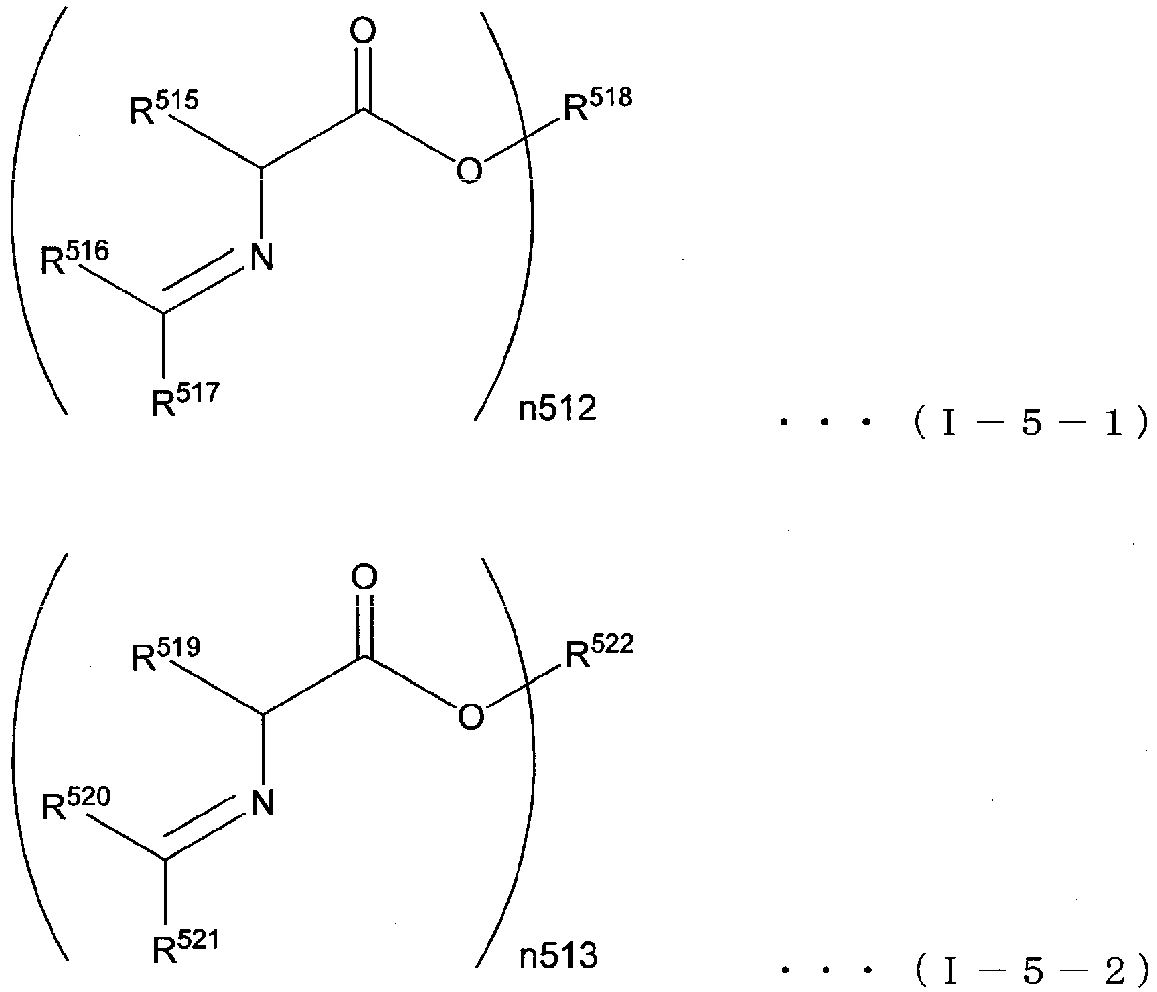
- In general formula (1-5-1), R515 is the same as R113 described above. R516 and R517 are the same as R512 described above and R513 described above respectively. R518 is the same as R13 described above. Further, n512 is the same as n11 described above.
- In general formula (1-5-2), R519 is the same as R115 described above. R520 and R521 are the same as R512 described above and R513 described above respectively. R522 is the same as R13 described above. Further, n513 is the same as n11 described above.
- Preferred examples of the compound (1-1-1) include compounds represented by general formula (I-1-1a) shown below (hereafter sometimes referred to as "the compound (I-1-1a)"), compounds represented by general formula (I-1-1b) shown below (hereafter sometimes referred to as "the compound (I-1-1b)"), compounds represented by general formula (I-1-1c) shown below (hereafter sometimes referred to as "the compound (1-1-1c)"), compounds represented by general formula (I-1-1d) shown below (hereafter sometimes referred to as "the compound (I-1-1d)"), compounds represented by general formula (I-1-1e) shown below (hereafter sometimes referred to as "the compound (1-1-1e)"), compounds represented by general formula (I-1-1f) shown below (hereafter sometimes referred to as "the compound (I-1-1f)"), compounds represented by general formula (I-1-1g) shown below (hereafter sometimes referred to as "the compound (1-1-1g)"), compounds represented by general formula (I-1-1h) shown below (hereafter sometimes referred to as "the compound (I-1-1h)"), compounds represented by general formula (I-1-1i) shown below (hereafter sometimes referred to as "the compound (I-1-1i)"), compounds represented by general formula (I-1-1j) shown below (hereafter sometimes referred to as "the compound (I-1-1j)"), compounds represented by general formula (I-1-1k) shown below (hereafter sometimes referred to as "the compound (1-1-1k)"), and compounds represented by general formula (I-1-1m) shown below (hereafter sometimes referred to as "the compound (I-1-1m)").


- In general formula (I-1-1a) to general formula (I-1-1m), each of R117, R118, R120, R121, R122, R123, R125, R126, R127, R128, R129 and R131 is the same as R13 described above. Each of R119, R124 and R130 independently represents a hydrogen atom, a monovalent aliphatic hydrocarbon group of at least 1 but not more than 10 carbon atoms, or a monovalent aromatic hydrocarbon group of at least 6 but not more than 10 carbon atoms. Examples of the monovalent aliphatic hydrocarbon group of at least 1 but not more than 10 carbon atoms and the monovalent aromatic hydrocarbon group of at least 6 but not more than 10 carbon atoms include the same groups as those exemplified above for R11.
- R132 represents a linear aliphatic hydrocarbon group of at least 2 but not more than 9 carbon atoms.
- Further, each of n114, n115, n116, n117, n118, n119, n120, n121, n123, n124 and n125 independently represents an integer of at least 1 but not more than 4.
- For example, when n114 is 1 in the compound (I-1-1a), one example is the compound represented by formula ((I-1-1a)-1) shown below. Further, when n114 is 3, one example is the compound represented by formula ((I-1-1a)-2) shown below. Further, when n114 is 4, one example is the compound represented by formula ((I-1-1a)-3) shown below. Furthermore, when R118, R120, R121, R122, R123, R125, R126, R127, R128, R129 and R131 are either trivalent or tetravalent, the compounds (I-1-1b) to (I-1-1m) can adopt similar structures to those shown below for the compound ((I-1-1a)-2) or the compound ((I-1-1a)-3).

- Further, in those cases where R117, R118, R119, R120, R121, R122, R123, R124, R125, R126, R127 and R128 are hydrogen atoms, the compounds (I-1-1a) to (I-1-1j) represent the amino acids listed below.
- Compound (I-1-1a): lysine
- Compound (I-1-1b): glutamic acid
- Compound (I-1-1c): methionine
- Compound (I-1-1d): glycine
- Compound (I-1-1e): phenylalanine
- Compound (I-1-1f): aspartic acid
- Compound (I-1-1g): alanine
- Compound (I-1-1h): leucine
- Compound (I-1-1i): isoleucine
- Compound (I-1-1j): valine
- Preferred examples of the compound (1-1-2) include compounds represented by general formula (I-1-2a) shown below (hereafter sometimes referred to as "the compound (I-1-2a)"), compounds represented by general formula (I-1-2b) shown below (hereafter sometimes referred to as "the compound (I-1-2b)"), compounds represented by general formula (I-1-2c) shown below (hereafter sometimes referred to as "the compound (1-1-2c)"), compounds represented by general formula (I-1-2d) shown below (hereafter sometimes referred to as "the compound (I-1-2d)"), compounds represented by general formula (I-1-2e) shown below (hereafter sometimes referred to as "the compound (1-1-2e)"), and compounds represented by general formula (I-1-2f) shown below (hereafter sometimes referred to as "the compound (I-1-2f)").


- In general formula (I-1-2a) to general formula (I-1-2f), each of R133, R134, R135, R136, R137 and R138 is the same as R13 described above. Each of n126, n127, n128, n129, n130 and n131 is the same as n11 described above. Further, X represents a halogeno group. Examples of the halogeno group include the same groups as those exemplified above for R11. Further, m111 is an integer of at least 1 but not more than 5.
- Furthermore, in the compound (I-1-1k), the compound (I-1-1m), and the compounds (I-1-2a) to (I-1-2f), compounds in which R129, R121, R133, R134, R135, R136, R137 and R138 are hydrogen atoms can be produced by using the Strecker reaction to introduce a functional group of the desired structure onto a side chain of one of the amino acids described above.
- Preferred examples of the compound (1-2-1) include compounds represented by general formula (I-2-1a) shown below (hereafter sometimes referred to as "the compound (I-2-1a)").

- In general formula (I-2-1a), R220 is the same as R13 described above. Each of R221 and R222 is the same as R212 described above. Further, n214 is the same as n11 described above.
- Similarly, in the compound (I-1-1b) to the compound (I-1-1m) described above, by substituting the amino group with the group (II-1) described above, structures similar to the compound (I-2-1a) or the like can be formed.
- Preferred examples of the compound (1-3) include compounds represented by general formula (I-3-1a) shown below (hereafter sometimes referred to as "the compound (I-3-1a)").


- In general formula (I-3-1a), R317 is the same as R13 described above. Further, n314 is the same as n11 described above.
- Similarly, in the compound (I-1-1b) to the compound (I-1-1m) described above, by substituting the amino group with a carbamide group, structures similar to the compound (I-3-1a) or the like can be formed.
- Preferred examples of the compound (1-4) include compounds represented by general formula (I-4-1a) shown below (hereafter sometimes referred to as "the compound (I-4-1a)").


- In general formula (I-4-1a), R417 is the same as R13 described above. Each of R418 and R419 is the same as R412 described above. Further, n414 is the same as n11 described above.
- Similarly, in the compound (I-1-1b) to the compound (I-1-1m) described above, by substituting the amino group with the group (II-2) described above, structures similar to the compound (I-4-1a) or the like can be formed.
- Preferred examples of the compound (1-5) include compounds represented by general formula (I-5-1a) shown below (hereafter sometimes referred to as "the compound (I-5-1a)").


- In general formula (I-5-1a), R523 is the same as R13 described above. R524, R525 R526 and R527 are the same as R512 and R513 described above respectively. Further, n514 is the same as n11 described above.
- Similarly, in the compound (I-1-1b) to the compound (I-1-1m) described above, by substituting the amino group with the group (II-3) described above, structures similar to the compound (I-5-1a) or the like can be formed.
- The compound (III) is a compound represented by general formula (III) shown below.
- Further, the compound (III) may exist in the form of a salt with an acid. The acid that forms the salt with the compound (III) may be an organic acid or an inorganic acid. Examples of these types of acids include the same acids as those exemplified below in relation to the "acid catalyst". Among the various possibilities, the acid that forms a salt with the compound (III) is preferably an inorganic acid. Further, hydrochloric acid may be used as the acid that forms a salt with the compound (III).

- (In general formula (III), n31 is an integer of at least 2 but not more than 4. R31 represents an n31-valent aliphatic hydrocarbon group of at least 1 but not more than 10 carbon atoms which may have a substituent, or an n31-valent aromatic cyclic group of at least 6 but not more than 10 carbon atoms which may have a substituent. The substituent is the same as the substituent described above in R11. R32 represents an amino group, a carbamide group (-NHCONH2), a group represented by general formula (II-1) shown above, a group represented by general formula (II-2) shown above, or a group represented by general formula (II-3) shown above. R33 is the same as R25 described above.)
- Further, n31 is an integer of least 2 but not more than 4, and is preferably either 2 or 4.
- R31 represents an n31-valent aliphatic hydrocarbon group of at least 1 but not more than 10 carbon atoms which may have a substituent, or an n31-valent aromatic cyclic group of at least 6 but not more than 10 carbon atoms which may have a substituent.
- Examples of the divalent to tetravalent aliphatic hydrocarbon group of at least 1 but not more than 10 carbon atoms include the same groups as those exemplified above for R13.
- Examples of the divalent to tetravalent aromatic cyclic group of at least 6 but not more than 10 carbon atoms include the same groups as those exemplified above for R13.
- Among the various possibilities, R31 is preferably an unsubstituted divalent or tetravalent chain-like hydrocarbon group of at least 1 but not more than 5 carbon atoms, or an unsubstituted divalent or tetravalent aromatic hydrocarbon group of at least 6 but not more than 10 carbon atoms, and is more preferably an unsubstituted divalent or tetravalent aromatic hydrocarbon group of at least 6 but not more than 10 carbon atoms.
- Preferred examples of the compound (III) include compounds represented by general formula (III-1) shown below (hereafter sometimes referred to as "the compound (III-1)") and compounds represented by general formula (III-2) shown below (hereafter sometimes referred to as "the compound (III-2)").


- In general formula (III-1), R611 is the same as R31 described above. R612 is the same as R33 described above. Further, n611 is the same as n31 described above.
- In general formula (III-2), R711 is the same as R31 described above. R712 is the same as R21 described above. R713 is the same as R33 described above. Further, n711 is the same as n31 described above.
- In general formula (III-3), R811 is the same as R31 described above. R812 is the same as R33 described above. Further, n811 is the same as n31 described above.
- In general formula (III-4), R911 is the same as R31 described above. R912 is the same as R22 described above. R913 is the same as R33 described above. Further, n911 is the same as n31 described above.
- In general formula (III-5), R951 is the same as R31 described above. R952 and R953 are the same as R23 described above and R24 described above respectively. R954 is the same as R33 described above. Further, n911 is the same as n31 described above.
- Preferred examples of the compound (III-1) include compounds represented by general formula (III-1-1) shown below (hereafter sometimes referred to as "the compound (III-1-1)"), and compounds represented by general formula (III-1-2) shown below (hereafter sometimes referred to as "the compound (III-1-2)").

- In general formula (III-1-1), R613 represents a hydrogen atom, a monovalent aliphatic hydrocarbon group of at least 1 but not more than 10 carbon atoms which may have a substituent, or a monovalent aromatic cyclic group of at least 6 but not more than 10 carbon atoms which may have a substituent. Examples of the monovalent aliphatic hydrocarbon group of at least 1 but not more than 10 carbon atoms which may have a substituent for R613 include the same groups as those exemplified above for R11. R614 is the same as R33 described above. Further, n612 is an integer of at least 0 but not more than 4. Moreover, n613 is the same as n31 described above, and 2 ≤ n612+n613 ≤ 6.
- In general formula (III-1-2), n614 is the same as n31 described above. R615 represents an n614-valent aliphatic hydrocarbon group of at least 1 but not more than 10 carbon atoms which may have a substituent. Examples of the n614-valent aliphatic hydrocarbon group of at least 1 but not more than 10 carbon atoms which may have a substituent for R615 include the same groups as those exemplified above for R31. R616 is the same as R33 described above.
- Preferred examples of the compound (III-2) include compounds represented by general formula (III-2-1) shown below (hereafter sometimes referred to as "the compound (III-2-1)"), and compounds represented by general formula (III-2-2) shown below (hereafter sometimes referred to as "the compound (III-2-2)").


- In general formula (III-2-1), R714 is the same as R613 described above. R715 is the same as R712 described above. R716 is the same as R33 described above. Further, n712 is the same as n612 described above. Moreover, n713 is the same as n31 described above, and 2 ≤ n712+n713 ≤ 6.
- In general formula (III-2-2), R717 is the same as R615 described above. R718 is the same as R712 described above. R719 is the same as R33 described above. Further, n714 is the same as n31 described above.
- Preferred examples of the compound (III-3) include compounds represented by general formula (III-3-1) shown below (hereafter sometimes referred to as "the compound (III-3-1)"), and compounds represented by general formula (III-3-2) shown below (hereafter sometimes referred to as "the compound (III-3-2)").


- In general formula (III-3-1), R813 is the same as R613 described above. R814 is the same as R33 described above. Further, n812 is the same as n612 described above. Moreover, n813 is the same as n31 described above, and 2 ≤ n812+n813 ≤ 6.
- In general formula (III-3-2), R815 is the same as R615 described above. R816 is the same as R33 described above. Further, n814 is the same as n31 described above.
- Preferred examples of the compound (III-4) include compounds represented by general formula (III-4-1) shown below (hereafter sometimes referred to as "the compound (III-4-1)"), and compounds represented by general formula (1-4-2) shown below (hereafter sometimes referred to as "the compound (III-4-2)").

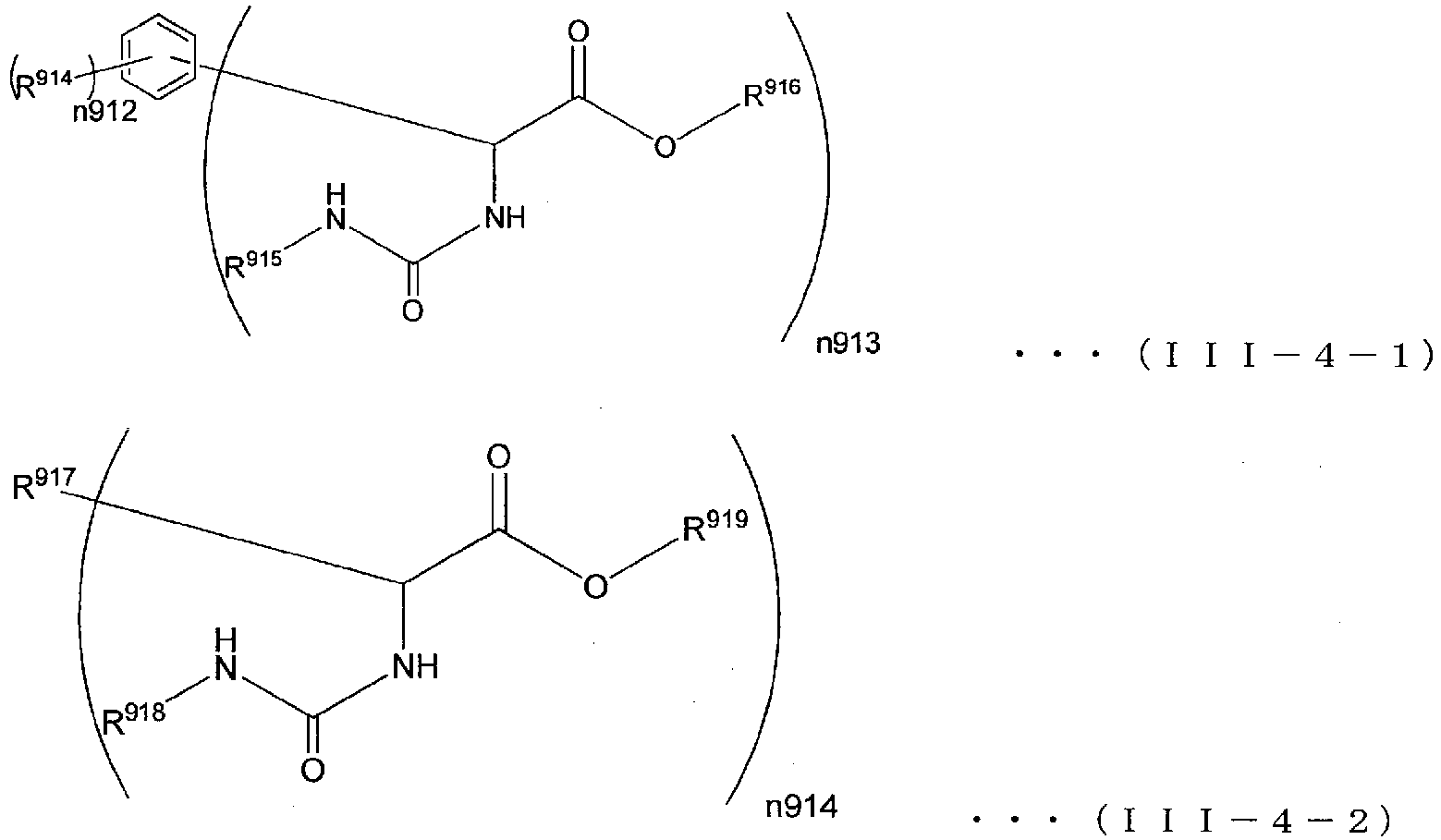
- In general formula (III-4-1), R914 is the same as R613 described above. R915 is the same as R912 described above. R916 is the same as R33 described above. Further, n912 is the same as n612 described above. Moreover, n913 is the same as n31 described above, and 2 ≤ n912+n913 ≤ 6.
- In general formula (III-4-2), R917 is the same as R615 described above. R918 is the same as R912 described above. R919 is the same as R33 described above. Further, n914 is the same as n31 described above.
- Preferred examples of the compound (III-5) include compounds represented by general formula (III-5-1) shown below (hereafter sometimes referred to as "the compound (III-5-1)"), and compounds represented by general formula (III-5-2) shown below (hereafter sometimes referred to as "the compound (III-5-2)").


- In general formula (1-5-1), R955 is the same as R613 described above. R956 and R957 are the same as R912 described above and R913 described above respectively. R958 is the same as R33 described above. Further, n952 is the same as n612 described above. Moreover, n953 is the same as n31 described above, and 2 ≤ n952+n953 ≤ 6.
- In general formula (1-5-2), R959 is the same as R615 described above. R970 and R971 are the same as R912 described above and R913 described above respectively. R952 is the same as R33 described above. Further, n954 is the same as n31 described above.
- Preferred examples of the compound (III-1-1) include compounds represented by general formula (III-1-1a) shown below (hereafter sometimes referred to as "the compound (III-1-1a)"), and compounds represented by general formula (III-1-1b) shown below (hereafter sometimes referred to as "the compound (III-1-1b)").


- In general formula (III-1-1a) and general formula (III-1-1b), each of R617, R618, R620 and R621 independently represents an aliphatic hydrocarbon group of at least 1 but not more than 10 carbon atoms or an aromatic hydrocarbon group of at least 6 but not more than 10 carbon atoms. Examples of the aliphatic hydrocarbon group of at least 1 but not more than 10 carbon atoms and the aromatic hydrocarbon group of at least 6 but not more than 10 carbon atoms include the same groups as those exemplified above for R11.
- Further, in the compound (III-1-1a) and the compound (III-1-1b), by substituting each of the amino groups with the group (II-1) described above, a carbamide group, the group (II-2) described above or the group (II-3) described above, structures similar to the compound (I-2-1a), the compound (I-3-1a), the compound (I-4-1a), and the compound (I-5-1a) and the like can be formed.
- The compound (IV-I) is a compound represented by general formula (IV-I) shown below.
- Further, the compound (IV-I) may exist in the form of a salt with an acid. The acid that forms the salt with the compound (IV-I) may be an organic acid or an inorganic acid. Examples of these types of acids include the same acids as those exemplified below in relation to the "acid catalyst". Among the various possibilities, the acid that forms a salt with the compound (IV-I) is preferably an inorganic acid. Further, hydrochloric acid may be used as the acid that forms a salt with the compound (IV-I).

- In general formula (IV-I), Y401 represents a divalent aliphatic hydrocarbon group of at least 1 but not more than 10 carbon atoms or a divalent aromatic cyclic group of at least 6 but not more than 10 carbon atoms. R401 represents an amino group, a carbamide group (-NHCONH2), a group represented by general formula (II-1) shown above, a group represented by general formula (II-2) shown above, a group represented by general formula (II-3) shown above, or a group represented by general formula (II-4) shown above.
- Examples of the divalent aliphatic hydrocarbon group of at least 1 but not more than 10 carbon atoms and the divalent aromatic cyclic group of at least 6 but not more than 10 carbon atoms for Y401 include the same groups as those exemplified above in relation to R13.
- Among the various possibilities, Y401 is preferably a divalent aliphatic hydrocarbon group of at least 1 but not more than 10 carbon atoms, more preferably a divalent aliphatic hydrocarbon group of at least 1 but not more than 5 carbon atoms, and even more preferably an ethylene group, 2'-methylethylene group, or 1',1',5-trimethylpentamethylene group.
- R401 is preferably an amino group, a carbamide group (-NHCONH2), a group represented by general formula (II-1) shown above, a group represented by general formula (II-2) shown above, or a group represented by general formula (II-3) shown above.
- When R401 is one of these groups, the compound (IV-I) can be represented by general formula (IV-1) to general formula (IV-5) shown below (hereafter sometimes referred to as "the compound (IV-1) to the compound (IV-5)").
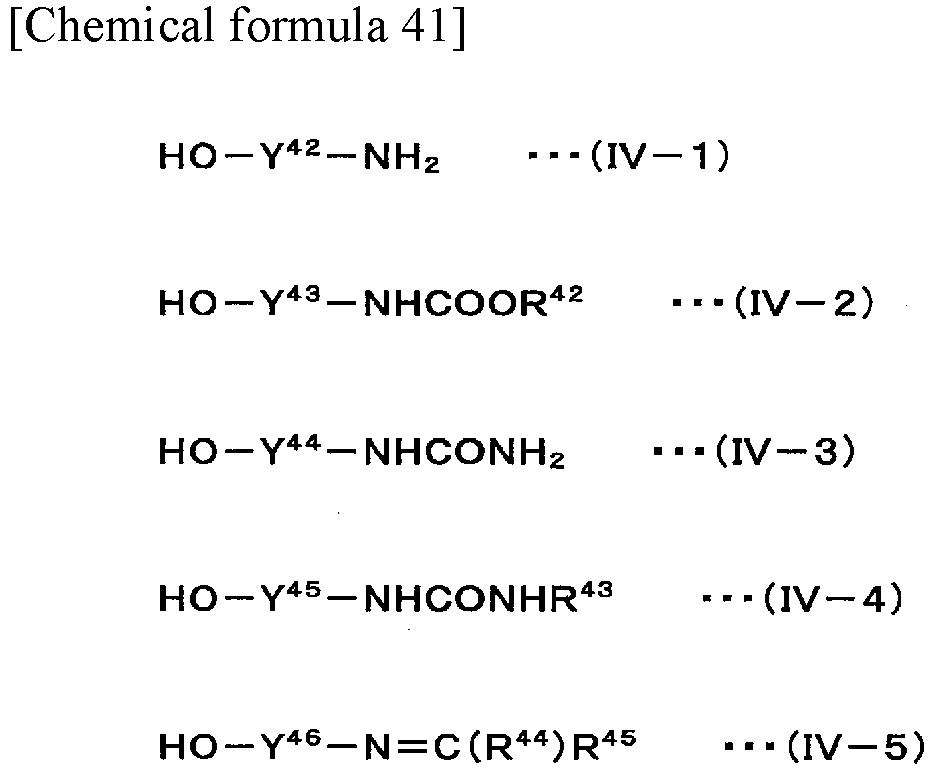
- In general formula (IV-1) to general formula (IV-5), each of Y42, Y43, Y44, Y45 and Y46 independently represents a divalent aliphatic hydrocarbon group of at least 1 but not more than 5 carbon atoms. Examples of the divalent aliphatic hydrocarbon group of at least 1 but not more than 5 carbon atoms include the same groups as those exemplified above for R13.
- R401 is the same as R21 described above. R43 is the same as R22 described above. R44 and R45 are the same as R23 described above and R24 described above respectively.
- Specific preferred examples of the compound (IV-1) include methanolamine, ethanolamine and propanolamine. Further, branched alkanolamines such as those shown below may also be used.

- Specific preferred examples of the compound (IV-2) include compounds represented by formulas (B-4) to (B-9) shown below.
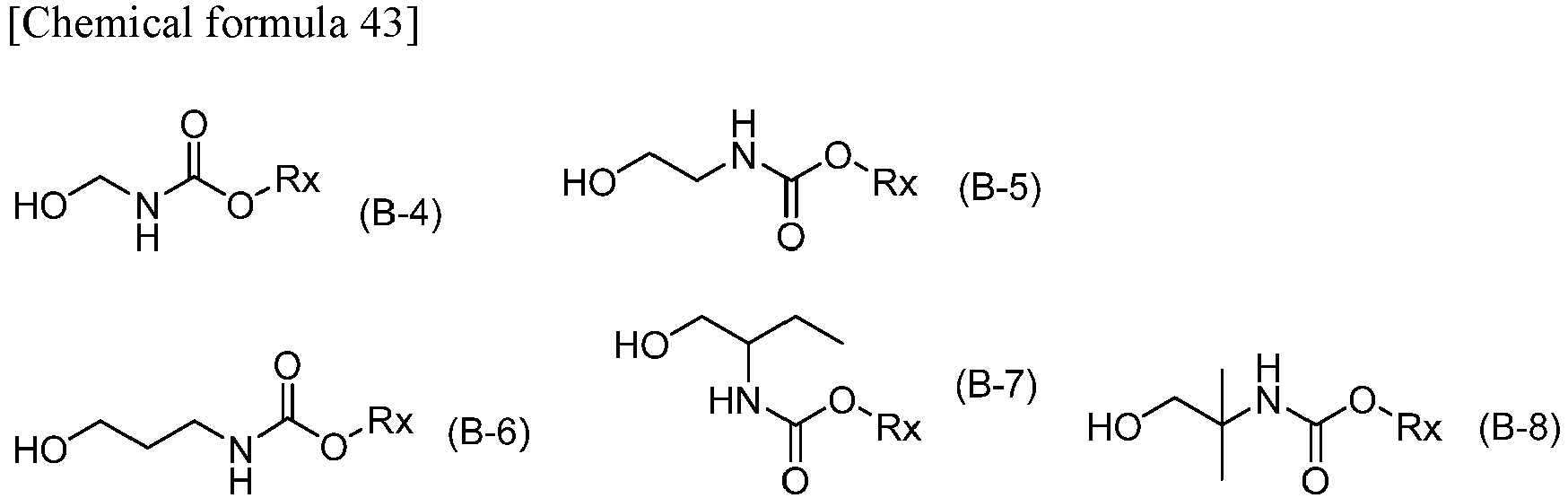

- Specific preferred examples of the compound (IV-3) include hydroxymethyl urea and 2-hydroxyethyl urea.
- Preferred examples of the compound (IV-4) include compounds represented by general formula (IV-4-1) shown below (hereafter sometimes referred to as "the compound (IV-4-1)").

- In general formula (IV-4-1), each of Y47 and Y48 is the same as Y42 described above, Y43 described above, Y44 described above, Y45 described above, and Y46 described above.
- Specific preferred examples of the compound (IV-4-1) include the compound represented by formula (B-3) shown below and compounds represented by formula (B-10) shown below.

- Specific preferred examples of the compound (IV-5) include the compound represented by formula (B-11) shown below.

- The compound (IV-II) is a compound represented by general formula (IV-II) shown below. The compound (IV-II) may exist in the form of a salt with an acid. The acid that forms the salt with the compound (IV-II) is as described above for the acid that forms a salt with the compound (IV-I),

- In general formula (IV-II), each of Y402 and Y403 independently represents a divalent aliphatic hydrocarbon group of at least 1 but not more than 10 carbon atoms or a divalent aromatic cyclic group of at least 6 but not more than 10 carbon atoms. Each of R402 and R403 independently represents at least one group selected from the group consisting of a hydrogen, an amino group, a carbamide group (-NHCONH2), groups represented by general formula (II-1) shown above, groups represented by general formula (II-2) shown above, groups represented by general formula (II-3) shown above, and groups represented by general formula (II-4) shown above.
- The divalent aliphatic hydrocarbon group of at least 1 but not more than 10 carbon atoms or the divalent aromatic cyclic group of at least 6 but not more than 10 carbon atoms for Y402 and Y403 is as described above for the divalent aliphatic hydrocarbon group of at least 1 but not more than 10 carbon atoms or the divalent aromatic cyclic group of at least 6 but not more than 10 carbon atoms for Y401 in general formula (IV-I).
- Specific preferred examples of the compound (IV-II) include the compounds represented by formulas (B-21) to (B-29) shown below.

- The compound (IV-III) is a compound represented by general formula (IV-III) shown below. The compound (IV-III) may exist in the form of a salt with an acid. The acid that forms the salt with the compound (IV-III) is as described above for the acid that forms a salt with the compound (IV-I),

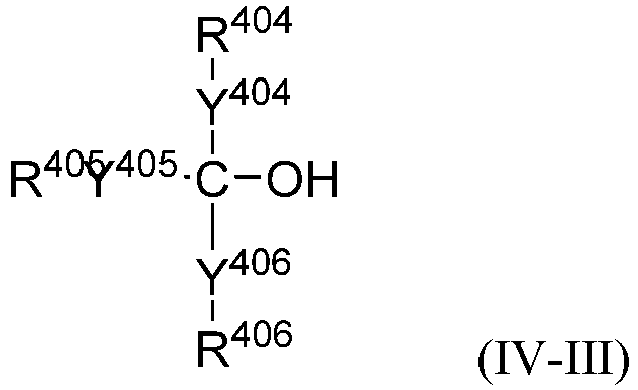
- The divalent aliphatic hydrocarbon group of at least 1 but not more than 10 carbon atoms or the divalent aromatic cyclic group of at least 6 but not more than 10 carbon atoms for Y404, Y405 and Y406 is as described above for the divalent aliphatic hydrocarbon group of at least 1 but not more than 10 carbon atoms or the divalent aromatic cyclic group of at least 6 but not more than 10 carbon atoms for Y401 in general formula (IV-I).
- Specific preferred examples of the compound (IV-III) include the compounds represented by formulas (B-31) to (B-317) shown below.


- The compound (IV-IV) is a compound represented by general formula (IV-IV) shown below. The compound (IV-IV) may exist in the form of a salt with an acid. The acid that forms the salt with the compound (IV-IV) is as described above for the acid that forms a salt with the compound (IV-I),


- In general formula (IV-IV), each of Y407, Y408, Y409 and Y4010 represents a divalent aliphatic hydrocarbon group of at least 1 but not more than 10 carbon atoms or a divalent aromatic cyclic group of at least 6 but not more than 10 carbon atoms. At least one of R407, R408, R409 and R4010 represents a hydroxyl group, and each of the others represents at least one group selected from the group consisting of a hydrogen, an amino group, a carbamide group (-NHCONH2), groups represented by general formula (II-1) shown above, groups represented by general formula (II-2) shown above, groups represented by general formula (II-3) shown above, and groups represented by general formula (II-4) shown above.
- The divalent aliphatic hydrocarbon group of at least 1 but not more than 10 carbon atoms or the divalent aromatic cyclic group of at least 6 but not more than 10 carbon atoms for Y407, Y408, Y409 and Y4010 is as described above for the divalent aliphatic hydrocarbon group of at least 1 but not more than 10 carbon atoms or the divalent aromatic cyclic group of at least 6 but not more than 10 carbon atoms for Y401 in general formula (IV-I).
- Specific preferred examples of the compound (IV-IV) include the compound represented by formula (B-41) shown below.


- The acid catalyst may be any acid with a normal boiling point of 0°C or higher, and there are no particular limitations. The normal boiling point of the acid catalyst is 0°C or higher, preferably 10°C or higher, more preferably 30°C or higher, and even more preferably 50°C or higher. By ensuring that the normal boiling point of the acid catalyst is at least as high as the above lower limit, the acid catalyst can be used in a liquid state under the reaction conditions, and loss of the acid by distillation can be more effectively suppressed.
- On the other hand, in terms of ensuring favorable viscosity under the reaction conditions, the normal boiling point of the acid catalyst is, for example, typically not higher than 400°C, and for example, may be 350°C or lower.
- The acid catalyst may be an organic acid or an inorganic acid.
- Examples of organic acids include aliphatic sulfonic acids, aromatic sulfonic acids, alkyl phosphoric acids, alkyl sulfuric acids, and aromatic sulfuric acids.
- Specific examples of the aliphatic sulfonic acids include methanesulfonic acid. and the like.
- Specific examples of the aromatic sulfonic acids include p-toluenesulfonic acid (normal boiling point: 140°C) and trifluoromethanesulfonic acid (normal boiling point: 162°C).
- Specific examples of the alkyl phosphoric acids include dimethyl phosphate (normal boiling point: 174°C) and diethyl phosphate (normal boiling point: 204°C).
- Specific examples of the alkyl sulfuric acids include dimethyl sulfate (normal boiling point: 188°C), diethyl sulfate (normal boiling point: 209°C) and lauryl sulfuric acid (normal boiling point: 206°C).
- Specific examples of aromatic sulfate esters include phenyl sulfate and phenyl fluorosulfate.
- Examples of the inorganic acids include sulfuric acid (normal boiling point: 337°C), phosphoric acid (normal boiling point: 158°C), nitric acid (normal boiling point:83°C) and boric acid (normal boiling point:300°C).
- One of these acids may be used alone, or a combination of two or more acids may be used.
- The inventors of the present invention discovered that in the production method of the present invention, when producing the amino acid aminoalkyl ester and the inorganic acid salt thereof, among the various possibilities listed above for the acid catalyst, an aliphatic sulfonic acid or an inorganic acid is preferred, and methanesulfonic acid, p-toluenesulfonic acid, trifluoromethanesulfonic acid, sulfuric acid, phosphoric acid, or a combination of these acids is more preferred.
- The reason for this preference is that by using these acids, side reactions of the above compound (IV) can be suppressed, enabling the yield of the amino acid aminoalkyl ester or the inorganic acid salt thereof to be improved, and the reason for this yield improvement is thought to be due to factors such as the molecular structure and molecular size of these acids, the dipole moment and the acid dissociation constant expressed by pKa, with these physical properties contributing to a suppression of side reactions including modifications of the substrate itself, while specifically promoting the main reaction.
- In the production method of the present embodiment, a carrying agent may be used to assist the distillation of the water or hydroxy compound produced by the reaction. Here, a "carrying agent" refers to a substance which is substantially inert and exists in the gaseous state under the reaction conditions. Further, the expression "substantially inert" means that under the conditions in which synthesis of the amino acid aminoalkyl ester or the inorganic acid salt thereof is conducted, the substance does not react with the raw materials, including the compound (I) or the compound (III) or the salt thereof, and the at least one compound selected from the group consisting of the compound (IV-I), the compound (IV-II), the compound (IV-III) and the compound (IV-IV), or the salt thereof, nor with the amino acid aminoalkyl ester or the inorganic acid salt thereof and the water that represent the reaction products, or if reaction does occur, then there is no significant effect on the synthesis of the amino acid aminoalkyl ester or the inorganic acid salt thereof.
- Specific examples of this type of carrying agent include inert gases and organic solvents and the like.
- Examples of the inert gas include nitrogen, argon, helium, carbon dioxide gas, methane, ethane and propane. Among these, an inert gas such as nitrogen is preferred as the carrying agent.
- The organic solvent is preferably a solvent that undergoes azeotropic distillation with water. The organic solvent may be supplied in a solution state, or supplied to the reaction system in a gaseous state.
- Examples of this type of organic solvent include aliphatic solvents, alicyclic solvents, aromatic solvents which may have a substituent, unsubstituted hydrocarbon solvents, and mixtures of these solvents.
- Further, compounds which may have an oxygen atom such as ethers, ketones and esters may be used, and compounds which may have a sulfur atom such as thioethers, sulfoxides and sulfones may also be used.
- Specific examples of the organic solvent includes alkanes, aromatic hydrocarbons and alkyl-substituted aromatic hydrocarbons, aromatic compounds substituted with a nitro group or a halogen, polycyclic hydrocarbon compounds, alicyclic hydrocarbons, ketones, esters, ethers and thioethers, sulfoxides, sulfones, and silicone oils.
- Examples of the alkanes include hexane, heptane, octane, nonane, decane, n-hexadecane, n-octadecane, eicosane and squalane.
- Examples of the aromatic hydrocarbons and alkyl-substituted aromatic hydrocarbons include benzene, toluene, xylene, ethylbenzene, triethylbenzene, cumene, diisopropylbenzene, dibutylbenzene, naphthalene, lower alkyl-substituted naphthalene, and dodecylbenzene.
- Examples of the aromatic compounds substituted with a nitro group or a halogen include chlorobenzene, 4-methylbenzyl chloride, p-dichlorobenzene, bromobenzene, dibromobenzene, chloronaphthalene, bromonaphthalene, nitrobenzene and nitronaphthalene.
- Examples of the polycyclic hydrocarbon compounds include diphenyl, substituted diphenyl, diphenylmethane, terphenyl, anthracene, phenanthrene, benzyltoluene, benzyltoluene isomers, and triphenylmethane.
- Examples of the alicyclic hydrocarbons include cyclohexane and ethylcyclohexane.
- Examples of the ketones include methyl ethyl ketone and acetophenone.
- Examples of the esters include dibutyl phthalate, dihexyl phthalate and dioctyl phthalate.
- Examples of the ethers and thioethers include diphenyl ether and diphenyl sulfide.
- Examples of the sulfoxides include dimethyl sulfoxide and diphenyl sulfoxide.
- Examples of the sulfones include dimethyl sulfone, diethyl sulfone, diphenyl sulfone and sulfolane.
- Among these, the inert solvent is preferably an aromatic hydrocarbon, an alkyl-substituted aromatic hydrocarbon, or an aromatic compound substituted with a nitro group or a halogen, is more preferably an alkyl-substituted aromatic hydrocarbon or an aromatic compound substituted with a halogen, and is even more preferably toluene, xylene or p-dichlorobenzene.
- The amount supplied of the carrying agent, for example in the case where the carrying agent is supplied in a solution state, may be set to an amount of at least 0.01 times but not more than 1.0 times, and preferably at least 0.02 times but not more than 0.5 times, the volume of the reaction liquid per hour. Further, when the carrying agent is supplied in the gaseous state, the amount supplied may be set to an amount of at least 3.0 times but not more than 20.0 times, and preferably at least 5.0 times but not more than 10.0 times, the volume of the reaction liquid per hour.
- The amino acid aminoalkyl ester or the inorganic acid salt thereof obtained using the production method of the present embodiment is a compound represented by general formula (I) shown above or a compound represented by general formula (III) shown above, in which R13 or R33 has been substituted with a group obtained by removing the hydroxyl group from general formula (IV-I), (IV-II), (IV-III) or (IV-IV) shown above, or is an inorganic acid salt of that compound. For example, in those cases where the group obtained by removing the hydroxyl group from general formula (IV-I) is -(CH2)n41-R41, a compound represented by general formula (I)' shown below, a compound represented by general formula (III)' shown below or an inorganic acid salt thereof is obtained.

- In general formula (I)', R11 and R12 are the same as R11 and R12 respectively in general formula (I) described above. R41 and n41 are the same as R41 and n41 respectively in general formula (I) described above.
- In general formula (III)', R32 and R33 are the same as R32 and R33 respectively in general formula (III) described above. R41 and n41 are the same as R41 and n41 respectively in general formula (I) described above.
- Embodiments of the present invention are described below in further detail using specific examples, but the embodiments of the present invention are in no way limited by the following examples, provided they do not exceed the scope of the invention.
- A glass flask with an internal capacity of 500 mL was charged with 200 g of lysine monohydrochloride, 34 g of urea and 100 g of water, and the resulting mixture was heated at 120°C for 2 hours while being stirred under a nitrogen atmosphere at atmospheric pressure. The reaction liquid was then cooled, the reaction liquid was poured into 2-propanol, and the precipitated solid was collected by filtration. Analysis by 1H-NMR revealed that the collected solid was a compound in which the amino group of the lysine had been substituted with a urea linkage. This compound was used as compound (A-20) as a raw material in Example 22 described below.
- A glass flask with an internal capacity of 1,000 mL fitted with a distillation device was charged with 200 g of a compound (A-1) (glycine) shown as the raw material 1 in Table 1 below, 171 g of a compound (B-1) (ethanolamine) shown as the raw material 2 in Table 1 below, 200 g of toluene and 214 g of phosphoric acid, and a reaction was conducted under reduced pressure at 100°C, with the toluene being distilled off while additional toluene was added to keep the liquid level substantially constant. After continuing the reaction for 8 hours, collection of the reaction liquid and analysis by liquid chromatography revealed that a compound (E-1) shown as the product in Table 1 below had been produced at a yield of 84% relative to the amount added of the compound (A-1) (glycine). Analysis of the amount of phosphoric acid contained in the compound (E-1) (excluding the counter anion component) by a conventional method revealed 350 wtppm of phosphoric acid relative to the compound (E-1).
- With the exceptions of adding the raw material 1, the raw material 2 and the solvent in the combinations shown below in Tables 1 to 8, and setting the reaction temperature, pressure and time as shown below in Tables 1 to 8, the same method as Example 1 was used to produce compounds (E-2) to (E-48).
- With the exception of replacing the acid used in Example 9 from phosphoric acid to hydrogen chloride, a reaction was conducted using the same method as Example 9. The method for supplying the hydrogen chloride involved supplying hydrogen chloride gas from a hydrogen chloride cylinder using a flow meter that used a corrosion-resistant material of stainless steel or glass, introducing the hydrogen chloride gas into the reaction system while controlling the supply rate and conducting the reaction by bubbling the gas through the liquid phase, and following completion of the reaction, calculating the amount of hydrogen chloride gas introduced into the system to calculate the weight of hydrogen chloride supplied. In this reaction, the yield of the produced compound (E-9) was 55%.
- With the exception of replacing the acid used in Example 10 from methanesulfonic acid to hydrogen chloride, a reaction was conducted using the same method as Example 10. The hydrogen chloride was supplied to the reaction system using the same method as Comparative Example 1. In this reaction, the yield of the produced compound (E-10) was 50%.
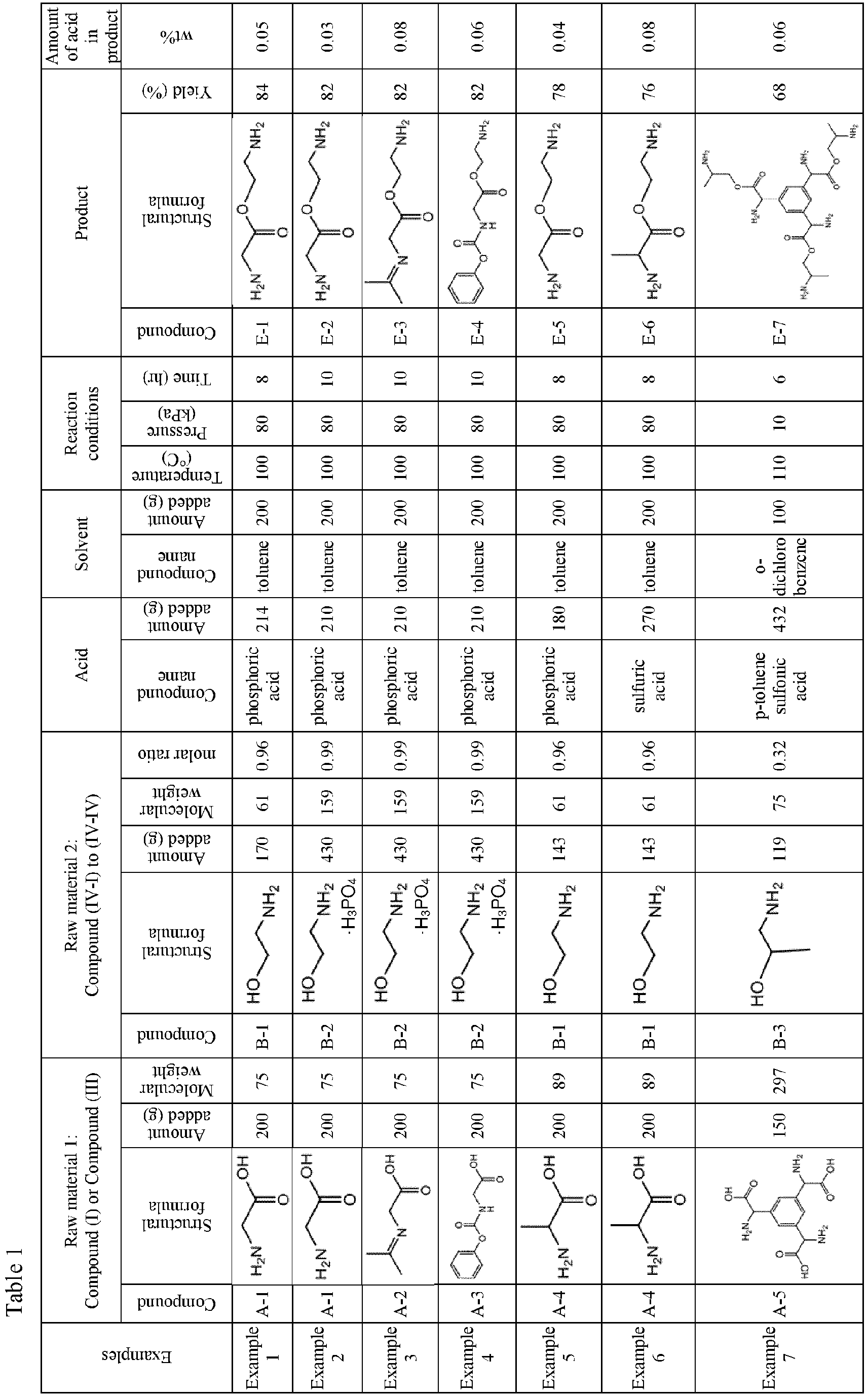


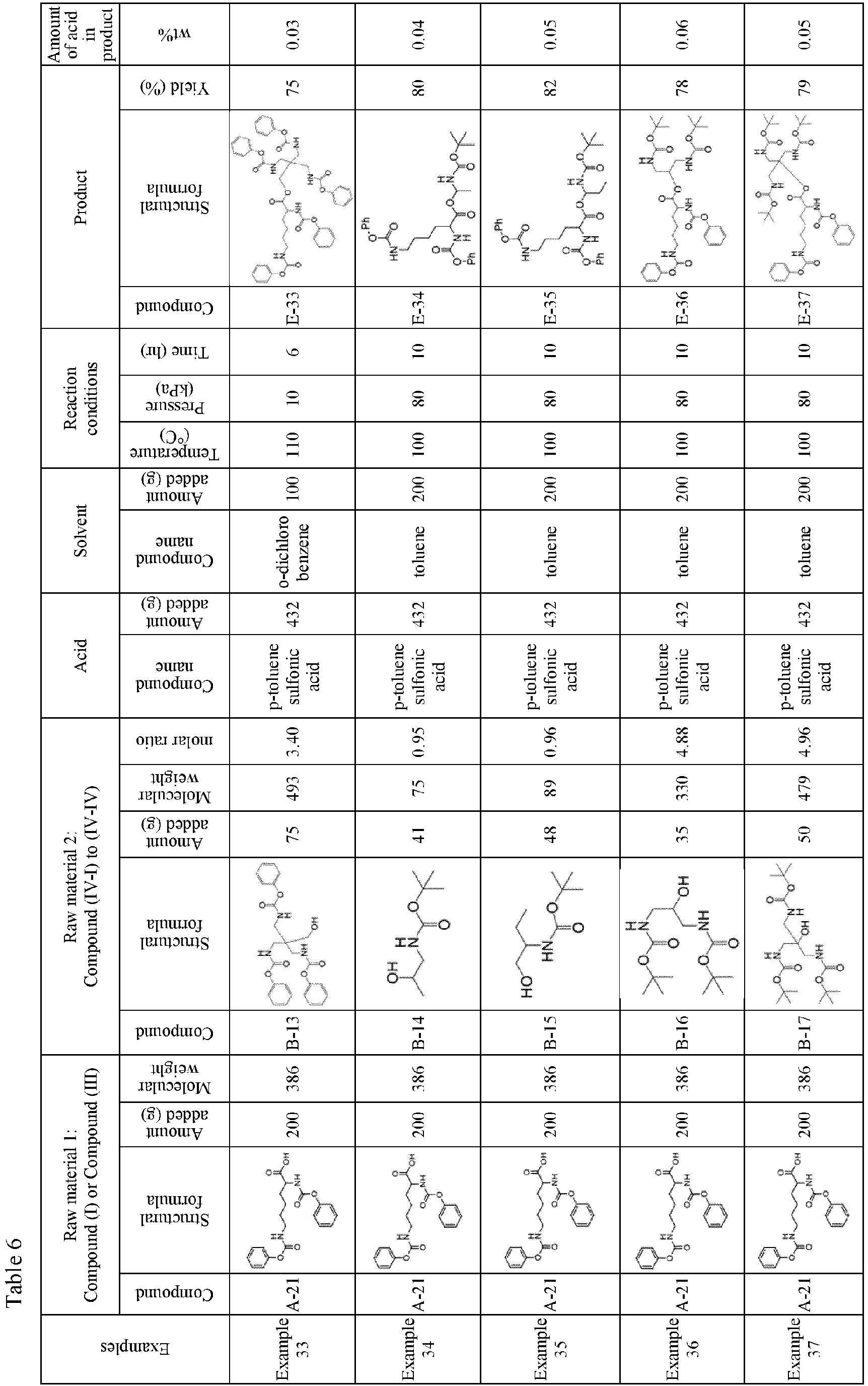


- As is evident from Examples 1 to 48, the yield of every products was at least 67%, with the target product able to be obtained in high yield. Further, the acid was in a liquid state during the production process, and was not contained in the distilled gaseous component.
- The production method of an embodiment of the present invention can produce an amino acid aminoalkyl ester or an inorganic acid salt thereof in high yield without acid distillation.
Claims (9)
- A method for producing an amino acid aminoalkyl ester or an inorganic acid salt thereof by reacting:a compound represented by general formula (I) shown below or a compound represented by general formula (III) shown below, or a salt thereof, andat least one compound selected from the group consisting of compounds represented by general formula (IV-I) shown below, compounds represented by general formula (IV-II) shown below, compounds represented by general formula (IV-III) shown below and compounds represented by general formula (IV-IV) shown below, or an inorganic acid salt thereof:


 in general formula (II-2), R22 represents a monovalent organic group;in general formula (II-3), each of R23 and R24 independently represents a monovalent aliphatic hydrocarbon group of at least 1 but not more than 10 carbon atoms which may have a substituent, or a monovalent aromatic cyclic group of at least 6 but not more than 10 carbon atoms which may have a substituent; andin general formula (II-4), R25 represents a hydrogen atom or a monovalent organic group),
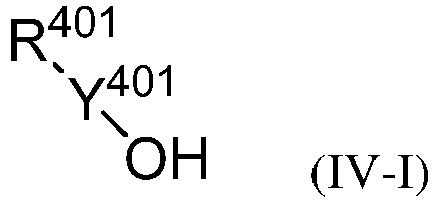

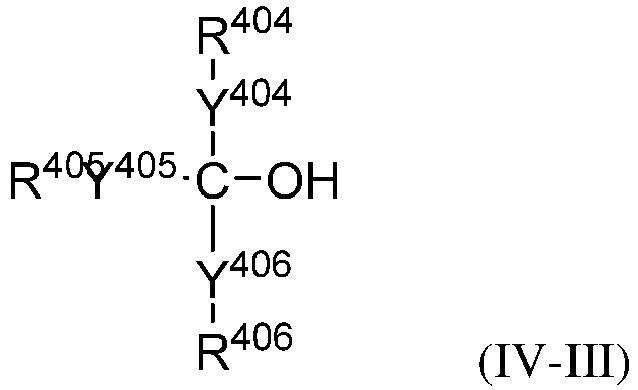

- The method according to claim 1, wherein the reaction is conducted in presence of at least one acid catalyst selected from the group consisting of organic acids and inorganic acids having a normal boiling point of 0°C or higher.
- The method according to claim 1 or 2, wherein the compound represented by the general formula (I) is at least one amino acid selected from the group consisting of lysine, glutamic acid, methionine, glycine, phenylalanine, asparagine, alanine, leucine, isoleucine, and valine.
- The method according to claim 2 or 3, wherein the inorganic acid used as an acid catalyst is at least one acid selected from the group consisting of sulfuric acid, phosphoric acid, nitric acid and boric acid.
- The method according to any one of claims 2 to 4, wherein an acid that forms a salt with the compound represented by general formula (I) or the compound represented by general formula (III) and the acid catalyst are the same acid.
- The method according to any one of claims 1 to 5, wherein
in the general formula (I):the substituent is at least one group selected from the group consisting of monovalent aliphatic hydrocarbon groups of at least 1 but not more than 10 carbon atoms, monovalent aromatic cyclic groups of at least 6 but not more than 10 carbon atoms, groups represented by the general formula (II-1), and groups represented by the general formula (II-2),R12 is a group represented by the general formula (II-1) or a group represented by the general formula (II-2),R13 is a hydrogen atom, andn11 is 1; andin the general formula (III):the substituent is at least one group selected from the group consisting of monovalent aliphatic hydrocarbon groups of at least 1 but not more than 10 carbon atoms, monovalent aromatic cyclic groups of at least 6 but not more than 10 carbon atoms, groups represented by the general formula (II-1), groups represented by the general formula (II-2), groups represented by the general formula (II-3), and groups represented by the general formula (II-4), andR32 is at least one group selected from the group consisting of groups represented by the general formula (II-1), groups represented by the general formula (II-2), and groups represented by the general formula (II-3). - The method according to any one of claims 1 to 6, wherein the compound represented by general formula (I) or the compound represented by general formula (III), or a salt thereof, is reacted with the compound represented by general formula (IV-I) or an inorganic acid salt thereof.
- The method according to claim 7, wherein
in the general formula (I):R11 represents a hydrogen atom or a monovalent aliphatic hydrocarbon group of at least 1 but not more than 10 carbon atoms which may have a substituent,the substituent is a group represented by the general formula (II-1),R12 is a group represented by the general formula (II-1), andR13 is a hydrogen atom; andin the general formula (IV-I):Y401 is a divalent aliphatic hydrocarbon group of at least 1 but not more than 10 carbon atoms, andR401 is a group represented by the general formula (II-1). - The method according to any one of claims 2 to 8, wherein the acid catalyst is included in an amount of 1 ppm to 5% by mass.
Applications Claiming Priority (2)
| Application Number | Priority Date | Filing Date | Title |
|---|---|---|---|
| JP2018094173 | 2018-05-15 | ||
| PCT/JP2019/019358 WO2019221192A1 (en) | 2018-05-15 | 2019-05-15 | Method for producing amino acid aminoalkyl ester or inorganic acid salt thereof |
Publications (3)
| Publication Number | Publication Date |
|---|---|
| EP3795559A1 true EP3795559A1 (en) | 2021-03-24 |
| EP3795559A4 EP3795559A4 (en) | 2021-06-23 |
| EP3795559B1 EP3795559B1 (en) | 2024-07-31 |
Family
ID=68540051
Family Applications (1)
| Application Number | Title | Priority Date | Filing Date |
|---|---|---|---|
| EP19803769.9A Active EP3795559B1 (en) | 2018-05-15 | 2019-05-15 | Method for producing amino acid aminoalkyl ester or inorganic acid salt thereof |
Country Status (5)
| Country | Link |
|---|---|
| US (1) | US11827586B2 (en) |
| EP (1) | EP3795559B1 (en) |
| JP (1) | JP6960532B2 (en) |
| CN (1) | CN111902393B (en) |
| WO (1) | WO2019221192A1 (en) |
Families Citing this family (1)
| Publication number | Priority date | Publication date | Assignee | Title |
|---|---|---|---|---|
| US11827586B2 (en) * | 2018-05-15 | 2023-11-28 | Asahi Kasei Kabushiki Kaisha | Method for producing amino acid aminoalkyl ester or inorganic acid salt thereof |
Family Cites Families (19)
| Publication number | Priority date | Publication date | Assignee | Title |
|---|---|---|---|---|
| JPS6026775B2 (en) | 1977-04-28 | 1985-06-25 | 東レ株式会社 | Lysine ester triisocyanate |
| JPS5945667B2 (en) | 1979-02-08 | 1984-11-07 | 東レ株式会社 | Method for producing amino acid aminoalkyl ester |
| JPS6153248A (en) | 1984-08-24 | 1986-03-17 | Toray Ind Inc | Preparation of 2,6,2'-triaminoethyl hexanoate trihydrochloride |
| EP0376230B1 (en) | 1988-12-27 | 1994-11-23 | MITSUI TOATSU CHEMICALS, Inc. | Preparation and isolation of mineral acid salt of an amino methyl ester |
| JP2928564B2 (en) | 1988-12-27 | 1999-08-03 | 三井化学株式会社 | Method for producing amino acid methyl ester mineral acid salt |
| JPH05148199A (en) | 1991-11-28 | 1993-06-15 | Ajinomoto Co Inc | Production of amino acid ester |
| JP2000247938A (en) | 1999-02-26 | 2000-09-12 | Mitsui Chemicals Inc | Production of highly purified n-carbonylamino acid ester |
| ATE257480T1 (en) | 1999-09-30 | 2004-01-15 | Pfizer Prod Inc | BICYCLIC PYRROLYLAMIDES AS GLYCOGEN PHOSPHORYLASE INHIBITORS |
| JP4237367B2 (en) * | 1999-12-24 | 2009-03-11 | 株式会社トクヤマ | Method for producing salt of amino acid ester and acid |
| JP2003252840A (en) * | 2002-02-27 | 2003-09-10 | Kyowa Yuka Co Ltd | Method for producing amino acid aminoalkyl ester inorganic acid salt |
| DE102004008042A1 (en) * | 2004-02-19 | 2005-09-01 | Goldschmidt Gmbh | Process for the preparation of amino acid esters and their acid addition salts |
| JO2653B1 (en) * | 2006-10-24 | 2012-06-17 | شركة جانسين فارماسوتيكا ان. في | Piperidine Or Piperazine Substituted Tetrahydro-Naphthalene-1-Carboxylic Acid Mtp Inhibiting Compounds.apoB |
| US8552217B2 (en) * | 2011-02-04 | 2013-10-08 | Warsaw Orthopedic, Inc. | Isocyanate manufacture |
| US20150197483A1 (en) | 2014-01-13 | 2015-07-16 | Warsaw Orthopedic, Inc. | Methods and compositions for making an amino acid trihydrochloride |
| JP2019504000A (en) * | 2015-12-08 | 2019-02-14 | レトロフィン, インコーポレイテッド | Cyclic phosphates and cyclic phosphoramidates for the treatment of neurological disorders |
| CN106316870A (en) | 2016-08-18 | 2017-01-11 | 精晶药业股份有限公司 | Synthesis method of L-glycine methyl ester salt product |
| EP3527593B1 (en) * | 2016-10-14 | 2025-07-23 | Asahi Kasei Kabushiki Kaisha | Isocyanate composition, method for producing isocyanate composition, and method for producing isocyanate polymer |
| JP6678097B2 (en) | 2016-12-14 | 2020-04-08 | 日本電信電話株式会社 | Instantaneous heart rate evaluation device, method and program |
| US11827586B2 (en) * | 2018-05-15 | 2023-11-28 | Asahi Kasei Kabushiki Kaisha | Method for producing amino acid aminoalkyl ester or inorganic acid salt thereof |
-
2019
- 2019-05-15 US US17/052,541 patent/US11827586B2/en active Active
- 2019-05-15 JP JP2020519898A patent/JP6960532B2/en active Active
- 2019-05-15 CN CN201980021357.9A patent/CN111902393B/en active Active
- 2019-05-15 EP EP19803769.9A patent/EP3795559B1/en active Active
- 2019-05-15 WO PCT/JP2019/019358 patent/WO2019221192A1/en not_active Ceased
Also Published As
| Publication number | Publication date |
|---|---|
| US11827586B2 (en) | 2023-11-28 |
| CN111902393A (en) | 2020-11-06 |
| WO2019221192A1 (en) | 2019-11-21 |
| JP6960532B2 (en) | 2021-11-05 |
| JPWO2019221192A1 (en) | 2020-12-17 |
| EP3795559A4 (en) | 2021-06-23 |
| US20210253517A1 (en) | 2021-08-19 |
| EP3795559B1 (en) | 2024-07-31 |
| CN111902393B (en) | 2023-11-10 |
Similar Documents
| Publication | Publication Date | Title |
|---|---|---|
| KR102045719B1 (en) | Method for solubilizing carboxylic acid-containing compound in hydrocarbon solvent | |
| Valgimigli et al. | Kinetic solvent effects on hydroxylic hydrogen atom abstractions are independent of the nature of the abstracting radical. Two extreme tests using vitamin E and phenol | |
| CA3081415A1 (en) | Acetoxy systems | |
| RU2010146077A (en) | METHOD FOR PRODUCING ISOCIANATES USING DIARYL CARBONATE | |
| EP3795559B1 (en) | Method for producing amino acid aminoalkyl ester or inorganic acid salt thereof | |
| EP2841436B1 (en) | Methods for producing 1,5,7-triazabicyclo[4.4.0]dec-5-ene by reaction of a disubstituted carbodiimide and dipropylene triamine | |
| US8492542B2 (en) | Method for producing bicyclic guanidines by use of a cyclic thiourea | |
| CN109651115B (en) | Method for preparing L-menthone | |
| CN116903455B (en) | A safe production method for 2-hydroxy-1,4-naphthoquinone and its application | |
| BRPI0920537B1 (en) | N, N-DIALKIL LACTAMIDE MANUFACTURING PROCESS | |
| US6465678B1 (en) | Method for preparing methyl carbazate | |
| EP3394021A1 (en) | Conversion of a perfluorinated vinyl ether into a partially fluorinated saturated ether derivative | |
| US9994720B2 (en) | Methods for producing 1,5,7-triazabicyclo[4.4.0]dec-5-ene by reaction of a disubstituted carbodiimide and dipropylene triamine | |
| JP2014532731A (en) | Process for producing polymethylene polyphenyl polycarbamate | |
| WO2024106525A1 (en) | Method for producing benzoxazine compound | |
| WO2010004818A1 (en) | Method for producing polyisocyanate | |
| JP7525112B2 (en) | Method for producing urea derivatives | |
| ES2371382T3 (en) | PROCESS TO PRODUCE 3-METHYTITIOPROPANAL. | |
| EP2855422B1 (en) | Synthesis of diamido gellants by using dane salts of amino acids | |
| CN109761954A (en) | Preparation method of dithiocyclic carbonate compounds | |
| US20250250215A1 (en) | Tribenzotriquinacene with axial aryl group and method for preparing the same | |
| CN111170929A (en) | method for preparing β -amino alcohol from terminal olefin | |
| US20110237807A1 (en) | Rotaxane compound and antitumor agent | |
| CN107108486B (en) | Process for producing specific acetals and ketals | |
| CN119775140A (en) | A method for preparing carbon isotope-labeled carbonic acid diester |
Legal Events
| Date | Code | Title | Description |
|---|---|---|---|
| STAA | Information on the status of an ep patent application or granted ep patent |
Free format text: STATUS: THE INTERNATIONAL PUBLICATION HAS BEEN MADE |
|
| PUAI | Public reference made under article 153(3) epc to a published international application that has entered the european phase |
Free format text: ORIGINAL CODE: 0009012 |
|
| STAA | Information on the status of an ep patent application or granted ep patent |
Free format text: STATUS: REQUEST FOR EXAMINATION WAS MADE |
|
| 17P | Request for examination filed |
Effective date: 20201103 |
|
| AK | Designated contracting states |
Kind code of ref document: A1 Designated state(s): AL AT BE BG CH CY CZ DE DK EE ES FI FR GB GR HR HU IE IS IT LI LT LU LV MC MK MT NL NO PL PT RO RS SE SI SK SM TR |
|
| AX | Request for extension of the european patent |
Extension state: BA ME |
|
| STAA | Information on the status of an ep patent application or granted ep patent |
Free format text: STATUS: EXAMINATION IS IN PROGRESS |
|
| A4 | Supplementary search report drawn up and despatched |
Effective date: 20210527 |
|
| RIC1 | Information provided on ipc code assigned before grant |
Ipc: C07C 227/18 20060101AFI20210520BHEP Ipc: C07C 229/08 20060101ALI20210520BHEP Ipc: C07C 229/24 20060101ALI20210520BHEP Ipc: C07C 229/26 20060101ALI20210520BHEP Ipc: C07C 229/36 20060101ALI20210520BHEP Ipc: C07C 249/02 20060101ALI20210520BHEP Ipc: C07C 251/08 20060101ALI20210520BHEP Ipc: C07C 251/16 20060101ALI20210520BHEP Ipc: C07C 269/06 20060101ALI20210520BHEP Ipc: C07C 271/48 20060101ALI20210520BHEP Ipc: C07C 273/18 20060101ALI20210520BHEP Ipc: C07C 275/10 20060101ALI20210520BHEP Ipc: C07C 319/20 20060101ALI20210520BHEP Ipc: C07C 323/57 20060101ALI20210520BHEP |
|
| 17Q | First examination report despatched |
Effective date: 20210609 |
|
| DAV | Request for validation of the european patent (deleted) | ||
| DAX | Request for extension of the european patent (deleted) | ||
| GRAP | Despatch of communication of intention to grant a patent |
Free format text: ORIGINAL CODE: EPIDOSNIGR1 |
|
| STAA | Information on the status of an ep patent application or granted ep patent |
Free format text: STATUS: GRANT OF PATENT IS INTENDED |
|
| INTG | Intention to grant announced |
Effective date: 20240222 |
|
| GRAS | Grant fee paid |
Free format text: ORIGINAL CODE: EPIDOSNIGR3 |
|
| GRAA | (expected) grant |
Free format text: ORIGINAL CODE: 0009210 |
|
| STAA | Information on the status of an ep patent application or granted ep patent |
Free format text: STATUS: THE PATENT HAS BEEN GRANTED |
|
| AK | Designated contracting states |
Kind code of ref document: B1 Designated state(s): AL AT BE BG CH CY CZ DE DK EE ES FI FR GB GR HR HU IE IS IT LI LT LU LV MC MK MT NL NO PL PT RO RS SE SI SK SM TR |
|
| REG | Reference to a national code |
Ref country code: CH Ref legal event code: EP Ref country code: GB Ref legal event code: FG4D |
|
| P01 | Opt-out of the competence of the unified patent court (upc) registered |
Free format text: CASE NUMBER: APP_39094/2024 Effective date: 20240701 |
|
| REG | Reference to a national code |
Ref country code: DE Ref legal event code: R096 Ref document number: 602019056200 Country of ref document: DE |
|
| REG | Reference to a national code |
Ref country code: IE Ref legal event code: FG4D |
|
| REG | Reference to a national code |
Ref country code: LT Ref legal event code: MG9D |
|
| REG | Reference to a national code |
Ref country code: NL Ref legal event code: MP Effective date: 20240731 |
|
| PG25 | Lapsed in a contracting state [announced via postgrant information from national office to epo] |
Ref country code: PT Free format text: LAPSE BECAUSE OF FAILURE TO SUBMIT A TRANSLATION OF THE DESCRIPTION OR TO PAY THE FEE WITHIN THE PRESCRIBED TIME-LIMIT Effective date: 20241202 |
|
| REG | Reference to a national code |
Ref country code: AT Ref legal event code: MK05 Ref document number: 1708367 Country of ref document: AT Kind code of ref document: T Effective date: 20240731 |
|
| PG25 | Lapsed in a contracting state [announced via postgrant information from national office to epo] |
Ref country code: PT Free format text: LAPSE BECAUSE OF FAILURE TO SUBMIT A TRANSLATION OF THE DESCRIPTION OR TO PAY THE FEE WITHIN THE PRESCRIBED TIME-LIMIT Effective date: 20241202 |
|
| PG25 | Lapsed in a contracting state [announced via postgrant information from national office to epo] |
Ref country code: NO Free format text: LAPSE BECAUSE OF FAILURE TO SUBMIT A TRANSLATION OF THE DESCRIPTION OR TO PAY THE FEE WITHIN THE PRESCRIBED TIME-LIMIT Effective date: 20241031 |
|
| PG25 | Lapsed in a contracting state [announced via postgrant information from national office to epo] |
Ref country code: NL Free format text: LAPSE BECAUSE OF FAILURE TO SUBMIT A TRANSLATION OF THE DESCRIPTION OR TO PAY THE FEE WITHIN THE PRESCRIBED TIME-LIMIT Effective date: 20240731 Ref country code: FI Free format text: LAPSE BECAUSE OF FAILURE TO SUBMIT A TRANSLATION OF THE DESCRIPTION OR TO PAY THE FEE WITHIN THE PRESCRIBED TIME-LIMIT Effective date: 20240731 Ref country code: PL Free format text: LAPSE BECAUSE OF FAILURE TO SUBMIT A TRANSLATION OF THE DESCRIPTION OR TO PAY THE FEE WITHIN THE PRESCRIBED TIME-LIMIT Effective date: 20240731 Ref country code: GR Free format text: LAPSE BECAUSE OF FAILURE TO SUBMIT A TRANSLATION OF THE DESCRIPTION OR TO PAY THE FEE WITHIN THE PRESCRIBED TIME-LIMIT Effective date: 20241101 |
|
| PG25 | Lapsed in a contracting state [announced via postgrant information from national office to epo] |
Ref country code: BG Free format text: LAPSE BECAUSE OF FAILURE TO SUBMIT A TRANSLATION OF THE DESCRIPTION OR TO PAY THE FEE WITHIN THE PRESCRIBED TIME-LIMIT Effective date: 20240731 |
|
| PG25 | Lapsed in a contracting state [announced via postgrant information from national office to epo] |
Ref country code: LV Free format text: LAPSE BECAUSE OF FAILURE TO SUBMIT A TRANSLATION OF THE DESCRIPTION OR TO PAY THE FEE WITHIN THE PRESCRIBED TIME-LIMIT Effective date: 20240731 |
|
| PG25 | Lapsed in a contracting state [announced via postgrant information from national office to epo] |
Ref country code: AT Free format text: LAPSE BECAUSE OF FAILURE TO SUBMIT A TRANSLATION OF THE DESCRIPTION OR TO PAY THE FEE WITHIN THE PRESCRIBED TIME-LIMIT Effective date: 20240731 Ref country code: IS Free format text: LAPSE BECAUSE OF FAILURE TO SUBMIT A TRANSLATION OF THE DESCRIPTION OR TO PAY THE FEE WITHIN THE PRESCRIBED TIME-LIMIT Effective date: 20241130 |
|
| PG25 | Lapsed in a contracting state [announced via postgrant information from national office to epo] |
Ref country code: HR Free format text: LAPSE BECAUSE OF FAILURE TO SUBMIT A TRANSLATION OF THE DESCRIPTION OR TO PAY THE FEE WITHIN THE PRESCRIBED TIME-LIMIT Effective date: 20240731 |
|
| PG25 | Lapsed in a contracting state [announced via postgrant information from national office to epo] |
Ref country code: ES Free format text: LAPSE BECAUSE OF FAILURE TO SUBMIT A TRANSLATION OF THE DESCRIPTION OR TO PAY THE FEE WITHIN THE PRESCRIBED TIME-LIMIT Effective date: 20240731 Ref country code: RS Free format text: LAPSE BECAUSE OF FAILURE TO SUBMIT A TRANSLATION OF THE DESCRIPTION OR TO PAY THE FEE WITHIN THE PRESCRIBED TIME-LIMIT Effective date: 20241031 |
|
| PG25 | Lapsed in a contracting state [announced via postgrant information from national office to epo] |
Ref country code: RS Free format text: LAPSE BECAUSE OF FAILURE TO SUBMIT A TRANSLATION OF THE DESCRIPTION OR TO PAY THE FEE WITHIN THE PRESCRIBED TIME-LIMIT Effective date: 20241031 Ref country code: PL Free format text: LAPSE BECAUSE OF FAILURE TO SUBMIT A TRANSLATION OF THE DESCRIPTION OR TO PAY THE FEE WITHIN THE PRESCRIBED TIME-LIMIT Effective date: 20240731 Ref country code: NO Free format text: LAPSE BECAUSE OF FAILURE TO SUBMIT A TRANSLATION OF THE DESCRIPTION OR TO PAY THE FEE WITHIN THE PRESCRIBED TIME-LIMIT Effective date: 20241031 Ref country code: NL Free format text: LAPSE BECAUSE OF FAILURE TO SUBMIT A TRANSLATION OF THE DESCRIPTION OR TO PAY THE FEE WITHIN THE PRESCRIBED TIME-LIMIT Effective date: 20240731 Ref country code: LV Free format text: LAPSE BECAUSE OF FAILURE TO SUBMIT A TRANSLATION OF THE DESCRIPTION OR TO PAY THE FEE WITHIN THE PRESCRIBED TIME-LIMIT Effective date: 20240731 Ref country code: IS Free format text: LAPSE BECAUSE OF FAILURE TO SUBMIT A TRANSLATION OF THE DESCRIPTION OR TO PAY THE FEE WITHIN THE PRESCRIBED TIME-LIMIT Effective date: 20241130 Ref country code: HR Free format text: LAPSE BECAUSE OF FAILURE TO SUBMIT A TRANSLATION OF THE DESCRIPTION OR TO PAY THE FEE WITHIN THE PRESCRIBED TIME-LIMIT Effective date: 20240731 Ref country code: GR Free format text: LAPSE BECAUSE OF FAILURE TO SUBMIT A TRANSLATION OF THE DESCRIPTION OR TO PAY THE FEE WITHIN THE PRESCRIBED TIME-LIMIT Effective date: 20241101 Ref country code: FI Free format text: LAPSE BECAUSE OF FAILURE TO SUBMIT A TRANSLATION OF THE DESCRIPTION OR TO PAY THE FEE WITHIN THE PRESCRIBED TIME-LIMIT Effective date: 20240731 Ref country code: ES Free format text: LAPSE BECAUSE OF FAILURE TO SUBMIT A TRANSLATION OF THE DESCRIPTION OR TO PAY THE FEE WITHIN THE PRESCRIBED TIME-LIMIT Effective date: 20240731 Ref country code: BG Free format text: LAPSE BECAUSE OF FAILURE TO SUBMIT A TRANSLATION OF THE DESCRIPTION OR TO PAY THE FEE WITHIN THE PRESCRIBED TIME-LIMIT Effective date: 20240731 Ref country code: AT Free format text: LAPSE BECAUSE OF FAILURE TO SUBMIT A TRANSLATION OF THE DESCRIPTION OR TO PAY THE FEE WITHIN THE PRESCRIBED TIME-LIMIT Effective date: 20240731 |
|
| PG25 | Lapsed in a contracting state [announced via postgrant information from national office to epo] |
Ref country code: RO Free format text: LAPSE BECAUSE OF FAILURE TO SUBMIT A TRANSLATION OF THE DESCRIPTION OR TO PAY THE FEE WITHIN THE PRESCRIBED TIME-LIMIT Effective date: 20240731 Ref country code: DK Free format text: LAPSE BECAUSE OF FAILURE TO SUBMIT A TRANSLATION OF THE DESCRIPTION OR TO PAY THE FEE WITHIN THE PRESCRIBED TIME-LIMIT Effective date: 20240731 Ref country code: SM Free format text: LAPSE BECAUSE OF FAILURE TO SUBMIT A TRANSLATION OF THE DESCRIPTION OR TO PAY THE FEE WITHIN THE PRESCRIBED TIME-LIMIT Effective date: 20240731 |
|
| PG25 | Lapsed in a contracting state [announced via postgrant information from national office to epo] |
Ref country code: EE Free format text: LAPSE BECAUSE OF FAILURE TO SUBMIT A TRANSLATION OF THE DESCRIPTION OR TO PAY THE FEE WITHIN THE PRESCRIBED TIME-LIMIT Effective date: 20240731 |
|
| PG25 | Lapsed in a contracting state [announced via postgrant information from national office to epo] |
Ref country code: CZ Free format text: LAPSE BECAUSE OF FAILURE TO SUBMIT A TRANSLATION OF THE DESCRIPTION OR TO PAY THE FEE WITHIN THE PRESCRIBED TIME-LIMIT Effective date: 20240731 |
|
| PG25 | Lapsed in a contracting state [announced via postgrant information from national office to epo] |
Ref country code: SK Free format text: LAPSE BECAUSE OF FAILURE TO SUBMIT A TRANSLATION OF THE DESCRIPTION OR TO PAY THE FEE WITHIN THE PRESCRIBED TIME-LIMIT Effective date: 20240731 Ref country code: IT Free format text: LAPSE BECAUSE OF FAILURE TO SUBMIT A TRANSLATION OF THE DESCRIPTION OR TO PAY THE FEE WITHIN THE PRESCRIBED TIME-LIMIT Effective date: 20240731 |
|
| REG | Reference to a national code |
Ref country code: DE Ref legal event code: R097 Ref document number: 602019056200 Country of ref document: DE |
|
| PLBE | No opposition filed within time limit |
Free format text: ORIGINAL CODE: 0009261 |
|
| STAA | Information on the status of an ep patent application or granted ep patent |
Free format text: STATUS: NO OPPOSITION FILED WITHIN TIME LIMIT |
|
| 26N | No opposition filed |
Effective date: 20250501 |
|
| PGFP | Annual fee paid to national office [announced via postgrant information from national office to epo] |
Ref country code: DE Payment date: 20250402 Year of fee payment: 7 |
|
| PGFP | Annual fee paid to national office [announced via postgrant information from national office to epo] |
Ref country code: FR Payment date: 20250401 Year of fee payment: 7 |
|
| PG25 | Lapsed in a contracting state [announced via postgrant information from national office to epo] |
Ref country code: SE Free format text: LAPSE BECAUSE OF FAILURE TO SUBMIT A TRANSLATION OF THE DESCRIPTION OR TO PAY THE FEE WITHIN THE PRESCRIBED TIME-LIMIT Effective date: 20240731 |
|
| REG | Reference to a national code |
Ref country code: CH Ref legal event code: H13 Free format text: ST27 STATUS EVENT CODE: U-0-0-H10-H13 (AS PROVIDED BY THE NATIONAL OFFICE) Effective date: 20251223 |
|
| PG25 | Lapsed in a contracting state [announced via postgrant information from national office to epo] |
Ref country code: LU Free format text: LAPSE BECAUSE OF NON-PAYMENT OF DUE FEES Effective date: 20250515 |
|
| PG25 | Lapsed in a contracting state [announced via postgrant information from national office to epo] |
Ref country code: CH Free format text: LAPSE BECAUSE OF NON-PAYMENT OF DUE FEES Effective date: 20250531 |
|
| GBPC | Gb: european patent ceased through non-payment of renewal fee |
Effective date: 20250515 |
|
| REG | Reference to a national code |
Ref country code: BE Ref legal event code: MM Effective date: 20250531 |
|
| PG25 | Lapsed in a contracting state [announced via postgrant information from national office to epo] |
Ref country code: MC Free format text: LAPSE BECAUSE OF FAILURE TO SUBMIT A TRANSLATION OF THE DESCRIPTION OR TO PAY THE FEE WITHIN THE PRESCRIBED TIME-LIMIT Effective date: 20240731 |
|
| PG25 | Lapsed in a contracting state [announced via postgrant information from national office to epo] |
Ref country code: GB Free format text: LAPSE BECAUSE OF NON-PAYMENT OF DUE FEES Effective date: 20250515 |
|
| PG25 | Lapsed in a contracting state [announced via postgrant information from national office to epo] |
Ref country code: IE Free format text: LAPSE BECAUSE OF NON-PAYMENT OF DUE FEES Effective date: 20250515 |
|
| PG25 | Lapsed in a contracting state [announced via postgrant information from national office to epo] |
Ref country code: BE Free format text: LAPSE BECAUSE OF NON-PAYMENT OF DUE FEES Effective date: 20250531 |