EP3795436B1 - Druckmodulator für ein antiblockier-system eines fahrrads - Google Patents
Druckmodulator für ein antiblockier-system eines fahrrads Download PDFInfo
- Publication number
- EP3795436B1 EP3795436B1 EP20195032.6A EP20195032A EP3795436B1 EP 3795436 B1 EP3795436 B1 EP 3795436B1 EP 20195032 A EP20195032 A EP 20195032A EP 3795436 B1 EP3795436 B1 EP 3795436B1
- Authority
- EP
- European Patent Office
- Prior art keywords
- piston
- pressure modulator
- bicycle
- cylinder
- modulator according
- Prior art date
- Legal status (The legal status is an assumption and is not a legal conclusion. Google has not performed a legal analysis and makes no representation as to the accuracy of the status listed.)
- Active
Links
Images



Classifications
-
- B—PERFORMING OPERATIONS; TRANSPORTING
- B62—LAND VEHICLES FOR TRAVELLING OTHERWISE THAN ON RAILS
- B62L—BRAKES SPECIALLY ADAPTED FOR CYCLES
- B62L3/00—Brake-actuating mechanisms; Arrangements thereof
-
- B—PERFORMING OPERATIONS; TRANSPORTING
- B60—VEHICLES IN GENERAL
- B60T—VEHICLE BRAKE CONTROL SYSTEMS OR PARTS THEREOF; BRAKE CONTROL SYSTEMS OR PARTS THEREOF, IN GENERAL; ARRANGEMENT OF BRAKING ELEMENTS ON VEHICLES IN GENERAL; PORTABLE DEVICES FOR PREVENTING UNWANTED MOVEMENT OF VEHICLES; VEHICLE MODIFICATIONS TO FACILITATE COOLING OF BRAKES
- B60T8/00—Arrangements for adjusting wheel-braking force to meet varying vehicular or ground-surface conditions, e.g. limiting or varying distribution of braking force
- B60T8/32—Arrangements for adjusting wheel-braking force to meet varying vehicular or ground-surface conditions, e.g. limiting or varying distribution of braking force responsive to a speed condition, e.g. acceleration or deceleration
-
- B—PERFORMING OPERATIONS; TRANSPORTING
- B60—VEHICLES IN GENERAL
- B60T—VEHICLE BRAKE CONTROL SYSTEMS OR PARTS THEREOF; BRAKE CONTROL SYSTEMS OR PARTS THEREOF, IN GENERAL; ARRANGEMENT OF BRAKING ELEMENTS ON VEHICLES IN GENERAL; PORTABLE DEVICES FOR PREVENTING UNWANTED MOVEMENT OF VEHICLES; VEHICLE MODIFICATIONS TO FACILITATE COOLING OF BRAKES
- B60T8/00—Arrangements for adjusting wheel-braking force to meet varying vehicular or ground-surface conditions, e.g. limiting or varying distribution of braking force
- B60T8/17—Using electrical or electronic regulation means to control braking
- B60T8/1701—Braking or traction control means specially adapted for particular types of vehicles
- B60T8/1706—Braking or traction control means specially adapted for particular types of vehicles for single-track vehicles, e.g. motorcycles
-
- B—PERFORMING OPERATIONS; TRANSPORTING
- B60—VEHICLES IN GENERAL
- B60T—VEHICLE BRAKE CONTROL SYSTEMS OR PARTS THEREOF; BRAKE CONTROL SYSTEMS OR PARTS THEREOF, IN GENERAL; ARRANGEMENT OF BRAKING ELEMENTS ON VEHICLES IN GENERAL; PORTABLE DEVICES FOR PREVENTING UNWANTED MOVEMENT OF VEHICLES; VEHICLE MODIFICATIONS TO FACILITATE COOLING OF BRAKES
- B60T8/00—Arrangements for adjusting wheel-braking force to meet varying vehicular or ground-surface conditions, e.g. limiting or varying distribution of braking force
- B60T8/32—Arrangements for adjusting wheel-braking force to meet varying vehicular or ground-surface conditions, e.g. limiting or varying distribution of braking force responsive to a speed condition, e.g. acceleration or deceleration
- B60T8/321—Arrangements for adjusting wheel-braking force to meet varying vehicular or ground-surface conditions, e.g. limiting or varying distribution of braking force responsive to a speed condition, e.g. acceleration or deceleration deceleration
- B60T8/3225—Systems specially adapted for single-track vehicles, e.g. motorcycles
-
- B—PERFORMING OPERATIONS; TRANSPORTING
- B60—VEHICLES IN GENERAL
- B60T—VEHICLE BRAKE CONTROL SYSTEMS OR PARTS THEREOF; BRAKE CONTROL SYSTEMS OR PARTS THEREOF, IN GENERAL; ARRANGEMENT OF BRAKING ELEMENTS ON VEHICLES IN GENERAL; PORTABLE DEVICES FOR PREVENTING UNWANTED MOVEMENT OF VEHICLES; VEHICLE MODIFICATIONS TO FACILITATE COOLING OF BRAKES
- B60T8/00—Arrangements for adjusting wheel-braking force to meet varying vehicular or ground-surface conditions, e.g. limiting or varying distribution of braking force
- B60T8/32—Arrangements for adjusting wheel-braking force to meet varying vehicular or ground-surface conditions, e.g. limiting or varying distribution of braking force responsive to a speed condition, e.g. acceleration or deceleration
- B60T8/34—Arrangements for adjusting wheel-braking force to meet varying vehicular or ground-surface conditions, e.g. limiting or varying distribution of braking force responsive to a speed condition, e.g. acceleration or deceleration having a fluid pressure regulator responsive to a speed condition
- B60T8/42—Arrangements for adjusting wheel-braking force to meet varying vehicular or ground-surface conditions, e.g. limiting or varying distribution of braking force responsive to a speed condition, e.g. acceleration or deceleration having a fluid pressure regulator responsive to a speed condition having expanding chambers for controlling pressure, i.e. closed systems
- B60T8/4208—Debooster systems
- B60T8/4266—Debooster systems having an electro-mechanically actuated expansion unit, e.g. solenoid, electric motor, piezo stack
-
- B—PERFORMING OPERATIONS; TRANSPORTING
- B62—LAND VEHICLES FOR TRAVELLING OTHERWISE THAN ON RAILS
- B62L—BRAKES SPECIALLY ADAPTED FOR CYCLES
- B62L3/00—Brake-actuating mechanisms; Arrangements thereof
- B62L3/02—Brake-actuating mechanisms; Arrangements thereof for control by a hand lever
- B62L3/023—Brake-actuating mechanisms; Arrangements thereof for control by a hand lever acting on fluid pressure systems
Definitions
- the present invention relates to a pressure modulator for an anti-lock braking system of a bicycle and an anti-lock braking system with such a pressure modulator and an electrically operated two-wheeler, in particular a bicycle, for example a pedelec or S-pedelec, with such an anti-lock braking system.
- a pressure modulator for an anti-lock braking system which has an integrated brake booster.
- the structure is selected here in such a way that a spring is provided against which an actuator must work in order to pump brake fluid out of the brake caliper.
- the arrangement is such that a driver cannot increase a braking pressure in the brake caliper by prestressing the spring. If a spring malfunction is present, it will cause the normal brake to stop working and a rider will be unable to brake the bicycle.
- the pressure modulator according to the invention of an anti-lock braking system of a bicycle or electrically operated bicycle with the features of claim 1 has the advantage that safe braking by the driver is possible in every operating situation.
- the pressure modulator according to the invention has a very simple and compact structure. This leads to a reduced weight and a space-saving design, so that the visual impression of the bicycle is not adversely affected by the pressure modulator. According to the invention, this is achieved in that the pressure modulator has a cylinder and a piston that can be pressurized on both sides, with a through-opening in the piston. Furthermore, a valve arrangement with a closing element and an actuating device for the closing element is provided.
- the closing element is arranged in the passage opening in the piston and the actuating device is arranged on a base of the cylinder and is set up to actuate the closing element. Furthermore, an actuator for moving the piston is provided, so that an antilock control is made possible via the actuator.
- the piston arranged in the cylinder divides the cylinder into a first, in particular upper, and a second, in particular lower, storage chamber, the first and second storage chambers being able to be connected to one another via the through-opening.
- the valve arrangement is thus integrated into the piston and the cylinder, so that a very small installation space is possible for the pressure modulator.
- the through-opening preferably has a first sealing seat directed towards the upper storage chamber and a second sealing seat directed towards the lower storage chamber. This achieves a particularly simple design of the pressure modulator.
- the closing element is arranged loosely movable in the through-opening.
- the closing element is preferably a ball.
- the valve arrangement is designed without springs. i.e. the valve arrangement is not provided as a spring-loaded non-return valve, as is usual in the prior art, but does without a spring. This is possible because the valve arrangement with the closing element and the actuating device is divided and integrated into the piston and the cylinder.
- the pressure modulator includes a restoring element between the piston and the cylinder.
- the restoring element returns the piston to an initial position in which the valve arrangement is open.
- the starting point here is a state in which a user of the bicycle is not braking.
- a spring force of the restoring element can be very small.
- the actuator on the cylinder is preferably a pin on the bottom of the cylinder.
- the pin is preferably arranged via arms at a connection of a line which connects the cylinder to the brake on the bicycle wheel.
- the actuator is preferably a magnetic actuator.
- the magnet actuator is preferably integrated into a casing of the cylinder and can thus be arranged in a very space-saving manner.
- the actuator is an electric motor connected to the piston.
- a sealing ring is preferably provided on the piston for sealing between the two storage chambers in the cylinder.
- the pressure modulator includes a pressure limiting device, which is preferably arranged on a line of the pressure modulator.
- the piston is conical on a side directed towards the first storage chamber.
- an effective piston area leading to the first storage chamber is directed can be optimally designed.
- the effective piston area determines the hydraulic force that can be generated by the piston.
- an anti-lock braking system of a two-wheeler in particular a bicycle or an electrically operated bicycle, with a pressure modulator according to the invention.
- an electrically operable bicycle is a bicycle that can be operated by muscle power and/or electrically, in particular a pedelec or an S-pedelec.
- the present invention relates to a two-wheeler, in particular a bicycle or an electrically operable bicycle with an anti-lock braking system with a pressure modulator according to the invention.
- the two-wheeler preferably has an anti-lock braking system on a front wheel and/or a rear wheel.
- the electrically operated bicycle 1 is shown in FIG. 1 and has a front wheel 12 with a front wheel brake 121 and a rear wheel 13 with a rear wheel brake 131 .
- an anti-lock braking system 9 is integrated in this embodiment, which in detail in the figures 2 and 3 is shown.
- the electrically operable bicycle 1 also has an electric drive 17, which is provided as a central motor in this exemplary embodiment, and a battery 18, which supplies the electric drive 17 with electric energy.
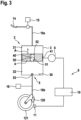
- a pressure modulator 2 is shown schematically, which is described as an example for the front wheel brake 121 .
- the pressure modulator can also be designed in the same way for the rear wheel brake.
- the pressure modulator 2 comprises a cylinder 3 and a cylindrical piston 4 which is movably arranged in the cylinder 3.
- the piston 4 has a through-opening 40 through which a fluid can be passed.
- a seal 41 is provided on the outer periphery of the piston 4 .
- the cylinder is divided into a first or upper storage chamber 31 and a second or lower storage chamber 32 .
- the pressure modulator also includes a valve arrangement 5.
- the valve arrangement 5 includes a closing element 50, in this exemplary embodiment a ball, and an actuating device 53.
- the actuating device 53 is arranged on a base 30 of the cylinder 3.
- the actuating device 53 is a pin.
- a first sealing seat 51 and a second sealing seat 52 are also provided in the through-opening 40 .
- the closing element 50 can seal either on the first sealing seat 51 or on the second sealing seat 52 or it is in an intermediate position in which the closing element 50 does not close the through-opening 40 on either of the two sealing seats 51, 52 and fluid can flow through the through-opening 40.
- the pressure modulator 2 also includes an actuator 6, which is a magnet actuator in this exemplary embodiment.
- the magnetic actuator is able to move the piston 40 back and forth within the cylinder 3 .
- a first hydraulic line 19a leads from a brake lever 14 on the bicycle to the cylinder 3.
- a second hydraulic line 19b then leads from the cylinder 3 to a brake caliper 120 on the front wheel brake 121.
- Numeral 15 designates a reservoir for a hydraulic fluid used in the pressure modulator of the antilock braking system.
- a control unit 10 is provided, which is connected to the actuator 6 . How further in figure 2 As shown, the control unit 10 is also connected to a sensor 11 on the front wheel brake 121 .
- the sensor 11 detects, for example, a locking of a wheel of the bicycle in order to set ABS control in motion.
- the sensor 11 is a speed sensor, for example. In this case, the sensor 11 does not necessarily have to be arranged on the front wheel brake 121, but can also be positioned at any point on the front wheel, for example.
- a pressure limiter 16 is provided on the second hydraulic line 19b.
- the pressure limiter 16 serves to limit a maximum pressure which is supplied to the front wheel brake 121 .
- figure 2 12 shows the normal braking condition of the bicycle, in which a rider has pulled a brake lever 14 so that a pressure in the first hydraulic line 19a and in the first accumulator chamber 31 of the cylinder 3 increases.
- the plunger is then inserted into the in figure 2 shown end position pressed at the bottom 30 of the cylinder.
- the closing element 50 is lifted off the first sealing seat 51 by the pin-like actuating device 53, so that hydraulic fluid can pass through the through-opening 40 and past the open sealing seats 51, 52 into the second hydraulic line 19b and from there to the front wheel brake 121. This performs normal braking.
- the ABS regulation by means of the control unit 10 begins.
- the locking of the wheel is transmitted to the control unit 10 by the sensor 11 .
- the control unit 10 then activates the actuator 6, which moves the piston 4 in the direction of the first hydraulic line 19a (arrow A).
- This position is in figure 3 shown.
- the second storage chamber 32 is enlarged and the passage opening on the first sealing seat 51 is closed, so that a pressure on the front wheel brake 121 is reduced. This releases the wheel from locking and, in particular, prevents it from rolling over.
- the movement of the piston 4 in the cylinder 3 closes the closing element 50 on the first sealing seat 51.
- This movement through the cylinder 3 can take place simply by energizing the actuator 6, which is designed as a magnetic actuator. As soon as the wheel is no longer locked, the energization of the actuator 6 is interrupted, so that the brake pressure is returned to the first storage chamber 31 if the driver is still pulling the brake lever 14 . As a result, the piston 3 moves again in the direction of the base 30 until the piston 4 rests on the base 30 and the second storage chamber 32 has completely disappeared again. In this in figure 2 position shown, the closing element 50 is again lifted from the first sealing seat 51 by the actuating device 53 .
- a pressure modulator 2 for an anti-lock braking system 9 can be provided, which is springless.
- the pressure modulator 2 is very built simply and cheaply. Furthermore, only a minimal amount of space is required for the components of the pressure modulator and the anti-lock braking system 9 .
- an anti-blocking functionality can only be implemented by controlling an actuator 6 .
- a spring or other critical component in the pressure modulator is not necessary in this embodiment.
- a pressure limitation is exclusively determined by the pressure limiter 16 .
- the pressure limiter 16 can ensure that the brake also functions without problems when a driver applies very high forces via the brake lever 14 .
- an effective piston area determines a hydraulic force that can be generated by the piston. This has the advantage, in particular when using a magnetic actuator, that a geometric shape of the side of the piston 4 directed towards the first storage chamber 31 can be freely selected, for example in order to optimize magnetic forces. In this way, a particularly quick release of the brake after a blocking can be made possible by actuating the actuator 6 .
- figure 4 shows a schematic sectional view of a pressure modulator 2 according to a second embodiment of the invention. Identical or functionally identical parts are denoted by the same reference symbols.
- the pressure modulator 2 has a piston 4 with a different geometric structure.
- the piston 4 in turn has a through-opening 40 and a valve arrangement 5 partially arranged in the piston 4 as in the first exemplary embodiment.
- the piston 4 of the second embodiment is a stepped piston.
- the cylinder 3 is also designed with a correspondingly adapted step corresponding to the step in the piston.
- the pressure modulator 2 of the second embodiment includes a restoring element 7.
- the restoring element 7 is arranged between the cylinder 3 and the piston 4 and places the piston 4 in the in figure 4 shown starting position.
- the restoring element 7 is arranged in the second storage chamber 32 .
- the restoring element 7 is a cylinder spring.
- One end of the restoring element 7 is supported on an annular shoulder 70 of the piston and the other end is supported on the cylinder 3 on an inwardly directed annular projection 33 .
- a check valve 33 is also arranged between the upper storage chamber 31 and the lower storage chamber 32 .
- a slot 42 is also provided on one side of the piston skirt, in order to enable the piston to be moved easily and safely.
- the surface of the piston 4 facing the first storage chamber 31 is flat.
- the spring element 7 thus ensures that in an operating situation in which no braking operation is initiated by the driver, the brake is always open and ready to brake.
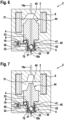
- FIGs 5 to 7 show alternative configurations of the piston 4 of a pressure modulator according to the invention.
- the piston has a region 44 tapering from a piston center.
- the piston is thus located in the axial direction in the cylinder 3 in such a way that there is greater overlap with a coil of the magnetic actuator 6 (cf. figure 5 ).
- figure 6 1 shows a geometry of the piston 4 in which, in addition to the tapering area 44, an end area 45 of the piston, which is directed towards the upper storage chamber 31, is of flat design.
- figure 7 shows a pressure modulator with a piston 4, which basically has a similar shape to that in figure 6 shown piston, however, a slope of the tapered portion is larger than the piston of FIG figure 6 .
- the in the Figures 5 to 7 The exemplary embodiments of the piston 4 shown make it clear that the piston 4 can be optimized in particular with regard to its geometric shape in relation to the magnetic actuator.
- a spring force of the restoring element 7 can be chosen to be very small, since only a restoring of the piston 4 in the cylinder 3 is necessary in the unbraked state of the brake of the bicycle.
Landscapes
- Engineering & Computer Science (AREA)
- Mechanical Engineering (AREA)
- Transportation (AREA)
- Physics & Mathematics (AREA)
- Fluid Mechanics (AREA)
- Regulating Braking Force (AREA)
Description
- Die vorliegende Erfindung betrifft einen Druckmodulator für ein Antiblockier-System eines Fahrrads sowie ein Antiblockier-System mit einem derartigen Druckmodulator und ein elektrisch betreibbares Zweirad, insbesondere Fahrrad, beispielsweise ein Pedelec oder S-Pedelec, mit einem derartigen Antiblockier-System.
- In der TWI649232 B ist ein Antiblockiersystemvorrichtung beschrieben.
- In jüngster Zeit werden nicht nur bei elektrisch betreibbaren Fahrrädern, sondern auch bei normalen Fahrrädern stärkere Bremsen mit Bremsscheiben verwendet. Hierbei besteht die Gefahr, dass ein Nutzer eines derartigen Fahrrads oder elektrisch betreibbaren Fahrrads eine zu starke Bremsung durchführt, bei der insbesondere ein Vorderrad blockieren kann und dies zu einem Überschlag oder Sturz oder dergleichen führen kann. Abhilfe für derartige gefährliche Fahrsituationen können durch Antiblockier-Systeme erreicht werden. Da bei Fahrrädern und elektrisch betreibbaren Fahrrädern ein Kaufgrund u. a. ein Gewicht des Fahrrads ist, müssen derartige Antiblockier-Systeme möglichst ein geringes Gewicht aufweisen. Auch ist eine reduzierte Bauteileanzahl von Vorteil, um ein optisch ansprechendes Fahrrad bereitzustellen. Aus der
EP 33 666 536 A1 - Der erfindungsgemäße Druckmodulator eines Antiblockier-Systems eines Fahrrads oder elektrisch betreibbaren Fahrrads mit den Merkmalen des Anspruchs 1 hat demgegenüber den Vorteil, dass in jeder Betriebssituation eine sichere Bremsung durch den Fahrer möglich ist. Dabei weist der erfindungsgemäße Druckmodulator einen sehr einfachen und kompakten Aufbau auf. Dies führt zu einem reduzierten Gewicht und einem platzsparenden Aufbau, sodass auch ein optischer Eindruck des Fahrrads nicht nachteilig durch den Druckmodulator beeinträchtigt wird. Dies wird erfindungsgemäß dadurch erreicht, dass der Druckmodulator einen Zylinder und einen zweiseitig beaufschlagbaren Kolben mit einer Durchgangsöffnung im Kolben aufweist. Ferner ist eine Ventilanordnung mit einem Schließelement und einer Betätigungseinrichtung für das Schließelement vorgesehen. Das Schließelement ist dabei in der Durchgangsöffnung im Kolben angeordnet und die Betätigungseinrichtung ist an einem Boden des Zylinders angeordnet und eingerichtet zur Betätigung des Schließelements. Ferner ist ein Aktor zur Bewegung des Kolbens vorgesehen, sodass eine Antiblockier-Regelung über den Aktor ermöglicht wird. Der im Zylinder angeordnete Kolben unterteilt den Zylinder in eine erste, insbesondere obere, und eine zweite, insbesondere untere, Speicherkammer, wobei die erste und zweite Speicherkammer über die Durchgangsöffnung miteinander verbindbar sind. Somit ist die Ventilanordnung in den Kolben und den Zylinder integriert, sodass ein sehr kleiner Bauraum für den Druckmodulator möglich ist.
- Die Unteransprüche zeigen bevorzugte Weiterbildungen der Erfindung.
- Vorzugsweise weist die Durchgangsöffnung einen ersten, zur oberen Speicherkammer gerichteten Dichtsitz und einen zweiten, zur unteren Speicherkammer gerichteten Dichtsitz auf. Hierdurch wird ein besonders einfacher Aufbau des Druckmodulators erreicht.
- Weiter bevorzugt ist das Schließelement lose beweglich in der Durchgangsöffnung angeordnet. Das Schließelement ist dabei vorzugsweise eine Kugel.
- Um einen besonders einfachen kostengünstigen Aufbau des Druckmodulators bereitzustellen, ist die Ventilanordnung federlos ausgebildet. D. h. die Ventilanordnung ist nicht, wie im Stand der Technik üblich, als federbelastetes Rückschlagventil vorgesehen, sondern kommt ohne Feder aus. Dies ist möglich, da die Ventilanordnung mit Schließelement und Betätigungseinrichtung aufgeteilt ist und in den Kolben und den Zylinder integriert sind.
- Gemäß einer alternativen bevorzugten Ausgestaltung der Erfindung umfasst der Druckmodulator ein Rückstellelement zwischen dem Kolben und dem Zylinder. Das Rückstellelement stellt dabei den Kolben in eine Ausgangslage zurück, in welcher die Ventilanordnung geöffnet ist. Die Ausgangslage ist hierbei ein Zustand, in welcher ein Nutzer des Fahrrads nicht bremst. Eine Federkraft des Rückstellelements kann dabei sehr klein sein.
- Die Betätigungseinrichtung am Zylinder ist vorzugsweise ein Stift am Boden des Zylinders. Der Stift ist vorzugsweise über Arme an einem Anschluss einer Leitung angeordnet, welche den Zylinder mit der Bremse am Rad des Fahrrads verbindet.
- Um einen besonders kostengünstigen Aufbau zu ermöglichen, ist der Aktor vorzugsweise ein Magnetaktor. Der Magnetaktor ist vorzugsweise in einen Mantel des Zylinders integriert und kann so sehr platzsparend angeordnet werden. Alternativ ist der Aktor ein mit dem Kolben verbundener elektrischer Motor.
- Zur Abdichtung zwischen den beiden Speicherkammern im Zylinder ist am Kolben vorzugsweise ein Dichtring vorgesehen.
- Weiter bevorzugt umfasst der Druckmodulator eine Druckbegrenzungseinrichtung, die vorzugsweise an einer Leitung des Druckmodulators angeordnet ist.
- Gemäß einer weiteren bevorzugten Ausgestaltung der Erfindung ist der Kolben an einer zur ersten Speicherkammer gerichteten Seite kegelförmig ausgebildet. Dadurch kann eine effektive Kolbenfläche, welche zur ersten Speicherkammer gerichtet ist, optimal ausgelegt werden. Die effektive Kolbenfläche bestimmt dabei die hydraulische Kraft, die durch den Kolben erzeugt werden kann.
- Ferner betrifft die vorliegende Erfindung ein Antiblockier-System eines Zweirads, insbesondere eines Fahrrads oder eines elektrisch betreibbaren Fahrrads, mit einem erfindungsgemäßen Druckmodulator. Es sei angemerkt, dass unter einem elektrisch betreibbaren Fahrrad ein Fahrrad verstanden wird, welches mittels Muskelkraft und/oder elektrisch betreibbar ist, insbesondere ein Pedelec oder ein S-Pedelec.
- Weiterhin betrifft die vorliegende Erfindung ein Zweirad, insbesondere ein Fahrrad oder ein elektrisch betreibbares Fahrrad mit einem Antiblockier-System mit einem erfindungsgemäßen Druckmodulator. Das Zweirad weist vorzugsweise ein Antiblockier-System an einem Vorderrad und/oder einem Hinterrad auf.
- Nachfolgend werden bevorzugte Ausführungsbeispiele der Erfindung unter Bezugnahme auf die begleitende Zeichnung im Detail beschrieben. In der Zeichnung ist:
- Figur 1
- eine schematische Ansicht eines elektrisch betreibbaren Fahrrads mit einem Antiblockier-System und einem Druckmodulator gemäß einem ersten Ausführungsbeispiel der vorliegenden Erfindung,
- Figur 2
- eine schematische Darstellung des Druckmodulators von
Figur 1 bei einem normalen Bremsvorgang, - Figur 3
- eine schematische Darstellung des Druckmodulators von
Figur 2 bei einem ABS-Regeleingriff, - Figur 4
- eine schematische Schnittansicht eines Druckmodulators gemäß einem zweiten Ausführungsbeispiel der Erfindung, und
- Figuren 5 bis 7
- alternative Ausgestaltungen von erfindungsgemäßen Druckmodulatoren, insbesondere mit unterschiedlichen geometrischen Kolbenformen.
- Nachfolgend wird unter Bezugnahme auf die
Figuren 1 bis 3 ein elektrisch betreibbares Fahrrad 1 mit einem Druckmodulator gemäß einem ersten Ausführungsbeispiel der Erfindung im Detail beschrieben. - Das elektrisch betreibbare Fahrrad 1 ist in Figur dargestellt und weist ein Vorderrad 12 mit einer Vorderradbremse 121 und ein Hinterrad 13 mit einer Hinterradbremse 131 auf.
- Bei beiden Bremsen ist in diesem Ausführungsbeispiel ein Antiblockier-System 9 integriert, welches im Detail in den
Figuren 2 und3 gezeigt ist. Das elektrisch betreibbare Fahrrad 1 weist ferner einen elektrischen Antrieb 17 auf, welcher in diesem Ausführungsbeispiel als Mittelmotor vorgesehen ist, sowie einen Akku 18, welcher den elektrischen Antrieb 17 mit elektrischer Energie versorgt. - Aus den
Figuren 2 und3 ist schematisch ein Druckmodulator 2 gezeigt, welcher beispielhaft für die Vorderradbremse 121 beschrieben wird. Der Druckmodulator kann jedoch auch in gleicher Weise für die Hinterradbremse ausgebildet sein. - Wie aus
Figur 2 ersichtlich ist, umfasst der Druckmodulator 2 einen Zylinder 3 und einen im Zylinder 3 beweglich angeordneten, zylindrischen Kolben 4. Der Kolben 4 weist eine Durchgangsöffnung 40 auf, durch welche ein Fluid hindurchführbar ist. Am äußeren Umfang des Kolbens 4 ist eine Dichtung 41 vorgesehen. Dadurch wird der Zylinder in eine erste bzw. obere Speicherkammer 31 und eine zweite bzw. untere Speicherkammer 32 unterteilt. - Ferner umfasst Druckmodulator eine Ventilanordnung 5. Die Ventilanordnung 5 umfasst ein Schließelement 50, in diesem Ausführungsbeispiel eine Kugel, sowie eine Betätigungseinrichtung 53. Die Betätigungseinrichtung 53 ist dabei an einem Boden 30 des Zylinders 3 angeordnet. Die Betätigungseinrichtung 53 ist dabei ein Stift. Somit ist die Ventilanordnung teilweise in den Kolben und teilweise in den Zylinder integriert.
- In der Durchgangsöffnung 40 ist ferner ein erster Dichtsitz 51 und ein zweiter Dichtsitz 52 vorgesehen. Das Schließelement 50 kann dabei entweder am ersten Dichtsitz 51 oder am zweiten Dichtsitz 52 abdichten oder es ist in einer Zwischenlage, bei der das Schließelement 50 an keinem der beiden Dichtsitze 51, 52 die Durchgangsöffnung 40 verschließt und Fluid durch die Durchgangsöffnung 40 strömen kann.
- Diese Zwischenposition ist insbesondere in der in
Figur 2 gezeigten Position erreicht, in welcher das Schließelement 50 mit der Betätigungseinrichtung 53 in Kontakt ist, sodass sowohl der erste als auch der zweite Dichtsitz 51, 52 offen sind. - Der Druckmodulator 2 umfasst ferner einen Aktor 6, welcher in diesem Ausführungsbeispiel ein Magnetaktor ist. Der Magnetaktor ist dabei in der Lage, den Kolben 40 innerhalb des Zylinders 3 hin und her zu bewegen.
- Eine erste Hydraulikleitung 19a führt von einem Bremshebel 14 am Fahrrad zum Zylinder 3. Eine zweite Hydraulikleitung 19b führt dann vom Zylinder 3 zu einem Bremssattel 120 an der Vorderradbremse 121.
- Das Bezugszeichen 15 bezeichnet ein Reservoir für eine Hydraulikflüssigkeit, welche im Druckmodulator des Antiblockier-Systems verwendet wird.
- Weiterhin ist eine Steuereinheit 10 vorgesehen, welche mit dem Aktor 6 verbunden ist. Wie weiter in
Figur 2 gezeigt, ist die Steuereinheit 10 auch mit einem Sensor 11 an der Vorderradbremse 121 verbunden. Der Sensor 11 erfasst beispielsweise ein Blockieren eines Rades des Fahrrads, um so eine ABS-Steuerung in Gang zu setzen. Der Sensor 11 ist beispielsweise ein Drehzahlsensor. Dabei muss der Sensor 11 nicht zwingend an der Vorderradbremse 121 angeordnet sein, sondern kann beispielsweise auch an einem beliebigen Punkt am Vorderrad positioniert sein. - Wie weiter aus
Figur 2 ersichtlich ist, ist an der zweiten Hydraulikleitung 19b ein Druckbegrenzer 16 vorgesehen. Der Druckbegrenzer 16 dient dabei zur Begrenzung eines maximalen Drucks, welcher zur Vorderradbremse 121 zugeführt wird. -
Figur 2 zeigt den normalen Bremszustand des Fahrrads, bei dem ein Fahrer an einem Bremshebel 14 gezogen hat, sodass ein Druck in der ersten Hydraulikleitung 19a und in der ersten Speicherkammer 31 des Zylinders 3 ansteigt. Der Kolben wird dann in die inFigur 2 gezeigte Endposition am Boden 30 des Zylinders gedrückt. Hierbei ist das Schließelement 50 durch die stiftartige Betätigungseinrichtung 53 vom ersten Dichtsitz 51 abgehoben, sodass Hydraulikfluid durch die Durchgangsöffnung 40 und an den offenen Dichtsitzen 51, 52 vorbei in die zweite Hydraulikleitung 19b und von dort zur Vorderradbremse 121 gelangen kann. Dadurch wird eine normale Bremsung ausgeführt. - Falls nun der Bremsdruck zu groß wird und das Vorderrad blockiert, setzt die ABS-Regelung mittels der Steuereinheit 10 ein. Das Blockieren des Rades wird der Steuereinheit 10 vom Sensor 11 übermittelt. Die Steuereinheit 10 aktiviert dann den Aktor 6, welcher den Kolben 4 in Richtung zur ersten Hydraulikleitung 19a bewegt (Pfeil A). Diese Position ist in
Figur 3 gezeigt. Dadurch wird die zweite Speicherkammer 32 vergrößert und die Durchgangsöffnung am ersten Dichtsitz 51 verschlossen, sodass ein Druck an der Vorderradbremse 121 abgebaut wird. Dadurch wird das Blockieren des Rades gelöst und insbesondere ein Überschlag verhindert. Wie inFigur 3 gezeigt, schließt durch die Bewegung des Kolbens 4 im Zylinder 3 das Schließelement 50 am ersten Dichtsitz 51. - Diese Bewegung durch den Zylinder 3 kann durch einfaches Bestromen des Aktors 6, welcher als Magnetaktor ausgebildet ist, erfolgen. Sobald das Blockieren des Rades aufgehoben ist, wird die Bestromung des Aktors 6 unterbrochen, sodass der Bremsdruck, falls der Fahrer immer noch den Bremshebel 14 zieht, wieder zurück zur ersten Speicherkammer 31 geführt. Dadurch bewegt sich der Kolben 3 wieder in Richtung des Bodens 30, bis der Kolben 4 am Boden 30 aufliegt und die zweite Speicherkammer 32 wieder vollständig verschwunden ist. In dieser in
Figur 2 gezeigten Position wird das Schließelement 50 vom ersten Dichtsitz 51 wieder durch die Betätigungseinrichtung 53 abgehoben. - Somit kann ein Druckmodulator 2 für ein Antiblockier-System 9 bereitgestellt werden, welcher federlos ausgebildet ist. Dabei ist der Druckmodulator 2 sehr einfach und kostengünstig aufgebaut. Ferner ist nur ein minimaler Bauraum für die Bauteile des Druckmodulators und des Antiblockier-Systems 9 notwendig.
- Somit kann erfindungsgemäß eine Antiblockier-Funktionalität nur durch Steuerung eines Aktors 6 realisiert werden. Eine Feder oder eine andere kritische Baukomponente im Druckmodulator ist in diesem Ausführungsbeispiel nicht notwendig. Somit existiert keine Feder oder dergleichen, welche eine Funktionalität der Basisbremse des Fahrrads infrage stellt. Ferner ist auch keine bauteilseitige Begrenzung eines maximalen Drucks vorhanden, welcher ein Fahrer am Bremssattel 120 aufbauen kann. Eine Druckbegrenzung wird ausschließlich durch den Druckbegrenzer 16 bestimmt.
- Der Druckbegrenzer 16 kann dabei sicherstellen, dass die Bremse auch problemlos funktioniert, wenn ein Fahrer über den Bremshebel 14 sehr hohe Kräfte aufbringt.
- Da in der ersten Speicherkammer 31 der Kolben 4 von der Hydraulikflüssigkeit umgeben ist, bestimmt eine effektive Kolbenfläche eine hydraulische Kraft, die durch den Kolben erzeugt werden kann. Dies hat insbesondere bei Verwendung eines Magnetaktors den Vorteil, dass eine geometrische Form der zur ersten Speicherkammer 31 gerichteten Seite des Kolbens 4 frei wählbar ist, um beispielsweise magnetische Kräfte zu optimieren. Hierdurch kann eine besonders schnelle Freigabe der Bremse nach einem Blockieren durch Ansteuerung des Aktors 6 ermöglicht werden.
-
Figur 4 zeigt eine schematische Schnittansicht eines Druckmodulators 2 gemäß einem zweiten Ausführungsbeispiel der Erfindung. Gleiche bzw. funktional gleiche Teile sind mit den gleichen Bezugszeichen bezeichnet. - Wie aus
Figur 4 ersichtlich ist, weist der Druckmodulator 2 einen Kolben 4 mit einem anderen geometrischen Aufbau auf. Der Kolben 4 weist wiederum eine Durchgangsöffnung 40 und eine teilweise im Kolben 4 angeordnete Ventilanordnung 5 wie im ersten Ausführungsbeispiel auf. Der Kolben 4 des zweiten Ausführungsbeispiels ist jedoch ein gestufter Kolben. Entsprechend der Stufe im Kolben ist auch der Zylinder 3 mit einer entsprechend angepassten Stufe ausgebildet. Weiterhin umfasst der Druckmodulator 2 des zweiten Ausführungsbeispiels ein Rückstellelement 7. Das Rückstellelement 7 ist zwischen dem Zylinder 3 und dem Kolben 4 angeordnet und stellt den Kolben 4 in die inFigur 4 gezeigte Ausgangsposition zurück. In dieser Ausgangsposition ist das Schließelement 50 der Ventilanordnung 5 geöffnet, da das Schließelement 50 durch die als Stift ausgebildete Betätigungseinrichtung 53 vom ersten Dichtsitz 51 abgehoben ist. Somit besteht eine Fluidverbindung zwischen der ersten und zweiten Hydraulikleitung 19a und 19b. - Das Rückstellelement 7 ist dabei in der zweiten Speicherkammer 32 angeordnet. In diesem Ausführungsbeispiel ist das Rückstellelement 7 eine Zylinderfeder. Ein Ende des Rückstellelements 7 stützt sich dabei an einem Ringabsatz 70 des Kolbens ab und das andere Ende stützt sich am Zylinder 3 an einem nach innen gerichteten Ringvorsprung 33 ab. Ferner ist zwischen der oberen Speicherkammer 31 und der unteren Speicherkammer 32 noch ein Rückschlagventil 33 angeordnet. Im Kolben 4 selbst ist noch ein Schlitz 42 an einer Kolbenmantelseite vorgesehen, um eine Bewegung des Kolbens einfach und sicher zu ermöglichen.
- Wie im ersten Ausführungsbeispiel ist die zur ersten Speicherkammer 31 gerichtete Fläche des Kolbens 4 eben ausgebildet. Das Federelement 7 stellt somit beim zweiten Ausführungsbeispiel sicher, dass in einer Betriebssituation, in welcher kein Bremsvorgang durch den Fahrer eingeleitet wird, die Bremse immer offensteht und bremsbereit ist.
- Die
Figuren 5 bis 7 zeigen alternative Ausgestaltungen des Kolbens 4 eines erfindungsgemäßen Druckmodulators. InFigur 5 weist der Kolben einen sich von einer Kolbenmitte verjüngenden Bereich 44 auf. Somit befindet sich der Kolben in axialer Richtung derart im Zylinder 3, dass eine höhere Überdeckung mit einer Spule des Magnetaktors 6 gegeben ist (vgl.Figur 5 ). -
Figur 6 zeigt eine Geometrie des Kolbens 4, bei der neben dem sich verjüngenden Bereich 44 ein Endbereich 45 des Kolbens, der zur oberen Speicherkammer 31 gerichtet ist, flach ausgebildet ist. -
Figur 7 zeigt einen Druckmodulator mit einem Kolben 4, welcher grundsätzlich eine ähnliche Form wie der inFigur 6 gezeigte Kolben aufweist, wobei allerdings eine Steigung des sich verjüngenden Bereichs größer ist als bei dem Kolben vonFigur 6 . - Die in den
Figuren 5 bis 7 gezeigten Ausführungsbeispiele des Kolbens 4 machen deutlich, dass der Kolben 4 hierbei insbesondere hinsichtlich seiner geometrischen Form in Bezug auf den Magnetaktor optimiert werden kann. Eine Federkraft des Rückstellelements 7 kann dabei sehr klein gewählt werden, da lediglich eine Rückstellung des Kolbens 4 im Zylinder 3 im nicht gebremsten Zustand der Bremse des Fahrrads notwendig ist.
Claims (13)
- Druckmodulator für ein Antiblockier-System eines Fahrrads, umfassend:- einen Zylinder (3),- einen Kolben (4) mit einer Durchgangsöffnung (40) für ein Hydraulikfluid, wobei der Kolben (4) im Zylinder (3) angeordnet ist und den Zylinder (3) in eine erste Speicherkammer (31) und eine zweite Speicherkammer (32) unterteilt, wobei die erste und zweite Speicherkammer (31, 32) über die Durchgangsöffnung (40) miteinander verbindbar sind,dadurch gekennzeichnet, dass der Druckmodulator ferner umfasst:- eine Ventilanordnung (5), welche ein Schließelement (50) und eine Betätigungseinrichtung (53) für das Schließelement umfasst, wobei das Schließelement (50) in der Durchgangsöffnung (40) angeordnet ist und die Betätigungseinrichtung (53) an einem Boden (30) des Zylinders (3) angeordnet ist, und- einen Aktor (6) zum Bewegen des Kolbens (4).
- Druckmodulator nach Anspruch 1, wobei die Durchgangsöffnung (40) einen ersten, zur zweiten Speicherkammer (32) gerichteten Dichtsitz (51) und einen zweiten, zur ersten Speicherkammer (31) gerichteten Dichtsitz (52) aufweist.
- Druckmodulator nach einem der vorhergehenden Ansprüche, wobei das Schließelement (50) lose beweglich in der Durchgangsöffnung (40) angeordnet ist.
- Druckmodulator nach einem der vorhergehenden Ansprüche, wobei das Schließelement eine Kugel ist.
- Druckmodulator nach einem der vorhergehenden Ansprüche, wobei die Ventilanordnung (5) federlos ausgebildet ist.
- Druckmodulator nach einem der Ansprüche 1 bis 4, wobei ein Rückstellelement (7) zwischen dem Kolben (4) und dem Zylinder (3) angeordnet ist, welches den Kolben in eine Ausgangslage zurückstellt, in welcher die Ventilanordnung (5) geöffnet ist.
- Druckmodulator nach einem der vorhergehenden Ansprüche, wobei die Betätigungseinrichtung (35) ein Stift am Boden (30) des Zylinders ist.
- Druckmodulator nach einem der vorhergehenden Ansprüche, wobei der Aktuator (6) ein Magnetaktuator ist oder wobei der Aktuator ein mit dem Kolben verbundener elektrischer Motor ist.
- Druckmodulator nach einem der vorhergehenden Ansprüche, ferner umfassend eine Druckbegrenzungseinrichtung (16), welche einen maximal durch einen Fahrer aufbringbaren Bremsdruck begrenzt.
- Druckmodulator nach einem der vorhergehenden Ansprüche, wobei der Kolben (4) an einer zur ersten Speicherkammer (31) gerichteten Seite kegelförmig oder flach ausgebildet ist.
- Antiblockiersystem eines Fahrrads, insbesondere eines elektrisch und/oder mit Muskelkraft betreibbaren Fahrrads, umfassend einen Druckmodulator nach einem der vorhergehenden Ansprüche.
- Zweirad, insbesondere Fahrrad oder elektrisch betreibbares Fahrrad, umfassend ein Antiblockiersystem nach Anspruch 11.
- Zweirad nach Anspruch 12, wobei ein Vorderrad und/oder ein Hinterrad mit einem Antiblockiersystem ausgestattet ist.
Applications Claiming Priority (1)
| Application Number | Priority Date | Filing Date | Title |
|---|---|---|---|
| DE202019105187.6U DE202019105187U1 (de) | 2019-09-19 | 2019-09-19 | Druckmodulator für ein Antiblockier-System eines Fahrrads |
Publications (2)
| Publication Number | Publication Date |
|---|---|
| EP3795436A1 EP3795436A1 (de) | 2021-03-24 |
| EP3795436B1 true EP3795436B1 (de) | 2023-03-01 |
Family
ID=68337137
Family Applications (1)
| Application Number | Title | Priority Date | Filing Date |
|---|---|---|---|
| EP20195032.6A Active EP3795436B1 (de) | 2019-09-19 | 2020-09-08 | Druckmodulator für ein antiblockier-system eines fahrrads |
Country Status (3)
| Country | Link |
|---|---|
| US (1) | US11364968B2 (de) |
| EP (1) | EP3795436B1 (de) |
| DE (1) | DE202019105187U1 (de) |
Families Citing this family (3)
| Publication number | Priority date | Publication date | Assignee | Title |
|---|---|---|---|---|
| WO2022097054A1 (en) | 2020-11-06 | 2022-05-12 | Blubrake S.P.A | Abs actuator device unit for a cargo cycle and a cargo cycle provided with such device |
| IT202000031865A1 (it) * | 2020-12-22 | 2022-06-22 | Raicam Driveline S R L | Metodo e sistema per la rilevazione della velocità di una bicicletta |
| DE102021211201A1 (de) * | 2021-10-05 | 2023-04-06 | Robert Bosch Gesellschaft mit beschränkter Haftung | Bremsvorrichtung für ein hydraulisches Bremssystem eines Fahrzeugs und Verfahren zum Betreiben eines hydraulischen Bremssystems eines Fahrzeugs |
Family Cites Families (13)
| Publication number | Priority date | Publication date | Assignee | Title |
|---|---|---|---|---|
| DE3322422A1 (de) * | 1983-06-22 | 1985-01-03 | Alfred Teves Gmbh, 6000 Frankfurt | Hydraulische bremsanlage mit einer blockierschutzeinrichtung |
| DE3526189A1 (de) * | 1985-07-23 | 1987-02-05 | Bosch Gmbh Robert | Druckmodulator fuer abs-systeme |
| DE4015746A1 (de) * | 1990-05-16 | 1991-11-21 | Teves Gmbh Alfred | Druckmodulator fuer eine blockiergeschuetzte, hydraulische bremsanlage |
| US5102207A (en) * | 1990-12-03 | 1992-04-07 | General Motors Corporation | Antilock brake system with motor current control of the pressure modulator |
| US5163744A (en) * | 1991-10-21 | 1992-11-17 | General Motors Corporation | Combined traction control and anti-lock braking system |
| ATE266548T1 (de) * | 2000-09-13 | 2004-05-15 | Fte Automotive Gmbh & Co Kg | Verfahren zur regelung der bremskraft an den rädern eines einspurigen fahrzeugs und bremsanlage zur durchführung des verfahrens |
| KR20110124602A (ko) * | 2010-05-11 | 2011-11-17 | 주식회사 만도 | 브레이크 시스템용 모터-펌프 유닛 |
| DE102012222058B4 (de) * | 2012-12-03 | 2024-03-21 | Robert Bosch Gmbh | Hydraulisches Bremssystem für Zweiräder |
| DE102016112487B4 (de) * | 2016-07-07 | 2022-05-12 | Zf Friedrichshafen Ag | Druckmodulator für ein ABS-System für ein Zweirad |
| KR102639408B1 (ko) * | 2016-09-05 | 2024-02-22 | 에이치엘만도 주식회사 | 브레이크 시스템용 솔레노이드밸브 |
| DE102017100279A1 (de) * | 2017-01-09 | 2018-07-12 | Baumeister GmbH & Co. KG | Ventileinheit für eine Bremsanlage eines Leichtfahrzeuges, insbesondere für ein Antiblockiersystem |
| EP3366536A1 (de) | 2017-02-28 | 2018-08-29 | Brake Force One GmbH | Druckmodulator mit integriertem bremskraftverstärker |
| TWI649232B (zh) * | 2018-05-04 | 2019-02-01 | Tektro Technology Corporation | 自行車之防鎖死煞車機構 |
-
2019
- 2019-09-19 DE DE202019105187.6U patent/DE202019105187U1/de active Active
-
2020
- 2020-09-08 EP EP20195032.6A patent/EP3795436B1/de active Active
- 2020-09-08 US US17/014,501 patent/US11364968B2/en active Active
Also Published As
| Publication number | Publication date |
|---|---|
| US11364968B2 (en) | 2022-06-21 |
| US20210086865A1 (en) | 2021-03-25 |
| DE202019105187U1 (de) | 2019-10-04 |
| EP3795436A1 (de) | 2021-03-24 |
Similar Documents
| Publication | Publication Date | Title |
|---|---|---|
| EP2303652B1 (de) | Regelventil für ein fahrzeugbremssystem und fahrzeugbremssystem mit einem solchen regelventil | |
| DE4041506C2 (de) | Absperrventil in einer hydraulischen Bremsanlage, insbesondere für Kraftfahrzeuge | |
| EP3789256B1 (de) | Druckmodulator eines antiblockier-systems eines zweirads | |
| EP3795436B1 (de) | Druckmodulator für ein antiblockier-system eines fahrrads | |
| EP2178727B1 (de) | Bremssystem für ein fahrzeug | |
| EP0761519B1 (de) | Hydraulische Bremsanlage, insbesondere für Kraftfahrzeuge | |
| DE2840344C2 (de) | ||
| DE3837525C2 (de) | ||
| DE2127536B2 (de) | Hydraulischer bremsverstaerker | |
| DE102016222562A1 (de) | Pedalwegsimulator und Hydraulikblock mit einem Pedalwegsimulator | |
| EP0477523A2 (de) | Druckbegrenzungsventil, insbesondere für hydraulische Kraftfahrzeug-Bremsanlagen | |
| WO2022207172A1 (de) | Fahrzeug und bremsassistenzeinrichtung für eine hydraulische bremsanlage für ein fahrzeug | |
| WO2018069010A1 (de) | Magnetventil und hydraulisches bremssystem für ein fahrzeug | |
| DE102017209618A1 (de) | Pedalwegsimulator für eine hydraulische Fremdkraft-Fahrzeugbremsanlage | |
| DE19533482A1 (de) | Ventilanordnung für einen Fremdkraft-Bremskreis einer hydraulischen Bremsanlage | |
| EP0735962B1 (de) | Ventilanordnung für die bremsdrucksteuerung bei einer hydraulischen fremdkraftbremsanlage eines strassenfahrzeuges | |
| DE102012215879A1 (de) | Hydraulisch gesteuertes Speicherkammerventil und hydraulisches Fahrzeugbremssystem | |
| DE102015015614A1 (de) | Verfahren zum Betreiben eines Bremskraftsimulators sowie entsprechender Bremskraftsimulator | |
| DE3742364C2 (de) | Vorrichtung zum Steuern der Bremskraft an den Hinterrädern eines Fahrzeuges | |
| EP0955222B1 (de) | Hydraulische Bremsanlage, insbesondere für Kraftfahrzeuge | |
| DE69101881T2 (de) | Hydraulisches Bremssystem mit zugehörigem Druckminderventil. | |
| EP3628556A1 (de) | Bremseinrichtung mit aktiver bremskrafteinstellung | |
| EP2164732B1 (de) | Hydraulische fahrzeugbremsanlage sowie verfahren zum betrieb der hydraulischen fahrzeugbremsanlage | |
| DE10164319C2 (de) | Betätigungseinheit für eine hydraulische Fahrzeugbremsanlage | |
| EP2619056A1 (de) | Pneumatisches steuerventil zur geregelten druckluftbeaufschlagung eines bremszylinders |
Legal Events
| Date | Code | Title | Description |
|---|---|---|---|
| PUAI | Public reference made under article 153(3) epc to a published international application that has entered the european phase |
Free format text: ORIGINAL CODE: 0009012 |
|
| STAA | Information on the status of an ep patent application or granted ep patent |
Free format text: STATUS: THE APPLICATION HAS BEEN PUBLISHED |
|
| AK | Designated contracting states |
Kind code of ref document: A1 Designated state(s): AL AT BE BG CH CY CZ DE DK EE ES FI FR GB GR HR HU IE IS IT LI LT LU LV MC MK MT NL NO PL PT RO RS SE SI SK SM TR |
|
| AX | Request for extension of the european patent |
Extension state: BA ME |
|
| STAA | Information on the status of an ep patent application or granted ep patent |
Free format text: STATUS: REQUEST FOR EXAMINATION WAS MADE |
|
| 17P | Request for examination filed |
Effective date: 20210924 |
|
| RBV | Designated contracting states (corrected) |
Designated state(s): AL AT BE BG CH CY CZ DE DK EE ES FI FR GB GR HR HU IE IS IT LI LT LU LV MC MK MT NL NO PL PT RO RS SE SI SK SM TR |
|
| GRAP | Despatch of communication of intention to grant a patent |
Free format text: ORIGINAL CODE: EPIDOSNIGR1 |
|
| STAA | Information on the status of an ep patent application or granted ep patent |
Free format text: STATUS: GRANT OF PATENT IS INTENDED |
|
| INTG | Intention to grant announced |
Effective date: 20221117 |
|
| GRAS | Grant fee paid |
Free format text: ORIGINAL CODE: EPIDOSNIGR3 |
|
| GRAA | (expected) grant |
Free format text: ORIGINAL CODE: 0009210 |
|
| STAA | Information on the status of an ep patent application or granted ep patent |
Free format text: STATUS: THE PATENT HAS BEEN GRANTED |
|
| AK | Designated contracting states |
Kind code of ref document: B1 Designated state(s): AL AT BE BG CH CY CZ DE DK EE ES FI FR GB GR HR HU IE IS IT LI LT LU LV MC MK MT NL NO PL PT RO RS SE SI SK SM TR |
|
| REG | Reference to a national code |
Ref country code: GB Ref legal event code: FG4D Free format text: NOT ENGLISH |
|
| REG | Reference to a national code |
Ref country code: NL Ref legal event code: FP Ref country code: CH Ref legal event code: EP Ref country code: AT Ref legal event code: REF Ref document number: 1550763 Country of ref document: AT Kind code of ref document: T Effective date: 20230315 |
|
| REG | Reference to a national code |
Ref country code: DE Ref legal event code: R096 Ref document number: 502020002621 Country of ref document: DE |
|
| REG | Reference to a national code |
Ref country code: IE Ref legal event code: FG4D Free format text: LANGUAGE OF EP DOCUMENT: GERMAN |
|
| REG | Reference to a national code |
Ref country code: LT Ref legal event code: MG9D |
|
| PG25 | Lapsed in a contracting state [announced via postgrant information from national office to epo] |
Ref country code: RS Free format text: LAPSE BECAUSE OF FAILURE TO SUBMIT A TRANSLATION OF THE DESCRIPTION OR TO PAY THE FEE WITHIN THE PRESCRIBED TIME-LIMIT Effective date: 20230301 Ref country code: NO Free format text: LAPSE BECAUSE OF FAILURE TO SUBMIT A TRANSLATION OF THE DESCRIPTION OR TO PAY THE FEE WITHIN THE PRESCRIBED TIME-LIMIT Effective date: 20230601 Ref country code: LV Free format text: LAPSE BECAUSE OF FAILURE TO SUBMIT A TRANSLATION OF THE DESCRIPTION OR TO PAY THE FEE WITHIN THE PRESCRIBED TIME-LIMIT Effective date: 20230301 Ref country code: LT Free format text: LAPSE BECAUSE OF FAILURE TO SUBMIT A TRANSLATION OF THE DESCRIPTION OR TO PAY THE FEE WITHIN THE PRESCRIBED TIME-LIMIT Effective date: 20230301 Ref country code: HR Free format text: LAPSE BECAUSE OF FAILURE TO SUBMIT A TRANSLATION OF THE DESCRIPTION OR TO PAY THE FEE WITHIN THE PRESCRIBED TIME-LIMIT Effective date: 20230301 Ref country code: ES Free format text: LAPSE BECAUSE OF FAILURE TO SUBMIT A TRANSLATION OF THE DESCRIPTION OR TO PAY THE FEE WITHIN THE PRESCRIBED TIME-LIMIT Effective date: 20230301 |
|
| PG25 | Lapsed in a contracting state [announced via postgrant information from national office to epo] |
Ref country code: SE Free format text: LAPSE BECAUSE OF FAILURE TO SUBMIT A TRANSLATION OF THE DESCRIPTION OR TO PAY THE FEE WITHIN THE PRESCRIBED TIME-LIMIT Effective date: 20230301 Ref country code: PL Free format text: LAPSE BECAUSE OF FAILURE TO SUBMIT A TRANSLATION OF THE DESCRIPTION OR TO PAY THE FEE WITHIN THE PRESCRIBED TIME-LIMIT Effective date: 20230301 Ref country code: GR Free format text: LAPSE BECAUSE OF FAILURE TO SUBMIT A TRANSLATION OF THE DESCRIPTION OR TO PAY THE FEE WITHIN THE PRESCRIBED TIME-LIMIT Effective date: 20230602 Ref country code: FI Free format text: LAPSE BECAUSE OF FAILURE TO SUBMIT A TRANSLATION OF THE DESCRIPTION OR TO PAY THE FEE WITHIN THE PRESCRIBED TIME-LIMIT Effective date: 20230301 |
|
| PG25 | Lapsed in a contracting state [announced via postgrant information from national office to epo] |
Ref country code: SM Free format text: LAPSE BECAUSE OF FAILURE TO SUBMIT A TRANSLATION OF THE DESCRIPTION OR TO PAY THE FEE WITHIN THE PRESCRIBED TIME-LIMIT Effective date: 20230301 Ref country code: RO Free format text: LAPSE BECAUSE OF FAILURE TO SUBMIT A TRANSLATION OF THE DESCRIPTION OR TO PAY THE FEE WITHIN THE PRESCRIBED TIME-LIMIT Effective date: 20230301 Ref country code: PT Free format text: LAPSE BECAUSE OF FAILURE TO SUBMIT A TRANSLATION OF THE DESCRIPTION OR TO PAY THE FEE WITHIN THE PRESCRIBED TIME-LIMIT Effective date: 20230703 Ref country code: EE Free format text: LAPSE BECAUSE OF FAILURE TO SUBMIT A TRANSLATION OF THE DESCRIPTION OR TO PAY THE FEE WITHIN THE PRESCRIBED TIME-LIMIT Effective date: 20230301 Ref country code: CZ Free format text: LAPSE BECAUSE OF FAILURE TO SUBMIT A TRANSLATION OF THE DESCRIPTION OR TO PAY THE FEE WITHIN THE PRESCRIBED TIME-LIMIT Effective date: 20230301 |
|
| PG25 | Lapsed in a contracting state [announced via postgrant information from national office to epo] |
Ref country code: SK Free format text: LAPSE BECAUSE OF FAILURE TO SUBMIT A TRANSLATION OF THE DESCRIPTION OR TO PAY THE FEE WITHIN THE PRESCRIBED TIME-LIMIT Effective date: 20230301 Ref country code: IS Free format text: LAPSE BECAUSE OF FAILURE TO SUBMIT A TRANSLATION OF THE DESCRIPTION OR TO PAY THE FEE WITHIN THE PRESCRIBED TIME-LIMIT Effective date: 20230701 |
|
| REG | Reference to a national code |
Ref country code: DE Ref legal event code: R097 Ref document number: 502020002621 Country of ref document: DE |
|
| PLBE | No opposition filed within time limit |
Free format text: ORIGINAL CODE: 0009261 |
|
| STAA | Information on the status of an ep patent application or granted ep patent |
Free format text: STATUS: NO OPPOSITION FILED WITHIN TIME LIMIT |
|
| PG25 | Lapsed in a contracting state [announced via postgrant information from national office to epo] |
Ref country code: SI Free format text: LAPSE BECAUSE OF FAILURE TO SUBMIT A TRANSLATION OF THE DESCRIPTION OR TO PAY THE FEE WITHIN THE PRESCRIBED TIME-LIMIT Effective date: 20230301 Ref country code: DK Free format text: LAPSE BECAUSE OF FAILURE TO SUBMIT A TRANSLATION OF THE DESCRIPTION OR TO PAY THE FEE WITHIN THE PRESCRIBED TIME-LIMIT Effective date: 20230301 |
|
| 26N | No opposition filed |
Effective date: 20231204 |
|
| PG25 | Lapsed in a contracting state [announced via postgrant information from national office to epo] |
Ref country code: AL Free format text: LAPSE BECAUSE OF FAILURE TO SUBMIT A TRANSLATION OF THE DESCRIPTION OR TO PAY THE FEE WITHIN THE PRESCRIBED TIME-LIMIT Effective date: 20230301 |
|
| REG | Reference to a national code |
Ref country code: CH Ref legal event code: PL |
|
| PG25 | Lapsed in a contracting state [announced via postgrant information from national office to epo] |
Ref country code: LU Free format text: LAPSE BECAUSE OF NON-PAYMENT OF DUE FEES Effective date: 20230908 |
|
| REG | Reference to a national code |
Ref country code: BE Ref legal event code: MM Effective date: 20230930 |
|
| PG25 | Lapsed in a contracting state [announced via postgrant information from national office to epo] |
Ref country code: LU Free format text: LAPSE BECAUSE OF NON-PAYMENT OF DUE FEES Effective date: 20230908 Ref country code: MC Free format text: LAPSE BECAUSE OF FAILURE TO SUBMIT A TRANSLATION OF THE DESCRIPTION OR TO PAY THE FEE WITHIN THE PRESCRIBED TIME-LIMIT Effective date: 20230301 |
|
| REG | Reference to a national code |
Ref country code: IE Ref legal event code: MM4A |
|
| PG25 | Lapsed in a contracting state [announced via postgrant information from national office to epo] |
Ref country code: IE Free format text: LAPSE BECAUSE OF NON-PAYMENT OF DUE FEES Effective date: 20230908 |
|
| PG25 | Lapsed in a contracting state [announced via postgrant information from national office to epo] |
Ref country code: CH Free format text: LAPSE BECAUSE OF NON-PAYMENT OF DUE FEES Effective date: 20230930 |
|
| PG25 | Lapsed in a contracting state [announced via postgrant information from national office to epo] |
Ref country code: IE Free format text: LAPSE BECAUSE OF NON-PAYMENT OF DUE FEES Effective date: 20230908 Ref country code: FR Free format text: LAPSE BECAUSE OF NON-PAYMENT OF DUE FEES Effective date: 20230930 Ref country code: CH Free format text: LAPSE BECAUSE OF NON-PAYMENT OF DUE FEES Effective date: 20230930 |
|
| PG25 | Lapsed in a contracting state [announced via postgrant information from national office to epo] |
Ref country code: BE Free format text: LAPSE BECAUSE OF NON-PAYMENT OF DUE FEES Effective date: 20230930 |
|
| PG25 | Lapsed in a contracting state [announced via postgrant information from national office to epo] |
Ref country code: BG Free format text: LAPSE BECAUSE OF FAILURE TO SUBMIT A TRANSLATION OF THE DESCRIPTION OR TO PAY THE FEE WITHIN THE PRESCRIBED TIME-LIMIT Effective date: 20230301 |
|
| PG25 | Lapsed in a contracting state [announced via postgrant information from national office to epo] |
Ref country code: BG Free format text: LAPSE BECAUSE OF FAILURE TO SUBMIT A TRANSLATION OF THE DESCRIPTION OR TO PAY THE FEE WITHIN THE PRESCRIBED TIME-LIMIT Effective date: 20230301 |
|
| GBPC | Gb: european patent ceased through non-payment of renewal fee |
Effective date: 20240908 |
|
| PG25 | Lapsed in a contracting state [announced via postgrant information from national office to epo] |
Ref country code: GB Free format text: LAPSE BECAUSE OF NON-PAYMENT OF DUE FEES Effective date: 20240908 |
|
| PG25 | Lapsed in a contracting state [announced via postgrant information from national office to epo] |
Ref country code: CY Free format text: LAPSE BECAUSE OF FAILURE TO SUBMIT A TRANSLATION OF THE DESCRIPTION OR TO PAY THE FEE WITHIN THE PRESCRIBED TIME-LIMIT; INVALID AB INITIO Effective date: 20200908 |
|
| PG25 | Lapsed in a contracting state [announced via postgrant information from national office to epo] |
Ref country code: HU Free format text: LAPSE BECAUSE OF FAILURE TO SUBMIT A TRANSLATION OF THE DESCRIPTION OR TO PAY THE FEE WITHIN THE PRESCRIBED TIME-LIMIT; INVALID AB INITIO Effective date: 20200908 |
|
| PGFP | Annual fee paid to national office [announced via postgrant information from national office to epo] |
Ref country code: NL Payment date: 20250922 Year of fee payment: 6 |
|
| PGFP | Annual fee paid to national office [announced via postgrant information from national office to epo] |
Ref country code: AT Payment date: 20251020 Year of fee payment: 5 |
|
| PG25 | Lapsed in a contracting state [announced via postgrant information from national office to epo] |
Ref country code: TR Free format text: LAPSE BECAUSE OF FAILURE TO SUBMIT A TRANSLATION OF THE DESCRIPTION OR TO PAY THE FEE WITHIN THE PRESCRIBED TIME-LIMIT Effective date: 20230301 |
|
| PGFP | Annual fee paid to national office [announced via postgrant information from national office to epo] |
Ref country code: DE Payment date: 20251121 Year of fee payment: 6 |
|
| PGFP | Annual fee paid to national office [announced via postgrant information from national office to epo] |
Ref country code: IT Payment date: 20250930 Year of fee payment: 6 |