EP3795415B1 - Child safety seat - Google Patents
Child safety seat Download PDFInfo
- Publication number
- EP3795415B1 EP3795415B1 EP20196579.5A EP20196579A EP3795415B1 EP 3795415 B1 EP3795415 B1 EP 3795415B1 EP 20196579 A EP20196579 A EP 20196579A EP 3795415 B1 EP3795415 B1 EP 3795415B1
- Authority
- EP
- European Patent Office
- Prior art keywords
- notifying
- base
- component
- seat body
- seat
- Prior art date
- Legal status (The legal status is an assumption and is not a legal conclusion. Google has not performed a legal analysis and makes no representation as to the accuracy of the status listed.)
- Active
Links
Images



Classifications
-
- B—PERFORMING OPERATIONS; TRANSPORTING
- B60—VEHICLES IN GENERAL
- B60N—SEATS SPECIALLY ADAPTED FOR VEHICLES; VEHICLE PASSENGER ACCOMMODATION NOT OTHERWISE PROVIDED FOR
- B60N2/00—Seats specially adapted for vehicles; Arrangement or mounting of seats in vehicles
- B60N2/24—Seats specially adapted for vehicles; Arrangement or mounting of seats in vehicles for particular purposes or particular vehicles
- B60N2/26—Seats specially adapted for vehicles; Arrangement or mounting of seats in vehicles for particular purposes or particular vehicles for children
- B60N2/28—Seats readily mountable on, and dismountable from, existing seats or other parts of the vehicle
- B60N2/2821—Seats readily mountable on, and dismountable from, existing seats or other parts of the vehicle having a seat and a base part
-
- B—PERFORMING OPERATIONS; TRANSPORTING
- B60—VEHICLES IN GENERAL
- B60N—SEATS SPECIALLY ADAPTED FOR VEHICLES; VEHICLE PASSENGER ACCOMMODATION NOT OTHERWISE PROVIDED FOR
- B60N2/00—Seats specially adapted for vehicles; Arrangement or mounting of seats in vehicles
- B60N2/90—Details or parts not otherwise provided for
-
- B—PERFORMING OPERATIONS; TRANSPORTING
- B60—VEHICLES IN GENERAL
- B60N—SEATS SPECIALLY ADAPTED FOR VEHICLES; VEHICLE PASSENGER ACCOMMODATION NOT OTHERWISE PROVIDED FOR
- B60N2/00—Seats specially adapted for vehicles; Arrangement or mounting of seats in vehicles
- B60N2/24—Seats specially adapted for vehicles; Arrangement or mounting of seats in vehicles for particular purposes or particular vehicles
- B60N2/26—Seats specially adapted for vehicles; Arrangement or mounting of seats in vehicles for particular purposes or particular vehicles for children
- B60N2/28—Seats readily mountable on, and dismountable from, existing seats or other parts of the vehicle
- B60N2/2869—Seats readily mountable on, and dismountable from, existing seats or other parts of the vehicle rotatable about a vertical axis
-
- B—PERFORMING OPERATIONS; TRANSPORTING
- B60—VEHICLES IN GENERAL
- B60N—SEATS SPECIALLY ADAPTED FOR VEHICLES; VEHICLE PASSENGER ACCOMMODATION NOT OTHERWISE PROVIDED FOR
- B60N2/00—Seats specially adapted for vehicles; Arrangement or mounting of seats in vehicles
- B60N2/24—Seats specially adapted for vehicles; Arrangement or mounting of seats in vehicles for particular purposes or particular vehicles
- B60N2/26—Seats specially adapted for vehicles; Arrangement or mounting of seats in vehicles for particular purposes or particular vehicles for children
- B60N2/266—Seats specially adapted for vehicles; Arrangement or mounting of seats in vehicles for particular purposes or particular vehicles for children with detection or alerting means responsive to presence or absence of children; with detection or alerting means responsive to improper locking or installation of the child seats or parts thereof
- B60N2/268—Seats specially adapted for vehicles; Arrangement or mounting of seats in vehicles for particular purposes or particular vehicles for children with detection or alerting means responsive to presence or absence of children; with detection or alerting means responsive to improper locking or installation of the child seats or parts thereof detecting or alerting means responsive to the installation of the child seats in the vehicle
-
- B—PERFORMING OPERATIONS; TRANSPORTING
- B60—VEHICLES IN GENERAL
- B60N—SEATS SPECIALLY ADAPTED FOR VEHICLES; VEHICLE PASSENGER ACCOMMODATION NOT OTHERWISE PROVIDED FOR
- B60N2/00—Seats specially adapted for vehicles; Arrangement or mounting of seats in vehicles
- B60N2/24—Seats specially adapted for vehicles; Arrangement or mounting of seats in vehicles for particular purposes or particular vehicles
- B60N2/26—Seats specially adapted for vehicles; Arrangement or mounting of seats in vehicles for particular purposes or particular vehicles for children
- B60N2/28—Seats readily mountable on, and dismountable from, existing seats or other parts of the vehicle
- B60N2/2857—Seats readily mountable on, and dismountable from, existing seats or other parts of the vehicle characterised by the peculiar orientation of the child
-
- B—PERFORMING OPERATIONS; TRANSPORTING
- B60—VEHICLES IN GENERAL
- B60N—SEATS SPECIALLY ADAPTED FOR VEHICLES; VEHICLE PASSENGER ACCOMMODATION NOT OTHERWISE PROVIDED FOR
- B60N2/00—Seats specially adapted for vehicles; Arrangement or mounting of seats in vehicles
- B60N2/24—Seats specially adapted for vehicles; Arrangement or mounting of seats in vehicles for particular purposes or particular vehicles
- B60N2/26—Seats specially adapted for vehicles; Arrangement or mounting of seats in vehicles for particular purposes or particular vehicles for children
- B60N2/28—Seats readily mountable on, and dismountable from, existing seats or other parts of the vehicle
- B60N2/2875—Seats readily mountable on, and dismountable from, existing seats or other parts of the vehicle inclinable, as a whole or partially
-
- B—PERFORMING OPERATIONS; TRANSPORTING
- B60—VEHICLES IN GENERAL
- B60N—SEATS SPECIALLY ADAPTED FOR VEHICLES; VEHICLE PASSENGER ACCOMMODATION NOT OTHERWISE PROVIDED FOR
- B60N2/00—Seats specially adapted for vehicles; Arrangement or mounting of seats in vehicles
- B60N2/90—Details or parts not otherwise provided for
- B60N2002/981—Warning systems, e.g. the seat or seat parts vibrates to warn the passenger when facing a danger
-
- B—PERFORMING OPERATIONS; TRANSPORTING
- B60—VEHICLES IN GENERAL
- B60N—SEATS SPECIALLY ADAPTED FOR VEHICLES; VEHICLE PASSENGER ACCOMMODATION NOT OTHERWISE PROVIDED FOR
- B60N2210/00—Sensor types, e.g. for passenger detection systems or for controlling seats
- B60N2210/10—Field detection presence sensors
- B60N2210/16—Electromagnetic waves
- B60N2210/18—Infrared
-
- B—PERFORMING OPERATIONS; TRANSPORTING
- B60—VEHICLES IN GENERAL
- B60N—SEATS SPECIALLY ADAPTED FOR VEHICLES; VEHICLE PASSENGER ACCOMMODATION NOT OTHERWISE PROVIDED FOR
- B60N2210/00—Sensor types, e.g. for passenger detection systems or for controlling seats
- B60N2210/10—Field detection presence sensors
- B60N2210/16—Electromagnetic waves
- B60N2210/22—Optical; Photoelectric; Lidar [Light Detection and Ranging]
-
- B—PERFORMING OPERATIONS; TRANSPORTING
- B60—VEHICLES IN GENERAL
- B60N—SEATS SPECIALLY ADAPTED FOR VEHICLES; VEHICLE PASSENGER ACCOMMODATION NOT OTHERWISE PROVIDED FOR
- B60N2230/00—Communication or electronic aspects
- B60N2230/10—Wired data transmission
-
- B—PERFORMING OPERATIONS; TRANSPORTING
- B60—VEHICLES IN GENERAL
- B60N—SEATS SPECIALLY ADAPTED FOR VEHICLES; VEHICLE PASSENGER ACCOMMODATION NOT OTHERWISE PROVIDED FOR
- B60N2230/00—Communication or electronic aspects
- B60N2230/20—Wireless data transmission
-
- B—PERFORMING OPERATIONS; TRANSPORTING
- B60—VEHICLES IN GENERAL
- B60R—VEHICLES, VEHICLE FITTINGS, OR VEHICLE PARTS, NOT OTHERWISE PROVIDED FOR
- B60R21/00—Arrangements or fittings on vehicles for protecting or preventing injuries to occupants or pedestrians in case of accidents or other traffic risks
- B60R21/01—Electrical circuits for triggering passive safety arrangements, e.g. airbags, safety belt tighteners, in case of vehicle accidents or impending vehicle accidents
- B60R21/015—Electrical circuits for triggering passive safety arrangements, e.g. airbags, safety belt tighteners, in case of vehicle accidents or impending vehicle accidents including means for detecting the presence or position of passengers, passenger seats or child seats, and the related safety parameters therefor, e.g. speed or timing of airbag inflation in relation to occupant position or seat belt use
- B60R21/01554—Seat position sensors
-
- B—PERFORMING OPERATIONS; TRANSPORTING
- B60—VEHICLES IN GENERAL
- B60R—VEHICLES, VEHICLE FITTINGS, OR VEHICLE PARTS, NOT OTHERWISE PROVIDED FOR
- B60R21/00—Arrangements or fittings on vehicles for protecting or preventing injuries to occupants or pedestrians in case of accidents or other traffic risks
- B60R21/01—Electrical circuits for triggering passive safety arrangements, e.g. airbags, safety belt tighteners, in case of vehicle accidents or impending vehicle accidents
- B60R21/015—Electrical circuits for triggering passive safety arrangements, e.g. airbags, safety belt tighteners, in case of vehicle accidents or impending vehicle accidents including means for detecting the presence or position of passengers, passenger seats or child seats, and the related safety parameters therefor, e.g. speed or timing of airbag inflation in relation to occupant position or seat belt use
- B60R21/01556—Child-seat detection systems
Definitions
- the present invention relates to a child safety seat.
- a child safety seat is a child product, which is specifically designed for a child riding in a vehicle to ensure the child's safety.
- An installation method of a child safety seat is usually determined according to a weight, a height or an age of a child, i.e., in order to provide a better protection for children of different ages, having different weights and heights, a child safety seat can be installed in different manners.
- a child safety seat can be installed at a rear facing position, i.e., the child safety seat faces toward a rear side of a vehicle, when a child is less than 2 years old, or less than 76 centimeters, or less than 18 kilograms
- a child safety seat can be installed at a front facing position, i.e., the child safety seat faces toward a front side of a vehicle, when a child is more than 2 years old, or more than 76 centimeters, or more than 18 kilograms.
- a child safety seat equipped with an indication device.
- the indication device measures a weight of a child sitting in the child safety seat and provides an indication of installation of the child safety seat at a front facing position or a rear facing position after logical judgment.
- the aforementioned operation of the indication device is complicated and takes times.
- a caregiver has to remove his/her child from the child safety seat before adjusting the child safety seat, or adjust the child safety seat with the child, which not only requires more efforts and brings difficulty in adjustment but also tends to make the child cry.
- a swiveling infant car seat with an infant restraint device comprises a pedestal formed with a circular opening bordered by a lip, to which a base is connected for distribution loads therebetween.
- a substantially circular base for a seat is formed with a groove around the periphery of an annulus, which receives the inner periphery of the anchor plate therein to the seat to the pedestal.
- the base includes a pivot plate, an anchor plate, and a retainer plate for holding the pivot plate in swiveling relationship with the anchor plate.
- the seat is reclinably attached to the base for orientation at select inclinations, and a latch mounted on the pedestal is engageable with the base to selectively hold the seat in either a forward facing or a rearward facing orientation.
- a rearward member is also mounted to the rear of the pedestal and a pair of diametrically opposite, grooved receptacles are provided on the base for receiving a tongue of the rearward member to maintain the integrity of the seat in the event the automobile, in which the seat is mounted is involved in a collision.
- JP 2018 122618 A provides a child seat, which allows electric devices to be used on a seat that is rotatably supported by a mounting pedestal with the solution: the child comprises a seat, on which an infant is to be seated; a mounting pedestal for supporting and mounting the seat on a passenger seat; and a rotary unit, which is disposed between the mounting pedestal and the seat and can rotate the seat on the mounting pedestal.
- the rotary unit is provided with a power supply contact, which can be electrically connected with an external power source.
- US 2015/091348 A1 discloses a child seat or child restraining system for securing a child to a vehicle seat, and method of installing the car seat are provided.
- the child seat which is configured to be secured to a seat of a vehicle, includes: a seat base secured to the seat of the vehicle; a child receiving portion supported by the seat base; and a belt tensioning system incorporated into the seat base.
- the belt tensioning system is configured to receive a belt that couples the seat base to the seat of the vehicle.
- the child seat also includes a controller operatively connected to the belt tensioning system and configured to automatically actuate the belt tensioning system.
- the belt tensioning system may be configured to drive the at least one belt in a pay-in direction to apply tension to the at least one belt.
- US 2016/207497 A1 discloses child restraint systems.
- the child restraint systems include a base portion and a seat portion.
- the child restraint systems include at least one motor-driven subsystem for installing the child restraint system in a vehicle, such as a motor-driven tensioner and/or motor-driven leveler.
- the motor-driven subsystems are coupled to a power source, such as a battery pack.
- the child restraint systems also include a microcontroller, which can be coupled to the power source and a motor for the motor-driven subsystem.
- the base portion and/or the seat portion include a plurality of sensors in communication with microcontroller. The sensors detect an installation condition and/or state of the child restraint system.
- WO 00/01561 A1 discloses a device for monitoring the locking position of a connecting device, especially the locking position of a device for fixing a child seat in a motor vehicle, comprising a base body that can be connected to a supporting member, which can be locked by means of a locking component, a slider that can be impinged upon by the locking component, when the base body is connected to the supporting member and said locking component is placed in a locking position, wherein said slider can also be moved from an initial position into a final position that corresponds to a locking position, in addition to a detection device that is placed on or in the base body to detect the correct locking position of the locking component and the supporting member by detecting the position of the slider, wherein the detection device detects at least one other position of the slider at a distance from the locking position, in addition to detecting said locking position.
- the present invention aims at providing a child safety seat with an easy operation, rapid notification, and improved fool proof design.
- the claimed child safety seat includes a base, a seat body and a notifying system.
- the seat body is disposed on the base and movable relative to the base between a front facing position and a rear facing position.
- the notifying system includes an actuated device, an actuating component and a notifying device.
- the actuated device is disposed on one of the base and the seat body.
- the actuating component is disposed on another one of the base and the seat body and configured to actuate the actuated device when the seat body reaches at least one of the front facing position and the rear facing position.
- the notifying device is electrically connected to the actuated device and configured to generate a notifying signal when the actuated device is actuated by the actuating component.
- the notifying signal indicates at least one of a height, a weight and an age of a child corresponding to the seat body reaching the front facing position or the rear facing position.
- the seat body is pivoted to the base around a pivoting axis, and the actuating component actuates the actuated device when the seat body pivots relative to the base around the pivoting axis to reach at least one of the front facing position and the rear facing position.
- a pivoting disc is disposed on one of the base and the seat body, and the pivoting axis passes through a center of the pivoting disc.
- a pivoting recess is formed on another one of the base and the seat body, and the pivoting disc is pivotally disposed inside the pivoting recess.
- the actuating component is disposed on at least one of a front side and a rear side of one of the pivoting disc and the base
- the actuated device is disposed on at least one of a front side and a rear side of another one of the pivoting disc and the base.
- the actuating component actuates the actuated device when the seat body is detachably installed on the base and reaches at least one of the front facing position and the rear facing position.
- the notifying device includes a signal processing component electrically connected to the actuated device, and a notifying component electrically connected to the signal processing component.
- the signal processing component is configured to process an actuating signal generated from the actuated device when the actuated device is actuated by the actuating component, and the notifying component is configured to receive the actuating signal processed by the signal processing component to generate the notifying signal.
- any two of the actuated device, the signal processing component and the notifying component are connected in a wired connection or a wireless connection.
- the signal processing component is disposed on one of the base and the seat body, and the notifying component is disposed on another one of the base and the seat body.
- the signal processing component and the notifying component are disposed on one of the base and the seat body.
- the notifying component is an audio notifying component or a video notifying component.
- the actuated device and the notifying device are electrically connected in a series connection, and when the seat body reaches at least one of the front facing position and the rear facing position, the actuated device and the notifying device are in a closed circuit, so that the notifying device is powered on to generate the notifying signal.
- the actuated device is a non-contact sensor or a mechanical switch.
- the child safety seat includes the notifying system, which includes the actuated device installed on one of the base and the seat body, the actuating component installed on another one of the base and the seat body and configured to actuate the actuated device when the seat body reaches at least one of the front facing position and the rear facing position, and the notifying device electrically connected to the actuated device and configured to generate the notifying signal when the actuated device is actuated by the actuating component.
- the notifying signal indicates at least one of the height, the weight and the age of the child corresponding to the seat body reaching the front facing position or the rear facing position. A caregiver can determine whether the child safety seat is suitable for his/her child according to the notifying signal easily without placing his/her child in the child safety seat. Therefore, the present invention is with an easy operation, rapid notification, and improved fool proof design.
- the child safety seat of the present invention includes a base, a seat body disposed on the base and movable relative to the base between a front facing position and a rear facing position, and a notifying system.
- the notifying system includes an actuated device installed on one of the base and the seat body, an actuating component installed on another one of the base and the seat body and configured to actuate the actuated device when the seat body reaches at least one of the front facing position and the rear facing position, and a notifying device electrically connected to the actuated device and configured to generate the notifying signal when the actuated device is actuated by the actuating component.
- the seat body can be pivotally disposed on the base around a pivoting axis, so that the actuating component can actuate the actuated device when the seat body is pivoted relative to the base to reach at least one of the front facing position and the rear facing position, which achieves a convenient switching movement of the seat body relative to the base between the front facing position and the rear facing position.
- the actuating component can be configured to actuate the actuated device when the seat body is detachably installed on the base at the front facing position and/or the rear facing position, i.e., the seat body can be switched between the front facing position and the rear facing position by disassembling and assembling.
- the actuated device can be a non-contact sensor or a mechanical switch.
- the actuating component can be a mechanical structure, e.g., an actuating block or an actuating hole for blocking or reflecting light emitted from the light sensor to actuate the non-contact sensor.
- the actuating component can be an actuating block for switching on or switching off the mechanical switch.
- FIG. 1 is a lateral diagram of a child safety seat 100 in a front facing state according to a first embodiment of the present invention.
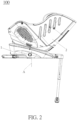
- FIG. 2 is a lateral diagram of the child safety seat 100 in a rear facing state according to the first embodiment of the present invention.
- FIG. 3 is a diagram of partial structure the child safety seat 100 according to the first embodiment of the present invention.
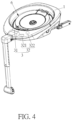
- FIG. 4 is another diagram of partial structure of the child safety seat 100 according to the first embodiment of the present invention.
- the child safety seat 100 includes a base 1, a seat body 2 and a notifying system 3.
- the seat body 2 is disposed on the base 1 and movable relative to the base 1 between a front facing position as shown in FIG.
- the notifying system 3 includes an actuated device 31, an actuating component 4 and a notifying device 32.
- the actuated device 31 is disposed on the base 1.
- the actuating component 4 is disposed on the seat body 2 and configured to actuate the actuated device 31 when the seat body 2 reaches the front facing position.
- the notifying device 32 is electrically connected to the actuated device 31 and configured to generate a notifying signal when the actuated device 31 is actuated by the actuating component 4.
- the notifying signal can be a loop signal which indicates at least one of a height, a weight and an age of a child corresponding to the seat body 2 reaching the front facing position, so that a caregiver can determine whether the child safety seat 100 is suitable for his/her child according to the notifying signal easily without placing his/her child in the child safety seat 100.
- the notifying signal can indicate a child corresponding to the seat body 2 reaching the front facing position should be more than 76 centimeters, or more than 18 kilograms, or more than 2 years old.
- the present invention is not limited to this embodiment.
- the actuated device and the actuating component can be respectively installed on the seat body and the base, and such configuration also can allow the notifying device to generate the notifying signal when the seat body reaches the front facing position.
- the notifying device can be configured to generate the notifying signal when the seat body reaches the rear facing position, and the notifying signal can indicate a child corresponding to the seat body reaching the rear facing position should be less than 76 centimeters, or less than 18 kilograms, or less than 2 years old.
- the actuated device 31 is a non-contact sensor.
- the actuated device 31 can be an infrared light sensor.
- the actuated device 31 is the non-contact sensor, there is no need with physical contact between the actuated device 31 and the actuating device 4. Therefore, collision damage of the actuated device 31 can be effectively prevented.
- the present invention is not limited to this embodiment.
- the actuated device in order to allow the actuated device to be actuated by the actuating component more responsively, the actuated device can be a mechanical switch, and the actuated device and the notifying device can be electrically connected in a series connection.
- the actuated device actuated by the actuating component and the notifying device can be in a closed circuit, so that the notifying device is powered on to generate the notifying signal by an external power source, wherein the external power source can be a battery installed in the seat body or the base, or an automotive battery of a vehicle.
- the notifying device 32 includes a signal processing component 321 electrically connected to the actuated device 31, and a notifying component 322 electrically connected to the signal processing component 321.
- the signal processing component 321 is configured to process an actuating signal generated from the actuated device 31 when the actuated device 31 is actuated by the actuating component 4, and the notifying component 322 is configured to receive the actuating signal processed by the signal processing component 321 to generate the notifying signal.
- any two of the actuated device 31, the signal processing component 321 and the notifying component 322 can be connected in a wired connection for ensuring stable and fast signal transmission in the notifying system.
- the present invention is not limited to this embodiment.
- any two of the actuated device, the signal processing component and the notifying component can be connected in a wireless connection for making structure of the notifying system compact and easy to arrange.
- the notifying component 322 can be an audio notifying component, such as an audio speaker, or a video notifying component, such as a liquid-crystal display device.
- the present invention is not limited to this embodiment.
- the signal processing device 321 and the notifying component 322 can be installed on the base 1.
- the configuration of the signal processing device and the notifying component is not limited to this embodiment. It depends on practical demands.
- the signal processing device and the notifying component can be installed on the seat body.
- the signal processing device and the notifying component can be respectively installed on the base and the seat body.
- the signal processing device and the notifying component can be respectively installed on the seat body and the base.
- the seat body 2 is pivoted to the base 1 around a pivoting axis A, so that the actuated device 31 can be actuated by the actuating component 4 when the seat body 2 is pivoted relative to the base 1 around the pivoting axis A to reach the front facing position as shown in FIG. 1 , which makes the switching movement of the seat body 2 relative to the base 1 between the front facing position and the rear facing position more convenient and effort saving.
- a pivoting disc 5 is disposed on the seat body 2, and a pivoting recess 6 is formed on the base 1.
- the pivoting disc 5 is located at a bottom portion of the seat body 2, and the pivoting axis A passes through a center of the pivoting disc 5 for preventing an unbalanced force caused by rotation of the pivoting disc 5.
- the pivoting recess 6 is located at a top portion of the base 1, and the pivoting disc 5 is pivotally disposed inside the pivoting recess 6.
- the configuration of the pivoting disc 5 and the pivoting recess 6 makes structure of the child safety seat 100 more compact and aesthetic and makes a pivoting movement of the seat body 2 relative to the base 1 more reliable.
- the pivoting disc can be disposed on the base, and the pivoting recess can be formed on the seat body.
- the actuating component 4 in order to achieve the actuating component 4 to actuate the actuated device 31 responsively when the seat body 2 is pivoted to the front facing position, the actuating component 4 can be disposed on a front side of the pivoting disc 5, and the actuated device 31 can be disposed on a front side of the base 1.
- the present invention is not limited to this embodiment.
- the actuating component can be disposed on the front side of the base, and the actuated device can be disposed on the front side of the pivoting disc.
- the actuating component can be configured to actuate the actuated device when the seat body is installed on the base at the front facing position and/or the rear facing position, i.e., the seat body can be switched between the front facing position and the rear facing position by disassembling and assembling.
- the actuating component 4 located at the front side of the pivoting disc 5 can actuate the actuated device 31 located at the front side of the base 1, so that the actuated device 31 can generate the actuating signal and then transmit the actuating signal to the signal processing device 321.
- the signal processing device 321 After the signal processing device 321 receives the actuating signal, the signal processing device 321 can process the actuating signal and then transmit the processed actuating signal to the notifying component 322.
- the notifying component 322 can generate the notifying signal to indicate at least one of a height, a weight and an age of a child corresponding to the seat body 2 reaching the front facing position, so that the caregiver can determine whether the child safety seat 100 is suitable for his/her child according to the notifying signal easily without placing his/her child in the child safety seat 100.
- the caregiver would like to switch the child safety seat 100 from the front facing state as shown in FIG. 1 to the rear facing state as shown in FIG. 2 , the caregiver can pivot the seat body 2 around the pivoting axis A in a first pivoting direction B or a second pivoting direction C relative to the base 1.
- the seat body 2 is pivoted to the rear facing position as shown in FIG.
- the actuating component 4 is pivoted to a position adjacent to a rear side of the base 1 and away from the actuated device 31. At this moment, the actuated device 31 cannot be actuated, and therefore, the notifying device 32 cannot generate the notifying signal.
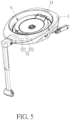
- FIG. 5 is a diagram of partial structure of a child safety seat according to a second embodiment of the present invention.
- the actuated device 31 is disposed on the rear side of the base 1, and therefore, the actuating component can actuate the actuated device 31 to allow the notifying device 32 to generate the notifying signal when the seat body is pivotally switched to the rear facing position relative to the base 1 around the pivoting axis.
- the actuating component When the seat body is pivotally switched to the front facing position relative to the base 1 around the pivoting axis, the actuating component is moved to a position adjacent to the front side of the base 1 and away from the actuated device 31, so that the notifying device 32 cannot generate the notifying signal.
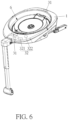
- FIG. 6 is a diagram of partial structure of a child safety seat according to a third embodiment of the present invention.
- the child safety seat includes one actuating component disposed on the front side of the pivoting disc on the seat body, and two actuated devices 31 respectively disposed on the front side and the rear side of the base 1, and therefore, the actuating component on the pivoting disc can actuate the front actuated device 31 or the rear actuated device 31 to allow the notifying device 32 to generate the corresponding notifying signal when the seat body is pivotally switched to the front facing position or the rear facing position relative to the base 1 around the pivoting axis.
- the front actuated device 31 and the rear actuated device 31 can be configured to generate different actuating signals to allow the notifying device 32 to generate different notifying signals to indicate corresponding information for the caregiver.
- the present invention is not limited to this embodiment.
- the child safety seat in order to allow the notifying device to generate the corresponding notifying signal when the seat body is pivotally switched to the front facing position or the rear facing position relative to the base, can include two actuating components respectively disposed on the front side and a rear side of the pivoting disc on the seat body, and one actuated device disposed on the front side of the base. Therefore, the front actuating component can actuate actuated device when the seat body is located at the front facing position, and the rear actuating component can actuate actuated device when the seat body is located at the rear facing position.
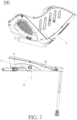
- FIG. 7 is an exploded diagram of a child safety seat according to a fourth embodiment of the present invention.
- the actuating component 4 is disposed on the front side of the base 1, and the actuated device 31 is disposed on the front side of the pivoting disc 5. Therefore, the actuating component 4 can actuate the actuated device 31 to allow the notifying device to generate the notifying signal when the seat body 2 is pivotally switched to the front facing position relative to the base 1 around the pivoting axis A.
- FIG. 8 is an exploded diagram of the child safety seat 100 according to a fifth embodiment of the present invention.
- the pivoting disc 5 is disposed on the base 1, and the pivoting recess 6 is formed on the seat body 2.
- the actuating component 4 is disposed on the front side of the pivoting disc 4, and the two actuated devices 31 are respectively located at the front side and the rear side of the seat body 2.
- the actuating component 4 can actuate the front actuated device 31 or the rear actuated device 31 to allow the notifying device to generate the corresponding notifying signal when the seat body 2 is pivotally switched to the front facing position or the rear facing position relative to the base 1 around the pivoting axis A.
- the child safety seat includes the notifying system which includes the actuated device installed on one of the base and the seat body, the actuating component installed on another one of the base and the seat body and configured to actuate the actuated device when the seat body reaches at least one of the front facing position and the rear facing position, and the notifying device electrically connected to the actuated device and configured to generate the notifying signal when the actuated device is actuated by the actuating component.
- the notifying signal indicates at least one of the height, the weight and the age of the child corresponding to the seat body reaching the front facing position or the rear facing position. A caregiver can determine whether the child safety seat is suitable for his/her child according to the notifying signal easily without placing his/her child in the child safety seat. Therefore, the present invention is with an easy operation, rapid notification, and improved fool proof design.
Landscapes
- Engineering & Computer Science (AREA)
- Aviation & Aerospace Engineering (AREA)
- Transportation (AREA)
- Mechanical Engineering (AREA)
- Health & Medical Sciences (AREA)
- Child & Adolescent Psychology (AREA)
- General Health & Medical Sciences (AREA)
- Seats For Vehicles (AREA)
- Lock And Its Accessories (AREA)
Description
- The present invention relates to a child safety seat.
- With increase in vehicle population, it becomes an important topic to ensure safety of a child riding in a vehicle. A child safety seat is a child product, which is specifically designed for a child riding in a vehicle to ensure the child's safety.
- An installation method of a child safety seat is usually determined according to a weight, a height or an age of a child, i.e., in order to provide a better protection for children of different ages, having different weights and heights, a child safety seat can be installed in different manners. For example, some associations and regulations recommend that a child safety seat can be installed at a rear facing position, i.e., the child safety seat faces toward a rear side of a vehicle, when a child is less than 2 years old, or less than 76 centimeters, or less than 18 kilograms, and a child safety seat can be installed at a front facing position, i.e., the child safety seat faces toward a front side of a vehicle, when a child is more than 2 years old, or more than 76 centimeters, or more than 18 kilograms.
- In order to ensure a child safety seat to be installed at a proper position, there is a child safety seat equipped with an indication device. The indication device measures a weight of a child sitting in the child safety seat and provides an indication of installation of the child safety seat at a front facing position or a rear facing position after logical judgment. However, the aforementioned operation of the indication device is complicated and takes times. Furthermore, if the indication device indicates that the child safety seat is located at an improper position, a caregiver has to remove his/her child from the child safety seat before adjusting the child safety seat, or adjust the child safety seat with the child, which not only requires more efforts and brings difficulty in adjustment but also tends to make the child cry.
-
US 4 936 629 A discloses that a swiveling infant car seat with an infant restraint device comprises a pedestal formed with a circular opening bordered by a lip, to which a base is connected for distribution loads therebetween. A substantially circular base for a seat is formed with a groove around the periphery of an annulus, which receives the inner periphery of the anchor plate therein to the seat to the pedestal. The base includes a pivot plate, an anchor plate, and a retainer plate for holding the pivot plate in swiveling relationship with the anchor plate. The seat is reclinably attached to the base for orientation at select inclinations, and a latch mounted on the pedestal is engageable with the base to selectively hold the seat in either a forward facing or a rearward facing orientation. A rearward member is also mounted to the rear of the pedestal and a pair of diametrically opposite, grooved receptacles are provided on the base for receiving a tongue of the rearward member to maintain the integrity of the seat in the event the automobile, in which the seat is mounted is involved in a collision. -
JP 2018 122618 A -
US 2015/091348 A1 discloses a child seat or child restraining system for securing a child to a vehicle seat, and method of installing the car seat are provided. The child seat, which is configured to be secured to a seat of a vehicle, includes: a seat base secured to the seat of the vehicle; a child receiving portion supported by the seat base; and a belt tensioning system incorporated into the seat base. The belt tensioning system is configured to receive a belt that couples the seat base to the seat of the vehicle. The child seat also includes a controller operatively connected to the belt tensioning system and configured to automatically actuate the belt tensioning system. The belt tensioning system may be configured to drive the at least one belt in a pay-in direction to apply tension to the at least one belt. -
US 2016/207497 A1 discloses child restraint systems. The child restraint systems include a base portion and a seat portion. The child restraint systems include at least one motor-driven subsystem for installing the child restraint system in a vehicle, such as a motor-driven tensioner and/or motor-driven leveler. The motor-driven subsystems are coupled to a power source, such as a battery pack. The child restraint systems also include a microcontroller, which can be coupled to the power source and a motor for the motor-driven subsystem. The base portion and/or the seat portion include a plurality of sensors in communication with microcontroller. The sensors detect an installation condition and/or state of the child restraint system. -
WO 00/01561 A1 - This is mind, the present invention aims at providing a child safety seat with an easy operation, rapid notification, and improved fool proof design.
- This is achieved by a child safety seat according to
claim 1. The dependent claims pertain to corresponding further developments and improvements. - As will be seen more clearly from the detail description following below, the claimed child safety seat includes a base, a seat body and a notifying system. The seat body is disposed on the base and movable relative to the base between a front facing position and a rear facing position. The notifying system includes an actuated device, an actuating component and a notifying device. The actuated device is disposed on one of the base and the seat body. The actuating component is disposed on another one of the base and the seat body and configured to actuate the actuated device when the seat body reaches at least one of the front facing position and the rear facing position. The notifying device is electrically connected to the actuated device and configured to generate a notifying signal when the actuated device is actuated by the actuating component. The notifying signal indicates at least one of a height, a weight and an age of a child corresponding to the seat body reaching the front facing position or the rear facing position.
- According to an embodiment of the present invention, the seat body is pivoted to the base around a pivoting axis, and the actuating component actuates the actuated device when the seat body pivots relative to the base around the pivoting axis to reach at least one of the front facing position and the rear facing position.
- According to an embodiment of the present invention, a pivoting disc is disposed on one of the base and the seat body, and the pivoting axis passes through a center of the pivoting disc.
- According to an embodiment of the present invention, a pivoting recess is formed on another one of the base and the seat body, and the pivoting disc is pivotally disposed inside the pivoting recess.
- According to an embodiment of the present invention, the actuating component is disposed on at least one of a front side and a rear side of one of the pivoting disc and the base, and the actuated device is disposed on at least one of a front side and a rear side of another one of the pivoting disc and the base.
- According to an embodiment of the present invention, the actuating component actuates the actuated device when the seat body is detachably installed on the base and reaches at least one of the front facing position and the rear facing position.
- According to an embodiment of the present invention, the notifying device includes a signal processing component electrically connected to the actuated device, and a notifying component electrically connected to the signal processing component. The signal processing component is configured to process an actuating signal generated from the actuated device when the actuated device is actuated by the actuating component, and the notifying component is configured to receive the actuating signal processed by the signal processing component to generate the notifying signal.
- According to an embodiment of the present invention, any two of the actuated device, the signal processing component and the notifying component are connected in a wired connection or a wireless connection.
- According to an embodiment of the present invention, the signal processing component is disposed on one of the base and the seat body, and the notifying component is disposed on another one of the base and the seat body.
- According to an embodiment of the present invention, the signal processing component and the notifying component are disposed on one of the base and the seat body.
- According to an embodiment of the present invention, the notifying component is an audio notifying component or a video notifying component.
- According to an embodiment of the present invention, the actuated device and the notifying device are electrically connected in a series connection, and when the seat body reaches at least one of the front facing position and the rear facing position, the actuated device and the notifying device are in a closed circuit, so that the notifying device is powered on to generate the notifying signal.
- According to an embodiment of the present invention, the actuated device is a non-contact sensor or a mechanical switch.
- In summary, in the present invention, the child safety seat includes the notifying system, which includes the actuated device installed on one of the base and the seat body, the actuating component installed on another one of the base and the seat body and configured to actuate the actuated device when the seat body reaches at least one of the front facing position and the rear facing position, and the notifying device electrically connected to the actuated device and configured to generate the notifying signal when the actuated device is actuated by the actuating component. Furthermore, the notifying signal indicates at least one of the height, the weight and the age of the child corresponding to the seat body reaching the front facing position or the rear facing position. A caregiver can determine whether the child safety seat is suitable for his/her child according to the notifying signal easily without placing his/her child in the child safety seat. Therefore, the present invention is with an easy operation, rapid notification, and improved fool proof design.
- These and other objectives of the present invention will no doubt become obvious to those of ordinary skill in the art after reading the following detailed description of the preferred embodiment that is illustrated in the various figures and drawings.
- In the following, the invention is further illustrated by way of example, taking reference to the accompanying drawings. Thereof
-
FIG. 1 is a lateral diagram of a child safety seat in a front facing state according to a first embodiment of the present invention, -
FIG. 2 is a lateral diagram of the child safety seat in a rear facing state according to the first embodiment of the present invention. -
FIG. 3 is a diagram of partial structure the child safety seat according to the first embodiment of the present invention, -
FIG. 4 is another diagram of partial structure the child safety seat according to the first embodiment of the present invention, -
FIG. 5 is a diagram of partial structure of a child safety seat according to a second embodiment of the present invention, -
FIG. 6 is a diagram of partial structure of a child safety seat according to a third embodiment of the present invention, -
FIG. 7 is an exploded diagram of a child safety seat according to a fourth embodiment of the present invention, and -
FIG. 8 is an exploded diagram of a child safety seat according to a fifth embodiment of the present invention. - In order to illustrate technical specifications and structural features as well as achieved purposes and effects of the present invention, relevant embodiments and figures are described as follows.
- In the following detailed description of the preferred embodiments, reference is made to the accompanying drawings which form a part hereof, and in which is shown by way of illustration specific embodiments in which the invention may be practiced. In this regard, directional terminology, such as "top", "bottom", "front", "back", etc., is used with reference to the orientation of the Figure(s) being described. The components of the present invention can be positioned in a number of different orientations. As such, the directional terminology is used for purposes of illustration and is in no way limiting. Accordingly, the drawings and descriptions will be regarded as illustrative in nature and not as restrictive. Also, the term "connect" is intended to mean either an indirect or direct electrical/mechanical connection. Thus, if a first device is connected to a second device, that connection may be through a direct electrical/mechanical connection, or through an indirect electrical/mechanical connection via other devices and connections.
- The child safety seat of the present invention includes a base, a seat body disposed on the base and movable relative to the base between a front facing position and a rear facing position, and a notifying system. The notifying system includes an actuated device installed on one of the base and the seat body, an actuating component installed on another one of the base and the seat body and configured to actuate the actuated device when the seat body reaches at least one of the front facing position and the rear facing position, and a notifying device electrically connected to the actuated device and configured to generate the notifying signal when the actuated device is actuated by the actuating component.
- Specifically, the seat body can be pivotally disposed on the base around a pivoting axis, so that the actuating component can actuate the actuated device when the seat body is pivoted relative to the base to reach at least one of the front facing position and the rear facing position, which achieves a convenient switching movement of the seat body relative to the base between the front facing position and the rear facing position. However, the present invention is not limited to this embodiment. For example, in another embodiment, the actuating component can be configured to actuate the actuated device when the seat body is detachably installed on the base at the front facing position and/or the rear facing position, i.e., the seat body can be switched between the front facing position and the rear facing position by disassembling and assembling.
- Furthermore, specifically, the actuated device can be a non-contact sensor or a mechanical switch. When the actuated device is a non-contact sensor, e.g., a light sensor, the actuating component can be a mechanical structure, e.g., an actuating block or an actuating hole for blocking or reflecting light emitted from the light sensor to actuate the non-contact sensor. When the actuated device is a mechanical switch, the actuating component can be an actuating block for switching on or switching off the mechanical switch.
- Detailed description for the following preferred embodiments is provided as follows. However, the present invention is not limited to the following preferred embodiments. Any child safety seat including the base, the seat body and the notifying system is included within the scope of the present invention.
- Please refer to
FIG. 1 to FIG. 4 .FIG. 1 is a lateral diagram of achild safety seat 100 in a front facing state according to a first embodiment of the present invention.FIG. 2 is a lateral diagram of thechild safety seat 100 in a rear facing state according to the first embodiment of the present invention.FIG. 3 is a diagram of partial structure thechild safety seat 100 according to the first embodiment of the present invention.FIG. 4 is another diagram of partial structure of thechild safety seat 100 according to the first embodiment of the present invention. As shown inFIG. 1 to FIG. 4 , thechild safety seat 100 includes abase 1, aseat body 2 and a notifyingsystem 3. Theseat body 2 is disposed on thebase 1 and movable relative to thebase 1 between a front facing position as shown inFIG. 1 and a rear facing position as shown inFIG. 2 . The notifyingsystem 3 includes an actuateddevice 31, anactuating component 4 and a notifyingdevice 32. The actuateddevice 31 is disposed on thebase 1. Theactuating component 4 is disposed on theseat body 2 and configured to actuate the actuateddevice 31 when theseat body 2 reaches the front facing position. The notifyingdevice 32 is electrically connected to the actuateddevice 31 and configured to generate a notifying signal when the actuateddevice 31 is actuated by theactuating component 4. The notifying signal can be a loop signal which indicates at least one of a height, a weight and an age of a child corresponding to theseat body 2 reaching the front facing position, so that a caregiver can determine whether thechild safety seat 100 is suitable for his/her child according to the notifying signal easily without placing his/her child in thechild safety seat 100. For example, the notifying signal can indicate a child corresponding to theseat body 2 reaching the front facing position should be more than 76 centimeters, or more than 18 kilograms, or more than 2 years old. - However, the present invention is not limited to this embodiment. For example, in another embodiment, the actuated device and the actuating component can be respectively installed on the seat body and the base, and such configuration also can allow the notifying device to generate the notifying signal when the seat body reaches the front facing position. Furthermore, in another embodiment, the notifying device can be configured to generate the notifying signal when the seat body reaches the rear facing position, and the notifying signal can indicate a child corresponding to the seat body reaching the rear facing position should be less than 76 centimeters, or less than 18 kilograms, or less than 2 years old.
- Specifically, as shown in
FIG. 3 andFIG. 4 , the actuateddevice 31 is a non-contact sensor. Preferably, in this embodiment, the actuateddevice 31 can be an infrared light sensor. When the actuateddevice 31 is the non-contact sensor, there is no need with physical contact between the actuateddevice 31 and theactuating device 4. Therefore, collision damage of the actuateddevice 31 can be effectively prevented. However, the present invention is not limited to this embodiment. For example, in another embodiment, in order to allow the actuated device to be actuated by the actuating component more responsively, the actuated device can be a mechanical switch, and the actuated device and the notifying device can be electrically connected in a series connection. When the seat body reaches at least one of the front facing position and the rear facing position, the actuated device actuated by the actuating component and the notifying device can be in a closed circuit, so that the notifying device is powered on to generate the notifying signal by an external power source, wherein the external power source can be a battery installed in the seat body or the base, or an automotive battery of a vehicle. - Furthermore, as shown in
FIG. 3 andFIG. 4 , the notifyingdevice 32 includes asignal processing component 321 electrically connected to the actuateddevice 31, and a notifyingcomponent 322 electrically connected to thesignal processing component 321. Thesignal processing component 321 is configured to process an actuating signal generated from the actuateddevice 31 when the actuateddevice 31 is actuated by theactuating component 4, and the notifyingcomponent 322 is configured to receive the actuating signal processed by thesignal processing component 321 to generate the notifying signal. More specifically, in this embodiment, any two of the actuateddevice 31, thesignal processing component 321 and the notifyingcomponent 322 can be connected in a wired connection for ensuring stable and fast signal transmission in the notifying system. However, the present invention is not limited to this embodiment. For example, in another embodiment, any two of the actuated device, the signal processing component and the notifying component can be connected in a wireless connection for making structure of the notifying system compact and easy to arrange. - Preferably, in this embodiment, the notifying
component 322 can be an audio notifying component, such as an audio speaker, or a video notifying component, such as a liquid-crystal display device. However, the present invention is not limited to this embodiment. - Preferably, in this embodiment, in order to make the structure the notifying
system 3 compact, as shown inFIG. 4 , thesignal processing device 321 and the notifyingcomponent 322 can be installed on thebase 1. However, the configuration of the signal processing device and the notifying component is not limited to this embodiment. It depends on practical demands. For example, in another embodiment, the signal processing device and the notifying component can be installed on the seat body. Alternatively, in another embodiment, the signal processing device and the notifying component can be respectively installed on the base and the seat body. Alternatively, in another embodiment, the signal processing device and the notifying component can be respectively installed on the seat body and the base. - As shown in
FIG. 1 to FIG. 4 , theseat body 2 is pivoted to thebase 1 around a pivoting axis A, so that the actuateddevice 31 can be actuated by theactuating component 4 when theseat body 2 is pivoted relative to thebase 1 around the pivoting axis A to reach the front facing position as shown inFIG. 1 , which makes the switching movement of theseat body 2 relative to thebase 1 between the front facing position and the rear facing position more convenient and effort saving. - Specifically in this embodiment, a
pivoting disc 5 is disposed on theseat body 2, and apivoting recess 6 is formed on thebase 1. Thepivoting disc 5 is located at a bottom portion of theseat body 2, and the pivoting axis A passes through a center of thepivoting disc 5 for preventing an unbalanced force caused by rotation of thepivoting disc 5. The pivotingrecess 6 is located at a top portion of thebase 1, and thepivoting disc 5 is pivotally disposed inside the pivotingrecess 6. The configuration of thepivoting disc 5 and thepivoting recess 6 makes structure of thechild safety seat 100 more compact and aesthetic and makes a pivoting movement of theseat body 2 relative to thebase 1 more reliable. However, the present invention is not limited to this embodiment. For example, in another embodiment, the pivoting disc can be disposed on the base, and the pivoting recess can be formed on the seat body. - Furthermore, as shown in
FIG. 3 andFIG. 4 , in order to achieve theactuating component 4 to actuate the actuateddevice 31 responsively when theseat body 2 is pivoted to the front facing position, theactuating component 4 can be disposed on a front side of thepivoting disc 5, and the actuateddevice 31 can be disposed on a front side of thebase 1. However, the present invention is not limited to this embodiment. For example, in another embodiment, the actuating component can be disposed on the front side of the base, and the actuated device can be disposed on the front side of the pivoting disc. Alternatively, in another embodiment, the actuating component can be configured to actuate the actuated device when the seat body is installed on the base at the front facing position and/or the rear facing position, i.e., the seat body can be switched between the front facing position and the rear facing position by disassembling and assembling. - Detailed description of operational principle of the
child safety seat 100 is provided as follows. When theseat body 2 is located at the front facing position as shown inFIG. 1 , theactuating component 4 located at the front side of thepivoting disc 5 can actuate the actuateddevice 31 located at the front side of thebase 1, so that the actuateddevice 31 can generate the actuating signal and then transmit the actuating signal to thesignal processing device 321. After thesignal processing device 321 receives the actuating signal, thesignal processing device 321 can process the actuating signal and then transmit the processed actuating signal to the notifyingcomponent 322. After the notifyingcomponent 322 receives the processed actuating signal, the notifyingcomponent 322 can generate the notifying signal to indicate at least one of a height, a weight and an age of a child corresponding to theseat body 2 reaching the front facing position, so that the caregiver can determine whether thechild safety seat 100 is suitable for his/her child according to the notifying signal easily without placing his/her child in thechild safety seat 100. When the caregiver would like to switch thechild safety seat 100 from the front facing state as shown inFIG. 1 to the rear facing state as shown inFIG. 2 , the caregiver can pivot theseat body 2 around the pivoting axis A in a first pivoting direction B or a second pivoting direction C relative to thebase 1. When theseat body 2 is pivoted to the rear facing position as shown inFIG. 2 , theactuating component 4 is pivoted to a position adjacent to a rear side of thebase 1 and away from the actuateddevice 31. At this moment, the actuateddevice 31 cannot be actuated, and therefore, the notifyingdevice 32 cannot generate the notifying signal. - Please refer to
FIG. 5. FIG. 5 is a diagram of partial structure of a child safety seat according to a second embodiment of the present invention. As shown inFIG. 5 , different from the first embodiment, in this embodiment, the actuateddevice 31 is disposed on the rear side of thebase 1, and therefore, the actuating component can actuate the actuateddevice 31 to allow the notifyingdevice 32 to generate the notifying signal when the seat body is pivotally switched to the rear facing position relative to thebase 1 around the pivoting axis. When the seat body is pivotally switched to the front facing position relative to thebase 1 around the pivoting axis, the actuating component is moved to a position adjacent to the front side of thebase 1 and away from the actuateddevice 31, so that the notifyingdevice 32 cannot generate the notifying signal. - Please refer to
FIG. 6. FIG. 6 is a diagram of partial structure of a child safety seat according to a third embodiment of the present invention. As shown inFIG. 6 , different from the aforementioned embodiments, in this embodiment, the child safety seat includes one actuating component disposed on the front side of the pivoting disc on the seat body, and two actuateddevices 31 respectively disposed on the front side and the rear side of thebase 1, and therefore, the actuating component on the pivoting disc can actuate the front actuateddevice 31 or the rear actuateddevice 31 to allow the notifyingdevice 32 to generate the corresponding notifying signal when the seat body is pivotally switched to the front facing position or the rear facing position relative to thebase 1 around the pivoting axis. Furthermore, preferably, in this embodiment, the front actuateddevice 31 and the rear actuateddevice 31 can be configured to generate different actuating signals to allow the notifyingdevice 32 to generate different notifying signals to indicate corresponding information for the caregiver. However, the present invention is not limited to this embodiment. For example, in another embodiment, in order to allow the notifying device to generate the corresponding notifying signal when the seat body is pivotally switched to the front facing position or the rear facing position relative to the base, the child safety seat can include two actuating components respectively disposed on the front side and a rear side of the pivoting disc on the seat body, and one actuated device disposed on the front side of the base. Therefore, the front actuating component can actuate actuated device when the seat body is located at the front facing position, and the rear actuating component can actuate actuated device when the seat body is located at the rear facing position. - Please refer to
FIG. 7.FIG. 7 is an exploded diagram of a child safety seat according to a fourth embodiment of the present invention. As shown inFIG. 7 , different from the aforementioned embodiments, in this embodiment, theactuating component 4 is disposed on the front side of thebase 1, and the actuateddevice 31 is disposed on the front side of thepivoting disc 5. Therefore, theactuating component 4 can actuate the actuateddevice 31 to allow the notifying device to generate the notifying signal when theseat body 2 is pivotally switched to the front facing position relative to thebase 1 around the pivoting axis A. - Please refer to
FIG. 8. FIG. 8 is an exploded diagram of thechild safety seat 100 according to a fifth embodiment of the present invention. As shown inFIG. 8 , different from the aforementioned embodiments, in this embodiment, thepivoting disc 5 is disposed on thebase 1, and thepivoting recess 6 is formed on theseat body 2. Furthermore, theactuating component 4 is disposed on the front side of thepivoting disc 4, and the two actuateddevices 31 are respectively located at the front side and the rear side of theseat body 2. Therefore, theactuating component 4 can actuate the front actuateddevice 31 or the rear actuateddevice 31 to allow the notifying device to generate the corresponding notifying signal when theseat body 2 is pivotally switched to the front facing position or the rear facing position relative to thebase 1 around the pivoting axis A. - In contrast to the prior art, in the present invention, the child safety seat includes the notifying system which includes the actuated device installed on one of the base and the seat body, the actuating component installed on another one of the base and the seat body and configured to actuate the actuated device when the seat body reaches at least one of the front facing position and the rear facing position, and the notifying device electrically connected to the actuated device and configured to generate the notifying signal when the actuated device is actuated by the actuating component. Furthermore, the notifying signal indicates at least one of the height, the weight and the age of the child corresponding to the seat body reaching the front facing position or the rear facing position. A caregiver can determine whether the child safety seat is suitable for his/her child according to the notifying signal easily without placing his/her child in the child safety seat. Therefore, the present invention is with an easy operation, rapid notification, and improved fool proof design.
- Those skilled in the art will readily observe that numerous modifications and alterations of the device and method may be made while retaining the teachings of the invention which is defined by the appended claims.
Claims (13)
- A child safety seat (100) comprising:a base (1);a seat body (2) disposed on the base (1) and movable relative to the base (1) between a front facing position and a rear facing position; anda notifying system (3) comprising:an actuated device (31) disposed on one of the base (1) and the seat body (2);an actuating component (4) disposed on another one of the base (1) and the seat body (2) and configured to actuate the actuated device (31) when the seat body (2) reaches at least one of the front facing position and the rear facing position; anda notifying device (32) electrically connected to the actuated device (31) and configured to generate a notifying signal when the actuated device (31) is actuated by the actuating component (4),characterized in that the notifying signal indicates at least one of a height, a weight and an age of a child corresponding to the seat body (2) reaching the front facing position or the rear facing position.
- The child safety seat (100) of claim 1, characterized in that the seat body (2) is pivoted to the base (1) around a pivoting axis (A), and the actuating component (4) actuates the actuated device (31) when the seat body (2) pivots relative to the base (1) around the pivoting axis (A) to reach at least one of the front facing position and the rear facing position.
- The child safety seat (100) of claim 2, characterized in that a pivoting disc (5) is disposed on one of the base (1) and the seat body (2), and the pivoting axis (A) passes through a center of the pivoting disc (5).
- The child safety seat (100) of claim 3, characterized in that a pivoting recess (6) is formed on another one of the base (1) and the seat body (2), and the pivoting disc (5) is pivotally disposed inside the pivoting recess (6).
- The child safety seat (100) of any one of claims 3 and 4, characterized in that the actuating component (4) is disposed on at least one of a front side and a rear side of one of the pivoting disc (5) and the base (1), and the actuated device (31) is disposed on at least one of a front side and a rear side of another one of the pivoting disc (5) and the base (1).
- The child safety seat (100) of claim 1, characterized in that the actuating component (4) actuates the actuated device (31) when the seat body (2) is detachably installed on the base (1) and reaches at least one of the front facing position and the rear facing position.
- The child safety seat (100) of any one of claims 1 to 6, characterized in that the notifying device (32) comprises a signal processing component (321) electrically connected to the actuated device (31), and a notifying component (322) electrically connected to the signal processing component (321), the signal processing component (321) is configured to process an actuating signal generated from the actuated device (31) when the actuated device (31) is actuated by the actuating component (4), and the notifying component (322) is configured to receive the actuating signal processed by the signal processing component (321) to generate the notifying signal.
- The child safety seat (100) of claim 7, characterized in that any two of the actuated device (31), the signal processing component (321) and the notifying component (322) are connected in a wired connection or a wireless connection.
- The child safety seat (100) of any one of claims 7 and 8, characterized in that the signal processing component (321) is disposed on one of the base (1) and the seat body (2), and the notifying component (322) is disposed on another one of the base (1) and the seat body (2).
- The child safety seat (100) of any one of claims 7 and 8, characterized in that the signal processing component (321) and the notifying component (322) are disposed on one of the base (1) and the seat body (2).
- The child safety seat (100) of any one of claims 7 to 10, characterized in that the notifying component (322) is an audio notifying component (322) or a video notifying component (322).
- The child safety seat (100) of any one of claims 1 to 11, characterized in that the actuated device (31) and the notifying device (32) are electrically connected in a series connection, and when the seat body (2) reaches at least one of the front facing position and the rear facing position, the actuated device (31) and the notifying device (32) are in a closed circuit, so that the notifying device (32) is powered on to generate the notifying signal.
- The child safety seat (100) of any one of claims 1 to 12, characterized in that the actuated device (31) is a non-contact sensor or a mechanical switch.
Priority Applications (1)
| Application Number | Priority Date | Filing Date | Title |
|---|---|---|---|
| EP24173378.1A EP4385815A3 (en) | 2019-09-19 | 2020-09-17 | Child safety seat |
Applications Claiming Priority (1)
| Application Number | Priority Date | Filing Date | Title |
|---|---|---|---|
| CN201910891408.5A CN112519643B (en) | 2019-09-19 | 2019-09-19 | Child safety seat |
Related Child Applications (2)
| Application Number | Title | Priority Date | Filing Date |
|---|---|---|---|
| EP24173378.1A Division EP4385815A3 (en) | 2019-09-19 | 2020-09-17 | Child safety seat |
| EP24173378.1A Division-Into EP4385815A3 (en) | 2019-09-19 | 2020-09-17 | Child safety seat |
Publications (2)
| Publication Number | Publication Date |
|---|---|
| EP3795415A1 EP3795415A1 (en) | 2021-03-24 |
| EP3795415B1 true EP3795415B1 (en) | 2024-06-12 |
Family
ID=72560404
Family Applications (2)
| Application Number | Title | Priority Date | Filing Date |
|---|---|---|---|
| EP24173378.1A Pending EP4385815A3 (en) | 2019-09-19 | 2020-09-17 | Child safety seat |
| EP20196579.5A Active EP3795415B1 (en) | 2019-09-19 | 2020-09-17 | Child safety seat |
Family Applications Before (1)
| Application Number | Title | Priority Date | Filing Date |
|---|---|---|---|
| EP24173378.1A Pending EP4385815A3 (en) | 2019-09-19 | 2020-09-17 | Child safety seat |
Country Status (5)
| Country | Link |
|---|---|
| US (4) | US11485263B2 (en) |
| EP (2) | EP4385815A3 (en) |
| CN (2) | CN112519643B (en) |
| ES (1) | ES2987145T3 (en) |
| TW (2) | TWI810483B (en) |
Families Citing this family (10)
| Publication number | Priority date | Publication date | Assignee | Title |
|---|---|---|---|---|
| CN112519643B (en) | 2019-09-19 | 2023-04-18 | 宝钜瑞士股份有限公司 | Child safety seat |
| US11427114B2 (en) * | 2020-08-14 | 2022-08-30 | Evenflo Company, Inc. | Booster seat to base attachment mechanism |
| CN119872366A (en) * | 2021-10-27 | 2025-04-25 | 明门瑞士股份有限公司 | Child safety seat and misuse prevention control method thereof |
| IT202200013201A1 (en) * | 2022-06-22 | 2023-12-22 | Artsana Spa | Sensorized car seat |
| IT202200013195A1 (en) * | 2022-06-22 | 2023-12-22 | Artsana Spa | Sensorized car seat |
| US11701985B1 (en) * | 2022-09-10 | 2023-07-18 | Ken Cabral | Pivoting car seat mount |
| US12365270B2 (en) | 2023-07-26 | 2025-07-22 | GM Global Technology Operations LLC | Child seat installation with vehicle belt checking device |
| US12172553B1 (en) * | 2023-07-26 | 2024-12-24 | GM Global Technology Operations LLC | Child seat installation checking device |
| CN220764159U (en) * | 2023-09-11 | 2024-04-12 | 宁波宝贝第一母婴用品有限公司 | Supporting leg structure and child safety seat |
| CN224028847U (en) * | 2024-04-19 | 2026-03-24 | 明门(中国)幼童用品有限公司 | Child safety seats |
Citations (2)
| Publication number | Priority date | Publication date | Assignee | Title |
|---|---|---|---|---|
| WO2000001561A1 (en) * | 1998-07-07 | 2000-01-13 | Trw Automotive Electronics & Components Gmbh & Co.Kg | Device for monitoring the locking position of a connecting device for fixing a child seat |
| US20160207497A1 (en) * | 2015-01-15 | 2016-07-21 | Thorley Industries Llc | Child restraint system |
Family Cites Families (28)
| Publication number | Priority date | Publication date | Assignee | Title |
|---|---|---|---|---|
| US4936629A (en) * | 1988-10-07 | 1990-06-26 | Rock-A-Bye Restraint Company, Inc. | Swiveling infant car seat |
| DE4409971C2 (en) * | 1994-03-23 | 1996-01-18 | Daimler Benz Ag | Device for recognizing a child seat strapped to the front passenger seat of a motor vehicle |
| JP3288002B2 (en) * | 1997-01-08 | 2002-06-04 | アップリカ▲葛▼西株式会社 | Automotive child safety seats |
| US5790031A (en) * | 1997-01-13 | 1998-08-04 | Trw Inc. | Apparatus and method for sensing a rearward facing child seat with error detection |
| US6357790B1 (en) * | 2000-01-20 | 2002-03-19 | Trw Inc. | Apparatus for use with child a child seat in a vehicle having a seat belt webbing pretensioner |
| DE10249465A1 (en) * | 2002-10-24 | 2004-05-06 | Robert Bosch Gmbh | Child seat and method for child seat recognition |
| US7481492B2 (en) * | 2006-09-01 | 2009-01-27 | Cosco Management, Inc. | Child restraint with swiveling juvenile seat and swivel-direction controller |
| US20080164990A1 (en) * | 2007-01-05 | 2008-07-10 | Anderson Monte S | Apparatus and Method for Automobile Child Seat Alarms |
| EP1970247A1 (en) | 2007-03-15 | 2008-09-17 | Team-Tex | Device for mounting a child seat in a car and a child seat |
| US9443411B2 (en) * | 2007-12-14 | 2016-09-13 | Cars-N-Kids Llc | Systems and methods for networking of car seat monitoring systems utilizing a central hub |
| US20130201013A1 (en) * | 2007-12-14 | 2013-08-08 | Cars-N-Kids Llc | Systems and Methods for Notifying a Caregiver of the Condition of a Child in a Vehicular Child Safety Restraint |
| US8179274B2 (en) * | 2009-04-02 | 2012-05-15 | Ford Global Technologies, Llc | Child seat monitoring system |
| CN201856670U (en) * | 2010-01-08 | 2011-06-08 | 中山市隆成日用制品有限公司 | Warning device for buckling of safe seat and base |
| US8702169B2 (en) * | 2010-06-04 | 2014-04-22 | Arvin Grande Abadilla | Method and apparatus for an infant safety seat |
| US9751433B2 (en) * | 2011-10-06 | 2017-09-05 | Thorley Industries Llc | Child restraint system with user interface |
| US9487111B2 (en) * | 2014-03-24 | 2016-11-08 | Jason Lake | Spinning infant car seat |
| US20160304004A1 (en) * | 2015-04-16 | 2016-10-20 | Thorley Industries Llc | Child restraint system |
| US9550454B1 (en) * | 2015-07-02 | 2017-01-24 | Horse Sense Shoes, Llc | Systems and methods for removable vehicle seat sensor |
| US10449876B2 (en) * | 2015-12-29 | 2019-10-22 | Jeffrey H. Lonstein | Multi-position chair with tiltable, rotatable and slidable seat shell |
| US10322651B2 (en) * | 2016-06-14 | 2019-06-18 | Wonderland Switzerland Ag | Child safety seat |
| US10259345B2 (en) | 2016-10-07 | 2019-04-16 | Dali, Llc | Integrated safety seat |
| JP2018122618A (en) * | 2017-01-30 | 2018-08-09 | 株式会社カーメイト | child seat |
| CN207790409U (en) | 2017-12-29 | 2018-08-31 | 好孩子儿童用品有限公司 | A kind of child safety seat |
| CN208559099U (en) | 2018-04-27 | 2019-03-01 | 上海沃雨电子科技有限公司 | Feedback device for child safety seat |
| CN109177830B (en) * | 2018-09-29 | 2024-07-02 | 好孩子儿童用品有限公司 | Child safety seat with alarm system |
| CN109624803B (en) * | 2018-12-28 | 2025-01-10 | 麦克英孚(宁波)婴童用品有限公司 | Child safety seat, rotation adjustment mechanism and adjustment method thereof |
| CN112519643B (en) | 2019-09-19 | 2023-04-18 | 宝钜瑞士股份有限公司 | Child safety seat |
| US20210188136A1 (en) * | 2019-12-19 | 2021-06-24 | Ellen Goldman | Adjustable child seat |
-
2019
- 2019-09-19 CN CN201910891408.5A patent/CN112519643B/en active Active
- 2019-09-19 CN CN202310325513.9A patent/CN116215337A/en active Pending
-
2020
- 2020-09-16 TW TW109131866A patent/TWI810483B/en active
- 2020-09-16 TW TW112123878A patent/TWI878936B/en active
- 2020-09-17 ES ES20196579T patent/ES2987145T3/en active Active
- 2020-09-17 EP EP24173378.1A patent/EP4385815A3/en active Pending
- 2020-09-17 US US17/023,377 patent/US11485263B2/en active Active
- 2020-09-17 EP EP20196579.5A patent/EP3795415B1/en active Active
-
2022
- 2022-08-22 US US17/892,149 patent/US11648862B2/en active Active
-
2023
- 2023-04-06 US US18/131,374 patent/US12030414B2/en active Active
-
2024
- 2024-06-13 US US18/741,800 patent/US12319186B2/en active Active
Patent Citations (2)
| Publication number | Priority date | Publication date | Assignee | Title |
|---|---|---|---|---|
| WO2000001561A1 (en) * | 1998-07-07 | 2000-01-13 | Trw Automotive Electronics & Components Gmbh & Co.Kg | Device for monitoring the locking position of a connecting device for fixing a child seat |
| US20160207497A1 (en) * | 2015-01-15 | 2016-07-21 | Thorley Industries Llc | Child restraint system |
Also Published As
| Publication number | Publication date |
|---|---|
| EP4385815A2 (en) | 2024-06-19 |
| ES2987145T3 (en) | 2024-11-13 |
| EP4385815A3 (en) | 2024-10-02 |
| CN116215337A (en) | 2023-06-06 |
| CN112519643A (en) | 2021-03-19 |
| US20230242024A1 (en) | 2023-08-03 |
| US12030414B2 (en) | 2024-07-09 |
| TWI878936B (en) | 2025-04-01 |
| CN112519643B (en) | 2023-04-18 |
| US20210086676A1 (en) | 2021-03-25 |
| EP3795415A1 (en) | 2021-03-24 |
| US20220388434A1 (en) | 2022-12-08 |
| US11648862B2 (en) | 2023-05-16 |
| US20240326672A1 (en) | 2024-10-03 |
| US11485263B2 (en) | 2022-11-01 |
| US12319186B2 (en) | 2025-06-03 |
| TW202112580A (en) | 2021-04-01 |
| TWI810483B (en) | 2023-08-01 |
| TW202339997A (en) | 2023-10-16 |
Similar Documents
| Publication | Publication Date | Title |
|---|---|---|
| EP3795415B1 (en) | Child safety seat | |
| US20080246316A1 (en) | Child restraint system including tension sensor and status indicator | |
| EP1755916B1 (en) | Child restraint system comprising weight sensor | |
| US7021709B2 (en) | Child restraint seat anchors with integrated child seat detectors | |
| EP3825172B1 (en) | Child safety seat with installation prompt function and installation prompt method therefor | |
| US20140085070A1 (en) | Systems and Methods for Monitoring the Orientation, Tensioning, and Installation of a Child Safety Restraint | |
| US10157534B2 (en) | Multi-function retroreflective on-board alert system | |
| ES3030860T3 (en) | Child safety seat alarm system | |
| WO2015107485A1 (en) | Child protection system and apparatus | |
| CA2858249A1 (en) | Systems and methods for monitoring the orientation, tensioning, and installation of a child safety restraint | |
| US20210229626A1 (en) | Anchor attachment detection sensors | |
| US20140266662A1 (en) | Portable Baby Car Seat Occupancy Alarm Device | |
| JP4211182B2 (en) | Child seat device for vehicle | |
| WO2024112607A1 (en) | Child seat illumination system | |
| JP6944338B2 (en) | ISOFIX child seat | |
| US20100283596A1 (en) | Child carrier latch warning system | |
| US7100980B2 (en) | Vehicle seat assembly having a vehicle occupant sensing system with a biasing pad | |
| US12252092B2 (en) | Seat belt device for vehicle and method of mounting same | |
| CN217048349U (en) | Safety seat | |
| EP1498704B1 (en) | Vehicle occupant weight estimation apparatus | |
| JPS6220736A (en) | Seat device for vehicle | |
| JPH09254739A (en) | Vehicle seat safety posture discrimination method, vehicle posture discriminating mechanism, and vehicle airbag control device | |
| KR20240071241A (en) | Preventing apparatus for impoperly wearing a seat belt | |
| JP2004050900A (en) | Angle indicator and child seat | |
| CN121404097A (en) | Child safety seats and their control methods |
Legal Events
| Date | Code | Title | Description |
|---|---|---|---|
| PUAI | Public reference made under article 153(3) epc to a published international application that has entered the european phase |
Free format text: ORIGINAL CODE: 0009012 |
|
| STAA | Information on the status of an ep patent application or granted ep patent |
Free format text: STATUS: THE APPLICATION HAS BEEN PUBLISHED |
|
| AK | Designated contracting states |
Kind code of ref document: A1 Designated state(s): AL AT BE BG CH CY CZ DE DK EE ES FI FR GB GR HR HU IE IS IT LI LT LU LV MC MK MT NL NO PL PT RO RS SE SI SK SM TR |
|
| AX | Request for extension of the european patent |
Extension state: BA ME |
|
| STAA | Information on the status of an ep patent application or granted ep patent |
Free format text: STATUS: REQUEST FOR EXAMINATION WAS MADE |
|
| 17P | Request for examination filed |
Effective date: 20210413 |
|
| RBV | Designated contracting states (corrected) |
Designated state(s): AL AT BE BG CH CY CZ DE DK EE ES FI FR GB GR HR HU IE IS IT LI LT LU LV MC MK MT NL NO PL PT RO RS SE SI SK SM TR |
|
| STAA | Information on the status of an ep patent application or granted ep patent |
Free format text: STATUS: EXAMINATION IS IN PROGRESS |
|
| 17Q | First examination report despatched |
Effective date: 20220905 |
|
| REG | Reference to a national code |
Ref country code: DE Ref legal event code: R079 Free format text: PREVIOUS MAIN CLASS: B60N0002280000 Ipc: B60N0002260000 Ref document number: 602020032217 Country of ref document: DE |
|
| RIC1 | Information provided on ipc code assigned before grant |
Ipc: B60N 2/28 20060101ALI20231121BHEP Ipc: B60N 2/26 20060101AFI20231121BHEP |
|
| GRAP | Despatch of communication of intention to grant a patent |
Free format text: ORIGINAL CODE: EPIDOSNIGR1 |
|
| STAA | Information on the status of an ep patent application or granted ep patent |
Free format text: STATUS: GRANT OF PATENT IS INTENDED |
|
| INTG | Intention to grant announced |
Effective date: 20240103 |
|
| P01 | Opt-out of the competence of the unified patent court (upc) registered |
Effective date: 20240202 |
|
| GRAS | Grant fee paid |
Free format text: ORIGINAL CODE: EPIDOSNIGR3 |
|
| GRAA | (expected) grant |
Free format text: ORIGINAL CODE: 0009210 |
|
| STAA | Information on the status of an ep patent application or granted ep patent |
Free format text: STATUS: THE PATENT HAS BEEN GRANTED |
|
| AK | Designated contracting states |
Kind code of ref document: B1 Designated state(s): AL AT BE BG CH CY CZ DE DK EE ES FI FR GB GR HR HU IE IS IT LI LT LU LV MC MK MT NL NO PL PT RO RS SE SI SK SM TR |
|
| REG | Reference to a national code |
Ref country code: GB Ref legal event code: FG4D |
|
| REG | Reference to a national code |
Ref country code: CH Ref legal event code: EP |
|
| REG | Reference to a national code |
Ref country code: IE Ref legal event code: FG4D |
|
| REG | Reference to a national code |
Ref country code: DE Ref legal event code: R096 Ref document number: 602020032217 Country of ref document: DE |
|
| REG | Reference to a national code |
Ref country code: NL Ref legal event code: FP |
|
| PG25 | Lapsed in a contracting state [announced via postgrant information from national office to epo] |
Ref country code: BG Free format text: LAPSE BECAUSE OF FAILURE TO SUBMIT A TRANSLATION OF THE DESCRIPTION OR TO PAY THE FEE WITHIN THE PRESCRIBED TIME-LIMIT Effective date: 20240612 |
|
| PG25 | Lapsed in a contracting state [announced via postgrant information from national office to epo] |
Ref country code: FI Free format text: LAPSE BECAUSE OF FAILURE TO SUBMIT A TRANSLATION OF THE DESCRIPTION OR TO PAY THE FEE WITHIN THE PRESCRIBED TIME-LIMIT Effective date: 20240612 Ref country code: HR Free format text: LAPSE BECAUSE OF FAILURE TO SUBMIT A TRANSLATION OF THE DESCRIPTION OR TO PAY THE FEE WITHIN THE PRESCRIBED TIME-LIMIT Effective date: 20240612 |
|
| REG | Reference to a national code |
Ref country code: LT Ref legal event code: MG9D |
|
| PG25 | Lapsed in a contracting state [announced via postgrant information from national office to epo] |
Ref country code: GR Free format text: LAPSE BECAUSE OF FAILURE TO SUBMIT A TRANSLATION OF THE DESCRIPTION OR TO PAY THE FEE WITHIN THE PRESCRIBED TIME-LIMIT Effective date: 20240913 |
|
| PG25 | Lapsed in a contracting state [announced via postgrant information from national office to epo] |
Ref country code: LV Free format text: LAPSE BECAUSE OF FAILURE TO SUBMIT A TRANSLATION OF THE DESCRIPTION OR TO PAY THE FEE WITHIN THE PRESCRIBED TIME-LIMIT Effective date: 20240612 |
|
| PG25 | Lapsed in a contracting state [announced via postgrant information from national office to epo] |
Ref country code: NO Free format text: LAPSE BECAUSE OF FAILURE TO SUBMIT A TRANSLATION OF THE DESCRIPTION OR TO PAY THE FEE WITHIN THE PRESCRIBED TIME-LIMIT Effective date: 20240912 Ref country code: LV Free format text: LAPSE BECAUSE OF FAILURE TO SUBMIT A TRANSLATION OF THE DESCRIPTION OR TO PAY THE FEE WITHIN THE PRESCRIBED TIME-LIMIT Effective date: 20240612 Ref country code: HR Free format text: LAPSE BECAUSE OF FAILURE TO SUBMIT A TRANSLATION OF THE DESCRIPTION OR TO PAY THE FEE WITHIN THE PRESCRIBED TIME-LIMIT Effective date: 20240612 Ref country code: GR Free format text: LAPSE BECAUSE OF FAILURE TO SUBMIT A TRANSLATION OF THE DESCRIPTION OR TO PAY THE FEE WITHIN THE PRESCRIBED TIME-LIMIT Effective date: 20240913 Ref country code: FI Free format text: LAPSE BECAUSE OF FAILURE TO SUBMIT A TRANSLATION OF THE DESCRIPTION OR TO PAY THE FEE WITHIN THE PRESCRIBED TIME-LIMIT Effective date: 20240612 Ref country code: BG Free format text: LAPSE BECAUSE OF FAILURE TO SUBMIT A TRANSLATION OF THE DESCRIPTION OR TO PAY THE FEE WITHIN THE PRESCRIBED TIME-LIMIT Effective date: 20240612 Ref country code: RS Free format text: LAPSE BECAUSE OF FAILURE TO SUBMIT A TRANSLATION OF THE DESCRIPTION OR TO PAY THE FEE WITHIN THE PRESCRIBED TIME-LIMIT Effective date: 20240912 |
|
| REG | Reference to a national code |
Ref country code: ES Ref legal event code: FG2A Ref document number: 2987145 Country of ref document: ES Kind code of ref document: T3 Effective date: 20241113 |
|
| REG | Reference to a national code |
Ref country code: AT Ref legal event code: MK05 Ref document number: 1693958 Country of ref document: AT Kind code of ref document: T Effective date: 20240612 |
|
| PG25 | Lapsed in a contracting state [announced via postgrant information from national office to epo] |
Ref country code: PT Free format text: LAPSE BECAUSE OF FAILURE TO SUBMIT A TRANSLATION OF THE DESCRIPTION OR TO PAY THE FEE WITHIN THE PRESCRIBED TIME-LIMIT Effective date: 20241014 |
|
| PG25 | Lapsed in a contracting state [announced via postgrant information from national office to epo] |
Ref country code: PT Free format text: LAPSE BECAUSE OF FAILURE TO SUBMIT A TRANSLATION OF THE DESCRIPTION OR TO PAY THE FEE WITHIN THE PRESCRIBED TIME-LIMIT Effective date: 20241014 |
|
| PG25 | Lapsed in a contracting state [announced via postgrant information from national office to epo] |
Ref country code: PL Free format text: LAPSE BECAUSE OF FAILURE TO SUBMIT A TRANSLATION OF THE DESCRIPTION OR TO PAY THE FEE WITHIN THE PRESCRIBED TIME-LIMIT Effective date: 20240612 |
|
| PG25 | Lapsed in a contracting state [announced via postgrant information from national office to epo] |
Ref country code: EE Free format text: LAPSE BECAUSE OF FAILURE TO SUBMIT A TRANSLATION OF THE DESCRIPTION OR TO PAY THE FEE WITHIN THE PRESCRIBED TIME-LIMIT Effective date: 20240612 |
|
| PG25 | Lapsed in a contracting state [announced via postgrant information from national office to epo] |
Ref country code: AT Free format text: LAPSE BECAUSE OF FAILURE TO SUBMIT A TRANSLATION OF THE DESCRIPTION OR TO PAY THE FEE WITHIN THE PRESCRIBED TIME-LIMIT Effective date: 20240612 Ref country code: IS Free format text: LAPSE BECAUSE OF FAILURE TO SUBMIT A TRANSLATION OF THE DESCRIPTION OR TO PAY THE FEE WITHIN THE PRESCRIBED TIME-LIMIT Effective date: 20241012 |
|
| PG25 | Lapsed in a contracting state [announced via postgrant information from national office to epo] |
Ref country code: CZ Free format text: LAPSE BECAUSE OF FAILURE TO SUBMIT A TRANSLATION OF THE DESCRIPTION OR TO PAY THE FEE WITHIN THE PRESCRIBED TIME-LIMIT Effective date: 20240612 |
|
| PG25 | Lapsed in a contracting state [announced via postgrant information from national office to epo] |
Ref country code: RO Free format text: LAPSE BECAUSE OF FAILURE TO SUBMIT A TRANSLATION OF THE DESCRIPTION OR TO PAY THE FEE WITHIN THE PRESCRIBED TIME-LIMIT Effective date: 20240612 Ref country code: SK Free format text: LAPSE BECAUSE OF FAILURE TO SUBMIT A TRANSLATION OF THE DESCRIPTION OR TO PAY THE FEE WITHIN THE PRESCRIBED TIME-LIMIT Effective date: 20240612 |
|
| PG25 | Lapsed in a contracting state [announced via postgrant information from national office to epo] |
Ref country code: SM Free format text: LAPSE BECAUSE OF FAILURE TO SUBMIT A TRANSLATION OF THE DESCRIPTION OR TO PAY THE FEE WITHIN THE PRESCRIBED TIME-LIMIT Effective date: 20240612 |
|
| PG25 | Lapsed in a contracting state [announced via postgrant information from national office to epo] |
Ref country code: SM Free format text: LAPSE BECAUSE OF FAILURE TO SUBMIT A TRANSLATION OF THE DESCRIPTION OR TO PAY THE FEE WITHIN THE PRESCRIBED TIME-LIMIT Effective date: 20240612 Ref country code: SK Free format text: LAPSE BECAUSE OF FAILURE TO SUBMIT A TRANSLATION OF THE DESCRIPTION OR TO PAY THE FEE WITHIN THE PRESCRIBED TIME-LIMIT Effective date: 20240612 Ref country code: RO Free format text: LAPSE BECAUSE OF FAILURE TO SUBMIT A TRANSLATION OF THE DESCRIPTION OR TO PAY THE FEE WITHIN THE PRESCRIBED TIME-LIMIT Effective date: 20240612 Ref country code: PL Free format text: LAPSE BECAUSE OF FAILURE TO SUBMIT A TRANSLATION OF THE DESCRIPTION OR TO PAY THE FEE WITHIN THE PRESCRIBED TIME-LIMIT Effective date: 20240612 Ref country code: IS Free format text: LAPSE BECAUSE OF FAILURE TO SUBMIT A TRANSLATION OF THE DESCRIPTION OR TO PAY THE FEE WITHIN THE PRESCRIBED TIME-LIMIT Effective date: 20241012 Ref country code: EE Free format text: LAPSE BECAUSE OF FAILURE TO SUBMIT A TRANSLATION OF THE DESCRIPTION OR TO PAY THE FEE WITHIN THE PRESCRIBED TIME-LIMIT Effective date: 20240612 Ref country code: CZ Free format text: LAPSE BECAUSE OF FAILURE TO SUBMIT A TRANSLATION OF THE DESCRIPTION OR TO PAY THE FEE WITHIN THE PRESCRIBED TIME-LIMIT Effective date: 20240612 Ref country code: AT Free format text: LAPSE BECAUSE OF FAILURE TO SUBMIT A TRANSLATION OF THE DESCRIPTION OR TO PAY THE FEE WITHIN THE PRESCRIBED TIME-LIMIT Effective date: 20240612 |
|
| PG25 | Lapsed in a contracting state [announced via postgrant information from national office to epo] |
Ref country code: IT Free format text: LAPSE BECAUSE OF FAILURE TO SUBMIT A TRANSLATION OF THE DESCRIPTION OR TO PAY THE FEE WITHIN THE PRESCRIBED TIME-LIMIT Effective date: 20240612 |
|
| REG | Reference to a national code |
Ref country code: DE Ref legal event code: R097 Ref document number: 602020032217 Country of ref document: DE |
|
| PG25 | Lapsed in a contracting state [announced via postgrant information from national office to epo] |
Ref country code: DK Free format text: LAPSE BECAUSE OF FAILURE TO SUBMIT A TRANSLATION OF THE DESCRIPTION OR TO PAY THE FEE WITHIN THE PRESCRIBED TIME-LIMIT Effective date: 20240612 |
|
| PLBE | No opposition filed within time limit |
Free format text: ORIGINAL CODE: 0009261 |
|
| STAA | Information on the status of an ep patent application or granted ep patent |
Free format text: STATUS: NO OPPOSITION FILED WITHIN TIME LIMIT |
|
| PG25 | Lapsed in a contracting state [announced via postgrant information from national office to epo] |
Ref country code: MC Free format text: LAPSE BECAUSE OF FAILURE TO SUBMIT A TRANSLATION OF THE DESCRIPTION OR TO PAY THE FEE WITHIN THE PRESCRIBED TIME-LIMIT Effective date: 20240612 |
|
| PG25 | Lapsed in a contracting state [announced via postgrant information from national office to epo] |
Ref country code: LU Free format text: LAPSE BECAUSE OF NON-PAYMENT OF DUE FEES Effective date: 20240917 |
|
| 26N | No opposition filed |
Effective date: 20250313 |
|
| REG | Reference to a national code |
Ref country code: BE Ref legal event code: MM Effective date: 20240930 |
|
| PG25 | Lapsed in a contracting state [announced via postgrant information from national office to epo] |
Ref country code: BE Free format text: LAPSE BECAUSE OF NON-PAYMENT OF DUE FEES Effective date: 20240930 |
|
| PGFP | Annual fee paid to national office [announced via postgrant information from national office to epo] |
Ref country code: NL Payment date: 20250528 Year of fee payment: 6 |
|
| PGFP | Annual fee paid to national office [announced via postgrant information from national office to epo] |
Ref country code: FR Payment date: 20250523 Year of fee payment: 6 |
|
| PG25 | Lapsed in a contracting state [announced via postgrant information from national office to epo] |
Ref country code: IE Free format text: LAPSE BECAUSE OF NON-PAYMENT OF DUE FEES Effective date: 20240917 |
|
| PG25 | Lapsed in a contracting state [announced via postgrant information from national office to epo] |
Ref country code: SE Free format text: LAPSE BECAUSE OF FAILURE TO SUBMIT A TRANSLATION OF THE DESCRIPTION OR TO PAY THE FEE WITHIN THE PRESCRIBED TIME-LIMIT Effective date: 20240612 |
|
| REG | Reference to a national code |
Ref country code: CH Ref legal event code: U11 Free format text: ST27 STATUS EVENT CODE: U-0-0-U10-U11 (AS PROVIDED BY THE NATIONAL OFFICE) Effective date: 20251001 |
|
| PGFP | Annual fee paid to national office [announced via postgrant information from national office to epo] |
Ref country code: DE Payment date: 20250528 Year of fee payment: 6 |
|
| PGFP | Annual fee paid to national office [announced via postgrant information from national office to epo] |
Ref country code: GB Payment date: 20250701 Year of fee payment: 6 |
|
| PGFP | Annual fee paid to national office [announced via postgrant information from national office to epo] |
Ref country code: CH Payment date: 20251001 Year of fee payment: 6 |
|
| PG25 | Lapsed in a contracting state [announced via postgrant information from national office to epo] |
Ref country code: CY Free format text: LAPSE BECAUSE OF FAILURE TO SUBMIT A TRANSLATION OF THE DESCRIPTION OR TO PAY THE FEE WITHIN THE PRESCRIBED TIME-LIMIT; INVALID AB INITIO Effective date: 20200917 |
|
| PGFP | Annual fee paid to national office [announced via postgrant information from national office to epo] |
Ref country code: ES Payment date: 20251013 Year of fee payment: 6 |
|
| PG25 | Lapsed in a contracting state [announced via postgrant information from national office to epo] |
Ref country code: HU Free format text: LAPSE BECAUSE OF FAILURE TO SUBMIT A TRANSLATION OF THE DESCRIPTION OR TO PAY THE FEE WITHIN THE PRESCRIBED TIME-LIMIT; INVALID AB INITIO Effective date: 20200917 |