EP3793853B1 - Electrical heater device, in particular having a ptc effect - Google Patents
Electrical heater device, in particular having a ptc effect Download PDFInfo
- Publication number
- EP3793853B1 EP3793853B1 EP19730548.5A EP19730548A EP3793853B1 EP 3793853 B1 EP3793853 B1 EP 3793853B1 EP 19730548 A EP19730548 A EP 19730548A EP 3793853 B1 EP3793853 B1 EP 3793853B1
- Authority
- EP
- European Patent Office
- Prior art keywords
- electrode
- electrical
- meshed structure
- heating
- distribution
- Prior art date
- Legal status (The legal status is an assumption and is not a legal conclusion. Google has not performed a legal analysis and makes no representation as to the accuracy of the status listed.)
- Active
Links
Images











Classifications
-
- B—PERFORMING OPERATIONS; TRANSPORTING
- B60—VEHICLES IN GENERAL
- B60K—ARRANGEMENT OR MOUNTING OF PROPULSION UNITS OR OF TRANSMISSIONS IN VEHICLES; ARRANGEMENT OR MOUNTING OF PLURAL DIVERSE PRIME-MOVERS IN VEHICLES; AUXILIARY DRIVES FOR VEHICLES; INSTRUMENTATION OR DASHBOARDS FOR VEHICLES; ARRANGEMENTS IN CONNECTION WITH COOLING, AIR INTAKE, GAS EXHAUST OR FUEL SUPPLY OF PROPULSION UNITS IN VEHICLES
- B60K13/00—Arrangement in connection with combustion air intake or gas exhaust of propulsion units
- B60K13/04—Arrangement in connection with combustion air intake or gas exhaust of propulsion units concerning exhaust
-
- B—PERFORMING OPERATIONS; TRANSPORTING
- B60—VEHICLES IN GENERAL
- B60K—ARRANGEMENT OR MOUNTING OF PROPULSION UNITS OR OF TRANSMISSIONS IN VEHICLES; ARRANGEMENT OR MOUNTING OF PLURAL DIVERSE PRIME-MOVERS IN VEHICLES; AUXILIARY DRIVES FOR VEHICLES; INSTRUMENTATION OR DASHBOARDS FOR VEHICLES; ARRANGEMENTS IN CONNECTION WITH COOLING, AIR INTAKE, GAS EXHAUST OR FUEL SUPPLY OF PROPULSION UNITS IN VEHICLES
- B60K15/00—Arrangement in connection with fuel supply of combustion engines or other fuel consuming energy converters, e.g. fuel cells; Mounting or construction of fuel tanks
- B60K15/03—Fuel tanks
-
- F—MECHANICAL ENGINEERING; LIGHTING; HEATING; WEAPONS; BLASTING
- F24—HEATING; RANGES; VENTILATING
- F24H—FLUID HEATERS, e.g. WATER OR AIR HEATERS, HAVING HEAT-GENERATING MEANS, e.g. HEAT PUMPS, IN GENERAL
- F24H1/00—Water heaters, e.g. boilers, continuous-flow heaters or water-storage heaters
- F24H1/0072—Special adaptations
- F24H1/009—Special adaptations for vehicle systems
-
- F—MECHANICAL ENGINEERING; LIGHTING; HEATING; WEAPONS; BLASTING
- F24—HEATING; RANGES; VENTILATING
- F24H—FLUID HEATERS, e.g. WATER OR AIR HEATERS, HAVING HEAT-GENERATING MEANS, e.g. HEAT PUMPS, IN GENERAL
- F24H1/00—Water heaters, e.g. boilers, continuous-flow heaters or water-storage heaters
- F24H1/18—Water-storage heaters
- F24H1/181—Construction of the tank
-
- F—MECHANICAL ENGINEERING; LIGHTING; HEATING; WEAPONS; BLASTING
- F24—HEATING; RANGES; VENTILATING
- F24H—FLUID HEATERS, e.g. WATER OR AIR HEATERS, HAVING HEAT-GENERATING MEANS, e.g. HEAT PUMPS, IN GENERAL
- F24H1/00—Water heaters, e.g. boilers, continuous-flow heaters or water-storage heaters
- F24H1/18—Water-storage heaters
- F24H1/185—Water-storage heaters using electric energy supply
-
- F—MECHANICAL ENGINEERING; LIGHTING; HEATING; WEAPONS; BLASTING
- F24—HEATING; RANGES; VENTILATING
- F24H—FLUID HEATERS, e.g. WATER OR AIR HEATERS, HAVING HEAT-GENERATING MEANS, e.g. HEAT PUMPS, IN GENERAL
- F24H3/00—Air heaters
- F24H3/02—Air heaters with forced circulation
- F24H3/04—Air heaters with forced circulation the air being in direct contact with the heating medium, e.g. electric heating element
- F24H3/0405—Air heaters with forced circulation the air being in direct contact with the heating medium, e.g. electric heating element using electric energy supply, e.g. the heating medium being a resistive element; Heating by direct contact, i.e. with resistive elements, electrodes and fins being bonded together without additional element in-between
- F24H3/0429—For vehicles
-
- F—MECHANICAL ENGINEERING; LIGHTING; HEATING; WEAPONS; BLASTING
- F24—HEATING; RANGES; VENTILATING
- F24H—FLUID HEATERS, e.g. WATER OR AIR HEATERS, HAVING HEAT-GENERATING MEANS, e.g. HEAT PUMPS, IN GENERAL
- F24H9/00—Details
- F24H9/18—Arrangement or mounting of grates or heating means
- F24H9/1809—Arrangement or mounting of grates or heating means for water heaters
- F24H9/1818—Arrangement or mounting of electric heating means
- F24H9/1827—Positive temperature coefficient [PTC] resistor
-
- F—MECHANICAL ENGINEERING; LIGHTING; HEATING; WEAPONS; BLASTING
- F24—HEATING; RANGES; VENTILATING
- F24H—FLUID HEATERS, e.g. WATER OR AIR HEATERS, HAVING HEAT-GENERATING MEANS, e.g. HEAT PUMPS, IN GENERAL
- F24H9/00—Details
- F24H9/18—Arrangement or mounting of grates or heating means
- F24H9/1854—Arrangement or mounting of grates or heating means for air heaters
- F24H9/1863—Arrangement or mounting of electric heating means
- F24H9/1872—PTC resistor
-
- H—ELECTRICITY
- H05—ELECTRIC TECHNIQUES NOT OTHERWISE PROVIDED FOR
- H05B—ELECTRIC HEATING; ELECTRIC LIGHT SOURCES NOT OTHERWISE PROVIDED FOR; CIRCUIT ARRANGEMENTS FOR ELECTRIC LIGHT SOURCES, IN GENERAL
- H05B3/00—Ohmic-resistance heating
- H05B3/02—Details
- H05B3/03—Electrodes
-
- H—ELECTRICITY
- H05—ELECTRIC TECHNIQUES NOT OTHERWISE PROVIDED FOR
- H05B—ELECTRIC HEATING; ELECTRIC LIGHT SOURCES NOT OTHERWISE PROVIDED FOR; CIRCUIT ARRANGEMENTS FOR ELECTRIC LIGHT SOURCES, IN GENERAL
- H05B3/00—Ohmic-resistance heating
- H05B3/20—Heating elements having extended surface area substantially in a two-dimensional [2D] plane, e.g. plate-heater
- H05B3/22—Heating elements having extended surface area substantially in a two-dimensional [2D] plane, e.g. plate-heater non-flexible
- H05B3/28—Heating elements having extended surface area substantially in a two-dimensional [2D] plane, e.g. plate-heater non-flexible heating conductor embedded in insulating material
- H05B3/286—Heating elements having extended surface area substantially in a two-dimensional [2D] plane, e.g. plate-heater non-flexible heating conductor embedded in insulating material the insulating material being an organic material, e.g. plastic
-
- H—ELECTRICITY
- H05—ELECTRIC TECHNIQUES NOT OTHERWISE PROVIDED FOR
- H05B—ELECTRIC HEATING; ELECTRIC LIGHT SOURCES NOT OTHERWISE PROVIDED FOR; CIRCUIT ARRANGEMENTS FOR ELECTRIC LIGHT SOURCES, IN GENERAL
- H05B3/00—Ohmic-resistance heating
- H05B3/40—Heating elements having the shape of rods or tubes
- H05B3/42—Heating elements having the shape of rods or tubes non-flexible
- H05B3/48—Heating elements having the shape of rods or tubes non-flexible heating conductor embedded in insulating material
- H05B3/50—Heating elements having the shape of rods or tubes non-flexible heating conductor embedded in insulating material heating conductor arranged in metal tubes, the radiating surface having heat-conducting fins
-
- B—PERFORMING OPERATIONS; TRANSPORTING
- B60—VEHICLES IN GENERAL
- B60K—ARRANGEMENT OR MOUNTING OF PROPULSION UNITS OR OF TRANSMISSIONS IN VEHICLES; ARRANGEMENT OR MOUNTING OF PLURAL DIVERSE PRIME-MOVERS IN VEHICLES; AUXILIARY DRIVES FOR VEHICLES; INSTRUMENTATION OR DASHBOARDS FOR VEHICLES; ARRANGEMENTS IN CONNECTION WITH COOLING, AIR INTAKE, GAS EXHAUST OR FUEL SUPPLY OF PROPULSION UNITS IN VEHICLES
- B60K1/00—Arrangement or mounting of electrical propulsion units
- B60K2001/008—Arrangement or mounting of electrical propulsion units with means for heating the electrical propulsion units
-
- B—PERFORMING OPERATIONS; TRANSPORTING
- B60—VEHICLES IN GENERAL
- B60K—ARRANGEMENT OR MOUNTING OF PROPULSION UNITS OR OF TRANSMISSIONS IN VEHICLES; ARRANGEMENT OR MOUNTING OF PLURAL DIVERSE PRIME-MOVERS IN VEHICLES; AUXILIARY DRIVES FOR VEHICLES; INSTRUMENTATION OR DASHBOARDS FOR VEHICLES; ARRANGEMENTS IN CONNECTION WITH COOLING, AIR INTAKE, GAS EXHAUST OR FUEL SUPPLY OF PROPULSION UNITS IN VEHICLES
- B60K15/00—Arrangement in connection with fuel supply of combustion engines or other fuel consuming energy converters, e.g. fuel cells; Mounting or construction of fuel tanks
- B60K15/03—Fuel tanks
- B60K2015/03328—Arrangements or special measures related to fuel tanks or fuel handling
- B60K2015/03427—Arrangements or special measures related to fuel tanks or fuel handling for heating fuel, e.g. to avoiding freezing
-
- H—ELECTRICITY
- H05—ELECTRIC TECHNIQUES NOT OTHERWISE PROVIDED FOR
- H05B—ELECTRIC HEATING; ELECTRIC LIGHT SOURCES NOT OTHERWISE PROVIDED FOR; CIRCUIT ARRANGEMENTS FOR ELECTRIC LIGHT SOURCES, IN GENERAL
- H05B2203/00—Aspects relating to Ohmic resistive heating covered by group H05B3/00
- H05B2203/02—Heaters using heating elements having a positive temperature coefficient
-
- H—ELECTRICITY
- H05—ELECTRIC TECHNIQUES NOT OTHERWISE PROVIDED FOR
- H05B—ELECTRIC HEATING; ELECTRIC LIGHT SOURCES NOT OTHERWISE PROVIDED FOR; CIRCUIT ARRANGEMENTS FOR ELECTRIC LIGHT SOURCES, IN GENERAL
- H05B2203/00—Aspects relating to Ohmic resistive heating covered by group H05B3/00
- H05B2203/021—Heaters specially adapted for heating liquids
Definitions
- the present invention relates to electrical heater devices, in particular devices based upon the use of materials distinguished by an electrical resistance with positive temperature coefficient, i.e., ones having a PTC effect, preferably materials of a polymeric type, i.e., polymer-based materials or materials that include at least one polymer.
- the invention has been developed with particular reference to electrical heater devices that are to be associated or integrated in vehicle components, such as heaters for tanks or reservoirs, heaters for filters, heaters for fluid ducts, heaters for batteries, heaters for substances that are subject to freezing or that vary their characteristics as a function of temperature, or again heaters used for heating aeriforms, such as air for environments or air subject to forced circulation on the surface of the aforesaid heaters.
- electrical heater devices that are to be associated or integrated in vehicle components, such as heaters for tanks or reservoirs, heaters for filters, heaters for fluid ducts, heaters for batteries, heaters for substances that are subject to freezing or that vary their characteristics as a function of temperature, or again heaters used for heating aeriforms, such as air for environments or air subject to forced circulation on the surface of the aforesaid heaters.
- the invention finds preferred application in the sector of components of tanks or ducts that are to come into contact with a liquid, for example a liquid necessary for operation of an internal-combustion engine or operation of a system for the treatment or reduction of exhaust gases of an internal-combustion engine, including Water-Injection or Anti-Detonant Injection systems.
- a liquid for example a liquid necessary for operation of an internal-combustion engine or operation of a system for the treatment or reduction of exhaust gases of an internal-combustion engine, including Water-Injection or Anti-Detonant Injection systems.
- the heater devices according to the invention may in any case also find application in contexts different from the preferential ones referred to above.
- WO 2017/077447 A discloses an electrical heater device of the type referred to, which comprises a plurality of heating elements integrated in a component of a motor-vehicle tank.
- Each heating element includes a heating body made of a polymeric material having a PTC effect, set between two parallel electrodes and in contact therewith.
- the electrodes are in the form of a metal foil, are substantially the same as one another, and are possibly provided with holes, and substantially coat the two opposite major faces of the heating body, which has the shape of a substantially parallelepipedal layer.
- This type of structure of the heating element is efficient from the standpoint of heat emission, thanks to the fact that the wide parallel surfaces of the laminar electrodes coat practically entirely the opposite surfaces of the mass of material with PTC effect: in this way, the uniformity and the intensity of the electric current between the electrodes themselves are guaranteed, and hence a good heating power.
- heater devices may be affected by problems linked to deformation (for example, expansion and contraction) of the PTC-effect material and/or of the corresponding metal electrodes, due to the cycles of heating and cooling.
- deformations may lead to relative movements between the parts made of different materials, with possible risks of delamination or peeling of the electrodes off the corresponding faces of the heating body made of the material with PTC effect, with consequent decay of the operating characteristics of the device.
- US2015168014 A upon which the preamble of claim1 is based, discloses a PTC electric heating assembly and an electric heating device.
- the PTC electric heating assembly comprises two electrode plates and a PTC heating module disposed between the two electrode plates, and comprising an insulation fixing frame and a plurality of PTC heating elements, the insulation fixing frame defining a plurality of fixing units and the PTC heating elements being disposed into the fixing units.
- US4700054 A discloses an electrical heater which comprises a fabric prepared from at least one of the electrodes and another elongate element of substantially higher resistance.
- the heater preferably comprises a PTC element, e.g. of a conductive polymer, to render the heater self-regulating.
- the PTC element may be in the form of a fiber forming part of the fabric, or a layer surrounding one of the electrodes, or a laminar element in which the fabric is embedded.
- US5140297 A discloses a conductive polymer PTC compositions having improved properties, especially at voltages of 200 volts or more, if they are very highly cross-linked by means of irradiation, for example to a dosage of at least 50 Mrads, preferably at least 80 Mrads, e.g. 120 to 600 Mrads.
- the cross-linked compositions are particularly useful in circuit protection devices and layered heaters.
- the present invention has basically the aim of overcoming or at least limiting the aforesaid drawback of the prior art, by means of an electrical heater device built in a way that is as a whole simple, inexpensive, and reliable.
- the above and other aims still, which will emerge clearly hereinafter, are achieved according to the present invention by an electrical heater device, a motor-vehicle component, and a method for obtaining an electrical heater device that have the characteristics specified in the annexed claims.
- the claims form an integral part of the technical teaching provided herein in relation to the invention.
- references to "an embodiment” or “one embodiment” within the framework of the present description is intended to indicate that a particular configuration, structure, or characteristic described in relation to the embodiment is comprised in at least one embodiment.
- phrases such as “in an embodiment” or “in one embodiment” and the like that may be present in various points of this description do not necessarily refer to one and the same embodiment.
- particular conformations, structures, or characteristics defined within this description may be combined in any adequate way in one or more embodiments, even different from the ones represented.
- the reference numbers and spatial references (such as “upper”, “lower”, “top”, “bottom”, etc.) used herein are provided merely for convenience and hence do not define the sphere of protection or the scope of the embodiments.
- the generic term "material” is to be understood as including mixtures, compositions, or combinations (for example, multilayer structures) of a number of different materials.
- the term “meshed structure” or “net structure” is understood as indicating a structure formed by the criss-crossing or interweaving of substantially filiform elements, preferably threads or wires, for example like a net, a mesh, a weave, etc.
- a heater device designated as a whole by 1 is a heater device according to possible embodiments of the invention.
- the device 1 belongs to a system on board a motor vehicle, for example a system for heating a stream of air or for heating a liquid that is contained in a tank or reservoir, or that passes through a duct.
- the device 1 comprises a casing body 2, which encloses at least partially at least one heating element, designated as a whole by 10 in Figure 2 .
- the casing body 2 is preferentially provided with an electrical connector 3 for connection to an electric power source.
- the heater device forming the subject of the invention is configured as a stand-alone component, in which case its casing body is preferentially configured for installation and/or fixing in a more complex system, for example, the heating system of a motor-vehicle.
- the device forming the subject of the invention is instead integrated in a component prearranged for performing also functions different from heating of a generic medium, in which case at least part of a body of the component can be exploited for providing at least in part also the casing body of the heater device.
- the device does not need a casing body of its own, for example when a corresponding heating element is exposed directly in a given environment for heating it.
- the distribution element 14 is shaped so as to be connected to a number of threads 16a and/or threads 16b such that the sum of the sections of these threads is such as to allow the electric current necessary for operation of the device 1 and/or of a heating element 10 to circulate without any damage or anomalies.
- the welding operation carried out between the two parts in question is resistance welding, i.e., a method of autogenous pressure welding in which the material is heated via an electrical resistance.
- resistance welding i.e., a method of autogenous pressure welding in which the material is heated via an electrical resistance.
- E1 and E2 are two metal electrodes of a welding apparatus.
- Part C) of Figure 7 illustrates the subsequent step in which the welding electrodes E1 and E2 are moved away from one another, to enable removal of the electrode 12 1 , with the structure 13 and the element 14 now welded together.
- Welding of the distribution element 14 on the meshed structure 13 typically also causes a deformation of the threads of the aforesaid structure, which is, however, substantially circumscribed to the areas of overlapping between the element 14 and the structure 13.
- the degree of the deformation of the threads at the overlapping welded areas will be substantially a function of the welding heat generated and/or of the mechanical pressure between the parts. From Figure 5 , and in particular from the corresponding detail of Figure 8 , it may be noted how at the welding areas 17a the shape of the threads of the meshed structure 13 differs from that of the non-overlapping areas 17b not involved in the welding process.
- Figure 10 exemplifies, via a view similar to that of Figure 9 , the case of a more intense welding carried out between the structure 13 and the element 14, i.e., with a greater generation of heat and/or a higher mechanical pressure at the areas to be welded 17a, and hence with a consequent more marked melting and/or deformation of the threads 16a, 16b, which in these areas 17a come to form a substantially flat grid.
- both of the electrodes 12 1 and 12 2 each comprise at least one corresponding meshed structure 13 and at least one corresponding electrical-distribution element 14, the two electrodes being preferably substantially the same as one another, to the advantage of standardisation of production.
- the electrodes 12 1 and 12 2 may be integrated in the heating body 11 at opposite faces of the body 11, preferably opposite major faces that are substantially parallel to one another, in order to bring about a circulation of the electric current in a plane perpendicular to the aforesaid faces, i.e., through the thickness of the body 11. According to other embodiments, however, the electrodes may be located at one and the same face of the body 11. Moreover, as has been said, it is preferable for the electrodes 12 1 and 12 2 , or at least the respective meshed structures 13 to extend substantially parallel to a corresponding face of the body 11.
- Arrangements of the above type are particularly advantageous when the distribution elements 14 of the two electrodes 12 1 and 12 2 have respective electrical-connection portions 12a, which can hence be set in a position close to one another to provide an electrical connector, such as the connector 3.
- the heating body 11 is set between the two electrodes 12 1 and 12 2 , preferably a part having a substantially constant thickness.
- the body 11 can have perimetral dimensions substantially similar to those of the electrodes, or of their structures 13, but not excluded is the case of a part of the body 11 that projects beyond the edges of the structures 13, or else that is recessed with respect thereto.
- the heating body 11 is preferably a body overmoulded at least in part on the electrodes 12 1 and 12 2 .
- the two electrodes in question are inserted in a mould, into which the polymeric material with PTC effect 11a is injected in the molten state.
- a spacer body and/or positioning body in particular configured for ensuring proper relative positioning of the electrodes, in particular in the mould.
- FIG. 3 Exemplified in Figure 3 is a possible embodiment of a such a spacer body, designated by 15, which may be made of an electrically insulating material, or else may itself be made of a material having an electric resistance or a PTC effect, which, for example, is also a polymer-based material.
- the spacer body 15 is shaped basically to define a meshed framework, with a sort of peripheral frame 15a extending within which are a series of longitudinal elements 15b and a series of transverse elements 15c, preferably coplanar with respect to one another.
- the elements 15b and 15c have a height (thickness) smaller than that of the frame 15a, it is possible to provide reliefs 15d at the areas of criss-crossing between the aforesaid elements 15b and 15c in order to compensate for the difference in height.
- Some reliefs 15d could also be shaped as engagement means so as to engage with at least one electrode 12 1 and/or 12 2 , for example in openings of the structure 13.
- the outer side of the peripheral frame 15a of the spacer body 15 is designed not to be coated by the material 11a of the heating body 11 so as to constitute a peripheral edge of at least one part of the heating element 10 (see in this connection Figure 2 ).
- a spacer body could be completely embedded in the overmoulded material 11a, as, for example, in the case of Figure 4 , where also the meshed structures of the electrodes are completely embedded in the material 11a of the heating body 11.
- the shape of the spacer body used may be different from the one exemplified, provided that its functions remain the same.
- a heater device may comprise a plurality of heating elements and/or, as already mentioned, may be integrated in a component that performs also functions different from, or additional to, heating of a generic medium.
- FIGS 11-25 Illustrated in Figures 11-25 are various embodiments that are suited to implementing both of the aforesaid characteristics. These figures exemplify how, in various embodiments, the heater device, or a heating element thereof, can have a generally arched shape, unlike the embodiments illustrated previously, where the device 1 and the heating element 10 are generally straight or planar. Even just a single part of a heating element (the heating body or an electrode thereof) may be at least in part planar, or else at least in part arched, or else be in part planar and in part arched.
- a motor-vehicle component and in particular a component of a tank for containing a generic liquid substance.
- the component 30 may, for example, form part of a system of the type known as Water-Injection or Anti-Detonant Injection (ADI), in which case the liquid in question is water that is to be injected into a cylinder of an internal-combustion engine.
- ADI Anti-Detonant Injection
- the component 30 could form part of a so-called Selective-Catalytic-Reduction (SCR) system, in which case the liquid in question is an aqueous solution containing urea that is to be injected into the exhaust line in order to reduce nitrogen oxides.
- SCR Selective-Catalytic-Reduction
- the component 30 could be of some other type, for example a component for housing or installing a fuel filter of an internal-combustion engine.
- the component has a substantially cup-shaped body, in which there may be identified a generally tubular upper part, designated by 1', in so far as it is basically provided by a heater device according to the invention, and a lower base 31, having a lower box-shaped portion 32 provided with an inlet 33 and an outlet 34 for the liquid, and preferably provided with an electrical connector 3'.
- the upper part 1' could, however, also have some other shape, possibly provided with openings, for example made up of a number of arched walls set at a distance from one another in order to provide at least one intermediate opening.
- the box-shaped portion 32 is preferentially provided with a lower lid (not shown) to enable positioning inside it of functional elements, such as electrical circuit parts.
- the body of the base 31 also has a flange portion, designated by 35, which could also serve for fixing the component 30 to some other part of a vehicle, such as for fixing or welding of the component 30 to a tank.
- the component 30 illustrated likewise integrates a further functional component, for example a sensor, such as a level sensor, denoted as a whole by LS, which constitutes in any case an optional element of the component 30; for this purpose, the device 1' and/or the base 31 can be appropriately shaped and/or provided with at least one opening or seat for housing the aforementioned further functional component.
- a sensor such as a level sensor, denoted as a whole by LS, which constitutes in any case an optional element of the component 30; for this purpose, the device 1' and/or the base 31 can be appropriately shaped and/or provided with at least one opening or seat for housing the aforementioned further functional component.
- the body as a whole of the component 30 is formed, which defines a volume - denoted by T in Figure 11 - designed to contain the liquid, or in any case designed to define an internal area in which the liquid can be heated more easily.
- Figure 12 is a partially exploded view of a component 30, of the type in which the heater device 1' and the base 31 are configured as parts distinct from one another and fixed together in a sealed way.
- the heater device 1' has a casing body of its own, designated by 2', having a substantially tubular shape, which may, for example, be made of an electrically insulating material (for example, a polymeric material) overmoulded on a plurality of heating elements, as clarified hereinafter.
- terminals 12a projecting from the casing body 2', here at a lower edge thereof, are terminals 12a for electrical connection of the heater device, which are to be electrically connected to an electrical circuit present in the base 31, which includes respective terminals (not shown) of the connector 3'.
- the device 1 may comprise more than two, as exemplified hereinafter.
- the apparatus described with reference to Figures 18 and 19 may have a shape different from the one exemplified, provided that its functions remain the same.
- just one of the two moving elements M5 and M6 could include a seat 50 designed to receive both of the electrodes 12 1 and 12 2 with the pre-formed body 11 set in between, with the other moving element that includes a part in relief designed to exert the mechanical pressure where necessary, when the two moving elements are pressed against one another.
- the electrical-connection portions, or the terminals 12a are here defined at an end of the elements 14, in particular at the end of the portions 14a.
- the elements 14 may have shapes different from the one exemplified, and include even just one transverse or longitudinal distribution portion.
Landscapes
- Engineering & Computer Science (AREA)
- Combustion & Propulsion (AREA)
- Mechanical Engineering (AREA)
- Chemical & Material Sciences (AREA)
- General Engineering & Computer Science (AREA)
- Thermal Sciences (AREA)
- Physics & Mathematics (AREA)
- Transportation (AREA)
- Life Sciences & Earth Sciences (AREA)
- Sustainable Development (AREA)
- Sustainable Energy (AREA)
- Resistance Heating (AREA)
- Control Of Resistance Heating (AREA)
- Catching Or Destruction (AREA)
Description
- The present invention relates to electrical heater devices, in particular devices based upon the use of materials distinguished by an electrical resistance with positive temperature coefficient, i.e., ones having a PTC effect, preferably materials of a polymeric type, i.e., polymer-based materials or materials that include at least one polymer.
- The invention has been developed with particular reference to electrical heater devices that are to be associated or integrated in vehicle components, such as heaters for tanks or reservoirs, heaters for filters, heaters for fluid ducts, heaters for batteries, heaters for substances that are subject to freezing or that vary their characteristics as a function of temperature, or again heaters used for heating aeriforms, such as air for environments or air subject to forced circulation on the surface of the aforesaid heaters.
- The invention finds preferred application in the sector of components of tanks or ducts that are to come into contact with a liquid, for example a liquid necessary for operation of an internal-combustion engine or operation of a system for the treatment or reduction of exhaust gases of an internal-combustion engine, including Water-Injection or Anti-Detonant Injection systems. The heater devices according to the invention may in any case also find application in contexts different from the preferential ones referred to above.
-
WO 2017/077447 A discloses an electrical heater device of the type referred to, which comprises a plurality of heating elements integrated in a component of a motor-vehicle tank. Each heating element includes a heating body made of a polymeric material having a PTC effect, set between two parallel electrodes and in contact therewith. The electrodes are in the form of a metal foil, are substantially the same as one another, and are possibly provided with holes, and substantially coat the two opposite major faces of the heating body, which has the shape of a substantially parallelepipedal layer. - This type of structure of the heating element is efficient from the standpoint of heat emission, thanks to the fact that the wide parallel surfaces of the laminar electrodes coat practically entirely the opposite surfaces of the mass of material with PTC effect: in this way, the uniformity and the intensity of the electric current between the electrodes themselves are guaranteed, and hence a good heating power.
- It has, however, been found that, in particular over the long term, heater devices may be affected by problems linked to deformation (for example, expansion and contraction) of the PTC-effect material and/or of the corresponding metal electrodes, due to the cycles of heating and cooling. Such deformations may lead to relative movements between the parts made of different materials, with possible risks of delamination or peeling of the electrodes off the corresponding faces of the heating body made of the material with PTC effect, with consequent decay of the operating characteristics of the device.
-
US2015168014 A , upon which the preamble of claim1 is based, discloses a PTC electric heating assembly and an electric heating device. The PTC electric heating assembly comprises two electrode plates and a PTC heating module disposed between the two electrode plates, and comprising an insulation fixing frame and a plurality of PTC heating elements, the insulation fixing frame defining a plurality of fixing units and the PTC heating elements being disposed into the fixing units. -
US4700054 A discloses an electrical heater which comprises a fabric prepared from at least one of the electrodes and another elongate element of substantially higher resistance. The heater preferably comprises a PTC element, e.g. of a conductive polymer, to render the heater self-regulating. The PTC element may be in the form of a fiber forming part of the fabric, or a layer surrounding one of the electrodes, or a laminar element in which the fabric is embedded. -
US5140297 A discloses a conductive polymer PTC compositions having improved properties, especially at voltages of 200 volts or more, if they are very highly cross-linked by means of irradiation, for example to a dosage of at least 50 Mrads, preferably at least 80 Mrads, e.g. 120 to 600 Mrads. The cross-linked compositions are particularly useful in circuit protection devices and layered heaters. - In view of what has been set forth above, the present invention has basically the aim of overcoming or at least limiting the aforesaid drawback of the prior art, by means of an electrical heater device built in a way that is as a whole simple, inexpensive, and reliable. The above and other aims still, which will emerge clearly hereinafter, are achieved according to the present invention by an electrical heater device, a motor-vehicle component, and a method for obtaining an electrical heater device that have the characteristics specified in the annexed claims. The claims form an integral part of the technical teaching provided herein in relation to the invention.
- The characteristics, advantages, and further objects of the present invention will emerge clearly from the ensuing detailed description, with reference to the annexed drawings, which are provided purely by way of non-limiting example and in which:
-
Figure 1 is a schematic perspective view of a heater device according to possible embodiments of the invention; -
Figure 2 is a partially exploded schematic view of a heater device according to possible embodiments of the invention; -
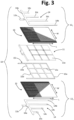
Figure 3 is an exploded schematic view of a heating element according to possible embodiments of the invention; -
Figure 4 is a schematic perspective view of a heating element according to possible embodiments of the invention; -
Figure 5 is a schematic perspective view of an electrode of a heater device according to possible embodiments of the invention; -
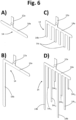
Figure 6 represents schematically, via perspective views, possible alternative configurations of a part of an electrode of a heater device according to possible embodiments of the invention; -
Figure 7 is a schematic representation of a process for fixing two parts of an electrode of a heater device according to possible embodiments of the invention; -
Figure 8 is a detail at a larger scale ofFigure 5 ; -
Figure 9 is a detail at a larger scale ofFigure 8 ; -
Figure 10 is a view similar to that ofFigure 9 , regarding a variant embodiment of the invention; -
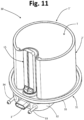
Figure 11 is a schematic perspective view of a motor-vehicle component that integrates a heater device according to possible embodiments of the invention; -
Figure 12 is a partially exploded schematic view of two parts of the component ofFigure 11 ; -
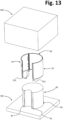
Figure 13 is a schematic representation of a first process for obtaining a casing body of a heater device according to possible embodiments of the invention; -
Figures 14 and 15 are schematic representations of a second process for obtaining a casing body of a heater device according to possible embodiments of the invention; -
Figure 16 is a schematic perspective view of a plurality of heating elements of a heater device according to possible embodiments of the invention; -
Figure 17 is an exploded schematic view of an electrode of a heater device according to possible embodiments of the invention; -
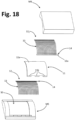
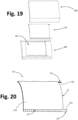
Figures 18 and19 are schematic representations of a first process for obtaining a heating element according to possible embodiments of the invention; -
Figure 20 is a schematic perspective view of a heating element that can be obtained with the process ofFigures 18-19 ; -
Figure 21 is a schematic representation of a second process for obtaining a heating element according to possible embodiments of the invention; -
Figure 22 is a schematic perspective view of a semi-finished product used in the process ofFigure 21 ; -
Figures 23 and24 are further schematic representations of the process ofFigure 21 ; -
Figure 25 is a partially sectioned schematic representation of a heating element according to possible embodiments of the invention; -
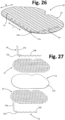
Figures 26 and 27 are a schematic perspective view and an exploded schematic view, respectively, of a further heating element according to possible embodiments of the invention; -
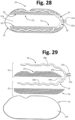
Figures 28 and 29 are a schematic perspective view and an exploded schematic view, respectively, of a further heating element according to possible embodiments of the invention; -
Figures 30 and 31 are a schematic perspective view and an exploded schematic view, respectively, of an electrode of a heater device according to possible embodiments of the invention; -
Figure 32 is a partially exploded view of a motor-vehicle component that integrates at least one heater device according to possible embodiments of the invention; and -
Figure 33 is a view similar to that ofFigure 32 , with a heating element of the heater device represented in exploded view. - Reference to "an embodiment" or "one embodiment" within the framework of the present description is intended to indicate that a particular configuration, structure, or characteristic described in relation to the embodiment is comprised in at least one embodiment. Hence, phrases such as "in an embodiment" or "in one embodiment" and the like that may be present in various points of this description do not necessarily refer to one and the same embodiment. Moreover, particular conformations, structures, or characteristics defined within this description may be combined in any adequate way in one or more embodiments, even different from the ones represented. The reference numbers and spatial references (such as "upper", "lower", "top", "bottom", etc.) used herein are provided merely for convenience and hence do not define the sphere of protection or the scope of the embodiments. In the present description and in the attached claims, the generic term "material" is to be understood as including mixtures, compositions, or combinations (for example, multilayer structures) of a number of different materials. In the present description and in the attached claims, the term "meshed structure" or "net structure" is understood as indicating a structure formed by the criss-crossing or interweaving of substantially filiform elements, preferably threads or wires, for example like a net, a mesh, a weave, etc.
- With initial reference to
Figure 1 , designated as a whole by 1 is a heater device according to possible embodiments of the invention. In what follows, it is to be assumed that thedevice 1 belongs to a system on board a motor vehicle, for example a system for heating a stream of air or for heating a liquid that is contained in a tank or reservoir, or that passes through a duct. - The
device 1 comprises acasing body 2, which encloses at least partially at least one heating element, designated as a whole by 10 inFigure 2 . Thecasing body 2 is preferentially provided with anelectrical connector 3 for connection to an electric power source. - In various embodiments, the casing body of the heater device according to the invention is made up of two or more parts fixed to one another, whereas in other embodiments the casing body is formed at least in part via overmoulding of material on at least one heating element of the device. The casing body may be of a hermetic type, i.e., devised for enclosing in a fluid-tight way the heating element or elements of the device.
- In various embodiments, the heater device forming the subject of the invention is configured as a stand-alone component, in which case its casing body is preferentially configured for installation and/or fixing in a more complex system, for example, the heating system of a motor-vehicle. In other embodiments, the device forming the subject of the invention is instead integrated in a component prearranged for performing also functions different from heating of a generic medium, in which case at least part of a body of the component can be exploited for providing at least in part also the casing body of the heater device. In other applications still, the device does not need a casing body of its own, for example when a corresponding heating element is exposed directly in a given environment for heating it.
- In the case exemplified in
Figures 1 and 2 , thedevice 1 is configured as a stand-alone component, and itscasing body 2 consists of threeparts heating element 10. - Once again with reference to the case exemplified in
Figures 1 and 2 , the casing part designated by 21 has a substantially boxlike structure, which defines aseat 4 for housing theheating element 10 completely or mostly inside it. In the case exemplified, thecasing part 21 has a flange-shapedfront portion 5, provided with aslit 5a through which theelement 10 can be inserted in a transverse direction in theseat 4, so that two electrical-connection terminals 12a, which belong or are connected to respective electrodes of the heating element 10 (just one of which is visible inFigure 2 , designated by 121), project at the front beyond theportion 5. Fixed at the front to thefront portion 5 is the casing part designated by 22, which defines aconnector body 6 configured for receiving within it theterminals 12a and thereby providing theconnector 3 ofFigure 1 . In the example represented, thecasing part 22 further comprises a flange-shapedportion 7, designed to close theslit 5a. - In the example, the
seat 4 can be closed via the casing part designated by 23, which basically functions as lid for the aforesaid seat, and is fixed peripherally to thecasing part 21. - Illustrated in exploded view in
Figure 3 is a possible embodiment of aheating element 10. In this figure, designated by 11 is the heating body of theelement 10, which is made at least in part of a material having a PTC effect, i.e., a material distinguished by an electrical resistance with positive temperature coefficient, and is arranged so as to be in contact with the two electrodes designated as a whole by 121 and 122. - In preferred embodiments, the material constituting the
body 11, designated by 11a, is a polymer-based material (i.e., a material comprising at least one polymer), preferably a composite material having a matrix formed by a polymer or by a mixture of a number of polymers and by a corresponding filler, for example an electrically conductive filler and/or a thermally conductive filler. - In various preferred embodiments, the
material 11a of theheating body 11 is a co-continuous polymeric composite with PTC effect, having a matrix that comprises at least two immiscible polymers and at least one electrically conductive filler in the matrix. In preferred embodiments of this type, at least one of the immiscible polymers is high-density polyethylene (HDPE) and at least one other of the immiscible polymers is polyoxymethylene (POM). The electrically conductive filler is preferentially constituted by particles having micrometric or nanometric dimensions, preferably comprised between 10 nm and 20 µm, very preferably between 50 nm and 200 nm, possibly aggregated to form chains or branched aggregates with dimensions of between 1 µm and 20 µm. Preferential materials for the electrically conductive filler are carbon materials, such as carbon black, or graphene, or carbon nanotubes, or mixtures thereof. - HDPE and POM are preferentially in relative percentages of between 45% and 55% of their sum in weight. Preferentially, the electrically conductive filler is confined or mostly confined in the HDPE, in a weight percentage of between 10% and 45%, preferably between 16% and 30% of the sum of the weigths of HDPE and the electrically conductive filler. For this purpose, the HDPE and the electrically conductive filler can be mixed together, in particular via extrusion, prior to subsequent mixing with POM, which also in this case can be carried out preferentially via extrusion.
- The high melting point of POM makes it possible to keep the two phases, HDPE and POM, better separated, reducing the possibility of migration of the electrically conductive filler into the POM (contributing to this effect is the fact that the filler is preferentially previously mixed with just the HDPE). The higher melting point of POM as compared to other known polymers likewise makes it possible to obtain a more stable final structure: the PTC effect of the composite material limits self-heating to a maximum temperature of approximately 120°C. POM moreover presents a high crystallinity, indicatively between 70% and 80%: this means that, in the preferential co-continuous composite proposed, it is more unlikely for migrations of filler from the HDPE to the POM to occur, thereby preventing the loss of performance of the material with PTC effect, for example due to heating and passage of electric current. The higher crystallinity of POM also renders the composite particularly resistant from the chemical standpoint and bestows high stability thereon. On the other hand, the crystallinity of HDPE is typically comprised between 60% and 90%: in this way, a high concentration of the conductive filler in the amorphous domains is obtained, with corresponding high electrical conductivity.
- With reference, for example, to
Figure 3 , according to an aspect of the invention, at least one of theelectrodes heating body 11, i.e., in thematerial 11a that constitutes it. - As will emerge more clearly hereinafter, the at least partial embedding of the meshed
structure 13 may be obtained by getting, via mechanical pressure and/or heating, thestructure 13 to penetrate into theheating body 11, at a face of the latter, or else by overmoulding at least part of theheating body 11 on themeshed structure 13, or on the correspondingelectrode 12. - It should be noted, in this regard, that in
Figure 2 themeshed structure 13 belonging to theelectrode 121 is represented, for reasons of greater clarity, practically entirely in view, i.e., as if it were resting on theheating body 11. However, as has been said, theaforesaid structure 13 is at least partially embedded in thematerial 11a of thebody 11, preferably in such a way that - between the openings defined between the various meshes of the structure - part of thematerial 11a is present. On the other hand, it is also possible to embed themeshed structure 13 of an electrode practically completely in thematerial 11a, as is, for example, represented schematically inFigure 4 . - It is preferable for the
meshed structure 13 to extend substantially parallel to a major face of theheating body 11, with theaforesaid structure 13 that defines an area substantially corresponding to that of the major face of thebody 11, or in any case an area corresponding to a prevalent part thereof. In this way, theheating body 11 is set between the wide surfaces of thestructures 13 of the twoelectrodes - The
meshed structure 13 hence extends in a length direction L and in a width direction W and is preferably substantially two-dimensional, i.e., of minimal thickness, substantially like a sheet structure. - In various preferred embodiments, the
structure 13 is constituted by a fabric formed at least in part with threads of electrically conductive material, preferably metal material. Preferred metals are, for example, selected from among stainless steel, copper, aluminium, brass, bronze, nickel-chrome-based alloys, or iron-chrome-based alloys. The electrically conductive fabric may be obtained via interweaving or criss-crossing of threads using any known technique; for example, the type of weave may be selected from the following: - plain weave, where each weft thread passes alternately above and below each warp thread, and vice versa;
- twill weave, where each weft thread crosses two warp threads, alternately;
- plain Dutch weave, where the warp threads have a diameter greater than the weft threads, with the weave that is made up of a small number of warp threads interwoven with a large number of weft threads;
- Dutch twill weave, which can be obtained via a weave similar to the plain Dutch weave, except that the weave is a twill weave and has a double layer of weft threads;
- reverse Dutch weave, which is substantially the reverse of the plain Dutch weave, i.e., with the larger number of finer threads in the warp and the smaller number of coarser threads in the weft; and
- reverse Dutch twill weave, which is a weave similar to the previous one, but with each weft thread that crosses two warp threads alternately.
- Preferentially, the threads that provide the electrically conductive fabric have a reduced nominal diameter (i.e., prior to weaving), indicatively of between 0.2 mm and 0.02 mm, for the reasons clarified hereinafter. The mesh opening of the fabric, i.e., the space between two adjacent and parallel threads of the structure, is preferably comprised between 1 mm and 0.05 mm.
- It should be noted that in
Figures 3 and5 , themeshed structures 13 are represented in partial and schematic form, in order to highlight - in particular inFigure 5 - the criss-crossing or interweaving of the weft threads and the warp threads, designated by 16a and 16b, respectively. - The fact that the
meshed structure 13 is at least partially embedded in the material withPTC effect 11a prevents the risk of the correspondingelectrode 12 separating from or peeling off theheating body 11, which is a problem typical of the prior art, even in the presence of possible deformations of thematerial 11 and/or of thestructure 13 due to the heating and cooling cycles. The fact that themeshed structure 13 is in any case relatively dense and extensive in any case ensures a considerable distribution and intensity of the current between theelectrodes 12. - As may be appreciated, the peripheral profile of the meshed
structure 13 of anelectrode 12 may, for example, be easily obtained via elementary operations of cutting or dinking of an electrically conductive sheet or web of fabric or mesh. The aforesaid peripheral profile does not necessarily have to be quadrangular, as exemplified so far in the figures. - According to another aspect of the invention, the at least one
electrode meshed structure 13, also at least one electrical-distribution element, such as the ones designated by 14 inFigures 2 and3 , which is fixed to themeshed structure 13 and extends in at least one of the length direction L and the width direction W of thestructure 13 itself. - The
element 14 is shaped so as to distribute the electric current on thethreads meshed structure 13, in particular in order to prevent undesirable concentrations of electric current on a few threads, which could even cause melting of the threads themselves. For this purpose, in various embodiments, thedistribution element 14 has at least one portion that extends substantially throughout the whole width W and/or at least one portion that extends substantially throughout the whole length L of thestructure 13. However, at least one portion of the distribution element could also extend through only a part of the width W and/or of the length L of thestructure 13, preferably for at least one half or one third of the width W and/or of the length L of thestructure 13. - The electrical-
distribution element 14 is preferentially fixed to the face of the meshedstructure 13 opposite to thebody 11, in order to not hinder the structure itself from being embedded in the material withPTC effect 11a. The electrical-distribution element 14 could also be fixed to the face of the meshedstructure 13 facing thebody 11, and in this case also part of thedistribution element 14 could be embedded in the structure of the material withPTC effect 11a. - With a view to improving further the distribution of the electric current, in various preferential embodiments at least one portion of the electrical-
distribution element 14 extends substantially at or in the proximity of an edge of the meshedstructure 13. - With reference, for example, to
Figures 3-5 , it may be noted how theelements 14 represented have at least oneportion 14a that extends in a direction transverse to the structure 13 (i.e., in the direction W), as well as at least oneportion 14b that extends in the longitudinal direction with respect to the structure 13 (i.e., in the direction L), with these two portions that are preferably substantially at right angles with respect to one another (different angles are, however, possible). In various embodiments, such as the ones represented, branching off from theportion 14a are moreoverfurther portions 14c that extend in the longitudinal direction L, preferably generally parallel to theportion 14b and preferably substantially distributed in the transverse direction W. - The electrical-distribution elements can thus have a substantially comb-like conformation, with teeth or fingers of different length (as in the case of the aforesaid
Figures 3-5 ) or else teeth or fingers of the same length. In any case, as it can be seen, the area of overlapping between a distrubution element, or of all the distribution portions thereof, and the corresponding meshed structure, is smaller than the area of the latter; in particular, as shown in the figures, the overlapping area is appreciabily smaller than the area of the corresponding meshed structure, preferably the overlapping area being at least smaller than one half or one third of the area of the corresponding meshed structure. - In various preferred embodiments, the electrical-
distribution element 14 has at least one electrical-connection portion, which, when the device is in the assembled condition, is designed to project beyond a peripheral edge of the meshedstructure 13 or of theheating body 11 in order to be accessible for the purposes of electrical connection. In the case exemplified, the aforesaid projecting portion is designated in the figures by 12a, in so far as it corresponds to the terminals referred to previously. Advantageously, then, the electrical-distribution element can define directly an electrical-connection terminal 12a of the correspondingelectrode 12. - Also from
figure 6 it can be inferred how the total area of thedistributio portion 14a or of thedistribution portions 14a-14b; 14a-14c of anelement 14, which is designed to be overlapped to a corresponding meshed structure, amounts to a limited fraction of the area of the meshed structure. As a mere example, by referring to the cases of parts a), b), c) e d) offigure 6 , the overlapping area may be of less than 10%, less than 20%, less than 30% or less than 50% of the area of the corresponding meshed structure, respectively. - In various embodiments, the
distribution element 14 is shaped so as to be connected to a substantial or prevalent part of thethreads 16a and/or of thethreads 16b that provide the meshedstructure 13, preferably with at least one transverse portion (such as theportion 14a) connected to at least one third or at least one half of thethreads 16a and/or with at least one longitudinal portion (such as theportion 14b) connected to at least one third or at least one half of thethreads 16b. - In various embodiments, the
distribution element 14 is shaped so as to be connected to a number ofthreads 16a and/orthreads 16b such that the sum of the sections of these threads is such as to allow the electric current necessary for operation of thedevice 1 and/or of aheating element 10 to circulate without any damage or anomalies. - Represented merely by way of example in
Figure 6 are some possible configurations of electrical-distribution elements 14 that can be used in heater devices according to the invention. The configurations exemplified do not have an exhaustive nature, since innumerable configurations suited to the purpose are possible. - Illustrated in part A) of
Figure 6 is a simpler shape of theelement 14, which has adistribution portion 14a that is to extend in the direction of the width W of a meshed structure 13 (or else, obviously, in the direction of the length L of the aforesaid structure), as well as the portion that constitutes the terminal 12a, here generally orthogonal to theportion 14a. - Illustrated in part B) of
Figure 6 is a prevalently L-shapedelement 14, i.e., one that includes both adistribution portion 14a that is to extend in the width direction (or length direction) of astructure 13 and adistribution portion 14b that is to extend in the length direction (or, respectively, width direction) of thesame structure 13; also in this case, extending from one of the twoaforementioned portions portion 14a) is the connection portion that constitutes the terminal 12a. - Illustrated in part C) of
Figure 6 is anelement 14 with a substantially comb-like shape, i.e., including both adistribution portion 14a that is to extend in the direction of width (or length) of astructure 13 and a plurality ofdistribution portions same structure 13; in this case, extending from theportion 14a is the connection portion that constitutes the terminal 12a. - Illustrated in part D) of
Figure 6 is anelement 14, which has also a substantially comb-like shape, but with series of teeth or fingers that are substantially parallel but of different lengths. In the example, there are provided both adistribution portion 14a that is to extend in the direction of width (or length) of astructure 13 and four pairs offingers same structure 13, where, for example, the fingers of each pair substantially have the same length but a length different from that of the fingers of the other pairs, and where each finger of one pair is set between two fingers of other two different pairs; also in this case, extending from theportion 14a is the connection portion that constitutes the terminal 12a. - In various preferred embodiments, the electrical-
distribution element 14 is formed by a strap or foil of electrically conductive material. Hence, preferentially, also thedistribution element 14 is substantially two-dimensional, i.e., it has a very small thickness, preferably of between 0.02 mm and 1.5 mm. - The strap that constitutes the
element 14 is preferentially made of a metal material compatible with that of the meshedstructure 13, in particular compatible in view of a weld being made between thestructure 13 and theelement 14; in this perspective, for example, the metal material constituting the aforesaid strap may, for example, be selected from among: stainless steel, copper, aluminium, brass, bronze, nickel-chrome-based alloys or iron-chrome-based alloys. - The strap that constitutes the
element 14 may possibly be coated at least in part with a different material, preferably a second electrically conductive material and/or a protective material. In this perspective, the terminal 12a may be coated at least in part with tin, for example to facilitate welding of an electrical thread, or else coated at least in part with gold or some other noble metal, for example to improve the electrical contact with the terminal of an external connector; at least an outer part of the strap not in contact with the meshed structure could also be coated with a protective and/or electrically insulating material. - It will appear evident that also the peripheral profile of the
distribution element 14 of anelectrode 12 may, for example, be easily obtained via elementary operations of blanking or dinking (and possible deformation) of a sheet or strip of electrically conductive metal. - In preferential embodiments, the mechanical connection or fixing between the
meshed structure 13 and a corresponding electrical-distribution element 14 of anelectrode 12 is obtained via welding, preferably welding without added weld material. - In various preferential embodiments, the welding operation carried out between the two parts in question is resistance welding, i.e., a method of autogenous pressure welding in which the material is heated via an electrical resistance. Such a technique is exemplified in
Figure 7 , where designated by E1 and E2 are two metal electrodes of a welding apparatus. - Represented schematically in part A) of
Figure 7 is an initial condition, in which the two welding electrodes E1 and E2 are at a first distance apart, which enables insertion between them of thestructure 13 and of theelement 14 simply laid on top of one another. Part B) ofFigure 7 exemplifies, instead, a subsequent step in which the two welding electrodes E1 and E2 are brought up to one another so as to press mechanically thestructure 13 on the surface of theelement 14 in contact with thestructure 13 itself, i.e., at the corresponding overlapping areas. Simultaneously with application of the mechanical pressure, between the electrodes E1 and E2 an electric current is made to flow having an intensity such as to generate, by the Joule effect, a heat sufficient to cause partial melting of thethreads element 14 and hence mutual welding (the heat generated at the area of the aforesaid threads and strap will be substantially proportional to the current intensity and to the electrical resistance of the parts to be joined). Part C) ofFigure 7 illustrates the subsequent step in which the welding electrodes E1 and E2 are moved away from one another, to enable removal of theelectrode 121, with thestructure 13 and theelement 14 now welded together. - Welding of the
distribution element 14 on themeshed structure 13 typically also causes a deformation of the threads of the aforesaid structure, which is, however, substantially circumscribed to the areas of overlapping between theelement 14 and thestructure 13. With reference to the welding technique exemplified above, the degree of the deformation of the threads at the overlapping welded areas will be substantially a function of the welding heat generated and/or of the mechanical pressure between the parts. FromFigure 5 , and in particular from the corresponding detail ofFigure 8 , it may be noted how at thewelding areas 17a the shape of the threads of the meshedstructure 13 differs from that of thenon-overlapping areas 17b not involved in the welding process. This circumstance may be better appreciated from the further detail represented inFigure 9 , where there may be noted the different shape of thethreads welding areas 17a, where the aforesaid threads are squeezed, with partial melting, and in theareas 17b not involved in the welding process, where the threads substantially maintain the initial nominal diameter and/or shape. -
Figure 10 exemplifies, via a view similar to that ofFigure 9 , the case of a more intense welding carried out between thestructure 13 and theelement 14, i.e., with a greater generation of heat and/or a higher mechanical pressure at the areas to be welded 17a, and hence with a consequent more marked melting and/or deformation of thethreads areas 17a come to form a substantially flat grid. - In various embodiments, such as the ones so far exemplified, both of the
electrodes meshed structure 13 and at least one corresponding electrical-distribution element 14, the two electrodes being preferably substantially the same as one another, to the advantage of standardisation of production. Theelectrodes heating body 11 at opposite faces of thebody 11, preferably opposite major faces that are substantially parallel to one another, in order to bring about a circulation of the electric current in a plane perpendicular to the aforesaid faces, i.e., through the thickness of thebody 11. According to other embodiments, however, the electrodes may be located at one and the same face of thebody 11. Moreover, as has been said, it is preferable for theelectrodes meshed structures 13 to extend substantially parallel to a corresponding face of thebody 11. - Arrangements of the above type are particularly advantageous when the
distribution elements 14 of the twoelectrodes connection portions 12a, which can hence be set in a position close to one another to provide an electrical connector, such as theconnector 3. - Hence, in various embodiments, at least part of the
heating body 11 is set between the twoelectrodes body 11 can have perimetral dimensions substantially similar to those of the electrodes, or of theirstructures 13, but not excluded is the case of a part of thebody 11 that projects beyond the edges of thestructures 13, or else that is recessed with respect thereto. - To return to
Figures 2-3 , in the case exemplified theheating body 11 is preferably a body overmoulded at least in part on theelectrodes PTC effect 11a is injected in the molten state. In order to facilitate the aforesaid production step, in particular during injection of the polymer and/or during previous handling of the semi-finished product, between the two electrodes there can be interposed a spacer body and/or positioning body, in particular configured for ensuring proper relative positioning of the electrodes, in particular in the mould. - Exemplified in
Figure 3 is a possible embodiment of a such a spacer body, designated by 15, which may be made of an electrically insulating material, or else may itself be made of a material having an electric resistance or a PTC effect, which, for example, is also a polymer-based material. In the example, thespacer body 15 is shaped basically to define a meshed framework, with a sort ofperipheral frame 15a extending within which are a series oflongitudinal elements 15b and a series oftransverse elements 15c, preferably coplanar with respect to one another. In the case where theelements frame 15a, it is possible to providereliefs 15d at the areas of criss-crossing between theaforesaid elements reliefs 15d could also be shaped as engagement means so as to engage with at least oneelectrode 121 and/or 122, for example in openings of thestructure 13. - In the example, the outer side of the
peripheral frame 15a of thespacer body 15 is designed not to be coated by thematerial 11a of theheating body 11 so as to constitute a peripheral edge of at least one part of the heating element 10 (see in this connectionFigure 2 ). It will be appreciated in any case that also a spacer body could be completely embedded in theovermoulded material 11a, as, for example, in the case ofFigure 4 , where also the meshed structures of the electrodes are completely embedded in thematerial 11a of theheating body 11. It will moreover be appreciated that the shape of the spacer body used may be different from the one exemplified, provided that its functions remain the same. - A heater device according to the invention may comprise a plurality of heating elements and/or, as already mentioned, may be integrated in a component that performs also functions different from, or additional to, heating of a generic medium.
- Illustrated in
Figures 11-25 are various embodiments that are suited to implementing both of the aforesaid characteristics. These figures exemplify how, in various embodiments, the heater device, or a heating element thereof, can have a generally arched shape, unlike the embodiments illustrated previously, where thedevice 1 and theheating element 10 are generally straight or planar. Even just a single part of a heating element (the heating body or an electrode thereof) may be at least in part planar, or else at least in part arched, or else be in part planar and in part arched. - With reference in particular to
Figure 11 , designated as a whole by 30 is a motor-vehicle component, and in particular a component of a tank for containing a generic liquid substance. Thecomponent 30 may, for example, form part of a system of the type known as Water-Injection or Anti-Detonant Injection (ADI), in which case the liquid in question is water that is to be injected into a cylinder of an internal-combustion engine. Alternatively, thecomponent 30 could form part of a so-called Selective-Catalytic-Reduction (SCR) system, in which case the liquid in question is an aqueous solution containing urea that is to be injected into the exhaust line in order to reduce nitrogen oxides. - As mentioned in the introductory part of the present description, on the other hand, the
component 30 could be of some other type, for example a component for housing or installing a fuel filter of an internal-combustion engine. - In the case exemplified, the component has a substantially cup-shaped body, in which there may be identified a generally tubular upper part, designated by 1', in so far as it is basically provided by a heater device according to the invention, and a
lower base 31, having a lower box-shapedportion 32 provided with aninlet 33 and anoutlet 34 for the liquid, and preferably provided with anelectrical connector 3'. Theupper part 1' could, however, also have some other shape, possibly provided with openings, for example made up of a number of arched walls set at a distance from one another in order to provide at least one intermediate opening. - The box-shaped
portion 32 is preferentially provided with a lower lid (not shown) to enable positioning inside it of functional elements, such as electrical circuit parts. In the example, the body of the base 31 also has a flange portion, designated by 35, which could also serve for fixing thecomponent 30 to some other part of a vehicle, such as for fixing or welding of thecomponent 30 to a tank. - The
component 30 illustrated likewise integrates a further functional component, for example a sensor, such as a level sensor, denoted as a whole by LS, which constitutes in any case an optional element of thecomponent 30; for this purpose, thedevice 1' and/or the base 31 can be appropriately shaped and/or provided with at least one opening or seat for housing the aforementioned further functional component. - As may be appreciated, following upon joining in a sealed way of the
device 1' to thebase 31, the body as a whole of thecomponent 30 is formed, which defines a volume - denoted by T inFigure 11 - designed to contain the liquid, or in any case designed to define an internal area in which the liquid can be heated more easily. -
Figure 12 is a partially exploded view of acomponent 30, of the type in which theheater device 1' and the base 31 are configured as parts distinct from one another and fixed together in a sealed way. As may be noted, theheater device 1' has a casing body of its own, designated by 2', having a substantially tubular shape, which may, for example, be made of an electrically insulating material (for example, a polymeric material) overmoulded on a plurality of heating elements, as clarified hereinafter. As may be noted, projecting from the casing body 2', here at a lower edge thereof, areterminals 12a for electrical connection of the heater device, which are to be electrically connected to an electrical circuit present in thebase 31, which includes respective terminals (not shown) of theconnector 3'. In the figures just twoterminals 12a are shown, but thedevice 1 may comprise more than two, as exemplified hereinafter. - Once again from
Figure 12 it may be noted how, in the example, at the upper face of the base 31 aninlet port 33a and anoutlet port 34a for the liquid are defined, which are in fluid communication with theinlet 33 and theoutlet 34, respectively. Illustrated moreover inFigure 12 is aseat 36 for positioning and electrical connection of the further functional component, such as the level sensor LS ofFigure 11 , and it may likewise be noted how, within theflange portion 35 of the base 31 a substantiallyannular seat 35a is defined, for fixing in a sealed way the lower edge of the casing body 2' of theheater device 1'. The body of the base 31 may be obtained at least in part via moulding of polymeric material, for example the same material used for producing the casing body 2'. -
Figure 13 exemplifies a possible step of overmoulding of the casing body 2' of theheater device 1' ofFigures 11-12 . In the example, the heater device is designed to integrate threeheating elements 10 having a generally arched shape, which are preferably, but not necessarily, substantially the same as one another. In the example, the mould part designated by M1 has a base part (without any reference number), rising from which is ashape 40 designed to define the inner peripheral surface of the casing body 2' of the heater device. In the aforesaid base part, in a peripheral position with respect to theshape 40,seats 41 are defined, into which there may be inserted theterminals 12a of theheating elements 10, which are positioned on the mould part in the proximity of one another to form an arc of a circle. The mould part M2 defines a hollow impression (not visible), designed to define the outer peripheral surface of the casing body 2' ofFigures 11-12 , as well as its top edge. - As may be appreciated, after positioning of the
heating elements 10 on the mould part M1, as inFigure 13 , the two mould parts are closed on one another so as to delimit a hollow shaped volume having a shape corresponding (complementary) to that of the casing body 2', and injected into the aforesaid hollow volume is the polymeric material designed to form the aforesaid casing body. After the time necessary for solidification and cooling, the mould parts M1 and M2 can be opened again, and thedevice 1' including the casing body 2' can be extracted, as represented inFigure 12 . - As an alternative to what has been exemplified with reference to
Figures 12 and13 , at least part of thebase 31 and of the casing 2' of theheater device 1' may also be configured in a single piece, in particular a piece obtained by overmoulding the necessary polymeric material on theheating elements 10. Such a case is exemplified schematically inFigures 14 and 15 , where designated by M3 and M4 are two corresponding mould parts. In this case, the mould part M3 has animpression 43 designed to define part of the outer profile of thebase 31 and its inner profile (as has been mentioned, thebase 31 can have a lower opening that is to be closed by a lid applied subsequently). Defined within theimpression 43 areseats 41 for theterminals 12a of theheating elements 10, as described with reference toFigure 13 . - The mould part M4 instead defines an
impression 42, visible only partially, designed to define the remaining part of the outer profile of thebase 31, as well as the casing body 2' of theheater device 1' (within the aforesaid impression there will then be provided also a shape of a type similar to the one designated by 40 inFigure 13 ). - Hence, also in this case, after positioning of the
heating elements 10 on the mould part M3, as inFigure 14 , the two mould parts M3 and M4 are closed on one another so as to delimit a hollow shaped volume, injected into which is the polymeric material that is to form the body defining both thebase 31 and the casing body 2'. Also in this case, after the time required for solidification and cooling, the mould parts M3 and M4 can be re-opened and the corresponding semi-finished product of thecomponent 30 can be extracted, as represented inFigure 15 . - Represented schematically in
Figure 16 are threeheating elements 10 having an arched configuration, for example of a type suitable for production of theheater device 1'. In the example, eachelement 10 includes the respective two electrodes, each formed by at least onemeshed structure 13 and at least one electrical-distribution element 14, shaped for defining arespective terminal 12a, here projecting downwards. Visible inFigure 16 is just one part of thestructure 13, i.e., the part welded to theelement 14, the remaining part of the structure being or embedded in the material withPTC effect 11a of theheating body 11. The electrodes are preferably arranged so that therespective distribution elements 14 are located substantially at opposite longitudinal edges of thecorresponding heating element 10; this does not constitute in any case an essential characteristic. - A
meshed structure 13 and a corresponding electrical-distribution element 14 are illustrated schematically inFigure 17 . As may be noted, thestructure 13 has an arched shape and theelement 14 consists of a single portion, which here extends in the length direction L of thestructure 13 in order to be fixed at or in the proximity of a longitudinal edge thereof. The length of theelement 14 is greater than that of thestructure 13, so that a terminal portion of theelement 14 provides thecorresponding terminal 12a. The join between the twoparts Figure 7 . It should be noted that inFigure 17 , as in the subsequent figures, themeshed structure 13 is represented only schematically, with very wide mesh openings, to enable a more immediate understanding. - As mentioned previously, at least part of the meshed
structure 13 may be force-fitted in theheating body 11 at a face of the latter, i.e., by getting thestructure 13 to penetrate into thebody 11. - A possible technique, in this connection, is exemplified in
Figure 18 , where designated by M5 and M6 are two moving elements, at least one of which is movable with respect to the other, of a pressing apparatus. Each moving element can define a respective seat 50 (here only the seat of the moving element M5 is visible) designed to receive a corresponding part of anarched electrode pre-formed heating body 11. Thebody 11 may be in this case obtained via operations of blanking or dinking starting from a sheet or web of the PTC-effect polymer, which is then heat-formed in order to bestow thereon the necessary arched configuration, or else thebody 11 may be directly injection-moulded in the arched form. - The electrodes are set between the moving elements M5 and M6, exploiting the corresponding
seats 50, and then the moving elements themselves are forced on one another, so that the meshed structures are forcefully pressed or pushed against the opposite major faces of thebody 11, causing the structures to penetrate into the faces. For this purpose, in preferential embodiments, at least one of the moving elements M5 and/or M6, or the corresponding pressing apparatus, is configured for heating thebody 11 in order to cause a modest softening thereof, that facilitates penetration of the structures into thematerial 11a. Then, in particular after cooling of thebody 11 if heating thereof is envisaged, the two moving elements M5 and M6 are moved away from each other, and theheating element 10 thus obtained can be extracted from the apparatus, as exemplified inFigure 19 . Theheating element 10 may be in the form represented inFigure 20 , with the threads of thestructures 13 completely embedded in thematerial 11a (possibly except for those welded to the respective distribution elements 14), or else the threads may be partially exposed, if they are not completely embedded in thematerial 11a. - In applications of this type, the
body 11 is preferentially pre-formed so as to present, at an edge, at least one area of smaller thickness (11b,Figure 18 ) for positioning of theelement 14, so that the outer surface of the latter will substantially be flush with the surface of the face of thebody 11 in which the threads of thestructure 13 are embedded. - The
seats 50 of the moving elements M5 and M6 will preferentially include a portion designed to receive theportion 12a of theelement 14 projecting from thestructure 13. - Of course, the apparatus described with reference to
Figures 18 and19 may have a shape different from the one exemplified, provided that its functions remain the same. For instance, just one of the two moving elements M5 and M6 could include aseat 50 designed to receive both of theelectrodes pre-formed body 11 set in between, with the other moving element that includes a part in relief designed to exert the mechanical pressure where necessary, when the two moving elements are pressed against one another. - It will be appreciated that what has been described with reference to
Figures 18-20 may be applied also to the case of straight or plane heating elements, for example as inFigure 4 , of course with a different shape of the moving elements M5 and M6 and of thecorresponding impressions 50. - Of course, also in the case of heating elements that are at least in part arched, the polymeric material with
PTC effect 11a can be overmoulded at least in part on theelectrodes Figures 2-3 . Such a case is represented schematically inFigure 21 , where designated by M7 and M8 are two mould parts for injection of thematerial 11a that is to form theheating body 11, where each mould part includes a respective impression that is to define a corresponding part of the profile of anarched heating element 10. - Also in this case, as described previously, it is preferable to provide a spacer and/or positioning body (here designated by 15') that is to be interposed between the
electrodes impression 51 of the mould part M7 visible inFigure 21 . In the case illustrated inFigure 21 , thebody 15', which may be made of electrically insulating material or else of a resistive material with PTC effect, has a substantially comb-like shape, arched according to the shape of theelectrodes -
Figure 22 shows schematically the result of the operation of setting theelectrodes spacer body 15' that keeps them at the right distance apart and the fingers of thebody 15' that here extend in the longitudinal direction of the electrodes themselves, i.e., substantially parallel to the electrical-distribution elements 14.Figure 23 illustrates, instead, the step of insertion of the ensemble or "sandwich" formed by theelectrodes spacer body 15' between the parts M7-M8, after closing of which thepolymeric material 11a that is to form theheating body 11 is injected into the mould.Figure 24 exemplifies the subsequent step of re-opening of the mould and extraction of the heating element, after the time necessary for solidification and cooling of the injected material. Also in this case, theelement 10 may present with the threads of thestructures 13 completely embedded in thematerial 11a (possibly except for the ones welded to the respective distribution elements 14), or else the aforesaid threads may be partially exposed if the moulding operation does not envisage complete covering thereof by thematerial 11a. -
Figure 25 is a partially sectioned schematic view of a heating element obtained according toFigures 21-24 , from which it may be noted how also the spacer body 15'is embedded in thematerial 11a in the space between the twoelectrodes -
Figures 26 and 27 are schematic illustrations of a further possible embodiment of a heating element of a heater device according to the invention. These figures show how theelement 10 does not necessarily have to be substantially quadrangular or polygonal, it possibly having a peripheral profile partially curved and/or comprising stretches that are curved and stretches that are rectilinear. -
Figures 26 and 27 likewise show how, in various embodiments, an electrical-distribution element 14 may present a dimensional-compensation structure, to compensate for the possible dimensional variations, for example with intermediate curves, or else have a substantially wavy development, or distinguished by a sequence of curves and/or stretches that are angled or oriented in opposite directions. - Shapes of this type may prove convenient to enable the
distribution element 14 to lengthen and/or shorten in order to compensate for possible dimensional variations due to thermal variations, such as expansions and contractions and/or lengthening and shortening in at least one of the directions L and/or W, in particular during heating of theheating body 11 made ofPTC material 11a. - Preferably, the aforementioned dimensional-compensation structure enables compensation for possible dimensional variations, such as different expansions and contractions between different materials of at least part of the
electrodes heating body 11, in particular between at least the electrical-distribution elements 14 made of metal and thebody 11 made of the polymer-basedPTC material 11a. - In the case exemplified, the two
elements 14 represented both have adistribution portion 14a that extends in the width direction W and adistribution portion 14b that extends in the length direction L, each in the proximity of a respective edge of the correspondingmeshed structure 13. Preferentially, but not necessarily, the electrical-connection portions, or theterminals 12a, are defined at the area of joining between the twoaforementioned distribution portions elements 14 of this type may have shapes different from what has been represented by way of example, and include even just one distribution portion. - It goes without saying that also in embodiments of the type described with reference to
Figures 26-27 thestructures 13 may be fixed to thecorresponding elements 14 in the ways already described above, for example via welding, and that likewise thestructures 13 may be at least partially embedded in theheating body 11 in the ways described above, i.e., via mechanical pressure or else via overmoulding of thematerial 11a. In the example ofFigures 26-27 , the two electrodes of aheating element 10, preferably electrodes with a dimensional-compensation structure, are located at respective opposite faces of thecorresponding heating body 11, in order to bring about a circulation of the electric current substantially in a way perpendicular to the plane of the corresponding face of theheating body 11. - In various embodiments, two electrodes of a
heating element 10 are located at one and the same face of thecorresponding heating body 11 in order to bring about a circulation of the electric current substantially according to a plane parallel to the plane of the corresponding face of theheating body 11. Such a case is exemplified inFigures 28 and 29 , where it may in fact be noted how the twoelectrodes electrodes Figures 26-27 , are both located at one and the same face of thebody 11, with the correspondingstructures 13 that are here only partially embedded in thematerial 11a. Also the twoelements 14 exemplified both have adistribution portion 14a that extends inclined in the width direction W, and adistribution portion 14b that extends in the length direction L, each in the proximity of a respective edge of the correspondingmeshed structure 13, possibly with a part of eachportion 14a that is set directly on top of thematerial 11a, i.e., without interposition of a corresponding part of thestructure 13. - The electrical-connection portions, or the
terminals 12a, are here defined at an end of theelements 14, in particular at the end of theportions 14a. Obviously, theelements 14 may have shapes different from the one exemplified, and include even just one transverse or longitudinal distribution portion. - Also in embodiments of the type described with reference to
Figures 28-29 , thestructures 13 may be fixed to thecorresponding elements 14 in the ways already described above, for example via welding, and thestructures 13 may be at least partially embedded in theheating body 11 in the ways described above, i.e., via mechanical pressure or else via overmoulding of thematerial 11a. - In various embodiments, at least one electrode, or each electrode, of a heating element includes a number of
meshed structures 13, which are preferentially electrically connected to one another by way of at least one electrical-distribution element. - An example of this type is represented schematically in
Figures 30 and 31 , where the electrode designated by 12 has a firstmeshed structure 13, with associated to it a corresponding electrical-distribution element 14 of the type already represented in part A) ofFigure 6 , as well as a secondmeshed structure 131, which is connected to the firstmeshed structure 13 via afurther distribution element 141, here substantially L-shaped, or having aportion 14a transverse to, and aportion 14b longitudinal with respect to, the secondmeshed structure 131. Thefurther distribution element 141 is preferentially fixed, in particular welded, between the twostructures - As has been said, in various embodiments, a heater device according to the invention may be integrated in a component that also performs functions different from heating of a generic medium, for example, a component of a tank. For such applications, it is evidently not necessary for the heater device to be of a generally arched type, or present one or more arched heating elements; it may, in fact, present one or more straight or planar heating elements, for example as in the aforementioned
WO 2017/077477 A . Moreover, one or more planar heaters do not necessarily have to be integrated in a tubular part of such a component. - Represented, for example, in
Figures 32 and33 is a component of the type already designated previously by 30, defined in thebase 31 of which is ahousing 37 for a straight orplanar heating element 10, here having a peripheral profile shaped so as to present curvatures. Also visible in these figures is a lower lid of the base 31 - designated by 32a only inFigure 32 - of the type mentioned previously, for closing the box-shapedportion 32. The seat is defined substantially at the transverse wall that defines the containment volume of the component 30 (i.e., the bottom wall of the volume designated by T inFigure 11 ). -
Figures 32 and33 are likewise useful to illustrate the case ofelectrodes distribution element 14 of which has a closed or substantially closed, or annular or substantially annular, development. In the example, thedistribution elements 14 hence have an annularperipheral portion 14d, which is to extend substantially at or in the proximity of the peripheral edge of the correspondingmeshed structure 13. Thisperipheral portion 14a hence extends both in the longitudinal direction and in the transverse direction of the correspondingstructure 13. In various embodiments of this type, theelement 14 may also include one or more intermediate distribution portions, forexample portions 14e that converge towards acentral area 14f of theelement 14. In the example, defined at the aforesaidcentral area 14f is an opening that is designed to couple with acorresponding positioning element 37a defined within thehousing 37 of thebase 31 of thecomponent 30. Within theaforesaid housing 37 there may also be defined aseat 37b having a profile substantially complementary to that of thedistribution element 14 of one of the electrodes, here theelectrode 122, in order to contribute further to proper positioning of theheating element 10. - It should be noted that, thanks to the presence of the
heating element 10 described, thecomponent 30 ofFigures 32-33 does not necessarily have to integrate also the heater device designated by 1', even though the presence of both of theheaters - Also in embodiments of this type, the
structures 13 may be fixed to thecorresponding elements 14 in the ways already described above, for example via welding, and thestructures 13 may be at least partially embedded in theheating body 11 in the ways described above, i.e., via mechanical pressure or else via overmoulding of thematerial 11a. In the case represented inFigure 32 , thestructures 13 are completely embedded in thematerial 11a, but this does not constitute an essential characteristic. - Once again with reference to the example illustrated, the electrical-connection portions of the
elements 14, or theterminals 12a of theheating element 10, extend in a direction perpendicular to the plane of the element itself, and for this purpose theperipheral portion 14d of theelement 14 of an electrode - here theelement 14 of the upper electrode 121 - bends inwards (14d1,Figure 33 ) or is in any case shaped so as to enable passage of the terminal 12a of the other electrode. As has been mentioned, in any case, theperipheral portion 14d of an electrode does not necessarily have to be closed on itself, it possibly presenting at least one interruption or discontinuity. - As mentioned previously, the
meshed structure 13 is preferably formed by the interweaving or criss-crossing of relatively fine filiform elements or threads, preferably having a diameter of between 0.2 mm and 0.02 mm. The use of fine threads makes it possible to obtain an efficient fixing of thestructures 13 to thematerial 11a, also thanks to their at least partial embedding in the aforesaid material, thus countering the risks of detachment between the parts in question. - For instance, threads having a diameter of less than 0.1 mm are advantageous for enabling the threads themselves to be embedded by force into the
material 11a, preferably by heating the latter, as explained previously, and this also in the case of small mesh openings, for example even of less than 0.05 mm. Threads having a diameter greater than 0.1 mm may instead be more convenient to use when thematerial 11a is overmoulded on thestructures 13, and it is necessary to have wider mesh openings to enable passage of the material itself, for example mesh openings even larger than 1 mm (in general, in conductive fabrics that can be used for implementation of the invention, corresponding to threads of larger diameter are wider mesh openings). - A thread of relatively large diameter can advantageously be replaced by a number of threads of smaller diameter. For instance, the cross section of a thread having a diameter of 0.14 mm substantially corresponds to that of three threads having a diameter of 0.08 mm: hence, neglecting the skin effect, the passage of electric current that can occur in a thread having a diameter of 0.14 mm can occur in three threads having a diameter of 0.08 mm. If, however, the sum of the circumferences of the three threads with a diameter of 0.08 mm is considered (approximately 0.77 mm), it will be noted that it is almost equal to twice the circumference (approximately 0.44 mm) of the single thread having a diameter of 0.14 mm. It will hence be appreciated that corresponding to the aforesaid larger "overall" circumference of the three finer threads is a larger (almost twice as large) surface of contact between the
meshed structure 13 and the material withPTC effect 11a, hence with a better electrical contact and a more extensive total mechanical adhesion between the structure and the material. - From the foregoing description, the characteristics of the present invention emerge clearly, as likewise do its advantages. The electrical heater device according to the invention is built in a way that is as a whole simple, inexpensive, and reliable.
- The fact that the electrodes of the heating element of the device include at least a meshed structure at least partially embedded in the material with PTC effect counters the risks of the electrodes separating from or peeling off the material, a phenomenon that is, instead, encountered in the prior art. The fact that the meshed structure is relatively extensive and dense, i.e., formed by relatively fine threads, in any case ensures a wide surface of adhesion and contact between the electrodes and the material with PTC effect, with an optimal distribution and intensity of the current flowing between the electrodes themselves. The presence in the electrode of at least one distribution element prevents undesirable concentrations of electric current on just a few threads of the meshed structure, and hence prevents the risk of melting of the threads themselves, a risk that moreover could be potentially greater given that threads of small cross section are preferably used for achieving a better electrical contact with, and a better mechanical adhesion, to the PTC material.
- It is clear that numerous variations may be made by the person skilled in the art to the electrical heater device described by way of example, without thereby departing from the scope of the invention as defined in the ensuing claims.
- In the embodiments exemplified previously, the
meshed structure 13 of at least one of theelectrodes material 11a with PTC effect. In other possible embodiments, thestructure 13 is instead at least in part embedded or englobed in a further electrically and thermally conductive material that coats at least partially thebody 11 in electrical contact therewith, for example a conductive adhesive or a conductive coating layer; in these embodiments, theheating body 11 includes the aforesaid further material, which can hence be exploited to enable mechanical fixing of at least one of theelectrodes - As has been seen previously, the methodology of production of an electrical heater device according to the invention envisages fixing an electrical-
distribution element 14 to themeshed structure 13 of an electrode. Preferentially, this fixing is carried out - for example via welding - before themeshed structure 13 is associated to theheating body 11, for example by causing forced penetration of the former into the latter or via overmoulding. However, alternatively, it is also possible to associate themeshed structure 13 initially to theheating body 11 in one of the aforesaid ways, and subsequently fix theelement 14 to thestructure 13. For instance, the meshed structure may be associated to thebody 11 allowing at least a part of the former to project from the latter, and then thedistribution element 14 is fixed to the aforesaid projecting part of thestructure 13.
Claims (15)
- An electrical heater device (1; 1') comprising at least one heating element (10) which includes a first electrode (121), a second electrode (122) and a heating body (11) that includes a material having a positive temperature coefficient effect (11a) in electrical contact with the first electrode (121) and the second electrode (122), wherein- at least one of the first electrode (121) and the second electrode (122) comprises a meshed structure (13; 13, 131), which extends in a length direction (L) and in a width direction (W) and is in electrical contact with the heating body (11),- the at least one of the first electrode (121) and the second electrode (122) further comprises at least one electrical-distribution element (14; 14, 141), preferably including a shaped strap or foil of electrically conductive material, which has at least one distribution portion (14a, 14b) that extends in at least one of the length direction (L) and the width direction (W) of the meshed structure (13; 131),the electrical heating device (1; 1') being characterized in that:- the material having a positive temperature coefficient effect (11a) comprises at least a polymer or a polymer-based material,- the at least one electrical-distribution element (14; 14, 141) is fixed to the meshed structure (13; 131), and- the meshed structure (13; 13, 131), is at least partially embedded or englobed in said polymer or polymer-based material of the material having a positive temperature coefficient effect (11a) of the heating body (11), or in a further electrically and thermally conductive material that coats at least partially the heating body (11) in electrical contact therewith, such as a conductive adhesive or a conductive coating layer.
- The device according to Claim 1, wherein the meshed structure (13; 13, 131) is formed by interweaving or criss-crossing of substantially threadlike elements (16a, 16b) of electrically conductive material having a diameter or cross-sectional dimensions of between 0.2 mm and 0.02 mm.
- The device according to Claim 1, wherein the meshed structure (13; 13, 131) extends substantially parallel to a major face of the heating body (11).
- The device according to any one of Claims 1-3, wherein- the meshed structure (13; 13, 131) is force-fitted in the heating body (11) at a face of the latter, or else- the heating body (11) is a body moulded at least in part over at least one of the first electrode (121) and the second electrode (122).
- The device according to Claim 4, wherein- the heating body (11) is a body moulded at least in part over at least one of the first electrode (121) and the second electrode (122), and- between the first electrode (121) and the second electrode (122) a spacer body (15; 15') is arranged, which is at least partially embedded or englobed in the material having a positive temperature coefficient effect (11a) of the heating body (11).
- The device according to any one of Claims 1-5, wherein the first electrode (121) and the second electrode (122) each comprise one said meshed structure (13; 13, 131) and one said electrical-distribution element (14; 14, 141), the first electrode (121) and the second electrode (122) being preferably substantially the same as one another.
- The device according to any one of Claims 1-6, wherein the at least one electrical-distribution element (14; 14, 141) has at least one first distribution portion (14a), which extends in the width direction (W) of the meshed structure (13; 13, 131), and at least one second distribution portion (14b), which extends in the length direction (L) of the meshed structure (13; 13, 131).
- The device according to Claim 7, wherein the at least one electrical-distribution element (14; 14, 141) is a prevalently L-shaped element, or an element with a substantially comb-like shape.
- The device according to any one of Claims 1-8, wherein the at least one electrical-distribution element (14) has:- at least one electrical-connection portion (12a) that projects beyond a peripheral edge of the meshed structure (13; 13, 131) or of the heating body (11), and/or- at least one distribution portion (14a, 14b) which extends substantially at or in the proximity of at least one edge of the meshed structure (13; 131).
- The device according to any one of Claims 1-9, wherein at least one part (11, 12, 13, 14) of the heating element (10) is substantially straight or planar, or else is substantially arched.
- The device according to any one of Claims 1-10, wherein the at least one electrical-distribution element (14; 14, 141) is welded to the meshed structure (13; 13, 131).
- The device according to any one of Claims 1-11, further comprising a casing body (2; 2') that covers at least partially the at least one heating element (10), the casing body (2') preferably belonging to a component (30) of a motor-vehicle tank.
- A motor-vehicle component, in particular a tank component (30), comprising at least one electrical heater device (1') according to any one of Claims 1-12.
- A method for providing an electrical heater device (1) according to any one of Claims 1-12, comprising the steps of:a) providing the at least one of the first electrode (121) and the second electrode (122);b) firmly associating the at least one of the first electrode (121) and the second electrode (122) to the heating body (11),wherein step a) comprises:- providing the meshed structure (13; 13, 131);- providing the at least one electrical-distribution element (14; 14, 141); and- fixing the at least one electrical-distribution element (14; 14, 141) to the meshed structure (13; 13, 131),wherein step b) comprises:- overmoulding the material having a positive temperature coefficient effect (11a) on at least part of the meshed structure (13; 13, 131); or else- pressing at least part of the meshed structure (13; 13, 131) on a face of the heating body (11), until the former is fitted or embedded at least partially in the latter,wherein step a) is carried out before step b) or else step b) is carried out before step a).
- The method according to claim 14, wherein the fixing of the at least one electrical-distribution element (14; 14, 141) to the meshed structure (13; 13, 131) is obtained via welding, preferably welding without added weld material.
Applications Claiming Priority (2)
| Application Number | Priority Date | Filing Date | Title |
|---|---|---|---|
| IT102018000005496A IT201800005496A1 (en) | 2018-05-18 | 2018-05-18 | ELECTRIC HEATER DEVICE, PARTICULARLY WITH PTC EFFECT |
| PCT/IB2019/054089 WO2019220402A1 (en) | 2018-05-18 | 2019-05-17 | Electrical heater device, in particular having a ptc effect |
Publications (3)
| Publication Number | Publication Date |
|---|---|
| EP3793853A1 EP3793853A1 (en) | 2021-03-24 |
| EP3793853B1 true EP3793853B1 (en) | 2025-02-26 |
| EP3793853C0 EP3793853C0 (en) | 2025-02-26 |
Family
ID=63080389
Family Applications (1)
| Application Number | Title | Priority Date | Filing Date |
|---|---|---|---|
| EP19730548.5A Active EP3793853B1 (en) | 2018-05-18 | 2019-05-17 | Electrical heater device, in particular having a ptc effect |
Country Status (7)
| Country | Link |
|---|---|
| US (1) | US11959663B2 (en) |
| EP (1) | EP3793853B1 (en) |
| JP (1) | JP7297793B2 (en) |
| KR (1) | KR20210018847A (en) |
| CN (1) | CN112654521B (en) |
| IT (1) | IT201800005496A1 (en) |
| WO (1) | WO2019220402A1 (en) |
Families Citing this family (7)
| Publication number | Priority date | Publication date | Assignee | Title |
|---|---|---|---|---|
| DE102019211567A1 (en) * | 2019-08-01 | 2021-02-04 | Eberspächer Catem Gmbh & Co. Kg | Electric heater |
| EP3789692B1 (en) * | 2019-09-04 | 2026-02-18 | Mahle International GmbH | Heating element, heating assembly and motor vehicle |
| DE102019132997B4 (en) * | 2019-12-04 | 2025-06-12 | Eichenauer Heizelemente Gmbh & Co. Kg | Container heating |
| DE102019132998A1 (en) * | 2019-12-04 | 2021-06-10 | Eichenauer Heizelemente Gmbh & Co. Kg | Container heating |
| DE102020201571A1 (en) * | 2020-02-10 | 2021-08-12 | Eberspächer Catem Gmbh & Co. Kg | Electric heater and method for making the same |
| USD1088201S1 (en) * | 2022-11-15 | 2025-08-12 | Graphene Square Inc. | Radiator for heating |
| WO2025096204A1 (en) * | 2023-10-30 | 2025-05-08 | Extang Corporation | Integrated cargo carrier |
Family Cites Families (14)
| Publication number | Priority date | Publication date | Assignee | Title |
|---|---|---|---|---|
| US4177376A (en) * | 1974-09-27 | 1979-12-04 | Raychem Corporation | Layered self-regulating heating article |
| US4314231A (en) * | 1980-04-21 | 1982-02-02 | Raychem Corporation | Conductive polymer electrical devices |
| US5140297A (en) * | 1981-04-02 | 1992-08-18 | Raychem Corporation | PTC conductive polymer compositions |
| US4700054A (en) * | 1983-11-17 | 1987-10-13 | Raychem Corporation | Electrical devices comprising fabrics |
| GB9517643D0 (en) * | 1995-08-30 | 1995-11-01 | Isis Innovation | Heating element |
| US7049559B2 (en) * | 2002-06-19 | 2006-05-23 | Matsushita Electric Industrial Co., Ltd. | Flexible PTC heating element and method of manufacturing the heating element |
| DE102004016434B4 (en) * | 2004-03-31 | 2006-01-05 | Hermsdorfer Institut Für Technische Keramik E.V. | Electric fluid heater |
| EP1931176B1 (en) * | 2006-10-25 | 2011-10-05 | Eberspächer catem GmbH & Co. KG | An electrical heating device and its method of manufacturing |
| DE102007006058B4 (en) * | 2007-02-02 | 2009-11-26 | Microhellix Systems Gmbh | Electric heating module for air flow heating, in particular for heating and ventilation of seats |
| JP2008213661A (en) * | 2007-03-05 | 2008-09-18 | Misato Kk | Vehicular planar heat generation body and vehicle heating device using this |
| US20110062137A1 (en) * | 2007-07-18 | 2011-03-17 | Chia-Hsiung Wu | Vehicular fluid heater |
| US8003016B2 (en) * | 2007-09-28 | 2011-08-23 | Sabic Innovative Plastics Ip B.V. | Thermoplastic composition with improved positive temperature coefficient behavior and method for making thereof |
| CN103517469B (en) * | 2012-06-27 | 2015-03-04 | 比亚迪股份有限公司 | PTC electrical heating element, electric heater unit and electric car |
| EP3245845B1 (en) * | 2015-01-13 | 2021-03-17 | De Luca Oven Technologies, LLC | Electrical energy transfer system for a wire mesh heater |
-
2018
- 2018-05-18 IT IT102018000005496A patent/IT201800005496A1/en unknown
-
2019
- 2019-05-17 JP JP2020564554A patent/JP7297793B2/en active Active
- 2019-05-17 KR KR1020207036579A patent/KR20210018847A/en not_active Ceased
- 2019-05-17 EP EP19730548.5A patent/EP3793853B1/en active Active
- 2019-05-17 US US17/056,261 patent/US11959663B2/en active Active
- 2019-05-17 CN CN201980048039.1A patent/CN112654521B/en active Active
- 2019-05-17 WO PCT/IB2019/054089 patent/WO2019220402A1/en not_active Ceased
Also Published As
| Publication number | Publication date |
|---|---|
| CN112654521B (en) | 2025-05-30 |
| US11959663B2 (en) | 2024-04-16 |
| KR20210018847A (en) | 2021-02-18 |
| JP2021526711A (en) | 2021-10-07 |
| JP7297793B2 (en) | 2023-06-26 |
| CN112654521A (en) | 2021-04-13 |
| EP3793853A1 (en) | 2021-03-24 |
| EP3793853C0 (en) | 2025-02-26 |
| IT201800005496A1 (en) | 2019-11-18 |
| WO2019220402A1 (en) | 2019-11-21 |
| US20210215393A1 (en) | 2021-07-15 |
Similar Documents
| Publication | Publication Date | Title |
|---|---|---|
| EP3793853B1 (en) | Electrical heater device, in particular having a ptc effect | |
| EP0202896B1 (en) | Electrical sheet heaters | |
| DE102012212798A1 (en) | Heating element and method for its production and use of the heating element | |
| CA1233911A (en) | Laminar conductive polymer devices | |
| CN102548058B (en) | Electric heater | |
| EP3620032A1 (en) | Electrical heating device, in particular with ptc effect | |
| JP3463898B2 (en) | Heating element and network structure for heating element | |
| US12185434B2 (en) | Semi-finished product of an electric heater device | |
| US20220132629A1 (en) | Electric heater device semi-finished product, electric heater device and manufacturing processes | |
| EP1933598A1 (en) | Electrical heater or supplementary heater, in particular for a heating or air conditioning assembly of a vehicle | |
| US20130264096A1 (en) | Electrode assembly with electro-conductive polymer encapsulating metallic insert, and method thereof | |
| EP3317134A1 (en) | Thawing device for operating fluid containers | |
| RU2297113C1 (en) | Electric heater (variants) | |
| US20230403763A1 (en) | Flexible heat generator and a manufacturing method thereof | |
| RU2213432C2 (en) | Flexible electric heater | |
| EP3568576A1 (en) | Housing forming a hollow space for receiving liquids or solid bodies | |
| JP2006278136A (en) | Rigid planar heating element | |
| FI110469B (en) | Electric heater for mounting on the surface of a structure or in its surface layer | |
| CN1186407A (en) | Manufacturing method of self-controlled temperature electric heating sheet | |
| JPS6245672B2 (en) | ||
| JPH0467524A (en) | Planar switch and heater using the same |
Legal Events
| Date | Code | Title | Description |
|---|---|---|---|
| STAA | Information on the status of an ep patent application or granted ep patent |
Free format text: STATUS: UNKNOWN |
|
| STAA | Information on the status of an ep patent application or granted ep patent |
Free format text: STATUS: THE INTERNATIONAL PUBLICATION HAS BEEN MADE |
|
| PUAI | Public reference made under article 153(3) epc to a published international application that has entered the european phase |
Free format text: ORIGINAL CODE: 0009012 |
|
| STAA | Information on the status of an ep patent application or granted ep patent |
Free format text: STATUS: REQUEST FOR EXAMINATION WAS MADE |
|
| 17P | Request for examination filed |
Effective date: 20201116 |
|
| AK | Designated contracting states |
Kind code of ref document: A1 Designated state(s): AL AT BE BG CH CY CZ DE DK EE ES FI FR GB GR HR HU IE IS IT LI LT LU LV MC MK MT NL NO PL PT RO RS SE SI SK SM TR |
|
| AX | Request for extension of the european patent |
Extension state: BA ME |
|
| DAV | Request for validation of the european patent (deleted) | ||
| DAX | Request for extension of the european patent (deleted) | ||
| STAA | Information on the status of an ep patent application or granted ep patent |
Free format text: STATUS: EXAMINATION IS IN PROGRESS |
|
| 17Q | First examination report despatched |
Effective date: 20220204 |
|
| GRAP | Despatch of communication of intention to grant a patent |
Free format text: ORIGINAL CODE: EPIDOSNIGR1 |
|
| STAA | Information on the status of an ep patent application or granted ep patent |
Free format text: STATUS: GRANT OF PATENT IS INTENDED |
|
| INTG | Intention to grant announced |
Effective date: 20241106 |
|
| GRAS | Grant fee paid |
Free format text: ORIGINAL CODE: EPIDOSNIGR3 |
|
| GRAA | (expected) grant |
Free format text: ORIGINAL CODE: 0009210 |
|
| STAA | Information on the status of an ep patent application or granted ep patent |
Free format text: STATUS: THE PATENT HAS BEEN GRANTED |
|
| AK | Designated contracting states |
Kind code of ref document: B1 Designated state(s): AL AT BE BG CH CY CZ DE DK EE ES FI FR GB GR HR HU IE IS IT LI LT LU LV MC MK MT NL NO PL PT RO RS SE SI SK SM TR |
|
| REG | Reference to a national code |
Ref country code: GB Ref legal event code: FG4D |
|
| REG | Reference to a national code |
Ref country code: CH Ref legal event code: EP |
|
| REG | Reference to a national code |
Ref country code: DE Ref legal event code: R096 Ref document number: 602019066476 Country of ref document: DE |
|
| REG | Reference to a national code |
Ref country code: IE Ref legal event code: FG4D |
|
| U01 | Request for unitary effect filed |
Effective date: 20250324 |
|
| U07 | Unitary effect registered |
Designated state(s): AT BE BG DE DK EE FI FR IT LT LU LV MT NL PT RO SE SI Effective date: 20250328 |
|
| U20 | Renewal fee for the european patent with unitary effect paid |
Year of fee payment: 7 Effective date: 20250505 |
|
| PG25 | Lapsed in a contracting state [announced via postgrant information from national office to epo] |
Ref country code: RS Free format text: LAPSE BECAUSE OF FAILURE TO SUBMIT A TRANSLATION OF THE DESCRIPTION OR TO PAY THE FEE WITHIN THE PRESCRIBED TIME-LIMIT Effective date: 20250526 |
|
| PG25 | Lapsed in a contracting state [announced via postgrant information from national office to epo] |
Ref country code: PL Free format text: LAPSE BECAUSE OF FAILURE TO SUBMIT A TRANSLATION OF THE DESCRIPTION OR TO PAY THE FEE WITHIN THE PRESCRIBED TIME-LIMIT Effective date: 20250226 |
|
| PG25 | Lapsed in a contracting state [announced via postgrant information from national office to epo] |
Ref country code: ES Free format text: LAPSE BECAUSE OF FAILURE TO SUBMIT A TRANSLATION OF THE DESCRIPTION OR TO PAY THE FEE WITHIN THE PRESCRIBED TIME-LIMIT Effective date: 20250226 |
|
| PG25 | Lapsed in a contracting state [announced via postgrant information from national office to epo] |
Ref country code: NO Free format text: LAPSE BECAUSE OF FAILURE TO SUBMIT A TRANSLATION OF THE DESCRIPTION OR TO PAY THE FEE WITHIN THE PRESCRIBED TIME-LIMIT Effective date: 20250526 Ref country code: IS Free format text: LAPSE BECAUSE OF FAILURE TO SUBMIT A TRANSLATION OF THE DESCRIPTION OR TO PAY THE FEE WITHIN THE PRESCRIBED TIME-LIMIT Effective date: 20250626 |
|
| PG25 | Lapsed in a contracting state [announced via postgrant information from national office to epo] |
Ref country code: HR Free format text: LAPSE BECAUSE OF FAILURE TO SUBMIT A TRANSLATION OF THE DESCRIPTION OR TO PAY THE FEE WITHIN THE PRESCRIBED TIME-LIMIT Effective date: 20250226 |
|
| PG25 | Lapsed in a contracting state [announced via postgrant information from national office to epo] |
Ref country code: GR Free format text: LAPSE BECAUSE OF FAILURE TO SUBMIT A TRANSLATION OF THE DESCRIPTION OR TO PAY THE FEE WITHIN THE PRESCRIBED TIME-LIMIT Effective date: 20250527 |
|
| PG25 | Lapsed in a contracting state [announced via postgrant information from national office to epo] |
Ref country code: SM Free format text: LAPSE BECAUSE OF FAILURE TO SUBMIT A TRANSLATION OF THE DESCRIPTION OR TO PAY THE FEE WITHIN THE PRESCRIBED TIME-LIMIT Effective date: 20250226 |
|
| PG25 | Lapsed in a contracting state [announced via postgrant information from national office to epo] |
Ref country code: CZ Free format text: LAPSE BECAUSE OF FAILURE TO SUBMIT A TRANSLATION OF THE DESCRIPTION OR TO PAY THE FEE WITHIN THE PRESCRIBED TIME-LIMIT Effective date: 20250226 |
|
| PG25 | Lapsed in a contracting state [announced via postgrant information from national office to epo] |
Ref country code: SK Free format text: LAPSE BECAUSE OF FAILURE TO SUBMIT A TRANSLATION OF THE DESCRIPTION OR TO PAY THE FEE WITHIN THE PRESCRIBED TIME-LIMIT Effective date: 20250226 |
|
| REG | Reference to a national code |
Ref country code: CH Ref legal event code: H13 Free format text: ST27 STATUS EVENT CODE: U-0-0-H10-H13 (AS PROVIDED BY THE NATIONAL OFFICE) Effective date: 20251223 |
|
| PLBE | No opposition filed within time limit |
Free format text: ORIGINAL CODE: 0009261 |
|
| STAA | Information on the status of an ep patent application or granted ep patent |
Free format text: STATUS: NO OPPOSITION FILED WITHIN TIME LIMIT |
|
| PG25 | Lapsed in a contracting state [announced via postgrant information from national office to epo] |
Ref country code: CH Free format text: LAPSE BECAUSE OF NON-PAYMENT OF DUE FEES Effective date: 20250531 |
|
| GBPC | Gb: european patent ceased through non-payment of renewal fee |
Effective date: 20250526 |
|
| PG25 | Lapsed in a contracting state [announced via postgrant information from national office to epo] |
Ref country code: MC Free format text: LAPSE BECAUSE OF FAILURE TO SUBMIT A TRANSLATION OF THE DESCRIPTION OR TO PAY THE FEE WITHIN THE PRESCRIBED TIME-LIMIT Effective date: 20250226 |
|
| 26N | No opposition filed |
Effective date: 20251127 |
|
| PG25 | Lapsed in a contracting state [announced via postgrant information from national office to epo] |
Ref country code: GB Free format text: LAPSE BECAUSE OF NON-PAYMENT OF DUE FEES Effective date: 20250526 |
|
| PG25 | Lapsed in a contracting state [announced via postgrant information from national office to epo] |
Ref country code: IE Free format text: LAPSE BECAUSE OF NON-PAYMENT OF DUE FEES Effective date: 20250517 |