EP3793588B1 - Methods of treating hemophilia a - Google Patents
Methods of treating hemophilia a Download PDFInfo
- Publication number
- EP3793588B1 EP3793588B1 EP19732781.0A EP19732781A EP3793588B1 EP 3793588 B1 EP3793588 B1 EP 3793588B1 EP 19732781 A EP19732781 A EP 19732781A EP 3793588 B1 EP3793588 B1 EP 3793588B1
- Authority
- EP
- European Patent Office
- Prior art keywords
- days
- fviii
- vwf
- chimeric polypeptide
- seq
- Prior art date
- Legal status (The legal status is an assumption and is not a legal conclusion. Google has not performed a legal analysis and makes no representation as to the accuracy of the status listed.)
- Active
Links
Images


Classifications
-
- A—HUMAN NECESSITIES
- A61—MEDICAL OR VETERINARY SCIENCE; HYGIENE
- A61K—PREPARATIONS FOR MEDICAL, DENTAL OR TOILETRY PURPOSES
- A61K38/00—Medicinal preparations containing peptides
- A61K38/16—Peptides having more than 20 amino acids; Gastrins; Somatostatins; Melanotropins; Derivatives thereof
- A61K38/17—Peptides having more than 20 amino acids; Gastrins; Somatostatins; Melanotropins; Derivatives thereof from animals; from humans
- A61K38/36—Blood coagulation or fibrinolysis factors
-
- A—HUMAN NECESSITIES
- A61—MEDICAL OR VETERINARY SCIENCE; HYGIENE
- A61K—PREPARATIONS FOR MEDICAL, DENTAL OR TOILETRY PURPOSES
- A61K38/00—Medicinal preparations containing peptides
- A61K38/16—Peptides having more than 20 amino acids; Gastrins; Somatostatins; Melanotropins; Derivatives thereof
- A61K38/17—Peptides having more than 20 amino acids; Gastrins; Somatostatins; Melanotropins; Derivatives thereof from animals; from humans
- A61K38/36—Blood coagulation or fibrinolysis factors
- A61K38/37—Factors VIII
-
- A—HUMAN NECESSITIES
- A61—MEDICAL OR VETERINARY SCIENCE; HYGIENE
- A61P—SPECIFIC THERAPEUTIC ACTIVITY OF CHEMICAL COMPOUNDS OR MEDICINAL PREPARATIONS
- A61P7/00—Drugs for disorders of the blood or the extracellular fluid
- A61P7/04—Antihaemorrhagics; Procoagulants; Haemostatic agents; Antifibrinolytic agents
-
- C—CHEMISTRY; METALLURGY
- C07—ORGANIC CHEMISTRY
- C07K—PEPTIDES
- C07K14/00—Peptides having more than 20 amino acids; Gastrins; Somatostatins; Melanotropins; Derivatives thereof
- C07K14/435—Peptides having more than 20 amino acids; Gastrins; Somatostatins; Melanotropins; Derivatives thereof from animals; from humans
- C07K14/745—Blood coagulation or fibrinolysis factors
- C07K14/755—Factors VIII, e.g. factor VIII C (AHF), factor VIII Ag (VWF)
-
- A—HUMAN NECESSITIES
- A61—MEDICAL OR VETERINARY SCIENCE; HYGIENE
- A61K—PREPARATIONS FOR MEDICAL, DENTAL OR TOILETRY PURPOSES
- A61K2300/00—Mixtures or combinations of active ingredients, wherein at least one active ingredient is fully defined in groups A61K31/00 - A61K41/00
-
- A—HUMAN NECESSITIES
- A61—MEDICAL OR VETERINARY SCIENCE; HYGIENE
- A61K—PREPARATIONS FOR MEDICAL, DENTAL OR TOILETRY PURPOSES
- A61K38/00—Medicinal preparations containing peptides
-
- C—CHEMISTRY; METALLURGY
- C07—ORGANIC CHEMISTRY
- C07K—PEPTIDES
- C07K2319/00—Fusion polypeptide
- C07K2319/30—Non-immunoglobulin-derived peptide or protein having an immunoglobulin constant or Fc region, or a fragment thereof, attached thereto
Definitions
- Hemophilia A is a bleeding disorder caused by defects in the gene encoding coagulation factor VIII (FVIII) and affects 1-2 in 10,000 male births. Graw et al., Nat. Rev. Genet. 6(6): 488-501 (2005 ). Patients affected with hemophilia A can be treated with infusions of purified or recombinantly produced FVIII. Many commercially available FVIII products are known to have a half-life of about 8-12 hours, requiring frequent intravenous administration to the patients. See Weiner M.A. and Cairo, M.S., Pediatric Hematology Secrets, Lee, M.T., 12. Disorders of Coagulation, Elsevier Health Sciences, 2001 ; Lillicrap, D. Thromb. Res.
- FVIII coagulation factor VIII
- the current recommended standard of care involves the regular administration (routine prophylaxis) of FVIII to minimize the number of bleeding episodes.
- Routine prophylaxis has been associated with improvements in long-term outcomes, but is a demanding regimen limited by the need for frequent intravenous (IV) administration.
- IV intravenous
- Extended half-life FVIII products have reduced the frequency of FVIII administration for prophylaxis; however, all interact with von Willebrand factor (VWF) and have comparable circulating half-lives, consistent with an upper limit on the half-life of rFVIII variants due to the half-life of endogenous VWF.
- VWF von Willebrand factor
- WO 2015/106052 A1 discloses a chimeric FVIII protein and general doses thereof in the range of from 0.1 to 100,000 ⁇ g/kg bodyweight.
- the present invention provides a chimeric polypeptide comprising (i) a factor VIII (FVIII) protein comprising the amino acid sequence of SEQ ID NO: 207, and (ii) a von Willebrand factor (VWF) protein comprising the amino acid sequence of SEQ ID NO: 202 for use in treating hemophilia A in a human subject in need thereof, wherein the chimeric polypeptide is administered intravenously in multiple doses from 45 IU/kg to 55 IU/kg and the dosing interval is at least 7 days, wherein the FVIII protein is associated with the VWF protein by a covalent bond.
- FVIII factor VIII
- VWF von Willebrand factor
- the multiple doses comprise at least two doses, at least three doses, at least four doses, at least five doses, at least six doses, at least seven doses, at least eight doses, at least nine doses, at least ten doses, at least eleven doses, at least twelve doses, at least thirteen doses, at least fourteen doses, at least fifteen doses, at least sixteen doses, at least seventeen doses, at least eighteen doses, at least nineteen doses, at least twenty doses, or more.
- the treatment of hemophilia A comprises controlling or decreasing the incidence or frequency of a bleeding episode in a human subject in need thereof. In some embodiments, the treatment of hemophilia A comprises preventing or treating a bleeding episode in a human subject in need thereof.
- At least one of the multiple doses is about 50 IU/kg.
- the dosing interval is at least 7 days, at least about 8 days, at least about 9 days, at least about 10 days, at least about 11 days, at least about 12 days, at least about 13 days, at least about 14 days, at least about 15 days, at least about 16 days, at least about 17 days, at least about 18 days, at least about 19 days, at least about 20 days, at least about 21 days, at least about 22 days, at least about 23 days, at least about 24 days, at least about 25 days, at least about 26 days, at least about 27 days, at least about 28 days, at least about 29 days, at least about 30 days, or at least about 31 days.
- the dosing frequency is once every week, once every 2 weeks, once every 3 weeks, or once every 4 weeks.
- the chimeric polypeptide is administered for prophylactic treatment.
- the covalent bond is a peptide bond or a disulfide bond.
- the FVIII protein and the VWF fragment are associated with each other through a covalent bond between the first Fc domain and the second Fc domain. In some embodiments, the FVIII protein and the VWF fragment are further associated with each other through a non-covalent interaction between the FVIII protein and the VWF fragment.
- the chimeric polypeptide for use according to the present invention comprises according to one embodiment: (i) a FVIII protein comprising a first FVIII polypeptide fragment comprising the amino acid sequence of SEQ ID NO: 215; a first XTEN sequence comprising the amino acid sequence of SEQ ID NO: 218 (AE288_3); a second FVIII polypeptide fragment comprising the amino acid sequence of SEQ ID NO: 216; and a first Fc region comprising the amino acid sequence of SEQ ID NO: 217; and (ii) a VWF protein comprising: a D' domain of VWF comprising the amino acid sequence of SEQ ID NO: 210; a D3 domain of VWF comprising the amino acid sequence of SEQ ID NO: 214; a second XTEN sequence comprising the amino acid sequence of SEQ ID NO: 58 (AE144_5A); an a2 linker comprising the amino acid sequence of SEQ ID NO: 88; and a second Fc region comprising the amino acid sequence of S
- the chimeric polypeptide comprises a FVIII protein comprising the amino acid sequence of SEQ ID NO: 207; and a VWF protein comprising the amino acid sequence of SEQ ID NO: 202.
- the chimeric polypeptide is administered by intravenous injection.
- the chimeric polypeptide after the administration results in a FVIII plasma activity level of at least about 1%, at least about 2%, at least about 3%, at least about 4%, at least about 5%, at least about 6%, at least about 7%, at least about 8%, at least about 9%, or at least about 10%.
- the FVIII plasma activity level is at least about 3%. In some embodiments, the FVIII plasma activity level is at least about 5%.
- the chimeric polypeptide after the administration results in a FVIII plasma activity level of at least about 1 IU/dL, at least about 2 IU/dL, at least about 3 IU/dL, at least about 4 IU/dL, at least about 5 IU/dL, at least about 6 IU/dL, at least about 7 IU/dL, at least about 8 IU/dL, at least about 9 IU/dL, or at least about 10 IU/dL.
- the FVIII plasma activity level is at least about 3 IU/dL. In some embodiments, the FVIII plasma activity level is at least about 5 IU/dL.
- the FVIII plasma activity level is at least about 10 IU/dL at least about 5 days after the administration of the chimeric polypeptide. In some embodiments, the FVIII plasma activity level is at least about 5 IU/dL at least about 7 days after the administration of the chimeric polypeptide. In some embodiments, the FVIII plasma activity level is at least about 3 IU/dL at least about 8 days after the administration of the chimeric polypeptide. In some embodiments, the FVIII plasma activity level is at least about 1 IU/dL at least about 10 days after the administration of the chimeric polypeptide.
- the multiple doses are about 50 IU/kg, and the dosing interval is 7 days. In some embodiments, the multiple doses are about 50 IU/kg, and the dosing interval is about 14 days.
- At least one of the multiple doses is from about 50 IU/kg to about 65 IU/kg, and the dosing interval is at least about 10 days.
- the dosing interval is 7 days to about 14 days. In some embodiments, the dosing interval is at least about 10 days. In some embodiments, the dosing interval is about 10 days to about 21 days. In some embodiments, the dosing interval is about 14 days to about 21 days. In some embodiments, the dosing interval is about 14 days.
- the human subject is a female. In some embodiments, the human subject is a child. In some embodiments, the human subject is a child less than or equal to about 12 years old, less than about 11 years old, less than about 10 years old, less than about 9 years old, less than about 8 years old, less than about 7 years old, less than about 6 years old, less than about 5 years old, less than about 4 years old, less than about 3 years old, less than about 2 years old, or less than about 1 year old.
- the administration induces immune tolerance to FVIII in the human subject. In some embodiments, the administration reduces an inhibitory immune response to FVIII in the human subject. In some embodiments, the inhibitory immune response to FVIII comprises a high titer of anti-F VIII antibodies in the human subject.
- administration of the chimeric polypeptide induces no FVIII inhibitor after about 7 days, about 10 days, about 11 days, about 12 days, about 13 days, about 14 days, about 15 days, about 20 days, about 24 days, about 25 days, about 28 days, about 30 days, or about 35 days of the administration. In some embodiments, administration of the chimeric polypeptide induces no FVIII inhibitor after about 28 days of the administration. Further aspects and embodiments are disclosed in the accompanying claims.
- the present disclosure is directed to a chimeric polypeptide for use in treating hemophilia A in a human subject in need thereof, wherein the chimeric polypeptide comprises (i) a factor VIII (FVIII) protein comprising the amino acid sequence of SEQ ID NO: 207, and (ii) a von Willebrand factor (VWF) protein comprising the amino acid sequence of SEQ ID NO: 202, wherein the chimeric polypeptide is administered intravenously in multiple doses from 45 IU/kg to 55 IU/kg, and the dosing interval is at least 7 days, wherein the FVIII protein is associated with the VWF protein by a covalent bond.
- FVIII factor VIII
- VWF von Willebrand factor
- a or “an” entity refers to one or more of that entity; for example, “a nucleotide sequence,” is understood to represent one or more nucleotide sequences.
- the terms “a” (or “an”), “one or more,” and “at least one” can be used interchangeably herein.
- polynucleotide or “nucleotide” is intended to encompass a singular nucleic acid as well as plural nucleic acids, and refers to an isolated nucleic acid molecule or construct, e.g., messenger RNA (mRNA) or plasmid DNA (pDNA).
- mRNA messenger RNA
- pDNA plasmid DNA
- a polynucleotide may comprise a conventional phosphodiester bond or a non-conventional bond (e.g., an amide bond, such as found in peptide nucleic acids (PNA)).
- PNA peptide nucleic acids
- nucleic acid refers to any one or more nucleic acid segments, e.g., DNA or RNA fragments, present in a polynucleotide.
- isolated nucleic acid or polynucleotide is intended a nucleic acid molecule, DNA or RNA, which has been removed from its native environment.
- a recombinant polynucleotide encoding a Factor VIII polypeptide contained in a vector is considered isolated for the purposes of the present disclosure.
- Further examples of an isolated polynucleotide include recombinant polynucleotides maintained in heterologous host cells or purified (partially or substantially) from other polynucleotides in a solution.
- Isolated RNA molecules include in vivo or in vitro RNA transcripts of polynucleotides of the present disclosure.
- Isolated polynucleotides or nucleic acids according to the present disclosure further include such molecules produced synthetically.
- a polynucleotide or a nucleic acid can include regulatory elements such as promoters, enhancers, ribosome binding sites, or transcription termination signals.
- Certain proteins secreted by mammalian cells are associated with a secretory signal peptide which is cleaved from the mature protein once export of the growing protein chain across the rough endoplasmic reticulum has been initiated.
- signal peptides are generally fused to the N-terminus of the polypeptide, and are cleaved from the complete or "full-length" polypeptide to produce a secreted or "mature" form of the polypeptide.
- a native signal peptide or a functional derivative of that sequence may be present that retains the ability to direct the secretion of the polypeptide that is operably associated with it.
- a heterologous mammalian signal peptide e.g., a human tissue plasminogen activator (TPA) or mouse ⁇ -glucuronidase signal peptide, or a functional derivative thereof, can be used.
- polypeptide is intended to encompass a singular “polypeptide” as well as plural “polypeptides,” and refers to a molecule composed of monomers (amino acids) linearly linked by amide bonds (also known as peptide bonds).
- polypeptide refers to any chain or chains of two or more amino acids, and does not refer to a specific length of the product.
- polypeptides dipeptides, tripeptides, oligopeptides, "protein,” “amino acid chain,” or any other term used to refer to a chain or chains of two or more amino acids, are included within the definition of "polypeptide,” and the term “polypeptide” can be used instead of, or interchangeably with any of these terms.
- polypeptide is also intended to refer to the products of post-expression modifications of the polypeptide, including without limitation glycosylation, acetylation, phosphorylation, amidation, derivatization by known protecting/blocking groups, proteolytic cleavage, or modification by non-naturally occurring amino acids.
- a polypeptide can be derived from a natural biological source or produced recombinant technology, but is not necessarily translated from a designated nucleic acid sequence. It can be generated in any manner, including by chemical synthesis.
- an "isolated" polypeptide or a fragment, variant, or derivative thereof refers to a polypeptide that is not in its natural milieu. No particular level of purification is required. For example, an isolated polypeptide can simply be removed from its native or natural environment. Recombinantly produced polypeptides and proteins expressed in host cells are considered isolated for the purpose of the disclosure, as are native or recombinant polypeptides which have been separated, fractionated, or partially or substantially purified by any suitable technique.
- fragments or variants of polypeptides are also included in the present disclosure.
- fragment or variants of polypeptide binding domains or binding molecules of the present disclosure include any polypeptides which retain at least some of the properties (e.g., FcRn binding affinity for an FcRn binding domain or Fc variant, coagulation activity for an FVIII variant, or FVIII binding activity for the VWF fragment) of the reference polypeptide.
- Fragments of polypeptides include proteolytic fragments, as well as deletion fragments, in addition to specific antibody fragments discussed elsewhere herein, but do not include the naturally occurring full-length polypeptide (or mature polypeptide).
- Variants of polypeptide binding domains or binding molecules of the present disclosure include fragments as described above, and also polypeptides with altered amino acid sequences due to amino acid substitutions, deletions, or insertions. Variants can be naturally or non-naturally occurring. Non-naturally occurring variants can be produced using art-known mutagenesis techniques. Variant polypeptides can comprise conservative or non-conservative amino acid substitutions, deletions or additions.
- VWF protein or "VWF proteins” used herein means any VWF fragments that interact with FVIII and retain at least one or more properties that are normally provided to FVIII by full-length VWF, e.g., preventing premature activation to FVllla, preventing premature proteolysis, preventing association with phospholipid membranes that could lead to premature clearance, preventing binding to FVIII clearance receptors that can bind naked FVIII but not VWF-bound FVIII, and/or stabilizing the FVIII heavy chain and light chain interactions.
- a VWF fragment referred to herein is a VWF polypeptide that is less than the full-length VWF protein, wherein the VWF fragment retains the ability to interact with and/or bind to FVIII.
- a “conservative amino acid substitution” is one in which the amino acid residue is replaced with an amino acid residue having a similar side chain.
- Families of amino acid residues having similar side chains have been defined in the art, including basic side chains (e.g., lysine, arginine, histidine), acidic side chains (e.g., aspartic acid, glutamic acid), uncharged polar side chains (e.g., glycine, asparagine, glutamine, serine, threonine, tyrosine, cysteine), nonpolar side chains (e.g., alanine, valine, leucine, isoleucine, proline, phenylalanine, methionine, tryptophan), beta-branched side chains (e.g., threonine, valine, isoleucine) and aromatic side chains (e.g., tyrosine, phenylalanine, tryptophan, histidine).
- basic side chains e
- a string of amino acids can be conservatively replaced with a structurally similar string that differs in order and/or composition of side chain family members.
- sequence identity between two polypeptides is determined by comparing the amino acid sequence of one polypeptide to the sequence of a second polypeptide.
- sequence identity is determined by comparing the amino acid sequence of one polypeptide to the sequence of a second polypeptide.
- whether any particular polypeptide is at least about 50%, 60%, 70%, 75%, 80%, 85%, 90%, 95%, 99%, or 100% identical to another polypeptide can be determined using methods and computer programs/software known in the art such as, but not limited to, the BESTFIT program (Wisconsin Sequence Analysis Package, Version 8 for Unix, Genetics Computer Group, University Research Park, 575 Science Drive, Madison, WI 53711).
- BESTFIT uses the local homology algorithm of Smith and Waterman, Advances in Applied Mathematics 2:482-489 (1981 ), to find the best segment of homology between two sequences.
- the parameters are set, of course, such that the percentage of identity is calculated over the full-length of the reference polypeptide sequence and that gaps in homology of up to 5% of the total number of amino acids in the reference sequence are allowed.
- an "amino acid corresponding to" or an "equivalent amino acid" in a VWF sequence or a FVIII protein sequence is identified by alignment to maximize the identity or similarity between a first VWF or FVIII sequence and a second VWF or FVIII sequence.
- the number used to identify an equivalent amino acid in a second VWF or FVIII sequence is based on the number used to identify the corresponding amino acid in the first VWF or FVIII sequence.
- insertion site refers to a position in a FVIII polypeptide, or fragment, variant, or derivative thereof, which is immediately downstream of the position at which a half-life extending moiety or heterologous moiety can be inserted.
- An "insertion site” is specified as a number, the number being the number of the amino acid in mature native FVIII (SEQ ID NO: 65) to which the insertion site corresponds, which is immediately C-terminal to the position of the insertion.
- the phrase “a3 comprises an XTEN at an insertion site which corresponds to amino acid 1656 of SEQ ID NO: 65” indicates that the heterologous moiety is located between two amino acids corresponding to amino acid 1656 and amino acid 1657 of SEQ ID NO: 65.
- an insertion site immediately downstream of amino acid 745 corresponding to the mature wild type FVIII protein means that the insertion site is between amino acid 745 and amino acid 746 corresponding to the mature wild type FVIII protein.
- the phrase “immediately upstream of an amino acid” refers to the position right next to the terminal amine group of the amino acid.
- inserted refers to the position of an XTEN in a chimeric polypeptide relative to the analogous position in native mature human FVIII.
- the terms refer to the characteristics of the recombinant FVIII polypeptide relative to native mature human FVIII, and do not indicate, imply or infer any methods or process by which the chimeric polypeptide was made.
- the phrase "an XTEN is inserted into immediately downstream of residue 745 of the FVIII polypeptide” means that the chimeric polypeptide comprises an XTEN immediately downstream of an amino acid which corresponds to amino acid 745 in native mature human FVIII, e.g., bounded by amino acids corresponding to amino acids 745 and 746 of native mature human FVIII.
- a “fusion” or “chimeric” protein comprises a first amino acid sequence linked to a second amino acid sequence with which it is not naturally linked in nature.
- the amino acid sequences which normally exist in separate proteins can be brought together in the fusion polypeptide, or the amino acid sequences which normally exist in the same protein can be placed in a new arrangement in the fusion polypeptide, e.g., fusion of a Factor VIII domain of the disclosure with an Ig Fc domain.
- a fusion protein is created, for example, by chemical synthesis, or by creating and translating a polynucleotide in which the peptide regions are encoded in the desired relationship.
- a chimeric polypeptide can further comprise a second amino acid sequence associated with the first amino acid sequence by a covalent, non-peptide bond or a non-covalent bond.
- linked refers to a first amino acid sequence or nucleotide sequence covalently or non-covalently joined to a second amino acid sequence or nucleotide sequence, respectively.
- the first amino acid or nucleotide sequence can be directly joined or juxtaposed to the second amino acid or nucleotide sequence or alternatively an intervening sequence can covalently join the first sequence to the second sequence.
- the term “linked” means not only a fusion of a first amino acid sequence to a second amino acid sequence at the C-terminus or the N-terminus, but also includes insertion of the whole first amino acid sequence (or the second amino acid sequence) into any two amino acids in the second amino acid sequence (or the first amino acid sequence, respectively).
- the first amino acid sequence can be linked to a second amino acid sequence by a peptide bond or a linker.
- the first nucleotide sequence can be linked to a second nucleotide sequence by a phosphodiester bond or a linker.
- the linker can be a peptide or a polypeptide (for polypeptide chains) or a nucleotide or a nucleotide chain (for nucleotide chains) or any chemical moiety (for both polypeptide and polynucleotide chains).
- the term "linked" is also indicated by a hyphen (-).
- covalent bonds include, but are not limited to, a peptide bond, a metal bond, a hydrogen bond, a disulfide bond, a sigma bond, a pi bond, a delta bond, a glycosidic bond, an agnostic bond, a bent bond, a dipolar bond, a Pi backbond, a double bond, a triple bond, a quadruple bond, a quintuple bond, a sextuple bond, conjugation, hyperconjugation, aromaticity, hapticity, or antibonding.
- Exemplary thrombin cleavage sites include, e.g., DFLAEGGGVR (SEQ ID NO: 4), TTKIKPR (SEQ ID NO: 5), LVPRG (SEQ ID NO: 6) , ALRPR (SEQ ID NO: 7), ISDKNTGDYYEDSYEDISAYLLSKNNAIEPRSFS (SEQ ID NO: 106), DKNTGDYYEDSYEDISAYLLSKNNAIEPRSFS (SEQ ID NO: 88), and IEPRSFS (SEQ ID NO: 194).
- Other enzymatic cleavage sites are known in the art and described in elsewhere herein.
- the "furin" family of enzymes includes, e.g., PCSK1 (also known as PC1/PC3), PCSK2 (also known as PC2), PCSK3 (also known as furin or PACE), PCSK4 (also known as PC4), PCSK5 (also known as PC5 or PC6), PCSK6 (also known as PACE4), or PCSK7 (also known as PC7/LPC, PC8, or SPC7).
- PCSK1 also known as PC1/PC3
- PCSK2 also known as PC2
- PCSK3 also known as furin or PACE
- PCSK4 also known as PC4
- PCSK5 also known as PC5 or PC6
- PCSK7 also known as PC7/LPC, PC8, or SPC7.
- PCSK7 also known as PC7/LPC, PC8, or SPC7.
- PCSK1 also known as PC1/PC3
- PCSK2 also known as PC2
- PCSK3 also known as furin or PACE
- PCSK4 also known as PC4
- a “processable linker” as used herein refers to a linker comprising at least one intracellular processing site, which are described elsewhere herein.
- half-life refers to a biological half-life of a particular polypeptide in vivo.
- Half-life can be represented by the time required for half the quantity administered to a subject to be cleared from the circulation and/or other tissues in the animal.
- a clearance curve of a given polypeptide is constructed as a function of time, the curve is usually biphasic with a rapid ⁇ -phase and longer ⁇ -phase.
- the ⁇ -phase typically represents an equilibration of the administered Fc polypeptide between the intra- and extra-vascular space and is, in part, determined by the size of the polypeptide.
- the ⁇ -phase typically represents the catabolism of the polypeptide in the intravascular space.
- FVIII and chimeric polypeptides comprising FVIII are monophasic, and thus do not have an alpha phase, but just the single beta phase. Therefore, in certain cases the term half-life as used herein refers to the half-life of the polypeptide in the ⁇ -phase.
- the typical beta phase half-life of a human antibody in humans is 21 days.
- the half-life is expressed as the half-life of the terminal phase.
- Hemostatic disorder means a genetically inherited or acquired condition characterized by a tendency to hemorrhage, either spontaneously or as a result of trauma, due to an impaired ability or inability to form a fibrin clot. Examples of such disorders include the hemophilias.
- the three main forms are hemophilia A (factor VIII deficiency), hemophilia B (factor IX deficiency or "Christmas disease”) and hemophilia C (factor XI deficiency, mild bleeding tendency).
- hemostatic disorders include, e.g., Von Willebrand disease, Factor XI deficiency (PTA deficiency), Factor XII deficiency, deficiencies or structural abnormalities in fibrinogen, prothrombin, Factor V, Factor VII, Factor X or factor XIII, Bernard-Soulier syndrome, which is a defect or deficiency in GPlb.
- GPlb the receptor for VWF, can be defective and lead to lack of primary clot formation (primary hemostasis) and increased bleeding tendency), and thrombasthenia of Glanzman and Naegeli (Glanzmann thrombasthenia).
- primary hemostasis primary hemostasis
- Naegeli Glanzman and Naegeli
- administering refers to delivering to a subject a composition described herein, e.g., a chimeric polypeptide.
- the composition e.g., the chimeric polypeptide
- the composition can be administered intravenously, subcutaneously, intramuscularly, intradermally, or via any mucosal surface, e.g., orally, sublingually, buccally, nasally, rectally, vaginally or via pulmonary route.
- chimeric polypeptide is self-administration, or a parent administers the chimeric polypeptide to a child, or the chimeric polypeptide is administered to a subject by a healthcare practitioner such as a medical doctor, a medic, or a nurse.
- dose refers to a single administration of a composition to a subject.
- a single dose can be administered all at once, e.g., as a bullous, or over a period of time, e.g., via an intravenous infusion.
- multiple doses means more than one dose, e.g., more than one administration.
- composition A When referring to co-administration of more than one composition, a dose of composition A can be administered concurrently with a dose of composition B. Alternatively, a dose of composition A can be administered before or after a dose of composition B. Optionally, composition A and composition B are combined into a single formulation.
- interval refers to the amount of time that elapses between a first dose of composition A and a subsequent dose of the same composition administered to a subject.
- a dosing interval can refer to the time that elapses between a first dose and a second dose, or a dosing interval can refer to the amount of time that elapses between multiple doses.
- dosing frequency refers to the number of doses administered per a specific dosing interval. For example, a dosing frequency can be written as once a week, once every two weeks, etc. Therefore, a dosing interval of 7 days can be also written as a dosing interval of once in 7 days or once every week, or once a week.
- prophylactic treatment refers to the administration of a therapy for the treatment of hemophilia, where such treatment is intended to prevent or reduce the severity of one or more symptoms of hemophilia, e.g., bleeding episodes, e.g., one or more spontaneous bleeding episodes, and/or joint damage. See Jimenez-Yuste et al., Blood Transfus. 12(3):314-19 (2014 ). To prevent or reduce the severity of such symptoms, e.g., bleeding episodes and the progression of joint disease, hemophilia A patients may receive regular infusions of clotting factor as part of a prophylactic treatment regimen.
- hemophilia patients with a clotting factor e.g., FVIII
- a clotting factor e.g., FVIII
- Health care practitioners treating these hemophilia patients surmised that maintaining factor levels at around 1% with regular infusions could potentially reduce the risk of hemophilia symptoms, including bleeding episodes and joint damage.
- Subsequent research has confirmed these benefits in pediatric hemophilia patients receiving prophylactic treatment with clotting factor, rendering prophylactic treatment the goal for people with severe hemophilia. See id.
- a “prophylactic” treatment can also refer to the preemptive administration of the composition described herein, e.g., a chimeric polypeptide, to a subject in order to control, manage, prevent, or reduce the occurrence or severity of one or more symptoms of hemophilia A, e.g., bleeding episodes.
- Prophylactic treatment with a clotting factor, e.g., FVIII is the standard of care for subjects with severe hemophilia A. See, e.g., Oldenburg, Blood 125:2038-44 (2015 ).
- prophylactic treatment refers to administering a composition disclosed herein to a subject in need thereof to reduce the occurrence of one or more symptom of hemophilia A.
- a prophylactic treatment can include administration of multiple doses.
- the multiple doses used in prophylactic treatment are typically administered at particular dosing intervals.
- the annualized bleeding rate may be reduced to less than 10, less than 9, less than 8, less than 7, less than 6, less than 5, less than 4, less than 3, less than 2, or less than 1.
- on-demand treatment refers to the "as needed" administration of a chimeric molecule in response to symptoms of hemophilia A, e.g., a bleeding episode, or before an activity that can cause bleeding.
- the on-demand treatment can be given to a subject when bleeding starts, such as after an injury, or when bleeding is expected, such as before surgery.
- the on-demand treatment can be given prior to activities that increase the risk of bleeding, such as contact sports.
- the on-demand treatment is given as a single dose, or the on-demand treatment is given as a first dose, followed by one or more additional doses.
- the one or more additional doses can be administered at least about 12 hours, at least about 24 hours, at least about 36 hours, at least about 48 hours, at least about 60 hours, at least about 72 hours, at least about 84 hours, at least about 96 hours, at least about 108 hours, or at least about 120 hours after the first dose. It should be noted, however, that the dosing interval associated with on-demand treatment is not the same as the dosing interval used for prophylactic treatment.
- the subject in need of a general hemostatic agent is undergoing, or is about to undergo, surgery.
- the chimeric polypeptide of the disclosure can be administered prior to or after surgery.
- the chimeric polypeptide of the disclosure can also be administered during or after surgery to control an acute bleeding episode.
- the administration can be at least about 1 hour, at least about 2 hours, at least about 4 hours, at least about 8 hours, at least about 12 hours, at least about 24 hours, at least about 36 hours, at least about 48 hours, or at least about 72 hours prior to surgery.
- the administration can be at least about 1 hour, at least about 2 hours, at least about 4 hours, at least about 8 hours, at least about 12 hours, at least about 24 hours, at least about 36 hours, at least about 48 hours, or at least about 72 hours after surgery.
- the surgery can include, but is not limited to, liver transplantation, liver resection, dental procedures, or stem cell transplantation.
- acute bleeding refers to a bleeding episode regardless of the underlying cause.
- a subject can have trauma, uremia, a hereditary bleeding disorder (e.g., factor VII deficiency) a platelet disorder, or resistance owing to the development of antibodies to clotting factors.
- Treatment refers to, e.g., the reduction in severity of a disease or condition; the reduction in the duration of a disease course; the amelioration of one or more symptoms associated with a disease or condition; the provision of beneficial effects to a subject with a disease or condition, without necessarily curing the disease or condition, or the prophylaxis of one or more symptoms associated with a disease or condition.
- the term "treating" or "treatment” means maintaining a FVIII trough level at least about 1 IU/dL, 2 IU/dL, 3 IU/dL, 4 IU/dL, 5 IU/dL, 6 IU/dL, 7 IU/dL, 8 IU/dL, 9 IU/dL, 10 IU/dL, 11 IU/dL, 12 IU/dL, 13 IU/dL, 14 IU/dL, 15 IU/dL, 16 IU/dL, 17 IU/dL, 18 IU/dL, 19 IU/dL, or 20 IU/dL in a subject by administering a chimeric polypeptide or a VWF fragment of the disclosure.
- a "trough level" in a hemophilia patient is the measurement of the lowest concentration reached by a factor therapy, e.g., a FVIII therapy, before the next dose is administered.
- treating or treatment means maintaining a FVIII trough level of at least about 1 IU/dL between the dosing interval.
- treating or treatment means maintaining a FVIII trough level of at least about 3 IU/dL between the dosing interval.
- treating or treatment means maintaining a FVIII trough level between about 1 and about 20 IU/dL, about 2 and about 20 IU/dL, about 3 and about 20 IU/dL, about 4 and about 20 IU/dL, about 5 and about 20 IU/dL, about 6 and about 20 IU/dL, about 7 and about 20 IU/dL, about 8 and about 20 IU/dL, about 9 and about 20 IU/dL, or about 10 and about 20 IU/dL during the dosing interval.
- Treatment or “treating” of a disease or condition can also include maintaining FVIII activity in a subject at a level comparable to at least about 1%, 2%, 3%, 4%, 5%, 6%, 7%, 8%, 9%, 10%, 11%, 12%, 13%, 14%, 15%, 16%, 17%, 18%, 19%, or 20% of the FVIII activity in a non-hemophiliac subject between the dosing interval.
- treating or treatment means maintaining a FVIII activity level of at least about 1% between the dosing interval.
- treating or treatment means maintaining a FVIII activity level of at least about 2% between the dosing interval.
- treating or treatment means maintaining a FVIII activity level of at least about 3% between the dosing interval. In other embodiments, treating or treatment means maintaining a FVIII activity level of at least about 4% between the dosing interval. In other embodiments, treating or treatment means maintaining a FVIII activity level of at least about 5%. between the dosing interval. In other embodiments, treating or treatment means maintaining a FVIII activity level of at least about 6% between the dosing interval. In other embodiments, treating or treatment means maintaining a FVIII activity level of at least about 7% between the dosing interval. In other embodiments, treating or treatment means maintaining a FVIII activity level of at least about 8% between the dosing interval.
- treating or treatment means maintaining a FVIII activity level of at least about 9% between the dosing interval. In other embodiments, treating or treatment means maintaining a FVIII activity level of at least about 10% between the dosing interval.
- the minimum trough level required for treatment can be measured by one or more known methods (for example, the aPTT assays or chromogenic assays described herein) and can be adjusted (increased or decreased) for each person.
- Certain aspects of the present invention are directed to the chimeric polypeptide as defined herein for use in treating hemophilia A in a subject in need thereof, comprising administering to the subject the chimeric polypeptide at a dosing interval.
- the chimeric polypeptide is administered to the subject in multiple doses.
- the multiple doses comprise at least two doses, at least three doses, at least four doses, at least five doses, at least six doses, at least seven doses, at least eight doses, at least nine doses, at least ten doses, at least eleven doses, at least twelve doses, at least thirteen doses, at least fourteen doses, at least fifteen doses, at least sixteen doses, at least seventeen doses, at least eighteen doses, at least nineteen doses, at least twenty doses, or more.
- the multiple doses are administered for at least about 1 month, at least about 2 months, at least about 3 months, at least about 4 months, at least about 5 months, at least about 6 months, at least about 12 months, at least about 18 months, at least about 2 years, at least about 3 years, at least about 4 years, at least about 5 years, at least about 10 years, at least about 15 years, at least about 20 years, or for at least about 25 years.
- the treatment of hemophilia A comprises preventing a bleeding episode in a human subject in need thereof. In some embodiments, the treatment of hemophilia A comprises treating a bleeding episode in a human subject in need thereof. In some embodiments, the treatment of hemophilia A comprises controlling the incidence or frequency of a bleeding episode in a human subject in need thereof. In some embodiments, the treatment of hemophilia A comprises decreasing the incidence or frequency of a bleeding episode in a human subject in need thereof.
- the amounts of each of the multiple doses are the same. In other embodiments, one or more of the multiple doses is different from one or more of the other multiple doses.
- At least one of the multiple doses of the chimeric polypeptide is from about 50 IU/kg to about 55 IU/kg.
- At least one of the multiple doses is about 45 IU/kg, about 50 IU/kg, about 55 IU/kg. In certain embodiments, at least one of the multiple doses is about 45 IU/kg. In certain embodiments, at least one of the multiple doses is about 50 IU/kg. In certain embodiments, at least one of the multiple doses is about 55 IU/kg.
- the chimeric polypeptide is administered prophylactically at a dose of 50 IU/kg once weekly.
- the chimeric polypeptide is administered on-demand. In certain embodiments, the chimeric polypeptide is administered on-demand as multiple doses of about 45 IU/kg, about 50 IU/kg, or about 55 IU/kg
- the administration of the chimeric polypeptide according to the present methods induces no FVIII inhibitor after about 7 days, about 10 days, about 11 days, about 12 days, about 13 days, about 14 days, about 15 days, about 20 days, about 24 days, about 25 days, about 28 days, about 30 days, or about 35 days of the administration. In some embodiments, the administration of the chimeric polypeptide induces no FVIII inhibitor after about 28 days of the administration.
- the chimeric polypeptide is administered as multiple doses at a dosing interval of at least 7 days, at least about 8 days, at least about 9 days, at least about 10 days, at least about 11 days, at least about 12 days, at least about 13 days, at least about 14 days, at least about 15 days, at least about 16 days, at least about 17 days, at least about 18 days, at least about 19 days, at least about 20 days, at least about 21 days, at least about 22 days, at least about 23 days, at least about 24 days, at least about 25 days, at least about 26 days, at least about 27 days, at least about 28 days, at least about 29 days, at least about 30 days, or at least about 31 days.
- the dosing interval e.g., for prophylactic treatment of hemophilia A
- the dosing interval is at least about 8 days. In certain embodiments, the dosing interval, e.g., for prophylactic treatment of hemophilia A, is at least about 9 days. In certain embodiments, the dosing interval is at least about 10 days. In certain embodiments, the dosing interval, e.g., for prophylactic treatment of hemophilia A, is at least about 11 days. In certain embodiments, the dosing interval, e.g., for prophylactic treatment of hemophilia A, is at least about 12 days.
- the dosing interval, e.g., for prophylactic treatment of hemophilia A is at least about 13 days. In certain embodiments, the dosing interval, e.g., for prophylactic treatment of hemophilia A, is at least about 14 days. In certain embodiments, the dosing interval, e.g., for prophylactic treatment of hemophilia A, is at least about 21 days. In certain embodiments, the dosing interval, e.g., for prophylactic treatment of hemophilia A, is at least about 27 days. In certain embodiments, the dosing interval, e.g., for prophylactic treatment of hemophilia A, is at least about 30 days.
- the dosing frequency e.g., for prophylactic treatment of hemophilia A
- the dosing frequency is once every week, at least once every 2 weeks, at least once every 3 weeks, at least once every 4 weeks, at least once every 5 weeks, or at least once every 6 weeks.
- the dosing interval e.g., for prophylactic treatment of hemophilia A
- the dosing interval is once every week.
- the dosing interval, e.g., for prophylactic treatment of hemophilia A is at least 2 weeks.
- the dosing interval, e.g., for prophylactic treatment of hemophilia A is at least 3 weeks.
- the dosing interval, e.g., for prophylactic treatment of hemophilia A is at least 4 weeks.
- the dosing frequency e.g., for prophylactic treatment of hemophilia A
- the dosing frequency is about 2 times every three months, about 1 time every month, about 2 times every month, about 3 times every month, or about 4 times every month. In certain embodiments, the dosing frequency is about 2 times every month. In certain embodiments, the dosing frequency is about 3 times every month. In certain embodiments, the dosing frequency is about 4 times every month.
- the dosing interval, e.g., for prophylactic treatment of hemophilia A is at least about 7 to 9 days. In some embodiments, the dosing interval, e.g., for prophylactic treatment of hemophilia A, is at least about 7 to 10 days. In some embodiments, the dosing interval, e.g., for prophylactic treatment of hemophilia A, is at least about 7 to 11 days. In some embodiments, the dosing interval, e.g., for prophylactic treatment of hemophilia A, is at least about 7 to 12 days. In some embodiments, the dosing interval, e.g., for prophylactic treatment of hemophilia A, is at least about 7 to 13 days.
- the dosing interval, e.g., for prophylactic treatment of hemophilia A is at least about 7 to 14 days. In some embodiments, the dosing interval, e.g., for prophylactic treatment of hemophilia A, is at least about 8 to 14 days. In some embodiments, the dosing interval, e.g., for prophylactic treatment of hemophilia A, is at least about 9 to 14 days. In some embodiments, the dosing interval, e.g., for prophylactic treatment of hemophilia A, is at least about 10 to 14 days. In some embodiments, the dosing interval, e.g., for prophylactic treatment of hemophilia A, is at least about 11 to 14 days.
- the dosing interval, e.g., for prophylactic treatment of hemophilia A is at least about 10 to 21 days. In some embodiments, the dosing interval, e.g., for prophylactic treatment of hemophilia A, is at least about 12 to 14 days. In some embodiments, the dosing interval, e.g., for prophylactic treatment of hemophilia A, is at least about 12 to 15 days. In some embodiments, the dosing interval, e.g., for prophylactic treatment of hemophilia A, is at least about 13 to 15 days. In some embodiments, the dosing interval, e.g., for prophylactic treatment of hemophilia A, is at least about 14 to 21 days.
- the chimeric polypeptide is administered for prophylactic treatment of hemophilia A.
- Prophylactic treatment of hemophilia A includes alleviating or reducing the severity of the symptoms of hemophilia A on a continuous or nearly continuous basis.
- the prophylactic treatment is administered before the occurrence of a symptom of hemophilia A, e.g., before a bleeding incident.
- the prophylactic treatment is administered on a regular basis, e.g., at a dosing interval described herein, to prevent the onset of or to lessen the severity of a symptom prior to the onset of the symptom. Any dosing interval disclosed herein can be used in a prophylactic treatment of hemophilia A.
- the chimeric polypeptide is administered before an activity that can bring on one or more symptom of hemophilia A, e.g., as an on-demand treatment.
- a chimeric polypeptide of the present disclosure can be administered to a subject suffering from hemophilia A before the subject undergoes a surgery or engages in an activity that otherwise increases the risk of physical trauma and/or a bleeding incident.
- the subject has previously been treated with one or more FVIII replacement therapy. In certain embodiments, the subject failed to respond to a previous FVIII replacement therapy. In certain embodiments, the FVIII replacement therapy is ELOCTATE ® or ADVATE ® . In some embodiments, the subject is an adult. In some embodiments, the subject is an adult male. In other embodiments, the subject is an adult female.
- the subject is a child, e.g., less than or equal to about 12 years old, less than or equal to or equal to about 11 years old, less than or equal to about 10 years old, less than or equal to about 9 years old, less than or equal to about 8 years old, less than or equal to about 7 years old, less than or equal to about 6 years old, less than or equal to about 5 years old, less than or equal to about 4 years old, less than or equal to about 3 years old, less than or equal to about 2 years old, or less than or equal to about 1 year old).
- the subject is a female.
- the subject is a male.
- the subject is a female less than or equal to about 12 years old.
- the subject is a female less than or equal to about 11 years old.
- the subject is a female less than or equal to about 10 years old.
- a chimeric polypeptide described herein can be administered by any means known in the art using the route of intravenous injection.
- the chimeric polypeptide after the administration results in a FVIII plasma activity level of at least about 1%, at least about 2%, at least about 3%, at least about 4%, at least about 5%, at least about 6%, at least about 7%, at least about 8%, at least about 9%, or at least about 10%.
- the FVIII plasma activity level is at least about 3%.
- the FVIII plasma activity level is at least about 4%.
- the FVIII plasma activity level is at least about 5%.
- the FVIII plasma activity level is at least about 4%.
- the FVIII plasma activity level is at least about 5%.
- the FVIII plasma activity level is at least about 5.6%. In some embodiments, the FVIII plasma activity level is at least about 7%. In some embodiments, the FVIII plasma activity level is at least about 10%. In some embodiments, the FVIII plasma activity level is at least about 12%. In some embodiments, the FVIII plasma activity level is at least about 12.95%. As used herein, plasma activity level is expressed as a percent (%). Alternatively, plasma activity can be expressed in IU/dL units, wherein 1% is equal to 1 IU/dL
- the FVIII plasma activity level is at least about 5% at least about 7 days after the administration of the chimeric polypeptide, e.g., at a dose of 25 IU/kg. In some embodiments, the FVIII plasma activity level is at least about 5.6% at least about 7 days after the administration of the chimeric polypeptide, e.g., at a dose of 25 IU/kg. In some embodiments, the FVIII plasma activity level is at least about 3% at least about 8 days after the administration of the chimeric polypeptide, e.g., at a dose of 25 IU/kg. In some embodiments, the FVIII plasma activity level is at least about 1% at least about 10 days after the administration of the chimeric polypeptide, e.g., at a dose of 25 IU/kg.
- Certain aspects of the present disclosure are directed to inducing immune tolerance to FVIII in the subject.
- the chimeric polypeptide optionally reduces an inhibitory response to FVIII in the subject or does not induce an immune response to the chimeric polypeptide following the administration.
- Another aspect of the present disclosure is directed to inducing immune tolerance in a human with hemophilia, wherein an effective amount of the chimeric polypeptide induces immune tolerance in the human.
- Various methods of immune tolerance induction using chimeric polypeptides comprising a FVIII and an Fc are disclosed in International Publication No. WO 2018/102760 A1 .
- a tapering regimen of the composition or the chimeric polypeptide can optionally be administered to the human.
- induction of immune tolerance occurs when the titer of the inhibitory antibodies in the human is less than about 0.6 BU. In certain embodiments, induction of immune tolerance occurs when the titer of the inhibitory antibodies in the human is less than about 0.6 BU, and 60% recovery of clotting factor activity as monitored in plasma.
- a prophylactic dose of the chimeric polypeptide described herein can be administered to the human.
- the human has not been treated with a previous immune tolerance therapy against the clotting factor, e.g., against a FVIII.
- the chimeric polypeptide e.g., rFVIIIFc-VWF-XTEN, can be administered to the human at any time it has been determined that the human has developed an inhibitor immune response, e.g., after measuring the level of an inhibitory immune response in the human.
- the chimeric polypeptide can be administered to the human who has not yet developed one or more inhibitor immune response to prevent development of an inhibitor immune response.
- the chimeric polypeptide is administered to the human who has a high likelihood (e.g., family history, genetic predisposition, or showing of a biomarker) of developing an inhibitor immune response.
- the method further comprises measuring the level of an inhibitory immune response or the likelihood of developing an inhibitor immune response before the administration.
- the chimeric polypeptide is administered to the human less than about 5 minutes, less than about 10 minutes, less than about 15 minutes, less than about 20 minutes, less than about 30 minutes, less than about 45 minutes, less than about 1 hour, less than about 2 hours, less than about 3 hours, less than about 4 hours, less than about 5 hours, less than about 6 hours, less than about 7 hours, less than about 8 hours, less than about 9 hours, less than about 10 hours, less than about 11 hours, less than about 12 hours, about 18 hours, or less than about 24 hours after it has been determined that the human has developed an inhibitor immune response or that the human has a likelihood of developing an inhibitor immune response, e.g., after measuring the level of an inhibitory immune response or the likelihood of developing an inhibitor immune response in the human.
- the chimeric polypeptide is administered to the human less than about 1 day after it has been determined that the human has developed an inhibitor immune response or that the human has a likelihood of developing an inhibitor immune response, e.g., after measuring the level of an inhibitory immune response or the likelihood of developing an inhibitor immune response in the human.
- the inhibitory immune response treated by the methods described herein can include any response within the human that negatively impacts one or more effects of a clotting factor treatment.
- the inhibitory immune response comprises production of inhibitory antibodies against the clotting factor, e.g., inhibitory anti-FVIII antibodies.
- the method of the present disclosure further comprises measuring the titer of one or more inhibitory antibodies in the human before (e.g., at baseline) and after administering an effective amount of a chimeric polypeptide described herein, or a polynucleotide encoding the same.
- titer of the inhibitory antibodies prior to the administration is at least about 0.6 Bethesda Units (BU).
- the titer of the inhibitory antibodies prior to the administration is at least about 1 BU, at least about 2 BU, at least about 3 BU, at least about 4 BU, at least about 5 BU, at least about 6 BU, at least about 7 BU, at least about 10 BU, at least about 20 BU, at least about 30 BU, at least about 40 BU, at least about 50 BU, at least about 100 BU, at least about 150 BU, or at least about 200 BU.
- the titer of the inhibitory antibodies prior to the administration is at least about 5 BU.
- the methods disclosed herein reduce the titer of inhibitory antibodies in a human subject relative to the titer of the inhibitory antibodies prior to the administration.
- the titer of the inhibitory antibodies after the administration is less than about 0.6 BU.
- the titer of the inhibitory antibodies after the administration is less than about 0.5 BU, less than about 0.4 BU, less than about 0.3 BU, less than about 0.2 BU, or less than about 0.1 BU.
- the titer of the inhibitory antibodies after the administration is 0 BU.
- the titer of the inhibitory antibodies after the administration is less than 5 BU, less than 4 BU, less than 3 BU, less than 2 BU, less than 1 BU, less than 0.9 BU, less than 0.8 BU, less than 0.7 BU, or less than 0.6 BU.
- the administration of the chimeric polypeptide described herein increases the differentiation of macrophages in the human towards an M2-like phenotype, as compared to macrophage differentiation in untreated controls and humans treated with the clotting factor alone.
- the M2-like phenotype comprises upregulation of the NRF2 pathway, the PPAR gamma pathway, or both the NRF2 pathway and the PPAR gamma pathway.
- the M2-like phenotype comprises upregulation of CD206 (MRC1).
- the M2-like phenotype comprises upregulation of ARG1.
- the M2-like phenotype comprises upregulation of CD206 (MRC1) and ARG1.
- the administration of a chimeric polypeptide described herein results in greater expression of one or more genes in the human, relative to the expression of the one or more genes in an untreated subject or in a subject treated with the clotting factor alone.
- the administration results in greater expression of one or more genes selected from the group consisting of Hmox1, PPAR gamma, LPL, EGR2, SLCO4A1, heme oxygenase 1 (HO-1), oxidative stress induced growth inhibitor 1 (OSGIN1), superoxide dismutase 1 (SOD1), glutathione-disulfide reductase (GSR), glutamate-cysteine ligase catalytic subunit (GCLC), glutamate-cysteine ligase modifier subunit (GCLM), NAD(P)H quinone dehydrogenase 1 (NQO1), fatty acid binding protein 5 (FABP5), B7-H3 (CD276), SLAM family
- the administration results in greater expression of one or more genes of the NRF2 pathway.
- the one or more genes of the NRF2 pathway are selected from the group consisting of HO-1, OSGIN1, SOD1, GSR, GCLC, GCLM, NQO1, and any combination thereof.
- the administration results in greater expression of one or more genes of the PPAR gamma pathway.
- the one or more genes of the PPAR gamma pathway are selected from the group consisting of PPAR gamma, LPL, FABP5, EGR2, and any combination thereof.
- the administration results in greater expression of one or more genes selected from the group consisting of B7-H3 (CD276), SLAMF3, SLAMF7, MRC1, SLC12A, NRP1, and any combination thereof.
- the administration results in greater expression of the one or more genes relative to the expression of the one or more genes in an untreated human or a human administered the clotting factor alone, wherein the expression is at least about 1.5 fold greater, at least about 2 fold greater, at least about 2.5 fold greater, at least about 3 fold greater, at least about 3.5 fold greater, at least about 4 fold greater, at least about 4.5 fold greater, or at least about 5 fold greater.
- the differential expression of the one or more genes is observed less than 6 hours after the administration of a chimeric polypeptide described herein. In some embodiments, the differential expression is observed less than 12 hours after administration. In some embodiments, the differential expression is observed less than 18 hours after administration. In some embodiments, the differential expression is observed less than 24 hours after administration.
- the inhibitory immune response comprises a cell-mediated immune response.
- the cell-mediated immune response comprises the release of a cytokine.
- the cytokine is any cytokine associated with an increased immune response.
- the cytokine selected from the group consisting of IL-1, IL-6, IL-16, IL-12, IL-4, IL-17, tumor necrosis factor ⁇ (TNF- ⁇ ), interferon ⁇ , interferon ⁇ and any combination thereof.
- the cell-mediated immune response comprises increased serum levels of IL-12.
- the cell-mediated immune response comprises increased serum levels of IL-4.
- the cell-mediated immune response comprises increased serum levels of IL-17.
- the cell-mediated immune response comprises increased serum levels of TNF- ⁇ .
- the TNF- ⁇ -308G>A polymorphism within Hap2 which is associated with increased constitutive and inducible transcription levels of TNF has been linked with an increased risk of developing an inhibitory immune response.
- the human has a genetic polymorphism associated with increased TNF- ⁇ .
- the polymorphism is the TNF- ⁇ -308G>A polymorphism.
- the human has a polymorphism in an IL10 gene, e.g. a polymorphism associated with increased secretion of IL10.
- FVIII-Fc is administered to a subject with the allele 134 of the IL10G microsatellite in the promote region of the IL10 gene. See Astermark et al. Hemostatis, Thrombosis, and Vascular Biology 108: 3739-3745 (2006 ).
- the human has a genetic polymorphism associated with decreased CTLA-4 (Cytotoxic T-Lymphocyte Antigen 4) expression.
- CTLA-4 Cytotoxic T-Lymphocyte Antigen 4
- the human has a mutation in DR15 (HLA-DR15) or DQB0602 MHC (Major histocompatibility complex) Class II molecules.
- DR15 HLA-DR15
- DQB0602 MHC Major histocompatibility complex
- Other MHC Class II molecules associated with the development of an inhibitory immune response in subjects with hemophilia are A3, B7, C7, DQA0102, C2, DQA0103, DQB0603, and DR13 (see Inhibitors in Patients with Hemophilia, E.C. Rodriguez-Merchan & C.A. Lee, Eds., Blackwell Science, Ltd,, 2002 ).
- the methods disclosed herein reduce the level of one or more cytokine in the subject compared to the level of the one or more cytokines in the subject after a previous treatment with a polypeptide consisting of a FVIII protein. In another embodiment, the methods disclosed herein reduce the level of one or more cytokine in the subject compared to the level of the one or more cytokines in the subject prior to the administration. In other embodiments, the expression of one or more tolerogenic molecules is increased after the administration of the methods disclosed herein relative to the expression level of the one or more tolerogenic molecules prior to the administration. In certain embodiments, the one or more tolerogenic molecules is selected from IL-10, TGF- ⁇ , IL-35, IDO-1, and any combination thereof.
- the immune response comprises a clinical symptom selected from the group consisting of: increased bleeding tendency, high clotting factor consumption, lack of response to clotting factor therapy, decreased efficacy of clotting factor therapy, shortened half-life of the clotting factor, and any combination thereof.
- the immune response comprises a clinical symptom selected from the group consisting of: increased bleeding tendency, high clotting factor consumption, lack of response to clotting factor therapy, decreased efficacy of clotting factor therapy, decreased recovery of clotting factor activity as monitored in the plasma, shortened half-life of the clotting factor, and any combination thereof.
- the human was previously diagnosed as having an inhibitory immune response.
- a diagnosis can be made using any methods known in the art.
- a human can be characterized as having an immune response to a clotting factor, e.g., a FVIII, if the human has one or more the following: (a) a titer of inhibitory antibodies to the clotting factor greater than or equal to 0.6 BU; (b) increased serum levels of one or more cytokine selected from the group consisting of IL-12, IL-4, IL-17, and TNF- ⁇ ; (c) increased bleeding tendency; (d) high clotting factor consumption; (e) a lack of response to clotting factor therapy; (f) decreased efficacy of clotting factor therapy; (g) shortened half-life of the clotting factor, and any combination thereof.
- the human is characterized as having an immune response to a clotting factor if the human has a titer of inhibitory antibodies to the clotting factor.
- the human was previously diagnosed as having developed an inhibitory immune response to the clotting factor at least about 1 month, at least about 2 months, at least about 3 months, at least about 4 months, at least about 5 months, at least about 6 months, at least about 7 months, at least about 8 months, at least about 9 months, at least about 10 months, at least about 11 months, at least about 12 months, at least about 13 months, at least about 14 months, at least about 15 months, at least about 16 months, at least about 17 months, at least about 18 months, at least about 19 months, at least about 20 months, at least about 21 months, at least about 22 months, at least about 23 months, at least about 24 months, at least about 27 months, at least about 30 months, at least about 33 months, at least about 36 months, at least about 39 months, at least about 42 months, at least about 45 months, at least about 48 years, at least about 51 months, at least about 54 months, at least about 57 months, at least about 60 months, at least about 6 years, at least about 7 years, at least
- time to tolerance refers to the amount of time between the administration of the first dose of the composition or the chimeric protein comprising a clotting factor and an Fc region and the development of immune tolerance in the human. Decreasing the time to tolerance can have significant benefits for the human, including but not limited to reducing the total financial burden required to achieve tolerance.
- the time to tolerance is about 1 to about 24 weeks, about 1 to about 23 weeks, about 1 to about 22 weeks, about 1 to about 21 weeks, about 2 to about 20 weeks, about 2 to about 19 weeks, about 2 to about 18 weeks, about 2 to about 17 weeks, about 3 to about 16 weeks, about 3 to about 15 weeks, about 3 to about 14 weeks, about 3 to about 13 weeks, about 4 to about 12 weeks, about 4 to about 11 weeks, about 4 to about 10 weeks, about 4 to about 9 weeks, about 5 to about 8 weeks, about 5 to about 7 weeks, about 5 to about 6 weeks, about 1 to about 12 weeks, about 1 to about 11 weeks, about 1 to about 10 weeks, about 1 to about 9 weeks, about 1 to about 8 weeks, about 1 to about 7 weeks, about 1 to about 6 weeks, about 1 to about 5 weeks, or about 1 to about 4 weeks.
- the time to tolerance is less than about 70 weeks, less than about 65 weeks, less than about 60 weeks, less than about 58 weeks, less than about 56 weeks, less than about 54 weeks, less than about 52 weeks, less than about 50 weeks, less than about 48 weeks, less than about 46 weeks, less than about 44 weeks, less than about 42 weeks, less than about 40 weeks, less than about 38 weeks, less than about 36 weeks, less than about 34 weeks, less than about 32 weeks, less than about 30 weeks, less than about 28 weeks, less than about 26 weeks, less than about 24 weeks, less than about 23 weeks, less than about 22 weeks, less than about 21 weeks, less than about 20 weeks, less than about 19 weeks, less than about 18 weeks, less than about 17 weeks, less than about 16 weeks, less than about 15 weeks, less than about 14 weeks, less than about 13 weeks, less than about 12 weeks, less than about 11 weeks, less than about 10 weeks, less than about 9 weeks, less than about 8 weeks, less than about 7 weeks, less than about 6 weeks, less than about 5 weeks, less than about 4
- the time to tolerance is about 4 to about 12 weeks. In one embodiment, the time to tolerance is about 4 weeks. In another embodiment, the time to tolerance is about 12 weeks. In some embodiments, the time to tolerance is less than about 10 months. In some embodiments, the time to tolerance is less than about 9 months. In some embodiments, the time to tolerance is less than about 8 months. In some embodiments, the time to tolerance is less than about 7 months. In some embodiments, the time to tolerance is less than about 6 months. In some embodiments, the time to tolerance is less than about 5 months. In some embodiments, the time to tolerance is less than about 4 months.
- the methods of the present disclosure result in a shorter time to tolerance in the human following treatment with a composition or the chimeric protein comprising a clotting factor and an Fc region as compared to the time to tolerance following treatment with the clotting factor alone.
- development of immune tolerance is characterized by a titer of an inhibitory antibody to the clotting factor of less than about 0.6 BU. In some embodiments, development of immune tolerance is characterized by a titer of an inhibitory antibody to the clotting factor of than about 0.5 BU. In some embodiments, development of immune tolerance is characterized by a titer of an inhibitory antibody to the clotting factor of less than about 0.4 BU. In some embodiments, development of immune tolerance is characterized by a titer of an inhibitory antibody to the clotting factor of less than about 0.3 BU.
- development of immune tolerance is characterized by a titer of an inhibitory antibody to the clotting factor of less than about 0.2 BU. In some embodiments, development of immune tolerance is characterized by a titer of an inhibitory antibody to the clotting factor of less than about 0.1 BU. In some embodiments, development of immune tolerance is characterized by a titer of an inhibitory antibody to the clotting factor of 0.0 BU. In certain embodiments, the titer of inhibitory immune antibodies is observed at two consecutive measurements, e.g., in two consecutive weeks within a four-week period.
- the development of immune tolerance is characterized by incremental recovery >66% (e.g., incremental recovery of about 67%, about 68%, about 69%, about 70%, about 71%, about 72%, about 73%, about 74%, about 75%, about 76%, about 77%, about 78%, about 79%, about 80%, about 81%, about 82%, about 83%, about 84%, about 85%, about 86%, about 87%, about 88%, about 89%, about 90%, about 91%, about 92%, about 93%, about 94%, about 95%, about 96%, about 97%, about 98%, about 99%, or about 100%).
- incremental recovery refers to peak FVIII levels 15 -30 minutes after infusion.
- the prophylactic dosing regimen can be any dosing regimen disclosed herein.
- the human treated using the methods disclosed herein is receiving or has recently received an immunostimulatory therapy.
- inhibitors have also been reported in HCV positive hemophilia A patients undergoing treatment with interferon as well as in HIV positive hemophilia A patients having an immune reconstitution inflammatory syndrome associated with anti-retroviral therapy. See Report of Expert Meeting on FVIII Products and Inhibitor Development, European Medicines Agency (February 28, 2006-March 2, 2006 ).
- the human is receiving interferon therapy.
- the human is receiving anti-viral therapy.
- the human is receiving an anti-retroviral therapy and having an immune reconstitution inflammatory syndrome.
- the human has had less than 150 exposure days (ED) to the clotting factor, e.g. FVIII. In one embodiment, the human has had less than 50 ED. In another embodiment, the human has had less than 20 ED.
- ED exposure days
- Some aspects disclosed herein are directed to reducing the severity or occurance of an allergic or anaphylactic reaction to a clotting factor in a subject in need thereof, comprising administering to the subject a composition or a chimeric protein comprising the clotting factor and an Fc region.
- the administration of the composition or the chimeric protein reduces the severity of an anaphylactoid reaction to the clotting factor.
- the administration of the composition or the chimeric protein reduces the severity of an allergic reaction to the clotting factor.
- Chimeric polypeptides in accordance with the present invention comprise a FVIII protein comprising the amino acid sequence of SEQ ID NO: 207, and a VWF fragment comprising the amino acid sequence of SEQ ID NO: 202.
- the VWF fragment is used to prevent or block the FVIII protein from interacting with endogenous VWF, thereby preventing the FVIII protein from being cleared through a VWF clearance pathway.
- the FVIII protein and the VWF fragment are associated directly with each other through a covalent bond.
- the covalent bond can be any covalent bond known in the art.
- the covalent bond is a disulfide bond.
- the covalent bond is a peptide bond.
- the FVIII protein is modified to increase the strength of the interaction between the FVIII protein and the VWF fragment.
- the VWF fragment is modified to increase the strength of the interaction between the FVIII protein and the VWF fragment.
- the FVIII protein and the VWF protein both are modified to increase the strength of the interaction between the FVIII protein and the VWF fragment.
- the FVIII protein comprising a FVIII polypeptide and the VWF fragment comprising a D' domain and a D3 domain of VWF associate directly through at least one covalent bond between at least one amino acid in the FVIII polypeptide sequence and at least one amino acid in the D' and D3 domains of VWF.
- the FVIII protein and the VWF fragment associate indirectly through at least one covalent bond between at least one amino acid in the FVIII polypeptide sequence and at least one amino acid in a heterologous sequence fused directly or indirectly with the D' and D3 domains of VWF.
- the FVIII protein and the VWF fragment associate indirectly through at least one covalent bond between at least one amino acid in the VWF fragment sequence and at least one amino acid in a heterologous sequence fused directly or indirectly with the FVIII polypeptide.
- the FVIII protein and the VWF fragment associate indirectly through at least one covalent bond between at least one amino acid in a heterologous sequence fused directly or indirectly with the D' and D3 domains of VWF and at least one amino acid in a heterologous sequence fused directly or indirectly with the FVIII polypeptide.
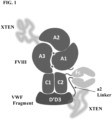
- the chimeric polypeptide or protein for use in accordance with the present invention comprises a FVIII-XTEN-Fc/D'D3-XTEN-Fc heterodimer.
- the FVIII-XTEN-Fc/D'D3-XTEN-Fc heterodimer chimeric polypeptide comprises: (i) the FVIII protein comprising the FVIII polypeptide, an XTEN inserted within the B domain of the FVIII polypeptide, and a first Fc region; and (ii) the VWF protein comprising a VWF fragment, a second XTEN sequence, an a2 linker, and a second Fc region.
- FIG. 1 A schematic representation of an exemplary FVIII-XTEN-Fc/D'D3-XTEN-Fc heterodimer, termed rFVIIIFc-VWF-XTEN, is presented in FIG. 1 .
- FVIII means functional FVIII polypeptide in its normal role in coagulation, unless otherwise specified.
- FVIII includes variant polypeptides that are functional.
- a FVIII protein is used to refer to a FVIII polypeptide (or protein) alone, a FVIII polypeptide fused to additional polypeptides, and a FVIII polypeptide associated with one or more additional polypeptides as long as the FVIII protein exhibits a FVIII function/activity.
- FVIII polypeptide “FVIII portion,” and “FVIII” refer to the FVIII polypeptide sequence alone.
- FVIII functions/activities include, but are not limited to, an ability to activate coagulation, an ability to act as a cofactor for factor IX, or an ability to form a tenase complex with factor IX in the presence of Ca 2+ and phospholipids, which then converts Factor X to the activated form Xa.
- the FVIII polypeptide can be the human, porcine, canine, rat, or murine FVIII polypeptide.
- comparisons between FVIII from humans and other species have identified conserved residues that are likely to be required for function ( Cameron et al., Thromb. Haemost. 79:317-22 (1998 ); US 6,251,632 ).
- FVIII polypeptides include, e.g., full-length FVIII, full-length FVIII minus Met at the N-terminus, mature FVIII polypeptide (minus the signal sequence), mature FVIII polypeptide with an additional Met at the N-terminus, and/or FVIII polypeptide with a full or partial deletion of the B domain.
- FVIII variants include B domain deletions, whether partial or full deletions.
- the FVIII polypeptide of the chimeric polypeptide used herein has FVIII activity in the plasma.
- FVIII activity can be measured by any known methods in the art. A number of tests are available to assess the function of the coagulation system: activated partial thromboplastin time (aPTT) test, chromogenic assay, ROTEM assay, prothrombin time (PT) test (also used to determine INR), fibrinogen testing (often by the Clauss method), platelet count, platelet function testing (often by PFA-100), TCT, bleeding time, mixing test (whether an abnormality corrects if the patient's plasma is mixed with normal plasma), coagulation factor assays, antiphospholipid antibodies, D-dimer, genetic tests (e.g., factor V Leiden, prothrombin mutation G20210A), dilute Russell's viper venom time (dRVVT), miscellaneous platelet function tests, thromboelastography (TEG or Sonoclot), thromboelastometry
- the aPTT test is a performance indicator measuring the efficacy of both the "intrinsic” (also referred to the contact activation pathway) and the common coagulation pathways. This test is commonly used to measure clotting activity of commercially available recombinant clotting factors, e.g., FVIII. It is typically used in conjunction with prothrombin time (PT), which measures the extrinsic pathway. (See, e.g., Kamal et al., Mayo Clin Proc., 82(7):864-873 (2007 )).
- PT prothrombin time
- aPTT is tested using an assay where FVIII activity is measured using the Dade ® Actin ® FSL Activated PTT Reagent (Siemens Health Care Diagnostics) on a BCS ® XP analyzer (Siemens Healthcare Diagnostics).
- the chimeric polypeptide has a plasma FVIII activity of at least about 1%, at least about 2%, at least about 3%, at least about 4%, at least about 5%, at least about 6%, at least about 7%, at least about 8%, at least about 9%, at least about 10%, at least about 11%, at least about 12 %, at least about 13%, at least about 14%, at least about 15%, at least about 15%, at least about 16%, at least about 17%, at least about 18%, at least about 19%, or at least about 20% as measured by aPTT test.
- the aPTT assay may also be used for assessing the potency of a chimeric polypeptide prior to administration to a patient or subject. ( Hubbard AR, et al. J Thromb Haemost 11: 988-9 (2013 )).
- the aPTT assay may further be used in conjunction with any of the assays described herein, either prior to administration or following administration to a patient or subject.
- ROTEM analysis provides information on the whole kinetics of haemostasis: clotting time, clot formation, clot stability and lysis.
- the different parameters in thromboelastometry are dependent on the activity of the plasmatic coagulation system, platelet function, fibrinolysis, or many factors which influence these interactions.
- This assay can provide a complete view of secondary haemostasis.
- the chromogenic assay mechanism is based on the principles of the blood coagulation cascade, where activated FVIII accelerates the conversion of Factor X into Factor Xa in the presence of activated Factor IX, phospholipids and calcium ions.
- the Factor Xa activity is assessed by hydrolysis of a p-nitroanilide (pNA) substrate specific to Factor Xa.
- pNA p-nitroanilide
- the initial rate of release of p-nitroaniline measured at 405 nM is directly proportional to the Factor Xa activity and thus to the FVIII activity in the sample.
- the chromogenic assay is the BIOPHEN FVIII:C assay (Hyphen Biomed, Neurville sur Oise, France)
- the chromogenic assay is recommended by the FVIII and Factor IX Subcommittee of the Scientific and Standardization Committee (SSC) of the International Society on Thrombosis and Hemostatsis (ISTH). Since 1994, the chromogenic assay has also been the reference method of the European Pharmacopoeia for the assignment of FVIII concentrate potency.
- the chimeric polypeptide comprising a FVIII polypeptide has FVIII activity comparable to a chimeric polypeptide comprising mature FVIII polypeptide or a BDD FVIII polypeptide (e.g., RECOMBINATE ® , KOGENATE FS ® , HELIXATE FS ® , XYNTHA/REFACTO AB ® , HEMOFIL-M ® , MONARC-M ® , MONOCLATE-P ® , HUMATE-P ® , ALPHANATE ® , KOATE-DVI ® , AFSTYLA ® , AND HYATE:C ® ).
- a BDD FVIII polypeptide e.g., RECOMBINATE ® , KOGENATE FS ® , HELIXATE FS ® , XYNTHA/REFACTO AB ® , HEMOFIL-M ® , MON
- the chromogenic assay may also be used for assessing the potency of a chimeric polypeptide prior to administration to a patient or subject. ( Hubbard AR, et al. J Thromb Haemost 11: 988-9 (2013 )).
- the chromogenic assay may further be used in conjunction with any of the assays described herein, either prior to administration or following administration to a patient or subject.
- the chimeric polypeptide comprising a FVIII polypeptide of this disclosure has a Factor Xa generation rate comparable to a chimeric polypeptide comprising a mature FVIII polypeptide or a BDD FVIII polypeptide (e.g., ADVATE ® , REFACTO ® , or ELOCTATE ® ).
- activated Factor IX hydrolyzes one arginine-isoleucine bond in Factor X to form Factor Xa in the presence of Ca 2+ , membrane phospholipids, and a FVIII cofactor. Therefore, the interaction of FVIII with Factor IX is critical in coagulation pathway.
- the chimeric polypeptide comprising a FVIII polypeptide can interact with Factor IXa at a rate comparable to a chimeric polypeptide comprising a mature FVIII polypeptide sequence or a BDD FVIII polypeptide (e.g., ADVATE ® , REFACTO ® , or ELOCTATE ® ).
- FVIII is bound to von Willebrand Factor while inactive in circulation. FVIII degrades rapidly when not bound to VWF and is released from VWF by the action of thrombin.
- the chimeric polypeptide comprising a FVIII polypeptide binds to von Willebrand Factor, e.g., a VWF fragment disclosed herein, at a level comparable to a chimeric polypeptide comprising a mature FVIII polypeptide sequence or a BDD FVIII polypeptide (e.g., ADVATE ® , REFACTO ® , or ELOCTATE ® ).
- FVIII can be inactivated by activated protein C in the presence of calcium and phospholipids.
- Activated protein C cleaves FVIII heavy chain after Arginine 336 in the A1 domain, which disrupts a Factor X substrate interaction site, and cleaves after Arginine 562 in the A2 domain, which enhances the dissociation of the A2 domain as well as disrupts an interaction site with the Factor IXa. This cleavage also bisects the A2 domain (43 kDa) and generates A2-N (18 kDa) and A2-C (25 kDa) domains.
- activated protein C can catalyze multiple cleavage sites in the heavy chain.
- the chimeric polypeptide comprising a FVIII polypeptide is inactivated by activated Protein C at a level comparable to a chimeric polypeptide comprising a mature FVIII polypeptide sequence or a BDD FVIII polypeptide (e.g., ADVATE ® , REFACTO ® , or ELOCTATE ® ).
- activated Protein C e.g., ADVATE ® , REFACTO ® , or ELOCTATE ®.
- the chimeric polypeptide comprising a FVIII polypeptide has FVIII activity in vivo comparable to a chimeric polypeptide comprising a mature FVIII polypeptide sequence or a BDD FVIII polypeptide (e.g., ADVATE ® , REFACTO ® , or ELOCTATE ® ).
- the chimeric polypeptide comprising a FVIII polypeptide is capable of protecting a HemA mouse at a level comparable to a chimeric polypeptide comprising a mature FVIII polypeptide sequence or a BDD FVIII polypeptide (e.g., ADVATE ® , REFACTO ® , or ELOCTATE ® ) in a HemA mouse tail vein transection model.
- a BDD FVIII polypeptide e.g., ADVATE ® , REFACTO ® , or ELOCTATE ®
- FVIII sequences full-length are shown below.
- Table 2 Amino Acid Sequence of Full-length Human Factor VIII (Full-length FVIII: FVIII signal peptide underlined; FVIII heavy chain is double underlined; B domain is italicized; and FVIII light chain is in plain text)
- Signal Peptide (SEQ ID NO: 64) MQIELSTCFFLCLLRFCFS Mature Factor VIII (SEQ ID NO: 65)* TABLE 3.
- Nucleotide Sequence Encoding Full-Length FVIII SEQ ID NO: 66)* *The underlined nucleic acids encode a signal peptide.
- FVIII polypeptides include full-length FVIII, full-length FVIII minus Met at the N-terminus, mature FVIII (minus the signal sequence), mature FVIII with an additional Met at the N-terminus, and/or FVIII with a full or partial deletion of the B domain.
- FVIII variants include B domain deletions, whether partial or full deletions.
- a native FVIII polypeptide has the following formula: A1-a1-A2-a2-B-a3-A3-C1-C2, where A1, A2, and A3 are the structurally-related "A domains,” B is the “B domain,” C1 and C2 are the structurally-related "C domains,” and a1, a2 and a3 are acidic spacer regions.
- the A1 domain of human FVIII extends from Ala1 to about Arg336, the a1 spacer region extends from about Met337 to about Val374, the A2 domain extends from about Ala375 to about Tyr719, the a2 spacer region extends from about Glu720 to about Arg740, the B domain extends from about Ser741 to about Arg 1648, the a3 spacer region extends from about Glu1649 to about Arg1689, the A3 domain extends from about Ser1690 to about Leu2025, the C1 domain extends from about Gly2026 to about Asn2072, and the C2 domain extends from about Ser2073 to Tyr2332.
- designation of the locations of the boundaries between the domains and regions of FVIII can vary in different literature references. The boundaries noted herein are therefore designated as approximate by use of the term "about.”
- the human FVIII gene was isolated and expressed in mammalian cells ( Toole, J. J., et al., Nature 312:342-347 (1984 ); Gitschier, J., et al., Nature 312:326-330 (1984 ); Wood, W. I., et al., Nature 312:330-337 (1984 ); Vehar, G. A., et al., Nature 312:337-342 (1984 ); WO 87/04187 ; WO 88/08035 ; WO 88/03558 ; and U.S. Pat. No. 4,757,006 ).
- the FVIII amino acid sequence was deduced from cDNA as shown in U.S. Pat. No.
- porcine FVIII sequence is published in Toole, J. J., et al., Proc. Natl. Acad. Sci. USA 83:5939-5942 (1986 ). Further, the complete porcine cDNA sequence obtained from PCR amplification of FVIII sequences from a pig spleen cDNA library has been reported in Healey, J. F., et al., Blood 88:4209-4214 (1996 ). Hybrid human/porcine FVIII having substitutions of all domains, all subunits, and specific amino acid sequences were disclosed in U.S. Pat. No. 5,364,771 by Lollar and Runge , and in WO 93/20093 .
- the "B-domain" of FVIII is the same as the B-domain known in the art that is defined by internal amino acid sequence identity and sites of proteolytic cleavage, e.g., residues Ser741-Arg1648 of full-length human FVIII.
- the other human FVIII domains are defined by the following amino acid residues: A1, residues Ala1-Arg372; A2, residues Ser373-Arg740; A3, residues Ser1690-Asn2019; C1, residues Lys2020-Asn2172; C2, residues Ser2173-Tyr2332.
- the A3-C1-C2 sequence includes residues Ser1690-Tyr2332.
- the remaining sequence, residues Glu1649-Arg1689, is usually referred to as the a3 acidic region.
- the locations of the boundaries for all of the domains, including the B-domains, for porcine, mouse and canine FVIII are also known in the art.
- the B domain of FVIII is deleted ("B-domain-deleted factor VIII" or "BDD FVIII”).
- Amino Acid Sequence of B-domain Deleted Factor VIII (B-domain deletion except 14 amino acid residues) (SEQ ID NO: 67) TABLE 5.
- Amino Acid Sequence of B-domain Deleted Factor VIII (B-domain deletion except 5 amino acid residues) (SEQ ID NO: 68)
- a "B-domain-deleted FVIII” can have the full or partial deletions disclosed in U.S. Pat. Nos. 6,316,226 , 6,346,513 , 7,041,635 , 5,789,203 , 6,060,447 , 5,595,886 , 6,228,620 , 5,972,885 , 6,048,720 , 5,543,502 , 5,610,278 , 5,171,844 , 5,112,950 , 4,868,112 , and 6,458,563 , U.S. Publ. Nos. US 2017/0073393 A1 and US 2012/308641 A1 , and Int'l Publ. Nos.
- a B-domain-deleted FVIII sequence comprises any one of the deletions disclosed at col. 4, line 4 to col. 5, line 28 and Examples 1-5 of U.S. Pat. No.
- a B-domain deleted Factor VIII is the S743/Q1638 B-domain deleted Factor VIII (SQ BDD FVIII) (e.g., Factor VIII having a deletion from amino acid 744 to amino acid 1637, e.g., Factor VIII having amino acids 1-743 and amino acids 1638-2332 of mature FVIII), or a B-domain-deleted FVIII has a deletion disclosed at col. 2, lines 26-51 and examples 5-8 of U.S. Patent No.
- 5,789,203 also US 6,060,447 , US 5,595,886 , and US 6,228,620
- a B-domain-deleted Factor VIII has a deletion described in col. 1, lines 25 to col. 2, line 40 of US Patent No. 5,972,885 ; col. 6, lines 1-22 and example 1 of U.S. Patent no. 6,048,720 ; col. 2, lines 17-46 of U.S. Patent No. 5,543,502 ; col. 4, line 22 to col. 5, line 36 of U.S. Patent no. 5,171,844 ; col. 2, lines 55-68, figure 2 , and example 1 of U.S. Patent No. 5,112,950 ; col. 2, line 2 to col.
- a B-domain-deleted FVIII polypeptide has a deletion of most of the B domain, but still contains amino-terminal sequences of the B domain that are essential for in vivo proteolytic processing of the primary translation product into two polypeptide chains, as disclosed in WO 91/09122 , or a B-domain-deleted FVIII polypeptide is constructed with a deletion of amino acids 747-1638, i.e., virtually a complete deletion of the B domain. Hoeben R.C., et al. J. Biol. Chem. 265 (13): 7318-7323 (1990 ).
- a B-domain-deleted Factor VIII polypeptide can also contain a deletion of amino acids 771-1666 or amino acids 868-1562 of FVIII. Meulien P., et al. Protein Eng. 2(4): 301-6 (1988 ). Additional B domain deletions include: deletion of amino acids 982 through 1562 or 760 through 1639 ( Toole et al., Proc. Natl. Acad. Sci. U.S.A. (1986) 83, 5939-5942 )), 797 through 1562 ( Eaton, et al. Biochemistry (1986) 25:8343-8347 )), 741 through 1646 ( Kaufman (PCT published application No.
- a B-domain-deleted FVIII polypeptide comprises a deletion of amino acid residues 746 to 1648 of mature FVIII (corresponding to a deletion of 765 to 1665 of full length FVIII), or a deletion of amino acid residues 745 to 1648 of mature FVIII (corresponding to a deletion of 764 to 1665 of full length FVIII).
- BDD FVIII includes a FVIII polypeptide containing fragments of the B-domain that retain one or more N-linked glycosylation sites, e.g., residues 757, 784, 828, 900, 963, or optionally 943, which correspond to the amino acid sequence of the full-length FVIII sequence.
- B-domain fragments include 226 amino acids or 163 amino acids of the B-domain as disclosed in Miao, H.Z., et al., Blood 103(a): 3412-3419 (2004 ), Kasuda, A, et al., J. Thromb. Haemost. 6: 1352-1359 (2008 ), and Pipe, S.W., et al., J.
- BDD FVIII further comprises a point mutation at residue 309 (from Phe to Ser) to improve expression of the BDD FVIII polypeptide. See Miao, H.Z., et al., Blood 103(a): 3412-3419 (2004 ).
- the BDD FVIII includes a FVIII polypeptide containing a portion of the B-domain, but not containing one or more furin cleavage sites (e.g., Arg1313 and Arg 1648). See Pipe, S.W., et al., J. Thromb.
- the BDD FVIII comprises single chain FVIII that contains a deletion in amino acids 765 to 1652 corresponding to the mature full length FVIII (also known as rFVIII-SingleChain and AFSTYLA ® ). See US Patent No. 7,041,635 . Each of the foregoing deletions can be made in any FVIII sequence.
- FVIII is cleaved right after Arginine at amino acid 1648 (in full-length Factor VIII or SEQ ID NO: 65), amino acid 754 (in the S743/Q1638 B-domain deleted Factor VIII or SEQ ID NO: 67), or the corresponding Arginine residue (in other variants), thereby resulting in a heavy chain and a light chain.
- a FVIII polypeptide comprises a heavy chain and a light chain, which are linked or associated by a metal ion-mediated non-covalent bond.
- FVIII is a single chain FVIII that has not been cleaved right after Arginine at amino acid 1648 (in full-length FVIII or SEQ ID NO: 65), amino acid 754 (in the S743/Q1638 B-domain-deleted FVIII or SEQ ID NO: 67), or the corresponding Arginine residue (in other variants).
- a single chain FVIII can comprise one or more amino acid substitutions.
- the amino acid substitution is at a residue corresponding to residue 1648, residue 1645, or both of full-length mature Factor VIII polypeptide (SEQ ID NO: 65) or residue 754, residue 751, or both of SQ BDD Factor VIII (SEQ ID NO: 67).
- the amino acid substitution can be any amino acids other than Arginine, e.g., isoleucine, leucine, lysine, methionine, phenylalanine, threonine, tryptophan, valine, alanine, asparagine, aspartic acid, cysteine, glutamic acid, glutamine, glycine, proline, selenocysteine, serine, tyrosine, histidine, ornithine, pyrrolysine, or taurine.
- Arginine e.g., isoleucine, leucine, lysine, methionine, phenylalanine, threonine, tryptophan, valine, alanine, asparagine, aspartic acid, cysteine, glutamic acid, glutamine, glycine, proline, selenocysteine, serine, tyrosine, histidine, ornithine, pyrrol
- FVIII can further be cleaved by thrombin and then activated as FVllla, serving as a cofactor for activated Factor IX (FIXa). And the activated FIX together with activated FVIII forms a Xase complex and converts Factor X to activated Factor X (FXa).
- FVIII is cleaved by thrombin after three Arginine residues, at amino acids 372, 740, and 1689 (corresponding to amino acids 372, 740, and 795 in the B-domain deleted FVIII sequence), the cleavage generating FVllla having the 50kDa A1, 43kDa A2, and 73kDa A3-C1-C2 chains.
- the FVIII polypeptide is non-active FVIII or an activated FVIII.
- the protein having FVIII polypeptide linked to or associated with the VWF protein has the FVIII clotting activity, e.g., activating Factor IX as a cofactor to convert Factor X to activated Factor X (FXa).
- Hybrid or “chimeric” polypeptides and proteins includes a combination of a first polypeptide and a second polypeptide.
- the hybrid or chimeric polypeptide comprises a single polypeptide chain, e.g., a chimeric polypeptide comprising a FVIII polypeptide and an XTEN. See, e.g., US 2015/0158929 A1 .
- the hybrid or chimeric polypeptide comprises a combination of a first polypeptide chain, e.g., a VWF fragment fused to an XTEN sequence and a first Ig constant region or a portion thereof, with a second polypeptide chain, e.g., a FVIII polypeptide fused to a second Ig constant region or a portion thereof, thereby forming a heterodimer.
- a first polypeptide chain e.g., a VWF fragment fused to an XTEN sequence and a first Ig constant region or a portion thereof
- a second polypeptide chain e.g., a FVIII polypeptide fused to a second Ig constant region or a portion thereof
- the rFVIIIFc-VWF-XTEN comprises the amino acid sequence of SEQ ID NO: 207.
- FVIII variants A great many functional FVIII variants are known, as is discussed above and below.
- hundreds of nonfunctional mutations in FVIII have been identified in hemophilia patients, and it has been determined that the effect of these mutations on FVIII function is due more to where they lie within the 3-dimensional structure of FVIII than on the nature of the substitution ( Cutler et al., Hum. Mutat. 19:274-8 (2002 )).
- comparisons between FVIII from humans and other species have identified conserved residues that are likely to be required for function ( Cameron et al., Thromb. Haemost. 79:317-22 (1998 ); US 6,251,632 ).
- VWF Von Willebrand Factor
- VWF also known as F8VWF
- F8VWF is a large multimeric glycoprotein present in blood plasma and produced constitutively in endothelium (in the Weibel-Palade bodies), megakaryocytes ( ⁇ -granules of platelets), and subendothelian connective tissue.
- the basic VWF monomer is a 2813 amino acid protein.
- Every monomer contains a number of specific domains with a specific function, the D'/D3 domain (which binds to Factor VIII), the A1 domain (which binds to platelet GPlb-receptor, heparin, and/or possibly collagen), the A3 domain (which binds to collagen), the C1 domain (in which the RGD domain binds to platelet integrin ⁇ IIb ⁇ 3 when this is activated), and the "cysteine knot" domain at the C-terminal end of the protein (which VWF shares with platelet-derived growth factor (PDGF), transforming growth factor- ⁇ (TGF ⁇ ) and ⁇ -human chorionic gonadotropin ( ⁇ HCG)).
- PDGF platelet-derived growth factor
- TGF ⁇ transforming growth factor- ⁇
- ⁇ HCG ⁇ -human chorionic gonadotropin
- a VWF fragment as used herein includes, but is not limited to, functional VWF fragments comprising a D' domain and a D3 domain, which are capable of inhibiting binding of endogenous VWF to FVIII.
- the VWF fragment binds to the FVIII protein or blocks the VWF binding site on the FVIII protein, thereby inhibiting interaction of the FVIII protein with endogenous VWF.
- the VWF fragment blocks the binding of FVIII to endogenous VWF, thereby preventing clearance of the FVIII protein through a VWF-clearance pathway.
- the VWF fragments include derivatives, variants, mutants, or analogues that retain these activities of VWF.
- the 2813 monomer amino acid sequence for human VWF is reported as Accession Number NP000543.2 in Genbank.
- the nucleotide sequence encoding the human VWF is reported as Accession Number NM000552.3 in Genbank.
- a nucleotide sequence of human VWF is designated as SEQ ID NO: 20.
- SEQ ID NO: 21 is the amino acid sequence of full-length VWF. Each domain of VWF is listed in Table 6. TABLE 6.
- VWF Sequences (human) VWF domains Amino acid Sequence VWF Signal Peptide 1 MIPARFAGVLLALALILPGT LC 22 SEQ ID NO: 208 (Amino acids 1 to 22 of SEQ ID NO: 21) VWF D1D2 Domain SEQ ID NO: 209 (Amino acids 23 to 763 of SEQ ID NO: 21) VWF D' Domain SEQ ID NO: 210 (Amino acids 764 to 866 of SEQ ID NO: 21) VWF D3 Domain SEQ ID NO: 211 (Amino acids 867 to 1240 of SEQ ID NO: 21) VWF A1 Domain SEQ ID NO: 212 (Amino acids 1241 to 1479 of SEQ ID NO: 21) VWF A2 Domain to C-terminus SEQ ID NO: 213 (Amino acids 1480 to 2813 of SEQ ID NO: 21)
- the VWF protein as used herein is a VWF fragment comprising a D' domain and a D3 domain of VWF, wherein the VWF fragment binds to Factor VIII (FVIII) and inhibits binding of endogenous VWF (full-length VWF) to FVIII.
- FVIII Factor VIII
- the VWF fragment comprising a D' domain and a D3 domain is associated with the FVIII protein. See, e.g., US 2015/0023959 A1 , US 2015/0266943 A1 , US 2016/0251408 A1 , US 2017/0073393 A1 , US 2018/185455 A1 , US 2018/0051067 A1 , US 2017/0152300 A1 , US 9,878,017 B2 , US 9,458,223 B2 , US 8,575,104 B2 , WO 2017/117630 A1 , US 2018/0161402 A1 , WO 2017/117631 A1 , WO 2018/087271 A1 , US 9,107,902 B2 , WO 2017/222337 A1 , WO 2015/185758 A1 .
- a VWF fragment of the disclosure protects FVIII from protease cleavage and FVIII activation, stabilizes the heavy chain and light chain of FVIII, and prevents clearance of FVIII by scavenger receptors.
- the VWF fragment binds to or associates with a FVIII protein and blocks or prevents binding of the FVIII protein to phospholipid and activated Protein C.
- the VWF fragment of the disclosure reduces the clearance of FVIII by VWF clearance receptors and thus extends half-life of the chimeric polypeptide.
- the half-life extension of a chimeric polypeptide is thus due to the binding of or associating with the VWF fragment lacking a VWF clearance receptor binding site to the FVIII protein and shielding or protecting of the FVIII protein by the VWF fragment from endogenous VWF which contains the VWF clearance receptor binding site.
- the FVIII protein bound to or protected by the VWF fragment can also allow recycling of a FVIII protein.
- the FVIII/VWF heterodimers of the disclosure are shielded from the VWF clearance pathway, further extending FVIII half-life.
- the VWF proteins useful for the disclosure can have other modifications, e.g., the protein can be pegylated, glycosylated, hesylated, or polysialylated.
- the chimeric polypeptide of the invention comprises the VWF protein comprising a VWF fragment, an XTEN sequence, an a2 linker of FVIII, and a Fc region.
- the VWF protein comprises, as ordered from N-terminal to C-terminal, a VWF fragment, fused to an XTEN sequence, fused to an a2 linker, fused to a Fc region.
- the VWF protein comprises a D' domain of VWF comprising the amino acid sequence of SEQ ID NO: 210, a D3 domain of VWF comprising the amino acid sequence of SEQ ID NO: 214, an XTEN sequence comprising the amino acid sequence of SEQ ID NO: 58 (AE144_5A), an a2 linker comprising the amino acid sequence of SEQ ID NO: 88, and an Fc region comprising the amino acid sequence of SEQ ID NO: 217.
- the chimeric polypeptide is rFVIIIFc-VWF-XTEN and comprises a VWF protein comprising the amino acid sequence of SEQ ID NO: 202.
- the chimeric polypeptide in accordance with the present invention comprises half-life extending moieties in the form of Fc regions and XTEN sequences.
- the chimeric polypeptide includes a first Ig constant region fused to the FVIII polypeptide by a linker.
- the chimeric polypeptide further includes a second Ig constant region fused to the VWF protein.
- the first Ig constant region is linked to or associated with the second Ig constant region by a covalent bond, e.g., a disulfide bond.
- the Ig constant region can improve pharmacokinetic or pharmacodynamic properties of the chimeric polypeptide in combination with the XTEN sequence, and the VWF protein.
- the Ig constant region extends a half-life of a molecule fused to the Ig constant region.
- An Ig constant region is comprised of domains denoted CH (constant heavy) domains (CH1, CH2, etc.).
- CH constant heavy domains
- the constant region can be comprised of three or four CH domains.
- Some isotypes (e.g. IgG) constant regions also contain a hinge region. See Janeway et al. 2001, Immunobiology, Garland Publishing, N.Y., N.Y .
- the Ig constant region for producing the chimeric polypeptide of the present disclosure is the human isotype IgG1.
- the sequences of the Ig constant region can be cloned, e.g., using the polymerase chain reaction and primers which are selected to amplify the domain of interest.
- mRNA can be isolated from hybridoma, spleen, or lymph cells, reverse transcribed into DNA, and antibody genes amplified by PCR.
- PCR amplification methods are described in detail in U.S. Pat. Nos. 4,683,195 ; 4,683,202 ; 4,800,159 ; 4,965,188 ; and in, e.g., " PCR Protocols: A Guide to Methods and Applications" Innis et al.
- PCR can be initiated by consensus constant region primers or by more specific primers based on the published heavy and light chain DNA and amino acid sequences. As discussed above, PCR also can be used to isolate DNA clones encoding the antibody light and heavy chains. In this case the libraries can be screened by consensus primers or larger homologous probes, such as mouse constant region probes. Numerous primer sets suitable for amplification of antibody genes are known in the art (e.g., 5' primers based on the N-terminal sequence of purified antibodies ( Benhar and Pastan. 1994.
- Fc region is defined as the portion of a polypeptide which corresponds to the Fc region of native Ig, i.e., as formed by the dimeric association of the respective Fc domains of its two heavy chains.
- a native Fc region forms a homodimer with another Fc region.
- scFc region single-chain Fc region
- scFc region refers to a synthetic dimeric Fc region comprised of Fc domains genetically linked within a single polypeptide chain (i.e., encoded in a single contiguous genetic sequence).
- An Ig constant region or a portion thereof can be an FcRn binding partner.
- FcRn is active in adult epithelial tissues and expressed in the lumen of the intestines, pulmonary airways, nasal surfaces, vaginal surfaces, colon and rectal surfaces ( U.S. Pat. No. 6,485,726 ).
- An FcRn binding partner is a portion of an Ig that binds to FcRn.
- Another example of an FcRn binding partner is albumin, further described below.
- the FcRn receptor has been isolated from several mammalian species including humans. The sequences of the human FcRn, monkey FcRn, rat FcRn, and mouse FcRn are known ( Story et al. 1994, J. Exp. Med. 180:2377 ).
- the FcRn receptor binds IgG (but not other Ig classes such as IgA, IgM, IgD, and IgE) at relatively low pH, actively transports the IgG transcellularly in a luminal to serosal direction, and then releases the IgG at relatively higher pH found in the interstitial fluids. It is expressed in adult epithelial tissue ( U.S. Pat. Nos.
- FcRn binding partners useful in the present disclosure encompass molecules that can be specifically bound by the FcRn receptor including whole IgG, the Fc fragment of IgG, and other fragments that include the complete binding region of the FcRn receptor.
- the region of the Fc portion of IgG that binds to the FcRn receptor has been described based on X-ray crystallography ( Burffle et al. 1994, Nature 372:379 ).
- the major contact area of the Fc with the FcRn is near the junction of the CH2 and CH3 domains. Fc-FcRn contacts are all within a single Ig heavy chain.
- the FcRn binding partners include whole IgG, the Fc fragment of IgG, and other fragments of IgG that include the complete binding region of FcRn.
- the major contact sites include amino acid residues 248, 250-257, 272, 285, 288, 290-291, 308-311, and 314 of the CH2 domain and amino acid residues 385-387, 428, and 433-436 of the CH3 domain.
- References made to amino acid numbering of Igs or Ig fragments, or regions, are all based on Kabat et al. 1991, Sequences of Proteins of Immunological Interest, U.S. Department of Public Health, Bethesda, Md .
- Fc regions or FcRn binding partners bound to FcRn can be effectively shuttled across epithelial barriers by FcRn, thus providing a non-invasive means to systemically administer a desired therapeutic molecule.
- fusion proteins comprising an Fc region or an FcRn binding partner are endocytosed by cells expressing the FcRn. But instead of being marked for degradation, these fusion proteins are recycled out into circulation again, thus increasing the in vivo half-life of these proteins.
- the portions of Ig constant regions are optionally an Fc region or an FcRn binding partner that typically associates, via disulfide bonds and other non-specific interactions, with another Fc region or another FcRn binding partner to form dimers and higher order multimers.
- FcRn receptors can bind a single Fc molecule. Crystallographic data suggest that each FcRn molecule binds a single polypeptide of the Fc homodimer.
- Linking the FcRn binding partner, e.g., an Fc fragment of an IgG, to a biologically active molecule provides a means of delivering the biologically active molecule orally, buccally, sublingually, rectally, vaginally, as an aerosol administered nasally or via a pulmonary route, or via an ocular route.
- An FcRn binding partner region is a molecule or a portion thereof that can be specifically bound by the FcRn receptor with consequent active transport by the FcRn receptor of the Fc region.
- Specifically bound refers to two molecules forming a complex that is relatively stable under physiologic conditions. Specific binding is characterized by a high affinity and a low to moderate capacity as distinguished from nonspecific binding which usually has a low affinity with a moderate to high capacity. Typically, binding is considered specific when the affinity constant KA is higher than 10 6 M -1 , or higher than 10 8 M -1 . If necessary, non-specific binding can be reduced without substantially affecting specific binding by varying the binding conditions.
- the appropriate binding conditions such as concentration of the molecules, ionic strength of the solution, temperature, time allowed for binding, concentration of a blocking agent (e.g. serum albumin, milk casein), etc., can be optimized by a skilled artisan using routine techniques.
- the immunoglobulin constant region or a portion thereof comprises an amino acid sequence in the hinge region or a portion thereof that forms one or more disulfide bonds with another immunoglobulin constant region or a portion thereof.
- the disulfide bond by the immunoglobulin constant region or a portion thereof places the first polypeptide comprising a FVIII polypeptide and the second polypeptide comprising the VWF fragment together so that endogenous VWF does not replace the VWF fragment and does not bind to the FVIII polypeptide. Therefore, the disulfide bond between the first immunoglobulin constant region or a portion thereof and a second immunoglobulin constant region or a portion thereof prevents interaction between endogenous VWF and the FVIII polypeptide.
- the hinge region or a portion thereof can further be linked to one or more domains of CH1, CH2, CH3, a fragment thereof, and any combinations thereof.
- the immunoglobulin constant region or a portion thereof is a hinge region and CH2.
- the Ig constant region or a portion thereof is hemi-glycosylated.
- the chimeric polypeptide comprising two Fc regions or FcRn binding partners can contain a first, glycosylated, Fc region (e.g., a glycosylated CH2 region) or FcRn binding partner and a second, aglycosylated, Fc region (e.g., an aglycosylated CH2 region) or FcRn binding partner.
- the Fc region or FcRn binding partner is fully glycosylated, i.e., all of the Fc regions are glycosylated.
- the Fc region can be aglycosylated, i.e., none of the Fc moieties are glycosylated.
- XTEN sequence refers to extended length polypeptides with non-naturally occurring, substantially non-repetitive sequences that are composed mainly of small hydrophilic amino acids, with the sequence having a low degree or no secondary or tertiary structure under physiologic conditions.
- XTENs can serve as a carrier, conferring certain desirable pharmacokinetic, physicochemical and pharmaceutical properties when linked to a VWF protein or a FVIII sequence of the disclosure to create a chimeric polypeptide. Such desirable properties include but are not limited to enhanced pharmacokinetic parameters and solubility characteristics.
- "XTEN” specifically excludes antibodies or antibody fragments such as single-chain antibodies or Fc fragments of a light chain or a heavy chain.
- a shorter XTEN sequence provides an improved half-life extending property compared to a longer XTEN sequence when the XTEN sequence is fused to the VWF protein. Therefore, the XTEN sequence fused to the VWF protein contains less than 288 amino acids in length, i.e., is shorter than 288 amino acids.
- the XTEN sequence fused to the VWF protein is an amino acid sequence of SEQ ID NO: 58, and the chimeric polypeptide exhibits an improved half-life compared to a chimeric polypeptide without the XTEN sequence.
- the chimeric polypeptide of the disclosure further comprises an additional second XTEN sequence.
- the additional second XTEN sequence is fused to the FVIII polypeptide.
- the additional XTEN sequences is as set forth in SEQ ID NO: 218.
- the XTEN sequences comprise non-overlapping sequence motifs consisting of multiple units of non-overlapping sequences selected from a single motif family selected from Table 7, resulting in a family sequence.
- family means that the XTEN has motifs selected only from a single motif category from Table 7; i.e., AD, AE, AF, AG, AM, AQ, BC, or BD XTEN, and that any other amino acids in the XTEN not from a family motif are selected to achieve a needed property, such as to permit incorporation of a restriction site by the encoding nucleotides, incorporation of a cleavage sequence, or to achieve a better linkage to FVIII or VWF.
- the XTEN comprises multiple units of motif sequences from two or more of the motif families of Table 7. These sequences can be selected to achieve desired physical/chemical characteristics, including such properties as net charge, hydrophilicity, lack of secondary structure, or lack of repetitiveness that are conferred by the amino acid composition of the motifs, described more fully below.
- the motifs incorporated into the XTEN can be selected and assembled using the methods described herein to achieve an XTEN of about 36 to about 3000 amino acid residues. Table 7.
- the XTEN sequence used in the disclosure affects the physical or chemical property, e.g., pharmacokinetics, of the chimeric polypeptide of the present disclosure.
- the XTEN sequence used in the present disclosure can exhibit one or more of the following advantageous properties: conformational flexibility, enhanced aqueous solubility, high degree of protease resistance, low immunogenicity, low binding to mammalian receptors, or increased hydrodynamic (or Stokes) radii.
- the XTEN sequence linked to a FVIII protein in this disclosure increases pharmacokinetic properties such as longer terminal half-life or increased area under the curve (AUC), so that the chimeric polypeptide described herein stays in vivo for an increased period of time compared to wild type FVIII.
- the XTEN sequence used in this disclosure increases pharmacokinetic properties such as longer terminal half-life or increased area under the curve (AUC), so that FVIII protein stays in vivo for an increased period of time compared to wild type FVIII.
- a variety of methods and assays can be employed to determine the physical/chemical properties of proteins comprising the XTEN sequence. Such methods include, but are not limited to analytical centrifugation, EPR, HPLC-ion exchange, HPLC-size exclusion, HPLC-reverse phase, light scattering, capillary electrophoresis, circular dichroism, differential scanning calorimetry, fluorescence, HPLC-ion exchange, HPLC-size exclusion, IR, NMR, Raman spectroscopy, refractometry, and UV/Visible spectroscopy. Additional methods are disclosed in Amau et al., Prot Expr and Purif 48, 1-13 (2006 ).
- XTEN sequences are disclosed in US Patent Publication Nos. 2010/0239554 A1 , 2010/0323956 A1 , 2011/0046060 A1 , 2011/0046061 A1 , 2011/0077199 A1 , or 2011/0172146 A1 , or International Patent Publication Nos. WO 2010091122 A1 , WO 2010144502 A2 , WO 2010144508 A1 , WO 2011028228 A1 , WO 2011028229 A1 , WO 2011028344 A2 , or WO 20130122617 A1 .
- an albumin or a portion thereof can be an FcRn binding partner.
- a chimeric polypeptide used in the context of the present disclosure comprises at least one albumin polypeptide or fragment, variant, or derivative thereof.
- Human serum albumin (HSA, or HA) a protein of 609 amino acids in its full-length form, is responsible for a significant proportion of the osmotic pressure of serum and also functions as a carrier of endogenous and exogenous ligands.
- the term "albumin” as used herein includes full-length albumin or a functional fragment, variant, derivative, or analog thereof. Examples of albumin or the fragments or variants thereof are disclosed in US Pat. Publ. Nos.
- albumin-binding polypeptides can compromise, without limitation, bacterial albumin-binding domains, albumin-binding peptides, or albumin-binding antibody fragments that can bind to albumin.
- Domain 3 from streptococcal protein G, as disclosed by Kraulis et al., FEBS Lett. 378:190-194 (1996 ) and Linhult et al., Protein Sci. 11:206-213 (2002 ) is an example of a bacterial albumin-binding domain. Examples of albumin-binding peptides are disclosed in Dennis et al., J. Biol. Chem. 2002, 277: 35035-35043 (2002 ).
- albumin-binding antibody fragments examples include Muller and Kontermann, Curr. Opin. Mol. Ther. 9:319-326 (2007 ); Roovers et al., Cancer Immunol. Immunother. 56:303-317 (2007 ), and Holt et al., Prot. Eng. Design Sci., 21:283-288 (2008 ).
- a chimeric polypeptide used in the context of the present disclosure comprises at least one attachment site for a non-polypeptide small molecule, variant, or derivative that can bind to albumin thereof.
- the chimeric polypeptide can include one or more organic albumin-binding moieties.
- An example of such albumin-binding moieties is 2-(3-maleimidopropanamido)-6-(4-(4-iodophenyl)butanamido)hexanoate ("Albu" tag) as disclosed by Trussel et al., Bioconjugate Chem. 20:2286-2292 (2009 ).
- the a VWF fragment described herein is fused to an albumin.
- the VWF fragment-albumin constructs form homodimers.
- the D'D3 domain of VWF that is fused to the albumin associates with a FVIII polypeptide.
- the D'D3 domain of VWF fused to the albumin associated with the FVIII polypeptide by an interaction stronger than the natural non-covalent interactions between wild-type FVIII and VWF.
- a chimeric polypeptide used in the context of the present disclosure comprises at least one C-terminal peptide (CTP) of the ⁇ subunit of human chorionic gonadotropin or fragment, variant, or derivative thereof.
- CTP peptides are known to increase the half-life of that protein. See, e.g., U.S. Patent No. 5,712,122 .
- Non-limiting exemplary CTP peptides are disclosed in U.S. Patent Application Publication No. US 2009/0087411 A1 .
- a chimeric polypeptide used in the context of the present disclosure comprises at least one PAS peptide or fragment, variant, or derivative thereof.
- a PAS peptide or PAS sequence as used herein, means an amino acid sequence comprising mainly alanine and serine residues or comprising mainly alanine, serine, and proline residues, the amino acid sequence forming random coil conformation under physiological conditions.
- the PAS sequence is a building block, an amino acid polymer, or a sequence cassette comprising, consisting essentially of, or consisting of alanine, serine, and proline which can be used as a part of the heterologous moiety in the chimeric polypeptide.
- amino acid polymer also can form random coil conformation when residues other than alanine, serine, and proline are added as a minor constituent in the PAS sequence.
- minor constituent is meant that that amino acids other than alanine, serine, and proline can be added in the PAS sequence to a certain degree, e.g., up to about 12%, i.e., about 12 of 100 amino acids of the PAS sequence, up to about 10%, up to about 9%, up to about 8%, about 6%, about 5%, about 4%, about 3%, i.e. about 2%, or about 1%, of the amino acids.
- the amino acids different from alanine, serine and proline cab be selected from the group consisting of Arg, Asn, Asp, Cys, Gln, Glu, Gly, His, Ile, Leu, Lys, Met, Phe, Thr, Trp, Tyr, and Val.
- a PAS peptide forms a random coil conformation and thereby can mediate an increased in vivo and/or in vitro stability to a recombinant protein of the disclosure, and has procoagulant activity.
- Non-limiting examples of the PAS peptides are disclosed in, e.g., US Pat. Publ. No. 2010/0292130 A1 ; PCT Appl. Publ. No. WO 2008/155134 A1 ; and European issued patent EP2173890 .
- a chimeric polypeptide used in the context of the present disclosure comprises at least one homo-amino acid polymer (HAP) peptide or fragment, variant, or derivative thereof.
- HAP peptide can comprise a repetitive sequence of glycine, which has at least 50 amino acids, at least 100 amino acids, 120 amino acids, 140 amino acids, 160 amino acids, 180 amino acids, 200 amino acids, 250 amino acids, 300 amino acids, 350 amino acids, 400 amino acids, 450 amino acids, or 500 amino acids in length.
- a HAP sequence is capable of extending half-life of a moiety fused to or linked to the HAP sequence.
- Non-limiting examples of the HAP sequence includes, but are not limited to (Gly)n, (Gly4Ser)n or S(Gly4Ser)n, wherein n is 1, 2, 3, 4, 5, 6, 7, 8, 9, 10, 11, 12, 13, 14, 15, 16, 17, 18, 19, or 20.
- n is 20, 21, 22, 23, 24, 25, 26, 26, 28, 29, 30, 31, 32, 33, 34, 35, 36, 37, 38, 39, or 40.
- n is 50, 60, 70, 80, 90, 100, 110, 120, 130, 140, 150, 160, 170, 180, 190, or 200. See, e.g., Schlapschy M et al., Protein Eng. Design Selection, 20: 273-284 (2007 ).
- a chimeric polypeptide used in the context of the present disclosure comprises at least one transferrin peptide or fragment, variant, or derivative thereof. Any transferrin can fuse with the chimeric polypeptide used in the methods of the present disclosure.
- Tf wild-type human Tf
- wild-type human Tf is a 679 amino acid protein, of approximately 75 kDa (not accounting for glycosylation), with two main domains, N (about 330 amino acids) and C (about 340 amino acids), which appear to originate from a gene duplication. See GenBank accession numbers NM001063, XM002793, M12530, XM039845, XM 039847 and S95936 (www.ncbi.nlm.nih.gov).
- Transferrin transports iron through transferrin receptor (TfR)-mediated endocytosis. After the iron is released into an endosomal compartment and Tf-TfR complex is recycled to cell surface, the Tf is released back extracellular space for next cycle of iron transporting.
- Tf possesses a long half-life that is in excess of 14-17 days ( Li et al., Trends Pharmacol. Sci. 23:206-209 (2002 )). Transferrin fusion proteins have been studied for half-life extension, targeted deliver for cancer therapies, oral delivery and sustained activation of proinsulin ( Brandsma et al., Biotechnol. Adv., 29: 230-238 (2011 ); Bai et al., Proc. Natl. Acad. Sci.
- a chimeric polypeptide used in the context of the present disclosure comprises at least one attachment site for a non-polypeptide heterologous moiety or fragment, variant, or derivative thereof.
- a chimeric polypeptide used in the methods of the present disclosure can include one or more polyethylene glycol (PEG) moieties attached to one or more amino acid residues in the clotting factor and/or the Fc region.
- PEG polyethylene glycol
- PEGylation of a protein can refer to a conjugate formed between the protein and at least one polyethylene glycol (PEG) molecule.
- PEG is commercially available in a large variety of molecular weights and average molecular weight ranges. Typical examples of PEG average molecular weight ranges include, but are not limited to, about 200, about 300, about 400, about 600, about 1000, about 1300-1600, about 1450, about 2000, about 3000, about 3000-3750, about 3350, about 3000-7000, about 3500-4500, about 5000-7000, about 7000-9000, about 8000, about 10000, about 8500-11500, about 16000-24000, about 35000, about 40000, about 60000, and about 80000 Daltons. These average molecular weights are provided merely as examples and are not meant to be limiting in any way.
- a chimeric polypeptide used in the context of the present disclosure can be PEGylated to include mono- or poly-(e.g., 2-4) PEG moieties.
- PEGylation can be carried out by any of the PEGylation reactions known in the art.
- Methods for preparing a PEGylated protein product will generally include (i) reacting a polypeptide with polyethylene glycol (such as a reactive ester or aldehyde derivative of PEG) under conditions whereby the peptide of the disclosure becomes attached to one or more PEG groups; and (ii) obtaining the reaction product(s).
- polyethylene glycol such as a reactive ester or aldehyde derivative of PEG
- the optimal reaction conditions for the reactions will be determined case by case based on known parameters and the desired result.
- FVIII variants can contain cysteine substitutions, and the cysteines can be further conjugated to PEG polymer. See Mei et al., Blood 116:270-279 (2010 ) and U.S. Patent No. 7,632,921 .
- the chimeric polypeptide comprises a single chain FVIII polypeptide covalently linked to a VWF fragment comprising a D' domain and a D3 domain of VWF, wherein the FVIII polypeptide comprises a deletion of the B domain, wherein the FVIII polypeptide is pegylated, and wherein the VWF fragment is fused directly or indirectly to the N-terminus of the FVIII polypeptide (e.g., PEG-scFVIII-D'D3, "MG1121,” or LAFATE).
- the chimeric polypeptide comprises a single chain FVIII polypeptide covalently linked to a VWF fragment comprising a D' domain and a D3 domain of VWF, wherein the FVIII polypeptide comprises a deletion of the B domain, wherein the VWF fragment is pegylated, and wherein the VWF fragment is fused directly or indirectly to the N-terminus of the FVIII polypeptide (e.g., scFVIII-D'D3-PEG).
- the chimeric polypeptide comprises a single chain FVIII polypeptide covalently linked to a VWF fragment comprising a D' domain and a D3 domain of VWF, wherein the FVIII polypeptide comprises a deletion of the B domain, wherein FVIII polypeptide and the VWF fragment are pegylated, and wherein the VWF fragment is fused directly or indirectly to the N-terminus of the FVIII polypeptide (e.g., scFVIII-D'D3-PEG).
- a chimeric polypeptide used in the context of the present disclosure comprises at least one hydroxyethyl starch (HES) polymer.
- HES is a derivative of naturally occurring amylopectin and is degraded by alpha-amylase in the body. HES exhibits advantageous biological properties and is used as a blood volume replacement agent and in hemodilution therapy in the clinics. See, e.g., Sommermeyer et al., Whypharmazie 8:271-278 (1987 ); and Weidler et al., Arzneim.-Forschung/Drug Res. 41: 494-498 (1991 ).
- HES is mainly characterized by the molecular weight distribution and the degree of substitution.
- HES has a mean molecular weight (weight mean) of from 1 to 300 kD, from 2 to 200kD, from 3 to 100 kD, or from 4 to 70kD.
- Hydroxyethyl starch can further exhibit a molar degree of substitution of from 0.1 to 3, from 0.1 to 2, from 0.1 to 0.9, or from 0.1 to 0.8, and a ratio between C2:C6 substitution in the range of from 2 to 20 with respect to the hydroxyethyl groups.
- HES with a mean molecular weight of about 130 kD is VOLUVEN ® from Fresenius.
- VOLUVEN ® is an artificial colloid, employed, e.g., for volume replacement used in the therapeutic indication for therapy and prophylaxis of hypovolaemia.
- HES attachment methods available to those skilled in the art, e.g., the same PEG attachment methods described above.
- a chimeric polypeptide used in the context of the present disclosure comprises at least one polysialic acid (PSA) polymer.
- PSAs are naturally occurring unbranched polymers of sialic acid produced by certain bacterial strains and in mammals in certain cells. See, e.g., Roth J. et al. (1993) in Polysialic Acid: From Microbes to Man, eds. Roth J., Rutishauser U., Troy F. A. (BirkhäuserVerlag, Basel, Switzerland), pp. 335-348 .
- PSA attachment methods available to those skilled in the art, e.g., the same PEG attachment methods described above.
- an activated PSA can also be attached to a cysteine amino acid residue within the clotting factor, e.g., on FVIII, or within the Fc region. See, e.g., U.S. Patent No. 5846951 .
- the half-life of a chimeric polypeptide used in the context of the present disclosure can be extended where the clotting factor of the chimeric polypeptide comprises a FVIII polypeptide and at least one fragment of a FVIII clearance receptor or FVIII-binding fragment, variant, or derivative thereof.
- Insertion of soluble forms of clearance receptors such as the low-density lipoprotein-related protein receptor LRP1, or fragments thereof, can block binding of FVIII to clearance receptors and thereby extend its half-life, e.g., in vivo half-life.
- LRP1 is a 600 kDa integral membrane protein that is implicated in the receptor-mediate clearance of a variety of proteins, including FVIII.
- FVIII clearance receptors are, e.g., LDLR (low-density lipoprotein receptor), VLDLR (very low-density lipoprotein receptor), and megalin (LRP-2), or fragments thereof.
- LDLR low-density lipoprotein receptor
- VLDLR very low-density lipoprotein receptor
- LRP-2 megalin
- the XTEN is inserted in the B domain of FVIII.
- the XTEN sequence comprising the amino acid sequence of AE288_3 (SEQ ID NO: 218) is inserted between amino acids 745 and 746 of a mature FVIII, wherein the mature FVIII has a deletion of amino acid residues 746-1648, more specifically, the XTEN is inserted immediately downstream of amino acid 745.
- the chimeric polypeptide of the present disclosure further comprises one linker in the VWF fragment.
- the linker is a cleavable linker, which can be cleaved by various proteases when administered to a subject in vivo, e.g., at a site of coagulation.
- the cleavable linker allows cleavage of moiety, e.g., a VWF protein, from the XTEN sequence, thus from the chimeric polypeptide at the site of the coagulation cascade, thereby allowing activated FVIII (FVllla) to have its FVllla activity.
- the chimeric polypeptide used in the context of the present invention comprises a first polypeptide which comprises (i) a FVIII polypeptide and (ii) a first Ig constant region and a second polypeptide which comprises (iii) a VWF protein, (iv) a linker (e.g., a cleavable linker), (v) an XTEN sequence, and (vi) a second Ig constant region.
- a first polypeptide which comprises (i) a FVIII polypeptide and (ii) a first Ig constant region
- a second polypeptide which comprises (iii) a VWF protein, (iv) a linker (e.g., a cleavable linker), (v) an XTEN sequence, and (vi) a second Ig constant region.
- the linker used in the context of the present invention is the a2 linker having the amino acid sequence as set forth in SEQ ID NO: 88.
- the cleavable linker can incorporate a moiety capable of being cleaved either chemically (e.g., hydrolysis of an ester bond), enzymatically (i.e., incorporation of a protease cleavage sequence), or photolytically (e.g., a chromophore such as 3-amino-3-(2-nitrophenyl) proprionic acid (ANP)) in order to release one molecule from another.
- a chromophore such as 3-amino-3-(2-nitrophenyl) proprionic acid (ANP)
- Examples of cleavable linkers can be found, for example, in US 2016/0229903 A1 and US 2016/0251408 A1 .
- the cleavable linker is cleavable in a thrombin cleavage assay as provided herein or as known in the art.
- the chimeric polypeptide of the present disclosure comprises: (i) a FVIII protein comprising a FVIII polypeptide, a first XTEN sequence, and a first Fc region; and (ii) a VWF fragment comprising a D' domain of VWF and a D3 domain of VWF, a second XTEN sequence, an a2 linker of FVIII, and a second Fc region; wherein:
- the chimeric polypeptide comprises two polypeptide sequences, a first polypeptide sequence comprising an amino acid sequence as set forth in SEQ ID NO: 207; and a second polypeptide sequence comprising a VWF fragment comprising a D' domain of VWF and a D3 domain of VWF and an Fc region as set forth in SEQ ID NO: 202.
- compositions containing the chimeric polypeptide for use of the present disclosure can contain a suitable pharmaceutically acceptable carrier.
- suitable pharmaceutically acceptable carrier for example, they can contain excipients and/or auxiliaries that facilitate processing of the active compounds into preparations designed for delivery to the site of action.
- the pharmaceutical composition can be formulated for parenteral administration (i.e. intravenous, subcutaneous, or intramuscular) by bolus injection.
- parenteral administration i.e. intravenous, subcutaneous, or intramuscular
- Formulations for injection can be presented in unit dosage form, e.g., in ampoules or in multidose containers with an added preservative.
- the compositions can take such forms as suspensions, solutions, or emulsions in oily or aqueous vehicles, and contain formulatory agents such as suspending, stabilizing and/or dispersing agents.
- the active ingredient can be in powder form for constitution with a suitable vehicle, e.g., pyrogen free water.
- Suitable formulations for parenteral administration also include aqueous solutions of the active compounds in water-soluble form, for example, water-soluble salts.
- suspensions of the active compounds as appropriate oily injection suspensions can be administered.
- Suitable lipophilic solvents or vehicles include fatty oils, for example, sesame oil, or synthetic fatty acid esters, for example, ethyl oleate or triglycerides.
- Aqueous injection suspensions can contain substances, which increase the viscosity of the suspension, including, for example, sodium carboxymethyl cellulose, sorbitol and dextran.
- the suspension can also contain stabilizers. Liposomes also can be used to encapsulate the molecules of the disclosure for delivery into cells or interstitial spaces.
- Exemplary pharmaceutically acceptable carriers are physiologically compatible solvents, dispersion media, coatings, antibacterial and antifungal agents, isotonic and absorption delaying agents, water, saline, phosphate buffered saline, dextrose, glycerol, ethanol and the like.
- the composition comprises isotonic agents, for example, sugars, polyalcohols such as mannitol, sorbitol, or sodium chloride.
- the compositions comprise pharmaceutically acceptable substances such as wetting agents or minor amounts of auxiliary substances such as wetting or emulsifying agents, preservatives or buffers, which enhance the shelf life or effectiveness of the active ingredients.
- compositions as disclosed herein can be in a variety of forms, including, for example, liquid (e.g., injectable and infusible solutions), dispersions, suspensions, semi-solid and solid dosage forms.
- liquid e.g., injectable and infusible solutions
- dispersions e.g., dispersions, suspensions, semi-solid and solid dosage forms.
- suspensions e.g., suspensions, semi-solid and solid dosage forms.
- solid dosage forms e.g., liquid (e.g., injectable and infusible solutions), dispersions, suspensions, semi-solid and solid dosage forms.
- the preferred form depends on the mode of administration and therapeutic application.
- the composition can be formulated as a solution, micro emulsion, dispersion, liposome, or other ordered structure suitable to high drug concentration.
- Sterile injectable solutions can be prepared by incorporating the active ingredient in the required amount in an appropriate solvent with one or a combination of ingredients enumerated above, as required, followed by filtered sterilization.
- dispersions are prepared by incorporating the active ingredient into a sterile vehicle that contains a basic dispersion medium and the required other ingredients from those enumerated above.
- the preferred methods of preparation are vacuum drying and freeze-drying that yields a powder of the active ingredient plus any additional desired ingredient from a previously sterile-filtered solution.
- the proper fluidity of a solution can be maintained, for example, by the use of a coating such as lecithin, by the maintenance of the required particle size in the case of dispersion and by the use of surfactants.
- Prolonged absorption of injectable compositions can be brought about by including in the composition an agent that delays absorption, for example, monostearate salts and gelatin.
- the active ingredient can be formulated with a controlled-release formulation or device.
- formulations and devices include implants, transdermal patches, and microencapsulated delivery systems.
- Biodegradable, biocompatible polymers can be used, for example, ethylene vinyl acetate, polyanhydrides, polyglycolic acid, collagen, polyorthoesters, and polylactic acid. Methods for the preparation of such formulations and devices are known in the art. See e.g., Sustained and Controlled Release Drug Delivery Systems, J. R. Robinson, ed., Marcel Dekker, Inc., New York, 1978 .
- Injectable depot formulations can be made by forming microencapsulated matrices of the drug in biodegradable polymers such as polylactide-polyglycolide. Depending on the ratio of drug to polymer, and the nature of the polymer employed, the rate of drug release can be controlled.
- biodegradable polymers are polyorthoesters and polyanhydrides.
- Depot injectable formulations also can be prepared by entrapping the drug in liposomes or microemulsions.
- the chimeric polypeptide of the disclosure is formulated with another clotting factor, or a variant, fragment, analogue, or derivative thereof.
- the clotting factor includes, but is not limited to, factor V, factor VII, factor VIII, factor IX, factor X, factor XI, factor XII, factor XIII, prothrombin, fibrinogen, von Willebrand factor or recombinant soluble tissue factor (rsTF) or activated forms of any of the preceding.
- the clotting factor of hemostatic agent can also include anti-fibrinolytic drugs, e.g., epsilon-amino-caproic acid, tranexamic acid.
- Dosage regimens can be adjusted to provide the optimum desired response. For example, a single bolus can be administered, several divided doses can be administered over time, or the dose can be proportionally reduced or increased as indicated by the exigencies of the therapeutic situation. It is advantageous to formulate parenteral compositions in dosage unit form for ease of administration and uniformity of dosage. See, e.g., Remington's Pharmaceutical Sciences (Mack Pub. Co., Easton, Pa. 1980 ).
- the liquid dosage form can contain inert ingredients such as water, ethyl alcohol, ethyl carbonate, ethyl acetate, benzyl alcohol, benzyl benzoate, propylene glycol, 1,3-butylene glycol, dimethylformamide, oils, glycerol, tetrahydrofurfuryl alcohol, polyethylene glycols, and fatty acid esters of sorbitan.
- inert ingredients such as water, ethyl alcohol, ethyl carbonate, ethyl acetate, benzyl alcohol, benzyl benzoate, propylene glycol, 1,3-butylene glycol, dimethylformamide, oils, glycerol, tetrahydrofurfuryl alcohol, polyethylene glycols, and fatty acid esters of sorbitan.
- Non-limiting examples of suitable pharmaceutical carriers are also described in Remington's Pharmaceutical Sciences by E. W. Martin.
- excipients include starch, glucose, lactose, sucrose, gelatin, malt, rice, flour, chalk, silica gel, sodium stearate, glycerol monostearate, talc, sodium chloride, dried skim milk, glycerol, propylene, glycol, water, ethanol, and the like.
- the composition can also contain pH buffering reagents, and wetting or emulsifying agents.
- a pharmaceutical composition comprises a chimeric polypeptide and a pharmaceutically acceptable carrier.
- the FVIII protein in a chimeric polypeptide has extended half-life compared to wild type FVIII protein or the corresponding FVIII protein without the VWF fragment.
- the half-life of the chimeric polypeptide is extended at least about 1.5 times, at least about 2 times, at least about 2.5 times, at least about 3 times, at least about 4 times, at least about 5 times, at least about 6 times, at least about 7 times, at least about 8 times, at least about 9 times, at least about 10 times, at least about 11 times, or at least about 12 times longer than wild type FVIII.
- the half-life of Factor VIII is at least about 17 hours, at least about 18 hours, at least about 19 hours, at least about 20 hours, at least about 21 hours, at least about 22 hours, at least about 23 hours, at least about 24 hours, at least about 25 hours, at least about 26 hours, at least about 27 hours, at least about 28 hours, at least about 29 hours, at least about 30 hours, at least about 31 hours, at least about 32 hours, at least about 33 hours, at least about 34 hours, at least about 35 hours, at least about 36 hours, at least about 48 hours, at least about 60 hours, at least about 72 hours, at least about 84 hours, at least about 96 hours, or at least about 108 hours.
- the half-life of the chimeric polypeptide is extended about 3 times compared to wild type FVIII.
- composition is optionally administered by intravenous administration.
- the composition is used to treat a bleeding disease or condition in a subject in need thereof.
- the bleeding disease or condition is selected from the group consisting of a bleeding coagulation disorder, hemarthrosis, muscle bleed, oral bleed, hemorrhage, hemorrhage into muscles, oral hemorrhage, trauma, trauma capitis, gastrointestinal bleeding, intracranial hemorrhage, intraabdominal hemorrhage, intrathoracic hemorrhage, bone fracture, central nervous system bleeding, bleeding in the retropharyngeal space, bleeding in the retroperitoneal space, bleeding in the illiopsoas sheath and any combinations thereof.
- the subject is scheduled to undergo a surgery.
- the treatment is prophylactic or on-demand.
- Factor-based replacement therapy is the cornerstone of hemophilia care.
- Conventional recombinant FVIII (rFVIII) products have a short half-life, requiring frequent administration.
- Significant advances to patient care have been brought by rFVIIIFc (Eloctate ® ), including the longest dosing interval for hemophilia A; adequate bleed control, including prophylactically, in acute, perioperative, and emergency situations; protection beyond bleed control, including joint protection and improved quality of life; and long-term consistent and well-characterized safety profile.
- rFVIIIFc Engeltate ®
- factor VIII prophylactic dosing still remains an unmet need for the majority of people with hemophilia A.
- PK pharmacokinetics
- the object of the present study was to assess the safety, tolerability, and FVIII activity (PK) of a single dose of rFVIIIFc-VWF-XTEN compared with rFVIII.
- the patient population included previously treated adult males with severe hemophilia A ( ⁇ 1 IU/dL [ ⁇ 1%] endogenous FVIII activity level) with at least 150 exposure days to FVIII products, and with no history of positive inhibitor test or clinical signs of decreased response to FVIII administration.
- the primary endpoints were adverse events and clinical abnormalities in laboratory tests, including development of inhibitors.
- Key secondary endpoints included pharmacokinetics parameters, including but not limited to elimination half-life (t1/2), clearance (CL), area under the curve from 0 to infinity (AUC 0- ⁇ ), mean residence time (MRT), and incremental recovery (IR).
- Patients were enrolled into a low-dose cohort (7 patients; FIG. 2A ) or a high-dose cohort (9 patients; FIG. 2B ). Each patient was dosed with rFVlll (ADVATE ® ) followed by a PK sampling period. Following a brief washout period ( ⁇ 3 days for the low dose cohort ( FIG. 2A ) and ⁇ 4 days for the high-dose cohort ( FIG. 2B )), each subject was then administered rFVIIIFc-VWF-XTEN followed by a PK sampling period.
- Pharmacokinetc parameters were measured by a modified activated partial thromboplastin time (aPTT) clotting assay ("one stage" assay). Briefly, FVIII activity is measured in a modified aPTT assay using the Dade ® Actin ® FSL Activated PTT Reagent (Siemens Health Care Diagnostics) on a BCS ® XP analyzer (Siemens Healthcare Diagnostics). 7-point calibration curves (High: 1.500-0.050 IU/mL; Low: 0.150-0.0025IU/mL) were prepared using a rFVIIIFc-VWF-XTEN specific calibrator.
- aPTT modified activated partial thromboplastin time
- the rFVIIIFc-VWF-XTEN calibrator [1.000 IU/mL] is diluted into Tris/BSA buffer (50 mM, 150 mM sodium chloride, pH 7.4 +/- 0.2, containing 1% BSA). This dilution is carried out by the BCS ® XP analyzer to generate pre-selected calibration FVIII activity levels. These are then tested at the 1:2 working dilution prepared in Tris/BSA buffer.
- the rFVIIIFc-VWF-XTEN calibrator [1.000 IU/mL] is diluted in immuno-depleted FVIII deficient plasma (Siemens Healthcare Diagnostics) by the BCS ® XP analyzer, and tested neat (in the absence of a working dilution). Calibration is performed in duplicate. Curves are plotted by FVIII activity in IU/mL (x-axis) and clotting time in seconds (y-axis). Both high and low calibration curves use a linear log-lin regression curve fit.
- Samples are tested in duplicate using the high calibration curve metatest (1:2, 1:4, and 1:8 working dilutions in Tris/BSA) or the low calibration curve metatest (neat, 1:2, and 1:4 working dilutions I n immuno-depleted FVIII deficient plasma).
- all calibrators, patient samples and quality control samples are mixed 1:1 with with immuno-depleted FVIII deficient plasma, containing less than or equal to 0.010 IU/mL FVIII activity and at least 0.400 IU/mL of the other clotting factors.
- the APTT reagent is added and the mixture is incubated.
- rFVIIIFc-VWF-XTEN Seven subjects enrolled in the low dose cohort; one subject withdrew for reasons unrelated to the study prior to receiving rFVIIIFc-VWF-XTEN. Six subjects received a single, low dose of rFVIIIFc-VWF-XTEN (25 IU/kg). Characteristics of the first four subjects treated in the low dose cohort included: previously treated adult male subjects with severe hemophilia A ( ⁇ 1 IU/dL [ ⁇ 1%] endogenous FVIII activity level); all subjects were Caucasian; the age of the subjects ranged from 19-60 years, with an average age of 33; and the average weight was 85 kg (ranging from 67.2-100.6 kg).
- Pharmacokinetic parameters, measured by activated partial thromboplastin time (aPTT) measurement, for rFVIIIFc-VWF-XTEN (25 IU/kg) and rFVIII (25 IU/kg) are shown in Table 9.
- rFVIIIFc-VWF-XTEN was observed to have an average half-life of about 37.6 hours in the human subjects, which was over 4-fold higher than the average half-life for rFVIII (about 9.12 hours) administered at the same dose.
- Pharmacokinetic parameters, measured activated partial thromboplastin time (aPTT) measurement, for rFVIIIFc-VWF-XTEN (65 IU/kg) and rFVlll (65 IU/kg) are shown in Table 10.
- rFVIIIFc-VWF-XTEN was observed to have an average half-life of about 42.5 hours in the human subjects, which was over 3-fold higher than the average half-life for rFVIII (about 13 hours) administered at the same dose.
- rFVIIIFc-VWF-XTEN was well tolerated in all patients with severe hemophilia A who were treated with either a single low dose (25 IU/kg) or a single high dose (65 IU/kg). No patient developed an inhibitor to FVIII. rFVIIIFc-VWF-XTEN demonstrated a half-life that was 3-fold to 4-fold higher than rFVIII, suggesting a breakthrough in the VWF-imposed half-life ceiling. Sustained, high FVIII activity has the potential to provide extended protection against all bleed types.
- rFVIIIFc-VWF-XTEN was well-tolerated and provided sustained FVIII levels in a cohort of subjects who received a single dose of rFVIIIFc-VWF-XTEN. (Example 1). The present study will evaluate the safety and tolerability and characterize the pharmacokinetics of repeat doses of rFVIIIFc-VWF-XTEN ( FIG. 1 ).
- a total of 4 once-weekly doses of rFVIIIFc-VWF-XTEN will be administered to adult male patients with severe hemophilia A who have been previously treated with FVIII treatment and received at least 150 exposure days of such FVIII treatment.
- Two cohorts, each consisting of approximately ten adult males 18 to 65 years of age will be enrolled.
- Each subject in Cohort 1 will receive a total of four once-weekly doses of 50 IU/kg rFVIIIFc-VWF-XTEN on Days 1, 8, 15, and 22.
- Each subject in Cohort 2 will receive a total of four once-weekly doses of 65 IU/kg rFVIIIFc-VWF-XTEN on Days 1, 8, 15, and 22.
- FIG. 4 A schematic representation of the design of the clinical study is depicted as FIG. 4 .
- a predose pharmacokinetic sample will be taken on Day 1.
- Subjects will undergo a safety observation period for 28 days after the last dose of rFVIIIFc-VWF-XTEN, including inhibitor assessments at 14 and 28 days after the last dose of rFVIIIFc-VWF-XTEN.
- EOS end-of-study
- the safety observation period will end with the early termination (ET) visit 28 days after the last dose of rFVIIIFc-VWF-XTEN.
- the primary objective of the study is to assess the safety and tolerability of a total of four once-weekly doses of intravenous (IV) rFVIIIFc-VWF-XTEN.
- the primary endpoints are the occurrence of adverse events (AEs) and the occurrence of clinically significant abnormalities in laboratory tests, including development of inhibitors (neutralizing antibodies directed against FVIII) as determined via the Nijmegen-modified Bethesda assay. ( Verbruggen et al, Thrombosis and Haemostasis, 73: 247-251 (1995 )).
- the secondary objective of the study is the characterization of the pharmacokinetics of rFVIIIFc-VWF-XTEN after a total of four once-weekly IV doses, with FVIII activity determined by the one-stage activated partial thromboplastin time (aPTT) clotting assay, as described in Example 1.
- the secondary endpoints are pharmacokinetics assessed via the estimation of parameters, including but not limited to maximum activity (Cmax), half-life (t1 ⁇ 2), total clearance at steady state (CLss), accumulating index (Al), area under the activity-time curve from hour 0 over the dosing interval (AUC0-tau), volume of distribution at steady state (Vss), mean residence time (MRT), IR, lowest (trough) concentration that a drug reaches before the next dose is administered (Ctrough), and time to 1% above baseline for FVIII activity.
- Cmax maximum activity
- t1 ⁇ 2 half-life
- CLss total clearance at steady state
- Al accumulating index
- AUC0-tau area under the activity-time curve from hour 0 over the dosing interval
- Vss volume of distribution at steady state
- MRT mean residence time
- IR lowest (trough) concentration that a drug reaches before the next dose is administered
- the exploratory objective of the study is to characterize the pharmacokinetics of rFVIIIFc-VWF-XTEN after a total of four once-weekly IV doses, with FVIII activity determined by the two-stage chromogenic coagulation assay.
- the exploratory endpoints are PK assessed via the estimation of parameters, including but not limited to the Cmax, t1 ⁇ 2, CLss, Al, AUCO-tau, Vss, MRT, IR, Ctrough, and time to 1% above baseline for FVIII activity.
- FVIII activity was determined by the modified activated partial thromboplastin time (aPTT) clotting assay ("one stage" assay), as detailed above in Example 1.
- aPTT modified activated partial thromboplastin time
- the two-stage chromogenic coagulation assay measures FVIII activity using the BIOPHEN FVIII:C assay (Hyphen Biomed 221402-RUO) on the BCS ® XP analyzer (Siemens Healthcare Diagnostics). Briefly, phospholipids, calcium and thrombin activated FVIII:C form an enzymatic complex in the presence of a constant amount of Factor IXa. This enzymatic complex in turn activates Factor X (FX), which is supplied at a constant concentration and in excess to Factor Xa (FXa).
- FX Factor X
- FX to FXa The activation of FX to FXa is directly related to the amount of FVIII:C, which is the limiting factor in the assay in the presence of a constant and in an excess amount of Factor IXa.
- the activity of the generated FXa is then measured using a specific chromogenic FXa substrate, SXa-11 (Hyphen Biomed).
- Factor Xa cleaves SXa-11 and releases paranitroaniline (pNA).
- the amount of pNA released is directly proportional to the amount of FXa generated.
- the release of pNA is determined by color development at a wavelength of 405 nm.
- 8-point calibration curves (High: 1.500 - 0.150 IU/mL; Low: 0.200 - 0.008 IU/mL) are prepared using a rFVIIIFc-VWF-XTEN specific calibrator.
- rFVIIIFc-VWF-XTEN at 1IU/mL is diluted in Tris/BSA buffer to generate pre-selected calibration levels of FVIII activity. This dilution is carried out by the BCS ® XP analyzer. The pre-selected calibration levels of FVIII activity are tested at a 1:4 working dilution in Tris/BSA buffer.
- rFVIIIFc-VWF-XTEN at 1 IU/mL is pre-dilted 1:4 in congenital FVIII deficient plasma (Helena Laboratories) and then further diluted by the BCS ® XP analyzer in Tris/BSA buffer to generate pre-selected calibration levels of FVIII activity which are tested in the absence of further dilution in the reaction setup.
- Calibration is performed in duplicate. Curves are plotted for FVIII activity in IU/mL (x-axis) and change in absorbance/min (y-axis). For the high calibration curve, a linear log-log regression curve fit is used. For the low calibration curve, a linear lin-lin regression curve fit is used. Samples are tested in duplicate on either the high calibration curve at a 1:4 working dilution or the low calibration curve using the 1:4 dilution in congenital FVIII deficient plasma or neat (in the absence of a working dilution).
- the median age was 35 years (range: 25 to 55 years) and all subjects were white.
- the median weight was 86.7 kg (range: 51.0 to 130.9 kg) and the median body mass index was 25.9 kg/m 2 (range: 16.4 to 40.9 kg/m 2 ).
- a treatment-emergent AE is defined as any adverse event that began on or after the first rFVIIIFc-VWF-XTEN administration and within 28 days after the final rFVIIIFc-VWF-XTEN administration. AEs with missing start dates are assumed to be treatment-emergent, unless the stop date was before the dosing date. In general, AEs were summarized by subject incidence by cohort and overall as well as presented in a data listing by cohort and subject. Treatment-emergent serious adverse events (TESAEs) were also also evaluated for each subject, but none were observed in treated subjects (Table 11).
- TEAEs were reported in 8 of the 13 subjects (61.5%) (Table 11). There were no serious or related TEAEs reported and no subject discontinued the study due to a TEAE. The most common TEAEs were arthralgia, upper respiratory tract infection, headache, and rhinitis (2/13 subjects each; 15.4%). No inhibitor development to FVIII was detected and there were no reports of serious hypersensitivity or anaphylaxis. At each level of subject summarization, a subject is counted once if the subject reported one or more events.
- PK analyses were performed based on the PK analysis set (PKAS) and included 9 subjects from the 50 IU/kg dosing cohort who had adequate blood sample collections following rFVIIIFc-VWF-XTEN administration.
- FVIII activity was determined in each subject at the prespecified time points. FVIII activity was summarized by cohort, scheduled PK visit, and timepoint for both the one-stage (activated partial thromboplastin time [aPTT]) clotting assay and the chromogenic coagulation assay. FVIII activity versus time profiles were plotted in both original and log scale for both FVIII activity assays. Individual FVIII activity was listed for each subject by cohort, scheduled PK visit and timepoint for both FVIII activity assays. Results for FVIII activity according to the one-stage [aPTT] assay are depicted in Table 12. Results for FVIII activity according to the chromogenic assay are depicted in Table 13.
- C max geometric mean maximum FVIII activity
- C maxs geometric mean FVIII activity at steady state
- the geometric mean cumulative FVIII activity was 7650 hr*IU/dL according to the one stage assay (Table 14) and 5630 hr*IU/dL according to the chromogenic assay (Table 15).
- the geometric mean AUC0 -tau was 8270 hr*IU/dL according to the one stage assay (Table 16A) and 5880 hr*IU/dL according to the chromogenic assay (Table 17A).
- Mean geometric mean
- %CV percent coefficient of variation
- CMAX maximum concentration at steady state
- TMAX time to reach maximum concentration
- CMAXSS maximum concentration at steady state
- IVR in vivo recovery
- AUCO-inf area under the activity-time curve from time 0 to infinity
- AUCO-tau area under the activity-time curve from hour 0 over the dosing interval
- MRTINF mean residence time extrapolated to infinity
- Al accumulating index
- IR incremental recovery
- Ctrough lowest concentration that a drug reaches before the next dose is administered
- Cavg average concentration after reaching steady state
- t1/2 elimination half-life
- CLss clearance at steady state
- Vss volume of distribution at steady state.
- Mean geometric mean
- %CV percent coefficient of variation
- CMAX maximum concentration at steady state
- TMAX time to reach maximum concentration
- CMAXSS maximum concentration at steady state
- IVR in vivo recovery
- AUCO-inf area under the activity-time curve from time 0 to infinity
- AUCO-tau area under the activity-time curve from hour 0 over the dosing interval
- MRTINF mean residence time extrapolated to infinity
- Al accumulating index
- IR incremental recovery
- Ctrough lowest concentration that a drug reaches before the next dose is administered
- Cavg average concentration after reaching steady state
- t1/2 elimination half-life
- CLss clearance at steady state
- Vss volume of distribution at steady state.
- PK Analysis Set (Part 1) Subject No. Actual Dose (IU/kg) CMAX SS (IU/dL) AUCO-inf (hr*IU/dL) Dose-normalized AUCO-inf (hr*kg*IU/dL/IU) AUCO-tau (hr*IU/dL) Dose-normalized AUC0-tau (hr*kg*IU/dL/IU) Cohort 1 (50 IU/kg): BIVV001 Day 22 Dosing 170-001 50.1 106 9230 184 8240 165 170-002 49.9 135 8690 174 8310 167 170-003 50 104 7520 150 6950 139 170-004 50 143 11000 219 10100 201 170-006 50 165 9480 190 9210 184 170-007 49.9 132 9300 186 8550
- Mean geometric mean
- %CV percent coefficient of variation
- CMAX maximum concentration at steady state
- TMAX time to reach maximum concentration
- CMAXSS maximum concentration at steady state
- IVR in vivo recovery
- AUCO-inf area under the activity-time curve from time 0 to infinity
- AUCO-tau area under the activity-time curve from hour 0 over the dosing interval
- MRTINF mean residence time extrapolated to infinity
- Al accumulating index
- IR incremental recovery
- Ctrough lowest concentration that a drug reaches before the next dose is administered
- Cavg average concentration after reaching steady state
- t1/2 elimination half-life
- CLss clearance at steady state
- Vss volume of distribution at steady state.
- Mean geometric mean
- %CV percent coefficient of variation
- CMAX maximum concentration at steady state
- TMAX time to reach maximum concentration
- CMAXSS maximum concentration at steady state
- IVR in vivo recovery
- AUCO-inf area under the activity-time curve from time 0 to infinity
- AUCO-tau area under the activity-time curve from hour 0 over the dosing interval
- MRTINF mean residence time extrapolated to infinity
- Al accumulating index
- IR incremental recovery
- Ctrough lowest concentration that a drug reaches before the next dose is administered
- Cavg average concentration after reaching steady state
- t1/2 elimination half-life
- CLss clearance at steady state
- Vss volume of distribution at steady state.
- PK Analysis Set (Part 1) Subject No. Actual Dose (IU/kg) CMAX SS (IU/dL) AUC0-inf (hr*IU/dL) Dose-normalized AUC0-inf (hr*kg*IU/dL/IU) AUC0-tau (hr*IU/dL) Dose-normalized AUC0-tau (hr*kg*IU/dL/IU) Cohort 1 (50 IU/kg): BIVV001 Day 22 Dosing 170-001 50.1 103 6560 131 5810 116 170-002 49.9 124 6830 137 6430 129 170-003 50.0 91.3 5210 104 4780 95.5 170-004 50.0 126 7050 141 6410 128 170-006 50.0 138 6520 130 6300 126 170-007 49.9 117 6460 129 5990 120 170-009 49
- Mean geometric mean
- %CV percent coefficient of variation
- CMAX maximum concentration at steady state
- TMAX time to reach maximum concentration
- CMAXSS maximum concentration at steady state
- IVR in vivo recovery
- AUCO-inf area under the activity-time curve from time 0 to infinity
- AUCO-tau area under the activity-time curve from hour 0 over the dosing interval
- MRTINF mean residence time extrapolated to infinity
- AI accumulating index
- IR incremental recovery
- Ctrough lowest concentration that a drug reaches before the next dose is administered
- Cavg average concentration after reaching steady state
- t1/2 elimination half-life
- CLss clearance at steady state
- Vss volume of distribution at steady state.
- Mean geometric mean
- %CV percent coefficient of variation
- CMAX maximum concentration at steady state
- TMAX time to reach maximum concentration
- CMAXSS maximum concentration at steady state
- IVR in vivo recovery
- AUCO-inf area under the activity-time curve from time 0 to infinity
- AUCO-tau area under the activity-time curve from hour 0 over the dosing interval
- MRTINF mean residence time extrapolated to infinity
- AI accumulating index
- IR incremental recovery
- Ctrough lowest concentration that a drug reaches before the next dose is administered
- Cavg average concentration after reaching steady state
- t1/2 elimination half-life
- CLss clearance at steady state
- Vss volume of distribution at steady state.
- rFVIIIFc-VWF-XTEN at a dose of 50 IU/kg exhibited mean elimination half-life (t1/2) of 41.24 and 43.87 hours with the one stage and chromogenic assays, respectively.
- Example 3 Phase 3 Study of rFVIIIFc-VWF-XTEN in Previously Treated Patients With Severe Hemophilia
- the present study will evaluate the safety and tolerability and characterize the pharmacokinetics of once weekly administration of 50 IU/kg rFVIIIFc-VWF-XTEN ( FIG. 1 ).
- the primary objective of the study is to evaluate the efficacy of rFVIIIFc-VWF-XTEN prophylactic treatment compared with rFVIIIFc-VWF-XTEN on-demand treatment.
- the secondary objection of the study is to evaluate rFVIIIFc-VWF-XTEN as a prophylactic treatment, its effect on bleeding episodes and consumption of rFVIIIFc-VWF-XTEN, joint health, and quality of life as measured by Patient-Reported Outcomes (PROs), and evaluate rFVIIIFc-VWF-XTEN for on-demand treatment.
- PROs Patient-Reported Outcomes
- the pharmacokinetic (PK) objective is to characterize the PK of rFVIIIFc-VWF-XTEN prophylaxis at baseline for all subjects and repeated at three months for a predefined subset of subjects, based on the aPTT FVIII activity assay. Additional objectives are to evaluate the efficacy of rFVIIIFc-VWF-XTEN in subjects who undergo surgery, and to evaluate the safety and tolerability of rFVIIIFc-VWF-XTEN. Further, joint health structural outcomes will be assessed via ultrasound, and the impact of treatment on other quality of life measurements and on healthcare resource utilization will be assessed.
- Subjects will be screened and, after meeting enrollment criteria, proceed to one of two treatment regimens (i.e., on demand or prophylaxis) with rFVIIIFc-VWF-XTEN at a dose of 50 IU/kg IV. All subjects will undergo baseline PK assessments after a washout period (at least 4 to 5 days, depending on current therapy). Subjects will undergo efficacy and safety assessments throughout the study. These safety assessments will include testing for potential inhibitor formation. A follow-up safety visit or telephone call will occur twenty-eight days after the last dose of rFVIIIFc-VWF-XTEN, unless the subject enrolls in the open-label extension study.
- End of study may occur when both criteria have been met: (i) at least 104 subjects have reached 50 exposure days (EDs) and have completed a valid inhibitor test after the 50 th ED; and (ii) at least twenty-five subjects have completed the on-demand arm of the study, including the 26-week prophylactic treatment period, or withdrawn from the study early.
- EDs exposure days
- at least twenty-five subjects have completed the on-demand arm of the study, including the 26-week prophylactic treatment period, or withdrawn from the study early.
- subjects from any arm who undergo surgery during the study will be included in the surgery subset.
- a minimum of ten major surgeries in at least five subjects will be targeted to assess control and prevention of bleeding in the surgical setting.
- Subjects will come to the clinic within an approximately 28-day Screening Period for determination of eligibility. In addition to the Screening Visit(s), subjects will return to the clinic for visits at Baseline, Week 4, Week 12, Week 26, Week 36, Week 52, and EOS/ET. The Dosing Period will be over 52 weeks. Subjects who enter on the prophylactic treatment arm will receive 52 once-weekly doses of rFVIIIFc-VWF-XTEN and additional doses as necessary to treat bleeding episodes.
- Subjects who enter on the on-demand treatment arm will receive rFVIIIFc-VWF-XTEN on-demand during the 26-week on-demand treatment period and 26 once-weekly doses of rFVIIIFc-VWF-XTEN and additional doses as necessary to treat bleeding episodes during the subsequent 26-week prophylactic treatment period.
- Safety will be assessed throughout the study.
- a follow-Up Safety Visit or Telephone Call will occur 28 days after the last dose of rFVIIIFc-VWF-XTEN, unless the subject enrolls in the open-label extension study.
- the primary endpoint of the study will be an intra-subject comparison of the Annualized Bleeding Rate (ABR) while subjects are on rFVIIIFc-VWF-XTEN on-demand treatment (26 weeks) versus once-weekly prophylactic treatment (26 weeks).
- ABR Annualized Bleeding Rate
- the secondary endpoints of the study will include (i) an intra-subject comparison of ABR on rFVIIIFc-VWF-XTEN prophylaxis versus the historical ABR (for subjects on prophylaxis who participated in a previous observational study); (ii) the occurrence of bleeding episodes and consumption (overall ABR, ABR by type and location, and total, annualized rFVIIIFc-VWF-XTEN consumption per subject); (iii) the response to treatment; (iv) efficacy index (percentage of subjects that maintain trough level of L3% at day 7; (v) joint health; and (vi) changes in quality of life measures (haem-A-QoL and PROMIS-SF physical Function for subjects at least 18 years old; and HAEMO-QoL and PROMIS Pediatric-SF Physical Activity for subjects less than 18 years old.
- the response to treatment will include the (i) number of infusions and dose of rFVIIIFc-VWF-XTEN required to resolve a bleeding episode; (ii) percentage of bleeding episodes that require a single infusion for resolution; (iii) subject's assessment of response to rFVlllFc-VWF-XTEN treatment of individual bleeding episodes based on a 4-point response scale; (iv) and investigator's global assessment of subject's response to rFVIIIFc-VWF-XTEN treatment based on a 4-point response scale.
- Joint health evaluation will include (i) ABR of joint bleeding episodes; (ii) Target joint resolution at 52 weeks, based on the International Society on Thrombosis and Haemostasis (ISTH) criteria; (iii) Functional outcomes based on absolute change from baseline to 52 weeks assessed by the modified Hemophilia Joint Health Score (mHJHS) or HJHS); (iv) Percentage of subjects with no joint deterioration at 52 weeks assessed by the mHJHS or HJHS.
- Additional endpoints include (i) Maximum (peak) plasma drug concentration (Cmax), elimination half-life (t1 ⁇ 2), accumulation index (Al), area under the plasma concentration-time curve (AUC), apparent volume of distribution at steady state (Vss), mean residence time (MRT), incremental recovery (IR), trough plasma concentration (Ctrough), and time above predefined FVIII activity levels; (ii) Investigators' or Surgeons' assessments of subjects' hemostatic response to rFVIIIFc-VWF-XTEN treatment on a 4-point response scale, number and dose of infusions required to maintain hemostasis during the surgery, total rFVIIIFc-VWF-XTEN consumption during the surgical period, estimated blood loss during surgery, number and type of blood component transfusions required during surgery, and bleeding episodes post-surgery during the surgical period; (iii) the occurrence of adverse events (AEs) and serious adverse events (SAEs), clinically significant abnormalities in physical examination, vital signs, and laboratory tests, and the development of inhibitors (neu
- Eligible candidates must meet the following eligibility criteria: (1) ⁇ 12 years of age at the time of informed consent; (2) severe hemophilia A, defined as ⁇ 1 IU/dL ( ⁇ 1%) endogenous FVIII as documented by a certified clinical laboratory; (3) previous treatment for hemophilia A (prophylactic or on demand) with any recombinant and/or plasma-derived FVIII, or cryoprecipitate for at least 150 EDs; (4) currently on a prophylactic treatment regimen with a marketed FVIII product and had at least four bleeding episodes in the twelve months prior to study enrollment, or currently on an on-demand treatment regimen with a marketed FVIII product and had at least twelve bleeding episodes in the twelve months prior to study enrollment; and (5) platelet count ⁇ 100,000 cells/ ⁇ L at screening (test performed by the central laboratory and reviewed prior to the Day 1 dose).
- Subjects will be excluded for any of the following reasons: (1) other known coagulation disorder(s) in addition to hemophilia A; (2) history of hypersensitivity or anaphylaxis associated with any FVIII product; (3) history of a positive inhibitor test or clinical signs of decreased response to FVIII administrations (family history of inhibitors will not exclude the subject); (4) positive inhibitor result, taken at screening, defined as ⁇ 0.6 BU/mL; (5) abnormal renal function, defined as serum creatinine >2.0 mg/dL taken at Screening; (6) serum alanine aminotransferase (ALT) or aspartate aminotransferase (AST) >5 ⁇ upper limit of normal (ULN) taken at Screening; (7) serum total bilirubin >3 ⁇ ULN, taken at Screening; (8) fitusiran or emicizumab use within the 12 weeks prior to Screening; (9) treatment within 12 weeks prior to screening with a monoclonal antibody therapeutic, an Fc fusion protein other than rFVIIIFc,
Landscapes
- Health & Medical Sciences (AREA)
- Life Sciences & Earth Sciences (AREA)
- Chemical & Material Sciences (AREA)
- Medicinal Chemistry (AREA)
- General Health & Medical Sciences (AREA)
- Hematology (AREA)
- Organic Chemistry (AREA)
- Bioinformatics & Cheminformatics (AREA)
- Engineering & Computer Science (AREA)
- Pharmacology & Pharmacy (AREA)
- Animal Behavior & Ethology (AREA)
- Public Health (AREA)
- Veterinary Medicine (AREA)
- Proteomics, Peptides & Aminoacids (AREA)
- Zoology (AREA)
- Gastroenterology & Hepatology (AREA)
- Epidemiology (AREA)
- Immunology (AREA)
- General Chemical & Material Sciences (AREA)
- Nuclear Medicine, Radiotherapy & Molecular Imaging (AREA)
- Chemical Kinetics & Catalysis (AREA)
- Diabetes (AREA)
- Molecular Biology (AREA)
- Toxicology (AREA)
- Biochemistry (AREA)
- Biophysics (AREA)
- Genetics & Genomics (AREA)
- Medicines That Contain Protein Lipid Enzymes And Other Medicines (AREA)
- Peptides Or Proteins (AREA)
- Medicinal Preparation (AREA)
Description
- Hemophilia A is a bleeding disorder caused by defects in the gene encoding coagulation factor VIII (FVIII) and affects 1-2 in 10,000 male births. Graw et al., Nat. Rev. Genet. 6(6): 488-501 (2005). Patients affected with hemophilia A can be treated with infusions of purified or recombinantly produced FVIII. Many commercially available FVIII products are known to have a half-life of about 8-12 hours, requiring frequent intravenous administration to the patients. See Weiner M.A. and Cairo, M.S., Pediatric Hematology Secrets, Lee, M.T., 12. Disorders of Coagulation, Elsevier Health Sciences, 2001; Lillicrap, D. Thromb. Res. 122 Suppl 4:S2-8 (2008). In addition, a number of approaches have been tried in order to extend the FVIII half-life. For example, the approaches in development to extend the half-life of clotting factors include pegylation, glycopegylation, and conjugation with albumin. See Dumont et al., Blood. 119(13): 3024-3030 (2012). Consistent results have been demonstrated in humans, for example, rFVIIIFc was reported to improve half-life up to ~1.7-fold compared with ADVATE® in hemophilia A patients. See Powell et al., Blood. 119(13): 3031-3037 (2012). Therefore, the half-life increases, despite minor improvements, indicate the presence of other half-life limiting factors. See Liu, T. et al., 2007 ISTH meeting, abstract #P-M-035; Henrik, A. et al., 2011 ISTH meeting, abstract #P=MO-181; Liu, T. et al., 2011 ISTH meeting abstract #P-WE-131.
- The current recommended standard of care involves the regular administration (routine prophylaxis) of FVIII to minimize the number of bleeding episodes. Routine prophylaxis has been associated with improvements in long-term outcomes, but is a demanding regimen limited by the need for frequent intravenous (IV) administration. See Manco-Johnson et al., N Engl J Med. 357(6):535-44 (2007). Extended half-life FVIII products have reduced the frequency of FVIII administration for prophylaxis; however, all interact with von Willebrand factor (VWF) and have comparable circulating half-lives, consistent with an upper limit on the half-life of rFVIII variants due to the half-life of endogenous VWF. See, e.g., Pipe et al., Blood. 128(16):2007-16 (2016). Prophylactic dosing for these FVIII products is every 3 to 5 days.
WO 2015/106052 A1 discloses a chimeric FVIII protein and general doses thereof in the range of from 0.1 to 100,000 µg/kg bodyweight. - Next-generation extended half-life FVIII products that prevent and control bleeding episodes for longer periods of time, resulting in less frequent administration, would potentially address the challenges of adherence to demanding prophylactic regimens, which in turn could improve the quality of life for hemophilia patients.
- The invention is set forth in the accompanying claims. Specifically, the present invention provides a chimeric polypeptide comprising (i) a factor VIII (FVIII) protein comprising the amino acid sequence of SEQ ID NO: 207, and (ii) a von Willebrand factor (VWF) protein comprising the amino acid sequence of SEQ ID NO: 202 for use in treating hemophilia A in a human subject in need thereof, wherein the chimeric polypeptide is administered intravenously in multiple doses from 45 IU/kg to 55 IU/kg and the dosing interval is at least 7 days, wherein the FVIII protein is associated with the VWF protein by a covalent bond.
- In some embodiments, the multiple doses comprise at least two doses, at least three doses, at least four doses, at least five doses, at least six doses, at least seven doses, at least eight doses, at least nine doses, at least ten doses, at least eleven doses, at least twelve doses, at least thirteen doses, at least fourteen doses, at least fifteen doses, at least sixteen doses, at least seventeen doses, at least eighteen doses, at least nineteen doses, at least twenty doses, or more.
- In some embodiments, the treatment of hemophilia A comprises controlling or decreasing the incidence or frequency of a bleeding episode in a human subject in need thereof. In some embodiments, the treatment of hemophilia A comprises preventing or treating a bleeding episode in a human subject in need thereof.
- In some embodiments, at least one of the multiple doses is about 50 IU/kg.
- In some embodiments, the dosing interval is at least 7 days, at least about 8 days, at least about 9 days, at least about 10 days, at least about 11 days, at least about 12 days, at least about 13 days, at least about 14 days, at least about 15 days, at least about 16 days, at least about 17 days, at least about 18 days, at least about 19 days, at least about 20 days, at least about 21 days, at least about 22 days, at least about 23 days, at least about 24 days, at least about 25 days, at least about 26 days, at least about 27 days, at least about 28 days, at least about 29 days, at least about 30 days, or at least about 31 days.
- In some embodiments, the dosing frequency is once every week, once every 2 weeks, once every 3 weeks, or once every 4 weeks.
- In some embodiments, the chimeric polypeptide is administered for prophylactic treatment.
- In some embodiments, the covalent bond is a peptide bond or a disulfide bond.
- In some embodiments, the FVIII protein and the VWF fragment are associated with each other through a covalent bond between the first Fc domain and the second Fc domain. In some embodiments, the FVIII protein and the VWF fragment are further associated with each other through a non-covalent interaction between the FVIII protein and the VWF fragment.
- The chimeric polypeptide for use according to the present invention comprises according to one embodiment: (i) a FVIII protein comprising a first FVIII polypeptide fragment comprising the amino acid sequence of SEQ ID NO: 215; a first XTEN sequence comprising the amino acid sequence of SEQ ID NO: 218 (AE288_3); a second FVIII polypeptide fragment comprising the amino acid sequence of SEQ ID NO: 216; and a first Fc region comprising the amino acid sequence of SEQ ID NO: 217; and (ii) a VWF protein comprising: a D' domain of VWF comprising the amino acid sequence of SEQ ID NO: 210; a D3 domain of VWF comprising the amino acid sequence of SEQ ID NO: 214; a second XTEN sequence comprising the amino acid sequence of SEQ ID NO: 58 (AE144_5A); an a2 linker comprising the amino acid sequence of SEQ ID NO: 88; and a second Fc region comprising the amino acid sequence of SEQ ID NO: 217, and wherein the first Fc region is covalently linked to the second Fc region by a disulfide bond.
- The chimeric polypeptide comprises a FVIII protein comprising the amino acid sequence of SEQ ID NO: 207; and a VWF protein comprising the amino acid sequence of SEQ ID NO: 202.
- According to the invention, the chimeric polypeptide is administered by intravenous injection.
- In some embodiments, the chimeric polypeptide after the administration results in a FVIII plasma activity level of at least about 1%, at least about 2%, at least about 3%, at least about 4%, at least about 5%, at least about 6%, at least about 7%, at least about 8%, at least about 9%, or at least about 10%. In some embodiments, the FVIII plasma activity level is at least about 3%. In some embodiments, the FVIII plasma activity level is at least about 5%.
- In some embodiments, the chimeric polypeptide after the administration results in a FVIII plasma activity level of at least about 1 IU/dL, at least about 2 IU/dL, at least about 3 IU/dL, at least about 4 IU/dL, at least about 5 IU/dL, at least about 6 IU/dL, at least about 7 IU/dL, at least about 8 IU/dL, at least about 9 IU/dL, or at least about 10 IU/dL. In some embodiments, the FVIII plasma activity level is at least about 3 IU/dL. In some embodiments, the FVIII plasma activity level is at least about 5 IU/dL.
- In some embodiments, the FVIII plasma activity level is at least about 10 IU/dL at least about 5 days after the administration of the chimeric polypeptide. In some embodiments, the FVIII plasma activity level is at least about 5 IU/dL at least about 7 days after the administration of the chimeric polypeptide. In some embodiments, the FVIII plasma activity level is at least about 3 IU/dL at least about 8 days after the administration of the chimeric polypeptide. In some embodiments, the FVIII plasma activity level is at least about 1 IU/dL at least about 10 days after the administration of the chimeric polypeptide.
- In some embodiments, the multiple doses are about 50 IU/kg, and the dosing interval is 7 days. In some embodiments, the multiple doses are about 50 IU/kg, and the dosing interval is about 14 days.
- In some embodiments, at least one of the multiple doses is from about 50 IU/kg to about 65 IU/kg, and the dosing interval is at least about 10 days.
- In some embodiments, the dosing interval is 7 days to about 14 days. In some embodiments, the dosing interval is at least about 10 days. In some embodiments, the dosing interval is about 10 days to about 21 days. In some embodiments, the dosing interval is about 14 days to about 21 days. In some embodiments, the dosing interval is about 14 days.
- In some embodiments, the human subject is a female. In some embodiments, the human subject is a child. In some embodiments, the human subject is a child less than or equal to about 12 years old, less than about 11 years old, less than about 10 years old, less than about 9 years old, less than about 8 years old, less than about 7 years old, less than about 6 years old, less than about 5 years old, less than about 4 years old, less than about 3 years old, less than about 2 years old, or less than about 1 year old.
- In some embodiments, the administration induces immune tolerance to FVIII in the human subject. In some embodiments, the administration reduces an inhibitory immune response to FVIII in the human subject. In some embodiments, the inhibitory immune response to FVIII comprises a high titer of anti-F VIII antibodies in the human subject.
- In some embodiments, administration of the chimeric polypeptide induces no FVIII inhibitor after about 7 days, about 10 days, about 11 days, about 12 days, about 13 days, about 14 days, about 15 days, about 20 days, about 24 days, about 25 days, about 28 days, about 30 days, or about 35 days of the administration. In some embodiments, administration of the chimeric polypeptide induces no FVIII inhibitor after about 28 days of the administration. Further aspects and embodiments are disclosed in the accompanying claims.
-
-
FIG. 1 is a schematic representation of rFVIIIFc-VWF-XTEN. FVIII: factor VIII; VWF: von Willebrand Factor; A1, A2, A3, C1, C2: domains of FVIII; D'D3: domains of VWF; Fc: Fc region of immunoglobulin constant region. -
FIGS. 2A and2B show the protocol for testing the safety and efficacy of rFVIIIFc-VWF-XTEN in human patients in a low-dose cohort administered 25 IU/kg rFVIIIFc-VWF-XTEN (FIG. 2A ) and a high-dose cohort administered 65 IU/kg rFVIIIFc-VWF-XTEN (FIG. 2B ). -
FIGS. 3A-3B are graphical representations of the baseline-corrected FVIII activity levels based on an activated partial thromboplastin time (aPTT) test in human subjects with severe hemophilia A administered 25 IU/kg rFVIII followed by a washout period and then 25 IU/kg rFVIIIFc-VWF-XTEN (FIG. 3A ; low dose cohort) or 65 IU/kg rFVIII followed by a washout period and then 65 IU/kg rFVIIIFc-VWF-XTEN (FIG. 3B ; high dose cohort). Horizontal dashed lines indicate 3%, 5%, 10%, and 20% FVIII activity. -
FIG. 4 is a schematic representation of the design of a clinical study to assess the safety and tolerability of a total of four once-weekly doses of rFVIIIFc-VWF-XTEN at a dose of 50 IU/kg or 65 IU/kg in adult male, previously treated patients (PTPs), 18 to 65 years of age (inclusive), with severe hemophilia A. EOS = End of Study; ET = Early Termination; PK = Pharmacokinetics. - The present disclosure is directed to a chimeric polypeptide for use in treating hemophilia A in a human subject in need thereof, wherein the chimeric polypeptide comprises (i) a factor VIII (FVIII) protein comprising the amino acid sequence of SEQ ID NO: 207, and (ii) a von Willebrand factor (VWF) protein comprising the amino acid sequence of SEQ ID NO: 202, wherein the chimeric polypeptide is administered intravenously in multiple doses from 45 IU/kg to 55 IU/kg, and the dosing interval is at least 7 days, wherein the FVIII protein is associated with the VWF protein by a covalent bond.
- It is to be noted that the term "a" or "an" entity refers to one or more of that entity; for example, "a nucleotide sequence," is understood to represent one or more nucleotide sequences. As such, the terms "a" (or "an"), "one or more," and "at least one" can be used interchangeably herein.
- Furthermore, "and/or" where used herein is to be taken as specific disclosure of each of the two specified features or components with or without the other. Thus, the term "and/or" as used in a phrase such as "A and/or B" herein is intended to include "A and B," "A or B," "A" (alone), and "B" (alone). Likewise, the term "and/or" as used in a phrase such as "A, B, and/or C" is intended to encompass each of the following aspects: A, B, and C; A, B, or C; A or C; A or B; B or C; A and C; A and B; B and C; A (alone); B (alone); and C (alone).
- It is understood that wherever aspects are described herein with the language "comprising," otherwise analogous aspects described in terms of "consisting of" and/or "consisting essentially of" are also provided.
- Unless defined otherwise, all technical and scientific terms used herein have the same meaning as commonly understood by one of ordinary skill in the art to which this disclosure is related. For example, the Concise Dictionary of Biomedicine and Molecular Biology, Juo, Pei-Show, 2nd ed., 2002, CRC Press; The Dictionary of Cell and Molecular Biology, 3rd ed., 1999, Academic Press; and the Oxford Dictionary Of Biochemistry And Molecular Biology, Revised, 2000, Oxford University Press, provide one of skill with a general dictionary of many of the terms used in this disclosure.
- Units, prefixes, and symbols are denoted in their Système International de Unites (SI) accepted form. Numeric ranges are inclusive of the numbers defining the range. Unless otherwise indicated, amino acid sequences are written left to right in amino to carboxy orientation. The headings provided herein are not limitations of the various aspects of the disclosure. Accordingly, the terms defined immediately below are more fully defined by reference to the specification in its entirety.
- The term "about" is used herein to mean approximately, roughly, around, or in the regions of. When the term "about" is used in conjunction with a numerical range, it modifies that range by extending the boundaries above and below the numerical values set forth. In general, the term "about" can modify a numerical value above and below the stated value by a variance of, e.g., 10 percent, up or down (higher or lower).
- The term "polynucleotide" or "nucleotide" is intended to encompass a singular nucleic acid as well as plural nucleic acids, and refers to an isolated nucleic acid molecule or construct, e.g., messenger RNA (mRNA) or plasmid DNA (pDNA). A polynucleotide may comprise a conventional phosphodiester bond or a non-conventional bond (e.g., an amide bond, such as found in peptide nucleic acids (PNA)). The term "nucleic acid" refers to any one or more nucleic acid segments, e.g., DNA or RNA fragments, present in a polynucleotide. By "isolated" nucleic acid or polynucleotide is intended a nucleic acid molecule, DNA or RNA, which has been removed from its native environment. For example, a recombinant polynucleotide encoding a Factor VIII polypeptide contained in a vector is considered isolated for the purposes of the present disclosure. Further examples of an isolated polynucleotide include recombinant polynucleotides maintained in heterologous host cells or purified (partially or substantially) from other polynucleotides in a solution. Isolated RNA molecules include in vivo or in vitro RNA transcripts of polynucleotides of the present disclosure. Isolated polynucleotides or nucleic acids according to the present disclosure further include such molecules produced synthetically. In addition, a polynucleotide or a nucleic acid can include regulatory elements such as promoters, enhancers, ribosome binding sites, or transcription termination signals.
- Certain proteins secreted by mammalian cells are associated with a secretory signal peptide which is cleaved from the mature protein once export of the growing protein chain across the rough endoplasmic reticulum has been initiated. Those of ordinary skill in the art are aware that signal peptides are generally fused to the N-terminus of the polypeptide, and are cleaved from the complete or "full-length" polypeptide to produce a secreted or "mature" form of the polypeptide. Optionally, a native signal peptide or a functional derivative of that sequence may be present that retains the ability to direct the secretion of the polypeptide that is operably associated with it. Alternatively, a heterologous mammalian signal peptide, e.g., a human tissue plasminogen activator (TPA) or mouse β-glucuronidase signal peptide, or a functional derivative thereof, can be used.
- As used herein, the term "polypeptide" is intended to encompass a singular "polypeptide" as well as plural "polypeptides," and refers to a molecule composed of monomers (amino acids) linearly linked by amide bonds (also known as peptide bonds). The term "polypeptide" refers to any chain or chains of two or more amino acids, and does not refer to a specific length of the product. Thus, peptides, dipeptides, tripeptides, oligopeptides, "protein," "amino acid chain," or any other term used to refer to a chain or chains of two or more amino acids, are included within the definition of "polypeptide," and the term "polypeptide" can be used instead of, or interchangeably with any of these terms. The term "polypeptide" is also intended to refer to the products of post-expression modifications of the polypeptide, including without limitation glycosylation, acetylation, phosphorylation, amidation, derivatization by known protecting/blocking groups, proteolytic cleavage, or modification by non-naturally occurring amino acids. A polypeptide can be derived from a natural biological source or produced recombinant technology, but is not necessarily translated from a designated nucleic acid sequence. It can be generated in any manner, including by chemical synthesis.
- An "isolated" polypeptide or a fragment, variant, or derivative thereof refers to a polypeptide that is not in its natural milieu. No particular level of purification is required. For example, an isolated polypeptide can simply be removed from its native or natural environment. Recombinantly produced polypeptides and proteins expressed in host cells are considered isolated for the purpose of the disclosure, as are native or recombinant polypeptides which have been separated, fractionated, or partially or substantially purified by any suitable technique.
- Also included in the present disclosure are fragments or variants of polypeptides, and any combination thereof. The term "fragment" or "variant" when referring to polypeptide binding domains or binding molecules of the present disclosure include any polypeptides which retain at least some of the properties (e.g., FcRn binding affinity for an FcRn binding domain or Fc variant, coagulation activity for an FVIII variant, or FVIII binding activity for the VWF fragment) of the reference polypeptide. Fragments of polypeptides include proteolytic fragments, as well as deletion fragments, in addition to specific antibody fragments discussed elsewhere herein, but do not include the naturally occurring full-length polypeptide (or mature polypeptide). Variants of polypeptide binding domains or binding molecules of the present disclosure include fragments as described above, and also polypeptides with altered amino acid sequences due to amino acid substitutions, deletions, or insertions. Variants can be naturally or non-naturally occurring. Non-naturally occurring variants can be produced using art-known mutagenesis techniques. Variant polypeptides can comprise conservative or non-conservative amino acid substitutions, deletions or additions.
- The term "VWF protein" or "VWF proteins" used herein means any VWF fragments that interact with FVIII and retain at least one or more properties that are normally provided to FVIII by full-length VWF, e.g., preventing premature activation to FVllla, preventing premature proteolysis, preventing association with phospholipid membranes that could lead to premature clearance, preventing binding to FVIII clearance receptors that can bind naked FVIII but not VWF-bound FVIII, and/or stabilizing the FVIII heavy chain and light chain interactions. A VWF fragment referred to herein is a VWF polypeptide that is less than the full-length VWF protein, wherein the VWF fragment retains the ability to interact with and/or bind to FVIII.
- A "conservative amino acid substitution" is one in which the amino acid residue is replaced with an amino acid residue having a similar side chain. Families of amino acid residues having similar side chains have been defined in the art, including basic side chains (e.g., lysine, arginine, histidine), acidic side chains (e.g., aspartic acid, glutamic acid), uncharged polar side chains (e.g., glycine, asparagine, glutamine, serine, threonine, tyrosine, cysteine), nonpolar side chains (e.g., alanine, valine, leucine, isoleucine, proline, phenylalanine, methionine, tryptophan), beta-branched side chains (e.g., threonine, valine, isoleucine) and aromatic side chains (e.g., tyrosine, phenylalanine, tryptophan, histidine). Thus, if an amino acid in a polypeptide is replaced with another amino acid from the same side chain family, the substitution is considered to be conservative. Optionally, a string of amino acids can be conservatively replaced with a structurally similar string that differs in order and/or composition of side chain family members.
- As known in the art, "sequence identity" between two polypeptides is determined by comparing the amino acid sequence of one polypeptide to the sequence of a second polypeptide. When discussed herein, whether any particular polypeptide is at least about 50%, 60%, 70%, 75%, 80%, 85%, 90%, 95%, 99%, or 100% identical to another polypeptide can be determined using methods and computer programs/software known in the art such as, but not limited to, the BESTFIT program (Wisconsin Sequence Analysis Package,
Version 8 for Unix, Genetics Computer Group, University Research Park, 575 Science Drive, Madison, WI 53711). BESTFIT uses the local homology algorithm of Smith and Waterman, Advances in Applied Mathematics 2:482-489 (1981), to find the best segment of homology between two sequences. When using BESTFIT or any other sequence alignment program to determine whether a particular sequence is, for example, 95% identical to a reference sequence according to the present disclosure, the parameters are set, of course, such that the percentage of identity is calculated over the full-length of the reference polypeptide sequence and that gaps in homology of up to 5% of the total number of amino acids in the reference sequence are allowed. - As used herein, an "amino acid corresponding to" or an "equivalent amino acid" in a VWF sequence or a FVIII protein sequence is identified by alignment to maximize the identity or similarity between a first VWF or FVIII sequence and a second VWF or FVIII sequence. The number used to identify an equivalent amino acid in a second VWF or FVIII sequence is based on the number used to identify the corresponding amino acid in the first VWF or FVIII sequence.
- As used herein, the term "insertion site" refers to a position in a FVIII polypeptide, or fragment, variant, or derivative thereof, which is immediately downstream of the position at which a half-life extending moiety or heterologous moiety can be inserted. An "insertion site" is specified as a number, the number being the number of the amino acid in mature native FVIII (SEQ ID NO: 65) to which the insertion site corresponds, which is immediately C-terminal to the position of the insertion. For example, the phrase "a3 comprises an XTEN at an insertion site which corresponds to amino acid 1656 of SEQ ID NO: 65" indicates that the heterologous moiety is located between two amino acids corresponding to amino acid 1656 and amino acid 1657 of SEQ ID NO: 65.
- The phrase "immediately downstream of an amino acid" as used herein refers to position right next to the terminal carboxyl group of the amino acid. For example, an insertion site immediately downstream of amino acid 745 corresponding to the mature wild type FVIII protein means that the insertion site is between amino acid 745 and amino acid 746 corresponding to the mature wild type FVIII protein. Similarly, the phrase "immediately upstream of an amino acid" refers to the position right next to the terminal amine group of the amino acid.
- The phrase "between two amino acids of an insertion site" as used herein refers to a position in which an XTEN or any other polypeptide is inserted between two adjacent amino acids. Thus, the phrases "inserted immediately downstream of an amino acid" and "inserted between two amino acids of an insertion site" are used synonymously with "inserted at an insertion site."
- The terms "inserted," "is inserted," "inserted into" or grammatically related terms, as used herein refers to the position of an XTEN in a chimeric polypeptide relative to the analogous position in native mature human FVIII. As used herein the terms refer to the characteristics of the recombinant FVIII polypeptide relative to native mature human FVIII, and do not indicate, imply or infer any methods or process by which the chimeric polypeptide was made. For example, in reference to a chimeric polypeptide provided herein, the phrase "an XTEN is inserted into immediately downstream of residue 745 of the FVIII polypeptide" means that the chimeric polypeptide comprises an XTEN immediately downstream of an amino acid which corresponds to amino acid 745 in native mature human FVIII, e.g., bounded by amino acids corresponding to amino acids 745 and 746 of native mature human FVIII.
- A "fusion" or "chimeric" protein comprises a first amino acid sequence linked to a second amino acid sequence with which it is not naturally linked in nature. The amino acid sequences which normally exist in separate proteins can be brought together in the fusion polypeptide, or the amino acid sequences which normally exist in the same protein can be placed in a new arrangement in the fusion polypeptide, e.g., fusion of a Factor VIII domain of the disclosure with an Ig Fc domain. A fusion protein is created, for example, by chemical synthesis, or by creating and translating a polynucleotide in which the peptide regions are encoded in the desired relationship. A chimeric polypeptide can further comprise a second amino acid sequence associated with the first amino acid sequence by a covalent, non-peptide bond or a non-covalent bond.
- The term "linked" as used herein refers to a first amino acid sequence or nucleotide sequence covalently or non-covalently joined to a second amino acid sequence or nucleotide sequence, respectively. The first amino acid or nucleotide sequence can be directly joined or juxtaposed to the second amino acid or nucleotide sequence or alternatively an intervening sequence can covalently join the first sequence to the second sequence. The term "linked" means not only a fusion of a first amino acid sequence to a second amino acid sequence at the C-terminus or the N-terminus, but also includes insertion of the whole first amino acid sequence (or the second amino acid sequence) into any two amino acids in the second amino acid sequence (or the first amino acid sequence, respectively). Optionally, the first amino acid sequence can be linked to a second amino acid sequence by a peptide bond or a linker. The first nucleotide sequence can be linked to a second nucleotide sequence by a phosphodiester bond or a linker. The linker can be a peptide or a polypeptide (for polypeptide chains) or a nucleotide or a nucleotide chain (for nucleotide chains) or any chemical moiety (for both polypeptide and polynucleotide chains). The term "linked" is also indicated by a hyphen (-).
- As used herein the term "associated with" refers to a covalent or non-covalent bond formed between a first amino acid chain and a second amino acid chain. Optionally, the term "associated with" means a covalent, non-peptide bond or a non-covalent bond. This association can be indicated by a colon, i.e., (:). In other cases, it means a covalent bond except a peptide bond. For example, the amino acid cysteine comprises a thiol group that can form a disulfide bond or bridge with a thiol group on a second cysteine residue. In most naturally occurring IgG molecules, the CH1 and CL regions are associated by a disulfide bond and the two heavy chains are associated by two disulfide bonds at positions corresponding to 239 and 242 using the Kabat numbering system (position 226 or 229, EU numbering system). Examples of covalent bonds include, but are not limited to, a peptide bond, a metal bond, a hydrogen bond, a disulfide bond, a sigma bond, a pi bond, a delta bond, a glycosidic bond, an agnostic bond, a bent bond, a dipolar bond, a Pi backbond, a double bond, a triple bond, a quadruple bond, a quintuple bond, a sextuple bond, conjugation, hyperconjugation, aromaticity, hapticity, or antibonding. Non-limiting examples of non-covalent bond include an ionic bond (e.g., cation-pi bond or salt bond), a metal bond, a hydrogen bond (e.g., dihydrogen bond, dihydrogen complex, low-barrier hydrogen bond, or symmetric hydrogen bond), van der Walls force, London dispersion force, a mechanical bond, a halogen bond, aurophilicity, intercalation, stacking, entropic force, or chemical polarity.
- As used herein, the term "cleavage site" or "enzymatic cleavage site" refers to a site recognized by an enzyme. Certain enzymatic cleavage sites comprise an intracellular processing site. Optionally, a polypeptide has an enzymatic cleavage site cleaved by an enzyme that is activated during the clotting cascade, such that cleavage of such sites occurs at the site of clot formation. Exemplary such sites include, e.g., those recognized by thrombin, Factor XIa or Factor Xa. Exemplary FXla cleavage sites include, e.g., TQSFNDFTR (SEQ ID NO: 1) and SVSQTSKLTR (SEQ ID NO: 3). Exemplary thrombin cleavage sites include, e.g., DFLAEGGGVR (SEQ ID NO: 4), TTKIKPR (SEQ ID NO: 5), LVPRG (SEQ ID NO: 6) , ALRPR (SEQ ID NO: 7), ISDKNTGDYYEDSYEDISAYLLSKNNAIEPRSFS (SEQ ID NO: 106), DKNTGDYYEDSYEDISAYLLSKNNAIEPRSFS (SEQ ID NO: 88), and IEPRSFS (SEQ ID NO: 194). Other enzymatic cleavage sites are known in the art and described in elsewhere herein.
- As used herein, the term "processing site" or "intracellular processing site" refers to a type of enzymatic cleavage site in a polypeptide which is a target for enzymes that function after translation of the polypeptide. Optionally, such enzymes function during transport from the Golgi lumen to the trans-Golgi compartment. Intracellular processing enzymes cleave polypeptides prior to secretion of the protein from the cell. Examples of such processing sites include, e.g., those targeted by the PACE/furin (where PACE is an acronym for Paired basic Amino acid Cleaving Enzyme) family of endopeptidases. These enzymes are localized to the Golgi membrane and cleave proteins on the carboxyterminal side of the sequence motif Arg-[any residue]-(Lys or Arg)-Arg. As used herein the "furin" family of enzymes includes, e.g., PCSK1 (also known as PC1/PC3), PCSK2 (also known as PC2), PCSK3 (also known as furin or PACE), PCSK4 (also known as PC4), PCSK5 (also known as PC5 or PC6), PCSK6 (also known as PACE4), or PCSK7 (also known as PC7/LPC, PC8, or SPC7). Other processing sites are known in the art.
- In constructs that include more than one processing or cleavage site, it will be understood that such sites can be the same or different.
- A "processable linker" as used herein refers to a linker comprising at least one intracellular processing site, which are described elsewhere herein.
- As used herein, the term "half-life" refers to a biological half-life of a particular polypeptide in vivo. Half-life can be represented by the time required for half the quantity administered to a subject to be cleared from the circulation and/or other tissues in the animal. When a clearance curve of a given polypeptide is constructed as a function of time, the curve is usually biphasic with a rapid α-phase and longer β-phase. The α-phase typically represents an equilibration of the administered Fc polypeptide between the intra- and extra-vascular space and is, in part, determined by the size of the polypeptide. The β-phase typically represents the catabolism of the polypeptide in the intravascular space. Optionally, FVIII and chimeric polypeptides comprising FVIII are monophasic, and thus do not have an alpha phase, but just the single beta phase. Therefore, in certain casesthe term half-life as used herein refers to the half-life of the polypeptide in the β-phase. The typical beta phase half-life of a human antibody in humans is 21 days. Optionally, the half-life is expressed as the half-life of the terminal phase.
- Hemostatic disorder, as used herein, means a genetically inherited or acquired condition characterized by a tendency to hemorrhage, either spontaneously or as a result of trauma, due to an impaired ability or inability to form a fibrin clot. Examples of such disorders include the hemophilias. The three main forms are hemophilia A (factor VIII deficiency), hemophilia B (factor IX deficiency or "Christmas disease") and hemophilia C (factor XI deficiency, mild bleeding tendency). Other hemostatic disorders include, e.g., Von Willebrand disease, Factor XI deficiency (PTA deficiency), Factor XII deficiency, deficiencies or structural abnormalities in fibrinogen, prothrombin, Factor V, Factor VII, Factor X or factor XIII, Bernard-Soulier syndrome, which is a defect or deficiency in GPlb. GPlb, the receptor for VWF, can be defective and lead to lack of primary clot formation (primary hemostasis) and increased bleeding tendency), and thrombasthenia of Glanzman and Naegeli (Glanzmann thrombasthenia). In liver failure (acute and chronic forms), there is insufficient production of coagulation factors by the liver; this can increase bleeding risk.
- "Administer" or "administering," as used herein refers to delivering to a subject a composition described herein, e.g., a chimeric polypeptide. The composition, e.g., the chimeric polypeptide, can be administered to a subject using methods known in the art. In particular, the composition can be administered intravenously, subcutaneously, intramuscularly, intradermally, or via any mucosal surface, e.g., orally, sublingually, buccally, nasally, rectally, vaginally or via pulmonary route. chimeric polypeptide. Optionally, the administration is self-administration, or a parent administers the chimeric polypeptide to a child, or the chimeric polypeptide is administered to a subject by a healthcare practitioner such as a medical doctor, a medic, or a nurse.
- As used herein, the term "dose" refers to a single administration of a composition to a subject. A single dose can be administered all at once, e.g., as a bullous, or over a period of time, e.g., via an intravenous infusion. The term "multiple doses" means more than one dose, e.g., more than one administration.
- When referring to co-administration of more than one composition, a dose of composition A can be administered concurrently with a dose of composition B. Alternatively, a dose of composition A can be administered before or after a dose of composition B. Optionally, composition A and composition B are combined into a single formulation.
- As used herein, the term "interval" or "dosing interval" refers to the amount of time that elapses between a first dose of composition A and a subsequent dose of the same composition administered to a subject. A dosing interval can refer to the time that elapses between a first dose and a second dose, or a dosing interval can refer to the amount of time that elapses between multiple doses.
- The term "dosing frequency" as used herein refers to the number of doses administered per a specific dosing interval. For example, a dosing frequency can be written as once a week, once every two weeks, etc. Therefore, a dosing interval of 7 days can be also written as a dosing interval of once in 7 days or once every week, or once a week.
- As used herein the term "prophylactic treatment" refers to the administration of a therapy for the treatment of hemophilia, where such treatment is intended to prevent or reduce the severity of one or more symptoms of hemophilia, e.g., bleeding episodes, e.g., one or more spontaneous bleeding episodes, and/or joint damage. See Jimenez-Yuste et al., Blood Transfus. 12(3):314-19 (2014). To prevent or reduce the severity of such symptoms, e.g., bleeding episodes and the progression of joint disease, hemophilia A patients may receive regular infusions of clotting factor as part of a prophylactic treatment regimen. The basis of such prophylactic treatment is the observation that hemophilia patients with a clotting factor, e.g., FVIII, level of 1% or more rarely experience spontaneous bleeding episodes and have fewer hemophilia-related comorbidities as compared to patients with severe hemophilia. See, e.g., Coppola A. et al, Semin. Thromb. Hemost. 38(1): 79-94 (2012).. Health care practitioners treating these hemophilia patients surmised that maintaining factor levels at around 1% with regular infusions could potentially reduce the risk of hemophilia symptoms, including bleeding episodes and joint damage. See id. Subsequent research has confirmed these benefits in pediatric hemophilia patients receiving prophylactic treatment with clotting factor, rendering prophylactic treatment the goal for people with severe hemophilia. See id.
- A "prophylactic" treatment can also refer to the preemptive administration of the composition described herein, e.g., a chimeric polypeptide, to a subject in order to control, manage, prevent, or reduce the occurrence or severity of one or more symptoms of hemophilia A, e.g., bleeding episodes. Prophylactic treatment with a clotting factor, e.g., FVIII, is the standard of care for subjects with severe hemophilia A. See, e.g., Oldenburg, Blood 125:2038-44 (2015). Optionally, prophylactic treatment refers to administering a composition disclosed herein to a subject in need thereof to reduce the occurrence of one or more symptom of hemophilia A. A prophylactic treatment can include administration of multiple doses. The multiple doses used in prophylactic treatment are typically administered at particular dosing intervals. Optionally, the annualized bleeding rate may be reduced to less than 10, less than 9, less than 8, less than 7, less than 6, less than 5, less than 4, less than 3, less than 2, or less than 1.
- The term "on-demand treatment" or "episodic treatment" refers to the "as needed" administration of a chimeric molecule in response to symptoms of hemophilia A, e.g., a bleeding episode, or before an activity that can cause bleeding. In one aspect, the on-demand treatment can be given to a subject when bleeding starts, such as after an injury, or when bleeding is expected, such as before surgery. In another aspect, the on-demand treatment can be given prior to activities that increase the risk of bleeding, such as contact sports. Optionally, the on-demand treatment is given as a single dose, or the on-demand treatment is given as a first dose, followed by one or more additional doses. When the chimeric polypeptide is administered on-demand, the one or more additional doses can be administered at least about 12 hours, at least about 24 hours, at least about 36 hours, at least about 48 hours, at least about 60 hours, at least about 72 hours, at least about 84 hours, at least about 96 hours, at least about 108 hours, or at least about 120 hours after the first dose. It should be noted, however, that the dosing interval associated with on-demand treatment is not the same as the dosing interval used for prophylactic treatment.
- In some embodiments, the subject in need of a general hemostatic agent is undergoing, or is about to undergo, surgery. The chimeric polypeptide of the disclosure can be administered prior to or after surgery. The chimeric polypeptide of the disclosure can also be administered during or after surgery to control an acute bleeding episode. When the chimeric polypeptide is administered prior to surgery, the administration can be at least about 1 hour, at least about 2 hours, at least about 4 hours, at least about 8 hours, at least about 12 hours, at least about 24 hours, at least about 36 hours, at least about 48 hours, or at least about 72 hours prior to surgery. When the chimeric polypeptide is administered to after surgery, the administration can be at least about 1 hour, at least about 2 hours, at least about 4 hours, at least about 8 hours, at least about 12 hours, at least about 24 hours, at least about 36 hours, at least about 48 hours, or at least about 72 hours after surgery. The surgery can include, but is not limited to, liver transplantation, liver resection, dental procedures, or stem cell transplantation.
- As used herein the term "acute bleeding" refers to a bleeding episode regardless of the underlying cause. For example, a subject can have trauma, uremia, a hereditary bleeding disorder (e.g., factor VII deficiency) a platelet disorder, or resistance owing to the development of antibodies to clotting factors.
- "Treat", "treatment", "treating", as used herein refers to, e.g., the reduction in severity of a disease or condition; the reduction in the duration of a disease course; the amelioration of one or more symptoms associated with a disease or condition; the provision of beneficial effects to a subject with a disease or condition, without necessarily curing the disease or condition, or the prophylaxis of one or more symptoms associated with a disease or condition. In some embodiments, the term "treating" or "treatment" means maintaining a FVIII trough level at least about 1 IU/dL, 2 IU/dL, 3 IU/dL, 4 IU/dL, 5 IU/dL, 6 IU/dL, 7 IU/dL, 8 IU/dL, 9 IU/dL, 10 IU/dL, 11 IU/dL, 12 IU/dL, 13 IU/dL, 14 IU/dL, 15 IU/dL, 16 IU/dL, 17 IU/dL, 18 IU/dL, 19 IU/dL, or 20 IU/dL in a subject by administering a chimeric polypeptide or a VWF fragment of the disclosure. As used herein, a "trough level" in a hemophilia patient is the measurement of the lowest concentration reached by a factor therapy, e.g., a FVIII therapy, before the next dose is administered. In other embodiments, treating or treatment means maintaining a FVIII trough level of at least about 1 IU/dL between the dosing interval. In other embodiments, treating or treatment means maintaining a FVIII trough level of at least about 3 IU/dL between the dosing interval. In other embodiments, treating or treatment means maintaining a FVIII trough level of at least about 5 IU/dL between the dosing interval. In other embodiments, treating or treatment means maintaining a FVIII trough level between about 1 and about 20 IU/dL, about 2 and about 20 IU/dL, about 3 and about 20 IU/dL, about 4 and about 20 IU/dL, about 5 and about 20 IU/dL, about 6 and about 20 IU/dL, about 7 and about 20 IU/dL, about 8 and about 20 IU/dL, about 9 and about 20 IU/dL, or about 10 and about 20 IU/dL during the dosing interval.
- "Treatment" or "treating" of a disease or condition can also include maintaining FVIII activity in a subject at a level comparable to at least about 1%, 2%, 3%, 4%, 5%, 6%, 7%, 8%, 9%, 10%, 11%, 12%, 13%, 14%, 15%, 16%, 17%, 18%, 19%, or 20% of the FVIII activity in a non-hemophiliac subject between the dosing interval. In other embodiments, treating or treatment means maintaining a FVIII activity level of at least about 1% between the dosing interval. In other embodiments, treating or treatment means maintaining a FVIII activity level of at least about 2% between the dosing interval. In other embodiments, treating or treatment means maintaining a FVIII activity level of at least about 3% between the dosing interval. In other embodiments, treating or treatment means maintaining a FVIII activity level of at least about 4% between the dosing interval. In other embodiments, treating or treatment means maintaining a FVIII activity level of at least about 5%. between the dosing interval. In other embodiments, treating or treatment means maintaining a FVIII activity level of at least about 6% between the dosing interval. In other embodiments, treating or treatment means maintaining a FVIII activity level of at least about 7% between the dosing interval. In other embodiments, treating or treatment means maintaining a FVIII activity level of at least about 8% between the dosing interval. In other embodiments, treating or treatment means maintaining a FVIII activity level of at least about 9% between the dosing interval. In other embodiments, treating or treatment means maintaining a FVIII activity level of at least about 10% between the dosing interval. The minimum trough level required for treatment can be measured by one or more known methods (for example, the aPTT assays or chromogenic assays described herein) and can be adjusted (increased or decreased) for each person.
- Certain aspects of the present invention are directed to the chimeric polypeptide as defined herein for use in treating hemophilia A in a subject in need thereof, comprising administering to the subject the chimeric polypeptide at a dosing interval. For example, the chimeric polypeptide is administered to the subject in multiple doses.
- In some embodiments, the multiple doses comprise at least two doses, at least three doses, at least four doses, at least five doses, at least six doses, at least seven doses, at least eight doses, at least nine doses, at least ten doses, at least eleven doses, at least twelve doses, at least thirteen doses, at least fourteen doses, at least fifteen doses, at least sixteen doses, at least seventeen doses, at least eighteen doses, at least nineteen doses, at least twenty doses, or more. In some embodiments, the multiple doses are administered for at least about 1 month, at least about 2 months, at least about 3 months, at least about 4 months, at least about 5 months, at least about 6 months, at least about 12 months, at least about 18 months, at least about 2 years, at least about 3 years, at least about 4 years, at least about 5 years, at least about 10 years, at least about 15 years, at least about 20 years, or for at least about 25 years.
- In some embodiments, the treatment of hemophilia A comprises preventing a bleeding episode in a human subject in need thereof. In some embodiments, the treatment of hemophilia A comprises treating a bleeding episode in a human subject in need thereof. In some embodiments, the treatment of hemophilia A comprises controlling the incidence or frequency of a bleeding episode in a human subject in need thereof. In some embodiments, the treatment of hemophilia A comprises decreasing the incidence or frequency of a bleeding episode in a human subject in need thereof.
- In some embodiments, the amounts of each of the multiple doses are the same. In other embodiments, one or more of the multiple doses is different from one or more of the other multiple doses.
- In some embodiments, at least one of the multiple doses of the chimeric polypeptide is from about 50 IU/kg to about 55 IU/kg.
- In some embodiments, at least one of the multiple doses is about 45 IU/kg, about 50 IU/kg, about 55 IU/kg. In certain embodiments, at least one of the multiple doses is about 45 IU/kg. In certain embodiments, at least one of the multiple doses is about 50 IU/kg. In certain embodiments, at least one of the multiple doses is about 55 IU/kg.
- In some embodiments, the chimeric polypeptide is administered prophylactically at a dose of 50 IU/kg once weekly..
- In some embodiments, the chimeric polypeptide is administered on-demand. In certain embodiments, the chimeric polypeptide is administered on-demand as multiple doses of about 45 IU/kg, about 50 IU/kg, or about 55 IU/kg
- In some embodiments, the administration of the chimeric polypeptide according to the present methods induces no FVIII inhibitor after about 7 days, about 10 days, about 11 days, about 12 days, about 13 days, about 14 days, about 15 days, about 20 days, about 24 days, about 25 days, about 28 days, about 30 days, or about 35 days of the administration. In some embodiments, the administration of the chimeric polypeptide induces no FVIII inhibitor after about 28 days of the administration.
- The chimeric polypeptide is administered as multiple doses at a dosing interval of at least 7 days, at least about 8 days, at least about 9 days, at least about 10 days, at least about 11 days, at least about 12 days, at least about 13 days, at least about 14 days, at least about 15 days, at least about 16 days, at least about 17 days, at least about 18 days, at least about 19 days, at least about 20 days, at least about 21 days, at least about 22 days, at least about 23 days, at least about 24 days, at least about 25 days, at least about 26 days, at least about 27 days, at least about 28 days, at least about 29 days, at least about 30 days, or at least about 31 days.
- In certain embodiments, the dosing interval, e.g., for prophylactic treatment of hemophilia A, is at least about 8 days. In certain embodiments, the dosing interval, e.g., for prophylactic treatment of hemophilia A, is at least about 9 days. In certain embodiments, the dosing interval is at least about 10 days. In certain embodiments, the dosing interval, e.g., for prophylactic treatment of hemophilia A, is at least about 11 days. In certain embodiments, the dosing interval, e.g., for prophylactic treatment of hemophilia A, is at least about 12 days. In certain embodiments, the dosing interval, e.g., for prophylactic treatment of hemophilia A, is at least about 13 days. In certain embodiments, the dosing interval, e.g., for prophylactic treatment of hemophilia A, is at least about 14 days. In certain embodiments, the dosing interval, e.g., for prophylactic treatment of hemophilia A, is at least about 21 days. In certain embodiments, the dosing interval, e.g., for prophylactic treatment of hemophilia A, is at least about 27 days. In certain embodiments, the dosing interval, e.g., for prophylactic treatment of hemophilia A, is at least about 30 days.
- The dosing frequency, e.g., for prophylactic treatment of hemophilia A, is once every week, at least once every 2 weeks, at least once every 3 weeks, at least once every 4 weeks, at least once every 5 weeks, or at least once every 6 weeks. In certain embodiments, the dosing interval, e.g., for prophylactic treatment of hemophilia A, is once every week. In certain embodiments, the dosing interval, e.g., for prophylactic treatment of hemophilia A, is at least 2 weeks. In certain embodiments, the dosing interval, e.g., for prophylactic treatment of hemophilia A, is at least 3 weeks. In certain embodiments, the dosing interval, e.g., for prophylactic treatment of hemophilia A, is at least 4 weeks.
- In some embodiments, the dosing frequency, e.g., for prophylactic treatment of hemophilia A, is about 2 times every three months, about 1 time every month, about 2 times every month, about 3 times every month, or about 4 times every month. In certain embodiments, the dosing frequency is about 2 times every month. In certain embodiments, the dosing frequency is about 3 times every month. In certain embodiments, the dosing frequency is about 4 times every month.
- In some embodiments, the dosing interval, e.g., for prophylactic treatment of hemophilia A, is at least about 7 to 9 days. In some embodiments, the dosing interval, e.g., for prophylactic treatment of hemophilia A, is at least about 7 to 10 days. In some embodiments, the dosing interval, e.g., for prophylactic treatment of hemophilia A, is at least about 7 to 11 days. In some embodiments, the dosing interval, e.g., for prophylactic treatment of hemophilia A, is at least about 7 to 12 days. In some embodiments, the dosing interval, e.g., for prophylactic treatment of hemophilia A, is at least about 7 to 13 days. In some embodiments, the dosing interval, e.g., for prophylactic treatment of hemophilia A, is at least about 7 to 14 days. In some embodiments, the dosing interval, e.g., for prophylactic treatment of hemophilia A, is at least about 8 to 14 days. In some embodiments, the dosing interval, e.g., for prophylactic treatment of hemophilia A, is at least about 9 to 14 days. In some embodiments, the dosing interval, e.g., for prophylactic treatment of hemophilia A, is at least about 10 to 14 days. In some embodiments, the dosing interval, e.g., for prophylactic treatment of hemophilia A, is at least about 11 to 14 days. In some embodiments, the dosing interval, e.g., for prophylactic treatment of hemophilia A, is at least about 10 to 21 days. In some embodiments, the dosing interval, e.g., for prophylactic treatment of hemophilia A, is at least about 12 to 14 days. In some embodiments, the dosing interval, e.g., for prophylactic treatment of hemophilia A, is at least about 12 to 15 days. In some embodiments, the dosing interval, e.g., for prophylactic treatment of hemophilia A, is at least about 13 to 15 days. In some embodiments, the dosing interval, e.g., for prophylactic treatment of hemophilia A, is at least about 14 to 21 days.
- Exemplary doses and dosing frequencies including those falling under the present invention are described in Table 1.
Table 1A: Dosing amounts and corresponding dosing frequency, e.g., for prophylactic treatment of hemophilia. 5 IU/kg 10 IU/kg 15 IU/kg 20 IU/kg 25 IU/kg 30 IU/kg 35 IU/kg 40 IU/kg 45 IU/kg 50 IU/kg 5 days 5 IU/kg Every 5 days 10 IU/kg Every 5 days 15 IU/kg Every 5 days 20 IU/kg Every 5 days 25 IU/kg Every 5 days 30 IU/kg Every 5 days 35 IU/kg Every 5 days 40 IU/kg Every 5 days 45 IU/kg Every 5 days 50 IU/kg Every 5 days 6 days 5 IU/kg Every 6 days 10 IU/kg Every 6 days 15 IU/kg Every 6 days 20 IU/kg Every 6 days 25 IU/kg Every 6 days 30 IU/kg Every 6 days 35 IU/kg Every 6 days 40 IU/kg Every 6 days 45 IU/kg Every 6 days 50 IU/kg Every 6 days 7 days 5 IU/kg Every 7 days 10 IU/kg Every 7 days 15 IU/kg Every 7 days 20 IU/kg Every 7 days 25 IU/kg Every 7 days 30 IU/kg Every 7 days 35 IU/kg Every 7 days 40 IU/kg Every 7 days 45 IU/kg Every 7 days 50 IU/kg Every 7 days 8 days 5 IU/kg Every 8 days 10 IU/kg Every 8 days 15 IU/kg Every 8 days 20 IU/kg Every 8 days 25 IU/kg Every 8 days 30 IU/kg Every 8 days 35 IU/kg Every 8 days 40 IU/kg Every 8 days 45 IU/kg Every 8 days 50 IU/kg Every 8 days 9 days 5 IU/kg Every 9 days 10 IU/kg Every 9 days 15 IU/kg Every 9 days 20 IU/kg Every 9 days 25 IU/kg Every 9 days 30 IU/kg Every 9 days 35 IU/kg Every 9 days 40 IU/kg Every 9 days 45 IU/kg Every 9 days 50 IU/kg Every 9 days 10 days 5 IU/kg Every 10 days 10 IU/kg Every 10 days 15 IU/kg Every 10 days 20 IU/kg Every 10 days 25 IU/kg Every 10 days 30 IU/kg Every 10 days 35 IU/kg Every 10 days 40 IU/kg Every 10 days 45 IU/kg Every 10 days 50 IU/kg Every 10 days 11 days 5 IU/kg Every 11 days 10 IU/kg Every 11 days 15 IU/kg Every 11 days 20 IU/kg Every 11 days 25 IU/kg Every 11 days 30 IU/kg Every 11 days 35 IU/kg Every 11 days 40 IU/kg Every 11 days 45 IU/kg Every 11 days 50 IU/kg Every 11 days 12 days 5 IU/kg Every 12 days 10 IU/kg Every 12 days 15 IU/kg Every 12 days 20 IU/kg Every 12 days 25 IU/kg Every 12 days 30 IU/kg Every 12 days 35 IU/kg Every 12 days 40 IU/kg Every 12 days 45 IU/kg Every 12 days 50 IU/kg Every 12 days 13 days 5 IU/kg Every 13 days 10 IU/kg Every 13 days 15 IU/kg Every 13 days 20 IU/kg Every 13 days 25 IU/kg Every 13 days 30 IU/kg Every 13 days 35 IU/kg Every 13 days 40 IU/kg Every 13 days 45 IU/kg Every 13 days 50 IU/kg Every 13 days 14 days 5 IU/kg Every 14 days 10 IU/kg Every 14 days 15 IU/kg Every 14 days 20 IU/kg Every 14 days 25 IU/kg Every 14 days 30 IU/kg Every 14 days 35 IU/kg Every 14 days 40 IU/kg Every 14 days 45 IU/kg Every 14 days 50 IU/kg Every 14 days 15 days 5 IU/kg Every 15 days 10 IU/kg Every 15 days 15 IU/kg Every 15 days 20 IU/kg Every 15 days 25 IU/kg Every 15 days 30 IU/kg Every 15 days 35 IU/kg Every 15 days 40 IU/kg Every 15 days 45 IU/kg Every 15 days 50 IU/kg Every 15 days 16 days 5 IU/kg Every 16 days 10 IU/kg Every 16 days 15 IU/kg Every 16 days 20 IU/kg Every 16 days 25 IU/kg Every 16 days 30 IU/kg Every 16 days 35 IU/kg Every 16 days 40 IU/kg Every 16 days 45 IU/kg Every 16 days 50 IU/kg Every 16 days 17 days 5 IU/kg Every 17 days 10 IU/kg Every 17 days 15 IU/kg Every 17 days 20 IU/kg Every 17 days 25 IU/kg Every 17 days 30 IU/kg Every 17 days 35 IU/kg Every 17 days 40 IU/kg Every 17 days 45 IU/kg Every 17 days 50 IU/kg Every 17 days 18 days 5 IU/kg Every 18 days 10 IU/kg Every 18 days 15 IU/kg Every 18 days 20 IU/kg Every 18 days 25 IU/kg Every 18 days 30 IU/kg Every 18 days 35 IU/kg Every 18 days 40 IU/kg Every 18 days 45 IU/kg Every 18 days 50 IU/kg Every 18 days 19 days 5 IU/kg Every 19 days 10 IU/kg Every 19 days 15 IU/kg Every 19 days 20 IU/kg Every 19 days 25 IU/kg Every 19 days 30 IU/kg Every 19 days 35 IU/kg Every 19 days 40 IU/kg Every 19 days 45 IU/kg Every 19 days 50 IU/kg Every 19 days 20 days 5 IU/kg Every 20 days 10 IU/kg Every 20 days 15 IU/kg Every 20 days 20 IU/kg Every 20 days 25 IU/kg Every 20 days 30 IU/kg Every 20 days 35 IU/kg Every 20 days 40 IU/kg Every 20 days 45 IU/kg Every 20 days 50 IU/kg Every 20 days 21 days 5 IU/kg Every 21 days 10 IU/kg Every 21 days 15 IU/kg Every 21 days 20 IU/kg Every 21 days 25 IU/kg Every 21 days 30 IU/kg Every 21 days 35 IU/kg Every 21 days 40 IU/kg Every 21 days 45 IU/kg Every 21 days 50 IU/kg Every 21 days 55 IU/kg 60 IU/kg 65 IU/kg 70 IU/kg 75 IU/kg 80 IU/kg 85 IU/kg 90 IU/kg 95 IU/kg 100 IU/kg 5 days 55 IU/kg Every 5 days 60 IU/kg Every 5 days 65 IU/kg Every 5 days 70 IU/kg Every 5 days 75 IU/kg Every 5 days 80 IU/kg Every 5 days 85 IU/kg Every 5 days 90 IU/kg Every 5 days 95 IU/kg Every 5 days 100 IU/kg Every 5 days 6 days 55 IU/kg Every 6 days 60 IU/kg Every 6 days 65 IU/kg Every 6 days 70 IU/kg Every 6 days 75 IU/kg Every 6 days 80 IU/kg Every 6 days 85 IU/kg Every 6 days 90 IU/kg Every 6 days 95 IU/kg Every 6 days 100 IU/kg Every 6 days 7 days 55 IU/kg Every 7 days 60 IU/kg Every 7 days 65 IU/kg Every 7 days 70 IU/kg Every 7 days 75 IU/kg Every 7 days 80 IU/kg Every 7 days 85 IU/kg Every 7 days 90 IU/kg Every 7 days 95 IU/kg Every 7 days 100 IU/kg Every 7 days 8 days 55 IU/kg Every 8 days 60 IU/kg Every 8 days 65 IU/kg Every 8 days 70 IU/kg Every 8 days 75 IU/kg Every 8 days 80 IU/kg Every 8 days 85 IU/kg Every 8 days 90 IU/kg Every 8 days 95 IU/kg Every 8 days 100 IU/kg Every 8 days 9 days 55 IU/kg Every 9 days 60 IU/kg Every 9 days 65 IU/kg Every 9 days 70 IU/kg Every 9 days 75 IU/kg Every 9 days 80 IU/kg Every 9 days 85 IU/kg Every 9 days 90 IU/kg Every 9 days 95 IU/kg Every 9 days 100 IU/kg Every 9 days 10 days 55 IU/kg Every 10 days 60 IU/kg Every 10 days 65 IU/kg Every 10 days 70 IU/kg Every 10 days 75 IU/kg Every 10 days 80 IU/kg Every 10 days 85 IU/kg Every 10 days 90 IU/kg Every 10 days 95 IU/kg Every 10 days 100 IU/kg Every 10 days 11 days 55 IU/kg Every 11 days 60 IU/kg Every 11 days 65 IU/kg Every 11 days 70 IU/kg Every 11 days 75 IU/kg Every 11 days 80 IU/kg Every 11 days 85 IU/kg Every 11 days 90 IU/kg Every 11 days 95 IU/kg Every 11 days 100 IU/kg Every 11 days 12 days 55 IU/kg Every 12 days 60 IU/kg Every 12 days 65 IU/kg Every 12 days 70 IU/kg Every 12 days 75 IU/kg Every 12 days 80 IU/kg Every 12 days 85 IU/kg Every 12 days 90 IU/kg Every 12 days 95 IU/kg Every 12 days 100 IU/kg Every 12 days 13 days 55 IU/kg Every 13 days 60 IU/kg Every 13 days 65 IU/kg Every 13 days 70 IU/kg Every 13 days 75 IU/kg Every 13 days 80 IU/kg Every 13 days 85 IU/kg Every 13 days 90 IU/kg Every 13 days 95 IU/kg Every 13 days 100 IU/kg Every 13 days 14 days 55 IU/kg Every 14 days 60 IU/kg Every 14 days 65 IU/kg Every 14 days 70 IU/kg Every 14 days 75 IU/kg Every 14 days 80 IU/kg Every 14 days 85 IU/kg Every 14 days 90 IU/kg Every 14 days 95 IU/kg Every 14 days 100 IU/kg Every 14 days 15 days 55 IU/kg Every 15 days 60 IU/kg Every 15 days 65 IU/kg Every 15 days 70 IU/kg Every 15 days 75 IU/kg Every 15 days 80 IU/kg Every 15 days 85 IU/kg Every 15 days 90 IU/kg Every 15 days 95 IU/kg Every 15 days 100 IU/kg Every 15 days 16 days 55 IU/kg Every 16 days 60 IU/kg Every 16 days 65 IU/kg Every 16 days 70 IU/kg Every 16 days 75 IU/kg Every 16 days 80 IU/kg Every 16 days 85 IU/kg Every 16 days 90 IU/kg Every 16 days 95 IU/kg Every 16 days 100 IU/kg Every 16 days 17 days 55 IU/kg Every 17 days 60 IU/kg Every 17 days 65 IU/kg Every 17 days 70 IU/kg Every 17 days 75 IU/kg Every 17 days 80 IU/kg Every 17 days 85 IU/kg Every 17 days 90 IU/kg Every 17 days 95 IU/kg Every 17 days 100 IU/kg Every 17 days 18 days 55 IU/kg Every 18 days 60 IU/kg Every 18 days 65 IU/kg Every 18 days 70 IU/kg Every 18 days 75 IU/kg Every 18 days 80 IU/kg Every 18 days 85 IU/kg Every 18 days 90 IU/kg Every 18 days 95 IU/kg Every 18 days 100 IU/kg Every 18 days 19 days 55 IU/kg Every 19 days 60 IU/kg Every 19 days 65 IU/kg Every 19 days 70 IU/kg Every 19 days 75 IU/kg Every 19 days 80 IU/kg Every 19 days 85 IU/kg Every 19 days 90 IU/kg Every 19 days 95 IU/kg Every 19 days 100 IU/kg Every 19 days 20 days 55 IU/kg Every 20 days 60 IU/kg Every 20 days 65 IU/kg Every 20 days 70 IU/kg Every 20 days 75 IU/kg Every 20 days 80 IU/kg Every 20 days 85 IU/kg Every 20 days 90 IU/kg Every 20 days 95 IU/kg Every 20 days 100 IU/kg Every 20 days 21 days 55 IU/kg Every 21 days 60 IU/kg Every 21 days 65 IU/kg Every 21 days 70 IU/kg Every 21 days 75 IU/kg Every 21 days 80 IU/kg Every 21 days 85 IU/kg Every 21 days 90 IU/kg Every 21 days 95 IU/kg Every 21 days 100 IU/kg Every 21 days Table 1B: Dosing amounts and corresponding dosing intervals, e.g., for prophylactic treatment of hemophilia. 55 IU/kg 60 IU/kg 65 IU/kg 70 IU/kg 75 IU/kg 80 IU/kg 85 IU/kg 90 IU/kg 95 IU/kg 100 IU/kg 5 days 55 IU/kg Every 5 days 60 IU/kg Every 5 days 65 IU/kg Every 5 days 70 IU/kg Every 5 days 75 IU/kg Every 5 days 80 IU/kg Every 5 days 85 IU/kg Every 5 days 90 IU/kg Every 5 days 95 IU/kg Every 5 days 100 IU/kg Every 5 days 6 days 55 IU/kg Every 6 days 60 IU/kg Every 6 days 65 IU/kg Every 6 days 70 IU/kg Every 6 days 75 IU/kg Every 6 days 80 IU/kg Every 6 days 85 IU/kg Every 6 days 90 IU/kg Every 6 days 95 IU/kg Every 6 days 100 IU/kg Every 6 days 7 days 55 IU/kg Every 7 days 60 IU/kg Every 7 days 65 IU/kg Every 7 days 70 IU/kg Every 7 days 75 IU/kg Every 7 days 80 IU/kg Every 7 days 85 IU/kg Every 7 days 90 IU/kg Every 7 days 95 IU/kg Every 7 days 100 IU/kg Every 7 days 8 days 55 IU/kg Every 8 days 60 IU/kg Every 8 days 65 IU/kg Every 8 days 70 IU/kg Every 8 days 75 IU/kg Every 8 days 80 IU/kg Every 8 days 85 IU/kg Every 8 days 90 IU/kg Every 8 days 95 IU/kg Every 8 days 100 IU/kg Every 8 days 9 days 55 IU/kg Every 9 days 60 IU/kg Every 9 days 65 IU/kg Every 9 days 70 IU/kg Every 9 days 75 IU/kg Every 9 days 80 IU/kg Every 9 days 85 IU/kg Every 9 days 90 IU/kg Every 9 days 95 IU/kg Every 9 days 100 IU/kg Every 9 days 10 days 55 IU/kg Every 10 days 60 IU/kg Every 10 days 65 IU/kg Every 10 days 70 IU/kg Every 10 days 75 IU/kg Every 10 days 80 IU/kg Every 10 days 85 IU/kg Every 10 days 90 IU/kg Every 10 days 95 IU/kg Every 10 days 100 IU/kg Every 10 days 11 days 55 IU/kg Every 11 days 60 IU/kg Every 11 days 65 IU/kg Every 11 days 70 IU/kg Every 11 days 75 IU/kg Every 11 days 80 IU/kg Every 11 days 85 IU/kg Every 11 days 90 IU/kg Every 11 days 95 IU/kg Every 11 days 100 IU/kg Every 11 days 12 days 55 IU/kg Every 12 days 60 IU/kg Every 12 days 65 IU/kg Every 12 days 70 IU/kg Every 12 days 75 IU/kg Every 12 days 80 IU/kg Every 12 days 85 IU/kg Every 12 days 90 IU/kg Every 12 days 95 IU/kg Every 12 days 100 IU/kg Every 12 days 13 days 55 IU/kg Every 13 days 60 IU/kg Every 13 days 65 IU/kg Every 13 days 70 IU/kg Every 13 days 75 IU/kg Every 13 days 80 IU/kg Every 13 days 85 IU/kg Every 13 days 90 IU/kg Every 13 days 95 IU/kg Every 13 days 100 IU/kg Every 13 days 14 days 55 IU/kg Every 14 days 60 IU/kg Every 14 days 65 IU/kg Every 14 days 70 IU/kg Every 14 days 75 IU/kg Every 14 days 80 IU/kg Every 14 days 85 IU/kg Every 14 days 90 IU/kg Every 14 days 95 IU/kg Every 14 days 100 IU/kg Every 14 days 15 days 55 IU/kg Every 15 days 60 IU/kg Every 15 days 65 IU/kg Every 15 days 70 IU/kg Every 15 days 75 IU/kg Every 15 days 80 IU/kg Every 15 days 85 IU/kg Every 15 days 90 IU/kg Every 15 days 95 IU/kg Every 15 days 100 IU/kg Every 15 days 16 days 55 IU/kg Every 16 days 60 IU/kg Every 16 days 65 IU/kg Every 16 days 70 IU/kg Every 16 days 75 IU/kg Every 16 days 80 IU/kg Every 16 days 85 IU/kg Every 16 days 90 IU/kg Every 16 days 95 IU/kg Every 16 days 100 IU/kg Every 16 days 17 days 55 IU/kg Every 17 days 60 IU/kg Every 17 days 65 IU/kg Every 17 days 70 IU/kg Every 17 days 75 IU/kg Every 17 days 80 IU/kg Every 17 days 85 IU/kg Every 17 days 90 IU/kg Every 17 days 95 IU/kg Every 17 days 100 IU/kg Every 17 days 18 days 55 IU/kg Every 18 days 60 IU/kg Every 18 days 65 IU/kg Every 18 days 70 IU/kg Every 18 days 75 IU/kg Every 18 days 80 IU/kg Every 18 days 85 IU/kg Every 18 days 90 IU/kg Every 18 days 95 IU/kg Every 18 days 100 IU/kg Every 18 days 19 days 55 IU/kg Every 19 days 60 IU/kg Every 19 days 65 IU/kg Every 19 days 70 IU/kg Every 19 days 75 IU/kg Every 19 days 80 IU/kg Every 19 days 85 IU/kg Every 19 days 90 IU/kg Every 19 days 95 IU/kg Every 19 days 100 IU/kg Every 19 days 20 days 55 IU/kg Every 20 days 60 IU/kg Every 20 days 65 IU/kg Every 20 days 70 IU/kg Every 20 days 75 IU/kg Every 20 days 80 IU/kg Every 20 days 85 IU/kg Every 20 days 90 IU/kg Every 20 days 95 IU/kg Every 20 days 100 IU/kg Every 20 days 21 days 55 IU/kg Every 21 days 60 IU/kg Every 21 days 65 IU/kg Every 21 days 70 IU/kg Every 21 days 75 IU/kg Every 21 days 80 IU/kg Every 21 days 85 IU/kg Every 21 days 90 IU/kg Every 21 days 95 IU/kg Every 21 days 100 IU/kg Every 21 days 55 IU/kg 60 IU/kg 65 IU/kg 70 IU/kg 75 IU/kg 80 IU/kg 85 IU/kg 90 IU/kg 95 IU/kg 100 IU/kg 5 days 55 IU/kg Every 5 days 60 IU/kg Every 5 days 65 IU/kg Every 5 days 70 IU/kg Every 5 days 75 IU/kg Every 5 days 80 IU/kg Every 5 days 85 IU/kg Every 5 days 90 IU/kg Every 5 days 95 IU/kg Every 5 days 100 IU/kg Every 5 days 6 days 55 IU/kg Every 6 days 60 IU/kg Every 6 days 65 IU/kg Every 6 days 70 IU/kg Every 6 days 75 IU/kg Every 6 days 80 IU/kg Every 6 days 85 IU/kg Every 6 days 90 IU/kg Every 6 days 95 IU/kg Every 6 days 100 IU/kg Every 6 days 7 days 55 IU/kg Every 7 days 60 IU/kg Every 7 days 65 IU/kg Every 7 days 70 IU/kg Every 7 days 75 IU/kg Every 7 days 80 IU/kg Every 7 days 85 IU/kg Every 7 days 90 IU/kg Every 7 days 95 IU/kg Every 7 days 100 IU/kg Every 7 days 8 days 55 IU/kg Every 8 days 60 IU/kg Every 8 days 65 IU/kg Every 8 days 70 IU/kg Every 8 days 75 IU/kg Every 8 days 80 IU/kg Every 8 days 85 IU/kg Every 8 days 90 IU/kg Every 8 days 95 IU/kg Every 8 days 100 IU/kg Every 8 days 9 days 55 IU/kg Every 9 days 60 IU/kg Every 9 days 65 IU/kg Every 9 days 70 IU/kg Every 9 days 75 IU/kg Every 9 days 80 IU/kg Every 9 days 85 IU/kg Every 9 days 90 IU/kg Every 9 days 95 IU/kg Every 9 days 100 IU/kg Every 9 days 10 days 55 IU/kg Every 10 days 60 IU/kg Every 10 days 65 IU/kg Every 10 days 70 IU/kg Every 10 days 75 IU/kg Every 10 days 80 IU/kg Every 10 days 85 IU/kg Every 10 days 90 IU/kg Every 10 days 95 IU/kg Every 10 days 100 IU/kg Every 10 days 11 days 55 IU/kg Every 11 days 60 IU/kg Every 11 days 65 IU/kg Every 11 days 70 IU/kg Every 11 days 75 IU/kg Every 11 days 80 IU/kg Every 11 days 85 IU/kg Every 11 days 90 IU/kg Every 11 days 95 IU/kg Every 11 days 100 IU/kg Every 11 days 12 days 55 IU/kg Every 12 days 60 IU/kg Every 12 days 65 IU/kg Every 12 days 70 IU/kg Every 12 days 75 IU/kg Every 12 days 80 IU/kg Every 12 days 85 IU/kg Every 12 days 90 IU/kg Every 12 days 95 IU/kg Every 12 days 100 IU/kg Every 12 days 13 days 55 IU/kg Every 13 days 60 IU/kg Every 13 days 65 IU/kg Every 13 days 70 IU/kg Every 13 days 75 IU/kg Every 13 days 80 IU/kg Every 13 days 85 IU/kg Every 13 days 90 IU/kg Every 13 days 95 IU/kg Every 13 days 100 IU/kg Every 13 days 14 days 55 IU/kg Every 14 days 60 IU/kg Every 14 days 65 IU/kg Every 14 days 70 IU/kg Every 14 days 75 IU/kg Every 14 days 80 IU/kg Every 14 days 85 IU/kg Every 14 days 90 IU/kg Every 14 days 95 IU/kg Every 14 days 100 IU/kg Every 14 days 15 days 55 IU/kg Every 15 days 60 IU/kg Every 15 days 65 IU/kg Every 15 days 70 IU/kg Every 15 days 75 IU/kg Every 15 days 80 IU/kg Every 15 days 85 IU/kg Every 15 days 90 IU/kg Every 15 days 95 IU/kg Every 15 days 100 IU/kg Every 15 days 16 days 55 IU/kg Every 16 days 60 IU/kg Every 16 days 65 IU/kg Every 16 days 70 IU/kg Every 16 days 75 IU/kg Every 16 days 80 IU/kg Every 16 days 85 IU/kg Every 16 days 90 IU/kg Every 16 days 95 IU/kg Every 16 days 100 IU/kg Every 16 days 17 days 55 IU/kg Every 17 days 60 IU/kg Every 17 days 65 IU/kg Every 17 days 70 IU/kg Every 17 days 75 IU/kg Every 17 days 80 IU/kg Every 17 days 85 IU/kg Every 17 days 90 IU/kg Every 17 days 95 IU/kg Every 17 days 100 IU/kg Every 17 days 18 days 55 IU/kg Every 18 days 60 IU/kg Every 18 days 65 IU/kg Every 18 days 70 IU/kg Every 18 days 75 IU/kg Every 18 days 80 IU/kg Every 18 days 85 IU/kg Every 18 days 90 IU/kg Every 18 days 95 IU/kg Every 18 days 100 IU/kg Every 18 days 19 days 55 IU/kg Every 19 days 60 IU/kg Every 19 days 65 IU/kg Every 19 days 70 IU/kg Every 19 days 75 IU/kg Every 19 days 80 IU/kg Every 19 days 85 IU/kg Every 19 days 90 IU/kg Every 19 days 95 IU/kg Every 19 days 100 IU/kg Every 19 days 20 days 55 IU/kg Every 20 days 60 IU/kg Every 20 days 65 IU/kg Every 20 days 70 IU/kg Every 20 days 75 IU/kg Every 20 days 80 IU/kg Every 20 days 85 IU/kg Every 20 days 90 IU/kg Every 20 days 95 IU/kg Every 20 days 100 IU/kg Every 20 days 21 days 55 IU/kg Every 21 days 60 IU/kg Every 21 days 65 IU/kg Every 21 days 70 IU/kg Every 21 days 75 IU/kg Every 21 days 80 IU/kg Every 21 days 85 IU/kg Every 21 days 90 IU/kg Every 21 days 95 IU/kg Every 21 days 100 IU/kg Every 21 days - In some embodiments, such as for prophylactic treatment of hemophilia A, at least one of the multiple doses is administered at a dose of about 50 IU/kg at a dosing interval of at least 7 to 9 days. In some embodiments, at least one of the multiple doses is administered at a dose of about 50 IU/kg at a dosing interval of at least 7 to 10 days. In some embodiments, at least one of the multiple doses is administered at a dose of about 50 IU/kg at a dosing interval of at least 7 to 11 days. In some embodiments, at least one of the multiple doses is administered at a dose of about 50 IU/kg at a dosing interval of at least 7 to 12 days. In some embodiments, at least one of the multiple doses is administered at a dose of about 50 IU/kg at a dosing interval of at least 7 to 13 days. In some embodiments, at least one of the multiple doses is administered at a dose of about 50 IU/kg at a dosing interval of at least 7 to 14 days. In some embodiments, at least one of the multiple doses is administered at a dose of about 50 IU/kg at a dosing interval of at least about 8 to 14 days. In some embodiments, at least one of the multiple doses is administered at a dose of about 50 IU/kg at a dosing interval of at least about 9 to 14 days. In some embodiments, at least one of the multiple doses is administered at a dose of about 50 IU/kg at a dosing interval of at least about 10 to 14 days. In some embodiments, at least one of the multiple doses is administered at a dose of about 50 IU/kg at a dosing interval of at least about 10 to 21 days. In some embodiments, at least one of the multiple doses is administered at a dose of about 50 IU/kg at a dosing interval of at least about 11 to 14 days. In some embodiments, at least one of the multiple doses is administered at a dose of about 50 IU/kg at a dosing interval of at least about 12 to 14 days. In some embodiments, at least one of the multiple doses is administered at a dose of about 50 IU/kg at a dosing interval of at least about 12 to 15 days. In some embodiments, at least one of the multiple doses is administered at a dose of about 50 IU/kg at a dosing interval of at least about 13 to 15 days. In some embodiments, at least one of the multiple doses is administered at a dose of about 50 IU/kg at a dosing interval of at least about 14 to 21 days.
- In certain embodiments, at least one of the multiple doses is about 50 IU/kg and the dosing interval is at least 7 days. In certain embodiments, at least one of the multiple doses is about 50 IU/kg and the dosing interval is at least about 8 days. In certain embodiments, at least one of the multiple doses is about 50 IU/kg and the dosing interval is at least about 9 days. In certain embodiments, at least one of the multiple doses is about 50 IU/kg and the dosing interval is at least about 10 days. In certain embodiments, at least one of the multiple doses is about 50 IU/kg and the dosing interval is at least about 11 days. In certain embodiments, at least one of the multiple doses is about 50 IU/kg and the dosing interval is at least about 12 days. In certain embodiments, at least one of the multiple doses is about 50 IU/kg and the dosing interval is at least about 13 days. In certain embodiments, at least one of the multiple doses is about 50 IU/kg and the dosing interval is at least about 14 days. In certain embodiments, at least one of the multiple doses is from about 50 IU/kg and the dosing interval is at least about 15 days. In certain embodiments, at least one of the multiple doses is from about 50 IU/kg and the dosing interval is at least about 16 days. In certain embodiments, at least one of the multiple doses is from about 50 IU/kg and the dosing interval is at least about 17 days. In certain embodiments, at least one of the multiple doses is from about 50 IU/kg and the dosing interval is at least about 18 days. In certain embodiments, at least one of the multiple doses is from about 50 IU/kg and the dosing interval is at least about 19 days. In certain embodiments, at least one of the multiple doses is from about 50 IU/kg and the dosing interval is at least about 20 days. In certain embodiments, at least one of the multiple doses is from about 50 IU/kg and the dosing interval is at least about 21 days.
- In some embodiments, the chimeric polypeptide is administered for prophylactic treatment of hemophilia A. Prophylactic treatment of hemophilia A includes alleviating or reducing the severity of the symptoms of hemophilia A on a continuous or nearly continuous basis. In some embodiments, the prophylactic treatment is administered before the occurrence of a symptom of hemophilia A, e.g., before a bleeding incident. In other embodiments, the prophylactic treatment is administered on a regular basis, e.g., at a dosing interval described herein, to prevent the onset of or to lessen the severity of a symptom prior to the onset of the symptom. Any dosing interval disclosed herein can be used in a prophylactic treatment of hemophilia A.
- In other embodiments, the chimeric polypeptide is administered before an activity that can bring on one or more symptom of hemophilia A, e.g., as an on-demand treatment. For example, a chimeric polypeptide of the present disclosure can be administered to a subject suffering from hemophilia A before the subject undergoes a surgery or engages in an activity that otherwise increases the risk of physical trauma and/or a bleeding incident.
- In some embodiments, the subject has previously been treated with one or more FVIII replacement therapy. In certain embodiments, the subject failed to respond to a previous FVIII replacement therapy. In certain embodiments, the FVIII replacement therapy is ELOCTATE® or ADVATE®. In some embodiments, the subject is an adult. In some embodiments, the subject is an adult male. In other embodiments, the subject is an adult female. In other embodiments, the subject is a child, e.g., less than or equal to about 12 years old, less than or equal to or equal to about 11 years old, less than or equal to about 10 years old, less than or equal to about 9 years old, less than or equal to about 8 years old, less than or equal to about 7 years old, less than or equal to about 6 years old, less than or equal to about 5 years old, less than or equal to about 4 years old, less than or equal to about 3 years old, less than or equal to about 2 years old, or less than or equal to about 1 year old). In some embodiments, the subject is a female. In some embodiments, the subject is a male. In some embodiments, the subject is a female less than or equal to about 12 years old. In some embodiments, the subject is a female less than or equal to about 11 years old. In some embodiments, the subject is a female less than or equal to about 10 years old.
- A chimeric polypeptide described herein can be administered by any means known in the art using the route of intravenous injection.
- In some embodiments, the chimeric polypeptide after the administration results in a FVIII plasma activity level of at least about 1%, at least about 2%, at least about 3%, at least about 4%, at least about 5%, at least about 6%, at least about 7%, at least about 8%, at least about 9%, or at least about 10%. In certain embodiments, the FVIII plasma activity level is at least about 3%. In some embodiments, the FVIII plasma activity level is at least about 4%. In some embodiments, the FVIII plasma activity level is at least about 5%. In some embodiments, the FVIII plasma activity level is at least about 4%. In some embodiments, the FVIII plasma activity level is at least about 5%. In some embodiments, the FVIII plasma activity level is at least about 5.6%. In some embodiments, the FVIII plasma activity level is at least about 7%. In some embodiments, the FVIII plasma activity level is at least about 10%. In some embodiments, the FVIII plasma activity level is at least about 12%. In some embodiments, the FVIII plasma activity level is at least about 12.95%. As used herein, plasma activity level is expressed as a percent (%). Alternatively, plasma activity can be expressed in IU/dL units, wherein 1% is equal to 1 IU/dL
- In some embodiments, the FVIII plasma activity level is at least about 10% at least about 5 days after the administration of the chimeric polypeptide, e.g., at a dose of 25 IU/kg. In some embodiments, the FVIII plasma activity level is at least about 12% at least about 5 days after the administration of the chimeric polypeptide, e.g., at a dose of 25 IU/kg. In some embodiments, the FVIII plasma activity level is at least about 12.95% at least about 5 days after the administration of the chimeric polypeptide, e.g., at a dose of 25 IU/kg. In some embodiments, the FVIII plasma activity level is at least about 5% at least about 7 days after the administration of the chimeric polypeptide, e.g., at a dose of 25 IU/kg. In some embodiments, the FVIII plasma activity level is at least about 5.6% at least about 7 days after the administration of the chimeric polypeptide, e.g., at a dose of 25 IU/kg. In some embodiments, the FVIII plasma activity level is at least about 3% at least about 8 days after the administration of the chimeric polypeptide, e.g., at a dose of 25 IU/kg. In some embodiments, the FVIII plasma activity level is at least about 1% at least about 10 days after the administration of the chimeric polypeptide, e.g., at a dose of 25 IU/kg.
- Certain aspects of the present disclosure are directed to inducing immune tolerance to FVIII in the subject. For example, the chimeric polypeptide optionally reduces an inhibitory response to FVIII in the subject or does not induce an immune response to the chimeric polypeptide following the administration. Another aspect of the present disclosure is directed to inducing immune tolerance in a human with hemophilia, wherein an effective amount of the chimeric polypeptide induces immune tolerance in the human. Various methods of immune tolerance induction using chimeric polypeptides comprising a FVIII and an Fc are disclosed in International Publication No.
WO 2018/102760 A1 . - Following induction of immune tolerance, a tapering regimen of the composition or the chimeric polypeptide can optionally be administered to the human. In certain embodiments, induction of immune tolerance occurs when the titer of the inhibitory antibodies in the human is less than about 0.6 BU. In certain embodiments, induction of immune tolerance occurs when the titer of the inhibitory antibodies in the human is less than about 0.6 BU, and 60% recovery of clotting factor activity as monitored in plasma. Following the tapering regimen, a prophylactic dose of the chimeric polypeptide described herein can be administered to the human.
- In certain aspects, the human has not been treated with a previous immune tolerance therapy against the clotting factor, e.g., against a FVIII. The chimeric polypeptide, e.g., rFVIIIFc-VWF-XTEN, can be administered to the human at any time it has been determined that the human has developed an inhibitor immune response, e.g., after measuring the level of an inhibitory immune response in the human. In other embodiments, the chimeric polypeptide can be administered to the human who has not yet developed one or more inhibitor immune response to prevent development of an inhibitor immune response. In some embodiments, the chimeric polypeptide is administered to the human who has a high likelihood (e.g., family history, genetic predisposition, or showing of a biomarker) of developing an inhibitor immune response. In some embodiments, the method further comprises measuring the level of an inhibitory immune response or the likelihood of developing an inhibitor immune response before the administration.
- In some embodiments, the chimeric polypeptide is administered to the human less than about 1 day, less than about 2 days, less than about 3 days, less than about 4 days, less than about 5 days, less than about 6 days, less than about 7 days, less than about 2 weeks, less than about 3 weeks, less than about 4 weeks, less than about 2 months, less than about 3 months, less than about 4 months, less than about 5 months, less than about 6 months, less than about 1 year, less than about 2 years, less than about 3 years, less than about 4 years, or less than about 5 years after it has been determined that the human has developed an inhibitor immune response or that the human has a likelihood of developing an inhibitor immune response, e.g., after measuring the level of an inhibitory immune response or the likelihood of developing an inhibitor immune response in the human. In certain embodiments, the chimeric polypeptide is administered to the human immediately after it has been determined that the human has developed an inhibitor immune response or that the human has a likelihood of developing an inhibitor immune response, e.g., after measuring the level of an inhibitory immune response or the likelihood of developing an inhibitor immune response in the human. In particular embodiments, the chimeric polypeptide is administered to the human less than about 5 minutes, less than about 10 minutes, less than about 15 minutes, less than about 20 minutes, less than about 30 minutes, less than about 45 minutes, less than about 1 hour, less than about 2 hours, less than about 3 hours, less than about 4 hours, less than about 5 hours, less than about 6 hours, less than about 7 hours, less than about 8 hours, less than about 9 hours, less than about 10 hours, less than about 11 hours, less than about 12 hours, about 18 hours, or less than about 24 hours after it has been determined that the human has developed an inhibitor immune response or that the human has a likelihood of developing an inhibitor immune response, e.g., after measuring the level of an inhibitory immune response or the likelihood of developing an inhibitor immune response in the human. In particular embodiments, the chimeric polypeptide is administered to the human about 5 minutes, about 10 minutes, about 15 minutes, about 20 minutes, about 30 minutes, about 45 minutes, about 1 hour, about 2 hours, about 3 hours, about 4 hours, about 5 hours, about 6 hours, about 7 hours, about 8 hours, about 9 hours, about 10 hours, about 11 hours, about 12 hours, about 18 hours, or about 24 hours after it has been determined that the human has developed an inhibitor immune response or that the human has a likelihood of developing an inhibitor immune response, e.g., after measuring the level of an inhibitory immune response or the likelihood of developing an inhibitor immune response in the human. In certain embodiments, the chimeric polypeptide is administered to the human less than about 1 day after it has been determined that the human has developed an inhibitor immune response or that the human has a likelihood of developing an inhibitor immune response, e.g., after measuring the level of an inhibitory immune response or the likelihood of developing an inhibitor immune response in the human.
- Induction of an immune response can be continued until the level of inhibitor is lower than a certain level or until inhibitors are not detectable. In certain embodiments, the induction period can continue for at least about 24 weeks, at least about 26 weeks, at least about 28 weeks, at least about 30 weeks, at least about 32 weeks, at least about 34 weeks, at least about 36 weeks, at least about 38 weeks, at least about 40 weeks, at least about 42 weeks, at least about 44 weeks, at least about 46 weeks, at least about 48 weeks, at least about 50 weeks, at least about 52 weeks, at least about 54 weeks, at least about 56 weeks, at least about 58 weeks, at least about 60 weeks, at least about 62 weeks, at least about 64 weeks, at least about 66 weeks, at least about 68 weeks, at least about 70 weeks. In a particular embodiment, the induction period is less than 60 weeks.
- The inhibitory immune response treated by the methods described herein can include any response within the human that negatively impacts one or more effects of a clotting factor treatment. In some embodiments, the inhibitory immune response comprises production of inhibitory antibodies against the clotting factor, e.g., inhibitory anti-FVIII antibodies. In certain embodiments, the method of the present disclosure further comprises measuring the titer of one or more inhibitory antibodies in the human before (e.g., at baseline) and after administering an effective amount of a chimeric polypeptide described herein, or a polynucleotide encoding the same. In some embodiments, titer of the inhibitory antibodies prior to the administration (e.g., at baseline) is at least about 0.6 Bethesda Units (BU). In certain embodiments, the titer of the inhibitory antibodies prior to the administration (e.g., at baseline) is at least about 1 BU, at least about 2 BU, at least about 3 BU, at least about 4 BU, at least about 5 BU, at least about 6 BU, at least about 7 BU, at least about 10 BU, at least about 20 BU, at least about 30 BU, at least about 40 BU, at least about 50 BU, at least about 100 BU, at least about 150 BU, or at least about 200 BU. In one particular embodiment, the titer of the inhibitory antibodies prior to the administration (e.g., at baseline) is at least about 5 BU.
- In some embodiments, the methods disclosed herein reduce the titer of inhibitory antibodies in a human subject relative to the titer of the inhibitory antibodies prior to the administration. In certain embodiments, the titer of the inhibitory antibodies after the administration is less than about 0.6 BU. In some embodiments, the titer of the inhibitory antibodies after the administration is less than about 0.5 BU, less than about 0.4 BU, less than about 0.3 BU, less than about 0.2 BU, or less than about 0.1 BU. In one particular embodiment, the titer of the inhibitory antibodies after the administration is 0 BU. In other embodiments, the titer of the inhibitory antibodies after the administration is less than 5 BU, less than 4 BU, less than 3 BU, less than 2 BU, less than 1 BU, less than 0.9 BU, less than 0.8 BU, less than 0.7 BU, or less than 0.6 BU.
- In some embodiments, the administration of the chimeric polypeptide described herein increases the differentiation of macrophages in the human towards an M2-like phenotype, as compared to macrophage differentiation in untreated controls and humans treated with the clotting factor alone. In some embodiments, the M2-like phenotype comprises upregulation of the NRF2 pathway, the PPAR gamma pathway, or both the NRF2 pathway and the PPAR gamma pathway. In some embodiments, the M2-like phenotype comprises upregulation of CD206 (MRC1). In some embodiments, the M2-like phenotype comprises upregulation of ARG1. In some embodiments, the M2-like phenotype comprises upregulation of CD206 (MRC1) and ARG1.
- In some embodiments, the administration of a chimeric polypeptide described herein results in greater expression of one or more genes in the human, relative to the expression of the one or more genes in an untreated subject or in a subject treated with the clotting factor alone. In some embodiments, the administration results in greater expression of one or more genes selected from the group consisting of Hmox1, PPAR gamma, LPL, EGR2, SLCO4A1, heme oxygenase 1 (HO-1), oxidative stress induced growth inhibitor 1 (OSGIN1), superoxide dismutase 1 (SOD1), glutathione-disulfide reductase (GSR), glutamate-cysteine ligase catalytic subunit (GCLC), glutamate-cysteine ligase modifier subunit (GCLM), NAD(P)H quinone dehydrogenase 1 (NQO1), fatty acid binding protein 5 (FABP5), B7-H3 (CD276), SLAM family member 3 (SLAMF3;
lymphocyte antigen 9; LY9), SLAM family member 7 (SLAMF7), mannose receptor C-type 1 (MRC1),solute carrier family 12 member 4 (SLC12A), neuropilin 1 (NRP1), and any combination thereof. In some embodiments, the administration results in greater expression of one or more genes of the NRF2 pathway. In certain embodiments, the one or more genes of the NRF2 pathway are selected from the group consisting of HO-1, OSGIN1, SOD1, GSR, GCLC, GCLM, NQO1, and any combination thereof. In some embodiments, the administration results in greater expression of one or more genes of the PPAR gamma pathway. In some embodiments, the one or more genes of the PPAR gamma pathway are selected from the group consisting of PPAR gamma, LPL, FABP5, EGR2, and any combination thereof. In some embodiments, the administration results in greater expression of one or more genes selected from the group consisting of B7-H3 (CD276), SLAMF3, SLAMF7, MRC1, SLC12A, NRP1, and any combination thereof. In particular embodiments, the administration results in greater expression of the one or more genes relative to the expression of the one or more genes in an untreated human or a human administered the clotting factor alone, wherein the expression is at least about 1.5 fold greater, at least about 2 fold greater, at least about 2.5 fold greater, at least about 3 fold greater, at least about 3.5 fold greater, at least about 4 fold greater, at least about 4.5 fold greater, or at least about 5 fold greater. - In some embodiments, the differential expression of the one or more genes is observed less than 6 hours after the administration of a chimeric polypeptide described herein. In some embodiments, the differential expression is observed less than 12 hours after administration. In some embodiments, the differential expression is observed less than 18 hours after administration. In some embodiments, the differential expression is observed less than 24 hours after administration.
- In some embodiments, the inhibitory immune response comprises a cell-mediated immune response. In certain embodiments, the cell-mediated immune response comprises the release of a cytokine. In some embodiments, the cytokine is any cytokine associated with an increased immune response. In some embodiments, the cytokine selected from the group consisting of IL-1, IL-6, IL-16, IL-12, IL-4, IL-17, tumor necrosis factor α (TNF-α), interferon α, interferon γ and any combination thereof. In one embodiment, the cell-mediated immune response comprises increased serum levels of IL-12. In another embodiment, the cell-mediated immune response comprises increased serum levels of IL-4. In another embodiment, the cell-mediated immune response comprises increased serum levels of IL-17. In another embodiment, the cell-mediated immune response comprises increased serum levels of TNF- α.
- Various gene mutations have been linked with an increased risk of developing an inhibitory immune response. For example, the TNF-α -308G>A polymorphism within Hap2, which is associated with increased constitutive and inducible transcription levels of TNF has been linked with an increased risk of developing an inhibitory immune response. See Astermark et al., Blood 108: 3739-3745 (2006). Thus, in some embodiments, the human has a genetic polymorphism associated with increased TNF-α. In some embodiments, the polymorphism is the TNF-α -308G>A polymorphism. In some embodiments, the human has a polymorphism in an IL10 gene, e.g. a polymorphism associated with increased secretion of IL10. In some embodiments, FVIII-Fc is administered to a subject with the allele 134 of the IL10G microsatellite in the promote region of the IL10 gene. See Astermark et al. Hemostatis, Thrombosis, and Vascular Biology 108: 3739-3745 (2006).
- In some embodiments, the human has a genetic polymorphism associated with decreased CTLA-4 (Cytotoxic T-Lymphocyte Antigen 4) expression. In some embodiments, the human has a mutation in DR15 (HLA-DR15) or DQB0602 MHC (Major histocompatibility complex) Class II molecules. Other MHC Class II molecules associated with the development of an inhibitory immune response in subjects with hemophilia are A3, B7, C7, DQA0102, C2, DQA0103, DQB0603, and DR13 (see Inhibitors in Patients with Hemophilia, E.C. Rodriguez-Merchan & C.A. Lee, Eds., Blackwell Science, Ltd,, 2002).
- In some embodiments, the methods disclosed herein reduce the level of one or more cytokine in the subject compared to the level of the one or more cytokines in the subject after a previous treatment with a polypeptide consisting of a FVIII protein. In another embodiment, the methods disclosed herein reduce the level of one or more cytokine in the subject compared to the level of the one or more cytokines in the subject prior to the administration. In other embodiments, the expression of one or more tolerogenic molecules is increased after the administration of the methods disclosed herein relative to the expression level of the one or more tolerogenic molecules prior to the administration. In certain embodiments, the one or more tolerogenic molecules is selected from IL-10, TGF-β, IL-35, IDO-1, and any combination thereof.
- In other embodiments, the immune response comprises a clinical symptom selected from the group consisting of: increased bleeding tendency, high clotting factor consumption, lack of response to clotting factor therapy, decreased efficacy of clotting factor therapy, shortened half-life of the clotting factor, and any combination thereof. In certain embodiments, the immune response comprises a clinical symptom selected from the group consisting of: increased bleeding tendency, high clotting factor consumption, lack of response to clotting factor therapy, decreased efficacy of clotting factor therapy, decreased recovery of clotting factor activity as monitored in the plasma, shortened half-life of the clotting factor, and any combination thereof.
- In certain embodiments, the human was previously diagnosed as having an inhibitory immune response. Such a diagnosis can be made using any methods known in the art. For example, a human can be characterized as having an immune response to a clotting factor, e.g., a FVIII, if the human has one or more the following: (a) a titer of inhibitory antibodies to the clotting factor greater than or equal to 0.6 BU; (b) increased serum levels of one or more cytokine selected from the group consisting of IL-12, IL-4, IL-17, and TNF-α; (c) increased bleeding tendency; (d) high clotting factor consumption; (e) a lack of response to clotting factor therapy; (f) decreased efficacy of clotting factor therapy; (g) shortened half-life of the clotting factor, and any combination thereof. In one particular embodiment, the human is characterized as having an immune response to a clotting factor if the human has a titer of inhibitory antibodies to the clotting factor greater than or equal to 0.6 BU.
- In some embodiments, the human was previously diagnosed as having developed an inhibitory immune response to the clotting factor at least about 1 month, at least about 2 months, at least about 3 months, at least about 4 months, at least about 5 months, at least about 6 months, at least about 7 months, at least about 8 months, at least about 9 months, at least about 10 months, at least about 11 months, at least about 12 months, at least about 13 months, at least about 14 months, at least about 15 months, at least about 16 months, at least about 17 months, at least about 18 months, at least about 19 months, at least about 20 months, at least about 21 months, at least about 22 months, at least about 23 months, at least about 24 months, at least about 27 months, at least about 30 months, at least about 33 months, at least about 36 months, at least about 39 months, at least about 42 months, at least about 45 months, at least about 48 years, at least about 51 months, at least about 54 months, at least about 57 months, at least about 60 months, at least about 6 years, at least about 7 years, at least about 8 years, at least about 10 years, at least about 15 years, or at least about 20 years prior to the administration. In one embodiment, the human was previously diagnosed as having developed an inhibitory immune response to the clotting factor at least about 5 years prior to the administration.
- The methods disclosed herein optionally provide an improved time to tolerance as compared to standard of care methods of inducing immune tolerance. The term "time to tolerance," as used herein refers to the amount of time between the administration of the first dose of the composition or the chimeric protein comprising a clotting factor and an Fc region and the development of immune tolerance in the human. Decreasing the time to tolerance can have significant benefits for the human, including but not limited to reducing the total financial burden required to achieve tolerance. In some embodiments, the time to tolerance is about 1 to about 24 weeks, about 1 to about 23 weeks, about 1 to about 22 weeks, about 1 to about 21 weeks, about 2 to about 20 weeks, about 2 to about 19 weeks, about 2 to about 18 weeks, about 2 to about 17 weeks, about 3 to about 16 weeks, about 3 to about 15 weeks, about 3 to about 14 weeks, about 3 to about 13 weeks, about 4 to about 12 weeks, about 4 to about 11 weeks, about 4 to about 10 weeks, about 4 to about 9 weeks, about 5 to about 8 weeks, about 5 to about 7 weeks, about 5 to about 6 weeks, about 1 to about 12 weeks, about 1 to about 11 weeks, about 1 to about 10 weeks, about 1 to about 9 weeks, about 1 to about 8 weeks, about 1 to about 7 weeks, about 1 to about 6 weeks, about 1 to about 5 weeks, or about 1 to about 4 weeks. In some embodiments, the time to tolerance is less than about 70 weeks, less than about 65 weeks, less than about 60 weeks, less than about 58 weeks, less than about 56 weeks, less than about 54 weeks, less than about 52 weeks, less than about 50 weeks, less than about 48 weeks, less than about 46 weeks, less than about 44 weeks, less than about 42 weeks, less than about 40 weeks, less than about 38 weeks, less than about 36 weeks, less than about 34 weeks, less than about 32 weeks, less than about 30 weeks, less than about 28 weeks, less than about 26 weeks, less than about 24 weeks, less than about 23 weeks, less than about 22 weeks, less than about 21 weeks, less than about 20 weeks, less than about 19 weeks, less than about 18 weeks, less than about 17 weeks, less than about 16 weeks, less than about 15 weeks, less than about 14 weeks, less than about 13 weeks, less than about 12 weeks, less than about 11 weeks, less than about 10 weeks, less than about 9 weeks, less than about 8 weeks, less than about 7 weeks, less than about 6 weeks, less than about 5 weeks, less than about 4 weeks, less than about 3 weeks, less than about 2 weeks, or less than about 1 week. In certain embodiments, the time to tolerance is about 4 to about 12 weeks. In one embodiment, the time to tolerance is about 4 weeks. In another embodiment, the time to tolerance is about 12 weeks. In some embodiments, the time to tolerance is less than about 10 months. In some embodiments, the time to tolerance is less than about 9 months. In some embodiments, the time to tolerance is less than about 8 months. In some embodiments, the time to tolerance is less than about 7 months. In some embodiments, the time to tolerance is less than about 6 months. In some embodiments, the time to tolerance is less than about 5 months. In some embodiments, the time to tolerance is less than about 4 months. In some embodiments, the methods of the present disclosure result in a shorter time to tolerance in the human following treatment with a composition or the chimeric protein comprising a clotting factor and an Fc region as compared to the time to tolerance following treatment with the clotting factor alone.
- In some embodiments, development of immune tolerance is characterized by a titer of an inhibitory antibody to the clotting factor of less than about 0.6 BU. In some embodiments, development of immune tolerance is characterized by a titer of an inhibitory antibody to the clotting factor of than about 0.5 BU. In some embodiments, development of immune tolerance is characterized by a titer of an inhibitory antibody to the clotting factor of less than about 0.4 BU. In some embodiments, development of immune tolerance is characterized by a titer of an inhibitory antibody to the clotting factor of less than about 0.3 BU. In some embodiments, development of immune tolerance is characterized by a titer of an inhibitory antibody to the clotting factor of less than about 0.2 BU. In some embodiments, development of immune tolerance is characterized by a titer of an inhibitory antibody to the clotting factor of less than about 0.1 BU. In some embodiments, development of immune tolerance is characterized by a titer of an inhibitory antibody to the clotting factor of 0.0 BU. In certain embodiments, the titer of inhibitory immune antibodies is observed at two consecutive measurements, e.g., in two consecutive weeks within a four-week period.
- In some embodiments, the development of immune tolerance is characterized by incremental recovery >66% (e.g., incremental recovery of about 67%, about 68%, about 69%, about 70%, about 71%, about 72%, about 73%, about 74%, about 75%, about 76%, about 77%, about 78%, about 79%, about 80%, about 81%, about 82%, about 83%, about 84%, about 85%, about 86%, about 87%, about 88%, about 89%, about 90%, about 91%, about 92%, about 93%, about 94%, about 95%, about 96%, about 97%, about 98%, about 99%, or about 100%). As used herein, "incremental recovery" refers to peak FVIII levels 15 -30 minutes after infusion.
- After the induction period and tapering period are completed, the subject can then be on prophylactic treatment of the chimeric protein. The prophylactic dosing regimen can be any dosing regimen disclosed herein.
- In some embodiments, the human treated using the methods disclosed herein is receiving or has recently received an immunostimulatory therapy. For example, inhibitors have also been reported in HCV positive hemophilia A patients undergoing treatment with interferon as well as in HIV positive hemophilia A patients having an immune reconstitution inflammatory syndrome associated with anti-retroviral therapy. See Report of Expert Meeting on FVIII Products and Inhibitor Development, European Medicines Agency (February 28, 2006-March 2, 2006). Thus, in some embodiments, the human is receiving interferon therapy. In some embodiments, the human is receiving anti-viral therapy. In some embodiments, the human is receiving an anti-retroviral therapy and having an immune reconstitution inflammatory syndrome.
- In certain embodiments, the human has had less than 150 exposure days (ED) to the clotting factor, e.g. FVIII. In one embodiment, the human has had less than 50 ED. In another embodiment, the human has had less than 20 ED.
- Some aspects disclosed herein are directed to reducing the severity or occurance of an allergic or anaphylactic reaction to a clotting factor in a subject in need thereof, comprising administering to the subject a composition or a chimeric protein comprising the clotting factor and an Fc region. In some embodiments, the administration of the composition or the chimeric protein reduces the severity of an anaphylactoid reaction to the clotting factor. In some embodiments, the administration of the composition or the chimeric protein reduces the severity of an allergic reaction to the clotting factor.
- Chimeric polypeptides in accordance with the present invention comprise a FVIII protein comprising the amino acid sequence of SEQ ID NO: 207, and a VWF fragment comprising the amino acid sequence of SEQ ID NO: 202. The VWF fragment is used to prevent or block the FVIII protein from interacting with endogenous VWF, thereby preventing the FVIII protein from being cleared through a VWF clearance pathway. In order to prevent dissociation of the FVIII protein from the VWF fragment, the FVIII protein and the VWF fragment are associated directly with each other through a covalent bond.
- The covalent bond can be any covalent bond known in the art. In some embodiments, the covalent bond is a disulfide bond. In some embodiments, the covalent bond is a peptide bond. In other embodiments, the FVIII protein is modified to increase the strength of the interaction between the FVIII protein and the VWF fragment. In other embodiments, the VWF fragment is modified to increase the strength of the interaction between the FVIII protein and the VWF fragment. In still other embodiments, the FVIII protein and the VWF protein both are modified to increase the strength of the interaction between the FVIII protein and the VWF fragment.
- In particular embodiments, the FVIII protein comprising a FVIII polypeptide and the VWF fragment comprising a D' domain and a D3 domain of VWF associate directly through at least one covalent bond between at least one amino acid in the FVIII polypeptide sequence and at least one amino acid in the D' and D3 domains of VWF. In other embodiments, the FVIII protein and the VWF fragment associate indirectly through at least one covalent bond between at least one amino acid in the FVIII polypeptide sequence and at least one amino acid in a heterologous sequence fused directly or indirectly with the D' and D3 domains of VWF. In other embodiments, the FVIII protein and the VWF fragment associate indirectly through at least one covalent bond between at least one amino acid in the VWF fragment sequence and at least one amino acid in a heterologous sequence fused directly or indirectly with the FVIII polypeptide. In still other embodiments, the FVIII protein and the VWF fragment associate indirectly through at least one covalent bond between at least one amino acid in a heterologous sequence fused directly or indirectly with the D' and D3 domains of VWF and at least one amino acid in a heterologous sequence fused directly or indirectly with the FVIII polypeptide.
- The chimeric polypeptide or protein for use in accordance with the present invention comprises a FVIII-XTEN-Fc/D'D3-XTEN-Fc heterodimer. The FVIII-XTEN-Fc/D'D3-XTEN-Fc heterodimer chimeric polypeptide comprises: (i) the FVIII protein comprising the FVIII polypeptide, an XTEN inserted within the B domain of the FVIII polypeptide, and a first Fc region; and (ii) the VWF protein comprising a VWF fragment, a second XTEN sequence, an a2 linker, and a second Fc region. A schematic representation of an exemplary FVIII-XTEN-Fc/D'D3-XTEN-Fc heterodimer, termed rFVIIIFc-VWF-XTEN, is presented in
FIG. 1 . - "Factor VIII," abbreviated throughout the instant application as "FVIII," as used herein, means functional FVIII polypeptide in its normal role in coagulation, unless otherwise specified. Thus, the term FVIII includes variant polypeptides that are functional. "A FVIII protein" is used to refer to a FVIII polypeptide (or protein) alone, a FVIII polypeptide fused to additional polypeptides, and a FVIII polypeptide associated with one or more additional polypeptides as long as the FVIII protein exhibits a FVIII function/activity. The terms "FVIII polypeptide," "FVIII portion," and "FVIII" refer to the FVIII polypeptide sequence alone. Examples of the FVIII functions/activities include, but are not limited to, an ability to activate coagulation, an ability to act as a cofactor for factor IX, or an ability to form a tenase complex with factor IX in the presence of Ca2+ and phospholipids, which then converts Factor X to the activated form Xa. The FVIII polypeptide can be the human, porcine, canine, rat, or murine FVIII polypeptide. In addition, comparisons between FVIII from humans and other species have identified conserved residues that are likely to be required for function (Cameron et al., Thromb. Haemost. 79:317-22 (1998);
US 6,251,632 ). The full-length polypeptide and polynucleotide sequences are known, as are many functional fragments, mutants and modified versions. Various FVIII amino acid and nucleotide sequences are disclosed in, e.g.,US Publication Nos. 2015/0158929 A1 ,2014/0308280 A1 2014/0370035 A1 WO 2015/106052 A1 . FVIII polypeptides include, e.g., full-length FVIII, full-length FVIII minus Met at the N-terminus, mature FVIII polypeptide (minus the signal sequence), mature FVIII polypeptide with an additional Met at the N-terminus, and/or FVIII polypeptide with a full or partial deletion of the B domain. FVIII variants include B domain deletions, whether partial or full deletions. - The FVIII polypeptide of the chimeric polypeptide used herein has FVIII activity in the plasma. FVIII activity can be measured by any known methods in the art. A number of tests are available to assess the function of the coagulation system: activated partial thromboplastin time (aPTT) test, chromogenic assay, ROTEM assay, prothrombin time (PT) test (also used to determine INR), fibrinogen testing (often by the Clauss method), platelet count, platelet function testing (often by PFA-100), TCT, bleeding time, mixing test (whether an abnormality corrects if the patient's plasma is mixed with normal plasma), coagulation factor assays, antiphospholipid antibodies, D-dimer, genetic tests (e.g., factor V Leiden, prothrombin mutation G20210A), dilute Russell's viper venom time (dRVVT), miscellaneous platelet function tests, thromboelastography (TEG or Sonoclot), thromboelastometry (TEM®, e.g., ROTEM®), or euglobulin lysis time (ELT).
- The aPTT test is a performance indicator measuring the efficacy of both the "intrinsic" (also referred to the contact activation pathway) and the common coagulation pathways. This test is commonly used to measure clotting activity of commercially available recombinant clotting factors, e.g., FVIII. It is typically used in conjunction with prothrombin time (PT), which measures the extrinsic pathway. (See, e.g., Kamal et al., Mayo Clin Proc., 82(7):864-873 (2007)). In one embodment, aPTT is tested using an assay where FVIII activity is measured using the Dade® Actin® FSL Activated PTT Reagent (Siemens Health Care Diagnostics) on a BCS® XP analyzer (Siemens Healthcare Diagnostics). In certain embodiments, the chimeric polypeptide has a plasma FVIII activity of at least about 1%, at least about 2%, at least about 3%, at least about 4%, at least about 5%, at least about 6%, at least about 7%, at least about 8%, at least about 9%, at least about 10%, at least about 11%, at least about 12 %, at least about 13%, at least about 14%, at least about 15%, at least about 15%, at least about 16%, at least about 17%, at least about 18%, at least about 19%, or at least about 20% as measured by aPTT test.
- The aPTT assay may also be used for assessing the potency of a chimeric polypeptide prior to administration to a patient or subject. (Hubbard AR, et al. J Thromb Haemost 11: 988-9 (2013)). The aPTT assay may further be used in conjunction with any of the assays described herein, either prior to administration or following administration to a patient or subject.
- ROTEM analysis provides information on the whole kinetics of haemostasis: clotting time, clot formation, clot stability and lysis. The different parameters in thromboelastometry are dependent on the activity of the plasmatic coagulation system, platelet function, fibrinolysis, or many factors which influence these interactions. This assay can provide a complete view of secondary haemostasis.
- The chromogenic assay mechanism is based on the principles of the blood coagulation cascade, where activated FVIII accelerates the conversion of Factor X into Factor Xa in the presence of activated Factor IX, phospholipids and calcium ions. The Factor Xa activity is assessed by hydrolysis of a p-nitroanilide (pNA) substrate specific to Factor Xa. The initial rate of release of p-nitroaniline measured at 405 nM is directly proportional to the Factor Xa activity and thus to the FVIII activity in the sample. In one embodiment, the chromogenic assay is the BIOPHEN FVIII:C assay (Hyphen Biomed, Neurville sur Oise, France)
- The chromogenic assay is recommended by the FVIII and Factor IX Subcommittee of the Scientific and Standardization Committee (SSC) of the International Society on Thrombosis and Hemostatsis (ISTH). Since 1994, the chromogenic assay has also been the reference method of the European Pharmacopoeia for the assignment of FVIII concentrate potency. Thus, in some embodiments, the chimeric polypeptide comprising a FVIII polypeptide has FVIII activity comparable to a chimeric polypeptide comprising mature FVIII polypeptide or a BDD FVIII polypeptide (e.g., RECOMBINATE®, KOGENATE FS®, HELIXATE FS®, XYNTHA/REFACTO AB®, HEMOFIL-M®, MONARC-M®, MONOCLATE-P®, HUMATE-P®, ALPHANATE®, KOATE-DVI®, AFSTYLA®, AND HYATE:C®).
- The chromogenic assay may also be used for assessing the potency of a chimeric polypeptide prior to administration to a patient or subject. (Hubbard AR, et al. J Thromb Haemost 11: 988-9 (2013)). The chromogenic assay may further be used in conjunction with any of the assays described herein, either prior to administration or following administration to a patient or subject.
- In other embodiments, the chimeric polypeptide comprising a FVIII polypeptide of this disclosure has a Factor Xa generation rate comparable to a chimeric polypeptide comprising a mature FVIII polypeptide or a BDD FVIII polypeptide (e.g., ADVATE®, REFACTO®, or ELOCTATE®).
- In order to activate Factor X to Factor Xa, activated Factor IX (Factor IXa) hydrolyzes one arginine-isoleucine bond in Factor X to form Factor Xa in the presence of Ca2+, membrane phospholipids, and a FVIII cofactor. Therefore, the interaction of FVIII with Factor IX is critical in coagulation pathway. In certain embodiments, the chimeric polypeptide comprising a FVIII polypeptide can interact with Factor IXa at a rate comparable to a chimeric polypeptide comprising a mature FVIII polypeptide sequence or a BDD FVIII polypeptide (e.g., ADVATE®, REFACTO®, or ELOCTATE®).
- In addition, FVIII is bound to von Willebrand Factor while inactive in circulation. FVIII degrades rapidly when not bound to VWF and is released from VWF by the action of thrombin. In some embodiments, the chimeric polypeptide comprising a FVIII polypeptide binds to von Willebrand Factor, e.g., a VWF fragment disclosed herein, at a level comparable to a chimeric polypeptide comprising a mature FVIII polypeptide sequence or a BDD FVIII polypeptide (e.g., ADVATE®, REFACTO®, or ELOCTATE®).
- FVIII can be inactivated by activated protein C in the presence of calcium and phospholipids. Activated protein C cleaves FVIII heavy chain after Arginine 336 in the A1 domain, which disrupts a Factor X substrate interaction site, and cleaves after Arginine 562 in the A2 domain, which enhances the dissociation of the A2 domain as well as disrupts an interaction site with the Factor IXa. This cleavage also bisects the A2 domain (43 kDa) and generates A2-N (18 kDa) and A2-C (25 kDa) domains. Thus, activated protein C can catalyze multiple cleavage sites in the heavy chain. In some embodiments, the chimeric polypeptide comprising a FVIII polypeptide is inactivated by activated Protein C at a level comparable to a chimeric polypeptide comprising a mature FVIII polypeptide sequence or a BDD FVIII polypeptide (e.g., ADVATE®, REFACTO®, or ELOCTATE®).
- In other embodiments, the chimeric polypeptide comprising a FVIII polypeptide has FVIII activity in vivo comparable to a chimeric polypeptide comprising a mature FVIII polypeptide sequence or a BDD FVIII polypeptide (e.g., ADVATE®, REFACTO®, or ELOCTATE®). In a particular embodiment, the chimeric polypeptide comprising a FVIII polypeptide is capable of protecting a HemA mouse at a level comparable to a chimeric polypeptide comprising a mature FVIII polypeptide sequence or a BDD FVIII polypeptide (e.g., ADVATE®, REFACTO®, or ELOCTATE®) in a HemA mouse tail vein transection model.
- Examples of human FVIII sequences (full-length) are shown below.
Table 2: Amino Acid Sequence of Full-length Human Factor VIII (Full-length FVIII: FVIII signal peptide underlined; FVIII heavy chain is double underlined; B domain is italicized; and FVIII light chain is in plain text) Signal Peptide: (SEQ ID NO: 64) MQIELSTCFFLCLLRFCFS Mature Factor VIII (SEQ ID NO: 65)* 

TABLE 3. Nucleotide Sequence Encoding Full-Length FVIII (SEQ ID NO: 66)* *The underlined nucleic acids encode a signal peptide. 


- FVIII polypeptides include full-length FVIII, full-length FVIII minus Met at the N-terminus, mature FVIII (minus the signal sequence), mature FVIII with an additional Met at the N-terminus, and/or FVIII with a full or partial deletion of the B domain. FVIII variants include B domain deletions, whether partial or full deletions.
- The sequence of native mature human FVIII polypeptide is presented as SEQ ID NO: 65. A native FVIII polypeptide has the following formula: A1-a1-A2-a2-B-a3-A3-C1-C2, where A1, A2, and A3 are the structurally-related "A domains," B is the "B domain," C1 and C2 are the structurally-related "C domains," and a1, a2 and a3 are acidic spacer regions. Referring to the primary amino acid sequence position in SEQ ID NO:65, the A1 domain of human FVIII extends from Ala1 to about Arg336, the a1 spacer region extends from about Met337 to about Val374, the A2 domain extends from about Ala375 to about Tyr719, the a2 spacer region extends from about Glu720 to about Arg740, the B domain extends from about Ser741 to about Arg 1648, the a3 spacer region extends from about Glu1649 to about Arg1689, the A3 domain extends from about Ser1690 to about Leu2025, the C1 domain extends from about Gly2026 to about Asn2072, and the C2 domain extends from about Ser2073 to Tyr2332. Other than specific proteolytic cleavage sites, designation of the locations of the boundaries between the domains and regions of FVIII can vary in different literature references. The boundaries noted herein are therefore designated as approximate by use of the term "about."
- The human FVIII gene was isolated and expressed in mammalian cells (Toole, J. J., et al., Nature 312:342-347 (1984); Gitschier, J., et al., Nature 312:326-330 (1984); Wood, W. I., et al., Nature 312:330-337 (1984); Vehar, G. A., et al., Nature 312:337-342 (1984);
WO 87/04187 WO 88/08035 WO 88/03558 U.S. Pat. No. 4,757,006 ). The FVIII amino acid sequence was deduced from cDNA as shown inU.S. Pat. No. 4,965,199 . In addition, partially or fully B-domain deleted FVIII is shown inU.S. Pat. Nos. 4,994,371 and4,868,112 . Optionally, the human FVIII B-domain is replaced with the human Factor V B-domain as shown inU.S. Pat. No. 5,004,803 . The cDNA sequence encoding human Factor VIII and amino acid sequence are shown in SEQ ID NOs: 1 and 2, respectively, ofUS Application Publ. No. 2005/0100990 . - The porcine FVIII sequence is published in Toole, J. J., et al., Proc. Natl. Acad. Sci. USA 83:5939-5942 (1986). Further, the complete porcine cDNA sequence obtained from PCR amplification of FVIII sequences from a pig spleen cDNA library has been reported in Healey, J. F., et al., Blood 88:4209-4214 (1996). Hybrid human/porcine FVIII having substitutions of all domains, all subunits, and specific amino acid sequences were disclosed in
U.S. Pat. No. 5,364,771 by Lollar and Runge , and inWO 93/20093 WO 94/11503 U.S. Pat. No. 5,859,204, Lollar, J. S. , also discloses the porcine cDNA and deduced amino acid sequences.U.S. Pat. No. 6,458,563 discloses a B-domain-deleted porcine FVIII. -
U.S. Pat. No. 5,859,204 to Lollar, J. S. reports functional mutants of FVIII having reduced antigenicity and reduced immunoreactivity.U.S. Pat. No. 6,376,463 to Lollar, J. S. also reports mutants of FVIII having reduced immunoreactivity.US Appl. Publ. No. 2005/0100990 to Saenko et al. reports functional mutations in the A2 domain of FVIII. - The "B-domain" of FVIII, as used herein, is the same as the B-domain known in the art that is defined by internal amino acid sequence identity and sites of proteolytic cleavage, e.g., residues Ser741-Arg1648 of full-length human FVIII. The other human FVIII domains are defined by the following amino acid residues: A1, residues Ala1-Arg372; A2, residues Ser373-Arg740; A3, residues Ser1690-Asn2019; C1, residues Lys2020-Asn2172; C2, residues Ser2173-Tyr2332. The A3-C1-C2 sequence includes residues Ser1690-Tyr2332. The remaining sequence, residues Glu1649-Arg1689, is usually referred to as the a3 acidic region. The locations of the boundaries for all of the domains, including the B-domains, for porcine, mouse and canine FVIII are also known in the art. According to the present invention, the B domain of FVIII is deleted ("B-domain-deleted factor VIII" or "BDD FVIII").
TABLE 4. Amino Acid Sequence of B-domain Deleted Factor VIII (B-domain deletion except 14 amino acid residues) (SEQ ID NO: 67) 
TABLE 5. Amino Acid Sequence of B-domain Deleted Factor VIII (B-domain deletion except 5 amino acid residues) (SEQ ID NO: 68) 
- A "B-domain-deleted FVIII" can have the full or partial deletions disclosed in
U.S. Pat. Nos. 6,316,226 ,6,346,513 ,7,041,635 ,5,789,203 ,6,060,447 ,5,595,886 ,6,228,620 ,5,972,885 ,6,048,720 ,5,543,502 ,5,610,278 ,5,171,844 ,5,112,950 ,4,868,112 , and6,458,563 , U.S. Publ. Nos.US 2017/0073393 A1 andUS 2012/308641 A1 , and Int'l Publ. Nos.WO 2011/041770 A1 ,WO 2015/106052 A1 (PCT/US2015/010738 ), andWO 2016/025764 . Optionally, a B-domain-deleted FVIII sequence comprises any one of the deletions disclosed at col. 4,line 4 to col. 5,line 28 and Examples 1-5 ofU.S. Pat. No. 6,316,226 (also inUS 6,346,513 ) , or a B-domain deleted Factor VIII is the S743/Q1638 B-domain deleted Factor VIII (SQ BDD FVIII) (e.g., Factor VIII having a deletion from amino acid 744 to amino acid 1637, e.g., Factor VIII having amino acids 1-743 and amino acids 1638-2332 of mature FVIII), or a B-domain-deleted FVIII has a deletion disclosed at col. 2, lines 26-51 and examples 5-8 ofU.S. Patent No. 5,789,203 (alsoUS 6,060,447 ,US 5,595,886 , andUS 6,228,620 ), or a B-domain-deleted Factor VIII has a deletion described in col. 1, lines 25 to col. 2, line 40 ofUS Patent No. 5,972,885 ; col. 6, lines 1-22 and example 1 ofU.S. Patent no. 6,048,720 ; col. 2, lines 17-46 ofU.S. Patent No. 5,543,502 ; col. 4, line 22 to col. 5, line 36 ofU.S. Patent no. 5,171,844 ; col. 2, lines 55-68,figure 2 , and example 1 ofU.S. Patent No. 5,112,950 ; col. 2, line 2 to col. 19, line 21 and table 2 ofU.S. Patent No. 4,868,112 ; col. 2, line 1 to col. 3, line 19, col. 3, line 40 to col. 4, line 67, col. 7, line 43 to col. 8, line 26, and col. 11, line 5 to col. 13, line 39 ofU.S. Patent no. 7,041,635 ; or col. 4, lines 25-53, ofU.S. Patent No. 6,458,563 . Optionally, a B-domain-deleted FVIII polypeptide has a deletion of most of the B domain, but still contains amino-terminal sequences of the B domain that are essential for in vivo proteolytic processing of the primary translation product into two polypeptide chains, as disclosed inWO 91/09122 Kaufman (PCT published application No. WO 87/04187 Pasek (PCT application No.88/00831 EP 295597 - Optionally, BDD FVIII includes a FVIII polypeptide containing fragments of the B-domain that retain one or more N-linked glycosylation sites, e.g.,
residues 757, 784, 828, 900, 963, or optionally 943, which correspond to the amino acid sequence of the full-length FVIII sequence. Examples of the B-domain fragments include 226 amino acids or 163 amino acids of the B-domain as disclosed in Miao, H.Z., et al., Blood 103(a): 3412-3419 (2004), Kasuda, A, et al., J. Thromb. Haemost. 6: 1352-1359 (2008), and Pipe, S.W., et al., J. Thromb. Haemost. 9: 2235-2242 (2011) (i.e., the first 226 amino acids or 163 amino acids of the B domain are retained). Optionally, BDD FVIII further comprises a point mutation at residue 309 (from Phe to Ser) to improve expression of the BDD FVIII polypeptide. See Miao, H.Z., et al., Blood 103(a): 3412-3419 (2004). Optionally, the BDD FVIII includes a FVIII polypeptide containing a portion of the B-domain, but not containing one or more furin cleavage sites (e.g., Arg1313 and Arg 1648). See Pipe, S.W., et al., J. Thromb. Haemost. 9: 2235-2242 (2011). Optionally, the BDD FVIII comprises single chain FVIII that contains a deletion in amino acids 765 to 1652 corresponding to the mature full length FVIII (also known as rFVIII-SingleChain and AFSTYLA®). SeeUS Patent No. 7,041,635 . Each of the foregoing deletions can be made in any FVIII sequence. - Optionally, FVIII is cleaved right after Arginine at amino acid 1648 (in full-length Factor VIII or SEQ ID NO: 65), amino acid 754 (in the S743/Q1638 B-domain deleted Factor VIII or SEQ ID NO: 67), or the corresponding Arginine residue (in other variants), thereby resulting in a heavy chain and a light chain. Optionally, a FVIII polypeptide comprises a heavy chain and a light chain, which are linked or associated by a metal ion-mediated non-covalent bond.
- Optionally, FVIII is a single chain FVIII that has not been cleaved right after Arginine at amino acid 1648 (in full-length FVIII or SEQ ID NO: 65), amino acid 754 (in the S743/Q1638 B-domain-deleted FVIII or SEQ ID NO: 67), or the corresponding Arginine residue (in other variants). A single chain FVIII can comprise one or more amino acid substitutions. Optionally, the amino acid substitution is at a residue corresponding to residue 1648, residue 1645, or both of full-length mature Factor VIII polypeptide (SEQ ID NO: 65) or residue 754, residue 751, or both of SQ BDD Factor VIII (SEQ ID NO: 67). The amino acid substitution can be any amino acids other than Arginine, e.g., isoleucine, leucine, lysine, methionine, phenylalanine, threonine, tryptophan, valine, alanine, asparagine, aspartic acid, cysteine, glutamic acid, glutamine, glycine, proline, selenocysteine, serine, tyrosine, histidine, ornithine, pyrrolysine, or taurine.
- FVIII can further be cleaved by thrombin and then activated as FVllla, serving as a cofactor for activated Factor IX (FIXa). And the activated FIX together with activated FVIII forms a Xase complex and converts Factor X to activated Factor X (FXa). For activation, FVIII is cleaved by thrombin after three Arginine residues, at amino acids 372, 740, and 1689 (corresponding to amino acids 372, 740, and 795 in the B-domain deleted FVIII sequence), the cleavage generating FVllla having the 50kDa A1, 43kDa A2, and 73kDa A3-C1-C2 chains. Optionally, the FVIII polypeptide is non-active FVIII or an activated FVIII.
- The protein having FVIII polypeptide linked to or associated with the VWF protein has the FVIII clotting activity, e.g., activating Factor IX as a cofactor to convert Factor X to activated Factor X (FXa).
- "Hybrid" or "chimeric" polypeptides and proteins, as used herein, includes a combination of a first polypeptide and a second polypeptide. Optionally, the hybrid or chimeric polypeptide comprises a single polypeptide chain, e.g., a chimeric polypeptide comprising a FVIII polypeptide and an XTEN. See, e.g.,
US 2015/0158929 A1 . Optionally, the hybrid or chimeric polypeptide comprises a combination of a first polypeptide chain, e.g., a VWF fragment fused to an XTEN sequence and a first Ig constant region or a portion thereof, with a second polypeptide chain, e.g., a FVIII polypeptide fused to a second Ig constant region or a portion thereof, thereby forming a heterodimer. See, e.g.,US 2015/0266943 A1 ,US 2016/0251408 A1 ,US 2017/0073393 A1 .. - According to the present invention, the rFVIIIFc-VWF-XTEN comprises the amino acid sequence of SEQ ID NO: 207.
- Further polypeptide sequences relating to FVIII proteins of chimeric polypeptides disclosed herein are provided in Tables 18-19.
- A great many functional FVIII variants are known, as is discussed above and below. In addition, hundreds of nonfunctional mutations in FVIII have been identified in hemophilia patients, and it has been determined that the effect of these mutations on FVIII function is due more to where they lie within the 3-dimensional structure of FVIII than on the nature of the substitution (Cutler et al., Hum. Mutat. 19:274-8 (2002)). In addition, comparisons between FVIII from humans and other species have identified conserved residues that are likely to be required for function (Cameron et al., Thromb. Haemost. 79:317-22 (1998);
US 6,251,632 ). - VWF (also known as F8VWF) is a large multimeric glycoprotein present in blood plasma and produced constitutively in endothelium (in the Weibel-Palade bodies), megakaryocytes (α-granules of platelets), and subendothelian connective tissue. The basic VWF monomer is a 2813 amino acid protein. Every monomer contains a number of specific domains with a specific function, the D'/D3 domain (which binds to Factor VIII), the A1 domain (which binds to platelet GPlb-receptor, heparin, and/or possibly collagen), the A3 domain (which binds to collagen), the C1 domain (in which the RGD domain binds to platelet integrin αIIbβ3 when this is activated), and the "cysteine knot" domain at the C-terminal end of the protein (which VWF shares with platelet-derived growth factor (PDGF), transforming growth factor-β (TGFβ) and β-human chorionic gonadotropin (βHCG)).
- The term "a VWF fragment" as used herein includes, but is not limited to, functional VWF fragments comprising a D' domain and a D3 domain, which are capable of inhibiting binding of endogenous VWF to FVIII. Optionally, the VWF fragment binds to the FVIII protein or blocks the VWF binding site on the FVIII protein, thereby inhibiting interaction of the FVIII protein with endogenous VWF. Optionally, the VWF fragment blocks the binding of FVIII to endogenous VWF, thereby preventing clearance of the FVIII protein through a VWF-clearance pathway. The VWF fragments include derivatives, variants, mutants, or analogues that retain these activities of VWF.
- The 2813 monomer amino acid sequence for human VWF is reported as Accession Number NP000543.2 in Genbank. The nucleotide sequence encoding the human VWF is reported as Accession Number NM000552.3 in Genbank. A nucleotide sequence of human VWF is designated as SEQ ID NO: 20. SEQ ID NO: 21 is the amino acid sequence of full-length VWF. Each domain of VWF is listed in Table 6.
TABLE 6. VWF Sequences (human) VWF domains Amino acid Sequence VWF Signal Peptide 1 MIPARFAGVLLALALILPGT LC 22SEQ ID NO: 208 ( Amino acids 1 to 22 of SEQ ID NO: 21)VWF D1D2 Domain 
SEQ ID NO: 209 (Amino acids 23 to 763 of SEQ ID NO: 21) VWF D' Domain 
SEQ ID NO: 210 (Amino acids 764 to 866 of SEQ ID NO: 21) VWF D3 Domain 
SEQ ID NO: 211 (Amino acids 867 to 1240 of SEQ ID NO: 21) VWF A1 Domain 
SEQ ID NO: 212 (Amino acids 1241 to 1479 of SEQ ID NO: 21) VWF A2 Domain to C-terminus 
SEQ ID NO: 213 (Amino acids 1480 to 2813 of SEQ ID NO: 21) 
- The VWF protein as used herein is a VWF fragment comprising a D' domain and a D3 domain of VWF, wherein the VWF fragment binds to Factor VIII (FVIII) and inhibits binding of endogenous VWF (full-length VWF) to FVIII.
- The VWF fragment comprising a D' domain and a D3 domain is associated with the FVIII protein. See, e.g.,
US 2015/0023959 A1 ,US 2015/0266943 A1 ,US 2016/0251408 A1 ,US 2017/0073393 A1 ,US 2018/185455 A1 ,US 2018/0051067 A1 ,US 2017/0152300 A1 ,US 9,878,017 B2 US 9,458,223 B2 US 8,575,104 B2 ,WO 2017/117630 A1 ,US 2018/0161402 A1 ,WO 2017/117631 A1 ,WO 2018/087271 A1 ,US 9,107,902 B2 WO 2017/222337 A1 ,WO 2015/185758 A1 . By associating with a FVIII protein, a VWF fragment of the disclosure protects FVIII from protease cleavage and FVIII activation, stabilizes the heavy chain and light chain of FVIII, and prevents clearance of FVIII by scavenger receptors. In other embodiments, the VWF fragment binds to or associates with a FVIII protein and blocks or prevents binding of the FVIII protein to phospholipid and activated Protein C. By preventing or inhibiting binding of the FVIII protein with endogenous, full-length VWF, the VWF fragment of the disclosure reduces the clearance of FVIII by VWF clearance receptors and thus extends half-life of the chimeric polypeptide. The half-life extension of a chimeric polypeptide is thus due to the binding of or associating with the VWF fragment lacking a VWF clearance receptor binding site to the FVIII protein and shielding or protecting of the FVIII protein by the VWF fragment from endogenous VWF which contains the VWF clearance receptor binding site. The FVIII protein bound to or protected by the VWF fragment can also allow recycling of a FVIII protein. By eliminating the VWF clearance pathway receptor binding sites contained in the full length VWF molecule, the FVIII/VWF heterodimers of the disclosure are shielded from the VWF clearance pathway, further extending FVIII half-life. - The VWF proteins useful for the disclosure can have other modifications, e.g., the protein can be pegylated, glycosylated, hesylated, or polysialylated.
- The chimeric polypeptide of the invention comprises the VWF protein comprising a VWF fragment, an XTEN sequence, an a2 linker of FVIII, and a Fc region. The VWF protein comprises, as ordered from N-terminal to C-terminal, a VWF fragment, fused to an XTEN sequence, fused to an a2 linker, fused to a Fc region. The VWF protein comprises a D' domain of VWF comprising the amino acid sequence of SEQ ID NO: 210, a D3 domain of VWF comprising the amino acid sequence of SEQ ID NO: 214, an XTEN sequence comprising the amino acid sequence of SEQ ID NO: 58 (AE144_5A), an a2 linker comprising the amino acid sequence of SEQ ID NO: 88, and an Fc region comprising the amino acid sequence of SEQ ID NO: 217.
- According to the present invention, the chimeric polypeptide is rFVIIIFc-VWF-XTEN and comprises a VWF protein comprising the amino acid sequence of SEQ ID NO: 202.
- Additional exemplary polypeptide sequences of VWF proteins are provided in Tables 18-19.
- The chimeric polypeptide in accordance with the present invention comprises half-life extending moieties in the form of Fc regions and XTEN sequences.
- The chimeric polypeptide includes a first Ig constant region fused to the FVIII polypeptide by a linker. The chimeric polypeptide further includes a second Ig constant region fused to the VWF protein. In particular embodiments, the first Ig constant region is linked to or associated with the second Ig constant region by a covalent bond, e.g., a disulfide bond.
- The Ig constant region can improve pharmacokinetic or pharmacodynamic properties of the chimeric polypeptide in combination with the XTEN sequence, and the VWF protein. In certain embodiments, the Ig constant region extends a half-life of a molecule fused to the Ig constant region.
- An Ig constant region is comprised of domains denoted CH (constant heavy) domains (CH1, CH2, etc.). Depending on the isotype, (i.e. IgG, IgM, IgA, IgD, or IgE), the constant region can be comprised of three or four CH domains. Some isotypes (e.g. IgG) constant regions also contain a hinge region. See Janeway et al. 2001, Immunobiology, Garland Publishing, N.Y., N.Y.
- The Ig constant region for producing the chimeric polypeptide of the present disclosure is the human isotype IgG1.
- The sequences of the Ig constant region can be cloned, e.g., using the polymerase chain reaction and primers which are selected to amplify the domain of interest. To clone a sequence of the Ig constant region from an antibody, mRNA can be isolated from hybridoma, spleen, or lymph cells, reverse transcribed into DNA, and antibody genes amplified by PCR. PCR amplification methods are described in detail in
U.S. Pat. Nos. 4,683,195 ;4,683,202 ;4,800,159 ;4,965,188 ; and in, e.g., "PCR Protocols: A Guide to Methods and Applications" Innis et al. eds., Academic Press, San Diego, CA (1990); Ho et al. 1989. Gene 77:51; Horton et al. 1993. Methods Enzymol. 217:270). PCR can be initiated by consensus constant region primers or by more specific primers based on the published heavy and light chain DNA and amino acid sequences. As discussed above, PCR also can be used to isolate DNA clones encoding the antibody light and heavy chains. In this case the libraries can be screened by consensus primers or larger homologous probes, such as mouse constant region probes. Numerous primer sets suitable for amplification of antibody genes are known in the art (e.g., 5' primers based on the N-terminal sequence of purified antibodies (Benhar and Pastan. 1994. Protein Engineering 7:1509); rapid amplification of cDNA ends (Ruberti, F. et al. 1994. J. Immunol. Methods 173:33); antibody leader sequences (Larrick et al. 1989 Biochem. Biophys. Res. Commun. 160:1250)). The cloning of antibody sequences is further described inNewman et al., U.S. Pat. No. 5,658,570, filed January 25, 1995 . - As used herein, the term "Fc region" is defined as the portion of a polypeptide which corresponds to the Fc region of native Ig, i.e., as formed by the dimeric association of the respective Fc domains of its two heavy chains. A native Fc region forms a homodimer with another Fc region. In contrast, the term "genetically-fused Fc region" or "single-chain Fc region" (scFc region), as used herein, refers to a synthetic dimeric Fc region comprised of Fc domains genetically linked within a single polypeptide chain (i.e., encoded in a single contiguous genetic sequence).
- The Fc region of an Ig constant region, depending on the Ig isotype can include the CH2, CH3, and CH4 domains, as well as the hinge region. Chimeric polypeptides comprising an Fc region of an Ig bestow several desirable properties on a chimeric polypeptide including increased stability, increased serum half-life (see Capon et al., 1989, Nature 337:525) as well as binding to Fc receptors such as the neonatal Fc receptor (FcRn) (
U.S. Pat. Nos. 6,086,875 ,6,485,726 ,6,030,613 ;WO 03/077834 US2003-0235536A1 ). The Fc region according to the present invention comprises the amino acid sequence of SEQ ID NO: 217. - An Ig constant region or a portion thereof can be an FcRn binding partner. FcRn is active in adult epithelial tissues and expressed in the lumen of the intestines, pulmonary airways, nasal surfaces, vaginal surfaces, colon and rectal surfaces (
U.S. Pat. No. 6,485,726 ). An FcRn binding partner is a portion of an Ig that binds to FcRn. Another example of an FcRn binding partner is albumin, further described below. - The FcRn receptor has been isolated from several mammalian species including humans. The sequences of the human FcRn, monkey FcRn, rat FcRn, and mouse FcRn are known (Story et al. 1994, J. Exp. Med. 180:2377). The FcRn receptor binds IgG (but not other Ig classes such as IgA, IgM, IgD, and IgE) at relatively low pH, actively transports the IgG transcellularly in a luminal to serosal direction, and then releases the IgG at relatively higher pH found in the interstitial fluids. It is expressed in adult epithelial tissue (
U.S. Pat. Nos. 6,485,726 ,6,030,613 ,6,086,875 ;WO 03/077834 US2003-0235536A1 ) including lung and intestinal epithelium (Israel et al. 1997, Immunology 92:69) renal proximal tubular epithelium (Kobayashi et al. 2002, Am. J. Physiol. Renal Physiol. 282:F358) as well as nasal epithelium, vaginal surfaces, and biliary tree surfaces. - FcRn binding partners useful in the present disclosure encompass molecules that can be specifically bound by the FcRn receptor including whole IgG, the Fc fragment of IgG, and other fragments that include the complete binding region of the FcRn receptor. The region of the Fc portion of IgG that binds to the FcRn receptor has been described based on X-ray crystallography (Burmeister et al. 1994, Nature 372:379). The major contact area of the Fc with the FcRn is near the junction of the CH2 and CH3 domains. Fc-FcRn contacts are all within a single Ig heavy chain. The FcRn binding partners include whole IgG, the Fc fragment of IgG, and other fragments of IgG that include the complete binding region of FcRn. The major contact sites include amino acid residues 248, 250-257, 272, 285, 288, 290-291, 308-311, and 314 of the CH2 domain and amino acid residues 385-387, 428, and 433-436 of the CH3 domain. References made to amino acid numbering of Igs or Ig fragments, or regions, are all based on Kabat et al. 1991, Sequences of Proteins of Immunological Interest, U.S. Department of Public Health, Bethesda, Md.
- Fc regions or FcRn binding partners bound to FcRn can be effectively shuttled across epithelial barriers by FcRn, thus providing a non-invasive means to systemically administer a desired therapeutic molecule. Additionally, fusion proteins comprising an Fc region or an FcRn binding partner are endocytosed by cells expressing the FcRn. But instead of being marked for degradation, these fusion proteins are recycled out into circulation again, thus increasing the in vivo half-life of these proteins. The portions of Ig constant regions are optionally an Fc region or an FcRn binding partner that typically associates, via disulfide bonds and other non-specific interactions, with another Fc region or another FcRn binding partner to form dimers and higher order multimers.
- Two FcRn receptors can bind a single Fc molecule. Crystallographic data suggest that each FcRn molecule binds a single polypeptide of the Fc homodimer. Linking the FcRn binding partner, e.g., an Fc fragment of an IgG, to a biologically active molecule provides a means of delivering the biologically active molecule orally, buccally, sublingually, rectally, vaginally, as an aerosol administered nasally or via a pulmonary route, or via an ocular route.
- An FcRn binding partner region is a molecule or a portion thereof that can be specifically bound by the FcRn receptor with consequent active transport by the FcRn receptor of the Fc region. Specifically bound refers to two molecules forming a complex that is relatively stable under physiologic conditions. Specific binding is characterized by a high affinity and a low to moderate capacity as distinguished from nonspecific binding which usually has a low affinity with a moderate to high capacity. Typically, binding is considered specific when the affinity constant KA is higher than 106 M-1, or higher than 108 M-1. If necessary, non-specific binding can be reduced without substantially affecting specific binding by varying the binding conditions. The appropriate binding conditions such as concentration of the molecules, ionic strength of the solution, temperature, time allowed for binding, concentration of a blocking agent (e.g. serum albumin, milk casein), etc., can be optimized by a skilled artisan using routine techniques.
- Optionally, the immunoglobulin constant region or a portion thereof comprises an amino acid sequence in the hinge region or a portion thereof that forms one or more disulfide bonds with another immunoglobulin constant region or a portion thereof. The disulfide bond by the immunoglobulin constant region or a portion thereof places the first polypeptide comprising a FVIII polypeptide and the second polypeptide comprising the VWF fragment together so that endogenous VWF does not replace the VWF fragment and does not bind to the FVIII polypeptide. Therefore, the disulfide bond between the first immunoglobulin constant region or a portion thereof and a second immunoglobulin constant region or a portion thereof prevents interaction between endogenous VWF and the FVIII polypeptide. This inhibition of interaction between the VWF and the FVIII polypeptide allows the half-life of the chimeric polypeptide to go beyond the two fold limit. The hinge region or a portion thereof can further be linked to one or more domains of CH1, CH2, CH3, a fragment thereof, and any combinations thereof. In a particular embodiment, the immunoglobulin constant region or a portion thereof is a hinge region and CH2.
- In certain embodiments, the Ig constant region or a portion thereof is hemi-glycosylated. For example, the chimeric polypeptide comprising two Fc regions or FcRn binding partners can contain a first, glycosylated, Fc region (e.g., a glycosylated CH2 region) or FcRn binding partner and a second, aglycosylated, Fc region (e.g., an aglycosylated CH2 region) or FcRn binding partner. In other embodiments, the Fc region or FcRn binding partner is fully glycosylated, i.e., all of the Fc regions are glycosylated. In other embodiments, the Fc region can be aglycosylated, i.e., none of the Fc moieties are glycosylated.
- As used herein "XTEN sequence" refers to extended length polypeptides with non-naturally occurring, substantially non-repetitive sequences that are composed mainly of small hydrophilic amino acids, with the sequence having a low degree or no secondary or tertiary structure under physiologic conditions. As a chimeric polypeptide partner, XTENs can serve as a carrier, conferring certain desirable pharmacokinetic, physicochemical and pharmaceutical properties when linked to a VWF protein or a FVIII sequence of the disclosure to create a chimeric polypeptide. Such desirable properties include but are not limited to enhanced pharmacokinetic parameters and solubility characteristics. As used herein, "XTEN" specifically excludes antibodies or antibody fragments such as single-chain antibodies or Fc fragments of a light chain or a heavy chain.
- A shorter XTEN sequence provides an improved half-life extending property compared to a longer XTEN sequence when the XTEN sequence is fused to the VWF protein. Therefore, the XTEN sequence fused to the VWF protein contains less than 288 amino acids in length, i.e., is shorter than 288 amino acids. The XTEN sequence fused to the VWF protein is an amino acid sequence of SEQ ID NO: 58, and the chimeric polypeptide exhibits an improved half-life compared to a chimeric polypeptide without the XTEN sequence.
- The chimeric polypeptide of the disclosure further comprises an additional second XTEN sequence. The additional second XTEN sequence is fused to the FVIII polypeptide. The additional XTEN sequences is as set forth in SEQ ID NO: 218.
- The XTEN sequences comprise non-overlapping sequence motifs consisting of multiple units of non-overlapping sequences selected from a single motif family selected from Table 7, resulting in a family sequence. As used herein, "family" means that the XTEN has motifs selected only from a single motif category from Table 7; i.e., AD, AE, AF, AG, AM, AQ, BC, or BD XTEN, and that any other amino acids in the XTEN not from a family motif are selected to achieve a needed property, such as to permit incorporation of a restriction site by the encoding nucleotides, incorporation of a cleavage sequence, or to achieve a better linkage to FVIII or VWF. The XTEN comprises multiple units of motif sequences from two or more of the motif families of Table 7. These sequences can be selected to achieve desired physical/chemical characteristics, including such properties as net charge, hydrophilicity, lack of secondary structure, or lack of repetitiveness that are conferred by the amino acid composition of the motifs, described more fully below. The motifs incorporated into the XTEN can be selected and assembled using the methods described herein to achieve an XTEN of about 36 to about 3000 amino acid residues.
Table 7. XTEN Sequence Motifs of 12 Amino Acids and Motif Families Motif Family* MOTIF SEQUENCE AD GESPGGSSGSES (SEQ ID NO: 24) AD GSEGSSGPGESS (SEQ ID NO: 25) AD GSSESGSSEGGP (SEQ ID NO: 26) AD GSGGEPSESGSS (SEQ ID NO: 27) AE, AM GSPAGSPTSTEE (SEQ ID NO: 28) AE, AM, AQ GSEPATSGSETP (SEQ ID NO: 29) AE, AM, AQ GTSESATPESGP (SEQ ID NO: 30) AE, AM, AQ GTSTEPSEGSAP (SEQ ID NO: 31) AF, AM GSTSESPSGTAP (SEQ ID NO: 32) AF, AM GTSTPESGSASP (SEQ ID NO: 33) AF, AM GTSPSGESSTAP (SEQ ID NO: 34) AF, AM GSTSSTAESPGP (SEQ ID NO: 35) AG, AM GTPGSGTASSSP (SEQ ID NO: 36) AG, AM GSSTPSGATGSP (SEQ ID NO: 37) AG, AM GSSPSASTGTGP (SEQ ID NO: 38) AG, AM GASPGTSSTGSP (SEQ ID NO: 39) AQ GEPAGSPTSTSE (SEQ ID NO: 40) AQ GTGEPSSTPASE (SEQ ID NO: 41) AQ GSGPSTESAPTE (SEQ ID NO: 42) AQ GSETPSGPSETA (SEQ ID NO: 43) AQ GPSETSTSEPGA (SEQ ID NO: 44) AQ GSPSEPTEGTSA (SEQ ID NO: 45) BC GSGASEPTSTEP (SEQ ID NO: 46) BC GSEPATSGTEPS (SEQ ID NO: 47) BC GTSEPSTSEPGA (SEQ ID NO: 48) BC GTSTEPSEPGSA (SEQ ID NO: 49) BD GSTAGSETSTEA (SEQ ID NO: 50) BD GSETATSGSETA (SEQ ID NO: 51) BD GTSESATSESGA (SEQ ID NO: 52) BD GTSTEASEGSAS (SEQ ID NO: 53) *Denotes individual motif sequences that, when used together in various permutations, results in a "family sequence" - The amino acid sequences for certain exemplary XTEN sequences are shown in Table 8.
TABLE 8. XTEN Sequences XTEN Amino Acid Sequence AE42 GAPGSPAGSPTSTEEGTSESATPESGPGSEPATSGSETPASS SEQ ID NO: 9 AE72 (SEQ ID NO: 10) 
AE144 (SEQ ID NO:11) 
AE144_2A (SEQ ID NO: 55) 
AE144_3B (SEQ ID NO: 56) 
AE144_4A (SEQ ID NO: 57) 
AE144_5A (SEQ ID NO: 58) 
AE144_6B (SEQ ID NO: 59) 
AG144 
SEQ ID NO:14 AG144 _A (SEQ ID NO: 60) 
AG144_B (SEQ ID NO: 61) 
AG144_C (SEQ ID NO: 62) 
AG144_F (SEQ ID NO: 63) 
AE288 
SEQ ID NO: 8 AE288 _2 (SEQ ID NO: 54) 
AG288 
SEQ ID NO:19 AE576 
SEQ ID NO:16 AG576 
SEQ ID NO:18 AE864 
SEQ ID NO:15 AG864 
SEQ ID NO:17 - Optionally, the XTEN sequence used in the disclosure affects the physical or chemical property, e.g., pharmacokinetics, of the chimeric polypeptide of the present disclosure. The XTEN sequence used in the present disclosure can exhibit one or more of the following advantageous properties: conformational flexibility, enhanced aqueous solubility, high degree of protease resistance, low immunogenicity, low binding to mammalian receptors, or increased hydrodynamic (or Stokes) radii. Optionally, the XTEN sequence linked to a FVIII protein in this disclosure increases pharmacokinetic properties such as longer terminal half-life or increased area under the curve (AUC), so that the chimeric polypeptide described herein stays in vivo for an increased period of time compared to wild type FVIII. Optionally, the XTEN sequence used in this disclosure increases pharmacokinetic properties such as longer terminal half-life or increased area under the curve (AUC), so that FVIII protein stays in vivo for an increased period of time compared to wild type FVIII.
- A variety of methods and assays can be employed to determine the physical/chemical properties of proteins comprising the XTEN sequence. Such methods include, but are not limited to analytical centrifugation, EPR, HPLC-ion exchange, HPLC-size exclusion, HPLC-reverse phase, light scattering, capillary electrophoresis, circular dichroism, differential scanning calorimetry, fluorescence, HPLC-ion exchange, HPLC-size exclusion, IR, NMR, Raman spectroscopy, refractometry, and UV/Visible spectroscopy. Additional methods are disclosed in Amau et al., Prot Expr and Purif 48, 1-13 (2006).
- Additional examples of XTEN sequences are disclosed in
US Patent Publication Nos. 2010/0239554 A1 ,2010/0323956 A1 2011/0046060 A1 2011/0046061 A1 2011/0077199 A1 2011/0172146 A1 WO 2010091122 A1 ,WO 2010144502 A2 ,WO 2010144508 A1 ,WO 2011028228 A1 ,WO 2011028229 A1 ,WO 2011028344 A2 , orWO 20130122617 A1 - An albumin or a portion thereof can be an FcRn binding partner. In certain aspects, a chimeric polypeptide used in the context of the present disclosure comprises at least one albumin polypeptide or fragment, variant, or derivative thereof. Human serum albumin (HSA, or HA), a protein of 609 amino acids in its full-length form, is responsible for a significant proportion of the osmotic pressure of serum and also functions as a carrier of endogenous and exogenous ligands. The term "albumin" as used herein includes full-length albumin or a functional fragment, variant, derivative, or analog thereof. Examples of albumin or the fragments or variants thereof are disclosed in
US Pat. Publ. Nos. 2008/0194481A1 ,2008/0004206 A1 2008/0161243 A1 2008/0261877 A1 2008/0153751 A1 PCT Appl. Publ. Nos. 2008/033413 A2 ,2009/058322 A1 , or2007/021494 A2 . - The albumin-binding polypeptides (ABPs) can compromise, without limitation, bacterial albumin-binding domains, albumin-binding peptides, or albumin-binding antibody fragments that can bind to albumin.
Domain 3 from streptococcal protein G, as disclosed by Kraulis et al., FEBS Lett. 378:190-194 (1996) and Linhult et al., Protein Sci. 11:206-213 (2002) is an example of a bacterial albumin-binding domain. Examples of albumin-binding peptides are disclosed in Dennis et al., J. Biol. Chem. 2002, 277: 35035-35043 (2002). Examples of albumin-binding antibody fragments are disclosed in Muller and Kontermann, Curr. Opin. Mol. Ther. 9:319-326 (2007); Roovers et al., Cancer Immunol. Immunother. 56:303-317 (2007), and Holt et al., Prot. Eng. Design Sci., 21:283-288 (2008). - In certain aspects, a chimeric polypeptide used in the context of the present disclosure comprises at least one attachment site for a non-polypeptide small molecule, variant, or derivative that can bind to albumin thereof. For example, the chimeric polypeptide can include one or more organic albumin-binding moieties. An example of such albumin-binding moieties is 2-(3-maleimidopropanamido)-6-(4-(4-iodophenyl)butanamido)hexanoate ("Albu" tag) as disclosed by Trussel et al., Bioconjugate Chem. 20:2286-2292 (2009).
- In certain embodiments, the a VWF fragment described herein is fused to an albumin. In some embodiments, the VWF fragment-albumin constructs form homodimers. In some embodiments, the D'D3 domain of VWF that is fused to the albumin associates with a FVIII polypeptide. In certain embodiments, the D'D3 domain of VWF fused to the albumin associated with the FVIII polypeptide by an interaction stronger than the natural non-covalent interactions between wild-type FVIII and VWF.
- In certain aspects, a chimeric polypeptide used in the context of the present disclosure comprises at least one C-terminal peptide (CTP) of the β subunit of human chorionic gonadotropin or fragment, variant, or derivative thereof. CTP peptides are known to increase the half-life of that protein. See, e.g.,
U.S. Patent No. 5,712,122 . Non-limiting exemplary CTP peptides are disclosed in U.S. Patent Application Publication No.US 2009/0087411 A1 . - In certain aspects, a chimeric polypeptide used in the context of the present disclosure comprises at least one PAS peptide or fragment, variant, or derivative thereof. A PAS peptide or PAS sequence, as used herein, means an amino acid sequence comprising mainly alanine and serine residues or comprising mainly alanine, serine, and proline residues, the amino acid sequence forming random coil conformation under physiological conditions. Accordingly, the PAS sequence is a building block, an amino acid polymer, or a sequence cassette comprising, consisting essentially of, or consisting of alanine, serine, and proline which can be used as a part of the heterologous moiety in the chimeric polypeptide. An amino acid polymer also can form random coil conformation when residues other than alanine, serine, and proline are added as a minor constituent in the PAS sequence. By "minor constituent" is meant that that amino acids other than alanine, serine, and proline can be added in the PAS sequence to a certain degree, e.g., up to about 12%, i.e., about 12 of 100 amino acids of the PAS sequence, up to about 10%, up to about 9%, up to about 8%, about 6%, about 5%, about 4%, about 3%, i.e. about 2%, or about 1%, of the amino acids. The amino acids different from alanine, serine and proline cab be selected from the group consisting of Arg, Asn, Asp, Cys, Gln, Glu, Gly, His, Ile, Leu, Lys, Met, Phe, Thr, Trp, Tyr, and Val. Under physiological conditions, a PAS peptide forms a random coil conformation and thereby can mediate an increased in vivo and/or in vitro stability to a recombinant protein of the disclosure, and has procoagulant activity.
- Non-limiting examples of the PAS peptides are disclosed in, e.g.,
US Pat. Publ. No. 2010/0292130 A1 ;PCT Appl. Publ. No. WO 2008/155134 A1 ; and European issued patentEP2173890 . - In certain aspects, a chimeric polypeptide used in the context of the present disclosure comprises at least one homo-amino acid polymer (HAP) peptide or fragment, variant, or derivative thereof. A HAP peptide can comprise a repetitive sequence of glycine, which has at least 50 amino acids, at least 100 amino acids, 120 amino acids, 140 amino acids, 160 amino acids, 180 amino acids, 200 amino acids, 250 amino acids, 300 amino acids, 350 amino acids, 400 amino acids, 450 amino acids, or 500 amino acids in length. A HAP sequence is capable of extending half-life of a moiety fused to or linked to the HAP sequence. Non-limiting examples of the HAP sequence includes, but are not limited to (Gly)n, (Gly4Ser)n or S(Gly4Ser)n, wherein n is 1, 2, 3, 4, 5, 6, 7, 8, 9, 10, 11, 12, 13, 14, 15, 16, 17, 18, 19, or 20. In some embodiments, n is 20, 21, 22, 23, 24, 25, 26, 26, 28, 29, 30, 31, 32, 33, 34, 35, 36, 37, 38, 39, or 40. In other embodiments, n is 50, 60, 70, 80, 90, 100, 110, 120, 130, 140, 150, 160, 170, 180, 190, or 200. See, e.g., Schlapschy M et al., Protein Eng. Design Selection, 20: 273-284 (2007).
- In certain aspects, a chimeric polypeptide used in the context of the present disclosure comprises at least one transferrin peptide or fragment, variant, or derivative thereof. Any transferrin can fuse with the chimeric polypeptide used in the methods of the present disclosure. As an example, wild-type human Tf (Tf) is a 679 amino acid protein, of approximately 75 kDa (not accounting for glycosylation), with two main domains, N (about 330 amino acids) and C (about 340 amino acids), which appear to originate from a gene duplication. See GenBank accession numbers NM001063, XM002793, M12530, XM039845, XM 039847 and S95936 (www.ncbi.nlm.nih.gov).
- Transferrin transports iron through transferrin receptor (TfR)-mediated endocytosis. After the iron is released into an endosomal compartment and Tf-TfR complex is recycled to cell surface, the Tf is released back extracellular space for next cycle of iron transporting. Tf possesses a long half-life that is in excess of 14-17 days (Li et al., Trends Pharmacol. Sci. 23:206-209 (2002)). Transferrin fusion proteins have been studied for half-life extension, targeted deliver for cancer therapies, oral delivery and sustained activation of proinsulin (Brandsma et al., Biotechnol. Adv., 29: 230-238 (2011); Bai et al., Proc. Natl. Acad. Sci. USA 102:7292-7296 (2005); Kim et al., J. Pharmacol. Exp. Ther., 334:682-692 (2010); Wang et al., J. Controlled Release 155:386-392 (2011)).
- In certain aspects, a chimeric polypeptide used in the context of the present disclosure comprises at least one attachment site for a non-polypeptide heterologous moiety or fragment, variant, or derivative thereof. For example, a chimeric polypeptide used in the methods of the present disclosure can include one or more polyethylene glycol (PEG) moieties attached to one or more amino acid residues in the clotting factor and/or the Fc region.
- PEGylation of a protein can refer to a conjugate formed between the protein and at least one polyethylene glycol (PEG) molecule. PEG is commercially available in a large variety of molecular weights and average molecular weight ranges. Typical examples of PEG average molecular weight ranges include, but are not limited to, about 200, about 300, about 400, about 600, about 1000, about 1300-1600, about 1450, about 2000, about 3000, about 3000-3750, about 3350, about 3000-7000, about 3500-4500, about 5000-7000, about 7000-9000, about 8000, about 10000, about 8500-11500, about 16000-24000, about 35000, about 40000, about 60000, and about 80000 Daltons. These average molecular weights are provided merely as examples and are not meant to be limiting in any way.
- A chimeric polypeptide used in the context of the present disclosure can be PEGylated to include mono- or poly-(e.g., 2-4) PEG moieties. PEGylation can be carried out by any of the PEGylation reactions known in the art. Methods for preparing a PEGylated protein product will generally include (i) reacting a polypeptide with polyethylene glycol (such as a reactive ester or aldehyde derivative of PEG) under conditions whereby the peptide of the disclosure becomes attached to one or more PEG groups; and (ii) obtaining the reaction product(s). In general, the optimal reaction conditions for the reactions will be determined case by case based on known parameters and the desired result.
- There are a number of PEG attachment methods available to those skilled in the art, for example Malik F et al., Exp. Hematol. 20:1028-35 (1992); Francis, Focus on Growth Factors 3(2):4-10 (1992); European Pat. Pub. Nos.
EP0401384 ,EP0154316 , andEP0401384 ; and International Pat. Appl. Pub. Nos.WO92/16221 WO95/34326 U.S. Patent No. 7,632,921 . - In certain embodiments, the chimeric polypeptide comprises a single chain FVIII polypeptide covalently linked to a VWF fragment comprising a D' domain and a D3 domain of VWF, wherein the FVIII polypeptide comprises a deletion of the B domain, wherein the FVIII polypeptide is pegylated, and wherein the VWF fragment is fused directly or indirectly to the N-terminus of the FVIII polypeptide (e.g., PEG-scFVIII-D'D3, "MG1121," or LAFATE). In other embodiments, the chimeric polypeptide comprises a single chain FVIII polypeptide covalently linked to a VWF fragment comprising a D' domain and a D3 domain of VWF, wherein the FVIII polypeptide comprises a deletion of the B domain, wherein the VWF fragment is pegylated, and wherein the VWF fragment is fused directly or indirectly to the N-terminus of the FVIII polypeptide (e.g., scFVIII-D'D3-PEG). In other embodiments, the chimeric polypeptide comprises a single chain FVIII polypeptide covalently linked to a VWF fragment comprising a D' domain and a D3 domain of VWF, wherein the FVIII polypeptide comprises a deletion of the B domain, wherein FVIII polypeptide and the VWF fragment are pegylated, and wherein the VWF fragment is fused directly or indirectly to the N-terminus of the FVIII polypeptide (e.g., scFVIII-D'D3-PEG).
- In certain aspects, a chimeric polypeptide used in the context of the present disclosure comprises at least one hydroxyethyl starch (HES) polymer. HES is a derivative of naturally occurring amylopectin and is degraded by alpha-amylase in the body. HES exhibits advantageous biological properties and is used as a blood volume replacement agent and in hemodilution therapy in the clinics. See, e.g., Sommermeyer et al., Krankenhauspharmazie 8:271-278 (1987); and Weidler et al., Arzneim.-Forschung/Drug Res. 41: 494-498 (1991).
- HES is mainly characterized by the molecular weight distribution and the degree of substitution. HES has a mean molecular weight (weight mean) of from 1 to 300 kD, from 2 to 200kD, from 3 to 100 kD, or from 4 to 70kD. Hydroxyethyl starch can further exhibit a molar degree of substitution of from 0.1 to 3, from 0.1 to 2, from 0.1 to 0.9, or from 0.1 to 0.8, and a ratio between C2:C6 substitution in the range of from 2 to 20 with respect to the hydroxyethyl groups. HES with a mean molecular weight of about 130 kD is VOLUVEN® from Fresenius. VOLUVEN® is an artificial colloid, employed, e.g., for volume replacement used in the therapeutic indication for therapy and prophylaxis of hypovolaemia. There are a number of HES attachment methods available to those skilled in the art, e.g., the same PEG attachment methods described above.
- In certain aspects, a chimeric polypeptide used in the context of the present disclosure comprises at least one polysialic acid (PSA) polymer. PSAs are naturally occurring unbranched polymers of sialic acid produced by certain bacterial strains and in mammals in certain cells. See, e.g., Roth J. et al. (1993) in Polysialic Acid: From Microbes to Man, eds. Roth J., Rutishauser U., Troy F. A. (BirkhäuserVerlag, Basel, Switzerland), pp. 335-348. PSAs can be produced in various degrees of polymerization from n=about 80 or more sialic acid residues down to n=2 by limited acid hydrolysis or by digestion with neuraminidases, or by fractionation of the natural, bacterially derived forms of the polymer. There are a number of PSA attachment methods available to those skilled in the art, e.g., the same PEG attachment methods described above. In certain aspects, an activated PSA can also be attached to a cysteine amino acid residue within the clotting factor, e.g., on FVIII, or within the Fc region. See, e.g.,
U.S. Patent No. 5846951 . - In certain aspects, the half-life of a chimeric polypeptide used in the context of the present disclosure can be extended where the clotting factor of the chimeric polypeptide comprises a FVIII polypeptide and at least one fragment of a FVIII clearance receptor or FVIII-binding fragment, variant, or derivative thereof. Insertion of soluble forms of clearance receptors, such as the low-density lipoprotein-related protein receptor LRP1, or fragments thereof, can block binding of FVIII to clearance receptors and thereby extend its half-life, e.g., in vivo half-life. LRP1 is a 600 kDa integral membrane protein that is implicated in the receptor-mediate clearance of a variety of proteins, including FVIII. See, e.g., Lenting et al., Haemophilia 16:6-16 (2010). Other suitable FVIII clearance receptors are, e.g., LDLR (low-density lipoprotein receptor), VLDLR (very low-density lipoprotein receptor), and megalin (LRP-2), or fragments thereof. See, e.g., Bovenschen et al., Blood 106:906-912 (2005); Bovenschen, Blood 116:5439-5440 (2010); Martinelli et al., Blood 116:5688-5697 (2010).
- According to the present invention, the XTEN is inserted in the B domain of FVIII. Specifically, the XTEN sequence comprising the amino acid sequence of AE288_3 (SEQ ID NO: 218) is inserted between amino acids 745 and 746 of a mature FVIII, wherein the mature FVIII has a deletion of amino acid residues 746-1648, more specifically, the XTEN is inserted immediately downstream of amino acid 745.
- The chimeric polypeptide of the present disclosure further comprises one linker in the VWF fragment. The linker is a cleavable linker, which can be cleaved by various proteases when administered to a subject in vivo, e.g., at a site of coagulation. The cleavable linker allows cleavage of moiety, e.g., a VWF protein, from the XTEN sequence, thus from the chimeric polypeptide at the site of the coagulation cascade, thereby allowing activated FVIII (FVllla) to have its FVllla activity.
- In some embodiments, the chimeric polypeptide used in the context of the present invention comprises a first polypeptide which comprises (i) a FVIII polypeptide and (ii) a first Ig constant region and a second polypeptide which comprises (iii) a VWF protein, (iv) a linker (e.g., a cleavable linker), (v) an XTEN sequence, and (vi) a second Ig constant region.
- The linker used in the context of the present invention is the a2 linker having the amino acid sequence as set forth in SEQ ID NO: 88.
- The cleavable linker can incorporate a moiety capable of being cleaved either chemically (e.g., hydrolysis of an ester bond), enzymatically (i.e., incorporation of a protease cleavage sequence), or photolytically (e.g., a chromophore such as 3-amino-3-(2-nitrophenyl) proprionic acid (ANP)) in order to release one molecule from another. Examples of cleavable linkers can be found, for example, in
US 2016/0229903 A1 andUS 2016/0251408 A1 . - In certain embodiments the cleavable linker is cleavable in a thrombin cleavage assay as provided herein or as known in the art.
- In particular embodiments, the chimeric polypeptide of the present disclosure comprises: (i) a FVIII protein comprising a FVIII polypeptide, a first XTEN sequence, and a first Fc region; and (ii) a VWF fragment comprising a D' domain of VWF and a D3 domain of VWF, a second XTEN sequence, an a2 linker of FVIII, and a second Fc region; wherein:
- (a) the FVIII protein has a deletion of amino acids 746 to 1648 corresponding to mature FVIII;
- (b) the first XTEN sequence is inserted within the FVIII polypeptide immediately downstream of amino acid 745 corresponding to mature FVIII;
- (c) the first XTEN sequence comprises the amino acid sequence of AE288_3 (SEQ ID NO: 218);
- (d) the first Fc region is fused to the C-terminus of the FVIII polypeptide;
- (e) the second XTEN sequence is fused to the C-terminus of the VWF fragment;
- (f) the second XTEN sequence comprises the amino acid sequence of AE144_5A (SEQ ID NO: 58);
- (g) the a2 linker is fused to the C-terminus of the XTEN;
- (h) the a2 linker comprises the amino acid sequence of SEQ ID NO: 88;
- (i) the second Fc region is fused to the C-terminus of the a2 linker; and
- (j) the first Fc region is covalently linked to the second Fc region by a disulfide bond.
- According to the invention, the chimeric polypeptide comprises two polypeptide sequences, a first polypeptide sequence comprising an amino acid sequence as set forth in SEQ ID NO: 207; and a second polypeptide sequence comprising a VWF fragment comprising a D' domain of VWF and a D3 domain of VWF and an Fc region as set forth in SEQ ID NO: 202.
- Compositions containing the chimeric polypeptide for use of the present disclosure can contain a suitable pharmaceutically acceptable carrier. For example, they can contain excipients and/or auxiliaries that facilitate processing of the active compounds into preparations designed for delivery to the site of action.
- The pharmaceutical composition can be formulated for parenteral administration (i.e. intravenous, subcutaneous, or intramuscular) by bolus injection. Formulations for injection can be presented in unit dosage form, e.g., in ampoules or in multidose containers with an added preservative. The compositions can take such forms as suspensions, solutions, or emulsions in oily or aqueous vehicles, and contain formulatory agents such as suspending, stabilizing and/or dispersing agents. Alternatively, the active ingredient can be in powder form for constitution with a suitable vehicle, e.g., pyrogen free water.
- Suitable formulations for parenteral administration also include aqueous solutions of the active compounds in water-soluble form, for example, water-soluble salts. In addition, suspensions of the active compounds as appropriate oily injection suspensions can be administered. Suitable lipophilic solvents or vehicles include fatty oils, for example, sesame oil, or synthetic fatty acid esters, for example, ethyl oleate or triglycerides. Aqueous injection suspensions can contain substances, which increase the viscosity of the suspension, including, for example, sodium carboxymethyl cellulose, sorbitol and dextran. Optionally, the suspension can also contain stabilizers. Liposomes also can be used to encapsulate the molecules of the disclosure for delivery into cells or interstitial spaces. Exemplary pharmaceutically acceptable carriers are physiologically compatible solvents, dispersion media, coatings, antibacterial and antifungal agents, isotonic and absorption delaying agents, water, saline, phosphate buffered saline, dextrose, glycerol, ethanol and the like. Optionally, the composition comprises isotonic agents, for example, sugars, polyalcohols such as mannitol, sorbitol, or sodium chloride. Optionally, the compositions comprise pharmaceutically acceptable substances such as wetting agents or minor amounts of auxiliary substances such as wetting or emulsifying agents, preservatives or buffers, which enhance the shelf life or effectiveness of the active ingredients.
- Compositions as disclosed herein can be in a variety of forms, including, for example, liquid (e.g., injectable and infusible solutions), dispersions, suspensions, semi-solid and solid dosage forms. The preferred form depends on the mode of administration and therapeutic application.
- The composition can be formulated as a solution, micro emulsion, dispersion, liposome, or other ordered structure suitable to high drug concentration. Sterile injectable solutions can be prepared by incorporating the active ingredient in the required amount in an appropriate solvent with one or a combination of ingredients enumerated above, as required, followed by filtered sterilization. Generally, dispersions are prepared by incorporating the active ingredient into a sterile vehicle that contains a basic dispersion medium and the required other ingredients from those enumerated above. In the case of sterile powders for the preparation of sterile injectable solutions, the preferred methods of preparation are vacuum drying and freeze-drying that yields a powder of the active ingredient plus any additional desired ingredient from a previously sterile-filtered solution. The proper fluidity of a solution can be maintained, for example, by the use of a coating such as lecithin, by the maintenance of the required particle size in the case of dispersion and by the use of surfactants. Prolonged absorption of injectable compositions can be brought about by including in the composition an agent that delays absorption, for example, monostearate salts and gelatin.
- The active ingredient can be formulated with a controlled-release formulation or device. Examples of such formulations and devices include implants, transdermal patches, and microencapsulated delivery systems. Biodegradable, biocompatible polymers can be used, for example, ethylene vinyl acetate, polyanhydrides, polyglycolic acid, collagen, polyorthoesters, and polylactic acid. Methods for the preparation of such formulations and devices are known in the art. See e.g., Sustained and Controlled Release Drug Delivery Systems, J. R. Robinson, ed., Marcel Dekker, Inc., New York, 1978.
- Injectable depot formulations can be made by forming microencapsulated matrices of the drug in biodegradable polymers such as polylactide-polyglycolide. Depending on the ratio of drug to polymer, and the nature of the polymer employed, the rate of drug release can be controlled. Other exemplary biodegradable polymers are polyorthoesters and polyanhydrides. Depot injectable formulations also can be prepared by entrapping the drug in liposomes or microemulsions.
- Supplementary active compounds can be incorporated into the compositions. Optionally, the chimeric polypeptide of the disclosure is formulated with another clotting factor, or a variant, fragment, analogue, or derivative thereof. For example, the clotting factor includes, but is not limited to, factor V, factor VII, factor VIII, factor IX, factor X, factor XI, factor XII, factor XIII, prothrombin, fibrinogen, von Willebrand factor or recombinant soluble tissue factor (rsTF) or activated forms of any of the preceding. The clotting factor of hemostatic agent can also include anti-fibrinolytic drugs, e.g., epsilon-amino-caproic acid, tranexamic acid.
- Dosage regimens can be adjusted to provide the optimum desired response. For example, a single bolus can be administered, several divided doses can be administered over time, or the dose can be proportionally reduced or increased as indicated by the exigencies of the therapeutic situation. It is advantageous to formulate parenteral compositions in dosage unit form for ease of administration and uniformity of dosage. See, e.g., Remington's Pharmaceutical Sciences (Mack Pub. Co., Easton, Pa. 1980).
- In addition to the active compound, the liquid dosage form can contain inert ingredients such as water, ethyl alcohol, ethyl carbonate, ethyl acetate, benzyl alcohol, benzyl benzoate, propylene glycol, 1,3-butylene glycol, dimethylformamide, oils, glycerol, tetrahydrofurfuryl alcohol, polyethylene glycols, and fatty acid esters of sorbitan.
- Non-limiting examples of suitable pharmaceutical carriers are also described in Remington's Pharmaceutical Sciences by E. W. Martin. Some examples of excipients include starch, glucose, lactose, sucrose, gelatin, malt, rice, flour, chalk, silica gel, sodium stearate, glycerol monostearate, talc, sodium chloride, dried skim milk, glycerol, propylene, glycol, water, ethanol, and the like. The composition can also contain pH buffering reagents, and wetting or emulsifying agents.
- Optionally, a pharmaceutical composition comprises a chimeric polypeptide and a pharmaceutically acceptable carrier. The FVIII protein in a chimeric polypeptide has extended half-life compared to wild type FVIII protein or the corresponding FVIII protein without the VWF fragment. Optionally, the half-life of the chimeric polypeptide is extended at least about 1.5 times, at least about 2 times, at least about 2.5 times, at least about 3 times, at least about 4 times, at least about 5 times, at least about 6 times, at least about 7 times, at least about 8 times, at least about 9 times, at least about 10 times, at least about 11 times, or at least about 12 times longer than wild type FVIII. In other embodiments, the half-life of Factor VIII is at least about 17 hours, at least about 18 hours, at least about 19 hours, at least about 20 hours, at least about 21 hours, at least about 22 hours, at least about 23 hours, at least about 24 hours, at least about 25 hours, at least about 26 hours, at least about 27 hours, at least about 28 hours, at least about 29 hours, at least about 30 hours, at least about 31 hours, at least about 32 hours, at least about 33 hours, at least about 34 hours, at least about 35 hours, at least about 36 hours, at least about 48 hours, at least about 60 hours, at least about 72 hours, at least about 84 hours, at least about 96 hours, or at least about 108 hours. Optionally, the half-life of the chimeric polypeptide is extended about 3 times compared to wild type FVIII.
- The composition is optionally administered by intravenous administration.
- Optionally, the composition is used to treat a bleeding disease or condition in a subject in need thereof. The bleeding disease or condition is selected from the group consisting of a bleeding coagulation disorder, hemarthrosis, muscle bleed, oral bleed, hemorrhage, hemorrhage into muscles, oral hemorrhage, trauma, trauma capitis, gastrointestinal bleeding, intracranial hemorrhage, intraabdominal hemorrhage, intrathoracic hemorrhage, bone fracture, central nervous system bleeding, bleeding in the retropharyngeal space, bleeding in the retroperitoneal space, bleeding in the illiopsoas sheath and any combinations thereof. Optionally, the subject is scheduled to undergo a surgery. Optionally, the treatment is prophylactic or on-demand.
- Having now described the present disclosure in detail, the same will be more clearly understood by reference to the following examples, which are included herewith for purposes of illustration only and are not intended to be limiting of the disclosure.
- Factor-based replacement therapy is the cornerstone of hemophilia care. Conventional recombinant FVIII (rFVIII) products have a short half-life, requiring frequent administration. Significant advances to patient care have been brought by rFVIIIFc (Eloctate®), including the longest dosing interval for hemophilia A; adequate bleed control, including prophylactically, in acute, perioperative, and emergency situations; protection beyond bleed control, including joint protection and improved quality of life; and long-term consistent and well-characterized safety profile. However, weekly or longer factor VIII prophylactic dosing still remains an unmet need for the majority of people with hemophilia A.
- The present study investigates the safety and pharmacokinetics (PK) of rFVIIIFc-VWF-XTEN, a chimeric polypeptide comprising a (i) a FVIII polypeptide, an XTEN inserted within the B domain of the FVIII polypeptide, and a first Fc region; and (ii) a VWF fragment, a second XTEN sequence, an a2 linker, and a second Fc region (
FIG. 1 ). - The object of the present study was to assess the safety, tolerability, and FVIII activity (PK) of a single dose of rFVIIIFc-VWF-XTEN compared with rFVIII. The patient population included previously treated adult males with severe hemophilia A (<1 IU/dL [<1%] endogenous FVIII activity level) with at least 150 exposure days to FVIII products, and with no history of positive inhibitor test or clinical signs of decreased response to FVIII administration. The primary endpoints were adverse events and clinical abnormalities in laboratory tests, including development of inhibitors. Key secondary endpoints included pharmacokinetics parameters, including but not limited to elimination half-life (t1/2), clearance (CL), area under the curve from 0 to infinity (AUC0-∞), mean residence time (MRT), and incremental recovery (IR).
- Patients were enrolled into a low-dose cohort (7 patients;
FIG. 2A ) or a high-dose cohort (9 patients;FIG. 2B ). Each patient was dosed with rFVlll (ADVATE®) followed by a PK sampling period. Following a brief washout period (≥ 3 days for the low dose cohort (FIG. 2A ) and ≥ 4 days for the high-dose cohort (FIG. 2B )), each subject was then administered rFVIIIFc-VWF-XTEN followed by a PK sampling period. Subjects underwent safety observation for 28 days following the injection of rFVIIIFc-VWF-XTEN, including sample collection for inhibitor assessments at 14 and 28 days after the injection of rFVIIIFc-VWF-XTEN. Patients in the low-dose cohort received 25 IU/kg of rFVIII and 25 IU/kg of rFVIIIFc-VWF-XTEN. Patients in the high-dose cohort received 65 IU/kg of rFVIII and 65 IU/kg of rFVIIIFc-VWF-XTEN. - Pharmacokinetc parameters were measured by a modified activated partial thromboplastin time (aPTT) clotting assay ("one stage" assay). Briefly, FVIII activity is measured in a modified aPTT assay using the Dade® Actin® FSL Activated PTT Reagent (Siemens Health Care Diagnostics) on a BCS® XP analyzer (Siemens Healthcare Diagnostics). 7-point calibration curves (High: 1.500-0.050 IU/mL; Low: 0.150-0.0025IU/mL) were prepared using a rFVIIIFc-VWF-XTEN specific calibrator. For the high calibration curve, the rFVIIIFc-VWF-XTEN calibrator [1.000 IU/mL] is diluted into Tris/BSA buffer (50 mM, 150 mM sodium chloride, pH 7.4 +/- 0.2, containing 1% BSA). This dilution is carried out by the BCS® XP analyzer to generate pre-selected calibration FVIII activity levels. These are then tested at the 1:2 working dilution prepared in Tris/BSA buffer. For the low calibration curve, the rFVIIIFc-VWF-XTEN calibrator [1.000 IU/mL] is diluted in immuno-depleted FVIII deficient plasma (Siemens Healthcare Diagnostics) by the BCS® XP analyzer, and tested neat (in the absence of a working dilution). Calibration is performed in duplicate. Curves are plotted by FVIII activity in IU/mL (x-axis) and clotting time in seconds (y-axis). Both high and low calibration curves use a linear log-lin regression curve fit.
- Samples are tested in duplicate using the high calibration curve metatest (1:2, 1:4, and 1:8 working dilutions in Tris/BSA) or the low calibration curve metatest (neat, 1:2, and 1:4 working dilutions I n immuno-depleted FVIII deficient plasma). After the appropriate working dilution, all calibrators, patient samples and quality control samples are mixed 1:1 with with immuno-depleted FVIII deficient plasma, containing less than or equal to 0.010 IU/mL FVIII activity and at least 0.400 IU/mL of the other clotting factors. After the samples are mixed with this plasma, the APTT reagent is added and the mixture is incubated. Following incubation, calcium chloride is added and the time to clot formation is measured optically. An algorithim then examines whether the individual working dilution results fall within +/- 15.0% of the mean to determine reported FVIII activity. Minimum of two metatest working dilution results are necessary to determine the reported FVIII activity, except near the Lower Limit of Quantification (LLOQ).
- Seven subjects enrolled in the low dose cohort; one subject withdrew for reasons unrelated to the study prior to receiving rFVIIIFc-VWF-XTEN. Six subjects received a single, low dose of rFVIIIFc-VWF-XTEN (25 IU/kg). Characteristics of the first four subjects treated in the low dose cohort included: previously treated adult male subjects with severe hemophilia A (<1 IU/dL [<1%] endogenous FVIII activity level); all subjects were Caucasian; the age of the subjects ranged from 19-60 years, with an average age of 33; and the average weight was 85 kg (ranging from 67.2-100.6 kg).
- In all patients, rFVIIIFc-VWF-XTEN was generally well tolerated, and no inhibitors were observed at
Day 14 orDay 28 following dosing. - The average FVIII activity post-infusion for the first six subjects receiving a single low dose of rFVIIIFc-VWF-XTEN (25 IU/kg) at 5 days was about 12.0% and at 7 days was about 5.3% (
FIG. 3A ). Average FVIII activity remained above 1% through 10 days (FIG. 3A ). Pharmacokinetic parameters, measured by activated partial thromboplastin time (aPTT) measurement, for rFVIIIFc-VWF-XTEN (25 IU/kg) and rFVIII (25 IU/kg) are shown in Table 9. rFVIIIFc-VWF-XTEN was observed to have an average half-life of about 37.6 hours in the human subjects, which was over 4-fold higher than the average half-life for rFVIII (about 9.12 hours) administered at the same dose.Table 9: Pharmacokinetic (PK) Parameters for the Low-Dose Cohort PK Parameter rFVIIIFc-VWF-XTEN Geometric Mean [Range] (N=6) rFVIII Geometric Mean [Range] (N=7) Mean Ratio [95% Cl] Half-life, h 37.61 [33.28-42.50] 9.12 [6.24-13.33] 4.13 [2.94, 5.79] P < 0.001 Cmax (IU/dL) 70.1 [49.7-98.9] 51.80 [43.3-61.9] 1.35 [1.04, 1.77] P = 0.032 AUC∞, h x IU/dL 4470 [3280-6080] 638 [495-822] 7.00 [5.78, 8.48] P < 0.001 MRT, h 56.93 [49.19-65.89] 12.54 [9.82-16.10] 4.54 [3.64, 5.66] P < 0.001 CL, mL/h/kg 0.56 [0.41-0.76] 3.91 [3.05-5.02] 0.14 [0.12, 0.17] P < 0.001 IR, IU/dL per IU/kg 2.72 [1.95-3.80] 2.00 [1.60-2.50] 1.36 [0.98, 1.89] P = 0.063 - Nine subjects were enrolled in the high dose cohort. The subjects were administered a single, high dose of rFVIIIFc-VWF-XTEN (65 IU/kg). One subject could not be tested for PK parameters due to reasons unrelated to the study. Characteristics of the subjects treated in the high dose cohort included: previously treated adult male subjects with severe hemophilia A (<1 IU/dL [<1%] endogenous FVIII activity level); 7 of 9 subjects were Caucasian; the age of the subjects ranged from 32-63 years, with an average age of 44; and the average weight was 81.1 kg (ranging from 61.5-100.7 kg).
- The average FVIII activity post-infusion for the eight evaluated subjects receiving a single high dose of rFVIIIFc-VWF-XTEN (65 IU/kg) at 5 days was about 38.0% and at 7 days was about 17% (
FIG. 3B ). Average FVIII activity remained above 1% through 14 days (FIG. 3B ). Pharmacokinetic parameters, measured activated partial thromboplastin time (aPTT) measurement, for rFVIIIFc-VWF-XTEN (65 IU/kg) and rFVlll (65 IU/kg) are shown in Table 10. rFVIIIFc-VWF-XTEN was observed to have an average half-life of about 42.5 hours in the human subjects, which was over 3-fold higher than the average half-life for rFVIII (about 13 hours) administered at the same dose.Table 10: Pharmacokinetic (PK) Parameters for the High-Dose Cohort PK parameter rFVIIIFc-VWF-XTEN Geometric Mean [Range] (N=8) rFVIII Geometric Mean [Range] (N=9) Mean Ratio [95% Cl] Half-life (h) 42.54 [39.72-45.56] 13.15 [10.89-15.87] 3.24 [2.76, 3.79] P < 0.001 Cmax (IU/dL) 161 [142-183] 138 [117-162] 1.17 [1.09-1.25] P < 0.001 AUC0-inf (h x IU/dL) 12,800 [11,100-14,900] 1960 [1670-2310] 6.54 [5.89-7.27] P < 0.001 MRT (h) 67.66 [62.59-73.14] 15.66 [14.06-17.45] 4.32 [3.96-4.72] P < 0.001 CL (mL/h/kg) 0.51 [0.44-0.59] 3.31 [2.81-3.88] 0.15 [0.14-0.17 P < 0.001 IR (IU/dL per IU/kg) 2.48 [2.18-2.82] 2.11 [1.79-2.49] 1.18 [1.10-1.26] P < 0.001 - rFVIIIFc-VWF-XTEN was well tolerated in all patients with severe hemophilia A who were treated with either a single low dose (25 IU/kg) or a single high dose (65 IU/kg). No patient developed an inhibitor to FVIII. rFVIIIFc-VWF-XTEN demonstrated a half-life that was 3-fold to 4-fold higher than rFVIII, suggesting a breakthrough in the VWF-imposed half-life ceiling. Sustained, high FVIII activity has the potential to provide extended protection against all bleed types.
- rFVIIIFc-VWF-XTEN was well-tolerated and provided sustained FVIII levels in a cohort of subjects who received a single dose of rFVIIIFc-VWF-XTEN. (Example 1). The present study will evaluate the safety and tolerability and characterize the pharmacokinetics of repeat doses of rFVIIIFc-VWF-XTEN (
FIG. 1 ). - A total of 4 once-weekly doses of rFVIIIFc-VWF-XTEN will be administered to adult male patients with severe hemophilia A who have been previously treated with FVIII treatment and received at least 150 exposure days of such FVIII treatment. Two cohorts, each consisting of approximately ten
adult males 18 to 65 years of age will be enrolled. Each subject inCohort 1 will receive a total of four once-weekly doses of 50 IU/kg rFVIIIFc-VWF-XTEN onDays Cohort 2 will receive a total of four once-weekly doses of 65 IU/kg rFVIIIFc-VWF-XTEN onDays - A schematic representation of the design of the clinical study is depicted as
FIG. 4 . A predose pharmacokinetic sample will be taken onDay 1. In addition, there will be multiple PK samples taken after dosing onDays Days - The primary objective of the study is to assess the safety and tolerability of a total of four once-weekly doses of intravenous (IV) rFVIIIFc-VWF-XTEN. The primary endpoints are the occurrence of adverse events (AEs) and the occurrence of clinically significant abnormalities in laboratory tests, including development of inhibitors (neutralizing antibodies directed against FVIII) as determined via the Nijmegen-modified Bethesda assay. (Verbruggen et al, Thrombosis and Haemostasis, 73: 247-251 (1995)).
- The secondary objective of the study is the characterization of the pharmacokinetics of rFVIIIFc-VWF-XTEN after a total of four once-weekly IV doses, with FVIII activity determined by the one-stage activated partial thromboplastin time (aPTT) clotting assay, as described in Example 1. The secondary endpoints are pharmacokinetics assessed via the estimation of parameters, including but not limited to maximum activity (Cmax), half-life (t½), total clearance at steady state (CLss), accumulating index (Al), area under the activity-time curve from hour 0 over the dosing interval (AUC0-tau), volume of distribution at steady state (Vss), mean residence time (MRT), IR, lowest (trough) concentration that a drug reaches before the next dose is administered (Ctrough), and time to 1% above baseline for FVIII activity.
- The exploratory objective of the study is to characterize the pharmacokinetics of rFVIIIFc-VWF-XTEN after a total of four once-weekly IV doses, with FVIII activity determined by the two-stage chromogenic coagulation assay. The exploratory endpoints are PK assessed via the estimation of parameters, including but not limited to the Cmax, t½, CLss, Al, AUCO-tau, Vss, MRT, IR, Ctrough, and time to 1% above baseline for FVIII activity.
- FVIII activity was determined by the modified activated partial thromboplastin time (aPTT) clotting assay ("one stage" assay), as detailed above in Example 1.
- The two-stage chromogenic coagulation assay measures FVIII activity using the BIOPHEN FVIII:C assay (Hyphen Biomed 221402-RUO) on the BCS® XP analyzer (Siemens Healthcare Diagnostics). Briefly, phospholipids, calcium and thrombin activated FVIII:C form an enzymatic complex in the presence of a constant amount of Factor IXa. This enzymatic complex in turn activates Factor X (FX), which is supplied at a constant concentration and in excess to Factor Xa (FXa). The activation of FX to FXa is directly related to the amount of FVIII:C, which is the limiting factor in the assay in the presence of a constant and in an excess amount of Factor IXa. The activity of the generated FXa is then measured using a specific chromogenic FXa substrate, SXa-11 (Hyphen Biomed). Factor Xa cleaves SXa-11 and releases paranitroaniline (pNA). The amount of pNA released is directly proportional to the amount of FXa generated. There is a direct relationship between the amount of FVIII:C in the sample, the amount of FXa generated, and the amount of pNA released. The release of pNA is determined by color development at a wavelength of 405 nm.
- 8-point calibration curves (High: 1.500 - 0.150 IU/mL; Low: 0.200 - 0.008 IU/mL) are prepared using a rFVIIIFc-VWF-XTEN specific calibrator. For the high calibration curve, rFVIIIFc-VWF-XTEN at 1IU/mL is diluted in Tris/BSA buffer to generate pre-selected calibration levels of FVIII activity. This dilution is carried out by the BCS® XP analyzer. The pre-selected calibration levels of FVIII activity are tested at a 1:4 working dilution in Tris/BSA buffer. For the low calibration curve, rFVIIIFc-VWF-XTEN at 1 IU/mL is pre-dilted 1:4 in congenital FVIII deficient plasma (Helena Laboratories) and then further diluted by the BCS ® XP analyzer in Tris/BSA buffer to generate pre-selected calibration levels of FVIII activity which are tested in the absence of further dilution in the reaction setup.
- Calibration is performed in duplicate. Curves are plotted for FVIII activity in IU/mL (x-axis) and change in absorbance/min (y-axis). For the high calibration curve, a linear log-log regression curve fit is used. For the low calibration curve, a linear lin-lin regression curve fit is used. Samples are tested in duplicate on either the high calibration curve at a 1:4 working dilution or the low calibration curve using the 1:4 dilution in congenital FVIII deficient plasma or neat (in the absence of a working dilution).
- 10
adult male subjects 18 to 65 years of age (inclusive) enrolled in Cohort 1 (50 IU/kg) and 5adult male subjects 18 to 65 years of age (inclusive) enrolled in Cohort 2 (65 IU/kg). All 10 subjects in the 50 IU/kg dosing cohort received 4 doses of rFVIIIFc-VWF-XTEN. Three of the 5 subjects enrolled in the 65 IU/kg dosing cohort received at least one dose of rFVIIIFc-VWF-XTEN. All 15 subjects enrolled were from a single site in Sofia, Bulgaria. Of the 15 subjects enrolled, 13 subjects received at least one dose of BIVV001 and were included in the summary of demographic and baseline characteristics. All subjects were male. The median age was 35 years (range: 25 to 55 years) and all subjects were white. The median weight was 86.7 kg (range: 51.0 to 130.9 kg) and the median body mass index was 25.9 kg/m2 (range: 16.4 to 40.9 kg/m2). - For the interim analysis a total of 13 subjects were included in the Safety Analysis Set (n=10 from the 50 IU/kg cohort and n=3 from the 65 IU/kg cohort). All safety analyses were performed based on the Safety Analysis Set and included all subjects who received at least one dose of rFVIIIFc-VWF-XTEN.
- A treatment-emergent AE (TEAE) is defined as any adverse event that began on or after the first rFVIIIFc-VWF-XTEN administration and within 28 days after the final rFVIIIFc-VWF-XTEN administration. AEs with missing start dates are assumed to be treatment-emergent, unless the stop date was before the dosing date. In general, AEs were summarized by subject incidence by cohort and overall as well as presented in a data listing by cohort and subject. Treatment-emergent serious adverse events (TESAEs) were also also evaluated for each subject, but none were observed in treated subjects (Table 11).
- Of the 15 subjects enrolled, 13 subjects received at least one dose of rFVIIIFc-VWF-XTEN and were included in the safety analysis. 19 TEAEs were reported in 8 of the 13 subjects (61.5%) (Table 11). There were no serious or related TEAEs reported and no subject discontinued the study due to a TEAE. The most common TEAEs were arthralgia, upper respiratory tract infection, headache, and rhinitis (2/13 subjects each; 15.4%). No inhibitor development to FVIII was detected and there were no reports of serious hypersensitivity or anaphylaxis. At each level of subject summarization, a subject is counted once if the subject reported one or more events. Percentages reportedin Table 11 are based on the number of subjects who received at least one dose of rFVIIIFc-VWF-XTEN in each cohort and overall.
TABLE 11. Summary of Treatment Emergent Adverse Events (TEAEs) in Safety Analysis Set rFVIIIFc-VWF- XTEN 50 IU/kgrFVIIIFc-VWF- XTEN 65 IU/kgMajor Surgical Period (N=0) rFVIIIFc-VWF-XTEN Total treated Number of Subjects treated with rFVIIIFc-VWF- XTEN 10 3 0 13 Total number of TEAEs 17 2 0 19 Subjects with at least one TEAE 7 (70.0%) 1 (33.3%) 0 8 (61.5%) Subjects with at least one related TEAE 0 0 0 0 Subjects who discontinued study due to TEAE 0 0 0 0 Total Number of TESAEs 0 0 0 0 Subjects with at least one TESAE 0 0 0 0 Subjects with at least one related TESAE 0 0 0 0 - All subjects were assessed for inhibitor development and anti-rFVIIIFc-VWF-XTEN antibodies at Screening,
Day 1,Day 8,Day 15,Day 22, Day 36, and Day 50 (EOS or ET visit). Testing for inhibitors was performed by the central laboratory using the Nijmegen-modified Bethesda assay. If a Nijmegen-modified Bethesda assay result returned as ≥0.6 BU/mL, a separate sample was collected and tested for confirmation of inhibitor development within 2 to 4 weeks. Testing for potential antibody formation was performed at a central laboratory using a validated rFVIIIFc-VWF-XTEN-specific anti-drug antibody (ADA) assay. Confirmed positive samples were further characterized for antibodies specific to FVIII, D'D3, or XTEN. The number and percentage of subjects who tested positive for inhibitor development and the number and percentage of subjects who tested positive for anti-rFVIIIFc-VWF-XTEN antibodies were summarized by cohort using the Safety Analysis Set. - No subject developed a positive anti-drug antibody assay result following rFVIIIFc-VWF-XTEN administration.
- In general, safety and PK data were summarized using standard summary statistics for continuous and categorical data. Data was summarized by cohort. Continuous variables were summarized using descriptive statistics including the number of non-missing values (n), mean, standard deviation (SD), median, minimum, and maximum. Pharmacokinetic parameters were also summarized using geometric mean and percent coefficient of variation (%CV). Categorical variables were summarized by counts and percentages.
- All PK analyses were performed based on the PK analysis set (PKAS) and included 9 subjects from the 50 IU/kg dosing cohort who had adequate blood sample collections following rFVIIIFc-VWF-XTEN administration.
- To characterize the pharmacokinetics of rFVIIIFc-VWF-XTEN after a total of four once-weekly IV doses, FVIII activity was determined in each subject at the prespecified time points. FVIII activity was summarized by cohort, scheduled PK visit, and timepoint for both the one-stage (activated partial thromboplastin time [aPTT]) clotting assay and the chromogenic coagulation assay. FVIII activity versus time profiles were plotted in both original and log scale for both FVIII activity assays. Individual FVIII activity was listed for each subject by cohort, scheduled PK visit and timepoint for both FVIII activity assays. Results for FVIII activity according to the one-stage [aPTT] assay are depicted in Table 12. Results for FVIII activity according to the chromogenic assay are depicted in Table 13.
- Briefly, following
Day 1 dosing, mean FVIII activities based on one-stage and chromogenic assay at 72 h were 45.53% and 29.37%, at 120 h were 21.56% and 13.49%, and at 168 h were 7.91% and 5.97%, respectively. FollowingDay 22 dosing, mean FVIII activities based on one stage and chromogenic assay at 72 h were 46.28% and 30.46%, at 120 h were 22.30% and 14.48%, and at 168 h were 9.83% and 6.74%, respectively. Generally across all patients, time points, and with both assays, the Ctrough for rFVIIIFc-VWF-XTEN at 50 IU/kg QW in this interim analysis ranged between 7-10%. - Individual PK parameter estimates were listed for each subject and summarized descriptively by cohort, scheduled PK visit, and time point for both FVIII activity assays.
- The geometric mean elimination half-life (t1/2) for all subjects receiving rFVIIIFc-VWF-XTEN at 50 IU/kg QW in this interim analysis was 41.24 hours according to the one stage assay (Table 16B) and 43.87 hours according to the chromogenic assay (Table 17B).
- Following
Day 1 dosing, the geometric mean maximum FVIII activity (Cmax) was 113 IU/dL with the one stage assay (Table 14) and 108 IU/dL with the chromogenic assay (Table 15). FollowingDay 22 dosing, the geometric mean FVIII activity at steady state (Cmaxss) was 127 IU/dL according to the one stage assay (Table 16A) and 115 IU/dL according to the chromogenic assay (Table 17A). - Following
Day 1 dosing, the geometric mean cumulative FVIII activity (AUC0-tau) was 7650 hr*IU/dL according to the one stage assay (Table 14) and 5630 hr*IU/dL according to the chromogenic assay (Table 15). FollowingDay 22 dosing, the geometric mean AUC0-tau was 8270 hr*IU/dL according to the one stage assay (Table 16A) and 5880 hr*IU/dL according to the chromogenic assay (Table 17A). - Cmax and AUC0-tau data on
Day 1 andDay 22 dosing indicated minimal accumulation supported by accumulation index (Al) of 1.07 (one-stage assay, Table 16B) and 1.08 (chromogenic assay, Table 17B). For all of the PK parameter data presented in Tables 12-17, values below the limit of quantification (BLQ) were treated as 0 for the purpose of analysis. Where necessary for calculation of PK parameters, as infusion end time was not captured, infusion duration was imputed as 8 minutes for each subject in line with administration guidance in the study's Directions for Handling and Adminstration document.TABLE 12. Summary of Baseline-Corrected FVIII Activity Levels (IU/dL) based on one-stage aPTT clotting assay: PK Analysis Set Dose Level: 50 IU/kg) Dosing Day Timepoint n Mean (SD) Median Geo. Mean %CV Min, Max Day1 Pre-injection 9 0.00 (0.000) 0.00 0.00 -------- 0.0. 0.0 30 mins from SOI 9 113.17 (20.214) 118.10 111.51 17.862 82.0, 140.2 3 hrs from SOI 9 109.07 (19.243) 109.90 107.49 17.643 77.4, 135.5 24 hrs from SOI 9 91.04 (15.231) 92.80 89.88 16.730 68.9, 115.8 48 hrs from SOI 9 66.38 (12.231) 65.90 65.30 18.426 46.7, 80.3 72 hrs from SOI 9 45.53 (6.742) 45.60 45.08 14.807 36.7, 53.9 120 hrs from SOI 9 21.56 (4.473) 22.20 21.11 20.750 14.2, 27.1 Day8 Pre injection 9 7.91 (2.869) 7.40 7.48 36.265 4.0, 13.1 Day 15 Pre injection 9 8.94 (3.322) 7.80 8.34 37.140 3.9, 13.5 Day 22 Pre injection 9 9.91 (2.838) 11.61 9.49 28.633 5.0, 12.9 30 mins from SOI 9 132.77 (31.741) 131.80 129.56 23.907 96.0, 190.7 3 hrs from SOI 9 120.94 (22.168) 126.60 119.03 18.329 85.2, 152.0 24 hrs from SOI 9 103.79 (18.513) 110.20 102.21 17.838 74.0, 126.3 48 hrs from SOI 9 69.89 (12.812) 68.10 68.84 18.332 49.8, 91.7 72 hrs from SOI 9 46.28 (7.720) 47.90 45.68 16.682 33.4, 58.3 120 hrs from SOI 9 22.30 (4.979) 21.70 21.77 22.329 13.7, 29.8 168 hrs from SOI 9 9.83 (3.847) 9.60 9.16 39.120 4.9, 15.5 240 hrs from SOI 9 2.84 (0.999) 2.80 2.68 35.117 1.4, 4.4 336 hrs from SOI 9 1.28 (2.651) 0.00 0.00 207.494 0.0, 8.2 Abbreviations: SD = standard deviation, Geo. Mean = geometric mean, %CV = percent coefficient of variation, Min = minimum value, Max = maximum value, SOI = start of injection TABLE 13. Summary of Baseline-Corrected FVIII Activity Levels (IU/dL) based on chromogenic assay: PK Analysis Set (Dose Level: 50 IU/kg) Dosing Day Timepoint n Mean (SD) Median Geo. Mean %CV Min, Max Day1 Pre-injection 9 0.00 (0.000) 0.00 0.00 -------- 0.0, 0.0 30 mins from SOI 9 108.94 (15.126) 113.00 107.99 13.884 87.4, 129.9 3 hrs from SOI 9 101.86 (13.782) 102.50 100.99 13.531 79.1, 118.3 24 hrs from SOI 9 71.68 (14.654) 73.50 70.24 20.445 47.8, 93.5 48 hrs from SOI 9 43.84 (7.086) 43.40 43.32 16.163 32.5, 54.0 72 hrs from SOI 9 29.37 (5.319) 30.10 28.93 18.112 22.3, 37.2 120 hrs from SOI 9 13.49 (2.680) 13.80 13.24 19.870 9.4, 17.2 Day8 Pre injection 9 5.97 (1.764) 6.20 5.74 29.568 3.6, 9.4 Day 15 Pre injection 9 6.93 (1.736) 6.70 6.74 25.044 4.8, 10.0 Day 22 Pre injection 9 7.13 (1.817) 7.50 6.93 25.466 5.0, 10.4 30 mins from SOI 9 113.58 (14.920) 113.25 112.72 13.137 91.3, 137.6 3 hrs from SOI 9 109.08 (16.394) 112.50 107.96 15.029 85.4, 132.6 24 hrs from SOI 9 72.13 (14.985) 71.40 70.78 20.774 56.6, 95.8 48 hrs from SOI 9 45.23 (4.907) 46.10 44.99 10.847 37.4, 52.3 72 hrs from SOI 9 30.46 (5.247) 31.20 30.04 17.230 21.4, 39.6 120 hrs from SOI 9 14.48 (2.862) 13.70 14.23 19.769 10.5, 18.7 168 hrs from SOI 9 6.74 (1.911) 6.20 6.51 28.328 4.4, 9.7 240 hrs from SOI 9 2.20 (1.025) 2.20 0.00 46.577 0.0, 3.7 336 hrs from SOI 9 0.46 (1.021) 0.00 0.00 224.158 0.0, 3.0 Abbreviations: SD = standard deviation, Geo. Mean = geometric mean, %CV = percent coefficient of variation, Min = minimum value, Max = maximum value, SOI = start of injection TABLE 14. Day 1 Dosing Summary of Pharmacokinetic Parameters for Baseline-Corrected FVIII Activity based on one-stage aPTT clotting assay: PK Analysis SetSubject No. Actual Dose (IU/kg) CMAX (IU/dL) TMAX (hr) AUCO-tau (hr*IU/dL) Dose-normalized AUCO-tau (hr*kg*IU/dL/IU) IVR (%) IR (IU/dL per IU/kg) Cohort 1 (50 IU/kg): BIVV001 Day 1 Dosing170-001 50.0 91.7 3.13 7940 159 52.5 1.83 170-002 49.9 140 0.50 8310 166 97.4 2.81 170-003 50.2 82.0 0.50 6000 119 53.1 1.63 170-004 50.1 131 300 9300 186 95.9 2.61 170-006 50.0 139 0.50 7960 159 89.4 2.78 170-007 40.8 109 0.50 7480 150 71.1 2.19 170-009 50.0 121 2.85 8170 163 85 2.42 170-010 50.2 99.1 0.50 5750 115 61.3 1.97 170-011 49.8 118 0.50 8740 176 64.2 2.37 n 9 9 9 9 9 9 9 Mean 5000 115 133 7740 155 74.4 2.29 Median 50.00 118 0.5 7960 159 71.1 2.37 Std. Dev 0.150 20.7 1.25 1180 23.8 17.9 0.42 %CV 0 18 94 15 15 24 18 Geo. Mean 50.00 113 0.91 7650 153 72.5 2.26 (95% CI) (49.88, 50.12) (97.6, 130) (0.46, 1.81) (6750, 8670) (135, 174) (60.1, 87.5) (1.95, 2.61) Minimum 40.8 82.0 0.50 5750 115 52.5 1.63 Maximum 50.2 140 3.13 9300 186 97.4 2.81 Abbreviations: Std Dev = standard deviation, Geo. Mean = geometric mean, %CV = percent coefficient of variation, CMAX = maximum concentration at steady state, TMAX = time to reach maximum concentration, CMAXSS = maximum concentration at steady state, IVR = in vivo recovery, AUCO-inf = area under the activity-time curve from time 0 to infinity, AUCO-tau = area under the activity-time curve from hour 0 over the dosing interval, MRTINF = mean residence time extrapolated to infinity, Al = accumulating index, IR = incremental recovery, Ctrough = lowest concentration that a drug reaches before the next dose is administered, Cavg = average concentration after reaching steady state, t1/2 = elimination half-life, CLss = clearance at steady state, Vss = volume of distribution at steady state. TABLE 15: Day 1 Summary of Pharmacokinetic Parameters for Baseline-Corrected FVIII Activity based on chromogenic assay: PK Analysis SetSubject No. Actual Dose (IU/kg) CMAX (IU/dL) TMAX (hr) AUCO-tau (hr*IU/dL) Dose-normalized AUC0-tau (hr*kg*IU/dL/IU) IVR (%) IR (IU/dL per IU/kg) Cohort 1 (50 IU/kg): BIVV001 Day 1 Dosing170-001 50 90.8 0.63 5850 117 52 1.82 170-002 49.9 130 0.5 6160 123 90.2 2.6 170-003 50.2 87.4 0.5 4290 85.4 56.6 1.74 170-004 50.1 124 0.5 7030 140 90.5 2.47 170-006 50 117 0.5 5530 111 74.9 2.33 170-007 40.8 105 0.5 5580 112 68.3 2.1 170-009 50 119 0.5 6500 130 84 2.39 170-010 50.2 95.4 0.5 4360 86.9 59 19 170-011 40.8 113 0.5 5970 120 61.4 2.27 n 9 9 9 9 9 9 9 Mean 50 109 0.51 5700 114 70.8 2.18 Median 50 113 0.5 5850 117 68.3 2.27 Std. Dev 0.15 15.1 0.04 905 18.2 14.8 0.3 %CV 0 14 9 16 16 21 14 Geo. Mean 50 108 0.51 5630 113 69.4 2.16 (95% CI) (49.88, 50.12) (96.8, 120) (0.48, 0.55) (4950, 6400) (98.9, 128) (59.1, 81.5) (1.93, 2.41) Minimum 40.8 87.4 0.5 4290 85.4 52 1.74 Maximum 50.2 130 0.63 7030 140 90.5 26 Abbreviations: Std Dev = standard deviation, Geo. Mean = geometric mean, %CV = percent coefficient of variation, CMAX = maximum concentration at steady state, TMAX = time to reach maximum concentration, CMAXSS = maximum concentration at steady state, IVR = in vivo recovery, AUCO-inf = area under the activity-time curve from time 0 to infinity, AUCO-tau = area under the activity-time curve from hour 0 over the dosing interval, MRTINF = mean residence time extrapolated to infinity, Al = accumulating index, IR = incremental recovery, Ctrough = lowest concentration that a drug reaches before the next dose is administered, Cavg = average concentration after reaching steady state, t1/2 = elimination half-life, CLss = clearance at steady state, Vss = volume of distribution at steady state. TABLE 16A. Day 22 - Summary of Pharmacokinetic Parameters for Baseline-Corrected FVIII Activity based on one-stage aPTT clotting assay: PK Analysis Set (Part 1) Subject No. Actual Dose (IU/kg) CMAX SS (IU/dL) AUCO-inf (hr*IU/dL) Dose-normalized AUCO-inf (hr*kg*IU/dL/IU) AUCO-tau (hr*IU/dL) Dose-normalized AUC0-tau (hr*kg*IU/dL/IU) Cohort 1 (50 IU/kg): BIVV001 Day 22 Dosing170-001 50.1 106 9230 184 8240 165 170-002 49.9 135 8690 174 8310 167 170-003 50 104 7520 150 6950 139 170-004 50 143 11000 219 10100 201 170-006 50 165 9480 190 9210 184 170-007 49.9 132 9300 186 8550 171 170-009 49.8 154 8980 180 8580 172 170-010 49.8 96 6130 123 5810 117 170-011 49.9 129 10200 205 9560 192 n 99 9 9 9 9 9 Mean 49.93 129 8940 179 8370 168 Median 49.9 132 9230 184 8550 171 Std. Dev 0.1 23.2 1420 28.4 1310 26.1 %CV 0 18 16 16 16 16 Geo. Mean 49.93 127 8830 177 8270 166 (95% CI) (49.86, 50.01) (110, 147) (7740, 10100) (155, 202) (7260, 9410) (145, 188) Minimum 49.8 96 6130 123 5810 117 Maximum 50.1 165 11000 219 10100 201 Abbreviations: Std Dev = standard deviation, Geo. Mean = geometric mean, %CV = percent coefficient of variation, CMAX = maximum concentration at steady state, TMAX = time to reach maximum concentration, CMAXSS = maximum concentration at steady state, IVR = in vivo recovery, AUCO-inf = area under the activity-time curve from time 0 to infinity, AUCO-tau = area under the activity-time curve from hour 0 over the dosing interval, MRTINF = mean residence time extrapolated to infinity, Al = accumulating index, IR = incremental recovery, Ctrough = lowest concentration that a drug reaches before the next dose is administered, Cavg = average concentration after reaching steady state, t1/2 = elimination half-life, CLss = clearance at steady state, Vss = volume of distribution at steady state. TABLE 16B: Day 22 - Summary of Pharmacokinetic Parameters for Baseline-Corrected FVIII Activity based on one-stage aPTT clotting assay: PK Analysis Set (Part 2) Subject No. t1/2 (hr) MRTINF (hr) CLss (mL/hr/kg Vss (mL/kg) Al Ctrough (IU/dL) Cavg (IU/dL) Cohort 1 (50 IU/kg): BIVV001 Day 22 Dosing170-001 50.05 78.56 0.61 47.8 1.11 15.2 49.1 170-002 36.86 57.13 0.6 34.3 1.04 7 49.5 170-003 43.86 66.35 0.72 47.8 1.08 9.6 41.4 170-004 45.45 69.54 0.5 34.5 1.08 15.5 60 170-006 34.21 49.79 0.54 27 1.03 4.9 54.8 170-007 48.87 67.08 0.58 39.1 1.1 11.5 50.9 170-009 34.63 56.19 0.58 32.6 1.04 7.8 51.1 170-010 38.29 58.71 0.86 50.3 1.05 5.8 34.6 170-011 42.34 63.41 0.52 33.1 1.07 11.2 56.9 n 9 9 9 9 9 9 9 Mean 41.62 62.97 0.61 38.5 1.07 9.83 40.8 Median 42.34 63.41 0.58 34.5 1.07 9.6 50.9 Std. Dev 5.93 8.57 0.11 8.21 0.03 3.85 7.79 %CV 14 14 18 21 3 39 16 Geo. Mean 41.24 62.46 0.6 37.7 1.07 9.16 49.2 (95% CI) (36.95, 46.04) (56.27, 69.33) (0.531, 0.688) (32.0, 44.4) (1.05, 1.09) (6.70, 12.5) (43.2, 56.0) Minimum 34.21 49.79 0.5 27 1.03 4.9 34.6 Maximum 50.05 78.56 0.86 50.3 1.11 15.5 60 Abbreviations: Std Dev = standard deviation, Geo. Mean = geometric mean, %CV = percent coefficient of variation, CMAX = maximum concentration at steady state, TMAX = time to reach maximum concentration, CMAXSS = maximum concentration at steady state, IVR = in vivo recovery, AUCO-inf = area under the activity-time curve from time 0 to infinity, AUCO-tau = area under the activity-time curve from hour 0 over the dosing interval, MRTINF = mean residence time extrapolated to infinity, Al = accumulating index, IR = incremental recovery, Ctrough = lowest concentration that a drug reaches before the next dose is administered, Cavg = average concentration after reaching steady state, t1/2 = elimination half-life, CLss = clearance at steady state, Vss = volume of distribution at steady state. TABLE 17A. Day 22 - Summary of Pharmacokinetic Parameters for Baseline-Corrected FVIII Activity based on chromogenic assay: PK Analysis Set (Part 1) Subject No. Actual Dose (IU/kg) CMAX SS (IU/dL) AUC0-inf (hr*IU/dL) Dose-normalized AUC0-inf (hr*kg*IU/dL/IU) AUC0-tau (hr*IU/dL) Dose-normalized AUC0-tau (hr*kg*IU/dL/IU) Cohort 1 (50 IU/kg): BIVV001 Day 22 Dosing170-001 50.1 103 6560 131 5810 116 170-002 49.9 124 6830 137 6430 129 170-003 50.0 91.3 5210 104 4780 95.5 170-004 50.0 126 7050 141 6410 128 170-006 50.0 138 6520 130 6300 126 170-007 49.9 117 6460 129 5990 120 170-009 49.8 123 6620 133 6290 126 170-010 49.8 103 5080 102 4800 96.5 170-011 49.9 113 6910 138 6450 129 n 9 9 9 9 9 9 Mean 49.93 115 6360 127 5920 119 Median 49.9 117 6560 131 6290 126 Std. Dev 0.100 14.5 718 14.3 674 13.5 %CV 0 13 11 11 11 11 Geo. Mean 49.93 115 6320 127 5880 118 (95% CI) (49.86, 50.01) (104, 126) (5760, 6940) (115, 139) (5360, 6460) (107, 129) Minimum 49.8 91.3 5080 102 4780 95.5 Abbreviations: Std Dev = standard deviation, Geo. Mean = geometric mean, %CV = percent coefficient of variation, CMAX = maximum concentration at steady state, TMAX = time to reach maximum concentration, CMAXSS = maximum concentration at steady state, IVR = in vivo recovery, AUCO-inf = area under the activity-time curve from time 0 to infinity, AUCO-tau = area under the activity-time curve from hour 0 over the dosing interval, MRTINF = mean residence time extrapolated to infinity, AI = accumulating index, IR = incremental recovery, Ctrough = lowest concentration that a drug reaches before the next dose is administered, Cavg = average concentration after reaching steady state, t1/2 = elimination half-life, CLss = clearance at steady state, Vss = volume of distribution at steady state. TABLE 17B. Day 22 - Summary of Pharmacokinetic Parameters for Baseline-Corrected FVIII Activity based on chromogenic assay: PK Analysis Set (Part 2) Subject No. t1/2 (hr) MRTINF (hr) CLss (mL/hr/kg Vss (mL/kg) Al Ctrough (IU/dL) Cavg (IU/dL) Cohort 1 (50 IU/kg): BIVV001 Day 22 Dosing170-001 53.31 76.94 0.86 66.3 1.13 9.6 34.6 170-002 44.73 55.57 0.78 43.1 1.08 6 38.3 170-003 48.29 64.39 1.05 67.4 1.1 6.2 28.4 170-004 46.03 71.12 0.78 55.5 1.09 9.7 38.2 170-006 35.59 47.89 0.79 38 1.04 4.4 37.5 170-007 45.35 62.51 0.83 52 1.08 7 35.7 170-009 40.09 54.93 0.79 43.5 1.06 5.5 37.4 170-010 40.2 56.26 1.04 58.3 1.06 4.8 28.6 170-011 43.61 60.71 0.77 47 1.07 7.5 38.4 n 9 9 9 9 9 9 9 Mean 44.13 61.15 0.85 52.4 1.08 6.74 35.2 Median 44.73 60.71 0.79 52 1.08 6.2 37.4 Std. Dev 5.15 8.88 0.11 10.4 0.03 1.91 4.01 %CV 12 15 13 20 2 28 11 Geo. Mean 43.87 60.59 0.85 51.4 1.08 6.51 35 (95% CI) (40.08, 48.01) (54.25, 67.67) (0.773, 0.932) (44.1, 60.0) (1.06, 1.10) (5.26, 8.07) (31.9, 38.4) Minimum 35.59 47.89 0.77 38 1.04 4.4 28.4 Maximum 53.31 76.94 1.05 67.4 1.13 9.7 38.4 Abbreviations: Std Dev = standard deviation, Geo. Mean = geometric mean, %CV = percent coefficient of variation, CMAX = maximum concentration at steady state, TMAX = time to reach maximum concentration, CMAXSS = maximum concentration at steady state, IVR = in vivo recovery, AUCO-inf = area under the activity-time curve from time 0 to infinity, AUCO-tau = area under the activity-time curve from hour 0 over the dosing interval, MRTINF = mean residence time extrapolated to infinity, AI = accumulating index, IR = incremental recovery, Ctrough = lowest concentration that a drug reaches before the next dose is administered, Cavg = average concentration after reaching steady state, t1/2 = elimination half-life, CLss = clearance at steady state, Vss = volume of distribution at steady state. - Consistent with the results observed in the single dose study (Example 1), the weekly dosing of rFVIIIFc-VWF-XTEN was generally well tolerated and no inhibitors were detected through 28 days following the final rFVIIIFc-VWF-XTEN administration. rFVIIIFc-VWF-XTEN at a dose of 50 IU/kg exhibited mean elimination half-life (t1/2) of 41.24 and 43.87 hours with the one stage and chromogenic assays, respectively. These interim results demonstrate that the enhanced half-life observed in single dosing of rFVIIIFc-VWF-XTEN is maintained with repeat dosing QW, strongly signaling that the advantages of rFVIIIFc-VWF-XTEN can be realized by hemophilia A patients receiving treatment according to a prophylactic FVIII dosing schedule.
- The present study will evaluate the safety and tolerability and characterize the pharmacokinetics of once weekly administration of 50 IU/kg rFVIIIFc-VWF-XTEN (
FIG. 1 ). The primary objective of the study is to evaluate the efficacy of rFVIIIFc-VWF-XTEN prophylactic treatment compared with rFVIIIFc-VWF-XTEN on-demand treatment. The secondary objection of the study is to evaluate rFVIIIFc-VWF-XTEN as a prophylactic treatment, its effect on bleeding episodes and consumption of rFVIIIFc-VWF-XTEN, joint health, and quality of life as measured by Patient-Reported Outcomes (PROs), and evaluate rFVIIIFc-VWF-XTEN for on-demand treatment. - In addition, the pharmacokinetic (PK) objective is to characterize the PK of rFVIIIFc-VWF-XTEN prophylaxis at baseline for all subjects and repeated at three months for a predefined subset of subjects, based on the aPTT FVIII activity assay. Additional objectives are to evaluate the efficacy of rFVIIIFc-VWF-XTEN in subjects who undergo surgery, and to evaluate the safety and tolerability of rFVIIIFc-VWF-XTEN. Further, joint health structural outcomes will be assessed via ultrasound, and the impact of treatment on other quality of life measurements and on healthcare resource utilization will be assessed.
- This is a pivotal,
Phase 3, open-label, multicenter study of the safety, efficacy and PK of intravenous rFVIIIFc-VWF-XTEN in patients ≥12 years of age with severe hemophilia A (defined as <1 IU/dL [<1%] endogenous FVIII). Approximately twenty-five subjects currently on an on-demand regimen will receive rFVIIIFc-VWF-XTEN at a dose of 50 IU/kg IV on an on-demand basis for twenty-six weeks, then receive rFVIIIFc-VWF-XTEN at a dose of 50 IU/kg IV once-weekly on a prophylactic treatment regimen for twenty-six weeks. Subjects currently on a prophylactic treatment regimen will receive rFVIIIFc-VWF-XTEN at a dose of 50 IU/kg IV once-weekly on a prophylactic treatment regimen for fifty-two weeks. - Approximately 140 subjects ≥12 years of age will be enrolled; repeat PK assessments will be performed on a subset of approximately sixteen subjects at 12 weeks.
- Subjects will be screened and, after meeting enrollment criteria, proceed to one of two treatment regimens (i.e., on demand or prophylaxis) with rFVIIIFc-VWF-XTEN at a dose of 50 IU/kg IV. All subjects will undergo baseline PK assessments after a washout period (at least 4 to 5 days, depending on current therapy). Subjects will undergo efficacy and safety assessments throughout the study. These safety assessments will include testing for potential inhibitor formation. A follow-up safety visit or telephone call will occur twenty-eight days after the last dose of rFVIIIFc-VWF-XTEN, unless the subject enrolls in the open-label extension study.
- End of study (EOS) may occur when both criteria have been met: (i) at least 104 subjects have reached 50 exposure days (EDs) and have completed a valid inhibitor test after the 50th ED; and (ii) at least twenty-five subjects have completed the on-demand arm of the study, including the 26-week prophylactic treatment period, or withdrawn from the study early. In addition, subjects from any arm who undergo surgery during the study will be included in the surgery subset. A minimum of ten major surgeries in at least five subjects will be targeted to assess control and prevention of bleeding in the surgical setting.
- Subjects will come to the clinic within an approximately 28-day Screening Period for determination of eligibility. In addition to the Screening Visit(s), subjects will return to the clinic for visits at Baseline,
Week 4,Week 12, Week 26, Week 36, Week 52, and EOS/ET. The Dosing Period will be over 52 weeks. Subjects who enter on the prophylactic treatment arm will receive 52 once-weekly doses of rFVIIIFc-VWF-XTEN and additional doses as necessary to treat bleeding episodes. Subjects who enter on the on-demand treatment arm will receive rFVIIIFc-VWF-XTEN on-demand during the 26-week on-demand treatment period and 26 once-weekly doses of rFVIIIFc-VWF-XTEN and additional doses as necessary to treat bleeding episodes during the subsequent 26-week prophylactic treatment period. Safety will be assessed throughout the study. A Follow-Up Safety Visit or Telephone Call will occur 28 days after the last dose of rFVIIIFc-VWF-XTEN, unless the subject enrolls in the open-label extension study. - The primary endpoint of the study will be an intra-subject comparison of the Annualized Bleeding Rate (ABR) while subjects are on rFVIIIFc-VWF-XTEN on-demand treatment (26 weeks) versus once-weekly prophylactic treatment (26 weeks).
- The secondary endpoints of the study will include (i) an intra-subject comparison of ABR on rFVIIIFc-VWF-XTEN prophylaxis versus the historical ABR (for subjects on prophylaxis who participated in a previous observational study); (ii) the occurrence of bleeding episodes and consumption (overall ABR, ABR by type and location, and total, annualized rFVIIIFc-VWF-XTEN consumption per subject); (iii) the response to treatment; (iv) efficacy index (percentage of subjects that maintain trough level of L3% at
day 7; (v) joint health; and (vi) changes in quality of life measures (haem-A-QoL and PROMIS-SF physical Function for subjects at least 18 years old; and HAEMO-QoL and PROMIS Pediatric-SF Physical Activity for subjects less than 18 years old. - The response to treatment will include the (i) number of infusions and dose of rFVIIIFc-VWF-XTEN required to resolve a bleeding episode; (ii) percentage of bleeding episodes that require a single infusion for resolution; (iii) subject's assessment of response to rFVlllFc-VWF-XTEN treatment of individual bleeding episodes based on a 4-point response scale; (iv) and investigator's global assessment of subject's response to rFVIIIFc-VWF-XTEN treatment based on a 4-point response scale.
- Joint health evaluation will include (i) ABR of joint bleeding episodes; (ii) Target joint resolution at 52 weeks, based on the International Society on Thrombosis and Haemostasis (ISTH) criteria; (iii) Functional outcomes based on absolute change from baseline to 52 weeks assessed by the modified Hemophilia Joint Health Score (mHJHS) or HJHS); (iv) Percentage of subjects with no joint deterioration at 52 weeks assessed by the mHJHS or HJHS.
- Additional endpoints include (i) Maximum (peak) plasma drug concentration (Cmax), elimination half-life (t½), accumulation index (Al), area under the plasma concentration-time curve (AUC), apparent volume of distribution at steady state (Vss), mean residence time (MRT), incremental recovery (IR), trough plasma concentration (Ctrough), and time above predefined FVIII activity levels; (ii) Investigators' or Surgeons' assessments of subjects' hemostatic response to rFVIIIFc-VWF-XTEN treatment on a 4-point response scale, number and dose of infusions required to maintain hemostasis during the surgery, total rFVIIIFc-VWF-XTEN consumption during the surgical period, estimated blood loss during surgery, number and type of blood component transfusions required during surgery, and bleeding episodes post-surgery during the surgical period; (iii) the occurrence of adverse events (AEs) and serious adverse events (SAEs), clinically significant abnormalities in physical examination, vital signs, and laboratory tests, and the development of inhibitors (neutralizing antibodies directed against FVIII as determined via the Nijmegen-modified Bethesda assay; and (iv) anatomical structural joint health outcomes via ultrasound imaging in a subpopulation, changes in other QoL measures (EQ-5D-5L, PGIC (week 52 only), PROMIS Pain Intensity, PROMIS-SF Pain Interference (subjects ≥ 18 years old), PROMIS Pediatric-SF Pain Interference (subjects < 18 years old)), and HRU.
- Eligible candidates must meet the following eligibility criteria: (1) ≥12 years of age at the time of informed consent; (2) severe hemophilia A, defined as <1 IU/dL (<1%) endogenous FVIII as documented by a certified clinical laboratory; (3) previous treatment for hemophilia A (prophylactic or on demand) with any recombinant and/or plasma-derived FVIII, or cryoprecipitate for at least 150 EDs; (4) currently on a prophylactic treatment regimen with a marketed FVIII product and had at least four bleeding episodes in the twelve months prior to study enrollment, or currently on an on-demand treatment regimen with a marketed FVIII product and had at least twelve bleeding episodes in the twelve months prior to study enrollment; and (5) platelet count ≥100,000 cells/µL at screening (test performed by the central laboratory and reviewed prior to the
Day 1 dose). Subjects will be excluded for any of the following reasons: (1) other known coagulation disorder(s) in addition to hemophilia A; (2) history of hypersensitivity or anaphylaxis associated with any FVIII product; (3) history of a positive inhibitor test or clinical signs of decreased response to FVIII administrations (family history of inhibitors will not exclude the subject); (4) positive inhibitor result, taken at screening, defined as ≥0.6 BU/mL; (5) abnormal renal function, defined as serum creatinine >2.0 mg/dL taken at Screening; (6) serum alanine aminotransferase (ALT) or aspartate aminotransferase (AST) >5 × upper limit of normal (ULN) taken at Screening; (7) serum total bilirubin >3 × ULN, taken at Screening; (8) fitusiran or emicizumab use within the 12 weeks prior to Screening; (9) treatment within 12 weeks prior to screening with a monoclonal antibody therapeutic, an Fc fusion protein other than rFVIIIFc, or IV immunoglobulin; (10) Treatment with acetylsalicylic acid (ASA) within 2 weeks prior to screening or treatment with non-steroidal anti-inflammatory drugs (NSAIDs) at or above the maximum dose specified in the regional prescribing information for each product; (11) systemic treatment within 12 weeks prior to screening with chemotherapy and/or other immunosuppressive drugs (except for the treatment of hepatitis C virus [HCV] or HIV; use of corticosteroids is allowed, except for systemic corticosteroid treatment given daily or on alternate days at 20 mg/day of prednisone or its equivalent for >14 days; local, topical, and/or inhaled steroid use is permitted; and (12) major surgery within 8 weeks prior to screening (major surgery is defined as any surgical procedure (elective or emergent) that usually, but not always, involves general anesthesia and/or respiratory assistance, in which a major body cavity is penetrated and exposed, or a substantial impairment of physical or physiological functions is produced (e.g., laparotomy, thoracotomy, craniotomy, joint replacement, or limb amputation)). -
-
VWF031 nucleotide Sequence (SEQ ID NO: 147)


-
VWF031 protein Sequence (SEQ ID NO: 86)


-
VWF034 nucleotide Sequence (SEQ ID NO: 148)


-
VWF034 Protein Sequence (SEQ ID NO: 87)

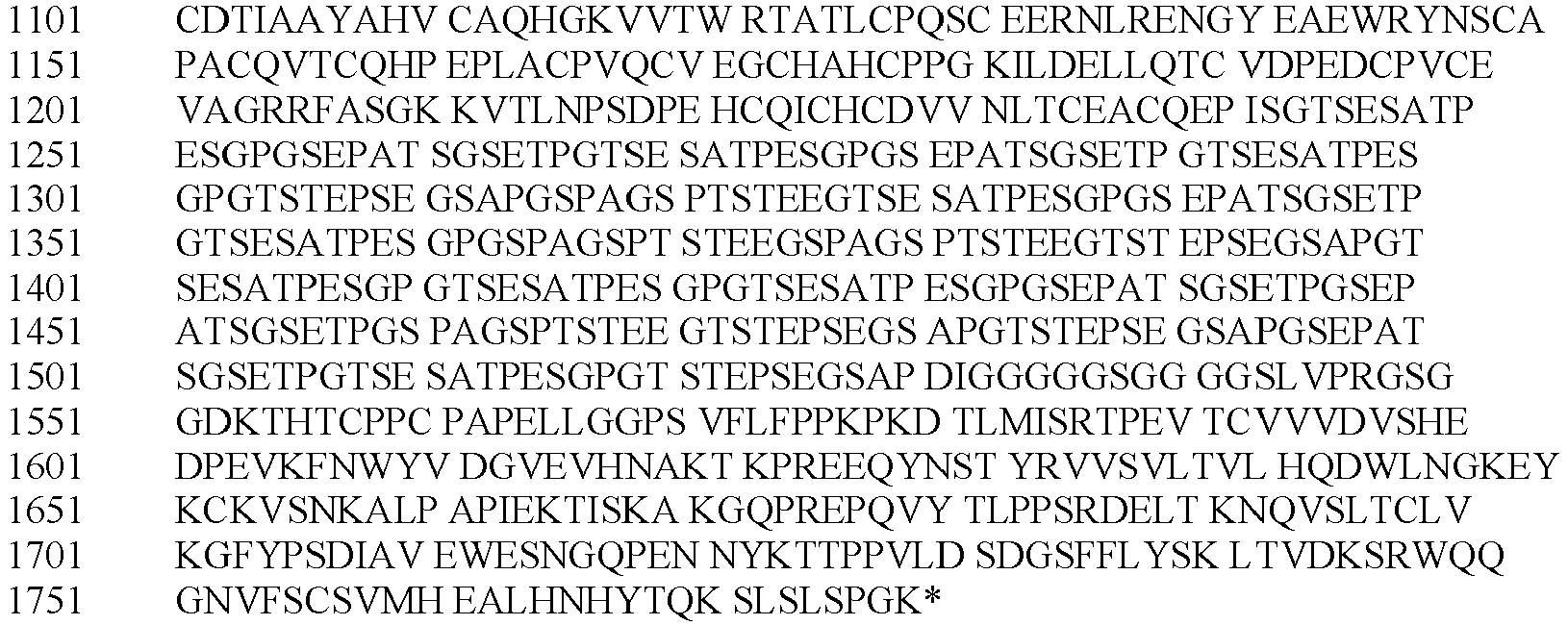
-
VWF050 nucleotide sequence (IHH triple mutant) (SEQ ID NO: 149)


-
VWF050 protein sequence (IHH triple mutant) (SEQ ID NO: 150)

-
VWF057 nucleotide sequence (SEQ ID NO: 151)


-
VWF058 nucleotide sequence (VWF034 with IHH mutation) (SEQ ID NO: 153 )


-
VWF058 protein sequence (VWF034 with IHH mutation) (SEQ ID NO: 154)


-
FVIII 169 nucleotide sequence (SEQ ID NO: 155)
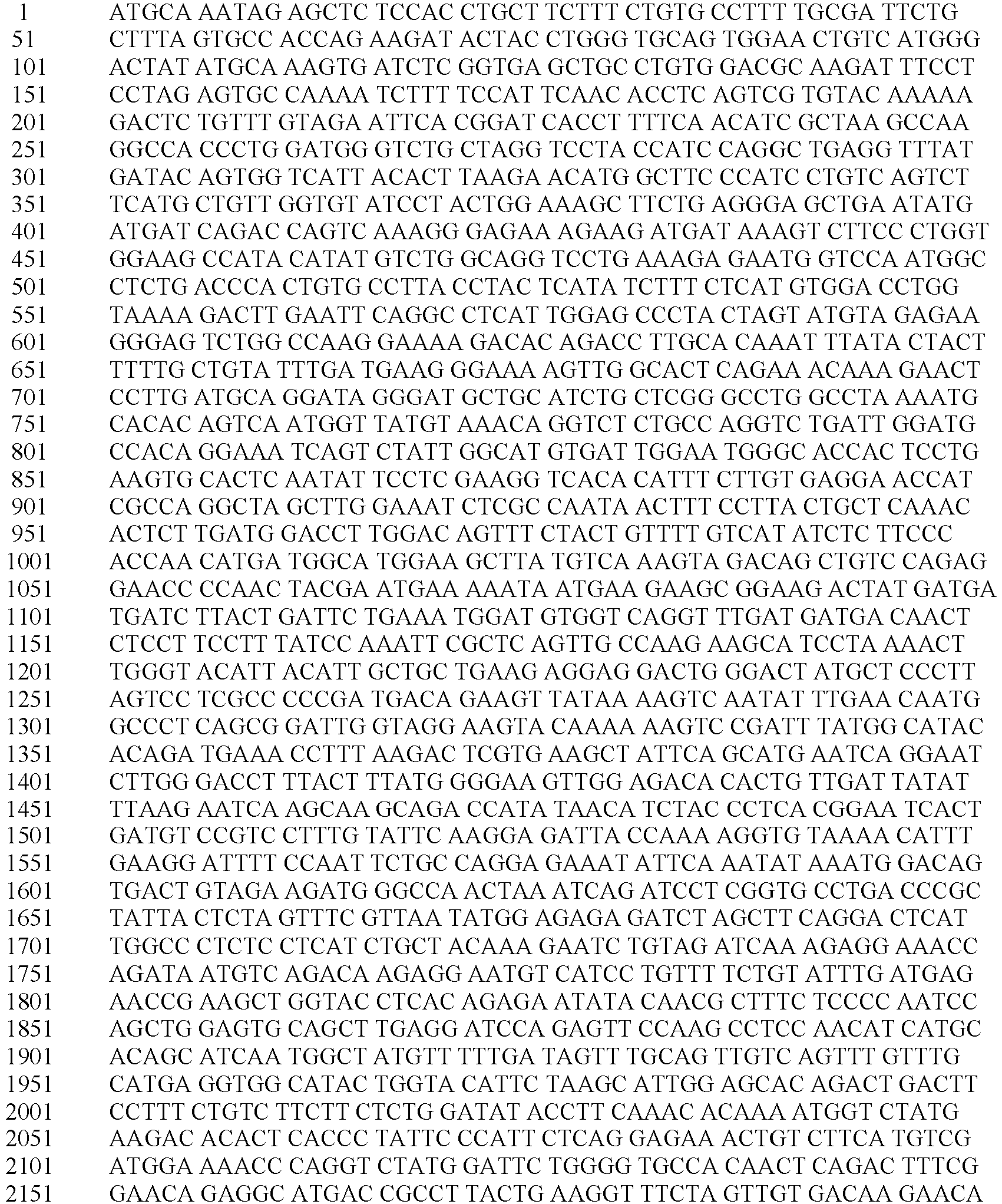

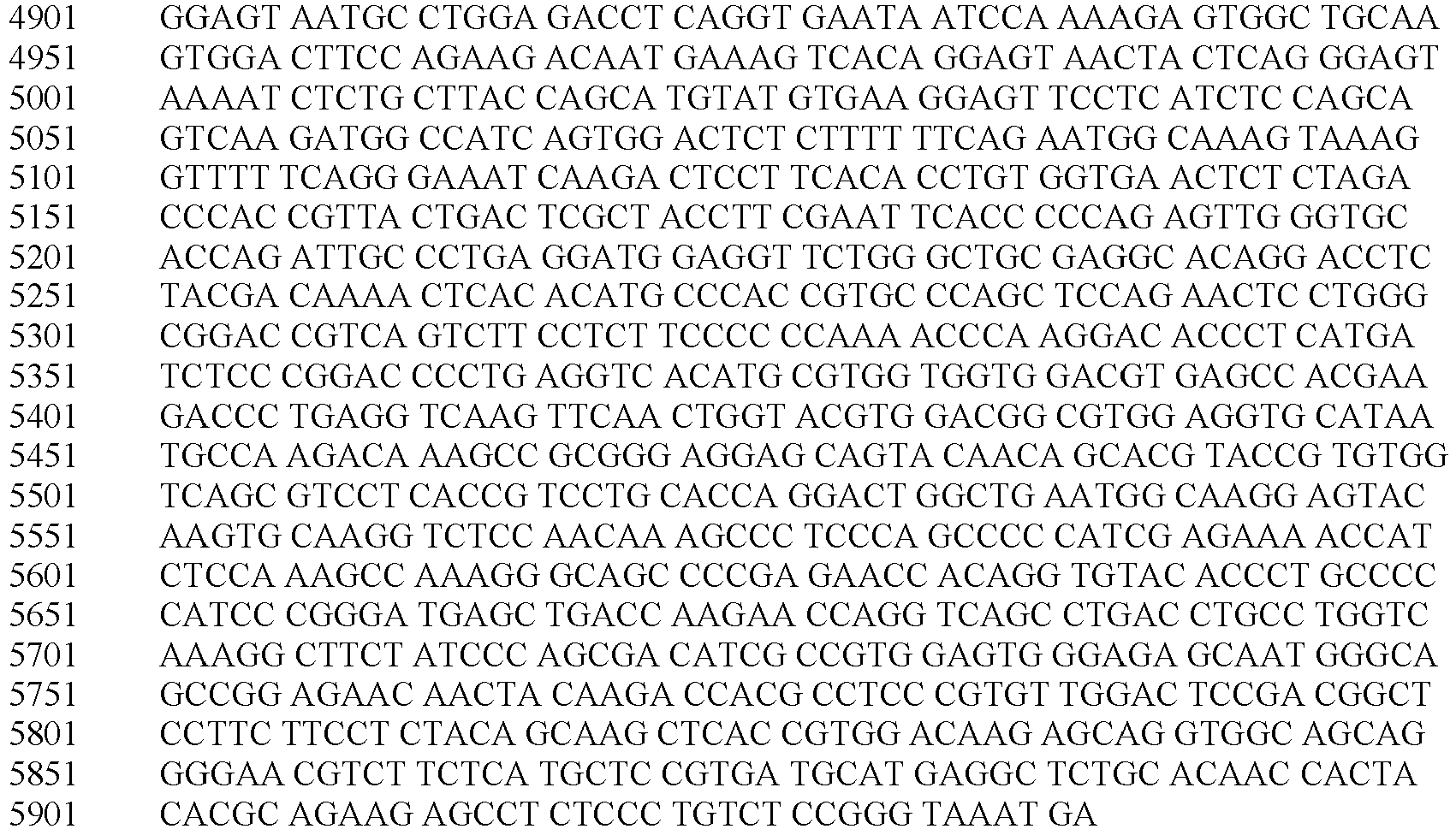
-
FVIII 169 protein sequence(SEQ ID NO: 70)


-
FVIII 263 nucleotide sequence (IHH triple mutant) (SEQ ID NO: 156)


-
FVIII 263 protein sequence(IHH triple mutant) (SEQ ID NO: 157)


-
FVIII 282 nucleotide sequence(SEQ ID NO: 158)


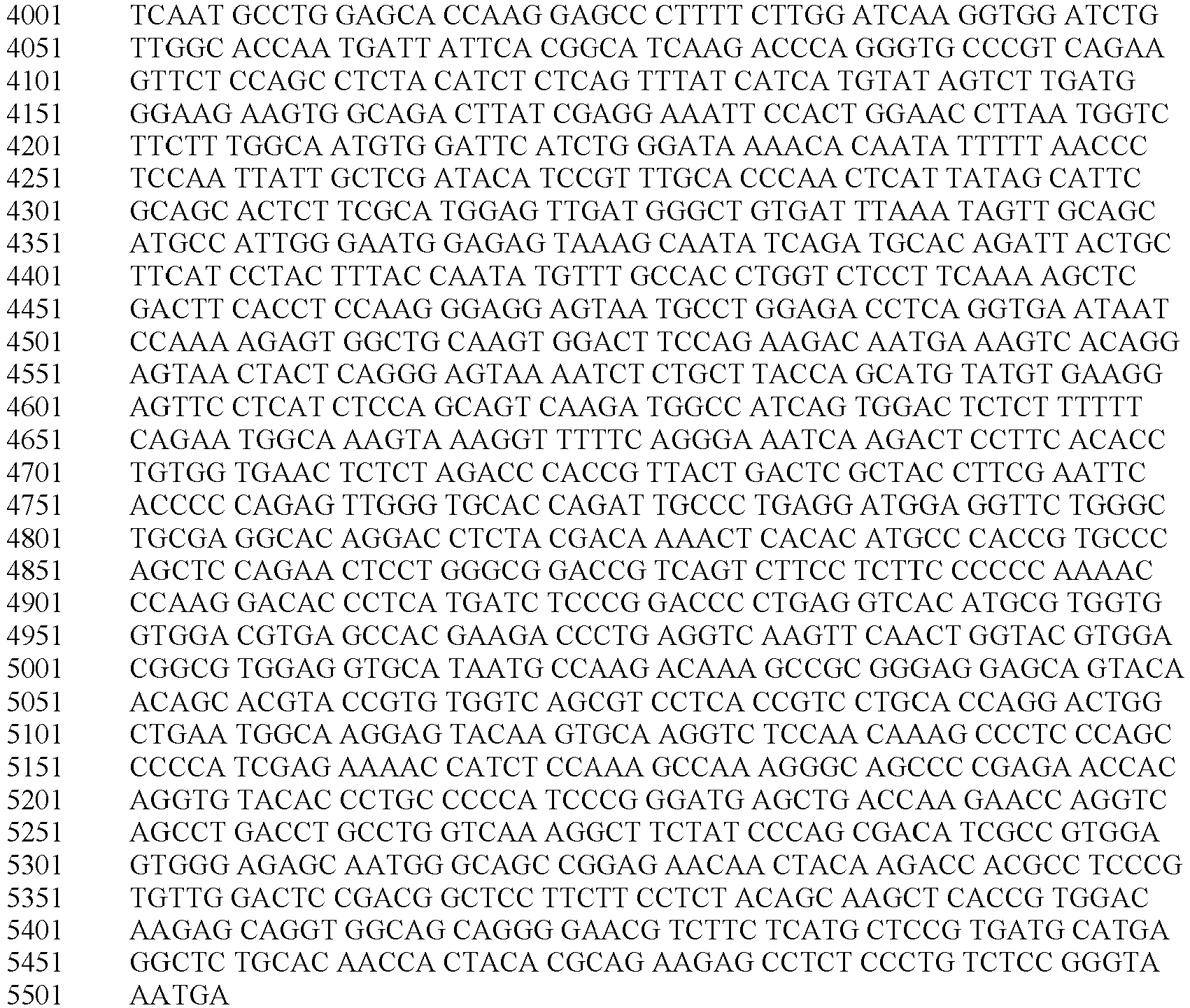
-
FVIII 282 protein sequence(SEQ ID NO: 159)


-
FVIII 283 nucleotide sequence (FVIII 169 with IHH triple mutation) (SEQ ID NO: 160)


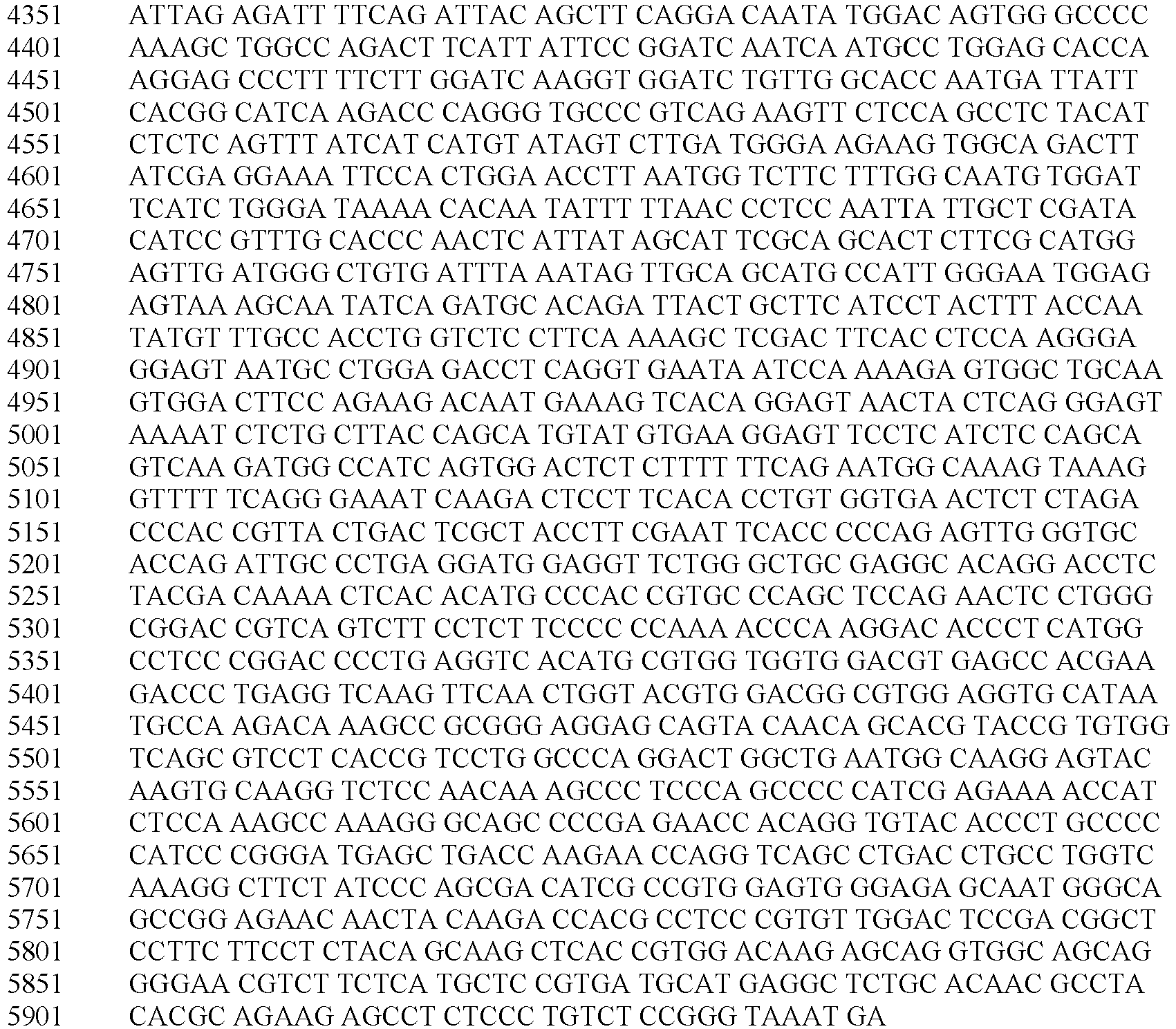
-
FVIII 283 protein sequence (FVIII 169 with IHH triple mutation) (SEQ ID NO: 161)


-
pSYNFVIII 010 nucleotide sequence-(Dual chain FVIIIFc) (SEQ ID NO: 162)


-
pSYNFVIII 010 protein sequence-(Dual chain FVIIIFc) (SEQ ID NO: 163)


-
FVIII 195 protein sequence (dual chain FVIIIFc with two 144 AE XTENs at amino acid 1656 and 1900) (SEQ ID NO: 73)

-
pSYN-FVIII-173 mature Protein sequencing (SEQ ID NO: 72):


-
FVIII 196 protein sequence (dual chain FVIIIFc with three 144 AE XTENs at amino acid 26, 1656 and 1900) (SEQ ID NO: 74)
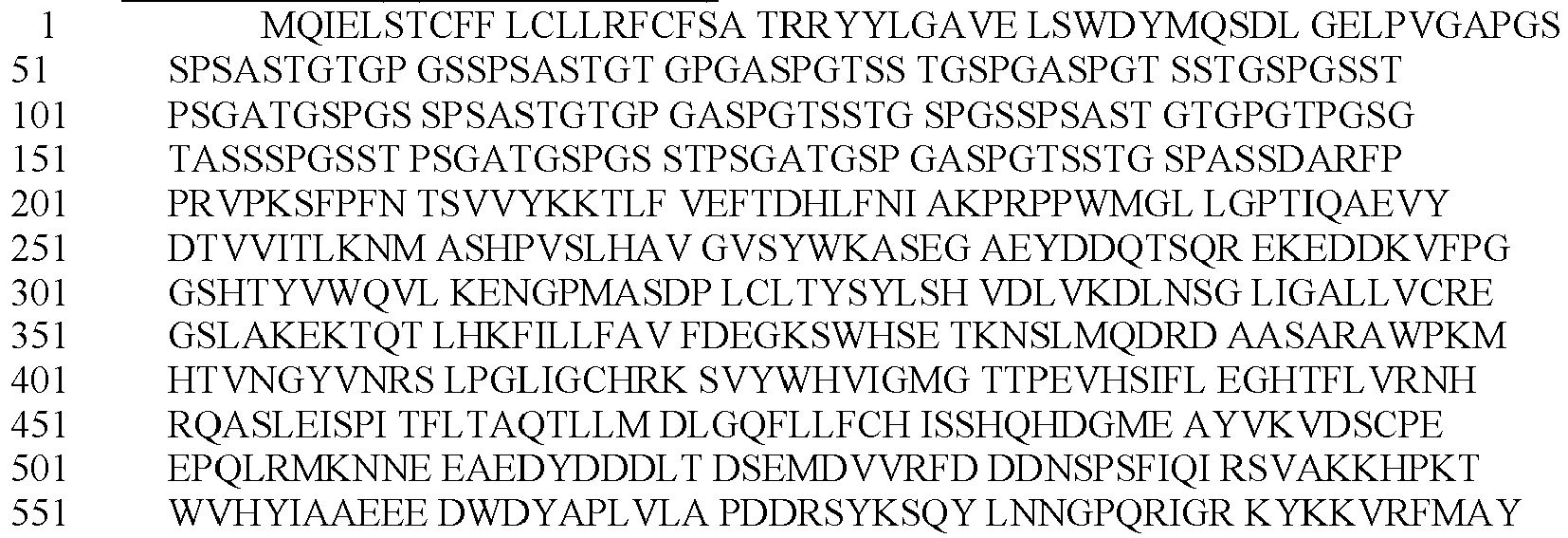

-
FVIII 199 protein sequence (single chain FVIIIFc with three 144 AE XTENs at amino acid 1656 and 1900) (SEQ ID NO: 75)

-
FVIII 201 protein sequence (single chain FVIIIFc with three 144 AE XTENs at amino acid 26, 1656 &1900) (SEQ ID NO: 76)


-
FVIII 203 protein sequence (single chain FVIIIFc with two AE XTENs; one 288AE XTEN in B-domain and one 144 AE XTEN at amino acid 1900) (SEQ ID NO: 77)


-
FVIII 204 protein sequence (single chain FVIIIFc with two AE XTENs; one 288AE XTEN in B-domain and one 144 AE XTEN at amino acid 403) (SEQ ID NO: 78)
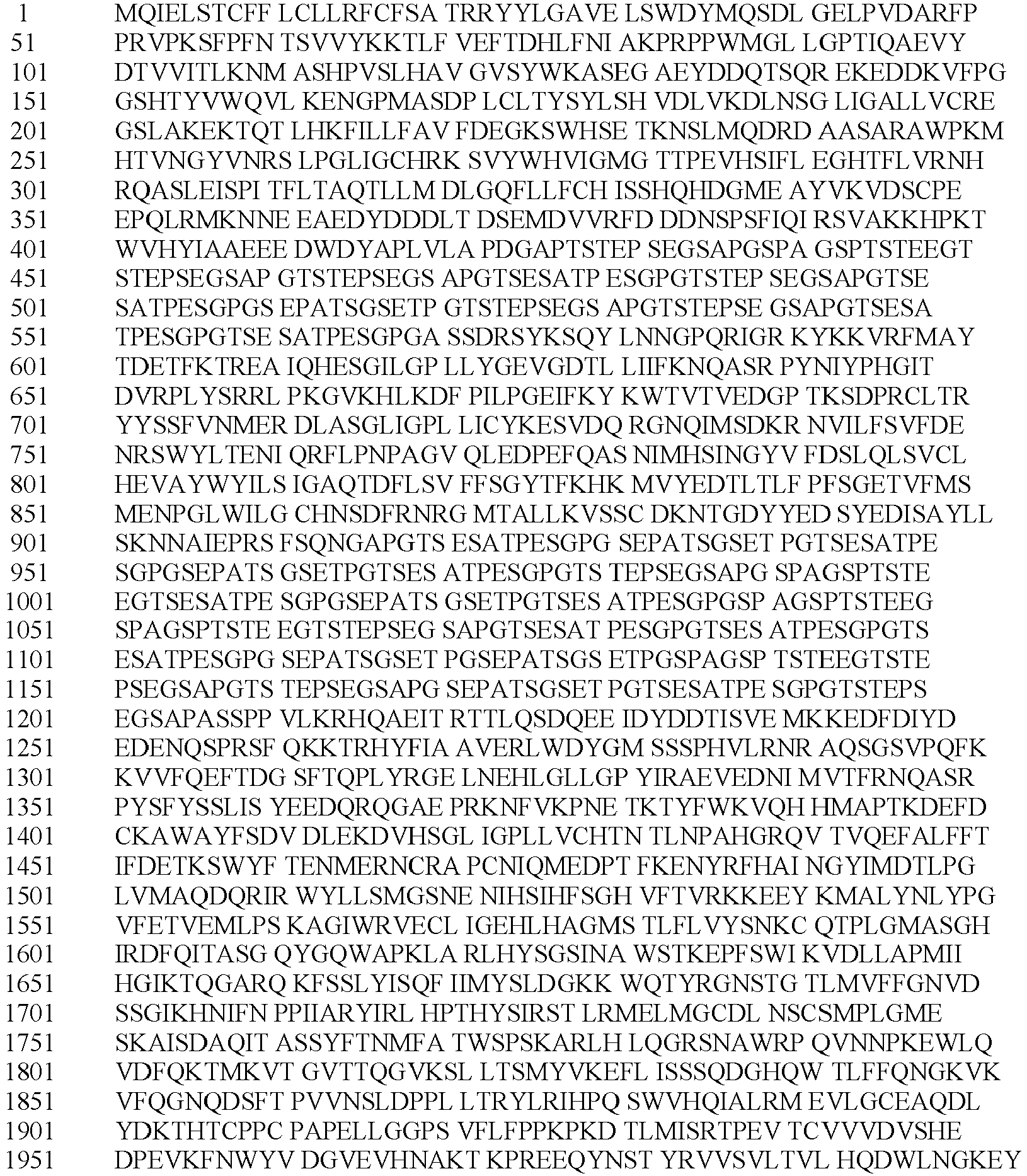

-
FVIII 205 protein sequence (single chain FVIIIFc with two AE XTENs; one 288AE XTEN in B-domain and one 144 AE XTEN at amino acid 18) (SEQ ID NO: 79)

-
pSYN FVIII 266 protein sequence (FVIII Fc with 42 AE-XTEN at
amino acid 18 and 288 AE XTEN in B-domain) SEQ ID NO: 80)
-
pSYN FVIII 267 protein sequence (FVIII Fc with 72 AE-XTEN at
amino acid 18 and 288 AE XTEN in B-domain) SEQ ID NO: 81)

-
pSYN FVIII 268 protein sequence (FVIII Fc with 144 AE-XTEN at amino acid 18) SEQ ID NO: 82)
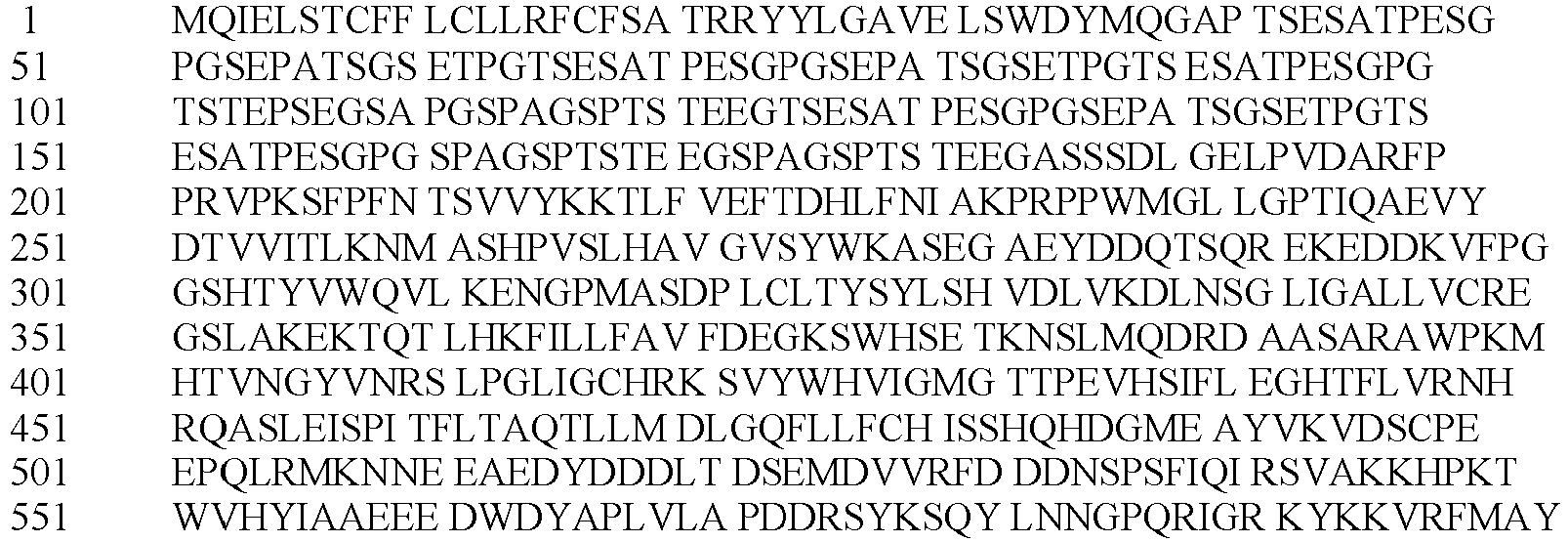

-
pSYN FVIII 269 protein sequence (FVIII Fc with 72 AE-XTEN at amino acid 18) SEQ ID NO: 83)


-
pSYNFVIII 271 protein sequence (FVIII Fc with 42 AE-XTEN at amino acid 18) SEQ ID NO: 84)

-
pSYN FVIII protein sequence 272 ( FVIII with 144 AE XTEN at
amino acid 18 and 244 AE XTEN in B-domain- no Fc) SEQ ID NO: 85)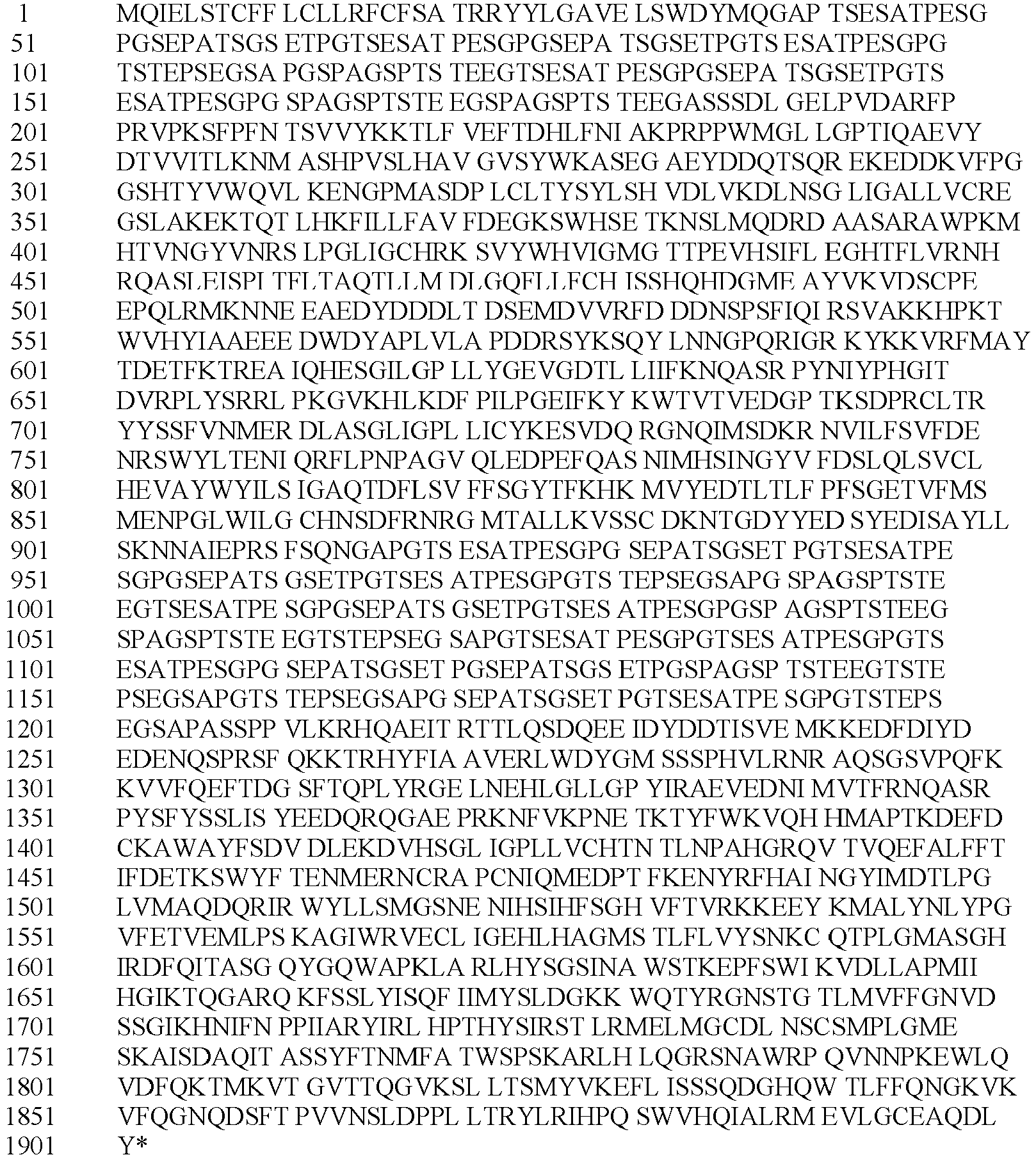
-
pSYN-FVIII-161 protein sequence (SEQ ID NO: 69) (FVIII sequence amino acid position 1-1457; underlined region represents Fc region; curvy underline represents cleavable linker in between first Fc and VWF fragment; double underlined region represents VWF fragment; bold region represents cleavable linker in between VWF fragment and Fc).

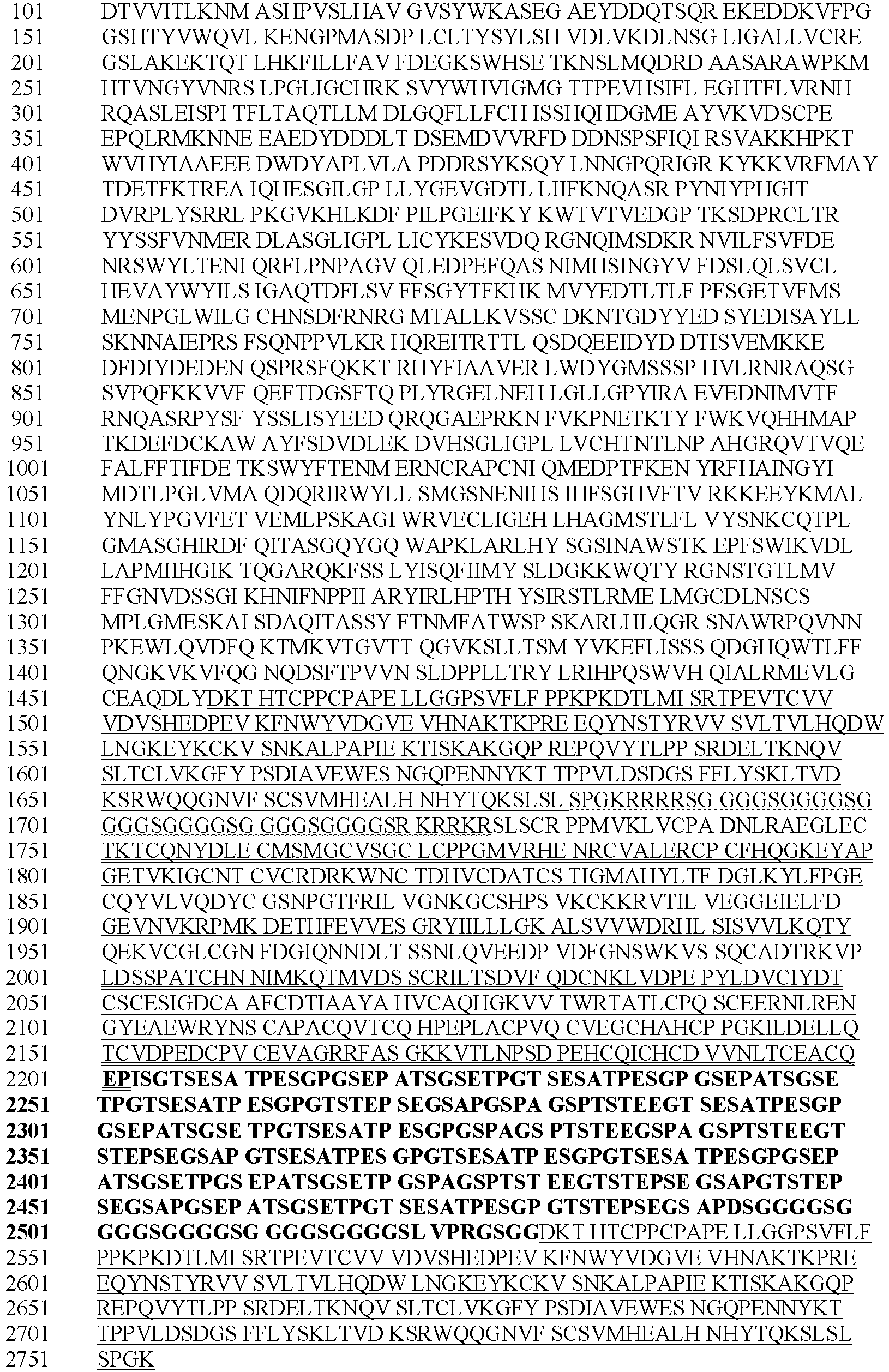
-
pSYN-FVIII-170 protein sequence (SEQ ID NO: 71)

-
pSYN FVIII 310 nucleotide sequence (encoding FVIII with complete B-domain deletion except 2 amino acid residues and 288 AE-XTEN inserted after aa 742) (SEQ ID NO:170)


-
pSYN FVIII 310 protein sequence (FVIII with complete B-domain deletion except 2 amino acid residues and 288 AE-XTEN inserted after aa 742) (SEQ ID NO:171)

-
pSYN FVIII 312 nucleotide sequence (encoding FVIII with complete B-domain deletion except 5 amino acid residues and 288 AE-XTEN inserted after aa 745- B5 version) (SEQ ID NO:172)


-
pSYN FVIII 312 protein sequence (FVIII with complete B-domain deletion except 5 amino acid residues and 288 AE-XTEN inserted after aa 745- B5 version) (SEQ ID NO:173)


-
pSYN VWF059 nucleotide sequence (encoding VWF D'D3-Fc with acidic region 2 (a2) thrombin site in the linker) (SEQ ID NO: 196)


-
pSYN VWF059 protein sequence (VWF D'D3-Fc with a2 region of FVIII thrombin site in the linker) - bold underlined area shows a2 region (SEQ ID NO: 197)

-
pSYN VWF062 nucleotide sequence (encoding VWF D'D3-Fc with no thrombin site in the linker) (SEQ ID NO: 198)


-
pSYN VWF062 protein sequence (VWF D'D3-Fc with no thrombin site in the linker) (SEQ ID NO: 199)


-
pSYN VWF073 nucleotide sequence- (encoding VWFD1D2D'D3- 144 AE XTEN- FVIII truncated a2 thrombin site-Fc) (SEQ ID NO:174)


-
pSYN VWF073 protein sequence- (VWFD1D2D'D3- 144 AE XTEN- truncated a2 thrombin site-Fc) (SEQ ID NO:175)


| FVIII-XTEN-Fc: SEQ ID NO: 201 |
 |
| VWF(D'D3)-XTEN-a2 Linker-Fc: SEQ ID NO: 202 |
 |
 |
| Amino acid sequence of FVIII protein (312A): SEQ ID NO: 203 |
 |
| Nucleotide sequence encoding FVIII 312A: SEQ ID NO: 204 |
 |
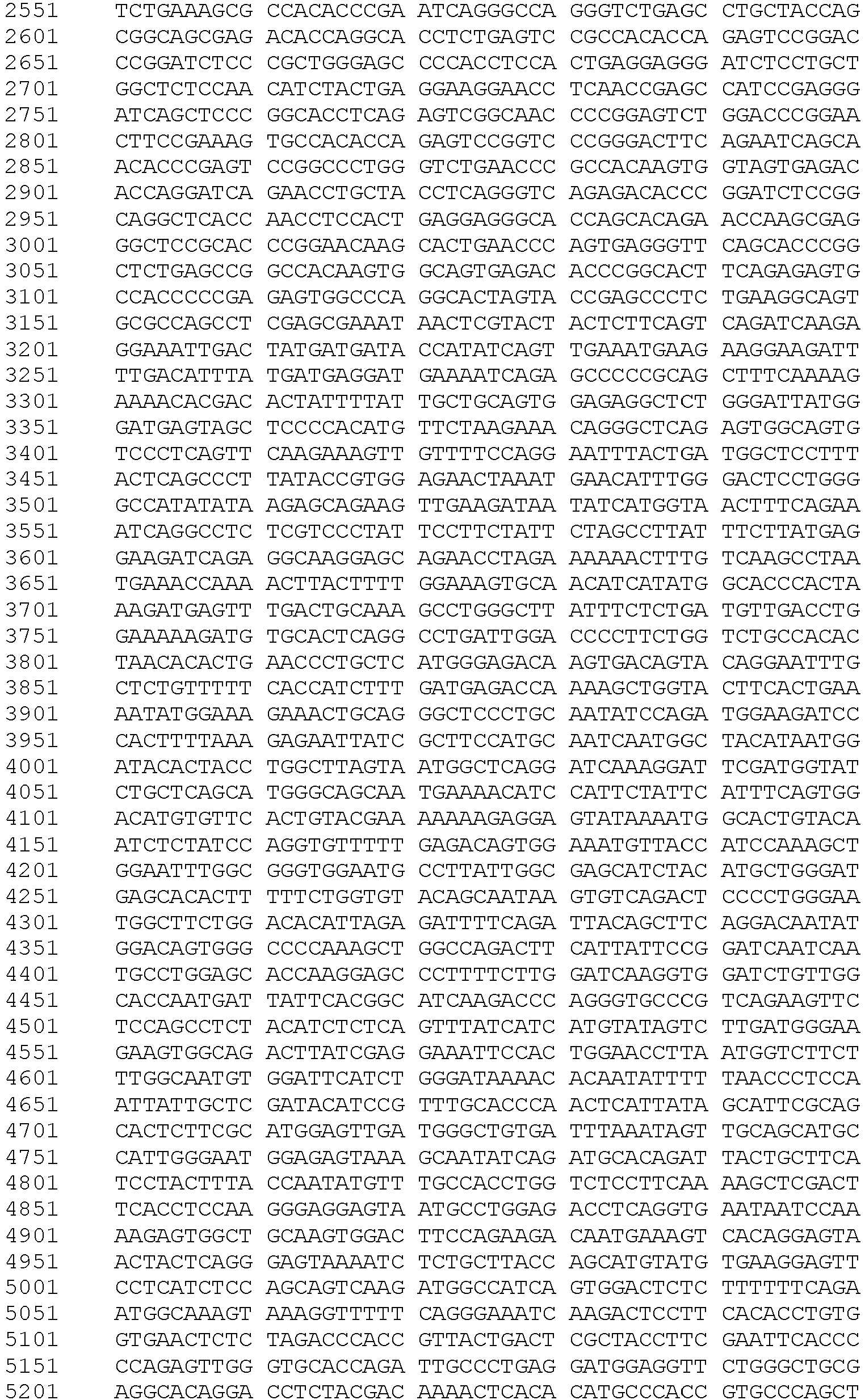 |
 |
| Amino acid sequence of VWF059A protein: SEQ ID NO: 205 |
 |
| Nucleotide sequence encoding VWF059A protein: SEQ ID NO: 206 |
 |
 |
| A-FVIII(XTEN)-Fc: SEQ ID NO: 207 |
 |
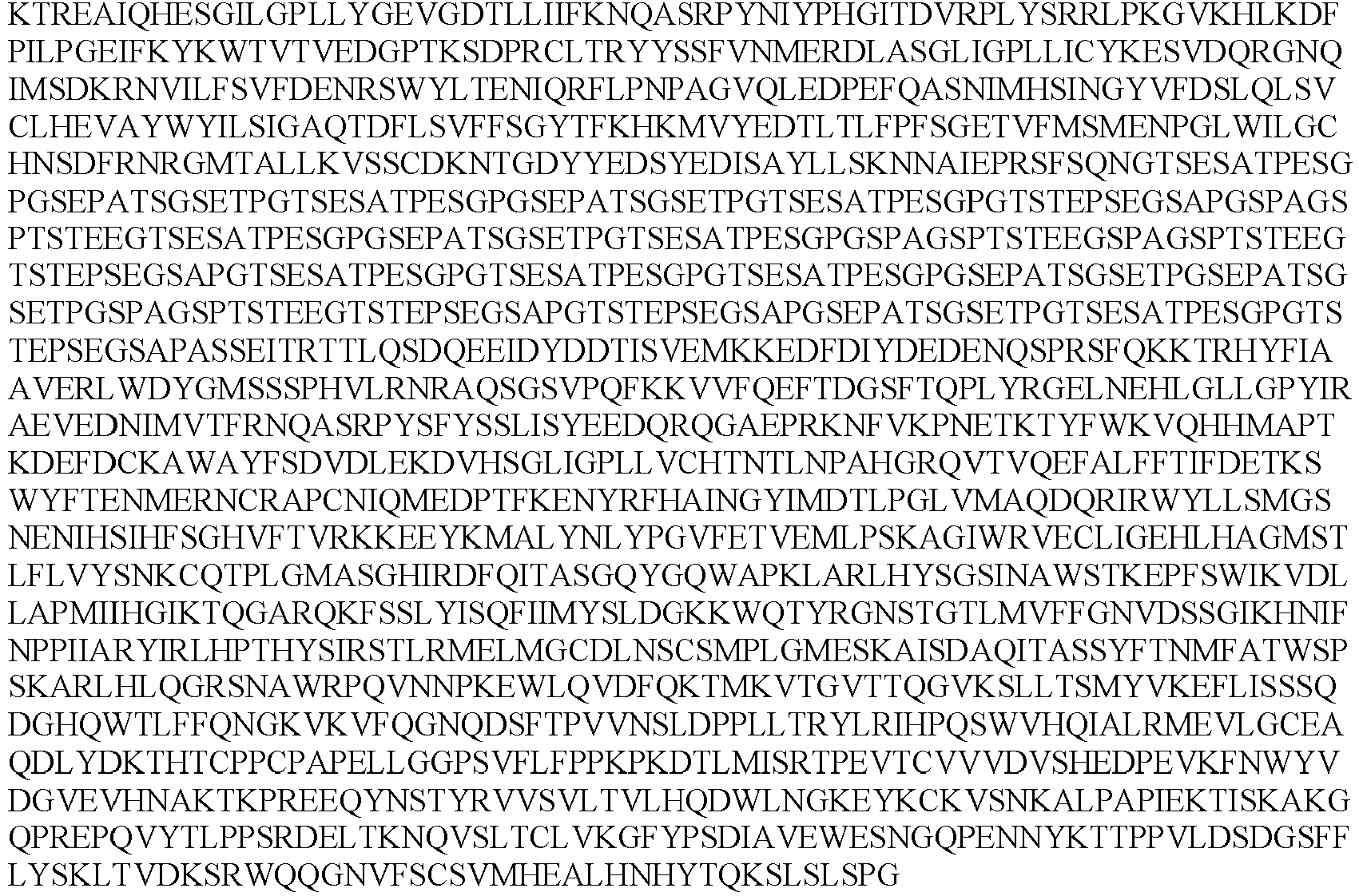 |
| Description / SEQ ID NO. | Sequence | |
| AE288 |
 |
|
| SEQ ID NO: 8 | ||
| pSYN VWF059 | TSTEEGASIS DKNTGDYYED SYEDISAYLL SKNNAIEPRS FSDKTH | |
| SEQ ID NO: 13 | ||
| pSYN VWF059A | TSTEEGASSD KNTGDYYEDS YEDISAYLLS KNNAIEPRSF SDKTH | |
| SEQ ID NO: 22 | ||
| pSYN FVIII 312 |
 |
|
| SEQ ID NO: 173 | ||
| XTEN_AE288_2 |
 |
|
| SEQ ID NO: 54 | ||
| XTEN AE144_5A |
 |
|
| SEQ ID NO: 58 | ||
| a2 Linker of chimeric polypeptide | DKNTGDYYED SYEDISAYLL SKNNAIEPRS FS | 32 |
| SEQ ID NO: 88 | ||
| Signal Peptide of FVIII | MQIELSTCFFLCLLRFCFS | |
| SEQ ID NO: 64 | ||
| |
 |
|
| SEQ ID NO. 215 | ||
| |
 |
|
| SEQ ID NO. 216 | ||
| VWF Signal Peptide | MIPARFAGVL LALALILPGT LC | |
| SEQ ID NO: 208 | ||
| VWF D1D2 domain of chimeric polypeptide |
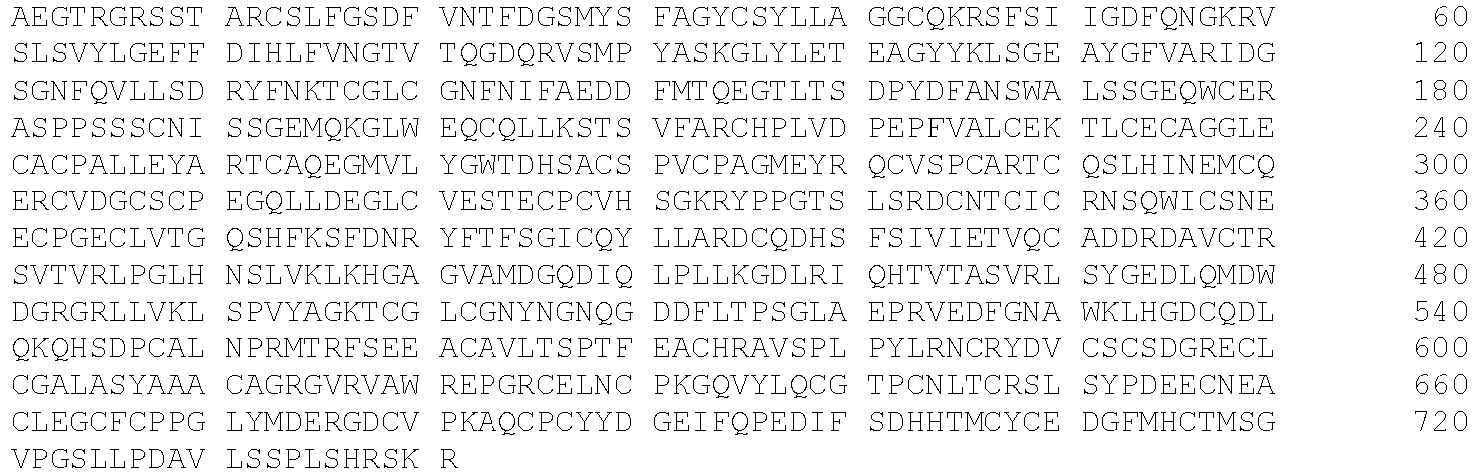 |
|
| SEQ ID NO: 209 | ||
| VWF D' domain of chimeric polypeptide |
 |
|
| SEQ ID NO: 210 | ||
| VWF D3 domain of chimeric polypeptide |
 |
|
| SEQ ID NO: 214 | ||
| Fc region |
 |
|
| SEQ ID NO: 217 | ||
| XTEN AE288_3 |
 |
|
| SEQ ID NO: 218 | ||
Claims (15)
- A chimeric polypeptide comprising(i) a factor VIII (FVIII) protein comprising the amino acid sequence of SEQ ID NO: 207; and(ii) a von Willebrand factor (VWF) protein comprising the amino acid sequence of SEQ ID NO: 202,for use in treating hemophilia A in a human subject in need thereof,wherein the chimeric polypeptide is administered intravenously in multiple doses from 45 IU/kg to 55 IU/kg and the dosing interval is at least 7 days, wherein the FVIII protein is associated with the VWF protein by a covalent bond.
- The chimeric polypeptide for use according to claim 1, wherein the covalent bond is a disulfide bond.
- The chimeric polypeptide for use according to claim 1 or 2, wherein each of the multiple doses is 50 IU/kg, and the dosing interval is 7 days.
- The chimeric polypeptide for use according to any one of claims 1 to 3, wherein the chimeric polypeptide is for prophylactic treatment.
- The chimeric polypeptide for use according to any one of claims 1 to 4, wherein the subject has severe hemophilia A.
- The chimeric polypeptide for use according to any one of claims 1 to 4, wherein the subject has less than 1 IU/dl endogenous FVIII.
- The chimeric polypeptide for use according to any one of claims 1 to 6, wherein the subject has previously received treatment for hemophilia A with any recombinant FVIII, plasma-derived FVIII, or cryoprecipitate for at least 150 exposure days (ED).
- The chimeric polypeptide for use according to any one of claims 1 to 7, wherein the subject is either(a) currently on a prophylactic treatment regimen with a marketed FVIII product and has had at least four bleeding episodes in the twelve months prior to administration of the chimeric polypeptide; or(b) currently on an on-demand treatment regimen with a marketed FVIII product and has had at least twelve bleeding episodes in the twelve months prior to administration of the chimeric polypeptide.
- The chimeric polypeptide for use according to any one of claims 1 to 8, wherein the subject has a platelet count of at least 100,000 cells/µL.
- The chimeric polypeptide for use according to any one of claims 1 to 9, wherein the subject is free of other coagulation disorders in addition to hemophilia A.
- The chimeric polypeptide for use according to any one of claims 1 to 10, wherein the subject does not have a history of developing inhibitors to a FVIII product.
- The chimeric polypeptide for use according to any one of claims 1 to 11, wherein the multiple doses are administered for at least about 1 month, at least about 2 months, at least about 3 months, at least about 4 months, at least about 5 months, at least about 6 months, at least about 12 months, at least about 18 months, at least about 2 years, at least about 3 years, at least about 4 years, at least about 5 years, at least about 10 years, at least about 15 years, at least about 20 years, or for at least about 25 years.
- A chimeric polypeptide for use in prophylactically treating severe hemophilia A in a subject in need thereof, wherein the chimeric polypeptide comprises(i) a FVIII protein comprising the amino acid sequence set forth in SEQ ID NO: 207; and(ii) a VWF protein comprising the amino acid sequence set forth in SEQ ID NO: 202;wherein multiple doses of the chimeric polypeptide are administered intravenously as a once weekly dose of 50 IU/kg.
- The chimeric polypeptide for use according to claim 13, wherein the multiple doses are administered for at least about 6 months.
- The chimeric polypeptide for use according to claim 13, wherein the multiple doses are administered for at least about 52 weeks.
Priority Applications (5)
| Application Number | Priority Date | Filing Date | Title |
|---|---|---|---|
| SI201930939T SI3793588T1 (en) | 2018-05-18 | 2019-05-17 | Methods of treating hemophilia a |
| HRP20250709TT HRP20250709T1 (en) | 2018-05-18 | 2019-05-17 | TREATMENT PROCEDURES FOR HEMOPHILIA A |
| EP25158962.8A EP4585260A3 (en) | 2018-05-18 | 2019-05-17 | Methods of treating hemophilia a |
| MA52630A MA52630B1 (en) | 2018-05-18 | 2019-05-17 | METHODS OF TREATMENT OF HEMOPHILIA A |
| RS20250583A RS66972B1 (en) | 2018-05-18 | 2019-05-17 | Methods of treating hemophilia a |
Applications Claiming Priority (5)
| Application Number | Priority Date | Filing Date | Title |
|---|---|---|---|
| US201862673670P | 2018-05-18 | 2018-05-18 | |
| US201862712880P | 2018-07-31 | 2018-07-31 | |
| US201862773785P | 2018-11-30 | 2018-11-30 | |
| US201962801576P | 2019-02-05 | 2019-02-05 | |
| PCT/US2019/032956 WO2019222682A1 (en) | 2018-05-18 | 2019-05-17 | Methods of treating hemophilia a |
Related Child Applications (2)
| Application Number | Title | Priority Date | Filing Date |
|---|---|---|---|
| EP25158962.8A Division EP4585260A3 (en) | 2018-05-18 | 2019-05-17 | Methods of treating hemophilia a |
| EP25158962.8A Division-Into EP4585260A3 (en) | 2018-05-18 | 2019-05-17 | Methods of treating hemophilia a |
Publications (2)
| Publication Number | Publication Date |
|---|---|
| EP3793588A1 EP3793588A1 (en) | 2021-03-24 |
| EP3793588B1 true EP3793588B1 (en) | 2025-03-26 |
Family
ID=67002363
Family Applications (2)
| Application Number | Title | Priority Date | Filing Date |
|---|---|---|---|
| EP25158962.8A Pending EP4585260A3 (en) | 2018-05-18 | 2019-05-17 | Methods of treating hemophilia a |
| EP19732781.0A Active EP3793588B1 (en) | 2018-05-18 | 2019-05-17 | Methods of treating hemophilia a |
Family Applications Before (1)
| Application Number | Title | Priority Date | Filing Date |
|---|---|---|---|
| EP25158962.8A Pending EP4585260A3 (en) | 2018-05-18 | 2019-05-17 | Methods of treating hemophilia a |
Country Status (24)
| Country | Link |
|---|---|
| US (2) | US12030925B2 (en) |
| EP (2) | EP4585260A3 (en) |
| JP (2) | JP7763589B2 (en) |
| KR (2) | KR102914074B1 (en) |
| CN (1) | CN112512555A (en) |
| AU (2) | AU2019270184B2 (en) |
| BR (1) | BR112020022164A2 (en) |
| CA (1) | CA3099049A1 (en) |
| CO (1) | CO2020014566A2 (en) |
| DK (1) | DK3793588T3 (en) |
| ES (1) | ES3034016T3 (en) |
| FI (1) | FI3793588T3 (en) |
| HR (1) | HRP20250709T1 (en) |
| HU (1) | HUE071488T2 (en) |
| LT (1) | LT3793588T (en) |
| MA (1) | MA52630B1 (en) |
| MX (2) | MX2020012397A (en) |
| PL (1) | PL3793588T3 (en) |
| PT (1) | PT3793588T (en) |
| RS (1) | RS66972B1 (en) |
| SG (1) | SG11202010767SA (en) |
| SI (1) | SI3793588T1 (en) |
| TW (1) | TW202015723A (en) |
| WO (1) | WO2019222682A1 (en) |
Families Citing this family (14)
| Publication number | Priority date | Publication date | Assignee | Title |
|---|---|---|---|---|
| EP2804623B1 (en) * | 2012-01-12 | 2019-08-07 | Bioverativ Therapeutics Inc. | Chimeric factor viii polypeptides and uses thereof |
| CN110054699A (en) * | 2012-07-11 | 2019-07-26 | 比奥贝拉蒂治疗公司 | Factor IX compound with XTEN and vWF ELISA albumen, and application thereof |
| MX2015016567A (en) * | 2013-06-28 | 2016-03-31 | Biogen Ma Inc | Thrombin cleavable linker with xten and its uses thereof. |
| SG11201605242YA (en) | 2014-01-10 | 2016-07-28 | Biogen Ma Inc | Factor viii chimeric proteins and uses thereof |
| MX2019006444A (en) | 2016-12-02 | 2019-10-30 | Bioverativ Therapeutics Inc | HEMOPHILIC ARTHROPATHY TREATMENT METHODS USING CHEMERIC COAGULATION FACTORS. |
| SI3793588T1 (en) | 2018-05-18 | 2025-07-31 | Bioverativ Therapeutics Inc. | Methods of treating hemophilia a |
| CN120795059A (en) | 2018-08-27 | 2025-10-17 | 瑞泽恩制药公司 | Use of raman spectroscopy in downstream purification |
| CN110624105B (en) * | 2019-09-24 | 2021-06-11 | 苏州大学 | Sequences of structurally sensitive polypeptide antigens of von Willebrand factor |
| WO2021257899A1 (en) * | 2020-06-19 | 2021-12-23 | Bioverativ Therapeutics Inc. | Methods for treating hemophilia a and population pharmacokinetics tools for determining treatments and uses thereof |
| KR20240024949A (en) | 2021-06-23 | 2024-02-26 | 바이오버라티브 테라퓨틱스 인크. | Formulations of Factor VIII chimeric proteins and uses thereof |
| CN118103034A (en) | 2021-10-15 | 2024-05-28 | 比奥维拉迪维治疗股份有限公司 | Formulations of factor VIII chimeric proteins and uses thereof |
| JP2025508043A (en) * | 2022-03-08 | 2025-03-21 | バイオベラティブ セラピューティクス インコーポレイテッド | Treatment method for hemophilia A |
| CN116715752B (en) * | 2023-06-16 | 2024-11-15 | 苏州诺洁贝生物技术有限公司 | Coagulation factor FVIII protein variants, expression vectors and uses |
| WO2024262381A1 (en) | 2023-06-21 | 2024-12-26 | 住友電気工業株式会社 | Hydrogen electrode-solid electrolyte layer composite body, proton conducting cell structure, fuel cell, steam electrolysis cell, and method for producing hydrogen electrode-solid electrolyte layer composite body |
Family Cites Families (434)
| Publication number | Priority date | Publication date | Assignee | Title |
|---|---|---|---|---|
| US836805A (en) | 1904-05-10 | 1906-11-27 | Alva Battie Dozier | Telephone or switchboard plug. |
| US4179337A (en) | 1973-07-20 | 1979-12-18 | Davis Frank F | Non-immunogenic polypeptides |
| US3992518A (en) | 1974-10-24 | 1976-11-16 | G. D. Searle & Co. | Method for making a microsealed delivery device |
| GB1478759A (en) | 1974-11-18 | 1977-07-06 | Alza Corp | Process for forming outlet passageways in pills using a laser |
| US4284444A (en) | 1977-08-01 | 1981-08-18 | Herculite Protective Fabrics Corporation | Activated polymer materials and process for making same |
| US4704362A (en) | 1977-11-08 | 1987-11-03 | Genentech, Inc. | Recombinant cloning vehicle microbial polypeptide expression |
| US4200098A (en) | 1978-10-23 | 1980-04-29 | Alza Corporation | Osmotic system with distribution zone for dispensing beneficial agent |
| US4235881A (en) | 1978-12-04 | 1980-11-25 | Cort Joseph H | Method for producing high potency factor VIII |
| US4200984A (en) | 1979-03-12 | 1980-05-06 | Fink Ray D | Detachable tool combining bracket and method |
| US4342832A (en) | 1979-07-05 | 1982-08-03 | Genentech, Inc. | Method of constructing a replicable cloning vehicle having quasi-synthetic genes |
| US4215051A (en) | 1979-08-29 | 1980-07-29 | Standard Oil Company (Indiana) | Formation, purification and recovery of phthalic anhydride |
| ZA811368B (en) | 1980-03-24 | 1982-04-28 | Genentech Inc | Bacterial polypedtide expression employing tryptophan promoter-operator |
| US4398908A (en) | 1980-11-28 | 1983-08-16 | Siposs George G | Insulin delivery system |
| US4456591A (en) | 1981-06-25 | 1984-06-26 | Baxter Travenol Laboratories, Inc. | Therapeutic method for activating factor VII |
| US4435173A (en) | 1982-03-05 | 1984-03-06 | Delta Medical Industries | Variable rate syringe pump for insulin delivery |
| US4542025A (en) | 1982-07-29 | 1985-09-17 | The Stolle Research And Development Corporation | Injectable, long-acting microparticle formulation for the delivery of anti-inflammatory agents |
| US4599311A (en) | 1982-08-13 | 1986-07-08 | Kawasaki Glenn H | Glycolytic promotersfor regulated protein expression: protease inhibitor |
| US4713339A (en) | 1983-01-19 | 1987-12-15 | Genentech, Inc. | Polycistronic expression vector construction |
| US4870008A (en) | 1983-08-12 | 1989-09-26 | Chiron Corporation | Secretory expression in eukaryotes |
| US4757006A (en) | 1983-10-28 | 1988-07-12 | Genetics Institute, Inc. | Human factor VIII:C gene and recombinant methods for production |
| US5004804A (en) | 1984-01-12 | 1991-04-02 | Nordisk Gentofte | Method and composition for preparation of factor VIIIC |
| US7138505B1 (en) | 1984-01-12 | 2006-11-21 | Novartis Vaccines And Diagnostics, Inc. | Factor VIII:C nucleic acid molecules |
| EP0154316B1 (en) | 1984-03-06 | 1989-09-13 | Takeda Chemical Industries, Ltd. | Chemically modified lymphokine and production thereof |
| US5916588A (en) | 1984-04-12 | 1999-06-29 | The Liposome Company, Inc. | Peptide-containing liposomes, immunogenic liposomes and methods of preparation and use |
| US5231112A (en) | 1984-04-12 | 1993-07-27 | The Liposome Company, Inc. | Compositions containing tris salt of cholesterol hemisuccinate and antifungal |
| US4965199A (en) | 1984-04-20 | 1990-10-23 | Genentech, Inc. | Preparation of functional human factor VIII in mammalian cells using methotrexate based selection |
| US4931373A (en) | 1984-05-25 | 1990-06-05 | Zymogenetics, Inc. | Stable DNA constructs for expression of α-1 antitrypsin |
| EP0190262B1 (en) | 1984-07-24 | 1990-12-27 | Key Pharmaceuticals, Inc. | Adhesive transdermal dosage layer |
| US4766073A (en) | 1985-02-25 | 1988-08-23 | Zymogenetics Inc. | Expression of biologically active PDGF analogs in eucaryotic cells |
| US4885249A (en) | 1984-12-05 | 1989-12-05 | Allelix, Inc. | Aspergillus niger transformation system |
| US4970300A (en) | 1985-02-01 | 1990-11-13 | New York University | Modified factor VIII |
| US4683202A (en) | 1985-03-28 | 1987-07-28 | Cetus Corporation | Process for amplifying nucleic acid sequences |
| US4965188A (en) | 1986-08-22 | 1990-10-23 | Cetus Corporation | Process for amplifying, detecting, and/or cloning nucleic acid sequences using a thermostable enzyme |
| US4683195A (en) | 1986-01-30 | 1987-07-28 | Cetus Corporation | Process for amplifying, detecting, and/or-cloning nucleic acid sequences |
| US5981216A (en) | 1985-04-01 | 1999-11-09 | Alusuisse Holdings A.G. | Transformed myeloma cell-line and a process for the expression of a gene coding for a eukaryotic polypeptide employing same |
| AU5772886A (en) | 1985-04-12 | 1986-11-05 | Genetics Institute Inc. | Novel procoagulant proteins |
| GR860984B (en) | 1985-04-17 | 1986-08-18 | Zymogenetics Inc | Expression of factor vii and ix activities in mammalian cells |
| JP2584443B2 (en) | 1985-04-22 | 1997-02-26 | ジエネテイツクス・インスチチユ−ト・インコ−ポレ−テツド | High-yield production of activated factors I and X |
| US4684479A (en) | 1985-08-14 | 1987-08-04 | Arrigo Joseph S D | Surfactant mixtures, stable gas-in-liquid emulsions, and methods for the production of such emulsions from said mixtures |
| KR910006424B1 (en) | 1985-08-21 | 1991-08-24 | 인코텍스 비.브이 | Manufacturing method of knitted briefs |
| US4882279A (en) | 1985-10-25 | 1989-11-21 | Phillips Petroleum Company | Site selective genomic modification of yeast of the genus pichia |
| US5250421A (en) | 1986-01-03 | 1993-10-05 | Genetics Institute, Inc. | Method for producing factor VIII:C-type proteins |
| JP2525022B2 (en) | 1986-01-03 | 1996-08-14 | ジェネティックス・インスチチュ−ト・インコ−ポレ−テッド | VIII: Improved production method for c-factor protein |
| US5198349A (en) | 1986-01-03 | 1993-03-30 | Genetics Institute, Inc. | Method for producing factor VIII:C and analogs |
| US4935349A (en) | 1986-01-17 | 1990-06-19 | Zymogenetics, Inc. | Expression of higher eucaryotic genes in aspergillus |
| US5595886A (en) | 1986-01-27 | 1997-01-21 | Chiron Corporation | Protein complexes having Factor VIII:C activity and production thereof |
| US4800159A (en) | 1986-02-07 | 1989-01-24 | Cetus Corporation | Process for amplifying, detecting, and/or cloning nucleic acid sequences |
| DK122686D0 (en) | 1986-03-17 | 1986-03-17 | Novo Industri As | PREPARATION OF PROTEINS |
| GB8610600D0 (en) | 1986-04-30 | 1986-06-04 | Novo Industri As | Transformation of trichoderma |
| US5422260A (en) | 1986-05-29 | 1995-06-06 | Genetics Institute, Inc. -Legal Affairs | Human factor VIII:c muteins |
| US6759057B1 (en) | 1986-06-12 | 2004-07-06 | The Liposome Company, Inc. | Methods and compositions using liposome-encapsulated non-steroidal anti-inflammatory drugs |
| US5543502A (en) | 1986-06-24 | 1996-08-06 | Novo Nordisk A/S | Process for producing a coagulation active complex of factor VIII fragments |
| IE60901B1 (en) | 1986-08-21 | 1994-08-24 | Vestar Inc | Improved treatment of systemic fungal infections with phospholipid particles encapsulating polyene antifungal antibiotics |
| US4933185A (en) | 1986-09-24 | 1990-06-12 | Massachusetts Institute Of Technology | System for controlled release of biologically active compounds |
| US5811128A (en) | 1986-10-24 | 1998-09-22 | Southern Research Institute | Method for oral or rectal delivery of microencapsulated vaccines and compositions therefor |
| US4912040A (en) | 1986-11-14 | 1990-03-27 | Genetics Institute, Inc. | Eucaryotic expression system |
| US6406713B1 (en) | 1987-03-05 | 2002-06-18 | The Liposome Company, Inc. | Methods of preparing low-toxicity drug-lipid complexes |
| US4775207A (en) | 1987-03-17 | 1988-10-04 | Bell Communications Research, Inc. | Electro-optical switch |
| EP0307434B2 (en) | 1987-03-18 | 1998-07-29 | Scotgen Biopharmaceuticals, Inc. | Altered antibodies |
| CA1331157C (en) | 1987-04-06 | 1994-08-02 | Randal J. Kaufman | Method for producing factor viii:c-type proteins |
| US6060447A (en) | 1987-05-19 | 2000-05-09 | Chiron Corporation | Protein complexes having Factor VIII:C activity and production thereof |
| IE69026B1 (en) | 1987-06-12 | 1996-08-07 | Immuno Ag | Novel proteins with factor VIII activity process for their preparation using genetically-engineered cells and pharmaceutical compositions containing them |
| US6346513B1 (en) | 1987-06-12 | 2002-02-12 | Baxter Trading Gmbh | Proteins with factor VIII activity: process for their preparation using genetically-engineered cells and pharmaceutical compositions containing them |
| DE3720246A1 (en) | 1987-06-19 | 1988-12-29 | Behringwerke Ag | FACTOR VIII: C-LIKE MOLECULE WITH COAGULATION ACTIVITY |
| US4897268A (en) | 1987-08-03 | 1990-01-30 | Southern Research Institute | Drug delivery system and method of making the same |
| US4976696A (en) | 1987-08-10 | 1990-12-11 | Becton, Dickinson And Company | Syringe pump and the like for delivering medication |
| FR2619314B1 (en) | 1987-08-11 | 1990-06-15 | Transgene Sa | FACTOR VIII ANALOG, PREPARATION METHOD AND PHARMACEUTICAL COMPOSITION CONTAINING THE SAME |
| US4861800A (en) | 1987-08-18 | 1989-08-29 | Buyske Donald A | Method for administering the drug deprenyl so as to minimize the danger of side effects |
| US4994371A (en) | 1987-08-28 | 1991-02-19 | Davie Earl W | DNA preparation of Christmas factor and use of DNA sequences |
| AU598958B2 (en) | 1987-11-12 | 1990-07-05 | Vestar, Inc. | Improved amphotericin b liposome preparation |
| US5270176A (en) | 1987-11-20 | 1993-12-14 | Hoechst Aktiengesellschaft | Method for the selective cleavage of fusion proteins with lysostaphin |
| GB8807504D0 (en) | 1988-03-29 | 1988-05-05 | Sandoz Ltd | Improvements in/relating to organic compounds |
| US5037743A (en) | 1988-08-05 | 1991-08-06 | Zymogenetics, Inc. | BAR1 secretion signal |
| JP2717808B2 (en) | 1988-08-10 | 1998-02-25 | テルモ株式会社 | Syringe pump |
| US5223409A (en) | 1988-09-02 | 1993-06-29 | Protein Engineering Corp. | Directed evolution of novel binding proteins |
| US5534617A (en) | 1988-10-28 | 1996-07-09 | Genentech, Inc. | Human growth hormone variants having greater affinity for human growth hormone receptor at site 1 |
| US6780613B1 (en) | 1988-10-28 | 2004-08-24 | Genentech, Inc. | Growth hormone variants |
| US5004803A (en) | 1988-11-14 | 1991-04-02 | Genetics Institute, Inc. | Production of procoagulant proteins |
| WO1990006952A1 (en) | 1988-12-22 | 1990-06-28 | Kirin-Amgen, Inc. | Chemically modified granulocyte colony stimulating factor |
| ATE148171T1 (en) | 1989-02-21 | 1997-02-15 | Univ Washington | MODIFIED FORMS OF REPRODUCTIVE HORMONES |
| US5017378A (en) | 1989-05-01 | 1991-05-21 | The University Of Virginia Alumni Patents Foundation | Intraorgan injection of biologically active compounds contained in slow-release microcapsules or microspheres |
| ES2084698T5 (en) | 1989-05-04 | 2005-03-01 | Southern Research Institute | ENCAPSULATION PROCEDURE. |
| US5599907A (en) | 1989-05-10 | 1997-02-04 | Somatogen, Inc. | Production and use of multimeric hemoglobins |
| US5298022A (en) | 1989-05-29 | 1994-03-29 | Amplifon Spa | Wearable artificial pancreas |
| FR2647677B1 (en) | 1989-05-31 | 1991-09-27 | Roussel Uclaf | NOVEL MICRO-PROTEINS, PROCESS FOR THE PREPARATION AND APPLICATION AS MEDICAMENTS OF SUCH NEW MICRO-PROTEINS |
| US7413537B2 (en) | 1989-09-01 | 2008-08-19 | Dyax Corp. | Directed evolution of disulfide-bonded micro-proteins |
| SE465222C5 (en) | 1989-12-15 | 1998-02-10 | Pharmacia & Upjohn Ab | A recombinant human factor VIII derivative and process for its preparation |
| US5492534A (en) | 1990-04-02 | 1996-02-20 | Pharmetrix Corporation | Controlled release portable pump |
| US5318540A (en) | 1990-04-02 | 1994-06-07 | Pharmetrix Corporation | Controlled release infusion device |
| US6552170B1 (en) | 1990-04-06 | 2003-04-22 | Amgen Inc. | PEGylation reagents and compounds formed therewith |
| US5176502A (en) | 1990-04-25 | 1993-01-05 | Becton, Dickinson And Company | Syringe pump and the like for delivering medication |
| US6517859B1 (en) | 1990-05-16 | 2003-02-11 | Southern Research Institute | Microcapsules for administration of neuroactive agents |
| US5215680A (en) | 1990-07-10 | 1993-06-01 | Cavitation-Control Technology, Inc. | Method for the production of medical-grade lipid-coated microbubbles, paramagnetic labeling of such microbubbles and therapeutic uses of microbubbles |
| US5583107A (en) | 1990-09-04 | 1996-12-10 | Cor Therapeutics, Inc. | Agents affecting thrombosis and hemostasis |
| HUT69963A (en) | 1990-12-13 | 1995-09-28 | Upjohn Co | Non-naturally-occuring fusion proteins and process for preparing them |
| US5206161A (en) | 1991-02-01 | 1993-04-27 | Genentech, Inc. | Human plasma carboxypeptidase B |
| US20060122376A1 (en) | 1991-02-07 | 2006-06-08 | Chiron Corporation | Protein complexes having factor VIII:C activity and production thereof |
| US5833982A (en) | 1991-02-28 | 1998-11-10 | Zymogenetics, Inc. | Modified factor VII |
| GEP20033082B (en) | 1991-03-15 | 2003-10-27 | Amgen Inc | Pegylation of Polypeptides |
| US5846951A (en) | 1991-06-06 | 1998-12-08 | The School Of Pharmacy, University Of London | Pharmaceutical compositions |
| MX9204374A (en) | 1991-07-25 | 1993-03-01 | Idec Pharma Corp | RECOMBINANT ANTIBODY AND METHOD FOR ITS PRODUCTION. |
| CA2078721A1 (en) | 1991-09-24 | 1993-03-25 | Hiroshi Yonemura | Process for preparing human coagulation factor viii protein complex |
| FR2686899B1 (en) | 1992-01-31 | 1995-09-01 | Rhone Poulenc Rorer Sa | NOVEL BIOLOGICALLY ACTIVE POLYPEPTIDES, THEIR PREPARATION AND PHARMACEUTICAL COMPOSITIONS CONTAINING THEM. |
| US5859204A (en) | 1992-04-07 | 1999-01-12 | Emory University | Modified factor VIII |
| US6376463B1 (en) | 1992-04-07 | 2002-04-23 | Emory University | Modified factor VIII |
| US5364771A (en) | 1992-04-07 | 1994-11-15 | Emory University | Hybrid human/porcine factor VIII |
| US6037452A (en) | 1992-04-10 | 2000-03-14 | Alpha Therapeutic Corporation | Poly(alkylene oxide)-Factor VIII or Factor IX conjugate |
| WO1994007510A1 (en) | 1992-10-02 | 1994-04-14 | Kabi Pharmacia Ab | Composition comprising coagulation factor viii formulation, process for its preparation and use of a surfactant as stabilizer |
| ES2088838T3 (en) | 1992-11-13 | 2004-01-01 | Idec Pharmaceuticals Corporation | FULLY ALTERED KOZAK CONSENSUS SEQUENCES INTENDED FOR EXPRESSION IN THE MAMMALS. |
| US5563045A (en) | 1992-11-13 | 1996-10-08 | Genetics Institute, Inc. | Chimeric procoagulant proteins |
| US5573776A (en) | 1992-12-02 | 1996-11-12 | Alza Corporation | Oral osmotic device with hydrogel driving member |
| US6090925A (en) | 1993-03-09 | 2000-07-18 | Epic Therapeutics, Inc. | Macromolecular microparticles and methods of production and use |
| US5554730A (en) | 1993-03-09 | 1996-09-10 | Middlesex Sciences, Inc. | Method and kit for making a polysaccharide-protein conjugate |
| US5981719A (en) | 1993-03-09 | 1999-11-09 | Epic Therapeutics, Inc. | Macromolecular microparticles and methods of production and use |
| ES2215207T3 (en) | 1993-03-09 | 2004-10-01 | Baxter International Inc. | MACROMOLECULES MICROPARTICLES AND PRODUCTION METHODS. |
| SE504074C2 (en) | 1993-07-05 | 1996-11-04 | Pharmacia Ab | Protein preparation for subcutaneous, intramuscular or intradermal administration |
| US5576291A (en) | 1993-09-13 | 1996-11-19 | Baxter International Inc. | Activated factor VIII as a therapeutic agent and method of treating factor VIII deficiency |
| US5643575A (en) | 1993-10-27 | 1997-07-01 | Enzon, Inc. | Non-antigenic branched polymer conjugates |
| US20020042079A1 (en) | 1994-02-01 | 2002-04-11 | Sanford M. Simon | Methods and agents for measuring and controlling multidrug resistance |
| US5660848A (en) | 1994-11-02 | 1997-08-26 | The Population Council, Center For Biomedical Research | Subdermally implantable device |
| GB9422383D0 (en) | 1994-11-05 | 1995-01-04 | Wellcome Found | Antibodies |
| SE503424C2 (en) | 1994-11-14 | 1996-06-10 | Pharmacia Ab | Process for purification of recombinant coagulation factor VIII |
| US6818439B1 (en) | 1994-12-30 | 2004-11-16 | Chiron Corporation | Methods for administration of recombinant gene delivery vehicles for treatment of hemophilia and other disorders |
| US6485726B1 (en) | 1995-01-17 | 2002-11-26 | The Brigham And Women's Hospital, Inc. | Receptor specific transepithelial transport of therapeutics |
| US6030613A (en) | 1995-01-17 | 2000-02-29 | The Brigham And Women's Hospital, Inc. | Receptor specific transepithelial transport of therapeutics |
| US6086875A (en) | 1995-01-17 | 2000-07-11 | The Brigham And Women's Hospital, Inc. | Receptor specific transepithelial transport of immunogens |
| US6096871A (en) | 1995-04-14 | 2000-08-01 | Genentech, Inc. | Polypeptides altered to contain an epitope from the Fc region of an IgG molecule for increased half-life |
| US5869046A (en) | 1995-04-14 | 1999-02-09 | Genentech, Inc. | Altered polypeptides with increased half-life |
| US6121022A (en) | 1995-04-14 | 2000-09-19 | Genentech, Inc. | Altered polypeptides with increased half-life |
| US5739277A (en) | 1995-04-14 | 1998-04-14 | Genentech Inc. | Altered polypeptides with increased half-life |
| US7846455B2 (en) | 1996-07-15 | 2010-12-07 | The United States Of America As Represented By The Department Of Health And Human Services | Attenuated chimeric respiratory syncytial virus |
| SE9503380D0 (en) | 1995-09-29 | 1995-09-29 | Pharmacia Ab | Protein derivatives |
| GB9526733D0 (en) | 1995-12-30 | 1996-02-28 | Delta Biotechnology Ltd | Fusion proteins |
| US5977163A (en) | 1996-03-12 | 1999-11-02 | Pg-Txl Company, L. P. | Water soluble paclitaxel prodrugs |
| US6441025B2 (en) | 1996-03-12 | 2002-08-27 | Pg-Txl Company, L.P. | Water soluble paclitaxel derivatives |
| US8183344B2 (en) | 1996-04-24 | 2012-05-22 | University Of Michigan | Inactivation resistant factor VIII |
| US6458563B1 (en) | 1996-06-26 | 2002-10-01 | Emory University | Modified factor VIII |
| US7560107B2 (en) | 1996-06-26 | 2009-07-14 | Emory University | Modified factor VIII |
| WO1998005787A1 (en) | 1996-08-02 | 1998-02-12 | Bristol-Myers Squibb Company | A method for inhibiting immunoglobulin-induced toxicity resulting from the use of immunoglobulins in therapy and in vivo diagnosis |
| DE69725747T2 (en) | 1996-08-23 | 2004-07-29 | Sequus Pharmaceuticals, Inc., Menlo Park | LIPOSOME CONTAINING CISPLATIN |
| AU4907897A (en) | 1996-10-11 | 1998-05-11 | Sequus Pharmaceuticals, Inc. | Therapeutic liposome composition and method |
| US6056973A (en) | 1996-10-11 | 2000-05-02 | Sequus Pharmaceuticals, Inc. | Therapeutic liposome composition and method of preparation |
| WO1998016199A1 (en) | 1996-10-15 | 1998-04-23 | The Liposome Company, Inc. | N-acyl phosphatidylethanolamine-mediated liposomal drug delivery |
| US6361796B1 (en) | 1996-10-25 | 2002-03-26 | Shire Laboratories, Inc. | Soluble form osmotic dose delivery system |
| AU721653B2 (en) | 1996-10-25 | 2000-07-13 | Supernus Pharmaceuticals, Inc. | Soluble form osmotic dose delivery system |
| AU5065198A (en) | 1996-11-15 | 1998-06-10 | Maria Grazia Masucci | Fusion proteins having increased half-lives |
| EP0842657A1 (en) | 1996-11-19 | 1998-05-20 | OctoPlus B.V. | Microspheres for controlled release and processes to prepare these microspheres |
| US6395302B1 (en) | 1996-11-19 | 2002-05-28 | Octoplus B.V. | Method for the preparation of microspheres which contain colloidal systems |
| WO1998023289A1 (en) | 1996-11-27 | 1998-06-04 | The General Hospital Corporation | MODULATION OF IgG BINDING TO FcRn |
| US20020019036A1 (en) | 1996-12-13 | 2002-02-14 | Hans-Peter Schwarz | Von willebrand factor derivatives and methods of isolating proteins that bind to von willebrand factor |
| US6294170B1 (en) | 1997-08-08 | 2001-09-25 | Amgen Inc. | Composition and method for treating inflammatory diseases |
| AT405516B (en) | 1997-02-27 | 1999-09-27 | Immuno Ag | FACTOR X-ANALOG WITH MODIFIED PROTEASE SPLIT |
| US6277375B1 (en) | 1997-03-03 | 2001-08-21 | Board Of Regents, The University Of Texas System | Immunoglobulin-like domains with increased half-lives |
| CA2225189C (en) | 1997-03-06 | 2010-05-25 | Queen's University At Kingston | Canine factor viii gene, protein and methods of use |
| BR9808584A (en) | 1997-03-14 | 2000-05-23 | Idec Pharma Corp | Process for integrating genes at specific sites in mammalian cells via homologous recombination and vectors to obtain the same |
| WO1998052976A1 (en) | 1997-05-21 | 1998-11-26 | Biovation Limited | Method for the production of non-immunogenic proteins |
| US6310183B1 (en) | 1997-09-10 | 2001-10-30 | Novo Nordisk A/S | Coagulation factor VIIa composition |
| US7786070B2 (en) | 1997-09-10 | 2010-08-31 | Novo Nordisk Healthcare A/G | Subcutaneous administration of coagulation factor VII |
| DE19747261A1 (en) | 1997-10-25 | 1999-04-29 | Bayer Ag | Single-chamber osmotic pharmaceutical release system |
| GB9722131D0 (en) | 1997-10-20 | 1997-12-17 | Medical Res Council | Method |
| DE69838526T2 (en) | 1998-02-05 | 2008-07-03 | Biosense Webster, Inc., Diamond Bar | Device for releasing a drug in the heart |
| US20050260605A1 (en) | 1998-02-11 | 2005-11-24 | Maxygen, Inc. | Targeting of genetic vaccine vectors |
| WO1999041383A1 (en) | 1998-02-11 | 1999-08-19 | Maxygen, Inc. | Antigen library immunization |
| US6528624B1 (en) | 1998-04-02 | 2003-03-04 | Genentech, Inc. | Polypeptide variants |
| US6242195B1 (en) | 1998-04-02 | 2001-06-05 | Genentech, Inc. | Methods for determining binding of an analyte to a receptor |
| US6194551B1 (en) | 1998-04-02 | 2001-02-27 | Genentech, Inc. | Polypeptide variants |
| IL138608A0 (en) | 1998-04-02 | 2001-10-31 | Genentech Inc | Antibody variants and fragments thereof |
| US6406632B1 (en) | 1998-04-03 | 2002-06-18 | Symyx Technologies, Inc. | Rapid characterization of polymers |
| GB9809951D0 (en) | 1998-05-08 | 1998-07-08 | Univ Cambridge Tech | Binding molecules |
| US7090976B2 (en) | 1999-11-10 | 2006-08-15 | Rigel Pharmaceuticals, Inc. | Methods and compositions comprising Renilla GFP |
| GB9815157D0 (en) | 1998-07-13 | 1998-09-09 | Metron Designs Ltd | High resolution pulse width setting from relatively low frequency clocks |
| EP1105427A2 (en) | 1998-08-17 | 2001-06-13 | Abgenix, Inc. | Generation of modified molecules with increased serum half-lives |
| US6927044B2 (en) | 1998-09-25 | 2005-08-09 | Regeneron Pharmaceuticals, Inc. | IL-1 receptor based cytokine traps |
| DK1129186T4 (en) | 1998-11-10 | 2017-02-06 | Stichting Sanquin Bloedvoorziening | A factor VIII polypeptide having factor VIII: C activity |
| EP1006183A1 (en) | 1998-12-03 | 2000-06-07 | Max-Planck-Gesellschaft zur Förderung der Wissenschaften e.V. | Recombinant soluble Fc receptors |
| US6329186B1 (en) | 1998-12-07 | 2001-12-11 | Novozymes A/S | Glucoamylases with N-terminal extensions |
| US6358703B1 (en) | 1998-12-10 | 2002-03-19 | Bayer Corporation | Expression system for factor VIII |
| US6713086B2 (en) | 1998-12-18 | 2004-03-30 | Abbott Laboratories | Controlled release formulation of divalproex sodium |
| US6737056B1 (en) | 1999-01-15 | 2004-05-18 | Genentech, Inc. | Polypeptide variants with altered effector function |
| KR100940380B1 (en) | 1999-01-15 | 2010-02-02 | 제넨테크, 인크. | Polypeptide Variants with Altered Effector Function |
| SI1180378T1 (en) | 1999-03-03 | 2011-04-29 | Optinose As | Nasal delivery device |
| US6183770B1 (en) | 1999-04-15 | 2001-02-06 | Acutek International | Carrier patch for the delivery of agents to the skin |
| US7666400B2 (en) | 2005-04-06 | 2010-02-23 | Ibc Pharmaceuticals, Inc. | PEGylation by the dock and lock (DNL) technique |
| US6743211B1 (en) | 1999-11-23 | 2004-06-01 | Georgia Tech Research Corporation | Devices and methods for enhanced microneedle penetration of biological barriers |
| US7829085B2 (en) | 1999-07-14 | 2010-11-09 | Life Sciences Research Partners Vzw | Methods of treating hemostasis disorders using antibodies binding the C1 domain of factor VIII |
| CA2378473A1 (en) | 1999-07-23 | 2001-02-01 | The Regents Of The University Of California | Modulation of platelet activation |
| DE60014919T2 (en) | 1999-08-06 | 2005-10-13 | Genentech, Inc., South San Francisco | PEPTIDANT AGONISTS OF FACTOR VIIA |
| US6458387B1 (en) | 1999-10-18 | 2002-10-01 | Epic Therapeutics, Inc. | Sustained release microspheres |
| US20030109428A1 (en) | 1999-12-01 | 2003-06-12 | John Bertin | Novel molecules of the card-related protein family and uses thereof |
| US20050287153A1 (en) | 2002-06-28 | 2005-12-29 | Genentech, Inc. | Serum albumin binding peptides for tumor targeting |
| US6352721B1 (en) | 2000-01-14 | 2002-03-05 | Osmotica Corp. | Combined diffusion/osmotic pumping drug delivery system |
| EP1982732A3 (en) | 2000-02-11 | 2011-06-08 | Bayer HealthCare LLC | Factor VII or VIIA-like conjugates |
| JP5179689B2 (en) | 2000-02-11 | 2013-04-10 | メルク パテント ゲゼルシャフト ミット ベシュレンクテル ハフツング | Enhancing the half-life of antibody-based fusion proteins in the circulation |
| EP1274720A4 (en) | 2000-04-12 | 2004-08-18 | Human Genome Sciences Inc | ALBUMIN FUSED PROTEINS |
| ATE313554T1 (en) | 2000-05-16 | 2006-01-15 | Lipoxen Technologies Ltd | DERIVATIZATION OF PROTEINS IN AQUEOUS SOLVENT |
| JP2001326635A (en) | 2000-05-16 | 2001-11-22 | Matsushita Electric Ind Co Ltd | Internet billing system |
| DE60140625D1 (en) | 2000-08-15 | 2010-01-07 | Univ Illinois | PROCESS FOR PRODUCING MICROPARTICLES |
| RU2326126C2 (en) | 2000-09-13 | 2008-06-10 | Ново Нордиск Хелт Кэр Аг | Polypeptyde of hemostasis factor vii, production and application |
| EP1319016A4 (en) | 2000-09-19 | 2006-05-10 | Univ Emory | MODIFIED FACTOR VIII |
| DE10053224A1 (en) | 2000-10-26 | 2002-05-08 | Univ Goettingen Georg August | Procedure for the exposure of peptides and polypeptides to the cell surface of bacteria |
| US20030228309A1 (en) | 2000-11-08 | 2003-12-11 | Theodora Salcedo | Antibodies that immunospecifically bind to TRAIL receptors |
| US7125841B2 (en) | 2000-11-14 | 2006-10-24 | The University Of Texas Systems | Mutant human factor IX with an increased resistance to inhibition by heparin |
| GB0029407D0 (en) | 2000-12-01 | 2001-01-17 | Affitech As | Product |
| JP4336498B2 (en) | 2000-12-12 | 2009-09-30 | メディミューン,エルエルシー | Molecules with extended half-life and compositions and uses thereof |
| US20030049689A1 (en) | 2000-12-14 | 2003-03-13 | Cynthia Edwards | Multifunctional polypeptides |
| US20030104591A1 (en) | 2000-12-14 | 2003-06-05 | Murray Christopher J. | Methods and compositions for grafting functional loops into a protein |
| CA2433439A1 (en) | 2000-12-29 | 2002-08-15 | Curagen Corporation | Proteins and nucleic acids encoding same |
| IN190699B (en) | 2001-02-02 | 2003-08-16 | Sun Pharmaceutical Ind Ltd | |
| EP1359935A1 (en) | 2001-02-05 | 2003-11-12 | Novo Nordisk Health Care AG | Combined use of factor vii polypeptides and factor ix polypeptides |
| US6888319B2 (en) | 2001-03-01 | 2005-05-03 | Palomar Medical Technologies, Inc. | Flashlamp drive circuit |
| EP1377306A1 (en) | 2001-03-09 | 2004-01-07 | Dyax Corp. | Serum albumin binding moieties |
| PE20020908A1 (en) | 2001-03-21 | 2002-10-26 | Cell Therapeutics Inc | RECOMBINANT PRODUCTION OF POLYANIONIC POLYMERS AND USE OF THE SAME |
| WO2002079415A2 (en) | 2001-03-30 | 2002-10-10 | Lexigen Pharmaceuticals Corp. | Reducing the immunogenicity of fusion proteins |
| US20040106794A1 (en) | 2001-04-16 | 2004-06-03 | Schering Corporation | 3,4-Di-substituted cyclobutene-1,2-diones as CXC-chemokine receptor ligands |
| US20050048512A1 (en) | 2001-04-26 | 2005-03-03 | Avidia Research Institute | Combinatorial libraries of monomer domains |
| US6890918B2 (en) | 2001-04-30 | 2005-05-10 | Shire Laboratories, Inc. | Pharmaceutical compositions including ACE/NEP inhibitors and bioavailability enhancers |
| TW503179B (en) | 2001-05-07 | 2002-09-21 | Benq Corp | Ink jetting device having bubble valve and the method thereof |
| US6838093B2 (en) | 2001-06-01 | 2005-01-04 | Shire Laboratories, Inc. | System for osmotic delivery of pharmaceutically active agents |
| NZ530131A (en) | 2001-06-15 | 2005-12-23 | Andre C | Gene therapy for hemophilia A |
| KR100407467B1 (en) | 2001-07-12 | 2003-11-28 | 최수봉 | Insulin pump operated by remote-controller |
| US20040259780A1 (en) | 2001-07-30 | 2004-12-23 | Glasebrook Andrew Lawrence | Method for treating diabetes and obesity |
| JP2005501547A (en) | 2001-09-04 | 2005-01-20 | メルク パテント ゲゼルシャフト ミット ベシュレンクテル ハフトング | Modified factor IX |
| JP2003110596A (en) | 2001-09-28 | 2003-04-11 | Hitachi Ltd | Data communication service provision method |
| US7125843B2 (en) | 2001-10-19 | 2006-10-24 | Neose Technologies, Inc. | Glycoconjugates including more than one peptide |
| EP2042196B1 (en) | 2001-10-10 | 2016-07-13 | ratiopharm GmbH | Remodelling and glycoconjugation of Granulocyte Colony Stimulating Factor (G-CSF) |
| US6960657B2 (en) | 2001-11-02 | 2005-11-01 | Novo Nordisk Healthcare A/G | Human coagulation factor VII polypeptides |
| EP1451297A4 (en) | 2001-12-07 | 2006-06-28 | Toolgen Inc | Phenotypic screen of chimeric proteins |
| KR101271635B1 (en) | 2001-12-21 | 2013-06-12 | 휴먼 게놈 사이언시즈, 인코포레이티드 | Albumin fusion proteins |
| US20080167238A1 (en) | 2001-12-21 | 2008-07-10 | Human Genome Sciences, Inc. | Albumin Fusion Proteins |
| PT1463751E (en) | 2001-12-21 | 2013-08-26 | Human Genome Sciences Inc | ALBUMINE FUSION PROTEINS |
| US20080194481A1 (en) | 2001-12-21 | 2008-08-14 | Human Genome Sciences, Inc. | Albumin Fusion Proteins |
| US20040002587A1 (en) | 2002-02-20 | 2004-01-01 | Watkins Jeffry D. | Fc region variants |
| US7317091B2 (en) | 2002-03-01 | 2008-01-08 | Xencor, Inc. | Optimized Fc variants |
| US20040132101A1 (en) | 2002-09-27 | 2004-07-08 | Xencor | Optimized Fc variants and methods for their generation |
| AU2003209446B2 (en) | 2002-03-01 | 2008-09-25 | Immunomedics, Inc. | Bispecific antibody point mutations for enhancing rate of clearance |
| WO2003077834A2 (en) | 2002-03-15 | 2003-09-25 | The Brigham And Women's Hospital, Inc. | Central airway administration for systemic delivery of therapeutics |
| US7700733B2 (en) | 2002-04-30 | 2010-04-20 | Bayer Healthcare Llc | Factor VII or VIIa polypeptide variants |
| US6945952B2 (en) | 2002-06-25 | 2005-09-20 | Theraject, Inc. | Solid solution perforator for drug delivery and other applications |
| US7294513B2 (en) | 2002-07-24 | 2007-11-13 | Wyatt Technology Corporation | Method and apparatus for characterizing solutions of small particles |
| US7314709B2 (en) | 2002-08-06 | 2008-01-01 | Vanderbilt University | Compositions and methods for detecting and quantifying COX-2 activity by lipoamino acid metabolism |
| WO2004016750A2 (en) | 2002-08-14 | 2004-02-26 | Macrogenics, Inc. | FcϜRIIB-SPECIFIC ANTIBODIES AND METHODS OF USE THEREOF |
| US7198867B2 (en) | 2002-09-17 | 2007-04-03 | Diffusion Science, Inc. | Electrochemical generation, storage and reaction of hydrogen and oxygen |
| US6911323B2 (en) | 2002-09-25 | 2005-06-28 | Novo Nordisk Healthcare A/G | Human coagulation factor VII polypeptides |
| WO2004029207A2 (en) | 2002-09-27 | 2004-04-08 | Xencor Inc. | Optimized fc variants and methods for their generation |
| WO2004035752A2 (en) | 2002-10-15 | 2004-04-29 | Protein Design Labs, Inc. | ALTERATION OF FcRn BINDING AFFINITIES OR SERUM HALF-LIVES OF ANTIBODIES BY MUTAGENESIS |
| GB2395337B (en) | 2002-11-14 | 2005-12-28 | Gary Michael Wilson | Warning Unit |
| EP2368578A1 (en) | 2003-01-09 | 2011-09-28 | Macrogenics, Inc. | Identification and engineering of antibodies with variant Fc regions and methods of using same |
| US7041635B2 (en) | 2003-01-28 | 2006-05-09 | In2Gen Co., Ltd. | Factor VIII polypeptide |
| EP1444986A1 (en) | 2003-02-07 | 2004-08-11 | Aventis Behring GmbH | Pharmaceutical preparation for the improved treatment of blood-clotting disorders |
| WO2004075923A2 (en) | 2003-02-26 | 2004-09-10 | Nektar Therapeutics Al, Corporation | Polymer-factor viii moiety conjugates |
| WO2004076484A1 (en) | 2003-02-27 | 2004-09-10 | National Research Council Of Canada | Peptide inhibitors of thrombin as potent anticoagulants |
| WO2004076522A1 (en) | 2003-02-28 | 2004-09-10 | Kuraray Co., Ltd. | Curable resin composition |
| US8388955B2 (en) | 2003-03-03 | 2013-03-05 | Xencor, Inc. | Fc variants |
| US20090010920A1 (en) | 2003-03-03 | 2009-01-08 | Xencor, Inc. | Fc Variants Having Decreased Affinity for FcyRIIb |
| US20050176108A1 (en) | 2003-03-13 | 2005-08-11 | Young-Min Kim | Physiologically active polypeptide conjugate having prolonged in vivo half-life |
| US7348004B2 (en) | 2003-05-06 | 2008-03-25 | Syntonix Pharmaceuticals, Inc. | Immunoglobulin chimeric monomer-dimer hybrids |
| TWI353991B (en) | 2003-05-06 | 2011-12-11 | Syntonix Pharmaceuticals Inc | Immunoglobulin chimeric monomer-dimer hybrids |
| ES2333598T5 (en) | 2003-05-06 | 2013-09-04 | Biogen Idec Hemophilia Inc | CHEMICAL PROTEINS OF FC COAGULATION FACTOR TO TREAT HEMOPHILIA. |
| US7132398B2 (en) | 2003-05-06 | 2006-11-07 | Dendreon Corporation | Method of treatment of hemorrhagic disease using a factor VIIa/tissue factor inhibitor |
| US20070161087A1 (en) | 2003-05-29 | 2007-07-12 | Wolfgang Glaesner | Glp-1 fusion proteins |
| CA2526120A1 (en) | 2003-06-03 | 2005-02-24 | Cell Genesys, Inc. | Compositions and methods for enhanced expression of recombinant polypeptides from a single vector using a peptide cleavage site |
| MXPA05013789A (en) | 2003-06-19 | 2006-06-27 | Tanox Inc | Compositions and methods for treating coagulation related disorders. |
| RU2333223C2 (en) | 2003-08-12 | 2008-09-10 | Лайпоксен Текнолоджиз Лимитед | Aldehyde derivatives of sialic acid, methods of their obtainment, conjugates of aldehyde derivatives of sialic acid, and pharmaceutical composition based on them |
| JP4934796B2 (en) | 2003-08-14 | 2012-05-16 | トロンボジェニクス・ナムローゼ・フエンノートシャップ | Variable antibody |
| US7550263B2 (en) | 2003-09-05 | 2009-06-23 | Gtc Biotherapeutics, Inc. | Method for the production of fusion proteins in transgenic mammal milk |
| US20050152979A1 (en) | 2003-09-05 | 2005-07-14 | Cell Therapeutics, Inc. | Hydrophobic drug compositions containing reconstitution enhancer |
| EP2392655A3 (en) | 2003-09-09 | 2012-02-29 | Novo Nordisk Health Care AG | Coagulation factor VII polypeptides |
| KR101241862B1 (en) | 2003-09-19 | 2013-03-13 | 노보 노르디스크 에이/에스 | Novel glp-1 derivatives |
| GB0324368D0 (en) | 2003-10-17 | 2003-11-19 | Univ Cambridge Tech | Polypeptides including modified constant regions |
| WO2005046583A2 (en) | 2003-10-30 | 2005-05-26 | Emory University | Modified fviii having reduced immunogenicity through mutagenesis of a2 and c2 epitopes |
| US7211559B2 (en) | 2003-10-31 | 2007-05-01 | University Of Maryland, Baltimore | Factor VIII compositions and methods |
| EP2385069A3 (en) | 2003-11-12 | 2012-05-30 | Biogen Idec MA Inc. | Neonatal Fc rReceptor (FcRn)- binding polypeptide variants, dimeric Fc binding proteins and methods related thereto |
| JP2007511604A (en) | 2003-11-18 | 2007-05-10 | アイコニック セラピューティクス インコーポレイティッド | Homogeneous preparation of chimeric protein |
| US20060040856A1 (en) | 2003-12-03 | 2006-02-23 | Neose Technologies, Inc. | Glycopegylated factor IX |
| WO2005077981A2 (en) | 2003-12-22 | 2005-08-25 | Xencor, Inc. | Fc POLYPEPTIDES WITH NOVEL Fc LIGAND BINDING SITES |
| EP1706424B1 (en) | 2004-01-12 | 2009-07-22 | Applied Molecular Evolution, Inc. | Fc region variants |
| EP2133427B1 (en) | 2004-01-14 | 2013-12-11 | Ohio University | Methods of producing peptides/proteins in plants and peptides/proteins produced thereby |
| JP5010923B2 (en) | 2004-02-09 | 2012-08-29 | ヒューマン ジノーム サイエンシーズ, インコーポレイテッド | Albumin fusion protein |
| US8076288B2 (en) | 2004-02-11 | 2011-12-13 | Amylin Pharmaceuticals, Inc. | Hybrid polypeptides having glucose lowering activity |
| WO2005092925A2 (en) | 2004-03-24 | 2005-10-06 | Xencor, Inc. | Immunoglobulin variants outside the fc region |
| WO2005123780A2 (en) | 2004-04-09 | 2005-12-29 | Protein Design Labs, Inc. | Alteration of fcrn binding affinities or serum half-lives of antibodies by mutagenesis |
| KR100624013B1 (en) | 2004-06-25 | 2006-09-19 | 주식회사 녹십자홀딩스 | Lyophilized Albumin-Free Recombinant Human Coagulation Factor 8 Formulation |
| US20080233100A1 (en) | 2004-06-30 | 2008-09-25 | Yiyou Chen | Targeted enzymes |
| WO2006085967A2 (en) | 2004-07-09 | 2006-08-17 | Xencor, Inc. | OPTIMIZED ANTI-CD20 MONOCONAL ANTIBODIES HAVING Fc VARIANTS |
| EP3342782B1 (en) | 2004-07-15 | 2022-08-17 | Xencor, Inc. | Optimized fc variants |
| CN101010425B (en) | 2004-08-13 | 2010-05-26 | 霍夫曼-拉罗奇有限公司 | C-terminal modification of peptides |
| US7566701B2 (en) | 2004-09-07 | 2009-07-28 | Archemix Corp. | Aptamers to von Willebrand Factor and their use as thrombotic disease therapeutics |
| US7442778B2 (en) | 2004-09-24 | 2008-10-28 | Amgen Inc. | Modified Fc molecules |
| WO2006047350A2 (en) | 2004-10-21 | 2006-05-04 | Xencor, Inc. | IgG IMMUNOGLOBULIN VARIANTS WITH OPTIMIZED EFFECTOR FUNCTION |
| KR101468345B1 (en) | 2004-11-12 | 2014-12-03 | 바이엘 헬스케어 엘엘씨 | Site-directed modification of fviii |
| US8367805B2 (en) | 2004-11-12 | 2013-02-05 | Xencor, Inc. | Fc variants with altered binding to FcRn |
| WO2006127040A2 (en) | 2004-11-16 | 2006-11-30 | Avidia Research Institute | Protein scaffolds and uses therof |
| BRPI0519562A2 (en) | 2004-12-27 | 2009-01-27 | Baxter Int | proteinaceous construct, complex, method for prolonging the in vivo half-life of factor viii (fviii) or a biologically active derivative of the same pharmaceutical composition, and method for forming a proteinaceous construct |
| NZ556726A (en) | 2005-01-25 | 2011-04-29 | Cell Therapeutics Inc | Conjugates of biologically active proteins having a modified in vivo half-life |
| US8263545B2 (en) | 2005-02-11 | 2012-09-11 | Amylin Pharmaceuticals, Inc. | GIP analog and hybrid polypeptides with selectable properties |
| WO2006103298A2 (en) | 2005-04-01 | 2006-10-05 | Novo Nordisk Health Care Ag | Blood coagulation fviii analogues |
| GB0516091D0 (en) | 2005-08-04 | 2005-09-14 | Haemostatix Ltd | Therapeutic agent |
| JP2009504157A (en) | 2005-08-12 | 2009-02-05 | ヒューマン ジノーム サイエンシーズ, インコーポレイテッド | Albumin fusion protein |
| WO2007039475A1 (en) | 2005-09-21 | 2007-04-12 | Novo Nordisk Health Care Ag | Human coagulation factor vii polypeptides |
| US7855279B2 (en) | 2005-09-27 | 2010-12-21 | Amunix Operating, Inc. | Unstructured recombinant polymers and uses thereof |
| US7846445B2 (en) | 2005-09-27 | 2010-12-07 | Amunix Operating, Inc. | Methods for production of unstructured recombinant polymers and uses thereof |
| WO2007038619A2 (en) | 2005-09-27 | 2007-04-05 | Amunix, Inc. | Proteinaceous pharmaceuticals and uses thereof |
| US20090099031A1 (en) | 2005-09-27 | 2009-04-16 | Stemmer Willem P | Genetic package and uses thereof |
| US20130172274A1 (en) | 2005-12-20 | 2013-07-04 | Duke University | Methods and compositions for delivering active agents with enhanced pharmacological properties |
| JP2009525946A (en) | 2005-12-20 | 2009-07-16 | デューク・ユニヴァーシティ | Methods and compositions for delivering active agents with enhanced pharmacological properties |
| US8048848B2 (en) | 2006-02-03 | 2011-11-01 | Prolor Biotech Ltd. | Long-acting interferons and derivatives thereof and methods thereof |
| EP1816201A1 (en) | 2006-02-06 | 2007-08-08 | CSL Behring GmbH | Modified coagulation factor VIIa with extended half-life |
| FR2897868B1 (en) | 2006-02-24 | 2012-08-31 | Lab Francais Du Fractionnement | ANTI-IDIOTYPIC ANTIBODIES THAT NEUTRALIZE THE INHIBITORY ACTIVITY OF AN INHIBITORY ANTIBODY DIRECTED AGAINST FIELD C1 OF FACTOR VIII. |
| DK2402754T4 (en) | 2006-03-06 | 2023-08-28 | Amunix Operating Inc | Unstructured recombinant polymers and uses thereof |
| KR20090019770A (en) | 2006-03-13 | 2009-02-25 | 티아이알 테크놀로지 엘피 | Adaptive control devices and voltage determination methods for solid state lighting systems |
| US7645860B2 (en) | 2006-03-31 | 2010-01-12 | Baxter Healthcare S.A. | Factor VIII polymer conjugates |
| KR20080108147A (en) | 2006-03-31 | 2008-12-11 | 백스터 인터내셔널 인코포레이티드 | Pegylated Factor VIII |
| US9283260B2 (en) | 2006-04-21 | 2016-03-15 | Amgen Inc. | Lyophilized therapeutic peptibody formulations |
| US20090169553A1 (en) | 2006-05-04 | 2009-07-02 | Molecular Innovations | Novel Protein Fusion/Tag Technology |
| DK3896090T3 (en) | 2006-06-14 | 2022-03-21 | Csl Behring Gmbh | PROTEOLYTIC SPLIT FUSION PROTEIN INCLUDING A BLOOD COAGAGATION FACTOR |
| EP1867660A1 (en) | 2006-06-14 | 2007-12-19 | CSL Behring GmbH | Proteolytically cleavable fusion protein comprising a blood coagulation factor |
| US7939632B2 (en) | 2006-06-14 | 2011-05-10 | Csl Behring Gmbh | Proteolytically cleavable fusion proteins with high molar specific activity |
| WO2007149406A2 (en) | 2006-06-19 | 2007-12-27 | Nautilus Technology Llc | Modified coagulation factor ix polypeptides and use thereof for treatment |
| US20080242607A1 (en) | 2006-07-21 | 2008-10-02 | Neose Technologies, Inc. | Glycosylation of peptides via o-linked glycosylation sequences |
| JP5290177B2 (en) | 2006-08-31 | 2013-09-18 | セントカー・インコーポレーテツド | GLP-2 mimetibodies, polypeptides, compositions, methods and uses |
| CA2663352A1 (en) | 2006-09-14 | 2008-03-20 | Human Genome Sciences, Inc. | Albumin fusion proteins |
| US8969532B2 (en) | 2006-10-03 | 2015-03-03 | Novo Nordisk A/S | Methods for the purification of polypeptide conjugates comprising polyalkylene oxide using hydrophobic interaction chromatography |
| BRPI0717505B8 (en) | 2006-10-04 | 2021-05-25 | Novo Nordisk As | peptide conjugate and pharmaceutical formulation |
| WO2008049711A1 (en) | 2006-10-27 | 2008-05-02 | Novo Nordisk A/S | Peptide extended insulins |
| CN101190945A (en) | 2006-11-29 | 2008-06-04 | 中国人民解放军军事医学科学院放射与辐射医学研究所 | Preparation for specificity anticoagulant substance and application thereof |
| CA2673459C (en) | 2006-12-22 | 2016-09-13 | Stefan Schulte | Modified coagulation factors with prolonged in vivo half-life |
| EP1935430A1 (en) | 2006-12-22 | 2008-06-25 | CSL Behring GmbH | Modified coagulation factors with prolonged in vivo half-life |
| MX2009007145A (en) | 2006-12-27 | 2009-08-27 | Nektar Therapeutics Al Corp | Von willebrand factor- and factor viii-polymer conjugates having a releasable linkage. |
| WO2008081024A1 (en) | 2007-01-03 | 2008-07-10 | Novo Nordisk Health Care Ag | Subcutaneous administration of coagulation factor viia-related popypeptdes |
| US7700734B2 (en) | 2007-01-09 | 2010-04-20 | Shu-Wha Lin | Recombinant human factor IX and use thereof |
| CA2674879A1 (en) | 2007-02-01 | 2008-08-07 | Baxter International Inc. | Improved fix-mutant proteins for hemophilia b treatment |
| EP2481797A1 (en) | 2007-04-13 | 2012-08-01 | Catalyst Biosciences, Inc. | Modified factor VII polypeptides and uses thereof |
| CA2683423C (en) | 2007-04-26 | 2020-10-27 | Inspiration Biopharmaceuticals, Inc. | Recombinant vitamin k dependent proteins with high sialic acid content and methods of preparing same |
| US20110177029A1 (en) | 2007-06-04 | 2011-07-21 | Novo Nordisk A/S | O-linked glycosylation using n-acetylglucosaminyl transferases |
| AU2008261261B2 (en) | 2007-06-13 | 2013-06-27 | Csl Behring Gmbh | Use of VWF stabilized FVIII preparations and of VWF preparations without FVIII for extravascular administration in the therapy and prophylactic treatment of bleeding disorders |
| JP5351889B2 (en) | 2007-06-21 | 2013-11-27 | テクニシェ ユニバーシタット ミュンヘン | Biologically active proteins with increased in vivo and / or in vitro stability |
| MX2010001684A (en) | 2007-08-15 | 2010-04-21 | Amunix Inc | Compositions and methods for modifying properties of biologically active polypeptides. |
| EP2209487A4 (en) | 2007-10-15 | 2012-06-20 | Univ North Carolina | HUMAN FACTOR IX VARIANTS WITH EXTENDED HALF-LIFE |
| JP2011502478A (en) | 2007-11-01 | 2011-01-27 | ユニバーシティー オブ ロチェスター | Recombinant factor VIII with increased stability |
| AU2008323768A1 (en) | 2007-11-09 | 2009-05-14 | Baxter Healthcare S.A. | Modified recombinant Factor VIII and von Willebrand Factor and methods of use |
| WO2009086400A2 (en) | 2007-12-28 | 2009-07-09 | Baxter International Inc. | Recombinant vwf formulations |
| KR100981092B1 (en) | 2008-02-29 | 2010-09-08 | 고려대학교 산학협력단 | Recombinant Expression Vector System of Eighth Coagulation Factor and Von Willy Blant Factor Variants |
| JP5444629B2 (en) | 2008-04-03 | 2014-03-19 | 富士通株式会社 | Light guide mechanism for illuminance sensor and mobile phone |
| MX2010011345A (en) | 2008-04-16 | 2011-02-23 | Bayer Healthcare Llc | Modified factor ix polypeptides and uses thereof. |
| CA2721362A1 (en) | 2008-04-16 | 2009-11-19 | Bayer Healthcare Llc | Site-directed modification of factor ix |
| TWI541020B (en) | 2008-04-17 | 2016-07-11 | 巴克斯歐塔公司 | Biologically active peptide |
| JP5665733B2 (en) | 2008-04-21 | 2015-02-04 | ノボ ノルディスク ヘルス ケア アーゲー | Highly glycosylated human coagulation factor IX |
| MX2010012044A (en) | 2008-05-06 | 2011-05-19 | Octapharma Ag | Complex comprising both heparin binding proteins and heparin-hydroxyalkyl starch conjugates. |
| AU2009256093A1 (en) | 2008-06-04 | 2009-12-10 | Bayer Healthcare Llc | FVIII muteins for treatment of von Willebrand disease |
| DK2865760T3 (en) | 2008-06-24 | 2018-01-15 | Csl Behring Gmbh | Factor VIII, Von Willebrand Factor or complexes thereof with extended in vivo half-life |
| JP2011526151A (en) | 2008-06-25 | 2011-10-06 | バイエル・ヘルスケア・エルエルシー | Factor VIII mutein with reduced immunogenicity |
| EP3103875A1 (en) | 2008-07-21 | 2016-12-14 | Apogenix AG | Tnfsf single chain molecules |
| KR20110093775A (en) | 2008-11-03 | 2011-08-18 | 바이엘 헬스케어 엘엘씨 | How to treat hemophilia |
| WO2010060081A1 (en) | 2008-11-24 | 2010-05-27 | Bayer Healthcare Llc | Method of determining pegylated blood coagulation factor activity in a silica-based activated partial thromboplastin time assay |
| US8680050B2 (en) | 2009-02-03 | 2014-03-25 | Amunix Operating Inc. | Growth hormone polypeptides fused to extended recombinant polypeptides and methods of making and using same |
| CL2011001856A1 (en) | 2009-02-03 | 2012-03-09 | Amunix Operating Inc | Isolated extended recombinant polypeptide (xten) that improves the properties of a biologically active protein fused to it; isolated fusion protein comprising xten bound to a biologically active protein; composition comprising said fusion protein; and use to prepare medications to treat diseases. |
| US8703717B2 (en) | 2009-02-03 | 2014-04-22 | Amunix Operating Inc. | Growth hormone polypeptides and methods of making and using same |
| CN108530543B (en) | 2009-02-03 | 2023-06-23 | 阿穆尼克斯制药公司 | Extended recombinant polypeptides and compositions comprising the extended recombinant polypeptides |
| CN102427823A (en) | 2009-03-24 | 2012-04-25 | 拜耳医药保健有限公司 | Factor VIII variants and methods of use |
| EP2416799B1 (en) | 2009-04-10 | 2017-11-01 | Tufts Medical Center, Inc. | Par-1 activation by metalloproteinase-1 (mmp-1) |
| GB0908515D0 (en) | 2009-05-18 | 2009-06-24 | Apitope Technology Bristol Ltd | Peptide |
| DK2440241T3 (en) | 2009-06-08 | 2017-10-02 | Amunix Operating Inc | GROWTH HORMON POLYPEPTIDES AND PROCEDURES FOR PREPARING AND USING THEREOF |
| JP5839597B2 (en) | 2009-06-08 | 2016-01-06 | アムニクス オペレーティング インコーポレイテッド | Glucose-regulating polypeptide and methods for making and using the same |
| WO2011020866A2 (en) | 2009-08-20 | 2011-02-24 | Csl Behring Gmbh | Albumin fused coagulation factors for non-intravenous administration in the therapy and prophylactic treatment of bleeding disorders |
| CN102741275B (en) | 2009-08-24 | 2016-08-03 | 阿穆尼克斯运营公司 | Plasma thromboplastin component compositions and preparation and application thereof |
| WO2011028344A2 (en) | 2009-08-25 | 2011-03-10 | Amunix Operating Inc. | Interleukin-1 receptor antagonist compositions and methods of making and using same |
| JP5544219B2 (en) | 2009-09-24 | 2014-07-09 | 富士フイルム株式会社 | Endoscope system |
| DK2482841T4 (en) | 2009-10-02 | 2022-10-24 | Childrens Hospital Philadelphia | COMPOSITIONS AND METHODS FOR IMPROVING COAGULATION FACTOR VIII FUNCTION |
| TWI423962B (en) | 2009-10-07 | 2014-01-21 | Lg Life Sciences Ltd | Novel compounds effective as xanthine oxidase inhibitors, method for preparing the same, and pharmaceutical composition containing the same |
| KR101808751B1 (en) | 2009-11-13 | 2017-12-13 | 그리폴스 테라퓨틱스 인코포레이티드 | VON WILLEBRAND FACTOR (vWF)-CONTAINING PREPARATIONS, AND METHODS, KITS, AND USES RELATED THERETO |
| WO2011062614A1 (en) | 2009-11-20 | 2011-05-26 | Tonix Pharmaceuticals, Inc. | Methods and compositions for treating symptoms associated with post-traumatic stress disorder using cyclobenzaprine |
| WO2011069164A2 (en) | 2009-12-06 | 2011-06-09 | Biogen Idec Ma Inc. | Factor viii-fc chimeric and hybrid polypeptides, and methods of use thereof |
| US20110312881A1 (en) | 2009-12-21 | 2011-12-22 | Amunix, Inc. | Bifunctional polypeptide compositions and methods for treatment of metabolic and cardiovascular diseases |
| US9493543B2 (en) | 2010-02-16 | 2016-11-15 | Novo Nordisk A/S | Factor VIII fusion protein |
| JP5914363B2 (en) | 2010-02-16 | 2016-05-11 | ノヴォ ノルディスク アー/エス | Factor VIII molecule with reduced VWF binding |
| US8466059B2 (en) | 2010-03-30 | 2013-06-18 | Taiwan Semiconductor Manufacturing Company, Ltd. | Multi-layer interconnect structure for stacked dies |
| EP4450523A3 (en) | 2010-04-02 | 2025-03-12 | Amunix Pharmaceuticals, Inc. | Binding fusion proteins, binding fusion protein-drug conjugates, xten-drug conjugates and methods of making and using same |
| US8557961B2 (en) | 2010-04-02 | 2013-10-15 | Amunix Operating Inc. | Alpha 1-antitrypsin compositions and methods of making and using same |
| EP2730663B1 (en) | 2010-04-21 | 2023-03-22 | Erik Berntorp | Genetic factors associated with inhibitor development in hemophilia A |
| TWI619713B (en) | 2010-04-21 | 2018-04-01 | 普雷辛肯公司 | Compounds and methods for kinase regulation and their indications |
| MX369263B (en) | 2010-05-20 | 2019-11-04 | Allergan Inc | Degradable clostridial toxins. |
| HRP20191305T1 (en) | 2010-07-09 | 2019-10-18 | Bioverativ Therapeutics Inc. | Processable single chain molecules and polypeptides made using same |
| EP3508573A1 (en) | 2010-07-09 | 2019-07-10 | Bioverativ Therapeutics Inc. | Systems for factor viii processing and methods thereof |
| PT3552619T (en) | 2010-07-09 | 2025-10-23 | Bioverativ Therapeutics Inc | Factor ix polypeptides and methods of use thereof |
| US20130183280A1 (en) | 2010-07-15 | 2013-07-18 | Novo Nordisk A/S | Stabilized factor viii variants |
| US20130017997A1 (en) | 2010-08-19 | 2013-01-17 | Amunix Operating Inc. | Factor VIII Compositions and Methods of Making and Using Same |
| CA2838833A1 (en) | 2011-06-10 | 2012-12-13 | Biogen Idec Ma Inc. | Pro-coagulant compounds and methods of use thereof |
| AU2012282875B2 (en) | 2011-07-08 | 2016-04-21 | Bioverativ Therapeutics Inc. | Factor VIII chimeric and hybrid polypeptides, and methods of use thereof |
| CA2850579A1 (en) | 2011-10-18 | 2013-04-25 | Carsten Horn | Method for improving the stability of purified factor viii after reconstitution |
| JP6122444B2 (en) | 2011-12-21 | 2017-04-26 | インテグリス・インコーポレーテッド | Liner-based unloading and dispensing system |
| US8920268B2 (en) | 2012-01-11 | 2014-12-30 | Aldila Golf Corp. | Small diameter crossbow bolt |
| EP2804623B1 (en) | 2012-01-12 | 2019-08-07 | Bioverativ Therapeutics Inc. | Chimeric factor viii polypeptides and uses thereof |
| SMT201800586T1 (en) | 2012-01-12 | 2019-01-11 | Bioverativ Therapeutics Inc | Reducing immunogenicity against factor viii in individuals undergoing factor viii therapy |
| EP2822577B1 (en) | 2012-02-15 | 2019-02-06 | Bioverativ Therapeutics Inc. | Recombinant factor viii proteins |
| LT3564260T (en) | 2012-02-15 | 2023-01-10 | Bioverativ Therapeutics Inc. | Factor viii compositions and methods of making and using same |
| WO2013120939A1 (en) | 2012-02-15 | 2013-08-22 | Csl Behring Gmbh | Von willebrand factor variants having improved factor viii binding affinity |
| WO2013083858A1 (en) | 2012-04-24 | 2013-06-13 | Novo Nordisk A/S | Compounds suitable for treatment of haemophilia |
| WO2013160005A1 (en) | 2012-04-24 | 2013-10-31 | Novo Nordisk A/S | Pharmaceutical composition suitable for treatment of haemophilia |
| US9753383B2 (en) | 2012-06-22 | 2017-09-05 | Asml Netherlands B.V. | Radiation source and lithographic apparatus |
| CN110054699A (en) | 2012-07-11 | 2019-07-26 | 比奥贝拉蒂治疗公司 | Factor IX compound with XTEN and vWF ELISA albumen, and application thereof |
| CN104619677B (en) | 2012-07-18 | 2016-10-26 | 西北大学 | The method forming ethylene |
| EP3446700A1 (en) | 2012-10-30 | 2019-02-27 | Bioverativ Therapeutics Inc. | Methods of using fviii polypeptide |
| WO2014100913A1 (en) | 2012-12-24 | 2014-07-03 | Beijing Anxinhuaide Biotech. Co., Ltd | Improving the half life of a therapeutic polypeptide by fusing with a trimeric scaffold protein via a spacer |
| ES2926798T3 (en) | 2013-03-15 | 2022-10-28 | Bioverativ Therapeutics Inc | Factor VIII Polypeptide Formulations |
| TWI828269B (en) | 2013-03-15 | 2024-01-01 | 美商百歐維拉提夫治療公司 | Factor ix polypeptide formulations |
| ES2657291T3 (en) | 2013-04-22 | 2018-03-02 | Csl Ltd. | A covalent complex of von Willebrand factor and factor VIII associated by a disulfide bridge |
| TW201536811A (en) | 2013-05-31 | 2015-10-01 | Biogen Idec Inc | Chimeric FVII-XTEN molecules and uses thereof |
| US20160207977A1 (en) | 2013-06-12 | 2016-07-21 | Novo Nordisk A/S | Compounds Suitable for Treatment of Haemophilia |
| WO2014210448A1 (en) | 2013-06-27 | 2014-12-31 | The Board Of Regents Of The University Of Texas System | Compositions and methods relating to myomaker-induced muscle cell fusion |
| EP3013359A4 (en) | 2013-06-28 | 2017-01-25 | Biogen MA Inc. | Thrombin cleavable linker |
| MX2015016567A (en) | 2013-06-28 | 2016-03-31 | Biogen Ma Inc | Thrombin cleavable linker with xten and its uses thereof. |
| WO2015021423A2 (en) * | 2013-08-08 | 2015-02-12 | Biogen Idec Ma Inc. | Purification of chimeric fviii molecules |
| TWI667255B (en) | 2013-08-14 | 2019-08-01 | 美商生物化學醫療公司 | Factor viii-xten fusions and uses thereof |
| EP3082848B1 (en) | 2013-12-06 | 2023-10-18 | Bioverativ Therapeutics Inc. | Population pharmacokinetics tools and uses thereof |
| SG11201605242YA (en) | 2014-01-10 | 2016-07-28 | Biogen Ma Inc | Factor viii chimeric proteins and uses thereof |
| CA2949323A1 (en) | 2014-06-06 | 2015-12-10 | Octapharma Ag | Preparation comprising factor viii and von willebrand factor peptides |
| BR112016030950A2 (en) | 2014-07-02 | 2018-03-27 | Csl Ltd | modified factor viii binding polypeptide, complex, pharmaceutical composition, methods for treating a coagulopathy, to produce a polypeptide comprising a modified vwf, and to increase vwf factor viii binding affinity and factor viii half-life, use of a modified polypeptide or complex, polynucleotide, plasmid or vector, and host cell. |
| US20170209546A1 (en) | 2014-07-25 | 2017-07-27 | Csl Behring Gmbh | Improved factor viii preparations suitable for therapeutic use and processes to obtain these |
| CN107427557B (en) | 2014-08-13 | 2022-01-04 | 费城儿童医院 | Improved expression modules for packaging and expressing variant factor VIII for treatment of hemophilia |
| CA2978374A1 (en) | 2015-03-06 | 2016-09-15 | Csl Behring Recombinant Facility Ag | Modified von willebrand factor having improved half-life |
| US9958572B2 (en) | 2015-03-31 | 2018-05-01 | Halliburton Energy Services, Inc. | Synthetic test beds for fracturing optimization and methods of manufacture and use thereof |
| SG10201910896UA (en) | 2015-05-22 | 2020-01-30 | CSL Behring Lengnau AG | Truncated von willebrand factor polypeptides for treating hemophilia |
| IL257231B (en) | 2015-08-03 | 2022-09-01 | Bioverativ Therapeutics Inc | Factor ix fusion proteins and methods for their preparation and use |
| CN108473969B9 (en) | 2015-10-14 | 2024-08-23 | 川斯勒佰尔公司 | Modification of RNA-associated enzymes for enhanced production |
| AU2017205776B2 (en) | 2016-01-07 | 2020-09-10 | CSL Behring Lengnau AG | Mutated von Willebrand factor |
| MX2018008337A (en) | 2016-01-07 | 2018-09-17 | CSL Behring Lengnau AG | Mutated truncated von willebrand factor. |
| JP6877469B2 (en) | 2016-06-24 | 2021-05-26 | モガム・インスティテュート・フォー・バイオメディカル・リサーチMogam Institute For Biomedical Research | Chimeric proteins, including FVIII and VWF factors, and their use |
| TW201828974A (en) | 2016-11-11 | 2018-08-16 | 瑞士商Csl貝林重組技能公司 | Truncated von Willebrand factor polypeptides for extravascular administration in the treatment or prophylaxis of a blood coagulation disorder |
| JP2019536794A (en) | 2016-12-02 | 2019-12-19 | バイオベラティブ セラピューティクス インコーポレイテッド | Methods for inducing immune tolerance to coagulation factors |
| MX2019006444A (en) | 2016-12-02 | 2019-10-30 | Bioverativ Therapeutics Inc | HEMOPHILIC ARTHROPATHY TREATMENT METHODS USING CHEMERIC COAGULATION FACTORS. |
| SI3793588T1 (en) | 2018-05-18 | 2025-07-31 | Bioverativ Therapeutics Inc. | Methods of treating hemophilia a |
| JP7050015B2 (en) | 2019-01-17 | 2022-04-07 | 古河電池株式会社 | Lead-acid battery |
| WO2021257899A1 (en) | 2020-06-19 | 2021-12-23 | Bioverativ Therapeutics Inc. | Methods for treating hemophilia a and population pharmacokinetics tools for determining treatments and uses thereof |
| JP7777589B2 (en) | 2020-12-18 | 2025-11-28 | ユーシービー バイオファルマ エスアールエル | Dihydroisoquinolinyl derivatives |
-
2019
- 2019-05-17 SI SI201930939T patent/SI3793588T1/en unknown
- 2019-05-17 CN CN201980046677.XA patent/CN112512555A/en active Pending
- 2019-05-17 LT LTEPPCT/US2019/032956T patent/LT3793588T/en unknown
- 2019-05-17 FI FIEP19732781.0T patent/FI3793588T3/en active
- 2019-05-17 CA CA3099049A patent/CA3099049A1/en active Pending
- 2019-05-17 MX MX2020012397A patent/MX2020012397A/en unknown
- 2019-05-17 EP EP25158962.8A patent/EP4585260A3/en active Pending
- 2019-05-17 HR HRP20250709TT patent/HRP20250709T1/en unknown
- 2019-05-17 ES ES19732781T patent/ES3034016T3/en active Active
- 2019-05-17 SG SG11202010767SA patent/SG11202010767SA/en unknown
- 2019-05-17 TW TW108117169A patent/TW202015723A/en unknown
- 2019-05-17 MA MA52630A patent/MA52630B1/en unknown
- 2019-05-17 KR KR1020207036196A patent/KR102914074B1/en active Active
- 2019-05-17 KR KR1020267001184A patent/KR20260020208A/en active Pending
- 2019-05-17 WO PCT/US2019/032956 patent/WO2019222682A1/en not_active Ceased
- 2019-05-17 AU AU2019270184A patent/AU2019270184B2/en active Active
- 2019-05-17 PL PL19732781.0T patent/PL3793588T3/en unknown
- 2019-05-17 BR BR112020022164-3A patent/BR112020022164A2/en unknown
- 2019-05-17 EP EP19732781.0A patent/EP3793588B1/en active Active
- 2019-05-17 RS RS20250583A patent/RS66972B1/en unknown
- 2019-05-17 US US16/415,893 patent/US12030925B2/en active Active
- 2019-05-17 PT PT197327810T patent/PT3793588T/en unknown
- 2019-05-17 DK DK19732781.0T patent/DK3793588T3/en active
- 2019-05-17 JP JP2020546149A patent/JP7763589B2/en active Active
- 2019-05-17 HU HUE19732781A patent/HUE071488T2/en unknown
-
2020
- 2020-11-18 MX MX2024015540A patent/MX2024015540A/en unknown
- 2020-11-24 CO CONC2020/0014566A patent/CO2020014566A2/en unknown
-
2023
- 2023-05-31 JP JP2023089824A patent/JP2023101713A/en active Pending
-
2024
- 2024-05-06 US US18/656,168 patent/US20240400645A1/en active Pending
-
2025
- 2025-07-23 AU AU2025208433A patent/AU2025208433A1/en active Pending
Non-Patent Citations (5)
| Title |
|---|
| "Abstracts", HAEMOPHILIA, BLACKWELL SCIENCE, OXFORD, GB, vol. 22, 11 July 2016 (2016-07-11), pages 3 - 138, XP072036098, ISSN: 1351-8216, DOI: 10.1111/HAE.12980 * |
| ANONYMOUS: "Bioverativ Investor Day", 6 January 2017 (2017-01-06), XP055621769, Retrieved from the Internet <URL:https://investors.biogen.com/static-files/f30d6af4-3f67-4134-9086-069f6825a66b> [retrieved on 20190912] * |
| SHAPIRO A.D. ET AL: "Recombinant factor VIII Fc fusion protein: extended-interval dosing maintains low bleeding rates and correlates with von Willebrand factor levels", JOURNAL OF THROMBOSIS AND HAEMOSTASIS, vol. 12, no. 11, 10 October 2014 (2014-10-10), pages 1788 - 1800, XP093060717, ISSN: 1538-7836, Retrieved from the Internet <URL:https://dul.usage.elsevier.com/doi/> DOI: 10.1111/jth.12723 * |
| SKOTNICKI ALEKSANDER ET AL: "Efficacy, safety and pharmacokinetic profiles of a plasma-derived VWF/FVIII concentrate (VONCENTO ) in subjects with haemophilia A (SWIFT-HA study)", THROMBOSIS RESEARCH, vol. 137, 13 October 2015 (2015-10-13), AMSTERDAM, NL, pages 119 - 125, XP093060692, ISSN: 0049-3848, Retrieved from the Internet <URL:https://pdf.sciencedirectassets.com/271043/1-s2.0-S0049384815X00156/1-s2.0-S004938481530147X/main.pdf?X-Amz-Security-Token=IQoJb3JpZ2luX2VjEJz//////////wEaCXVzLWVhc3QtMSJGMEQCIDmVrVzizLKM/Gwln2P9p3Z7+dl4/iQYcyR7C7ycq39WAiBa43FkIOLCs4mlGJN70TNDAntNjlesqwGRbVDFJR/l5iqzBQgVEAUaDDA1OTAwMzU0Njg2NSIM4gbSE> DOI: 10.1016/j.thromres.2015.10.014 * |
| VON DRYGALSKI ANNETTE ET AL: "Efanesoctocog Alfa Prophylaxis for Patients with Severe Hemophilia A", THE NEW ENGLAND JOURNAL OF MEDICINE, vol. 388, no. 4, 26 January 2023 (2023-01-26), US, pages 310 - 318, XP093120922, ISSN: 0028-4793, Retrieved from the Internet <URL:https://epo.summon.serialssolutions.com/2.0.0/link/0/eLvHCXMwnV3db9MwED-tIE1IiO-PwNgCEjzRkTipnYinql1XREEVjAeeLMcfUNQ2VZOi_fncJWm0DqZJvPrOsWPf2b_zx88AETsOupfGBB4xh8g65Emsq0mExdwFKo5cpKyt7oh9H8Rnp-LLaTzZA7a9GlOf4f-1qPb0yclXxm3fi39Hr8XnirEgRQzRgZs9DB-qqGowvMAg1SDgZhGpodn8K_vOtNQMzp2fdDays1gUKKXHrNRsbf-> DOI: 10.1056/NEJMoa2209226 * |
Also Published As
Similar Documents
| Publication | Publication Date | Title |
|---|---|---|
| JP7763589B2 (en) | Methods of Treating Hemophilia A | |
| JP7273487B2 (en) | FACTOR VIII CHIMERIC AND HYBRID POLYPEPTIDES AND USES THEREOF | |
| EP3505179B1 (en) | Chimeric factor viii polypeptides and uses thereof | |
| EP2882450B1 (en) | Factor viii complex with xten and von willebrand factor protein, and uses thereof | |
| US11168316B2 (en) | Chimeric clotting factors | |
| EP4368194A2 (en) | Thrombin cleavable linker with xten and its uses thereof | |
| US20250268990A1 (en) | Methods of inducing immune tolerance to clotting factors | |
| HK40049026B (en) | Methods of treating hemophilia a | |
| HK40049026A (en) | Methods of treating hemophilia a | |
| HK40129141A (en) | Methods of treating hemophilia a | |
| HK40091851A (en) | Factor viii chimeric and hybrid polypeptides, and methods of use thereof | |
| HK40010284A (en) | Chimeric factor viii polypeptides and uses thereof | |
| HK40011493A (en) | Factor viii chimeric and hybrid polypeptides, and methods of use thereof | |
| HK40011493B (en) | Factor viii chimeric and hybrid polypeptides, and methods of use thereof | |
| HK40099494A (en) | Factor viii complex with xten and von willebrand factor protein, and uses thereof | |
| NZ795161A (en) | Methods of inducing immune tolerance to clotting factors | |
| HK1197805A (en) | Factor viii chimeric and hybrid polypeptides, and methods of use thereof | |
| HK1197805B (en) | Factor viii chimeric and hybrid polypeptides, and methods of use thereof | |
| HK40111404A (en) | Thrombin cleavable linker with xten and its uses thereof | |
| HK1211228B (en) | Factor viii complex with xten and von willebrand factor protein, and uses thereof | |
| BR112015031194B1 (en) | CHIMERICAL MOLECULE, PHARMACEUTICAL COMPOSITION, AND USE OF THE FOREGOING |
Legal Events
| Date | Code | Title | Description |
|---|---|---|---|
| REG | Reference to a national code |
Ref country code: HR Ref legal event code: TUEP Ref document number: P20250709T Country of ref document: HR |
|
| STAA | Information on the status of an ep patent application or granted ep patent |
Free format text: STATUS: UNKNOWN |
|
| STAA | Information on the status of an ep patent application or granted ep patent |
Free format text: STATUS: THE INTERNATIONAL PUBLICATION HAS BEEN MADE |
|
| PUAI | Public reference made under article 153(3) epc to a published international application that has entered the european phase |
Free format text: ORIGINAL CODE: 0009012 |
|
| STAA | Information on the status of an ep patent application or granted ep patent |
Free format text: STATUS: REQUEST FOR EXAMINATION WAS MADE |
|
| 17P | Request for examination filed |
Effective date: 20201208 |
|
| AK | Designated contracting states |
Kind code of ref document: A1 Designated state(s): AL AT BE BG CH CY CZ DE DK EE ES FI FR GB GR HR HU IE IS IT LI LT LU LV MC MK MT NL NO PL PT RO RS SE SI SK SM TR |
|
| AX | Request for extension of the european patent |
Extension state: BA ME |
|
| RIN1 | Information on inventor provided before grant (corrected) |
Inventor name: INNES, ALISON Inventor name: KATRAGADDA, SURESH Inventor name: RICE, KARA Inventor name: RUDIN, DAN Inventor name: SETH CHHABRA, EKTA Inventor name: WONG, NANCY |
|
| REG | Reference to a national code |
Ref country code: HK Ref legal event code: DE Ref document number: 40049026 Country of ref document: HK |
|
| STAA | Information on the status of an ep patent application or granted ep patent |
Free format text: STATUS: EXAMINATION IS IN PROGRESS |
|
| 17Q | First examination report despatched |
Effective date: 20230711 |
|
| GRAP | Despatch of communication of intention to grant a patent |
Free format text: ORIGINAL CODE: EPIDOSNIGR1 |
|
| STAA | Information on the status of an ep patent application or granted ep patent |
Free format text: STATUS: GRANT OF PATENT IS INTENDED |
|
| INTG | Intention to grant announced |
Effective date: 20241108 |
|
| GRAS | Grant fee paid |
Free format text: ORIGINAL CODE: EPIDOSNIGR3 |
|
| GRAA | (expected) grant |
Free format text: ORIGINAL CODE: 0009210 |
|
| STAA | Information on the status of an ep patent application or granted ep patent |
Free format text: STATUS: THE PATENT HAS BEEN GRANTED |
|
| AK | Designated contracting states |
Kind code of ref document: B1 Designated state(s): AL AT BE BG CH CY CZ DE DK EE ES FI FR GB GR HR HU IE IS IT LI LT LU LV MC MK MT NL NO PL PT RO RS SE SI SK SM TR |
|
| REG | Reference to a national code |
Ref country code: GB Ref legal event code: FG4D Ref country code: TN Ref legal event code: VAGR Ref document number: TN/P/2025/0198 Country of ref document: TN |
|
| REG | Reference to a national code |
Ref country code: CH Ref legal event code: EP |
|
| REG | Reference to a national code |
Ref country code: DE Ref legal event code: R096 Ref document number: 602019067763 Country of ref document: DE |
|
| REG | Reference to a national code |
Ref country code: IE Ref legal event code: FG4D |
|
| P01 | Opt-out of the competence of the unified patent court (upc) registered |
Free format text: CASE NUMBER: APP_14425/2025 Effective date: 20250325 |
|
| REG | Reference to a national code |
Ref country code: DK Ref legal event code: T3 Effective date: 20250611 |
|
| REG | Reference to a national code |
Ref country code: PT Ref legal event code: SC4A Ref document number: 3793588 Country of ref document: PT Date of ref document: 20250618 Kind code of ref document: T Free format text: AVAILABILITY OF NATIONAL TRANSLATION Effective date: 20250611 |
|
| REG | Reference to a national code |
Ref country code: SE Ref legal event code: TRGR |
|
| REG | Reference to a national code |
Ref country code: NL Ref legal event code: FP |
|
| PGFP | Annual fee paid to national office [announced via postgrant information from national office to epo] |
Ref country code: FI Payment date: 20250513 Year of fee payment: 7 |
|
| PGFP | Annual fee paid to national office [announced via postgrant information from national office to epo] |
Ref country code: DE Payment date: 20250408 Year of fee payment: 7 |
|
| REG | Reference to a national code |
Ref country code: FI Ref legal event code: FGE |
|
| PGFP | Annual fee paid to national office [announced via postgrant information from national office to epo] |
Ref country code: ES Payment date: 20250603 Year of fee payment: 7 Ref country code: DK Payment date: 20250615 Year of fee payment: 7 |
|
| PGFP | Annual fee paid to national office [announced via postgrant information from national office to epo] |
Ref country code: LT Payment date: 20250422 Year of fee payment: 7 |
|
| PGFP | Annual fee paid to national office [announced via postgrant information from national office to epo] |
Ref country code: RS Payment date: 20250612 Year of fee payment: 7 Ref country code: NO Payment date: 20250509 Year of fee payment: 7 |
|
| PGFP | Annual fee paid to national office [announced via postgrant information from national office to epo] |
Ref country code: LU Payment date: 20250516 Year of fee payment: 7 Ref country code: BE Payment date: 20250422 Year of fee payment: 7 |
|
| PGFP | Annual fee paid to national office [announced via postgrant information from national office to epo] |
Ref country code: HU Payment date: 20250429 Year of fee payment: 7 |
|
| PGFP | Annual fee paid to national office [announced via postgrant information from national office to epo] |
Ref country code: GR Payment date: 20250625 Year of fee payment: 7 |
|
| PGFP | Annual fee paid to national office [announced via postgrant information from national office to epo] |
Ref country code: CH Payment date: 20250601 Year of fee payment: 7 |
|
| PGFP | Annual fee paid to national office [announced via postgrant information from national office to epo] |
Ref country code: RO Payment date: 20250422 Year of fee payment: 7 Ref country code: AT Payment date: 20250425 Year of fee payment: 7 |
|
| PGFP | Annual fee paid to national office [announced via postgrant information from national office to epo] |
Ref country code: TR Payment date: 20250619 Year of fee payment: 7 |
|
| PGFP | Annual fee paid to national office [announced via postgrant information from national office to epo] |
Ref country code: CZ Payment date: 20250430 Year of fee payment: 7 |
|
| REG | Reference to a national code |
Ref country code: MA Ref legal event code: VAGR Ref document number: 52630 Country of ref document: MA Kind code of ref document: B1 |
|
| REG | Reference to a national code |
Ref country code: HR Ref legal event code: ODRP Ref document number: P20250709T Country of ref document: HR Payment date: 20250715 Year of fee payment: 7 |
|
| REG | Reference to a national code |
Ref country code: ES Ref legal event code: FG2A Ref document number: 3034016 Country of ref document: ES Kind code of ref document: T3 Effective date: 20250812 |
|
| REG | Reference to a national code |
Ref country code: SK Ref legal event code: T3 Ref document number: E 46584 Country of ref document: SK |
|
| REG | Reference to a national code |
Ref country code: HR Ref legal event code: T1PR Ref document number: P20250709 Country of ref document: HR |
|
| REG | Reference to a national code |
Ref country code: GR Ref legal event code: EP Ref document number: 20250401269 Country of ref document: GR Effective date: 20250707 |
|
| REG | Reference to a national code |
Ref country code: EE Ref legal event code: FG4A Ref document number: E025136 Country of ref document: EE Effective date: 20250611 |
|
| REG | Reference to a national code |
Ref country code: HU Ref legal event code: AG4A Ref document number: E071488 Country of ref document: HU |
|
| PG25 | Lapsed in a contracting state [announced via postgrant information from national office to epo] |
Ref country code: SM Free format text: LAPSE BECAUSE OF FAILURE TO SUBMIT A TRANSLATION OF THE DESCRIPTION OR TO PAY THE FEE WITHIN THE PRESCRIBED TIME-LIMIT Effective date: 20250326 |
|
| PGFP | Annual fee paid to national office [announced via postgrant information from national office to epo] |
Ref country code: PT Payment date: 20250818 Year of fee payment: 7 |
|
| PGFP | Annual fee paid to national office [announced via postgrant information from national office to epo] |
Ref country code: IT Payment date: 20250626 Year of fee payment: 7 |
|
| VS25 | Lapsed in a validation state [announced via postgrant information from nat. office to epo] |
Ref country code: MD Free format text: LAPSE BECAUSE OF FAILURE TO SUBMIT A TRANSLATION OF THE DESCRIPTION OR TO PAY THE FEE WITHIN THE PRESCRIBED TIME-LIMIT Effective date: 20250326 |
|
| PGFP | Annual fee paid to national office [announced via postgrant information from national office to epo] |
Ref country code: EE Payment date: 20250716 Year of fee payment: 7 |
|
| PGFP | Annual fee paid to national office [announced via postgrant information from national office to epo] |
Ref country code: SK Payment date: 20250416 Year of fee payment: 7 |
|
| PG25 | Lapsed in a contracting state [announced via postgrant information from national office to epo] |
Ref country code: IS Free format text: LAPSE BECAUSE OF FAILURE TO SUBMIT A TRANSLATION OF THE DESCRIPTION OR TO PAY THE FEE WITHIN THE PRESCRIBED TIME-LIMIT Effective date: 20250726 |
|
| VSFP | Annual fee paid to validation state [announced via postgrant information from national office to epo] |
Ref country code: MA Payment date: 20250708 Year of fee payment: 7 |
|
| REG | Reference to a national code |
Ref country code: DE Ref legal event code: R097 Ref document number: 602019067763 Country of ref document: DE |
|
| PG25 | Lapsed in a contracting state [announced via postgrant information from national office to epo] |
Ref country code: MC Free format text: LAPSE BECAUSE OF FAILURE TO SUBMIT A TRANSLATION OF THE DESCRIPTION OR TO PAY THE FEE WITHIN THE PRESCRIBED TIME-LIMIT Effective date: 20250326 |
|
| PLBE | No opposition filed within time limit |
Free format text: ORIGINAL CODE: 0009261 |
|
| STAA | Information on the status of an ep patent application or granted ep patent |
Free format text: STATUS: NO OPPOSITION FILED WITHIN TIME LIMIT |
|
| REG | Reference to a national code |
Ref country code: CH Ref legal event code: L10 Free format text: ST27 STATUS EVENT CODE: U-0-0-L10-L00 (AS PROVIDED BY THE NATIONAL OFFICE) Effective date: 20260211 |
|
| 26N | No opposition filed |
Effective date: 20260105 |
|
| PGFP | Annual fee paid to national office [announced via postgrant information from national office to epo] |
Ref country code: SE Payment date: 20260312 Year of fee payment: 8 |
|
| PGFP | Annual fee paid to national office [announced via postgrant information from national office to epo] |
Ref country code: GB Payment date: 20260313 Year of fee payment: 8 |
|
| PGFP | Annual fee paid to national office [announced via postgrant information from national office to epo] |
Ref country code: IE Payment date: 20260310 Year of fee payment: 8 |
|
| PGFP | Annual fee paid to national office [announced via postgrant information from national office to epo] |
Ref country code: HR Payment date: 20260323 Year of fee payment: 8 |
|
| PGFP | Annual fee paid to national office [announced via postgrant information from national office to epo] |
Ref country code: NL Payment date: 20260317 Year of fee payment: 8 |
|
| PGFP | Annual fee paid to national office [announced via postgrant information from national office to epo] |
Ref country code: FR Payment date: 20260309 Year of fee payment: 8 |
|
| PGFP | Annual fee paid to national office [announced via postgrant information from national office to epo] |
Ref country code: PL Payment date: 20260316 Year of fee payment: 8 |
|
| PGFP | Annual fee paid to national office [announced via postgrant information from national office to epo] |
Ref country code: LV Payment date: 20260320 Year of fee payment: 8 |
|
| PGFP | Annual fee paid to national office [announced via postgrant information from national office to epo] |
Ref country code: SI Payment date: 20260325 Year of fee payment: 8 |
|
| PGFP | Annual fee paid to national office [announced via postgrant information from national office to epo] |
Ref country code: BG Payment date: 20260316 Year of fee payment: 8 |