EP3793552B1 - Abhd12 inhibitors and methods of making and using same - Google Patents
Abhd12 inhibitors and methods of making and using same Download PDFInfo
- Publication number
- EP3793552B1 EP3793552B1 EP19803323.5A EP19803323A EP3793552B1 EP 3793552 B1 EP3793552 B1 EP 3793552B1 EP 19803323 A EP19803323 A EP 19803323A EP 3793552 B1 EP3793552 B1 EP 3793552B1
- Authority
- EP
- European Patent Office
- Prior art keywords
- pyridin
- piperidin
- compound
- pharmaceutically acceptable
- chloro
- Prior art date
- Legal status (The legal status is an assumption and is not a legal conclusion. Google has not performed a legal analysis and makes no representation as to the accuracy of the status listed.)
- Active
Links
Classifications
-
- C—CHEMISTRY; METALLURGY
- C07—ORGANIC CHEMISTRY
- C07D—HETEROCYCLIC COMPOUNDS
- C07D401/00—Heterocyclic compounds containing two or more hetero rings, having nitrogen atoms as the only ring hetero atoms, at least one ring being a six-membered ring with only one nitrogen atom
- C07D401/14—Heterocyclic compounds containing two or more hetero rings, having nitrogen atoms as the only ring hetero atoms, at least one ring being a six-membered ring with only one nitrogen atom containing three or more hetero rings
-
- A—HUMAN NECESSITIES
- A61—MEDICAL OR VETERINARY SCIENCE; HYGIENE
- A61P—SPECIFIC THERAPEUTIC ACTIVITY OF CHEMICAL COMPOUNDS OR MEDICINAL PREPARATIONS
- A61P25/00—Drugs for disorders of the nervous system
- A61P25/28—Drugs for disorders of the nervous system for treating neurodegenerative disorders of the central nervous system, e.g. nootropic agents, cognition enhancers, drugs for treating Alzheimer's disease or other forms of dementia
-
- A—HUMAN NECESSITIES
- A61—MEDICAL OR VETERINARY SCIENCE; HYGIENE
- A61P—SPECIFIC THERAPEUTIC ACTIVITY OF CHEMICAL COMPOUNDS OR MEDICINAL PREPARATIONS
- A61P35/00—Antineoplastic agents
-
- A—HUMAN NECESSITIES
- A61—MEDICAL OR VETERINARY SCIENCE; HYGIENE
- A61P—SPECIFIC THERAPEUTIC ACTIVITY OF CHEMICAL COMPOUNDS OR MEDICINAL PREPARATIONS
- A61P37/00—Drugs for immunological or allergic disorders
-
- C—CHEMISTRY; METALLURGY
- C07—ORGANIC CHEMISTRY
- C07D—HETEROCYCLIC COMPOUNDS
- C07D213/00—Heterocyclic compounds containing six-membered rings, not condensed with other rings, with one nitrogen atom as the only ring hetero atom and three or more double bonds between ring members or between ring members and non-ring members
- C07D213/02—Heterocyclic compounds containing six-membered rings, not condensed with other rings, with one nitrogen atom as the only ring hetero atom and three or more double bonds between ring members or between ring members and non-ring members having three double bonds between ring members or between ring members and non-ring members
- C07D213/04—Heterocyclic compounds containing six-membered rings, not condensed with other rings, with one nitrogen atom as the only ring hetero atom and three or more double bonds between ring members or between ring members and non-ring members having three double bonds between ring members or between ring members and non-ring members having no bond between the ring nitrogen atom and a non-ring member or having only hydrogen or carbon atoms directly attached to the ring nitrogen atom
- C07D213/60—Heterocyclic compounds containing six-membered rings, not condensed with other rings, with one nitrogen atom as the only ring hetero atom and three or more double bonds between ring members or between ring members and non-ring members having three double bonds between ring members or between ring members and non-ring members having no bond between the ring nitrogen atom and a non-ring member or having only hydrogen or carbon atoms directly attached to the ring nitrogen atom with hetero atoms or with carbon atoms having three bonds to hetero atoms with at the most one bond to halogen, e.g. ester or nitrile radicals, directly attached to ring carbon atoms
- C07D213/72—Nitrogen atoms
- C07D213/75—Amino or imino radicals, acylated by carboxylic or carbonic acids, or by sulfur or nitrogen analogues thereof, e.g. carbamates
-
- C—CHEMISTRY; METALLURGY
- C07—ORGANIC CHEMISTRY
- C07D—HETEROCYCLIC COMPOUNDS
- C07D401/00—Heterocyclic compounds containing two or more hetero rings, having nitrogen atoms as the only ring hetero atoms, at least one ring being a six-membered ring with only one nitrogen atom
- C07D401/02—Heterocyclic compounds containing two or more hetero rings, having nitrogen atoms as the only ring hetero atoms, at least one ring being a six-membered ring with only one nitrogen atom containing two hetero rings
- C07D401/04—Heterocyclic compounds containing two or more hetero rings, having nitrogen atoms as the only ring hetero atoms, at least one ring being a six-membered ring with only one nitrogen atom containing two hetero rings directly linked by a ring-member-to-ring-member bond
-
- C—CHEMISTRY; METALLURGY
- C07—ORGANIC CHEMISTRY
- C07D—HETEROCYCLIC COMPOUNDS
- C07D401/00—Heterocyclic compounds containing two or more hetero rings, having nitrogen atoms as the only ring hetero atoms, at least one ring being a six-membered ring with only one nitrogen atom
- C07D401/02—Heterocyclic compounds containing two or more hetero rings, having nitrogen atoms as the only ring hetero atoms, at least one ring being a six-membered ring with only one nitrogen atom containing two hetero rings
- C07D401/12—Heterocyclic compounds containing two or more hetero rings, having nitrogen atoms as the only ring hetero atoms, at least one ring being a six-membered ring with only one nitrogen atom containing two hetero rings linked by a chain containing hetero atoms as chain links
-
- C—CHEMISTRY; METALLURGY
- C07—ORGANIC CHEMISTRY
- C07D—HETEROCYCLIC COMPOUNDS
- C07D451/00—Heterocyclic compounds containing 8-azabicyclo [3.2.1] octane, 9-azabicyclo [3.3.1] nonane, or 3-oxa-9-azatricyclo [3.3.1.0<2,4>] nonane ring systems, e.g. tropane or granatane alkaloids, scopolamine; Cyclic acetals thereof
- C07D451/02—Heterocyclic compounds containing 8-azabicyclo [3.2.1] octane, 9-azabicyclo [3.3.1] nonane, or 3-oxa-9-azatricyclo [3.3.1.0<2,4>] nonane ring systems, e.g. tropane or granatane alkaloids, scopolamine; Cyclic acetals thereof containing not further condensed 8-azabicyclo [3.2.1] octane or 3-oxa-9-azatricyclo [3.3.1.0<2,4>] nonane ring systems, e.g. tropane; Cyclic acetals thereof
- C07D451/04—Heterocyclic compounds containing 8-azabicyclo [3.2.1] octane, 9-azabicyclo [3.3.1] nonane, or 3-oxa-9-azatricyclo [3.3.1.0<2,4>] nonane ring systems, e.g. tropane or granatane alkaloids, scopolamine; Cyclic acetals thereof containing not further condensed 8-azabicyclo [3.2.1] octane or 3-oxa-9-azatricyclo [3.3.1.0<2,4>] nonane ring systems, e.g. tropane; Cyclic acetals thereof with hetero atoms directly attached in position 3 of the 8-azabicyclo [3.2.1] octane or in position 7 of the 3-oxa-9-azatricyclo [3.3.1.0<2,4>] nonane ring system
-
- C—CHEMISTRY; METALLURGY
- C07—ORGANIC CHEMISTRY
- C07D—HETEROCYCLIC COMPOUNDS
- C07D471/00—Heterocyclic compounds containing nitrogen atoms as the only ring hetero atoms in the condensed system, at least one ring being a six-membered ring with one nitrogen atom, not provided for by groups C07D451/00 - C07D463/00
- C07D471/02—Heterocyclic compounds containing nitrogen atoms as the only ring hetero atoms in the condensed system, at least one ring being a six-membered ring with one nitrogen atom, not provided for by groups C07D451/00 - C07D463/00 in which the condensed system contains two hetero rings
- C07D471/04—Ortho-condensed systems
-
- C—CHEMISTRY; METALLURGY
- C07—ORGANIC CHEMISTRY
- C07D—HETEROCYCLIC COMPOUNDS
- C07D471/00—Heterocyclic compounds containing nitrogen atoms as the only ring hetero atoms in the condensed system, at least one ring being a six-membered ring with one nitrogen atom, not provided for by groups C07D451/00 - C07D463/00
- C07D471/02—Heterocyclic compounds containing nitrogen atoms as the only ring hetero atoms in the condensed system, at least one ring being a six-membered ring with one nitrogen atom, not provided for by groups C07D451/00 - C07D463/00 in which the condensed system contains two hetero rings
- C07D471/08—Bridged systems
-
- C—CHEMISTRY; METALLURGY
- C07—ORGANIC CHEMISTRY
- C07D—HETEROCYCLIC COMPOUNDS
- C07D487/00—Heterocyclic compounds containing nitrogen atoms as the only ring hetero atoms in the condensed system, not provided for by groups C07D451/00 - C07D477/00
- C07D487/02—Heterocyclic compounds containing nitrogen atoms as the only ring hetero atoms in the condensed system, not provided for by groups C07D451/00 - C07D477/00 in which the condensed system contains two hetero rings
- C07D487/04—Ortho-condensed systems
Definitions
- Alpha/beta-hydrolase domain containing 12 (ABHD12) is a serine hydrolase encoded by the ABHD12 gene that participates in the breakdown of the endocannabinoid neurotransmitter 2-arachidonylglycerol (2-AG) in the central nervous system.
- references in the description to methods of treatment refer to the compounds, pharmaceutical compositions and medicaments of the present invention for use in a method for treatment of the human (or animal) body by therapy (or for diagnosis).
- This disclosure provides, for example, compounds and compositions which are modulators of ABHD12, and their use as medicinal agents, processes for their preparation, and pharmaceutical compositions that include disclosed compounds as at least one active ingredient.
- the disclosure also provides for the use of disclosed compounds as medicaments and/or in the manufacture of medicaments for the inhibition of ABHD12 activity in warm-blooded animals such as humans.
- n is 1 or 2.
- n is a compound of Formula (I) or a solvate, N-oxide, stereoisomer, or pharmaceutically acceptable salt thereof, wherein n is 1.
- n is a compound of Formula (I) or a solvate, N-oxide, stereoisomer, or pharmaceutically acceptable salt thereof, wherein n is 2.
- n is a compound of Formula (I) or or a solvate, N-oxide, stereoisomer, or pharmaceutically acceptable salt thereof, wherein n is 0.
- composition comprising a compound of Formula (I) described herein, or a solvate, stereoisomer, N -oxide, or a pharmaceutically acceptable salt thereof, and at least one pharmaceutically acceptable excipient.
- the compound of Formula (I) or a solvate, stereoisomer, N -oxide, or a pharmaceutically acceptable salt thereof, is for use in a method of treating a neuropsychiatric disorder, an autoimmune disease, a neuroinflammatory disease, a neurodegenerative disease, or cancer.
- This disclosure is directed, at least in part, to modulators or inhibitors of ABHD12.
- modulators or inhibitors of ABHD12 For example, provided herein are compounds capable of inhibiting ABHD12.
- C 1 -C x includes C 1 -C 2 , C 1 -C 3 ... C 1 -C x .
- C 1 -C x refers to the number of carbon atoms that make up the moiety to which it designates (excluding optional substituents).
- Amino refers to the -NH 2 radical.
- Niro refers to the -NO 2 radical.
- Oxa refers to the -O- radical.
- Alkyl refers to a straight or branched hydrocarbon chain radical consisting solely of carbon and hydrogen atoms, containing no unsaturation, having from one to fifteen carbon atoms ( e.g. , C 1 -C 15 alkyl).
- an alkyl comprises one to thirteen carbon atoms ( e.g., C 1 -C 13 alkyl).
- an alkyl comprises one to eight carbon atoms ( e.g., C 1 -C 8 alkyl).
- an alkyl comprises one to six carbon atoms ( e.g., C 1 -C 6 alkyl).
- an alkyl comprises one to five carbon atoms (e.g., C 1 -C 5 alkyl). In other embodiments, an alkyl comprises one to four carbon atoms ( e.g., C 1 -C 4 alkyl). In other embodiments, an alkyl comprises one to three carbon atoms ( e.g., C 1 -C 3 alkyl). In other embodiments, an alkyl comprises one to two carbon atoms ( e.g., C 1 -C 2 alkyl). In other embodiments, an alkyl comprises one carbon atom ( e.g., C 1 alkyl).
- an alkyl comprises five to fifteen carbon atoms (e.g., C 5 -C 15 alkyl). In other embodiments, an alkyl comprises five to eight carbon atoms ( e.g., C 5 -C 8 alkyl). In other embodiments, an alkyl comprises two to five carbon atoms ( e.g., C 2 -C 5 alkyl). In other embodiments, an alkyl comprises three to five carbon atoms ( e.g., C 3 -C 5 alkyl).
- the alkyl group is selected from methyl, ethyl, 1-propyl ( n -propyl), 1-methylethyl ( iso -propyl), 1-butyl ( n -butyl), 1-methylpropyl ( sec -butyl), 2-methylpropyl ( iso -butyl), 1,1-dimethylethyl ( tert -butyl), and 1-pentyl ( n -pentyl).
- the alkyl is attached to the rest of the molecule by a single bond.
- Alkoxy refers to a radical bonded through an oxygen atom of the formula -O-alkyl, where alkyl is an alkyl chain as defined above.
- Halo or halogen refers to bromo, chloro, fluoro or iodo substituents.
- Haloalkyl refers to an alkyl radical, as defined above, that is substituted by one or more halo radicals, as defined above.
- Haloalkoxy refers to an alkoxy radical, as defined above, that is substituted by one or more halo radicals, as defined above.
- Fluoroalkyl refers to an alkyl radical, as defined above, that is substituted by one or more fluoro radicals, as defined above, for example, trifluoromethyl, difluoromethyl, fluoromethyl, 2,2,2-trifluoroethyl, 1-fluoromethyl-2-fluoroethyl, and the like.
- the compounds disclosed herein contain one or more asymmetric centers and thus give rise to enantiomers, diastereomers, and other stereoisomeric forms that are defined, in terms of absolute stereochemistry, as ( R )- or ( S )-. Unless stated otherwise, it is intended that all stereoisomeric forms of the compounds disclosed herein are contemplated by this disclosure. Likewise, all possible racemic and optically pure forms, and all tautomeric forms are also intended to be included.
- Optional or “optionally” means that a subsequently described event or circumstance may or may not occur and that the description includes instances when the event or circumstance occurs and instances in which it does not.
- optionally substituted aryl means that the aryl radical are or are not substituted and that the description includes both substituted aryl radicals and aryl radicals having no substitution.
- Exemplary salts thus include sulfates, pyrosulfates, bisulfates, sulfites, bisulfites, nitrates, phosphates, monohydrogenphosphates, dihydrogenphosphates, metaphosphates, pyrophosphates, chlorides, bromides, iodides, acetates, trifluoroacetates, propionates, caprylates, isobutyrates, oxalates, malonates, succinate suberates, sebacates, fumarates, maleates, mandelates, benzoates, chlorobenzoates, methylbenzoates, dinitrobenzoates, phthalates, benzenesulfonates, toluenesulfonates, phenylacetates, citrates, lactates, malates, tartrates, methanesulfonates, and the like.
- salts of amino acids such as arginates, gluconates, and galacturonates (see, for example, Berge S.M. et al., "Pharmaceutical Salts," Journal of Pharmaceutical Science, 66:1-19 (1997 )).
- Acid addition salts of basic compounds are prepared by contacting the free base forms with a sufficient amount of the desired acid to produce the salt.
- “Pharmaceutically acceptable base addition salt” refers to those salts that retain the biological effectiveness and properties of the free acids, which are not biologically or otherwise undesirable. These salts are prepared from addition of an inorganic base or an organic base to the free acid. In some embodiments, pharmaceutically acceptable base addition salts are formed with metals or amines, such as alkali and alkaline earth metals or organic amines. Salts derived from inorganic bases include, but are not limited to, sodium, potassium, lithium, ammonium, calcium, magnesium, iron, zinc, copper, manganese, aluminum salts, and the like.
- Salts derived from organic bases include, but are not limited to, salts of primary, secondary, and tertiary amines, substituted amines including naturally occurring substituted amines, cyclic amines and basic ion exchange resins, for example, isopropylamine, trimethylamine, diethylamine, triethylamine, tripropylamine, ethanolamine, diethanolamine, 2-dimethylaminoethanol, 2-diethylaminoethanol, dicyclohexylamine, lysine, arginine, histidine, caffeine, procaine, N , N -dibenzylethylenediamine, chloroprocaine, hydrabamine, choline, betaine, ethylenediamine, ethylenedianiline, N- methylglucamine, glucosamine, methylglucamine, theobromine, purines, piperazine, piperidine, N -ethylpiperidine, polyamine resins, and the like. See Berg
- treatment or “treating” or “palliating” or “ameliorating” are used interchangeably herein. These terms refer to an approach for obtaining beneficial or desired results including but not limited to therapeutic benefit and/or a prophylactic benefit.
- therapeutic benefit is meant eradication or amelioration of the underlying disorder being treated.
- a therapeutic benefit is achieved with the eradication or amelioration of one or more of the physiological symptoms associated with the underlying disorder such that an improvement is observed in the patient, notwithstanding that the patient is still afflicted with the underlying disorder.
- the compositions are administered to a patient at risk of developing a particular disease, or to a patient reporting one or more of the physiological symptoms of a disease, even though a diagnosis of this disease has not been made.
- the compounds of Formula (I) described herein are modulators of ABHD12.
- the compounds of Formula (I) described herein, and compositions comprising these compounds are useful for the treatment of a disease or disorder selected from a neuropsychiatric disorder, an autoimmune disease, a neuroinflammatory disease, a neurodegenerative disease, and cancer.
- compounds of Formula (I) described herein, and compositions comprising these compounds stimulate a patient's immune system to treat a disease.
- the disease is an infectious disease.
- the disease is cancer.
- n is 2 and each R 1 is independently selected from halogen, C 1-6 alkyl, C 1-6 haloalkyl, - OR 3 , and phenyl substituted with 1 or 2 substituents independently selected from halogen, C 1-6 alkyl, C 1-6 haloalkyl, C 1-6 alkoxy, and C 1-6 haloalkoxy.
- n is 2 and each R 1 is independently selected from halogen and C 1-6 haloalkyl.
- n is 2 and each R 1 is independently selected from halogen and C 1-6 alkyl.
- n 2 and each R 1 is independently selected from halogen and -OR 3 .
- n 2 and each R 1 is independently selected from -Cl and -OCF 3 .
- n 2
- R 1 is independently selected from halogen and -OR 3
- R 3 is phenyl optionally substituted with 1 or 2 substituents independently selected from halogen, C 1-6 haloalkyl, and C 1-6 haloalkoxy.
- n 2
- R 1 is independently selected from halogen and -OR 3
- R 3 is phenyl substituted with 1 or 2 substituents independently selected from halogen, C 1-6 haloalkyl, and C 1-6 haloalkoxy.
- n 2
- R 1 is independently selected from halogen and -OR 3
- R 3 is -C 1-6 alkyl-phenyl optionally substituted with 1 or 2 substituents independently selected from halogen, C 1-6 haloalkyl, and C 1-6 haloalkoxy.
- One embodiment provides a pharmaceutical composition
- a pharmaceutical composition comprising a pharmaceutically acceptable excipient and a compound of Formula (I), or a pharmaceutically acceptable salt thereof.
- Exemplary pharmaceutical compositions are used in the form of a pharmaceutical preparation, for example, in solid, semisolid, or liquid form, which includes one or more of a disclosed compound, as an active ingredient, in a mixture with an organic or inorganic carrier or excipient suitable for external, enteral, or parenteral applications.
- the active ingredient is compounded, for example, with the usual non-toxic, pharmaceutically acceptable carriers for tablets, pellets, capsules, suppositories, solutions, emulsions, suspensions, and any other form suitable for use.
- the active object compound is included in the pharmaceutical composition in an amount sufficient to produce the desired effect upon the process or condition of the disease.
- the subject composition is mixed with one or more pharmaceutically acceptable carriers, such as sodium citrate or dicalcium phosphate, and/or any of the following: (1) fillers or extenders, such as starches, cellulose, microcrystalline cellulose, silicified microcrystalline cellulose, lactose, sucrose, glucose, mannitol, and/or silicic acid; (2) binders, such as, for example, carboxymethylcellulose, hypromellose, alginates, gelatin, polyvinyl pyrrolidone, sucrose and/or acacia; (3) humectants, such as glycerol; (4) disintegrating agents, such as crospovidone, croscarmellose sodium, sodium starch glycolate, agar-agar, calcium carbonate, potato or tapioca starch, alginic acid, certain silicates, and sodium carbonate; (5) solution retarding
- fillers or extenders such as starches, cellulose, microcrystalline cellulose, silicified microcrystalline cellulose, lactose
- formulations for rectal or vaginal administration are presented as a suppository, which are prepared by mixing a subject composition with one or more suitable non-irritating excipients or carriers comprising, for example, cocoa butter, polyethylene glycol, a suppository wax or a salicylate, and which is solid at room temperature, but liquid at body temperature and, therefore, will melt in the body cavity and release the active agent.
- suitable non-irritating excipients or carriers comprising, for example, cocoa butter, polyethylene glycol, a suppository wax or a salicylate, and which is solid at room temperature, but liquid at body temperature and, therefore, will melt in the body cavity and release the active agent.
- the ointments, pastes, creams, and gels contain, in addition to a subject composition, excipients, such as animal and vegetable fats, oils, waxes, paraffins, starch, tragacanth, cellulose derivatives, polyethylene glycols, silicones, bentonites, silicic acid, talc, and zinc oxide, or mixtures thereof.
- excipients such as animal and vegetable fats, oils, waxes, paraffins, starch, tragacanth, cellulose derivatives, polyethylene glycols, silicones, bentonites, silicic acid, talc, and zinc oxide, or mixtures thereof.
- powders and sprays contain, in addition to a subject composition, excipients such as lactose, talc, silicic acid, aluminum hydroxide, calcium silicates and polyamide powder, or mixtures of these substances.
- sprays additionally contain customary propellants, such as chlorofluorohydrocarbons and volatile unsubstituted hydrocarbons, such as butane and propane.
- enteral pharmaceutical formulations including a disclosed compound, an enteric material, and a pharmaceutically acceptable carrier or excipient thereof.
- Enteric materials refer to polymers that are substantially insoluble in the acidic environment of the stomach, and that are predominantly soluble in intestinal fluids at specific pHs.
- the small intestine is the part of the gastrointestinal tract (gut) between the stomach and the large intestine, and includes the duodenum, jejunum, and ileum.
- the pH of the duodenum is about 5.5
- the pH of the jejunum is about 6.5
- the pH of the distal ileum is about 7.5.
- enteric materials are not soluble, for example, until a pH of about 5.0, of about 5.2, of about 5.4, of about 5.6, of about 5.8, of about 6.0, of about 6.2, of about 6.4, of about 6.6, of about 6.8, of about 7.0, of about 7.2, of about 7.4, of about 7.6, of about 7.8, of about 8.0, of about 8.2, of about 8.4, of about 8.6, of about 8.8, of about 9.0, of about 9.2, of about 9.4, of about 9.6, of about 9.8, or of about 10.0.
- compositions are administered in a manner appropriate to the disease to be treated (or prevented).
- An appropriate dose and a suitable duration and frequency of administration will be determined by such factors as the condition of the patient, the type and severity of the patient's disease, the particular form of the active ingredient, and the method of administration.
- an appropriate dose and treatment regimen provides the composition(s) in an amount sufficient to provide therapeutic and/or prophylactic benefit (e.g ., an improved clinical outcome, such as more frequent complete or partial remissions, or longer disease-free and/or overall survival, or a lessening of symptom severity.
- Optimal doses are generally determined using experimental models and/or clinical trials. In some embodiments, the optimal dose depends upon the body mass, weight, or blood volume of the patient.
- Oral doses typically range from about 1.0 mg to about 1000 mg, one to four times, or more, per day.
- ABHD12 ABHD12
- Contemplated methods for example, comprise exposing said enzyme to a compound described herein.
- the compound utilized by one or more of the foregoing methods is one of the generic, subgeneric, or specific compounds described herein, such as a compound of Formula (I).
- a compound of Formula (I) wherein the compound is an ABHD12 inhibitor.
- a compound of Formula (I) wherein the compound is a selective ABHD12 inhibitor.
- the ability of compounds described herein to modulate or inhibit ABHD12 is evaluated by procedures known in the art and/or described herein.
- Another aspect of this disclosure provides methods of treating a disease associated with expression or activity of ABHD12 in a patient.
- a compound of Formula (I) wherein the compound is selective in inhibiting ABHD12 as compared to inhibition of other serine hydrolases.
- a compound of Formula (I) wherein the compound is 10, 100, or 1000 fold selective in inhibiting ABHD12 as compared to inhibition of other serine hydrolases.
- a method of treating a disease or disorder in a patient in need thereof comprising administering to the patient a therapeutically effective amount of a compound of Formula (I) described herein, or a solvate, hydrate, tautomer, N -oxide, or a pharmaceutically acceptable salt thereof, wherein the disease or disorder is a neuropsychiatric disorder, an autoimmune disease, a neuroinflammatory disease, a neurodegenerative disease, or cancer.
- a method of treating a neuropsychiatric disorder in a patient in need thereof comprising administering to the patient a therapeutically effective amount of a compound of Formula (I) described herein, or a solvate, hydrate, tautomer, N -oxide, or a pharmaceutically acceptable salt thereof.
- a method of treating an autoimmune disease in a patient in need thereof comprising administering to the patient a therapeutically effective amount of a compound of Formula (I) described herein, or a solvate, hydrate, tautomer, N -oxide, or a pharmaceutically acceptable salt thereof.
- a method of treating a neuroinflammatory disease in a patient in need thereof comprising administering to the patient a therapeutically effective amount of a compound of Formula (I) described herein, or a solvate, hydrate, tautomer, N -oxide, or a pharmaceutically acceptable salt thereof.
- a method of treating a neurodegenerative disease in a patient in need thereof comprising administering to the patient a therapeutically effective amount of a compound of Formula (I) described herein, or a solvate, hydrate, tautomer, N -oxide, or a pharmaceutically acceptable salt thereof.
- in another embodiment is a method of treating cancer in a patient in need thereof, comprising administering to the patient a therapeutically effective amount of a compound of Formula (I) described herein, or a solvate, hydrate, tautomer, N -oxide, or a pharmaceutically acceptable salt thereof.
- a compound of Formula (I) described herein stimulates a patient's immune system to treat a disease.
- a method of treating a disease in a patient in need thereof comprising administering to the patient a therapeutically effective amount of a compound of Formula (I) or a solvate, N -oxide, stereoisomer, or pharmaceutically acceptable salt thereof, wherein administration of the compound stimulates the patient's immune system.
- in another embodiment is a method of treating an infectious disease in a patient in need thereof, comprising administering to the patient a therapeutically effective amount of a compound of Formula (I) or a solvate, N -oxide, stereoisomer, or pharmaceutically acceptable salt thereof, wherein the compound is an immunotherapeutic agent.
- in another embodiment is a method of treating an infectious disease in a patient in need thereof, comprising administering to the patient a therapeutically effective amount of a compound of Formula (I) or a solvate, N -oxide, stereoisomer, or pharmaceutically acceptable salt thereof, wherein administration of the compound stimulates the patient's immune system.
- a method of treating an infectious disease in a patient in need thereof comprising administering to the patient a therapeutically effective amount of a compound of Formula (I) or a solvate, N -oxide, stereoisomer, or pharmaceutically acceptable salt thereof, wherein administration of the compound stimulates the patient's immune system.
- Disclosed compounds are administered to patients (animals and humans) in need of such treatment in dosages that will provide optimal pharmaceutical efficacy. It will be appreciated that the dose required for use in any particular application will vary from patient to patient, not only with the particular compound or composition selected, but also with the route of administration, the nature of the condition being treated, the age and condition of the patient, concurrent medication or special diets then being followed by the patient, and other factors, with the appropriate dosage ultimately being at the discretion of the attendant physician.
- a contemplated compound disclosed herein is administered orally, subcutaneously, topically, parenterally, by inhalation spray, or rectally in dosage unit formulations containing conventional non-toxic pharmaceutically acceptable carriers, adjuvants and vehicles. Parenteral administration includes subcutaneous injections, intravenous, or intramuscular injections or infusion techniques.
- combination therapies for example, co-administering a disclosed compound and an additional active agent, as part of a specific treatment regimen intended to provide the beneficial effect from the co-action of these therapeutic agents.
- the beneficial effect of the combination includes, but is not limited to, pharmacokinetic or pharmacodynamic co-action resulting from the combination of therapeutic agents.
- Administration of these therapeutic agents in combination typically is carried out over a defined time period (usually weeks, months, or years depending upon the combination selected).
- Combination therapy is intended to embrace administration of multiple therapeutic agents in a sequential manner, that is, wherein each therapeutic agent is administered at a different time, as well as administration of these therapeutic agents, or at least two of the therapeutic agents, in a substantially simultaneous manner.
- Substantially simultaneous administration is accomplished, for example, by administering to the subject a single formulation or composition, (e.g ., a tablet or capsule having a fixed ratio of each therapeutic agent or in multiple, single formulations ( e.g., capsules) for each of the therapeutic agents.
- Sequential or substantially simultaneous administration of each therapeutic agent is effected by any appropriate route including, but not limited to, oral routes, intravenous routes, intramuscular routes, and direct absorption through mucous membrane tissues.
- the therapeutic agents are administered by the same route or by different routes.
- a first therapeutic agent of the combination selected is administered by intravenous injection while the other therapeutic agents of the combination are administered orally.
- all therapeutic agents are administered orally or all therapeutic agents are administered by intravenous injection.
- Combination therapy also embraces the administration of the therapeutic agents as described above in further combination with other biologically active ingredients and non-drug therapies.
- the combination therapy further comprises a non-drug treatment
- the non-drug treatment is conducted at any suitable time so long as a beneficial effect from the co-action of the combination of the therapeutic agents and non-drug treatment is achieved.
- the beneficial effect is still achieved when the non-drug treatment is temporally removed from the administration of the therapeutic agents, perhaps by days or even weeks.
- Step 3 Preparation of 1-(pyridin-3-yl)-3-(1-(4-(4-(trifluoromethoxy)phenoxy)pyridin-2-yl)piperidin-4-yl)thiourea
- Step 2 Preparation of t -butyl (1-(3-chloro-4-(4-(trifluoromethoxy)phenoxy)pyridin-2-yl)piperidin-4-yl)carbamate
- Step 3 Preparation of 1-(1-(3-chloro-4-(4-(trifluoromethoxy)phenoxy)pyridin-2-yl)piperidin-4-yl)-3-(pyridin-3-yl)thiourea
- Step 2 Preparation of t -butyl (1-(3-chloro-4-(2-chloro-4-(trifluoromethoxy)phenoxy)pyridin-2-yl)piperidin-4-yl)(methyl)carbamate
- Step 3 Preparation of 1-(1-(3-chloro-4-(2-chloro-4-(trifluoromethoxy)phenoxy)pyridin-2-yl)piperidin-4-yl)-3-(pyridin-3-yl)thiourea
- 2,3-Dichloro-4-(2-chloro-4-iodophenoxy)pyridine was prepared from 2-chloro-4-iodophenol and 2,3,4-trichloropyridine (500 mg, 2.8 mmol) as described in Example 2, Step 1 in 78% yield.
- Step 2 Preparation of t -butyl (1-(3-chloro-4-(2-chloro-4-iodophenoxy)pyridin-2-yl)piperidin-4-yl)carbamate
- Step 3 Preparation of t -butyl (1-(3-chloro-4-(2-chloro-4-ethynylphenoxy)pyridin-2-yl)piperidin-4-yl)carbamate
- Step 4 Preparation of 1-(1-(3-chloro-4-(2-chloro-4-ethynylphenoxy)pyridin-2-yl)piperidin-4-yl)-3-(pyridin-3-yl)thiourea
- Example 7 ( S )-1,3-Dioxo-7-(4-phenoxybenzoyl)hexahydroimidazo[1,5-a]pyrazin-2(3H)-yl 4-(4-(prop-2-yn-1-yloxy)phenyl)piperazine-1-carboxylate (reference example)
Landscapes
- Chemical & Material Sciences (AREA)
- Organic Chemistry (AREA)
- Health & Medical Sciences (AREA)
- Public Health (AREA)
- Veterinary Medicine (AREA)
- Bioinformatics & Cheminformatics (AREA)
- Engineering & Computer Science (AREA)
- General Health & Medical Sciences (AREA)
- Animal Behavior & Ethology (AREA)
- Life Sciences & Earth Sciences (AREA)
- Chemical Kinetics & Catalysis (AREA)
- General Chemical & Material Sciences (AREA)
- Medicinal Chemistry (AREA)
- Nuclear Medicine, Radiotherapy & Molecular Imaging (AREA)
- Pharmacology & Pharmacy (AREA)
- Neurosurgery (AREA)
- Neurology (AREA)
- Biomedical Technology (AREA)
- Psychiatry (AREA)
- Hospice & Palliative Care (AREA)
- Immunology (AREA)
- Pharmaceuticals Containing Other Organic And Inorganic Compounds (AREA)
- Nitrogen Condensed Heterocyclic Rings (AREA)
- Pyridine Compounds (AREA)
- Plural Heterocyclic Compounds (AREA)
- Medicines That Contain Protein Lipid Enzymes And Other Medicines (AREA)
Description
- This application claims benefit of
U.S. Provisional Application No. 62/671,998, filed on May 15, 2018 - This invention was made with the support of the United States government under Contract number DA033760 by National Institutes of Health ("NIH").
- Alpha/beta-hydrolase domain containing 12 (ABHD12) is a serine hydrolase encoded by the ABHD12 gene that participates in the breakdown of the endocannabinoid neurotransmitter 2-arachidonylglycerol (2-AG) in the central nervous system.
- Any references in the description to methods of treatment refer to the compounds, pharmaceutical compositions and medicaments of the present invention for use in a method for treatment of the human (or animal) body by therapy (or for diagnosis).
- This disclosure provides, for example, compounds and compositions which are modulators of ABHD12, and their use as medicinal agents, processes for their preparation, and pharmaceutical compositions that include disclosed compounds as at least one active ingredient. The disclosure also provides for the use of disclosed compounds as medicaments and/or in the manufacture of medicaments for the inhibition of ABHD12 activity in warm-blooded animals such as humans.
- In one aspect is a compound of Formula (I):

- each R1 is independently selected from halogen, C1-6alkyl, C1-6haloalkyl, -OR3, and phenyl substituted with 1 or 2 substituents independently selected from halogen, C1-6alkyl, C1-6haloalkyl, C1-6alkoxy, and C1-6haloalkoxy;
- each R3 is C1-6haloalkyl, phenyl, or -C1-6alkyl-phenyl, wherein phenyl, or -C1-6alkyl-phenyl are optionally substituted with 1 or 2 substituents independently selected from halogen, C1-6haloalkyl, and C1-6haloalkoxy, and
- n is 0, 1, 2, or 3;
- or a solvate, N-oxide, stereoisomer, or pharmaceutically acceptable salt thereof.
- In another embodiment is a compound of Formula (I) or a solvate, N-oxide, stereoisomer, or pharmaceutically acceptable salt thereof, wherein n is 1 or 2. In another embodiment is a compound of Formula (I) or a solvate, N-oxide, stereoisomer, or pharmaceutically acceptable salt thereof, wherein n is 1. In another embodiment is a compound of Formula (I) or a solvate, N-oxide, stereoisomer, or pharmaceutically acceptable salt thereof, wherein n is 2. In another embodiment is a compound of Formula (I) or or a solvate, N-oxide, stereoisomer, or pharmaceutically acceptable salt thereof, wherein n is 0.
- In another embodiment is a pharmaceutical composition comprising a compound of Formula (I) described herein, or a solvate, stereoisomer, N-oxide, or a pharmaceutically acceptable salt thereof, and at least one pharmaceutically acceptable excipient.
- The compound of Formula (I) or a solvate, stereoisomer, N-oxide, or a pharmaceutically acceptable salt thereof, is for use in a method of treating a neuropsychiatric disorder, an autoimmune disease, a neuroinflammatory disease, a neurodegenerative disease, or cancer.
- This disclosure is directed, at least in part, to modulators or inhibitors of ABHD12. For example, provided herein are compounds capable of inhibiting ABHD12.
- When ranges are used herein for physical properties, such as molecular weight, or chemical properties, such as chemical formulae, all combinations and subcombinations of ranges and specific embodiments therein are intended to be included. The term "about" when referring to a number or a numerical range means that the number or numerical range referred to is an approximation within experimental variability (or within statistical experimental error), and thus the number or numerical range varies between 1% and 15% of the stated number or numerical range. The term "comprising" (and related terms such as "comprise" or "comprises" or "having" or "including") is not intended to exclude that which in other certain embodiments, for example, an embodiment of any composition of matter, composition, method, or process, or the like, described herein, may "consist of" or "consist essentially of" the described features.
- As used in the specification and appended claims, unless specified to the contrary, the following terms have the meaning indicated below.
- As used herein, C1-Cx includes C1-C2, C1-C3 ... C1-Cx. C1-Cx refers to the number of carbon atoms that make up the moiety to which it designates (excluding optional substituents).
- "Amino" refers to the -NH2 radical.
- "Cyano" refers to the -CN radical.
- "Nitro" refers to the -NO2 radical.
- "Oxa" refers to the -O- radical.
- "Oxo" refers to the =O radical.
- "Thioxo" refers to the =S radical.
- "Alkyl" or "alkylene" refers to a straight or branched hydrocarbon chain radical consisting solely of carbon and hydrogen atoms, containing no unsaturation, having from one to fifteen carbon atoms (e.g., C1-C15 alkyl). In certain embodiments, an alkyl comprises one to thirteen carbon atoms (e.g., C1-C13 alkyl). In certain embodiments, an alkyl comprises one to eight carbon atoms (e.g., C1-C8 alkyl). In other embodiments, an alkyl comprises one to six carbon atoms (e.g., C1-C6 alkyl). In other embodiments, an alkyl comprises one to five carbon atoms (e.g., C1-C5 alkyl). In other embodiments, an alkyl comprises one to four carbon atoms (e.g., C1-C4 alkyl). In other embodiments, an alkyl comprises one to three carbon atoms (e.g., C1-C3 alkyl). In other embodiments, an alkyl comprises one to two carbon atoms (e.g., C1-C2 alkyl). In other embodiments, an alkyl comprises one carbon atom (e.g., C1 alkyl). In other embodiments, an alkyl comprises five to fifteen carbon atoms (e.g., C5-C15 alkyl). In other embodiments, an alkyl comprises five to eight carbon atoms (e.g., C5-C8 alkyl). In other embodiments, an alkyl comprises two to five carbon atoms (e.g., C2-C5 alkyl). In other embodiments, an alkyl comprises three to five carbon atoms (e.g., C3-C5 alkyl). In other embodiments, the alkyl group is selected from methyl, ethyl, 1-propyl (n-propyl), 1-methylethyl (iso-propyl), 1-butyl (n-butyl), 1-methylpropyl (sec-butyl), 2-methylpropyl (iso-butyl), 1,1-dimethylethyl (tert-butyl), and 1-pentyl (n-pentyl). The alkyl is attached to the rest of the molecule by a single bond.
- "Alkoxy" refers to a radical bonded through an oxygen atom of the formula -O-alkyl, where alkyl is an alkyl chain as defined above.
- "Halo" or "halogen" refers to bromo, chloro, fluoro or iodo substituents.
- "Haloalkyl" refers to an alkyl radical, as defined above, that is substituted by one or more halo radicals, as defined above.
- "Haloalkoxy" refers to an alkoxy radical, as defined above, that is substituted by one or more halo radicals, as defined above.
- "Fluoroalkyl" refers to an alkyl radical, as defined above, that is substituted by one or more fluoro radicals, as defined above, for example, trifluoromethyl, difluoromethyl, fluoromethyl, 2,2,2-trifluoroethyl, 1-fluoromethyl-2-fluoroethyl, and the like.
- In some embodiments, the compounds disclosed herein contain one or more asymmetric centers and thus give rise to enantiomers, diastereomers, and other stereoisomeric forms that are defined, in terms of absolute stereochemistry, as (R)- or (S)-. Unless stated otherwise, it is intended that all stereoisomeric forms of the compounds disclosed herein are contemplated by this disclosure. Likewise, all possible racemic and optically pure forms, and all tautomeric forms are also intended to be included.
- A "tautomer" refers to a molecule wherein a proton shift from one atom of a molecule to another atom of the same molecule is possible. In certain embodiments, the compounds presented herein exist as tautomers. In circumstances where tautomerization is possible, a chemical equilibrium of the tautomers will exist. The exact ratio of the tautomers depends on several factors, including physical state, temperature, solvent, and pH. Some examples of tautomeric equilibrium include:



- "Optional" or "optionally" means that a subsequently described event or circumstance may or may not occur and that the description includes instances when the event or circumstance occurs and instances in which it does not. For example, "optionally substituted aryl" means that the aryl radical are or are not substituted and that the description includes both substituted aryl radicals and aryl radicals having no substitution.
- "Pharmaceutically acceptable salt" includes both acid and base addition salts. A pharmaceutically acceptable salt of any one of the compounds described herein is intended to encompass any and all pharmaceutically suitable salt forms. Preferred pharmaceutically acceptable salts of the compounds described herein are pharmaceutically acceptable acid addition salts, and pharmaceutically acceptable base addition salts.
- "Pharmaceutically acceptable acid addition salt" refers to those salts which retain the biological effectiveness and properties of the free bases, which are not biologically or otherwise undesirable, and which are formed with inorganic acids such as hydrochloric acid, hydrobromic acid, sulfuric acid, nitric acid, phosphoric acid, hydroiodic acid, hydrofluoric acid, phosphorous acid, and the like. Also included are salts that are formed with organic acids such as aliphatic mono- and dicarboxylic acids, phenyl-substituted alkanoic acids, hydroxy alkanoic acids, alkanedioic acids, aromatic acids, aliphatic and aromatic sulfonic acids, etc. and include, for example, acetic acid, trifluoroacetic acid, propionic acid, glycolic acid, pyruvic acid, oxalic acid, maleic acid, malonic acid, succinic acid, fumaric acid, tartaric acid, citric acid, benzoic acid, cinnamic acid, mandelic acid, methanesulfonic acid, ethanesulfonic acid, p-toluenesulfonic acid, salicylic acid, and the like. Exemplary salts thus include sulfates, pyrosulfates, bisulfates, sulfites, bisulfites, nitrates, phosphates, monohydrogenphosphates, dihydrogenphosphates, metaphosphates, pyrophosphates, chlorides, bromides, iodides, acetates, trifluoroacetates, propionates, caprylates, isobutyrates, oxalates, malonates, succinate suberates, sebacates, fumarates, maleates, mandelates, benzoates, chlorobenzoates, methylbenzoates, dinitrobenzoates, phthalates, benzenesulfonates, toluenesulfonates, phenylacetates, citrates, lactates, malates, tartrates, methanesulfonates, and the like. Also contemplated are salts of amino acids, such as arginates, gluconates, and galacturonates (see, for example, Berge S.M. et al., "Pharmaceutical Salts," Journal of Pharmaceutical Science, 66:1-19 (1997)). Acid addition salts of basic compounds are prepared by contacting the free base forms with a sufficient amount of the desired acid to produce the salt.
- "Pharmaceutically acceptable base addition salt" refers to those salts that retain the biological effectiveness and properties of the free acids, which are not biologically or otherwise undesirable. These salts are prepared from addition of an inorganic base or an organic base to the free acid. In some embodiments, pharmaceutically acceptable base addition salts are formed with metals or amines, such as alkali and alkaline earth metals or organic amines. Salts derived from inorganic bases include, but are not limited to, sodium, potassium, lithium, ammonium, calcium, magnesium, iron, zinc, copper, manganese, aluminum salts, and the like. Salts derived from organic bases include, but are not limited to, salts of primary, secondary, and tertiary amines, substituted amines including naturally occurring substituted amines, cyclic amines and basic ion exchange resins, for example, isopropylamine, trimethylamine, diethylamine, triethylamine, tripropylamine, ethanolamine, diethanolamine, 2-dimethylaminoethanol, 2-diethylaminoethanol, dicyclohexylamine, lysine, arginine, histidine, caffeine, procaine, N,N-dibenzylethylenediamine, chloroprocaine, hydrabamine, choline, betaine, ethylenediamine, ethylenedianiline, N-methylglucamine, glucosamine, methylglucamine, theobromine, purines, piperazine, piperidine, N-ethylpiperidine, polyamine resins, and the like. See Berge et al., supra.
- As used herein, "treatment" or "treating " or "palliating" or "ameliorating" are used interchangeably herein. These terms refer to an approach for obtaining beneficial or desired results including but not limited to therapeutic benefit and/or a prophylactic benefit. By "therapeutic benefit" is meant eradication or amelioration of the underlying disorder being treated. Also, a therapeutic benefit is achieved with the eradication or amelioration of one or more of the physiological symptoms associated with the underlying disorder such that an improvement is observed in the patient, notwithstanding that the patient is still afflicted with the underlying disorder. For prophylactic benefit, the compositions are administered to a patient at risk of developing a particular disease, or to a patient reporting one or more of the physiological symptoms of a disease, even though a diagnosis of this disease has not been made.
- The compounds of Formula (I) described herein are modulators of ABHD12. The compounds of Formula (I) described herein, and compositions comprising these compounds, are useful for the treatment of a disease or disorder selected from a neuropsychiatric disorder, an autoimmune disease, a neuroinflammatory disease, a neurodegenerative disease, and cancer. In some embodiments compounds of Formula (I) described herein, and compositions comprising these compounds, stimulate a patient's immune system to treat a disease. In some embodiments, the disease is an infectious disease. In some embodiments, the disease is cancer.
- In some embodiments is a compound of Formula (I):

- R1 and n are as defined before;
- or a solvate, N-oxide, stereoisomer, or pharmaceutically acceptable salt thereof.
- In another embodiment is a compound of Formula (I), or a solvate, N-oxide, stereoisomer, or pharmaceutically acceptable salt thereof, wherein n is 2 and each R1 is independently selected from halogen, C1-6alkyl, C1-6haloalkyl, - OR3, and phenyl substituted with 1 or 2 substituents independently selected from halogen, C1-6alkyl, C1-6haloalkyl, C1-6alkoxy, and C1-6haloalkoxy. In another embodiment is a compound of Formula (I), or a solvate, N-oxide, stereoisomer, or pharmaceutically acceptable salt thereof, wherein n is 2 and each R1 is independently selected from halogen and C1-6haloalkyl. In another embodiment is a compound of Formula (I), or a solvate, N-oxide, stereoisomer, or pharmaceutically acceptable salt thereof, wherein n is 2 and each R1 is independently selected from -Cl and -CF3. In another embodiment is a compound of Formula (I), or a solvate, N-oxide, stereoisomer, or pharmaceutically acceptable salt thereof, wherein n is 2 and each R1 is independently selected from -F and -CF3. In another embodiment is a compound of Formula (I), or a solvate, N-oxide, stereoisomer, or pharmaceutically acceptable salt thereof, wherein n is 2 and each R1 is independently selected from halogen and C1-6alkyl. In another embodiment is a compound of Formula (I), or a solvate, N-oxide, stereoisomer, or pharmaceutically acceptable salt thereof, wherein n is 2 and each R1 is independently selected from -Cl and -CH3. In another embodiment is a compound of Formula (I), or a solvate, N-oxide, stereoisomer, or pharmaceutically acceptable salt thereof, wherein n is 2 and each R1 is independently selected from -F and -CH3. In another embodiment is a compound of Formula (I), or a solvate, N-oxide, stereoisomer, or pharmaceutically acceptable salt thereof, wherein n is 2 and each R1 is independently selected from halogen and -OR3. In another embodiment is a compound of Formula (I), or a solvate, N-oxide, stereoisomer, or pharmaceutically acceptable salt thereof, wherein n is 2, each R1 is independently selected from halogen and -OR3, and R3 is C1-6haloalkyl. In another embodiment is a compound of Formula (I), or a solvate, N-oxide, stereoisomer, or pharmaceutically acceptable salt thereof, wherein n is 2 and each R1 is independently selected from -Cl and -OCF3. In another embodiment is a compound of Formula (I), or a solvate, N-oxide, stereoisomer, or pharmaceutically acceptable salt thereof, wherein n is 2 and each R1 is independently selected from -F and -OCF3. In another embodiment is a compound of Formula (I), or a solvate, N-oxide, stereoisomer, or pharmaceutically acceptable salt thereof, wherein n is 2, each R1 is independently selected from halogen and -OR3, and R3 is phenyl optionally substituted with 1 or 2 substituents independently selected from halogen, C1-6haloalkyl, and C1-6haloalkoxy. In another embodiment is a compound of Formula (I), or a solvate, N-oxide, stereoisomer, or pharmaceutically acceptable salt thereof, wherein n is 2, each R1 is independently selected from halogen and -OR3, and R3 is phenyl substituted with 1 or 2 substituents independently selected from halogen, C1-6haloalkyl, and C1-6haloalkoxy. In another embodiment is a compound of Formula (I), or a solvate, N-oxide, stereoisomer, or pharmaceutically acceptable salt thereof, wherein n is 2, each R1 is independently selected from halogen and -OR3, and R3 is phenyl substituted with 2 substituents independently selected from halogen, C1-6haloalkyl, and C1-6haloalkoxy. In another embodiment is a compound of Formula (I), or a solvate, N-oxide, stereoisomer, or pharmaceutically acceptable salt thereof, wherein n is 2, each R1 is independently selected from halogen and - OR3, and R3 is phenyl substituted with 1 substituent selected from halogen, C1-6haloalkyl, and C1-6haloalkoxy. In another embodiment is a compound of Formula (I), or a solvate, N-oxide, stereoisomer, or pharmaceutically acceptable salt thereof, wherein n is 2, each R1 is independently selected from halogen and -OR3, and R3 is -C1-6alkyl-phenyl optionally substituted with 1 or 2 substituents independently selected from halogen, C1-6haloalkyl, and C1-6haloalkoxy. In another embodiment is a compound of Formula (I), or a solvate, N-oxide, stereoisomer, or pharmaceutically acceptable salt thereof, wherein n is 2, each R1 is independently selected from halogen and -OR3, and R3 is -C1-6alkyl-phenyl substituted with 1 or 2 substituents independently selected from halogen, C1-6haloalkyl, and C1-6haloalkoxy. In another embodiment is a compound of Formula (I), or a solvate, N-oxide, stereoisomer, or pharmaceutically acceptable salt thereof, wherein n is 2, each R1 is independently selected from halogen and -OR3, and R3 is -C1-6alkyl-phenyl substituted with 2 substituents independently selected from halogen, C1-6haloalkyl, and C1-6haloalkoxy. In another embodiment is a compound of Formula (I), or a solvate, N-oxide, stereoisomer, or pharmaceutically acceptable salt thereof, wherein n is 2, each R1 is independently selected from halogen and -OR3, and R3 is - C1-6alkyl-phenyl substituted with 1 substituent selected from halogen, C1-6haloalkyl, and C1-6haloalkoxy.
- In another embodiment is a compound of Formula (I), or a solvate, N-oxide, stereoisomer, or pharmaceutically acceptable salt thereof, wherein n is 1 and R1 is selected from halogen, C1-6alkyl, C1-6haloalkyl, -OR3, and phenyl substituted with 1 or 2 substituents independently selected from halogen, C1-6alkyl, C1-6haloalkyl, C1-6alkoxy, and C1-6haloalkoxy. In another embodiment is a compound of Formula (I), or a solvate, N-oxide, stereoisomer, or pharmaceutically acceptable salt thereof, wherein n is 1 and R1 is halogen. In another embodiment is a compound of Formula (I), or a solvate, N-oxide, stereoisomer, or pharmaceutically acceptable salt thereof, wherein n is 1 and R1 is -Cl. In another embodiment is a compound of Formula (I), or a solvate, N-oxide, stereoisomer, or pharmaceutically acceptable salt thereof, wherein n is 1 and R1 is -F. In another embodiment is a compound of Formula (I), or a solvate, N-oxide, stereoisomer, or pharmaceutically acceptable salt thereof, wherein n is 1 and R1 is C1-6alkyl. In another embodiment is a compound of Formula (I), or a solvate, N-oxide, stereoisomer, or pharmaceutically acceptable salt thereof, wherein n is 1 and R1 is -CH3. In another embodiment is a compound of Formula (I), or a solvate, N-oxide, stereoisomer, or pharmaceutically acceptable salt thereof, wherein n is 1 and R1 is C1-6haloalkyl. In another embodiment is a compound of Formula (I), or a solvate, N-oxide, stereoisomer, or pharmaceutically acceptable salt thereof, wherein n is 1 and R1 is -CF3. In another embodiment is a compound of Formula (I), or a solvate, N-oxide, stereoisomer, or pharmaceutically acceptable salt thereof, wherein n is 1 and R1 is -OR3. In another embodiment is a compound of Formula (I), or a solvate, N-oxide, stereoisomer, or pharmaceutically acceptable salt thereof, wherein n is 1, R1 is -OR3, and R3 is C1-6haloalkyl. In another embodiment is a compound of Formula (I), or a solvate, N-oxide, stereoisomer, or pharmaceutically acceptable salt thereof, wherein n is 1 and R1 is -OCF3. In another embodiment is a compound of Formula (I), or a solvate, N-oxide, stereoisomer, or pharmaceutically acceptable salt thereof, wherein n is 1, R1 is -OR3, and R3 is phenyl optionally substituted with 1 or 2 substituents independently selected from halogen, C1-6haloalkyl, and C1-6haloalkoxy. In another embodiment is a compound of Formula (I), or a solvate, N-oxide, stereoisomer, or pharmaceutically acceptable salt thereof, wherein n is 1, R1 is -OR3, and R3 is phenyl substituted with 1 or 2 substituents independently selected from halogen, C1-6haloalkyl, and C1-6haloalkoxy. In another embodiment is a compound of Formula (I), or a solvate, N-oxide, stereoisomer, or pharmaceutically acceptable salt thereof, wherein n is 1, R1 is -OR3, and R3 is phenyl substituted with 2 substituents independently selected from halogen, C1-6haloalkyl, and C1-6haloalkoxy. In another embodiment is a compound of Formula (I), or a solvate, N-oxide, stereoisomer, or pharmaceutically acceptable salt thereof, wherein n is 1, R1 is -OR3, and R3 is phenyl substituted with 1 substituent selected from halogen, C1-6haloalkyl, and C1-6haloalkoxy. In another embodiment is a compound of Formula (I), or a solvate, N-oxide, stereoisomer, or pharmaceutically acceptable salt thereof, wherein n is 1, R1 is -OR3, and R3 is -C1-6alkyl-phenyl optionally substituted with 1 or 2 substituents independently selected from halogen, C1-6haloalkyl, and C1-6haloalkoxy. In another embodiment is a compound of Formula (I), or a solvate, N-oxide, stereoisomer, or pharmaceutically acceptable salt thereof, wherein n is 1, R1 is -OR3, and R3 is -C1-6alkyl-phenyl substituted with 1 or 2 substituents independently selected from halogen, C1-6haloalkyl, and C1-6haloalkoxy. In another embodiment is a compound of Formula (I), or a solvate, N-oxide, stereoisomer, or pharmaceutically acceptable salt thereof, wherein n is 1, R1 is -OR3, and R3 is -C1-6alkyl-phenyl substituted with 2 substituents independently selected from halogen, C1-6haloalkyl, and C1-6haloalkoxy. In another embodiment is a compound of Formula (I), or a solvate, N-oxide, stereoisomer, or pharmaceutically acceptable salt thereof, wherein n is 1, R1 is -OR3, and R3 is -C1-6alkyl-phenyl substituted with 1 substituent selected from halogen, C1-6haloalkyl, and C1-6haloalkoxy. In another embodiment is a compound of Formula (I), or a solvate, N-oxide, stereoisomer, or pharmaceutically acceptable salt thereof, wherein n is 1 and R1 is phenyl substituted with 1 or 2 substituents independently selected from halogen, C1-6alkyl, C1-6haloalkyl, C1-6alkoxy, and C1-6haloalkoxy. In another embodiment is a compound of Formula (I), or a solvate, N-oxide, stereoisomer, or pharmaceutically acceptable salt thereof, wherein n is 1 and R1 is phenyl substituted with 1 substituent selected from halogen, C1-6alkyl, C1-6haloalkyl, C1-6alkoxy, and C1-6haloalkoxy. In another embodiment is a compound of Formula (I), or a solvate, N-oxide, stereoisomer, or pharmaceutically acceptable salt thereof, wherein n is 1 and R1 is phenyl substituted with 2 substituents independently selected from halogen, C1-6alkyl, C1-6haloalkyl, C1-6alkoxy, and C1-6haloalkoxy.
- In some embodiments, the compound disclosed herein is selected from:


- The compounds used in the reactions described herein are made according to organic synthesis techniques, starting from commercially available chemicals and/or from compounds described in the chemical literature. "Commercially available chemicals" are obtained from standard commercial sources including Acros Organics (Geel, Belgium), Aldrich Chemical (Milwaukee, WI, including Sigma Chemical and Fluka), Apin Chemicals Ltd. (Milton Park, UK), Ark Pharm, Inc. (Libertyville, IL), Avocado Research (Lancashire, U.K.), BDH Inc. (Toronto, Canada), Bionet (Cornwall, U.K.), Chemservice Inc. (West Chester, PA), Combi-blocks (San Diego, CA), Crescent Chemical Co. (Hauppauge, NY), eMolecules (San Diego, CA), Fisher Scientific Co. (Pittsburgh, PA), Fisons Chemicals (Leicestershire, UK), Frontier Scientific (Logan, UT), ICN Biomedicals, Inc. (Costa Mesa, CA), Key Organics (Cornwall, U.K.), Lancaster Synthesis (Windham, NH), Matrix Scientific, (Columbia, SC), Maybridge Chemical Co. Ltd. (Cornwall, U.K.), Parish Chemical Co. (Orem, UT), Pfaltz & Bauer, Inc. (Waterbury, CN), Polyorganix (Houston, TX), Pierce Chemical Co. (Rockford, IL), Riedel de Haen AG (Hanover, Germany), Ryan Scientific, Inc. (Mount Pleasant, SC), Spectrum Chemicals (Gardena, CA), Sundia Meditech, (Shanghai, China), TCI America (Portland, OR), Trans World Chemicals, Inc. (Rockville, MD), and WuXi (Shanghai, China).
- Suitable reference books and treatises that detail the synthesis of reactants useful in the preparation of compounds described herein, or provide references to articles that describe the preparation, include for example, "Synthetic Organic Chemistry", John Wiley & Sons, Inc., New York; S. R. Sandler et al., "Organic Functional Group Preparations," 2nd Ed., Academic Press, New York, 1983; H. O. House, "Modern Synthetic Reactions", 2nd Ed., W. A. Benjamin, Inc. Menlo Park, Calif. 1972; T. L. Gilchrist, "Heterocyclic Chemistry", 2nd Ed., John Wiley & Sons, New York, 1992; J. March, "Advanced Organic Chemistry: Reactions, Mechanisms and Structure", 4th Ed., Wiley-Interscience, New York, 1992. Additional suitable reference books and treatises that detail the synthesis of reactants useful in the preparation of compounds described herein, or provide references to articles that describe the preparation, include for example, Fuhrhop, J. and Penzlin G. "Organic Synthesis: Concepts, Methods, Starting Materials", Second, Revised and Enlarged Edition (1994) John Wiley & Sons ISBN: 3-527-29074-5; Hoffman, R.V. "Organic Chemistry, An Intermediate Text" (1996) Oxford University Press, ISBN 0-19-509618-5; Larock, R. C. "Comprehensive Organic Transformations: A Guide to Functional Group Preparations" 2nd Edition (1999) Wiley-VCH, ISBN: 0-471-19031-4; March, J. "Advanced Organic Chemistry: Reactions, Mechanisms, and Structure" 4th Edition (1992) John Wiley & Sons, ISBN: 0-471-60180-2; Otera, J. (editor) "Modern Carbonyl Chemistry" (2000) Wiley-VCH, ISBN: 3-527-29871-1; Patai, S. "Patai's 1992 Guide to the Chemistry of Functional Groups" (1992) Interscience ISBN: 0-471-93022-9; Solomons, T. W. G. "Organic Chemistry" 7th Edition (2000) John Wiley & Sons, ISBN: 0-471-19095-0; Stowell, J.C., "Intermediate Organic Chemistry" 2nd Edition (1993) Wiley-Interscience, ISBN: 0-471-57456-2; "Industrial Organic Chemicals: Starting Materials and Intermediates: An Ullmann's Encyclopedia" (1999) John Wiley & Sons, ISBN: 3-527-29645-X, in 8 volumes; "Organic Reactions" (1942-2000) John Wiley & Sons, in over 55 volumes; and "Chemistry of Functional Groups" John Wiley & Sons, in 73 volumes.
- Specific and analogous reactants are also identified through the indices of known chemicals prepared by the Chemical Abstract Service of the American Chemical Society, which are available in most public and university libraries, as well as through on-line databases (the American Chemical Society, Washington, D.C.). Chemicals that are known but not commercially available in catalogs are optionally prepared by custom chemical synthesis houses, where many of the standard chemical supply houses (e.g., those listed above) provide custom synthesis services. A reference for the preparation and selection of pharmaceutical salts of the compounds described herein is P. H. Stahl & C. G. Wermuth "Handbook of Pharmaceutical Salts", Verlag Helvetica Chimica Acta, Zurich, 2002.
- In some situations, compounds exist as tautomers. The compounds described herein include all possible tautomers within the formulas described herein. In some situations, the compounds described herein possess one or more chiral centers and each center exists in the R configuration or S configuration. The compounds described herein include all diastereomeric, enantiomeric, and epimeric forms as well as the corresponding mixtures thereof. In additional embodiments of the compounds and methods provided herein, mixtures of enantiomers and/or diastereoisomers, resulting from a single preparative step, combination, or interconversion, are useful for the applications described herein. In some embodiments, the compounds described herein are prepared as optically pure enantiomers by chiral chromatographic resolution of the racemic mixture. In some embodiments, the compounds described herein are prepared as their individual stereoisomers by reacting a racemic mixture of the compound with an optically active resolving agent to form a pair of diastereoisomeric compounds, separating the diastereomers, and recovering the optically pure enantiomers. In some embodiments, dissociable complexes are preferred (e.g., crystalline diastereomeric salts). In some embodiments, the diastereomers have distinct physical properties (e.g., melting points, boiling points, solubilities, reactivity, etc.) and are separated by taking advantage of these dissimilarities. In some embodiments, the diastereomers are separated by chiral chromatography, or preferably, by separation/resolution techniques based upon differences in solubility. In some embodiments, the optically pure enantiomer is then recovered, along with the resolving agent, by any practical means that does not result in racemization.
- In some embodiments, the compounds described herein exist in their isotopically-labeled forms. In some embodiments, the methods disclosed herein include methods of treating diseases by administering such isotopically-labeled compounds. In some embodiments, the methods disclosed herein include methods of treating diseases by administering such isotopically-labeled compounds as pharmaceutical compositions. Thus, in some embodiments, the compounds disclosed herein include isotopically-labeled compounds, which are identical to those recited herein, but for the fact that one or more atoms are replaced by an atom having an atomic mass or mass number different from the atomic mass or mass number usually found in nature. Examples of isotopes that are incorporated into compounds described herein include isotopes of hydrogen, carbon, nitrogen, oxygen, phosphorous, sulfur, fluorine, and chloride, such as 2H, 3H, 13C, 14C, 15N, 18O, 17O, 31P, 31P, 35S, 18F, and 36Cl, respectively. Compounds described herein, and pharmaceutically acceptable salts, esters, solvate, hydrates, or derivatives thereof which contain the aforementioned isotopes and/or other isotopes of other atoms are within the scope of this invention. Certain isotopically-labeled compounds, for example those into which radioactive isotopes such as 3H and 14C are incorporated, are useful in drug and/or substrate tissue distribution assays. Tritiated, i. e., 3H and carbon-14, i. e., 14C, isotopes are particularly preferred for their ease of preparation and detectability. Further, substitution with heavy isotopes such as deuterium, i.e., 2H, produces certain therapeutic advantages resulting from greater metabolic stability, for example increased in vivo half-life or reduced dosage requirements. In some embodiments, the isotopically labeled compounds, pharmaceutically acceptable salt, ester, solvate, hydrate, or derivative thereof is prepared by any suitable method.
- In some embodiments, the compounds described herein are labeled by other means, including, but not limited to, the use of chromophores or fluorescent moieties, bioluminescent labels, or chemiluminescent labels.
- In some embodiments, the compounds described herein exist as their pharmaceutically acceptable salts. In some embodiments, the methods disclosed herein include methods of treating diseases by administering such pharmaceutically acceptable salts. In some embodiments, the methods disclosed herein include methods of treating diseases by administering such pharmaceutically acceptable salts as pharmaceutical compositions.
- In some embodiments, the compounds described herein possess acidic or basic groups and therefore react with any of a number of inorganic or organic bases, and inorganic and organic acids, to form a pharmaceutically acceptable salt. In some embodiments, these salts are prepared in situ during the final isolation and purification of the compounds described herein, or by separately reacting a purified compound in its free form with a suitable acid or base, and isolating the salt thus formed.
- In some embodiments, the compounds described herein exist as solvates. In some embodiments are methods of treating diseases by administering such solvates. Further described herein are methods of treating diseases by administering such solvates as pharmaceutical compositions.
- Solvates contain either stoichiometric or non-stoichiometric amounts of a solvent, and, in some embodiments, are formed during the process of crystallization with pharmaceutically acceptable solvents such as water, ethanol, and the like. Hydrates are formed when the solvent is water, or alcoholates are formed when the solvent is alcohol. Solvates of the compounds described herein are conveniently prepared or formed during the processes described herein. By way of example only, hydrates of the compounds described herein are conveniently prepared by recrystallization from an aqueous/organic solvent mixture, using organic solvents including, but not limited to, dioxane, tetrahydrofuran, or MeOH. In addition, the compounds provided herein exist in unsolvated as well as solvated forms. In general, the solvated forms are considered equivalent to the unsolvated forms for the purposes of the compounds and methods provided herein.
- In certain embodiments, the compound of Formula (I) described herein is administered as a pure chemical. In some embodiments, the compound of Formula (I) described herein is combined with a pharmaceutically suitable or acceptable carrier (also referred to herein as a pharmaceutically suitable (or acceptable) excipient, physiologically suitable (or acceptable) excipient, or physiologically suitable (or acceptable) carrier) selected on the basis of a chosen route of administration and standard pharmaceutical practice as described, for example, in Remington: The Science and Practice of Pharmacy (Gennaro, 21st Ed. Mack Pub. Co., Easton, PA (2005)).
- Accordingly, provided herein is a pharmaceutical composition comprising at least one compound of Formula (I) described herein, or a stereoisomer, pharmaceutically acceptable salt, hydrate, solvate, or N-oxide thereof, together with one or more pharmaceutically acceptable carriers. The carrier(s) (or excipient(s)) is acceptable or suitable if the carrier is compatible with the other ingredients of the composition and not deleterious to the recipient (i.e., the subject) of the composition.
- One embodiment provides a pharmaceutical composition comprising a pharmaceutically acceptable excipient and a compound of Formula (I), or a pharmaceutically acceptable salt thereof.
- Another embodiment provides a pharmaceutical composition consisting essentially of a pharmaceutically acceptable excipient and a compound of Formula (I), or a pharmaceutically acceptable salt thereof.
- In certain embodiments, the compound of Formula (I) described herein is substantially pure, in that it contains less than about 5%, or less than about 1%, or less than about 0.1%, of other organic small molecules, such as contaminating intermediates or byproducts that are created, for example, in one or more of the steps of a synthesis method.
- These formulations include those suitable for oral, rectal, topical, buccal, parenteral (e.g., subcutaneous, intramuscular, intradermal, or intravenous), vaginal, ophthalmic, or aerosol administration, although the most suitable form of administration in any given case will depend on the degree and severity of the condition being treated and on the nature of the particular compound being used. For example, disclosed compositions are formulated as a unit dose, and/or are formulated for oral or subcutaneous administration.
- Exemplary pharmaceutical compositions are used in the form of a pharmaceutical preparation, for example, in solid, semisolid, or liquid form, which includes one or more of a disclosed compound, as an active ingredient, in a mixture with an organic or inorganic carrier or excipient suitable for external, enteral, or parenteral applications. In some embodiments, the active ingredient is compounded, for example, with the usual non-toxic, pharmaceutically acceptable carriers for tablets, pellets, capsules, suppositories, solutions, emulsions, suspensions, and any other form suitable for use. The active object compound is included in the pharmaceutical composition in an amount sufficient to produce the desired effect upon the process or condition of the disease.
- In some embodiments for preparing solid compositions such as tablets, the principal active ingredient is mixed with a pharmaceutical carrier, e.g., conventional tableting ingredients such as corn starch, lactose, sucrose, sorbitol, talc, stearic acid, magnesium stearate, dicalcium phosphate, or gums, and other pharmaceutical diluents, e.g., water, to form a solid preformulation composition containing a homogeneous mixture of a disclosed compound or a non-toxic pharmaceutically acceptable salt thereof. When referring to these preformulation compositions as homogeneous, it is meant that the active ingredient is dispersed evenly throughout the composition so that the composition is readily subdivided into equally effective unit dosage forms such as tablets, pills, and capsules.
- In solid dosage forms for oral administration (capsules, tablets, pills, dragees, powders, granules and the like), the subject composition is mixed with one or more pharmaceutically acceptable carriers, such as sodium citrate or dicalcium phosphate, and/or any of the following: (1) fillers or extenders, such as starches, cellulose, microcrystalline cellulose, silicified microcrystalline cellulose, lactose, sucrose, glucose, mannitol, and/or silicic acid; (2) binders, such as, for example, carboxymethylcellulose, hypromellose, alginates, gelatin, polyvinyl pyrrolidone, sucrose and/or acacia; (3) humectants, such as glycerol; (4) disintegrating agents, such as crospovidone, croscarmellose sodium, sodium starch glycolate, agar-agar, calcium carbonate, potato or tapioca starch, alginic acid, certain silicates, and sodium carbonate; (5) solution retarding agents, such as paraffin; (6) absorption accelerators, such as quaternary ammonium compounds; (7) wetting agents, such as, for example, docusate sodium, cetyl alcohol and glycerol monostearate; (8) absorbents, such as kaolin and bentonite clay; (9) lubricants, such a talc, calcium stearate, magnesium stearate, solid polyethylene glycols, sodium lauryl sulfate, and mixtures thereof; and (10) coloring agents. In the case of capsules, tablets and pills, in some embodiments, the compositions comprise buffering agents. In some embodiments, solid compositions of a similar type are also employed as fillers in soft and hard-filled gelatin capsules using such excipients as lactose or milk sugars, as well as high molecular weight polyethylene glycols and the like.
- In some embodiments, a tablet is made by compression or molding, optionally with one or more accessory ingredients. In some embodiments, compressed tablets are prepared using binder (for example, gelatin or hydroxypropylmethyl cellulose), lubricant, inert diluent, preservative, disintegrant (for example, sodium starch glycolate or cross-linked sodium carboxymethyl cellulose), surface-active or dispersing agent. In some embodiments, molded tablets are made by molding in a suitable machine a mixture of the subject composition moistened with an inert liquid diluent. In some embodiments, tablets, and other solid dosage forms, such as dragees, capsules, pills, and granules, are scored or prepared with coatings and shells, such as enteric coatings and other coatings.
- Compositions for inhalation or insufflation include solutions and suspensions in pharmaceutically acceptable aqueous or organic solvents, or mixtures thereof, and powders. Liquid dosage forms for oral administration include pharmaceutically acceptable emulsions, microemulsions, solutions, suspensions, syrups, and elixirs. In addition to the subject composition, in some embodiments, the liquid dosage forms contain inert diluents, such as, for example, water or other solvents, solubilizing agents and emulsifiers, such as ethyl alcohol, isopropyl alcohol, ethyl carbonate, ethyl acetate, benzyl alcohol, benzyl benzoate, propylene glycol, 1,3-butylene glycol, oils (optionally, cottonseed, groundnut, corn, germ, olive, castor and sesame oils), glycerol, tetrahydrofuryl alcohol, polyethylene glycols and fatty acid esters of sorbitan, cyclodextrins, and mixtures thereof.
- In some embodiments, suspensions, in addition to the subject composition, contain suspending agents as, for example, ethoxylated isostearyl alcohols, polyoxyethylene sorbitol and sorbitan esters, microcrystalline cellulose, aluminum metahydroxide, bentonite, agar-agar, tragacanth, and mixtures thereof.
- In some embodiments, formulations for rectal or vaginal administration are presented as a suppository, which are prepared by mixing a subject composition with one or more suitable non-irritating excipients or carriers comprising, for example, cocoa butter, polyethylene glycol, a suppository wax or a salicylate, and which is solid at room temperature, but liquid at body temperature and, therefore, will melt in the body cavity and release the active agent.
- Dosage forms for transdermal administration of a subject composition include powders, sprays, ointments, pastes, creams, lotions, gels, solutions, patches, and inhalants. In some embodiments, the active component is mixed under sterile conditions with a pharmaceutically acceptable carrier, and with any preservatives, buffers, or propellants as required.
- In some embodiments, the ointments, pastes, creams, and gels contain, in addition to a subject composition, excipients, such as animal and vegetable fats, oils, waxes, paraffins, starch, tragacanth, cellulose derivatives, polyethylene glycols, silicones, bentonites, silicic acid, talc, and zinc oxide, or mixtures thereof.
- In some embodiments, powders and sprays contain, in addition to a subject composition, excipients such as lactose, talc, silicic acid, aluminum hydroxide, calcium silicates and polyamide powder, or mixtures of these substances. In some embodiments, sprays additionally contain customary propellants, such as chlorofluorohydrocarbons and volatile unsubstituted hydrocarbons, such as butane and propane.
- In some embodiments, the compounds described herein are formulated as eye drops for ophthalmic administration.
- Compositions and compounds disclosed herein alternatively are administered by aerosol. This is accomplished by preparing an aqueous aerosol, liposomal preparation, or solid particles containing the compound. In some embodiments, a non-aqueous (e.g., fluorocarbon propellant) suspension is used. In some embodiments, sonic nebulizers are used because they minimize exposing the agent to shear, which results in degradation of the compounds contained in the subject compositions. Ordinarily, an aqueous aerosol is made by formulating an aqueous solution or suspension of a subject composition together with conventional pharmaceutically acceptable carriers and stabilizers. The carriers and stabilizers vary with the requirements of the particular subject composition, but typically include non-ionic surfactants (Tweens, Pluronics, or polyethylene glycol), innocuous proteins like serum albumin, sorbitan esters, oleic acid, lecithin, and amino acids such as glycine, buffers, salts, sugars, or sugar alcohols. Aerosols generally are prepared from isotonic solutions.
- Pharmaceutical compositions suitable for parenteral administration comprise a subject composition in combination with one or more pharmaceutically-acceptable sterile isotonic aqueous or non-aqueous solutions, dispersions, suspensions or emulsions, or sterile powders which are reconstituted into sterile injectable solutions or dispersions just prior to use, which, in some embodiments, contain antioxidants, buffers, bacteriostats, solutes which render the formulation isotonic with the blood of the intended recipient or suspending or thickening agents.
- Examples of suitable aqueous and non-aqueous carriers which are employed in the pharmaceutical compositions include water, ethanol, polyols (such as glycerol, propylene glycol, polyethylene glycol, and the like), and suitable mixtures thereof, vegetable oils such as olive oil, and injectable organic esters such as ethyl oleate and cyclodextrins. Proper fluidity is maintained, for example, by the use of coating materials, such as lecithin, by the maintenance of the required particle size in the case of dispersions, and by the use of surfactants.
- Also contemplated are enteral pharmaceutical formulations including a disclosed compound, an enteric material, and a pharmaceutically acceptable carrier or excipient thereof. Enteric materials refer to polymers that are substantially insoluble in the acidic environment of the stomach, and that are predominantly soluble in intestinal fluids at specific pHs. The small intestine is the part of the gastrointestinal tract (gut) between the stomach and the large intestine, and includes the duodenum, jejunum, and ileum. The pH of the duodenum is about 5.5, the pH of the jejunum is about 6.5, and the pH of the distal ileum is about 7.5. Accordingly, enteric materials are not soluble, for example, until a pH of about 5.0, of about 5.2, of about 5.4, of about 5.6, of about 5.8, of about 6.0, of about 6.2, of about 6.4, of about 6.6, of about 6.8, of about 7.0, of about 7.2, of about 7.4, of about 7.6, of about 7.8, of about 8.0, of about 8.2, of about 8.4, of about 8.6, of about 8.8, of about 9.0, of about 9.2, of about 9.4, of about 9.6, of about 9.8, or of about 10.0. Exemplary enteric materials include cellulose acetate phthalate (CAP), hydroxypropyl methylcellulose phthalate (HPMCP), polyvinyl acetate phthalate (PVAP), hydroxypropyl methylcellulose acetate succinate (HPMCAS), cellulose acetate trimellitate, hydroxypropyl methylcellulose succinate, cellulose acetate succinate, cellulose acetate hexahydrophthalate, cellulose propionate phthalate, cellulose acetate maleate, cellulose acetate butyrate, cellulose acetate propionate, copolymer of methylmethacrylic acid and methyl methacrylate, copolymer of methyl acrylate, methylmethacrylate and methacrylic acid, copolymer of methylvinyl ether and maleic anhydride (Gantrez ES series), ethyl methyacrylate-methylmethacrylate-chlorotrimethylammonium ethyl acrylate copolymer, natural resins such as zein, shellac and copal collophorium, and several commercially available enteric dispersion systems (e.g., Eudragit L30D55, Eudragit FS30D, Eudragit L100, Eudragit S100, Kollicoat EMM30D, Estacryl 30D, Coateric, and Aquateric). The solubility of each of the above materials is either known or is readily determinable in vitro.
- The dose of the composition comprising at least one compound of Formula (I) described herein differs, depending upon the patient's (e.g., human) condition, that is, stage of the disease, general health status, age, and other factors.
- Pharmaceutical compositions are administered in a manner appropriate to the disease to be treated (or prevented). An appropriate dose and a suitable duration and frequency of administration will be determined by such factors as the condition of the patient, the type and severity of the patient's disease, the particular form of the active ingredient, and the method of administration. In general, an appropriate dose and treatment regimen provides the composition(s) in an amount sufficient to provide therapeutic and/or prophylactic benefit (e.g., an improved clinical outcome, such as more frequent complete or partial remissions, or longer disease-free and/or overall survival, or a lessening of symptom severity. Optimal doses are generally determined using experimental models and/or clinical trials. In some embodiments, the optimal dose depends upon the body mass, weight, or blood volume of the patient.
- Oral doses typically range from about 1.0 mg to about 1000 mg, one to four times, or more, per day.
- Disclosed herein are methods of modulating the activity of ABHD12. Contemplated methods, for example, comprise exposing said enzyme to a compound described herein. In some embodiments, the compound utilized by one or more of the foregoing methods is one of the generic, subgeneric, or specific compounds described herein, such as a compound of Formula (I). In some embodiments, provided herein is a compound of Formula (I) wherein the compound is an ABHD12 inhibitor. In some embodiments, provided herein is a compound of Formula (I) wherein the compound is a selective ABHD12 inhibitor. The ability of compounds described herein to modulate or inhibit ABHD12 is evaluated by procedures known in the art and/or described herein. Another aspect of this disclosure provides methods of treating a disease associated with expression or activity of ABHD12 in a patient. In some embodiments, provided herein is a compound of Formula (I) wherein the compound is selective in inhibiting ABHD12 as compared to inhibition of other serine hydrolases. In some embodiments, provided herein is a compound of Formula (I) wherein the compound is 10, 100, or 1000 fold selective in inhibiting ABHD12 as compared to inhibition of other serine hydrolases.
- In another embodiment is a method of treating a disease or disorder in a patient in need thereof, comprising administering to the patient a therapeutically effective amount of a compound of Formula (I) described herein, or a solvate, hydrate, tautomer, N-oxide, or a pharmaceutically acceptable salt thereof, wherein the disease or disorder is a neuropsychiatric disorder, an autoimmune disease, a neuroinflammatory disease, a neurodegenerative disease, or cancer. In another embodiment is a method of treating a neuropsychiatric disorder in a patient in need thereof, comprising administering to the patient a therapeutically effective amount of a compound of Formula (I) described herein, or a solvate, hydrate, tautomer, N-oxide, or a pharmaceutically acceptable salt thereof. In another embodiment is a method of treating an autoimmune disease in a patient in need thereof, comprising administering to the patient a therapeutically effective amount of a compound of Formula (I) described herein, or a solvate, hydrate, tautomer, N-oxide, or a pharmaceutically acceptable salt thereof. In another embodiment is a method of treating a neuroinflammatory disease in a patient in need thereof, comprising administering to the patient a therapeutically effective amount of a compound of Formula (I) described herein, or a solvate, hydrate, tautomer, N-oxide, or a pharmaceutically acceptable salt thereof. In another embodiment is a method of treating a neurodegenerative disease in a patient in need thereof, comprising administering to the patient a therapeutically effective amount of a compound of Formula (I) described herein, or a solvate, hydrate, tautomer, N-oxide, or a pharmaceutically acceptable salt thereof. In another embodiment is a method of treating cancer in a patient in need thereof, comprising administering to the patient a therapeutically effective amount of a compound of Formula (I) described herein, or a solvate, hydrate, tautomer, N-oxide, or a pharmaceutically acceptable salt thereof.
- In another embodiment is a method of treating cancer in a patient in need thereof, comprising administering to the patient a therapeutically effective amount of a compound of Formula (I) or a solvate, N-oxide, stereoisomer, or pharmaceutically acceptable salt thereof, wherein the compound is an immunotherapeutic agent.
- In some embodiments, a compound of Formula (I) described herein stimulates a patient's immune system to treat a disease. In some embodiments is a method of treating a disease in a patient in need thereof, comprising administering to the patient a therapeutically effective amount of a compound of Formula (I) or a solvate, N-oxide, stereoisomer, or pharmaceutically acceptable salt thereof, wherein administration of the compound stimulates the patient's immune system. In another embodiment is a method of treating cancer in a patient in need thereof, comprising administering to the patient a therapeutically effective amount of a compound of Formula (I) or a solvate, N-oxide, stereoisomer, or pharmaceutically acceptable salt thereof, wherein administration of the compound stimulates the patient's immune system. In another embodiment is a method of treating cancer in a patient in need thereof, comprising administering to the patient a therapeutically effective amount of a compound of Formula (I) or a solvate, N-oxide, stereoisomer, or pharmaceutically acceptable salt thereof, wherein administration of the compound initiates an immune response.
- In another embodiment is a method of treating an infectious disease in a patient in need thereof, comprising administering to the patient a therapeutically effective amount of a compound of Formula (I) or a solvate, N-oxide, stereoisomer, or pharmaceutically acceptable salt thereof, wherein the compound is an immunotherapeutic agent.
- In another embodiment is a method of treating an infectious disease in a patient in need thereof, comprising administering to the patient a therapeutically effective amount of a compound of Formula (I) or a solvate, N-oxide, stereoisomer, or pharmaceutically acceptable salt thereof, wherein administration of the compound stimulates the patient's immune system. In another embodiment is a method of treating an infectious disease in a patient in need thereof, comprising administering to the patient a therapeutically effective amount of a compound of Formula (I) or a solvate, N-oxide, stereoisomer, or pharmaceutically acceptable salt thereof, wherein administration of the compound stimulates the patient's immune system. In another embodiment is a method of treating an infectious disease in a patient in need thereof, comprising administering to the patient a therapeutically effective amount of a compound of Formula (I) or a solvate, N-oxide, stereoisomer, or pharmaceutically acceptable salt thereof, wherein administration of the compound initiates an immune response.
- In certain embodiments, a disclosed compound utilized by one or more of the foregoing methods is one of the generic, subgeneric, or specific compounds described herein, such as a compound of Formula (I).
- Disclosed compounds are administered to patients (animals and humans) in need of such treatment in dosages that will provide optimal pharmaceutical efficacy. It will be appreciated that the dose required for use in any particular application will vary from patient to patient, not only with the particular compound or composition selected, but also with the route of administration, the nature of the condition being treated, the age and condition of the patient, concurrent medication or special diets then being followed by the patient, and other factors, with the appropriate dosage ultimately being at the discretion of the attendant physician. For treating clinical conditions and diseases noted above, a contemplated compound disclosed herein is administered orally, subcutaneously, topically, parenterally, by inhalation spray, or rectally in dosage unit formulations containing conventional non-toxic pharmaceutically acceptable carriers, adjuvants and vehicles. Parenteral administration includes subcutaneous injections, intravenous, or intramuscular injections or infusion techniques.
- Also contemplated herein are combination therapies, for example, co-administering a disclosed compound and an additional active agent, as part of a specific treatment regimen intended to provide the beneficial effect from the co-action of these therapeutic agents. The beneficial effect of the combination includes, but is not limited to, pharmacokinetic or pharmacodynamic co-action resulting from the combination of therapeutic agents. Administration of these therapeutic agents in combination typically is carried out over a defined time period (usually weeks, months, or years depending upon the combination selected). Combination therapy is intended to embrace administration of multiple therapeutic agents in a sequential manner, that is, wherein each therapeutic agent is administered at a different time, as well as administration of these therapeutic agents, or at least two of the therapeutic agents, in a substantially simultaneous manner.
- Substantially simultaneous administration is accomplished, for example, by administering to the subject a single formulation or composition, (e.g., a tablet or capsule having a fixed ratio of each therapeutic agent or in multiple, single formulations (e.g., capsules) for each of the therapeutic agents. Sequential or substantially simultaneous administration of each therapeutic agent is effected by any appropriate route including, but not limited to, oral routes, intravenous routes, intramuscular routes, and direct absorption through mucous membrane tissues. The therapeutic agents are administered by the same route or by different routes. For example, a first therapeutic agent of the combination selected is administered by intravenous injection while the other therapeutic agents of the combination are administered orally. Alternatively, for example, all therapeutic agents are administered orally or all therapeutic agents are administered by intravenous injection.
- Combination therapy also embraces the administration of the therapeutic agents as described above in further combination with other biologically active ingredients and non-drug therapies. Where the combination therapy further comprises a non-drug treatment, the non-drug treatment is conducted at any suitable time so long as a beneficial effect from the co-action of the combination of the therapeutic agents and non-drug treatment is achieved. For example, in appropriate cases, the beneficial effect is still achieved when the non-drug treatment is temporally removed from the administration of the therapeutic agents, perhaps by days or even weeks.
- The components of the combination are administered to a patient simultaneously or sequentially. It will be appreciated that the components are present in the same pharmaceutically acceptable carrier and, therefore, are administered simultaneously. Alternatively, the active ingredients are present in separate pharmaceutical carriers, such as, conventional oral dosage forms, that are administered either simultaneously or sequentially.
- The following examples are provided merely as illustrative of various embodiments and shall not be construed to limit the invention in any way.
- As used above, and throughout the description of the invention, the following abbreviations, unless otherwise indicated, shall be understood to have the following meanings:
- ACN or MeCN
- acetonitrile
- Bn
- benzyl
- BOC or Boc
- tert-butyl carbamate
- CDI
- 1,1'-carbonyldiimidazole
- Cy
- cyclohexyl
- DCE
- dichloroethane (ClCH2CH2Cl)
- DCM
- dichloromethane (CH2Cl2)
- DIPEA or DIEA
- diisopropylethylamine
- DMAP
- 4-(N,N-dimethylamino)pyridine
- DMF
- dimethylformamide
- DMA
- N,N-dimethylacetamide
- DMSO
- dimethylsulfoxide
- equiv
- equivalent(s)
- Et
- ethyl
- EtOH
- ethanol
- EtOAc
- ethyl acetate
- HATU
- 1-[bis(dimethylamino)methylene]-1H-1,2,3-triazolo[4,5-b]pyridinium 3-oxid hexafluorophosphate
- HPLC
- high performance liquid chromatography
- LAH
- lithium aluminum hydride
- Me
- methyl
- MeOH
- methanol
- MS
- mass spectroscopy
- NMM
- N-methylmorpholine
- NMR
- nuclear magnetic resonance
- PMB
- para-methoxybenzyl
- TEA
- triethylamine
- TFA
- trifluoroacetic acid
- THF
- tetrahydrofuran
- TLC
- thin layer chromatography
- Unless otherwise noted, reagents and solvents were used as received from commercial suppliers. Anhydrous solvents and oven-dried glassware were used for synthetic transformations sensitive to moisture and/or oxygen. Yields were not optimized. Reaction times are approximate and were not optimized. Column chromatography and thin layer chromatography (TLC) were performed on silica gel unless otherwise noted. Spectra are given in ppm (δ) and coupling constants (J) are reported in Hertz. For proton spectra the solvent peak was used as the reference peak.
-

-

- A solution of 2,3-dichloro-5-(trifluoromethyl)pyridine (11) (1.0 g, 4.6 mmol), t-butyl(piperidin-4-yl)carbamate, (0.93 g, 4.6 mmol) and Cu powder (40 mg) in dry DMF (2.5 mL) was stirred for 30 min at 120 °C. The mixture was diluted with DCM and washed with water and brine. The organic layer was dried over Na2SO4 and concentrated under reduced pressure. The residue was purified by flash column chromatography to afford t-butyl (1-(3-chloro-5-(trifluoromethyl)pyridin-2-yl)piperidin-4-yl)carbamate (800 mg, 46%) as a white solid. 1H NMR (CDCl3, 600 MHz) δ 8.35 (s, 1H), 7.72 (s, 1H), 4.54 (s, 1H), 3.97 - 3.93 (m, 2H), 3.69 (s, 1H), 3.00 (ddd, 2H, J = 12.4, 11.5, 2.5 Hz), 2.06 - 2.02 (m, 2H), 1.54 (dtd, 2H, J = 12.7, 11.1, 3.9 Hz), 1.44 (s, 9H).
-

- To a solution of t-butyl (1-(3-chloro-5-(trifluoromethyl)pyridin-2-yl)piperidin-4-yl)carbamate (50 mg, 0.13 mmol) in DCM (0.5 mL) was added dropwise 4N HCl in dioxane (0.5 mL). The mixture was stirred for 2 h at room temperature and dried under N2 stream to provide 1-(3-chloro-5-(trifluoromethyl)pyridin-2-yl)piperidin-4-amine. The crude material was dissolved in DCM (1 mL). DIPEA (90 µL, 0.51 mmol) and 3-pyridineisothiocyanate (19 mg, 0.14 mmol) were added and the mixture was stirred for 3 h at room temperature, diluted with DCM and washed with sat. NaHCO3. The organic layer was dried over Na2SO4 and concentrated under reduced pressure. The residue was purified by preparative TLC to afford t-butyl (1-(3-chloro-5-(trifluoromethyl)pyridin-2-yl)piperidin-4-yl)carbamate (50 mg, 94%) as a white solid. 1H NMR (CDCl3, 600 MHz) δ 8.56 (dd, 1H, J = 4.8, 1.5 Hz), 8.54 (dd, 1H, J = 2.6, 0.8 Hz), 8.37 - 8.36 (m, 1H), 7.74 (d, 1H, J = 2.2 Hz), 7.66 (s, 1H), 7.61 (dt, 1H, J = 8.3, 2.2 Hz), 7.40 (dd, 1H, J = 8.1, 4.7, 0.8 Hz), 5.77 (d, 1H, J = 8.1 Hz), 4.60 - 4.54 (1H, m), 4.00 (d, 2H, J = 13.7 Hz), 3.07 (ddd, 2H, J = 13.7, 11.6, 2.5 Hz), 2.25 - 2.21 (m, 2H), 1.60 - 1.54 (m, 2H). HRMS calculated for C17H17ClF3N5S [M+H]+ 416.0924, found 416.0928.
-

-

- To a solution of 4-trifluoromethoxyphenol (406 mg, 2.3 mmol) in dry DMF (1.0 mL) was slowly added 60% sodium hydride in mineral oil (91 mg, 2.3 mmol) at 0 °C. The mixture was warmed to room temperature and stirred for 20 min. The reaction mixture was cooled to 0 °C and 2-chloro-4-fluoropyridine (300 mg, 2.3 mmol) was added. The reaction mixture was stirred overnight at 90 °C and concentrated under reduced pressure. The residue was purified by flash column chromatography to afford 2-chloro-4-(4-(trifluoromethoxy)phenoxy)pyridine (580 mg, 88%) as a colorless oil. 1H NMR (CDCl3, 600 MHz) δ 8.23 (d, 1H, J = 5.7 Hz), 7.31 - 7.28 (m, 2H), 7.14-7.11 (m, 2H), 6.83 (d, 1H, J = 2.2 Hz), 6.79 (dd, 1H, J = 5.7, 2.2 Hz). HRMS calculated for C12H7ClF3NO2 [M+H]+ 290.0196, found 290.0198.
-

- A solution of 2-chloro-4-(4-(trifluoromethoxy)phenoxy)pyridine (500 mg, 1.7 mmol), t-butyl(piperidin-4-yl)carbamate (1.38 g, 6.9 mmol) and potassium carbonate (360 mg, 2.6 mmol) in dry DMSO (0.85 mL) was stirred for 12 h at 120 °C. The mixture was dissolved in DCM and filtered through a pad of silica with EtOAc. The eluent was concentrated under reduced pressure and the residue was purified by flash column chromatography to afford t-butyl (1-(4-(4-(trifluoromethoxy)phenoxy)pyridin-2-yl)piperidin-4-yl)carbamate (390 mg, 50%) as a white solid. 1H NMR (CDCl3, 600 MHz) δ 8.00 (d, J = 5.7 Hz, 1H), 7.18 (d, J = 8.7 Hz, 2H), 7.05 - 7.02 (m, 2H), 6.17 (d, J = 2.1 Hz, 1H), 6.12 (dd, J = 5.7, 2.0 Hz, 1H), 4.60 (d, J = 8.0 Hz, 1H), 4.10 (dt, J = 13.8, 3.9 Hz, 2H), 3.64 (d, J = 10.2 Hz, 1H), 2.91 (ddd, J = 13.9, 11.6, 2.8 Hz, 2H), 1.96 (d, J = 13.0 Hz, 2H), 1.41 (s, 9H), 1.40 - 1.33 (m, 2H). HRMS calculated for C22H26F3N3O4 [M+H]+ 454.1954, found 454.1957.
-

- 1-(Pyridin-3-yl)-3-(1-(4-(4-(trifluoromethoxy)phenoxy)pyridin-2-yl)piperidin-4-yl)thiourea was prepared from t-butyl (1-(4-(4-(trifluoromethoxy)phenoxy)pyridin-2-yl)piperidin-4-yl)carbamate, HCl, and 3-pyridineisothiocyanate as described in Example 1, Step 2 in 86% yield. 1H NMR (CDCl3, 600 MHz) δ 8.56 (s, 1H), 8.46 (d, J = 2.6 Hz, 1H), 8.43 (dd, J = 4.8, 1.5 Hz, 1H), 8.02 (d, J = 5.7 Hz, 1H), 7.73 (dt, J = 8.6, 1.8 Hz, 1H), 7.32 (ddd, J = 8.2, 4.8, 0.7 Hz, 1H), 7.23 - 7.21 (m, 2H), 7.08 - 7.05 (m, 2H), 6.21 (s, 1H), 6.19 (d, J = 2.1 Hz, 1H), 6.15 (dd, J = 5.7, 2.0 Hz, 1H), 4.53 (s, 1H), 4.15 - 4.11 (m, 2H), 2.99 (ddd, J = 13.9, 11.6, 2.7 Hz, 2H), 2.16 - 2.12 (m, 2H), 1.40 (qd, J = 11.7, 4.1 Hz, 2H). HRMS calculated for C23H22F3N5O2S [M+H]+ 490.1525, found 490.1528.
-

-

- 2,3-Dichloro-4-(4-(trifluoromethoxy)phenoxy)pyridine was prepared from 4-trifluoromethoxyphenol and 2,3,4-trichloropyridine as described in Example 2, Step 1 in 96% yield. 1H NMR (CDCl3, 600 MHz) δ 8.09 (d, 1H, J = 5.6 Hz), 7.31 - 7.28 (m, 2H), 7.15 - 7.12 (m, 2H), 6.61 (d, 1H, J = 5.5 Hz). HRMS calculated for C12H6Cl2F3NO2 [M+H]+ 323.9806, found 323.9813.
-

- t-Butyl (1-(3-chloro-4-(4-(trifluoromethoxy)phenoxy)pyridin-2-yl)piperidin-4-yl)carbamate was prepared from 2,3-dichloro-4-(4-(trifluoromethoxy)phenoxy)pyridine and t-butyl(piperidin-4-yl)carbamate as described in Example 2, Step 2 in 63% yield. 1H NMR (CDCl3, 600 MHz) δ 8.00 (d, J = 5.6 Hz, 1H), 7.24 (d, J = 8.5 Hz, 2H), 7.09 - 7.06 (m, 2H), 6.33 (d, J = 5.6 Hz, 1H), 4.56 - 4.51 (m, 1H), 3.78 (d, J = 13.0 Hz, 2H), 3.68 (s, 1H), 2.97 (ddd, J = 13.4, 11.3, 2.5 Hz, 2H), 2.06 (d, J = 12.1 Hz, 2H), 1.59 (dtd, J = 12.6, 11.0, 3.9 Hz, 2H), 1.45 (s, 9H). HRMS calculated for C22H25ClF3N3O4 [M+H]+ 488.1564, found 488.1571.
-

- 1-(1-(3-Chloro-4-(4-(trifluoromethoxy)phenoxy)pyridin-2-yl)piperidin-4-yl)-3-(pyridin-3-yl)thiourea was prepared from t-butyl (1-(3-chloro-4-(4-(trifluoromethoxy)phenoxy)pyridin-2-yl)piperidin-4-yl)carbamate, HCl, and 3-pyridineisothiocyanate as described in Example 1, Step 2 in 68% yield. 1H NMR (DMSO-d 6, 600 MHz) δ 9.49 (s, 1H), 8.57 (d, J = 2.5 Hz, 1H), 8.28 (d, J = 4.7 Hz, 1H), 8.10 (dd, J = 5.5, 1.1 Hz, 1H), 8.05 (s, 1H), 7.97 (d, J = 7.8 Hz, 1H), 7.46 (d, J = 8.5 Hz, 2H), 7.34 (dd, J = 8.3, 4.7 Hz, 1H), 7.29 - 7.26 (m, 2H), 6.50 (d, J = 5.5, 1H), 4.37 (s, 1H), 3.74 (d, J = 12.5 Hz, 2H), 2.97 (t, J = 11.8 Hz, 2H), 2.06 (d, J = 8.7 Hz, 2H), 1.68 (q, J = 10.6, 2H). HRMS calculated for C23H21ClF3N5O2S [M+H]+ 524.1135, found 524.1138.
-

-

- 2,3-Dichloro-4-(2-chloro-4-(trifluoromethoxy)phenoxy)pyridine was prepared from 2-chloro-4-trifluoromethoxyphenol and 2,3,4-trichloropyridine (1.5 g, 8.3 mmol) as described in Example 2, Step 1 in 82% yield. 1H NMR (CDCl3, 600 MHz) δ 8.12 (d, 1H, J = 5.6 Hz), 7.43 (dt, 1H, J = 2.6, 0.8 Hz), 7.26 - 7.22 (m, 2H), 6.45 (d, 1H, J = 5.6 Hz). HRMS calculated for C12H5Cl3F3NO2 [M+H]+ 357.9416, found 357.9422.
-

- t-Butyl (1-(3-chloro-4-(2-chloro-4-(trifluoromethoxy)phenoxy)pyridin-2-yl)piperidin-4-yl)(methyl)carbamate was prepared from 2,3-dichloro-4-(2-chloro-4-(trifluoromethoxy)phenoxy)pyridine and N-methyl-t-butyl(piperidin-4-yl)carbamate as described in Example 2, Step 2 in 39% yield. 1H NMR (CDCl3, 600 MHz) δ 8.00 (d, J = 5.5 Hz, 1H), 7.39 (d, J = 2.7 Hz, 1H), 7.19 - 7.17 (m, 1H), 7.12 (d, J = 8.9 Hz, 1H), 6.17 (d, J = 5.6 Hz, 1H), 4.24 - 3.94 (m, 3H), 2.92 (t, J = 11.7 Hz, 2H), 2.79 (s, 3H), 1.92 - 1.86 (m, 2H), 1.76 (ddd, J = 11.7, 4.4, 2.0 Hz, 2H), 1.48 (s, 9H). HRMS calculated for C23H26Cl2F3N3O4 [M+H]+ 536.1331, found 536.1334.
-

- 1-(1-(3-Chloro-4-(2-chloro-4-(trifluoromethoxy)phenoxy)pyridin-2-yl)piperidin-4-yl)-3-(pyridin-3-yl)thiourea was prepared from t-butyl (1-(3-chloro-4-(2-chloro-4-(trifluoromethoxy)phenoxy)pyridin-2-yl)piperidin-4-yl)(methyl)carbamate, HCl and 3-pyridineisothiocyanate as described in Example 1, Step 2 in 76% yield. 1H NMR (CDCl3, 600 MHz) δ 8.56 - 8.55 (m, 2H), 7.98 (d, J = 5.6 Hz, 1H), 7.84 (s, 1H), 7.64 (d, J = 8.3 Hz, 0H), 7.41 - 7.38 (m, 2H), 7.18 (ddd, J = 9.0, 2.8, 0.9 Hz, 1H), 7.12 (d, J = 8.9 Hz, 1H), 6.17 (d, J = 5.6 Hz, 1H), 5.87 (d, J = 7.9 Hz, 1H), 4.55 (s, 1H), 3.82 (d, J = 12.9 Hz, 2H), 3.05 (ddd, J = 13.5, 11.4, 2.5 Hz, 2H), 2.26 - 2.22 (m, 2H), 1.66 - 1.60 (m, 2H). HRMS calculated for C23H20Cl2F3N5O2S [M+H]+ 558.0745, found 558.0751.
-

-

- 2,3-Dichloro-4-(2-chloro-4-iodophenoxy)pyridine was prepared from 2-chloro-4-iodophenol and 2,3,4-trichloropyridine (500 mg, 2.8 mmol) as described in Example 2, Step 1 in 78% yield. 1H NMR (CDCl3, 600 MHz) δ 8.10 (d, J = 5.5 Hz, 1H), 7.86 (d, J = 2.1 Hz, 1H), 7.67 (dd, J = 8.5, 2.1 Hz, 1H), 6.92 (d, J = 8.5 Hz, 1H), 6.45 (d, J = 5.6 Hz, HRMS calculated for C11H6Cl3INO [M+H]+ 399.8560, found 399.8566.
-

- t-Butyl (1-(3-chloro-4-(2-chloro-4-iodophenoxy)pyridin-2-yl)piperidin-4-yl)carbamate was prepared from 2,3-dichloro-4-(2-chloro-4-iodophenoxy)pyridine (200 mg, 0.50 mmol) and t-butyl(piperidin-4-yl)carbamate as described in Example 2, Step 2 in 36% yield. 1H NMR (CDCl3, 600 MHz) δ 7.97 (d, J = 5.6 Hz, 1H), 7.81 (d, J = 2.1 Hz, 1H), 7.59 (dd, J = 8.5, 2.1 Hz, 1H), 6.82 (d, J = 8.5 Hz, 1H), 6.17 (d, J = 5.6 Hz, 1H), 4.54 - 4.53 (m, 1H), 3.81- 3.77 (m, 2H), 3.68 (s, 1H), 2.97 (ddd, J = 13.3, 11.4, 2.4 Hz, 2H), 2.08 - 2.05 (m, 2H), 1.59 (dtd, J = 12.7, 11.1, 3.9 Hz, 2H). HRMS calculated for C21H25Cl2F3IN3O3 [M+H]+ 564.0318, found 564.0322.
-

- To a solution of t-butyl (1-(3-chloro-4-(2-chloro-4-iodophenoxy)pyridin-2-yl)piperidin-4-yl)carbamate (80 mg, 0.14 mmol) in THF (1.92 mL) was added PdCl2(PPh3)2 (2.5 mg, 3.5 µmol), CuI (0.68 mg, 3.5 µmol), TMS-acetylene (42 µL, 0.16 mmol), and DIPEA (130 µL, 0.72 mmol). The reaction mixture was stirred for 2 h, concentrated under reduced pressure, triturated with DCM and washed with sat. NaHCO3. The organic layer was dried over Na2SO4 and concentrated under reduced pressure. The residue was passed through a short column to provide the crude product, which was dissolved in MeOH (3 mL). K2CO3 (39 mg, 0.28 mmol) was added and the mixture was stirred for 2 h at room temperature, concentrated, triturated with DCM and purified by preparative-TLC to afford t-butyl (1-(3-chloro-4-(2-chloro-4-ethynylphenoxy)pyridin-2-yl)piperidin-4-yl)carbamate (61 mg, 93% over 2 steps) as a brown amorphous solid. 1H NMR (CDCl3, 600 MHz) δ 7.98 (d, J = 5.6 Hz, 1H), 7.61 (d, J = 2.0 Hz, 1H), 7.39 (dd, J = 8.4, 2.0 Hz, 1H), 7.01 (d, J = 8.4 Hz, 1H), 6.19 (d, J = 5.6 Hz, 1H), 4.54 (d, J = 7.8 Hz, 1H), 3.81 - 3.77 (m, 2H), 3.68 (s, 1H), 3.13 (s, 1H), 2.97 (ddd, J = 13.4, 11.3, 2.4 Hz, 2H), 2.06 (dd, J = 13.1, 4.0 Hz, 2H), 1.59 (dtd, J = 12.7, 11.0, 3.9 Hz, 2H), 1.45 (s, 9H). HRMS calculated for C23H26Cl2N3O3 [M+H]+ 462.1351, found 462.1357.
-

- 1-(1-(3-Chloro-4-(2-chloro-4-ethynylphenoxy)pyridin-2-yl)piperidin-4-yl)-3-(pyridin-3-yl)thiourea was prepared from t-butyl (1-(3-chloro-4-(2-chloro-4-ethynylphenoxy)pyridin-2-yl)piperidin-4-yl) and 3-pyridineisothiocyanate as described in Example 1, Step 2 in 88% yield. 1H NMR (CDCl3, 600 MHz) δ 8.65 (s, 1H), 8.50 (d, J = 2.6 Hz, 1H), 8.46 (dd, J = 4.8, 1.5 Hz, 1H), 7.95 (d, J = 5.5 Hz, 1H), 7.74 (dt, J = 8.4, 2.0 Hz, 1H), 7.59 (d, J = 1.9 Hz, 1H), 7.38 (dd, J = 8.3, 2.0 Hz, 1H), 7.34 (dd, J = 8.2, 4.8 Hz, 1H), 7.00 (d, J = 8.4 Hz, 1H), 6.22 (s, 1H), 6.17 (d, J = 5.6 Hz, 1H), 4.52 (s, 1H), 3.79 (dd, J = 13.1, 4.4 Hz, 2H), 3.12 (s, 1H), 3.02 (ddd, J = 13.5, 11.1, 2.4 Hz, 2H), 2.22 - 2.18 (m, 2H), 1.64 (tt, J = 15.2, 7.7 Hz, 2H). HRMS calculated for C24H22Cl2N5OS [M+H]+ 498.0922, found 498.0925.
-

-

- To a solution of 3-aminopyridine (49 mg, 0.52 mmol) and DIPEA (90 µL, 0.52 mmol) in DCM (0.5 mL) was added 1,1-carbonyldiimidazole (100 mg, 0.62 mmol). The mixture was stirred for 3 h at room temperature prior to addition of 1-(3-chloro-4-(2-chloro-4-(trifluoromethoxy)phenoxy)pyridin-2-yl)piperidin-4-amine (109 mg, 0.26 mmol) (prepared according to Example 4, Steps 1-3a) and DIPEA (140 µL, 0.78 mmol). The mixture was stirred for 17 h at room temperature, diluted with DCM and washed with sat. NaHCO3 and sat. NH4Cl. The organic layer was dried over Na2SO4 and concentrated under reduced pressure. The residue was purified by preparative TLC to afford a crude mixture of 1-(1-(3-chloro-4-(2-chloro-4-ethynylphenoxy)pyridin-2-yl)piperidin-4-yl)-3-(pyridin-3-yl)thiourea, which was recrystallized to provide the product (31 mg, 22%) as a white solid. 1H NMR (CDCl3, 600 MHz) δ 8.34 (d, J = 2.6 Hz, 1H), 8.23 (dd, J = 4.8, 1.5 Hz, 1H), 8.05 (ddd, J = 8.4, 2.7, 1.5 Hz, 1H), 7.98 (d, J = 5.6 Hz, 1H), 7.73 (s, 1H), 7.39 (d, J = 2.5 Hz, 1H), 7.24 (dd, J = 8.4, 4.7 Hz, 1H), 7.17 (ddd, J = 8.9, 2.7, 1.0 Hz, 1H), 7.12 (d, J = 8.9 Hz, 1H), 6.17 (d, J = 5.6 Hz, 1H), 5.42 (d, J = 7.8 Hz, 1H), 3.97 - 3.90 (m, 1H), 3.79 (d, J = 12.7 Hz, 2H), 3.02 (ddd, J = 13.3, 11.1, 2.5 Hz, 2H), 2.13 - 2.07 (m, 2H), 1.66 - 1.59 (m, 2H). HRMS calculated for C23H20Cl2F3N5O3 [M+H]+ 542.0974, found 542.0984.
-

-

- (S)-1,3-dioxohexahydroimidazo[1,5-a]pyrazin-2(3H)-yl 4-(4-(prop-2-yn-1-yloxy)phenyl)piperazine-1-carboxylate (prepared as reported by Cognetta, A. B. et al. Selective N-Hydroxyhydantoin Carbamate Inhibitors of Mammalian Serine Hydrolases. Chemistry & Biology 2015, 22, 928-937) (23 mg, 54 µmol, 1 eq) was dissolved in 200 µL DMF. 4-Phenoxy benzoic acid (12 mg, 54 µmol, 1 eq), 1-ethyl-3-(3-dimethylaminopropyl)carbodiimide hydrochloride (EDCI·HCl) (16 mg, 82 µmol, 1.5 eq), 1-hydroxybenzotriazole monohydrate (HOBt·H2O) (13 mg, 82 µmol, 1.5 eq), and DIPEA (19 µL, 110 µmol, 2 eq) were added. The resulting mixture was stirred at room temperature overnight and poured into saturated aqueous NaHCO3 solution. The mixture was extracted twice with EtOAc. The combined organic layers were washed with H2O and brine, dried over Na2SO4, and concentrated under reduced pressure. The residue was purified by prep-TLC to afford (S)-1,3-dioxo-7-(4-phenoxybenzoyl)hexahydroimidazo[1,5-a]pyrazin-2(3H)-yl 4-(4-(prop-2-yn-1-yloxy)phenyl)piperazine-1-carboxylate (28 mg, 86%) as a white solid. 1H NMR (CDCl3, 600 MHz) δ 7.43 - 7.37 (m, 4H), 7.19 (tt, J = 7.4, 1.1 Hz, 1H), 7.09 - 7.06 (m, 2H), 7.03 - 7.01 (m, 2H), 6.94 - 6.88 (m, 4H), 4.64 (d, J = 2.5 Hz, 3H), 4.14 (brs, 1H), 4.12 (brs, 1H), 3.77 (s, 2H), 3.64 (s, 2H), 3.22 - 2.91 (m, 8H), 2.51 (t, J= 2.4 Hz, 1H). HRMS calculated for C33H31N5O7 [M+H]+ 610.2296, found 610.2298.
- Examples 9, 10, 20, 30, 31, 33, 35, 36, 44, 45, 61, 69-71, 73-85 are reference examples not part of the invention.
Ex Name Structure 1H NMR (CDCl3, 600 MHz) HRMS [M+H]+ 8 1-(1-(3-Chloro-5-methylpyridin-2-yl)piperidin-4-yl)-3-(pyridin-3-yl)thiourea 
δ 8.56 - 8.47 (m, 2H), 7.95 (s, 1H), 7.81 (s, 1H), 7.63 (d, J = 7.5 Hz, 1H), 7.42 - 7.38 (m, 1H), 7.36 (d, 1H), 5.87 (s, 1H), 4.48 (s, 1H), 3.63 (d, 2H), 2.95 (t, 2H), 2.21 (s, 3H), 2.20 - 2.15 (m, 2H), 1.64 - 1.55 (m, 2H). 362.1205 9 1-(1-(3-Chloro-5-(trifluoromethyl)pyr idin-2-yl)piperidin-4-yl)-3-phenylthiourea 
δ 8.35 (d, 1H), 7.82 (s, 1H), 7.72 (d, 1H), 7.49 - 7.41 (m, 2H), 7.33 - 7.30 (m, 1H), 7.24 - 7.17 (m, 2H), 5.89 (d, 1H), 4.61 - 4.55 (m, 1H), 4.04 - 3.89 (m, 2H), 3.10-3.05 (m, 2H), 2.23 - 2.19 (m, 2H), 1.58 - 1.47 (m, 2H) 415.0970 10 1-(1-(5-Ethynylpyridin-2-yl)piperidin-4-yl)-3-(pyridin-3 - yl)thiourea 
δ 8.52 - 8.48 (m, 2H), 8.27 (d, 1H), 7.91 (s, 1H), 7.65 - 7.61 (m, 1H), 7.51 (d, 1H), 7.36 (d, 1H), 6.56 (d, 1H), 5.85 (d, 1H), 4.63 - 4.53 (m, 1H), 4.32 - 4.23 (m, 2H), 3.10 - 3.01 (m, 3H), 2.23 - 2.14 (m, 2H), 1.45 - 1.33 (m, 2H) 338.1 (LRMS) 11 1-(1-(5-Chloropyridin-2-yl)piperidin-4-yl)-3 - (pyridin-3 - yl)thiourea 
δ 8.52 - 8.41 (m, 3H), 8.05 (d, 1H), 7.71 (d, 1H), 7.38 (d, 1H), 7.32 (d, 1H), 6.57 (d, 1H), 6.15 (d, 1H), 4.53 (s, 1H), 4.18 - 4.13 (m, 2H), 3.04 - 2.96 (m, 2H), 2.18 - 2.12 (m, 2H), 1.46 - 1.36 (m, 2H) 348.1044 12 1-(1-(5-Fluoropyridin-2-yl)piperidin-4-yl)-3 - (pyridin-3 - yl)thiourea 
δ 8.50 - 8.47 (m, 2H), 8.11 (s, 1H), 8.01 (d, 1H), 7.70 - 7.67 (m, 1H), 7.35 (d, 1H), 7.23 (d, 1H), 6.61 (d, 1H), 6.00 (d, 1H), 4.53 (s, 1H), 4.13 - 4.07 (m, 2H), 3.03 - 2.96 (m, 2H), 2.19 - 2.13 (m, 2H), 1.49 - 1.39 (m, 2H) 332.1344 13 1-(Pyridin-3 -yl)-3 - (1-(5-(trifluoromethoxy)p yridin-2-yl)piperidin-4-yl)thiourea 
δ 8.54 - 8.51 (m, 2H), 8.07 - 8.06 (m, 1H), 7.80 (s, 1H), 7.63 - 7.59 (m, 1H), 7.37 (d, 1H), 7.33 (d, 1H), 6.62 (d, 1H), 5.79 (d, 1H), 4.61 - 4.53 (m, 1H), 4.25 - 4.19 (m, 2H), 3.08 - 3.02 (m, 2H), 2.22 - 2.17 (m, 2H), 1.45 - 1.37 (m, 2H) 398.1267 14 1-(Pyridin-3-yl)-3-(1-(5-(trifluoromethyl)pyr idin-2-yl)piperidin-4-yl)thiourea 
δ 8.52 - 8.46 (m, 2H), 8.35 (s, 1H), 8.21 - 8.08 (m, 1H), 7.67 (d, 1H), 7.59 (d, 1H), 7.37 - 7.33 (m, 1H), 6.64 (d, 1H), 5.96 (s, 1H), 4.60 (s, 1H), 4.35 (d, 2H), 3.12 - 3.03 (m, 2H), 2.22 - 2.15 (m, 2H), 1.44 - 1.33 (m, 2H) 382.1315 15 1-(Pyridin-3-yl)-3-(1-(4-(trifluoromethyl)pyr idin-2-yl)piperidin-4-yl)thiourea 
δ 8.60 (d, 1H), 8.31 - 8.26 (m, 2H), 8.05 (d, 1H), 7.40 (d, 1H), 7.03 (d, 1H), 6.81 (d, 1H), 4.40 - 4.34 (m, 2H), 3.16 - 3.09 (m, 2H), 2.18 - 2.12 (m, 2H), 1.61 - 1.52 (m, 2H) 382.1322 16 1-(Pyridin-3-yl)-3-(1-(3-(trifluoromethyl)pyr idin-2-yl)piperidin-4-yl)thiourea 
δ 8.51 (d, 1H), 8.48 (d, 1H), 8.42 (s, 1H), 8.40 (s, 1H), 7.83 (d, 1H), 7.73 (d, 1H), 7.36 (d, 1H), 6.99 - 6.96 (m, 1H), 6.12 (d, 1H), 4.49 (s, 1H), 3.52 (d, 2H), 3.04 (d, 2H), 2.21 - 2.14 (d, 2H), 1.63 - 1.54 (m, 2H) 382.1313 17 1-(1-(3-Chloropyridin-2-yl)piperidin-4-yl)-3-(pyridin-3 - yl)thiourea 
δ 8.55 - 8.47 (m, 2H), 8.21 - 8.10 (m, 2H), 7.79 - 7.72 (m, 1H), 7.56 (d, 1H), 7.41 - 7.33 (m, 1H), 6.82 (t, 1H), 6.15 (s, 1H), 4.52 (s, 1H), 3.75 (d, 2H), 3.00 (t, 2H), 2.24 - 2.15 (m, 2H), 1.66 - 1.55 (d, 2H) 348.1055 18 1-(1-(5-Chloro-3-(trifluoromethyl)pyr idin-2-yl)piperidin-4-yl)-3-(pyridin-3-yl)thiourea 
δ 8.50 (d, 1H), 8.48 (d, 1H), 8.44 (s, 1H), 8.32 (d, 1H), 7.79 (d, 1H), 7.71 (d, 1H), 7.36 (d, 1H), 6.09 (d, 1H), 4.49 (s, 1H), 3.56 - 3.48 (m, 2H), 3.06 - 3.00 (m, 2H), 2.20 - 2.45 (m, 2H), 1.60 - 1.52 (m, 2H) 416.0922 19 1-(1-(6-Chloropyridin-3-yl)piperidin-4-yl)-3 - (pyridin-3-yl)thiourea 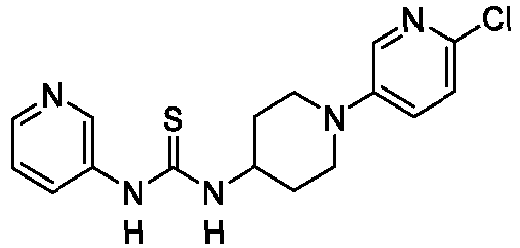
(MeOD) δ 9.45 (s, 1H), 8.51 (s, 1H), 8.24 (s, 1H), 8.05 (s, 1H), 8.01-7.87 (m, 2H), 7.40 (d, 1H), 7.30 (d, 1H), 7.24 (d, 1H), 4.28 (s, 1H), 3.68 (d, 2H), 2.92 - 2.80 (m, 2H), 2.00 - 1.90 (m, 2H), 1.60 - 1.46 (m, 2H) 348.1049 20 1-(1-(3-Chloro-5-ethynylpyridin-2-yl)piperidin-4-yl)-3 - (pyridin-3-yl)thiourea 
δ 8.53 - 8.51 (m, 2H), 8.23 (d, 1H), 8.06 (s, 1H), 7.69 - 7.65 (m, 1H), 7.63 (d, 1H), 7.37 (d, 1H), 5.95 (d, 1H), 4.53 (s, 1H), 3.90 - 3.82 (m, 2H), 3.13 (s, 1H), 3.05 - 2.98 (m, 2H), 2.23 - 2.17 (m, 2H), 1.62 - 1.54 (m, 2H) 372.1050 21 1-(1-(3-Fluoro-5-(trifluoromethyl)pyr idin-2-yl)piperidin-4-yl)-3-(pyridin-3-yl)thiourea 
δ 8.52 - 8.44 (m, 3H), 8.20 - 8.17 (m, 1H), 7.72 - 7.69 (m, 1H), 7.37 - 7.32 (m, 2H), 6.08 (d, 1H), 4.62 - 4.53 (m, 1H), 4.28 - 4.22 (m, 2H), 3.14 - 3.07 (m, 2H), 2.22 - 2.16 (m, 2H), 1.48 (q, 2H) 400.1224 22 1-(Pyridin-3 -yl)-3 - (1-(4-(4-(trifluoromethoxy)p henyl)pyridin-2-yl)piperidin-4-yl)thiourea 
δ 8.52 - 8.49 (m, 2H), 8.33 (d, 1H), 7.91 - 7.88 (m, 2H), 7.84 (s, 1H), 7.68 - 7.64 (m, 1H), 7.36 (d, 1H), 7.29 - 7.25 (m, 2H), 7.00 (d, 1H), 6.65 - 6.62 (m, 1H), 5.94 (d, 1H), 4.68 - 4.58 (m, 1H), 3.92 (d, 2H), 3.15 - 3.04 (m, 2H), 2.25 - 2.17 (m, 2H), 1.50 - 1.38 (m, 2H) 474.1584 23 1-(Pyridin-3 -yl)-3 - (1-(4-(3-(trifluoromethoxy)p henyl)pyridin-2-yl)piperidin-4-yl)thiourea 
δ 8.50 - 8.39 (m, 3H), 8.30 (d, 1H), 7.79 - 7.75 (m, 2H), 7.71 (s, 1H), 7.44 (t, 1H), 7.31 (d, 1H), 7.25 -7.22 (m, 1H), 6.98 (d, 1H), 6.63 (d, 1H), 6.36 (d, 1H), 4.65 - 4.56 (m, 1H), 3.90 - 3.83 (m, 2H), 3.13 - 3.04 (m, 2H), 2.20 - 2.13 (m, 2H), 1.46 - 1.37 (m, 2H) 474.1580 24 1-(pyridin-3-yl)-3-(1-(4-(2-(trifluoromethyl)phe nyl)pyridin-2-yl)piperidin-4-yl)thiourea 
δ 8.59 (s, 1H), 8.43 - 8.38 (m, 2H), 8.24 (d, 1H), 7.81 (d, 1H), 7.71 (d, 1H), 7.54 - 7.46 (m, 2H), 7.42 (d, 1H), 7.29 (d, 1H), 6.74 (d, 1H), 6.67 (d, 1H), 6.49 (d, 1H), 4.66 - 4.57 (m, 1H), 3.89 - 3.83 (m, 2H), 3.12 - 3.04 (m, 2H), 2.15 - 2.09 (m, 2H), 1.40 - 1.31 (m, 2H) 458.1637 25 1-(1-(5-Chloro-4-(trifluoromethyl)pyr idin-2-yl)piperidin-4-yl)-3-(pyridin-3-yl)thiourea 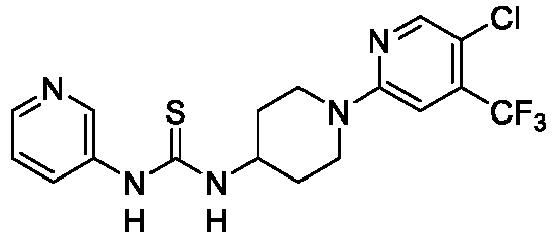
(DMSO-d6 ) δ 9.50 (s, 1H), 8.56 - 8.54 (m, 1H), 8.33 (s, 1H), 8.28 (d, 1H), 7.98 - 7.90 (m, 2H), 7.33 (d, 1H), 7.20 (s, 1H), 4.42 (s, 1H), 4.30 (d, 2H), 3.10 (t, 2H), 2.03 - 1.97 (m, 2H), 1.52 - 1.44 (m, 2H) 416.0919 26 1-(1-(3-Chloro-4-(trifluoromethyl)pyr idin-2-yl)piperidin-4-yl)-3-(pyridin-3-yl)thiourea 
(MeOD) δ 8.60 (d, 1H), 8.35 (d, 1H), 8.28 (d, 1H), 8.07 - 8.04 (m, 1H), 7.39 (d, 1H), 7.27 (d, J = 5.0 Hz, 1H), 4.49 (s, 1H), 3.83 - 3.75 (m, 2H), 3.09 - 3.00 (m, 2H), 2.22 - 2.14 (m, 2H), 1.80 - 1.70 (m, 2H) 416.0930 27 1-(1-(6-Chloro-4-(trifluoromethyl)pyr idin-2-yl)piperidin-4-yl)-3-(pyridin-3-yl)thiourea 
(DMSO-d6 ) δ 9.51 (s, 1H), 8.55 (d, 1H), 8.28 (d, 1H), 8.00 - 7.90 (m, 2H), 7.33 (d, 1H), 7.12 (s, 1H), 6.90 (s, 1H), 4.43 (s, 1H), 4.34 - 4.22 (m, 2H), 3.17 - 3.04 (m, 2H), 2.05 - 1.98 (m, 2H), 1.52 - 1.43 (m, 2H) 416.0919 28 1-(1-(4-Chloropyridin-2-yl)piperidin-4-yl)-3 - (pyridin-3 - yl)thiourea 
δ 8.49 - 8.44 (m, 2H), 8.36 (s, 1H), 8.01 (d, 1H), 7.72 - 7.67 (m, 1H), 7.33 (d, 1H), 6.62 - 6.56 (m, 2H), 6.07 (d, 1H), 4.59 - 4.53 (m, 1H), 4.23 - 4.15 (m, 2H), 3.06 - 2.98 (m, 2H), 2.20 - 2.12 (m, 2H), 1.45 - 1.35 (m, 2H) 348.1057 29 1-(Pyridin-3-yl)-3-(1-(6-(trifluoromethyl)pyr idin-2-yl)piperidin-4-yl)thiourea 
δ 8.49 - 8.40 (m, 3H), 7.73 - 7.68 (m, 1H), 7.54 (t, 1H), 7.33 (d, 1H), 6.90 (d, 1H), 6.76 (d, 1H), 6.12 (d, 1H), 4.55 (s, 1H), 4.32 - 4.24 (m, 2H), 3.08 - 2.99 (m, 2H), 2.20 - 2.11 (m, 2H), 1.46 - 1.35 (m, 2H) 382.1322 30 1-(1-(4-(Cyclohexyloxy)pyr idin-2-yl)piperidin-4-yl)-3-(pyridin-3-yl)thiourea 
δ 8.50 - 8.41 (m, 2H), 8.31 (s, 1H), 7.96 (d, 1H), 7.77 (d, 1H), 7.32 (d, 1H), 6.27 - 6.21 (m, 2H), 6.10 (d, 1H), 4.52 (s, 1H), 4.31 - 4.25 (m, 1H), 4.15 - 4.08 (m, 2H), 3.02 - 2.95 (m, 2H), 2.16-2.10 (m, 2H), 1.97 - 1.90 (m, 2H), 1.82 - 1.74 (m, 2H), 1.60 - 1.27 (m, 8H) 412.2173 31 1-(1-(4-(Cyclopropylmetho xy)pyridin-2-yl)piperidin-4-yl)-3 - (pyridin-3 - yl)thiourea 
δ 8.49 (s, 3H), 7.96 (d, 1H), 7.77 (s, 1H), 7.35 (s, 1H), 6.40 - 6.19 (m, 2H), 6.10 (s, 1H), 4.52 (s, 1H), 4.12 (d, 2H), 3.79 (d, 2H), 2.98 (t, 2H), 2.19 - 2.06 (m, 2H), 1.40 (s, 2H), 1.27 - 1.19 (m, 1H), 0.67 - 0.61 (m, 2H), 0.36 - 0.30 (m, 2H) 384.1861 32 1-(1-(4-(2,2-Difluoroethoxy)pyri din-2-yl)piperidin-4-yl)-3-(pyridin-3-yl)thiourea 
δ 8.54 - 8.34 (m, 3H), 8.02 (d, 1H), 7.74 (d, 1H), 7.32 (d, 1H), 6.32 - 5.93 (m, 4H), 4.54 (s, 1H), 4.24 - 4.08 (m, 4H), 3.00 (t, 2H), 2.21-2.04 (m, 2H), 1.40 - 1.33 (m, 2H) 394.1518 33 1-(1-(4-(2-Cyclopropylethoxy) pyridin-2-yl)piperidin-4-yl)-3 - (pyridin-3-yl)thiourea 
δ 8.63 (s, 1H), 8.44 (d, 1H), 8.39 (d, 1H), 7.96 (d, 1H), 7.83 - 7.78 (m, 1H), 7.29 (d, 1H), 6.44 (d, 1H), 6.24 (d, 1H), 6.10 (d, 1H), 4.52 (s, 1H), 4.16 - 4.08 (m, 2H), 4.02 (t, 2H), 3.02 - 2.94 (m, 2H), 2.15 - 2.09 (m, 2H), 1.65 (q, 2H), 1.46 - 1.36 (m, 2H), 0.85 - 0.77 (m, 1H), 0.50 - 0.45 (m, 2H), 0.12 - 0.07 (m, 2H) 398.2019 34 1-(Pyridin-3 -yl)-3 - (1-(4-(4,4,4-trifluorobutoxy)pyri din-2-yl)piperidin-4-yl)thiourea 
δ 8.52 - 8.41 (m, 2H), 8.30 (s, 1H), 7.99 (d, 1H), 7.76 (d, 1H), 7.33 (d, 1H), 6.20 (d, 2H), 6.09 (d, 1H), 4.54 (s, 1H), 4.20 - 4.14 (m, 2H), 4.02 (t, 2H), 3.04 - 2.97 (m, 2H), 2.34 - 2.24 (m, 2H), 2.18 - 2.11 (m, 2H), 2.06 - 2.00 (m, 2H), 1.45 - 1.35 (m, 2H) 440.1731 35 1-(1-(4-((4,4-Difluorocyclohexyl) oxy)pyridin-2-yl)piperidin-4-yl)-3 - (pyridin-3-yl)thiourea 
δ 8.48 (s, 2H), 8.18 (s, 1H), 8.00 (d, 1H), 7.75 (s, 1H), 7.35 (s, 1H), 6.24 - 6.10 (m, 1H), 6.18 - 6.10 (m, 2H), 4.59 - 4.50 (m, 2H), 4.16 (d, 2H), 3.01 (t, 2H), 2.21-1.84 (m, 10H), 1.48 - 1.37 (m, 2H) 448.1983 36 Isopropyl 4-((2-(4-(3-(pyridin-3-yl)thioureido)piperi din-1-yl)pyridin-4-yl)oxy)piperidine-1-carboxylate 
δ 8.50 - 8.44 (m, 2H), 8.10 (s, 1H), 8.00 (d, 1H), 7.74 (d, 1H), 7.34 (d, 1H), 6.21 (d, 1H), 6.14 - 6.06 (m, 2H), 4.95 - 4.89 (m, 1H), 4.59 - 4.48 (m, 2H), 4.16 (d, 2H), 3.71 - 3.62 (m, 2H), 3.46 - 3.37 (m, 2H), 3.05 - 2.96 (m, 2H), 2.19 - 2.11 (m, 3H), 1.94 - 1.83 (m, 2H), 1.78 - 1.68 (m, 2H), 1.46 - 1.35 (m, 2H), 1.24 (d, 6H) 499.2493 37 1-(1-(4-(Benzyloxy)pyridin-2-yl)piperidin-4-yl)-3-(pyridin-3-yl)thiourea 
δ 8.51 (s, 1H), 8.45 (s, 1H), 8.43 - 8.39 (m, 1H), 7.99 (d, 1H), 7.80 - 7.76 (m, 1H), 7.41 - 7.35 (m, 4H), 7.35 - 7.28 (m, 2H), 6.35 - 6.28 (m, 2H), 6.18 (d, 1H), 5.05 (s, 2H), 4.52 (s, 1H), 4.15 - 4.08 (m, 2H), 3.03 - 2.93 (m, 2H), 2.15 - 2.08 (m, 2H), 1.44 - 1.35 (m, 2H) 420.1859 38 1-(1-(4-((4-Fluorobenzyl)oxy)p yridin-2-yl)piperidin-4-yl)-3 - (pyridin-3-yl)thiourea 
δ 8.52 - 8.41 (m, 2H), 8.36 (s, 1H), 8.00 (d, 1H), 7.77 - 7.71 (m, 1H), 7.40 - 7.29 (m, 3H), 7.09 - 7.04 (m, 2H), 6.28 (d, 1H), 6.21 - 6.15 (m, 2H), 5.01 (s, 2H), 4.53 (s, 1H), 4.18 - 4.09 (m, 2H), 3.03 - 2.94 (m, 2H), 2.17 - 2.10 (m, 2H), 1.44 - 1.36 (m, 2H) 438.1766 39 1-(Pyridin-3 -yl)-3 - (1-(4-((4-(trifluoromethoxy)b enzyl)oxy)pyridin-2-yl)piperidin-4-yl)thiourea 
δ 8.47 (s, 2H), 8.19 (s, 1H), 8.01 (d, 1H), 7.72 (s, 1H), 7.45 - 7.41 (m, 2H), 7.35 (s, 1H), 7.23 (d, 2H), 6.28 (d, 1H), 6.19 - 6.15 (m, 1H), 6.10 (s, 1H), 5.05 (s, 2H), 4.54 (s, 1H), 4.19 - 4.11 (m, 2H), 3.04 - 2.95 (m, 2H), 2.19 - 2.09 (m, 2H), 1.47 - 1.35 (m, 2H) 456.1669 40 1-(1-(4-Phenoxypyridin-2-yl)piperidin-4-yl)-3 - (pyridin-3-yl)thiourea 
δ 8.49 (s, 1H), 8.47 - 8.44 (m, 1H), 8.42 (d, 1H), 7.99 (d, 1H), 7.78 - 7.73 (m, 1H), 7.40 - 7.35 (m, 2H), 7.31 (d, 1H), 7.21 - 7.18 (m, 1H), 7.07 - 7.04 (m, 2H), 6.25 (d, 1H), 6.19 - 6.16 (m, 2H), 4.52 (s, 1H), 4.15 - 4.06 (m, 2H), 3.01- 2.93 (m, 2H), 2.16 - 2.09 (m, 2H), 1.44 - 1.35 (m, 2H) 406.1711 41 1-(1-(4-(4-Fluorophenoxy)pyri din-2-yl)piperidin-4-yl)-3-(pyridin-3-yl)thiourea 
δ 8.48 (s, 2H), 8.37 (s, 1H), 8.02 (d, 1H), 7.81 - 7.71 (m, 1H), 7.37 (s, 1H), 7.12 - 7.02 (m, 4H), 6.23 - 6.14 (m, 3H), 4.55 (s, 1H), 4.17 - 4.08 (m, 2H), 3.05 - 2.97 (m, 2H), 2.20 - 2.11 (m, 2H), 1.48 - 1.36 (m, 2H) 424.1614 42 1-(1-(4-((3,4-Difluorobenzyl)oxy) pyridin-2-yl)piperidin-4-yl)-3 - (pyridin-3-yl)thiourea 
δ 8.52 - 8.44 (m, 2H), 8.12 (s, 1H), 8.01 (d, 1H), 7.70 (d, 1H), 7.34 (d, 1H), 7.25 - 7.09 (m, 3H), 6.26 (d, 1H), 6.16 (d, 1H), 6.03 (d, 1H), 5.00 (s, 2H), 4.54 (s, 1H), 4.19 - 4.13 (m, 2H), 3.05 - 2.97 (m, 2H), 2.18 - 2.11 (m, 2H), 1.46 - 1.37 (m, 2H) 456.1669 43 1-(1-(4-(4-Chloro-2-fluorophenoxy)pyri din-2-yl)piperidin-4-yl)-3-(pyridin-3-yl)thiourea 
δ 8.52 - 8.43 (m, 2H), 8.14 (s, 1H), 8.00 (d, 1H), 7.71 (d, 1H), 7.35 (d, 1H), 7.22 (d, 1H), 7.12 - 7.07 (m, 1H), 7.04 - 6.99 (m, 1H), 6.14 - 6.12 (m, 1H), 6.07 - 6.02 (m, 2H), 4.54 (s, 1H), 4.19 - 4.08 (m, 2H), 3.05 - 2.94 (m, 2H), 2.19 - 2.10 (m, 2H), 1.46 - 1.35 (m, 2H) 458.1221 44 1-(1-(4-Methoxypyridin-2-yl)piperidin-4-yl)-3 - (pyridin-3 - yl)thiourea 
δ 8.62 (s, 1H), 8.44 (d, 1H), 8.39 (d, 1H), 7.97 (d, 1H), 7.82 - 7.78 (m, 1H), 7.29 (d, 1H), 6.41 (d, 1H), 6.23 (d, 1H), 6.09 (d, 1H), 4.52 (s, 1H), 4.15 - 4.08 (m, 2H), 3.78 (s, 3H), 3.01- 2.95 (m, 2H), 2.15 - 2.10 (m, 2H), 1.40 (q, 2H) 344.1545 45 1-(1-(4-Phenylpyridin-2-yl)piperidin-4-yl)-3 - (pyridin-3 - yl)thiourea 
(DMSO-d6 ) δ 9.71 (s, 1H), 8.57 (d, 1H), 8.27 (d, 1H), 8.24 (d, 1H), 8.17 (d, 1H), 8.05 - 8.02 (m, 2H), 7.96 (d, 1H), 7.49 - 7.41 (m, 3H), 7.36 - 7.31 (m, 2H), 6.89 (d, 1H), 4.44 (s, 1H), 4.07 (d, 2H), 3.17 - 3.08 (m, 2H), 2.06 - 2.00 (m, 2H), 1.59 - 1.50 (m, 2H) 390.1758 46 1-(1-(4-(4-Methoxyphenyl)pyri din-2-yl)piperidin-4-yl)-3-(pyridin-3-yl)thiourea 
δ 10.11 (s, 1H), 8.79 (s, 1H), 8.64 (s, 1H), 8.25 - 7.97 (m, 3H), 7.79 (d, 2H), 7.11 (d, 1H), 6.93 (d, 2H), 6.84 (s, 1H), 6.71 - 6.67 (m, 1H), 4.68 - 4.59 (m, 1H), 4.01 - 3.91 (m, 2H), 3.77 (s, 3H), 3.43 - 3.32 (m, 2H), 2.14 - 2.05 (m, 2H), 1.77 - 1.66 (m, 2H) 420.1863 47 1-(1-(4-(4-Fluorophenyl)pyridi n-2-yl)piperidin-4-yl)-3-(pyridin-3-yl)thiourea 
δ 9.66 (s, 1H), 8.58 (d, 1H), 8.23 (d, 1H), 8.19 - 8.16 (m, 2H), 7.99 (s, 1H), 7.84 - 7.79 (m, 2H), 7.19 (d, 1H), 7.13 - 7.08 (m, 2H), 6.93 (d, 1H), 6.62 (d, 1H), 4.65 - 4.56 (m, 1H), 3.90 - 3.84 (m, 2H), 3.23 - 3.15 (m, 2H), 2.19 - 2.11 (m, 2H), 1.63 - 1.55 (m, 2H) 408.1663 48 1-(1-(4-(3,4-Difluorophenyl)pyri din-2-yl)piperidin-4-yl)-3-(pyridin-3-yl)thiourea 
δ 8.63 - 8.24 (m, 4H), 7.81 (s, 1H), 7.78 - 7.70 (m, 1H), 7.67 - 7.58 (m, 1H), 7.36 (s, 1H), 7.26 - 7.19 (m, 1H), 7.00 - 6.95 (m, 1H), 6.68 - 6.60 (m, 1H), 6.55 - 6.35 (m, 1H), 4.64 (s, 1H), 3.92 (d, 2H), 3.16 - 3.07 (m, 2H), 2.26 - 2.15 (m, 2H), 1.55 - 1.42 (m, 2H) 426.1570 49 1-(Pyridin-3-yl)-3-(1-(4-(3-(trifluoromethoxy)p henoxy)pyridin-2-yl)piperidin-4-yl)thiourea 
δ 8.47 - 8.46 (m, 1H), 8.44 (d, 1H), 8.41 (s, 1H), 8.04 (d, 1H), 7.73 (s, 1H), 7.38 (t, 1H), 7.33 (d, 1H), 7.05 (d, 1H), 6.99 (d, 1H), 6.94 - 6.92 (m, 1H), 6.21 - 6.18 (m, 2H), 6.15 (d, 1H), 4.54 (s, 1H), 4.17 - 4.09 (m, 2H), 3.04 - 2.95 (m, 2H), 2.19-2.10 (m, 2H), 1.45 - 1.36 (m, 2H) 490.1527 50 1-(Pyridin-3-yl)-3-(1-(4-(2-(trifluoromethoxy)p henoxy)pyridin-2-yl)piperidin-4-yl)thiourea 
δ 8.50 - 8.46 (m, 2H), 8.18 (s, 1H), 8.01 (d, 1H), 7.71 - 7.66 (m, 1H), 7.37 - 7.28 (m, 3H), 7.25 - 7.21 (m, 1H), 7.14 (d, 1H), 6.19 (d, 1H), 6.13 (d, 1H), 6.01 (d, 1H), 4.55 (s, 1H), 4.18 - 4.10 (m, 2H), 3.04 - 2.95 (m, 2H), 2.19 - 2.10 (m, 2H), 1.45 - 1.35 (m, 2H) 490.1527 51 1-(Pyridin-3-yl)-3-(1-(4-(4-(trifluoromethyl)phe noxy)pyridin-2-yl)piperidin-4-yl)thiourea 
δ 8.50 - 8.44 (m, 2H), 8.35 (s, 1H), 8.05 (d, 1H), 7.72 (d, 1H), 7.64 - 7.59 (m, 2H), 7.34 (d, 1H), 7.16 -7.10 (m, 2H), 6.23 (d, 1H), 6.20 (d, 1H), 6.11 (d, 1H), 4.55 (s, 1H), 4.19-4.13 (m, 2H), 3.05 - 2.97 (m, 2H), 2.19 - 2.12 (m, 2H), 1.47 - 1.35 (m, 2H) 474.1577 52 1-(Pyridin-3-yl)-3-(1-(4-(3-(trifluoromethyl)phe noxy)pyridin-2-yl)piperidin-4-yl)thiourea 
δ 8.48 - 8.43 (m, 2H), 8.37 (s, 1H), 8.04 (d, 1H), 7.75 - 7.70 (m, 1H), 7.49 (t, 1H), 7.46 - 7.43 (m, 1H), 7.35 - 7.30 (m, 2H), 7.25 - 7.22 (m, 1H), 6.21 (d, 1H), 6.16 (d, 1H), 6.13 (d, 1H), 4.55 (s, 1H), 4.18 - 4.11 (m, 2H), 3.05 - 2.96 (m, 2H), 2.19 - 2.11 (m, 2H), 1.45 - 1.36 (m, 2H) 474.1582 53 1-(Pyridin-3-yl)-3-(1-(4-(2-(trifluoromethyl)phe noxy)pyridin-2-yl)piperidin-4-yl)thiourea 
δ 8.53 - 8.35 (m, 3H), 8.05 - 8.01 (m, 1H), 7.77 - 7.67 (m, 2H), 7.56 - 7.51 (m, 1H), 7.36 - 7.25 (m, 2H), 7.08 (d, 1H), 6.28 - 6.13 (m, 3H), 4.54 (s, 1H), 4.22 - 4.07 (m, 2H), 3.08 - 2.96 (m, 2H), 2.21 - 2.09 (m, 2H), 1.49 - 1.36 (m, 2H) 474.1579 54 1-(1-(4-(3-Chloro-4-(trifluoromethoxy)p henoxy)pyridin-2-yl)piperidin-4-yl)-3 - (pyridin-3-yl)thiourea 
δ 8.53 - 8.47 (m, 2H), 8.06 (d, 1H), 7.95 (s, 1H), 7.65 (d, 1H), 7.37 (d, 1H), 7.34 - 7.29 (m, 1H), 7.17 (d, 1H), 6.98 (d, 1H), 6.23 - 6.21 (m, 1H), 6.18 (d, 1H), 5.89 (d, 1H), 4.57 (s, 1H), 4.23 - 4.14 (m, 2H), 3.07 - 2.96 (m, 2H), 2.22 - 2.14 (m, 2H), 1.47 - 1.36 (m, 2H) 524.1142 55 1-(1-(4-(2-Chloro-4-(trifluoromethoxy)p henoxy)pyridin-2-yl)piperidin-4-yl)-3 - (pyridin-3-yl)thiourea 
δ 8.50 - 8.47 (m, 2H), 8.14 (s, 1H), 8.02 (d, 1H), 7.70 - 7.66 (m, 1H), 7.38 - 7.33 (m, 2H), 7.17 - 7.12 (m, 2H), 6.18 (d, 1H), 6.07 (d, 1H), 5.99 (d, 1H), 4.55 (s, 1H), 4.19-4.13 (m, 2H), 3.06 - 2.94 (m, 2H), 2.21 - 2.13 (m, 2H), 1.46 - 1.37 (m, 2H) 524.1142 56 1-(1-(4-(3-Fluoro-4-(trifluoromethoxy)p henoxy)pyridin-2-yl)piperidin-4-yl)-3 - (pyridin-3-yl)thiourea 
δ 8.55 - 8.49 (m, 2H), 8.07 (d, 1H), 7.85 (s, 1H), 7.66 - 7.61 (m, 1H), 7.37 (d, 1H), 7.32 - 7.28 (m, 2H), 6.91 (d, 1H), 6.85 (d, 1H), 6.23 (d, 1H), 6.19 (d, 1H), 5.84 (d, 1H), 4.57 (s, 1H), 4.22 - 4.15 (m, 2H), 3.07 - 2.99 (m, 2H), 2.21 - 2.14 (m, 2H), 1.47 - 1.37 (m, 2H) 508.1438 57 1-(1-(4-(4-Chloro-3-(trifluoromethoxy)p henoxy)pyridin-2-yl)piperidin-4-yl)-3 - (pyridin-3-yl)thiourea 
δ 8.52 - 8.47 (m, 2H), 8.14 (s, 1H), 8.06 (d, 1H), 7.71 - 7.67 (m, 1H), 7.46 (d, 1H), 7.38 - 7.33 (m, 1H), 7.07 - 7.05 (m, 1H), 6.96 (d, 1H), 6.21- 6.17 (m, 2H), 5.99 (d, 1H), 4.56 (s, 1H), 4.21 - 4.13 (m, 2H), 3.06 - 2.96 (m, 2H), 2.22 - 2.11 (m, 2H), 1.47 - 1.34 (m, 2H) 524.1137 58 1-(1-(4-(2-Fluoro-5-(trifluoromethoxy)p henoxy)pyridin-2-yl)piperidin-4-yl)-3 - (pyridin-3-yl)thiourea 
δ 8.55 - 8.47 (m, 2H), 8.05 (d, 1H), 7.93 (s, 1H), 7.65 (d, 1H), 7.40 - 7.34 (m, 1H), 7.29 - 7.20 (m, 2H), 7.10 - 7.02 (m, 2H), 6.24 - 6.12 (m, 2H), 5.92 - 5.85 (m, 1H), 4.56 (s, 1H), 4.23 - 4.14 (m, 2H), 3.09 - 2.97 (m, 2H), 2.24 - 2.12 (m, 2H), 1.47 - 1.35 (m, 2H) 508.1431 59 1-(Pyridin-3-yl)-3-(1-(4-(4-(trifluoromethoxy)p henoxy)-3-(trifluoromethyl)pyr idin-2-yl)piperidin-4-yl)thiourea 
δ 8.54 - 8.46 (m, 2H), 8.36 (s, 1H), 8.11 (d, 1H), 7.73 (d, 1H), 7.37 (d, 1H), 7.27 - 7.22 (m, 2H), 7.11 - 7.06 (m, 2H), 6.22 (d, 1H), 6.11 (d, 1H), 4.50 (s, 1H), 3.73 - 3.63 (m, 2H), 3.12 - 3.02 (m, 2H), 2.23 - 2.12 (m, 2H), 1.62 - 1.51 (m, 2H) 558.1398 60 1-(Pyridin-3-yl)-3-(1-(4-(4-(trifluoromethoxy)p henoxy)-6-(trifluoromethyl)pyr idin-2-yl)piperidin-4-yl)thiourea 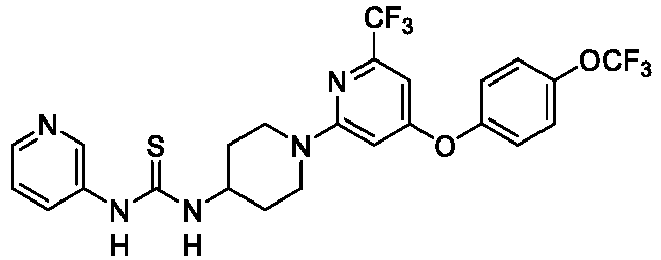
δ 8.55 - 8.49 (m, 2H), 7.86 (s, 1H), 7.67 (d, 1H), 8.42 - 8.34 (m, 1H), 7.31 - 7.24 (m, 2H), 7.13 - 7.03 (m, 2H), 6.52 - 6.46 (m, 1H), 6.28 - 6.23 (m, 1H), 5.91 - 5.83 (s, 1H), 4.57 (s, 1H), 4.27 - 4.17 (m, 2H), 3.10-2.98 (m, 2H), 2.22 - 2.14 (m, 2H), 1.46 - 1.33 (m, 2H) 558.1403 61 1-(1-(4-(4-Pentylphenoxy)pyri din-2-yl)piperidin-4-yl)-3-(pyridin-3-yl)thiourea 
δ 8.53 - 8.46 (m, 2H), 8.01 - 7.91 (m, 2H), 7.70 - 7.63 (m, 1H), 7.38 - 7.33 (m, 1H), 7.20 - 7.15 (m, 2H), 6.99 - 6.92 (m, 2H), 6.20 - 6.14 (m, 2H), 5.93 (d, 1H), 4.54 (s, 1H), 4.16 - 4.07 (m, 2H), 3.04 - 2.95 (m, 2H), 2.63 - 2.57 (m, 2H), 2.17 - 2.11 (m, 2H), 1.66 - 1.59 (m, 2H), 1.46 - 1.28 (m, 6H), 0.90 (t, J = 7.0 Hz, 3H) 476.2493 62 1-(1-(4-(4-(Difluoromethoxy)p henoxy)pyridin-2-yl)piperidin-4-yl)-3 - (pyridin-3-yl)thiourea 
δ 8.49 - 8.43 (m, 2H), 8.35 (s, 1H), 8.01 (d, 1H), 7.73 - 7.69 (m, 1H), 7.33 (d, 1H), 7.16 - 7.12 (m, 2H), 7.16 - 7.03 (m, 2H), 6.50 (t, 1H), 6.17 (d, 1H), 6.15 (d, 1H), 6.11 (d, 1H), 4.53 (s, 1H), 4.16 - 4.09 (m, 2H), 3.03 - 2.94 (m, 2H), 2.18 - 2.09 (m, 2H), 1.45 - 1.34 (m, 2H) 472.1620 63 1-(1-(3-Chloro-4-(4-chloro-3-(trifluoromethoxy)p henoxy)pyridin-2-yl)piperidin-4-yl)-3-(pyridin-3-yl)thiourea 
δ 8.55 - 8.52 (m, 2H), 8.03 (d, 2H), 7.69 - 7.65 (m, 1H), 7.47 (d, 1H), 7.38 (d, 1H), 7.07 - 7.05 (m, 1H), 6.94 (d, 1H), 6.38 (d, 1H), 5.95 (d, 1H), 4.54 (s, 1H), 3.84 - 3.76 (m, 2H), 3.09 - 2.98 (m, 2H), 2.26 - 2.17 (m, 2H), 1.69 - 1.57 (m, 2H) 558.0754 64 1-(1-(3-Chloro-4-(3-fluoro-4-(trifluoromethoxy)p henoxy)pyridin-2-yl)piperidin-4-yl)-3 - (pyridin-3-yl)thiourea 
δ 8.55 - 8.52 (m, 2H), 8.05 (d, 1H), 7.98 (s, 1H), 7.69 - 7.65 (d, 1H), 7.39 (d, 1H), 7.34 - 7.29 (m, 1H), 6.91 (d, 1H), 6.84 (d, 1H), 6.42 (d, 1H), 5.94 (d, 1H), 4.55 (s, 1H), 3.85 - 3.77 (m, 2H), 3.08 - 3.00 (m, 2H), 2.27 - 2.19 (m, 2H), 1.67 - 1.58 (m, 2H) 542.1040 65 1-(1-(3-Chloro-4-(3-chloro-4-(trifluoromethoxy)p henoxy)pyridin-2-yl)piperidin-4-yl)-3 - (pyridin-3-yl)thiourea 
δ 8.55 - 8.50 (m, 2H), 8.09 (s, 1H), 8.04 (d, 1H), 7.72 - 7.67 (m, 1H), 7.38 (d, 1H), 7.35 - 7.31 (m, 1H), 7.17 (d, 1H), 6.97 (d, 1H), 6.40 (d, 1H), 6.00 (d, 1H), 4.54 (s, 1H), 3.85 - 3.76 (m, 2H), 3.09 - 3.00 (m, 2H), 2.27 - 2.19 (m, 2H), 1.68 - 1.58 (m, 2H) 558.0743 66 1-(1-(3-Chloro-4-(3-(trifluoromethoxy)p heno xy)py ridin-2-yl)piperidin-4-yl)-3 - (pyridin-3-yl)thiourea 
δ 8.50 (s, 2H), 8.37 (s, 1H), 8.00 (d, 1H), 7.75 (d, 1H), 7.42 - 7.34 (m, 2H), 7.09 - 7.06 (m, 1H), 6.99 - 6.96 (m, 1H), 6.95 - 6.92 (m, 1H), 6.37 (d, 1H), 6.15 (s, 1H), 4.53 (s, 1H), 3.85 - 3.73 (m, 2H), 3.08 - 3.00 (m, 2H), 2.22 - 2.17 (m, 2H), 1.68 - 1.60 (m, 2H) 524.1142 67 1-(1-(3-Chloro-4-(2-(trifluoromethoxy)p heno xy)py ridin-2-yl)piperidin-4-yl)-3 - (pyridin-3-yl)thiourea 
δ 8.56 - 8.45 (d, 2H), 8.26 (s, 1H), 7.96 (d, 1H), 7.75 - 7.68 (m, 1H), 7.40 - 7.34 (m, 2H), 7.33 - 7.29 (m, 1H), 7.28 - 7.23 (m, 1H), 7.12 (d, 1H), 6.23 (d, 1H), 6.12 - 6.05 (d, 1H), 4.53 (s, 1H), 3.84 - 3.75 (m, 2H), 3.08 - 2.98 (m, 2H), 2.27 - 2.22 (m, 2H), 1.70 - 1.59 (m, 2H) 524.1131 68 1-(1-(3-Chloro-4-(4-fluoro-3-(trifluoromethoxy)p heno xy)py ridin-2-yl)piperidin-4-yl)-3 - (pyridin-3-yl)thiourea 
δ 8.55 - 8.49 (m, 2H), 8.19 (s, 1H), 8.01 (d, 1H), 7.72 - 7.67 (d, 1H), 7.40 - 7.37 (m, 1H), 7.23 (t, 1H), 7.06 - 7.04 (m, 1H), 6.98 (m, 1H), 6.3 1 (d, 1H), 6.06 - 5.97 (m, 1H), 4.54 (s, 1H), 3.84 - 3.76 (m, 2H), 3.08 - 2.99 (m, 2H), 2.26 - 2.18 (m, 2H), 1.68 - 1.57 (m, 2H) 542.1039 69 1-(1-(3-Chloro-4-(4-fluoro-2-methylphenoxy)pyri din-2-yl)piperidin-4-yl)-3-(pyridin-3-yl)thiourea 
δ 8.56 - 8.42 (m, 3H), 7.94 (d, 1H), 7.81 -7.74 (m, 1H), 7.36 (d, 1H), 7.01 (t, 1H), 6.89 (d, 1H), 6.84 (d, 1H), 6.29 (d, 1H), 6.25 (d, 1H), 4.53 (s, 1H), 3.82 - 3.74 (m, 2H), 3.06 - 2.97 (m, 2H), 2.26 (s, 3H), 2.24 - 2.18 (m, 2H), 1.70 - 1.60 (m, 2H) 472.1377 70 1-(1-(3-Chloro-4-(4-fluoro-3-methylphenoxy)pyri din-2-yl)piperidin-4-yl)-3-(pyridin-3-yl)thiourea 
δ 8.54 - 8.46 (m, 2H), 8.37 (s, 1H), 7.91 (d, 1H), 7.78 - 7.72 (m, 1H), 7.36 (d, 1H), 7.00 - 6.88 (m, 3H), 6.16 (s, 1H), 6.09 (d, 1H), 4.53 (s, 1H), 3.81 - 3.72 (m, 2H), 3.07 - 2.97 (m, 2H), 2.25 - 2.18 (m, 2H), 2.14 (s, 3H), 1.69 - 1.60 (m, 2H) 472.1381 71 1-(1-(3-Cyano-4-(4-(trifluoromethoxy)p henoxy)pyridin-2-yl)piperidin-4-yl)-3-(pyridin-3 - yl)thiourea 
δ 8.85 (s, 1H), 8.53 (s, 1H), 8.40 - 8.34 (m, 1H), 8.08 (d, 1H), 8.01 - 7.97 (m, 1H), 7.32 - 7.25 (m, 3H), 7.16 - 7.12 (m, 2H), 6.93 (d, 1H), 6.02 (d, 1H), 4.64 - 4.53 (m, 1H), 4.35 - 4.27 (m, 2H), 3.27 - 3.18 (m, 2H), 2.26 - 2.19 (m, 2H), 1.66 - 1.56 (m, 2H) 515.1484 72 1-(1-(3-Methyl-4-(4-(trifluoromethoxy)p heno xy)py ridin-2-yl)piperidin-4-yl)-3 - (pyridin-3 - yl)thiourea 
δ 8.58 - 8.49 (m, 2H), 8.04 - 7.98 (m, 1H), 7.89 (s, 1H), 7.72 (s, 1H), 7.39 (s, 1H), 7.22 (d, 2H), 7.02 (d, 2H), 6.33 (d, 1H), 6.06 (s, 1H), 4.53 (s, 1H), 3.49 - 3.34 (m, 2H), 3.09 - 2.93 (m, 2H), 2.29 - 2.08 (m, 5H), 1.50 - 1.32 (m, 2H) 504.1677 73 1-(1-(3-Chloro-4-(2-methyl-4-(trifluoromethoxy)p heno xy)py ridin-2-yl)piperidin-4-yl)-3 - (pyridin-3 - yl)thiourea 
δ 8.54 - 8.48 (m, 2H), 8.39 (s, 1H), 7.94 (d, 1H), 7.76 - 7.70 (m, 1H), 7.36 (d, 1H), 7.15 - 7.12 (m, 1H), 7.09 - 7.05 (m, 1H), 6.98 (d, 1H), 6.14 (d, 2H), 4.54 (s, 1H), 3.83 - 3.75 (m, 2H), 3.07 - 2.97 (m, 2H), 2.25 - 2.19 (m, 2H), 2.18 (s, 3H), 1.70 - 1.58 (m, 2H) 538.1290 74 1-(1-(4-(4-Methoxyphenoxy)p yridin-2-yl)piperidin-4-yl)-3 - (pyridin-3 - yl)thiourea 
δ 8.47 - 8.32 (m, 3H), 7.97 (d, 1H), 7.78 - 7.71 (m, 1H), 7.32 (d, 1H), 7.00 - 6.97 (m, 2H), 6.92 - 6.88 (m, 2H), 6.20 (d, 1H), 6.15 - 6.12 (m, 2H), 4.51 (s, 1H), 4.13 - 4.05 (m, 2H), 3.81 (s, 3H), 3.00 - 2.93 (m, 2H), 2.15-2.09 (m, 2H), 1.44 - 1.34 (m, 2H) 436.1814 75 1-(Pyridin-3-yl)-3-(1-(4-(p-tolyloxy)pyridin-2-yl)piperidin-4-yl)thiourea 
δ 8.50 - 8.46 (m, 2H), 8.09 (s, 1H), 8.00 - 7.95 (m, 1H), 7.72 - 7.67 (m, 1H), 7.35 (d, 1H), 7.19 -7.15 (m, 2H), 6.96 - 6.93 (m, 2H), 6.18 - 6.15 (m, 2H), 6.02 (d, J = 8.0 Hz, 1H), 4.52 (s, 1H), 4.15 - 4.08 (m, 2H), 3.03 - 2.94 (m, 2H), 2.36 (s, 3H), 2.17 - 2.10 (m, 2H), 1.45-1.34 (m, 2H) 420.1858 76 1-(1-(4-Acetylpyridin-2-yl)piperidin-4-yl)-3 - (pyridin-3-yl)thiourea 
δ 8.48 - 8.43 (m, 2H), 8.37 (s, 1H), 8.27 (d, 1H), 7.72 - 7.67 (m, 1H), 7.34 -7.30 (m, 1H), 7.06 (s, 1H), 6.97 - 6.94 (m, 1H), 6.10 (d, 1H), 4.57 (s, 1H), 4.32 - 4.25 (m, 2H), 3.10 - 3.01 (m, 2H), 2.54 (s, 3H), 2.21 - 2.15 (m, 2H), 1.46 - 1.37 (m, 2H) 356.1546 77 1-(1-(3-Chloro-5-(trifluoromethyl)pyr idin-2-yl)piperidin-4-yl)-3-(pyridin-3-yl)urea 
δ 8.37 (s, 2H), 8.25 (d, 1H), 8.01 (d, 1H), 7.74 (d, 1H), 7.26 - 7.24 (m, 1H), 7.19 (s, 1H), 5.10 (t, 1H), 3.99 - 3.93 (m, 3H), 3.05 (t, 2H), 2.15 - 2.05 (m, 2H), 1.58 (d, 2H) 400.1163 78 1-(Pyridin-3-yl)-3-(1-(5-(trifluoromethyl)pyr imidin-2-yl)piperidin-4-yl)thiourea 
δ 8.55 (d, 1H), 8.52 (d, 1H), 8.46 - 8.45 (m, 2H), 7.62 - 7.57 (m, 2H), 7.38 (d, 1H), 5.71 (d, 1H), 4.82 - 4.77 (m, 2H), 4.69 - 4.61 (m, 1H), 3.16 - 3.08 (m, 2H), 2.25 - 2.03 (m, 2H), 1.39 - 1.31 (m, 2H) 382.1270 79 1-(Pyridin-3-yl)-3-(1-(6-(trifluoromethyl)pyr idazin-3-yl)piperidin-4-yl)thiourea 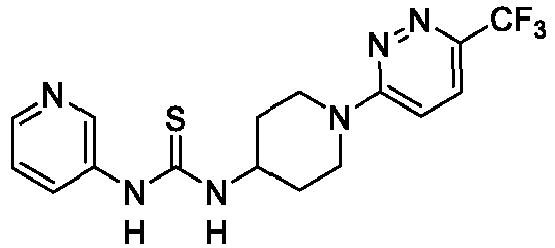
δ 8.52 - 8.40 (m, 2H), 8.05 (s, 1H), 7.76 (d, 1H), 7.46 (d, 1H), 7.33 (d, 1H), 6.95 (d, 1H), 6.26 (s, 1H), 4.70 (s, 1H), 4.46 (d, 2H), 3.21 (t, 2H), 2.26 (d, 2H), 1.49 - 1.40 (m, 2H) 382.1271 80 1-(1-(3-Chloro-5-(trifluoromethyl)pyr idin-2-yl)azepan-4-yl)-3-(pyridin-3-yl)thiourea 
δ 8.44 (d, 1H), 8.40 (s, 1H), 8.34 (d, 1H), 8.26 - 8.24 (m, 1H), 7.65 (d, J = 2.1 Hz, 1H), 7.58 (d, 1H), 7.16 (d, 1H), 6.34 - 6.25 (m, 1H), 4.68 (s, 1H), 3.85 - 3.80 (m, 1H), 3.77 - 3.73 (m, 1H), 3.52 - 3.43 (m, 2H), 2.23 - 2.18 (m, 1H), 2.05 - 1.84 (m, 4H), 1.79 - 1.71 (m, 1H) 430.1081 81 1-(5-((3-Chloro-5-(trifluoromethyl)pyr idin-2-yl)amino)pentyl)-3-(pyridin-3 - yl)thiourea 
δ 8.51 (d, 1H), 8.48 (d, 1H), 8.25 - 8.23 (m, 1H), 8.20 (s, 1H), 7.72 - 7.66 (m, 1H), 7.60 (d, 1H), 7.35 (d, 1H), 6.19 (s, 1H), 5.36 (t, 1H), 3.69 - 3.58 (m, 2H), 3.52 - 3.48 (m, 2H), 1.70 - 1.62 (m, 2H), 1.45 - 1.39 (m, 2H) 418.1089 82 1-(1-(3-Chloro-5-(trifluoromethyl)pyr idin-2-yl)piperidin-4-yl)-1-methyl-3-(pyridin-3-yl)thiourea 
δ 8.45 (d, 1H), 8.40 - 8.38 (m, 2H), 7.84 (d, 1H), 7.76 (d, 1H), 7.41 (s, 1H), 7.29 (d, 1H), 5.57 -5.47 (m, 1H), 4.21- 4.15 (m, 2H), 3.14 (s, 3H), 3.08 - 3.00 (m, 2H), 1.98 - 1.84 (m, 4H) 430.1087 83 1-(4-((3-Chloro-5-(trifluoromethyl)pyr idin-2-yl)amino)butyl)-3 - (pyridin-3-yl)thiourea 
δ 8.49 (d, 1H), 8.43 (d, 1H), 8.18 (s, 1H), 7.72 (d, 1H), 7.59 (d, 1H), 7.32 (d, 1H), 3.71 - 3.63 (m, 2H), 3.56 - 3.51 (m, 2H), 1.73 - 1.64 (m, 4H) 404.0933 84 1-(6-((3-Chloro-5-(trifluoromethyl)pyr idin-2-yl)amino)hexyl)-3-(pyridin-3 - yl)thiourea 
δ 8.51- 8.49 (m, 1H), 8.47 (d, 1H), 8.25 - 8.23 (m, 2H), 7.71 (s, 1H), 7.60 (d, 1H), 7.34 (d, 1H), 6.21 (s, 1H), 5.36 (t, 1H), 3.61 (s, 2H), 3.52 - 3.46 (m, 2H), 1.69 - 1.57 (m, 4H), 1.45 - 1.34 (m, 4H) 432.1244 85 1-((1R,5S)-8-(3-Chloro-5-(trifluoromethyl)pyr idin-2-yl)-8-azabicyclo[3.2.1]oct an-3-yl)-3-(pyridin-3-yl)thiourea 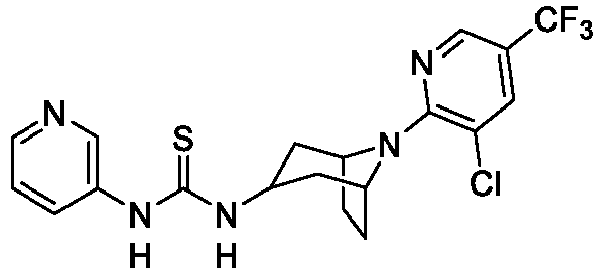
δ 8.47 - 8.44 (m, 2H), 8.27 (s, 1H), 8.12 (s, 1H), 7.66 (s, 1H), 7.59 (d, 1H), 7.34 (d, 1H), 5.83 - 5.74 (m, 1H), 4.99 - 4.89 (m, 1H), 4.87 (s, 2H), 2.19 - 2.11 (m, 2H), 2.08 - 1.99 (m, 2H), 1.95 - 1.88 (m, 2H), 1.66 - 1.57 (m, 2H) 442.1089 - Compounds were tested to assess their ABHD12 activity using the following assays.
- Gel-based ABPP assays were performed as previously reported (Bachovchin, D. A. et al. Superfamily-wide portrait of serine hydrolase inhibition achieved by library-versus-library screening. Proc. Natl. Acad. Sci. U. S. A. 2010, 107, 20941-20946). Cell or tissue proteomes (50 µL, 1 mg/mL) were treated with either FP-Rh (1 µM final concentration) or JJH350 (2 µM final concentration) for 45 min at 37 °C. For FP-Rh labeled samples, the reactions were quenched by adding 20 µL of 4X SDS-PAGE loading buffer. The 30 µL of the quenched samples were loaded on gel for analysis. For (S)-1,3-dioxo-7-(4-phenoxybenzoyl)hexahydroimidazo[1,5-a]pyrazin-2(3H)-yl 4-(4-(prop-2-yn-1-yloxy)phenyl)piperazine-1-carboxylate (JJH350)-labeled samples, copper-catalyzed azide-alkyne cycloaddition (CuAAC) was used for visualizing the labeled proteins following the reported protocol. Briefly, rhodamine-PEG3-N3 (1 µL/reaction, 1.25 mM in DMSO), CuSO4 (1 µL/reaction, 50 mM in H2O), TBTA (3 µL/reaction, 1.7 mM in DMSO/t-BuOH [1:4, v/v]) and tris(2-carboxyethyl)phosphine (TCEP) (1 µL/reaction, 50 mM in H2O, freshly prepared) were premixed. 6 µL of this click reagent mixture was immediately added to each JJH350-labeled samples (50 µL, 1 mg/mL) and incubated for 1 h at room temperature. The reactions were quenched by adding 20 µL of 4X SDS-PAGE loading buffer. The 40 µL of the quenched samples were loaded on a gel for analysis.
- After separation by SDS-PAGE (10% acrylamide), samples were visualized by in-gel fluorescence scanning using the ChemiDoc MP system (Bio-Rad). Band intensities were quantified using the Image Lab (5.2.1) software (Bio-Rad).
- Tissues from mice treated with inhibitors were dounce-homogenized in DPBS (1 mL for a half brain, spleen and liver, and 1.5 mL for lung) followed by low-speed spin (1,400 x g, 3 min, 4 °C) to remove debris. For FP-Rh labeling, 2 µL of 50 µM FP-Rh was added to 50 µL of the whole tissue lysate obtained above (2 µM final) and incubated for 20 min at room temperature. For JJH350 labeling, 1 µL of 500 µM JJH350 was added to 50 µL of the whole tissue lysate obtained above (10 µM final) and incubated for 30 min at room temperature. 1.5 mL of cold DPBS was added to each probe-labeled samples and spun at 16,000 x g for 45 min at 4 °C. The resulting membrane pellet was resuspended in cold DPBS, and protein concentrations were adjusted to 1 mg/mL using the Bio-Rad DC protein assay kit. For FP-Rh labeled samples, the reactions were quenched by adding 20 µL of 4X SDS-PAGE loading buffer, and the 30 µL of the quenched samples were loaded on a gel for analysis. For (S)-1,3-dioxo-7-(4-phenoxybenzoyl)hexahydroimidazo[1,5-a]pyrazin-2(3H)-yl 4-(4-(prop-2-yn-1-yloxy)phenyl)piperazine-1-carboxylate (JJH350)-labeled samples, CuAAC reactions were performed as described above and the reactions were quenched by adding 20 µL of 4X SDS-PAGE loading buffer. The 40 µL of the quenched samples were loaded on gel for analysis.
- The lyso-PS lipase activity of ABHD12 was determined as previously described (Blankman, J. L., Long, J. Z., Trauger, S. A., Siuzdak, G. & Cravatt, B. F. ABHD12 controls brain lysophosphatidylserine pathways that are deregulated in a murine model of the neurodegenerative disease PHARC. Proc. Natl. Acad. Sci. U. S. A. 110, 1500-1505, doi:10.1073/pnas.1217121110 (2013)) with some minor modifications. The proteome concentrations were adjusted to 0.25 mg/mL (ABHD12-overexpressing HEK293T membrane) or 0.5 mg/mL (mouse brain membrane) in Dulbecco's phosphate-buffered saline (DPBS) (80 µL/reaction). 20 µL of 500 µM 17:1 lyso-PS in DPBS was added to each reaction (100 µM final concentration) and incubated at 37 °C. After 30 min, the reaction was quenched with 400 µL of 2:1 CHCl3/MeOH (v/v) with 1 nmol 15:0 FFA as an internal standard. The mixture was vortexed and centrifuged at 1,400 x g to separate the aqueous and organic phase. The organic phase was analyzed by LC-MS (1200 LC/MSD, Agilent Technologies). The separation of the analyte was achieved using a 50 mm × 4.6 mm 5 µm Gemini C18 column (Phenomenex) coupled to a guard column (Gemini: C18: 4 × 3 mm). The LC solvents were as follows: buffer A, H2O:MeOH (95:5, v/v) with 0.1 % NH4OH (v/v); and buffer B, iPrOH:MeOH:H2O (60:35:5, v/v/v) with 0.1 % NH4OH (v/v). The LC method consisted of 0.1 mL/min 20% buffer B for 1.0 min, 0.4 ml/min isocratic mode of 100% buffer B over 7 min and equilibration with 0.5 mL/min 100% buffer A for 3 min. The MS analyses were performed using an electrospray ionization source (ESI) in negative ion mode to measure product formation. MS data were acquired in selected ion monitoring mode at m/z 267.20 for 17:1 FFA and m/z 241.20 for 15:0 FFA.
- Percent enzyme inhibition at 10 µM and IC50 data from these assays are shown in Table 1. Examples 5-7, 9, 10, 20, 30, 31, 33, 35, 36, 44, 45, 61, 69-71, 73-85 are reference examples not part of the invention.
TABLE 1 Ex % Inhibition @ 10 µM (ABPP gel_JJH350 probe vs brain mem) IC50 (ABPP gel_JJH350 probe vs brain mem) IC50 (Substrate-based assay-ABHD12-overexpressed HEK lysate) 1 A * * 2 A ** ** 3 A *** *** 4 *** *** 5 *** 6 ** 7 8 A 9 A 10 C (at 2 uM) 11 A 12 A 13 A 14 A * * 15 A ** * 16 C * * 17 B 18 A 19 D 20 B (at 2 uM) 21 A 22 A 23 A 24 B 25 A * * 26 A ** ** 27 A ** ** 28 A * * 29 A ** ** 30 A * 31 A * 32 B 33 A 34 A 35 A 36 B 37 A * 38 A 39 A 40 A * * 41 A * * 42 A 43 A 44 B * 45 C * 46 D 47 A 48 A 49 A 50 A 51 A ** ** 52 A 53 A 54 A ** 55 A 56 A 57 A ** ** 58 A 59 A * * 60 D 61 A 62 A 63 *** 64 ∗∗∗ 65 *** *** 66 *** ** 67 *** ** 68 *** 69 ** 70 ** 71 ** ** 72 *** *** 73 *** 74 * * 75 * 76 C * 77 C 78 B 79 D 80 B 81 A 82 B 83 C 84 B 85 B *** IC50 is less than or equal to 100 nM; ** IC50 is greater than 100 nM and less than 1 µM; * IC50 is greater than or equal to 1 µM and less or equal to 25 µM.
A = % inhibition is greater than or equal to 75%; B = % inhibition is greater than or equal to 50% and less than 75%; C = % inhibition is greater than or equal to 25% and less than 50%; D = % inhibition is greater than or equal to 0% and less than 25%.
Claims (7)
- A compound of Formula (I):
 each R1 is independently selected from halogen, C1-6alkyl, C1-6haloalkyl, -OR3, and phenyl substituted with 1 or 2 substituents independently selected from halogen, C1-6alkyl, C1-6haloalkyl, C1-6alkoxy, and C1-6haloalkoxy;each R3 is C1-6haloalkyl, phenyl, or -C1-6alkyl-phenyl, wherein phenyl or -C1-6alkylphenyl are optionally substituted with 1 or 2 substituents independently selected from halogen, C1-6haloalkyl, and C1-6haloalkoxy;
andn is 0, 1, 2, or 3;or a solvate, N-oxide, stereoisomer, or pharmaceutically acceptable salt thereof. - The compound of claim 1, or a solvate, N-oxide, stereoisomer, or pharmaceutically acceptable salt thereof, wherein n is 1 or 2.
- The compound of claim 1, or a solvate, N-oxide, stereoisomer, or pharmaceutically acceptable salt thereof, wherein n is 1.
- The compound of claim 1, or a solvate, N-oxide, stereoisomer, or pharmaceutically acceptable salt thereof, wherein n is 2.
- The compound of claim 1, or a solvate, N-oxide, stereoisomer, or pharmaceutically acceptable salt thereof, wherein n is 0.
- A compound according to claim 1 selected from:


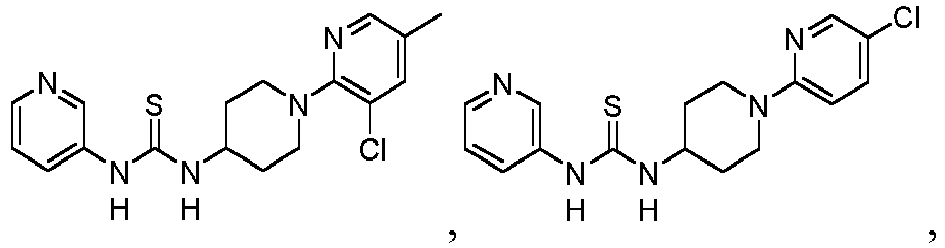


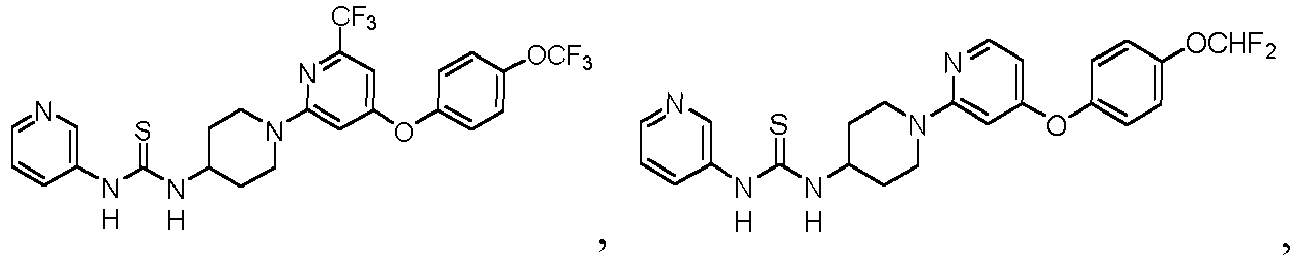



- A pharmaceutical composition comprising a compound of any one of claims 1-6, or a solvate, N-oxide, stereoisomer, or pharmaceutically acceptable salt thereof, and at least one pharmaceutically acceptable excipient.
Applications Claiming Priority (2)
| Application Number | Priority Date | Filing Date | Title |
|---|---|---|---|
| US201862671998P | 2018-05-15 | 2018-05-15 | |
| PCT/US2019/032290 WO2019222267A1 (en) | 2018-05-15 | 2019-05-14 | Abhd12 inhibitors and methods of making and using same |
Publications (4)
| Publication Number | Publication Date |
|---|---|
| EP3793552A1 EP3793552A1 (en) | 2021-03-24 |
| EP3793552A4 EP3793552A4 (en) | 2022-02-16 |
| EP3793552C0 EP3793552C0 (en) | 2023-07-12 |
| EP3793552B1 true EP3793552B1 (en) | 2023-07-12 |
Family
ID=68540848
Family Applications (1)
| Application Number | Title | Priority Date | Filing Date |
|---|---|---|---|
| EP19803323.5A Active EP3793552B1 (en) | 2018-05-15 | 2019-05-14 | Abhd12 inhibitors and methods of making and using same |
Country Status (7)
| Country | Link |
|---|---|
| US (1) | US11897865B2 (en) |
| EP (1) | EP3793552B1 (en) |
| JP (1) | JP7282104B2 (en) |
| CN (1) | CN112105355B (en) |
| ES (1) | ES2952333T3 (en) |
| MA (1) | MA52638A (en) |
| WO (1) | WO2019222267A1 (en) |
Families Citing this family (2)
| Publication number | Priority date | Publication date | Assignee | Title |
|---|---|---|---|---|
| EP3793552B1 (en) | 2018-05-15 | 2023-07-12 | The Scripps Research Institute | Abhd12 inhibitors and methods of making and using same |
| US20220213074A1 (en) * | 2019-05-14 | 2022-07-07 | H. Lundbeck A/S | Abhd12 inhibitors and methods of making and using same |
Family Cites Families (9)
| Publication number | Priority date | Publication date | Assignee | Title |
|---|---|---|---|---|
| DE60136562D1 (en) * | 2000-12-21 | 2008-12-24 | Schering Corp | HETEROARYL-urea neuropeptide Y Y5 receptor antagonists |
| US6946476B2 (en) | 2000-12-21 | 2005-09-20 | Schering Corporation | Heteroaryl urea neuropeptide Y Y5 receptor antagonists |
| EP1836179B1 (en) | 2004-12-30 | 2015-05-06 | Janssen Pharmaceutica NV | Piperidine- and piperazine-1-carboxylic acid amide derivatives and related compounds as modulators of fatty acid amide hydrolase (faah) for the treatment of anxiety, pain and other conditions |
| EP2132176A1 (en) * | 2007-03-13 | 2009-12-16 | Arete Therapeutics, Inc. | 4-piperidinylurea compounds as soluble epoxide hydrolase inhibitors |
| EP2380991A1 (en) | 2010-04-20 | 2011-10-26 | Universitätsklinikum Hamburg-Eppendorf | Method of determining the metastatic potential of a tumor |
| WO2016115463A1 (en) | 2015-01-15 | 2016-07-21 | Whitehead Institute For Biomedical Research | Inhibitors of phosphoglycerate dehydrogenase (phgdh) and uses thereof |
| WO2017023861A1 (en) * | 2015-08-03 | 2017-02-09 | The Regents Of The University Of California | Compositions and methods for modulating abhd2 activity |
| EP3793552B1 (en) | 2018-05-15 | 2023-07-12 | The Scripps Research Institute | Abhd12 inhibitors and methods of making and using same |
| US20220213074A1 (en) | 2019-05-14 | 2022-07-07 | H. Lundbeck A/S | Abhd12 inhibitors and methods of making and using same |
-
2019
- 2019-05-14 EP EP19803323.5A patent/EP3793552B1/en active Active
- 2019-05-14 US US17/055,081 patent/US11897865B2/en active Active
- 2019-05-14 WO PCT/US2019/032290 patent/WO2019222267A1/en not_active Ceased
- 2019-05-14 CN CN201980031793.4A patent/CN112105355B/en active Active
- 2019-05-14 JP JP2020563912A patent/JP7282104B2/en active Active
- 2019-05-14 MA MA052638A patent/MA52638A/en unknown
- 2019-05-14 ES ES19803323T patent/ES2952333T3/en active Active
Also Published As
| Publication number | Publication date |
|---|---|
| US11897865B2 (en) | 2024-02-13 |
| WO2019222267A1 (en) | 2019-11-21 |
| EP3793552A1 (en) | 2021-03-24 |
| US20210221790A1 (en) | 2021-07-22 |
| EP3793552A4 (en) | 2022-02-16 |
| CN112105355B (en) | 2024-01-02 |
| EP3793552C0 (en) | 2023-07-12 |
| MA52638A (en) | 2021-03-24 |
| JP7282104B2 (en) | 2023-05-26 |
| JP2021523902A (en) | 2021-09-09 |
| CN112105355A (en) | 2020-12-18 |
| ES2952333T3 (en) | 2023-10-30 |
Similar Documents
| Publication | Publication Date | Title |
|---|---|---|
| EP3541820B1 (en) | Magl inhibitors | |
| EP3675848B1 (en) | Spirocycle compounds and methods of making and using same | |
| EP3630744B1 (en) | Pyrazole magl inhibitors | |
| EP3793547A1 (en) | Magl inhibitors | |
| KR102756049B1 (en) | Dual magl and faah inhibitors | |
| KR20250075662A (en) | PCSK9 inhibitors and methods of use thereof | |
| US10927105B1 (en) | Pyrazole MAGL inhibitors | |
| US11897865B2 (en) | ABHD12 inhibitors and methods of making and using same | |
| EP3968994B1 (en) | Abhd12 inhibitors and methods of making and using same | |
| EP3743419B1 (en) | Novel compounds for the treatment of parasitic infections | |
| HK40047050B (en) | Abhd12 inhibitors and methods of making and using same | |
| HK40047050A (en) | Abhd12 inhibitors and methods of making and using same | |
| HK40070601B (en) | Abhd12 inhibitors and methods of making and using same | |
| HK40070601A (en) | Abhd12 inhibitors and methods of making and using same | |
| HK40095793A (en) | Pyrazole magl inhibitors | |
| HK40026545A (en) | Pyrazole magl inhibitors | |
| HK40026545B (en) | Pyrazole magl inhibitors | |
| HK40115819A (en) | Dual magl and faah inhibitors | |
| HK40009161B (en) | Magl inhibitors | |
| HK40009161A (en) | Magl inhibitors | |
| US20150031668A1 (en) | Chroman derivatives as trpm8 inhibitors | |
| TW202606669A (en) | Arnt degrading compounds and uses thereof |
Legal Events
| Date | Code | Title | Description |
|---|---|---|---|
| STAA | Information on the status of an ep patent application or granted ep patent |
Free format text: STATUS: THE INTERNATIONAL PUBLICATION HAS BEEN MADE |
|
| PUAI | Public reference made under article 153(3) epc to a published international application that has entered the european phase |
Free format text: ORIGINAL CODE: 0009012 |
|
| STAA | Information on the status of an ep patent application or granted ep patent |
Free format text: STATUS: REQUEST FOR EXAMINATION WAS MADE |
|
| 17P | Request for examination filed |
Effective date: 20201215 |
|
| AK | Designated contracting states |
Kind code of ref document: A1 Designated state(s): AL AT BE BG CH CY CZ DE DK EE ES FI FR GB GR HR HU IE IS IT LI LT LU LV MC MK MT NL NO PL PT RO RS SE SI SK SM TR |
|
| AX | Request for extension of the european patent |
Extension state: BA ME |
|
| RAV | Requested validation state of the european patent: fee paid |
Extension state: MA Effective date: 20201215 Extension state: TN Effective date: 20201215 |
|
| REG | Reference to a national code |
Ref country code: HK Ref legal event code: DE Ref document number: 40047050 Country of ref document: HK |
|
| REG | Reference to a national code |
Ref country code: DE Ref legal event code: R079 Free format text: PREVIOUS MAIN CLASS: A61K0031423000 Ipc: C07D0401140000 Ref country code: DE Ref legal event code: R079 Ref document number: 602019032706 Country of ref document: DE Free format text: PREVIOUS MAIN CLASS: A61K0031423000 Ipc: C07D0401140000 |
|
| A4 | Supplementary search report drawn up and despatched |
Effective date: 20220114 |
|
| RIC1 | Information provided on ipc code assigned before grant |
Ipc: A61P 25/28 20060101ALI20220110BHEP Ipc: A61P 37/00 20060101ALI20220110BHEP Ipc: A61P 35/00 20060101ALI20220110BHEP Ipc: A61K 31/444 20060101ALI20220110BHEP Ipc: C07D 451/04 20060101ALI20220110BHEP Ipc: C07D 213/75 20060101ALI20220110BHEP Ipc: C07D 487/04 20060101ALI20220110BHEP Ipc: C07D 401/04 20060101ALI20220110BHEP Ipc: C07D 401/14 20060101AFI20220110BHEP |
|
| GRAP | Despatch of communication of intention to grant a patent |
Free format text: ORIGINAL CODE: EPIDOSNIGR1 |
|
| STAA | Information on the status of an ep patent application or granted ep patent |
Free format text: STATUS: GRANT OF PATENT IS INTENDED |
|
| INTG | Intention to grant announced |
Effective date: 20230405 |
|
| GRAS | Grant fee paid |
Free format text: ORIGINAL CODE: EPIDOSNIGR3 |
|
| GRAA | (expected) grant |
Free format text: ORIGINAL CODE: 0009210 |
|
| STAA | Information on the status of an ep patent application or granted ep patent |
Free format text: STATUS: THE PATENT HAS BEEN GRANTED |
|
| AK | Designated contracting states |
Kind code of ref document: B1 Designated state(s): AL AT BE BG CH CY CZ DE DK EE ES FI FR GB GR HR HU IE IS IT LI LT LU LV MC MK MT NL NO PL PT RO RS SE SI SK SM TR |
|
| REG | Reference to a national code |
Ref country code: CH Ref legal event code: EP |
|
| REG | Reference to a national code |
Ref country code: IE Ref legal event code: FG4D |
|
| REG | Reference to a national code |
Ref country code: DE Ref legal event code: R096 Ref document number: 602019032706 Country of ref document: DE |
|
| U01 | Request for unitary effect filed |
Effective date: 20230807 |
|
| U07 | Unitary effect registered |
Designated state(s): AT BE BG DE DK EE FI FR IT LT LU LV MT NL PT SE SI Effective date: 20230814 |
|
| REG | Reference to a national code |
Ref country code: ES Ref legal event code: FG2A Ref document number: 2952333 Country of ref document: ES Kind code of ref document: T3 Effective date: 20231030 |
|
| REG | Reference to a national code |
Ref country code: LT Ref legal event code: MG9D |
|
| PG25 | Lapsed in a contracting state [announced via postgrant information from national office to epo] |
Ref country code: GR Free format text: LAPSE BECAUSE OF FAILURE TO SUBMIT A TRANSLATION OF THE DESCRIPTION OR TO PAY THE FEE WITHIN THE PRESCRIBED TIME-LIMIT Effective date: 20231013 |
|
| PG25 | Lapsed in a contracting state [announced via postgrant information from national office to epo] |
Ref country code: IS Free format text: LAPSE BECAUSE OF FAILURE TO SUBMIT A TRANSLATION OF THE DESCRIPTION OR TO PAY THE FEE WITHIN THE PRESCRIBED TIME-LIMIT Effective date: 20231112 |
|
| PG25 | Lapsed in a contracting state [announced via postgrant information from national office to epo] |
Ref country code: RS Free format text: LAPSE BECAUSE OF FAILURE TO SUBMIT A TRANSLATION OF THE DESCRIPTION OR TO PAY THE FEE WITHIN THE PRESCRIBED TIME-LIMIT Effective date: 20230712 Ref country code: NO Free format text: LAPSE BECAUSE OF FAILURE TO SUBMIT A TRANSLATION OF THE DESCRIPTION OR TO PAY THE FEE WITHIN THE PRESCRIBED TIME-LIMIT Effective date: 20231012 Ref country code: IS Free format text: LAPSE BECAUSE OF FAILURE TO SUBMIT A TRANSLATION OF THE DESCRIPTION OR TO PAY THE FEE WITHIN THE PRESCRIBED TIME-LIMIT Effective date: 20231112 Ref country code: HR Free format text: LAPSE BECAUSE OF FAILURE TO SUBMIT A TRANSLATION OF THE DESCRIPTION OR TO PAY THE FEE WITHIN THE PRESCRIBED TIME-LIMIT Effective date: 20230712 Ref country code: GR Free format text: LAPSE BECAUSE OF FAILURE TO SUBMIT A TRANSLATION OF THE DESCRIPTION OR TO PAY THE FEE WITHIN THE PRESCRIBED TIME-LIMIT Effective date: 20231013 |
|
| PG25 | Lapsed in a contracting state [announced via postgrant information from national office to epo] |
Ref country code: PL Free format text: LAPSE BECAUSE OF FAILURE TO SUBMIT A TRANSLATION OF THE DESCRIPTION OR TO PAY THE FEE WITHIN THE PRESCRIBED TIME-LIMIT Effective date: 20230712 |
|
| REG | Reference to a national code |
Ref country code: DE Ref legal event code: R097 Ref document number: 602019032706 Country of ref document: DE |
|
| PG25 | Lapsed in a contracting state [announced via postgrant information from national office to epo] |
Ref country code: SM Free format text: LAPSE BECAUSE OF FAILURE TO SUBMIT A TRANSLATION OF THE DESCRIPTION OR TO PAY THE FEE WITHIN THE PRESCRIBED TIME-LIMIT Effective date: 20230712 Ref country code: RO Free format text: LAPSE BECAUSE OF FAILURE TO SUBMIT A TRANSLATION OF THE DESCRIPTION OR TO PAY THE FEE WITHIN THE PRESCRIBED TIME-LIMIT Effective date: 20230712 Ref country code: CZ Free format text: LAPSE BECAUSE OF FAILURE TO SUBMIT A TRANSLATION OF THE DESCRIPTION OR TO PAY THE FEE WITHIN THE PRESCRIBED TIME-LIMIT Effective date: 20230712 Ref country code: SK Free format text: LAPSE BECAUSE OF FAILURE TO SUBMIT A TRANSLATION OF THE DESCRIPTION OR TO PAY THE FEE WITHIN THE PRESCRIBED TIME-LIMIT Effective date: 20230712 |
|
| PLBE | No opposition filed within time limit |
Free format text: ORIGINAL CODE: 0009261 |
|
| STAA | Information on the status of an ep patent application or granted ep patent |
Free format text: STATUS: NO OPPOSITION FILED WITHIN TIME LIMIT |
|
| 26N | No opposition filed |
Effective date: 20240415 |
|
| U20 | Renewal fee for the european patent with unitary effect paid |
Year of fee payment: 6 Effective date: 20240531 |
|
| U1H | Name or address of the proprietor changed after the registration of the unitary effect |
Owner name: THE SCRIPPS RESEARCH INSTITUTE; US |
|
| REG | Reference to a national code |
Ref country code: CH Ref legal event code: PL |
|
| PG25 | Lapsed in a contracting state [announced via postgrant information from national office to epo] |
Ref country code: MC Free format text: LAPSE BECAUSE OF FAILURE TO SUBMIT A TRANSLATION OF THE DESCRIPTION OR TO PAY THE FEE WITHIN THE PRESCRIBED TIME-LIMIT Effective date: 20230712 |
|
| PG25 | Lapsed in a contracting state [announced via postgrant information from national office to epo] |
Ref country code: MC Free format text: LAPSE BECAUSE OF FAILURE TO SUBMIT A TRANSLATION OF THE DESCRIPTION OR TO PAY THE FEE WITHIN THE PRESCRIBED TIME-LIMIT Effective date: 20230712 Ref country code: CH Free format text: LAPSE BECAUSE OF NON-PAYMENT OF DUE FEES Effective date: 20240531 |
|
| PG25 | Lapsed in a contracting state [announced via postgrant information from national office to epo] |
Ref country code: IE Free format text: LAPSE BECAUSE OF NON-PAYMENT OF DUE FEES Effective date: 20240514 |
|
| U20 | Renewal fee for the european patent with unitary effect paid |
Year of fee payment: 7 Effective date: 20250602 |
|
| PGFP | Annual fee paid to national office [announced via postgrant information from national office to epo] |
Ref country code: ES Payment date: 20250605 Year of fee payment: 7 Ref country code: GB Payment date: 20250401 Year of fee payment: 7 |
|
| PG25 | Lapsed in a contracting state [announced via postgrant information from national office to epo] |
Ref country code: CY Free format text: LAPSE BECAUSE OF FAILURE TO SUBMIT A TRANSLATION OF THE DESCRIPTION OR TO PAY THE FEE WITHIN THE PRESCRIBED TIME-LIMIT; INVALID AB INITIO Effective date: 20190514 |
|
| PG25 | Lapsed in a contracting state [announced via postgrant information from national office to epo] |
Ref country code: HU Free format text: LAPSE BECAUSE OF FAILURE TO SUBMIT A TRANSLATION OF THE DESCRIPTION OR TO PAY THE FEE WITHIN THE PRESCRIBED TIME-LIMIT; INVALID AB INITIO Effective date: 20190514 |
|
| VS25 | Lapsed in a validation state [announced via postgrant information from nat. office to epo] |
Ref country code: MA Free format text: FAILURE TO ELECT DOMICILE IN THE NATIONAL COUNTRY Effective date: 20231013 |