EP3793147A1 - First path acceptance for secure ranging - Google Patents
First path acceptance for secure ranging Download PDFInfo
- Publication number
- EP3793147A1 EP3793147A1 EP20191388.6A EP20191388A EP3793147A1 EP 3793147 A1 EP3793147 A1 EP 3793147A1 EP 20191388 A EP20191388 A EP 20191388A EP 3793147 A1 EP3793147 A1 EP 3793147A1
- Authority
- EP
- European Patent Office
- Prior art keywords
- channel
- statistical characteristic
- values
- temporal range
- estimated cir
- Prior art date
- Legal status (The legal status is an assumption and is not a legal conclusion. Google has not performed a legal analysis and makes no representation as to the accuracy of the status listed.)
- Granted
Links
Images


Classifications
-
- H—ELECTRICITY
- H04—ELECTRIC COMMUNICATION TECHNIQUE
- H04W—WIRELESS COMMUNICATION NETWORKS
- H04W12/00—Security arrangements; Authentication; Protecting privacy or anonymity
- H04W12/12—Detection or prevention of fraud
- H04W12/121—Wireless intrusion detection systems [WIDS]; Wireless intrusion prevention systems [WIPS]
- H04W12/122—Counter-measures against attacks; Protection against rogue devices
-
- H—ELECTRICITY
- H04—ELECTRIC COMMUNICATION TECHNIQUE
- H04L—TRANSMISSION OF DIGITAL INFORMATION, e.g. TELEGRAPHIC COMMUNICATION
- H04L63/00—Network architectures or network communication protocols for network security
- H04L63/14—Network architectures or network communication protocols for network security for detecting or protecting against malicious traffic
- H04L63/1441—Countermeasures against malicious traffic
-
- G—PHYSICS
- G01—MEASURING; TESTING
- G01S—RADIO DIRECTION-FINDING; RADIO NAVIGATION; DETERMINING DISTANCE OR VELOCITY BY USE OF RADIO WAVES; LOCATING OR PRESENCE-DETECTING BY USE OF THE REFLECTION OR RERADIATION OF RADIO WAVES; ANALOGOUS ARRANGEMENTS USING OTHER WAVES
- G01S13/00—Systems using the reflection or reradiation of radio waves, e.g. radar systems; Analogous systems using reflection or reradiation of waves whose nature or wavelength is irrelevant or unspecified
- G01S13/02—Systems using reflection of radio waves, e.g. primary radar systems; Analogous systems
- G01S13/04—Systems determining presence of a target
-
- G—PHYSICS
- G01—MEASURING; TESTING
- G01S—RADIO DIRECTION-FINDING; RADIO NAVIGATION; DETERMINING DISTANCE OR VELOCITY BY USE OF RADIO WAVES; LOCATING OR PRESENCE-DETECTING BY USE OF THE REFLECTION OR RERADIATION OF RADIO WAVES; ANALOGOUS ARRANGEMENTS USING OTHER WAVES
- G01S13/00—Systems using the reflection or reradiation of radio waves, e.g. radar systems; Analogous systems using reflection or reradiation of waves whose nature or wavelength is irrelevant or unspecified
- G01S13/74—Systems using reradiation of radio waves, e.g. secondary radar systems; Analogous systems
- G01S13/76—Systems using reradiation of radio waves, e.g. secondary radar systems; Analogous systems wherein pulse-type signals are transmitted
- G01S13/765—Systems using reradiation of radio waves, e.g. secondary radar systems; Analogous systems wherein pulse-type signals are transmitted with exchange of information between interrogator and responder
-
- G—PHYSICS
- G01—MEASURING; TESTING
- G01S—RADIO DIRECTION-FINDING; RADIO NAVIGATION; DETERMINING DISTANCE OR VELOCITY BY USE OF RADIO WAVES; LOCATING OR PRESENCE-DETECTING BY USE OF THE REFLECTION OR RERADIATION OF RADIO WAVES; ANALOGOUS ARRANGEMENTS USING OTHER WAVES
- G01S13/00—Systems using the reflection or reradiation of radio waves, e.g. radar systems; Analogous systems using reflection or reradiation of waves whose nature or wavelength is irrelevant or unspecified
- G01S13/88—Radar or analogous systems specially adapted for specific applications
- G01S13/886—Radar or analogous systems specially adapted for specific applications for alarm systems
-
- G—PHYSICS
- G01—MEASURING; TESTING
- G01S—RADIO DIRECTION-FINDING; RADIO NAVIGATION; DETERMINING DISTANCE OR VELOCITY BY USE OF RADIO WAVES; LOCATING OR PRESENCE-DETECTING BY USE OF THE REFLECTION OR RERADIATION OF RADIO WAVES; ANALOGOUS ARRANGEMENTS USING OTHER WAVES
- G01S7/00—Details of systems according to groups G01S13/00, G01S15/00, G01S17/00
- G01S7/02—Details of systems according to groups G01S13/00, G01S15/00, G01S17/00 of systems according to group G01S13/00
- G01S7/28—Details of pulse systems
- G01S7/285—Receivers
- G01S7/292—Extracting wanted echo-signals
- G01S7/2923—Extracting wanted echo-signals based on data belonging to a number of consecutive radar periods
-
- G—PHYSICS
- G01—MEASURING; TESTING
- G01S—RADIO DIRECTION-FINDING; RADIO NAVIGATION; DETERMINING DISTANCE OR VELOCITY BY USE OF RADIO WAVES; LOCATING OR PRESENCE-DETECTING BY USE OF THE REFLECTION OR RERADIATION OF RADIO WAVES; ANALOGOUS ARRANGEMENTS USING OTHER WAVES
- G01S7/00—Details of systems according to groups G01S13/00, G01S15/00, G01S17/00
- G01S7/02—Details of systems according to groups G01S13/00, G01S15/00, G01S17/00 of systems according to group G01S13/00
- G01S7/41—Details of systems according to groups G01S13/00, G01S15/00, G01S17/00 of systems according to group G01S13/00 using analysis of echo signal for target characterisation; Target signature; Target cross-section
- G01S7/414—Discriminating targets with respect to background clutter
-
- G—PHYSICS
- G01—MEASURING; TESTING
- G01S—RADIO DIRECTION-FINDING; RADIO NAVIGATION; DETERMINING DISTANCE OR VELOCITY BY USE OF RADIO WAVES; LOCATING OR PRESENCE-DETECTING BY USE OF THE REFLECTION OR RERADIATION OF RADIO WAVES; ANALOGOUS ARRANGEMENTS USING OTHER WAVES
- G01S7/00—Details of systems according to groups G01S13/00, G01S15/00, G01S17/00
- G01S7/02—Details of systems according to groups G01S13/00, G01S15/00, G01S17/00 of systems according to group G01S13/00
- G01S7/41—Details of systems according to groups G01S13/00, G01S15/00, G01S17/00 of systems according to group G01S13/00 using analysis of echo signal for target characterisation; Target signature; Target cross-section
- G01S7/415—Identification of targets based on measurements of movement associated with the target
-
- H—ELECTRICITY
- H04—ELECTRIC COMMUNICATION TECHNIQUE
- H04L—TRANSMISSION OF DIGITAL INFORMATION, e.g. TELEGRAPHIC COMMUNICATION
- H04L25/00—Baseband systems
- H04L25/02—Details ; arrangements for supplying electrical power along data transmission lines
- H04L25/0202—Channel estimation
- H04L25/0212—Channel estimation of impulse response
-
- H—ELECTRICITY
- H04—ELECTRIC COMMUNICATION TECHNIQUE
- H04L—TRANSMISSION OF DIGITAL INFORMATION, e.g. TELEGRAPHIC COMMUNICATION
- H04L25/00—Baseband systems
- H04L25/02—Details ; arrangements for supplying electrical power along data transmission lines
- H04L25/0202—Channel estimation
- H04L25/0224—Channel estimation using sounding signals
-
- G—PHYSICS
- G06—COMPUTING OR CALCULATING; COUNTING
- G06F—ELECTRIC DIGITAL DATA PROCESSING
- G06F17/00—Digital computing or data processing equipment or methods, specially adapted for specific functions
- G06F17/10—Complex mathematical operations
- G06F17/18—Complex mathematical operations for evaluating statistical data, e.g. average values, frequency distributions, probability functions, regression analysis
Definitions
- This disclosure relates generally to distance ranging, and more specifically to high sensitivity ranging with security against distance decreasing attacks.
- Radio Frequency (RF) ranging determines a distance between a transceiver, (or a collocated transceiver and receiver), and a second object by measuring a Time-of-Flight (ToF) of an RF transmission between the transceiver and the object. This ToF measurement is then multiplied by the speed of light to determine the distance (or "range”).
- An erroneous ToF measurement can result from the transceiver receiving a multipath transmission caused by reflections of the RF transmission from other objects or surfaces, rather than a line-of-sight transmission. Accordingly, proper ranging requires the line-of-sight path or "first path" to be determined.
- an adversary can mimic characteristics of the RF transmission to provide a shorter first path, thereby validating an illegitimate transmitter used for gaining access to the system.
- an adversary can guess the sequence. The success of an adversary's guess depends on part on the length of the pseudo random sequence, as well as the sensitivity of the RF receiver. Degrading the sensitivity of the RF receiver to require a stronger correlation between the received sequence and the expected sequence undesirably reduces the link budget of the system.
- Embodiments described herein provide for an RF receiver having both high sensitivity and high security against distance decreasing attacks, by assessing the noise characteristics in a CIR.
- a secure ranging system based on ToF employs a pseudo random sequence of pilot symbols, also referred to as a Secure Training Sequence (STS), to obtain the CIR.
- STS Secure Training Sequence
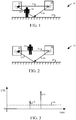
- a first transceiver 12 receives an STS from a second transceiver 14.
- the second transceiver 14 actively retransmits an RF signal received by the first transceiver 12.
- the second transceiver 14 is replaced with a passive target, which reflects an RF signal previously transmitted by the first transceiver 12. As shown in FIG.
- the second transceiver 14 transmits first path 16, which is a line-of-sight path between the second transceiver 14 and the first transceiver 12.
- An indirect path is formed by a path 18, reflected off a surface 20, and continuing as a path 22 towards the first transceiver 12.
- the signal received by the indirect path is inherently weaker than the signal from the direct path 16, due to the increased distance resulting in additional propagation path loss.
- the indirect path is further attenuated by a body 24, or any intervening object causing absorption, reflection, diffraction or scattering of the RF signal.
- FIG. 2 shows an alternate example embodiment 30 wherein the body 24 attenuates the direct path 16.
- the direct path 16 is attenuated by the body 24 by an amount exceeding the propagation path loss and/or multipath fading of the indirect path formed by paths 18 and 22. Accordingly, the direct path 16 cannot be determined by signal strength received at the first transceiver 12. Instead, the direct path 16 is determined by a first sample in the CIR that exceeds a detection threshold.
- FIG. 3 shows a CIR of the embodiment 30 plotted as function of time, where each channel tap corresponds to a time slot.
- the weak direct path 16 has a CIR value 32 occurring earlier than indirect path having a CIR value 34, hence the direct path is determined.
- the CIR values 32 and 34 both exceed the receiver detection threshold 36.
- the ranging application is secure, when only the genuine transmitter and the genuine receiver have knowledge of the pseudo random sequence, or expected STS, used to correlate with the transmission by the second transceiver 14.
- an adversary shortens the perceived distance between the first transceiver 12 and the second transceiver 14, by observing the communication from the second transceiver 14 and guessing the expected STS.
- the adversary then transmits a guessed STS earlier than the genuine transmitter's STS (e.g., the second transceiver 14), to generate a fake first path received by the first transceiver 12.
- the probability of success for the adversary depends on the length of the expected STS and the sensitivity of the first path detector in the genuine receiver (e.g., the first transceiver 12).
- a short STS increases the probability of the adversary guessing a sufficient portion of the STS symbol sequence, such that the correlation of the guessed STS with the pilot symbols transmitted by the second transceiver 14, exceeds a detection threshold 36 of the receiving portion of the first transceiver 12.
- a detection threshold 36 optimized for high sensitivity increases the probability of an attack from an adversary.
- a low detection threshold 36 increases the link budget between the first transceiver 12 and the second transceiver 14 by allowing detection of weaker signals from the second transceiver 14.
- the signals are weakened by increasing the distance of the transmission paths, using a weaker transmitter, permitting more attenuation from intervening objects and the like.
- Increasing the link budget is generally desirable from a system perspective, however, lowering the detection threshold 36 also permits weakly correlated values of the guessed STS to be accepted by the receiving portion of the first transceiver 12, thus reducing security. In previous ranging systems, a compromise between security and link budget was required.
- the embodiments described herein provide for both high security and a high link budget by assessing the properties of the noise of the CIR to detect a distance decreasing attack, rather than constraining the receiver's detection threshold 36.
- the time of arrival for a corresponding channel tap is either discarded, or a higher protocol layer of the communication system is notified (e.g., by a signal flag).
- FIG. 4 shows an example embodiment 40 of a channel estimator.
- the embodiment 40 receives a digitized RF signal 42 (e.g. a digitized signal received from the second transceiver 14 of FIG. 2 ).
- the digitized RF signal 42 includes a plurality of symbols beginning with the received STS.
- the received STS is correlated with an expected STS 44 by a correlator 46.
- the correlator 46 generates a correlation signal 48.
- the correlation signal 48 is sampled for a plurality of sequential channel taps corresponding to a respective symbol clock phase 50a, 50b through 50c (generally 50).
- Each symbol clock phase 50 controls a respective sampler 52a, 52b through 52c (generally 52).
- Each symbol correlation value, sampled by a respective sampler 52, is summated by a respective summator 54a, 54b through 54c (generally 54) with a respective accumulated symbol correlation value 56a, 56b through 56c (generally 56).
- Each accumulated symbol correlation value 56 is stored in a storage circuit 58 (e.g., a register) by a respective accumulator 60a, 60b through 60c (generally 60).
- the plurality of accumulator symbol correlation values 56 are stored in a storage circuit 64 over a path 62.
- Each of the estimated CIR values 56 is stored in a respective addressable location 70a, 70b, 70c, 70d through 70e, 70g and 70g (generally 70) of the storage circuit 64.
- the CIR is a complex signal including a real part 80 and an imaginary part 82, or in-phase ("I”) and quadrature phase (Q) respectively.
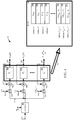
- an example embodiment 90 of a system for first path acceptance for secure ranging comprises a channel estimator 92 (e.g., the channel estimator 40 of FIG. 4 ), an attack detector 94, which further comprises a noise estimator 96 and a noise analyzer 98.
- the embodiment 90 further comprises a first path detector 100.
- the channel estimator 92 generates a plurality of estimated CIR values from a digitized RF signal. Each accumulated symbol correlation value corresponds to a channel tap, which is temporally defined by a symbol clock phase. The various arrival times of one or more paths of an RF transmission will generally fall within a respective channel tap.
- the noise estimator 96 determines a statistical characteristic from an estimated CIR over a certain interval. In one embodiment, the temporal range of channel taps for noise estimation is chosen to be outside the range wherein the direct path is expected to arrive.
- the noise analyzer 98 analyzes a statistical characteristic based on qualitative statistical parameters from the noise estimate to determine if a distance decreasing attack has occurred.
- the statistical characteristic is a standard deviation of the estimated CIR values within a temporal range of the channel taps.
- the statistical characteristic is a variance (e.g. a squared standard deviation) of the estimated CIR values within a temporal range of the channel taps.
- the statistical characteristic is a power of the estimated CIR values within a temporal range of the channel taps.
- the statistical characteristic is a probability distribution type (e.g., a Gaussian, Binomial, Chi-Squared or Rayleigh distribution), of the estimated CIR values within a temporal range of the channel taps.
- the noise typically has a Gaussian distribution. If another type of distribution is detected, the noise analyzer 98 will indicate that a distance decreasing attack has occurred, and either the ranging sequence terminates, no ranging estimate is generated, or a higher level protocol is notified.
- a total power of the estimated CIR values for all channel taps is used for the statistical characteristic.
- the statistical characteristic is a maximum amplitude of the estimated CIR values within a temporal range of the channel taps, which when exceeded will indicate that an attack has occurred.
- the statistical characteristic is a minimum amplitude of the estimated CIR values within a temporal range of the channel taps, which when not met will indicate that an attack has occurred.
- the statistical characteristic is a relationship between a plurality of in-phase components and quadrature components of the estimated CIR values within a temporal range of the channel taps.
- the first path detector 100 estimates the time of arrival for the direct path corresponding to the earliest channel tap having an estimated CIR value with sufficient correlation to the expected STS to meet or exceed the detection threshold 36.
- the time of arrival of the direct (e.g., "first") path is converted to a distance by multiplying by the speed of light in the communication medium.
- FIG. 7 shows an absolute CIR for the embodiment 90 of FIG. 6 , for a sequential range of channel tap values.
- the noise estimator 96 analyzes estimated CIR values within a temporal range 110 of the channel taps.
- the temporal range 110 includes channel taps that are each earlier than the expected channel tap of the direct path.
- a faked first path 112 generates a random response CIR 114 with a certain statistical characteristic, within the temporal range 110 of channel taps, significantly altered from the genuine first path 116.
- the genuine first path 116 has a random response CIR 118 with a statistical characteristic of a random variable with a Gaussian distribution.
- the noise analyzer 98 of FIG. 6 detects the difference in the statistical characteristics of the random response CIR 114 and 118 to determine that a distance decreasing attack has occurred.
- FIG. 8 shows a method 120 for first path acceptance for secure ranging.
- a CIR is determined by estimated CIR values 56 (e.g., by a channel estimator 92).
- a statistical characteristic is extracted from the estimated CIR values 56 (e.g., by a noise estimator 96).
- the statistical characteristic is compared to a reference value to detect a distance decreasing attack (e.g., by a noise analyzer 98).
- an apparatus comprises a channel estimator circuit comprising a symbol correlator circuit configured to generate a plurality of symbol correlation values of a sequence of pilot symbols.
- the pilot symbols are received by the apparatus and correlated to a predefined sequence of secure symbols.
- a plurality of accumulator circuits are configured to summate the plurality of symbol correlation values for a respective channel tap to generate a respective accumulated symbol correlation value, each channel tap corresponding to a phase of a symbol.
- a memory circuit is configured to store the estimated CIR values for each channel tap.
- An attack detector circuit is configured to extract a statistical characteristic from the plurality of estimated CIR values within a temporal range of the channel taps, and to compare the statistical characteristic to a reference value to detect a distance decreasing attack.
- the statistical characteristic is a standard deviation of the estimated CIR values within the temporal range of the channel taps.
- the statistical characteristic is a variance of the estimated CIR values within the temporal range of the channel taps.
- the statistical characteristic is a power metric of the estimated CIR values within the temporal range of the channel taps.
- the statistical characteristic is a probability distribution of the estimated CIR values within the temporal range of the channel taps.
- the statistical characteristic is a power spectral density of the estimated CIR values within the temporal range of the channel taps.
- the statistical characteristic is a maximum amplitude of the estimated CIR values within the temporal range of the channel taps.
- the statistical characteristic is a minimum amplitude of the estimated CIR values within the temporal range of the channel taps.
- the statistical characteristic is a relationship between a plurality of in-phase components and a plurality of quadrature components of the estimated CIR values within the temporal range of the channel taps.
- a method for first path acceptance for secure ranging comprises determining a CIR of a communication channel for a plurality of channel taps, each channel tap corresponding to a respective one of a plurality of time slots of the CIR, wherein the CIR comprises a plurality of estimated CIR values.
- a statistical characteristic is extracted from the estimated CIR values within a temporal range of the channel taps. The statistical characteristic is compared to a reference value to detect a distance decreasing attack.
- Comparing the statistical characteristic to the reference comprises comparing a standard deviation of the estimated CIR values within the temporal range of the channel taps to the reference. Comparing the statistical characteristic to the reference comprises comparing a variance of the estimated CIR values within the temporal range of the channel taps to the reference. Comparing the statistical characteristic to the reference comprises comparing a power metric of the estimated CIR values within the temporal range of the channel taps to the reference. Comparing the statistical characteristic to the reference comprises comparing a probability distribution of the estimated CIR values within the temporal range of the channel taps to the reference.
- Comparing the statistical characteristic to the reference comprises comparing a total power of the estimated CIR values comprising each channel tap to the reference. Comparing the statistical characteristic to the reference comprises comparing a one of a maximum amplitude and a minimum amplitude of the estimated CIR values within the temporal range of the channel taps to the reference. Comparing the statistical characteristic to the reference comprises comparing a relationship between a plurality of in-phase components and a plurality of quadrature components of the estimated CIR values within the temporal range of the channel taps.
- a system comprises an attack detector circuit configured to extract a statistical characteristic from a plurality of estimated CIR values within a temporal range of channel taps, and to compare the statistical characteristic to a reference value to detect a distance decreasing attack.
- a first path detector circuit is configured to determine a first path of the estimated CIR values, wherein the first path corresponds to an earliest channel tap comprising a respective estimated CIR value exceeding a detection threshold, and the earliest channel tap not comprising the distance decreasing attack.
- a range detector circuit is configured to determine a distance based on a time of arrival of the first path.
- the system discards a time of arrival corresponding to a channel tap comprising the distance decreasing attack.
Landscapes
- Engineering & Computer Science (AREA)
- Computer Networks & Wireless Communication (AREA)
- Remote Sensing (AREA)
- Radar, Positioning & Navigation (AREA)
- Signal Processing (AREA)
- Physics & Mathematics (AREA)
- General Physics & Mathematics (AREA)
- Power Engineering (AREA)
- Computer Security & Cryptography (AREA)
- General Engineering & Computer Science (AREA)
- Computing Systems (AREA)
- Computer Hardware Design (AREA)
- Electromagnetism (AREA)
- Mobile Radio Communication Systems (AREA)
- Radar Systems Or Details Thereof (AREA)
- Small-Scale Networks (AREA)
- Monitoring And Testing Of Transmission In General (AREA)
Abstract
Description
- This disclosure relates generally to distance ranging, and more specifically to high sensitivity ranging with security against distance decreasing attacks.
- Radio Frequency (RF) ranging determines a distance between a transceiver, (or a collocated transceiver and receiver), and a second object by measuring a Time-of-Flight (ToF) of an RF transmission between the transceiver and the object. This ToF measurement is then multiplied by the speed of light to determine the distance (or "range"). An erroneous ToF measurement can result from the transceiver receiving a multipath transmission caused by reflections of the RF transmission from other objects or surfaces, rather than a line-of-sight transmission. Accordingly, proper ranging requires the line-of-sight path or "first path" to be determined.
- In an unsecured system, an adversary can mimic characteristics of the RF transmission to provide a shorter first path, thereby validating an illegitimate transmitter used for gaining access to the system. In systems employing pseudo random sequences in the RF transmission, an adversary can guess the sequence. The success of an adversary's guess depends on part on the length of the pseudo random sequence, as well as the sensitivity of the RF receiver. Degrading the sensitivity of the RF receiver to require a stronger correlation between the received sequence and the expected sequence undesirably reduces the link budget of the system.
- The present invention is illustrated by way of example and is not limited by the accompanying figures, in which like references indicate similar elements. Elements in the figures are illustrated for simplicity and clarity and have not necessarily been drawn to scale.
-
FIG. 1 is a schematic view of an example embodiment of a communication channel having an attenuated communication path. -
FIG. 2 is a schematic view of an example embodiment of a communication channel having an attenuated communication path. -
FIG. 3 is a schematic view of an example embodiment of a Channel Impulse Response (CIR) of the communication channel ofFIG. 2 -
FIG. 4 is a schematic view of an example embodiment of a channel estimator. -
FIG. 5 is a graphical view of a CIR for a plurality of channel taps determined by the embodiment ofFIG. 4 . -
FIG. 6 is a schematic view of a system for first path acceptance for secure ranging, in accordance with an example embodiment of the present disclosure. -
FIG. 7 is a graphical view of a CIR for a communication system including both a genuine transmission and adversarial transmission, in accordance with an example embodiment of the present disclosure. -
FIG. 8 is a flowchart representation of a method for first path acceptance for secure ranging in accordance with an example embodiment of the present disclosure. - Embodiments described herein provide for an RF receiver having both high sensitivity and high security against distance decreasing attacks, by assessing the noise characteristics in a CIR. Referring to
FIG. 1 , in anembodiment 10, a secure ranging system based on ToF employs a pseudo random sequence of pilot symbols, also referred to as a Secure Training Sequence (STS), to obtain the CIR. Afirst transceiver 12 receives an STS from asecond transceiver 14. In theembodiment 10, thesecond transceiver 14 actively retransmits an RF signal received by thefirst transceiver 12. In another embodiment, thesecond transceiver 14 is replaced with a passive target, which reflects an RF signal previously transmitted by thefirst transceiver 12. As shown inFIG. 1 , thesecond transceiver 14 transmits first path 16, which is a line-of-sight path between thesecond transceiver 14 and thefirst transceiver 12. An indirect path is formed by apath 18, reflected off asurface 20, and continuing as apath 22 towards thefirst transceiver 12. In theembodiment 10, the signal received by the indirect path is inherently weaker than the signal from the direct path 16, due to the increased distance resulting in additional propagation path loss. In theembodiment 10, the indirect path is further attenuated by abody 24, or any intervening object causing absorption, reflection, diffraction or scattering of the RF signal. -
FIG. 2 shows analternate example embodiment 30 wherein thebody 24 attenuates the direct path 16. In theembodiment 30, the direct path 16 is attenuated by thebody 24 by an amount exceeding the propagation path loss and/or multipath fading of the indirect path formed bypaths first transceiver 12. Instead, the direct path 16 is determined by a first sample in the CIR that exceeds a detection threshold.FIG. 3 shows a CIR of theembodiment 30 plotted as function of time, where each channel tap corresponds to a time slot. InFIG. 3 , the weak direct path 16 has aCIR value 32 occurring earlier than indirect path having aCIR value 34, hence the direct path is determined. InFIG. 3 , theCIR values - The ranging application is secure, when only the genuine transmitter and the genuine receiver have knowledge of the pseudo random sequence, or expected STS, used to correlate with the transmission by the
second transceiver 14. In a distance decreasing attack, an adversary shortens the perceived distance between thefirst transceiver 12 and thesecond transceiver 14, by observing the communication from thesecond transceiver 14 and guessing the expected STS. The adversary then transmits a guessed STS earlier than the genuine transmitter's STS (e.g., the second transceiver 14), to generate a fake first path received by thefirst transceiver 12. - The probability of success for the adversary depends on the length of the expected STS and the sensitivity of the first path detector in the genuine receiver (e.g., the first transceiver 12). A short STS increases the probability of the adversary guessing a sufficient portion of the STS symbol sequence, such that the correlation of the guessed STS with the pilot symbols transmitted by the
second transceiver 14, exceeds a detection threshold 36 of the receiving portion of thefirst transceiver 12. - A detection threshold 36 optimized for high sensitivity (e.g., a low threshold), increases the probability of an attack from an adversary. A low detection threshold 36 increases the link budget between the
first transceiver 12 and thesecond transceiver 14 by allowing detection of weaker signals from thesecond transceiver 14. In one example, the signals are weakened by increasing the distance of the transmission paths, using a weaker transmitter, permitting more attenuation from intervening objects and the like. Increasing the link budget is generally desirable from a system perspective, however, lowering the detection threshold 36 also permits weakly correlated values of the guessed STS to be accepted by the receiving portion of thefirst transceiver 12, thus reducing security. In previous ranging systems, a compromise between security and link budget was required. The embodiments described herein, provide for both high security and a high link budget by assessing the properties of the noise of the CIR to detect a distance decreasing attack, rather than constraining the receiver's detection threshold 36. Upon detection of an attack, the time of arrival for a corresponding channel tap is either discarded, or a higher protocol layer of the communication system is notified (e.g., by a signal flag). -
FIG. 4 shows anexample embodiment 40 of a channel estimator. Theembodiment 40 receives a digitized RF signal 42 (e.g. a digitized signal received from thesecond transceiver 14 ofFIG. 2 ). The digitizedRF signal 42 includes a plurality of symbols beginning with the received STS. The received STS is correlated with an expected STS 44 by acorrelator 46. Thecorrelator 46 generates acorrelation signal 48. Thecorrelation signal 48 is sampled for a plurality of sequential channel taps corresponding to a respectivesymbol clock phase respective sampler - Each symbol correlation value, sampled by a respective sampler 52, is summated by a
respective summator symbol correlation value respective accumulator storage circuit 64 over apath 62. Each of the estimated CIR values 56 is stored in a respectiveaddressable location storage circuit 64.FIG. 5 shows a graphical view of a CIR for a plurality of channel taps determined by theembodiment 40 ofFIG. 4 . The CIR is a complex signal including areal part 80 and animaginary part 82, or in-phase ("I") and quadrature phase (Q) respectively. - Referring to
FIG. 6 , anexample embodiment 90 of a system for first path acceptance for secure ranging comprises a channel estimator 92 (e.g., thechannel estimator 40 ofFIG. 4 ), anattack detector 94, which further comprises anoise estimator 96 and anoise analyzer 98. Theembodiment 90 further comprises afirst path detector 100. Thechannel estimator 92 generates a plurality of estimated CIR values from a digitized RF signal. Each accumulated symbol correlation value corresponds to a channel tap, which is temporally defined by a symbol clock phase. The various arrival times of one or more paths of an RF transmission will generally fall within a respective channel tap. Thenoise estimator 96 determines a statistical characteristic from an estimated CIR over a certain interval. In one embodiment, the temporal range of channel taps for noise estimation is chosen to be outside the range wherein the direct path is expected to arrive. - The
noise analyzer 98 analyzes a statistical characteristic based on qualitative statistical parameters from the noise estimate to determine if a distance decreasing attack has occurred. In one example, the statistical characteristic is a standard deviation of the estimated CIR values within a temporal range of the channel taps. In another embodiment, the statistical characteristic is a variance (e.g. a squared standard deviation) of the estimated CIR values within a temporal range of the channel taps. In another embodiment, the statistical characteristic is a power of the estimated CIR values within a temporal range of the channel taps. In another embodiment, the statistical characteristic is a probability distribution type (e.g., a Gaussian, Binomial, Chi-Squared or Rayleigh distribution), of the estimated CIR values within a temporal range of the channel taps. Under normal conditions, where an attack is not present, the noise typically has a Gaussian distribution. If another type of distribution is detected, thenoise analyzer 98 will indicate that a distance decreasing attack has occurred, and either the ranging sequence terminates, no ranging estimate is generated, or a higher level protocol is notified. In another embodiment, a total power of the estimated CIR values for all channel taps is used for the statistical characteristic. In another embodiment, the statistical characteristic is a maximum amplitude of the estimated CIR values within a temporal range of the channel taps, which when exceeded will indicate that an attack has occurred. In another embodiment, the statistical characteristic is a minimum amplitude of the estimated CIR values within a temporal range of the channel taps, which when not met will indicate that an attack has occurred. In another embodiment, the statistical characteristic is a relationship between a plurality of in-phase components and quadrature components of the estimated CIR values within a temporal range of the channel taps. - When the noise analyzer determines that no distance decreasing attack has occurred, the
first path detector 100 estimates the time of arrival for the direct path corresponding to the earliest channel tap having an estimated CIR value with sufficient correlation to the expected STS to meet or exceed the detection threshold 36. The time of arrival of the direct (e.g., "first") path is converted to a distance by multiplying by the speed of light in the communication medium. -
FIG. 7 with continued reference toFIG. 6 , shows an absolute CIR for theembodiment 90 ofFIG. 6 , for a sequential range of channel tap values. InFIG. 7 , thenoise estimator 96 analyzes estimated CIR values within atemporal range 110 of the channel taps. In one embodiment, thetemporal range 110 includes channel taps that are each earlier than the expected channel tap of the direct path. InFIG. 7 , a fakedfirst path 112 generates arandom response CIR 114 with a certain statistical characteristic, within thetemporal range 110 of channel taps, significantly altered from the genuinefirst path 116. The genuinefirst path 116 has arandom response CIR 118 with a statistical characteristic of a random variable with a Gaussian distribution. Thenoise analyzer 98 ofFIG. 6 detects the difference in the statistical characteristics of therandom response CIR -
FIG. 8 with reference toFIG. 4 , shows amethod 120 for first path acceptance for secure ranging. At 122, a CIR is determined by estimated CIR values 56 (e.g., by a channel estimator 92). At 124, a statistical characteristic is extracted from the estimated CIR values 56 (e.g., by a noise estimator 96). At 126, the statistical characteristic is compared to a reference value to detect a distance decreasing attack (e.g., by a noise analyzer 98). - As will be appreciated, embodiments as disclosed include at least the following. In one embodiment, an apparatus comprises a channel estimator circuit comprising a symbol correlator circuit configured to generate a plurality of symbol correlation values of a sequence of pilot symbols. The pilot symbols are received by the apparatus and correlated to a predefined sequence of secure symbols. A plurality of accumulator circuits are configured to summate the plurality of symbol correlation values for a respective channel tap to generate a respective accumulated symbol correlation value, each channel tap corresponding to a phase of a symbol. A memory circuit is configured to store the estimated CIR values for each channel tap. An attack detector circuit is configured to extract a statistical characteristic from the plurality of estimated CIR values within a temporal range of the channel taps, and to compare the statistical characteristic to a reference value to detect a distance decreasing attack.
- Alternative embodiments of the apparatus include one of the following features, or any combination thereof. The statistical characteristic is a standard deviation of the estimated CIR values within the temporal range of the channel taps. The statistical characteristic is a variance of the estimated CIR values within the temporal range of the channel taps. The statistical characteristic is a power metric of the estimated CIR values within the temporal range of the channel taps. The statistical characteristic is a probability distribution of the estimated CIR values within the temporal range of the channel taps. The statistical characteristic is a power spectral density of the estimated CIR values within the temporal range of the channel taps. The statistical characteristic is a maximum amplitude of the estimated CIR values within the temporal range of the channel taps. The statistical characteristic is a minimum amplitude of the estimated CIR values within the temporal range of the channel taps. The statistical characteristic is a relationship between a plurality of in-phase components and a plurality of quadrature components of the estimated CIR values within the temporal range of the channel taps.
- In another embodiment, a method for first path acceptance for secure ranging comprises determining a CIR of a communication channel for a plurality of channel taps, each channel tap corresponding to a respective one of a plurality of time slots of the CIR, wherein the CIR comprises a plurality of estimated CIR values. A statistical characteristic is extracted from the estimated CIR values within a temporal range of the channel taps. The statistical characteristic is compared to a reference value to detect a distance decreasing attack.
- Alternative embodiments of the method for first path acceptance for secure ranging include one of the following features, or any combination thereof. Comparing the statistical characteristic to the reference comprises comparing a standard deviation of the estimated CIR values within the temporal range of the channel taps to the reference. Comparing the statistical characteristic to the reference comprises comparing a variance of the estimated CIR values within the temporal range of the channel taps to the reference. Comparing the statistical characteristic to the reference comprises comparing a power metric of the estimated CIR values within the temporal range of the channel taps to the reference. Comparing the statistical characteristic to the reference comprises comparing a probability distribution of the estimated CIR values within the temporal range of the channel taps to the reference. Comparing the statistical characteristic to the reference comprises comparing a total power of the estimated CIR values comprising each channel tap to the reference. Comparing the statistical characteristic to the reference comprises comparing a one of a maximum amplitude and a minimum amplitude of the estimated CIR values within the temporal range of the channel taps to the reference. Comparing the statistical characteristic to the reference comprises comparing a relationship between a plurality of in-phase components and a plurality of quadrature components of the estimated CIR values within the temporal range of the channel taps.
- In another embodiment, a system comprises an attack detector circuit configured to extract a statistical characteristic from a plurality of estimated CIR values within a temporal range of channel taps, and to compare the statistical characteristic to a reference value to detect a distance decreasing attack. A first path detector circuit is configured to determine a first path of the estimated CIR values, wherein the first path corresponds to an earliest channel tap comprising a respective estimated CIR value exceeding a detection threshold, and the earliest channel tap not comprising the distance decreasing attack.
- Alternative embodiments of the system include one of the following features, or any combination thereof. A range detector circuit is configured to determine a distance based on a time of arrival of the first path. The system discards a time of arrival corresponding to a channel tap comprising the distance decreasing attack.
- Although the invention is described herein with reference to specific embodiments, various modifications and changes can be made without departing from the scope of the present invention as set forth in the claims below. Accordingly, the specification and figures are to be regarded in an illustrative rather than a restrictive sense, and all such modifications are intended to be included within the scope of the present invention. Any benefits, advantages, or solutions to problems that are described herein with regard to specific embodiments are not intended to be construed as a critical, required, or essential feature or element of any or all the claims.
- Unless stated otherwise, terms such as "first" and "second" are used to arbitrarily distinguish between the elements such terms describe. Thus, these terms are not necessarily intended to indicate temporal or other prioritization of such elements.
Claims (15)
- An apparatus comprising:
a channel estimator circuit comprising:a symbol correlator circuit configured to generate a plurality of symbol correlation values of a sequence of pilot symbols, the pilot symbols received by the apparatus and correlated to a predefined sequence of secure symbols;a plurality of accumulator circuits, configured to summate the plurality of symbol correlation values for a respective channel tap to generate a respective estimated Channel Impulse Response (CIR) value, each channel tap corresponding to a phase of a symbol;a memory circuit configured to store the estimated CIR values for each channel tap; andan attack detector circuit configured to extract a statistical characteristic from the plurality of estimated CIR values within a temporal range of the channel taps, and to compare the statistical characteristic to a reference value to detect a distance decreasing attack. - The apparatus of claim 1 wherein the statistical characteristic is a standard deviation of the estimated CIR values within the temporal range of the channel taps.
- The apparatus of any preceding claim wherein the statistical characteristic is a variance of the estimated CIR values within the temporal range of the channel taps.
- The apparatus of any preceding claim wherein the statistical characteristic is a power metric of the estimated CIR values within the temporal range of the channel taps.
- The apparatus of any preceding claim wherein the statistical characteristic is a probability distribution of the estimated CIR values within the temporal range of the channel taps.
- The apparatus of any preceding claim wherein the statistical characteristic is a power spectral density of the estimated CIR values within the temporal range of the channel taps.
- The apparatus of any preceding claim wherein the statistical characteristic is a maximum amplitude of the estimated CIR values within the temporal range of the channel taps.
- The apparatus of any preceding claim wherein the statistical characteristic is a minimum amplitude of the estimated CIR values within the temporal range of the channel taps.
- The apparatus of any preceding claim wherein the statistical characteristic is a relationship between a plurality of in-phase components and a plurality of quadrature components of the estimated CIR values within the temporal range of the channel taps.
- A method for first path acceptance for secure ranging comprising:determining a Channel Impulse Response (CIR) of a communication channel for a plurality of channel taps, each channel tap corresponding to a respective one of a plurality of time slots of the CIR, wherein the CIR comprises a plurality of estimated CIR values;extracting a statistical characteristic from the estimated CIR values within a temporal range of the channel taps; andcomparing the statistical characteristic to a reference value to detect a distance decreasing attack.
- The method of claim 10 wherein comparing the statistical characteristic to the reference comprises comparing a standard deviation of the estimated CIR values within the temporal range of the channel taps to the reference.
- The method of claim 10 or 11 wherein comparing the statistical characteristic to the reference comprises comparing a variance of the estimated CIR values within the temporal range of the channel taps to the reference.
- The method of any of claims 10 to 12 wherein comparing the statistical characteristic to the reference comprises comparing a power metric of the estimated CIR values within the temporal range of the channel taps to the reference.
- The method of any of claims 10 to 13 wherein comparing the statistical characteristic to the reference comprises comparing a probability distribution of the estimated CIR values within the temporal range of the channel taps to the reference.
- A system comprising:an attack detector circuit configured to extract a statistical characteristic from a plurality of estimated Channel Impulse Response (CIR) values within a temporal range of channel taps, and to compare the statistical characteristic to a reference value to detect a distance decreasing attack; anda first path detector circuit configured to determine a first path of the estimated CIR values, wherein the first path corresponds to an earliest channel tap comprising a respective estimated CIR value exceeding a detection threshold, and the earliest channel tap not comprising the distance decreasing attack.
Applications Claiming Priority (1)
| Application Number | Priority Date | Filing Date | Title |
|---|---|---|---|
| US16/571,412 US11546766B2 (en) | 2019-09-16 | 2019-09-16 | First path acceptance for secure ranging |
Publications (2)
| Publication Number | Publication Date |
|---|---|
| EP3793147A1 true EP3793147A1 (en) | 2021-03-17 |
| EP3793147B1 EP3793147B1 (en) | 2025-05-14 |
Family
ID=72139535
Family Applications (1)
| Application Number | Title | Priority Date | Filing Date |
|---|---|---|---|
| EP20191388.6A Active EP3793147B1 (en) | 2019-09-16 | 2020-08-17 | First path acceptance for secure ranging |
Country Status (3)
| Country | Link |
|---|---|
| US (1) | US11546766B2 (en) |
| EP (1) | EP3793147B1 (en) |
| CN (1) | CN112511485B (en) |
Cited By (1)
| Publication number | Priority date | Publication date | Assignee | Title |
|---|---|---|---|---|
| EP4270802A1 (en) * | 2022-04-26 | 2023-11-01 | Nxp B.V. | Uwb receiver and method of operation |
Families Citing this family (5)
| Publication number | Priority date | Publication date | Assignee | Title |
|---|---|---|---|---|
| GB201908534D0 (en) * | 2019-06-13 | 2019-07-31 | Decawave Ltd | Secure ultra wide band ranging |
| EP3813402A1 (en) * | 2019-10-21 | 2021-04-28 | Nxp B.V. | Wireless communicaton device and method for spying counter measures |
| US11438089B2 (en) | 2020-11-10 | 2022-09-06 | Silicon Laboratories Inc. | System and method for phase manipulation attack protection and detection in AoA and AoD |
| US11700531B2 (en) * | 2020-11-10 | 2023-07-11 | Silicon Laboratories Inc. | System and method for phase manipulation attack protection and detection in AoA and AoD |
| KR102747698B1 (en) * | 2022-09-06 | 2024-12-27 | 고려대학교 산학협력단 | Device and method of detecting for hrp uwb ranging against distance reduction attacks |
Citations (3)
| Publication number | Priority date | Publication date | Assignee | Title |
|---|---|---|---|---|
| EP3195487A1 (en) * | 2014-08-13 | 2017-07-26 | Decawave Ltd. | A receiver for use in an ultra-wideband communication system |
| EP3321712A1 (en) * | 2016-11-11 | 2018-05-16 | Nxp B.V. | Processing module and associated method |
| US20190098507A1 (en) * | 2017-09-28 | 2019-03-28 | Apple Inc. | Secure Channel Estimation Architecture |
Family Cites Families (12)
| Publication number | Priority date | Publication date | Assignee | Title |
|---|---|---|---|---|
| JP2006262039A (en) * | 2005-03-17 | 2006-09-28 | Fujitsu Ltd | Propagation path estimation method and propagation path estimation apparatus |
| US8437432B2 (en) * | 2010-03-22 | 2013-05-07 | DecaWave, Ltd. | Receiver for use in an ultra-wideband communication system |
| US9154337B2 (en) * | 2013-03-15 | 2015-10-06 | Acorn Technologies, Inc. | Non-linear time domain channel estimation in OFDM systems |
| EP3171194B1 (en) * | 2015-11-19 | 2021-01-13 | u-blox AG | Calculating a ranging measurement in a cellular communications network |
| EP3255851B1 (en) | 2016-06-08 | 2019-08-07 | Nxp B.V. | Processing module for a communication device and method therefor |
| EP3370365B1 (en) | 2017-03-02 | 2020-07-01 | Nxp B.V. | Processing module and associated method |
| DE102017205198B4 (en) | 2017-03-27 | 2019-10-17 | Bayerische Motoren Werke Ag | Device for determining a distance between an anchor and a tag |
| EP3386218B1 (en) | 2017-04-03 | 2021-03-10 | Nxp B.V. | Range determining module |
| EP3425867B1 (en) | 2017-07-05 | 2021-01-13 | Nxp B.V. | Communication devices and associated method |
| EP3451599B1 (en) | 2017-09-05 | 2025-06-25 | Nxp B.V. | Carrier recovery system and method |
| US11520032B2 (en) * | 2019-02-28 | 2022-12-06 | Samsung Electronics Co., Ltd. | Methods and apparatuses for object presence detection and range estimation |
| GB201908534D0 (en) * | 2019-06-13 | 2019-07-31 | Decawave Ltd | Secure ultra wide band ranging |
-
2019
- 2019-09-16 US US16/571,412 patent/US11546766B2/en active Active
-
2020
- 2020-08-17 EP EP20191388.6A patent/EP3793147B1/en active Active
- 2020-09-08 CN CN202010938548.6A patent/CN112511485B/en active Active
Patent Citations (3)
| Publication number | Priority date | Publication date | Assignee | Title |
|---|---|---|---|---|
| EP3195487A1 (en) * | 2014-08-13 | 2017-07-26 | Decawave Ltd. | A receiver for use in an ultra-wideband communication system |
| EP3321712A1 (en) * | 2016-11-11 | 2018-05-16 | Nxp B.V. | Processing module and associated method |
| US20190098507A1 (en) * | 2017-09-28 | 2019-03-28 | Apple Inc. | Secure Channel Estimation Architecture |
Cited By (2)
| Publication number | Priority date | Publication date | Assignee | Title |
|---|---|---|---|---|
| EP4270802A1 (en) * | 2022-04-26 | 2023-11-01 | Nxp B.V. | Uwb receiver and method of operation |
| US12689903B2 (en) | 2022-04-26 | 2026-07-21 | Nxp B.V. | UWB receiver and method of operation |
Also Published As
| Publication number | Publication date |
|---|---|
| CN112511485A (en) | 2021-03-16 |
| EP3793147B1 (en) | 2025-05-14 |
| US20210084499A1 (en) | 2021-03-18 |
| US11546766B2 (en) | 2023-01-03 |
| CN112511485B (en) | 2024-06-21 |
Similar Documents
| Publication | Publication Date | Title |
|---|---|---|
| EP3793147B1 (en) | First path acceptance for secure ranging | |
| US12432098B2 (en) | Secure ultra wide band ranging | |
| US7688878B2 (en) | Method and device of peak detection in preamble synchronization for direct sequence spread spectrum communication | |
| EP1065801B1 (en) | Adaptive path searcher in a CDMA receiver | |
| US10887863B2 (en) | Receiver for secure time-of-arrival calculation | |
| US9613475B2 (en) | Communications with interaction detection | |
| US9794056B1 (en) | Tone rejection during synchronization in frequency shift keyed modulation systems | |
| JP7489262B2 (en) | Communication device and program | |
| US12601810B2 (en) | Device and method of detecting for HRP UWB ranging against distance reduction attacks | |
| WO2004021030A1 (en) | Procedure for jammer detection | |
| JP7535410B2 (en) | Communication device and program | |
| EP4270802A1 (en) | Uwb receiver and method of operation | |
| JP4324222B2 (en) | Apparatus and method for determining maximum correlation point | |
| US20040043726A1 (en) | Procedure for detecting interfering multi-path condition | |
| JP5258577B2 (en) | Method for detecting symbols and associated receiver | |
| US12140661B2 (en) | Control device for a motor vehicle access or locating system and method | |
| EP2068453B1 (en) | First significant path detection | |
| HK40071688A (en) | Secure ultra wide band ranging | |
| HK40106668A (en) | Secure ultra wide band ranging | |
| HK40071688B (en) | Secure ultra wide band ranging | |
| CN112804703A (en) | Packet detection method and communication device |
Legal Events
| Date | Code | Title | Description |
|---|---|---|---|
| PUAI | Public reference made under article 153(3) epc to a published international application that has entered the european phase |
Free format text: ORIGINAL CODE: 0009012 |
|
| STAA | Information on the status of an ep patent application or granted ep patent |
Free format text: STATUS: THE APPLICATION HAS BEEN PUBLISHED |
|
| AK | Designated contracting states |
Kind code of ref document: A1 Designated state(s): AL AT BE BG CH CY CZ DE DK EE ES FI FR GB GR HR HU IE IS IT LI LT LU LV MC MK MT NL NO PL PT RO RS SE SI SK SM TR |
|
| AX | Request for extension of the european patent |
Extension state: BA ME |
|
| STAA | Information on the status of an ep patent application or granted ep patent |
Free format text: STATUS: REQUEST FOR EXAMINATION WAS MADE |
|
| 17P | Request for examination filed |
Effective date: 20210917 |
|
| RBV | Designated contracting states (corrected) |
Designated state(s): AL AT BE BG CH CY CZ DE DK EE ES FI FR GB GR HR HU IE IS IT LI LT LU LV MC MK MT NL NO PL PT RO RS SE SI SK SM TR |
|
| STAA | Information on the status of an ep patent application or granted ep patent |
Free format text: STATUS: EXAMINATION IS IN PROGRESS |
|
| 17Q | First examination report despatched |
Effective date: 20230313 |
|
| GRAP | Despatch of communication of intention to grant a patent |
Free format text: ORIGINAL CODE: EPIDOSNIGR1 |
|
| STAA | Information on the status of an ep patent application or granted ep patent |
Free format text: STATUS: GRANT OF PATENT IS INTENDED |
|
| RIC1 | Information provided on ipc code assigned before grant |
Ipc: G01S 7/41 20060101ALI20250211BHEP Ipc: G01S 7/292 20060101ALI20250211BHEP Ipc: G01S 13/88 20060101ALI20250211BHEP Ipc: G01S 13/76 20060101ALI20250211BHEP Ipc: G01S 13/04 20060101ALI20250211BHEP Ipc: G01S 13/32 20060101ALI20250211BHEP Ipc: H04L 25/02 20060101AFI20250211BHEP |
|
| INTG | Intention to grant announced |
Effective date: 20250221 |
|
| GRAS | Grant fee paid |
Free format text: ORIGINAL CODE: EPIDOSNIGR3 |
|
| GRAA | (expected) grant |
Free format text: ORIGINAL CODE: 0009210 |
|
| STAA | Information on the status of an ep patent application or granted ep patent |
Free format text: STATUS: THE PATENT HAS BEEN GRANTED |
|
| AK | Designated contracting states |
Kind code of ref document: B1 Designated state(s): AL AT BE BG CH CY CZ DE DK EE ES FI FR GB GR HR HU IE IS IT LI LT LU LV MC MK MT NL NO PL PT RO RS SE SI SK SM TR |
|
| REG | Reference to a national code |
Ref country code: GB Ref legal event code: FG4D |
|
| REG | Reference to a national code |
Ref country code: CH Ref legal event code: EP |
|
| REG | Reference to a national code |
Ref country code: IE Ref legal event code: FG4D |
|
| REG | Reference to a national code |
Ref country code: DE Ref legal event code: R096 Ref document number: 602020051178 Country of ref document: DE |
|
| REG | Reference to a national code |
Ref country code: NL Ref legal event code: MP Effective date: 20250514 |
|
| PG25 | Lapsed in a contracting state [announced via postgrant information from national office to epo] |
Ref country code: PT Free format text: LAPSE BECAUSE OF FAILURE TO SUBMIT A TRANSLATION OF THE DESCRIPTION OR TO PAY THE FEE WITHIN THE PRESCRIBED TIME-LIMIT Effective date: 20250915 Ref country code: FI Free format text: LAPSE BECAUSE OF FAILURE TO SUBMIT A TRANSLATION OF THE DESCRIPTION OR TO PAY THE FEE WITHIN THE PRESCRIBED TIME-LIMIT Effective date: 20250514 Ref country code: ES Free format text: LAPSE BECAUSE OF FAILURE TO SUBMIT A TRANSLATION OF THE DESCRIPTION OR TO PAY THE FEE WITHIN THE PRESCRIBED TIME-LIMIT Effective date: 20250514 |
|
| PGFP | Annual fee paid to national office [announced via postgrant information from national office to epo] |
Ref country code: DE Payment date: 20250724 Year of fee payment: 6 |
|
| REG | Reference to a national code |
Ref country code: LT Ref legal event code: MG9D |
|
| PG25 | Lapsed in a contracting state [announced via postgrant information from national office to epo] |
Ref country code: NO Free format text: LAPSE BECAUSE OF FAILURE TO SUBMIT A TRANSLATION OF THE DESCRIPTION OR TO PAY THE FEE WITHIN THE PRESCRIBED TIME-LIMIT Effective date: 20250814 Ref country code: GR Free format text: LAPSE BECAUSE OF FAILURE TO SUBMIT A TRANSLATION OF THE DESCRIPTION OR TO PAY THE FEE WITHIN THE PRESCRIBED TIME-LIMIT Effective date: 20250815 |
|
| PG25 | Lapsed in a contracting state [announced via postgrant information from national office to epo] |
Ref country code: NL Free format text: LAPSE BECAUSE OF FAILURE TO SUBMIT A TRANSLATION OF THE DESCRIPTION OR TO PAY THE FEE WITHIN THE PRESCRIBED TIME-LIMIT Effective date: 20250514 Ref country code: PL Free format text: LAPSE BECAUSE OF FAILURE TO SUBMIT A TRANSLATION OF THE DESCRIPTION OR TO PAY THE FEE WITHIN THE PRESCRIBED TIME-LIMIT Effective date: 20250514 |
|
| REG | Reference to a national code |
Ref country code: AT Ref legal event code: MK05 Ref document number: 1795770 Country of ref document: AT Kind code of ref document: T Effective date: 20250514 |
|
| PG25 | Lapsed in a contracting state [announced via postgrant information from national office to epo] |
Ref country code: BG Free format text: LAPSE BECAUSE OF FAILURE TO SUBMIT A TRANSLATION OF THE DESCRIPTION OR TO PAY THE FEE WITHIN THE PRESCRIBED TIME-LIMIT Effective date: 20250514 |
|
| PG25 | Lapsed in a contracting state [announced via postgrant information from national office to epo] |
Ref country code: HR Free format text: LAPSE BECAUSE OF FAILURE TO SUBMIT A TRANSLATION OF THE DESCRIPTION OR TO PAY THE FEE WITHIN THE PRESCRIBED TIME-LIMIT Effective date: 20250514 |
|
| PG25 | Lapsed in a contracting state [announced via postgrant information from national office to epo] |
Ref country code: AT Free format text: LAPSE BECAUSE OF FAILURE TO SUBMIT A TRANSLATION OF THE DESCRIPTION OR TO PAY THE FEE WITHIN THE PRESCRIBED TIME-LIMIT Effective date: 20250514 |
|
| PG25 | Lapsed in a contracting state [announced via postgrant information from national office to epo] |
Ref country code: RS Free format text: LAPSE BECAUSE OF FAILURE TO SUBMIT A TRANSLATION OF THE DESCRIPTION OR TO PAY THE FEE WITHIN THE PRESCRIBED TIME-LIMIT Effective date: 20250814 |
|
| PG25 | Lapsed in a contracting state [announced via postgrant information from national office to epo] |
Ref country code: IS Free format text: LAPSE BECAUSE OF FAILURE TO SUBMIT A TRANSLATION OF THE DESCRIPTION OR TO PAY THE FEE WITHIN THE PRESCRIBED TIME-LIMIT Effective date: 20250914 |
|
| PG25 | Lapsed in a contracting state [announced via postgrant information from national office to epo] |
Ref country code: LV Free format text: LAPSE BECAUSE OF FAILURE TO SUBMIT A TRANSLATION OF THE DESCRIPTION OR TO PAY THE FEE WITHIN THE PRESCRIBED TIME-LIMIT Effective date: 20250514 |
|
| PG25 | Lapsed in a contracting state [announced via postgrant information from national office to epo] |
Ref country code: DK Free format text: LAPSE BECAUSE OF FAILURE TO SUBMIT A TRANSLATION OF THE DESCRIPTION OR TO PAY THE FEE WITHIN THE PRESCRIBED TIME-LIMIT Effective date: 20250514 Ref country code: SM Free format text: LAPSE BECAUSE OF FAILURE TO SUBMIT A TRANSLATION OF THE DESCRIPTION OR TO PAY THE FEE WITHIN THE PRESCRIBED TIME-LIMIT Effective date: 20250514 |
|
| PG25 | Lapsed in a contracting state [announced via postgrant information from national office to epo] |
Ref country code: CZ Free format text: LAPSE BECAUSE OF FAILURE TO SUBMIT A TRANSLATION OF THE DESCRIPTION OR TO PAY THE FEE WITHIN THE PRESCRIBED TIME-LIMIT Effective date: 20250514 |
|
| PG25 | Lapsed in a contracting state [announced via postgrant information from national office to epo] |
Ref country code: EE Free format text: LAPSE BECAUSE OF FAILURE TO SUBMIT A TRANSLATION OF THE DESCRIPTION OR TO PAY THE FEE WITHIN THE PRESCRIBED TIME-LIMIT Effective date: 20250514 |
|
| PG25 | Lapsed in a contracting state [announced via postgrant information from national office to epo] |
Ref country code: RO Free format text: LAPSE BECAUSE OF FAILURE TO SUBMIT A TRANSLATION OF THE DESCRIPTION OR TO PAY THE FEE WITHIN THE PRESCRIBED TIME-LIMIT Effective date: 20250514 Ref country code: SK Free format text: LAPSE BECAUSE OF FAILURE TO SUBMIT A TRANSLATION OF THE DESCRIPTION OR TO PAY THE FEE WITHIN THE PRESCRIBED TIME-LIMIT Effective date: 20250514 |
|
| PG25 | Lapsed in a contracting state [announced via postgrant information from national office to epo] |
Ref country code: IT Free format text: LAPSE BECAUSE OF FAILURE TO SUBMIT A TRANSLATION OF THE DESCRIPTION OR TO PAY THE FEE WITHIN THE PRESCRIBED TIME-LIMIT Effective date: 20250514 |
|
| REG | Reference to a national code |
Ref country code: DE Ref legal event code: R097 Ref document number: 602020051178 Country of ref document: DE |
|
| PLBE | No opposition filed within time limit |
Free format text: ORIGINAL CODE: 0009261 |
|
| STAA | Information on the status of an ep patent application or granted ep patent |
Free format text: STATUS: NO OPPOSITION FILED WITHIN TIME LIMIT |
|
| REG | Reference to a national code |
Ref country code: CH Ref legal event code: H13 Free format text: ST27 STATUS EVENT CODE: U-0-0-H10-H13 (AS PROVIDED BY THE NATIONAL OFFICE) Effective date: 20260324 |
|
| REG | Reference to a national code |
Ref country code: CH Ref legal event code: L10 Free format text: ST27 STATUS EVENT CODE: U-0-0-L10-L00 (AS PROVIDED BY THE NATIONAL OFFICE) Effective date: 20260325 |
|
| PG25 | Lapsed in a contracting state [announced via postgrant information from national office to epo] |
Ref country code: MC Free format text: LAPSE BECAUSE OF FAILURE TO SUBMIT A TRANSLATION OF THE DESCRIPTION OR TO PAY THE FEE WITHIN THE PRESCRIBED TIME-LIMIT Effective date: 20250514 |
|
| PG25 | Lapsed in a contracting state [announced via postgrant information from national office to epo] |
Ref country code: LU Free format text: LAPSE BECAUSE OF NON-PAYMENT OF DUE FEES Effective date: 20250817 |
|
| 26N | No opposition filed |
Effective date: 20260217 |
|
| PG25 | Lapsed in a contracting state [announced via postgrant information from national office to epo] |
Ref country code: CH Free format text: LAPSE BECAUSE OF NON-PAYMENT OF DUE FEES Effective date: 20250831 |
|
| GBPC | Gb: european patent ceased through non-payment of renewal fee |
Effective date: 20250817 |
|
| REG | Reference to a national code |
Ref country code: BE Ref legal event code: MM Effective date: 20250831 |
|
| PG25 | Lapsed in a contracting state [announced via postgrant information from national office to epo] |
Ref country code: LT Free format text: LAPSE BECAUSE OF FAILURE TO SUBMIT A TRANSLATION OF THE DESCRIPTION OR TO PAY THE FEE WITHIN THE PRESCRIBED TIME-LIMIT Effective date: 20250514 |
|
| PG25 | Lapsed in a contracting state [announced via postgrant information from national office to epo] |
Ref country code: GB Free format text: LAPSE BECAUSE OF NON-PAYMENT OF DUE FEES Effective date: 20250817 |
|
| PG25 | Lapsed in a contracting state [announced via postgrant information from national office to epo] |
Ref country code: BE Free format text: LAPSE BECAUSE OF NON-PAYMENT OF DUE FEES Effective date: 20250831 Ref country code: IE Free format text: LAPSE BECAUSE OF NON-PAYMENT OF DUE FEES Effective date: 20250817 |
|
| PG25 | Lapsed in a contracting state [announced via postgrant information from national office to epo] |
Ref country code: FR Free format text: LAPSE BECAUSE OF NON-PAYMENT OF DUE FEES Effective date: 20250831 |
|
| PG25 | Lapsed in a contracting state [announced via postgrant information from national office to epo] |
Ref country code: SE Free format text: LAPSE BECAUSE OF FAILURE TO SUBMIT A TRANSLATION OF THE DESCRIPTION OR TO PAY THE FEE WITHIN THE PRESCRIBED TIME-LIMIT Effective date: 20250514 |