EP3793059B1 - Wireless charger and control method - Google Patents
Wireless charger and control method Download PDFInfo
- Publication number
- EP3793059B1 EP3793059B1 EP19810514.0A EP19810514A EP3793059B1 EP 3793059 B1 EP3793059 B1 EP 3793059B1 EP 19810514 A EP19810514 A EP 19810514A EP 3793059 B1 EP3793059 B1 EP 3793059B1
- Authority
- EP
- European Patent Office
- Prior art keywords
- class
- power amplifier
- equivalent load
- target
- constraint condition
- Prior art date
- Legal status (The legal status is an assumption and is not a legal conclusion. Google has not performed a legal analysis and makes no representation as to the accuracy of the status listed.)
- Active
Links
Images





Classifications
-
- H—ELECTRICITY
- H02—GENERATION; CONVERSION OR DISTRIBUTION OF ELECTRIC POWER
- H02J—ELECTRIC POWER NETWORKS; CIRCUIT ARRANGEMENTS OR SYSTEMS FOR SUPPLYING OR DISTRIBUTING ELECTRIC POWER; SYSTEMS FOR STORING ELECTRIC ENERGY
- H02J50/00—Circuit arrangements or systems for wireless supply or distribution of electric power
- H02J50/10—Circuit arrangements or systems for wireless supply or distribution of electric power using inductive coupling
- H02J50/12—Circuit arrangements or systems for wireless supply or distribution of electric power using inductive coupling of the resonant type
-
- H—ELECTRICITY
- H02—GENERATION; CONVERSION OR DISTRIBUTION OF ELECTRIC POWER
- H02J—ELECTRIC POWER NETWORKS; CIRCUIT ARRANGEMENTS OR SYSTEMS FOR SUPPLYING OR DISTRIBUTING ELECTRIC POWER; SYSTEMS FOR STORING ELECTRIC ENERGY
- H02J50/00—Circuit arrangements or systems for wireless supply or distribution of electric power
- H02J50/10—Circuit arrangements or systems for wireless supply or distribution of electric power using inductive coupling
-
- H—ELECTRICITY
- H02—GENERATION; CONVERSION OR DISTRIBUTION OF ELECTRIC POWER
- H02J—ELECTRIC POWER NETWORKS; CIRCUIT ARRANGEMENTS OR SYSTEMS FOR SUPPLYING OR DISTRIBUTING ELECTRIC POWER; SYSTEMS FOR STORING ELECTRIC ENERGY
- H02J50/00—Circuit arrangements or systems for wireless supply or distribution of electric power
- H02J50/05—Circuit arrangements or systems for wireless supply or distribution of electric power using capacitive coupling
-
- H—ELECTRICITY
- H02—GENERATION; CONVERSION OR DISTRIBUTION OF ELECTRIC POWER
- H02J—ELECTRIC POWER NETWORKS; CIRCUIT ARRANGEMENTS OR SYSTEMS FOR SUPPLYING OR DISTRIBUTING ELECTRIC POWER; SYSTEMS FOR STORING ELECTRIC ENERGY
- H02J50/00—Circuit arrangements or systems for wireless supply or distribution of electric power
- H02J50/80—Circuit arrangements or systems for wireless supply or distribution of electric power involving the exchange of data, concerning supply or distribution of electric power, between transmitting devices and receiving devices
-
- H—ELECTRICITY
- H02—GENERATION; CONVERSION OR DISTRIBUTION OF ELECTRIC POWER
- H02M—APPARATUS FOR CONVERSION BETWEEN AC AND AC, BETWEEN AC AND DC, OR BETWEEN DC AND DC, AND FOR USE WITH MAINS OR SIMILAR POWER SUPPLY SYSTEMS; CONVERSION OF DC OR AC INPUT POWER INTO SURGE OUTPUT POWER; CONTROL OR REGULATION THEREOF
- H02M3/00—Conversion of DC power input into DC power output
- H02M3/01—Resonant DC/DC converters
- H02M3/015—Resonant DC/DC converters with means for adaptation of resonance frequency, e.g. by modification of capacitance or inductance of resonance circuit
-
- H—ELECTRICITY
- H03—ELECTRONIC CIRCUITRY
- H03F—AMPLIFIERS
- H03F3/00—Amplifiers with only discharge tubes or only semiconductor devices as amplifying elements
- H03F3/20—Power amplifiers, e.g. Class B amplifiers, Class C amplifiers
- H03F3/21—Power amplifiers, e.g. Class B amplifiers, Class C amplifiers with semiconductor devices only
- H03F3/217—Class D power amplifiers; Switching amplifiers
- H03F3/2176—Class E amplifiers
-
- H—ELECTRICITY
- H04—ELECTRIC COMMUNICATION TECHNIQUE
- H04B—TRANSMISSION
- H04B5/00—Near-field transmission systems, e.g. inductive or capacitive transmission systems
- H04B5/70—Near-field transmission systems, e.g. inductive or capacitive transmission systems specially adapted for specific purposes
- H04B5/79—Near-field transmission systems, e.g. inductive or capacitive transmission systems specially adapted for specific purposes for data transfer in combination with power transfer
-
- H—ELECTRICITY
- H02—GENERATION; CONVERSION OR DISTRIBUTION OF ELECTRIC POWER
- H02J—ELECTRIC POWER NETWORKS; CIRCUIT ARRANGEMENTS OR SYSTEMS FOR SUPPLYING OR DISTRIBUTING ELECTRIC POWER; SYSTEMS FOR STORING ELECTRIC ENERGY
- H02J7/00—Circuit arrangements for charging or discharging batteries or for supplying loads from batteries
- H02J7/02—Circuit arrangements for charging or discharging batteries or for supplying loads from batteries for charging batteries from AC mains by converters
-
- H—ELECTRICITY
- H03—ELECTRONIC CIRCUITRY
- H03F—AMPLIFIERS
- H03F2200/00—Indexing scheme relating to amplifiers
- H03F2200/423—Amplifier output adaptation especially for transmission line coupling purposes, e.g. impedance adaptation
-
- H—ELECTRICITY
- H03—ELECTRONIC CIRCUITRY
- H03F—AMPLIFIERS
- H03F2200/00—Indexing scheme relating to amplifiers
- H03F2200/546—A tunable capacitance being present in an amplifier circuit
-
- Y—GENERAL TAGGING OF NEW TECHNOLOGICAL DEVELOPMENTS; GENERAL TAGGING OF CROSS-SECTIONAL TECHNOLOGIES SPANNING OVER SEVERAL SECTIONS OF THE IPC; TECHNICAL SUBJECTS COVERED BY FORMER USPC CROSS-REFERENCE ART COLLECTIONS [XRACs] AND DIGESTS
- Y02—TECHNOLOGIES OR APPLICATIONS FOR MITIGATION OR ADAPTATION AGAINST CLIMATE CHANGE
- Y02B—CLIMATE CHANGE MITIGATION TECHNOLOGIES RELATED TO BUILDINGS, e.g. HOUSING, HOUSE APPLIANCES OR RELATED END-USER APPLICATIONS
- Y02B40/00—Technologies aiming at improving the efficiency of home appliances, e.g. induction cooking or efficient technologies for refrigerators, freezers or dish washers
Definitions
- a wireless charging apparatus has advantages such as a small size, high portability, and a waterproof and dustproof design favorable to an electrical device.
- the wireless charging apparatus is widely applied to electronic devices such as a smartphone and a wearable device.
- a filter for improved driver circuit efficiency In actual use, when a load device changes in a location and a size, there are comparatively great changes in an actual output efficiency and an output power of the class-E power amplifier. When the output power changes within a comparatively great range, damage is caused to the load device, for example, a problem of accelerating battery aging may be caused.
- US 2012/242284 A1 discloses a filter for improved driver circuit efficiency.
- the document provides systems, methods and apparatus for increasing the efficiency of an amplifier when driven by a variable load.
- the transmitter device includes a driver circuit characterized by an efficiency.
- the driver circuit is electrically connected to a transmit circuit characterized by an impedance.
- the document does not disclose that the constraint condition obtained by the control unit comprises a target output power of the class-E power amplifier, and that the target output power is a preset constant output power of the class-E power amplifier; wherein the control unit is configured to if the tunable capacitance circuit has N2 values obtainable through adjustment, each capacitance value obtainable through adjustment corresponds to one Smith chart, and each Smith chart corresponds to one target curve segment that meets the constraint condition, wherein N2 is an integer greater than or equal to 2, select N1 points from N2 target curve segments, and use a set of impedances corresponding to the N1 points as the N1 target equivalent load impedances of the class-E power amplifier.
- CN 102355032 A discloses a wireless charging device.
- This disclosure provides a wireless charger and a control method, to ensure efficient and stable output of a class-E power amplifier when a load changes.
- the invention is set out in the appended set of claims.
- an embodiment of this application provides a wireless charger, including a class-E power amplifier and a tunable impedance circuit that is connected to an output end of the class-E power amplifier.
- the class-E power amplifier includes a switching transistor and a tunable capacitance circuit that is parallelly connected to the switching transistor.
- the wireless charger further includes a control unit.
- the control unit is further configured to determine N1 target equivalent load impedances of the class-E power amplifier based on the constraint condition, where N1 is 1 or an integer greater than 1.
- the control unit is further configured to adjust a capacitance value of the tunable capacitance circuit in the class-E power amplifier, and adjust an impedance value of the tunable impedance circuit, to enable an equivalent load impedance of the class-E power amplifier to match one of the N1 target equivalent load impedances.
- a plurality of target equivalent load impedances that meet the constraint condition are determined based on the constraint condition of the class-E power amplifier. Then the capacitance value of the tunable capacitance circuit in the class-E power amplifier is adjusted, and the impedance value of the tunable impedance circuit is adjusted, to match the equivalent load impedance of the class-E power amplifier with one target equivalent load impedance. According to the technical solution provided in this embodiment of this application, because the equivalent load impedance of the class-E power amplifier matches the target equivalent load impedance, even if a load changes, efficient and stable output of the class-E power amplifier can still be ensured.
- the wireless charger may further include a storage unit.
- the storage unit is configured to prestore the constraint condition of the class-E power amplifier.
- control unit When configured to obtain the constraint condition of the class-E power amplifier, the control unit is configured to obtain the constraint condition of the class-E power amplifier from the storage unit
- the wireless charger further includes a communications unit.
- the communications unit is configured to obtain the constraint condition of the class-E power amplifier by using a terminal that communicates with the communications unit.
- control unit When configured to obtain the constraint condition of the class-E power amplifier, the control unit is configured to obtain the constraint condition of the class-E power amplifier from the communications unit
- the control unit when configured to match the equivalent load impedance of the class-E power amplifier with one of the N1 target equivalent load impedances, the control unit is configured to enable the equivalent load impedance of the class-E power amplifier to be equal to one of the N1 target equivalent load impedances.
- an embodiment of this application provides a wireless charging control method, applied to a wireless charger that wirelessly charges a load device.
- the wireless charger includes a class-E power amplifier and a tunable impedance circuit that is connected to an output end of the class-E power amplifier.
- the class-E power amplifier includes a switching transistor and a tunable capacitance circuit that is parallelly connected to the switching transistor, and the method includes:
- the obtaining a constraint condition of the class-E power amplifier includes:
- the enabling an equivalent load impedance of the class-E power amplifier to match one of the N1 target equivalent load impedances includes: enabling the equivalent load impedance of the class-E power amplifier to be equal to one of the N1 target equivalent load impedances.
- the enabling an equivalent load impedance of the class-E power amplifier to match one of the N1 target equivalent load impedances includes: enabling the equivalent load impedance of the class-E power amplifier to be equal to a target equivalent load impedance of the N1 target equivalent load impedances that has a smallest modulus of a difference between the target equivalent load impedance and the equivalent load impedance of the class-E power amplifier.
- the determining N1 target equivalent load impedances of the class-E power amplifier based on the constraint condition includes:
- a charged electronic product below is referred to as a load device.
- a main innovation of the embodiments of this application lies in that a transmit end of a wireless charging system is referred to as a wireless charger.
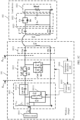
- FIG. 1B is a schematic structural diagram of a wireless charging system according to an embodiment of this application.
- the wireless charging system includes a wireless charger 101 and a load device 102.
- the wireless charger 101 includes a class-E power amplifier 1011.
- the class-E power amplifier 1011 includes a switching transistor Q and a tunable capacitance circuit 10111 that is parallelly connected to the switching transistor Q. Specifically, one end of the tunable capacitance circuit 10111 is connected to a drain of the switching transistor Q, and the other end of the tunable capacitance circuit 10111 is connected to a source of the switching transistor Q.
- a power supply V DD is connected to the drain of the switching transistor Q by using a radio frequency choke coil Lf, and an input end of a filter circuit 10112 is connected to the drain of the switching transistor Q.
- the wireless charger 101 further includes a drive circuit 1014 that provides a drive signal V D for the class-E power amplifier 1011, a tunable impedance circuit 1012 connected to an output end of the filter circuit 10112, a transmitting coil compensation circuit 1013 connected between a transmitting coil Ltx and the tunable impedance circuit 1012, an impedance detection unit 1016 connected to an input end of the transmitting coil compensation circuit 1013, and a control unit 1015 connected to the impedance detection unit 1016.
- the control unit 1015 is further connected to the tunable impedance circuit 1012 and the tunable capacitance circuit 10111.
- the load device 102 includes a receiving coil Lrx, a receiving coil replenishing circuit 1023, a rectifier 1022, and a direct current load 1021 that are sequentially connected.
- the control unit 1015 in the wireless charger 101 is configured to obtain a constraint condition of the class-E power amplifier.
- the constraint condition includes a target efficiency of the class-E power amplifier 1011, a target output power of the class-E power amplifier 1011, and a circuit parameter of the class-E power amplifier 1011.
- the target efficiency is a preset minimum output efficiency of the class-E power amplifier 1011, and the target output power is a preset constant output power of the class-E power amplifier 1011.
- the target efficiency may be 65%, 80%, 90%, or the like.
- the target output power may be 8 W, 9 W, 9.2 W, 10 W, or the like.
- Circuit parameters of the class-E power amplifier include an inductance value of the radio frequency choke coil Lf, a voltage value of the power supply V DD , a parameter of the switching transistor Q, values of possible combinations of the tunable capacitance circuit, and parameter values of the filter circuit.
- the wireless charger 101 may further include a storage unit, configured to prestore the constraint condition.
- the control unit 1015 may obtain the prestored constraint condition from the storage unit.
- the wireless charger 101 may include a communications unit, configured to obtain the constraint condition of the class-E power amplifier 1011 by using a terminal that communicates with the wireless charger 101.
- the control unit 1015 obtains the constraint condition of the class-E power amplifier 1011 by using the communications unit.
- the control unit 1015 is further configured to determine N1 target equivalent load impedances of the class-E power amplifier 1011 that meet the constraint condition, where N1 is 1 or an integer greater than 1.
- each capacitance value obtainable through adjustment corresponds to one Smith chart
- each Smith chart corresponds to one target curve segment that meets the constraint condition, where N2 is an integer greater than or equal to 2.
- N2 2
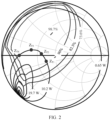
- the target efficiency of the class-E power amplifier 1011 corresponding to FIG. 2 and FIG. 3 is 90%
- the target output power of the class-E power amplifier 1011 is 10.2 W.
- Each Smith chart corresponds to one target curve segment that meets the constraint condition, that is, a curve segment of a target power curve in an area corresponding to the target efficiency.
- FIG. 2 is a Smith chart in a case in which the switch K6 in FIG. 1C is turned on, that is, the capacitance value of the tunable capacitance circuit is Cs1.
- the four points randomly selected are Z T1 , Z T2 , Z T3 , and Z T4 in FIG. 2 .
- FIG. 3 is a Smith chart in a case in which the switch K6 in FIG. 1C is turned off, that is, the capacitance value of the tunable capacitance circuit is Cs1 + Cs2.
- the four points randomly selected are Z T5 , Z T6 , Z T7 , and Z T8 in FIG. 3 .
- the control unit 1015 is further configured to adjust the capacitance value of the tunable capacitance circuit 10111 in the class-E power amplifier 1011, and adjust an impedance value of the tunable impedance circuit 1012, to match an equivalent load impedance of the class-E power amplifier 1011 with one of the N1 target equivalent load impedances.
- an adjustable parameter in the tunable impedance circuit 1012 may be a stepless adjustment parameter or a switch parameter.
- N1 is 8, and eight target equivalent load impedances that meet the constraint condition are Z T1 , Z T2 , Z T3 , Z T4 , Z T5 , Z T6 , Z T7 , and Z T8 .
- step 405 If a determining result of step 405 indicates that the calculated network parameter is within the adjustable range, perform step 406 to set a circuit parameter. By this, adjustment is completed.
- changes of a capacitance and an impedance in the tunable capacitance circuit may be adjusted by using a switch.
- the target equivalent load impedance is obtained as follows: adjusting the tunable capacitance circuit in the class-E power amplifier, and adjusting an impedance value of a tunable impedance circuit, to match the equivalent load impedance of the class-E power amplifier with one of N1 target equivalent load impedances.
- a processing procedure of the control unit refer to a schematic flowchart shown in FIG. 5 .
- the processing procedure shown in FIG. 5 includes the following steps: 501. Determine N1 target equivalent load impedances (Z T1 , Z T2 , ..., Z TN1 ) that meet a constraint condition.
- N1 is 8, and eight target equivalent load impedances that meet the constraint condition are Z T1 , Z T2 , Z T3 , Z T4 , Z T5 , Z T6 , Z T7 , and Z T8 .
- the equivalent input impedance Z in_tx of the transmitting coil may be shown in FIG. 1C , and is obtained through detection by using the impedance detection unit 1016. A change of the load device 102 is reflected by using the equivalent input impedance Z in_tx of the transmitting coil.
- a simulation test is performed to verify performance of this application.
- a structure of the wireless charger is shown in FIG. 1C , and a constraint condition includes that an output power of the class-E power amplifier is kept at approximately 9 W, and an efficiency is kept at 66% or above.
- An inductance value of the radio frequency choke coil Lf is 68 uH
- a capacitance value of the capacitor Cs1 parallel with a switch is 215 pF
- a capacitance value of the capacitor Cs2 parallel with the switch is 205 pF
- an inductance value of the filter inductor L0 is 1.42 uH
- a capacitance value of the filter capacitor C0 is 626 pF
- an inductance value of the transmitting coil Ltx is 3.24 uH
- a parasitic resistance rtx of the transmitting coil is 0.7 ohm
- a capacitance value of a compensation capacitor Ctx of the transmitting coil is 165 pF
- the tunable impedance circuit is an L-shaped impedance matching network.
- An inductance value of a radio frequency inductor Ln1 is 400 nH, and an inductance value of a radio frequency inductor Ln2 is 600 nH.
- a capacitance value of a radio frequency capacitor Cn1 is 300 pF, a capacitance value of a radio frequency capacitor Cn2 is 450 pF, and a capacitance value of a radio frequency capacitor Cn3 is 600 pF.
- a capacitance value of the radio frequency choke coil Lr is 68 uH.
- a capacitance value of a capacitor Cr parallel with a diode Dr is 200 pF.
- a capacitance value of a direct current filter capacitor Cf is 44 uF.
- the control unit 1015 determines that target equivalent load impedances that meet the constraint condition are: 6.6 - 3.4j, 11.3 + 0.8j, 19.5 + 4j, 28.7 + 0j, 34.4 - 5.3j, 3 - 9.8j, 8 - 4j, 16.3 - 1.5j, 24.4 - 2.7j, and 33 - 8.8j.
- the impedance detection unit 1016 detects an equivalent input impedance Z in_tx of the transmitting coil, and then selects a group (Ln1, Ln2, Cn1, Cn2, Cn3, and Cs) of values based on an adjustable component.
- switch states of switches (K1, K2, K3, K4, K5, and K6) are selected, to make a value of an input impedance Zin_n in the circuit shown in FIG. 1C is closest to any value of the plurality of target equivalent load impedances, when a left side of the tunable impedance circuit is disconnected.
- Table 1 lists state values of the switches K1 to K6 under different operating conditions. 1 indicates that the switch is turned off, and 0 indicates that the switch is turned on.
- the coil coupling coefficient k changes from 0.1 to 0.4, and a load Rload changes from 10 ohms to 100 ohms
- an output power of the class-E power amplifier is kept at approximately 9 W, and an efficiency is greater than 66%.
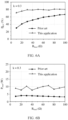
- FIG. 6A, FIG. 6B , FIG. 7A, and FIG. 7B are schematic diagrams of characteristic comparisons between a technical solution that is obtained by using a simulation test and that is provided in this application and a technical solution in the prior art.
- a circuit structure in the technical solution provided in this application is shown in FIG. 1C .
- a circuit structure in the prior art includes no tunable impedance circuit 1012, no switch K6, and no switch Cs2.
- Other circuit structures and parameters are the same as those in FIG. 1B .
- a coupling coefficient k corresponding to FIG. 6A and FIG. 6B is 0.3.
- a coupling coefficient k corresponding to FIG. 7A and FIG. 7B is 0.2.
- FIG. 7A are schematic diagrams of corresponding output efficiency characteristic curves
- FIG. 6B and FIG. 7B are schematic diagrams of corresponding output power characteristic curves.
- An embodiment of this application further provides a wireless charging system, including a load device and a wireless charger that wirelessly charges the load device.
- the wireless charger may be the wireless charger described in any one of the foregoing embodiments. Details are not described herein again.
Landscapes
- Engineering & Computer Science (AREA)
- Power Engineering (AREA)
- Computer Networks & Wireless Communication (AREA)
- Signal Processing (AREA)
- Amplifiers (AREA)
- Charge And Discharge Circuits For Batteries Or The Like (AREA)
Description
- This application relates to the field of wireless charging, and in particular, to a wireless charger and a control method.
- A wireless charging apparatus has advantages such as a small size, high portability, and a waterproof and dustproof design favorable to an electrical device. Currently, the wireless charging apparatus is widely applied to electronic devices such as a smartphone and a wearable device.
- A class-E power amplifier is widely used in the field of wireless charging by virtue of an ideal work efficiency of 100%, a simple structure, and an easy implementation.
- In actual use, when a load device changes in a location and a size, there are comparatively great changes in an actual output efficiency and an output power of the class-E power amplifier. When the output power changes within a comparatively great range, damage is caused to the load device, for example, a problem of accelerating battery aging may be caused.
US 2012/242284 A1 discloses a filter for improved driver circuit efficiency. The document provides systems, methods and apparatus for increasing the efficiency of an amplifier when driven by a variable load. In one aspect a transmitter device is provided. The transmitter device includes a driver circuit characterized by an efficiency. The driver circuit is electrically connected to a transmit circuit characterized by an impedance. The transmitter device further includes a filter circuit electrically connected to the driver circuit and configured to modify the impedance to maintain the efficiency of the driver circuit at a level that is within 20% of a maximum efficiency of the driver circuit. The impedance is characterized by a complex impedance value that is within a range defined by a real first impedance value and a second real impedance value. A ratio of the first real impedance value to the second real impedance value is at least two to one. With respect to claim 1 the document does not disclose that the constraint condition obtained by the control unit comprises a target output power of the class-E power amplifier, and that the target output power is a preset constant output power of the class-E power amplifier; wherein the control unit is configured to if the tunable capacitance circuit has N2 values obtainable through adjustment, each capacitance value obtainable through adjustment corresponds to one Smith chart, and each Smith chart corresponds to one target curve segment that meets the constraint condition, wherein N2 is an integer greater than or equal to 2, select N1 points from N2 target curve segments, and use a set of impedances corresponding to the N1 points as the N1 target equivalent load impedances of the class-E power amplifier.
CN 102355032 A discloses a wireless charging device. - This disclosure provides a wireless charger and a control method, to ensure efficient and stable output of a class-E power amplifier when a load changes. The invention is set out in the appended set of claims.
- According to a first aspect, an embodiment of this application provides a wireless charger, including a class-E power amplifier and a tunable impedance circuit that is connected to an output end of the class-E power amplifier. The class-E power amplifier includes a switching transistor and a tunable capacitance circuit that is parallelly connected to the switching transistor. The wireless charger further includes a control unit.
- The control unit is configured to obtain a constraint condition of the class-E power amplifier. The constraint condition includes a target efficiency of the class-E power amplifier, a target output power of the class-E power amplifier, and a circuit parameter of the class-E power amplifier. The target efficiency is a preset minimum output efficiency of the class-E power amplifier, and the target output power is a preset constant output power of the class-E power amplifier.
- The control unit is further configured to determine N1 target equivalent load impedances of the class-E power amplifier based on the constraint condition, where N1 is 1 or an integer greater than 1.
- The control unit is further configured to adjust a capacitance value of the tunable capacitance circuit in the class-E power amplifier, and adjust an impedance value of the tunable impedance circuit, to enable an equivalent load impedance of the class-E power amplifier to match one of the N1 target equivalent load impedances.
- According to the technical solution provided in this embodiment of this application, a plurality of target equivalent load impedances that meet the constraint condition are determined based on the constraint condition of the class-E power amplifier. Then the capacitance value of the tunable capacitance circuit in the class-E power amplifier is adjusted, and the impedance value of the tunable impedance circuit is adjusted, to match the equivalent load impedance of the class-E power amplifier with one target equivalent load impedance. According to the technical solution provided in this embodiment of this application, because the equivalent load impedance of the class-E power amplifier matches the target equivalent load impedance, even if a load changes, efficient and stable output of the class-E power amplifier can still be ensured.
- According to the first aspect, in some possible implementations of this application, the wireless charger may further include a storage unit. The storage unit is configured to prestore the constraint condition of the class-E power amplifier.
- When configured to obtain the constraint condition of the class-E power amplifier, the control unit is configured to obtain the constraint condition of the class-E power amplifier from the storage unit
- According to the first aspect, in some possible implementations of this application, the wireless charger further includes a communications unit.
- The communications unit is configured to obtain the constraint condition of the class-E power amplifier by using a terminal that communicates with the communications unit.
- When configured to obtain the constraint condition of the class-E power amplifier, the control unit is configured to obtain the constraint condition of the class-E power amplifier from the communications unit
- According to the first aspect, in some possible implementations of this application, when configured to match the equivalent load impedance of the class-E power amplifier with one of the N1 target equivalent load impedances, the control unit is configured to enable the equivalent load impedance of the class-E power amplifier to be equal to one of the N1 target equivalent load impedances.
- According to the first aspect, in some possible implementations of this application, when configured to match the equivalent load impedance of the class-E power amplifier with one of the N1 target equivalent load impedances, the control unit is specifically configured to enable the equivalent load impedance of the class-E power amplifier to be equal to a target equivalent load impedance of the N1 target equivalent load impedances that has a smallest modulus of a difference between the target equivalent load impedance and the equivalent load impedance of the class-E power amplifier.
- According to the first aspect, the control unit is configured to: if the tunable capacitance circuit has N2 values obtainable through adjustment, each capacitance value obtainable through adjustment corresponds to one Smith chart, and each Smith chart corresponds to one target curve segment that meets the constraint condition, where N2 is an integer greater than or equal to 2, select N1 points from N2 target curve segments, and use a set of impedances corresponding to the N1 points as the N1 target equivalent load impedances of the class-E power amplifier.
- According to a second aspect, an embodiment of this application provides a wireless charging control method, applied to a wireless charger that wirelessly charges a load device. The wireless charger includes a class-E power amplifier and a tunable impedance circuit that is connected to an output end of the class-E power amplifier. The class-E power amplifier includes a switching transistor and a tunable capacitance circuit that is parallelly connected to the switching transistor, and the method includes:
- obtaining a constraint condition of the class-E power amplifier, where the constraint condition includes a target efficiency of the class-E power amplifier, a target output power of the class-E power amplifier, and a circuit parameter of the class-E power amplifier, where the target efficiency is a preset minimum output efficiency of the class-E power amplifier, and the target output power is a preset constant output power of the class-E power amplifier;
- determining N1 target equivalent load impedances of the class-E power amplifier based on the constraint condition, where N1 is 1 or an integer greater than 1; and
- adjusting a capacitance value of the tunable capacitance circuit in the class-E power amplifier, and adjusting an impedance value of the tunable impedance circuit, to enable an equivalent load impedance of the class-E power amplifier to match one of the N1 target equivalent load impedances.
- According to the second aspect, in some possible implementations of this application, the obtaining a constraint condition of the class-E power amplifier includes:
- obtaining the constraint condition of the class-E power amplifier from a storage unit that prestores the constraint condition; or
- obtaining the constraint condition of the class-E power amplifier by using a terminal that communicates with the wireless charger.
- According to the second aspect, in some possible implementations of this application, the enabling an equivalent load impedance of the class-E power amplifier to match one of the N1 target equivalent load impedances includes:
enabling the equivalent load impedance of the class-E power amplifier to be equal to one of the N1 target equivalent load impedances. - According to the second aspect, in some possible implementations of this application, the enabling an equivalent load impedance of the class-E power amplifier to match one of the N1 target equivalent load impedances includes:
enabling the equivalent load impedance of the class-E power amplifier to be equal to a target equivalent load impedance of the N1 target equivalent load impedances that has a smallest modulus of a difference between the target equivalent load impedance and the equivalent load impedance of the class-E power amplifier. - According to the second aspect, the determining N1 target equivalent load impedances of the class-E power amplifier based on the constraint condition includes:
- if the tunable capacitance circuit has N2 values obtainable through adjustment, each capacitance value obtainable through adjustment corresponds to one Smith chart, and each Smith chart corresponds to one target curve segment that meets the constraint condition, where N2 is an integer greater than or equal to 2,
- selecting N1 points from N2 target curve segments, and using a set of impedances corresponding to the N1 points as the N1 target equivalent load impedances of the class-E power amplifier.
- According to a third aspect, an embodiment of this application provides a wireless charging system, including a load device and a wireless charger that wirelessly charges the load device. The wireless charger is the wireless charger according to any one of the first aspect or the possible implementations of the first aspect.
- To describe the technical solutions in the embodiments of this application or the prior art more clearly, the following briefly describes accompanying drawings required for describing the embodiments.
-
FIG. 1A is a schematic diagram of an application scenario of a wireless charging system according to an embodiment of this application; -
FIG. 1B is a schematic structural diagram of a wireless charging system according to an embodiment of this application; -
FIG. 1C is a schematic structural diagram of a specific circuit corresponding toFIG. 1B according to an embodiment of this application; -
FIG. 2 is a schematic Smith chart corresponding to an embodiment of this application; -
FIG. 3 is another schematic Smith chart corresponding to an embodiment of this application; -
FIG. 4 is a schematic flowchart of a wireless charging control method according to an embodiment of this application; -
FIG. 5 is a schematic flowchart of a wireless charging control method according to an embodiment of this application; -
FIG. 6A is a schematic diagram of a characteristic comparison between a technical solution provided in this application and a technical solution in the prior art; -
FIG. 6B is a schematic diagram of a characteristic comparison between a technical solution provided in this application and a technical solution in the prior art; -
FIG. 7A is a schematic diagram of a characteristic comparison between a technical solution provided in this application and a technical solution in the prior art; and -
FIG. 7B is a schematic diagram of a characteristic comparison between a technical solution provided in this application and a technical solution in the prior art. - The following clearly describes the technical solutions in the embodiments of this application with reference to the accompanying drawings in the embodiments of this application.
- A wireless charger in the embodiments of this application is applicable to various electronic devices with a wireless charging function, and particularly to some portable devices such as mobile phones, tablet computers, laptop computers, various wearable devices, and other terminal products. Such terminal products have a high requirement for mobility. Using the wireless charger can completely get rid of a constraint of a wire, and this helps improve mobility of the terminal products and improve user experience.
- For ease of description, a charged electronic product below is referred to as a load device. A main innovation of the embodiments of this application lies in that a transmit end of a wireless charging system is referred to as a wireless charger.
- As shown in
FIG. 1A , the wireless charging system in the embodiments of this application includes awireless charger 101 used as a transmit end and aload device 102 used as a receive end. Theload device 102 receives energy from thewireless charger 101, to charge a battery of theload device 102 or directly supply power to theload device 102. -
FIG. 1B is a schematic structural diagram of a wireless charging system according to an embodiment of this application. The wireless charging system includes awireless charger 101 and aload device 102. - The
wireless charger 101 includes a class-E power amplifier 1011. The class-E power amplifier 1011 includes a switching transistor Q and atunable capacitance circuit 10111 that is parallelly connected to the switching transistor Q. Specifically, one end of thetunable capacitance circuit 10111 is connected to a drain of the switching transistor Q, and the other end of thetunable capacitance circuit 10111 is connected to a source of the switching transistor Q. A power supply VDD is connected to the drain of the switching transistor Q by using a radio frequency choke coil Lf, and an input end of afilter circuit 10112 is connected to the drain of the switching transistor Q. Thewireless charger 101 further includes adrive circuit 1014 that provides a drive signal VD for the class-E power amplifier 1011, atunable impedance circuit 1012 connected to an output end of thefilter circuit 10112, a transmittingcoil compensation circuit 1013 connected between a transmitting coil Ltx and thetunable impedance circuit 1012, animpedance detection unit 1016 connected to an input end of the transmittingcoil compensation circuit 1013, and acontrol unit 1015 connected to theimpedance detection unit 1016. Thecontrol unit 1015 is further connected to thetunable impedance circuit 1012 and thetunable capacitance circuit 10111. Theload device 102 includes a receiving coil Lrx, a receivingcoil replenishing circuit 1023, arectifier 1022, and a directcurrent load 1021 that are sequentially connected. - The
control unit 1015 in thewireless charger 101 is configured to obtain a constraint condition of the class-E power amplifier. The constraint condition includes a target efficiency of the class-E power amplifier 1011, a target output power of the class-E power amplifier 1011, and a circuit parameter of the class-E power amplifier 1011. The target efficiency is a preset minimum output efficiency of the class-E power amplifier 1011, and the target output power is a preset constant output power of the class-E power amplifier 1011. For example, the target efficiency may be 65%, 80%, 90%, or the like. The target output power may be 8 W, 9 W, 9.2 W, 10 W, or the like. Circuit parameters of the class-E power amplifier include an inductance value of the radio frequency choke coil Lf, a voltage value of the power supply VDD, a parameter of the switching transistor Q, values of possible combinations of the tunable capacitance circuit, and parameter values of the filter circuit. - Using
FIG. 1C as an example, there are two possible values of possible combinations of the tunable capacitance circuit inFIG. 1C . One value is a capacitance value Cs1 corresponding to a case in which a switch K6 is turned on, and the other value is a capacitance value Cs1 + Cs2 corresponding to a case in which the switch K6 is turned off. Thefilter circuit 10112 includes an inductor L0 and a capacitor C0 that are serially connected. The parameter values of thefilter circuit 10112 include an inductance value of the inductor L0 and a capacitance value of the capacitor C0. - In some possible implementations of this application, the
wireless charger 101 may further include a storage unit, configured to prestore the constraint condition. Thecontrol unit 1015 may obtain the prestored constraint condition from the storage unit. In another possible implementation of this application, thewireless charger 101 may include a communications unit, configured to obtain the constraint condition of the class-E power amplifier 1011 by using a terminal that communicates with thewireless charger 101. Thecontrol unit 1015 obtains the constraint condition of the class-E power amplifier 1011 by using the communications unit. - The
control unit 1015 is further configured to determine N1 target equivalent load impedances of the class-E power amplifier 1011 that meet the constraint condition, where N1 is 1 or an integer greater than 1. - It should be noted that, if the
tunable capacitance circuit 10111 has N2 values obtainable through adjustment, each capacitance value obtainable through adjustment corresponds to one Smith chart, and each Smith chart corresponds to one target curve segment that meets the constraint condition, where N2 is an integer greater than or equal to 2. UsingFIG. 1C as an example, in this embodiment, N2 = 2, and this corresponds to two Smith charts as shown inFIG. 2 andFIG. 3 . The target efficiency of the class-E power amplifier 1011 corresponding toFIG. 2 andFIG. 3 is 90%, and the target output power of the class-E power amplifier 1011 is 10.2 W. Each Smith chart corresponds to one target curve segment that meets the constraint condition, that is, a curve segment of a target power curve in an area corresponding to the target efficiency. - The
control unit 1015 selects N1 points from N2 target curve segments, and uses a set of impedances corresponding to the N1 points as the N1 target equivalent load impedances of the class-E power amplifier 1011, where N1 may be a preset value. In the embodiment corresponding toFIG. 2 andFIG. 3 , impedance values corresponding to four points are randomly selected from each target curve segment that meet the constraint condition as the target equivalent load impedances. It may be understood that, in some possible embodiments, the N1 target equivalent load impedances may include end values of impedances corresponding to target curve segments. - Randomly selecting four points from each target curve segment is used as an example for description.
FIG. 2 is a Smith chart in a case in which the switch K6 inFIG. 1C is turned on, that is, the capacitance value of the tunable capacitance circuit is Cs1. The four points randomly selected are ZT1, ZT2, ZT3, and ZT4 inFIG. 2 .FIG. 3 is a Smith chart in a case in which the switch K6 inFIG. 1C is turned off, that is, the capacitance value of the tunable capacitance circuit is Cs1 + Cs2. The four points randomly selected are ZT5, ZT6, ZT7, and ZT8 inFIG. 3 . Therefore, the target equivalent load impedances of the class-E power amplifier that meet the constraint condition include impedance values corresponding to ZT1, ZT2, ZT3, ZT4, ZT5, ZT6, ZT7, and ZT8. - The
control unit 1015 is further configured to adjust the capacitance value of thetunable capacitance circuit 10111 in the class-E power amplifier 1011, and adjust an impedance value of thetunable impedance circuit 1012, to match an equivalent load impedance of the class-E power amplifier 1011 with one of the N1 target equivalent load impedances. - It should be noted that an adjustable parameter in the
tunable impedance circuit 1012 may be a stepless adjustment parameter or a switch parameter. - For the stepless adjustment parameter, the equivalent load impedance of the class-
E power amplifier 1011 may be adjusted to be equal to the target equivalent load impedance. For a processing procedure of thecontrol unit 1015, refer to a schematic flowchart shown inFIG. 4 . The processing procedure shown inFIG. 4 may include the following steps:
401. Determine N1 target equivalent load impedances (ZT1, ZT2, ..., ZTN1) that meet a constraint condition. - Using
FIG. 2 andFIG. 3 as examples, N1 is 8, and eight target equivalent load impedances that meet the constraint condition are ZT1, ZT2, ZT3, ZT4, ZT5, ZT6, ZT7, and ZT8. - 402. Detect an equivalent input impedance Zin_tx of a transmitting coil.
- In some possible implementations of this application, the equivalent input impedance Zin_tx of the transmitting coil may be shown in
FIG. 1C , and is obtained through detection by using theimpedance detection unit 1016. A change of theload device 102 is reflected by using the equivalent input impedance Zin_tx of the transmitting coil. - 403. Set i = 1.
- 404. Calculate an output network parameter required for converting Zin_tx into ZTi.
- 405. Determine whether the calculated network parameter is within an adjustable range.
- If a determining result of
step 405 indicates that the calculated network parameter is not within the adjustable range, performstep 407 to set i = i + 1, and then performstep 404. - If a determining result of
step 405 indicates that the calculated network parameter is within the adjustable range, performstep 406 to set a circuit parameter. By this, adjustment is completed. - In some possible implementations of this application, changes of a capacitance and an impedance in the tunable capacitance circuit may be adjusted by using a switch. The target equivalent load impedance is obtained as follows: adjusting the tunable capacitance circuit in the class-E power amplifier, and adjusting an impedance value of a tunable impedance circuit, to match the equivalent load impedance of the class-E power amplifier with one of N1 target equivalent load impedances. For a processing procedure of the control unit, refer to a schematic flowchart shown in
FIG. 5 . The processing procedure shown inFIG. 5 includes the following steps:
501. Determine N1 target equivalent load impedances (ZT1, ZT2, ..., ZTN1) that meet a constraint condition. - Using
FIG. 2 andFIG. 3 as examples, N1 is 8, and eight target equivalent load impedances that meet the constraint condition are ZT1, ZT2, ZT3, ZT4, ZT5, ZT6, ZT7, and ZT8. - 502. Detect an equivalent input impedance Zin_tx of a transmitting coil.
- In some possible implementations of this application, the equivalent input impedance Zin_tx of the transmitting coil may be shown in
FIG. 1C , and is obtained through detection by using theimpedance detection unit 1016. A change of theload device 102 is reflected by using the equivalent input impedance Zin_tx of the transmitting coil. - 503. Calculate all values (Zi, ..., ZN2) obtainable through adjustment by the class-E power amplifier when the equivalent input impedance is Zin_tx.
- 504. Determine a minimum value of |ZTi - Zj| from an array (ZTi, Zj), where i ≤ N1, and j ≤ N2.
- 505. Set a circuit parameter based on the minimum value of |ZTi - Zj|.
- By this, adjustment is completed.
- A simulation test is performed to verify performance of this application. A structure of the wireless charger is shown in
FIG. 1C , and a constraint condition includes that an output power of the class-E power amplifier is kept at approximately 9 W, and an efficiency is kept at 66% or above. An inductance value of the radio frequency choke coil Lf is 68 uH, a capacitance value of the capacitor Cs1 parallel with a switch is 215 pF, a capacitance value of the capacitor Cs2 parallel with the switch is 205 pF, an inductance value of the filter inductor L0 is 1.42 uH, a capacitance value of the filter capacitor C0 is 626 pF, and an inductance value of the transmitting coil Ltx is 3.24 uH, a parasitic resistance rtx of the transmitting coil is 0.7 ohm, a capacitance value of a compensation capacitor Ctx of the transmitting coil is 165 pF, an inductance value of the receiving coil Lrx is 3.24 uH, a resistance value of a parasitic resistor rrx of the receiving coil is 0.7 ohm, a capacitance value of a compensation capacitor Crx of the receiving coil is 175 pF, and a coefficient k of coupling between the transmitting coil and the receiving coil is from 0.1 to 0.4. The tunable impedance circuit is an L-shaped impedance matching network. An inductance value of a radio frequency inductor Ln1 is 400 nH, and an inductance value of a radio frequency inductor Ln2 is 600 nH. A capacitance value of a radio frequency capacitor Cn1 is 300 pF, a capacitance value of a radio frequency capacitor Cn2 is 450 pF, and a capacitance value of a radio frequency capacitor Cn3 is 600 pF. A capacitance value of the radio frequency choke coil Lr is 68 uH. A capacitance value of a capacitor Cr parallel with a diode Dr is 200 pF. A capacitance value of a direct current filter capacitor Cf is 44 uF. - After obtaining the constraint condition, the
control unit 1015 determines that target equivalent load impedances that meet the constraint condition are: 6.6 - 3.4j, 11.3 + 0.8j, 19.5 + 4j, 28.7 + 0j, 34.4 - 5.3j, 3 - 9.8j, 8 - 4j, 16.3 - 1.5j, 24.4 - 2.7j, and 33 - 8.8j. Theimpedance detection unit 1016 detects an equivalent input impedance Zin_tx of the transmitting coil, and then selects a group (Ln1, Ln2, Cn1, Cn2, Cn3, and Cs) of values based on an adjustable component. To be specific, switch states of switches (K1, K2, K3, K4, K5, and K6) are selected, to make a value of an input impedance Zin_n in the circuit shown inFIG. 1C is closest to any value of the plurality of target equivalent load impedances, when a left side of the tunable impedance circuit is disconnected. Table 1 lists state values of the switches K1 to K6 under different operating conditions. 1 indicates that the switch is turned off, and 0 indicates that the switch is turned on. When the coil coupling coefficient k changes from 0.1 to 0.4, and a load Rload changes from 10 ohms to 100 ohms, an output power of the class-E power amplifier is kept at approximately 9 W, and an efficiency is greater than 66%.
-
FIG. 6A, FIG. 6B ,FIG. 7A, and FIG. 7B are schematic diagrams of characteristic comparisons between a technical solution that is obtained by using a simulation test and that is provided in this application and a technical solution in the prior art. A circuit structure in the technical solution provided in this application is shown inFIG. 1C . In comparison withFIG. 1C , a circuit structure in the prior art includes notunable impedance circuit 1012, no switch K6, and no switch Cs2. Other circuit structures and parameters are the same as those inFIG. 1B . A coupling coefficient k corresponding toFIG. 6A and FIG. 6B is 0.3. A coupling coefficient k corresponding toFIG. 7A and FIG. 7B is 0.2.FIG. 6A andFIG. 7A are schematic diagrams of corresponding output efficiency characteristic curves, andFIG. 6B andFIG. 7B are schematic diagrams of corresponding output power characteristic curves. It can be learned from observation that, in the technical solution in the prior art, an output is unstable in a case of changes of a wide coupling range and a wide load range, and an efficiency drops to a quite low value in some cases. This test also verifies advantages, of the technical solution provided in this application, that an efficient and stable output in the case of changes of the wide load range and the wide coupling range can be achieved by using the technical solution provided in this application. - An embodiment of this application further provides a wireless charging system, including a load device and a wireless charger that wirelessly charges the load device. The wireless charger may be the wireless charger described in any one of the foregoing embodiments. Details are not described herein again.
- A person of ordinary skill in the art may understand that all or some of the processes of the methods in the embodiments may be implemented by a computer program instructing relevant hardware. The program may be stored in a computer readable storage medium. When the program runs, the processes of the methods in the embodiments are included. What is disclosed above is merely embodiments of this application, and certainly is not intended to limit the protection scope of this application. Therefore, equivalent variations made in accordance with the claims of this application shall fall within the scope of this application.
Claims (10)
- A wireless charger (101), comprising a class-E power amplifier (1011) and a tunable impedance circuit (1012) that is connected to an output end of the class-E power amplifier (1011), wherein the class-E power amplifier (1011) comprises a switching transistor (Q) and a tunable capacitance circuit (10111) that is parallelly connected to the switching transistor (Q); and the wireless charger (101) further comprises a control unit (1015), whereinthe control unit (1015) is configured to obtain a constraint condition of the class-E power amplifier (1011), wherein the constraint condition comprises a target efficiency of the class-E power amplifier (1011), a target output power of the class-E power amplifier (1011), and a circuit parameter of the class-E power amplifier (1011), the target efficiency is a preset minimum output efficiency of the class-E power amplifier (1011), and the target output power is a preset constant output power of the class-E power amplifier (1011);the control unit (1015) is further configured to determine N1 target equivalent load impedances of the class-E power amplifier (1011) based on the constraint condition, wherein N1 is 1 or an integer greater than 1; andthe control unit (1015) is further configured to: adjust a capacitance value of the tunable capacitance circuit (10111) in the class-E power amplifier (1011), and adjust an impedance value of the tunable impedance circuit (10111), to enable an equivalent load impedance of the class-E power amplifier (1011) to match one of the N1 target equivalent load impedances, wherein the control unit (1015) is configured to: if the tunable capacitance circuit (10111) has N2 values obtainable through adjustment, each capacitance value obtainable through adjustment corresponds to one Smith chart, and each Smith chart corresponds to one target curve segment that meets the constraint condition, wherein N2 is an integer greater than or equal to 2, select N1 points from N2 target curve segments, and use a set of impedances corresponding to the N1 points as the N1 target equivalent load impedances of the class-E power amplifier (1011).
- The wireless charger (101) according to claim 1, wherein the wireless charger (101) further comprises a storage unit, whereinthe storage unit is configured to prestore the constraint condition of the class-E power amplifier (1011); andwhen configured to obtain the constraint condition of the class-E power amplifier (1011), the control unit (1015) is configured to obtain the constraint condition of the class-E power amplifier (1011) from the storage unit.
- The wireless charger (101) according to claim 1, wherein the wireless charger (101) further comprises a communications unit, whereinthe communications unit is configured to obtain the constraint condition of the class-E power amplifier (1011) by using a terminal that communicates with the communications unit; andwhen configured to obtain the constraint condition of the class-E power amplifier (1011), the control unit (1015) is configured to obtain the constraint condition of the class-E power amplifier (1011) from the communications unit.
- The wireless charger (101) according to claim 1, wherein
when configured to match the equivalent load impedance of the class-E power amplifier (1011) with one of the N1 target equivalent load impedances, the control unit (1015) is configured to enable the equivalent load impedance of the class-E power amplifier (1011) to be equal to one of the N1 target equivalent load impedances. - The wireless charger (101) according to claim 1, wherein
when configured to match the equivalent load impedance of the class-E power amplifier (1011) with one of the N1 target equivalent load impedances, the control unit (1015) is configured to enable the equivalent load impedance of the class-E power amplifier (1011) to be equal to a target equivalent load impedance of the N1 target equivalent load impedances that has a smallest modulus of a difference between the target equivalent load impedance and the equivalent load impedance of the class-E power amplifier (1011). - A wireless charging control method, applied to a wireless charger (101) that wirelessly charges a load device (102), wherein the wireless charger (101) comprises a class-E power amplifier (1011) and a tunable impedance circuit (1012) that is connected to an output end of the class-E power amplifier (1011), wherein the class-E power amplifier (1011) comprises a switching transistor (Q) and a tunable capacitance circuit (10111) that is parallelly connected to the switching transistor (Q), and the method comprises:obtaining a constraint condition of the class-E power amplifier (1011), wherein the constraint condition comprises a target efficiency of the class-E power amplifier (1011), a target output power of the class-E power amplifier (1011), and a circuit parameter of the class-E power amplifier (1011), wherein the target efficiency is a preset minimum output efficiency of the class-E power amplifier (1011), and the target output power is a preset constant output power of the class-E power amplifier (1011);determining N1 target equivalent load impedances of the class-E power amplifier (1011) based on the constraint condition, wherein N1 is 1 or an integer greater than 1; andadjusting a capacitance value of the tunable capacitance circuit (10111) in the class-E power amplifier (1011), and adjusting an impedance value of the tunable impedance circuit, to enable an equivalent load impedance of the class-E power amplifier (1011) to match one of the N1 target equivalent load impedances,wherein the determining N1 target equivalent load impedances of the class-E power amplifier (1011) based on the constraint condition comprises:if the tunable capacitance circuit (10111) has N2 values obtainable through adjustment, each capacitance value obtainable through adjustment corresponds to one Smith chart, and each Smith chart corresponds to one target curve segment that meets the constraint condition, wherein N2 is an integer greater than or equal to 2,selecting N1 points from N2 target curve segments, and using a set of impedances corresponding to the N1 points as the N1 target equivalent load impedances of the class-E power amplifier (1011).
- The method according to claim 6, wherein the obtaining a constraint condition of the class-E power amplifier (1011) comprises:obtaining the constraint condition of the class-E power amplifier (1011) from a storage unit that prestores the constraint condition; orobtaining the constraint condition of the class-E power amplifier (1011) by using a terminal that communicates with the wireless charger (101).
- The method according to claim 6, wherein the enabling an equivalent load impedance of the class-E power amplifier (1011) to match one of the N1 target equivalent load impedances comprises:
enabling the equivalent load impedance of the class-E power amplifier (1011) to be equal to one of the N1 target equivalent load impedances. - The method according to claim 6, wherein the enabling an equivalent load impedance of the class-E power amplifier (1011) to match one of the N1 target equivalent load impedances comprises:
enabling the equivalent load impedance of the class-E power amplifier (1011) to be equal to a target equivalent load impedance of the N1 target equivalent load impedances that has a smallest modulus of a difference between the target equivalent load impedance and the equivalent load impedance of the class-E power amplifier (1011). - A wireless charging system, comprising a load device (102) and a wireless charger (101) that wirelessly charges the load device (102), wherein
the wireless charger (101) is the wireless charger (101) according to any one of claims 1 to 5.
Applications Claiming Priority (2)
| Application Number | Priority Date | Filing Date | Title |
|---|---|---|---|
| CN201810548622.6A CN110556925B (en) | 2018-05-31 | 2018-05-31 | Wireless charger and control method |
| PCT/CN2019/085946 WO2019228159A1 (en) | 2018-05-31 | 2019-05-08 | Wireless charger and control method |
Publications (3)
| Publication Number | Publication Date |
|---|---|
| EP3793059A1 EP3793059A1 (en) | 2021-03-17 |
| EP3793059A4 EP3793059A4 (en) | 2021-06-23 |
| EP3793059B1 true EP3793059B1 (en) | 2023-12-20 |
Family
ID=68696611
Family Applications (1)
| Application Number | Title | Priority Date | Filing Date |
|---|---|---|---|
| EP19810514.0A Active EP3793059B1 (en) | 2018-05-31 | 2019-05-08 | Wireless charger and control method |
Country Status (4)
| Country | Link |
|---|---|
| US (1) | US11569688B2 (en) |
| EP (1) | EP3793059B1 (en) |
| CN (1) | CN110556925B (en) |
| WO (1) | WO2019228159A1 (en) |
Families Citing this family (8)
| Publication number | Priority date | Publication date | Assignee | Title |
|---|---|---|---|---|
| KR102898613B1 (en) * | 2019-12-20 | 2025-12-10 | 레존테크 인크. | Wireless power supply system with tuning control circuit |
| CN115812142B (en) | 2020-06-12 | 2026-04-21 | 亚德诺半导体国际无限责任公司 | Self-calibrating polymer nanocomposite (PNC) sensing element |
| DE112021005751T5 (en) | 2020-10-27 | 2023-08-17 | Analog Devices, Inc. | WIRELESS INTEGRITY ACQUISITION PROCUREMENT MODULE |
| US12375046B2 (en) | 2021-05-20 | 2025-07-29 | Skyworks Solutions, Inc. | Reconfigurable power amplifiers with controllable output capacitance |
| CN114492277A (en) * | 2021-12-31 | 2022-05-13 | 厦门市三安集成电路有限公司 | A design method of a radio frequency amplifier circuit and a radio frequency amplifier circuit |
| US12525934B2 (en) | 2022-03-17 | 2026-01-13 | Skyworks Solutions, Inc. | Power amplifiers with broadband matching networks |
| CN116260258A (en) * | 2022-12-12 | 2023-06-13 | 国网江苏省电力有限公司灌云县供电分公司 | A neural network-based multi-load wireless charging system and its control method |
| CN120030360A (en) * | 2025-01-20 | 2025-05-23 | 江苏神州半导体科技有限公司 | A method for impedance matching of radio frequency power supply based on capacitor array |
Family Cites Families (21)
| Publication number | Priority date | Publication date | Assignee | Title |
|---|---|---|---|---|
| US6232841B1 (en) | 1999-07-01 | 2001-05-15 | Rockwell Science Center, Llc | Integrated tunable high efficiency power amplifier |
| US7202734B1 (en) | 1999-07-06 | 2007-04-10 | Frederick Herbert Raab | Electronically tuned power amplifier |
| US6690251B2 (en) | 2001-04-11 | 2004-02-10 | Kyocera Wireless Corporation | Tunable ferro-electric filter |
| US6806767B2 (en) * | 2002-07-09 | 2004-10-19 | Anadigics, Inc. | Power amplifier with load switching circuit |
| WO2009070730A2 (en) | 2007-11-27 | 2009-06-04 | University Of Florida Research Foundation, Inc. | Method and apparatus for high efficiency scalable near-field wireless power transfer |
| US8629650B2 (en) | 2008-05-13 | 2014-01-14 | Qualcomm Incorporated | Wireless power transfer using multiple transmit antennas |
| US8643326B2 (en) | 2008-09-27 | 2014-02-04 | Witricity Corporation | Tunable wireless energy transfer systems |
| US10381874B2 (en) * | 2011-03-25 | 2019-08-13 | Qualcomm Incorporated | Filter for improved driver circuit efficiency and method of operation |
| CA2844062C (en) | 2011-08-04 | 2017-03-28 | Witricity Corporation | Tunable wireless power architectures |
| CN102355032A (en) * | 2011-11-01 | 2012-02-15 | 东南大学 | Wireless charging device |
| US9294056B2 (en) * | 2013-03-12 | 2016-03-22 | Peregrine Semiconductor Corporation | Scalable periphery tunable matching power amplifier |
| US9049664B2 (en) * | 2013-06-24 | 2015-06-02 | Mediatek Inc. | Wireless communications circuit for improving current consumption and RF performance |
| EP3039770B1 (en) | 2013-08-14 | 2020-01-22 | WiTricity Corporation | Impedance tuning |
| CN104868612B (en) * | 2015-05-25 | 2019-04-09 | 华南理工大学 | A resonant wireless power transmission system based on class E power amplifier |
| CN104917473B (en) * | 2015-06-16 | 2018-10-23 | 华讯方舟科技有限公司 | A kind of the equivalent inductance circuit and device parameters acquisition methods of E power-like amplifiers |
| US10056785B2 (en) | 2015-09-02 | 2018-08-21 | Semiconductor Components Industries, Llc | Tunable/de-tunable wireless power resonator system and related methods |
| TWI621319B (en) | 2015-09-19 | 2018-04-11 | 立錡科技股份有限公司 | Resonant wireless power transmit circuit and control method thereof |
| US10326314B2 (en) * | 2016-04-13 | 2019-06-18 | Mediatek Inc. | Efficiency improvement for soft-switched wireless power transmitters |
| US10218210B2 (en) * | 2016-09-29 | 2019-02-26 | Intel Corporation | Adaptive impedance control for wireless charging |
| CN206894365U (en) * | 2017-04-18 | 2018-01-16 | 苏州横空电子科技有限公司 | Reactance skew compensation mechanism, wireless power transmission unit and wireless charging system applied to wireless charging |
| CN206894366U (en) * | 2017-04-20 | 2018-01-16 | 苏州横空电子科技有限公司 | Inductive load detection circuit, reactance compensation device, power emitting unit and system |
-
2018
- 2018-05-31 CN CN201810548622.6A patent/CN110556925B/en active Active
-
2019
- 2019-05-08 WO PCT/CN2019/085946 patent/WO2019228159A1/en not_active Ceased
- 2019-05-08 EP EP19810514.0A patent/EP3793059B1/en active Active
-
2020
- 2020-11-25 US US17/105,120 patent/US11569688B2/en active Active
Also Published As
| Publication number | Publication date |
|---|---|
| US20210083510A1 (en) | 2021-03-18 |
| CN110556925A (en) | 2019-12-10 |
| EP3793059A4 (en) | 2021-06-23 |
| EP3793059A1 (en) | 2021-03-17 |
| CN110556925B (en) | 2022-12-27 |
| WO2019228159A1 (en) | 2019-12-05 |
| US11569688B2 (en) | 2023-01-31 |
Similar Documents
| Publication | Publication Date | Title |
|---|---|---|
| EP3793059B1 (en) | Wireless charger and control method | |
| US9577460B2 (en) | Wireless charging device and control method thereof | |
| US9997930B2 (en) | Wireless power transmission apparatus and wireless power transfer system | |
| KR101304314B1 (en) | Wireless Power Transfering apparatus enable impedence to match | |
| US6806836B2 (en) | Helical antenna apparatus provided with two helical antenna elements, and radio communication apparatus provided with same helical antenna apparatus | |
| CN105932888A (en) | Resonant wireless power receiving circuit and control circuit and method thereof | |
| US11038375B2 (en) | Power transmitting unit with adjustable field and methods for use therewith | |
| US20110234012A1 (en) | Power receiving apparatus and wireless power transceiving system | |
| US10439425B2 (en) | Power transmitting unit and power receiving unit with control data communication and methods for use therewith | |
| WO2009070730A2 (en) | Method and apparatus for high efficiency scalable near-field wireless power transfer | |
| CN108718199A (en) | Antenna self-adaptive impedance matching box and matching process | |
| CN101312354A (en) | Aerial matching circuit and aerial matching method | |
| US10298064B2 (en) | Power receiving unit, power feeding control method, and feed system | |
| CN104104405B (en) | Self-adaptive impedance matching device, communication system and impedance matching method | |
| CN107078703B (en) | Power amplifier matching circuit with DVC | |
| CN102316608A (en) | Radio frequency processing device, radio frequency processing method and related wireless communication device | |
| CN111654119A (en) | Impedance matching device of wireless charging system and wireless charging system | |
| US20190131716A1 (en) | Terminal antenna and terminal | |
| US20170085115A1 (en) | Method, system and apparatus for alternative power wireless charging | |
| CN115693876A (en) | A charging device, wireless charging system, charging method and medium | |
| CN106067830B (en) | Radio frequency signal sending device and mobile terminal | |
| CN104579407A (en) | Wireless communication device | |
| JP2021158915A (en) | Power transmission/reception system and power reception device | |
| KR101208276B1 (en) | Front-end module and wireless signal processing apparatus having thereof | |
| KR20150054037A (en) | Wireless power transmission apparatus capable of varying resonant frequency and method thereof |
Legal Events
| Date | Code | Title | Description |
|---|---|---|---|
| STAA | Information on the status of an ep patent application or granted ep patent |
Free format text: STATUS: THE INTERNATIONAL PUBLICATION HAS BEEN MADE |
|
| PUAI | Public reference made under article 153(3) epc to a published international application that has entered the european phase |
Free format text: ORIGINAL CODE: 0009012 |
|
| STAA | Information on the status of an ep patent application or granted ep patent |
Free format text: STATUS: REQUEST FOR EXAMINATION WAS MADE |
|
| 17P | Request for examination filed |
Effective date: 20201210 |
|
| AK | Designated contracting states |
Kind code of ref document: A1 Designated state(s): AL AT BE BG CH CY CZ DE DK EE ES FI FR GB GR HR HU IE IS IT LI LT LU LV MC MK MT NL NO PL PT RO RS SE SI SK SM TR |
|
| AX | Request for extension of the european patent |
Extension state: BA ME |
|
| A4 | Supplementary search report drawn up and despatched |
Effective date: 20210525 |
|
| RIC1 | Information provided on ipc code assigned before grant |
Ipc: H02J 50/00 20160101AFI20210518BHEP Ipc: H02J 50/12 20160101ALI20210518BHEP Ipc: H02J 50/80 20160101ALI20210518BHEP Ipc: H04B 5/00 20060101ALI20210518BHEP Ipc: H02J 7/02 20160101ALN20210518BHEP |
|
| DAV | Request for validation of the european patent (deleted) | ||
| DAX | Request for extension of the european patent (deleted) | ||
| REG | Reference to a national code |
Ref country code: DE Ref legal event code: R079 Free format text: PREVIOUS MAIN CLASS: H02J0050000000 Ipc: H02J0050120000 Ref document number: 602019043702 Country of ref document: DE |
|
| GRAP | Despatch of communication of intention to grant a patent |
Free format text: ORIGINAL CODE: EPIDOSNIGR1 |
|
| STAA | Information on the status of an ep patent application or granted ep patent |
Free format text: STATUS: GRANT OF PATENT IS INTENDED |
|
| RIC1 | Information provided on ipc code assigned before grant |
Ipc: H02J 7/02 20160101ALN20230802BHEP Ipc: H02M 3/00 20060101ALI20230802BHEP Ipc: H04B 5/00 20060101ALI20230802BHEP Ipc: H02J 50/80 20160101ALI20230802BHEP Ipc: H02J 50/12 20160101AFI20230802BHEP |
|
| INTG | Intention to grant announced |
Effective date: 20230818 |
|
| GRAS | Grant fee paid |
Free format text: ORIGINAL CODE: EPIDOSNIGR3 |
|
| GRAA | (expected) grant |
Free format text: ORIGINAL CODE: 0009210 |
|
| STAA | Information on the status of an ep patent application or granted ep patent |
Free format text: STATUS: THE PATENT HAS BEEN GRANTED |
|
| AK | Designated contracting states |
Kind code of ref document: B1 Designated state(s): AL AT BE BG CH CY CZ DE DK EE ES FI FR GB GR HR HU IE IS IT LI LT LU LV MC MK MT NL NO PL PT RO RS SE SI SK SM TR |
|
| REG | Reference to a national code |
Ref country code: GB Ref legal event code: FG4D |
|
| REG | Reference to a national code |
Ref country code: DE Ref legal event code: R096 Ref document number: 602019043702 Country of ref document: DE |
|
| REG | Reference to a national code |
Ref country code: CH Ref legal event code: EP |
|
| REG | Reference to a national code |
Ref country code: IE Ref legal event code: FG4D |
|
| PG25 | Lapsed in a contracting state [announced via postgrant information from national office to epo] |
Ref country code: GR Free format text: LAPSE BECAUSE OF FAILURE TO SUBMIT A TRANSLATION OF THE DESCRIPTION OR TO PAY THE FEE WITHIN THE PRESCRIBED TIME-LIMIT Effective date: 20240321 |
|
| REG | Reference to a national code |
Ref country code: LT Ref legal event code: MG9D |
|
| PG25 | Lapsed in a contracting state [announced via postgrant information from national office to epo] |
Ref country code: LT Free format text: LAPSE BECAUSE OF FAILURE TO SUBMIT A TRANSLATION OF THE DESCRIPTION OR TO PAY THE FEE WITHIN THE PRESCRIBED TIME-LIMIT Effective date: 20231220 |
|
| REG | Reference to a national code |
Ref country code: NL Ref legal event code: MP Effective date: 20231220 |
|
| PG25 | Lapsed in a contracting state [announced via postgrant information from national office to epo] |
Ref country code: ES Free format text: LAPSE BECAUSE OF FAILURE TO SUBMIT A TRANSLATION OF THE DESCRIPTION OR TO PAY THE FEE WITHIN THE PRESCRIBED TIME-LIMIT Effective date: 20231220 |
|
| PG25 | Lapsed in a contracting state [announced via postgrant information from national office to epo] |
Ref country code: LT Free format text: LAPSE BECAUSE OF FAILURE TO SUBMIT A TRANSLATION OF THE DESCRIPTION OR TO PAY THE FEE WITHIN THE PRESCRIBED TIME-LIMIT Effective date: 20231220 Ref country code: GR Free format text: LAPSE BECAUSE OF FAILURE TO SUBMIT A TRANSLATION OF THE DESCRIPTION OR TO PAY THE FEE WITHIN THE PRESCRIBED TIME-LIMIT Effective date: 20240321 Ref country code: FI Free format text: LAPSE BECAUSE OF FAILURE TO SUBMIT A TRANSLATION OF THE DESCRIPTION OR TO PAY THE FEE WITHIN THE PRESCRIBED TIME-LIMIT Effective date: 20231220 Ref country code: ES Free format text: LAPSE BECAUSE OF FAILURE TO SUBMIT A TRANSLATION OF THE DESCRIPTION OR TO PAY THE FEE WITHIN THE PRESCRIBED TIME-LIMIT Effective date: 20231220 Ref country code: BG Free format text: LAPSE BECAUSE OF FAILURE TO SUBMIT A TRANSLATION OF THE DESCRIPTION OR TO PAY THE FEE WITHIN THE PRESCRIBED TIME-LIMIT Effective date: 20240320 |
|
| REG | Reference to a national code |
Ref country code: AT Ref legal event code: MK05 Ref document number: 1643304 Country of ref document: AT Kind code of ref document: T Effective date: 20231220 |
|
| PG25 | Lapsed in a contracting state [announced via postgrant information from national office to epo] |
Ref country code: NL Free format text: LAPSE BECAUSE OF FAILURE TO SUBMIT A TRANSLATION OF THE DESCRIPTION OR TO PAY THE FEE WITHIN THE PRESCRIBED TIME-LIMIT Effective date: 20231220 |
|
| PG25 | Lapsed in a contracting state [announced via postgrant information from national office to epo] |
Ref country code: SE Free format text: LAPSE BECAUSE OF FAILURE TO SUBMIT A TRANSLATION OF THE DESCRIPTION OR TO PAY THE FEE WITHIN THE PRESCRIBED TIME-LIMIT Effective date: 20231220 Ref country code: RS Free format text: LAPSE BECAUSE OF FAILURE TO SUBMIT A TRANSLATION OF THE DESCRIPTION OR TO PAY THE FEE WITHIN THE PRESCRIBED TIME-LIMIT Effective date: 20231220 Ref country code: NO Free format text: LAPSE BECAUSE OF FAILURE TO SUBMIT A TRANSLATION OF THE DESCRIPTION OR TO PAY THE FEE WITHIN THE PRESCRIBED TIME-LIMIT Effective date: 20240320 Ref country code: NL Free format text: LAPSE BECAUSE OF FAILURE TO SUBMIT A TRANSLATION OF THE DESCRIPTION OR TO PAY THE FEE WITHIN THE PRESCRIBED TIME-LIMIT Effective date: 20231220 Ref country code: LV Free format text: LAPSE BECAUSE OF FAILURE TO SUBMIT A TRANSLATION OF THE DESCRIPTION OR TO PAY THE FEE WITHIN THE PRESCRIBED TIME-LIMIT Effective date: 20231220 Ref country code: HR Free format text: LAPSE BECAUSE OF FAILURE TO SUBMIT A TRANSLATION OF THE DESCRIPTION OR TO PAY THE FEE WITHIN THE PRESCRIBED TIME-LIMIT Effective date: 20231220 |
|
| PG25 | Lapsed in a contracting state [announced via postgrant information from national office to epo] |
Ref country code: IS Free format text: LAPSE BECAUSE OF FAILURE TO SUBMIT A TRANSLATION OF THE DESCRIPTION OR TO PAY THE FEE WITHIN THE PRESCRIBED TIME-LIMIT Effective date: 20240420 |
|
| PG25 | Lapsed in a contracting state [announced via postgrant information from national office to epo] |
Ref country code: CZ Free format text: LAPSE BECAUSE OF FAILURE TO SUBMIT A TRANSLATION OF THE DESCRIPTION OR TO PAY THE FEE WITHIN THE PRESCRIBED TIME-LIMIT Effective date: 20231220 Ref country code: AT Free format text: LAPSE BECAUSE OF FAILURE TO SUBMIT A TRANSLATION OF THE DESCRIPTION OR TO PAY THE FEE WITHIN THE PRESCRIBED TIME-LIMIT Effective date: 20231220 |
|
| PG25 | Lapsed in a contracting state [announced via postgrant information from national office to epo] |
Ref country code: SK Free format text: LAPSE BECAUSE OF FAILURE TO SUBMIT A TRANSLATION OF THE DESCRIPTION OR TO PAY THE FEE WITHIN THE PRESCRIBED TIME-LIMIT Effective date: 20231220 |
|
| PG25 | Lapsed in a contracting state [announced via postgrant information from national office to epo] |
Ref country code: SM Free format text: LAPSE BECAUSE OF FAILURE TO SUBMIT A TRANSLATION OF THE DESCRIPTION OR TO PAY THE FEE WITHIN THE PRESCRIBED TIME-LIMIT Effective date: 20231220 Ref country code: SK Free format text: LAPSE BECAUSE OF FAILURE TO SUBMIT A TRANSLATION OF THE DESCRIPTION OR TO PAY THE FEE WITHIN THE PRESCRIBED TIME-LIMIT Effective date: 20231220 Ref country code: RO Free format text: LAPSE BECAUSE OF FAILURE TO SUBMIT A TRANSLATION OF THE DESCRIPTION OR TO PAY THE FEE WITHIN THE PRESCRIBED TIME-LIMIT Effective date: 20231220 Ref country code: IT Free format text: LAPSE BECAUSE OF FAILURE TO SUBMIT A TRANSLATION OF THE DESCRIPTION OR TO PAY THE FEE WITHIN THE PRESCRIBED TIME-LIMIT Effective date: 20231220 Ref country code: IS Free format text: LAPSE BECAUSE OF FAILURE TO SUBMIT A TRANSLATION OF THE DESCRIPTION OR TO PAY THE FEE WITHIN THE PRESCRIBED TIME-LIMIT Effective date: 20240420 Ref country code: EE Free format text: LAPSE BECAUSE OF FAILURE TO SUBMIT A TRANSLATION OF THE DESCRIPTION OR TO PAY THE FEE WITHIN THE PRESCRIBED TIME-LIMIT Effective date: 20231220 Ref country code: CZ Free format text: LAPSE BECAUSE OF FAILURE TO SUBMIT A TRANSLATION OF THE DESCRIPTION OR TO PAY THE FEE WITHIN THE PRESCRIBED TIME-LIMIT Effective date: 20231220 Ref country code: AT Free format text: LAPSE BECAUSE OF FAILURE TO SUBMIT A TRANSLATION OF THE DESCRIPTION OR TO PAY THE FEE WITHIN THE PRESCRIBED TIME-LIMIT Effective date: 20231220 |
|
| PG25 | Lapsed in a contracting state [announced via postgrant information from national office to epo] |
Ref country code: PL Free format text: LAPSE BECAUSE OF FAILURE TO SUBMIT A TRANSLATION OF THE DESCRIPTION OR TO PAY THE FEE WITHIN THE PRESCRIBED TIME-LIMIT Effective date: 20231220 Ref country code: PT Free format text: LAPSE BECAUSE OF FAILURE TO SUBMIT A TRANSLATION OF THE DESCRIPTION OR TO PAY THE FEE WITHIN THE PRESCRIBED TIME-LIMIT Effective date: 20240422 |
|
| PG25 | Lapsed in a contracting state [announced via postgrant information from national office to epo] |
Ref country code: PT Free format text: LAPSE BECAUSE OF FAILURE TO SUBMIT A TRANSLATION OF THE DESCRIPTION OR TO PAY THE FEE WITHIN THE PRESCRIBED TIME-LIMIT Effective date: 20240422 Ref country code: PL Free format text: LAPSE BECAUSE OF FAILURE TO SUBMIT A TRANSLATION OF THE DESCRIPTION OR TO PAY THE FEE WITHIN THE PRESCRIBED TIME-LIMIT Effective date: 20231220 |
|
| REG | Reference to a national code |
Ref country code: DE Ref legal event code: R097 Ref document number: 602019043702 Country of ref document: DE |
|
| PG25 | Lapsed in a contracting state [announced via postgrant information from national office to epo] |
Ref country code: DK Free format text: LAPSE BECAUSE OF FAILURE TO SUBMIT A TRANSLATION OF THE DESCRIPTION OR TO PAY THE FEE WITHIN THE PRESCRIBED TIME-LIMIT Effective date: 20231220 |
|
| PLBE | No opposition filed within time limit |
Free format text: ORIGINAL CODE: 0009261 |
|
| STAA | Information on the status of an ep patent application or granted ep patent |
Free format text: STATUS: NO OPPOSITION FILED WITHIN TIME LIMIT |
|
| PG25 | Lapsed in a contracting state [announced via postgrant information from national office to epo] |
Ref country code: SI Free format text: LAPSE BECAUSE OF FAILURE TO SUBMIT A TRANSLATION OF THE DESCRIPTION OR TO PAY THE FEE WITHIN THE PRESCRIBED TIME-LIMIT Effective date: 20231220 |
|
| PG25 | Lapsed in a contracting state [announced via postgrant information from national office to epo] |
Ref country code: SI Free format text: LAPSE BECAUSE OF FAILURE TO SUBMIT A TRANSLATION OF THE DESCRIPTION OR TO PAY THE FEE WITHIN THE PRESCRIBED TIME-LIMIT Effective date: 20231220 Ref country code: DK Free format text: LAPSE BECAUSE OF FAILURE TO SUBMIT A TRANSLATION OF THE DESCRIPTION OR TO PAY THE FEE WITHIN THE PRESCRIBED TIME-LIMIT Effective date: 20231220 |
|
| 26N | No opposition filed |
Effective date: 20240923 |
|
| REG | Reference to a national code |
Ref country code: CH Ref legal event code: PL |
|
| PG25 | Lapsed in a contracting state [announced via postgrant information from national office to epo] |
Ref country code: MC Free format text: LAPSE BECAUSE OF FAILURE TO SUBMIT A TRANSLATION OF THE DESCRIPTION OR TO PAY THE FEE WITHIN THE PRESCRIBED TIME-LIMIT Effective date: 20231220 |
|
| PG25 | Lapsed in a contracting state [announced via postgrant information from national office to epo] |
Ref country code: LU Free format text: LAPSE BECAUSE OF NON-PAYMENT OF DUE FEES Effective date: 20240508 |
|
| GBPC | Gb: european patent ceased through non-payment of renewal fee |
Effective date: 20240508 |
|
| PG25 | Lapsed in a contracting state [announced via postgrant information from national office to epo] |
Ref country code: MC Free format text: LAPSE BECAUSE OF FAILURE TO SUBMIT A TRANSLATION OF THE DESCRIPTION OR TO PAY THE FEE WITHIN THE PRESCRIBED TIME-LIMIT Effective date: 20231220 Ref country code: LU Free format text: LAPSE BECAUSE OF NON-PAYMENT OF DUE FEES Effective date: 20240508 Ref country code: CH Free format text: LAPSE BECAUSE OF NON-PAYMENT OF DUE FEES Effective date: 20240531 |
|
| REG | Reference to a national code |
Ref country code: BE Ref legal event code: MM Effective date: 20240531 |
|
| PG25 | Lapsed in a contracting state [announced via postgrant information from national office to epo] |
Ref country code: IE Free format text: LAPSE BECAUSE OF NON-PAYMENT OF DUE FEES Effective date: 20240508 |
|
| PG25 | Lapsed in a contracting state [announced via postgrant information from national office to epo] |
Ref country code: BE Free format text: LAPSE BECAUSE OF NON-PAYMENT OF DUE FEES Effective date: 20240531 |
|
| PG25 | Lapsed in a contracting state [announced via postgrant information from national office to epo] |
Ref country code: FR Free format text: LAPSE BECAUSE OF NON-PAYMENT OF DUE FEES Effective date: 20240531 |
|
| PG25 | Lapsed in a contracting state [announced via postgrant information from national office to epo] |
Ref country code: GB Free format text: LAPSE BECAUSE OF NON-PAYMENT OF DUE FEES Effective date: 20240508 |
|
| PGFP | Annual fee paid to national office [announced via postgrant information from national office to epo] |
Ref country code: DE Payment date: 20250402 Year of fee payment: 7 |
|
| PG25 | Lapsed in a contracting state [announced via postgrant information from national office to epo] |
Ref country code: CY Free format text: LAPSE BECAUSE OF FAILURE TO SUBMIT A TRANSLATION OF THE DESCRIPTION OR TO PAY THE FEE WITHIN THE PRESCRIBED TIME-LIMIT; INVALID AB INITIO Effective date: 20190508 |
|
| PG25 | Lapsed in a contracting state [announced via postgrant information from national office to epo] |
Ref country code: HU Free format text: LAPSE BECAUSE OF FAILURE TO SUBMIT A TRANSLATION OF THE DESCRIPTION OR TO PAY THE FEE WITHIN THE PRESCRIBED TIME-LIMIT; INVALID AB INITIO Effective date: 20190508 |