EP3792917A1 - Pitch enhancement device, method, program and recording medium therefor - Google Patents
Pitch enhancement device, method, program and recording medium therefor Download PDFInfo
- Publication number
- EP3792917A1 EP3792917A1 EP19800273.5A EP19800273A EP3792917A1 EP 3792917 A1 EP3792917 A1 EP 3792917A1 EP 19800273 A EP19800273 A EP 19800273A EP 3792917 A1 EP3792917 A1 EP 3792917A1
- Authority
- EP
- European Patent Office
- Prior art keywords
- signal
- time
- pitch
- consonant
- time segment
- Prior art date
- Legal status (The legal status is an assumption and is not a legal conclusion. Google has not performed a legal analysis and makes no representation as to the accuracy of the status listed.)
- Granted
Links
Images



Classifications
-
- G—PHYSICS
- G10—MUSICAL INSTRUMENTS; ACOUSTICS
- G10L—SPEECH ANALYSIS TECHNIQUES OR SPEECH SYNTHESIS; SPEECH RECOGNITION; SPEECH OR VOICE PROCESSING TECHNIQUES; SPEECH OR AUDIO CODING OR DECODING
- G10L21/00—Speech or voice signal processing techniques to produce another audible or non-audible signal, e.g. visual or tactile, in order to modify its quality or its intelligibility
- G10L21/003—Changing voice quality, e.g. pitch or formants
- G10L21/007—Changing voice quality, e.g. pitch or formants characterised by the process used
- G10L21/013—Adapting to target pitch
-
- G—PHYSICS
- G10—MUSICAL INSTRUMENTS; ACOUSTICS
- G10L—SPEECH ANALYSIS TECHNIQUES OR SPEECH SYNTHESIS; SPEECH RECOGNITION; SPEECH OR VOICE PROCESSING TECHNIQUES; SPEECH OR AUDIO CODING OR DECODING
- G10L19/00—Speech or audio signals analysis-synthesis techniques for redundancy reduction, e.g. in vocoders; Coding or decoding of speech or audio signals, using source filter models or psychoacoustic analysis
- G10L19/04—Speech or audio signals analysis-synthesis techniques for redundancy reduction, e.g. in vocoders; Coding or decoding of speech or audio signals, using source filter models or psychoacoustic analysis using predictive techniques
- G10L19/26—Pre-filtering or post-filtering
-
- G—PHYSICS
- G10—MUSICAL INSTRUMENTS; ACOUSTICS
- G10L—SPEECH ANALYSIS TECHNIQUES OR SPEECH SYNTHESIS; SPEECH RECOGNITION; SPEECH OR VOICE PROCESSING TECHNIQUES; SPEECH OR AUDIO CODING OR DECODING
- G10L21/00—Speech or voice signal processing techniques to produce another audible or non-audible signal, e.g. visual or tactile, in order to modify its quality or its intelligibility
- G10L21/02—Speech enhancement, e.g. noise reduction or echo cancellation
- G10L21/0316—Speech enhancement, e.g. noise reduction or echo cancellation by changing the amplitude
- G10L21/0324—Details of processing therefor
- G10L21/034—Automatic adjustment
-
- G—PHYSICS
- G10—MUSICAL INSTRUMENTS; ACOUSTICS
- G10L—SPEECH ANALYSIS TECHNIQUES OR SPEECH SYNTHESIS; SPEECH RECOGNITION; SPEECH OR VOICE PROCESSING TECHNIQUES; SPEECH OR AUDIO CODING OR DECODING
- G10L21/00—Speech or voice signal processing techniques to produce another audible or non-audible signal, e.g. visual or tactile, in order to modify its quality or its intelligibility
- G10L21/02—Speech enhancement, e.g. noise reduction or echo cancellation
- G10L21/0316—Speech enhancement, e.g. noise reduction or echo cancellation by changing the amplitude
- G10L21/0364—Speech enhancement, e.g. noise reduction or echo cancellation by changing the amplitude for improving intelligibility
-
- G—PHYSICS
- G10—MUSICAL INSTRUMENTS; ACOUSTICS
- G10L—SPEECH ANALYSIS TECHNIQUES OR SPEECH SYNTHESIS; SPEECH RECOGNITION; SPEECH OR VOICE PROCESSING TECHNIQUES; SPEECH OR AUDIO CODING OR DECODING
- G10L25/00—Speech or voice analysis techniques not restricted to a single one of groups G10L15/00 - G10L21/00
- G10L25/90—Pitch determination of speech signals
Definitions
- This invention relates to a technology to analyze and enhance a pitch component of a sample sequence derived from an audio signal in signal processing technology such as audio signal coding technology.
- a sample sequence which is obtained at the time of decoding is a distorted sample sequence different from the original sample sequence.
- this distortion often contains a pattern that natural sounds do not have, which sometimes makes a decoded audio signal sound unnatural to a person who hears it.
- processing to enhance a pitch component by adding an earlier sample than each sample by a pitch period is performed on each sample of an audio signal obtained by decoding.
- a technology that converts a sound into a sound closer to a natural sound by this pitch enhancement processing is widely used (for example, Non-patent Literature 1).
- Patent Literature 1 there is another technology that, based on information indicating whether an audio signal obtained by decoding is "speech” or “non-speech", performs processing to enhance a pitch component if the audio signal is "speech” and does not perform processing to enhance a pitch component if the audio signal is "non-speech".
- Non-patent Literature 1 ITU-T Recommendation G.723.1 (05/2006) pp. 16-18, 2006
- Patent Literature 1 Japanese Patent Application Laid Open No. H10-143195
- Non-patent Literature 1 the problem of the technology described in Non-patent Literature 1 is that processing to enhance a pitch component is performed also on a consonant portion without a clear pitch structure, which makes the consonant portion sound unnatural to a person who hears it.
- one problem of the technology described in Patent Literature 1 is that, even when a pitch component is present in a consonant portion as a signal, no processing to enhance a pitch component is performed, which makes the consonant portion sound unnatural to a person who hears it.
- Patent Literature 1 Another problem of the technology described in Patent Literature 1 is that the presence or absence of pitch enhancement processing changes between a vowel time segment and a consonant time segment, which frequently causes discontinuity in an audio signal and makes the audio signal sound more unnatural to a person who hears it.
- the present invention has been made to solve these problems and an object thereof is to achieve pitch enhancement processing that makes a consonant sound less unnatural even in a consonant time segment and, even with frequent switching between a consonant time segment and other time segments, makes a consonant, which may sound unnatural due to discontinuity, sound less unnatural to a person who hears it.
- consonants include fricatives, plosives, semivowels, nasals, and affricates (see Reference Literatures 1 and 2).
- a pitch enhancement apparatus obtains an output signal by performing, for each time segment, pitch enhancement processing on a signal derived from an input audio signal.
- the pitch enhancement apparatus includes a pitch enhancement unit that performs, as the pitch enhancement processing, for a time segment judged to be a time segment including the signal that is a consonant, for each time of the time segment, processing to obtain, as an output signal, a signal including a signal obtained by adding a signal, which was obtained by multiplying the signal at a time that is an earlier time than the time by the number of samples T 0 corresponding to a pitch period of the time segment, the pitch gain ⁇ 0 of the time segment, a predetermined constant B 0 , and a value that is greater than 0 and less than 1, and the signal at the time, and, for a time segment judged to be a time segment including the signal that is not a consonant, for each time of the time segment, processing to obtain, as an output signal,
- a pitch enhancement apparatus obtains an output signal by performing, for each time segment, pitch enhancement processing on a signal derived from an input audio signal.
- the pitch enhancement apparatus includes a pitch enhancement unit that performs, as the pitch enhancement processing, for each time n of each time segment, processing to obtain, as an output signal, a signal including a signal obtained by adding a signal, which was obtained by multiplying the signal at a time that is an earlier time than the time n by the number of samples T 0 corresponding to a pitch period of the time segment, the pitch gain ⁇ 0 of the time segment, and a value that becomes smaller as the consonant-likeness of the time segment becomes higher, and the signal at the time n.
- a pitch enhancement apparatus obtains an output signal by performing, for each time segment, pitch enhancement processing on a signal derived from an input audio signal.
- the pitch enhancement apparatus includes a pitch enhancement unit that performs, as the pitch enhancement processing, for a time segment judged to be a time segment including the signal that is a consonant or/and the signal whose spectral envelope is flat, for each time of the time segment, processing to obtain, as an output signal, a signal including a signal obtained by adding a signal, which was obtained by multiplying the signal at a time that is an earlier time than the time by the number of samples T 0 corresponding to a pitch period of the time segment, the pitch gain ⁇ 0 of the time segment, a predetermined constant B 0 , and a value that is greater than 0 and less than 1, and the signal at the time, and, for a time segment about which a judgment other than that described above has been made, for each time of the time segment, processing
- a pitch enhancement apparatus obtains an output signal by performing, for each time segment, pitch enhancement processing on a signal derived from an input audio signal.
- the pitch enhancement apparatus includes a pitch enhancement unit that performs, as the pitch enhancement processing, for each time n of each time segment, processing to obtain, as an output signal, a signal including a signal obtained by adding a signal, which was obtained by multiplying the signal at a time that is an earlier time than the time n by the number of samples T 0 corresponding to a pitch period of the time segment, the pitch gain ⁇ 0 of the time segment, and a value that becomes smaller as the consonant-likeness of the time segment becomes higher and that becomes smaller as the flatness of the spectral envelope of the time segment becomes higher, and the signal at the time n.
- pitch enhancement processing when pitch enhancement processing is performed on a speech signal obtained by decoding processing, it is possible to achieve pitch enhancement processing that makes a consonant sound less unnatural even in a consonant time segment and, even with frequent switching between a consonant time segment and other time segments, makes a consonant, which may sound unnatural due to discontinuity, sound less unnatural to a person who hears it.
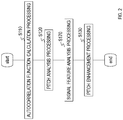
- Fig. 1 shows a functional block diagram of a speech pitch enhancement apparatus 100 according to a first embodiment and Fig. 2 shows a processing flow of the speech pitch enhancement apparatus 100.
- the speech pitch enhancement apparatus 100 of the first embodiment obtains a pitch period and pitch gain by analyzing an input signal and enhances a pitch based on the pitch period and the pitch gain.
- pitch enhancement processing is performed on an input audio signal of each time segment by using a pitch component, which corresponds to a pitch period, multiplied by pitch gain
- the degree of enhancement of a pitch component of a consonant time segment is made lower than the degree of enhancement of a pitch component of a non-consonant time segment or the degree of enhancement of a pitch component of a time segment is made lower as the consonant-likeness of the time segment becomes higher.
- the speech pitch enhancement apparatus 100 of the first embodiment includes a signal feature analysis unit 170, an autocorrelation function calculation unit 110, a pitch analysis unit 120, a pitch enhancement unit 130, and a signal storage 140.
- the speech pitch enhancement apparatus 100 of the first embodiment may include a pitch information storage 150, an autocorrelation function storage 160, and an attenuation coefficient storage 180.
- the speech pitch enhancement apparatus 100 is a special apparatus configured as a result of a special program being read into a publicly known or dedicated computer including, for example, a central processing unit (CPU), a main storage unit (random access memory: RAM), and so forth.
- the speech pitch enhancement apparatus 100 executes each processing under the control of the central processing unit, for example.
- the data input to the speech pitch enhancement apparatus 100 and the data obtained by each processing are stored in the main storage unit, for instance, and the data stored in the main storage unit is read into the central processing unit when necessary and used for other processing.
- At least part of each processing unit of the speech pitch enhancement apparatus 100 may be configured with hardware such as an integrated circuit.
- Each storage of the speech pitch enhancement apparatus 100 can be configured with, for example, a main storage unit such as random access memory (RAM) or middleware such as a relational database or a key-value store. It is to be noted that the speech pitch enhancement apparatus 100 does not necessarily have to include each storage; each storage may be configured with an auxiliary storage unit configured with a hard disk, an optical disk, or a semiconductor memory element such as flash memory and provided outside the speech pitch enhancement apparatus 100.
- RAM random access memory
- middleware such as a relational database or a key-value store.
- the speech pitch enhancement apparatus 100 does not necessarily have to include each storage; each storage may be configured with an auxiliary storage unit configured with a hard disk, an optical disk, or a semiconductor memory element such as flash memory and provided outside the speech pitch enhancement apparatus 100.
- Main processing which is performed by the speech pitch enhancement apparatus 100 of the first embodiment includes autocorrelation function calculation processing (S110), pitch analysis processing (S 120), signal feature analysis processing (S 170), and pitch enhancement processing (S130) (see Fig. 2 ). Since these processing is performed by a plurality of hardware resources of the speech pitch enhancement apparatus 100 in cooperation with each other, each of the autocorrelation function calculation processing (S110), the pitch analysis processing (S120), the signal feature analysis processing (S170), and the pitch enhancement processing (S130) will be explained in the following description along with related processing.
- a time domain audio signal (input signal) is input to the autocorrelation function calculation unit 110.
- This audio signal is a signal obtained by performing compression coding of a sound signal such as a speech signal by a coding apparatus and decoding the codes by a decoding apparatus corresponding to the coding apparatus.
- a sample sequence of a time domain audio signal of the current frame which was input to the speech pitch enhancement apparatus 100, is input to the autocorrelation function calculation unit 110 in frames (time segments), each having a predetermined length of time. Assume that a positive integer representing the length of a sample sequence of one frame is N; then, N time domain audio signal samples that make up a sample sequence of a time domain audio signal of the current frame are input to the autocorrelation function calculation unit 110.
- the autocorrelation function calculation unit 110 calculates an autocorrelation function R 0 at time lag 0 and autocorrelation functions R ⁇ ( 1 ), ..., R ⁇ ( M ) for each of a plurality of (M; M is a positive integer) predetermined time lags ⁇ (1), ..., ⁇ (M) in a sample sequence of the latest L (L is a positive integer) audio signal samples including the input N time domain audio signal samples. That is, the autocorrelation function calculation unit 110 calculates autocorrelation functions in a sample sequence of the latest audio signal samples including the time domain audio signal samples of the current frame.
- the autocorrelation functions calculated by the autocorrelation function calculation unit 110 in processing of the current frame that is, the autocorrelation functions in a sample sequence of the latest audio signal samples including the time domain audio signal samples of the current frame will also be referred to as the "autocorrelation functions of the current frame"; likewise, if a certain earlier frame is assumed to be a frame F, the autocorrelation functions calculated by the autocorrelation function calculation unit 110 in processing of the frame F, that is, the autocorrelation functions in a sample sequence of the latest audio signal samples at the frame F, which include the time domain audio signal samples of the frame F, will also be referred to as the "autocorrelation functions of the frame F".
- the speech pitch enhancement apparatus 100 includes the signal storage 140 to use the latest L audio signal samples for calculation of autocorrelation functions and the signal storage 140 is configured so that the signal storage 140 can store at least L-N audio signal samples, which are the latest audio signal samples, input by the previous frame.
- the autocorrelation function calculation unit 110 reads the latest L-N audio signal samples, which are stored in the signal storage 140, as X 0 , X 1 , ..., X L-N-1 and obtains the latest L audio signal samples X 0 , X 1 , ..., X L-1 by assigning the input N time domain audio signal samples to X L-N , X L-N+1 , ..., X L-1 .
- the autocorrelation function calculation unit 110 calculates an autocorrelation function R 0 at time lag 0 and autocorrelation functions K ⁇ (1) , ..., P ⁇ (M) for each of a plurality of predetermined time lags ⁇ (1), ..., ⁇ (M) by using the latest L audio signal samples X 0 , X 1 , ..., X L-1 . If a time lag such as ⁇ (1), ..., ⁇ (M) and 0 is assumed to be ⁇ , the autocorrelation function calculation unit 110 calculates an autocorrelation function R ⁇ by Formula (1) below, for example.
- the autocorrelation function calculation unit 110 outputs the calculated autocorrelation functions R 0 and R ⁇ (1) , ..., P ⁇ (M) to the pitch analysis unit 120.
- these time lags ⁇ (1), ..., ⁇ (M) are candidates for a pitch period T 0 of the current frame, which is obtained by the pitch analysis unit 120 which will be described later.
- T 0 the pitch period
- M values out of integer values from 75 to 320 which are suitable for candidates for a speech pitch period can be adopted as ⁇ (1), ..., ⁇ (M), for instance.
- R ⁇ in Formula (1) a normalized autocorrelation function R ⁇ /R 0 , which is obtained by dividing R ⁇ in Formula (1) by R 0 , may be obtained.
- the autocorrelation function R ⁇ may be calculated by Formula (1) itself; alternatively, a value that is the same as a value which is obtained by Formula (1) may be calculated by another calculation method.
- the speech pitch enhancement apparatus 100 includes the autocorrelation function storage 160 and stores, in the autocorrelation function storage 160, the autocorrelation functions (the autocorrelation functions of the immediately preceding frame) R ⁇ (1) , ..., R ⁇ ( M ) obtained by processing to calculate autocorrelation functions of the previous frame (the immediately preceding frame).
- the autocorrelation function calculation unit 110 may calculate the autocorrelation functions R ⁇ (1) , ..., P ⁇ (M) of the current frame by adding the contributions of the newly input audio signal samples of the current frame to and subtracting the contributions of the earliest frame from each of the autocorrelation functions (the autocorrelation functions of the immediately preceding frame) R ⁇ (1) , ..., R ⁇ (M) read from the autocorrelation function storage 160, which were obtained by the processing of the immediately preceding frame. This makes it possible to curb the amount of computation needed to calculate autocorrelation functions compared to calculation performed by using Formula (1) itself.
- the autocorrelation function calculation unit 110 obtains the autocorrelation function R ⁇ of the current frame by adding a difference ⁇ R ⁇ + , which is obtained by Formula (2) below, to and subtracting a difference ⁇ K ⁇ - , which is obtained by Formula (3) in the immediately preceding frame, from the autocorrelation function R ⁇ (the autocorrelation function R ⁇ of the immediately preceding frame) obtained by the processing of the immediately preceding frame.
- the amount of computation may be reduced by calculating an autocorrelation function by processing similar to that described above using, not the latest L audio signal samples themselves of an input audio signal, a signal whose number of samples is reduced by, for example, performing downsampling on the L audio signal samples or decimating samples.
- M time lags ⁇ (1), ..., ⁇ (M) are expressed by using half the number of samples.
- the audio signal samples stored in the signal storage 140 are used also for the signal feature analysis processing, which will be described later.
- J-N J is a positive integer
- the signal storage 140 updates the storage contents so as to store the latest K-N audio signal samples at this point. Specifically, for example, when K > 2N, the signal storage 140 deletes the oldest N audio signal samples XR 0 , XR 1 , ..., XR N-1 of the stored K-N audio signal samples, assigns XR N , XR N+1 , ..., XR K-N-1 to XR 0 , XR 1 , ..., XR K-2N-1 , and newly stores the input N time domain audio signal samples of the current frame as XR K-2N , XR K-2N+1 , ..., XR K-N-1 .
- the signal storage 140 deletes the stored K-N audio signal samples XR 0 , XR 1 , ..., XR K-N-1 and newly stores the latest K-N audio signal samples of the input N time domain audio signal samples of the current frame as XR 0 , XR 1 , ..., XR K-N-1 .
- the speech pitch enhancement apparatus 100 does not have to include the signal storage 140.
- the autocorrelation function storage 160 updates the storage contents so as to store the calculated autocorrelation functions R ⁇ (1) , ..., R ⁇ ( M ) of the current frame. Specifically, the autocorrelation function storage 160 deletes the stored R ⁇ (1) , ..., R ⁇ (M) and newly stores the calculated autocorrelation functions R ⁇ (1) , ..., R ⁇ (M) of the current frame.
- the autocorrelation function calculation unit 110 only has to calculate an autocorrelation function R 0 at time lag 0 and autocorrelation functions R ⁇ (1) , ..., R ⁇ ( M ) for each of a plurality of predetermined time lags ⁇ (1), ..., ⁇ (M) by using L consecutive audio signal samples X 0 , X 1 , ..., X L-1 included in the N audio signal samples of the current frame.
- the autocorrelation functions R 0 and R ⁇ (1) , ..., P ⁇ (M) of the current frame, which were output from the autocorrelation function calculation unit 110, are input to the pitch analysis unit 120.
- the pitch analysis unit 120 obtains the maximum value among the autocorrelation functions R ⁇ (1) , ..., P ⁇ (M) of the current frame for predetermined time lags.
- the pitch analysis unit 120 obtains the ratio between the maximum value of the autocorrelation function and the autocorrelation function R 0 at time lag 0 as the pitch gain ⁇ 0 of the current frame, obtains a time lag at which the value of the autocorrelation function becomes the maximum value as a pitch period T 0 of the current frame, and outputs the pitch gain ⁇ 0 and the pitch period T 0 to the pitch enhancement unit 130.
- Information derived from a time domain audio signal is input to the signal feature analysis unit 170.
- This audio signal is the same signal as the audio signal which is input to the autocorrelation function calculation unit 110.
- a sample sequence of a time domain audio signal of the current frame which was input to the speech pitch enhancement apparatus 100, is input to the signal feature analysis unit 170 in frames (time segments), each having a predetermined length of time. That is, N time domain audio signal samples that make up a sample sequence of a time domain audio signal of the current frame are input to the signal feature analysis unit 170.
- the signal feature analysis unit 170 obtains, using a sample sequence of the latest J (J is a positive integer) audio signal samples including the input N time domain audio signal samples, information indicating whether or not the current frame is a consonant or the consonant-likeness index value of the current frame, and outputs the information or the consonant-likeness index value to the pitch enhancement unit 130 as signal analysis information I 0 . That is, in this case, "information derived from a time domain audio signal” is a sample sequence of a time domain audio signal of the current frame (indicated by chain double-dashed lines in Fig. 1 ).
- pitch periods from the pitch period T 0 of the current frame to a pitch period T - ⁇ of the ⁇ -th frame previous to the current frame are input to the signal feature analysis unit 170 in frames (time segments), each having a predetermined length of time.
- the signal feature analysis unit 170 obtains, using the pitch periods from the pitch period T 0 of the current frame to the pitch period T - ⁇ of the ⁇ -th frame previous to the current frame, information indicating whether or not the current frame is a consonant or the consonant-likeness index value of the current frame, and outputs the information or the consonant-likeness index value to the pitch enhancement unit 130 as the signal analysis information I 0 .
- the speech pitch enhancement apparatus 100 further includes the pitch information storage 150 and stores, in the pitch information storage 150, the pitch periods T -1 , ..., T - ⁇ of frames from the previous frame to the ⁇ -th frame previous to the current frame.
- the signal feature analysis unit 170 uses the pitch period T 0 of the current frame, which was input from the pitch analysis unit 120, and the pitch periods T -1 , ..., T - ⁇ of frames from the previous frame to the ⁇ -th frame previous to the current frame, which were read from the pitch information storage 150.
- a pitch period of the s-th frame previous to the current frame is written as T -s and ⁇ is a predetermined positive integer.
- the pitch information storage 150 updates the storage contents so that the pitch period of the current frame can be used as a pitch period of an earlier frame in processing which is performed on a subsequent frame by the signal feature analysis unit 170.
- the signal feature analysis unit 170 obtains the signal analysis information I 0 by the signal feature analysis processing of Examples 1 to 5 below, for example.
- Example 1 of the signal feature analysis processing an example (1) in which the consonant-likeness index value is used as the signal analysis information
- the signal feature analysis unit 170 obtains, using the input pitch periods from the pitch period T 0 of the current frame to the pitch period T - ⁇ of the ⁇ -th frame previous to the current frame, an index value that becomes larger as the magnitude of discontinuity between pitch periods increases (also referred to as a "first consonant-likeness index value 1-1" for convenience in writing) as the consonant-likeness index value of the current frame, and outputs the obtained first index value 1-1 as the signal analysis information I 0 .
- the signal feature analysis unit 170 determines a first index value 1-1 ⁇ by Formula (4) using, for example, the pitch period T 0 input from the pitch analysis unit 120 and the pitch periods T -1 , ..., T - ⁇ of frames from the previous frame to the ⁇ -th frame previous to the current frame, which were read from the pitch information storage 150.
- the first index value 1-1 ⁇ is used as the consonant-likeness index value. It is desirable to set ⁇ at a value that is large enough to make it possible to obtain adequate information for making a judgment and is small enough to prevent time segments corresponding to T 0 to T - ⁇ from containing both a consonant and a vowel.
- Example 2 of the signal feature analysis processing an example (2) in which the consonant-likeness index value is used as the signal analysis information
- the signal feature analysis unit 170 obtains, using a sample sequence of the latest J audio signal samples including the input N time domain audio signal samples, a fricative-ness index value (also referred to as a "first consonant-likeness index value 1-2" for convenience in writing) as the consonant-likeness index value of the current frame, and outputs the obtained first index value 1-2 as the signal analysis information I 0 .
- a fricative-ness index value also referred to as a "first consonant-likeness index value 1-2" for convenience in writing
- the signal feature analysis unit 170 determines, for example, the number of zero-crossings (see Reference Literature 3) in a sample sequence of the latest J audio signal samples including the input N time domain audio signal samples as the first consonant-likeness index value 1-2 which is the fricative-ness index value.
- Reference Literature 3 L. R. Rabiner et al., "Digital Processing of Speech Signals (Vol. 1)” translated by Hisayoshi Suzuki, Corona Publishing Co., Ltd., 1983, pp. 132-137
- the signal feature analysis unit 170 transforms, for example, a sample sequence of the latest J audio signal samples including the input N time domain audio signal samples into a frequency spectral sequence by the modified discrete cosine transform (MDCT) or the like.
- the signal feature analysis unit 170 determines, as the first consonant-likeness index value 1-2 which is the fricative-ness index value, an index value that becomes larger as the ratio of the average energy of the samples on the high frequency side of the frequency spectral sequence to the average energy of the samples on the low frequency side of the frequency spectral sequence increases.
- consonants include fricatives (see Reference Literatures 1 and 2). Therefore, in this example, the fricative-ness index value is used as the consonant-likeness index value.
- Example 3 of the signal feature analysis processing an example in which an index value obtained by combining a plurality of index values is used as the signal analysis information
- the signal feature analysis unit 170 obtains the first consonant-likeness index value 1-1 of the current frame by the same method as that of Example 1 using the input pitch periods from the pitch period T 0 of the current frame to the pitch period T - ⁇ of the ⁇ -th frame previous to the current frame (Step 3-1). Moreover, the signal feature analysis unit 170 obtains the first consonant-likeness index value 1-2 of the current frame by the same method as that of Example 2 using a sample sequence of the latest J audio signal samples including the input N time domain audio signal samples (Step 3-2).
- the signal feature analysis unit 170 obtains, as the consonant-likeness index value (also referred to as the "first consonant-likeness index value 1-3" for convenience in writing) of the current frame, a value that becomes larger as the first index value 1-1 becomes larger and that becomes larger as the first index value 1-2 becomes larger by, for example, the weighted addition of the first index value 1-1 obtained in Step 3-1 and the first index value 1-2 obtained in Step 3-2, and outputs the obtained first index value 1-3 as the signal analysis information I 0 (Step 3-3).
- the consonant-likeness index value also referred to as the "first consonant-likeness index value 1-3" for convenience in writing
- both the first index value 1-1 and the first index value 1-2 are indices indicating consonant-likeness.
- by combining two index values it is possible to set the consonant-likeness index value more flexibly.
- Examples 1 to 3 of the signal feature analysis processing the examples in which the consonant-likeness index value is used as the signal analysis information have been described.
- the following description deals with an example in which information indicating whether or not the current frame is a consonant is used as the signal analysis information.
- Example 4 of the signal feature analysis processing an example (1) in which information indicating whether or not the current frame is a consonant is used as the signal analysis information
- the signal feature analysis unit 170 obtains any one of the first consonant-likeness index values 1-1 to 1-3 of the current frame by the same method as that of any one of Examples 1 to 3. Then, if the obtained index value (that is, any one of the first index values 1-1 to 1-3) is greater than or equal to a predetermined threshold or exceeds the threshold, the signal feature analysis unit 170 outputs information indicating that the current frame is a consonant (pieces of "information indicating whether or not the current frame is a consonant", which correspond to the "first index value 1-1", the "first index value 1-2", and the "first index value 1-3", are also referred to as “first information 1-1", “first information 1-2", and “first information 1-3", respectively, for convenience in writing) as the signal analysis information I 0 ; otherwise, outputs any one of the pieces of first information 1-1 to 1-3, which indicates that the current frame is not a consonant, as the signal analysis information I 0 .
- Example 5 of the signal feature analysis processing an example (2) in which information indicating whether or not the current frame is a consonant is used as the signal analysis information
- the signal feature analysis unit 170 obtains the first consonant-likeness index value 1-1 of the current frame by the same method as that of Example 1 (Step 5-1).
- the signal feature analysis unit 170 obtains the first information 1-1 indicating that the current frame is a consonant; otherwise, obtains the first information 1-1 indicating that the current frame is not a consonant (Step 5-2).
- the signal feature analysis unit 170 obtains the first consonant-likeness index value 1-2 of the current frame by the same method as that of Example 2 (Step 5-3).
- the signal feature analysis unit 170 obtains the first information 1-2 indicating that the current frame is a consonant; otherwise, obtains the first information 1-2 indicating the current frame is not a consonant (Step 5-4).
- the signal feature analysis unit 170 outputs information (also referred to as "first information 1-4" for convenience in writing) indicating that the current frame is a consonant as the signal analysis information I 0 ; otherwise, outputs the first information 1-4 indicating that the current frame is not a consonant as the signal analysis information I 0 (Step 5-5).
- the signal feature analysis unit 170 may output the first information 1-4 indicating that the current frame is a consonant as the signal analysis information I 0 ; otherwise, output the first information 1-4 indicating that the current frame is not a consonant as the signal analysis information I 0 (Step 5-5').
- the signal feature analysis unit 170 outputs the consonant-likeness index value or the information indicating whether or not the current frame is a consonant as the signal analysis information I 0 .
- the pitch enhancement unit 130 receives the pitch period and the pitch gain which were output from the pitch analysis unit 120, the signal analysis information output from the signal feature analysis unit 170, and the time domain audio signal (input signal) of the current frame, which was input to the speech pitch enhancement apparatus 100.
- the pitch enhancement unit 130 outputs, for an audio signal sample sequence of the current frame, a sample sequence of an output signal obtained by enhancing a pitch component corresponding to the pitch period T 0 of the current frame such that the degree of enhancement, which is based on the pitch gain ⁇ 0 , in a consonant frame is made lower than the degree of enhancement in a non-consonant frame.
- the pitch enhancement unit 130 performs the pitch enhancement processing on the sample sequence of the audio signal of the current frame using the input pitch gain ⁇ 0 of the current frame, the input pitch period T 0 of the current frame, and the input signal analysis information I 0 of the current frame. Specifically, the pitch enhancement unit 130 obtains a sample sequence, which consists of N samples X new L-N , ..., X neW L-1 , of an output signal of the current frame by obtaining an output signal X neW n for each sample X n (L-N ⁇ n ⁇ L-1), which makes up the input sample sequence of the audio signal of the current frame, by Formula (8) below.
- X n new 1 A X n + B 0 ⁇ 0 ⁇ 0 X n ⁇ T 0
- the attenuation coefficient ⁇ 0 is a value that is determined based on the signal analysis information I 0 of the current frame, and is a value that becomes smaller as the consonant-likeness index value I 0 becomes larger.
- a in Formula (8) is an amplitude correction factor which is determined by Formula (9) below.
- A 1 + B 0 2 ⁇ 0 2 ⁇ 0 2
- B 0 is a predetermined value and 3/4, for example.
- the pitch enhancement processing of Formula (8) is processing that enhances a pitch component with consideration given not only to a pitch period but also to pitch gain, and processing that enhances a pitch component of a frame which is a consonant, making the degree of enhancement lower than the degree of enhancement of a pitch component of a frame which is not a consonant.
- the pitch enhancement unit 130 when the signal analysis information I 0 indicates whether or not the current frame is a consonant, in the pitch enhancement unit 130, for a frame (a time segment) judged to be a consonant, for each time n in the frame, a signal including a signal obtained by adding a signal, which was obtained by multiplying a signal X n-T_0 at a time n-T 0 that is an earlier time than the time n by the number of samples T 0 corresponding to a pitch period of the frame, the pitch gain ⁇ 0 of the frame, a predetermined constant B 0 , and a value that is greater than 0 and less than 1, and a signal X n at the time n is obtained as an output signal X new n .
- the speech pitch enhancement apparatus 100 of the first modification further includes the pitch information storage 150.
- the pitch information storage 150 may be used in both the signal feature analysis processing (S170) and the pitch enhancement processing (S130).
- the pitch enhancement unit 130 receives the pitch period and the pitch gain which were output from the pitch analysis unit 120, the signal analysis information output from the signal feature analysis unit 170, and the time domain audio signal of the current frame, which was input to the speech pitch enhancement apparatus 100.
- the pitch enhancement unit 130 outputs, for an audio signal sample sequence of the current frame, a sample sequence of an output signal obtained by enhancing a pitch component corresponding to the pitch period T 0 of the current frame and a pitch component corresponding to a pitch period of an earlier frame.
- the pitch enhancement unit 130 enhances a pitch component corresponding to the pitch period T 0 of the current frame such that the degree of enhancement, which is based on the pitch gain ⁇ 0 of the current frame, in a consonant frame is made lower than the degree of enhancement in a non-consonant frame.
- the pitch period and the pitch gain of the s-th frame previous to the current frame are written as T -s and ⁇ -s , respectively.
- Pitch periods T -1 , ..., T - ⁇ and pitch gains ⁇ -1 , ..., ⁇ - ⁇ of frames from the previous frame to the ⁇ -th frame previous to the current frame are stored in the pitch information storage 150.
- ⁇ is a predetermined positive integer and 1, for example.
- the pitch information storage 150 may be used in both the signal feature analysis processing (S170) and the pitch enhancement processing (S130).
- ⁇ may be greater than ⁇ , ⁇ may be less than ⁇ , or ⁇ may be set so as to be equal to ⁇ and overlapping portions may be used in both the signal feature analysis processing (S170) and the pitch enhancement processing (S130) to the fullest extent possible.
- the pitch enhancement unit 130 performs the pitch enhancement processing on the sample sequence of the audio signal of the current frame using the input pitch gain ⁇ 0 of the current frame, the pitch gain ⁇ - ⁇ of the ⁇ -th frame previous to the current frame, which was read from the pitch information storage 150, the input pitch period T 0 of the current frame, the pitch period T - ⁇ of the ⁇ -th frame previous to the current frame, which was read from the pitch information storage 150, and the input signal analysis information I 0 of the current frame.
- the pitch enhancement unit 130 obtains a sample sequence, which consists of N samples X new L-N , ..., X neW L-1 , of an output signal of the current frame by obtaining an output signal X neW n for each sample X n (L-N ⁇ n ⁇ L-1), which makes up the input sample sequence of the audio signal of the current frame, by Formula (10) below.
- X n new 1 A X n + B 0 ⁇ 0 ⁇ 0 0 0 X n ⁇ T 0 + B ⁇ ⁇ ⁇ ⁇ X n ⁇ T ⁇ ⁇
- the attenuation coefficient ⁇ 0 is a value that is determined based on the signal analysis information I 0 of the current frame, and is a value that becomes smaller as the consonant-likeness index value I 0 becomes larger.
- a in Formula (10) is an amplitude correction factor which is determined by Formula (11) below.
- A 1 + B 0 2 ⁇ 0 2 ⁇ 0 2 + B ⁇ ⁇ 2 ⁇ ⁇ ⁇ 2 + 2 B 0 B ⁇ ⁇ ⁇ 0 ⁇ ⁇ ⁇ ⁇ 0
- B 0 and B - ⁇ are predetermined values less than 1 and are 3/4 and 1/4, respectively, for example.
- the pitch enhancement unit 130 obtains a sample sequence, which consists of N samples X new L-N , ..., X neW L-1 , of an output signal of the current frame by obtaining an output signal X neW n for each sample X n (L-N ⁇ n ⁇ L-1), which makes up the input sample sequence of the audio signal of the current frame, by Formula (12) below.
- X n new 1 A X n + B 0 ⁇ 0 ⁇ 0 0 X n ⁇ T 0 + B ⁇ ⁇ ⁇ ⁇ ⁇ ⁇ X n ⁇ T ⁇ ⁇
- an attenuation coefficient ⁇ 0 is the same as that of the first specific example and an attenuation coefficient ⁇ - ⁇ is an attenuation coefficient of the ⁇ -th frame previous to the current frame. Since the attenuation coefficient ⁇ - ⁇ of the ⁇ -th frame previous to the current frame is used in this specific example, the speech pitch enhancement apparatus 100 of this specific example further includes the attenuation coefficient storage 180.
- the attenuation coefficients ⁇ -1 , ..., ⁇ - ⁇ of frames from the previous frame to the ⁇ -th frame previous to the current frame are stored in the attenuation coefficient storage 180.
- a in Formula (12) is an amplitude correction factor which is determined by Formula (13) below.
- A 1 + B 0 2 ⁇ 0 2 ⁇ 0 2 + B ⁇ ⁇ 2 ⁇ ⁇ ⁇ 2 ⁇ ⁇ ⁇ 2 + 2 B 0 B ⁇ ⁇ ⁇ 0 ⁇ ⁇ ⁇ ⁇ 0 ⁇ ⁇ ⁇ ⁇ ⁇ ⁇ ⁇ ⁇
- B 0 and B - ⁇ are predetermined values less than 1 and are 3/4 and 1/4, respectively, for example.
- the pitch enhancement unit 130 obtains a sample sequence, which consists of N samples X new L-N , ..., X neW L-1 , of an output signal of the current frame by obtaining an output signal X neW n for each sample X n (L-N ⁇ n ⁇ L-1), which makes up the input sample sequence of the audio signal of the current frame, by Formula (14) below.
- X n new 1 A X n + B 0 ⁇ 0 ⁇ 0 0 X n ⁇ T 0 + B ⁇ ⁇ ⁇ ⁇ ⁇ 0 X n ⁇ T ⁇ ⁇
- an attenuation coefficient ⁇ 0 is the same as that of the first and second specific examples.
- a in Formula (14) is an amplitude correction factor which is determined by Formula (15) below.
- A 1 + B 0 2 ⁇ 0 2 ⁇ 0 2 + B ⁇ ⁇ 2 ⁇ ⁇ ⁇ 2 ⁇ 0 2 + 2 B 0 B ⁇ ⁇ ⁇ 0 ⁇ ⁇ ⁇ ⁇ 0 2
- B 0 and B - ⁇ are predetermined values less than 1 and are 3/4 and 1/4, respectively, for example.
- This specific example is a configuration in which the attenuation coefficient ⁇ 0 of the current frame is used in place of the attenuation coefficient ⁇ - ⁇ of the ⁇ -th frame previous to the current frame of the second specific example.
- This configuration can eliminate the need for the speech pitch enhancement apparatus 100 to include the attenuation coefficient storage 180.
- the pitch enhancement processing of the first modification is processing that enhances a pitch component with consideration given not only to a pitch period but also to pitch gain, processing that enhances a pitch component of a frame which is a consonant, making the degree of enhancement lower than the degree of enhancement of a pitch component of a frame which is not a consonant, and processing that enhances a pitch component corresponding to the pitch period T 0 of the current frame and, at the same time, also enhances a pitch component corresponding to the pitch period T - ⁇ in an earlier frame, making the degree of enhancement slightly lower than the degree of enhancement of a pitch component corresponding to the pitch period T 0 of the current frame.
- the signal analysis information I 0 is information indicating whether or not the current frame is a consonant
- B 0 > B - ⁇ in Formula (14) B 0 ⁇ B - ⁇ in Formula (14)
- B 0 ⁇ B - ⁇ in Formula (14) the effect of reducing discontinuity between frames caused by fluctuations in a pitch period can be obtained.
- the amplitude correction factors A which are determined by Formula (11), Formula (13), and Formula (15) allow the energy of a pitch component to be preserved before and after pitch enhancement if the assumption is made that the pitch period T 0 of the current frame and the pitch period T - ⁇ of the ⁇ -th frame previous to the current frame are values sufficiently close to each other.
- the pitch information storage 150 updates the storage contents so that the pitch period and the pitch gain of the current frame can be used as the pitch period and the pitch gain of an earlier frame in processing which is performed on a subsequent frame by the pitch enhancement unit 130.
- the attenuation coefficient storage 180 updates the storage contents so that the attenuation coefficient of the current frame can be used as an attenuation coefficient of an earlier frame in processing which is performed on a subsequent frame by the pitch enhancement unit 130.
- a sample sequence of an output signal is obtained by enhancing a pitch component corresponding to the pitch period T 0 of the current frame and a pitch component corresponding to a pitch period of one earlier frame; alternatively, pitch components corresponding to pitch periods of a plurality of (two or more) earlier frames may be enhanced.
- pitch components corresponding to pitch periods of a plurality of earlier frames by taking, as an example, a case where pitch components corresponding to pitch periods of two earlier frames are enhanced, a difference from the first modification will be described.
- Pitch periods T -1 , ..., T - ⁇ , ..., T - ⁇ and pitch gains ⁇ -1 , ..., ⁇ - ⁇ , ..., ⁇ - ⁇ of frames from the previous frame to the ⁇ -th frame previous to the current frame are stored in the pitch information storage 150.
- ⁇ is a predetermined positive integer greater than ⁇ .
- ⁇ is 1 and ⁇ is 2.
- the pitch information storage 150 may be used in both the signal feature analysis processing (S170) and the pitch enhancement processing (S130).
- ⁇ may be greater than ⁇ , ⁇ may be less than ⁇ , or ⁇ may be set so as to be equal to ⁇ and overlapping portions may be used in both the signal feature analysis processing (S170) and the pitch enhancement processing (S130) to the fullest extent possible.
- the pitch enhancement unit 130 performs the pitch enhancement processing on the sample sequence of the audio signal of the current frame using the input pitch gain ⁇ 0 of the current frame, the pitch gain ⁇ - ⁇ of the ⁇ -th frame previous to the current frame, which was read from the pitch information storage 150, the pitch gain ⁇ - ⁇ of the ⁇ -th frame previous to the current frame, which was read from the pitch information storage 150, the input pitch period T 0 of the current frame, the pitch period T - ⁇ of the ⁇ -th frame previous to the current frame, which was read from the pitch information storage 150, the pitch period T - ⁇ of the ⁇ -th frame previous to the current frame, which was read from the pitch information storage 150, and the input signal analysis information I 0 of the current frame.
- the pitch enhancement unit 130 obtains a sample sequence, which consists of N samples X new L-N , ..., X neW L-1 , of an output signal of the current frame by obtaining an output signal X neW n for each sample X n (L-N ⁇ n ⁇ L-1), which makes up the input sample sequence of the audio signal of the current frame, by Formula (16) below.
- X n new 1 A X n + B 0 ⁇ 0 ⁇ 0 0 0 X n ⁇ T 0 + B ⁇ ⁇ ⁇ ⁇ X n ⁇ T ⁇ ⁇ + B ⁇ ⁇ ⁇ ⁇ ⁇ X n ⁇ T ⁇ ⁇ ⁇
- the attenuation coefficient ⁇ 0 is a value that is determined based on the signal analysis information I 0 of the current frame, and is a value that becomes smaller as the consonant-likeness index value I 0 becomes larger.
- a in Formula (16) is an amplitude correction factor which is determined by Formula (17) below.
- A 1 + B 0 2 ⁇ 0 2 ⁇ 0 2 + B ⁇ ⁇ 2 ⁇ ⁇ ⁇ 2 + B ⁇ ⁇ 2 ⁇ ⁇ ⁇ 2 + E + F + G
- B 0 , B - ⁇ , and B- ⁇ are predetermined values less than 1 and are 3/4, 3/16, and 1/16, respectively, for example.
- the pitch enhancement unit 130 obtains a sample sequence, which consists of N samples X new L-N , ..., X neW L-1 , of an output signal of the current frame by obtaining an output signal X neW n for each sample X n (L-N ⁇ n ⁇ L-1), which makes up the input sample sequence of the audio signal of the current frame, by Formula (18) below.
- X n new 1 A X n + B 0 ⁇ 0 ⁇ 0 X n ⁇ T 0 + B ⁇ ⁇ ⁇ ⁇ ⁇ ⁇ ⁇ X n ⁇ T ⁇ ⁇ + B ⁇ ⁇ ⁇ ⁇ ⁇ ⁇ ⁇ X n ⁇ T ⁇ ⁇
- an attenuation coefficient ⁇ 0 is the same as that of the first specific example, an attenuation coefficient ⁇ - ⁇ is an attenuation coefficient of the ⁇ -th frame previous to the current frame, and an attenuation coefficient ⁇ - ⁇ is an attenuation coefficient of the ⁇ -th frame previous to the current frame. Since the attenuation coefficient ⁇ - ⁇ of the ⁇ -th frame previous to the current frame and the attenuation coefficient ⁇ - ⁇ of the ⁇ -th frame previous to the current frame are used in this specific example, the speech pitch enhancement apparatus 100 of this specific example further includes the attenuation coefficient storage 180. The attenuation coefficients ⁇ -1 , ..., ⁇ - ⁇ of frames from the previous frame to the ⁇ -th frame previous to the current frame are stored in the attenuation coefficient storage 180.
- a in Formula (18) is an amplitude correction factor which is determined by Formula (19) below.
- A 1 + B 0 2 ⁇ 0 2 ⁇ 0 2 + B ⁇ ⁇ 2 ⁇ ⁇ ⁇ 2 ⁇ ⁇ ⁇ 2 + B ⁇ ⁇ 2 ⁇ ⁇ ⁇ 2 ⁇ ⁇ ⁇ 2 + E + F + G
- B 0 , B - ⁇ , and B- ⁇ are predetermined values less than 1 and are 3/4, 3/16, and 1/16, respectively, for example.
- the pitch enhancement unit 130 obtains a sample sequence, which consists of N samples X new L-N , ..., X neW L-1 , of an output signal of the current frame by obtaining an output signal X neW n for each sample X n (L-N ⁇ n ⁇ L-1), which makes up the input sample sequence of the audio signal of the current frame, by Formula (20) below.
- X n new 1 A X n + B 0 ⁇ 0 ⁇ 0 X n ⁇ T 0 + B ⁇ ⁇ ⁇ ⁇ ⁇ 0 X n ⁇ T ⁇ ⁇ + B ⁇ ⁇ ⁇ ⁇ ⁇ ⁇ 0 X n ⁇ T ⁇ ⁇
- an attenuation coefficient ⁇ 0 is the same as that of the first and second specific examples.
- a in Formula (20) is an amplitude correction factor which is determined by Formula (21) below.
- A 1 + B 0 2 ⁇ 0 2 ⁇ 0 2 + B ⁇ ⁇ 2 ⁇ ⁇ ⁇ 2 ⁇ 0 2 + B ⁇ ⁇ 2 ⁇ ⁇ ⁇ 2 ⁇ 0 2 + E + F + G
- E 2 B 0 B ⁇ ⁇ ⁇ 0 ⁇ ⁇ ⁇ ⁇ 0 2
- F 2 B 0 B ⁇ ⁇ ⁇ 0 ⁇ ⁇ ⁇ ⁇ 0 2
- G 2 B ⁇ ⁇ B ⁇ ⁇ ⁇ ⁇ ⁇ ⁇ ⁇ ⁇ ⁇ 0 2
- B 0 , B - ⁇ , and B - ⁇ are predetermined values less than 1 and are 3/4, 3/16, and 1/16, respectively, for example.
- This specific example is a configuration in which the attenuation coefficient ⁇ 0 of the current frame is used in place of the attenuation coefficient ⁇ - ⁇ of the ⁇ -th frame previous to the current frame and the attenuation coefficient ⁇ - ⁇ of the ⁇ -th frame previous to the current frame of the second specific example.
- This configuration can eliminate the need for the speech pitch enhancement apparatus 100 to include the attenuation coefficient storage 180.
- the pitch enhancement processing of the second modification is also processing that enhances a pitch component with consideration given not only to a pitch period but also to pitch gain, processing that enhances a pitch component of a frame which is a consonant, making the degree of enhancement lower than the degree of enhancement of a pitch component of a frame which is not a consonant, and processing that enhances a pitch component corresponding to the pitch period T 0 of the current frame and, at the same time, also enhances a pitch component corresponding to a pitch period in an earlier frame, making the degree of enhancement slightly lower than the degree of enhancement of a pitch component corresponding to the pitch period T 0 of the current frame.
- the signal analysis information I 0 is information indicating whether or not the current frame is a consonant
- the amplitude correction factors A which are determined by Formula (17), Formula (19), and Formula (21) allow the energy of a pitch component to be preserved before and after pitch enhancement if the assumption is made that the pitch period T 0 of the current frame, the pitch period T - ⁇ of the ⁇ -th frame previous to the current frame, and the pitch period T - ⁇ of the ⁇ -th frame previous to the current frame are values sufficiently close to one another.
- a predetermined value which is greater than or equal to 1 may be used as the amplitude correction factor A.
- the pitch enhancement unit 130 may obtain an output signal X new n by a formula without 1/A (that is, 1/A in Formula (8), Formula (10), Formula (12), Formula (14), Formula (16), Formula (18), and Formula (20)), which is included in the above-described formulae by which an output signal X new n is obtained.
- an earlier sample than each sample by each pitch period in an audio signal that was passed through a low-pass filter may be used or processing equivalent to a low-pass filter may be performed.
- pitch enhancement processing when pitch gain is less than a predetermined threshold, pitch enhancement processing that does not include the pitch component may be performed.
- a configuration may be adopted in which, when the pitch gain ⁇ 0 of the current frame is less than a predetermined threshold, a pitch component corresponding to the pitch period T 0 of the current frame is not included in an output signal and, when the pitch gain of an earlier frame is less than the predetermined threshold, a pitch component corresponding to a pitch period of the earlier frame is not included in the output signal.
- the signal feature analysis unit 170 obtains the consonant-likeness index value and outputs the consonant-likeness index value to the pitch enhancement unit 130 as the signal analysis information I 0 and the pitch enhancement unit 130 changes the degree of enhancement (the magnitude of the attenuation coefficient ⁇ 0 ) in two levels based on the magnitude relationship between the consonant-likeness index value and a threshold.
- a spectral envelope flatness index value is obtained as the consonant-likeness index value.
- the spectral envelope of the spectrum of a consonant has the property of being flatter than the spectral envelope of the spectrum of a vowel.
- the spectral envelope flatness index value is used as the consonant-likeness index value.
- the details of the signal feature analysis processing (S170) are different from those of the first embodiment.
- information derived from a time domain audio signal is input to the signal feature analysis unit 170.
- the signal feature analysis unit 170 obtains information indicating whether or not the current frame is a consonant or the consonant-likeness index value of the current frame and outputs the information or the consonant-likeness index value to the pitch enhancement unit 130 as the signal analysis information I 0 .
- the spectral envelope flatness index value of the current frame is used as the consonant-likeness index value of the current frame.
- information indicating whether or not the spectral envelope of the current frame is flat is used as the information indicating whether or not the current frame is a consonant.
- the signal feature analysis unit 170 obtains the signal analysis information I 0 by, for example, signal feature analysis processing of Examples 2-1 to 2-7 below.
- Example 2-1 of the signal feature analysis processing an example (1) in which the spectral envelope flatness index value is used as the signal analysis information
- the signal feature analysis unit 170 obtains T-th order LSP parameters ⁇ [1], ⁇ [2], ..., ⁇ [T] from a sample sequence of the latest J audio signal samples including the input N time domain audio signal samples (Step 2-1-1).
- the signal feature analysis unit 170 then obtains, using the T-th order LSP parameters ⁇ [I], ⁇ [2], ..., ⁇ [T] obtained in Step 2-1-1, the following index Q as the spectral envelope flatness index value (also referred to as the "second consonant-likeness index value 2-1" for convenience in writing) of the current frame (Step 2-1-2).
- Example 2-2 of the signal feature analysis processing an example (2) in which the spectral envelope flatness index value is used as the signal analysis information
- the signal feature analysis unit 170 obtains T-th order LSP parameters ⁇ [1], ⁇ [2], ..., ⁇ [T] from a sample sequence of the latest J audio signal samples including the input N time domain audio signal samples (Step 2-2-1).
- the signal feature analysis unit 170 then obtains, using the T-th order LSP parameters ⁇ [I], ⁇ [2], ..., ⁇ [T] obtained in Step 2-2-1, the minimum value of the intervals between adjacent LSP parameters, that is, the following index Q' as the spectral envelope flatness index value (also referred to as the "second consonant-likeness index value 2-2" for convenience in writing) of the current frame (Step 2-2-2).
- Q ′ min i ⁇ 1 , ... , T ⁇ 1 ⁇ i + 1 ⁇ ⁇ i
- Example 2-3 of the signal feature analysis processing an example (3) in which the spectral envelope flatness index value is used as the signal analysis information
- the signal feature analysis unit 170 obtains T-th order LSP parameters ⁇ [1], ⁇ [2], ..., ⁇ [T] from a sample sequence of the latest J audio signal samples including the input N time domain audio signal samples (Step 2-3-1).
- the signal feature analysis unit 170 then obtains, using the T-th order LSP parameters ⁇ [1], ⁇ [2], ..., ⁇ [T] obtained in Step 2-3-1, the minimum value of the values of the intervals of adjacent LSP parameters and the value of the lowest order LSP parameter, that is, the following index Q" as the spectral envelope flatness index value (also referred to as the "second consonant-likeness index value 2-3" for convenience in writing) of the current frame (Step 2-3-2).
- Q " min ( min i ⁇ 1 , ... , T ⁇ 1 ⁇ i + 1 ⁇ ⁇ i , ⁇ 1 ] )
- Example 2-4 of the signal feature analysis processing an example (4) in which the spectral envelope flatness index value is used as the signal analysis information
- the signal feature analysis unit 170 obtains p-th order PARCOR coefficients k[1], k[2], ..., k[p] from a sample sequence of the latest J audio signal samples including the input N time domain audio signal samples (Step 2-4-1).
- the signal feature analysis unit 170 then obtains, using the p-th order PARCOR coefficients k[1], k[2], ..., k[p] obtained in Step 2-4-1, the following index Q'" as the spectral envelope flatness index value (also referred to as the "second consonant-likeness index value 2-4" for convenience in writing) of the current frame (Step 2-4-2).
- Q ′′′ ⁇ i p 1 ⁇ k i 2
- Example 2-5 of the signal feature analysis processing an example in which an index value obtained by combining a plurality of index values is used as the signal analysis information
- the signal feature analysis unit 170 obtains the second consonant-likeness index values 2-1 to 2-4 by the methods of Examples 2-1 to 2-4 (Step 2-5-1). Furthermore, the signal feature analysis unit 170 obtains, by the weighted addition of the second consonant-likeness index values 2-1 to 2-4 obtained in Step 2-5-1, a value that becomes larger as the second index value 2-1 becomes larger, that becomes larger as the second index value 2-2 becomes larger, that becomes larger as the second index value 2-3 becomes larger, and that becomes larger as the second index value 2-4 becomes larger as the spectral envelope flatness index value (also referred to as the "second consonant-likeness index value 2-5" for convenience in writing) of the current frame, and outputs the obtained second index value 2-5 as the signal analysis information I 0 (Step 2-5-2).
- the second consonant-likeness index values 2-1 to 2-4 are each an index indicating the flatness of a spectral envelope.
- the four index values it is possible to more flexibly set an index value indicating the flatness of a spectral envelope.
- the signal feature analysis unit 170 may obtain at least two of the second consonant-likeness index values 2-1 to 2-4 (Step 2-5-1').
- the signal feature analysis unit 170 may obtain, by the weighted addition of the at least two consonant-likeness index values obtained in Step 2-5-1', a value that becomes larger as each of the index values obtained in Step 2-5-1' becomes larger as the second consonant-likeness index value 2-5 of the current frame and output the obtained second index value 2-5 as the signal analysis information I 0 (Step 2-5-2').
- Examples 2-1 to 2-5 of the signal feature analysis processing the examples in which the consonant-likeness index value (the spectral envelope flatness index value) is used as the signal analysis information have been described.
- the following description deals with an example in which information indicating whether or not the current frame is a consonant (information indicating whether or not a spectral envelope is flat) is used as the signal analysis information.
- Example 2-6 of the signal feature analysis processing an example (1) in which information indicating whether or not a spectral envelope is flat is used as the signal analysis information
- the signal feature analysis unit 170 obtains any one of the second consonant-likeness index values 2-1 to 2-5 of the current frame by the same method as that of any one of Examples 2-1 to 2-5 (Step 2-6-1). Then, if the index value obtained in Step 2-6-1 is greater than or equal to a predetermined threshold or exceeds the threshold, the signal feature analysis unit 170 outputs information indicating that the current frame is a consonant (pieces of "information indicating whether or not the current frame is a consonant", which correspond to the "second index value 2-1", the “second index value 2-2", the “second index value 2-3", the “second index value 2-4", and the "second index value 2-5", are also referred to as “second information 2-1", “second information 2-2", “second information 2-3", “second information 2-4", and “second information 2-5", respectively, for convenience in writing) as the signal analysis information I 0 ; otherwise, outputs any one of the pieces of second information 2-1 to 2-5, which indicates that the current frame is
- Example 2-7 of the signal feature analysis processing an example (2) in which information indicating whether or not a spectral envelope is flat is used as the signal analysis information
- the signal feature analysis unit 170 obtains the second consonant-likeness index values 2-1 to 2-4 of the current frame by the same methods as those of Examples 2-1 to 2-4 (Step 2-7-1). Then, based on the magnitude relationship between each of the four second consonant-likeness index values 2-1 to 2-4 obtained in Step 2-7-1 and a predetermined threshold, the signal feature analysis unit 170 obtains, for each of the second consonant-likeness index values 2-1 to 2-4, information indicating that the current frame is a consonant or information indicating that the current frame is not a consonant (Step 2-7-2).
- the threshold is set for each of the four second index values 2-1 to 2-4, and pieces of information indicating whether or not the current frame is a consonant, which correspond to the second index value 2-1, the second index value 2-2, the second index value 2-3, and the second index value 2-4, are also referred to as second information 2-1, second information 2-2, second information 2-3, and second information 2-4, respectively.
- the signal feature analysis unit 170 obtains the second information 2-1 indicating that the current frame is a consonant; otherwise, obtains the second information 2-1 indicating that the current frame is not a consonant.
- the signal feature analysis unit 170 obtains the second information 2-2 to 2-4 based on the magnitude relationship between each of the second index values 2-2 to 2-4 and a predetermined threshold in a similar way.
- the signal feature analysis unit 170 obtains information (also referred to as "second information 2-6" for convenience in writing) indicating that the current frame is a consonant or the second information 2-6 indicating that the current frame is not a consonant (Step 2-7-3).
- the signal feature analysis unit 170 outputs the second information 2-6 indicating that the current frame is a consonant as the signal analysis information I 0 ; otherwise, outputs the second information 2-6 indicating that the current frame is not a consonant as the signal analysis information I 0 .
- the signal feature analysis unit 170 outputs the second information 2-6 indicating that the current frame is a consonant as the signal analysis information I 0 ; otherwise, outputs the second information 2-6 indicating that the current frame is not a consonant as the signal analysis information I 0 .
- the signal feature analysis unit 170 outputs the second information 2-6 indicating that the current frame is a consonant as the signal analysis information I 0 ; otherwise, outputs the second information 2-6 indicating that the current frame is not a consonant as the signal analysis information I 0 .
- the logical operation of the pieces of second information 2-1 to 2-4 is not limited to Examples 1 to 3 of the logical operation described above and the logical operation of the pieces of second information 2-1 to 2-4 may be appropriately set in such a way as to make a decoded audio signal sound more natural.
- the signal feature analysis unit 170 may obtain at least two of the second consonant-likeness index values 2-1 to 2-4 (Step 2-7-1'). In this case, based on the magnitude relationship between each of the at least two consonant-likeness index values obtained in Step 2-7-1' and a predetermined threshold, the signal feature analysis unit 170 may obtain, for each consonant-likeness index value, at least two pieces of information: information indicating that the current frame is a consonant or information indicating that the current frame is not a consonant (Step 2-7-2').
- the signal feature analysis unit 170 may obtain the second information 2-6 indicating that the current frame is a consonant or the second information 2-6 indicating that the current frame is not a consonant (Step 2-7-3').
- the signal feature analysis unit 170 outputs the consonant-likeness index value or the information indicating whether or not the current frame is a consonant as the signal analysis information I 0 .
- the pitch enhancement processing (S130) in the pitch enhancement unit 130 is similar to that of the first embodiment.
- the pitch enhancement unit 130 of the present embodiment obtains, for each time n of the frame, as an output signal X new n , a signal including a signal obtained by adding a signal, which was obtained by multiplying a signal X n-T_0 at a time n-T 0 that is an earlier time than the time n by the number of samples T 0 corresponding to a pitch period of the frame, the pitch gain ⁇ 0 of the frame, a predetermined constant B 0 , and a value that is greater than 0 and less than 1, and the signal X n at the time n.
- the pitch enhancement unit 130 obtains, for each time n of the frame, as an output signal X new n , a signal including a signal (X n +B 0 ⁇ 0 X n-T_0 ) obtained by adding a signal (B 0 ⁇ 0 X n-T_0 ) (which corresponds to a signal obtained when ⁇ 0 in the second term inside the brackets on the right side of Formula (8) is 1), which was obtained by multiplying a signal X n-T_0 at a time n-T 0 that is an earlier time than the time n by the number of samples T 0 corresponding to a pitch period of the frame, the pitch gain ⁇ 0 of the frame, and a predetermined constant B 0 , and the signal X n at the time n.
- the pitch enhancement unit 130 for each time n of a frame, a signal including a signal (X n +B 0 ⁇ 0 ⁇ 0 X n-T_0 ) obtained by adding a signal (B 0 ⁇ 0 ⁇ 0 X n-T_0 ), which was obtained by multiplying a signal X n-T_0 at a time n-T 0 that is an earlier time than the time n by the number of samples T 0 corresponding to a pitch period of a frame including a signal X n , the pitch gain ⁇ 0 of the frame, and a value B 0 ⁇ 0 that becomes smaller as the flatness of the spectral envelope of the frame becomes higher (as the consonant-likeness of the frame becomes higher), and the signal X n at the time n is obtained as an output signal X new n
- a consonant-likeness index value or information indicating whether or not the current frame is a consonant is obtained.
- any one of the first consonant-likeness index values 1-1 to 1-3 described in the first embodiment is referred to as a first consonant-likeness index value
- any one of the second consonant-likeness index values 2-1 to 2-5, which are the spectral envelope flatness index values, described in the second embodiment is referred to as a second index value
- a consonant-likeness index value which is obtained by the signal feature analysis processing (S170) using the first consonant-likeness index value and the second consonant-likeness index value is referred to as a third consonant-likeness index value.
- the signal feature analysis unit 170 Based on the consonant-likeness index value described in the first embodiment and the spectral envelope flatness index value described in the second embodiment, the signal feature analysis unit 170 obtains a consonant-likeness index value or information indicating whether or not the current frame is a consonant and outputs the consonant-likeness index value or the information to the pitch enhancement unit 130 as the signal analysis information.
- the signal feature analysis unit 170 obtains the signal analysis information I 0 by signal feature analysis processing of Examples 3-1 to 3-4 below, for example.
- Example 3-1 of the signal feature analysis processing an example in which an index value obtained by combining the first consonant-likeness index value and the spectral envelope flatness index value (the second consonant-likeness index value) is used as the third consonant-likeness index value and the third index value itself is used as the signal analysis information)
- the signal feature analysis unit 170 obtains the first consonant-likeness index value of the current frame by the same method as that of any one of Examples 1 to 3 described in the first embodiment (Step 3-1-1). Moreover, the signal feature analysis unit 170 obtains the spectral envelope flatness index value (the second consonant-likeness index value) of the current frame by any one of the methods of Examples 2-1 to 2-5 described in the second embodiment (Step 3-1-2).
- the signal feature analysis unit 170 obtains, by, for example, the weighted addition of the first consonant-likeness index value obtained in Step 3-1-1 and the spectral envelope flatness index value (the second consonant-likeness index value) obtained in Step 3-1-2, a value that becomes larger as the first consonant-likeness index value becomes larger and that becomes larger as the spectral envelope flatness index value (the second consonant-likeness index value) becomes larger as the third consonant-likeness index value of the current frame, and outputs the obtained third consonant-likeness index value as the signal analysis information I 0 (Step 3-1-3).
- Example 3-2 of the signal feature analysis processing an example in which information obtained by making a judgment, based on a threshold, about the third index value obtained by combining the first consonant-likeness index value and the spectral envelope flatness index value (the second consonant-likeness index value) is used as the signal analysis information)
- the signal feature analysis unit 170 obtains the third consonant-likeness index value of the current frame by the same method as that of Example 3-1 (Step 3-2-1). Then, if the third consonant-likeness index value obtained in Step 3-2-1 is greater than or equal to a predetermined threshold or exceeds the threshold, the signal feature analysis unit 170 outputs third information indicating that the current frame is a consonant as the signal analysis information I 0 ; otherwise, outputs third information indicating that the current frame is not a consonant as the signal analysis information I 0 .
- Example 3-3 of the signal feature analysis processing an example in which information indicating whether or not the current frame is a consonant or a spectral envelope is flat is used as the signal analysis information
- the signal feature analysis unit 170 obtains the first consonant-likeness index value of the current frame by the same method as that of any one of Examples 1 to 3 described in the first embodiment (Step 3-3-1). If the first index value obtained in Step 3-3-1 is greater than or equal to a predetermined threshold or exceeds the threshold, the signal feature analysis unit 170 obtains first information indicating that the current frame is a consonant; otherwise, obtains first information indicating that the current frame is not a consonant (Step 3-3-2).
- the signal feature analysis unit 170 obtains the spectral envelope flatness index value (the second consonant-likeness index value) of the current frame by any one of the methods of Examples 2-1 to 2-5 described in the second embodiment (Step 3-3-3). If the second index value obtained in Step 3-3-3 is greater than or equal to a predetermined threshold or exceeds the threshold, the signal feature analysis unit 170 obtains second information indicating that the spectral envelope of the current frame is flat (the current frame is a consonant); otherwise, obtains second information indicating that the spectral envelope of the current frame is not flat (the current frame is not a consonant) (Step 3-3-4).
- the signal feature analysis unit 170 outputs third information indicating that the current frame is a consonant as the signal analysis information I 0 ; otherwise, outputs third information indicating that the current frame is not a consonant as the signal analysis information I 0 .
- Example 3-4 of the signal feature analysis processing an example in which information indicating whether or not the current frame is a consonant and a spectral envelope is flat is used as the signal analysis information
- the signal feature analysis unit 170 obtains the first consonant-likeness index value of the current frame by the same method as that of any one of Examples 1 to 3 described in the first embodiment (Step 3-4-1). If the index value obtained in Step 3-4-1 is greater than or equal to a predetermined threshold or exceeds the threshold, the signal feature analysis unit 170 obtains first information indicating that the current frame is a consonant; otherwise, obtains first information indicating that the current frame is not a consonant (Step 3 -4-2).
- the signal feature analysis unit 170 obtains the spectral envelope flatness index value (the second consonant-likeness index value) of the current frame by any one of the methods of Examples 2-1 to 2-5 described in the second embodiment (Step 3-4-3). If the index value obtained in Step 3-4-3 is greater than or equal to a predetermined threshold or exceeds the threshold, the signal feature analysis unit 170 obtains second information indicating that the spectral envelope of the current frame is flat (the current frame is a consonant); otherwise, obtains second information indicating that the spectral envelope of the current frame is not flat (the current frame is not a consonant) (Step 3-4-4).
- the signal feature analysis unit 170 outputs third information indicating that the current frame is a consonant as the signal analysis information I 0 ; otherwise, outputs third information indicating that the current frame is not a consonant as the signal analysis information I 0 .
- the pitch enhancement processing (S130) in the pitch enhancement unit 130 is similar to that of the first embodiment.
- the pitch enhancement unit 130 of the present embodiment obtains, for each time n of the frame, as an output signal X new n , a signal including a signal obtained by adding a signal, which was obtained by multiplying a signal X n-T_0 at a time n-T 0 that is an earlier time than the time n by the number of samples T 0 corresponding to a pitch period of the frame, the pitch gain ⁇ 0 of the frame, a predetermined constant B 0 , and a value that is greater than 0 and less than 1, and the signal X n at the time n.
- the pitch enhancement unit 130 obtains, for each time n of the frame, as an output signal X new n , a signal including a signal (X n +B 0 ⁇ 0 X n-T_0 ) obtained by adding a signal (B 0 ⁇ 0 X n-T_0 ) (which corresponds to a signal obtained when ⁇ 0 in the second term inside the brackets on the right side of Formula (8) is 1), which was obtained by multiplying a signal X n-T_0 at a time n-T 0 that is an earlier time than the time n by the number of samples T 0 corresponding to a pitch period of the frame, the pitch gain ⁇ 0 of the frame, and a predetermined constant B 0 , and the signal X n at the time n (which corresponds to Examples 3-3 and 3-4).
- Example 3-2 a judgment about the third index value obtained by combining the first consonant-likeness index value and the spectral envelope flatness index value (the second consonant-likeness index value) is made based on a threshold, and this judgment based on a threshold corresponds to making a judgment whether or not the current frame is a consonant or/and the spectral envelope of a signal X n is flat.
- the pitch enhancement unit 130 for each time n of a frame, a signal including a signal (X n +B 0 ⁇ 0 ⁇ 0 X n-T_0 ) obtained by adding a signal (B 0 ⁇ 0 ⁇ 0 X n-T_0 ), which was obtained by multiplying a signal X n-T_0 at a time n-T 0 that is an earlier time than the time n by the number of samples T 0 corresponding to a pitch period of a frame including a signal X n , the pitch gain ⁇ 0 of the frame, and a value B 0 ⁇ 0 that becomes smaller as the consonant-likeness of the frame becomes higher and that becomes smaller as the flatness of the spectral envelope of the frame becomes higher, and the signal X n at the time n is obtained as an output
- This configuration makes it possible to obtain the effects similar to those of the first embodiment. Furthermore, in the present embodiment, by also considering the second index value (the spectral envelope flatness index value) in addition to the first index value, it is possible to obtain a more appropriate consonant-likeness index value.
- the second index value the spectral envelope flatness index value
- the speech pitch enhancement apparatus 100 may be configured as shown in Fig. 3 so as to enhance a pitch based on the pitch period, the pitch gain, and the signal analysis information obtained outside the speech pitch enhancement apparatus 100.
- Fig. 4 shows a processing flow of the speech pitch enhancement apparatus 100.
- the speech pitch enhancement apparatus 100 does not have to include the autocorrelation function calculation unit 110, the pitch analysis unit 120, the signal feature analysis unit 170, and the autocorrelation function storage 160 which are included in the speech pitch enhancement apparatus 100 of the first embodiment, the second embodiment, the third embodiment, and the modifications thereof, and the pitch enhancement unit 130 only has to perform the pitch enhancement processing (S130) using the pitch period, the pitch gain, and the signal analysis information which were input to the speech pitch enhancement apparatus 100, not the pitch period and the pitch gain which were output from the pitch analysis unit 120 and the signal analysis information output from the signal feature analysis unit 170.
- S130 pitch enhancement processing
- the speech pitch enhancement apparatus 100 of the first embodiment, the second embodiment, the third embodiment, and the modifications thereof can obtain a pitch period, pitch gain, and signal analysis information independently of the frequency of obtaining a pitch period, pitch gain, and signal analysis information outside the speech pitch enhancement apparatus 100, which allows the speech pitch enhancement apparatus 100 of the first embodiment, the second embodiment, the third embodiment, and the modifications thereof to perform pitch enhancement processing in frames, each having a very short length of time.
- N is assumed to be 32, for instance, the speech pitch enhancement apparatus 100 of the first embodiment, the second embodiment, the third embodiment, and the modifications thereof can perform pitch enhancement processing in 1-ms frames.
- the present invention may be applied as pitch enhancement processing which is performed on linear prediction residual in a configuration, which is described in Non-patent Literature 1, for example, in which linear prediction synthesis is performed after pitch enhancement processing is performed on linear prediction residual. That is, the present invention may be applied, not to an audio signal itself, but to a signal derived from an audio signal, such as a signal obtained by performing an analysis or processing on an audio signal.
- the present invention is not limited to the above embodiments and modifications.
- the above-described various kinds of processing may be executed, in addition to being executed in chronological order in accordance with the descriptions, in parallel or individually depending on the processing power of an apparatus that executes the processing or when necessary.
- changes may be made as appropriate without departing from the spirit of the present invention.
- the computer-readable recording medium may be any medium such as a magnetic recording apparatus, an optical disk, a magneto-optical recording medium, and a semiconductor memory.
- Distribution of this program is implemented by sales, transfer, rental, and other transactions of a portable recording medium such as a DVD and a CD-ROM on which the program is recorded, for example. Furthermore, this program may be distributed by storing the program in a storage of a server computer and transferring the program from the server computer to other computers via a network.
- a computer which executes such program first stores the program recorded in a portable recording medium or transferred from a server computer once in a storage thereof, for example.
- the computer reads out the program stored in the storage thereof and performs processing in accordance with the program thus read out.
- the computer may directly read out the program from a portable recording medium and perform processing in accordance with the program.
- the computer may sequentially perform processing in accordance with the received program.
- a configuration may be adopted in which the transfer of a program to the computer from the server computer is not performed and the above-described processing is executed by so-called application service provider (ASP)-type service by which the processing functions are implemented only by an instruction for execution thereof and result acquisition.
- ASP application service provider
- the program includes information which is provided for processing performed by electronic calculation equipment and which is equivalent to a program (such as data which is not a direct instruction to the computer but has a property specifying the processing performed by the computer).
- the apparatuses are assumed to be configured with a predetermined program executed on a computer. However, at least part of these processing details may be realized in a hardware manner.
Landscapes
- Engineering & Computer Science (AREA)
- Quality & Reliability (AREA)
- Computational Linguistics (AREA)
- Signal Processing (AREA)
- Health & Medical Sciences (AREA)
- Audiology, Speech & Language Pathology (AREA)
- Human Computer Interaction (AREA)
- Physics & Mathematics (AREA)
- Acoustics & Sound (AREA)
- Multimedia (AREA)
- Compression, Expansion, Code Conversion, And Decoders (AREA)
- Electrophonic Musical Instruments (AREA)
Abstract
Description
- This invention relates to a technology to analyze and enhance a pitch component of a sample sequence derived from an audio signal in signal processing technology such as audio signal coding technology.
- In general, when a sample sequence of a time series signal or the like is subjected to lossy compression coding, a sample sequence which is obtained at the time of decoding is a distorted sample sequence different from the original sample sequence. In coding of an audio signal, in particular, this distortion often contains a pattern that natural sounds do not have, which sometimes makes a decoded audio signal sound unnatural to a person who hears it. To address this problem, with attention being paid to a fact that many natural sounds, when observed in a certain segment, each contain a periodic component, that is, a pitch corresponding to each sound, processing to enhance a pitch component (pitch enhancement processing) by adding an earlier sample than each sample by a pitch period is performed on each sample of an audio signal obtained by decoding. A technology that converts a sound into a sound closer to a natural sound by this pitch enhancement processing is widely used (for example, Non-patent Literature 1).
- Moreover, as described in
Patent Literature 1, for example, there is another technology that, based on information indicating whether an audio signal obtained by decoding is "speech" or "non-speech", performs processing to enhance a pitch component if the audio signal is "speech" and does not perform processing to enhance a pitch component if the audio signal is "non-speech". - Non-patent Literature 1: ITU-T Recommendation G.723.1 (05/2006) pp. 16-18, 2006
- Patent Literature 1: Japanese Patent Application Laid Open No.
H10-143195 - However, the problem of the technology described in Non-patent
Literature 1 is that processing to enhance a pitch component is performed also on a consonant portion without a clear pitch structure, which makes the consonant portion sound unnatural to a person who hears it. On the other hand, one problem of the technology described inPatent Literature 1 is that, even when a pitch component is present in a consonant portion as a signal, no processing to enhance a pitch component is performed, which makes the consonant portion sound unnatural to a person who hears it. Moreover, another problem of the technology described inPatent Literature 1 is that the presence or absence of pitch enhancement processing changes between a vowel time segment and a consonant time segment, which frequently causes discontinuity in an audio signal and makes the audio signal sound more unnatural to a person who hears it. - The present invention has been made to solve these problems and an object thereof is to achieve pitch enhancement processing that makes a consonant sound less unnatural even in a consonant time segment and, even with frequent switching between a consonant time segment and other time segments, makes a consonant, which may sound unnatural due to discontinuity, sound less unnatural to a person who hears it. It is to be noted that consonants include fricatives, plosives, semivowels, nasals, and affricates (see
Reference Literatures 1 and 2). - (Reference Literature 1) Sadaoki Furui, "Sound/Speech Engineering", Kindai kagaku sha Co., Ltd., 1992, p. 99
- (Reference Literature 2) Shuzo Saito, Kazuo Nakata, "Basics of Speech Information Processing", Ohmsha, Ltd., 1981, pp. 38-39
- In order to solve the above-described problems, according to one aspect of the present invention, a pitch enhancement apparatus obtains an output signal by performing, for each time segment, pitch enhancement processing on a signal derived from an input audio signal. The pitch enhancement apparatus includes a pitch enhancement unit that performs, as the pitch enhancement processing, for a time segment judged to be a time segment including the signal that is a consonant, for each time of the time segment, processing to obtain, as an output signal, a signal including a signal obtained by adding a signal, which was obtained by multiplying the signal at a time that is an earlier time than the time by the number of samples T0 corresponding to a pitch period of the time segment, the pitch gain σ0 of the time segment, a predetermined constant B0, and a value that is greater than 0 and less than 1, and the signal at the time, and, for a time segment judged to be a time segment including the signal that is not a consonant, for each time of the time segment, processing to obtain, as an output signal, a signal including a signal obtained by adding a signal, which was obtained by multiplying the signal at a time that is an earlier time than the time by the number of samples T0 corresponding to a pitch period of the time segment, the pitch gain σ0 of the time segment, and a predetermined constant B0, and the signal at the time.
- In order to solve the above-described problems, according to another aspect of the present invention, a pitch enhancement apparatus obtains an output signal by performing, for each time segment, pitch enhancement processing on a signal derived from an input audio signal. The pitch enhancement apparatus includes a pitch enhancement unit that performs, as the pitch enhancement processing, for each time n of each time segment, processing to obtain, as an output signal, a signal including a signal obtained by adding a signal, which was obtained by multiplying the signal at a time that is an earlier time than the time n by the number of samples T0 corresponding to a pitch period of the time segment, the pitch gain σ0 of the time segment, and a value that becomes smaller as the consonant-likeness of the time segment becomes higher, and the signal at the time n.
- In order to solve the above-described problems, according to still another aspect of the present invention, a pitch enhancement apparatus obtains an output signal by performing, for each time segment, pitch enhancement processing on a signal derived from an input audio signal. The pitch enhancement apparatus includes a pitch enhancement unit that performs, as the pitch enhancement processing, for a time segment judged to be a time segment including the signal that is a consonant or/and the signal whose spectral envelope is flat, for each time of the time segment, processing to obtain, as an output signal, a signal including a signal obtained by adding a signal, which was obtained by multiplying the signal at a time that is an earlier time than the time by the number of samples T0 corresponding to a pitch period of the time segment, the pitch gain σ0 of the time segment, a predetermined constant B0, and a value that is greater than 0 and less than 1, and the signal at the time, and, for a time segment about which a judgment other than that described above has been made, for each time of the time segment, processing to obtain, as an output signal, a signal including a signal obtained by adding a signal, which was obtained by multiplying the signal at a time that is an earlier time than the time by the number of samples T0 corresponding to a pitch period of the time segment, the pitch gain σ0 of the time segment, and a predetermined constant B0, and the signal at the time.
- In order to solve the above-described problems, according to yet another aspect of the present invention, a pitch enhancement apparatus obtains an output signal by performing, for each time segment, pitch enhancement processing on a signal derived from an input audio signal. The pitch enhancement apparatus includes a pitch enhancement unit that performs, as the pitch enhancement processing, for each time n of each time segment, processing to obtain, as an output signal, a signal including a signal obtained by adding a signal, which was obtained by multiplying the signal at a time that is an earlier time than the time n by the number of samples T0 corresponding to a pitch period of the time segment, the pitch gain σ0 of the time segment, and a value that becomes smaller as the consonant-likeness of the time segment becomes higher and that becomes smaller as the flatness of the spectral envelope of the time segment becomes higher, and the signal at the time n.
- According to the present invention, when pitch enhancement processing is performed on a speech signal obtained by decoding processing, it is possible to achieve pitch enhancement processing that makes a consonant sound less unnatural even in a consonant time segment and, even with frequent switching between a consonant time segment and other time segments, makes a consonant, which may sound unnatural due to discontinuity, sound less unnatural to a person who hears it.
-
-
Fig. 1 is a functional block diagram of a pitch enhancement apparatus according to a first embodiment, a second embodiment, a third embodiment, and modifications thereof. -
Fig. 2 is a diagram showing an example of a processing flow of the pitch enhancement apparatus according to the first embodiment, the second embodiment, the third embodiment, and the modifications thereof. -
Fig. 3 is a functional block diagram of a pitch enhancement apparatus according to another modification. -
Fig. 4 is a diagram showing an example of a processing flow of the pitch enhancement apparatus according to the other modification. - Hereinafter, embodiments of the present invention will be described. It is to be noted that, in the drawings which are used in the following description, component units having the same function and steps in which the same processing is performed are identified with the same reference characters and overlapping explanations are omitted. In the following description, it is assumed that processing which is performed element by element of a vector and a matrix is applied to all the elements of the vector and the matrix unless otherwise specified.
-
Fig. 1 shows a functional block diagram of a speechpitch enhancement apparatus 100 according to a first embodiment andFig. 2 shows a processing flow of the speechpitch enhancement apparatus 100. - A processing procedure of the speech
pitch enhancement apparatus 100 of the first embodiment will be described with reference toFig. 1 . The speechpitch enhancement apparatus 100 of the first embodiment obtains a pitch period and pitch gain by analyzing an input signal and enhances a pitch based on the pitch period and the pitch gain. In the present embodiment, when pitch enhancement processing is performed on an input audio signal of each time segment by using a pitch component, which corresponds to a pitch period, multiplied by pitch gain, the degree of enhancement of a pitch component of a consonant time segment is made lower than the degree of enhancement of a pitch component of a non-consonant time segment or the degree of enhancement of a pitch component of a time segment is made lower as the consonant-likeness of the time segment becomes higher. More specifically, for a consonant time segment, pitch gain multiplied by a value less than 1 is used in place of pitch gain. The speechpitch enhancement apparatus 100 of the first embodiment includes a signalfeature analysis unit 170, an autocorrelationfunction calculation unit 110, apitch analysis unit 120, apitch enhancement unit 130, and asignal storage 140. In addition, the speechpitch enhancement apparatus 100 of the first embodiment may include apitch information storage 150, anautocorrelation function storage 160, and anattenuation coefficient storage 180. - The speech
pitch enhancement apparatus 100 is a special apparatus configured as a result of a special program being read into a publicly known or dedicated computer including, for example, a central processing unit (CPU), a main storage unit (random access memory: RAM), and so forth. The speechpitch enhancement apparatus 100 executes each processing under the control of the central processing unit, for example. The data input to the speechpitch enhancement apparatus 100 and the data obtained by each processing are stored in the main storage unit, for instance, and the data stored in the main storage unit is read into the central processing unit when necessary and used for other processing. At least part of each processing unit of the speechpitch enhancement apparatus 100 may be configured with hardware such as an integrated circuit. Each storage of the speechpitch enhancement apparatus 100 can be configured with, for example, a main storage unit such as random access memory (RAM) or middleware such as a relational database or a key-value store. It is to be noted that the speechpitch enhancement apparatus 100 does not necessarily have to include each storage; each storage may be configured with an auxiliary storage unit configured with a hard disk, an optical disk, or a semiconductor memory element such as flash memory and provided outside the speechpitch enhancement apparatus 100. - Main processing which is performed by the speech
pitch enhancement apparatus 100 of the first embodiment includes autocorrelation function calculation processing (S110), pitch analysis processing (S 120), signal feature analysis processing (S 170), and pitch enhancement processing (S130) (seeFig. 2 ). Since these processing is performed by a plurality of hardware resources of the speechpitch enhancement apparatus 100 in cooperation with each other, each of the autocorrelation function calculation processing (S110), the pitch analysis processing (S120), the signal feature analysis processing (S170), and the pitch enhancement processing (S130) will be explained in the following description along with related processing. - First, the autocorrelation function calculation processing, which is performed by the speech
pitch enhancement apparatus 100, and related processing will be described. - A time domain audio signal (input signal) is input to the autocorrelation
function calculation unit 110. This audio signal is a signal obtained by performing compression coding of a sound signal such as a speech signal by a coding apparatus and decoding the codes by a decoding apparatus corresponding to the coding apparatus. A sample sequence of a time domain audio signal of the current frame, which was input to the speechpitch enhancement apparatus 100, is input to the autocorrelationfunction calculation unit 110 in frames (time segments), each having a predetermined length of time. Assume that a positive integer representing the length of a sample sequence of one frame is N; then, N time domain audio signal samples that make up a sample sequence of a time domain audio signal of the current frame are input to the autocorrelationfunction calculation unit 110. The autocorrelationfunction calculation unit 110 calculates an autocorrelation function R0 at time lag 0 and autocorrelation functions Rτ(1), ..., Rτ(M) for each of a plurality of (M; M is a positive integer) predetermined time lags τ(1), ..., τ(M) in a sample sequence of the latest L (L is a positive integer) audio signal samples including the input N time domain audio signal samples. That is, the autocorrelationfunction calculation unit 110 calculates autocorrelation functions in a sample sequence of the latest audio signal samples including the time domain audio signal samples of the current frame. - In the following description, the autocorrelation functions calculated by the autocorrelation
function calculation unit 110 in processing of the current frame, that is, the autocorrelation functions in a sample sequence of the latest audio signal samples including the time domain audio signal samples of the current frame will also be referred to as the "autocorrelation functions of the current frame"; likewise, if a certain earlier frame is assumed to be a frame F, the autocorrelation functions calculated by the autocorrelationfunction calculation unit 110 in processing of the frame F, that is, the autocorrelation functions in a sample sequence of the latest audio signal samples at the frame F, which include the time domain audio signal samples of the frame F, will also be referred to as the "autocorrelation functions of the frame F". Moreover, the "autocorrelation function" will also be referred to simply as the "autocorrelation". When L is a value greater than N, the speechpitch enhancement apparatus 100 includes thesignal storage 140 to use the latest L audio signal samples for calculation of autocorrelation functions and thesignal storage 140 is configured so that thesignal storage 140 can store at least L-N audio signal samples, which are the latest audio signal samples, input by the previous frame. Then, when the N time domain audio signal samples of the current frame are input, the autocorrelationfunction calculation unit 110 reads the latest L-N audio signal samples, which are stored in thesignal storage 140, as X0, X1, ..., XL-N-1 and obtains the latest L audio signal samples X0, X1, ..., XL-1 by assigning the input N time domain audio signal samples to XL-N, XL-N+1, ..., XL-1. - Then, the autocorrelation
function calculation unit 110 calculates an autocorrelation function R0 at time lag 0 and autocorrelation functions Kτ(1), ..., Pτ(M) for each of a plurality of predetermined time lags τ(1), ..., τ(M) by using the latest L audio signal samples X0, X1, ..., XL-1. If a time lag such as τ(1), ..., τ(M) and 0 is assumed to be τ, the autocorrelationfunction calculation unit 110 calculates an autocorrelation function Rτ by Formula (1) below, for example.
- The autocorrelation
function calculation unit 110 outputs the calculated autocorrelation functions R0 and Rτ(1), ..., Pτ(M) to thepitch analysis unit 120. - Here, these time lags τ(1), ..., τ(M) are candidates for a pitch period T0 of the current frame, which is obtained by the
pitch analysis unit 120 which will be described later. For example, for an audio signal whose principal component is a speech signal sampled at a sampling frequency of 32 kHz, M values out of integer values from 75 to 320 which are suitable for candidates for a speech pitch period can be adopted as τ(1), ..., τ(M), for instance. In place of Rτ in Formula (1), a normalized autocorrelation function Rτ/R0, which is obtained by dividing Rτ in Formula (1) by R0, may be obtained. It is to be noted that, when, for example, L is set at a sufficiently large value such as 8192 for integer values from 75 to 320 which are candidates for a pitch period T0, it is better to calculate the autocorrelation function Rτ by a method that curbs the amount of computation, which will be described below, rather than to obtain a normalized autocorrelation function Rτ/R0 in place of the autocorrelation function Rτ. - The autocorrelation function Rτ may be calculated by Formula (1) itself; alternatively, a value that is the same as a value which is obtained by Formula (1) may be calculated by another calculation method. For example, the speech
pitch enhancement apparatus 100 includes theautocorrelation function storage 160 and stores, in theautocorrelation function storage 160, the autocorrelation functions (the autocorrelation functions of the immediately preceding frame) Rτ(1), ..., Rτ(M) obtained by processing to calculate autocorrelation functions of the previous frame (the immediately preceding frame). The autocorrelationfunction calculation unit 110 may calculate the autocorrelation functions Rτ(1), ..., Pτ(M) of the current frame by adding the contributions of the newly input audio signal samples of the current frame to and subtracting the contributions of the earliest frame from each of the autocorrelation functions (the autocorrelation functions of the immediately preceding frame) Rτ(1), ..., Rτ(M) read from theautocorrelation function storage 160, which were obtained by the processing of the immediately preceding frame. This makes it possible to curb the amount of computation needed to calculate autocorrelation functions compared to calculation performed by using Formula (1) itself. In this case, if each of τ(1), ..., τ(M) is assumed to be τ, the autocorrelationfunction calculation unit 110 obtains the autocorrelation function Rτ of the current frame by adding a difference ΔRτ +, which is obtained by Formula (2) below, to and subtracting a difference ΔKτ -, which is obtained by Formula (3) in the immediately preceding frame, from the autocorrelation function Rτ (the autocorrelation function Rτ of the immediately preceding frame) obtained by the processing of the immediately preceding frame.

- Moreover, the amount of computation may be reduced by calculating an autocorrelation function by processing similar to that described above using, not the latest L audio signal samples themselves of an input audio signal, a signal whose number of samples is reduced by, for example, performing downsampling on the L audio signal samples or decimating samples. In this case, when, for example, the number of samples is reduced by half, M time lags τ(1), ..., τ(M) are expressed by using half the number of samples. For instance, when the above-described 8192 audio signal samples obtained by sampling at a sampling frequency of 32 kHz are downsampled to 4096 samples obtained by sampling at a sampling frequency of 16 kHz, it is only necessary to change τ(1), ..., τ(M), which are candidates for a pitch period T0, from M values out of the integer values from 75 to 320 to M values out of integer values from 37 to 160, which are about half of the integer values from 75 to 320.
- It is to be noted that the audio signal samples stored in the
signal storage 140 are used also for the signal feature analysis processing, which will be described later. Specifically, in the signal feature analysis processing, which will be described later, J-N (J is a positive integer) audio signal samples stored in thesignal storage 140 are used. That is, if the larger one of the two values, L and J, is assumed to be K (if K = max(L, J)), it is necessary to store, in thesignal storage 140, at least K-N audio signal samples, which are the latest audio signal samples, input by the previous frame. Therefore, after the speechpitch enhancement apparatus 100 completes processing which is performed on the current frame by thepitch enhancement unit 130, which will be described later, thesignal storage 140 updates the storage contents so as to store the latest K-N audio signal samples at this point. Specifically, for example, when K > 2N, thesignal storage 140 deletes the oldest N audio signal samples XR0, XR1, ..., XRN-1 of the stored K-N audio signal samples, assigns XRN, XRN+1, ..., XRK-N-1 to XR0, XR1, ..., XRK-2N-1, and newly stores the input N time domain audio signal samples of the current frame as XRK-2N, XRK-2N+1, ..., XRK-N-1. Moreover, when K ≤ 2N, thesignal storage 140 deletes the stored K-N audio signal samples XR0, XR1, ..., XRK-N-1 and newly stores the latest K-N audio signal samples of the input N time domain audio signal samples of the current frame as XR0, XR1, ..., XRK-N-1. When K ≤ N, the speechpitch enhancement apparatus 100 does not have to include thesignal storage 140. - Furthermore, after the autocorrelation
function calculation unit 110 completes calculation of an autocorrelation function of the current frame, theautocorrelation function storage 160 updates the storage contents so as to store the calculated autocorrelation functions Rτ(1), ..., Rτ(M) of the current frame. Specifically, theautocorrelation function storage 160 deletes the stored Rτ(1), ..., Rτ(M) and newly stores the calculated autocorrelation functions Rτ(1), ..., Rτ(M) of the current frame. - The above description is based on the assumption that the latest L audio signal samples include the N audio signal samples of the current frame (that is, L ≥ N); however, L does not necessarily have to be greater than or equal to N and L may be less than N. In this case, the autocorrelation
function calculation unit 110 only has to calculate an autocorrelation function R0 at time lag 0 and autocorrelation functions Rτ(1), ..., Rτ(M) for each of a plurality of predetermined time lags τ(1), ..., τ(M) by using L consecutive audio signal samples X0, X1, ..., XL-1 included in the N audio signal samples of the current frame. - Next, the pitch analysis processing which is performed by the speech
pitch enhancement apparatus 100 will be described. - The autocorrelation functions R0 and Rτ(1), ..., Pτ(M) of the current frame, which were output from the autocorrelation
function calculation unit 110, are input to thepitch analysis unit 120. - The
pitch analysis unit 120 obtains the maximum value among the autocorrelation functions Rτ(1), ..., Pτ(M) of the current frame for predetermined time lags. Thepitch analysis unit 120 obtains the ratio between the maximum value of the autocorrelation function and the autocorrelation function R0 at time lag 0 as the pitch gain σ0 of the current frame, obtains a time lag at which the value of the autocorrelation function becomes the maximum value as a pitch period T0 of the current frame, and outputs the pitch gain σ0 and the pitch period T0 to thepitch enhancement unit 130. - Next, the signal feature analysis processing which is performed by the speech
pitch enhancement apparatus 100 will be described. - Information derived from a time domain audio signal is input to the signal
feature analysis unit 170. This audio signal is the same signal as the audio signal which is input to the autocorrelationfunction calculation unit 110. - For example, a sample sequence of a time domain audio signal of the current frame, which was input to the speech
pitch enhancement apparatus 100, is input to the signalfeature analysis unit 170 in frames (time segments), each having a predetermined length of time. That is, N time domain audio signal samples that make up a sample sequence of a time domain audio signal of the current frame are input to the signalfeature analysis unit 170. In this case, the signalfeature analysis unit 170 obtains, using a sample sequence of the latest J (J is a positive integer) audio signal samples including the input N time domain audio signal samples, information indicating whether or not the current frame is a consonant or the consonant-likeness index value of the current frame, and outputs the information or the consonant-likeness index value to thepitch enhancement unit 130 as signal analysis information I0. That is, in this case, "information derived from a time domain audio signal" is a sample sequence of a time domain audio signal of the current frame (indicated by chain double-dashed lines inFig. 1 ). - Moreover, for example, pitch periods from the pitch period T0 of the current frame to a pitch period T-ε of the ε-th frame previous to the current frame are input to the signal
feature analysis unit 170 in frames (time segments), each having a predetermined length of time. In this case, the signalfeature analysis unit 170 obtains, using the pitch periods from the pitch period T0 of the current frame to the pitch period T-ε of the ε-th frame previous to the current frame, information indicating whether or not the current frame is a consonant or the consonant-likeness index value of the current frame, and outputs the information or the consonant-likeness index value to thepitch enhancement unit 130 as the signal analysis information I0. That is, in this case, "information derived from a time domain audio signal" is pitch periods from the pitch period T0 of the current frame to the pitch period T-ε of the ε-th frame previous to the current frame (indicated by alternate long and short dashed lines inFig. 1 ). In this case, the speechpitch enhancement apparatus 100 further includes thepitch information storage 150 and stores, in thepitch information storage 150, the pitch periods T-1, ..., T-ε of frames from the previous frame to the ε-th frame previous to the current frame. Then, the signalfeature analysis unit 170 uses the pitch period T0 of the current frame, which was input from thepitch analysis unit 120, and the pitch periods T-1, ..., T-ε of frames from the previous frame to the ε-th frame previous to the current frame, which were read from thepitch information storage 150. Here, a pitch period of the s-th frame previous to the current frame is written as T-s and ε is a predetermined positive integer. Thepitch information storage 150 updates the storage contents so that the pitch period of the current frame can be used as a pitch period of an earlier frame in processing which is performed on a subsequent frame by the signalfeature analysis unit 170. - The signal
feature analysis unit 170 obtains the signal analysis information I0 by the signal feature analysis processing of Examples 1 to 5 below, for example. - In this example, the signal
feature analysis unit 170 obtains, using the input pitch periods from the pitch period T0 of the current frame to the pitch period T-ε of the ε-th frame previous to the current frame, an index value that becomes larger as the magnitude of discontinuity between pitch periods increases (also referred to as a "first consonant-likeness index value 1-1" for convenience in writing) as the consonant-likeness index value of the current frame, and outputs the obtained first index value 1-1 as the signal analysis information I0. - The signal
feature analysis unit 170 determines a first index value 1-1 δ by Formula (4) using, for example, the pitch period T0 input from thepitch analysis unit 120 and the pitch periods T-1, ..., T-ε of frames from the previous frame to the ε-th frame previous to the current frame, which were read from thepitch information storage 150.
- In this example, the signal
feature analysis unit 170 obtains, using a sample sequence of the latest J audio signal samples including the input N time domain audio signal samples, a fricative-ness index value (also referred to as a "first consonant-likeness index value 1-2" for convenience in writing) as the consonant-likeness index value of the current frame, and outputs the obtained first index value 1-2 as the signal analysis information I0. - The signal
feature analysis unit 170 determines, for example, the number of zero-crossings (see Reference Literature 3) in a sample sequence of the latest J audio signal samples including the input N time domain audio signal samples as the first consonant-likeness index value 1-2 which is the fricative-ness index value.
(Reference Literature 3) L. R. Rabiner et al., "Digital Processing of Speech Signals (Vol. 1)" translated by Hisayoshi Suzuki, Corona Publishing Co., Ltd., 1983, pp. 132-137 - Moreover, the signal
feature analysis unit 170 transforms, for example, a sample sequence of the latest J audio signal samples including the input N time domain audio signal samples into a frequency spectral sequence by the modified discrete cosine transform (MDCT) or the like. Next, the signalfeature analysis unit 170 determines, as the first consonant-likeness index value 1-2 which is the fricative-ness index value, an index value that becomes larger as the ratio of the average energy of the samples on the high frequency side of the frequency spectral sequence to the average energy of the samples on the low frequency side of the frequency spectral sequence increases. - As described earlier, consonants include fricatives (see
Reference Literatures 1 and 2). Therefore, in this example, the fricative-ness index value is used as the consonant-likeness index value. - In this example, first, the signal
feature analysis unit 170 obtains the first consonant-likeness index value 1-1 of the current frame by the same method as that of Example 1 using the input pitch periods from the pitch period T0 of the current frame to the pitch period T-ε of the ε-th frame previous to the current frame (Step 3-1). Moreover, the signalfeature analysis unit 170 obtains the first consonant-likeness index value 1-2 of the current frame by the same method as that of Example 2 using a sample sequence of the latest J audio signal samples including the input N time domain audio signal samples (Step 3-2). Furthermore, the signalfeature analysis unit 170 obtains, as the consonant-likeness index value (also referred to as the "first consonant-likeness index value 1-3" for convenience in writing) of the current frame, a value that becomes larger as the first index value 1-1 becomes larger and that becomes larger as the first index value 1-2 becomes larger by, for example, the weighted addition of the first index value 1-1 obtained in Step 3-1 and the first index value 1-2 obtained in Step 3-2, and outputs the obtained first index value 1-3 as the signal analysis information I0 (Step 3-3). - As described earlier, both the first index value 1-1 and the first index value 1-2 are indices indicating consonant-likeness. In this example, by combining two index values, it is possible to set the consonant-likeness index value more flexibly.
- In Examples 1 to 3 of the signal feature analysis processing, the examples in which the consonant-likeness index value is used as the signal analysis information have been described. The following description deals with an example in which information indicating whether or not the current frame is a consonant is used as the signal analysis information.
- In this example, first, the signal
feature analysis unit 170 obtains any one of the first consonant-likeness index values 1-1 to 1-3 of the current frame by the same method as that of any one of Examples 1 to 3. Then, if the obtained index value (that is, any one of the first index values 1-1 to 1-3) is greater than or equal to a predetermined threshold or exceeds the threshold, the signalfeature analysis unit 170 outputs information indicating that the current frame is a consonant (pieces of "information indicating whether or not the current frame is a consonant", which correspond to the "first index value 1-1", the "first index value 1-2", and the "first index value 1-3", are also referred to as "first information 1-1", "first information 1-2", and "first information 1-3", respectively, for convenience in writing) as the signal analysis information I0; otherwise, outputs any one of the pieces of first information 1-1 to 1-3, which indicates that the current frame is not a consonant, as the signal analysis information I0. - In this example, first, the signal
feature analysis unit 170 obtains the first consonant-likeness index value 1-1 of the current frame by the same method as that of Example 1 (Step 5-1). Next, if the first index value 1-1 obtained in Step 5-1 is greater than or equal to a predetermined threshold or exceeds the threshold, the signalfeature analysis unit 170 obtains the first information 1-1 indicating that the current frame is a consonant; otherwise, obtains the first information 1-1 indicating that the current frame is not a consonant (Step 5-2). Moreover, the signalfeature analysis unit 170 obtains the first consonant-likeness index value 1-2 of the current frame by the same method as that of Example 2 (Step 5-3). If the first index value 1-2 obtained in Step 5-3 is greater than or equal to a predetermined threshold or exceeds the threshold, the signalfeature analysis unit 170 obtains the first information 1-2 indicating that the current frame is a consonant; otherwise, obtains the first information 1-2 indicating the current frame is not a consonant (Step 5-4). Furthermore, if the first information 1-1 obtained in Step 5-2 indicates that the current frame is a consonant and the first information 1-2 obtained in Step 5-4 indicates that the current frame is a consonant, the signalfeature analysis unit 170 outputs information (also referred to as "first information 1-4" for convenience in writing) indicating that the current frame is a consonant as the signal analysis information I0; otherwise, outputs the first information 1-4 indicating that the current frame is not a consonant as the signal analysis information I0 (Step 5-5). - In place of Step 5-5 described above, if the first information 1-1 obtained in Step 5-2 indicates that the current frame is a consonant or the first information 1-2 obtained in Step 5-4 indicates that the current frame is a consonant, the signal
feature analysis unit 170 may output the first information 1-4 indicating that the current frame is a consonant as the signal analysis information I0; otherwise, output the first information 1-4 indicating that the current frame is not a consonant as the signal analysis information I0 (Step 5-5'). - By these processing, the signal
feature analysis unit 170 outputs the consonant-likeness index value or the information indicating whether or not the current frame is a consonant as the signal analysis information I0. - Next, the pitch enhancement processing which is performed by the speech
pitch enhancement apparatus 100 will be described. - The
pitch enhancement unit 130 receives the pitch period and the pitch gain which were output from thepitch analysis unit 120, the signal analysis information output from the signalfeature analysis unit 170, and the time domain audio signal (input signal) of the current frame, which was input to the speechpitch enhancement apparatus 100. Thepitch enhancement unit 130 outputs, for an audio signal sample sequence of the current frame, a sample sequence of an output signal obtained by enhancing a pitch component corresponding to the pitch period T0 of the current frame such that the degree of enhancement, which is based on the pitch gain σ0, in a consonant frame is made lower than the degree of enhancement in a non-consonant frame. - Hereinafter, a specific example will be described.
- The
pitch enhancement unit 130 performs the pitch enhancement processing on the sample sequence of the audio signal of the current frame using the input pitch gain σ0 of the current frame, the input pitch period T0 of the current frame, and the input signal analysis information I0 of the current frame. Specifically, thepitch enhancement unit 130 obtains a sample sequence, which consists of N samples Xnew L-N, ..., XneW L-1, of an output signal of the current frame by obtaining an output signal XneW n for each sample Xn (L-N ≤ n ≤ L-1), which makes up the input sample sequence of the audio signal of the current frame, by Formula (8) below.
- When the signal analysis information I0 is information indicating whether or not the current frame is a consonant, an attenuation coefficient γ0 is a predetermined value that is greater than 0 and less than 1 (0 < γ0 < 1) if the signal analysis information I0 of the current frame indicates that the current frame is a consonant and the attenuation coefficient γ0 is 1 (γ0 = 1) if the signal analysis information I0 of the current frame indicates that the current frame is not a consonant.
- Moreover, when the signal analysis information I0 of the current frame is the consonant-likeness index value, the attenuation coefficient γ0 is a value that is determined based on the signal analysis information I0 of the current frame, and is a value that becomes smaller as the consonant-likeness index value I0 becomes larger. More specifically, for example, the attenuation coefficient γ0 only has to be a value that becomes smaller as the consonant-likeness index value I0 becomes larger and that is determined by a predetermined function γ0 = f(I0) which makes γ0 = 1 hold if the consonant-likeness index value I0 is the minimum value that the index value can take and makes γ0 = 0 hold if the consonant-likeness index value I0 is the maximum value that the index value can take.
- Here, A in Formula (8) is an amplitude correction factor which is determined by Formula (9) below.

- Moreover, B0 is a predetermined value and 3/4, for example.
- The pitch enhancement processing of Formula (8) is processing that enhances a pitch component with consideration given not only to a pitch period but also to pitch gain, and processing that enhances a pitch component of a frame which is a consonant, making the degree of enhancement lower than the degree of enhancement of a pitch component of a frame which is not a consonant.
- In other words, when the signal analysis information I0 indicates whether or not the current frame is a consonant, in the
pitch enhancement unit 130, for a frame (a time segment) judged to be a consonant, for each time n in the frame, a signal including a signal obtained by adding a signal, which was obtained by multiplying a signal Xn-T_0 at a time n-T0 that is an earlier time than the time n by the number of samples T0 corresponding to a pitch period of the frame, the pitch gain σ0 of the frame, a predetermined constant B0, and a value that is greater than 0 and less than 1, and a signal Xn at the time n is obtained as an output signal Xnew n. Moreover, in thepitch enhancement unit 130, for a frame (a time segment) judged to be a non-consonant, for each time n in the frame, a signal including a signal (Xn+B0σ0Xn-T_0) obtained by adding a signal (B0σ0Xn-T_0) (which corresponds to a signal obtained when γ0 in the second term inside the brackets on the right side of Formula (8) is 1), which was obtained by multiplying a signal Xn-T_0 at a time n-T0 that is an earlier time than the time n by the number of samples T0 corresponding to a pitch period of the frame, the pitch gain σ0 of the frame, and a predetermined constant B0, and a signal Xn at the time n is obtained as an output signal Xnew n. - Moreover, when the signal analysis information I0 is the consonant-likeness index value, in the
pitch enhancement unit 130, for each time n in the frame, a signal including a signal (Xn+B0γ0σ0Xn-T_0) obtained by adding a signal (B0σ0γ0Xn-T_0), which was obtained by multiplying a signal Xn-T_0 at a time n-T0 that is an earlier time than the time n by the number of samples T0 corresponding to a pitch period of a frame including a signal Xn, the pitch gain σ0 of the frame, and a value B0γ0 that becomes smaller as the consonant-likeness of the frame becomes higher, and the signal Xn at the time n is obtained as an output signal Xnew n. - By this pitch enhancement processing, it is possible to obtain the effect of making a consonant sound less unnatural even in a consonant frame and, even with frequent switching between a consonant frame and other frames, making a consonant, which may sound unnatural due to fluctuations in the degree of enhancement of a pitch component between frames, sound less unnatural.
- Next, a first modification of the pitch enhancement processing which is performed by the speech
pitch enhancement apparatus 100 and related processing will be described. - The speech
pitch enhancement apparatus 100 of the first modification further includes thepitch information storage 150. When thepitch information storage 150 is used in the signal feature analysis processing (S170), thepitch information storage 150 may be used in both the signal feature analysis processing (S170) and the pitch enhancement processing (S130). - The
pitch enhancement unit 130 receives the pitch period and the pitch gain which were output from thepitch analysis unit 120, the signal analysis information output from the signalfeature analysis unit 170, and the time domain audio signal of the current frame, which was input to the speechpitch enhancement apparatus 100. Thepitch enhancement unit 130 outputs, for an audio signal sample sequence of the current frame, a sample sequence of an output signal obtained by enhancing a pitch component corresponding to the pitch period T0 of the current frame and a pitch component corresponding to a pitch period of an earlier frame. In so doing, thepitch enhancement unit 130 enhances a pitch component corresponding to the pitch period T0 of the current frame such that the degree of enhancement, which is based on the pitch gain σ0 of the current frame, in a consonant frame is made lower than the degree of enhancement in a non-consonant frame. Here, in the following description, the pitch period and the pitch gain of the s-th frame previous to the current frame are written as T-s and σ-s, respectively. - Pitch periods T-1, ..., T-α and pitch gains σ-1, ..., σ-α of frames from the previous frame to the α-th frame previous to the current frame are stored in the
pitch information storage 150. Here, α is a predetermined positive integer and 1, for example. Moreover, as described above, thepitch information storage 150 may be used in both the signal feature analysis processing (S170) and the pitch enhancement processing (S130). ε may be greater than α, ε may be less than α, or ε may be set so as to be equal to α and overlapping portions may be used in both the signal feature analysis processing (S170) and the pitch enhancement processing (S130) to the fullest extent possible. - The
pitch enhancement unit 130 performs the pitch enhancement processing on the sample sequence of the audio signal of the current frame using the input pitch gain σ0 of the current frame, the pitch gain σ-α of the α-th frame previous to the current frame, which was read from thepitch information storage 150, the input pitch period T0 of the current frame, the pitch period T-α of the α-th frame previous to the current frame, which was read from thepitch information storage 150, and the input signal analysis information I0 of the current frame. - Hereinafter, a specific example will be described.
- In this specific example, the
pitch enhancement unit 130 obtains a sample sequence, which consists of N samples Xnew L-N, ..., XneW L-1, of an output signal of the current frame by obtaining an output signal XneW n for each sample Xn (L-N ≤ n ≤ L-1), which makes up the input sample sequence of the audio signal of the current frame, by Formula (10) below.
- When the signal analysis information I0 is information indicating whether or not the current frame is a consonant, an attenuation coefficient γ0 is a predetermined value that is greater than 0 and less than 1 (0 < γ0 < 1) if the signal analysis information I0 of the current frame indicates that the current frame is a consonant and the attenuation coefficient γ0 is 1 (γ0 = 1) if the signal analysis information I0 of the current frame indicates that the current frame is not a consonant.
- Moreover, when the signal analysis information I0 of the current frame is the consonant-likeness index value, the attenuation coefficient γ0 is a value that is determined based on the signal analysis information I0 of the current frame, and is a value that becomes smaller as the consonant-likeness index value I0 becomes larger. More specifically, for example, the attenuation coefficient γ0 only has to be a value that becomes smaller as the consonant-likeness index value I0 becomes larger and that is determined by a predetermined function γ0 = f(I0) which makes γ0 = 1 hold if the consonant-likeness index value I0 is the minimum value that the index value can take and makes γ0 = 0 hold if the consonant-likeness index value I0 is the maximum value that the index value can take.
- Here, A in Formula (10) is an amplitude correction factor which is determined by Formula (11) below.

- Moreover, B0 and B-α are predetermined values less than 1 and are 3/4 and 1/4, respectively, for example.
- In this specific example, the
pitch enhancement unit 130 obtains a sample sequence, which consists of N samples Xnew L-N, ..., XneW L-1, of an output signal of the current frame by obtaining an output signal XneW n for each sample Xn (L-N ≤ n ≤ L-1), which makes up the input sample sequence of the audio signal of the current frame, by Formula (12) below.
- Here, an attenuation coefficient γ0 is the same as that of the first specific example and an attenuation coefficient γ-α is an attenuation coefficient of the α-th frame previous to the current frame. Since the attenuation coefficient γ-α of the α-th frame previous to the current frame is used in this specific example, the speech
pitch enhancement apparatus 100 of this specific example further includes theattenuation coefficient storage 180. The attenuation coefficients γ-1, ..., γ-α of frames from the previous frame to the α-th frame previous to the current frame are stored in theattenuation coefficient storage 180. - Here, A in Formula (12) is an amplitude correction factor which is determined by Formula (13) below.

- Moreover, B0 and B-α are predetermined values less than 1 and are 3/4 and 1/4, respectively, for example.
- In this specific example, the
pitch enhancement unit 130 obtains a sample sequence, which consists of N samples Xnew L-N, ..., XneW L-1, of an output signal of the current frame by obtaining an output signal XneW n for each sample Xn (L-N ≤ n ≤ L-1), which makes up the input sample sequence of the audio signal of the current frame, by Formula (14) below.
- Here, an attenuation coefficient γ0 is the same as that of the first and second specific examples.
- Moreover, A in Formula (14) is an amplitude correction factor which is determined by Formula (15) below.

- Furthermore, B0 and B-α are predetermined values less than 1 and are 3/4 and 1/4, respectively, for example.
- This specific example is a configuration in which the attenuation coefficient γ0 of the current frame is used in place of the attenuation coefficient γ-α of the α-th frame previous to the current frame of the second specific example. This configuration can eliminate the need for the speech
pitch enhancement apparatus 100 to include theattenuation coefficient storage 180. - The pitch enhancement processing of the first modification is processing that enhances a pitch component with consideration given not only to a pitch period but also to pitch gain, processing that enhances a pitch component of a frame which is a consonant, making the degree of enhancement lower than the degree of enhancement of a pitch component of a frame which is not a consonant, and processing that enhances a pitch component corresponding to the pitch period T0 of the current frame and, at the same time, also enhances a pitch component corresponding to the pitch period T-α in an earlier frame, making the degree of enhancement slightly lower than the degree of enhancement of a pitch component corresponding to the pitch period T0 of the current frame. By the pitch enhancement processing of the first modification, even when pitch enhancement processing is performed for every short time segment (frame), the effect of reducing discontinuity between frames caused by fluctuations in a pitch period can also be obtained.
- When the signal analysis information I0 is information indicating whether or not the current frame is a consonant, it is preferable that B0γ0 > B-α in Formula (10), B0γ0 > B-αγ-α in Formula (12), and B0 > B-α in Formula (14). However, even when B0γ0 ≤ B-α in Formula (10), B0γ0 ≤ B-αγ-α in Formula (12), and B0 ≤ B-α in Formula (14), the effect of reducing discontinuity between frames caused by fluctuations in a pitch period can be obtained.
- Moreover, when the signal analysis information I0 is the consonant-likeness index value, it is preferable that B0 > B-α in Formula (10), Formula (12), and Formula (14). However, even when B0 ≤ B-α, the effect of reducing discontinuity between frames caused by fluctuations in a pitch period can be obtained.
- Furthermore, the amplitude correction factors A which are determined by Formula (11), Formula (13), and Formula (15) allow the energy of a pitch component to be preserved before and after pitch enhancement if the assumption is made that the pitch period T0 of the current frame and the pitch period T-α of the α-th frame previous to the current frame are values sufficiently close to each other.
- It is to be noted that the
pitch information storage 150 updates the storage contents so that the pitch period and the pitch gain of the current frame can be used as the pitch period and the pitch gain of an earlier frame in processing which is performed on a subsequent frame by thepitch enhancement unit 130. - Moreover, when the speech
pitch enhancement apparatus 100 includes theattenuation coefficient storage 180, theattenuation coefficient storage 180 updates the storage contents so that the attenuation coefficient of the current frame can be used as an attenuation coefficient of an earlier frame in processing which is performed on a subsequent frame by thepitch enhancement unit 130. - In the first modification, for an audio signal sample sequence of the current frame, a sample sequence of an output signal is obtained by enhancing a pitch component corresponding to the pitch period T0 of the current frame and a pitch component corresponding to a pitch period of one earlier frame; alternatively, pitch components corresponding to pitch periods of a plurality of (two or more) earlier frames may be enhanced. In the following description, as an example of enhancement of pitch components corresponding to pitch periods of a plurality of earlier frames, by taking, as an example, a case where pitch components corresponding to pitch periods of two earlier frames are enhanced, a difference from the first modification will be described.
- Pitch periods T-1, ..., T-α, ..., T-β and pitch gains σ-1, ..., σ-α, ..., σ-β of frames from the previous frame to the β-th frame previous to the current frame are stored in the
pitch information storage 150. Here, β is a predetermined positive integer greater than α. For example, α is 1 and β is 2. Moreover, as described above, thepitch information storage 150 may be used in both the signal feature analysis processing (S170) and the pitch enhancement processing (S130). ε may be greater than β, ε may be less than β, or ε may be set so as to be equal to β and overlapping portions may be used in both the signal feature analysis processing (S170) and the pitch enhancement processing (S130) to the fullest extent possible. - The
pitch enhancement unit 130 performs the pitch enhancement processing on the sample sequence of the audio signal of the current frame using the input pitch gain σ0 of the current frame, the pitch gain σ-α of the α-th frame previous to the current frame, which was read from thepitch information storage 150, the pitch gain σ-β of the β-th frame previous to the current frame, which was read from thepitch information storage 150, the input pitch period T0 of the current frame, the pitch period T-α of the α-th frame previous to the current frame, which was read from thepitch information storage 150, the pitch period T-β of the β-th frame previous to the current frame, which was read from thepitch information storage 150, and the input signal analysis information I0 of the current frame. - Hereinafter, a specific example will be described.
- In this specific example, the
pitch enhancement unit 130 obtains a sample sequence, which consists of N samples Xnew L-N, ..., XneW L-1, of an output signal of the current frame by obtaining an output signal XneW n for each sample Xn (L-N ≤ n ≤ L-1), which makes up the input sample sequence of the audio signal of the current frame, by Formula (16) below.
- When the signal analysis information I0 is information indicating whether or not the current frame is a consonant, an attenuation coefficient γ0 is a predetermined value that is greater than 0 and less than 1 (0 < γ0 < 1) if the signal analysis information I0 of the current frame indicates that the current frame is a consonant and the attenuation coefficient γ0 is 1 (γ0 = 1) if the signal analysis information I0 of the current frame indicates that the current frame is not a consonant.
- Moreover, when the signal analysis information I0 of the current frame is the consonant-likeness index value, the attenuation coefficient γ0 is a value that is determined based on the signal analysis information I0 of the current frame, and is a value that becomes smaller as the consonant-likeness index value I0 becomes larger. More specifically, for example, the attenuation coefficient γ0 only has to be a value that becomes smaller as the consonant-likeness index value I0 becomes larger and that is determined by a predetermined function γ0 = f(I0) which makes γ0 = 1 hold if the consonant-likeness index value I0 is the minimum value that the index value can take and makes γ0 = 0 hold if the consonant-likeness index value I0 is the maximum value that the index value can take.
- Here, A in Formula (16) is an amplitude correction factor which is determined by Formula (17) below.

- E = 2B 0 B -α σ 0 σ -α γ 0
- F = 2B 0 B-β σ0σ -βγ 0
- G = 2B -α B-β σ-α σ -β
- Moreover, B0, B-α, and B-β are predetermined values less than 1 and are 3/4, 3/16, and 1/16, respectively, for example.
- In this specific example, the
pitch enhancement unit 130 obtains a sample sequence, which consists of N samples Xnew L-N, ..., XneW L-1, of an output signal of the current frame by obtaining an output signal XneW n for each sample Xn (L-N ≤ n ≤ L-1), which makes up the input sample sequence of the audio signal of the current frame, by Formula (18) below.
- Here, an attenuation coefficient γ0 is the same as that of the first specific example, an attenuation coefficient γ-α is an attenuation coefficient of the α-th frame previous to the current frame, and an attenuation coefficient γ-β is an attenuation coefficient of the β-th frame previous to the current frame. Since the attenuation coefficient γ-α of the α-th frame previous to the current frame and the attenuation coefficient γ-β of the β-th frame previous to the current frame are used in this specific example, the speech
pitch enhancement apparatus 100 of this specific example further includes theattenuation coefficient storage 180. The attenuation coefficients γ-1, ..., γ-β of frames from the previous frame to the β-th frame previous to the current frame are stored in theattenuation coefficient storage 180. - Here, A in Formula (18) is an amplitude correction factor which is determined by Formula (19) below.

- E = 2B 0 B -α σ 0 σ -α γ 0 γ -α
- F = 2B 0 B-β σ0σ- βγ 0γ-β
- G = 2B -α B-β σ-ασ- βγ -α γ-β
- Moreover, B0, B-α, and B-β are predetermined values less than 1 and are 3/4, 3/16, and 1/16, respectively, for example.
- In this specific example, the
pitch enhancement unit 130 obtains a sample sequence, which consists of N samples Xnew L-N, ..., XneW L-1, of an output signal of the current frame by obtaining an output signal XneW n for each sample Xn (L-N ≤ n ≤ L-1), which makes up the input sample sequence of the audio signal of the current frame, by Formula (20) below.
- Here, an attenuation coefficient γ0 is the same as that of the first and second specific examples.
- Moreover, A in Formula (20) is an amplitude correction factor which is determined by Formula (21) below.


- Moreover, B0, B-α, and B-β are predetermined values less than 1 and are 3/4, 3/16, and 1/16, respectively, for example.
- This specific example is a configuration in which the attenuation coefficient γ0 of the current frame is used in place of the attenuation coefficient γ-α of the α-th frame previous to the current frame and the attenuation coefficient γ-β of the β-th frame previous to the current frame of the second specific example. This configuration can eliminate the need for the speech
pitch enhancement apparatus 100 to include theattenuation coefficient storage 180. - As in the case of the pitch enhancement processing of the first modification, the pitch enhancement processing of the second modification is also processing that enhances a pitch component with consideration given not only to a pitch period but also to pitch gain, processing that enhances a pitch component of a frame which is a consonant, making the degree of enhancement lower than the degree of enhancement of a pitch component of a frame which is not a consonant, and processing that enhances a pitch component corresponding to the pitch period T0 of the current frame and, at the same time, also enhances a pitch component corresponding to a pitch period in an earlier frame, making the degree of enhancement slightly lower than the degree of enhancement of a pitch component corresponding to the pitch period T0 of the current frame. By the pitch enhancement processing of the second modification, even when pitch enhancement processing is performed for every short time segment (frame), the effect of reducing discontinuity between frames caused by fluctuations in a pitch period can also be obtained.
- When the signal analysis information I0 is information indicating whether or not the current frame is a consonant, it is preferable that B0γ0 > B-α > B-β in Formula (16), B0γ0 > B-αγ-α > B-βγ-β in Formula (18), and B0 > B-α > B-β in Formula (20). However, even when B0γ0 ≤ B-α, B0γ0 ≤ B-β, or B-α ≤ B-β in Formula (16), B0γ0 ≤ B-αγ-α, B0γ0 ≤ B-βγ-β, or B-αγ-α ≤ B-βγ-β in Formula (18), and B0 ≤ B-α, B0 ≤ B-β, or B-α ≤ B-β in Formula (20), the effect of reducing discontinuity between frames caused by fluctuations in a pitch period can be obtained.
- Moreover, when the signal analysis information I0 is the consonant-likeness index value, it is preferable that B0 > B-α > B-β in Formula (16), Formula (18), and Formula (20). However, even when this magnitude relationship is not satisfied, the effect of reducing discontinuity between frames caused by fluctuations in a pitch period can be obtained.
- Furthermore, the amplitude correction factors A which are determined by Formula (17), Formula (19), and Formula (21) allow the energy of a pitch component to be preserved before and after pitch enhancement if the assumption is made that the pitch period T0 of the current frame, the pitch period T-α of the α-th frame previous to the current frame, and the pitch period T-β of the β-th frame previous to the current frame are values sufficiently close to one another.
- In place of a value which is determined by Formula (9), Formula (11), Formula (13), Formula (15), Formula (17), Formula (19), or Formula (21), a predetermined value which is greater than or equal to 1 may be used as the amplitude correction factor A. When the amplitude correction factor A is set at 1, the
pitch enhancement unit 130 may obtain an output signal Xnew n by a formula without 1/A (that is, 1/A in Formula (8), Formula (10), Formula (12), Formula (14), Formula (16), Formula (18), and Formula (20)), which is included in the above-described formulae by which an output signal Xnew n is obtained. - Moreover, in place of a value based on an earlier sample than each sample by each pitch period, which is added to each sample of an input audio signal, for example, an earlier sample than each sample by each pitch period in an audio signal that was passed through a low-pass filter may be used or processing equivalent to a low-pass filter may be performed.
- Furthermore, when pitch gain is less than a predetermined threshold, pitch enhancement processing that does not include the pitch component may be performed. For example, a configuration may be adopted in which, when the pitch gain σ0 of the current frame is less than a predetermined threshold, a pitch component corresponding to the pitch period T0 of the current frame is not included in an output signal and, when the pitch gain of an earlier frame is less than the predetermined threshold, a pitch component corresponding to a pitch period of the earlier frame is not included in the output signal.
- Furthermore, a configuration may be adopted in which the signal
feature analysis unit 170 obtains the consonant-likeness index value and outputs the consonant-likeness index value to thepitch enhancement unit 130 as the signal analysis information I0 and thepitch enhancement unit 130 changes the degree of enhancement (the magnitude of the attenuation coefficient γ0) in two levels based on the magnitude relationship between the consonant-likeness index value and a threshold. - A difference from the first embodiment will be mainly described.
- In the present embodiment, in place of the consonant-likeness index value described in the first embodiment, a spectral envelope flatness index value is obtained as the consonant-likeness index value. The spectral envelope of the spectrum of a consonant has the property of being flatter than the spectral envelope of the spectrum of a vowel. In the present embodiment, by using this property, the spectral envelope flatness index value is used as the consonant-likeness index value.
- The details of the signal feature analysis processing (S170) are different from those of the first embodiment.
- As in the case of the first embodiment, information derived from a time domain audio signal is input to the signal
feature analysis unit 170. - The signal
feature analysis unit 170 obtains information indicating whether or not the current frame is a consonant or the consonant-likeness index value of the current frame and outputs the information or the consonant-likeness index value to thepitch enhancement unit 130 as the signal analysis information I0. In the present embodiment, as described above, the spectral envelope flatness index value of the current frame is used as the consonant-likeness index value of the current frame. Moreover, in the present embodiment, information indicating whether or not the spectral envelope of the current frame is flat is used as the information indicating whether or not the current frame is a consonant. - The signal
feature analysis unit 170 obtains the signal analysis information I0 by, for example, signal feature analysis processing of Examples 2-1 to 2-7 below. - In this example, first, the signal
feature analysis unit 170 obtains T-th order LSP parameters θ[1], θ[2], ..., θ[T] from a sample sequence of the latest J audio signal samples including the input N time domain audio signal samples (Step 2-1-1). The signalfeature analysis unit 170 then obtains, using the T-th order LSP parameters θ[I], θ[2], ..., θ[T] obtained in Step 2-1-1, the following index Q as the spectral envelope flatness index value (also referred to as the "second consonant-likeness index value 2-1" for convenience in writing) of the current frame (Step 2-1-2).

- In this example, first, the signal
feature analysis unit 170 obtains T-th order LSP parameters θ[1], θ[2], ..., θ[T] from a sample sequence of the latest J audio signal samples including the input N time domain audio signal samples (Step 2-2-1). The signalfeature analysis unit 170 then obtains, using the T-th order LSP parameters θ[I], θ[2], ..., θ[T] obtained in Step 2-2-1, the minimum value of the intervals between adjacent LSP parameters, that is, the following index Q' as the spectral envelope flatness index value (also referred to as the "second consonant-likeness index value 2-2" for convenience in writing) of the current frame (Step 2-2-2).
- In this example, first, the signal
feature analysis unit 170 obtains T-th order LSP parameters θ[1], θ[2], ..., θ[T] from a sample sequence of the latest J audio signal samples including the input N time domain audio signal samples (Step 2-3-1). The signalfeature analysis unit 170 then obtains, using the T-th order LSP parameters θ[1], θ[2], ..., θ[T] obtained in Step 2-3-1, the minimum value of the values of the intervals of adjacent LSP parameters and the value of the lowest order LSP parameter, that is, the following index Q" as the spectral envelope flatness index value (also referred to as the "second consonant-likeness index value 2-3" for convenience in writing) of the current frame (Step 2-3-2).
- In this example, first, the signal
feature analysis unit 170 obtains p-th order PARCOR coefficients k[1], k[2], ..., k[p] from a sample sequence of the latest J audio signal samples including the input N time domain audio signal samples (Step 2-4-1). The signalfeature analysis unit 170 then obtains, using the p-th order PARCOR coefficients k[1], k[2], ..., k[p] obtained in Step 2-4-1, the following index Q'" as the spectral envelope flatness index value (also referred to as the "second consonant-likeness index value 2-4" for convenience in writing) of the current frame (Step 2-4-2).
- In this example, the signal
feature analysis unit 170 obtains the second consonant-likeness index values 2-1 to 2-4 by the methods of Examples 2-1 to 2-4 (Step 2-5-1). Furthermore, the signalfeature analysis unit 170 obtains, by the weighted addition of the second consonant-likeness index values 2-1 to 2-4 obtained in Step 2-5-1, a value that becomes larger as the second index value 2-1 becomes larger, that becomes larger as the second index value 2-2 becomes larger, that becomes larger as the second index value 2-3 becomes larger, and that becomes larger as the second index value 2-4 becomes larger as the spectral envelope flatness index value (also referred to as the "second consonant-likeness index value 2-5" for convenience in writing) of the current frame, and outputs the obtained second index value 2-5 as the signal analysis information I0 (Step 2-5-2). - As described earlier, the second consonant-likeness index values 2-1 to 2-4 are each an index indicating the flatness of a spectral envelope. In this example, by combining the four index values, it is possible to more flexibly set an index value indicating the flatness of a spectral envelope.
- It is to be noted that the signal
feature analysis unit 170 may obtain at least two of the second consonant-likeness index values 2-1 to 2-4 (Step 2-5-1'). In this case, the signalfeature analysis unit 170 may obtain, by the weighted addition of the at least two consonant-likeness index values obtained in Step 2-5-1', a value that becomes larger as each of the index values obtained in Step 2-5-1' becomes larger as the second consonant-likeness index value 2-5 of the current frame and output the obtained second index value 2-5 as the signal analysis information I0 (Step 2-5-2'). - In Examples 2-1 to 2-5 of the signal feature analysis processing, the examples in which the consonant-likeness index value (the spectral envelope flatness index value) is used as the signal analysis information have been described. The following description deals with an example in which information indicating whether or not the current frame is a consonant (information indicating whether or not a spectral envelope is flat) is used as the signal analysis information.
- In this example, first, the signal
feature analysis unit 170 obtains any one of the second consonant-likeness index values 2-1 to 2-5 of the current frame by the same method as that of any one of Examples 2-1 to 2-5 (Step 2-6-1). Then, if the index value obtained in Step 2-6-1 is greater than or equal to a predetermined threshold or exceeds the threshold, the signalfeature analysis unit 170 outputs information indicating that the current frame is a consonant (pieces of "information indicating whether or not the current frame is a consonant", which correspond to the "second index value 2-1", the "second index value 2-2", the "second index value 2-3", the "second index value 2-4", and the "second index value 2-5", are also referred to as "second information 2-1", "second information 2-2", "second information 2-3", "second information 2-4", and "second information 2-5", respectively, for convenience in writing) as the signal analysis information I0; otherwise, outputs any one of the pieces of second information 2-1 to 2-5, which indicates that the current frame is not a consonant, as the signal analysis information I0 (Step 2-6-2). - In this example, first, the signal
feature analysis unit 170 obtains the second consonant-likeness index values 2-1 to 2-4 of the current frame by the same methods as those of Examples 2-1 to 2-4 (Step 2-7-1). Then, based on the magnitude relationship between each of the four second consonant-likeness index values 2-1 to 2-4 obtained in Step 2-7-1 and a predetermined threshold, the signalfeature analysis unit 170 obtains, for each of the second consonant-likeness index values 2-1 to 2-4, information indicating that the current frame is a consonant or information indicating that the current frame is not a consonant (Step 2-7-2). It is assumed that the threshold is set for each of the four second index values 2-1 to 2-4, and pieces of information indicating whether or not the current frame is a consonant, which correspond to the second index value 2-1, the second index value 2-2, the second index value 2-3, and the second index value 2-4, are also referred to as second information 2-1, second information 2-2, second information 2-3, and second information 2-4, respectively. For example, if the second index value 2-1 is greater than or equal to a predetermined threshold or exceeds the threshold, the signalfeature analysis unit 170 obtains the second information 2-1 indicating that the current frame is a consonant; otherwise, obtains the second information 2-1 indicating that the current frame is not a consonant. The signalfeature analysis unit 170 obtains the second information 2-2 to 2-4 based on the magnitude relationship between each of the second index values 2-2 to 2-4 and a predetermined threshold in a similar way. - Based on the logical operation of the four pieces of second information 2-1 to 2-4, the signal
feature analysis unit 170 obtains information (also referred to as "second information 2-6" for convenience in writing) indicating that the current frame is a consonant or the second information 2-6 indicating that the current frame is not a consonant (Step 2-7-3). - For example, if all of the pieces of second information 2-1 to 2-4 indicate that the current frame is a consonant, the signal
feature analysis unit 170 outputs the second information 2-6 indicating that the current frame is a consonant as the signal analysis information I0; otherwise, outputs the second information 2-6 indicating that the current frame is not a consonant as the signal analysis information I0. - Moreover, for example, if any one of the pieces of second information 2-1 to 2-4 indicates that the current frame is a consonant, the signal
feature analysis unit 170 outputs the second information 2-6 indicating that the current frame is a consonant as the signal analysis information I0; otherwise, outputs the second information 2-6 indicating that the current frame is not a consonant as the signal analysis information I0. - Furthermore, for example, if any one of the pieces of second information 2-1 and 2-2 indicates that the current frame is a consonant and any one of the pieces of second information 2-3 and 2-4 indicates that the current frame is a consonant (if a combination of OR and AND is used), the signal
feature analysis unit 170 outputs the second information 2-6 indicating that the current frame is a consonant as the signal analysis information I0; otherwise, outputs the second information 2-6 indicating that the current frame is not a consonant as the signal analysis information I0. - It is to be noted that the logical operation of the pieces of second information 2-1 to 2-4 is not limited to Examples 1 to 3 of the logical operation described above and the logical operation of the pieces of second information 2-1 to 2-4 may be appropriately set in such a way as to make a decoded audio signal sound more natural.
- Moreover, the signal
feature analysis unit 170 may obtain at least two of the second consonant-likeness index values 2-1 to 2-4 (Step 2-7-1'). In this case, based on the magnitude relationship between each of the at least two consonant-likeness index values obtained in Step 2-7-1' and a predetermined threshold, the signalfeature analysis unit 170 may obtain, for each consonant-likeness index value, at least two pieces of information: information indicating that the current frame is a consonant or information indicating that the current frame is not a consonant (Step 2-7-2'). Furthermore, based on the logical operation of the at least two pieces of information obtained in Step 2-7-2', the signalfeature analysis unit 170 may obtain the second information 2-6 indicating that the current frame is a consonant or the second information 2-6 indicating that the current frame is not a consonant (Step 2-7-3'). - By these processing, the signal
feature analysis unit 170 outputs the consonant-likeness index value or the information indicating whether or not the current frame is a consonant as the signal analysis information I0. - The pitch enhancement processing (S130) in the
pitch enhancement unit 130 is similar to that of the first embodiment. - In other words, when the signal analysis information I0 indicates whether or not a spectral envelope is flat (whether or not the current frame is a consonant), for a frame (a time segment) whose spectral envelope (to be more specific, the spectral envelope of a frame including a signal Xn) was judged to be flat (for a frame (a time segment) judged to be a consonant), the
pitch enhancement unit 130 of the present embodiment obtains, for each time n of the frame, as an output signal Xnew n, a signal including a signal obtained by adding a signal, which was obtained by multiplying a signal Xn-T_0 at a time n-T0 that is an earlier time than the time n by the number of samples T0 corresponding to a pitch period of the frame, the pitch gain σ0 of the frame, a predetermined constant B0, and a value that is greater than 0 and less than 1, and the signal Xn at the time n. Moreover, for a frame (a time segment) whose spectral envelope was judged not to be flat (for a frame (a time segment) judged to be a non-consonant), thepitch enhancement unit 130 obtains, for each time n of the frame, as an output signal Xnew n, a signal including a signal (Xn+B0σ0Xn-T_0) obtained by adding a signal (B0σ0Xn-T_0) (which corresponds to a signal obtained when γ0 in the second term inside the brackets on the right side of Formula (8) is 1), which was obtained by multiplying a signal Xn-T_0 at a time n-T0 that is an earlier time than the time n by the number of samples T0 corresponding to a pitch period of the frame, the pitch gain σ0 of the frame, and a predetermined constant B0, and the signal Xn at the time n. - Furthermore, when the signal analysis information I0 is the spectral envelope flatness index value (the consonant-likeness index value), in the
pitch enhancement unit 130, for each time n of a frame, a signal including a signal (Xn+B0γ0σ0Xn-T_0) obtained by adding a signal (B0σ0γ0Xn-T_0), which was obtained by multiplying a signal Xn-T_0 at a time n-T0 that is an earlier time than the time n by the number of samples T0 corresponding to a pitch period of a frame including a signal Xn, the pitch gain σ0 of the frame, and a value B0γ0 that becomes smaller as the flatness of the spectral envelope of the frame becomes higher (as the consonant-likeness of the frame becomes higher), and the signal Xn at the time n is obtained as an output signal Xnew n. - The above-described configuration makes it possible to obtain the effects similar to those of the first embodiment.
- A difference from the first embodiment will be mainly described.
- In the present embodiment, by using, in addition to the consonant-likeness index value described in the first embodiment, the spectral envelope flatness index value described in the second embodiment, a consonant-likeness index value or information indicating whether or not the current frame is a consonant is obtained.
- The details of the signal feature analysis processing (S170) are different from those of the first embodiment. In the following description, for convenience in writing, any one of the first consonant-likeness index values 1-1 to 1-3 described in the first embodiment is referred to as a first consonant-likeness index value, any one of the second consonant-likeness index values 2-1 to 2-5, which are the spectral envelope flatness index values, described in the second embodiment is referred to as a second index value, and a consonant-likeness index value which is obtained by the signal feature analysis processing (S170) using the first consonant-likeness index value and the second consonant-likeness index value is referred to as a third consonant-likeness index value.
- Based on the consonant-likeness index value described in the first embodiment and the spectral envelope flatness index value described in the second embodiment, the signal
feature analysis unit 170 obtains a consonant-likeness index value or information indicating whether or not the current frame is a consonant and outputs the consonant-likeness index value or the information to thepitch enhancement unit 130 as the signal analysis information. The signalfeature analysis unit 170 obtains the signal analysis information I0 by signal feature analysis processing of Examples 3-1 to 3-4 below, for example. - In this example, first, the signal
feature analysis unit 170 obtains the first consonant-likeness index value of the current frame by the same method as that of any one of Examples 1 to 3 described in the first embodiment (Step 3-1-1). Moreover, the signalfeature analysis unit 170 obtains the spectral envelope flatness index value (the second consonant-likeness index value) of the current frame by any one of the methods of Examples 2-1 to 2-5 described in the second embodiment (Step 3-1-2). Furthermore, the signalfeature analysis unit 170 obtains, by, for example, the weighted addition of the first consonant-likeness index value obtained in Step 3-1-1 and the spectral envelope flatness index value (the second consonant-likeness index value) obtained in Step 3-1-2, a value that becomes larger as the first consonant-likeness index value becomes larger and that becomes larger as the spectral envelope flatness index value (the second consonant-likeness index value) becomes larger as the third consonant-likeness index value of the current frame, and outputs the obtained third consonant-likeness index value as the signal analysis information I0 (Step 3-1-3). - In this example, first, the signal
feature analysis unit 170 obtains the third consonant-likeness index value of the current frame by the same method as that of Example 3-1 (Step 3-2-1). Then, if the third consonant-likeness index value obtained in Step 3-2-1 is greater than or equal to a predetermined threshold or exceeds the threshold, the signalfeature analysis unit 170 outputs third information indicating that the current frame is a consonant as the signal analysis information I0; otherwise, outputs third information indicating that the current frame is not a consonant as the signal analysis information I0. - In this example, first, the signal
feature analysis unit 170 obtains the first consonant-likeness index value of the current frame by the same method as that of any one of Examples 1 to 3 described in the first embodiment (Step 3-3-1). If the first index value obtained in Step 3-3-1 is greater than or equal to a predetermined threshold or exceeds the threshold, the signalfeature analysis unit 170 obtains first information indicating that the current frame is a consonant; otherwise, obtains first information indicating that the current frame is not a consonant (Step 3-3-2). Moreover, the signalfeature analysis unit 170 obtains the spectral envelope flatness index value (the second consonant-likeness index value) of the current frame by any one of the methods of Examples 2-1 to 2-5 described in the second embodiment (Step 3-3-3). If the second index value obtained in Step 3-3-3 is greater than or equal to a predetermined threshold or exceeds the threshold, the signalfeature analysis unit 170 obtains second information indicating that the spectral envelope of the current frame is flat (the current frame is a consonant); otherwise, obtains second information indicating that the spectral envelope of the current frame is not flat (the current frame is not a consonant) (Step 3-3-4). Furthermore, if the first information obtained in Step 3-3-2 indicates that the current frame is a consonant or the second information obtained in Step 3-3-4 indicates that the spectral envelope is flat (the current frame is a consonant), the signalfeature analysis unit 170 outputs third information indicating that the current frame is a consonant as the signal analysis information I0; otherwise, outputs third information indicating that the current frame is not a consonant as the signal analysis information I0. - In this example, first, the signal
feature analysis unit 170 obtains the first consonant-likeness index value of the current frame by the same method as that of any one of Examples 1 to 3 described in the first embodiment (Step 3-4-1). If the index value obtained in Step 3-4-1 is greater than or equal to a predetermined threshold or exceeds the threshold, the signalfeature analysis unit 170 obtains first information indicating that the current frame is a consonant; otherwise, obtains first information indicating that the current frame is not a consonant (Step 3 -4-2). Moreover, the signalfeature analysis unit 170 obtains the spectral envelope flatness index value (the second consonant-likeness index value) of the current frame by any one of the methods of Examples 2-1 to 2-5 described in the second embodiment (Step 3-4-3). If the index value obtained in Step 3-4-3 is greater than or equal to a predetermined threshold or exceeds the threshold, the signalfeature analysis unit 170 obtains second information indicating that the spectral envelope of the current frame is flat (the current frame is a consonant); otherwise, obtains second information indicating that the spectral envelope of the current frame is not flat (the current frame is not a consonant) (Step 3-4-4). Furthermore, if the first information obtained in Step 3-4-2 indicates that the current frame is a consonant and the second information obtained in Step 3-4-4 indicates that the spectral envelope is flat, the signalfeature analysis unit 170 outputs third information indicating that the current frame is a consonant as the signal analysis information I0; otherwise, outputs third information indicating that the current frame is not a consonant as the signal analysis information I0. - The pitch enhancement processing (S130) in the
pitch enhancement unit 130 is similar to that of the first embodiment. - In other words, when the signal analysis information I0 indicates whether or not the current frame is a consonant (when the signal analysis information I0 is the third information), for a frame (a time segment) judged to be a consonant or/and judged to be a frame (a time segment) including a signal Xn whose spectral envelope is flat, the
pitch enhancement unit 130 of the present embodiment obtains, for each time n of the frame, as an output signal Xnew n, a signal including a signal obtained by adding a signal, which was obtained by multiplying a signal Xn-T_0 at a time n-T0 that is an earlier time than the time n by the number of samples T0 corresponding to a pitch period of the frame, the pitch gain σ0 of the frame, a predetermined constant B0, and a value that is greater than 0 and less than 1, and the signal Xn at the time n. Moreover, for a frame about which a judgment other than that described above has been made, thepitch enhancement unit 130 obtains, for each time n of the frame, as an output signal Xnew n, a signal including a signal (Xn+B0σ0Xn-T_0) obtained by adding a signal (B0σ0Xn-T_0) (which corresponds to a signal obtained when γ0 in the second term inside the brackets on the right side of Formula (8) is 1), which was obtained by multiplying a signal Xn-T_0 at a time n-T0 that is an earlier time than the time n by the number of samples T0 corresponding to a pitch period of the frame, the pitch gain σ0 of the frame, and a predetermined constant B0, and the signal Xn at the time n (which corresponds to Examples 3-3 and 3-4). In Example 3-2, a judgment about the third index value obtained by combining the first consonant-likeness index value and the spectral envelope flatness index value (the second consonant-likeness index value) is made based on a threshold, and this judgment based on a threshold corresponds to making a judgment whether or not the current frame is a consonant or/and the spectral envelope of a signal Xn is flat. - Moreover, when the signal analysis information I0 is the consonant-likeness index value (when the signal analysis information I0 is the third index value), in the
pitch enhancement unit 130, for each time n of a frame, a signal including a signal (Xn+B0γ0σ0Xn-T_0) obtained by adding a signal (B0σ0γ0Xn-T_0), which was obtained by multiplying a signal Xn-T_0 at a time n-T0 that is an earlier time than the time n by the number of samples T0 corresponding to a pitch period of a frame including a signal Xn, the pitch gain σ0 of the frame, and a value B0γ0 that becomes smaller as the consonant-likeness of the frame becomes higher and that becomes smaller as the flatness of the spectral envelope of the frame becomes higher, and the signal Xn at the time n is obtained as an output signal Xnew n (which corresponds to Example 3-1). - This configuration makes it possible to obtain the effects similar to those of the first embodiment. Furthermore, in the present embodiment, by also considering the second index value (the spectral envelope flatness index value) in addition to the first index value, it is possible to obtain a more appropriate consonant-likeness index value.
- When a pitch period, pitch gain, and signal analysis information of each frame are already obtained by, for example, decoding processing which is performed outside the speech
pitch enhancement apparatus 100, the speechpitch enhancement apparatus 100 may be configured as shown inFig. 3 so as to enhance a pitch based on the pitch period, the pitch gain, and the signal analysis information obtained outside the speechpitch enhancement apparatus 100.Fig. 4 shows a processing flow of the speechpitch enhancement apparatus 100. In this case, the speechpitch enhancement apparatus 100 does not have to include the autocorrelationfunction calculation unit 110, thepitch analysis unit 120, the signalfeature analysis unit 170, and theautocorrelation function storage 160 which are included in the speechpitch enhancement apparatus 100 of the first embodiment, the second embodiment, the third embodiment, and the modifications thereof, and thepitch enhancement unit 130 only has to perform the pitch enhancement processing (S130) using the pitch period, the pitch gain, and the signal analysis information which were input to the speechpitch enhancement apparatus 100, not the pitch period and the pitch gain which were output from thepitch analysis unit 120 and the signal analysis information output from the signalfeature analysis unit 170. With this configuration, it is possible to make the amount of arithmetic processing of the speechpitch enhancement apparatus 100 itself smaller than the amount of arithmetic processing in the first embodiment, the second embodiment, the third embodiment, and the modifications thereof. However, the speechpitch enhancement apparatus 100 of the first embodiment, the second embodiment, the third embodiment, and the modifications thereof can obtain a pitch period, pitch gain, and signal analysis information independently of the frequency of obtaining a pitch period, pitch gain, and signal analysis information outside the speechpitch enhancement apparatus 100, which allows the speechpitch enhancement apparatus 100 of the first embodiment, the second embodiment, the third embodiment, and the modifications thereof to perform pitch enhancement processing in frames, each having a very short length of time. In the above-described case of a sampling frequency of 32 kHz, if N is assumed to be 32, for instance, the speechpitch enhancement apparatus 100 of the first embodiment, the second embodiment, the third embodiment, and the modifications thereof can perform pitch enhancement processing in 1-ms frames. - The above description is based on the assumption that pitch enhancement processing is performed on an audio signal itself; alternatively, the present invention may be applied as pitch enhancement processing which is performed on linear prediction residual in a configuration, which is described in
Non-patent Literature 1, for example, in which linear prediction synthesis is performed after pitch enhancement processing is performed on linear prediction residual. That is, the present invention may be applied, not to an audio signal itself, but to a signal derived from an audio signal, such as a signal obtained by performing an analysis or processing on an audio signal. - The present invention is not limited to the above embodiments and modifications. For example, the above-described various kinds of processing may be executed, in addition to being executed in chronological order in accordance with the descriptions, in parallel or individually depending on the processing power of an apparatus that executes the processing or when necessary. In addition, changes may be made as appropriate without departing from the spirit of the present invention.
- Further, various types of processing functions in the apparatuses described in the above embodiments and modifications may be implemented on a computer. In that case, the processing details of the functions to be contained in each apparatus are written by a program. With this program executed on the computer, various types of processing functions in the above-described apparatuses are implemented on the computer.
- This program in which the processing details are written can be recorded in a computer-readable recording medium. The computer-readable recording medium may be any medium such as a magnetic recording apparatus, an optical disk, a magneto-optical recording medium, and a semiconductor memory.
- Distribution of this program is implemented by sales, transfer, rental, and other transactions of a portable recording medium such as a DVD and a CD-ROM on which the program is recorded, for example. Furthermore, this program may be distributed by storing the program in a storage of a server computer and transferring the program from the server computer to other computers via a network.
- A computer which executes such program first stores the program recorded in a portable recording medium or transferred from a server computer once in a storage thereof, for example. When the processing is performed, the computer reads out the program stored in the storage thereof and performs processing in accordance with the program thus read out. As another execution form of this program, the computer may directly read out the program from a portable recording medium and perform processing in accordance with the program. Furthermore, each time the program is transferred to the computer from the server computer, the computer may sequentially perform processing in accordance with the received program. Alternatively, a configuration may be adopted in which the transfer of a program to the computer from the server computer is not performed and the above-described processing is executed by so-called application service provider (ASP)-type service by which the processing functions are implemented only by an instruction for execution thereof and result acquisition. It should be noted that the program includes information which is provided for processing performed by electronic calculation equipment and which is equivalent to a program (such as data which is not a direct instruction to the computer but has a property specifying the processing performed by the computer).
- Moreover, the apparatuses are assumed to be configured with a predetermined program executed on a computer. However, at least part of these processing details may be realized in a hardware manner.
Claims (10)
- A pitch enhancement apparatus that obtains an output signal by performing, for each time segment, pitch enhancement processing on a signal derived from an input audio signal, the pitch enhancement apparatus comprising:
a pitch enhancement unit that performs, as the pitch enhancement processing,for a time segment judged to be a time segment including the signal that is a consonant, for each time of the time segment, processing to obtain, as an output signal, a signal including a signal obtained by addinga signal, which was obtained by multiplying the signal at a time that is an earlier time than the time by the number of samples T0 corresponding to a pitch period of the time segment, pitch gain σ0 of the time segment, a predetermined constant B0, and a value that is greater than 0 and less than 1, andthe signal at the time, andfor a time segment judged to be a time segment including the signal that is not a consonant, for each time of the time segment, processing to obtain, as an output signal, a signal including a signal obtained by addinga signal, which was obtained by multiplying the signal at a time that is an earlier time than the time by the number of samples T0 corresponding to a pitch period of the time segment, pitch gain σ0 of the time segment, and a predetermined constant B0, andthe signal at the time. - A pitch enhancement apparatus that obtains an output signal by performing, for each time segment, pitch enhancement processing on a signal derived from an input audio signal, the pitch enhancement apparatus comprising:
a pitch enhancement unit that performs, as the pitch enhancement processing, for each time n of each time segment, processing to obtain, as an output signal, a signal including a signal obtained by addinga signal, which was obtained by multiplying the signal at a time that is an earlier time than the time n by the number of samples T0 corresponding to a pitch period of the time segment, pitch gain σ0 of the time segment, and a value that becomes smaller as the consonant-likeness of the time segment becomes higher, andthe signal at the time n. - A pitch enhancement apparatus that obtains an output signal by performing, for each time segment, pitch enhancement processing on a signal derived from an input audio signal, the pitch enhancement apparatus comprising:
a pitch enhancement unit that performs, as the pitch enhancement processing,for a time segment judged to be a time segment including the signal that is a consonant or/and the signal whose spectral envelope is flat, for each time of the time segment, processing to obtain, as an output signal, a signal including a signal obtained by addinga signal, which was obtained by multiplying the signal at a time that is an earlier time than the time by the number of samples T0 corresponding to a pitch period of the time segment, pitch gain σ0 of the time segment, a predetermined constant B0, and a value that is greater than 0 and less than 1, andthe signal at the time, andfor a time segment about which a judgment other than that described above has been made, for each time of the time segment, processing to obtain, as an output signal, a signal including a signal obtained by addinga signal, which was obtained by multiplying the signal at a time that is an earlier time than the time by the number of samples T0 corresponding to a pitch period of the time segment, pitch gain σ0 of the time segment, and a predetermined constant B0, andthe signal at the time. - A pitch enhancement apparatus that obtains an output signal by performing, for each time segment, pitch enhancement processing on a signal derived from an input audio signal, the pitch enhancement apparatus comprising:
a pitch enhancement unit that performs, as the pitch enhancement processing, for each time n of each time segment, processing to obtain, as an output signal, a signal including a signal obtained by addinga signal, which was obtained by multiplying the signal at a time that is an earlier time than the time n by the number of samples T0 corresponding to a pitch period of the time segment, pitch gain σ0 of the time segment, and a value that becomes smaller as the consonant-likeness of the time segment becomes higher and that becomes smaller as the flatness of a spectral envelope of the time segment becomes higher, andthe signal at the time n. - A pitch enhancement method for obtaining an output signal by performing, for each time segment, pitch enhancement processing on a signal derived from an input audio signal, the pitch enhancement method comprising:
a pitch enhancement step of performing, as the pitch enhancement processing,for a time segment judged to be a time segment including the signal that is a consonant, for each time of the time segment, processing to obtain, as an output signal, a signal including a signal obtained by addinga signal, which was obtained by multiplying the signal at a time that is an earlier time than the time by the number of samples T0 corresponding to a pitch period of the time segment, pitch gain σ0 of the time segment, a predetermined constant B0, and a value that is greater than 0 and less than 1, andthe signal at the time, andfor a time segment judged to be a time segment including the signal that is not a consonant, for each time of the time segment, processing to obtain, as an output signal, a signal including a signal obtained by addinga signal, which was obtained by multiplying the signal at a time that is an earlier time than the time by the number of samples T0 corresponding to a pitch period of the time segment, pitch gain σ0 of the time segment, and a predetermined constant B0, andthe signal at the time. - A pitch enhancement method for obtaining an output signal by performing, for each time segment, pitch enhancement processing on a signal derived from an input audio signal, the pitch enhancement method comprising:
a pitch enhancement step of performing, as the pitch enhancement processing, for each time n of each time segment, processing to obtain, as an output signal, a signal including a signal obtained by addinga signal, which was obtained by multiplying the signal at a time that is an earlier time than the time n by the number of samples T0 corresponding to a pitch period of the time segment, pitch gain σ0 of the time segment, and a value that becomes smaller as the consonant-likeness of the time segment becomes higher, andthe signal at the time n. - A pitch enhancement method for obtaining an output signal by performing, for each time segment, pitch enhancement processing on a signal derived from an input audio signal, the pitch enhancement method comprising:
a pitch enhancement step of performing, as the pitch enhancement processing,for a time segment judged to be a time segment including the signal that is a consonant or/and the signal whose spectral envelope is flat, for each time of the time segment, processing to obtain, as an output signal, a signal including a signal obtained by addinga signal, which was obtained by multiplying the signal at a time that is an earlier time than the time by the number of samples T0 corresponding to a pitch period of the time segment, pitch gain σ0 of the time segment, a predetermined constant B0, and a value that is greater than 0 and less than 1, andthe signal at the time, andfor a time segment about which a judgment other than that described above has been made, for each time of the time segment, processing to obtain, as an output signal, a signal including a signal obtained by addinga signal, which was obtained by multiplying the signal at a time that is an earlier time than the time by the number of samples T0 corresponding to a pitch period of the time segment, pitch gain σ0 of the time segment, and a predetermined constant B0, andthe signal at the time. - A pitch enhancement method for obtaining an output signal by performing, for each time segment, pitch enhancement processing on a signal derived from an input audio signal, the pitch enhancement method comprising:
a pitch enhancement step of performing, as the pitch enhancement processing, for each time n of each time segment, processing to obtain, as an output signal, a signal including a signal obtained by addinga signal, which was obtained by multiplying the signal at a time that is an earlier time than the time n by the number of samples T0 corresponding to a pitch period of the time segment, pitch gain σ0 of the time segment, and a value that becomes smaller as the consonant-likeness of the time segment becomes higher and that becomes smaller as the flatness of a spectral envelope of the time segment becomes higher, andthe signal at the time n. - A program for making a computer execute the pitch enhancement method according to any one of Claims 5 to 8.
- A computer-readable recording medium on which a program for making a computer execute the pitch enhancement method according to any one of Claims 5 to 8 is recorded.
Applications Claiming Priority (2)
| Application Number | Priority Date | Filing Date | Title |
|---|---|---|---|
| JP2018091199 | 2018-05-10 | ||
| PCT/JP2019/011984 WO2019216037A1 (en) | 2018-05-10 | 2019-03-22 | Pitch enhancement device, method, program and recording medium therefor |
Publications (3)
| Publication Number | Publication Date |
|---|---|
| EP3792917A1 true EP3792917A1 (en) | 2021-03-17 |
| EP3792917A4 EP3792917A4 (en) | 2022-01-26 |
| EP3792917B1 EP3792917B1 (en) | 2022-12-28 |
Family
ID=68466945
Family Applications (1)
| Application Number | Title | Priority Date | Filing Date |
|---|---|---|---|
| EP19800273.5A Active EP3792917B1 (en) | 2018-05-10 | 2019-03-22 | Pitch enhancement apparatus, method, computer program and recording medium for the same |
Country Status (5)
| Country | Link |
|---|---|
| US (1) | US12100410B2 (en) |
| EP (1) | EP3792917B1 (en) |
| JP (1) | JP6989003B2 (en) |
| CN (1) | CN112088404B (en) |
| WO (1) | WO2019216037A1 (en) |
Families Citing this family (2)
| Publication number | Priority date | Publication date | Assignee | Title |
|---|---|---|---|---|
| JP6962268B2 (en) * | 2018-05-10 | 2021-11-05 | 日本電信電話株式会社 | Pitch enhancer, its method, and program |
| US20250245209A1 (en) * | 2024-01-26 | 2025-07-31 | Netapp, Inc. | System and method for compressing storage system monitoring data |
Family Cites Families (14)
| Publication number | Priority date | Publication date | Assignee | Title |
|---|---|---|---|---|
| FR2697101B1 (en) * | 1992-10-21 | 1994-11-25 | Sextant Avionique | Speech detection method. |
| EP0763818B1 (en) | 1995-09-14 | 2003-05-14 | Kabushiki Kaisha Toshiba | Formant emphasis method and formant emphasis filter device |
| US5864798A (en) | 1995-09-18 | 1999-01-26 | Kabushiki Kaisha Toshiba | Method and apparatus for adjusting a spectrum shape of a speech signal |
| JP3426871B2 (en) * | 1995-09-18 | 2003-07-14 | 株式会社東芝 | Method and apparatus for adjusting spectrum shape of audio signal |
| JPH10143195A (en) | 1996-11-14 | 1998-05-29 | Olympus Optical Co Ltd | Post filter |
| JP2002149200A (en) * | 2000-08-31 | 2002-05-24 | Matsushita Electric Ind Co Ltd | Audio processing device and audio processing method |
| JP4876245B2 (en) * | 2006-02-17 | 2012-02-15 | 国立大学法人九州大学 | Consonant processing device, voice information transmission device, and consonant processing method |
| JP4946293B2 (en) * | 2006-09-13 | 2012-06-06 | 富士通株式会社 | Speech enhancement device, speech enhancement program, and speech enhancement method |
| CN101609684B (en) * | 2008-06-19 | 2012-06-06 | 展讯通信(上海)有限公司 | Post-processing filter for decoding voice signal |
| WO2011151956A1 (en) * | 2010-06-04 | 2011-12-08 | パナソニック株式会社 | Voice quality conversion device, method therefor, vowel information generating device, and voice quality conversion system |
| JP2014122939A (en) * | 2012-12-20 | 2014-07-03 | Sony Corp | Voice processing device and method, and program |
| WO2016009444A2 (en) * | 2014-07-07 | 2016-01-21 | Sensibiol Audio Technologies Pvt. Ltd. | Music performance system and method thereof |
| EP2980799A1 (en) | 2014-07-28 | 2016-02-03 | Fraunhofer-Gesellschaft zur Förderung der angewandten Forschung e.V. | Apparatus and method for processing an audio signal using a harmonic post-filter |
| JP6962268B2 (en) | 2018-05-10 | 2021-11-05 | 日本電信電話株式会社 | Pitch enhancer, its method, and program |
-
2019
- 2019-03-22 JP JP2020518174A patent/JP6989003B2/en active Active
- 2019-03-22 WO PCT/JP2019/011984 patent/WO2019216037A1/en not_active Ceased
- 2019-03-22 US US17/053,681 patent/US12100410B2/en active Active
- 2019-03-22 EP EP19800273.5A patent/EP3792917B1/en active Active
- 2019-03-22 CN CN201980030851.1A patent/CN112088404B/en active Active
Also Published As
| Publication number | Publication date |
|---|---|
| US20210233549A1 (en) | 2021-07-29 |
| CN112088404A (en) | 2020-12-15 |
| EP3792917B1 (en) | 2022-12-28 |
| JP6989003B2 (en) | 2022-01-05 |
| JPWO2019216037A1 (en) | 2021-05-13 |
| CN112088404B (en) | 2024-05-17 |
| WO2019216037A1 (en) | 2019-11-14 |
| US12100410B2 (en) | 2024-09-24 |
| EP3792917A4 (en) | 2022-01-26 |
Similar Documents
| Publication | Publication Date | Title |
|---|---|---|
| EP3098813B1 (en) | Linear predictive analysis apparatus, method, program and recording medium | |
| EP3534367A1 (en) | Encoding method, encoder, program and recording medium | |
| EP3792917B1 (en) | Pitch enhancement apparatus, method, computer program and recording medium for the same | |
| US12106767B2 (en) | Pitch emphasis apparatus, method and program for the same | |
| EP3537439B1 (en) | Periodic-combined-envelope-sequence generation device, periodic-combined-envelope-sequence generation method, periodic-combined-envelope-sequence generation program and recording medium | |
| EP3751565B1 (en) | Parameter determination device, method, program and recording medium | |
| CN120375838B (en) | Human voice tone quality optimization method, device, equipment and medium | |
| EP3509063B1 (en) | Encoder, decoder, coding method, decoding method, coding program, decoding program and recording medium | |
| EP2571170A1 (en) | Encoding method, decoding method, encoding device, decoding device, program, and recording medium | |
| EP3786949B1 (en) | Coding of a sound signal | |
| US11270719B2 (en) | Pitch enhancement apparatus, pitch enhancement method, and program | |
| WO2021104189A1 (en) | Method, apparatus, and device for generating high-sampling rate speech waveform, and storage medium | |
| JPH0573093A (en) | Extracting method for signal feature point | |
| JP6962269B2 (en) | Pitch enhancer, its method, and program | |
| JP2011009868A (en) | Encoding method, decoding method, encoder, decoder, and program | |
| KR100766170B1 (en) | Apparatus and Method for Music Summary Using Multi-Level Quantization | |
| KR102858807B1 (en) | Apparatus and method for protecting voice data through real-time frequency transformation and upsampling | |
| KR102870670B1 (en) | Apparatus and method for contaminating voice data in real time | |
| Zhou et al. | Speech denoising based on sparse representation algorithm | |
| EP3637418A1 (en) | Encoding device, decoding device, smoothing device, reverse-smoothing device, methods therefor, and program |
Legal Events
| Date | Code | Title | Description |
|---|---|---|---|
| STAA | Information on the status of an ep patent application or granted ep patent |
Free format text: STATUS: THE INTERNATIONAL PUBLICATION HAS BEEN MADE |
|
| PUAI | Public reference made under article 153(3) epc to a published international application that has entered the european phase |
Free format text: ORIGINAL CODE: 0009012 |
|
| STAA | Information on the status of an ep patent application or granted ep patent |
Free format text: STATUS: REQUEST FOR EXAMINATION WAS MADE |
|
| 17P | Request for examination filed |
Effective date: 20201210 |
|
| AK | Designated contracting states |
Kind code of ref document: A1 Designated state(s): AL AT BE BG CH CY CZ DE DK EE ES FI FR GB GR HR HU IE IS IT LI LT LU LV MC MK MT NL NO PL PT RO RS SE SI SK SM TR |
|
| AX | Request for extension of the european patent |
Extension state: BA ME |
|
| DAV | Request for validation of the european patent (deleted) | ||
| DAX | Request for extension of the european patent (deleted) | ||
| A4 | Supplementary search report drawn up and despatched |
Effective date: 20211223 |
|
| RIC1 | Information provided on ipc code assigned before grant |
Ipc: G10L 25/90 20130101ALN20211217BHEP Ipc: G10L 21/0364 20130101ALI20211217BHEP Ipc: G10L 21/0324 20130101ALI20211217BHEP Ipc: G10L 19/26 20130101AFI20211217BHEP |
|
| GRAP | Despatch of communication of intention to grant a patent |
Free format text: ORIGINAL CODE: EPIDOSNIGR1 |
|
| STAA | Information on the status of an ep patent application or granted ep patent |
Free format text: STATUS: GRANT OF PATENT IS INTENDED |
|
| RIC1 | Information provided on ipc code assigned before grant |
Ipc: G10L 25/90 20130101ALN20220713BHEP Ipc: G10L 21/0364 20130101ALI20220713BHEP Ipc: G10L 21/0324 20130101ALI20220713BHEP Ipc: G10L 19/26 20130101AFI20220713BHEP |
|
| INTG | Intention to grant announced |
Effective date: 20220728 |
|
| GRAS | Grant fee paid |
Free format text: ORIGINAL CODE: EPIDOSNIGR3 |
|
| GRAA | (expected) grant |
Free format text: ORIGINAL CODE: 0009210 |
|
| STAA | Information on the status of an ep patent application or granted ep patent |
Free format text: STATUS: THE PATENT HAS BEEN GRANTED |
|
| AK | Designated contracting states |
Kind code of ref document: B1 Designated state(s): AL AT BE BG CH CY CZ DE DK EE ES FI FR GB GR HR HU IE IS IT LI LT LU LV MC MK MT NL NO PL PT RO RS SE SI SK SM TR |
|
| REG | Reference to a national code |
Ref country code: GB Ref legal event code: FG4D |
|
| REG | Reference to a national code |
Ref country code: CH Ref legal event code: EP |
|
| REG | Reference to a national code |
Ref country code: DE Ref legal event code: R096 Ref document number: 602019023744 Country of ref document: DE |
|
| REG | Reference to a national code |
Ref country code: AT Ref legal event code: REF Ref document number: 1540984 Country of ref document: AT Kind code of ref document: T Effective date: 20230115 |
|
| REG | Reference to a national code |
Ref country code: IE Ref legal event code: FG4D |
|
| REG | Reference to a national code |
Ref country code: LT Ref legal event code: MG9D |
|
| PG25 | Lapsed in a contracting state [announced via postgrant information from national office to epo] |
Ref country code: SE Free format text: LAPSE BECAUSE OF FAILURE TO SUBMIT A TRANSLATION OF THE DESCRIPTION OR TO PAY THE FEE WITHIN THE PRESCRIBED TIME-LIMIT Effective date: 20221228 Ref country code: NO Free format text: LAPSE BECAUSE OF FAILURE TO SUBMIT A TRANSLATION OF THE DESCRIPTION OR TO PAY THE FEE WITHIN THE PRESCRIBED TIME-LIMIT Effective date: 20230328 Ref country code: LT Free format text: LAPSE BECAUSE OF FAILURE TO SUBMIT A TRANSLATION OF THE DESCRIPTION OR TO PAY THE FEE WITHIN THE PRESCRIBED TIME-LIMIT Effective date: 20221228 Ref country code: FI Free format text: LAPSE BECAUSE OF FAILURE TO SUBMIT A TRANSLATION OF THE DESCRIPTION OR TO PAY THE FEE WITHIN THE PRESCRIBED TIME-LIMIT Effective date: 20221228 |
|
| REG | Reference to a national code |
Ref country code: NL Ref legal event code: MP Effective date: 20221228 |
|
| REG | Reference to a national code |
Ref country code: AT Ref legal event code: MK05 Ref document number: 1540984 Country of ref document: AT Kind code of ref document: T Effective date: 20221228 |
|
| PG25 | Lapsed in a contracting state [announced via postgrant information from national office to epo] |
Ref country code: RS Free format text: LAPSE BECAUSE OF FAILURE TO SUBMIT A TRANSLATION OF THE DESCRIPTION OR TO PAY THE FEE WITHIN THE PRESCRIBED TIME-LIMIT Effective date: 20221228 Ref country code: LV Free format text: LAPSE BECAUSE OF FAILURE TO SUBMIT A TRANSLATION OF THE DESCRIPTION OR TO PAY THE FEE WITHIN THE PRESCRIBED TIME-LIMIT Effective date: 20221228 Ref country code: HR Free format text: LAPSE BECAUSE OF FAILURE TO SUBMIT A TRANSLATION OF THE DESCRIPTION OR TO PAY THE FEE WITHIN THE PRESCRIBED TIME-LIMIT Effective date: 20221228 Ref country code: GR Free format text: LAPSE BECAUSE OF FAILURE TO SUBMIT A TRANSLATION OF THE DESCRIPTION OR TO PAY THE FEE WITHIN THE PRESCRIBED TIME-LIMIT Effective date: 20230329 |
|
| PG25 | Lapsed in a contracting state [announced via postgrant information from national office to epo] |
Ref country code: NL Free format text: LAPSE BECAUSE OF FAILURE TO SUBMIT A TRANSLATION OF THE DESCRIPTION OR TO PAY THE FEE WITHIN THE PRESCRIBED TIME-LIMIT Effective date: 20221228 |
|
| PG25 | Lapsed in a contracting state [announced via postgrant information from national office to epo] |
Ref country code: SM Free format text: LAPSE BECAUSE OF FAILURE TO SUBMIT A TRANSLATION OF THE DESCRIPTION OR TO PAY THE FEE WITHIN THE PRESCRIBED TIME-LIMIT Effective date: 20221228 Ref country code: RO Free format text: LAPSE BECAUSE OF FAILURE TO SUBMIT A TRANSLATION OF THE DESCRIPTION OR TO PAY THE FEE WITHIN THE PRESCRIBED TIME-LIMIT Effective date: 20221228 Ref country code: PT Free format text: LAPSE BECAUSE OF FAILURE TO SUBMIT A TRANSLATION OF THE DESCRIPTION OR TO PAY THE FEE WITHIN THE PRESCRIBED TIME-LIMIT Effective date: 20230428 Ref country code: ES Free format text: LAPSE BECAUSE OF FAILURE TO SUBMIT A TRANSLATION OF THE DESCRIPTION OR TO PAY THE FEE WITHIN THE PRESCRIBED TIME-LIMIT Effective date: 20221228 Ref country code: EE Free format text: LAPSE BECAUSE OF FAILURE TO SUBMIT A TRANSLATION OF THE DESCRIPTION OR TO PAY THE FEE WITHIN THE PRESCRIBED TIME-LIMIT Effective date: 20221228 Ref country code: CZ Free format text: LAPSE BECAUSE OF FAILURE TO SUBMIT A TRANSLATION OF THE DESCRIPTION OR TO PAY THE FEE WITHIN THE PRESCRIBED TIME-LIMIT Effective date: 20221228 Ref country code: AT Free format text: LAPSE BECAUSE OF FAILURE TO SUBMIT A TRANSLATION OF THE DESCRIPTION OR TO PAY THE FEE WITHIN THE PRESCRIBED TIME-LIMIT Effective date: 20221228 |
|
| PG25 | Lapsed in a contracting state [announced via postgrant information from national office to epo] |
Ref country code: SK Free format text: LAPSE BECAUSE OF FAILURE TO SUBMIT A TRANSLATION OF THE DESCRIPTION OR TO PAY THE FEE WITHIN THE PRESCRIBED TIME-LIMIT Effective date: 20221228 Ref country code: PL Free format text: LAPSE BECAUSE OF FAILURE TO SUBMIT A TRANSLATION OF THE DESCRIPTION OR TO PAY THE FEE WITHIN THE PRESCRIBED TIME-LIMIT Effective date: 20221228 Ref country code: IS Free format text: LAPSE BECAUSE OF FAILURE TO SUBMIT A TRANSLATION OF THE DESCRIPTION OR TO PAY THE FEE WITHIN THE PRESCRIBED TIME-LIMIT Effective date: 20230428 Ref country code: AL Free format text: LAPSE BECAUSE OF FAILURE TO SUBMIT A TRANSLATION OF THE DESCRIPTION OR TO PAY THE FEE WITHIN THE PRESCRIBED TIME-LIMIT Effective date: 20221228 |
|
| REG | Reference to a national code |
Ref country code: DE Ref legal event code: R097 Ref document number: 602019023744 Country of ref document: DE |
|
| PG25 | Lapsed in a contracting state [announced via postgrant information from national office to epo] |
Ref country code: MC Free format text: LAPSE BECAUSE OF FAILURE TO SUBMIT A TRANSLATION OF THE DESCRIPTION OR TO PAY THE FEE WITHIN THE PRESCRIBED TIME-LIMIT Effective date: 20221228 Ref country code: DK Free format text: LAPSE BECAUSE OF FAILURE TO SUBMIT A TRANSLATION OF THE DESCRIPTION OR TO PAY THE FEE WITHIN THE PRESCRIBED TIME-LIMIT Effective date: 20221228 |
|
| REG | Reference to a national code |
Ref country code: CH Ref legal event code: PL |
|
| PLBE | No opposition filed within time limit |
Free format text: ORIGINAL CODE: 0009261 |
|
| STAA | Information on the status of an ep patent application or granted ep patent |
Free format text: STATUS: NO OPPOSITION FILED WITHIN TIME LIMIT |
|
| REG | Reference to a national code |
Ref country code: BE Ref legal event code: MM Effective date: 20230331 |
|
| 26N | No opposition filed |
Effective date: 20230929 |
|
| PG25 | Lapsed in a contracting state [announced via postgrant information from national office to epo] |
Ref country code: LU Free format text: LAPSE BECAUSE OF NON-PAYMENT OF DUE FEES Effective date: 20230322 |
|
| REG | Reference to a national code |
Ref country code: IE Ref legal event code: MM4A |
|
| PG25 | Lapsed in a contracting state [announced via postgrant information from national office to epo] |
Ref country code: SI Free format text: LAPSE BECAUSE OF FAILURE TO SUBMIT A TRANSLATION OF THE DESCRIPTION OR TO PAY THE FEE WITHIN THE PRESCRIBED TIME-LIMIT Effective date: 20221228 Ref country code: LI Free format text: LAPSE BECAUSE OF NON-PAYMENT OF DUE FEES Effective date: 20230331 Ref country code: IE Free format text: LAPSE BECAUSE OF NON-PAYMENT OF DUE FEES Effective date: 20230322 Ref country code: FR Free format text: LAPSE BECAUSE OF NON-PAYMENT OF DUE FEES Effective date: 20230331 Ref country code: CH Free format text: LAPSE BECAUSE OF NON-PAYMENT OF DUE FEES Effective date: 20230331 |
|
| PG25 | Lapsed in a contracting state [announced via postgrant information from national office to epo] |
Ref country code: BE Free format text: LAPSE BECAUSE OF NON-PAYMENT OF DUE FEES Effective date: 20230331 |
|
| PG25 | Lapsed in a contracting state [announced via postgrant information from national office to epo] |
Ref country code: IT Free format text: LAPSE BECAUSE OF FAILURE TO SUBMIT A TRANSLATION OF THE DESCRIPTION OR TO PAY THE FEE WITHIN THE PRESCRIBED TIME-LIMIT Effective date: 20221228 |
|
| PG25 | Lapsed in a contracting state [announced via postgrant information from national office to epo] |
Ref country code: BG Free format text: LAPSE BECAUSE OF FAILURE TO SUBMIT A TRANSLATION OF THE DESCRIPTION OR TO PAY THE FEE WITHIN THE PRESCRIBED TIME-LIMIT Effective date: 20221228 |
|
| PG25 | Lapsed in a contracting state [announced via postgrant information from national office to epo] |
Ref country code: BG Free format text: LAPSE BECAUSE OF FAILURE TO SUBMIT A TRANSLATION OF THE DESCRIPTION OR TO PAY THE FEE WITHIN THE PRESCRIBED TIME-LIMIT Effective date: 20221228 |
|
| PG25 | Lapsed in a contracting state [announced via postgrant information from national office to epo] |
Ref country code: CY Free format text: LAPSE BECAUSE OF FAILURE TO SUBMIT A TRANSLATION OF THE DESCRIPTION OR TO PAY THE FEE WITHIN THE PRESCRIBED TIME-LIMIT; INVALID AB INITIO Effective date: 20190322 |
|
| PG25 | Lapsed in a contracting state [announced via postgrant information from national office to epo] |
Ref country code: HU Free format text: LAPSE BECAUSE OF FAILURE TO SUBMIT A TRANSLATION OF THE DESCRIPTION OR TO PAY THE FEE WITHIN THE PRESCRIBED TIME-LIMIT; INVALID AB INITIO Effective date: 20190322 |
|
| PG25 | Lapsed in a contracting state [announced via postgrant information from national office to epo] |
Ref country code: TR Free format text: LAPSE BECAUSE OF FAILURE TO SUBMIT A TRANSLATION OF THE DESCRIPTION OR TO PAY THE FEE WITHIN THE PRESCRIBED TIME-LIMIT Effective date: 20221228 |
|
| REG | Reference to a national code |
Ref country code: DE Ref legal event code: R081 Ref document number: 602019023744 Country of ref document: DE Owner name: NTT, INC., JP Free format text: FORMER OWNER: NIPPON TELEGRAPH AND TELEPHONE CORPORATION, TOKYO, JP Ref country code: DE Ref legal event code: R082 Ref document number: 602019023744 Country of ref document: DE Representative=s name: DENNEMEYER & ASSOCIATES RECHTSANWALTSGESELLSCH, DE |
|
| PGFP | Annual fee paid to national office [announced via postgrant information from national office to epo] |
Ref country code: GB Payment date: 20260324 Year of fee payment: 8 |
|
| PGFP | Annual fee paid to national office [announced via postgrant information from national office to epo] |
Ref country code: DE Payment date: 20260319 Year of fee payment: 8 |