EP3792894B1 - Determining road safety - Google Patents
Determining road safety Download PDFInfo
- Publication number
- EP3792894B1 EP3792894B1 EP20156447.3A EP20156447A EP3792894B1 EP 3792894 B1 EP3792894 B1 EP 3792894B1 EP 20156447 A EP20156447 A EP 20156447A EP 3792894 B1 EP3792894 B1 EP 3792894B1
- Authority
- EP
- European Patent Office
- Prior art keywords
- vehicle
- given location
- controller
- threshold
- driving behaviour
- Prior art date
- Legal status (The legal status is an assumption and is not a legal conclusion. Google has not performed a legal analysis and makes no representation as to the accuracy of the status listed.)
- Active
Links
Images






Classifications
-
- G—PHYSICS
- G08—SIGNALLING
- G08G—TRAFFIC CONTROL SYSTEMS
- G08G1/00—Traffic control systems for road vehicles
- G08G1/16—Anti-collision systems
-
- G—PHYSICS
- G08—SIGNALLING
- G08G—TRAFFIC CONTROL SYSTEMS
- G08G1/00—Traffic control systems for road vehicles
- G08G1/01—Detecting movement of traffic to be counted or controlled
- G08G1/0104—Measuring and analyzing of parameters relative to traffic conditions
- G08G1/0108—Measuring and analyzing of parameters relative to traffic conditions based on the source of data
- G08G1/0112—Measuring and analyzing of parameters relative to traffic conditions based on the source of data from the vehicle, e.g. floating car data [FCD]
-
- B—PERFORMING OPERATIONS; TRANSPORTING
- B60—VEHICLES IN GENERAL
- B60W—CONJOINT CONTROL OF VEHICLE SUB-UNITS OF DIFFERENT TYPE OR DIFFERENT FUNCTION; CONTROL SYSTEMS SPECIALLY ADAPTED FOR HYBRID VEHICLES; ROAD VEHICLE DRIVE CONTROL SYSTEMS FOR PURPOSES NOT RELATED TO THE CONTROL OF A PARTICULAR SUB-UNIT
- B60W40/00—Estimation or calculation of non-directly measurable driving parameters for road vehicle drive control systems not related to the control of a particular sub unit, e.g. by using mathematical models
- B60W40/02—Estimation or calculation of non-directly measurable driving parameters for road vehicle drive control systems not related to the control of a particular sub unit, e.g. by using mathematical models related to ambient conditions
- B60W40/04—Traffic conditions
-
- B—PERFORMING OPERATIONS; TRANSPORTING
- B60—VEHICLES IN GENERAL
- B60Q—ARRANGEMENT OF SIGNALLING OR LIGHTING DEVICES, THE MOUNTING OR SUPPORTING THEREOF OR CIRCUITS THEREFOR, FOR VEHICLES IN GENERAL
- B60Q9/00—Arrangement or adaptation of signal devices not provided for in one of main groups B60Q1/00 - B60Q7/00, e.g. haptic signalling
- B60Q9/008—Arrangement or adaptation of signal devices not provided for in one of main groups B60Q1/00 - B60Q7/00, e.g. haptic signalling for anti-collision purposes
-
- B—PERFORMING OPERATIONS; TRANSPORTING
- B60—VEHICLES IN GENERAL
- B60W—CONJOINT CONTROL OF VEHICLE SUB-UNITS OF DIFFERENT TYPE OR DIFFERENT FUNCTION; CONTROL SYSTEMS SPECIALLY ADAPTED FOR HYBRID VEHICLES; ROAD VEHICLE DRIVE CONTROL SYSTEMS FOR PURPOSES NOT RELATED TO THE CONTROL OF A PARTICULAR SUB-UNIT
- B60W30/00—Purposes of road vehicle drive control systems not related to the control of a particular sub-unit, e.g. of systems using conjoint control of vehicle sub-units
- B60W30/08—Active safety systems predicting or avoiding probable or impending collision or attempting to minimise its consequences
-
- B—PERFORMING OPERATIONS; TRANSPORTING
- B60—VEHICLES IN GENERAL
- B60W—CONJOINT CONTROL OF VEHICLE SUB-UNITS OF DIFFERENT TYPE OR DIFFERENT FUNCTION; CONTROL SYSTEMS SPECIALLY ADAPTED FOR HYBRID VEHICLES; ROAD VEHICLE DRIVE CONTROL SYSTEMS FOR PURPOSES NOT RELATED TO THE CONTROL OF A PARTICULAR SUB-UNIT
- B60W40/00—Estimation or calculation of non-directly measurable driving parameters for road vehicle drive control systems not related to the control of a particular sub unit, e.g. by using mathematical models
- B60W40/10—Estimation or calculation of non-directly measurable driving parameters for road vehicle drive control systems not related to the control of a particular sub unit, e.g. by using mathematical models related to vehicle motion
-
- B—PERFORMING OPERATIONS; TRANSPORTING
- B60—VEHICLES IN GENERAL
- B60W—CONJOINT CONTROL OF VEHICLE SUB-UNITS OF DIFFERENT TYPE OR DIFFERENT FUNCTION; CONTROL SYSTEMS SPECIALLY ADAPTED FOR HYBRID VEHICLES; ROAD VEHICLE DRIVE CONTROL SYSTEMS FOR PURPOSES NOT RELATED TO THE CONTROL OF A PARTICULAR SUB-UNIT
- B60W40/00—Estimation or calculation of non-directly measurable driving parameters for road vehicle drive control systems not related to the control of a particular sub unit, e.g. by using mathematical models
- B60W40/10—Estimation or calculation of non-directly measurable driving parameters for road vehicle drive control systems not related to the control of a particular sub unit, e.g. by using mathematical models related to vehicle motion
- B60W40/105—Speed
-
- B—PERFORMING OPERATIONS; TRANSPORTING
- B60—VEHICLES IN GENERAL
- B60W—CONJOINT CONTROL OF VEHICLE SUB-UNITS OF DIFFERENT TYPE OR DIFFERENT FUNCTION; CONTROL SYSTEMS SPECIALLY ADAPTED FOR HYBRID VEHICLES; ROAD VEHICLE DRIVE CONTROL SYSTEMS FOR PURPOSES NOT RELATED TO THE CONTROL OF A PARTICULAR SUB-UNIT
- B60W40/00—Estimation or calculation of non-directly measurable driving parameters for road vehicle drive control systems not related to the control of a particular sub unit, e.g. by using mathematical models
- B60W40/12—Estimation or calculation of non-directly measurable driving parameters for road vehicle drive control systems not related to the control of a particular sub unit, e.g. by using mathematical models related to parameters of the vehicle itself, e.g. tyre models
-
- B—PERFORMING OPERATIONS; TRANSPORTING
- B60—VEHICLES IN GENERAL
- B60W—CONJOINT CONTROL OF VEHICLE SUB-UNITS OF DIFFERENT TYPE OR DIFFERENT FUNCTION; CONTROL SYSTEMS SPECIALLY ADAPTED FOR HYBRID VEHICLES; ROAD VEHICLE DRIVE CONTROL SYSTEMS FOR PURPOSES NOT RELATED TO THE CONTROL OF A PARTICULAR SUB-UNIT
- B60W50/00—Details of control systems for road vehicle drive control not related to the control of a particular sub-unit, e.g. process diagnostic or vehicle driver interfaces
- B60W50/04—Monitoring the functioning of the control system
- B60W50/045—Monitoring control system parameters
-
- B—PERFORMING OPERATIONS; TRANSPORTING
- B60—VEHICLES IN GENERAL
- B60W—CONJOINT CONTROL OF VEHICLE SUB-UNITS OF DIFFERENT TYPE OR DIFFERENT FUNCTION; CONTROL SYSTEMS SPECIALLY ADAPTED FOR HYBRID VEHICLES; ROAD VEHICLE DRIVE CONTROL SYSTEMS FOR PURPOSES NOT RELATED TO THE CONTROL OF A PARTICULAR SUB-UNIT
- B60W50/00—Details of control systems for road vehicle drive control not related to the control of a particular sub-unit, e.g. process diagnostic or vehicle driver interfaces
- B60W50/08—Interaction between the driver and the control system
- B60W50/085—Changing the parameters of the control units, e.g. changing limit values, working points by control input
-
- B—PERFORMING OPERATIONS; TRANSPORTING
- B60—VEHICLES IN GENERAL
- B60W—CONJOINT CONTROL OF VEHICLE SUB-UNITS OF DIFFERENT TYPE OR DIFFERENT FUNCTION; CONTROL SYSTEMS SPECIALLY ADAPTED FOR HYBRID VEHICLES; ROAD VEHICLE DRIVE CONTROL SYSTEMS FOR PURPOSES NOT RELATED TO THE CONTROL OF A PARTICULAR SUB-UNIT
- B60W50/00—Details of control systems for road vehicle drive control not related to the control of a particular sub-unit, e.g. process diagnostic or vehicle driver interfaces
- B60W50/08—Interaction between the driver and the control system
- B60W50/14—Means for informing the driver, warning the driver or prompting a driver intervention
-
- B—PERFORMING OPERATIONS; TRANSPORTING
- B60—VEHICLES IN GENERAL
- B60W—CONJOINT CONTROL OF VEHICLE SUB-UNITS OF DIFFERENT TYPE OR DIFFERENT FUNCTION; CONTROL SYSTEMS SPECIALLY ADAPTED FOR HYBRID VEHICLES; ROAD VEHICLE DRIVE CONTROL SYSTEMS FOR PURPOSES NOT RELATED TO THE CONTROL OF A PARTICULAR SUB-UNIT
- B60W60/00—Drive control systems specially adapted for autonomous road vehicles
- B60W60/001—Planning or execution of driving tasks
- B60W60/0015—Planning or execution of driving tasks specially adapted for safety
-
- G—PHYSICS
- G05—CONTROLLING; REGULATING
- G05D—SYSTEMS FOR CONTROLLING OR REGULATING NON-ELECTRIC VARIABLES
- G05D1/00—Control of position, course, altitude or attitude of land, water, air or space vehicles, e.g. using automatic pilots
- G05D1/02—Control of position or course in two dimensions
- G05D1/021—Control of position or course in two dimensions specially adapted to land vehicles
- G05D1/0212—Control of position or course in two dimensions specially adapted to land vehicles with means for defining a desired trajectory
- G05D1/0214—Control of position or course in two dimensions specially adapted to land vehicles with means for defining a desired trajectory in accordance with safety or protection criteria, e.g. avoiding hazardous areas
-
- G—PHYSICS
- G07—CHECKING-DEVICES
- G07C—TIME OR ATTENDANCE REGISTERS; REGISTERING OR INDICATING THE WORKING OF MACHINES; GENERATING RANDOM NUMBERS; VOTING OR LOTTERY APPARATUS; ARRANGEMENTS, SYSTEMS OR APPARATUS FOR CHECKING NOT PROVIDED FOR ELSEWHERE
- G07C5/00—Registering or indicating the working of vehicles
- G07C5/02—Registering or indicating driving, working, idle, or waiting time only
-
- G—PHYSICS
- G08—SIGNALLING
- G08G—TRAFFIC CONTROL SYSTEMS
- G08G1/00—Traffic control systems for road vehicles
- G08G1/01—Detecting movement of traffic to be counted or controlled
- G08G1/0104—Measuring and analyzing of parameters relative to traffic conditions
- G08G1/0108—Measuring and analyzing of parameters relative to traffic conditions based on the source of data
- G08G1/0116—Measuring and analyzing of parameters relative to traffic conditions based on the source of data from roadside infrastructure, e.g. beacons
-
- G—PHYSICS
- G08—SIGNALLING
- G08G—TRAFFIC CONTROL SYSTEMS
- G08G1/00—Traffic control systems for road vehicles
- G08G1/01—Detecting movement of traffic to be counted or controlled
- G08G1/0104—Measuring and analyzing of parameters relative to traffic conditions
- G08G1/0125—Traffic data processing
- G08G1/0129—Traffic data processing for creating historical data or processing based on historical data
-
- G—PHYSICS
- G08—SIGNALLING
- G08G—TRAFFIC CONTROL SYSTEMS
- G08G1/00—Traffic control systems for road vehicles
- G08G1/01—Detecting movement of traffic to be counted or controlled
- G08G1/0104—Measuring and analyzing of parameters relative to traffic conditions
- G08G1/0125—Traffic data processing
- G08G1/0133—Traffic data processing for classifying traffic situation
-
- G—PHYSICS
- G08—SIGNALLING
- G08G—TRAFFIC CONTROL SYSTEMS
- G08G1/00—Traffic control systems for road vehicles
- G08G1/01—Detecting movement of traffic to be counted or controlled
- G08G1/0104—Measuring and analyzing of parameters relative to traffic conditions
- G08G1/0137—Measuring and analyzing of parameters relative to traffic conditions for specific applications
- G08G1/0141—Measuring and analyzing of parameters relative to traffic conditions for specific applications for traffic information dissemination
-
- G—PHYSICS
- G08—SIGNALLING
- G08G—TRAFFIC CONTROL SYSTEMS
- G08G1/00—Traffic control systems for road vehicles
- G08G1/01—Detecting movement of traffic to be counted or controlled
- G08G1/0104—Measuring and analyzing of parameters relative to traffic conditions
- G08G1/0137—Measuring and analyzing of parameters relative to traffic conditions for specific applications
- G08G1/0145—Measuring and analyzing of parameters relative to traffic conditions for specific applications for active traffic flow control
-
- G—PHYSICS
- G08—SIGNALLING
- G08G—TRAFFIC CONTROL SYSTEMS
- G08G1/00—Traffic control systems for road vehicles
- G08G1/09—Arrangements for giving variable traffic instructions
- G08G1/0962—Arrangements for giving variable traffic instructions having an indicator mounted inside the vehicle, e.g. giving voice messages
-
- G—PHYSICS
- G08—SIGNALLING
- G08G—TRAFFIC CONTROL SYSTEMS
- G08G1/00—Traffic control systems for road vehicles
- G08G1/09—Arrangements for giving variable traffic instructions
- G08G1/0962—Arrangements for giving variable traffic instructions having an indicator mounted inside the vehicle, e.g. giving voice messages
- G08G1/0965—Arrangements for giving variable traffic instructions having an indicator mounted inside the vehicle, e.g. giving voice messages responding to signals from another vehicle, e.g. emergency vehicle
-
- G—PHYSICS
- G08—SIGNALLING
- G08G—TRAFFIC CONTROL SYSTEMS
- G08G1/00—Traffic control systems for road vehicles
- G08G1/09—Arrangements for giving variable traffic instructions
- G08G1/0962—Arrangements for giving variable traffic instructions having an indicator mounted inside the vehicle, e.g. giving voice messages
- G08G1/0968—Systems involving transmission of navigation instructions to the vehicle
- G08G1/096805—Systems involving transmission of navigation instructions to the vehicle where the transmitted instructions are used to compute a route
- G08G1/096827—Systems involving transmission of navigation instructions to the vehicle where the transmitted instructions are used to compute a route where the route is computed onboard
-
- G—PHYSICS
- G08—SIGNALLING
- G08G—TRAFFIC CONTROL SYSTEMS
- G08G1/00—Traffic control systems for road vehicles
- G08G1/16—Anti-collision systems
- G08G1/164—Centralised systems, e.g. external to vehicles
-
- G—PHYSICS
- G08—SIGNALLING
- G08G—TRAFFIC CONTROL SYSTEMS
- G08G1/00—Traffic control systems for road vehicles
- G08G1/16—Anti-collision systems
- G08G1/165—Anti-collision systems for passive traffic, e.g. including static obstacles, trees
-
- G—PHYSICS
- G08—SIGNALLING
- G08G—TRAFFIC CONTROL SYSTEMS
- G08G1/00—Traffic control systems for road vehicles
- G08G1/16—Anti-collision systems
- G08G1/166—Anti-collision systems for active traffic, e.g. moving vehicles, pedestrians, bikes
-
- B—PERFORMING OPERATIONS; TRANSPORTING
- B60—VEHICLES IN GENERAL
- B60W—CONJOINT CONTROL OF VEHICLE SUB-UNITS OF DIFFERENT TYPE OR DIFFERENT FUNCTION; CONTROL SYSTEMS SPECIALLY ADAPTED FOR HYBRID VEHICLES; ROAD VEHICLE DRIVE CONTROL SYSTEMS FOR PURPOSES NOT RELATED TO THE CONTROL OF A PARTICULAR SUB-UNIT
- B60W2556/00—Input parameters relating to data
- B60W2556/45—External transmission of data to or from the vehicle
-
- G—PHYSICS
- G08—SIGNALLING
- G08G—TRAFFIC CONTROL SYSTEMS
- G08G1/00—Traffic control systems for road vehicles
- G08G1/16—Anti-collision systems
- G08G1/161—Decentralised systems, e.g. inter-vehicle communication
- G08G1/163—Decentralised systems, e.g. inter-vehicle communication involving continuous checking
Definitions
- the present invention relates to a method and apparatus for determining road safety.
- the method relates to determining road safety at a particular location based on certain performance parameters one or more vehicles being operated at or near that location that may indicate how the vehicles are being driven.
- Identifying the areas in a city of high accident risk may be beneficial towards reducing the number of injuries and fatalities in that city.
- Some of examples of the disclosure presented herein relate to monitoring a performance parameter of a vehicle in a given location, and, when it is determined that the performance parameter is greater than, or less than, an acceptable threshold, an alert may be issued to give warning that an accident is likely. Consequentially, the alert may indicate that the given location is more susceptible to accidents.
- a controller is defined by claim 1.
- the controller is configured to receive data relating to a first performance parameter of a first vehicle at a given location to determine a driving behaviour of the first vehicle, and data relating to a second performance parameter of a second vehicle at the given location to determine a driving behaviour of the second vehicle.
- the controller is also configured to receive data relating to a geography at the given location. If the controller determines that the driving behaviour of the first vehicle and the driving behaviour of the second vehicle are the same, or similar within a predetermined first threshold, and the controller determines that the geography at the given location increases the risk of accident, then the controller is configured to issue an alert.
- the behaviour of two drivers is monitored at a given location (for example approaching an intersection). If the two drivers are behaving similarly then geographical data are examined to determine whether there is a probable cause of the similar driver behaviour. For example, an obstacle in the local geography of the location may indicate a potential accident risk. Alternatively, if there is nothing in the road geography that would suggest an accident then it may be concluded that the two drivers' similar behaviour is isolated and/or coincidental and an alert may not be issued in this case. In this latter example, this data may indicate that the two vehicles are driving normally (albeit similarly) through a safe location.
- this may comprise road layout information (e.g. whether there are any kerbs, signage, markings, etc.) and/or information on the wider environment (including trees, buildings etc.) and/or broader location information (including gradients, sight lines, orientation to sun, road lighting) etc.
- road layout information e.g. whether there are any kerbs, signage, markings, etc.
- information on the wider environment including trees, buildings etc.
- broader location information including gradients, sight lines, orientation to sun, road lighting
- the controller may be configured to receive data relating to accidents that have occurred within a predetermined threshold (e.g. a second threshold) of the given location.
- the controller may be configured to determine whether an accident has occurred within the predetermined (second) threshold.
- the threshold may be a distance, for example a radius from the given location (or a centre thereof).
- the data may relate to all accidents that have occurred within a predetermined radius of the given location.
- the threshold may be a temporal threshold.
- the data may relate to all accidents that have occurred within a maximum travel time (e.g. 10 mins away at the local speed limit(s)) from the given location.
- the controller is configured to take into account whether there have been any known accidents in the area and to issue an alert on this basis.
- the accident data may allow an understanding of where, when, and/or under what conditions accidents have occurred in the past which can aid in an understanding of where they are likely to occur in the future.
- the accident data may comprise metadata describing the position (e.g. by GPS coordinates) and the time, date etc. of the accident that has occurred.
- the controller may be configured to issue the alert to at least one of: a local authority, a fleet manager (e.g. of the first and/or second vehicle), a driver of a vehicle (e.g. the first and/or second vehicle).
- a local authority e.g. of the first and/or second vehicle
- a driver of a vehicle e.g. the first and/or second vehicle
- the controller may be configured to issue the alert based on whether an accident has occurred within the predetermined threshold. For example, if the controller determines that an accident has not occurred within the predetermined threshold then the controller may be configured to issue the alert. In this example, the alert may be issued to a local authority as this may represent the instance where a local authority is unaware of the given location being a potential accident hotspot (as there is no historical accident data associated with that location) and so the alert essentially flags to the local authority that the given location should be investigated. Alternatively, if the controller determines that an accident has occurred within the predetermined threshold then the controller is configured to issue the alert. In this example, the alert may be issued to a driver (e.g. a driver of the first and/or the second vehicle) as this may represent the first and/or second drivers heading towards a potentially dangerous location.
- a driver e.g. a driver of the first and/or the second vehicle
- the alert may comprise metadata describing the accident that has occurred within the predetermined threshold. This may allow the driver and/or local authority to make an informed decision as to whether to further investigate the given location etc.
- At least one (or both) of the first and second performance parameters comprises brake pedal pressure or rate of change of steering wheel angle.
- at least one of these parameters may be monitored to determine the first and second driving behaviours of the first and second vehicles.
- the parameters may be the same, for example rate of change of steering wheel angle may be monitored for both vehicles and it may be determined form this parameter that both vehicles are swerving (and therefore may be swerving to avoid a potential cause of accident).
- the parameters may be different, for example the rate of change of steering wheel angle of the first vehicle may be monitored and the brake pedal pressure of the second vehicle may be monitored.
- the rate of change of steering wheel angle may indicate that the first vehicle is swerving and the brake pedal pressure may indicate that the second vehicle is braking harshly (and therefore may be indicating that both drivers are behaving to avoid a potential cause of accident).
- the controller may therefore comprise a vehicle sensor (e.g. a sensor configured to sense a vehicle parameter) of may be configured to receive data from a vehicle sensor.
- the controller may be configured to compute a measure of difference between the first and second performance parameters and to determine that the first and second driving behaviours are the same, or similar within the predetermined threshold, if the measure of difference is zero, or less than a predetermined threshold (e.g. a third threshold).
- a predetermined threshold e.g. a third threshold
- the accelerator pedal rate of change of input of each vehicle may be monitored and determined and a measure of difference of this parameter for each vehicle may be determined. If this measure of difference is less than the predetermined (third) threshold then it may be determined that the driving behaviour is the same. In these examples it may also be determined whether the first and second parameters fall below, or exceed, a predetermined threshold.
- the controller may be configured to compute a measure of difference between the first performance parameter and a predetermined threshold (e.g. a fourth threshold), and to compute a measure of difference between the second performance parameter and a predetermined threshold (e.g. a fifth threshold), and the determination that the first and second driving behaviours are the same, or similar within the predetermined threshold, is based on each measure of difference.
- the two performance parameters may be different, and it may be determined that the driving behaviours are the same or similar when the first performance parameter falls below a predetermined acceptable threshold and the second performance parameter exceeds a predetermined acceptable threshold.
- the two performance parameters may be different and it may be determined that the driving behaviours are the same or similar when the both performance parameters fall below, or exceed, a predetermined acceptable threshold.
- the controller may be configured to determine the difference between the value of the first and second performance parameters.
- the controller is configured to receive data relating to the flow of traffic and to determine whether the flow of traffic departs from a normal traffic flow.
- the controller may be configured to receive data describing a normal traffic flow through the given location.
- the controller may be configured to determine a normal traffic flow through the given location.
- the controller may be configured to receive data (e.g. data relating to a flow of traffic at the given location) from a smart device (e.g. from a smart camera or smartphone).
- the controller may be configured to determine a measure of difference between the flow of traffic and the normal flow of traffic and the controller is to determine that the flow of traffic departs from the normal flow of traffic when the measure of difference is above a predetermined threshold (e.g. a sixth predetermined threshold). In this way, a departure from the normal traffic flow is determined when the (current) flow of traffic is sufficiently different from a normal traffic flow.
- the normal traffic flow may represent an average traffic flow, e.g. over an historical time interval.
- the data relating to the flow of traffic at the given location comprises a virtual representation of the given location, the virtual representation comprising a plurality of virtual traffic paths, each virtual traffic path representing the historical movement of a vehicle through the given location.
- the normal traffic flow may comprise an average flow path, e.g. over a historical time interval.
- the controller may be configured to average at least a portion of the plurality of virtual traffic flow paths to determine a normal traffic flow through the given location being the average of the virtual traffic flow paths.
- the traffic flow may be visualised as a road network comprising a number of paths in a virtual location, with each path representing the real-time flow of traffic through the given location corresponding to the virtual location.
- the virtual representation may comprise a 2-dimensional grid and wherein the virtual traffic paths are lines on the 2-dimensional grid.
- the virtual representation may comprise a 2-d visualisation of traffic flow through the given location, e.g. represented in terms of a top, plan, or birds-eye view looking down on the given location, with each flow path being represented by a curve in 2-d space.
- the virtual representation may comprise a 3-dimensional grid, or volume. This may be suited for examples where the vehicle comprises a marine vessel, or an aircraft, etc.
- the virtual representation may comprise a 3-d visualisation of traffic flow through a 3-dimensional volume (corresponding to the given location).
- the 3-d visualisation may be viewable in a virtual environment (e.g. via a virtual reality headset).
- the controller may be configured to receive the traffic flow data form at least one remotely mounted smart camera.
- a remotely mounted smart camera may use image recognition software and/or machine learning to identify and classify objects (e.g. pedestrian, car, cycle, van, etc.) and may construct, e.g. through image analysis, the virtual representation being a reconstruction of the area of road space at the given location comprising the temporal and geospatial movement and behaviour of certain objects (e.g. car, pedestrian, etc.) through the area of road space.
- This data may be sent to the controller and the controller may be configured to determine normal traffic flow.
- the smart camera may determine a normal traffic flow and send this data to the controller.
- the data relating to a geography at the given location comprises data describing an obstacle within a predetermined distance of the given location.
- the predetermined distance may comprise a predetermined radius from the given location (e.g. a centre thereof).
- the data may therefore describe an obstacle (for example, a plurality of obstacles) that are within a predetermined radius of the given location (e.g. a centre thereof).
- the obstacle may comprise at least one of: a parked vehicle, roadworks, a sign, a tree, a building, a kerb, a road marking, a road gradient, a sight line, a position of the sun, lighting on the road, dustbin, bollard, lamppost, or bush etc.
- the controller is configured to determine that the geography at the given location increases the risk of accident if there is an obstacle within the predetermined distance (or radius) of the given location. For example, if it is determined that a street sign and/or tree is within the predetermined distance, which may be configured so as to be proximate the first and/or second vehicles, then it may be determined that the street sign and/or tree may pose a risk of accident.
- the controller may be configured to receive data (e.g. data relating to a flow of traffic at the given location from a smart device (e.g. from a smart camera or smartphone).
- Issuing the alert may comprise causing an alarm to sound.
- the controller determines that the driving behaviour of the first vehicle and the driving behaviour of the second vehicle are within the predetermined first threshold and the controller determines that the flow of traffic at the given location departs from a normal traffic flow and/or the geography at the given location increases the risk of accident, then the controller is configured to cause an alarm to sound.
- the alarm may comprise an audio alarm, visual alarm and/or sending signal to another entity.
- the alarm may comprise a warning sound, warning light (e.g. on a dash panel of the vehicle) or sending a signal to another vehicle, e.g. that causes an alarm of that other vehicle to sound.
- the alert may comprise metadata describing the deviation from the normal traffic flow and/or how the geography increases the risk of accident (e.g. whether an obstacle is present, the type and/or position of an obstacle etc.).
- the controller may be configured to issue the alert to all vehicles within a predetermined threshold (e.g. a seventh threshold, e.g. a predetermined radius) of the given location and/or all vehicles travelling towards the given location.
- a predetermined threshold e.g. a seventh threshold, e.g. a predetermined radius
- the alert issued to another vehicle may comprise instructions that, when executed by the other vehicle, cause an alarm to sound in the third vehicle.
- the alarm may comprise an audio and/or a visual alarm (e.g. a warning sound or light).
- the controller may be configured to issue an alert to a third vehicle, and the alert may comprise machine-readable instructions that, when executed by the third vehicle (e.g. a controller and/or processor thereof) cause the third vehicle to drive away from the given location under autonomous control and/or mimic the driving behaviour of at least one of the first and second vehicle.
- the controller may be configured to issue an alert to a third vehicle, and the alert may comprise machine-readable instructions that, when executed by the third vehicle (e.g. a controller and/or processor thereof) cause the third vehicle to deviate from the driving behaviour of at least one of the first and second vehicles.
- the first and second vehicles may be swerving, but the third vehicle (which may comprise a police vehicle) may deviate from this behaviour by stopping (e.g. to divert traffic).
- the controller may be configured to issue an alert to a vehicle route guidance system, and the alert may comprise machine-readable instructions that, when executed by the route guidance system, cause the route guidance system to recalculate a route to a target destination that avoids the given location.
- a vehicle comprising the controller as described above.
- the controller is provided on a vehicle and is capable of issuing an alert (or warning) to the driver of the vehicle and/or to a location remote from the vehicle (such as a local authority).
- the controller may be provided remote from a vehicle, for example may be provided proximate an area of road.
- the vehicle (comprising the controller) may be the first vehicle and/or the second vehicle.
- the controller may be configured to monitor the performance parameter of the vehicle at, on, or in which it is disposed and one other vehicle.
- a method is defined by claim 7.
- the method may comprise receiving data relating to accidents that have occurred within a predetermined threshold of the given location (e.g. a predetermined second threshold).
- the method may comprise determining whether an accident has occurred within the predetermined threshold.
- the alert may be issued based on whether an accident has occurred within the predetermined threshold. If it is determined that an accident has not occurred within the predetermined threshold then the method may comprise issuing the alert. If it is determined that an accident has occurred within the predetermined threshold then the method may comprise issuing the alert.
- the alert may comprise metadata describing the accident that has occurred within the predetermined threshold.
- At least one, or both, of the first and second performance parameters may comprise brake pedal pressure or rate of change of steering wheel angle.
- Determining whether the driving behaviour of the first vehicle and the driving behaviour of the second vehicle are the same, or similar within the predetermined threshold may comprise computing a measure of difference between the first and second performance parameters, and determining that the first and second driving behaviours are the same, or similar within the predetermined threshold, may comprise determining that the measure of difference is zero, or less than a predetermined threshold (e.g. a predetermined third threshold).
- a predetermined threshold e.g. a predetermined third threshold
- Determining whether the driving behaviour of the first vehicle and the driving behaviour of the second vehicle are the same, or similar within the predetermined threshold may comprise computing a measure of difference between the first performance parameter and a predetermined threshold (e.g. a fourth threshold), and computing a measure of difference between the second performance parameter and a predetermined threshold (e.g. a fifth threshold), and determining that the first and second driving behaviours are the same, or similar within the predetermined threshold, may be based on each measure of difference.
- Computing the measure of difference may comprise determining the difference between the value of the first and second performance parameters.
- the method may comprise, not according to the claimed invention, receiving data describing a normal traffic flow through the given location.
- the method may comprise determining a normal traffic flow through the given location.
- the method may comprise determining a measure of difference between the flow of traffic and the normal flow of traffic, and determine that the flow of traffic departs from the normal flow of traffic when the measure of difference is above a predetermined threshold (e.g. a predetermined sixth threshold).
- the data relating to the flow of traffic at the given location may comprise a virtual representation of the given location, the virtual representation comprising a plurality of virtual traffic paths, each virtual traffic path representing the historical movement of a vehicle through the given location.
- the virtual representation may comprise a 2-dimensional grid and wherein the virtual traffic paths are lines on the 2-dimensional grid.
- the method may comprise averaging at least a portion of the plurality of virtual traffic flow paths to determine a normal traffic flow through the given location being the average of the virtual traffic flow paths.
- the data relating to a geography at the given location comprises data describing an obstacle within a predetermined distance of the given location.
- the method comprises determining that the geography at the given location increases the risk of accident if there is an obstacle within the predetermined distance of the given location.
- the obstacle may comprise at least one of: a parked vehicle, roadworks, a sign, a tree, a building, a kerb, a road marking, a road gradient, a sight line, a position of the sun, lighting on the road, dustbin, bollard, lamppost, or bush etc.
- Receiving data may comprise receiving data from a smart device (e.g. from a smart camera or smartphone).
- Issuing the alert may comprise issuing the alert to at least one of: a local authority, a fleet manager (e.g. of the first and/or second vehicle), a driver of a vehicle (e.g. the first and/or second vehicle). Issuing the alert may comprise causing an alarm to sound.
- the alert may comprise metadata describing the deviation from the normal traffic flow and/or how the geography increases the risk of accident (e.g. whether an obstacle is present, the type and/or position of an obstacle etc.).
- Issuing the alert may comprise issuing the alert to all vehicles within a predetermined threshold (e.g. a seventh predetermined threshold, e.g. a predetermined radius) of the given location and/or all vehicles travelling towards the given location.
- a predetermined threshold e.g. a seventh predetermined threshold, e.g. a predetermined radius
- Issuing the alert may comprise issuing an alert to a third vehicle, and wherein the alert comprises machine-readable instructions that, when executed by the third vehicle (e.g. a controller and/or processor thereof) cause the third vehicle to drive away from the given location under autonomous control and/or mimic (or, in other examples, deviate) the driving behaviour of at least one of the first and second vehicle.
- the third vehicle e.g. a controller and/or processor thereof
- Issuing the alert may comprise issuing the alert to a vehicle route guidance system, and wherein the alert comprises machine-readable instructions that, when executed by the route guidance system, cause the route guidance system to recalculate a route to a target destination that avoids the given location.
- a non-transitory machine-readable medium is defined by claim 10.
- the present disclosure relates to a controller for a vehicle, such as a motor vehicle (e.g. car, van, truck, motorcycle etc.), industrial or agricultural vehicles (e.g. tractor, forklift, bulldozer, excavator etc), marine vessel, aircraft or any other type of vehicle.
- a motor vehicle e.g. car, van, truck, motorcycle etc.
- industrial or agricultural vehicles e.g. tractor, forklift, bulldozer, excavator etc
- marine vessel e.g., aircraft, aircraft or any other type of vehicle.
- Figure 1 shows an example method 100.
- the method 100 may be a method for assessing the road safety risk at a given location.
- the method 100 may be a method of determining a risk factor at a given location. More generally, the method 100 may be a method of determining road safety.
- Block 102 comprises selecting a first location from a set of locations.
- Block 102 may comprise a user manually selecting a location, for example a location in a city selected from a city map or user directory.
- block 102 may be performed automatically, e.g. by a processor, a location from the set of locations based on at least one criteria to be explained with reference to another example below.
- the method 100 comprises analysing, by a processor, data collected from a first vehicle located within a first distance of the first location.
- the data may, in some examples, be streamed from the vehicle.
- the vehicle may transmit data to a remote storage device, such as a cloud device, and the stored data may be received by a device comprising the processor for analysis.
- a device on or in the vehicle itself such as a plug-in device, may transmit data to another location, such as a server device (e.g. via a cellular network).
- a "plug-in device" on the vehicle or embedded modem may constantly monitor a controller area network (CAN) device of the vehicle to collect the required data from the CAN device (such as a bus) and transmit at least a part of the data to another location for analysis, e.g. via a cellular network.
- CAN controller area network
- the method 100 comprises generating values representative of respective performance parameters of the first vehicle.
- block 106 may comprise generating a first value representative of a first performance parameter of the first vehicle and generating a second value representative of a second performance value of the first vehicle.
- the performance parameters may be at least one of: the brake pedal pressure of the first vehicle, the speed of the first vehicle, the speed of the first vehicle engine, the steering wheel angle of the first vehicle, the rate of change of steering wheel angle of the first vehicle, the accelerator pressure of the first vehicle, the state of at least one indicator of the first vehicle, the gear of the first vehicle, and the first vehicle type.
- block 106 may comprise generating values representative of the behaviour of the vehicle, for example how the vehicle is being operated. As will explained below, in subsequent steps, these may be assessed to determine if the vehicle is being operated "at-risk" and therefore may be used to determine a risk of accident at the first location.
- the method 100 comprises comparing at least one value with a first threshold; and at block 110, it is determined whether this value is greater than (in some example, less than) the first threshold. If it is determined at block 110 that the first value is greater than or less than the first threshold then the method 100 proceeds to block 112 at which an alert is issued, e.g. a safety alert.
- an alert e.g. a safety alert.
- the method 100 may comprise generating a value representative of the brake pedal pressure of the first vehicle.
- this value may be compared with a threshold brake pedal pressure which may indicate a minimum brake pedal pressure which should be applied for the vehicle to be considered to be operated safely.
- an alert may be issued at block 112 which may indicate that the vehicle is being operated at risk (e.g. to other vehicles or pedestrians) or that there is a heightened risk of accident.
- the first location may represent a roundabout or a corner or T-intersection and so a minimal amount of brake pressure may be expected to be applied by a user of the vehicle so as to decelerate the vehicle to a speed appropriate for entering the roundabout or for taking corners, etc. Accordingly, the applied brake pedal pressure being below the minimum threshold (as determined at block 110) at the first location may cause the alert to be issued at block 112 as this may, in this example, indicate that the vehicle is heading toward the first location too fast.
- the brake pedal threshold may be a maximum threshold as higher braking pressure than expected may suggest that the driver is emergency braking, and this may cause the alert to be issued at block 112.
- the method 100 may comprise generating a value representative of the gear of the first vehicle.
- this value may be compared to a threshold gear number which may indicate a minimum gear, or a maximum gear, at which the vehicle would be considered to be operated safely. For example, if the first location were on, and in the middle of, a freeway then the threshold gear may be fourth of fifth, indicating a minimum range of speeds that are considered safe. If the vehicle's gear were below this threshold then this may indicate that the vehicle is being operated at too low a gear (and therefore too slowly) for its location (the first location being on a freeway where the speed limit may be comparatively high).
- the first location could be at, or near, a school zone and the threshold gear may be, for example, third gear, and if the operated gear is above this threshold then this may indicate that the vehicle's speed is too fast for the school zone.
- an alert may be issued to alert someone (for example, the driver or a remote party) of the risk.
- the threshold may be a maximum threshold (such as the local speed limit at the first location).
- the vehicle speed value is above this threshold then it is determined that the vehicle is being operated above the local speed limit and hence the alert is issued at block 112.
- the method 100 at block 110, comprises comparing the value to a threshold and issuing an alert when the value is greater (in some examples) or less (in other examples) than the threshold since whether there is a risk may depend on the type of parameter being monitored.
- multiple values may be used, and the alert may be issued when a combination of values is above, or below, the threshold.
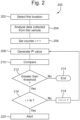
- Figure 2 shows a method 200 in which comprises generating a plurality of values, each value of the plurality being representative of a parameter of the first vehicle, and wherein the first value is one of the plurality, then comparing each one of the plurality of values to a respective threshold value.
- a respective threshold value As for the example of Figure 1 , depending on whether each one of the values is greater than (in some examples, less than) its respective threshold, an alert may be issued.
- the method 200 of Figure 2 may be a method for assessing the road safety risk at a given location.
- the method 200 may be a method of determining a risk factor at a given location. More generally, the method 200 may be a method of determining road safety.
- the method 200 comprises selecting a location from a set of locations.
- block 202 may comprise a user manually selecting a location, for example a location in a city selected from a city map or user directory.
- block 202 may be performed automatically, e.g. by a processor, a location from the set of locations based on at least one criteria to be explained with reference to another example below.
- the method 200 comprises analysing, by a processor, data collected from a first vehicle located within a first distance of the first location.
- the data may, in some examples, be streamed from the vehicle.
- the vehicle may transmit data to a remote storage device, such as a cloud device, and the stored data may be received by a device comprising the processor for analysis.
- a device on or in the vehicle itself such as a plug-in device, may transmit data to another location, such as a server device (e.g. via a cellular network).
- a "plug-in device" on the vehicle or embedded modem may constantly monitor a controller area network (CAN) device of the vehicle to collect the required data from the CAN device (such as a bus) and transmit at least a part of the data to another location for analysis, e.g. via a cellular network.
- CAN controller area network
- N values are to be generated and so the counter i will count from 1 to N.
- N values are to be generated with each one of the N values representing a parameter (in one example, a different parameter) of the first vehicle.
- the parameter(s) may be at least one of: the brake pedal pressure of the first vehicle, the speed of the first vehicle, the speed of the first vehicle engine, the steering wheel angle of the first vehicle, the accelerator pressure of the first vehicle, the state of at least one indicator of the first vehicle, the gear of the first vehicle, and the first vehicle type.
- the method 200 comprises generating a first (the ith) value, this value being representative of a first (ith) parameter of the first vehicle.
- this value is compared with a threshold Ti, and at block 212 the method comprises determining whether the ith value is greater than, or less than, its respective threshold Ti. If not, the method 200 advances to block 214 where it ends.
- whether the ith value is greater than or less than its respective threshold may depend on at least one of the first location and the type of value that is being measured (e.g. gear or engine speed, etc.).
- the method advances to block 216 at which it is determined whether the counter i has reached N. If the counter i has not reached N then the method proceeds to block 218 in which the counter is incremented by 1 and the method returns back to block 216, and the next value is generated (e.g. a value corresponding to the next parameter).
- the method 200 then comprises performing blocks 210 and 212 for the subsequent value.
- the method 200 at block 220 comprises issuing an alert. Therefore, the example of Figure 2 comprises generating a plurality of values, each representing a parameter, and comparing these values to individual thresholds. An alert is issued if each value is determined to be too low, or too high, relative to their respective threshold.
- the example of Figure 2 may be used in example situations where an individual measured performance parameter is not enough to make a risk assessment, which is instead one on the basis of two or more parameters. For example, a vehicle being operated at too high a gear (e.g.
- the determined gear is assessed to be above a maximum gear threshold may not on its own be enough for one example method to determine that there is a risk, but in combination with, for example, accelerator pedal pressure being above a maximum threshold pressure may indicate that the vehicle is being operated at a high speed with no signs of the driver slowing, and in this example an alert may be issued to alert the driver of the vehicle (or a remote source) of a risk of accident.
- Figure 3 shows an example method 300, which may be an example of the method 200 of Figure 2 .
- the method 300 comprises selecting a location from a set of locations.
- the method 300 comprises analysing, by a processor, data collected from a first vehicle located within a first distance of the first location.
- the method comprises generating a brake pedal pressure value and at block 308 the method comprises comparing this generated value to a brake pedal pressure threshold.
- the generated vehicle speed value is compared to a vehicle speed threshold and, if at block 316 it is determined that this value exceeds the vehicle speed threshold then at block 318 an engine speed value is generated and, at block 320, is compared to an engine speed threshold. If the engine speed value is greater than the threshold (determined at block 322) then at block 324 an alert is issued.
- the vehicle speed threshold may, for example, be the local speed limit.
- an accident probability, or risk is determined when the vehicle is being operated at too low a break pressure, with too high a vehicle and engine speed. This may represent the vehicle being operated too fast (e.g. for the first location) with no signs of slowing. An alert may not be issued if, for example, the brake pedal pressure is over a minimum brake pedal pressure threshold as this example may represent the driver attempting to slow the vehicle even though its speed may exceed the local speed limit.
- the brake pedal pressure threshold may be a maximum threshold and, at block 310, it may be determined that the brake pedal pressure value is above the threshold and, if it is, the method 300 may proceed to block 312.
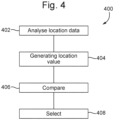
- Figure 4 shows an example method 400 for selecting a first location from a set of locations.
- the method 400 of Figure 4 may be utilised in any of blocks 102, 202, or 302 of the example methods of Figures 1 , 2 , and 3 , respectively.
- the method may be a stand-alone method and may not be used in conjunction with any of the methods of the examples of Figures 1 , 2 , or 3 .
- the method 400 comprises, at block 402, analysing, by a processor, location data collected from a monitoring service of a computing system, the location data comprising a set of location data points.
- the location data comprises a set of location data points within a distance (e.g. a radius) of a vehicle (e.g. the first vehicle).
- the method 400 comprises generating, for each location data point in the location data, a location value representative of a first location parameter of the location data.
- the first location parameter may be any of, e.g. at least one of, the number of traffic accidents that have occurred at each location data point, the average severity of the traffic accidents that have occurred at that location data point, the traffic data at that location data point, the weather at that location data point, the time of day, the road surface at that location data point.
- the method 400 comprises comparing each location value with a first location threshold to determine the set of location data points that have a location value greater than, or less than, the first location threshold.
- the method 400 comprises selecting one of the location data points that has a location value greater than, or less than, the first location threshold as the first location.
- the location value generated at block 404 is representative of the number of traffic accidents, then at block 406 this may be compared to a maximum number of traffic accidents, and if it is determined that the value is over this maximum threshold then it may be determined that this location is dangerous, or at risk of accident, and so it may be selected as the first location.
- block 404 may comprise generating a plurality of location values, and at block 406 each one of the plurality of location values may be compared to a respective threshold.
- block 404 may comprise a value representing the traffic data, and the weather at a given location. If the traffic data, when compared to a traffic data threshold, is above a maximum threshold indicating the presence of heavy traffic and if the weather data is above a weather data threshold indicating bad weather (e.g. heavy rain and/or wind) then this location may be selected as the first location, as this may indicate that this location is susceptible to traffic accidents, due to the traffic and weather thresholds being exceeded.
- FIG. 5 shows a processing apparatus 500.
- the processing apparatus 500 comprises a location module 502 configured to select a first location from a set of locations, and a processor 504 configured to analyse data collected from a first vehicle located within a first distance of the first location, and an analytics module 506 configured to generate a first value representative of a first parameter of the first vehicle, and configured to comparing the first value with a first threshold; and configured to issue an alert depending on whether the first value is greater than (in some examples, less than) the first threshold.
- the processing apparatus 500 may be configured to perform the method according to any one of the examples of Figures 1-4 .
- Figure 6 is an example of a tangible (and non-transitory) machine readable medium 600 in association with a processor 602.
- the tangible machine readable medium 600 comprises instructions 604 which, when executed by the processor 602, cause the processor 602 to carry out a plurality of tasks.
- the instructions 604 may comprise instructions to cause the processor 602 to perform the method according to any one of the examples of Figures 1-4 .
- Figure 7 shows a vehicle 700 and a controller 710 for the vehicle 700.
- the controller 710 is configured to receive data relating to a first performance parameter of a first vehicle (not shown) at a given location to determine a driving behaviour of the first vehicle, and to receive data relating to a second performance parameter of a second vehicle (not shown) at the given location to determine a driving behaviour of the second vehicle.
- the controller is further configured to receive data relating to a flow of traffic at the given location and/or a geography at the given location, and, if the controller determines that the driving behaviour of the first vehicle and the driving behaviour of the second vehicle are the same, or similar within a predetermined first threshold, and the controller determines that the flow of traffic at the given location departs from a normal traffic flow and/or the geography at the given location increases the risk of accident, then the controller is configured to issue an alert.
- controller 710 is remote from the vehicle 700 but in other examples the vehicle 700 may comprise the controller 710.
- Figure 8 schematically shows a given location 800.
- the given location 800 in the Figure 8 example comprises a 4-way crossing, or intersection, but it will be understood that this is for purely exemplary purposes to illustrate some of the principles of this disclosure and that other given locations are within the scope of the examples described herein.
- Figure 8 schematically shows a controller 810.
- the controller 810 is for a vehicle which may be the first vehicle 801, the second vehicle 802 or a (not shown) other vehicle.
- the controller 810 may comprise the controller 710 as described with reference to Figure 7 .
- the controller 810 is configured to receive data relating to a first performance parameter of the first vehicle 801 to determine a driving behaviour of the first vehicle 801, and to receive data relating to a second performance parameter of a second vehicle 802 at to determine a driving behaviour of the second vehicle 802.
- the first vehicle 801 is moving in the direction of travel indicated by arrow 801a and the second vehicle 802 is moving in the direction of travel indicated by arrow 802a. Both vehicles are therefore moving towards the intersection.
- the performance parameter may comprise at least one of: brake pedal pressure, speed, engine speed, the steering wheel angle, rate of change of input to the accelerator pedal, rate of change of position of the accelerator pedal, rate of change of steering wheel angle, the gear of the vehicle, the temporal and/or geospatial movement of the vehicle, accelerometer data, driver controls, vehicle functional status, vehicle operational status.
- performance parameters may be monitored in order to determine whether the two vehicles 801, 802 are behaving similarly in order to look at further data to determine whether there is a cause of the vehicles behaving similarly (in that their drivers are exhibiting similar driving styles). Accordingly, if the first and second driving behaviours are similar it may be determined that the vehicles are behaving similarly and the controller 810 may look at traffic flow data and/or geographic data to determine whether there may be a cause of the vehicle's behaviour, which may need to be investigated.
- Figure 9 shows a location 900 which comprises an intersection in which the north-south road is a boulevard, or similar, in that it comprises a nature strip 921, 922 between the lanes of the road.
- a nature strip 921, 922 between the lanes of the road In the middle of the intersection is another nature strip 920 which has a tree 920a and the nature strips 921, 922 between the lanes of the north-south road also comprise trees 921a, 921b, 922a, 922b.
- the location 900 also comprises two stop signs 931 and 932 which are respectively provided on the corners joining the west-north and south-east roads of the intersection.
- a building 940 is on the corner of the west-south road of the intersection. For the sake of clarity the first and second vehicles are not shown in Figure 9 .
- a controller 910 which may comprise the controllers 710 or 810 of the Figure 7 and 8 examples, is configured to receive data relating to first and second performance parameters of the (not shown) first and second vehicles to determine whether their driving behaviour is the same or similar.
- the controller is also configured to receive data relating to the geography at the location 900.
- the geographical data received by the controller may include at least one of (and in one example, all of) the position (e.g. spatial arrangement, for example coordinates) of the natures trips 920, 921, 922, trees 920a, 921a, 921b, 922a, 922b, signs 931, 932, and building 940 - these may be referred to as "obstacles".
- similar driving behaviour of the first and second vehicles may indicate a fault with one of the obstacles and/or that the obstacle needs investigation.
- similar driving behaviour proximate one of the trees and/or stop signs e.g. a rate of change of steering wheel angle
- similar driving behaviour proximate the building 940 may suggest that the drivers (e.g. travelling east on the west road) are veering to the north side of the west road so as to check for oncoming traffic on the south road, which may suggest that the building is posing a sight-line, or visibility, problem.
- the controller is also configured to receive traffic flow data.
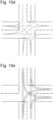
- Figure 10a shows a location 1000 which comprises an intersection and which may comprise the location 800 or 900.
- a basic road layout is shown in the location 1000 of the Figure 10a example. It will be appreciated that, over time, there will be movement of vehicles into and through the intersection 1000. This may enable the creation of a visual road-map, or virtual representation of the location 1000 showing the movement of a plurality of vehicles through the location 1000 by way of lines or paths through a virtual location corresponding to the physical location 1000. This is shown in Figure 10a as the virtual location 1001.
- the virtual location 1001 is a virtual representation of the real-world location 1000 and comprises a plurality of paths 1002, with each path 1002 representing the real-life movement of a vehicle through the location 1000, the virtual path 1002 corresponding to the path the vehicle took in the real world.
- a 2-dimensional representation of the location 1000 is produced comprising a number of 2-dimensional lines, or curves, that characterise the traffic flow through the location 1000 during a real-world time interval.
- the controller e.g. the controller of Figures 7, 8 , and/or 9, may be configured to receive the data in the same or similar format as shown in Figure 10 (e.g. the 2-dimensional representation 1001) or may be configured to receive an average traffic flow.
- Figure 10b shows such an average traffic flow representation 1003 which may be transmitted to the controller, or alternatively the controller may be configured to determine the average traffic flow.
- the plurality of traffic flow paths of the representation 1001 have been averaged to produce an average traffic flow as indicated by the lines 1004 and this may be interpreted as a "normal" traffic flow through the location 1000 virtually represented by the representation 1003.
- the controller may be configured to receive data in the same or similar format to 1003, or may receive data in the same or similar format to the representation 1002 and may be configured to determine or produce the normal traffic flow 1003 from the received data.
- Remotely mounted smart cameras e.g. mounted at or around the location 1000 may monitor the area to determine the traffic flow and produce the representation 1002 for transmitting to the controller.
- the controller may be configured to receive data from a remotely mounted smart camera to build the representation 1002.
- the remotely mounted smart cameras may also be configured to produce the representation 1003 and transmit this to the controller.
- the remotely mounted smart cameras may transmit data to a remote control unit, the control unit being configured to build the representation 1002 and/or 1003 and transmit this to the controller, the controller thereby being configured to receive the traffic flow data from the control unit.
- traffic flow data may indicate that the flow of traffic at the location 1000 is departing from normal (the normal being indicated by the average traffic flow 1003).
- Figures 10c , 10d and 10e indicate traffic flow data that deviate from the normal traffic flow as indicated in Figure 10b .
- Figure 10c shows unusual traffic data (unusual in the sense that it is different to the normal traffic flow data as indicated by 1003 in Figure 10b ) in that each driver appears to be U-turning when approaching, or at, the intersection.
- the similar behaviour of the first and second vehicles may comprise both vehicles prematurely slowing, or braking, (e.g. by monitoring the parameter of speed and/or brake pedal pressure) when approaching the junction and/or monitoring the rate of change of steering wheel angle may indicate the vehicles turning more sharply than usual (potentially indicating a U-turn).
- the traffic flow data of Figure 10c suggests that drivers are U-turning at or approaching the intersection, suggesting that there is a potential accident risk in the middle of the intersection.
- the controller is configured to issue an alert.
- Figure 10d shows another example of the traffic data deviating from normal. If the first and second vehicles are behaving similarly, as described above, and the received traffic data indicates a traffic flow similar to Figure 10d , then this suggests that drivers are avoiding turning left from the south road to the west road, suggesting that there is a potential accident risk on the corner of the south and west roads.
- the controller is configured to issue an alert.
- Figure 10e shows another example of the traffic data deviating from normal. If the first and second vehicles are behaving similarly, as described above, and the received traffic data indicated a traffic flow similar to Figure 10e , then this suggests that drivers are avoiding the west road.
- the controller is configured to issue an alert.
- the traffic flow data indicates a normal flow (e.g. the traffic flow data received is similar to that shown in Figure 10b ) and/or the road geography indicates that no obstacle is present proximate the first and second vehicles, then no alert may be issued as it may be effectively concluded that there is no risk of accident.
- the determination that the traffic flow patterns, e.g. those shown in Figures 10c , 10d, and 10e , differ from the normal traffic flow pattern, e.g. that shown in Figure 10b may be done by computing a measure of difference between the flow patterns (of Figs. 10c-e ) and the normal flow pattern 1003.
- the measure of difference may comprise treating the normal flow curve 1003 as a regression line and computing the residuals between the values of the curve of the traffic flow pattern (e.g. those shown in Figures 10c-e ), e.g. at a plurality of points along an axis (e.g.
- the measure of difference may be said to be below a threshold when the sum of the absolute value of each residual is below the threshold. In this way it may be determined that the lower the sum of the absolute value of each residual, the more the traffic flow curve is identical to the normal traffic flow curve 1003.
- the virtual representation of traffic flow may comprise a 3-dimensioanl grid, or volume, and the flow paths may comprise 3-dimensional curves in the 3-dimensiaonl volume.
- a 2-dimensional representation may be suitable for representing plan view of a road space
- the 3-dimensional representation may comprise a volume that is a visual representation of the sky, or ocean, with the paths of the vehicles in these examples extending in three dimensions.
- the controller is configured to issue the alert when the first and second vehicle are behaving similarly and the traffic flow data indicates a departure from normal and/or the geographic data indicates the presence of an obstacle proximate the first and second vehicles, in some examples the controller will not issue an alert. In some examples, the issuance of an alert will depend on historical data relating to whether any accidents have occurred in, around, on, or proximate to the given location.
- the controller e.g. the controller 710, 810, or 910
- the controller is configured to receive historical accident-related data to determine whether an accident has occurred at the given location. If an accident has occurred at the given location (as determined by the presence of historical accident data) then, in some examples, the controller may not send an alert as the accident data indicates that the given location being an accident risk is known, e.g. to a local authority.
- the controller 710, 810, 910 may also be configured to instruct a vehicle (for example a vehicle remote from the controller or a vehicle comprising the controller) approaching the intersection to driver away under autonomous control (e.g. to avoid the potential accident risk), or to instruct a route guidance system to re-program the vehicle's destination to avoid the given location.
- the controller may be configured to issue an alert comprising instructions which, when executed by a vehicle, cause the vehicle to change its autonomous driving style and/or parameters, and/or to change the route guidance of the vehicle.
- FIG. 11 This is shown in Figure 11 .
- a first vehicle 1101 and a second vehicle 1102 have exhibited the same driving behaviour due to the presence of an accident risk indicated schematically at 1104. Due to either traffic flow data (such as that indicated in Figure 11c) and/or geographic data (such as indicated by the tree 920a in Figure 9 ), a controller 1110 (that may comprise the controller 710, 810, 910) issues an alert, comprising the signal 1111, to a third vehicle 505 approaching the given location 1103.
- traffic flow data such as that indicated in Figure 11c
- geographic data such as indicated by the tree 920a in Figure 9
- the first and second vehicles 1110, 1102 were approaching, or were inside of the given location 1103, travelling north on the south road, but at the current time frame (snapshotted in the schematic of Figure 11 ) each driver has taken a course of action in view of the accident risk 1104.
- the driver of vehicle 1101 has turned left on to the west road and the driver of vehicle 1102 has U-turned to travel south on the south road.
- the third vehicle 1105 has, as its end destination, the point indicated by the star 1106. Under normal traffic conditions, the vehicle 1105 would be able to travel north on the south road, cross the intersection that is at the centre of the given location 1103.
- the alert 1111 being transmitted by the controller 1110 to the vehicle 1105 takes into account the driving behaviour of the first and second vehicles 1101, 1102 and that they were exhibiting this driving behaviour in order to avoid an accident at 1104, and comprises instructions that, when executed by the vehicle 1105 (e.g. a processor or controller thereof), cause the vehicle 1105 to either drive to the end destination 1106, under autonomous control, taking a route that avoids the location 1104, or cause a route guidance system of the vehicle 1105 to reprogram its route to the destination 1106 that avoids the location 1104. This new route is indicated by the dotted arrows 1107.
- the vehicle 1105 in view of the vehicle 1105 being unable to travel on a usual route to 1106, the vehicle 1105 takes, or a driver of the vehicle 1105 is instructed to take, the new route 1107 to the destination 1106 that avoids the accident-risk location 1104.
- the first and/or second vehicles behaviour may be used to instruct the vehicle 1105.
- each of the first and second vehicles have taken a different course of action to avoid the location 1104 and vehicle 1105 takes a further different course of action, in turning right before it is at the given location 1103.
- the vehicle 1105 may be instructed to mimic, or substantially mimic, the actions taken by the first and/or second vehicles.
- the vehicle 1105 (or the driver thereof) may be instructed to enter the intersection but turn left, following vehicle 1101, or U-turn, following vehicle 1102, to avoid the location 1104.
- the vehicle 1105 may be instructed to deviate from the actions taken by the first and/or second vehicles.
- each of the vehicles 1101, 1102, 1105 may comprise its own controller that can effectively build up a network of vehicle-to-vehicle communication where each controller of each vehicle can send a signal that instructs a controller of another vehicle, e.g. in the manner described with reference to Figure 11 .
- Figure 12 shows an example method 1200 which may be a computer-implemented method. Any one of the controllers 710, 810, 910, and 1110 may be configured to perform the method 1200 of Figure 12 .
- the method comprises receiving data relating to a first performance parameter of a first vehicle at a given location to determine a driving behaviour of the first vehicle.
- the method comprises receiving data relating to a second performance parameter of a second vehicle at the given location to determine a driving behaviour of the second vehicle.
- Block 1203 comprises receiving data relating to a flow of traffic at the given location
- block 1204 comprises receiving data relating to a geography at the given location. As indicated by the doted box, blocks 1203 and 1204 may be performed alternatively, or in addition to one another.
- Block 1205 comprises determining whether the driving behaviour of the first vehicle and the driving behaviour of the second vehicle are the same, or similar within a predetermined first threshold and, if so, blocks 1206 and 1207, respectively comprise determining whether the flow of traffic at the given location departs from a normal traffic flow, and determining whether the geography at the given location increases the risk of accident.
- the dotted box indicates that blocks 1206 and 1207 may be performed alternatively, or in addition to one another. If yes, block 1208 comprises issuing an alert.
- the method 1200 may comprise receiving data relating to accidents that have occurred within a predetermined threshold of the given location.
- the method 1200 may comprise receiving data relating to, or describing, a normal traffic flow through the given location (for example as described above in relation to Figures 10a and 10b ).
- the method 1200 may comprise determining a normal traffic flow through the given location (for example as described above in relation to Figure 10b ).
- the method 1200 may comprise determining a measure of difference between the flow of traffic (e.g. the current flow of traffic, or the flow of traffic within a certain time of the current time) at the given location and determining whether flow departs from normal may be based on the measure of difference (e.g. whether the measure of difference is above a predetermined threshold).
- Figure 13 shows an example non-transitory and machine- (or computer-) readable storage medium 1300 comprising a set of machine- (or computer-) readable instructions 1302 (e.g. stored thereon) which, when executed by a 1304 processor (e.g. a controller for a vehicle such as the controller 710, 810, 910, 1110) cause the processor to perform the method 1200 as discussed in relation to the example of Figure 12 .
- a 1304 processor e.g. a controller for a vehicle such as the controller 710, 810, 910, 1110
Landscapes
- Engineering & Computer Science (AREA)
- Physics & Mathematics (AREA)
- General Physics & Mathematics (AREA)
- Automation & Control Theory (AREA)
- Mechanical Engineering (AREA)
- Transportation (AREA)
- Analytical Chemistry (AREA)
- Chemical & Material Sciences (AREA)
- Human Computer Interaction (AREA)
- Mathematical Physics (AREA)
- Radar, Positioning & Navigation (AREA)
- Remote Sensing (AREA)
- Aviation & Aerospace Engineering (AREA)
- Business, Economics & Management (AREA)
- Emergency Management (AREA)
- Traffic Control Systems (AREA)
Description
- The present invention relates to a method and apparatus for determining road safety. In one example, the method relates to determining road safety at a particular location based on certain performance parameters one or more vehicles being operated at or near that location that may indicate how the vehicles are being driven.
- Road safety is an important concern for many cities across the world, some of which have shown, or are showing, an increased commitment to reducing the number of road-related accidents and injuries. However, some cities may not have adequate resources to address safety concerns at every location within their cities. In particular, it may be difficult for some cities to identify the areas of higher risk to traffic accidents (for example, so as to reduce the risk of future accidents in that location). Reducing death and serious injury on roads remains both difficult to achieve and a high priority for many areas.
US 9805601 - Identifying the areas in a city of high accident risk may be beneficial towards reducing the number of injuries and fatalities in that city. Some of examples of the disclosure presented herein relate to monitoring a performance parameter of a vehicle in a given location, and, when it is determined that the performance parameter is greater than, or less than, an acceptable threshold, an alert may be issued to give warning that an accident is likely. Consequentially, the alert may indicate that the given location is more susceptible to accidents.
- A controller is defined by
claim 1. The controller is configured to receive data relating to a first performance parameter of a first vehicle at a given location to determine a driving behaviour of the first vehicle, and data relating to a second performance parameter of a second vehicle at the given location to determine a driving behaviour of the second vehicle. The controller is also configured to receive data relating to a geography at the given location. If the controller determines that the driving behaviour of the first vehicle and the driving behaviour of the second vehicle are the same, or similar within a predetermined first threshold, and the controller determines that the geography at the given location increases the risk of accident, then the controller is configured to issue an alert. - In this way, the behaviour of two drivers is monitored at a given location (for example approaching an intersection). If the two drivers are behaving similarly then geographical data are examined to determine whether there is a probable cause of the similar driver behaviour. For example, an obstacle in the local geography of the location may indicate a potential accident risk. Alternatively, if there is nothing in the road geography that would suggest an accident then it may be concluded that the two drivers' similar behaviour is isolated and/or coincidental and an alert may not be issued in this case. In this latter example, this data may indicate that the two vehicles are driving normally (albeit similarly) through a safe location.
- For geographical data this may comprise road layout information (e.g. whether there are any kerbs, signage, markings, etc.) and/or information on the wider environment (including trees, buildings etc.) and/or broader location information (including gradients, sight lines, orientation to sun, road lighting) etc. Whereas a normal flow of traffic at a given time may provide an explanation for the driver behaviour that may be temporary for example due to a broken down vehicle, geographical data may provide a "local" and more permanent reason for the driver behaviour, such as poor sight lines, lighting, or sun exposure etc.).
- The controller may be configured to receive data relating to accidents that have occurred within a predetermined threshold (e.g. a second threshold) of the given location. The controller may be configured to determine whether an accident has occurred within the predetermined (second) threshold. In these examples, the threshold may be a distance, for example a radius from the given location (or a centre thereof). In this example the data may relate to all accidents that have occurred within a predetermined radius of the given location. In another example the threshold may be a temporal threshold. In this example the data may relate to all accidents that have occurred within a maximum travel time (e.g. 10 mins away at the local speed limit(s)) from the given location. In these examples, the controller is configured to take into account whether there have been any known accidents in the area and to issue an alert on this basis. In these examples, the accident data may allow an understanding of where, when, and/or under what conditions accidents have occurred in the past which can aid in an understanding of where they are likely to occur in the future.
- Accordingly, the accident data may comprise metadata describing the position (e.g. by GPS coordinates) and the time, date etc. of the accident that has occurred.
- The controller may be configured to issue the alert to at least one of: a local authority, a fleet manager (e.g. of the first and/or second vehicle), a driver of a vehicle (e.g. the first and/or second vehicle).
- The controller may be configured to issue the alert based on whether an accident has occurred within the predetermined threshold. For example, if the controller determines that an accident has not occurred within the predetermined threshold then the controller may be configured to issue the alert. In this example, the alert may be issued to a local authority as this may represent the instance where a local authority is unaware of the given location being a potential accident hotspot (as there is no historical accident data associated with that location) and so the alert essentially flags to the local authority that the given location should be investigated. Alternatively, if the controller determines that an accident has occurred within the predetermined threshold then the controller is configured to issue the alert. In this example, the alert may be issued to a driver (e.g. a driver of the first and/or the second vehicle) as this may represent the first and/or second drivers heading towards a potentially dangerous location.
- The alert may comprise metadata describing the accident that has occurred within the predetermined threshold. This may allow the driver and/or local authority to make an informed decision as to whether to further investigate the given location etc.
- At least one (or both) of the first and second performance parameters comprises brake pedal pressure or rate of change of steering wheel angle. In other words, at least one of these parameters may be monitored to determine the first and second driving behaviours of the first and second vehicles. In one example the parameters may be the same, for example rate of change of steering wheel angle may be monitored for both vehicles and it may be determined form this parameter that both vehicles are swerving (and therefore may be swerving to avoid a potential cause of accident). In another example the parameters may be different, for example the rate of change of steering wheel angle of the first vehicle may be monitored and the brake pedal pressure of the second vehicle may be monitored. The rate of change of steering wheel angle may indicate that the first vehicle is swerving and the brake pedal pressure may indicate that the second vehicle is braking harshly (and therefore may be indicating that both drivers are behaving to avoid a potential cause of accident). The controller may therefore comprise a vehicle sensor (e.g. a sensor configured to sense a vehicle parameter) of may be configured to receive data from a vehicle sensor.
- Therefore, in some examples, to determine whether the driving behaviour of the first vehicle and the driving behaviour of the second vehicle are the same, or similar within the predetermined threshold, the controller may be configured to compute a measure of difference between the first and second performance parameters and to determine that the first and second driving behaviours are the same, or similar within the predetermined threshold, if the measure of difference is zero, or less than a predetermined threshold (e.g. a third threshold). For example, the accelerator pedal rate of change of input of each vehicle may be monitored and determined and a measure of difference of this parameter for each vehicle may be determined. If this measure of difference is less than the predetermined (third) threshold then it may be determined that the driving behaviour is the same. In these examples it may also be determined whether the first and second parameters fall below, or exceed, a predetermined threshold.
- In other examples, to determine whether the driving behaviour of the first vehicle and the driving behaviour of the second vehicle are the same, or similar within the predetermined threshold, the controller may be configured to compute a measure of difference between the first performance parameter and a predetermined threshold (e.g. a fourth threshold), and to compute a measure of difference between the second performance parameter and a predetermined threshold (e.g. a fifth threshold), and the determination that the first and second driving behaviours are the same, or similar within the predetermined threshold, is based on each measure of difference. In this example the two performance parameters may be different, and it may be determined that the driving behaviours are the same or similar when the first performance parameter falls below a predetermined acceptable threshold and the second performance parameter exceeds a predetermined acceptable threshold. In another example, the two performance parameters may be different and it may be determined that the driving behaviours are the same or similar when the both performance parameters fall below, or exceed, a predetermined acceptable threshold.
- To compute a measure of difference, the controller may be configured to determine the difference between the value of the first and second performance parameters.
- According to some examples herein, however not according to the claimed invention, the controller is configured to receive data relating to the flow of traffic and to determine whether the flow of traffic departs from a normal traffic flow. The controller may be configured to receive data describing a normal traffic flow through the given location. The controller may be configured to determine a normal traffic flow through the given location. The controller may be configured to receive data (e.g. data relating to a flow of traffic at the given location) from a smart device (e.g. from a smart camera or smartphone).
- The controller may be configured to determine a measure of difference between the flow of traffic and the normal flow of traffic and the controller is to determine that the flow of traffic departs from the normal flow of traffic when the measure of difference is above a predetermined threshold (e.g. a sixth predetermined threshold). In this way, a departure from the normal traffic flow is determined when the (current) flow of traffic is sufficiently different from a normal traffic flow. The normal traffic flow may represent an average traffic flow, e.g. over an historical time interval.
- The data relating to the flow of traffic at the given location comprises a virtual representation of the given location, the virtual representation comprising a plurality of virtual traffic paths, each virtual traffic path representing the historical movement of a vehicle through the given location. The normal traffic flow may comprise an average flow path, e.g. over a historical time interval. The controller may be configured to average at least a portion of the plurality of virtual traffic flow paths to determine a normal traffic flow through the given location being the average of the virtual traffic flow paths. In this way, the traffic flow may be visualised as a road network comprising a number of paths in a virtual location, with each path representing the real-time flow of traffic through the given location corresponding to the virtual location.
- The virtual representation may comprise a 2-dimensional grid and wherein the virtual traffic paths are lines on the 2-dimensional grid. In this way, the virtual representation may comprise a 2-d visualisation of traffic flow through the given location, e.g. represented in terms of a top, plan, or birds-eye view looking down on the given location, with each flow path being represented by a curve in 2-d space. In other examples, the virtual representation may comprise a 3-dimensional grid, or volume. This may be suited for examples where the vehicle comprises a marine vessel, or an aircraft, etc. In these examples, the virtual representation may comprise a 3-d visualisation of traffic flow through a 3-dimensional volume (corresponding to the given location). In some examples, the 3-d visualisation may be viewable in a virtual environment (e.g. via a virtual reality headset). Accordingly, the controller may be configured to receive the traffic flow data form at least one remotely mounted smart camera. For example, a remotely mounted smart camera may use image recognition software and/or machine learning to identify and classify objects (e.g. pedestrian, car, cycle, van, etc.) and may construct, e.g. through image analysis, the virtual representation being a reconstruction of the area of road space at the given location comprising the temporal and geospatial movement and behaviour of certain objects (e.g. car, pedestrian, etc.) through the area of road space. This data may be sent to the controller and the controller may be configured to determine normal traffic flow. Alternatively, the smart camera may determine a normal traffic flow and send this data to the controller.
- The data relating to a geography at the given location comprises data describing an obstacle within a predetermined distance of the given location. For example, the predetermined distance may comprise a predetermined radius from the given location (e.g. a centre thereof). The data may therefore describe an obstacle (for example, a plurality of obstacles) that are within a predetermined radius of the given location (e.g. a centre thereof). The obstacle may comprise at least one of: a parked vehicle, roadworks, a sign, a tree, a building, a kerb, a road marking, a road gradient, a sight line, a position of the sun, lighting on the road, dustbin, bollard, lamppost, or bush etc.
- The controller is configured to determine that the geography at the given location increases the risk of accident if there is an obstacle within the predetermined distance (or radius) of the given location. For example, if it is determined that a street sign and/or tree is within the predetermined distance, which may be configured so as to be proximate the first and/or second vehicles, then it may be determined that the street sign and/or tree may pose a risk of accident. The controller may be configured to receive data (e.g. data relating to a flow of traffic at the given location from a smart device (e.g. from a smart camera or smartphone).
- Issuing the alert may comprise causing an alarm to sound. In other words, if the controller determines that the driving behaviour of the first vehicle and the driving behaviour of the second vehicle are within the predetermined first threshold and the controller determines that the flow of traffic at the given location departs from a normal traffic flow and/or the geography at the given location increases the risk of accident, then the controller is configured to cause an alarm to sound.
- The alarm may comprise an audio alarm, visual alarm and/or sending signal to another entity. For example, the alarm may comprise a warning sound, warning light (e.g. on a dash panel of the vehicle) or sending a signal to another vehicle, e.g. that causes an alarm of that other vehicle to sound.
- The alert may comprise metadata describing the deviation from the normal traffic flow and/or how the geography increases the risk of accident (e.g. whether an obstacle is present, the type and/or position of an obstacle etc.).
- The controller may be configured to issue the alert to all vehicles within a predetermined threshold (e.g. a seventh threshold, e.g. a predetermined radius) of the given location and/or all vehicles travelling towards the given location. The alert issued to another vehicle may comprise instructions that, when executed by the other vehicle, cause an alarm to sound in the third vehicle. As above, the alarm may comprise an audio and/or a visual alarm (e.g. a warning sound or light).
- The controller may be configured to issue an alert to a third vehicle, and the alert may comprise machine-readable instructions that, when executed by the third vehicle (e.g. a controller and/or processor thereof) cause the third vehicle to drive away from the given location under autonomous control and/or mimic the driving behaviour of at least one of the first and second vehicle. In another example, the controller may be configured to issue an alert to a third vehicle, and the alert may comprise machine-readable instructions that, when executed by the third vehicle (e.g. a controller and/or processor thereof) cause the third vehicle to deviate from the driving behaviour of at least one of the first and second vehicles. In this latter example, the first and second vehicles may be swerving, but the third vehicle (which may comprise a police vehicle) may deviate from this behaviour by stopping (e.g. to divert traffic).
- The controller may be configured to issue an alert to a vehicle route guidance system, and the alert may comprise machine-readable instructions that, when executed by the route guidance system, cause the route guidance system to recalculate a route to a target destination that avoids the given location.
- According to one example, there may be provided a vehicle comprising the controller as described above. In this example, the controller is provided on a vehicle and is capable of issuing an alert (or warning) to the driver of the vehicle and/or to a location remote from the vehicle (such as a local authority). In other examples, the controller may be provided remote from a vehicle, for example may be provided proximate an area of road. The vehicle (comprising the controller) may be the first vehicle and/or the second vehicle. In these examples, the controller may be configured to monitor the performance parameter of the vehicle at, on, or in which it is disposed and one other vehicle.
- A method is defined by claim 7.
- The method may comprise receiving data relating to accidents that have occurred within a predetermined threshold of the given location (e.g. a predetermined second threshold). The method may comprise determining whether an accident has occurred within the predetermined threshold.
- The alert may be issued based on whether an accident has occurred within the predetermined threshold. If it is determined that an accident has not occurred within the predetermined threshold then the method may comprise issuing the alert. If it is determined that an accident has occurred within the predetermined threshold then the method may comprise issuing the alert. The alert may comprise metadata describing the accident that has occurred within the predetermined threshold.
- At least one, or both, of the first and second performance parameters may comprise brake pedal pressure or rate of change of steering wheel angle.
- Determining whether the driving behaviour of the first vehicle and the driving behaviour of the second vehicle are the same, or similar within the predetermined threshold, may comprise computing a measure of difference between the first and second performance parameters, and determining that the first and second driving behaviours are the same, or similar within the predetermined threshold, may comprise determining that the measure of difference is zero, or less than a predetermined threshold (e.g. a predetermined third threshold).
- Determining whether the driving behaviour of the first vehicle and the driving behaviour of the second vehicle are the same, or similar within the predetermined threshold, may comprise computing a measure of difference between the first performance parameter and a predetermined threshold (e.g. a fourth threshold), and computing a measure of difference between the second performance parameter and a predetermined threshold (e.g. a fifth threshold), and determining that the first and second driving behaviours are the same, or similar within the predetermined threshold, may be based on each measure of difference. Computing the measure of difference may comprise determining the difference between the value of the first and second performance parameters.
- The method may comprise, not according to the claimed invention, receiving data describing a normal traffic flow through the given location. The method may comprise determining a normal traffic flow through the given location. The method may comprise determining a measure of difference between the flow of traffic and the normal flow of traffic, and determine that the flow of traffic departs from the normal flow of traffic when the measure of difference is above a predetermined threshold (e.g. a predetermined sixth threshold).
- The data relating to the flow of traffic at the given location may comprise a virtual representation of the given location, the virtual representation comprising a plurality of virtual traffic paths, each virtual traffic path representing the historical movement of a vehicle through the given location. The virtual representation may comprise a 2-dimensional grid and wherein the virtual traffic paths are lines on the 2-dimensional grid.
- The method may comprise averaging at least a portion of the plurality of virtual traffic flow paths to determine a normal traffic flow through the given location being the average of the virtual traffic flow paths.
- The data relating to a geography at the given location comprises data describing an obstacle within a predetermined distance of the given location.
- The method comprises determining that the geography at the given location increases the risk of accident if there is an obstacle within the predetermined distance of the given location. The obstacle may comprise at least one of: a parked vehicle, roadworks, a sign, a tree, a building, a kerb, a road marking, a road gradient, a sight line, a position of the sun, lighting on the road, dustbin, bollard, lamppost, or bush etc.
- Receiving data (e.g. data relating to a flow of traffic at the given location and/or a geography at the given location) may comprise receiving data from a smart device (e.g. from a smart camera or smartphone).
- Issuing the alert may comprise issuing the alert to at least one of: a local authority, a fleet manager (e.g. of the first and/or second vehicle), a driver of a vehicle (e.g. the first and/or second vehicle). Issuing the alert may comprise causing an alarm to sound.
- The alert may comprise metadata describing the deviation from the normal traffic flow and/or how the geography increases the risk of accident (e.g. whether an obstacle is present, the type and/or position of an obstacle etc.).
- Issuing the alert may comprise issuing the alert to all vehicles within a predetermined threshold (e.g. a seventh predetermined threshold, e.g. a predetermined radius) of the given location and/or all vehicles travelling towards the given location.
- Issuing the alert may comprise issuing an alert to a third vehicle, and wherein the alert comprises machine-readable instructions that, when executed by the third vehicle (e.g. a controller and/or processor thereof) cause the third vehicle to drive away from the given location under autonomous control and/or mimic (or, in other examples, deviate) the driving behaviour of at least one of the first and second vehicle.
- Issuing the alert may comprise issuing the alert to a vehicle route guidance system, and wherein the alert comprises machine-readable instructions that, when executed by the route guidance system, cause the route guidance system to recalculate a route to a target destination that avoids the given location.
- A non-transitory machine-readable medium is defined by claim 10.
- For a better understanding of the present disclosure, and to illustrate how it may be put into effect, examples will now be described with reference to the accompanying drawings in which:
-
Figure 1 is a flowchart of an example method; -
Figure 2 is a flowchart of an example method; -
Figure 3 is a flowchart of an example method; -
Figure 4 is a flowchart of an example method; -
Figure 5 is an example processing apparatus; -
Figure 6 is an example of a machine readable medium in association with a processor; -
Figure 7 is a schematic diagram of an example controller; -
Figure 8 is a schematic diagram showing an example road layout; -
Figure 9 is a schematic diagram showing an example road layout showing geographical features; -
Figure 10a is a schematic diagram of an example road layout and a representation of flow paths of traffic through the road layout; -
Figure 10b is a schematic diagram of an average traffic flow through the road layout ofFigure 10a based on the traffic flow shown inFigure 10a ; -
Figures 10c-10e are example traffic flows through the example road layout ofFigure 10a that show a different flow path than the average flow path shown inFigure 10a ; -
Figure 11 is a schematic diagram showing an example road layout and a path through the example road layout taking into account the potential accident risk of a location in the example road layout; -
Figure 12 is a flowchart of an example method; and -
Figure 13 is an example non-transitory machine-readable medium in association with a processor. - The present disclosure relates to a controller for a vehicle, such as a motor vehicle (e.g. car, van, truck, motorcycle etc.), industrial or agricultural vehicles (e.g. tractor, forklift, bulldozer, excavator etc), marine vessel, aircraft or any other type of vehicle.
-
Figure 1 shows anexample method 100. Themethod 100 may be a method for assessing the road safety risk at a given location. Themethod 100 may be a method of determining a risk factor at a given location. More generally, themethod 100 may be a method of determining road safety. - At
block 102, themethod 100 comprises selecting a first location from a set of locations.Block 102, in some examples, may comprise a user manually selecting a location, for example a location in a city selected from a city map or user directory. In other examples, block 102 may be performed automatically, e.g. by a processor, a location from the set of locations based on at least one criteria to be explained with reference to another example below. - At
block 104, themethod 100 comprises analysing, by a processor, data collected from a first vehicle located within a first distance of the first location. The data may, in some examples, be streamed from the vehicle. In one example, the vehicle may transmit data to a remote storage device, such as a cloud device, and the stored data may be received by a device comprising the processor for analysis. In other examples, a device on or in the vehicle itself, such as a plug-in device, may transmit data to another location, such as a server device (e.g. via a cellular network). In one example, a "plug-in device" on the vehicle or embedded modem may constantly monitor a controller area network (CAN) device of the vehicle to collect the required data from the CAN device (such as a bus) and transmit at least a part of the data to another location for analysis, e.g. via a cellular network. - At
block 106, themethod 100 comprises generating values representative of respective performance parameters of the first vehicle. For example, block 106 may comprise generating a first value representative of a first performance parameter of the first vehicle and generating a second value representative of a second performance value of the first vehicle. The performance parameters may be at least one of: the brake pedal pressure of the first vehicle, the speed of the first vehicle, the speed of the first vehicle engine, the steering wheel angle of the first vehicle, the rate of change of steering wheel angle of the first vehicle, the accelerator pressure of the first vehicle, the state of at least one indicator of the first vehicle, the gear of the first vehicle, and the first vehicle type. - Therefore, block 106 may comprise generating values representative of the behaviour of the vehicle, for example how the vehicle is being operated. As will explained below, in subsequent steps, these may be assessed to determine if the vehicle is being operated "at-risk" and therefore may be used to determine a risk of accident at the first location.
- At
block 108, themethod 100 comprises comparing at least one value with a first threshold; and atblock 110, it is determined whether this value is greater than (in some example, less than) the first threshold. If it is determined atblock 110 that the first value is greater than or less than the first threshold then themethod 100 proceeds to block 112 at which an alert is issued, e.g. a safety alert. - For example, at
block 106 themethod 100 may comprise generating a value representative of the brake pedal pressure of the first vehicle. Atblock 108 this value may be compared with a threshold brake pedal pressure which may indicate a minimum brake pedal pressure which should be applied for the vehicle to be considered to be operated safely. Accordingly, atblock 110 if it is determined that the brake pedal pressure value is less than the threshold an alert may be issued atblock 112 which may indicate that the vehicle is being operated at risk (e.g. to other vehicles or pedestrians) or that there is a heightened risk of accident. For example, the first location may represent a roundabout or a corner or T-intersection and so a minimal amount of brake pressure may be expected to be applied by a user of the vehicle so as to decelerate the vehicle to a speed appropriate for entering the roundabout or for taking corners, etc. Accordingly, the applied brake pedal pressure being below the minimum threshold (as determined at block 110) at the first location may cause the alert to be issued atblock 112 as this may, in this example, indicate that the vehicle is heading toward the first location too fast. - Alternatively, the brake pedal threshold may be a maximum threshold as higher braking pressure than expected may suggest that the driver is emergency braking, and this may cause the alert to be issued at
block 112. - By way of another example, at
block 106 themethod 100 may comprise generating a value representative of the gear of the first vehicle. Atblock 108 this value may be compared to a threshold gear number which may indicate a minimum gear, or a maximum gear, at which the vehicle would be considered to be operated safely. For example, if the first location were on, and in the middle of, a freeway then the threshold gear may be fourth of fifth, indicating a minimum range of speeds that are considered safe. If the vehicle's gear were below this threshold then this may indicate that the vehicle is being operated at too low a gear (and therefore too slowly) for its location (the first location being on a freeway where the speed limit may be comparatively high). Alternatively, the first location could be at, or near, a school zone and the threshold gear may be, for example, third gear, and if the operated gear is above this threshold then this may indicate that the vehicle's speed is too fast for the school zone. In each of these examples, an alert may be issued to alert someone (for example, the driver or a remote party) of the risk. - By way of a further example, if the value is representative of the vehicle speed then the threshold may be a maximum threshold (such as the local speed limit at the first location). When the vehicle speed value is above this threshold then it is determined that the vehicle is being operated above the local speed limit and hence the alert is issued at
block 112. - Hence, the
method 100, atblock 110, comprises comparing the value to a threshold and issuing an alert when the value is greater (in some examples) or less (in other examples) than the threshold since whether there is a risk may depend on the type of parameter being monitored. - As will now be explained with reference to
Figure 2 , multiple values may be used, and the alert may be issued when a combination of values is above, or below, the threshold. -
Figure 2 shows amethod 200 in which comprises generating a plurality of values, each value of the plurality being representative of a parameter of the first vehicle, and wherein the first value is one of the plurality, then comparing each one of the plurality of values to a respective threshold value. As for the example ofFigure 1 , depending on whether each one of the values is greater than (in some examples, less than) its respective threshold, an alert may be issued. - The
method 200 ofFigure 2 may be a method for assessing the road safety risk at a given location. Themethod 200 may be a method of determining a risk factor at a given location. More generally, themethod 200 may be a method of determining road safety. - At
block 202 themethod 200 comprises selecting a location from a set of locations. As for themethod 100, block 202, in some examples, may comprise a user manually selecting a location, for example a location in a city selected from a city map or user directory. In other examples, block 202 may be performed automatically, e.g. by a processor, a location from the set of locations based on at least one criteria to be explained with reference to another example below. - At
block 204, themethod 200 comprises analysing, by a processor, data collected from a first vehicle located within a first distance of the first location. The data may, in some examples, be streamed from the vehicle. In one example, the vehicle may transmit data to a remote storage device, such as a cloud device, and the stored data may be received by a device comprising the processor for analysis. In other examples, a device on or in the vehicle itself, such as a plug-in device, may transmit data to another location, such as a server device (e.g. via a cellular network). In one example, a "plug-in device" on the vehicle or embedded modem may constantly monitor a controller area network (CAN) device of the vehicle to collect the required data from the CAN device (such as a bus) and transmit at least a part of the data to another location for analysis, e.g. via a cellular network. - At
block 206 themethod 200 setting a counter i = 1. In this example, N values are to be generated and so the counter i will count from 1 to N. In this example, N values are to be generated with each one of the N values representing a parameter (in one example, a different parameter) of the first vehicle. The parameter(s) may be at least one of: the brake pedal pressure of the first vehicle, the speed of the first vehicle, the speed of the first vehicle engine, the steering wheel angle of the first vehicle, the accelerator pressure of the first vehicle, the state of at least one indicator of the first vehicle, the gear of the first vehicle, and the first vehicle type. - At
block 208, themethod 200 comprises generating a first (the ith) value, this value being representative of a first (ith) parameter of the first vehicle. Atblock 210 this value is compared with a threshold Ti, and atblock 212 the method comprises determining whether the ith value is greater than, or less than, its respective threshold Ti. If not, themethod 200 advances to block 214 where it ends. As will be appreciated, whether the ith value is greater than or less than its respective threshold may depend on at least one of the first location and the type of value that is being measured (e.g. gear or engine speed, etc.). - If, at
block 212 it is determined that the ith generated value is greater than, or less than, its respective threshold then the method advances to block 216 at which it is determined whether the counter i has reached N. If the counter i has not reached N then the method proceeds to block 218 in which the counter is incremented by 1 and the method returns back to block 216, and the next value is generated (e.g. a value corresponding to the next parameter). Themethod 200 then comprises performingblocks - Having generated the required number of values, and if all of those values were determined (at block 212) to be greater than, or less than, their respective thresholds, then the
method 200, atblock 220 comprises issuing an alert. Therefore, the example ofFigure 2 comprises generating a plurality of values, each representing a parameter, and comparing these values to individual thresholds. An alert is issued if each value is determined to be too low, or too high, relative to their respective threshold. Thus, the example ofFigure 2 may be used in example situations where an individual measured performance parameter is not enough to make a risk assessment, which is instead one on the basis of two or more parameters. For example, a vehicle being operated at too high a gear (e.g. the determined gear is assessed to be above a maximum gear threshold) may not on its own be enough for one example method to determine that there is a risk, but in combination with, for example, accelerator pedal pressure being above a maximum threshold pressure may indicate that the vehicle is being operated at a high speed with no signs of the driver slowing, and in this example an alert may be issued to alert the driver of the vehicle (or a remote source) of a risk of accident. - Once example of
Figure 2 (where N=3, and where each value represents a specific and different parameter) is depicted inFigure 3 and will now be described. -
Figure 3 shows anexample method 300, which may be an example of themethod 200 ofFigure 2 . Atblock 302 themethod 300 comprises selecting a location from a set of locations. Atblock 304, themethod 300 comprises analysing, by a processor, data collected from a first vehicle located within a first distance of the first location. - At
block 306 the method comprises generating a brake pedal pressure value and atblock 308 the method comprises comparing this generated value to a brake pedal pressure threshold. Atblock 310 it is determined whether the generated brake pedal pressure value is lower than a brake pedal pressure threshold and if it is the method proceeds to block 312 at which a vehicle speed value is generated. Atblock 314 the generated vehicle speed value is compared to a vehicle speed threshold and, if atblock 316 it is determined that this value exceeds the vehicle speed threshold then atblock 318 an engine speed value is generated and, atblock 320, is compared to an engine speed threshold. If the engine speed value is greater than the threshold (determined at block 322) then atblock 324 an alert is issued. The vehicle speed threshold may, for example, be the local speed limit. Therefore, in the example ofFigure 3 an accident probability, or risk, is determined when the vehicle is being operated at too low a break pressure, with too high a vehicle and engine speed. This may represent the vehicle being operated too fast (e.g. for the first location) with no signs of slowing. An alert may not be issued if, for example, the brake pedal pressure is over a minimum brake pedal pressure threshold as this example may represent the driver attempting to slow the vehicle even though its speed may exceed the local speed limit. - Alternatively, the brake pedal pressure threshold may be a maximum threshold and, at
block 310, it may be determined that the brake pedal pressure value is above the threshold and, if it is, themethod 300 may proceed to block 312. - It will be appreciated that the order in which these steps are depicted in, and described with reference to,
Figure 3 is for illustrative purposes only. -
Figure 4 shows anexample method 400 for selecting a first location from a set of locations. Themethod 400 ofFigure 4 may be utilised in any ofblocks Figures 1 ,2 , and3 , respectively. Alternatively, the method may be a stand-alone method and may not be used in conjunction with any of the methods of the examples ofFigures 1 ,2 , or3 . - The
method 400 comprises, atblock 402, analysing, by a processor, location data collected from a monitoring service of a computing system, the location data comprising a set of location data points. In one example, the location data comprises a set of location data points within a distance (e.g. a radius) of a vehicle (e.g. the first vehicle). - At
block 404, themethod 400 comprises generating, for each location data point in the location data, a location value representative of a first location parameter of the location data. The first location parameter may be any of, e.g. at least one of, the number of traffic accidents that have occurred at each location data point, the average severity of the traffic accidents that have occurred at that location data point, the traffic data at that location data point, the weather at that location data point, the time of day, the road surface at that location data point. - At
block 406, themethod 400 comprises comparing each location value with a first location threshold to determine the set of location data points that have a location value greater than, or less than, the first location threshold. - At
block 408, themethod 400 comprises selecting one of the location data points that has a location value greater than, or less than, the first location threshold as the first location. - For example, if the location value generated at
block 404 is representative of the number of traffic accidents, then atblock 406 this may be compared to a maximum number of traffic accidents, and if it is determined that the value is over this maximum threshold then it may be determined that this location is dangerous, or at risk of accident, and so it may be selected as the first location. - In one example, block 404 may comprise generating a plurality of location values, and at
block 406 each one of the plurality of location values may be compared to a respective threshold. For example, block 404 may comprise a value representing the traffic data, and the weather at a given location. If the traffic data, when compared to a traffic data threshold, is above a maximum threshold indicating the presence of heavy traffic and if the weather data is above a weather data threshold indicating bad weather (e.g. heavy rain and/or wind) then this location may be selected as the first location, as this may indicate that this location is susceptible to traffic accidents, due to the traffic and weather thresholds being exceeded. -
Figure 5 shows aprocessing apparatus 500. Theprocessing apparatus 500 comprises alocation module 502 configured to select a first location from a set of locations, and aprocessor 504 configured to analyse data collected from a first vehicle located within a first distance of the first location, and ananalytics module 506 configured to generate a first value representative of a first parameter of the first vehicle, and configured to comparing the first value with a first threshold; and configured to issue an alert depending on whether the first value is greater than (in some examples, less than) the first threshold. - The
processing apparatus 500 may be configured to perform the method according to any one of the examples ofFigures 1-4 . -
Figure 6 is an example of a tangible (and non-transitory) machinereadable medium 600 in association with aprocessor 602. The tangible machinereadable medium 600 comprisesinstructions 604 which, when executed by theprocessor 602, cause theprocessor 602 to carry out a plurality of tasks. For examples, theinstructions 604 may comprise instructions to cause theprocessor 602 to perform the method according to any one of the examples ofFigures 1-4 . -
Figure 7 shows avehicle 700 and acontroller 710 for thevehicle 700. Thecontroller 710 is configured to receive data relating to a first performance parameter of a first vehicle (not shown) at a given location to determine a driving behaviour of the first vehicle, and to receive data relating to a second performance parameter of a second vehicle (not shown) at the given location to determine a driving behaviour of the second vehicle. The controller is further configured to receive data relating to a flow of traffic at the given location and/or a geography at the given location, and, if the controller determines that the driving behaviour of the first vehicle and the driving behaviour of the second vehicle are the same, or similar within a predetermined first threshold, and the controller determines that the flow of traffic at the given location departs from a normal traffic flow and/or the geography at the given location increases the risk of accident, then the controller is configured to issue an alert. - In the example of
Figure 7 thecontroller 710 is remote from thevehicle 700 but in other examples thevehicle 700 may comprise thecontroller 710. -
Figure 8 schematically shows a givenlocation 800. At the given location are afirst vehicle 801 andsecond vehicle 802. The givenlocation 800 in theFigure 8 example comprises a 4-way crossing, or intersection, but it will be understood that this is for purely exemplary purposes to illustrate some of the principles of this disclosure and that other given locations are within the scope of the examples described herein.Figure 8 schematically shows acontroller 810. Thecontroller 810 is for a vehicle which may be thefirst vehicle 801, thesecond vehicle 802 or a (not shown) other vehicle. Thecontroller 810 may comprise thecontroller 710 as described with reference toFigure 7 . - Accordingly, the
controller 810 is configured to receive data relating to a first performance parameter of thefirst vehicle 801 to determine a driving behaviour of thefirst vehicle 801, and to receive data relating to a second performance parameter of asecond vehicle 802 at to determine a driving behaviour of thesecond vehicle 802. Thefirst vehicle 801 is moving in the direction of travel indicated byarrow 801a and thesecond vehicle 802 is moving in the direction of travel indicated byarrow 802a. Both vehicles are therefore moving towards the intersection. The performance parameter may comprise at least one of: brake pedal pressure, speed, engine speed, the steering wheel angle, rate of change of input to the accelerator pedal, rate of change of position of the accelerator pedal, rate of change of steering wheel angle, the gear of the vehicle, the temporal and/or geospatial movement of the vehicle, accelerometer data, driver controls, vehicle functional status, vehicle operational status. - These performance parameters may be monitored in order to determine whether the two
vehicles controller 810 may look at traffic flow data and/or geographic data to determine whether there may be a cause of the vehicle's behaviour, which may need to be investigated. - This is schematically shown in
Figures 9 and10 . -
Figure 9 shows alocation 900 which comprises an intersection in which the north-south road is a boulevard, or similar, in that it comprises anature strip nature strip 920 which has atree 920a and thenature strips trees location 900 also comprises twostop signs building 940 is on the corner of the west-south road of the intersection. For the sake of clarity the first and second vehicles are not shown inFigure 9 . - A
controller 910, which may comprise thecontrollers Figure 7 and 8 examples, is configured to receive data relating to first and second performance parameters of the (not shown) first and second vehicles to determine whether their driving behaviour is the same or similar. The controller is also configured to receive data relating to the geography at thelocation 900. For example, for thelocation 900 the geographical data received by the controller may include at least one of (and in one example, all of) the position (e.g. spatial arrangement, for example coordinates) of the natures trips 920, 921, 922,trees signs - As will be described below, similar driving behaviour of the first and second vehicles may indicate a fault with one of the obstacles and/or that the obstacle needs investigation. For example, similar driving behaviour proximate one of the trees and/or stop signs (e.g. a rate of change of steering wheel angle) may suggest that the drivers of the first and second vehicles are swerving to avoid something, which may indicate that the tree and/or stop sign has fallen and is now blocking or obstructing part of the road. In another example, similar driving behaviour proximate the
building 940 may suggest that the drivers (e.g. travelling east on the west road) are veering to the north side of the west road so as to check for oncoming traffic on the south road, which may suggest that the building is posing a sight-line, or visibility, problem. - As explained above, the controller is also configured to receive traffic flow data.
-
Figure 10a shows alocation 1000 which comprises an intersection and which may comprise thelocation location 1000 of theFigure 10a example. It will be appreciated that, over time, there will be movement of vehicles into and through theintersection 1000. This may enable the creation of a visual road-map, or virtual representation of thelocation 1000 showing the movement of a plurality of vehicles through thelocation 1000 by way of lines or paths through a virtual location corresponding to thephysical location 1000. This is shown inFigure 10a as thevirtual location 1001. Thevirtual location 1001 is a virtual representation of the real-world location 1000 and comprises a plurality ofpaths 1002, with eachpath 1002 representing the real-life movement of a vehicle through thelocation 1000, thevirtual path 1002 corresponding to the path the vehicle took in the real world. In this way a 2-dimensional representation of thelocation 1000 is produced comprising a number of 2-dimensional lines, or curves, that characterise the traffic flow through thelocation 1000 during a real-world time interval. The controller (e.g. the controller ofFigures 7, 8 , and/or 9, may be configured to receive the data in the same or similar format as shown inFigure 10 (e.g. the 2-dimensional representation 1001) or may be configured to receive an average traffic flow. -
Figure 10b shows such an averagetraffic flow representation 1003 which may be transmitted to the controller, or alternatively the controller may be configured to determine the average traffic flow. AsFigure 10b shows, the plurality of traffic flow paths of therepresentation 1001 have been averaged to produce an average traffic flow as indicated by thelines 1004 and this may be interpreted as a "normal" traffic flow through thelocation 1000 virtually represented by therepresentation 1003. As stated above, the controller may be configured to receive data in the same or similar format to 1003, or may receive data in the same or similar format to therepresentation 1002 and may be configured to determine or produce thenormal traffic flow 1003 from the received data. Remotely mounted smart cameras (e.g. mounted at or around the location 1000) may monitor the area to determine the traffic flow and produce therepresentation 1002 for transmitting to the controller. Alternatively, the controller may be configured to receive data from a remotely mounted smart camera to build therepresentation 1002. The remotely mounted smart cameras may also be configured to produce therepresentation 1003 and transmit this to the controller. In another example the remotely mounted smart cameras may transmit data to a remote control unit, the control unit being configured to build therepresentation 1002 and/or 1003 and transmit this to the controller, the controller thereby being configured to receive the traffic flow data from the control unit. - As explained above, similar driving behaviour of the first and second vehicles may indicate that there is a potential cause of accident that needs investigating and for this purposes the controller may examine, not according to the claimed invention, traffic flow data. For example, traffic flow data may indicate that the flow of traffic at the
location 1000 is departing from normal (the normal being indicated by the average traffic flow 1003).Figures 10c ,10d and 10e indicate traffic flow data that deviate from the normal traffic flow as indicated inFigure 10b . -
Figure 10c shows unusual traffic data (unusual in the sense that it is different to the normal traffic flow data as indicated by 1003 inFigure 10b ) in that each driver appears to be U-turning when approaching, or at, the intersection. The similar behaviour of the first and second vehicles may comprise both vehicles prematurely slowing, or braking, (e.g. by monitoring the parameter of speed and/or brake pedal pressure) when approaching the junction and/or monitoring the rate of change of steering wheel angle may indicate the vehicles turning more sharply than usual (potentially indicating a U-turn). The traffic flow data ofFigure 10c suggests that drivers are U-turning at or approaching the intersection, suggesting that there is a potential accident risk in the middle of the intersection. In the example where the received traffic flow data comprises the data as inFigure 10c , the controller is configured to issue an alert. -
Figure 10d shows another example of the traffic data deviating from normal. If the first and second vehicles are behaving similarly, as described above, and the received traffic data indicates a traffic flow similar toFigure 10d , then this suggests that drivers are avoiding turning left from the south road to the west road, suggesting that there is a potential accident risk on the corner of the south and west roads. In the example where the received traffic flow data comprises the data as inFigure 10d , the controller is configured to issue an alert. -
Figure 10e shows another example of the traffic data deviating from normal. If the first and second vehicles are behaving similarly, as described above, and the received traffic data indicated a traffic flow similar toFigure 10e , then this suggests that drivers are avoiding the west road. In the example where the received traffic flow data comprises the data as inFigure 10e , the controller is configured to issue an alert. - In another example where the driving behaviour of the first and second vehicles are similar but the traffic flow data indicates a normal flow (e.g. the traffic flow data received is similar to that shown in
Figure 10b ) and/or the road geography indicates that no obstacle is present proximate the first and second vehicles, then no alert may be issued as it may be effectively concluded that there is no risk of accident. - In each example the determination that the traffic flow patterns, e.g. those shown in
Figures 10c ,10d, and 10e , differ from the normal traffic flow pattern, e.g. that shown inFigure 10b , may be done by computing a measure of difference between the flow patterns (ofFigs. 10c-e ) and thenormal flow pattern 1003. For example the measure of difference may comprise treating thenormal flow curve 1003 as a regression line and computing the residuals between the values of the curve of the traffic flow pattern (e.g. those shown inFigures 10c-e ), e.g. at a plurality of points along an axis (e.g. an assigned 'x'-axis being parallel to one of the roads in the virtual road map), and then summing up the absolute value of each residual. The measure of difference may be said to be below a threshold when the sum of the absolute value of each residual is below the threshold. In this way it may be determined that the lower the sum of the absolute value of each residual, the more the traffic flow curve is identical to the normaltraffic flow curve 1003. - Although the traffic flow, and the traffic flow data, schematically depicted in the examples of
Figure 10 it is to be understood that this is for exemplary purposes only. It is to be understood that in other examples the virtual representation of traffic flow may comprise a 3-dimensioanl grid, or volume, and the flow paths may comprise 3-dimensional curves in the 3-dimensiaonl volume. Whilst a 2-dimensional representation may be suitable for representing plan view of a road space, in examples when the vehicle comprises an aircraft or marine vessel the 3-dimensional representation may comprise a volume that is a visual representation of the sky, or ocean, with the paths of the vehicles in these examples extending in three dimensions. - Although the controller is configured to issue the alert when the first and second vehicle are behaving similarly and the traffic flow data indicates a departure from normal and/or the geographic data indicates the presence of an obstacle proximate the first and second vehicles, in some examples the controller will not issue an alert. In some examples, the issuance of an alert will depend on historical data relating to whether any accidents have occurred in, around, on, or proximate to the given location.
- For example, the controller (e.g. the
controller - The
controller - This is shown in
Figure 11 . InFigure 11 , afirst vehicle 1101 and asecond vehicle 1102 have exhibited the same driving behaviour due to the presence of an accident risk indicated schematically at 1104. Due to either traffic flow data (such as that indicated in Figure 11c) and/or geographic data (such as indicated by thetree 920a inFigure 9 ), a controller 1110 (that may comprise thecontroller signal 1111, to a third vehicle 505 approaching the givenlocation 1103. At the time of determining the risk of a presence of an accident in the given location 1103 (indicated schematically by the dotted circle) the first andsecond vehicles location 1103, travelling north on the south road, but at the current time frame (snapshotted in the schematic ofFigure 11 ) each driver has taken a course of action in view of theaccident risk 1104. For example, the driver ofvehicle 1101 has turned left on to the west road and the driver ofvehicle 1102 has U-turned to travel south on the south road. Thethird vehicle 1105 has, as its end destination, the point indicated by thestar 1106. Under normal traffic conditions, thevehicle 1105 would be able to travel north on the south road, cross the intersection that is at the centre of the givenlocation 1103. However, the alert 1111 being transmitted by thecontroller 1110 to thevehicle 1105 takes into account the driving behaviour of the first andsecond vehicles vehicle 1105 to either drive to theend destination 1106, under autonomous control, taking a route that avoids thelocation 1104, or cause a route guidance system of thevehicle 1105 to reprogram its route to thedestination 1106 that avoids thelocation 1104. This new route is indicated by the dottedarrows 1107. In this example, in view of thevehicle 1105 being unable to travel on a usual route to 1106, thevehicle 1105 takes, or a driver of thevehicle 1105 is instructed to take, thenew route 1107 to thedestination 1106 that avoids the accident-risk location 1104. - In another example, the first and/or second vehicles behaviour may be used to instruct the
vehicle 1105. For example, inFigure 11 each of the first and second vehicles have taken a different course of action to avoid thelocation 1104 andvehicle 1105 takes a further different course of action, in turning right before it is at the givenlocation 1103. However in another example thevehicle 1105 may be instructed to mimic, or substantially mimic, the actions taken by the first and/or second vehicles. For example, the vehicle 1105 (or the driver thereof) may be instructed to enter the intersection but turn left, followingvehicle 1101, or U-turn, followingvehicle 1102, to avoid thelocation 1104. In other examples, thevehicle 1105 may be instructed to deviate from the actions taken by the first and/or second vehicles. - It will be appreciated that where the
controller 1110 is disposed on a vehicle then each of thevehicles Figure 11 . -
Figure 12 shows anexample method 1200 which may be a computer-implemented method. Any one of thecontrollers method 1200 ofFigure 12 . - At
block 1201 the method comprises receiving data relating to a first performance parameter of a first vehicle at a given location to determine a driving behaviour of the first vehicle. Atblock 1202 the method comprises receiving data relating to a second performance parameter of a second vehicle at the given location to determine a driving behaviour of the second vehicle.Block 1203 comprises receiving data relating to a flow of traffic at the given location, andblock 1204 comprises receiving data relating to a geography at the given location. As indicated by the doted box, blocks 1203 and 1204 may be performed alternatively, or in addition to one another.Block 1205 comprises determining whether the driving behaviour of the first vehicle and the driving behaviour of the second vehicle are the same, or similar within a predetermined first threshold and, if so, blocks 1206 and 1207, respectively comprise determining whether the flow of traffic at the given location departs from a normal traffic flow, and determining whether the geography at the given location increases the risk of accident. The dotted box indicates thatblocks - The
method 1200 may comprise receiving data relating to accidents that have occurred within a predetermined threshold of the given location. Themethod 1200 may comprise receiving data relating to, or describing, a normal traffic flow through the given location (for example as described above in relation toFigures 10a and10b ). Themethod 1200 may comprise determining a normal traffic flow through the given location (for example as described above in relation toFigure 10b ). Themethod 1200 may comprise determining a measure of difference between the flow of traffic (e.g. the current flow of traffic, or the flow of traffic within a certain time of the current time) at the given location and determining whether flow departs from normal may be based on the measure of difference (e.g. whether the measure of difference is above a predetermined threshold). -
Figure 13 shows an example non-transitory and machine- (or computer-)readable storage medium 1300 comprising a set of machine- (or computer-) readable instructions 1302 (e.g. stored thereon) which, when executed by a 1304 processor (e.g. a controller for a vehicle such as thecontroller method 1200 as discussed in relation to the example ofFigure 12 .
Claims (10)
- A controller (710) configured to receive:(1201) data relating to a first performance parameter of a first vehicle (1101) at a given location (1103) to determine a driving behaviour of the first vehicle, wherein the first performance parameter comprises a rate of change of steering wheel angle or a brake pedal pressure, and the driving behaviour comprises whether the first vehicle is swerving or braking harshly; and(1202) data relating to a second performance parameter of a second vehicle (1102) at the given location to determine a driving behaviour of the second vehicle, wherein the second performance parameter comprises a rate of change of steering wheel angle or a brake pedal pressure, and the driving behaviour comprises whether the second vehicle is swerving or braking harshly,wherein the controller is configured to receive data relating to:
(1204) a geography at the given location, wherein the data relating to the geography at the given location comprises data describing an obstacle within a predetermined distance of the given location;
and,to determine if the driving behaviour of the first vehicle and the driving behaviour of the second vehicle are the same, or similar within a predetermined first threshold:if the first and second performance parameters are the same, the controller determines whether a difference between the values of the first and second performance parameters is zero or less than a predetermined threshold, andif the first and second performance parameters are different, the controller determines whether the first performance parameter exceeds a predetermined threshold and determines whether the second performance parameter exceeds a predetermined threshold,and if the controller determines (1205) that the driving behaviour of the first vehicle and the driving behaviour of the second vehicle are the same, or similar within a predetermined first threshold, then the geographical data are examined to determine whether there is a probable cause of the same or similar driving behaviour,and if the controller determines that:
(1207) the geography at the given location increases the risk of accident due to the presence of an obstacle within the predetermined distance of the given location,then the controller is configured to issue an alert (1208). - The controller (710) as claimed in claim 1 wherein the controller is configured to receive data relating to accidents that have occurred within a predetermined threshold of the given location (1103), and , if the controller determines that an accident has not occurred within the predetermined threshold then the controller is configured to issue the alert.
- The controller (710) of any preceding claim, wherein the obstacle comprises: a parked vehicle, roadworks, a sign, a tree, a building, a kerb, a road marking, a road gradient, a sight line, a position of the sun, lighting on the road, dustbin, bollard, lamppost, or a bush.
- The controller (710) as claimed in any preceding claim wherein the controller is configured to issue the alert to at least one of:all vehicles within a predetermined threshold of the given location (1103); andall vehicles travelling towards the given location (1103).
- The controller (710) as claimed in any preceding claim wherein the controller is configured to issue an alert to a third vehicle (1105), and wherein the alert comprises machine-readable instructions that, when executed by the third vehicle cause the third vehicle to at least one of:drive away from the given location (1103) under autonomous control; andmimic the driving behaviour of at least one of the first and second vehicle (1101, 1102).
- The controller (710) as claimed in any preceding claim wherein the controller is configured to issue an alert to a vehicle route guidance system, and wherein the alert comprises machine-readable instructions that, when executed by the route guidance system, cause the route guidance system to recalculate a route to a target destination that avoids the given location (1103).
- A computer-implemented method (1200) comprising:(1201) receiving data relating to a first performance parameter of a first vehicle at a given location to determine a driving behaviour of the first vehicle, wherein the first performance parameter comprises a rate of change of steering wheel angle or a brake pedal pressure, and the driving behaviour comprises whether the first vehicle is swerving or braking harshly;(1202) receiving data relating to a second performance parameter of a second vehicle at the given location to determine a driving behaviour of the second vehicle, wherein the second performance parameter comprises a rate of change of steering wheel angle or a brake pedal pressure, and the driving behaviour comprises whether the second vehicle is swerving or braking harshly;receiving data relating to:(1204) a geography at the given location, wherein the data relating to the geography at the given location comprises data describing an obstacle within a predetermined distance of the given location;(1205) determining whether the driving behaviour of the first vehicle and the driving behaviour of the second vehicle are the same, or similar within a predetermined first threshold, comprising:if the first and second performance parameters are the same, determining whether a difference between the values of the first and second performance parameters is zero or less than a predetermined threshold, andif the first and second performance parameters are different, determining whether the first performance parameter exceeds a predetermined threshold and determining whether the second performance parameter exceeds a predetermined threshold; anddetermining:(1207) whether the geography at the given location increases the risk of accident due to the presence of an obstacle within the predetermined distance of the given location, and
if it is determined that the driving behaviour of the first vehicle and the driving behaviour of the second vehicle are the same, or similar within a predetermined first threshold, then the geographical data are examined to determine whether there is a probable cause of the same or similar driving behaviour, and if it is determined that:the geography at the given location increases the risk of accident due to the presence of an obstacle within the predetermined distance of the given location, (1208) issuing an alert. - The method (1200) as claimed in claim 7 further comprising:
receiving data relating to accidents that have occurred within a predetermined threshold of the given location. - The method (1200) as claimed in claim 7 or 8 wherein determining (1205) whether the driving behaviour of the first vehicle and the driving behaviour of the second vehicle are the same, or similar within the predetermined threshold, comprises computing a measure of difference between the first and second performance parameters, and determining that the first and second driving behaviours are the same, or similar within the predetermined first threshold, comprises determining that the measure of difference is zero, or less than a predetermined threshold; or computing a measure of difference between the first performance parameter and a predetermined threshold, and computing a measure of difference between the second performance parameter and a predetermined threshold, and wherein determining whether the first and second driving behaviours are the same, or similar within the predetermined first threshold, is based on each measure of difference.
- A non-transitory machine-readable medium (1300) comprising instructions (1302) which, when executed by a processor (1304), cause the processor to perform the method (1200) according to any one of claims 7-9.
Applications Claiming Priority (2)
| Application Number | Priority Date | Filing Date | Title |
|---|---|---|---|
| GB1814854.4A GB2577082B (en) | 2018-09-12 | 2018-09-12 | Determining road safety |
| GB1913089.7A GB2578677B (en) | 2018-09-12 | 2019-09-11 | Determining road safety |
Publications (2)
| Publication Number | Publication Date |
|---|---|
| EP3792894A1 EP3792894A1 (en) | 2021-03-17 |
| EP3792894B1 true EP3792894B1 (en) | 2025-04-02 |
Family
ID=63921078
Family Applications (1)
| Application Number | Title | Priority Date | Filing Date |
|---|---|---|---|
| EP20156447.3A Active EP3792894B1 (en) | 2018-09-12 | 2020-02-10 | Determining road safety |
Country Status (5)
| Country | Link |
|---|---|
| US (2) | US11699347B2 (en) |
| EP (1) | EP3792894B1 (en) |
| CN (2) | CN110895887A (en) |
| DE (1) | DE102019123507A1 (en) |
| GB (2) | GB2577082B (en) |
Families Citing this family (17)
| Publication number | Priority date | Publication date | Assignee | Title |
|---|---|---|---|---|
| US11855971B2 (en) * | 2018-01-11 | 2023-12-26 | Visa International Service Association | Offline authorization of interactions and controlled tasks |
| US11718288B2 (en) | 2020-03-23 | 2023-08-08 | Toyota Motor North America, Inc. | Consensus-based transport event severity |
| US11574543B2 (en) * | 2020-03-23 | 2023-02-07 | Toyota Motor North America, Inc. | Transport dangerous location warning |
| US20210291866A1 (en) | 2020-03-23 | 2021-09-23 | Toyota Motor North America, Inc. | Transport item management |
| US20210291819A1 (en) | 2020-03-23 | 2021-09-23 | Toyota Motor North America, Inc. | Transport dangerous situation consensus |
| US11192497B1 (en) * | 2020-07-31 | 2021-12-07 | Sherlin Enterprises LLC | Vehicle warning system |
| US11613271B2 (en) * | 2020-08-18 | 2023-03-28 | Allstate Insurance Company | Driver behavior tracking and prediction |
| EP4112411B1 (en) * | 2021-07-01 | 2024-03-27 | Zenseact AB | Estimation of accident intensity for vehicles |
| CN114882694B (en) * | 2022-03-24 | 2023-06-02 | 成都亿盟恒信科技有限公司 | Risk area generation method and system based on alarm positioning data |
| US12339129B2 (en) * | 2022-09-05 | 2025-06-24 | Y.E. Hub Armenia LLC | Methods and servers for generating a prediction score by a machine learning algorithm |
| US12456378B2 (en) | 2022-12-22 | 2025-10-28 | Direct Cursus Technology L.L.C | Method and a system for assigning vehicles to taxi orders |
| US12441365B2 (en) * | 2023-03-30 | 2025-10-14 | Honda Motor Co., Ltd. | Automated driving vehicle and traffic safety support system |
| US12391308B2 (en) * | 2023-08-23 | 2025-08-19 | Toyota Jidosha Kabushiki Kaisha | False positive request detection |
| CN117289675A (en) * | 2023-09-15 | 2023-12-26 | 苏州时代新安能源科技有限公司 | Performance testing methods, devices, equipment and computer storage media for vehicle control modules |
| US20250166508A1 (en) * | 2023-11-17 | 2025-05-22 | GM Global Technology Operations LLC | System and method of traffic signal violation risk assessment and warning |
| EP4660044A1 (en) * | 2024-06-04 | 2025-12-10 | Deere & Company | Method for generating an acoustic trip condition report for an agricultural tractor |
| US12620309B2 (en) * | 2024-06-21 | 2026-05-05 | Torc Robotics, Inc. | Systems and methods for crash detection on autonomous vehicles |
Family Cites Families (18)
| Publication number | Priority date | Publication date | Assignee | Title |
|---|---|---|---|---|
| EP1500907B1 (en) * | 2003-07-21 | 2014-11-12 | LG Electronics, Inc. | Apparatus and method for detecting vehicle location in navigation system |
| US20110037619A1 (en) * | 2009-08-11 | 2011-02-17 | On Time Systems, Inc. | Traffic Routing Using Intelligent Traffic Signals, GPS and Mobile Data Devices |
| US20100100324A1 (en) * | 2008-10-22 | 2010-04-22 | Toyota Motor Engineering & Manufacturing North America, Inc. | Communication based vehicle-pedestrian collision warning system |
| US9418554B2 (en) * | 2014-08-07 | 2016-08-16 | Verizon Patent And Licensing Inc. | Method and system for determining road conditions based on driver data |
| US9081650B1 (en) * | 2012-12-19 | 2015-07-14 | Allstate Insurance Company | Traffic based driving analysis |
| US10880118B2 (en) * | 2014-05-01 | 2020-12-29 | Elizabeth B. Stolfus | Providing dynamic routing alternatives based on determined traffic conditions |
| US9373257B2 (en) * | 2014-09-29 | 2016-06-21 | Lytx, Inc. | Proactive driver warning |
| US10024684B2 (en) * | 2014-12-02 | 2018-07-17 | Operr Technologies, Inc. | Method and system for avoidance of accidents |
| US9836963B1 (en) * | 2015-01-20 | 2017-12-05 | State Farm Mutual Automobile Insurance Company | Determining corrective actions based upon broadcast of telematics data originating from another vehicle |
| GB2539470A (en) * | 2015-06-17 | 2016-12-21 | Risk Telematics Uk Ltd | Monitoring vehicle behaviour |
| US9849887B2 (en) * | 2015-08-27 | 2017-12-26 | Intelligent Imaging Systems, Inc. | Contextual driver behavior monitoring |
| US20210272207A1 (en) * | 2015-08-28 | 2021-09-02 | State Farm Mutual Automobile Insurance Company | Vehicular driver profiles and discounts |
| US20170264688A1 (en) * | 2015-09-09 | 2017-09-14 | Telefonaktiebolaget Lm Ericsson (Publ) | Methods and devices for requesting and providing information |
| DE102015015259A1 (en) * | 2015-11-26 | 2016-05-12 | Daimler Ag | Method for the route guidance of a vehicle |
| US10810695B2 (en) * | 2016-12-31 | 2020-10-20 | Ava Information Systems Gmbh | Methods and systems for security tracking and generating alerts |
| US11816981B2 (en) * | 2017-05-23 | 2023-11-14 | D.R Roads A.I Ltd. | Traffic monitoring and management systems and methods |
| US10304329B2 (en) * | 2017-06-28 | 2019-05-28 | Zendrive, Inc. | Method and system for determining traffic-related characteristics |
| US10803740B2 (en) * | 2017-08-11 | 2020-10-13 | Cubic Corporation | System and method of navigating vehicles |
-
2018
- 2018-09-12 GB GB1814854.4A patent/GB2577082B/en active Active
-
2019
- 2019-09-03 DE DE102019123507.3A patent/DE102019123507A1/en active Pending
- 2019-09-10 CN CN201910850395.7A patent/CN110895887A/en active Pending
- 2019-09-11 US US16/568,138 patent/US11699347B2/en active Active
- 2019-09-11 GB GB1913089.7A patent/GB2578677B/en active Active
-
2020
- 2020-02-10 EP EP20156447.3A patent/EP3792894B1/en active Active
- 2020-02-24 CN CN202010112936.9A patent/CN112572452A/en active Pending
- 2020-02-28 US US16/804,967 patent/US11210950B2/en active Active
Also Published As
| Publication number | Publication date |
|---|---|
| GB201913089D0 (en) | 2019-10-23 |
| GB2577082B (en) | 2021-01-06 |
| EP3792894A1 (en) | 2021-03-17 |
| US11699347B2 (en) | 2023-07-11 |
| US11210950B2 (en) | 2021-12-28 |
| GB2577082A (en) | 2020-03-18 |
| US20200082721A1 (en) | 2020-03-12 |
| GB201814854D0 (en) | 2018-10-24 |
| DE102019123507A1 (en) | 2020-03-12 |
| CN112572452A (en) | 2021-03-30 |
| GB2578677B (en) | 2021-11-17 |
| US20210074160A1 (en) | 2021-03-11 |
| GB2578677A (en) | 2020-05-20 |
| CN110895887A (en) | 2020-03-20 |
Similar Documents
| Publication | Publication Date | Title |
|---|---|---|
| US11210950B2 (en) | Determining road safety | |
| US12332652B1 (en) | Determining the stationary state of detected vehicles | |
| US10580296B2 (en) | Advanced threat warning for autonomous vehicles | |
| EP3217244B1 (en) | Drive mode switch-over on a planned route according to autopilot geofencing | |
| US10048700B1 (en) | Generating state information for autonomous vehicles | |
| CN107077792B (en) | Travel control system | |
| WO2021220845A1 (en) | Vehicle recording device and information recording method | |
| EP3877229B1 (en) | Automated performance checks for autonomous vehicles | |
| JP2023508083A (en) | Method and apparatus for controlling automated vehicles | |
| CN109733391A (en) | Control method, device, equipment, vehicle and the storage medium of vehicle | |
| US20190019416A1 (en) | Systems and Methods for Deploying an Autonomous Vehicle to Oversee Autonomous Navigation | |
| CN109606377B (en) | Emergency driving behavior defense prompting method and system | |
| US20120296539A1 (en) | Driver assistance system | |
| CN113140129B (en) | Vehicle early warning method, device and system | |
| JP2019519420A (en) | Vehicle monitoring control method | |
| WO2017095614A1 (en) | Collision mitigated braking for autonomous vehicles | |
| JP2013168118A (en) | Remote traffic management system using video radar | |
| CN113748448A (en) | Vehicle-based virtual stop-line and yield-line detection | |
| CN115729229B (en) | Methods and vehicle systems for use in vehicles | |
| CN117355451A (en) | Systems and methods for operating autonomous vehicles | |
| CN114689075A (en) | Driving information projection method and device and vehicle with same | |
| CN110431612B (en) | System and method for automatically controlling vehicles in a traffic network | |
| KR102897481B1 (en) | Driving Score Evaluation System and Method Based on V2X Communication | |
| US12606213B2 (en) | Providing compensation measures for preventing unexpected actions by a vehicle operator | |
| US20250065904A1 (en) | Autonomous vehicle infrastructure hub |
Legal Events
| Date | Code | Title | Description |
|---|---|---|---|
| PUAI | Public reference made under article 153(3) epc to a published international application that has entered the european phase |
Free format text: ORIGINAL CODE: 0009012 |
|
| STAA | Information on the status of an ep patent application or granted ep patent |
Free format text: STATUS: REQUEST FOR EXAMINATION WAS MADE |
|
| 17P | Request for examination filed |
Effective date: 20201127 |
|
| AK | Designated contracting states |
Kind code of ref document: A1 Designated state(s): AL AT BE BG CH CY CZ DE DK EE ES FI FR GB GR HR HU IE IS IT LI LT LU LV MC MK MT NL NO PL PT RO RS SE SI SK SM TR |
|
| AX | Request for extension of the european patent |
Extension state: BA ME |
|
| STAA | Information on the status of an ep patent application or granted ep patent |
Free format text: STATUS: EXAMINATION IS IN PROGRESS |
|
| 17Q | First examination report despatched |
Effective date: 20220817 |
|
| P01 | Opt-out of the competence of the unified patent court (upc) registered |
Effective date: 20230620 |
|
| REG | Reference to a national code |
Ref country code: DE Ref legal event code: R079 Free format text: PREVIOUS MAIN CLASS: G08G0001160000 Ipc: G08G0001010000 Ref document number: 602020048589 Country of ref document: DE |
|
| RIC1 | Information provided on ipc code assigned before grant |
Ipc: B60W 50/04 20060101ALI20240827BHEP Ipc: B60W 50/14 20200101ALI20240827BHEP Ipc: G08G 1/0968 20060101ALI20240827BHEP Ipc: G08G 1/0965 20060101ALI20240827BHEP Ipc: G08G 1/16 20060101ALI20240827BHEP Ipc: G08G 1/01 20060101AFI20240827BHEP |
|
| GRAP | Despatch of communication of intention to grant a patent |
Free format text: ORIGINAL CODE: EPIDOSNIGR1 |
|
| STAA | Information on the status of an ep patent application or granted ep patent |
Free format text: STATUS: GRANT OF PATENT IS INTENDED |
|
| INTG | Intention to grant announced |
Effective date: 20241010 |
|
| GRAS | Grant fee paid |
Free format text: ORIGINAL CODE: EPIDOSNIGR3 |
|
| GRAA | (expected) grant |
Free format text: ORIGINAL CODE: 0009210 |
|
| STAA | Information on the status of an ep patent application or granted ep patent |
Free format text: STATUS: THE PATENT HAS BEEN GRANTED |
|
| AK | Designated contracting states |
Kind code of ref document: B1 Designated state(s): AL AT BE BG CH CY CZ DE DK EE ES FI FR GB GR HR HU IE IS IT LI LT LU LV MC MK MT NL NO PL PT RO RS SE SI SK SM TR |
|
| REG | Reference to a national code |
Ref country code: GB Ref legal event code: FG4D |
|
| REG | Reference to a national code |
Ref country code: CH Ref legal event code: EP |
|
| REG | Reference to a national code |
Ref country code: IE Ref legal event code: FG4D |
|
| REG | Reference to a national code |
Ref country code: DE Ref legal event code: R096 Ref document number: 602020048589 Country of ref document: DE |
|
| REG | Reference to a national code |
Ref country code: NL Ref legal event code: MP Effective date: 20250402 |
|
| PG25 | Lapsed in a contracting state [announced via postgrant information from national office to epo] |
Ref country code: NL Free format text: LAPSE BECAUSE OF FAILURE TO SUBMIT A TRANSLATION OF THE DESCRIPTION OR TO PAY THE FEE WITHIN THE PRESCRIBED TIME-LIMIT Effective date: 20250402 |
|
| REG | Reference to a national code |
Ref country code: AT Ref legal event code: MK05 Ref document number: 1782083 Country of ref document: AT Kind code of ref document: T Effective date: 20250402 |
|
| PG25 | Lapsed in a contracting state [announced via postgrant information from national office to epo] |
Ref country code: FI Free format text: LAPSE BECAUSE OF FAILURE TO SUBMIT A TRANSLATION OF THE DESCRIPTION OR TO PAY THE FEE WITHIN THE PRESCRIBED TIME-LIMIT Effective date: 20250402 Ref country code: PT Free format text: LAPSE BECAUSE OF FAILURE TO SUBMIT A TRANSLATION OF THE DESCRIPTION OR TO PAY THE FEE WITHIN THE PRESCRIBED TIME-LIMIT Effective date: 20250804 Ref country code: ES Free format text: LAPSE BECAUSE OF FAILURE TO SUBMIT A TRANSLATION OF THE DESCRIPTION OR TO PAY THE FEE WITHIN THE PRESCRIBED TIME-LIMIT Effective date: 20250402 |
|
| REG | Reference to a national code |
Ref country code: LT Ref legal event code: MG9D |
|
| PG25 | Lapsed in a contracting state [announced via postgrant information from national office to epo] |
Ref country code: GR Free format text: LAPSE BECAUSE OF FAILURE TO SUBMIT A TRANSLATION OF THE DESCRIPTION OR TO PAY THE FEE WITHIN THE PRESCRIBED TIME-LIMIT Effective date: 20250703 Ref country code: NO Free format text: LAPSE BECAUSE OF FAILURE TO SUBMIT A TRANSLATION OF THE DESCRIPTION OR TO PAY THE FEE WITHIN THE PRESCRIBED TIME-LIMIT Effective date: 20250702 |
|
| PG25 | Lapsed in a contracting state [announced via postgrant information from national office to epo] |
Ref country code: PL Free format text: LAPSE BECAUSE OF FAILURE TO SUBMIT A TRANSLATION OF THE DESCRIPTION OR TO PAY THE FEE WITHIN THE PRESCRIBED TIME-LIMIT Effective date: 20250402 |
|
| PG25 | Lapsed in a contracting state [announced via postgrant information from national office to epo] |
Ref country code: BG Free format text: LAPSE BECAUSE OF FAILURE TO SUBMIT A TRANSLATION OF THE DESCRIPTION OR TO PAY THE FEE WITHIN THE PRESCRIBED TIME-LIMIT Effective date: 20250402 |
|
| PG25 | Lapsed in a contracting state [announced via postgrant information from national office to epo] |
Ref country code: HR Free format text: LAPSE BECAUSE OF FAILURE TO SUBMIT A TRANSLATION OF THE DESCRIPTION OR TO PAY THE FEE WITHIN THE PRESCRIBED TIME-LIMIT Effective date: 20250402 |
|
| PG25 | Lapsed in a contracting state [announced via postgrant information from national office to epo] |
Ref country code: AT Free format text: LAPSE BECAUSE OF FAILURE TO SUBMIT A TRANSLATION OF THE DESCRIPTION OR TO PAY THE FEE WITHIN THE PRESCRIBED TIME-LIMIT Effective date: 20250402 |
|
| PG25 | Lapsed in a contracting state [announced via postgrant information from national office to epo] |
Ref country code: RS Free format text: LAPSE BECAUSE OF FAILURE TO SUBMIT A TRANSLATION OF THE DESCRIPTION OR TO PAY THE FEE WITHIN THE PRESCRIBED TIME-LIMIT Effective date: 20250702 |
|
| PG25 | Lapsed in a contracting state [announced via postgrant information from national office to epo] |
Ref country code: IS Free format text: LAPSE BECAUSE OF FAILURE TO SUBMIT A TRANSLATION OF THE DESCRIPTION OR TO PAY THE FEE WITHIN THE PRESCRIBED TIME-LIMIT Effective date: 20250802 |
|
| PG25 | Lapsed in a contracting state [announced via postgrant information from national office to epo] |
Ref country code: LV Free format text: LAPSE BECAUSE OF FAILURE TO SUBMIT A TRANSLATION OF THE DESCRIPTION OR TO PAY THE FEE WITHIN THE PRESCRIBED TIME-LIMIT Effective date: 20250402 |
|
| REG | Reference to a national code |
Ref country code: DE Ref legal event code: R097 Ref document number: 602020048589 Country of ref document: DE |
|
| PG25 | Lapsed in a contracting state [announced via postgrant information from national office to epo] |
Ref country code: SM Free format text: LAPSE BECAUSE OF FAILURE TO SUBMIT A TRANSLATION OF THE DESCRIPTION OR TO PAY THE FEE WITHIN THE PRESCRIBED TIME-LIMIT Effective date: 20250402 Ref country code: DK Free format text: LAPSE BECAUSE OF FAILURE TO SUBMIT A TRANSLATION OF THE DESCRIPTION OR TO PAY THE FEE WITHIN THE PRESCRIBED TIME-LIMIT Effective date: 20250402 |
|
| PG25 | Lapsed in a contracting state [announced via postgrant information from national office to epo] |
Ref country code: CZ Free format text: LAPSE BECAUSE OF FAILURE TO SUBMIT A TRANSLATION OF THE DESCRIPTION OR TO PAY THE FEE WITHIN THE PRESCRIBED TIME-LIMIT Effective date: 20250402 |
|
| PG25 | Lapsed in a contracting state [announced via postgrant information from national office to epo] |
Ref country code: EE Free format text: LAPSE BECAUSE OF FAILURE TO SUBMIT A TRANSLATION OF THE DESCRIPTION OR TO PAY THE FEE WITHIN THE PRESCRIBED TIME-LIMIT Effective date: 20250402 |
|
| PG25 | Lapsed in a contracting state [announced via postgrant information from national office to epo] |
Ref country code: SK Free format text: LAPSE BECAUSE OF FAILURE TO SUBMIT A TRANSLATION OF THE DESCRIPTION OR TO PAY THE FEE WITHIN THE PRESCRIBED TIME-LIMIT Effective date: 20250402 Ref country code: RO Free format text: LAPSE BECAUSE OF FAILURE TO SUBMIT A TRANSLATION OF THE DESCRIPTION OR TO PAY THE FEE WITHIN THE PRESCRIBED TIME-LIMIT Effective date: 20250402 |
|
| PG25 | Lapsed in a contracting state [announced via postgrant information from national office to epo] |
Ref country code: IT Free format text: LAPSE BECAUSE OF FAILURE TO SUBMIT A TRANSLATION OF THE DESCRIPTION OR TO PAY THE FEE WITHIN THE PRESCRIBED TIME-LIMIT Effective date: 20250402 |
|
| PLBE | No opposition filed within time limit |
Free format text: ORIGINAL CODE: 0009261 |
|
| STAA | Information on the status of an ep patent application or granted ep patent |
Free format text: STATUS: NO OPPOSITION FILED WITHIN TIME LIMIT |
|
| REG | Reference to a national code |
Ref country code: CH Ref legal event code: L10 Free format text: ST27 STATUS EVENT CODE: U-0-0-L10-L00 (AS PROVIDED BY THE NATIONAL OFFICE) Effective date: 20260211 |
|
| 26N | No opposition filed |
Effective date: 20260105 |