EP3792869A1 - Video deblurring method and apparatus, and storage medium and electronic apparatus - Google Patents
Video deblurring method and apparatus, and storage medium and electronic apparatus Download PDFInfo
- Publication number
- EP3792869A1 EP3792869A1 EP19799523.6A EP19799523A EP3792869A1 EP 3792869 A1 EP3792869 A1 EP 3792869A1 EP 19799523 A EP19799523 A EP 19799523A EP 3792869 A1 EP3792869 A1 EP 3792869A1
- Authority
- EP
- European Patent Office
- Prior art keywords
- image frame
- sample
- net model
- generative
- spatio
- Prior art date
- Legal status (The legal status is an assumption and is not a legal conclusion. Google has not performed a legal analysis and makes no representation as to the accuracy of the status listed.)
- Withdrawn
Links
Images


Classifications
-
- G—PHYSICS
- G06—COMPUTING OR CALCULATING; COUNTING
- G06T—IMAGE DATA PROCESSING OR GENERATION, IN GENERAL
- G06T5/00—Image enhancement or restoration
- G06T5/73—Deblurring; Sharpening
-
- G—PHYSICS
- G06—COMPUTING OR CALCULATING; COUNTING
- G06N—COMPUTING ARRANGEMENTS BASED ON SPECIFIC COMPUTATIONAL MODELS
- G06N3/00—Computing arrangements based on biological models
- G06N3/02—Neural networks
- G06N3/04—Architecture, e.g. interconnection topology
- G06N3/045—Combinations of networks
-
- G—PHYSICS
- G06—COMPUTING OR CALCULATING; COUNTING
- G06N—COMPUTING ARRANGEMENTS BASED ON SPECIFIC COMPUTATIONAL MODELS
- G06N3/00—Computing arrangements based on biological models
- G06N3/02—Neural networks
- G06N3/04—Architecture, e.g. interconnection topology
- G06N3/0464—Convolutional networks [CNN, ConvNet]
-
- G—PHYSICS
- G06—COMPUTING OR CALCULATING; COUNTING
- G06N—COMPUTING ARRANGEMENTS BASED ON SPECIFIC COMPUTATIONAL MODELS
- G06N3/00—Computing arrangements based on biological models
- G06N3/02—Neural networks
- G06N3/04—Architecture, e.g. interconnection topology
- G06N3/047—Probabilistic or stochastic networks
-
- G—PHYSICS
- G06—COMPUTING OR CALCULATING; COUNTING
- G06N—COMPUTING ARRANGEMENTS BASED ON SPECIFIC COMPUTATIONAL MODELS
- G06N3/00—Computing arrangements based on biological models
- G06N3/02—Neural networks
- G06N3/04—Architecture, e.g. interconnection topology
- G06N3/0475—Generative networks
-
- G—PHYSICS
- G06—COMPUTING OR CALCULATING; COUNTING
- G06N—COMPUTING ARRANGEMENTS BASED ON SPECIFIC COMPUTATIONAL MODELS
- G06N3/00—Computing arrangements based on biological models
- G06N3/02—Neural networks
- G06N3/08—Learning methods
-
- G—PHYSICS
- G06—COMPUTING OR CALCULATING; COUNTING
- G06N—COMPUTING ARRANGEMENTS BASED ON SPECIFIC COMPUTATIONAL MODELS
- G06N3/00—Computing arrangements based on biological models
- G06N3/02—Neural networks
- G06N3/08—Learning methods
- G06N3/088—Non-supervised learning, e.g. competitive learning
-
- G—PHYSICS
- G06—COMPUTING OR CALCULATING; COUNTING
- G06N—COMPUTING ARRANGEMENTS BASED ON SPECIFIC COMPUTATIONAL MODELS
- G06N3/00—Computing arrangements based on biological models
- G06N3/02—Neural networks
- G06N3/08—Learning methods
- G06N3/09—Supervised learning
-
- G—PHYSICS
- G06—COMPUTING OR CALCULATING; COUNTING
- G06N—COMPUTING ARRANGEMENTS BASED ON SPECIFIC COMPUTATIONAL MODELS
- G06N3/00—Computing arrangements based on biological models
- G06N3/02—Neural networks
- G06N3/08—Learning methods
- G06N3/094—Adversarial learning
-
- G—PHYSICS
- G06—COMPUTING OR CALCULATING; COUNTING
- G06T—IMAGE DATA PROCESSING OR GENERATION, IN GENERAL
- G06T5/00—Image enhancement or restoration
- G06T5/50—Image enhancement or restoration using two or more images, e.g. averaging or subtraction
-
- G—PHYSICS
- G06—COMPUTING OR CALCULATING; COUNTING
- G06T—IMAGE DATA PROCESSING OR GENERATION, IN GENERAL
- G06T5/00—Image enhancement or restoration
- G06T5/60—Image enhancement or restoration using machine learning, e.g. neural networks
-
- G—PHYSICS
- G06—COMPUTING OR CALCULATING; COUNTING
- G06V—IMAGE OR VIDEO RECOGNITION OR UNDERSTANDING
- G06V10/00—Arrangements for image or video recognition or understanding
- G06V10/40—Extraction of image or video features
- G06V10/44—Local feature extraction by analysis of parts of the pattern, e.g. by detecting edges, contours, loops, corners, strokes or intersections; Connectivity analysis, e.g. of connected components
- G06V10/443—Local feature extraction by analysis of parts of the pattern, e.g. by detecting edges, contours, loops, corners, strokes or intersections; Connectivity analysis, e.g. of connected components by matching or filtering
- G06V10/449—Biologically inspired filters, e.g. difference of Gaussians [DoG] or Gabor filters
- G06V10/451—Biologically inspired filters, e.g. difference of Gaussians [DoG] or Gabor filters with interaction between the filter responses, e.g. cortical complex cells
- G06V10/454—Integrating the filters into a hierarchical structure, e.g. convolutional neural networks [CNN]
-
- G—PHYSICS
- G06—COMPUTING OR CALCULATING; COUNTING
- G06T—IMAGE DATA PROCESSING OR GENERATION, IN GENERAL
- G06T2207/00—Indexing scheme for image analysis or image enhancement
- G06T2207/10—Image acquisition modality
- G06T2207/10016—Video; Image sequence
-
- G—PHYSICS
- G06—COMPUTING OR CALCULATING; COUNTING
- G06T—IMAGE DATA PROCESSING OR GENERATION, IN GENERAL
- G06T2207/00—Indexing scheme for image analysis or image enhancement
- G06T2207/20—Special algorithmic details
- G06T2207/20081—Training; Learning
-
- G—PHYSICS
- G06—COMPUTING OR CALCULATING; COUNTING
- G06T—IMAGE DATA PROCESSING OR GENERATION, IN GENERAL
- G06T2207/00—Indexing scheme for image analysis or image enhancement
- G06T2207/20—Special algorithmic details
- G06T2207/20084—Artificial neural networks [ANN]
-
- G—PHYSICS
- G06—COMPUTING OR CALCULATING; COUNTING
- G06T—IMAGE DATA PROCESSING OR GENERATION, IN GENERAL
- G06T2207/00—Indexing scheme for image analysis or image enhancement
- G06T2207/20—Special algorithmic details
- G06T2207/20172—Image enhancement details
- G06T2207/20182—Noise reduction or smoothing in the temporal domain; Spatio-temporal filtering
-
- G—PHYSICS
- G06—COMPUTING OR CALCULATING; COUNTING
- G06T—IMAGE DATA PROCESSING OR GENERATION, IN GENERAL
- G06T2207/00—Indexing scheme for image analysis or image enhancement
- G06T2207/20—Special algorithmic details
- G06T2207/20172—Image enhancement details
- G06T2207/20201—Motion blur correction
-
- G—PHYSICS
- G06—COMPUTING OR CALCULATING; COUNTING
- G06T—IMAGE DATA PROCESSING OR GENERATION, IN GENERAL
- G06T2207/00—Indexing scheme for image analysis or image enhancement
- G06T2207/20—Special algorithmic details
- G06T2207/20212—Image combination
- G06T2207/20221—Image fusion; Image merging
Definitions
- Embodiments of this disclosure relate to the field of computer technologies, and in particular, to a video deblurring method and a video deblurring apparatus, a storage medium, and an electronic apparatus.
- the shaking device and a moving object to be shot may usually cause a blurry video. Therefore, there is a realistic demand for the user to transform the taken blurry video to a clearer one.
- the related art mainly includes: inputting multiple frames of images together into a convolutional neural network model, extracting spatial information in a single frame of image with a 2D convolution kernel, and performing deblurring processing on the blurry video by using a reconstruction loss function as supervised information.
- the 2D convolution kernel is used. Consequently, only the spatial information in the single frame of image can be extracted, and information between images in the video cannot be extracted. As a result, the capability of the convolutional neural network model to utilize the spatial information in the related art is limited. Besides, because merely the pixel-based reconstruction loss function is used as the supervised information, a video after deblurring appears insufficiently real, reducing the effect of video deblurring.
- Embodiments of this disclosure provide a video deblurring method and a video deblurring apparatus, a storage medium, and an electronic apparatus, to improve the effect of video deblurring.
- an embodiment of this disclosure provides a video deblurring method.
- the method includes: acquiring, by an electronic device, N continuous image frames from a video clip, the N being a positive integer, and the N image frames including a blurry image frame to be processed; performing, by the electronic device, three-dimensional 3D convolution processing on the N image frames with a generative adversarial net model, to acquire spatio-temporal information corresponding to the blurry image frame, the spatio-temporal information including spatial feature information of the blurry image frame and temporal feature information between the blurry image frame and an image frame adjacent to the blurry image frame in the N image frames; and performing, by the electronic device, deblurring processing on the blurry image frame by using the spatio-temporal information corresponding to the blurry image frame through the generative adversarial net model, to output a clear image frame.
- an embodiment of this disclosure further provides a video deblurring apparatus, including one or more processors and one or more memories storing a program unit.
- the program unit is executed by the processor.
- the program unit includes:
- modules of the video deblurring apparatus may further perform the steps in the foregoing one aspect and any possible implementation.
- an embodiment of this disclosure provides an electronic apparatus, including a processor and a memory.
- the memory stores a computer program, and the processor executes the computer program to perform the foregoing video deblurring method.
- an embodiment of this disclosure provides a non-transient computer-readable storage medium, the computer-readable storage medium storing instructions.
- the instructions when executed by a computer, cause the computer to perform the method according to the foregoing aspects.
- an embodiment of this disclosure provides a computer program product including an instruction.
- the computer program product when executed by a computer, causes the computer to perform the method according to the foregoing aspects.
- N continuous image frames are acquired from a video clip, the N image frames includes a blurry image frame to be processed.
- Three-dimensional 3D convolution processing is performed on the N image frames with a generative adversarial net model, to acquire spatio-temporal information corresponding to the blurry image frame.
- the spatio-temporal information includes spatial feature information of the blurry image frame and temporal feature information between the blurry image frame and an image frame adjacent to the blurry image frame in the N image frames.
- Deblurring processing is performed on the blurry image frame by using the spatio-temporal information corresponding to the blurry image frame through the generative adversarial net model, to output a clear image frame.
- the generative adversarial net model extracts the spatio-temporal information implicit between the continuous image frames through a 3D convolution operation, so that the deblurring processing on the blurry image frame is completed by using the spatio-temporal information corresponding to the blurry image frames through the generative adversarial net model. Therefore, a more real clear image can be obtained, and the effect of video deblurring is improved.
- Embodiments of this disclosure provide a video deblurring method and a video deblurring apparatus to improving the effect of video deblurring.
- the embodiments of this disclosure mainly provide a video deblurring method based on deep learning.
- the embodiments of this disclosure can improve a blurry video to a clear video through a deep neural network, which is applied to deblurring processing on a video taken by a camera.
- a video deblurring apparatus is further provided in the embodiments of this disclosure.
- the video deblurring apparatus may be deployed in a terminal in a form of video processing software.
- the video deblurring apparatus may alternatively be a server storing a video.
- a generative adversarial nets (GAN) model is obtained by training in a deep learning manner.
- the generative adversarial net model may be implemented by a convolutional neural network model.
- multiple frames of images neighboring each frame of image are inputted together into the generative adversarial net model; feature extraction and integration are performed on a video with multiple frames by using the generative adversarial net model; a 3D convolution operation is performed by using a three-dimensional (3D) convolution kernel in the generative adversarial net model; spatio-temporal information implicit between continuous image frames is extracted; and a blurry image frame is improved to a clear one in an equal proportion by performing a full convolution operation, so that a more real clear image can be obtained.
- the generative adversarial net model adopted in this embodiment of this disclosure can effectively extract the spatio-temporal information to process the blurry image frame, thereby automatically improving the blurry video to a clear video.
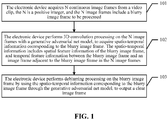
- FIG. 1 is a schematic block flowchart of a video deblurring method according to an embodiment of this disclosure.
- the video deblurring method may be executed by an electronic device.
- the electronic device may be a terminal or server. The following is described with the electronic device executing the video deblurring method as an example. Referring to FIG. 1 , the method may include the following steps 101 to 103.
- the electronic device acquires N continuous image frames from a video clip, the N is a positive integer, and the N image frames include a blurry image frame to be processed.
- the video clip may be shot by the terminal through a camera, or may be downloaded from the Internet by the terminal.
- the N continuous image frames are acquired from the video clip, the N image frames include at least one blurry image frame to be processed.
- the blurry image frame may be caused by a shake of a shooting device or a movement of an object to be shot.
- the N continuous image frames acquired at first may include one blurry image frame to be processed.
- the blurry image frame may be a middle image frame of the N continuous image frames. If the value of N is 3, the blurry image frame may be the second image frame, or if the value of N is 5, the blurry image frame may be the third image frame.
- the value of N is a positive integer not limited herein.
- the electronic device performs 3D convolution processing on the N image frames with a generative adversarial net model, to acquire spatio-temporal information corresponding to the blurry image frame.
- the spatio-temporal information includes spatial feature information of the blurry image frame, and temporal feature information between the blurry image frame and an image frame adjacent to the blurry image frame in the N image frames.
- a trained generative adversarial net model may be used to perform video deblurring processing.
- the N continuous image frames are inputted into the generative adversarial net model.
- the 3D convolution operation is performed by using a 3D convolution kernel in the generative adversarial net model to extract the spatio-temporal information implicit between the continuous image frames.
- the spatio-temporal information includes the spatial feature information of the blurry image frame. That is, the spatial feature information is hidden in a single frame of blurry image.
- the temporal feature information is the temporal information between the blurry image frame and an image frame adjacent to the blurry image frame.
- temporal feature information between a blurry image frame and two neighboring image frames prior to the blurry image frame and two neighboring image frames behind the blurry image frame, may be extracted through the 3D convolution operation.
- the spatio-temporal information that is, the temporal feature information and the spatial feature information
- the 3D convolution kernel may be extracted through the 3D convolution kernel. Therefore, effective utilization of the feature information implicit between the continuous images in the video clip, in combination with the trained generative adversarial net model, can improve the effect of deblurring processing on a blurry image frame.
- the electronic device performs deblurring processing on the blurry image frame by using the spatio-temporal information corresponding to the blurry image frame through the generative adversarial net model, to output a clear image frame.
- the spatio-temporal information corresponding to the blurry image frame may be used as an image feature to perform a predicted output through the generative adversarial net model.
- An output result of the generative adversarial net model is a clear image frame obtained after deblurring the blurry image frame. Because the 3D convolution operation is adopted by the generative adversarial net model according to this embodiment of this disclosure, the temporal feature information and the spatial feature information may be extracted. This type of feature information may be used to predict the clear image frame corresponding to the blurry image frame.
- the 3D convolution kernel is mainly used to process continuous video frames, so that spatio-temporal information implicit in the continuous video frames can be extracted more effectively.
- the use of the generative adversarial net model can better ensure that a clear video obtained from a blurry video is more real.
- the generative adversarial net model according to this embodiment of this disclosure includes a generative net model and a adversarial net model.
- the generative adversarial net model according to this embodiment of this disclosure includes at least two net models. One is a generative net model, the other is a discriminative net model. Through mutual game learning between the generative net model and the discriminative net model, a fairly good output is generated through the generative adversarial net model.
- the video deblurring method according to this embodiment of this disclosure further includes following steps A1 to A4.
- the video sample library may be set for model training and discrimination.
- a segment of N continuous sample image frames is adopted for the model training.
- the "sample image frame" herein is different from the image frame in step 101.
- the sample image frame is a sample image in the video sample library.
- the N sample image frames include a sample blurry image frame.
- a real clear image frame is further provided.
- the real clear image frame corresponds to the sample blurry image frame, that is, the real clear image frame is a clear image frame that is real and corresponds to the sample blurry image frame.
- the spatio-temporal information corresponding to the sample blurry image frame is extracted from the N sample image frames by using the 3D convolution kernel in the generative net model.
- the spatio-temporal information may include the spatial feature information of the sample blurry image frame, and the temporal feature information between the sample blurry image frame and an image frame adjacent to the sample blurry image frame of the N sample image frames.
- the generative net model may be a convolutional neural network model.
- the generative net model After the generative net model outputs the sample clear image frame, whether the outputted sample clear image frame is blurry or clear is discriminated according to the sample clear image frame and the real clear image frame by using the discriminative net model.
- An adversarial loss function is introduced by using the discriminative net model, to alternately train the generative net model and the discriminative net model for multiple times, thereby better ensuring that a clear video obtained from a blurry video is more real.
- the generative net model includes a first 3D convolution kernel and a second 3D convolution kernel.
- step A2 of extracting, by the electronic device, spatio-temporal information corresponding to the sample blurry image frame from the N sample image frames by using a 3D convolution kernel in the generative net model includes following steps A11 to A13.
- the 3D convolutional layers may use different 3D convolution kernels.
- the first 3D convolution kernel and the second 3D convolution kernel have different weight parameters.
- the first 3D convolution kernel is first used to perform the convolution processing on the N sample image frames, to acquire the low-level spatio-temporal features corresponding to the sample blurry image frame.
- the low-level spatio-temporal features refer to inconspicuous feature information, such as features of lines. Then taking the low-level spatio-temporal features as an input, the convolution processing is performed on the next 3D convolutional layer, to acquire the high-level spatio-temporal features corresponding to the sample blurry image frame.
- the high-level spatio-temporal features refer to feature information of image frames adjacent to the sample blurry image frame. At last, the high-level spatio-temporal features are fused together to acquire the spatio-temporal information corresponding to the sample blurry image frame.
- the spatio-temporal information may be used as a feature map for training of the generative net model. The following is an illustration with an example.
- the first 3D convolution kernel is first used to perform the convolution processing on 5 sample image frames, to acquire low-level spatio-temporal features in 3 different dimensions; then the convolution processing is performed on the low-level spatio-temporal features by using the second 3D convolution kernel, to acquire high-level spatio-temporal features corresponding to the sample blurry image frame; and the high-level spatio-temporal features are fused to acquire spatio-temporal information corresponding to the sample blurry image frame. Because 5 frames of images are inputted into the generative net model, after 2 times of 3D convolution processing, one frame of feature map is outputted, that is, after the 2 times of 3D convolution processing, a quantity of channels of time series is changed from 5 to 1.
- the generative net model further includes M 2D convolution kernels, the M being a positive integer.
- the step A3 of the electronic device performing deblurring processing on the sample blurry image frame by using the spatio-temporal information corresponding to the sample blurry image frame through the generative net model, to output a sample clear image frame includes following step A31.
- step A31 perform convolution processing on the spatio-temporal information corresponding to the sample blurry image frame by using each 2D convolution kernel of the M 2D convolution kernels in sequence, and acquire the sample clear image frame after the convolution processing is performed by using the last 2D convolution kernel of the M 2D convolution kernels.
- the generative net model includes not only two 3D convolution kernels, but also multiple 2D convolution kernels.
- the convolution processing is performed on the spatio-temporal information corresponding to the sample blurry image frame by using the multiple 2D convolution kernels in sequence, and the sample clear image frame is acquired after the convolution processing is performed by using the last 2D convolution kernel of the M 2D convolution kernels.
- an odd 2D convolution kernel of the M 2D convolution kernels includes a convolutional layer, a normalization layer, and an activation function; and an even 2D convolution kernel of the M 2D convolution kernels includes a convolutional layer and an activation function.
- Each 2D convolution kernel may be implemented according to an application scenario.
- the odd 2D convolution kernel refers to the first 2D convolution kernel, the third 2D convolution kernel, or the like of the M 2D convolution kernels.
- the odd 2D convolution kernel includes the convolutional layer, the normalization layer, and the activation function (Rectified Linear Units, ReLu).
- the even 2D convolution kernel of the M 2D convolution kernels refers to the second 2D convolution kernel, the fourth 2D convolution kernel, or the like of the M 2D convolution kernels.
- the even 2D convolution kernel includes the convolutional layer and the activation function. Refer to descriptions of a convolutional neural network for a specific calculating process of the normalization layer and the activation function, and details are not described herein again.
- step A4 of the electronic device training alternately the generative net model and a discriminative net model according to the sample clear image frame and the real clear image frame includes following steps A41 to A44.
- the discriminative net model may be further introduced when the generative net model is trained.
- the generative net model is first trained.
- a sample blurry image frame is inputted into the generative net model, to generate a sample clear image frame;
- the reconstruction loss function is acquired by comparing the sample clear image frame with the real clear image frame; and a weight parameter of the generative net model is adjusted through the reconstruction loss function.
- the discriminative net model is trained.
- the real clear video and the generated sample clear video are inputted into the discriminative net model, to acquire the adversarial loss function; and the generative net model is adjusted through the adversarial loss function, to enable the discriminative net model to have a capability of discriminating between the real clear image and the clear image generated from the blurry image frame. In this way, structures of the two net models are alternately trained.
- step A4 of training alternately the generative net model and a discriminative net model according to the sample clear image frame and the real clear image frame in addition to including the foregoing step A41 to step A44, further includes following steps A45 to A47.
- step A45 to step A47 are performed based on the two net models after the first training.
- a structure of the generative net model is adjusted by using the two types of loss functions together, so that an image can be similar to a real clear image at a pixel level, and appears more like a clear image as a whole.
- the two loss functions may be fused with a weight parameter. The weight may be used to control the effect of the two types of loss functions on feedback regulation.
- the effect of the generative net model is to generate a clear video from a blurry video
- the effect of the discriminative net model is to discriminate whether an inputted video frame is a real clear image or a generated clear image.
- N continuous image frames are acquired from a video clip
- the N image frames includes a blurry image frame to be processed.
- 3D convolution processing is performed on the N image frames with a generative adversarial net model, to acquire spatio-temporal information corresponding to the blurry image frame.
- the spatio-temporal information includes spatial feature information of the blurry image frame and temporal feature information between the blurry image frame and an image frame adjacent to the blurry image frame in the N image frames.
- Deblurring processing is performed on the blurry image frame by using the spatio-temporal information corresponding to the blurry image frame through the generative adversarial net model, to output a clear image frame.
- the generative adversarial net model extracts the spatio-temporal information implicit between the continuous image frames through a 3D convolution operation, so that the deblurring processing on the blurry image frame is completed by using the spatio-temporal information corresponding to the blurry image frames through the generative adversarial net model. Therefore, a more real clear image can be obtained, and the effect of video deblurring is improved.
- a video deblurring method can provide a service for video deblurring.
- the shaking device and a moving object to be shot may cause a blurry video.
- the video deblurring method according to the embodiments of this disclosure is applied to the mobile phone and the digital camera, the blurry video taken will become clearer.
- the video deblurring method according to the embodiments of this disclosure may be deployed in a back-end server.
- use of the video deblurring method according to the embodiments of this disclosure makes the videos uploaded by the user become clearer.
- the video deblurring method adopts an end-to-end video processing method, including: pre-processing a video frame; extracting low-level spatio-temporal information from the video frame; then extracting high-level spatio-temporal information from the video frame; performing model training by using two types of loss functions; and finally reconstructing a clear video by using an obtained model.
- FIG. 1 is the specific flowchart of the method.
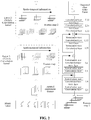
- FIG. 2 is a schematic diagram of a process of performing deblurring processing on a blurry image frame through a generative net model according to an embodiment of this disclosure.
- the specific solution is as follows. For a video with a length of T seconds, 5 neighboring frames of images are selected as an input. First two convolutional layers use a 3D convolution operation to extract spatio-temporal information of the neighboring video frames. Because the 5 frames are inputted, and features can be better fused after the 3D convolution operation is performed twice, a quantity of channels of time series is changed from 5 to 1. Next, 33 2D convolution kernels are used to perform a feature extraction operation and an image reconstruction operation on the image.
- the full convolution indicates that no fully connected layer is used, because an up-sampling operation or a down-sampling operation does not need to be performed on the image.
- an adversarial net structure may be further introduced. Using a reconstruction loss function and an adversarial loss function in the embodiments of this disclosure, the generative net can perform adaptive adjustment, making an image become clearer. Therefore, a more real video is acquired.
- the method for video deblurring operations in the solution is mainly based on a convolutional neural network, which is to extract spatio-temporal information implicit in neighboring video frames by utilizing an advantage that the 3D convolution can extract a spatio-temporal feature, and reconstruct a blurry video to acquire a clear video.
- V ij xyz represents a spatio-temporal feature value of the j-th feature on the i-th layer at a position (x, y, z)
- P i , Q j , R r represents a size of a 3D convolution kernel
- Q j represents a time dimension
- ⁇ ( ⁇ ) represents the function ReLu.
- FIG. 2 An operation process of the entire convolutional net is shown in FIG. 2 .
- b is a bias function
- g is a net weight
- v is a feature value of an inputted feature map
- m represents a number counting how many times images are inputted.
- FIG. 3 is a schematic diagram of a training process of a generative net model and a discriminative net model according to an embodiment of this disclosure.
- a discriminative net model (briefly referred to as a discriminative net) and a generative net model (briefly referred to as a generative net) are joined together to form an adversarial net.
- the discriminative net and the generative net compete with each other.
- an adversarial net structure is introduced when the generative net model shown in FIG. 2 is trained.
- the net structure in FIG. 2 is taken as a generator (namely, generative net model), and a discriminator (namely, discriminative net model) is added.
- the generative net is trained at first.
- a blurry video frame is inputted into the generative net, to generate a clear video frame; a reconstruction loss function (namely, loss function 1 shown in FIG. 3 ) is acquired by comparing the generated clear video frame with a real video frame; and a weight parameter of the generative net is adjusted through the loss function.
- the discriminative net is trained.
- the real clear video and the generated clear video are inputted into the discriminative net, to acquire an adversarial loss function (namely, loss function 2 in FIG. 3 ); and the generative net structure is adjusted through the adversarial loss function, to enable the discriminative net to have a capability of discriminating between the real clear image and the clear image generated from the blurry image frame.
- the two net structures are alternately trained.
- a structure of the generative net is adjusted by using the two types of loss functions together, so that an image can be similar to a real clear image at a pixel level, and appears more like a clear image as a whole.
- the two loss functions may be fused with a weight parameter.
- the weight may be used to control the effect of the two types of loss functions on feedback regulation.
- the effect of the generative net is to generate a clear video from a blurry video
- the effect of the discriminative net is to discriminate whether an inputted video frame is a real clear image or a generated clear video frame.
- the two loss functions are a content loss function based on pixel-value differencing (that is a reconstruction loss function) and an adversarial loss function.
- W and H represent a length and a width of a video frame respectively
- I x , y sharp represents a pixel value of a real clear video frame on a position (x, y)
- G ( I blurry ) x,y represents a value of a generated video frame on the corresponding position.
- a represents a weight of the two functions.
- the method according to the embodiments of this disclosure can improve the existing capability of video deblurring, can automatically perform a deblurring operation on a video, can be used in post-processing of a video taken by a device such as a mobile phone or a digital camera, and can also be used by a back-end web server to perform the deblurring processing on a video uploaded by a user, to acquire a clearer video.
- FIG. 4-a is a schematic structural diagram of a video deblurring apparatus according to an embodiment of this disclosure.
- this embodiment of this disclosure provides a video deblurring apparatus 400.
- the apparatus includes one or more processors and one or more memories storing a program unit.
- the program unit is executed by the processor, and the program unit includes an acquiring module 401, a spatio-temporal information extraction module 402 and a deblurring processing module 403.
- the acquiring module 401 is configured to acquire N continuous image frames from a video clip.
- the N is a positive integer, and the N image frames includes a blurry image frame to be processed.
- the spatio-temporal information extraction module 402 is configured to perform three-dimensional 3D convolution processing on the N image frames with a generative adversarial net model, to acquire spatio-temporal information corresponding to the blurry image frame.
- the spatio-temporal information includes spatial feature information of the blurry image frame and temporal feature information between the blurry image frame and an image frame adjacent to the blurry image frame in the N image frames.
- the deblurring processing module 403 is configured to perform deblurring processing on the blurry image frame by using the spatio-temporal information corresponding to the blurry image frame through the generative adversarial net model, to output a clear image frame.
- the generative adversarial net model includes a generative net model and an adversarial net model.
- FIG. 4-b is a schematic structural diagram of another video deblurring apparatus according to an embodiment of this disclosure. As shown in FIG. 4-b , the program unit further includes a model training module 404.
- the acquiring module 401 is further configured to acquire N continuous sample image frames and a real clear image frame for discrimination from a video sample library.
- the N sample image frames includes a sample blurry image frame for training.
- the real clear image frame is corresponding to the sample blurry image frame.
- the spatio-temporal information extraction module 402 is further configured to extract spatio-temporal information corresponding to the sample blurry image frame from the N sample image frames by using a 3D convolution kernel in the generative net model.
- the deblurring processing module 403 is further configured to perform deblurring processing on the sample blurry image frame by using the spatio-temporal information corresponding to the sample blurry image frame through the generative net model, to output a sample clear image frame.
- the model training module 404 is configured to train alternately the generative net model and a discriminative net model according to the sample clear image frame and the real clear image frame.
- the generative net model includes a first 3D convolution kernel and a second 3D convolution kernel.
- FIG. 4-c is a schematic structural diagram of a spatio-temporal information extraction module according to an embodiment of this disclosure. As shown in FIG. 4-c , the spatio-temporal information extraction module 402 includes a first convolution unit 4021, a second convolution unit 4022 and a spatio-temporal feature fusion unit 4023.
- the first convolution unit 4021 is configured to perform convolution processing on the N sample image frames with the first 3D convolution kernel, to acquire low-level spatio-temporal features corresponding to the sample blurry image frame.
- the second convolution unit 4022 is configured to perform convolution processing on the low-level spatio-temporal features with the second 3D convolution kernel, to acquire high-level spatio-temporal features corresponding to the sample blurry image frame.
- the spatio-temporal feature fusion unit 4023 is configured to fuse the high-level spatio-temporal features corresponding to the sample blurry image frame, to acquire the spatio-temporal information corresponding to the sample blurry image frame.
- the generative net model includes M 2D convolution kernels, the M being a positive integer.
- the deblurring processing module 403 is configured to perform convolution processing on the spatio-temporal information corresponding to the sample blurry image frame by using each 2D convolution kernel of the M 2D convolution kernels in sequence, and acquire the sample clear image frame after the convolution processing is performed by using the last 2D convolution kernel of the M 2D convolution kernels.
- an odd 2D convolution kernel of the M 2D convolution kernels includes a convolutional layer, a normalization layer, and an activation function; and an even 2D convolution kernel of the M 2D convolution kernels includes a convolutional layer and an activation function.
- FIG. 4-d is a schematic structural diagram of a model training module according to an embodiment of this disclosure.
- the model training module 404 includes a loss function acquiring unit 4041, a generative net model training unit 4042 and a discriminative net model training unit 4043.
- the loss function acquiring unit 4041 is configured to acquire a reconstruction loss function according to the sample clear image frame and the real clear image frame.
- the generative net model training unit 4042 is configured to train the generative net model through the reconstruction loss function.
- the discriminative net model training unit 4043 is configured to train the discriminative net model by using the real clear image frame and the sample clear image frame, to acquire an adversarial loss function outputted by the discriminative net model.
- the generative net model training unit 4042 is further configured to train the generative net model through the adversarial loss function.
- the loss function acquiring unit 4041 is further configured to reacquire a reconstruction loss function through the generative net model after the training the generative net model through the adversarial loss function.
- the discriminative net model training unit 4043 is further configured to reacquire an adversarial loss function through the discriminative net model.
- the loss function acquiring unit 4041 is further configured to perform weighted fusion on the reacquired reconstruction loss function and the reacquired adversarial loss function, to acquire a fused loss function.
- the generative net model training unit 4042 is further configured to train the generative net model through the fused loss function.
- N continuous image frames are acquired from a video clip
- the N image frames includes a blurry image frame to be processed.
- 3D convolution processing is performed on the N image frames with a generative adversarial net model, to acquire spatio-temporal information corresponding to the blurry image frame.
- the spatio-temporal information includes spatial feature information of the blurry image frame and temporal feature information between the blurry image frame and an image frame adjacent to the blurry image frame in the N image frames.
- Deblurring processing is performed on the blurry image frame by using the spatio-temporal information corresponding to the blurry image frame through the generative adversarial net model, to output a clear image frame.
- the generative adversarial net model extracts the spatio-temporal information implicit between the continuous image frames through a 3D convolution operation, so that the deblurring processing on the blurry image frame is completed by using the spatio-temporal information corresponding to the blurry image frames through the generative adversarial net model. Therefore, a more real clear image can be obtained, and the effect of video deblurring is improved.
- FIG. 5 shows a schematic structural diagram of a terminal to which a video deblurring method is applied according to an embodiment of this disclosure.
- the terminal may be a mobile phone. As shown in FIG. 5 , for ease of description, only parts related to this embodiment of this disclosure are shown. For specific technical details not disclosed, refer to the method parts of the embodiments of this disclosure.
- the terminal may be any terminal device including a mobile phone, a tablet computer, a personal digital assistant (PDA), a point of sales (POS), an on-board computer and the like, and the terminal being a mobile phone is used as an example,
- the mobile phone includes components such as a radio frequency (RF) circuit 1010, a memory 1020, an input unit 1030, a display unit 1040, a sensor 1050, an audio circuit 1060, a wireless fidelity (WiFi) module 1070, a processor 1080, and a power supply 1090.
- RF radio frequency
- the mobile phone structure shown in FIG. 5 constitutes no limitation on the mobile phone, and the mobile phone may include more or fewer components than those shown in the figure, or a combination of some components, or different component layouts.
- the components of the mobile phone are described in detail below with reference to FIG. 5 .
- the RF circuit 1010 may be configured to receive and transmit signals during an information receiving and transmitting process or a call process. Specifically, the RF circuit receives downlink information from a base station, then delivers the downlink information to the processor 1080 for processing, and transmits designed uplink data to the base station.
- the RF circuit 1010 includes but is not limited to an antenna, at least one amplifier, a transceiver, a coupler, a low noise amplifier (LNA), a duplexer, etc.
- the RF circuit 1010 may further communicate with a network and another device through wireless communication.
- the wireless communication may use any communications standard or protocol, including but not limited to Global System of Mobile Communication (GSM), General Packet Radio Service (GPRS), Code Division Multiple Access (CDMA), Wideband Code Division Multiple Access (WCDMA), Long Term Evolution (LTE), email, Short Messaging Service (SMS), etc.
- GSM Global System of Mobile Communication
- GPRS General Packet Radio Service
- CDMA Code Division Multiple Access
- WCDMA Wideband Code Division Multiple Access
- LTE Long Term Evolution
- email Short Messaging Service
- the memory 1020 may be configured to store a software program and a module, and the processor 1080 executes various function applications of the mobile phone and performs data processing by running the software program and the module that are stored in the memory 1020.
- the memory 1020 may mainly include a program storage area and a data storage area.
- the program storage area may store an operating system, an application program required for at least one function (such as an audio playing function and an image playing function, etc.) etc.
- the data storage area may store data (such as audio data and a phone book, etc.) created according to use of the mobile phone.
- the memory 1020 may include a high speed random access memory, and may further include a non-volatile memory, such as at least one magnetic disk memory device, a flash memory device, or other non-volatile solid state memory devices.
- the input unit 1030 may be configured to receive an entered numeral or character information, and generate key signal input related to user setting and function control of the mobile phone.
- the input unit 1030 may include a touch panel 1031 and other input devices 1032.
- the touch panel 1031 also referred to as a touchscreen, may collect a touch operation performed by a user on or near the touch panel (such as an operation performed by a user on the touch panel 1031 or near the touch panel 1031 by using any proper object or accessory, such as a finger or a stylus), and drive a corresponding connecting device according to a preset program.
- the touch panel 1031 may include two parts: a touch detection apparatus and a touch controller.
- the touch detection apparatus detects a touch position of a user, detects a signal generated by the touch operation, and transfers the signal to the touch controller.
- the touch controller receives the touch information from the touch detection apparatus, converts the touch information into touch point coordinates, and transmits the touch point coordinates to the processor 1080. Moreover, the touch controller can receive and execute a command sent from the processor 1080.
- the touch panel 1031 may be implemented in various types, such as a resistive type, a capacitance type, an infrared type, and a surface acoustic wave type.
- the input unit 1030 may further include the another input device 1032.
- the another input device 1032 may include, but is not limited to, one or more of a physical keyboard, a functional key (such as a volume control key or a switch key), a track ball, a mouse, and a joystick.
- the display unit 1040 may be configured to display information inputted by a user or information provided to a user and various menus of the mobile phone.
- the display unit 1040 may include a display panel 1041.
- the display panel 1041 may be configured in a form such as a liquid crystal display (LCD), an organic light-emitting diode (OLED), etc.
- the touch panel 1031 may cover the display panel 1041. After detecting a touch operation on or near the touch panel 1031, the touch panel transfers the touch operation to the processor 1080, to determine a type of a touch event. Then, the processor 1080 provides a corresponding visual output on the display panel 1041 according to the type of the touch event.
- the touch panel 1031 and the display panel 1041 are used as two separate parts to implement input and output functions of the mobile phone, in some embodiments, the touch panel 1031 and the display panel 1041 may be integrated to implement the input and output functions of the mobile phone.
- the mobile phone may further include at least one sensor 1050 such as an optical sensor, a motion sensor, and other sensors.
- the optical sensor may include an ambient light sensor and a proximity sensor.
- the ambient light sensor may adjust luminance of the display panel 1041 according to brightness of the ambient light.
- the proximity sensor may switch off the display panel 1041 and/or backlight when the mobile phone is moved to the ear.
- an acceleration sensor can detect magnitude of accelerations in various directions (generally on three axes), may detect magnitude and a direction of the gravity when static, and may be applied to an application that recognizes the attitude of the mobile phone (for example, switching between landscape orientation and portrait orientation, a related game, and magnetometer attitude calibration), a function related to vibration recognition (such as a pedometer and a knock), and the like.
- Other sensors such as a gyroscope, a barometer, a hygrometer, a thermometer, and an infrared sensor, which may be configured in the mobile phone, are not further described herein.
- the audio circuit 1060, a speaker 1061, and a microphone 1062 may provide audio interfaces between a user and the mobile phone.
- the audio circuit 1060 may convert received audio data into an electrical signal and transmit the electrical signal to the speaker 1061.
- the speaker 1061 converts the electrical signal into a sound signal for outputting a sample clear image frame.
- the microphone 1062 converts a collected sound signal into an electrical signal.
- the audio circuit 1060 receives the electrical signal, converts the electrical signal into audio data, and outputs the audio data to the processor 1080 for processing. Then, the processor transmits the audio data to, for example, another mobile phone by using the RF circuit 1010, or outputs the audio data to the memory 1020 for further processing.
- WiFi belongs to near field communication.
- the mobile phone may help a user transmit and receive an email, browse a webpage, access streaming media, etc. through a WiFi module 1070.
- the WiFi module provides a user with wireless broadband Internet access.
- FIG. 5 shows the WiFi module 1070, it may be understood that the WiFi module is not an essential component of the mobile phone, and may be completely omitted according to requirements without changing the scope of the essence of the present disclosure.
- the processor 1080 is connected to all parts of the entire mobile phone by using various interfaces and lines, and performs various functions and data processing of the mobile phone by running or executing the software program and/or module stored in the memory 1020 and invoking the data stored in the memory 1020, to perform overall monitoring on the mobile phone.
- the processor 1080 may include one or more processing units.
- the processor 1080 may integrate an application processor and a modem processor.
- the application processor mainly processes an operating system, a user interface, and an application program and the like, and the modem processor mainly processes wireless communication. It may be understood that the modem processor may also not be integrated into the processor 1080.
- the mobile phone further includes the power supply 1090 (such as a battery) for supplying power to the components.
- the power supply may be logically connected to the processor 1080 by using a power management system, thereby implementing functions such as charging, discharging and power consumption management by using the power management system.
- the mobile phone may further include a camera, a Bluetooth module, and the like, which are not further described herein.
- the processor 1080 included in the terminal further controls execution of the process of the video deblurring method executed by the terminal.
- FIG. 6 is a schematic structural diagram of a server to which a video deblurring method is applied according to an embodiment of this disclosure.
- the server 1100 may vary greatly due to different configurations or performance, and may include one or more central processing units (CPU) 1122 (for example, one or more processors) and a memory 1132, and one or more storage mediums 1130 (for example, one or more mass storage devices) that store an application program 1142 or data 1144.
- the memories 1132 and the storage mediums 1130 may be used for transient storage or permanent storage.
- the program stored in the storage medium 1130 may include one or more modules (not marked in the figure), and each module may include a series of instruction operations for the server.
- the central processing unit 1122 may be set to communicate with the storage medium 1130, and execute, on the server 1100, the series of instruction operations stored in the storage medium 1130.
- the server 1100 may further include one or more power supplies 1126, one or more wired or wireless network interfaces 1150, one or more input/output interfaces 1158, and/or one or more operating systems 1141 such as Windows ServerTM, Mac OS XTM, UnixTM, LinuxTM, and FreeBSDTM.
- one or more power supplies 1126 one or more wired or wireless network interfaces 1150, one or more input/output interfaces 1158, and/or one or more operating systems 1141 such as Windows ServerTM, Mac OS XTM, UnixTM, LinuxTM, and FreeBSDTM.
- the steps of the video deblurring method performed by the server in the foregoing embodiment may be based on the server structure shown in FIG. 6 .
- the described apparatus embodiment is merely an example.
- the units described as separate parts may or may not be physically separate, and parts displayed as units may or may not be physical units, may be located in one position, or may be distributed on multiple network units. Some or all of the units may be selected according to actual needs to achieve the objectives of the solutions of the embodiments.
- a connection relationship between modules indicates a communication connection between them, and can be specifically implemented as one or more communications buses or signal lines. A person of ordinary skill in the art may understand and implement the embodiments of this disclosure without creative efforts.
- the embodiments of this disclosure may be implemented by software and necessary general hardware, and certainly can also be implemented by specific hardware including: an application-specific integrated circuit, a specific CPU, a specific memory, a specific component, and the like.
- any function implemented by a computer program can be easily implemented by corresponding hardware, and specific hardware structures for implementing the same function may be various.
- the structures may be an analog circuit, a digital circuit, a specific circuit, or the like.
- the implementation by a software program is the better one in more cases.
- the technical solutions in the embodiments of this disclosure essentially or the part contributing to the related art may be implemented in a form of a software product.
- the computer software product is stored in a readable storage medium such as a floppy disk of a computer, a USB flash drive, a removable hard disk, a read-only memory (ROM), a random access memory (RAM), a magnetic disk, or an optical disc and includes several instructions for instructing a computer device (which may be a personal computer, a server, a network device, or the like) to perform the method described in the embodiments of this disclosure.
- N continuous image frames are acquired from a video clip, the N image frames includes a blurry image frame to be processed.
- 3D convolution processing is performed on the N image frames with a generative adversarial net model, to acquire spatio-temporal information corresponding to the blurry image frame.
- the spatio-temporal information includes spatial feature information of the blurry image frame and temporal feature information between the blurry image frame and an image frame adjacent to the blurry image frame in the N image frames.
- Deblurring processing is performed on the blurry image frame by using the spatio-temporal information corresponding to the blurry image frame through the generative adversarial net model, to output a clear image frame.
- the generative adversarial net model extracts the spatio-temporal information implicit between the continuous image frames through a 3D convolution operation, so that the deblurring processing on the blurry image frame is completed by using the spatio-temporal information corresponding to the blurry image frames through the generative adversarial net model. Therefore, a more real clear image can be obtained, and the effect of video deblurring is improved.
Landscapes
- Engineering & Computer Science (AREA)
- Physics & Mathematics (AREA)
- Theoretical Computer Science (AREA)
- General Physics & Mathematics (AREA)
- Biomedical Technology (AREA)
- General Health & Medical Sciences (AREA)
- Life Sciences & Earth Sciences (AREA)
- Health & Medical Sciences (AREA)
- Artificial Intelligence (AREA)
- Molecular Biology (AREA)
- Evolutionary Computation (AREA)
- Computing Systems (AREA)
- Data Mining & Analysis (AREA)
- Computational Linguistics (AREA)
- General Engineering & Computer Science (AREA)
- Biophysics (AREA)
- Mathematical Physics (AREA)
- Software Systems (AREA)
- Biodiversity & Conservation Biology (AREA)
- Computer Vision & Pattern Recognition (AREA)
- Multimedia (AREA)
- Probability & Statistics with Applications (AREA)
- Image Processing (AREA)
- Image Analysis (AREA)
Abstract
Description
- This application claims priority to Chinese Patent Application No.
201810438831.5 - Embodiments of this disclosure relate to the field of computer technologies, and in particular, to a video deblurring method and a video deblurring apparatus, a storage medium, and an electronic apparatus.
- When a user takes a video with a mobile phone or a digital camera, the shaking device and a moving object to be shot may usually cause a blurry video. Therefore, there is a realistic demand for the user to transform the taken blurry video to a clearer one.
- Currently, it is proposed that deblurring processing of images in a video is completed based on a deep learning method. The related art mainly includes: inputting multiple frames of images together into a convolutional neural network model, extracting spatial information in a single frame of image with a 2D convolution kernel, and performing deblurring processing on the blurry video by using a reconstruction loss function as supervised information.
- In the video deblurring solution in the related art, the 2D convolution kernel is used. Consequently, only the spatial information in the single frame of image can be extracted, and information between images in the video cannot be extracted. As a result, the capability of the convolutional neural network model to utilize the spatial information in the related art is limited. Besides, because merely the pixel-based reconstruction loss function is used as the supervised information, a video after deblurring appears insufficiently real, reducing the effect of video deblurring.
- Embodiments of this disclosure provide a video deblurring method and a video deblurring apparatus, a storage medium, and an electronic apparatus, to improve the effect of video deblurring.
- In order to resolve the foregoing technical problem, the embodiments of this disclosure provide the following technical solutions.
- According to one aspect, an embodiment of this disclosure provides a video deblurring method. The method includes: acquiring, by an electronic device, N continuous image frames from a video clip, the N being a positive integer, and the N image frames including a blurry image frame to be processed; performing, by the electronic device, three-dimensional 3D convolution processing on the N image frames with a generative adversarial net model, to acquire spatio-temporal information corresponding to the blurry image frame, the spatio-temporal information including spatial feature information of the blurry image frame and temporal feature information between the blurry image frame and an image frame adjacent to the blurry image frame in the N image frames; and performing, by the electronic device, deblurring processing on the blurry image frame by using the spatio-temporal information corresponding to the blurry image frame through the generative adversarial net model, to output a clear image frame.
- According to another aspect, an embodiment of this disclosure further provides a video deblurring apparatus, including one or more processors and one or more memories storing a program unit. The program unit is executed by the processor. The program unit includes:
- an acquiring module, configured to acquire N continuous image frames from a video clip, the N being a positive integer, and the N image frames including a blurry image frame to be processed;
- a spatio-temporal information extraction module, configured to perform three-dimensional 3D convolution processing on the N image frames with a generative adversarial net model, to acquire spatio-temporal information corresponding to the blurry image frame, the spatio-temporal information including spatial feature information of the blurry image frame and temporal feature information between the blurry image frame and an image frame adjacent to the blurry image frame in the N image frames; and
- a deblurring processing module, configured to perform deblurring processing on the blurry image frame by using the spatio-temporal information corresponding to the blurry image frame through the generative adversarial net model, to output a clear image frame.
- In the foregoing aspect, the modules of the video deblurring apparatus may further perform the steps in the foregoing one aspect and any possible implementation. For details, reference is made to the foregoing descriptions of the foregoing one aspect and any possible implementation.
- According to still another aspect, an embodiment of this disclosure provides an electronic apparatus, including a processor and a memory. The memory stores a computer program, and the processor executes the computer program to perform the foregoing video deblurring method.
- According to yet another aspect, an embodiment of this disclosure provides a non-transient computer-readable storage medium, the computer-readable storage medium storing instructions. The instructions, when executed by a computer, cause the computer to perform the method according to the foregoing aspects.
- According to still yet another aspect, an embodiment of this disclosure provides a computer program product including an instruction. The computer program product, when executed by a computer, causes the computer to perform the method according to the foregoing aspects.
- It may be learned from the foregoing technical solutions that the embodiments of this disclosure have the following advantages. According to the embodiments of this disclosure, N continuous image frames are acquired from a video clip, the N image frames includes a blurry image frame to be processed. Three-dimensional 3D convolution processing is performed on the N image frames with a generative adversarial net model, to acquire spatio-temporal information corresponding to the blurry image frame. The spatio-temporal information includes spatial feature information of the blurry image frame and temporal feature information between the blurry image frame and an image frame adjacent to the blurry image frame in the N image frames. Deblurring processing is performed on the blurry image frame by using the spatio-temporal information corresponding to the blurry image frame through the generative adversarial net model, to output a clear image frame. According to the embodiments of this disclosure, the generative adversarial net model extracts the spatio-temporal information implicit between the continuous image frames through a 3D convolution operation, so that the deblurring processing on the blurry image frame is completed by using the spatio-temporal information corresponding to the blurry image frames through the generative adversarial net model. Therefore, a more real clear image can be obtained, and the effect of video deblurring is improved.
- To describe the technical solutions in the embodiments of this disclosure more clearly, the following briefly introduces the accompanying drawings required for describing the embodiments. Apparently, the accompanying drawings in the following description show only some embodiments of this disclosure, and a person skilled in the art may still derive other accompanying drawings from the accompanying drawings.
-
FIG. 1 is a schematic block flowchart of a video deblurring method according to an embodiment of this disclosure. -
FIG. 2 is a schematic diagram of a process of performing deblurring processing on a blurry image frame through a generative net model according to an embodiment of this disclosure. -
FIG. 3 is a schematic diagram of a training process of a generative net model and a discriminative net model according to an embodiment of this disclosure. -
FIG. 4-a is a schematic structural diagram of a video deblurring apparatus according to an embodiment of this disclosure. -
FIG. 4-b is a schematic structural diagram of another video deblurring apparatus according to an embodiment of this disclosure. -
FIG. 4-c is a schematic structural diagram of a spatio-temporal information extraction module according to an embodiment of this disclosure. -
FIG. 4-d is a schematic structural diagram of a model training module according to an embodiment of this disclosure. -
FIG. 5 is a schematic structural diagram of a terminal to which a video deblurring method is applied according to an embodiment of this disclosure. -
FIG. 6 is a schematic structural diagram of a server to which a video deblurring method is applied according to an embodiment of this disclosure. - Embodiments of this disclosure provide a video deblurring method and a video deblurring apparatus to improving the effect of video deblurring.
- To make the inventive objectives, features, and advantages of this disclosure clearer and more comprehensible, the following clearly and completely describes the technical solutions in the embodiments of this disclosure with reference to the accompanying drawings in the embodiments of this disclosure. Apparently, the embodiments described below are merely some rather than all of the embodiments of this disclosure. All other embodiments obtained by a person skilled in the art based on the embodiments of this disclosure shall fall within the protection scope of this disclosure.
- In the specification, the claims, and the accompanying drawings of this disclosure, the terms "include", "have", and any other variations are meant to cover the non-exclusive inclusion, so that a process, method, system, product, or device that includes a list of units is not necessarily limited to those listed units, but may include other units not expressly listed or inherent to such a process, method, product, or device.
- Detailed description is given below.
- The embodiments of this disclosure mainly provide a video deblurring method based on deep learning. The embodiments of this disclosure can improve a blurry video to a clear video through a deep neural network, which is applied to deblurring processing on a video taken by a camera. A video deblurring apparatus is further provided in the embodiments of this disclosure. The video deblurring apparatus may be deployed in a terminal in a form of video processing software. The video deblurring apparatus may alternatively be a server storing a video. In the video deblurring method according to this embodiment of this disclosure, a generative adversarial nets (GAN) model is obtained by training in a deep learning manner. The generative adversarial net model may be implemented by a convolutional neural network model. Specifically, multiple frames of images neighboring each frame of image are inputted together into the generative adversarial net model; feature extraction and integration are performed on a video with multiple frames by using the generative adversarial net model; a 3D convolution operation is performed by using a three-dimensional (3D) convolution kernel in the generative adversarial net model; spatio-temporal information implicit between continuous image frames is extracted; and a blurry image frame is improved to a clear one in an equal proportion by performing a full convolution operation, so that a more real clear image can be obtained. The generative adversarial net model adopted in this embodiment of this disclosure can effectively extract the spatio-temporal information to process the blurry image frame, thereby automatically improving the blurry video to a clear video.
-
FIG. 1 is a schematic block flowchart of a video deblurring method according to an embodiment of this disclosure. The video deblurring method may be executed by an electronic device. The electronic device may be a terminal or server. The following is described with the electronic device executing the video deblurring method as an example. Referring toFIG. 1 , the method may include the followingsteps 101 to 103. - 101. The electronic device acquires N continuous image frames from a video clip, the N is a positive integer, and the N image frames include a blurry image frame to be processed.
- According to this embodiment of this disclosure, the video clip may be shot by the terminal through a camera, or may be downloaded from the Internet by the terminal. As long as there is at least one frame of blurry image in the video clip, a clear image can be obtained from the blurry image by using the video deblurring method according to this embodiment of this disclosure. At first, the N continuous image frames are acquired from the video clip, the N image frames include at least one blurry image frame to be processed. The blurry image frame may be caused by a shake of a shooting device or a movement of an object to be shot. According to this embodiment of this disclosure, the N continuous image frames acquired at first may include one blurry image frame to be processed. For example, the blurry image frame may be a middle image frame of the N continuous image frames. If the value of N is 3, the blurry image frame may be the second image frame, or if the value of N is 5, the blurry image frame may be the third image frame. The value of N is a positive integer not limited herein.
- 102. The electronic device performs 3D convolution processing on the N image frames with a generative adversarial net model, to acquire spatio-temporal information corresponding to the blurry image frame. The spatio-temporal information includes spatial feature information of the blurry image frame, and temporal feature information between the blurry image frame and an image frame adjacent to the blurry image frame in the N image frames.
- According to this embodiment of this disclosure, a trained generative adversarial net model may be used to perform video deblurring processing. After acquiring the N continuous image frames, the N continuous image frames are inputted into the generative adversarial net model. The 3D convolution operation is performed by using a 3D convolution kernel in the generative adversarial net model to extract the spatio-temporal information implicit between the continuous image frames. The spatio-temporal information includes the spatial feature information of the blurry image frame. That is, the spatial feature information is hidden in a single frame of blurry image. The temporal feature information is the temporal information between the blurry image frame and an image frame adjacent to the blurry image frame. For example, temporal feature information, between a blurry image frame and two neighboring image frames prior to the blurry image frame and two neighboring image frames behind the blurry image frame, may be extracted through the 3D convolution operation. According to this embodiment of this disclosure, the spatio-temporal information, that is, the temporal feature information and the spatial feature information, may be extracted through the 3D convolution kernel. Therefore, effective utilization of the feature information implicit between the continuous images in the video clip, in combination with the trained generative adversarial net model, can improve the effect of deblurring processing on a blurry image frame. For details, reference is made to descriptions of video deblurring in a subsequent embodiment.
- 103. The electronic device performs deblurring processing on the blurry image frame by using the spatio-temporal information corresponding to the blurry image frame through the generative adversarial net model, to output a clear image frame.
- According to this embodiment of this disclosure, after the spatio-temporal information corresponding to the blurry image frame is extracted by performing the 3D convolution operation through the 3D convolution kernel in the generative adversarial net model, the spatio-temporal information corresponding to the blurry image frame may be used as an image feature to perform a predicted output through the generative adversarial net model. An output result of the generative adversarial net model is a clear image frame obtained after deblurring the blurry image frame. Because the 3D convolution operation is adopted by the generative adversarial net model according to this embodiment of this disclosure, the temporal feature information and the spatial feature information may be extracted. This type of feature information may be used to predict the clear image frame corresponding to the blurry image frame.
- In this embodiment of this disclosure, the 3D convolution kernel is mainly used to process continuous video frames, so that spatio-temporal information implicit in the continuous video frames can be extracted more effectively. Moreover, the use of the generative adversarial net model can better ensure that a clear video obtained from a blurry video is more real.
- A training process of a generative adversarial net model according to an embodiment of this disclosure is illustrated next with examples. Specifically, the generative adversarial net model according to this embodiment of this disclosure includes a generative net model and a adversarial net model. The generative adversarial net model according to this embodiment of this disclosure includes at least two net models. One is a generative net model, the other is a discriminative net model. Through mutual game learning between the generative net model and the discriminative net model, a fairly good output is generated through the generative adversarial net model.
- According to some embodiments of this disclosure, before the electronic device performs three-dimensional 3D convolution processing on the N image frames with a generative adversarial net model, the video deblurring method according to this embodiment of this disclosure further includes following steps A1 to A4.
- A1. The electronic device acquires N continuous sample image frames and a real clear image frame for discrimination from a video sample library. The N sample image frames includes a sample blurry image frame for training, and the real clear image frame is corresponding to the sample blurry image frame.
- A2. The electronic device extracts spatio-temporal information corresponding to the sample blurry image frame from the N sample image frames by using a 3D convolution kernel in the generative net model.
- A3. The electronic device performs deblurring processing on the sample blurry image frame by using the spatio-temporal information corresponding to the sample blurry image frame through the generative net model, to output a sample clear image frame.
- A4. The electronic device trains alternately the generative net model and the discriminative net model according to the sample clear image frame and the real clear image frame.
- According to this embodiment of this disclosure, the video sample library may be set for model training and discrimination. For example, a segment of N continuous sample image frames is adopted for the model training. The "sample image frame" herein is different from the image frame in
step 101. The sample image frame is a sample image in the video sample library. The N sample image frames include a sample blurry image frame. In order to discriminate an output result of the generative net model, a real clear image frame is further provided. The real clear image frame corresponds to the sample blurry image frame, that is, the real clear image frame is a clear image frame that is real and corresponds to the sample blurry image frame. - Next, the spatio-temporal information corresponding to the sample blurry image frame is extracted from the N sample image frames by using the 3D convolution kernel in the generative net model. The spatio-temporal information may include the spatial feature information of the sample blurry image frame, and the temporal feature information between the sample blurry image frame and an image frame adjacent to the sample blurry image frame of the N sample image frames. The generative net model may be a convolutional neural network model. After acquiring the spatio-temporal information corresponding to the sample blurry image frame, the deblurring processing is then performed on the sample blurry image frame by using the spatio-temporal information corresponding to the sample blurry image frame through the generative net model. The subsequent embodiments describe a training process of the generative net model in detail. Through the deblurring processing performed by the generative net model, the sample clear image frame may be outputted. The sample clear image frame is the result outputted after the generative net model performs the deblurring on the sample blurry image frame.
- After the generative net model outputs the sample clear image frame, whether the outputted sample clear image frame is blurry or clear is discriminated according to the sample clear image frame and the real clear image frame by using the discriminative net model. An adversarial loss function is introduced by using the discriminative net model, to alternately train the generative net model and the discriminative net model for multiple times, thereby better ensuring that a clear video obtained from a blurry video is more real.
- Further, according to some embodiments of this disclosure, the generative net model includes a first 3D convolution kernel and a second 3D convolution kernel. In this case, step A2 of extracting, by the electronic device, spatio-temporal information corresponding to the sample blurry image frame from the N sample image frames by using a 3D convolution kernel in the generative net model includes following steps A11 to A13.
- A11. Perform convolution processing on the N sample image frames with the first 3D convolution kernel, to acquire low-level spatio-temporal features corresponding to the sample blurry image frame.
- A12. Perform convolution processing on the low-level spatio-temporal features with the second 3D convolution kernel, to acquire high-level spatio-temporal features corresponding to the sample blurry image frame.
- A13. Fuse the high-level spatio-temporal features corresponding to the sample blurry image frame, to acquire the spatio-temporal information corresponding to the sample blurry image frame.
- At first, two 3D convolutional layers are set in the generative net model. The 3D convolutional layers may use different 3D convolution kernels. For example, the first 3D convolution kernel and the second 3D convolution kernel have different weight parameters. The first 3D convolution kernel is first used to perform the convolution processing on the N sample image frames, to acquire the low-level spatio-temporal features corresponding to the sample blurry image frame. The low-level spatio-temporal features refer to inconspicuous feature information, such as features of lines. Then taking the low-level spatio-temporal features as an input, the convolution processing is performed on the next 3D convolutional layer, to acquire the high-level spatio-temporal features corresponding to the sample blurry image frame. The high-level spatio-temporal features refer to feature information of image frames adjacent to the sample blurry image frame. At last, the high-level spatio-temporal features are fused together to acquire the spatio-temporal information corresponding to the sample blurry image frame. The spatio-temporal information may be used as a feature map for training of the generative net model. The following is an illustration with an example. The first 3D convolution kernel is first used to perform the convolution processing on 5 sample image frames, to acquire low-level spatio-temporal features in 3 different dimensions; then the convolution processing is performed on the low-level spatio-temporal features by using the second 3D convolution kernel, to acquire high-level spatio-temporal features corresponding to the sample blurry image frame; and the high-level spatio-temporal features are fused to acquire spatio-temporal information corresponding to the sample blurry image frame. Because 5 frames of images are inputted into the generative net model, after 2 times of 3D convolution processing, one frame of feature map is outputted, that is, after the 2 times of 3D convolution processing, a quantity of channels of time series is changed from 5 to 1.
- Further, according to some embodiments of this disclosure, the generative net model further includes M 2D convolution kernels, the M being a positive integer. The step A3 of the electronic device performing deblurring processing on the sample blurry image frame by using the spatio-temporal information corresponding to the sample blurry image frame through the generative net model, to output a sample clear image frame includes following step A31. In A31, perform convolution processing on the spatio-temporal information corresponding to the sample blurry image frame by using each 2D convolution kernel of the M 2D convolution kernels in sequence, and acquire the sample clear image frame after the convolution processing is performed by using the last 2D convolution kernel of the M 2D convolution kernels.
- According to the embodiments of this disclosure, the generative net model includes not only two 3D convolution kernels, but also multiple 2D convolution kernels. The convolution processing is performed on the spatio-temporal information corresponding to the sample blurry image frame by using the multiple 2D convolution kernels in sequence, and the sample clear image frame is acquired after the convolution processing is performed by using the last 2D convolution kernel of the M 2D convolution kernels. Refer to descriptions in subsequent embodiments for a specific implementation of the 2D convolution kernel.
- According to some embodiments of this disclosure, an odd 2D convolution kernel of the M 2D convolution kernels includes a convolutional layer, a normalization layer, and an activation function; and an even 2D convolution kernel of the M 2D convolution kernels includes a convolutional layer and an activation function.
- Each 2D convolution kernel may be implemented according to an application scenario. The odd 2D convolution kernel refers to the first 2D convolution kernel, the third 2D convolution kernel, or the like of the M 2D convolution kernels. The odd 2D convolution kernel includes the convolutional layer, the normalization layer, and the activation function (Rectified Linear Units, ReLu). The even 2D convolution kernel of the M 2D convolution kernels refers to the second 2D convolution kernel, the fourth 2D convolution kernel, or the like of the M 2D convolution kernels. The even 2D convolution kernel includes the convolutional layer and the activation function. Refer to descriptions of a convolutional neural network for a specific calculating process of the normalization layer and the activation function, and details are not described herein again.
- According to some embodiments of this disclosure, step A4 of the electronic device training alternately the generative net model and a discriminative net model according to the sample clear image frame and the real clear image frame includes following steps A41 to A44.
- A41. Acquire a reconstruction loss function according to the sample clear image frame and the real clear image frame.
- A42. Train the generative net model through the reconstruction loss function.
- A43. Train the discriminative net model by using the real clear image frame and the sample clear image frame, to acquire an adversarial loss function outputted by the discriminative net model.
- A44. Train the generative net model through the adversarial loss function.
- In order to acquire a more real deblurred video, the discriminative net model may be further introduced when the generative net model is trained. During the training, the generative net model is first trained. A sample blurry image frame is inputted into the generative net model, to generate a sample clear image frame; the reconstruction loss function is acquired by comparing the sample clear image frame with the real clear image frame; and a weight parameter of the generative net model is adjusted through the reconstruction loss function. Next, the discriminative net model is trained. The real clear video and the generated sample clear video are inputted into the discriminative net model, to acquire the adversarial loss function; and the generative net model is adjusted through the adversarial loss function, to enable the discriminative net model to have a capability of discriminating between the real clear image and the clear image generated from the blurry image frame. In this way, structures of the two net models are alternately trained.
- Further, according to some embodiments of this disclosure, step A4 of training alternately the generative net model and a discriminative net model according to the sample clear image frame and the real clear image frame, in addition to including the foregoing step A41 to step A44, further includes following steps A45 to A47.
- A45. Reacquire a reconstruction loss function through the generative net model and reacquiring an adversarial loss function through the discriminative net model, after the training the generative net model through the adversarial loss function.
- A46. Perform weighted fusion on the reacquired reconstruction loss function and the reacquired adversarial loss function, to acquire a fused loss function.
- A47. Train the generative net model through the fused loss function.
- After training the generative net model and the discriminative net model through the foregoing step A41 to step A44, step A45 to step A47 are performed based on the two net models after the first training. When training the generative net model again, a structure of the generative net model is adjusted by using the two types of loss functions together, so that an image can be similar to a real clear image at a pixel level, and appears more like a clear image as a whole. The two loss functions may be fused with a weight parameter. The weight may be used to control the effect of the two types of loss functions on feedback regulation. The effect of the generative net model is to generate a clear video from a blurry video, and the effect of the discriminative net model is to discriminate whether an inputted video frame is a real clear image or a generated clear image. Through the adversarial learning according to this embodiment of this disclosure, the discriminative capability of the discriminative net model gets increasingly strong, and the video generated by the generative net model gets increasingly real.
- According to the above description of embodiments of this disclosure, N continuous image frames are acquired from a video clip, the N image frames includes a blurry image frame to be processed. 3D convolution processing is performed on the N image frames with a generative adversarial net model, to acquire spatio-temporal information corresponding to the blurry image frame. The spatio-temporal information includes spatial feature information of the blurry image frame and temporal feature information between the blurry image frame and an image frame adjacent to the blurry image frame in the N image frames. Deblurring processing is performed on the blurry image frame by using the spatio-temporal information corresponding to the blurry image frame through the generative adversarial net model, to output a clear image frame. According to the embodiments of this disclosure, the generative adversarial net model extracts the spatio-temporal information implicit between the continuous image frames through a 3D convolution operation, so that the deblurring processing on the blurry image frame is completed by using the spatio-temporal information corresponding to the blurry image frames through the generative adversarial net model. Therefore, a more real clear image can be obtained, and the effect of video deblurring is improved.
- To facilitate better understanding and implementation of the foregoing solution provided by the embodiments of this disclosure, specific descriptions are illustrated below with corresponding application scenarios as examples.
- A video deblurring method according to the embodiments of this disclosure can provide a service for video deblurring. When a video is taken by a mobile phone or a digital camera, the shaking device and a moving object to be shot may cause a blurry video. When the video deblurring method according to the embodiments of this disclosure is applied to the mobile phone and the digital camera, the blurry video taken will become clearer. In addition, the video deblurring method according to the embodiments of this disclosure may be deployed in a back-end server. When a user uploads some blurry videos taken by the user, use of the video deblurring method according to the embodiments of this disclosure makes the videos uploaded by the user become clearer.
- The video deblurring method according to the embodiments of this disclosure adopts an end-to-end video processing method, including: pre-processing a video frame; extracting low-level spatio-temporal information from the video frame; then extracting high-level spatio-temporal information from the video frame; performing model training by using two types of loss functions; and finally reconstructing a clear video by using an obtained model.
FIG. 1 is the specific flowchart of the method. -
FIG. 2 is a schematic diagram of a process of performing deblurring processing on a blurry image frame through a generative net model according to an embodiment of this disclosure. The specific solution is as follows. For a video with a length of T seconds, 5 neighboring frames of images are selected as an input. First two convolutional layers use a 3D convolution operation to extract spatio-temporal information of the neighboring video frames. Because the 5 frames are inputted, and features can be better fused after the 3D convolution operation is performed twice, a quantity of channels of time series is changed from 5 to 1. Next, 33 2D convolution kernels are used to perform a feature extraction operation and an image reconstruction operation on the image. Through the foregoing 3D convolution operation, temporal information is fused into spatial information, to acquire the spatio-temporal information. Therefore, a 2D convolution operation is then performed. After each convolution operation, an output is processed by using a normalization layer and an activation function ReLU. From the third layer to the 32nd layer, the batch normalization (BN) layer and the activation function ReLU follow immediately after the convolution operation of an odd layer, and the batch normalization (BN) layer follows after the convolution operation of an even layer. The function ReLU is used after the convolution operations of the 33rd to 34th layers. After the convolution operation of the 35th layer, a final clear video frame is acquired. All operations belong to a full convolution operation. The full convolution indicates that no fully connected layer is used, because an up-sampling operation or a down-sampling operation does not need to be performed on the image. During training, in the embodiments of this disclosure, an adversarial net structure may be further introduced. Using a reconstruction loss function and an adversarial loss function in the embodiments of this disclosure, the generative net can perform adaptive adjustment, making an image become clearer. Therefore, a more real video is acquired. - Next, a calculating process of a 3D convolution in the embodiments of this disclosure is illustrated with examples. The method for video deblurring operations in the solution is mainly based on a convolutional neural network, which is to extract spatio-temporal information implicit in neighboring video frames by utilizing an advantage that the 3D convolution can extract a spatio-temporal feature, and reconstruct a blurry video to acquire a clear video. A 3D convolution operation is:

where
FIG. 2 . b is a bias function, g is a net weight, v is a feature value of an inputted feature map, and m represents a number counting how many times images are inputted. -
FIG. 3 is a schematic diagram of a training process of a generative net model and a discriminative net model according to an embodiment of this disclosure. A discriminative net model (briefly referred to as a discriminative net) and a generative net model (briefly referred to as a generative net) are joined together to form an adversarial net. The discriminative net and the generative net compete with each other. In order to acquire a more real deblurred video, an adversarial net structure is introduced when the generative net model shown inFIG. 2 is trained. The net structure inFIG. 2 is taken as a generator (namely, generative net model), and a discriminator (namely, discriminative net model) is added. During the training, the generative net is trained at first. A blurry video frame is inputted into the generative net, to generate a clear video frame; a reconstruction loss function (namely,loss function 1 shown inFIG. 3 ) is acquired by comparing the generated clear video frame with a real video frame; and a weight parameter of the generative net is adjusted through the loss function. Next, the discriminative net is trained. The real clear video and the generated clear video are inputted into the discriminative net, to acquire an adversarial loss function (namely,loss function 2 inFIG. 3 ); and the generative net structure is adjusted through the adversarial loss function, to enable the discriminative net to have a capability of discriminating between the real clear image and the clear image generated from the blurry image frame. The two net structures are alternately trained. When training the generative net again, a structure of the generative net is adjusted by using the two types of loss functions together, so that an image can be similar to a real clear image at a pixel level, and appears more like a clear image as a whole. The two loss functions may be fused with a weight parameter. The weight may be used to control the effect of the two types of loss functions on feedback regulation. The effect of the generative net is to generate a clear video from a blurry video, and the effect of the discriminative net is to discriminate whether an inputted video frame is a real clear image or a generated clear video frame. Through the adversarial learning, the discriminative capability of the discriminative net gets increasingly strong, and the video generated by the generative net gets increasingly real. - Next, weighted fusion of two different types of loss functions is illustrated with an example. Because two nets are used in this embodiment of this disclosure, that is, a generative net and a discriminative net, two loss functions are used in this embodiment of this disclosure, the two loss functions are a content loss function based on pixel-value differencing (that is a reconstruction loss function) and an adversarial loss function.
- At first, the content loss function based on pixel-value differencing is:


- The adversarial loss function is:

- The two loss functions are fused through the following formula:

- The method according to the embodiments of this disclosure can improve the existing capability of video deblurring, can automatically perform a deblurring operation on a video, can be used in post-processing of a video taken by a device such as a mobile phone or a digital camera, and can also be used by a back-end web server to perform the deblurring processing on a video uploaded by a user, to acquire a clearer video.
- It should be noted that the foregoing method embodiments are expressed as a series of action combinations for the purpose of brief description, but a person skilled in the art is to know that because some steps may be performed in other sequences or simultaneously according to the embodiments of this disclosure, the embodiments of this disclosure are not limited to a described action sequence. In addition, a person skilled in the art is to also know that the embodiments described in this specification are all preferred embodiments; and therefore, an action and a module involved are not necessarily mandatory in the embodiments of this disclosure.
- In order to facilitate the better implementation of the foregoing solutions according to the embodiments of this disclosure, relevant apparatuses for implementing the foregoing solutions are further provided below.
-
FIG. 4-a is a schematic structural diagram of a video deblurring apparatus according to an embodiment of this disclosure. Referring toFIG. 4-a , this embodiment of this disclosure provides avideo deblurring apparatus 400. The apparatus includes one or more processors and one or more memories storing a program unit. The program unit is executed by the processor, and the program unit includes an acquiringmodule 401, a spatio-temporalinformation extraction module 402 and adeblurring processing module 403. - The acquiring
module 401 is configured to acquire N continuous image frames from a video clip. The N is a positive integer, and the N image frames includes a blurry image frame to be processed. - The spatio-temporal
information extraction module 402 is configured to perform three-dimensional 3D convolution processing on the N image frames with a generative adversarial net model, to acquire spatio-temporal information corresponding to the blurry image frame. The spatio-temporal information includes spatial feature information of the blurry image frame and temporal feature information between the blurry image frame and an image frame adjacent to the blurry image frame in the N image frames. - The
deblurring processing module 403 is configured to perform deblurring processing on the blurry image frame by using the spatio-temporal information corresponding to the blurry image frame through the generative adversarial net model, to output a clear image frame. - According to some embodiments of this disclosure, the generative adversarial net model includes a generative net model and an adversarial net model.
FIG. 4-b is a schematic structural diagram of another video deblurring apparatus according to an embodiment of this disclosure. As shown inFIG. 4-b , the program unit further includes amodel training module 404. - The acquiring
module 401 is further configured to acquire N continuous sample image frames and a real clear image frame for discrimination from a video sample library. The N sample image frames includes a sample blurry image frame for training. The real clear image frame is corresponding to the sample blurry image frame. - The spatio-temporal
information extraction module 402 is further configured to extract spatio-temporal information corresponding to the sample blurry image frame from the N sample image frames by using a 3D convolution kernel in the generative net model. - The
deblurring processing module 403 is further configured to perform deblurring processing on the sample blurry image frame by using the spatio-temporal information corresponding to the sample blurry image frame through the generative net model, to output a sample clear image frame. - The
model training module 404 is configured to train alternately the generative net model and a discriminative net model according to the sample clear image frame and the real clear image frame. - According to some embodiments of this disclosure, the generative net model includes a first 3D convolution kernel and a second 3D convolution kernel.
FIG. 4-c is a schematic structural diagram of a spatio-temporal information extraction module according to an embodiment of this disclosure. As shown inFIG. 4-c , the spatio-temporalinformation extraction module 402 includes afirst convolution unit 4021, asecond convolution unit 4022 and a spatio-temporalfeature fusion unit 4023. - The
first convolution unit 4021 is configured to perform convolution processing on the N sample image frames with the first 3D convolution kernel, to acquire low-level spatio-temporal features corresponding to the sample blurry image frame. - The
second convolution unit 4022 is configured to perform convolution processing on the low-level spatio-temporal features with the second 3D convolution kernel, to acquire high-level spatio-temporal features corresponding to the sample blurry image frame. - The spatio-temporal
feature fusion unit 4023 is configured to fuse the high-level spatio-temporal features corresponding to the sample blurry image frame, to acquire the spatio-temporal information corresponding to the sample blurry image frame. - According to some embodiments of this disclosure, the generative net model includes M 2D convolution kernels, the M being a positive integer. The
deblurring processing module 403 is configured to perform convolution processing on the spatio-temporal information corresponding to the sample blurry image frame by using each 2D convolution kernel of the M 2D convolution kernels in sequence, and acquire the sample clear image frame after the convolution processing is performed by using the last 2D convolution kernel of the M 2D convolution kernels. - According to some embodiments of this disclosure, an odd 2D convolution kernel of the M 2D convolution kernels includes a convolutional layer, a normalization layer, and an activation function; and an even 2D convolution kernel of the M 2D convolution kernels includes a convolutional layer and an activation function.
-
FIG. 4-d is a schematic structural diagram of a model training module according to an embodiment of this disclosure. According to some embodiments of this disclosure, as shown inFIG. 4-d , themodel training module 404 includes a lossfunction acquiring unit 4041, a generative netmodel training unit 4042 and a discriminative netmodel training unit 4043. - The loss
function acquiring unit 4041 is configured to acquire a reconstruction loss function according to the sample clear image frame and the real clear image frame. - The generative net
model training unit 4042 is configured to train the generative net model through the reconstruction loss function. - The discriminative net
model training unit 4043 is configured to train the discriminative net model by using the real clear image frame and the sample clear image frame, to acquire an adversarial loss function outputted by the discriminative net model. - The generative net
model training unit 4042 is further configured to train the generative net model through the adversarial loss function. - According to some embodiments of this disclosure, the loss
function acquiring unit 4041 is further configured to reacquire a reconstruction loss function through the generative net model after the training the generative net model through the adversarial loss function. - The discriminative net
model training unit 4043 is further configured to reacquire an adversarial loss function through the discriminative net model. - The loss
function acquiring unit 4041 is further configured to perform weighted fusion on the reacquired reconstruction loss function and the reacquired adversarial loss function, to acquire a fused loss function. - The generative net
model training unit 4042 is further configured to train the generative net model through the fused loss function. - According to the above description of embodiments of this disclosure, N continuous image frames are acquired from a video clip, the N image frames includes a blurry image frame to be processed. 3D convolution processing is performed on the N image frames with a generative adversarial net model, to acquire spatio-temporal information corresponding to the blurry image frame. The spatio-temporal information includes spatial feature information of the blurry image frame and temporal feature information between the blurry image frame and an image frame adjacent to the blurry image frame in the N image frames. Deblurring processing is performed on the blurry image frame by using the spatio-temporal information corresponding to the blurry image frame through the generative adversarial net model, to output a clear image frame. According to the embodiments of this disclosure, the generative adversarial net model extracts the spatio-temporal information implicit between the continuous image frames through a 3D convolution operation, so that the deblurring processing on the blurry image frame is completed by using the spatio-temporal information corresponding to the blurry image frames through the generative adversarial net model. Therefore, a more real clear image can be obtained, and the effect of video deblurring is improved.
- Another terminal is further provided according to an embodiment of this disclosure.
FIG. 5 shows a schematic structural diagram of a terminal to which a video deblurring method is applied according to an embodiment of this disclosure. The terminal may be a mobile phone. As shown inFIG. 5 , for ease of description, only parts related to this embodiment of this disclosure are shown. For specific technical details not disclosed, refer to the method parts of the embodiments of this disclosure. The terminal may be any terminal device including a mobile phone, a tablet computer, a personal digital assistant (PDA), a point of sales (POS), an on-board computer and the like, and the terminal being a mobile phone is used as an example, - Referring to
FIG. 5 , the mobile phone includes components such as a radio frequency (RF)circuit 1010, amemory 1020, aninput unit 1030, adisplay unit 1040, asensor 1050, anaudio circuit 1060, a wireless fidelity (WiFi)module 1070, aprocessor 1080, and a power supply 1090. A person skilled in the art may understand that the mobile phone structure shown inFIG. 5 constitutes no limitation on the mobile phone, and the mobile phone may include more or fewer components than those shown in the figure, or a combination of some components, or different component layouts. - The components of the mobile phone are described in detail below with reference to
FIG. 5 . - The
RF circuit 1010 may be configured to receive and transmit signals during an information receiving and transmitting process or a call process. Specifically, the RF circuit receives downlink information from a base station, then delivers the downlink information to theprocessor 1080 for processing, and transmits designed uplink data to the base station. Generally, theRF circuit 1010 includes but is not limited to an antenna, at least one amplifier, a transceiver, a coupler, a low noise amplifier (LNA), a duplexer, etc. In addition, theRF circuit 1010 may further communicate with a network and another device through wireless communication. The wireless communication may use any communications standard or protocol, including but not limited to Global System of Mobile Communication (GSM), General Packet Radio Service (GPRS), Code Division Multiple Access (CDMA), Wideband Code Division Multiple Access (WCDMA), Long Term Evolution (LTE), email, Short Messaging Service (SMS), etc. - The
memory 1020 may be configured to store a software program and a module, and theprocessor 1080 executes various function applications of the mobile phone and performs data processing by running the software program and the module that are stored in thememory 1020. Thememory 1020 may mainly include a program storage area and a data storage area. The program storage area may store an operating system, an application program required for at least one function (such as an audio playing function and an image playing function, etc.) etc. The data storage area may store data (such as audio data and a phone book, etc.) created according to use of the mobile phone. In addition, thememory 1020 may include a high speed random access memory, and may further include a non-volatile memory, such as at least one magnetic disk memory device, a flash memory device, or other non-volatile solid state memory devices. - The
input unit 1030 may be configured to receive an entered numeral or character information, and generate key signal input related to user setting and function control of the mobile phone. Specifically, theinput unit 1030 may include atouch panel 1031 andother input devices 1032. Thetouch panel 1031, also referred to as a touchscreen, may collect a touch operation performed by a user on or near the touch panel (such as an operation performed by a user on thetouch panel 1031 or near thetouch panel 1031 by using any proper object or accessory, such as a finger or a stylus), and drive a corresponding connecting device according to a preset program. Optionally, thetouch panel 1031 may include two parts: a touch detection apparatus and a touch controller. The touch detection apparatus detects a touch position of a user, detects a signal generated by the touch operation, and transfers the signal to the touch controller. The touch controller receives the touch information from the touch detection apparatus, converts the touch information into touch point coordinates, and transmits the touch point coordinates to theprocessor 1080. Moreover, the touch controller can receive and execute a command sent from theprocessor 1080. In addition, thetouch panel 1031 may be implemented in various types, such as a resistive type, a capacitance type, an infrared type, and a surface acoustic wave type. In addition to thetouch panel 1031, theinput unit 1030 may further include the anotherinput device 1032. Specifically, the anotherinput device 1032 may include, but is not limited to, one or more of a physical keyboard, a functional key (such as a volume control key or a switch key), a track ball, a mouse, and a joystick. - The
display unit 1040 may be configured to display information inputted by a user or information provided to a user and various menus of the mobile phone. Thedisplay unit 1040 may include adisplay panel 1041. Optionally, thedisplay panel 1041 may be configured in a form such as a liquid crystal display (LCD), an organic light-emitting diode (OLED), etc. Further, thetouch panel 1031 may cover thedisplay panel 1041. After detecting a touch operation on or near thetouch panel 1031, the touch panel transfers the touch operation to theprocessor 1080, to determine a type of a touch event. Then, theprocessor 1080 provides a corresponding visual output on thedisplay panel 1041 according to the type of the touch event. Although inFIG. 5 , thetouch panel 1031 and thedisplay panel 1041 are used as two separate parts to implement input and output functions of the mobile phone, in some embodiments, thetouch panel 1031 and thedisplay panel 1041 may be integrated to implement the input and output functions of the mobile phone. - The mobile phone may further include at least one
sensor 1050 such as an optical sensor, a motion sensor, and other sensors. Specifically, the optical sensor may include an ambient light sensor and a proximity sensor. The ambient light sensor may adjust luminance of thedisplay panel 1041 according to brightness of the ambient light. The proximity sensor may switch off thedisplay panel 1041 and/or backlight when the mobile phone is moved to the ear. As one type of motion sensor, an acceleration sensor can detect magnitude of accelerations in various directions (generally on three axes), may detect magnitude and a direction of the gravity when static, and may be applied to an application that recognizes the attitude of the mobile phone (for example, switching between landscape orientation and portrait orientation, a related game, and magnetometer attitude calibration), a function related to vibration recognition (such as a pedometer and a knock), and the like. Other sensors, such as a gyroscope, a barometer, a hygrometer, a thermometer, and an infrared sensor, which may be configured in the mobile phone, are not further described herein. - The
audio circuit 1060, aspeaker 1061, and amicrophone 1062 may provide audio interfaces between a user and the mobile phone. Theaudio circuit 1060 may convert received audio data into an electrical signal and transmit the electrical signal to thespeaker 1061. Thespeaker 1061 converts the electrical signal into a sound signal for outputting a sample clear image frame. On the other hand, themicrophone 1062 converts a collected sound signal into an electrical signal. Theaudio circuit 1060 receives the electrical signal, converts the electrical signal into audio data, and outputs the audio data to theprocessor 1080 for processing. Then, the processor transmits the audio data to, for example, another mobile phone by using theRF circuit 1010, or outputs the audio data to thememory 1020 for further processing. - WiFi belongs to near field communication. The mobile phone may help a user transmit and receive an email, browse a webpage, access streaming media, etc. through a
WiFi module 1070. The WiFi module provides a user with wireless broadband Internet access. AlthoughFIG. 5 shows theWiFi module 1070, it may be understood that the WiFi module is not an essential component of the mobile phone, and may be completely omitted according to requirements without changing the scope of the essence of the present disclosure. - As a control center of the mobile phone, the
processor 1080 is connected to all parts of the entire mobile phone by using various interfaces and lines, and performs various functions and data processing of the mobile phone by running or executing the software program and/or module stored in thememory 1020 and invoking the data stored in thememory 1020, to perform overall monitoring on the mobile phone. Optionally, theprocessor 1080 may include one or more processing units. Preferably, theprocessor 1080 may integrate an application processor and a modem processor. The application processor mainly processes an operating system, a user interface, and an application program and the like, and the modem processor mainly processes wireless communication. It may be understood that the modem processor may also not be integrated into theprocessor 1080. - The mobile phone further includes the power supply 1090 (such as a battery) for supplying power to the components. Preferably, the power supply may be logically connected to the
processor 1080 by using a power management system, thereby implementing functions such as charging, discharging and power consumption management by using the power management system. - Although not shown in the figure, the mobile phone may further include a camera, a Bluetooth module, and the like, which are not further described herein.
- According to this embodiment of this disclosure, the
processor 1080 included in the terminal further controls execution of the process of the video deblurring method executed by the terminal. -
FIG. 6 is a schematic structural diagram of a server to which a video deblurring method is applied according to an embodiment of this disclosure. Theserver 1100 may vary greatly due to different configurations or performance, and may include one or more central processing units (CPU) 1122 (for example, one or more processors) and amemory 1132, and one or more storage mediums 1130 (for example, one or more mass storage devices) that store anapplication program 1142 ordata 1144. Thememories 1132 and thestorage mediums 1130 may be used for transient storage or permanent storage. The program stored in thestorage medium 1130 may include one or more modules (not marked in the figure), and each module may include a series of instruction operations for the server. Further, thecentral processing unit 1122 may be set to communicate with thestorage medium 1130, and execute, on theserver 1100, the series of instruction operations stored in thestorage medium 1130. - The
server 1100 may further include one ormore power supplies 1126, one or more wired orwireless network interfaces 1150, one or more input/output interfaces 1158, and/or one ormore operating systems 1141 such as Windows ServerTM, Mac OS XTM, UnixTM, LinuxTM, and FreeBSDTM. - The steps of the video deblurring method performed by the server in the foregoing embodiment may be based on the server structure shown in
FIG. 6 . - In addition, the described apparatus embodiment is merely an example. The units described as separate parts may or may not be physically separate, and parts displayed as units may or may not be physical units, may be located in one position, or may be distributed on multiple network units. Some or all of the units may be selected according to actual needs to achieve the objectives of the solutions of the embodiments. Besides, in the accompanying drawings of the apparatus embodiments of this disclosure, a connection relationship between modules indicates a communication connection between them, and can be specifically implemented as one or more communications buses or signal lines. A person of ordinary skill in the art may understand and implement the embodiments of this disclosure without creative efforts.
- According to the descriptions in the foregoing implementations, a person skilled in the art may clearly understand that the embodiments of this disclosure may be implemented by software and necessary general hardware, and certainly can also be implemented by specific hardware including: an application-specific integrated circuit, a specific CPU, a specific memory, a specific component, and the like. Generally, any function implemented by a computer program can be easily implemented by corresponding hardware, and specific hardware structures for implementing the same function may be various. The structures may be an analog circuit, a digital circuit, a specific circuit, or the like. However, for the embodiments of this disclosure, the implementation by a software program is the better one in more cases. Based on such an understanding, the technical solutions in the embodiments of this disclosure essentially or the part contributing to the related art may be implemented in a form of a software product. The computer software product is stored in a readable storage medium such as a floppy disk of a computer, a USB flash drive, a removable hard disk, a read-only memory (ROM), a random access memory (RAM), a magnetic disk, or an optical disc and includes several instructions for instructing a computer device (which may be a personal computer, a server, a network device, or the like) to perform the method described in the embodiments of this disclosure.
- In summary, the foregoing embodiments are merely intended for describing the technical solutions of the embodiments of this disclosure, but not for limiting the embodiments of this disclosure. Although this disclosure is described in detail with reference to the foregoing embodiments, a person of ordinary skill in the art needs to understand that they may still make modifications to the technical solutions described in the foregoing embodiments or make equivalent replacements to some technical features thereof, without departing from the spirit and scope of the technical solutions of the embodiments of this disclosure.
- According to the embodiments of this disclosure, N continuous image frames are acquired from a video clip, the N image frames includes a blurry image frame to be processed. 3D convolution processing is performed on the N image frames with a generative adversarial net model, to acquire spatio-temporal information corresponding to the blurry image frame. The spatio-temporal information includes spatial feature information of the blurry image frame and temporal feature information between the blurry image frame and an image frame adjacent to the blurry image frame in the N image frames. Deblurring processing is performed on the blurry image frame by using the spatio-temporal information corresponding to the blurry image frame through the generative adversarial net model, to output a clear image frame. According to the embodiments of this disclosure, the generative adversarial net model extracts the spatio-temporal information implicit between the continuous image frames through a 3D convolution operation, so that the deblurring processing on the blurry image frame is completed by using the spatio-temporal information corresponding to the blurry image frames through the generative adversarial net model. Therefore, a more real clear image can be obtained, and the effect of video deblurring is improved.
Claims (16)
- A video deblurring method, comprising:acquiring, by an electronic device, N continuous image frames from a video clip, the N being a positive integer, and the N image frames comprising a blurry image frame to be processed;performing, by the electronic device, three-dimensional 3D convolution processing on the N image frames with a generative adversarial net model, to acquire spatio-temporal information corresponding to the blurry image frame, the spatio-temporal information comprising spatial feature information of the blurry image frame and temporal feature information between the blurry image frame and an image frame adjacent to the blurry image frame in the N image frames; andperforming, by the electronic device, deblurring processing on the blurry image frame by using the spatio-temporal information corresponding to the blurry image frame through the generative adversarial net model, to output a clear image frame.
- The method according to claim 1, wherein the generative adversarial net model comprises a generative net model and an adversarial net model; and
before the performing, by the electronic device, three-dimensional 3D convolution processing on the N image frames with a generative adversarial net model, the method further comprises:acquiring, by the electronic device, N continuous sample image frames and a real clear image frame for discrimination from a video sample library, the N sample image frames comprising a sample blurry image frame for training, and the real clear image frame corresponding to the sample blurry image frame;extracting, by the electronic device, spatio-temporal information corresponding to the sample blurry image frame from the N sample image frames by using a 3D convolution kernel in the generative net model;performing, by the electronic device, deblurring processing on the sample blurry image frame by using the spatio-temporal information corresponding to the sample blurry image frame through the generative net model, to output a sample clear image frame; andtraining alternately, by the electronic device, the generative net model and a discriminative net model according to the sample clear image frame and the real clear image frame. - The method according to claim 2, wherein the generative net model comprises a first 3D convolution kernel and a second 3D convolution kernel; and
the extracting, by the electronic device, spatio-temporal information corresponding to the sample blurry image frame from the N sample image frames by using a 3D convolution kernel in the generative net model comprises:performing convolution processing on the N sample image frames with the first 3D convolution kernel, to acquire low-level spatio-temporal features corresponding to the sample blurry image frame;performing convolution processing on the low-level spatio-temporal features with the second 3D convolution kernel, to acquire high-level spatio-temporal features corresponding to the sample blurry image frame; andfusing the high-level spatio-temporal features corresponding to the sample blurry image frame, to acquire the spatio-temporal information corresponding to the sample blurry image frame. - The method according to claim 2, wherein the generative net model comprises M 2D convolution kernels, the M being a positive integer; and
the performing, by the electronic device, deblurring processing on the sample blurry image frame by using the spatio-temporal information corresponding to the sample blurry image frame through the generative net model, to output a sample clear image frame comprises:
performing convolution processing on the spatio-temporal information corresponding to the sample blurry image frame by using each 2D convolution kernel of the M 2D convolution kernels in sequence, and acquiring the sample clear image frame after the convolution processing is performed by using the last 2D convolution kernel of the M 2D convolution kernels. - The method according to claim 4, wherein an odd 2D convolution kernel of the M 2D convolution kernels comprises a convolutional layer, a normalization layer, and an activation function; and an even 2D convolution kernel of the M 2D convolution kernels comprises a convolutional layer and an activation function.
- The method according to any one of claims 2 to 5, wherein the training alternately, by the electronic device, the generative net model and a discriminative net model according to the sample clear image frame and the real clear image frame comprises:acquiring a reconstruction loss function according to the sample clear image frame and the real clear image frame;training the generative net model through the reconstruction loss function;training the discriminative net model by using the real clear image frame and the sample clear image frame, to acquire an adversarial loss function outputted by the discriminative net model; andtraining the generative net model through the adversarial loss function.
- The method according to claim 6, wherein the training alternately, by the electronic device, the generative net model and a discriminative net model according to the sample clear image frame and the real clear image frame further comprises:reacquiring a reconstruction loss function through the generative net model and reacquiring an adversarial loss function through the discriminative net model, after the training the generative net model through the adversarial loss function;performing weighted fusion on the reacquired reconstruction loss function and the reacquired adversarial loss function, to acquire a fused loss function; andtraining the generative net model through the fused loss function.
- A video deblurring apparatus, comprising one or more processors and one or more memories storing a program unit, the program unit being executed by the processor, and the program unit comprising:an acquiring module, configured to acquire N continuous image frames from a video clip, the N being a positive integer, and the N image frames comprising a blurry image frame to be processed;a spatio-temporal information extraction module, configured to perform three-dimensional 3D convolution processing on the N image frames with a generative adversarial net model, to acquire spatio-temporal information corresponding to the blurry image frame, the spatio-temporal information comprising spatial feature information of the blurry image frame and temporal feature information between the blurry image frame and an image frame adjacent to the blurry image frame in the N image frames; anda deblurring processing module, configured to perform deblurring processing on the blurry image frame by using the spatio-temporal information corresponding to the blurry image frame through the generative adversarial net model, to output a clear image frame.
- The apparatus according to claim 8, wherein the generative adversarial net model comprises a generative net model and an adversarial net model; and
the video deblurring apparatus further comprises a model training module, wherein
the acquiring module is further configured to acquire N continuous sample image frames and a real clear image frame for discrimination from a video sample library, wherein the N sample image frames comprises a sample blurry image frame for training, and the real clear image frame is corresponding to the sample blurry image frame;
the spatio-temporal information extraction module is further configured to extract spatio-temporal information corresponding to the sample blurry image frame from the N sample image frames by using a 3D convolution kernel in the generative net model;
the deblurring processing module is further configured to perform deblurring processing on the sample blurry image frame by using the spatio-temporal information corresponding to the sample blurry image frame through the generative net model, to output a sample clear image frame; and
the model training module is configured to train alternately the generative net model and a discriminative net model according to the sample clear image frame and the real clear image frame. - The apparatus according to claim 9, wherein the generative net model comprises a first 3D convolution kernel and a second 3D convolution kernel; and
the spatio-temporal information extraction module comprises:a first convolution unit, configured to perform convolution processing on the N sample image frames with the first 3D convolution kernel, to acquire low-level spatio-temporal features corresponding to the sample blurry image frame;a second convolution unit, configured to perform convolution processing on the low-level spatio-temporal features with the second 3D convolution kernel, to acquire high-level spatio-temporal features corresponding to the sample blurry image frame; anda spatio-temporal feature fusion unit, configured to fuse the high-level spatio-temporal features corresponding to the sample blurry image frame, to acquire the spatio-temporal information corresponding to the sample blurry image frame. - The apparatus according to claim 9, wherein the generative net model comprises M 2D convolution kernels, the M being a positive integer; and
the deblurring processing module is configured to perform convolution processing on the spatio-temporal information corresponding to the sample blurry image frame by using each 2D convolution kernel of the M 2D convolution kernels in sequence, and acquire the sample clear image frame after the convolution processing is performed by using the last 2D convolution kernel of the M 2D convolution kernels. - The apparatus according to claim 11, wherein an odd 2D convolution kernel of the M 2D convolution kernels comprises a convolutional layer, a normalization layer, and an activation function; and an even 2D convolution kernel of the M 2D convolution kernels comprises a convolutional layer and an activation function.
- The apparatus according to any one of claims 9 to 12, wherein the model training module comprises:a loss function acquiring unit, configured to acquire a reconstruction loss function according to the sample clear image frame and the real clear image frame;a generative net model training unit, configured to train the generative net model through the reconstruction loss function; anda discriminative net model training unit, configured to train the discriminative net model by using the real clear image frame and the sample clear image frame, to acquire an adversarial loss function outputted by the discriminative net model; andthe generative net model training unit is further configured to train the generative net model through the adversarial loss function.
- The apparatus according to claim 13, wherein
the loss function acquiring unit is further configured to reacquire a reconstruction loss function through the generative net model after the training the generative net model through the adversarial loss function;
the discriminative net model training unit is further configured to reacquire an adversarial loss function through the discriminative net model;
the loss function acquiring unit is further configured to perform weighted fusion on the reacquired reconstruction loss function and the reacquired adversarial loss function, to acquire a fused loss function; and
the generative net model training unit is further configured to train the generative net model through the fused loss function. - A non-transient computer-readable storage medium, comprising instructions, the instructions, when executed by a computer, causing the computer to perform the method according to any one of claims 1 to 7.
- An electronic apparatus, comprising a memory and a processor, the memory storing a computer program, and the processor executing the computer program to perform the method according to any one of claims 1 to 7.
Applications Claiming Priority (2)
| Application Number | Priority Date | Filing Date | Title |
|---|---|---|---|
| CN201810438831.5A CN110473147A (en) | 2018-05-09 | 2018-05-09 | A kind of video deblurring method and device |
| PCT/CN2019/081702 WO2019214381A1 (en) | 2018-05-09 | 2019-04-08 | Video deblurring method and apparatus, and storage medium and electronic apparatus |
Publications (2)
| Publication Number | Publication Date |
|---|---|
| EP3792869A1 true EP3792869A1 (en) | 2021-03-17 |
| EP3792869A4 EP3792869A4 (en) | 2021-06-23 |
Family
ID=68467114
Family Applications (1)
| Application Number | Title | Priority Date | Filing Date |
|---|---|---|---|
| EP19799523.6A Withdrawn EP3792869A4 (en) | 2018-05-09 | 2019-04-08 | METHOD AND APPARATUS FOR VIDEO BLUR REMOVAL, INFORMATION MEDIA AND ELECTRONIC APPARATUS |
Country Status (4)
| Country | Link |
|---|---|
| US (1) | US11688043B2 (en) |
| EP (1) | EP3792869A4 (en) |
| CN (1) | CN110473147A (en) |
| WO (1) | WO2019214381A1 (en) |
Families Citing this family (57)
| Publication number | Priority date | Publication date | Assignee | Title |
|---|---|---|---|---|
| EP3973459B1 (en) * | 2019-05-23 | 2025-07-02 | DeepMind Technologies Limited | Generative adversarial networks with temporal and spatial discriminators for efficient video generation |
| US12541671B1 (en) * | 2019-09-05 | 2026-02-03 | Nvidia Corporation | Processor and system to encode sequence data in neural networks |
| CN111028166B (en) * | 2019-11-30 | 2022-07-22 | 温州大学 | A video deblurring method based on iterative neural network |
| CN111047532B (en) * | 2019-12-06 | 2020-12-29 | 广东启迪图卫科技股份有限公司 | Low-illumination video enhancement method based on 3D convolutional neural network |
| CN111178401B (en) * | 2019-12-16 | 2023-09-12 | 上海航天控制技术研究所 | Space target classification method based on multilayer countermeasure network |
| CN112837344B (en) * | 2019-12-18 | 2024-03-29 | 沈阳理工大学 | Target tracking method for generating twin network based on condition countermeasure |
| CN111460939A (en) * | 2020-03-20 | 2020-07-28 | 深圳市优必选科技股份有限公司 | A deblurred face recognition method, system and inspection robot |
| US20230085827A1 (en) * | 2020-03-20 | 2023-03-23 | The Regents Of The University Of California | Single-shot autofocusing of microscopy images using deep learning |
| CN111368941B (en) * | 2020-04-10 | 2023-09-01 | 浙江大华技术股份有限公司 | Image processing method, device and computer storage medium |
| CN111626944B (en) * | 2020-04-21 | 2023-07-25 | 温州大学 | Video deblurring method based on space-time pyramid network and against natural priori |
| CN111612703A (en) * | 2020-04-22 | 2020-09-01 | 杭州电子科技大学 | A Blind Image Deblurring Method Based on Generative Adversarial Networks |
| CN111738913B (en) * | 2020-06-30 | 2024-11-08 | 北京百度网讯科技有限公司 | Video filling method, device, equipment and storage medium |
| CN111914785B (en) * | 2020-08-10 | 2023-12-05 | 北京小米松果电子有限公司 | Method, device and storage medium for improving definition of face image |
| CN111968052B (en) * | 2020-08-11 | 2024-04-30 | 北京小米松果电子有限公司 | Image processing method, image processing apparatus, and storage medium |
| CN111951168B (en) * | 2020-08-25 | 2023-04-07 | Oppo(重庆)智能科技有限公司 | Image processing method, image processing apparatus, storage medium, and electronic device |
| CN112351196B (en) * | 2020-09-22 | 2022-03-11 | 北京迈格威科技有限公司 | Image clarity determination method, image focusing method and device |
| CN112115322B (en) * | 2020-09-25 | 2024-05-07 | 平安科技(深圳)有限公司 | User grouping method, device, electronic device and storage medium |
| CN112489198A (en) * | 2020-11-30 | 2021-03-12 | 江苏科技大学 | Three-dimensional reconstruction system and method based on counterstudy |
| CN112565628B (en) * | 2020-12-01 | 2022-03-29 | 合肥工业大学 | Cartoon video reproduction method and system |
| CN112529798A (en) * | 2020-12-04 | 2021-03-19 | 北京小米松果电子有限公司 | Training data acquisition, neural network training and image correction method and device |
| CN112465730A (en) * | 2020-12-18 | 2021-03-09 | 辽宁石油化工大学 | A method for motion video deblurring |
| CN112734678B (en) * | 2021-01-22 | 2022-11-08 | 西华大学 | Image motion blur removing method based on depth residual shrinkage network and generation countermeasure network |
| CN112837240B (en) * | 2021-02-02 | 2023-08-04 | 北京百度网讯科技有限公司 | Model training method, score lifting method, device, equipment, medium and product |
| CN113129240B (en) * | 2021-05-19 | 2023-07-25 | 广西师范大学 | Motion blur removing method for industrial packaging characters |
| CN113658062A (en) * | 2021-07-28 | 2021-11-16 | 上海影谱科技有限公司 | Video deblurring method and device and computing equipment |
| CN113570689B (en) * | 2021-07-28 | 2024-03-01 | 杭州网易云音乐科技有限公司 | Portrait cartoonization method, device, medium and computing device |
| CN113610713B (en) * | 2021-08-13 | 2023-11-28 | 北京达佳互联信息技术有限公司 | Training method of video super-resolution model, video super-resolution method and device |
| CN113643215B (en) * | 2021-10-12 | 2022-01-28 | 北京万里红科技有限公司 | Method for generating image deblurring model and iris image deblurring method |
| CN114004760B (en) * | 2021-10-22 | 2024-11-29 | 北京工业大学 | Image defogging method, electronic device, storage medium, and computer program product |
| CN113822824B (en) * | 2021-11-22 | 2022-02-25 | 腾讯科技(深圳)有限公司 | Video deblurring method, device, equipment and storage medium |
| CN114202474B (en) * | 2021-11-24 | 2024-08-20 | 清华大学 | Mobile-oriented cyclic multi-channel output efficient video noise reduction method and device |
| CN116245739A (en) * | 2021-12-07 | 2023-06-09 | 西安邮电大学 | Method and device for dehazing UAV aerial images based on generative confrontation network |
| CN116362976A (en) * | 2021-12-22 | 2023-06-30 | 北京字跳网络技术有限公司 | Fuzzy video restoration method and device |
| CN114596219B (en) * | 2022-01-27 | 2024-04-26 | 太原理工大学 | A method for image motion blur removal based on conditional generative adversarial network |
| CN114140363B (en) * | 2022-02-08 | 2022-05-24 | 腾讯科技(深圳)有限公司 | Video deblurring method and device and video deblurring model training method and device |
| CN114612308B (en) * | 2022-03-17 | 2025-02-25 | 北京达佳互联信息技术有限公司 | Image processing method, device, electronic device and storage medium |
| CN114782267B (en) * | 2022-04-20 | 2025-04-29 | 南京理工大学 | Video deblurring method and system |
| CN114820382A (en) * | 2022-05-17 | 2022-07-29 | 上海传英信息技术有限公司 | Image processing method, intelligent terminal and storage medium |
| CN114820588A (en) * | 2022-06-02 | 2022-07-29 | 河南理工大学 | Deblurring method for wind power generation equipment image |
| CN114998152B (en) * | 2022-06-17 | 2025-02-14 | 武汉工程大学 | Image deblurring method and device based on difference between clear image and blurred image |
| CN114820389B (en) * | 2022-06-23 | 2022-09-23 | 北京科技大学 | Face image deblurring method based on unsupervised decoupling representation |
| CN115205595B (en) * | 2022-07-18 | 2025-12-30 | 北京交通大学 | A method and system for generating test cases for train visual positioning |
| US12122417B2 (en) * | 2022-08-09 | 2024-10-22 | Motional Ad Llc | Discriminator network for detecting out of operational design domain scenarios |
| CN115601257B (en) * | 2022-09-30 | 2025-08-29 | 青海民族大学 | An image deblurring method based on local features and non-local features |
| CN115601644B (en) * | 2022-10-21 | 2026-01-23 | 东北电力大学 | Transmission line image enhancement method based on generation of countermeasure network under low illuminance |
| CN115439375B (en) * | 2022-11-02 | 2023-03-24 | 国仪量子(合肥)技术有限公司 | Training method and device of image deblurring model and application method and device |
| CN115861099B (en) * | 2022-11-24 | 2024-02-13 | 南京信息工程大学 | A method for restoring satellite cloud images by introducing prior knowledge constraints on physical imaging |
| CN115719317A (en) * | 2022-11-25 | 2023-02-28 | 南京邮电大学 | A two-dimensional code defuzzification method, device, electronic equipment and storage medium |
| CN116468617B (en) * | 2022-12-23 | 2025-09-26 | 杭州电子科技大学 | A scene clarity restoration device and method for intelligent vehicle-mounted imaging camera |
| CN116347419A (en) * | 2023-03-23 | 2023-06-27 | 国网湖南省电力有限公司 | Mobile terminal identification method and system |
| CN116233626B (en) * | 2023-05-05 | 2023-09-15 | 荣耀终端有限公司 | Image processing methods, devices and electronic equipment |
| CN117196985A (en) * | 2023-09-12 | 2023-12-08 | 军事科学院军事医学研究院军事兽医研究所 | Visual rain and fog removing method based on deep reinforcement learning |
| CN116993623B (en) * | 2023-09-14 | 2025-06-06 | 中国科学技术大学 | A deep image deblurring method based on spatiotemporal frequency perception |
| CN118115390B (en) * | 2024-03-12 | 2024-09-10 | 广东工业大学 | Weak conductive material scanning electron microscope image processing method based on unsupervised learning |
| CN118469837B (en) * | 2024-07-10 | 2024-09-27 | 杭州像素元科技有限公司 | Construction method and device for enhancing definition model of highway monitoring video |
| CN119762389B (en) * | 2024-12-24 | 2025-11-18 | 爱泊车科技有限公司 | Video deblurring method and system based on road side parking scene |
| CN120751274B (en) * | 2025-09-08 | 2026-01-23 | 歌尔股份有限公司 | A video deblurring method, apparatus, and electronic device |
Family Cites Families (24)
| Publication number | Priority date | Publication date | Assignee | Title |
|---|---|---|---|---|
| WO2011049565A1 (en) * | 2009-10-21 | 2011-04-28 | Hewlett-Packard Development Company, L.P. | Real-time video deblurring |
| US8345984B2 (en) * | 2010-01-28 | 2013-01-01 | Nec Laboratories America, Inc. | 3D convolutional neural networks for automatic human action recognition |
| US8768069B2 (en) * | 2011-02-24 | 2014-07-01 | Sony Corporation | Image enhancement apparatus and method |
| US9692939B2 (en) * | 2013-05-29 | 2017-06-27 | Yeda Research And Development Co. Ltd. | Device, system, and method of blind deblurring and blind super-resolution utilizing internal patch recurrence |
| US9135683B2 (en) * | 2013-09-05 | 2015-09-15 | Arecont Vision, Llc. | System and method for temporal video image enhancement |
| US20160321523A1 (en) * | 2015-04-30 | 2016-11-03 | The Regents Of The University Of California | Using machine learning to filter monte carlo noise from images |
| KR101671391B1 (en) * | 2015-07-07 | 2016-11-02 | 한국과학기술연구원 | Method for deblurring video using modeling blurred video with layers, recording medium and device for performing the method |
| US10607321B2 (en) * | 2016-06-22 | 2020-03-31 | Intel Corporation | Adaptive sharpness enhancement control |
| US10387765B2 (en) * | 2016-06-23 | 2019-08-20 | Siemens Healthcare Gmbh | Image correction using a deep generative machine-learning model |
| US11024009B2 (en) * | 2016-09-15 | 2021-06-01 | Twitter, Inc. | Super resolution using a generative adversarial network |
| US10701394B1 (en) * | 2016-11-10 | 2020-06-30 | Twitter, Inc. | Real-time video super-resolution with spatio-temporal networks and motion compensation |
| CN106934769A (en) * | 2017-01-23 | 2017-07-07 | 武汉理工大学 | Motion blur method is gone based on close shot remote sensing |
| JP7002729B2 (en) * | 2017-07-31 | 2022-01-20 | 株式会社アイシン | Image data generator, image recognition device, image data generation program, and image recognition program |
| CN107730458A (en) * | 2017-09-05 | 2018-02-23 | 北京飞搜科技有限公司 | A kind of fuzzy facial reconstruction method and system based on production confrontation network |
| CN107590774A (en) * | 2017-09-18 | 2018-01-16 | 北京邮电大学 | A kind of car plate clarification method and device based on generation confrontation network |
| CN107491771A (en) * | 2017-09-21 | 2017-12-19 | 百度在线网络技术(北京)有限公司 | Method for detecting human face and device |
| CN109727201A (en) * | 2017-10-30 | 2019-05-07 | 富士通株式会社 | Information processing equipment, image processing method and storage medium |
| US10733714B2 (en) * | 2017-11-09 | 2020-08-04 | Samsung Electronics Co., Ltd | Method and apparatus for video super resolution using convolutional neural network with two-stage motion compensation |
| CN107968962B (en) * | 2017-12-12 | 2019-08-09 | 华中科技大学 | A video generation method for two non-adjacent images based on deep learning |
| JP2019152927A (en) * | 2018-02-28 | 2019-09-12 | 株式会社エクォス・リサーチ | Image data generation device, image recognition device, image data generation program and image recognition program |
| CN108416752B (en) * | 2018-03-12 | 2021-09-07 | 中山大学 | A method for image deblurring based on generative adversarial network |
| CN110728626A (en) * | 2018-07-16 | 2020-01-24 | 宁波舜宇光电信息有限公司 | Image deblurring method and apparatus and training thereof |
| CN111861894B (en) * | 2019-04-25 | 2023-06-20 | 上海理工大学 | Image motion blur removing method based on generation type countermeasure network |
| CN111223062B (en) * | 2020-01-08 | 2023-04-07 | 西安电子科技大学 | Image deblurring method based on generation countermeasure network |
-
2018
- 2018-05-09 CN CN201810438831.5A patent/CN110473147A/en active Pending
-
2019
- 2019-04-08 WO PCT/CN2019/081702 patent/WO2019214381A1/en not_active Ceased
- 2019-04-08 EP EP19799523.6A patent/EP3792869A4/en not_active Withdrawn
-
2020
- 2020-08-14 US US16/993,922 patent/US11688043B2/en active Active
Also Published As
| Publication number | Publication date |
|---|---|
| US20200372618A1 (en) | 2020-11-26 |
| EP3792869A4 (en) | 2021-06-23 |
| CN110473147A (en) | 2019-11-19 |
| US11688043B2 (en) | 2023-06-27 |
| WO2019214381A1 (en) | 2019-11-14 |
Similar Documents
| Publication | Publication Date | Title |
|---|---|---|
| US11688043B2 (en) | Video deblurring method and apparatus, storage medium, and electronic apparatus | |
| CN109325967B (en) | Target tracking method, device, medium, and apparatus | |
| EP3805982B1 (en) | Gesture recognition method, apparatus and device | |
| EP3944147A1 (en) | Target detection method, model training method, device, apparatus and storage medium | |
| US10607120B2 (en) | Training method and apparatus for convolutional neural network model | |
| CN109785368B (en) | Target tracking method and device | |
| EP3594848B1 (en) | Queue information acquisition method, device and computer readable storage medium | |
| WO2020216054A1 (en) | Sight line tracking model training method, and sight line tracking method and device | |
| CN111582116B (en) | Video erasing trace detection method, device, equipment and storage medium | |
| EP3644219A1 (en) | Human face feature point tracking method, device, storage medium and apparatus | |
| CN113723159B (en) | Scene recognition model training method, scene recognition method and model training device | |
| CN110909630A (en) | Abnormal game video detection method and device | |
| CN109036419A (en) | A kind of speech recognition match method, terminal and computer readable storage medium | |
| CN108628985B (en) | Photo album processing method and mobile terminal | |
| CN110516113B (en) | Video classification method, video classification model training method and device | |
| CN107766403B (en) | Photo album processing method, mobile terminal and computer readable storage medium | |
| CN113536876B (en) | Image recognition method and related device | |
| CN112184548A (en) | Image super-resolution method, device, device and storage medium | |
| CN115035596A (en) | Behavior detection method and apparatus, electronic device, and storage medium | |
| CN112084959B (en) | Crowd image processing method and device | |
| CN110083742B (en) | Video query method and device | |
| EP3627382A1 (en) | Method for iris liveness detection and related product | |
| CN109785254A (en) | Picture noise-reduction method, picture noise reduction model generating method, terminal and storage medium | |
| CN110197459A (en) | Image stylization generation method, device and electronic equipment | |
| CN110443852B (en) | Image positioning method and related device |
Legal Events
| Date | Code | Title | Description |
|---|---|---|---|
| STAA | Information on the status of an ep patent application or granted ep patent |
Free format text: STATUS: THE INTERNATIONAL PUBLICATION HAS BEEN MADE |
|
| PUAI | Public reference made under article 153(3) epc to a published international application that has entered the european phase |
Free format text: ORIGINAL CODE: 0009012 |
|
| STAA | Information on the status of an ep patent application or granted ep patent |
Free format text: STATUS: REQUEST FOR EXAMINATION WAS MADE |
|
| 17P | Request for examination filed |
Effective date: 20200925 |
|
| AK | Designated contracting states |
Kind code of ref document: A1 Designated state(s): AL AT BE BG CH CY CZ DE DK EE ES FI FR GB GR HR HU IE IS IT LI LT LU LV MC MK MT NL NO PL PT RO RS SE SI SK SM TR |
|
| AX | Request for extension of the european patent |
Extension state: BA ME |
|
| A4 | Supplementary search report drawn up and despatched |
Effective date: 20210520 |
|
| RIC1 | Information provided on ipc code assigned before grant |
Ipc: G06T 5/00 20060101AFI20210514BHEP Ipc: G06T 5/50 20060101ALI20210514BHEP |
|
| DAV | Request for validation of the european patent (deleted) | ||
| DAX | Request for extension of the european patent (deleted) | ||
| STAA | Information on the status of an ep patent application or granted ep patent |
Free format text: STATUS: THE APPLICATION HAS BEEN WITHDRAWN |
|
| 18W | Application withdrawn |
Effective date: 20211209 |