EP3792804A1 - Safety assessment device, safety assessment method, and program - Google Patents
Safety assessment device, safety assessment method, and program Download PDFInfo
- Publication number
- EP3792804A1 EP3792804A1 EP19798961.9A EP19798961A EP3792804A1 EP 3792804 A1 EP3792804 A1 EP 3792804A1 EP 19798961 A EP19798961 A EP 19798961A EP 3792804 A1 EP3792804 A1 EP 3792804A1
- Authority
- EP
- European Patent Office
- Prior art keywords
- record
- neighbor
- database
- secure database
- records
- Prior art date
- Legal status (The legal status is an assumption and is not a legal conclusion. Google has not performed a legal analysis and makes no representation as to the accuracy of the status listed.)
- Granted
Links
Images




Classifications
-
- G—PHYSICS
- G06—COMPUTING OR CALCULATING; COUNTING
- G06F—ELECTRIC DIGITAL DATA PROCESSING
- G06F21/00—Security arrangements for protecting computers, components thereof, programs or data against unauthorised activity
- G06F21/60—Protecting data
- G06F21/62—Protecting access to data via a platform, e.g. using keys or access control rules
- G06F21/6218—Protecting access to data via a platform, e.g. using keys or access control rules to a system of files or objects, e.g. local or distributed file system or database
- G06F21/6245—Protecting personal data, e.g. for financial or medical purposes
-
- G—PHYSICS
- G06—COMPUTING OR CALCULATING; COUNTING
- G06F—ELECTRIC DIGITAL DATA PROCESSING
- G06F16/00—Information retrieval; Database structures therefor; File system structures therefor
- G06F16/20—Information retrieval; Database structures therefor; File system structures therefor of structured data, e.g. relational data
- G06F16/24—Querying
- G06F16/245—Query processing
- G06F16/2455—Query execution
- G06F16/24564—Applying rules; Deductive queries
-
- G—PHYSICS
- G06—COMPUTING OR CALCULATING; COUNTING
- G06F—ELECTRIC DIGITAL DATA PROCESSING
- G06F16/00—Information retrieval; Database structures therefor; File system structures therefor
- G06F16/20—Information retrieval; Database structures therefor; File system structures therefor of structured data, e.g. relational data
- G06F16/22—Indexing; Data structures therefor; Storage structures
- G06F16/221—Column-oriented storage; Management thereof
-
- G—PHYSICS
- G06—COMPUTING OR CALCULATING; COUNTING
- G06F—ELECTRIC DIGITAL DATA PROCESSING
- G06F16/00—Information retrieval; Database structures therefor; File system structures therefor
- G06F16/20—Information retrieval; Database structures therefor; File system structures therefor of structured data, e.g. relational data
- G06F16/22—Indexing; Data structures therefor; Storage structures
- G06F16/2228—Indexing structures
- G06F16/2246—Trees, e.g. B+trees
-
- G—PHYSICS
- G06—COMPUTING OR CALCULATING; COUNTING
- G06F—ELECTRIC DIGITAL DATA PROCESSING
- G06F16/00—Information retrieval; Database structures therefor; File system structures therefor
- G06F16/20—Information retrieval; Database structures therefor; File system structures therefor of structured data, e.g. relational data
- G06F16/22—Indexing; Data structures therefor; Storage structures
- G06F16/2282—Tablespace storage structures; Management thereof
-
- G—PHYSICS
- G06—COMPUTING OR CALCULATING; COUNTING
- G06F—ELECTRIC DIGITAL DATA PROCESSING
- G06F16/00—Information retrieval; Database structures therefor; File system structures therefor
- G06F16/20—Information retrieval; Database structures therefor; File system structures therefor of structured data, e.g. relational data
- G06F16/24—Querying
- G06F16/245—Query processing
- G06F16/2457—Query processing with adaptation to user needs
- G06F16/24573—Query processing with adaptation to user needs using data annotations, e.g. user-defined metadata
-
- G—PHYSICS
- G06—COMPUTING OR CALCULATING; COUNTING
- G06F—ELECTRIC DIGITAL DATA PROCESSING
- G06F16/00—Information retrieval; Database structures therefor; File system structures therefor
- G06F16/20—Information retrieval; Database structures therefor; File system structures therefor of structured data, e.g. relational data
- G06F16/25—Integrating or interfacing systems involving database management systems
- G06F16/258—Data format conversion from or to a database
Definitions
- the present invention relates to a technique for assessing the safety of a database that conceals individual data by a deterministic method or a probabilistic method for a database.
- Techniques for concealing individual data by the deterministic method for a database include a k-anonymity method (see Non-patent literatures 1 and 2). Further, techniques for concealing by the probabilistic method include a Pk-anonymity method (see Non-patent literatures 3 and 4).
- original database a k-anonymity method
- Pk-anonymity method a method for concealing individual data by the deterministic method for a database
- Pk-anonymity method see Non-patent literatures 3 and 4
- secure database In order to assess the safety of a database that has been subjected to the concealing processing (hereinafter referred to as "secure database”), a method called record linkage (see Non-patent literatures 5 and 6) is used.
- the record linkage is a method for measuring how well a record is concealed by trying to re-identify the record.
- the present invention aims to efficiently assess the safety of a database that conceals large-scale data.
- a safety assessment apparatus comprises a database storage that stores an original database composed of a plurality of records and a secure database that conceals the original database, a neighbor record search part that obtains, for each record in the secure database, a neighbor record set having a predetermined neighborhood number by a neighbor search of the original database, a nearest neighbor record calculation part that calculates, for each record in the secure database, a distance from each record in the neighbor record set and obtains a nearest neighbor record based on the distance from the record, a re-identification determination part that calculates, for each record in the secure database, a re-identification rate of the record based on whether a record in the original database corresponding to the record in the secure database matches the nearest neighbor record, and a re-identification rate calculation part that calculates a re-identification rate of the secure database based on the re-identification rate calculated for each record in the secure database.
- the record linkage when performing the record linkage, processing that requires an amount of calculation of O(N 2 ) in the prior art becomes an amount of calculation of O(N log N) when the number of neighbors is log N. Therefore, the record linkage can be performed within a practical processing time for large-scale data. Thus, it is possible to efficiently assess the safety of a database that conceals large-scale data.
- a set of certain attributes is expressed as an upper case X, whereas a value of the attribute X is expressed as a lower case x ⁇ X.
- One record in a database is expressed as a horizontal vector.
- a set composed of a plurality of records is a database X ⁇ .
- a set composed of records in which the respective records in the database X ⁇ are concealed by the deterministic method or the probabilistic method is a secure database Y ⁇ .
- a row number correspondence function f y R ⁇ R that associates row numbers in the secure database Y ⁇ with row numbers in the original database X ⁇ (hereinafter sometimes referred to as "true row numbers”) is defined.
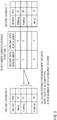
- Fig. 1 shows an example of the original database X ⁇ , the secure database Y ⁇ , and the row number correspondence function f y .
- the original database X ⁇ is a database including N plaintext records each having M attributes.
- the secure database Y ⁇ is a database in which the records in the original database are concealed and the order is shuffled.
- the row number correspondence function f y is a reference table showing correspondence between row numbers in the original database and row numbers in the secure database.
- a safety assessment technique of the present invention uses the original database X ⁇ , the secure database Y ⁇ , and the row number correspondence function f y to calculate a re-identification rate of the entire database, and assesses the safety.
- roughly the following two processes are performed when calculating the re-identification rate of a record.
- the search for neighbor records includes one using a tree structure (see Reference literature 1) and one using hashing (see Reference literature 2), and they are used to obtain neighbor records.
- the tree structure includes, for example, a kd tree.
- Process 2 To calculate distances between a record linkage target record based on the neighbor records and the neighbor records, and if a row number of the nearest neighbor record matches a true row number of the record linkage target record, determine that re-identification is completed.
- a distance to be calculated an appropriate distance, for example, Euclidean distance, Hamming distance, and Manhattan distance can be used.
- attribute values of records are duplicated, neighbor records equal to or more than the neighborhood number specified in the neighbor search are obtained. In that case, after excluding duplicate records in the neighbor records, distances from neighbor records are calculated.
- Processes 1 and 2 are performed for each record in the secure database, the total value of re-identification rates of respective records is set as a re-identification rate of the database, and the safety of the entire secure database is assessed.
- Fig. 2 is a conceptual diagram representing record linkage according to the prior art
- Fig. 3 is a conceptual diagram representing record linkage according to the present invention.
- distances from all records in the original database are calculated, and it is determined to be re-identified if the row number of the nearest record matches the true row number of the record.
- distances from neighbor records having the predetermined neighborhood number obtained by the neighbor search from the original database are calculated, and it is determined to be re-identified if the row number of the nearest record matches the true row number of the record.
- Process 1 neighbor search
- Process 2 record linkage based on neighbor records
- • represents the number of elements in a set •.
- a neighbor record set X ⁇ i near is obtained using the neighbor search for each record y ⁇ i in the secure database Y ⁇ (corresponding to 2nd to 4th lines). If there are few duplicate records in the original database X ⁇ , the obtained neighbor record set X ⁇ i near is equal to or less than the specified neighborhood number K. However, if there are many duplicate records in the original database X ⁇ , the obtained neighbor record set X ⁇ i near may exceed the specified neighborhood number K, and the effect of the neighbor search may be lost.
- a function f i dup is held that generates a record set X ⁇ i uniq in which duplicate records are excluded from the neighbor record set X ⁇ i near and returns the row numbers of the duplicate records (corresponding to 5th to 7th lines).
- a distance from each record in the neighbor record set for each record y ⁇ i in the secure database Y ⁇ is calculated, and if the true row number (that is, the row number in the original database) of the nearest record matches the true row number of the current record (that is, the row number in the original database associated with the row number in the secure database of the current record), a re-identification rate r is added as a re-identification success.
- the true row number of a duplicate record of the nearest record is searched for, and if it matches the row number of the current record, assuming that re-identification has been completed on average among the duplicate records, 1/the number of duplicate records (1/
- the number of the nearest neighbor records is plural, assuming that those have also been re-identified on average, (1/
- the number of records in the neighbor record set X ⁇ i near is equal to or less than ⁇ K, first a distance from each record in the neighbor record set X ⁇ i near is calculated. Then, the true row number of a duplicate record of the nearest record is searched for, and if it matches the row number of the current record, 1 is added as the re-identification rate. At that time, if the number of the nearest neighbor records is plural, assuming that those have been re-identified on average, (1/
- a safety assessment apparatus and method executes ⁇ Algorithm 1> described above and assesses the safety of a secure database.
- a safety assessment apparatus 1 includes a database storage 10, a neighbor record search part 11, a duplication exclusion part 12, a nearest neighbor record calculation part 13, a re-identification determination part 14, and a re-identification rate calculation part 15, as exemplified in Fig. 4 .
- the safety assessment apparatus 1 performs processes of steps exemplified in Fig. 5 , and the safety assessment method according to the embodiment is implemented.
- the safety assessment apparatus 1 is a special apparatus in which a special program is read into a known or dedicated computer including, for example, a central processing unit (CPU) and a main storage device (RAM: Random Access Memory).
- the safety assessment apparatus 1 performs each process, for example, under control of the central processing unit.
- Data input into the safety assessment apparatus 1 or data obtained in each process is stored in, for example, the main storage device, and the data stored in the main storage device is read out to the central processing unit and used for other processes as needed.
- At least part of each processing part of the safety assessment apparatus 1 may be made of hardware such as an integrated circuit.
- Each storage included in the safety assessment apparatus 1 can be composed of, for example, a main storage device such as a RAM (Random Access Memory), an auxiliary storage device composed of a hard disk, an optical disk, or a semiconductor memory element like a flash memory, or middleware such as a relational database or a key-value store.
- a main storage device such as a RAM (Random Access Memory)
- an auxiliary storage device composed of a hard disk, an optical disk, or a semiconductor memory element like a flash memory
- middleware such as a relational database or a key-value store.
- the neighborhood number K is set to, for example, log N, a logarithm of the number N of records in the original database X ⁇ .
- the neighbor search uses a neighbor search using either the tree structure or hashing and, for example, a method using the kd tree is used.
- the neighbor record search part 11 outputs the obtained neighbor record set X ⁇ i near to the duplication exclusion part 12.
- step S12 if the number of records in the neighbor record set X ⁇ i near is greater than a predetermined threshold value ⁇ K, the duplication exclusion part 12 excludes duplicate records in the neighbor record set X ⁇ i near to generate a duplication excluded neighbor record set X ⁇ i uniq .
- the duplication exclusion part 12 outputs the duplication excluded neighbor record set X ⁇ i uniq to the nearest neighbor record calculation part 13. If the number of records in the neighbor record set X ⁇ i near is equal to or less than the threshold value ⁇ K, the duplication exclusion part 12 outputs the neighbor record set X ⁇ i near to the nearest neighbor record calculation part 13.
- the nearest neighbor record calculation part 13 outputs the obtained nearest neighbor record Z ⁇ to the re-identification determination part 14.
- step S14 for each record y ⁇ i in the secure database Y ⁇ , the re-identification determination part 14 calculates a re-identification rate ri of the record y ⁇ i on the basis of whether the record x ⁇ j of the original database X ⁇ associated with the record y ⁇ i is in the nearest neighbor record Z ⁇ .
- the record x ⁇ j associated with the record y ⁇ i can be obtained using the row number correspondence function f y .
- the re-identification determination part 14 outputs the calculated re-identification rate r i of the record y ⁇ i to the re-identification rate calculation part 15.
- the re-identification rate calculation part 15 calculates a re-identification rate r of the secure database Y ⁇ on the basis of the re-identification rate ri calculated for each record y ⁇ i in the secure database Y ⁇ .
- the re-identification rate calculation part 15 sets the re-identification rate r of the secure database Y ⁇ as an output of the safety assessment apparatus 1.
- the point of the embodiment is to have solved a problem that cannot be solved by simply combining the neighbor search for record linkage, that is, a problem when a large number of neighbor records appear. Specifically, by applying the duplication exclusion process to a large number of neighbor records, the processing time is reduced. In the case where attribute values are duplicated or the like when neighbor records are obtained, since neighbor records equal to or more than a specified neighborhood number are obtained, an execution time will be longer if processing is performed as is. In the worst case, neighbor records are output as many as the number of all records in the database, and as a result, the effect of searching for neighbor records will be lost. In the embodiment, since the process of duplication exclusion is applied when neighbor records are obtained, the above problem can be avoided and high-speed execution is made possible.
- the program describing the processing contents can be recorded in a computer-readable recording medium.
- the computer-readable recording medium may be any recording medium, for example, a magnetic recording device, an optical disk, a magneto-optical recording medium, and a semiconductor memory.
- Distribution of this program is carried out, for example, by selling, transferring, or lending a portable recording medium such as a DVD or a CD-ROM on which the program is recorded.
- the program may be stored in a storage device of a server computer, transferred from the server computer to another computer via a network, and thereby distributed.
- a computer that executes such a program for example, first stores the program recorded on the portable recording medium or the program transferred from the server computer temporarily in its own storage device. Then, when executing processing, the computer reads the program stored in its own storage device and performs the processing according to the read program.
- the computer may directly read the program from the portable recording medium and perform the processing according to the program, or further may sequentially execute processing according to a received program every time the program is transferred from the server computer to the computer.
- the program is not transferred from the server computer to the computer, and the above-described processing may be executed by a so-called ASP (Application Service Provider) type service that implements a processing function only by execution instructions and result acquisition.
- ASP Application Service Provider
- the program in the embodiment includes information which is used for processing by the computer and is similar to the program (data or the like that is not a direct command to the computer but has properties that define processing of the computer).
- the apparatus is configured by executing the predetermined program on the computer, but at least part of the processing contents may be implemented by hardware.
Landscapes
- Engineering & Computer Science (AREA)
- Theoretical Computer Science (AREA)
- Databases & Information Systems (AREA)
- General Physics & Mathematics (AREA)
- Physics & Mathematics (AREA)
- General Engineering & Computer Science (AREA)
- Data Mining & Analysis (AREA)
- Software Systems (AREA)
- Computational Linguistics (AREA)
- Health & Medical Sciences (AREA)
- Bioethics (AREA)
- General Health & Medical Sciences (AREA)
- Library & Information Science (AREA)
- Medical Informatics (AREA)
- Computer Hardware Design (AREA)
- Computer Security & Cryptography (AREA)
- Information Retrieval, Db Structures And Fs Structures Therefor (AREA)
- Storage Device Security (AREA)
Abstract
Description
- The present invention relates to a technique for assessing the safety of a database that conceals individual data by a deterministic method or a probabilistic method for a database.
- Techniques for concealing individual data by the deterministic method for a database (hereinafter referred to as "original database") include a k-anonymity method (see Non-patent
literatures 1 and 2). Further, techniques for concealing by the probabilistic method include a Pk-anonymity method (see Non-patentliteratures 3 and 4). In order to assess the safety of a database that has been subjected to the concealing processing (hereinafter referred to as "secure database"), a method called record linkage (see Non-patentliteratures 5 and 6) is used. The record linkage is a method for measuring how well a record is concealed by trying to re-identify the record. In the prior art, distances between a target record in the secure database for which re-identification is tried and all records in the original database are calculated, and if the nearest neighbor record matches the target record, it is considered as re-identification is completed, and an inverse of a nearest neighbor record number is set as a re-identification rate of the target record. This is done for all records in the secure database, and a total value of re-identification rates of the respective records is assessed as a re-identification rate of the database. -
- Non-patent literature 1: Kristen LeFevre, David J DeWitt, and Raghu Ramakrishnan, "Incognito: Efficient full-domain k-anonymity", Proceedings of the 2005 ACM SIGMOD international conference on Management of data, pp. 49-60, 2005.
- Non-patent literature 2: Florian Kohlmayer, Fabian Prasser, Claudia Eckert, Alfons Kemper, and Klaus A Kuhn, "Flash: efficient, stable and optimal k-anonymity", Privacy, Security, Risk and Trust (PASSAT), 2012 International Conference on and 2012 International Conference on Social Computing (SocialCom), pp. 708-717, 2012.
- Non-patent literature 3: Dai Ikarashi, Koji Chida, and Katsumi Takahashi, "Randomized k-anonymization for numeric attributes", Computer Security Symposium 2011, pp. 450-455, 2011.
- Non-patent literature 4: Dai Ikarashi, Koji Chida, and Katsumi Takahashi, "A probabilistic extension of k-anonymity", Computer Security Symposium 2009, pp. 1-6, 2009.
- Non-patent literature 5: Vicenc Torra, John M Abowd, and Josep Domingo-Ferrer, "Using mahalanobis distance-based record linkage for disclosure risk assessment", International Conference on Privacy in Statistical Databases, pp. 233-242, 2006.
- Non-patent literature 6: Josep Domingo-Ferrer and Vicenc Torra, "Distance-based and probabilistic record linkage for re-identification of records with categorical variables", Butlleti de IACIA, Associacio Catalana dIntelligencia Artificial, pp. 243-250, 2002.
- Recently, the utilization of big data is drawing attention, and it is expected that data to be anonymized will also be large-scale data. In the prior art, it is a problem that a processing time increases as the number of records increases at the time of record linkage. More specifically, as the number of records increases linearly, the processing time increases by the square. Therefore, it is a problem to perform the record linkage for large-scale data within a practical processing time.
- In view of the above technical problem, the present invention aims to efficiently assess the safety of a database that conceals large-scale data.
- In order to solve the above problem, a safety assessment apparatus according to one aspect of the invention comprises a database storage that stores an original database composed of a plurality of records and a secure database that conceals the original database, a neighbor record search part that obtains, for each record in the secure database, a neighbor record set having a predetermined neighborhood number by a neighbor search of the original database, a nearest neighbor record calculation part that calculates, for each record in the secure database, a distance from each record in the neighbor record set and obtains a nearest neighbor record based on the distance from the record, a re-identification determination part that calculates, for each record in the secure database, a re-identification rate of the record based on whether a record in the original database corresponding to the record in the secure database matches the nearest neighbor record, and a re-identification rate calculation part that calculates a re-identification rate of the secure database based on the re-identification rate calculated for each record in the secure database.
- According to the present invention, when performing the record linkage, processing that requires an amount of calculation of O(N2) in the prior art becomes an amount of calculation of O(N log N) when the number of neighbors is log N. Therefore, the record linkage can be performed within a practical processing time for large-scale data. Thus, it is possible to efficiently assess the safety of a database that conceals large-scale data.
-
-
Fig. 1 is a diagram for illustrating definition of a database targeted by the present invention; -
Fig. 2 is a conceptual diagram for illustrating conventional record linkage; -
Fig. 3 is a conceptual diagram for illustrating record linkage of the present invention; -
Fig. 4 is a diagram exemplifying a functional configuration of a safety assessment apparatus according to an embodiment; and -
Fig. 5 is a diagram exemplifying a processing procedure of a safety assessment method according to the embodiment. - Hereinafter, an embodiment of the present invention will be described in detail. Components having the same functions are provided with the same reference numerals in the drawings, and redundant description will be omitted.
- A set of certain attributes is expressed as an upper case X, whereas a value of the attribute X is expressed as a lower case x∈X.
- One record in a database is expressed as a horizontal vector. For example, an ith record in a database having M attributes is x→ i={xi1, ..., xij, ..., xiM}.
- A set composed of a plurality of records is a database X→. For example, a database including N records is X→={x→ 1, ..., x→ N}.
- A set composed of records in which the respective records in the database X→ are concealed by the deterministic method or the probabilistic method is a secure database Y→. For example, a secure database having a record number N is Y→={y→ 1, ..., y→ N}.
- The order of records in the secure database Y→ may be shuffled. Therefore, a row number correspondence function fy: R→R that associates row numbers in the secure database Y→ with row numbers in the original database X→ (hereinafter sometimes referred to as "true row numbers") is defined.
-
Fig. 1 shows an example of the original database X→, the secure database Y→, and the row number correspondence function fy. The original database X→ is a database including N plaintext records each having M attributes. The secure database Y→ is a database in which the records in the original database are concealed and the order is shuffled. The row number correspondence function fy is a reference table showing correspondence between row numbers in the original database and row numbers in the secure database. - A safety assessment technique of the present invention uses the original database X→, the secure database Y→, and the row number correspondence function fy to calculate a re-identification rate of the entire database, and assesses the safety. In the present invention, roughly the following two processes are performed when calculating the re-identification rate of a record.
-
Process 1. To obtain neighbor records of a record that is a target of a neighbor search as many as a specified neighborhood number. The search for neighbor records includes one using a tree structure (see Reference literature 1) and one using hashing (see Reference literature 2), and they are used to obtain neighbor records. The tree structure includes, for example, a kd tree. -
- [Reference literature 1] Jon Louis Bentley, "Multidimensional binary search trees used for associative searching", Communications of the ACM, Vol. 18, No. 9, pp. 509-517, 1975.
- [Reference literature 2] Mayur Datar, Nicole Immorlica, Piotr Indyk, and Vahab S Mirrokni, "Locality-sensitive hashing scheme based on p-stable distributions", In Proceedings of the twentieth annual symposium on Computational geometry, pp. 253-262, 2004.
-
Process 2. To calculate distances between a record linkage target record based on the neighbor records and the neighbor records, and if a row number of the nearest neighbor record matches a true row number of the record linkage target record, determine that re-identification is completed. As a distance to be calculated, an appropriate distance, for example, Euclidean distance, Hamming distance, and Manhattan distance can be used. When attribute values of records are duplicated, neighbor records equal to or more than the neighborhood number specified in the neighbor search are obtained. In that case, after excluding duplicate records in the neighbor records, distances from neighbor records are calculated. -
Processes -
Fig. 2 is a conceptual diagram representing record linkage according to the prior art, whereasFig. 3 is a conceptual diagram representing record linkage according to the present invention. In the prior art, for a record in the secure database, distances from all records in the original database are calculated, and it is determined to be re-identified if the row number of the nearest record matches the true row number of the record. On the other hand, in the present invention, for a record in the secure database, distances from neighbor records having the predetermined neighborhood number obtained by the neighbor search from the original database are calculated, and it is determined to be re-identified if the row number of the nearest record matches the true row number of the record. - In the present invention, either a neighbor search using the tree structure or a neighbor search using hashing is used. A specific process of the present invention is shown in <
Algorithm 1>. Process 1 (neighbor search) corresponds to 2nd to 7th lines, and Process 2 (record linkage based on neighbor records) corresponds to 8th to 22nd lines. Note that | • | represents the number of elements in a set •. - <
Algorithm 1> Record linkage using the neighbor search Input: an original database with N records X→={x→ 1, ..., x→ N}, a secure database with N records Y→={y→ 1, ..., y→ N}, a row number correspondence function fy: R→R, a neighborhood number K (1<K<N), and a permissible range ε (ε>1) - Output: a re-identification rate r


- First, a neighbor record set X→ i near is obtained using the neighbor search for each record y→ i in the secure database Y→ (corresponding to 2nd to 4th lines). If there are few duplicate records in the original database X→, the obtained neighbor record set X→ i near is equal to or less than the specified neighborhood number K. However, if there are many duplicate records in the original database X→, the obtained neighbor record set X→ i near may exceed the specified neighborhood number K, and the effect of the neighbor search may be lost. Therefore, if the neighbor record set X→ i near exceeds εK, a function fi dup is held that generates a record set X→ i uniq in which duplicate records are excluded from the neighbor record set X→ i near and returns the row numbers of the duplicate records (corresponding to 5th to 7th lines). Note that the permissible range ε and the neighborhood number K may be set to, for example, ε=2.0 and K=log N.
- Next, a distance from each record in the neighbor record set for each record y→ i in the secure database Y→ is calculated, and if the true row number (that is, the row number in the original database) of the nearest record matches the true row number of the current record (that is, the row number in the original database associated with the row number in the secure database of the current record), a re-identification rate r is added as a re-identification success.
- More specifically, if the number of records in the neighbor record set X→ i near exceeds εK, a distance from each record in the neighbor record set X→ i uniq in which duplication is excluded is calculated. Then, the true row number of a duplicate record of the nearest record is searched for, and if it matches the row number of the current record, assuming that re-identification has been completed on average among the duplicate records, 1/the number of duplicate records (1/|fidup|) is added as the re-identification rate. At that time, if the number of the nearest neighbor records is plural, assuming that those have also been re-identified on average, (1/|Z→|) is added (corresponding to 9th to 15th lines).
- If the number of records in the neighbor record set X→ i near is equal to or less than εK, first a distance from each record in the neighbor record set X→ i near is calculated. Then, the true row number of a duplicate record of the nearest record is searched for, and if it matches the row number of the current record, 1 is added as the re-identification rate. At that time, if the number of the nearest neighbor records is plural, assuming that those have been re-identified on average, (1/|Z→|) is added (corresponding to 16th to 21st lines).
- A safety assessment apparatus and method according to an embodiment executes <
Algorithm 1> described above and assesses the safety of a secure database. Asafety assessment apparatus 1 according to the embodiment includes adatabase storage 10, a neighborrecord search part 11, aduplication exclusion part 12, a nearest neighborrecord calculation part 13, are-identification determination part 14, and a re-identificationrate calculation part 15, as exemplified inFig. 4 . Thesafety assessment apparatus 1 performs processes of steps exemplified inFig. 5 , and the safety assessment method according to the embodiment is implemented. - The
safety assessment apparatus 1 is a special apparatus in which a special program is read into a known or dedicated computer including, for example, a central processing unit (CPU) and a main storage device (RAM: Random Access Memory). Thesafety assessment apparatus 1 performs each process, for example, under control of the central processing unit. Data input into thesafety assessment apparatus 1 or data obtained in each process is stored in, for example, the main storage device, and the data stored in the main storage device is read out to the central processing unit and used for other processes as needed. At least part of each processing part of thesafety assessment apparatus 1 may be made of hardware such as an integrated circuit. Each storage included in thesafety assessment apparatus 1 can be composed of, for example, a main storage device such as a RAM (Random Access Memory), an auxiliary storage device composed of a hard disk, an optical disk, or a semiconductor memory element like a flash memory, or middleware such as a relational database or a key-value store. - Hereinafter, the safety assessment method executed by the
safety assessment apparatus 1 according to the embodiment will be described with reference toFig. 5 . - The
database storage 10 stores an original database X→={x→ 1, ..., x→ N} composed of plaintext records x→ i (i=1, ..., N, N≥2), a secure database Y→={y→ 1, ..., y→ N} that conceals the original database X→, and a row number correspondence function fy that associates row numbers in the original database X→ with row numbers in the secure database Y→. - In step S11, the neighbor
record search part 11 obtains a neighbor record set X→ i near={x→ j} (j∈ {1, ..., N}) having a predetermined neighborhood number K by the neighbor search of the original database X→ with respect to each record y→ i in the secure database Y→. At this time, the neighborhood number K is set to, for example, log N, a logarithm of the number N of records in the original database X→. The neighbor search uses a neighbor search using either the tree structure or hashing and, for example, a method using the kd tree is used. The neighborrecord search part 11 outputs the obtained neighbor record set X→ i near to theduplication exclusion part 12. - In step S12, if the number of records in the neighbor record set X→ i near is greater than a predetermined threshold value εK, the
duplication exclusion part 12 excludes duplicate records in the neighbor record set X→ i near to generate a duplication excluded neighbor record set X→ i uniq. At this time, the threshold value εK is set to, for example, twice the neighborhood number (that is, the permissible range ε=2.0). Theduplication exclusion part 12 outputs the duplication excluded neighbor record set X→ i uniq to the nearest neighborrecord calculation part 13. If the number of records in the neighbor record set X→ i near is equal to or less than the threshold value εK, theduplication exclusion part 12 outputs the neighbor record set X→ i near to the nearest neighborrecord calculation part 13. - In step S13, for each record y→ i in the secure database Y→, the nearest neighbor
record calculation part 13 calculates a distance from each record in the duplication excluded neighbor record set X→ i uniq if the number of records in the neighbor record set X→ i near is greater than the threshold value εK, or calculates a distance from each record in the neighbor record set X→ i near if the number of records in the neighbor record set X→ i near is equal to or less than the threshold value εK, and then obtains a nearest neighbor record Z→={x→ k} (k ∈ {1, ..., N}) which is the nearest to the record y→ i. The nearest neighborrecord calculation part 13 outputs the obtained nearest neighbor record Z→ to there-identification determination part 14. - In step S14, for each record y→ i in the secure database Y→, the
re-identification determination part 14 calculates a re-identification rate ri of the record y→ i on the basis of whether the record x→ j of the original database X→ associated with the record y→ i is in the nearest neighbor record Z→. The record x→ j associated with the record y→ i can be obtained using the row number correspondence function fy. There-identification determination part 14 outputs the calculated re-identification rate ri of the record y→ i to the re-identificationrate calculation part 15. - In step S15, the re-identification
rate calculation part 15 calculates a re-identification rate r of the secure database Y→ on the basis of the re-identification rate ri calculated for each record y→ i in the secure database Y→. For example, the total ∑i=1 Nri of the re-identification rate ri of each record y→ i in the secure database Y→ is set as the re-identification rate r of the secure database Y→. The re-identificationrate calculation part 15 sets the re-identification rate r of the secure database Y→ as an output of thesafety assessment apparatus 1. - The point of the embodiment is to have solved a problem that cannot be solved by simply combining the neighbor search for record linkage, that is, a problem when a large number of neighbor records appear. Specifically, by applying the duplication exclusion process to a large number of neighbor records, the processing time is reduced. In the case where attribute values are duplicated or the like when neighbor records are obtained, since neighbor records equal to or more than a specified neighborhood number are obtained, an execution time will be longer if processing is performed as is. In the worst case, neighbor records are output as many as the number of all records in the database, and as a result, the effect of searching for neighbor records will be lost. In the embodiment, since the process of duplication exclusion is applied when neighbor records are obtained, the above problem can be avoided and high-speed execution is made possible.
- As above, the embodiment of the present invention has been described, but specific configurations are not limited to the embodiment, and it goes without saying that even if there is a design modification or the like as appropriate without departing from the scope of the invention, it is included in the invention. The various processes described in the embodiment may be performed not only in chronological order according to the described order, but also in parallel or individually according to processing capability of a device that performs the processes or as needed.
- When various processing functions in each apparatus described in the embodiment above are implemented by a computer, processing contents of functions which each apparatus should have are described by a program. Then, the computer executes the program, and thereby the various processing functions in each apparatus can be implemented on the computer.
- The program describing the processing contents can be recorded in a computer-readable recording medium. The computer-readable recording medium may be any recording medium, for example, a magnetic recording device, an optical disk, a magneto-optical recording medium, and a semiconductor memory.
- Distribution of this program is carried out, for example, by selling, transferring, or lending a portable recording medium such as a DVD or a CD-ROM on which the program is recorded. Furthermore, the program may be stored in a storage device of a server computer, transferred from the server computer to another computer via a network, and thereby distributed.
- A computer that executes such a program, for example, first stores the program recorded on the portable recording medium or the program transferred from the server computer temporarily in its own storage device. Then, when executing processing, the computer reads the program stored in its own storage device and performs the processing according to the read program. As another execution form of the program, the computer may directly read the program from the portable recording medium and perform the processing according to the program, or further may sequentially execute processing according to a received program every time the program is transferred from the server computer to the computer. In addition, the program is not transferred from the server computer to the computer, and the above-described processing may be executed by a so-called ASP (Application Service Provider) type service that implements a processing function only by execution instructions and result acquisition. Note that the program in the embodiment includes information which is used for processing by the computer and is similar to the program (data or the like that is not a direct command to the computer but has properties that define processing of the computer).
- In the embodiment, the apparatus is configured by executing the predetermined program on the computer, but at least part of the processing contents may be implemented by hardware.
Claims (6)
- A safety assessment apparatus comprising:a database storage that stores an original database composed of a plurality of records and a secure database that conceals the original database;a neighbor record search part that obtains, for each record in the secure database, a neighbor record set having a predetermined neighborhood number by a neighbor search of the original database;a nearest neighbor record calculation part that calculates, for each record in the secure database, a distance from each record in the neighbor record set and obtains a nearest neighbor record based on the distance from the record;a re-identification determination part that calculates, for each record in the secure database, a re-identification rate of the record based on whether a record in the original database corresponding to the record in the secure database matches the nearest neighbor record; anda re-identification rate calculation part that calculates a re-identification rate of the secure database based on the re-identification rate calculated for each record in the secure database.
- The safety assessment apparatus according to claim 1, further comprising
a duplication exclusion part that excludes duplicate records in the neighbor record set when a number of records in the neighbor record set is greater than a predetermined threshold value. - The safety assessment apparatus according to claim 2, wherein: the neighbor record search part obtains the neighbor record set by setting the neighborhood number to a logarithm of a number of records in the original database; and
the duplication exclusion part excludes the duplicate records in the neighbor record set by setting the threshold value to twice the neighborhood number. - The safety assessment apparatus according to any one of claims 1 to 3,
wherein the neighbor record search part obtains the neighbor record set by a neighbor search using a kd tree. - A safety assessment method comprising:in a database storage, storing an original database composed of a plurality of records and a secure database that conceals the original database;by a neighbor record search part, obtaining, for each record in the secure database, a neighbor record set having a predetermined neighborhood number by a neighbor search of the original database;by a nearest neighbor record calculation part, calculating, for each record in the secure database, a distance from each record in the neighbor record set and obtaining a nearest neighbor record based on the distance from the record;by a re-identification determination part, calculating, for each record in the secure database, a re-identification rate of the record based on whether a record in the original database corresponding to the record in the secure database matches the nearest neighbor record; andby a re-identification rate calculation part, calculating a re-identification rate of the secure database based on the re-identification rate calculated for each record in the secure database.
- A program for causing a computer to function as the safety assessment apparatus according to any one of claims 1 to 4.
Applications Claiming Priority (2)
| Application Number | Priority Date | Filing Date | Title |
|---|---|---|---|
| JP2018089641 | 2018-05-08 | ||
| PCT/JP2019/016447 WO2019216137A1 (en) | 2018-05-08 | 2019-04-17 | Safety assessment device, safety assessment method, and program |
Publications (3)
| Publication Number | Publication Date |
|---|---|
| EP3792804A1 true EP3792804A1 (en) | 2021-03-17 |
| EP3792804A4 EP3792804A4 (en) | 2022-02-09 |
| EP3792804B1 EP3792804B1 (en) | 2023-02-01 |
Family
ID=68468119
Family Applications (1)
| Application Number | Title | Priority Date | Filing Date |
|---|---|---|---|
| EP19798961.9A Active EP3792804B1 (en) | 2018-05-08 | 2019-04-17 | Safety assessment device, safety assessment method, and program |
Country Status (5)
| Country | Link |
|---|---|
| US (1) | US11354317B2 (en) |
| EP (1) | EP3792804B1 (en) |
| JP (1) | JP6973636B2 (en) |
| CN (1) | CN112088375B (en) |
| WO (1) | WO2019216137A1 (en) |
Family Cites Families (6)
| Publication number | Priority date | Publication date | Assignee | Title |
|---|---|---|---|---|
| WO2007132564A1 (en) * | 2006-05-13 | 2007-11-22 | Justsystems Corporation | Data processing device and method |
| JP5531154B2 (en) * | 2011-03-10 | 2014-06-25 | 日本電信電話株式会社 | Secret product-sum combination system, calculation device, secret product-sum combination method, and program thereof |
| US9600524B2 (en) * | 2014-12-22 | 2017-03-21 | Blackberry Limited | Method and system for efficient feature matching |
| JP6542883B2 (en) * | 2015-05-14 | 2019-07-10 | 日本電信電話株式会社 | Database system, database processing method |
| JP6434162B2 (en) * | 2015-10-28 | 2018-12-05 | 株式会社東芝 | Data management system, data management method and program |
| JP6618875B2 (en) * | 2016-09-21 | 2019-12-11 | Kddi株式会社 | Evaluation apparatus, evaluation method, and evaluation program |
-
2019
- 2019-04-17 US US17/052,211 patent/US11354317B2/en active Active
- 2019-04-17 JP JP2020518220A patent/JP6973636B2/en active Active
- 2019-04-17 CN CN201980030466.7A patent/CN112088375B/en active Active
- 2019-04-17 EP EP19798961.9A patent/EP3792804B1/en active Active
- 2019-04-17 WO PCT/JP2019/016447 patent/WO2019216137A1/en not_active Ceased
Also Published As
| Publication number | Publication date |
|---|---|
| CN112088375B (en) | 2024-03-08 |
| EP3792804B1 (en) | 2023-02-01 |
| WO2019216137A1 (en) | 2019-11-14 |
| US20210232587A1 (en) | 2021-07-29 |
| JP6973636B2 (en) | 2021-12-01 |
| US11354317B2 (en) | 2022-06-07 |
| EP3792804A4 (en) | 2022-02-09 |
| JPWO2019216137A1 (en) | 2021-04-30 |
| CN112088375A (en) | 2020-12-15 |
Similar Documents
| Publication | Publication Date | Title |
|---|---|---|
| US11710131B2 (en) | Method and apparatus of identifying a transaction risk | |
| US12169507B2 (en) | Database compaction in distributed data system | |
| EP4213042B1 (en) | Merging and unmerging entity representations via resolver trees | |
| US11487876B1 (en) | Robust whitelisting of legitimate files using similarity score and suspiciousness score | |
| US10956453B2 (en) | Method to estimate the deletability of data objects | |
| Jeong et al. | Anomaly teletraffic intrusion detection systems on hadoop-based platforms: A survey of some problems and solutions | |
| US11244073B2 (en) | Method and system for anonymising data stocks | |
| CN120179509B (en) | Microservice fault location method and equipment based on causal inference and knowledge graph | |
| US10311093B2 (en) | Entity resolution from documents | |
| CN106844089A (en) | A kind of method and apparatus for recovering tree data storage | |
| CN104090952B (en) | A kind of method and system of data flow average value under estimation sliding window | |
| US12536204B2 (en) | Multi-subgraph matching method and apparatus, and device | |
| US11574217B2 (en) | Machine learning based identification and classification of database commands | |
| Ait El Hadj et al. | Validation and correction of large security policies: A clustering and access log based approach | |
| CN114969061A (en) | Distributed storage method and device for industrial time sequence data | |
| US11822803B2 (en) | Method, electronic device and computer program product for managing data blocks | |
| EP3792804B1 (en) | Safety assessment device, safety assessment method, and program | |
| US20220253546A1 (en) | System and method for representing and verifying a data set using a tree-based data structure | |
| CN118432895A (en) | Cross-certification methods, equipment, media and products for attack evidence on big data platforms | |
| US9063944B2 (en) | Match window size for matching multi-level transactions between log files | |
| US20210279660A1 (en) | Information sharing assistance method and information sharing assistance system | |
| Feng et al. | Probabilistic reverse nearest neighbors on uncertain data streams | |
| US11500886B2 (en) | Finding locations of tabular data across systems | |
| Chuang et al. | Pursuing efficient data stream mining by removing long patterns from summaries | |
| EP4068071B1 (en) | Data storage method in storage system and related device |
Legal Events
| Date | Code | Title | Description |
|---|---|---|---|
| STAA | Information on the status of an ep patent application or granted ep patent |
Free format text: STATUS: THE INTERNATIONAL PUBLICATION HAS BEEN MADE |
|
| PUAI | Public reference made under article 153(3) epc to a published international application that has entered the european phase |
Free format text: ORIGINAL CODE: 0009012 |
|
| STAA | Information on the status of an ep patent application or granted ep patent |
Free format text: STATUS: REQUEST FOR EXAMINATION WAS MADE |
|
| 17P | Request for examination filed |
Effective date: 20201208 |
|
| AK | Designated contracting states |
Kind code of ref document: A1 Designated state(s): AL AT BE BG CH CY CZ DE DK EE ES FI FR GB GR HR HU IE IS IT LI LT LU LV MC MK MT NL NO PL PT RO RS SE SI SK SM TR |
|
| AX | Request for extension of the european patent |
Extension state: BA ME |
|
| DAV | Request for validation of the european patent (deleted) | ||
| DAX | Request for extension of the european patent (deleted) | ||
| A4 | Supplementary search report drawn up and despatched |
Effective date: 20220110 |
|
| RIC1 | Information provided on ipc code assigned before grant |
Ipc: G06F 21/62 20130101AFI20220103BHEP |
|
| GRAP | Despatch of communication of intention to grant a patent |
Free format text: ORIGINAL CODE: EPIDOSNIGR1 |
|
| STAA | Information on the status of an ep patent application or granted ep patent |
Free format text: STATUS: GRANT OF PATENT IS INTENDED |
|
| INTG | Intention to grant announced |
Effective date: 20220826 |
|
| GRAS | Grant fee paid |
Free format text: ORIGINAL CODE: EPIDOSNIGR3 |
|
| GRAA | (expected) grant |
Free format text: ORIGINAL CODE: 0009210 |
|
| STAA | Information on the status of an ep patent application or granted ep patent |
Free format text: STATUS: THE PATENT HAS BEEN GRANTED |
|
| AK | Designated contracting states |
Kind code of ref document: B1 Designated state(s): AL AT BE BG CH CY CZ DE DK EE ES FI FR GB GR HR HU IE IS IT LI LT LU LV MC MK MT NL NO PL PT RO RS SE SI SK SM TR |
|
| REG | Reference to a national code |
Ref country code: GB Ref legal event code: FG4D |
|
| REG | Reference to a national code |
Ref country code: CH Ref legal event code: EP Ref country code: AT Ref legal event code: REF Ref document number: 1547106 Country of ref document: AT Kind code of ref document: T Effective date: 20230215 |
|
| REG | Reference to a national code |
Ref country code: DE Ref legal event code: R096 Ref document number: 602019025046 Country of ref document: DE |
|
| REG | Reference to a national code |
Ref country code: IE Ref legal event code: FG4D |
|
| REG | Reference to a national code |
Ref country code: LT Ref legal event code: MG9D |
|
| REG | Reference to a national code |
Ref country code: NL Ref legal event code: MP Effective date: 20230201 |
|
| REG | Reference to a national code |
Ref country code: AT Ref legal event code: MK05 Ref document number: 1547106 Country of ref document: AT Kind code of ref document: T Effective date: 20230201 |
|
| PG25 | Lapsed in a contracting state [announced via postgrant information from national office to epo] |
Ref country code: RS Free format text: LAPSE BECAUSE OF FAILURE TO SUBMIT A TRANSLATION OF THE DESCRIPTION OR TO PAY THE FEE WITHIN THE PRESCRIBED TIME-LIMIT Effective date: 20230201 Ref country code: PT Free format text: LAPSE BECAUSE OF FAILURE TO SUBMIT A TRANSLATION OF THE DESCRIPTION OR TO PAY THE FEE WITHIN THE PRESCRIBED TIME-LIMIT Effective date: 20230601 Ref country code: NO Free format text: LAPSE BECAUSE OF FAILURE TO SUBMIT A TRANSLATION OF THE DESCRIPTION OR TO PAY THE FEE WITHIN THE PRESCRIBED TIME-LIMIT Effective date: 20230501 Ref country code: NL Free format text: LAPSE BECAUSE OF FAILURE TO SUBMIT A TRANSLATION OF THE DESCRIPTION OR TO PAY THE FEE WITHIN THE PRESCRIBED TIME-LIMIT Effective date: 20230201 Ref country code: LV Free format text: LAPSE BECAUSE OF FAILURE TO SUBMIT A TRANSLATION OF THE DESCRIPTION OR TO PAY THE FEE WITHIN THE PRESCRIBED TIME-LIMIT Effective date: 20230201 Ref country code: LT Free format text: LAPSE BECAUSE OF FAILURE TO SUBMIT A TRANSLATION OF THE DESCRIPTION OR TO PAY THE FEE WITHIN THE PRESCRIBED TIME-LIMIT Effective date: 20230201 Ref country code: HR Free format text: LAPSE BECAUSE OF FAILURE TO SUBMIT A TRANSLATION OF THE DESCRIPTION OR TO PAY THE FEE WITHIN THE PRESCRIBED TIME-LIMIT Effective date: 20230201 Ref country code: ES Free format text: LAPSE BECAUSE OF FAILURE TO SUBMIT A TRANSLATION OF THE DESCRIPTION OR TO PAY THE FEE WITHIN THE PRESCRIBED TIME-LIMIT Effective date: 20230201 Ref country code: AT Free format text: LAPSE BECAUSE OF FAILURE TO SUBMIT A TRANSLATION OF THE DESCRIPTION OR TO PAY THE FEE WITHIN THE PRESCRIBED TIME-LIMIT Effective date: 20230201 |
|
| PG25 | Lapsed in a contracting state [announced via postgrant information from national office to epo] |
Ref country code: SE Free format text: LAPSE BECAUSE OF FAILURE TO SUBMIT A TRANSLATION OF THE DESCRIPTION OR TO PAY THE FEE WITHIN THE PRESCRIBED TIME-LIMIT Effective date: 20230201 Ref country code: PL Free format text: LAPSE BECAUSE OF FAILURE TO SUBMIT A TRANSLATION OF THE DESCRIPTION OR TO PAY THE FEE WITHIN THE PRESCRIBED TIME-LIMIT Effective date: 20230201 Ref country code: IS Free format text: LAPSE BECAUSE OF FAILURE TO SUBMIT A TRANSLATION OF THE DESCRIPTION OR TO PAY THE FEE WITHIN THE PRESCRIBED TIME-LIMIT Effective date: 20230601 Ref country code: GR Free format text: LAPSE BECAUSE OF FAILURE TO SUBMIT A TRANSLATION OF THE DESCRIPTION OR TO PAY THE FEE WITHIN THE PRESCRIBED TIME-LIMIT Effective date: 20230502 Ref country code: FI Free format text: LAPSE BECAUSE OF FAILURE TO SUBMIT A TRANSLATION OF THE DESCRIPTION OR TO PAY THE FEE WITHIN THE PRESCRIBED TIME-LIMIT Effective date: 20230201 |
|
| PG25 | Lapsed in a contracting state [announced via postgrant information from national office to epo] |
Ref country code: SM Free format text: LAPSE BECAUSE OF FAILURE TO SUBMIT A TRANSLATION OF THE DESCRIPTION OR TO PAY THE FEE WITHIN THE PRESCRIBED TIME-LIMIT Effective date: 20230201 Ref country code: RO Free format text: LAPSE BECAUSE OF FAILURE TO SUBMIT A TRANSLATION OF THE DESCRIPTION OR TO PAY THE FEE WITHIN THE PRESCRIBED TIME-LIMIT Effective date: 20230201 Ref country code: EE Free format text: LAPSE BECAUSE OF FAILURE TO SUBMIT A TRANSLATION OF THE DESCRIPTION OR TO PAY THE FEE WITHIN THE PRESCRIBED TIME-LIMIT Effective date: 20230201 Ref country code: DK Free format text: LAPSE BECAUSE OF FAILURE TO SUBMIT A TRANSLATION OF THE DESCRIPTION OR TO PAY THE FEE WITHIN THE PRESCRIBED TIME-LIMIT Effective date: 20230201 Ref country code: CZ Free format text: LAPSE BECAUSE OF FAILURE TO SUBMIT A TRANSLATION OF THE DESCRIPTION OR TO PAY THE FEE WITHIN THE PRESCRIBED TIME-LIMIT Effective date: 20230201 |
|
| REG | Reference to a national code |
Ref country code: DE Ref legal event code: R097 Ref document number: 602019025046 Country of ref document: DE |
|
| PG25 | Lapsed in a contracting state [announced via postgrant information from national office to epo] |
Ref country code: SK Free format text: LAPSE BECAUSE OF FAILURE TO SUBMIT A TRANSLATION OF THE DESCRIPTION OR TO PAY THE FEE WITHIN THE PRESCRIBED TIME-LIMIT Effective date: 20230201 |
|
| REG | Reference to a national code |
Ref country code: CH Ref legal event code: PL |
|
| PLBE | No opposition filed within time limit |
Free format text: ORIGINAL CODE: 0009261 |
|
| STAA | Information on the status of an ep patent application or granted ep patent |
Free format text: STATUS: NO OPPOSITION FILED WITHIN TIME LIMIT |
|
| PG25 | Lapsed in a contracting state [announced via postgrant information from national office to epo] |
Ref country code: LU Free format text: LAPSE BECAUSE OF NON-PAYMENT OF DUE FEES Effective date: 20230417 |
|
| 26N | No opposition filed |
Effective date: 20231103 |
|
| REG | Reference to a national code |
Ref country code: BE Ref legal event code: MM Effective date: 20230430 |
|
| PG25 | Lapsed in a contracting state [announced via postgrant information from national office to epo] |
Ref country code: MC Free format text: LAPSE BECAUSE OF FAILURE TO SUBMIT A TRANSLATION OF THE DESCRIPTION OR TO PAY THE FEE WITHIN THE PRESCRIBED TIME-LIMIT Effective date: 20230201 |
|
| PG25 | Lapsed in a contracting state [announced via postgrant information from national office to epo] |
Ref country code: SI Free format text: LAPSE BECAUSE OF FAILURE TO SUBMIT A TRANSLATION OF THE DESCRIPTION OR TO PAY THE FEE WITHIN THE PRESCRIBED TIME-LIMIT Effective date: 20230201 Ref country code: MC Free format text: LAPSE BECAUSE OF FAILURE TO SUBMIT A TRANSLATION OF THE DESCRIPTION OR TO PAY THE FEE WITHIN THE PRESCRIBED TIME-LIMIT Effective date: 20230201 Ref country code: LI Free format text: LAPSE BECAUSE OF NON-PAYMENT OF DUE FEES Effective date: 20230430 Ref country code: CH Free format text: LAPSE BECAUSE OF NON-PAYMENT OF DUE FEES Effective date: 20230430 |
|
| REG | Reference to a national code |
Ref country code: IE Ref legal event code: MM4A |
|
| PG25 | Lapsed in a contracting state [announced via postgrant information from national office to epo] |
Ref country code: BE Free format text: LAPSE BECAUSE OF NON-PAYMENT OF DUE FEES Effective date: 20230430 |
|
| PG25 | Lapsed in a contracting state [announced via postgrant information from national office to epo] |
Ref country code: IE Free format text: LAPSE BECAUSE OF NON-PAYMENT OF DUE FEES Effective date: 20230417 |
|
| PG25 | Lapsed in a contracting state [announced via postgrant information from national office to epo] |
Ref country code: IE Free format text: LAPSE BECAUSE OF NON-PAYMENT OF DUE FEES Effective date: 20230417 |
|
| PG25 | Lapsed in a contracting state [announced via postgrant information from national office to epo] |
Ref country code: IT Free format text: LAPSE BECAUSE OF FAILURE TO SUBMIT A TRANSLATION OF THE DESCRIPTION OR TO PAY THE FEE WITHIN THE PRESCRIBED TIME-LIMIT Effective date: 20230201 |
|
| PG25 | Lapsed in a contracting state [announced via postgrant information from national office to epo] |
Ref country code: BG Free format text: LAPSE BECAUSE OF FAILURE TO SUBMIT A TRANSLATION OF THE DESCRIPTION OR TO PAY THE FEE WITHIN THE PRESCRIBED TIME-LIMIT Effective date: 20230201 |
|
| PG25 | Lapsed in a contracting state [announced via postgrant information from national office to epo] |
Ref country code: BG Free format text: LAPSE BECAUSE OF FAILURE TO SUBMIT A TRANSLATION OF THE DESCRIPTION OR TO PAY THE FEE WITHIN THE PRESCRIBED TIME-LIMIT Effective date: 20230201 |
|
| PGFP | Annual fee paid to national office [announced via postgrant information from national office to epo] |
Ref country code: DE Payment date: 20250422 Year of fee payment: 7 |
|
| PGFP | Annual fee paid to national office [announced via postgrant information from national office to epo] |
Ref country code: GB Payment date: 20250423 Year of fee payment: 7 |
|
| PGFP | Annual fee paid to national office [announced via postgrant information from national office to epo] |
Ref country code: FR Payment date: 20250425 Year of fee payment: 7 |
|
| PG25 | Lapsed in a contracting state [announced via postgrant information from national office to epo] |
Ref country code: CY Free format text: LAPSE BECAUSE OF FAILURE TO SUBMIT A TRANSLATION OF THE DESCRIPTION OR TO PAY THE FEE WITHIN THE PRESCRIBED TIME-LIMIT; INVALID AB INITIO Effective date: 20190417 |
|
| PG25 | Lapsed in a contracting state [announced via postgrant information from national office to epo] |
Ref country code: HU Free format text: LAPSE BECAUSE OF FAILURE TO SUBMIT A TRANSLATION OF THE DESCRIPTION OR TO PAY THE FEE WITHIN THE PRESCRIBED TIME-LIMIT; INVALID AB INITIO Effective date: 20190417 |
|
| PG25 | Lapsed in a contracting state [announced via postgrant information from national office to epo] |
Ref country code: TR Free format text: LAPSE BECAUSE OF FAILURE TO SUBMIT A TRANSLATION OF THE DESCRIPTION OR TO PAY THE FEE WITHIN THE PRESCRIBED TIME-LIMIT Effective date: 20230201 |
|
| REG | Reference to a national code |
Ref country code: DE Ref legal event code: R081 Ref document number: 602019025046 Country of ref document: DE Owner name: NTT, INC., JP Free format text: FORMER OWNER: NIPPON TELEGRAPH AND TELEPHONE CORPORATION, TOKYO, JP Ref country code: DE Ref legal event code: R082 Ref document number: 602019025046 Country of ref document: DE Representative=s name: DENNEMEYER & ASSOCIATES RECHTSANWALTSGESELLSCH, DE |