EP3792707A1 - Cooking method, cooking device, cooking appliance, and computer readable storage medium - Google Patents
Cooking method, cooking device, cooking appliance, and computer readable storage medium Download PDFInfo
- Publication number
- EP3792707A1 EP3792707A1 EP18923347.1A EP18923347A EP3792707A1 EP 3792707 A1 EP3792707 A1 EP 3792707A1 EP 18923347 A EP18923347 A EP 18923347A EP 3792707 A1 EP3792707 A1 EP 3792707A1
- Authority
- EP
- European Patent Office
- Prior art keywords
- cooking
- cooking process
- cooked
- determining
- attribute information
- Prior art date
- Legal status (The legal status is an assumption and is not a legal conclusion. Google has not performed a legal analysis and makes no representation as to the accuracy of the status listed.)
- Granted
Links
Images
Classifications
-
- A—HUMAN NECESSITIES
- A47—FURNITURE; DOMESTIC ARTICLES OR APPLIANCES; COFFEE MILLS; SPICE MILLS; SUCTION CLEANERS IN GENERAL
- A47J—KITCHEN EQUIPMENT; COFFEE MILLS; SPICE MILLS; APPARATUS FOR MAKING BEVERAGES
- A47J43/00—Implements for preparing or holding food, not provided for in other groups of this subclass
- A47J43/04—Machines for domestic use not covered elsewhere, e.g. for grinding, mixing, stirring, kneading, emulsifying, whipping or beating foodstuffs, e.g. power-driven
- A47J43/07—Parts or details, e.g. mixing tools, whipping tools
-
- G—PHYSICS
- G05—CONTROLLING; REGULATING
- G05B—CONTROL OR REGULATING SYSTEMS IN GENERAL; FUNCTIONAL ELEMENTS OF SUCH SYSTEMS; MONITORING OR TESTING ARRANGEMENTS FOR SUCH SYSTEMS OR ELEMENTS
- G05B19/00—Program-control systems
- G05B19/02—Program-control systems electric
- G05B19/04—Program control other than numerical control, i.e. in sequence controllers or logic controllers
- G05B19/042—Program control other than numerical control, i.e. in sequence controllers or logic controllers using digital processors
- G05B19/0426—Programming the control sequence
-
- A—HUMAN NECESSITIES
- A47—FURNITURE; DOMESTIC ARTICLES OR APPLIANCES; COFFEE MILLS; SPICE MILLS; SUCTION CLEANERS IN GENERAL
- A47J—KITCHEN EQUIPMENT; COFFEE MILLS; SPICE MILLS; APPARATUS FOR MAKING BEVERAGES
- A47J43/00—Implements for preparing or holding food, not provided for in other groups of this subclass
- A47J43/04—Machines for domestic use not covered elsewhere, e.g. for grinding, mixing, stirring, kneading, emulsifying, whipping or beating foodstuffs, e.g. power-driven
-
- A—HUMAN NECESSITIES
- A47—FURNITURE; DOMESTIC ARTICLES OR APPLIANCES; COFFEE MILLS; SPICE MILLS; SUCTION CLEANERS IN GENERAL
- A47J—KITCHEN EQUIPMENT; COFFEE MILLS; SPICE MILLS; APPARATUS FOR MAKING BEVERAGES
- A47J36/00—Parts, details or accessories of cooking-vessels
- A47J36/32—Time-controlled igniting mechanisms or alarm devices
-
- A—HUMAN NECESSITIES
- A47—FURNITURE; DOMESTIC ARTICLES OR APPLIANCES; COFFEE MILLS; SPICE MILLS; SUCTION CLEANERS IN GENERAL
- A47J—KITCHEN EQUIPMENT; COFFEE MILLS; SPICE MILLS; APPARATUS FOR MAKING BEVERAGES
- A47J44/00—Multi-purpose machines for preparing food with several driving units
-
- G—PHYSICS
- G05—CONTROLLING; REGULATING
- G05B—CONTROL OR REGULATING SYSTEMS IN GENERAL; FUNCTIONAL ELEMENTS OF SUCH SYSTEMS; MONITORING OR TESTING ARRANGEMENTS FOR SUCH SYSTEMS OR ELEMENTS
- G05B19/00—Program-control systems
- G05B19/02—Program-control systems electric
- G05B19/04—Program control other than numerical control, i.e. in sequence controllers or logic controllers
-
- G—PHYSICS
- G05—CONTROLLING; REGULATING
- G05B—CONTROL OR REGULATING SYSTEMS IN GENERAL; FUNCTIONAL ELEMENTS OF SUCH SYSTEMS; MONITORING OR TESTING ARRANGEMENTS FOR SUCH SYSTEMS OR ELEMENTS
- G05B19/00—Program-control systems
- G05B19/02—Program-control systems electric
- G05B19/04—Program control other than numerical control, i.e. in sequence controllers or logic controllers
- G05B19/042—Program control other than numerical control, i.e. in sequence controllers or logic controllers using digital processors
- G05B19/0423—Input/output
-
- G—PHYSICS
- G05—CONTROLLING; REGULATING
- G05B—CONTROL OR REGULATING SYSTEMS IN GENERAL; FUNCTIONAL ELEMENTS OF SUCH SYSTEMS; MONITORING OR TESTING ARRANGEMENTS FOR SUCH SYSTEMS OR ELEMENTS
- G05B2219/00—Program-control systems
- G05B2219/20—Pc systems
- G05B2219/26—Pc applications
- G05B2219/2613—Household appliance in general
-
- G—PHYSICS
- G05—CONTROLLING; REGULATING
- G05B—CONTROL OR REGULATING SYSTEMS IN GENERAL; FUNCTIONAL ELEMENTS OF SUCH SYSTEMS; MONITORING OR TESTING ARRANGEMENTS FOR SUCH SYSTEMS OR ELEMENTS
- G05B2219/00—Program-control systems
- G05B2219/20—Pc systems
- G05B2219/26—Pc applications
- G05B2219/2643—Oven, cooking
-
- Y—GENERAL TAGGING OF NEW TECHNOLOGICAL DEVELOPMENTS; GENERAL TAGGING OF CROSS-SECTIONAL TECHNOLOGIES SPANNING OVER SEVERAL SECTIONS OF THE IPC; TECHNICAL SUBJECTS COVERED BY FORMER USPC CROSS-REFERENCE ART COLLECTIONS [XRACs] AND DIGESTS
- Y02—TECHNOLOGIES OR APPLICATIONS FOR MITIGATION OR ADAPTATION AGAINST CLIMATE CHANGE
- Y02P—CLIMATE CHANGE MITIGATION TECHNOLOGIES IN THE PRODUCTION OR PROCESSING OF GOODS
- Y02P90/00—Enabling technologies with a potential contribution to greenhouse gas [GHG] emissions mitigation
- Y02P90/30—Computing systems specially adapted for manufacturing
Definitions
- the present invention relates to the field of cooking technology, specifically, to a cooking method, a cooking device, a cooking appliance and a computer readable storage medium.
- the wall breaker has the advantages of a juicer and a soymilk machine.
- the wall breaker can beat or grind the material to destroy its cell wall and improve the body's absorption efficiency of nutrients and dietary fiber. At the same time, it can also reduce the amount of residue.
- the material can be heated and cooked to prepare rice cereal, milkshakes, yogurt, soy milk and other foods to improve the taste and health needs of users.
- the wall breaking treatment and heating treatment are usually performed on the materials according to the maximum time period when each cooking function is executed.
- the above cooking scheme has at least the following technical problems:
- the present invention aims to solve at least one of the technical problems existing in the prior art or related technologies.
- the first purpose of the present invention is to provide a cooking method.
- Another purpose of the present invention is to provide a cooking device.
- Another purpose of the present invention is to provide a cooking appliance.
- Another purpose of the present invention is to provide a computer readable storage medium.
- a cooking method comprises: receiving attribute information of a material to be cooked and/or culinary demand information for the material to be cooked; determining corresponding cooking process according to the attribute information and/or the culinary demand information; and performing wall breaking treatment and heating treatment on the material to be cooked according to the cooking process.
- the corresponding cooking process is determined according to the attribute information and/or culinary demand information of the material, and the corresponding wall breaking treatment and heating treatment are performed on the material.
- it can determine whether the material is resistant to cooking according to the nutritional component composition, hardness, weight and variety name of the material. For example, the cooking time and cooking power of the material resistant to cooking can be increased, which can effectively reduce the waiting time of the users, for example, shortening the cooking time and cooking power for materials that are not resistant to cooking can effectively reduce power consumption, and combine the nutritional components to determine the vitamin content, trace element content and dietary fiber content, which can reduce the decomposition and loss of nutrients.
- the eating needs include viscosity, hardness, water content, particle size of food, low sugar, low fat, dietary fiber ratio and trace element content, etc.
- the attribute information of the received material can be from the touch panel of the cooking appliance or from the associated client.
- the wall breaking treatment includes whipping treatment, grinding treatment and extrusion treatment, etc., which cause the cell wall of the material to be broken.
- the determining corresponding cooking process according to the attribute information and/or the culinary demand information specifically includes: when analyzing the attribute information to determine that category of the material to be cooked is fruit and vegetable material, determining corresponding hardness according to category information of the fruit and vegetable material; determining particle size range of cooked material according to hardness of the fruit and vegetable material, preset corresponding relationship between hardness and particle size; and determining corresponding cooking process according to the particle size range, preset corresponding relationship between particle size range and cooking process.
- the fruit and vegetable material is rich in dietary fiber, and the dietary fiber ratio mainly determines the taste and hardness of the food
- the preset corresponding relationship between the hardness and particle size according to the hardness of the fruit and vegetable material, to determine the particle size range of the cooked material, and the preset corresponding relationship between the particle size range and the cooking process according to the particle size range, to determine the corresponding cooking process can provide users with food with the best granularity. Further, the taste of the food can better satisfy the needs of users, and in order to retain vitamins and minerals to the greatest extent, the cooking power and cooking time are appropriately reduced, which is conducive to improving the user experience.
- the particle size of the food material gradually decreases, and at the same time, the nutrition of the food material is gradually released.
- the fineness of the food material has fully satisfied the user's food requirements, and the nutrient release of the food has reached the peak, if the whipping is continued, the fineness and taste of the food will no longer be significantly improved, and the whipping time will be wasted, and even the loss of nutrients will be caused.
- the determining corresponding cooking process according to the attribute information and/or the culinary demand information specifically further includes: when analyzing the attribute information to determine that category of the material to be cooked is a bean material, determining pre-stored nutritional component composition corresponding to the bean material; and determining corresponding cooking process according to nutrient component composition of the bean material, preset corresponding relationship between nutrient component composition and cooking process.
- the preset corresponding relationship between the nutritional component composition and the cooking process by determining the pre-stored nutritional component composition corresponding to the bean material, and determining the corresponding cooking process according to the nutritional component composition of the bean material, the preset corresponding relationship between the nutritional component composition and the cooking process.
- the heating power in the corresponding cooking process needs to be appropriately reduced to reduce the occurrence of paste pot and overflow.
- the bean material may produce a large amount of the residue during the cooking process; therefore, the time of the wall breaking treatment needs to be increased in the corresponding cooking process to reduce the generation of the residue, which is conducive to improving the user's taste and the absorption rate of nutrient components.
- the bean material is edamame and the cooking function is preset to "make soy milk", due to its high dietary fiber and high content of flavonoids, after obtaining the default soy milk process, the whipping process time is increased to make the soy milk reach extremely delicate, increase digestion and absorption, lower blood lipids and cholesterol.
- the bean material is black beans and the cooking function is preset to "make soy milk", due to its high protein and dietary fiber content, after obtaining the default soy milk process, on the one hand, it reduces the power and time period of the heating treatment, on the other hand, it increases the time period of the whipping process to make the soy milk extremely delicate, increase digestion and absorption, and lower blood lipids and cholesterol.
- the determining corresponding cooking process according to the attribute information and/or the culinary demand information specifically further includes: when analyzing the attribute information to determine category of the material to be cooked, and analyzing the culinary demand information to determine nutritional effect required by the user, determining corresponding cooking process according to the category, the nutritional effect, and preset corresponding relationship between the nutritional effect under any of the categories and cooking process.
- the fruit and vegetable materials are usually rich in dietary fiber
- the dietary fiber Dietary Fiber, DF
- the dietary fiber can be divided into two categories: water-soluble dietary fiber (Soluble Dietary Fiber, SDF) and non-water-soluble dietary fiber (Insoluble Dietary Fiber, IDF) according to different solubility.
- the above dietary fiber ratio refers to the component ratio of water-soluble dietary fiber and non-water-soluble dietary fiber.
- the water-soluble dietary fiber is a type of non-starch polysaccharide that is not digested by the digestive enzymes of the body, but is soluble in hot water and separated by precipitation with a certain volume of ethanol.
- the water-soluble dietary fiber mainly refers to the water-soluble storage substances and secretions in plant cells, and also includes some microbial polysaccharides and synthetic polysaccharides.
- the water-soluble dietary fiber is mainly composed of some glues.
- the non-water-soluble dietary fiber refers to the non-starch structural polysaccharide that is not digested by the digestive enzymes and is insoluble in hot water, it includes cellulose, hemicellulose, lignin, chitosan and vegetable waxes.
- the two types of dietary fiber exist at the same time, and their composition has a great relationship with the particle size of the food.
- the content of non-water-soluble dietary fiber IDF
- the content of water-soluble dietary fiber SDF
- the insoluble components gradually become soluble components.
- IDF The main function of IDF is to produce mechanical peristaltic effect, promote gastric emptying, promote intestinal peristalsis, and moisturize the bowel. While the SDF exerts more metabolic functions and affects the metabolism of carbohydrates and lipids. It can lower blood lipids, lower cholesterol, lower blood sugar and other effects. There is a proportional relationship between these two components, namely SDF/IDF. Normally, the SDF/IDF is about 1:3 when a reasonable dietary fiber is taken in.
- the particle size of the food can be controlled by adjusting the parameters of the stirring treatment, and then the SDF/IDF can be adjusted. If the SDF/IDF is slightly higher, it means that the content of SDF is increased, and the food demand is biased towards lowering blood lipids, lowering cholesterol, and lowering blood sugar. If the SDF/IDF is slightly lower, it means that the content of IDF is increasing, and the food demand is biased towards the laxative effect.
- the determining corresponding cooking process according to the attribute information and/or the culinary demand information specifically further includes: when analyzing the attribute information to determine increase in moisture content of the material to be cooked, the increase in moisture content is the change in moisture content of the material to be cooked after absorbing water within a preset time period; and determining corresponding cooking process according to the change in moisture content, preset corresponding relationship between change in moisture content and cooking process.
- the increase in moisture content is the change in moisture content of the material to be cooked after absorbing water within a preset time period; and determining corresponding cooking process according to the change in moisture content, preset corresponding relationship between change in moisture content and cooking process. It can improve the taste of the food and conducive to reducing the power consumption of the cooking appliance.
- the material is a boil-resistant material or an easy-to-cook material. For example, if a certain type of cereals absorbs water at room temperature for 30 minutes, the increase in moisture content is ⁇ T ⁇ 10%, and the time required to reach the saturation of water absorption is t>3h, the cereals are determined to be resistant to cooking.
- the cereals are determined to be an easy-to-cook material.
- a cooking device comprises: a receiving device used to receive attribute information of a material to be cooked and/or culinary demand information of the material to be cooked; a determining device used to determine corresponding cooking process according to the attribute information and/or the culinary demand information; and an execution device used to perform wall breaking treatment and heating treatment on the material to be cooked according to the cooking process.
- the corresponding cooking process is determined according to the attribute information and/or culinary demand information of the material, and the corresponding wall breaking treatment and heating treatment are performed on the material.
- it can determine whether the material is resistant to cooking according to the nutritional component composition, hardness, weight and variety name of the material. For example, the cooking time and cooking power of the material resistant to cooking can be increased, which can effectively reduce the waiting time of the users, for example, shortening the cooking time and cooking power for materials that are not resistant to cooking can effectively reduce power consumption, and combine the nutritional components to determine the vitamin content, trace element content and dietary fiber content, which can reduce the decomposition and loss of nutrients.
- the eating needs include viscosity, hardness, water content, particle size of food, low sugar, low fat, dietary fiber ratio and trace element content, etc.
- the attribute information of the received material can be from the touch panel of the cooking appliance or from the associated client.
- the wall breaking treatment includes whipping treatment, grinding treatment and extrusion treatment, etc., which cause the cell wall of the material to be broken.
- the determining device is also used to: when analyzing the attribute information to determine that category of the material to be cooked is fruit and vegetable material, determining corresponding hardness according to category information of the fruit and vegetable material; the determining device is also used to: determining particle size range of cooked material according to hardness of the fruit and vegetable material, preset corresponding relationship between hardness and particle size; and the determining device is also used to: determining corresponding cooking process according to the particle size range, preset corresponding relationship between particle size range and cooking process.
- the fruit and vegetable material is rich in dietary fiber
- the dietary fiber ratio mainly determines the taste and hardness of the food, according to the hardness of the fruit and vegetable material, the preset corresponding relationship between the hardness and particle size, to determine the particle size range of the cooked material, according to the particle size range, the preset corresponding relationship between the particle size range and the cooking process, to determine the corresponding cooking process, which can provide users with food with the best granularity.
- the taste of the food can more satisfy the needs of users, and in order to retain vitamins and minerals to the greatest extent, the cooking power and cooking time are appropriately reduced, which is conducive to improving the user experience.
- the particle size of the food material gradually decreases, and at the same time, the nutrition of the food material is gradually released.
- the fineness of the food material has fully satisfied the user's food requirements, and the nutrient release of the food has reached the peak, if the whipping is continued, the fineness and taste of the food will no longer be significantly improved, and the whipping time will be wasted, and even the loss of nutrients will be caused.
- the determining device is also used to: when analyzing the attribute information to determine that category of the material to be cooked is a bean material, determining pre-stored nutritional component composition corresponding to the bean material; and the determining device is also used to: determining corresponding cooking process according to nutrient component composition of the bean material, preset corresponding relationship between nutrient component composition and cooking process.
- the preset corresponding relationship between the nutritional component composition and the cooking process by determining the pre-stored nutritional component composition corresponding to the bean material, and determining the corresponding cooking process according to the nutritional component composition of the bean material, the preset corresponding relationship between the nutritional component composition and the cooking process.
- the heating power in the corresponding cooking process needs to be appropriately reduced to reduce the occurrence of paste pot and overflow.
- the bean material may produce a large amount of the residue during the cooking process; therefore, the time of the wall breaking treatment needs to be increased in the corresponding cooking process to reduce the generation of the residue, which is conducive to improving the user's taste and the absorption rate of nutrient components.
- the bean material is edamame and the cooking function is preset to "make soy milk", due to its high dietary fiber and high content of flavonoids, after obtaining the default soy milk process, the whipping process time is increased to make the soy milk reach extremely delicate, increase digestion and absorption, lower blood lipids and cholesterol.
- the bean material is black beans and the cooking function is preset to "make soy milk", due to its high protein and dietary fiber content, after obtaining the default soy milk process, on the one hand, it reduces the power and time period of the heating treatment, on the other hand, it increases the time period of the whipping process to make the soy milk extremely delicate, increase digestion and absorption, and lower blood lipids and cholesterol.
- the determining device is also used to: when analyzing the attribute information to determine category of the material to be cooked, and analyzing the culinary demand information to determine nutritional effect required by the user, determining corresponding cooking process according to the category, the nutritional effect, and preset corresponding relationship between the nutritional effect under any of the categories and cooking process.
- the fruit and vegetable materials are usually rich in dietary fiber
- the dietary fiber Dietary Fiber, DF
- the dietary fiber can be divided into two categories: water-soluble dietary fiber (Soluble Dietary Fiber, SDF) and non-water-soluble dietary fiber (Insoluble Dietary Fiber, IDF) according to different solubility.
- the above dietary fiber ratio refers to the component ratio of water-soluble dietary fiber and non-water-soluble dietary fiber.
- the water-soluble dietary fiber is a type of non-starch polysaccharide that is not digested by the digestive enzymes of the body, but is soluble in hot water and separated by precipitation with a certain volume of ethanol.
- the water-soluble dietary fiber mainly refers to the water-soluble storage substances and secretions in plant cells, and also includes some microbial polysaccharides and synthetic polysaccharides.
- the water-soluble dietary fiber is mainly composed of some glues.
- the non-water-soluble dietary fiber refers to the non-starch structural polysaccharide that is not digested by the digestive enzymes and is insoluble in hot water, it includes cellulose, hemicellulose, lignin, chitosan and vegetable waxes.
- the two types of dietary fiber exist at the same time, and their composition has a great relationship with the particle size of the food.
- the content of non-water-soluble dietary fiber IDF
- the content of water-soluble dietary fiber SDF
- the insoluble components gradually become soluble components.
- IDF The main function of IDF is to produce mechanical peristaltic effect, promote gastric emptying, promote intestinal peristalsis, and moisturize the bowel. While the SDF exerts more metabolic functions and affects the metabolism of carbohydrates and lipids. It can lower blood lipids, lower cholesterol, lower blood sugar and other effects. There is a proportional relationship between these two components, namely SDF/IDF. Normally, the SDF/IDF is about 1:3 when a reasonable dietary fiber is taken in.
- the particle size of the food can be controlled by adjusting the parameters of the stirring treatment, and then the SDF/IDF can be adjusted. If the SDF/IDF is slightly higher, it means that the content of SDF is increased, and the food demand is biased towards lowering blood lipids, lowering cholesterol, and lowering blood sugar. If the SDF/IDF is slightly lower, it means that the content of IDF is increasing, and the food demand is biased towards the laxative effect.
- the determining device is also used to: when analyzing the attribute information to determine increase in moisture content of the material to be cooked, the increase in moisture content is the change in moisture content of the material to be cooked after absorbing water within a preset time period; and the determining device is also used to: determining corresponding cooking process according to the change in moisture content, preset corresponding relationship between change in moisture content and cooking process.
- the increase in moisture content is the change in moisture content of the material to be cooked after absorbing water within a preset time period; and determining corresponding cooking process according to the change in moisture content, preset corresponding relationship between change in moisture content and cooking process. It can improve the taste of the food and conducive to reducing the power consumption of the cooking appliance.
- the material is a boil-resistant material or an easy-to-cook material. For example, if a certain type of cereals absorbs water at room temperature for 30 minutes, the increase in moisture content is ⁇ T ⁇ 10%, and the time required to reach the saturation of water absorption is t>3h, the cereals are determined to be resistant to cooking.
- the cereals are determined to be an easy-to-cook material.
- a cooking appliance comprises a cooking device as defined in any of the above-mentioned technical solutions.
- a computer readable storage medium on which a computer program is stored, and when the computer program is executed, cause the computer to carry out the cooking method as defined in any of the above-mentioned technical solutions.
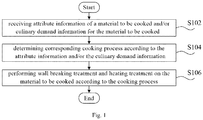
- Fig. 1 shows a schematic flow diagram of a cooking method according to an embodiment of the present invention.
- step S102 receiving attribute information of a material to be cooked and/or culinary demand information for the material to be cooked
- step S104 determining corresponding cooking process according to the attribute information and/or the culinary demand information
- step S106 performing wall breaking treatment and heating treatment on the material to be cooked according to the cooking process.
- the corresponding cooking process is determined according to the attribute information and/or culinary demand information of the material, and the corresponding wall breaking treatment and heating treatment are performed on the material.
- it can determine whether the material is resistant to cooking according to the nutritional component composition, hardness, weight and variety name of the material. For example, the cooking time and cooking power of the material resistant to cooking can be increased, which can effectively reduce the waiting time of the users, for example, shortening the cooking time and cooking power for materials that are not resistant to cooking can effectively reduce power consumption, and combine the nutritional components to determine the vitamin content, trace element content and dietary fiber content, which can reduce the decomposition and loss of nutrients.
- the eating needs include viscosity, hardness, water content, particle size of food, low sugar, low fat, dietary fiber ratio and trace element content, etc.
- the attribute information of the received material can be from the touch panel of the cooking appliance or from the associated client.
- the wall breaking treatment includes whipping treatment, grinding treatment and extrusion treatment, etc., which cause the cell wall of the material to be broken.
- the determining corresponding cooking process according to the attribute information and/or the culinary demand information specifically includes: when analyzing the attribute information to determine that category of the material to be cooked is fruit and vegetable material, determining corresponding hardness according to category information of the fruit and vegetable material; determining particle size range of cooked material according to hardness of the fruit and vegetable material, preset corresponding relationship between hardness and particle size; and determining corresponding cooking process according to the particle size range, preset corresponding relationship between particle size range and cooking process.
- the fruit and vegetable material is rich in dietary fiber, and the dietary fiber ratio mainly determines the taste and hardness of the food
- the preset corresponding relationship between the hardness and particle size according to the hardness of the fruit and vegetable material, to determine the particle size range of the cooked material, and the preset corresponding relationship between the particle size range and the cooking process according to the particle size range, to determine the corresponding cooking process can provide users with food with the best granularity. Further, the taste of the food can better satisfy the needs of users, and in order to retain vitamins and minerals to the greatest extent, the cooking power and cooking time are appropriately reduced, which is conducive to improving the user experience.
- the particle size of the food material gradually decreases, and at the same time, the nutrition of the food material is gradually released.
- the fineness of the food material has fully satisfied the user's food requirements, and the nutrient release of the food has reached the peak, if the whipping is continued, the fineness and taste of the food will no longer be significantly improved, and the whipping time will be wasted, and even the loss of nutrients will be caused.
- Table 1 classification hardness representative ingredients optimal particle size range optimal whipping process fruit and high carrot 240 ⁇ m ⁇ 260 ⁇ m (1) Full power whipping for 30-40 seconds; (2) Power modulation whipping for 15 seconds; (3) Repeat (1) and (2) step 3 times. medium chili 200 ⁇ m ⁇ 220 ⁇ m (1) Full power whipping for 30-40 seconds; (2) Power modulation whipping for 15 seconds; (3) Full power whipping for 20 seconds; (4) Power modulation whipping for 15 seconds. low kiwi 160 ⁇ m ⁇ 180 ⁇ m (1) Full power whipping for 0-40 seconds; (2) Power modulation whipping for 15 seconds; (3) Repeat (1) and (2) step 2 times. cereals unlimited corn 90 ⁇ m ⁇ 110 ⁇ m (1) Full power whipping for 20-30 seconds; (2) Power modulation whipping for 15 seconds; (3) Repeat (1) and (2) step 3 times.
- the motor speed is greater than or equal to 20000 revolutions per minute during full power whipping, and the motor speed is greater than or equal to 15000 revolutions per minute and less than 20000 revolutions per minute during power modulation whipping.
- the determining corresponding cooking process according to the attribute information and/or the culinary demand information specifically further includes: when analyzing the attribute information to determine that category of the material to be cooked is a bean material, determining pre-stored nutritional component composition corresponding to the bean material; and determining corresponding cooking process according to nutrient component composition of the bean material, preset corresponding relationship between nutrient component composition and cooking process.
- the preset corresponding relationship between the nutritional component composition and the cooking process by determining the pre-stored nutritional component composition corresponding to the bean material, and determining the corresponding cooking process according to the nutritional component composition of the bean material, the preset corresponding relationship between the nutritional component composition and the cooking process.
- the heating power in the corresponding cooking process needs to be appropriately reduced to reduce the occurrence of paste pot and overflow.
- the bean material may produce a large amount of the residue during the cooking process; therefore, the time of the wall breaking treatment needs to be increased in the corresponding cooking process to reduce the generation of the residue, which is conducive to improving the user's taste and the absorption rate of nutrient components.
- the bean material is edamame and the cooking function is preset to "make soy milk", due to its high dietary fiber and high content of flavonoids, after obtaining the default soy milk process, the whipping process time is increased to make the soy milk reach extremely delicate, increase digestion and absorption, lower blood lipids and cholesterol.
- the cooking process of edamame can refer to the following steps:
- the bean material is black beans and the cooking function is preset to "make soy milk", due to its high protein and dietary fiber content, after obtaining the default soy milk process, on the one hand, it reduces the power and time period of the heating treatment, on the other hand, it increases the time period of the whipping process to make the soy milk extremely delicate, increase digestion and absorption, and lower blood lipids and cholesterol.
- the cooking process of black beans can refer to the following steps:
- the determining corresponding cooking process according to the attribute information and/or the culinary demand information specifically further includes: when analyzing the attribute information to determine category of the material to be cooked, and analyzing the culinary demand information to determine nutritional effect required by the user, determining corresponding cooking process according to the category, the nutritional effect, and preset corresponding relationship between the nutritional effect under any of the categories and cooking process.
- the fruit and vegetable materials are usually rich in dietary fiber
- the dietary fiber Dietary Fiber, DF
- the dietary fiber can be divided into two categories: water-soluble dietary fiber (Soluble Dietary Fiber, SDF) and non-water-soluble dietary fiber (Insoluble Dietary Fiber, IDF) according to different solubility.
- the above dietary fiber ratio refers to the component ratio of water-soluble dietary fiber and non-water-soluble dietary fiber.
- the water-soluble dietary fiber is a type of non-starch polysaccharide that is not digested by the digestive enzymes of the body, but is soluble in hot water and separated by precipitation with a certain volume of ethanol.
- the water-soluble dietary fiber mainly refers to the water-soluble storage substances and secretions in plant cells, and also includes some microbial polysaccharides and synthetic polysaccharides.
- the water-soluble dietary fiber is mainly composed of some glues.
- the non-water-soluble dietary fiber refers to the non-starch structural polysaccharide that is not digested by the digestive enzymes and is insoluble in hot water, it includes cellulose, hemicellulose, lignin, chitosan and vegetable waxes.
- the two types of dietary fiber exist at the same time, and their composition has a great relationship with the particle size of the food.
- the content of non-water-soluble dietary fiber IDF
- the content of water-soluble dietary fiber SDF
- the insoluble components gradually become soluble components.
- IDF The main function of IDF is to produce mechanical peristaltic effect, promote gastric emptying, promote intestinal peristalsis, and moisturize the bowel. While the SDF exerts more metabolic functions and affects the metabolism of carbohydrates and lipids. It can lower blood lipids, lower cholesterol, lower blood sugar and other effects. There is a proportional relationship between these two components, namely SDF/IDF. Normally, the SDF/IDF is about 1:3 when a reasonable dietary fiber is taken in.
- the particle size of the food can be controlled by adjusting the parameters of the stirring treatment, and then the SDF/IDF can be adjusted. If the SDF/IDF is slightly higher, it means that the content of SDF is increased, and the food demand is biased towards lowering blood lipids, lowering cholesterol, and lowering blood sugar. If the SDF/IDF is slightly lower, it means that the content of IDF is increasing, and the food demand is biased towards the laxative effect.
- the corresponding relationship between the attribute information of the material, the edible requirements (including the health function) and the cooking process can refer to the following Table 2.
- Table 2 classification hardness representative ingredients health function optimal whipping process fruit and vegetable high carrot standard (1) Full power whipping for 30-40 seconds; (2) Power modulation whipping for 15 seconds; (3) Repeat (1) and (2) step 3 times. drop three highs (high blood pressure, high blood sugar, high blood lipid) (1) Full power whipping for 30-40 seconds; (2) Power modulation whipping for 15 seconds; (3) Repeat (1) and (2) step 5 times. moisturize the bowel (1) Full power whipping for 20-30 seconds; (2) Power modulation whipping for 10 seconds; (3) Repeat (1) and (2) step 2 times.
- medium bitter gourd standard (1) Full power whipping for 20-30 seconds; (2) Power modulation whipping for 15 seconds; (3) Repeat (1) and (2) step 3 times. drop three highs (high blood pressure, high (1) Full power whipping for 20-30 seconds; (2) Power modulation whipping for 10 blood sugar, high blood lipid) seconds; (3) Repeat (1) and (2) step 5 times. moisturize the bowel (1) Full power whipping for 20-30 seconds; (2) Power modulation whipping for 10 seconds; (3) Repeat (1) and (2) step 2 times. low celery standard (1) Full power whipping for 20-30 seconds; (2) Power modulation whipping for 5 seconds; (3) Repeat (1) and (2) step 3 times.
- the motor speed is greater than or equal to 20000 revolutions per minute during full power whipping, and the motor speed is greater than or equal to 15000 revolutions per minute and less than 20000 revolutions per minute during power modulation whipping.
- the determining corresponding cooking process according to the attribute information and/or the culinary demand information specifically further includes: when analyzing the attribute information to determine increase in moisture content of the material to be cooked, the increase in moisture content is the change in moisture content of the material to be cooked after absorbing water within a preset time period; and determining corresponding cooking process according to the change in moisture content, preset corresponding relationship between change in moisture content and cooking process.
- the increase in moisture content is the change in moisture content of the material to be cooked after absorbing water within a preset time period; and determining corresponding cooking process according to the change in moisture content, preset corresponding relationship between change in moisture content and cooking process. It can improve the taste of the food and conducive to reducing the power consumption of the cooking appliance.
- the material is a boil-resistant material or an easy-to-cook material. For example, if a certain type of cereals absorbs water at room temperature for 30 minutes, the increase in moisture content is ⁇ T ⁇ 10%, and the time required to reach the saturation of water absorption is t>3h, the cereals are determined to be resistant to cooking, as shown in Table 3.
- Table 3 classification representative ingredients boil-resistant type cereals sorghum, barley, wheat, corn miscellaneous beans black beans, mung beans, red beans tubers/seeds lotus seeds, dried lilies, dried yam
- the cereals are determined to be an easy-to-cook material, as shown in Table 4.
- Table 4 classification representative ingredients easy-to-cook type cereals white rice, brown rice, black rice, red rice, glutinous rice, oats, buckwheat, miscellaneous beans soy beans, green beans, tubers/seeds sweet potato, purple potato, potato, pumpkin, chestnut, gorgon,
- the cooking process corresponding to the boil-resistant type materials shown in Table 3 and the easy-to-cook type materials shown in Table 4 can refer to the following steps:
- Fig. 2 shows a schematic block diagram of a cooking device according to an embodiment of the present invention.
- a cooking device 200 of an embodiment of the present invention comprising: a receiving device 202 used to receive attribute information of a material to be cooked and/or culinary demand information of the material to be cooked; a determining device 204 used to determining corresponding cooking process according to the attribute information and/or the culinary demand information; and an execution device 206 used to perform wall breaking treatment and heating treatment on the material to be cooked according to the cooking process.
- the corresponding cooking process is determined according to the attribute information and/or culinary demand information of the material, and the corresponding wall breaking treatment and heating treatment are performed on the material.
- it can determine whether the material is resistant to cooking according to the nutritional component composition, hardness, weight and variety name of the material. For example, the cooking time and cooking power of the material resistant to cooking can be increased, which can effectively reduce the waiting time of the users, for example, shortening the cooking time and cooking power for materials that are not resistant to cooking can effectively reduce power consumption, and combine the nutritional components to determine the vitamin content, trace element content and dietary fiber content, which can reduce the decomposition and loss of nutrients.
- the eating needs include viscosity, hardness, water content, particle size of food, low sugar, low fat, dietary fiber ratio and trace element content, etc.
- the attribute information of the received material can be from the touch panel of the cooking appliance or from the associated client.
- the wall breaking treatment includes whipping treatment, grinding treatment and extrusion treatment, etc., which cause the cell wall of the material to be broken.
- the determining device 204 is also used to: when analyzing the attribute information to determine that category of the material to be cooked is fruit and vegetable material, determining corresponding hardness according to category information of the fruit and vegetable material; the determining device 204 is also used to: determining particle size range of cooked material according to hardness of the fruit and vegetable material, preset corresponding relationship between hardness and particle size; and the determining device 204 is also used to: determining corresponding cooking process according to the particle size range, preset corresponding relationship between particle size range and cooking process.
- the fruit and vegetable material is rich in dietary fiber
- the dietary fiber ratio mainly determines the taste and hardness of the food, according to the hardness of the fruit and vegetable material, the preset corresponding relationship between the hardness and particle size, to determine the particle size range of the cooked material, according to the particle size range, the preset corresponding relationship between the particle size range and the cooking process, to determine the corresponding cooking process, which can provide users with food with the best granularity.
- the taste of the food can more satisfy the needs of users, and in order to retain vitamins and minerals to the greatest extent, the cooking power and cooking time are appropriately reduced, which is conducive to improving the user experience.
- the particle size of the food material gradually decreases, and at the same time, the nutrition of the food material is gradually released.
- the fineness of the food material has fully satisfied the user's food requirements, and the nutrient release of the food has reached the peak, if the whipping is continued, the fineness and taste of the food will no longer be significantly improved, and the whipping time will be wasted, and even the loss of nutrients will be caused.
- the determining device 204 is also used to: when analyzing the attribute information to determine that category of the material to be cooked is a bean material, determining pre-stored nutritional component composition corresponding to the bean material; and the determining device 204 is also used to: determining corresponding cooking process according to nutrient component composition of the bean material, preset corresponding relationship between nutrient component composition and cooking process.
- the preset corresponding relationship between the nutritional component composition and the cooking process by determining the pre-stored nutritional component composition corresponding to the bean material, and determining the corresponding cooking process according to the nutritional component composition of the bean material, the preset corresponding relationship between the nutritional component composition and the cooking process.
- the heating power in the corresponding cooking process needs to be appropriately reduced to reduce the occurrence of paste pot and overflow.
- the bean material may produce a large amount of the residue during the cooking process; therefore, the time of the wall breaking treatment needs to be increased in the corresponding cooking process to reduce the generation of the residue, which is conducive to improving the user's taste and the absorption rate of nutrient components.
- the bean material is edamame and the cooking function is preset to "make soy milk", due to its high dietary fiber and high content of flavonoids, after obtaining the default soy milk process, the whipping process time is increased to make the soy milk reach extremely delicate, increase digestion and absorption, lower blood lipids and cholesterol.
- the bean material is black beans and the cooking function is preset to "make soy milk", due to its high protein and dietary fiber content, after obtaining the default soy milk process, on the one hand, it reduces the power and time period of the heating treatment, on the other hand, it increases the time period of the whipping process to make the soy milk extremely delicate, increase digestion and absorption, and lower blood lipids and cholesterol.
- the determining device 204 is also used to: when analyzing the attribute information to determine category of the material to be cooked, and analyzing the culinary demand information to determine nutritional effect required by the user, determining corresponding cooking process according to the category, the nutritional effect, and preset corresponding relationship between the nutritional effect under any of the categories and cooking process.
- the fruit and vegetable materials are usually rich in dietary fiber
- the dietary fiber Dietary Fiber, DF
- the dietary fiber can be divided into two categories: water-soluble dietary fiber (Soluble Dietary Fiber, SDF) and non-water-soluble dietary fiber (Insoluble Dietary Fiber, IDF) according to different solubility.
- the above dietary fiber ratio refers to the component ratio of water-soluble dietary fiber and non-water-soluble dietary fiber.
- the water-soluble dietary fiber is a type of non-starch polysaccharide that is not digested by the digestive enzymes of the body, but is soluble in hot water and separated by precipitation with a certain volume of ethanol.
- the water-soluble dietary fiber mainly refers to the water-soluble storage substances and secretions in plant cells, and also includes some microbial polysaccharides and synthetic polysaccharides.
- the water-soluble dietary fiber is mainly composed of some glues.
- the non-water-soluble dietary fiber refers to the non-starch structural polysaccharide that is not digested by the digestive enzymes and is insoluble in hot water, it includes cellulose, hemicellulose, lignin, chitosan and vegetable waxes.
- the two types of dietary fiber exist at the same time, and their composition has a great relationship with the particle size of the food.
- the content of non-water-soluble dietary fiber IDF
- the content of water-soluble dietary fiber SDF
- the insoluble components gradually become soluble components.
- IDF The main function of IDF is to produce mechanical peristaltic effect, promote gastric emptying, promote intestinal peristalsis, and moisturize the bowel. While the SDF exerts more metabolic functions and affects the metabolism of carbohydrates and lipids. It can lower blood lipids, lower cholesterol, lower blood sugar and other effects. There is a proportional relationship between these two components, namely SDF/IDF. Normally, the SDF/IDF is about 1:3 when a reasonable dietary fiber is taken in.
- the particle size of the food can be controlled by adjusting the parameters of the stirring treatment, and then the SDF/IDF can be adjusted. If the SDF/IDF is slightly higher, it means that the content of SDF is increased, and the food demand is biased towards lowering blood lipids, lowering cholesterol, and lowering blood sugar. If the SDF/IDF is slightly lower, it means that the content of IDF is increasing, and the food demand is biased towards the laxative effect.
- the determining device 204 is also used to: when analyzing the attribute information to determine increase in moisture content of the material to be cooked, the increase in moisture content is the change in moisture content of the material to be cooked after absorbing water within a preset time period; and the determining device 204 is also used to: determining corresponding cooking process according to the change in moisture content, preset corresponding relationship between change in moisture content and cooking process.
- the increase in moisture content is the change in moisture content of the material to be cooked after absorbing water within a preset time period; and determining corresponding cooking process according to the change in moisture content, preset corresponding relationship between change in moisture content and cooking process. It can improve the taste of the food and conducive to reducing the power consumption of the cooking appliance.
- the material is a boil-resistant material or an easy-to-cook material. For example, if a certain type of cereals absorbs water at room temperature for 30 minutes, the increase in moisture content is ⁇ T ⁇ 10%, and the time required to reach the saturation of water absorption is t>3h, the cereals are determined to be resistant to cooking.
- the cereals are determined to be an easy-to-cook material.
- Fig. 3 shows a schematic block diagram of a cooking appliance according to an embodiment of the present invention.
- a cooking appliance 300 of an embodiment of the present invention comprising the cooking device 200 as defined in any one of the above-mentioned technical solutions.
- the cooking device 200 may include logic computing devices such as MCU, CPU, DSP, single-chip microcomputer and embedded equipment, and the receiving device 202 may include touch screen, buttons, voice recognizer and communication antenna, etc.
- the determining device 204 may include a comparator and a memory, etc.
- the execution device 206 may include a heating drive circuit and a corresponding heating component, a stirring drive circuit and a corresponding stirring component, a hammering drive circuit and a corresponding hammering component, a grinding drive circuit and a corresponding grinding components.
- the cooking method comprises: receiving attribute information of a material to be cooked and/or culinary demand information for the material to be cooked; determining corresponding cooking process according to the attribute information and/or the culinary demand information; and performing wall breaking treatment and heating treatment on the material to be cooked according to the cooking process.
- the corresponding cooking process is determined according to the attribute information and/or culinary demand information of the material, and the corresponding wall breaking treatment and heating treatment are performed on the material.
- it can determine whether the material is resistant to cooking according to the nutritional component composition, hardness, weight and variety name of the material. For example, the cooking time and cooking power of the material resistant to cooking can be increased, which can effectively reduce the waiting time of the users, for example, shortening the cooking time and cooking power for materials that are not resistant to cooking can effectively reduce power consumption, and combine the nutritional components to determine the vitamin content, trace element content and dietary fiber content, which can reduce the decomposition and loss of nutrients.
- the eating needs include viscosity, hardness, water content, particle size of food, low sugar, low fat, dietary fiber ratio and trace element content, etc.
- the attribute information of the received material can be from the touch panel of the cooking appliance or from the associated client.
- the wall breaking treatment includes whipping treatment, grinding treatment and extrusion treatment, etc., which cause the cell wall of the material to be broken.
- the determining corresponding cooking process according to the attribute information and/or the culinary demand information specifically includes: when analyzing the attribute information to determine that category of the material to be cooked is fruit and vegetable material, determining corresponding hardness according to category information of the fruit and vegetable material; determining particle size range of cooked material according to hardness of the fruit and vegetable material, preset corresponding relationship between hardness and particle size; and determining corresponding cooking process according to the particle size range, preset corresponding relationship between particle size range and cooking process.
- the fruit and vegetable material is rich in dietary fiber
- the dietary fiber ratio mainly determines the taste and hardness of the food, according to the hardness of the fruit and vegetable material, the preset corresponding relationship between the hardness and particle size, to determine the particle size range of the cooked material, according to the particle size range, the preset corresponding relationship between the particle size range and the cooking process, to determine the corresponding cooking process, which can provide users with food with the best granularity.
- the taste of the food can more satisfy the needs of users, and in order to retain vitamins and minerals to the greatest extent, the cooking power and cooking time are appropriately reduced, which is conducive to improving the user experience.
- the particle size of the food material gradually decreases, and at the same time, the nutrition of the food material is gradually released.
- the fineness of the food material has fully satisfied the user's food requirements, and the nutrient release of the food has reached the peak, if the whipping is continued, the fineness and taste of the food will no longer be significantly improved, and the whipping time will be wasted, and even the loss of nutrients will be caused.
- the determining corresponding cooking process according to the attribute information and/or the culinary demand information specifically further includes: when analyzing the attribute information to determine that category of the material to be cooked is a bean material, determining pre-stored nutritional component composition corresponding to the bean material; and determining corresponding cooking process according to nutrient component composition of the bean material, preset corresponding relationship between nutrient component composition and cooking process.
- the preset corresponding relationship between the nutritional component composition and the cooking process by determining the pre-stored nutritional component composition corresponding to the bean material, and determining the corresponding cooking process according to the nutritional component composition of the bean material, the preset corresponding relationship between the nutritional component composition and the cooking process.
- the heating power in the corresponding cooking process needs to be appropriately reduced to reduce the occurrence of paste pot and overflow.
- the bean material may produce a large amount of the residue during the cooking process; therefore, the time of the wall breaking treatment needs to be increased in the corresponding cooking process to reduce the generation of the residue, which is conducive to improving the user's taste and the absorption rate of nutrient components.
- the bean material is edamame and the cooking function is preset to "make soy milk", due to its high dietary fiber and high content of flavonoids, after obtaining the default soy milk process, the whipping process time is increased to make the soy milk reach extremely delicate, increase digestion and absorption, lower blood lipids and cholesterol.
- the bean material is black beans and the cooking function is preset to "make soy milk", due to its high protein and dietary fiber content, after obtaining the default soy milk process, on the one hand, it reduces the power and time period of the heating treatment, on the other hand, it increases the time period of the whipping process to make the soy milk extremely delicate, increase digestion and absorption, and lower blood lipids and cholesterol.
- the determining corresponding cooking process according to the attribute information and/or the culinary demand information specifically further includes: when analyzing the attribute information to determine category of the material to be cooked, and analyzing the culinary demand information to determine nutritional effect required by the user, determining corresponding cooking process according to the category, the nutritional effect, and preset corresponding relationship between the nutritional effect under any of the categories and cooking process.
- the fruit and vegetable materials are usually rich in dietary fiber
- the dietary fiber Dietary Fiber, DF
- the dietary fiber can be divided into two categories: water-soluble dietary fiber (Soluble Dietary Fiber, SDF) and non-water-soluble dietary fiber (Insoluble Dietary Fiber, IDF) according to different solubility.
- the above dietary fiber ratio refers to the component ratio of water-soluble dietary fiber and non-water-soluble dietary fiber.
- the water-soluble dietary fiber is a type of non-starch polysaccharide that is not digested by the digestive enzymes of the body, but is soluble in hot water and separated by precipitation with a certain volume of ethanol.
- the water-soluble dietary fiber mainly refers to the water-soluble storage substances and secretions in plant cells, and also includes some microbial polysaccharides and synthetic polysaccharides.
- the water-soluble dietary fiber is mainly composed of some glues.
- the non-water-soluble dietary fiber refers to the non-starch structural polysaccharide that is not digested by the digestive enzymes and is insoluble in hot water, it includes cellulose, hemicellulose, lignin, chitosan and vegetable waxes.
- the two types of dietary fiber exist at the same time, and their composition has a great relationship with the particle size of the food.
- the content of non-water-soluble dietary fiber IDF
- the content of water-soluble dietary fiber SDF
- the insoluble components gradually become soluble components.
- IDF The main function of IDF is to produce mechanical peristaltic effect, promote gastric emptying, promote intestinal peristalsis, and moisturize the bowel. While the SDF exerts more metabolic functions and affects the metabolism of carbohydrates and lipids. It can lower blood lipids, lower cholesterol, lower blood sugar and other effects. There is a proportional relationship between these two components, namely SDF/IDF. Normally, the SDF/IDF is about 1:3 when a reasonable dietary fiber is taken in.
- the particle size of the food can be controlled by adjusting the parameters of the stirring treatment, and then the SDF/IDF can be adjusted. If the SDF/IDF is slightly higher, it means that the content of SDF is increased, and the food demand is biased towards lowering blood lipids, lowering cholesterol, and lowering blood sugar. If the SDF/IDF is slightly lower, it means that the content of IDF is increasing, and the food demand is biased towards the laxative effect.
- the determining corresponding cooking process according to the attribute information and/or the culinary demand information specifically further includes: when analyzing the attribute information to determine increase in moisture content of the material to be cooked, the increase in moisture content is the change in moisture content of the material to be cooked after absorbing water within a preset time period; and determining corresponding cooking process according to the change in moisture content, preset corresponding relationship between change in moisture content and cooking process.
- the increase in moisture content is the change in moisture content of the material to be cooked after absorbing water within a preset time period; and determining corresponding cooking process according to the change in moisture content, preset corresponding relationship between change in moisture content and cooking process. It can improve the taste of the food and conducive to reducing the power consumption of the cooking appliance.
- the material is a boil-resistant material or an easy-to-cook material. For example, if a certain type of cereals absorbs water at room temperature for 30 minutes, the increase in moisture content is ⁇ T ⁇ 10%, and the time required to reach the saturation of water absorption is t>3h, the cereals are determined to be resistant to cooking.
- the cereals are determined to be an easy-to-cook material.
- the present invention proposes a cooking method, a cooking device, a cooking appliance and a computer readable storage medium. Since the attribute information of the material usually includes nutritional component composition, hardness, weight and variety name of the material, etc., the corresponding cooking process is determined according to the attribute information and/or culinary demand information of the material, and the corresponding wall breaking treatment and heating treatment are performed on the material. On the one hand, it can determine whether the material is resistant to cooking according to the nutritional component composition, hardness, weight and variety name of the material.
- the cooking time and cooking power of the material resistant to cooking can be increased, which can effectively reduce the waiting time of the users, for example, shortening the cooking time and cooking power for materials that are not resistant to cooking can effectively reduce power consumption, and combine the nutritional components to determine the vitamin content, trace element content and dietary fiber content, which can reduce the decomposition and loss of nutrients.
- the user's set eating needs, cooking functions and variety name of the material it can meet the user's personalized cooking needs.
Landscapes
- Engineering & Computer Science (AREA)
- Food Science & Technology (AREA)
- Mechanical Engineering (AREA)
- Physics & Mathematics (AREA)
- General Physics & Mathematics (AREA)
- Automation & Control Theory (AREA)
- General Preparation And Processing Of Foods (AREA)
- Dairy Products (AREA)
- Food-Manufacturing Devices (AREA)
- Cookers (AREA)
Abstract
Description
- The present application claims the priority of Chinese Patent Application No.
201810631044.2 - The present invention relates to the field of cooking technology, specifically, to a cooking method, a cooking device, a cooking appliance and a computer readable storage medium.
- As a new type of cooking appliance, the wall breaker has the advantages of a juicer and a soymilk machine. On the one hand, the wall breaker can beat or grind the material to destroy its cell wall and improve the body's absorption efficiency of nutrients and dietary fiber. At the same time, it can also reduce the amount of residue. On the other hand, the material can be heated and cooked to prepare rice cereal, milkshakes, yogurt, soy milk and other foods to improve the taste and health needs of users.
- In related technologies, in order to ensure that all types of materials can be cooked completely, the wall breaking treatment and heating treatment are usually performed on the materials according to the maximum time period when each cooking function is executed. However, the above cooking scheme has at least the following technical problems:
- (1) It is not conducive to reducing the power consumption of cooking appliance;
- (2) It causes a long waiting time and affects the user experience;
- (3) It may cause the destruction of nutrients. For example, if protein and dietary fiber are overheated, they may be decomposed or deteriorated, which may reduce the absorption rate of nutrients absorbed by the body.
- The present invention aims to solve at least one of the technical problems existing in the prior art or related technologies.
- To this end, the first purpose of the present invention is to provide a cooking method.
- Another purpose of the present invention is to provide a cooking device.
- Another purpose of the present invention is to provide a cooking appliance.
- Another purpose of the present invention is to provide a computer readable storage medium.
- In order to achieve the above purposes, according to the technical solution of the first aspect of the present invention, a cooking method is provided, the cooking method comprises: receiving attribute information of a material to be cooked and/or culinary demand information for the material to be cooked; determining corresponding cooking process according to the attribute information and/or the culinary demand information; and performing wall breaking treatment and heating treatment on the material to be cooked according to the cooking process.
- In this technical solution, since the attribute information of the material usually includes nutritional component composition, hardness, weight and variety name of the material, etc., the corresponding cooking process is determined according to the attribute information and/or culinary demand information of the material, and the corresponding wall breaking treatment and heating treatment are performed on the material. On the one hand, it can determine whether the material is resistant to cooking according to the nutritional component composition, hardness, weight and variety name of the material. For example, the cooking time and cooking power of the material resistant to cooking can be increased, which can effectively reduce the waiting time of the users, for example, shortening the cooking time and cooking power for materials that are not resistant to cooking can effectively reduce power consumption, and combine the nutritional components to determine the vitamin content, trace element content and dietary fiber content, which can reduce the decomposition and loss of nutrients. On the other hand, combined with the user's set eating needs, cooking functions and variety name of the material, it can meet the user's personalized cooking needs, wherein, the eating needs include viscosity, hardness, water content, particle size of food, low sugar, low fat, dietary fiber ratio and trace element content, etc.
- Wherein, the attribute information of the received material can be from the touch panel of the cooking appliance or from the associated client.
- In addition, those skilled in the art can understand that the wall breaking treatment includes whipping treatment, grinding treatment and extrusion treatment, etc., which cause the cell wall of the material to be broken.
- In any of the above-mentioned technical solutions, optionally, the determining corresponding cooking process according to the attribute information and/or the culinary demand information specifically includes: when analyzing the attribute information to determine that category of the material to be cooked is fruit and vegetable material, determining corresponding hardness according to category information of the fruit and vegetable material; determining particle size range of cooked material according to hardness of the fruit and vegetable material, preset corresponding relationship between hardness and particle size; and determining corresponding cooking process according to the particle size range, preset corresponding relationship between particle size range and cooking process.
- In this technical solution, since the fruit and vegetable material is rich in dietary fiber, and the dietary fiber ratio mainly determines the taste and hardness of the food, the preset corresponding relationship between the hardness and particle size according to the hardness of the fruit and vegetable material, to determine the particle size range of the cooked material, and the preset corresponding relationship between the particle size range and the cooking process according to the particle size range, to determine the corresponding cooking process, can provide users with food with the best granularity. Further,, the taste of the food can better satisfy the needs of users, and in order to retain vitamins and minerals to the greatest extent, the cooking power and cooking time are appropriately reduced, which is conducive to improving the user experience.
- Specifically, as the whipping time increases, the particle size of the food material gradually decreases, and at the same time, the nutrition of the food material is gradually released. When it reaches a certain level (that is, the optimal particle size range), the fineness of the food material has fully satisfied the user's food requirements, and the nutrient release of the food has reached the peak, if the whipping is continued, the fineness and taste of the food will no longer be significantly improved, and the whipping time will be wasted, and even the loss of nutrients will be caused.
- In any of the above-mentioned technical solutions, optionally, the determining corresponding cooking process according to the attribute information and/or the culinary demand information specifically further includes: when analyzing the attribute information to determine that category of the material to be cooked is a bean material, determining pre-stored nutritional component composition corresponding to the bean material; and determining corresponding cooking process according to nutrient component composition of the bean material, preset corresponding relationship between nutrient component composition and cooking process.
- In this technical solution, by determining the pre-stored nutritional component composition corresponding to the bean material, and determining the corresponding cooking process according to the nutritional component composition of the bean material, the preset corresponding relationship between the nutritional component composition and the cooking process. On the one hand, since the high protein content of the bean material, a paste pot may be produced during the high temperature process, which affects the user's taste and experience. Therefore, the heating power in the corresponding cooking process needs to be appropriately reduced to reduce the occurrence of paste pot and overflow. On the other hand, the bean material may produce a large amount of the residue during the cooking process; therefore, the time of the wall breaking treatment needs to be increased in the corresponding cooking process to reduce the generation of the residue, which is conducive to improving the user's taste and the absorption rate of nutrient components.
- For example, if the bean material is edamame and the cooking function is preset to "make soy milk", due to its high dietary fiber and high content of flavonoids, after obtaining the default soy milk process, the whipping process time is increased to make the soy milk reach extremely delicate, increase digestion and absorption, lower blood lipids and cholesterol.
- For another example, if the bean material is black beans and the cooking function is preset to "make soy milk", due to its high protein and dietary fiber content, after obtaining the default soy milk process, on the one hand, it reduces the power and time period of the heating treatment, on the other hand, it increases the time period of the whipping process to make the soy milk extremely delicate, increase digestion and absorption, and lower blood lipids and cholesterol.
- In any of the above-mentioned technical solutions, optionally, the determining corresponding cooking process according to the attribute information and/or the culinary demand information specifically further includes: when analyzing the attribute information to determine category of the material to be cooked, and analyzing the culinary demand information to determine nutritional effect required by the user, determining corresponding cooking process according to the category, the nutritional effect, and preset corresponding relationship between the nutritional effect under any of the categories and cooking process.
- In this technical solution, when analyzing the attribute information to determine category of the material to be cooked, and analyzing the culinary demand information to determine nutritional effect required by the user, determining corresponding cooking process according to the category, the nutritional effect, and preset corresponding relationship between the nutritional effect under any of the categories and cooking process. It can further meet the needs of users for healthy diet.
- For example, the fruit and vegetable materials are usually rich in dietary fiber, and the dietary fiber (Dietary Fiber, DF) can be divided into two categories: water-soluble dietary fiber (Soluble Dietary Fiber, SDF) and non-water-soluble dietary fiber (Insoluble Dietary Fiber, IDF) according to different solubility. The above dietary fiber ratio refers to the component ratio of water-soluble dietary fiber and non-water-soluble dietary fiber.
- The water-soluble dietary fiber (SDF) is a type of non-starch polysaccharide that is not digested by the digestive enzymes of the body, but is soluble in hot water and separated by precipitation with a certain volume of ethanol. The water-soluble dietary fiber mainly refers to the water-soluble storage substances and secretions in plant cells, and also includes some microbial polysaccharides and synthetic polysaccharides. The water-soluble dietary fiber is mainly composed of some glues. The non-water-soluble dietary fiber (IDF) refers to the non-starch structural polysaccharide that is not digested by the digestive enzymes and is insoluble in hot water, it includes cellulose, hemicellulose, lignin, chitosan and vegetable waxes.
- The two types of dietary fiber (SDF and IDF) exist at the same time, and their composition has a great relationship with the particle size of the food. As the particle size decreases, the content of non-water-soluble dietary fiber (IDF) gradually decreases, while the content of water-soluble dietary fiber (SDF) gradually increases. This is because during the whipping and crushing process, on the one hand, the soluble components trapped in the fiber network structure are released; on the other hand, the insoluble components gradually become soluble components.
- The main function of IDF is to produce mechanical peristaltic effect, promote gastric emptying, promote intestinal peristalsis, and moisturize the bowel. While the SDF exerts more metabolic functions and affects the metabolism of carbohydrates and lipids. It can lower blood lipids, lower cholesterol, lower blood sugar and other effects. There is a proportional relationship between these two components, namely SDF/IDF. Normally, the SDF/IDF is about 1:3 when a reasonable dietary fiber is taken in.
- In order to achieve different health effects, the particle size of the food can be controlled by adjusting the parameters of the stirring treatment, and then the SDF/IDF can be adjusted. If the SDF/IDF is slightly higher, it means that the content of SDF is increased, and the food demand is biased towards lowering blood lipids, lowering cholesterol, and lowering blood sugar. If the SDF/IDF is slightly lower, it means that the content of IDF is increasing, and the food demand is biased towards the laxative effect.
- In any of the above-mentioned technical solutions, optionally, the determining corresponding cooking process according to the attribute information and/or the culinary demand information specifically further includes: when analyzing the attribute information to determine increase in moisture content of the material to be cooked, the increase in moisture content is the change in moisture content of the material to be cooked after absorbing water within a preset time period; and determining corresponding cooking process according to the change in moisture content, preset corresponding relationship between change in moisture content and cooking process.
- In this technical solution, when analyzing the attribute information to determine increase in moisture content of the material to be cooked, the increase in moisture content is the change in moisture content of the material to be cooked after absorbing water within a preset time period; and determining corresponding cooking process according to the change in moisture content, preset corresponding relationship between change in moisture content and cooking process. It can improve the taste of the food and conducive to reducing the power consumption of the cooking appliance.
- Specifically, by analyzing the attribute information to determine the increase in moisture content of the material to be cooked, it can be determined that the material is a boil-resistant material or an easy-to-cook material. For example, if a certain type of cereals absorbs water at room temperature for 30 minutes, the increase in moisture content is ΔT<10%, and the time required to reach the saturation of water absorption is t>3h, the cereals are determined to be resistant to cooking.
- If a certain type of cereals absorbs water at room temperature for 30 minutes, the increase in moisture content is ΔT>10%, and the time required to reach the saturation of water absorption is t<3h, the cereals are determined to be an easy-to-cook material.
- According to the technical solution of the second aspect of the present invention, a cooking device is provided, the cooking device comprises: a receiving device used to receive attribute information of a material to be cooked and/or culinary demand information of the material to be cooked; a determining device used to determine corresponding cooking process according to the attribute information and/or the culinary demand information; and an execution device used to perform wall breaking treatment and heating treatment on the material to be cooked according to the cooking process.
- In this technical solution, since the attribute information of the material usually includes nutritional component composition, hardness, weight and variety name of the material, etc., the corresponding cooking process is determined according to the attribute information and/or culinary demand information of the material, and the corresponding wall breaking treatment and heating treatment are performed on the material. On the one hand, it can determine whether the material is resistant to cooking according to the nutritional component composition, hardness, weight and variety name of the material. For example, the cooking time and cooking power of the material resistant to cooking can be increased, which can effectively reduce the waiting time of the users, for example, shortening the cooking time and cooking power for materials that are not resistant to cooking can effectively reduce power consumption, and combine the nutritional components to determine the vitamin content, trace element content and dietary fiber content, which can reduce the decomposition and loss of nutrients. On the other hand, combined with the user's set eating needs, cooking functions and variety name of the material, it can meet the user's personalized cooking needs, wherein, the eating needs include viscosity, hardness, water content, particle size of food, low sugar, low fat, dietary fiber ratio and trace element content, etc.
- Wherein, the attribute information of the received material can be from the touch panel of the cooking appliance or from the associated client.
- In addition, those skilled in the art can understand that the wall breaking treatment includes whipping treatment, grinding treatment and extrusion treatment, etc., which cause the cell wall of the material to be broken.
- In any of the above-mentioned technical solutions, optionally, the determining device is also used to: when analyzing the attribute information to determine that category of the material to be cooked is fruit and vegetable material, determining corresponding hardness according to category information of the fruit and vegetable material; the determining device is also used to: determining particle size range of cooked material according to hardness of the fruit and vegetable material, preset corresponding relationship between hardness and particle size; and the determining device is also used to: determining corresponding cooking process according to the particle size range, preset corresponding relationship between particle size range and cooking process.
- In this technical solution, since the fruit and vegetable material is rich in dietary fiber, and the dietary fiber ratio mainly determines the taste and hardness of the food, according to the hardness of the fruit and vegetable material, the preset corresponding relationship between the hardness and particle size, to determine the particle size range of the cooked material, according to the particle size range, the preset corresponding relationship between the particle size range and the cooking process, to determine the corresponding cooking process, which can provide users with food with the best granularity. In turn, the taste of the food can more satisfy the needs of users, and in order to retain vitamins and minerals to the greatest extent, the cooking power and cooking time are appropriately reduced, which is conducive to improving the user experience.
- Specifically, as the whipping time increases, the particle size of the food material gradually decreases, and at the same time, the nutrition of the food material is gradually released. When it reaches a certain level (that is, the optimal particle size range), the fineness of the food material has fully satisfied the user's food requirements, and the nutrient release of the food has reached the peak, if the whipping is continued, the fineness and taste of the food will no longer be significantly improved, and the whipping time will be wasted, and even the loss of nutrients will be caused.
- In any of the above-mentioned technical solutions, optionally, the determining device is also used to: when analyzing the attribute information to determine that category of the material to be cooked is a bean material, determining pre-stored nutritional component composition corresponding to the bean material; and the determining device is also used to: determining corresponding cooking process according to nutrient component composition of the bean material, preset corresponding relationship between nutrient component composition and cooking process.
- In this technical solution, by determining the pre-stored nutritional component composition corresponding to the bean material, and determining the corresponding cooking process according to the nutritional component composition of the bean material, the preset corresponding relationship between the nutritional component composition and the cooking process. On the one hand, since the high protein content of the bean material, a paste pot may be produced during the high temperature process, which affects the user's taste and experience. Therefore, the heating power in the corresponding cooking process needs to be appropriately reduced to reduce the occurrence of paste pot and overflow. On the other hand, the bean material may produce a large amount of the residue during the cooking process; therefore, the time of the wall breaking treatment needs to be increased in the corresponding cooking process to reduce the generation of the residue, which is conducive to improving the user's taste and the absorption rate of nutrient components.
- For example, if the bean material is edamame and the cooking function is preset to "make soy milk", due to its high dietary fiber and high content of flavonoids, after obtaining the default soy milk process, the whipping process time is increased to make the soy milk reach extremely delicate, increase digestion and absorption, lower blood lipids and cholesterol.
- For another example, if the bean material is black beans and the cooking function is preset to "make soy milk", due to its high protein and dietary fiber content, after obtaining the default soy milk process, on the one hand, it reduces the power and time period of the heating treatment, on the other hand, it increases the time period of the whipping process to make the soy milk extremely delicate, increase digestion and absorption, and lower blood lipids and cholesterol.
- In any of the above-mentioned technical solutions, optionally, the determining device is also used to: when analyzing the attribute information to determine category of the material to be cooked, and analyzing the culinary demand information to determine nutritional effect required by the user, determining corresponding cooking process according to the category, the nutritional effect, and preset corresponding relationship between the nutritional effect under any of the categories and cooking process.
- In this technical solution, when analyzing the attribute information to determine category of the material to be cooked, and analyzing the culinary demand information to determine nutritional effect required by the user, determining corresponding cooking process according to the category, the nutritional effect, and preset corresponding relationship between the nutritional effect under any of the categories and cooking process. It can further meet the needs of users for healthy diet.
- For example, the fruit and vegetable materials are usually rich in dietary fiber, and the dietary fiber (Dietary Fiber, DF) can be divided into two categories: water-soluble dietary fiber (Soluble Dietary Fiber, SDF) and non-water-soluble dietary fiber (Insoluble Dietary Fiber, IDF) according to different solubility. The above dietary fiber ratio refers to the component ratio of water-soluble dietary fiber and non-water-soluble dietary fiber.
- The water-soluble dietary fiber (SDF) is a type of non-starch polysaccharide that is not digested by the digestive enzymes of the body, but is soluble in hot water and separated by precipitation with a certain volume of ethanol. The water-soluble dietary fiber mainly refers to the water-soluble storage substances and secretions in plant cells, and also includes some microbial polysaccharides and synthetic polysaccharides. The water-soluble dietary fiber is mainly composed of some glues. The non-water-soluble dietary fiber (IDF) refers to the non-starch structural polysaccharide that is not digested by the digestive enzymes and is insoluble in hot water, it includes cellulose, hemicellulose, lignin, chitosan and vegetable waxes.
- The two types of dietary fiber (SDF and IDF) exist at the same time, and their composition has a great relationship with the particle size of the food. As the particle size decreases, the content of non-water-soluble dietary fiber (IDF) gradually decreases, while the content of water-soluble dietary fiber (SDF) gradually increases. This is because during the whipping and crushing process, on the one hand, the soluble components trapped in the fiber network structure are released; on the other hand, the insoluble components gradually become soluble components.
- The main function of IDF is to produce mechanical peristaltic effect, promote gastric emptying, promote intestinal peristalsis, and moisturize the bowel. While the SDF exerts more metabolic functions and affects the metabolism of carbohydrates and lipids. It can lower blood lipids, lower cholesterol, lower blood sugar and other effects. There is a proportional relationship between these two components, namely SDF/IDF. Normally, the SDF/IDF is about 1:3 when a reasonable dietary fiber is taken in.
- In order to achieve different health effects, the particle size of the food can be controlled by adjusting the parameters of the stirring treatment, and then the SDF/IDF can be adjusted. If the SDF/IDF is slightly higher, it means that the content of SDF is increased, and the food demand is biased towards lowering blood lipids, lowering cholesterol, and lowering blood sugar. If the SDF/IDF is slightly lower, it means that the content of IDF is increasing, and the food demand is biased towards the laxative effect.
- In any of the above-mentioned technical solutions, optionally, the determining device is also used to: when analyzing the attribute information to determine increase in moisture content of the material to be cooked, the increase in moisture content is the change in moisture content of the material to be cooked after absorbing water within a preset time period; and the determining device is also used to: determining corresponding cooking process according to the change in moisture content, preset corresponding relationship between change in moisture content and cooking process.
- In this technical solution, when analyzing the attribute information to determine increase in moisture content of the material to be cooked, the increase in moisture content is the change in moisture content of the material to be cooked after absorbing water within a preset time period; and determining corresponding cooking process according to the change in moisture content, preset corresponding relationship between change in moisture content and cooking process. It can improve the taste of the food and conducive to reducing the power consumption of the cooking appliance.
- Specifically, by analyzing the attribute information to determine the increase in moisture content of the material to be cooked, it can be determined that the material is a boil-resistant material or an easy-to-cook material. For example, if a certain type of cereals absorbs water at room temperature for 30 minutes, the increase in moisture content is ΔT<10%, and the time required to reach the saturation of water absorption is t>3h, the cereals are determined to be resistant to cooking.
- If a certain type of cereals absorbs water at room temperature for 30 minutes, the increase in moisture content is ΔT>10%, and the time required to reach the saturation of water absorption is t<3h, the cereals are determined to be an easy-to-cook material.
- According to the technical solution of the third aspect of the present invention, a cooking appliance is provided, the cooking appliance comprises a cooking device as defined in any of the above-mentioned technical solutions.
- According to the technical solution of the fourth aspect of the present invention, a computer readable storage medium is provided, on which a computer program is stored, and when the computer program is executed, cause the computer to carry out the cooking method as defined in any of the above-mentioned technical solutions.
- Additional aspects and advantages of the present invention will become apparent in the following description, or are understood by the practice of the present invention.
- The above and/or additional aspects and advantages of the present invention will become apparent and readily understood from the following description of embodiments in conjunction with the drawings:
-
Fig. 1 shows a schematic flow diagram of a cooking method according to an embodiment of the present invention; - Fig. 2 shows a schematic block diagram of a cooking device according to an embodiment of the present invention;
- Fig. 3 shows a schematic block diagram of a cooking appliance according to an embodiment of the present invention.
- In order that the above-mentioned objectives, features and advantages of the present invention can be understood more clearly, a further detailed description of the present invention will be given below in connection with the accompanying drawings and specific embodiments. It should be noted that the embodiments of the present invention and the features in the embodiments can be combined with each other if there is no conflict.
- In the following description, numerous specific details are set forth in order to provide a thorough understanding of the present invention. However, the present invention can also be implemented in other manners than those described herein. Therefore, the protection scope of the present invention is not limited to the specific embodiments disclosed below.
-
Fig. 1 shows a schematic flow diagram of a cooking method according to an embodiment of the present invention. - As shown in
Fig. 1 , according to a cooking method of an embodiment of the present invention, comprising: step S102, receiving attribute information of a material to be cooked and/or culinary demand information for the material to be cooked; step S104, determining corresponding cooking process according to the attribute information and/or the culinary demand information; and step S106, performing wall breaking treatment and heating treatment on the material to be cooked according to the cooking process. - In this technical solution, since the attribute information of the material usually includes nutritional component composition, hardness, weight and variety name of the material, etc., the corresponding cooking process is determined according to the attribute information and/or culinary demand information of the material, and the corresponding wall breaking treatment and heating treatment are performed on the material. On the one hand, it can determine whether the material is resistant to cooking according to the nutritional component composition, hardness, weight and variety name of the material. For example, the cooking time and cooking power of the material resistant to cooking can be increased, which can effectively reduce the waiting time of the users, for example, shortening the cooking time and cooking power for materials that are not resistant to cooking can effectively reduce power consumption, and combine the nutritional components to determine the vitamin content, trace element content and dietary fiber content, which can reduce the decomposition and loss of nutrients. On the other hand, combined with the user's set eating needs, cooking functions and variety name of the material, it can meet the user's personalized cooking needs, wherein, the eating needs include viscosity, hardness, water content, particle size of food, low sugar, low fat, dietary fiber ratio and trace element content, etc.
- Wherein, the attribute information of the received material can be from the touch panel of the cooking appliance or from the associated client.
- In addition, those skilled in the art can understand that the wall breaking treatment includes whipping treatment, grinding treatment and extrusion treatment, etc., which cause the cell wall of the material to be broken.
- In any of the above-mentioned technical solutions, optionally, the determining corresponding cooking process according to the attribute information and/or the culinary demand information specifically includes: when analyzing the attribute information to determine that category of the material to be cooked is fruit and vegetable material, determining corresponding hardness according to category information of the fruit and vegetable material; determining particle size range of cooked material according to hardness of the fruit and vegetable material, preset corresponding relationship between hardness and particle size; and determining corresponding cooking process according to the particle size range, preset corresponding relationship between particle size range and cooking process.
- In this technical solution, since the fruit and vegetable material is rich in dietary fiber, and the dietary fiber ratio mainly determines the taste and hardness of the food, the preset corresponding relationship between the hardness and particle size according to the hardness of the fruit and vegetable material, to determine the particle size range of the cooked material, and the preset corresponding relationship between the particle size range and the cooking process according to the particle size range, to determine the corresponding cooking process, can provide users with food with the best granularity. Further, the taste of the food can better satisfy the needs of users, and in order to retain vitamins and minerals to the greatest extent, the cooking power and cooking time are appropriately reduced, which is conducive to improving the user experience.
- Specifically, as the whipping time increases, the particle size of the food material gradually decreases, and at the same time, the nutrition of the food material is gradually released. When it reaches a certain level (that is, the optimal particle size range), the fineness of the food material has fully satisfied the user's food requirements, and the nutrient release of the food has reached the peak, if the whipping is continued, the fineness and taste of the food will no longer be significantly improved, and the whipping time will be wasted, and even the loss of nutrients will be caused.
- The corresponding relationship between the hardness of the fruit and vegetable material, variety name of the material, optimal particle size range and cooking process can be referred to Table 1 below.
Table 1 classification hardness representative ingredients optimal particle size range optimal whipping process fruit and high carrot 240µm∼260µm (1) Full power whipping for 30-40 seconds; (2) Power modulation whipping for 15 seconds; (3) Repeat (1) and (2) step 3 times. medium chili 200µm∼220µm (1) Full power whipping for 30-40 seconds; (2) Power modulation whipping for 15 seconds; (3) Full power whipping for 20 seconds; (4) Power modulation whipping for 15 seconds. low kiwi 160µm∼180µm (1) Full power whipping for 0-40 seconds; (2) Power modulation whipping for 15 seconds; (3) Repeat (1) and (2) step 2 times. cereals unlimited corn 90µm∼110µm (1) Full power whipping for 20-30 seconds; (2) Power modulation whipping for 15 seconds; (3) Repeat (1) and (2) step 3 times. - Wherein, the motor speed is greater than or equal to 20000 revolutions per minute during full power whipping, and the motor speed is greater than or equal to 15000 revolutions per minute and less than 20000 revolutions per minute during power modulation whipping.
- In any of the above-mentioned technical solutions, optionally, the determining corresponding cooking process according to the attribute information and/or the culinary demand information specifically further includes: when analyzing the attribute information to determine that category of the material to be cooked is a bean material, determining pre-stored nutritional component composition corresponding to the bean material; and determining corresponding cooking process according to nutrient component composition of the bean material, preset corresponding relationship between nutrient component composition and cooking process.
- In this technical solution, by determining the pre-stored nutritional component composition corresponding to the bean material, and determining the corresponding cooking process according to the nutritional component composition of the bean material, the preset corresponding relationship between the nutritional component composition and the cooking process. On the one hand, since the high protein content of the bean material, a paste pot may be produced during the high temperature process, which affects the user's taste and experience. Therefore, the heating power in the corresponding cooking process needs to be appropriately reduced to reduce the occurrence of paste pot and overflow. On the other hand, the bean material may produce a large amount of the residue during the cooking process; therefore, the time of the wall breaking treatment needs to be increased in the corresponding cooking process to reduce the generation of the residue, which is conducive to improving the user's taste and the absorption rate of nutrient components.
- For example, if the bean material is edamame and the cooking function is preset to "make soy milk", due to its high dietary fiber and high content of flavonoids, after obtaining the default soy milk process, the whipping process time is increased to make the soy milk reach extremely delicate, increase digestion and absorption, lower blood lipids and cholesterol.
- Wherein, the cooking process of edamame can refer to the following steps:
- (1) Full power heating (greater than or equal to 800 watts) to 93°C.
- (2) Power modulation whipping for 30 seconds.
- (3) Performing power modulation heating (greater than or equal to 800 watts) for 5 minutes with the first power modulation ratio, and the first power modulation ratio is less than 1 and greater than or equal to 2/3.
- (4) Performing power modulation heating (greater than or equal to 800 watts) for 6 minutes with the second power modulation ratio, and the second power modulation ratio is less than 2/3 and greater than or equal to 1/3.
- (5) Power modulation whipping for 1 minute.
- (6) When the work is over, the buzzer emits a sound signal.
- For another example, if the bean material is black beans and the cooking function is preset to "make soy milk", due to its high protein and dietary fiber content, after obtaining the default soy milk process, on the one hand, it reduces the power and time period of the heating treatment, on the other hand, it increases the time period of the whipping process to make the soy milk extremely delicate, increase digestion and absorption, and lower blood lipids and cholesterol.
- Wherein, the cooking process of black beans can refer to the following steps:
- (1) Full power heating (greater than or equal to 800 watts) to 93°C.
- (2) Performing power modulation heating (greater than or equal to 800 watts) for 5 minutes with the third power modulation ratio, and the third power modulation ratio is less than 1/3 and greater than or equal to 1/5.
- (4) Performing power modulation heating (greater than or equal to 800 watts) for 6 minutes with the fourth power modulation ratio, and the fourth power modulation ratio is less than 1 and greater than or equal to 1/3.
- (5) Power modulation whipping for 2 minutes.
- (6) Full power whipping for 6 minutes.
- (7) When the work is over, the buzzer emits a sound signal.
- In any of the above-mentioned technical solutions, optionally, the determining corresponding cooking process according to the attribute information and/or the culinary demand information specifically further includes: when analyzing the attribute information to determine category of the material to be cooked, and analyzing the culinary demand information to determine nutritional effect required by the user, determining corresponding cooking process according to the category, the nutritional effect, and preset corresponding relationship between the nutritional effect under any of the categories and cooking process.
- In this technical solution, when analyzing the attribute information to determine category of the material to be cooked, and analyzing the culinary demand information to determine nutritional effect required by the user, determining corresponding cooking process according to the category, the nutritional effect, and preset corresponding relationship between the nutritional effect under any of the categories and cooking process. It can further meet the needs of users for healthy diet.
- For example, the fruit and vegetable materials are usually rich in dietary fiber, and the dietary fiber (Dietary Fiber, DF) can be divided into two categories: water-soluble dietary fiber (Soluble Dietary Fiber, SDF) and non-water-soluble dietary fiber (Insoluble Dietary Fiber, IDF) according to different solubility. The above dietary fiber ratio refers to the component ratio of water-soluble dietary fiber and non-water-soluble dietary fiber.
- The water-soluble dietary fiber (SDF) is a type of non-starch polysaccharide that is not digested by the digestive enzymes of the body, but is soluble in hot water and separated by precipitation with a certain volume of ethanol. The water-soluble dietary fiber mainly refers to the water-soluble storage substances and secretions in plant cells, and also includes some microbial polysaccharides and synthetic polysaccharides. The water-soluble dietary fiber is mainly composed of some glues. The non-water-soluble dietary fiber (IDF) refers to the non-starch structural polysaccharide that is not digested by the digestive enzymes and is insoluble in hot water, it includes cellulose, hemicellulose, lignin, chitosan and vegetable waxes.
- The two types of dietary fiber (SDF and IDF) exist at the same time, and their composition has a great relationship with the particle size of the food. As the particle size decreases, the content of non-water-soluble dietary fiber (IDF) gradually decreases, while the content of water-soluble dietary fiber (SDF) gradually increases. This is because during the whipping and crushing process, on the one hand, the soluble components trapped in the fiber network structure are released; on the other hand, the insoluble components gradually become soluble components.
- The main function of IDF is to produce mechanical peristaltic effect, promote gastric emptying, promote intestinal peristalsis, and moisturize the bowel. While the SDF exerts more metabolic functions and affects the metabolism of carbohydrates and lipids. It can lower blood lipids, lower cholesterol, lower blood sugar and other effects. There is a proportional relationship between these two components, namely SDF/IDF. Normally, the SDF/IDF is about 1:3 when a reasonable dietary fiber is taken in.
- In order to achieve different health effects, the particle size of the food can be controlled by adjusting the parameters of the stirring treatment, and then the SDF/IDF can be adjusted. If the SDF/IDF is slightly higher, it means that the content of SDF is increased, and the food demand is biased towards lowering blood lipids, lowering cholesterol, and lowering blood sugar. If the SDF/IDF is slightly lower, it means that the content of IDF is increasing, and the food demand is biased towards the laxative effect.
- The corresponding relationship between the attribute information of the material, the edible requirements (including the health function) and the cooking process can refer to the following Table 2.
Table 2 classification hardness representative ingredients health function optimal whipping process fruit and vegetable high carrot standard (1) Full power whipping for 30-40 seconds; (2) Power modulation whipping for 15 seconds; (3) Repeat (1) and (2) step 3 times. drop three highs (high blood pressure, high blood sugar, high blood lipid) (1) Full power whipping for 30-40 seconds; (2) Power modulation whipping for 15 seconds; (3) Repeat (1) and (2) step 5 times. moisturize the bowel (1) Full power whipping for 20-30 seconds; (2) Power modulation whipping for 10 seconds; (3) Repeat (1) and (2) step 2 times. medium bitter gourd standard (1) Full power whipping for 20-30 seconds; (2) Power modulation whipping for 15 seconds; (3) Repeat (1) and (2) step 3 times. drop three highs (high blood pressure, high (1) Full power whipping for 20-30 seconds; (2) Power modulation whipping for 10 blood sugar, high blood lipid) seconds; (3) Repeat (1) and (2) step 5 times. moisturize the bowel (1) Full power whipping for 20-30 seconds; (2) Power modulation whipping for 10 seconds; (3) Repeat (1) and (2) step 2 times. low celery standard (1) Full power whipping for 20-30 seconds; (2) Power modulation whipping for 5 seconds; (3) Repeat (1) and (2) step 3 times. drop three highs (high blood pressure, high blood sugar, high blood lipid) (1) Full power whipping for 20-30 seconds; (2) Power modulation whipping for 5 seconds; (3) Repeat (1) and (2) step 5 times. moisturize the bowel (1) Full power whipping for 20-30 seconds; (2) Power modulation whipping for 5 seconds; (3) Repeat (1) and (2) step 2 times. cereals unlimited corn standard (1) Full power whipping for 20-30 seconds; (2) Power modulation whipping for 15 seconds; (3) Repeat (1) and (2) step 3 times. drop three highs (high blood pressure, high blood sugar, high blood lipid) (1) Full power whipping for 20-30 seconds; (2) Power modulation whipping for 10 seconds; (3) Repeat (1) and (2) step 5 times. moisturize the bowel (1) Full power whipping for 20-30 seconds; (2) Power modulation whipping for 10 seconds; (3) Repeat (1) and (2) step 2 times. - Wherein, the motor speed is greater than or equal to 20000 revolutions per minute during full power whipping, and the motor speed is greater than or equal to 15000 revolutions per minute and less than 20000 revolutions per minute during power modulation whipping.
- In any of the above-mentioned technical solutions, optionally, the determining corresponding cooking process according to the attribute information and/or the culinary demand information specifically further includes: when analyzing the attribute information to determine increase in moisture content of the material to be cooked, the increase in moisture content is the change in moisture content of the material to be cooked after absorbing water within a preset time period; and determining corresponding cooking process according to the change in moisture content, preset corresponding relationship between change in moisture content and cooking process.
- In this technical solution, when analyzing the attribute information to determine increase in moisture content of the material to be cooked, the increase in moisture content is the change in moisture content of the material to be cooked after absorbing water within a preset time period; and determining corresponding cooking process according to the change in moisture content, preset corresponding relationship between change in moisture content and cooking process. It can improve the taste of the food and conducive to reducing the power consumption of the cooking appliance.
- By analyzing the attribute information to determine the increase in moisture content of the material to be cooked, it can be determined that the material is a boil-resistant material or an easy-to-cook material. For example, if a certain type of cereals absorbs water at room temperature for 30 minutes, the increase in moisture content is ΔT<10%, and the time required to reach the saturation of water absorption is t>3h, the cereals are determined to be resistant to cooking, as shown in Table 3.
Table 3 classification representative ingredients boil-resistant type cereals sorghum, barley, wheat, corn miscellaneous beans black beans, mung beans, red beans tubers/seeds lotus seeds, dried lilies, dried yam - If a certain type of cereals absorbs water at room temperature for 30 minutes, the increase in moisture content is ΔT>10%, and the time required to reach the saturation of water absorption is t<3h, the cereals are determined to be an easy-to-cook material, as shown in Table 4.
Table 4 classification representative ingredients easy-to-cook type cereals white rice, brown rice, black rice, red rice, glutinous rice, oats, buckwheat, miscellaneous beans soy beans, green beans, tubers/seeds sweet potato, purple potato, potato, pumpkin, chestnut, gorgon, - The cooking process corresponding to the boil-resistant type materials shown in Table 3 and the easy-to-cook type materials shown in Table 4 can refer to the following steps:
- (1) Full power heating (greater than or equal to 800 watts) to 93°C, while whipping at low speed.
- (2) Heating the material with power modulation (300 watts to 400 watts) for 3 minutes to 10 minutes, whipping at low speed every minute.
- (3) Heating the material with power modulation (200 watts to 300 watts) for 5 minutes to 20 minutes, whipping at low speed every minute.
- (4) According to the obtained attribute information, the material is determined to be a boil-resistant type material or an easy-to-cook type material.
- (5) If it is a boil-resistant type material, whipped at full speed for 3 minutes, and heated at full power (more than 800 watts) for 2 minutes.
- (6) If it is an easy-to-cook type material, it will not be whipped, and heated at full power (more than 800 watts) for 30 seconds to 2 minutes.
- (7) When the work is over, the buzzer emits a sound signal.
- Fig. 2 shows a schematic block diagram of a cooking device according to an embodiment of the present invention.
- As shown in Fig. 2, according to a cooking device 200 of an embodiment of the present invention, comprising: a receiving device 202 used to receive attribute information of a material to be cooked and/or culinary demand information of the material to be cooked; a determining device 204 used to determining corresponding cooking process according to the attribute information and/or the culinary demand information; and an execution device 206 used to perform wall breaking treatment and heating treatment on the material to be cooked according to the cooking process.
- In this technical solution, since the attribute information of the material usually includes nutritional component composition, hardness, weight and variety name of the material, etc., the corresponding cooking process is determined according to the attribute information and/or culinary demand information of the material, and the corresponding wall breaking treatment and heating treatment are performed on the material. On the one hand, it can determine whether the material is resistant to cooking according to the nutritional component composition, hardness, weight and variety name of the material. For example, the cooking time and cooking power of the material resistant to cooking can be increased, which can effectively reduce the waiting time of the users, for example, shortening the cooking time and cooking power for materials that are not resistant to cooking can effectively reduce power consumption, and combine the nutritional components to determine the vitamin content, trace element content and dietary fiber content, which can reduce the decomposition and loss of nutrients. On the other hand, combined with the user's set eating needs, cooking functions and variety name of the material, it can meet the user's personalized cooking needs, wherein, the eating needs include viscosity, hardness, water content, particle size of food, low sugar, low fat, dietary fiber ratio and trace element content, etc.
- Wherein, the attribute information of the received material can be from the touch panel of the cooking appliance or from the associated client.
- In addition, those skilled in the art can understand that the wall breaking treatment includes whipping treatment, grinding treatment and extrusion treatment, etc., which cause the cell wall of the material to be broken.
- In any of the above-mentioned technical solutions, optionally, the determining device 204 is also used to: when analyzing the attribute information to determine that category of the material to be cooked is fruit and vegetable material, determining corresponding hardness according to category information of the fruit and vegetable material; the determining device 204 is also used to: determining particle size range of cooked material according to hardness of the fruit and vegetable material, preset corresponding relationship between hardness and particle size; and the determining device 204 is also used to: determining corresponding cooking process according to the particle size range, preset corresponding relationship between particle size range and cooking process.
- In this technical solution, since the fruit and vegetable material is rich in dietary fiber, and the dietary fiber ratio mainly determines the taste and hardness of the food, according to the hardness of the fruit and vegetable material, the preset corresponding relationship between the hardness and particle size, to determine the particle size range of the cooked material, according to the particle size range, the preset corresponding relationship between the particle size range and the cooking process, to determine the corresponding cooking process, which can provide users with food with the best granularity. In turn, the taste of the food can more satisfy the needs of users, and in order to retain vitamins and minerals to the greatest extent, the cooking power and cooking time are appropriately reduced, which is conducive to improving the user experience.
- Specifically, as the whipping time increases, the particle size of the food material gradually decreases, and at the same time, the nutrition of the food material is gradually released. When it reaches a certain level (that is, the optimal particle size range), the fineness of the food material has fully satisfied the user's food requirements, and the nutrient release of the food has reached the peak, if the whipping is continued, the fineness and taste of the food will no longer be significantly improved, and the whipping time will be wasted, and even the loss of nutrients will be caused.
- In any of the above-mentioned technical solutions, optionally, the determining device 204 is also used to: when analyzing the attribute information to determine that category of the material to be cooked is a bean material, determining pre-stored nutritional component composition corresponding to the bean material; and the determining device 204 is also used to: determining corresponding cooking process according to nutrient component composition of the bean material, preset corresponding relationship between nutrient component composition and cooking process.
- In this technical solution, by determining the pre-stored nutritional component composition corresponding to the bean material, and determining the corresponding cooking process according to the nutritional component composition of the bean material, the preset corresponding relationship between the nutritional component composition and the cooking process. On the one hand, since the high protein content of the bean material, a paste pot may be produced during the high temperature process, which affects the user's taste and experience. Therefore, the heating power in the corresponding cooking process needs to be appropriately reduced to reduce the occurrence of paste pot and overflow. On the other hand, the bean material may produce a large amount of the residue during the cooking process; therefore, the time of the wall breaking treatment needs to be increased in the corresponding cooking process to reduce the generation of the residue, which is conducive to improving the user's taste and the absorption rate of nutrient components.
- For example, if the bean material is edamame and the cooking function is preset to "make soy milk", due to its high dietary fiber and high content of flavonoids, after obtaining the default soy milk process, the whipping process time is increased to make the soy milk reach extremely delicate, increase digestion and absorption, lower blood lipids and cholesterol.
- For another example, if the bean material is black beans and the cooking function is preset to "make soy milk", due to its high protein and dietary fiber content, after obtaining the default soy milk process, on the one hand, it reduces the power and time period of the heating treatment, on the other hand, it increases the time period of the whipping process to make the soy milk extremely delicate, increase digestion and absorption, and lower blood lipids and cholesterol.
- In any of the above-mentioned technical solutions, optionally, the determining device 204 is also used to: when analyzing the attribute information to determine category of the material to be cooked, and analyzing the culinary demand information to determine nutritional effect required by the user, determining corresponding cooking process according to the category, the nutritional effect, and preset corresponding relationship between the nutritional effect under any of the categories and cooking process.
- In this technical solution, when analyzing the attribute information to determine category of the material to be cooked, and analyzing the culinary demand information to determine nutritional effect required by the user, determining corresponding cooking process according to the category, the nutritional effect, and preset corresponding relationship between the nutritional effect under any of the categories and cooking process. It can further meet the needs of users for healthy diet.
- For example, the fruit and vegetable materials are usually rich in dietary fiber, and the dietary fiber (Dietary Fiber, DF) can be divided into two categories: water-soluble dietary fiber (Soluble Dietary Fiber, SDF) and non-water-soluble dietary fiber (Insoluble Dietary Fiber, IDF) according to different solubility. The above dietary fiber ratio refers to the component ratio of water-soluble dietary fiber and non-water-soluble dietary fiber.
- The water-soluble dietary fiber (SDF) is a type of non-starch polysaccharide that is not digested by the digestive enzymes of the body, but is soluble in hot water and separated by precipitation with a certain volume of ethanol. The water-soluble dietary fiber mainly refers to the water-soluble storage substances and secretions in plant cells, and also includes some microbial polysaccharides and synthetic polysaccharides. The water-soluble dietary fiber is mainly composed of some glues. The non-water-soluble dietary fiber (IDF) refers to the non-starch structural polysaccharide that is not digested by the digestive enzymes and is insoluble in hot water, it includes cellulose, hemicellulose, lignin, chitosan and vegetable waxes.
- The two types of dietary fiber (SDF and IDF) exist at the same time, and their composition has a great relationship with the particle size of the food. As the particle size decreases, the content of non-water-soluble dietary fiber (IDF) gradually decreases, while the content of water-soluble dietary fiber (SDF) gradually increases. This is because during the whipping and crushing process, on the one hand, the soluble components trapped in the fiber network structure are released; on the other hand, the insoluble components gradually become soluble components.
- The main function of IDF is to produce mechanical peristaltic effect, promote gastric emptying, promote intestinal peristalsis, and moisturize the bowel. While the SDF exerts more metabolic functions and affects the metabolism of carbohydrates and lipids. It can lower blood lipids, lower cholesterol, lower blood sugar and other effects. There is a proportional relationship between these two components, namely SDF/IDF. Normally, the SDF/IDF is about 1:3 when a reasonable dietary fiber is taken in.
- In order to achieve different health effects, the particle size of the food can be controlled by adjusting the parameters of the stirring treatment, and then the SDF/IDF can be adjusted. If the SDF/IDF is slightly higher, it means that the content of SDF is increased, and the food demand is biased towards lowering blood lipids, lowering cholesterol, and lowering blood sugar. If the SDF/IDF is slightly lower, it means that the content of IDF is increasing, and the food demand is biased towards the laxative effect.
- In any of the above-mentioned technical solutions, optionally, the determining device 204 is also used to: when analyzing the attribute information to determine increase in moisture content of the material to be cooked, the increase in moisture content is the change in moisture content of the material to be cooked after absorbing water within a preset time period; and the determining device 204 is also used to: determining corresponding cooking process according to the change in moisture content, preset corresponding relationship between change in moisture content and cooking process.
- In this technical solution, when analyzing the attribute information to determine increase in moisture content of the material to be cooked, the increase in moisture content is the change in moisture content of the material to be cooked after absorbing water within a preset time period; and determining corresponding cooking process according to the change in moisture content, preset corresponding relationship between change in moisture content and cooking process. It can improve the taste of the food and conducive to reducing the power consumption of the cooking appliance.
- Specifically, by analyzing the attribute information to determine the increase in moisture content of the material to be cooked, it can be determined that the material is a boil-resistant material or an easy-to-cook material. For example, if a certain type of cereals absorbs water at room temperature for 30 minutes, the increase in moisture content is ΔT<10%, and the time required to reach the saturation of water absorption is t>3h, the cereals are determined to be resistant to cooking.
- If a certain type of cereals absorbs water at room temperature for 30 minutes, the increase in moisture content is ΔT>10%, and the time required to reach the saturation of water absorption is t<3h, the cereals are determined to be an easy-to-cook material.
- Fig. 3 shows a schematic block diagram of a cooking appliance according to an embodiment of the present invention.
- As shown in Fig. 3, according to a cooking appliance 300 of an embodiment of the present invention, comprising the cooking device 200 as defined in any one of the above-mentioned technical solutions.
- Wherein, the cooking device 200 may include logic computing devices such as MCU, CPU, DSP, single-chip microcomputer and embedded equipment, and the receiving device 202 may include touch screen, buttons, voice recognizer and communication antenna, etc. The determining device 204 may include a comparator and a memory, etc., the execution device 206 may include a heating drive circuit and a corresponding heating component, a stirring drive circuit and a corresponding stirring component, a hammering drive circuit and a corresponding hammering component, a grinding drive circuit and a corresponding grinding components.
- According to a computer readable storage medium of an embodiment of the present invention, on which a computer program is stored, and when the computer program is executed, cause the computer to carry out the cooking method as defined in any of the above-mentioned technical solutions, the cooking method comprises: receiving attribute information of a material to be cooked and/or culinary demand information for the material to be cooked; determining corresponding cooking process according to the attribute information and/or the culinary demand information; and performing wall breaking treatment and heating treatment on the material to be cooked according to the cooking process.
- In this technical solution, since the attribute information of the material usually includes nutritional component composition, hardness, weight and variety name of the material, etc., the corresponding cooking process is determined according to the attribute information and/or culinary demand information of the material, and the corresponding wall breaking treatment and heating treatment are performed on the material. On the one hand, it can determine whether the material is resistant to cooking according to the nutritional component composition, hardness, weight and variety name of the material. For example, the cooking time and cooking power of the material resistant to cooking can be increased, which can effectively reduce the waiting time of the users, for example, shortening the cooking time and cooking power for materials that are not resistant to cooking can effectively reduce power consumption, and combine the nutritional components to determine the vitamin content, trace element content and dietary fiber content, which can reduce the decomposition and loss of nutrients. On the other hand, combined with the user's set eating needs, cooking functions and variety name of the material, it can meet the user's personalized cooking needs, wherein, the eating needs include viscosity, hardness, water content, particle size of food, low sugar, low fat, dietary fiber ratio and trace element content, etc.
- Wherein, the attribute information of the received material can be from the touch panel of the cooking appliance or from the associated client.
- In addition, those skilled in the art can understand that the wall breaking treatment includes whipping treatment, grinding treatment and extrusion treatment, etc., which cause the cell wall of the material to be broken.
- In any of the above-mentioned technical solutions, optionally, the determining corresponding cooking process according to the attribute information and/or the culinary demand information specifically includes: when analyzing the attribute information to determine that category of the material to be cooked is fruit and vegetable material, determining corresponding hardness according to category information of the fruit and vegetable material; determining particle size range of cooked material according to hardness of the fruit and vegetable material, preset corresponding relationship between hardness and particle size; and determining corresponding cooking process according to the particle size range, preset corresponding relationship between particle size range and cooking process.
- In this technical solution, since the fruit and vegetable material is rich in dietary fiber, and the dietary fiber ratio mainly determines the taste and hardness of the food, according to the hardness of the fruit and vegetable material, the preset corresponding relationship between the hardness and particle size, to determine the particle size range of the cooked material, according to the particle size range, the preset corresponding relationship between the particle size range and the cooking process, to determine the corresponding cooking process, which can provide users with food with the best granularity. In turn, the taste of the food can more satisfy the needs of users, and in order to retain vitamins and minerals to the greatest extent, the cooking power and cooking time are appropriately reduced, which is conducive to improving the user experience.
- Specifically, as the whipping time increases, the particle size of the food material gradually decreases, and at the same time, the nutrition of the food material is gradually released. When it reaches a certain level (that is, the optimal particle size range), the fineness of the food material has fully satisfied the user's food requirements, and the nutrient release of the food has reached the peak, if the whipping is continued, the fineness and taste of the food will no longer be significantly improved, and the whipping time will be wasted, and even the loss of nutrients will be caused.
- In any of the above-mentioned technical solutions, optionally, the determining corresponding cooking process according to the attribute information and/or the culinary demand information specifically further includes: when analyzing the attribute information to determine that category of the material to be cooked is a bean material, determining pre-stored nutritional component composition corresponding to the bean material; and determining corresponding cooking process according to nutrient component composition of the bean material, preset corresponding relationship between nutrient component composition and cooking process.
- In this technical solution, by determining the pre-stored nutritional component composition corresponding to the bean material, and determining the corresponding cooking process according to the nutritional component composition of the bean material, the preset corresponding relationship between the nutritional component composition and the cooking process. On the one hand, since the high protein content of the bean material, a paste pot may be produced during the high temperature process, which affects the user's taste and experience. Therefore, the heating power in the corresponding cooking process needs to be appropriately reduced to reduce the occurrence of paste pot and overflow. On the other hand, the bean material may produce a large amount of the residue during the cooking process; therefore, the time of the wall breaking treatment needs to be increased in the corresponding cooking process to reduce the generation of the residue, which is conducive to improving the user's taste and the absorption rate of nutrient components.
- For example, if the bean material is edamame and the cooking function is preset to "make soy milk", due to its high dietary fiber and high content of flavonoids, after obtaining the default soy milk process, the whipping process time is increased to make the soy milk reach extremely delicate, increase digestion and absorption, lower blood lipids and cholesterol.
- For another example, if the bean material is black beans and the cooking function is preset to "make soy milk", due to its high protein and dietary fiber content, after obtaining the default soy milk process, on the one hand, it reduces the power and time period of the heating treatment, on the other hand, it increases the time period of the whipping process to make the soy milk extremely delicate, increase digestion and absorption, and lower blood lipids and cholesterol.
- In any of the above-mentioned technical solutions, optionally, the determining corresponding cooking process according to the attribute information and/or the culinary demand information specifically further includes: when analyzing the attribute information to determine category of the material to be cooked, and analyzing the culinary demand information to determine nutritional effect required by the user, determining corresponding cooking process according to the category, the nutritional effect, and preset corresponding relationship between the nutritional effect under any of the categories and cooking process.
- In this technical solution, when analyzing the attribute information to determine category of the material to be cooked, and analyzing the culinary demand information to determine nutritional effect required by the user, determining corresponding cooking process according to the category, the nutritional effect, and preset corresponding relationship between the nutritional effect under any of the categories and cooking process. It can further meet the needs of users for healthy diet.
- For example, the fruit and vegetable materials are usually rich in dietary fiber, and the dietary fiber (Dietary Fiber, DF) can be divided into two categories: water-soluble dietary fiber (Soluble Dietary Fiber, SDF) and non-water-soluble dietary fiber (Insoluble Dietary Fiber, IDF) according to different solubility. The above dietary fiber ratio refers to the component ratio of water-soluble dietary fiber and non-water-soluble dietary fiber.
- The water-soluble dietary fiber (SDF) is a type of non-starch polysaccharide that is not digested by the digestive enzymes of the body, but is soluble in hot water and separated by precipitation with a certain volume of ethanol. The water-soluble dietary fiber mainly refers to the water-soluble storage substances and secretions in plant cells, and also includes some microbial polysaccharides and synthetic polysaccharides. The water-soluble dietary fiber is mainly composed of some glues. The non-water-soluble dietary fiber (IDF) refers to the non-starch structural polysaccharide that is not digested by the digestive enzymes and is insoluble in hot water, it includes cellulose, hemicellulose, lignin, chitosan and vegetable waxes.
- The two types of dietary fiber (SDF and IDF) exist at the same time, and their composition has a great relationship with the particle size of the food. As the particle size decreases, the content of non-water-soluble dietary fiber (IDF) gradually decreases, while the content of water-soluble dietary fiber (SDF) gradually increases. This is because during the whipping and crushing process, on the one hand, the soluble components trapped in the fiber network structure are released; on the other hand, the insoluble components gradually become soluble components.
- The main function of IDF is to produce mechanical peristaltic effect, promote gastric emptying, promote intestinal peristalsis, and moisturize the bowel. While the SDF exerts more metabolic functions and affects the metabolism of carbohydrates and lipids. It can lower blood lipids, lower cholesterol, lower blood sugar and other effects. There is a proportional relationship between these two components, namely SDF/IDF. Normally, the SDF/IDF is about 1:3 when a reasonable dietary fiber is taken in.
- In order to achieve different health effects, the particle size of the food can be controlled by adjusting the parameters of the stirring treatment, and then the SDF/IDF can be adjusted. If the SDF/IDF is slightly higher, it means that the content of SDF is increased, and the food demand is biased towards lowering blood lipids, lowering cholesterol, and lowering blood sugar. If the SDF/IDF is slightly lower, it means that the content of IDF is increasing, and the food demand is biased towards the laxative effect.
- In any of the above-mentioned technical solutions, optionally, the determining corresponding cooking process according to the attribute information and/or the culinary demand information specifically further includes: when analyzing the attribute information to determine increase in moisture content of the material to be cooked, the increase in moisture content is the change in moisture content of the material to be cooked after absorbing water within a preset time period; and determining corresponding cooking process according to the change in moisture content, preset corresponding relationship between change in moisture content and cooking process.
- In this technical solution, when analyzing the attribute information to determine increase in moisture content of the material to be cooked, the increase in moisture content is the change in moisture content of the material to be cooked after absorbing water within a preset time period; and determining corresponding cooking process according to the change in moisture content, preset corresponding relationship between change in moisture content and cooking process. It can improve the taste of the food and conducive to reducing the power consumption of the cooking appliance.
- Specifically, by analyzing the attribute information to determine the increase in moisture content of the material to be cooked, it can be determined that the material is a boil-resistant material or an easy-to-cook material. For example, if a certain type of cereals absorbs water at room temperature for 30 minutes, the increase in moisture content is ΔT<10%, and the time required to reach the saturation of water absorption is t>3h, the cereals are determined to be resistant to cooking.
- If a certain type of cereals absorbs water at room temperature for 30 minutes, the increase in moisture content is ΔT>10%, and the time required to reach the saturation of water absorption is t<3h, the cereals are determined to be an easy-to-cook material.
- The technical solution of the present invention is described in detail above in conjunction with the accompanying drawings. The present invention proposes a cooking method, a cooking device, a cooking appliance and a computer readable storage medium. Since the attribute information of the material usually includes nutritional component composition, hardness, weight and variety name of the material, etc., the corresponding cooking process is determined according to the attribute information and/or culinary demand information of the material, and the corresponding wall breaking treatment and heating treatment are performed on the material. On the one hand, it can determine whether the material is resistant to cooking according to the nutritional component composition, hardness, weight and variety name of the material. For example, the cooking time and cooking power of the material resistant to cooking can be increased, which can effectively reduce the waiting time of the users, for example, shortening the cooking time and cooking power for materials that are not resistant to cooking can effectively reduce power consumption, and combine the nutritional components to determine the vitamin content, trace element content and dietary fiber content, which can reduce the decomposition and loss of nutrients. On the other hand, combined with the user's set eating needs, cooking functions and variety name of the material, it can meet the user's personalized cooking needs.
- The descriptions above are only preferred embodiments of the present invention, which are not used to limit the present invention. For a person skilled in the art, the present invention may have various changes and variations. Any modifications, equivalent substitutions, improvements etc. within the spirit and principle of the present invention shall all be included in the protection scope of the present invention.
Claims (12)
- A cooking method, comprising:receiving attribute information of a material to be cooked and/or culinary demand information for the material to be cooked;determining corresponding cooking process according to the attribute information and/or the culinary demand information; andperforming wall breaking treatment and heating treatment on the material to be cooked according to the cooking process.
- The cooking method according to claim 1, wherein
the determining corresponding cooking process according to the attribute information and/or the culinary demand information specifically includes:when analyzing the attribute information to determine that category of the material to be cooked is fruit and vegetable material, determining corresponding hardness according to category information of the fruit and vegetable material;determining particle size range of cooked material according to hardness of the fruit and vegetable material, preset corresponding relationship between hardness and particle size; anddetermining corresponding cooking process according to the particle size range, preset corresponding relationship between particle size range and cooking process. - The cooking method according to claim 1, wherein
the determining corresponding cooking process according to the attribute information and/or the culinary demand information specifically further includes:when analyzing the attribute information to determine that category of the material to be cooked is a bean material, determining pre-stored nutritional component composition corresponding to the bean material; anddetermining corresponding cooking process according to nutrient component composition of the bean material, preset corresponding relationship between nutrient component composition and cooking process. - The cooking method according to claim 1, wherein
the determining corresponding cooking process according to the attribute information and/or the culinary demand information specifically further includes:
when analyzing the attribute information to determine category of the material to be cooked, and analyzing the culinary demand information to determine nutritional effect required by the user, determining corresponding cooking process according to the category, the nutritional effect, and preset corresponding relationship between the nutritional effect under any of the categories and cooking process. - The cooking method according to any one of claims 1 to 4, wherein
the determining corresponding cooking process according to the attribute information and/or the culinary demand information specifically further includes:when analyzing the attribute information to determine increase in moisture content of the material to be cooked, the increase in moisture content is the change in moisture content of the material to be cooked after absorbing water within a preset time period; anddetermining corresponding cooking process according to the change in moisture content, preset corresponding relationship between change in moisture content and cooking process. - A cooking device, comprising:a receiving device used to receive attribute information of a material to be cooked and/or culinary demand information of the material to be cooked;a determining device used to determining corresponding cooking process according to the attribute information and/or the culinary demand information; andan execution device used to perform wall breaking treatment and heating treatment on the material to be cooked according to the cooking process.
- The cooking device according to claim 6, wherein
the determining device is also used to: when analyzing the attribute information to determine that category of the material to be cooked is fruit and vegetable material, determining corresponding hardness according to category information of the fruit and vegetable material;
the determining device is also used to: determining particle size range of cooked material according to hardness of the fruit and vegetable material, preset corresponding relationship between hardness and particle size; and
the determining device is also used to: determining corresponding cooking process according to the particle size range, preset corresponding relationship between particle size range and cooking process. - The cooking device according to claim 6, wherein
the determining device is also used to: when analyzing the attribute information to determine that category of the material to be cooked is a bean material, determining pre-stored nutritional component composition corresponding to the bean material; and
the determining device is also used to: determining corresponding cooking process according to nutrient component composition of the bean material, preset corresponding relationship between nutrient component composition and cooking process. - The cooking device according to claim 6, wherein
the determining device is also used to: when analyzing the attribute information to determine category of the material to be cooked, and analyzing the culinary demand information to determine nutritional effect required by the user, determining corresponding cooking process according to the category, the nutritional effect, and preset corresponding relationship between the nutritional effect under any of the categories and cooking process. - The cooking device according to claim 6, wherein
the determining device is also used to: when analyzing the attribute information to determine increase in moisture content of the material to be cooked, the increase in moisture content is the change in moisture content of the material to be cooked after absorbing water within a preset time period; and
the determining device is also used to: determining corresponding cooking process according to the change in moisture content, preset corresponding relationship between change in moisture content and cooking process. - A cooking appliance, comprising: the cooking device according to any one of claims 6 to 10.
- A computer readable storage medium with a computer program stored thereon, wherein,
when the computer program is executed by a computer, cause the computer to carry out the cooking method according to any one of claims 1 to 5.
Applications Claiming Priority (2)
| Application Number | Priority Date | Filing Date | Title |
|---|---|---|---|
| CN201810631044.2A CN110618619B (en) | 2018-06-19 | 2018-06-19 | Cooking method, cooking device, cooking appliance, and computer-readable storage medium |
| PCT/CN2018/106698 WO2019242137A1 (en) | 2018-06-19 | 2018-09-20 | Cooking method, cooking device, cooking appliance, and computer readable storage medium |
Publications (3)
| Publication Number | Publication Date |
|---|---|
| EP3792707A1 true EP3792707A1 (en) | 2021-03-17 |
| EP3792707A4 EP3792707A4 (en) | 2021-07-14 |
| EP3792707B1 EP3792707B1 (en) | 2023-09-13 |
Family
ID=68920056
Family Applications (1)
| Application Number | Title | Priority Date | Filing Date |
|---|---|---|---|
| EP18923347.1A Active EP3792707B1 (en) | 2018-06-19 | 2018-09-20 | Cooking method, cooking device, cooking appliance, and computer readable storage medium |
Country Status (5)
| Country | Link |
|---|---|
| EP (1) | EP3792707B1 (en) |
| JP (1) | JP2021525099A (en) |
| KR (1) | KR102414573B1 (en) |
| CN (1) | CN110618619B (en) |
| WO (1) | WO2019242137A1 (en) |
Families Citing this family (5)
| Publication number | Priority date | Publication date | Assignee | Title |
|---|---|---|---|---|
| CN111419071A (en) * | 2020-04-02 | 2020-07-17 | 青岛善凡智能科技有限公司 | Heating control method and device of chef machine and control terminal |
| CN115721187B (en) * | 2021-08-27 | 2025-11-28 | 广东美的生活电器制造有限公司 | Control method and device of cooking equipment, cooking equipment and readable storage medium |
| CN116548850A (en) * | 2022-01-29 | 2023-08-08 | 广东美的生活电器制造有限公司 | Food processing method, device, equipment and computer-readable storage medium |
| CN116369735A (en) * | 2022-12-13 | 2023-07-04 | 浙江绍兴苏泊尔生活电器有限公司 | A cooking task execution method, device, storage medium and electronic equipment |
| CN120704184B (en) * | 2025-08-29 | 2026-01-23 | 珠海格力电器股份有限公司 | Wall breaking machine, control method and device thereof and computer equipment |
Family Cites Families (9)
| Publication number | Priority date | Publication date | Assignee | Title |
|---|---|---|---|---|
| ATE428334T1 (en) * | 2003-10-17 | 2009-05-15 | Xiaoyong Liu | INTELLIGENT COOKING PROCESS |
| WO2006053507A1 (en) * | 2004-11-22 | 2006-05-26 | Xiaoyong Liu | Intellectualized cooking method |
| EP2878237A4 (en) * | 2012-07-24 | 2016-06-08 | Nepuree Corp | Method for operating food mill |
| CN205162708U (en) * | 2015-11-06 | 2016-04-20 | 九阳股份有限公司 | Intelligence juice extractor |
| CN106724813A (en) * | 2015-11-23 | 2017-05-31 | 九阳股份有限公司 | A kind of intelligent soy milk grinder |
| CN105425643A (en) * | 2015-12-17 | 2016-03-23 | 小米科技有限责任公司 | Cooking control method and device |
| CN107660979A (en) * | 2016-07-27 | 2018-02-06 | 广东美的生活电器制造有限公司 | Broken wall cooking machine |
| CN107957690A (en) * | 2017-11-29 | 2018-04-24 | 佛山市因诺威特科技有限公司 | A kind of method, apparatus and storage medium for controlling household electrical appliances |
| CN107899733B (en) * | 2017-12-18 | 2023-04-07 | 江苏徐工工程机械研究院有限公司 | Crusher, control method, device and system thereof, and computer-readable storage medium |
-
2018
- 2018-06-19 CN CN201810631044.2A patent/CN110618619B/en active Active
- 2018-09-20 KR KR1020207034992A patent/KR102414573B1/en active Active
- 2018-09-20 EP EP18923347.1A patent/EP3792707B1/en active Active
- 2018-09-20 WO PCT/CN2018/106698 patent/WO2019242137A1/en not_active Ceased
- 2018-09-20 JP JP2020567586A patent/JP2021525099A/en active Pending
Also Published As
| Publication number | Publication date |
|---|---|
| KR102414573B1 (en) | 2022-06-28 |
| JP2021525099A (en) | 2021-09-24 |
| CN110618619A (en) | 2019-12-27 |
| EP3792707A4 (en) | 2021-07-14 |
| CN110618619B (en) | 2023-04-14 |
| WO2019242137A1 (en) | 2019-12-26 |
| KR20210005260A (en) | 2021-01-13 |
| EP3792707B1 (en) | 2023-09-13 |
Similar Documents
| Publication | Publication Date | Title |
|---|---|---|
| EP3792707B1 (en) | Cooking method, cooking device, cooking appliance, and computer readable storage medium | |
| CN100591224C (en) | Gudouhua fruit and vegetable tea nutritional powder with balanced nutrition, weight loss and blood sugar reduction | |
| CN105520052A (en) | Production method of staple food vermicelli for diabetic population | |
| CN102342439B (en) | Bean dreg peach slice cake and preparation method thereof | |
| CN107373324A (en) | A kind of coarse cereals mixotrophism rice of low GI values and preparation method thereof | |
| CN107455746A (en) | A kind of comprehensive enzyme generation meal bag and preparation method thereof | |
| CN109699864A (en) | A kind of preparation method of food and drink wheat Flavor coarse cereal solid beverage | |
| CN102599417A (en) | Coarse cereal fine dried noodles | |
| CN103211015A (en) | Stomach-invigorating digestion-promoting soybean milk and preparation method thereof | |
| CN103535792B (en) | A kind of coarse food grain black sesame paste and preparation method thereof | |
| CN103689382A (en) | Multi-cereal-containing nutritive noodles and preparation method thereof | |
| CN109222088A (en) | A kind of formula and preparation method thereof of balanced nutritious meal | |
| CN104920960A (en) | Rice product with a long shelf life and preparation method thereof | |
| CN101455377A (en) | Raw fiber food and preparation method thereof | |
| CN108552475A (en) | A kind of convenience type potato zheganmian production method of high-resistance starch | |
| CN107279644A (en) | A kind of millet drink and preparation method thereof | |
| CN104839554A (en) | Instant coarse cereal food and preparation method thereof | |
| CN109259066A (en) | A kind of raw material packet applied to food processor | |
| CN109259068A (en) | A kind of raw material packet applied to food processor | |
| CN109463633A (en) | A kind of corn compound wheat germ brewing powder and preparation method thereof | |
| CN108651985A (en) | A kind of anti-dietary fiber meal replacement powder processing method to treat constipation | |
| CN110250370B (en) | Full-nutrition natural corn juice beverage and preparation method and production device thereof | |
| CN107373359A (en) | The processing method of purple Chinese yam sweet tea buckwheat nutrition fine dried noodles | |
| CN106578870A (en) | Premixed coarse grain powder and preparation method thereof | |
| CN105248808A (en) | Processing method for Chinese yam healthcare crispy sugar |
Legal Events
| Date | Code | Title | Description |
|---|---|---|---|
| STAA | Information on the status of an ep patent application or granted ep patent |
Free format text: STATUS: THE INTERNATIONAL PUBLICATION HAS BEEN MADE |
|
| PUAI | Public reference made under article 153(3) epc to a published international application that has entered the european phase |
Free format text: ORIGINAL CODE: 0009012 |
|
| STAA | Information on the status of an ep patent application or granted ep patent |
Free format text: STATUS: REQUEST FOR EXAMINATION WAS MADE |
|
| 17P | Request for examination filed |
Effective date: 20201208 |
|
| AK | Designated contracting states |
Kind code of ref document: A1 Designated state(s): AL AT BE BG CH CY CZ DE DK EE ES FI FR GB GR HR HU IE IS IT LI LT LU LV MC MK MT NL NO PL PT RO RS SE SI SK SM TR |
|
| AX | Request for extension of the european patent |
Extension state: BA ME |
|
| REG | Reference to a national code |
Ref country code: DE Ref legal event code: R079 Free format text: PREVIOUS MAIN CLASS: G05B0019040000 Ipc: A47J0043040000 Ref country code: DE Ref legal event code: R079 Ref document number: 602018057751 Country of ref document: DE Free format text: PREVIOUS MAIN CLASS: G05B0019040000 Ipc: A47J0043040000 |
|
| A4 | Supplementary search report drawn up and despatched |
Effective date: 20210615 |
|
| RIC1 | Information provided on ipc code assigned before grant |
Ipc: G05B 19/04 20060101ALI20210609BHEP Ipc: A47J 43/04 20060101AFI20210609BHEP |
|
| DAV | Request for validation of the european patent (deleted) | ||
| DAX | Request for extension of the european patent (deleted) | ||
| GRAP | Despatch of communication of intention to grant a patent |
Free format text: ORIGINAL CODE: EPIDOSNIGR1 |
|
| STAA | Information on the status of an ep patent application or granted ep patent |
Free format text: STATUS: GRANT OF PATENT IS INTENDED |
|
| INTG | Intention to grant announced |
Effective date: 20230510 |
|
| GRAS | Grant fee paid |
Free format text: ORIGINAL CODE: EPIDOSNIGR3 |
|
| GRAA | (expected) grant |
Free format text: ORIGINAL CODE: 0009210 |
|
| STAA | Information on the status of an ep patent application or granted ep patent |
Free format text: STATUS: THE PATENT HAS BEEN GRANTED |
|
| AK | Designated contracting states |
Kind code of ref document: B1 Designated state(s): AL AT BE BG CH CY CZ DE DK EE ES FI FR GB GR HR HU IE IS IT LI LT LU LV MC MK MT NL NO PL PT RO RS SE SI SK SM TR |
|
| REG | Reference to a national code |
Ref country code: CH Ref legal event code: EP |
|
| REG | Reference to a national code |
Ref country code: DE Ref legal event code: R096 Ref document number: 602018057751 Country of ref document: DE |
|
| REG | Reference to a national code |
Ref country code: IE Ref legal event code: FG4D |
|
| REG | Reference to a national code |
Ref country code: LT Ref legal event code: MG9D |
|
| REG | Reference to a national code |
Ref country code: NL Ref legal event code: MP Effective date: 20230913 |
|
| PG25 | Lapsed in a contracting state [announced via postgrant information from national office to epo] |
Ref country code: GR Free format text: LAPSE BECAUSE OF FAILURE TO SUBMIT A TRANSLATION OF THE DESCRIPTION OR TO PAY THE FEE WITHIN THE PRESCRIBED TIME-LIMIT Effective date: 20231214 |
|
| PG25 | Lapsed in a contracting state [announced via postgrant information from national office to epo] |
Ref country code: SE Free format text: LAPSE BECAUSE OF FAILURE TO SUBMIT A TRANSLATION OF THE DESCRIPTION OR TO PAY THE FEE WITHIN THE PRESCRIBED TIME-LIMIT Effective date: 20230913 Ref country code: RS Free format text: LAPSE BECAUSE OF FAILURE TO SUBMIT A TRANSLATION OF THE DESCRIPTION OR TO PAY THE FEE WITHIN THE PRESCRIBED TIME-LIMIT Effective date: 20230913 Ref country code: NO Free format text: LAPSE BECAUSE OF FAILURE TO SUBMIT A TRANSLATION OF THE DESCRIPTION OR TO PAY THE FEE WITHIN THE PRESCRIBED TIME-LIMIT Effective date: 20231213 Ref country code: LV Free format text: LAPSE BECAUSE OF FAILURE TO SUBMIT A TRANSLATION OF THE DESCRIPTION OR TO PAY THE FEE WITHIN THE PRESCRIBED TIME-LIMIT Effective date: 20230913 Ref country code: LT Free format text: LAPSE BECAUSE OF FAILURE TO SUBMIT A TRANSLATION OF THE DESCRIPTION OR TO PAY THE FEE WITHIN THE PRESCRIBED TIME-LIMIT Effective date: 20230913 Ref country code: HR Free format text: LAPSE BECAUSE OF FAILURE TO SUBMIT A TRANSLATION OF THE DESCRIPTION OR TO PAY THE FEE WITHIN THE PRESCRIBED TIME-LIMIT Effective date: 20230913 Ref country code: GR Free format text: LAPSE BECAUSE OF FAILURE TO SUBMIT A TRANSLATION OF THE DESCRIPTION OR TO PAY THE FEE WITHIN THE PRESCRIBED TIME-LIMIT Effective date: 20231214 Ref country code: FI Free format text: LAPSE BECAUSE OF FAILURE TO SUBMIT A TRANSLATION OF THE DESCRIPTION OR TO PAY THE FEE WITHIN THE PRESCRIBED TIME-LIMIT Effective date: 20230913 |
|
| REG | Reference to a national code |
Ref country code: AT Ref legal event code: MK05 Ref document number: 1610399 Country of ref document: AT Kind code of ref document: T Effective date: 20230913 |
|
| PG25 | Lapsed in a contracting state [announced via postgrant information from national office to epo] |
Ref country code: NL Free format text: LAPSE BECAUSE OF FAILURE TO SUBMIT A TRANSLATION OF THE DESCRIPTION OR TO PAY THE FEE WITHIN THE PRESCRIBED TIME-LIMIT Effective date: 20230913 |
|
| PG25 | Lapsed in a contracting state [announced via postgrant information from national office to epo] |
Ref country code: IS Free format text: LAPSE BECAUSE OF FAILURE TO SUBMIT A TRANSLATION OF THE DESCRIPTION OR TO PAY THE FEE WITHIN THE PRESCRIBED TIME-LIMIT Effective date: 20240113 |
|
| PG25 | Lapsed in a contracting state [announced via postgrant information from national office to epo] |
Ref country code: AT Free format text: LAPSE BECAUSE OF FAILURE TO SUBMIT A TRANSLATION OF THE DESCRIPTION OR TO PAY THE FEE WITHIN THE PRESCRIBED TIME-LIMIT Effective date: 20230913 |
|
| PG25 | Lapsed in a contracting state [announced via postgrant information from national office to epo] |
Ref country code: ES Free format text: LAPSE BECAUSE OF FAILURE TO SUBMIT A TRANSLATION OF THE DESCRIPTION OR TO PAY THE FEE WITHIN THE PRESCRIBED TIME-LIMIT Effective date: 20230913 |
|
| PG25 | Lapsed in a contracting state [announced via postgrant information from national office to epo] |
Ref country code: SM Free format text: LAPSE BECAUSE OF FAILURE TO SUBMIT A TRANSLATION OF THE DESCRIPTION OR TO PAY THE FEE WITHIN THE PRESCRIBED TIME-LIMIT Effective date: 20230913 Ref country code: RO Free format text: LAPSE BECAUSE OF FAILURE TO SUBMIT A TRANSLATION OF THE DESCRIPTION OR TO PAY THE FEE WITHIN THE PRESCRIBED TIME-LIMIT Effective date: 20230913 Ref country code: IS Free format text: LAPSE BECAUSE OF FAILURE TO SUBMIT A TRANSLATION OF THE DESCRIPTION OR TO PAY THE FEE WITHIN THE PRESCRIBED TIME-LIMIT Effective date: 20240113 Ref country code: ES Free format text: LAPSE BECAUSE OF FAILURE TO SUBMIT A TRANSLATION OF THE DESCRIPTION OR TO PAY THE FEE WITHIN THE PRESCRIBED TIME-LIMIT Effective date: 20230913 Ref country code: EE Free format text: LAPSE BECAUSE OF FAILURE TO SUBMIT A TRANSLATION OF THE DESCRIPTION OR TO PAY THE FEE WITHIN THE PRESCRIBED TIME-LIMIT Effective date: 20230913 Ref country code: CZ Free format text: LAPSE BECAUSE OF FAILURE TO SUBMIT A TRANSLATION OF THE DESCRIPTION OR TO PAY THE FEE WITHIN THE PRESCRIBED TIME-LIMIT Effective date: 20230913 Ref country code: AT Free format text: LAPSE BECAUSE OF FAILURE TO SUBMIT A TRANSLATION OF THE DESCRIPTION OR TO PAY THE FEE WITHIN THE PRESCRIBED TIME-LIMIT Effective date: 20230913 Ref country code: SK Free format text: LAPSE BECAUSE OF FAILURE TO SUBMIT A TRANSLATION OF THE DESCRIPTION OR TO PAY THE FEE WITHIN THE PRESCRIBED TIME-LIMIT Effective date: 20230913 Ref country code: PT Free format text: LAPSE BECAUSE OF FAILURE TO SUBMIT A TRANSLATION OF THE DESCRIPTION OR TO PAY THE FEE WITHIN THE PRESCRIBED TIME-LIMIT Effective date: 20240115 |
|
| REG | Reference to a national code |
Ref country code: CH Ref legal event code: PL |
|
| PG25 | Lapsed in a contracting state [announced via postgrant information from national office to epo] |
Ref country code: LU Free format text: LAPSE BECAUSE OF NON-PAYMENT OF DUE FEES Effective date: 20230920 |
|
| REG | Reference to a national code |
Ref country code: BE Ref legal event code: MM Effective date: 20230930 |
|
| PG25 | Lapsed in a contracting state [announced via postgrant information from national office to epo] |
Ref country code: PL Free format text: LAPSE BECAUSE OF FAILURE TO SUBMIT A TRANSLATION OF THE DESCRIPTION OR TO PAY THE FEE WITHIN THE PRESCRIBED TIME-LIMIT Effective date: 20230913 Ref country code: LU Free format text: LAPSE BECAUSE OF NON-PAYMENT OF DUE FEES Effective date: 20230920 Ref country code: IT Free format text: LAPSE BECAUSE OF FAILURE TO SUBMIT A TRANSLATION OF THE DESCRIPTION OR TO PAY THE FEE WITHIN THE PRESCRIBED TIME-LIMIT Effective date: 20230913 |
|
| REG | Reference to a national code |
Ref country code: DE Ref legal event code: R097 Ref document number: 602018057751 Country of ref document: DE |
|
| PG25 | Lapsed in a contracting state [announced via postgrant information from national office to epo] |
Ref country code: MC Free format text: LAPSE BECAUSE OF FAILURE TO SUBMIT A TRANSLATION OF THE DESCRIPTION OR TO PAY THE FEE WITHIN THE PRESCRIBED TIME-LIMIT Effective date: 20230913 |
|
| REG | Reference to a national code |
Ref country code: IE Ref legal event code: MM4A |
|
| PG25 | Lapsed in a contracting state [announced via postgrant information from national office to epo] |
Ref country code: IE Free format text: LAPSE BECAUSE OF NON-PAYMENT OF DUE FEES Effective date: 20230920 |
|
| PG25 | Lapsed in a contracting state [announced via postgrant information from national office to epo] |
Ref country code: DK Free format text: LAPSE BECAUSE OF FAILURE TO SUBMIT A TRANSLATION OF THE DESCRIPTION OR TO PAY THE FEE WITHIN THE PRESCRIBED TIME-LIMIT Effective date: 20230913 |
|
| PG25 | Lapsed in a contracting state [announced via postgrant information from national office to epo] |
Ref country code: CH Free format text: LAPSE BECAUSE OF NON-PAYMENT OF DUE FEES Effective date: 20230930 |
|
| PLBE | No opposition filed within time limit |
Free format text: ORIGINAL CODE: 0009261 |
|
| STAA | Information on the status of an ep patent application or granted ep patent |
Free format text: STATUS: NO OPPOSITION FILED WITHIN TIME LIMIT |
|
| PG25 | Lapsed in a contracting state [announced via postgrant information from national office to epo] |
Ref country code: MC Free format text: LAPSE BECAUSE OF FAILURE TO SUBMIT A TRANSLATION OF THE DESCRIPTION OR TO PAY THE FEE WITHIN THE PRESCRIBED TIME-LIMIT Effective date: 20230913 Ref country code: IE Free format text: LAPSE BECAUSE OF NON-PAYMENT OF DUE FEES Effective date: 20230920 Ref country code: DK Free format text: LAPSE BECAUSE OF FAILURE TO SUBMIT A TRANSLATION OF THE DESCRIPTION OR TO PAY THE FEE WITHIN THE PRESCRIBED TIME-LIMIT Effective date: 20230913 Ref country code: CH Free format text: LAPSE BECAUSE OF NON-PAYMENT OF DUE FEES Effective date: 20230930 |
|
| 26N | No opposition filed |
Effective date: 20240614 |
|
| PG25 | Lapsed in a contracting state [announced via postgrant information from national office to epo] |
Ref country code: BE Free format text: LAPSE BECAUSE OF NON-PAYMENT OF DUE FEES Effective date: 20230930 |
|
| PG25 | Lapsed in a contracting state [announced via postgrant information from national office to epo] |
Ref country code: SI Free format text: LAPSE BECAUSE OF FAILURE TO SUBMIT A TRANSLATION OF THE DESCRIPTION OR TO PAY THE FEE WITHIN THE PRESCRIBED TIME-LIMIT Effective date: 20230913 |
|
| PG25 | Lapsed in a contracting state [announced via postgrant information from national office to epo] |
Ref country code: SI Free format text: LAPSE BECAUSE OF FAILURE TO SUBMIT A TRANSLATION OF THE DESCRIPTION OR TO PAY THE FEE WITHIN THE PRESCRIBED TIME-LIMIT Effective date: 20230913 |
|
| PG25 | Lapsed in a contracting state [announced via postgrant information from national office to epo] |
Ref country code: BG Free format text: LAPSE BECAUSE OF FAILURE TO SUBMIT A TRANSLATION OF THE DESCRIPTION OR TO PAY THE FEE WITHIN THE PRESCRIBED TIME-LIMIT Effective date: 20230913 |
|
| PG25 | Lapsed in a contracting state [announced via postgrant information from national office to epo] |
Ref country code: BG Free format text: LAPSE BECAUSE OF FAILURE TO SUBMIT A TRANSLATION OF THE DESCRIPTION OR TO PAY THE FEE WITHIN THE PRESCRIBED TIME-LIMIT Effective date: 20230913 |
|
| REG | Reference to a national code |
Ref country code: DE Ref legal event code: R082 Ref document number: 602018057751 Country of ref document: DE Representative=s name: MAUCHER JENKINS PATENTANWAELTE & RECHTSANWAELT, DE |
|
| PG25 | Lapsed in a contracting state [announced via postgrant information from national office to epo] |
Ref country code: CY Free format text: LAPSE BECAUSE OF FAILURE TO SUBMIT A TRANSLATION OF THE DESCRIPTION OR TO PAY THE FEE WITHIN THE PRESCRIBED TIME-LIMIT; INVALID AB INITIO Effective date: 20180920 |
|
| PG25 | Lapsed in a contracting state [announced via postgrant information from national office to epo] |
Ref country code: HU Free format text: LAPSE BECAUSE OF FAILURE TO SUBMIT A TRANSLATION OF THE DESCRIPTION OR TO PAY THE FEE WITHIN THE PRESCRIBED TIME-LIMIT; INVALID AB INITIO Effective date: 20180920 |
|
| PGFP | Annual fee paid to national office [announced via postgrant information from national office to epo] |
Ref country code: DE Payment date: 20250923 Year of fee payment: 8 |
|
| PGFP | Annual fee paid to national office [announced via postgrant information from national office to epo] |
Ref country code: GB Payment date: 20250915 Year of fee payment: 8 |
|
| PGFP | Annual fee paid to national office [announced via postgrant information from national office to epo] |
Ref country code: FR Payment date: 20250915 Year of fee payment: 8 |
|
| PG25 | Lapsed in a contracting state [announced via postgrant information from national office to epo] |
Ref country code: TR Free format text: LAPSE BECAUSE OF FAILURE TO SUBMIT A TRANSLATION OF THE DESCRIPTION OR TO PAY THE FEE WITHIN THE PRESCRIBED TIME-LIMIT Effective date: 20230913 |