EP3792259A1 - Heterocyclic compound and organic electroluminescent device comprising the same - Google Patents
Heterocyclic compound and organic electroluminescent device comprising the same Download PDFInfo
- Publication number
- EP3792259A1 EP3792259A1 EP20187479.9A EP20187479A EP3792259A1 EP 3792259 A1 EP3792259 A1 EP 3792259A1 EP 20187479 A EP20187479 A EP 20187479A EP 3792259 A1 EP3792259 A1 EP 3792259A1
- Authority
- EP
- European Patent Office
- Prior art keywords
- compound
- present disclosure
- organic electroluminescent
- formula
- heterocyclic compound
- Prior art date
- Legal status (The legal status is an assumption and is not a legal conclusion. Google has not performed a legal analysis and makes no representation as to the accuracy of the status listed.)
- Granted
Links
- 0 C*C(C(*1)I=CN(C=CC)C(C)=CC)c2c1cccc2 Chemical compound C*C(C(*1)I=CN(C=CC)C(C)=CC)c2c1cccc2 0.000 description 10
- AUUZMWSTBGKDMZ-UHFFFAOYSA-N CC1(C)c(cc(cc2)Br)c2Nc2c1cccc2 Chemical compound CC1(C)c(cc(cc2)Br)c2Nc2c1cccc2 AUUZMWSTBGKDMZ-UHFFFAOYSA-N 0.000 description 2
- GBPFFAKGDNGKDQ-UHFFFAOYSA-N CC(C)(c1cc(N(c2c(C3(C)C)cccc2)c(cc2)c3cc2-c2nc(cccc3)c3[o]2)ccc1-1)c2c-1c(cccc1)c1c(N(c1ccccc1C1(C)C)c(cc3)c1cc3-c1nc3ccccc3[o]1)c2 Chemical compound CC(C)(c1cc(N(c2c(C3(C)C)cccc2)c(cc2)c3cc2-c2nc(cccc3)c3[o]2)ccc1-1)c2c-1c(cccc1)c1c(N(c1ccccc1C1(C)C)c(cc3)c1cc3-c1nc3ccccc3[o]1)c2 GBPFFAKGDNGKDQ-UHFFFAOYSA-N 0.000 description 1
- XDVBHGWKVZFDES-UHFFFAOYSA-N CC(C)(c1cc(N(c2ccccc2C2(C)C)c(cc3)c2cc3-c2nc(cccc3)c3[o]2)c(cccc2)c2c1-1)c2c-1c(cccc1)c1c(N(c1ccccc1C(C)(C)c1c3)c1ccc3-c1nc3ccccc3[o]1)c2 Chemical compound CC(C)(c1cc(N(c2ccccc2C2(C)C)c(cc3)c2cc3-c2nc(cccc3)c3[o]2)c(cccc2)c2c1-1)c2c-1c(cccc1)c1c(N(c1ccccc1C(C)(C)c1c3)c1ccc3-c1nc3ccccc3[o]1)c2 XDVBHGWKVZFDES-UHFFFAOYSA-N 0.000 description 1
- CGRNCSZPHKEAAK-UHFFFAOYSA-N CC1(C)c2cc(-c(cc3)ccc3Br)ccc2C2C=CC(Br)=CC12 Chemical compound CC1(C)c2cc(-c(cc3)ccc3Br)ccc2C2C=CC(Br)=CC12 CGRNCSZPHKEAAK-UHFFFAOYSA-N 0.000 description 1
- RNRTVPAWLGFJFU-UHFFFAOYSA-N CC1(C)c2cc(N(c3c(C(C)(C)c4c5)cccc3)c4ccc5-c3nc4ccccc4[o]3)ccc2-c(cc2)c1cc2-c(cc1)ccc1N(c1ccccc1C1(C)C)c(cc2)c1cc2-c1nc(cccc2)c2[o]1 Chemical compound CC1(C)c2cc(N(c3c(C(C)(C)c4c5)cccc3)c4ccc5-c3nc4ccccc4[o]3)ccc2-c(cc2)c1cc2-c(cc1)ccc1N(c1ccccc1C1(C)C)c(cc2)c1cc2-c1nc(cccc2)c2[o]1 RNRTVPAWLGFJFU-UHFFFAOYSA-N 0.000 description 1
- AOTSGERVIFFHOY-UHFFFAOYSA-N CC12OC(c(cc3)ccc3N(c3ccccc3)c3cccc(-c(cc4)ccc4-[n](c(cccc4)c4c4c5)c4ccc5-c4nc5ccccc5[o]4)c3)=NC1C=CC=C2 Chemical compound CC12OC(c(cc3)ccc3N(c3ccccc3)c3cccc(-c(cc4)ccc4-[n](c(cccc4)c4c4c5)c4ccc5-c4nc5ccccc5[o]4)c3)=NC1C=CC=C2 AOTSGERVIFFHOY-UHFFFAOYSA-N 0.000 description 1
- MFZSEYIBADWQEH-UHFFFAOYSA-N c(cc1)ccc1-c(cc1)ccc1N(c(cc1)ccc1-c1nc2cccc(-c(cc3)cc4c3nc(-c(cc3c5ccccc55)ccc3[n]5-c(cc3)ccc3-c(cc3)ccc3-c(cc3)ccc3N(c3ccccc3)c(cc3)ccc3-c3nc5ccccc5[o]3)[o]4)c2[s]1)c(cc1)ccc1-c(cc1)ccc1-[n](c(ccc(-c1nc2ccccc2[s]1)c1)c1c1c2)c1ccc2-c1ccccc1 Chemical compound c(cc1)ccc1-c(cc1)ccc1N(c(cc1)ccc1-c1nc2cccc(-c(cc3)cc4c3nc(-c(cc3c5ccccc55)ccc3[n]5-c(cc3)ccc3-c(cc3)ccc3-c(cc3)ccc3N(c3ccccc3)c(cc3)ccc3-c3nc5ccccc5[o]3)[o]4)c2[s]1)c(cc1)ccc1-c(cc1)ccc1-[n](c(ccc(-c1nc2ccccc2[s]1)c1)c1c1c2)c1ccc2-c1ccccc1 MFZSEYIBADWQEH-UHFFFAOYSA-N 0.000 description 1
- CLKPANYJRYOLRF-UHFFFAOYSA-N c(cc1)ccc1-c(cc1)ccc1N(c(cc1)ccc1-c1nc2ccccc2[o]1)c(cc1)ccc1-c(cc1)ccc1-[n](c(ccc(-c1nc2cc(-c(cc3c4cc(-c5nc6ccccc6[o]5)ccc44)ccc3[n]4-c(cc3)ccc3-c(cc3)ccc3N(c(cc3)ccc3-c3nc4ccccc4[o]3)c3c(cccc4)c4ccc3)ccc2[o]1)c1)c1c1c2)c1ccc2-c1ccccc1 Chemical compound c(cc1)ccc1-c(cc1)ccc1N(c(cc1)ccc1-c1nc2ccccc2[o]1)c(cc1)ccc1-c(cc1)ccc1-[n](c(ccc(-c1nc2cc(-c(cc3c4cc(-c5nc6ccccc6[o]5)ccc44)ccc3[n]4-c(cc3)ccc3-c(cc3)ccc3N(c(cc3)ccc3-c3nc4ccccc4[o]3)c3c(cccc4)c4ccc3)ccc2[o]1)c1)c1c1c2)c1ccc2-c1ccccc1 CLKPANYJRYOLRF-UHFFFAOYSA-N 0.000 description 1
- XSFXAERAMKJROP-UHFFFAOYSA-N c(cc1)ccc1-c(cc1)ccc1N(c(cc1)ccc1-c1nc2ccccc2[o]1)c(cc1)ccc1-c(cc1)ccc1-[n]1c(ccc(-c2nc3ccccc3[o]2)c2)c2c2ccccc12 Chemical compound c(cc1)ccc1-c(cc1)ccc1N(c(cc1)ccc1-c1nc2ccccc2[o]1)c(cc1)ccc1-c(cc1)ccc1-[n]1c(ccc(-c2nc3ccccc3[o]2)c2)c2c2ccccc12 XSFXAERAMKJROP-UHFFFAOYSA-N 0.000 description 1
- JYZPURDGLCMCAZ-UHFFFAOYSA-N c(cc1)ccc1N(c(cc1)ccc1-c(cc1)ccc1-c1nc2ccccc2[o]1)c(cc1)ccc1-c(cc1)ccc1-[n]1c(ccc(-c(cc2)ccc2-c2nc3ccccc3[o]2)c2)c2c2ccccc12 Chemical compound c(cc1)ccc1N(c(cc1)ccc1-c(cc1)ccc1-c1nc2ccccc2[o]1)c(cc1)ccc1-c(cc1)ccc1-[n]1c(ccc(-c(cc2)ccc2-c2nc3ccccc3[o]2)c2)c2c2ccccc12 JYZPURDGLCMCAZ-UHFFFAOYSA-N 0.000 description 1
- OCCONNLGYPOWBD-UHFFFAOYSA-N c(cc1)ccc1N(c(cc1)ccc1-c1nc(cccc2)c2[o]1)c(cc1)ccc1-c(cc1)ccc1-c(cc1)ccc1-[n](c(c1c2)ccc2-c2nc3ccccc3[o]2)c2c1c(cccc1)c1cc2 Chemical compound c(cc1)ccc1N(c(cc1)ccc1-c1nc(cccc2)c2[o]1)c(cc1)ccc1-c(cc1)ccc1-c(cc1)ccc1-[n](c(c1c2)ccc2-c2nc3ccccc3[o]2)c2c1c(cccc1)c1cc2 OCCONNLGYPOWBD-UHFFFAOYSA-N 0.000 description 1
- IGEXCOINNJPRBK-UHFFFAOYSA-N c(cc1)ccc1N(c(cc1)ccc1-c1nc2ccccc2[o]1)c(cc1)ccc1-c(cc1)ccc1-[n](c(cccc1)c1c1c2)c1ccc2-c1nc2ccccc2[o]1 Chemical compound c(cc1)ccc1N(c(cc1)ccc1-c1nc2ccccc2[o]1)c(cc1)ccc1-c(cc1)ccc1-[n](c(cccc1)c1c1c2)c1ccc2-c1nc2ccccc2[o]1 IGEXCOINNJPRBK-UHFFFAOYSA-N 0.000 description 1
- JYMHWIRYOQDLNK-UHFFFAOYSA-N c(cc1)ccc1N(c(cc1)ccc1-c1nc2ccccc2[s]1)c(cc1)ccc1-c(cc1)ccc1-[n]1c(ccc(-c2nc3ccccc3[s]2)c2)c2c2ccccc12 Chemical compound c(cc1)ccc1N(c(cc1)ccc1-c1nc2ccccc2[s]1)c(cc1)ccc1-c(cc1)ccc1-[n]1c(ccc(-c2nc3ccccc3[s]2)c2)c2c2ccccc12 JYMHWIRYOQDLNK-UHFFFAOYSA-N 0.000 description 1
- VGLVDHOXXNGBIJ-UHFFFAOYSA-N c(cc1c2c3ccc(-c4nc5ccccc5[o]4)c2)ccc1[n]3-c(cc1)ccc1-c(cc1)ccc1-c(cc1)ccc1N(c(cc1)ccc1-c1nc(cccc2-c3c4[o]c(-c(cc5c6ccccc66)ccc5[n]6-c(cc5)ccc5-c(cc5)ccc5-c(cc5)ccc5N(c(cc5)ccc5-c5nc(cccc6)c6[o]5)c5c(cccc6)c6ccc5)nc4ccc3)c2[o]1)c1ccc(cccc2)c2c1 Chemical compound c(cc1c2c3ccc(-c4nc5ccccc5[o]4)c2)ccc1[n]3-c(cc1)ccc1-c(cc1)ccc1-c(cc1)ccc1N(c(cc1)ccc1-c1nc(cccc2-c3c4[o]c(-c(cc5c6ccccc66)ccc5[n]6-c(cc5)ccc5-c(cc5)ccc5-c(cc5)ccc5N(c(cc5)ccc5-c5nc(cccc6)c6[o]5)c5c(cccc6)c6ccc5)nc4ccc3)c2[o]1)c1ccc(cccc2)c2c1 VGLVDHOXXNGBIJ-UHFFFAOYSA-N 0.000 description 1
- VRZKVANGTDJVLW-UHFFFAOYSA-N c(cc1c2c3ccc(-c4nc5ccccc5[o]4)c2)ccc1[n]3-c(cc1)ccc1-c(cc1)ccc1N(c(cc1)ccc1-c1nc2ccccc2[o]1)c1ccc(cccc2)c2c1 Chemical compound c(cc1c2c3ccc(-c4nc5ccccc5[o]4)c2)ccc1[n]3-c(cc1)ccc1-c(cc1)ccc1N(c(cc1)ccc1-c1nc2ccccc2[o]1)c1ccc(cccc2)c2c1 VRZKVANGTDJVLW-UHFFFAOYSA-N 0.000 description 1
- CGWAPTYBSSAPBI-UHFFFAOYSA-N c(cc1c2c3ccc(-c4nc5ccccc5[s]4)c2)ccc1[n]3-c(cc1)ccc1-c(cc1)ccc1-c(cc1)ccc1-[n]1c(ccc(-c2nc(ccc(-c3c4[s]c(-c(cc5c6c(cccc7)c7ccc66)ccc5[n]6-c(cc5)ccc5-c(cc5)ccc5-c(cc5)ccc5-[n]5c6ccc(cccc7)c7c6c6c5ccc(-c5nc(cccc7)c7[s]5)c6)nc4ccc3)c3)c3[s]2)c2)c2c2c1cccc2 Chemical compound c(cc1c2c3ccc(-c4nc5ccccc5[s]4)c2)ccc1[n]3-c(cc1)ccc1-c(cc1)ccc1-c(cc1)ccc1-[n]1c(ccc(-c2nc(ccc(-c3c4[s]c(-c(cc5c6c(cccc7)c7ccc66)ccc5[n]6-c(cc5)ccc5-c(cc5)ccc5-c(cc5)ccc5-[n]5c6ccc(cccc7)c7c6c6c5ccc(-c5nc(cccc7)c7[s]5)c6)nc4ccc3)c3)c3[s]2)c2)c2c2c1cccc2 CGWAPTYBSSAPBI-UHFFFAOYSA-N 0.000 description 1
- VQAGFQRQHKUAIK-UHFFFAOYSA-N c1ccc2[o]c(-c(cc3)ccc3N(c(cc3)ccc3-c(cc3)ccc3-[n](c(c3c4)ccc4-c4nc5ccccc5[o]4)c4c3c(cccc3)c3cc4)c3c(cccc4)c4ccc3)nc2c1 Chemical compound c1ccc2[o]c(-c(cc3)ccc3N(c(cc3)ccc3-c(cc3)ccc3-[n](c(c3c4)ccc4-c4nc5ccccc5[o]4)c4c3c(cccc3)c3cc4)c3c(cccc4)c4ccc3)nc2c1 VQAGFQRQHKUAIK-UHFFFAOYSA-N 0.000 description 1
- GMULZACJDJSQQH-UHFFFAOYSA-N c1ccc2[s]c(-c(cc3)ccc3N(c(cc3)ccc3-c(cc3)ccc3-[n](c(cc3)c4cc3-c3nc5ccccc5[s]3)c3c4c4ccccc4cc3)c3ccc(cccc4)c4c3)nc2c1 Chemical compound c1ccc2[s]c(-c(cc3)ccc3N(c(cc3)ccc3-c(cc3)ccc3-[n](c(cc3)c4cc3-c3nc5ccccc5[s]3)c3c4c4ccccc4cc3)c3ccc(cccc4)c4c3)nc2c1 GMULZACJDJSQQH-UHFFFAOYSA-N 0.000 description 1
Images


Classifications
-
- C—CHEMISTRY; METALLURGY
- C07—ORGANIC CHEMISTRY
- C07D—HETEROCYCLIC COMPOUNDS
- C07D413/00—Heterocyclic compounds containing two or more hetero rings, at least one ring having nitrogen and oxygen atoms as the only ring hetero atoms
- C07D413/14—Heterocyclic compounds containing two or more hetero rings, at least one ring having nitrogen and oxygen atoms as the only ring hetero atoms containing three or more hetero rings
-
- C—CHEMISTRY; METALLURGY
- C07—ORGANIC CHEMISTRY
- C07D—HETEROCYCLIC COMPOUNDS
- C07D417/00—Heterocyclic compounds containing two or more hetero rings, at least one ring having nitrogen and sulfur atoms as the only ring hetero atoms, not provided for by group C07D415/00
- C07D417/14—Heterocyclic compounds containing two or more hetero rings, at least one ring having nitrogen and sulfur atoms as the only ring hetero atoms, not provided for by group C07D415/00 containing three or more hetero rings
-
- H—ELECTRICITY
- H10—SEMICONDUCTOR DEVICES; ELECTRIC SOLID-STATE DEVICES NOT OTHERWISE PROVIDED FOR
- H10K—ORGANIC ELECTRIC SOLID-STATE DEVICES
- H10K50/00—Organic light-emitting devices
- H10K50/80—Constructional details
- H10K50/84—Passivation; Containers; Encapsulations
- H10K50/844—Encapsulations
-
- H—ELECTRICITY
- H10—SEMICONDUCTOR DEVICES; ELECTRIC SOLID-STATE DEVICES NOT OTHERWISE PROVIDED FOR
- H10K—ORGANIC ELECTRIC SOLID-STATE DEVICES
- H10K50/00—Organic light-emitting devices
- H10K50/80—Constructional details
- H10K50/85—Arrangements for extracting light from the devices
- H10K50/858—Arrangements for extracting light from the devices comprising refractive means, e.g. lenses
-
- H—ELECTRICITY
- H10—SEMICONDUCTOR DEVICES; ELECTRIC SOLID-STATE DEVICES NOT OTHERWISE PROVIDED FOR
- H10K—ORGANIC ELECTRIC SOLID-STATE DEVICES
- H10K85/00—Organic materials used in the body or electrodes of devices covered by this subclass
- H10K85/60—Organic compounds having low molecular weight
- H10K85/615—Polycyclic condensed aromatic hydrocarbons, e.g. anthracene
-
- H—ELECTRICITY
- H10—SEMICONDUCTOR DEVICES; ELECTRIC SOLID-STATE DEVICES NOT OTHERWISE PROVIDED FOR
- H10K—ORGANIC ELECTRIC SOLID-STATE DEVICES
- H10K85/00—Organic materials used in the body or electrodes of devices covered by this subclass
- H10K85/60—Organic compounds having low molecular weight
- H10K85/615—Polycyclic condensed aromatic hydrocarbons, e.g. anthracene
- H10K85/622—Polycyclic condensed aromatic hydrocarbons, e.g. anthracene containing four rings, e.g. pyrene
-
- H—ELECTRICITY
- H10—SEMICONDUCTOR DEVICES; ELECTRIC SOLID-STATE DEVICES NOT OTHERWISE PROVIDED FOR
- H10K—ORGANIC ELECTRIC SOLID-STATE DEVICES
- H10K85/00—Organic materials used in the body or electrodes of devices covered by this subclass
- H10K85/60—Organic compounds having low molecular weight
- H10K85/615—Polycyclic condensed aromatic hydrocarbons, e.g. anthracene
- H10K85/623—Polycyclic condensed aromatic hydrocarbons, e.g. anthracene containing five rings, e.g. pentacene
-
- H—ELECTRICITY
- H10—SEMICONDUCTOR DEVICES; ELECTRIC SOLID-STATE DEVICES NOT OTHERWISE PROVIDED FOR
- H10K—ORGANIC ELECTRIC SOLID-STATE DEVICES
- H10K85/00—Organic materials used in the body or electrodes of devices covered by this subclass
- H10K85/60—Organic compounds having low molecular weight
- H10K85/615—Polycyclic condensed aromatic hydrocarbons, e.g. anthracene
- H10K85/624—Polycyclic condensed aromatic hydrocarbons, e.g. anthracene containing six or more rings
-
- H—ELECTRICITY
- H10—SEMICONDUCTOR DEVICES; ELECTRIC SOLID-STATE DEVICES NOT OTHERWISE PROVIDED FOR
- H10K—ORGANIC ELECTRIC SOLID-STATE DEVICES
- H10K85/00—Organic materials used in the body or electrodes of devices covered by this subclass
- H10K85/60—Organic compounds having low molecular weight
- H10K85/631—Amine compounds having at least two aryl rest on at least one amine-nitrogen atom, e.g. triphenylamine
-
- H—ELECTRICITY
- H10—SEMICONDUCTOR DEVICES; ELECTRIC SOLID-STATE DEVICES NOT OTHERWISE PROVIDED FOR
- H10K—ORGANIC ELECTRIC SOLID-STATE DEVICES
- H10K85/00—Organic materials used in the body or electrodes of devices covered by this subclass
- H10K85/60—Organic compounds having low molecular weight
- H10K85/631—Amine compounds having at least two aryl rest on at least one amine-nitrogen atom, e.g. triphenylamine
- H10K85/633—Amine compounds having at least two aryl rest on at least one amine-nitrogen atom, e.g. triphenylamine comprising polycyclic condensed aromatic hydrocarbons as substituents on the nitrogen atom
-
- H—ELECTRICITY
- H10—SEMICONDUCTOR DEVICES; ELECTRIC SOLID-STATE DEVICES NOT OTHERWISE PROVIDED FOR
- H10K—ORGANIC ELECTRIC SOLID-STATE DEVICES
- H10K85/00—Organic materials used in the body or electrodes of devices covered by this subclass
- H10K85/60—Organic compounds having low molecular weight
- H10K85/649—Aromatic compounds comprising a hetero atom
- H10K85/656—Aromatic compounds comprising a hetero atom comprising two or more different heteroatoms per ring
-
- H—ELECTRICITY
- H10—SEMICONDUCTOR DEVICES; ELECTRIC SOLID-STATE DEVICES NOT OTHERWISE PROVIDED FOR
- H10K—ORGANIC ELECTRIC SOLID-STATE DEVICES
- H10K85/00—Organic materials used in the body or electrodes of devices covered by this subclass
- H10K85/60—Organic compounds having low molecular weight
- H10K85/649—Aromatic compounds comprising a hetero atom
- H10K85/657—Polycyclic condensed heteroaromatic hydrocarbons
-
- H—ELECTRICITY
- H10—SEMICONDUCTOR DEVICES; ELECTRIC SOLID-STATE DEVICES NOT OTHERWISE PROVIDED FOR
- H10K—ORGANIC ELECTRIC SOLID-STATE DEVICES
- H10K85/00—Organic materials used in the body or electrodes of devices covered by this subclass
- H10K85/60—Organic compounds having low molecular weight
- H10K85/649—Aromatic compounds comprising a hetero atom
- H10K85/657—Polycyclic condensed heteroaromatic hydrocarbons
- H10K85/6572—Polycyclic condensed heteroaromatic hydrocarbons comprising only nitrogen in the heteroaromatic polycondensed ring system, e.g. phenanthroline or carbazole
Definitions
- the present disclosure relates to the field of organic electroluminescent materials and specifically, relates to a heterocyclic compound and an organic electroluminescent device comprising the same.
- An organic light-emitting diode is an all-solid-state light emitting device, and has the advantages of high brightness, high contrast, high definition, wide angle of view, wide color gamut, ultra-thin thickness, ultra-light weight, low power consumption, wide temperature range, self-luminescence, high luminescence efficiency, short response time, transparency, flexibility, and the like.
- the OLED has been commercially used in the fields of mobile phone, television, micro display and the like, has been called dreamy display in the industry, and will become the most promising new display technology in the future.
- a cover layer with high refractive index is usually provided on the outside of the translucent electrode to adjust the optical interference distance, reduce the total reflection effect of the device, and improve the light extraction efficiency.
- the Japanese Patent Publication No. JP2017123341 discloses a cover layer material of aromatic amine derivatives, which improves the light extraction efficiency to some extent, but the refractive index of this material is only about 1.90.
- the types of cover layer materials are relatively single, so it is of great application significance to develop new cover layer materials.
- the present disclosure provides a heterocyclic compound and an organic electroluminescent device comprising the same.
- the present disclosure provides a heterocyclic compound having a structure represented by Formula (I): A-L-B Formula (I)
- the present disclosure further provides an organic electroluminescent device comprising the heterocyclic compound.
- the present disclosure has the following beneficial effects: Compared with the existing art, the heterocyclic compound provided by the present disclosure has a high refractive index which can reach 1.95 to 2.10, such that when used as a cover layer material, it can improve the transmittance of a semi-transmissive electrode, adjust the light extraction direction and improve the light extraction efficiency.
- the heterocyclic compound provided by the present disclosure improves the glass transition temperature through both structure optimization and introduction of a five-membered heterocyclic ring containing nitrogen or a six-membered heterocyclic ring containing nitrogen, benzoxazole or a benzothiazole group, to allow better film-forming property and stability, such that when as used as the cover layer material of an organic electroluminescent device, it can effectively increase the service life of the device.
- the organic electroluminescent device containing the heterocyclic compound further provided by the present disclosure has high luminescence efficiency and great lifetime performance.
- the present disclosure first provides a heterocyclic compound having a structure represented by Formula (I): A-L-B Formula (I)
- a substituent is independently selected from a deuterium atom, cyano, nitro, a halogen atom, C1 - C10 alkyl, C1 - C10 alkoxy, C1 - C10 alkylthio, C6 - C30 aryl, C6 - C30 aryloxy, C6 - C30 arylthio, C3 - C30 heteroaryl, C1 - C30 silylalkyl, C2 - C10 alkylamino, C6 - C30 arylamino, or a combination thereof, for example, a deuterium atom, cyano, nitro, halogen, methyl, ethyl, propyl, isopropyl, t-butyl, methoxy, methylthio, phenyl, biphenyl, triphenyl, naphthyl, anthryl,
- the substituent may be any substituent other than those enumerated above as long as the technical effect of the present disclosure can be achieved. There may be one or more substituents, and when there is more than one substituent, each of the multiple substituents is the same or different.
- alkyl refers to a hydrocarbon radical obtained by removing one hydrogen atom from an alkane molecule, and it may be linear alkyl, branched alkyl or cycloalkyl, and preferably has 1 to 15 carbon atoms, more preferably 1 to 10 carbon atoms, and particularly preferably 1 to 4 carbon atoms. Examples may include, but are not limited to, methyl, ethyl, propyl, isopropyl, normal-butyl, isobutyl, secondary-butyl, tertiary-butyl, pentyl, isopentyl, cyclopentyl, cyclohexyl, and the like.
- alkoxy refers to a group obtained after alkyl is bonded to an oxygen atom, that is, an "alkyl-O-" group, wherein the alkyl is defined as above. Examples may include, but are not limited to, methoxy, ethoxy, 2-propoxy, 2-cyclohexoxy, and the like.
- alkylthio refers to a group obtained after alkyl is bonded to a sulphur atom, that is, an "alkyl-S-" group, wherein the alkyl is defined as above.
- aryl refers to a general term of a monovalent group left after one hydrogen atom is removed from aromatic nucleus carbon of an aromatic hydrocarbon molecule, and it may be monocyclic aryl, polycyclic aryl or fused ring aryl, and preferably has 6 to 30 carbon atoms, more preferably 6 to 18 carbon atoms, and particularly preferably 6 to 14 carbon atoms.
- Examples may include, but are not limited to, phenyl, biphenyl, naphthyl, anthryl, phenanthryl, benzophenanthryl, perylene, pyrenyl, fluorenyl, benzofluorenyl, dibenzofluorenyl, spirodifluorenyl, and the like.
- aryloxy refers to a group obtained after aryl is bonded to an oxygen atom, that is, an "aryl-O-" group, wherein the aryl is defined as above.
- arylthio refers to a group obtained after aryl is bonded to a sulphur atom, that is, an "aryl-S-" group, wherein the aryl is defined as above.
- heteroaryl refers to a general term of a group obtained after one or more aromatic nucleus carbons in aryl are replaced with heteroatoms, wherein the heteroatom includes, but is not limited to, an oxygen atom, a sulfur atom, a nitrogen atom or a silicon atom, and the heteroaryl preferably has 1 to 25 carbon atoms, more preferably 2 to 20 carbon atoms, and particularly preferably 3 to 15 carbon atoms.
- the heteroaryl may be monocyclic, polycyclic or fused.
- Examples may include, but are not limited to, furyl, thienyl, pyridyl, pyrazinyl, pyrimidyl, phenothiazinyl, phenoxazinyl, benzopyrimidinyl, carbazolyl, triazinyl, benzothiazole, benzimidazolyl, dibenzothiophene, dibenzofuran, acridinyl, and the like.
- silylalkyl described in the present disclosure examples include, but are not limited to, trimethylsilane, triethylsilane, triphenylsilane, trimethoxysilane, dimethoxyphenylsilane, diphenylmethylsilane, silane, diphenylenesilane, methylcyclobutylsilane, dimethylfuranosilane, and the like.
- alkylamino refers to a general term of a group obtained after a hydrogen atom in amino, i.e., -NH 2 , is substituted with alkyl. Examples may include, but are not limited to, -N(CH 3 ) 2 , -N(CH 2 CH 3 ) 2 , and the like.
- arylamino refers to a general term of a group obtained after a hydrogen atom in amino, i.e., -NH 2 , is substituted with an aromatic group.
- the arylamino group may be further substituted with the substituent described in the present disclosure. Examples may include, but are not limited to, the following structures:
- the ring formed through bonding may be a five-membered ring, a six-membered ring or a fused ring, for example, phenyl, naphthyl, cyclopentenyl, cyclohexanophenyl, quinolyl, isoquinolyl, dibenzothienyl, phenanthryl or pyrenyl, but not limited thereto.
- L is selected from any one of the following groups: phenyl, biphenyl, terphenyl, 9,9-dimethylfluorenyl, 9,9-diphenylfluorenyl, benzo 9,9-dimethylfluorenyl, dibenzo 9,9-dimethylfluorenyl and spirodifluorenyl which are substituted or unsubstituted.
- L is selected from any one of the following groups:
- R 1 is H, C1 - C4 alkyl, phenyl or biphenyl, or two adjacent R 1 groups are bonded to form a ring structure.
- a and B are independently selected from any one of the following formulas:
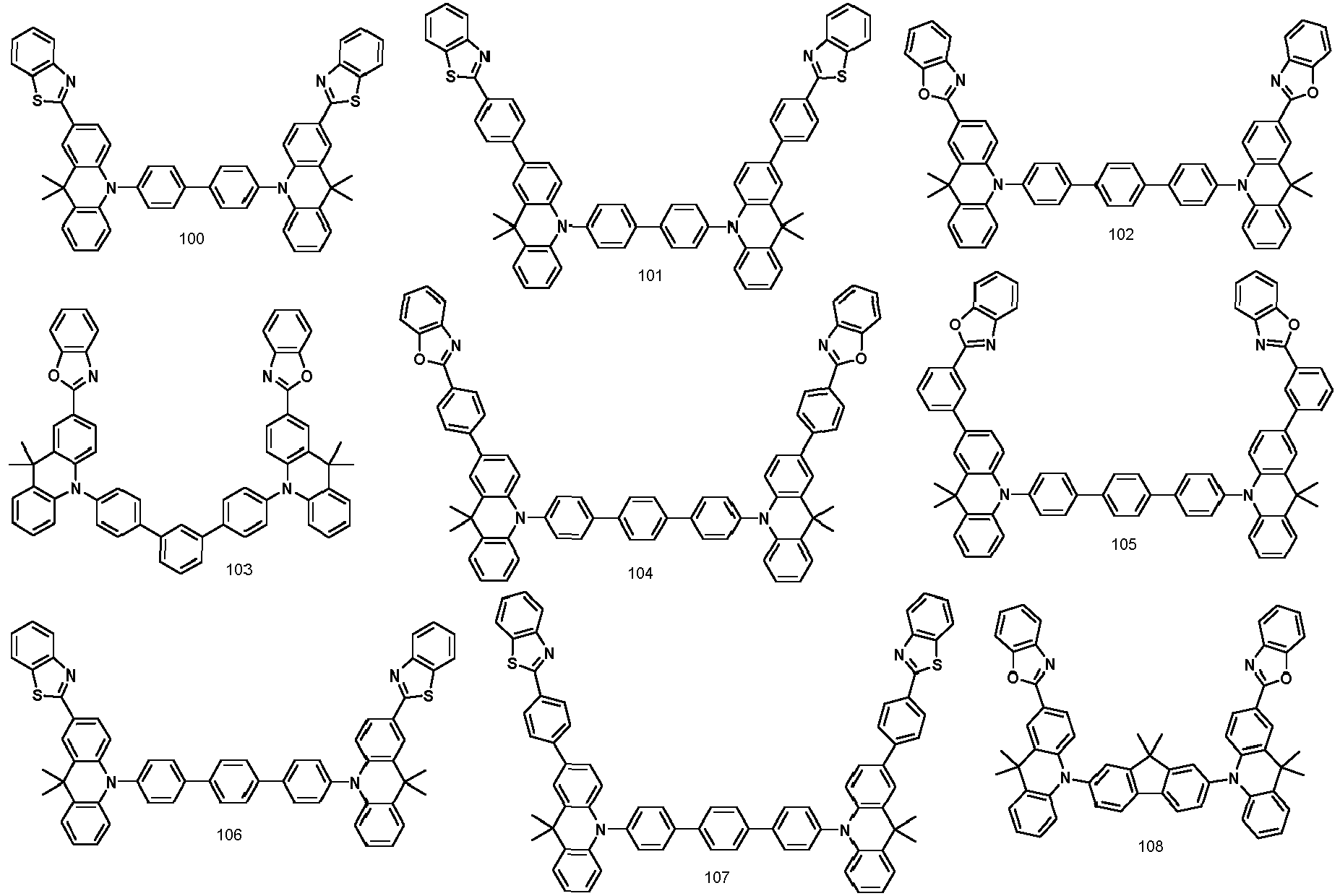
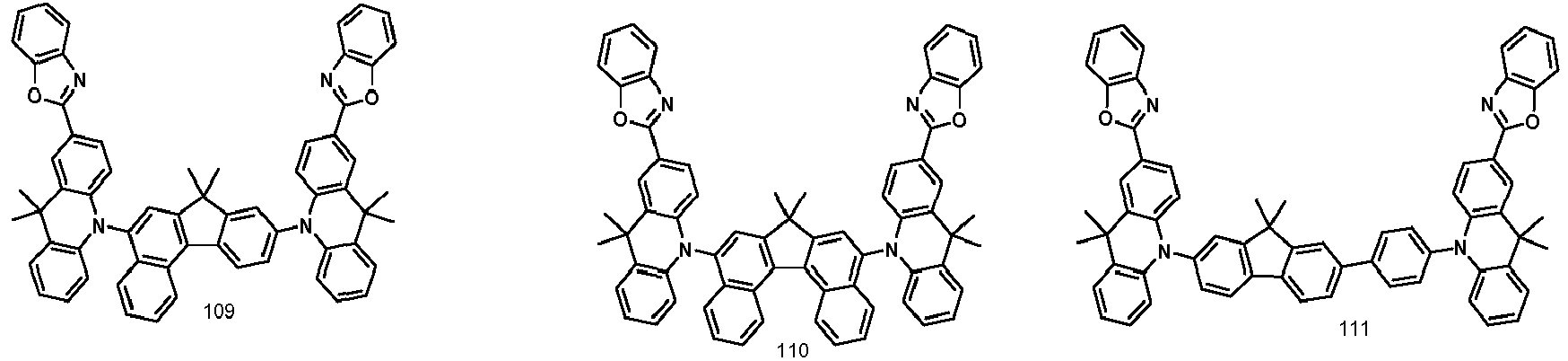
- the heterocyclic compound is selected from any one of the following compounds:
- heterocyclic compound according to the present disclosure Some specific structure forms of the heterocyclic compound according to the present disclosure are illustrated above, but the present disclosure is not limited to these chemical structures. Any compound having a basic structure as shown in Formula (I) and having substituents as defined above shall be included.
- the heterocyclic compound according to the present disclosure may be prepared through conventional coupled reaction.
- the heterocyclic compound may be prepared according to the following synthetic route, but the present disclosure is not limited thereto.
- Compound (a) is subjected to a Suzuki reaction with Compound (b) to obtain Intermediate (A), or Compound (a) is subjected to a Suzuki reaction with Compound (c) to obtain Intermediate (B), or Compound (d) is subjected to a Buchwald reaction with Compound (e) to obtain Intermediate (C).
- Intermediate (A), (B) or (C) is then subjected to a Buchwald reaction with a halide (f) Br-L-Br or I-L-Br containing an L group, to finally obtain a target compound represented by Formula (I).
- Conditions for each reaction described above are not particularly restricted herein, and any reaction conditions known to those skilled in the art can be used.
- Sources of raw materials used in each reaction described above are not particularly restricted herein, and the raw materials may be commercially available products or may be prepared with a preparation method known to those skilled in the art.
- the heterocyclic compound in the present disclosure requires fewer synthetic steps and is simple in treatment, and thus is suitable for industrial production.
- the present disclosure further provides an organic electroluminescent device comprising the heterocyclic compound.
- the organic electroluminescent device includes a cover layer, a cathode, an organic layer, an anode and a substrate, wherein the cover layer contains the heterocyclic compound.
- the organic layer may include a hole injection layer, a hole transport layer, a light emitting layer, an electron transport layer and an electron injection layer.
- the structure of the organic electroluminescent device in the present disclosure is not limited to the above structure, and if necessary, the organic layer may be omitted or there may be multiple organic layers simultaneously.
- an electron blocking layer may further be provided between the hole transport layer and the light emitting layer, and a hole blocking layer may further be provided between the electron transport layer and the light emitting layer.
- Organic layers having the same function may be made into a laminate structure with more than two layers.
- the hole transport layer may further include a first hole transport layer and a second hole transport layer
- the electron transport layer may further include a first electron transport layer and a second electron transport layer.
- the cover layer which contains the heterocyclic compound represented by Formula (I) may use any material in the existing art useful for such layers.
- a material having a high work function may be used, for example, a metal such as vanadium, chromium, copper, zinc, gold or an alloy thereof; a metal oxide such as zinc oxide, indium oxide, indium tin oxide (ITO) and indium zinc oxide (IZO); a combination of a metal and an oxide, such as ZnO:Al or SnO 2 :Sb; and a conductive polymer such as poly(3-methyl compound), poly[3,4-(ethylene-1,2-dioxy)thiophene] (PEDOT), polypyrrole, polyaniline and the like, but is not limited thereto.
- a metal such as vanadium, chromium, copper, zinc, gold or an alloy thereof
- a metal oxide such as zinc oxide, indium oxide, indium tin oxide (ITO) and indium zinc oxide (IZO)
- ITO indium oxide
- IZO indium zinc oxide
- a combination of a metal and an oxide such as ZnO:Al
- a material having a low work function may be used, for example, a metal such as magnesium, calcium, sodium, potassium, titanium, indium, yttrium, lithium, gadolinium, aluminum, silver, tin, lead or an alloy thereof; and a material with a multilayer-structure, such as LiF/Al or LiO 2 /Al, but is not limited thereto.
- a metal such as magnesium, calcium, sodium, potassium, titanium, indium, yttrium, lithium, gadolinium, aluminum, silver, tin, lead or an alloy thereof
- a material with a multilayer-structure such as LiF/Al or LiO 2 /Al, but is not limited thereto.
- the material of the hole transport layer is required to have a proper ionic potential and a large hole mobility, and may be an organic material based on arylamine, a conductive polymer, a block copolymer with both conjugated and non-conjugated parts, but is not limited thereto.
- Examples include 4,4'-bis[N-(1-naphthyl)-N-phenylamino]biphenyl (NPB), 4,4,4"-tris(N-carbazolyl)triphenylamine (TCTA), N,N'-dis(3-methylphenyl)-N,N'-dibenzyl-[1,1-biphenyl]-4,4'-diamine (TPD), N,N'-dis(naphthalen-1-yl)-N,N'-diphenylbenzidine (a-NPD), or the like.
- the light emitting material may be a red light emitting material, a green light emitting material, or a blue light emitting material, and if necessary, two or more light emitting materials may be mixed.
- the light emitting material may be only a host material, or may be the mixture of a host material and a doped material.
- the light emitting layer uses the mixture of a host material and a doped material.
- the electron transport material is required to have a high electron affinity, and be able to effectively transport electrons, so that substances such as impurities that will become traps are not easily produced during manufacture and use.
- the electron transport material used in the electron transport layer is not particularly limited, which may be, but is not limited to, (1) metal complexes such as aluminum complexes, beryllium complexes and zinc complexes, (2) aromatic heterocyclic compounds such as imidazole derivatives, benzimidazole derivatives and phenanthroline derivatives, and (3) polymer compounds.
- the electron transport material described above may be tris(8-hydroxyquinoline)aluminum (Alq 3 ), 1,3,5-tris(1-naphthyl-1H-benzoimidazol-2-yl)benzene (TPBI), 4,7-diphenyl-1,10-phenanthroline (BPhen) and other phenanthroline derivatives, and the like.
- the main function of the electron injection layer of the organic electroluminescent device in the present disclosure is to improve the efficiency of electron injection into the electron transport layer and the light emitting layer from the cathode, and thus the electron injection layer is required to be capable of transmitting electrons.
- the material of the electron injection layer may be salts of alkali metal such as lithium fluoride and cesium fluoride, salts of alkaline-earth metal such as magnesium fluoride, and metal oxides such as aluminum oxide, and the like.
- the cover layer includes a first cover layer containing the heterocyclic compound, and a second cover layer containing a compound represented by Formula (V). wherein Ar 1 to Ar 4 are each independently selected from any one of substituted or unsubstituted C6 - C30 aryl.
- Ar 1 to Ar 4 are each independently selected from any one of the following groups:
- the compound represented by Formula (V) is selected from any one of the following structures:
- the organic layer includes a hole injection layer including a host material and a doped material, wherein the host material has a structure represented by Formula (VI): wherein n is 1, 2 or 3, and Ar 5 and Ar 6 are each independently selected from any one of substituted or unsubstituted C6 - C30 aryl.
- Formula (VI) wherein n is 1, 2 or 3, and Ar 5 and Ar 6 are each independently selected from any one of substituted or unsubstituted C6 - C30 aryl.
- Ar 5 and Ar 6 are each independently selected from any one of the following groups:
- the doped material has a structure represented by Formula (VII): wherein R 2 to R 4 are each independently selected from any one of the following groups:
- the compound represented by Formula (VI) is selected from any one of the following structures:
- each organic layer of the organic electroluminescent device is not particularly restricted herein, and any thickness known to those skilled in the art can be used.
- the organic electroluminescent device in the present disclosure can be prepared in various ways, such as a solution coating method including spin coating, ink jet printing and the like, or a vacuum evaporation method.
- Sources of raw materials used in examples described below are not particularly restricted herein, and the raw materials may be commercially available products or may be prepared with a preparation method known to those skilled in the art.
- the mass spectrum of the compounds of the present disclosure is analyzed using the AXIMA-CFR plus Matrix-assisted Laser Desorption/Ionization Time-of-Flight Mass Spectrometry available from Kratos Analytical (UK) of Shimadzu Co., with chloroform as the solvent.
- the element analysis is performed using Vario EL cube Elemental Analyzer available from Elementar Co., Germany, with sample mass of 5 mg.
- the nuclear magnetic resonance ( 1 H NMR) is performed using the Bruker-510 nuclear magnetic resonance spectrometer available from Bruker Co., Germany, in 600 MHz, with CDCl 3 as the solvent and TMS as internal standard.
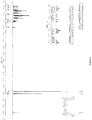
- FIG. 1 is a 1 H NMR diagram of Compound 9 prepared in Example 1 of the present disclosure. The above results confirmed that the obtained product was the target product.
- Compound 16 was obtained according to the same procedures as Example 1 except that an equal molar amount of a-2 was used in place of a-1.
- Theoretical element content (%) of C 62 H 38 N 4 S 2 C, 82.46; H, 4.24; N, 6.20; S, 7.10.
- FIG. 2 is a 1 H NMR diagram of Compound 18 prepared in Example 4 of the present disclosure. The above results confirmed that the obtained product was the target product.
- FIG. 3 is a 1 H NMR diagram of Compound 34
- FIG. 4 is a 1 H NMR diagram of Compound 51 prepared in Example 8 of the present disclosure. The above results confirmed that the obtained product was the target product.
- FIG. 5 is a 1 H NMR diagram of Compound 9 prepared in Example 9 of the present disclosure. The above results confirmed that the obtained product was the target product.
- Compound 106 was obtained according to the same procedures as Example 1 except that an equal molar amount of a-4 was used in place of a-1, an equal molar amount of c-1 was used in place of b-1, and an equal molar amount of f-2 was used in place of f-1.
- Theoretical element content (%) of C 62 H 46 N 4 S 2 : C, 81.73; H, 5.09; N, 6.15; S, 7.04.
- the above results confirmed that the obtained product was the target product.
- Compound 111 was obtained according to the same procedures as Example 1 except that an equal molar amount of c-1 was used in place of b-1 and that an equal molar amount of f-4 was used in place of f-1.
- FIG. 6 is a 1 H NMR diagram of Compound 111 prepared in Example 14 of the present disclosure. The above results confirmed that the obtained product
- Compound 114 was obtained according to the same procedures as Example 1 except that an equal molar amount of a-2 was used in place of a-1, an equal molar amount of c-1 was used in place of b-1, and an equal molar amount of f-3 was used in place of f-1.
- Theoretical element content (%) of C 71 H 54 N 4 S 2 C, 83.01; H, 5.30; N, 5.45; S, 6.24.
- the above results confirmed that the obtained product was the target product.
- Refractive index was measured at 620 nm using M-2000 spectroscopic ellipsometer available from J.A.Woollam, USA, wherein the scanning range of the instrument was 245 - 1000 nm, the size of the glass substrate was 200 ⁇ 200 mm, and the thickness of the material film was 60 nm. Results are shown in Table 1.
- a hole injection layer (Compound HIL doped with 5% of Compound P-D, 25 nm), a hole transport layer (NPB, 60 nm), a light emitting layer (host CBP doped with 5% of (piq) 2 Ir(acac), 30 nm), an electron transport layer (TPBI, 40 nm), and an electron injection layer (LiF, 0.5 nm) were deposited layer-by-layer on an ITO (10 nm)/Ag (100 nm)/ITO (10 nm) layer formed on an organic substrate. Then, Mg/Ag was deposited in a thickness of 20 nm to form a cathode. Finally, a heterocyclic compound in the present disclosure was deposited under vacuum in a thickness of 60 nm as a cover layer.
- a hole injection layer (Compound HIL doped with 5% of Compound P-D, 25 nm), a hole transport layer (NPB, 60 nm), a light emitting layer (host CBP doped with 5% of (piq) 2 Ir(acac), 30 nm), an electron transport layer (TPBI, 40 nm), and an electron injection layer (LiF, 0.5 nm) were deposited layer-by-layer on an ITO (10 nm)/Ag (100 nm)/ITO (10 nm) layer formed on an organic substrate. Then, Mg/Ag was deposited in a thickness of 20 nm to form a cathode.
- a heterocyclic compound in the present disclosure was deposited under vacuum in a thickness of 40 nm as a first cover layer, and a compound represented by Formula (V) was deposited under vacuum in a thickness of 20 nm as a second cover layer.
- devices were prepared by using a vacuum evaporation system by continuously evaporating under a condition of uninterrupted vacuum.
- the materials used herein were separately placed in quartz crucibles under different evaporation sources, and the temperatures of the evaporation sources can be separately controlled.
- the thermal evaporation rates of organic materials or doped parent organic materials were generally set at 0.1 nm/s, and the evaporation rates of the doped materials were adjusted according to the doping ratio.
- the evaporation rates of electrode metals were 0.4 - 0.6 nm/s.
- the processed glass substrates were placed in an OLED vacuum coating machine. In the film manufacturing process, the vacuum degree of the system was maintained below 5 ⁇ 10 -5 Pa.
- Organic layers and metal electrodes were respectively deposited by replacing mask plates.
- the evaporation rate was detected by an SQM160 quartz crystal film thickness detector from Inficon, and the film thickness was detected by a quartz crystal oscillator.
- Test software computers, K2400 Digital Source Meter manufactured by Keithley, USA, and PR788 Spectrascan Photometer manufactured by Photo Research, USA were combined into a combined IVL test system to test the driving voltage, the light emitting efficiency and the CIE color coordinates of organic electroluminescent devices.
- the lifetime was tested using M6000 OLED Lifetime Test System from McScience Co.
- the environment for testing was atmospheric environment, and the temperature was room temperature.
Landscapes
- Chemical & Material Sciences (AREA)
- Organic Chemistry (AREA)
- Physics & Mathematics (AREA)
- Spectroscopy & Molecular Physics (AREA)
- Engineering & Computer Science (AREA)
- Materials Engineering (AREA)
- Optics & Photonics (AREA)
- Electroluminescent Light Sources (AREA)
- Plural Heterocyclic Compounds (AREA)
- Nitrogen And Oxygen Or Sulfur-Condensed Heterocyclic Ring Systems (AREA)
- Luminescent Compositions (AREA)
Abstract
Description
- The present disclosure relates to the field of organic electroluminescent materials and specifically, relates to a heterocyclic compound and an organic electroluminescent device comprising the same.
- An organic light-emitting diode (OLED) is an all-solid-state light emitting device, and has the advantages of high brightness, high contrast, high definition, wide angle of view, wide color gamut, ultra-thin thickness, ultra-light weight, low power consumption, wide temperature range, self-luminescence, high luminescence efficiency, short response time, transparency, flexibility, and the like. The OLED has been commercially used in the fields of mobile phone, television, micro display and the like, has been called dreamy display in the industry, and will become the most promising new display technology in the future.
- Since total reflection will occur at the interface between the Indium tin oxide (ITO) film and glass substrate of the OLED or at the interface of the glass substrate and air, only 20% of the emitted light can be utilized, and the remaining 80% of the light is limited to being inside the device and converted to heat, which adversely affects the device. In the top-emitter, a cover layer with high refractive index is usually provided on the outside of the translucent electrode to adjust the optical interference distance, reduce the total reflection effect of the device, and improve the light extraction efficiency. The Japanese Patent Publication No.
JP2017123341 - The present disclosure provides a heterocyclic compound and an organic electroluminescent device comprising the same.
- The present disclosure provides a heterocyclic compound having a structure represented by Formula (I):
A-L-B Formula (I)
- wherein L is selected from any one of the following groups: phenyl, biphenyl, terphenyl, fluorenyl, benzofluorenyl, dibenzofluorenyl, and spirodifluorenyl which are substituted or unsubstituted; and
- A and B are independently selected from any one of Formula (II), Formula (III) or Formula (IV), and A and B are not both Formula (IV);

- wherein X is oxygen (O) or sulphur (S);
- L1 is a single bond, phenyl or biphenyl;
- n is 0, 1, 2, 3 or 4, and m is 0, 1, 2, 3, 4 or 5; and
- R1 is hydrogen (H), substituted or unsubstituted C1 - C15 alkyl or substituted or unsubstituted C6 - C30 aryl, or two adjacent R1 groups are bonded to form a ring structure.
- The present disclosure further provides an organic electroluminescent device comprising the heterocyclic compound.
- The present disclosure has the following beneficial effects:
Compared with the existing art, the heterocyclic compound provided by the present disclosure has a high refractive index which can reach 1.95 to 2.10, such that when used as a cover layer material, it can improve the transmittance of a semi-transmissive electrode, adjust the light extraction direction and improve the light extraction efficiency. Moreover, the heterocyclic compound provided by the present disclosure improves the glass transition temperature through both structure optimization and introduction of a five-membered heterocyclic ring containing nitrogen or a six-membered heterocyclic ring containing nitrogen, benzoxazole or a benzothiazole group, to allow better film-forming property and stability, such that when as used as the cover layer material of an organic electroluminescent device, it can effectively increase the service life of the device. - The organic electroluminescent device containing the heterocyclic compound further provided by the present disclosure has high luminescence efficiency and great lifetime performance.
-
-
FIG. 1 shows a 1H nuclear magnetic resonance (1H NMR) diagram ofCompound 9 prepared in Example 1 of the present disclosure; -
FIG. 2 shows a 1H NMR diagram ofCompound 18 prepared in Example 4 of the present disclosure; -
FIG. 3 shows a 1H NMR diagram of Compound 34 prepared in Example 7 of the present disclosure; -
FIG. 4 shows a 1H NMR diagram of Compound 51 prepared in Example 8 of the present disclosure; -
FIG. 5 shows a 1H NMR diagram of Compound 95 prepared in Example 9 of the present disclosure; and -
FIG. 6 shows a 1H NMR diagram of Compound 111 prepared in Example 14 of the present disclosure. - The present disclosure will be described clearly and completely in conjunction with technical solutions in the specific examples of the present disclosure. Apparently, the examples described are part, not all, of the examples of the present disclosure. Based on the examples of the present disclosure, all other examples obtained by those skilled in the art are within the scope of the present disclosure on the premise that no creative work is done.
- The present disclosure first provides a heterocyclic compound having a structure represented by Formula (I):
A-L-B Formula (I)
- wherein L is selected from any one of the following groups: phenyl, biphenyl, terphenyl, fluorenyl, benzofluorenyl, dibenzofluorenyl, and spirodifluorenyl which are substituted or unsubstituted; and
- A and B are independently selected from any one of Formula (II), Formula (III) or Formula (IV), and A and B are not both Formula (IV);
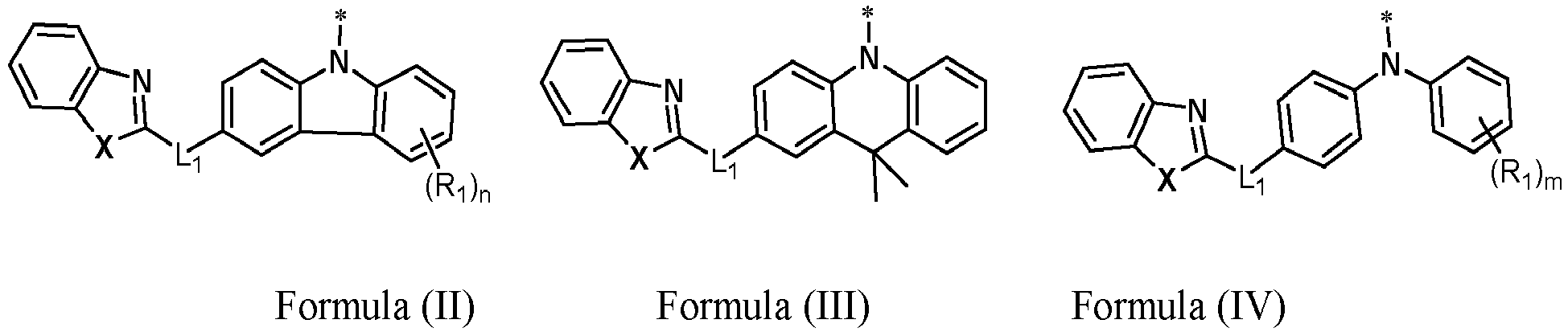
- wherein X is O or S;
- L1 is a single bond, phenyl or biphenyl;
- n is 0, 1, 2, 3 or 4, and m is 0, 1, 2, 3, 4 or 5; and
- R1 is H, substituted or unsubstituted C1 - C15 alkyl or substituted or unsubstituted C6 - C30 aryl, or two adjacent R1 groups are bonded to form a ring structure.
- In referring "substituted or unsubstituted" as described in the present disclosure, a substituent is independently selected from a deuterium atom, cyano, nitro, a halogen atom, C1 - C10 alkyl, C1 - C10 alkoxy, C1 - C10 alkylthio, C6 - C30 aryl, C6 - C30 aryloxy, C6 - C30 arylthio, C3 - C30 heteroaryl, C1 - C30 silylalkyl, C2 - C10 alkylamino, C6 - C30 arylamino, or a combination thereof, for example, a deuterium atom, cyano, nitro, halogen, methyl, ethyl, propyl, isopropyl, t-butyl, methoxy, methylthio, phenyl, biphenyl, triphenyl, naphthyl, anthryl, phenanthryl, benzophenanthryl, perylene, pyrenyl, fluorenyl, 9,9-dimethylfluorenyl, benzyl, phenoxy, thiophenyl, diphenylamino, dimethylamido, carbazolyl, 9-phenylcarbazolyl, furyl, thienyl, triphenylsilyl, trimethylsilyl, trifluoromethyl, phenothiazinyl, phenoxazine, acridinyl, pyridyl, pyrazinyl, triazinyl, pyrimidyl, and the like, but not limited thereto. The substituent may be any substituent other than those enumerated above as long as the technical effect of the present disclosure can be achieved. There may be one or more substituents, and when there is more than one substituent, each of the multiple substituents is the same or different.
- The "alkyl" described in the present disclosure refers to a hydrocarbon radical obtained by removing one hydrogen atom from an alkane molecule, and it may be linear alkyl, branched alkyl or cycloalkyl, and preferably has 1 to 15 carbon atoms, more preferably 1 to 10 carbon atoms, and particularly preferably 1 to 4 carbon atoms. Examples may include, but are not limited to, methyl, ethyl, propyl, isopropyl, normal-butyl, isobutyl, secondary-butyl, tertiary-butyl, pentyl, isopentyl, cyclopentyl, cyclohexyl, and the like.
- The "alkoxy" described in the present disclosure refers to a group obtained after alkyl is bonded to an oxygen atom, that is, an "alkyl-O-" group, wherein the alkyl is defined as above. Examples may include, but are not limited to, methoxy, ethoxy, 2-propoxy, 2-cyclohexoxy, and the like.
- The "alkylthio" described in the present disclosure refers to a group obtained after alkyl is bonded to a sulphur atom, that is, an "alkyl-S-" group, wherein the alkyl is defined as above.
- The "aryl" described in the present disclosure refers to a general term of a monovalent group left after one hydrogen atom is removed from aromatic nucleus carbon of an aromatic hydrocarbon molecule, and it may be monocyclic aryl, polycyclic aryl or fused ring aryl, and preferably has 6 to 30 carbon atoms, more preferably 6 to 18 carbon atoms, and particularly preferably 6 to 14 carbon atoms. Examples may include, but are not limited to, phenyl, biphenyl, naphthyl, anthryl, phenanthryl, benzophenanthryl, perylene, pyrenyl, fluorenyl, benzofluorenyl, dibenzofluorenyl, spirodifluorenyl, and the like.
- The "aryloxy" described in the present disclosure refers to a group obtained after aryl is bonded to an oxygen atom, that is, an "aryl-O-" group, wherein the aryl is defined as above.
- The "arylthio" described in the present disclosure refers to a group obtained after aryl is bonded to a sulphur atom, that is, an "aryl-S-" group, wherein the aryl is defined as above.
- The "heteroaryl" described in the present disclosure refers to a general term of a group obtained after one or more aromatic nucleus carbons in aryl are replaced with heteroatoms, wherein the heteroatom includes, but is not limited to, an oxygen atom, a sulfur atom, a nitrogen atom or a silicon atom, and the heteroaryl preferably has 1 to 25 carbon atoms, more preferably 2 to 20 carbon atoms, and particularly preferably 3 to 15 carbon atoms. The heteroaryl may be monocyclic, polycyclic or fused. Examples may include, but are not limited to, furyl, thienyl, pyridyl, pyrazinyl, pyrimidyl, phenothiazinyl, phenoxazinyl, benzopyrimidinyl, carbazolyl, triazinyl, benzothiazole, benzimidazolyl, dibenzothiophene, dibenzofuran, acridinyl, and the like. Examples of the silylalkyl described in the present disclosure include, but are not limited to, trimethylsilane, triethylsilane, triphenylsilane, trimethoxysilane, dimethoxyphenylsilane, diphenylmethylsilane, silane, diphenylenesilane, methylcyclobutylsilane, dimethylfuranosilane, and the like.
- The "alkylamino" described in the present disclosure refers to a general term of a group obtained after a hydrogen atom in amino, i.e., -NH2, is substituted with alkyl. Examples may include, but are not limited to, -N(CH3)2, -N(CH2CH3)2, and the like.
- The "arylamino" described in the present disclosure refers to a general term of a group obtained after a hydrogen atom in amino, i.e., -NH2, is substituted with an aromatic group. The arylamino group may be further substituted with the substituent described in the present disclosure. Examples may include, but are not limited to, the following structures:


- The expression "being bonded to form a ring structure" described in the present disclosure refers to that two groups are joined to each other through a chemical bond, which can be exemplified by the following formula:


- In the present disclosure, the ring formed through bonding may be a five-membered ring, a six-membered ring or a fused ring, for example, phenyl, naphthyl, cyclopentenyl, cyclohexanophenyl, quinolyl, isoquinolyl, dibenzothienyl, phenanthryl or pyrenyl, but not limited thereto.
- In Formula (I), preferably, L is selected from any one of the following groups: phenyl, biphenyl, terphenyl, 9,9-dimethylfluorenyl, 9,9-diphenylfluorenyl,
benzo 9,9-dimethylfluorenyl,dibenzo 9,9-dimethylfluorenyl and spirodifluorenyl which are substituted or unsubstituted. - More preferably, L is selected from any one of the following groups:


- Preferably, R1 is H, C1 - C4 alkyl, phenyl or biphenyl, or two adjacent R1 groups are bonded to form a ring structure.
- Preferably, A and B are independently selected from any one of the following formulas:


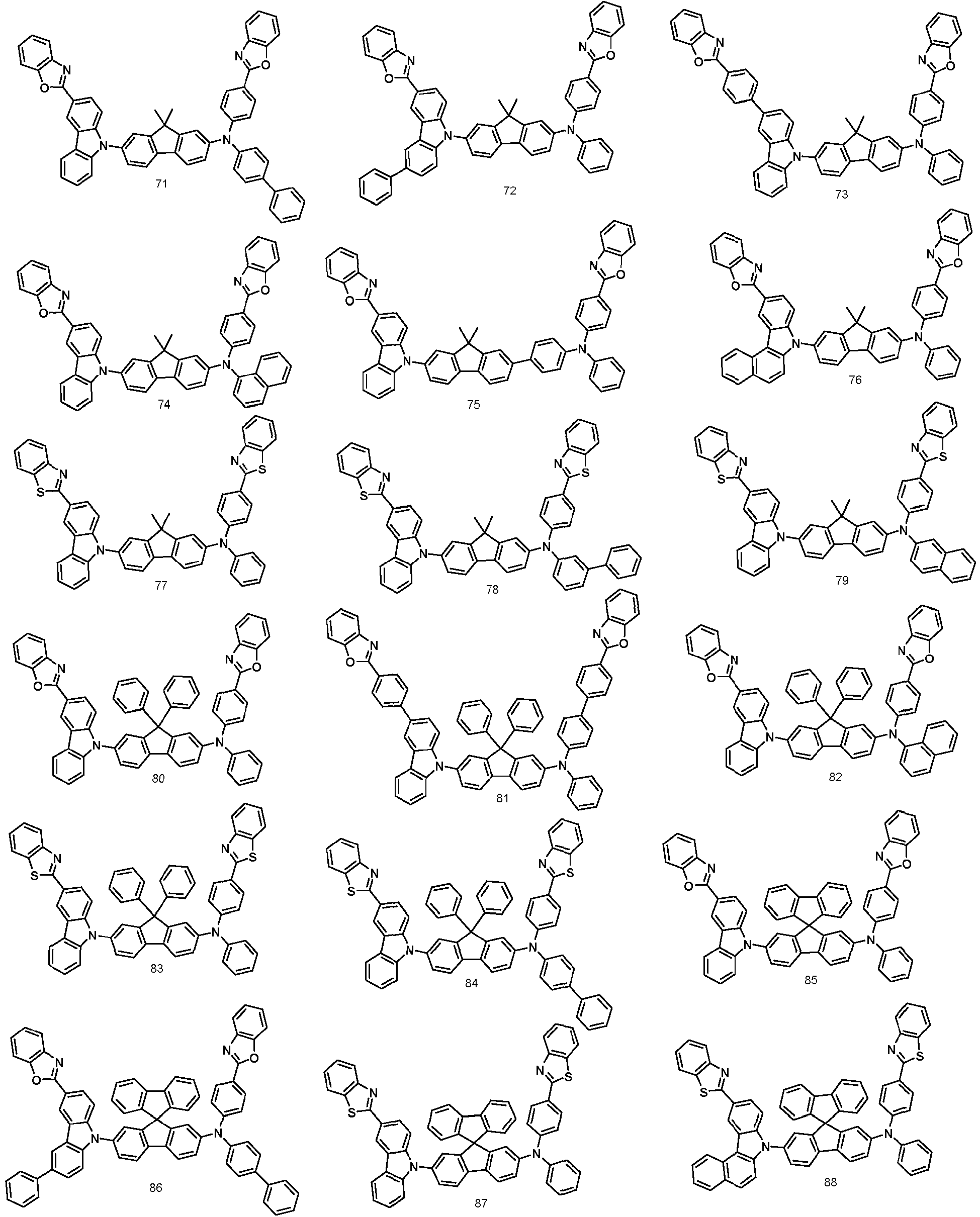
- Preferably, the heterocyclic compound is selected from any one of the following compounds:


- Some specific structure forms of the heterocyclic compound according to the present disclosure are illustrated above, but the present disclosure is not limited to these chemical structures. Any compound having a basic structure as shown in Formula (I) and having substituents as defined above shall be included.
- The heterocyclic compound according to the present disclosure may be prepared through conventional coupled reaction. For example, the heterocyclic compound may be prepared according to the following synthetic route, but the present disclosure is not limited thereto.


- Compound (a) is subjected to a Suzuki reaction with Compound (b) to obtain Intermediate (A), or Compound (a) is subjected to a Suzuki reaction with Compound (c) to obtain Intermediate (B), or Compound (d) is subjected to a Buchwald reaction with Compound (e) to obtain Intermediate (C). Intermediate (A), (B) or (C) is then subjected to a Buchwald reaction with a halide (f) Br-L-Br or I-L-Br containing an L group, to finally obtain a target compound represented by Formula (I).
- Wherein, the definitions of L, L1, X, R1, m and n are as described above, which will not be repeated herein.
- Conditions for each reaction described above are not particularly restricted herein, and any reaction conditions known to those skilled in the art can be used. Sources of raw materials used in each reaction described above are not particularly restricted herein, and the raw materials may be commercially available products or may be prepared with a preparation method known to those skilled in the art. The heterocyclic compound in the present disclosure requires fewer synthetic steps and is simple in treatment, and thus is suitable for industrial production.
- The present disclosure further provides an organic electroluminescent device comprising the heterocyclic compound. Preferably, the organic electroluminescent device includes a cover layer, a cathode, an organic layer, an anode and a substrate, wherein the cover layer contains the heterocyclic compound.
- For the organic electroluminescent device of the present disclosure, the organic layer may include a hole injection layer, a hole transport layer, a light emitting layer, an electron transport layer and an electron injection layer. However, the structure of the organic electroluminescent device in the present disclosure is not limited to the above structure, and if necessary, the organic layer may be omitted or there may be multiple organic layers simultaneously. For example, an electron blocking layer may further be provided between the hole transport layer and the light emitting layer, and a hole blocking layer may further be provided between the electron transport layer and the light emitting layer. Organic layers having the same function may be made into a laminate structure with more than two layers. For example, the hole transport layer may further include a first hole transport layer and a second hole transport layer, and the electron transport layer may further include a first electron transport layer and a second electron transport layer.
- As regards the organic electroluminescent device in the present disclosure, except the cover layer which contains the heterocyclic compound represented by Formula (I), other layers may use any material in the existing art useful for such layers.
- As regards the anode of the organic electroluminescent device in the present disclosure, a material having a high work function may be used, for example, a metal such as vanadium, chromium, copper, zinc, gold or an alloy thereof; a metal oxide such as zinc oxide, indium oxide, indium tin oxide (ITO) and indium zinc oxide (IZO); a combination of a metal and an oxide, such as ZnO:Al or SnO2:Sb; and a conductive polymer such as poly(3-methyl compound), poly[3,4-(ethylene-1,2-dioxy)thiophene] (PEDOT), polypyrrole, polyaniline and the like, but is not limited thereto.
- As regards the cathode of the organic electroluminescent device in the present disclosure, a material having a low work function may be used, for example, a metal such as magnesium, calcium, sodium, potassium, titanium, indium, yttrium, lithium, gadolinium, aluminum, silver, tin, lead or an alloy thereof; and a material with a multilayer-structure, such as LiF/Al or LiO2/Al, but is not limited thereto.
- As regards the hole transport layer of the organic electroluminescent device in the present disclosure, the material of the hole transport layer is required to have a proper ionic potential and a large hole mobility, and may be an organic material based on arylamine, a conductive polymer, a block copolymer with both conjugated and non-conjugated parts, but is not limited thereto. Examples include 4,4'-bis[N-(1-naphthyl)-N-phenylamino]biphenyl (NPB), 4,4,4"-tris(N-carbazolyl)triphenylamine (TCTA), N,N'-dis(3-methylphenyl)-N,N'-dibenzyl-[1,1-biphenyl]-4,4'-diamine (TPD), N,N'-dis(naphthalen-1-yl)-N,N'-diphenylbenzidine (a-NPD), or the like.
- As regards the light emitting layer of the organic electroluminescent device in the present disclosure, the light emitting material may be a red light emitting material, a green light emitting material, or a blue light emitting material, and if necessary, two or more light emitting materials may be mixed. In addition, the light emitting material may be only a host material, or may be the mixture of a host material and a doped material. Preferably, the light emitting layer uses the mixture of a host material and a doped material.
- As regards the electron transport layer of the organic electroluminescent device in the present disclosure, the electron transport material is required to have a high electron affinity, and be able to effectively transport electrons, so that substances such as impurities that will become traps are not easily produced during manufacture and use. The electron transport material used in the electron transport layer is not particularly limited, which may be, but is not limited to, (1) metal complexes such as aluminum complexes, beryllium complexes and zinc complexes, (2) aromatic heterocyclic compounds such as imidazole derivatives, benzimidazole derivatives and phenanthroline derivatives, and (3) polymer compounds. For example, the electron transport material described above may be tris(8-hydroxyquinoline)aluminum (Alq3), 1,3,5-tris(1-naphthyl-1H-benzoimidazol-2-yl)benzene (TPBI), 4,7-diphenyl-1,10-phenanthroline (BPhen) and other phenanthroline derivatives, and the like.
- The main function of the electron injection layer of the organic electroluminescent device in the present disclosure is to improve the efficiency of electron injection into the electron transport layer and the light emitting layer from the cathode, and thus the electron injection layer is required to be capable of transmitting electrons. The material of the electron injection layer may be salts of alkali metal such as lithium fluoride and cesium fluoride, salts of alkaline-earth metal such as magnesium fluoride, and metal oxides such as aluminum oxide, and the like.
- Preferably, the cover layer includes a first cover layer containing the heterocyclic compound, and a second cover layer containing a compound represented by Formula (V).

- Preferably, Ar1 to Ar4 are each independently selected from any one of the following groups:


- Preferably, the compound represented by Formula (V) is selected from any one of the following structures:




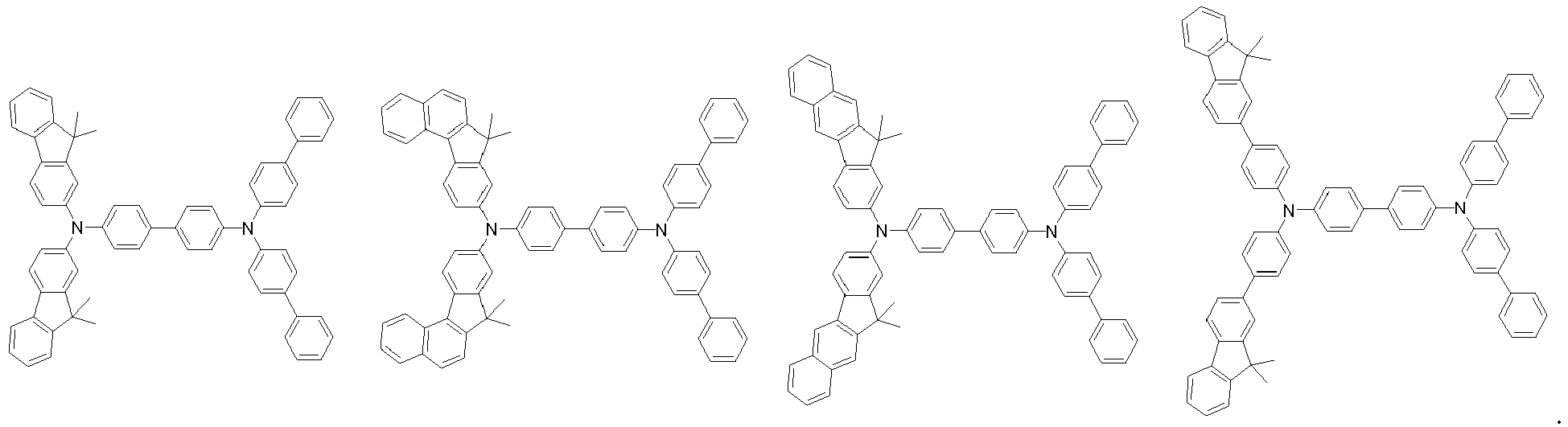
- Preferably, the organic layer includes a hole injection layer including a host material and a doped material, wherein the host material has a structure represented by Formula (VI):

- Preferably, Ar5 and Ar6 are each independently selected from any one of the following groups:



- The doped material has a structure represented by Formula (VII):


- Preferably, the compound represented by Formula (VI) is selected from any one of the following structures:

- The thickness of each organic layer of the organic electroluminescent device is not particularly restricted herein, and any thickness known to those skilled in the art can be used.
- The organic electroluminescent device in the present disclosure can be prepared in various ways, such as a solution coating method including spin coating, ink jet printing and the like, or a vacuum evaporation method.
- Sources of raw materials used in examples described below are not particularly restricted herein, and the raw materials may be commercially available products or may be prepared with a preparation method known to those skilled in the art.
- The mass spectrum of the compounds of the present disclosure is analyzed using the AXIMA-CFR plus Matrix-assisted Laser Desorption/Ionization Time-of-Flight Mass Spectrometry available from Kratos Analytical (UK) of Shimadzu Co., with chloroform as the solvent.
- The element analysis is performed using Vario EL cube Elemental Analyzer available from Elementar Co., Germany, with sample mass of 5 mg.
- The nuclear magnetic resonance (1H NMR) is performed using the Bruker-510 nuclear magnetic resonance spectrometer available from Bruker Co., Germany, in 600 MHz, with CDCl3 as the solvent and TMS as internal standard.
-

- Under nitrogen protection, Compound a-1 (4.89 g, 30 mmol), Compound b-1 (7.46 g, 30.3 mmol), K2CO3 (12.44 g, 90 mmol) and 300 mL of toluene solvent were added to a 1L reaction flask and stirred. Catalyst Pd(PPh3)4 (0.35 g, 0.3 mmol) and 50 mL of distilled water were added to the flask. The reaction was heated to reflux and stirred for 10 hours. After full reaction, 75 mL of distilled water was added to terminate the reaction. The resultant was filtrated under reduced pressure to obtain crude Intermediate A-1, which was washed three times with distilled water, and recrystallized from toluene and ethanol (10: 1) to obtain 6.65 g of the target Compound A-1 in a yield of 78%.
- Under argon atmosphere, Intermediate A-1 (5.74 g, 20.2 mmol), f-1 (3.12 g, 10 mmol) and sodium tert-butoxide (2.40 g, 25 mmol) were dissolved in 100 ml of dehydrated toluene, a solution of palladium acetate (0.04 g, 0.2 mmol) and tri-tert-butylphosphine (0.16 g, 0.8 mmol) in toluene was added with stirring, and the reaction was refluxed for 8 hours. After cooling, the mixture was filtrated through a celite/silica funnel. The filtrate was distilled under reduced pressure to remove the organic solvent. The concentrated solution was recrystallized from toluene and ethanol (14: 1) and then filtrated to obtain Compound 9 (4.96 g, 6.9 mmol) in a yield of 69%.
- Mass spectrum (m/z): 718.40 (Calcd.: 718.24). Theoretical element content (%) of C50H30N4O2: C, 83.55; H, 4.21; N, 7.79; O, 4.45. Measured elemental content (%): C, 83.66; H, 4.20; N, 7.81; O, 4.48. 1H NMR (500 MHz, CDCl3): δ 8.55 (dd, 1H), 8.31 (d, 2H), 8.22 - 8.16 (m, 1H), 7.92 (s, 8H), 7.87 (dd, 1H), 7.77 - 7.69 (m, 5H), 7.59 (d, 1H), 7.51 (m, 2H), 7.41 (m, 2H), 7.38 (d, 2H), 7.36 (d, 1H), 7.22 - 7.09 (m, 4H).
FIG. 1 is a 1H NMR diagram ofCompound 9 prepared in Example 1 of the present disclosure. The above results confirmed that the obtained product was the target product. -

- Compound 12 was obtained according to the same procedures as Example 1 except that an equal molar amount of bromide b-2 was used in place of bromide b-1. Mass spectrum (m/z): 818.39 (Calcd.: 818.27). Theoretical element content (%) of C58H34N4O2: C, 85.07; H, 4.18; N, 6.84; O, 3.91. Measured elemental content (%): C, 85.14; H, 4.21; N, 6.89; O, 3.90. The above results confirmed that the obtained product was the target product.
-

- Compound 16 was obtained according to the same procedures as Example 1 except that an equal molar amount of a-2 was used in place of a-1. Mass spectrum (m/z): 902.40 (Calcd.: 902.25). Theoretical element content (%) of C62H38N4S2: C, 82.46; H, 4.24; N, 6.20; S, 7.10. The measured elemental content (%): C, 82.54; H, 4.24; N, 6.24; S, 7.12. The above results confirmed that the obtained product was the target product.
-

-
Compound 18 was obtained according to the same procedures as Example 1 except that an equal molar amount of f-2 was used in place of f-1. Mass spectrum (m/z): 794.38 (Calcd.: 794.27). Theoretical element content (%) of C56H34N4O2: C, 84.61; H, 4.31; N, 7.05; O, 4.03. Measured elemental content (%): C, 84.70; H, 4.32; N, 7.08; O, 4.04. 1H NMR (500 MHz, CDCl3): δ 8.55 (dd, 1H), 8.31 (d, 2H), 8.22 - 8.16 (m, 1H), 7.92 (s, 8H), 7.87 (dd, 1H), 7.76 (s, 1H), 7.74 (d, 2H), 7.71 (d, 2H), 7.59 (d, 1H), 7.51 (m, 2H), 7.41 (m, 2H), 7.38 (d, 2H), 7.36 (s, 1H), 7.25 (s, 4H), 7.22 - 7.10 (m, 4H).FIG. 2 is a 1H NMR diagram ofCompound 18 prepared in Example 4 of the present disclosure. The above results confirmed that the obtained product was the target product. -

-
Compound 24 was obtained according to the same procedures as Example 1 except that an equal molar amount of f-3 was used in place of f-1. Mass spectrum (m/z): 758.40 (Calcd.: 758.27). Theoretical element content (%) of C53H34N4O2: C, 83.88; H, 4.52; N, 7.38; O, 4.22. Measured elemental content (%): C, 83.99; H, 4.52; N, 7.42; O, 4.24. The above results confirmed that the obtained product was the target product. -

- Compound 27 was obtained according to the same procedures as Example 1 except that an equal molar amount of f-4 was used in place of f-1. Mass spectrum (m/z): 834.45 (Calcd.: 834.30). Theoretical element content (%) of C59H38N4O2: C, 84.87; H, 4.59; N, 6.71; O, 3.83. Measured elemental content (%): C, 84.99; H, 4.60; N, 6.74; O, 3.84. The above results confirmed that the obtained product was the target product.
-

- Compound 34 was obtained according to the same procedures as Example 1 except that an equal molar amount of a-3 was used in place of a-1 and that an equal molar amount of f-5 was used in place of f-1. Mass spectrum (m/z): 1034.49 (Calcd.: 1034.36). Theoretical element content (%) of C75H46N4O2: C, 87.02; H, 4.48; N, 5.41; O, 3.09. Measured elemental content (%): C, 87.14; H, 4.50; N, 5.42; O, 3.10. 1H NMR (500 MHz, CDCl3): δ 9.52 (d, 2H), 8.55 (d, 1H), 8.19 (d, 1H), 8.06 (s, 1H), 8.03 (s, 1H), 7.97 (d, 2H), 7.96 - 7.92 (m, 2H), 7.87 (dd, 1H), 7.76 (s, 1H), 7.74 (d, 2H), 7.71 (d, 2H), 7.59 (d, 1H), 7.52 (dd, 2H), 7.40 (dd, 4H), 7.38 (d, 2H), 7.36 (s, 1H), 7.27 (m, 4H), 7.25 - 7.22 (m, 4H), 7.20 (dd, 2H), 7.17 (dd, 2H), 7.13 (d, 1H), 7.12 (d, 1H), 7.11 (m, 2H), 7.09 (dd, 2H), 6.88 (d, 1H), 6.85 (d, 1H).
FIG. 3 is a 1H NMR diagram of Compound 34 prepared in Example 7 of the present disclosure. The above results confirmed that the obtained product was the target product. -

- The synthesis of Intermediate A-1 was the same as that in Example 1.
- Under argon atmosphere, Compound d-1 (4.11 g, 15 mmol), e-1 (2.16 g, 15.15 mmol) and sodium tert-butoxide (2.11 g, 22 mmol) were dissolved in 100 ml of dehydrated toluene, a solution of palladium acetate (0.03 g, 0.15 mmol) and tri-tert-butylphosphine (0.12 g, 0.6 mmol) in toluene was added with stirring, and the reaction was refluxed for 8 hours. After cooling, the mixture was filtrated through a celite/silica funnel. The filtrate was distilled under reduced pressure to remove the organic solvent. The residue was recrystallized from toluene and ethanol (10: 1) and then filtrated to obtain Intermediate C-1 (3.99 g, 11.85 mmol) in a yield of 79%.
- Under argon atmosphere, Intermediate A-1 (4.11 g, 18 mmol), 4-bromo-4'-iodobiphenyl (2.16 g, 18.2 mmol) and sodium tert-butoxide (3.36 g, 35 mmol) were dissolved in 100 ml of dehydrated toluene, a solution of palladium acetate (0.038 g, 0.19 mmol) and tri-tert-butylphosphine (0.15 g, 0.76 mmol) in toluene was added with stirring, and the reaction was refluxed for 8 hours. After cooling, the mixture was filtrated through a celite/silica funnel. The filtrate was distilled under reduced pressure to remove the organic solvent. The concentrated solution was recrystallized from toluene and ethanol (12: 1) and then filtrated to obtain Intermediate D (6.85 g, 13.3 mmol) in a yield of 74%.
- Under argon atmosphere, Intermediate D (5.15 g, 10 mmol), Intermediate C-1 (3.53 g, 10.5 mmol) and sodium tert-butoxide (2.88 g, 30 mmol) were dissolved in 100 ml of dehydrated toluene, a solution of palladium acetate (0.03 g, 0.15 mmol) and tri-tert-butylphosphine (0.12 g, 0.6 mmol) in toluene was added with stirring, and the reaction was refluxed for 8 hours. After cooling, the mixture was filtrated through a celite/silica funnel. The filtrate was distilled under reduced pressure to remove the organic solvent. The concentrated solution was recrystallized from toluene and ethanol (14: 1) and then filtrated to obtain Compound 51 (5.01 g, 6.5 mmol) in a yield of 65%.
- Mass spectrum (m/z): 770.39 (Calcd.: 770.27). Theoretical element content (%) of C54H34N4O2: C, 84.14; H, 4.45; N, 7.27; O, 4.15. Measured elemental content (%): C, 84.26; H, 4.44; N, 7.29; O, 4.16. 1H NMR (500 MHz, CDCl3): δ 8.55 (dd, 1H), 8.31 (d, 1H), 8.22 (dd, 1H), 7.92 (s, 4H), 7.87 - 7.81 (m, 1H), 7.76 (s, 1H), 7.74 (dd, 3H), 7.72 (d, 2H), 7.67 - 7.57 (m, 3H), 7.56 (d, 1H), 7.54 (m, 2H), 7.51 (m, 2H), 7.49 - 7.47 (m, 1H), 7.45 (dd, 1H), 7.40 (s, 1H), 7.38 (dd, 4H), 7.35 (m, 3H), 7.13 (m, 2H).
FIG. 4 is a 1H NMR diagram of Compound 51 prepared in Example 8 of the present disclosure. The above results confirmed that the obtained product was the target product. -

- Compound 95 was obtained according to the same procedures as Example 1 except that an equal molar amount of c-1 was used in place of b-1. Mass spectrum (m/z): 802.46 (Calcd.: 802.33). Theoretical element content (%) of C56H42N4O2: C, 83.77; H, 5.27; N, 6.98; O, 3.98. Measured elemental content (%): C, 83.90; H, 5.29; N, 7.00; O, 3.99. 1H NMR (500 MHz, CDCl3): δ 7.78 - 7.70 (m, 6H), 7.65 (d, 1H), 7.62 (d, 1H), 7.58 - 7.55 (m, 2H), 7.55 - 7.53 (m, 2H), 7.40 - 7.34 (m, 10H), 7.22 (d, 1H), 7.20 (d, 1H), 7.19 (d, 2H), 7.17 (d, 2H), 6.94 (m, 2H), 1.69 (s, 12H).
FIG. 5 is a 1H NMR diagram ofCompound 9 prepared in Example 9 of the present disclosure. The above results confirmed that the obtained product was the target product. -

- Compound 99 was obtained according to the same procedures as Example 1 except that an equal molar amount of a-3 was used in place of a-1 and that an equal molar amount of c-1 was used in place of b-1. Mass spectrum (m/z): 954.51 (Calcd.: 954.39). Theoretical element content (%) of C68H50N4O2: C, 85.51; H, 5.28; N, 5.87; O, 3.35. Measured elemental content (%): C, 85.60; H, 5.29; N, 5.90; O, 3.36. The above results confirmed that the obtained product was the target product.
-

- Compound 102 was obtained according to the same procedures as Example 1 except that an equal molar amount of c-1 was used in place of b-1 and that an equal molar amount of f-2 was used in place of f-1. Mass spectrum (m/z): 878.49 (Calcd.: 878.36). Theoretical element content (%) of C62H46N4O2: C, 84.71; H, 5.27; N, 6.37; O, 3.64. Measured elemental content (%): C, 84.82; H, 5.29; N, 6.40; O, 3.65. The above results confirmed that the obtained product was the target product.
-

- Compound 106 was obtained according to the same procedures as Example 1 except that an equal molar amount of a-4 was used in place of a-1, an equal molar amount of c-1 was used in place of b-1, and an equal molar amount of f-2 was used in place of f-1. Mass spectrum (m/z): 910.48 (Calcd.: 910.32). Theoretical element content (%) of C62H46N4S2: C, 81.73; H, 5.09; N, 6.15; S, 7.04. Measured elemental content (%): C, 81.80; H, 5.10; N, 6.16; S, 7.05. The above results confirmed that the obtained product was the target product.
-

- Compound 108 was obtained according to the same procedures as Example 1 except that an equal molar amount of c-1 was used in place of b-1 and that an equal molar amount of f-3 was used in place of f-1. Mass spectrum (m/z): 842.49 (Calcd.: 842.36). Theoretical element content (%) of C59H46N4O2: C, 84.06; H, 5.50; N, 6.65; O, 3.80. Measured elemental content (%): C, 84.14; H, 5.51; N, 6.66; O, 3.81. The above results confirmed that the obtained product was the target product.
-

- Compound 111 was obtained according to the same procedures as Example 1 except that an equal molar amount of c-1 was used in place of b-1 and that an equal molar amount of f-4 was used in place of f-1. Mass spectrum (m/z): 918.50 (Calcd.: 918.39). Theoretical element content (%) of C65H50N4O2: C,84.94; H, 5.48; N,6.10; O, 3.48. Measured elemental content (%): C, 85.02; H, 5.50; N, 6.13; O, 3.50. 1H NMR (500 MHz, CDC13): δ 8.09 (d, 1H), 8.00 (d, 1H), 7.86 (d, 1H), 7.78 (dd, 1H), 7.76 (d, 3H), 7.74 (d, 2H), 7.72 (s, 1H), 7.65 (d, 1H), 7.62 (d, 1H), 7.56 (d, 1H), 7.55 - 7.52 (m, 1H), 7.40 (s, 1H), 7.39 - 7.37 (m, 4H), 7.36 (d, 2H), 7.34 (s, 1H), 7.23 - 7.21 (m, 1H), 7.20 (d, 1H), 7.19 (d, 2H), 7.17 (d, 2H), 6.98 (d, 1H), 6.94 (m, 2H), 6.48 (dd, 1H),1.67 (s, 12H), 1.50 (s, 6H).
FIG. 6 is a 1H NMR diagram of Compound 111 prepared in Example 14 of the present disclosure. The above results confirmed that the obtained product was the target product. -


- Compound 114 was obtained according to the same procedures as Example 1 except that an equal molar amount of a-2 was used in place of a-1, an equal molar amount of c-1 was used in place of b-1, and an equal molar amount of f-3 was used in place of f-1. Mass spectrum (m/z): 1026.56 (Calcd.: 1026.38). Theoretical element content (%) of C71H54N4S2: C, 83.01; H, 5.30; N, 5.45; S, 6.24. Measured elemental content (%): C, 83.13; H, 5.31; N, 5.49; S, 6.26. The above results confirmed that the obtained product was the target product.
- Refractive index was measured at 620 nm using M-2000 spectroscopic ellipsometer available from J.A.Woollam, USA, wherein the scanning range of the instrument was 245 - 1000 nm, the size of the glass substrate was 200 × 200 mm, and the thickness of the material film was 60 nm. Results are shown in Table 1.
Table 1 Refractive indexes (n) of compounds Compound Refractive Index (620 nm) Compound 92.00 Compound 12 1.98 Compound 16 1.99 Compound 182.01 Compound 241.97 Compound 27 1.96 Compound 34 1.98 Compound 51 1.95 Compound 95 2.05 Compound 99 2.06 Compound 102 2.10 Compound 106 2.07 Compound 108 2.04 Compound 111 2.02 Compound 114 2.03 - Glass transition temperature was measured using DSC 821e differential scanning calorimeter available from Mettler-Toledo company, Switzerland, wherein the testing atmosphere was nitrogen, and the flow rate of the nitrogen was 200 ml/min; the scanning rate of the instrument was 10 °C/min, and the scanning range was 80 - 400°C; and the mass of the compound sample was 5 mg. The measurement results are shown in Table 2.
Table 2 Glass transition temperature (Tg) of compounds Compound Glass transition temperature (°C) Compound 9135 Compound 12 133 Compound 16 134 Compound 18135 Compound 24133 Compound 27 134 Compound 34 131 Compound 51 130 Compound 95 140 Compound 99 138 Compound 102 136 Compound 106 139 Compound 108 136 Compound 111 134 Compound 114 137 - First, on the ITO (10 nm)/Ag (100 nm)/ITO (10 nm) layer formed on an organic substrate, a hole injection layer (Compound HIL doped with 5% of Compound P-D, 25 nm), a hole transport layer (NPB, 60 nm), a light emitting layer (host CBP doped with 5% of (piq)2Ir(acac), 30 nm), an electron transport layer (TPBI, 40 nm), and an electron injection layer (LiF, 0.5 nm) were deposited layer-by-layer on an ITO (10 nm)/Ag (100 nm)/ITO (10 nm) layer formed on an organic substrate. Then, Mg/Ag was deposited in a thickness of 20 nm to form a cathode. Finally, a heterocyclic compound in the present disclosure was deposited under vacuum in a thickness of 60 nm as a cover layer.
- First, a hole injection layer (Compound HIL doped with 5% of Compound P-D, 25 nm), a hole transport layer (NPB, 60 nm), a light emitting layer (host CBP doped with 5% of (piq)2Ir(acac), 30 nm), an electron transport layer (TPBI, 40 nm), and an electron injection layer (LiF, 0.5 nm) were deposited layer-by-layer on an ITO (10 nm)/Ag (100 nm)/ITO (10 nm) layer formed on an organic substrate. Then, Mg/Ag was deposited in a thickness of 20 nm to form a cathode. Finally, a heterocyclic compound in the present disclosure was deposited under vacuum in a thickness of 40 nm as a first cover layer, and a compound represented by Formula (V) was deposited under vacuum in a thickness of 20 nm as a second cover layer.
- The difference of these examples from application examples 1 - 11 was that the cover layer was compound CP-1 or CP-2.
- In the present disclosure, devices were prepared by using a vacuum evaporation system by continuously evaporating under a condition of uninterrupted vacuum. The materials used herein were separately placed in quartz crucibles under different evaporation sources, and the temperatures of the evaporation sources can be separately controlled. The thermal evaporation rates of organic materials or doped parent organic materials were generally set at 0.1 nm/s, and the evaporation rates of the doped materials were adjusted according to the doping ratio. The evaporation rates of electrode metals were 0.4 - 0.6 nm/s. The processed glass substrates were placed in an OLED vacuum coating machine. In the film manufacturing process, the vacuum degree of the system was maintained below 5 × 10⁻⁵ Pa. Organic layers and metal electrodes were respectively deposited by replacing mask plates. The evaporation rate was detected by an SQM160 quartz crystal film thickness detector from Inficon, and the film thickness was detected by a quartz crystal oscillator. Test software, computers, K2400 Digital Source Meter manufactured by Keithley, USA, and PR788 Spectrascan Photometer manufactured by Photo Research, USA were combined into a combined IVL test system to test the driving voltage, the light emitting efficiency and the CIE color coordinates of organic electroluminescent devices. The lifetime was tested using M6000 OLED Lifetime Test System from McScience Co. The environment for testing was atmospheric environment, and the temperature was room temperature.
- The compounds involved in application examples and comparative examples of the present disclosure are shown below:


- The light emitting properties of the organic electroluminescent devices prepared in the examples of the present disclosure are shown in Table 3.
Table 3 Data on light emitting property test of organic electroluminescent devices Example First cover layer Second cover layer Driving voltage [V] (@20 mA/cm2) Efficiency (cd/A) Lifetime (%) Application example 1 Compound 9 - 4.00 22.1 124 Application example 2 Compound 16 - 4.01 21.8 126 Application example 3 Compound 18 - 4.00 22.0 127 Application example 4 Compound 27 - 3.99 21.6 125 Application example 5 Compound 34 - 3.97 21.5 122 Application example 6 Compound 95 - 4.02 22.9 132 Application example 7 Compound 99 - 4.00 22.5 130 Application example 8 Compound 102 - 3.98 22.7 133 Application example 9 Compound 106 - 4.01 22.8 131 Application example 10 Compound 108 - 3.98 22.5 128 Application example 11 Compound 114 - 4.00 22.3 129 Application example 12 Compound 18Compound TM6 4.01 22.0 123 Application example 13 Compound 95 Compound TM7 3.97 22.6 134 Application example 14 Compound 24Compound 4.02 22.3 125 TM8 Application example 15 Compound 111 Compound TM7 4.02 22.5 130 Comparative example 1 Compound CP-1 - 4.00 18.0 104 Comparative example 2 Compound CP-2 - 3.99 17.1 100 - The results show that when the heterocyclic compound in the present disclosure is used in an organic electroluminescent device as a cover layer, it can improve the light emitting efficiency and service life of the device, and thus is an organic light emitting material with excellent performance.
- Obviously, the above description of the examples is only used to help understanding the methods and core concept of the present disclosure. It is to be noted that for those skilled in the art, a number of improvements and modifications can be made without departing from the principle of the present disclosure, and these improvements and modifications are within the scope of the present disclosure.
Claims (10)
- A heterocyclic compound having a structure represented by Formula (I):
A-L-B Formula (I)
wherein L is selected from any one of the following groups: phenyl, biphenyl, terphenyl, fluorenyl, benzofluorenyl, dibenzofluorenyl, and spirodifluorenyl which are substituted or unsubstituted; andA and B are each independently selected from any one of Formula (II), Formula (III) or Formula (IV), and A and B are not both Formula (IV): wherein X is O or S;L1 is a single bond, phenyl or biphenyl;n is 0, 1, 2, 3 or 4, and m is 0, 1, 2, 3, 4 or 5; andR1 is H, substituted or unsubstituted C1 - C15 alkyl or substituted or unsubstituted C6 - C30 aryl, or two adjacent R1 groups are bonded to form a ring structure.
 - The heterocyclic compound of claim 1, wherein L is selected from any one of the following groups:


- The heterocyclic compound of claim 1, wherein A and B are independently selected from any one of the following formulas:


- The heterocyclic compound of claim 1, wherein the heterocyclic compound is selected from any one of the following compounds:





- An organic electroluminescent device, comprising the heterocyclic compound of any one of claims 1 to 4.
- The organic electroluminescent device of claim 5, wherein the organic electroluminescent device comprises a cover layer, a cathode, an organic layer, an anode and a substrate, wherein the cover layer contains the heterocyclic compound of any one of claims 1 to 4.
- The organic electroluminescent device of claim 6, wherein the cover layer comprises a first cover layer and a second cover layer, wherein the first cover layer contains the heterocyclic compound of any one of claims 1 to 4, and the second cover layer contains a compound represented by Formula (V):

- The organic electroluminescent device of claim 7, wherein the compound represented by Formula (V) is selected from any one of the following structures:


- The organic electroluminescent device of claim 6, wherein the organic layer comprises a hole injection layer comprising a host material and a doped material, wherein the host material has a structure represented by Formula (VI):

the doped material has a structure represented by Formula (VII):


- The organic electroluminescent device of claim 9, wherein the structure represented by Formula (VI) is selected from any one of the following structures:


Applications Claiming Priority (1)
| Application Number | Priority Date | Filing Date | Title |
|---|---|---|---|
| CN201910872691.7A CN110483495B (en) | 2019-09-16 | 2019-09-16 | A kind of heterocyclic compound and its organic electroluminescent device |
Publications (2)
| Publication Number | Publication Date |
|---|---|
| EP3792259A1 true EP3792259A1 (en) | 2021-03-17 |
| EP3792259B1 EP3792259B1 (en) | 2023-11-29 |
Family
ID=68558202
Family Applications (1)
| Application Number | Title | Priority Date | Filing Date |
|---|---|---|---|
| EP20187479.9A Active EP3792259B1 (en) | 2019-09-16 | 2020-07-23 | Heterocyclic compound and organic electroluminescent device comprising the same |
Country Status (7)
| Country | Link |
|---|---|
| US (1) | US20210078989A1 (en) |
| EP (1) | EP3792259B1 (en) |
| JP (1) | JP6955610B2 (en) |
| KR (1) | KR102424609B1 (en) |
| CN (1) | CN110483495B (en) |
| ES (1) | ES2969607T3 (en) |
| PL (1) | PL3792259T3 (en) |
Families Citing this family (19)
| Publication number | Priority date | Publication date | Assignee | Title |
|---|---|---|---|---|
| JP7098895B2 (en) * | 2017-09-06 | 2022-07-12 | 株式会社三洋物産 | Pachinko machine |
| JP7035387B2 (en) * | 2017-09-06 | 2022-03-15 | 株式会社三洋物産 | Pachinko machine |
| KR102710664B1 (en) * | 2019-10-24 | 2024-09-25 | 주식회사 엘지화학 | Novel compound and organic light emitting device comprising the same |
| CN110964002A (en) * | 2019-12-13 | 2020-04-07 | 长春海谱润斯科技有限公司 | Arylamine derivative and organic light-emitting device thereof |
| CN111004226B (en) * | 2019-12-20 | 2020-11-10 | 陕西莱特光电材料股份有限公司 | Organic electroluminescent material, intermediate thereof, electronic device, and electronic apparatus |
| CN111039938B (en) * | 2019-12-20 | 2021-01-05 | 陕西莱特光电材料股份有限公司 | Organic electroluminescent material, electronic device and electronic apparatus |
| CN111039888B (en) * | 2019-12-23 | 2020-10-13 | 长春海谱润斯科技有限公司 | Compound for organic electroluminescent device and organic electroluminescent device thereof |
| KR102910939B1 (en) * | 2020-07-03 | 2026-01-12 | (주)피엔에이치테크 | An electroluminescent compound and an electroluminescent device comprising the same |
| CN111933818A (en) * | 2020-08-12 | 2020-11-13 | 长春海谱润斯科技有限公司 | Organic light-emitting device |
| CN112510160B (en) * | 2020-11-30 | 2022-04-08 | 长春海谱润斯科技股份有限公司 | Organic light-emitting device |
| JP2021090878A (en) * | 2021-03-19 | 2021-06-17 | 株式会社三洋物産 | Game machine |
| JP2021090873A (en) * | 2021-03-19 | 2021-06-17 | 株式会社三洋物産 | Game machine |
| CN113258020B (en) * | 2021-05-12 | 2022-04-15 | 长春海谱润斯科技股份有限公司 | Organic electroluminescent device |
| KR20230108768A (en) | 2022-01-10 | 2023-07-19 | 삼성디스플레이 주식회사 | Light emitting device and electronic apparatus including the same |
| CN114507460B (en) * | 2022-01-24 | 2023-02-07 | 西北农林科技大学 | Application of benzothiazole derivative in anti-counterfeiting and encryption |
| CN115109051B (en) * | 2022-07-07 | 2023-06-09 | 陕西莱特光电材料股份有限公司 | Aromatic amine compound, organic electroluminescent device and electronic device |
| CN116082322B (en) * | 2023-01-11 | 2025-06-17 | 长春海谱润斯科技股份有限公司 | A heterocyclic compound and an organic electroluminescent device thereof |
| CN116322134B (en) * | 2023-02-13 | 2026-03-27 | 长春海谱润斯科技股份有限公司 | An organic electroluminescent device |
| CN116249424A (en) * | 2023-02-28 | 2023-06-09 | 长春海谱润斯科技股份有限公司 | An organic electroluminescent device |
Citations (5)
| Publication number | Priority date | Publication date | Assignee | Title |
|---|---|---|---|---|
| US20080091025A1 (en) * | 2006-09-15 | 2008-04-17 | Idemitsu Kosan Co., Ltd. | Aromatic amine derivative and organic electroluminescence device using the same |
| JP2017123341A (en) | 2013-07-03 | 2017-07-13 | 保土谷化学工業株式会社 | Organic electroluminescent element |
| EP3432688A1 (en) * | 2016-04-22 | 2019-01-23 | Hodogaya Chemical Co., Ltd. | Organic electroluminescence element |
| CN109761967A (en) * | 2019-03-12 | 2019-05-17 | 江苏三月光电科技有限公司 | An organic compound based on heteroarylamine structure and its application in OLED |
| CN111004226A (en) * | 2019-12-20 | 2020-04-14 | 陕西莱特光电材料股份有限公司 | Organic electroluminescent material, intermediate thereof, electronic device, and electronic apparatus |
Family Cites Families (19)
| Publication number | Priority date | Publication date | Assignee | Title |
|---|---|---|---|---|
| US6548956B2 (en) * | 1994-12-13 | 2003-04-15 | The Trustees Of Princeton University | Transparent contacts for organic devices |
| US6602619B2 (en) * | 2001-10-19 | 2003-08-05 | Lightronik Technology Inc. | Organic EL device |
| JP4581355B2 (en) * | 2003-09-09 | 2010-11-17 | 東洋インキ製造株式会社 | Organic electroluminescence device |
| CN101094828A (en) * | 2005-01-05 | 2007-12-26 | 出光兴产株式会社 | Aromatic amine derivative and organic electroluminescent device using same |
| KR100883306B1 (en) * | 2005-03-24 | 2009-02-11 | 쿄세라 코포레이션 | Light emitting element, light emitting device having the light emitting element and manufacturing method thereof |
| EP2615153B1 (en) * | 2006-03-23 | 2017-03-01 | Konica Minolta Holdings, Inc. | Organic electroluminescent device, display and illuminating device |
| EP3076451B1 (en) * | 2007-04-30 | 2019-03-06 | Novaled GmbH | Oxocarbon, pseudo oxocarbon and radial compounds and their use |
| JP5479759B2 (en) * | 2008-09-05 | 2014-04-23 | 株式会社半導体エネルギー研究所 | Benzoxazole derivatives, materials for light-emitting elements, light-emitting elements, light-emitting devices, and electronic devices |
| JP2010147115A (en) * | 2008-12-17 | 2010-07-01 | Toyo Ink Mfg Co Ltd | Organic electroluminescent device material and organic electroluminescent device using the same |
| US9051274B2 (en) * | 2011-06-24 | 2015-06-09 | Semiconductor Energy Laboratory Co., Ltd. | Triarylamine compound, light-emitting element, light-emitting device, electronic device, and lighting device |
| KR101638665B1 (en) * | 2012-04-20 | 2016-07-13 | 주식회사 엘지화학 | New compound and organic light emitting device using the same |
| KR20170030427A (en) * | 2015-09-09 | 2017-03-17 | 주식회사 엘지화학 | Organoluminescent device |
| EP3605638B1 (en) * | 2017-03-28 | 2023-11-08 | Hodogaya Chemical Co., Ltd. | Organic electroluminescent device |
| US11296304B2 (en) * | 2017-11-23 | 2022-04-05 | Toray Industries, Inc. | Organic light-emitting element |
| CN108822020A (en) * | 2018-06-04 | 2018-11-16 | 长春海谱润斯科技有限公司 | A kind of benzidine derivative and its organic electroluminescence device |
| CN108933198B (en) * | 2018-08-27 | 2020-08-25 | 长春海谱润斯科技有限公司 | Organic electroluminescent device containing arylamine compound |
| CN109824659B (en) * | 2019-03-12 | 2021-07-27 | 江苏三月科技股份有限公司 | Organic compound based on heteroaryl amine structure and application thereof |
| CN109943321B (en) * | 2019-04-09 | 2021-12-07 | 南京邮电大学 | ESIPT luminescent material with delayed fluorescence property and preparation method and application thereof |
| KR102641712B1 (en) * | 2019-06-24 | 2024-02-27 | 덕산네오룩스 주식회사 | Organic electric device |
-
2019
- 2019-09-16 CN CN201910872691.7A patent/CN110483495B/en active Active
-
2020
- 2020-06-09 JP JP2020100203A patent/JP6955610B2/en active Active
- 2020-07-23 EP EP20187479.9A patent/EP3792259B1/en active Active
- 2020-07-23 PL PL20187479.9T patent/PL3792259T3/en unknown
- 2020-07-23 ES ES20187479T patent/ES2969607T3/en active Active
- 2020-07-24 KR KR1020200092156A patent/KR102424609B1/en active Active
- 2020-07-27 US US16/940,065 patent/US20210078989A1/en not_active Abandoned
Patent Citations (5)
| Publication number | Priority date | Publication date | Assignee | Title |
|---|---|---|---|---|
| US20080091025A1 (en) * | 2006-09-15 | 2008-04-17 | Idemitsu Kosan Co., Ltd. | Aromatic amine derivative and organic electroluminescence device using the same |
| JP2017123341A (en) | 2013-07-03 | 2017-07-13 | 保土谷化学工業株式会社 | Organic electroluminescent element |
| EP3432688A1 (en) * | 2016-04-22 | 2019-01-23 | Hodogaya Chemical Co., Ltd. | Organic electroluminescence element |
| CN109761967A (en) * | 2019-03-12 | 2019-05-17 | 江苏三月光电科技有限公司 | An organic compound based on heteroarylamine structure and its application in OLED |
| CN111004226A (en) * | 2019-12-20 | 2020-04-14 | 陕西莱特光电材料股份有限公司 | Organic electroluminescent material, intermediate thereof, electronic device, and electronic apparatus |
Also Published As
| Publication number | Publication date |
|---|---|
| ES2969607T3 (en) | 2024-05-21 |
| JP6955610B2 (en) | 2021-10-27 |
| EP3792259B1 (en) | 2023-11-29 |
| CN110483495B (en) | 2020-04-28 |
| CN110483495A (en) | 2019-11-22 |
| KR102424609B1 (en) | 2022-07-25 |
| JP2021046389A (en) | 2021-03-25 |
| KR20210032274A (en) | 2021-03-24 |
| US20210078989A1 (en) | 2021-03-18 |
| PL3792259T3 (en) | 2024-04-22 |
Similar Documents
| Publication | Publication Date | Title |
|---|---|---|
| EP3792259B1 (en) | Heterocyclic compound and organic electroluminescent device comprising the same | |
| CN111825668B (en) | Arylamine compound and organic light-emitting device thereof | |
| CN112661714B (en) | Heterocyclic compound and organic electroluminescent device containing same | |
| KR101355562B1 (en) | Compound for organic electronic element, organic electronic element using the same, and an electronic device thereof | |
| CN111039888B (en) | Compound for organic electroluminescent device and organic electroluminescent device thereof | |
| CN111116505B (en) | Amine compound and organic light-emitting device thereof | |
| KR20130075982A (en) | Anthracene-based compound and organic electroluminescence device using the same | |
| KR101917114B1 (en) | Compound for organic electronic element, organic electronic element using the same, and a electronic device thereof | |
| CN116640127A (en) | Compound and organic electroluminescent device thereof | |
| CN115873025A (en) | A kind of condensed heterocyclic compound and its application and organic electroluminescent device comprising the compound | |
| CN113735809A (en) | Arylamine derivative and organic electroluminescent device thereof | |
| CN110964002A (en) | Arylamine derivative and organic light-emitting device thereof | |
| KR20140121991A (en) | Compound for organic electronic element, organic electronic element using the same, and an electronic device thereof | |
| KR101896009B1 (en) | Compound for organic electronic element, organic electronic element using the same, and a electronic device thereof | |
| CN111848414B (en) | Arylamine compound and organic electroluminescent device comprising same | |
| CN111393458B (en) | Heterocyclic compound and organic electroluminescent device thereof | |
| KR102853358B1 (en) | Composition for organic optoelectronic device, organic optoelectronic device and display device | |
| CN111635410B (en) | Compound and organic electroluminescent device containing same | |
| KR102955077B1 (en) | Novel boron compounds and organic light emitting diode including the same | |
| CN117126191A (en) | A triarylamine compound and its organic electroluminescent device | |
| KR101517093B1 (en) | Compound for organic electronic element, organic electronic element using the same, and a electronic device thereof | |
| KR20230013803A (en) | Polycyclic compound and organic light emitting device using the same | |
| KR101907671B1 (en) | Compound for organic electronic element, organic electronic element using the same, and a electronic device thereof | |
| KR101952234B1 (en) | Compound for organic electronic element, organic electronic element using the same, and a electronic device thereof | |
| KR102939219B1 (en) | An electroluminescent compound and an electroluminescent device comprising the same |
Legal Events
| Date | Code | Title | Description |
|---|---|---|---|
| PUAI | Public reference made under article 153(3) epc to a published international application that has entered the european phase |
Free format text: ORIGINAL CODE: 0009012 |
|
| STAA | Information on the status of an ep patent application or granted ep patent |
Free format text: STATUS: REQUEST FOR EXAMINATION WAS MADE |
|
| 17P | Request for examination filed |
Effective date: 20200723 |
|
| AK | Designated contracting states |
Kind code of ref document: A1 Designated state(s): AL AT BE BG CH CY CZ DE DK EE ES FI FR GB GR HR HU IE IS IT LI LT LU LV MC MK MT NL NO PL PT RO RS SE SI SK SM TR |
|
| AX | Request for extension of the european patent |
Extension state: BA ME |
|
| STAA | Information on the status of an ep patent application or granted ep patent |
Free format text: STATUS: EXAMINATION IS IN PROGRESS |
|
| 17Q | First examination report despatched |
Effective date: 20220908 |
|
| GRAP | Despatch of communication of intention to grant a patent |
Free format text: ORIGINAL CODE: EPIDOSNIGR1 |
|
| STAA | Information on the status of an ep patent application or granted ep patent |
Free format text: STATUS: GRANT OF PATENT IS INTENDED |
|
| RIC1 | Information provided on ipc code assigned before grant |
Ipc: H10K 85/60 20230101ALI20230821BHEP Ipc: C07D 417/14 20060101ALI20230821BHEP Ipc: C07D 413/14 20060101AFI20230821BHEP |
|
| INTG | Intention to grant announced |
Effective date: 20230922 |
|
| GRAS | Grant fee paid |
Free format text: ORIGINAL CODE: EPIDOSNIGR3 |
|
| GRAA | (expected) grant |
Free format text: ORIGINAL CODE: 0009210 |
|
| STAA | Information on the status of an ep patent application or granted ep patent |
Free format text: STATUS: THE PATENT HAS BEEN GRANTED |
|
| AK | Designated contracting states |
Kind code of ref document: B1 Designated state(s): AL AT BE BG CH CY CZ DE DK EE ES FI FR GB GR HR HU IE IS IT LI LT LU LV MC MK MT NL NO PL PT RO RS SE SI SK SM TR |
|
| REG | Reference to a national code |
Ref country code: GB Ref legal event code: FG4D |
|
| REG | Reference to a national code |
Ref country code: CH Ref legal event code: EP |
|
| REG | Reference to a national code |
Ref country code: DE Ref legal event code: R096 Ref document number: 602020021759 Country of ref document: DE |
|
| REG | Reference to a national code |
Ref country code: IE Ref legal event code: FG4D |
|
| REG | Reference to a national code |
Ref country code: LT Ref legal event code: MG9D |
|
| REG | Reference to a national code |
Ref country code: NL Ref legal event code: MP Effective date: 20231129 |
|
| PG25 | Lapsed in a contracting state [announced via postgrant information from national office to epo] |
Ref country code: GR Free format text: LAPSE BECAUSE OF FAILURE TO SUBMIT A TRANSLATION OF THE DESCRIPTION OR TO PAY THE FEE WITHIN THE PRESCRIBED TIME-LIMIT Effective date: 20240301 |
|
| PG25 | Lapsed in a contracting state [announced via postgrant information from national office to epo] |
Ref country code: IS Free format text: LAPSE BECAUSE OF FAILURE TO SUBMIT A TRANSLATION OF THE DESCRIPTION OR TO PAY THE FEE WITHIN THE PRESCRIBED TIME-LIMIT Effective date: 20240329 |
|
| PG25 | Lapsed in a contracting state [announced via postgrant information from national office to epo] |
Ref country code: LT Free format text: LAPSE BECAUSE OF FAILURE TO SUBMIT A TRANSLATION OF THE DESCRIPTION OR TO PAY THE FEE WITHIN THE PRESCRIBED TIME-LIMIT Effective date: 20231129 |
|
| PG25 | Lapsed in a contracting state [announced via postgrant information from national office to epo] |
Ref country code: LT Free format text: LAPSE BECAUSE OF FAILURE TO SUBMIT A TRANSLATION OF THE DESCRIPTION OR TO PAY THE FEE WITHIN THE PRESCRIBED TIME-LIMIT Effective date: 20231129 Ref country code: IS Free format text: LAPSE BECAUSE OF FAILURE TO SUBMIT A TRANSLATION OF THE DESCRIPTION OR TO PAY THE FEE WITHIN THE PRESCRIBED TIME-LIMIT Effective date: 20240329 Ref country code: GR Free format text: LAPSE BECAUSE OF FAILURE TO SUBMIT A TRANSLATION OF THE DESCRIPTION OR TO PAY THE FEE WITHIN THE PRESCRIBED TIME-LIMIT Effective date: 20240301 Ref country code: BG Free format text: LAPSE BECAUSE OF FAILURE TO SUBMIT A TRANSLATION OF THE DESCRIPTION OR TO PAY THE FEE WITHIN THE PRESCRIBED TIME-LIMIT Effective date: 20240229 |
|
| REG | Reference to a national code |
Ref country code: AT Ref legal event code: MK05 Ref document number: 1636005 Country of ref document: AT Kind code of ref document: T Effective date: 20231129 |
|
| PG25 | Lapsed in a contracting state [announced via postgrant information from national office to epo] |
Ref country code: NL Free format text: LAPSE BECAUSE OF FAILURE TO SUBMIT A TRANSLATION OF THE DESCRIPTION OR TO PAY THE FEE WITHIN THE PRESCRIBED TIME-LIMIT Effective date: 20231129 |
|
| REG | Reference to a national code |
Ref country code: ES Ref legal event code: FG2A Ref document number: 2969607 Country of ref document: ES Kind code of ref document: T3 Effective date: 20240521 |
|
| PG25 | Lapsed in a contracting state [announced via postgrant information from national office to epo] |
Ref country code: SE Free format text: LAPSE BECAUSE OF FAILURE TO SUBMIT A TRANSLATION OF THE DESCRIPTION OR TO PAY THE FEE WITHIN THE PRESCRIBED TIME-LIMIT Effective date: 20231129 Ref country code: RS Free format text: LAPSE BECAUSE OF FAILURE TO SUBMIT A TRANSLATION OF THE DESCRIPTION OR TO PAY THE FEE WITHIN THE PRESCRIBED TIME-LIMIT Effective date: 20231129 Ref country code: NO Free format text: LAPSE BECAUSE OF FAILURE TO SUBMIT A TRANSLATION OF THE DESCRIPTION OR TO PAY THE FEE WITHIN THE PRESCRIBED TIME-LIMIT Effective date: 20240229 Ref country code: NL Free format text: LAPSE BECAUSE OF FAILURE TO SUBMIT A TRANSLATION OF THE DESCRIPTION OR TO PAY THE FEE WITHIN THE PRESCRIBED TIME-LIMIT Effective date: 20231129 Ref country code: LV Free format text: LAPSE BECAUSE OF FAILURE TO SUBMIT A TRANSLATION OF THE DESCRIPTION OR TO PAY THE FEE WITHIN THE PRESCRIBED TIME-LIMIT Effective date: 20231129 Ref country code: HR Free format text: LAPSE BECAUSE OF FAILURE TO SUBMIT A TRANSLATION OF THE DESCRIPTION OR TO PAY THE FEE WITHIN THE PRESCRIBED TIME-LIMIT Effective date: 20231129 |
|
| PG25 | Lapsed in a contracting state [announced via postgrant information from national office to epo] |
Ref country code: DK Free format text: LAPSE BECAUSE OF FAILURE TO SUBMIT A TRANSLATION OF THE DESCRIPTION OR TO PAY THE FEE WITHIN THE PRESCRIBED TIME-LIMIT Effective date: 20231129 |
|
| PG25 | Lapsed in a contracting state [announced via postgrant information from national office to epo] |
Ref country code: CZ Free format text: LAPSE BECAUSE OF FAILURE TO SUBMIT A TRANSLATION OF THE DESCRIPTION OR TO PAY THE FEE WITHIN THE PRESCRIBED TIME-LIMIT Effective date: 20231129 Ref country code: AT Free format text: LAPSE BECAUSE OF FAILURE TO SUBMIT A TRANSLATION OF THE DESCRIPTION OR TO PAY THE FEE WITHIN THE PRESCRIBED TIME-LIMIT Effective date: 20231129 |
|
| PG25 | Lapsed in a contracting state [announced via postgrant information from national office to epo] |
Ref country code: SK Free format text: LAPSE BECAUSE OF FAILURE TO SUBMIT A TRANSLATION OF THE DESCRIPTION OR TO PAY THE FEE WITHIN THE PRESCRIBED TIME-LIMIT Effective date: 20231129 |
|
| PG25 | Lapsed in a contracting state [announced via postgrant information from national office to epo] |
Ref country code: SM Free format text: LAPSE BECAUSE OF FAILURE TO SUBMIT A TRANSLATION OF THE DESCRIPTION OR TO PAY THE FEE WITHIN THE PRESCRIBED TIME-LIMIT Effective date: 20231129 Ref country code: SK Free format text: LAPSE BECAUSE OF FAILURE TO SUBMIT A TRANSLATION OF THE DESCRIPTION OR TO PAY THE FEE WITHIN THE PRESCRIBED TIME-LIMIT Effective date: 20231129 Ref country code: RO Free format text: LAPSE BECAUSE OF FAILURE TO SUBMIT A TRANSLATION OF THE DESCRIPTION OR TO PAY THE FEE WITHIN THE PRESCRIBED TIME-LIMIT Effective date: 20231129 Ref country code: EE Free format text: LAPSE BECAUSE OF FAILURE TO SUBMIT A TRANSLATION OF THE DESCRIPTION OR TO PAY THE FEE WITHIN THE PRESCRIBED TIME-LIMIT Effective date: 20231129 Ref country code: DK Free format text: LAPSE BECAUSE OF FAILURE TO SUBMIT A TRANSLATION OF THE DESCRIPTION OR TO PAY THE FEE WITHIN THE PRESCRIBED TIME-LIMIT Effective date: 20231129 Ref country code: CZ Free format text: LAPSE BECAUSE OF FAILURE TO SUBMIT A TRANSLATION OF THE DESCRIPTION OR TO PAY THE FEE WITHIN THE PRESCRIBED TIME-LIMIT Effective date: 20231129 Ref country code: AT Free format text: LAPSE BECAUSE OF FAILURE TO SUBMIT A TRANSLATION OF THE DESCRIPTION OR TO PAY THE FEE WITHIN THE PRESCRIBED TIME-LIMIT Effective date: 20231129 |
|
| PG25 | Lapsed in a contracting state [announced via postgrant information from national office to epo] |
Ref country code: PT Free format text: LAPSE BECAUSE OF FAILURE TO SUBMIT A TRANSLATION OF THE DESCRIPTION OR TO PAY THE FEE WITHIN THE PRESCRIBED TIME-LIMIT Effective date: 20240401 |
|
| PG25 | Lapsed in a contracting state [announced via postgrant information from national office to epo] |
Ref country code: PT Free format text: LAPSE BECAUSE OF FAILURE TO SUBMIT A TRANSLATION OF THE DESCRIPTION OR TO PAY THE FEE WITHIN THE PRESCRIBED TIME-LIMIT Effective date: 20240401 |
|
| REG | Reference to a national code |
Ref country code: DE Ref legal event code: R097 Ref document number: 602020021759 Country of ref document: DE |
|
| PLBE | No opposition filed within time limit |
Free format text: ORIGINAL CODE: 0009261 |
|
| STAA | Information on the status of an ep patent application or granted ep patent |
Free format text: STATUS: NO OPPOSITION FILED WITHIN TIME LIMIT |
|
| PG25 | Lapsed in a contracting state [announced via postgrant information from national office to epo] |
Ref country code: SI Free format text: LAPSE BECAUSE OF FAILURE TO SUBMIT A TRANSLATION OF THE DESCRIPTION OR TO PAY THE FEE WITHIN THE PRESCRIBED TIME-LIMIT Effective date: 20231129 |
|
| PG25 | Lapsed in a contracting state [announced via postgrant information from national office to epo] |
Ref country code: SI Free format text: LAPSE BECAUSE OF FAILURE TO SUBMIT A TRANSLATION OF THE DESCRIPTION OR TO PAY THE FEE WITHIN THE PRESCRIBED TIME-LIMIT Effective date: 20231129 |
|
| 26N | No opposition filed |
Effective date: 20240830 |
|
| PG25 | Lapsed in a contracting state [announced via postgrant information from national office to epo] |
Ref country code: MC Free format text: LAPSE BECAUSE OF FAILURE TO SUBMIT A TRANSLATION OF THE DESCRIPTION OR TO PAY THE FEE WITHIN THE PRESCRIBED TIME-LIMIT Effective date: 20231129 |
|
| REG | Reference to a national code |
Ref country code: CH Ref legal event code: PL |
|
| PG25 | Lapsed in a contracting state [announced via postgrant information from national office to epo] |
Ref country code: LU Free format text: LAPSE BECAUSE OF NON-PAYMENT OF DUE FEES Effective date: 20240723 |
|
| PG25 | Lapsed in a contracting state [announced via postgrant information from national office to epo] |
Ref country code: LU Free format text: LAPSE BECAUSE OF NON-PAYMENT OF DUE FEES Effective date: 20240723 |
|
| PG25 | Lapsed in a contracting state [announced via postgrant information from national office to epo] |
Ref country code: BE Free format text: LAPSE BECAUSE OF NON-PAYMENT OF DUE FEES Effective date: 20240731 Ref country code: CH Free format text: LAPSE BECAUSE OF NON-PAYMENT OF DUE FEES Effective date: 20240731 |
|
| REG | Reference to a national code |
Ref country code: BE Ref legal event code: MM Effective date: 20240731 |
|
| PG25 | Lapsed in a contracting state [announced via postgrant information from national office to epo] |
Ref country code: IE Free format text: LAPSE BECAUSE OF NON-PAYMENT OF DUE FEES Effective date: 20240723 |
|
| PG25 | Lapsed in a contracting state [announced via postgrant information from national office to epo] |
Ref country code: FI Free format text: LAPSE BECAUSE OF FAILURE TO SUBMIT A TRANSLATION OF THE DESCRIPTION OR TO PAY THE FEE WITHIN THE PRESCRIBED TIME-LIMIT Effective date: 20231129 |
|
| PGFP | Annual fee paid to national office [announced via postgrant information from national office to epo] |
Ref country code: ES Payment date: 20250827 Year of fee payment: 6 |
|
| PGFP | Annual fee paid to national office [announced via postgrant information from national office to epo] |
Ref country code: DE Payment date: 20250722 Year of fee payment: 6 |
|
| PGFP | Annual fee paid to national office [announced via postgrant information from national office to epo] |
Ref country code: PL Payment date: 20250711 Year of fee payment: 6 Ref country code: IT Payment date: 20250724 Year of fee payment: 6 |
|
| PGFP | Annual fee paid to national office [announced via postgrant information from national office to epo] |
Ref country code: GB Payment date: 20250722 Year of fee payment: 6 |
|
| PGFP | Annual fee paid to national office [announced via postgrant information from national office to epo] |
Ref country code: FR Payment date: 20250725 Year of fee payment: 6 |
|
| PG25 | Lapsed in a contracting state [announced via postgrant information from national office to epo] |
Ref country code: CY Free format text: LAPSE BECAUSE OF FAILURE TO SUBMIT A TRANSLATION OF THE DESCRIPTION OR TO PAY THE FEE WITHIN THE PRESCRIBED TIME-LIMIT; INVALID AB INITIO Effective date: 20200723 |
|
| PG25 | Lapsed in a contracting state [announced via postgrant information from national office to epo] |
Ref country code: HU Free format text: LAPSE BECAUSE OF FAILURE TO SUBMIT A TRANSLATION OF THE DESCRIPTION OR TO PAY THE FEE WITHIN THE PRESCRIBED TIME-LIMIT; INVALID AB INITIO Effective date: 20200723 |