EP3790868B1 - Sulfamate derivatives of 4-(1-phenyl-1h-[1,2,3]triazol-4-yl)-phenol, derivatives of 4-(1-phenyl-1h-[1,2,3]triazol-4-yl)-phenol, their medical use and the method of obtaining 4-(1-phenyl-1h-[1,2,3]triazol-4-yl)-phenyl sulfamate derivatives - Google Patents
Sulfamate derivatives of 4-(1-phenyl-1h-[1,2,3]triazol-4-yl)-phenol, derivatives of 4-(1-phenyl-1h-[1,2,3]triazol-4-yl)-phenol, their medical use and the method of obtaining 4-(1-phenyl-1h-[1,2,3]triazol-4-yl)-phenyl sulfamate derivatives Download PDFInfo
- Publication number
- EP3790868B1 EP3790868B1 EP18786433.5A EP18786433A EP3790868B1 EP 3790868 B1 EP3790868 B1 EP 3790868B1 EP 18786433 A EP18786433 A EP 18786433A EP 3790868 B1 EP3790868 B1 EP 3790868B1
- Authority
- EP
- European Patent Office
- Prior art keywords
- phenyl
- triazol
- phenol
- carried out
- ocf
- Prior art date
- Legal status (The legal status is an assumption and is not a legal conclusion. Google has not performed a legal analysis and makes no representation as to the accuracy of the status listed.)
- Active
Links
Classifications
-
- C—CHEMISTRY; METALLURGY
- C07—ORGANIC CHEMISTRY
- C07D—HETEROCYCLIC COMPOUNDS
- C07D249/00—Heterocyclic compounds containing five-membered rings having three nitrogen atoms as the only ring hetero atoms
- C07D249/02—Heterocyclic compounds containing five-membered rings having three nitrogen atoms as the only ring hetero atoms not condensed with other rings
- C07D249/04—1,2,3-Triazoles; Hydrogenated 1,2,3-triazoles
- C07D249/06—1,2,3-Triazoles; Hydrogenated 1,2,3-triazoles with aryl radicals directly attached to ring atoms
-
- A—HUMAN NECESSITIES
- A61—MEDICAL OR VETERINARY SCIENCE; HYGIENE
- A61P—SPECIFIC THERAPEUTIC ACTIVITY OF CHEMICAL COMPOUNDS OR MEDICINAL PREPARATIONS
- A61P31/00—Antiinfectives, i.e. antibiotics, antiseptics, chemotherapeutics
- A61P31/04—Antibacterial agents
-
- A—HUMAN NECESSITIES
- A61—MEDICAL OR VETERINARY SCIENCE; HYGIENE
- A61P—SPECIFIC THERAPEUTIC ACTIVITY OF CHEMICAL COMPOUNDS OR MEDICINAL PREPARATIONS
- A61P35/00—Antineoplastic agents
-
- G—PHYSICS
- G01—MEASURING; TESTING
- G01N—INVESTIGATING OR ANALYSING MATERIALS BY DETERMINING THEIR CHEMICAL OR PHYSICAL PROPERTIES
- G01N33/00—Investigating or analysing materials by specific methods not covered by groups G01N1/00 - G01N31/00
- G01N33/48—Biological material, e.g. blood, urine; Haemocytometers
- G01N33/50—Chemical analysis of biological material, e.g. blood, urine; Testing involving biospecific ligand binding methods; Immunological testing
- G01N33/53—Immunoassay; Biospecific binding assay; Materials therefor
- G01N33/573—Immunoassay; Biospecific binding assay; Materials therefor for enzymes or isoenzymes
-
- A—HUMAN NECESSITIES
- A61—MEDICAL OR VETERINARY SCIENCE; HYGIENE
- A61K—PREPARATIONS FOR MEDICAL, DENTAL OR TOILETRY PURPOSES
- A61K31/00—Medicinal preparations containing organic active ingredients
- A61K31/33—Heterocyclic compounds
- A61K31/395—Heterocyclic compounds having nitrogen as a ring hetero atom, e.g. guanethidine or rifamycins
- A61K31/41—Heterocyclic compounds having nitrogen as a ring hetero atom, e.g. guanethidine or rifamycins having five-membered rings with two or more ring hetero atoms, at least one of which being nitrogen, e.g. tetrazole
- A61K31/4192—1,2,3-Triazoles
Definitions
- the invention relates to 4-(1-phenyl-1 H -[1,2,3]triazol-4-yl)-phenyl sulfamate derivatives and derivatives of 4-(1-phenyl-1 H- [1,2,3]triazol-4-yl)-phenol as new compounds.
- the subject of the invention is the first medical use of 4-(1-phenyl-1 H -[1,2,3]triazol-4-yl)-phenyl sulfamate derivatives and the first medical use of 4-(1-phenyl-1 H- [1,2,3]triazol-4-yl)-phenol analogs.
- the invention relates to the medical use of 4-(1-phenyl-1 H- [1,2,3]triazol-4-yl)-phenyl sulfamate derivatives as pharmaceuticals - for use as medicament - drugs with the action of steroid sulfatase inhibitor and / or with the action of an estrogen receptor modulator as well use of the derivatives as compounds with the properties of a steroid sulfatase inhibitor and / or an estrogen receptor modulator.
- the subject of the invention is the medical use of 4-(1-phenyl-1 H -[1,2,3]triazol-4-yl)-phenol derivatives as pharmaceuticals - for use as medicament - drugs with the action of an antimicrobial, including antibacterial drugs, and as drugs with the action of an selective estrogen receptor modulator, as well as their use as an antimicrobial and / or an estrogen receptor modulator agents.
- the 4-(1-phenyl-1 H- [1,2,3]triazol-4-yl)-phenyl sulfamate analogs are for use as medicament in cancer therapy, and in particular in the treatment of hormone-dependent cancers in animals, especially mammals including people.
- the invention also relates to a process for the preparation of these new compounds, wherein the derivatives of 4-(1-phenyl-1 H -[1,2,3]triazol-4-yl)-phenol are the intermediate products to obtaining the sulfamate derivatives.
- STS steroid sulfatase inhibitors containing a sulfamate moiety in particular from EP 1193250 , STS inhibitors of the general formula are known:
- the compounds are useful as 17 ⁇ -hydroxysteroid dehydrogenase inhibitors.
- the 17 ⁇ -hydroxysteroid dehydrogenase enzyme catalyzes the reduction of 17 ⁇ -steroids including estradiol to estradiol, dehydroepiandrosterone sulfate (DHEAS) to androstendiol sulfate, or dehydroepiandrosterone (DHEA) to androstendiol, and demonstrates the activity in a different pathway of estrogen and androgen biosynthesis in the body compared to the action of steroid sulfatase (STS). Due to the different topology of 17 ⁇ -hydroxysteroid dehydrogenase and steroid sulfatase active site, inhibition of these enzymes involves compounds that differ structurally and in their mechanism of action.
- the compounds described have also been used as inhibitors of 17 ⁇ -hydroxysteroid dehydrogenase. Due to the different topology of 17 ⁇ -hydroxysteroid dehydrogenase and steroid sulfatase active site, inhibition of these enzymes involves compounds that differ structurally and in their mechanism of action.
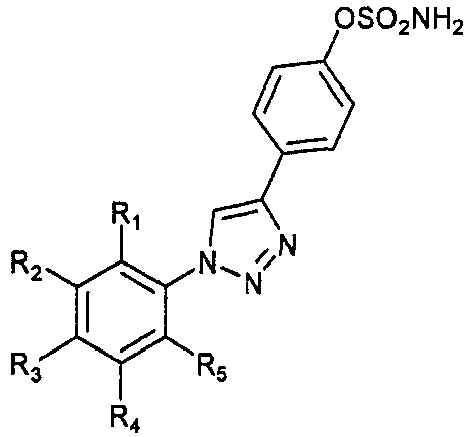
- the subject of the invention is in particular new chemical compounds defined by the general formula 1: wherein R 1 denotes H or F or CF 3 or OCF 3 ; R 2 denotes H or F or CF 3 or Cl or Br or J or CH 3 or OCH 3 or Et or iPr or NO 2 ; R 3 denotes H or F or CF 3 or OCF 3 ; R 4 denotes H or F or CF 3 or Cl or Br or J or CH 3 or OCH 3 ; R 5 denotes H or F or CF 3 .
- the compounds have a structure that mimics the steroid system and contain a sulfamate moiety.
- the consequence of this is the much higher selectivity of the compounds of the general formula 1 compared to the prior art compounds and the lower or no side effects of these inhibitors, as well as additional unique and important both biological and medical properties - its biological use, diagnostic use and medical use.
- Exemplary embodiments of the compounds are shown below in Table 1. These compounds have an active medical and biological effect.
- the compounds therefore are for use as a medicament - in treatment as pharmaceuticals - drugs, and in particular as drugs with a steroid sulfatase inhibitor and / or an estrogen receptor modulator actions, particularly are for use in anti-cancer therapy, especially for therapy of hormone-dependent cancers of animals and especially mammals, including humans.
- the compounds of the invention have biological and diagnostic applications, including e.g. for use as steroid sulfatase inhibitors and / or estrogen receptor modulators in diagnostics and in vitro tests, and the biological use of the compounds as steroid sulfatase inhibitors and / or estrogen receptor modulators is disclosed.
- R 1 denotes H or F or CF 3 or OCF 3
- R 2 denotes H or F or CF 3 or Cl or Br or J or CH 3 or OCH 3 or Et or iPr or NO 2
- R 3 denotes H or F or CF 3 or OCF 3
- R 4 denotes H or F or CF 3 or Cl or Br or J or CH 3 or OCH 3
- R 5 denotes H or F or CF 3 .
- the intermediates defined by the general formula 2 and the final products defined by the general formula 1 contain the same important chemical moiety - the scaffold imitating the steroid system while the final product is obtained directly from the intermediate product.
- the compounds of the general formula 2 have active medical, diagnostic and biological properties, and are for use as a medicament - as pharmaceuticals - drugs, in particular, antimicrobial drugs, including antibacterial drugs or drugs with the action of selective estrogen receptor modulators.
- the compounds of the general formula 2 show effective antimicrobial activity, including antibacterial effects, exhibit lower toxicity to the body as well as lower ability to induce drug resistance.
- the compounds of general formula 2 are for use as antimicrobial agent and / or an estrogen receptor modulator properties, especially in diagnostics and in vitro tests and the use of compounds as an antimicrobial compound and / or estrogen receptor modulator is disclosed.
- the compounds of the general formula 2 due to their structure containing scaffold imitating the steroid system and R 1 -R 2 substituents, affecting the properties of the compounds, especially the binding strength of these compounds to the estrogen receptors, show higher affinity and stronger binding to estrogen receptors in comparison with the compounds disclosed in the prior art and find use in particular as selective estrogen receptor modulators - both in medicine and in general biological sciences.
- Exemplary preferred compounds of general formula 2 are shown in Table 2. According to preliminary results, these compounds also show antimicrobial activity, especially antibacterial effect.
- 4-((trimethylsilyl)ethynyl)phenol (3) is obtained from p-iodophenol and trimethylsilylacetylene by the Sonogashira coupling reaction and this step is carried out under reflux.
- derivatives of 4-(1-phenyl-1 H -[1,2,3]triazol-4-yl)-phenol (4) are obtained by the reaction of 1,3-dipolar cycloaddition of corresponding azide derivative with 4-((trimethylsilyl)ethynyl)phenol (3), preferably in the presence of tetrabutylammonium fluoride (TBAF) or with 4-ethynylphenol.
- TBAF tetrabutylammonium fluoride
- the final product is obtained by reaction of sulfamoyl chloride (generated in situ ) with the 4-(1-phenyl-1 H -[1,2,3]triazol-4-yl)-phenol derivative (4) and this step is carried out under anhydrous conditions.
- the first step is carried out over a minimum of 1 hour, preferably over 2 to 24 hours.
- the second step is carried out at room temperature.
- the second step is carried out in situ without isolation or with isolation.
- the second step is carried out over at least 12 hours, preferably over 12 to 48 hours.
- the third step is carried out under anhydrous conditions at a temperature in the range of 15 to 40°C, preferably 30-40°C, preferably at room temperature.
- the third step is carried out over a minimum of 6 hours.
- the first step includes the preparation of 4-((trimethylsilyl)ethynyl)phenol (3) by the Sonogashira coupling reaction of p-iodophenol and trimethylsilylacetylene.
- the second step involves the synthesis of 4-(1-phenyl-1 H -[1,2,3]triazol-4-yl)-phenol derivatives (4) as a result of the 1,3-dipolar cycloaddition reaction of the azide derivative with 4-((trimethylsilyl)ethynyl)phenol (3) in the presence of tetrabutylammonium fluoride (TBAF) / or with 4-ethynyl phenol in situ without isolation / or with isolation of intermediates.
- TBAF tetrabutylammonium fluoride
- the third step involves obtaining the final product as a result of the reaction of sulfamoyl chloride (generated in situ ) with the 4-(1-phenyl-1 H- [1,2,3]triazol-4-yl)-phenol derivative (4).
- the substituents in the substrate are selected for the intermediates and the final product, as is known to a person skilled in the art.
- the corresponding synthesis steps, for variants of the invention, are shown below.
- R 1 H or F or CF 3 or OCF 3
- R 2 H or F or CF 3 or Cl or Br or J or CH 3 or OCH 3 or Et or iPr or NO 2
- R 3 H or F or CF 3 or OCF 3
- R 4 H or F or CF 3 or Cl or Br or J or CH 3 or OCH 3
- R 5 H or F or CF 3 .
- the medical and biological activity of the compounds defined the general formula 1, for use as active compounds - medicament - drugs and / or as STS steroid sulfatase inhibitors, diagnostic agent and biological use were evaluated using the STS steroid sulfatase enzyme isolated from a human placenta according to the following procedure:
- the biological, diagnostics and medical activity of STS inhibitors were evaluated by analyzing the progress of the enzymatic reaction using nitrophenyl sulfate (NPS).
- NPS nitrophenyl sulfate
- 0.5 mL of 1M NaOH was added to the reaction mixture. Released p nitrophenol was determined using a spectrophotometer at 405nm.
- the IC 50 parameter values characterizing the ability of obtained compounds to inhibit steroid sulfatase activity
- the compounds of the general formula 1 have biological, medical and diagnostic activity, and have medical applications for use as a medicament a well as in diagnostics for use as a diagnostic agent. It has been confirmed that the new compounds with general formula 1, as one of the possible mechanisms of medical and biological action, show a strong STS inhibitory activity at low micromolar or nanomolar concentrations, which is sufficient for the compounds to act as drugs classified as steroid sulfatase inhibitors or as compounds for use as steroid sulfatase inhibitors in diagnostic tests, in vitro clinical trials and its use in biological sciences.
- the compounds of the general formula 1 are for use as medicaments - useful as drugs in cancer therapy and in particular in the therapy of hormone-dependent cancers of animals, in particular mammals, including humans.
- the biological, diagnostics and medical effects of the compounds of the general formula 2 have also been investigated, which are for use as a medicament, in particular estrogen receptor modulators or for use as a diagnostic agent in diagnostic tests in particular as estrogen receptor modulators.
- the biological use of the compounds in biological sciences in particular in vitro test was also studied. This study was performed by preliminary analysis of the affinity of compounds for estrogen receptors in known in vitro tests. Biological and medical effects of the compounds shown in Table 2 were confirmed.
- the compounds of the general formula 1 can be hydrolyzed to the compounds of the general formula 2, the biological and medical effects of the compounds with general formula 1 are also useful as estrogen receptor modulators or as compounds useful in biological sciences, including diagnostic tests as estrogen receptor modulators. In studies using a standard in vitro test, a high degree of affinity of the compounds with general formula 1 was observed for estrogen receptors.
Landscapes
- Health & Medical Sciences (AREA)
- Chemical & Material Sciences (AREA)
- Organic Chemistry (AREA)
- Life Sciences & Earth Sciences (AREA)
- General Health & Medical Sciences (AREA)
- Medicinal Chemistry (AREA)
- Immunology (AREA)
- Engineering & Computer Science (AREA)
- Public Health (AREA)
- Chemical Kinetics & Catalysis (AREA)
- Animal Behavior & Ethology (AREA)
- Veterinary Medicine (AREA)
- Pharmacology & Pharmacy (AREA)
- Nuclear Medicine, Radiotherapy & Molecular Imaging (AREA)
- General Chemical & Material Sciences (AREA)
- Hematology (AREA)
- Molecular Biology (AREA)
- Urology & Nephrology (AREA)
- Biomedical Technology (AREA)
- Cell Biology (AREA)
- Pathology (AREA)
- General Physics & Mathematics (AREA)
- Biochemistry (AREA)
- Analytical Chemistry (AREA)
- Physics & Mathematics (AREA)
- Food Science & Technology (AREA)
- Microbiology (AREA)
- Biotechnology (AREA)
- Communicable Diseases (AREA)
- Oncology (AREA)
- Pharmaceuticals Containing Other Organic And Inorganic Compounds (AREA)
- Heterocyclic Carbon Compounds Containing A Hetero Ring Having Nitrogen And Oxygen As The Only Ring Hetero Atoms (AREA)
Description
- The invention relates to 4-(1-phenyl-1H-[1,2,3]triazol-4-yl)-phenyl sulfamate derivatives and derivatives of 4-(1-phenyl-1H-[1,2,3]triazol-4-yl)-phenol as new compounds. The subject of the invention is the first medical use of 4-(1-phenyl-1H-[1,2,3]triazol-4-yl)-phenyl sulfamate derivatives and the first medical use of 4-(1-phenyl-1H-[1,2,3]triazol-4-yl)-phenol analogs. The invention relates to the medical use of 4-(1-phenyl-1H-[1,2,3]triazol-4-yl)-phenyl sulfamate derivatives as pharmaceuticals - for use as medicament - drugs with the action of steroid sulfatase inhibitor and / or with the action of an estrogen receptor modulator as well use of the derivatives as compounds with the properties of a steroid sulfatase inhibitor and / or an estrogen receptor modulator. In addition, the subject of the invention is the medical use of 4-(1-phenyl-1H-[1,2,3]triazol-4-yl)-phenol derivatives as pharmaceuticals - for use as medicament - drugs with the action of an antimicrobial, including antibacterial drugs, and as drugs with the action of an selective estrogen receptor modulator, as well as their use as an antimicrobial and / or an estrogen receptor modulator agents. In particular, the 4-(1-phenyl-1H-[1,2,3]triazol-4-yl)-phenyl sulfamate analogs are for use as medicament in cancer therapy, and in particular in the treatment of hormone-dependent cancers in animals, especially mammals including people. The invention also relates to a process for the preparation of these new compounds, wherein the derivatives of 4-(1-phenyl-1H-[1,2,3]triazol-4-yl)-phenol are the intermediate products to obtaining the sulfamate derivatives.
- From document
EP1608671 , a steroid structure having the general formula
- Among the known STS steroid sulfatase inhibitors containing a sulfamate moiety, in particular from
EP 1193250 , STS inhibitors of the general formula are known: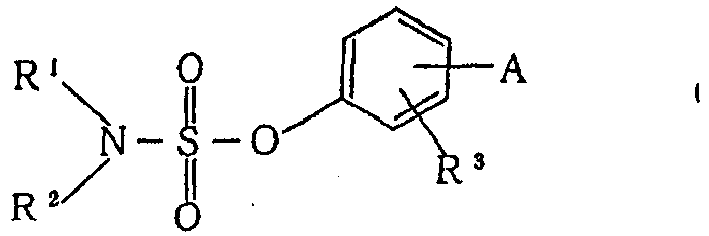
- In the publication 1,4-Diaryl-substituted triazoles as cyclooxygenase-2 inhibitors: Synthesis, biological evaluation and molecular modeling studies, Kaur J. et al., Bioorganic & Medicinal Chemistry (2013), 21 (14), 4288-4295 , chemical compounds containing a sulfonamide group with the formula have been disclosed:


-
- The compounds are useful as 17β-hydroxysteroid dehydrogenase inhibitors. The 17β-hydroxysteroid dehydrogenase enzyme catalyzes the reduction of 17β-steroids including estradiol to estradiol, dehydroepiandrosterone sulfate (DHEAS) to androstendiol sulfate, or dehydroepiandrosterone (DHEA) to androstendiol, and demonstrates the activity in a different pathway of estrogen and androgen biosynthesis in the body compared to the action of steroid sulfatase (STS). Due to the different topology of 17β-hydroxysteroid dehydrogenase and steroid sulfatase active site, inhibition of these enzymes involves compounds that differ structurally and in their mechanism of action.
- In the publication Design, Synthesis, Biological Evaluation and Pharmacokinetics of Bis (hydroxyphenyl) substituted Azoles, Thiophenes, Benzenes, and Aza-Benzenes as Potent and Selective Nonsteroidal Inhibitors of 17β-Hydroxysteroid Dehydrogenase Type 1 (17β-HSD1), Bey. E. et al., J. Med. Chem., 2008, 51 (21), pp. 6725-6739 , the compounds of the general formula are shown:

- The compounds described have also been used as inhibitors of 17β-hydroxysteroid dehydrogenase. Due to the different topology of 17β-hydroxysteroid dehydrogenase and steroid sulfatase active site, inhibition of these enzymes involves compounds that differ structurally and in their mechanism of action.
- The subject of the invention is in particular new chemical compounds defined by the general formula 1:

- Also described (but not part of the invention) are chemical compounds which are intermediates in the pathway for the preparation of compounds of the general formula 1. These compounds are derivatives of 4-(1-phenyl-1H-[1,2,3]triazol-4-yl)-phenol defined by the general formula 2:

Table 1 Embodiments of 4-(1-phenyl-1H-[1,2,3]triazol-4-yl)-phenyl sulfamate derivatives: 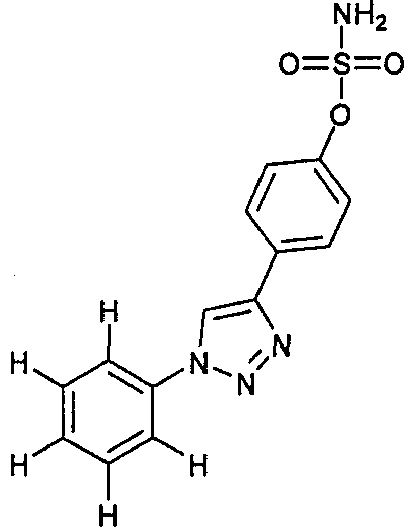

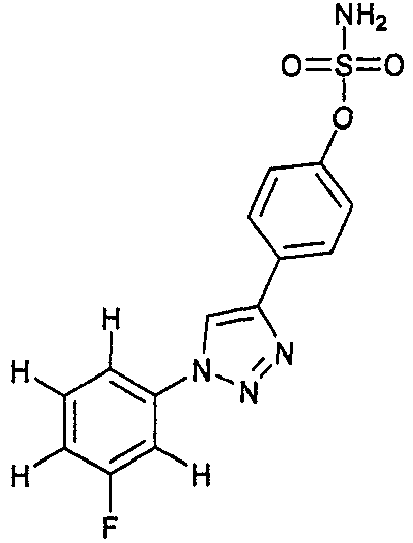
4-(1-phenyl-1H-[1,2,3]triazol-4-yl)-phenyl sulfamate 4-[1-(4-fluoro-phenyl)-1H-[1,2,3]triazol-4-yl]-phenyl sulfamate 4-[1-(3-fluoro-phenyl)-1H-[1,2,3]triazol-4-yl]-phenyl sulfamate 


4-[1-(3,4-difluoro-phenyl)-1H-[1,2,3]triazol-4-yl]-phenyl sulfamate 4-[1-(3,5-difluoro-phenyl)-1H-[1,2,3]triazol-4-yl]-phenyl sulfamate 4-[1-(2,3,4-trifluorophenyl)-1H-[1,2,3]triazol-4-yl]-phenyl sulfamate 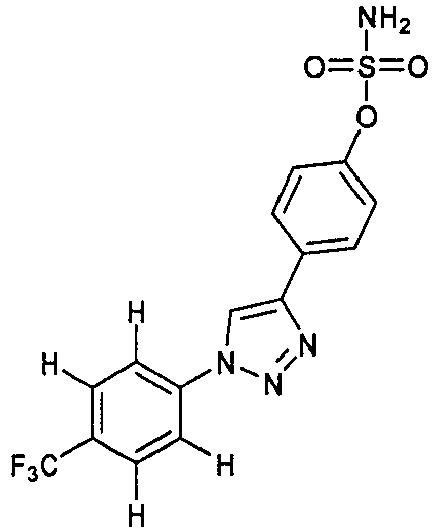


4-[1 -(4-trifluoromethylphenyl)-1H-[1,2,3]triazol-4-yl]-phenyl sulfamate 4-[1-(3-trifluoromethylphenyl)-1H-[1,2,3]triazol-4-yl]-phenyl sulfamate 4-[1-(2-trifluoromethylphenyl)-1H-[1,2,3]triazol-4-yl]-phenyl sulfamate 


4-[1-(3,5-bis-trifluoromethyl-phenyl)-1H-[1,2,3]triazol-4-yl]-phenyl sulfamate 4-[1-(2-fluoro-4-trifluoromethyl-phenyl)-1H-[1,2,3]triazol-4-yl]-phenyl sulfamate 4-[1-(4-fluoro-2-trifluoromethyl- phenyl)-1H-[1,2,3]triazol-4-yl]-phenyl sulfamate 


4-[1-(4-trifluoromethoxy-phenyl)-1H-[1,2,3]triazol-4-yl]-phenyl sulfamate 4-[1-(2-trifluoromethoxyphenyl)-1H-[1,2,3]triazol-4-yl]-phenyl sulfamate 4-[1-(3-chloro-phenyl)-1H-[1,2,3]triazol-4-yl]-phenyl sulfamate 


4-[1-(3,5-dichlorophenyl)-1H-[1,2,3]triazol-4-yl]-phenyl sulfamate 4-[1-(3-bromo-phenyl)-1H-[1,2,3]triazol-4-yl]-phenyl sulfamate 4-[1-(3,5-dibromophenyl)-1H-[1,2,3]triazol-4-yl]-phenyl sulfmate 


4-[1-(3-iodo-phenyl)-1H-[1,2,3]triazol-4-yl]-phenyl sulfmate 4-[1-(3,5-diiodo-phenyl)-1H-[1,2,3]triazol-4-yl]-phenyl sulfamate 4-(1-m-tolyl-1H-[1,2,3]triazol-4-yl)-phenyl sulfamate 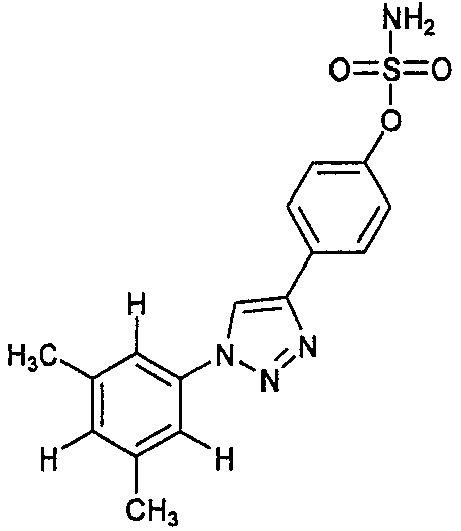


4-[1-(3,5-dimethylphenyl)-1H-[1,2,3]triazol-4-yl]-phenyl sulfamate 4-[1-(3-methoxy-phenyl)-1H-[1,2,3]triazol-4-yl]-phenyl sulfamate 4-[1-(3,5-dimethoxyphenyl)-1H-[1,2,3]triazol-4-yl]-phenyl sulfamate 


4-[1-(3-ethyl-phenyl)-1H-[1,2,3]triazol-4-yl]-phenyl sulfamate 4-[1-(3-isopropylphenyl)-1H-[1,2,3]triazol-4-yl]-phenyl sulfamate 4-[1-(3-nitro-phenyl)-1H-[1,2,3]triazol-4-yl]-phenyl sulfamate Table 2 Derivatives of 4-(1-phenyl-1H-[1,2,3]triazol-4-yl)-phenol (not claimed): 


4-(1-phenyl-1H-[1,2,3]triazol-4-yl)-phenol 4-[1-(4-fluoro-phenyl)-1H-[1,2,3]triazol-4-yl]-phenol 4-[1-(3-fluoro-phenyl)-1H-[1,2,3]triazol-4-yl]-phenol 


4-[1-(3,4-difluoro-phenyl)-1H [1,2,3]triazol-4-yl]-phenol 4-[1-(3,5-difluoro-phenyl)-1H-[1,2,3]triazol-4-yl]-phenol 4-[1-(2,3,4-trifluoro-phenyl)-1H-[1,2,3]triazol-4-yl]-phenol 

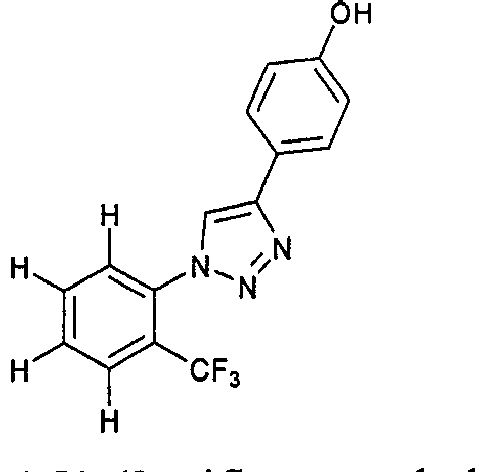
4-[1-(4-trifluoromethylphenyl)-1H-[1,2,3]triazol-4-yl]-phenol 4-[1-(3-trifluoromethylphenyl)-1H [1,2,3]triazol-4-yl]-phenol 4-[1-(2-tritluoromethyl-phenyl)-1H-[1,2,3]triazol-4-yl]-phenol 


4-[1-(3,5-bis-trifluoromethyl-phenyl)-1H-[1,2,3]triazol-4-yl]-phenol 4-[1-(2-fluoro-4-trifluoromethyl-phenyl)-1H-[1,2,3]triazol-4-yl]-phenol 4-[1-(4-fluoro-2-trifluoromethyl-phenyl)-1H-[1,2,3]triazol-4-yl]-phenol 


4-[1-(4-trifluoromethoxyphenyl)-1H-[1,2,3]triazol-4-yl]-phenol 4-[1-(2-trifluoromethoxy-fenylo)-1H-[1,2,3]triazol-4-yl]-phenol 4-[1-(3-chloro-phenyl)-1H-[1,2,3]triazol-4-yl]-phenol 


4-[1-(3,5-dichlorophenyl)-1H-[1,2,3]triazol-4-yl]-phenol 4-[1-(3-bromo-phenyl)-1H-[1,2,3]triazol-4-yl]-phenol 4-[1-(3,5-dibromophenyl)-1H-[1,2,3]triazol-4-yl]-phenol 


4-[1-(3-iodo-phenyl)-1H-[1,2,3]triazol-4-yl]-phenol 4-[1-(3,5-diiodo-phenyl)-1H-[1,2,3]triazol-4-yl]-phenol 4-(1-m-tolyl-1H-[1,2,3]triazol-4-yl)-phenol 


4-[1-(3,5-dimethylphenyl)-1H-[1,2,3]triazol-4-yl]-phenol 4-[1-(3-methoxy-phenyl)-1H-[1,2,3]triazol-4-yl]-phenol 4-[1-(3,5-dimethoxyphenyl)-1H-[1,2,3]triazol-4-yl]-phenol 


4-[1-(3-ethyl-phenyl)-1H-[1,2,3]triazol-4-yl]-phenol 4-[1-(3-isopropylphenyl)-1H [1,2,3]triazol-4-yl]-phenol 4-[1-(3-nitro-phenyl)-1H-[1,2,3]triazol-4-yl]-phenol - The subject of the invention is also a method for the preparation of compound defined by the general formula 1:

wherein the method is carried out in several steps according to scheme 1:
- In the first step, 4-((trimethylsilyl)ethynyl)phenol (3) is obtained from p-iodophenol and trimethylsilylacetylene by the Sonogashira coupling reaction and this step is carried out under reflux. In the second step, derivatives of 4-(1-phenyl-1H-[1,2,3]triazol-4-yl)-phenol (4) are obtained by the reaction of 1,3-dipolar cycloaddition of corresponding azide derivative with 4-((trimethylsilyl)ethynyl)phenol (3), preferably in the presence of tetrabutylammonium fluoride (TBAF) or with 4-ethynylphenol. In the third step, the final product is obtained by reaction of sulfamoyl chloride (generated in situ) with the 4-(1-phenyl-1H-[1,2,3]triazol-4-yl)-phenol derivative (4) and this step is carried out under anhydrous conditions.
- Preferably, the first step is carried out over a minimum of 1 hour, preferably over 2 to 24 hours.
- Preferably, the second step is carried out at room temperature.
- Preferably, the second step is carried out in situ without isolation or with isolation. Preferably, the second step is carried out over at least 12 hours, preferably over 12 to 48 hours.
- Preferably, the third step is carried out under anhydrous conditions at a temperature in the range of 15 to 40°C, preferably 30-40°C, preferably at room temperature.
- Preferably, the third step is carried out over a minimum of 6 hours.
-
- A) Preparation of compounds of general formula 1:
- Scheme 1. Synthesis of new steroid sulfatase (STS) inhibitors based on 4-(1-phenyl-1H-[1,2,3]triazol-4-yl)-phenyl sulfamate derivatives (5); ACN-acetonitrile, TMS- trimethylsilane, tBuONO- tert-butylnitrite, TMSN3-trimethylsilyl azide, TBAF- tetrabutylammonium fluoride, N,N'-DMA - dimethylacetamide, DCM- dichloromethane.
- The first step includes the preparation of 4-((trimethylsilyl)ethynyl)phenol (3) by the Sonogashira coupling reaction of p-iodophenol and trimethylsilylacetylene. The second step involves the synthesis of 4-(1-phenyl-1H-[1,2,3]triazol-4-yl)-phenol derivatives (4) as a result of the 1,3-dipolar cycloaddition reaction of the azide derivative with 4-((trimethylsilyl)ethynyl)phenol (3) in the presence of tetrabutylammonium fluoride (TBAF) / or with 4-ethynyl phenol in situ without isolation / or with isolation of intermediates. In the second step, intermediates of general formula 2 are obtained. The third step involves obtaining the final product as a result of the reaction of sulfamoyl chloride (generated in situ) with the 4-(1-phenyl-1H-[1,2,3]triazol-4-yl)-phenol derivative (4).
- Depending on the final product to be synthesized, a various substrate is used to the reaction, i.e. the aniline derivative of the general formula 3 substituted in the aromatic ring:

- The substituents in the substrate are selected for the intermediates and the final product, as is known to a person skilled in the art. The corresponding synthesis steps, for variants of the invention, are shown below.
- A solution of 4-iodophenol (0.88 g, 4 mmol), trimethylsilylacetylene (0.855 mL, 6 mmol), palladium (II) chloride (35.8 mg, 0.20 mmol), triphenylphosphine (0.106 g, 0.40 mmol), copper (I) iodide (19 mg, 0.10 mmol) and triethylamine (3.94 mL, 28.2 mmol) in acetonitrile (20 mL) was prepared in a round bottom flask. The reaction mixture was heated under reflux for 3 hours in an inert gas atmosphere. After this time, the reaction mixture was filtered and the solvent was evaporated. The product of 4-((trimethylsilyl)ethynyl)phenol (3) was isolated using preparative column chromatography (in the normal phase) using a mixture of ethyl acetate and hexane in a 1: 4 volume ratio as an eluent.
- Yield 70%; melting point 63-66 °C; v max (KBr)/cm-1 3308, 2956, 2160, 1606, 1508, 1434, 1356, 1206, 826; 1H NMR δH (400 MHz, CDCl3) 7.38 (2H, d, J 8.8 Hz, Ar-H), 6.77 (2H, d, J 8.8, Ar-H), 6.00-3.40 (1H, brs, OH), 0.26 (9H, s, CH3); 13C NMR δC (101 MHz, CDCl3) 155.8, 133.7, 115.5, 115.4, 105.1, 92.6, 0.1. HRMS (m/z) [M-H]- calculated 189.0741, observed 189.0951.
- To a cooled solution of the appropriate amine (2.63 mmol) in acetonitrile (6.1 mL), tert-butyl nitrite (0.325 g, 3.16 mmol) and azidotrimethylsilane (0.333 g, 2.89 mmol) were added dropwise. After stirring at room temperature for 4 hours, 4-((trimethylsilyl)ethynyl)phenol (3) (0.5 g, 2.63 mmol) and a 1 M solution of tetrabutylammonium fluoride in THF (2.89 mL) were added. The mixture was stirred at 0 °C for 30 min. Then a freshly prepared solution of sodium ascorbate (0.104 g, 0.526 mmol) in 0.525 mL of water and copper (II) sulfate pentahydrate (65.7 mg, 0.263 mmol) were added to the reaction mixture. The mixture was stirred for 24 hours under an inert gas atmosphere. The reaction mixture was then evaporated under reduced pressure and the residue was dissolved in ethyl acetate (30 mL). The solution was washed with 0.1 M HCl. The separated organic layer was dried over anhydrous magnesium sulfate, filtered and the solvent was evaporated under reduced pressure. The obtained crude product was crystallized from acetonitrile.
-

- To an ice-cooled solution of 3,5-bis-(trifluoromethyl)aniline (0.603 g, 2.63 mmol) in acetonitrile (6.1 mL), tert-butyl nitrite (0.325 g, 3.16 mmol) and azidotrimethylsilane (0.333 g, 2.89 mmol) were added dropwise. After stirring at room temperature for 4 hours, 4-((trimethylsilyl)ethynyl)phenol (3) (0.5 g, 2.63 mmol) and a 1 M solution of tetrabutylammonium fluoride in THF (2.89 mL) were added. The mixture was stirred at 0 °C for 30 min. Then a freshly prepared solution of sodium ascorbate (0.104 g, 0.526 mmol) in 0.525 mL of water and copper (II) sulfate pentahydrate (65.7 mg, 0.263 mmol) were added to the reaction mixture. The mixture was stirred for 24 hours under an inert gas atmosphere. The reaction mixture was then evaporated under reduced pressure and the residue was dissolved in ethyl acetate (30 mL). The solution was washed with 0.1 M HCl. The separated organic layer was dried over anhydrous magnesium sulfate, filtered and the solvent was evaporated under reduced pressure. The obtained crude product was crystallized from acetonitrile.
- Yield 66%; melting point 270-272 °C; v max (KBr)/cm-1 3172, 1615, 1492, 1426, 1361, 1223, 1054, 846; 1H NMR δH (400 MHz, DMSO) 9.72 (1H, s, OH), 9.43 (1H, s, CH), 8.65 (2H, s, Ar-H), 8.26 (1H, s, Ar-H), 7.75 (2H, d, J 8.6 Hz, Ar-H), 6.90 (2H, d, J 8.7 Hz, Ar-H); 13C NMR δC (101 MHz, DMSO) 158.3, 148.6, 138.4, 132.3 (m), 127.3, 123.3 (q, 1 J C-F 273 Hz), 122.2 (m), 121.1, 120.8 (m), 119.1, 116.3. HRMS (m/z) [M+H]+ calculated 374.0728, observed 374.0757.
-

- To an ice-cooled solution of 3,5-difluoroaniline (0.340 g, 2.63 mmol) in acetonitrile (6.1 mL), tert-butyl nitrite (0.325 g, 3.16 mmol) and azidotrimethylsilane (0.333 g, 2.89 mmol) were added dropwise. After stirring at room temperature for 4 hours, 4-((trimethylsilyl)ethynyl)phenol (3) (0.5 g, 2.63 mmol) and a 1 M solution of tetrabutylammonium fluoride in THF (2.89 mL) were added. The mixture was stirred at 0 °C for 30 min. Then a freshly prepared solution of sodium ascorbate (0.104 g, 0.526 mmol) in 0.525 mL of water and copper (II) sulfate pentahydrate (65.7 mg, 0.263 mmol) were added to the reaction mixture. The mixture was stirred for 24 hours under an inert gas atmosphere. The reaction mixture was then evaporated under reduced pressure and the residue was dissolved in ethyl acetate (30 mL). The solution was washed with 0.1 M HCl. The separated organic layer was dried over anhydrous magnesium sulfate, filtered and the solvent was evaporated under reduced pressure. The obtained crude product was crystallized from acetonitrile.
- Yield 63%; melting point 214-216 °C; v max (KBr)/cm-1 3333, 1627, 1493, 1408, 1331, 1216, 1029, 823; 1H NMR δH (400 MHz, DMSO) 9.71 (1H, s, OH), 9.19 (1H, s, CH), 7.85-7.67 (4H, m, Ar-H), 7.47-7.35 (1H, m, Ar-H), 6.90 (2H, d, J8.7 Hz, Ar-H); 13C NMR δC (101 MHz, DMSO) 163.4 (d, 1 J C-F 247 Hz),158.3, 148.4, 138.9 (m), 127.3, 121.2, 118.8, 116.3, 104.3 (m), 104.1 (m). HRMS (m/z) [M+H]+ calculated 274.0792, observed 274.0812.
- To a solution of chlorosulfonyl isocyanate (212.3 mg, 1.50 mmol) in anhydrous dichloromethane (0.5 mL) was added a mixture of formic acid (70.9 mg, 1.54 mmol) and N,N-dimethylacetamide (1.4 mg, 0.016 mmol). The mixture was stirred at 40 °C for 3.5 hours. A solution of 4-(1-phenyl-1H-[1,2,3]triazol-4-yl)-phenol (4) (1.00 mmol) in N,N-dimethylacetamide (3.4 mL) was then added to the reaction mixture. The mixture was stirred for 24 hours at room temperature. After this time, the reaction mixture was poured into water (50 mL). The resulting suspension was stirred for 2 hours. The precipitated crude product was filtered, washed with water and crystallized from acetonitrile.
-

- To a solution of chlorosulfonyl isocyanate (212.3 mg, 1.50 mmol) in anhydrous dichloromethane (0.5 mL) was added a mixture of formic acid (70.9 mg, 1.54 mmol) and N,N-dimethylacetamide (1.4 mg, 0.016 mmol). The mixture was stirred at 40 °C for 3.5 hours. Then a solution of 4-[1-(3,5-Bis-trifluoromethylphenyl)-1H-[1,2,3]triazol-4-yl]-phenol (0.373 g, 1.00 mmol) (obtained according to the procedure shown in example 1, step 2) in N,N-dimethylacetamide (3.4 mL) was added to the reaction mixture. The mixture was stirred for 24 hours at room temperature. After this time, the reaction mixture was poured into water (50 mL). The resulting suspension was stirred for 2 hours. The precipitated crude product was filtered, washed with water and crystallized from acetonitrile.
- Yield 79%; melting point 231-232 °C; v max (KBr)/cm-1 3358, 3145, 1493, 1373, 1277, 1153, 1052, 808, 755; 1H NMR δH (400 MHz, DMSO) 9.65 (1H, s, CH), 8.68 (2H, s, Ar-H), 8.30 (1H, s, Ar-H), 8.10 (2H, s, NH2), 8.02 (2H, d, J 8.7 Hz, Ar-H), 7.45 (2H, d, J 7.45 Hz, Ar-H); 13C NMR δC (101 MHz, DMSO) 150.6, 147.6, 138.3, 132.4 (m), 128.6, 127.2, 123.4, 123.3 (q, 1 J C-F 273 Hz), 122.6 (m), 121.1 (m), 121.0. HRMS (m/z) [M+H]+ calculated 453.0456, observed 453.0511.
-

- To a solution of chlorosulfonyl isocyanate (212.3 mg, 1.50 mmol) in anhydrous dichloromethane (0.5 mL) was added a mixture of formic acid (70.9 mg, 1.54 mmol) and N,N-dimethylacetamide (1.4 mg, 0.016 mmol). The mixture was stirred at 40 °C for 3.5 hours. Then a solution of 4-[1-(3,5-difluoro-phenyl)-1H-[1,2,3]-triazol-4-yl]-phenol (0.273 g, 1.00 mmol) (obtained according to the procedure shown in example 2, step 2) in N,N-dimethylacetamide (3.4 mL) was added to the reaction mixture. The mixture was stirred for 24 hours at room temperature. After this time, the reaction mixture was poured into water (50 mL). The resulting suspension was stirred for 2 hours. The precipitated crude product was filtered, washed with water and crystallized from acetonitrile.
- Yield 80%; melting point 227-228 °C; v max (KBr)/cm-1 3343, 3155, 1493, 1376, 1227, 1157, 1056, 844, 756; 1H NMR δH (400 MHz, DMSO) 9.42 (1H, s, CH), 8.09 (1H, s, NH2), 7.99 (2H, d, J 8.7 Hz, Ar-H), 7.86-7.76 (2H, m, Ar-H), 7.51-7.40 (3H, m, Ar-H); 13C NMR δC (101 MHz, DMSO) 163.4 (d, 1 J C-F 247 Hz), 150.6, 147.2, 138.8 (m), 128.7, 127.2, 123.4, 120.6, 104.5 (m), 104.3 (m). HRMS (m/z) [M+H]+ calculated 353.0520, observed 353.0548.
- In a similar manner, the other compounds of general formula 1 and 2 are obtained.
- B) Biological and medical evaluation of the obtained derivatives in the enzymatic assay - study of the properties of the compounds for use as a medicament and for use as a diagnostic agents as well as its biological use.
- Studies on in vitro activity of the new compounds presented by the general formula 1:

- The medical and biological activity of the compounds defined the general formula 1, for use as active compounds - medicament - drugs and / or as STS steroid sulfatase inhibitors, diagnostic agent and biological use were evaluated using the STS steroid sulfatase enzyme isolated from a human placenta according to the following procedure:
- human placenta was stripped from membranes and homogenized in ice-cold Tris-HCl buffer pH 7,4 containing 0,1% Triton X-100 and 0,02% NaN3.
- the homogenate was alternately frozen and thawed a few times and then centrifuged at 100000g for 60 min,
- the supernatant was removed and the same procedure from homogenization to centrifugation was carried out 5 times,
- finally, the enzyme was purified by three-step chromatography using columns: DEAE-cellulose, Con A-Sepharose and Bio-Gel A-1.5 and appropriate buffers. All steps were carried out at 4°C.
- The biological, diagnostics and medical activity of STS inhibitors, for the compounds defined by the general formula 1, were evaluated by analyzing the progress of the enzymatic reaction using nitrophenyl sulfate (NPS). The final volume of the reaction mixture was 120 µL (pH = 7.25) and contained 0.8 µmol NPS, 40 µmol Tris HCl and the appropriate amount of enzyme. After 60 minutes of reaction time, 0.5 mL of 1M NaOH was added to the reaction mixture. Released p nitrophenol was determined using a spectrophotometer at 405nm. In the final step, the IC50 parameter values (characterizing the ability of obtained compounds to inhibit steroid sulfatase activity) were determined. For all possible compounds with general formula 1, which are shown in detail in Table 1 as preferred 4-(1-phenyl-1H-[1,2,3] triazol-4-yl)-phenyl sulfamate derivatives, the STS inhibitory activity was observed with IC50 values in the range from 0.036 to 0.821 µM. For example, it has been shown that for 4- [1- (3,5-difluoro-phenyl) 1H-[1,2,3]-triazol-4-yl]-phenyl sulfamate IC50= 0.036 µM, 4-[1-(3-trifluoromethyl-phenyl)-1H-[1,2,3]-triazol-4-yl]-phenyl sulfamate IC50= 0.180 µM, 4-[1-(4-trifluoromethoxy-phenyl)-1H-[1,2,3]-triazol-4-yl]-phenyl sulfamate IC50= 0.240 µM, 4-[1-(3,5-Bis-trifluoromethyl-phenyl)-1H-[1,2,3]triazol-4-yl]-phenyl sulfamate IC50= 0.821 µM. Therefore, the compounds of the general formula 1 have biological, medical and diagnostic activity, and have medical applications for use as a medicament a well as in diagnostics for use as a diagnostic agent. It has been confirmed that the new compounds with general formula 1, as one of the possible mechanisms of medical and biological action, show a strong STS inhibitory activity at low micromolar or nanomolar concentrations, which is sufficient for the compounds to act as drugs classified as steroid sulfatase inhibitors or as compounds for use as steroid sulfatase inhibitors in diagnostic tests, in vitro clinical trials and its use in biological sciences. In particular, the compounds of the general formula 1 are for use as medicaments - useful as drugs in cancer therapy and in particular in the therapy of hormone-dependent cancers of animals, in particular mammals, including humans.
- The biological, diagnostics and medical effects of the compounds of the general formula 2 have also been investigated, which are for use as a medicament, in particular estrogen receptor modulators or for use as a diagnostic agent in diagnostic tests in particular as estrogen receptor modulators. The biological use of the compounds in biological sciences in particular in vitro test was also studied. This study was performed by preliminary analysis of the affinity of compounds for estrogen receptors in known in vitro tests. Biological and medical effects of the compounds shown in Table 2 were confirmed.
- Due to the fact that the compounds of the general formula 1 can be hydrolyzed to the compounds of the general formula 2, the biological and medical effects of the compounds with general formula 1 are also useful as estrogen receptor modulators or as compounds useful in biological sciences, including diagnostic tests as estrogen receptor modulators. In studies using a standard in vitro test, a high degree of affinity of the compounds with general formula 1 was observed for estrogen receptors.
- In the preliminary microbiological tests based on antibiograms, the biological and medical effects of the compounds with general formula 2 were also confirmed. The compounds shown in Table 2 showed inhibition of microbial growth in in vitro tests.


Claims (12)
- Chemical compound that imitate the steroid system and contain a sulfamate moiety, the compound defined by the general formula 1:

- Chemical compound defined by the general formula 1:

- The chemical compound for use according to claim 2, wherein medicament is use as a steroid sulfatase inhibitor and / or as medicament with the action of estrogen receptor modulators in cancer therapy.
- The chemical compound for use according to claim 2, wherein cancer is hormone-dependent.
- Chemical compound defined by the general formula 1:

- Method for the preparation of compound presented by the general formula 1:


- The method according to the claim 6, wherein the first step is carried out for a minimum of 1 hour, preferably for 2 to 24 hours.
- The method according to the claim 6 or 7, wherein the second step is carried out at room temperature.
- The method according to the claim 6 or 7 or 8, wherein the second step is carried out in situ without isolation or with the isolation of intermediates.
- The method according to any one of the claims 6-9, wherein the second step is carried out for at least 12 hours, preferably for 12 to 48 hours.
- The method according to any one of the claims 6-10, wherein the third step is carried out under anhydrous conditions at a temperature in the range of 15 to 40°C, preferably 30-40°C, preferably at room temperature.
- The method according to any one of the claims 6-11, wherein the third step is carried out for a minimum of 6 hours.
Applications Claiming Priority (2)
| Application Number | Priority Date | Filing Date | Title |
|---|---|---|---|
| PL425970A PL239999B1 (en) | 2018-06-18 | 2018-06-18 | Amidosulfate derivatives of 4-(1-phenyl-1H-[1,2,3]triazol-4-yl)-phenol, 4-(1-phenyl-1H-1,2,3]triazol-4-yl)-phenol derivatives, their medical use and the preparation method of 4-(1-phenyl-1H-[1,2,3]triazol-4-yl)-phenol sulfate derivatives |
| PCT/PL2018/000080 WO2019245393A1 (en) | 2018-06-18 | 2018-08-20 | Sulfamate derivatives of 4-(1-phenyl-1h-[1,2,3]triazol-4-yl)-phenol, derivatives of 4-(1-phenyl-1h-[1,2,3]triazol-4-yl)-phenol, their medical use and the method of obtaining 4-(1-phenyl-1h-[1,2,3]triazol-4-yl)-phenyl sulfamate derivatives |
Publications (2)
| Publication Number | Publication Date |
|---|---|
| EP3790868A1 EP3790868A1 (en) | 2021-03-17 |
| EP3790868B1 true EP3790868B1 (en) | 2023-01-11 |
Family
ID=63858012
Family Applications (1)
| Application Number | Title | Priority Date | Filing Date |
|---|---|---|---|
| EP18786433.5A Active EP3790868B1 (en) | 2018-06-18 | 2018-08-20 | Sulfamate derivatives of 4-(1-phenyl-1h-[1,2,3]triazol-4-yl)-phenol, derivatives of 4-(1-phenyl-1h-[1,2,3]triazol-4-yl)-phenol, their medical use and the method of obtaining 4-(1-phenyl-1h-[1,2,3]triazol-4-yl)-phenyl sulfamate derivatives |
Country Status (6)
| Country | Link |
|---|---|
| US (1) | US11939303B2 (en) |
| EP (1) | EP3790868B1 (en) |
| JP (1) | JP7160387B2 (en) |
| CA (1) | CA3101768C (en) |
| PL (1) | PL239999B1 (en) |
| WO (1) | WO2019245393A1 (en) |
Families Citing this family (2)
| Publication number | Priority date | Publication date | Assignee | Title |
|---|---|---|---|---|
| PL239999B1 (en) | 2018-06-18 | 2022-02-07 | Politechnika Gdanska | Amidosulfate derivatives of 4-(1-phenyl-1H-[1,2,3]triazol-4-yl)-phenol, 4-(1-phenyl-1H-1,2,3]triazol-4-yl)-phenol derivatives, their medical use and the preparation method of 4-(1-phenyl-1H-[1,2,3]triazol-4-yl)-phenol sulfate derivatives |
| CN116589418B (en) * | 2023-04-22 | 2026-01-23 | 大连理工大学 | 2-Triazoloethane-1-one/alcohol HSP90/HIF-1 inhibitor and application thereof |
Family Cites Families (7)
| Publication number | Priority date | Publication date | Assignee | Title |
|---|---|---|---|---|
| JP4320089B2 (en) | 1999-07-06 | 2009-08-26 | あすか製薬株式会社 | Phenylsulfamate derivatives |
| GB0525323D0 (en) * | 2005-12-13 | 2006-01-18 | Sterix Ltd | Compound |
| WO2009082398A1 (en) * | 2007-12-21 | 2009-07-02 | University Of Notre Dame Du Lac | Antibacterial compounds and methods of using same |
| US20110201656A1 (en) * | 2008-08-08 | 2011-08-18 | Neurosearch A/S | Novel diphenyl 1,2,3-triazole derivatives useful as modulators of nicotinic acetylcholine receptors |
| GB0914767D0 (en) * | 2009-08-24 | 2009-09-30 | Sterix Ltd | Compound |
| EP3089969A2 (en) | 2014-01-03 | 2016-11-09 | Elexopharm GmbH | Inhibitors of 17beta-hydroxysteroid dehydrogenases type 1 and type 2 |
| PL239999B1 (en) | 2018-06-18 | 2022-02-07 | Politechnika Gdanska | Amidosulfate derivatives of 4-(1-phenyl-1H-[1,2,3]triazol-4-yl)-phenol, 4-(1-phenyl-1H-1,2,3]triazol-4-yl)-phenol derivatives, their medical use and the preparation method of 4-(1-phenyl-1H-[1,2,3]triazol-4-yl)-phenol sulfate derivatives |
-
2018
- 2018-06-18 PL PL425970A patent/PL239999B1/en unknown
- 2018-08-20 JP JP2020570953A patent/JP7160387B2/en active Active
- 2018-08-20 WO PCT/PL2018/000080 patent/WO2019245393A1/en not_active Ceased
- 2018-08-20 US US17/252,703 patent/US11939303B2/en active Active
- 2018-08-20 CA CA3101768A patent/CA3101768C/en active Active
- 2018-08-20 EP EP18786433.5A patent/EP3790868B1/en active Active
Also Published As
| Publication number | Publication date |
|---|---|
| PL239999B1 (en) | 2022-02-07 |
| JP2022501310A (en) | 2022-01-06 |
| JP7160387B2 (en) | 2022-10-25 |
| WO2019245393A1 (en) | 2019-12-26 |
| CA3101768A1 (en) | 2019-12-26 |
| PL425970A1 (en) | 2020-01-02 |
| US20210188785A1 (en) | 2021-06-24 |
| US11939303B2 (en) | 2024-03-26 |
| EP3790868A1 (en) | 2021-03-17 |
| CA3101768C (en) | 2023-12-05 |
Similar Documents
| Publication | Publication Date | Title |
|---|---|---|
| EP1150961B1 (en) | Pyrazolecarboxylic acid derivatives, their preparation, pharmaceutical compositions containing them | |
| EP1658269B1 (en) | Fused compounds that inhibit vanilloid receptor subtype 1 (vr1) receptor | |
| JP2001516361A (en) | New cannabinoid receptor agonist | |
| FR2732017A1 (en) | NEW DERIVATIVES OF IMIDAZOLE HISTAMINE H3 RECEPTOR ANTAGONISTS AND / OR AGONISTS, THEIR PREPARATION AND THEIR THERAPEUTIC APPLICATIONS | |
| CA2683929A1 (en) | Triazolopyridine carboxamide derivatives and triazolopyrimidine carboxamide derivatives, preparation thereof and therapeutic use thereof | |
| Punia et al. | Facile synthesis, antimicrobial evaluation and molecular docking studies of pyrazole-imidazole-triazole hybrids | |
| KR20150127720A (en) | Androgen Receptor Down-Regulating Agents and Uses Thereof | |
| KR20220163435A (en) | Pyrazolylpropanamide compounds and their use in the treatment of prostate cancer | |
| CA3046212A1 (en) | Heterocyclic inhibitors of mct4 | |
| TR201807104T4 (en) | Cycloalkyl acid derivative, method of preparation and pharmaceutical application thereof. | |
| WO1992012144A1 (en) | Condensed benzoxa ring compound, production thereof, and pharmaceutical composition containing the same | |
| AU2005221131A1 (en) | Ion channel modulators | |
| Zhang et al. | Recent research advances in ATX inhibitors: An overview of primary literature | |
| HUT60730A (en) | Process for producing n-imidazolyl derivatives of substituted indoles and pharmaceutical compositions comprising same | |
| EP2623503B1 (en) | Chromene derivatives useful in the treatment of a disease mediated by the tcr-nck interaction | |
| US11939303B2 (en) | Sulfamate derivatives of 4-(1-phenyl-1H-[1,2,3]triazol-4-yl)-phenol, derivatives of 4-(1-phenyl-1H-[1,2,3]triazol-4-yl)-phenol, their medical use and the method of obtaining 4-(1-phenyl-1H-[1,2,3]triazol-4-yl)-phenyl sulfamate derivatives | |
| JP2005528384A (en) | Compounds and methods for inducing apoptosis in proliferating cells | |
| EP1242389B1 (en) | Novel branched substituted amino derivatives of 3-amino-1-phenyl-1h[1,2,4]triazol, methods for producing them and pharmaceutical compositions containing them | |
| EP1756078A1 (en) | Phenylsulfonamide derivatives for use as 11-beta-hydroxysteroid dehydrogenase inhibitors | |
| JP2008542359A (en) | Benzofuran derivatives with therapeutic activity | |
| MX2011001070A (en) | Novel diphenyl 1,2,3-triazole derivatives useful as modulators of nicotinic acetylcholine receptors. | |
| JP2007538102A (en) | 5-anilino-4-heteroarylpyrazole derivatives useful for the treatment of diabetes | |
| JP2025523127A (en) | 1,3,4-OXADIAZOLETRIAZOLE COMPOUND AS HISTONE DEACETYLASE 6 INHIBITOR AND PHARMACEUTICAL COMPOSITION CONTAINING THE SAME | |
| EP3749306B1 (en) | Nicotinamide phosphoribosyltransferase inhibitors and methods for use of the same | |
| PT97392A (en) | PROCESS FOR THE PREPARATION OF NAFETHALINE DERIVATIVES |
Legal Events
| Date | Code | Title | Description |
|---|---|---|---|
| STAA | Information on the status of an ep patent application or granted ep patent |
Free format text: STATUS: UNKNOWN |
|
| STAA | Information on the status of an ep patent application or granted ep patent |
Free format text: STATUS: THE INTERNATIONAL PUBLICATION HAS BEEN MADE |
|
| PUAI | Public reference made under article 153(3) epc to a published international application that has entered the european phase |
Free format text: ORIGINAL CODE: 0009012 |
|
| STAA | Information on the status of an ep patent application or granted ep patent |
Free format text: STATUS: REQUEST FOR EXAMINATION WAS MADE |
|
| 17P | Request for examination filed |
Effective date: 20201110 |
|
| AK | Designated contracting states |
Kind code of ref document: A1 Designated state(s): AL AT BE BG CH CY CZ DE DK EE ES FI FR GB GR HR HU IE IS IT LI LT LU LV MC MK MT NL NO PL PT RO RS SE SI SK SM TR |
|
| AX | Request for extension of the european patent |
Extension state: BA ME |
|
| DAV | Request for validation of the european patent (deleted) | ||
| DAX | Request for extension of the european patent (deleted) | ||
| GRAP | Despatch of communication of intention to grant a patent |
Free format text: ORIGINAL CODE: EPIDOSNIGR1 |
|
| STAA | Information on the status of an ep patent application or granted ep patent |
Free format text: STATUS: GRANT OF PATENT IS INTENDED |
|
| INTG | Intention to grant announced |
Effective date: 20221025 |
|
| GRAS | Grant fee paid |
Free format text: ORIGINAL CODE: EPIDOSNIGR3 |
|
| GRAA | (expected) grant |
Free format text: ORIGINAL CODE: 0009210 |
|
| STAA | Information on the status of an ep patent application or granted ep patent |
Free format text: STATUS: THE PATENT HAS BEEN GRANTED |
|
| AK | Designated contracting states |
Kind code of ref document: B1 Designated state(s): AL AT BE BG CH CY CZ DE DK EE ES FI FR GB GR HR HU IE IS IT LI LT LU LV MC MK MT NL NO PL PT RO RS SE SI SK SM TR |
|
| REG | Reference to a national code |
Ref country code: GB Ref legal event code: FG4D |
|
| REG | Reference to a national code |
Ref country code: CH Ref legal event code: EP |
|
| REG | Reference to a national code |
Ref country code: DE Ref legal event code: R096 Ref document number: 602018045334 Country of ref document: DE |
|
| REG | Reference to a national code |
Ref country code: IE Ref legal event code: FG4D |
|
| REG | Reference to a national code |
Ref country code: AT Ref legal event code: REF Ref document number: 1543365 Country of ref document: AT Kind code of ref document: T Effective date: 20230215 |
|
| PGFP | Annual fee paid to national office [announced via postgrant information from national office to epo] |
Ref country code: FR Payment date: 20230327 Year of fee payment: 6 |
|
| REG | Reference to a national code |
Ref country code: LT Ref legal event code: MG9D |
|
| REG | Reference to a national code |
Ref country code: NL Ref legal event code: MP Effective date: 20230111 |
|
| REG | Reference to a national code |
Ref country code: AT Ref legal event code: MK05 Ref document number: 1543365 Country of ref document: AT Kind code of ref document: T Effective date: 20230111 |
|
| PG25 | Lapsed in a contracting state [announced via postgrant information from national office to epo] |
Ref country code: NL Free format text: LAPSE BECAUSE OF FAILURE TO SUBMIT A TRANSLATION OF THE DESCRIPTION OR TO PAY THE FEE WITHIN THE PRESCRIBED TIME-LIMIT Effective date: 20230111 |
|
| PG25 | Lapsed in a contracting state [announced via postgrant information from national office to epo] |
Ref country code: RS Free format text: LAPSE BECAUSE OF FAILURE TO SUBMIT A TRANSLATION OF THE DESCRIPTION OR TO PAY THE FEE WITHIN THE PRESCRIBED TIME-LIMIT Effective date: 20230111 Ref country code: PT Free format text: LAPSE BECAUSE OF FAILURE TO SUBMIT A TRANSLATION OF THE DESCRIPTION OR TO PAY THE FEE WITHIN THE PRESCRIBED TIME-LIMIT Effective date: 20230511 Ref country code: NO Free format text: LAPSE BECAUSE OF FAILURE TO SUBMIT A TRANSLATION OF THE DESCRIPTION OR TO PAY THE FEE WITHIN THE PRESCRIBED TIME-LIMIT Effective date: 20230411 Ref country code: LV Free format text: LAPSE BECAUSE OF FAILURE TO SUBMIT A TRANSLATION OF THE DESCRIPTION OR TO PAY THE FEE WITHIN THE PRESCRIBED TIME-LIMIT Effective date: 20230111 Ref country code: LT Free format text: LAPSE BECAUSE OF FAILURE TO SUBMIT A TRANSLATION OF THE DESCRIPTION OR TO PAY THE FEE WITHIN THE PRESCRIBED TIME-LIMIT Effective date: 20230111 Ref country code: HR Free format text: LAPSE BECAUSE OF FAILURE TO SUBMIT A TRANSLATION OF THE DESCRIPTION OR TO PAY THE FEE WITHIN THE PRESCRIBED TIME-LIMIT Effective date: 20230111 Ref country code: ES Free format text: LAPSE BECAUSE OF FAILURE TO SUBMIT A TRANSLATION OF THE DESCRIPTION OR TO PAY THE FEE WITHIN THE PRESCRIBED TIME-LIMIT Effective date: 20230111 Ref country code: AT Free format text: LAPSE BECAUSE OF FAILURE TO SUBMIT A TRANSLATION OF THE DESCRIPTION OR TO PAY THE FEE WITHIN THE PRESCRIBED TIME-LIMIT Effective date: 20230111 |
|
| PG25 | Lapsed in a contracting state [announced via postgrant information from national office to epo] |
Ref country code: SE Free format text: LAPSE BECAUSE OF FAILURE TO SUBMIT A TRANSLATION OF THE DESCRIPTION OR TO PAY THE FEE WITHIN THE PRESCRIBED TIME-LIMIT Effective date: 20230111 Ref country code: PL Free format text: LAPSE BECAUSE OF FAILURE TO SUBMIT A TRANSLATION OF THE DESCRIPTION OR TO PAY THE FEE WITHIN THE PRESCRIBED TIME-LIMIT Effective date: 20230111 Ref country code: IS Free format text: LAPSE BECAUSE OF FAILURE TO SUBMIT A TRANSLATION OF THE DESCRIPTION OR TO PAY THE FEE WITHIN THE PRESCRIBED TIME-LIMIT Effective date: 20230511 Ref country code: GR Free format text: LAPSE BECAUSE OF FAILURE TO SUBMIT A TRANSLATION OF THE DESCRIPTION OR TO PAY THE FEE WITHIN THE PRESCRIBED TIME-LIMIT Effective date: 20230412 Ref country code: FI Free format text: LAPSE BECAUSE OF FAILURE TO SUBMIT A TRANSLATION OF THE DESCRIPTION OR TO PAY THE FEE WITHIN THE PRESCRIBED TIME-LIMIT Effective date: 20230111 |
|
| REG | Reference to a national code |
Ref country code: DE Ref legal event code: R097 Ref document number: 602018045334 Country of ref document: DE |
|
| PG25 | Lapsed in a contracting state [announced via postgrant information from national office to epo] |
Ref country code: SM Free format text: LAPSE BECAUSE OF FAILURE TO SUBMIT A TRANSLATION OF THE DESCRIPTION OR TO PAY THE FEE WITHIN THE PRESCRIBED TIME-LIMIT Effective date: 20230111 Ref country code: RO Free format text: LAPSE BECAUSE OF FAILURE TO SUBMIT A TRANSLATION OF THE DESCRIPTION OR TO PAY THE FEE WITHIN THE PRESCRIBED TIME-LIMIT Effective date: 20230111 Ref country code: EE Free format text: LAPSE BECAUSE OF FAILURE TO SUBMIT A TRANSLATION OF THE DESCRIPTION OR TO PAY THE FEE WITHIN THE PRESCRIBED TIME-LIMIT Effective date: 20230111 Ref country code: DK Free format text: LAPSE BECAUSE OF FAILURE TO SUBMIT A TRANSLATION OF THE DESCRIPTION OR TO PAY THE FEE WITHIN THE PRESCRIBED TIME-LIMIT Effective date: 20230111 Ref country code: CZ Free format text: LAPSE BECAUSE OF FAILURE TO SUBMIT A TRANSLATION OF THE DESCRIPTION OR TO PAY THE FEE WITHIN THE PRESCRIBED TIME-LIMIT Effective date: 20230111 |
|
| PGFP | Annual fee paid to national office [announced via postgrant information from national office to epo] |
Ref country code: GB Payment date: 20230601 Year of fee payment: 6 |
|
| PLBE | No opposition filed within time limit |
Free format text: ORIGINAL CODE: 0009261 |
|
| STAA | Information on the status of an ep patent application or granted ep patent |
Free format text: STATUS: NO OPPOSITION FILED WITHIN TIME LIMIT |
|
| PG25 | Lapsed in a contracting state [announced via postgrant information from national office to epo] |
Ref country code: SK Free format text: LAPSE BECAUSE OF FAILURE TO SUBMIT A TRANSLATION OF THE DESCRIPTION OR TO PAY THE FEE WITHIN THE PRESCRIBED TIME-LIMIT Effective date: 20230111 |
|
| PGFP | Annual fee paid to national office [announced via postgrant information from national office to epo] |
Ref country code: DE Payment date: 20230328 Year of fee payment: 6 |
|
| 26N | No opposition filed |
Effective date: 20231012 |
|
| PG25 | Lapsed in a contracting state [announced via postgrant information from national office to epo] |
Ref country code: SI Free format text: LAPSE BECAUSE OF FAILURE TO SUBMIT A TRANSLATION OF THE DESCRIPTION OR TO PAY THE FEE WITHIN THE PRESCRIBED TIME-LIMIT Effective date: 20230111 |
|
| PG25 | Lapsed in a contracting state [announced via postgrant information from national office to epo] |
Ref country code: MC Free format text: LAPSE BECAUSE OF FAILURE TO SUBMIT A TRANSLATION OF THE DESCRIPTION OR TO PAY THE FEE WITHIN THE PRESCRIBED TIME-LIMIT Effective date: 20230111 |
|
| REG | Reference to a national code |
Ref country code: CH Ref legal event code: PL |
|
| PG25 | Lapsed in a contracting state [announced via postgrant information from national office to epo] |
Ref country code: MC Free format text: LAPSE BECAUSE OF FAILURE TO SUBMIT A TRANSLATION OF THE DESCRIPTION OR TO PAY THE FEE WITHIN THE PRESCRIBED TIME-LIMIT Effective date: 20230111 |
|
| PG25 | Lapsed in a contracting state [announced via postgrant information from national office to epo] |
Ref country code: LU Free format text: LAPSE BECAUSE OF NON-PAYMENT OF DUE FEES Effective date: 20230820 |
|
| PG25 | Lapsed in a contracting state [announced via postgrant information from national office to epo] |
Ref country code: LU Free format text: LAPSE BECAUSE OF NON-PAYMENT OF DUE FEES Effective date: 20230820 Ref country code: CH Free format text: LAPSE BECAUSE OF NON-PAYMENT OF DUE FEES Effective date: 20230831 |
|
| REG | Reference to a national code |
Ref country code: BE Ref legal event code: MM Effective date: 20230831 |
|
| REG | Reference to a national code |
Ref country code: IE Ref legal event code: MM4A |
|
| PG25 | Lapsed in a contracting state [announced via postgrant information from national office to epo] |
Ref country code: IT Free format text: LAPSE BECAUSE OF FAILURE TO SUBMIT A TRANSLATION OF THE DESCRIPTION OR TO PAY THE FEE WITHIN THE PRESCRIBED TIME-LIMIT Effective date: 20230111 |
|
| PG25 | Lapsed in a contracting state [announced via postgrant information from national office to epo] |
Ref country code: IE Free format text: LAPSE BECAUSE OF NON-PAYMENT OF DUE FEES Effective date: 20230820 |
|
| PG25 | Lapsed in a contracting state [announced via postgrant information from national office to epo] |
Ref country code: IE Free format text: LAPSE BECAUSE OF NON-PAYMENT OF DUE FEES Effective date: 20230820 |
|
| PG25 | Lapsed in a contracting state [announced via postgrant information from national office to epo] |
Ref country code: BE Free format text: LAPSE BECAUSE OF NON-PAYMENT OF DUE FEES Effective date: 20230831 |
|
| PG25 | Lapsed in a contracting state [announced via postgrant information from national office to epo] |
Ref country code: BG Free format text: LAPSE BECAUSE OF FAILURE TO SUBMIT A TRANSLATION OF THE DESCRIPTION OR TO PAY THE FEE WITHIN THE PRESCRIBED TIME-LIMIT Effective date: 20230111 |
|
| PG25 | Lapsed in a contracting state [announced via postgrant information from national office to epo] |
Ref country code: BG Free format text: LAPSE BECAUSE OF FAILURE TO SUBMIT A TRANSLATION OF THE DESCRIPTION OR TO PAY THE FEE WITHIN THE PRESCRIBED TIME-LIMIT Effective date: 20230111 |
|
| REG | Reference to a national code |
Ref country code: DE Ref legal event code: R119 Ref document number: 602018045334 Country of ref document: DE |
|
| GBPC | Gb: european patent ceased through non-payment of renewal fee |
Effective date: 20240820 |
|
| PG25 | Lapsed in a contracting state [announced via postgrant information from national office to epo] |
Ref country code: DE Free format text: LAPSE BECAUSE OF NON-PAYMENT OF DUE FEES Effective date: 20250301 |
|
| PG25 | Lapsed in a contracting state [announced via postgrant information from national office to epo] |
Ref country code: GB Free format text: LAPSE BECAUSE OF NON-PAYMENT OF DUE FEES Effective date: 20240820 |
|
| PG25 | Lapsed in a contracting state [announced via postgrant information from national office to epo] |
Ref country code: FR Free format text: LAPSE BECAUSE OF NON-PAYMENT OF DUE FEES Effective date: 20240831 |
|
| PG25 | Lapsed in a contracting state [announced via postgrant information from national office to epo] |
Ref country code: CY Free format text: LAPSE BECAUSE OF FAILURE TO SUBMIT A TRANSLATION OF THE DESCRIPTION OR TO PAY THE FEE WITHIN THE PRESCRIBED TIME-LIMIT; INVALID AB INITIO Effective date: 20180820 |
|
| PG25 | Lapsed in a contracting state [announced via postgrant information from national office to epo] |
Ref country code: HU Free format text: LAPSE BECAUSE OF FAILURE TO SUBMIT A TRANSLATION OF THE DESCRIPTION OR TO PAY THE FEE WITHIN THE PRESCRIBED TIME-LIMIT; INVALID AB INITIO Effective date: 20180820 |
|
| PG25 | Lapsed in a contracting state [announced via postgrant information from national office to epo] |
Ref country code: TR Free format text: LAPSE BECAUSE OF FAILURE TO SUBMIT A TRANSLATION OF THE DESCRIPTION OR TO PAY THE FEE WITHIN THE PRESCRIBED TIME-LIMIT Effective date: 20230111 |