EP3790646B1 - Method of adsorbing a gas into a liquid - Google Patents
Method of adsorbing a gas into a liquid Download PDFInfo
- Publication number
- EP3790646B1 EP3790646B1 EP18796093.5A EP18796093A EP3790646B1 EP 3790646 B1 EP3790646 B1 EP 3790646B1 EP 18796093 A EP18796093 A EP 18796093A EP 3790646 B1 EP3790646 B1 EP 3790646B1
- Authority
- EP
- European Patent Office
- Prior art keywords
- zeolite
- liquid
- polyethylene glycol
- porous particles
- gas
- Prior art date
- Legal status (The legal status is an assumption and is not a legal conclusion. Google has not performed a legal analysis and makes no representation as to the accuracy of the status listed.)
- Active
Links
Images





Classifications
-
- B—PERFORMING OPERATIONS; TRANSPORTING
- B01—PHYSICAL OR CHEMICAL PROCESSES OR APPARATUS IN GENERAL
- B01D—SEPARATION
- B01D53/00—Separation of gases or vapours; Recovering vapours of volatile solvents from gases; Chemical or biological purification of waste gases, e.g. engine exhaust gases, smoke, fumes, flue gases, aerosols
- B01D53/02—Separation of gases or vapours; Recovering vapours of volatile solvents from gases; Chemical or biological purification of waste gases, e.g. engine exhaust gases, smoke, fumes, flue gases, aerosols by adsorption, e.g. preparative gas chromatography
- B01D53/06—Separation of gases or vapours; Recovering vapours of volatile solvents from gases; Chemical or biological purification of waste gases, e.g. engine exhaust gases, smoke, fumes, flue gases, aerosols by adsorption, e.g. preparative gas chromatography with moving adsorbents, e.g. rotating beds
- B01D53/10—Separation of gases or vapours; Recovering vapours of volatile solvents from gases; Chemical or biological purification of waste gases, e.g. engine exhaust gases, smoke, fumes, flue gases, aerosols by adsorption, e.g. preparative gas chromatography with moving adsorbents, e.g. rotating beds with dispersed adsorbents
-
- B—PERFORMING OPERATIONS; TRANSPORTING
- B01—PHYSICAL OR CHEMICAL PROCESSES OR APPARATUS IN GENERAL
- B01D—SEPARATION
- B01D15/00—Separating processes involving the treatment of liquids with solid sorbents; Apparatus therefor
- B01D15/02—Separating processes involving the treatment of liquids with solid sorbents; Apparatus therefor with moving adsorbents
-
- B—PERFORMING OPERATIONS; TRANSPORTING
- B01—PHYSICAL OR CHEMICAL PROCESSES OR APPARATUS IN GENERAL
- B01D—SEPARATION
- B01D53/00—Separation of gases or vapours; Recovering vapours of volatile solvents from gases; Chemical or biological purification of waste gases, e.g. engine exhaust gases, smoke, fumes, flue gases, aerosols
- B01D53/02—Separation of gases or vapours; Recovering vapours of volatile solvents from gases; Chemical or biological purification of waste gases, e.g. engine exhaust gases, smoke, fumes, flue gases, aerosols by adsorption, e.g. preparative gas chromatography
-
- B—PERFORMING OPERATIONS; TRANSPORTING
- B01—PHYSICAL OR CHEMICAL PROCESSES OR APPARATUS IN GENERAL
- B01D—SEPARATION
- B01D53/00—Separation of gases or vapours; Recovering vapours of volatile solvents from gases; Chemical or biological purification of waste gases, e.g. engine exhaust gases, smoke, fumes, flue gases, aerosols
- B01D53/02—Separation of gases or vapours; Recovering vapours of volatile solvents from gases; Chemical or biological purification of waste gases, e.g. engine exhaust gases, smoke, fumes, flue gases, aerosols by adsorption, e.g. preparative gas chromatography
- B01D53/025—Separation of gases or vapours; Recovering vapours of volatile solvents from gases; Chemical or biological purification of waste gases, e.g. engine exhaust gases, smoke, fumes, flue gases, aerosols by adsorption, e.g. preparative gas chromatography with wetted adsorbents; Chromatography
-
- B—PERFORMING OPERATIONS; TRANSPORTING
- B01—PHYSICAL OR CHEMICAL PROCESSES OR APPARATUS IN GENERAL
- B01D—SEPARATION
- B01D53/00—Separation of gases or vapours; Recovering vapours of volatile solvents from gases; Chemical or biological purification of waste gases, e.g. engine exhaust gases, smoke, fumes, flue gases, aerosols
- B01D53/14—Separation of gases or vapours; Recovering vapours of volatile solvents from gases; Chemical or biological purification of waste gases, e.g. engine exhaust gases, smoke, fumes, flue gases, aerosols by absorption
- B01D53/1493—Selection of liquid materials for use as absorbents
-
- B—PERFORMING OPERATIONS; TRANSPORTING
- B01—PHYSICAL OR CHEMICAL PROCESSES OR APPARATUS IN GENERAL
- B01J—CHEMICAL OR PHYSICAL PROCESSES, e.g. CATALYSIS OR COLLOID CHEMISTRY; THEIR RELEVANT APPARATUS
- B01J20/00—Solid sorbent compositions or filter aid compositions; Sorbents for chromatography; Processes for preparing, regenerating or reactivating thereof
- B01J20/02—Solid sorbent compositions or filter aid compositions; Sorbents for chromatography; Processes for preparing, regenerating or reactivating thereof comprising inorganic material
- B01J20/10—Solid sorbent compositions or filter aid compositions; Sorbents for chromatography; Processes for preparing, regenerating or reactivating thereof comprising inorganic material comprising silica or silicate
- B01J20/16—Alumino-silicates
- B01J20/18—Synthetic zeolitic molecular sieves
-
- B—PERFORMING OPERATIONS; TRANSPORTING
- B01—PHYSICAL OR CHEMICAL PROCESSES OR APPARATUS IN GENERAL
- B01J—CHEMICAL OR PHYSICAL PROCESSES, e.g. CATALYSIS OR COLLOID CHEMISTRY; THEIR RELEVANT APPARATUS
- B01J20/00—Solid sorbent compositions or filter aid compositions; Sorbents for chromatography; Processes for preparing, regenerating or reactivating thereof
- B01J20/22—Solid sorbent compositions or filter aid compositions; Sorbents for chromatography; Processes for preparing, regenerating or reactivating thereof comprising organic material
-
- B—PERFORMING OPERATIONS; TRANSPORTING
- B01—PHYSICAL OR CHEMICAL PROCESSES OR APPARATUS IN GENERAL
- B01J—CHEMICAL OR PHYSICAL PROCESSES, e.g. CATALYSIS OR COLLOID CHEMISTRY; THEIR RELEVANT APPARATUS
- B01J20/00—Solid sorbent compositions or filter aid compositions; Sorbents for chromatography; Processes for preparing, regenerating or reactivating thereof
- B01J20/22—Solid sorbent compositions or filter aid compositions; Sorbents for chromatography; Processes for preparing, regenerating or reactivating thereof comprising organic material
- B01J20/223—Solid sorbent compositions or filter aid compositions; Sorbents for chromatography; Processes for preparing, regenerating or reactivating thereof comprising organic material containing metals, e.g. organo-metallic compounds, coordination complexes
- B01J20/226—Coordination polymers, e.g. metal-organic frameworks [MOF], zeolitic imidazolate frameworks [ZIF]
-
- B—PERFORMING OPERATIONS; TRANSPORTING
- B01—PHYSICAL OR CHEMICAL PROCESSES OR APPARATUS IN GENERAL
- B01D—SEPARATION
- B01D2252/00—Absorbents, i.e. solvents and liquid materials for gas absorption
- B01D2252/20—Organic absorbents
- B01D2252/202—Alcohols or their derivatives
- B01D2252/2023—Glycols, diols or their derivatives
-
- B—PERFORMING OPERATIONS; TRANSPORTING
- B01—PHYSICAL OR CHEMICAL PROCESSES OR APPARATUS IN GENERAL
- B01D—SEPARATION
- B01D2252/00—Absorbents, i.e. solvents and liquid materials for gas absorption
- B01D2252/20—Organic absorbents
- B01D2252/202—Alcohols or their derivatives
- B01D2252/2023—Glycols, diols or their derivatives
- B01D2252/2026—Polyethylene glycol, ethers or esters thereof, e.g. Selexol
-
- B—PERFORMING OPERATIONS; TRANSPORTING
- B01—PHYSICAL OR CHEMICAL PROCESSES OR APPARATUS IN GENERAL
- B01D—SEPARATION
- B01D2252/00—Absorbents, i.e. solvents and liquid materials for gas absorption
- B01D2252/20—Organic absorbents
- B01D2252/202—Alcohols or their derivatives
- B01D2252/2023—Glycols, diols or their derivatives
- B01D2252/2028—Polypropylene glycol, ethers or esters thereof
-
- B—PERFORMING OPERATIONS; TRANSPORTING
- B01—PHYSICAL OR CHEMICAL PROCESSES OR APPARATUS IN GENERAL
- B01D—SEPARATION
- B01D2252/00—Absorbents, i.e. solvents and liquid materials for gas absorption
- B01D2252/20—Organic absorbents
- B01D2252/205—Other organic compounds not covered by B01D2252/00 - B01D2252/20494
-
- B—PERFORMING OPERATIONS; TRANSPORTING
- B01—PHYSICAL OR CHEMICAL PROCESSES OR APPARATUS IN GENERAL
- B01D—SEPARATION
- B01D2253/00—Adsorbents used in seperation treatment of gases and vapours
- B01D2253/10—Inorganic adsorbents
- B01D2253/102—Carbon
-
- B—PERFORMING OPERATIONS; TRANSPORTING
- B01—PHYSICAL OR CHEMICAL PROCESSES OR APPARATUS IN GENERAL
- B01D—SEPARATION
- B01D2253/00—Adsorbents used in seperation treatment of gases and vapours
- B01D2253/10—Inorganic adsorbents
- B01D2253/106—Silica or silicates
- B01D2253/108—Zeolites
-
- B—PERFORMING OPERATIONS; TRANSPORTING
- B01—PHYSICAL OR CHEMICAL PROCESSES OR APPARATUS IN GENERAL
- B01D—SEPARATION
- B01D2253/00—Adsorbents used in seperation treatment of gases and vapours
- B01D2253/20—Organic adsorbents
- B01D2253/202—Polymeric adsorbents
-
- B—PERFORMING OPERATIONS; TRANSPORTING
- B01—PHYSICAL OR CHEMICAL PROCESSES OR APPARATUS IN GENERAL
- B01D—SEPARATION
- B01D2253/00—Adsorbents used in seperation treatment of gases and vapours
- B01D2253/20—Organic adsorbents
- B01D2253/204—Metal organic frameworks (MOF's)
-
- B—PERFORMING OPERATIONS; TRANSPORTING
- B01—PHYSICAL OR CHEMICAL PROCESSES OR APPARATUS IN GENERAL
- B01D—SEPARATION
- B01D2256/00—Main component in the product gas stream after treatment
- B01D2256/24—Hydrocarbons
- B01D2256/245—Methane
-
- B—PERFORMING OPERATIONS; TRANSPORTING
- B01—PHYSICAL OR CHEMICAL PROCESSES OR APPARATUS IN GENERAL
- B01D—SEPARATION
- B01D2257/00—Components to be removed
- B01D2257/10—Single element gases other than halogens
- B01D2257/102—Nitrogen
-
- B—PERFORMING OPERATIONS; TRANSPORTING
- B01—PHYSICAL OR CHEMICAL PROCESSES OR APPARATUS IN GENERAL
- B01D—SEPARATION
- B01D2257/00—Components to be removed
- B01D2257/50—Carbon oxides
- B01D2257/504—Carbon dioxide
-
- B—PERFORMING OPERATIONS; TRANSPORTING
- B01—PHYSICAL OR CHEMICAL PROCESSES OR APPARATUS IN GENERAL
- B01D—SEPARATION
- B01D2257/00—Components to be removed
- B01D2257/70—Organic compounds not provided for in groups B01D2257/00 - B01D2257/602
- B01D2257/702—Hydrocarbons
- B01D2257/7022—Aliphatic hydrocarbons
- B01D2257/7025—Methane
-
- B—PERFORMING OPERATIONS; TRANSPORTING
- B01—PHYSICAL OR CHEMICAL PROCESSES OR APPARATUS IN GENERAL
- B01D—SEPARATION
- B01D53/00—Separation of gases or vapours; Recovering vapours of volatile solvents from gases; Chemical or biological purification of waste gases, e.g. engine exhaust gases, smoke, fumes, flue gases, aerosols
- B01D53/14—Separation of gases or vapours; Recovering vapours of volatile solvents from gases; Chemical or biological purification of waste gases, e.g. engine exhaust gases, smoke, fumes, flue gases, aerosols by absorption
- B01D53/1456—Removing acid components
- B01D53/1475—Removing carbon dioxide
-
- B—PERFORMING OPERATIONS; TRANSPORTING
- B01—PHYSICAL OR CHEMICAL PROCESSES OR APPARATUS IN GENERAL
- B01J—CHEMICAL OR PHYSICAL PROCESSES, e.g. CATALYSIS OR COLLOID CHEMISTRY; THEIR RELEVANT APPARATUS
- B01J20/00—Solid sorbent compositions or filter aid compositions; Sorbents for chromatography; Processes for preparing, regenerating or reactivating thereof
- B01J20/02—Solid sorbent compositions or filter aid compositions; Sorbents for chromatography; Processes for preparing, regenerating or reactivating thereof comprising inorganic material
- B01J20/20—Solid sorbent compositions or filter aid compositions; Sorbents for chromatography; Processes for preparing, regenerating or reactivating thereof comprising inorganic material comprising free carbon; comprising carbon obtained by carbonising processes
- B01J20/205—Carbon nanostructures, e.g. nanotubes, nanohorns, nanocones, nanoballs
-
- Y—GENERAL TAGGING OF NEW TECHNOLOGICAL DEVELOPMENTS; GENERAL TAGGING OF CROSS-SECTIONAL TECHNOLOGIES SPANNING OVER SEVERAL SECTIONS OF THE IPC; TECHNICAL SUBJECTS COVERED BY FORMER USPC CROSS-REFERENCE ART COLLECTIONS [XRACs] AND DIGESTS
- Y02—TECHNOLOGIES OR APPLICATIONS FOR MITIGATION OR ADAPTATION AGAINST CLIMATE CHANGE
- Y02C—CAPTURE, STORAGE, SEQUESTRATION OR DISPOSAL OF GREENHOUSE GASES [GHG]
- Y02C20/00—Capture or disposal of greenhouse gases
- Y02C20/20—Capture or disposal of greenhouse gases of methane
-
- Y—GENERAL TAGGING OF NEW TECHNOLOGICAL DEVELOPMENTS; GENERAL TAGGING OF CROSS-SECTIONAL TECHNOLOGIES SPANNING OVER SEVERAL SECTIONS OF THE IPC; TECHNICAL SUBJECTS COVERED BY FORMER USPC CROSS-REFERENCE ART COLLECTIONS [XRACs] AND DIGESTS
- Y02—TECHNOLOGIES OR APPLICATIONS FOR MITIGATION OR ADAPTATION AGAINST CLIMATE CHANGE
- Y02C—CAPTURE, STORAGE, SEQUESTRATION OR DISPOSAL OF GREENHOUSE GASES [GHG]
- Y02C20/00—Capture or disposal of greenhouse gases
- Y02C20/40—Capture or disposal of greenhouse gases of CO2
Definitions
- This invention relates to a method of adsorbing a gas into a liquid, comprising at least the step of bringing the gas into contact with a dispersion comprising porous particles dispersed in a liquid phase, wherein the porous particles comprise a zeolite and the liquid phase is a size-excluded liquid.
- Liquid phases for the dissolution of gases are known. Solutions of various amines in water, or other solvents, are known to dissolve CO 2 and are applied industrially in natural gas "sweetening". However, these methodologies comprise the use of toxic materials; are corrosive towards steel, which limits their uses industrially; and require large amounts of energy to regenerate. They are also non-specific and therefore cannot be used for specific or targeted gas separation.
- An glycol ether solvent type called Genosorb is utilised in industry for separating CO 2 from CH 4 . However, the CO 2 uptake of Genosorb is limited, as is its selectivity for CO 2 over CH 4 .
- Porous solids such as zeolites are useful in molecular separation due to their permanent porosity. Porous solid adsorbents have significant advantages, for instance in terms of lower energy penalties in adsorption-desorption cycles when compared with their liquid counterparts, but they are difficult to incorporate into conventional flow processes.
- the use of solid zeolite Rho as an adsorbent for CO 2 /CH 4 separation is described in Palomino et al, Chem. Commun., 2012, 48, 215-217 . US 2014/157984 A1 describes adsorbent materials for performing gas separation.
- Porous liquids liquids with permanent porosity, or dispersions
- These porous liquids have been categorised into three different types ( Chem. Eur. J., 2007, 13, 3020 ) as follows:
- Liquids having improved properties, particularly high CO 2 uptake and improved selectivity for CO 2 over CH 4 , are sought. This can provide improved efficiency in industrial processes where these properties are useful, for example by reducing circulation rates.
- This invention relates to a method of adsorbing a gas into a liquid, comprising at least the step of bringing the gas into contact with a dispersion comprising porous particles dispersed in a liquid phase, wherein the porous particles comprise a zeolite and the liquid phase is a size-excluded liquid, whereby the term size-excluded liquid is defined as a liquid which is excluded from the pores of the porous particles, either because it has a molecular size which is too large to enter the pores of the porous particles, or its entry into the pores of the porous particles is thermodynamically or kinetically unfavourable.
- a dispersion is a system in which particles are dispersed in a continuous phase of a different composition.
- the term "dispersion" is used in relation to the invention to refer to a system in which particles of a porous solid are dispersed in a liquid phase or medium.
- the dispersion may optionally comprise additives, such as surfactants, in order to increase the stability of the dispersion. Such additives are known to those skilled in the art.
- dispersions are time dependent before the start of separation of the solid particles in the liquid phase or medium, possibly based on requiring some form of agitation to continue as a dispersion.
- the present invention is not limited to the stability or transience of the dispersion.
- the dispersion may be a type 3 porous liquid.
- the porous particles may be microparticles and/or nanoparticles. More particularly, the porous particles may be microparticles. Microparticles are generally defined as particles having a mean diameter in the range 0.1-100 ⁇ m (ie 100-100,000 nm). More particularly, the porous particles may have a mean diameter in the range 0.1-2 ⁇ m (ie 100-2000 nm). Nanoparticles are generally defined as particles having a mean diameter in the range 1-100 nm.
- the pores of the porous particles may comprise micropores (ie that they have a pore diameter of less than 2 nm), mesopores (ie that they have a pore diameter in the range 2-50 nm) or a mixture of micropores and mesopores.
- the zeolite may be selected from zeolite Rho, zeolite Na-Rho, ECR-18, ZSM-25 and PST-20. More particularly, the zeolite may be zeolite Rho.
- Zeolites may be generally defined as aluminosilicate materials which are crystalline and porous.
- Zeolite Rho is a type of zeolite which may be defined as having an Si/Al ratio in the range 1-8, more particularly 2-6.
- zeolite Rho may have a mean pore diameter of 1.9-6.0 Angstroms, more particularly 2.9-4.0 Angstroms, even more particularly about 3.6 Angstroms.
- it may have a pore volume of 0.22-0.44 cm 3 g -1 , more particularly 0.24-0.33 cm 3 g -1 , even more particularly about 0.26 cm 3 g -1 .
- zeolite Rho may have a body-centred cubic crystal structure.
- a size-excluded liquid is defined in the context of the invention as a liquid which is excluded from the pores (ie the cavities) within the porous particles. This can be because the size-excluded liquid has a molecular size which is too large to enter the pores of the porous particles. Alternatively, entry into the pores of the porous particles may be thermodynamically or kinetically unfavourable.
- the size-excluded liquid may be selected from a glycol; 15-crown-5; a tertiary amine having substituted or unsubstituted aryl or alkyl substituents, for example each substituent can individually be C 6 -C 10 substituted or unsubstituted aryl or alkyl; the tertiary amine may be a trialkylamine where each alkyl group is individually C 6 -C 10 alkyl, more particularly C 7 -C 9 alkyl, for example trioctylamine; 2-(tert-butylamino)ethyl methacrylate; a trialkyl phosphate where each alkyl group is individually C 2 -C 6 alkyl, more particularly C 3 -C 5 alkyl, for example tributyl phosphate; a dialkyl phthalate where each alkyl group is individually C 6 -C 10 alkyl, more particularly C 7 -C 9 alkyl, for example dioct
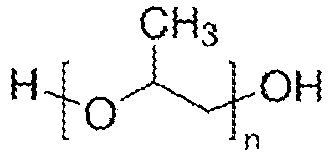
- the glycol may be a polyalkylene glycol.
- the polyalkylene glycol may be a polyethylene glycol or a polypropylene glycol.
- the polyethylene glycol may be selected from a polyethylene glycol dialkyl ether and a polyethylene glycol carboxylate.
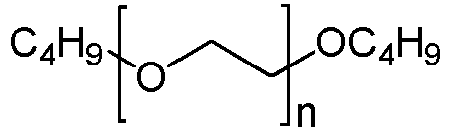
- the polyethylene glycol dialkyl ether may be selected from a polyethylene glycol dimethyl ether and a polyethylene glycol dibutyl ether.
- the polyethylene glycol dimethyl ether may be in the form of a mixture with one or more other components.
- Example mixtures include:
- the polyethylene glycol dibutyl ether may be in the form of a mixture with one or more other components.
- the zeolite may be zeolite Rho and the size-excluded liquid may be a polyethylene glycol dimethyl ether, a polyethylene glycol dibutyl ether, 15-crown-5 or bis(2-ethylhexyl) sebacate. More particularly, the zeolite may be zeolite Rho and the size-excluded liquid may be a polyethylene glycol dimethyl ether. Even more particularly, the zeolite may be zeolite Rho and the size-excluded liquid may be a polyethylene glycol dimethyl ether in the form of a mixture with one or more other components as defined above.
- the dispersion may comprise 0.1-50 wt% of the porous particles, more particularly 5-40 wt%. Even more particularly, the dispersion may comprise 10-30 wt% of the porous particles, more particularly 10-15 wt%.
- the pores of the porous particles may be accessible to a gas.
- the gas may be CO 2 , CH 4 , N 2 , C 2 H 4 , C 2 H 6 , Xe, SF 6 , C 3 H 8 or H 2 , or a mixture thereof. More particularly, the gas may be selected from CO 2 and CH 4 , even more particularly the gas may be CO 2 .
- the gas in the method is in a gas mixture and the gas is selectively adsorbed by the dispersion.
- the gas in the method may be CO 2 , CH 4 , N 2 , C 2 H 4 , C 2 H 6 , Xe, SF 6 , C 3 H 8 or H 2 , or a mixture thereof. More particularly, the gas may be selected from CO 2 and CH 4 , even more particularly the gas may be CO 2 .
- the method of adsorbing a gas into a liquid may additionally comprise, after the step of bringing the gas into contact with the dispersion, the step of regenerating the dispersion.
- the regeneration step may comprise applying a vacuum to the dispersion.
- the regeneration step may comprise heating the dispersion to a temperature of at least 30°C, more particularly at least 40°C, even more particularly at least 50°C.
- the steps of applying the vacuum and heating may be carried out at the same time. More particularly, the steps of applying the vacuum and heating may be carried out for at least 10 minutes, even more particularly at least 20 minutes, more particularly at least 30 minutes.
- a method of preparing a dispersion comprising at least the step of: mixing (i) porous particles comprising a zeolite, and (ii) a size-excluded liquid.
- the porous particles may be as defined above.
- the size-excluded liquid may be as defined above. More particularly, the dispersion formed by the method may be as defined above.
- the mixing includes agitating, stirring, sonication or grinding or a combination thereof. More particularly, the method may comprise stirring the mixture.
- the gas may be CO 2 , CH 4 , N 2 , C 2 H 4 , C 2 H 6 , Xe, SF 6 , C 3 H 8 or H 2 , or a mixture thereof.
- the gas may be selected from CO 2 and CH 4 , even more particularly the gas may be CO 2 .
- the obtained precursor mixture was then placed in a Teflon-lined stainless steel autoclave at 398K for 3 days for crystallization.
- the resulting zeolite Rho was then washed with deionised water by filtration until neutral and calcined at 773K for approximately 3 hours to remove the organic template (18-crown-6).
- Method 3 Caesium hydroxide (1.91 g, 12.75 mmol) and sodium hydroxide (3.274 g, 81.75 mmol) were dissolved in 20 ml of deionised water. Sodium aluminate (3.94 g, 19.51 mmol) was added to this solution and stirred until fully dissolved. Ludox AS-40 colloidal silica (33.88 g, 563.9 mmol) was then added. 400mg of crystalline zeolite Rho (seeding) was then added to the resulting mixture and stirred overnight at room temperature under atmospheric pressure. The obtained precursor mixture was then placed in a Teflon flask at 358K in oil bath for 7 days for crystallization. The resulting zeolite Rho was then washed with deionised water by filtration until neutral.
- the zeolite Rho data below is a result of testing carried out on material made by Method 1.
- the dispersion (also sometimes referred to as a "porous liquid”) was prepared by mixing Genosorb 1753 and zeolite Rho by stirring the components in laboratory flask until formation of homogeneous dispersion, typically about 15 mins. Other missing techniques such as grinding, milling or sonicating can also be used.
- the zeolite Rho - Genosorb 1753 porous liquid was characterized by Powder X-Ray Diffractometer (PXRD), Thermo-gravimetric Analysis (TGA) and Infrared Spectroscopy (IR).
- PXRD Powder X-Ray Diffractometer
- TGA Thermo-gravimetric Analysis
- IR Infrared Spectroscopy
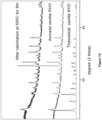
- the PXRD spectrum of zeolite Rho in Genosorb porous liquid shows an identical pattern to that of the original zeolite Rho (see both Figures 1A and 1B ). This confirms that the zeolite components remain intact and crystalline after mixing with Genosorb.
- Genosorb 1753 12.5 wt% Zeolite Rho in Genosorb 25 wt% Zeolite Rho in Genosorb CO 2 solubility * 0.209 mmol/g (9.234 mg/g) 0.475 mmol/g (20.923 mg/g) 0.738 mmol/g (32.499 mg/g) CH 4 solubilityl l 0.055 mmol/g (0.882 mg/g) 0.043 mmol/g (0.6463 mg/g) 0.027 mmol/g (0.4383 mg/g) CO 2 /CH 4 c.a. 3.8 c.a. 10.32 c.a. 23.06 * from large volume gas rig (V2) ' from small volume gas rig (V1), error is large due to small amount of CH 4 uptake
- the measured CO 2 solubility of the dispersions is comparable to its predicted value at low pressure but slightly less than the predicted value at high pressure.
- the high pressure gas uptake measurements show that the addition of zeolite Rho to Genosorb 1753 solvent significantly enhances CO 2 uptake and the operational range for a temperature pressure swing adsorption/desorption system.
- Ease of material regeneration is a useful property which can provide a reduction in regeneration cost. It is difficult to achieve by amine-based technology nowadays due to the high energy penalty.
- the dispersions of the invention are understood to be easily regenerated by applying mild heating or vacuum.
- the porous liquid (12.5wt% zeolite RHO in Genosorb 1753) shows about a 62.5% recovery in CO 2 uptake capacity when it has undergone a room temperature regeneration under vacuum for 30 minutes.
- CO 2 uptake capacity recovers to around 92% when the same regeneration conditions are used, but the temperature is increased to 50°C.
Landscapes
- Chemical & Material Sciences (AREA)
- Analytical Chemistry (AREA)
- Chemical Kinetics & Catalysis (AREA)
- Engineering & Computer Science (AREA)
- General Chemical & Material Sciences (AREA)
- Oil, Petroleum & Natural Gas (AREA)
- Organic Chemistry (AREA)
- Inorganic Chemistry (AREA)
- Dispersion Chemistry (AREA)
- Crystallography & Structural Chemistry (AREA)
- Materials Engineering (AREA)
- Nanotechnology (AREA)
- Solid-Sorbent Or Filter-Aiding Compositions (AREA)
- Organic Low-Molecular-Weight Compounds And Preparation Thereof (AREA)
Description
- This invention relates to a method of adsorbing a gas into a liquid, comprising at least the step of bringing the gas into contact with a dispersion comprising porous particles dispersed in a liquid phase, wherein the porous particles comprise a zeolite and the liquid phase is a size-excluded liquid.
- Liquid phases for the dissolution of gases are known. Solutions of various amines in water, or other solvents, are known to dissolve CO2 and are applied industrially in natural gas "sweetening". However, these methodologies comprise the use of toxic materials; are corrosive towards steel, which limits their uses industrially; and require large amounts of energy to regenerate. They are also non-specific and therefore cannot be used for specific or targeted gas separation. An glycol ether solvent type called Genosorb is utilised in industry for separating CO2 from CH4. However, the CO2 uptake of Genosorb is limited, as is its selectivity for CO2 over CH4.
- Porous solids such as zeolites are useful in molecular separation due to their permanent porosity. Porous solid adsorbents have significant advantages, for instance in terms of lower energy penalties in adsorption-desorption cycles when compared with their liquid counterparts, but they are difficult to incorporate into conventional flow processes. The use of solid zeolite Rho as an adsorbent for CO2/CH4 separation is described in Palomino et al, Chem. Commun., 2012, 48, 215-217.
US 2014/157984 A1 describes adsorbent materials for performing gas separation. - Porous liquids (liquids with permanent porosity, or dispersions) for use in molecular separation have subsequently been developed. These porous liquids have been categorised into three different types ( Chem. Eur. J., 2007, 13, 3020) as follows:
- Type 1 - neat liquid hosts comprising molecules having an internal cavity, and that the molecules cannot collapse or interpenetrate,
- Type 2 - host molecules having an internal cavity, the molecules being dissolved in a solvents that cannot occupy the host's cavities, and
- Type 3 - particles of a host molecular framework dispersed in a liquid that cannot occupy the host's cavities.
- Disadvantages of known porous liquids include that their preparation involves several steps and requires highly specialised expertise. The solvents used to prepare them are often volatile, which restricts their use in applications utilising reduced pressure to remove dissolved gases. In addition, the solubility of gases in these liquids is difficult to predict due to a lack of available data.
- Liquids having improved properties, particularly high CO2 uptake and improved selectivity for CO2 over CH4, are sought. This can provide improved efficiency in industrial processes where these properties are useful, for example by reducing circulation rates.
- This invention relates to a method of adsorbing a gas into a liquid, comprising at least the step of bringing the gas into contact with a dispersion comprising porous particles dispersed in a liquid phase, wherein the porous particles comprise a zeolite and the liquid phase is a size-excluded liquid, whereby the term size-excluded liquid is defined as a liquid which is excluded from the pores of the porous particles, either because it has a molecular size which is too large to enter the pores of the porous particles, or its entry into the pores of the porous particles is thermodynamically or kinetically unfavourable.
- Generally, a dispersion is a system in which particles are dispersed in a continuous phase of a different composition. The term "dispersion" is used in relation to the invention to refer to a system in which particles of a porous solid are dispersed in a liquid phase or medium. The dispersion may optionally comprise additives, such as surfactants, in order to increase the stability of the dispersion. Such additives are known to those skilled in the art.
- It is known that some dispersions are time dependent before the start of separation of the solid particles in the liquid phase or medium, possibly based on requiring some form of agitation to continue as a dispersion. The present invention is not limited to the stability or transience of the dispersion.
- More particularly, the dispersion may be a
type 3 porous liquid. - In particular, the porous particles may be microparticles and/or nanoparticles. More particularly, the porous particles may be microparticles. Microparticles are generally defined as particles having a mean diameter in the range 0.1-100 µm (ie 100-100,000 nm). More particularly, the porous particles may have a mean diameter in the range 0.1-2 µm (ie 100-2000 nm). Nanoparticles are generally defined as particles having a mean diameter in the range 1-100 nm.
- More particularly, the pores of the porous particles may comprise micropores (ie that they have a pore diameter of less than 2 nm), mesopores (ie that they have a pore diameter in the range 2-50 nm) or a mixture of micropores and mesopores.
- In some embodiments, the zeolite may be selected from zeolite Rho, zeolite Na-Rho, ECR-18, ZSM-25 and PST-20. More particularly, the zeolite may be zeolite Rho.
- Zeolites may be generally defined as aluminosilicate materials which are crystalline and porous. Zeolite Rho is a type of zeolite which may be defined as having an Si/Al ratio in the range 1-8, more particularly 2-6. In particular, zeolite Rho may have a mean pore diameter of 1.9-6.0 Angstroms, more particularly 2.9-4.0 Angstroms, even more particularly about 3.6 Angstroms. In particular, it may have a pore volume of 0.22-0.44 cm3g-1, more particularly 0.24-0.33 cm3g-1, even more particularly about 0.26 cm3g-1. More particularly, zeolite Rho may have a body-centred cubic crystal structure.
- A size-excluded liquid is defined in the context of the invention as a liquid which is excluded from the pores (ie the cavities) within the porous particles. This can be because the size-excluded liquid has a molecular size which is too large to enter the pores of the porous particles. Alternatively, entry into the pores of the porous particles may be thermodynamically or kinetically unfavourable.
- In particular, the size-excluded liquid may be selected from a glycol; 15-crown-5; a tertiary amine having substituted or unsubstituted aryl or alkyl substituents, for example each substituent can individually be C6-C10 substituted or unsubstituted aryl or alkyl; the tertiary amine may be a trialkylamine where each alkyl group is individually C6-C10 alkyl, more particularly C7-C9 alkyl, for example trioctylamine; 2-(tert-butylamino)ethyl methacrylate; a trialkyl phosphate where each alkyl group is individually C2-C6 alkyl, more particularly C3-C5 alkyl, for example tributyl phosphate; a dialkyl phthalate where each alkyl group is individually C6-C10 alkyl, more particularly C7-C9 alkyl, for example dioctyl phthalate; and bis(2-ethylhexyl) sebacate. More particularly, the glycol may be a polyalkylene glycol. In particular, the polyalkylene glycol may be a polyethylene glycol or a polypropylene glycol. More particularly, the polyethylene glycol may be selected from a polyethylene glycol dialkyl ether and a polyethylene glycol carboxylate. In particular, the polyethylene glycol dialkyl ether may be selected from a polyethylene glycol dimethyl ether and a polyethylene glycol dibutyl ether.
- The polyethylene glycol dimethyl ether may be in the form of a mixture with one or more other components. Example mixtures include:
- (i) polyethylene glycol dimethyl ether with triethylene glycol dimethyl ether and bis(2-(2-methoxylethoxyl)ethyl)ether (for example, Genosorb 1753 - triethylene glycol dimethyl ether (4.9% w/w); bis(2-(2-methoxylethoxyl)ethyl)ether (<=13 %w/w));
- (ii) polyethylene glycol dimethyl ether with triethylene glycol dimethyl ether (for example, Genosorb 1900 - triethylene glycol dimethyl ether (4.9% w/w)); and
- (iii) polyethylene glycol dimethyl ether with diaryl-p-penylenediamines, triethylene glycol dimethyl ether and bis(2-(2-methoxylethoxyl)ethyl)ether (for example, Genosorb 300 - mixture of diaryl-p-penylenediamines (<1%w/w); triethylene glycol dimethyl ether (4.9% w/w); bis(2-(2-methoxylethoxyl)ethyl)ether (<=13 %w/w)).
- The polyethylene glycol dibutyl ether may be in the form of a mixture with one or more other components. An example mixtures is polyethylene glycol dibutyl ether with diaryl-p-penylenediamines (for example, Genosorb 1843 - mixture of diaryl-p-penylenediamines >=0.25 - < 1 %w/w)).
- In particular, the zeolite may be zeolite Rho and the size-excluded liquid may be a polyethylene glycol dimethyl ether, a polyethylene glycol dibutyl ether, 15-crown-5 or bis(2-ethylhexyl) sebacate. More particularly, the zeolite may be zeolite Rho and the size-excluded liquid may be a polyethylene glycol dimethyl ether. Even more particularly, the zeolite may be zeolite Rho and the size-excluded liquid may be a polyethylene glycol dimethyl ether in the form of a mixture with one or more other components as defined above.
- In particular, the dispersion may comprise 0.1-50 wt% of the porous particles, more particularly 5-40 wt%. Even more particularly, the dispersion may comprise 10-30 wt% of the porous particles, more particularly 10-15 wt%.
- In the dispersion according to the present invention, the pores of the porous particles may be accessible to a gas. Optionally, the gas may be CO2, CH4, N2, C2H4, C2H6, Xe, SF6, C3H8 or H2, or a mixture thereof. More particularly, the gas may be selected from CO2 and CH4, even more particularly the gas may be CO2.
- In an embodiment, the gas in the method is in a gas mixture and the gas is selectively adsorbed by the dispersion.
- In particular, the gas in the method may be CO2, CH4, N2, C2H4, C2H6, Xe, SF6, C3H8 or H2, or a mixture thereof. More particularly, the gas may be selected from CO2 and CH4, even more particularly the gas may be CO2.
- In particular, the method of adsorbing a gas into a liquid may additionally comprise, after the step of bringing the gas into contact with the dispersion, the step of regenerating the dispersion. More particularly, the regeneration step may comprise applying a vacuum to the dispersion. In particular, the regeneration step may comprise heating the dispersion to a temperature of at least 30°C, more particularly at least 40°C, even more particularly at least 50°C. In particular, the steps of applying the vacuum and heating may be carried out at the same time. More particularly, the steps of applying the vacuum and heating may be carried out for at least 10 minutes, even more particularly at least 20 minutes, more particularly at least 30 minutes.
- Also described, but not claimed, is a method of preparing a dispersion comprising at least the step of: mixing (i) porous particles comprising a zeolite, and (ii) a size-excluded liquid. The porous particles may be as defined above. The size-excluded liquid may be as defined above. More particularly, the dispersion formed by the method may be as defined above.
- Optionally, the mixing includes agitating, stirring, sonication or grinding or a combination thereof. More particularly, the method may comprise stirring the mixture.
- Also described, but not claimed, is an assemblage of a dispersion comprising porous particles dispersed in a liquid phase, wherein the porous particles comprise a zeolite and the liquid phase is a size-excluded liquid, wherein the zeolite comprising a cavity and a gas contained within the cavity. More particularly, the gas may be CO2, CH4, N2, C2H4, C2H6, Xe, SF6, C3H8 or H2, or a mixture thereof. In particular, the gas may be selected from CO2 and CH4, even more particularly the gas may be CO2.
- This invention will be further described by reference to the following Figures which are not intended to limit the scope of the invention claimed, in which:
-
Figure 1A shows Powder X-Ray Diffraction (PXRD) data comparing the theoretical pattern for zeolite Rho and the pattern for the zeolite Rho made in the examples both before and after calcination at 500°C for 8 hours, -
Figure 1B shows PXRD data comparing as made zeolite Rho,Genosorb 1753, and 12.5 wt% and 25 wt% dispersions of zeolite Rho inGenosorb 1753, -
Figure 2 shows a Scanning Electron Microscope (SEM) image of the as made zeolite Rho, -
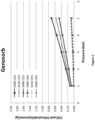
Figure 3 shows the CO2 uptake ofGenosorb 1753 at three different temperatures and at pressures of from 1-5 bar, -
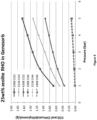
Figure 4 shows the CO2 uptake of a 12.5 wt% dispersion of zeolite Rho inGenosorb 1753 at three different temperatures and at pressures of from 1-5 bar, -
Figure 5 shows the CO2 uptake of a 25 wt% dispersion of zeolite Rho inGenosorb 1753 at three different temperatures and at pressures of from 1-5 bar, -
Figure 6 shows the CO2 solubility of a 12.5 wt% dispersion of zeolite Rho inGenosorb 1753 before use, after use and regeneration at 25°C, and after use and regeneration at 50°C, and -
Figure 7 shows a Parr reactor used in the high pressure gas update studies. - There are two reported methods to synthesize zeolite Rho according to literature. For the current study of zeolite Rho,
method 1 was used to synthesize high crystallinity material. - Method 1 (see Palomino et al, Chem. Commun., 2012, 48, 215-217): 18-crown-6 ether (4.70 g, 17.78 mmol), cesium hydroxide (3.53 g, 23.54 mmol) and sodium hydroxide (1.70 g, 42.50 mmol) were dissolved in 30 ml of deionised water. Sodium aluminate (6.60 g, 32.65 mmol) was added to this solution and stirred until fully dissolved. Ludox AS-40 colloidal silica (52.5g, 873.8 mmol) was then added. The resulting mixture was stirred overnight at room temperature under atmospheric pressure. The obtained precursor mixture was then placed in a Teflon-lined stainless steel autoclave at 398K for 3 days for crystallization. The resulting zeolite Rho was then washed with deionised water by filtration until neutral and calcined at 773K for approximately 3 hours to remove the organic template (18-crown-6).
- Method 2 (see Mousavi et al, Ceramics International, 39 (2013), 7149-7158): Caesium hydroxide (1.91 g, 12.75 mmol) and sodium hydroxide (3.274 g, 81.75 mmol) were dissolved in 20 ml of deionised water. Sodium aluminate (3.94 g, 19.51 mmol) was added to this solution and stirred until fully dissolved. Ludox AS-40 colloidal silica (33.88 g, 563.9 mmol) was then added. The resulting mixture was stirred overnight at room temperature under atmospheric pressure. The obtained precursor mixture was then placed in a Teflon-lined stainless steel autoclave at 358K in an oil bath for 7 days for crystallization. The resulting zeolite Rho was then washed with deionised water by filtration until neutral.
- Method 3: Caesium hydroxide (1.91 g, 12.75 mmol) and sodium hydroxide (3.274 g, 81.75 mmol) were dissolved in 20 ml of deionised water. Sodium aluminate (3.94 g, 19.51 mmol) was added to this solution and stirred until fully dissolved. Ludox AS-40 colloidal silica (33.88 g, 563.9 mmol) was then added. 400mg of crystalline zeolite Rho (seeding) was then added to the resulting mixture and stirred overnight at room temperature under atmospheric pressure. The obtained precursor mixture was then placed in a Teflon flask at 358K in oil bath for 7 days for crystallization. The resulting zeolite Rho was then washed with deionised water by filtration until neutral.
- The zeolite Rho data below is a result of testing carried out on material made by
Method 1. - The dispersion (also sometimes referred to as a "porous liquid") was prepared by mixing
Genosorb 1753 and zeolite Rho by stirring the components in laboratory flask until formation of homogeneous dispersion, typically about 15 mins. Other missing techniques such as grinding, milling or sonicating can also be used. - The zeolite Rho -
Genosorb 1753 porous liquid was characterized by Powder X-Ray Diffractometer (PXRD), Thermo-gravimetric Analysis (TGA) and Infrared Spectroscopy (IR). The PXRD spectrum of zeolite Rho in Genosorb porous liquid (seeFigure 1B ) shows an identical pattern to that of the original zeolite Rho (see bothFigures 1A and1B ). This confirms that the zeolite components remain intact and crystalline after mixing with Genosorb. - An SEM image of the original zeolite Rho (ie not as a dispersion) is shown in
Figure 2 . This demonstrates that the particle size is around 1.0-1.2 µm. - Low pressure measurement (c.a. 0.8 bar condition; 25°C) - Gas solubility studies were carried out by using a volumetric technique based on an isochoric method (see S. L. James et. al.; Nature, 527, 216).
- . All the measurements were carried out at around 0.8 bar and 298K. The results show that the addition of zeolite Rho to
commercial solvent Genosorb 1753 increases the CO2/CH4 selectivity significantly (see Table 1 below). The zeolite Rho does not lose its gas capacity and the gas uptake is predictable.Table 1 Genosorb 175312.5 wt% Zeolite Rho in Genosorb 25 wt% Zeolite Rho in Genosorb CO2 solubility* 0.209 mmol/g (9.234 mg/g) 0.475 mmol/g (20.923 mg/g) 0.738 mmol/g (32.499 mg/g) CH4 solubilityll 0.055 mmol/g (0.882 mg/g) 0.043 mmol/g (0.6463 mg/g) 0.027 mmol/g (0.4383 mg/g) CO2/CH4 c.a. 3.8 c.a. 10.32 c.a. 23.06 * from large volume gas rig (V2)
' from small volume gas rig (V1), error is large due to small amount of CH4 uptake - High Pressure measurement (1-5 bar, 25°C-75°C) - High pressure gas solubility studies were carried out by using Parr reactor based on a mass flow (see A.M. Orozco et. al., Industrial Crops and products, 2013, 44, 1 for a similar experimental set-up).
- . All the measurements were carried out from 1 to 5 bar at 298K, 323K and 348K. The high pressure measurements also show predictable outcomes. Table 2 below, and
Figures 3-5 , show the CO2 uptake ofGenosorb 1753, a 12.5wt% dispersion of zeolite Rho inGenosorb 1753 and a 25wt% dispersion of zeolite Rho inGenosorb 1753. Table 3 below shows the experimental values for pure zeolite Rho at 298K, plus the predicted values for the 12.5wt% zeolite Rho inGenosorb 1753 and 25wt% zeolite Rho inGenosorb 1753 dispersions. - The measured CO2 solubility of the dispersions is comparable to its predicted value at low pressure but slightly less than the predicted value at high pressure. The high pressure gas uptake measurements show that the addition of zeolite Rho to
Genosorb 1753 solvent significantly enhances CO2 uptake and the operational range for a temperature pressure swing adsorption/desorption system.Table 2 Genosorb 12.5 wt% Zeolite Rho in Genosorb 25 wt% Zeolite Rho in Genosorb 298K 323K 348K 298K 323K 348K 298K 323K 348K 1 bar 5.478 5.044 3.669 16.457 11.476 7.919 30.024 21.639 15.234 2 bar 11.331 9.687 7.423 29.015 19.852 14.160 48.327 33.558 24.342 3 bar 17.493 14.571 11.727 35.968 36.580 19.339 58.322 41.623 30.804 4 bar 24.221 19.598 16.206 42.717 32.829 24.000 65.377 50.361 36.102 5 bar 31.471 25.089 20.853 49.862 37.909 29.408 72.444 58.028 41.274 Table 3 298K Experimental pure Zeolite Rho Theoretical 12.5 wt% Zeolite Rho Theoretical 25 wt % Zeolite Rho 1 bar 108.12 18.31 31.14 2 bar 170.00 31.16 51.00 3 bar 200.57 40.38 63.26 4 bar 216.69 48.28 72.34 5 bar 228.68 56.12 80.77 - Ease of material regeneration is a useful property which can provide a reduction in regeneration cost. It is difficult to achieve by amine-based technology nowadays due to the high energy penalty. The dispersions of the invention are understood to be easily regenerated by applying mild heating or vacuum. As shown in
Figure 6 , the porous liquid (12.5wt% zeolite RHO in Genosorb 1753) shows about a 62.5% recovery in CO2 uptake capacity when it has undergone a room temperature regeneration under vacuum for 30 minutes. However, CO2 uptake capacity recovers to around 92% when the same regeneration conditions are used, but the temperature is increased to 50°C. - Further dispersions comprising combinations of porous particles with various liquids were prepared by mixing the porous particles with the liquid as described above. The dispersions produced, and their theoretical and actual CO2 uptake values in mg/g, are shown in Tables 4a-c below.
Table 4a 


Polyethylene glycol dimethyl ether (Genosorb 1753) - CO2 uptake mg/g (mmol/g) Polyethylene glycol dimethyl ether (Genosorb 300) - CO2 uptake mg/g (mmol/g) Polyethylene glycol dimethyl ether (Genosorb 1900) - CO2 uptake mg/g (mmol/g) Polyethylene glycol dibutyl ether (Genosorb 1843) - CO2 uptake mg/g (mmol/g) Polypropylene glycol - CO2 uptake mg/g (mmol/g) Wt% Exp. Cal. Exp. Cal. Exp. Exp. Cal. Cal. Exp. Cal. 9.23 (0.21) 5.64 (0.13) 6.7 (0.15) 7.3 (0.17) Zeolite Rho 12.5 22.58 (0.51) 22.64 (0.51) 16.18 (0.37) 18.61 (0.42) 15.93 (0.36) 19.6 (0.45) 19.24 (0.44) 20.14 (0.46) 15.69 (0.36) 18.96 (0.43) 25 33.2 (0.75) 33.6 (0.76) -- -- -- -- -- -- -- -- PAF-1 12.5 31.91 (0.76) 31.23 (0.71) -- -- -- -- -- -- -- -- ZIF-8 12.5 5.64 (0.13) 13.04 (0.30) -- -- -- -- -- -- -- -- Al(fum)(OH) 12.5 11.78 (0.27) 20.12 (0.46) -- -- -- -- -- -- -- -- Table 4b 


polyethylene glycol dibenzoate - CO2 uptake mg/g (mmol/g) Polyethylene glycol bis(2-ethylhexanoate) - CO2 uptake mg/g (mmol/g) poly(ethylene glycol) dimethacrylate - CO2 uptake mg/g (mmol/g) 15-crown-5 - CO2 uptake mg/g (mmol/g) Silicone oil (50cst) - CO2 uptake mg/g (mmol/g) Wt% Exp. Cal. Exp. Cal. Exp. Exp. Exp. Cal. Exp. Cal. 2.8 (0.063) 7.91 (0.18) 4.53 (0.10) 4.37 (0.099) 9.38 (0.21) Zeolite Rho 12.5 16.65 (0.39) 17.01 (0.39) 14.23 (0.33) 21.48 (0.49) -- -- 18.71 (0.43) 17.57 (0.40) 20.23 (0.46) 18.92 (0.43) 25 -- -- -- -- -- -- -- -- -- -- ZIF-8 12.5 6.7 (0.15) 7.05 (0.16) 11.30 (0.26) 11.52 (0.26) 7.41 (0.17) 8.91 (0.20) 4.40 (0.10) 9.68 (0.22) 9.68 (0.22) 9.24 (0.21) 25 -- -- 14.84 15.13 -- -- -- -- -- -- Al(fum)(OH) 12.5 -- -- -- -- -- -- -- -- 15.84 (0.36) 16.28 (0.37) Zeolite 10A 12.5 -- -- -- -- -- -- -- -- 20.25 (0.46) 20.68 (0.47) Table 4c 


Trioctylamine - CO2 uptake mg/g (mmol/g) 2-(tert-butylamino)ethyl methacrylate - CO2 uptake mg/g (mmol/g) Tributyl phosphate - CO2 uptake mg/g (mmol/g) Dioctyl phthalate - CO2 uptake mg/g (mmol/g) Bis(2-ethylhexyl) sebacate - CO2 uptake mg/g (mmol/g) Wt% Exp. Cal. Exp. Cal. Exp. Exp. Exp. Cal. Exp. Cal. 2.92 (0.066) 6.33 (0.14) 2.65 (0.06) 3.54 (0.09) 9.38 (0.21) Zeolite Rho 12.5 18.85 (0.43) 17.12 (0.39) 15.44 (0.35) 20.10 (0.46) 17.65 (0.40) 16.88 (0.38) 18.71 (0.43) 17.66 (0.40) 23.65 (0.54) 22.77 (0.52) - CH4 uptake of the dispersions was also investigated and the results are shown in Table 5 below. This was carried out using the isochoric method described above (ie S. L. James et. al.; Nature, 527, 216).
Table 5 Table 4c 

Tributyl phosphate - CH4 uptake mg/g (mmol/g) Polypropylene glycol - CH4 uptake mg/g (mmol/g) Wt% Exp. Cal. Exp. Exp. -- 0.457 (0.028) Zeolite Rho 12.5 0.181 (0.011) -- 0.466 (0.029) 0.502 (0.031) 25 -- -- 0.506 (0.031) 0.547 (0.034) - Selectivity is estimated by ratio (Ammol/g/Bmmol/g). Values for CO2 selectivity over CH4 (CO2/CH4) were calculated for two of the dispersions and the results are shown in Table 6 below.
Table 6 

Tributyl phosphate - CO2/CH4 selectivity (by 1:1 ratio) Polypropylene glycol - CO2/CH4 selectivity (by 1:1 ratio) Wt% Exp. Cal. Exp. Exp. -- c.a. 7.5 Zeolite Rho 12.5 c.a.36.4 -- c.a. 17.6 c.a. 16.5 25 -- -- c.a. 24.1 c.a. 22.4
Claims (11)
- A method of adsorbing a gas into a liquid, comprising at least the step of bringing the gas into contact with a dispersion comprising porous particles dispersed in a liquid phase, wherein the porous particles comprise a zeolite and the liquid phase is a size-excluded liquid, whereby the term size-excluded liquid is defined as a liquid which is excluded from the pores of the porous particles, either because it has a molecular size which is too large to enter the pores of the porous particles, or its entry into the pores of the porous particles is thermodynamically or kinetically unfavourable.
- A method as claimed in claim 1, wherein the zeolite is selected from zeolite Rho, zeolite Na-Rho, ECR-18, ZSM-25 and PST-20.
- A method as claimed in claim 1 or claim 2, wherein the zeolite is zeolite Rho.
- A method as claimed in any one of the preceding claims, wherein the size-excluded liquid is selected from a glycol, 15-crown-5, trioctylamine, 2-(tert-butylamino)ethyl methacrylate, tributyl phosphate, dioctyl phthalate and bis(2-ethylhexyl) sebacate.
- A method as claimed in claim 4, wherein the glycol is a polyalkylene glycol.
- A method as claimed in claim 5, wherein the polyalkylene glycol is a polyethylene glycol or a polypropylene glycol.
- A method as claimed in claim 6, wherein the polyethylene glycol is selected from a polyethylene glycol dialkyl ether and a polyethylene glycol carboxylate.
- A method as claimed in claim 7, wherein the polyethylene glycol dialkyl ether is selected from a polyethylene glycol dimethyl ether and a polyethylene glycol dibutyl ether.
- A method as claimed in any one of the preceding claims, wherein the dispersion comprises 0.1-50 wt% of the porous particles.
- A method as claimed in claim 9, wherein the dispersion comprises 10-30 wt% of the porous particles.
- A method as claimed in any one of the preceding claims, wherein the gas is selected from CO2 and CH4.
Applications Claiming Priority (3)
| Application Number | Priority Date | Filing Date | Title |
|---|---|---|---|
| GB1707674.6A GB2562309A (en) | 2017-05-12 | 2017-05-12 | Porous liquids |
| PCT/GB2018/051279 WO2018206977A1 (en) | 2017-05-12 | 2018-05-11 | Porous liquids |
| PCT/GB2018/053168 WO2019215419A1 (en) | 2017-05-12 | 2018-11-01 | Type 3 porous liquids |
Publications (3)
| Publication Number | Publication Date |
|---|---|
| EP3790646A1 EP3790646A1 (en) | 2021-03-17 |
| EP3790646C0 EP3790646C0 (en) | 2025-01-08 |
| EP3790646B1 true EP3790646B1 (en) | 2025-01-08 |
Family
ID=59201521
Family Applications (3)
| Application Number | Title | Priority Date | Filing Date |
|---|---|---|---|
| EP22199794.3A Pending EP4134151A1 (en) | 2017-05-12 | 2018-05-11 | Porous liquids |
| EP18725616.9A Withdrawn EP3621721A1 (en) | 2017-05-12 | 2018-05-11 | Porous liquids |
| EP18796093.5A Active EP3790646B1 (en) | 2017-05-12 | 2018-11-01 | Method of adsorbing a gas into a liquid |
Family Applications Before (2)
| Application Number | Title | Priority Date | Filing Date |
|---|---|---|---|
| EP22199794.3A Pending EP4134151A1 (en) | 2017-05-12 | 2018-05-11 | Porous liquids |
| EP18725616.9A Withdrawn EP3621721A1 (en) | 2017-05-12 | 2018-05-11 | Porous liquids |
Country Status (5)
| Country | Link |
|---|---|
| US (2) | US11565212B2 (en) |
| EP (3) | EP4134151A1 (en) |
| ES (1) | ES3004882T3 (en) |
| GB (1) | GB2562309A (en) |
| WO (2) | WO2018206977A1 (en) |
Families Citing this family (27)
| Publication number | Priority date | Publication date | Assignee | Title |
|---|---|---|---|---|
| CN109200760B (en) * | 2018-11-20 | 2021-06-04 | 安徽工业大学 | Low-energy-consumption regenerated eutectic solvent for removing carbon dioxide stably |
| CN109529932B (en) * | 2018-12-04 | 2021-09-21 | 三峡大学 | Preparation method and application of petal-shaped metal organic framework material |
| WO2020113267A1 (en) * | 2018-12-05 | 2020-06-11 | Commonwealth Scientific And Industrial Research Organisation | Porous liquid oligomers |
| CN109589934A (en) * | 2018-12-13 | 2019-04-09 | 常州大学 | It is adjusted based on benzoic acid and chloroform activates the method and adsorption applications for preparing UiO-66 |
| CN109651055B (en) * | 2019-01-29 | 2020-06-05 | 浙江大学 | A kind of separation method of ethylene ethane |
| CN109745952B (en) * | 2019-03-18 | 2022-02-11 | 上海科技大学 | A kind of porous liquid and its preparation method and use |
| CN110624365A (en) * | 2019-10-10 | 2019-12-31 | 义乌韦陀环保科技有限公司 | Soybean oil absorption liquid for VOC waste gas treatment, absorption method and separation and recovery method |
| CN110624366A (en) * | 2019-10-10 | 2019-12-31 | 义乌韦陀环保科技有限公司 | Cottonseed oil absorption liquid for VOC waste gas treatment, absorption method and separation and recovery method |
| CN111151098A (en) * | 2019-10-10 | 2020-05-15 | 义乌韦陀环保科技有限公司 | Waste kitchen grease absorption liquid for VOC waste gas treatment, absorption method and separation and recovery method |
| CN111044590A (en) * | 2019-11-26 | 2020-04-21 | 云南大学 | A CuNi-MOF nanomaterial modified electrode and its application |
| CN110935196B (en) * | 2019-12-17 | 2021-11-16 | 湖北大学 | Based on Zn5Metal cluster copolymerization monolithic column and preparation method and application thereof |
| EP3964279A1 (en) * | 2020-09-07 | 2022-03-09 | Indian Oil Corporation Limited | Solvent composition for co2 capture and a process mediated thereof |
| EP4225487A4 (en) * | 2020-10-08 | 2024-11-27 | President and Fellows of Harvard College | HIGH POROSITY POLAR LIQUIDS AND THEIR USES |
| CN112675695A (en) * | 2020-12-01 | 2021-04-20 | 深圳市尤佳环境科技有限公司 | Spray liquid for purifying waste gas and odor and preparation method thereof |
| CN112934196A (en) * | 2021-01-27 | 2021-06-11 | 西北工业大学 | Hollow carbon sphere HCS porous liquid with flowing behavior at room temperature and preparation method thereof |
| CN113117455B (en) * | 2021-04-12 | 2022-11-22 | 江西师范大学 | Application of choline chloride-glycerol eutectic solvent in absorbing HCl gas |
| CN113332832A (en) * | 2021-05-31 | 2021-09-03 | 北京工业大学 | Method for removing chlorobenzene compounds by using porous organic micromolecular liquid material |
| CN113289457A (en) * | 2021-05-31 | 2021-08-24 | 北京工业大学 | Method for removing chloralkane compound by using porous organic small molecule liquid material |
| CN113350970A (en) * | 2021-05-31 | 2021-09-07 | 北京工业大学 | Porous organic small molecule liquid absorbent, preparation method and application |
| CN113913020A (en) * | 2021-09-26 | 2022-01-11 | 西北工业大学 | Low-viscosity I-type porous liquid, preparation method and use method thereof |
| CN114289065B (en) * | 2021-12-23 | 2023-09-22 | 淮阴工学院 | Preparation method and application of metal ion doped x-MOF-74 photocatalyst |
| CN115386057A (en) * | 2022-08-15 | 2022-11-25 | 西南医科大学 | High-crystallinity covalent organic framework material and preparation method and application thereof |
| US20240066461A1 (en) | 2022-08-29 | 2024-02-29 | Welltec Manufacturing Center Completions ApS | Carbon capture device |
| CN116237013B (en) * | 2023-01-16 | 2024-11-22 | 廊坊师范学院 | A carbon material based on biomass and a low eutectic solvent and a wastewater adsorption treatment method |
| CN115920668B (en) * | 2023-01-30 | 2025-09-12 | 中南大学 | Self-supporting COFs membrane based on DES-H2O interfacial polymerization, preparation method and application |
| CN116651511B (en) * | 2023-06-01 | 2024-08-20 | 齐鲁工业大学(山东省科学院) | Composite material for removing hydrogen sulfide, preparation method and application |
| US12128356B1 (en) * | 2024-07-02 | 2024-10-29 | King Fahd University Of Petroleum And Minerals | Process for removing hydrogen sulfide from sour gases with ZIF-67 supported on mixed metal oxides |
Family Cites Families (19)
| Publication number | Priority date | Publication date | Assignee | Title |
|---|---|---|---|---|
| JPS598419B2 (en) * | 1978-08-14 | 1984-02-24 | 株式会社日立製作所 | Adsorbent for elemental iodine or organic iodine compounds |
| GB8813908D0 (en) * | 1988-06-13 | 1988-07-20 | Castrol Ltd | Functional fluids |
| JPH0226640A (en) * | 1988-07-15 | 1990-01-29 | Asahi Glass Co Ltd | Adsorbent and method for diluting gas concentration |
| JPH02150494A (en) * | 1988-12-01 | 1990-06-08 | Bridgestone Corp | Electroviscous liquid |
| JPH02164438A (en) | 1988-12-17 | 1990-06-25 | Bridgestone Corp | Electroviscous liquid |
| EP0425149A3 (en) * | 1989-10-23 | 1992-03-25 | Imperial Chemical Industries Plc | Detergent compositions and processes of making them |
| US5552076A (en) * | 1994-06-08 | 1996-09-03 | The Regents Of The University Of Michigan | Anhydrous amorphous ceramics as the particulate phase in electrorheological fluids |
| WO1996021706A1 (en) * | 1995-01-14 | 1996-07-18 | Jochen Daume | Heat-transfer concentrate, method of manufacturing it and its use, as well as a latent-heat accumulator making use of the concentrate |
| US6107433A (en) * | 1998-11-06 | 2000-08-22 | Pittsburg State University | Process for the preparation of vegetable oil-based polyols and electroninsulating casting compounds created from vegetable oil-based polyols |
| US6540936B1 (en) * | 2000-06-19 | 2003-04-01 | Toagosei Co., Ltd. | Aldehyde gas absorbent and process for absorbing aldehyde gas |
| GB0111863D0 (en) * | 2001-05-15 | 2001-07-04 | Unilever Plc | Granular composition |
| DE102005023857A1 (en) * | 2005-05-24 | 2006-11-30 | Basf Ag | Suspension for the reduction of odor |
| JP2012520756A (en) * | 2009-03-20 | 2012-09-10 | ビーエーエスエフ ソシエタス・ヨーロピア | Separation method of acidic gas using organometallic framework material impregnated with amine |
| US8470395B2 (en) * | 2010-06-01 | 2013-06-25 | Air Products And Chemicals Inc. | Low energy, high recovery, rapid cycle kinetic PSA for biogas |
| CN103338858B (en) * | 2010-08-25 | 2016-02-10 | 康奈尔大学 | Metal-organic framework modified material, its preparation and use method |
| SE1100140A1 (en) * | 2011-03-01 | 2012-09-02 | Joachim Karthaeuser | Methods for producing metallized carbon nanoparticles |
| US9175591B2 (en) * | 2012-10-05 | 2015-11-03 | Saudi Arabian Oil Company | Process and system employing phase-changing absorbents and magnetically responsive sorbent particles for on-board recovery of carbon dioxide from mobile sources |
| CN104822434B (en) * | 2012-12-06 | 2016-08-17 | 埃克森美孚研究工程公司 | Use the gas separating method of the DDR zeolite of the adsorption activity with stabilisation |
| CN105013292A (en) * | 2014-04-28 | 2015-11-04 | 中国石油大学(北京) | A Composite Method for Capturing CO2 in Mixed Gas |
-
2017
- 2017-05-12 GB GB1707674.6A patent/GB2562309A/en not_active Withdrawn
-
2018
- 2018-05-11 US US16/611,774 patent/US11565212B2/en active Active
- 2018-05-11 EP EP22199794.3A patent/EP4134151A1/en active Pending
- 2018-05-11 EP EP18725616.9A patent/EP3621721A1/en not_active Withdrawn
- 2018-05-11 WO PCT/GB2018/051279 patent/WO2018206977A1/en not_active Ceased
- 2018-11-01 WO PCT/GB2018/053168 patent/WO2019215419A1/en not_active Ceased
- 2018-11-01 ES ES18796093T patent/ES3004882T3/en active Active
- 2018-11-01 US US17/052,747 patent/US11571656B2/en active Active
- 2018-11-01 EP EP18796093.5A patent/EP3790646B1/en active Active
Also Published As
| Publication number | Publication date |
|---|---|
| GB2562309A (en) | 2018-11-14 |
| EP3790646A1 (en) | 2021-03-17 |
| US20210229068A1 (en) | 2021-07-29 |
| GB201707674D0 (en) | 2017-06-28 |
| EP3790646C0 (en) | 2025-01-08 |
| US11571656B2 (en) | 2023-02-07 |
| US20200330919A1 (en) | 2020-10-22 |
| EP3621721A1 (en) | 2020-03-18 |
| WO2018206977A1 (en) | 2018-11-15 |
| WO2019215419A1 (en) | 2019-11-14 |
| US11565212B2 (en) | 2023-01-31 |
| ES3004882T3 (en) | 2025-03-13 |
| EP4134151A1 (en) | 2023-02-15 |
Similar Documents
| Publication | Publication Date | Title |
|---|---|---|
| US11571656B2 (en) | Type 3 porous liquids | |
| Lee et al. | Chabazite-type zeolite membranes for effective CO2 separation: the role of hydrophobicity and defect structure | |
| Nik et al. | Functionalized metal organic framework-polyimide mixed matrix membranes for CO2/CH4 separation | |
| EP2928578B1 (en) | Gas separation method using ddr type zeolites with stabilized adsorption activity | |
| TWI259781B (en) | Zeolite adsorbents, process for producing them and process for the decarbonatation of gas flows using them | |
| KR102173543B1 (en) | Zeolitic adsorbents, process for preparing same and uses thereof | |
| CN106279213B (en) | High stability copper base metal-organic framework materials and preparation method and application | |
| WO2018230737A1 (en) | Ammonia separation method and zeolite | |
| TW555587B (en) | Process for the decarbonation of gas flows using zeolite adsorbents | |
| WO2010012656A1 (en) | Process for separating liquid mixtures | |
| EP2668995A1 (en) | Method for preparing hydrophobic fluorinated mixed matrix membranes, said membranes, and separation methods using said membranes | |
| JP2009541040A (en) | Method for gas separation and zeolitic material | |
| Khay et al. | Energetic behavior of the pure silica ITQ-12 (ITW) zeolite under high pressure water intrusion | |
| Avila et al. | Porous ionic liquids: beyond the bounds of free volume in a fluid phase | |
| JP2005145955A (en) | Chemical reaction separation method | |
| CN110961080A (en) | Adsorption separation C8Aromatic hydrocarbon adsorbent and preparation method thereof | |
| CN116586037A (en) | A shaped ultramicroporous metal-organic framework material and its preparation method and application of selective adsorption of sulfur hexafluoride | |
| TW524718B (en) | Method for the separation of molecules in the gas phase by adsorption by means of agglomerated solid inorganic adsorbents with a narrow and calibrated mesopore distribution | |
| US20220213125A1 (en) | Extruded Metal-organic Framework Materials and Methods For Production Thereof | |
| JP2017128499A (en) | Amorphous aluminum silicate and manufacturing method therefor | |
| JP2011056494A (en) | Water-soluble volatile organic compound adsorbent | |
| CN114106344A (en) | Preparation method of aluminum metal organic framework material Al-MIL-53 | |
| JP2017039633A (en) | Zirconium hydroxide mesoporous body having carbon dioxide adsorptivity, manufacturing method therefor and carbon dioxide adsorbent consisting of zirconium hydroxide mesoporous body | |
| CN113893817B (en) | NaY type molecular sieve, preparation method thereof and application thereof in adsorption of carbonyl sulfide | |
| US11571653B2 (en) | Ethylene separations using small pore zeolite SSZ-45 |
Legal Events
| Date | Code | Title | Description |
|---|---|---|---|
| STAA | Information on the status of an ep patent application or granted ep patent |
Free format text: STATUS: UNKNOWN |
|
| STAA | Information on the status of an ep patent application or granted ep patent |
Free format text: STATUS: THE INTERNATIONAL PUBLICATION HAS BEEN MADE |
|
| PUAI | Public reference made under article 153(3) epc to a published international application that has entered the european phase |
Free format text: ORIGINAL CODE: 0009012 |
|
| STAA | Information on the status of an ep patent application or granted ep patent |
Free format text: STATUS: REQUEST FOR EXAMINATION WAS MADE |
|
| 17P | Request for examination filed |
Effective date: 20200918 |
|
| AK | Designated contracting states |
Kind code of ref document: A1 Designated state(s): AL AT BE BG CH CY CZ DE DK EE ES FI FR GB GR HR HU IE IS IT LI LT LU LV MC MK MT NL NO PL PT RO RS SE SI SK SM TR |
|
| AX | Request for extension of the european patent |
Extension state: BA ME |
|
| DAV | Request for validation of the european patent (deleted) | ||
| DAX | Request for extension of the european patent (deleted) | ||
| GRAP | Despatch of communication of intention to grant a patent |
Free format text: ORIGINAL CODE: EPIDOSNIGR1 |
|
| STAA | Information on the status of an ep patent application or granted ep patent |
Free format text: STATUS: GRANT OF PATENT IS INTENDED |
|
| INTG | Intention to grant announced |
Effective date: 20240531 |
|
| GRAS | Grant fee paid |
Free format text: ORIGINAL CODE: EPIDOSNIGR3 |
|
| GRAA | (expected) grant |
Free format text: ORIGINAL CODE: 0009210 |
|
| STAA | Information on the status of an ep patent application or granted ep patent |
Free format text: STATUS: THE PATENT HAS BEEN GRANTED |
|
| AK | Designated contracting states |
Kind code of ref document: B1 Designated state(s): AL AT BE BG CH CY CZ DE DK EE ES FI FR GB GR HR HU IE IS IT LI LT LU LV MC MK MT NL NO PL PT RO RS SE SI SK SM TR |
|
| REG | Reference to a national code |
Ref country code: GB Ref legal event code: FG4D |
|
| REG | Reference to a national code |
Ref country code: CH Ref legal event code: EP |
|
| REG | Reference to a national code |
Ref country code: DE Ref legal event code: R096 Ref document number: 602018078373 Country of ref document: DE |
|
| REG | Reference to a national code |
Ref country code: IE Ref legal event code: FG4D |
|
| U01 | Request for unitary effect filed |
Effective date: 20250108 |
|
| U07 | Unitary effect registered |
Designated state(s): AT BE BG DE DK EE FI FR IT LT LU LV MT NL PT RO SE SI Effective date: 20250114 |
|
| REG | Reference to a national code |
Ref country code: ES Ref legal event code: FG2A Ref document number: 3004882 Country of ref document: ES Kind code of ref document: T3 Effective date: 20250313 |
|
| PG25 | Lapsed in a contracting state [announced via postgrant information from national office to epo] |
Ref country code: RS Free format text: LAPSE BECAUSE OF FAILURE TO SUBMIT A TRANSLATION OF THE DESCRIPTION OR TO PAY THE FEE WITHIN THE PRESCRIBED TIME-LIMIT Effective date: 20250408 |
|
| PG25 | Lapsed in a contracting state [announced via postgrant information from national office to epo] |
Ref country code: PL Free format text: LAPSE BECAUSE OF FAILURE TO SUBMIT A TRANSLATION OF THE DESCRIPTION OR TO PAY THE FEE WITHIN THE PRESCRIBED TIME-LIMIT Effective date: 20250108 |
|
| PG25 | Lapsed in a contracting state [announced via postgrant information from national office to epo] |
Ref country code: IS Free format text: LAPSE BECAUSE OF FAILURE TO SUBMIT A TRANSLATION OF THE DESCRIPTION OR TO PAY THE FEE WITHIN THE PRESCRIBED TIME-LIMIT Effective date: 20250508 |
|
| PG25 | Lapsed in a contracting state [announced via postgrant information from national office to epo] |
Ref country code: HR Free format text: LAPSE BECAUSE OF FAILURE TO SUBMIT A TRANSLATION OF THE DESCRIPTION OR TO PAY THE FEE WITHIN THE PRESCRIBED TIME-LIMIT Effective date: 20250108 |
|
| PG25 | Lapsed in a contracting state [announced via postgrant information from national office to epo] |
Ref country code: GR Free format text: LAPSE BECAUSE OF FAILURE TO SUBMIT A TRANSLATION OF THE DESCRIPTION OR TO PAY THE FEE WITHIN THE PRESCRIBED TIME-LIMIT Effective date: 20250409 |
|
| PG25 | Lapsed in a contracting state [announced via postgrant information from national office to epo] |
Ref country code: SM Free format text: LAPSE BECAUSE OF FAILURE TO SUBMIT A TRANSLATION OF THE DESCRIPTION OR TO PAY THE FEE WITHIN THE PRESCRIBED TIME-LIMIT Effective date: 20250108 |
|
| PG25 | Lapsed in a contracting state [announced via postgrant information from national office to epo] |
Ref country code: CZ Free format text: LAPSE BECAUSE OF FAILURE TO SUBMIT A TRANSLATION OF THE DESCRIPTION OR TO PAY THE FEE WITHIN THE PRESCRIBED TIME-LIMIT Effective date: 20250108 |
|
| PG25 | Lapsed in a contracting state [announced via postgrant information from national office to epo] |
Ref country code: SK Free format text: LAPSE BECAUSE OF FAILURE TO SUBMIT A TRANSLATION OF THE DESCRIPTION OR TO PAY THE FEE WITHIN THE PRESCRIBED TIME-LIMIT Effective date: 20250108 |
|
| PLBE | No opposition filed within time limit |
Free format text: ORIGINAL CODE: 0009261 |
|
| STAA | Information on the status of an ep patent application or granted ep patent |
Free format text: STATUS: NO OPPOSITION FILED WITHIN TIME LIMIT |
|
| REG | Reference to a national code |
Ref country code: CH Ref legal event code: L10 Free format text: ST27 STATUS EVENT CODE: U-0-0-L10-L00 (AS PROVIDED BY THE NATIONAL OFFICE) Effective date: 20251119 |
|
| REG | Reference to a national code |
Ref country code: CH Ref legal event code: U11 Free format text: ST27 STATUS EVENT CODE: U-0-0-U10-U11 (AS PROVIDED BY THE NATIONAL OFFICE) Effective date: 20251201 |
|
| 26N | No opposition filed |
Effective date: 20251009 |
|
| U20 | Renewal fee for the european patent with unitary effect paid |
Year of fee payment: 8 Effective date: 20251126 |
|
| PGFP | Annual fee paid to national office [announced via postgrant information from national office to epo] |
Ref country code: GB Payment date: 20251128 Year of fee payment: 8 |
|
| PGFP | Annual fee paid to national office [announced via postgrant information from national office to epo] |
Ref country code: NO Payment date: 20251201 Year of fee payment: 8 |
|
| PGFP | Annual fee paid to national office [announced via postgrant information from national office to epo] |
Ref country code: CH Payment date: 20251201 Year of fee payment: 8 |
|
| PGFP | Annual fee paid to national office [announced via postgrant information from national office to epo] |
Ref country code: IE Payment date: 20251127 Year of fee payment: 8 |
|
| PGFP | Annual fee paid to national office [announced via postgrant information from national office to epo] |
Ref country code: ES Payment date: 20251210 Year of fee payment: 8 |