EP3789956A1 - Method and system for analyzing the mechanical response of microstructures under investigation - Google Patents
Method and system for analyzing the mechanical response of microstructures under investigation Download PDFInfo
- Publication number
- EP3789956A1 EP3789956A1 EP19196081.4A EP19196081A EP3789956A1 EP 3789956 A1 EP3789956 A1 EP 3789956A1 EP 19196081 A EP19196081 A EP 19196081A EP 3789956 A1 EP3789956 A1 EP 3789956A1
- Authority
- EP
- European Patent Office
- Prior art keywords
- neural network
- micromechanical
- ebsd image
- network
- probed
- Prior art date
- Legal status (The legal status is an assumption and is not a legal conclusion. Google has not performed a legal analysis and makes no representation as to the accuracy of the status listed.)
- Granted
Links
Images

Classifications
-
- G—PHYSICS
- G06—COMPUTING OR CALCULATING; COUNTING
- G06T—IMAGE DATA PROCESSING OR GENERATION, IN GENERAL
- G06T7/00—Image analysis
- G06T7/0002—Inspection of images, e.g. flaw detection
- G06T7/0004—Industrial image inspection
-
- G—PHYSICS
- G06—COMPUTING OR CALCULATING; COUNTING
- G06T—IMAGE DATA PROCESSING OR GENERATION, IN GENERAL
- G06T2207/00—Indexing scheme for image analysis or image enhancement
- G06T2207/10—Image acquisition modality
- G06T2207/10056—Microscopic image
- G06T2207/10061—Microscopic image from scanning electron microscope
-
- G—PHYSICS
- G06—COMPUTING OR CALCULATING; COUNTING
- G06T—IMAGE DATA PROCESSING OR GENERATION, IN GENERAL
- G06T2207/00—Indexing scheme for image analysis or image enhancement
- G06T2207/20—Special algorithmic details
- G06T2207/20081—Training; Learning
-
- G—PHYSICS
- G06—COMPUTING OR CALCULATING; COUNTING
- G06T—IMAGE DATA PROCESSING OR GENERATION, IN GENERAL
- G06T2207/00—Indexing scheme for image analysis or image enhancement
- G06T2207/20—Special algorithmic details
- G06T2207/20084—Artificial neural networks [ANN]
Definitions
- the present invention relates to micromechanical simulations of mechanical properties of a workpiece having a particular microstructure.
- these simulations can be based on either experimentally obtained grain data, e.g. as an EBSD (Electron Backscatter Diffraction) image, or on synthetically generated morphologies.
- EBSD Electro Backscatter Diffraction
- it is a goal to simulate the microstructure-dependent mechanical behavior of a workpiece e.g. by methods, such as the Crystal Plasticity Finite Element Method (CPFEM).
- CPFEM Crystal Plasticity Finite Element Method
- the simulation of a microstructure to evaluate the lifetime of a workpiece with the underlying microstructure is based on fatigue indicator parameters which correspond to a material meta-response.
- Such a micromechanical simulation using an FEM-method is usually very complex and time-consuming.
- a method for evaluating a mechanical property of a material of a workpiece according to claim 1 and a system according to the further independent claim are provided.
- a computer-implemented method for evaluating at least one mechanical property of a material to be probed, particularly of a workpiece comprising the steps of:
- micromechanical response of a material is simulated by means of a Finite-Element-Method based on a microstructure EBSD image.
- the microstructure EBSD image is taken from a cutting surface probe of the material of a workpiece to analyze micromechanical stress, strain and energy fields in the microstructure of the material.
- the micromechanical response array is configured to indicate local stress, strain and/or energy fields over the (cutting) surface showing the microstructure being analyzed.
- the micromechanical response array indicate a local mechanical condition for any pixel or pixel group of the EBSD image.
- the obtained mechanical response arrays shall correspond to or resemble the resulting mechanical response arrays obtained by the conventional simulation.
- Using the trained neural network to obtain the results of the time-consuming micromechanical simulation allows to get a quicker indication about the micromechanical properties of a specific material and therefore of the behavior of the material.
- the processing of the microstructure images to obtain the mechanical response arrays by means of the neural network is more efficient than by means of the time-consuming micromechanical simulation. Therefore, micromechanical simulation results can be obtained faster.
- the determining of the mechanical properties of the material depending on the network output is made by combining the values of the respective mechanical response array pixel by pixel, e.g. by obtaining a minimum, a maximum, a mean of the pixel values of the respective mechanical response array.
- the fatigue indicator parameters of the respective mechanical response array can be used to predict the crack initiation time and its position in the given microstructure.
- One feature of artificial neural networks may be that in addition to the mechanical response arrays an uncertainty of the predicted result is obtained.
- the uncertainty of the prediction of the artificial neural network concerning the simulation results can be used to decide whether the output of the neural network provides a sufficiently accurate prediction of the mechanical response array of the probed material or whether a conventional micromechanical simulation is to be performed.
- an indication can be obtained whether the neural network analysis can be trusted or not. If the neural network analysis is too uncertain, a conventional simulation run can be performed, the results of which can further be used for improving the training of the neural network.
- the artificial neural network may be trained to associate the EBSD image together with a load condition with the one or more micromechanical response arrays; wherein the sample EBSD image of a material and a sample load condition to be probed is provided to obtain the micromechanical response.
- the load condition can be implicit, i.e.: the artificial neural network is trained to model the dependence on a fixed load. The prediction of the artificial neural network thus depends on the input (sample EBSD image) and the implicitly assumed load.
- the training samples for the artificial neural network may include EBSD images from real parts, synthetically generated images or both.
- the neural network may comprise an autoencoder, particularly a variational autoencoder, having an encoder network, a decoder network and an intermediate layer for holding an intermediate vector as output of the encoder network.
- an autoencoder particularly a variational autoencoder, having an encoder network, a decoder network and an intermediate layer for holding an intermediate vector as output of the encoder network.
- the intermediate layer may further be configured to receive and provide at least one further load condition and/or material parameter.
- the one or more micromechanical response arrays may include an array of stress values, strain values and/or energy levels.
- the mechanical properties of the material may be obtained by one or more corresponding micromechanical response arrays obtained by a simulation on the EBSD image.
- the neural network may be retrained with the EBSD image of the material to be probed and the results of the simulation.
- the mechanical properties may include at least one of strength, elasticity, plasticity, hardness, toughness, brittleness, stiffness, ductility, malleability, impact strength, fatigue and creep.
- the mechanical properties of the probed material may be used for estimating the duration of lifetime of a workpiece formed by the material.
- a system for evaluating mechanical properties of a material particularly of a workpiece is provided, wherein the system is configured to carry out above method.
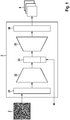
- Figure 1 shows a block diagram illustrating the process flow of an analysis of a microstructure image of a cutting surface of a probed material.
- the microstructure is obtained from a workpiece to be analyzed.
- the workpiece is cut and polished/etched to obtain a cutting surface which is scanned using an electron backscatter diffraction method as well known in the art, e.g. by means of a Scanning Electron Microscope.
- EBSD image Electro Backscatter Diffraction
- the EBSD image is used as an input for a micromechanical simulation to obtain one or more micromechanical response arrays indicating the distribution of stress, strain and/or energy levels (fatigue level values) over the cutting surface of the probed material.
- the resulting micromechanical response arrays may then be used to calculate the macroscopic mechanical properties of the workpiece made of the specifically probed material, such as the resistance of the material against fatigue, the average lifetime of the workpiece or the like.
- an artificial neural network shall be applied, which has been trained to output one or more micromechanical response arrays based on a given EBSD image.
- the EBSD image 2 is input to an artificial neural network 3 to obtain the resulting micromechanical response arrays 4.
- the EBSD image can be experimentally obtained.
- the micromechanical response arrays 4 may include arrays indicating the distribution of stress, strain and energy levels over the cutting surface.
- the dimension of the EBSD image 2 and the dimension of the resulting micromechanical response arrays 4, i.e. the stress, strain and fatigue level arrays are equal.
- the neural network 3 may be provided as a kind of artificial neural network which is able to associate resulting micromechanical response arrays to a given pixel array of an EBSD image.
- the neural network 3 comprises an input layer 31 which may receive color information of each pixel of the EBSD image and forwards them to an encoder network 32, which may be formed as a convolutional neural network. Further, optionally an indication about a mechanical load can be applied to the input layer 31 of the artificial neural network.
- the encoder network 32 outputs an intermediate vector in an intermediate layer 33.
- the intermediate layer 33 may be configured to append an indication about a load condition, such as a global pressure or force, and/or known material parameters M, such as elasticity, yield strength, and the like.
- the intermediate vector of the intermediate layer 33, the mechanical load and the material parameters M are decompressed to obtain output arrays in an output layer 36.
- the output data may include several channels of the resulting micromechanical response arrays 4. Usually, the dimension of the EBSD image and the dimension of the result stress, strain and energy/fatigue level arrays are equal.
- each pixel may be dependent on other pixels of the EBSD image as it carries spatial information (such as grids) the artificial neural network learns local spatial, pattern and texture correlation between the EBSD images and the output images.
- the encoder network 32 and the decoder network 35 may each be implemented as a convolutional neural network which is well-known in the art.
- the neural network 3 of this kind is generally known as a conditional autoencoder.
- An autoencoder is a neural network, which can learn efficient data encodings.
- the input data here the EBSD image 2
- the input data can be dimensionally reduced by configuration and training the encoder network 32 and further the intermediate vector of the intermediate layer 33, the mechanical load and the material parameter M are reconstructed so that the decoder network 35 generates a representation of the micromechanical response arrays 4.
- the training of the autoencoder i.e. the encoder network 32 and the decoder network 35, is performed as commonly known for neural networks of this kind, such as by providing sets of experimentally obtained or synthetically generated EBSD images and resulting micromechanical response arrays 4 which may be obtained by the conventional micromechanical simulation.
- resulting micromechanical response arrays 4 as resulting images can be obtained by any EBSD image. Furthermore, in case of a Bayes neural network the neural network 3 provides an uncertainty indicating the measure of how reliable the prediction of the neural network 3 is.
- FIG. 2 a flowchart is shown indicating a method for obtaining micromechanical or mechanical parameters from the given EBSD image 2.
- the method may be implemented as a hardware and/or software algorithm in a data processing device.
- step S1 the EBSD image of the sample is provided.
- the EBSD image 2 can be obtained by cutting a workpiece or material, by polishing and etching the cutting surface and by taking an electron backscatter image.
- An example of such an EBSD image is shown in Figure 1 .
- the EBSD image 2 is available in a standard image format so that an array of pixels, each having a different color code, is provided.
- the color codes of the pixel array of the EBSD image are forwarded to the neural network 3, particularly to the input layer 31, as input data.
- step S2 the neural network 3, which has been trained before, processes the input data and provides one or more resulting micromechanical response arrays 4, indicating arrays of stress, strain, fatigue/energy level and the like.
- the uncertainty of the prediction of the resulting micromechanical response arrays 4 may be retrieved from the output of the neural network 3 together with the micromechanical response arrays.
- the uncertainty of a prediction (its variance) of a neural network usually comes together with the output data.
- the uncertainty is usually computed by outputting a number of micromechanical response arrays given the same input and computing the mean and standard deviation of the various outputs.
- Most approaches generate a pixel by pixel uncertainty, which has to be aggregated to a single common uncertainty value. For instance, a maximum, a mean, or a weighted average of the pixel by pixel uncertainty can be calculated to obtain a single common uncertainty value. In case of using a weighted average domain knowledge can be used to assign a weight to the uncertainty of each pixel.
- To make the neural network 3 to output different results given the same input can be achieved by e.g. using stochastic dropout or varying some neural network parameters according to a distribution.
- step S4 it is checked whether or not the uncertainty is too high for relying on the processing results of the neural network 3. If it is found that the uncertainty is too high (Alternative: Yes), e.g. if the uncertainty indicates that the resulting micromechanical response arrays have a likelihood of correctness below an accuracy level, the process is continued with step S5 otherwise the process is continued with step S6.
- step S6 the micromechanical properties and/or the mechanical response of the probed material, such as lifetime or resistance against fatigue, are directly obtained by or derived from the micromechanical response arrays 4 in a conventional manner, as known in the art.
- the fatigue indicator parameters can then be used to predict the crack initiation time and its position in the given microstructure.
- step S1 for the next material to be probed.
- step S5 a conventional simulation of the micromechanical properties is performed in step S5.
- the resulting simulated micromechanical response arrays are further processed in step S7 to obtain the mechanical properties of the probed material, such as lifetime or resistance against fatigue.
- step S8 the simulation results of a conventional micromechanical simulation and the EBDS image it is based on, can be further used to retrain the neural network 3 so that the neural network 3 is improved for predicting the resulting micromechanical response arrays based on an EBSD image sample.
- the retrained neural network 3 can be used.
- step S1 for the next material to be probed.
Landscapes
- Engineering & Computer Science (AREA)
- Quality & Reliability (AREA)
- Computer Vision & Pattern Recognition (AREA)
- Physics & Mathematics (AREA)
- General Physics & Mathematics (AREA)
- Theoretical Computer Science (AREA)
- Investigating Strength Of Materials By Application Of Mechanical Stress (AREA)
Abstract
Description
- The present invention relates to micromechanical simulations of mechanical properties of a workpiece having a particular microstructure. Conventionally, these simulations can be based on either experimentally obtained grain data, e.g. as an EBSD (Electron Backscatter Diffraction) image, or on synthetically generated morphologies. Generally, it is a goal to simulate the microstructure-dependent mechanical behavior of a workpiece, e.g. by methods, such as the Crystal Plasticity Finite Element Method (CPFEM).
- The simulation of a microstructure to evaluate the lifetime of a workpiece with the underlying microstructure is based on fatigue indicator parameters which correspond to a material meta-response. Such a micromechanical simulation using an FEM-method is usually very complex and time-consuming.
- According to the present invention, a method for evaluating a mechanical property of a material of a workpiece according to claim 1 and a system according to the further independent claim are provided.
- Further embodiments are indicated in the depending subclaims.
- According to a first aspect, a computer-implemented method for evaluating at least one mechanical property of a material to be probed, particularly of a workpiece, comprising the steps of:
- Providing an artificial neural network being trained to associate an EBSD image, as an input, with one or more micromechanical response arrays, as a network output;
- Providing a sample EBSD image of a material to be probed for evaluating the at least one mechanical property;
- Applying the EBSD image to the neural network to obtain as network output one or more corresponding micromechanical response arrays and particularly a prediction uncertainty of the neural network;
- Determining mechanical properties of the material depending on the network output.
- Conventionally, the micromechanical response of a material is simulated by means of a Finite-Element-Method based on a microstructure EBSD image. The microstructure EBSD image is taken from a cutting surface probe of the material of a workpiece to analyze micromechanical stress, strain and energy fields in the microstructure of the material.
- One idea of the above method is to replace the costly simulation of the microstructure by means of a neural network which processes the EBSD image to obtain at least one mechanical response array. The micromechanical response array is configured to indicate local stress, strain and/or energy fields over the (cutting) surface showing the microstructure being analyzed. In other words, the micromechanical response array indicate a local mechanical condition for any pixel or pixel group of the EBSD image.
- Due to the training of the neural network, the obtained mechanical response arrays shall correspond to or resemble the resulting mechanical response arrays obtained by the conventional simulation. Using the trained neural network to obtain the results of the time-consuming micromechanical simulation allows to get a quicker indication about the micromechanical properties of a specific material and therefore of the behavior of the material. Thus, the processing of the microstructure images to obtain the mechanical response arrays by means of the neural network is more efficient than by means of the time-consuming micromechanical simulation. Therefore, micromechanical simulation results can be obtained faster.
- The determining of the mechanical properties of the material depending on the network output is made by combining the values of the respective mechanical response array pixel by pixel, e.g. by obtaining a minimum, a maximum, a mean of the pixel values of the respective mechanical response array. For instance, the fatigue indicator parameters of the respective mechanical response array can be used to predict the crack initiation time and its position in the given microstructure.
- One feature of artificial neural networks may be that in addition to the mechanical response arrays an uncertainty of the predicted result is obtained. According to a further embodiment, the uncertainty of the prediction of the artificial neural network concerning the simulation results can be used to decide whether the output of the neural network provides a sufficiently accurate prediction of the mechanical response array of the probed material or whether a conventional micromechanical simulation is to be performed. Hence, using the uncertainty of the resulting mechanical response arrays of the neural network analysis, an indication can be obtained whether the neural network analysis can be trusted or not. If the neural network analysis is too uncertain, a conventional simulation run can be performed, the results of which can further be used for improving the training of the neural network.
- According to an embodiment, the artificial neural network may be trained to associate the EBSD image together with a load condition with the one or more micromechanical response arrays; wherein the sample EBSD image of a material and a sample load condition to be probed is provided to obtain the micromechanical response. Further the load condition can be implicit, i.e.: the artificial neural network is trained to model the dependence on a fixed load. The prediction of the artificial neural network thus depends on the input (sample EBSD image) and the implicitly assumed load.
- The training samples for the artificial neural network may include EBSD images from real parts, synthetically generated images or both.
- Furthermore, the neural network may comprise an autoencoder, particularly a variational autoencoder, having an encoder network, a decoder network and an intermediate layer for holding an intermediate vector as output of the encoder network.
- Particularly, the intermediate layer may further be configured to receive and provide at least one further load condition and/or material parameter.
- It may be provided, that the one or more micromechanical response arrays may include an array of stress values, strain values and/or energy levels.
- Moreover, if the prediction uncertainty is too high, the mechanical properties of the material may be obtained by one or more corresponding micromechanical response arrays obtained by a simulation on the EBSD image.
- Moreover, the neural network may be retrained with the EBSD image of the material to be probed and the results of the simulation.
- The mechanical properties may include at least one of strength, elasticity, plasticity, hardness, toughness, brittleness, stiffness, ductility, malleability, impact strength, fatigue and creep.
- The mechanical properties of the probed material may be used for estimating the duration of lifetime of a workpiece formed by the material.
- According to a further aspect, a system for evaluating mechanical properties of a material particularly of a workpiece is provided, wherein the system is configured to carry out above method.
- Embodiments are described in more detail in conjunction with the accompanying drawings in which:
- Figure 1
- shows a block diagram illustrating the process of a microstructure analysis using a neural network; and
- Figure 2
- shows a flowchart illustrating the method for obtaining a mechanical behavior of a material.
-
Figure 1 shows a block diagram illustrating the process flow of an analysis of a microstructure image of a cutting surface of a probed material. The microstructure is obtained from a workpiece to be analyzed. The workpiece is cut and polished/etched to obtain a cutting surface which is scanned using an electron backscatter diffraction method as well known in the art, e.g. by means of a Scanning Electron Microscope. Thereby, a so called EBSD image (Electron Backscatter Diffraction) is obtained which forms the basis for an analysis of the micromechanical properties of the probed material of the workpiece. - Conventionally, the EBSD image is used as an input for a micromechanical simulation to obtain one or more micromechanical response arrays indicating the distribution of stress, strain and/or energy levels (fatigue level values) over the cutting surface of the probed material.
- The resulting micromechanical response arrays may then be used to calculate the macroscopic mechanical properties of the workpiece made of the specifically probed material, such as the resistance of the material against fatigue, the average lifetime of the workpiece or the like.
- One bottleneck for accurately evaluating such macroscopic mechanical properties of a workpiece is the very time-consuming simulation. To overcome the need for a simulation for each material to be newly probed, an artificial neural network shall be applied, which has been trained to output one or more micromechanical response arrays based on a given EBSD image.
- As shown in
Figure 1 , the EBSD image 2 is input to an artificialneural network 3 to obtain the resultingmicromechanical response arrays 4. The EBSD image can be experimentally obtained. In the present embodiment themicromechanical response arrays 4 may include arrays indicating the distribution of stress, strain and energy levels over the cutting surface. Usually, the dimension of the EBSD image 2 and the dimension of the resultingmicromechanical response arrays 4, i.e. the stress, strain and fatigue level arrays are equal. - The
neural network 3 may be provided as a kind of artificial neural network which is able to associate resulting micromechanical response arrays to a given pixel array of an EBSD image. In the present embodiment, theneural network 3 comprises aninput layer 31 which may receive color information of each pixel of the EBSD image and forwards them to anencoder network 32, which may be formed as a convolutional neural network. Further, optionally an indication about a mechanical load can be applied to theinput layer 31 of the artificial neural network. - The
encoder network 32 outputs an intermediate vector in anintermediate layer 33. Theintermediate layer 33 may be configured to append an indication about a load condition, such as a global pressure or force, and/or known material parameters M, such as elasticity, yield strength, and the like. - In the following decoder network 35, which may be formed as a convolutional neural network, the intermediate vector of the
intermediate layer 33, the mechanical load and the material parameters M are decompressed to obtain output arrays in anoutput layer 36. The output data may include several channels of the resultingmicromechanical response arrays 4. Usually, the dimension of the EBSD image and the dimension of the result stress, strain and energy/fatigue level arrays are equal. - Generally, as each pixel may be dependent on other pixels of the EBSD image as it carries spatial information (such as grids) the artificial neural network learns local spatial, pattern and texture correlation between the EBSD images and the output images.
- In the present embodiment, the
encoder network 32 and the decoder network 35 may each be implemented as a convolutional neural network which is well-known in the art. Theneural network 3 of this kind is generally known as a conditional autoencoder. An autoencoder is a neural network, which can learn efficient data encodings. The input data, here the EBSD image 2, can be dimensionally reduced by configuration and training theencoder network 32 and further the intermediate vector of theintermediate layer 33, the mechanical load and the material parameter M are reconstructed so that the decoder network 35 generates a representation of themicromechanical response arrays 4. - The training of the autoencoder, i.e. the
encoder network 32 and the decoder network 35, is performed as commonly known for neural networks of this kind, such as by providing sets of experimentally obtained or synthetically generated EBSD images and resultingmicromechanical response arrays 4 which may be obtained by the conventional micromechanical simulation. - Once the
neural network 3 has been trained, resultingmicromechanical response arrays 4 as resulting images can be obtained by any EBSD image. Furthermore, in case of a Bayes neural network theneural network 3 provides an uncertainty indicating the measure of how reliable the prediction of theneural network 3 is. - In
Figure 2 , a flowchart is shown indicating a method for obtaining micromechanical or mechanical parameters from the given EBSD image 2. The method may be implemented as a hardware and/or software algorithm in a data processing device. - In step S1, the EBSD image of the sample is provided. As explained earlier, the EBSD image 2 can be obtained by cutting a workpiece or material, by polishing and etching the cutting surface and by taking an electron backscatter image. An example of such an EBSD image is shown in
Figure 1 . The EBSD image 2 is available in a standard image format so that an array of pixels, each having a different color code, is provided. The color codes of the pixel array of the EBSD image are forwarded to theneural network 3, particularly to theinput layer 31, as input data. - In step S2, the
neural network 3, which has been trained before, processes the input data and provides one or more resultingmicromechanical response arrays 4, indicating arrays of stress, strain, fatigue/energy level and the like. - In step S3, the uncertainty of the prediction of the resulting
micromechanical response arrays 4 may be retrieved from the output of theneural network 3 together with the micromechanical response arrays. The uncertainty of a prediction (its variance) of a neural network usually comes together with the output data. The uncertainty is usually computed by outputting a number of micromechanical response arrays given the same input and computing the mean and standard deviation of the various outputs. Most approaches generate a pixel by pixel uncertainty, which has to be aggregated to a single common uncertainty value. For instance, a maximum, a mean, or a weighted average of the pixel by pixel uncertainty can be calculated to obtain a single common uncertainty value. In case of using a weighted average domain knowledge can be used to assign a weight to the uncertainty of each pixel. - To make the
neural network 3 to output different results given the same input can be achieved by e.g. using stochastic dropout or varying some neural network parameters according to a distribution. - In step S4 it is checked whether or not the uncertainty is too high for relying on the processing results of the
neural network 3. If it is found that the uncertainty is too high (Alternative: Yes), e.g. if the uncertainty indicates that the resulting micromechanical response arrays have a likelihood of correctness below an accuracy level, the process is continued with step S5 otherwise the process is continued with step S6. - In step S6 the micromechanical properties and/or the mechanical response of the probed material, such as lifetime or resistance against fatigue, are directly obtained by or derived from the
micromechanical response arrays 4 in a conventional manner, as known in the art. The fatigue indicator parameters can then be used to predict the crack initiation time and its position in the given microstructure. - Following the process is continued with step S1 for the next material to be probed.
- If it is found that the uncertainty is too high, a conventional simulation of the micromechanical properties is performed in step S5.
- The resulting simulated micromechanical response arrays are further processed in step S7 to obtain the mechanical properties of the probed material, such as lifetime or resistance against fatigue.
- In step S8, the simulation results of a conventional micromechanical simulation and the EBDS image it is based on, can be further used to retrain the
neural network 3 so that theneural network 3 is improved for predicting the resulting micromechanical response arrays based on an EBSD image sample. For following evaluation, the retrainedneural network 3 can be used. - Following the process is continued with step S1 for the next material to be probed.
Claims (13)
- Computer-implemented method for evaluating at least one mechanical property of a material to be probed particularly of a workpiece, comprising the steps of:- Providing an artificial neural network (3) being trained to associate an EBSD image (2) with one or more micromechanical response arrays (4);- Providing (S1) a sample EBSD image (2) of the material to be probed for evaluating the at least one mechanical property;- Applying (S2) the EBSD image to the neural network (3) to obtain as network output one or more corresponding micromechanical response arrays (4) and/or a prediction uncertainty of the neural network (3);- Determining (S6) mechanical properties of the material depending on the network output.
- Method according to claim 1, wherein the artificial neural network (3) is trained to associate the EBSD image (2) together with a load condition with the one or more micromechanical response arrays (4); wherein the sample EBSD image (2) of a material and a sample load condition to be probed is provided to obtain the micromechanical response.
- Method according to claim 1 or 2, wherein the neural network (3) comprises an autoencoder, particularly a variational autoencoder, having an encoder network (32), a decoder network (35) and an intermediate layer (33) for holding an intermediate vector as output of the encoder network (32).
- Method according to claim 3, wherein the intermediate layer (33) is further configured to receive and provide at least one further load condition and/or material parameter.
- Method according to any of the claims 1 to 4, wherein the one or more micromechanical response arrays (4) may include an array of stress values, strain values and/or energy levels.
- Method according to any of the claims 1 to 5, wherein, if the prediction uncertainty is too high, the mechanical properties of the material are obtained by one or more corresponding micromechanical response arrays (4) obtained by a simulation on the EBSD image (2).
- Method according to claim 6, wherein the neural network (3) is retrained with the EBSD image (2) of the material to be probed and the results of the simulation.
- Method according to any of the claims 1 to 7, wherein mechanical properties include at least one of strength, elasticity, plasticity, hardness, toughness, brittleness, stiffness, ductility, malleability, impact strength, fatigue and creep.
- Method according to any of the claims 1 to 8, wherein the mechanical properties of the probed material are used for estimating the duration of lifetime of a workpiece formed by the material.
- Method according to any of the claims 1 to 9, wherein the neural network (3) comprises a convolutional neural network.
- System for evaluating mechanical properties of a material particularly of a workpiece, wherein the system is configured to carry out the method of any of the claims 1 to 10.
- A computer program comprising instructions which, when the program is executed by a computer, cause the computer to carry out the steps of the method of any of the claims 1 to 10.
- A machine-readable storage medium comprising instructions which, when executed by a data processing unit, cause the data processing unit to carry out the steps of the method of any of the claims 1 to 10.
Priority Applications (1)
| Application Number | Priority Date | Filing Date | Title |
|---|---|---|---|
| EP19196081.4A EP3789956B1 (en) | 2019-09-09 | 2019-09-09 | Method and system for analyzing the mechanical response of microstructures under investigation |
Applications Claiming Priority (1)
| Application Number | Priority Date | Filing Date | Title |
|---|---|---|---|
| EP19196081.4A EP3789956B1 (en) | 2019-09-09 | 2019-09-09 | Method and system for analyzing the mechanical response of microstructures under investigation |
Publications (2)
| Publication Number | Publication Date |
|---|---|
| EP3789956A1 true EP3789956A1 (en) | 2021-03-10 |
| EP3789956B1 EP3789956B1 (en) | 2025-12-10 |
Family
ID=67902334
Family Applications (1)
| Application Number | Title | Priority Date | Filing Date |
|---|---|---|---|
| EP19196081.4A Active EP3789956B1 (en) | 2019-09-09 | 2019-09-09 | Method and system for analyzing the mechanical response of microstructures under investigation |
Country Status (1)
| Country | Link |
|---|---|
| EP (1) | EP3789956B1 (en) |
Cited By (1)
| Publication number | Priority date | Publication date | Assignee | Title |
|---|---|---|---|---|
| CN113033106A (en) * | 2021-04-06 | 2021-06-25 | 东北大学 | Steel material performance prediction method based on EBSD and deep learning method |
Citations (1)
| Publication number | Priority date | Publication date | Assignee | Title |
|---|---|---|---|---|
| CN108229062A (en) * | 2018-01-31 | 2018-06-29 | 西安科技大学 | Method based on sensibility micro-parameter prediction cemented fill mechanical response characteristic |
-
2019
- 2019-09-09 EP EP19196081.4A patent/EP3789956B1/en active Active
Patent Citations (1)
| Publication number | Priority date | Publication date | Assignee | Title |
|---|---|---|---|---|
| CN108229062A (en) * | 2018-01-31 | 2018-06-29 | 西安科技大学 | Method based on sensibility micro-parameter prediction cemented fill mechanical response characteristic |
Non-Patent Citations (3)
| Title |
|---|
| BRIAN GALLAGHER ET AL: "Predicting Compressive Strength of Consolidated Molecular Solids Using Computer Vision and Deep Learning", ARXIV.ORG, CORNELL UNIVERSITY LIBRARY, 201 OLIN LIBRARY CORNELL UNIVERSITY ITHACA, NY 14853, 5 June 2019 (2019-06-05), XP081528937 * |
| XIANG LI ET AL: "Predicting the effective mechanical property of heterogeneous materials by image based modeling and deep learning", COMPUTER METHODS IN APPLIED MECHANICS AND ENGINEERING, vol. 347, 14 January 2019 (2019-01-14), AMSTERDAM, NL, pages 735 - 753, XP055673998, ISSN: 0045-7825, DOI: 10.1016/j.cma.2019.01.005 * |
| XUEBIN QIN ET AL: "Prediction of Mechanical Strength Based on Deep Learning Using the Scanning Electron Image of Microscopic Cemented Paste Backfill", ADVANCES IN CIVIL ENGINEERING, vol. 2018, 1 November 2018 (2018-11-01), pages 1 - 7, XP055673995, ISSN: 1687-8086, DOI: 10.1155/2018/6245728 * |
Cited By (2)
| Publication number | Priority date | Publication date | Assignee | Title |
|---|---|---|---|---|
| CN113033106A (en) * | 2021-04-06 | 2021-06-25 | 东北大学 | Steel material performance prediction method based on EBSD and deep learning method |
| CN113033106B (en) * | 2021-04-06 | 2023-09-19 | 东北大学 | A steel material performance prediction method based on EBSD and deep learning methods |
Also Published As
| Publication number | Publication date |
|---|---|
| EP3789956B1 (en) | 2025-12-10 |
Similar Documents
| Publication | Publication Date | Title |
|---|---|---|
| CN112069697B (en) | Accelerated degradation test statistical analysis method under dependent competition condition of multiple stress and multiple failure modes | |
| KR102216306B1 (en) | System and method for predicting fatigue life of ship | |
| CN113065702B (en) | Landslide displacement multi-linear prediction method based on ST-SEEP segmentation method and space-time ARMA model | |
| EP3789904A1 (en) | Method and system for calibrating a simulation system for simulating micromechanical response characteristics of microstructures under investigation | |
| CN117594164A (en) | Calculation and evaluation method and system for residual fatigue life of metal structures based on digital twin | |
| JP7017712B2 (en) | Relationship analyzers, relationship analysis methods and programs | |
| EP3992657B1 (en) | High-resolution sound source map obtaining and analyzing method and system using artificial intelligence neural network | |
| CN110209150B (en) | Job shop scheduling scheme robustness measuring method based on multi-process fault influence | |
| WO2021076937A1 (en) | Die level product modeling without die level input data | |
| EP3789956B1 (en) | Method and system for analyzing the mechanical response of microstructures under investigation | |
| CN116258087B (en) | Matte grade soft measurement method and device, electronic equipment and storage medium | |
| Banerjee et al. | Robust data-driven online learning algorithm for precise structural damage localization using stochastic subspace identification | |
| CN115394380B (en) | A prediction method for material-related parameters based on random degradation processes | |
| CN114357778B (en) | Cable force self-adaptive identification method in long-term monitoring scene | |
| CN110879530A (en) | Methods for safe training of dynamic models | |
| CN115270961A (en) | Method and system for repairing fouling process data, electronic equipment and storage medium | |
| CN118553359B (en) | Method and system for evaluating durability of steel-concrete composite beam | |
| CN111241614B (en) | Engineering structure load inversion method based on condition generation confrontation network model | |
| Kamper et al. | Making modal analysis easy and more reliable–Reference points identification by experimental prestudy | |
| CN117058451B (en) | A method for detecting structural acceleration data anomalies based on two-dimensional convolutional neural networks | |
| CN114965120B (en) | Material mechanical parameter identification method based on artificial neural network and indentation test | |
| EP2372531A1 (en) | Software modification estimate method and software modification estimate system | |
| CN116911160A (en) | Dynamic increment-based residual life prediction method, device and medium | |
| Gardonyi et al. | An enhanced evaluation method of sequential probability ratio test | |
| Wright | How to implement a PoD into a highly effective inspection strategy |
Legal Events
| Date | Code | Title | Description |
|---|---|---|---|
| PUAI | Public reference made under article 153(3) epc to a published international application that has entered the european phase |
Free format text: ORIGINAL CODE: 0009012 |
|
| STAA | Information on the status of an ep patent application or granted ep patent |
Free format text: STATUS: THE APPLICATION HAS BEEN PUBLISHED |
|
| AK | Designated contracting states |
Kind code of ref document: A1 Designated state(s): AL AT BE BG CH CY CZ DE DK EE ES FI FR GB GR HR HU IE IS IT LI LT LU LV MC MK MT NL NO PL PT RO RS SE SI SK SM TR |
|
| AX | Request for extension of the european patent |
Extension state: BA ME |
|
| STAA | Information on the status of an ep patent application or granted ep patent |
Free format text: STATUS: REQUEST FOR EXAMINATION WAS MADE |
|
| 17P | Request for examination filed |
Effective date: 20210910 |
|
| RBV | Designated contracting states (corrected) |
Designated state(s): AL AT BE BG CH CY CZ DE DK EE ES FI FR GB GR HR HU IE IS IT LI LT LU LV MC MK MT NL NO PL PT RO RS SE SI SK SM TR |
|
| STAA | Information on the status of an ep patent application or granted ep patent |
Free format text: STATUS: EXAMINATION IS IN PROGRESS |
|
| 17Q | First examination report despatched |
Effective date: 20230704 |
|
| GRAP | Despatch of communication of intention to grant a patent |
Free format text: ORIGINAL CODE: EPIDOSNIGR1 |
|
| STAA | Information on the status of an ep patent application or granted ep patent |
Free format text: STATUS: GRANT OF PATENT IS INTENDED |
|
| INTG | Intention to grant announced |
Effective date: 20250630 |
|
| GRAS | Grant fee paid |
Free format text: ORIGINAL CODE: EPIDOSNIGR3 |
|
| GRAA | (expected) grant |
Free format text: ORIGINAL CODE: 0009210 |
|
| STAA | Information on the status of an ep patent application or granted ep patent |
Free format text: STATUS: THE PATENT HAS BEEN GRANTED |
|
| AK | Designated contracting states |
Kind code of ref document: B1 Designated state(s): AL AT BE BG CH CY CZ DE DK EE ES FI FR GB GR HR HU IE IS IT LI LT LU LV MC MK MT NL NO PL PT RO RS SE SI SK SM TR |
|
| REG | Reference to a national code |
Ref country code: CH Ref legal event code: F10 Free format text: ST27 STATUS EVENT CODE: U-0-0-F10-F00 (AS PROVIDED BY THE NATIONAL OFFICE) Effective date: 20251210 Ref country code: GB Ref legal event code: FG4D |
|
| REG | Reference to a national code |
Ref country code: DE Ref legal event code: R096 Ref document number: 602019078982 Country of ref document: DE |
|
| REG | Reference to a national code |
Ref country code: IE Ref legal event code: FG4D |
|
| PG25 | Lapsed in a contracting state [announced via postgrant information from national office to epo] |
Ref country code: ES Free format text: LAPSE BECAUSE OF FAILURE TO SUBMIT A TRANSLATION OF THE DESCRIPTION OR TO PAY THE FEE WITHIN THE PRESCRIBED TIME-LIMIT Effective date: 20251210 |
|
| REG | Reference to a national code |
Ref country code: LT Ref legal event code: MG9D |
|
| PG25 | Lapsed in a contracting state [announced via postgrant information from national office to epo] |
Ref country code: NO Free format text: LAPSE BECAUSE OF FAILURE TO SUBMIT A TRANSLATION OF THE DESCRIPTION OR TO PAY THE FEE WITHIN THE PRESCRIBED TIME-LIMIT Effective date: 20260310 |
|
| PG25 | Lapsed in a contracting state [announced via postgrant information from national office to epo] |
Ref country code: FI Free format text: LAPSE BECAUSE OF FAILURE TO SUBMIT A TRANSLATION OF THE DESCRIPTION OR TO PAY THE FEE WITHIN THE PRESCRIBED TIME-LIMIT Effective date: 20251210 Ref country code: HR Free format text: LAPSE BECAUSE OF FAILURE TO SUBMIT A TRANSLATION OF THE DESCRIPTION OR TO PAY THE FEE WITHIN THE PRESCRIBED TIME-LIMIT Effective date: 20251210 |
|
| REG | Reference to a national code |
Ref country code: NL Ref legal event code: MP Effective date: 20251210 |
|
| PG25 | Lapsed in a contracting state [announced via postgrant information from national office to epo] |
Ref country code: RS Free format text: LAPSE BECAUSE OF FAILURE TO SUBMIT A TRANSLATION OF THE DESCRIPTION OR TO PAY THE FEE WITHIN THE PRESCRIBED TIME-LIMIT Effective date: 20260310 |
|
| PG25 | Lapsed in a contracting state [announced via postgrant information from national office to epo] |
Ref country code: LV Free format text: LAPSE BECAUSE OF FAILURE TO SUBMIT A TRANSLATION OF THE DESCRIPTION OR TO PAY THE FEE WITHIN THE PRESCRIBED TIME-LIMIT Effective date: 20251210 |
|
| PG25 | Lapsed in a contracting state [announced via postgrant information from national office to epo] |
Ref country code: BG Free format text: LAPSE BECAUSE OF FAILURE TO SUBMIT A TRANSLATION OF THE DESCRIPTION OR TO PAY THE FEE WITHIN THE PRESCRIBED TIME-LIMIT Effective date: 20251210 |