EP3789426A1 - Polyarylether ketone imide sulfone adhesives - Google Patents
Polyarylether ketone imide sulfone adhesives Download PDFInfo
- Publication number
- EP3789426A1 EP3789426A1 EP20193961.8A EP20193961A EP3789426A1 EP 3789426 A1 EP3789426 A1 EP 3789426A1 EP 20193961 A EP20193961 A EP 20193961A EP 3789426 A1 EP3789426 A1 EP 3789426A1
- Authority
- EP
- European Patent Office
- Prior art keywords
- mol
- composition
- polymers
- kda
- aspects
- Prior art date
- Legal status (The legal status is an assumption and is not a legal conclusion. Google has not performed a legal analysis and makes no representation as to the accuracy of the status listed.)
- Withdrawn
Links
- 0 **C(c1ccccc1)=O Chemical compound **C(c1ccccc1)=O 0.000 description 4
Images




Classifications
-
- C—CHEMISTRY; METALLURGY
- C09—DYES; PAINTS; POLISHES; NATURAL RESINS; ADHESIVES; COMPOSITIONS NOT OTHERWISE PROVIDED FOR; APPLICATIONS OF MATERIALS NOT OTHERWISE PROVIDED FOR
- C09J—ADHESIVES; NON-MECHANICAL ASPECTS OF ADHESIVE PROCESSES IN GENERAL; ADHESIVE PROCESSES NOT PROVIDED FOR ELSEWHERE; USE OF MATERIALS AS ADHESIVES
- C09J7/00—Adhesives in the form of films or foils
- C09J7/10—Adhesives in the form of films or foils without carriers
-
- B—PERFORMING OPERATIONS; TRANSPORTING
- B29—WORKING OF PLASTICS; WORKING OF SUBSTANCES IN A PLASTIC STATE IN GENERAL
- B29C—SHAPING OR JOINING OF PLASTICS; SHAPING OF MATERIAL IN A PLASTIC STATE, NOT OTHERWISE PROVIDED FOR; AFTER-TREATMENT OF THE SHAPED PRODUCTS, e.g. REPAIRING
- B29C64/00—Additive manufacturing, i.e. manufacturing of three-dimensional [3D] objects by additive deposition, additive agglomeration or additive layering, e.g. by 3D printing, stereolithography or selective laser sintering
- B29C64/10—Processes of additive manufacturing
- B29C64/141—Processes of additive manufacturing using only solid materials
- B29C64/153—Processes of additive manufacturing using only solid materials using layers of powder being selectively joined, e.g. by selective laser sintering or melting
-
- B—PERFORMING OPERATIONS; TRANSPORTING
- B29—WORKING OF PLASTICS; WORKING OF SUBSTANCES IN A PLASTIC STATE IN GENERAL
- B29C—SHAPING OR JOINING OF PLASTICS; SHAPING OF MATERIAL IN A PLASTIC STATE, NOT OTHERWISE PROVIDED FOR; AFTER-TREATMENT OF THE SHAPED PRODUCTS, e.g. REPAIRING
- B29C64/00—Additive manufacturing, i.e. manufacturing of three-dimensional [3D] objects by additive deposition, additive agglomeration or additive layering, e.g. by 3D printing, stereolithography or selective laser sintering
- B29C64/10—Processes of additive manufacturing
- B29C64/165—Processes of additive manufacturing using a combination of solid and fluid materials, e.g. a powder selectively bound by a liquid binder, catalyst, inhibitor or energy absorber
-
- B—PERFORMING OPERATIONS; TRANSPORTING
- B29—WORKING OF PLASTICS; WORKING OF SUBSTANCES IN A PLASTIC STATE IN GENERAL
- B29C—SHAPING OR JOINING OF PLASTICS; SHAPING OF MATERIAL IN A PLASTIC STATE, NOT OTHERWISE PROVIDED FOR; AFTER-TREATMENT OF THE SHAPED PRODUCTS, e.g. REPAIRING
- B29C65/00—Joining or sealing of preformed parts, e.g. welding of plastics materials; Apparatus therefor
- B29C65/48—Joining or sealing of preformed parts, e.g. welding of plastics materials; Apparatus therefor using adhesives, i.e. using supplementary joining material; solvent bonding
- B29C65/4805—Joining or sealing of preformed parts, e.g. welding of plastics materials; Apparatus therefor using adhesives, i.e. using supplementary joining material; solvent bonding characterised by the type of adhesives
- B29C65/483—Reactive adhesives, e.g. chemically curing adhesives
- B29C65/4835—Heat curing adhesives
-
- B—PERFORMING OPERATIONS; TRANSPORTING
- B33—ADDITIVE MANUFACTURING TECHNOLOGY
- B33Y—ADDITIVE MANUFACTURING, i.e. MANUFACTURING OF THREE-DIMENSIONAL [3D] OBJECTS BY ADDITIVE DEPOSITION, ADDITIVE AGGLOMERATION OR ADDITIVE LAYERING, e.g. BY 3D PRINTING, STEREOLITHOGRAPHY OR SELECTIVE LASER SINTERING
- B33Y10/00—Processes of additive manufacturing
-
- B—PERFORMING OPERATIONS; TRANSPORTING
- B33—ADDITIVE MANUFACTURING TECHNOLOGY
- B33Y—ADDITIVE MANUFACTURING, i.e. MANUFACTURING OF THREE-DIMENSIONAL [3D] OBJECTS BY ADDITIVE DEPOSITION, ADDITIVE AGGLOMERATION OR ADDITIVE LAYERING, e.g. BY 3D PRINTING, STEREOLITHOGRAPHY OR SELECTIVE LASER SINTERING
- B33Y70/00—Materials specially adapted for additive manufacturing
- B33Y70/10—Composites of different types of material, e.g. mixtures of ceramics and polymers or mixtures of metals and biomaterials
-
- C—CHEMISTRY; METALLURGY
- C08—ORGANIC MACROMOLECULAR COMPOUNDS; THEIR PREPARATION OR CHEMICAL WORKING-UP; COMPOSITIONS BASED THEREON
- C08G—MACROMOLECULAR COMPOUNDS OBTAINED OTHERWISE THAN BY REACTIONS ONLY INVOLVING UNSATURATED CARBON-TO-CARBON BONDS
- C08G61/00—Macromolecular compounds obtained by reactions forming a carbon-to-carbon link in the main chain of the macromolecule
- C08G61/12—Macromolecular compounds containing atoms other than carbon in the main chain of the macromolecule
- C08G61/127—Macromolecular compounds containing atoms other than carbon in the main chain of the macromolecule derived from carbon dioxide, carbonyl halide, carboxylic acids or their derivatives
-
- C—CHEMISTRY; METALLURGY
- C08—ORGANIC MACROMOLECULAR COMPOUNDS; THEIR PREPARATION OR CHEMICAL WORKING-UP; COMPOSITIONS BASED THEREON
- C08G—MACROMOLECULAR COMPOUNDS OBTAINED OTHERWISE THAN BY REACTIONS ONLY INVOLVING UNSATURATED CARBON-TO-CARBON BONDS
- C08G65/00—Macromolecular compounds obtained by reactions forming an ether link in the main chain of the macromolecule
- C08G65/34—Macromolecular compounds obtained by reactions forming an ether link in the main chain of the macromolecule from hydroxy compounds or their metallic derivatives
- C08G65/38—Macromolecular compounds obtained by reactions forming an ether link in the main chain of the macromolecule from hydroxy compounds or their metallic derivatives derived from phenols
- C08G65/40—Macromolecular compounds obtained by reactions forming an ether link in the main chain of the macromolecule from hydroxy compounds or their metallic derivatives derived from phenols from phenols (I) and other compounds (II), e.g. OH-Ar-OH + X-Ar-X, where X is halogen atom, i.e. leaving group
- C08G65/4012—Other compound (II) containing a ketone group, e.g. X-Ar-C(=O)-Ar-X for polyetherketones
-
- C—CHEMISTRY; METALLURGY
- C08—ORGANIC MACROMOLECULAR COMPOUNDS; THEIR PREPARATION OR CHEMICAL WORKING-UP; COMPOSITIONS BASED THEREON
- C08G—MACROMOLECULAR COMPOUNDS OBTAINED OTHERWISE THAN BY REACTIONS ONLY INVOLVING UNSATURATED CARBON-TO-CARBON BONDS
- C08G73/00—Macromolecular compounds obtained by reactions forming a linkage containing nitrogen with or without oxygen or carbon in the main chain of the macromolecule, not provided for in groups C08G12/00 - C08G71/00
- C08G73/06—Polycondensates having nitrogen-containing heterocyclic rings in the main chain of the macromolecule
- C08G73/10—Polyimides; Polyester-imides; Polyamide-imides; Polyamide acids or similar polyimide precursors
- C08G73/1046—Polyimides containing oxygen in the form of ether bonds in the main chain
-
- C—CHEMISTRY; METALLURGY
- C08—ORGANIC MACROMOLECULAR COMPOUNDS; THEIR PREPARATION OR CHEMICAL WORKING-UP; COMPOSITIONS BASED THEREON
- C08G—MACROMOLECULAR COMPOUNDS OBTAINED OTHERWISE THAN BY REACTIONS ONLY INVOLVING UNSATURATED CARBON-TO-CARBON BONDS
- C08G73/00—Macromolecular compounds obtained by reactions forming a linkage containing nitrogen with or without oxygen or carbon in the main chain of the macromolecule, not provided for in groups C08G12/00 - C08G71/00
- C08G73/06—Polycondensates having nitrogen-containing heterocyclic rings in the main chain of the macromolecule
- C08G73/10—Polyimides; Polyester-imides; Polyamide-imides; Polyamide acids or similar polyimide precursors
- C08G73/1046—Polyimides containing oxygen in the form of ether bonds in the main chain
- C08G73/105—Polyimides containing oxygen in the form of ether bonds in the main chain with oxygen only in the diamino moiety
-
- C—CHEMISTRY; METALLURGY
- C08—ORGANIC MACROMOLECULAR COMPOUNDS; THEIR PREPARATION OR CHEMICAL WORKING-UP; COMPOSITIONS BASED THEREON
- C08G—MACROMOLECULAR COMPOUNDS OBTAINED OTHERWISE THAN BY REACTIONS ONLY INVOLVING UNSATURATED CARBON-TO-CARBON BONDS
- C08G73/00—Macromolecular compounds obtained by reactions forming a linkage containing nitrogen with or without oxygen or carbon in the main chain of the macromolecule, not provided for in groups C08G12/00 - C08G71/00
- C08G73/06—Polycondensates having nitrogen-containing heterocyclic rings in the main chain of the macromolecule
- C08G73/10—Polyimides; Polyester-imides; Polyamide-imides; Polyamide acids or similar polyimide precursors
- C08G73/1057—Polyimides containing other atoms than carbon, hydrogen, nitrogen or oxygen in the main chain
- C08G73/1064—Polyimides containing other atoms than carbon, hydrogen, nitrogen or oxygen in the main chain containing sulfur
-
- C—CHEMISTRY; METALLURGY
- C08—ORGANIC MACROMOLECULAR COMPOUNDS; THEIR PREPARATION OR CHEMICAL WORKING-UP; COMPOSITIONS BASED THEREON
- C08G—MACROMOLECULAR COMPOUNDS OBTAINED OTHERWISE THAN BY REACTIONS ONLY INVOLVING UNSATURATED CARBON-TO-CARBON BONDS
- C08G73/00—Macromolecular compounds obtained by reactions forming a linkage containing nitrogen with or without oxygen or carbon in the main chain of the macromolecule, not provided for in groups C08G12/00 - C08G71/00
- C08G73/06—Polycondensates having nitrogen-containing heterocyclic rings in the main chain of the macromolecule
- C08G73/10—Polyimides; Polyester-imides; Polyamide-imides; Polyamide acids or similar polyimide precursors
- C08G73/1067—Wholly aromatic polyimides, i.e. having both tetracarboxylic and diamino moieties aromatically bound
- C08G73/1071—Wholly aromatic polyimides containing oxygen in the form of ether bonds in the main chain
-
- C—CHEMISTRY; METALLURGY
- C08—ORGANIC MACROMOLECULAR COMPOUNDS; THEIR PREPARATION OR CHEMICAL WORKING-UP; COMPOSITIONS BASED THEREON
- C08G—MACROMOLECULAR COMPOUNDS OBTAINED OTHERWISE THAN BY REACTIONS ONLY INVOLVING UNSATURATED CARBON-TO-CARBON BONDS
- C08G75/00—Macromolecular compounds obtained by reactions forming a linkage containing sulfur with or without nitrogen, oxygen, or carbon in the main chain of the macromolecule
- C08G75/20—Polysulfones
- C08G75/23—Polyethersulfones
-
- C—CHEMISTRY; METALLURGY
- C08—ORGANIC MACROMOLECULAR COMPOUNDS; THEIR PREPARATION OR CHEMICAL WORKING-UP; COMPOSITIONS BASED THEREON
- C08G—MACROMOLECULAR COMPOUNDS OBTAINED OTHERWISE THAN BY REACTIONS ONLY INVOLVING UNSATURATED CARBON-TO-CARBON BONDS
- C08G81/00—Macromolecular compounds obtained by interreacting polymers in the absence of monomers, e.g. block polymers
-
- C—CHEMISTRY; METALLURGY
- C08—ORGANIC MACROMOLECULAR COMPOUNDS; THEIR PREPARATION OR CHEMICAL WORKING-UP; COMPOSITIONS BASED THEREON
- C08J—WORKING-UP; GENERAL PROCESSES OF COMPOUNDING; AFTER-TREATMENT NOT COVERED BY SUBCLASSES C08B, C08C, C08F, C08G or C08H
- C08J5/00—Manufacture of articles or shaped materials containing macromolecular substances
- C08J5/12—Bonding of a preformed macromolecular material to the same or other solid material such as metal, glass, leather, e.g. using adhesives
- C08J5/124—Bonding of a preformed macromolecular material to the same or other solid material such as metal, glass, leather, e.g. using adhesives using adhesives based on a macromolecular component
- C08J5/128—Adhesives without diluent
-
- C—CHEMISTRY; METALLURGY
- C08—ORGANIC MACROMOLECULAR COMPOUNDS; THEIR PREPARATION OR CHEMICAL WORKING-UP; COMPOSITIONS BASED THEREON
- C08J—WORKING-UP; GENERAL PROCESSES OF COMPOUNDING; AFTER-TREATMENT NOT COVERED BY SUBCLASSES C08B, C08C, C08F, C08G or C08H
- C08J5/00—Manufacture of articles or shaped materials containing macromolecular substances
- C08J5/18—Manufacture of films or sheets
-
- C—CHEMISTRY; METALLURGY
- C08—ORGANIC MACROMOLECULAR COMPOUNDS; THEIR PREPARATION OR CHEMICAL WORKING-UP; COMPOSITIONS BASED THEREON
- C08K—Use of inorganic or non-macromolecular organic substances as compounding ingredients
- C08K7/00—Use of ingredients characterised by shape
- C08K7/02—Fibres or whiskers
-
- C—CHEMISTRY; METALLURGY
- C08—ORGANIC MACROMOLECULAR COMPOUNDS; THEIR PREPARATION OR CHEMICAL WORKING-UP; COMPOSITIONS BASED THEREON
- C08L—COMPOSITIONS OF MACROMOLECULAR COMPOUNDS
- C08L79/00—Compositions of macromolecular compounds obtained by reactions forming in the main chain of the macromolecule a linkage containing nitrogen with or without oxygen or carbon only, not provided for in groups C08L61/00 - C08L77/00
- C08L79/04—Polycondensates having nitrogen-containing heterocyclic rings in the main chain; Polyhydrazides; Polyamide acids or similar polyimide precursors
- C08L79/08—Polyimides; Polyester-imides; Polyamide-imides; Polyamide acids or similar polyimide precursors
-
- C—CHEMISTRY; METALLURGY
- C08—ORGANIC MACROMOLECULAR COMPOUNDS; THEIR PREPARATION OR CHEMICAL WORKING-UP; COMPOSITIONS BASED THEREON
- C08L—COMPOSITIONS OF MACROMOLECULAR COMPOUNDS
- C08L81/00—Compositions of macromolecular compounds obtained by reactions forming in the main chain of the macromolecule a linkage containing sulfur with or without nitrogen, oxygen or carbon only; Compositions of polysulfones; Compositions of derivatives of such polymers
- C08L81/06—Polysulfones; Polyethersulfones
-
- C—CHEMISTRY; METALLURGY
- C09—DYES; PAINTS; POLISHES; NATURAL RESINS; ADHESIVES; COMPOSITIONS NOT OTHERWISE PROVIDED FOR; APPLICATIONS OF MATERIALS NOT OTHERWISE PROVIDED FOR
- C09J—ADHESIVES; NON-MECHANICAL ASPECTS OF ADHESIVE PROCESSES IN GENERAL; ADHESIVE PROCESSES NOT PROVIDED FOR ELSEWHERE; USE OF MATERIALS AS ADHESIVES
- C09J165/00—Adhesives based on macromolecular compounds obtained by reactions forming a carbon-to-carbon link in the main chain; Adhesives based on derivatives of such polymers
-
- C—CHEMISTRY; METALLURGY
- C09—DYES; PAINTS; POLISHES; NATURAL RESINS; ADHESIVES; COMPOSITIONS NOT OTHERWISE PROVIDED FOR; APPLICATIONS OF MATERIALS NOT OTHERWISE PROVIDED FOR
- C09J—ADHESIVES; NON-MECHANICAL ASPECTS OF ADHESIVE PROCESSES IN GENERAL; ADHESIVE PROCESSES NOT PROVIDED FOR ELSEWHERE; USE OF MATERIALS AS ADHESIVES
- C09J165/00—Adhesives based on macromolecular compounds obtained by reactions forming a carbon-to-carbon link in the main chain; Adhesives based on derivatives of such polymers
- C09J165/02—Polyphenylenes
-
- C—CHEMISTRY; METALLURGY
- C09—DYES; PAINTS; POLISHES; NATURAL RESINS; ADHESIVES; COMPOSITIONS NOT OTHERWISE PROVIDED FOR; APPLICATIONS OF MATERIALS NOT OTHERWISE PROVIDED FOR
- C09J—ADHESIVES; NON-MECHANICAL ASPECTS OF ADHESIVE PROCESSES IN GENERAL; ADHESIVE PROCESSES NOT PROVIDED FOR ELSEWHERE; USE OF MATERIALS AS ADHESIVES
- C09J171/00—Adhesives based on polyethers obtained by reactions forming an ether link in the main chain; Adhesives based on derivatives of such polymers
-
- C—CHEMISTRY; METALLURGY
- C09—DYES; PAINTS; POLISHES; NATURAL RESINS; ADHESIVES; COMPOSITIONS NOT OTHERWISE PROVIDED FOR; APPLICATIONS OF MATERIALS NOT OTHERWISE PROVIDED FOR
- C09J—ADHESIVES; NON-MECHANICAL ASPECTS OF ADHESIVE PROCESSES IN GENERAL; ADHESIVE PROCESSES NOT PROVIDED FOR ELSEWHERE; USE OF MATERIALS AS ADHESIVES
- C09J5/00—Adhesive processes in general; Adhesive processes not provided for elsewhere, e.g. relating to primers
- C09J5/04—Adhesive processes in general; Adhesive processes not provided for elsewhere, e.g. relating to primers involving separate application of adhesive ingredients to the different surfaces to be joined
-
- C—CHEMISTRY; METALLURGY
- C09—DYES; PAINTS; POLISHES; NATURAL RESINS; ADHESIVES; COMPOSITIONS NOT OTHERWISE PROVIDED FOR; APPLICATIONS OF MATERIALS NOT OTHERWISE PROVIDED FOR
- C09J—ADHESIVES; NON-MECHANICAL ASPECTS OF ADHESIVE PROCESSES IN GENERAL; ADHESIVE PROCESSES NOT PROVIDED FOR ELSEWHERE; USE OF MATERIALS AS ADHESIVES
- C09J5/00—Adhesive processes in general; Adhesive processes not provided for elsewhere, e.g. relating to primers
- C09J5/06—Adhesive processes in general; Adhesive processes not provided for elsewhere, e.g. relating to primers involving heating of the applied adhesive
-
- B—PERFORMING OPERATIONS; TRANSPORTING
- B29—WORKING OF PLASTICS; WORKING OF SUBSTANCES IN A PLASTIC STATE IN GENERAL
- B29K—INDEXING SCHEME ASSOCIATED WITH SUBCLASSES B29B, B29C OR B29D, RELATING TO MOULDING MATERIALS OR TO MATERIALS FOR MOULDS, REINFORCEMENTS, FILLERS OR PREFORMED PARTS, e.g. INSERTS
- B29K2065/00—Use of polyphenylenes or polyxylylenes as moulding material
-
- B—PERFORMING OPERATIONS; TRANSPORTING
- B29—WORKING OF PLASTICS; WORKING OF SUBSTANCES IN A PLASTIC STATE IN GENERAL
- B29L—INDEXING SCHEME ASSOCIATED WITH SUBCLASS B29C, RELATING TO PARTICULAR ARTICLES
- B29L2031/00—Other particular articles
- B29L2031/30—Vehicles, e.g. ships or aircraft, or body parts thereof
- B29L2031/3076—Aircrafts
-
- C—CHEMISTRY; METALLURGY
- C08—ORGANIC MACROMOLECULAR COMPOUNDS; THEIR PREPARATION OR CHEMICAL WORKING-UP; COMPOSITIONS BASED THEREON
- C08G—MACROMOLECULAR COMPOUNDS OBTAINED OTHERWISE THAN BY REACTIONS ONLY INVOLVING UNSATURATED CARBON-TO-CARBON BONDS
- C08G2170/00—Compositions for adhesives
- C08G2170/20—Compositions for hot melt adhesives
-
- C—CHEMISTRY; METALLURGY
- C08—ORGANIC MACROMOLECULAR COMPOUNDS; THEIR PREPARATION OR CHEMICAL WORKING-UP; COMPOSITIONS BASED THEREON
- C08G—MACROMOLECULAR COMPOUNDS OBTAINED OTHERWISE THAN BY REACTIONS ONLY INVOLVING UNSATURATED CARBON-TO-CARBON BONDS
- C08G2261/00—Macromolecular compounds obtained by reactions forming a carbon-to-carbon link in the main chain of the macromolecule
- C08G2261/10—Definition of the polymer structure
- C08G2261/12—Copolymers
-
- C—CHEMISTRY; METALLURGY
- C08—ORGANIC MACROMOLECULAR COMPOUNDS; THEIR PREPARATION OR CHEMICAL WORKING-UP; COMPOSITIONS BASED THEREON
- C08G—MACROMOLECULAR COMPOUNDS OBTAINED OTHERWISE THAN BY REACTIONS ONLY INVOLVING UNSATURATED CARBON-TO-CARBON BONDS
- C08G2261/00—Macromolecular compounds obtained by reactions forming a carbon-to-carbon link in the main chain of the macromolecule
- C08G2261/10—Definition of the polymer structure
- C08G2261/12—Copolymers
- C08G2261/122—Copolymers statistical
-
- C—CHEMISTRY; METALLURGY
- C08—ORGANIC MACROMOLECULAR COMPOUNDS; THEIR PREPARATION OR CHEMICAL WORKING-UP; COMPOSITIONS BASED THEREON
- C08G—MACROMOLECULAR COMPOUNDS OBTAINED OTHERWISE THAN BY REACTIONS ONLY INVOLVING UNSATURATED CARBON-TO-CARBON BONDS
- C08G2261/00—Macromolecular compounds obtained by reactions forming a carbon-to-carbon link in the main chain of the macromolecule
- C08G2261/10—Definition of the polymer structure
- C08G2261/12—Copolymers
- C08G2261/126—Copolymers block
-
- C—CHEMISTRY; METALLURGY
- C08—ORGANIC MACROMOLECULAR COMPOUNDS; THEIR PREPARATION OR CHEMICAL WORKING-UP; COMPOSITIONS BASED THEREON
- C08G—MACROMOLECULAR COMPOUNDS OBTAINED OTHERWISE THAN BY REACTIONS ONLY INVOLVING UNSATURATED CARBON-TO-CARBON BONDS
- C08G2261/00—Macromolecular compounds obtained by reactions forming a carbon-to-carbon link in the main chain of the macromolecule
- C08G2261/10—Definition of the polymer structure
- C08G2261/16—End groups
- C08G2261/164—End groups comprising organic end groups
- C08G2261/1646—End groups comprising organic end groups comprising aromatic or heteroaromatic end groups
-
- C—CHEMISTRY; METALLURGY
- C08—ORGANIC MACROMOLECULAR COMPOUNDS; THEIR PREPARATION OR CHEMICAL WORKING-UP; COMPOSITIONS BASED THEREON
- C08G—MACROMOLECULAR COMPOUNDS OBTAINED OTHERWISE THAN BY REACTIONS ONLY INVOLVING UNSATURATED CARBON-TO-CARBON BONDS
- C08G2261/00—Macromolecular compounds obtained by reactions forming a carbon-to-carbon link in the main chain of the macromolecule
- C08G2261/10—Definition of the polymer structure
- C08G2261/22—Molecular weight
- C08G2261/228—Polymers, i.e. more than 10 repeat units
-
- C—CHEMISTRY; METALLURGY
- C08—ORGANIC MACROMOLECULAR COMPOUNDS; THEIR PREPARATION OR CHEMICAL WORKING-UP; COMPOSITIONS BASED THEREON
- C08G—MACROMOLECULAR COMPOUNDS OBTAINED OTHERWISE THAN BY REACTIONS ONLY INVOLVING UNSATURATED CARBON-TO-CARBON BONDS
- C08G2261/00—Macromolecular compounds obtained by reactions forming a carbon-to-carbon link in the main chain of the macromolecule
- C08G2261/30—Monomer units or repeat units incorporating structural elements in the main chain
- C08G2261/31—Monomer units or repeat units incorporating structural elements in the main chain incorporating aromatic structural elements in the main chain
- C08G2261/316—Monomer units or repeat units incorporating structural elements in the main chain incorporating aromatic structural elements in the main chain bridged by heteroatoms, e.g. N, P, Si or B
- C08G2261/3162—Arylamines
-
- C—CHEMISTRY; METALLURGY
- C08—ORGANIC MACROMOLECULAR COMPOUNDS; THEIR PREPARATION OR CHEMICAL WORKING-UP; COMPOSITIONS BASED THEREON
- C08G—MACROMOLECULAR COMPOUNDS OBTAINED OTHERWISE THAN BY REACTIONS ONLY INVOLVING UNSATURATED CARBON-TO-CARBON BONDS
- C08G2261/00—Macromolecular compounds obtained by reactions forming a carbon-to-carbon link in the main chain of the macromolecule
- C08G2261/30—Monomer units or repeat units incorporating structural elements in the main chain
- C08G2261/34—Monomer units or repeat units incorporating structural elements in the main chain incorporating partially-aromatic structural elements in the main chain
- C08G2261/344—Monomer units or repeat units incorporating structural elements in the main chain incorporating partially-aromatic structural elements in the main chain containing heteroatoms
-
- C—CHEMISTRY; METALLURGY
- C08—ORGANIC MACROMOLECULAR COMPOUNDS; THEIR PREPARATION OR CHEMICAL WORKING-UP; COMPOSITIONS BASED THEREON
- C08G—MACROMOLECULAR COMPOUNDS OBTAINED OTHERWISE THAN BY REACTIONS ONLY INVOLVING UNSATURATED CARBON-TO-CARBON BONDS
- C08G2261/00—Macromolecular compounds obtained by reactions forming a carbon-to-carbon link in the main chain of the macromolecule
- C08G2261/30—Monomer units or repeat units incorporating structural elements in the main chain
- C08G2261/34—Monomer units or repeat units incorporating structural elements in the main chain incorporating partially-aromatic structural elements in the main chain
- C08G2261/344—Monomer units or repeat units incorporating structural elements in the main chain incorporating partially-aromatic structural elements in the main chain containing heteroatoms
- C08G2261/3442—Polyetherketones
-
- C—CHEMISTRY; METALLURGY
- C08—ORGANIC MACROMOLECULAR COMPOUNDS; THEIR PREPARATION OR CHEMICAL WORKING-UP; COMPOSITIONS BASED THEREON
- C08G—MACROMOLECULAR COMPOUNDS OBTAINED OTHERWISE THAN BY REACTIONS ONLY INVOLVING UNSATURATED CARBON-TO-CARBON BONDS
- C08G2261/00—Macromolecular compounds obtained by reactions forming a carbon-to-carbon link in the main chain of the macromolecule
- C08G2261/30—Monomer units or repeat units incorporating structural elements in the main chain
- C08G2261/34—Monomer units or repeat units incorporating structural elements in the main chain incorporating partially-aromatic structural elements in the main chain
- C08G2261/344—Monomer units or repeat units incorporating structural elements in the main chain incorporating partially-aromatic structural elements in the main chain containing heteroatoms
- C08G2261/3444—Polyethersulfones
-
- C—CHEMISTRY; METALLURGY
- C08—ORGANIC MACROMOLECULAR COMPOUNDS; THEIR PREPARATION OR CHEMICAL WORKING-UP; COMPOSITIONS BASED THEREON
- C08G—MACROMOLECULAR COMPOUNDS OBTAINED OTHERWISE THAN BY REACTIONS ONLY INVOLVING UNSATURATED CARBON-TO-CARBON BONDS
- C08G2261/00—Macromolecular compounds obtained by reactions forming a carbon-to-carbon link in the main chain of the macromolecule
- C08G2261/40—Polymerisation processes
- C08G2261/45—Friedel-Crafts-type
-
- C—CHEMISTRY; METALLURGY
- C08—ORGANIC MACROMOLECULAR COMPOUNDS; THEIR PREPARATION OR CHEMICAL WORKING-UP; COMPOSITIONS BASED THEREON
- C08G—MACROMOLECULAR COMPOUNDS OBTAINED OTHERWISE THAN BY REACTIONS ONLY INVOLVING UNSATURATED CARBON-TO-CARBON BONDS
- C08G2261/00—Macromolecular compounds obtained by reactions forming a carbon-to-carbon link in the main chain of the macromolecule
- C08G2261/50—Physical properties
-
- C—CHEMISTRY; METALLURGY
- C08—ORGANIC MACROMOLECULAR COMPOUNDS; THEIR PREPARATION OR CHEMICAL WORKING-UP; COMPOSITIONS BASED THEREON
- C08G—MACROMOLECULAR COMPOUNDS OBTAINED OTHERWISE THAN BY REACTIONS ONLY INVOLVING UNSATURATED CARBON-TO-CARBON BONDS
- C08G2261/00—Macromolecular compounds obtained by reactions forming a carbon-to-carbon link in the main chain of the macromolecule
- C08G2261/50—Physical properties
- C08G2261/60—Glass transition temperature
-
- C—CHEMISTRY; METALLURGY
- C08—ORGANIC MACROMOLECULAR COMPOUNDS; THEIR PREPARATION OR CHEMICAL WORKING-UP; COMPOSITIONS BASED THEREON
- C08G—MACROMOLECULAR COMPOUNDS OBTAINED OTHERWISE THAN BY REACTIONS ONLY INVOLVING UNSATURATED CARBON-TO-CARBON BONDS
- C08G2261/00—Macromolecular compounds obtained by reactions forming a carbon-to-carbon link in the main chain of the macromolecule
- C08G2261/90—Applications
-
- C—CHEMISTRY; METALLURGY
- C08—ORGANIC MACROMOLECULAR COMPOUNDS; THEIR PREPARATION OR CHEMICAL WORKING-UP; COMPOSITIONS BASED THEREON
- C08G—MACROMOLECULAR COMPOUNDS OBTAINED OTHERWISE THAN BY REACTIONS ONLY INVOLVING UNSATURATED CARBON-TO-CARBON BONDS
- C08G2650/00—Macromolecular compounds obtained by reactions forming an ether link in the main chain of the macromolecule
- C08G2650/28—Macromolecular compounds obtained by reactions forming an ether link in the main chain of the macromolecule characterised by the polymer type
- C08G2650/38—Macromolecular compounds obtained by reactions forming an ether link in the main chain of the macromolecule characterised by the polymer type containing oxygen in addition to the ether group
- C08G2650/40—Macromolecular compounds obtained by reactions forming an ether link in the main chain of the macromolecule characterised by the polymer type containing oxygen in addition to the ether group containing ketone groups, e.g. polyarylethylketones, PEEK or PEK
-
- C—CHEMISTRY; METALLURGY
- C08—ORGANIC MACROMOLECULAR COMPOUNDS; THEIR PREPARATION OR CHEMICAL WORKING-UP; COMPOSITIONS BASED THEREON
- C08J—WORKING-UP; GENERAL PROCESSES OF COMPOUNDING; AFTER-TREATMENT NOT COVERED BY SUBCLASSES C08B, C08C, C08F, C08G or C08H
- C08J2300/00—Characterised by the use of unspecified polymers
- C08J2300/22—Thermoplastic resins
-
- C—CHEMISTRY; METALLURGY
- C08—ORGANIC MACROMOLECULAR COMPOUNDS; THEIR PREPARATION OR CHEMICAL WORKING-UP; COMPOSITIONS BASED THEREON
- C08J—WORKING-UP; GENERAL PROCESSES OF COMPOUNDING; AFTER-TREATMENT NOT COVERED BY SUBCLASSES C08B, C08C, C08F, C08G or C08H
- C08J2365/00—Characterised by the use of macromolecular compounds obtained by reactions forming a carbon-to-carbon link in the main chain; Derivatives of such polymers
- C08J2365/02—Polyphenylenes
-
- C—CHEMISTRY; METALLURGY
- C08—ORGANIC MACROMOLECULAR COMPOUNDS; THEIR PREPARATION OR CHEMICAL WORKING-UP; COMPOSITIONS BASED THEREON
- C08J—WORKING-UP; GENERAL PROCESSES OF COMPOUNDING; AFTER-TREATMENT NOT COVERED BY SUBCLASSES C08B, C08C, C08F, C08G or C08H
- C08J2465/00—Characterised by the use of macromolecular compounds obtained by reactions forming a carbon-to-carbon link in the main chain; Derivatives of such polymers
- C08J2465/02—Polyphenylenes
-
- C—CHEMISTRY; METALLURGY
- C09—DYES; PAINTS; POLISHES; NATURAL RESINS; ADHESIVES; COMPOSITIONS NOT OTHERWISE PROVIDED FOR; APPLICATIONS OF MATERIALS NOT OTHERWISE PROVIDED FOR
- C09J—ADHESIVES; NON-MECHANICAL ASPECTS OF ADHESIVE PROCESSES IN GENERAL; ADHESIVE PROCESSES NOT PROVIDED FOR ELSEWHERE; USE OF MATERIALS AS ADHESIVES
- C09J2301/00—Additional features of adhesives in the form of films or foils
- C09J2301/30—Additional features of adhesives in the form of films or foils characterized by the chemical, physicochemical or physical properties of the adhesive or the carrier
- C09J2301/304—Additional features of adhesives in the form of films or foils characterized by the chemical, physicochemical or physical properties of the adhesive or the carrier the adhesive being heat-activatable, i.e. not tacky at temperatures inferior to 30°C
-
- C—CHEMISTRY; METALLURGY
- C09—DYES; PAINTS; POLISHES; NATURAL RESINS; ADHESIVES; COMPOSITIONS NOT OTHERWISE PROVIDED FOR; APPLICATIONS OF MATERIALS NOT OTHERWISE PROVIDED FOR
- C09J—ADHESIVES; NON-MECHANICAL ASPECTS OF ADHESIVE PROCESSES IN GENERAL; ADHESIVE PROCESSES NOT PROVIDED FOR ELSEWHERE; USE OF MATERIALS AS ADHESIVES
- C09J2465/00—Presence of polyphenylene
Definitions
- aspects of the present disclosure generally relate to polyarylether ketones and methods of use.
- a vehicle such as an aircraft, contains many components adhered to one another by adhesives and/or fasteners.
- Adhesives and fasteners must withstand chemical, thermal, and physical conditions experienced by the vehicle.
- Adhesives offer greater performance, better design efficiency, and lower weight as compared to fasteners used for connecting the vehicle/aircraft components to one another.
- thermosets chemically or physically join vehicle/aircraft components by co-cure or co-bonding processes.
- co-curing involves expensive, precision tooling to properly locate and maintain the vehicle components as well as control of the thermoset resin distribution throughout the curing process.
- co-cured structures typically suffer thickness control issues and ply waviness due to undesirable viscosity of an adhesive.
- co-bonding involves less extensive tooling but adds the costly labor of surface preparation for the surfaces of the vehicle components to be joined.
- thermosets have components that are typically fabricated with a peel ply on the surfaces to be joined, which is removed prior to joining, coupled with a surface preparation process such as grit blasting, plasma etching, and or hand sanding of the surfaces to be joined, and followed by bonding of those surfaces with an adhesive.
- Adhesives are typically thermosets or thermoplastics, such as poly ether ketone ketone (PEKK) or poly ether ether ketone (PEEK).
- PEKK poly ether ketone ketone
- PEEK poly ether ether ketone
- thermoplastics are inherently more difficult for adhesive bonding applications in comparison to thermosets due to the chemical nature of poly aryl ether ketone matrix, and their associated processing temperatures when used in structural applications.
- thermoplastics for film joining (adhesion) processes for vehicle components typically employ a melting/fused joining rather than a curing adhesive system.
- Ideal processing parameters for such a thermoplastic would include:
- thermoplastic prepregs/thermosets there is a need in the art for polymers that may be used in thermoplastic prepregs/thermosets and/or as an adhesive in vehicle/aircraft structures.
- a composition includes one or more polymers of formulae (I), (II), or (III):
- Each Z is independently selected from -H, and benzyl, where each R' is independently H, halo, C1-C20 alkyl, or cyano.
- Each R is independently selected from and
- Each L is independently selected from -CH 2 -, - (CH 3 ) 2 C-, -O-, -S-, -SO 2 -, and -CO-.
- Each Q is independently selected from - S-, -SO 2 - or -(CF 3 ) 2 C-, -O-, and -(CH 3 ) 2 C-.
- Each j is independently a positive integer.
- Each m is independently a positive integer.
- Each n is independently a positive integer.
- Each p is independently a positive integer.
- Each q is independently a positive integer.
- a ratio of m to n is between about 1:1 and about 1:2.
- a ratio of m to p may be between about 1:1 and about 1:2.
- a ratio of n to p may be between about 1:1 and about 1:2.
- a composition includes one or more reaction products of: and at least one of
- Each R is independently selected from and
- Each L is independently selected from -CH 2 -, - (CH 3 ) 2 C-, -O-, -S-, -SO 2 -, and -CO-.
- Each Q is independently selected from - S-, -SO 2 -, -(CF 3 ) 2 C-, -O-, and -(CH 3 ) 2 C-.
- Each j is independently a positive integer.
- the molecular weight of at least one of the one or more reaction products is between about 10 kDa and about 150 kDa.
- polyimides (not copolymers) have a solvent resistance that is ideal, but processing temperatures are very high, which drastically increases the cost of these polymers.
- Polyethersulfones (not copolymers) are generally tough polymers having very high Tg values, but poor chemical resistance.
- imide monomers of polymers of the present disclosure provide high Tg values, good solvent resistance, and thermal stability, while sulfone monomers of polymers of the present disclosure provide high Tg values, overall durability, and thermal stability.
- Imide monomers include ether imide ether imide ether (EIEIE) and derivatives thereof.
- EIEIE is of the general structure: where each R is independently selected from and where L is selected from -CH 2 , -(CH 3 ) 2 C-,-O-, -S-, -SO 2 - or -CO-, where Q is selected from -S-, -SO 2 - or -(CF 3 ) 2 C-, - O-, -(CH 3 ) 2 C-, and where j is a positive integer.
- the molecular weight of the EIEIE does not exceed about 3 kDa.
- Sulfone monomers include ether sulfone ether (ESE) and derivatives thereof.
- ESE is of the structure:
- Ketone monomers include ether ketone ether (EKE) and derivatives thereof.
- EKE is of the structure:
- An EKE monomer may be present in a polymer backbone as a majority monomer, which provides some processing improvements.
- a polymer may comprise greater than about 33 mol% of EKE as compared to EIEIE and ESE.
- a polymer comprises greater than about 50 mol% EKE as compared to EIEIE.
- the ratio of EKE to EIEIE to ESE may be adjusted to optimize polymer properties.
- ICP isophthaloyl chloride
- TCP terephthaloyl chloride
- polymers of the present disclosure have Tg values between about 140°C and about 225°C, for example about 140°C, 145°C, 150°C, 155°C, 160°C, 165°C, 170°C, 175°C, or 180°C.
- polymers of the present disclosure have Tm values between about 200°C and about 450°C, such as between about 330°C and about 355°C, for example about 330°C, 335°C, 340°C, 345°C, 350°C, or 355°C.
- polymers of the present disclosure have intrinsic viscosity values between about 1 and about 3, such as about 1.5 and about 2.4.
- polymers of the present disclosure have a molecular weight between about 10 kDa and about 150 kDa, such as about 50 kDa and about 120 kDa, such as about 90 kDa and about 110 kDa.
- a composition includes one or more polymers of formulae (I), (II), or (III):
- the molecular weight of the at least one of the one or more polymers of formulae (I), (II), or (III) may be between about 10 kDa and about 150 kDa. In some aspects, the molecular weight of at least one of the one or more polymers is between about 50 kDa and about 120 kDa. The molecular weight of at least one of the one or more polymers may be between about 90 kDa and about 110 kDa.
- the molecular weight of each moiety of the structure: of formulae (I), (II), or (III) does not exceed about 3 kDa. In some aspects, the moiety: is greater than about 33 mol% of the molecular weight of at least one of the one or more polymers of formulae (I), (II), or (III). The moiety: may be greater than about 50 mol% of at least one of the one or more polymers.
- a composition includes one or more polymers of formulae (I), (II), or (III) and has a glass transition temperature between about 135°C and about 225°C.
- a composition including one or more polymers of formulae (I), (II), or (III) may have a glass transition temperature between about 135°C and about 190°C, for example about 140°C, 145°C, 150°C, 155°C, 160°C, 165°C, 170°C, 175°C, or 180°C.
- a composition including one or more polymers of formulae (I), (II), or (III) may have a melting temperature between about 200°C and about 450°C, for example about 330°C, 335°C, 340°C, 345°C, 350°C, or 355°C.
- At least one of the one or more polymers of formulae (I), (II), or (III) is a block copolymer.
- q may be 1, m may be an integer between about 1 and about 1,000, such as about 1 and about 100, and n may be an integer between about 1 and about 1,000, such as about 1 and about 100.
- at least one of the one or more polymers of formulae (I), (II), or (III) is a random copolymer.
- q may be an integer between 2 and about 1,000
- m may be an integer between about 1 and about 100
- n may be an integer between about 1 and about 100.
- a composition including at least one of the one or more polymers of formulae (I), (II), or (III) further includes a fiber material.
- the fiber material may be graphite, fiberglass, nylon, aramid polymers, spectra, and mixtures thereof.
- a vehicle component includes any component of a vehicle, such as a structural component such as a panel or joint of an aircraft, automobile, etc.
- a vehicle component includes a composition including at least one of the one or more polymers of formulae (I), (II), or (III).
- the composition may have a glass transition temperature between about 135°C and about 225°C, for example about 140°C, 145°C, 150°C, 155°C, 160°C, 165°C, 170°C, 175°C, or 180°C, and a melting temperature between about 200°C and about 450°C, for example about 330°C, 335°C, 340°C, 345°C, 350°C, or 355°C.
- the vehicle component may be a tail cone, a panel, a coated lap joint between two or more panels, a wing-to-fuselage assembly, structural aircraft composite, fuselage body-joint and/or wing rib-to-skin joint.
- a method includes using a composition including at least one of the one or more polymers of formulae (I), (II), or (III) as an adhesive.
- the molecular weight of at least one of the one or more polymers may be between about 10 kDa and about 150 kDa.
- a method includes coating a surface with a composition including at least one of the one or more polymers of formulae (I), (II), or (III).
- the molecular weight of at least one of the one or more polymers may be between about 10 kDa and about 150 kDa.
- the method may include contacting the coated surface with a second surface and heating the composition to above about 355°C.
- the coated surface may include a thermoplastic prepreg, thermoset prepreg, and/or metal. Heating the composition to above about 355°C may consolidate the thermoplastic prepreg or cure the thermoset prepreg.
- the second surface may include a thermoplastic prepreg, thermoset prepreg, and/or metal, and heating the composition to above about 355°C may consolidate the thermoplastic prepreg (or cure the thermoset prepreg) of the first surface and the thermoplastic prepreg of the second surface.
- the method may further include coating the second surface with a composition including at least one of the one or more polymers of formulae (I), (II), or (III) to form a second coated surface.
- the first surface and the second surface is each a surface of a vehicle component.
- a method includes forming a three dimensional structure using at least one of the one or more polymers of formulae (I), (II), and (III).
- One or more polymers of formulae (I), (II), and (III) may be deposited onto a three dimensional structure using any suitable deposition method including conventional 3D printing methods.
- at least a first part of a three dimensional structure may be formed using the one or more polymers of formulae (I), (II), and (III).
- the three dimensional structure may further include a reinforcement agent. The reinforcement agent may improve structural integrity of the three dimensional structure.
- the reinforcement agent may be included in a mixture containing one or more polymers of formulae (I), (II), and (III) that is then deposited to form a three dimensional structure (or deposit a layer onto a three dimensional structure) using any suitable deposition method such as a conventional 3D printing method.
- the reinforcement agent is selected from glass, carbon fibers, chopped carbon fibers, carbon black, and carbon nanotubes.
- the three dimensional structure may be formed using any suitable 3D printing process, such as fused filament fabrication and/or selective laser sintering.
- a composition includes one or more reaction products of: and at least one of Each R is independently selected from and Each L is independently -CH 2 -, -(CH 3 ) 2 C-, -O-, - S-, -SO 2 -, or -CO-.
- Each Q is independently -S-, -SO 2 -, -(CF 3 ) 2 C-, -O-, or - (CH 3 ) 2 C-.
- Each j is independently a positive integer, such as between about 1 and about 100, such as between about 1 and about 10.
- the molecular weight of at least one of the one or more reaction products may be between about 10 kDa and about 150 kDa. In some aspects, the molecular weight of does not exceed about 3 kDa.
- a composition includes one or more polymers of formula (IV):
- the molecular weight of at least one of the one or more polymers of formula (IV) may be between about 50 kDa and about 150 kDa. In some aspects, the molecular weight of at least one of the one or more polymers of formula (IV) is between about 90 kDa and about 110 kDa.
- the molecular weight of each moiety of the structure: of formula (IV) does not exceed about 3 kDa.
- the moiety: of formula (IV) may be greater than about 33 mol% of the molecular weight of at least one of the one or more polymers of formula (IV). In some aspects, the moiety: is greater than about 50 mol% of at least one of the one or more polymers of formula (IV).
- a composition including at least one of the one or more polymers of formula (IV) has a glass transition temperature between about 135°C and about 225°C.
- a composition including at least one of the one or more polymers of formula (IV) may have a glass transition temperature between about 135°C and about 190°C, for example about 140°C, 145°C, 150°C, 155°C, 160°C, 165°C, 170°C, 175°C, or 180°C, and/or a melting temperature between about 200°C and about 450°C, for example about 330°C, 335°C, 340°C, 345°C, 350°C, or 355°C.
- At least one of the one or more polymers of formula (IV) may be a block copolymer.
- q may be 1, m is an integer between about 1 and about 1,000, such as about 1 and 100, and n is an integer between about 1 and about 1,000, such as about 1 and about 100.
- At least one of the one or more polymers of formula (IV) may be a random copolymer.
- q may be an integer between 2 and about 2,000, such as about 2 and about 1,000.
- m is an integer between about 1 and about 1,000, such as about 1 and about 100
- n is an integer between about 1 and about 1,000, such as about 1 and about 100.
- a composition includes at least one of the one or more polymers of Formula (IV), where the moiety: is about 17 mol% of the molecular weight of the polymer, R is and j is 1. The moiety: is about 32 mol% of the molecular weight of the polymer. X is and X is about 46 mol% of the molecular weight of the polymer. In some aspects, a composition includes at least one of the one or more polymers of Formula (IV), where the moiety: is about 23 mol% of the molecular weight of the polymer, R is and j is 1. The moiety: is about 29 mol% of the molecular weight of the polymer. The moiety: is about 24 mol% of the molecular weight of the polymer, and the moiety: is about 24 mol% of the molecular weight of the polymer.
- a composition includes at least one of the one or more polymers of Formula (IV) and a fiber material.
- the fiber material may be graphite, fiberglass, nylon, aramid polymers, spectra, and mixtures thereof.
- a vehicle component includes a composition that includes at least one of the one or more polymers of Formula (IV).
- the composition may have a glass transition temperature between about 135°C and about 225°C, for example about 140°C, 145°C, 150°C, 155°C, 160°C, 165°C, 170°C, 175°C, or 180°C, and a melting temperature between about 200°C and about 450°C, for example about 330°C, 335°C, 340°C, 345°C, 350°C, or 355°C.
- the vehicle component may be a tail cone, a panel, a coated lap joint between two or more panels, a wing-to-fuselage assembly, structural aircraft composite, fuselage body-joint or wing rib-to-skin joint.
- a method includes using a composition that includes at least one of the one or more polymers of Formula (IV) as an adhesive.
- a method may include coating a surface with a composition including at least one of the one or more polymers of Formula (IV).
- a method includes coating a first surface with a composition that includes at least one of the one or more polymers of Formula (IV) to form a coated surface. The method includes contacting the coated surface with a second surface and heating the composition to above about 355°C.
- the first surface and/or the second surface may include a thermoplastic prepreg, thermoset prepreg, and/or metal.
- Heating the composition to above about 355°C may consolidate the thermoplastic prepreg (or cure the thermoset prepreg) of the first surface and/or, if present, the thermoplastic prepreg (or thermoset prepreg) of the second surface.
- the method may include coating the second surface with a composition that includes at least one of the one or more polymers of Formula (IV) to form a second coated surface.
- the first surface and/or the second surface may be a surface of a vehicle component.
- a method includes forming a three dimensional structure using at least one of the one or more polymers of formula (IV).
- One or more polymers of formula (IV) may be deposited onto a three dimensional structure using any suitable deposition method including conventional 3D printing methods.
- a first part of a three dimensional structure may be formed using the one or more polymers of formula (IV).
- the three dimensional structure may further include a reinforcement agent.
- the reinforcement agent may improve structural integrity of the three dimensional structure.
- the reinforcement agent may be included in a mixture containing one or more polymers of formula (IV) that is then deposited to form a three dimensional structure (or deposit a layer onto a three dimensional structure) using any suitable deposition method such as a conventional 3D printing method.
- the reinforcement agent is selected from glass, carbon fibers, chopped carbon fibers, carbon black, and carbon nanotubes.
- the three dimensional structure may be formed using any suitable 3D printing process, such as fused filament fabrication and/or selective laser sintering.
- a composition includes one or more reaction products of: and at least one of Each R is independently selected from and Each L is independently selected from -CH 2 -, - (CH 3 ) 2 C-, -O-, -S-, -SO 2 -, and -CO-.
- Each Q is independently selected from -S-, -SO 2 -, -(CF 3 ) 2 C-, -O-, and -(CH 3 ) 2 C-.
- Each j is independently a positive integer, such as between about 1 and about 100, such between about 1 and about 10.
- the molecular weight of at least one of the one or more reaction products may be between about 50 kDa and about 150 kDa. In some aspects, the molecular weight of does not exceed about 3 kDa.
- the one or more reaction products are formed from a reaction mixture that includes that is about 17 mol% of the reaction mixture, R is and j is 1. is about 32 mol% of the reaction mixture. is about 46 mol% of the reaction mixture.
- the one or more reaction products are formed from a reaction mixture that includes that is about 23 mol% of the reaction mixture, R is and j is 1. is about 29 mol% of the reaction mixture. is about 24 mol% of the reaction mixture, and is about 24 mol% of the reaction mixture.
- DSC Dynamic scanning calorimetry
- Tg glass transition temperatures
- Tm melting temperatures
- Tc crystallization temperatures
- thermal gravimetric analysis provides degradation temperatures of the polymers.
- ASTM D3418 with a heating rate of 5°C per minute.
- the sample is placed in a small aluminum pan (approx. 5-10 milligram sample).
- the sample is heated to 395°C at 5°C/min.
- the sample is either (1) cooled at 5°C/min to room temperature, or (2) quenched by removing the sample from the test chamber and placing the sample on a room temperature metal surface.
- the sample is then heated again to 395°C at 5°C/min.
- Intrinsic viscosity may be used to determine the size of polymers (e.g., molecular weight(s)) of polymers of the present disclosure.
- Intrinsic viscosity (IV) refers to the mean intrinsic viscosity as determined by dissolving about 0.1 g of polymer in about 100 mL of concentrated sulfuric acid at 25°C. The method involves solubilizing the polymer in sulfuric acid and then using an ubelode viscometer to determine the intrinsic viscosity.
- M 1 is also commonly referred to as M n , the "number average molecular weight”.
- M 2 is also commonly referred to as M w , the "weight average molecular weight”.
- compositions of polymers of the present disclosure may have M n and/or M w of between about 10 kDa and about 150 kDa, such as about 50 kDa and about 120 kDa, such as about 90 kDa and about 110 kDa.
- Polymer compositions of the present disclosure typically come from polymer mixtures having a polydispersity ratio P z of between about 1 and about 3, for example about 2.
- Figure 1 illustrates chemical structures of general Formula (I).
- polymers of the present disclosure include polymers of Formula (I): where each X may independently be Each Y may independently be In some aspects, a ratio of is between about 1:1 and about 1:2.
- Each Z may independently be -H, or benzyl, , where each R' is independently H, halo, C1-C20 alkyl, or cyano.
- Each R may be independently selected from and
- Each L may independently be -CH 2 -, -(CH 3 ) 2 C-, - O-, -S-, -SO 2 -, or -CO-.
- Each Q may independently be -S-, -SO 2 -, -(CF 3 ) 2 C-, -O-, or -(CH 3 ) 2 C-.
- Each j is independently a positive integer, such as between about 1 and about 100, such as about 1 and about 10.
- Each m is independently a positive integer, such as between about 1 and about 1,000, such as about 1 and about 100.
- Each n is independently a positive integer, such as between about 1 and about 1,000, such as about 1 and about 10.
- Each p is independently a positive integer, such as between about 1 and about 1,000, such as about 1 and about 100.
- Each q is independently a positive integer, such as between about 1 and about 2,000, such as about 200 and about 1,000.
- a ratio of m to n values of Formula (I) is between about 0.1:10 and about 10:0.1, such as about 1:1 and about 1:2.
- a ratio of m to p values of Formula (I) may be between about 0.1:10 and about 10:0.1, such as about 1:1 and about 1:2.
- a ratio of n to p values of Formula (I) may be between about 0.1:10 and about 10:0.1, such as about 1:1 and about 1:2.
- a ratio of (for X and Y moieties of Formula (I)) is between about 0.1:10 and about 10:0.1, such as about 1:1 and about 1:2.
- Figure 2 illustrates chemical structures of general Formula (II).
- polymers of the present disclosure further include polymers of formula (II): where each X may independently be Each Y may independently be In some aspects, a ratio of is between about 1:1 and about 1:2.
- Each Z may independently be -H, or benzyl, where each R' is independently H, halo, C1-C20 alkyl, or cyano.
- Each R may be selected from and
- Each L may independently be -CH 2 -, -(CH 3 ) 2 C-, - O-, -S-, -SO 2 -, or -CO-.
- Each Q may independently be -S-, -SO 2 -, -(CF 3 ) 2 C-, -O-, or -(CH 3 ) 2 C-.
- Each j is independently a positive integer, such as between about 1 and about 100, such as about 1 and about 10.
- Each m is independently a positive integer, such as between about 1 and about 1,000, such as about 1 and about 100.
- Each n is independently a positive integer, such as between about 1 and about 1,000, such as about 1 and about 100.
- Each p is independently a positive integer, such as between about 1 and about 1,000, such as about 1 and about 100.
- Each q is independently a positive integer, such as between about 1 and about 2,000, such as about 200 and about 1,000.
- a ratio of m to n values of Formula (II) is between about 0.1:10 and about 10:0.1, such as about 1:1 and about 1:2.
- a ratio of m to p values of Formula (II) may be between about 0.1:10 and about 10:0.1, such as about 1:1 and about 1:2.
- a ratio of n to p values of Formula (II) may be between about 0.1:10 and about 10:0.1, such as about 1:1 and about 1:2.
- a ratio of (for X and Y moieties of Formula (II)) is between about 0.1:10 and about 10:0.1, such as about 1:1 and about 1:2.
- Figure 3 illustrates chemical structures of general Formula (III).
- polymers of the present disclosure further include polymers of formula (III) : where each X may independently be Each Y may independently be In some aspects, a ratio is between about 1:1 and about 1:2.
- Each Z may independently be -H, or benzyl, where each R' is independently H, halo, C1-C20 alkyl, or cyano.
- Each R may be independently selected from and
- Each L may independently be -CH 2 -, -(CH 3 ) 2 C-, - O-, -S-, -SO 2 -, or -CO-.
- Each Q may independently be -S-, -SO 2 -, -(CF 3 ) 2 C-, -O-, or -(CH 3 ) 2 C-.
- Each j is independently a positive integer, such as between about 1 and about 100, such as about 1 and about 10.
- Each m is independently a positive integer, such as between about 1 and about 1,000, such as about 1 and about 100.
- Each n is independently a positive integer, such as between about 1 and about 1,000, such as about 1 and about 100.
- Each p is independently a positive integer, such as between about 1 and about 1,000, such as about 1 and about 100.
- Each q is independently a positive integer, such as between about 1 and about 2,000, such as about 200 and about 1,000.
- a ratio of m to n values of Formula (III) is between about 0.1:10 and about 10:0.1, such as about 1:1 and about 1:2.
- a ratio of m to p values of Formula (III) may be between about 0.1:10 and about 10:0.1, such as about 1:1 and about 1:2.
- a ratio of n to p values of Formula (III) may be between about 0.1:10 and about 10:0.1, such as about 1:1 and about 1:2.
- a ratio of (for X and Y moieties of Formula (III)) is between about 0.1:10 and about 10:0.1, such as about 1:1 and about 1:2.
- Figure 4 illustrates chemical structures of general Formula (IV).
- polymers of the present disclosure include polymers of formula (IV): where each X may independently be Each Z may independently be -H or benzyl, where each R' is independently H, halo, C1-C20 alkyl, or cyano.
- Each R may independently be and
- Each L may independently be -CH 2 -, -(CH 3 ) 2 C-, - O-, -S-, -SO 2 -, and -CO-.
- Each Q may independently be -S-, -SO 2 -, - (CF 3 ) 2 C-, -O-, or -(CH 3 ) 2 C-.
- Each j is a positive integer, such as between about 1 and about 100, such as about 1 and about 10.
- Each m is independently a positive integer such as between about 1 and about 1,000, such as about 1 and about 100.
- Each n is independently a positive integer such as between about 1 and about 1,000, such as about 1 and about 100.
- Each q is independently a positive integer such as between about 1 and about 1,000, such as about 1 and about 100.
- the molecular weight of the polymer of formula (IV) may be between about 10 kDa and about 150 kDa, such as about 50 kDa and about 120 kDa, such as about 80 kDa and about 100 kDa.
- a ratio of m to n values of Formula (IV) is between about 0.1:10 and about 10:0.1, such as about 1:1 and about 1:2. In some aspects, a ratio of (for X moieties of Formula (IV)) is between about 0.1:10 and about 10:0.1, such as about 1:1 and about 1:2.
- Polymers of the present disclosure may be random copolymers or block copolymers.
- Random Copolymers Synthetic approaches for random copolymers include (1) electrophilic syntheses, (2) nucleophilic syntheses, or (3) electrophilic gel syntheses.
- an electrophilic gel synthesis involves charging a reactor with about 788 g of aluminum chloride and about 50 mL dichloromethane, followed by cooling the mixture to - 15°C. Next, about 200 g of EKE monomer is dissolved in 25 mL dichloromethane and added to the solution containing aluminum chloride to form a reaction mixture. Then, about 190 g of EIEIE monomer dissolved in 50 mL of dichloromethane is added to the reaction mixture.
- reaction mixture about 160 g of TCP/ICP monomers in 25 mL dichloromethane is added to the reaction mixture. Then, about 20 g of benzoyl chloride in 10 mL dichloromethane is added to the bulk reaction mixture, and the mixture is allowed to warm to about 10°C and stirred for about 4.5 hours while maintaining temperature at 10°C. The reaction mixture may then be washed using any suitable washing process, for example a hydrochloric acid wash.
- any suitable washing process for example a hydrochloric acid wash.
- reaction temperatures of electrophilic syntheses are typically lower than temperatures involving nucleophilic reactions, making electrophilic syntheses more amenable to scale up.
- Electrophilic syntheses may include Friedel Crafts synthesis in which an aryl ketone linkage is formed from a carboxylic acid halide and an aromatic compound having an activated hydrogen, i.e., a hydrogen atom displaceable under the electrophilic reaction conditions.
- the monomer system employed in the reaction can be, for example, (a) a single aromatic compound containing a carboxylic acid halide (e.g ., a capping agent) as well as an aromatic carbon bearing a hydrogen activated towards electrophilic substitution (e.g ., EKE, EIEIE, or ESE); or (b) a two-monomer system of a dicarboxylic acid dihalide (e.g ., TCP or ICP) and an aromatic compound containing two such activated hydrogens (e.g ., EKE, EIEIE, or ESE).
- a reaction mixture for such Friedel Crafts reactions includes the monomers, a catalyst, such as anhydrous aluminum chloride, and an inert solvent such as methylene chloride.
- copolymers of the present disclosure are synthesized by Friedel Crafts reactions where reaction conditions generally include adding TCP/ICP, EKE, ESE, and EIEIE to a reactor with o-dichlorobenzene, dichloromethane, and/or dichloroethane as a solvent.
- the solution may be cooled to about - 10°C, and aluminum chloride added slowly over about 30 minutes.
- the reaction mixture may be allowed to warm to about 10°C, held at 10°C for about 10 minutes, and re-cooled to - 10°C. Additional TCP/ICP may then be added.
- Preheated solvent for example, o-dichlorobenzene between about 160°C and about 190°C
- the reaction mixture may be held at 100°C for at least about 30 minutes.
- the reaction mixture is then decomplexed using, for example, ice water. For every 1 kg of polymer, at least about 3 kg of water may be used to rinse and neutralize the hydrochloric acid.
- the sample is then dried.
- An additional 8 liters (L) of water (per 1 kg polymer) is then added to the sample and heated to about 95°C while stirring. Water is then removed (e.g., by distillation).
- the temperature at which a Friedel Crafts reaction is conducted is between about -50°C and about 160°C.
- the reaction may commence at lower temperatures, for example between about -50°C and about -10°C.
- the temperature may then be raised if desired, up to about 160°C or even higher, for example, to promote the reaction to substantial completion.
- a Friedel Crafts reaction is performed at temperatures in the range of between about -30°C and 25°C ( e.g ., room temperature).
- one or more capping agents are added to a reaction mixture to cap the polymer on at least one end of the polymer backbone.
- Capping agents promote termination of continued growth of a polymer chain and control the resulting molecular weight of the polymer, as shown by the inherent viscosity of the polymer. Judicious use of the capping agents results in a polymer within a controlled molecular weight range, decreases gel formation during polymerization, decreases branching of the polymer chains, and increases melt stability.
- Molecular weights of polymers of the present disclosure are balanced to provide good mechanical properties while providing rheological properties that promote chain mobility close to the polymer glass transition temperatures.
- capping agents are compounds of the formula: where "Ar” includes phenyl or an aromatic group substituted with C1-C20 alkyl and/or an electron withdrawing substituent such as halo or cyano, and E is halogen or other leaving group.
- Some exemplary capping agents include benzoyl chloride, benzyl chloride, benzenesulfonyl chloride, 3-chlorophenyl, 4-chlorophenyl, 4-cyanophenyl, 4-methylphenyl.
- Decomplexation of the polymer from the aluminum chloride catalyst can be accomplished by treating the reaction mixture with a decomplexing base after completion of polymerization.
- the base can be added to the reaction medium or the reaction medium can be added to the base.
- the decomplexing base may be at least as basic towards the Lewis acid (aluminum chloride) as the basic groups on the polymer chain. Such decomplexation may be performed before isolation of the polymer from the reaction mixture.
- the amount of decomplexing base used may be in excess of the total amount of bound (complexed) and unbound Lewis acid present in the reaction mixture and may be twice the total amount of Lewis acid.
- Decomplexing bases include water, dilute aqueous hydrochloric acid, methanol, ethanol, acetone, N,N-dimethyl-formamide, N,N-dimethylacetamide, pyridine, dimethyl ether, diethyl ether, tetrahydrofuran, trimethylamine, trimethylamine hydrochloride, dimethyl sulfide, tetramethylenesulfone, benzophenone, tetramethylammonium chloride, isopropanol and the like.
- the decomplexed polymer can then be removed by adding a nonsolvent for the polymer which is a solvent for or miscible with the Lewis acid/Lewis base complex and the Lewis acid; spraying the reaction mixture into a non-solvent for the polymer; separating the polymer by filtration; or evaporating the volatiles from the reaction mixture and then washing with an appropriate solvent to remove any remaining base/catalyst complex and diluent from the polymer.
- a nonsolvent for the polymer which is a solvent for or miscible with the Lewis acid/Lewis base complex and the Lewis acid
- Terephthaloyl chloride and/or isophthaloyl chloride are dissolved in DCM, chilled, and added to the reactor.
- the temperature of the reaction mixture is increased slowly to about 20°C over a period of 4.5 hours and stirred continuously.
- a molar excess of end cap, such as benzoyl chloride, is then added and stirring is continued at 20°C for an additional 30 minutes.
- the reaction is then quenched by adding 1 liter of methanol chilled to about -40°C. Stirring is continued for about an hour.
- the polymer is filtered and rewashed twice with one liter of methanol.
- the polymer is transferred to a beaker and boiled in one liter of water until the liquid temperature is about 98°C. After filtration, the polymer is soaked in about 500 g glacial formic acid for about 30 minutes, filtered and dried overnight in a vacuum oven at about 170°C with a light nitrogen bleed.
- Example of High Molecular Weight EIEIE + EKE Random Copolymer synthesis 2L of cooled ( e.g ., -20°C) dichloromethane (DCM) is added to a reactor.
- DCM dichloromethane
- Aluminum chloride about 500 g
- EKE monomer about 150 g
- Dimethyl sulfone about 100 g
- EIEIE about 100 g
- monomer is dissolved in DCM, chilled to, for example, -20°C, and added to the reactor.
- Terephthaloyl chloride and/or isophthaloyl chloride are dissolved in DCM, chilled, and added to the reactor.
- the temperature of the reaction mixture is increased slowly to about 20°C over a period of 4.5 hours and stirred continuously.
- a molar excess of end cap, such as benzoyl chloride, is then added and stirring is continued at 20°C for an additional 30 minutes.
- the reaction is then quenched by adding 1 liter of methanol chilled to about -40°C. Stirring is continued for about an hour.
- the polymer is filtered and rewashed twice with one liter of methanol.
- the polymer is transferred to a beaker and boiled in one liter of water until the liquid temperature is about 98°C. After filtration, the polymer is soaked in about 500 g glacial formic acid for about 30 minutes, filtered and dried overnight in a vacuum oven at about 170°C with a light nitrogen bleed.
- Block copolymers may be synthesized by: (1) sequential monomer addition or (2) macro-initiator methods. Specifically, sequential monomer addition may involve a Friedel Crafts reaction, similar to that described above for random copolymer synthesis. However, reaction conditions of a Friedel Crafts reaction for polymer synthesis (as described above) may be adjusted, e.g . order of addition of reagents, such that a block copolymer is formed instead of a random copolymer.
- a reaction mixture (1) ratios or sequential addition of ICP and TCP and/or (2) ratios or sequential addition of EKE/EIEIE/ESE or EKE/EIEIE for syntheses of random and block copolymers of the present disclosure provides control of the crystallinity of the copolymer, e.g . tailoring amorphous and crystalline blocks of a block copolymer.
- sequential monomer addition of (1) TCP or ICP and/or (2) EKE/EIEIE/ESE will promote block copolymers with controlled formation of crystalline or semicrystalline blocks and amorphous blocks.
- a particular ratio of EKE/EIEIE/ESE or EKE/EIEIE monomers of a copolymer synthesis affects, for example, integer values of n, m, and p of Formulae (I), (II), (III), and (IV), and a particular ratio of ICP/TCP monomers of a copolymer synthesis affects the identity and quantity of X and Y of Formulae (I), (II), (III), and (IV).
- Example of high molecular weight EIEIE + EKE + ESE block copolymer 2L of cooled (e.g., -20°C) dichloromethane (DCM) is added to a reactor.
- DCM dichloromethane
- Aluminum chloride about 500 g
- a molar excess of EKE is dissolved in about 25 mL of DCM and chilled to, for example, -20°C.
- the molar excess of EKE ensures that the polymers formed in the first phase of this synthesis are low molecular weight polymers.
- the high molecular weight polymers are achieved by the end of the overall synthesis.
- Dimethyl sulfone is dissolved in DCM, chilled, and added to the reactor.
- EIEIE monomer is dissolved in DCM, chilled, and added to the reactor.
- Terephthaloyl chloride and/or isophthaloyl chloride are dissolved in DCM, chilled, and added to the reactor.
- the temperature of the reaction mixture is then increased to about 20°C slowly over a period of about 2 hours and stirred continuously.
- the reaction mixture is then cooled to about -20°C.
- Additional EKE monomer is dissolved in DCM, chilled, and added to the reactor.
- Additional ESE monomer is also dissolved in DCM, chilled, and added to the reactor.
- Terephthaloyl chloride and/or isophthaloyl chloride are dissolved in DCM, chilled, and added to the reactor.
- the temperature of the reaction mixture is increased to about 20°C slowly over a period of 4.5 hours and stirred continuously. A molar excess of end cap, such as benzoyl chloride, is then added to the reaction mixture and stirring is continued at about 20°C for an additional about 30 minutes.
- the reaction is then quenched by adding 1 liter of methanol chilled to about -40°C. Stirring is continued for about an hour.
- the polymer is filtered and rewashed twice with one liter of methanol.
- the polymer is transferred to a beaker and boiled in one liter of water until the liquid temperature is about 98°C. After filtration, the polymer is soaked in about 500 g glacial formic acid for about 30 minutes, filtered and dried overnight in a vacuum oven at about 170°C with a light nitrogen bleed.
- Example of high molecular weight EIEIE + EKE block copolymer 2L of cooled (e.g., -20°C) dichloromethane (DCM) is added to a reactor.
- DCM dichloromethane
- Aluminum chloride about 500 g
- a molar excess of EKE is dissolved in about 25 mL of DCM and chilled to, for example, -20°C.
- the molar excess of EKE ensures that the polymers formed in the first phase of this synthesis are low molecular weight polymers.
- the high molecular weight polymers are achieved by the end of the overall synthesis.
- Dimethyl sulfone is dissolved in DCM, chilled, and added to the reactor.
- EIEIE monomer is dissolved in DCM, chilled, and added to the reactor.
- Terephthaloyl chloride and/or isophthaloyl chloride are dissolved in DCM, chilled, and added to the reactor.
- the temperature of the reaction mixture is then increased to about 20°C slowly over a period of about 2 hours and stirred continuously.
- the reaction mixture is then cooled to about -20°C.
- Additional EKE monomer is dissolved in DCM, chilled, and added to the reactor.
- Additional EIEIE monomer is also dissolved in DCM, chilled, and added to the reactor.
- Terephthaloyl chloride and/or isophthaloyl chloride are dissolved in DCM, chilled, and added to the reactor.
- the temperature of the reaction mixture is increased to about 20°C slowly over a period of 4.5 hours and stirred continuously. A molar excess of end cap, such as benzoyl chloride, is then added to the reaction mixture and stirring is continued at about 20°C for an additional about 30 minutes.
- the reaction is then quenched by adding 1 liter of methanol chilled to about -40°C. Stirring is continued for about an hour.
- the polymer is filtered and rewashed twice with one liter of methanol.
- the polymer is transferred to a beaker and boiled in one liter of water until the liquid temperature is about 98°C. After filtration, the polymer is soaked in about 500 g glacial formic acid for about 30 minutes, filtered and dried overnight in a vacuum oven at about 170°C with a light nitrogen bleed.
- Non-limiting examples for uses of block copolymers and random copolymers of the present disclosure include uses as thermoplastic adhesives and as a component of prepreg material.
- polymers of the present disclosure may be applied onto and/or impregnated into fiber materials composed of graphite, fiberglass, nylon, Kevlar® and related materials (for example, other aramid polymers), spectra, among others.
- High molecular weight block copolymers and random copolymers of the present disclosure have superior physical and chemical properties as compared to existing thermoplastic polymer adhesives and prepreg polymers.
- copolymers of Formulae (I), (II), (III), and (IV) undergo processing at temperatures of about 355°C or 385°C without polymer degradation.
- copolymers of Formulae (I), (II), (III), and (IV) have glass transition temperatures below about 190°C for joining thermoset applications without degrading the thermoset component.
- copolymers of Formulae (I), (II), (III), and (IV) may be at least partially amorphous so that crystal formations do not inhibit molecular diffusion at a film to film interface.
- Copolymers of Formulae (I), (II), (III), and (IV) may also have environmental/chemical resistance equal to or better than base structures ( i.e ., vehicle components and, if present, other typical layers on the components).
- syntheses of the present disclosure for copolymers of Formulae (I), (II), (III), and (IV) allow copolymer molecular weights that are high molecular weights, but are nonetheless balanced to provide good mechanical properties while providing rheological properties that promote chain mobility close to the glass transition temperatures.
- the high molecular weights of copolymers of Formulae (I), (II), (III), and (IV) promote adhesion ability with vehicle surfaces utilizing physical interactions with the surface, instead of chemical reactions with the surface which is typical for existing low molecular weight polymers.
- Amorphous thermoplastic films e.g., a composition comprising one or more polymers of the present disclosure
- the film should be thermally stable at processing temperatures greater than 355°C and compatible with epoxies.
- An adherend to which the film is applied may be a thermoset composite, thermoplastic composite, or a metal substrate.
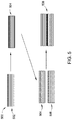
- FIG. 5 is a schematic illustration of film consolidation on an adherend.
- stack 500 contains sheets 502 of thermoplastic prepreg. The sheets are not consolidated. Applying high heat (such as 355°C - 385°C) and pressure promotes consolidation of the stack to form consolidated thermoplastic composite 504. Temperatures and pressures for consolidating known thermoplastic polymers degrade the polymers impregnated within and onto a prepreg. However, high molecular weight polymers of the present disclosure, such as polymers of Formulae (I), (II), (III), and (IV), provide temperature resistance at the typical processing temperatures.
- consolidated thermoplastic prepreg 504 can be joined with a companion thermoplastic composite 506 using heat and pressure.
- the two or more thermoplastic prepregs may be already consolidated (e.g., consolidated thermoplastic prepreg 504 ) before joining of the two films.
- a random copolymer of Formulae (I), (II), (III), and/or (IV) is placed on a surface of consolidated thermoplastic prepreg 504 and/or a surface of companion thermoplastic composite 506 . The surfaces are mated together by heating the structure with pressure, forming a bonded prepreg stack 508.
- High molecular weight polymers of the present disclosure are useful for these purposes because the high molecular weight copolymers of Formulae (I), (II), (III), and/or (IV) promote adhesion without detrimentally high viscosity upon heating and increased pressure.
- polymer viscosity becomes unworkable if the molecular weight of a polymer becomes too large, further highlighting an advantage of copolymers having high molecular weights that are balanced.
- high molecular weight copolymers of Formulae (I), (II), (III), and/or (IV) utilize physical interactions with an adjacent surface to promote adhesion of adjacent surfaces, as opposed to chemical reactions with adjacent surfaces which is typical for known low molecular weight polymers.
- thermoplastic prepregs may be consolidated simultaneously upon a film joining (a "co-consolidation")( e.g , thermoplastic prepreg 504 and companion thermoplastic composite 506 are not yet consolidated upon film joining).
- the film joining process may also be a consolidation process.
- Diffusion bonded adhesive that is a block copolymer Adhesion processes for block copolymers of the present disclosure are the same as those with random copolymers, e.g. as shown in Figure 5 . However, in some aspects, the adhesion ability of a block copolymer may be stronger than the adhesion ability of a corresponding random copolymer because the block copolymer provides a core block that is relatively crystalline and one or more adjacent blocks that are amorphous.
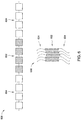
- Figure 6 is a schematic of a block copolymer and copolymer block-block interactions. As shown in Figure 6 , a block copolymer 600 has a crystalline core (block) 602 and amorphous arms (blocks) 604.
- Crystalline core 602 may be, for example, EIEIE monomeric units connected by TCP or ICP linkers, while amorphous arms 604 may be, for example, EKE monomeric units connected by TCP or ICP linkers.
- crystalline blocks of the block copolymer may be physically entangled with each other, such that there are now two types of physical cross sections for polymer-polymer interactions: one type that is crystalline-crystalline block interactions and one type that is amorphous-amorphous block interactions.
- different molecules of block copolymer 600 may form a copolymer aggregate 606, promoted by crystalline-crystalline block interactions of crystalline core 602 of molecules of block copolymer 600.
- the crystalline-crystalline block interactions are high strength interactions.
- the one or more amorphous blocks adjacent to a crystalline core provide a block copolymer that is at least partially amorphous so that crystal formations do not inhibit molecular diffusion at a film to film interface, such as the interface of consolidated thermoplastic prepreg 504 and companion thermoplastic composite 506 of Figure 5 .
- Target glass transition temperatures are greater than about 135°C and target melting temperatures are less than about 355°C.
- Example 1 is a copolymer with a significantly lower Tg value (approx. 40°C) than PEKK, polyether imide (PEI), and polyethersulfone (PES), but maintains similar mechanical properties, has excellent thermal stability, and has equivalent or improved miscibility with PEKK.
- Tg value approximately 40°C
- Example 1 A small subset of three coupons was made for Example 1 and Example 2 in the continuous compression molding (CCM) process and the autoclave at 375°C for 1 hour at 100 psi.
- the coupons were fabricated with polymer (Example 1 or Example 2) as a film that was converted from reactor flake in a press.
- FIG. 7 is a graph illustrating load displacement curves of lap shear testing of test coupons including the copolymers of Example 1 or Example 2.
- Lap shear strengths were measured from 0.5 square inch laps. As shown in Figure 7 , lap shear strength of Example 1 (line 702 ) is 7.1 +/-1 thousands of pounds per square inch (ksi), while lap shear strength of Example 2 (line 704 ) is 3.0 +/- 0.2 ksi, illustrating an advantage of high molecular weight copolymers of the present disclosure.
- test coupons including Example 1 and Example 2 show first ply failure (predominantly fiber tear failure) for test coupons including Example 1, but adhesive failure between film-to-film layers for test coupons including Example 2.
- Example 1 The results of the lap shear tests are favorable for Example 1, the higher molecular weight version of the co-polymer. In this case, polymer chain length of Example 2 was too small showing a failure between the two films (Example 2 had the lower viscosity at 380°C).
- Example 4 and Example 5 were fabricated in the same manner as Example 1 and Example 2, but were joined in the autoclave at 190°C due to their slightly higher glass transition temperatures.
- Figure 8 is a graph illustrating load displacement curves of lap shear testing of test coupons including the copolymers of Example 4 or Example 5. Lap shear strengths were measured from 0.5 square inch laps. As shown in Figure 8 , lap shear strength of Example 4 (line 802 ) is 7.0 +/- 0.7 ksi, while lap shear strength of Example 5 (line 804 ) is 7.2 +/- 0.5 ksi.
- Example 5 the higher molecular weight version (Example 5) provided better performance over a lower molecular weight. However, only a small difference was observed in failure modes of Example 4 and Example 5, as both examples have first ply failure in adherends. Shear strength of imide-based co-polymers of the present disclosure are the highest recorded in comparison to known films including pseudo amorphous PEKK-DS and PES.
- Figure 9 is a graph illustrating storage moduli versus processing temperatures of Example 1 and Example 4.
- Example 1 (line 902) and Example 4 (line 904) each have a storage modulus (G') in gigaPascals (GPa) that drastically declines at temperatures above 175°C, such as about 190°C.
- G' storage modulus
- GPa gigaPascals
- High molecular weight copolymers of the present disclosure provide improved lap shear strength but are of sufficiently low molecular weight such that a joining temperature far away, e.g. 75°C, from the polymers' glass transition temperatures does not result.
- Example 7 Monomer Concentration mol. % EIEIE 36.00 ESE 0.00 EKE 12.00 TCP 17.20 ICP 32.20 BC 2.60
- Example 8 Monomer Concentration mol. % EIEIE 36.75 ESE 9.19 EKE 3.06 TCP 48.45 ICP 0.00 BC 2.55
- EIEIE 24.50 ESE 9.80 EKE 14.70 TCP 35.70 ICP 12.75 BC 2.55
- EIEIE, ESE, EKE, TCP, and ICP are as described above.
- BC is benzyl chloride.
- the polymers of Examples 7, 8, and 9 are amorphous and provide improved thermal stability.
- Benzyl chloride capping agent provides a polymer having a benzyl end cap for controlled molecular weight of the polymers.
- polymers of the present disclosure may be used as an adhesive. These polymers provide greater adhesion strength than existing polymers. Without being bound by theory, polymers of the present disclosure allow improved adhesion to surfaces due, at least in part, to the increased energy required to promote cohesive removal. Physical entanglement of the polymer adhesive with the polymers/material of the substrate does not require chemical reaction of the polymers with the substrate, unlike known low molecular weight polymers.
- polymers of the present disclosure are compatible with epoxies, providing bonding to a thermoset. Polymers of the present disclosure provide a high use temperature, but low processing temperature. High use temperature provides for use of the polymers on components of a vehicle/aircraft. Another application of polymers of the present disclosure may be as an adhesive as a diffusion bonded film with a lower processing temperature than typical thermoplastic and thermoset composites. This allows for joining of composite parts with the use of fewer or no fasteners.
- polymers of the present disclosure have very low flow at elevated temperatures so it is not necessary for a tool to encapsulate the resin, which opens up the range of tooling materials that can be used for a co-bond or post-bond process.
- An elastomeric material can be used to fill tool gaps and allow some buffer for thermal expansion during a cycle.
- a tool with more generous tolerances is provided, which significantly reduces tooling and machining costs.
- the tooling cost to produce a typical flight control surface with this method would be in the $30,000 to $50,000 range compared to $500,000 to $1,000,000 for a similar thermoset co-cure tool.
- adherends do not require extensive surface preparation that is typically required for adhesive bonding.
- a simple solvent wipe may be sufficient to obtain a sufficient joint since melt fusing two polymers of material does not require certain functional groups (i.e ., physical bonding instead of chemical bonding) nor is it sensitive to surface energies for wet-out.
- This substantially or completely eliminates the need for plasma treating or mechanical abrasion processes, which adds savings in both labor and certification.
- the vehicle components may be fabricated and can be inspected for defects prior to joining into an assembly, eliminating costly repairs due to part thinning or dislocation.
Landscapes
- Chemical & Material Sciences (AREA)
- Organic Chemistry (AREA)
- Chemical Kinetics & Catalysis (AREA)
- Medicinal Chemistry (AREA)
- Polymers & Plastics (AREA)
- Health & Medical Sciences (AREA)
- Engineering & Computer Science (AREA)
- Materials Engineering (AREA)
- Manufacturing & Machinery (AREA)
- Mechanical Engineering (AREA)
- Optics & Photonics (AREA)
- Physics & Mathematics (AREA)
- Civil Engineering (AREA)
- Ceramic Engineering (AREA)
- Composite Materials (AREA)
- Structural Engineering (AREA)
- General Chemical & Material Sciences (AREA)
- Aviation & Aerospace Engineering (AREA)
- Adhesives Or Adhesive Processes (AREA)
- Compositions Of Macromolecular Compounds (AREA)
- Laminated Bodies (AREA)
Abstract
Description
- Aspects of the present disclosure generally relate to polyarylether ketones and methods of use.
- A vehicle, such as an aircraft, contains many components adhered to one another by adhesives and/or fasteners. Adhesives and fasteners must withstand chemical, thermal, and physical conditions experienced by the vehicle. Adhesives offer greater performance, better design efficiency, and lower weight as compared to fasteners used for connecting the vehicle/aircraft components to one another. In particular, thermosets chemically or physically join vehicle/aircraft components by co-cure or co-bonding processes. However, co-curing involves expensive, precision tooling to properly locate and maintain the vehicle components as well as control of the thermoset resin distribution throughout the curing process. Additionally, co-cured structures typically suffer thickness control issues and ply waviness due to undesirable viscosity of an adhesive. Alternatively, co-bonding involves less extensive tooling but adds the costly labor of surface preparation for the surfaces of the vehicle components to be joined.
- Regarding thermoset materials, thermosets have components that are typically fabricated with a peel ply on the surfaces to be joined, which is removed prior to joining, coupled with a surface preparation process such as grit blasting, plasma etching, and or hand sanding of the surfaces to be joined, and followed by bonding of those surfaces with an adhesive. Adhesives are typically thermosets or thermoplastics, such as poly ether ketone ketone (PEKK) or poly ether ether ketone (PEEK). However, thermoplastics are inherently more difficult for adhesive bonding applications in comparison to thermosets due to the chemical nature of poly aryl ether ketone matrix, and their associated processing temperatures when used in structural applications.
- Low cost thermoplastics for film joining (adhesion) processes for vehicle components typically employ a melting/fused joining rather than a curing adhesive system. Ideal processing parameters for such a thermoplastic would include:
- about 355°C - 385°C maximum processing temperature for thermoplastic co-consolidation without polymer degradation
- Glass transition temperature below about 190°C for joining thermoset applications without degrading the thermoset component(s)
- Polymer that is at least partially amorphous so that crystal formations do not inhibit molecular diffusion at a film to film interface
- Polymer should have environmental/chemical resistance equal to or better than vehicle base structures (i.e., vehicle components and, if present, other layers on the components)
- Polymer molecular weight should be balanced to provide good mechanical properties while providing rheological properties that promote chain mobility close to the glass transition temperature
- Polymer should have adequate adhesion ability
- Existing adhesives do not possess ideal properties. For example, existing materials do not have a low enough processing temperature for suitable use with thermoset materials or the materials degrade at the processing temperature of thermoplastic composites. Polyether ether ketone (PEEK) polymers, for example, have high strength, but processing temperatures for PEEK polymers are high (generally above 355°C). Furthermore, PEEK polymers are expensive and do not possess sufficiently high Tg values for all applications.
- There is a need in the art for polymers that may be used in thermoplastic prepregs/thermosets and/or as an adhesive in vehicle/aircraft structures.
- In some aspects, a composition includes one or more polymers of formulae (I), (II), or (III):


- each X is independently selected from

- Y is independently


- Each Z is independently selected from -H,

- Each R is independently selected from


- Each L is independently selected from -CH2-, - (CH3)2C-, -O-, -S-, -SO2-, and -CO-. Each Q is independently selected from - S-, -SO2- or -(CF3)2C-, -O-, and -(CH3)2C-. Each j is independently a positive integer. Each m is independently a positive integer. Each n is independently a positive integer. Each p is independently a positive integer. Each q is independently a positive integer. In some aspects, a ratio of m to n is between about 1:1 and about 1:2. A ratio of m to p may be between about 1:1 and about 1:2. A ratio of n to p may be between about 1:1 and about 1:2.
- In some aspects, a composition includes one or more reaction products of:


- Each R is independently selected from


- Each L is independently selected from -CH2-, - (CH3)2C-, -O-, -S-, -SO2-, and -CO-. Each Q is independently selected from - S-, -SO2-, -(CF3)2C-, -O-, and -(CH3)2C-. Each j is independently a positive integer. The molecular weight of at least one of the one or more reaction products is between about 10 kDa and about 150 kDa.
- So that the manner in which the above recited features of the present disclosure can be understood in detail, a more particular description of the disclosure, briefly summarized above, may be had by reference to aspects, some of which are illustrated in the appended drawings. It is to be noted, however, that the appended drawings illustrate only typical aspects of this present disclosure and are therefore not to be considered limiting of its scope, for the present disclosure may admit to other equally effective aspects.
-
Figure 1 illustrates chemical structures of general Formula (I). -
Figure 2 illustrates chemical structures of general Formula (II). -
Figure 3 illustrates chemical structures of general Formula (III). -
Figure 4 illustrates chemical structures of general Formula (IV). -
Figure 5 is a schematic illustration of film consolidation on an adherend. -
Figure 6 is a schematic of a block copolymer and copolymer block-block interactions. -
Figure 7 is a graph illustrating load displacement curves of lap shear testing of test coupons including the copolymers of Example 1 or Example 2. -
Figure 8 is a graph illustrating load displacement curves of lap shear testing of test coupons including the copolymers of Example 4 or Example 5. -
Figure 9 is a graph illustrating storage moduli versus processing temperatures of Example 1 and Example 5. - To facilitate understanding, identical reference numerals have been used, where possible, to designate identical elements that are common to the figures. It is contemplated that elements and features of one aspect may be beneficially incorporated in other aspects without further recitation.
- The descriptions of the various aspects of the present disclosure have been presented for purposes of illustration, but are not intended to be exhaustive or limited to the aspects disclosed. Many modifications and variations will be apparent to those of ordinary skill in the art without departing from the scope and spirit of the described aspects. The terminology used herein was chosen to best explain the principles of the aspects, the practical application or technical improvement over technologies found in the marketplace, or to enable others of ordinary skill in the art to understand the aspects disclosed herein.
- Aspects of the present disclosure generally describe polyarylether ketones and methods of use.
- In general, polyimides (not copolymers) have a solvent resistance that is ideal, but processing temperatures are very high, which drastically increases the cost of these polymers. Polyethersulfones (not copolymers) are generally tough polymers having very high Tg values, but poor chemical resistance. Thus, imide monomers of polymers of the present disclosure provide high Tg values, good solvent resistance, and thermal stability, while sulfone monomers of polymers of the present disclosure provide high Tg values, overall durability, and thermal stability.
- Imide monomers include ether imide ether imide ether (EIEIE) and derivatives thereof. In some aspects, EIEIE is of the general structure:

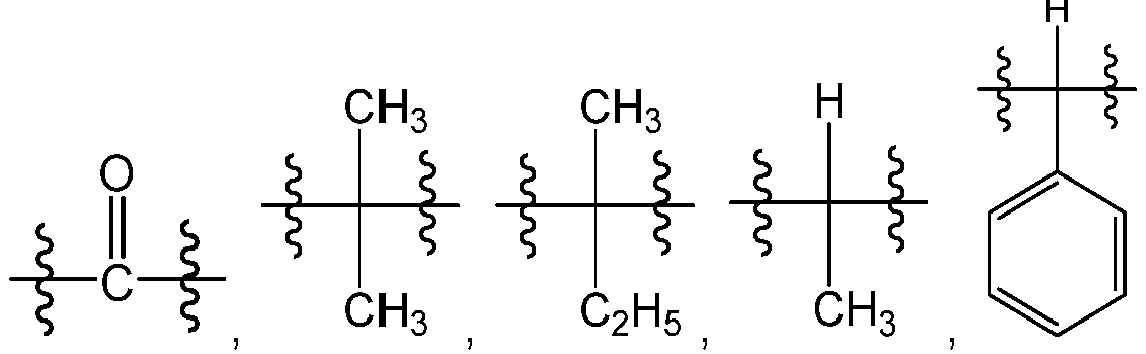





- Sulfone monomers include ether sulfone ether (ESE) and derivatives thereof. In some aspects, ESE is of the structure:

- Ketone monomers include ether ketone ether (EKE) and derivatives thereof. In some aspects, EKE is of the structure:

- An EKE monomer may be present in a polymer backbone as a majority monomer, which provides some processing improvements. For example, a polymer may comprise greater than about 33 mol% of EKE as compared to EIEIE and ESE. In other aspects, a polymer comprises greater than about 50 mol% EKE as compared to EIEIE. Furthermore, in some aspects, the ratio of EKE to EIEIE to ESE may be adjusted to optimize polymer properties.
- Furthermore, including isophthaloyl chloride (ICP) and terephthaloyl chloride (TCP) for syntheses of polymers of the present disclosure provides additional control of the crystallinity of the polymer, e.g. tailoring amorphous and crystalline blocks of a copolymer.
Isophthaloyl chloride (ICP):

- In some aspects, polymers of the present disclosure have Tg values between about 140°C and about 225°C, for example about 140°C, 145°C, 150°C, 155°C, 160°C, 165°C, 170°C, 175°C, or 180°C. In some aspects, polymers of the present disclosure have Tm values between about 200°C and about 450°C, such as between about 330°C and about 355°C, for example about 330°C, 335°C, 340°C, 345°C, 350°C, or 355°C. In some aspects, polymers of the present disclosure have intrinsic viscosity values between about 1 and about 3, such as about 1.5 and about 2.4. In some aspects, polymers of the present disclosure have a molecular weight between about 10 kDa and about 150 kDa, such as about 50 kDa and about 120 kDa, such as about 90 kDa and about 110 kDa.
- In some aspects, a composition includes one or more polymers of formulae (I), (II), or (III):


- each X is independently selected from

- Y is independently selected from
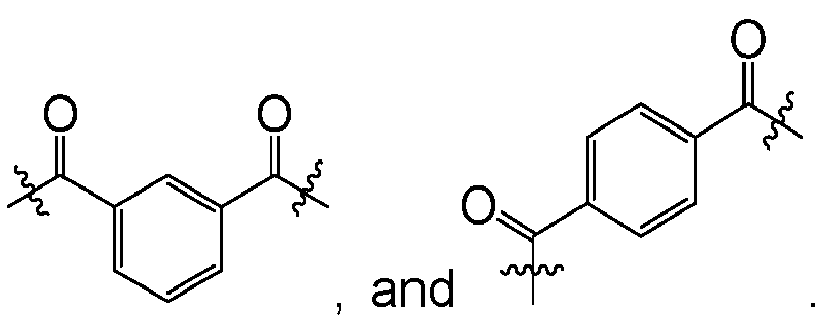

- Each Z is independently selected from -H,

- Each R is independently selected from


- Each L is independently selected from -CH2-, - (CH3)2C-, -O-, -S-, -SO2-, and -CO-. Each Q may independently be -S-, - SO2- or -(CF3)2C-, -O-, or -(CH3)2C-. Each j is independently a positive integer, such as between about 1 and about 50, such as about 1 and about 10. Each m is independently a positive integer, such as between about 1 and about 200, such as about 1 and about 100. Each n is independently a positive integer, such as between about 1 and about 200, such as about 1 and about 100. Each p is independently a positive integer, such as between about 1 and about 200, such as about 1 and about 100. Each q is independently a positive integer, such as between about 1 and about 2,000, such as about 200 and about 1,000. In some aspects, a ratio of m to n is between about 1:1 and about 1:2. A ratio of m to p may be between about 1:1 and about 1:2, and a ratio of n to p may be between about 1:1 and about 1:2.
- The molecular weight of the at least one of the one or more polymers of formulae (I), (II), or (III) may be between about 10 kDa and about 150 kDa. In some aspects, the molecular weight of at least one of the one or more polymers is between about 50 kDa and about 120 kDa. The molecular weight of at least one of the one or more polymers may be between about 90 kDa and about 110 kDa.
- In some aspects, the molecular weight of each moiety of the structure:


- In some aspects, a composition includes one or more polymers of formulae (I), (II), or (III) and has a glass transition temperature between about 135°C and about 225°C. A composition including one or more polymers of formulae (I), (II), or (III) may have a glass transition temperature between about 135°C and about 190°C, for example about 140°C, 145°C, 150°C, 155°C, 160°C, 165°C, 170°C, 175°C, or 180°C. A composition including one or more polymers of formulae (I), (II), or (III) may have a melting temperature between about 200°C and about 450°C, for example about 330°C, 335°C, 340°C, 345°C, 350°C, or 355°C.
- In some aspects, at least one of the one or more polymers of formulae (I), (II), or (III) is a block copolymer. q may be 1, m may be an integer between about 1 and about 1,000, such as about 1 and about 100, and n may be an integer between about 1 and about 1,000, such as about 1 and about 100. In some aspects, at least one of the one or more polymers of formulae (I), (II), or (III) is a random copolymer. q may be an integer between 2 and about 1,000, m may be an integer between about 1 and about 100, and n may be an integer between about 1 and about 100.
- In some aspects, a composition including at least one of the one or more polymers of formulae (I), (II), or (III) further includes a fiber material. The fiber material may be graphite, fiberglass, nylon, aramid polymers, spectra, and mixtures thereof.
- As used herein, a vehicle component includes any component of a vehicle, such as a structural component such as a panel or joint of an aircraft, automobile, etc. In some aspects, a vehicle component includes a composition including at least one of the one or more polymers of formulae (I), (II), or (III). The composition may have a glass transition temperature between about 135°C and about 225°C, for example about 140°C, 145°C, 150°C, 155°C, 160°C, 165°C, 170°C, 175°C, or 180°C, and a melting temperature between about 200°C and about 450°C, for example about 330°C, 335°C, 340°C, 345°C, 350°C, or 355°C. The vehicle component may be a tail cone, a panel, a coated lap joint between two or more panels, a wing-to-fuselage assembly, structural aircraft composite, fuselage body-joint and/or wing rib-to-skin joint.
- In some aspects, a method includes using a composition including at least one of the one or more polymers of formulae (I), (II), or (III) as an adhesive. The molecular weight of at least one of the one or more polymers may be between about 10 kDa and about 150 kDa. In some aspects, a method includes coating a surface with a composition including at least one of the one or more polymers of formulae (I), (II), or (III). The molecular weight of at least one of the one or more polymers may be between about 10 kDa and about 150 kDa. The method may include contacting the coated surface with a second surface and heating the composition to above about 355°C. The coated surface may include a thermoplastic prepreg, thermoset prepreg, and/or metal. Heating the composition to above about 355°C may consolidate the thermoplastic prepreg or cure the thermoset prepreg. The second surface may include a thermoplastic prepreg, thermoset prepreg, and/or metal, and heating the composition to above about 355°C may consolidate the thermoplastic prepreg (or cure the thermoset prepreg) of the first surface and the thermoplastic prepreg of the second surface. The method may further include coating the second surface with a composition including at least one of the one or more polymers of formulae (I), (II), or (III) to form a second coated surface. In some aspects, the first surface and the second surface is each a surface of a vehicle component. In some aspects, a method includes forming a three dimensional structure using at least one of the one or more polymers of formulae (I), (II), and (III). One or more polymers of formulae (I), (II), and (III) may be deposited onto a three dimensional structure using any suitable deposition method including conventional 3D printing methods. Alternatively, at least a first part of a three dimensional structure may be formed using the one or more polymers of formulae (I), (II), and (III). The three dimensional structure may further include a reinforcement agent. The reinforcement agent may improve structural integrity of the three dimensional structure. The reinforcement agent may be included in a mixture containing one or more polymers of formulae (I), (II), and (III) that is then deposited to form a three dimensional structure (or deposit a layer onto a three dimensional structure) using any suitable deposition method such as a conventional 3D printing method. In some aspects, the reinforcement agent is selected from glass, carbon fibers, chopped carbon fibers, carbon black, and carbon nanotubes. The three dimensional structure may be formed using any suitable 3D printing process, such as fused filament fabrication and/or selective laser sintering.
- In some aspects, a composition includes one or more reaction products of:


- In some aspects, a composition includes one or more polymers of formula (IV):

- Each X is independently selected from

- Z is independently selected from -H,

- Each R is independently selected from


- Each L is independently selected from -CH2-, -(CH3)2C-, -O-, -S-, -SO2-, and -CO-. Each Q is independently selected from -S-, -SO2-, -(CF3)2C-, -O-, and -(CH3)2C-. Each j is independently a positive integer, such as between about 1 and about 100, such as about 1 and about 10. Each m is independently a positive integer such as between about 1 and about 1,000, such as about 1 and about 100.
- Each n is independently a positive integer such as between about 1 and about 1,000, such as about 1 and about 10. Each q is independently a positive integer such as between about 1 and about 2,000, such as about 200 and about 1,000. In some aspects, a ratio of m to n is between about 1:1 and about 1:2. A ratio of

- The molecular weight of at least one of the one or more polymers of formula (IV) may be between about 50 kDa and about 150 kDa. In some aspects, the molecular weight of at least one of the one or more polymers of formula (IV) is between about 90 kDa and about 110 kDa.
- In some aspects, the molecular weight of each moiety of the structure:


- In some aspects, a composition including at least one of the one or more polymers of formula (IV) has a glass transition temperature between about 135°C and about 225°C. A composition including at least one of the one or more polymers of formula (IV) may have a glass transition temperature between about 135°C and about 190°C, for example about 140°C, 145°C, 150°C, 155°C, 160°C, 165°C, 170°C, 175°C, or 180°C, and/or a melting temperature between about 200°C and about 450°C, for example about 330°C, 335°C, 340°C, 345°C, 350°C, or 355°C.
- At least one of the one or more polymers of formula (IV) may be a block copolymer. In some aspects, q may be 1, m is an integer between about 1 and about 1,000, such as about 1 and 100, and n is an integer between about 1 and about 1,000, such as about 1 and about 100. At least one of the one or more polymers of formula (IV) may be a random copolymer. In some aspects, q may be an integer between 2 and about 2,000, such as about 2 and about 1,000. m is an integer between about 1 and about 1,000, such as about 1 and about 100, and n is an integer between about 1 and about 1,000, such as about 1 and about 100.
- In some aspects, a composition includes at least one of the one or more polymers of Formula (IV), where the moiety:


In some aspects, a composition includes at least one of the one or more polymers of Formula (IV), where the moiety:


- In some aspects, a composition includes at least one of the one or more polymers of Formula (IV) and a fiber material. The fiber material may be graphite, fiberglass, nylon, aramid polymers, spectra, and mixtures thereof.
- In some aspects, a vehicle component includes a composition that includes at least one of the one or more polymers of Formula (IV). The composition may have a glass transition temperature between about 135°C and about 225°C, for example about 140°C, 145°C, 150°C, 155°C, 160°C, 165°C, 170°C, 175°C, or 180°C, and a melting temperature between about 200°C and about 450°C, for example about 330°C, 335°C, 340°C, 345°C, 350°C, or 355°C. The vehicle component may be a tail cone, a panel, a coated lap joint between two or more panels, a wing-to-fuselage assembly, structural aircraft composite, fuselage body-joint or wing rib-to-skin joint.
- In some aspects, a method includes using a composition that includes at least one of the one or more polymers of Formula (IV) as an adhesive. A method may include coating a surface with a composition including at least one of the one or more polymers of Formula (IV). In some aspects, a method includes coating a first surface with a composition that includes at least one of the one or more polymers of Formula (IV) to form a coated surface. The method includes contacting the coated surface with a second surface and heating the composition to above about 355°C. The first surface and/or the second surface may include a thermoplastic prepreg, thermoset prepreg, and/or metal. Heating the composition to above about 355°C may consolidate the thermoplastic prepreg (or cure the thermoset prepreg) of the first surface and/or, if present, the thermoplastic prepreg (or thermoset prepreg) of the second surface. The method may include coating the second surface with a composition that includes at least one of the one or more polymers of Formula (IV) to form a second coated surface. The first surface and/or the second surface may be a surface of a vehicle component. In some aspects, a method includes forming a three dimensional structure using at least one of the one or more polymers of formula (IV). One or more polymers of formula (IV) may be deposited onto a three dimensional structure using any suitable deposition method including conventional 3D printing methods. Alternatively, at least a first part of a three dimensional structure may be formed using the one or more polymers of formula (IV). The three dimensional structure may further include a reinforcement agent. The reinforcement agent may improve structural integrity of the three dimensional structure. The reinforcement agent may be included in a mixture containing one or more polymers of formula (IV) that is then deposited to form a three dimensional structure (or deposit a layer onto a three dimensional structure) using any suitable deposition method such as a conventional 3D printing method. In some aspects, the reinforcement agent is selected from glass, carbon fibers, chopped carbon fibers, carbon black, and carbon nanotubes. The three dimensional structure may be formed using any suitable 3D printing process, such as fused filament fabrication and/or selective laser sintering.
- In some aspects, a composition includes one or more reaction products of:


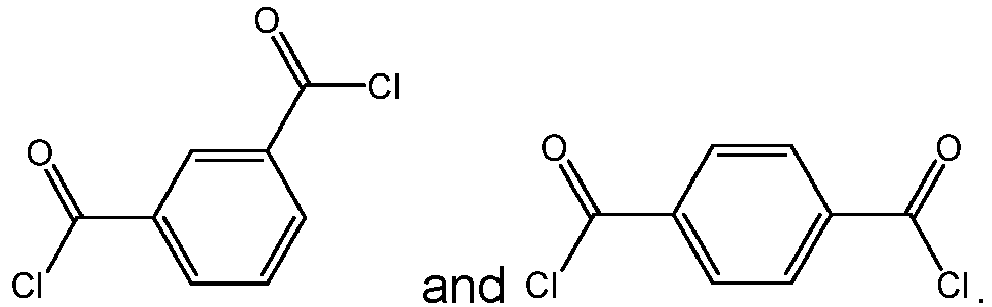

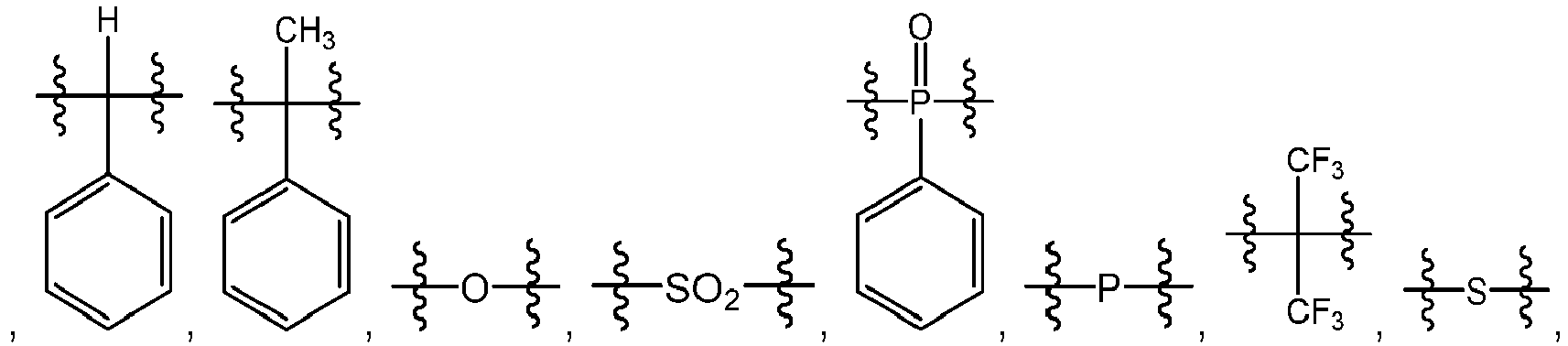


- In some aspects, the one or more reaction products are formed from a reaction mixture that includes


- In some aspects, the one or more reaction products are formed from a reaction mixture that includes


- Dynamic scanning calorimetry (DSC) may be used to determine glass transition temperatures (Tg), melting temperatures (Tm), and crystallization temperatures (Tc) of polymers of the present disclosure. Furthermore, thermal gravimetric analysis provides degradation temperatures of the polymers.
- Conditions for the DSC scans of the present disclosure: ASTM D3418 with a heating rate of 5°C per minute. The sample is placed in a small aluminum pan (approx. 5-10 milligram sample). The sample is heated to 395°C at 5°C/min. The sample is either (1) cooled at 5°C/min to room temperature, or (2) quenched by removing the sample from the test chamber and placing the sample on a room temperature metal surface. The sample is then heated again to 395°C at 5°C/min.
- Intrinsic viscosity may be used to determine the size of polymers (e.g., molecular weight(s)) of polymers of the present disclosure. Intrinsic viscosity (IV) refers to the mean intrinsic viscosity as determined by dissolving about 0.1 g of polymer in about 100 mL of concentrated sulfuric acid at 25°C. The method involves solubilizing the polymer in sulfuric acid and then using an ubelode viscometer to determine the intrinsic viscosity.
- Molecular weight of a composition of polymers is usually expressed in terms of a moment of the molecular weight distribution of the polymer mixture, defined as

- Molecular weight distribution of a composition of polymers may be indicated by a polydispersity ratio Pz, which may be defined as
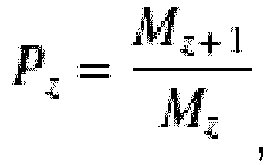
-
Figure 1 illustrates chemical structures of general Formula (I). As shown inFigure 1 , polymers of the present disclosure include polymers of Formula (I):


Each Z may independently be -H,
Each R may be independently selected from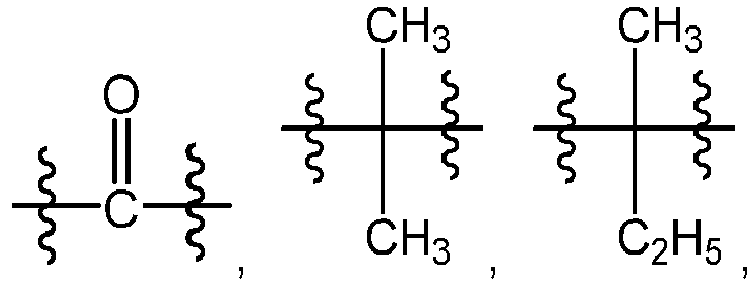


- In some aspects, a ratio of m to n values of Formula (I) is between about 0.1:10 and about 10:0.1, such as about 1:1 and about 1:2. A ratio of m to p values of Formula (I) may be between about 0.1:10 and about 10:0.1, such as about 1:1 and about 1:2. A ratio of n to p values of Formula (I) may be between about 0.1:10 and about 10:0.1, such as about 1:1 and about 1:2. In some aspects, a ratio of
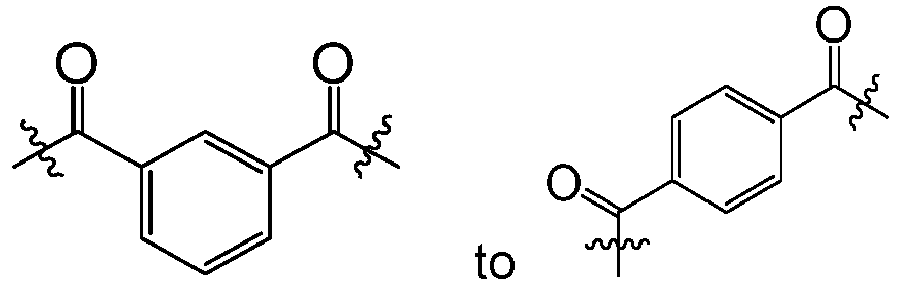
-
Figure 2 illustrates chemical structures of general Formula (II). As shown inFigure 2 , polymers of the present disclosure further include polymers of formula (II):


Each Z may independently be -H,
Each R may be selected from


- In some aspects, a ratio of m to n values of Formula (II) is between about 0.1:10 and about 10:0.1, such as about 1:1 and about 1:2. A ratio of m to p values of Formula (II) may be between about 0.1:10 and about 10:0.1, such as about 1:1 and about 1:2. A ratio of n to p values of Formula (II) may be between about 0.1:10 and about 10:0.1, such as about 1:1 and about 1:2. In some aspects, a ratio of

-
Figure 3 illustrates chemical structures of general Formula (III). As shown inFigure 3 , polymers of the present disclosure further include polymers of formula (III) :


Each Z may independently be -H,
Each R may be independently selected from




- Each j is independently a positive integer, such as between about 1 and about 100, such as about 1 and about 10. Each m is independently a positive integer, such as between about 1 and about 1,000, such as about 1 and about 100. Each n is independently a positive integer, such as between about 1 and about 1,000, such as about 1 and about 100. Each p is independently a positive integer, such as between about 1 and about 1,000, such as about 1 and about 100. Each q is independently a positive integer, such as between about 1 and about 2,000, such as about 200 and about 1,000.
- In some aspects, a ratio of m to n values of Formula (III) is between about 0.1:10 and about 10:0.1, such as about 1:1 and about 1:2. A ratio of m to p values of Formula (III) may be between about 0.1:10 and about 10:0.1, such as about 1:1 and about 1:2. A ratio of n to p values of Formula (III) may be between about 0.1:10 and about 10:0.1, such as about 1:1 and about 1:2. In some aspects, a ratio of

-
Figure 4 illustrates chemical structures of general Formula (IV). As shown inFigure 4 , polymers of the present disclosure include polymers of formula (IV):


Each R may independently be


- In some aspects, a ratio of m to n values of Formula (IV) is between about 0.1:10 and about 10:0.1, such as about 1:1 and about 1:2. In some aspects, a ratio of

- Polymers of the present disclosure, and synthesized from monomers described above, may be random copolymers or block copolymers.
- Random Copolymers: Synthetic approaches for random copolymers include (1) electrophilic syntheses, (2) nucleophilic syntheses, or (3) electrophilic gel syntheses. In some aspects, an electrophilic gel synthesis involves charging a reactor with about 788 g of aluminum chloride and about 50 mL dichloromethane, followed by cooling the mixture to - 15°C. Next, about 200 g of EKE monomer is dissolved in 25 mL dichloromethane and added to the solution containing aluminum chloride to form a reaction mixture. Then, about 190 g of EIEIE monomer dissolved in 50 mL of dichloromethane is added to the reaction mixture. Next, about 160 g of TCP/ICP monomers in 25 mL dichloromethane is added to the reaction mixture. Then, about 20 g of benzoyl chloride in 10 mL dichloromethane is added to the bulk reaction mixture, and the mixture is allowed to warm to about 10°C and stirred for about 4.5 hours while maintaining temperature at 10°C. The reaction mixture may then be washed using any suitable washing process, for example a hydrochloric acid wash. However, a gel process results in a gel having large amounts of hydrochloric acid, which leads to difficulties in scalability. Furthermore, reaction temperatures of electrophilic syntheses are typically lower than temperatures involving nucleophilic reactions, making electrophilic syntheses more amenable to scale up.
- Electrophilic syntheses may include Friedel Crafts synthesis in which an aryl ketone linkage is formed from a carboxylic acid halide and an aromatic compound having an activated hydrogen, i.e., a hydrogen atom displaceable under the electrophilic reaction conditions. The monomer system employed in the reaction can be, for example, (a) a single aromatic compound containing a carboxylic acid halide (e.g., a capping agent) as well as an aromatic carbon bearing a hydrogen activated towards electrophilic substitution (e.g., EKE, EIEIE, or ESE); or (b) a two-monomer system of a dicarboxylic acid dihalide (e.g., TCP or ICP) and an aromatic compound containing two such activated hydrogens (e.g., EKE, EIEIE, or ESE). A reaction mixture for such Friedel Crafts reactions includes the monomers, a catalyst, such as anhydrous aluminum chloride, and an inert solvent such as methylene chloride.
- In some aspects, copolymers of the present disclosure (both random and block copolymers) are synthesized by Friedel Crafts reactions where reaction conditions generally include adding TCP/ICP, EKE, ESE, and EIEIE to a reactor with o-dichlorobenzene, dichloromethane, and/or dichloroethane as a solvent. The solution may be cooled to about - 10°C, and aluminum chloride added slowly over about 30 minutes. Following addition of the aluminum chloride, the reaction mixture may be allowed to warm to about 10°C, held at 10°C for about 10 minutes, and re-cooled to - 10°C. Additional TCP/ICP may then be added. Preheated solvent (for example, o-dichlorobenzene between about 160°C and about 190°C) may then be added to the reaction mixture, and the reaction mixture may be held at 100°C for at least about 30 minutes. In some aspects, the reaction mixture is then decomplexed using, for example, ice water. For every 1 kg of polymer, at least about 3 kg of water may be used to rinse and neutralize the hydrochloric acid. The sample is then dried. An additional 8 liters (L) of water (per 1 kg polymer) is then added to the sample and heated to about 95°C while stirring. Water is then removed (e.g., by distillation). An additional 8 liters (L) of water (per 1 kg polymer) is then added to the sample and again heated to about 95°C while stirring. Water is then decanted. 8 L of water (per 1 kg polymer) and 200 mL of NH3 (per 1 kg polymer) is then added to the sample and heated to about 95°C while stirring. Water is then removed. 8 L of deionized water is then added to the sample and heated to about 95°C while stirring. The sample is then dried at about 120°C for about 24 hours.
- In some aspects, the temperature at which a Friedel Crafts reaction is conducted is between about -50°C and about 160°C. The reaction may commence at lower temperatures, for example between about -50°C and about -10°C. The temperature may then be raised if desired, up to about 160°C or even higher, for example, to promote the reaction to substantial completion. In some aspects, a Friedel Crafts reaction is performed at temperatures in the range of between about -30°C and 25°C (e.g., room temperature).
- In some aspects, one or more capping agents are added to a reaction mixture to cap the polymer on at least one end of the polymer backbone. Capping agents promote termination of continued growth of a polymer chain and control the resulting molecular weight of the polymer, as shown by the inherent viscosity of the polymer. Judicious use of the capping agents results in a polymer within a controlled molecular weight range, decreases gel formation during polymerization, decreases branching of the polymer chains, and increases melt stability. Molecular weights of polymers of the present disclosure are balanced to provide good mechanical properties while providing rheological properties that promote chain mobility close to the polymer glass transition temperatures.
- In some aspects, capping agents are compounds of the formula:

- Decomplexation of the polymer from the aluminum chloride catalyst can be accomplished by treating the reaction mixture with a decomplexing base after completion of polymerization. The base can be added to the reaction medium or the reaction medium can be added to the base. The decomplexing base may be at least as basic towards the Lewis acid (aluminum chloride) as the basic groups on the polymer chain. Such decomplexation may be performed before isolation of the polymer from the reaction mixture.
- The amount of decomplexing base used may be in excess of the total amount of bound (complexed) and unbound Lewis acid present in the reaction mixture and may be twice the total amount of Lewis acid. Decomplexing bases include water, dilute aqueous hydrochloric acid, methanol, ethanol, acetone, N,N-dimethyl-formamide, N,N-dimethylacetamide, pyridine, dimethyl ether, diethyl ether, tetrahydrofuran, trimethylamine, trimethylamine hydrochloride, dimethyl sulfide, tetramethylenesulfone, benzophenone, tetramethylammonium chloride, isopropanol and the like. The decomplexed polymer can then be removed by adding a nonsolvent for the polymer which is a solvent for or miscible with the Lewis acid/Lewis base complex and the Lewis acid; spraying the reaction mixture into a non-solvent for the polymer; separating the polymer by filtration; or evaporating the volatiles from the reaction mixture and then washing with an appropriate solvent to remove any remaining base/catalyst complex and diluent from the polymer.
- Example of High Molecular Weight EIEIE + EKE + ESE Random Copolymer synthesis: 2L of cooled (e.g., -20°C) dichloromethane (DCM) is added to a reactor. Aluminum chloride (approx. 500 g) is dissolved in about 50 mL of additional chilled DCM. EKE monomer (about 150 g) is dissolved in about 25 mL of chilled DCM. Dimethyl sulfone (about 100 g) is dissolved in about 25 mL of DCM and chilled. EIEIE (approx. 100 g) and ESE (approx. 100 g) monomers is dissolved in DCM, chilled to, for example, -20°C, and added to the reactor. Terephthaloyl chloride and/or isophthaloyl chloride are dissolved in DCM, chilled, and added to the reactor. The temperature of the reaction mixture is increased slowly to about 20°C over a period of 4.5 hours and stirred continuously. A molar excess of end cap, such as benzoyl chloride, is then added and stirring is continued at 20°C for an additional 30 minutes. The reaction is then quenched by adding 1 liter of methanol chilled to about -40°C. Stirring is continued for about an hour. The polymer is filtered and rewashed twice with one liter of methanol. The polymer is transferred to a beaker and boiled in one liter of water until the liquid temperature is about 98°C. After filtration, the polymer is soaked in about 500 g glacial formic acid for about 30 minutes, filtered and dried overnight in a vacuum oven at about 170°C with a light nitrogen bleed.
- Example of High Molecular Weight EIEIE + EKE Random Copolymer synthesis: 2L of cooled (e.g., -20°C) dichloromethane (DCM) is added to a reactor. Aluminum chloride (about 500 g) is dissolved in about 50 mL of additional chilled dichloromethane. EKE monomer (about 150 g) is dissolved in about 25 mL of chilled DCM. Dimethyl sulfone (about 100 g) is dissolved in about 25 mL of DCM and chilled. EIEIE (about 100 g) monomer is dissolved in DCM, chilled to, for example, -20°C, and added to the reactor. Terephthaloyl chloride and/or isophthaloyl chloride are dissolved in DCM, chilled, and added to the reactor. The temperature of the reaction mixture is increased slowly to about 20°C over a period of 4.5 hours and stirred continuously. A molar excess of end cap, such as benzoyl chloride, is then added and stirring is continued at 20°C for an additional 30 minutes. The reaction is then quenched by adding 1 liter of methanol chilled to about -40°C. Stirring is continued for about an hour. The polymer is filtered and rewashed twice with one liter of methanol. The polymer is transferred to a beaker and boiled in one liter of water until the liquid temperature is about 98°C. After filtration, the polymer is soaked in about 500 g glacial formic acid for about 30 minutes, filtered and dried overnight in a vacuum oven at about 170°C with a light nitrogen bleed.
- Block copolymers: Block copolymers may be synthesized by: (1) sequential monomer addition or (2) macro-initiator methods. Specifically, sequential monomer addition may involve a Friedel Crafts reaction, similar to that described above for random copolymer synthesis. However, reaction conditions of a Friedel Crafts reaction for polymer synthesis (as described above) may be adjusted, e.g. order of addition of reagents, such that a block copolymer is formed instead of a random copolymer.
- In addition, providing to a reaction mixture (1) ratios or sequential addition of ICP and TCP and/or (2) ratios or sequential addition of EKE/EIEIE/ESE or EKE/EIEIE for syntheses of random and block copolymers of the present disclosure provides control of the crystallinity of the copolymer, e.g. tailoring amorphous and crystalline blocks of a block copolymer. Thus, sequential monomer addition of (1) TCP or ICP and/or (2) EKE/EIEIE/ESE will promote block copolymers with controlled formation of crystalline or semicrystalline blocks and amorphous blocks. As indicated in the general description above of Formulae (I), (II), (III), and (IV), a particular ratio of EKE/EIEIE/ESE or EKE/EIEIE monomers of a copolymer synthesis affects, for example, integer values of n, m, and p of Formulae (I), (II), (III), and (IV), and a particular ratio of ICP/TCP monomers of a copolymer synthesis affects the identity and quantity of X and Y of Formulae (I), (II), (III), and (IV).
- Example of high molecular weight EIEIE + EKE + ESE block copolymer: 2L of cooled (e.g., -20°C) dichloromethane (DCM) is added to a reactor. Aluminum chloride (about 500 g) is dissolved in about 50 mL of additional chilled dichloromethane. A molar excess of EKE is dissolved in about 25 mL of DCM and chilled to, for example, -20°C. The molar excess of EKE ensures that the polymers formed in the first phase of this synthesis are low molecular weight polymers. The high molecular weight polymers are achieved by the end of the overall synthesis. Dimethyl sulfone is dissolved in DCM, chilled, and added to the reactor. EIEIE monomer is dissolved in DCM, chilled, and added to the reactor. Terephthaloyl chloride and/or isophthaloyl chloride are dissolved in DCM, chilled, and added to the reactor. The temperature of the reaction mixture is then increased to about 20°C slowly over a period of about 2 hours and stirred continuously. The reaction mixture is then cooled to about -20°C. Additional EKE monomer is dissolved in DCM, chilled, and added to the reactor. Additional ESE monomer is also dissolved in DCM, chilled, and added to the reactor. Terephthaloyl chloride and/or isophthaloyl chloride are dissolved in DCM, chilled, and added to the reactor. The temperature of the reaction mixture is increased to about 20°C slowly over a period of 4.5 hours and stirred continuously. A molar excess of end cap, such as benzoyl chloride, is then added to the reaction mixture and stirring is continued at about 20°C for an additional about 30 minutes. The reaction is then quenched by adding 1 liter of methanol chilled to about -40°C. Stirring is continued for about an hour. The polymer is filtered and rewashed twice with one liter of methanol. The polymer is transferred to a beaker and boiled in one liter of water until the liquid temperature is about 98°C. After filtration, the polymer is soaked in about 500 g glacial formic acid for about 30 minutes, filtered and dried overnight in a vacuum oven at about 170°C with a light nitrogen bleed.
- Example of high molecular weight EIEIE + EKE block copolymer: 2L of cooled (e.g., -20°C) dichloromethane (DCM) is added to a reactor. Aluminum chloride (about 500 g) is dissolved in about 50 mL of additional dichloromethane and chilled. A molar excess of EKE is dissolved in about 25 mL of DCM and chilled to, for example, -20°C. The molar excess of EKE ensures that the polymers formed in the first phase of this synthesis are low molecular weight polymers. The high molecular weight polymers are achieved by the end of the overall synthesis. Dimethyl sulfone is dissolved in DCM, chilled, and added to the reactor. EIEIE monomer is dissolved in DCM, chilled, and added to the reactor. Terephthaloyl chloride and/or isophthaloyl chloride are dissolved in DCM, chilled, and added to the reactor. The temperature of the reaction mixture is then increased to about 20°C slowly over a period of about 2 hours and stirred continuously. The reaction mixture is then cooled to about -20°C. Additional EKE monomer is dissolved in DCM, chilled, and added to the reactor. Additional EIEIE monomer is also dissolved in DCM, chilled, and added to the reactor. Terephthaloyl chloride and/or isophthaloyl chloride are dissolved in DCM, chilled, and added to the reactor. The temperature of the reaction mixture is increased to about 20°C slowly over a period of 4.5 hours and stirred continuously. A molar excess of end cap, such as benzoyl chloride, is then added to the reaction mixture and stirring is continued at about 20°C for an additional about 30 minutes. The reaction is then quenched by adding 1 liter of methanol chilled to about -40°C. Stirring is continued for about an hour. The polymer is filtered and rewashed twice with one liter of methanol. The polymer is transferred to a beaker and boiled in one liter of water until the liquid temperature is about 98°C. After filtration, the polymer is soaked in about 500 g glacial formic acid for about 30 minutes, filtered and dried overnight in a vacuum oven at about 170°C with a light nitrogen bleed.
- Non-limiting examples for uses of block copolymers and random copolymers of the present disclosure include uses as thermoplastic adhesives and as a component of prepreg material. For prepreg material, polymers of the present disclosure may be applied onto and/or impregnated into fiber materials composed of graphite, fiberglass, nylon, Kevlar® and related materials (for example, other aramid polymers), spectra, among others.
- High molecular weight block copolymers and random copolymers of the present disclosure, such as copolymers of Formulae (I), (II), (III), and (IV), have superior physical and chemical properties as compared to existing thermoplastic polymer adhesives and prepreg polymers. For example, in some aspects, copolymers of Formulae (I), (II), (III), and (IV) undergo processing at temperatures of about 355°C or 385°C without polymer degradation. Furthermore, in some aspects, copolymers of Formulae (I), (II), (III), and (IV) have glass transition temperatures below about 190°C for joining thermoset applications without degrading the thermoset component. In addition, copolymers of Formulae (I), (II), (III), and (IV) may be at least partially amorphous so that crystal formations do not inhibit molecular diffusion at a film to film interface. Copolymers of Formulae (I), (II), (III), and (IV) may also have environmental/chemical resistance equal to or better than base structures (i.e., vehicle components and, if present, other typical layers on the components). Furthermore, syntheses of the present disclosure for copolymers of Formulae (I), (II), (III), and (IV) allow copolymer molecular weights that are high molecular weights, but are nonetheless balanced to provide good mechanical properties while providing rheological properties that promote chain mobility close to the glass transition temperatures. Furthermore, the high molecular weights of copolymers of Formulae (I), (II), (III), and (IV) promote adhesion ability with vehicle surfaces utilizing physical interactions with the surface, instead of chemical reactions with the surface which is typical for existing low molecular weight polymers.
- Diffusion bonded adhesive that is a random copolymer: Amorphous thermoplastic films (e.g., a composition comprising one or more polymers of the present disclosure) may be used to join thermoplastics to thermoplastics and thermoplastics to thermosets. The film should be thermally stable at processing temperatures greater than 355°C and compatible with epoxies. An adherend (to which the film is applied) may be a thermoset composite, thermoplastic composite, or a metal substrate.
-
Figure 5 is a schematic illustration of film consolidation on an adherend. As shown inFigure 5 , stack 500 containssheets 502 of thermoplastic prepreg. The sheets are not consolidated. Applying high heat (such as 355°C - 385°C) and pressure promotes consolidation of the stack to formconsolidated thermoplastic composite 504. Temperatures and pressures for consolidating known thermoplastic polymers degrade the polymers impregnated within and onto a prepreg. However, high molecular weight polymers of the present disclosure, such as polymers of Formulae (I), (II), (III), and (IV), provide temperature resistance at the typical processing temperatures. - Also shown in
Figure 5 , consolidatedthermoplastic prepreg 504 can be joined with acompanion thermoplastic composite 506 using heat and pressure. The two or more thermoplastic prepregs may be already consolidated (e.g., consolidated thermoplastic prepreg 504) before joining of the two films. A random copolymer of Formulae (I), (II), (III), and/or (IV) is placed on a surface of consolidatedthermoplastic prepreg 504 and/or a surface of companionthermoplastic composite 506. The surfaces are mated together by heating the structure with pressure, forming a bondedprepreg stack 508. High molecular weight polymers of the present disclosure are useful for these purposes because the high molecular weight copolymers of Formulae (I), (II), (III), and/or (IV) promote adhesion without detrimentally high viscosity upon heating and increased pressure. In general, polymer viscosity becomes unworkable if the molecular weight of a polymer becomes too large, further highlighting an advantage of copolymers having high molecular weights that are balanced. Also, high molecular weight copolymers of Formulae (I), (II), (III), and/or (IV) utilize physical interactions with an adjacent surface to promote adhesion of adjacent surfaces, as opposed to chemical reactions with adjacent surfaces which is typical for known low molecular weight polymers. - In some aspects, one or both of the thermoplastic prepregs may be consolidated simultaneously upon a film joining (a "co-consolidation")(e.g,
thermoplastic prepreg 504 and companionthermoplastic composite 506 are not yet consolidated upon film joining). Thus, the film joining process may also be a consolidation process. - Diffusion bonded adhesive that is a block copolymer: Adhesion processes for block copolymers of the present disclosure are the same as those with random copolymers, e.g. as shown in
Figure 5 . However, in some aspects, the adhesion ability of a block copolymer may be stronger than the adhesion ability of a corresponding random copolymer because the block copolymer provides a core block that is relatively crystalline and one or more adjacent blocks that are amorphous.Figure 6 is a schematic of a block copolymer and copolymer block-block interactions. As shown inFigure 6 , ablock copolymer 600 has a crystalline core (block) 602 and amorphous arms (blocks) 604.Crystalline core 602 may be, for example, EIEIE monomeric units connected by TCP or ICP linkers, whileamorphous arms 604 may be, for example, EKE monomeric units connected by TCP or ICP linkers. After processing, crystalline blocks of the block copolymer may be physically entangled with each other, such that there are now two types of physical cross sections for polymer-polymer interactions: one type that is crystalline-crystalline block interactions and one type that is amorphous-amorphous block interactions. For example, different molecules ofblock copolymer 600 may form acopolymer aggregate 606, promoted by crystalline-crystalline block interactions ofcrystalline core 602 of molecules ofblock copolymer 600. The crystalline-crystalline block interactions are high strength interactions. Furthermore, the one or more amorphous blocks adjacent to a crystalline core provide a block copolymer that is at least partially amorphous so that crystal formations do not inhibit molecular diffusion at a film to film interface, such as the interface of consolidatedthermoplastic prepreg 504 and companionthermoplastic composite 506 ofFigure 5 . - Examples: (as used herein, "%OOB" denotes the percent out of balance stoichiometry (ether/imide or ether/sulfone is in excess)). Target glass transition temperatures (Tg) are greater than about 135°C and target melting temperatures are less than about 355°C.
Examp le EIEIE (mol %) EKE (mol %) ESE (mol %) TCP (mol %) ICP (mol %) Benzoy l Chlorid e End Cap (mol%) %OO B Tg (°C) Viscosity @ 380°C (Pa x S) ΔHc (J/g) 1 (High MW) 24.45 28.06 0 24.74 27.74 2 178 1840 2 (Low MW) 22.61 28.26 0 24.56 24.56 3.5 174 165 3a 16.92 32.01 0 45.58 0 5.48 169 29.8 4 (Low MW) 53.20 28.35 0 24.23 24.23 6 186 448 5 (High MW) 23.44 28.65 0 23.96 23.96 8 187 1660 6 (High MW) 15 20 15 45 0 5 182 a: Tg = 169°C. Tm = 212°C - The polymers of Example 1 and Example 2 may be amorphous. Example 1 is a copolymer with a significantly lower Tg value (approx. 40°C) than PEKK, polyether imide (PEI), and polyethersulfone (PES), but maintains similar mechanical properties, has excellent thermal stability, and has equivalent or improved miscibility with PEKK.
- A small subset of three coupons was made for Example 1 and Example 2 in the continuous compression molding (CCM) process and the autoclave at 375°C for 1 hour at 100 psi. The coupons were fabricated with polymer (Example 1 or Example 2) as a film that was converted from reactor flake in a press.
- A continuous compression molding process was used to flatten the film (Example 1 or Example 2) to a uniform thickness onto co-consolidated adherends.
Figure 7 is a graph illustrating load displacement curves of lap shear testing of test coupons including the copolymers of Example 1 or Example 2. Lap shear strengths were measured from 0.5 square inch laps. As shown inFigure 7 , lap shear strength of Example 1 (line 702) is 7.1 +/-1 thousands of pounds per square inch (ksi), while lap shear strength of Example 2 (line 704) is 3.0 +/- 0.2 ksi, illustrating an advantage of high molecular weight copolymers of the present disclosure. - Furthermore, comparison of failure modes between test coupons including Example 1 and Example 2 show first ply failure (predominantly fiber tear failure) for test coupons including Example 1, but adhesive failure between film-to-film layers for test coupons including Example 2.
- The results of the lap shear tests are favorable for Example 1, the higher molecular weight version of the co-polymer. In this case, polymer chain length of Example 2 was too small showing a failure between the two films (Example 2 had the lower viscosity at 380°C).
- Example 4 and Example 5 were fabricated in the same manner as Example 1 and Example 2, but were joined in the autoclave at 190°C due to their slightly higher glass transition temperatures.
Figure 8 is a graph illustrating load displacement curves of lap shear testing of test coupons including the copolymers of Example 4 or Example 5. Lap shear strengths were measured from 0.5 square inch laps. As shown inFigure 8 , lap shear strength of Example 4 (line 802) is 7.0 +/- 0.7 ksi, while lap shear strength of Example 5 (line 804) is 7.2 +/- 0.5 ksi. - Again, the higher molecular weight version (Example 5) provided better performance over a lower molecular weight. However, only a small difference was observed in failure modes of Example 4 and Example 5, as both examples have first ply failure in adherends. Shear strength of imide-based co-polymers of the present disclosure are the highest recorded in comparison to known films including pseudo amorphous PEKK-DS and PES.
-
Figure 9 is a graph illustrating storage moduli versus processing temperatures of Example 1 and Example 4. As shown inFigure 9 , Example 1 (line 902) and Example 4 (line 904) each have a storage modulus (G') in gigaPascals (GPa) that drastically declines at temperatures above 175°C, such as about 190°C. Thus, a temperature of about 190°C is obtained for film joining with common thermoset matrix composites, and provides a significantly lower processing temperature window as compared to known film joining processes. (Example 5 gave very similar data as Example 4). - High molecular weight copolymers of the present disclosure provide improved lap shear strength but are of sufficiently low molecular weight such that a joining temperature far away, e.g. 75°C, from the polymers' glass transition temperatures does not result.
-
Example 7 Monomer Concentration mol. % EIEIE 36.00 ESE 0.00 EKE 12.00 TCP 17.20 ICP 32.20 BC 2.60 Example 8 Monomer Concentration mol. % EIEIE 36.75 ESE 9.19 EKE 3.06 TCP 48.45 ICP 0.00 BC 2.55 EIEIE 24.50 ESE 9.80 EKE 14.70 TCP 35.70 ICP 12.75 BC 2.55 - Regarding Examples 7, 8, and 9, EIEIE, ESE, EKE, TCP, and ICP are as described above. "BC" is benzyl chloride. The polymers of Examples 7, 8, and 9 are amorphous and provide improved thermal stability. Benzyl chloride capping agent provides a polymer having a benzyl end cap for controlled molecular weight of the polymers.
- Overall, polymers of the present disclosure, high molecular weight copolymers, may be used as an adhesive. These polymers provide greater adhesion strength than existing polymers. Without being bound by theory, polymers of the present disclosure allow improved adhesion to surfaces due, at least in part, to the increased energy required to promote cohesive removal. Physical entanglement of the polymer adhesive with the polymers/material of the substrate does not require chemical reaction of the polymers with the substrate, unlike known low molecular weight polymers. In some examples, polymers of the present disclosure are compatible with epoxies, providing bonding to a thermoset. Polymers of the present disclosure provide a high use temperature, but low processing temperature. High use temperature provides for use of the polymers on components of a vehicle/aircraft. Another application of polymers of the present disclosure may be as an adhesive as a diffusion bonded film with a lower processing temperature than typical thermoplastic and thermoset composites. This allows for joining of composite parts with the use of fewer or no fasteners.
- From an assembly perspective, there are multiple benefits with regard to the use of polymers of the present disclosure. For example, the complexity of assembly tooling is improved. In some aspects, polymers of the present disclosure have very low flow at elevated temperatures so it is not necessary for a tool to encapsulate the resin, which opens up the range of tooling materials that can be used for a co-bond or post-bond process. An elastomeric material can be used to fill tool gaps and allow some buffer for thermal expansion during a cycle. Thus, a tool with more generous tolerances is provided, which significantly reduces tooling and machining costs. In some aspects, the tooling cost to produce a typical flight control surface with this method would be in the $30,000 to $50,000 range compared to $500,000 to $1,000,000 for a similar thermoset co-cure tool. Furthermore, in some aspects, adherends do not require extensive surface preparation that is typically required for adhesive bonding. A simple solvent wipe may be sufficient to obtain a sufficient joint since melt fusing two polymers of material does not require certain functional groups (i.e., physical bonding instead of chemical bonding) nor is it sensitive to surface energies for wet-out. This substantially or completely eliminates the need for plasma treating or mechanical abrasion processes, which adds savings in both labor and certification. Furthermore, the vehicle components may be fabricated and can be inspected for defects prior to joining into an assembly, eliminating costly repairs due to part thinning or dislocation.
- Further, the description comprises aspects according to the following clauses:
- Clause 1. A composition comprising one or more polymers of formulae (I), (II), or (III):


- X is selected from the group consisting of

- Y is selected from the group consisting of

- Z is selected from the group consisting of-H,

- R is selected from the group consisting of:


- L is selected from the group consisting of: -CH2-, -(CH3)2C-, -O-, -S-, -SO2-, -CO-, and combinations thereof,
- Q is selected from the group consisting of: -S-, -SO2- or -(CF3)2C-, -O-, -
- (CH3)2C-, and combinations thereof,
- j is a positive integer,
- m is a positive integer,
- n is a positive integer,
- p is a positive integer, and
- q is a positive integer.
- X is selected from the group consisting of
- Clause 2. The composition of Clause 1, wherein the molecular weight of at least one of the one or more polymers is between 10 kDa and 150 kDa.
- Clause 3. The composition of Clause 2, wherein the molecular weight of at least one of the one or more polymers is between 50 kDa and 120 kDa.
- Clause 4. The composition of Clause 3, wherein the molecular weight of at least one of the one or more polymers is between 90 kDa and 110 kDa.
- Clause 5. The composition of any of Clauses 1-4, wherein the molecular weight of each moiety of the structure:

- Clause 6. The composition of any of Clauses 1- 5, wherein a ratio of m to n is between 1:1 and 1:2.
- Clause 7. The composition of any of Clauses 1 - 6, wherein a ratio of m to p is between 1:1 and 1:2.
- Clause 8. The composition of any of Clauses 1 - 7, wherein a ratio of n to p is between 1:1 and 1:2.
- Clause 9. The composition of any of Clauses 1 - 8, wherein a ratio of

- Clause 10. The composition of any of Clauses 1 - 9, wherein the moiety:

- Clause 11. The composition of any of Clauses 1 - 10, wherein the moiety:

- Clause 12. The composition of any of Clauses 1 - 11, wherein the composition has a glass transition temperature between 135°C and 225°C.
- Clause 13. The composition of any of Clauses 1 - 12, wherein the composition has a glass transition temperature between 135°C and 190°C.
- Clause 14. The composition of any of Clauses 1 - 13, wherein the composition has a melting temperature between 200°C and 450°C.
- Clause 15. The composition of any of Clauses 1 - 14, wherein at least one of the one or more polymers of formulae (I), (II), or (III) is a block copolymer.
- Clause 16. The composition of any of Clauses 1 - 15, wherein q is 1, m is an integer between 1 and 1,000, and n is an integer between 1 and 1,000.
- Clause 17. The composition of any of Clauses 1 - 16, wherein at least one of the one or more polymers of formulae (I), (II), or (III) is a random copolymer.
- Clause 18. The composition of any of Clauses 1 - 17, wherein q is an integer between 2 and 2,000, m is an integer between 1 and 1,000, and n is an integer between 1 and 1,000.
- Clause 19. The composition of any of Clauses 1 - 18, further comprising a fiber material.
- Clause 20. The composition of Clauses 19, wherein the fiber material is selected from the group consisting of graphite, fiberglass, nylon, aramid polymers, spectra, and mixtures thereof.
- Clause 21. A vehicle component including the composition of any of accompanying Clauses 1 - 20, Clauses 1a - 13a or as described herein.
- Clause 22. The vehicle component of Clause 21, wherein the vehicle component is a tail cone, a panel, a coated lap joint between two or more panels, a wing-to-fuselage assembly, structural aircraft composite, fuselage body-joint or wing rib-to-skin joint.
- Clause 23. A method comprising: using the composition of any of accompanying Clauses 1 - 20, Clauses 1a - 13a or as described herein as an adhesive.
- Clause 24. The method of Clause 23, wherein the molecular weight of at least one of the one or more polymers is between 10 kDa and 150 kDa.
- Clause 25. A method comprising: coating a surface with the composition of any of accompanying Clauses 1 - 20, Clauses 1a - 13a or as described herein.
- Clause 26. The method of Clause 25, wherein the molecular weight of at least one of the one or more polymers is between 10 kDa and 150 kDa.
- Clause 27. A method comprising: forming a three dimensional structure at least partially comprising the composition of any of accompanying Clauses 1 - 20, Clauses 1a - 13a or as described herein.
- Clause 28. The method of Clause 27, wherein the three dimensional structure further comprises a reinforcement agent selected from the group consisting of glass, carbon fibers, chopped carbon fibers, carbon black, and carbon nanotubes.
- Clause 29. The method of Clause 28, wherein forming the three dimensional structure comprises fused filament fabrication and/or selective laser sintering.
- Clause 30. A three dimensional structure comprising the composition of any of accompanying Clauses 1 - 20, Clauses 1a - 13a or as described herein.
- Clause 31. The three dimensional structure of Clause 30, further comprising a reinforcing agent.
- Clause 32. A method comprising:
- coating a first surface with the composition of any of accompanying Clauses 1 - 20, Clauses 1a - 13a or as described herein to form a coated surface;
- contacting the coated surface with a second surface; and
- heating the composition to above 355°C.
- Clause 33. The method of Clause 32, wherein the first surface comprises a thermoplastic prepreg, thermoset prepreg, and/or metal.
- Clause 34. The method of Clauses 32 or 33, wherein the first surface comprises a thermoplastic prepreg, and heating the composition to above 355°C consolidates the thermoplastic prepreg.
- Clause 35. The method of any of Clauses 32 - 34, wherein the first surface and the second surface comprises a thermoplastic prepreg, and wherein heating the composition to above 355°C consolidates the thermoplastic prepreg of the first surface and the thermoplastic prepreg of the second surface.
- Clause 36. The method of any of Clauses 32 - 35, further comprising coating the second surface with the composition of clause 1a to form a second coated surface.
- Clause 37. The method of any of Clauses 32 - 36, wherein the first surface is a surface of a vehicle component, and the second surface is a surface of a vehicle component.
- Clause 38. The method of any of Clauses 32 - 37, wherein the molecular weight of at least one of the one or more polymers is between 10 kDa and 150 kDa.
- Clause 39. A composition, comprising one or more reaction products of:


- R is selected from the group consisting of:


- L is selected from the group consisting of -CH2-, -(CH3)2C-, -O-, -S-, -SO2-, - CO-, and combinations thereof,
- Q is selected from the group consisting of -S-, -SO2-, -(CF3)2C-, -O-, - (CH3)2C-, and combinations thereof,
- j is a positive integer, and
- the molecular weight of at least one of the one or more reaction products is between 10 kDa and 150 kDa.
- R is selected from the group consisting of:
- Clause 40. The composition of Clause 39, wherein the molecular weight of

- Clause 1a. A composition comprising one or more polymers of formulae (I), (II), or (III):


- each X is independently selected from the group consisting of


- each Y is independently selected from the group consisting of


- each Z is independently selected from the group consisting of-H,


- each R is independently selected from the group consisting of:


- each L is independently selected from the group consisting of: -CH2-, -(CH3)2C-, -O- -S-, -SO2-, and -CO-,
- each Q is independently selected from the group consisting of: -S-, -SO2- or - (CF3)2C- -O-, and -(CH3)2C-,
- each j is independently a positive integer,
- each m is independently a positive integer,
- each n is independently a positive integer,
- each p is independently a positive integer, and
- each q is independently a positive integer.
- each X is independently selected from the group consisting of
- Clause 2a. The composition of clause 1a, wherein the molecular weight of at least one of the one or more polymers is between 10 kDa and 150 kDa, optionally wherein the molecular weight of at least one of the one or more polymers is between 50 kDa and 120 kDa, optionally wherein the molecular weight of at least one of the one or more polymers is between 90 kDa and 110 kDa.
- Clause 3a. The composition of any of clauses 1a- 2a, wherein the molecular weight of each moiety of the structure:

- Clause 4a. The composition of any of clauses 1a- 3a, wherein:
- a) a ratio of m to n is between 1:1 and 1:2; and/or
- b) a ratio of m to p is between 1:1 and 1:2; and/or
- c) a ratio of n to p is between 1:1 and 1:2.
- Clause 5a. The composition of and of clauses 1a - 4a, wherein a ratio of

- Clause 6a. The composition of any of clauses 1a - 5a, wherein the moiety:


- Clause 7a. The composition of any of clauses 1a - 6a, wherein the composition has:
- a) a glass transition temperature between 135°C and 225°C, optionally
wherein the composition has a glass transition temperature between 135°C and 190°C; and/or - b) a melting temperature between 200°C and 450°C.
- a) a glass transition temperature between 135°C and 225°C, optionally
- Clause 8a. The composition of any of clauses 1a - 7a, wherein at least one of the one or more polymers of formulae (I), (II), or (III) is a block copolymer.
- Clause 9a. The composition of any of clauses 1a - 8a, wherein q is 1, m is an integer between 1 and 1,000, and n is an integer between 1 and 1,000.
- Clause 10a. The composition of any of clauses 1a - 9a, wherein at least one of the one or more polymers of formulae (I), (II), or (III) is a random copolymer.
- Clause 11a. The composition of any of clauses 1a - 10a, wherein q is an integer between 2 and 2,000, m is an integer between 1 and 1,000, and n is an integer between 1 and 1,000.
- Clause 12a. The composition of any of clauses 1a - 11a, further comprising a fiber material.
- Clause 13a. The composition of clauses 12a, wherein the fiber material is selected from the group consisting of graphite, fiberglass, nylon, aramid polymers, spectra, and mixtures thereof.
- Clause 14a. A vehicle component including the composition of any of clauses 1a - 13a.
- Clause 15a. A method comprising: using the composition of any of clauses 1a - 13a as an adhesive.
- While the foregoing is directed to aspects of the present disclosure, other and further aspects of the present disclosure may be devised without departing from the basic scope thereof. Furthermore, while the foregoing is directed to polymers as applied to the aerospace industry, aspects of the present disclosure may be directed to other applications not associated with an aircraft, such as applications in the automotive, marine, energy industry, wind turbine, and the like.
Claims (15)
- A composition, comprising one or more reaction products of:
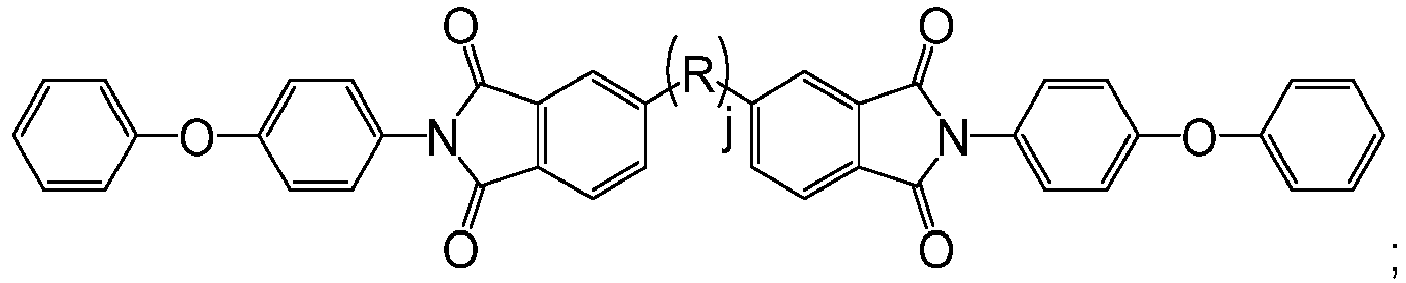


 R is selected from the group consisting of:


 L is selected from the group consisting of -CH2-, -(CH3)2C-, -O-, -S-, -SO2-, - CO-, and combinations thereof,Q is selected from the group consisting of-S-, -SO2-, -(CF3)2C-, -O-, - (CH3)2C-, and combinations thereof,j is a positive integer, andthe molecular weight of at least one of the one or more reaction products is between 10 kDa and 150 kDa.
 - The composition of claim 1, wherein each R is independently selected from:


- The composition of claim 1 or 2, wherein each R is selected from the group consisting of:(a)
 (b)wherein L is independently -CH2- or -(CH3)2C-.


- The composition of claim 1, wherein the one or more reaction products are formed from a reaction mixture comprising greater than about 33 mol% of:



- The composition of claim 1, wherein the one or more reaction products are formed from a reaction mixture comprising greater than about 50 mol% of:


- The composition of claim 1, wherein the one or more reaction products are formed from a reaction mixture further comprising one or more capping agents selected from compounds of the formula:

- The composition of claim 1, wherein the one or more reaction products are formed from a reaction mixture further comprising one or more capping agents, wherein the one or more capping agents include benzoyl chloride, benzyl chloride, benzenesulfonyl chloride, 3-chlorophenyl, 4-chlorophenyl, 4-cyanophenyl, 4-methylphenyl.
- The composition of claim 1, wherein the molecular weight of

- The composition of claim 1, wherein the one or more reaction products are a block or random copolymer.
- The composition of claim 1, wherein the one or more reaction products are formed from a reaction mixture that includes:about 17 mol % of

 about 32 mol % of
 and about 46 % mol of
- The composition of claim 1, wherein the one or more reaction products are formed from a reaction mixture that includes:about 23 mol % of

 about 29 mol % of
 about 24 mol % of
 and about 24 mol% of
- The composition of claim 1, wherein the one or more reaction products are formed from a reaction mixture that includes:45 mol % of
 5 mol % of benzoyl chloride; 20 mol % of
 15 mol % of
 and 15 mol % of
- The composition of claim 1, wherein the one or more reaction products are formed from a reaction mixture that includes:48.45 mol % of
 2.55 mol % of benzoyl chloride; 3.06 mol % of
 9.19 mol % of
 and 36.75 mol % of
- The composition of claim 1, wherein the one or more reaction products are formed from a reaction mixture that includes:35.7 mol % of
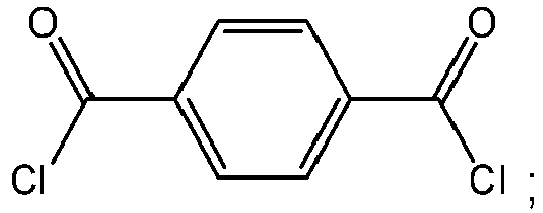 2.55 mol % of benzoyl chloride; 14.7 mol % of
 9.8 mol % of
 and 24.5 mol % of
- The composition of any of claims 1 - 14, wherein:(a) the molecular weight of at least one of the one or more reaction products is between 50 kDa and 120 kDa; optionally between 90 kDa and 110 kDa; and/or(b) the one or more reaction products have a glass transition temperature between 140°C and 225°C; optionally between 140°C and 180°C; and/or(c) the one or more reaction products have a melting temperature between 200°C and 450°C.
Applications Claiming Priority (3)
| Application Number | Priority Date | Filing Date | Title |
|---|---|---|---|
| US201662307310P | 2016-03-11 | 2016-03-11 | |
| US15/247,275 US9976063B2 (en) | 2016-03-11 | 2016-08-25 | Polyarylether ketone imide sulfone adhesives |
| EP17159673.7A EP3216820B1 (en) | 2016-03-11 | 2017-03-07 | Polyarylether ketone imide sulfone adhesives |
Related Parent Applications (1)
| Application Number | Title | Priority Date | Filing Date |
|---|---|---|---|
| EP17159673.7A Division EP3216820B1 (en) | 2016-03-11 | 2017-03-07 | Polyarylether ketone imide sulfone adhesives |
Publications (1)
| Publication Number | Publication Date |
|---|---|
| EP3789426A1 true EP3789426A1 (en) | 2021-03-10 |
Family
ID=58347067
Family Applications (2)
| Application Number | Title | Priority Date | Filing Date |
|---|---|---|---|
| EP20193961.8A Withdrawn EP3789426A1 (en) | 2016-03-11 | 2017-03-07 | Polyarylether ketone imide sulfone adhesives |
| EP17159673.7A Active EP3216820B1 (en) | 2016-03-11 | 2017-03-07 | Polyarylether ketone imide sulfone adhesives |
Family Applications After (1)
| Application Number | Title | Priority Date | Filing Date |
|---|---|---|---|
| EP17159673.7A Active EP3216820B1 (en) | 2016-03-11 | 2017-03-07 | Polyarylether ketone imide sulfone adhesives |
Country Status (2)
| Country | Link |
|---|---|
| US (2) | US9976063B2 (en) |
| EP (2) | EP3789426A1 (en) |
Families Citing this family (99)
| Publication number | Priority date | Publication date | Assignee | Title |
|---|---|---|---|---|
| ES2770053T3 (en) | 2014-05-16 | 2020-06-30 | Divergent Tech Inc | Modular formed nodes for vehicle chassis and their methods of use |
| EP3925766B1 (en) | 2014-07-02 | 2023-11-08 | Divergent Technologies, Inc. | Tubular frame of vehicle |
| US9976063B2 (en) | 2016-03-11 | 2018-05-22 | The Boeing Company | Polyarylether ketone imide sulfone adhesives |
| KR20190006593A (en) | 2016-06-09 | 2019-01-18 | 디버전트 테크놀로지스, 인크. | Systems and methods for arc and node design and fabrication |
| US11155005B2 (en) | 2017-02-10 | 2021-10-26 | Divergent Technologies, Inc. | 3D-printed tooling and methods for producing same |
| US10759090B2 (en) | 2017-02-10 | 2020-09-01 | Divergent Technologies, Inc. | Methods for producing panels using 3D-printed tooling shells |
| US12251884B2 (en) | 2017-04-28 | 2025-03-18 | Divergent Technologies, Inc. | Support structures in additive manufacturing |
| US10898968B2 (en) | 2017-04-28 | 2021-01-26 | Divergent Technologies, Inc. | Scatter reduction in additive manufacturing |
| US10703419B2 (en) | 2017-05-19 | 2020-07-07 | Divergent Technologies, Inc. | Apparatus and methods for joining panels |
| US11358337B2 (en) | 2017-05-24 | 2022-06-14 | Divergent Technologies, Inc. | Robotic assembly of transport structures using on-site additive manufacturing |
| US11123973B2 (en) | 2017-06-07 | 2021-09-21 | Divergent Technologies, Inc. | Interconnected deflectable panel and node |
| US10919230B2 (en) | 2017-06-09 | 2021-02-16 | Divergent Technologies, Inc. | Node with co-printed interconnect and methods for producing same |
| US10781846B2 (en) | 2017-06-19 | 2020-09-22 | Divergent Technologies, Inc. | 3-D-printed components including fasteners and methods for producing same |
| US10994876B2 (en) | 2017-06-30 | 2021-05-04 | Divergent Technologies, Inc. | Automated wrapping of components in transport structures |
| US11022375B2 (en) | 2017-07-06 | 2021-06-01 | Divergent Technologies, Inc. | Apparatus and methods for additively manufacturing microtube heat exchangers |
| US10895315B2 (en) | 2017-07-07 | 2021-01-19 | Divergent Technologies, Inc. | Systems and methods for implementing node to node connections in mechanized assemblies |
| US10940609B2 (en) | 2017-07-25 | 2021-03-09 | Divergent Technologies, Inc. | Methods and apparatus for additively manufactured endoskeleton-based transport structures |
| US10751800B2 (en) | 2017-07-25 | 2020-08-25 | Divergent Technologies, Inc. | Methods and apparatus for additively manufactured exoskeleton-based transport structures |
| US10605285B2 (en) | 2017-08-08 | 2020-03-31 | Divergent Technologies, Inc. | Systems and methods for joining node and tube structures |
| US10357959B2 (en) | 2017-08-15 | 2019-07-23 | Divergent Technologies, Inc. | Methods and apparatus for additively manufactured identification features |
| US11306751B2 (en) | 2017-08-31 | 2022-04-19 | Divergent Technologies, Inc. | Apparatus and methods for connecting tubes in transport structures |
| US10960611B2 (en) | 2017-09-06 | 2021-03-30 | Divergent Technologies, Inc. | Methods and apparatuses for universal interface between parts in transport structures |
| US11292058B2 (en) | 2017-09-12 | 2022-04-05 | Divergent Technologies, Inc. | Apparatus and methods for optimization of powder removal features in additively manufactured components |
| US10668816B2 (en) | 2017-10-11 | 2020-06-02 | Divergent Technologies, Inc. | Solar extended range electric vehicle with panel deployment and emitter tracking |
| US10814564B2 (en) | 2017-10-11 | 2020-10-27 | Divergent Technologies, Inc. | Composite material inlay in additively manufactured structures |
| US11786971B2 (en) | 2017-11-10 | 2023-10-17 | Divergent Technologies, Inc. | Structures and methods for high volume production of complex structures using interface nodes |
| US10926599B2 (en) | 2017-12-01 | 2021-02-23 | Divergent Technologies, Inc. | Suspension systems using hydraulic dampers |
| US11110514B2 (en) | 2017-12-14 | 2021-09-07 | Divergent Technologies, Inc. | Apparatus and methods for connecting nodes to tubes in transport structures |
| US11085473B2 (en) | 2017-12-22 | 2021-08-10 | Divergent Technologies, Inc. | Methods and apparatus for forming node to panel joints |
| US11534828B2 (en) | 2017-12-27 | 2022-12-27 | Divergent Technologies, Inc. | Assembling structures comprising 3D printed components and standardized components utilizing adhesive circuits |
| US11420262B2 (en) | 2018-01-31 | 2022-08-23 | Divergent Technologies, Inc. | Systems and methods for co-casting of additively manufactured interface nodes |
| US10751934B2 (en) | 2018-02-01 | 2020-08-25 | Divergent Technologies, Inc. | Apparatus and methods for additive manufacturing with variable extruder profiles |
| US11224943B2 (en) | 2018-03-07 | 2022-01-18 | Divergent Technologies, Inc. | Variable beam geometry laser-based powder bed fusion |
| US11267236B2 (en) | 2018-03-16 | 2022-03-08 | Divergent Technologies, Inc. | Single shear joint for node-to-node connections |
| US11872689B2 (en) | 2018-03-19 | 2024-01-16 | Divergent Technologies, Inc. | End effector features for additively manufactured components |
| US11254381B2 (en) | 2018-03-19 | 2022-02-22 | Divergent Technologies, Inc. | Manufacturing cell based vehicle manufacturing system and method |
| US11408216B2 (en) | 2018-03-20 | 2022-08-09 | Divergent Technologies, Inc. | Systems and methods for co-printed or concurrently assembled hinge structures |
| US11613078B2 (en) | 2018-04-20 | 2023-03-28 | Divergent Technologies, Inc. | Apparatus and methods for additively manufacturing adhesive inlet and outlet ports |
| US11214317B2 (en) | 2018-04-24 | 2022-01-04 | Divergent Technologies, Inc. | Systems and methods for joining nodes and other structures |
| US11020800B2 (en) | 2018-05-01 | 2021-06-01 | Divergent Technologies, Inc. | Apparatus and methods for sealing powder holes in additively manufactured parts |
| US10682821B2 (en) | 2018-05-01 | 2020-06-16 | Divergent Technologies, Inc. | Flexible tooling system and method for manufacturing of composite structures |
| US11389816B2 (en) | 2018-05-09 | 2022-07-19 | Divergent Technologies, Inc. | Multi-circuit single port design in additively manufactured node |
| US10691104B2 (en) | 2018-05-16 | 2020-06-23 | Divergent Technologies, Inc. | Additively manufacturing structures for increased spray forming resolution or increased fatigue life |
| US11590727B2 (en) | 2018-05-21 | 2023-02-28 | Divergent Technologies, Inc. | Custom additively manufactured core structures |
| US11441586B2 (en) | 2018-05-25 | 2022-09-13 | Divergent Technologies, Inc. | Apparatus for injecting fluids in node based connections |
| US11035511B2 (en) | 2018-06-05 | 2021-06-15 | Divergent Technologies, Inc. | Quick-change end effector |
| US11292056B2 (en) | 2018-07-06 | 2022-04-05 | Divergent Technologies, Inc. | Cold-spray nozzle |
| US11269311B2 (en) | 2018-07-26 | 2022-03-08 | Divergent Technologies, Inc. | Spray forming structural joints |
| US10836120B2 (en) | 2018-08-27 | 2020-11-17 | Divergent Technologies, Inc . | Hybrid composite structures with integrated 3-D printed elements |
| US11433557B2 (en) | 2018-08-28 | 2022-09-06 | Divergent Technologies, Inc. | Buffer block apparatuses and supporting apparatuses |
| US11826953B2 (en) | 2018-09-12 | 2023-11-28 | Divergent Technologies, Inc. | Surrogate supports in additive manufacturing |
| US11072371B2 (en) | 2018-10-05 | 2021-07-27 | Divergent Technologies, Inc. | Apparatus and methods for additively manufactured structures with augmented energy absorption properties |
| US11260582B2 (en) | 2018-10-16 | 2022-03-01 | Divergent Technologies, Inc. | Methods and apparatus for manufacturing optimized panels and other composite structures |
| US12115583B2 (en) | 2018-11-08 | 2024-10-15 | Divergent Technologies, Inc. | Systems and methods for adhesive-based part retention features in additively manufactured structures |
| US12194536B2 (en) | 2018-11-13 | 2025-01-14 | Divergent Technologies, Inc. | 3-D printer with manifolds for gas exchange |
| US11504912B2 (en) | 2018-11-20 | 2022-11-22 | Divergent Technologies, Inc. | Selective end effector modular attachment device |
| USD911222S1 (en) | 2018-11-21 | 2021-02-23 | Divergent Technologies, Inc. | Vehicle and/or replica |
| US11529741B2 (en) | 2018-12-17 | 2022-12-20 | Divergent Technologies, Inc. | System and method for positioning one or more robotic apparatuses |
| US11449021B2 (en) | 2018-12-17 | 2022-09-20 | Divergent Technologies, Inc. | Systems and methods for high accuracy fixtureless assembly |
| US10663110B1 (en) | 2018-12-17 | 2020-05-26 | Divergent Technologies, Inc. | Metrology apparatus to facilitate capture of metrology data |
| US11885000B2 (en) | 2018-12-21 | 2024-01-30 | Divergent Technologies, Inc. | In situ thermal treatment for PBF systems |
| US12378643B2 (en) | 2019-01-18 | 2025-08-05 | Divergent Technologies, Inc. | Aluminum alloys |
| US11203240B2 (en) | 2019-04-19 | 2021-12-21 | Divergent Technologies, Inc. | Wishbone style control arm assemblies and methods for producing same |
| US12314031B1 (en) | 2019-06-27 | 2025-05-27 | Divergent Technologies, Inc. | Incorporating complex geometric features in additively manufactured parts |
| US12280554B2 (en) | 2019-11-21 | 2025-04-22 | Divergent Technologies, Inc. | Fixtureless robotic assembly |
| US11912339B2 (en) | 2020-01-10 | 2024-02-27 | Divergent Technologies, Inc. | 3-D printed chassis structure with self-supporting ribs |
| US11590703B2 (en) | 2020-01-24 | 2023-02-28 | Divergent Technologies, Inc. | Infrared radiation sensing and beam control in electron beam additive manufacturing |
| US11479015B2 (en) | 2020-02-14 | 2022-10-25 | Divergent Technologies, Inc. | Custom formed panels for transport structures and methods for assembling same |
| US11884025B2 (en) | 2020-02-14 | 2024-01-30 | Divergent Technologies, Inc. | Three-dimensional printer and methods for assembling parts via integration of additive and conventional manufacturing operations |
| US12194674B2 (en) | 2020-02-14 | 2025-01-14 | Divergent Technologies, Inc. | Multi-material powder bed fusion 3-D printer |
| US12203397B2 (en) | 2020-02-18 | 2025-01-21 | Divergent Technologies, Inc. | Impact energy absorber with integrated engine exhaust noise muffler |
| US11535322B2 (en) | 2020-02-25 | 2022-12-27 | Divergent Technologies, Inc. | Omni-positional adhesion device |
| US11421577B2 (en) | 2020-02-25 | 2022-08-23 | Divergent Technologies, Inc. | Exhaust headers with integrated heat shielding and thermal syphoning |
| US12337541B2 (en) | 2020-02-27 | 2025-06-24 | Divergent Technologies, Inc. | Powder bed fusion additive manufacturing system with desiccant positioned within hopper and ultrasonic transducer |
| US11413686B2 (en) | 2020-03-06 | 2022-08-16 | Divergent Technologies, Inc. | Methods and apparatuses for sealing mechanisms for realizing adhesive connections with additively manufactured components |
| WO2021252686A1 (en) | 2020-06-10 | 2021-12-16 | Divergent Technologies, Inc. | Adaptive production system |
| US11850804B2 (en) | 2020-07-28 | 2023-12-26 | Divergent Technologies, Inc. | Radiation-enabled retention features for fixtureless assembly of node-based structures |
| US11806941B2 (en) | 2020-08-21 | 2023-11-07 | Divergent Technologies, Inc. | Mechanical part retention features for additively manufactured structures |
| CN116457139A (en) | 2020-09-08 | 2023-07-18 | 戴弗根特技术有限公司 | Assembly sequence generation |
| WO2022066671A1 (en) | 2020-09-22 | 2022-03-31 | Divergent Technologies, Inc. | Methods and apparatuses for ball milling to produce powder for additive manufacturing |
| US12220819B2 (en) | 2020-10-21 | 2025-02-11 | Divergent Technologies, Inc. | 3-D printed metrology feature geometry and detection |
| US12311612B2 (en) | 2020-12-18 | 2025-05-27 | Divergent Technologies, Inc. | Direct inject joint architecture enabled by quick cure adhesive |
| US12083596B2 (en) | 2020-12-21 | 2024-09-10 | Divergent Technologies, Inc. | Thermal elements for disassembly of node-based adhesively bonded structures |
| US12226824B2 (en) | 2020-12-22 | 2025-02-18 | Divergent Technologies, Inc. | Three dimensional printer with configurable build plate for rapid powder removal |
| US11872626B2 (en) | 2020-12-24 | 2024-01-16 | Divergent Technologies, Inc. | Systems and methods for floating pin joint design |
| US11947335B2 (en) | 2020-12-30 | 2024-04-02 | Divergent Technologies, Inc. | Multi-component structure optimization for combining 3-D printed and commercially available parts |
| US11928966B2 (en) | 2021-01-13 | 2024-03-12 | Divergent Technologies, Inc. | Virtual railroad |
| US12459377B2 (en) | 2021-01-19 | 2025-11-04 | Divergent Technologies, Inc. | Energy unit cells for primary vehicle structure |
| US12249812B2 (en) | 2021-01-19 | 2025-03-11 | Divergent Technologies, Inc. | Bus bars for printed structural electric battery modules |
| CN116917129A (en) | 2021-03-09 | 2023-10-20 | 戴弗根特技术有限公司 | Rotary additive manufacturing systems and methods |
| US12090551B2 (en) | 2021-04-23 | 2024-09-17 | Divergent Technologies, Inc. | Removal of supports, and other materials from surface, and within hollow 3D printed parts |
| US12138772B2 (en) | 2021-04-30 | 2024-11-12 | Divergent Technologies, Inc. | Mobile parts table |
| CN117769486A (en) | 2021-05-24 | 2024-03-26 | 戴弗根特技术有限公司 | Robotic gripper equipment |
| WO2023278878A1 (en) | 2021-07-01 | 2023-01-05 | Divergent Technologies, Inc. | Al-mg-si based near-eutectic alloy composition for high strength and stiffness applications |
| US12583033B2 (en) | 2021-08-13 | 2026-03-24 | Divergent Technologies, Inc. | Integrating additively-manufactured components |
| US11865617B2 (en) | 2021-08-25 | 2024-01-09 | Divergent Technologies, Inc. | Methods and apparatuses for wide-spectrum consumption of output of atomization processes across multi-process and multi-scale additive manufacturing modalities |
| EP4427324A4 (en) | 2021-11-02 | 2025-09-17 | Divergent Tech Inc | MOTOR NODES |
| US12152629B2 (en) | 2022-01-25 | 2024-11-26 | Divergent Technologies, Inc. | Attachment structure having a connection member with multiple attachment features |
| WO2023147390A2 (en) | 2022-01-25 | 2023-08-03 | Divergent Technologies, Inc. | Measurement-based corrections for structure assembly |
Citations (2)
| Publication number | Priority date | Publication date | Assignee | Title |
|---|---|---|---|---|
| WO2015179618A1 (en) * | 2014-05-22 | 2015-11-26 | Cytec Industries Inc. | Functionalized polymer particles for use as toughening agent |
| WO2015177550A1 (en) * | 2014-05-22 | 2015-11-26 | Ketonex Limited | Amine and non-amine derivatised polyaryletherketone random and block copolymers |
Family Cites Families (7)
| Publication number | Priority date | Publication date | Assignee | Title |
|---|---|---|---|---|
| US4868271A (en) | 1985-10-22 | 1989-09-19 | Raychem Corporation | Novel aromatic polymers |
| US4816556A (en) | 1985-02-22 | 1989-03-28 | E. I. Du Pont De Nemours And Company | Ordered polyetherketones |
| EP0210851B1 (en) | 1985-07-26 | 1992-03-18 | Teijin Limited | Mixtures of polyamideimides, containing 3,4'-diaminodiphenylether as diamine component, and of a plasticizer. |
| US5260404A (en) * | 1988-04-19 | 1993-11-09 | Raychem Limited | Polyetherketonimides |
| GB8809231D0 (en) | 1988-04-19 | 1988-05-25 | Raychem Ltd | Polyetherketoneimides |
| JP6637491B2 (en) * | 2014-05-22 | 2020-01-29 | サイテック インダストリーズ インコーポレイテッド | Granular amine-functionalized polyaryletherketone polymers and copolymers thereof |
| US9976063B2 (en) | 2016-03-11 | 2018-05-22 | The Boeing Company | Polyarylether ketone imide sulfone adhesives |
-
2016
- 2016-08-25 US US15/247,275 patent/US9976063B2/en active Active
-
2017
- 2017-03-07 EP EP20193961.8A patent/EP3789426A1/en not_active Withdrawn
- 2017-03-07 EP EP17159673.7A patent/EP3216820B1/en active Active
-
2018
- 2018-05-17 US US15/982,602 patent/US10501665B2/en active Active
Patent Citations (2)
| Publication number | Priority date | Publication date | Assignee | Title |
|---|---|---|---|---|
| WO2015179618A1 (en) * | 2014-05-22 | 2015-11-26 | Cytec Industries Inc. | Functionalized polymer particles for use as toughening agent |
| WO2015177550A1 (en) * | 2014-05-22 | 2015-11-26 | Ketonex Limited | Amine and non-amine derivatised polyaryletherketone random and block copolymers |
Non-Patent Citations (1)
| Title |
|---|
| BIN HUANG ET AL: "Synthesis and characterization of novel copolymers of poly(ether ketone ketone) and poly(ether ketone sulfone imide)", POLYMER BULLETIN, SPRINGER, BERLIN, DE, vol. 69, no. 6, 13 April 2012 (2012-04-13), pages 661 - 673, XP035101217, ISSN: 1436-2449, DOI: 10.1007/S00289-012-0753-7 * |
Also Published As
| Publication number | Publication date |
|---|---|
| EP3216820A1 (en) | 2017-09-13 |
| US9976063B2 (en) | 2018-05-22 |
| US20170260432A1 (en) | 2017-09-14 |
| US10501665B2 (en) | 2019-12-10 |
| EP3216820B1 (en) | 2020-09-23 |
| US20180334598A1 (en) | 2018-11-22 |
Similar Documents
| Publication | Publication Date | Title |
|---|---|---|
| EP3216820B1 (en) | Polyarylether ketone imide sulfone adhesives | |
| US11098162B2 (en) | Polyarylether ketone imide adhesives | |
| KR101667465B1 (en) | Thermoplastic composite material reinforced with synthetic fibres, and method for producing same | |
| US11077644B2 (en) | Material systems and methods of manufacturing material systems | |
| US10738170B2 (en) | Method for the open-mold production of a fiber-reinforced semi-crystalline polyamide matrix composite material from a prepolymer reactive precursor composition | |
| CN103850124B (en) | Carbon fiber/polymer matrix composites of a kind of interface modification and preparation method thereof | |
| US10961362B2 (en) | Method for producing a fibre-reinforced polyamide matrix composite material from a reactive prepolymer precursor composition | |
| JP2026034609A (en) | Reactive polyamideimide oligomers, methods, and articles | |
| Hergenrother | Recent advances in high temperature polymers | |
| US9725567B2 (en) | Adduct thermosetting surfacing film and method of forming the same | |
| CN108884243A (en) | The method for preparing the component made of the composite material with reinforcer | |
| Frich et al. | Aromatic copolyester thermosets: High temperature adhesive properties | |
| JP2019513156A (en) | Novel heterodiels alder crosslinker and its use in a reversible crosslinkable polymer system | |
| KR20020069018A (en) | Laminate and process for producing a laminate of this type | |
| TW201823319A (en) | Novel crosslinker unit for use in reversibly crosslinking polymer systems | |
| Wang et al. | Strong, and recyclable thermosets cross-linked by MWCNT/poly (aryl ether ketone) containing furan based on Diels-Alder cycloaddition | |
| Hergenrother | Adhesive and composite evaluation of acetylene‐terminated phenylquinoxaline resins | |
| Cano et al. | Polyimide Composites from Salt-Like Solution Precursors | |
| CN114008115B (en) | Self-adhesive prepreg | |
| CN117777929A (en) | A high-solid heat-resistant polyurethane adhesive and its application | |
| Saitta et al. | Epoxy Latent Systems for Novel Hybrid 3D Printed Metal/CFs Reinforced Composite Joint Disassembly via Chemical Recycling | |
| CN110408202A (en) | A kind of thermosetting composition for fused deposition molding and its prepared product and preparation method | |
| CN121674023A (en) | Ionomer adhesives prepared based on PET degradation and their preparation method | |
| CN107532054A (en) | Adhesive compositions with improved delta-alpha tolerance, related joining methods and resultant composite workpieces | |
| JPH0136785B2 (en) |
Legal Events
| Date | Code | Title | Description |
|---|---|---|---|
| PUAI | Public reference made under article 153(3) epc to a published international application that has entered the european phase |
Free format text: ORIGINAL CODE: 0009012 |
|
| STAA | Information on the status of an ep patent application or granted ep patent |
Free format text: STATUS: THE APPLICATION HAS BEEN PUBLISHED |
|
| AC | Divisional application: reference to earlier application |
Ref document number: 3216820 Country of ref document: EP Kind code of ref document: P |
|
| AK | Designated contracting states |
Kind code of ref document: A1 Designated state(s): AL AT BE BG CH CY CZ DE DK EE ES FI FR GB GR HR HU IE IS IT LI LT LU LV MC MK MT NL NO PL PT RO RS SE SI SK SM TR |
|
| STAA | Information on the status of an ep patent application or granted ep patent |
Free format text: STATUS: REQUEST FOR EXAMINATION WAS MADE |
|
| 17P | Request for examination filed |
Effective date: 20210825 |
|
| RBV | Designated contracting states (corrected) |
Designated state(s): AL AT BE BG CH CY CZ DE DK EE ES FI FR GB GR HR HU IE IS IT LI LT LU LV MC MK MT NL NO PL PT RO RS SE SI SK SM TR |
|
| STAA | Information on the status of an ep patent application or granted ep patent |
Free format text: STATUS: EXAMINATION IS IN PROGRESS |
|
| RAP3 | Party data changed (applicant data changed or rights of an application transferred) |
Owner name: THE BOEING COMPANY |
|
| 17Q | First examination report despatched |
Effective date: 20230227 |
|
| STAA | Information on the status of an ep patent application or granted ep patent |
Free format text: STATUS: THE APPLICATION IS DEEMED TO BE WITHDRAWN |
|
| 18D | Application deemed to be withdrawn |
Effective date: 20250802 |