EP3789424A1 - Gel-forming block copolymers - Google Patents
Gel-forming block copolymers Download PDFInfo
- Publication number
- EP3789424A1 EP3789424A1 EP19196221.6A EP19196221A EP3789424A1 EP 3789424 A1 EP3789424 A1 EP 3789424A1 EP 19196221 A EP19196221 A EP 19196221A EP 3789424 A1 EP3789424 A1 EP 3789424A1
- Authority
- EP
- European Patent Office
- Prior art keywords
- block copolymer
- block
- accordance
- polymer
- repeating units
- Prior art date
- Legal status (The legal status is an assumption and is not a legal conclusion. Google has not performed a legal analysis and makes no representation as to the accuracy of the status listed.)
- Granted
Links
Images


Classifications
-
- C—CHEMISTRY; METALLURGY
- C08—ORGANIC MACROMOLECULAR COMPOUNDS; THEIR PREPARATION OR CHEMICAL WORKING-UP; COMPOSITIONS BASED THEREON
- C08G—MACROMOLECULAR COMPOUNDS OBTAINED OTHERWISE THAN BY REACTIONS ONLY INVOLVING UNSATURATED CARBON-TO-CARBON BONDS
- C08G73/00—Macromolecular compounds obtained by reactions forming a linkage containing nitrogen with or without oxygen or carbon in the main chain of the macromolecule, not provided for in groups C08G12/00 - C08G71/00
- C08G73/02—Polyamines
-
- B—PERFORMING OPERATIONS; TRANSPORTING
- B29—WORKING OF PLASTICS; WORKING OF SUBSTANCES IN A PLASTIC STATE IN GENERAL
- B29C—SHAPING OR JOINING OF PLASTICS; SHAPING OF MATERIAL IN A PLASTIC STATE, NOT OTHERWISE PROVIDED FOR; AFTER-TREATMENT OF THE SHAPED PRODUCTS, e.g. REPAIRING
- B29C64/00—Additive manufacturing, i.e. manufacturing of three-dimensional [3D] objects by additive deposition, additive agglomeration or additive layering, e.g. by 3D printing, stereolithography or selective laser sintering
- B29C64/40—Structures for supporting 3D objects during manufacture and intended to be sacrificed after completion thereof
-
- B—PERFORMING OPERATIONS; TRANSPORTING
- B33—ADDITIVE MANUFACTURING TECHNOLOGY
- B33Y—ADDITIVE MANUFACTURING, i.e. MANUFACTURING OF THREE-DIMENSIONAL [3D] OBJECTS BY ADDITIVE DEPOSITION, ADDITIVE AGGLOMERATION OR ADDITIVE LAYERING, e.g. BY 3D PRINTING, STEREOLITHOGRAPHY OR SELECTIVE LASER SINTERING
- B33Y10/00—Processes of additive manufacturing
-
- B—PERFORMING OPERATIONS; TRANSPORTING
- B33—ADDITIVE MANUFACTURING TECHNOLOGY
- B33Y—ADDITIVE MANUFACTURING, i.e. MANUFACTURING OF THREE-DIMENSIONAL [3D] OBJECTS BY ADDITIVE DEPOSITION, ADDITIVE AGGLOMERATION OR ADDITIVE LAYERING, e.g. BY 3D PRINTING, STEREOLITHOGRAPHY OR SELECTIVE LASER SINTERING
- B33Y70/00—Materials specially adapted for additive manufacturing
-
- C—CHEMISTRY; METALLURGY
- C08—ORGANIC MACROMOLECULAR COMPOUNDS; THEIR PREPARATION OR CHEMICAL WORKING-UP; COMPOSITIONS BASED THEREON
- C08G—MACROMOLECULAR COMPOUNDS OBTAINED OTHERWISE THAN BY REACTIONS ONLY INVOLVING UNSATURATED CARBON-TO-CARBON BONDS
- C08G73/00—Macromolecular compounds obtained by reactions forming a linkage containing nitrogen with or without oxygen or carbon in the main chain of the macromolecule, not provided for in groups C08G12/00 - C08G71/00
- C08G73/02—Polyamines
- C08G73/0233—Polyamines derived from (poly)oxazolines, (poly)oxazines or having pendant acyl groups
-
- C—CHEMISTRY; METALLURGY
- C08—ORGANIC MACROMOLECULAR COMPOUNDS; THEIR PREPARATION OR CHEMICAL WORKING-UP; COMPOSITIONS BASED THEREON
- C08J—WORKING-UP; GENERAL PROCESSES OF COMPOUNDING; AFTER-TREATMENT NOT COVERED BY SUBCLASSES C08B, C08C, C08F, C08G or C08H
- C08J3/00—Processes of treating or compounding macromolecular substances
- C08J3/02—Making solutions, dispersions, lattices or gels by other methods than by solution, emulsion or suspension polymerisation techniques
- C08J3/03—Making solutions, dispersions, lattices or gels by other methods than by solution, emulsion or suspension polymerisation techniques in aqueous media
- C08J3/075—Macromolecular gels
-
- B—PERFORMING OPERATIONS; TRANSPORTING
- B29—WORKING OF PLASTICS; WORKING OF SUBSTANCES IN A PLASTIC STATE IN GENERAL
- B29K—INDEXING SCHEME ASSOCIATED WITH SUBCLASSES B29B, B29C OR B29D, RELATING TO MOULDING MATERIALS OR TO MATERIALS FOR MOULDS, REINFORCEMENTS, FILLERS OR PREFORMED PARTS, e.g. INSERTS
- B29K2105/00—Condition, form or state of moulded material or of the material to be shaped
- B29K2105/0085—Copolymers
-
- B—PERFORMING OPERATIONS; TRANSPORTING
- B29—WORKING OF PLASTICS; WORKING OF SUBSTANCES IN A PLASTIC STATE IN GENERAL
- B29K—INDEXING SCHEME ASSOCIATED WITH SUBCLASSES B29B, B29C OR B29D, RELATING TO MOULDING MATERIALS OR TO MATERIALS FOR MOULDS, REINFORCEMENTS, FILLERS OR PREFORMED PARTS, e.g. INSERTS
- B29K2105/00—Condition, form or state of moulded material or of the material to be shaped
- B29K2105/24—Condition, form or state of moulded material or of the material to be shaped crosslinked or vulcanised
-
- C—CHEMISTRY; METALLURGY
- C08—ORGANIC MACROMOLECULAR COMPOUNDS; THEIR PREPARATION OR CHEMICAL WORKING-UP; COMPOSITIONS BASED THEREON
- C08G—MACROMOLECULAR COMPOUNDS OBTAINED OTHERWISE THAN BY REACTIONS ONLY INVOLVING UNSATURATED CARBON-TO-CARBON BONDS
- C08G2210/00—Compositions for preparing hydrogels
-
- C—CHEMISTRY; METALLURGY
- C08—ORGANIC MACROMOLECULAR COMPOUNDS; THEIR PREPARATION OR CHEMICAL WORKING-UP; COMPOSITIONS BASED THEREON
- C08J—WORKING-UP; GENERAL PROCESSES OF COMPOUNDING; AFTER-TREATMENT NOT COVERED BY SUBCLASSES C08B, C08C, C08F, C08G or C08H
- C08J2379/00—Characterised by the use of macromolecular compounds obtained by reactions forming in the main chain of the macromolecule a linkage containing nitrogen with or without oxygen, or carbon only, not provided for in groups C08J2361/00 - C08J2377/00
- C08J2379/02—Polyamines
Definitions
- thermoresponsive polymers are widely discussed and described in the literature, e.g. Y.-J. Kim and Y. Matsunaga, "Thermo-responsive polymers and their application as smart biomaterials", J. Mater. Chem. B, 2017, 5, 4307-4321 .
- Some of these thermoresponsive structures undergo reversible temperature dependent gelation in aqueous solutions, like gelatin. Depending on the applications, the temperature and conditions at which the gel forms and is stable must be suitable. Also the strength of the gel must be adapted to the desired application. It was the objective underlying the invention to provide such a thermoresponsive polymer, which is capable of forming a gel structure within an appropriate temperature range, and with a suitable gel strength.
- the invention provides a block copolymer comprising
- the invention provides a hydrogel comprising the block copolymer of the present invention, and a process for the formation of such a hydrogel.
- the block copolymer in accordance with the present invention comprises a polymer block (A) formed from repeating units of formula (I): wherein R 1 is methyl or ethyl, preferably methyl.
- brackets [ ] in formula (I) indicate that the entity within the brackets (i.e. -N(C(O)R 1 )-CH 2 -CH 2 -) represents a repeating unit of the polymer block, and the lines crossing the brackets indicate the bonds which link the repeating unit to adjacent atoms or entities, typically to an adjacent repeating unit of the same polymer block, to an adjacent repeating unit of a different polymer block, or to a terminal group of the block copolymer.
- the reference to a polymer block "formed from" a defined repeating unit or a group of repeating units indicates that the polymer block consists of the respective units.
- R 1 is the same for all repeating units within each polymer block (A). Likewise, it is preferred that all repeating units within a polymer block (A) are the same, and if more than one polymer block (A) is present, the polymer blocks are also formed from the same repeating unit of formula (I).
- the number of repeating units of formula (I) forming each polymer block (A) is, independently for each polymer block (A) if more than one polymer block (A) is present, preferably 5 or more and 100 or less, more preferably 10 or more and 70 or less, and even more preferably 20 or more and 50 or less.
- a preferred structure of the polymer block(s) (A) is indicated by the following formula (Ia): wherein R 1 is methyl or ethyl, more preferably methyl, and n is 5 or more and 100 or less, more preferably 10 or more and 70 or less, and even more preferably 20 or more and 50 or less.
- the polymer block(s) (B) comprised by the block copolymer in accordance with the present invention are formed from repeating units of formula (II):
- brackets [ ] in formula (II) indicate that the entity within the brackets (i.e. -N(C(O)Ph)-CH 2 -CH 2 -CH 2 -) represents a repeating unit of the polymer block, and the lines crossing the brackets indicate the bonds which link the repeating unit to adjacent atoms or entities, typically to an adjacent repeating unit of the same polymer block, to an adjacent repeating unit of a different polymer block, or to a terminal group of the block copolymer.
- the reference to a polymer block "formed from" a defined repeating unit or a group of repeating units indicates that the polymer block consists of the respective units.
- the number of repeating units of formula (II) forming each polymer block (B) is, independently for each polymer block (B) if more than one polymer block (B) is present, preferably 5 or more and 100 or less, more preferably 5 or more and 70 or less, and even more preferably 10 or more and 33 or less.
- a preferred structure of the polymer block(s) (B) is indicated by the following formula (IIa): wherein m is 5 or more and 100 or less, more preferably 5 or more and 70 or less, and even more preferably 10 or more and 33 or less.
- block copolymer is used herein in accordance with its established meaning in the art to refer to copolymers wherein repeating units of a defined type are organized in blocks.
- the block (A) or blocks (A) contained in the block copolymer in accordance with the invention can be considered as polymers themselves, and the same applies for the block (B) or the blocks (B).
- the block copolymer according to the invention comprises a polymer block (A) and a polymer block (B) as defined herein. It can comprise other repeating units and/or other polymer blocks in addition to the polymer block(s) (A) and the polymer block(s) (B). However, typically all of the repeating units contained in the block copolymer are the repeating units forming the polymer block(s) (A) and the polymer block(s) (B) as defined above.
- the polymeric entities of the block copolymer consist of one or more polymer block(s) (A) and one or more polymer block(s) (B).
- such a block copolymer wherein the polymeric entities consist of one or more polymer block(s) (A) and one or more polymer block(s) (B), can comprise, in addition to the polymer blocks (A) and (B), groups which are not repeating units, e.g. terminal groups originating from a polymerization initiator or from a terminating agent.
- the block copolymer in accordance with the present invention typically has a structure selected from a linear block copolymer, a star-like block copolymer, and a block copolymer with a graft structure or a brush copolymer. More preferred is a linear block copolymer structure. As will be understood by the skilled reader, in such a linear structure, there are either two polymer blocks (A)-(B) or (B)-(A), three polymer blocks (A)-(B)-(A) or (B)-(A)-(B), or more polymer blocks (A) and (B) linearly arranged in an alternating fashion.
- linear block copolymers preference is given to a diblock copolymer (A)-(B) or (B)-(A), and to a triblock copolymer (A)-(B)-(A).
- the triblock copolymer having the structure (A)-(B)-(A), i.e. a triblock copolymer comprising two polymer blocks (A) and one polymer block (B) in the order of (A)-(B)-(A).
- the polymer blocks (A) contain similar numbers of repeating units, e.g. if the average number of repeating units is calculated, the number of repeating units in all polymer blocks (A) is within the range of the average number of repeating units ⁇ 50 %, more preferably within the range of the average number of repeating units ⁇ 25 %.
- the polymer blocks (B) contain similar numbers of repeating units, e.g. if the average number of repeating units is calculated, the number of repeating units in all polymer blocks (B) is within the range of the average number of repeating units ⁇ 50 %, more preferably within the range of the average number of repeating units ⁇ 25 %.
- the ratio of the total number of repeating units of formula (I) forming the polymer block(s) (A) to the total number of repeating units of formula (II) forming the polymer block(s) (B) in any block copolymer in accordance with the invention, in terms of the numbers of repeating units, is preferably in the range of 20:1 to 1:1, more preferably 16:1 to 2:1, and even more preferably 8:1 to 3:1.
- This ratio can be determined, e.g., by measuring the relative amounts of side chains R 1 and phenyl side chains via 1 H-NMR analysis and calculating their ratio accordingly.
- the average degree of polymerization (number average) of the block copolymer in accordance with the present invention is preferably in the range of 40 to 180, more preferably in the range of 60 to 110, indicated as the average number of repeating units. It can be determined, e.g., via NMR endgroup analysis.
- a strongly preferred block copolymer in accordance with the invention is an (A)-(B)-(A) triblock copolymer having the following structure (III): wherein R 1 is methyl or ethyl, more preferably methyl, n is, independently, 5 or more and 100 or less, more preferably 10 or more and 70 or less, and even more preferably 20 or more and 50 or less, and m is 5 or more and 100 or less, more preferably 5 or more and 70 or less, and even more preferably 10 or more and 33 or less.
- this ratio ranges from 20:1 to 1:1, more preferably from 16:1 to 2:1, and even more preferably from 8:1 to 3:1.
- the average degree of polymerization is preferably in the range of 40 to 180, more preferably in the range of 60 to 110.
- formula (III) shows that the polymeric entities of the block copolymer of formula (III) consists of the three polymer blocks, the first one being formed by n repeating units of the formula -N(C(O)R 1 )-CH 2 -CH 2 -, the second one being formed by m repeating units of the formula -N(C(O)Ph)-CH 2 -CH 2 -CH 2 -, and the third one being formed by n repeating units of the formula -N(C(O)R 1 )-CH 2 -CH 2 -.
- the open bonds at the polymer terminals on the left side and on the right side of formula (III) will typically be attached to groups which are not repeating units, i.e. terminal groups of the block copolymer, such as groups originating from a polymerization initiator or from a terminating agent, or a group or atom contained in a monomer terminating a polymer block, such as a hydrogen atom, a methyl group, a propargyl group, or a tert -butyl piperazinyl-1-carboxylate (1-Boc-piperazinyl) group.
- terminal groups of the block copolymer such as groups originating from a polymerization initiator or from a terminating agent, or a group or atom contained in a monomer terminating a polymer block, such as a hydrogen atom, a methyl group, a propargyl group, or a tert -butyl piperazinyl-1-carboxylate (1-Boc-
- the block copolymers of the present invention can be prepared by polymerization methods known in the art, the polymer synthesis is well reproducible and scalable.
- a polymer block (B) can be conveniently prepared via cationic ring-opening polymerization of 2-phenyl substituted 2-oxazines (also referred to as 2-phenyl substituted 5,6-dihydro- 4H -1,3-oxazines) of the formula
- Such 2-oxazine monomers are obtainable, e.g., from a suitable nitrile, 3-aminopropanol and zinc acetate as a catalyst, following the procedure by Seeliger et al. ( H. Witte, W. Seeliger, Justus Liebigs Annalen der Chemie 1974, 996-1009 ).
- 2-substituted 2-oxazolines of the following formula, wherein R 1 has the same meaning as above can be polymerized via ring-opening polymerization to provide a polymer block (A):
- Suitable conditions for the cationic ring opening polymerization of 2-substituted 2-oxazine or 2-substituted 2-oxazoline monomers are disclosed, e.g., by R. Luxenhofer and R. Jordan, Macromolecules 39, 3509-3516 (2006 ), T. Bonné et al., Colloid. Polym. Sci., 282, 833-843 (2004 ), T. Bonné et al. Macromol. Chem. Phys. 2008, 1402-1408, (2007 ), or L. Hahn et al., Biomacromolecules 2018, 19,7, 3119-3128 .
- the molar mass or degree of polymerization of the block copolymer in accordance with the invention can be controlled, e.g., by controlling the ratio of the amount of a polymerization initiator to the amount of monomers.
- a hydrogel which comprises a block copolymer of the present invention.
- the block copolymer is comprised within the polymer network of this hydrogel, and preferably the polymer network of the hydrogel consists of the block copolymer of the present invention.
- the macromolecules of the block copolymer form a network via non-covalent interactions of their polymer chains or of blocks contained therein, respectively.
- the hydrogel can comprise one or more types of the block copolymer in accordance with the invention. If more than one type of such a copolymer is used, the types of block copolymer may differ, e.g., with respect to the degree of polymerization of one or more of the polymer blocks contained therein.
- aqueous solution is a solution comprising water as a solvent, typically as a main solvent in an amount of 50 wt% or more (based on the total weight of solvent as 100%) preferably in an amount of 75 wt% or more and more preferably in an amount of 90 wt% or more. Most preferably, the aqueous solution uses water as the only solvent.
- the block copolymers of the present invention are thermoresponsive and capable of forming a hydrogel from aqueous solutions of comparably low polymer concentrations.
- Typical concentrations of the block copolymer in the aqueous solutions which can be used to provide such a hydrogel range from 3 wt% to 40 wt%, and preferred concentrations from 5 wt% to 30 wt%, based on the total weight of the solution as 100 wt%.
- the inventors have found that the gel strength of the obtained hydrogel can be adjusted by adjusting the concentration of the block copolymer in the aqueous solution, with higher concentrations leading to a higher gel strength.
- the block copolymer can be dissolved in an appropriate amount of water.
- the solution is preferably be prepared using an aqueous solvent or a mixture of the aqueous solvent and the block copolymer with a temperature at or above the upper critical temperature where the gel liquefies, i.e. at or above a temperature which is typically in the range of 27 to 35 °C for the block copolymers in accordance with the present invention.
- a further aspect of the present invention relates to a process for the formation of a hydrogel, comprising the step of cooling an aqueous solution of a block copolymer in accordance with the invention.
- the aqueous solution is kept for this purpose at a temperature of 20°C or less.
- the aqueous solution In order to accelerate the formation of the gel, it is preferred to keep the aqueous solution at a temperature of 15°C or less, more preferably 10°C or less, e.g. 5 to 10°C.
- the temperature at which the solution is kept to allow the formation of the hydrogel is typically not lower than 0°C.
- the hydrogel Once the hydrogel has formed, it remains stable until it is exposed to a temperature at or above the upper critical temperature. At temperatures at or above the upper critical temperature, the hydrogel turns again into a liquid aqueous solution (a process which may also be referred to as the liquefication of the hydrogel).
- the upper critical temperature is typically in the range of 27 to 35°C. The process of gelation and dissolution of the hydrogel can be repeated without limitations.
- the hydrogel in accordance with the present invention is optically transparent. As noted above, its gel strength can be adjusted across a broad range in a simple procedure, and it can be obtained from solutions of low polymer concentration. Furthermore, it has been found that the hydrogel in accordance with the invention has shear-thinning properties.
- the hydrogel in accordance with the present invention can be used in a variety of applications, including e.g. the use as support material in 3D printing, or the use as a matrix for the transport of a sensitive material such as of biological material.
- initiator and 2-methyl-2-oxazoline were added to dry benzonitrile (PhCN) and stirred for several hours at 110 °C.
- the full monomer conversion was verified by 1 H-NMR-spectroscopy before adding the monomer for the second block.
- the mixture was cooled to room temperature and 2-phenyl-2-oxazine (PheOzi) was added. After stirring at 120 °C overnight the monomer (MeOx) for the third block was added. After completion of the third block, termination was carried out using the respective terminating agent and stirring for several hours at 45 °C. After cooling to room temperature, potassium carbonate was added and the mixture was stirred for 5 hours.
- Figure 1 illustrates the structure of the resulting block copolymer, wherein m and n have the meanings defined above.
- the polymers are characterized via NMR, size exclusion chromatography and rheology.
- NMR spectra were recorded on a Fourier 300 (300.12 MHz), Bruker Biospin (Rheinstetten, Germany) at 298 K. The spectra were calibrated to the signal of residual protonated solvent (CDCI3 at 7.26 ppm).
- Results from NMR and GPC analysis of different block copolymers are shown in the following Table 1.
- the ratio of blocks A and B can be determined in an appropriate non-selective solvent by comparing the signals of appropriate side chain signals of block A and block B.
- Endgroup analysis for the determination of the average degree of polymerization can be conducted after appropriate base line correction using the signal of initiator or termination fragment in relation to the signal of the polymer backbone or an appropriate polymer side chain signal. Alternatively, or in addition, this can be conducted in a solvent selective from one block, for example block A.
- the average degree of polymerization of block A can then be obtained by endgroup analysis, whereby the overall average degree of polymerization can be obtained by considering the molar ratio of block A and block B.
- Table 1 Number average molar mass, ratio of oxazine/oxazoline (Ozi/Ox) units, dispersity ⁇ and yield of the synthesized triblock copolymers used in this study.
- LVR linear viscoelastic region
- Figure 2 shows amplitude-sweeps of block copolymer B1 (cf. Table 1) of different concentrations (5 wt.%: storage modulus G': filled squares, loss modulus G": filled circles; 10 wt.%: G': empty squares, G": empty circles; 15 wt.%: G': filled triangle up, G": filled triangle down and 20 wt.%: G': empty triangle up, G": empty triangle down) at 5 °C and an angular frequency of 10 rad/s.
- Figure 3 illustrates a temperature-sweep of block copolymer B1 from 5 to 50 °C with a 15 wt.% aqueous polymer solution, Amplitude 1%, angular frequency 10 rad/s. Storage modulus is shown by squares, loss modulus by circles. At 27 °C the structure undergoes first changes and at 30 °C the structure dissolves
- Figure 5 shows the viscosity of hydrogels of block copolymer B1 in dependency of applied shear rate and different polymer concentrations at 5 °C.
Landscapes
- Chemical & Material Sciences (AREA)
- Health & Medical Sciences (AREA)
- Chemical Kinetics & Catalysis (AREA)
- Medicinal Chemistry (AREA)
- Polymers & Plastics (AREA)
- Organic Chemistry (AREA)
- Manufacturing & Machinery (AREA)
- Engineering & Computer Science (AREA)
- Materials Engineering (AREA)
- Dispersion Chemistry (AREA)
- Physics & Mathematics (AREA)
- Mechanical Engineering (AREA)
- Optics & Photonics (AREA)
- Graft Or Block Polymers (AREA)
Abstract
Description
- Thermoresponsive polymers are widely discussed and described in the literature, e.g. Y.-J. Kim and Y. Matsunaga, "Thermo-responsive polymers and their application as smart biomaterials", J. Mater. Chem. B, 2017, 5, 4307-4321. Some of these thermoresponsive structures undergo reversible temperature dependent gelation in aqueous solutions, like gelatin. Depending on the applications, the temperature and conditions at which the gel forms and is stable must be suitable. Also the strength of the gel must be adapted to the desired application. It was the objective underlying the invention to provide such a thermoresponsive polymer, which is capable of forming a gel structure within an appropriate temperature range, and with a suitable gel strength.
- It has been found that a new block copolymer platform based on poly(2-oxazoline)-block-poly(2-oxazine)s as described in the following is able to undergo inverse thermogelation from aqueous solutions with a low polymer concentration. The hydrogels, which are formed when the solutions of the block copolymers disclosed herein are kept below a critical temperature, show a number of beneficial properties, such as shear-thinning and structure recovery properties. The gel formation is reversible, and once the gel is formed, it stays stable until heated to an upper critical temperature. At this upper critical temperature, the gel liquefies. Moreover, the gel strength can be adjusted by appropriately selecting the concentration of the block copolymer.
- Thus, in accordance with a first aspect of the present invention, the invention provides a block copolymer comprising
- a polymer block (A) formed from repeating units of formula (I):

and - a polymer block (B) formed from repeating units of formula (II):

- In accordance with further related aspects, the invention provides a hydrogel comprising the block copolymer of the present invention, and a process for the formation of such a hydrogel.
- The block copolymer in accordance with the present invention comprises a polymer block (A) formed from repeating units of formula (I):

- In line with conventional practice, it will be understood that the brackets [ ] in formula (I) indicate that the entity within the brackets (i.e. -N(C(O)R1)-CH2-CH2-) represents a repeating unit of the polymer block, and the lines crossing the brackets indicate the bonds which link the repeating unit to adjacent atoms or entities, typically to an adjacent repeating unit of the same polymer block, to an adjacent repeating unit of a different polymer block, or to a terminal group of the block copolymer. The reference to a polymer block "formed from" a defined repeating unit or a group of repeating units indicates that the polymer block consists of the respective units.
- Preferably, R1 is the same for all repeating units within each polymer block (A). Likewise, it is preferred that all repeating units within a polymer block (A) are the same, and if more than one polymer block (A) is present, the polymer blocks are also formed from the same repeating unit of formula (I).
- The number of repeating units of formula (I) forming each polymer block (A) is, independently for each polymer block (A) if more than one polymer block (A) is present, preferably 5 or more and 100 or less, more preferably 10 or more and 70 or less, and even more preferably 20 or more and 50 or less.
- In line with the above, a preferred structure of the polymer block(s) (A) is indicated by the following formula (Ia):

- The polymer block(s) (B) comprised by the block copolymer in accordance with the present invention are formed from repeating units of formula (II):

- In line with conventional practice, it will be understood that the brackets [ ] in formula (II) indicate that the entity within the brackets (i.e. -N(C(O)Ph)-CH2-CH2-CH2-) represents a repeating unit of the polymer block, and the lines crossing the brackets indicate the bonds which link the repeating unit to adjacent atoms or entities, typically to an adjacent repeating unit of the same polymer block, to an adjacent repeating unit of a different polymer block, or to a terminal group of the block copolymer. The reference to a polymer block "formed from" a defined repeating unit or a group of repeating units indicates that the polymer block consists of the respective units.
- The number of repeating units of formula (II) forming each polymer block (B) is, independently for each polymer block (B) if more than one polymer block (B) is present, preferably 5 or more and 100 or less, more preferably 5 or more and 70 or less, and even more preferably 10 or more and 33 or less.
- In line with the above, a preferred structure of the polymer block(s) (B) is indicated by the following formula (IIa):

- The term "block copolymer" is used herein in accordance with its established meaning in the art to refer to copolymers wherein repeating units of a defined type are organized in blocks. Typically, the block (A) or blocks (A) contained in the block copolymer in accordance with the invention can be considered as polymers themselves, and the same applies for the block (B) or the blocks (B). Thus, reference may be made herein to a "polymer A" providing the polymer block(s) (A), and to a "polymer B" providing the polymer block(s) (B) in the copolymer in accordance with the invention.
- The block copolymer according to the invention comprises a polymer block (A) and a polymer block (B) as defined herein. It can comprise other repeating units and/or other polymer blocks in addition to the polymer block(s) (A) and the polymer block(s) (B). However, typically all of the repeating units contained in the block copolymer are the repeating units forming the polymer block(s) (A) and the polymer block(s) (B) as defined above. Thus, preferably, the polymeric entities of the block copolymer consist of one or more polymer block(s) (A) and one or more polymer block(s) (B). It will be understood that such a block copolymer, wherein the polymeric entities consist of one or more polymer block(s) (A) and one or more polymer block(s) (B), can comprise, in addition to the polymer blocks (A) and (B), groups which are not repeating units, e.g. terminal groups originating from a polymerization initiator or from a terminating agent.
- The block copolymer in accordance with the present invention typically has a structure selected from a linear block copolymer, a star-like block copolymer, and a block copolymer with a graft structure or a brush copolymer. More preferred is a linear block copolymer structure. As will be understood by the skilled reader, in such a linear structure, there are either two polymer blocks (A)-(B) or (B)-(A), three polymer blocks (A)-(B)-(A) or (B)-(A)-(B), or more polymer blocks (A) and (B) linearly arranged in an alternating fashion. Among these linear block copolymers, preference is given to a diblock copolymer (A)-(B) or (B)-(A), and to a triblock copolymer (A)-(B)-(A). Most preferred is the triblock copolymer having the structure (A)-(B)-(A), i.e. a triblock copolymer comprising two polymer blocks (A) and one polymer block (B) in the order of (A)-(B)-(A).
- If more than one polymer block (A) is present in the block copolymer in accordance with the present invention, it is preferred that the polymer blocks (A) contain similar numbers of repeating units, e.g. if the average number of repeating units is calculated, the number of repeating units in all polymer blocks (A) is within the range of the average number of repeating units ± 50 %, more preferably within the range of the average number of repeating units ± 25 %.
- If more than one polymer block (B) is present in the block copolymer in accordance with the present invention, it is preferred that the polymer blocks (B) contain similar numbers of repeating units, e.g. if the average number of repeating units is calculated, the number of repeating units in all polymer blocks (B) is within the range of the average number of repeating units ± 50 %, more preferably within the range of the average number of repeating units ± 25 %.
- The ratio of the total number of repeating units of formula (I) forming the polymer block(s) (A) to the total number of repeating units of formula (II) forming the polymer block(s) (B) in any block copolymer in accordance with the invention, in terms of the numbers of repeating units, is preferably in the range of 20:1 to 1:1, more preferably 16:1 to 2:1, and even more preferably 8:1 to 3:1. This ratio can be determined, e.g., by measuring the relative amounts of side chains R1 and phenyl side chains via 1H-NMR analysis and calculating their ratio accordingly.
- The average degree of polymerization (number average) of the block copolymer in accordance with the present invention is preferably in the range of 40 to 180, more preferably in the range of 60 to 110, indicated as the average number of repeating units. It can be determined, e.g., via NMR endgroup analysis.
- As apparent from the above, a strongly preferred block copolymer in accordance with the invention is an (A)-(B)-(A) triblock copolymer having the following structure (III):

- As regards the ratio of the total of n to m in the block copolymer of formula (III), it is equally preferred that this ratio ranges from 20:1 to 1:1, more preferably from 16:1 to 2:1, and even more preferably from 8:1 to 3:1.
- Also for the block copolymer of formula (III), the average degree of polymerization (number average) is preferably in the range of 40 to 180, more preferably in the range of 60 to 110.
- In line with conventional practice, formula (III) shows that the polymeric entities of the block copolymer of formula (III) consists of the three polymer blocks, the first one being formed by n repeating units of the formula -N(C(O)R1)-CH2-CH2-, the second one being formed by m repeating units of the formula -N(C(O)Ph)-CH2-CH2-CH2-, and the third one being formed by n repeating units of the formula -N(C(O)R1)-CH2-CH2-.
- As will be understood by the skilled person, the open bonds at the polymer terminals on the left side and on the right side of formula (III) will typically be attached to groups which are not repeating units, i.e. terminal groups of the block copolymer, such as groups originating from a polymerization initiator or from a terminating agent, or a group or atom contained in a monomer terminating a polymer block, such as a hydrogen atom, a methyl group, a propargyl group, or a tert-butyl piperazinyl-1-carboxylate (1-Boc-piperazinyl) group.
- The block copolymers of the present invention can be prepared by polymerization methods known in the art, the polymer synthesis is well reproducible and scalable. For example, a polymer block (B) can be conveniently prepared via cationic ring-opening polymerization of 2-phenyl substituted 2-oxazines (also referred to as 2-phenyl substituted 5,6-dihydro-4H-1,3-oxazines) of the formula

- Such 2-oxazine monomers are obtainable, e.g., from a suitable nitrile, 3-aminopropanol and zinc acetate as a catalyst, following the procedure by Seeliger et al. (H. Witte, W. Seeliger, Justus Liebigs Annalen der Chemie 1974, 996-1009).
- Likewise, 2-substituted 2-oxazolines of the following formula, wherein R1 has the same meaning as above, can be polymerized via ring-opening polymerization to provide a polymer block (A):

- Suitable conditions for the cationic ring opening polymerization of 2-substituted 2-oxazine or 2-substituted 2-oxazoline monomers are disclosed, e.g., by R. Luxenhofer and R. Jordan, Macromolecules 39, 3509-3516 (2006), T. Bonné et al., Colloid. Polym. Sci., 282, 833-843 (2004), T. Bonné et al. Macromol. Chem. Phys. 2008, 1402-1408, (2007), or L. Hahn et al., Biomacromolecules 2018, 19,7, 3119-3128.
- As will be understood by the skilled person, the molar mass or degree of polymerization of the block copolymer in accordance with the invention can be controlled, e.g., by controlling the ratio of the amount of a polymerization initiator to the amount of monomers.
- It has been found by the present inventors that the block copolymers in accordance with the invention are able to form a hydrogel, and that the formation of this hydrogel is reversible. Thus, as a further aspect, a hydrogel is provided which comprises a block copolymer of the present invention. As will be understood by the skilled person, the block copolymer is comprised within the polymer network of this hydrogel, and preferably the polymer network of the hydrogel consists of the block copolymer of the present invention. Without wishing to be bound by theory, it is assumed that the macromolecules of the block copolymer form a network via non-covalent interactions of their polymer chains or of blocks contained therein, respectively. It will be further understood that the hydrogel can comprise one or more types of the block copolymer in accordance with the invention. If more than one type of such a copolymer is used, the types of block copolymer may differ, e.g., with respect to the degree of polymerization of one or more of the polymer blocks contained therein.
- The hydrogel in accordance with the invention can be conveniently formed using an aqueous solution of the block copolymer in accordance with the invention. As will be understood by the skilled reader, and aqueous solution is a solution comprising water as a solvent, typically as a main solvent in an amount of 50 wt% or more (based on the total weight of solvent as 100%) preferably in an amount of 75 wt% or more and more preferably in an amount of 90 wt% or more. Most preferably, the aqueous solution uses water as the only solvent.
- The block copolymers of the present invention are thermoresponsive and capable of forming a hydrogel from aqueous solutions of comparably low polymer concentrations. Typical concentrations of the block copolymer in the aqueous solutions which can be used to provide such a hydrogel range from 3 wt% to 40 wt%, and preferred concentrations from 5 wt% to 30 wt%, based on the total weight of the solution as 100 wt%. The inventors have found that the gel strength of the obtained hydrogel can be adjusted by adjusting the concentration of the block copolymer in the aqueous solution, with higher concentrations leading to a higher gel strength. In order to provide such a solution, the block copolymer can be dissolved in an appropriate amount of water. As will be understood by the skilled person, the solution is preferably be prepared using an aqueous solvent or a mixture of the aqueous solvent and the block copolymer with a temperature at or above the upper critical temperature where the gel liquefies, i.e. at or above a temperature which is typically in the range of 27 to 35 °C for the block copolymers in accordance with the present invention.
- In order to allow the formation of a hydrogel, it is sufficient to keep the aqueous solution of the block copolymer at a temperature which allows the gelation to proceed, i.e. a temperature which lies below the critical temperature at which the hydrogel liquefies. This can be conveniently accomplished e.g. by cooling the aqueous solution. Thus, a further aspect of the present invention relates to a process for the formation of a hydrogel, comprising the step of cooling an aqueous solution of a block copolymer in accordance with the invention. Typically, the aqueous solution is kept for this purpose at a temperature of 20°C or less. In order to accelerate the formation of the gel, it is preferred to keep the aqueous solution at a temperature of 15°C or less, more preferably 10°C or less, e.g. 5 to 10°C. The temperature at which the solution is kept to allow the formation of the hydrogel is typically not lower than 0°C.
- Once the hydrogel has formed, it remains stable until it is exposed to a temperature at or above the upper critical temperature. At temperatures at or above the upper critical temperature, the hydrogel turns again into a liquid aqueous solution (a process which may also be referred to as the liquefication of the hydrogel). The upper critical temperature is typically in the range of 27 to 35°C. The process of gelation and dissolution of the hydrogel can be repeated without limitations.
- The hydrogel in accordance with the present invention is optically transparent. As noted above, its gel strength can be adjusted across a broad range in a simple procedure, and it can be obtained from solutions of low polymer concentration. Furthermore, it has been found that the hydrogel in accordance with the invention has shear-thinning properties.
- Due to the favorable properties discussed above, the hydrogel in accordance with the present invention can be used in a variety of applications, including e.g. the use as support material in 3D printing, or the use as a matrix for the transport of a sensitive material such as of biological material.
- The aspects of the present invention as described above are further summarized and explained in the following items.
- 1. A block copolymer comprising
a polymer block (A) formed from repeating units of formula (I):
a polymer block (B) formed from repeating units of formula (II):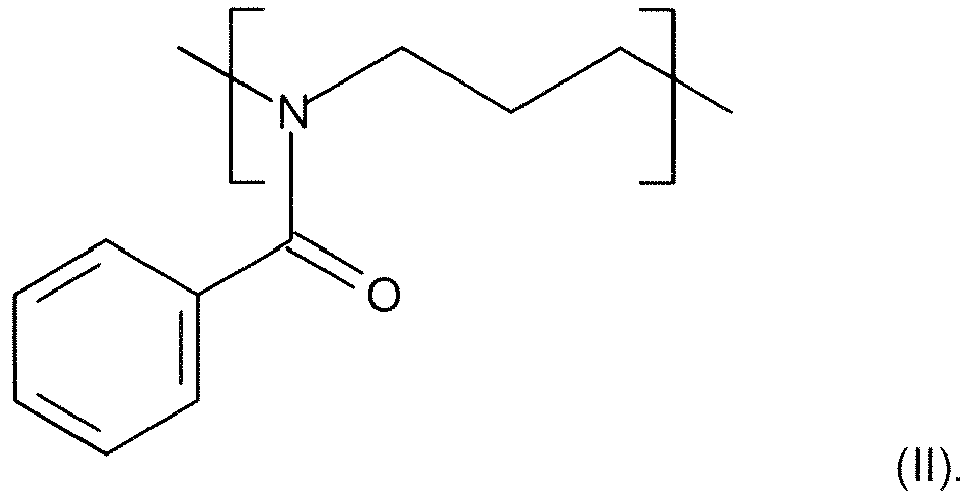
- 2. The block copolymer in accordance with
item 1, wherein R1 is methyl. - 3. The block copolymer in accordance with
item 1 or 2, wherein the number of repeating units of formula (I) forming each polymer block (A) is, independently for each polymer block (A) if more than one polymer block (A) is present, 5 or more and 100 or less. - 4. The block copolymer in accordance with item 3, wherein the number of repeating units of formula (I) forming each polymer block (A) is, independently for each polymer block (A) if more than one polymer block (A) is present, 10 or more and 70 or less.
- 5. The block copolymer in accordance with item 4, wherein the number of repeating units of formula (I) forming each polymer block (A) is, independently for each polymer block (A) if more than one polymer block (A) is present, 20 or more and 50 or less.
- 6. The block copolymer in accordance with
item 1 or item 2, wherein the structure of the polymer block (A) is represented by formula (Ia):
item 1 or 2, and n is 5 or more and 100 or less. - 7. The block copolymer in accordance with item 6, wherein n is 10 or more and 70 or less.
- 8. The block copolymer in accordance with item 7, wherein n is 20 or more and 50 or less.
- 9. The block copolymer in accordance with any of
items 1 to 8, wherein the number of repeating units of formula (II) forming each polymer block (B) is, independently for each polymer block (B) if more than one polymer block (B) is present, 5 or more and 100 or less. - 10. The block copolymer in accordance with item 9, wherein the number of repeating units of formula (II) forming each polymer block (B) is, independently for each polymer block (B) if more than one polymer block (B) is present, 5 or more and 70 or less.
- 11. The block copolymer in accordance with
item 10, wherein the number of repeating units of formula (II) forming each polymer block (B) is, independently for each polymer block (B) if more than one polymer block (B) is present, 10 or more and 33 or less. - 12. The block copolymer in accordance with any of
items 1 to 8, wherein the structure of the polymer block (B) is represented by formula (IIa):
- 13. The block copolymer in accordance with item 12, wherein m is 5 or more and 70 or less.
- 14. The block copolymer in accordance with item 13, wherein m is 10 or more and 33 or less.
- 15. The block copolymer in accordance with any of
items 1 to 14, which is a triblock copolymer having the structure (A)-(B)-(A). - 16. The block copolymer in accordance with any of
items 1 to 15, wherein the ratio of the total number of repeating units of formula (I) forming the polymer block(s) (A) to the total number of repeating units of formula (II) forming the polymer block(s) (B) in terms of the numbers of repeating units, is in the range of 20:1 to 1:1. - 17. The block copolymer in accordance with item 16, wherein the ratio of the total number of repeating units of formula (I) forming the polymer block(s) (A) to the total number of repeating units of formula (II) forming the polymer block(s) (B) in terms of the numbers of repeating units, is in the range of 16:1 to 2:1.
- 18. The block copolymer in accordance item 17, wherein the ratio of the total number of repeating units of formula (I) forming the polymer block(s) (A) to the total number of repeating units of formula (II) forming the polymer block(s) (B) in terms of the numbers of repeating units, is in the range of 8:1 to 3:1.
- 19. The block copolymer in accordance with any of
items 1 to 18, wherein the number average degree of polymerization of the block copolymer is in the range of 40 to 180. - 20. The block copolymer in accordance with item 19, wherein the number average degree of polymerization is in the range of 60 to 110.
- 21. The block copolymer in accordance with any of
items 1, 2, 6 to 8, 12 to 14 and 16 to 20, wherein the block copolymer is a triblock copolymer having the following structure (III):
item 1 or 2, n is defined as in items 6,7 or 8, and m is defined as in items 12, 13 or 14. - 22. A hydrogel comprising the block copolymer in accordance with any of
items 1 to 21. - 23. A process for the formation of a hydrogel, comprising the step of keeping an aqueous solution of the block copolymer in accordance with any of
items 1 to 21 at a temperature of 20°C or less. - 24. The process in accordance with item 23, wherein the aqueous solution of the block copolymer is kept at a temperature of 15°C or less.
- 25. The process in accordance with item 24, wherein the aqueous solution of the block copolymer is kept at a temperature of 10°C or less.
- 26. The process in accordance with item 24 or 25, wherein the aqueous solution of the block copolymer is kept at a temperature of not lower than 0°C.
- 27. The process in accordance with any of items 23 to 26, wherein the aqueous solution comprises the block copolymer at a concentration of 3 wt% to 40 wt%, based on the total weight of the solution as 100 wt%.
- 28. The process in accordance with item 27, wherein the aqueous solution comprises the block copolymer at a concentration of 5 wt% to 30 wt%, based on the total weight of the solution as 100 wt%.
- 29. A hydrogel, obtainable by the process in accordance with any of items 23 to 28.
- 30. Use of the block copolymer in accordance with any of
items 1 to 22 or of the hydrogel in accordance with items 23 or 29 as support material in 3D printing or as a matrix for the transport of a sensitive material. - Under dry and inert conditions, initiator and 2-methyl-2-oxazoline (MeOx) were added to dry benzonitrile (PhCN) and stirred for several hours at 110 °C. The full monomer conversion was verified by 1H-NMR-spectroscopy before adding the monomer for the second block. The mixture was cooled to room temperature and 2-phenyl-2-oxazine (PheOzi) was added. After stirring at 120 °C overnight the monomer (MeOx) for the third block was added. After completion of the third block, termination was carried out using the respective terminating agent and stirring for several hours at 45 °C. After cooling to room temperature, potassium carbonate was added and the mixture was stirred for 5 hours. The solvent was removed at reduced pressure and the flask was placed in a vacuum drying oven at 40 °C and 20 mbar for 2 days. The product was dissolved in deionized water, dialyzed overnight using a membrane with a MWCO of 1kDa and freeze-dried.
Figure 1 illustrates the structure of the resulting block copolymer, wherein m and n have the meanings defined above. - The polymers are characterized via NMR, size exclusion chromatography and rheology.
- NMR spectra were recorded on a Fourier 300 (300.12 MHz), Bruker Biospin (Rheinstetten, Germany) at 298 K. The spectra were calibrated to the signal of residual protonated solvent (CDCI3 at 7.26 ppm).
- Gel permeation chromatography (GPC) was performed on an Agilent 1260 Infinity System, Polymer Standard Service (Mainz, Germany) with HFIP containing 3 g/L potassium trifluoroacetate as eluent; precolumn: 50 x 8 mm PSS PFG linear M; 2 columns: 300 x 8 mm PSS PFG linear M (particle size 7 µm; pore size 0.1 - 1,000 kg/mol). The columns were kept at 40 °C and flow rate was 0.7 mL/min. Prior to each measurement, samples were filtered through 0.2 µm PTFE filters, Roth (Karlsruhe, Germany). Conventional calibration was performed with PEG standards (0.1 - 1,000 kg/mol) and data was processed with WinGPC software.
- Results from NMR and GPC analysis of different block copolymers (A: MeOx 35 blocks containing 35 repeating units derived from MeOx) are shown in the following Table 1. The ratio of blocks A and B can be determined in an appropriate non-selective solvent by comparing the signals of appropriate side chain signals of block A and block B. Endgroup analysis for the determination of the average degree of polymerization can be conducted after appropriate base line correction using the signal of initiator or termination fragment in relation to the signal of the polymer backbone or an appropriate polymer side chain signal. Alternatively, or in addition, this can be conducted in a solvent selective from one block, for example block A. The average degree of polymerization of block A can then be obtained by endgroup analysis, whereby the overall average degree of polymerization can be obtained by considering the molar ratio of block A and block B.
Table 1. Number average molar mass, ratio of oxazine/oxazoline (Ozi/Ox) units, dispersity Ð and yield of the synthesized triblock copolymers used in this study. Polymer Mn a [kg/mol] Ozi/Ox ratio b Mn c [kg/mol] Ð yield [%] A-PPheOzi15-A (B1) 8.7 1:3.9 3.7 1.22 89 A-PPheOzi15-A (B2) 8.6 1:4.1 3.8 1.28 83 A-PPheOzi15-A (B3) 8.7 1:3.9 2.8 1.23 81 A-PPheOzi15-A (B4) 8.7 /1:3.9 2.3 1.30 89 A-PPheOzi5-A 7.0 1:14 4.0 1.29 70 A-PPheOzi30-A 10.9 1:2.2 4.0 1.26 79 aValues obtained theoretical by [M]0/[I]0. bValues calculated from 1H-NMR side chain analysis (PPheOzi/PMeOx). cObtained from GPC (T= 40 °C, 0.7 mL/min (HFIP), poly(ethylene glycol) standards). dObtained from GPC by using Mw/Mn). - Rheology experiments were performed using an Anton Paar (Ostfildern, Germany) Physica MCR 301 system utilizing a plate-plate geometry (25 mm diameter) equipped with a solvent trap and Peltier element. All aqueous samples were stored after dissolving for 48 h at 5 °C. The temperature-sweep was performed in oscillation mode from 5-50 °C (Heat-rate: 0.05 °C/s), using a fixed amplitude of 0.1 % and angular frequency of 10 rad/s. The long-time gelation experiment was performed at an amplitude of 0.1 % and an angular frequency of 1 rad/s for several hours. To investigate the viscoelastic properties the linear viscoelastic region (LVR) was obtained by performing amplitude sweeps at different concentrations (5-40 wt.%) from 0.01 % to 500 % strain deformation and a fixed angular frequency of 10 rad/s at 5 °C. For steady shear experiments, the control shear rate mode was used from 0.01 to 10 1/s at 5 °C/s.
-
Figure 2 shows amplitude-sweeps of block copolymer B1 (cf. Table 1) of different concentrations (5 wt.%: storage modulus G': filled squares, loss modulus G": filled circles; 10 wt.%: G': empty squares, G": empty circles; 15 wt.%: G': filled triangle up, G": filled triangle down and 20 wt.%: G': empty triangle up, G": empty triangle down) at 5 °C and an angular frequency of 10 rad/s. -
Figure 3 illustrates a temperature-sweep of block copolymer B1 from 5 to 50 °C with a 15 wt.% aqueous polymer solution,Amplitude 1%,angular frequency 10 rad/s. Storage modulus is shown by squares, loss modulus by circles. At 27 °C the structure undergoes first changes and at 30 °C the structure dissolves - In
Figure 4 , the gelation kinetics of block copolymer B1 at 5 °C of a 15 wt.% aqueous polymer solution are shown.Amplitude 1%,angular frequency 10 rad/s. Storage modulus is shown by squares, loss modulus by circles. The reorganization of the hydrogel takes place in a time frame of 100 minutes. -
Figure 5 shows the viscosity of hydrogels of block copolymer B1 in dependency of applied shear rate and different polymer concentrations at 5 °C.
Claims (11)
- A block copolymer comprising
a polymer block (A) formed from repeating units of formula (I):
a polymer block (B) formed from repeating units of formula (II):
- The block copolymer in accordance with claim 1, wherein the structure of the polymer block (A) is represented by formula (Ia):

- The block copolymer in accordance with claim 1 or 2, wherein the structure of the polymer block (B) is represented by formula (IIa):

- The block copolymer in accordance with any of claims 1 to 3, which is a triblock copolymer having the structure (A)-(B)-(A).
- The block copolymer in accordance with any of claims 1 to 4, wherein the total number of repeating units in the block copolymer is in the range of 40 to 180.
- The block copolymer in accordance with any of claims 1 to 5, wherein the ratio of the total number of repeating units of formula (I) forming the polymer block(s) (A) to the total number of repeating units of formula (II) forming the polymer block(s) (B) in terms of the numbers of repeating units, is in the range of 20:1 to 1:1.
- A hydrogel comprising the block copolymer in accordance with any of claims 1 to 6.
- A process for the formation of a hydrogel, comprising the step of keeping an aqueous solution of the block copolymer in accordance with any of claims 1 to 6 at a temperature of 20°C or less.
- The process in accordance with claim 8, wherein the aqueous solution of the block copolymer is kept at a temperature of 15°C or less.
- The process in accordance with claim 8 or 9, wherein the aqueous solution comprises the block copolymer at a concentration of 3 wt% to 40 wt%, based on the total weight of the solution as 100 wt%.
- Use of the block copolymer in accordance with any of claims 1 to 6 or the hydrogel in accordance with claim 7 as support material in 3D printing or as a matrix for the transport of a sensitive material.
Priority Applications (2)
| Application Number | Priority Date | Filing Date | Title |
|---|---|---|---|
| EP19196221.6A EP3789424B1 (en) | 2019-09-09 | 2019-09-09 | Gel-forming block copolymers |
| US17/012,377 US12139579B2 (en) | 2019-09-09 | 2020-09-04 | Gel-forming block copolymers |
Applications Claiming Priority (1)
| Application Number | Priority Date | Filing Date | Title |
|---|---|---|---|
| EP19196221.6A EP3789424B1 (en) | 2019-09-09 | 2019-09-09 | Gel-forming block copolymers |
Publications (3)
| Publication Number | Publication Date |
|---|---|
| EP3789424A1 true EP3789424A1 (en) | 2021-03-10 |
| EP3789424C0 EP3789424C0 (en) | 2025-02-19 |
| EP3789424B1 EP3789424B1 (en) | 2025-02-19 |
Family
ID=67902404
Family Applications (1)
| Application Number | Title | Priority Date | Filing Date |
|---|---|---|---|
| EP19196221.6A Active EP3789424B1 (en) | 2019-09-09 | 2019-09-09 | Gel-forming block copolymers |
Country Status (2)
| Country | Link |
|---|---|
| US (1) | US12139579B2 (en) |
| EP (1) | EP3789424B1 (en) |
Cited By (1)
| Publication number | Priority date | Publication date | Assignee | Title |
|---|---|---|---|---|
| EP4063429A1 (en) * | 2021-03-25 | 2022-09-28 | Julius-Maximilians-Universität Würzburg | Inverse thermogelling polyoxazoline copolymers |
Citations (2)
| Publication number | Priority date | Publication date | Assignee | Title |
|---|---|---|---|---|
| US4540747A (en) * | 1983-06-10 | 1985-09-10 | Sumitomo Chemical Company, Limited | Block copolymer |
| US20190153157A1 (en) * | 2016-07-22 | 2019-05-23 | Julius-Maximilians-Universitaet Wuerzburg | Thermogelling supramolecular sponge as self-healing and biocompatible hydrogel |
Family Cites Families (1)
| Publication number | Priority date | Publication date | Assignee | Title |
|---|---|---|---|---|
| US5854331A (en) * | 1997-11-04 | 1998-12-29 | E. I. Du Pont De Nemours And Company | Block copolymers of oxazolines and oxazines as pigment dispersants and their use in ink jet inks |
-
2019
- 2019-09-09 EP EP19196221.6A patent/EP3789424B1/en active Active
-
2020
- 2020-09-04 US US17/012,377 patent/US12139579B2/en active Active
Patent Citations (2)
| Publication number | Priority date | Publication date | Assignee | Title |
|---|---|---|---|---|
| US4540747A (en) * | 1983-06-10 | 1985-09-10 | Sumitomo Chemical Company, Limited | Block copolymer |
| US20190153157A1 (en) * | 2016-07-22 | 2019-05-23 | Julius-Maximilians-Universitaet Wuerzburg | Thermogelling supramolecular sponge as self-healing and biocompatible hydrogel |
Non-Patent Citations (7)
| Title |
|---|
| H. WITTEW. SEELIGER, JUSTUS LIEBIGS ANNALEN DER CHEMIE, 1974, pages 996 - 1009 |
| L. HAHN ET AL., BIOMACROMOLECULES, vol. 19, no. 7, 2018, pages 3119 - 3128 |
| R. LUXENHOFERR. JORDAN, MACROMOLECULES, vol. 39, 2006, pages 3509 - 3516 |
| S. ; KOBAYASHI ET AL: "Block Copolymer from Cyclic Imino Ethers: A New Class of Nonionic Polymer Surfactant", MACROMOLECULES, vol. 19, no. 15, 1 January 1986 (1986-01-01), pages 535 - 541, XP055335114 * |
| T. BONNE ET AL., COLLOID. POLYM. SCI., vol. 282, 2004, pages 833 - 843 |
| T. BONNE ET AL., MACROMOL. CHEM. PHYS. 2008, 2007, pages 1402 - 1408 |
| Y.-J. KIMY. MATSUNAGA: "Thermo-responsive polymers and their application as smart biomaterials", J. MATER. CHEM. B, vol. 5, 2017, pages 4307 - 4321, XP055620232, doi:10.1039/C7TB00157F |
Cited By (2)
| Publication number | Priority date | Publication date | Assignee | Title |
|---|---|---|---|---|
| EP4063429A1 (en) * | 2021-03-25 | 2022-09-28 | Julius-Maximilians-Universität Würzburg | Inverse thermogelling polyoxazoline copolymers |
| WO2022200360A1 (en) * | 2021-03-25 | 2022-09-29 | Julius-Maximilians-Universität Würzburg | Inverse thermogelling polyoxazoline copolymers |
Also Published As
| Publication number | Publication date |
|---|---|
| US20210087338A1 (en) | 2021-03-25 |
| US12139579B2 (en) | 2024-11-12 |
| EP3789424C0 (en) | 2025-02-19 |
| US20230093774A9 (en) | 2023-03-23 |
| EP3789424B1 (en) | 2025-02-19 |
Similar Documents
| Publication | Publication Date | Title |
|---|---|---|
| US8835492B2 (en) | Temperature and pH sensitive block copolymer and polymeric hydrogels using the same | |
| Ward et al. | Multicompartment thermoresponsive gels: does the length of the hydrophobic side group matter? | |
| Guo et al. | pH-Switchable and self-healable hydrogels based on ketone type acylhydrazone dynamic covalent bonds | |
| Han et al. | Inverse thermally-reversible gelation of aqueous N-isopropylacrylamide copolymer solutions | |
| Monnery et al. | Thermoresponsive hydrogels formed by poly (2-oxazoline) triblock copolymers | |
| Huynh et al. | Sustained delivery of doxorubicin using biodegradable pH/temperature-sensitive poly (ethylene glycol)-poly (β-amino ester urethane) multiblock copolymer hydrogels | |
| US7193007B2 (en) | Environment responsive gelling copolymer | |
| Yang et al. | Self‐healing supramolecular waterborne polyurethane dispersions with quadruple hydrogen bonds in main chain | |
| US12168718B2 (en) | Thermogelling supramolecular sponge as self-healing and biocompatible hydrogel | |
| US20070249536A1 (en) | Three-component polyanhydride copolymers and a method of forming the same | |
| KR101274668B1 (en) | TEMPERATURE AND pH-SENSITIVE STAR-SHAPED BLOCK COPOLYMER HAVING EXCELLENT BIOADHESIVE PROPERTY AND METHOD OF MAKING THE SAME AND INJECTABLE HYDROGELS USING THEREOF | |
| WO2006109945A1 (en) | Temperature and ph sensitive block copolymer and polymeric hydrogles using the same | |
| Meng et al. | Dual thermal-and pH-responsive polypeptide-based hydrogels | |
| EP3789424B1 (en) | Gel-forming block copolymers | |
| Cai et al. | Synthesis and self‐assembly behavior of amphiphilic polypeptide‐based brush‐coil block copolymers | |
| Ranucci et al. | Block copolymers containing poly (ethylene glycol) and poly (amido-amine) or poly (amido-thioether-amine) segments | |
| Schmalz et al. | Smart hydrogels based on responsive star-block copolymers | |
| Agrawal et al. | Rheological characterization of biocompatible associative polymer hydrogels with crystalline and amorphous endblocks | |
| CA2402546C (en) | Environment responsive gelling copolymer | |
| Daengmankhong et al. | Water-soluble macromers based on 2-acrylamido-2-methyl-1-propanesulfonic acid sodium salt (Na-AMPS) for rapid in situ hydrogel film formation | |
| KR20190142569A (en) | Composition for polylactic acid toughening agents, toughening polylactic acid copolymer using the same and method for manufacturing thereof | |
| Wang et al. | Synthesis and sol-gel transition of novel temperature responsive ABA triblock-graft copolymers based on PCL and PEG analogues | |
| Xiao et al. | Synthesis and gelation of copolypept (o) ides with random and block structure | |
| Ohya et al. | Effects of polydepsipeptide side‐chain groups on the temperature sensitivity of triblock copolymers composed of polydepsipeptides and poly (ethylene glycol) | |
| Negru et al. | Poly (N-isopropylacrylamide-co-Nt-butylacrylamide)-block-poly (ethylene glycol)-block-poly (N-isopropylacrylamide-co-Nt-butylacrylamide) triblock copolymers: synthesis and thermogelation properties of aqueous solutions |
Legal Events
| Date | Code | Title | Description |
|---|---|---|---|
| PUAI | Public reference made under article 153(3) epc to a published international application that has entered the european phase |
Free format text: ORIGINAL CODE: 0009012 |
|
| STAA | Information on the status of an ep patent application or granted ep patent |
Free format text: STATUS: THE APPLICATION HAS BEEN PUBLISHED |
|
| AK | Designated contracting states |
Kind code of ref document: A1 Designated state(s): AL AT BE BG CH CY CZ DE DK EE ES FI FR GB GR HR HU IE IS IT LI LT LU LV MC MK MT NL NO PL PT RO RS SE SI SK SM TR |
|
| AX | Request for extension of the european patent |
Extension state: BA ME |
|
| STAA | Information on the status of an ep patent application or granted ep patent |
Free format text: STATUS: REQUEST FOR EXAMINATION WAS MADE |
|
| 17P | Request for examination filed |
Effective date: 20210910 |
|
| RBV | Designated contracting states (corrected) |
Designated state(s): AL AT BE BG CH CY CZ DE DK EE ES FI FR GB GR HR HU IE IS IT LI LT LU LV MC MK MT NL NO PL PT RO RS SE SI SK SM TR |
|
| STAA | Information on the status of an ep patent application or granted ep patent |
Free format text: STATUS: EXAMINATION IS IN PROGRESS |
|
| 17Q | First examination report despatched |
Effective date: 20240202 |
|
| GRAP | Despatch of communication of intention to grant a patent |
Free format text: ORIGINAL CODE: EPIDOSNIGR1 |
|
| STAA | Information on the status of an ep patent application or granted ep patent |
Free format text: STATUS: GRANT OF PATENT IS INTENDED |
|
| INTG | Intention to grant announced |
Effective date: 20240916 |
|
| GRAS | Grant fee paid |
Free format text: ORIGINAL CODE: EPIDOSNIGR3 |
|
| GRAA | (expected) grant |
Free format text: ORIGINAL CODE: 0009210 |
|
| STAA | Information on the status of an ep patent application or granted ep patent |
Free format text: STATUS: THE PATENT HAS BEEN GRANTED |
|
| AK | Designated contracting states |
Kind code of ref document: B1 Designated state(s): AL AT BE BG CH CY CZ DE DK EE ES FI FR GB GR HR HU IE IS IT LI LT LU LV MC MK MT NL NO PL PT RO RS SE SI SK SM TR |
|
| REG | Reference to a national code |
Ref country code: GB Ref legal event code: FG4D |
|
| REG | Reference to a national code |
Ref country code: CH Ref legal event code: EP |
|
| REG | Reference to a national code |
Ref country code: DE Ref legal event code: R096 Ref document number: 602019066076 Country of ref document: DE |
|
| REG | Reference to a national code |
Ref country code: IE Ref legal event code: FG4D |
|
| U01 | Request for unitary effect filed |
Effective date: 20250303 |
|
| U07 | Unitary effect registered |
Designated state(s): AT BE BG DE DK EE FI FR IT LT LU LV MT NL PT RO SE SI Effective date: 20250311 |
|
| PG25 | Lapsed in a contracting state [announced via postgrant information from national office to epo] |
Ref country code: RS Free format text: LAPSE BECAUSE OF FAILURE TO SUBMIT A TRANSLATION OF THE DESCRIPTION OR TO PAY THE FEE WITHIN THE PRESCRIBED TIME-LIMIT Effective date: 20250519 |
|
| PG25 | Lapsed in a contracting state [announced via postgrant information from national office to epo] |
Ref country code: PL Free format text: LAPSE BECAUSE OF FAILURE TO SUBMIT A TRANSLATION OF THE DESCRIPTION OR TO PAY THE FEE WITHIN THE PRESCRIBED TIME-LIMIT Effective date: 20250219 |
|
| PG25 | Lapsed in a contracting state [announced via postgrant information from national office to epo] |
Ref country code: ES Free format text: LAPSE BECAUSE OF FAILURE TO SUBMIT A TRANSLATION OF THE DESCRIPTION OR TO PAY THE FEE WITHIN THE PRESCRIBED TIME-LIMIT Effective date: 20250219 |
|
| PG25 | Lapsed in a contracting state [announced via postgrant information from national office to epo] |
Ref country code: IS Free format text: LAPSE BECAUSE OF FAILURE TO SUBMIT A TRANSLATION OF THE DESCRIPTION OR TO PAY THE FEE WITHIN THE PRESCRIBED TIME-LIMIT Effective date: 20250619 Ref country code: NO Free format text: LAPSE BECAUSE OF FAILURE TO SUBMIT A TRANSLATION OF THE DESCRIPTION OR TO PAY THE FEE WITHIN THE PRESCRIBED TIME-LIMIT Effective date: 20250519 |
|
| PG25 | Lapsed in a contracting state [announced via postgrant information from national office to epo] |
Ref country code: HR Free format text: LAPSE BECAUSE OF FAILURE TO SUBMIT A TRANSLATION OF THE DESCRIPTION OR TO PAY THE FEE WITHIN THE PRESCRIBED TIME-LIMIT Effective date: 20250219 |
|
| PG25 | Lapsed in a contracting state [announced via postgrant information from national office to epo] |
Ref country code: GR Free format text: LAPSE BECAUSE OF FAILURE TO SUBMIT A TRANSLATION OF THE DESCRIPTION OR TO PAY THE FEE WITHIN THE PRESCRIBED TIME-LIMIT Effective date: 20250520 |
|
| PG25 | Lapsed in a contracting state [announced via postgrant information from national office to epo] |
Ref country code: SM Free format text: LAPSE BECAUSE OF FAILURE TO SUBMIT A TRANSLATION OF THE DESCRIPTION OR TO PAY THE FEE WITHIN THE PRESCRIBED TIME-LIMIT Effective date: 20250219 |
|
| PG25 | Lapsed in a contracting state [announced via postgrant information from national office to epo] |
Ref country code: CZ Free format text: LAPSE BECAUSE OF FAILURE TO SUBMIT A TRANSLATION OF THE DESCRIPTION OR TO PAY THE FEE WITHIN THE PRESCRIBED TIME-LIMIT Effective date: 20250219 |
|
| U20 | Renewal fee for the european patent with unitary effect paid |
Year of fee payment: 7 Effective date: 20250916 |
|
| PG25 | Lapsed in a contracting state [announced via postgrant information from national office to epo] |
Ref country code: SK Free format text: LAPSE BECAUSE OF FAILURE TO SUBMIT A TRANSLATION OF THE DESCRIPTION OR TO PAY THE FEE WITHIN THE PRESCRIBED TIME-LIMIT Effective date: 20250219 |
|
| PLBE | No opposition filed within time limit |
Free format text: ORIGINAL CODE: 0009261 |
|
| STAA | Information on the status of an ep patent application or granted ep patent |
Free format text: STATUS: NO OPPOSITION FILED WITHIN TIME LIMIT |
|
| REG | Reference to a national code |
Ref country code: CH Ref legal event code: L10 Free format text: ST27 STATUS EVENT CODE: U-0-0-L10-L00 (AS PROVIDED BY THE NATIONAL OFFICE) Effective date: 20251231 |
|
| 26N | No opposition filed |
Effective date: 20251120 |
|
| REG | Reference to a national code |
Ref country code: CH Ref legal event code: H13 Free format text: ST27 STATUS EVENT CODE: U-0-0-H10-H13 (AS PROVIDED BY THE NATIONAL OFFICE) Effective date: 20260504 |